
Final Results
Summary by AI BETAClose X

21 May 2026
BRAEMAR PLC
("Braemar", "the Company" and together with its subsidiaries the "Group")
Audited Financial Results for the year ended 28 February 2026
Strong strategic progress reinforces confidence in FY30 growth targets
FY26 results in line with expectations
Braemar Plc (LSE: BMS), a leading provider of expert chartering, investment and risk management advice to the shipping and energy markets, announces its audited results for the year ended 28 February 2026 ("FY26").
James Gundy, Group CEO of Braemar, commented:
"We made significant strategic progress in FY26 towards our stated ambition of delivering £200m of revenue by FY30. This included expanding our geographic footprint, launching new capabilities and completing a share buyback programme, all while successfully navigating a period of considerable geopolitical uncertainty. Our performance in line with expectations demonstrates the value and resilience of our diversified business model and reinforces our confidence in Braemar's ability to perform across market cycles.
"We enter the new financial year with strong momentum, a strengthening forward order book and a leadership team focused on disciplined execution. As the situation in the Middle East continues to evolve, our priority remains supporting our clients with high-quality advice, market insight and execution capability. In a fragmented industry, we believe that this environment also provides opportunities to deepen client relationships and gain market share.
"This is my final set of results as Group CEO, as I step down from the board in July to focus on my shipbroking activities. This decision was made from a position of confidence in Braemar's leadership, strategy and future prospects. I am immensely proud of what this team has built together, transforming our operational platform, broadening our service offering, expanding our global reach and laying the foundations for the next chapter of growth.
"I am confident that the business will be in excellent hands under Grant's leadership as our new CEO. My commitment to Braemar, and my belief in what it can achieve, remain as strong as ever and I look forward to continuing to contribute to the success of the business in my broking role as we pursue our growth ambitions."
Financial Performance
|
|
Underlying results* |
Statutory results |
|||||
|
|
FY26 |
FY25 |
% change |
FY26 |
FY25 |
% change |
|
|
Revenue |
£135.6m |
£141.9m |
(4%) |
£135.6m |
£141.9m |
(4%) |
|
|
Operating profit (before acquisition-related expenditure) |
£13.2m |
£16.7m |
(21%) |
£12.4m |
£16.0m |
(23%) |
|
|
Operating profit |
£12.4m |
£15.6m |
(20%) |
£7.7m |
£11.2m |
(31%) |
|
|
Profit before tax |
£10.1m |
£13.4m |
(25%) |
£4.6m |
£9.2m |
(50%) |
|
|
Earnings per share (basic) |
24.23p |
31.30p |
(23%) |
7.24p |
19.41p |
(63%) |
|
|
Total dividend per share |
7.0p |
7.0p |
- |
7.0p |
7.0p |
- |
|
* Underlying results measures above are before specific items, including some acquisition-related expenditure and corporate costs
· Resilient financial performance:
o Continued strong cash generation with net cash generated from operations of £12.1m (FY25: £5.9m)
o Group revenues of £135.6m (FY25: £141.9m), reflecting weaker chartering rates in the first half, partially offset by strong performances in S&P and Risk Advisory, highlighting the benefits of the Group's diversified business model
o Underlying operating profit (before acquisition-related expenditure) of £13.2m (FY25: £16.7m)
o The Group returned to a net cash position in March 2026, in line with the Group's normal working capital cycle, after ending the year with net debt of £2.9m (FY25: net debt £2.5m)
Operational Highlights
· Strong progress against strategic framework targets set out in FY25:
o Expansion into new jurisdiction with the opening of the Cape Town office, Braemar's first office in Africa
o Key senior hires made throughout the year, strengthening desk capabilities
o Globalisation of tankers operations
o Launch of a UK Organised Trading Facility ("OTF") enhancing and further supporting the growth in the Risk Advisory business
· Completion of a £2 million share buyback representing the board's confidence in Braemar's intrinsic value and long-term growth trajectory
Final Dividend
The board is proposing a final dividend for the year ended 28 February 2026 of 4.5 pence per share for approval by shareholders at the Company's Annual General Meeting to be held on 2 July 2026. Subject to shareholder approval, the final dividend will be paid on 7 September 2026 to shareholders who are on the register at the close of business on 31 July 2026, with a corresponding ex-dividend date of 30 July 2026. The last date for Dividend Reinvestment Plan ("DRIP") elections will be 14 August 2026.
Outlook
· Strong current trading and strengthening forward order book
o Trading in the first two months of the new financial year has been strong
o Geographic and revenue stream diversity is helping to mitigate the effect of ongoing geopolitical disruption
o The structural drivers underpinning demand for Braemar's services remain compelling, with a robust forward order book of $72.5m at 28 February 2026 (FY25: $82.2m), increasing to $77.9m as at 30 April 2026
· Continued strategic progress
o Approval received in May for an office in the Dubai International Financial Centre
o Approval for European OTF expected in first half of the new financial year
· FY27 output set:
o Hiring 10 new brokers
o Establish one new desk in Risk Advisory
o Embed AI across the business
o Complete one complementary M&A transaction
· Confident in FY30 growth targets
o With a reinforced operational platform, a clear long‑term plan and a strong pipeline of opportunities, the Board is confident of further progress and of delivering annual revenue of £200m by FY30
Board
As previously announced on 17 February 2026, James Gundy will step down as Group CEO and a director of the Company at the Annual General Meeting on 2 July 2026 and Grant Foley will succeed James as Group CEO. James will remain with the Group and focus on his shipbroking activities.
Analyst Presentation
Management will host a briefing for analysts at 09:00 BST today at Braemar's offices at One Strand, Trafalgar Square, London, WC2N 5HR. For further details, please contact the team at Houston via braemar@houston.co.uk.
Investor Webcast
Braemar will also host a webcast via the Investor Meet Company platform later today, commencing at 14:00 BST. The presentation is open to all existing and potential shareholders. Questions can be submitted pre-event via the Investor Meet Company dashboard up until 09:00 BST this morning, or at any time during the live presentation.
Investors can sign up to Investor Meet Company for free and add to meet BRAEMAR PLC via:
https://www.investormeetcompany.com/braemar-plc/register-investor
The 2026 Annual Report and Accounts will be available on the Company's website (www.braemar.com) shortly.
Enquiries:
|
Braemar Plc |
Tel: +44 (0)20 3142 4100 |
|
James Gundy, Group Chief Executive Officer |
|
|
Grant Foley, Group Chief Financial and Operating Officer |
|
|
Rebecca-Joy Wekwete, Company Secretary |
|
|
|
|
|
Houston |
Tel: +44 (0)20 4529 0549 |
|
Kate Hoare / Charlie Barker / Polly Clarke |
Tel: +44 (0)77 3303 2695 |
|
|
|
|
Canaccord Genuity |
Tel: +44 (0) 20 7523 8000 |
|
Adam James / Harry Rees |
|
About Braemar Plc
Braemar provides expert advice in shipping chartering, investment and risk management to enable its clients to secure sustainable returns and mitigate risk in the volatile world of shipping. Our experienced brokers work in tandem with specialist professionals to form teams tailored to our customers' needs, and provide an integrated service supported by a collaborative culture.
Braemar joined the Official List of the London Stock Exchange in November 1997 and trades under the symbol BMS.
For more information, including our investor presentation, visit www.braemar.com and follow Braemar on LinkedIn.
Chairman's Statement
FY26 has validated the board's strategy. Disciplined execution and operational delivery continue to unlock new opportunities and reinforce confidence in the Group's future.
I am pleased to present Braemar's Annual Report for the financial year ended 28 February 2026, a year in which the Group's diversified operating model once again demonstrated its strength by reducing our exposure to volatility in any single market segment, enabling resilient performance through shifting market conditions.
FY26 marked the commencement of operations under our updated strategic framework, which is underpinned by a commitment to operational excellence, diversifying our revenue streams and disciplined market consolidation. This framework was announced in May 2025 and provides a clear statement of our ambitions to grow, amongst other things, to at least £200 million of revenue by FY30, as well as one-year operational targets to mark our progress.
I am delighted to report that we have made good progress against these objectives during the year and, notwithstanding ongoing geopolitical uncertainty, maintained a clear focus on disciplined execution. The Group has strengthened its platform further and is well positioned to achieve sustainable future growth.
Overview of the Year
The macroeconomic environment during the year was challenging, marked by volatility in energy markets, ongoing geopolitical uncertainty and an evolving regulatory environment. Nevertheless, the Group delivered a solid operational and financial performance. Its financial results are in line with the board's expectations, underscoring the resilience of the Group's diversified business model and the enduring strength of our client relationships.
As anticipated, the second half of the year delivered a notably stronger performance than the first, reflecting improved market conditions and demonstrating the Group's ability to successfully balance and optimise its exposure across chartering, investment advisory and risk management activities.
Revenue for the year was £135.6 million (FY25: £141.9 million), and underlying operating profit (before acquisition-related expenditure) was £13.2 million (FY25: £16.7 million).
Net debt at year-end remained consistent at £2.9 million (FY25: £2.5 million) with the Group returning to a net cash positive position during March 2026.
Operational and Strategic Progress
In FY26 we were pleased to see the board's objectives, set out in our strategic framework, immediately start to translate into operational and strategic results. These results included:
· Opening Braemar's first office in Africa, establishing a new jurisdictional footprint and supporting our ambition to expand our influence across emerging markets;
· Enhancing our Risk Advisory business through the launch of a UK Organised Trading Facility, enabling greater operational depth and market access;
· Strengthening leadership capability with a number of key senior hires across the Group; and
· Completing a £2 million share buyback programme, reflecting the board's confidence in Braemar's intrinsic value and long-term growth trajectory.
In addition, the board continues to actively evaluate complementary acquisition opportunities that support the Group's objective. Through these evaluations, a rigorous and highly selective due diligence process is applied, and a transaction will only proceed through to completion if there is a clear strategic alignment and confidence in long-term value creation.
Middle East Conflict
The escalation of conflict across the Middle East, and the effective closure of the Strait of Hormuz has resulted in the most significant disruption to global shipping since the 2021 Suez blockage. A significant proportion of the world's oil and gas products pass through the Strait and this closure has led to increased energy prices and freight rates globally.
For Braemar, this backdrop presents both uncertainty and opportunities for growth. Periods of geopolitical disruption tend to reward resilient, well-invested platforms with strong operational execution and diversified revenue streams. Braemar's operating model and disciplined investment in talent and systems, position the firm well to navigate current geopolitical challenges effectively.
Board Changes
In February 2026, James Gundy announced his intention to step down as Group Chief Executive Officer ("Group CEO") and as a director of the Company at the Annual General Meeting on 2 July 2026 ("AGM"). Following the AGM, James will continue with the business, focusing on his shipbroking activities, where he has over 40 years' experience.
I am pleased to confirm that the board appointed Grant Foley, currently Group Chief Financial and Operating Officer (CEO designate), to succeed James as Group CEO with effect from 2 July 2026. I would like to extend my sincere thanks to James for his leadership and contribution over the past five years. During his tenure, he has reshaped Braemar, profitably divested non-core operations, eliminated a significant debt burden and built a more diversified and resilient shipbroking business. I am delighted that, after stepping down, James will remain with the Group to continue serving his broking clients. Grant joined the Company in 2023 and since that time, it has been clear that he has all the operational, financial and strategic skills to be the natural choice to succeed James. The board is confident that his extensive operational experience and knowledge of the business mean that Grant is ideally placed to lead the Group in the next stage of its growth. The search for a new Chief Financial Officer is progressing well, and I expect to give an update in due course.
Dividend
The board will recommend a final dividend for the year ended 28 February 2026 of 4.5 pence for approval by shareholders at the Company's AGM. This payment is in line with our updated Capital Allocation Framework announced in May 2025 and designed to reflect a balance between growth investment and returning cash to shareholders.
The final dividend, together with the interim dividend of 2.5 pence paid on 13 January 2026, represents a total dividend of 7.0 pence, in line with last year's total payment. The final dividend will be paid on 7 September 2026 to shareholders who are on the register at the close of business on 31 July 2026, with a corresponding ex-dividend date of 30 July 2026. The last date for Dividend Reinvestment Plan ("DRIP") elections will be 14 August 2026.
Outlook
As we enter FY27, we do so with a reinforced operational foundation, a clear long‑term plan and a strong pipeline of opportunities. These elements position us well to advance towards our ambition of becoming the trusted broker of choice for the shipping and energy markets, delivering annual revenues of at least £200m by FY30, with a 15% underlying operating profit margin and balance sheet leverage under 1.5x EBITDA.
We look to the future with increasing confidence.
Acknowledgements
On behalf of the board, I would like to thank our colleagues across the Group for their hard work, professionalism and commitment throughout the year. Their contribution has been central to navigating a complex market landscape while delivering on our long-term strategic goals. I would also like to express our appreciation to our clients and shareholders for their continued trust and support.
Braemar's future remains bright. With a proven model, a global footprint, a clear strategic path and an energised workforce, we are well placed to strengthen our position in the shipping and energy markets in the years ahead.
Nigel Payne
Chairman
20 May 2026
Group Chief Executive Officer's Statement
As I approach the end of my tenure as Group CEO, I find myself reflecting not only on the past five and a half years in this role, but on a longer journey - from my time as CEO of ACM, through the merger with Braemar in 2014, and my subsequent role as CEO of Shipbroking within the Group. Each of those chapters shaped my thinking and gave me the clarity of vision that has guided the transformation of Braemar into the business it is today.
When I stepped into the Group CEO role, I had three clear priorities: to reduce debt, to return the business to its core foundations in shipbroking, and to build out selectively into complementary areas where we had genuine expertise and competitive advantage. We were disciplined - growing only where we truly understood the market and could add real value for clients.
Over the course of my tenure we have meaningfully expanded our global footprint, entering new geographies and growing our presence in markets that are strategically important to our clients. Our expansion into the United States, and the acquisition of Southport in particular, has been a significant milestone - that location is central to a key part of our client base and has opened doors to new sectors within the shipbroking space.
One of my longest-held ambitions was to move Braemar into the securities and derivatives space. The acquisition of Atlantic Securities in 2017 - a regulated business focused on physical coal and swaps - provided exactly the platform we needed. From that foundation we have built out across multiple desks, focusing on sectors that complement our shipbroking heritage. Braemar Securities is now a core and growing part of the Group, and I have considerable confidence in its future trajectory.
I am immensely proud of how the business has evolved and performed during this period. Revenue has grown by 62%, underlying operating profit has increased by 71%, and net debt has been materially reduced. These are not just financial metrics - they reflect the sustained effort of an exceptional team and the strength of the strategy we have pursued together.
FY26 has been a year of resilient delivery, demonstrating once again that the diversification strategy was the right one. We enter the next phase of our journey with a strong platform firmly in place, and I am highly confident in Braemar's prospects and the opportunities that lie ahead.
It has been a privilege to work alongside such an exceptional team. During my tenure, the Group has navigated periods of rapid growth, global uncertainty, and significant change. Throughout this time the resilience, integrity and commitment of our people have been one of our greatest strengths. Together we have expanded our market presence, advanced our strategic priorities, and established firm foundations for long-term, sustainable growth and success.
Through diversification, an expanded global reach, and a culture in which talent can thrive and clients are fully supported, Braemar is now a more resilient and sustainable business. These achievements reflect a truly collective effort, driven by a sense of shared purpose and aligned values.
I would like to thank all our employees for their dedication and professionalism, our clients for their trust, and our shareholders and partners for their unwavering support. I am also grateful to the board for its guidance, insight, and constructive challenge throughout my time as Group CEO.
The Group enters its next chapter from a position of strength. Grant Foley brings exceptional capability to the Group CEO role, and having worked closely with him for the past three years, I am confident that the business is in excellent hands. I have no doubt that Braemar will continue to evolve, innovate, and deliver long-term value for all stakeholders.
While I am stepping down from the Group CEO role, I am returning my full focus to what I have always loved most - broking. It is the work that drew me to this industry and, if I am honest, the work I never really stopped doing. My belief in this organisation, and my commitment to its people and its future, remain as strong as ever.
Robust Performance
FY26 was a year of disciplined execution, with Braemar making good operational progress in support of the growth objectives set out in our strategic framework in May 2025. All this was again achieved against a challenging and volatile macroeconomic environment backdrop, with the year characterised by the resilience of our performance as we continued to invest in our growth platform and capitalise on opportunities.
Market conditions remained complex, shaped by geopolitical uncertainty, disrupted trade flows, and an evolving regulatory landscape. The escalation of conflict affecting Red Sea and Middle East shipping routes significantly reshaped tonne mile demand, voyage economics, and freight risk dynamics, underscoring the importance and value of high-quality advisory insight and risk management expertise.
Against this backdrop, the Group delivered a resilient operational performance, with momentum building through the second half of the year.
For FY26, the Group delivered revenue of £135.6 million (FY25: £141.9 million), a decrease of 4%, in line with expectations and primarily reflecting reduced chartering rates. This was partly offset by strong performances in Sale and Purchase and Risk Advisory. Chartering rates improved during the second half of the year although overall US dollar revenues were at similar levels. This leaves the business well positioned for improved performance ahead.
Underlying operating profit (before acquisition related costs) of £13.2 million (FY25: £16.7 million) was £3.5 million lower year on year, reflecting the reduced revenue. Operating expenditure remained well controlled during the year while continuing to support targeted investment in both senior revenue-generating roles and operational infrastructure. We strengthened our compliance capability and implemented enhanced technology solutions to further support our brokers and improve efficiency across the business.
Strong progress on strategic priorities
Our growth strategy is built around three pillars:
1. Operational Excellence
2. Diversification
3. Consolidation
During the year, the Group made good progress executing our strategy, further enhancing resilience, deepening client engagement, and strengthening the platform required to achieve our FY30 ambitions, including reaching annual revenues of at least £200 million and 15% underlying operating profit margin.
Our diversified business model continued to perform as intended, effectively balancing exposure across physical chartering, investment advisory, and risk management activities, with the Group well positioned to capitalise on organic and acquisitional growth opportunities as they arise.
Strategic Pillars in Action
Operational Excellence
Operational excellence remains a core enabler of the Group's sustainable growth strategy. During the year further progress was made in strengthening governance, systems and processes across the business, alongside continued investment in technology, data, and infrastructure. These initiatives, together with ongoing focus on regulatory compliance, are enhancing scalability, resilience and the quality of decision making across the Group.
Cost discipline remained a clear priority, particularly during softer market conditions in the first half of the year. Targeted investment in talent also continued.
Collectively these actions underpinned accelerating second half momentum and positioned the Group to enter FY27 with improved operational readiness, a strong platform for continued growth and the ability to capture opportunities as they arise.
Diversification
Diversification remains integral to Braemar's ability to deliver consistent performance across shipping and market cycles, supporting earnings resilience while providing multiple avenues for growth. During FY26, the Group continued to benefit from the breadth of its activities across Chartering, Investment Advisory and Risk Advisory.
Risk Advisory further expanded its contribution, supported by the launch of our UK Organised Trading Facility and Cross Commodities during the year with a further desk expected to be launched in FY27.
Geographic diversification also advanced during the year, with the opening of the Group's first office in Africa, extending Braemar's jurisdictional footprint. This geographic expansion strengthens local market access, enhances client coverage and further positions the Group to capitalise on long-term growth opportunities across key emerging markets.
Consolidation
In line with our strategy, we continue to actively evaluate complementary acquisition opportunities during the year. Our approach remains highly disciplined with a clear focus on strategic fit, cultural alignment, and shareholder value creation. While a limited number of opportunities advanced through enhanced due diligence, the Group remained steadfast in applying its rigorous investment framework and will not proceed where a transaction does not fully meet return and risk thresholds. This approach reflects our commitment to prudent capital allocation, maintaining strategic focus and creating sustainable value for shareholders.
Furthermore, the Group remained focused on consolidating its operating platform with continued investment in consistency, governance, and collaboration. During the year we further embedded a more integrated operating model, enhancing alignment across physical broking, advisory and risk management teams. This integration is enabling deeper client relationships, more efficient capital and risk oversight and clearer accountability across regions and business lines. Importantly, these enhancements have been achieved while preserving the Group's entrepreneurial culture, underpinned by a disciplined and robust control framework that supports sustainable growth.
Sustainability and Responsible Business
Sustainability considerations are playing an increasingly important role in client decision making, particularly across asset investment, fleet renewal, and risk management. We are well positioned to support clients as they respond to regulatory change, evolving emissions requirements, and energy transition related investment decisions. This is reflected in growing demand for advisory services across sale and purchase, corporate finance and risk advisory reinforcing the relevance of the Group's diversified expertise in a changing market environment.
Internally, the Group remains focused on strong governance, responsible business practices, and disciplined capital allocation, supporting long term value creation for shareholders.
Outlook
While geopolitical and macroeconomic uncertainty continues, the structural drivers underpinning demand for Braemar's diversified services remain strong. Ongoing disruption to global trade patterns, increasing regulatory complexity and heightened market volatility continue to reinforce the importance of specialist advice and sophisticated risk management solutions. This underpins sustained demand for the Group's capabilities.
As the Group enters FY27, it does so from a position of increased strength, supported by continued investment in our operating platform, improving momentum, a strong forward order book and clear strategic objectives to support sustainable future growth. As a result, the business is well positioned to capture opportunities across market cycles and support the Board's confidence of achieving our FY30 growth ambitions to establish Braemar as the trusted broker of choice in global shipping and energy markets, generating at least £200m revenue with a 15% underlying operating profit margin.
I would like to thank our clients for their continued trust, our colleagues for their commitment and professionalism throughout FY26 and our shareholders for their ongoing support. With a resilient operating model, a strong forward order book, M&A opportunities being evaluated and a clear long-term strategy, Braemar is well positioned to navigate future challenges, invest selectively and deliver sustainable value over the long term.
I am excited by the opportunities for the Group under Grant's leadership, and look forward to contributing to the business in the years ahead.
James Gundy
Group Chief Executive Officer
20 May 2026
Financial Review
Revenue
Revenue from continuing operations declined 4% year on year, reflecting softer conditions in chartering markets, particularly in the first half of the financial year. This impact was partially mitigated by strong performances in Sale and Purchase and Risk Advisory underlining the benefits of the Group's diversified, advisory-led model and its increasing resilience. The Group continued to invest selectively in its operating platform during the period and trading momentum improved during the second half as chartering rates strengthened. Overall, second half revenues were 11% higher than the first half.
Chartering revenues declined 16% to £74.7 million (FY25: £89.4 million) reflecting weaker market conditions and the restructuring of the Tanker and Dry Cargo broking desks. Investment Advisory revenues increased by 6% to £32.1 million (FY25: £30.2 million), driven by a strong performance in Sale and Purchase. Risk Advisory saw strong growth with revenues increasing 29% to £28.8 million (FY25: £22.3 million), further demonstrating the value of the Group's diversification.
The majority of the Group's revenues are denominated in US dollars. During the year, sterling strengthened against the US dollar moving from $1.26 at the start of the year to $1.35 at the end of the year, which had an adverse translation impact on reported revenues. Total revenues at $177 million were modestly lower than the prior year (FY25: $179 million).
Foreign exchange exposure continues to be actively managed. At 28 February 2026, the Group held forward currency contracts to sell $75.9 million at an average rate of US$1.30/£1.
At 28 February 2026, the Group's forward order book stood at $72.5 million (FY25: $82.2 million) with $37.6 million contracted to convert within the next 12 months, providing meaningful near-term revenue visibility. The reduction from the prior year primarily reflects a lower Chartering forward book, partly offset by a robust Sale and Purchase pipeline. This forward order book provides a sound foundation for the board's confidence in the Group's near-term trading outlook and supports expectations for FY27.
Operating Profit and Profit before tax
The Group delivered underlying profit (before acquisition-related expenditure) of £13.2 million, 21% lower than the prior year and underlying profit before tax of £10.1 million, a 25% reduction compared with the prior year. This outcome primarily reflects the impact of lower revenues from weaker chartering markets, particularly during the first half of the year. Costs discipline remained strong throughout the period and the business generated strong operating cash flow of £12.1 million (FY25: £5.9 million).
The Group enters FY27 with a strong forward order book and a clear strategic framework designed to build and support sustainable and resilient performance.
• Underlying operating profit (before acquisition-related expenditure) £13.2 million (FY25: £16.7 million).
• Underlying operating profit £12.4 million (FY25: £15.6 million).
• Underlying profit before tax £10.1 million (FY25: £13.4 million)
• Statutory operating profit £7.7 million (FY25: £11.2 million).
• Statutory profit before tax £4.6 million (FY25: £9.2 million).
Operating costs
Underlying operating costs were £121.4 million, a reduction of £2.7 million compared with the prior year (FY25: £124.1 million). While the Group continued to invest in people and technology to support its strategic priorities, overall expenditure declined largely due to lower bonus costs reflecting reduced financial performance for the year.
Central costs
Central costs increased to £7.2 million (FY25: £5.6 million) reflecting the full-year impact of the Group's London headquarters at One Strand as previously sublet space was vacated by occupying tenants, investment in senior leadership and governance and further enhancements to the Group's compliance and control infrastructure. These investments strengthen the Group's operating platform and support long term scalability.
Specific items
The Group uses Alternative Performance Measures ("APMs") as key financial indicators to assess underlying performance. Management considers that these APMs provide a useful complement to statutory measures by excluding items that do not relate to underlying trading performance for the period. This approach is to assist investors and other stakeholders in evaluating the ongoing performance of the Group.
Items that are not considered part of the Group's underlying trade are presented separately as specific items, where their size and/or nature could otherwise distort interpretations of operating performance. Further details are set out in Note 2.2 to these Financial Statements.
|
|
FY26 |
FY25 |
|
|
£'000 |
£'000 |
|
Underlying operating profit before specific items and acquisition-related expenditure |
13,180 |
16,731 |
|
Acquisition-related expenditure |
(757) |
(1,134) |
|
Underlying operating profit before specific items |
12,423 |
15,597 |
|
Specific items - Acquisition-related expenditure |
(3,952) |
(3,711) |
|
Specific items - Other operating costs |
(782) |
(928) |
|
Specific items - Other operating income |
- |
215 |
|
Operating profit |
7,689 |
11,173 |
Acquisition-related expenditure includes the final charge of £2.9 million associated with the acquisition of Southport Maritime Inc. (FY25: £3.6 million). Other operating costs include £0.4 million (FY25: £0.7 million) relating to the impairment of a right-of-use lease asset.
Net finance costs
Net finance costs for the year increased by £1.3 million to £3.3 million (FY25: £2.0 million). This increase reflects a £0.7 million fair value loss on forward currency contracts not designated for hedge accounting (FY25: £nil), lower interest income on bank deposits of £0.2 million and a £0.4 million increase in foreign exchange losses on financing liabilities compared with the prior year. Interest payable on the Group's revolving credit facility at £2.2 million was in line with FY25.
During the year, one of the Group's forward exchange contract counterparties entered administration. Hedge accounting was discontinued from the point of identification, giving rise to the fair value loss of £0.7 million recognised within the finance costs. This has been treated as a specific item as it does not reflect the Group's underlying hedging strategy.
Taxation
The Group's underlying effective tax rate in FY26 was 24.8% (FY25: 26.7%) reflecting the global nature of the Group's operations.
Dividend
Reflecting the board's confidence in the Group's cash generation, balance sheet and medium-term prospects whilst also being mindful of disciplined capital allocation, the board has recommended a final dividend of 4.5 pence (FY25: 2.5 pence) per share. Subject to shareholder approval at the AGM on 2 July 2026, the dividend will be paid on 7 September 2026.
The total dividend of 7.0 pence for the year (FY26: 7.0 pence) is covered 3.5 times by the underlying earnings per share from operations of 24.23 pence. The total cash outflow in respect of dividends paid during the year ended 28 February 2026 was £1.6 million (FY25: £5.5 million), and the Group completed its £2 million share buyback programme during the year.
Balance sheet
Net assets at 28 February 2026 were £82.4 million, a decrease of £1.8 million compared with the prior year (FY25: £84.2 million). Total assets reduced by £2.0 million over the period, reflecting lower trade and other receivables (£1.7 million), property, plant and equipment (£1.3 million) and deferred tax assets (£1.2 million). These movements were partially offset by increases in cash balances (£2.9 million) and derivative assets (£1.8 million).
Total liabilities decreased marginally by £0.2 million. This primarily reflected the repayment of the Group's convertible loan notes (£2.4 million) and utilisation of the uncertain commission obligation provision (£1.9 million), offset by increased trade and other payables (£2.6 million) consistent with the timing of activity towards the year end.
Goodwill of £71.4m was tested for impairment during the year with no impairment identified. The Chartering segment demonstrated headroom of £7.7 million, providing a strong degree of comfort. The Corporate Finance cash generating unit carries more limited headroom of £0.4 million, reflecting the inherently highly variable nature of M&A success fees in the current market environment. The board remains focused on strengthening the Corporate Finance pipeline to support the sustainable long-term value of this business.
Borrowings and Cash
At the Balance Sheet date, the Group had access to a £40 million revolving credit facility with HSBC. The facility also includes a global cash pooling arrangement in the UK, USA, Germany and Singapore supporting efficient liquidity management across the Group's core operating regions. Net debt at the end of the year comprising £26.3 million of revolving credit facilities and £23.4 million of cash, was £2.9 million (FY25: £2.5 million), in line with the Group's usual working capital cycle.
Cash flow
The Group generated net cash from operations of £12.1 million in FY26 (FY25: £5.9 million), reflecting strong profit conversion and a working capital inflow of £2.2 million (FY25: £12.0 million outflow) as receivables and payables were actively managed. Cash deployment across financing activities totalled £9.7 million, comprising the £2.0 million share buyback, £4.1 million of ESOP share purchases to support employee participation, £1.6 million of dividends and the final £2.6 million settlement of the Naves convertible loan notes. Capital expenditure remained disciplined at £1.4 million.
ESOP Trust
During the year, the Group purchased 1.8 million shares for the ESOP (£4.1 million) to satisfy commitments under its DBP and LTIP employee share schemes. Together with the £2.0 million buyback programme, total capital deployed in share-related activity was £6.1 million in FY26.
At year end, the ESOP Trust held 1,080,697 shares, which management expects to be sufficient to meet anticipated near-term vesting requirements. Full details of the schemes are provided in Note 6.3.
Retirement benefits
The Group's defined benefit pension scheme, which was closed to new members during FY16, recorded a surplus of £3.5 million at 28 February 2026 (FY25: surplus £2.5 million). This surplus has been recognised on the balance sheet. The most recent funding valuation carried out as at March 2023 showed a surplus of £0.3 million.
Capital management
Capital allocation decisions are made in the context of the Group's FY30 ambition to deliver annual revenues of at least £200 million. The board remains committed to funding organic and selective inorganic growth opportunities, maintaining balance sheet discipline and returning cash to shareholders in line with the Capital Allocation Framework, while preserving the financial flexibility to invest in the operating platform during the next phase of growth.
The Group actively manages its capital structure in response to changes in economic conditions and business requirements. This may include adjustments to shareholder distributions, capital returns or the issuance of equity and debt instruments where appropriate. The Group seeks to maintain positive cash balances where possible, supported by the prudent and flexible use of its revolving credit facility to manage seasonal working capital requirements.
Going concern
Based on the trading cash flows generated during the year and the Group's available liquidity, the board considers the Group to be in a robust liquidity position. The Group will continue to apply a prudent approach to working capital forecasting and credit management. The revolving credit facility, which expires in November 2027, provides sufficient headroom to support seasonal working capital requirements. Accordingly, the accounts have been prepared on a going concern basis.
Leadership Transition
As announced on 17 February 2026, I will transition from the role of Group Chief Financial and Operating Officer to Group Chief Executive Officer following the AGM on 2 July 2026.
Since joining Braemar almost three years ago, the focus has been on building a finance function that is resilient, well governed and capable of supporting the Group through a range of market conditions. I am confident that the financial reporting infrastructure, risk management framework and treasury capabilities now in place provide a strong and disciplined foundation for the next phase of the Group's development.
I would also like to acknowledge the strength, professionalism and commitment of the wider finance team. They have played a central role in navigating a period of market volatility while continuing to raise standards across financial control, governance and insight. I have full confidence in the team to maintain this momentum and support the Group effectively under new leadership.
The board has commenced the process to appoint my successor as Group Chief Financial Officer and an announcement regarding the appointment will be made in due course.
Grant Foley
Group Chief Financial and Operating Officer (CEO designate)
20 May 2026
Operating Review
Braemar demonstrated resilience through its diversified revenue streams, with its global, advisory‑led platform driving second‑half momentum. Having invested across the Group, Braemar enters FY 27 with compelling opportunities ahead.
Chartering
Revenue decreased by 16% to £74.7 million (FY25: £89.4 million), primarily reflecting weaker chartering rates in the first half.
Braemar's global platform and integrated chartering capability underpinned a resilient performance amid shifting trade patterns and market disruption. Chartering revenue declined year‑on‑year reflecting weaker rates in the first half and some internal restructuring, with the business now strengthened and positioned for growth. Throughout this period client relationships remained strong and rates saw some improvement in the second half. The business enters the new financial year on a strong footing and is well positioned for growth.
Tankers
The tanker market remained volatile during the year, with a notable improvement during the second half. Ongoing international sanctions, shifts in global oil trade flows and evolving supply dynamics continued to reshape voyage economics and increase operational complexity across the sector. Against this backdrop clients placed growing emphasis on regulatory compliance, operational flexibility and risk management alongside freight rate considerations.
Throughout the year, Braemar's tanker teams supported clients across both spot and longer‑term chartering activity. By combining timely market insight with effective execution support, the teams helped optimise commercial outcomes and manage risk in a challenging trading environment reinforcing Braemar's role as a trusted adviser amid changing market conditions.
Dry Cargo
Despite growth in longer distance trades supporting demand for larger vessel classes, earnings across the dry cargo sector remained constrained by uneven demand for key commodities and continued pressure from vessel supply. Market conditions varied significantly, by region and cargo, with headline rates often masking underlying volatility, with activity levels improving in the second half of the year. In this environment clients prioritised income stability and operational flexibility over short-term rate optimisation.
Braemar's dry cargo teams were active across all major vessel segments, supporting clients with both transaction execution and broader chartering strategy. Demand was strongest for advisory services relating to shipment timing, route optimisation and contract structuring rather than purely price driven fixtures. Selective opportunities emerged during the year, particularly within the minor bulks segment, where cargoes linked to cleaner energy transition and infrastructure development performed well.
Specialised Products
Specialised Products comprises of Specialised Tankers, Liquid Petroleum Gas ("LPG"), Petrochemicals and Liquid Natural Gas ("LNG").
Specialised Tankers
Fleet growth and moderating demand weighed on earnings across the year, although sanctions‑related longer routings supported vessel utilisation in certain trades. Market conditions promoted a more selective approach from clients with increased focus on vessel suitability, regulatory compliance and contractual complexity.
Against this backdrop Braemar's Specialised Tankers team delivered advisory‑led chartering solutions, supporting clients with both near‑term execution and longer‑term commercial planning and helping manage risk in a complex operating environment.
LPG and Petrochemicals
LPG and Petrochemicals markets were more balanced though trading conditions remained complex. Trade flows continued to be influenced by regional pricing differentials, infrastructure constraints and margin volatility. Clients focussed on managing logistical risk carefully while retaining flexibility in vessel coverage.
Braemar's LPG and Petrochemicals team supported clients through route optimisation, tailored contract structures and flexible coverage solutions, with activity strengthening in the second half.
LNG
The LNG Tanker market remained challenging, reflecting continued vessel oversupply following significant fleet deliveries and delayed growth in liquefaction capacity. Charter rates averaged at historically low levels for much of the year, despite a brief seasonal improvement during the winter period. Conditions began to stabilise towards the end of the year with early signs of recovery emerging.
Braemar's LNG team provided advisory and execution support across spot, term and project‑related charters assisting clients in navigating a difficult market while positioning for an eventual improvement in market conditions.
Offshore Energy Services
Strong offshore investment momentum in recent years has driven a sharp uplift in demand across the sector. With limited vessels built over the past decade, fleet supply remains constrained, underpinning very high utilisation levels and robust day‑rate pricing. This imbalance has also supported a buoyant second‑hand market with asset values rising across both modern and legacy tonnage.
Newbuild activity has been highly selective, focussed primarily on subsea construction vessels and specialised wind support assets. In contrast, Offshore Support Vessel ordering has remained muted reflecting disciplined capital allocation and the ongoing requirement for long‑term contract visibility to secure financing .As a result, clients continue to adopt flexible, returns-driven contracting strategies, prioritising capital efficiency.
Investment Advisory
Investment Advisory's revenue increased by 6% to £32.1 million (FY25: £30.2 million) as Sales and Purchase activity remained strong.
Sale and Purchase
Second-hand activity remained robust during the year, supported by firm earnings, elevated asset values and ongoing fleet renewal. Transaction volumes were strongest in the bulk carrier and tanker markets, with improved momentum also evident in the containership sector. Market uncertainty in the first half of the year led some clients to defer decision-making, with activity accelerating in the second half as visibility improved. Elevated pricing levels placed increased emphasis on valuation discipline, timing and execution quality. Against this backdrop Braemar supported clients through targeted market advice, valuation insight and consistent transaction execution, enabling both buyers and sellers to transact effectively despite changing market sentiment and price sensitivity.
Newbuilding activity remained elevated with contracting concentrated in the tanker and gas sectors. High asset prices, extended shipyard lead times and ongoing regulatory uncertainty around future emissions standards continued to shape investment decisions and added complexity to the contracting environment. Alternative‑fuel considerations were central to investment decisions and newbuilding strategies, with LNG dual‑fuel propulsion the preferred option. Braemar worked closely with clients to navigate technical, regulatory and commercial considerations underpinning newbuild investment. Through the provision of market intelligence, comparative analysis and strategic advice, Supporting informed capital allocation and risk-adjusted investment decisions across an evolving market landscape, consistent with its advisory-led approach.
Corporate Finance
Corporate Finance activity reflected a selective transactional environment during the year, shaped by geopolitical uncertainty, tighter financing conditions and fluctuating asset valuations which collectively extended decision‑making timelines. In this context, clients focussed on balance sheet resilience, strategic flexibility and long‑term positioning.
Braemar advised on a range of mandates including M&A, minority investments, restructurings and bespoke capital solutions. Engagement levels were strongest where independent advice was required on capital structure, refinancing and portfolio review. While public market activity remained subdued, private capital continued to provide support, particularly within specialist shipping and energy‑transition sectors.
Risk Advisory
Risk Advisory's revenue increased by 29% to £28.8 million (FY25: £22.3 million) in reflecting increased volatility and demand for risk management solutions.
The Risk Advisory business delivered a strong performance during the year, benefiting from elevated market volatility and continued growth in client demand for structured risk management solutions. The Group's integrated physical and financial model, combined with leading positions in core markets, supports resilient revenue generation and positions the business to capture further growth as market complexity and hedging requirements increase.
Dry Cargo Derivatives
Ongoing volatility in dry bulk markets drove strong demand for freight hedging and trading activity, as clients sought greater earnings visibility and balance sheet protection. While near-term risk management remained a consistent source of revenue, activity increasingly shifted towards more structured, longer-dated hedging solutions aligned with underlying physical exposure.
Braemar's integrated model, combining physical dry cargo broking with derivatives expertise, provides differentiated market insight and execution capability. This positioning supported deeper client engagement and reinforced the Group's role in delivering scalable, sophisticated risk management solutions.
Coal
Coal markets continued to generate significant trading activity, with regional dislocations and price volatility underpinning liquidity despite the longer-term structural transition in global energy markets.
Braemar's coal desk delivered a strong performance, supported by its leading position in the European-delivered Amsterdam-Rotterdam-Antwerp market. The desk remains a key contributor to market liquidity and price formation, leveraging deep physical market knowledge alongside financial execution. Integration with the Group's freight and commodity advisory further enhances client relevance and supports consistent flow generation.
Natural Gas Derivatives
Volatility across global gas markets sustained robust demand for active and structured risk management solutions. Clients increasingly adopted more complex hedging strategies to manage risk across both physical and financial exposures.
Braemar's Natural Gas desk continued to expand its advisory and analytical capabilities, with a focus on structured solutions and scenario-driven analysis. Ongoing investment in coverage and analytics positions the business to capture growth in a market of increasing strategic importance both for clients and in the context of the broader energy transition.
Tanker Derivatives
Tanker Derivatives, the Group's joint venture with GFI, remains one of the leading facilitators of liquidity in wet freight and LPG FFAs.
Market conditions, shaped by sanctions, evolving trade flows and capacity constraints, supported sustained client engagement throughout the year. The business delivered a strong performance, driven by higher participation and volumes and supported by close alignment with the physical tanker broking platform.
Cross Commodities
The Cross Commodities desk was established to address rising demand from clients managing risk across interconnected freight, fuel and energy markets.
Leveraging the breadth of Braemar's Securities platform, the desk provides coordinated multi-market access through a single point of execution. Early progress has been encouraging, with strong client engagement, and the platform is well placed to scale as cross-commodity risk management becomes an increasingly important driver of client activity.
Principal Risks and Uncertainties for the Year Ended 28 February 2026
Risk Management
Effective risk management forms an integral part of how we operate. It is essential for delivering our strategic objectives as well as protecting our relationships and reputation.
The Group's Risk Management Framework
Risk awareness is a key element of Braemar's organisational culture at all levels and is key in managing risks to our business, helping to ensure the process of risk identification, assessment and response is embedded within daily operational and functional activities across the Group.
The board is responsible for managing the Group's risks, overseeing the internal control framework, and determining the nature and extent of the principal risks the Group is willing to take to achieve its long- term objectives. The Group's risk management and internal control frameworks are continually monitored and reviewed by the board and the Audit and Risk Committee, with support from the Risk Committee. The board is committed to maintaining the highest standards of conduct in all aspects of its business, but in considering the other matters set out in Section 172 of the Companies Act 2006, the directors are mindful that the approach must be balanced with both Employee interests and the Group's need to foster business relationships. Group policies and procedures have been designed to ensure that the level of risk to which the Group is exposed is consistent with the Group's risk appetite and aligned with the Group's long-term strategy.
Reporting to the Chair of the Audit and Risk Committee and administratively to the Chief Financial and Operating Officer, the Head of Internal Audit and Risk leads the Internal Audit and Risk Management function.
Risk management process
The Group's Risk Management framework incorporates both bottom-up and top-down identification, evaluation, and management of risks. Within our framework:
· senior management have initial responsibility for identifying, monitoring, and updating business risks, while
· the management teams of Group IT, HR, Legal, Compliance and Finance assess their respective functions for operational and functional risks not identified by senior management.
The Group's risk management framework is managed via an online system which is accessible to the senior management team and operational and functional management teams globally. The system's functionality has allowed for enhanced monitoring and reporting automation. The system allows for:
· Group-wide real-time updating,
· Distribution and completion of periodic internal control self-assessment surveys,
· Ongoing monitoring of risks and mitigation activities at Group, operational, and functional levels, and
· Risk management reporting at Group, regional, and company location levels.
The Group's risk management framework considers both the likelihood and the impact of identified risks materialising. Risks are mitigated, where possible, by the implementation of control activities, which are evaluated as part of the risk-based internal audit plan to determine their effectiveness in mitigating or reducing risk to acceptable levels.
All identified risks are aggregated and reviewed to assess their impact on the Group's strategic objectives and the resources required to manage them effectively. Principal risks are aggregated together with associated issues or areas of uncertainty. Inherent risks can be significant, but our control processes and management actions reduce the risk level.
The risk management process evaluates the timescale over which new or emerging risks may occur. The risk management process also considers the potential impact and likelihood of risks, as well as the timescale over which risks may occur. The outcome of this process is then reviewed with further consideration and assessment provided by the Risk Committee, the Audit and Risk Committee, and the board.
Oversight and evaluation of the effectiveness of Braemar's risk management framework is led by the Group Chief Financial and Operating Officer, supported by the Risk Committee whose membership includes the Company Secretary, Head of Internal Audit and Risk, Head of Compliance, and representatives of other functions and locations of the business. The Risk Committee monitors risks regularly, taking into consideration the appetite, tolerance, and potential impact for specific risks on the Group.
Principal Risks
The principal risks which may impact the Group's ability to execute its strategic objectives have remained unchanged since 2025. The risks that follow, whilst not exhaustive, are those principal risks which we believe could have the greatest impact on our business and have been discussed at meetings of the board, the Risk Committee and the Audit and Risk Committee. The board reviews these risks in the knowledge that currently unknown, non-existent or immaterial risks could turn out to be significant in the future and confirms that a robust assessment has been performed. The Audit and Risk Committee review and approve the principal risks and any related mitigation plans.
In today's increasingly complex and volatile global environment, Braemar recognises the heightened risks and uncertainties that impact our operations. Geopolitical instability, economic fluctuations, and evolving regulatory landscapes contribute to a challenging risk management landscape. We remain committed to proactively identifying, assessing, and mitigating these risks to ensure the resilience and sustainability of our business.
Risk Mitigation
As part of our risk management process, the Group takes various measures to mitigate risk throughout the year. These measures include:
· Ongoing periodic review and updating of policies and procedures, including AML and KYC, to enhance/strengthen the Group's Governance Framework, with ongoing monitoring of Employee training completion rates.
· A signature authorisation and delegation of authority policy, complemented by independent assurance activities.
· Usage of common finance, HR and operations systems across the Group supported by our IT team.
· Strategic recruitment supported by the Group HR team.
· Establishment of board-approved Group budgets with ongoing performance monitoring against budgets/reforecasts and investigation of significant variances.
· Regular reporting of treasury management activity to the board by the Group Chief Financial and Operating Officer.
· Ongoing monitoring of contractual risk by the Group legal team.
· Operation of the Group's whistleblowing procedure.
· Maintenance of appropriate insurance cover.
· Continued investment in Information Technology and Cyber Security to strengthen security policies, technical and operational controls, skilled resources and up-to-date training dedicated to the prevention of cybercrime.
· Compliance systems and processes used to manage the risk of financial crime and sanctions breaches in an increasingly complex environment.
Regular functional reporting of existing department risks, emerging risks and the status of ongoing mitigation measures.
Principal Risks
The directors have carried out an assessment of the principal and emerging risks facing the Group. The most significant risks to which the board considers the Group is exposed, based on the evaluation process described in the Group's Risk Management Framework are set out below.
|
Risk |
Summary of impact |
Mitigating control and management actions |
|
|
Competition and Market Consolidation
Competition in the shipping industry is becoming increasingly intense, and there is a growing trend towards market consolidation, and hiring established brokers as companies seek to gain scale and reduce costs.
|
Loss of established brokers could impact revenues. Increasing consolidation could impact the Group's M&A strategy for growth. |
· Maintain a geographically diverse and balanced shipbroking and securities offering to prevent overreliance on a single broker, location or revenue stream. · Quarterly horizon-scanning exercises are conducted by the executive leadership team which assess emerging trends in the market and identify areas of the business that could be targeted by competitors. · Annual review of compensation and reward with external benchmarking helps to ensure remuneration packages continue to be appropriate and competitive, supporting the attraction and retention of high-performing brokers. |
- |
|
Cybercrime/data security
Cybercrime could result in loss of business assets or disruption to the Group's IT systems and its business. Lack of appropriate data security could result in loss of data. |
Loss of service and associated loss of revenue.
Reputational damage.
Potential for material losses due to fraud or phishing. |
· Developed a two-year Security & Resilience Strategy with board-level approval. Implementation of a robust set of risk controls through adoption of the National Institute of Standards & Technology ("NIST") Cyber Security Framework and ISO 27001 Standard · IT processes prioritise cybersecurity through regular penetration testing, endpoint protection, and a trusted third-party software-defined wide area networking (SD-WAN) solution, software patching, frequent complex password changes, MFA, strict access control procedures, and tested IT Disaster Recovery Plans. · Mandatory security awareness training is delivered to all employees to reinforce cyber risk awareness, promote secure behaviours, and reduce the likelihood of phishing and other cyber‑enabled attacks. · Outsourced security operations centre ("SOC") supporting the wider cyber security control environment by providing continuous monitoring, enhanced threat detection and response capabilities, reduced incident impact through continuous monitoring, ensuring faster remediation by centralising security operations. Cyber due diligence for third-party risk to evaluate the security posture of vendors and identify vulnerabilities, prevent unauthorised access, and mitigate exposure to cybercrime through external attack vendors. |
- |
|
Geopolitical and macroeconomic
Braemar's businesses are reliant on global trade flows and as such may be negatively impacted by geopolitical and/or macroeconomic issues, such as changes in crude oil price, restrictions in global trade due to pandemics, sanctions, and changes in supply and demand. |
A downturn in the world economy could affect transaction volumes, resulting in reduced revenue.
Changes in shipping rates, disruption to key shipping routes, and/or changes in the demand or pricing of commodities could affect global supply activity.
Note: Conflict in Russia, Ukraine and the Middle East, associated disruption to shipping volumes, and an increasingly complex global sanctions regime, have heightened geopolitical and macroeconomic risks, and the challenge of regulatory compliance.
Political change, ongoing regional conflicts, increased trade tensions, tariffs and sanctions have heightened geopolitical and macroeconomic risks. These developments can lead to increased volatility in international markets, affecting trade relationships, investment decisions, and economic stability worldwide.
|
· Diversification on a sector and geographic basis reduces dependency on individual business areas. · Monthly performance review of each business area in each region to ensure the Group is appropriately resourced across its activities and geographies. · Ongoing management of costs based on current and reasonably foreseeable market conditions. The brokers' bonus is based on profits and is therefore responsive to market swings. · Enhanced KYC procedures and ongoing monitoring of compliance with governance policies, sanctions, and other legal / regulatory requirements across the Group to help ensure laws and regulations are not breached. · The diverse service offering, led by experts in their fields, means the Group is in the best position to find new opportunities in volatile market conditions and able to take advantage of market turnarounds. |
↑ |
|
Compliance with laws and regulations
Braemar generates revenues from a global business that exposes the Group to risks associated with legal and regulatory requirements. |
Legal and regulatory breaches could result in fines, sanctions being imposed on our business, and the loss of Braemar's ability to continue operating.
Failure to meet all reporting obligations could lead to reputational damage which could then lead to loss of revenue and staff.
The associated risk relating to the increasingly complex and fast-moving sanctions regime is identified as a separate standalone principal risk, 'Sanctions and trade restrictions'. |
· Group-wide training program to help ensure employee awareness of, and compliance with, all relevant legal and regulatory obligations: Ø Braemar Corporate Governance Framework; Ø Braemar Risk Management Methodology; Ø Compliance with our policies, including our AML/KYC policies' (enhanced) customer due diligence requirements; and Ø Compliance with relevant laws & regulations, including Anti-bribery and Corruption regulations. · Enhanced KYC procedures and ongoing monitoring of compliance with governance policies and legal/regulatory requirements across the Group to help ensure requirements are not breached. · A global network of legal advisors is used for expert advice on complex and/or regional matters, where applicable. · For the Securities business, lexicons and transcripts from communication monitoring solutions are regularly reviewed to detect any potential inappropriateness or wrongdoing. · Gifts received and issued are recorded on a Gifts Register which is reviewed by the Compliance function against tiered approval thresholds.
|
- |
|
Currency fluctuations (incl. Market Volatility) The Group is exposed to foreign exchange risk because a large proportion of its revenue is generated in US dollars while its cost base is in multiple currencies. The increase in risk is driven by heightened geopolitical volatility |
A change in exchange rates could result in a financial gain or loss. |
• The Group hedges in accordance with the Hedging Strategy. Forward currency (US $) contracts are entered into to mitigate the risk of adverse currency movements. • Hedging performance is regularly reported into the Executive Committee, Board and other relevant governance structures. |
- |
|
Disruptive technology
Shipbroking is still largely a business that is transacted via personal relationships dependent on quality service. Hence the risk of technological change (including artificial intelligence), disintermediation and increased customer demands for enhanced technological offerings could render aspects of our current services obsolete, potentially resulting in loss of customers.
|
Relationships could be devalued and replaced by disruptive technology platforms, resulting in increased competition, consequent price reductions, and loss of revenue. |
• Investment in technology through partnering with best-in-class providers. • Quarterly horizon-scanning exercises are conducted by the leadership team which aim to identify emerging trends and disruptive forces in this area whilst monitoring the competitive landscape. |
- |
|
Environment and Climate Change
Seaborne transportation is estimated to create approximately 3% of the world's carbon emissions and there will be increased pressure to reduce that in future years. Failure to monitor and address the risks associated with that reduction process could result in loss of revenue for Braemar and its customers and counterparties |
The Group's P&L and liquidity could be negatively impacted if customers are lost as a result of our not keeping pace with our peers and industry best-practice.
Non-compliance with regulations or disclosure requirements could result in fines or penalties.
Failure to appropriately monitor and mitigate these risks could lead to Braemar suffering serious reputational damage.
Note: Management does not expect climate-related risks to have a material impact on the Group's short-term financial performance.
|
• Investment in the offshore renewables market and technology to allow the Group and its clients to offset carbon emissions. • Ongoing development and ESG strategy which allows the Group to monitor and report on environmental and climate-related risks. |
- |
|
Integration Risk
Braemar's shipbroking-focussed growth strategy makes use of strategic hires and acquisitions to increase the size of the business.
Integrating and aligning any new acquisition with the Group poses various challenges from an operational and financial perspective. |
Inefficiencies and/or reduced expected synergies realised after integrating new acquisitions into the group and aligning them with the respective group strategies.
Inappropriate recognition and/or consolidation of newly acquired net assets and profits could undermine the reliability of the Group's financial statements. |
• Performance of new business is monitored through regular dialogue with relevant business leaders. • Focus on alignment of systems, processes and teams to optimise efficiencies, support synergy realisation and actively retain key leadership and team members through structured integration planning and engagement. • Compliance and legal mechanisms in place to ensure the purchase meets any relevant regulatory requirements and the target company aligns appropriately with the relevant Group values. • Prioritisation of identified growth opportunities to ensure resources are appropriately allocated to opportunities with the best potential return on investment. |
- |
|
People, Structure and Culture
Braemar is a people-based business and people are vital to its success.
Inadequate policies and reward structures could incentivise negative behaviours, create internal conflict, lead to reputational damage, and contribute to failure in attracting and /or retaining skilled personnel.
Failure to adapt to, or align with, market expectations, including the offering of flexible or hybrid working arrangements, could result in the inability to attract and retain skilled personnel.
Lack of appropriate consideration of environmental and wider social issues could also contribute to the inability to attract and retain skilled personnel.
|
Employee relations claims / litigation / tribunals attributed to negative behaviours or actions, increases the potential for reputational damage because of negative publicity in the public domain.
Loss of key staff or teams could result in reduced revenue.
Strategic growth objectives may not be achieved if Braemar fails to attract and retain valued employees.
|
· Regular review and update of HR policies, to ensure behavioural expectations, standards of conduct, and employment practices for managers and employees are clearly defined and consistently applied. · Ongoing development of an engaged and high-performance culture, supported by structured performance objectives, defined career development pathways, and succession planning for senior management and other critical roles. · Regular review of structures within the business to ensure that they remain well structured and competitive. · Annual review of compensation and reward structures, including external market benchmarking, to help ensure remuneration remains appropriate, competitive and supportive of attracting and retaining high-performing brokers and key team members.
|
- |
|
Sanctions and trade restrictions
Braemar operates in a global landscape of international and financial sanctions with a variety of associated compliance requirements.
|
Conducting business with sanctioned entities, through sanctioned regions and facilitating transport of sanctioned goods will lead to non-compliance with sanctioned regimes resulting in financial penalties/fines and reputational damage.
Note: Increased scrutiny from regulatory bodies and rising geopolitical and macroeconomic issues, such as the conflict in Russia, Ukraine and the Middle East, has increased the potential impact of risks associated with breaches of sanctions and trade restriction requirements. |
· KYC procedures performed by the Group Compliance teams with support from the Legal team and Braemar's global network of legal advisors. · Through strategic and targeted recruitment, increasing our in-house KYC and sanctions-monitoring capabilities enhances our ability to navigate the intricate landscape of sanctions regulations and mitigate associated risks within our business operations. · Technology solutions used to optimise the efficiency of sanction screening performed. · External assurance providers performing internal audit reviews over the sanctions process and validating the implementation of recommendations previously raised to management. · Targeted training program aimed at Management and senior desk heads to further raise awareness of, and compliance with, all relevant legal and regulatory obligations.
|
- |
Going concern
The Group generated net cash from operating activities of £12.1 million in the year, above the £5.9 million in the prior year. The business had a modest net debt position at the end of the year of £2.9 million (FY25: £2.5 million net debt), due to the timing of certain working capital items. The Group has started the year in line with expectations although there remains significant geopolitical uncertainty, however, the fundamentals of the business and industry remain strong, and the directors believe that the Group is well positioned to manage its risks going forward.
A more detailed analysis of the risks facing the business is outlined in Note 1 of the financial statements. The analysis concludes that there is no material uncertainty relating to going concern, based on cash flow forecast for a 15-month period from the signing of these accounts to 31 August 2027. The directors have a reasonable expectation that the Company and Group have adequate resources to continue to trade for at least twelve months from the date of the approval of these Financial Statements and for this reason they continue to adopt the going concern basis in preparing the Financial Statements.
Viability statement
In accordance with the UK Corporate Governance Code, the directors have assessed the prospects of the Group over a period of four years, which they believe is an appropriate period based on the Group's current financial position, banking facilities, budgets and forecasts, strategy, principal risks, and exposure to potentially volatile market forces.
The Group's bankers, HSBC, remain highly supportive and the Group met all of its financial covenant tests during the year and is confident that it will continue to do so.
The facilities with HSBC expire in November 2027, and more detail can be found in Note 1 to the financial statements. The viability assessment has been carried out over a four-year period from the balance sheet date to 28 February 2030, by which time new banking facilities will need to have been concluded. It therefore assumes that similar banking facilities will be made available to the Group for the whole of this time. The directors' assessment considers those current facility terms and includes a review of the financial impact of significant adverse scenarios.
In generating those scenarios, consideration was also given to the following risks to the business that have been identified in the FY26 Annual Report:
Competition risk and market consolidation
Competition in the shipping industry remains intense, and there is a growing trend towards market consolidation, as companies seek to gain scale and reduce costs. Loss of established brokers could impact revenues. Increasing consolidation could impact the Group's M&A strategy for growth. Quarterly horizon-scanning exercises are conducted by the leadership team to assess emerging trends in the market and identify areas of the business that could be targeted by competitors.
Cybercrime and data security
Cybercrime could result in loss of business assets or disruption to the Group's IT systems and its business. Lack of appropriate data security could result in loss of data. Loss of service and associated loss of revenue. Reputational damage. Potential for material losses due to fraud or phishing. To address the persistent threat of cyber-attacks, and to enhance security measures already in place, Braemar has developed a Security & Resilience Strategy with Board level approval. Implementing a robust set of risk controls through adoption of the National Institute of Standards & Technology (NIST) Cyber Security Framework and ISO 27001 Standard. Our Security Operations Centre (SOC) supports the wider cyber security control environment, providing 24x7 monitoring.
Geopolitical and macroeconomic
Braemar's businesses are reliant on global trade flows and as such may be negatively impacted by geopolitical and/or macroeconomic issues. A downturn in the world economy could affect transaction volumes, resulting in reduced revenue. Changes in shipping rates and/or changes in the demand or pricing of commodities could affect global supply activity. Political change, ongoing conflicts, increased trade tensions and sanctions have heightened geopolitical and macroeconomic risks.
Currency fluctuations
The Group is exposed to foreign exchange risk because a large proportion of its revenue is generated in US dollars while its cost base is in multiple currencies. The increase in risk is driven by heightened geopolitical volatility.
People, Structure and Culture
Braemar is a people-based business and people are vital to its success. Inadequate policies and reward structures could incentivise negative behaviours, create internal conflict, lead to reputational damage, and contribute to failure in attracting and /or retaining skilled personnel.
Revenue was chosen as the main variable in generating the adverse scenarios as there are no costs of sale within the business and the remaining costs are largely fixed or made up of bonus pools which will vary in line with the levels of revenue. Set against those falls in revenue is the likely effectiveness of potential mitigations that are reasonably believed to be available to the Group over this period.
In considering these potential mitigations, the board was mindful of its duties under Section 172 of the Companies Act 2006 and considered the potentially competing interests of different stakeholder groups and the potential long-term consequences of the actions, including the use of funds for employee remuneration (and the role this plays in the retention of staff), paying dividends, making investments and repaying debt.
The assessment involves the production of cash flow forecasts designed to assess the ability of the Group to operate both within the banking facility covenants and liquidity headroom. The main downside sensitivities used were annual revenue reductions of 7.5% and 15% from May 2026 to July 2027 and stabilised thereafter. Under the 7.5% cases the board concluded that with only very minor cost-saving or cash management mitigations available to it, the Group could continue to operate under the current banking facilities over the period. Under the 15% case certain additional cost saving and cash mitigation actions were required to allow the Group to continue to operate within the current banking facilities, all of which were within the board's control.
The assessment also incorporated a "reverse stress test" which was designed to identify scenarios under which the Group's banking facilities would be inadequate to continue as a going concern despite using all the mitigating options available. The result of this test shows that all available mitigations would be exhausted, and facilities breached if there was approximately a 31% decrease in forecast revenue from May 2026 through to July 2027.
The directors have concluded that whilst future outcomes cannot be guaranteed or predicted with certainty the revenue and operating margin scenarios that would lead to such a failure are highly unlikely. They also noted that the facility headroom in terms of liquidity remained adequate even under the reverse stress test conditions and that it was the leverage covenant which would be breached if revenue fell by more than 31% and then only during 2027.
There is no evidence indicating that revenues will fall to levels indicated in this test and that the likelihood is therefore remote and that there is therefore no material uncertainty in this regard, nor any impact on the basis of preparation of the Financial Statements. There is also a reasonable expectation that the Group will be able to continue in operation and meet its liabilities as they fall due over the next four financial years.
Consolidated Income Statement
For the year ended 28 February 2026
|
|
|
28 Feb 2026 |
28 Feb 2025 |
||||
|
|
Notes |
Underlying £'000 |
Specific items |
Total |
Underlying £'000 |
Specific items |
Total |
|
Revenue |
2.1 |
135,614 |
- |
135,614 |
141,860 |
- |
141,860 |
|
Other operating income |
2.2 |
- |
- |
- |
- |
215 |
215 |
|
Operating expense: |
|
|
|
|
|
|
|
|
Operating costs |
2.3, 2.2 |
(121,355) |
(782) |
(122,137) |
(124,090) |
(928) |
(125,018) |
|
Acquisition-related expenditure |
2.2 |
(757) |
(3,952) |
(4,709) |
(1,134) |
(3,711) |
(4,845) |
|
Impairment of financial assets |
2.3,2.2 |
(1,079) |
- |
(1,079) |
(1,039) |
- |
(1,039) |
|
Total operating expense |
|
(123,191) |
(4,734) |
(127,925) |
(126,263) |
(4,639) |
(130,902) |
|
Operating profit/(loss) |
|
12,423 |
(4,734) |
7,689 |
15,597 |
(4,424) |
11,173 |
|
|
|
|
|
|
|
|
|
|
Gain on disposal of associate |
3.4 |
217 |
- |
217 |
- |
- |
- |
|
Finance income |
2.5, 2.2 |
322 |
- |
322 |
553 |
213 |
766 |
|
Finance costs |
2.5, 2.2 |
(2,823) |
(774) |
(3,597) |
(2,717) |
- |
(2,717) |
|
Profit/(loss) before tax |
|
10,139 |
(5,508) |
4,631 |
13,433 |
(4,211) |
9,222 |
|
Taxation |
2.7 |
(2,515) |
161 |
(2,354) |
(3,593) |
473 |
(3,120) |
|
Profit/(loss) for the year |
|
7,624 |
(5,347) |
2,277 |
9,840 |
(3,738) |
6,102 |
|
|
|
|
|
|
|
|
|
|
Profit/(loss) attributable to equity shareholders of the Company |
|
7,624 |
(5,347) |
2,277 |
9,840 |
(3,738) |
6,102 |
|
|
|
|
|
|
|
|
|
|
|
|
Underlying |
|
Total |
Underlying |
|
Total |
|
Earnings per ordinary share |
|
|
|
|
|
|
|
|
Basic |
2.8 |
24.23p |
|
7.24p |
31.30p |
|
19.41p |
|
Diluted |
2.8 |
21.28p |
|
6.36p |
26.74p |
|
16.58p |
Consolidated Statement of Comprehensive Income
For the year ended 28 February 2026
|
|
Notes |
28 Feb 2026 |
28 Feb 2025 |
|
Profit for the year |
|
2,277 |
6,102 |
|
Other comprehensive income/(expense) |
|
|
|
|
Items that will not be reclassified to profit or loss: |
|
|
|
|
- Actuarial gain on employee benefit schemes - net of tax |
5.1 |
780 |
1,025 |
|
Items that may be reclassified to profit or loss: |
|
|
|
|
- Foreign exchange differences on retranslation of foreign operations |
6.4 |
(1,255) |
295 |
|
- Reclassification of foreign currency loss on strike off of foreign operation |
|
58 |
- |
|
- Net investment hedge |
6.4 |
263 |
(19) |
|
- Cash flow hedges - net of tax |
6.4 |
1,885 |
(1,201) |
|
Other comprehensive income |
|
1,731 |
100 |
|
|
|
|
|
|
Total comprehensive income attributable to owners of the parent |
|
4,008 |
6,202 |
Consolidated Balance Sheet
As at 28 February 2026
|
|
Notes |
As at 28 Feb 2026 |
As at |
|
Assets |
|
|
|
|
Non-current assets |
|
|
|
|
Goodwill |
3.1 |
71,401 |
71,243 |
|
Other intangible assets |
3.2 |
2,050 |
2,608 |
|
Property, plant and equipment |
3.5, 3.6 |
8,823 |
10,135 |
|
Other investments |
3.3 |
1,443 |
1,720 |
|
Investment in associate |
3.4 |
- |
713 |
|
Derivative financial instruments |
4.4 |
- |
205 |
|
Deferred tax assets |
2.7 |
2,131 |
3,368 |
|
Pension surplus |
5.1 |
3,508 |
2,548 |
|
Other long-term receivables |
4.1 |
720 |
1,768 |
|
|
|
90,076 |
94,308 |
|
Current assets |
|
|
|
|
Trade and other receivables |
4.2 |
39,212 |
40,887 |
|
Derivative financial instruments |
4.4 |
2,027 |
192 |
|
Current tax receivable |
|
733 |
1,554 |
|
Cash and cash equivalents |
4.5 |
23,363 |
20,477 |
|
|
|
65,335 |
63,110 |
|
Total assets |
|
155,411 |
157,418 |
|
|
|
|
|
|
Liabilities |
|
|
|
|
Current liabilities |
|
|
|
|
Derivative financial instruments |
4.4 |
51 |
592 |
|
Trade and other payables |
4.3 |
37,329 |
34,732 |
|
Current tax payable |
2.7 |
1,385 |
1,659 |
|
Provisions |
7.1 |
525 |
2,433 |
|
Convertible loan notes |
4.7 |
- |
2,401 |
|
|
|
39,290 |
41,817 |
|
Non-current liabilities |
|
|
|
|
Long-term liabilities |
4.6 |
30,729 |
29,448 |
|
Deferred tax liabilities |
2.7 |
188 |
358 |
|
Derivative financial instruments |
4.4 |
- |
116 |
|
Trade and other payables |
4.3 |
1,798 |
498 |
|
Provisions |
7.1 |
1,049 |
1,026 |
|
|
|
33,764 |
31,446 |
|
Total liabilities |
|
73,054 |
73,263 |
|
Total assets less total liabilities |
|
82,357 |
84,155 |
|
|
|
|
|
|
Equity |
|
|
|
|
Share capital |
6.1 |
3,307 |
3,292 |
|
ESOP reserve |
6.3 |
(2,505) |
(4,334) |
|
Other reserves |
6.4 |
8,478 |
7,440 |
|
Retained earnings |
|
73,077 |
77,757 |
|
Total equity |
|
82,357 |
84,155 |
Registered number: 02286034
Consolidated Cash Flow Statement
For the year ended 28 February 2026
|
|
Notes |
28 Feb 2026 |
|
|
Profit before tax |
|
4,631 |
9,222 |
|
Adjustment for: |
|
|
|
|
Depreciation and amortisation charges |
3.2, 3.5 |
4,120 |
3,812 |
|
Impairment of assets |
3.5, 3.6 |
411 |
743 |
|
Share scheme charges |
2.2 |
2,387 |
5,563 |
|
Loss on disposal of property, plant and equipment |
3.5, 3.6 |
17 |
3 |
|
Net foreign exchange loss with no cash impact |
|
108 |
232 |
|
Fair value gain on financial instruments charged to profit or loss |
2.2 |
(394) |
(128) |
|
Fair value gain on unlisted investments |
3.3 |
(2) |
(87) |
|
Net finance cost |
2.2, 2.5 |
3,275 |
1,951 |
|
Gain on disposal of associate |
3.4 |
(217) |
- |
|
Operating cash flows not included in profit: |
|
|
|
|
Cash settlement of share-based payment |
|
- |
(163) |
|
Operating cash flow before changes in working capital |
|
14,336 |
21,148 |
|
|
|
|
|
|
Decrease/(increase) in receivables |
|
379 |
(2,153) |
|
Increase /(decrease) in payables |
|
3,630 |
(9,854) |
|
(Decrease)/increase in provisions |
|
(1,846) |
5 |
|
Cash flows from operating activities |
|
16,499 |
9,146 |
|
|
|
|
|
|
Interest received |
|
206 |
427 |
|
Interest paid |
|
(2,654) |
(2,610) |
|
Tax paid |
|
(2,384) |
(3,028) |
|
Tax received |
|
444 |
2,006 |
|
Net cash generated from operating activities |
|
12,111 |
5,941 |
|
Cash flows from investing activities |
|
|
|
|
Purchase of property, plant and equipment |
3.5 |
(1,398) |
(615) |
|
Purchase of other intangible assets |
3.2 |
(13) |
- |
|
Proceeds related to disposal of Cory Brothers |
4.9 |
1,695 |
1,666 |
|
Proceeds from disposal of investment in associate |
3.4 |
929 |
- |
|
Principal received on finance lease receivables |
3.6 |
- |
240 |
|
Net cash generated from investing activities |
|
1,213 |
1,291 |
|
|
|
|
|
|
Cash flows from financing activities |
|
|
|
|
Repayment of RCF loan facility |
|
(1,000) |
(4,000) |
|
Proceeds from RCF loan facility |
|
4,500 |
- |
|
Repayment of principal under lease liabilities |
3.6 |
(2,913) |
(3,106) |
|
Cash proceeds on exercise of share awards settled by release of shares from ESOP |
|
- |
514 |
|
Dividends paid |
6.2 |
(1,553) |
(5,497) |
|
Purchase of own shares for cancellation |
6.1 |
(2,022) |
- |
|
Purchase of own shares |
6.3 |
(4,141) |
(2,376) |
|
Settlement of convertible loan notes |
4.7 |
(2,559) |
(584) |
|
Net cash used in financing activities |
|
(9,688) |
(15,049) |
|
|
|
|
|
|
Increase/(decrease) in cash and cash equivalents |
|
3,636 |
(7,817) |
|
Cash and cash equivalents at beginning of the year |
4.5 |
20,477 |
27,951 |
|
Foreign exchange differences |
|
(750) |
343 |
|
Cash and cash equivalents at the end of the year |
4.5 |
23,363 |
20,477 |
|
|
|
|
|
Consolidated Statement of Changes in Total Equity
For the year ended 28 February 2026
|
|
Notes |
Share |
ESOP reserve |
Other |
Retained (deficit)/ earnings |
Total |
|
At 1 March 2024 |
|
3,292 |
(7,140) |
8,365 |
75,104 |
79,621 |
|
Profit for the year |
|
- |
- |
- |
6,102 |
6,102 |
|
Actuarial gain on employee benefits schemes - net of tax |
|
- |
- |
- |
1,025 |
1,025 |
|
Foreign exchange differences |
|
- |
- |
295 |
- |
295 |
|
Net investment hedge |
|
- |
- |
(19) |
- |
(19) |
|
Cash flow hedges - net of tax |
|
- |
- |
(1,201) |
- |
(1,201) |
|
Other comprehensive income |
|
- |
- |
(925) |
1,025 |
100 |
|
Total comprehensive income |
|
- |
- |
(925) |
7,127 |
6,202 |
|
Tax on share awards |
2.7 |
- |
- |
- |
291 |
291 |
|
Dividends |
6.2 |
- |
- |
- |
(5,497) |
(5,497) |
|
Acquisition of own shares |
|
- |
(2,376) |
- |
- |
(2,376) |
|
ESOP shares allocated |
6.3 |
- |
4,661 |
- |
(4,327) |
334 |
|
Disposal of EBT shares |
6.3 |
- |
521 |
- |
(341) |
180 |
|
Cash paid for share-based payments |
6.3 |
- |
- |
- |
(163) |
(163) |
|
Share-based payments |
5.2 |
- |
- |
- |
5,563 |
5,563 |
|
|
|
- |
2,806 |
- |
(4,474) |
(1,668) |
|
At 28 February 2025 |
|
3,292 |
(4,334) |
7,440 |
77,757 |
84,155 |
|
Profit for the year |
|
- |
- |
- |
2,277 |
2,277 |
|
Actuarial gain on employee benefits schemes - net of tax |
|
- |
- |
- |
780 |
780 |
|
Foreign exchange differences |
|
- |
- |
(1,255) |
- |
(1,255) |
|
Reclassification of foreign currency loss on strike off of foreign operation |
|
- |
- |
58 |
- |
58 |
|
Net investment hedge |
|
- |
- |
263 |
- |
263 |
|
Cash flow hedges - net of tax |
|
- |
- |
1,885 |
- |
1,885 |
|
Other comprehensive income |
|
- |
- |
951 |
780 |
1,731 |
|
Total comprehensive income |
|
- |
- |
951 |
3,057 |
4,008 |
|
Tax on share awards |
2.7 |
- |
- |
- |
(477) |
(477) |
|
Dividends |
6.2 |
- |
- |
- |
(1,553) |
(1,553) |
|
Share repurchase and cancellation |
6.1 |
(87) |
- |
87 |
(2,022) |
(2,022) |
|
New shares issued |
6.1 |
102 |
- |
- |
(102) |
- |
|
Acquisition of own shares |
6.3 |
- |
(4,141) |
- |
- |
(4,141) |
|
ESOP shares allocated |
6.3 |
- |
5,970 |
- |
(5,970) |
- |
|
Share-based payments |
5.2 |
- |
- |
- |
2,387 |
2,387 |
|
|
|
15 |
1,829 |
87 |
(7,737) |
(5,806) |
|
At 28 February 2026 |
|
3,307 |
(2,505) |
8,478 |
73,077 |
82,357 |
Notes to the Financial Statements
General information
Braemar plc (the "Company") is a public company limited by shares incorporated in the United Kingdom under the Companies Act. The Company is registered in England and Wales and its registered address is 1 Strand, Trafalgar Square, London, United Kingdom, WC2N 5HR. The consolidated Financial Statements of the Company as at and for the year ended 28 February 2026 comprise the Company and its subsidiaries (together referred to as the "Group").
The Group Financial Statements of Braemar Plc for the year ended 28 February 2026 were authorised for issue in accordance with a resolution of the directors on 20 May 2026.
1 Basis of preparation
1.1 Basis of preparation and forward-looking statements
The financial information set out above does not constitute the Group's statutory accounts for the years ended 28 February 202 or 28 February 2025 but is derived from those accounts. Statutory accounts for 2025 have been delivered to the registrar of companies, and those for 2026 will be delivered in due course. The auditor has reported on those accounts; their reports were (i) unqualified; (ii) did not include a reference to any matters to which the auditor drew attention by way of emphasis without qualifying their report; and (iii) did not contain a statement under section 498 (2) or (3) of the Companies Act 2006.
The financial information included in this preliminary announcement has been prepared in accordance with UK-adopted international accounting standards and with the requirements of the Companies Act 2006 as applicable to companies reporting under those standards. The Group expects to distribute full accounts that comply with UK-adopted international accounting standards and with the requirements of the Companies Act 2006. The Financial Statements have been prepared under the historic cost convention except for items measured at fair value as set out in the accounting policies below.
Subsidiaries are entities that are controlled by the Group. Control exists when the Group has the rights to variable returns from its involvement with an entity and has the ability to affect those returns through its power over the entity. The results of subsidiaries sold or acquired during the year are included in the accounts up to, or from, the date that control exists. All intercompany balances and transactions have been eliminated in full.
Certain statements in this Annual Report are forward-looking. Although the Group believes that the expectations reflected in these forward-looking statements are reasonable, it gives no assurance that these expectations will prove to have been correct. These forward-looking statements involve risks and uncertainties, so actual results may differ materially from those expressed or implied by these forward-looking statements.
The Group Financial Statements are presented in sterling and all values are rounded to the nearest thousand sterling (£'000) except where otherwise indicated.
New standards, amendments and interpretations effective for the financial year beginning 1 March 2025
The following amendments to IFRS Accounting Standards have been applied for the first time by the Group:
- Amendments to IAS 21 "The Effects of Changes in Foreign Exchange Rates" titled Lack of Exchangeability
The adoption of the above has not had any material impact on the amounts reported or the disclosures in these Financial Statements.
New standards, amendments and interpretations issued but not yet effective for the financial year beginning 1 March 2025 and not early adopted
There are a number of standards, amendments to standards, and interpretations which have been issued by the IASB that are effective in future accounting periods that the Group has decided not to adopt early.
The following standards or amendments are effective in future periods and have not been early adopted by the Group:
- Annual Improvements 2024 to IFRS Accounting Standards
- Amendments to IFRS 9 and IFRS 7 "Contracts Referencing Nature-dependent Electricity"
- Amendments to IFRS 9 and IFRS 7 "Amendments to the Classification and Measurement of Financial Instruments"
- Amendments to IAS 21 "The Effects of Changes in Foreign Exchange Rates: Translation to a Hyperinflationary Presentation Currency"
- IFRS 18 "Presentation and Disclosures in Financial Statements"
- IFRS 19 "Subsidiaries without Public Accountability: Disclosures"
- Amendments to IFRS 19 "Subsidiaries without Public Accountability: Disclosures"
IFRS 18 introduces new requirements to:
· present specified categories and defined subtotals in the statement of profit or loss
· provide disclosures on management-defined performance measures ("MPMs") in the notes to the financial statements
· improve aggregation and disaggregation.
Except for IFRS 18, the adoption of these standards and amendments is not expected to have a material impact on the Financial Statements of the Group in future periods. Management is currently in the process of assessing the detailed implications of applying IFRS 18 to the Group's Consolidated Financial Statements. Although this process is ongoing, the following changes are expected:
- Additional totals or sub-totals will be required in the Income Statement,
- The Income Statement line items which foreign exchange gains and losses and derivative gains or losses are included might change,
- Additional new disclosures in relation to management-defined performance measures are required, and
- Changes to the presentation of the cash flow statement in relation to interest paid, which will be included within the financing category and interest received which will be included within the investing category.
1.2 Going concern
The Group Financial Statements have been prepared on a going concern basis. In reaching this conclusion regarding the going concern assumption, the directors considered cash flow forecasts to 31 August 2027 which is more than twelve months from the date of signing of these Financial Statements.
A set of cash flow forecasts ("the base case") have been prepared by management to cover the going concern period and reviewed by the directors based on revenue and cost forecasts considered reasonable in the light of work done on budgets for the current year and the current shipping markets. In putting together these forecasts, particular attention was paid to the following factors:
· Expected market demand, the impact on market rates and the Group's forward order book.
· The Group's compliance with sanctions put in place as a result of the conflicts in Ukraine and the Middle East has meant additional work reviewing compliance obligations on a regular basis as the laws have been amended but did not have a material effect on trading in FY26, nor is it expected to have an impact in FY27.
· The level of likely cost inflation, particularly around salaries.
· Adverse movement in foreign exchange rates, particularly USD that can have an impact on revenues. The Group has a hedging programme in place to partially mitigate this impact.
· The impact that a prolonged Middle East conflict and closure of the Strait of Hormuz could have on performance.
· Geopolitical tensions can cause volatility in shipping markets, but, if anything, that uncertainty can give rise to additional opportunities for the business to support the industry and clients further. There is therefore no expectation that the current global political tensions will have an adverse impact on trading in FY27.
· The impact of climate change is not expected to have any material impact on the business in the short term and indeed could lead to additional opportunities.
The directors have considered trading performance during the current year and have concluded that none of these factors are currently likely to have a significantly adverse impact on the Group's future cash flows.
At 28 February 2026, the Group had net debt of £2.9 million (2025: £2.5 million net debt). As at 30 April 2026, the Group had net cash of £6.8 million.
|
|
Notes |
30 April 2026 |
28 Feb 2026 |
28 Feb 2025 |
|
Secured revolving credit facilities |
4.6 |
(23.3) |
(26.3) |
(22.9) |
|
Cash |
4.5 |
30.3 |
23.4 |
20.4 |
|
Net cash/(debt) |
|
7.0 |
(2.9) |
(2.5) |
The Group's revolving credit facility ("RCF") is for £40.0 million which has increased by £10 million following approval of the accordion facility of £10.0 million. In the prior year, the Group exercised an option to extend the facility by two years which was approved by the lender, extending the term to November 2027. The RCF agreement has an EBITDA leverage covenant of 2.5x and a minimum interest cover of 4x. At 31 May 2025, 31 August 2025, 30 November 2025 and 28 February 2026, the Group met all financial covenant tests. In addition, there is a further requirement to provide HSBC with the Group's audited financial statements within six months of the year-end.
The cash flow forecasts in the base case assessed the ability of the Group to operate both within the banking covenants and the facility headroom, including a number of downside sensitivities on budgeted revenue, including a reverse stress test scenario. The directors consider revenue as the key assumption in the Group's budget. The cost base is largely fixed or made up of discretionary bonuses, which are directly linked to profitability. Based on two flex scenarios; a revenue decrease of 7.5% and a revenue decrease of 15% from the base case, only very minor mitigations were necessary to meet banking covenants.
A reverse stress test was also performed to ascertain the point at which the covenants would be breached in respect of the key assumption of budgeted revenue decline. This test indicated that the business, alongside certain mitigating actions which are fully in control of the directors, would be capable of withstanding a reduction of approximately 31% in budgeted revenue from the base case assumptions from May 2026 through to July 2027. In light of current trading, forecasts and the Group's performance over FY26, the directors assessed this downturn in revenue and concluded the likelihood of such a reduction remote, especially in the light of the forward order book of $72.5 million at the end of February 2026 ($37.6 million of which is for the financial year ending February 2027), such that it does not impact the basis of preparation of the Financial Statements and there is no material uncertainty in this regard.
1.3 Use of estimates and critical judgements
The preparation of the Group's Financial Statements requires management to make judgements, estimates and assumptions that affect the reported amounts of revenues, expenses, assets and liabilities, and the disclosure of contingent liabilities, at the reporting date. Estimates and judgements are continually evaluated based on historical experience and other factors, including expectations of future events that are believed to be reasonable under the circumstances. In the future, actual experience may differ from these estimates and assumptions. Key estimates are those that the Group has made in the process of applying the Group's accounting policies and that have a significant risk of resulting in material adjustments to the carrying amounts of assets and liabilities within the next financial year. Critical judgements are those that the Group makes, apart from those involving estimations, that the directors have made in the process of applying the Group's accounting policies and that have the most significant effect on the amounts recognised in the Financial Statements.
The following table provides a summary of the Group's key estimates and critical judgements, along with the location of more detailed information relating to those judgements.
|
Judgement applied to |
Judgements excluding estimates |
Estimates |
Location of further information |
|
Revenue recognition |
Yes |
|
Note 2 - Revenue recognition |
|
Classification and recognition of specific items |
Yes |
|
Note 2.2 - Specific items |
|
Impairment of goodwill |
|
Yes |
Note 3.1 - Goodwill |
|
Lease term |
|
Yes |
Note 3.6 - Leases |
|
Provision for impairment of trade receivables and contract assets |
|
Yes |
Note 4.2 - Trade and other receivables |
|
Recoverability and valuation of defined benefit pension scheme |
Yes |
Yes |
Note 5.1 - Long-term employee benefits |
|
Share option vesting |
|
Yes |
Note 5.2 - Share-based payments |
Climate‐related risks and opportunities
Management has considered the impact of climate-related risks in respect of impairment of goodwill, recoverability of receivables and the recoverability of deferred tax assets in particular and does not consider that climate‐related risks have a material impact on any key judgements, estimates or assumptions in the consolidated Financial Statements.
Climate change was assessed as part of ongoing discussions of key and emerging risks for the Group and the shipping and energy sectors within which it operates. Consideration of the potential short to medium-term impact of the Environment and Climate Change risk resulted in its inclusion as a Group Principal Risk.
1.4 Material accounting policies
The accounting policies applied by the Group in relation to specific transactions and balances are disclosed in the note to which they relate. The following section includes those accounting policies which apply pervasively across the Financial Statements and to avoid repetition are disclosed in this note.
a) Business combinations
The acquisition method of accounting is used to account for all business combinations, regardless of whether equity instruments or other assets are acquired. The consideration transferred for the acquisition of a subsidiary comprises the:
- fair values of the assets acquired;
- liabilities incurred to the former owners of the acquired business;
- equity interests issued by the Group;
- fair value of any asset or liability resulting from a contingent consideration arrangement; and
- fair value of any pre-existing equity interest in the subsidiary.
Identifiable assets acquired and liabilities and contingent liabilities assumed in a business combination are, with limited exceptions, measured initially at their fair values at the acquisition date. The Group recognises any non-controlling interest in the acquired entity on an acquisition-by-acquisition basis either at fair value or at the non-controlling interest's proportionate share of the acquired entity's net identifiable assets.
Acquisition-related costs are expensed as incurred.
The excess of the consideration transferred, amount of any non-controlling interest in the acquired entity, and acquisition-date fair value of any previous equity interest in the acquired entity over the fair value of the net identifiable assets acquired is recorded as goodwill. If those amounts are less than the fair value of the net identifiable assets of the business acquired, the difference is recognised directly in profit or loss as a gain on purchase.
Where settlement of any part of cash consideration is deferred, the amounts payable in the future are discounted to their present value as at the date of exchange. The discount rate used is the entity's incremental borrowing rate, being the rate at which a similar borrowing could be obtained from an independent financier under comparable terms and conditions.
Contingent consideration is classified either as equity or a financial liability. Amounts classified as a financial liability are subsequently remeasured to fair value, with changes in fair value recognised in profit or loss.
If the business combination is achieved in stages, the acquisition date carrying value of the acquirer's previously held equity interest in the acquiree is remeasured to fair value at the acquisition date. Any gains or losses arising from such remeasurement are recognised in profit or loss.
Due to the nature of the Group's business, amounts paid or shares issued to sellers are often linked to their continued employment. An assessment is performed to determine whether the amounts are part of the exchange for the acquiree, or should be treated as a transaction separate from the business combination. Transactions that are separate from the business combination are accounted for in accordance with the relevant IFRSs which generally results in the amounts being treated as a post-combination remuneration expense.
b) Foreign currencies
Transactions and balances
Transactions in currencies other than sterling are recorded at the rates of exchange prevailing on the date of the transaction. Foreign exchange gains and losses resulting from the settlement of such transactions and from the translation at year-end exchange rates of monetary assets and liabilities denominated in foreign currencies are recognised in the Income Statement.
In order to hedge its exposure to certain foreign exchange risks, the Group enters into derivative financial instrument contracts, mainly forward foreign currency exchange contracts which are designated as cash flow hedges (see Note 4.4). For a qualifying hedge relationship, the fair value gain or loss on the hedging instrument is recognised as part of revenue when the underlying transaction is recognised in accordance with the Group's revenue recognition policy.
Translation to presentation currency
The presentational currency of the Group is sterling. Assets and liabilities of overseas subsidiaries, branches and associates are translated from their functional currency into sterling at the exchange rates ruling at the Balance Sheet date. Trading results are translated at the average rates for the period. Exchange differences arising on the consolidation of the net assets of overseas subsidiaries are recognised through other comprehensive income ("OCI") in the foreign currency translation reserve (see Note 6.4).
On disposal of a business, the cumulative exchange differences previously recognised in the foreign currency translation reserve relating to that business are transferred to the Income Statement as part of the gain or loss on disposal. The Group finances overseas investments partly through the use of foreign currency borrowings in order to provide a net investment hedge over the foreign currency risk that arises on translation of its foreign currency subsidiaries. For effective hedge relationships, the gain or loss on the hedging instrument is recognised in equity through other comprehensive income.
c) Impairment
The carrying amount of the Group's assets, other than financial assets within the scope of IFRS 9 and deferred tax assets, are reviewed for impairment as described below. If any indication of impairment exists, the asset's recoverable amount is estimated. The recoverable amount is determined based on the higher of value-in-use calculations and fair value less costs to sell, which requires the use of estimates. An impairment loss is recognised in the Income Statement whenever the carrying amount of the assets exceeds its recoverable amount.
Goodwill is reviewed for impairment at least annually. Impairments are recognised immediately in the Income Statement. Goodwill is allocated to cash-generating units for the purposes of impairment testing.
The carrying value of intangible assets with a finite life is reviewed for impairment whenever events or changes in circumstances indicate that the carrying value may not be recoverable. The carrying values of other intangible assets are reviewed for impairment at least annually or when there is an indication that they may be impaired.
Right-of-use assets are reviewed for impairment to account for any loss when events or changes in circumstances indicate the carrying value may not be fully recoverable.
Where there is objective evidence that the investment in an associate has been impaired, the carrying amount of the investment is tested for impairment in the same way as other non-financial assets.
Where an impairment loss subsequently reverses, the carrying amount of the assets, with the exception of goodwill, is increased to the revised estimate of its recoverable amount. This cannot exceed the carrying amount prior to the impairment charge. An impairment recognised in the Income Statement in respect of goodwill is not subsequently reversed.
d) Contingent assets
Contingent assets are not recognised but are disclosed where an inflow of economic benefits is probable.
e) Joint arrangements
The Group has a 50% interest in its joint operation with GFI, an operating division within BGC Group Inc. , which conducts wet freight derivative broking, operating from the Company's registered address, 1 Strand, Trafalgar Square, London, United Kingdom, WC2N 5H. The Group recognises its share of revenues and costs in the respective Income Statement line items as reported by the Group.
2 Performance-related information
Revenue recognition
|
Key judgement Revenue recognition IFRS 15 "Revenue from Contracts with Customers" requires judgement to determine whether revenue is recognised at a "point in time" or "over time" as well as determining the transfer of control for when performance obligations are satisfied. For Chartering, in relation to single voyages, the Group has defined the performance obligation to be satisfied at the point in time where the negotiated contract between counterparties has been successfully completed, being the discharge of cargoes, and therefore revenue is recognised at this point in time. This is a critical judgement since revenue recognition would differ if the performance obligations were deemed to be satisfied over a time period, or at a different point in time. For time charters, the performance obligation is to provide operational support and act on behalf of the principal over the course of hire. As a result, the Group believes the performance obligation is satisfied over the period of hire and revenue is recognised accordingly. |
Revenue is recognised in accordance with satisfaction of performance obligations. Revenue of the Group consists of:
i) Chartering desks - The Group acts as a broker for several types of shipping transactions, each of which gives rise to an entitlement to commission:
Deep Sea Tankers, Specialised Tankers and Gas, Dry Cargo and Offshore:
- for single voyage chartering, the contractual terms are governed by a standard charterparty contract in which the broker's performance obligation is satisfied when the cargo has been discharged according to the contractual terms; and
- for time charters, the commission is specified in the hire agreement and the performance obligation is spread over the term of the charter at specified intervals in accordance with the charter party terms.
ii) Risk Advisory desks
Securities:
- for income derived from commodity broking, the commission is recognised when a binding contractual arrangement is entered into between the two parties, at which point, the Group has fulfilled its performance obligation.
iii) Investment Advisory
Financial:
- income comprises retainer fees and success fees generated by corporate finance-related activities. Revenue is recognised in accordance with the terms agreed in individual client terms of engagement. Recurring monthly retainers allow customers to benefit from services when required, and as such, are generally recognised in the month of invoice. Success fees are recognised at the point when the performance obligations of the particular engagement are fulfilled.
Sale and Purchase:
- in the case of second-hand sale and purchase contracts, the broker's performance obligation is satisfied when the principals in the transaction complete on the sale/purchase and the title of the vessel passes from the seller to the buyer;
- with regard to newbuilding contracts, the commission is recognised when contractual stage payments are made by the purchaser of a vessel to a shipyard which in turn reflects the performance of services over the life of the contract; and
- for income derived from providing ship and fleet valuations, the Group recognises income when a valuation certificate is provided to the client and the service is invoiced.
Dividend income from investments is recognised when the right to receive payment is established.
2.1 Business segments
Based on the way in which information is presented to the Group's Chief Operating Decision Maker, the Group's operating segments are Chartering, Investment Advisory and Risk Advisory. The Chief Operating Decision Maker is considered to be the Group's board of directors. These three segments are managed separately on the basis of the nature of the services offered to clients and differences in the regulatory environment applicable to each segment.
The table below shows the make-up of the Group's segments by underlying component.
|
Segment |
Component |
|
Chartering |
Deep Sea Tankers Specialised Tankers Offshore Dry Cargo |
|
Investment Advisory |
Corporate Finance Sale and Purchase |
|
Risk Advisory |
Securities |
Each of Chartering, Investment Advisory and Risk Advisory are managed separately, and the nature of the services offered to clients is distinct between the segments. The Chartering segment includes the Group's shipbroking business, Risk Advisory includes the Group's regulated securities business and Investment Advisory focuses on transactional services.
The segmental analysis is consistent with the way the Group manages itself and with the format of the Group's internal financial reporting. The board considers the business from both service line and geographic perspectives. A description of each of the lines of service is provided in the Operating and Financial Reviews. The Group's main geographic markets comprise the UK, Singapore, the US, Australia, Switzerland, Germany and the Rest of the World. The Group's geographical markets are determined by the location of the Group's assets and operations.
Central costs relate to board costs and other costs associated with the Group's listing on the London Stock Exchange. All segments meet the quantitative thresholds required by IFRS 8 as reportable segments.
Underlying operating profit is defined as operating profit for continuing activities before specific items, including restructuring costs, gain/loss on disposal of investments and acquisition and disposal-related items.
The segmental information provided to the board for reportable segments for the year ended 28 February 2026 is as follows:
|
|
Revenue |
Operating profit |
||
|
|
2026 |
2025 |
2026 |
2025 |
|
Chartering |
74,713 |
89,352 |
8,344 |
11,552 |
|
Investment Advisory |
32,126 |
30,167 |
6,332 |
6,107 |
|
Risk Advisory |
28,775 |
22,341 |
4,929 |
3,493 |
|
Trading segments revenue/results |
135,614 |
141,860 |
19,605 |
21,152 |
|
Central costs |
|
|
(7,182) |
(5,555) |
|
Underlying operating profit |
|
|
12,423 |
15,597 |
|
Specific items included in operating profit |
|
|
(4,734) |
(4,424) |
|
Operating profit |
|
|
7,689 |
11,173 |
|
Gain on disposal of associate |
|
|
217 |
- |
|
Net finance expense |
|
|
(3,275) |
(1,951) |
|
Profit before taxation |
|
|
4,631 |
9,222 |
Geographical segment - by origin of invoice
The Group manages its business segments on a global basis. The operation's main geographical area and also the home country of the Company is the United Kingdom.
Geographical information determined by origin of invoice is set out below:
|
|
Revenue |
|
|
|
2026 |
2025 |
|
United Kingdom |
80,351 |
77,294 |
|
Singapore |
15,597 |
18,404 |
|
Australia |
9,383 |
10,220 |
|
Switzerland |
1,288 |
1,781 |
|
United States |
18,649 |
19,441 |
|
Germany |
1,540 |
1,646 |
|
Rest of the World |
8,806 |
13,074 |
|
Total |
135,614 |
141,860 |
Revenue analysis
The Group disaggregates revenue in line with the segmental information presented above and also by desk. Revenue analysed by desk is provided below.
|
|
|
|
2026 |
2025 |
|
Tankers |
|
|
33,358 |
42,928 |
|
Specialised Tankers |
|
|
14,854 |
16,487 |
|
Dry Cargo |
|
|
17,581 |
20,954 |
|
Offshore |
|
|
8,920 |
8,983 |
|
Chartering total |
|
|
74,713 |
89,352 |
|
|
|
|
|
|
|
Sales and Purchase |
|
|
30,459 |
27,895 |
|
Corporate Finance |
|
|
1,667 |
2,272 |
|
Investment Advisory total |
|
|
32,126 |
30,167 |
|
|
|
|
|
|
|
Securities |
|
|
28,775 |
22,341 |
|
Risk Advisory total |
|
|
28,775 |
22,341 |
|
Total continuing operations |
|
|
135,614 |
141,860 |
All revenue arises from the rendering of services. There is no single customer that contributes greater than 10% of the Group's revenue.
Remaining performance obligations
The Group enters into some contracts which are for a duration longer than twelve months and where the Group has outstanding performance obligations on which revenue has not yet been recognised at the Balance Sheet date. The amount of revenue that will be recognised in future periods on these contracts when those remaining performance obligations are satisfied is set out below:
Forward order book
|
2026 |
Within |
1-2 years £'000 |
More than2 years |
Total |
|
Chartering |
16,004 |
3,691 |
4,421 |
24,116 |
|
Sale and Purchase |
11,884 |
10,413 |
7,399 |
29,696 |
|
Total |
27,888 |
14,104 |
11,820 |
53,812 |
|
2025 |
Within |
1-2 years |
More than |
Total |
|
Chartering |
17,869 |
6,012 |
6,954 |
30,835 |
|
Sale and Purchase |
13,292 |
10,875 |
10,297 |
34,464 |
|
Total |
31,161 |
16,887 |
17,251 |
65,299 |
2.2 Specific items
Specific items are significant items considered material in size or nature (including acquisition and disposal-related gains and losses) as well as items which are not considered to be part of the trading performance of the business in the current year. These are disclosed separately to enable a full understanding of the Group's ongoing financial performance, but may not be comparable with disclosures provided by other companies. The Group's adjusted performance measures are reviewed by the Group's Chief Operating Decision Maker and are used as the basis to determine the discretionary bonus pools and measure earnings per share performance related to targets for awards under the Group's Long Term Incentive Plan.
|
Key judgement
Classification and recognition of specific items In reporting financial information, the Group presents Alternative Performance Measures ("APMs") which are not defined or specified under the requirements of International Financial Reporting Standards ("IFRS"). The Group believes that these APMs, which are not considered to be a substitute for or superior to IFRS measures, provide stakeholders with additional helpful information and enable an alternative comparison of performance over time. The Group excludes specific items from its underlying earnings measures. Management judgement is required as to which items qualify for this classification. There can also be judgement required as to the point at which costs should be recognised and the amount to record to ensure that the understanding of the underlying performance is not distorted. Further details of the Group's specific items are included in the note below.
|
|
|
2026 |
2025 |
|
Other operating income: |
|
|
|
- Gain on investment measured at fair value through profit or loss |
- |
87 |
|
- Gain on revaluation of Cory contingent consideration receivable |
- |
128 |
|
|
- |
215 |
|
Operating costs: |
|
|
|
- Impairment of ROU asset |
(401) |
(743) |
|
- Investigation costs |
(381) |
(185) |
|
|
(782) |
(928) |
|
Acquisition-related items: |
|
|
|
- Consideration treated as an employment expense |
(2,855) |
(3,580) |
|
- Madrid post-contractual obligation |
(110) |
281 |
|
- Corporate transaction costs |
(689) |
- |
|
- Amortisation of acquired intangible assets |
(298) |
(412) |
|
|
(3,952) |
(3,711) |
|
Other items: |
|
|
|
- Finance income - foreign exchange and derivative gain on Naves liability |
- |
213 |
|
- Finance costs - foreign exchange and derivative gain on Naves liability |
(111) |
- |
|
- Finance costs - hedge ineffectiveness |
(663) |
- |
|
|
(774) |
213 |
|
|
|
|
|
Total |
(5,508) |
(4,211) |
Other operating income
In the prior year, other operating income includes the fair value gain of £0.1 million on the revaluation of the Group's investment in London Tanker Brokers' Panel. Consistent with the previous fair value movements being included as a specific item, the Group has treated the gain as a specific item as it does not relate to the trading performance of the business.
Revaluation of the contingent receivable due in respect of the Cory Brothers disposal resulted in a gain of £0.1 million. See Note 4.9 for further details.
The tax charge on specific items included within other operating income was £nil (2025: £nil).
Operating costs
Impairment of ROU asset
The Group had previously sublet a segregated portion of its office space, but does not expect to be able to sublet the office space for the full period of the head lease. As a result, the Group prepared a value-in-use calculation to determine the recoverable amount and recognised an impairment charge in relation to the portion of the right-of-use asset relating to the unused office space which is included in central costs. As this cost does not relate to the performance of the business, it is treated as a specific item.
Investigation costs
During the preparation of the 2023 Annual Report, the board instigated an investigation into a transaction which originated in 2013 and involved payments being made through to 2017. The investigation engaged multiple external specialist firms and resulted in a significant cost to the business of £2.6 million in the year to 29 February 2024. Smaller residual amounts of £0.4 million in relation to ongoing legal support have been incurred in the current year. The total cost incurred to date is £3.2 million.
The tax income on specific items included within operating costs was £0.3 million (2025: £0.2 million).
Acquisition-related items
Consideration treated as an employment expense
Following the acquisition of Southport Maritime Inc. in December 2022, due to the requirement for ongoing employee service, the upfront cash payment of £6.0 million and IFRS 2 charge related to share awards made to the sellers and existing employees of Southport are treated as a post-combination remuneration expense. The total expense for the year related to amounts linked to ongoing employee service in connection with the acquisition of Southport was £2.9 million (2025: £3.6 million). The period of required employee service is three years from the acquisition date.
Madrid post-contractual obligation
As a result of the recruitment of a team of brokers based in Madrid, service agreements were entered into with employees. Certain brokers are entitled to a payment on termination in return for a non-compete obligation. The cost related to the post-contractual payment obligation is treated as a specific item because there is no requirement to provide service. The Group recognised a cost of £0.1 million during the year in relation to this obligation (2025: £0.3 million gain).
Corporate transaction costs
During the year, the Group incurred costs of £0.7 million primarily in relation to professional advisor fees relating to the ongoing review of potential acquisition targets and the loss on strike off of certain subsidiary undertakings.
Amortisation of acquired intangible assets
An amount of £0.3 million (2025: £0.4 million) relates to the amortisation of acquired intangible assets, primarily in relation to intangible assets recognised as a result of the acquisition of Southport Inc. in FY23.
The tax income on acquisition-related items was £0.1 million (2025: £0.1 million). The tax effect of expenses not deductible for tax was £0.7 million (2025: £0.8 million).
Other items
Foreign exchange and derivative movement on Naves liability
The foreign exchange loss on the Naves-related liabilities and derivative of £0.1 million (2025: £0.2 million gain) is included as a specific item as it relates to the acquisition of Naves and is not related to trading. During the year, the final tranche of convertible loan notes was settled, and as such, there will be no further specific item related to the Naves liability from FY27 onwards.
Hedge ineffectiveness
During the year, one of the Group's counterparties to its forward foreign exchange contracts was placed into administration. From the date that the Group determined there to be a significant increase in credit risk, such that it dominated the fair value changes of the derivatives, the Group discontinued hedge accounting. The net fair value loss on outstanding derivative contracts with this counterparty from this date is presented as a specific item as hedge accounting is not permitted under IFRS 9 and the Group does not consider the loss to be reflective of the Group's underlying hedging strategy and business performance.
The tax charge on specific items included within other items was £0.2 million (2025: £0.2 million credit). The tax effect of income not taxable was £0.4 million (2025: £0.2 million).
2.3 Operating profit
Operating profit represents the results from operations before finance income and costs, share of profit/(loss) in associate and taxation.
This is stated after charging/(crediting):
|
|
Notes |
2026 |
2025 |
|
Staff costs |
2.4 |
100,046 |
102,877 |
|
Depreciation of property, plant and equipment |
3.5 |
3,721 |
3,227 |
|
Amortisation of computer software intangible assets |
3.2 |
101 |
173 |
|
Impairment of financial assets |
4.2 |
1,079 |
1,039 |
|
Auditor's remuneration |
2.6 |
1,160 |
1,354 |
|
Other professional costs |
|
4,437 |
3,860 |
|
Office costs |
|
2,810 |
2,166 |
|
IT and communication costs |
|
4,129 |
4,411 |
|
Insurance |
|
1,013 |
1,463 |
|
Net foreign exchange losses |
|
302 |
857 |
|
|
|
|
|
2.4 Staff costs
a) Staff costs for the Group during the year (including directors)
|
|
Notes |
2026 |
2025 £'000 |
|
Salaries, wages and short-term employee benefits |
|
88,279 |
88,909 |
|
Other pension costs |
5.1 |
2,048 |
1,967 |
|
Social security costs |
|
7,332 |
6,438 |
|
Share-based payments |
5.2 |
2,387 |
5,563 |
|
Total |
|
100,046 |
102,877 |
The numbers above include remuneration and pension entitlements for each director.
b) Average number of employees
|
|
2026 |
2025 |
|
Chartering |
232 |
248 |
|
Risk Advisory |
30 |
33 |
|
Investment Advisory |
56 |
55 |
|
Central |
70 |
75 |
|
Total |
388 |
411 |
c) Key management compensation
The remuneration of key management, which the Group considers to be the directors, is set out below.
|
|
2026 |
2025 |
|
Salaries, short-term employee benefits and fees |
2,986 |
1,187 |
|
Other pension costs |
12 |
59 |
|
Termination benefits |
400 |
- |
|
Share-based payments |
188 |
349 |
|
Total |
3,586 |
1,595 |
Pension costs relate to contributions made to a defined contribution pension scheme on behalf of one (2025: two) members of key management.
2.5 Finance income and costs
The tables below provide a breakdown of the key components of finance income and finance costs.
|
|
Note |
2026 |
2025 |
|
Finance income: |
|
|
|
|
- Interest on bank deposits |
4.5 |
111 |
358 |
|
- Interest on lease receivables |
3.6 |
- |
1 |
|
- Interest on Cory earnout deferred consideration receivable |
4.4 |
31 |
39 |
|
Interest income applying the effective interest method |
|
142 |
398 |
|
|
|
|
|
|
- Interest income on the net defined benefit asset |
5.1 |
180 |
109 |
|
- Foreign exchange gain on non-GBP denominated credit facilities |
4.6 |
- |
46 |
|
- Gain on Naves related derivative instruments and liability |
4.7 |
- |
213 |
|
Total finance income |
|
322 |
766 |
|
|
|
|
|
|
Finance costs: |
|
|
|
|
- Interest payable on revolving credit and overdraft facilities |
4.6 |
(2,179) |
(2,240) |
|
- Interest on lease liabilities |
3.6 |
(474) |
(276) |
|
- Interest payable on convertible loan notes |
4.7 |
(93) |
(201) |
|
Interest expense applying the effective interest method |
|
(2,746) |
(2,717) |
|
|
|
|
|
|
- Loss on derivative instruments not eligible for hedge accounting |
|
(663) |
- |
|
- Foreign exchange loss on non-GBP denominated credit facilities |
|
(77) |
- |
|
- Loss on Naves related derivative instruments and liability |
|
(111) |
- |
|
Total finance costs |
|
(3,597) |
(2,717) |
|
|
|
|
|
|
Finance costs - net |
|
(3,275) |
(1,951) |
2.6 Auditor's remuneration
A more detailed analysis of the auditor's services is provided below:
|
|
2026 |
2025 |
|
Audit services: |
|
|
|
- Fees payable to the Company's auditor for the audit of the Company's Financial Statements |
652 |
702 |
|
Fees payable to the Group's auditor and its associates for other services: |
|
|
|
- The audit of the Group's subsidiaries pursuant to legislation |
363 |
521 |
|
- Other services - interim review and reporting accountant services |
145 |
131 |
|
|
1,160 |
1,354 |
All fees paid to the auditor were charged to operating profit in both years.
2.7 Taxation
The taxation expense represents the sum of the current and deferred tax.
Tax currently payable is based on taxable profit for the year. Taxable profit differs from profit as reported in the Income Statement because it excludes items of income and expense that are taxable or deductible in other years and it further excludes items that are never taxable or deductible. The Group and Company's liability for current tax is calculated using rates that have been enacted or substantively enacted by the Balance Sheet date.
Deferred income tax is provided in full, using the liability method, on temporary differences arising between the tax bases of assets and liabilities and their carrying amounts in the consolidated Financial Statements. However, deferred tax liabilities are not recognised if they arise from the initial recognition of goodwill. Deferred income tax is also not accounted for if it arises from the initial recognition of an asset or liability in a transaction other than a business combination that, at the time of the transaction, affects neither accounting nor taxable profit or loss and does not give rise to equal taxable and deductible temporary differences. Deferred income tax is determined using tax rates (and laws) that have been enacted or substantively enacted by the end of the reporting period and are expected to apply when the related deferred income tax asset is realised, or the deferred income tax liability is settled. Deferred tax assets and liabilities are offset where there is a legally enforceable right to offset current tax assets and liabilities and where the deferred tax balances relate to the same taxation authority. Current tax assets and tax liabilities are offset where the entity has a legally enforceable right to offset and intends either to settle on a net basis, or to realise the asset and settle the liability simultaneously.
Current and deferred tax are recognised in the Income Statement, except to the extent that it relates to items recognised in other comprehensive income or directly in equity. In this case, the tax is also recognised in other comprehensive income or directly in equity, respectively.
a) Analysis of charge in year
|
|
2026 |
2025 |
|
Current tax |
|
|
|
UK corporation tax charged to the Income Statement |
830 |
831 |
|
UK adjustment in respect of previous years |
(290) |
(6) |
|
Overseas tax on profits in the year |
2,210 |
1,810 |
|
Overseas adjustment in respect of previous years |
(227) |
33 |
|
Total current tax |
2,523 |
2,668 |
|
Deferred tax |
|
|
|
UK current year origination and reversal of temporary differences |
385 |
269 |
|
UK adjustment in respect of previous years |
2 |
- |
|
Overseas current year origination and reversal of temporary differences |
(556) |
183 |
|
Overseas adjustment in respect of previous years |
- |
- |
|
Total deferred tax |
(169) |
452 |
|
Taxation |
2,354 |
3,120 |
|
Reconciliation between expected and actual tax charge |
2026 |
2025 |
|
Profit before tax from continuing operations |
4,631 |
9,222 |
|
Profit before tax at standard rate of UK corporation tax of 25% (2025: 25%) |
1,158 |
2,305 |
|
Tangible fixed assets |
58 |
- |
|
Net expenses not deductible for tax purposes |
1,757 |
1,649 |
|
Utilisation of previously unrecognised losses |
(27) |
(33) |
|
(Losses)/profit on overseas branch |
(112) |
(241) |
|
Tax calculated at domestic rates applicable to profits in overseas subsidiaries |
(604) |
(696) |
|
Share scheme movements |
555 |
98 |
|
Unrecognised deferred tax on losses1 |
82 |
11 |
|
Prior year adjustments |
(513) |
27 |
|
Total tax charge for the year |
2,354 |
3,120 |
1 The Group has £0.3 million of unrecognised deferred tax asset relating to £1.1 million of losses. The expiry date of operating losses carried forward is dependent upon the law of the various territories in which losses arise. As at 28 February 2026, the losses have no expiry.
Included within the total tax charge is £0.2 million credit (2025: £0.5 million) in respect of specific items disclosed separately on the face of the Income Statement. See Note 2.2.
The Group's future tax charge will be sensitive to the geographic mix of profits earned, the tax rates in force and changes to the tax rules in jurisdictions that the Group operates in.
b) Amounts recognised in OCI
|
|
2026 |
2025 |
|
Items that will not be reclassified to profit or loss |
|
|
|
Actuarial gain in respect of defined benefit pension scheme |
780 |
1,025 |
|
Sub-total |
780 |
1,025 |
|
|
|
|
|
Items that will be reclassified to profit or loss |
|
|
|
Cash flow hedge |
2,535 |
(1,601) |
|
Deferred tax charge on cash flow hedge |
(650) |
400 |
|
Sub-total |
1,885 |
(1,201) |
|
|
|
|
|
Total amounts recognised in OCI |
2,665 |
(176) |
Within the UK current year origination and reversal of temporary differences, there is no amount (2025: £nil) in respect of deferred tax on the actuarial gain on the Group's defined benefit pension scheme.
c) Deferred tax asset
|
Deferred tax asset |
|
|
|
|
|
|
|
Accelerated capital allowances £'000 |
Trading losses £'000 |
Bonuses £'000 |
Other provisions £'000 |
Employee benefits £'000 |
Total £'000 |
|
|
At 1 March 2024 |
86 |
215 |
855 |
120 |
1,703 |
2,979 |
|
(Charge)/credit to Income Statement |
(42) |
108 |
(122) |
148 |
(194) |
(102) |
|
(Charge)/credit to other comprehensive income |
- |
- |
- |
400 |
- |
400 |
|
(Charge)/credit to equity |
- |
- |
- |
- |
133 |
133 |
|
Exchange translation differences |
- |
(10) |
(15) |
(17) |
- |
(42) |
|
At 28 February 2025 |
44 |
313 |
718 |
651 |
1,642 |
3,368 |
|
(Charge)/credit to Income Statement |
(309) |
208 |
335 |
30 |
(239) |
25 |
|
(Charge)/credit to other comprehensive income |
- |
- |
- |
(650) |
- |
(650) |
|
(Charge)/credit to equity |
- |
- |
- |
- |
(519) |
(519) |
|
Exchange translation differences |
- |
(16) |
(45) |
(32) |
- |
(93) |
|
At 28 February 2026 |
(265) |
505 |
1,008 |
(1) |
884 |
2,131 |
d) Deferred tax liability
|
Analysis of the deferred tax liability |
As at 28 Feb 2026 £'000 |
As at 28 Feb 2025 £'000 |
|
Temporary differences |
(188) |
(358) |
|
Balance at end of year |
(188) |
(358) |
|
The movement in the deferred tax liability |
As at 28 Feb 2026 £'000 |
As at 28 Feb 2025 £'000 |
|
Balance at beginning of year |
(358) |
(8) |
|
Current year origination and reversal of temporary differences |
144 |
(350) |
|
Exchange differences |
26 |
- |
|
Balance at end of year |
(188) |
(358) |
e) The movement in the net deferred tax asset
|
|
2026 |
2025 |
|
Balance at beginning of year |
3,010 |
2,971 |
|
|
|
|
|
Movement to Income Statement: |
|
|
|
Adjustments in respect of prior years |
2 |
- |
|
Arising on bonuses |
529 |
(535) |
|
Arising on other |
(123) |
83 |
|
Arising on employee benefits |
(239) |
- |
|
Total movement to Income Statement |
169 |
(452) |
|
|
|
|
|
Movement to other comprehensive income: |
|
|
|
Related deferred tax asset |
(650) |
400 |
|
Exchange translation differences |
(67) |
(42) |
|
Movement to equity |
(519) |
133 |
|
Total movement to equity and other comprehensive income |
(1,236) |
491 |
|
|
|
|
|
Balance at end of year |
1,943 |
3,010 |
A deferred net tax asset of £1.9 million (2025: £3.0 million) has been recognised as the directors believe that it is probable that there will be sufficient taxable profits in the future to recover the asset in full.
No deferred tax has been provided in respect of temporary differences associated with investments in subsidiaries and interests in joint ventures where the Group is in a position to control the timing of the reversal of the temporary differences and it is probable that such differences will not reverse in the foreseeable future. The aggregate amount of temporary differences associated with investments in subsidiaries, for which a deferred tax liability has not been recognised, is approximately £nil (2025: £nil).
2.8 Earnings per share
Basic earnings per share is calculated by dividing the earnings attributable to ordinary shareholders by the weighted average number of ordinary shares outstanding during the year, excluding ordinary shares held by the Employee Share Ownership Plan and ordinary shares held by the ACM Employee Benefit Trust which are not treated as outstanding.
For diluted earnings per share, the weighted average number of ordinary shares in issue is adjusted to assume conversion of all dilutive potential ordinary shares. The Group has dilutive ordinary shares, being those options granted to employees where the expected consideration is less than the average market price of the Company's ordinary shares during the period that they are outstanding, and convertible loan notes issued in respect of the acquisition of Naves.
|
Total operations |
2026 £'000 |
2025 £'000 |
|
Profit for the year attributable to shareholders |
2,277 |
6,102 |
|
|
|
|
|
|
Pence |
Pence |
|
Basic earnings per share |
7.24 |
19.41 |
|
Effect of dilutive share options |
(0.88) |
(2.83) |
|
Diluted earnings per share |
6.36 |
16.58 |
|
|
|
|
|
Underlying operations |
2026 £'000 |
2025 £'000 |
|
Underlying profit for the year attributable to shareholders |
7,624 |
9,840 |
|
|
Pence |
Pence |
|
Basic earnings per share |
24.23 |
31.30 |
|
Effect of dilutive share options |
(2.95) |
(4.56) |
|
Diluted earnings per share |
21.28 |
26.74 |
|
|
|
|
A reconciliation by class of instrument in relation to potential dilutive ordinary shares and their impact on earnings is set out below:
|
|
2026 |
|
2025 |
||||
|
|
Weighted average number of shares |
Underlying earnings £'000 |
Statutory earnings £'000 |
|
Weighted average number of shares |
Underlying earnings £'000 |
Statutory earnings £'000 |
|
|
|
|
|
|
|
|
|
|
Used in basic earnings per share |
31,468,164 |
7,624 |
2,277 |
|
31,435,065 |
9,840 |
6,102 |
|
RSP, DBP and LTIP |
4,360,433 |
- |
- |
|
5,361,377 |
- |
- |
|
Used in diluted earnings per share |
35,828,597 |
7,624 |
2,277 |
|
36,796,442 |
9,840 |
6,102 |
3 Balance sheet non-current assets
3.1 Goodwill
Business combinations are accounted for using the acquisition method. The goodwill recognised as an asset by the Group is stated at cost less any accumulated impairment losses.
On the acquisition of a business, fair values are attributed to the net assets (including any identifiable intangible assets) acquired. The excess of the consideration transferred, any non-controlling interest recognised and the fair value of any previous equity interest in the acquired entity over the fair value of net identifiable assets acquired is recorded as goodwill. Acquisition-related costs are recognised in the Income Statement as incurred in accordance with IFRS 3.
In relation to acquisitions where the fair value of assets acquired exceeds the fair value of the consideration, the excess fair value is recognised immediately in the Income Statement as a gain on purchase.
On the disposal of a business, goodwill relating to that business remaining on the Balance Sheet is included in the determination of the profit or loss on disposal. As permitted by IFRS 1, goodwill on acquisitions arising prior to 1 March 2004 has been retained at prior amounts and is tested annually for impairment.
|
Key estimate Impairment of goodwill Goodwill is tested for impairment on an annual basis, and the Group will also test for impairment at other times if there is an indication that an impairment may exist. Determining whether goodwill is impaired requires an estimation of the value-in-use of the cash-generating units to which these assets have been allocated. The value-in-use calculation estimates the present value of future cash flows expected to arise for the cash-generating units. The key estimates are therefore the selection of suitable discount rates and the estimation of future growth rates which vary between cash-generating units depending on the specific risks and the anticipated economic and market conditions related to each cash-generating unit. As part of determining the value in use of each CGU group, management has considered the potential impact of climate change on the business performance over the next five years, and the terminal growth rates. While there is considerable uncertainty relating to the longer term and quantifying the impact on a range of outcomes, management considers that environmental-related incremental costs are expected to have a relatively low impact. Recognising that there are extreme but unlikely scenarios, the Group considers that while exposed to physical risks associated with climate change (such as flooding, heatwaves, sea level rises and increased precipitation) the estimated impact of these on the Group is not deemed material. In addition, the Group is exposed to transitional risks which might arise, for example, from government policy, customer expectations, material costs and increased stakeholder concern. The transitional risks could result in financial impacts such as higher environmentally focused levies (e.g. carbon pricing). While the Group is exposed to the potential financial impacts associated with transitional risks, based on information currently available, these are not deemed to have a significant impact. The key assumptions and the sensitivity of them to the carrying values are provided in the note below. |
|
|
£'000 |
|
Cost |
|
|
At 29 February 2024 |
87,816 |
|
Exchange adjustments |
(409) |
|
At 28 February 2025 |
87,407 |
|
Exchange adjustments |
686 |
|
At 28 February 2026 |
88,093 |
|
Accumulated impairment |
|
|
At 29 February 2024 |
16,479 |
|
Exchange adjustments |
(315) |
|
At 28 February 2025 |
16,164 |
|
Exchange adjustments |
528 |
|
At 28 February 2026 |
16,692 |
|
|
|
|
Net book value at 28 February 2026 |
71,401 |
|
Net book value at 28 February 2025 |
71,243 |
All goodwill is allocated to cash-generating units. The allocation of goodwill to groups of cash-generating units is as follows:
|
|
2026 £'000 |
2025 £'000 |
|
Chartering |
68,696 |
68,696 |
|
Corporate Finance (part of Investment Advisory segment) |
2,705 |
2,547 |
|
Total goodwill |
71,401 |
71,243 |
These groups of cash-generating units represent the lowest level within the Group at which goodwill is monitored for internal management purposes.
All goodwill is denominated in the Group's reporting currency, with the exception of the Corporate Finance Division which is denominated in euros. Goodwill denominated in foreign currencies is revalued at the Balance Sheet date. The exchange adjustment for the year ended 28 February 2026 was a gain of £0.2 million (2025: loss of £0.1 million).
The Group is required to test, on an annual basis, whether goodwill has suffered any impairment. The recoverable amount is determined based on value-in-use calculations. The use of this method requires the estimation of future cash flows and the determination of a discount rate in order to calculate the present value of the cash flows.
The key assumptions on which the value-in-use calculations are based relate to (i) business performance over the next five years; (ii) long-term growth rates beyond 2031; and (iii) discount rates applied.
i) Business performance over the next five years - The estimated cash flows were based on the approved annual budget for the next financial year and projections for the following four years which are based on management's estimates of revenue growth and cost inflation which reflect past experience and management's expectation of future events given the specific risks and economic and market conditions of each cash-generating unit. The assumptions behind these projections are consistent with the viability statement. Cash flows have been used over a period of five years as management believes this reflects a reasonable time horizon for management to monitor the trends in the business.
ii) Long-term growth rates - This is the average growth rate used to extrapolate cash flows beyond the budget period.
iii) Discount rates - The post-tax discount rate was determined based on a weighted average cost of capital ("WACC") and adjusted for CGU-specific risk factors specific to the CGU group.
The effect on cash flows of climate change was considered but assessed to have no material impact at this time. Management does not believe that climate-related risks nor the potential impact of climate change on the Group's operations would materially affect the recoverability of goodwill in either of the cash-generating units.
The results of the impairment tests are as follows:
a) Chartering
The key assumptions and resulting net present values are as follows:
|
Chartering |
2026 |
2025 |
|
|
|
|
|
Pre-tax discount rate |
14.3% |
11.8% |
|
Revenue growth/(decline) in year 1 |
1.1% |
(1.6)% |
|
Average revenue growth rate years 2-5 |
3.0% |
3.0% |
|
Operating profit margin years 1-5 |
10.3% - 10.7% |
11.4% - 12.1% |
|
Long-term growth rate |
1.7% |
1.7% |
At 28 February 2026, the net present value of the Chartering segment is higher than the carrying value of the goodwill and other assets in respect of this cash-generating unit. At the Balance Sheet date, management concluded that there is no impairment.
b) Corporate Finance
Revenues for the Corporate Finance Division are challenging to forecast because of the highly variable nature of success fees. Management forecasts over the five-year forecast period consider recent performance and reflect management's best estimate of success fee with volatility of the success fee taken into account. Growth rates used in the value-in-use test reflect this variability and were based on the best estimate of management.
|
Corporate Finance |
2026 |
2025 |
|
|
|
|
|
Pre-tax discount rate |
17.5% |
13.7% |
|
Revenue growth in year 1 |
2.0% |
9.4% |
|
Average revenue growth rate years 2-5 |
5.0% |
5.0% |
|
Operating profit margin years 1-5 |
19.1% - 24.4% |
21.3% - 24.2% |
|
Long-term growth rate |
1.7% |
1.7% |
At 28 February 2026, the net present value of the Corporate Finance CGUs is higher than the carrying value of the goodwill and other assets in respect of the cash-generating units. At the Balance Sheet date, management concluded that there is no impairment.
Sensitivity to impairment
To test the sensitivity of the results of the impairment review, the calculations have been re-performed, flexing the three key assumptions:
- revenue growth rate from years 2 to 5;
- pre-tax discount rate; and
- revenue outperforms or underperforms forecast in year 1 with subsequent revenue growth in line with the above assumptions in years 2 to 5.
In addition, because the majority of the Group's revenue is denominated in US dollars, a change in foreign currency exchange rate could have a significant impact on the determined value. The sensitivity of a change in exchange rates is also modelled by reference to the impact of changes in revenue performance. The recoverable amount of the Group's goodwill relating to Chartering exceeds its carrying value by £7.7 million. The below table presents the net variance in the calculated value in use of Chartering under each scenario:
|
|
|
|
Change in revenue growth |
Change in discount rate |
Year 1 revenue outperforms or underperforms forecast |
|||
|
|
|
|
+1% |
-1% |
+2% |
-2% |
+15% |
-15% |
|
|
|
|
£'000 |
£'000 |
£'000 |
£'000 |
£'000 |
£'000 |
|
Chartering |
|
|
6,199 |
(6,038) |
(10,729) |
14,798 |
27,791 |
(27,791) |
Further, the break-even points of the impairment review which would result in an impairment when flexing these three key assumptions are as below:
|
|
|
Change in assumptions Increase/(decrease) |
|
Revenue growth rate from years 2 to 5 |
|
(1.3%) |
|
Discount rate |
|
1.4% |
|
Revenue underperforms forecast in year 1 |
|
(4.2%) |
The recoverable amount of the Group's goodwill relating to Corporate Finance exceeds its carrying value by £0.4 million. The below table presents the net variance in the calculated value in use of Corporate Finance under each scenario:
|
|
|
|
Change in revenue growth |
Change in discount rate |
Year 1 revenue outperforms or underperforms forecast |
|||
|
|
|
|
+1% |
-1% |
+2% |
-2% |
+15% |
-15% |
|
|
|
|
£'000 |
£'000 |
£'000 |
£'000 |
£'000 |
£'000 |
|
Corporate Finance |
|
|
196 |
(191) |
(371) |
480 |
924 |
(924) |
Further, the break-even points of the impairment review which would result in an impairment when flexing these three key assumptions are as below:
|
|
|
Change in assumptions Increase/(decrease) |
|
Revenue growth rate from year 2 to 5 |
|
(2.1%) |
|
Discount rate |
|
2.1% |
|
Revenue underperforms forecast in year 1 |
|
(6.4%) |
While the break-even disclosure above relates to specific discrete inputs to management's value-in-use calculation, a combination of smaller changes in assumptions results in larger reductions of the value-in-use.
3.2 Other intangible assets
Computer software
The Group capitalises computer software at cost. It is amortised on a straight-line basis over its estimated useful life of up to four years.
Other intangible assets
Intangible assets acquired as part of a business combination are stated in the Balance Sheet at their fair value at the date of acquisition less accumulated amortisation and any provision for impairment. The amortisation of the carrying value of the capitalised customer relationships is charged to the Income Statement over an estimated useful life, which is up to twelve years. The amortisation in respect of capitalised brand assets is expensed to the Income Statement over an estimated useful life, which is between three and twelve years.
|
|
|
Computer |
Other |
Total £'000 |
|
Cost |
|
|
|
|
|
At 29 February 2024 |
|
3,638 |
4,202 |
7,840 |
|
Disposals 1 |
|
(45) |
293 |
248 |
|
Exchange rate adjustments |
|
(4) |
15 |
11 |
|
At 28 February 2025 |
|
3,589 |
4,510 |
8,099 |
|
Addition |
|
13 |
- |
13 |
|
Disposals |
|
(1,073) |
- |
(1,073) |
|
Exchange rate adjustments |
|
4 |
(210) |
(206) |
|
At 28 February 2026 |
|
2,533 |
4,300 |
6,833 |
|
|
|
|
|
|
|
Amortisation |
|
|
|
|
|
At 29 February 2024 |
|
3,341 |
1,314 |
4,655 |
|
Charge for the year |
|
173 |
412 |
585 |
|
Disposals 1 |
|
(44) |
293 |
249 |
|
Exchange adjustments |
|
(3) |
5 |
2 |
|
At 28 February 2025 |
|
3,467 |
2,024 |
5,491 |
|
Charge for the year |
|
101 |
298 |
399 |
|
Disposal |
|
(1,063) |
- |
(1,063) |
|
Exchange adjustments |
|
5 |
(49) |
(44) |
|
At 28 February 2026 |
|
2,510 |
2,273 |
4,783 |
|
|
|
|
|
|
|
Net book value at 28 February 2026 |
|
23 |
2,027 |
2,050 |
|
|
|
|
|
|
|
Net book value at 28 February 2025 |
|
122 |
2,486 |
2,608 |
1 The positive amount in the prior year disposal line relates to an immaterial correction of an amount of £0.3 million incorrectly disclosed as a disposal in the prior year.
Other intangible assets brought forward from the prior year relate to forward books of income acquired in acquisitions which are amortised over the period that the income is recognised, customer relationships which are amortised over a period of up to twelve years, and brand which is amortised over a period of up to ten years.
At 28 February 2026, the Group had no contractual commitments for the acquisition of computer software or other intangible assets (2025: £nil).
3.3 Investments
In accordance with IFRS 9, the Group's investments in unlisted equity investments are measured at fair value through profit or loss as the Group has not elected to recognise fair value gains and losses through other comprehensive income.
|
|
2026 £'000 |
2025 £'000 |
|
|
Unlisted investments |
1,443 |
1,720 |
|
|
|
|
|
|
|
Movement in unlisted investments |
|
|
|
|
Opening balance |
|
1,720 |
1,633 |
|
Balance sheet transfer |
|
(279) |
- |
|
Fair value gain |
|
2 |
87 |
|
Closing balance |
|
1,443 |
1,720 |
A list of subsidiary undertakings is included in Note 7.3. The Financial Statements of the principal subsidiary undertakings are prepared to 28 February 2026.
The Group's unlisted investments include 1,000 (2025: 1,000) ordinary £1 shares in London Tanker Brokers' Panel Limited. The investment is carried at fair value of £1.4 million; see Note 4.4 for further details.
3.4 Investment in associate
Investments
Investments in associates and joint ventures where the Group has joint control or significant influence are accounted for under the equity method. Investments in associates are initially recognised in the Consolidated Balance Sheet at cost. Subsequently, associates are accounted for under the equity method, where the Group's share of post-acquisition profits and losses and other comprehensive income is recognised in the Income Statement and Statement of Comprehensive Income.
Profits and losses arising on transactions between the Group and its associates are recognised only to the extent of unrelated investors' interests in the associate. The investor's share in the associate's profits and losses arising from these transactions is eliminated against the carrying value of the associate.
Where the Group's share of the associate's identifiable net assets is greater than the cost of investment, a gain on purchase is recognised in the Income Statement and the carrying value of the investment in the Consolidated Balance Sheet is increased.
When the Group disposes of shares in associates or joint ventures, the Group recognises a profit or loss on disposal based on the net proceeds less the weighted average cost of the shares disposed of. On disposal, the Group reclassifies foreign exchange amounts previously recognised in other comprehensive income relating to that reduction in ownership interest if that gain or loss would be required to be reclassified to profit or loss on the disposal of the related assets or liabilities.
The most recent Financial Statements of an associate are used for accounting purposes unless it is impractical to do so. Where the Group and an associate have non-coterminous reporting dates, the associate's full-year accounts will be used for the purposes of the Group's reporting at 28 February with adjustments made for any significant transactions or events.
Investments where the Group has no significant influence are held at fair value, with movements in fair value recorded in profit and loss.
Zuma Labs Limited
Zuma Labs Limited is a private company incorporated in England and Wales and its registered address is Kemp House, 128 City Road, London, United Kingdom, EC1V 2NX. Zuma Labs Limited has one share class and each share carries one vote.
A purchase price allocation exercise was undertaken to measure the fair value of the net assets on the date at which Zuma Labs Limited became an associate, and also at each date at which further shares were subscribed for. Based on the purchase price allocation exercise, the difference between the cost of the investment and the Group's share of the net fair value of Zuma Labs Limited's identifiable assets and liabilities is accounted for as goodwill. Amortisation of that goodwill is not permitted.
IAS 28 requires the most recent financial statements of an associate are used for accounting purposes, and that coterminous information should be used unless it is impractical to do so. Zuma Labs Limited has a year-end of 31 March with the latest statutory accounts available being for the year ended 31 March 2025. For practical reasons Zuma Labs Limited's management accounts for the period have been used.
At 28 February 2025, the Group's shareholding was 2,500 shares, which equated to 20.0% of Zuma Labs Limited's share capital and 20.0% of voting rights. The Group had representation on the board of Zuma Labs Limited, and, as a result, the Group considered that it had the power to exercise significant influence in Zuma Labs Limited and the investment in it was accounted for using the equity method.
On 8 January 2026, the Group disposed of its investment in Zuma Labs Limited for $1.25 million (£0.9 million) resulting in a gain on disposal of £0.2 million, which was recognised in the Consolidated Income Statement.
The movements in the investment in the associate are provided below.
|
|
Zuma £'000 |
|
At 29 February 2024 |
713 |
|
Share of loss in associate |
- |
|
At 28 February 2025 |
713 |
|
Disposal of interest in associate |
(713) |
|
At 28 February 2026 |
- |
3.5 Property, plant and equipment
Property, plant and equipment are shown at historical cost less accumulated depreciation and any provision for impairment. Included in each category are right-of-use assets where the Group is a lessee. Land and buildings primarily includes right-of-use assets and leasehold improvements.
Depreciation is provided at rates calculated to write off the cost, less estimated residual value of each asset, on a straight-line basis over its expected useful life as follows:
Land and buildings - over the lease term
Computer equipment - four years
Fixtures and equipment - four years or the lease term for right-of-use assets
|
|
|
Land and buildings |
Computers |
Fixtures and |
Total |
|
Cost |
|
|
|
|
|
|
At 29 February 2024 |
|
16,002 |
2,121 |
2,192 |
20,315 |
|
Additions at cost |
|
8,048 |
427 |
60 |
8,535 |
|
Disposals |
|
(160) |
(154) |
(55) |
(369) |
|
Exchange differences |
|
13 |
(3) |
(6) |
4 |
|
At 28 February 2025 |
|
23,903 |
2,391 |
2,191 |
28,485 |
|
Reclassification |
|
49 |
52 |
(101) |
- |
|
Additions at cost |
|
1,903 |
341 |
829 |
3,073 |
|
Disposals |
|
(722) |
(1,063) |
(85) |
(1,870) |
|
Exchange differences |
|
(455) |
(29) |
(60) |
(544) |
|
At 28 February 2026 |
|
24,678 |
1,692 |
2,774 |
29,144 |
|
|
|
|
|
|
|
|
Accumulated depreciation and impairment |
|
|
|
|
|
|
At 29 February 2024 |
|
11,585 |
1,540 |
1,608 |
14,733 |
|
Charge for the year |
|
2,653 |
361 |
213 |
3,227 |
|
Disposals |
|
(159) |
(150) |
(55) |
(364) |
|
Impairment |
|
743 |
- |
- |
743 |
|
Exchange differences |
|
20 |
(5) |
(4) |
11 |
|
At 28 February 2025 |
|
14,842 |
1,746 |
1,762 |
18,350 |
|
Charge for the year |
|
3,227 |
307 |
187 |
3,721 |
|
Disposals |
|
(670) |
(1,062) |
(80) |
(1,812) |
|
Reclassification |
|
16 |
9 |
(25) |
- |
|
Impairment |
|
391 |
- |
- |
391 |
|
Exchange differences |
|
(274) |
(14) |
(41) |
(329) |
|
At 28 February 2026 |
|
17,532 |
986 |
1,803 |
20,321 |
|
|
|
|
|
|
|
|
Net book value at 28 February 2026 |
|
7,146 |
706 |
971 |
8,823 |
|
|
|
|
|
|
|
|
Net book value at 28 February 2025 |
|
9,061 |
645 |
429 |
10,135 |
At 28 February 2026, the Group had no contractual commitments for the acquisition of property, plant and equipment (2025: £nil).
3.6 Leases
|
Key estimate
Lease term The Group determines the lease term as the non-cancellable period of the lease, together with any periods covered by an option to extend the lease if it is reasonably certain to be exercised, or any period covered by an option to terminate the lease, if it is reasonably certain not to be exercised. The Group also considers the local legal framework when making an assessment of its ability to continue to occupy premises. The assessment of whether it is reasonably certain that the Group will exercise an extension option or not exercise a termination option is made at the commencement of the lease. This estimate is reassessed only if there is a significant event or significant change in circumstance that is within the control of the Group and affects whether the Group is reasonably certain to exercise the extension option or not exercise the termination option, not included in the lease term. Management applies judgement in evaluating whether it is reasonably certain whether or not to exercise the option to renew or terminate the lease. That is, it considers all relevant factors that create an economic incentive for the Group to exercise either the renewal or termination option. During the prior year, the Group increased its right-of-use assets and corresponding lease liabilities by £7.6 million, primarily relating to its continued use of office space, reflecting its best estimate of the of the lease terms. Undiscounted potential future cash outflows of £8.2 million have not been included in lease liabilities because it is not reasonably certain that the leases will be extended (or not terminated).
|
The Group as a lessee
The Group has various lease arrangements for properties and other equipment. At inception of a lease contract, the Group assesses whether the contract conveys the right to control the use of an identified asset for a certain period of time and whether it obtains substantially all the economic benefits from the use of that asset, in exchange for consideration. The Group recognises a lease liability and a corresponding right-of-use asset with respect to all lease arrangements in which it is a lessee, except low-value leases and short-term leases of twelve months or less, costs for which are recognised as an operating expense within the Income Statement on a straight-line basis.
A right-of-use asset is capitalised on the Balance Sheet at cost, comprising the amount of the initial measurement of the lease liability and lease payments made at or before the commencement date, plus any initial direct costs incurred in addition to an estimate of costs to remove or restore the underlying asset. Where a lease incentive is receivable, the amount is offset against the right-of-use asset at inception. Right-of-use assets are depreciated using the straight-line method over the shorter of the estimated life of the asset or the lease term.
The lease liability is initially measured at the present value of future lease payments. Interest expense is charged to the Consolidated Income Statement over the lease period so as to produce a constant periodic rate of interest on the remaining balance of the liability. The lease payments are discounted using the interest rate implicit in the lease. If that rate cannot be determined, the lessee's incremental borrowing rate is used, being the rate that the lessee would have to pay to borrow the funds necessary to obtain an asset of similar value in a similar economic environment with similar terms and conditions. Generally, the interest rate implicit in the lease is not readily determinable, as such the incremental borrowing rate is used to discount future lease payments.
For the Group, lease payments generally comprise the following:
− Fixed payments, less any lease incentives receivable;
− Variable payments that are based on an index or rate; and
− Payments to be made under extension options which are reasonably certain to be exercised.
Lease payments made are apportioned between an interest charge and a capital repayment amount which are disclosed within the financing activities and the operating activities sections of the Consolidated Statement of Cash Flows respectively. When an adjustment to lease payments based on an index takes effect, the liability is remeasured with a corresponding adjustment to the right-of-use asset.
Contracts entered into by the Group have a wide range of terms and conditions but generally do not impose any additional covenants. Several of the Group's contracts include indexation adjustments to lease payments in future periods which are not reflected in the measurement of the lease liabilities at 28 February 2026. Many of the contracts entered into by the Group include extension or termination options which provide the Group with additional operational flexibility. If the Group considers it reasonably certain that an extension option will be exercised or a termination option not exercised, the additional period is included in the lease term.
A modification to a lease which changes the lease payment amount (e.g. due to a renegotiation or market rent review) or amends the term of the lease, results in a reassessment of the lease liability with a corresponding adjustment to the right-of-use asset.
The Group as a lessor
The Group classifies leases as either operating or finance leases based on the substance of the arrangement. At commencement of a finance lease, a receivable is recognised at an amount equal to the Group's net investment in the lease. Finance income is recognised reflecting a constant periodic rate of return on the net investment in the lease. Lease payments from operating leases are recognised as income on a straight-line basis.
Right-of-use assets
The Group leases a number of properties in the jurisdictions from which it operates. In some jurisdictions it is customary for lease contracts to provide for payments to increase each year by inflation and in other property leases the periodic rent is fixed over the lease term. The Group also leases certain items of plant and equipment which are typically motor vehicles. These contracts normally comprise only fixed payments over the lease term.
|
|
|
Land and buildings |
Fixtures and |
Total |
|
At 29 February 2024 |
|
4,095 |
148 |
4,243 |
|
Additions |
|
7,570 |
38 |
7,608 |
|
Depreciation |
|
(2,407) |
(81) |
(2,488) |
|
Impairment |
|
(743) |
- |
(743) |
|
Disposals |
|
(2) |
- |
(2) |
|
Exchange differences |
|
(7) |
(1) |
(8) |
|
At 28 February 2025 |
|
8,506 |
104 |
8,610 |
|
Additions |
|
1,572 |
103 |
1,675 |
|
Depreciation |
|
(2,965) |
(65) |
(3,030) |
|
Impairment |
|
(321) |
- |
(321) |
|
Disposals |
|
(51) |
(6) |
(57) |
|
Exchange differences |
|
(167) |
1 |
(166) |
|
At 28 February 2026 |
|
6,574 |
137 |
6,711 |
Lease liabilities
|
|
|
|
Total |
|
At 29 February 2024 |
|
|
4,778 |
|
Additions |
|
|
7,608 |
|
Interest expense |
|
|
276 |
|
Lease payments |
|
|
(3,382) |
|
Exchange differences |
|
|
(35) |
|
At 28 February 2025 |
|
|
9,245 |
|
Additions |
|
|
1,663 |
|
Disposal |
|
|
(41) |
|
Interest expense |
|
|
474 |
|
Lease payments |
|
|
(3,387) |
|
Exchange differences |
|
|
6 |
|
At 28 February 2026 |
|
|
7,960 |
The total cash outflow for leases is £3,387,000 (2025: £3,382,000), of which £474,000 (2025: £276,000) represents payment of interest.
Contractual payments by maturity are provided in Note 4.4 (f).
During the year, the financial effect of revising the lease term of the Group's leases subject to exercising extension and termination options was £33,000 (2025: £nil) in the recognised lease liabilities. As at 28 February 2026, undiscounted potential future cash outflows of £8.2 million (2025: £8.1 million) have not been included in the lease liability because it is not reasonably certain that the leases will be extended (or not terminated).
Lease receivables
|
|
Gross |
Provision |
Net |
|
At 29 February 2024 |
240 |
- |
240 |
|
Interest income |
1 |
- |
1 |
|
Lease payments |
(241) |
- |
(241) |
|
At 28 February 2025 and 28 February 2026 |
- |
- |
- |
|
|
2026 £'000 |
2025 £'000 |
|
Short-term lease expense |
(146) |
(232) |
|
Short-term lease income |
99 |
128 |
4 Balance sheet - Operating assets and liabilities
4.1 Other long-term receivables
The following table sets out the assets of the Group expected to be recovered in greater than twelve months.
|
|
|
2026 £'000 |
2025 £'000 |
|
Security deposits |
|
362 |
360 |
|
Prepayments |
|
358 |
1,408 |
|
|
|
720 |
1,768 |
Prepayments includes the non-current element of the clawback provision on joining and retention incentives paid to certain employees. The receivable is amortised over the clawback period, and therefore is expected to be recovered in greater than twelve months.
4.2 Trade and other receivables
Trade receivables and contract assets
Trade receivables and contract assets that do not have a significant financing component are initially recognised at their transaction price and subsequently measured at amortised cost.
At the Balance Sheet date, there may be amounts where invoices have not been raised but performance obligations have been satisfied, and these are recognised as contract assets.
Specific provision for impairment is made where there is evidence that the balances will not be recovered in full. An impairment provision for expected credit losses is made for trade receivables and contract assets using the simplified approach. A provision matrix is used to calculate an expected credit loss as a percentage of carrying value by age. The percentages are determined based on historical credit loss experience as well as forward-looking information. Impairment provisions are made for other receivables based on lifetime expected credit losses using a model that considers forward-looking information and significant increases in credit risk.
Trade and other receivables are non-interest bearing and generally on terms payable within 30 to 90 days.
Other items
For the accounting policy and further details on deferred and contingent consideration receivable, see Note 4.9. The accounting policy for finance lease receivables is set out in Note 3.6.
|
Key estimate Provision for impairment of trade receivables and contract assets Trade receivables and contract assets are amounts due from customers in the ordinary course of business. Trade receivables and contract assets are classified as current assets if collection is due within one year or less (or in the normal operating cycle of the business if longer). If not, they are presented as non-current assets. The provision for impairment of trade receivables and contract assets represents management's best estimate at the Balance Sheet date. A number of judgements are made in the calculation of the provision, primarily the age of the invoice, the existence of any disputes, recent historical payment patterns and the debtor's financial position. When measuring expected credit losses, the Group uses reasonable and supportable forward-looking information, which is based on assumptions for the future movement of different economic drivers and how these drivers will affect each other. Probability of default constitutes a key input in measuring expected credit losses. Probability of default is an estimate of the likelihood of default over a given time horizon, the calculation of which includes historical data, assumptions and expectations of future market conditions. The expected loss rates applied to receivables are provided in this Note. A 2% increase in the expected credit loss rate across all past due time bands would result in an increase to the provision of £0.6 million (2025: £0.5 million) and a decrease of 2% would result in a decrease in the provision of £0.4 million (£0.5 million). |
|
|
2026 £'000 |
2025 £'000 |
|
Trade receivables |
29,925 |
28,871 |
|
Provision for impairment of trade receivables |
(4,059) |
(3,433) |
|
Net trade receivables |
25,866 |
25,438 |
|
Deferred consideration |
- |
1,336 |
|
Contingent consideration |
- |
654 |
|
Other receivables1 |
7,094 |
5,078 |
|
Finance lease receivables |
- |
- |
|
Contract assets |
1,356 |
1,270 |
|
Prepayments |
4,896 |
7,111 |
|
Total |
39,212 |
40,887 |
1Other receivables is net of an impairment provision of £171,000 (2025: £113,000 provision which is included in Provision for impairment of trade receivables).
Deferred consideration and contingent consideration relate to the earnout payments receivable in respect of the disposal of Cory Brothers; further detail is provided in Note 4.9.
Included in other receivables are amounts in relation to the Group's 50% in interest in its joint operation with GFI, an operating division within BGC Group Inc., which conducts wet freight derivative broking. VAT and other sales tax receivables and employee loans are also included in other receivables.
Prepayments include an asset of £1.7 million (2025: £2.2 million) in respect of the current portion of the clawback provision on joining incentives paid to certain employees which are being charged to the Income Statement in accordance with the clawback provisions of the underlying contracts. The receivable is amortised over the clawback period.
The directors consider that the carrying amounts of trade receivables approximate to their fair value.
Trade receivables are non-interest bearing and are generally on terms payable within 30-90 days; terms associated with the settlement of the Group's trade receivables vary across the Group. Specific debts are provided for where recovery is deemed uncertain, which will be assessed on a case-by-case basis whenever debts are older than the due date, but always when debts are older than usual for the industry in which each business in the Group operates.
As at 28 February 2026, trade receivables of £3.2 million (2025: £2.8 million) which were over twelve months old were treated as credit impaired and have been provided for. A £0.2 million provision (2025: £nil) has been made for specific trade receivables which are less than twelve months overdue.
The Group applies the IFRS 9 simplified approach to measuring expected credit losses using a lifetime expected credit loss provision for trade receivables and contract assets. To measure expected credit losses on a collective basis, trade receivables and contract assets are grouped based on similar credit risk and ageing. The contract assets have similar risk characteristics to the trade receivables for similar types of contracts.
Based on the Group's historical experience, debtors that reach more than twelve months past due are generally considered credit impaired. The expected loss rates are based on the Group's historical credit losses and rates are then adjusted for current and forward-looking information on macroeconomic factors affecting the Group's customers. Trade receivables and contract assets are written off where there is no reasonable expectation of recovery. Indicators that there is no reasonable expectation of recovery include, amongst others, the failure of a debtor to engage in a repayment plan with the Group, and a failure to make contractual payments for a period of greater than 365 days past due.
The ageing profile of trade receivables and the lifetime expected credit loss for provisions and contract assets is as follows:
|
2026 |
Trade £'000 |
Expected loss rate % |
Group provision £'000 |
ECL provision £'000 |
Total provision for impairment of trade receivables £'000 |
|
Up to 3 months |
20,976 |
0.5 |
- |
96 |
96 |
|
3 to 6 months |
3,102 |
3.8 |
- |
117 |
117 |
|
6 to 12 months |
2,621 |
23.3 |
208 |
404 |
612 |
|
Over 12 months |
3,226 |
100 |
3,226 |
- |
3,226 |
|
Trade receivables |
29,925 |
13.5 |
3,434 |
617 |
4,051 |
|
|
|
|
|
|
|
|
Contract assets |
1,356 |
0.6 |
- |
8 |
8 |
|
|
|
|
|
|
|
|
Total |
31,281 |
13.0 |
3,434 |
625 |
4,059 |
|
2025 |
Trade £'000 |
Expected loss rate % |
Group provision £'000 |
ECL provision £'000 |
Total provision for impairment of trade receivables £'000 |
|
Up to 3 months |
20,138 |
1.8 |
- |
365 |
365 |
|
3 to 6 months |
2,787 |
2.0 |
- |
56 |
56 |
|
6 to 12 months |
3,002 |
5.0 |
- |
150 |
150 |
|
Over 12 months |
2,944 |
96.8 |
2,849 |
- |
2,849 |
|
Trade receivables |
28,871 |
11.8 |
2,849 |
571 |
3,420 |
|
|
|
|
|
|
|
|
Contract assets |
1,270 |
1.0 |
- |
13 |
13 |
|
|
|
|
|
|
|
|
Total |
30,141 |
11.4 |
2,849 |
584 |
3,433 |
Movements on the provision for impairment of trade receivables and contract assets were as follows:
|
|
2026 £'000 |
2025 £'000 |
|
At 1 March |
3,433 |
2,837 |
|
Impairment charge |
1,079 |
1,039 |
|
Receivables written off during the year as uncollectible |
(142) |
(445) |
|
Reclassification of other provisions |
(171) |
- |
|
Foreign exchange (gain)/loss |
(140) |
2 |
|
At 28 February |
4,059 |
3,433 |
Amounts receivable written off in the year relate to previously fully provided for amounts.
Contract assets
The Group's contract assets related to accrued income which has not yet been invoiced at the Balance Sheet date. Significant changes in contract assets during the period are analysed as follows:
|
|
2026 £'000 |
2025 £'000 |
|
At 1 March |
1,270 |
1,517 |
|
Contract assets converted to receivables on invoicing |
(1,216) |
(1,434) |
|
Contract assets arising on new contracts in year |
1,302 |
1,187 |
|
At 28 February |
1,356 |
1,270 |
The movement in the asset between years is due to the invoicing of prior year assets and the accrual of amounts relating to the current year.
4.3 Trade and other payables
Commissions payable to co-brokers are recognised in trade payables due within one year on the earlier of the date of invoicing or the date of receipt of cash. The accounting policy for lease liabilities is set out in Note 3.6.
|
Current liabilities |
2026 £'000 |
2025 £'000 |
|
Trade payables |
4,113 |
3,646 |
|
Lease liabilities |
3,555 |
2,733 |
|
Other taxation and social security |
366 |
374 |
|
Other payables |
830 |
1,375 |
|
Contract liabilities |
675 |
533 |
|
Accruals |
27,790 |
26,071 |
|
Total |
37,329 |
34,732 |
Accruals primarily includes accrued bonuses and other specific accruals.
The directors consider that the carrying amounts of trade payables approximate to their fair value.
|
Non-current liabilities |
2026 £'000 |
2025 £'000 |
|
Deferred bonus accrual |
1,601 |
- |
|
Other payables |
197 |
498 |
|
Total |
1,798 |
498 |
4.4 Financial instruments and risk management
The Group is exposed through its operations to the following financial risks:
- Currency risk;
- Interest rate risk;
- Credit risk; and
- Liquidity risk.
In common with all other businesses, the Group is exposed to risks that arise from its use of financial instruments. This note describes the Group's objectives, policies and processes for managing those risks and the methods used to measure them. Further quantitative information in respect of these risks is presented throughout the Financial Statements.
There have been no substantive changes in the Group's exposure to financial instrument risks, its objectives, policies, and other processes for managing those risks, or the methods used to measure them from previous periods.
a) Financial instruments
i) Principal financial instruments
The principal financial instruments used by the Group, from which financial risks arise, are as follows:
- Trade and other receivables;
- Cash and cash equivalents;
- Deferred consideration receivable;
- Contingent consideration receivable;
- Unlisted investments;
- Trade and other payables;
- Revolving credit facility;
- Lease liabilities; and
- Derivative financial instruments.
ii) Financial instruments by category
Financial instruments measured at fair value
The Group's financial assets and liabilities measured at fair value through profit and loss, including their fair value hierarchy, are as follows. Fair value is the amount at which a financial instrument could be exchanged in an arm's length transaction, other than in a forced or liquidated sale.
|
|
Level 1 £'000 |
Level 2 £'000 |
Level 3 £'000 |
As at 28 Feb 2026 £'000 |
|
Financial assets: |
|
|
|
|
|
Unlisted investment |
- |
- |
1,443 |
1,443 |
|
Derivative contracts1 |
- |
2,027 |
- |
2,027 |
|
Total |
- |
2,027 |
1,443 |
3,470 |
|
Financial liabilities: |
|
|
|
|
|
Derivative contracts1 |
- |
51 |
- |
51 |
|
Total |
- |
51 |
- |
51 |
|
|
Level 1 £'000 |
Level 2 £'000 |
Level 3 £'000 |
As at 28 Feb 2025 £'000 |
|
Financial assets: |
|
|
|
|
|
Unlisted investment |
- |
- |
1,720 |
1,720 |
|
Contingent consideration receivable |
- |
- |
654 |
654 |
|
Derivative contracts1 |
- |
397 |
- |
397 |
|
Total |
- |
397 |
2,374 |
2,771 |
|
Financial liabilities: |
|
|
|
|
|
Derivative contracts1 |
- |
679 |
- |
679 |
|
Embedded derivative |
- |
- |
29 |
29 |
|
Total |
- |
679 |
29 |
708 |
1Currency forwards with a fair value of £2.0 million (2025: £0.2 million) maturing within twelve months have been shown as current assets. Currency forwards with a fair value of £nil (2025: £0.2 million) maturing in greater than twelve months of the Balance Sheet date have been shown as non-current assets. Liabilities include currency forwards with a fair value of £0.1 million (2025: £0.6 million) maturing within twelve months shown as current liabilities and currency forwards with a fair value of £nil (2025: £0.1 million) maturing in greater than twelve months of the Balance Sheet date shown as non-current liabilities.
Fair value hierarchy
The level in the fair value hierarchy within which the financial asset or liability is categorised is determined on the basis of the lowest level input that is significant to the fair value measurement.
Financial assets and liabilities are classified in their entirety into one of three levels:
- Level 1: Quoted prices (unadjusted) in active markets for identical assets or liabilities.
- Level 2: Inputs other than quoted prices included within Level 1 that are observable for the asset or liability, either directly or indirectly.
- Level 3: Inputs for the asset or liability that are not based on observable market data.
Valuation processes
The Group's finance team and Group Chief Financial Officer are responsible for fair value measurement of financial instruments and make the decision as to the valuation technique to be applied, along with the level of external support required. The Group uses external specialists to value some of the financial instruments included within Level 3 of the fair value hierarchy. The results of those valuations are reviewed at each reporting date within the finance team.
The following table provides a reconciliation of movements in Level 3 financial assets during the year:
|
|
Contingent consideration receivable £'000 |
Unlisted investments £'000 |
|
Fair value at 29 February 2024 |
1,082 |
1,633 |
|
Transfer into Level 3 |
- |
- |
|
Fair value gain recognised in operating costs |
128 |
87 |
|
Cash settlement |
(556) |
- |
|
Fair value at 28 February 2025 |
654 |
1,720 |
|
Balance sheet transfer |
- |
(281) |
|
Fair value gain recognised in operating costs |
9 |
4 |
|
Cash settlement |
(663) |
- |
|
Fair value at 28 Feb 2026 |
- |
1,443 |
Unlisted investments
The unlisted investment primarily relates to the Group's investment in the London Tanker Brokers' Panel; see Note 3.3. The Group has valued the investment based on an income approach which has resulted in the fair value being deemed to be in Level 3 of the fair value hierarchy. The Group's policy is that the beginning of the financial year is considered the date of transfer between levels in the fair value hierarchy. The significant unobservable inputs into the valuation are:
- a discount rate of 14.8% (2025: 16.0%); and
- expected income from the investment.
An increase in the discount rate of 2% would result in a fair value loss of £0.2 million recognised in the Income Statement, while a decrease in the discount rate of 2% would result in a gain of £0.2 million recognised in the Income Statement. A 10% increase/decrease in expected income would result in a £0.1 million gain/loss.
Contingent consideration receivable
The fair value of the contingent consideration receivable includes unobservable inputs and is therefore classified as Level 3. The contingent consideration receivable relates to the disposal of the Logistics Division. The SPA provides for a minimum guaranteed amount in each of the three years following disposal; this amount is classified as deferred consideration. The balance of the earnout consideration is contingent on the future performance of the combined business up to a maximum specified in the SPA; this is classified as contingent consideration. The prior year fair value of the contingent consideration has been calculated by reference to management's expectation of the future profitability of the combined business and discounted to present value using a discount rate of 5.51%. The discount rate takes into account the credit risk of Vertom Agencies BV. See Note 4.9 for further details.
Derivative contracts
Contracts with derivative counterparties are based on ISDA Master Agreements. Under the terms of these arrangements, only in certain situations will the net amounts owing/receivable to a single counterparty be considered outstanding. The Group does not have the present legal ability to set off these amounts and so they are not offset in the Balance Sheet. Of the derivative assets and derivative liabilities recognised in the Balance Sheet, an amount of £0.1 million (2025: £0.4 million) would be set off under enforceable master netting agreements.
Forward currency contracts
The fair value of the forward currency contracts are based on prices quoted by the counterparty within these contracts versus the market rate at the Balance Sheet date and have therefore been classified as Level 2 in the fair value hierarchy. See the currency risk section for further details.
Embedded derivative
The convertible loan note instruments issued on the acquisition of Naves contain an embedded derivative, being a euro liability of principal and interest. The equity value of the underlying derivative is not considered closely related to the debt host, therefore the loan note is considered to be a financial liability host with an embedded derivative convertible feature which is required to be separated from the host. The fair value of the embedded derivative includes unobservable inputs and is therefore classified as Level 3. The key assumptions underpinning the fair value of the embedded derivative relate to the expected future share price of the Group and the GBP:EUR exchange rate. The fair value has been determined using a Black-Scholes valuation model.
A gain of £29,000 (2025: £111,000 gain) has been recognised in the Income Statement in respect of the fair value movement of the embedded derivative from 1 March 2025 to 28 February 2026. On settlement of the outstanding convertible loan notes during the year, the embedded derivative has also been extinguished.
Financial instruments not measured at fair value
The Group's financial assets and liabilities that are not measured at fair value are measured at amortised cost. Due to their short-term nature or frequent repricing, the carrying value of these financial instruments approximates their fair value. Their carrying values are as follows:
|
Financial assets |
2026 £'000 |
2025 £'000 |
|
Cash and cash equivalents |
23,363 |
20,477 |
|
Deferred consideration receivable |
- |
1,336 |
|
Trade and other receivables |
34,384 |
32,237 |
|
Total |
57,747 |
54,050 |
|
Financial liabilities |
2026 £'000 |
2025 £'000 |
|
Trade and other payables |
6,518 |
6,095 |
|
Convertible loan notes |
- |
2,401 |
|
Long-term borrowings |
26,324 |
22,936 |
|
Total |
32,842 |
31,432 |
Deferred consideration receivable
The initial fair value of the deferred consideration receivable was determined by discounting the guaranteed minimum amounts as per the SPA to present value using a discount rate of 2.39% and it is subsequently measured at amortised cost.
b) Currency risk
Currency risk arises when Group entities enter into transactions denominated in a currency other than their functional currency. The Group's policy is, where possible, to allow Group entities to settle liabilities denominated in their functional currency with the cash generated from operations in that currency. The Group's currency risk exposure arises mainly as a result of the majority of its earnings being denominated in US dollars while the majority of its costs are denominated in sterling. There is also some currency exposure related to convertible loan notes and deferred consideration denominated in euros and from the carrying values of its overseas subsidiaries being denominated in foreign currencies.
The Group manages its transactional exposures to foreign currency risks using forward exchange contracts and currency options. The Group is primarily exposed to fluctuations in US dollar to sterling exchange rates on foreign currency sales and hedges a proportion of those expected cash flows out to 12 months (2025: 17 months). The principal source of hedge ineffectiveness is the risk of changes in timing of the forecast transaction or that they do not occur, which is addressed by only hedging a proportion of future foreign currency sales. There were no hedged transactions forecast in the current year which did not occur (2025: £nil).
The Group's results, which are reported in sterling, are exposed to changes in foreign currency exchange rates across a number of different currencies with the most significant exposures relating to the US dollar. The Group is exposed to the underlying translational movements which remain outside the control of the Group. The Group's translational exposures to foreign currency risks relate to both the translation of income and expenses and net assets of overseas subsidiaries which are converted into sterling on consolidation. The Group finances overseas investments partly through the use of foreign currency borrowings in order to provide a net investment hedge over the foreign currency risk that arises on translation of its foreign currency subsidiaries.
The Group continues to apply hedge accounting to hedging instruments that meet the criteria set out in IFRS 9.
c) Hedge accounting
Derivatives are initially recognised at fair value and are subsequently remeasured at their fair value at each Balance Sheet date with gains and losses recognised immediately in the Income Statement unless hedge accounting is applied. Recognition of the resulting gain or loss depends on whether the derivative is designated as a hedging instrument and, if it is, the nature of the item being hedged. Changes in the fair value of derivatives that do not qualify for hedge accounting are recognised immediately in the Income Statement within finance costs or income.
To qualify for hedge accounting, the terms of the hedge must be clearly documented at inception and there must be an expectation that the derivative will be highly effective in offsetting changes in the cash flow of the hedged risk. Hedge effectiveness is tested throughout the life of the hedge and if at any point it is concluded that the relationship can no longer be expected to remain highly effective in achieving its objective, the hedge relationship is terminated.
The fair value of derivative contracts is based either directly or indirectly on market prices at the Balance Sheet date.
Financial assets and liabilities are classified in accordance with the fair value hierarchy specified by IFRS 13. See Note 4.4.
Cash flow hedge accounting
Cash flow hedges are used to hedge the variability in cash flows of highly probable forecast transactions caused by changes in foreign currency exchange rates and interest rates. Where a derivative financial instrument is designated in a cash flow hedge relationship with a highly probable forecast transaction, the effective part of any change in fair value arising is deferred in the cash flow hedging reserve within equity, via the Statement of Comprehensive Income. The Group designates a portion, being the first US dollar amounts in a particular period, of forecast revenue transactions in cash flow hedges and reports any gain or loss as part of revenue when the revenue is recognised. The gain or loss relating to the ineffective part is recognised in the Income Statement within net finance expense. Amounts deferred in the cash flow hedging reserve are reclassified to the Income Statement in the periods when the hedged item is recognised in the Income Statement.
If a hedging instrument expires or is sold but the hedged forecast transaction is still expected to occur, the cumulative gain or loss at that point remains in equity and is recognised in accordance with the above policy when the transaction occurs. If the hedged transaction is no longer expected to take place, the cumulative unrealised gain or loss recognised in equity is recognised immediately in the Income Statement.
The critical terms of the hedging instruments match the hedged transactions in relation to currency, timing and amounts, meaning there is a clear economic relationship between the hedging instrument and hedged item as required under IFRS 9. Thereby, management qualitatively demonstrates that the hedging instrument and the hedged items will move equally in the opposite direction.
A gain of £3.4 million (2025: £1.5 million gain) in relation to effective hedges has been recognised in the Income Statement in respect of derivative contracts which have matured in the period. No ineffectiveness in relation to hedge accounting has been recognised in the period.
|
Forward currency contracts |
2026
|
2025
|
|
Carrying amount of asset |
£2,027,006 |
£397,427 |
|
Carrying amount of liability |
£(51,225) |
£(679,140) |
|
Total notional amount |
US $75,900,000 |
US $115,650,000 |
|
Maturity dates |
March 2026 to February 2027 |
March 2025 to September 2026 |
|
Hedge ratio |
1:1 |
1:1 |
|
Change in fair value of outstanding hedging instruments since inception of the hedge |
£1,975,781 |
£(281,714) |
|
Change in value of hedged item used to determine hedge ineffectiveness |
£(1,975,781) |
£281,714 |
|
Weighted average strike rate for outstanding hedging instruments |
1.30 |
1.26 |
Net investment hedge accounting
The Group uses its US dollar denominated borrowings as a hedge against the translation exposure on the Group's net investment in overseas companies. The Group designates the spot rate of the loans as the hedging instrument. There was no ineffectiveness to be recognised on hedges of net investments in foreign operations. Where the hedge is fully effective at hedging the variability in the net assets of such companies caused by changes in exchange rates, the changes in value of the borrowings are recognised in the translation reserve within equity, via the Statement of Comprehensive Income. The ineffective part of any change in value caused by changes in exchange rates is recognised in the Income Statement within finance income or costs. The effective portion will be recycled into the Income Statement on the sale of the foreign operation.
The table below provides further information on the Group's net investment hedging relationships:
|
|
2026 £'000 |
2025 £'000 |
|
Hedge ratio |
1:1 |
1:1 |
|
Change in value of hedging instruments due to foreign currency movements since 1 March |
263 |
(19) |
|
Change in value of the hedged item used to determine hedge effectiveness |
(263) |
19 |
The balances and movements into and out of the foreign currency translation reserve are shown in the Consolidated Statement of Comprehensive Income and the Consolidated Statement of Changes in Equity respectively. The amount in the foreign currency translation reserve in relation to hedge accounting is a gain of £0.4 million (2025: £0.1 million gain) and is split as follows:
- continuing net investment hedges gain of £0.4 million (2025: £0.1 million gain); and
- hedging relationships for which hedge accounting is no longer applied, £nil (2025: £nil)..The effect on equity and profit before tax if the US dollar or the euro strengthened/(weakened) by 10% against sterling, with all other variables being equal, is as follows:
|
|
Profit or loss |
Equity, net of tax |
||
|
|
+10% strengthening £'000 |
-10% weakening £'000 |
+10% strengthening £'000 |
-10% weakening £'000 |
|
28 February 2026 |
|
|
|
|
|
US dollars |
1,934 |
(1,582) |
(2,653) |
3,020 |
|
Euros |
423 |
(346) |
423 |
(346) |
|
Total |
2,357 |
(1,928) |
(2,230) |
2,674 |
|
|
|
|
|
|
|
28 February 2025 |
|
|
|
|
|
US dollars |
1,247 |
(1,020) |
(6,762) |
5,533 |
|
Euros |
255 |
(209) |
255 |
(209) |
|
Total |
1,502 |
(1,229) |
(6,507) |
5,324 |
d) Interest rate risk
The Group is exposed to interest rate risk from borrowings at floating rates. The Group minimises its short-term exposure to interest rate risk on its cash and cash equivalents by pooling cash balances across the Group's entities.
The Group has not entered into any financial instruments to fix or hedge the interest rates applied to its bank borrowings and overdrafts.
The following table sets out the carrying amount, by maturity, of the Group's financial instruments which are exposed to interest rate risk:
|
|
Note |
2026 £'000 |
2025 £'000 |
|
Floating rate: |
|
|
|
|
Within one year |
|
|
|
|
Cash and cash equivalents |
4.5 |
23,362 |
20,472 |
|
Long-term borrowings |
4.6 |
(26,524) |
(23,210) |
|
|
|
(3,162) |
(2,738) |
Cash balances are generally held on overnight deposits at floating rates depending on cash requirements and the prevailing market rates for the amount of funds deposited. The other financial instruments of the Group are non-interest bearing.
The effect on equity and profit before tax of a 1% increase/(decrease) in the interest rate, all other variables being equal, is as follows:
|
|
Profit or loss |
Equity, net of tax |
||
|
|
+1% increase £'000 |
-1% decrease £'000 |
+1% increase £'000 |
-1% decrease £'000 |
|
28 February 2026 |
|
|
|
|
|
Cash and cash equivalents |
217 |
(217) |
217 |
(217) |
|
Long-term borrowings |
(254) |
254 |
(254) |
254 |
|
Total |
(37) |
37 |
(37) |
37 |
|
|
|
|
|
|
|
28 February 2025 |
|
|
|
|
|
Cash and cash equivalents |
251 |
(251) |
251 |
(251) |
|
Long-term borrowings |
(233) |
233 |
(233) |
233 |
|
Total |
18 |
(18) |
18 |
(18) |
e) Credit risk
The maximum exposure to credit risk at the end of the reporting period is the carrying amount of each class of financial assets. Concentrations of credit risk with respect to trade receivables are limited due to the diversity of the Group's customer base. The directors believe there is no further credit risk provision required in excess of normal provisions for doubtful receivables, estimated by management based on prior experience and their assessment of the current economic environment. The Group seeks to trade only with creditworthy parties and carries out credit checks where appropriate. The maximum exposure is the carrying amount as disclosed in Note 4.4.
f) Liquidity risk
Liquidity risk arises from the Group's management of working capital and the finance charges and principal repayments on its debt instruments. It is the risk that the Group will encounter difficulty in meeting its financial obligations as they fall due.
The Group's policy is to ensure that it will always have sufficient cash to allow it to meet its liabilities when they become due. Management receives rolling 13-week cash flow projections on a weekly basis to ensure the Group has sufficient liquidity.
The board receives rolling twelve-month cash flow projections on a monthly basis as well as information regarding cash balances. At the end of the financial year, these projections indicated that the Group expected to have sufficient liquid resources to meet its obligations under all reasonably expected circumstances.
The following table sets out the undiscounted contractual amounts due, in relation to the Group's financial liabilities which exposes the Group to liquidity risk:
|
At 28 February 2026 |
Up to £'000 |
Between £'000 |
Between £'000 |
Between £'000 |
Over £'000 |
Total £'000 |
Total £'000 |
|
Trade and other payables |
6,466 |
52 |
- |
- |
- |
6,518 |
6,518 |
|
Loans and borrowings |
374 |
1,121 |
27,560 |
- |
- |
29,055 |
26,324 |
|
Lease liabilities |
915 |
2,919 |
3,465 |
1,040 |
139 |
8,478 |
7,960 |
|
Total |
7,755 |
4,092 |
31,025 |
1,040 |
139 |
44,051 |
40,802 |
|
|
|
|
|
|
|
|
|
|
Forward currency contracts |
|
|
|
|
|
|
51 |
|
Gross outflows |
- |
20,473 |
- |
- |
- |
20,473 |
|
|
Gross inflows |
- |
(20,444) |
- |
- |
- |
(20,444) |
|
|
Net outflow from derivative contracts |
- |
29 |
- |
- |
- |
29 |
|
|
At 28 February 2025 |
Up to £'000 |
Between £'000 |
Between £'000 |
Between £'000 |
Over £'000 |
Total £'000 |
Total £'000 |
|
Trade and other payables |
5,750 |
364 |
- |
- |
- |
6,114 |
6,095 |
|
Loans and borrowings |
367 |
1,102 |
1,469 |
24,228 |
- |
27,166 |
22,936 |
|
Lease liabilities |
761 |
2,362 |
3,371 |
3,589 |
6 |
10,089 |
9,245 |
|
Convertible loan notes |
36 |
2,454 |
- |
- |
- |
2,490 |
2,401 |
|
Total |
6,914 |
6,282 |
4,840 |
27,817 |
6 |
45,859 |
40,677 |
|
|
|
|
|
|
|
|
|
|
Forward currency contracts |
|
|
|
|
|
|
679 |
|
Gross outflows |
7,348 |
46,032 |
25,618 |
- |
- |
78,998 |
|
|
Gross inflows |
(7,288) |
(45,474) |
(25,715) |
- |
- |
(78,477) |
|
|
Net outflow from derivative contracts |
60 |
558 |
(97) |
- |
- |
521 |
|
Loans and borrowings have been represented to show the expected interest payments payable on the revolving credit facility in addition to the repayment of the loan.
g) Capital management
The Group manages its capital structure so as to maintain investor and market confidence and to provide returns to shareholders that will support the future development of the business. The Group makes adjustments to the capital structure if required in response to changes in economic conditions. The Group considers its capital as consisting of ordinary shares and retained earnings. To maintain or adjust the capital structure, the Group may adjust the dividend payment to shareholders, return capital to shareholders or issue new shares.
The Group has a policy of maintaining positive cash balances and also has a revolving credit facility which it draws down as required to provide cover against the cyclical nature of the shipping industry.
The board monitors underlying business performance to determine the ongoing use of capital, namely executive and staff incentive schemes (and whether to fund this through cash or share incentives); acquisition appraisals ahead of potential business combinations; investment in property, plant and equipment; and the level of dividends.
No changes were made in the objectives, policies or processes during the years ended 28 February 2026 and 28 February 2025.
4.5 Cash and cash equivalents
Cash and cash equivalents included in the Balance Sheet comprise cash in hand, short-term deposits with an original maturity of three months or less and restricted cash.
Cash and cash equivalents included in the Cash Flow Statement include cash and short-term deposits. Bank overdrafts are included in the Balance Sheet within short-term borrowings.
|
|
2026 £'000 |
2025 £'000 |
|
Cash at bank and cash in hand |
23,363 |
20,477 |
|
Total |
23,363 |
20,477 |
Cash and cash equivalents largely comprise bank balances denominated in sterling, US dollars, euros and other currencies for the purpose of settling current liabilities.
Cash includes an amount of £7.1 million (2025: £6.0 million) held in the bank accounts of regulated entities where there is a requirement to hold a certain amount of cash at any one time in order to cover future obligations. No charge or other restriction of use is held over this cash.
The directors consider that the carrying amounts of these assets approximate to their fair value.
4.6 Long-term liabilities
Arrangement costs for loan facilities are capitalised and amortised over the life of the debt at a constant rate. Finance costs are charged to the Income Statement, based on the effective interest rate of the associated external borrowings and debt instruments.
Modification of terms of financial liabilities
When the terms of an existing financial liability are modified, management will consider both quantitative and qualitative factors to assess whether the modification is substantial. In the case that the modification of the terms of existing financial liability is considered to be substantial, the modification is accounted for as an extinguishment of that financial liability and the recognition of a new financial liability. If the modification is not considered substantial, then the existing financial liability is remeasured in accordance with its original classification and any gain or loss is recognised immediately in the Income Statement. During the year the Group exercised its option and received approval for the accordion facility as set out below.
|
|
2026 £'000 |
2025 £'000 |
|
Long-term borrowings |
|
|
|
Secured revolving credit facilities |
26,324 |
22,936 |
|
Lease liabilities |
4,405 |
6,512 |
|
Total |
30,729 |
29,448 |
The Group's revolving credit facility ("RCF") is for £40.0 million which has increased by £10 million following approval of the accordion facility of £10.0 million. In the prior year, the Group exercised an option to extend the facility by two years which was approved by the lender, extending the term to November 2027. The RCF agreement has an EBITDA leverage covenant of 2.5x and a minimum interest cover of 4x. At 31 May 2025, 31 August 2025, 30 November 2025 and 28 February 2026 the Group met all financial covenant tests. In addition, there is a further requirement to provide HSBC with the Group's audited financial statements within six months of the year-end. Amounts can be rolled on a monthly basis until the facility expires subject to certain conditions, and on that basis the borrowings have been classified as non-current. The amounts drawn under the RCF bear interest based on SONIA, SOFR and EURIBOR from amounts drawn in sterling, US dollars and euros respectively, plus a credit margin dependent on the Group's leverage ratio. As at 28 February 2026, the Group's net debt was £2.9 million (28 February 2025: £2.5 million net debt) with available headroom in the £40.0 million RCF of £13.5 million (at 28 February 2025: £6.8 million) (net cash is calculated as cash less secured RCF). All revolving credit facilities are drawn by Braemar Plc.
The directors consider that the fair value of the revolving credit facility liability is equivalent to its carrying amount.
4.7 Convertible loan notes
The Group issued convertible loan notes in connection with its acquisition of Naves in September 2017.
These convertible loan note instruments are unsecured, unlisted and non-transferable. The notes are euro-denominated and carry a 3% per annum coupon. Each tranche is redeemable on or after two years from the date of issue by the Group or by the individual holder. The conversion prices were fixed at 390.3 pence for management sellers and 450.3 pence for non-management sellers.
The convertible loan note instruments carry certain accelerated conversion rights in the event of default on financial commitments associated with the instruments or business distress within the Group. The loan notes shall automatically convert or be redeemed in the event that any person or persons acting in concert hold more than 50% of the issued share capital of the Group or an impairment charge in excess of £43.9 million (€50.0 million) is reflected in the audited Financial Statements of the Group.
The convertible loan notes are considered to be a financial liability host with an embedded derivative convertible feature which is required to be separated from the host. The Group has an accounting choice to record the instrument in its entirety at fair value through profit and loss but has not chosen to apply this treatment. Instead, the financial liability host is recognised as a euro liability initially recognised at fair value and prospectively accounted for applying the effective interest rate method. As the loan notes are denominated in euros, the conversion feature does not meet the definition of an equity instrument. As a result, it is treated as a separated embedded derivative and is recognised at fair value through profit and loss. Where there are conversion options that can be exercised within one year, the liability is recognised as current.
The embedded derivatives within the convertible loan notes are valued using Level 3 hierarchy techniques under IFRS 13. See Note 4.4.
The final convertible loan notes were settled in the year and the Group has no outstanding balance at the end of February 2026 (2025: £2.4 million). The following table shows amounts in the Group balance sheet relating to the convertible loan notes issued on the acquisition of Naves.
|
|
2026 |
2025 |
|
Represented in the Group Balance Sheet |
£'000
|
£'000
|
|
Current liabilities: |
|
|
|
Convertible loan notes |
- |
2,401 |
|
Derivatives |
- |
29 |
|
|
- |
2,430 |
The movement in the Naves-related balances in the Group Balance Sheet during the year is explained by the items below:
|
|
2026 |
2025 |
|
|
£'000 |
£'000 |
|
|
|
|
|
Total Naves-related balances at start of year |
2,430 |
3,118 |
|
|
|
|
|
Finance expense |
93 |
201 |
|
Derivative gain |
(29) |
(111) |
|
Foreign exchange loss/(gain) |
140 |
(102) |
|
Cash paid |
(2,634) |
(676) |
|
Total movements |
(2,430) |
(688) |
|
|
|
|
|
Total Naves-related balances at year-end |
- |
2,430 |
The current year cash paid includes interest of £0.1 million (2025: £0.1 million).
The loan notes have the following maturities:
|
|
Accounting value |
Nominal value |
||
|
|
2026 |
2025 |
2026 |
2025 |
|
|
£'000 |
£'000 |
€'000 |
€'000 |
|
Due at the reporting date |
|
|
|
|
|
30 September 2025 |
- |
2,401 |
- |
2,929 |
|
|
- |
2,401 |
- |
2,929 |
|
Derivatives thereon |
- |
29 |
|
|
|
Total liabilities on loan notes |
- |
2,430 |
|
|
4.8 Reconciliation of liabilities from financing activities
|
|
RCF £'000 |
Convertible loan notes £'000 |
Lease |
Total £'000 |
|
At 1 March 2025 |
22,936 |
2,401 |
9,245 |
34,582 |
|
Cash flows |
3,500 |
(2,559) |
(2,913) |
(1,972) |
|
Non-cash flows: |
|
|
|
|
|
- Interest accruing in the period |
111 |
18 |
- |
129 |
|
- Fees paid reported as operating cash flows |
(37) |
- |
- |
(37) |
|
- New leases |
- |
- |
1,663 |
1,663 |
|
- Lease terminations |
- |
- |
(41) |
(41) |
|
- Effects of foreign exchange |
(186) |
140 |
6 |
(40) |
|
At 28 February 2026 |
26,324 |
- |
7,960 |
34,284 |
|
Current portion |
- |
- |
3,555 |
3,555 |
|
|
RCF £'000 |
Convertible loan notes £'000 |
Lease |
Total £'000 |
|
At 1 March 2024 |
26,966 |
2,978 |
4,778 |
34,722 |
|
Cash flows |
(4,000) |
(584) |
(3,106) |
(7,690) |
|
Non-cash flows: |
|
|
|
|
|
- Interest accruing in the period |
121 |
109 |
- |
230 |
|
- Fees paid reported as operating cash flows |
(123) |
- |
- |
(123) |
|
- New leases |
- |
- |
7,608 |
7,608 |
|
- Effects of foreign exchange |
(28) |
(102) |
(35) |
(165) |
|
At 28 February 2025 |
22,936 |
2,401 |
9,245 |
34,582 |
|
Current portion |
- |
2,401 |
2,733 |
5,134 |
4.9 Deferred and contingent consideration receivable
Contingent consideration receivable is initially recognised at fair value and is subsequently remeasured at its fair value at each Balance Sheet date. The resulting gain or loss is recognised immediately in the Income Statement. Contingent consideration receivable is classified as Level 3 in accordance with the fair value hierarchy specified by IFRS 13. Deferred consideration is initially measured at its fair value and subsequently measured at amortised cost less provision for impairment.
On 28 February 2022, the Group sold Cory Brothers to Vertom Agencies BV for maximum consideration of £15.5 million. Initial cash proceeds of £6.5 million were received on completion of the transaction, and three contractual "earnout" payments were due, being an agreed percentage of the future gross profits of the combined VertomCory business over three subsequent twelve-month earnout periods.
The minimum earnout consideration has been classified as deferred consideration receivable. The minimum amount is specified in the SPA and is therefore not an estimate; however, an estimate of a discount rate is necessary to discount the deferred consideration receivable. A discount rate of 2.39% was used to calculate the net present value; this was based on the credit risk of Vertom Agencies BV following a credit check performed by management. Deferred consideration receivable is initially recognised at fair value and subsequently measured at amortised cost.
The balance of the earnout consideration, up to the maximum specified in the SPA, has been classified as contingent consideration receivable because it is contingent on the future profitability of the combined business. The fair value of the contingent consideration receivable involves two critical estimates: the future profitability of the combined business and the discount rate used to calculate the net present value. The future profitability forecasts are based on a business plan prepared by the combined VertomCory business. Contingent consideration receivable is initially recognised at fair value and subsequently measured at fair value through profit and loss.
The fair value of the contingent consideration is calculated using the forecast gross profit for the combined VertomCory business for each earnout period, applying the agreed percentage, deducting the minimum payment and discounting the forecast contingent cashflows. The valuation of the contingent consideration involves two estimates: the future profitability of the combined business and the discount rate used to calculate the net present value. The future profitability forecasts are based on a business plan prepared by the combined VertomCory business and was reviewed by management as part of the financial due diligence process. A discount rate of 5.51% was used in 2025 to calculate the net present value; this was based on the credit risk of Vertom Agencies BV.
Fair value of Cory Brothers deferred and contingent consideration receivable
The agreed minimum earnout payment is presented as deferred consideration and measured at amortised cost, using a discount rate of 2.39% determined on initial measurement. The uncertain element of each earnout payment is measured at fair value through profit or loss and presented as contingent consideration.
Deferred and contingent consideration are included in current other receivables (see Note 4.2). The amortised cost of the deferred consideration in 2025 was £1.3 million. The fair value of the contingent consideration was £0.7 million. During the year, the Group received £2.0 million (2025: £1.8 million) which is included in the Group Cash Flow Statement with £1.7 million (2025: £1.7 million) allocated to investing activities, £0.2 million (2025: £nil) allocated to operating activities due to changes in fair value, and £0.1 million (2025: £0.1 million) to interest received in relation to the deferred consideration payment. No further payments are due in relation to the sale of Cory Brothers.
5 Employee remuneration schemes
5.1 Long-term employee benefits
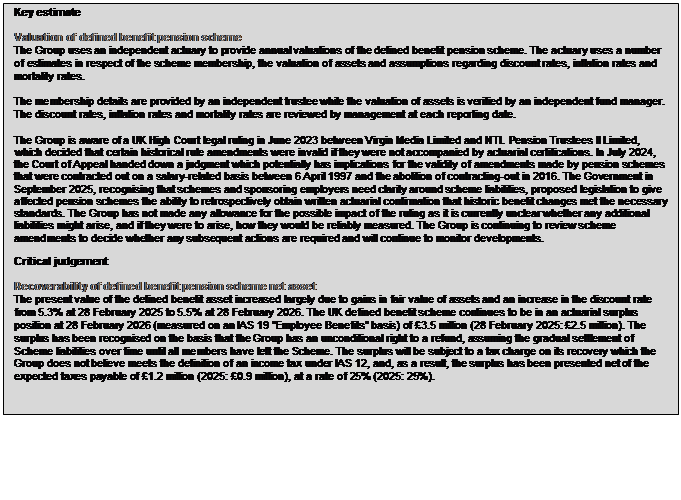
The Group has the following long-term employee benefits:
i) Defined contribution schemes
The Group operates a number of defined contribution schemes. Pension costs charged against profits in respect of these schemes represent the amount of the contributions payable to the schemes in respect of the accounting period. The assets of the schemes are held separately from those of the Group within independently administered funds. The Group has no further payment obligations once the contributions have been paid.
ii) Defined benefit schemes
The Group operates a defined benefit scheme, the ACM Staff Pension Scheme (the "Scheme"), with assets held separately from the Group. The cost of providing benefits under the Scheme is determined using the projected unit credit actuarial valuation method which measures the liability based on service completed and allowing for projected future salary increases and discounted at an appropriate rate.
The current service cost, which is the increase in the present value of the retirement benefit obligation resulting from employee service in the current year, and gains and losses on settlements and curtailments, are included within operating profit in the Income Statement. The unwinding of the discount rate on the Scheme liabilities which is shown as a net finance cost and past service costs are presented and recognised immediately in the Income Statement.
The pension asset or liability recognised on the Balance Sheet in respect of this Scheme represents the difference between the present value of the Group's obligations under the Scheme and the fair value of the Scheme's assets. Actuarial gains or losses and return on plan assets net of tax, excluding interest, are recognised in the period in which they arise within the Statement of Comprehensive Income.
When the defined benefit plan is in a surplus, the asset is recognised at the lower of the surplus and the asset ceiling, less any associated costs, such as taxes payable.
iii) Other long-term benefits
The current service cost of other long-term benefits resulting from employee services in the current year is included within the Income Statement. The unwinding of any discounting on the liabilities is shown in net finance costs.
The Group operates a defined benefit scheme in the UK. A full actuarial valuation was carried out as at 31 March 2023 and updated by the IAS 19 valuation as at 28 February 2026. All valuations have been carried out by a qualified independent actuary.
The Group's obligations in respect of the funded defined benefit scheme at 28 February 2026 were as follows:
|
|
2026 £'000 |
2025 £'000 |
|
Present value of funded obligations |
9,910 |
9,904 |
|
Fair value of scheme assets, net of tax |
(13,418) |
(12,452) |
|
Total surplus of defined benefit pension scheme |
(3,508) |
(2,548) |
Funded defined benefit scheme
The Group sponsors a funded defined benefit scheme (the ACM Staff Pension Scheme) for qualifying UK employees. The Scheme is administered by a separate board of Trustees which is legally separate from the Group. The Trustees are composed of representatives of both the employer and employees. The Trustees are required by law to act in the interest of all relevant beneficiaries and are responsible for the investment policy with regard to the trust assets and the day-to-day administration of benefits.
Under the Scheme, employees are entitled to annual pensions on retirement at age 60 of 1/60th of final pensionable salary for each year of service. Pensionable salary is defined as basic salary plus the average of the previous three years' bonuses (capped at three times basic salary). Pensionable salaries for members who joined after 1 June 1989 are also subject to an earnings cap. Other benefits are payable, for example those provided on death.
The Scheme was closed to future accrual and from 1 February 2016, post-retirement benefits are provided to these employees through a separate defined contribution arrangement.
Profile of the Scheme
The defined benefit obligation includes benefits for current employees, former employees, and current pensioners. Broadly, around 50% of the liabilities are attributable to deferred pensions for current and former employees, with the remaining 50% to current pensioners.
The Scheme duration is an indicator of the weighted average time until benefit payments are made. For the Scheme as a whole, the duration is around 14 years (2025: 14 years).
Funding implications
UK legislation requires that pension schemes are funded prudently. The most recent funding valuation of the Scheme was carried out by a qualified actuary as at 31 March 2023 and showed a surplus of £0.3 million.
Risks associated with the Scheme
The Scheme exposes the Group to a number of risks, the most significant of which are:
Asset volatility
The liabilities are calculated using a discount rate set with reference to corporate bond yields; if assets underperform this yield, this will create a deficit. The Scheme holds a significant proportion of growth assets which, though expected to outperform corporate bonds in the long term, create volatility and risk in the short term. The allocation to growth assets is monitored to ensure it remains appropriate given the Scheme's long-term objectives.
Changes in bond yields
An increase in corporate bond yields will decrease the value placed on the Scheme's liabilities for accounting purposes, although this will be partially offset by a decrease in the value of the Scheme's bond holdings.
Inflation risk
A proportion of the Scheme's benefit obligations are linked to inflation and higher inflation will lead to higher liabilities (although, in most cases, caps on the level of inflationary increases are in place to protect against extreme inflation). The majority of the assets are either unaffected by or only loosely correlated with inflation, meaning that an increase in inflation will also increase the deficit.
Life expectancy
The majority of the Scheme's obligations are to provide benefits for the life of the member, so increases in life expectancy will result in an increase in Scheme liabilities.
The Company and Trustees have agreed a long-term strategy for reducing investment risk as and when appropriate. This includes moving assets to match pensioner liabilities when members reach retirement.
The Trustees insure certain benefits payable on death before retirement.
The principal assumptions used for updating the latest valuation of the Scheme were:
|
|
2026 (% p.a.) |
2025 (% p.a.) |
|
Discount rate |
5.5 |
5.3 |
|
CPI inflation |
2.5 |
2.6 |
|
|
|
|
|
Pension and deferred pension increases: |
|
|
|
CPI capped at 2.5% p.a. |
2.3 |
2.3 |
|
CPI capped at 5.0% p.a. |
2.5 |
2.6 |
|
|
|
2026 Years |
2025 Years |
|
Life expectancy from age 60 for: |
|
|
|
|
Current 60-year-old male |
|
26.1 |
25.6 |
|
Current 60-year-old female |
|
28.7 |
28.1 |
|
Post-retirement mortality |
S2 PXA, CMI 2024 (min 1.25%) |
||
|
Early retirement |
No allowance for early retirement |
||
|
Withdrawals from active service |
No allowance |
||
|
Cash commutation |
80% of members assumed to take maximum lump sum (2025: 80%) |
||
All members are assumed to retire at age 60.
The Scheme's assets are split by type of asset in the following table.
|
Scheme assets (before expected tax charge on recovery) |
2026 £'000 |
2025 £'000 |
|
Scheme assets are comprised as follows: |
|
|
|
Overseas equities |
966 |
1,387 |
|
High yield debt |
- |
45 |
|
Cash |
360 |
395 |
|
Inflation-linked bonds |
1,089 |
1,057 |
|
Corporate bonds |
2,393 |
2,187 |
|
Government bonds |
770 |
728 |
|
Diversified growth funds |
9,010 |
7,503 |
|
Total |
14,588 |
13,302 |
The Pension Scheme assets do not include any ordinary shares issued by the Company. All assets are held through pooled investment vehicles.
|
Expense recognised in the Income Statement (included in operating costs) |
2026 £'000 |
2025 £'000 |
|
Interest income on net asset/liability |
(180) |
(109) |
|
Income recognised in Income Statement |
(180) |
(109) |
|
|
|
|
|
Remeasurements in other comprehensive expense: |
|
|
|
Gain on assets in excess of that recognised in net interest |
(982) |
(277) |
|
Actuarial gains due to changes in financial assumptions |
(353) |
(693) |
|
Actuarial loss due to changes in demographic assumptions |
158 |
27 |
|
Actuarial loss/(gain) due to liability experience |
77 |
(171) |
|
Expected tax charge on recovery of assets |
320 |
89 |
|
Gain recognised in other comprehensive income |
(780) |
(1,025) |
|
|
|
|
|
Total amount recognised in Income Statement and other comprehensive expense |
(960) |
(1,134) |
Changes to the present value of the defined benefit obligation are analysed as follows:
|
|
2026 £'000 |
2025 £'000 |
|
Opening defined benefit obligation |
9,904 |
10,609 |
|
Interest expense |
525 |
530 |
|
Actuarial gains due to changes in financial assumptions |
(353) |
(693) |
|
Actuarial loss/(gain) due to changes in demographic assumptions |
158 |
27 |
|
Actuarial (gain)/loss due to liability experience |
77 |
(171) |
|
Net benefit payments from Scheme |
(401) |
(398) |
|
Closing value at 28 February |
9,910 |
9,904 |
Changes in the fair value of plan assets are analysed as follows:
|
|
2026 £'000 |
2025 £'000 |
|
Opening fair value at 1 March |
12,452 |
12,023 |
|
Interest income |
705 |
639 |
|
Fair value gain/(loss) on assets |
982 |
277 |
|
Contributions by employers |
- |
- |
|
Net benefit payments from Scheme |
(401) |
(398) |
|
Expected tax charge on recovery of assets |
(320) |
(89) |
|
Closing value at 28 February |
13,418 |
12,452 |
The Group does not expect to make any contributions to the Scheme in the next twelve months.
|
Actual return on Scheme assets |
2026 £'000 |
2025 £'000 |
|
Interest income on plan assets |
705 |
639 |
|
Remeasurement gain/(loss) on assets |
982 |
277 |
|
Actual return on assets |
1,687 |
916 |
Sensitivity analysis
The table below illustrates the sensitivity of the Scheme liabilities at 28 February 2026 to changes in the principal assumptions. The sensitivities assume that all other assumptions remain unchanged and the calculations are approximate (full calculations could lead to a different result).
|
Change in assumption |
Approximate increase in liabilities |
Approximate increase in liabilities |
|
Interest rate reduced by 0.5% p.a. |
9.0 |
892 |
|
Inflation assumption increased by 0.5% p.a.1 |
5.9 |
585 |
|
Increase in life expectancy of one year for all members reaching 60 |
2.5 |
248 |
1The inflation assumption sensitivity applies to both the assumed rate of increase in the CPI and the RPI, and includes the impact on the rate of increases to pensions, both before and after retirement.
Defined contribution schemes
There are a number of defined contribution schemes in the Group, the principal scheme being the Braemar Pension Scheme, which is open to all UK employees. Cash contributions paid into the defined contribution schemes are accounted for as an Income Statement expense as they are incurred. The total charge for the year in respect of this and other defined contribution schemes amounted to £2,048,000 (2025: £1,967,000) which was in respect of continuing operations.
Contributions of £212,927 were due to these schemes at 28 February 2026 (2025: £190,000).
The assets of these schemes are held separately from those of the Group in funds under the control of the Trustees.
5.2 Share-based payments
The Group operates a number of equity-settled share-based payment schemes.
No awards may be granted under the schemes set out below which would result in the total number of shares issued or remaining issuable under all of the schemes (or any other Group share schemes), in the ten-year period ending on the date of grant of the option, exceeding 10% of the Company's issued share capital (calculated at the date of grant of the relevant option).
All of the Group's share schemes are accounted for as equity-settled share-based payments because they only entitle the employee to receive equity instruments issued by the Parent Company. The Group may provide a net settlement feature, whereby it withholds the number of equity instruments equal to the monetary value of the employee's tax obligation arising from the exercise (or vesting) of the award of the total number of shares that otherwise would have been issued to the employee. The Group has no contractual obligation to provide a net settlement option, and therefore the award is still accounted for as an equity-settled award in full and the value of the shares foregone by the employee is accounted for as a deduction from equity. Occasionally the Group, at its discretion, might repurchase vested equity instruments. In accordance with IFRS 2, such payments to employees are accounted for as a deduction from equity, except to the extent the payment exceeds the fair value of the equity instruments repurchased.
The net cost of the shares acquired for the shares held by the ESOP and the EBT are a deduction from shareholders' funds and represent a reduction in distributable reserves. Note 6.3 provides detail on the ESOP and the EBT and movements in shares to be issued.
|
Key estimate Share option vesting The fair value determined at the grant date of the equity-settled share-based payments is typically expensed on a straight-line basis over the vesting period, based on the Group's estimate of the number of equity instruments that will eventually vest. At each reporting date, the Group revises its estimate of the number of equity instruments expected to vest as a result of the effect of non-market-based vesting conditions. The impact of the revision of the original estimates, if any, is recognised in the Income Statement such that the cumulative expense reflects the revised estimate, with a corresponding adjustment to reserves. A 5% decrease in the forfeiture assumption during FY26 would result in an additional charge of £0.4 million (2025: £0.5 million) to the Income Statement, while a 5% increase in the forfeiture assumption during FY26 would result in a reduced charge of £0.4 million (2025: £0.7 million). While the Group believes that a change in estimate of 5% or greater for all awards in any one year is unlikely, due to the fact that the value of awards are not uniform between employees, the Group believes that there is a significant risk that a revision to the forfeiture estimate could result in a material impact to the Income Statement in the next financial year depending on the profile of leavers. |
Deferred Bonus Plan ("DBP")
The Company adopted a Deferred Bonus Plan in May 2020 (the "2020 DBP"), pursuant to which future discretionary bonus awards will be granted to staff including executive directors. Awards under the new DBP may be linked to an option granted under the new Braemar Company Share Option Plan 2020, which was also adopted by the Company in May 2020 (the "2020 CSOP"). Where an employee receives a linked award under the 2020 DBP, if the Company's share price rises over the vesting period, the 2020 CSOP award can be exercised with the value of shares delivered on the vesting of the 2020 DBP award being reduced by the exercise gain on the 2020 CSOP award. Awards under the 2020 DBP and the 2020 CSOP may be settled by the issue of new shares by way of transfer of shares from the ESOP. Historical practice has been to settle via the transfer of shares from the ESOP and it is the current intention to continue to operate in this manner.
The number of awards granted under the Deferred Bonus Plan each year is related to the profits generated in the previous year. The cost of the award is therefore expensed from the beginning of that profit period until the vesting date which is usually three years after the date of award and is subject to continued employment. Awards made to new joiners are expensed over the period from date of joining to date of vesting. Their fair value is estimated based on the share price at the time of grant less the expected dividend to be paid during the vesting period. The number of awards which are expected to vest is estimated by management based on levels of expected forfeitures.
Long Term Incentive Plan ("LTIP")
The Company also operates an LTIP, which was approved by shareholders and adopted in 2014. LTIP awards under this plan take the form of a conditional right to receive shares at £nil cost. The awards normally vest over three years and are typically subject to a performance condition such as earnings per share ("EPS") or Total Shareholder Return ("TSR"), a market-based condition.
The fair value of awards with the EPS condition are non-market conditions and their fair value is estimated based on the share price at the time of grant less the expected dividend to be paid during the vesting period. The fair value of awards containing market conditions is determined using Monte Carlo simulation models. The number of awards which are expected to vest is estimated by management based on levels of expected forfeitures and the expected outcome of the EPS condition. For awards subject to market conditions, no adjustment is made to reflect the likelihood of the market condition being met nor the actual number of awards which lapse as a result of the condition not being met.
The Company operates a variety of share-based payment schemes which are listed below.
a) Deferred Bonus Plan
Details of the share awards in issue and the movements in the year are given below:
|
Share scheme |
Number at 1 March 2025 |
Granted |
Exercised |
Forfeited |
Number at 28 February 2026 |
Exercise price (pence) |
Exercisable
|
|
Jun-21 |
5,179 |
- |
(5,005) |
(174) |
- |
nil |
Jun 2025 |
|
Sep-22 |
768,634 |
- |
(677,817) |
(90,817) |
- |
nil |
Jun 2025 |
|
Jan-23 |
341,543 |
- |
(338,138) |
(3,405) |
- |
nil |
Jun 2025 |
|
Feb-23 |
121,944 |
- |
(107,439) |
(14,505) |
- |
nil |
Jun 2025 |
|
Dec-23 |
1,624,371 |
- |
(140,455) |
(242,943) |
1,240,973 |
nil |
Jul 2024 - Jul 2026 |
|
Jul-24 |
2,051,729 |
- |
- |
(722,731) |
1,328,998 |
nil |
Jul 2027 |
|
Feb-25 |
- |
132,873 |
(6,825) |
- |
126,048 |
nil |
Feb 2028 |
|
Nov-25 |
- |
105,000 |
- |
- |
105,000 |
nil |
Aug 28 - Nov 28 |
|
Dec-25 |
- |
27,778 |
- |
- |
27,778 |
nil |
Dec 2028 |
|
Total |
4,913,400 |
265,651 |
(1,275,679) |
(1,074,575) |
2,828,797 |
|
|
The weighted average share price on exercise for awards exercised during the year was £2.11 (2025: £2.89). The weighted average share price at grant date for awards granted during the year was £2.48 (2025: £2.97).
Under the DBP, sufficient shares to satisfy each award are bought over the course of the vesting period and held in an employee trust ("ESOP") until vesting. As at 28 February 2026, the ESOP held 1,080,697 ordinary shares (2025: 1,583,460 ). The ESOP holding is in line with expectations of how many shares will be needed, along with the time to acquire them, to satisfy the current awards under this scheme. This amount is net of expected lapses in the scheme and the fact that recipients typically forego sufficient shares in order to satisfy the associated tax liability that arises on their vesting.
b) Long-Term Incentive Plan ("LTIP")
The Company also has LTIP awards, which allow for the form of a conditional right to receive shares at £nil cost. The awards normally vest over three years and are subject to various performance conditions based on earnings per share ("EPS") or segmental operating profit.
Details of the LTIP share awards in issue and the movements in the year are given below:
|
Share scheme |
Number at 1 March 2025 |
Granted |
Exercised |
Lapsed |
Forfeited |
Number at 28 February 2026 |
Exercisable between |
|
LTIP 2020 |
375,000 |
- |
(156,250) |
- |
- |
218,750 |
Jul 25 - Jul 30 |
|
LTIP 2022 (granted FY23) |
493,945 |
- |
- |
(234,429) |
(259,516) |
- |
Jul 27 - Jul 32 |
|
LTIP 2023 |
369,958 |
- |
- |
- |
(133,452) |
236,506 |
Dec 28 - Dec 33 |
|
LTIP 2024 |
394,560 |
- |
- |
- |
(125,923) |
268,637 |
Jul 29 - Jul 34 |
|
LTIP 2025 |
- |
416,030 |
- |
- |
- |
416,030 |
Jul 30 - Jul 35 |
|
Total |
1,633,463 |
|
(156,250) |
(234,429) |
(518,891) |
1,139,923 |
|
The weighted average share price at grant date for awards granted during the year was £2.20 (2025: £2.97). The weighted average share price on exercise for awards exercised during the year was £2.43 (2025: £2.46).
The value of the awards is recognised as an expense over the period from the date of grant to the vesting date. The awards are satisfied by the issue of new shares.
c) Other share-based payments
On 5 December 2022, 253,434 shares were awarded as a joining incentive to certain employees of Madrid Shipping Advisors SL and on 16 December 2022, 1,016,121 shares were issued to the former owners of Southport as part of the acquisition. In addition, on the acquisition of Southport, a further 872,821 shares were awarded to key employees of Southport. The fair value of the awards is determined based on the share price at the time of grant less the expected dividend to be paid during the three-year vesting period calculated using the market consensus dividend yield.
The value of the awards is recognised as an expense over the period from the date of grant to the vesting date. The Southport Maritime Inc. awards will be satisfied by the issue of new shares.
|
Share award |
Number at 1 March 2025 |
Granted |
Exercised |
Lapsed |
Forfeited |
Number at 28 February 2026 |
Vesting |
|
Southport Maritime Inc. |
1,888,942 |
- |
(1,888,942) |
- |
- |
- |
Dec 25 |
|
Madrid Shipping Advisors SL |
84,478 |
- |
(84,478) |
- |
- |
- |
Dec 23 - Dec 25 |
6 Share capital and other reserves
6.1 Share capital
|
|
Ordinary shares |
Ordinary shares |
||
|
|
2026 Number |
2025 Number |
2026 £'000 |
2025 £'000 |
|
Authorised |
|
|
|
|
|
Ordinary shares of 10 pence each |
34,903,000 |
34,903,000 |
3,490 |
3,490 |
|
|
Ordinary shares |
Ordinary shares |
Share premium |
|||
|
|
2026 Number |
2025 Number |
2026 £'000 |
2025 £'000 |
2026 £'000 |
2025 £'000 |
|
Issued |
|
|
|
|
|
|
|
Fully paid ordinary shares of 10 pence each |
|
|
|
|
|
|
|
As at start of year |
32,924,877 |
32,924,877 |
3,292 |
3,292 |
- |
- |
|
Shares cancelled |
(873,395) |
- |
(87) |
- |
- |
- |
|
Shares issued and fully paid (see below) |
1,016,121 |
- |
102 |
- |
- |
- |
|
As at end of year |
33,067,603 |
32,924,877 |
3,307 |
3,292 |
- |
- |
During the year, the Company purchased 873,395 shares from the market and immediately cancelled them. The total consideration paid for the shares was £2.0 million. No shares remained unpaid at 28 February 2026 or 28 February 2025. The Company has one class of ordinary shares which carry no right to fixed income.
6.2 Dividends
Amounts recognised as distributions to equity holders in the year:
|
|
2026 £'000 |
2025 £'000 |
|
Ordinary shares of 10 pence each |
|
|
|
Final dividend of 2.5 pence per share for the year ended 28 February 2025 paid on 8 September 2025 (2025: 9.0 pence per share for the year ended 29 February 2024 paid on 9 September 2024) |
787 |
2,862 |
|
Interim dividend of 2.5 pence per share paid on 13 January 2026 |
766 |
|
|
Interim dividend of 4.0 pence per share paid on 2 April 2024 |
- |
1,222 |
|
Interim dividend of 4.5 pence per share paid on 13 January 2025 |
- |
1,413 |
|
|
1,553 |
5,497 |
The right to receive dividends on the shares held in the ESOP has been waived (see Note 6.3). The dividend saving through the waiver was £0.1 million (2025: £0.1 million).
For the year ended 28 February 2026, a final ordinary dividend of 4.5 pence per share has been proposed totalling £1.4 million.
6.3 ESOP reserve
An Employee Share Ownership Plan ("ESOP") was established on 23 January 1995. The ESOP has been set up to purchase shares in the Company. These shares, once purchased, are held in trust by the Trustee of the ESOP, SG Kleinwort Hambros Trust Company (CI) Limited, for the benefit of the employees. Additionally, an Employee Benefit Trust ("EBT") previously run by ACM Shipping Group plc also holds shares in the Company. During the prior year, the Group completed the process of winding up the EBT with the shares held being sold in the market.
The ESOP reserve represents a deduction from shareholders' funds and a reduction in distributable reserves. The deduction equals the net purchase cost of the shares held in trust by the ESOP. Shares allocated by the ESOP to satisfy share awards issued by the Group are released at cost on a first in first out basis.
|
|
£'000 |
|
At 29 February 2024 |
7,140 |
|
Disposal of EBT shares |
(521) |
|
Shares acquired by the ESOP |
2,376 |
|
ESOP shares allocated |
(4,661) |
|
At 28 February 2025 |
4,334 |
|
Shares acquired by the ESOP |
4,141 |
|
ESOP shares allocated |
(5,970) |
|
At 28 February 2026 |
2,505 |
As at 28 February 2026, the ESOP held 1,080,697 (2025: 1,583,460) ordinary shares of 10 pence each. The funding of the purchase has been provided by the Company in the form of a gift and the Trustees have contracted with the Company to waive the ESOP's right to receive dividends. The fees charged by the Trustees for the operation of the ESOP are paid by the Company and charged to the Income Statement as they fall due.
The total cost to the Company of shares held in the ESOP at 28 February 2026 was £2.5 million (2025: £4.3 million) including stamp duty associated with the purchases. The shares owned by the ESOP had a market value at 28 February 2026 of £2.3 million (2025: £4.2 million). The distribution of these shares is determined by the Remuneration Committee.
2,299,745 shares (2025: 1,600,095) have been released to employees during the year. The shares acquired by the ESOP during the year had an aggregate cost of £4.1 million (2025: £2.4 million).
6.4 Other reserves
|
|
|
Capital |
Merger |
Foreign |
Hedging |
Total |
|
At 29 February 2024 |
|
- |
4,886 |
2,490 |
989 |
8,365 |
|
Cash flow hedges: |
|
|
|
|
|
|
|
- Transfer to income statement |
|
- |
- |
- |
(1,500) |
(1,500) |
|
- Fair value gains/losses in the period |
|
- |
- |
- |
(101) |
(101) |
|
Investment hedge |
|
- |
- |
(19) |
- |
(19) |
|
Exchange differences |
|
- |
- |
295 |
- |
295 |
|
Deferred tax on items taken to equity |
|
- |
- |
- |
400 |
400 |
|
At 28 February 2025 |
|
- |
4,886 |
2,766 |
(212) |
7,440 |
|
Cash flow hedges: |
|
|
|
|
|
|
|
- Transfer to income statement |
|
- |
- |
- |
(3,376) |
(3,376) |
|
- Fair value gains/losses in the period |
|
- |
- |
- |
5,911 |
5,911 |
|
Share repurchase and cancellation |
|
87 |
- |
- |
- |
87 |
|
Investment hedge |
|
- |
- |
263 |
- |
263 |
|
Exchange differences |
|
- |
- |
(1,255) |
- |
(1,255) |
|
Recycling foreign currency translation reserve for Company strike off |
|
- |
- |
58 |
- |
58 |
|
Deferred tax on items taken to equity |
|
- |
- |
- |
(650) |
(650) |
|
At 28 February 2026 |
|
87 |
4,886 |
1,832 |
1,673 |
8,478 |
The capital redemption reserve arose on share buy-backs and cancellation of those shares by the Company. The merger reserve arose on transactions where the Company issued shares pursuant to an arrangement to acquire more than a 90% interest in another company and no share premium was recorded. The amounts in the merger reserve are unrealised profits relating to the corresponding assets acquired by the Company on the issue of shares. These profits may become realised on the disposal or write-down of these assets.
The hedging reserve comprises the effective portion of the cumulative net change in fair value of cash flow hedging instruments relating to hedged transactions that have not yet occurred. The deferred tax movement recognised in equity in the year was a loss of £0.7 million (2025: £0.4 million gain).
7 Other supporting notes
7.1 Provisions
Provisions are recognised when the Group has a present obligation (legal or otherwise) as a result of a past event and it is probable that an outflow of resources embodying economic benefits will be required to settle the obligation and a reliable estimate can be made of the amount of the obligation. If material, the provisions are discounted using an appropriate current post-tax interest rate.
Short-term provisions for long service leave expected to be settled wholly within twelve months of the reporting date are measured at the amounts expected to be paid when the liabilities are settled.
The provision for long service leave not expected to be settled within twelve months of the reporting date is measured at the present value of expected future payments to be made in respect of services provided by employees up to the reporting date. Consideration is given to expected future wage and salary levels, experience of employee departures and periods of service. Expected future payments are discounted using market yields at the reporting date on corporate bonds with terms to maturity and currency that match, as closely as possible, the estimated future cash outflows.
Uncertain commission obligations
In June 2023, the board commissioned an independent internal investigation into an historical transaction originating in 2013. The investigation was overseen by an Investigation Committee chaired by the Group's non-executive Chairman and was conducted by an independent specialist forensic accounting firm, and independent external counsel. The investigation was comprehensive and complex and ultimately encompassed several transactions between 2006 and 2013 which required further investigation.
As a result of the investigation, the Group recognised a provision of £2.0 million in relation to the uncertain obligations connected to a number of the transactions and commission obligations identified as part of the investigation. An adjustment to reduce the provision by £0.1 million was made in the prior year and the full amount of the provision was utilised during the current year. While the board cannot forecast with certainty final outcomes in respect of these obligations, based on the Group's current information, the board believes that no further provision is required.
|
|
Dilapidations |
Uncertain commission obligation £'000 |
Other |
Total |
|
At 29 February 2024 |
605 |
2,094 |
439 |
3,138 |
|
Provided in the year |
455 |
- |
164 |
619 |
|
Utilised in the year |
- |
- |
(208) |
(208) |
|
Reversal of provision in the year |
- |
(88) |
- |
(88) |
|
Exchange differences |
2 |
(3) |
(1) |
(2) |
|
At 28 February 2025 |
1,062 |
2,003 |
394 |
3,459 |
|
Provided in the year |
44 |
- |
128 |
172 |
|
Utilised in the year |
(9) |
(1,907) |
- |
(1,916) |
|
Reversal of provision in the year |
(6) |
- |
- |
(6) |
|
Exchange differences |
(14) |
(96) |
(25) |
(135) |
|
At 28 February 2026 |
1,077 |
- |
497 |
1,574 |
|
|
|
|
|
|
|
Current |
28 |
- |
497 |
525 |
|
Non-current |
1,049 |
- |
- |
1,049 |
|
At 28 February 2026 |
1,077 |
- |
497 |
1,574 |
Dilapidations relate to future obligations to make good certain office premises upon expiration of the lease term. The provision is calculated with reference to the location and square footage of the office.
Employee entitlements of £0.5 million (2025: £0.4 million) are included in other, which relate to statutory long service leave in Braemar Shipbroking Pty Limited. This is based on the principle that each Australian employee is entitled to eight weeks of leave over and above any annual leave on completion of ten years' continuous service. The provision is calculated with reference to the number of employees who have at least seven years of continuous service.
7.2 Contingent liabilities
From time to time the Group may be engaged in litigation in the ordinary course of business. The Group carries professional indemnity insurance. There are currently no liabilities expected to have a material adverse financial impact on the Group's consolidated results or net assets.
7.3 Related party transactions
Transactions with wholly owned subsidiaries
Transactions between the Company and its subsidiaries, which are related parties, have been eliminated on consolidation and are not disclosed in this Note.
7.4 Events after the reporting date
A proposed final dividend for the year ended 28 February 2026 of 4.5 pence per share, totalling £1.4 million, has been recommended by the directors. This is subject to shareholder approval. There were no other adjusting or significant non-adjusting events between the reporting date and the date these Financial Statements were authorised for issue.
Five-year Financial Summary (Unaudited)
Consolidated Income Statement
|
Continuing operations |
12 months to |
12 months to |
12 months to |
12 months to 28 Feb 2023 £'000 |
12 months to 28 Feb 2022 |
|
Group revenue |
135,614 |
141,860 |
152,751 |
152,911 |
101,310 |
|
|
|
|
|
|
|
|
Other operating expenses |
(123,191) |
(126,263) |
(136,203) |
(132,836) |
(91,250) |
|
Specific items (net) |
(4,734) |
(4,424) |
(7,504) |
(8,406) |
(514) |
|
Total operating expenses, net of other incomes |
(127,925) |
(130,687) |
(143,707) |
(141,242) |
(91,764) |
|
Operating profit/(loss) |
7,689 |
11,173 |
9,044 |
11,669 |
9,546 |
|
Gain on revaluation of investment |
- |
- |
- |
- |
172 |
|
Net interest expense |
(3,275) |
(1,951) |
(1,533) |
(2,195) |
(1,156) |
|
Gain on disposal of associate / share of associate profit for the period |
217 |
- |
12 |
(23) |
(19) |
|
Profit before taxation |
4,631 |
9,222 |
7,523 |
9,451 |
8,543 |
|
Taxation |
(2,354) |
(3,120) |
(2,899) |
(4,855) |
(1,839) |
|
Gain/(loss) for the year from discontinued operations |
- |
- |
- |
- |
7,215 |
|
Profit/(loss) after taxation |
2,277 |
6,102 |
4,624 |
4,596 |
13,919 |
|
|
|
|
|
|
|
|
Dividends |
|
|
|
|
|
|
Interim |
766 |
1,413 |
1,222 |
1,172 |
610 |
|
Final proposed |
1,439 |
787 |
2,862 |
2,440 |
2,254 |
|
|
2,205 |
2,200 |
4,084 |
3,612 |
2,864 |
|
|
|
|
|
|
|
|
Earnings per ordinary share - pence |
|
|
|
|
|
|
Basic - underlying from continuing operations |
24.23p |
31.30p |
36.62p |
46.22p |
23.06p |
|
Diluted - underlying from continuing operations |
21.28p |
26.74p |
29.96p |
38.52p |
18.79p |
Five-year Financial Summary (Unaudited)
Consolidated Balance Sheet
|
|
As at |
As at |
As at |
As at 28 Feb 2023 (restated) |
As at 28 Feb 2022 |
|
Assets |
|
|
|
|
|
|
Non-current assets |
|
|
|
|
|
|
Goodwill |
71,401 |
71,243 |
71,337 |
71,407 |
79,891 |
|
Other intangible assets |
2,050 |
2,608 |
3,185 |
3,980 |
997 |
|
Property, plant and equipment |
8,823 |
10,135 |
5,582 |
5,320 |
7,078 |
|
Other investments |
1,443 |
1,720 |
1,633 |
1,780 |
1,780 |
|
Investment in associate |
- |
713 |
713 |
701 |
724 |
|
Derivative financial instruments |
- |
205 |
249 |
30 |
8 |
|
Deferred tax assets |
2,131 |
3,368 |
2,979 |
4,794 |
3,713 |
|
Pension surplus |
3,508 |
2,548 |
1,414 |
1,120 |
- |
|
Other long-term receivables |
720 |
1,768 |
4,589 |
8,554 |
5,636 |
|
|
90,076 |
94,308 |
91,681 |
97,686 |
99,827 |
|
Current assets |
|
|
|
|
|
|
Trade and other receivables |
39,212 |
40,887 |
37,730 |
43,323 |
35,792 |
|
Financial assets |
- |
- |
- |
- |
- |
|
Derivative financial instruments |
2,027 |
192 |
1,287 |
1,224 |
54 |
|
Current tax receivable |
733 |
1,554 |
2,925 |
973 |
- |
|
Assets held for sale |
- |
- |
- |
- |
- |
|
Cash and cash equivalents |
23,363 |
20,477 |
27,951 |
34,735 |
13,964 |
|
|
65,335 |
63,110 |
69,893 |
80,255 |
49,810 |
|
Total assets |
155,411 |
157,418 |
161,574 |
177,941 |
149,637 |
|
Liabilities |
|
|
|
|
|
|
Current liabilities |
|
|
|
|
|
|
Derivative financial instruments |
51 |
592 |
315 |
1,447 |
688 |
|
Trade and other payables |
37,329 |
34,732 |
43,611 |
57,310 |
39,183 |
|
Current tax payable |
1,385 |
1,659 |
1,625 |
4,141 |
1,608 |
|
Provisions |
525 |
2,433 |
3,080 |
2,575 |
486 |
|
Convertible loan notes |
- |
2,401 |
2,978 |
3,001 |
1,416 |
|
Liabilities directly associated with assets classified as held for sale |
- |
- |
- |
- |
- |
|
|
39,290 |
41,817 |
51,609 |
68,474 |
43,381 |
|
Non-current liabilities |
|
|
|
|
|
|
Long-term borrowings |
30,729 |
29,448 |
29,819 |
29,919 |
28,331 |
|
Deferred tax liabilities |
188 |
358 |
8 |
344 |
- |
|
Derivative financial instruments |
- |
116 |
43 |
697 |
335 |
|
Trade and other payables |
1,049 |
1,026 |
58 |
542 |
- |
|
Provisions |
1,798 |
498 |
416 |
734 |
797 |
|
Convertible loan notes |
- |
- |
- |
550 |
2,755 |
|
Deferred consideration |
- |
- |
- |
- |
495 |
|
Pension deficit |
- |
- |
- |
- |
2,052 |
|
|
33,764 |
31,446 |
30,344 |
32,786 |
34,765 |
|
Total liabilities |
73,054 |
73,263 |
81,953 |
101,260 |
78,146 |
|
Total assets less total liabilities |
82,357 |
84,155 |
79,621 |
76,681 |
71,491 |
|
Equity |
|
|
|
|
|
|
Share capital |
3,307 |
3,292 |
3,292 |
3,292 |
3,221 |
|
Share premium |
- |
- |
- |
53,796 |
53,030 |
|
ESOP reserve |
(2,505) |
(4,334) |
(7,140) |
(10,607) |
(6,771) |
|
Other reserves |
8,478 |
7,440 |
8,365 |
28,819 |
26,130 |
|
Retained earnings |
73,077 |
77,757 |
75,104 |
1,381 |
(4,119) |
|
Total equity |
82,357 |
84,155 |
79,621 |
76,681 |
71,491 |
RNS may use your IP address to confirm compliance with the terms and conditions, to analyse how you engage with the information contained in this communication, and to share such analysis on an anonymised basis with others as part of our commercial services. For further information about how RNS and the London Stock Exchange use the personal data you provide us, please see our Privacy Policy.

Latest directors dealings
- 1 hour ago Gamma Communications
- 2 days ago Ondo Insurtech
- 2 days ago Ondo Insurtech
- 2 days ago Sunbelt Rentals Holdings, Inc.
- 2 days ago Savannah Energy