
Half-year Financial Report
Summary by AI BETAClose X

VINACAPITAL VIETNAM OPPORTUNITY FUND LIMITED
(a non-cellular company incorporated in the Bailiwick of Guernsey under The Companies (Guernsey) Law, 2008, on 22 March 2016 with registered number 61765.)
VinaCapital Vietnam Opportunity Fund Limited ("VOF" or the "Company") is pleased to announce its unaudited results for the six-month period from 1 July 2025 to 31 December 2025.
More information on the Company is available at: https://vof.vinacapital.com/
The information contained within the announcement is deemed by the Company to constitute inside information as stipulated under the Market Abuse Regulations ("MAR"). Upon the publication of this announcement via Regulatory Information Service ("RIS"), this inside information is now considered to be in the public domain.
Interim Report and Condensed Interim Financial Statements for the period 1 July 2025 to 31 December 2025
CHAIR'S STATEMENT
Dear Shareholder
This is my first report to you as the Chair of VinaCapital Vietnam Opportunity Fund Limited and I would like to start by thanking my predecessor, Huw Evans, for his commitment, support and diligence as a director and latterly Chairman of VOF.
Investment Performance
I am pleased to report that the NAV per share of VOF increased by 11.9% over the six months to end December 2025 resulting in a total return of 12.8%, in USD terms. Although VOF is index agnostic we do note that the VN Index had an exceptionally strong performance, increasing by 29.8% for the six months to 31 December 2025. This was predominantly due to the strong performance of Vingroup (VIC) which makes up 16% of the Index weight and whose share price increased by over 250% during the period of this review. If VIC is removed, the VN Index was up by only 13.9% for the second six months of 2025. VOF does not own any shares in Vingroup as the Investment Manager does not find that company's combination of high market valuation, complexity and lack of transparency attractive. The Investment Manager's report sets out more details on performance.
The Board appreciates that this relative underperformance may be disappointing to some shareholders and we have been working closely with the Investment Manager to understand better the reasons behind this relative underperformance and to approve changes that can lead to higher returns for shareholders in the future. Our Investment Manager has reorganised and strengthened its investment team and improved its approach to research on both listed and private companies. They were very active in the period under review in repositioning our portfolio of listed investments and, as set out in their report, this activity added significantly to portfolio returns. We are also pleased to report that good progress has been made with our distressed privately negotiated investments. In particular we managed to restructure our holding in Dat Xanh Real Estate Services (DXS) into listed shares in Dat Xanh Group (DXG), resulting in an uplift of USD 6.7 million compared with the valuation of the holding as at 30 June 2025. Elsewhere, our Investment Manager continues to work diligently to secure exits from a number of our privately negotiated investments. At the half year stage, updates to the valuations of unlisted assets resulted in a small decrease in valuation of USD 1.7 million, or 0.17% of the NAV. Greater detail on these valuations is given in the Investment Manager's report.
Dividend
The Board continues to believe that a regular dividend is an important factor in making the shares attractive to retail investors and has a policy of paying a dividend of approximately 1% of the NAV per share, twice per year and a dividend of 7.25 US cents per share was paid to shareholders in early December 2025. The next half-yearly dividend will be 7.25 US cents per share, payable to shareholders on 6 May 2026.
Marketing and the Discount
Given the improved interest in emerging markets after a period of uncertainty and volatility we continue actively to encourage investment in the Company. Our Investment Manager, assisted by our joint brokers, Deutsche Numis and Barclays Bank, and our distribution partner, Cadarn Capital provide regular communication to both existing and prospective investors on the progress of the company and the opportunities of investing in Vietnam. We also provide regular commentary to printed and online media in order to widen our investor base and encourage new investors to look at investing in Vietnam. A wide variety of information is available in this regard. A detailed fact sheet is issued each month and regular updates on the Vietnamese market and economy in both written and video form are posted to our website. You can sign up to be notified of new publications at https://vof.vinacapital.com.
Along with many other Investment Trusts and reflecting continued uncertainty in some parts of the market, the discount remained under pressure for a large proportion of the six months under review. We are working hard with our brokers to address this problem and will continue with an active buyback program until this pressure alleviates. During the six months, 7.0 million shares were bought back at a cost of USD 44.3 million, which was 5.2% of shares in issue at the start of the period. The discounts at which these shares were bought resulted in an increase in the NAV of some 9.0 US cents per share to the benefit of continuing shareholders and, the Directors believe, helped to control the volatility of the discount. We believe that, as confidence returns to the Asian region following the introduction of tariffs and with the realisation of swapped and collateral assets as well as repayments of principal from our distressed investments in the unlisted portfolio, the discount should return to a more acceptable level. In addition to this the Board has been reviewing both the quantum and structure of the management fees in order to bring them closer in line with current market levels while still recognising the nature of the investments in the portfolio. These discussions are still ongoing and we hope to be able to announce some changes shortly.
The Board
As announced in our most recent Annual Report, Charlotta Ginman has taken over the roles of Chair of the Audit Committee and of the Management Engagement Committee. The previous Chair of the Audit Committee, Julian Healy, remains on the Board and will focus on our private equity investments, an area in which he has many years' experience in developing markets as well as continuing to be our Senior Independent Director.
Annual General Meeting
All of the Resolutions proposed at the AGM held on 3 December 2025 were passed in line with the Board's recommendations and I would like to record my thanks to shareholders for their support.
Outlook
The Vietnamese economy is expected to be very strong in 2026 with forecasts of over 8% growth in GDP year on year. The country has a sound and stable government which has the ability to stimulate growth primarily through badly needed infrastructure development and continuing to remove barriers to stimulate the real estate market. The business environment remains favourable both for foreign investors and for the continuing development of the domestic entrepreneur. However, this positive view will inevitably be tempered by recent actions in the Middle East and the potential impact on inflation and interest rates caused by the sharp rise in the oil price leading to significant market corrections.
In spite of this we believe that there is much cause for optimism. Our Investment Manager has reorganised their investment team and has worked hard in recent months to reposition the portfolio to benefit from this expected growth in the economy. Our investment strategy to invest in the best opportunities available in Vietnam's listed and private markets, with a strong emphasis on identifying opportunities not easily available, remains unchanged despite the challenges of investing in a market which can be very illiquid and where the ability to privately negotiate investment terms is a key differentiator. We have seen that index returns can be distorted by one dominant company, although we believe that these distortions will unwind in the coming years as Vietnam ascends to Emerging Market status and as the breadth and depth of the market increases, providing greater investment opportunities, improved liquidity and easier access for investors.
Kathryn Matthews
Chair
VinaCapital Vietnam Opportunity Fund Limited
13 March 2026
INVESTMENT MANAGER'S INTERIM REPORT
Macroeconomic Review
Vietnam's GDP[1] growth accelerated from 7.1% in 2024 to 8% in 2025. Several factors supported the country's growth over the year, the two most notable of which were (i) credit growth which continued to increase steadily by 18% as part of the State Bank of Vietnam's accommodative yet disciplined monetary policy stance and (ii) a 28% surge in exports to the U.S. driven by an 80% jump in exports of laptops and other electronics products. Whilst there was some "front loading" ahead of tariff implementation, over the full calendar year GDP growth was strong.
Vietnam's exports to the US were able largely to overcome President Trump's tariffs, partly because the initial 46% "reciprocal tariff" that was announced on April 2 was quickly reduced to 20% and, with exemptions for key categories like electronics, the effective rate was trending toward 10-15%. Subsequently, in February 2026 President Trump announced a 10% temporary tariff for all countries as US Supreme Court ruled against the initial tariffs. We do not expect much impact on the economy in 2026 as Vietnam tariff rates were already trending to similar level.
The net result is that Vietnam's export growth accelerated from 14% in 2024 to 17% in 2025, and Vietnam achieved a USD 20 billion trade surplus for the full year, equivalent to about 4% of GDP. This marked the tenth consecutive year that Vietnam has maintained a trade surplus and the third consecutive year in which the surplus was USD 20 billion or more. Most products manufactured in Vietnam are exported, so strong export growth translated into 10% growth of the manufacturing sector and 6-7% factory wage growth in 2025. Manufacturing accounts for approximately one-quarter of Vietnam's GDP.
Foreign direct investment (FDI) into Vietnam remained resilient in 2025. Disbursed FDI reached USD 27.6 billion, a 9% increase from 2024 and the highest level in the past five years, underscoring sustained investor confidence to still manufacture in Vietnam despite global uncertainties.
However, domestic consumption was weak. We estimate that spending by Vietnamese consumers only grew by about 5% in 2025 when spending by foreign tourists is stripped out, compared with annual rates of 8-9% pre-COVID. That relatively weak pace of domestic consumption growth stemmed from the fact that the household savings rate in Vietnam has remained elevated post-COVID as households continue to rebuild their savings, which were depleted during pandemic.
Real retail sales growth (i.e. stripping out inflation) grew by approximately 6.7% in 2025 but tourist arrivals, driven by the increase in Chinese visitors (which saw a remarkable 40% increase), rose by 20%. We estimate that foreign tourists account for roughly 10% of retail sales in Vietnam. The Government has taken some modest measures to support consumption growth, including trimming both VAT and personal income taxes, but the direct impact of those measures is moderate, and we believe that the Government could do much more to stimulate growth if necessary.
The silver lining to the weak consumer story is that muted consumer sentiment combined with weak consumption in China limited inflation in Vietnam. Inflation averaged 3.3% in 2025, in line with our expectations, and is well below the Government's official 5% maximum inflation target.
The VN Dong depreciated by about 3% against the US Dollar in 2025, which is consistent with an apparent (though not explicitly stated) maximum depreciation target. The VND temporarily depreciated by more than 5% in late-2025, driven by a few factors including a 70% surge in gold prices. The State Bank of Vietnam responded to the weakening of the VND by allowing interest rates to drift higher, which helped to stem depreciation pressures. Twelve-month bank deposit rates increased by about 0.5%-1% in 2025 to around 6% on average by the year-end; rates typically need to rise significantly above 7-8% to meaningfully dampen retail investors' interest in the stock market.
While the Vietnamese government's reform agenda, often referred to as Doi Moi 2.0, will boost long-term GDP growth, in 2025 policy makers took steps immediately to unfreeze the real estate market by addressing the approvals issues that are the primary bottleneck for most of the country's stalled projects. Several moribund building projects sprung back to life in 2025 as the issues impeding progress were addressed on a case-by-case basis; recently enacted legislation will address the issue nationwide and is expected to unleash a surge of real estate supply into the market.
Investment performance
Over the six months to 31 December 2025, VOF's net asset value per share increased by 12.8% and the share price increased by 10.3%, both on a USD total return basis[2].
|
Total Return in USD |
6 months |
1 year |
3 Years |
5 Years |
|
VOF NAV per share |
12.8% |
6.6% |
37.0% |
39.7% |
|
VOF Share Price |
10.3% |
10.3% |
25.5% |
22.7% |
Data to 31 December 2025 Source: Bloomberg / VinaCapital
Relative Performance
Whilst the fund is benchmark agnostic, the VN-Index or MSCI VN Index serve as a useful comparison for some investors:
|
Total Return in USD |
6 months |
1 year |
3 Years |
5 Years |
|
VN Index |
29.8% |
38.8% |
59.2% |
53.8% |
|
MSCI VN Index |
45.2% |
66.7% |
66.0% |
16.3% |
Data to 31 December 2025 Source:Bloomberg / VinaCapital
As an opportunity fund that invests across public and private markets, since inception in 2003 VOF has delivered a cumulative return of 939% (or 11% per annum) in USD terms with standard deviation1 of 16%. Over the same period, the VN Index delivered a cumulative return of 963% (or 11% per annum) with a standard deviation of 30%, demonstrating that the fund's strategy delivers similar growth across various market cycles with lower volatility (as measured by the standard deviation). However, in 2025 and over the six month period under review, we did not outperform the VN Index, primarily due to the small number of stocks driving index performance, and also because several of our long-term holdings which had been strong compounders to performance in recent years faced downward share price pressure or simply did not keep up with the market rally.
The VN Index, which is a capitalisation-weighted index that tracks the performance of all common stocks listed on the closely followed Ho Chi Minh Stock Exchange (HOSE), increased by 29.8% for the last six months of 2025 but this masks a highly concentrated market rally. The VN Index has set several all-time high milestones, but the increase was overwhelmingly driven by a group of stocks related to the Vingroup ecosystem. The main differentiator to performance was attributable to Vingroup (VIC), the parent company of the conglomerate, which contributed 15.9% points, or effectively half of the VN Index's rise, over that period. In fact, without VIC, the VN Index is up by only 13.9% for the second six months of 2025.
We are fundamental investors and do not own VIC. The conglomerate is trading at disproportionately high valuations compared to peers and the overall stock market, whilst the company is significantly leveraged and burdened by its fledgling electric vehicle business (which media claims continues to receive significant sponsor support for capex and working capital), among other constraints that do not meet our investment criteria. Whilst the increase in the share price of VIC during the period of review has been significant (up by over 250%), the stock trades on thin liquidity relative to market capitalisation. VIC has run longer (since January 2025) and further than expected, but we observe that, similar such instances in the past have often been followed by significant corrections.
Portfolio activity
To address the recent performance as a result of market challenges and dynamics, over the period under review we repositioned the portfolio by exiting or trimming some of our long-term holdings and recycling capital into attractive new investment opportunities with the aim of delivering better long-term, risk-adjusted returns for our shareholders.
Between July and December 2025, portfolio repositioning activities resulted in over USD 460 million of portfolio transactions, including trimming and selling down USD 250 million of holdings and reinvesting USD 210 million into new opportunities or adding to existing holdings. The remaining balance was used for share buybacks and dividend payments to our investors as part of our ongoing commitment to the return of capital to our investors.
This portfolio repositioning has been in progress for some time, and over the 2025 calendar year over USD 750 million of the portfolio was transacted, including USD 450 million being trimmed and sold and reinvesting USD 300 million. This reposition is accretive over the long term and has generated approximately an extra 4.4% points to the portfolio's calendar year return compared to if we had not made any changes.
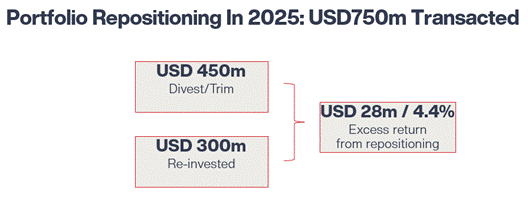
Transactions in calendar year 2025 Source:VinaCapital
We have also strengthened and reorganised the investment team to provide a much deeper focus on our refreshed sector-led approach. The core sectors are: (i) Financial; (ii) Real Estate; (iii) Industrial (including Materials and Energy); and (iv) Consumer (comprising of Discretionary, Staples, Healthcare and Information Technology). These changes have resulted in enhanced deal generation, allowing us to build a pipeline of privately negotiated transactions which is in line with our strategy of seeking opportunities which offer the prospect of superior returns to those achievable simply by investing in the publicly listed markets. Of this pipeline, in the last six months we have closed four privately negotiated deals and pre-IPO1 investments, aggregating to over USD 70 million deployed and at the time of writing they are all accretive to our performance.
Financial sector - 29.9% NAV
Our exposure to the financial sector, which includes banks and non-banks, remains a key part of our strategy, as we seek to benefit from the growth of the domestic economy in Vietnam. This sector, which makes up 29.9% of NAV, returned 19.0% for the period under review.
We were very active within this sector by making tactical switches to seek better growth opportunities in the market. We continued taking profits on Asia Commercial Bank (ACB), a long-term holding and which in the first ten months of calendar year 2025 was the largest holding in the portfolio. We also trimmed our position in Vietnam Prosperity Bank (VPB) to take profits after its share price increased by almost 90% in July and August 2025. In terms of investment activity, we increased our stake in Vietinbank (CTG), one of Vietnam's "Big Four" banks and the second-largest bank in Vietnam in terms of asset base. We also continued to add to our position in MB Bank (MBB), a leading commercial bank with one of the largest retail customer bases. These investment decisions were accretive to the performance, delivering returns of 18% and 30% respectively for the period under review.
We have also invested into security brokerages as a long-term proxy for Vietnam's rapidly evolving and maturing capital markets, seeking to capture the catalyst of an imminent rerating of the market to Emerging Market status. We initiated a position in SSI Securities (SSI) and, as the share price rallied significantly on the anticipated announcement that Vietnam would achieve Emerging Market status by FTSE Russell, we exercised our sell-discipline to lock-in a 42% return on this investment over a holding period of approximately 6 months.
We subsequently redeployed capital into two deals that exemplify our investment philosophy: accessing opportunities through a privately negotiated approach that is not easily available on the market. We made a pre-IPO investment into Techcom Securities (TCX) which successfully accelerated their block-buster listing on HOSE in October 2025 and negotiated an investment into VietCap Securities (VCI) at a discount to its trading value. Both investments have seen strong returns which have contributed to performance in recent months.
Real Estate sector - 25.4% NAV
Investments in the real estate sector remain a key part of our strategy and we believe that actions and supportive measures by the Vietnamese government will continue to boost residential property development and home ownership as structural demand significantly exceeds supply. This sector makes up 25.4% of NAV and returned 15.3% for the period under review.
The largest holding in the portfolio at 31 December 2025 was Khang Dien Homes (KDH), a long-term holding in the portfolio which we entered as part of a private equity investment. KDH was the second largest contributor to performance over the period under review due to an increase of 30% in its share price and despite our trimming part of our holdings to take profits. Also, we have been a long-term holder in one of the Vingroup-related companies, having invested in the leading real estate developer in the country Vinhomes (VHM) for more than five years. VHM was the largest contributor as it delivered exceptional performance, delivering for us a 61% return for the period under review and we exercised our sell discipline by taking profits at various stages of the year.
We successfully restructured our investment in DXS, a subsidiary of the listed Dat Xanh Group (DXG) and the restructured investment in DXG shares is now marked-to-market.. Also, as reported in the last reporting period, we restructured our investment in Novaland (NVL) by securing collateral assets in the form or parcels of land and agreeing to a new repayment plan for the remaining obligation (which includes the remaining investment principal and expected returns). We are in the process of selling the first collateral asset with several prospective acquirors showing interest, and we are working to complete the sale in the first half of 2026.
Consumer sector (including Discretionary, Staples, Healthcare and IT) - 24.2% NAV
Domestic consumption has been muted in the past couple years (as mentioned above). Nevertheless, it remains an important, long-term theme within our portfolio construction as consumption is equivalent to two-thirds of Vietnam's GDP. We continued selectively to deploy capital to this sector. The broad sector, which makes up 24.2% of NAV, returned 7.3% for the period under review. In the last six months, we added to our investment in Mobile World Group (MWG), the consumer electronics retailer with a rapidly growing modern trade groceries business which we believe will be a strong catalyst for future growth. MWG returned 27% over the six months under review.
We also decided to exit our private equity investment in Chicilon Media as the dominant indoor advertising and digital media company has come under intense pricing pressure and competition from other forms of digital advertising. We commenced the divestment in late 2025, with the proceeds of our initial investment received by December 2025, and the purchaser agreeing to pay the remaining balance in 2026. The investment, held over a period of 3 years is expected to deliver a multiple on invested capital (MOIC) of 1.3 times.
Industrial sector (including Materials and Energy) - 17.4% NAV
Vietnam is still in the midst of industrialisation with significant investments in public works, infrastructure and construction, hence this secular trend remains prominent in our portfolio. This broad theme, which makes up 17.4% of NAV, has faced idiosyncratic challenges and delivered 3.5% for the period under review. The main underperformance was from Airports Corporation of Vietnam (ACV), an operator of 21 out of 22 airports in the country, which we invested into through a privatisation process in 2015. This company still remains listed on UPCoM1, a junior bourse of the Hanoi Stock Exchange and faces thin liquidity even though ACV has a market capitalisation of USD7 billion. In early 2025 we started exiting this investment as we were concerned that ACV was slowly losing its monopolistic advantage and faced headwinds from increasing demand on capex through the expansion of the Long Thanh International Airport near Ho Chi Minh City. By December 2025 we were able to sell out most of our holdings and fully divested the investment in early 2026. We achieved 18% Gross IRR1 (in USD) on this investment over a 10-year investment period.
In October, we deployed capital into Gemadept (GMD, NAV: 3.9%), Vietnam's leading integrated seaport and logistics operator. The company operates a network of six ports and inland container depots across the country, with its two largest ports strategically located near key industrial clusters in the north and south. The business remains resilient given initial tariff concerns on Vietnam's export activities, but these concerns subsequently subsided and we used the price weakness to acquire and build up our stake in recent months.
Portfolio List
|
Listed Equities |
|
||||
|
# |
Ticker |
Company Name |
Sector |
% of NAV |
Entry Method |
|
1 |
KDH |
Khang Dien Homes |
Real Estate |
9.6% |
Privately Negotiated |
|
2 |
HPG |
Hoa Phat Group |
Materials |
8.9% |
Privately Negotiated |
|
3 |
ACB |
Asia Commercial Bank |
Financials |
7.8% |
Privately Negotiated |
|
4 |
CTG |
Vietinbank |
Financials |
7.5% |
On Market |
|
5 |
VHM |
Vinhomes |
Real Estate |
6.1% |
On Market |
|
6 |
MBB |
MB Bank |
Financials |
5.6% |
On Market |
|
7 |
FPT |
FPT Corporation |
IT |
4.8% |
Privately Negotiated |
|
8 |
MWG |
Mobile World Group |
Consumer Discretionary |
4.7% |
On Market |
|
9 |
PNJ |
Phu Nhuan Jewelry |
Consumer Discretionary |
4.4% |
Privately Negotiated |
|
10 |
KDC |
KIDO Group |
Consumer Staples |
3.7% |
Privately Negotiated |
|
11 |
GMD |
Gemadept |
Industrials |
3.6% |
On Market |
|
12 |
DXG |
Dat Xanh Group |
Real Estate |
3.6% |
Privately Negotiated |
|
13 |
VCI |
Viet Capital Securities |
Financials |
2.8% |
Privately Negotiated |
|
14 |
VPB |
Vietnam Prosperity Bank |
Financials |
2.6% |
Privately Negotiated |
|
15 |
NLG |
Nam Long Investment |
Real Estate |
2.4% |
On Market |
|
16 |
ACG |
An Cuong Wood Working |
Materials |
2.3% |
Privately Negotiated |
|
17 |
VIB |
Vietnam International Bank |
Financials |
1.9% |
Privately Negotiated |
|
18 |
TCX |
Techcom Securities |
Financials |
1.2% |
Privately Negotiated |
|
19 |
PHR |
Phuoc Hoa Rubber |
Materials |
1.0% |
On Market |
|
20 |
TCB |
Techcombank |
Financials |
0.6% |
On Market |
|
21 |
RCI |
Ricons |
Industrials |
0.5% |
Privately Negotiated |
|
22 |
ACV |
Airports Corporation of Vietnam |
Industrials |
0.5% |
Privately Negotiated |
|
Total Listed Equities |
86.1% |
|
|||
|
Unlisted investments* |
10.7% |
Privately Negotiated |
|||
|
Cash and cash equivalents |
3.2% |
|
|||
|
|
100.0% |
|
|||
* Unlisted investments include: Thu Cuc International (Healthcare), Chicilon Media (Consumer Discretionary), Novaland (Real Estate), IN Holdings (Consumer Discretionary), Hung Thinh Land (Real Estate), Tam Tri Medical (Healthcare) and Petrolimex Aviation (Energy). We do not generally publish the values of individual unlisted holdings unless a holding is one of our top ten investments. We provide an explanation of movements in valuations below
VinaCapital's investment strategy is based on a bottom-up approach to fundamental analysis of the concentrated portfolio of businesses in which we invest. To help frame the strategy, we remain sector aware, directing our team to seek opportunities in the sectors that we expect to benefit from Vietnam's long-term economic growth, while remaining diligent to the risks inherent in investing in a frontier market, where market illiquidity is prevalent in both the private and public equity markets, and where sector concentration and correlation risks exist. We overlay our portfolio construction with a liquidity screen to adjust portfolio exposures, while adhering to our sell-discipline and operating within clearly defined portfolio guidelines and limits. The effects of the portfolio activity along with changes in valuations can be seen in the chart below.
The portfolio is not benchmarked to any index and the sector allocations reflect our strategy of seeking opportunities to invest in individual companies for long-term growth, many of which are not available, in the listed market. Our focus for some time has been on selecting investments which benefit mostly from the growth of the domestic economy and, as such, we find opportunities in the banking and financial sector, the real estate sector, industrial and materials, and consumer sector which includes healthcare and consumer goods, as areas where we have historically and continue to have our largest exposures.
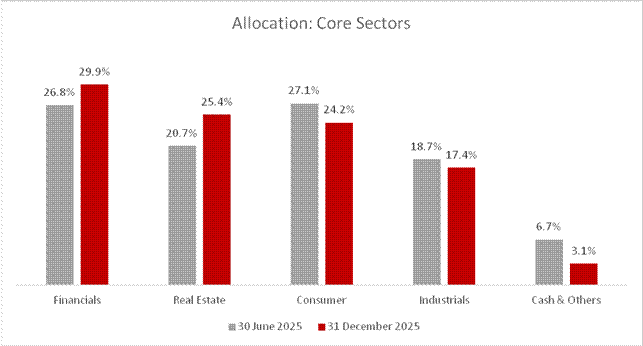
As mentioned above, Industrials includes Materials and Energy, and Consumer comprises Discretionary, Staples, Healthcare and Information Technology.
Top-10 Holdings as of 31 December 2025
|
# |
Ticker |
Company Name |
% of NAV |
6-month Return |
6-month Weighted Contribution |
|
1 |
KDH |
Khang Dien Homes |
9.6% |
18.2% |
1.8% |
|
2 |
HPG |
Hoa Phat Group |
8.9% |
15.7% |
1.3% |
|
3 |
ACB |
Asia Commercial Bank |
7.8% |
12.8% |
1.5% |
|
4 |
CTG |
Vietinbank |
7.5% |
17.5% |
1.2% |
|
5 |
VHM |
Vinhomes |
6.1% |
60.8% |
2.5% |
|
6 |
MBB |
MB Bank |
5.6% |
29.6% |
1.4% |
|
7 |
FPT |
FPT Corporation |
4.8% |
-3.7% |
-0.3% |
|
8 |
MWG |
Mobile World Group |
4.7% |
27.3% |
1.1% |
|
9 |
PNJ |
Phu Nhuan Jewelry |
4.4% |
17.8% |
0.7% |
|
10 |
Private |
Thu Cuc International |
3.9% |
Private |
Private |
 1 Khang Dien Homes (Quoted, HOSE: KDH, Market Cap: USD 1.4 billion, 6 month total return 18.2% weighted contribution:+1.8%):
Khang Dien has delivered approximately USD 40 million net profits for calendar year 2025, which was in line with our expectations. The primary driver of their earnings came from Gladia by the Waters, a joint venture project with a leading Singaporean real estate developer called Keppel. KDH presold approximately 60% of units and targets full pre-sales by the middle of 2026. Despite steady business performance, KDH's share price was affected by retail investors chasing momentum and swapping most real estate holdings to buy Vingroup-related stocks. We worked with the management to increase shareholder engagement to improve share price performance, resulting in an 18% rise in the last six months. We are still bullish on this investment as we expect Khang Dien's net profit to double next year as presales of several projects are expected to begin in 2026 and construction progress of their key projects is still on track. Also, the management expects to complete land clearance and obtain legal approvals for two more projects by late 2026. As noted above we sold part of this holding to take profits during the period.
Investment background: Established in 2001, KDH is a leading developer of landed property, including townhouses and villas in southern Vietnam. It is particularly known for its strong presence in Ho Chi Minh City and its ability to secure and complete land title and documentation is highly prized by home buyers. The long-term growth prospects for residential real estate developers like KDH remain very promising, driven by the persistent demand for new housing units across the country. The business is well managed with solid fundamentals and a prudent net debt-to-equity ratio (which is the lowest amongst its peer group) and minimal exposure to corporate bond issuance, which has been a problem for lower quality real estate developers. VOF first invested in KDH in 2008 before the company was listed, through a privately negotiated investment. VinaCapital has, in the past, served on the board and supervisory committee.
2 Hoa Phat Group (Quoted, HOSE: HPG, Market Cap: USD 7.8 billion, 6 month total return 15.7%, weighted contribution:+1.3%):
Hoa Phat Group benefited from domestic and external tailwinds. Internationally, the steel price in China is gradually recovering as Chinese steel companies are reducing supply due to prolonged weak domestic real estate demand. This will ease steel price pressure for HPG, supporting margin and earnings expansion. Locally, faster real estate project approvals and record-high infrastructure investment spending have benefited construction steel material. Infrastructure spending increased by over 40% year-on-year, yet construction spending only increased by around 10% year-on-year, thus much of the fiscal budget disbursed for infrastructure projects has not reached construction activity. We expect HPG, as the largest steel producer with approximately 35% market share, to be the primary beneficiary once the construction expenditure accelerates. We estimate a 3-year earnings growth rate of 20-25%.
Investment background: Established in 1992, HPG today is Vietnam's largest steel producer by a wide margin with over 30% market share. The company supplies high-quality construction steel for a variety of sectors, including factories, industrial parks, logistics, infrastructure projects and residential developments. VOF first invested in Hoa Phat in 2007 before it was listed, through a privately negotiated transaction. The company was, at the time, outside of the top ten steel producers in the country, in what was then a highly fragmented market. VinaCapital previously appointed a representative to serve on the board and supervisory committee.
3 Asia Commercial Bank (Quoted, HOSE: ACB, Market Cap: USD 4.7 billion, 6 month total return 12.8%, weighted contribution:+1.5%):
Asia Commercial Bank is a long-term investment and was previously the largest holding in the portfolio. As noted above, we realised part of the holding during the period under review to take profits. The bank continues to have best-in-class asset quality and has been more prudent in trying to grow its business. ACB experienced a challenging year amid pressure from increasing competition and soft demand from retail customers and small-and-medium enterprises, which is the bank's core segment. ACB has announced a move to transform the bank into a group with services spanning securities, non-life insurance, fund management, leasing and gold trading. To achieve this, the bank plans to invest USD 100 - 150 million per year for strategy execution and digital transformation.
Investment background: Established in 1993, ACB is one of the leading publicly listed commercial banks in Vietnam and focuses on the rapidly growing affluent retail and SME1 segments. We invested in ACB for its high asset quality, strong credit growth, prudent lending standards, robust risk management philosophy and low exposure to real estate and corporate bonds. VOF first invested in ACB in 2020 through a privately negotiated process to purchase a large block from an institutional investor and increased its exposure in 2022, once again through a privately negotiated process.
4 Vietinbank (Quoted: HOSE: CTG, Market Cap: USD10.6 billion, 6-month total return 17.5%, weighted contribution:+1.2%):
Vietinbank is the second largest state-owned commercial bank (SOCB) but the only one matching private banks' growth rates, thanks to management's mindset to operate like a private bank. CTG has best-in-class operational efficiency with the lowest cost-to-income ratio amongst state-owned banks while its non-performing loan rate (NPL) is below 1%. More impressively, CTG's earnings growth of well over 25% is the highest amongst state-owned banks and its private bank peers. We initiated a position in this bank at the beginning of 2025 and subsequently increased our stake in the last six months, as CTG provides the highest ROE amongst state-owned banks while trading at discount to its SOCB peers, thus we expect a near-term re-rating.
Investment background: Established in 1988, Vietinbank is a leading SOCB in Vietnam that entered our Top 10 holdings in July. Despite being categorised as state-owned, the bank differentiates itself from other SOCBs with a dynamic and agile strategy more akin to a private bank. CTG's loan book is well diversified across retail, SME1, corporates, and FDIs1. We invested into this bank in 2025 and it quickly became one of our Top-10 holdings.
5 Vinhomes (Quoted: HOSE: VHM, Market Cap: USD 7.8 billion, 6 month total return 60.8%, weighted contribution:+2.5%):
Vinhomes continues to benefit from Vietnam's increasing infrastructure spending, which underpins strong presales for their mega-projects. VHM's stock price surged remarkably by 210% in the second half of 2025 and contributed the second most to the VN Index's rise after Vingroup, its parent company. We remain fundamentally bullish on the largest real estate developer as its presales are accelerating due to the above-mentioned buoyant homebuyers' desire to purchase units with strong intracity connectivity. Aggregate presales for 2025-2027 could reach over USD 22 billion with the developer's strong sales culture and ability to launch projects quickly.
Investment background: Established in 2002, Vinhomes was first listed in 2018 but the majority of its shares are owned by Vingroup, Vietnam's largest conglomerate. Vinhomes is also Vietnam's largest residential real estate developer, with a strong track record of delivering large scale, mid-to-high-end developments in major cities in Vietnam. Vinhomes' singular focus on residential real estate provides visibility into operating cash flows and enables a robust valuation of its business. In addition, Vinhomes benefits from market liquidity, supported by significant participation from foreign institutional investors. VOF first invested in VHM in 2020.
6 MB Bank (Quoted, HOSE: MBB, Market Cap: USD 6.3 billion, 6 month total return 29.6%, weighted contribution:+1.4%):
MB Bank reported a strong calendar year 2025, with consolidated profit-before-tax of USD 1.3 billion. MBB's credit growth reached 35%, which was well above system-wide growth of 19%. The bank's credit disbursement spanned diverse sectors such as manufacturing, wholesale and retail trade, household business and real estate. Outside of core banking activities, their consumer credit, bancassurance, non-life insurance and brokerage businesses reported combined 67% year-on-year profit growth. The group's outperformance is a result of a strong ecosystem underpinned by a relatively low cost of funding, a large customer base and low cost of new customer acquisition thanks to strong digital platform.
Investment background: Established in 1994, MB Bank is a leading Vietnam-based financial institution. It is engaged in commercial banking services and derivative products for both individual and institutional clients. The bank, through its subsidiaries and platforms, provides other financial services such as insurance (life and non-life insurance), consumer finance, wealth management and securities brokerage services, where it is leveraging rapid digitisation and mobile applications to accelerate growth across these services. We invested in MBB in 2024.
7 FPT Corporation (Quoted, HOSE: FPT, Market Cap: USD 6.3 billion, 6 month total return -3.7%, weighted contribution:-0.3%):
FPT is a long-term holding which has been a strong compounder to performance. FPT's share price has faced significant pressure since DeepSeek shocked the global technology industry in January 2025, as investors perceived that global AI trends pose a risk to FPT's IT outsourcing business model. FPT's newly signed revenue from global IT business accelerated after a slowdown in the first half of the year, caused by uncertainty from US reciprocal tariffs. The share price declined by 6% over the last six months and 26% for the year. We had been trimming this position since before the DeepSeek moment and have sold more stock when we felt that the price offered was attractive. We expect global IT spending to continue to recover next year, with Japan remaining FPT's key revenue contributor. Over the medium term, FPT remains well-positioned to capitalize on winning new projects thanks to competitive labour costs and its ability to move up the value chain into higher-value services.
Investment background: Established in 1988, FPT is Vietnam's leading technology and software service company, which derives most of its revenues from software outsourcing and broadband services, the growth of which is being driven by growing global IT spending and increased spending on digital transformation projects by corporations and local governments in Vietnam. VOF first invested in 2017 to acquire a large block of FPT shares through a privately negotiated process and added further to the holding subsequently.
8 Mobile World Group (Quoted, HOSE: MWG, Market Cap: USD 5.0 billion, 6 month total return 27.3%, weighted contribution:+1.1%):
Despite muted domestic consumption Mobile World's core business, ICT1 and consumer electronics, posted 18% revenue growth and more impressively this was mainly driven by same-store sales growth. The retailer continues to gain market share, surpassing 50% thanks to its strong focus on aftersales service, financing options and a more diversified suite of products. MWG's grocery business (called Bach Hoa Xanh or BHX) in 2025 achieved profitability for the second consecutive year. The grocery chain continues store expansion with an additional 789 stores opened, mostly in central Vietnam, to reach over 2,500 stores. Looking ahead, BHX will focus on improving existing store sales growth and profitability through reducing shrinkage and logistical costs, while enhancing its fresh-food mix and overall shopping experience.
Investment background: Established in 2004, MWG has become the largest retailer of electronics in Vietnam with over 3,000 stores across the country. Initially started as a mobile phone store, hence the name of the company, it quickly expanded to all consumer electronics and established itself as a leading retailer in the segment. Subsequently, MWG has ventured into grocery and pharmaceuticals as households started shifting from traditional markets to modern retail channels. Now MWG's ICT business has matured and is providing stable cashflow, and its grocery business (Bach Hoa Xanh) with over 2,500 stores nationwide is the new catalyst for growth.
9 Phu Nhuan Jewelry (HOSE: PNJ, Market Cap: USD 1.3 billion, 6 month total return 17.8% weighted contribution:+0.7%):
Consumer sentiment has been a tale of two halves, with consumers more reluctant to spend on discretionary items such as jewelry in the first half of 2025 but we then saw a gradual recovery on such spending in the last six months. Despite this, PNJ achieved low double-digit retail sales growth primarily driven by higher selling prices, as the retailer was able to pass on higher input costs, whilst a pilot buyback policy was implemented to encourage customers to swap for higher valued products. With roughly the same number of stores (431) last year, PNJ focused on improving net margins and store efficiency by improving sales mix and cost optimization such as inventory recycling, rationalisation of the product range and reducing supply chain costs.
Investment background: Established in 1988, PNJ has developed into a leading jewelry company in Vietnam with over 60% market share in the high-end segment, being a well-respected and trusted brand amongst consumers thanks to its long history and continuously evolving portfolio of jewelry that young consumers respond well to. PNJ benefits from the fast-growing discretionary and luxury spending of the country's emerging middle class. VOF first invested in 2007 through a privately negotiated process.
10 Thu Cuc International Hospital Group (TCI) (Unquoted - Private Equity):
Despite significant challenges facing the private healthcare sector in 2025 particularly general hospitals amid a rapidly declining birth rate, rising drug and consumable costs driven by exchange rate volatility and global supply-chain disruptions TCI's 2025 revenue remained stable while EBITDA reached USD 10m, exceeding our forecast at the beginning of the year. By the year-end, TCI was in a net cash position and well prepared for its expansion plan. The hospital signed a lease agreement for a 15-floor building with a total gross floor area of approximately 7,000 sqm in Hai Duong, a satellite city located about 1.5 hours from central Hanoi. Renovation and fit-out works are expected to be completed by April 2026, with patient intake commencing in May 2026. This will be the third clinic to add capacity to the main hospital.
Investment background: Established in 2011, Thu Cuc developed into Hanoi's largest private healthcare provider, serving mid- and high-income individuals seeking high-quality medical services which are unavailable at local public hospitals. In 2020, VOF purchased 24.4% of the shares of Thu Cuc through a private equity investment and it remains an important allocation in the portfolio to develop and continue to grow our healthcare investment platform that serves domestic needs.
Valuations of Unlisted Investments
|
Unlisted Investments # |
Sector |
|
|
1 |
Thu Cuc International (TCI) |
Healthcare |
|
2 |
Tam Tri Medical |
Healthcare |
|
3 |
Chicilon Media |
Consumer Discretionary |
|
4 |
IN Holdings |
Consumer Discretionary |
|
5 |
Novaland |
Real Estate |
|
6 |
Hung Thinh Land |
Real Estate |
|
7 |
Petrolimex Aviation |
Energy |
As at 31 December 2025, we had seven privately negotiated investments that are not marked-to-market with holding value equal to 10.7% of NAV. These investments comprise of private equity or structured loan investments, therefore, their holding values are re-valued at least twice per year (at 30 June and 31 December), or at exit, or if there is a risk of an impairment. Where we are able to restructure or convert the investment into a listed equity investment with daily valuations, these investments get reclassified and carried at marked-to-market accordingly.
At 31 December 2025 the overall carrying value of VOF's remaining unlisted investments was written down by USD 1.7 million.
As described above, we successfully participated in the private placement of DXG shares which replaced collateral for a structured loan investment in DXS Private placements in Vietnam are typically subject to a one-year lock-up period. Since the restructuring, these shares have been part of our listed equities portfolio which is revalued daily based on market prices. As at 31 December 2025, the shares were valued USD 6.7 million higher than the valuation of our previous holding in DXS as at our 30 June 2025 financial year end.
Having completed the restructuring of the investment in DXS, VOF now has private investments structured as loans to two real estate companies: Hung Thinh Land (HTL) and the Novaland (NVL) group. We continue to work to resolve the amounts due to VOF through securing asset swaps and negotiating new repayment plans for these loans and the associated interests. Having settled part of the repayments due during our 2024/25 financial year the remaining repayments from HTL remain delayed, and the valuation of this investment was reduced by USD 1.9 million in the period to reflect the likely timing of receipts. We continue to monitor the company's repayment capacity and to working on a revised repayment plan, whilst concurrently exploring alternative solutions including potential asset swaps. As stated above, we are also continuing our negotiations with the Novaland group, and are moving ahead with the sale process for an asset which was received in partial settlement of that company's debt.
The valuation was marginally reduced from that as at 30 June 2025.
We reported difficulties with our investment in IN Holdings in the last annual report. The situation is largely as we noted in that report but there are some signs of recovery in the conference centre business, where stronger bookings during the year-end event season and cost optimisation efforts have contributed to improved profitability, whilst the restaurant portfolio turnaround to profitability remains challenging. Simultaneously, we continue to seek enforcement of our rights as minority investors against the sponsor which should allow a clearer path to restructuring and exit. The valuation is unchanged compared with that as at 30 June 2025.
As described above, we are in the process of exiting VOF's holding in Chicilon Media with payment due to be received in stages. The payments have so far been received as agreed and the valuation has been adjusted to reflect the cash received, with the value of the remaining balance reduced by USD1.5 million compared with that as at 30 June 2025 to reflect the likely timing of further cash receipts.
On a positive note, the value of two investments increased as at 31 December 2025. The investment in hospital chain Thu Cuc International Hospital Group, which is described above, further increased in value by USD 1.2 million. The investment in Petrolimex Aviation increased by USD0.8 million, reflecting improved operating performance but tempered by continuing provisions for overdue receivables from airline customers.
As we reported in the last annual report, we completed the sale of Tam Tri Medical in June 2025. As part of the sale terms, there is an outstanding final payment due as part of a condition subsequent. This is progressing as planned and we expect to receive the remaining payment in due course.
Investment Outlook
The Vietnamese government expects the country's rate of GDP growth to accelerate to 10% in 2026. Although this is an ambitious number we support this view, driven by:
· Soaring infrastructure spending. Having increased by circa 40% in 2025, infrastructure spending looks set to grow by another 20-30% in 2026.
· Resilient exports. Vietnam's "New Export Orders" index hit its highest level in over a year in late-2025, supported by Al-driven demand and the continued strength of US consumers.
· Modest consumption recovery. Households have made meaningful progress in rebuilding their savings post-COVID and are buoyed by increases in the real estate and stock markets.
· Promoting the Private Sector. Vietnam's Doi Moi 2.0 structural reforms are promoting the private sector and should ultimately boost the country's GDP growth rate.
In advance of Vietnam's Communist Party Congress in January 2026, international media reported that it appears to be clear that the economic reform agenda will continue its momentum going forward and we also believe that the Government's pro-growth policies will remain firmly in place. This belief has been re-affirmed by the re-election of General Secretary To Lam for the term 2026-2031. General Secretary To Lam has been spearheading the domestic reforms, mentioned above, with the focus on private sector growth to accelerate economic growth. This should correspondingly support the stock market and investment activities.
Tight liquidity in Vietnam's banking system is the biggest risk to the positive scenario for Vietnam's economy and stock market. Credit growth outpaced deposit growth in 2025, leaving the country's commercial banks with an estimated USD 40 billion deposit shortfall, according to the State Bank of Vietnam. This mismatch helped to drive 12-month bank deposit rates up by about 1% in 2025 and recently prompted Government officials to call for more muted credit growth in 2026. We expect another increase in interest rates in 2026 to circa 7%, but we do not expect deposit rates to climb significantly above the 7-8% level at which local investors tend to take their money out of the stock market to move into deposits. Critically, Vietnam's policymakers have powerful tools to address the issue, including central bank balance sheet expansion and depositing some of the Government's own cash reserves into the banks. Other risks include a drop in exports to the US or a muted consumption recovery in Vietnam, which the Government also has policies and tools to address.
The VN lndex is trading at approximately 14x forward P/E1 with 18% expected earnings growth, or a 0.8x PEG1 ratio. In comparison, our portfolio at time of writing is trading at 10x forward P/E with a 19% expected earnings growth, which is higher than the market. We believe that positive factors such as the anticipated FTSE upgrade in 2026 will present opportunities in the public markets, particularly as more private companies come to the market via IPOs1. We also believe that investing for the long term in Vietnam is best served by "bottom-up" stock picking skills that require a deep understanding and due diligence of individual companies. VinaCapital are active, fundamental investors and we believe that we are well positioned to take advantage of opportunities which we expect both public and private markets to present.
In the first two months of 2026, markets have shown a renewed focus on fundamental investing, supporting a broad-based recovery. Maintaining our disciplined investment philosophy and approach, the Fund has begun to narrow its performance gap to the VN Index. During Q1 2026, we secured attractive opportunities across public and private markets, contributing to improved performance. We completed a pre-IPO investment in Gelex Infrastructure (GEL), which listed on HOSE in early February 2026, negotiating access to this highly sought-after allocation in a company well positioned to benefit from sustained Government infrastructure spending. We also invested in Bank for Investment and Development of Vietnam (BIDV), a leading state-owned commercial bank, at a discount to its prevailing market price. As of the date of this report, both positions are generating double-digit returns. The team is also evaluating several privately negotiated opportunities in listed and unlisted companies in the Consumer, Financial and Industrial sectors.
As we actively deploy capital into new opportunities, we remain disciplined in managing portfolio liquidity. We emphasise ownership of high-quality companies, where our investment can be sold, as and when appropriate, to meet our capital return commitments in the form of semi-annual dividends and VOF's share buyback program, which we recently increased to help narrow the discount. We believe that improved Fund performance, enhanced marketing efforts, and consistent capital returns to shareholders will contribute to a narrowing of the discount to a more appropriate level
Khanh Vu
Managing Director
VinaCapital Vietnam Opportunity Fund Limited
13 March 2026
INTERIM REPORT OF THE BOARD OF DIRECTORS
The Board of Directors (the "Board") submits its report, together with the Condensed Interim Financial Statements, of VinaCapital Vietnam Opportunity Fund Limited (the "Company") for the six-month period from 1 July 2025 to 31 December 2025 (the "six-month period").
The Company is a Guernsey domiciled closed ended investment company. It is classified as a registered closed-ended Collective Investment Scheme under The POI Law, 2020 and is subject to Guernsey Companies Law.
The Company's shares are quoted on the Main Market of the London Stock Exchange ("LSE") (ticker: VOF) (LEI: 2138007UD8FBBVAX9469).
Investing Policy
Investment Objective
The Company's objective is to achieve medium to long-term returns through investment in assets either in Vietnam or in companies with a substantial majority of their assets, operations, revenues or income in, or derived from, Vietnam.
Investment Policy
All of the Company's investments will be in Vietnam or in companies with at least 75% of their assets, operations, revenues or income in, or derived from, Vietnam at the time of investment.
· No single investment may exceed 20% of the NAV of the Company at the time of investment.
· The Company may from time to time invest in other funds focused on Vietnam. This includes investments in other funds managed by the Investment Manager. Any investment or divestment into or out of funds managed by the Investment Manager will be subject to prior approval by the Board.
· The Company may from time to time make co-investments alongside other investors in private equity, real estate or similar assets. This includes, but is not restricted to, co-investments alongside other funds managed by the Investment Manager.
· The Company will not invest in other listed closed-ended funds.
The Company may gear its assets through borrowings which may vary over time according to market conditions and any or all of the assets of the Company may be pledged as security for such borrowings. Borrowings will not exceed 10% of the Company's total assets at the time that any debt is drawn down.
From time to time the Company may hold cash or low risk instruments such as government bonds or cash funds denominated in either Vietnamese Dong ("VND") or US Dollars ("USD"), either in Vietnam or outside Vietnam.
Principal Risks
The process which the Company follows in order to identify and mitigate its key risks is set out on pages 33 to 37 of the Annual Report and Financial Statements for the year ended 30 June 2025 (the "2025 Annual Report"), a copy of which is available on the Company's website https://vof.vinacapital.com/documents/. The Directors have reviewed the key risks for the remaining six months of the Company's financial year. The risks and mitigants identified are in line with those set out in the 2025 Annual Report but the outbreak of war between the United States / Israel and Iran in March 2026 has further increased the likelihood of geopolitical and macroeconomic risks. The key risks are summarised below.
Geopolitical
Risks to global growth emerged in February 2022 as a result of the conflict between Russia and Ukraine, continued throughout 2025 and were further heightened by the outbreak of conflict between Israel and Hamas in October 2023 and the attacks by the United States and Israel on Iran in March 2026. There is also a risk of an increase in the geopolitical tensions in the Asia region and between some Asian countries and the United States. Some countries and trading blocks are increasingly adopting protectionist policies, which could be detrimental to international trade.
Macroeconomic and Market
Opportunities for the Company to invest in Vietnam have come about through the liberalisation of the Vietnamese economy. Were the pace or direction of change to the economy to alter in the future, the interests of the Company could be damaged. There is a continuing risk that more recent efforts to stimulate the economy will not be successful.
Changes in the equilibrium of international trade caused, for example, by the imposition of tariffs could affect the Vietnamese economy and the companies in which the Company is invested.
As Vietnam becomes increasingly connected with the rest of the world, significant world events will have a greater impact on the country. The recent events in the Middle East had an immediate effect on the price of oil and natural gas, which could lead to a period of higher inflation, increases in interest rates to combat this and a reduction in economic activity around the world. The consequences of these events are not always known and, in the past, have led to increased uncertainty and volatility in the pricing of investments. The consequences of world events continue to be felt in the risk of heightened inflation and higher interest rates intended to combat this and the resulting effects on exchange rates.
Investment Performance
The Investment Management Agreement requires the Investment Manager to provide competent, attentive, and efficient services to the Company. If the Investment Manager was not able to do this or if the Investment Management Agreement was terminated, there could be no assurance that a suitable replacement could be found and, under those circumstances, the Company could suffer a loss of value.
The performance of the Company's investment portfolio could be poor, either absolutely or in relation to the Company's peers and/or the VN Index. Within the portfolio, individual investments could suffer a partial or total loss of value. For some structured investments, downside protections are subject to risk that the counterparty is unable to meet their obligations.
There is a risk that privately negotiated deals are not executed at the best possible price or that the timing of deals is not optimal due to the presence of co-investors who may have different liquidity or timing requirements.
There is also a risk that the Investment Manager is not able to access suitable private equity investments. Private equity investments are subject to higher execution risk than the risks associated with trading in public markets. Satisfactory performance of private equity investments relies on detailed and continuing management oversight.
Operational
The Company is dependent on third parties for the provision of all systems and services (in particular, those of the Investment Manager and of the Administrator) and any control failures or gaps in these systems and services could result in a loss or damage to the Company.
Fair Valuation
The risks associated with the fair valuation of the portfolio could result in the NAV of the Company being misstated.
The quoted companies in the portfolio are valued at market price but many of the holdings are of a size which would make them difficult to liquidate at these prices in the ordinary course of market activity. The unlisted securities are valued at their quoted prices on UPCoM or using quotations from brokers, but many of the holdings are of a size which may make them difficult to liquidate at these prices in the ordinary course of market activity. The fair valuation of operating assets and private equity investments is carried out according to international valuation standards. The investments are not readily liquid and many not be immediately realisable at the stated carrying values.
The values of the Company's underlying investments are, on a 'look-through' basis, mainly denominated in VND whereas the Company's Financial Statements are prepared in USD. The Company makes investments and receives income and proceeds from sales of investments in VND. The Company does not hedge its VND exposure, so exchange rate fluctuations could have a material effect on the NAV. The sensitivity of the NAV to exchange rates is set out in note 19(a) of the 2025 Annual Report.
Legal and Regulatory
Failure to comply with relevant regulation and legislation in Vietnam, Guernsey, Singapore, the British Virgin Islands or the UK may have an impact on the Company. Although there are anti-bribery and corruption policies in place at the Company, the Investment Manager and all other service providers, the Company could be damaged and suffer losses if any of these policies were breached.
Changing Investor Sentiment
As a Company investing mainly in Vietnam, changes in investor sentiment towards Vietnam and/or emerging and frontier markets in general may lead to the Company becoming unattractive to investors. Changes in international investor sentiment could lead to reduced demand for its shares and a widening discount. There has been a marked increase in shareholder activism in the investment companies sector, leading to some corporate actions.
ESG
As responsible investors, the Board and Investment Manager are aware of the growing focus on ESG matters. There is a risk that the value of an investment could be damaged for example by a failure of governance and/or a failure to protect the environment, employees or the wider community in which a company operates. As evidence of the effects of climate change grows, there is increasing focus by shareholders on investment companies' role in influencing investee companies' approach to environmental risks.
Section 172 Statement
Section 172 of the UK Companies Act applies directly to UK domiciled companies. Nonetheless, the intention of the AIC Code is that the matters set out in section 172 are reported on by all London listed investment companies, irrespective of domicile, provided that this does not conflict with local company law.
Section 172 states that: A director of a company must act in the way he or she considers, in good faith, would be most likely to promote the success of the company for the benefit of its members as a whole, and in doing so have regard (amongst other matters) to the following six items:
(a) the likely consequences of any decision in the long term;
(b) the interests of the company's employees;
(c) the need to foster the company's business relationships with suppliers, customers and others;
(d) the impact of the company's operations on the community and the environment;
(e) the desirability of the company maintaining a reputation for high standards of business conduct; and
(f) the need to act fairly as between members of the company.
The process which the Company follows in order to consider and adhere to the matters above is set out on pages 22 and 23 of the 2025 Annual Report.
Life of the Company
The Company does not have a fixed life but the Board considers it desirable that shareholders should have the opportunity to review the future of the Company at appropriate intervals. Accordingly, the Board intends that every fifth year a special resolution will be proposed that the Company ceases to continue. If the resolution is not passed, the Company will continue to operate as currently constituted. If the resolution is passed, the Directors will be required to formulate proposals to be put to shareholders to reorganise, unitise or reconstruct the Company or for the Company to be wound up. The Board last tabled such a resolution in December 2023. On each occasion the resolution was not passed, allowing the Company to continue as currently constituted. The next such resolution will be put to shareholders at the annual general meeting which is expected to be held in December 2028.
Results and Dividend
The results of the Company for the six-month period and the state of its financial affairs as at the reporting date are set out in the Condensed Interim Financial Statements.
When the Board first declared a dividend in 2017, it was the intention that the Company would pay a dividend representing approximately 1% of NAV twice each year and the Company paid a half yearly dividend of 7.25 cents per share in December 2025. The Board has declared a further half yearly dividend of 7.25 cents per share which will be payable on 6 May 2026.
Performance
The Chair's Statement and the Investment Manager's Report provide details of the Company's activities and performance during the six-month period.
The KPIs used to measure the progress of the Company during the six-month period were:
• the movement in the Company's NAV total return;
• the movement in the Company's share price; and
• the discount of the share price in relation to the NAV.
A discussion of progress against the KPIs is included in the Chair's Statement.
Related Parties
Details of related party transactions that have taken place during the period and any material changes, if any, are set out in note 17 of the Condensed Interim Financial Statements.
Share repurchase programme
Details of the Company's share repurchase programme are set out in note 10 of the Condensed Interim Financial Statements.
Board of Directors
The members of the Board during the six-month period and up to the date of this report were:
|
Name |
Position |
Date of appointment |
Date of resignation |
|
Kathryn Matthews |
Chair* |
10 May 2019 |
|
|
Julian Healy |
Director |
23 July 2018 |
|
|
Peter Hames |
Director |
24 June 2021 |
|
|
Hai Thanh Trinh |
Director |
30 June 2022 |
|
|
Charlotta Ginman |
Director |
2 January 2025 |
|
|
Huw Evans |
Director* |
27 May 2016 |
3 December 2025 |
*Huw Evans served as Chair until his retirement at the AGM of the Company on 3 December 2025, when he was succeeded by Kathryn Matthews.
Directors' interests in the Company
As at 31 December 2025 and 30 June 2025, the interests of the Directors in shares of the Company were as follows:
|
|
Shares held |
Shares held |
|
|
as at 31 December 2025 |
as at 30 June 2025 |
|
Kathryn Matthews |
9,464 |
9,464 |
|
Julian Healy |
25,000 |
25,000 |
|
Peter Hames |
8,000 |
8,000 |
|
Hai Thanh Trinh |
- |
- |
|
Charlotta Ginman |
4,400 |
- |
|
Huw Evans* |
- |
55,000 |
*Huw Evans retired at the AGM of the Company on 3 December 2025.
Change of Administrator, Company Secretary and Registered Office
On 4 November 2025, the administration of the Company was transferred from Aztec Financial Services (Guernsey) Limited to NSM Funds Limited ("NSM") and effective from that date NSM acts as Administrator and Secretary of the Company.
Also with effect from 4 November 2025, the registered office address of the Company changed to Les Echelons Court, Les Echelons, St Peter Port, Guernsey GY1 1AR.
Going Concern
Under the AIC Code and applicable regulations, the Directors are required to satisfy themselves that it is reasonable to assume that the Company is a going concern. The Directors have undertaken a rigorous review of the Company's ability to continue as a going concern over the period to 31 March 2027 including reviewing the on-going cash flows and level of cash balances as at the reporting date as well as taking forecasts of future cash flows into consideration. After making enquiries of the Investment Manager and having reassessed the principal risks, the Directors consider it appropriate to adopt the going concern basis of accounting in preparing the Interim Report and Condensed Interim Financial Statements.
Signed on behalf of the Board by:
Kathryn Matthews
Chair
VinaCapital Vietnam Opportunity Fund Limited
13 March 2026
STATEMENT OF DIRECTORS' RESPONSIBILITY IN RESPECT OF THE CONDENSED INTERIM FINANCIAL STATEMENTS
To the best of their knowledge, the Directors confirm that:
- the Condensed Interim Financial Statements have been prepared in accordance with IAS 34, "Interim Financial Reporting"; and
- the Interim Report, comprising the Chair's Statement, the Investment Manager's Interim Report and the Interim Report of the Board of Directors, meets the requirements of an interim management report and includes a fair review of information required by:
(i) DTR 4.2.7R of the UK Disclosure Guidance and Transparency Rules, being an indication of important events which have occurred during the first six months of the financial year, and their impact on the Condensed Interim Financial Statements, and a description of the principal risks and uncertainties for the remaining six months of the year; and
(ii) DTR 4.2.8R of the UK Disclosure Guidance and Transparency Rules, being related party transactions which have taken place in the first six months of the current financial year and that have materially affected the financial position or performance of the Company during that period, and any material changes in the related party transactions disclosed in the 2025 Annual Report.
Signed on behalf of the Board by:
Charlotta Ginman
Director
VinaCapital Vietnam Opportunity Fund Limited
13 March 2026
INDEPENDENT REVIEW REPORT TO VINACAPITAL VIETNAM OPPORTUNITY FUND LIMITED
Introduction
We have reviewed the accompanying unaudited interim condensed financial statements of VinaCapital Vietnam Opportunity Fund Limited (the "Company") as at 31 December 2025 which comprise the condensed statement of financial position as at 31 December 2025 and the related condensed statement of changes in equity, condensed statement of comprehensive income and condensed statement of cash flows for the six-month period then ended, and a summary of material accounting policy information and other explanatory notes. Management is responsible for the preparation and fair presentation of this interim financial information in accordance with International Accounting Standard ('IAS') 34 as issued by the International Accounting Standards Board ('IASB') and the Disclosure Guidance and Transparency Rules of the United Kingdom's Financial Conduct Authority. Our responsibility is to express a conclusion on this interim financial information based on our review.
Scope of review
We conducted our review in accordance with International Standard on Review Engagements 2410, "Review of Interim Financial Information Performed by the Independent Auditor of the Entity". A review of interim financial information consists of making inquiries, primarily of persons responsible for financial and accounting matters, and applying analytical and other review procedures. A review is substantially less in scope than an audit conducted in accordance with International Standards on Auditing and consequently does not enable us to obtain assurance that we would become aware of all significant matters that might be identified in an audit. Accordingly, we do not express an audit opinion.
Responsibilities of the Directors
The directors are responsible for preparing the unaudited interim condensed financial statements in accordance with the IAS 34 as issued by the IASB and the Disclosure Guidance and Transparency Rules of the United Kingdom's Financial Conduct Authority.
In preparing the unaudited interim condensed financial statements, the directors are responsible for assessing the Company's ability to continue as a going concern, disclosing, as applicable, matters related to going concern and using the going concern basis of accounting unless the directors either intend to liquidate the Company or to cease operations, or have no realistic alternative but to do so.
Conclusion
Based on our review, nothing has come to our attention that causes us to believe that the accompanying unaudited interim condensed financial statements do not present fairly, in all material respects, the financial position of the entity as at 31 December 2025, and of its financial performance and its cash flows for the six-month period then ended in accordance with IAS 34 as issued by the IASB and the Disclosure Guidance and Transparency Rules of the United Kingdom's Financial Conduct Authority.
Use of our report
This report is made solely to the Company in accordance with guidance contained in International Standard on Review Engagements 2410 "Review of Interim Financial Information Performed by the Independent Auditor of the Entity" issued by the International Auditing and Assurance Standards Board. To the fullest extent permitted by law, we do not accept or assume responsibility to anyone other than the Company, for our work, for this report, or for the conclusions we have formed.
Ernst & Young LLP
Guernsey
13 March 2026
CONDENSED STATEMENT OF FINANCIAL POSITION
|
31 December 2025 |
30 June 2025 |
||
|
|
Note |
USD'000 |
USD'000 |
|
|
|
(Unaudited) |
(Audited) |
|
TOTAL ASSETS |
|
|
|
|
Financial assets at FVTPL1 |
8 |
1,009,152 |
916,619 |
|
Prepayments and other assets |
|
1,489 |
697 |
|
Cash and cash equivalents |
6 |
50,114 |
48,676 |
|
Total assets |
|
1,060,755 |
965,992 |
|
TOTAL LIABILITIES |
|
|
|
|
Accrued expenses and other payables |
11 |
13,466 |
1,821 |
|
Loans and other borrowings |
12 |
25,000 |
- |
|
Total liabilities |
|
38,466 |
1,821 |
|
SHAREHOLDERS' EQUITY |
|
|
|
|
Share capital |
10 |
80,452 |
124,504 |
|
Retained earnings |
|
941,837 |
839,667 |
|
Total shareholders' equity |
|
1,022,289 |
964,171 |
|
|
|
|
|
|
Total liabilities and shareholders' equity |
|
1,060,755 |
965,992 |
|
Net asset value, USD per share |
16 |
7.97 |
7.13 |
|
Net asset value, expressed in GBP per share |
16 |
5.95 |
5.20 |
The Condensed Interim Financial Statements on pages 23 to 50 were approved and signed by the Board of Directors on 13 March 2026.
Kathryn Matthews Charlotta Ginman
Chair Director
The accompanying notes are an integral part of these Condensed Interim Financial Statements.
CONDENSED STATEMENT OF CHANGES IN EQUITY
|
Share capital |
Retained earnings |
Total equity |
||
|
For the six months ended 31 December 2024 (Unaudited) |
Note |
USD'000 |
USD'000 |
USD'000 |
|
Balance at 1 July 2024 |
|
221,284 |
907,954 |
1,129,238 |
|
Profit for the period |
|
- |
25,824 |
25,824 |
|
Total comprehensive income |
|
- |
25,824 |
25,824 |
|
Transactions with shareholders |
|
|
|
|
|
Shares repurchased |
|
(50,930) |
- |
(50,930) |
|
Dividends paid |
|
- |
(10,657) |
(10,657) |
|
Balance at 31 December 2024 |
|
170,354 |
923,121 |
1,093,475 |
|
For the six months ended 31 December 2025 (Unaudited) |
|
|
|
|
|
Balance at 1 July 2025 |
|
124,504 |
839,667 |
964,171 |
|
Profit for the period |
|
- |
111,640 |
111,640 |
|
Total comprehensive income |
|
- |
111,640 |
111,640 |
|
Transactions with shareholders |
|
|
|
|
|
Shares repurchased |
10 |
(44,052) |
- |
(44,052) |
|
Dividends paid |
9 |
- |
(9,470) |
(9,470) |
|
Balance at 31 December 2025 |
|
80,452 |
941,837 |
1,022,289 |
The accompanying notes are an integral part of these Condensed Interim Financial Statements.
CONDENSED STATEMENT OF COMPREHENSIVE INCOME
|
|
|
Six months ended |
Six months ended |
|
|
|
31 December 2025 |
31 December 2024 |
|
|
Note(s) |
USD'000 |
USD'000 |
|
|
|
(Unaudited) |
(Unaudited) |
|
Dividend income |
13 |
96,857 |
60,334 |
|
Finance income |
|
173 |
153 |
|
Net gain/(losses) on financial assets at FVTPL |
|
35,733 |
(19,894) |
|
General and administration expenses |
14(a) |
(9,051) |
(9,455) |
|
Interest expense |
|
(113) |
(265) |
|
Facility set-up costs |
|
(300) |
(445) |
|
Incentive fee |
14(b) |
(11,659) |
(4,604) |
|
Operating profit |
|
111,640 |
25,824 |
|
Profit before tax |
|
111,640 |
25,824 |
|
Corporate income tax |
15 |
- |
- |
|
Profit for the period |
|
111,640 |
25,824 |
|
Total comprehensive income for the period |
|
111,640 |
25,824 |
|
Earnings per share |
|
|
|
|
- basic and diluted (USD per share) |
16 |
0.85 |
0.17 |
|
- basic and diluted expressed in GBP per share |
16 |
0.63 |
0.14 |
All items were derived from continuing activities.
The accompanying notes are an integral part of these Condensed Interim Financial Statements.
CONDENSED STATEMENT OF CASH FLOWS
|
Six months ended |
Six months ended |
||
|
|
31 December 2025 |
31 December 2024 |
|
|
|
Note(s) |
USD'000 |
USD'000 |
|
|
|
(Unaudited) |
(Unaudited) |
|
Operating activities |
|
|
|
|
Profit before tax |
|
111,640 |
25,824 |
|
Adjustments for: |
|
|
|
|
Net (gains)/losses on financial assets at FVTPL |
18 |
(35,733) |
19,894 |
|
Dividend income |
13 |
(96,857) |
(60,334) |
|
Facility set-up costs |
|
300 |
445 |
|
Finance income |
|
(173) |
(153) |
|
Interest expense |
|
113 |
265 |
|
|
|
(20,710) |
(14,059) |
|
Finance income received |
|
173 |
153 |
|
(Decrease)/increase in prepayments and other assets |
|
(1,092) |
8 |
|
Increase/(decrease) in liabilities |
11 |
11,557 |
(10,036) |
|
|
|
(10,072) |
(23,934) |
|
Purchases of financial assets at FVTPL |
18 |
(88,030) |
(47,130) |
|
Return of capital from financial assets at FVTPL |
18 |
31,230 |
29,713 |
|
Dividend income |
13 |
96,857 |
60,334 |
|
Net cash generated from operating activities |
|
29,985 |
18,983 |
|
Financing activities |
|
|
|
|
Purchase of shares into treasury |
10 |
(44,052) |
(50,493) |
|
Loan principal drawdown |
12 |
25,000 |
25,000 |
|
Loan principal repayments |
12 |
- |
(10,000) |
|
Loan interest paid |
|
(25) |
(167) |
|
Dividends paid |
9 |
(9,470) |
(10,657) |
|
Net cash used in financing activities |
|
(28,547) |
(46,317) |
|
Net change in cash and cash equivalents for the period |
|
1,438 |
(27,334) |
|
Cash and cash equivalents at the beginning of the period |
6 |
48,676 |
36,769 |
|
Cash and cash equivalents at the end of the period |
6 |
50,114 |
9,435 |
The accompanying notes are an integral part of these Condensed Interim Financial Statements.
NOTES TO THE CONDENSED INTERIM FINANCIAL STATEMENTS
1. GENERAL INFORMATION
The Company registered on 22 March 2016 as a closed-ended investment scheme with limited liability under the Guernsey Law. The Company is registered in Guernsey with registration number 61765. Prior to that date the Company was incorporated in the Cayman Islands as an exempted company with limited liability.
The Company is classified as a registered closed-ended Collective Investment Scheme under the Protection of Investors (Bailiwick of Guernsey) Law 2020 and is subject to the Guernsey Law.
The Company's objective is to achieve medium to long-term returns through investment either in Vietnam or in companies with a majority of their assets, operations, revenues or income in, or derived from, Vietnam.
On 30 March 2016, the Company's shares were admitted to the Main Market of the LSE under the ticker symbol VOF. Prior to that date, the Company's shares were traded on the AIM market of the LSE.
The Company does not have a fixed life but the Board considers it desirable that shareholders should have the opportunity to review the future of the Company at appropriate intervals. Accordingly, the Board intends that every fifth year a special resolution will be proposed that the Company ceases to continue. If the resolution is not passed, the Company will continue to operate as currently constituted. If the resolution is passed, the Directors will be required to formulate proposals to be put to shareholders to reorganise, unitise or reconstruct the Company or for the Company to be wound up. The Board last tabled such a resolution in December 2023. On each occasion the resolution was not passed, allowing the Company to continue as currently constituted. The next such resolution will be put to shareholders at the annual general meeting which is expected to be held in December 2028.
The Condensed Interim Financial Statements for the six-month period ended 31 December 2025 were approved for issue by the Board on 12 March 2026.
2. SUMMARY OF MATERIAL ACCOUNTING POLICY INFORMATION
2.1 Basis of preparation
The Company has prepared these Condensed Interim Financial Statements on a going concern basis in accordance with the Disclosure Guidance and Transparency Rules of the United Kingdom Financial Conduct Authority and IAS 34 "Interim Financial Reporting". These Condensed Interim Financial Statements do not comprise statutory Financial Statements within the meaning of the Companies (Guernsey) Law, 2008 and should be read in conjunction with the Financial Statements of the Company as at and for the year ended 30 June 2025, which were prepared in accordance with International Financial Reporting Standards as issued by the International Accounting Standard Board. The statutory Financial Statements for the year ended 30 June 2025 were approved by the Board of Directors on 23 October 2025. The opinion of the auditors on those Financial Statements was unqualified. The accounting policies adopted in these Condensed Interim Financial Statements are consistent with those of the previous financial year and the corresponding interim reporting period. New and amended standards have been considered in note 2.3. These Condensed Interim Financial Statements for the period ended 31 December 2025 have been reviewed by the Company's Auditors, Ernst & Young LLP, but not audited and their review report appears earlier in this document. The financial information for the year ended 30 June 2025 has been derived from the Audited Annual Financial Statements of the Company for that year, which were reported on by Ernst & Young LLP in the Company's Annual Report and Financial Statements for the year ended 30 June 2025.
2.2 Going concern
Under the AIC Code and applicable regulations, the Directors are required to satisfy themselves that it is reasonable to assume that the Company is a going concern. The Directors have undertaken a rigorous review of the Company's ability to continue as a going concern over the period to 31 March 2027 including reviewing the on-going cash flows and level of cash balances as at the reporting date as well as taking forecasts of future cash flows into consideration. After making enquiries of the Investment Manager and having reassessed the principal risks, the Directors consider it appropriate to adopt the going concern basis of accounting in preparing the Interim Report and Condensed Interim Financial Statements.
2.3 Recent accounting developments
The Board has considered the new standards and amendments that are mandatorily effective from 1 January 2025 and standards that are issued but not yet effective from 1 January 2025 and has determined that these do not have a material impact on the Company and are not expected significantly to affect the current or future periods.
IFRS 18 Presentation and Disclosure in Financial Statements, effective for periods beginning on or after 1 January 2027, will change the presentation of the Statement of Comprehensive Income by introducing new categories and subtotals. However, the valuation and measurement of balances therein will not be impacted. The Company does not intend to early-adopt IFRS 18 and will apply it from 2027, restating comparative information if required, in accordance with the transitional provisions.
2.4 Subsidiaries and associates
The Company meets the definition of an Investment Entity within IFRS 10 and therefore does not consolidate its subsidiaries but measures them instead at FVTPL. The Company has also applied the exemption from accounting for its associates using the equity method as permitted by IAS 28.
Any gain or loss arising from a change in the fair value of investments in subsidiaries and associates is recognised in the Condensed Statement of Comprehensive Income.
Refer to note 3 for further disclosure on accounting for subsidiaries and associates.
2.5 Segmental reporting
In identifying its operating segments, management follows the subsidiaries' sectors of investment which are based on internal management reporting information. The operating segments by investment portfolio include: capital markets, private equity investments and other net assets (which is not a segment in itself and has been included to reconcile to the Statement of Comprehensive Income and the Statement of Financial Position).
Each of the operating segments is managed and monitored individually by the Investment Manager as each requires appropriate resources and approaches. The Investment Manager assesses segment profit or loss using a measure of operating profit or loss from the underlying investment assets of the subsidiaries. Refer to note 4 for further disclosure regarding allocation to segments.
2.6 Financial Instruments
(a) Recognition and derecognition
Financial assets and financial liabilities are recognised when the Company becomes a party to the contractual provisions of the financial instrument. Purchases and sales of financial assets are recognised on the trade date, being the date on which the Company commits to purchase or sell the asset.
Financial assets are derecognised when the rights to receive cash flows from the financial assets have expired or have been transferred and the Company has transferred substantially all of the risks and rewards of ownership. A financial liability is derecognised when it is extinguished, discharged, cancelled or expires.
(b) Classification of financial assets
The Company classifies its financial assets based on the Company's business model for managing those financial assets and the contractual cashflow characteristics of the financial assets.
The Company has classified all investments in equity securities as financial assets at FVTPL as they are managed, and performance is evaluated, on a fair value basis.
The Company is primarily focused on fair value information and uses that information to assess the assets' performance and to make decisions. The Company has not taken the option to designate irrevocably any investment in equity as fair value through other comprehensive income.
The Company's receivables and cash and cash equivalents are classified as financial assets at amortised cost as these are held to collect contractual cash flows which represent solely payments of principal and interest.
(c) Initial and subsequent measurement of financial assets
Financial assets are initially measured at fair value plus, in the case of a financial asset not at FVTPL, transaction costs that are directly attributable to the acquisition of the financial asset. All other transaction costs of financial assets at FVTPL are expensed in the Statement of Comprehensive Income.
Subsequent to initial recognition, investments at FVTPL are measured at fair value with gains and losses arising from changes in the fair value recognised in the Statement of Comprehensive Income.
All other financial assets are subsequently measured at amortised cost using the effective interest rate method, less any impairment.
(d) Impairment of financial assets
At each reporting date, the Company measures the loss allowance on debt assets carried at amortised cost at an amount equal to the lifetime expected credit losses if the credit risk has increased significantly since initial recognition.
If, at the reporting date, the credit risk has not increased significantly since initial recognition, the Company measures the loss allowance at an amount equal to 12-month expected credit losses. The expected credit losses are estimated using a provision matrix based on the Company's historical credit loss experience, adjusted for factors that are specific to the debtors, general economic conditions and an assessment of both the current as well as the forecast direction of conditions at the reporting date, including time value of money where appropriate. The measurement of expected credit losses is a function of the probability of default, loss given default (i.e., the magnitude of the loss if there is a default) and the exposure at default.
The assessment of the probability of default and loss given default is based on historical data adjusted by forward-looking information.
(e) Classification and measurement of financial liabilities
Financial liabilities are initially measured at fair value plus transaction costs that are directly attributable to their acquisition or issue, other than those classified as at FVTPL in which case transaction costs are recognised directly in profit or loss.
Subsequently, financial liabilities are measured at amortised cost using the effective interest method.
The Company's financial liabilities include trade and other payables and loans and other borrowings which are measured at amortised cost.
3. CRITICAL ACCOUNTING ESTIMATES AND JUDGEMENTS
When preparing the Condensed Interim Financial Statements, the Company relies on a number of judgements, estimates and assumptions about recognition and measurement of assets, liabilities, income and expenses. Actual results may differ from the judgements, estimates and assumptions.
Information about significant judgements, estimates and assumptions which have the greatest effect on the recognition and measurement of assets, liabilities, income and expenses were the same as those that applied to the Annual Report and Financial Statements for the year ended 30 June 2025.
3.1 Critical accounting estimates
(a) Fair value of subsidiaries and associates and their underlying investments
The Company holds its investments through a number of subsidiaries and associates which were established for this purpose. At the end of each half of the financial year, the fair values of investments in subsidiaries and associates are reviewed and the fair values of all investments held by these subsidiaries and associates are assessed. As at 31 December 2025, 100% (30 June 2025: 100%) of the financial assets at fair value through profit or loss relate to the Company's investments in subsidiaries and associates that have been fair valued in accordance with the policies set out above.
The shares of the subsidiaries and associates are not publicly traded; return of capital to the Company can only be made by divesting the underlying investments of the subsidiaries and associates. As a result, the carrying value of the subsidiaries and associates may not be indicative of the value ultimately realised on divestment.
The underlying investments include listed and UPCoM securities, and private equity investments (including investments classified as "public equity with private terms"). Where an active market exists (for example, for listed securities), the fair value of the subsidiary or associate reflects the valuation of the underlying holdings, as disclosed below. Where no active market exists, valuation techniques are used.
Information about the significant judgements, estimates and assumptions which are used in the valuation of the underlying investments is discussed below.
(a.1) Valuation of assets that are traded on an active market
The fair values of listed securities are based on quoted market prices at the close of trading on the reporting date. The fair values of securities which are traded on Vietnam's Unlisted Public Company Market ("UPCoM") are based on published prices at the close of business on the reporting date. UPCoM is a stock trading market for limited liability companies or unlisted joint-stock companies. The shares of some companies which have not been registered or do not meet the conditions for listing on the HOSE and HNX exchanges3, are traded on UPCoM. For other UPCoM securities which are traded on an active market, fair value is the average quoted price at the close of trading obtained from a minimum sample of five reputable securities companies at the reporting date. Other relevant measurement bases are used if broker quotes are not available or if better and more reliable information is available.
(a.2) Valuation of investments in private equities
As at the financial year-end, the Company's underlying investments in private equities are fair valued by an Independent Valuer or by the Investment Manager using a number of methodologies such as adjusted net asset valuations, discounted cash flows, income related multiples, price-to-book ratios, structured financial arrangements and blended models. The projected future cash flows are driven by management's business strategies and goals and its assumptions of growth in GDP, market demand, inflation, ESG risk, etc. For the principal investments, the Independent Valuer and, where relevant, the Investment Manager selects appropriate discount rates that reflect the level of certainty of the quantum and timing of the projected cash flows.
As at 31 December 2025, the Investment Manager reviewed the valuations carried out as at 30 June 2025 and considered whether there were any changes to performance or the circumstances of the underlying investments which would affect the fair values. Methods, assumptions, and data were consistently applied from 30 June 2025.
The Investment Manager then made recommendations to the Audit Committee of the fair values as at 31 December 2025 and the Audit Committee, having considered these, then made recommendations for approval by the Board. Refer to note 18(c) which sets out a sensitivity analysis of the significant observable inputs used in the valuations of the private equity investments.
(a.3) Loans and receivables at FVTPL
For the current period, consistent with the prior year, these underlying loans and receivables designated at FVTPL are fair valued by the Investment Manager using methodologies such as a scenario-based model using probability-weighted average of discounted cash flows and investment cost plus expected return. Refer to note 18(c) which sets out a sensitivity analysis of the significant unobservable inputs used in the valuations.
(b) Incentive Fee
The incentive fee was calculated as follows:
• To the extent that the NAV as at any year end is above the higher of a 10% compound annual return and a high water mark initially set in 2019, having accounted for any share buy backs, share issues and/or dividends, the incentive fee payable on any increase in the NAV above the higher of the high water mark and a 10% annual return target is calculated at a rate of 10%;
• The maximum amount of incentive fees that can be paid out in any one year is capped at 1.5% of the average month-end NAV during that year; and
• Any incentive fees earned in excess of this 1.5% cap are accrued if they are expected to be paid out in subsequent years.
Any incentive fees payable within 12 months are classified under accrued expenses and other payables in the Statement of Financial Position. The fair values of any additional incentive fees potentially payable beyond 12 months after the end of the reporting period are classified as deferred incentive fees in the Statement of Financial Position.
At the end of each financial period, the Board makes an assessment of the total amount of any accrued incentive fees which is likely to be settled beyond 12 months after the end of the reporting period. In determining the fair value of the non-current liability at a Statement of Financial Position date the Board may apply a discount to reflect the time value of money and the probability and phasing of payment. An annualised discount rate of 8% is applied where applicable to the deferred incentive fees carried forward. Any unwinding of the discount recorded in the previous financial period is recorded in finance expense in the Statement of Comprehensive Income.
For further details of the incentive fees earned and accrued at the period end please refer to note 14(b).
3.2. Critical judgements in applying the Company's accounting policies
(a) Eligibility to qualify as an investment entity
The Company has determined that it is an investment entity under the definition of IFRS 10 as it meets the following criteria:
i. The Company has obtained funds from investors for the purpose of providing those investors with investment management services;
ii. The Company's business purpose is to invest funds solely for returns from capital appreciation, investment income or both; and
iii. The performance of investments made by the Company are substantially measured and evaluated on a fair value basis.
The Company has the typical characteristics of an investment entity:
· It holds more than one investment;
· It has more than one investor;
· It has investors that are not its related parties; and
· It has ownership interests in the form of equity or similar interests.
As a consequence, the Company does not consolidate its subsidiaries and accounts for them at FVTPL. The Company has applied the exemption from accounting for its subsidiaries using the equity method as permitted by IAS 28.
(b) Judgements about active and inactive markets
The Board considers that the Ho Chi Minh Stock Exchange, the Hanoi Stock Exchange and UPCoM are active markets for the purposes of IFRS 13. Consequently, the prices quoted by those markets for individual shares as at the balance sheet date can be used to estimate the fair value of the Company's underlying investments.
Notwithstanding the fact that these stock exchanges can be regarded as active markets, the size of the Company's holdings in particular in relation to daily market turnover in those stocks would make it difficult to conduct an orderly transaction in a large number of shares on a single day.
When taken across the whole portfolio of the Company's underlying quoted investments, the Board considers that using the quoted prices of the shares on the various active markets is generally a reasonable determination of the fair value of the securities.
In the absence of an active market for quoted or unquoted investments which may include positions that are not traded on active markets, valuations may be adjusted to reflect illiquidity and/or non-transferability, which are generally based on available market information, and in determining the fair value one or more valuation techniques may be utilised.
4. SEGMENTAL ANALYSIS
Dividend income is allocated based on the underlying investments of subsidiaries which declared dividends. Net losses on financial assets at FVTPL are allocated to each segment with reference to the assets held by each respective subsidiary. Management fees within general and administration expenses and finance expenses are allocated based on total investment holdings in each investment sector and all other general expenses are unallocated and included in Other Net Assets. Finance costs and loan facility set-up costs are unallocated and included in Other Net Assets. Management fees payable and incentive fees payable to the Investment manager included in accrued and other expenses are allocated based on total investment holdings in each investment sector. The remaining accrued and other expenses payable are unallocated due to their nature and general use and are included under Other Net Assets.
The financial assets at FVTPL are measured based on the investment sector. Segmental information can be analysed as follows:
Condensed Statement of Comprehensive Income
|
|
|
Capital |
Private |
Other Net |
|
|
|
|
Markets* |
Equity |
Assets** |
Total |
|
(Unaudited) |
|
USD'000 |
USD'000 |
USD'000 |
USD'000 |
|
Six months ended 31 December 2025 |
|
|
|
|
|
|
Dividend income |
|
68,731 |
28,126 |
- |
96,857 |
|
Finance income |
|
- |
- |
173 |
173 |
|
Net gains on financial assets at FVTPL |
|
58,670 |
(22,286) |
(651) |
35,733 |
|
General and administration expenses (note 14 (a)) |
|
(5,911) |
(460) |
(2,680) |
(9,051) |
|
Facility set-up costs |
|
- |
- |
(300) |
(300) |
|
Interest expense |
|
(98) |
(8) |
(7) |
(113) |
|
Incentive fee |
|
(10,088) |
(785) |
(786) |
(11,659) |
|
Profit/(loss) before tax |
|
110,304 |
4,587 |
(4,251) |
111,640 |
|
|
|
|
|
||
|
Six months ended 31 December 2024 |
|
|
|
|
|
|
Dividend income |
|
60,334 |
- |
- |
60,334 |
|
Finance income |
|
- |
- |
153 |
153 |
|
Net losses on financial assets at FVTPL |
|
(15,842) |
(3,218) |
(834) |
(19,894) |
|
General and administration expenses (note 14 (a)) |
|
(5,691) |
(1,036) |
(2,728) |
(9,455) |
|
Facility set-up costs |
|
- |
- |
(445) |
(445) |
|
Interest expense |
|
(207) |
(38) |
(20) |
(265) |
|
Incentive fee |
|
(3,589) |
(653) |
(362) |
(4,604) |
|
Profit/(loss) before tax |
|
35,005 |
(4,945) |
(4,236) |
25,824 |
* Capital markets include listed securities and UPCoM securities, valued at their prices on UPCoM or using quotations from brokers.
** Other Net Assets is not a segment in itself and has been included to reconcile to the Statement of Comprehensive Income.
Condensed Statement of Financial Position
|
|
|
Capital |
Private |
Other Net |
|
|
|
|
Markets* |
Equity |
Assets** |
Total |
|
|
|
USD'000 |
USD'000 |
USD'000 |
USD'000 |
|
As at 31 December 2025 (Unaudited) |
|
|
|
|
|
|
Financial assets at FVTPL |
|
873,205 |
67,965 |
67,982 |
1,009,152 |
|
Receivables and prepayments |
|
- |
- |
1,489 |
1,489 |
|
Cash and cash equivalents |
|
- |
- |
50,114 |
50,114 |
|
Total assets |
|
873,205 |
67,965 |
119,585 |
1,060,755 |
|
Total liabilities |
|
|
|
|
|
|
Accrued expenses and other payables |
|
11,652 |
907 |
907 |
13,466 |
|
Loans and borrowings |
|
- |
- |
25,000 |
25,000 |
|
Total liabilities |
|
11,652 |
907 |
25,907 |
38,466 |
|
Net asset value |
|
861,553 |
67,058 |
93,678 |
1,022,289 |
|
As at 30 June 2025 (Audited) |
|
|
|
|
|
|
Financial assets at FVTPL |
|
738,289 |
91,155 |
87,175 |
916,619 |
|
Prepayments and other assets |
|
- |
- |
697 |
697 |
|
Cash and cash equivalents |
|
- |
- |
48,676 |
48,676 |
|
Total assets |
|
738,289 |
91,155 |
136,548 |
965,992 |
|
Total liabilities |
|
|
|
|
|
|
Accrued expenses and other payables |
|
836 |
103 |
882 |
1,821 |
|
Total liabilities |
|
836 |
103 |
882 |
1,821 |
|
Net asset value |
|
737,453 |
91,052 |
135,666 |
964,171 |
*Capital markets include listed securities and UPCoM securities, valued at their prices on UPCoM or using quotations from brokers.
** Other net assets of USD67.9 million (30 June 2025: USD87.1 million) include cash and cash equivalents, prepayments, loans and receivables at FVTPL and other net assets of the subsidiaries and associates. Other Net Assets is not a segment in itself and has been included to reconcile to the Statement of Financial Position.
5. INTERESTS IN SUBSIDIARIES AND ASSOCIATES
There is no legal restriction to the transfer of funds from the BVI or Singapore subsidiaries to the Company. Cash held in directly owned as well as indirectly owned Vietnamese subsidiaries or associates may be subject to restrictions imposed by co-investors and the Vietnamese government and therefore it cannot be transferred out of Vietnam unless such restrictions are satisfied. As at 31 December 2025, the restricted cash held in these Vietnamese subsidiaries and associates amounted to USD Nil (30 June 2025: USD Nil).
The Company has not entered into a contractual obligation to, nor has it committed to provide, current financial or other support to an unconsolidated subsidiary during the period.
5.1 Directly-owned subsidiaries
The Company had the following directly-owned subsidiaries as at 31 December and 30 June 2025:
|
As at |
||||
|
|
|
31 December 2025 |
30 June 2025 |
|
|
Subsidiary |
Country of incorporation |
% of Company interest |
% of Company interest |
Nature of the business |
|
Asia Value Investment Limited |
BVI |
100.00 |
100.00 |
Holding company for listed and unlisted securities |
|
Belfort Worldwide Limited |
BVI |
100.00 |
100.00 |
Holding company for private equity |
|
Boardwalk South Limited |
BVI |
100.00 |
100.00 |
Holding company for listed securities |
|
Clearfield Pacific Limited |
BVI |
100.00 |
100.00 |
Holding company for investments |
|
Clipper Ventures Limited |
BVI |
100.00 |
100.00 |
Holding company for listed securities and private equity |
|
Darasol Investments Limited |
BVI |
100.00 |
100.00 |
Holding company for investments |
|
Foremost Worldwide Limited |
BVI |
100.00 |
100.00 |
Holding company for unlisted securities |
|
Fraser Investment Holdings Pte. Limited |
Singapore |
100.00 |
100.00 |
Holding company for listed securities |
|
Hospira Holdings Limited |
Singapore |
100.00 |
100.00 |
Holding company for investments |
|
Longwoods Worldwide Limited |
BVI |
100.00 |
100.00 |
Holding company for listed securities |
|
Navia Holdings Limited |
BVI |
100.00 |
100.00 |
Holding company for investments |
|
Portal Global Limited |
BVI |
100.00 |
100.00 |
Holding company for listed securities |
|
Preston Pacific Limited |
BVI |
100.00 |
100.00 |
Holding company for listed securities |
|
Rewas Holdings Limited |
BVI |
100.00 |
100.00 |
Holding company for unlisted securities |
|
Turnbull Holding Pte. Ltd. |
Singapore |
100.00 |
100.00 |
Holding company for investments |
|
Vietnam Enterprise Limited |
BVI |
100.00 |
100.00 |
Holding company for listed and unlisted securities |
|
Vietnam Investment Limited |
BVI |
100.00 |
100.00 |
Holding company for listed and unlisted securities |
|
Vietnam Investment Property Holdings Limited |
BVI |
100.00 |
100.00 |
Holding company for listed and unlisted securities |
|
Vietnam Investment Property Limited |
BVI |
100.00 |
100.00 |
Holding company for listed securities |
|
Vietnam Master Holding 2 Limited |
BVI |
100.00 |
100.00 |
Holding company for private equity |
|
Vietnam Ventures Limited |
BVI |
100.00 |
100.00 |
Holding company for listed and unlisted securities |
|
VinaSugar Holdings Limited |
BVI |
100.00 |
100.00 |
Holding company for investments |
|
VOF Investment Limited |
BVI |
100.00 |
100.00 |
Holding company for listed and unlisted securities and private equity |
|
VOF PE Holding 5 Limited |
BVI |
100.00 |
100.00 |
Holding company for listed securities |
|
Windstar Resources Limited |
BVI |
100.00 |
100.00 |
Holding company for listed securities |
5.2 Indirect interests in subsidiaries
The Company had the following indirect interests in subsidiaries as at 31 December and 30 June 2025:
|
|
|
|
|
As at |
|
|
|
|
|
|
31 December 2025 |
30 June 2025 |
|
|
|
|
|
% of |
% of |
|
|
|
|
|
Company's |
Company's |
|
|
Country of |
|
Immediate |
indirect |
indirect |
|
Indirect subsidiary |
incorporation |
Nature of the business |
Parent |
interest |
interest |
|
Abbott Holding Pte. Limited |
Singapore |
Holding company for private equity |
Hospira Holdings Limited |
100.00 |
100.00 |
|
Aldrin One Pte. Ltd. |
Singapore |
Holding company for private equity |
Halley One Limited |
81.31 |
81.31 |
|
Aldrin Three Pte. Ltd. |
Singapore |
Holding company for private equity |
Halley Three Limited |
80.07 |
80.07 |
|
Aldrin Two Pte. Ltd. |
Singapore |
Holding company for investments |
Clipper Ventures Limited |
100.00 |
100.00 |
|
Allright Assets Limited |
BVI |
Holding company for private equity |
Clipper Ventures Limited |
100.00 |
100.00 |
|
Allwealth Worldwide Limited |
BVI |
Holding company for investments |
Clipper Ventures Limited |
80.02 |
80.08 |
|
Chifley Investments Pte. Ltd |
Singapore |
Holding company for investments |
Belfort Worldwide Limited |
85,91 |
85,91 |
|
Clipper One Limited |
BVI |
Holding company for investments |
Clipper Ventures Limited |
100.00 |
100.00 |
|
Goldcity Worldwide Limited |
BVI |
Holding company for investments |
Clipper Ventures Limited |
100.00 |
100.00 |
|
Gorton Investments Pte. Ltd |
Singapore |
Holding company for investments |
Belfort Worldwide Limited |
100.00 |
100.00 |
|
Halley Five Limited |
BVI |
Holding company for investments |
Clipper Ventures Limited |
87.50 |
87.50 |
|
Halley Four Limited |
BVI |
Holding company for investments |
Clipper Ventures Limited |
79.40 |
79.40 |
|
Halley One Limited |
BVI |
Holding company for investments |
Clipper Ventures Limited |
81.31 |
81.31 |
|
Halley Three Limited |
BVI |
Holding company for investments |
Clipper Ventures Limited |
80.07 |
80.07 |
|
Halley Two Limited |
BVI |
Holding company for investments |
Clipper Ventures Limited |
85.91 |
85.91 |
|
Liva Holdings Limited |
BVI |
Holding company for private equity |
Halley Five Limited |
87.50 |
87.50 |
|
Menzies Holding Pte. Ltd. |
Singapore |
Holding company for investments |
Belfort Worldwide Limited |
100.00 |
100.00 |
|
PA Investment Opportunity II Limited |
BVI |
Holding company for investments |
Vietnam Enterprise Limited |
100.00 |
100.00 |
|
Sharda Holdings Limited |
BVI |
Holding company for private equity |
Clipper Ventures Limited |
89.64 |
89.64 |
|
Tempel Four Limited |
BVI |
Holding company for private equity |
Halley Four Limited |
79.40 |
79.40 |
|
Victory Holding Investment Limited |
BVI |
Holding company for listed securities and private equity |
Clipper Ventures Limited |
87.58 |
87.58 |
|
Vietnam Opportunity Fund II Pte. Ltd. |
Singapore |
Holding company for private equity |
Belfort Worldwide Limited |
68.00 |
68.00 |
|
Whitlam Holding Pte. Ltd |
Singapore |
Holding company for listed securities |
Navia Holdings Limited |
61.26 |
61.26 |
5.3 Direct interests in associates
The Company did not have any directly-owned associates as at 31 December and 30 June 2025.
5.4 Indirect interests in associates
The Company had the following indirect interests in associates as at 31 December and 30 June 2025:
|
|
|
|
|
|
As at |
|
|
|
|
|
31 December 2025 |
30 June 2025 |
|
|
|
|
|
% of |
% of |
|
|
|
|
|
Company's |
Company's |
|
|
Country of |
|
Company's subsidiary holding |
indirect |
indirect |
|
Indirect associate |
incorporation |
Nature of the business |
direct interest in the associate |
interest |
interest |
|
Thu Cuc Medical & Beauty Care Joint Stock Company |
BVI |
Private equity investment |
Aldrin One Pte. Ltd |
24.39 |
24.39 |
5.5 Financial risks
As at 31 December 2025, the Company owned a number of subsidiaries and associates for the purpose of holding investments in listed and UPCoM securities and private equity investments. The Company, via these underlying investments, is subject to financial risks which are further disclosed in note 18. The Investment Manager makes investment decisions after performing extensive due diligence on the underlying investments, their strategies, financial structure and the overall quality of management.
6. CASH AND CASH EQUIVALENTS
|
|
31 December 2025 |
30 June 2025 |
|
|
USD'000 |
USD'000 |
|
|
(Unaudited) |
(Audited) |
|
Cash at banks |
50,114 |
48,676 |
As at 31 December 2025, the cash and cash equivalents were principally denominated in USD and GBP.
The Company's overall cash position including cash held in directly held subsidiaries as at 31 December 2025 was USD71.1 million (30 June 2025: USD68.7 million). Please refer to note 8 for details of the cash held by the Company's subsidiaries. As mentioned in note 5, the restricted cash held in Vietnamese subsidiaries and associates amount to USD Nil (30 June2025: USD Nil).
7. FINANCIAL INSTRUMENTS BY CATEGORY
|
|
Financial assets at amortised cost |
Financial assets at FVTPL |
Financial liabilities at amortised cost |
Total |
|
|
USD'000 |
USD'000 |
USD'000 |
USD'000 |
|
As at 31 December 2025 (Unaudited) |
|
|
|
|
|
Financial assets at FVTPL |
- |
1,009,152 |
- |
1,009,152 |
|
Financial liabilities |
- |
- |
(38,466) |
(38,466) |
|
Cash and cash equivalents |
50,114 |
- |
- |
50,114 |
|
Total |
50,114 |
1,009,152 |
(38,466) |
1,020,800 |
|
Financial assets/(liabilities) denominated in: |
||||
|
- GBP |
21 |
- |
- |
21 |
|
- USD |
50,093 |
1,009,152 |
(38,466) |
1,020,779 |
|
As at 30 June 2025 (Audited) |
|
|
|
|
|
Financial assets at FVTPL |
- |
916,619 |
- |
916,619 |
|
Financial liabilities |
- |
- |
(1,821) |
(1,821) |
|
Cash and cash equivalents |
48,676 |
- |
- |
48,676 |
|
Total |
48,676 |
916,619 |
(1,821) |
963,474 |
|
Financial assets/(liabilities) denominated in: |
||||
|
- GBP |
21 |
- |
- |
21 |
|
- USD |
48,655 |
916,619 |
(1,821) |
963,453 |
As at 31 December 2025 and 30 June 2025, the carrying amounts of all financial liabilities approximate their fair values.
All financial liabilities are short term in nature and their carrying values approximate their fair values. There are no financial liabilities that must be accounted for at FVTPL (30 June 2025: USD Nil).
8. FINANCIAL ASSETS AT FAIR VALUE THROUGH PROFIT OR LOSS
Financial assets at FVTPL comprise VOF's investments in subsidiaries and associates. The underlying assets and liabilities of the subsidiaries and associates at fair value are included with those of VOF in the following table.
|
31 December 2025 |
30 June 2025 |
|
||
|
|
(Unaudited) |
(Audited) |
|
|
|
|
Within 12 Months |
Over 12 Months |
Within 12 Months |
Over 12 Months |
|
|
USD'000 |
USD'000 |
USD'000 |
USD'000 |
|
Cash and cash equivalents |
20,970 |
- |
20,043 |
- |
|
Ordinary shares - listed |
863,276 |
- |
697,975 |
- |
|
Ordinary shares - UPCoM |
9,929 |
- |
40,314 |
- |
|
Private equity |
- |
67,965 |
- |
91,155 |
|
Real Estate |
8,300 |
- |
10,400 |
- |
|
Loans and Receivables at FVTPL |
31,151 |
- |
46,411 |
- |
|
Other net assets |
7,561 |
- |
10,321 |
- |
|
|
941,187 |
67,965 |
825,464 |
91,155 |
The major underlying investments held by the direct and indirect subsidiaries and associates of VOF were in the following industry sectors.
|
|
31 December 2025 |
30 June 2025 |
|
|
USD'000 |
USD'000 |
|
|
(Unaudited) |
(Audited) |
|
Financials |
312,132 |
258,600 |
|
Real Estate |
243,650 |
199,700 |
|
Materials |
143,492 |
115,000 |
|
Consumer Discretionary |
102,658 |
109,800 |
|
Information Technology |
48,894 |
68,300 |
|
Health Care |
45,001 |
46,500 |
|
Industrial |
47,211 |
40,300 |
|
Consumer Staples |
37,324 |
36,300 |
|
Energy |
7,500 |
24,900 |
As at 31 December 2025, the largest underlying holding, Khang Dien House Trading and Investment Joint Stock Company, within financial assets at FVTPL amounted to 9.6% of the NAV of VOF (30 June 2025: the holding in Asia Commercial bank amounted to 11.5% of the NAV).
9. DIVIDENDS
The dividends paid in the reporting period were as follows:
|
|
Dividend rate |
Net dividend |
|
|
|
|
During the six months ended 31 December 2025 (Unaudited) |
per share |
payable |
|
|
|
|
(cents) |
(USD'000) |
Record date |
Ex-dividend date |
Pay date |
|
|
Second dividend for the year ended 30 June 2025 |
7.25 |
9,470 |
31 October 2025 |
30 October 2025 |
03 December 2025 |
|
|
Dividend rate |
Net dividend |
|
|
|
|
During the six months ended 31 December 2024 (Unaudited) |
per share |
payable |
|
|
|
|
(cents) |
(USD'000) |
Record date |
Ex-dividend date |
Pay date |
|
|
Second dividend for the year ended 30 June 2024 |
7.25 |
10,657 |
01 November 2024 |
31 October 2024 |
4 December 2024 |
Under the Companies (Guernsey) Companies Law, 2008, the Company can distribute dividends from capital and revenue reserves, subject to the net asset and solvency test. The net asset and solvency test considers whether a company is able to pay its debts when they fall due, and whether the value of a company's assets is greater than its liabilities. The Board confirms that the Company passed the net asset and solvency test for each dividend paid.
10. SHARE CAPITAL
The Company may issue an unlimited number of shares, including shares of no par value or shares with a par value. Shares may be issued as (a) shares in such currencies as the Directors may determine; and/or (b) such other classes of shares in such currencies as the Directors may determine in accordance with the Articles and the Guernsey Law and the price per Share at which shares of each class shall first be offered to subscribers shall be fixed by the Board. The minimum price which may be paid for a share is USD0.01. The Directors will act in the best interest of the Company and the shareholders when authorising the issue of any shares and shares will only be issued at a price of at least the prevailing Net Asset Value at the time of issue, so that the NAV per share is not diluted.
Issued capital
|
Six months ended |
Year ended |
|||
|
|
31 December 2025 |
30 June 2025 |
||
|
|
(Unaudited) |
(Audited) |
||
|
|
Number of |
|
Number of |
|
|
|
shares |
USD'000 |
shares |
USD'000 |
|
Issued and fully paid at 1 July |
141,409,760 |
1,414 |
158,213,316 |
1,582 |
|
Cancellation of treasury shares |
(6,983,535) |
(70) |
(16,803,556) |
(168) |
|
Total Issued and fully paid at period/year end |
134,426,225 |
1,344 |
141,409,760 |
1,414 |
|
Shares held in treasury |
(6,182,716) |
(62) |
(6,182,716) |
(62) |
|
Outstanding and fully paid at period/year end |
128,243,509 |
1,282 |
135,227,044 |
1,352 |
|
Share premium reserve |
- |
79,170 |
- |
123,152 |
|
Closing balance at period/year end |
128,243,509 |
80,452 |
135,227,044 |
124,504 |
Treasury shares
|
||||||||||||||||||||||||||||||||||||||||||||||
In October 2011, the Board first sought and obtained shareholder approval to implement a share buyback programme. The share buyback programme was approved again at subsequent general meetings of the Company.
During the period ended 31 December 2025, 7.0 million shares (30 June 2025: 16.8 million) were repurchased at a cost of USD 44.0 million (30 June 2025: USD96.8 million) of which USD Nil (30 June 2025: USD0.4 million) was payable at the period end (see note 11) and 7.0 million shares (30 June 2025: 16.8 million) were cancelled.
11. ACCRUED EXPENSES AND OTHER PAYABLES
|
31 December 2025 |
30 June 2025 |
|
|
|
USD'000 |
USD'000 |
|
|
(Unaudited) |
(Audited) |
|
Incentive fees payable to the Investment Manager (note 14(b)) |
11,659 |
- |
|
Management fees payable to the Investment Manager (note 17(a)) |
1,133 |
1,038 |
|
Revolving credit facility costs payable |
169 |
- |
|
Shares repurchase payable |
- |
366 |
|
Other payables |
505 |
417 |
|
|
13,466 |
1,821 |
All accrued expenses and other payables are short-term in nature. Therefore, their carrying values are considered to be a reasonable approximation of their fair values. Further details of the payables to other related parties are disclosed in note 17.
12. LOANS AND OTHER BORROWINGS
|
|
31 December 2025 |
30 June 2025 |
|
|
USD'000 |
USD'000 |
|
|
(Unaudited) |
(Audited) |
|
Net loan liability at beginning of the period/year |
- |
- |
|
Revolving credit facility total of all drawdowns |
25,000 |
50,000 |
|
Revolving credit facility total of all repayments |
- |
(50,000) |
|
Net loan liability due at period/year end |
25,000 |
- |
On 18 March 2022, the Company entered into a USD40.0 million revolving credit facility with Standard Chartered Bank (Singapore) Limited. Interest charged on the Facility is the aggregate of margin plus the compounded reference rate. On 18 March 2023, the Company exercised an option extending the Facility to 18 March 2024. In March 2024, the Company agreed to extend the Facility. The facility was further extended in April 2025 until 30 May 2027. As at 31 December 2025, the Company had drawn USD25.0 million and repaid USD Nil. USD25.0 million was outstanding on the facility as at 31 December 2025 (30 June 2025: USD Nil). The total size of available facility as at 31 December 2025 was USD60.0 million.
Security has been provided by way of a charge over the group's assets under the Facility.
In accordance with the Facility Agreement the group has various non-financial and financial covenants that are required to be met. The two financial covenants are detailed below. Throughout the period, these financial covenants have been met.
|
Covenants |
Requirement |
|
Loan to Value Ratio Asset Cover Ratio |
Must not exceed 10% Must not be less than 3.25:1 |
13. DIVIDEND INCOME
|
Six months ended |
||
|
|
31 December 2025 |
31 December 2024 |
|
|
USD'000 |
USD'000 |
|
|
(Unaudited) |
(Unaudited) |
|
Dividend income |
96,857 |
60,334 |
The above table sets out dividends received by the Company from its subsidiaries. These represent distributions of income received as well as the proceeds of disposals of assets by subsidiaries, and do not reflect the dividends earned by the underlying investee companies. During the period, the subsidiaries received a total amount of USD13.2 million in dividends from their investee companies (31 December 2024: USD6.7 million).
14(a). GENERAL AND ADMINISTRATION EXPENSES
|
Six months ended |
||
|
|
31 December 2025 |
31 December 2024 |
|
|
USD'000 |
USD'000 |
|
|
(Unaudited) |
(Unaudited) |
|
Management fees and expenses (note 17(a)) |
6,832 |
7,300 |
|
Custodian, secretarial and other professional fees |
737 |
663 |
|
Audit fees |
424 |
419 |
|
Directors' fees, including expenses (note 17(c)) |
295 |
253 |
|
Others |
763 |
820 |
|
|
9,051 |
9,455 |
14(b). INCENTIVE FEE
The NAV total return for the six months to 31 December 2025 has resulted in an incentive fee accrual of USD 11.7 million (30 June 2025: USD Nil). Incentive fees are only paid out following the publication of the Annual Report and Financial Statements and, at the half year stage, any incentive fees are provided for on the assumption that the NAV as at the following 30 June will be the same as at 31 December. On this assumption, USD 11.7 million will be payable when the annual report for the year ending 30 June 2026 is published in October 2026 and is classified as a current liability as at 31 December 2025.
15. CORPORATE INCOME TAX EXPENSE
The Company has been granted Guernsey tax exempt status in accordance with the Income Tax (Exempt Bodies) (Guernsey) Ordinance 1989 (as amended).
The majority of the subsidiaries are domiciled in the BVI and so have a tax-exempt status whilst the remaining subsidiaries are established in Singapore and are subject to corporate income tax in that country. The income tax payable by these subsidiaries is taken into account in determining their fair values in the Condensed Statement of Financial Position.
16. EARNINGS PER SHARE AND NET ASSET VALUE PER SHARE
(a) Basic
Basic earnings per share is calculated by dividing the profit from operations of the Company by the weighted average number of ordinary shares in issue during the period excluding ordinary shares purchased by the Company and held as treasury shares (note 10).
|
Six months ended |
||
|
|
31 December 2025 |
31 December 2024 |
|
|
USD'000 |
USD'000 |
|
|
(Unaudited) |
(Unaudited) |
|
Profit for the period (USD'000) |
111,640 |
25,824 |
|
Weighted average number of ordinary shares in issue |
131,694,871 |
149,175,685 |
|
Basic earnings per share (USD per share) |
0.85 |
0.17 |
|
Exchange rate (GBP to USD) |
1.34 |
1.25 |
|
Basic earnings per share expressed in GBP |
0.63 |
0.14 |
(b) Diluted
Diluted earnings per share is calculated by adjusting the weighted average number of ordinary shares outstanding to assume conversion of all dilutive potential ordinary shares. The Company has no category of potentially dilutive ordinary shares. Therefore, diluted earnings per share is equal to basic earnings per share.
(c) NAV per share
NAV per share is calculated by dividing the NAV of the Company by the number of outstanding ordinary shares in issue as at the reporting date excluding ordinary shares purchased by the Company and held as treasury shares (note 10). NAV is determined as total assets less total liabilities. The basic NAV per share is equal to the diluted NAV per share.
|
|
31 December 2025 |
30 June 2025 |
|
|
(Unaudited) |
(Audited) |
|
Net asset value (USD'000) |
1,022,289 |
964,171 |
|
Number of outstanding ordinary shares in issue |
128,243,509 |
135,227,044 |
|
Net asset value per share (USD per share) |
7.97 |
7.13 |
|
Exchange rate (GBP to USD) |
1.34 |
1.37 |
|
Net asset value, expressed in GBP per share |
5.95 |
5.20 |
17. RELATED PARTIES
The Investment Management Agreement between the Company and the Investment Manager can be terminated by either party giving six months' notice. In certain circumstances the Company may be required to pay compensation to the Investment Manager of an amount up to six months' fees in lieu of notice.
(a) Management fees
For the accounting year ended 30 June 2025 and period ending 31 December 2025, the Investment Manager received a fee at the annual rates set out below, paid monthly in arrears.
● 1.30% of net assets, levied on the first USD1,000 million of net assets;
● 1.00% of net assets, levied on net assets between USD1,000 million and USD1,500 million;
● 0.75% of net assets, levied on net assets between USD1,500 million and USD2,000 million; and
● 0.50% of net assets, levied on net assets above USD2,000 million.
Total management fees incurred for the period amounted to USD 6.8 million (31 December 2024: USD 7.3 million), of which USD Nil (31 December 2024: USD 0.08 million) was in relation to recharge of expenses incurred. In total USD 1.1 million (30 June 2025: USD 1.0 million) was payable to the Investment Manager at the reporting date.
(b) Incentive fees
As described in note 14(b), as at 31 December 2025, an incentive fee of USD 11.7 million (30 June 2025: USD Nil) will potentially be payable when the annual report is published in October 2026 and is accounted for as a current liability in the Statement of Financial Position.
25% of any incentive fee paid to the Investment Manager is used by the Investment Manager to purchase shares in the Company. In practice such purchases are generally made alongside, and at the same price as, share buybacks made by the Company.
(c) Directors' Remuneration
The Directors who served during the period received the following emoluments in the form of fees:
|
Six months ended |
|||
|
|
Annual fee rate as at 31 December 2025 |
31 December 2025 |
31 December 2024 |
|
|
USD |
USD |
USD |
|
|
|
(Unaudited) |
(Unaudited) |
|
Kathryn Matthews2 |
118,450 |
45,688 |
42,500 |
|
Charlotta Ginman1 |
108,150 |
47,051 |
- |
|
Julian Healy |
92,700 |
50,172 |
50,000 |
|
Hai Thanh Trinh |
87,550 |
43,317 |
42,500 |
|
Peter Hames |
97,850 |
48,414 |
47,500 |
|
Huw Evans2 |
- |
49,519 |
57,500 |
|
|
|
284,161 |
240,000 |
1Charlotta Ginman was appointed as a Director on 2 January 2025 and so did not receive any fees with respect to the period ended 31 December 2024.
2Huw Evans served as Chair until his retirement at the AGM of the Company on 3 December 2025, when he was succeeded by Kathryn Matthews.
In addition to annual fees, Directors' expenses of USD 11,392 (31 December 2024: USD 12,864) were incurred during the period. The total amount received by the Directors during the period was USD295,553 (31 December 2024: USD 252,864), of which USD Nil was outstanding at 31 December 2024 (30 June 2024: USD Nil).
(d) Shares held by related parties
|
|
Shares held |
Shares held |
|
|
as at 31 December 2025 (Unaudited) |
as at 30 June 2025 (Audited) |
|
Kathryn Matthews |
9,464 |
9,464 |
|
Julian Healy |
25,000 |
25,000 |
|
Peter Hames |
8,000 |
8,000 |
|
Charlotta Ginman |
4,400 |
- |
|
Huw Evans |
- |
55,000 |
|
|
102,046 |
97,464 |
As at 31 December 2025, Stephen Westwood, the co-owner of CES Investments Ltd which provides consultancy services to the Company, owned 6,000 shares (30 June 2025: 6,000 shares) in the Company. As at 31 December 2025, the Investment Manager owned 4,589,150 shares (30 June 2025: 4,589,150 shares) in the Company.
(e) Controlling party
In the opinion of the Directors on the basis of shareholdings advised to them, the Company has no immediate nor ultimate controlling party.
18. FINANCIAL RISK MANAGEMENT
(a) Financial risk factors
The Company has set up a number of subsidiaries and associates for the purpose of holding investments in listed and unlisted securities and private equity investments in Vietnam and overseas with the objective of achieving medium to long-term capital appreciation and providing investment income. The Company accounts for these subsidiaries and associates as financial assets at FVTPL.
The Condensed Interim Financial Statements do not include all financial risk management information and disclosures required in the Annual Audited Financial Statements; they should be read in conjunction with the Company's Audited Financial Statements as at 30 June 2025.
There have been no significant changes in the management of risk or in any risk management policies since the last balance sheet date.
(b) Capital Management
The Company's capital management objectives are:
● To ensure the Company's ability to continue as a going concern;
● To provide investors with an attractive level of investment income; and
● To preserve a potential capital growth level.
The Company is not subject to any externally imposed capital requirements other than the covenants as disclosed in note 12. The Company has engaged the Investment Manager to allocate the Company's assets in such a way so as to generate a reasonable investment return for its shareholders and to ensure that there is sufficient funding available for the Company to continue as a going concern.
Capital as at the period end is summarised as follows:
|
|
31 December 2025 |
30 June 2025 |
|
|
USD'000 |
USD'000 |
|
|
(Unaudited) |
(Audited) |
|
Net assets attributable to equity shareholders |
1,022,289 |
964,171 |
(c) Fair value estimation
The table below analyses financial instruments carried at fair value, by valuation method. The different levels have been defined as follows:
● Level 1: Quoted prices (unadjusted) in active markets for identical assets or liabilities;
● Level 2: Inputs other than quoted prices included within Level 1 that are observable for the asset or liability, either directly (that is, as prices) or indirectly (that is, derived from prices); and
● Level 3: Inputs for the asset or liability that are not based on observable market data (that is, unobservable inputs).
There are no financial liabilities of the Company which were carried at FVTPL as at 31 December 2025 and 30 June 2025.
The level into which each financial asset is classified is determined based on the lowest level of significant input to the fair value measurement.
Financial assets measured at fair value in the Condensed Statement of Financial Position are grouped into the following fair value hierarchy:
The table below analyses financial instruments carried at fair value, by valuation method. The different levels have been defined as follows:
|
|
Level 3 |
Total |
|
(Unaudited) |
USD'000 |
USD'000 |
|
As at 31 December 2025 |
|
|
|
Financial assets at FVTPL |
1,009,152 |
1,009,152 |
|
(Audited) |
|
|
|
As at 30 June 2025 |
|
|
|
Financial assets at FVTPL |
916,619 |
916,619 |
The Company classifies its investments in subsidiaries and associates as Level 3 because they are not publicly traded, even when the underlying assets may be readily realisable. There were no transfers between the levels during the period/year ended 31 December 2025 and 30 June 2025.
If the investments which are held by the subsidiaries were instead held at the Company level, they would be presented as follows:
|
|
Level 1 |
Level 2 |
Level 3 |
Not measured at fair value |
Total |
|
|
USD'000 |
USD'000 |
USD'000 |
USD'000 |
USD'000 |
|
As at 31 December 2025 (Unaudited) |
|
|
|
|
|
|
Cash and cash equivalents |
- |
- |
- |
20,970 |
20,970 |
|
Ordinary shares - listed |
863,276 |
- |
- |
- |
863,276 |
|
Ordinary shares - UPCoM |
4,702 |
5,227 |
- |
- |
9,929 |
|
Private equity investments |
- |
- |
67,965 |
- |
67,965 |
|
Real Estate |
- |
- |
8,300 |
- |
8,300 |
|
Loans and receivables at FVTPL |
- |
- |
31,151 |
- |
31,151 |
|
Other net assets |
- |
- |
7,561 |
- |
7,561 |
|
|
867,978 |
5,227 |
114,977 |
20,970 |
1,009,152 |
|
|
Level 1 |
Level 2 |
Level 3 |
Not measured at fair value |
Total |
|
|
USD'000 |
USD'000 |
USD'000 |
USD'000 |
USD'000 |
|
As at 30 June 2025 (Audited) |
|
|
|
|
|
|
Cash and cash equivalents |
- |
- |
- |
20,043 |
20,043 |
|
Ordinary shares - listed |
697,975 |
- |
- |
- |
697,975 |
|
Ordinary shares - UPCoM |
34,882 |
5,432 |
- |
- |
40,314 |
|
Private equity investments |
- |
- |
91,155 |
- |
91,155 |
|
Real Estate |
- |
- |
10,400 |
- |
10,400 |
|
Loans and receivables at FVTPL |
- |
- |
46,411 |
- |
46,411 |
|
Other net assets |
- |
- |
10,321 |
- |
10,321 |
|
|
732,857 |
5,432 |
158,287 |
20,043 |
916,619 |
Investments whose values are based on quoted market prices in active markets, and are therefore classified within Level 1, include actively traded equities on Ho Chi Minh City Stock Exchange, Hanoi Stock Exchange or UPCoM at the Statement of Financial Position date. Financial instruments which trade in markets that are not considered to be active but are valued based on prices quoted by dealers are classified within Level 2. These include investments in OTC equities. As Level 2 investments include positions that are not traded in active markets, valuations may be adjusted to reflect illiquidity and/or non-transferability, which are generally based on available market information.
Private equity investments, loans and receivables at FVTPL and other assets that do not have an active market are classified within Level 3. The Company uses valuation techniques to estimate the fair value of these assets based on significant unobservable inputs as described in the table below. There were no movements into or out of the Level 3 category during the year.
The Company considers the appropriateness of the valuation model inputs, as well as the valuation results using various valuation methods and techniques which are generally recognised as standard within the industry. The change in the significant unobservable inputs shown in the table below shows the impact which a reasonable potential shift in the input variables would have on the valuation result.
During the period, the underlying investment in Airports Corporation of Vietnam was transferred, on a 'look-through' basis, from Level 2 to Level 1 of the fair value hierarchy due to the stock listing on the HOSE. There have been no changes in the classification of financial assets at fair value through profit or loss shown as Level 3 during the period ended 31 December 2025.
Changes in Level 3 financial assets at fair value through profit or loss
The fair values of the Company's investments in subsidiaries and associates are estimated using approaches as described in note 3.1. As observable prices are not available for these investments, the Company classifies them as Level 3 fair values.
|
|
For the period ended |
For the year ended |
|
|
31 December 2025 USD'000 |
30 June 2025 USD'000 |
|
|
(Unaudited) |
(Audited) |
|
Opening balance |
916,619 |
1,108,320 |
|
Purchases |
88,030 |
81,640 |
|
Return of capital |
(31,230) |
(115,987) |
|
Net gains/(losses) on financial assets at FVTPL for the period/year |
35,733
|
(157,354) |
|
|
1,009,152 |
916,619 |
Set out below is the sensitivity analysis which shows the changes in the Company's net asset value, on a look through basis, based on the significant unobservable input assumptions used in the valuation of Level 3 investments as at 31 December 2025, keeping all other assumptions constant. The changes in discount rates by +/- 1% are considered appropriate for the market in which the Company is operating.
Unaudited
|
Segment |
Valuation |
Valuation |
Discount |
Cap |
Terminal |
Multiples |
Sensitivities in discount rates and cap rates/terminal |
|
||||
|
|
Technique |
(USD'000) |
rate |
rate |
growth rate |
|
growth rate (USD'000) |
|
||||
|
Private equity |
Discounted cash flows |
137,480 |
13%-25% |
n/a |
5% |
n/a |
Change in discount rate -1% 0% 1% |
|
||||
|
|
|
|
|
|
|
|
Change in -1% terminal growth 0% 1% |
138,516 134,758 131,683 142,024 137,480 133,843 146,535 140,882 136,483 |
||||
|
Private equity |
Multiples |
7,456 |
n/a |
n/a |
n/a |
6.77 |
Change in |
|
-1% |
0% |
1% |
|
|
|
|
|
|
|
|
|
EBITDA margin |
8,678 7,456 6,246 |
||||
Set out below is the sensitivity analysis which shows the changes in the Company's net asset value, on a look through basis, based on the significant unobservable input assumptions used in the valuation of Level 3 investments as at 30 June 2025, keeping all other assumptions constant. The changes in discount rates by +/- 1% are considered appropriate for the market in which the Company is operating.
Audited
|
Segment |
Valuation |
Valuation |
Discount |
Cap |
Terminal |
Multiples |
Sensitivities in discount rates and cap rates/terminal |
|
|
|||||
|
|
technique |
(USD'000) |
rate |
rate |
growth rate |
|
growth rate (USD'000) |
|
|
|||||
|
Private equity |
Discounted cash flows |
99,187 |
14%-25% |
n/a |
5% |
n/a |
Change in discount rate -1% 0% 1% |
|
|
|||||
|
|
|
|
|
|
|
|
Change in -1% terminal growth 0% 1% |
100,590 104,805 110,248 96,523 99,187 102,708 91,950 94,668 97,982 |
|
|||||
|
Private equity |
Multiples |
6,677 |
n/a |
n/a |
n/a |
6.77 |
Change in |
|
-1% |
0% |
1% |
|
||
|
|
|
|
|
|
|
|
EBITDA margin |
3,878 6,677 9,498 |
||||||
|
Loans at FVTPL |
Discounted cash flows |
46,326 |
10%-17% |
n/a |
n/a |
n/a |
|
|
-1% |
0% |
1% |
|
||
|
|
|
|
|
|
|
|
|
46,829 46,326 45,837 |
||||||
Specific valuation techniques used to value the Company's underlying investments include:
· Quoted market prices or dealer quotes;
· Use of discounted cash flow technique to calculate the present value of the estimated future cash flows; and
· Other techniques, such as the latest market transaction price.
19. SUBSEQUENT EVENTS
This Interim Report and Condensed Interim Financial Statements were approved for issue by the Board on 13 March 2026.
MANAGEMENT AND ADMINISTRATION
|
Directors |
Registrar |
|
|
Computershare Limited |
|
Kathryn Matthews |
13 Castle Street |
|
Julian Healy |
St Helier |
|
Peter Hames |
Jersey, JE1 1ES |
|
Hai Thanh Trinh |
Channel Islands |
|
Charlotta Ginman Huw Evans (Retired 3 December 2025) |
|
|
Registered Office |
Independent Auditor |
|
PO Box 656 |
Ernst & Young LLP |
|
Trafalgar Court |
PO Box 9 |
|
Les Banques |
Royal Chambers |
|
St Peter Port |
St Julian's Avenue |
|
Guernsey, GY1 3PP |
St Peter Port |
|
Channel Islands (Until 4 November 2025) |
Guernsey GY1 4AF Channel Islands |
|
|
|
|
PO Box 20 |
Investment Valuer |
|
Les Echelons Court |
KPMG Tax and Advisory Limited Branch |
|
St Peter Port |
10th Floor, Sun Wah Tower |
|
Guernsey, GY1 4AN |
115 Nguyen Hue Street, Sai Gon Ward |
|
Channel Islands (From 4 November 2025) |
Ho Chi Minh City Vietnam |
|
|
|
|
Investment Manager |
Investment Advisor |
|
VinaCapital Investment Management Ltd |
VinaCapital Fund Management JSC |
|
1st and 2nd Floors, Elizabeth House |
17th Floor, Sun Wah Tower |
|
Les Ruettes Brayes |
115 Nguyen Hue Blvd, District 1 |
|
St Peter Port |
Ho Chi Minh City |
|
Guernsey, GY1 1EW |
Vietnam |
|
Channel Islands |
|
|
|
|
|
Administrator and Corporate Secretary |
UK Marketing and Distribution Partner |
|
Aztec Financial Services (Guernsey) Limited |
Cadarn Capital Limited |
|
PO Box 656 |
Moor Place |
|
Trafalgar Court |
1 Fore St Avenue |
|
Les Banques |
London EC2Y 9DT |
|
St Peter Port |
|
|
Guernsey, GY1 3PP |
|
|
Channel Islands |
|
|
(Resigned 4 November 2025) |
|
|
|
|
|
NSM Funds Limited |
Public Relations (London) |
|
Les Echelons Court |
Camarco |
|
Les Echelons |
40 Strand |
|
St Peter Port |
London, WC2N 5RW |
|
Guernsey, GY1 1AR |
United Kingdom |
|
Channel Islands |
|
|
(Appointed 4 November 2025) |
|
|
|
|
|
Joint Corporate Brokers |
Custodian |
|
Deutsche Numis |
Standard Chartered Bank (Vietnam) Limited |
|
21 Moorfields |
Unit 1810-1815, Keangnam |
|
London, EC2Y 9DB |
Cau Giay New Urban Area |
|
United Kingdom |
Me Tri Com Hanoi |
|
|
|
|
Barclays Bank PLC |
|
|
1 Churchill Place, |
|
|
London, E14 5HP |
|
|
United Kingdom |
|
Investment Advisor's Offices:
Ho Chi Minh City
17th Floor, Sun Wah Tower
115 Nguyen Hue Blvd, District 1 Ho Chi Minh City
Vietnam
Phone: +84-28 3821 9930
Fax: +84-28 3821 9931
Hanoi
2nd Floor, International Centre Building 17 Ngo Quyen, Hoan Kiem District Hanoi
Vietnam
Phone: +84-424 3936 4630
Fax: +84-424 3936 4629
Singapore
6 Temasek Boulevard
# 42-01, Suntec Tower 4
Singapore 038986
Phone: +65 6332 9081
Fax: +65 6333 9081
GLOSSARY
|
Term |
Definition |
|
|
AGM |
Annual General Meeting |
|
|
AIC |
The Association of Investment Companies |
|
|
AIC Code |
The AIC Corporate Governance Code which was issued in August 2024 |
|
|
Board |
The Board of Directors |
|
|
BVI |
British Virgin Islands |
|
|
Company |
VinaCapital Vietnam Opportunity Fund Limited |
|
|
COVID |
The disease caused by SARS-CoV-2, the coronavirus that emerged in December 2019 |
|
|
EBITDA |
Earnings before interest, tax, depreciation and amortisation. A measure of the gross profit of a company |
|
|
ESG |
Environmental, Social, and Governance |
|
|
External Auditor or EY |
Ernst & Young LLP |
|
|
Facility |
The revolving credit facility as disclosed in note 12 |
|
|
FDI |
Foreign direct investments. |
|
|
Financial Statements |
The Audited Financial Statement |
|
|
FVTPL |
Fair value through profit or loss |
|
|
GBP |
British Pound Sterling |
|
|
GDP |
Gross Domestic Product. GDP is a monetary measure of the market value of all the final goods and services produced in a specific time period in a country or wider region |
|
|
Guernsey Code |
The Guernsey Financial Services Commission's Finance Sector Code of Corporate Governance
|
|
|
Guernsey Companies Law |
The Companies (Guernsey) Law, 2008, as amended |
|
|
HNX |
The Hanoi Stock Exchange |
|
|
HOSE |
The Ho Chi Minh Stock Exchange. |
|
|
IAS |
International Accounting Standard |
|
|
IASB |
International Accounting Standards Board |
|
|
ICT |
Information and communications technology |
|
|
IFRS |
International Financial Reporting Standards |
|
|
Independent Valuer |
A qualified independent professional services firm |
|
|
IPO |
Initial public offering - the means by which most listed companies achieve their stock market listing |
|
|
IRR |
The internal rate of return. A measure of the total return on an investment taking account of the amount and timing of all amounts invested and amounts realised. The IRR is expressed as an annualised percentage. The use of IRR enables different investments with differing cash flow profiles to be compared on a like for like financial basis |
|
|
KPI |
Key performance Indicator |
|
|
LSE |
The London Stock Exchange |
|
|
NAV |
Net Asset Value, being the total value of the Company's assets less its liabilities (the net assets) |
|
|
NAV per share |
NAV divided by the number of shares in issue |
|
|
NovaGroup |
Unlisted parent company of Novaland and Nova Consumer Group |
|
|
NPL |
Non-performing loan |
|
|
OTC |
Over-The-Counter |
|
|
P/E |
Price-to-earnings ratio |
|
|
POI Law, 2020 |
The Protection of Investors (Bailiwick of Guernsey) Law, 2020, as amended |
|
|
Private Equity |
This consists of investments in private companies, structured investments, and bonds with privately negotiated terms |
|
|
SME |
Small and Medium-sized Enterprises - businesses with limited revenue, assets, or employees
|
|
|
Share Price Total Return |
A measure of the investment return to shareholders, taking account of the change in share price over the period in question and assuming that any dividends paid in the period are reinvested at the prevailing share price at the time that the shares begin to trade ex-dividend. Share price total returns are calculated by Bloomberg or a recognised independent provider of market statistics |
|
|
SID |
Senior Independent Director |
|
|
Standard Deviation |
A statistical measure of volatility. A higher standard deviation indicates higher volatility in a data series.
|
|
|
UK Companies Act |
Companies Act 2006 |
|
|
UK Code |
The UK Corporate Governance Code issued in January 2024 |
|
|
UPCoM |
UPCoM stands for Unlisted Public Company Market. It is a centralised stock trading market operated by the Hanoi Stock Exchange for public companies that are not formally listed on Vietnam's two main exchanges. |
|
|
US |
United States of America |
|
|
USD |
United States Dollar |
|
|
VND / VN Dong |
Vietnamese Dong |
|
|
VN Index |
The Ho Chi Minh Stock Exchange Index, a capitalisation-weighted index of all companies listed on the Ho Chi Minh Stock Exchange |
|
|
VOF |
VinaCapital Vietnam Opportunity Fund Limited |
|
ALTERNATIVE PERFORMANCE MEASURES
For the period ended 31 December 2025
|
Discount to NAV per Share |
Discount to NAV per Share is calculated as follows (in USD):
(NAV at period end - Share Price at period end) ÷ NAV at period end Being (7.97 - 6.29) ÷ 7.97 = 21.08% |
|||||||||||||||||||||||||||||||||||||||||||||||||||||||||
|
NAV per share increase |
Expressed in percentage terms, is a measure of the NAV per share of the Company, calculated by taking the change in NAV per share over the period in question and dividing by the NAV per share.
The NAV per share increase is calculated as follows:
|
|||||||||||||||||||||||||||||||||||||||||||||||||||||||||
|
NAV Total Return |
Expressed in percentage terms, is a measure of the investment return earned by the Company, calculated by taking the change in the NAV over the period in question and dividing by the starting NAV. This assumes that any dividends paid in the period are reinvested at the prevailing NAV per share on the ex-dividend date and that the dividend would grow at the same rate of return as the NAV per share after re-investment. The NAV Total Return is calculated as follows: Total return over period:
|
|||||||||||||||||||||||||||||||||||||||||||||||||||||||||
|
Share price (GBP) |
The GBP share price is calculated as the USD share price ÷closing exchange rate at 31 December 2025. |
|||||||||||||||||||||||||||||||||||||||||||||||||||||||||
ALTERNATIVE PERFORMANCE MEASURES
For the period ended 31 December 2024
|
Discount to NAV per Share |
Discount to NAV per Share is calculated as follows (in USD):
(NAV at period end - Share Price at period end) ÷ NAV at period end Being (7.63 - 5.86) ÷ 7.63 = 23.2% |
||||||||||||||||||||||||||||||||||||||||||||||||||||||||||||||||||||||||||||
|
NAV per share increase |
Expressed in percentage terms, is a measure of the NAV per share of the Company, calculated by taking the change in NAV per share over the period in question and dividing by the NAV per share.
The NAV per share increase is calculated as follows:
|
||||||||||||||||||||||||||||||||||||||||||||||||||||||||||||||||||||||||||||
|
NAV Total Return |
Expressed in percentage terms, is a measure of the investment return earned by the Company, calculated by taking the change in the NAV over the period in question and dividing by the starting NAV. This assumes that any dividends paid in the period are reinvested at the prevailing NAV per share on the ex-dividend date and that the dividend would grow at the same rate of return as the NAV per share after re-investment. The NAV Total Return is calculated as follows: Total return over period:
|
||||||||||||||||||||||||||||||||||||||||||||||||||||||||||||||||||||||||||||
|
Share price (GBP) |
The GBP share price is calculated as the USD share price ÷closing exchange rate at 31 December 2024. |
||||||||||||||||||||||||||||||||||||||||||||||||||||||||||||||||||||||||||||
RNS may use your IP address to confirm compliance with the terms and conditions, to analyse how you engage with the information contained in this communication, and to share such analysis on an anonymised basis with others as part of our commercial services. For further information about how RNS and the London Stock Exchange use the personal data you provide us, please see our Privacy Policy.

Latest directors dealings
- 27 minutes ago Galliford Try
- 27 minutes ago Galliford Try
- 27 minutes ago Galliford Try
- 27 minutes ago Galliford Try
- 2 hours ago Cake Box Holdings