
Results for the year ended 31 December 2025
Summary by AI BETAClose X

SEEEN plc
("SEEEN", the "Group" or the "Company")
Audited results for the year ended 31 December 2025
Update on 2026 trading
SEEEN plc, the media and technology platform that delivers AI-infused Key Video Moments to drive increased views and revenues across all video content, is pleased to present its audited results for the year ended 31 December 2025 and an unaudited update on trading in 2026.
During 2025, the Group grew revenues by 65% to $5.0 million and achieved operating cash flow breakeven. During 1H 2026, this momentum has continued with organic revenue growth of 45% ahead of 1H25. Furthermore, during 1H 2026, the business also made the accretive acquisition of Streaming Limited (trading as MEDIAL) to enter the further education video market.
The Company's annual report and accounts for the year ended 31 December 2025 (the "Accounts") will shortly be available from the Company's website https://seeen.com/ and will be sent to shareholders today.
Overview
FY 2025 (audited):
· Revenues up 65% to $5.0m (2024: $3.0m)
o Reflects strong growth in both Technology sales and the Group's CSP (YouTube Creator Service Partner) business
· Ongoing cash flow breakeven achieved throughout H2 2025
· Signed largest group contract for $3.5 million for CSP in February 2025
Post Year End highlights:
· Accretive acquisition of MEDIAL for up to £1.2 million
o Pro forma for 2025 for enlarged group of $6.0m in revenue and $0.5m in Adjusted EBITDA
o Entry into the further education market with 60+ customers
o All key management and employees of MEDIAL retained
o SEEEN and Medial management supported with £325,000 investment
o Fundraising of £130,000 at 6 pence
· First half revenues of approximately $3.0 million (2024: $2.1 million), representing 45% growth
o Organic revenue growth in 1H26 of 40% (excluding Medial acquisition)
· Continued to deliver operating cash flow breakeven, further enhanced by MEDIAL acquisition
o Cash of $0.6 million, reflecting cash outflow from MEDIAL acquisition
· Strategic collaboration with Tiger Tracks to re-sell SEEEN video commerce to their Pay Per Click customer base
· 5 new sports clubs signed up, including announced deals with Bromley and Bradford Bulls
Investor Interview
· To watch the Shareview interview with Adrian Hargrave, CEO of SEEEN plc, and Sarah Lowther of focusIR, please use the link below https://investor.seeen.com/link/PQm52P
Full Year 2025 highlights:
● Revenues:
o Total Group revenues increased 65% to $5.0m (2024: $3.0m), reflecting greater use of technology
● Profitability
o Gross Profit increased to $0.8 million (2024: $0.6 million)
o Adjusted constant currency EBITDA* flat (2024: loss of $0.5m)
▪ Adjusted EBITDA* loss of $0.2m (2024: loss of $0.5m)
* See EBITDA Bridge below
Adrian Hargrave, CEO of SEEEN, commented: "
SEEEN has now moved during 2025 and 1H 2026 from demonstrating strong technology potential to delivering measurable operational and financial results. Revenue increased by 65% to $5.0m, the Group achieved operating cash flow breakeven throughout the second half, and we signed our largest ever contract worth up to $3.5m annually. Organic revenue growth in 1H 2026 was 40%, and the acquisition of MEDIAL has added scale, improved overall margins and added an established recurring customer base in education and enterprise video into which we can upsell.
We have a robust and clear value proposition for both investors and clients: SEEEN is built for the AI shift, whether customers use our algorithms for direct content delivery or through third-party AI platforms. Most long-form video buries its best material where viewers, search engines and AI tools can't find it. Our Key Video Moments technology finds the segments that matter and turns each one into a structured, discoverable, interactive asset - surfaced through search, AI discovery services and our customers' own channels.
Crucially, we then connect discovery to action. A viewer can jump from the right moment straight to learning more, making an enquiry or buying. The first-party engagement data that flows back shows customers which subjects and moments win attention and drive revenue - the basis for analytics products that sharpen their content and their commercial results.
Our focus now is scaling this platform across more customer-owned video and more routes to market. MEDIAL leverages our video moments platform: it brings to SEEEN established recurring-revenue business with deep long-form libraries, ready for SEEEN's technology to improve outcomes and open new revenue. Alongside our double digit organic growth, we'll pursue reseller partnerships, joint ventures and selective acquisitions to further our growth trajectory by shaping through our video moments engine to how people consume now - AI-led search, short-form video and gaming.
We are grateful to our shareholders for their ongoing support and look forward to delivering further growth and increases in shareholder value.
The information communicated within this announcement is deemed to constitute inside information as stipulated under the Market Abuse Regulations (EU) No. 596/ 2014 (which forms part of Domestic UK law pursuant to the European Union (Withdrawal) Act 2018). Upon the publication of this announcement, this inside information is now considered to be in the public domain.
Note: Constant Currency EBITDA Bridge
|
EBITDA excluding SBP |
|
$(0.6) million |
|
Non-core professional fees |
$0.3 million |
|
|
Non-cash items, write-offs and discontinued activities |
$0.1 million |
|
|
Internal Foreign Exchange movements |
$0.1 million |
|
|
Constant currency effects |
$0.1 million |
|
|
Adjusted EBITDA |
|
$0.0 million |
Enquiries:
|
SEEEN plc Adrian Hargrave, CEO
|
Via our InvestorHub https://investor.seeen.com/link/PQm52P |
|
Zeus - Nominated Adviser & Broker Mike Coe / James Bavister |
Tel: +44 (0)203 829 5000 |
|
|
|
|
Focus IR (Investor Relations) |
Tel: +44 (0)7866 384 707 |
|
Paul Cornelius / Kat Perez |
seeen@focusir.com |
|
|
|
Chief Executive Officer's Statement
Overview
2025 represented a year of further rapid growth for the business with revenue growth of 65%, whilst maintaining a consistent cost base that has driven the business to cash flow breakeven during 2H 2025. This built on revenue growth of more than 40% in 2024 and has laid the foundations for SEEEN to continue this rapid growth in 2026 and beyond. SEEEN's position is strengthened by the wider acceptance of AI solutions, which should drive further adoption of SEEEN's own AI solutions, in addition to integrations with several of the AI platforms. Since the year end, SEEEN made the accretive acquisition of MEDIAL, an established and profitable provider of enterprise media library and streaming software, into which SEEEN will deploy its moments technology to enhance learning outcomes for students in education and corporate training. Following this acquisition, SEEEN has a customer base of more than 80 customers, 95% of whom produce recurring or repeat income for the Group.
During 2025 and 1H 2026, the Group's progress has been visible in three important areas.
1. Our CSP business continued to scale, benefiting from larger customers, stronger execution and the increasing importance of short-form video. This was demonstrated by both a 27% increase in the number of views to 3.0 billion and more importantly a higher yield per view driving a revenues increase of 71%. In February 2025, we signed our largest contract in this space worth up to $3.5m annually, by the end of the year, this contract was worth approximately $1.5 million on an annualised basis. This momentum has continued in 1H 2026 with revenues for the CSP having increased more than 40%.
2. Completion of the training and education product, allowing direct search within video collections for specific requests. Whilst this has not been sold as a standalone offering in 2025, the prospects for this have been significantly enhanced by the acquisition of MEDIAL into which the Group is integrating its Key Video Moments technology to deliver better learning and training outcomes for its customers. This has already resulted in the conversion of a major MEDIAL customer into a three year licence deal, reflecting the improved offering from the combined group.
3. Our technology business to show strong clickthrough and conversion rates from videos with an average clickthrough rate within videos of approximately 10%, versus industry averages of 1-3%. Whilst the Group has added fewer customers than anticipated during 2025, these statistics have provided the basis for five new customer wins in the sports sector in 2026, including through the launch of the Group's Century Club offering, building directly on its CreatorSuite 2.0 software and a growing pipeline against which to execute.
Each of these three developments are core for the Group's business going forward and reflect our strategic and commercial proposition around three related outcomes: Engage, Educate and Enrich. These are not separate businesses, but three ways in which SEEEN's core technology and services help customers extract more value from video.
Importantly, SEEEN's technology benefits both from SEEEN's proprietary data and AI models that allow SEEEN to deliver better moments for specific verticals, such as education and training, as well as advancements in more general AI that will help deliver more video moments to the right viewer. For example, we have shown that our video moments, embedded in a longer form video, can be found directly by ChatGPT, Gemini and Claude on our customer's web pages, because of the metadata and schema that we supply to the videos and therefore the platforms.
Below, we look at each are of the business in turn, split by the Engage, Educate, Enrich segmentation described above.
Engage
One of our core strengths is how our technology helps customers engage audiences more effectively and drive direct actions. This is visible all our business lines. For CreatorSuite, we have delivered average clickthrough rates of approximately 10 per cent. during 2025, which compares with a typical 2-3 per cent. click through for other video offers. This also applies to our training solution, including MEDIAL, where we drive interactive quizzes and questions for short form pieces of educational and training content to deliver better results. And finally, this also applies to our Creator Service Provider ("CSP") business, where SEEEN supports creators, publishers and other rights holders in growing audiences, improving video performance and increasing revenue from YouTube and related short-form video activity.
The CSP business had a strong year in 2025, including the signing of what has been the largest contract in the Group's history. This reflected both our operational capability and the value of combining YouTube know-how with technology that identifies, edits and republishes the most engaging moments from larger video libraries. Video owners are under increasing pressure to publish more frequently, particularly in short-form formats, while controlling production costs. SEEEN's tools and team help address this need by finding and repurposing "Key Video Moments" from existing video assets.
Educate
Another stated objective has been to help customers educate their customers (external and internal) more effectively. This opportunity existed before the MEDIAL acquisition, particularly through our work with American Leak Detection and the development of training use cases based on Key Video Moments. MEDIAL materially accelerates this opportunity.
MEDIAL is an established and profitable provider of enterprise media library and streaming software, with a recurring customer base of universities and corporate organisations. Its customers already use video as part of embedded education and enterprise workflows. This is important because selling into education and enterprise training is not simply a matter of having an AI tool. Customers require reliable infrastructure, security, integration with learning management systems and long-term support, including the ability to deliver on premise solutions. MEDIAL brings those customer relationships and workflows into the Group.
Our opportunity is to add SEEEN's proprietary AI to those workflows. Students, lecturers, employees and field technicians often do not need to watch an entire video. They need to find the relevant segment quickly, understand it and act on it. By applying SEEEN's AI and Key Video Moments technology to MEDIAL's installed base and infrastructure, we believe we can help existing and customers make video libraries easier to search, easier to use and more valuable.
The same logic applies to corporate training. Companies with distributed workforces, technical products or field service teams need to train staff and customers efficiently. Manuals are often underused, long videos are difficult to navigate and classroom training can be expensive. SEEEN's technology can break training content into shorter, more relevant, task-specific moments. This creates a practical route into markets such as field service, compliance, customer support and product education.
The broader market trend supports this direction. Education and training customers are increasingly comfortable using AI to improve learning, but they also need solutions that are reliable, auditable and embedded into existing systems. MEDIAL gives SEEEN a stronger platform from which to meet those requirements.
Enrich
The final pillar is our ability to help customers enrich, or monetise, their video assets. This is the core purpose of CreatorSuite and our Smart Video technology.
Most organisations invest heavily in video, but still treat it as a passive engagement tool and as a cost centre. They publish videos on websites or social channels and then rely on users to take action elsewhere. SEEEN's view is that video should itself become a measurable commercial surface. Customers should be able to place calls to action, product links, donation prompts, ticket offers, data capture and other relevant actions directly around the moments that create the strongest viewer intent.
During 2025, we continued to see strong evidence that this approach works. Across customer implementations, average clickthrough rates from videos materially exceeded standard digital advertising benchmarks, with direct links to sales, donations, ticketing, merchandise and customer acquisition. This is particularly relevant in sports, charitable foundations, e-commerce and performance marketing, where customers need measurable returns from digital activity. Key successes include reducing customer acquisition costs from pay per click campaigns by 30%, as well as doubling on page conversion rates where customers have our interactive video solutions.
The post year-end partnership with Tiger Tracks also demonstrates the opportunity to connect Smart Video with performance marketing. Many brands already spend heavily to create video content and then separately spend on paid media to drive traffic. SEEEN's technology allows customers to drive social video advertising into a video-led landing page, where customers can directly measure and improve the returns from their advertising campaigns, as evidence by the 30 per cent/ reduction in customer acquisition costs referred to above.
Additionally in sports, our new agreements with Bromley FC and Bradford Bulls demonstrate two related uses of the technology. For Bromley FC, Smart Video can help transform highlights, interviews and archive content into interactive assets that support ticketing, merchandise and fan engagement. For Bradford Bulls, our new Century Club product uses archive content to create a deeper fan experience and sponsorship and commerce opportunities. In both cases, the principle is the same: existing video assets can be made both more engaging and more commercial.
Market opportunity and AI
SEEEN is now focused on three related markets: creator and publisher optimisation; education and corporate training; and video commerce and performance marketing. Each of these markets is being reshaped by the wider adoption of AI, as organisations look for practical ways to improve efficiency, reduce content production costs and extract more value from existing digital assets.
This trend supports SEEEN's strategy. Customers are increasingly being encouraged, by competitors, investors, management teams and technology providers, to adopt AI-led solutions that improve productivity and deliver measurable returns. Video is an obvious area for this adoption. Most organisations already own significant video libraries, but these assets are often difficult to search, expensive to edit and poorly monetised. SEEEN's technology is designed to address this problem by identifying the Key Video Moments that are most likely to drive engagement, learning or commercial action.
SEEEN is not simply dependent on generic third-party AI tools. The Group has developed its own algorithms, classifiers and video-moment technology, built around the analysis of video, audio, speech, visual cues and viewer interaction data. These proprietary capabilities are central to the Group's products and create differentiation against generic AI clipping or summarisation tools. While broader AI developments can reduce certain processing costs and increase customer awareness, SEEEN's value is in applying video-specific intelligence to real customer workflows and measurable outcomes.
As adoption increases, the Group expects its solutions to strengthen. Each customer implementation increases SEEEN's understanding of how different audiences interact with video moments across sectors such as sport, education, training, publishing and commerce. This accumulated knowledge, combined with the Group's growing database of processed Key Video Moments, is expected to improve the relevance and performance of SEEEN's technology over time. In this respect, wider adoption is not only a sales opportunity, but also a data and product improvement opportunity.
AI also increases competition. Generic AI tools can now create clips, summaries and captions quickly, and large platforms may continue to add native AI functionality. Marketing agencies, learning platforms, video hosting providers and social media platforms are also incorporating AI features into their products. This creates a more competitive environment, but also validates the scale of the market opportunity.
SEEEN's response is to focus on sector-specific outcomes rather than AI novelty. The Group's objective is not to compete as a generic AI tool provider, but to deliver technology-led solutions that help customers engage audiences, educate users and enrich video assets. This means helping a publisher grow audience and revenue, helping an education or corporate customer make training video more usable, and helping a brand convert video engagement into sales, data or other measurable actions. In management's view, this combination of proprietary video intelligence, workflow integration and measurable customer ROI provides the strongest basis for long-term differentiation.
Capital allocation, acquisitions and shareholder value
Having achieved a stronger financial base, the Group is well positioned to invest for continued growth. The priority remains organic execution: converting the sales pipeline, supporting customers, generating case studies and increasing recurring revenues. Operational gearing remains central to our plan. We have grown revenues while maintaining a disciplined cost base, and future growth should therefore have the potential to improve profitability materially.
At the same time, the Board will continue to evaluate selective corporate opportunities. The acquisition of MEDIAL is a clear example of the type of transaction we believe can create shareholder value: an established, profitable business with recurring customers, strategic relevance and clear opportunities for SEEEN to upsell its technology. We will not pursue acquisitions for scale alone. Any future transaction must be capable of accelerating customer acquisition, improving the Group's recurring revenue base and creating value for shareholders.
As a quoted company, SEEEN has the ability to use the public market to support growth where appropriate. That may include raising capital for accretive acquisitions or strategic investments, but only where the Board believes the expected return is justified. The objective is to use the market as a tool to build a larger and more valuable business, not as a substitute for operational discipline.
Summary
2025 was an important year for SEEEN. The Group delivered substantial revenue growth, reached ongoing cash flow breakeven in the second half of 2025 and entered 2026 with a clearer strategy, a stronger customer base and a larger market opportunity. Since the year end, the acquisition of MEDIAL has added scale, profitability, recurring customers and a platform for growth in education and training.
Our strategic focus is now clear. SEEEN helps customers Engage audiences, Educate users and Enrich our customers from their existing video assets. AI is accelerating the opportunity, but also increasing the need for differentiation. Our answer is to focus on measurable outcomes, sector-specific solutions and recurring customer relationships.
I am grateful to our shareholders, employees, customers and partners for their continued support. We now have the foundations to scale the Group more aggressively, while maintaining financial discipline and focusing on the creation of long-term shareholder value.
Business Review and Key Performance Indicators
This Strategic Report outlines the business indicators to help the Board evaluate both the Group's current performance and the progress being made by the Group in applying its technology assets to its own and third-party media assets to create a leading video technology platform business.
Group's Business
SEEEN is organized into two primary, but synergistic offerings: (i) video moments AI technology and (ii) a YouTube Creator Service Provider ("CSP") (formerly called Multichannel Network ("MCN")) that provides technology-led social video optimisation services. Together, these two businesses have complementary assets and provide synergies, enabling the Group to deliver a Technology-Enabled Services offering to its clients. The synergistic nature of these business lines means that the Board and management consider the Group and its progress as one business as opposed to separate reporting entities.
During the year, the Group delivered revenues of $5.0 million, representing growth of 65%, whilst maintaining a consistent cost base that has driven the business to cash flow breakeven during 2H 2025 and continued to improve the underlying profitability of the Group. This growth was driven by continued progress in all parts of the business, including the Group's largest ever contract win for its CSP business of up to $3.5 million annually in February 2025. Despite an increase loss before tax to $2.6 million, driven primarily by impairments of the Group's intangible assets, the Group's cash position strengthened during the year through a combination of warrant exercises and this improved trading profile.
Technology Business
The Group has developed a suite of proprietary products focused on the production and application of Key Video Moments. Key Video Moments are short segments of videos that are most likely to lead to a response from viewers. These products are based on patents, trade secrets, licences, product designs and technical know-how owned or controlled by the Group.
Through CreatorSuite, Reels Galleries, ShortsCut and related technologies, SEEEN enables customers to make video shoppable, interactive and measurable. Customers can use these products to drive product sales, ticket sales, donations, lead capture, customer education, fan engagement and training outcomes.
During 2025, the Group completed the initial version of its training and education product. This enables SEEEN to target customers that have substantial video libraries but need better tools for search, navigation, training and support. Whilst at year end, the Group has impaired these assets as they were not being sold on a stand alone basis, the post-year-end acquisition of MEDIAL strengthens this opportunity by adding an established enterprise video platform and integrations with education workflows and the value in use of these assets will be assessed at the next impairment review.
Creator Service Provider Services
The Group's CSP provides services to creators, publishers and content owners on YouTube through standalone service agreements and by aggregating channels and publishing content on YouTube. Publishing partners rely on the Group's know-how to create a content strategy that increases views, audience engagement and digital advertising revenue.
YouTube receives digital advertising revenue and, after deducting its commission, pays the Group. The CSP pays creators and channel partners who have supplied videos or rights to the CSP, and these payments are recognised as cost of sales.
The CSP business also supports the technology business. It provides a customer base and content base on which SEEEN can test, improve and commercialise its AI-infused video moments technology, including short-form video creation, remixing and interactive overlays.
Synergies from the Technology and Media Businesses
As noted above, additional shareholder value is extracted from the synergies that the technology business and the CSP's Managed Video Optimisation Services business create for customers by working together.
First, the Group monitors the CSP data as a standalone business unit. Second, the Group also analyses the use of its technology features to attract an audience and content creators for the Company to test and subsequently productize its video moments technology. Examples of this included the launch in 2020 of the new, micro-moment led GTChannel website (www.gtchannel.com), the launch of Dialog-To-Clip, which was integrated into CreatorSuite and, more recently ShortsCut, a search tool based on visuals, activities, speech and various other classifiers which accelerates the process of finding and publishing sub-60 second videos for content creators from their own back catalogue, allowing them to publish "new" content without the traditional costs of production.
The post-year-end acquisition of MEDIAL potentially extends these synergies into education and enterprise customers. MEDIAL customers have significant video libraries and established workflows, while SEEEN can add AI-powered search, discoverability and interactivity.
Non-Core / One-Time Costs (Gains)
During the period, the Group continued to incur certain costs which are not expected to recur at the same level in future periods. These included certain professional fees associated with corporate activity and one-off events, together with limited bad debt write-offs and terminations. The Board monitors these costs separately when assessing the underlying performance of the Group.
The Group's reported administrative cost base remained broadly stable year on year despite material revenue growth. This demonstrates the operating leverage available to the Group as it continues to scale revenue from a controlled cost base.
Capital
The Board is mindful that it needs to apply the Group's financial resources prudently to position the Group to succeed through building both a leading technology stack and an effective sales and customer success function.
At 31 December 2025, the Group had cash of approximately $1.4 million. During 2025, the Company issued new ordinary shares, including through the early exercise of warrants, strengthening the Group's balance sheet. The Group also continued to have the benefit of the convertible loan note arrangements entered into in 2024.
After the year end, the MEDIAL acquisition was funded through a combination of existing cash resources, equity issued at 6 pence per share and loan capital from Adrian Hargrave and Robert Thomas. The Board considered the acquisition to be consistent with its capital allocation policy because it was expected to be earnings accretive and to accelerate the Group's strategic access to education and enterprise video customers.
Amortisation of intangible assets
The Group continues to amortise its intangible assets in accordance with the policies set out in the notes to the accounts. This assessment is conducted after the conclusion of each financial year and during the year, the Group capitalised approximately $0.3 million in anticipation of an acceleration in sales for its technology products. Upon this assessment, the Group recognised amortisation of intangibles of $0.6 million and impairment of intangibles of approximately $1.2 million relating to certain products, including CreatorSuite, training and the Shorts tool where development spend has been completed, but, as at the year end, the Group had not yet reached sufficient internal or external customers to justify the carrying value following a year end impairment assessment. Since the year end, the Group has acquired Streaming Limited, trading as MEDIAL, into which the Group's training products are being integrated, driving new revenue streams and expected value from this intangible asset development.
The Board continues to regularly review the carrying value of intangible assets, including the future cash flows expected from the relevant technology assets, as part of the annual impairment review process. This includes potentially reversing the impairment on these intangible assets should sales growth accelerate, including through the planned cross-selling of the Group's intangible assets into the MEDIAL customer base. This will be considered at the next impairment assessment date,
KPIs
The Board considered certain KPIs for the Group. As the Group evolves, it is expected that the KPIs for the business will evolve also and the Company expects to update these at the time of its interim report. Current KPIs are as follows:
(i) Technology Product Releases - During 2025, the Group delivered upgraded features for CreatorSuite 2.0, especially the development of a training module that can sit within CreatorSuite 2.0 or exist as a standalone product. Since the period end, the Group has made the acquisition of Streaming Limited, trading as MEDIAL, into which the training product is being integrated.
(ii) Corporate Development - During 2025, the Group signed its largest contract to date with AMG Media Network to supply CSP related services to drive up to $3.5 million in revenue, as well as smaller re-seller opportunities for its technology products.
(iii) CSP Audience - At year-end 2025, the CSP had approximately 3.0 billion views, up 27 per cent (2024: 2.4 billion), however revenues across partner channels were up 71 per cent, demonstrating that the migration to higher quality channel partners continues to deliver a much greater yield per view
(iv) Adjusted EBITDA - EBITDA adjusted for share-based payments and non-core costs was a loss of $0.18 million (2024: loss of $0.55 million)
(v) Non-Core Costs - During the year to 31 December 2025, there were net non-core costs of approximately $0.46 million (2024: $0.69 million), as well as impairment noted above of approximately $1.2 million (2024: $0).
(vi) Cash - At the end of 2025, the Group had $1.4 million in cash.
Non-Core Costs
|
$ |
2025 |
2024 |
|
|
|
|
|
Non-cash expense items |
(33,706) |
145,000 |
|
Non-core professional fees |
331,479 |
40,000 |
|
Write-offs |
27,007 |
365,700 |
|
Termination payments |
26,121 |
75,000 |
|
Discontinued Business Lines |
49,542 |
- |
|
Foreign Exchange movements |
61,305 |
60,482 |
|
|
|
|
Non-core professional fees relate to fees related to potential transactions, litigation and audit overrun fees. Non-cash expense items relate to write back of historic creditors, non-cash payments to directors and other non-cash movements. Write-offs reflect accounts receivable that have been written off, as described in note 19. Discontinued business lines relate to non ongoing costs related to new ventures not being pursued that are not related to the underlying performance of the business. Termination payments relate to costs payable as severance to staff and commercial partners and Foreign Exchange movements relate to balance sheet movements from internal revaluations.
Principal Risks and Uncertainties
The Group's objectives, policies and processes for measuring and managing risk are described in note 17. The principal risks and uncertainties to which the Group is exposed include:
Technological advances within the industry
The technology industry as a whole evolves rapidly with new entrants and ideas continuously changing the market. This is especially true in the area of artificial intelligence. The rapid growth in investment and popularity of AI has intensified competition across the industry. There is a risk that if the Group does not adapt its technology to incorporate or compete with AI-driven solutions, its ability to deliver differentiated and competitive products could be materially impaired. In order to mitigate against these risks, SEEEN has focused on deploying its technology for specific markets and applications, such as education, sports, commerce and social media. By focusing on markets where SEEEN can access relevant proprietary data, the Group is positioning itself to drive better, more relevant AI solutions to suit customer workflows than its competitors.
Customer Risk
The Group is selling its products to customers, who have implemented CreatorSuite and JetStream related products. The Company is subject to such customers continuing to use the Group's products and also its ability to win new customers as projected using these initial customers as reference customers. The Board is particularly aware of this risk should the economy undergo a recession and therefore customers reduce their expenditure on new products.
YouTube / Google changes
The Group's revenues have predominantly been sourced from YouTube advertising revenue. Should YouTube alter its terms of business for creators and CSPs, this could have a significant impact on the operations of the Group's CSP business.
Advertising Revenue Risk
The Group has historically been dependent on revenue from its YouTube CSP to generate profitability and changes to the market conditions or regulations and the terms of advertising on YouTube could affect the Group's ability to generate revenues and profits. For example, recently YouTube has changed its monetisation suitability requirements to encourage content that is original and adds value to the viewer, leading to significant demonetisation events across channels. There is also the risk that economic shocks affect the demand for advertising opportunities on YouTube, in which case the revenue for the Group would be adversely affected.
Data Protection and General Data Protection Regulation ("GDPR")
Data protection, driven in Europe by GDPR, is becoming increasingly relevant in the handling of consumer data. Any failures to follow relevant data protection rules could result in significant monetary penalties.
Money-laundering and Anti-Corruption Regulations
As the Group has to make payments to its network of creators, it is responsible for ensuring that all payments made to creators comply with all money-laundering, anticorruption and sanctions regulations of the jurisdictions in which it operates. Historically, the Group has outsourced payments or made them through recognised payment wallet providers which provide an indemnity to the Group, however where the Group does make direct transfers to creators, the Group monitors the increased risks associated with these direct payments.
Foreign exchange risk
The Group has employees and contractors based overseas who are paid in foreign currencies and may enter into contracts priced in foreign currencies. It is therefore exposed to adverse exchange rate movements which could cause its costs to increase (relative to its reporting currency) resulting in reduced profitability for the Group.
Credit Risk
The Group's credit risk is primarily attributable to trade receivables and, in the case of the Company, intercompany receivables. The credit risk on other classes of financial assets is considered insignificant.
Liquidity Risk
The Group manages its liquidity risk primarily through the monitoring of forecasts and actual cash flows.
Organisational Risk
As a small Group, there is a reliance on key staff; the loss of any of these staff may be detrimental to the Group.
Market and Geopolitical Volatility
The Group monitors general market conditions for their impact on sales cycles and capital markets. In the current economic environment, rapidly changing inflation indicators and interest rates affect corporate spending on technology and on advertising on YouTube and other social channels.
Corporate Governance Statement s172 of the Companies Act
Each director must act in a way that, in good faith, would most likely promote the success of the Group for the benefit of its stakeholders. A discussion of s172 is presented on page 22 in the Statement on Corporate Governance. The Strategic Report incorporates actions taken by the Group to ensure compliance with s172.

The Directors present their report on the affairs of SEEEN plc (the "Company") and its subsidiaries, referred to as the Group, together with the audited Financial Statements and Independent Auditors' report for the year ended 31 December 2025.
Principal Activities
The Group is a global media and technology platform whose mission is to leverage its AI and machine learning technology to more efficiently momentize video and to license such capabilities to brands, creators and publishers to enable discovery, sharing and e-commerce.
Results
The financial performance for the year for each of the Group and the Company, including the Group's Statement of Comprehensive Income and each of the Group's and the Company's financial position at the end of the year, is shown in the Financial Statements on pages 30 to 61.
Future Developments
The Company has chosen in accordance with section 414C(11) of the Companies Act 2006 to include the disclosure of likely future developments in the CEO's Report.
Going Concern
The Directors have prepared a business plan and cash flow forecast for the period to December 2026. The forecast contains certain assumptions about the level of future sales and the level of margins achievable. These assumptions are the Directors' best estimate of the future development of the business.
Cash at 31 December 2025 was $1.4 million. Subsequent to the year end, the Group completed the acquisition of Streaming Limited, trading as MEDIAL, which is expected to be immediately earnings accretive and provides the Group with an established recurring revenue base in the education and enterprise video market.
The Directors have concluded that it remains appropriate to adopt the going concern basis in preparing these financial statements. In reaching this conclusion, they have considered a range of scenarios, including trading in line with recent revenue and profitability trends, the enlarged Group benefiting from the MEDIAL acquisition, and reasonable worst case downside scenarios in which no material new customer wins are assumed and the Group experiences inflationary cost pressures. The Directors have also considered the expected cash impact of the acquisition, the post year-end funding received from both share and loan note issuance and warrant exercises and the repayment profile of financing arrangements. Under these scenarios, including our reasonable worst case scenario the directors are satisfied that there are sufficient mitigations with regards to discretionary expenditure that could be undertaken to ensure in a reasonable worst case scenario the group has sufficient cash resources for a period of 12 months from the date of approval of these financial statements. Therefore the Directors consider that it remains appropriate to adopt the going concern basis in preparing these financial statements.
Dividends
The Directors do not recommend the payment of a dividend (2024: nil).
Share Price
On 31 December 2025, the closing market price of SEEEN plc ordinary shares was 4.50 pence. The highest and lowest closing prices of these shares during the year to 31 December 2025 were 5.75 pence and 3.25 pence respectively.
Capital Structure
Details of the authorised and issued share capital are shown in Note 16. No person has any special rights of control over the Company's share capital and all issued shares are fully paid.
Treasury Operations & Financial Instruments
The Group operates a centralised treasury function which is responsible for managing liquidity, interest and foreign currency risks associated with the Group's activities.
The Group's principal financial instrument is cash, the main purpose of which is to fund the Group's operations.
The Group has various other financial assets and liabilities such as trade receivables and trade payables naturally arising through its operations.
The Group's exposure and approach to capital and financial risk, and approach to managing these is set out in note 19 to the consolidated financial statements.
Subsequent Events
In April 2026, the Group agreed to acquire 100% of the shares of Streaming Limited, trading as MEDIAL, an established provider of enterprise media library and streaming software to universities and corporate organisations. The transaction is a non-adjusting event after the reporting period and has not been reflected in the consolidated financial statements for the year ended 31 December 2025. The maximum consideration is approximately £1.2 million, comprising initial consideration of approximately £1.0 million, satisfied through £0.95 million in cash and the issue of 1,000,000 new ordinary shares, together with deferred cash consideration of £0.2 million payable over eight quarters subject to no warranty claims arising. In connection with the acquisition, the Company also raised £130,000 through an equity subscription and entered into £325,000 of new loan capital arrangements with Adrian Hargrave and Robert Thomas; the initial accounting for the business combination, including the fair value assessment of identifiable assets and liabilities acquired and any resulting goodwill, had not been finalised at the date these financial statements were approved.
As the acquisition occurred after the reporting date, the results and financial position of the acquired company have not been included in these financial statements. The assessment of the fair value of the identifiable assets and liabilities acquired is ongoing and has not yet been finalised. The amounts presented below are provisional and reflect the book values of assets and liabilities at the acquisition date. No fair value adjustments or separately intangible assets have been recognised at this stage. Consequently, goodwill has not been finalised and remains subject to change on completion of the purchase price allocation exercise.
|
|
Medial |
|
Property plant and equipment |
6,882 |
|
Trade and other receivables |
87,063 |
|
Cash and cash equivalents |
176,839 |
|
Total assets |
270,784 |
|
Trade and other payables |
98,082 |
|
Total liabilities |
98,082 |
On 30 June 2026, the Group announced that 1,283,331 warrants were exercised, raising approximately £0.06m from the issue of new ordinary shares in the Company to warrant holders from the fundraising completed in June 2024. The remaining warrants have all now expired.
Directors
The Directors who served the Company during the year and up to the date of this report were as follows:
Executive Directors
Adrian Hargrave
Non-Executive Directors
Patrick DeSouza
David Anton
Mark Williams (resigned 19 April 2026)
Michael Zigman
Chris Andrew (appointed 19 April 2026)
Directors' Indemnity
The Company's Articles of Association provide, subject to the provisions of UK legislation, an indemnity for Directors and officers of the Company in respect of liabilities they may incur in the discharge of their duties or in the exercise of their powers, including any liabilities relating to the defence of any proceedings brought against them which relate to anything done or omitted, or alleged to have been done or omitted, by them as officers or employees of the Company. Appropriate directors' and officers' liability insurance cover is in place in respect of all the Directors.
Directors' Conflicts of Interest
In the event that a Director becomes aware that they, or their connected parties, have an interest in an existing or proposed transaction involving the Group, they will notify the Board in writing or at the next Board meeting.
Political Donations
The Group did not make any political donations during the year to 31 December 2025 (2024: £Nil).
Directors' emoluments
|
12 months to 31 December 2025 |
Salary, Fees & Bonus |
Benefits** |
Total |
|
$ |
$ |
$ |
|
|
Executive Directors |
|
|
|
|
A Hargrave** |
171,278 |
9,623 |
180,901 |
|
Non-Executive Directors |
|
|
|
|
P DeSouza* |
50,000 |
- |
50,000 |
|
D Anton* |
50,000 |
- |
50,000 |
|
M Williams* |
50,000 |
- |
50,000 |
|
M Zigman* |
50,000 |
- |
50,000 |
|
|
371,278 |
9,623 |
380,901 |
* These directors have agreed to receive all of their fees in shares, which will be issued shortly after the release of these results.
** The Company contributed $1,740 to Adrian Hargrave's pension and did not make any contributions to a pension scheme in relation to the other directors in the 12 months to 31 December 2025.
The directors did not receive any other emoluments, compensation or cash or non-cash benefits in relation to the 12 months to 31 December 2025 other than that disclosed above.
Directors' emoluments
|
12 months to 31 December 2024 |
Salary, Fees & Bonus |
Benefits |
Total |
|
$ |
$ |
$ |
|
|
Executive Directors |
|
|
|
|
A Hargrave*** |
170,644 |
9,571 |
180,215 |
|
Non-Executive Directors |
|
|
|
|
P DeSouza* |
50,000 |
- |
50,000 |
|
D Anton* |
50,000 |
- |
50,000 |
|
M Williams** |
50,000 |
- |
50,000 |
|
M Zigman * |
6,250 |
- |
6,250 |
|
|
326,894 |
9,571 |
336,465 |
* These directors applied all of their fees towards subscription for new ordinary shares at the time of the Company's June 2024 fundraising.
** Mark Williams applied $17,500 of his compensation towards subscription for new ordinary shares at the time of the Company's June 2024 fundraising, with the remainder paid in cash.
*** The Company contributed $2,040 to Adrian Hargrave's pension and did not make any contributions to a pension scheme in relation to the other directors in the 12 months to 31 December 2024.
The directors did not receive any other emoluments, compensation or cash or non-cash benefits in relation to the 12 months to 31 December 2024 other than that disclosed above.
Directors' interests
The Directors who currently hold office had the following direct interest in the ordinary shares of the Company at 31 December 2025 and at the date of this report:
|
|
Number of shares at 31 December 2025 |
% held at 31 December 2025 |
Number of shares at 31 July 2026 |
% held at 31 July 2026 |
|
|
P DeSouza |
7,426,165 |
5.4% |
7,426,165 |
5.2% |
|
|
A Hargrave |
2,295,265 |
1.7% |
2,728,598 |
1.9% |
|
|
D Anton |
1,333,333 |
1.0% |
1,333,333 |
0.9% |
|
|
M Zigman |
1,166,666 |
0.8% |
1,166,666 |
0.8% |
|
|
C Andrew |
N/A |
N/A |
416,667 |
0.3% |
|
In addition to the above, the following directors have options over the following shares
|
Name |
Options |
Exercise Price |
Exercise Period |
|
Adrian Hargrave |
273,749 |
45p |
31/09/2020 - 31/09/2029 |
|
Adrian Hargrave |
50,000 |
60p |
04/03/2022 - 04/03/2031 |
|
Adrian Hargrave |
250,000 |
65p |
04/03/2022 - 04/03/2031 |
|
Patrick DeSouza |
600,000 |
60p |
04/03/2022 - 04/03/2031 |
|
David Anton |
152,083 |
45p |
31/09/2020 - 31/09/2029 |
|
David Anton |
200,000 |
60p |
04/03/2022 - 04/03/2031 |
Substantial Shareholders
As well as the Directors' interests reported above, the following interests of 3.0% and above as at the date of this report were as follows:
|
|
Number of shares |
% held |
|
John Gunn |
22,469,940 |
15.8% |
|
Gresham House Asset Management Limited |
17,945,169 |
12.8% |
|
Dowgate Capital Limited |
9,811,633 |
7.9% |
|
Water Intelligence plc |
5,938,366 |
4.3% |
|
Scott Schlichter |
5,870,406 |
4.3% |
|
Paul Hodges |
4,200,000 |
3.0% |
Employees
The Group has established employment policies which are compliant with current legislation and codes of practice. The Group is an equal opportunities employer.
Independent Auditors
HaysMac LLP has expressed their willingness to continue in office. In accordance with section 489 of the Companies Act 2006, resolutions for their re-appointment and to authorise the Directors to determine the Independent Auditors' remuneration will be proposed at the forthcoming Annual General Meeting.
Statement of disclosure to the Independent Auditor
Each of the persons who are directors at the time when this Directors' report is approved has confirmed that:
· so far as that director is aware, there is no relevant audit information of which the Company and the Group's auditor is unaware; and
· that director has taken all the steps that ought to have been taken as a director in order to be aware of any relevant audit information and to establish that the Company and the Group's auditor is aware of that information.
Corporate Governance
As a Board, we believe that practicing good Corporate Governance is essential for building a successful and sustainable business in the long-term interests of all stakeholders. SEEEN's shares are listed on AIM, a market operated by the London Stock Exchange.
SEEEN has adopted the QCA Corporate Governance Code. The Company has adopted a share dealing code for the Board and employees of the Company which is in conformity with the requirements of Rule 21 of the AIM Rules for Companies. The Company takes steps to ensure compliance by the Board and applicable employees with the terms of such code.
The following pages outline the structures, processes and procedures by which the Board ensures that high standards of corporate governance are maintained throughout the Group.
Further details can be found on our website at seeen.com.
Takeovers and Mergers
The Company is subject to The City Code on Takeovers and Mergers.
Board
The Board, chaired by Dr. Patrick DeSouza, comprises one executive and three non-executive directors and it oversees and implements the Company's corporate governance programme. As Chairman, Dr. DeSouza is responsible for the Company's approach to corporate governance and the application of the principles of the QCA Code. David Anton, Michael Zigman and Chris Andrew are the Company's independent directors. The Board is supported by three committees: Audit, Remuneration and Nominations. The Audit and Remuneration Committees are the principal committees for Corporate Governance.
Each Board member commits sufficient time to fulfill their duties and obligations to the Board and the Company. They are required to attend at least 4 Board meetings annually and join Board calls that take place between formal meetings and offer availability for consultation when needed.
Board papers are sent out to all directors in advance of each Board meeting including management accounts and accompanying reports from those responsible.
Meetings held during the year to 31 December 2025 and the attendance of directors is summarised below.
|
|
Board meetings |
Audit committee |
Remuneration committee |
|
|
Possible (attended) |
Possible (attended) |
Possible (attended) |
|
Adrian Hargrave |
6/6 |
|
|
|
Patrick DeSouza |
6/6 |
2/2 |
1/1 |
|
David Anton |
6/6 |
2/2 |
1/1 |
|
Mark Williams |
6/6 |
|
1/1 |
|
Michael Zigman |
6/6 |
2/2 |
1/1 |
Board Committees
The Board has established an Audit Committee, Remuneration Committee and Nominations Committee with delegated duties and responsibilities.
(a) Audit Committee
The Audit Committee has the primary responsibility for monitoring the quality of internal control, ensuring that the financial performance of the Company is properly measured and reported on and for reviewing reports from the Company's auditors. The Audit Committee will meet at least twice a year at appropriate times in the reporting and audit cycle and otherwise when required. The Audit Committee will also meet with the Company's auditors at least once a year.
The Audit Committee is chaired by Patrick DeSouza and comprises of himself, David Anton and Michael Zigman.
(b) Remuneration Committee
The Remuneration Committee is responsible for the review and recommendation of the scale and structure of remuneration for executive directors and other designated senior management, taking into account all factors which it deems necessary. The Remuneration Committee considers all aspects of the executive directors' remuneration including pensions, benefits and share option awards. No director will be involved in any decision as to his or her own remuneration. The Remuneration Committee will meet at least twice a year and otherwise when required. In exercising this role, the Directors shall have regard to the recommendations put forward in the QCA Corporate Governance Code and, where appropriate, the QCA Remuneration Committee Guide and associated guidance.
The Remuneration Committee is chaired by David Anton and comprises himself, Patrick DeSouza, Chris Andrew and Michael Zigman.
(c) Nominations and Strategy Committee
Given the size of the Group, it is considered appropriate that all members of the Board sit on the Nominations and Strategy Committees. As such, whenever matters arise that would be appropriate for such committees, these will be considered at Board meetings.
Board Experience
All members of the board bring complementary skill sets to the Board. The board believes that its blend of relevant experience, skills and personal qualities and capabilities is sufficient to enable it to successfully execute its strategy. In addition, the Board receives regular updates from, amongst others, its nominated adviser, legal counsel and company secretary in relation to key rule changes and corporate governance requirements, as well as regular liaison with audit firms both in the UK and the US in respect of key disclosure and accounting requirements for the group, especially as accounting standards evolve. In addition, each new director appointment is required to receive AIM rule training from the Company's nominated adviser at the time of their appointment.
Patrick J. DeSouza, Chairman
Term of office: Appointed 30 September 2019.
Since 2010 Dr. DeSouza has been the Executive Chairman of Water Intelligence plc, a rapidly growing AIM quoted business focusing on technology transformation of the water industry. He has 25 years of operating and financial advisory leadership experience with both public and private companies in media and technology and asset management industries. Over the last 15 years, Dr. DeSouza has also invested in and incubated technology companies centered at Yale University. Dr. DeSouza has served at the White House on the National Security Council. He is a graduate of Columbia College, Yale Law School and Stanford Graduate School. He is a member of the Council on Foreign Relations.
David Anton, Independent Non-Executive Director
Term of office: Appointed 30 September 2019.
David is Chief Executive Officer of Anton & Partners, a leading advertising, branding, and marketing communication company with a 20-year track record of creating impact for some of the world's most notable brands in fashion, lifestyle, financial and automotive sectors. David is a serial entrepreneur and has founded various successful companies. He is an investor in and advisor to Village Roadshow Productions, leading movie production company. David has advised, co-founded and invested in multiple companies such as Tori Burch, Roqu Media International, Village Roadshow and Spotify among others. He is a graduate of Columbia College.
Michael Zigman, Independent Non-Executive Director
Term of office: Appointed 12 November 2024.
Michael is currently CEO of NYC FIRST, an educational non-profit that promotes Science, Technology, Engineering, and Mathematics (STEM) learning including artificial intelligence and robotics. Michael has spent over 25 years operating, scaling and advising technology companies. Prior to NYC FIRST, Michael was a managing director at Soundview Technology Group and WR Hambrecht & Co., both technology-focused U.S. investment banks. He is a graduate of Dartmouth College. The Board believes that Mr. Zigman's experience in education and technology will be synergistic both in advancing SEEEN's customer use cases for training (short-form "How To" videos) and in financial advisory matters that support SEEEN's growth plan. He is a graduate of Dartmouth College.
Chris Andrew, Independent Non-Executive Director
Term of office: Appointed 19 April 2026.
Christopher has over 25 years' experience in private wealth management, family offices and alternative investments. He is the Founder and Managing Director of Clarmond Wealth, advising high‑net‑worth individuals and family offices on multi‑asset portfolio allocation. Chris has extensive experience across hedge funds, private equity and investment research, and has held a number of board and trustee roles. He holds a BA from Christ Church, University of Oxford.
Adrian Hargrave, Chief Executive Officer
Term of office: Appointed 4 March 2021 (CEO since 11 July 2022).
Adrian became CEO in July 2022, having been the Group's CFO since admission to AIM. Prior to becoming CEO, Adrian had already led sales to the Group's largest customers. Prior to joining SEEEN, Adrian was a Corporate Development Director at Water Intelligence plc. Adrian started his career in investment banking and stockbroking, having worked at Citigroup, Deloitte, Cenkos and finnCap. He is a graduate of Cambridge University.
The Directors have access to the Company Secretary, NOMAD, lawyers and auditors as and when required and are able to obtain advice from other external bodies when necessary.
Board Performance and Effectiveness
The performance and effectiveness of the Board, its committees and individual Directors is reviewed by the Chairman and the Board on an ongoing basis. Training is available should a Director request it, or if the Chairman feels it is necessary. The performance of the Board is measured by the Chairman with reference to the Company's achievement of its strategic goals.
Risk Management
The Directors recognise their responsibility for the Group's system of internal control and have established systems to ensure that an appropriate and reasonable level of oversight and control is provided. The Group's systems of internal control are designed to help the Group meet its business objectives by appropriately managing, rather than eliminating, the risks to those objectives. The controls can only provide reasonable, not absolute, assurance against material misstatement or loss.
The risk register for the Group identifies key risks in the areas of corporate strategy, financial, clients, staff, environmental and the investment community. The Audit Committee is provided with a copy of the register. The register is reviewed periodically and is updated as and when necessary.
Within the scope of the annual audit, specific financial risks are also evaluated in detail, including in relation to foreign currency, interest rates, debt covenants, taxation and liquidity.
The annual budget is reviewed and approved by the Board. Financial results, with comparisons to budget and latest forecasts are reported on a monthly basis to the Board together with a report on operational achievements, objectives and issues encountered. Significant variances from plan are discussed at Board meetings and actions set in place to address them.
Approval levels for authorisation of expenditure are at set levels throughout the management structure with any expenditure in excess of pre-defined levels requiring approval from the Non-Executive Chairman, and the Chief Executive Officer.
Measures continue to be taken to review and embed internal controls and risk management procedures into the business processes of the organisation and to deal with areas of improvement which come to the management's and the Board's attention. We expect the internal controls for the business to change as the business expands both geographically and in terms of product development.
The Company's auditors are encouraged to raise comments on internal control in their management letter following their audit, and the points raised and actions arising are monitored by the Audit Committee.
Corporate Culture
The Group aims to operate ethically and be socially responsible in its actions. Importantly, the Board recognises that the Group's employees are its most important asset.
The Group is committed to achieving equal opportunities and to complying with relevant anti-discrimination legislation. It is established Group policy to offer employees and job applicants the opportunity to benefit from fair employment, without regard to their sex, sexual orientation, marital status, race, religion or belief, age or disability. Employees are encouraged to train and develop their careers.
The Group has continued its policy of informing all employees of matters of concern to them as employees, both in their immediate work situation and in the wider context of the Group's well-being.
In addition, all directors and senior employees are required to abide by the Group's share dealing code, which was updated at the time of admission to AIM.
Audit Committee Annual Review
The role of the Audit Committee is to monitor the quality of internal controls and check that the financial performance of the Group is properly assessed and reported on. It receives and reviews both internal reports and those from the external auditors relating to the interim and annual accounts and the accounting and internal control systems in use throughout the Group. The members of the Audit Committee for these meetings were Patrick DeSouza, David Anton and Michael Zigman.
The CEO is invited to attend parts of meetings. The external auditors attend meetings to discuss the conclusions of their work and meet with the members of the Committee. The Committee is able to call for information from management and consults with the external auditors directly as required.
The objectivity and independence of the external auditors is safeguarded by reviewing the auditors' formal declarations, monitoring relationships between key audit staff and the Company and tracking the level of non-audit fees payable to the auditors.
The Audit Committee met twice in 2025 to review the annual accounts and the interim accounts. The Committee will review with the independent auditor its judgements as to the acceptability of the Company's accounting principles.
In addition, the Committee monitors the auditor firm's independence from Company management and the Company.
Remuneration Committee Annual Review
The Remuneration Committee met once in 2025. The Committee currently comprises all of the Non-Executive Directors, with Patrick DeSouza as Chairman. The Remuneration Committee is responsible for reviewing the performance of Executive Directors and determining the remuneration and basis of service agreement. The Remuneration Committee also determines the payment of any bonuses to Executive Directors and the grant of options. No Director plays a part in any discussion regarding his or her own remuneration.
Relations with Shareholders
The Company is available to hold meetings with its shareholders to discuss objectives and to keep them updated on the Company's strategy, Board membership and management.
The board also welcome shareholders' enquiries, which may be sent via the Company's website seeen.com.
Corporate Governance Statement s172 of the Companies Act
Each director must act in a way that, in good faith, would most likely promote the success of the Group for the benefit of its stakeholders. The board of directors consider, both individually and together, that they have acted in the way they consider, in good faith, would be most likely to promote the success of the company for the benefit of its members as a whole (having regard to the stakeholders and matters indicated in S172) in the decisions taken during the year ended 31 December 2025. Following is an overview of how the Board performed its duties during 2025.
Shareholders
The Chairman, Chief Executive Officer, members of the Board and senior executives on the management team have regular contact with major shareholders. The Board receives regular updates on the views of shareholders which are taken into account when the Board makes its decisions. In particular, the Company met with its largest shareholders to report on progress at the time of publication of its annual audited results and its interim unaudited results. The Company received feedback during that process, as well as subsequent meetings and calls alongside trading updates issued by the Group.
Employees
The Group encourages an environment of openness and debate and welcomes all feedback from within.
The Board communicates with senior management and employees. The Group also operates regular internal Company-wide meetings via video conference calls, which staff can access as required and is a source of both discussion and sharing information relevant to employees. Details of the Group's performance are shared with all employees at appropriate times using these methods.
The Group expects a high standard from its staff and provides training to achieve this. Where possible, as new roles in the organisation arise, the Group aims to promote from within.
Customers and Partners
The Group has a different set of customers and partners for its various products and services. YouTube is the Group's primary customer for its CSP, as it receives videos from the Group and its channel partners against which it generates advertising revenue. In addition, the Group has direct customer relationships for both technology products and its Managed Video Optimisation Services where customers pay a monthly fee to the Group, which is often structured as a fixed component and a variable fee for performance. All customers and channel partners are treated with professionalism and the Group aims to work with all such stakeholders in developing its product roadmap further.
Community
The Group is aware that the dissemination of video carries with it social responsibility to the broader community. Board and management are committed to the highest levels of professionalism in the aggregation and dissemination of video content and to ensure compliance with relevant data protection and compliance regulations.
Statement of Directors' Responsibilities
Directors' Responsibilities
The Directors are responsible for preparing the Annual Report and the Financial Statements in accordance with the Companies Act 2006 and for being satisfied that the Financial Statements give a true and fair view. The Directors are also responsible for preparing the Financial Statements in accordance with UK adopted International Accounting Standards.
Company law requires the Directors to prepare Financial Statements for each financial period which give a true and fair view of the state of affairs of the Company and the Group and of the profit or loss of the Company and the Group for that period. In preparing those Financial Statements, the Directors are required to:
· select suitable accounting policies and then apply them consistently;
· make judgements and estimates that are reasonable and fair;
· state whether applicable accounting standards have been followed, subject to any material departures disclosed and explained in the Financial Statements; and
· prepare the Financial Statements on the going concern basis unless it is inappropriate to presume that the Company and the Group will continue in business.
The Directors confirm that they have complied with the above requirements in preparing the Financial Statements. The Directors are responsible for keeping adequate accounting records that are sufficient to show and explain the Company's transactions, disclose with reasonable accuracy at any time the financial position of the Company and the Group, and to enable them to ensure that the Financial Statements comply with the Companies Act 2006.
They are also responsible for safeguarding the assets of the Company and hence for taking reasonable steps for the prevention and detection of fraud and other irregularities.
Website publication
The Directors are responsible for ensuring the Annual Report and Financial Statements are made available on a website. Financial Statements are published on the Group's website (seeen.com) in accordance with legislation in the United Kingdom governing the preparation and dissemination of Financial Statements, which may vary from legislation in other jurisdictions. The maintenance and integrity of the Group's website is the responsibility of the Directors - the work carried out by the auditors does not involve the consideration of these matters and, accordingly, and the auditors accept no responsibly for any changes that may have occurred in the accounts since they were initially presented on the website. The Directors' responsibility also extends to the ongoing integrity of the Financial Statements contained therein.
Independent Auditors' report to the members of SEEEN plc
Opinion
We have audited the financial statements of SEEEN Plc (the 'parent company') and its subsidiaries (the 'group') for the year ended 31 December 2025 which comprise Consolidated Statement of Comprehensive Income, Consolidated Statement of Financial Position, Consolidated Statement of Changes in Equity, Consolidated Statment of Cashflows, Company Statement of Financial Position, Company Statement of Changes in Equity and notes to the financial statements, including a summary of significant accounting policies. The financial reporting framework that has been applied in their preparation is applicable law and UK adopted international accounting standards.
In our opinion, the financial statements:
• give a true and fair view of the state of the group's and of the parent company's affairs as at 31 December 2025 and of the group's loss for the year then ended;
• have been properly prepared in accordance with UK adopted international accounting standards; and
• have been prepared in accordance with the requirements of the Companies Act 2006.
Basis for opinion
We conducted our audit in accordance with International Standards on Auditing (UK) (ISAs (UK)) and applicable law. Our responsibilities under those standards are further described in the Auditor's responsibilities for the audit of the financial statements section of our report. We are independent of the group in accordance with the ethical requirements that are relevant to our audit of the financial statements in the UK, including the FRC's Ethical Standard as applied to listed entities, and we have fulfilled our other ethical responsibilities in accordance with these requirements. We believe that the audit evidence we have obtained is sufficient and appropriate to provide a basis for our opinion.
An overview of the scope of our audit
Our audit scope covered all the Group's component, with the scope of the audit testing based on the significance of each component to the Group. We determined the Group to be made up of two significant components, the Company was subject to a full statutory audit and GTChannel Inc ("GTC") whilst not requiring a full statutory audit had full scope audit testing carried out. We identified two specific scope components, Entertainment AI Inc ("EAI") and Tagasauris Inc ("TAG") which required specific scope testing on balances. It was performed to the materiality levels set out below, with component materiality levels adopted for the relevant subsidiary entities.
We communicated with both the Directors and the Audit Committee our planned audit work via our audit planning report and relevant discussion at the audit planning meeting.
We communicated audit progress with the Audit Committee through interim audit progress meetings. We have communicated any issues to the Audit Committee and the Directors in our final audit findings report.
Our application of materiality
We apply the concept of materiality both in planning and performing our audit, and in evaluating the effect of misstatements on our audit and on the financial statements. For the purposes of determining whether the financial statements are free from material misstatement we define materiality as the magnitude of misstatement that makes it probable that the economic decisions of a reasonably knowledgeable person, relying on the financial statements, would be changed, or influenced. We determined overall materiality for the Group financial statements as a whole to be US$141,000 being 5.3% of group's pre-tax loss for the year.
We considered it appropriate to determine our materiality based on pre-tax loss as SEEEN the group is loss making, therefore this key metrics for the users of the financial statements. For the company, we have determined materiality to be US$103,800 which is based on 3.1% of the company's pre-tax loss for the year, for the same reasons as detailed above. We apply a different level of materiality, performance materiality, to determine the extent of our testing and this was set at 60% of the overall financial statements' materiality.
Conclusions relating to going concern
In auditing the financial statements, we have concluded that the Directors' use of the going concern basis of accounting in the preparation of the financial statements is appropriate.
Our evaluation of the Directors' assessment of the Group's ability to continue to adopt the going concern basis of accounting included consideration of the inherent risks to the Group's business model and analysed how those risks might affect the Group's financial resources or ability to continue operations over the period 12 months from the date of the signing of the financial statements.
The risks that we considered most likely to affect the Group's financial resources or ability to continue operations over this period were adverse circumstances impacting the underlying profitability of the trading subsidiaries.
We considered these risks through a review of the application of reasonably foreseeable downside scenarios that could arise with reference to the level of available financial resources indicated by the Group's financial forecasts and management's assessment of these risks, including potential mitigations available.
Our audit procedures to evaluate the Director's assessment of the Group and the Company's ability to continue to adopt the going concern basis of accounting included:
- Undertaking an initial assessment at the planning stage of the audit to identify events or conditions that may cast significant doubt on the Group and the Company's ability to continue as a going concern;
- Evaluating the methodology used by the Directors to assess the Group and the Company's ability to continue as a going concern;
- Reviewing the Directors' going concern assessment and evaluating the key assumptions used and judgements applied;
- Reviewing the sensitivities performed by management to understand any going concern implications;
- Performing our own review of the liquidity headroom and applying sensitivities to the base trading and cashflow forecast assessments of the Directors to ensure there was sufficient headroom to adopt the going concern basis of accounting;
- Reviewing and confirming the receipt of post year end cash amounts for the issue of shares to the Group bank statements;
- Reviewing the bank statements against the going concern cashflow forecast as at the date of this report;
- A review of post year end actuals compared to forecasts prepared by the directors to note whether there was any adverse trading or change in underlying performance of the trading subsidiaries within the group that would impact the going concern assessment;
- Assessing the reasonableness of growth assumptions included within the going concern assessment prepared by the directors by comparing actual performance to forecasts to assist us in determining whether these growth assumptions are reasonable; and
- Reviewing and assessing the appropriateness of the Directors' disclosures regarding going concern in the financial statements.
Based on the work we have performed, we have not identified any material uncertainties relating to events or conditions that, individually or collectively, may cast significant doubt on the Group and the Company's ability to continue as a going concern for a period of at least twelve months from when the financial statements are authorised for issue;
Our responsibilities and the responsibilities of the Directors with respect to going concern are described in the relevant sections of this report.
Key audit matters
Key audit matters are those matters that, in our professional judgment, were of most significance in our audit of the financial statements of the current period and include the most significant assessed risks of material misstatement (whether or not due to fraud) we identified, including those which had the greatest effect on: the overall audit strategy, the allocation of resources in the audit; and directing the efforts of the engagement team. These matters were addressed in the context of our audit of the financial statements as a whole, and in forming our opinion thereon, and we do not provide a separate opinion on these matters.
|
Key Audit Matter |
How our scope addressed this matter |
|
Carrying value of other intangible assets (note 10)
Given the Group is loss making, there is a risk that intangible assets that have been capitalised are impaired.
To determine if an impairment is required management have performed impairment assessments for capitalised development costs in accordance with IAS 36 "Impairment of Assets". Management performed an impairment assessment using "Value in Use" calculation. The calculation consists of a discounted cashflow model applicable to each intangible asset as far as they can be separately identified as generating independent cashflows.
The carrying value of other intangible assets was $0.04 million as at 31 December 2025 (2024: $1.45 million). During the year, management recognised impairment charges totalling $1.194 million against these assets following a full impairment review exercise.
The key judgements and estimates are highlighted in note 10 of the financial statements. |
Our audit procedures consisted of, but were not limited to the following:
- We reviewed managements impairment in conjunction with the stipulations of IAS 36 to determine whether an impairment of intangible assets was required - We obtained managements forecasts, namely the value in use calculation prepared for the purposes of an IAS 36 assessment and assessed the reasonableness of the judgements and estimates included within this forecast - We reviewed post year end actual performance against the budgets used to prepare the value in use calculation to determine whether the growth rates and forecasted revenue and costs were appropriate - We assessed the forecasts prepared to ensure the period over which the impairment assessment was carried out was appropriate - We ensured that the cashflows were appropriately allocated to each CGU, ensuring that the forecasted financial performance was linked to the intangible assets that were subject to an impairment review - We challenged the discount rate applied to the value in use calculations to ensure that the rate applied was reasonable. We performed this check utilising our internal valuation experts - We performed sensitivity analysis and reviewed the sensitivity analysis completed by management to assess which assumptions had the most impact on the cashflow forecasts, challenging the inputs identified as the most impactful and agreeing these where appropriate to supporting documentation or post year end performance - We reviewed the disclosures made in the accounts regarding the impairment assessments undertaken by management.
|
|
Capitalisation of intangible assets (internal development costs - see note 10) The capitalisation of development costs has been identified as a significant risk area regarding misstatement as a result of fraud or error. There is a risk, that additions have been erroneously capitalised which would lead to an overstatement of the carrying value of the intangible assets as at 31 December 2025.
Additions in the period of $342k have been recorded (Dec 2024: $347k). Management capitalises costs where time incurred on internally generated assets are deemed to meet the criteria of IAS 38 "Intangible Assets".
This capitalisation process requires management estimation and judgement. There is a risk that these judgements and estimates made are not appropriate and that costs have been incorrectly capitalised in accordance with IAS 38. |
Our audit procedures consisted of but were not limited to the following:
- Obtaining managements listing of intangible asset additions alongside the justification for these additions meeting development costs in line with the criteria of IAS 38 - Assessing the development of underlying assets to determine whether the work completed in the year was appropriately capitalised on the basis that these costs were either improving or creating new intangible assets - Reviewing the appropriateness of the costs determined to meet the development criteria of IAS 38 as well as any estimates on staff time capitalised during the year. We challenged management as to whether the additions in the year were appropriate and clearly linked to the development of the underlying assets - We selected a sample of the additions in the year and validated these to appropriate supporting documentation - Obtaining, where appropriate supporting documentation to support the underlying information that formed part of the in year calculation of capitalised development costs additions |
|
Carrying value of investments and intercompany receivables - Parent Company (see note 11)
There is a risk due to the Group being loss making that the carrying value of investments in subsidiaries are materially overstated, and require impairment.
Management have assessed these balances for impairment utilising a discounted cashflow forecast based on the current business plan which contains judgement and estimation uncertainty.
The carrying value of investment in subsidiaries (including loans designated as investments) in the parent company financial statements as at 31 December 2025 was $0 (Dec 2024: $1.077 million) following an impairment charge of $1.156 million (2024 $399k) and an exchange rate movement of $79k.
|
Our audit procedures consisted of, but were not limited to the following:
- We obtained managements forecasts and assessed the reasonableness of the judgements and estimates included within this forecast - We reviewed post year end actual performance against the budgets used to prepare the value in use calculation to determine whether the growth rates and forecasted revenue and costs were appropriate - We ensured that the cashflows were appropriately allocated to the entity from which the intercompany loan was due, ensuring that the forecasted financial performance was linked to the asset under impairment review - We challenged the discount rate applied to the value in use calculations to ensure that the rate applied was reasonable. We performed this check utilising our internal valuation experts. - We performed sensitivity analysis and reviewed the sensitivity analysis completed by management to assess which assumptions had the most impact on the cashflow forecasts, challenging the inputs identified as the most impactful and agreeing these where appropriate to supporting documentation or post year end performance -
|
Other information
The directors are responsible for the other information. The other information comprises the information included in the annual report, other than the financial statements and our auditor's report thereon. Our opinion on the financial statements does not cover the other information and, except to the extent otherwise explicitly stated in our report, we do not express any form of assurance conclusion thereon.
In connection with our audit of the financial statements, our responsibility is to read the other information and, in doing so, consider whether the other information is materially inconsistent with the financial statements or our knowledge obtained in the audit or otherwise appears to be materially misstated. If we identify such material inconsistencies or apparent material misstatements, we are required to determine whether there is a material misstatement in the financial statements or a material misstatement of the other information. If, based on the work we have performed, we conclude that there is a material misstatement of this other information, we are required to report that fact. We have nothing to report in this regard.
Opinions on other matters prescribed by the Companies Act 2006
In our opinion, based on the work undertaken in the course of the audit:
• the information given in the strategic report and the directors' report for the financial year for which the financial statements are prepared is consistent with the financial statements; and
• the strategic report and the directors' report have been prepared in accordance with applicable legal requirements.
Matters on which we are required to report by exception
In the light of the knowledge and understanding of the group and the parent company and its environment obtained in the course of the audit, we have not identified material misstatements in the strategic report or the directors' report.
We have nothing to report in respect of the following matters in relation to which the Companies Act
2006 requires us to report to you if, in our opinion:
• adequate accounting records have not been kept by the parent company, or returns adequate for our audit have not been received from branches not visited by us; or
• the parent company financial statements are not in agreement with the accounting records and returns; or
• certain disclosures of directors' remuneration specified by law are not made; or
• we have not received all the information and explanations we require for our audit.
Responsibilities of directors
As explained more fully in the directors' responsibilities statement set out on page 23, the directors are responsible for the preparation of the financial statements and for being satisfied that they give a true and fair view, and for such internal control as the directors determine is necessary to enable the preparation of financial statements that are free from material misstatement, whether due to fraud or error.
In preparing the financial statements, the directors are responsible for assessing the group's and the parent company's ability to continue as a going concern, disclosing, as applicable, matters related to going concern and using the going concern basis of accounting unless the directors either intend to liquidate the group or the parent company or to cease operations, or have no realistic alternative but to do so.
Auditor's responsibilities for the audit of the financial statements
Our objectives are to obtain reasonable assurance about whether the financial statements as a whole are free from material misstatement, whether due to fraud or error, and to issue an auditor's report that includes our opinion. Reasonable assurance is a high level of assurance but is not a guarantee that an audit conducted in accordance with ISAs (UK) will always detect a material misstatement when it exists. Misstatements can arise from fraud or error and are considered material if, individually or in the aggregate, they could reasonably be expected to influence the economic decisions of users taken based on these financial statements.
Irregularities, including fraud, are instances of non-compliance with laws and regulations. We design procedures in line with our responsibilities, outlined above, to detect material misstatements in respect of irregularities, including fraud. The extent to which our procedures are capable of detecting irregularities, including fraud is detailed below:
Explanation as to what extent the audit was considered capable of detecting irregularities, including fraud
Based on our understanding of the Group and industry, we identified that the principal risks of non-compliance with laws and regulations related to regulatory requirements for the Group and trade regulations, and we considered the extent to which non-compliance might have a material effect on the financial statements. We also considered those laws and regulations that have a direct impact on the preparation of the financial statements such as the Companies Act 2006, income tax, payroll tax and sales tax.
We evaluated management's incentives and opportunities for fraudulent manipulation of the financial statements (including the risk of override of controls), and determined that the principal risks were related to posting inappropriate journal entries to revenue and management bias in accounting estimates. Audit procedures performed by the engagement team included:
§ Inspecting correspondence with regulators and tax authorities;
§ Discussions with management including consideration of known or suspected instances of non-compliance with laws and regulation and fraud;
§ Evaluating management's controls designed to prevent and detect irregularities;
§ Identifying and testing accounting journal entries, in particular those journal entries which exhibited the characteristics we had identified as possible indicators of irregularities;
§ Detailed testing of revenue recorded during the year, and the recognition of revenue as well as detailed testing performed on the development costs capitalised during the year; and
§ Challenging assumptions and judgements made by management in their critical accounting estimates
Because of the inherent limitations of an audit, there is a risk that we will not detect all irregularities, including those leading to a material misstatement in the financial statements or non-compliance with regulation. This risk increases the more that compliance with a law or regulation is removed from the events and transactions reflected in the financial statements, as we will be less likely to become aware of instances of non-compliance. The risk is also greater regarding irregularities occurring due to fraud rather than error, as fraud involves intentional concealment, forgery, collusion, omission or misrepresentation.
A further description of our responsibilities for the audit of the financial statements is located on the Financial Reporting Council's website at: www.frc.org.uk/auditorsresponsibilities. This description forms part of our auditor's report.
Use of our report
This report is made solely to the company's members, as a body, in accordance with Chapter 3 of Part 16 of the Companies Act 2006. Our audit work has been undertaken so that we might state to the company's members those matters we are required to state to them in an Auditor's report and for no other purpose. To the fullest extent permitted by law, we do not accept or assume responsibility to anyone other than the company and the company's members as a body, for our audit work, for this report, or for the opinions we have formed.
Jonathan Maddison (Senior Statutory Auditor)
For and on behalf of HaysMac LLP, Statutory Auditors
10 Queen Street Place
London
EC4R 1AG
31 July 2026
Consolidated Statement of Comprehensive Income
for the year ended 31 December 2025
|
|
|
Year ended 31 December 2025 |
|
|
Year ended 31 December 2024 |
|
|
|
Notes |
$ |
|
|
$ |
|
|
|
|
|
|
|
|
|
|
Revenue |
|
5,016,282 |
|
|
3,040,908 |
|
|
Cost of sales |
|
(4,241,866) |
|
|
(2,397,428) |
|
|
|
|
|
|
|
|
|
|
Gross profit |
|
774,416 |
|
|
643,480 |
|
|
Administrative expenses |
|
|
|
|
|
|
|
- Share-based payments |
6 |
(211,592) |
|
|
(134,967) |
|
|
- Amortisation and impairment of intangibles |
10 |
(1,752,354) |
|
|
(1,023,480) |
|
|
- Other administrative costs |
4 |
(1,413,334) |
|
|
(1,908,200) |
|
|
Total administrative expenses |
|
(3,377,280) |
|
|
(3,066,647) |
|
|
|
|
|
|
|
|
|
|
Operating Loss |
|
(2,602,864) |
|
|
(2,423,167) |
|
|
Finance costs |
7 |
(66,006) |
|
|
(2,113) |
|
|
|
|
|
|
|
|
|
|
Loss before tax |
|
(2,668,870) |
|
|
(2,425,280) |
|
|
|
|
|
|
|
|
|
|
Taxation |
8 |
- |
|
|
- |
|
|
Loss after tax |
|
(2,668,870) |
|
|
(2,425,280) |
|
|
|
|
|
|
|
|
|
|
|
|
|
|
|
|
|
|
Other Comprehensive Income
|
|
|
|
|
|
|
|
Exchange differences arising on translation of foreign operations |
|
51,093 |
|
|
(69,910) |
|
|
Total comprehensive loss for the year |
|
(2,617,777) |
|
|
(2,495,190) |
|
|
|
|
|
|
|
|
|
|
|
|
|
|
|
|
|
|
Loss per share attributable to equity holders of Parent |
|
Cents |
|
|
Cents |
|
|
Basic |
9 |
(2.03) |
|
|
(2.25) |
|
|
Diluted |
9 |
(2.03) |
|
|
(2.25) |
|
The accompanying notes form an integral part of these financial statements.
Consolidated Statement of Financial Position
as at 31 December 2025
|
|
|
31 December 2025 |
|
31 December 2024 |
|
|
|
Notes |
$ |
|
$ |
|
|
ASSETS |
|
|
|
|
|
|
Non-current assets |
|
|
|
|
|
|
Intangible assets |
10 |
40,907 |
|
1,450,955 |
|
|
Trade and other receivables |
|
1,800 |
|
1,800 |
|
|
|
|
42,707 |
|
1,452,755 |
|
|
Current assets |
|
|
|
|
|
|
Trade and other receivables |
12 |
839,912 |
|
868,975 |
|
|
Cash and cash equivalents |
13 |
1,392,021 |
|
1,003,014 |
|
|
|
|
2,231,933 |
|
1,871,989 |
|
|
TOTAL ASSETS |
|
2,274,640 |
|
3,324,744 |
|
|
|
|
|
|
|
|
|
EQUITY AND LIABILITIES |
|
|
|
|
|
|
Equity attributable to holders of the parent |
|
|
|
|
|
|
Share capital |
16 |
7,512,941 |
|
7,488,325 |
|
|
Share premium |
16 |
11,937,233 |
|
10,880,118 |
|
|
Merger relief reserve |
|
8,989,501 |
|
8,989,501 |
|
|
Share based payment reserve |
|
396,723 |
|
239,517 |
|
|
Convertible loan note reserve |
17 |
198,337 |
|
198,337 |
|
|
Foreign exchange reserve |
|
438,348 |
|
387,255 |
|
|
Retained earnings |
|
(29,417,420) |
|
(26,748,550) |
|
|
Total Shareholders' Equity |
|
55,663 |
|
1,434,503 |
|
|
|
|
|
|
|
|
|
Non-current liabilities |
|
|
|
|
|
|
Deferred tax liability |
15 |
17,408 |
|
17,408 |
|
|
Convertible Loan Note |
18 |
253,136 |
|
178,090 |
|
|
Option liability |
18 |
24,621 |
|
22,936 |
|
|
|
|
295,165 |
|
218,434 |
|
|
|
|
|
|
|
|
|
Current liabilities |
|
|
|
|
|
|
Trade and other payables |
14 |
1,923,812 |
|
1,671,807 |
|
|
|
|
1,923,812 |
|
1,671,807 |
|
|
TOTAL EQUITY AND LIABILITIES |
|
2,274,640 |
|
3,324,744 |
|
|
|
|
|
|
|
|
The financial statements of SEEEN plc, company number 10621059, were approved by the board of Directors and authorised for issue on the 31 July 2026. They were signed on its behalf by:
Adrian Hargrave
Chief Executive Officer
31 July 2026
The accompanying notes form an integral part of these financial statements.
Company Statement of Financial Position
as at 31 December 2025
|
|
Notes |
31 December 2025 |
31 December 2024 |
|
|
|
$ |
$ |
|
ASSETS |
|
|
|
|
Non-current assets |
|
|
|
|
Investment in Subsidiaries |
11 |
- |
1,077,090 |
|
|
|
- |
1,077,090 |
|
Current assets |
|
|
|
|
Trade and other receivables |
12 |
141,781 |
944,753 |
|
Cash and cash equivalents |
13 |
875,337 |
566,068 |
|
|
|
1,017,118 |
1,510,821 |
|
TOTAL ASSETS |
|
1,017,118 |
2,587,911 |
|
|
|
|
|
|
EQUITY AND LIABILITIES |
|
|
|
|
Share capital |
16 |
7,512,941 |
7,488,325 |
|
Share premium |
16 |
11,937,233 |
10,880,118 |
|
Merger reserve |
|
8,989,501 |
8,989,501 |
|
Share based payment reserve |
|
394,943 |
237,737 |
|
Convertible loan note reserve |
17 |
198,337 |
198,337 |
|
Foreign exchange reserve |
|
541,138 |
410,901 |
|
Retained earnings |
|
(29,649,949) |
(26,247,281) |
|
Total Shareholders' Equity |
|
(75,856) |
1,957,638 |
|
|
|
|
|
|
Non-Current liabilities |
|
|
|
|
Convertible Loan Note |
18 |
253,136 |
178,090 |
|
Option Liability |
18 |
24,621 |
22,936 |
|
|
|
277,757 |
201,026 |
|
|
|
|
|
|
Current liabilities |
|
|
|
|
Trade and other payables |
14 |
815,217 |
429,247 |
|
|
|
815,217 |
429,247 |
|
TOTAL EQUITY AND LIABILITIES |
|
1,017,118 |
2,587,911 |
The loss for the financial year in the financial statements of the parent Company was $3,402,668 and $2,190,817 for the years ended 31 December 2025 and 2024, respectively.
The financial statements of SEEEN plc, company number 10621059, were approved by the board of Directors and authorized for issue on the 31 July 2026. They were signed on its behalf by:
Adrian Hargrave
Chief Executive Officer
31 July 2026
The accompanying notes form an integral part of these financial statements.
 Consolidated Statement of Changes in Equity
for the year ended 31 December 2025
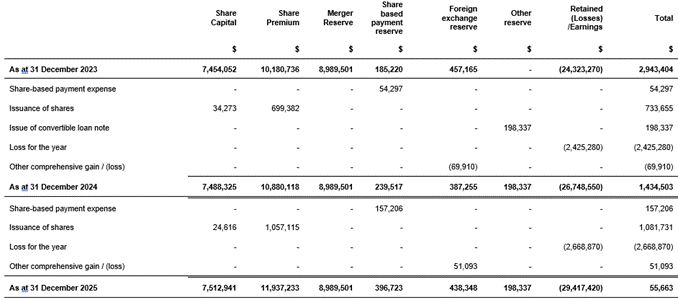
The accompanying notes on pages 38 to 58 are an integral part of these financial statements.
Company Statement of Changes in Equity
for the year ended 31 December 2025
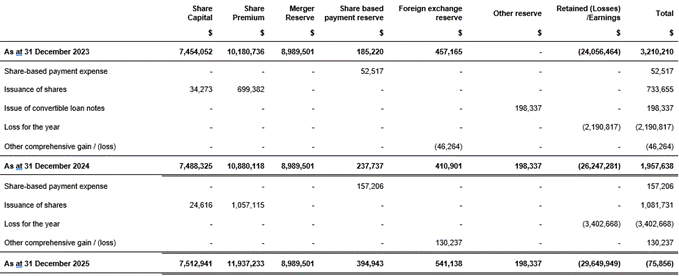
The accompanying notes on pages 38 to 58 are an integral part of these financial statements.
 Consolidated Statement of Cash Flows
for the year ended 31 December 2025
|
|
Year ended 31 December 2025 $ |
Year ended 31 December 2024 $ |
|
Cash flows from operating activities |
|
|
|
Loss before tax |
(2,668,870) |
(2,425,280) |
|
Adjustments for non-cash/non-operating items: |
|
|
|
Amortisation and impairment of intangible assets |
1,752,354 |
1,023,480 |
|
Share based payments and payment in shares |
211,592 |
134,967 |
|
Fair value movement on options liability |
- |
(53,203) |
|
Write off of fixed assets |
- |
22,959 |
|
Interest (income) / expense |
66,006 |
2,113 |
|
Operating cash flows before movements in working capital |
(638,918) |
(1,294,964) |
|
|
|
|
|
Decrease/(increase) in trade and other receivables |
29,063 |
78,157 |
|
Increase/(decrease) in trade and other payables |
252,004 |
571,529 |
|
|
281,067 |
649,686 |
|
Cash generated / (used) by operations |
(357,851) |
(645,278) |
|
Income taxes paid |
- |
- |
|
Net cash generated / (used) by operating activities |
(357,851) |
(645,278) |
|
Cash flows from investing activities |
|
|
|
Purchase of intangible assets, net of disposals |
(342,306) |
(373,488) |
|
Net cash used in investing activities |
(342,306) |
(373,488) |
|
Cash flows from financing activities |
|
|
|
Proceeds from issue of shares |
1,081,731 |
686,049 |
|
Proceeds from convertible loan note |
- |
394,720 |
|
Interest income/(paid) |
(66,006) |
(2,113) |
|
Net cash generated from financing activities |
1,015,725 |
1,078,656 |
|
|
|
|
|
Net increase / (decrease) in cash and cash equivalents |
315,568 |
59,890 |
|
|
|
|
|
Effect of exchange rates on cash and cash equivalents |
73,439 |
(117,740) |
|
Cash and cash equivalents at the beginning of year |
1,003,014 |
1,060,864 |
|
Cash and cash equivalents at end of year |
1,392,021 |
1,003,014 |
The accompanying notes form an integral part of these financial statements.
Notes to the Financial Statements
1 General information
The Group is a global media and technology platform whose mission is to leverage its AI and machine learning technology to more efficiently momentize video and to license such capabilities to brands, creators and publishers to enable discovery, sharing and e-commerce. The Company is a public limited company domiciled in the United Kingdom and incorporated under registered number 10621059 in England and Wales. The Company's registered office is 27-28 Eastcastle Street, London W1W 8DH.
The Company is listed on AIM, a market operated by the London Stock Exchange. These Financial Statements were authorised for issue by the Board of Directors on 31 July 2026.
2 Material accounting policies
Basis of preparation
These Financial Statements of the Group and Company are prepared on a going concern basis, under the historical cost convention except for certain financial instruments which are carried at fair value as specified within the individual accounting policies.
These financial statements consolidate those of the Company and its subsidiaries (together referred to as the "Group"). The Parent Company financial statements present information about the Company as a separate entity.
Both the Company and consolidated financial statements have been prepared and approved by the Directors in accordance with UK adopted International Accounting Standards ("Adopted IFRSs"). On publishing the Company financial statements here together with the consolidated financial statements, the Company is taking advantage of the exemption in s408 of the Companies Act 2006 not to present its individual income statement and statement of comprehensive income and related notes.
The accounting policies set out below have been applied consistently to all periods presented in these financial statements.
The Financial Statements are presented in US Dollars ($), rounded to the nearest dollar.
Going concern
The Directors have prepared a business plan and cash flow forecast for the period to December 2026. The forecast contains certain assumptions about the level of future sales and the level of margins achievable. These assumptions are the Directors' best estimate of the future development of the business.
Cash at 31 December 2025 was $1.4 million. Subsequent to the year end, the Group completed the acquisition of Streaming Limited, trading as MEDIAL, which is expected to be immediately earnings accretive and provides the Group with an established recurring revenue base in the education and enterprise video market.
The Directors have concluded that it remains appropriate to adopt the going concern basis in preparing these financial statements. In reaching this conclusion, they have considered a range of scenarios, including trading in line with recent revenue and profitability trends, the enlarged Group benefiting from the MEDIAL acquisition, and reasonable worst case downside scenarios in which no material new customer wins are assumed and the Group experiences inflationary cost pressures. The Directors have also considered the expected cash impact of the acquisition, the post year-end funding received from both share and loan note issuance and warrant exercises and the repayment profile of financing arrangements. Under these scenarios, including our reasonable worst case scenario the directors are satisfied that there are sufficient mitigations with regards to discretionary expenditure that could be undertaken to ensure in a reasonable worst case scenario the group has sufficient cash resources for a period of 12 months from the date of approval of these financial statements. Therefore the Directors consider that it remains appropriate to adopt the going concern basis in preparing these financial statements.
Basis of consolidation
The accompanying consolidated financial statements of SEEEN plc include its wholly owned subsidiaries: GT Channel, Inc., Tagasauris Inc., and Entertainment AI, Inc.
The Consolidated Statement of Comprehensive Income includes the results of all subsidiary undertakings for the period from the date on which control passes. Control is achieved where the Company (or one of its subsidiary undertakings) obtains the power to govern the financial and operating policies of an investee entity so as to derive benefits from its activities.
The purchase method of accounting is used to account for the acquisition of subsidiaries by the Company. The cost of an acquisition is measured as the fair value of the assets given, equity instruments issued, and liabilities incurred or assumed at the date of exchange. Identifiable assets acquired and liabilities and contingent liabilities assumed in a business combination are measured initially at their fair values at the acquisition date, irrespective of the extent of any non-controlling interest. The excess of the cost of acquisition over the fair value of the Company's share of the identifiable net assets acquired is recorded as goodwill. If the cost of acquisition is less than the fair value of the net assets of the subsidiary acquired, the difference is recognized directly in the income statement.
All Inter-company transactions and balances and unrealized gains or losses on transactions between Group companies are eliminated in full.
Revenue recognition
Under IFRS 15, revenue is recognized when a customer obtains control of a good or a service and thus has the ability to direct the use of and obtain the benefits from the good or service.
CSP
SEEEN owns 100% of GT Channel, Inc, which operates a Creator Service Provider ("CSP") (formerly multichannel network ("MCN")). The CSP aggregates content supplied by creators. The CSP then provides such content to YouTube, who is the customer. YouTube then directs the use of such content to gain the benefit of digital ad revenue from brands. YouTube takes forty-five per cent. of the gross amount of digital ad revenue and then pays the CSP. The Group recognises the payment received from YouTube as revenue, being the net amount after the deduction of forty-five per cent. of the gross advertising revenue. YouTube provides the CSP with daily reports on its receipt of revenue from brands against the CSP's content. Revenue to the CSP is recognized upon receipt of such reports from YouTube.
The CSP pays the creators who have supplied videos to the CSP and these payments are recognized as Cost of Sales in the Group's statement of comprehensive income.
Technology Income
The Group derives revenue from licensing software as a service and bespoke development work.
For software as a service, under IFRS 15 three distinct performance obligations have been identified for these contracts.
• Hosted software licenses;
• performance based results; and
• maintenance and support.
Revenue from the provision of the hosted software licence is recognised evenly over the period in which the licence is hosted by the Group. This policy reflects the continuous transfer of the service to the customer throughout the contracted licence period. For renewals of hosted licences, the revenue is recognised over the period of the contract.
Revenue related to the success of the Group's software products in driving specific customer targets, such as sales of products or clickthroughs onto landing pages, is recognised monthly utilizing the Group's analytics tools to measure the performance of the Group's technology. Customers are invoiced monthly in relation to these performance based results.
Revenue related to ongoing support and periodic updates is recognised evenly over the licence period as the Group is unable to predict at inception of the licence when the support and updates will be required to be provided to the customer.
For bespoke development work, revenue is recognised on completion of the work in those contracts where it is considered that control of the work does not pass until all development work has been completed. Bespoke development work does not create an asset with an alternative use to the Group and, in those contracts where the Group does have an enforceable contractual right to payment for performance completed to date, revenue is recognised over time.
Goodwill
Goodwill represents the excess of the fair value of the consideration over the fair values of the identifiable net assets acquired.
Goodwill arising on acquisitions is not subject to amortisation but is subject to annual impairment testing. Any impairment is recognised immediately in the Consolidated Statement of Comprehensive Income and not subsequently reversed. Goodwill created upon the acquisitions of the Group's subsidiaries was fully impaired in the year ending 31 December 2023.
Other intangible assets
Intangible assets are recorded as separately identifiable assets and amortised at historical cost less any accumulated amortisation. These assets are amortised over their definite useful economic lives on the straight-line method.
Amortisation is computed using the straight-line method over the definite estimated useful lives of the assets as follows:
Years
Customer lists 4
Product development 4
Any amortisation is included within total administrative expenses in the statement of comprehensive income.
Intangible assets with indefinite useful lives are not amortised, but are tested for impairment annually, either individually or at the cash-generating unit level. The assessment of indefinite life is reviewed annually to determine whether the indefinite life continues to be supportable. If not, the change in useful life from indefinite to finite is made on a prospective basis.
The asset's residual values and economic lives are reviewed, and adjusted if appropriate, at each reporting date. An asset's carrying amount is written down immediately to its recoverable amount if the asset's carrying amount is greater than its estimated recoverable amount.
Gains and losses on disposals are determined by comparing the proceeds with the carrying amount and are recognised within other (losses) or gains in the Statement of Comprehensive Income.
Research and development
Research expenditure is recognised as an expense when incurred. Costs incurred on development projects (relating to the design and testing of new or improved products) are recognised as intangible assets when the following criteria are fulfilled.
· It is technically feasible to complete the intangible asset so that it will be available for use or resale;
· Management intends to complete the intangible asset and use or sell it;
· There is an ability to use or sell the intangible;
· It can be demonstrated how the intangible asset will generate possible future economic benefits;
· Adequate technical, financial and other resource to complete the development and to use or sell the intangible asset are available; and
· The expenditure attributable to the intangible asset during its development can be reliably measured.
Other development expenditures that do not meet these criteria are recognised as an expense in the period incurred. Development costs previously recognised as an expense are not recognised as an asset in a subsequent period. Capitalised development costs are recorded as intangible assets and are amortised from the point at which they are ready for use on a straight-line basis over the asset's estimated useful life.
Segment reporting
The Board considers that whilst the Company operates two cash generating units, being technology and CSP, there is no segmental reporting required as the group consider there to be one reportable operating segment. Decisions in respect of the Group are taken at the Group level as a whole.
Impairment reviews
Assets that are subject to amortisation and depreciation are reviewed for impairment when events or changes in circumstances indicate that the carrying amount may not be fully recoverable. Assets that are not subject to amortisation and depreciation are reviewed on an annual basis at each year end (including goodwill) and, if there is any indication that an asset may be impaired, its recoverable amount is estimated. The recoverable amount is the higher of the fair value less costs to sell and its value in use. Any impairment loss arising from the review is charged to the Statement of Comprehensive Income whenever the carrying amount of the asset exceeds its recoverable amount.
Share based payments
The Group has made share-based payments to certain Directors, employees and advisers by way of issue of share options. The fair value of these payments is calculated depending on whether these are cash settled options or not. If they are cash settled, a liability is calculated upon vesting based on Black Scholes option pricing model and this liability is assessed on an annual basis. If the options are equity settled, the options are valued either using the Black Scholes option pricing model or by reference to the fair value of any fees or remuneration settled by way of granting of options. The expense is amortised on a straight-line basis over the period from the date of award to the first date of exercise, based on the best estimate of the number of shares that will eventually vest.
Taxation
Income tax expense represents the sum of the current tax and deferred tax charge for the year.
Current tax
The tax currently payable is based on taxable profit for the year. Taxable profit differs from profit as reported in the Statement of Comprehensive Income because it excludes items of income or expense that are taxable or deductible in other periods and it further excludes items that are never taxable or deductible. The Group's and Company's liability for current tax is calculated using tax rates that have been enacted or substantively enacted by the year end.
Deferred tax
Deferred income taxes are provided in full, using the liability method, for all temporary differences arising between the tax bases of assets and liabilities and their carrying amounts in the Financial Statements. Deferred income taxes are determined using tax rates that have been enacted or substantially enacted and are expected to apply when the related deferred income tax asset is amortisation or the related deferred income tax liability is settled.
The principal temporary differences arise from depreciation or amortisation charged on assets and tax losses carried forward. Deferred tax assets relating to the carry forward of unused tax losses and are recognised to the extent that it is probable that future taxable profit will be available against which the unused tax losses can be utilised. The carrying amount of deferred tax assets is reviewed at each reporting date and reduced to the extent that it is probable that sufficient taxable profits will be available to allow all or part of the asset to be recovered.
Cash and cash equivalents
Cash and cash equivalents comprise cash in hand, deposits held at call with banks, and other short term highly liquid investments with original maturities of three months or less.
Foreign currencies
(i) Functional and presentational currency
Items included in the Financial Statements are measured using the currency of the primary economic environment in which each entity operates ("the functional currency") which is considered by the Directors to be Pounds Sterling (£) for the Parent Company and US Dollars ($) for SEEEN, Inc, GTChannel, Inc and Tagasauris, Inc. The Financial Statements have been presented in US Dollars which represents the dominant economic environment in which the Group operates.
The effective exchange rate at 31 December 2025 was £1 = US$1.3441 (31 December 2024 was £1 = US$1.2521). The average exchange rate for the year to 31 December 2025 was £1 = US$1.3175 (2024 was £1 = US$1.2640).
(ii) Transactions and balances
Foreign currency transactions are translated into the functional currency using the exchange rates prevailing at the dates of the transactions. Foreign exchange gains and losses resulting from the settlement of such transactions and from the translation at year end exchange rates of monetary assets and liabilities denominated in foreign currencies are recognised in the statement of comprehensive income.
(iii) Group Companies
The results and financial position of all the Group entities that have a functional currency different from the presentational currency are translated into the presentational currency as follows:
(a) assets and liabilities for each statement of financial position presented are translated at closing rate at the date of the statement;
(b) the income and expenses are translated at average exchange rates for period where there is no significant fluctuation in rates, otherwise a more precise rate at a transaction date is used; and
(c) all resulting exchange differences are recognised in other comprehensive income and accumulated in the foreign exchange reserve.
Financial instruments
Financial assets and financial liabilities are recognised in the Group's statement of financial position when the Group becomes a party to the contractual provisions of the instrument.
Loans and receivables
Trade receivables, loans, and other receivables held with the objective to collect the contractual cash flows are classified as subsequently measured at amortised cost. These are initially measured at fair value plus transaction costs. At each period end, there is an assessment of the expected credit loss in accordance with IFRS 9; with any increase or reduction in the credit loss provision charged or released to other selling and administrative expenses in the statement of comprehensive income.
Impairment of financial assets
The Group recognises an allowance for expected credit losses ("ECLs") for all debt instruments not held at fair value through profit or loss. ECLs are based on the difference between the contractual cash flows due in accordance with the contract and all the cash flows that the Group expects to receive, discounted at an approximation of the original effective interest rate.
The Group also recognises lifetime ECLs for trade receivables. The ECLs on these financial assets are estimated using a provision matrix based on the Group's historical credit loss experience, adjusted for factors that are specific to the debtors, general economic conditions and an assessment of both the current as well as the forecast conditions at the reporting date, including time value of money where appropriate.
For all other financial instruments, the Group recognises lifetime ECL when there has been a significant increase in credit risk since initial recognition. However, if the credit risk on the financial instrument has not increased significantly since initial recognition, the Group measures the loss allowance for that financial instrument at an amount equal to 12‑month ECL.
Financial liabilities
Financial liabilities, including borrowings, are initially measured at fair value, net of transaction costs and are subsequently measured at amortised cost using the effective interest method.
Equity instruments
An equity instrument is any instrument with a residual interest in the assets of the Company after deducting all of its liabilities. Equity instruments (ordinary shares) are recorded at the proceeds received, net of direct issue costs.
Convertible Loan Notes
The Company has issued and may in the future issue convertible loan notes, which are compound financial instruments containing both a liability component and, in certain cases, an equity component. At initial recognition, the proceeds received are allocated between these components:
· The liability component, representing the obligation to deliver cash or another financial asset, is measured at the fair value of a similar debt instrument without a conversion option and subsequently measured at amortised cost using the effective interest method.
· The equity component, representing the holder's option to convert the loan into a fixed number of the Company's equity instruments, is determined as the residual amount after deducting the fair value of the liability component from the total proceeds received. This component is recognised in equity and is not subsequently remeasured.
Where convertible loan notes are structured such that the conversion option fails to meet the definition of equity (for example, if the number of shares to be issued varies), the entire instrument is classified as a financial liability at fair value through profit or loss, with changes in fair value recognised in the income statement.
Warrants
The Company has issued and may in the future issue warrants, which provide the holder with the right to purchase the Company's equity instruments at a fixed price within a specified period.
Where warrants meet the "fixed-for-fixed" criterion (i.e., the Company is obliged to deliver a fixed number of its own equity instruments in exchange for a fixed amount of cash or another financial asset), they are classified as equity instruments. Equity-classified warrants are recognised in equity and are not subsequently remeasured. Where such warrants are issued together with shares to incoming investors and no separate consideration is paid for the warrants, the entire proceeds from the transaction are allocated to share capital and share premium, and no separate amount is recorded in respect of the warrants.
Where the settlement terms of the warrants do not meet the definition of equity (for example, if the exercise price or number of shares to be issued varies), the warrants are classified as financial liabilities. These are initially recognised at fair value, with subsequent remeasurement at each reporting date. Changes in fair value are recognised in the income statement.
Upon exercise of equity-classified warrants, the proceeds received are credited to share capital and share premium. Expired warrants previously classified as equity remain within equity.
Derecognition of financial liabilities
The Group derecognises financial liabilities when, and only when, the Group's obligations are discharged, cancelled or they expire.
Critical accounting estimates and judgements
The preparation of Financial Statements in conformity with International Financial Reporting Standards requires the use of judgements together with accounting estimates and assumptions that affect the reported amounts of assets and liabilities and the reported amounts of income and expenses during the reporting period. Although these judgements and estimates are based on management's best knowledge of current events and actions, the resulting accounting treatment estimates will, by definition, seldom equal the related actual results.
The following are the critical judgements and estimations that the Directors have made in the process of applying the Company's accounting policies and that have the most significant effect on the amounts recognised in the financial statements.
Principal versus Agent Considerations
Management is required to exercise significant judgement in determining whether the Group acts as principal or agent in certain revenue arrangements, particularly in relation to its CSP activities. Under IFRS 15, this assessment requires consideration of whether the Group controls the specified good or service before it is transferred to the customer, or whether it is instead arranging for another party to provide that good or service.
In making this assessment, the Board considered the nature of the Group's contractual relationship with YouTube and its creator partners. The Group has concluded that YouTube is its customer, from whom it receives a share of its advertising income. The Group is capable of affecting such income by selling its own advertising inventory, as well as taking on the receivables risk in its obligations to creators, whom it has to pay regardless of whether YouTube pays the Group in respect of advertising sales.
This judgement has a material impact on the presentation of revenue. If the Group were determined to act as agent, revenue and cost of sales would both be presented net, with no impact on profit after tax but a significant impact on reported revenue and expenses.
For Technology income, management has concluded that the Group acts as principal, as it controls the provision of software licences, performance-based services, and development work before transferring these services to the customer. Accordingly, revenue is recognised on a gross basis in respect of these contracts.
Impairment of intangible assets
Impairment of the valuation of all intangible assets is considered annually for indicators of impairment to ensure that the asset is not overstated within the financial statements. The annual impairment assessment in respect of intangible assets requires estimates of the value in use (or fair value less costs to sell) of such assets. Given the nature of the business, estimating the future cash flows and appropriate discount factor, in order to determine the net present value of those cash flows is an area of estimation uncertainty. The assumptions made by the Directors in valuing the intangible assets are provided in note 10 to the financial statements, including the impact on valuation if certain key inputs were to be changed.
Impairment of investment in subsidiaries
The carrying value of these investments at 31 December 2025 was nil. Further details of the impairment recognised during the year are provided in note 11 to the financial statements.
Amortisation of intangible assets
The periods of amortisation adopted to write down capitalised intangible assets requires judgements to be made in respect of estimating the useful lives of the intangible assets to determine an appropriate
amortisation rate. Technology and website development costs are being amortised on a straight-line basis over the period during which the economic benefits are expected to be received, which has been estimated at 4 years.
Convertible loan note valuation
Convertible loan notes contain both debt and equity features, and the determination of their appropriate accounting treatment requires judgment in assessing whether the instrument should be classified wholly as a financial liability, wholly as equity, or as a compound instrument comprising both elements. Management has considered the contractual terms of the loan notes, including:
· whether the conversion option is fixed-for-fixed and therefore meets the definition of an equity instrument;
· whether the conversion feature represents an embedded derivative liability requiring separate recognition at fair value through profit or loss;
· the likelihood of conversion versus redemption; and
· the discount rate applied in determining the present value of future cash flows attributable to the liability component.
Where the loan notes are determined to be compound instruments, the liability component is measured initially at the fair value of a similar instrument without a conversion feature, with the residual amount allocated to equity. This requires estimation of an appropriate discount rate and involves significant management judgment.
Subsequent measurement of the liability component at amortised cost, together with periodic reassessment of the classification of the equity component, could result in volatility in reported earnings. Management believes the assumptions applied are appropriate; however, changes in those assumptions could have a material effect on the reported financial position and performance of the Group.
3 Revenue
On the basis that the Group consider there to be only one operating segment as detailed in note 2, no IFRS 8 disclosures are required and below is revenue split by stream and location:
|
|
|
Year ended |
Year ended |
|
|
|
31 December |
31 December |
|
|
|
2025 |
2024 |
|
|
|
$ |
$ |
|
CSP Revenue |
|
4,799,899 |
2,820,721 |
|
Technology Revenue |
|
216,383 |
220,187 |
|
Total Revenue |
|
5,016,282 |
3,040,908 |
Revenue is attributed to the following geographical locations:
|
|
|
Year ended |
Year ended |
|
|
|
31 December |
31 December |
|
|
|
2025 |
2024 |
|
|
|
$ |
$ |
|
USA |
|
4,958,311 |
2,991,100 |
|
ROW |
|
57,971 |
49,808 |
|
|
|
5,016,282 |
3,040,908 |
4 Expenses by nature
The Group's operating loss has been arrived at after charging:
|
|
Year ended |
Year ended |
|
|
31 December |
31 December |
|
|
2025 |
2024 |
|
|
$ |
$ |
|
Employee costs |
244,534 |
682,465 |
|
Consulting services |
37,402 |
65,636 |
|
Bad debt write-offs |
27,007 |
365,700 |
|
Agency fees |
178,449 |
75,000 |
|
Rent |
13,567 |
21,024 |
|
Professional fees |
275,335 |
193,557 |
|
Listing fees |
106,889 |
22,088 |
|
Foreign Exchange |
52,688 |
60,482 |
|
Other |
477,463 |
422,248 |
|
Other administrative expenses |
1,413,334 |
1,908,200 |
|
Share based payments |
211,592 |
134,967 |
|
Amortisation and impairment of intangible assets |
1,752,354 |
1,023,480 |
|
Total administrative expenses |
3,377,280 |
3,066,647 |
|
|
Year ended 31 December 2025 |
Year ended 31 December 2024 |
|
|
$ |
$ |
|
Auditors remuneration |
|
|
|
Fees payable to the Group's auditor for audit of Parent Company and Consolidated Financial Statements |
114,625 |
95,000 |
|
Fees payable to the Group's in respect of prior period audit |
105,402 |
- |
5 Employees and Executive Directors
The Executive Director is considered to be the key management of the business.
The following table shows all compensation paid to employees and non-executive directors, including expenses that were capitalised during the year.
|
|
Year ended 31 December 2025 $ |
Year ended 31 December 2024 |
|
|
|
|
|
Staff costs for all employees, including Executive Directors consist of: |
|
|
|
Wages and salaries |
411,107 |
617,865 |
|
Pensions, Social Security and Health Benefits |
91,169 |
69,365 |
|
Share Based Payments Expense |
211,592 |
134,967 |
|
|
|
|
|
|
713,868 |
822,197 |
Information regarding Directors emoluments are as follows:
|
|
Year ended 31 December 2025 |
Year ended 31 December 2024 |
|
|
$ |
$ |
|
Short-Term employee benefits |
|
|
|
Directors' fees, salaries and benefits* |
371,278 |
326,894 |
|
Social Security Costs |
25,763 |
20,666 |
|
|
397,041 |
347,560 |
*The highest paid Executive Director received emoluments of $180,901 (2024: $180,215).
All Non-Executives agreed to receive their entire fees for 2025 in shares or options of the Company.
The average number of employees (including Directors) in the Group during the year was:
|
|
Year ended |
Year ended |
|
|
31 December |
31 December |
|
|
2025 |
2024 |
|
Directors (executive and non-executive) |
5 |
5 |
|
Management |
1 |
1 |
|
Other |
3 |
4 |
|
|
9 |
10 |
Note: The Group also used three full time consultants in respect of product development and sales.
6 Share options
The Company grants share options at its discretion to Directors, management and advisors. These are accounted for as equity settled options. Should the options remain unexercised after a period of ten years from the date of grant the options will expire unless an extension is agreed to by the Board. Options are exercisable at a price equal to an exercise price determined by the Board.
Details for the share options and warrants granted, exercised, lapsed and outstanding at the year-end are as follows:
|
|
Number of share options 2025 |
Weighted average exercise price (GBp) 2025 |
|
Outstanding at beginning of the year |
8,263,553 |
51.8 |
|
Granted during the year |
- |
- |
|
Forfeited/lapsed during the year |
- |
- |
|
Exercised during the year |
- |
- |
|
Outstanding at end of the year |
8,263,553 |
51.8 |
|
Exercisable at end of the year |
8,263,553 |
51.8 |
Fair value of share options
The Black Scholes calculations for the options outstanding during 2025 resulted in an annual charge of $788 (2024: $32,310), which has been expensed in 2025.
The weighted average remaining contractual life of the share options as at 31 December 2025 was 4.39 years.
Options arrangements that exist over the Company's shares at year end are detailed below:
|
Grant |
31 December 2025 |
31 December 2024 |
Date of Grant |
Exercise price |
Exercise period From To |
|
|
AIM Admission Grant Options |
4,996,887 |
4,996,887 |
30/9/2019 |
45p |
30/9/2020 |
30/9/2029 |
|
2021 Director Fee Options |
1,450,000 |
1,450,000 |
4/3/2021 |
60p |
4/3/2024 |
4/3/2031 |
|
2021 Incentive Options |
1,208,333 |
1,208,333 |
4/3/2021 |
65p |
4/3/2024 |
4/3/2031 |
|
2021 Incentive Options |
541,666 |
541,666 |
13/5/2021 |
65p |
13/5/2024 |
13/5/2031 |
|
2022 Director Options |
66,667 |
66,667 |
27/5/2022 |
30p |
27/5/2025 |
27/5/2032 |
|
Total |
8,263,553 |
8,263,553 |
|
|
|
|
The 2021 and 2022 share options are equity settled on exercise, whilst the AIM Admission Grant Options can be equity or cash settled at the option holder's request.
In addition, as the Non-Executive Directors have elected to receive their 2025 compensation in either shares or options, these have been included as a share based expense totalling $210,804 (2024: $102,657). Part of this has been satisfied through the issue of shares to certain directors in 2024 in respect of their 2025 compensation with the rest to be satisfied after the release of these results.
7 Finance costs
|
|
|
Year ended |
Year ended |
|
Interest expense |
|
(66,006) |
(2,113) |
8 Taxation
The major components of income tax expense for the years ended 31 December 2025 and 31 December 2024 are as follows:
|
|
Year ended |
Year ended |
|
|
31 December |
31 December |
|
|
2025 |
2024 |
|
Group |
$ |
$ |
|
Current tax: |
- |
- |
|
Current tax (benefit) on profits in the year |
- |
- |
|
Prior year over provision |
- |
- |
|
Total Tax charge (benefit) |
- |
- |
|
Deferred tax current year |
- |
- |
|
Deferred |
- |
- |
|
Total Tax charge (benefit) |
- |
- |
|
|
|
|
The tax on the Group's loss before tax differs from the theoretical amount that would arise using the weighted average tax rate applicable to profits and losses as follows:
|
|
Year ended |
Year ended |
|
|
31 December |
31 December |
|
|
2025 |
2024 |
|
|
$ |
$ |
|
Total loss on ordinary activities before tax |
(2,668,870) |
(2,425,280) |
|
Loss on ordinary activities at the standard rate of corporation tax in the US of 21% (2024: 21%) |
(560,462) |
(509,309) |
|
Non-deductible expenses |
295,484 |
33,966 |
|
State taxes net of federal benefit |
(18,333) |
(20,989) |
|
Other tax adjustments, reliefs and transfers |
- |
- |
|
Adjustment in respect of prior year |
- |
- |
|
Deferred tax not recognised / valuation allowance |
283,311 |
496,332 |
|
Changes in rates |
- |
- |
|
Total Tax charge |
- |
- |
|
|
|
|
At the balance sheet date, the Group had unused tax losses (as reported on the Group's tax returns) of $19,438,469 available for offset against future profits. $4,100,409 represents unrecognized deferred tax assets thereon. The deferred tax asset has not been recognized due to uncertainty over timing of utilization.
9 Earnings per share
The loss per share has been calculated using the loss for the year and the weighted average number of ordinary shares outstanding during the year, as follows:
|
|
Year ended |
Year ended |
|
Loss for the year attributable to equity holders of the Parent ($) |
(2,668,870) |
(2,425,280) |
|
Weighted and diluted average number of ordinary shares |
131,739,161 |
107,841,702 |
|
Loss per share (cents) |
(2.03) |
(2.25) |
|
Diluted loss per share (cents) |
(2.03) |
(2.25) |
As the Group reported a loss per share, all potential dilutive shares have been discounted as this would have had the result of reducing the loss per share reported by the Group.
10 Intangible assets
|
Group |
Goodwill |
Other Intangible Assets |
Development Costs |
Total |
|
Cost |
|
|
|
|
|
At 31 December 2024
|
9,762,158 |
4,760,994 |
5,309,786 |
19,832,938 |
|
Additions |
- |
- |
342,306 |
342,306 |
|
Disposals |
- |
- |
- |
- |
|
At 31 December 2025 |
9,762,158 |
4,760,994 |
5,652,092 |
20,175,244 |
|
|
|
|
|
|
|
Impairment and Amortisation |
|
|
|
|
|
At 31 December 2024 |
(9,762,158) |
(4,760,994) |
(3,858,831) |
(18,381,983) |
|
Amortisation |
- |
- |
(557,855) |
(557,855) |
|
Impairment |
- |
- |
(1,194,499) |
(1,194,499) |
|
At 31 December 2025 |
(9,762,158) |
(4,760,994) |
(5,611,185) |
(20,134,337) |
|
|
|
|
|
|
|
Carrying amount |
|
|
|
|
|
At 31 December 2024 |
- |
- |
1,450,955 |
1,450,955 |
|
At 31 December 2025 |
- |
- |
40,907 |
40,907 |
The cost of other intangible assets comprises customer lists and technology development acquired at the date of acquisition. The other intangible assets are being amortised over a period of 4 years. Amortisation is charged to administrative costs in the Statement of Comprehensive Income.
At 31 December 2025, all material development projects included in the above schedule had been completed and were available for use. The remaining carrying amount of development costs was $40,907.
Impairment Assessment
At the end of the year, the Directors reviewed the value of the completed intangible assets and development projects. Where appropriate, assets were grouped into cash-generating units. Expected future cash flows were assessed on a pre-tax value-in-use basis over the lower of six years and the remaining useful life of the relevant asset, using a pre-tax discount rate of 16%. The review incorporated current customer acquisition and trading performance and a 5% annual increase in staff costs. As a result of this review, the carrying values of the completed development asset groups were reduced to nil, except for a residual carrying amount of $40,907 at 31 December 2025.
11 Investment in subsidiary undertakings
|
Company |
Cost of investment |
Loan to group undertaking |
|
|
Cost |
|
|
|
|
At 31 December 2024
|
13,408,199 |
4,743,896 |
18,152,095 |
|
Additions |
- |
- |
- |
|
At 31 December 2025 |
13,408,199 |
4,743,896 |
18,152,095 |
|
|
|
|
|
|
Impairment |
|
|
|
|
At 31 December 2024 |
(13,408,199) |
(3,666,806) |
(17,075,005) |
|
Foreign exchange adjustment |
|
79,142 |
79,142 |
|
Impairment |
- |
(1,156,232) |
(1,156,232) |
|
At 31 December 2025 |
(13,408,199) |
(4,743,896) |
(18,152,095) |
|
|
|
|
|
|
Carrying amount |
|
|
|
|
At 31 December 2024 |
- |
1,077,090 |
1,077,090 |
|
At 31 December 2025 |
- |
- |
- |
The Directors annually assess the carrying value of the investment in subsidiaries and related loans. During the year, an additional impairment charge of $1,156,232 was recognised, reducing the carrying value at 31 December 2025 to nil.
The subsidiary undertakings during the year were as follows:
|
|
Registered office address |
Country of incorporation |
Interest held |
|
GTChannel, Inc. |
199 Whitney Avenue, New Haven, Connecticut 06511 U.S. |
US |
100% |
|
Tagasauris, Inc. |
199 Whitney Avenue, New Haven, Connecticut 06511 U.S. |
US |
100% |
|
Entertainment AI, Inc. |
199 Whitney Avenue, New Haven, Connecticut 06511 U.S. |
US |
100%
|
All subsidiaries are owned directly by the Parent Company.
12 Trade and other receivables
|
|
Group |
Company |
||
|
|
31 December 2025 |
31 December 2024 |
31 December 2025 |
31 December 2024 |
|
Trade receivables |
662,356 |
585,104 |
8,065 |
50,760 |
|
Other receivables |
77,640 |
36,618 |
33,801 |
- |
|
Prepayments |
99,916 |
247,253 |
99,915 |
127,855 |
|
Intercompany receivables |
- |
- |
- |
766,139 |
|
|
839,912 |
868,975 |
141,781 |
944,754 |
In determining the recoverability of accounts receivable, the Group considers changes in credit quality from the date credit was initially granted to the reporting date. Expected credit losses are assessed in accordance with IFRS 9 using customer credit profiles, payment history, current conditions and forward-looking information. Any loss allowance is determined in accordance with IFRS 9 and in 2025 $27,007 was provided for and written off (2024: $365,700).
13 Cash and cash equivalents
|
|
Group |
Company |
||
|
|
31 December 2025 |
31 December 2024 |
31 December 2025 |
31 December 2024 |
|
Cash at bank and in hand |
1,392,021 |
1,003,014 |
875,337 |
566,068 |
14 Trade and other payables
|
|
Group |
Company |
||
|
|
Year Ended 31 December |
Year Ended 31 December |
Year Ended 31 December |
Year Ended 31 December |
|
Trade payables |
628,458 |
743,175 |
343,109 |
333,521 |
|
Intercompany payables |
- |
- |
307,575 |
- |
|
Accruals and other payables |
1,295,354 |
928,632 |
164,533 |
95,726 |
|
|
1,923,812 |
1,671,807 |
815,217 |
429,247 |
Trade payables and accruals principally comprise amounts outstanding for trade purchases and ongoing costs and are payable within 3 months.
15 Deferred Tax
|
|
Total |
|
Balance as at 1 January 2025 |
(17,408) |
|
Deferred tax charge for the year |
- |
|
Balance At 31 December 2025 |
(17,408) |
The deferred tax provision comprises:
|
|
31 December 2025 $ |
31 December 2024 $ |
|
Deferred tax liability arising from acquisition of intangible assets |
- |
- |
|
Deferred tax liability relating to other timing differences |
17,408 |
17,408 |
|
Total |
17,408 |
17,408 |
At the balance sheet date, the Group had unused tax losses (as reported on the Group's tax returns) of $19,438,469 available for offset against future profits. $4,100,409 represents unrecognized deferred tax assets thereon. The deferred tax asset has not been recognized due to uncertainty over timing of utilization.
16 Share capital
The issued share capital in the year consisted of ordinary shares of 0.1 pence each and deferred shares of 11.9 pence each and was as follows:
Group & Company
|
|
Number of Shares |
Nominal Value of Shares $ |
|||
|
|
Ordinary |
Deferred |
Ordinary |
Deferred |
Total |
|
At 31 December 2024 |
120,279,141 |
49,957,876 |
149,265 |
7,339,060 |
7,488,325 |
|
Issue of Shares |
18,445,828 |
- |
24,616 |
- |
24,616 |
|
At 31 December 2025 |
138,724,969 |
49,957,876 |
173,881 |
7,339,060 |
7,512,941 |
.
Group & Company - MOVEMENT
|
|
Share capital |
Share premium |
|
At 31 December 2024 |
7,488,325 |
10,880,118 |
|
Change |
24,616 |
1,057,115 |
|
At 31 December 2025 |
7,512,941 |
11,937,233 |
During the year, the Company issued shares on the following dates and amounts:
|
Date |
Number of shares |
Issue Price |
Total Value |
|
31 January 2025 |
1,962,500 |
4.98c |
$97,683 |
|
31 May 2025 |
16,483,328 |
6.05c |
$997,772 |
$13,724 in directly attributable costs were deducted from share premium.
During the year ended 31 December 2024, the Company issued 21,166,661 warrants to subscribing shareholders, exercisable at 4.5p per ordinary share up to 18 June 2026. During the year ended 31 December 2025, 14,816,662 warrants were exercised, resulting in the issue of an equal number of ordinary shares. Accordingly, 6,349,999 warrants remained outstanding at 31 December 2025.
17 Convertible loan note reserve
Balance sheet
|
|
31 December 2025 |
|
|
$ |
|
Convertible Loan Note |
|
|
Non-current liability |
253,136 |
|
Current liability |
- |
|
|
|
|
Equity component of convertible loan note |
198,337 |
Convertible loan notes
As at 31 December 2025, the Group had a convertible loan note ("CLN") issued to Gresham House with a face value of £325,000 and a maturity date of 17 December 2029. The instrument contains liability and equity components in accordance with IAS 32. At 31 December 2025, the liability component was $253,136 and the equity component recognised in the convertible loan note reserve was $198,337. During the year, the carrying amount of the liability increased by $75,046 through the effective interest charge and foreign exchange translation. The equity component is not remeasured after initial recognition, although the Group presentation reflects foreign currency translation movements.
In addition to the £325,000 of CLNs subscribed on 16 December 2024, the Subscription Agreement provides for the issuance of further unsecured loan notes with a principal amount of £487,500 (the "Additional Notes") to the same noteholder, subject to the satisfaction of specified conditions outlined in the agreement. While the Additional Notes have not yet been issued and therefore have no current accounting impact, they are disclosed as an undrawn facility available to the Group should the conditions to issuance be satisfied.
Movement in the carrying value of the CLN is detailed below:
|
|
31 December 2025 |
|
|
$ |
|
At 31 December 2024 |
178,090 |
|
Effective interest expense and foreign exchange movement |
75,046 |
|
Closing balance 31 December 2025 |
253,136 |
|
|
|
Risk Management Disclosures - IFRS 7
The CLNs expose the Company to interest rate risk, liquidity risk and foreign currency translation risk because the instrument is denominated in Pounds Sterling while the Group presents its financial statements in US Dollars.
The Company has modelled its cash flow obligations over the five-year term of the CLNs and is confident in its ability to meet the repayment obligation in the event the notes are not converted. Conversion would reduce liquidity pressure by eliminating the repayment obligation and replacing it with share capital issuance.
The fair value of the liability component at initial recognition was determined using a Level 2 input (observable discount rate for comparable debt instruments). The Company does not remeasure the fair value of the liability subsequently, as it is held at amortised cost.
18 Long Term Liabilities
|
|
Group |
Company |
||
|
|
Year Ended 31 December |
Year Ended 31 December |
Year Ended 31 December |
Year Ended 31 December |
|
Convertible loan note liability |
253,136 |
178,090 |
253,136 |
178,090 |
|
Option liability |
24,621 |
22,936 |
24,621 |
22,936 |
|
|
277,757 |
201,026 |
277,757 |
201,026 |
The convertible loan note liability is described in further detail in Note 17 above,
The option liability arose because the terms of the options issued on 30 September 2019 allow option holders to elect to settle their options for cash. Accordingly, the entire value of the options is treated as a liability with no equity component. The fair value of these share-based payment liabilities is determined using Black-Scholes valuations at each year end, with changes in fair value recognised in the Statement of Comprehensive Income.
|
|
Option Liability $ |
|
At 31 December 2024 |
22,936 |
|
Change |
1,685 |
|
At 31 December 2025 |
24,621 |
19 Financial instruments
Financial instruments
As at the dates presented, the Group has classified its financial instruments as follows:
|
At 31 December 2025 |
Loans and Receivables at Amortized Cost |
Other Financial Liabilities at Amortized Cost |
Fair Value through Profit or Loss |
Total |
|
Financial Assets |
|
|
|
|
|
Cash |
1,392,021 |
- |
- |
1,392,021 |
|
Trade and Other Receivables |
839,912 |
- |
- |
839,912 |
|
|
|
|
|
|
|
Financial Liabilities |
|
|
|
|
|
Trade and Other Payables |
- |
1,923,812 |
- |
1,923,812 |
|
Convertible Loan Note |
- |
253,136 |
- |
253,136 |
|
Option Liability |
- |
- |
24,621 |
24,621 |
|
|
|
|
|
|
|
At 31 December 2024 |
Loans and Receivables at Amortized Cost |
Other Financial Liabilities at Amortized Cost |
Fair Value through Profit or Loss |
Total |
|
Financial Assets |
|
|
|
|
|
Cash |
1,003,014 |
- |
- |
1,003,014 |
|
Trade and Other Receivables |
868,975 |
- |
- |
868,975 |
|
|
|
|
|
|
|
Financial Liabilities |
|
|
|
|
|
Trade and Other Payables |
- |
1,671,807 |
- |
1,671,807 |
|
Convertible Loan Note |
- |
178,090 |
- |
178,090 |
|
Option Liability |
- |
- |
22,936 |
22,936 |
Credit risk management
The Company is exposed to credit risk associated with its accounts receivable. Credit risk is minimized substantially by ensuring the credit worthiness of the entities with which it carries on business. Most of the Group's revenues are derived from its CSP business. The key counterparty for this business is YouTube. The performance obligations arise at the time that CSP videos generate advertising or other income on YouTube. YouTube makes a monthly payment to the Group, approximately 20 days in arrears.
At the reporting date, trade receivables amounted to $662,356 (2024: $558,222). Management has reviewed all outstanding receivables. Balances considered irrecoverable have been written off or provided against. Remaining balances have either been settled after the reporting date or are considered recoverable. Accordingly, no additional material net loss allowance has been recognised.
The Group's trade receivables ageing was as follows:
|
|
31 December 2025 |
31 December 2024 |
|
Current |
614,365 |
494,922 |
|
31-60 days |
- |
- |
|
61-90 days |
- |
- |
|
>90 days |
74,998 |
63,300 |
|
|
689,363 |
558,222 |
|
Allowance for doubtful accounts |
27,007 |
- |
|
Total |
662,356 |
558,222 |
Interest rate risk management
Interest rate risk is the risk that the fair value or future cash flows of a financial instrument will fluctuate because of changes in market rates. The Company's exposure to interest rate risk is based on short-term fixed interest rates. At 31 December 2025, the Company's exposure to interest rate risk was determined to be nominal.
Capital risk management
In managing its capital, the Group's primary objective is to maintain a sufficient funding base to enable working capital, research and development commitments and strategic investment needs to be met and therefore to safeguard the Group's ability to continue as a going concern in order to provide returns to shareholders and benefits to other stakeholders. In making decisions to adjust its capital structure to achieve these aims, including through new share issues, the Group considers not only its short-term position but also its long term operational and strategic objectives.
The capital structure of the Group currently consists of equity comprising issued capital, reserves and retained earnings. The Group is not subject to any externally imposed capital requirements.
Foreign currency risk management
Foreign exchange transaction risk arises when individual Group operations enter into transactions denominated in a currency other than the dominant economic currency of the Group. The principal risk arises from the Group's holding company and payments made in relation to the holding company's activities in the United Kingdom.
The carrying amount of the Group's foreign currency denominated monetary assets and monetary liabilities were:
|
|
Group |
Company |
||
|
|
Year ended |
Year ended |
Year ended |
Year ended |
|
Assets |
|
|
|
|
|
Sterling |
1,017,118 |
564,885 |
1,017,118 |
566,068 |
|
Liabilities |
|
|
|
|
|
Sterling |
1,092,974 |
394,720 |
1,092,974 |
394,720 |
As shown above, at 31 December 2025 the Group had Sterling-denominated net monetary deficit of $75,856 (2024: net assets $170,165). If Sterling weakened by 10% against the US Dollar, the net monetary deficit would reduce by approximately $7,586 (2024: assets decrease by $17,017), with a corresponding impact on reported profit or loss.
Liquidity risk management
Ultimate responsibility for liquidity management rests with management. The Group's policy is to ensure that it will have sufficient cash to allow it to meet its liabilities when they become due and so cash holdings may be high during certain periods throughout the period. The Group currently has no bank borrowing or overdraft facilities, although it has a convertible loan note as described in more detail in Note 17 above. All liabilities related to trade and other payables are current and expected to be settled within 3 months.
The Group's policy in respect of cash and cash equivalents is to limit its exposure by reducing cash holding in the operating units and investing amounts that are not immediately required in funds that have low risk and are placed with a reputable bank.
20 Related party transactions
During the year ended 31 December 2025, the Group provided digital marketing and related technology services to American Leak Detection, a subsidiary of Water Intelligence plc. The transaction is a related-party transaction under the AIM Rules for Companies because SEEEN plc's Chairman, Dr Patrick DeSouza, is Executive Chairman of and a major shareholder in Water Intelligence plc. Revenue recognised from these services totalled $120,404 during 2025 (2024: $97,567). The amount receivable at year end was $70,330 (2024: $100,681). In addition, during the period American Leak Detection paid $75,000 of the Group's expenses.
The directors are considered to be the Group's key management personnel. Their compensation is disclosed in note 5.
The Directors are not aware of any other related party transactions.
21 Contingent liabilities
The Group is involved in a legal claim arising from a historic employment arrangement in connection with the acquisition of GT Channel, Inc. The claim is at an early procedural stage, with no operative pleading currently in place, and SEEEN plc has not been validly served.
Based on external legal advice, the directors do not consider an adverse outcome to be probable and no reliable estimate of any potential loss can be made. Accordingly, no provision has been recognised and the matter is disclosed as a contingent liability.
22 Subsequent events
In April 2026, the Group agreed to acquire 100% of the shares of Streaming Limited, trading as MEDIAL, an established provider of enterprise media library and streaming software to universities and corporate organisations. The transaction is a non-adjusting event after the reporting period and has not been reflected in the consolidated financial statements for the year ended 31 December 2025. The maximum consideration is approximately £1.2 million, comprising initial consideration of approximately £1.0 million, satisfied through £0.95 million in cash and the issue of 1,000,000 new ordinary shares, together with deferred cash consideration of £0.2 million payable over eight quarters subject to no warranty claims arising. In connection with the acquisition, the Company also raised £130,000 through an equity subscription and entered into £325,000 of new loan capital arrangements with Adrian Hargrave and Robert Thomas.
As the acquisition occurred after the reporting date, the results and financial position of the acquired company have not been included in these financial statements. The assessment of the fair value of the identifiable assets and liabilities acquired is ongoing and has not yet been finalised. The amounts presented below are provisional and reflect the book values of assets and liabilities at the acquisition date. No fair value adjustments or separately intangible assets have been recognised at this stage. Consequently, goodwill has not been finalised and remains subject to change on completion of the purchase price allocation exercise.
|
|
Medial |
|
Property plant and equipment |
6,882 |
|
Trade and other receivables |
87,063 |
|
Cash and cash equivalents |
176,839 |
|
Total assets |
270,784 |
|
Trade and other payables |
98,082 |
|
Total liabilities |
98,082 |
On 30 June 2026, the Group announced that 1,283,331 warrants were exercised, raising approximately £0.06m from the issue of new ordinary shares in the Company to warrantholders from the fundraising completed in June 2024. The remaining warrants have all now expired.
23 Control
The Company is under the control of its shareholders and not any one party. The shareholdings of the directors and entities in which they are related are as outlined within the Director's Report.
RNS may use your IP address to confirm compliance with the terms and conditions, to analyse how you engage with the information contained in this communication, and to share such analysis on an anonymised basis with others as part of our commercial services. For further information about how RNS and the London Stock Exchange use the personal data you provide us, please see our Privacy Policy.

Latest directors dealings
- 1 hour ago Trufin
- 1 hour ago Everplay Group plc
- 1 hour ago Hilton Food Group
- 1 hour ago Sunbelt Rentals Holdings, Inc.
- 15 hours ago Cambridge Cognition Holdings