
Uranium JV: Badger Lake Drill Programme
Summary by AI BETAClose X

20 April 2026
Power Metal Resources PLC
("Power Metal" or the "Company")
Uranium Joint Venture: Badger Lake Drill Programme
Favourable Geologic Conditions for Uranium Mineralisation Confirmed
HIGHLIGHTS:
· Diamond drilling programme completed with four holes and a total of 1,922 metres drilled.
· Drilling successfully tested fault structures and analogies of major deposits.
· Highly encouraging hydrothermal alteration intersected, including distinct bleaching and preserved palaeoweathering profiles, confirming the presence of potential REDOX fronts necessary for uranium precipitation.
· No elevated radioactivity was encountered, despite the promising geology and mineralogy encountered.
· Core samples have been dispatched for comprehensive laboratory analysis.
Sean Wade, Chief Executive Officer of Power Metal Resources PLC commented:
"This initial drill programme has successfully validated our geological models for Badger Lake. While still early in our exploration, encountering such geological conditions is a significant milestone for the project. We look forward to sharing the laboratory results with the market as we plan our next steps."
DRILL PROGRAMME SUMMARY
Four NQ diameter drill holes (47.6mm core diameter), with a total metreage of 1,922m, were drilled on the Badger Lake Property over the period 2 March - 9 April 2025. Three holes (BL26-01 to BL26-03) were drilled from a single central location, and one (BL26-04) was drilled approximately 270m to the north-north-west, as shown in Figures 1 and 2.
BL26-01 - Drilled to test a combined magnetic low (inferred fault structure), intersecting both the S-Zone and the inferred Eastern Shear Zone, this hole was planned for 650m, and 647m were drilled. This hole was targeting shear/fault-hosted mineralisation and was designed to provide information on the alteration and geochemistry of the Eastern Shear Zone.
BL26-02 - Drilled to test the inferred Western Shear Zone, the S-Zone and the overlying anomalous uranium in soil. This hole was planned for 650m, of which 584m was drilled due to the earlier than expected intersection of the target zone. This hole was targeting shear/fault-hosted mineralisation and was designed to provide information on the alteration and geochemistry of the Western Shear Zone.
BL26-03 - Drilled to test for a potential Cigar Lake Analogy between the two Shear Zones, as well as investigate the S-Zone and the inferred gravity high. This hole was planned for 400m, but terminated at 305m due to the unconformity being shallower (250m) than anticipated.
BL-26-04 - Drilled to test for mineralisation at the apex of the Western Shear Zone and the unconformity. This hole was planned for 400m, and terminated at 386m.
The centralised drilling setup for BL-26-01 to BL-26-03 allowed the programme to test the two fault structures, the Cigar Lake Anomaly and the S-Zone, without moving the drill, thereby increasing the programme's efficiency.
The drill programme was carried out by ITL Diamond Drilling Ltd, with technical services provided by Mercator Geological Services, and helicopter support from Access Helicopters Ltd. The drilling campaign was staged out of Big Bear Camp in western Saskatchewan.
A full discussion on previous work on the property, the overlying geochemistry and the target's structural geology is presented in the Company announcement of 18 June 2025:
https://polaris.brighterir.com/public/power_metal_resources/news/rns/story/wk641yx
A release outlining the drill programme as proposed is presented in the Company announcement of 9 February 2026:
https://polaris.brighterir.com/public/power_metal_resources/news/rns/story/wvy560w
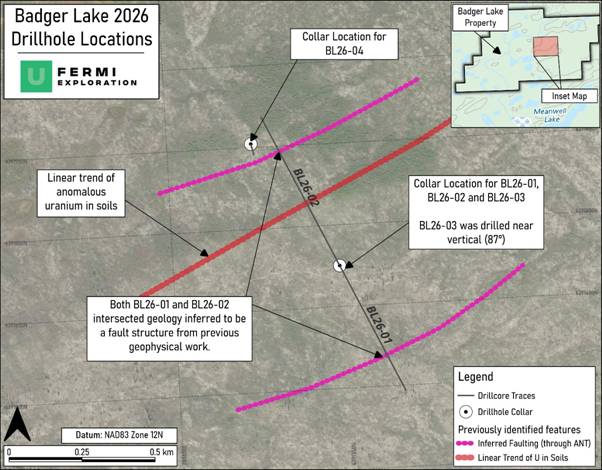
Figure 1 - Map showing the location of the drill collars and traces drilled in winter 2026 on the Badger Lake Property
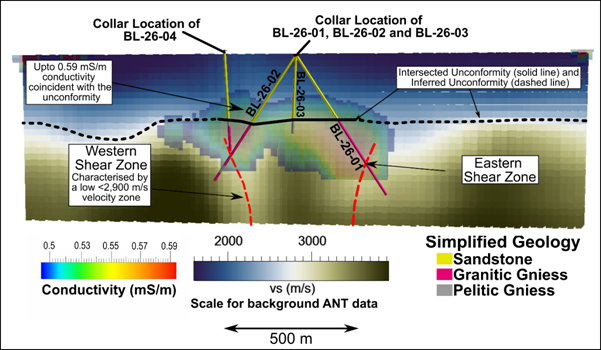
Figure 2: Side view of the ANT profile (scale provided) and the previously identified conductivity and inferred basement faulting. The drillholes (BL26-01 to BL-26-04) and their simplified geology are shown, alongside the proven and inferred unconformity. View is looking 54° to northeast.
Preliminary Drilling Results
BL-26-01
This inclined (-57°) hole intersected the unconformity at 302.79 metres down-hole depth equivalent to 253.9m vertical depth or true-depth ("TD"). The overlying Athabasca sandstone is primarily fine- to medium-grained and pale brick-red, with minor cross-bedding. A notable zone of desilicification was observed at 123.00m down-hole (103.2m TD), whilst the lower sandstone column exhibits weak to moderate illite bleaching (242.0m-275.5m downhole / 203.0m-231.1m TD) and intense maroon haematite alteration approaching the basement contact.
Beneath the unconformity, a well-developed palaeoweathering profile is preserved, featuring a heavily hematised Red Zone (302.79m-313.65m downhole / 253.9m-263.1m TD) and a transitional clay-rich Green Zone (313.65m-336.00m downhole / 263.1m-281.8m TD) dominated by chlorite, illite, and kaolinite. The basement lithology is primarily augen gneiss with minor pegmatitic sections, intruded by a series of mafic dykes starting at 501.73 metres downhole (420.8m TD) and continuing to the end of the hole. The basement was variably silicified throughout, with the field observations indicating the Silicification to be late in the alteration sequence.
Structurally, minor faulting and shear zones are clustered immediately below the unconformity (between 313m and 331m downhole / 262.5m and 277.6m TD), with no strong evidence of sustained faulting to depth, although annealed clay-filled fractures were observed. No uranium mineralisation was encountered, with localised blebby and fracture-fill pyrite (up to 8%) concentrated between 347.85m and 349.55m downhole (291.7m-293.2m TD), accompanied by a secondary hydrothermal overprint of chlorite, illite, and calcite veining within the upper basement.
BL-26-02
This inclined (-57°) hole intersected the unconformity at 316.40 metres downhole (265.4m TD). The overlying Athabasca sandstone displays variably bedded pale brick-red to burgundy hues, with significant intermittent bleaching starting at 277.32m downhole (232.6m TD) and continuing to the basement contact. Beneath the unconformity, a well-defined palaeoweathering profile is evident, comprising a Red Zone (316.4m-321.6m downhole / 265.4m-269.7m TD), a transitional Red/Green Zone (321.6m-345.8m downhole / 269.7m-290.0m TD), and a Green Zone (345.8m-387.0m downhole / 290.0m-324.6m TD).
The basement lithology transitions from an augen gneiss to a structurally complex granitic and pelitic gneiss sequence, and is similarly silicified, as with BL2026-01. However, the deeper basement (below 500m downhole / 419.3m TD) is characterised by significant structural deformation, including multiple breccias and fault structures infilled with clay, chlorite, and calcite with a silicified overprint. No uranium mineralisation was identified within the drillhole.
BL-26-03
Drillhole BL2026_03, drilled vertically, encountered the unconformity at a shallower downhole depth of 251.31 metres. The sandstone showing patchy trace to moderate bleaching and diagenetic haematite banding, the unconformity is well preserved, and does not indicate intense hydrothermal alteration. The basement rocks are dominated by pelitic gneiss, transitioning into semi-pelitic gneiss and granite. The palaeoweathering profile features a pronounced Red-Green Zone (251.3m-263.9m downhole) with pervasive haematite and chloritisation of mafic minerals. Structure in this hole is relatively weak, mostly limited to open fractures; this weak structural geology and minimal clay alteration is not supportive of a Cigar Lake model for uranium mineralisation.
BL-26-04
This vertical hole reached the unconformity at 262.30 metres downhole, marked by 5 centimetres of clay gouge. The sedimentary sequence exhibits patchy bleaching. The basement is primarily pelitic gneiss grading into granitic gneiss. A complete, albeit compressed, regolith profile was intersected: a thin Bleached Zone (262.3m-262.5m), a Red Zone (262.5m-275.9m), and a Red-Green Zone (275.9m-291.4m). As with the other holes, the basement is highly silicified and shows moderate fracturing with a notable crackle breccia zone towards the end of the hole (379.5m), coated with illite, chlorite, and pyrite.
Technical Summary
Above the unconformity, the lower sandstone units exhibit intermittent trace to moderate illite bleaching and targeted de-silicification overprinting regional diagenetic haematite. This bleaching is often inferred to be a record of chemically aggressive, reducing fluids migrating upwards from the basement structure into the lower sedimentary package, interacting with the oxidised basinal brines.1, 2
Beneath the unconformity, the drillholes intersected varying extents of the classic palaeoweathering profile, encompassing haematite-rich Red, transitional Red-Green, and chlorite-dominant Green zones. This alteration sequence was most notable in BL26-02, drilled to test the Western Shear Zone and underlying significant soil geochemical data. Red-green alteration is noted across the Athabasca Basin, and where it has been subjected to later hydrothermal alteration in the vicinity of structures, it is inferred to have provided the chemical contrast crucial for generating uranium deposits. As such, confirming its presence is a positive outcome of the drilling at Badger Lake. The highly silicified geology provides scope for brittle faulting, which can increase the porosity of fault systems, providing pathways for fluid mixing, and thus aiding in localising mineralising fluids to generate unconformity-related deposits.2, 3
Of note to the prospectivity of the Western Shear Zone is that hole BL26-04 has a distinct, preserved bleached cap directly at the contact between the Western Shear Zone and the unconformity. This narrow alteration zone can be inferred to represent a REDOX front mechanism. Such mechanisms are considered to have formed the high-grade uranium deposits elsewhere in the Athabasca Basin.
In summary, although no uranium mineralisation was intersected during the drill programme at Badger Lake, the results speak to a potentially fertile system.
Next Steps
Geochemical, short-wave infrared "SWIR" (for clay mineralogy), petrophysical (to constrain geophysical models), and petrographic (to understand mineral assemblages and timing) samples are either at their respective laboratories or in transit to them for analysis. Analytical work is currently underway across several facilities; Geochemical samples are being tested at the Saskatchewan Research Council Geoanalytical Laboratories, whilst SWIR samples are being processed by the Axiom Exploration Group in Saskatoon. Petrographic samples are being cut by Vancouver Petrographics prior to analysis at Saint Mary's University's Mineral Imaging & Analysis Laboratory (Department of Earth Science); finally, petrophysical samples are undergoing analysis at the Rock Mechanics Laboratory at the University of Saskatchewan, Saskatoon.
The results of this analysis will be reviewed internally and reported to the market in due course.
Table of Drill Collars
|
Hole_No |
UTM Easting |
UTM Northing |
Elevation (M) |
Azimuth (deg.) |
Dip (deg.) |
Downhole Depth (m) |
|
BL-26-01 |
639284 |
6388193 |
490 |
150 |
-57 |
647 |
|
BL-26-02 |
639284 |
6388193 |
490 |
330 |
-57 |
584 |
|
BL-26-03 |
639284 |
6388193 |
490 |
314.81 |
-87 |
305 |
|
BL2-6-04 |
639113 |
6388410 |
504 |
150 |
-87 |
386 |
Table note: NAD83 Zone 12N
GLOSSARY
|
Term |
Definition |
|
Alteration (Hydrothermal) |
The chemical and physical changes to a rock caused by the passage of hot, chemically active fluids. In this context, it includes bleaching, chloritisation, and silicification. |
|
ANT (Ambient Noise Tomography) |
A passive seismic geophysical technique used to image the subsurface, helping to identify structural features like shear zones. |
|
Basement / Crystalline Basement |
The older, hard, metamorphic and igneous rocks (such as gneiss and granite) that lie beneath the sedimentary basin. |
|
Bleaching (Illite Bleaching) |
The removal of oxidised iron from a rock by reducing hydrothermal fluids, resulting in a pale, clay-rich rock. It is a strong indicator of fluid flow. |
|
Breccia |
Rock that has been fractured into a network of highly interconnected, angular fragments. These open fractures are often subsequently filled with hydrothermal minerals like clay and pyrite. |
|
De-silicification |
The chemical removal of silica (quartz) from a rock by hydrothermal fluids. In sandstone, this can create soft, porous "sand seams". |
|
Diagenetic Haematite |
Iron oxide that formed naturally during the regional compaction of the sedimentary basin, giving the sandstone its background colour. |
|
Gneiss (Augen, Pelitic, Granitic) |
High-grade, banded metamorphic rocks that constitute the primary lithology of the crystalline basement in this area. |
|
Palaeoweathering Profile (Regolith) |
An ancient soil horizon that developed on the exposed basement rocks before the overlying sandstones were deposited. In the Athabasca Basin it can be characterised by distinct Red, Red-Green, and Green clay-rich zones. |
|
REDOX Front |
An active oxidation-reduction chemical boundary. It occurs where chemically distinct fluids-such as oxidised basinal brines and reducing basement fluids-interact and mix. |
|
Shear Zone |
A zone of structural deformation and faulting in the rock mass. These zones act as conduits for mineralising fluids. |
|
Silicification |
The addition of silica to a rock by hydrothermal fluids. It typically overprints other alteration features. |
|
True Depth (TD) |
The actual vertical depth of a feature beneath the surface. Because some holes are drilled at an angle (e.g., -57°), the length of the drill core is longer than the true vertical depth. |
REFERENCES
1 Hoeve, J., & Sibbald, T. I. I. (1978). On the genesis of Rabbit Lake and other unconformity-type uranium deposits in northern Saskatchewan, Canada. Economic Geology, 73(8), 1450-1473.
2 Jefferson, C.W., Thomas, D.J., Gandhi, S.S., Ramaekers, P., Delaney, G., Brisbin, D., Cutts, C., Portella, P. and Olson, R.A., 2007. Unconformity-associated uranium deposits of the Athabasca Basin, Saskatchewan and Alberta. Bulletin-geological survey of Canada, 588, p.23.
3 Li, Z., Chi, G., Bethune, K. M., Thomas, D., & Zaluski, G. (2017). "Structural Controls on Fluid Flow During Compressional Reactivation of Basement Faults: Insights from Numerical Modelling for the Formation of Unconformity-Related Uranium Deposits in the Athabasca Basin, Canada." Economic Geology, 112(2), 451-466.
QUALIFIED PERSON STATEMENT
The technical information contained in this disclosure has been read and approved by Mr Nick O'Reilly (MSc, DIC, MIMMM QMR, MAusIMM, FGS), who is a qualified geologist and acts as the Qualified Person under the AIM Rules - Note for Mining and Oil & Gas Companies. Mr O'Reilly is a Principal consultant working for Mining Analyst Consulting Ltd which has been retained by Power Metal Resources PLC to provide technical support.
This announcement contains inside information for the purposes of Article 7 of the Market Abuse Regulation (EU) 596/2014 as it forms part of UK domestic law by virtue of the European Union (Withdrawal) Act 2018 ("MAR"), and is disclosed in accordance with the Company's obligations under Article 17 of MAR.
For further information please visit https://www.powermetalresources.com/ or contact:
|
Power Metal Resources plc |
|
|
Sean Wade (Chief Executive Officer)
|
+44 (0) 20 3778 1396 |
|
|
|
|
SP Angel Corporate Finance LLP (Nomad and Joint Broker) |
|
|
Ewan Leggat/Jen Clarke
|
+44 (0) 20 3470 0470 |
|
|
|
|
Tamesis Partners LLP (Joint Broker) |
|
|
Richard Greenfield/Charlie Bendon |
+44 (0) 20 3882 2868 |
|
|
|
|
BlytheRay (PR Advisors) Megan Ray/Alastair Roberts |
+44 (0) 20 7138 3204 |
|
|
NOTES TO EDITORS
Power Metal Resources plc - Background
Power Metal Resources plc (AIM: POW, OTCQB: POWMF) is a London-listed metals exploration company which finances and manages global resource projects and is seeking large scale metal discoveries.
The Company has a principal focus on opportunities offering district scale potential across a global portfolio including precious, base and strategic metal exploration in North America, Africa, Saudi Arabia, Oman and Australia.
Project interests range from early-stage greenfield exploration to later-stage prospects currently subject to drill programmes.
Power Metal will develop projects internally or through strategic joint ventures until a project becomes ready for disposal through outright sale or separate listing on a recognised stock exchange thereby crystallising the value generated from our internal exploration and development work.
Value generated through disposals will be deployed internally to drive the Company's growth or may be returned to shareholders through share buy backs, dividends or in-specie distributions of assets.
RNS may use your IP address to confirm compliance with the terms and conditions, to analyse how you engage with the information contained in this communication, and to share such analysis on an anonymised basis with others as part of our commercial services. For further information about how RNS and the London Stock Exchange use the personal data you provide us, please see our Privacy Policy.

Latest directors dealings
- 7 hours ago Legal & General Group
- 8 hours ago Trustpilot Group
- 9 hours ago Rio Tinto
- 9 hours ago Trustpilot Group
- 9 hours ago Ruffer Investment Company Ltd Red PTG Pref Shares