
2025 Annual Results
Summary by AI BETAClose X

GOLDEN ROCK GLOBAL PLC
("COMPANY")
2025 Annual Results
Golden Rock Global plc, ("GCG", the "Company") a Jersey registered company admitted to the Equity shares (shell companies) category of the Official List of the Financial Conduct Authority (the "Official List") and to the main market of the London Stock Exchange plc ("Main Market") is pleased to announce the publication of its final results for the year ended 31 December 2025.
Hard copies of the Audited 2025 Financial Statements are available upon request. The Results will also be available on the Company's website: https://grglondon.com/investor-relations-1
Enquiries
Golden Rock Global plc
John Croft Email: John@croftinternationalpartners.com
Tel: 0778 531 5588
LEI: 213800LQDN7P5PV83Q46
The information contained within this announcement is deemed to constitute inside information as stipulated under the retained EU law version of the Market Abuse Regulation (EU) No. 596/2014 (the "UK MAR") which is part of UK law by virtue of the European Union (Withdrawal) Act 2018. The information is disclosed in accordance with the Company's obligations under Article 17 of the UK MAR. Upon the publication of this announcement, this inside information is now considered to be in the public domain.
STATEMENT ON BEHALF OF THE
GOLDEN ROCK GLOBAL PLC BOARD
I am pleased to announce the audited results for the year ended 31 December 2025.
The Company remained suspended from the start of the year until its restoration on 21 August 2025. On 21 January 2026 the Company announced it had entered into heads of terms for a potential reverse takeover transaction and applied for suspension from that date, which continues to the date of this report.
Turning to the results for the year, with the Company continuing as a cash shell we had no revenue and operating costs were kept to a minimum mainly comprising the regulatory costs of being a listed company. Operational cash outgoings amounted to £409k, funded by the issue of new convertible loan notes during the year.
In June 2025 the Company secured a Convertible Loan Note ("CLN") facility of up to £300k from NE-10 Vodka Ltd, ("NE10") increased in July 2025 to £500k. Successful negotiations were achieved with various creditors to accept reduced settlement which were met from loan drawdowns of £180k in June 2025. NE10 subsequently was unable to provide further funding under the facility, culminating in a request in December 2025 to have the loans repaid and the amount outstanding being partly repaid and a principal of £130k outstanding at the year end.
In October 2025 the Company carried out a further round of funding and issued a new CLN and raised £455k from new subscribers, of which £50k was used to repay £50k to NE10, and to fund ongoing working capital.
The Company also agreed with NE10 in February 2026 to cancel the CLN and to replace it with a non-interest-bearing repayment loan, to be repaid at such time as the Company may determine.
Since the end of the 2025 financial year, the Company has entered into subscription agreements to raise, subject to compliance with final conditions, a further £1.035 million in new convertible loans, principally to fund the advisory costs anticipated for the reverse takeover transaction. You will note the audit opinion and the going concern statement on page 16 which underlines the Company is reliant on receipt of these new convertible loans for certainty over its liquidity for the next twelve months.
Your Board is now focused on the delivery in 2026 of a successful reverse takeover and the creation of enhanced value for the Company's shareholders.
Paul Carroll
Chairman
13 May 2026
CORPORATE GOVERNANCE REPORT
Introduction
There is no applicable regime of corporate governance to which the directors of a Jersey company must adhere over and above the general fiduciary duties and duties of care, skill and diligence imposed on such directors under Jersey law. As a Jersey company and a company with a Shell Companies listing category, the Company is not required to comply with the provisions of the UK Corporate Governance Code. Nevertheless, the Directors are committed to maintaining high standards of corporate governance and, so far as is practicable given the Company's size and nature, have voluntarily adopted and comply with the Quoted Companies Alliance Code ("QCA Code").
QCA CODE
The QCA Code is a pragmatic and practical corporate governance tool which adopts a proportionate, principles-based approach which the Board believes will enable the explanation of how the Company applies the QCA Code and its overall corporate governance arrangements. The QCA Code is constructed around 10 broad principles which are set out below together with an explanation of how the Company will comply with each principle, and where it will not do so, an explanation for that.
THE BOARD
As suggested by the QCA, the Chairman makes the following statement in relation to corporate governance:
"As Chairman of the Company, I lead our Board of Directors and have primary responsibility for ensuring that the Company meets the standards of corporate governance expected of a listed Shell Company of our size. Our over-arching role as a Board is to be responsible for the Company's investing policy and to ensure that it is being properly pursued. In pursuing that strategy, our second key focus is to supervise, manage and objectively assess decisions and performance of investments. Given there is no executive team or management in the Company, this direct responsibility is critically important in terms of delivering value to our shareholders.
We set out below how we as a Board seek to apply the QCA Code, bearing in mind the Shell Company nature of the Company. Being a Shell Company means we are naturally focused on investment strategy and deploying our cash resources in the most efficient way to secure investments and to generate returns for shareholders in the medium to long term, balancing the potential risks and rewards of each potential investment. We have a rigorous investment process including third-party legal, commercial, and financial due diligence, and will procure site visits, management meetings, and independent valuations where relevant. We are not a large corporate with multiple stakeholders and, as noted above, our Board is non-executive at the date of this report. We, therefore, intend to take a pragmatic approach to governance structures and processes and whilst implementing a high-bar governance culture at Board level, will adopt policies, procedures and systems which we think are appropriate to a listed Shell Company and for any potential transaction."
The Board and Board Committees
The Company holds board meetings as required and not less than four times annually. The Board has established terms of reference for but has not delegated matters to committees. Given the Company's current stage of development and currently with only two non-executive Directors, the Board takes responsibility for overseeing audit, nomination, remuneration and investment matters.
The Board has established terms of reference for the following Committees:
The Nominations and Remuneration Committee
To review the proposed appointments of directors, and the scale and structure of the Directors' remuneration and the terms of their service or employment contracts, including warrant schemes and other bonus arrangements. The remuneration and terms and conditions of the non-executive Directors are to be set by the entire Board, with Directors absenting themselves, at the appropriate time, from discussions on matters directly reflecting their remuneration.
The Audit Committee
The Audit Committee will appoint and determine the terms of engagement of the Group's auditors and will determine, in consultation with the auditors, the scope of the audit. The Audit Committee monitors the independence of the Group's auditor, and the appropriateness of any non-audit services. The Audit Committee receives and reviews reports from management and the Group's auditors relating to the interim and annual accounts and the accounting and internal control systems in use throughout the Group. The Audit Committee has unrestricted access to the Group's auditors. The Audit Committee makes recommendations to the Board.
DELIVER GROWTH
Principle 1: Establish a purpose, strategy and business model which promotes long-term value for shareholders
Application
(a) The board must be able to express a shared view of the company's purpose, business model and strategy.
(b) A company's purpose is its essential reason for being. The business model and strategy should fall out of this. A board should be able to explain, beyond a simple description of products and corporate structures, how the company intends to deliver shareholder value in the medium to long-term.
(c) In explaining the strategy, the board should have specific long-term objectives against which it can determine if the company is succeeding and in so doing delivering on its purpose.
(d) The board should demonstrate that the delivery of long-term growth is underpinned by a clear set of values aimed at protecting the company from unnecessary risk and securing its long-term future.
Compliance
The Board will be concentrating on the reverse takeover transaction following its current suspension from market trading.
The Board maintains access to a strong pipeline of targets consisting of companies with strong management teams and good growth prospects. The Board's primary objective is to complete the current transaction.
The Board maintains a vigilant watch over the current investment climate and macro-economic conditions worldwide. These factors have the potential to impact and pose challenges to the Company's execution strategy. This includes considerations of regulatory and governmental policy changes that may arise, requiring the Company to adapt and navigate accordingly.
Principle 2: Promote a corporate culture that is based on ethical values and behaviours
Application
(a) The board should embody and promote a corporate culture that is based on sound ethical values and behaviours, and which is supportive of the delivery of the company's established purpose, strategy and business model.
(b) The desired culture should be reflected in the actions and decisions of the board and executive management team. Corporate values should guide the objectives and strategy of the company.
(c) The culture should be visible throughout the company's operations, including recruitment, nominations, training, and engagement. The performance and reward system throughout the company should reflect and reinforce the maintenance of this culture.
(d) The corporate culture should be recognisable throughout the disclosures in the annual report, website, and any other communications by the company, both internal and external.
Compliance
The Board is focused on securing funding, making qualifying investments and generating investment returns for its shareholders and will at all times seek to follow ethical practises and to engage with similarly committed parties, but this is not an absolute determinant for any transaction. As discussed above, given the Company is a listed Shell Company currently with no employees or other internal stakeholders, the Board cannot presently drive a corporate culture within the business.
Principle 3: Seek to understand and meet shareholder needs and expectations
Application
(a) Directors must develop a good understanding of the needs and expectations of all elements of the company's shareholder base.
(b) Where not already required, companies with a controlling shareholder (for example, an investor controlling 30% or more of the votes able to be cast at a general meeting of the company) should consider putting in place arrangements to protect minority shareholders which may include a relationship agreement or other measures.
(c) The board should ensure proactive engagement with shareholders on governance matters. This should be led by the chair or, where appropriate, the Senior Independent Director. Other directors, such as the chairs of the board's sub-committees, should also make themselves available for engagement with shareholders.
(d) The board must manage shareholders' expectations and should seek to understand the motivations behind shareholder voting decisions.
Compliance
The Board is aware of the need to protect the interests of minority shareholders and the balancing of these interests with those of any majority shareholders. The Board also considers the terms of the relationship agreement the Company has entered with its largest shareholders and, where necessary, will enforce any relevant terms.
The Company regularly updates the market via its RNS news feed of any disclosable matters and where appropriate, also uses social media platforms to engage with a wider audience.
The Company publishes all relevant materials, according to QCA definitions, on its website. This includes annual reports and shareholder circulars.
Principle 4: Take into account wider stakeholder interests, including social and environmental responsibilities, and their implications for long-term success
Application
(a) Long-term success relies upon good relations with a range of different stakeholder groups.
(b) The board should periodically identify the company's key stakeholders - for example, suppliers, customers, employees, communities, regulators, or others. The board should understand their needs, interests, and expectations.
(c) Feedback is an essential part of all control mechanisms. Systems need to be in place to solicit, consider and act on feedback from all stakeholders.
(d) The company should devote particular attention to its workforce and ensure that its practices towards its employees (direct and indirect) are consistent with the company's values. Arrangements should be in place to enable employees to raise concerns in confidence and processes to ensure that such matters are considered and where appropriate actions are taken.
(e) The governance and appropriate oversight of a company's approach towards relevant environmental and social issues is a responsibility of the board. Matters that relate to the company's impact on society, the communities within which it operates, or the environment - including those relating to or stemming from climate change - have the potential to affect the company's ability to deliver shareholder value over the medium to long-term. These matters must be integrated into the company's strategy, risk management and business model.
Compliance
The balance of economic value to the Group and environmental and social impact will be carefully considered, not only throughout acquisition due diligence for any potential investments but also in the ongoing monitoring of performance indicators of invested projects, with the maintenance of high environmental and social standards is a key priority. The Board is conscious of its responsibilities in relation to society, particularly in developing economies.
The key resources for the Company are principally its Board of Directors and the Company's external advisors including its brokers, lawyers and auditors. The Company relies on a network of intermediaries to originate investment deal flow. The Board engages with its advisors on a regular basis and takes feedback from it throughout the year. In particular, it seeks advice in relation to regulatory and statutory compliance and their impact on its investments from its legal advisor and from the auditors in relation to accounting matters including fair value and the annual audit.
Principle 5: Embed effective risk management, internal controls and assurance activities, considering both opportunities and threats, throughout the organisation
Application
(a) The board needs to ensure that the company's risk management framework identifies and addresses all relevant risks in order to execute and deliver on its stated purpose and strategy. Companies need to consider not only the enterprise view but also their extended business, including the company's entire supply chain, other material third-parties (including suppliers of outsourced services) and any reliance on strategic partners.
(b) Setting strategy includes determining the extent of exposure to the identified principal risks that the company is able to bear and willing to take (risk tolerance and risk appetite). The company should ensure that a balanced view of risk is achieved, and, as well as threats should consider opportunities and the potential for value creation.
(c) The board should ensure that all potential risks are considered, on a proportionate and material basis, including those relating to climate change.
(d) The board should review and consider whether the company's enterprise-wide internal controls are sufficiently robust to manage the identified risks adequately.
(e) To achieve effective risk management, the board, and in particular the audit committee, must ensure that there are appropriate assurance activities in operation. This may be based on access to internal resources, or particularly in specialist or technical areas, the utilisation of external experts.
(f) It is important to ensure that the company auditor is and is seen to be sufficiently independent of management.
Compliance
Effective risk management in relation to a transaction is key to the Board's assessment of potential transaction performance. Measuring risk in a transaction case, in terms of both how it can be mitigated and the potential upside of taking on such risk are critical elements of the analysis produced by the Company and reviewed by the Board for each transaction. The Board also considers at all times regulatory requirements to avoid the risk of delisting, to enter into transactions consistent with its Company Objective and Business Strategy and to ensure a transaction's continuing qualification.
MAINTAIN A DYNAMIC MANAGEMENT FRAMEWORK
Principle 6: Establish and maintain the board as a well-functioning, balanced team led by the Chair
Application
(a) The board members have a collective responsibility and legal obligation to promote the interests of the company and are collectively responsible for defining corporate governance arrangements. The board should not be dominated by one person or a group of people, and each director must be able to commit the time necessary to fulfil their role. Ultimate responsibility for the quality and effectiveness of the board lies with the chair.
(b) Shareholders should be given the opportunity to vote annually on the (re-)election of all individual directors to the board.
(c) In order to uphold the quality of board independence (see section 4 for more guidance), the board should be comprised of an appropriate balance between executive and non-executive directors. The independent non-executive directors should comprise at least half of the board. The chair, if independent upon appointment and still considered independent (see paragraph e), can be included in this calculation. However, as a minimum there should be at least two non-executive directors whom the board considers to be independent.
(d) Key committees, in particular the audit committee and remuneration committee, should comprise at least a majority of independent NEDs and ideally aim for full independence. The company should consider whether it is appropriate to have a senior independent director.
(e) Boards should be sensitive to both real and perceived impediments to independence. Consideration should be given to those factors which may impede independence which include (but are not limited to): length of board tenure; size of shareholding; prior and/or current commercial or contractual relationships with the company; prior and/or current commercial or contractual relationships with executive directors; and significant incentive pay arrangements beyond a director's fee.
(f) Since independence can be easily compromised, NEDs should rarely participate in performance-related remuneration schemes or have a significant interest in a company share option scheme. Where performance-related remuneration is considered beneficial, it should be proportionate, and shareholders should be consulted before proceeding.
(g) The board should reflect on its own levels of diversity. Of most importance is ensuring the board possesses the necessary knowledge and skillset - while avoiding groupthink. Consideration should be given to factors such as socio-economic backgrounds, nationality, educational attainment, gender, ethnicity and age. Boards should assess how their collective and individual perspectives add to board discussions and ensure there is sufficiently wide-ranging and business relevant input, to deliver the best decision-making process in the context of the company's business model, geographic footprint and forward-looking strategy. This assessment should feed into ongoing succession planning for the board.
Compliance
The Board currently consists of the non-executive Chairman and one other non-executive Director.
These individuals serve as non-executive Directors and are regarded as independent directors.
Each non-executive Director is engaged on a rolling three-year contract basis with three months' notice on either side and is required to commit to the time necessary to fulfil their roles.
The non-executive Directors' roles and responsibilities include but are not limited to engaging potential advisors and other parties across the Company's domain globally, initiating and agreeing terms of engagement to support the business development of the Company, liaising with the Company's lawyers and other advisors in London, being the main representative of the Board for making public announcements and engaging with Shareholders, Investors and other Stakeholders to promote the Company and its business objectives.
Principle 7: Maintain appropriate governance structures and ensure that, individually and collectively, directors have the necessary up-to-date experience, skills and capabilities
Application
(a) The company should maintain governance structures and processes in line with its desired corporate culture and appropriate to its:
(i) size and complexity; and
(ii) capacity, appetite and tolerance for risk.
(b) The governance structures, processes and policies should evolve over time in parallel with its size, strategy and business model to reflect its maturity and stage of development.
(c) The board should be supported by committees - typically at least an audit, remuneration and nomination committee - that also have the necessary skills and knowledge to discharge their duties and responsibilities effectively.
(d) The board should ensure that it has the necessary skills and experience to fulfil its governance responsibilities, including among other things with respect to cyber security, emerging technologies, and relevant sustainability matters such as climate change. The board should consider any need to establish further dedicated sub-committees and, where appropriate, seek input from external advisers on such matters.
(e) All directors should continually update their skills and knowledge. As a company and the external environment evolves, the mix of skills and experience required on the board will change. The board should consider its training and development needs in this context, plan ahead and structure such provision accordingly.
(f) The board (and any committees) should be provided with high quality information in a timely manner to facilitate proper assessment of the matters requiring a decision or insight. The board should consider this and the design and implementation of its decision-making processes to ensure they are effective.
Compliance
Directors who have been appointed to the Company have been chosen because of the skills and experience they offer. The identity of each Director and his biographical summary is provided on the Company's website, which includes each Director's relevant experience, skills, personal qualities, and capabilities. The current Directors offer a mix of investment, governance, operational, sector and geographical expertise and exposure.
The Board has not taken any specific external advice on a specific matter, other than in the normal course of business as a listed Shell Company and in pursuit of the Investment Policy. There are no internal advisors to the Board. The Directors rely on access to the Company's advisors to keep their skills up to date and through attending market updates and other seminars provided by the advisors, the London Stock Exchange plc and regulators.
Principle 8: Evaluate Board performance based on clear and relevant objectives, seeking continuous improvement
Application
(a) The board should regularly review its performance as a unit, as well as that of its committees and the individual directors.
(b) The board performance review should be carried out on an annual basis and include opportunities for improvement with respect to the performance of the chair, and the operation of the board and its committees. The review should identify development or mentoring needs of individual directors and/or the wider senior management team.
(c) The annual review can be carried out internally and should, ideally, be supplemented periodically by an external independent third-party review.
(d) It is healthy for membership of the board to be periodically refreshed. No member of the board should become indispensable.
(e) Succession planning for both the executives and non-executives is a vital task for boards. This should extend to contingency planning for the absence of key staff. There should be a robust process for the orderly appointment of new directors to the board and senior management positions. Consideration should be given to establishing a nomination committee to help with the process and ensure a diverse pipeline - both internally and externally - for succession. The skills, experience, capabilities and background required for directors and senior management to support the next stage of the company's development should be identified and factored into succession planning.
Compliance
The Board currently consists of non-executive Directors, the Company having no employees. In this regard, Board performance and oversight lies predominantly with the Chairman and other stakeholders, particularly shareholders.
The annual general meeting is held with shareholders where feedback on the Company's progress is sought, and this interaction provides valuable input on Board performance. Advice is also sought on Board composition on an ongoing basis from the Company's advisors.
The composition of the Board is reviewed regularly, and changes made where appropriate. The Company has recently made changes to the Board to realign its skills and experience base and may make further appointment of additional Directors in due course.
The Board does not carry out a formal review process.
Principle 9: Establish a remuneration policy which is supportive of long-term value creation and the company's purpose, strategy and culture
Application
(a) It is the board's responsibility to establish an effective remuneration policy which is aligned with the company's purpose, strategy and culture, as well as its stage of development.
(b) A remuneration policy should motivate management and promote the long-term growth of shareholder value. Remuneration practices across the company, in particular for senior management, should support and reinforce the desired corporate culture and promote the right behaviours and decisions.
(c) Pay structures for senior management should be simple and easy for participants to understand and foster alignment with shareholders through the building and holding of a meaningful shareholding in the company.
(d) The remuneration committee should, as necessary, consult with other board committees in order to set appropriate incentive targets and to appraise performance in respect of those targets.
(e) The annual remuneration report should be put to an advisory shareholder vote. Where not mandated to be put to a binding vote, remuneration policies should at least be put to an advisory vote. Larger companies may wish to follow best practice and put their remuneration policy to a binding shareholder vote. Given the significance and dilutive impact of such plans, new (or significant amendments to existing) share schemes or long-term incentive plans should be put to a shareholder vote.
Compliance
Compliance with this section is currently limited in its application, due to the Company having only two remunerated Non-executive Directors. The Company intends to adopt a new Remuneration Policy at an appropriate stage of the Company's strategic development and operational expansion of its Board, Officers and senior management following completion of a transaction.
BUILD TRUST
Principle 10: Communicate how the company is governed and is performing by maintaining a dialogue with shareholders and other relevant stakeholders
Application
(a) A healthy dialogue should exist between the board and all of its key stakeholders, including shareholders, to enable all interested parties to come to informed decisions about the company. Board members, in particular the chair, should be proactive in their effort.
(b) In particular, appropriate communication and reporting structures should exist between the board and all constituent parts of its shareholder base and other key stakeholders. This will assist:
(i) the communication of shareholders' and other key stakeholders' views to the board; and
(ii) the shareholders' and other key stakeholders' understanding of the unique circumstances and constraints faced by the company.
(c) Boards should ensure that corporate disclosures, in particular through annual reporting, are appropriate to satisfy the reporting needs of investors, including, but not limited to, sustainability matters.
(d) It should be clear where communication practices are described (annual report or website).
Compliance
The Board attaches great importance to providing shareholders with clear and transparent information on the Group's activities, strategy, and financial position. Details of all shareholder communications are provided on the Company's website, including historical annual reports and governance-related material together with notices of all general meetings since its incorporation. The Company discloses outcomes of all general meeting voting.
The Company works with its advisors on managing its communications strategy and to assist in the review and distribution of regular news and regulatory announcements. Periodic announcements are made regarding the Company's activities and in accordance with its reporting calendar, as well as other market and regional news relevant to the Company's business.
The Company lists contact details on its website and on all announcements released via RNS, should shareholders wish to communicate with the Board.
GOLDEN ROCK GLOBAL BOARD
Leadership
The terms and conditions of appointment of the non-executive directors are available for inspection at the Company's registered office.
Role of the Board
The Board sets the Company's strategy, ensuring that the necessary resources are in place to achieve the agreed strategic priorities, and reviews management and financial performance. It is accountable to shareholders for the creation and delivery of strong, sustainable financial performance and monitoring the Company's affairs within a framework of controls which enable risk to be assessed and managed effectively. The Board also has responsibility for setting the Company's core values and standards of business conduct and for ensuring that these, together with the Company's obligations to its stakeholders, are widely understood throughout the Company. The Board has a formal schedule of matters reserved which is detailed later in this report.
Board Meetings
The core activities of the Board are carried out in scheduled meetings of the Board and its Committees. These meetings are timed to link to key events in the Company's corporate calendar. Outside the scheduled meetings of the Board, the Directors maintain frequent contact with each other to keep them fully briefed on the Company's operations. In the period under review the Board met on seven occasions. Member's attendance record:
|
|
John Croft |
Ross Andrews (res. 1 April 2025) |
Wei Chen (res. 30 May 2025) |
Paul Carroll (app. 4 June 2025) |
|
Meeting 1 |
Present
|
Apologies |
Present |
|
|
Meeting 2 |
Present |
|
|
Present |
|
Meeting 3 |
Present |
|
|
Present |
|
Meeting 4 |
Present |
|
|
Present |
|
Meeting 5 |
Present |
|
|
Present |
|
Meeting 6 |
Present |
|
|
Present |
|
Meeting 7 |
Present |
|
|
Present |
Matters reserved specifically for Board
The Board has a formal schedule of matters reserved that can only be decided by the Board. The key matters reserved are the consideration and approval of:
· The Company's overall strategy;
· Financial statements and dividend policy;
· Management structure including succession planning, appointments and remuneration (supported by the Remuneration Committee);
· Material acquisitions and disposals, material contracts, major capital expenditure projects and budgets;
· Capital structure, debt and equity financing and other matters;
· Risk
· The Company's corporate governance and compliance arrangements; and
· Corporate policies.
Summary of the Board's work in the period
During the period under review, the Board devoted its time to seeking further funding and transaction opportunities.
The Chairman sets the Board Agenda and ensures adequate time for discussion.
The Non-executive Directors brought a broad range of business and commercial experience to the Company and had a particular responsibility to challenge independently and constructively the performance of the Executive Director and to monitor the Company's performance in the delivery of the agreed objectives and targets. The Board considered John Croft and Paul Carroll to have been independent in character and judgement throughout the period.
The independent Directors have effectively operated as Committee members during the year. There were no committee meetings during the year owing to the absence of an Audit or Remuneration matters, other than the Company's review of its internal controls and matters related to the annual independent audit, to be considered.
Experience of the Current Board
John Croft (Independent Non-Executive Director) is a well-regarded Board Director with extensive experience of bringing Corporate Governance disciplines to Boards of public and private companies alike, having served also on numerous Board committees in a recent career which has focused particularly on international companies in the Financial Services, Resources and TMT sectors. John has extensive public market experience having served on Boards of international companies which have been listed on the London Stock Exchange. John is based in Dubai.
Paul Carroll (Independent Non-Executive Director appointed 4 June 2025) is an innovative entrepreneur, experienced C-Suite executive, and highly proficient public market director. He has extensive experience in founding and developing businesses in manufacturing, technology and digital sectors throughout the UK, USA and Canada. Paul currently holds senior leadership and advisory positions with a diverse range of high growth organisations and specialises in sustainable business modelling, growth capital financing and more recently public and private mergers and acquisitions.
Other governance matters
All the Directors are aware that independent professional advice is available to each Director in order to properly discharge their duties as a Director.
The Board is responsible for reviewing the structure, size and composition of the Board and making recommendations to the Board with regards to any required changes.
Commitments
All Directors have disclosed any significant commitments to the Board and confirmed that they have sufficient time to discharge their duties.
Induction
All new Directors receive an induction as soon as practical on joining the Board.
Conflict of interest
A Director has a duty to avoid a situation in which he or she has, or can have, a direct or indirect interest that conflicts, or possibly may conflict, with the interests of the Company. The Board had satisfied itself that there is no compromise to the independence of those Directors who have appointments on the Boards of, or relationships with, companies outside the Group. The Board requires Directors to declare all appointments and other situations which could result in a possible conflict of interest.
Board performance and evaluation
The Company has a policy of appraising Board performance annually. The Company has concluded that for a company of its current scale, an internal process administered by the Board is most appropriate at this stage.
Accountability
The Board is committed to providing shareholders with a clear assessment of the Company's position and prospects. This is achieved through this report and as required other periodic financial and trading statements.
Internal control
The Board of Directors reviews the effectiveness of the Company's system of internal controls in line with the requirements of the QCA Code. The internal control system is designed to manage the risk of failure to achieve its business objectives. This covers internal financial and operational controls, compliances and risk management. The Company had necessary procedures in place for the period under review and up to the date of approval of the Annual Report and Accounts. The Directors acknowledge their responsibility for the Company's system of internal controls and for reviewing its effectiveness. The Board confirms the need for an ongoing process for identification, evaluation and management of significant risks faced by the Company. A risk assessment for each project is carried out by the Directors before making any commitments.
Board Committees
With a currently reduced Board comprised of two Directors, all Committee functions are conducted as the full Board.
The Audit Committee has responsibility for monitoring the Company's financial reporting. Given the size of the Company and the relative simplicity of the systems, the Board considers that there has not been and there is no current requirement for an internal audit function. The procedures that have been established to provide internal financial controls are considered appropriate for a company of its size and include controls over expenditure, regular reconciliations and management accounts.
Provision of non-audit services is considered by the Audit Committee. The Audit Committee has considered the use of external accounting service providers for non-audit services, and all the current providers have been retained and considered appropriate.
During the year the auditors received fees set out in note 9 to the Financial Statements
The Nominations and Remuneration Committee has responsibility for agreeing the remuneration policy for senior executives and for the review of the composition and balance of the Board.
Report of the Audit Committee
The Audit Committee has written terms of reference and provides a mechanism through which the Board can maintain the integrity of the financial statements of the Company and any formal announcements relating to its financial performance; to review the Company's internal financial controls and its internal control and risk management systems; and to make recommendations to the Board in relation to the appointment of the external auditor, their remuneration both for audit and non-audit work, the nature, scope and results of the audit and the cost effectiveness, independence and objectivity of the auditors. Provision is made by the Audit Committee to meet the auditors at least twice a year. The Group is still at an early stage of its development and is reliant on the Audit Committee to perform various reporting requirements particularly with regards the preparation of supporting accounting papers for audit purposes.
The Board, functioning as the Audit Committee reviewed, considered and agreed the scope and methodology of the audit work to be undertaken by the external auditors and fees and agreed the terms of engagement for the audit of the financial statements during the year ended 31 December 2025. Significant matters considered by the Board during the year included the independence of the auditor, scope and methodology for the audit of the financial statements, in particular determining the areas at greatest risk of material misstatement (whether or not due to fraud or poor internal controls). Following their review the Board considers the internal control system has been no more than adequate for the Company and has recognised that a more comprehensive system of policies and practises needs to be implemented immediately. The Board acknowledges that the business will increase in complexity when it undertakes a corporate transaction and will further review effectiveness of its internal control system to ensure it is prepared to respond to the anticipated change at the appropriate time.
Report of the Nominations and Remuneration Committee
The Nominations and Remuneration Committee is established to consider potential appointees to the Board and monitor the remuneration policies of the Company to ensure that they are consistent with its business objectives. Its terms of reference include the recommendation and execution of policy on Director and future executive management remuneration and for reporting decisions made to the Board. The Committee will determine the individual remuneration packages of members of the Board.
The duties of the Nominations and Remuneration Committee are to:
• consider the composition, individual roles, and balance of the Board;
• review the necessary changes to the Board and vacancies arising and to screen proposed candidates and recommend those suitable as appointees to those positions on the Board;
• determine and agree with the Board the framework or broad policy for the remuneration of the each of the directors;
• within the terms of the agreed policy, determine individual remuneration packages;
• determine the contractual terms on termination and individual termination payments, ensuring that the duty of the individual to mitigate loss is fully recognised;
• in determining individual packages and arrangements, give due regard to the comments and recommendations of the Listing Rules;
• be told of and be given the chance to advise on any major changes in employee benefit structures in the Company; and
The Company's Remuneration Policy is designed to provide remuneration packages to motivate and retain high-calibre individuals and new talent as required. The Committee takes into account the principles of sound risk management when setting pay and takes action to ensure that the remuneration structure and does not encourage undue risk. The Remuneration Policy is unaudited.
Non-Executive Directors' fees
Purpose - core element of remuneration paid for fulfilling the relevant role.
Operation - non-executive directors receive a basic fee, paid monthly, in respect of their board duties. Non-executive directors are not eligible for annual bonus or other benefits. Expenses incurred directly in performance of non-executive duties for the Company may be reimbursed or paid directly on their behalf.
Opportunity - Fees are set at a level which is considered appropriate to attract or retain non-executive directors of the calibre required by the Company. Fee levels are normally set by reference to amounts paid to non-executive directors serving on the boards of similar sized UK - listed companies, taking into account the size, responsibility and time commitment of the role.
The sole Executive Director waived his entitlement to fees during the period and post year-end to date of resignation.
Model Code
The Directors have voluntarily adopted the Model Code for directors' dealings contained in the Listing Rules of the UK Listing Authority. The Board will be responsible for taking all proper and reasonable steps to ensure compliance with the Model Code by the Directors.
Compliance with the Model Code is being undertaken on a voluntary basis and the FCA will not have the authority to (and will not) monitor the Company's voluntary compliance with the Model Code, nor to impose sanctions in respect of any failure by the Company to so comply.
Shareholder relations, communication and dialogue
Open and transparent communication with shareholders is given high priority and the Directors are available to meet with shareholders who have specific interests or concerns. The Company issues its results to shareholders and publishes them on the Company's website.
Annual General Meeting
At each AGM individual shareholders are given the opportunity to put questions to the Chairman and to other members of the Board that may be present. Notice of the AGM is sent to shareholders before the meeting. Details of proxy votes for and against each resolution, together with the votes withheld are announced to the London Stock Exchange and are published on the Company's website as soon as practical after the meeting.
Paul Carroll Chairman
13 May 2026
COMPANY INFORMATION
Directors Paul Carroll
John Croft
Company number 121560
Registered office 36 Hilgrove Street, St Helier, JE2 4SL, Jersey
Administrative office Golden Rock Services Ltd, Rouen House, Rouen Road, Norwich, NR1 1RB
Legal advisers to the Company as to English law:
Troutman Pepper Locke LLP
201 Bishopsgate, Spitalfields, London EC2M 3AB United Kingdom
Legal advisers to the Company as to Jersey Islands law:
Ogier
44 Esplanade, St Helier JE4 9WG Jersey
Auditors:
PKF Littlejohn LLP
30 Churchill Place, Canary Wharf, London, E14 5RE
Registrar:
MFUG Corporate Markets (Jersey) Limited
IFC5, St Helier, JE1 1ST, Jersey
Company website:
https://www.grglondon.com
DIRECTORS' REPORT
The directors present their report together with the audited financial statements for the year ended 31 December 2025. The Company is incorporated in Jersey.
Results and dividends
The results for the period are set out in the financial statements. The directors do not recommend the payment of a dividend for the period (2024: Nil).
Principal activity and future developments
The principal activity of the Company is to seek and complete a reverse takeover in the financial or other technologies sectors.
Directors' interests in shares and contracts
Directors' interests in the shares of the Company at the date of this report are disclosed below. There are no requirements for Directors to hold shares in the Company.
|
Director |
Ordinary Shares held |
% held |
Warrants |
|
Paul Carroll (appointed 30 May 2025)(2) |
- |
- |
1,670,000 |
|
John Croft(1)(2) |
- |
- |
2,070,000 |
|
Ross Andrews (resigned 1 April 2025)(1) |
- |
- |
400,000 |
|
Wei Chen (resigned 30 May 2025) |
- |
- |
- |
(1) Issue of 400,000 warrants on 23 July 2023 priced at 2.5p, expiring 20 July 2026.
(2) Issue of 1,670,000 warrants on 22 July 2025 priced at 0.3p, expiring 22 July 2030.
Substantial interests
Share register at 21 January 2026(3):
|
|
Ordinary Shares held |
% held |
|
|
Leon Hogan |
5,400,000 |
15.72 |
|
|
GBS Banking Group |
4,480,000 |
13.04 |
|
|
Green Coast Capital LLC |
4,390,000 |
12.78 |
|
|
James Brearley & Sons |
3,800,000 |
11.06 |
|
|
John Nemanic |
3,680,000 |
10.71 |
|
|
Tiger Trout Capital LLC |
3,675,000 |
10.70 |
|
|
|
|
||
(3) The Company's shares were suspended on 21 January 2026 so there has been no change since that date.
Directors' Confirmation
Each of the directors who are a director at the time when the report is approved confirms that:
(a) so far as each director is aware, there is no relevant audit information of which the Company's auditors are unaware and;
(b) The director has taken all the steps that ought to have been taken as a director, in order to be aware of any information needed by the Company's auditors in connection with preparing their report and to establish that the Company's auditors are aware of that information.
Going concern
The Directors have approved a business plan and cash flow forecast for a period of twelve months after the date of this report. The Directors considered stress test scenarios including timing and quantum sensitivities for delayed receipt of new funding, increased operating expense run-rate, success and abort Reverse Takeover costs and contractual cost recovery. The Directors concluded that the forecast is materially reliant on timely receipt of funding from the subscription for £1 million of convertible loan notes as executed on 24 April 2026, and on the £146k held in cash at the date of this report, which the Board has determined in aggregate is sufficient to meet the Company's ongoing working capital requirement and to pursue the proposed transaction throughout the next twelve months.
Events after the reporting period
(a) On 21 January 2026 a warrant was exercised, and 3,000,000 ordinary shares were allotted fully paid up at an exercise price of £0.00021978 per share for consideration of £659.
(b) On 22 January 2026 the Company announced that it had entered into a non-binding, conditional, exclusive Heads of Terms for a proposed acquisition and requested the suspension of the Company's shares from trading on the London Stock Exchange until such time the Company publishes a prospectus or notifies the market that the proposed transaction is not proceeding.
(c) On 24 February 2026 the Company and NE10 Vodka Limited agreed to cancel the JUNE CLN with outstanding principal of £130,000 and to enter into a non-interest-bearing repayment loan in the aggregate amount of £140,394 in settlement of the principal and accrued interest.
(d) On 24 April 2026 the Company entered into two subscription agreements for convertible loan notes in the amounts of £35k with B Liceaga and £1 million with Shin Nieh Group.
By order of the Board
Paul Carroll
Director
13 May 2026
STATEMENT OF DIRECTORS' RESPONSIBILITIES
The directors are responsible for preparing the directors' report and the financial statements in accordance with applicable law and regulations.
Jersey Company law requires the directors to prepare financial statements for each financial period. Under that law the directors have elected to prepare the financial statements in accordance with International Financial Reporting Standards as endorsed by European Union (IFRS endorsed by EU). Under company law the directors must not approve the financial statements unless they are satisfied that they give a true and fair view of the state of affairs of the Group and of the profit or loss of the Group for that period.
In preparing these financial statements, the directors are required to:
· select suitable accounting policies and then apply them consistently;
· make judgements and estimates that are reasonable and prudent;
· state whether the financial statements have been prepared in accordance with IFRS endorsed by EU ; and
· prepare the financial statements on the going concern basis unless it is inappropriate to presume that the company will continue in business.
The directors are responsible for keeping proper accounting records that are sufficient to show and explain the Company's transactions and disclose with reasonable accuracy at any time the financial position of the Company and enable them to ensure that the financial statements comply with the Companies (Jersey) Law 1991. They are also responsible for safeguarding the assets of the Company and hence for taking reasonable steps for the prevention and detection of fraud and other irregularities.
The maintenance and integrity of the Group's website is the responsibility of the Directors; the work carried out by the auditors does not involve the consideration of these matters and, accordingly, the auditors accept no responsibility for any changes that may have occurred in the accounts since they were initially presented on the website. Legislation in Jersey governing the preparation and dissemination of the accounts and the other information included in annual reports may differ from legislation in other jurisdictions.
INDEPENDENT AUDITOR'S REPORT TO THE MEMBERS OF GOLDEN ROCK GLOBAL PLC
Qualified opinion
We have audited the group financial statements of Golden Rock Global Plc (the 'group') for the year ended 31 December 2025 which comprise the Consolidated Statement of Comprehensive Income and Expense, the Consolidated Statement of Financial Position, the Consolidated Statements of Changes in Equity, the Consolidated Statements of Cash Flows and notes to the group financial statements, including significant accounting policies. The financial reporting framework that has been applied in their preparation is applicable law and International Financial Reporting Standards as adopted by the European Union.
In our opinion, except for the effects of the matter described in the Basis for qualified opinion section of our report, the group financial statements:
· give a true and fair view of the state of the group's affairs as at 31 December 2025 and of its loss for the year then ended;
· have been properly prepared in accordance with International Financial Reporting Standards as endorsed by the European Union; and
· have been properly prepared in accordance with the requirements of the Companies (Jersey) Law 1991.
Basis for qualified opinion
As detailed in note 16, the group entered into two convertible loan note arrangements in June 2025 and October 2025, with the total amount due at the Balance Sheet date of £585,000, of which £122,452 has been allocated to equity relating to the embedded derivative. In our opinion, the classification of the equity component does not align with the requirements of IAS 32 Financial Instruments: Presentation ("IAS 32"), and the derivative liability along with the host contract should be classified as financial liabilities. Consequently, there is a material impact on the classification and valuation at the inception of the contracts and at the reporting date.
We conducted our audit in accordance with International Standards on Auditing (UK) (ISAs (UK)) and applicable law. Our responsibilities under those standards are further described in the Auditor's responsibilities for the audit of the group financial statements section of our report. We are independent of the group in accordance with the ethical requirements that are relevant to our audit of the financial statements in the UK, including the FRC's Ethical Standard as applied to listed entities, and we have fulfilled our other ethical responsibilities in accordance with these requirements. We believe that the audit evidence we have obtained is sufficient and appropriate to provide a basis for our qualified opinion.
Material uncertainty related to going concern
We draw attention to note 4C in the group financial statements, which states that the group's ability to continue as a going concern is dependent on its ability to raise further funding in the coming 12 months, or obtain receipt of committed funds as disclosed in the post balance sheet event note.
As stated in note 4C, these events or conditions, along with the other matters as set forth in note 4C, indicate that a material uncertainty exists that may cast significant doubt on the group's ability to continue as a going concern. Our opinion is not modified in respect of this matter.
In auditing the group financial statements, we have concluded that the directors' use of the going concern basis of accounting in the preparation of the group financial statements is appropriate. Our evaluation of the directors' assessment of the group's ability to continue to adopt the going concern basis of accounting included the following:
· Reviewed management's forecasts for the 12-month period from the date of approval and challenged the key inputs, including expected committed expenditures to be incurred, the injection of expected cashflows and performing both sensitivity analysis and stress testing;
· Enquired with management of any post year end events that would impact the group's ability to continue as a going concern; and
· Reviewed and considered disclosures relating to going concern.
Our responsibilities and the responsibilities of the directors with respect to going concern are described in the relevant sections of this report.
Our application of materiality
The scope of our audit was influenced by our application of materiality. The quantitative and qualitative thresholds for materiality determine the scope of our audit and the nature, timing and extent of our audit procedures.
The materiality for the group financial statements as a whole was set at £10,300 (2024: £6,200), based on a benchmark of 5% (2024: 5%) of loss before tax. Loss before tax was used as the basis for calculating materiality as the group is loss making due to the fact that the parent company is a shell and expenditure focus is key to investors. Performance materiality was calculated at £7,200 (2024: £4,900) or 80% (2024: 80%) of materiality for the group financial statements as a whole to reflect the risk associated with the group financial statements based on our experience of prior year audits.
We have agreed with the audit committee that we would report any individual audit difference in excess of £516 (2024: £300) for the group, as well as differences below this threshold that, in our view, warranted reporting on qualitative grounds.
Our approach to the audit
In designing our audit, we determined materiality, as above, and assessed the risk of material misstatement in the group financial statements. In particular, we looked at areas involving significant accounting estimates and judgements by the directors, such as going concern assumption, and considered future events that are inherently uncertain. We also addressed the risk of management override of internal controls, including evaluating whether there was evidence of bias by the directors that represented a risk of material misstatements due to fraud. The group's key accounting function is based in the United Kingdom and our audit was performed remotely with regular contact with the management throughout.
Key audit matters
Key audit matters are those matters that, in our professional judgment, were of most significance in our audit of the group financial statements of the current period and include the most significant assessed risks of material misstatement (whether or not due to fraud) we identified, including those which had the greatest effect on: the overall audit strategy, the allocation of resources in the audit; and directing the efforts of the engagement team. These matters were addressed in the context of our audit of the group financial statements as a whole, and in forming our opinion thereon, and we do not provide a separate opinion on these matters. In addition to the matter described in the Material uncertainty related to going concern section we have determined the matters described below to be the key audit matters to be communicated in our report.
|
Key Audit Matter |
How our scope addressed this matter |
|
Classification of convertible loan notes (refer to note 16) The loans fall within the scope of cope of IAS 32, IFRS 9 Financial Instruments ("IFRS 9") and IFRS 7 Financial Instruments: Disclosures. Per IAS 32, management is required to classify the instrument on initial recognition as a financial liability, embedded derivative or compound instrument in accordance with the substance of the contractual arrangement and fair value the components identified as part of classification. There is a risk that the classification and valuation of the convertible loan notes is not in accordance with the requirements of IAS 32, IFRS 9 and IFRS 13 Fair Value Measurement and may result in inaccurate classification and valuation due to management bias or error. This has been identified as a key audit matter as: 1. The balance is material to the group financial statements; and 2. There are significant estimates and judgements involved in management's assessment which is susceptible to incorrect classification and valuation of convertible loan notes due to management bias. notes, there is a risk that the recognition and classification of loan notes may be incorrect, and the value may be misstated within the group financial statements. |
Our work in this area included: · Reviewing the agreements for each convertible loan note and ensuring that the loan liability has been accounted for correctly and is supported by sufficient and appropriate audit evidence; · Obtaining management's assessment of the classification of the convertible loan notes and critically evaluating the classification of the loan notes; · Reviewing management valuation of the instrument and challenging the estimates and assumptions using PKF valuation team; and · Considering whether the transaction has been disclosed correctly within the group financial statements.
|
Other information
The other information comprises the information included in the annual report, other than the group financial statements and our auditor's report thereon. The directors are responsible for the other information contained within the annual report. Our opinion on the group financial statements does not cover the other information and, except to the extent otherwise explicitly stated in our report, we do not express any form of assurance conclusion thereon. Our responsibility is to read the other information and, in doing so, consider whether the other information is materially inconsistent with the group financial statements or our knowledge obtained in the course of the audit, or otherwise appears to be materially misstated. If we identify such material inconsistencies or apparent material misstatements, we are required to determine whether this gives rise to a material misstatement in the group financial statements themselves. If, based on the work we have performed, we conclude that there is a material misstatement of this other information, we are required to report that fact.
We have nothing to report in this regard.
Matters on which we are required to report on by exception
We have nothing to report in respect of the following matters in relation to which the Companies (Jersey) Law 1991 requires us to report to you if, in our opinion:
· returns adequate for our audit have not been received from branches not visited by us; or
· the financial statements are not in agreement with the accounting records and returns; or
· we have not received all the information and explanations we require for our audit.
Responsibilities of directors
As explained more fully in the statement of directors' responsibilities, the directors are responsible for the preparation of the group financial statements and for being satisfied that they give a true and fair view, and for such internal control as the directors determine is necessary to enable the preparation of financial statements that are free from material misstatement, whether due to fraud or error.
In preparing the group financial statements, the directors are responsible for assessing the group's ability to continue as a going concern, disclosing, as applicable, matters related to going concern and using the going concern basis of accounting unless the directors either intend to liquidate the group or to cease operations, or have no realistic alternative but to do so.
Auditor's responsibilities for the audit of the group financial statements
Our objectives are to obtain reasonable assurance about whether the group financial statements as a whole are free from material misstatement, whether due to fraud or error, and to issue an auditor's report that includes our opinion. Reasonable assurance is a high level of assurance but is not a guarantee that an audit conducted in accordance with ISAs (UK) will always detect a material misstatement when it exists. Misstatements can arise from fraud or error and are considered material if, individually or in the aggregate, they could reasonably be expected to influence the economic decisions of users taken on the basis of these group financial statements.
Irregularities, including fraud, are instances of non-compliance with laws and regulations. We design procedures in line with our responsibilities, outlined above, to detect material misstatements in respect of irregularities, including fraud. The extent to which our procedures are capable of detecting irregularities, including fraud is detailed below:
· We obtained an understanding of the group and the sector in which it operates to identify laws and regulations that could reasonably be expected to have a direct effect on the group financial statements. We obtained our understanding in this regard through discussion with management and audit committee, industry research and our cumulative knowledge and experience of the sector, and including obtaining and reviewing supporting documentation, concerning the group's policies and procedures relating to:
o identifying, evaluating and complying with laws and regulations and whether they were aware of any instance of non-compliance;
o detecting and responding to the risks of fraud and whether they have knowledge of any actual, suspected or alleged fraud; and
o the internal controls established to mitigate risks related to fraud or non-compliance with laws and regulations.
· We determined the principal laws and regulations relevant to the group in this regard to be those arising from the Companies (Jersey) Law 1991, relevant tax legislations, and rules applicable to issuers on the London Stock Exchange Main Market, including the FCA Listing Rules and the Disclosure Guidance and Transparency Rules.
· We designed our audit procedures to ensure the audit team considered whether there were any indications of non-compliance by the group with those laws and regulations. These procedures included, but were not limited to:
o Discussing with Those Charged With Governance compliance with laws and regulations by the group.
o Reviewing board minutes;
o Reviewing regulatory news announcements made throughout and post year end; and
o Obtaining an understanding of the legal and regulatory frameworks that the group operates in, focusing on those laws and regulations that had a direct effect on the group financial statements. The key laws and regulation we considered in this context included the Companies (Jersey) Law 1991, the FCA Listing Rules, and relevant tax legislations.
· We also identified the risks of material misstatement of the group financial statements due to fraud. We considered, that apart from the non-rebuttable presumption of a risk of fraud arising from management override of controls, that there is no other fraud risk to consider.
· As in all of our audits, we addressed the risk of fraud arising from management override of controls by performing audit procedures which included but were not limited to: the testing of journals; reviewing accounting estimates for evidence of bias; and evaluating the business rationale of any significant transactions that are unusual or outside the normal course of business.
Because of the inherent limitations of an audit, there is a risk that we will not detect all irregularities, including those leading to a material misstatement in the group financial statements or non-compliance with regulation. This risk increases the more that compliance with a law or regulation is removed from the events and transactions reflected in the group financial statements, as we will be less likely to become aware of instances of non-compliance. The risk is also greater regarding irregularities occurring due to fraud rather than error, as fraud involves intentional concealment, forgery, collusion, omission or misrepresentation.
A further description of our responsibilities for the audit of the group financial statements is located on the Financial Reporting Council's website at: www.frc.org.uk/auditorsresponsibilities. This description forms part of our auditor's report.
Use of our report
This report is made solely to the group's members, as a body, in accordance with the engagement letter dated 6 January 2026. Our audit work has been undertaken so that we might state to the group's members those matters we are required to state to them in an auditor's report and for no other purpose. To the fullest extent permitted by law, we do not accept or assume responsibility to anyone, other than the group and the group's members as a body, for our audit work, for this report, or for the opinions we have formed.
Nicholas Joel (Engagement Partner) 30 Churchill Place
For and on behalf of PKF Littlejohn LLP London
Recognised Auditor E14 5RE
13 May 2026
|
CONSOLIDATED STATEMENT OF COMPREHENSIVE INCOME AND EXPENSE |
|
|
|||
|
For the year ended 31 December 2025 |
|
||||
|
|
Note |
Year ended 31/12/2025 £ |
|
Year ended 31/12/2024 £ |
|
|
Administrative expenses |
|
|
|
|
|
|
- Professional fees |
|
(202,883) |
|
(97,902) |
|
|
- Directorship fees |
8 |
(97,378) |
|
(26,900) |
|
|
- Other expenses Share based payments |
|
(67,403) (478,194)
|
|
(3,117) -
|
|
|
-Operating loss |
|
(845,858) |
|
(127,919) |
|
|
Finance Income |
|
720 |
|
- |
|
|
Finance costs |
|
(20,229) |
|
(3,897) |
|
|
Loss before income tax |
|
(865,367)
|
|
(131,816)
|
|
|
Taxation |
10 |
- |
|
- |
|
|
Loss and Total comprehensive income for the year |
|
(865,397) |
|
(131,816) |
|
|
Earnings per share |
|
|
|
|
|
|
Loss from continuing operations - basic and diluted |
11 |
(3.34) |
|
(0.57) |
|
|
(pence per share) |
|
|
|
|
|
The notes form an integral part of these financial statements.
CONSOLIDATED STATEMENT OF FINANCIAL POSITION AS AT 31 DECEMBER 2025
|
|
Note |
31/12/2025 £ |
|
31/12/2024 £ |
|
Assets |
|
|
|
|
|
Current assets |
|
|
|
|
|
Other Receivables |
12 |
7,217 |
|
6,416 |
|
Cash and cash equivalents |
13 |
272,892 |
|
1,867 |
|
Total current assets |
|
280,109 |
|
8,283 |
|
Total assets |
|
280,109 |
|
8,283 |
|
Equity and liabilities |
|
|
|
|
|
Capital and reserves |
|
|
|
|
|
Ordinary shares |
15 |
268,750 |
|
229,750 |
|
Share premium |
|
1,715,038 |
|
1,658,038 |
|
Prepaid equity |
16 |
449,161 |
|
78,180 |
|
Equity options |
16 |
150,819 |
|
- |
|
Share based payments |
18 |
574,397 |
|
45,075 |
|
Accumulated losses |
|
(3,085,984) |
|
(2,220,617) |
|
Total equity |
|
72,181 |
|
(209,574) |
|
Liabilities |
|
|
|
|
|
Current liabilities |
|
|
|
|
|
Trade creditors |
14 |
13,105 |
|
87,277 |
|
Accruals |
14 |
83,117 |
|
126,003 |
|
Financial liability |
16 |
111,706 |
|
4,577 |
|
Total current liabilities |
|
207,928 |
|
217,857 |
|
|
|
|
|
|
|
Total equity and liabilities |
|
280,109 |
|
8,283 |
|
These financial statements were approved by the Board of Directors for issue on 13 May 2026 and signed on its behalf by:
Paul Carroll Director
The notes form an integral part of these financial statements.
|
||||
CONSOLIDATED STATEMENT OF CHANGES IN EQUITY
FOR THE YEAR ENDED 31 DECEMBER 2025
|
|
Share capital |
Share premium |
Share based payments |
Prepaid equity |
Equity options |
Accumulated losses |
Total equity |
|
|
£ |
£ |
£ |
£ |
£ |
£ |
£ |
|
Balance at 1 January 2024 |
229,750 |
1,658,038 |
45,075 |
85,776 |
- |
(2,088,081) |
(70,162) |
|
Loss and Total comprehensive income for the year |
- |
- |
- |
- |
- |
(131,816) |
(131,816)
|
|
Decrease in capital |
- |
- |
- |
(7,596) |
- |
- |
(7,596) |
|
Balance at 31 December 2024 |
229,750 |
1,658,038 |
45,075 |
78,180 |
- |
(2,220,617) |
(209,574) |
|
Loss and Total comprehensive income for the year
|
- |
- |
- |
- |
- |
(865,367) |
(865,367)
|
|
Issue of Shares |
39,000 |
57,000 |
- |
- |
- |
- |
1,024,580 |
|
Issue of Warrants |
- |
- |
529,322 |
- |
- |
- |
529,322 |
|
Issue of Convertible Instruments |
- |
- |
- |
370,981 |
122,542 |
- |
493,523 |
|
Reclassification from liabilities |
- |
- |
- |
- |
28,277 |
- |
28,277 |
|
Balance at 31 December 2025 |
268,750 |
1,715,038 |
574,397 |
449,161 |
150,819 |
(3,085,984) |
72,181 |
The following describes the nature and purpose of each reserve within owners' equity.
|
Share capital |
Amount subscribed for share capital at par value |
|
|
|
|
Share premium |
Amount subscribed for share capital in excess of par value |
|
|
|
|
Share based payment reserve |
The share-based payment reserve represents relating to share-based payment transactions granted as warrants (Note 17)
|
|
Prepaid equity |
Fair value of convertible loan notes that will convert into equity in future accounting periods
|
|
Equity options |
Fair value of conversion option in convertible loan notes that will convert into equity in future accounting periods |
|
|
|
|
Accumulated losses |
Represents the cumulative net gains and losses recognised in the statement of comprehensive income |
The notes form an integral part of these financial statements.
CONSOLIDATED STATEMENT OF CASH FLOWS
FOR THE YEAR ENDED 31 DECEMBER 2025
|
|
31/12/2025 £ |
|
31/12/2024 £ |
|
Cash flows from operating activities |
|
|
|
|
Loss before tax |
(865,367) |
|
(131,816) |
|
Adjustment for non-cash movement: |
|
|
|
|
Effective interest cost |
20,229 |
|
3,897 |
|
Share based payments |
529,322 |
|
- |
|
Adjusted loss |
(315,816) |
|
(127,919) |
|
Increase in receivables |
(801) |
|
(6,416) |
|
(Increase) / Decrease in payables |
(93,358) |
|
126,045 |
|
Net cash used in operating activities |
(409,975) |
|
(7,930) |
|
|
|
|
|
|
Cash flows from financing activities |
|
|
|
|
Net proceeds from issue of ordinary shares |
96,000 |
|
- |
|
Net prepayment of equity |
585,000 |
|
- |
|
Cash flows from financing activities |
681,000 |
|
- |
|
Net increase / (decrease) in cash and cash equivalents |
271,025 |
|
(7,930) |
|
Cash and cash equivalents at beginning of the year |
1,867 |
|
9,797 |
|
Cash and cash equivalents at end of the year |
272,892 |
|
1,867 |
|
The notes form an integral part of these financial statements. |
|
|
|
NOTES TO THE FINANCIAL STATEMENTS FOR THE YEAR ENDED 31 DECEMBER 2025
The Company was incorporated and registered in Jersey as a public company limited by shares on 17 June 2016 under the Companies (Jersey) Law 1991, as amended, with the name Golden Rock Global plc, and registered number 121560. The Company's registered office is located at 36 Hilgrove Street, St Helier, JE2 4SL, Jersey.
The Company acquired on 1 January 2023 and wholly owns Golden Rock Services Limited ("GRS") incorporated in England & Wales as a private company limited by shares on 20 November 2020 under the UK Companies Act 2006, as amended, and registered number 13036001. The Company has controlled GRS since its incorporation. GRS functioned only to hold cash and operate banking for the Company in the United Kingdom until 31 March 2025; it has since been dormant. Unless otherwise stated or presented as required by financial reporting standards adopted, all references to "Company" include GRS.
2. PRINCIPAL ACTIVITIES
The principal activity of the Company is to seek acquisition opportunities, focusing on the Financial and Technology sector.
3. RECENT ACCOUNTING PRONOUNCEMENT
There are a number of standards and interpretations which have been issued by the International Accounting Standards Board that are effective for the year ended 31 December 2025:
New and amended standards adopted in 2025:
The following new standards have come into effect this year however they have no impact on the Group:
|
IFRS
|
Particular |
Effective Date |
|
IAS 21 amendments |
The Effects of Changes in Foreign Exchange Rates: Lack of Exchangeability
|
1st January 2025 |
New EU-adopted International Standards and Interpretations not yet adopted:
The following amendments are effective for the period beginning 1 January 2026:
|
IFRS
|
Particular
|
Effective Date
|
|
IFRS 7 |
Financial instruments: Disclosures |
1 January 2026 |
|
IFRS9
|
Classification and measurement of Financial Instruments |
1 January 2026 |
|
Annual Improvements Volume 11 |
Annual improvements are limited to changes that either clarify the wording in an Accounting Standard or correct relatively minor unintended consequences |
1 January 2026 |
|
IFRS 18 |
Presentation of disclosures in Financial Statements |
1 January 2027 |
|
IFRS 19
|
Subsidiaries without Public Accountability: Disclosures |
1 January 2027 |
The Group is evaluating the impact of the new and amended standards above which are not expected to have a material impact on the Group's results or shareholders' funds.
There are no other IFRSs or IFRIC interpretations that are not yet effective that would be expected to have a material impact on the Company.
4. GROUP ACCOUNTING POLICIES
a) Basis of preparation
The financial information has been prepared in accordance with International Financial Reporting Standards ("IFRS") as adopted by the European Union and prepared on a going concern basis, under the historic cost convention.
The financial information is presented in Pounds Sterling (£) to the nearest pound, which is the Group's functional and presentation currency.
b) Foreign currency translation
The financial statements of the Group are presented in the currency of the primary environment in which the Group operates (its functional currency). Foreign currency transactions are translated into the functional currency using the exchange rates prevailing at the dates of the transactions. Foreign exchange gains or losses resulting from the settlement of such transactions and from the translation at year end exchange rates of monetary assets and liabilities denominated in foreign currencies are recognised in profit or loss.
c) Going Concern
The Directors have approved a business plan and cash flow forecast for a period of twelve months after the date of this report. The Directors considered stress test scenarios including timing and quantum sensitivities for delayed receipt of new funding, increased operating expense run-rate, success and abort Reverse Takeover costs and contractual cost recovery. The Directors concluded that the forecast is materially reliant on timely receipt of funding from the subscription for £1 million of convertible loan notes as executed on 24 April 2026, and on the £146k held in cash at the date of this report, which the Board has determined in aggregate is sufficient to meet the Company's ongoing working capital requirement and to pursue the proposed transaction throughout the next twelve months.
Accordingly, the financial statements have been prepared on a going concern basis and do not include any adjustments that would result if the group was unable to continue as a going concern.
d) Financial instruments
Initial recognition
A financial asset or financial liability is recognised in the statement of financial position of the Company when it arises or when the Company becomes part of the contractual terms of the financial instrument.
Classification
Financial assets at amortised cost
The Company measures financial assets at amortised cost if both of the following conditions are met:
1) the asset is held within a business model whose objective is to collect contractual cash flows; and
2) the contractual terms of the financial asset generating cash flows at specified dates only pertain to capital and interest payments on the balance of the initial capital.
Financial assets which are measured at amortised cost, are measured using the Effective Interest Rate Method (EIR) and are subject to impairment. Gains and losses are recognised in profit or loss when the asset is derecognised, modified or impaired.
Financial liabilities at amortised cost
Financial liabilities include other payables and accruals, and convertible loan note. All financial liabilities except for derivatives are recognised initially at their fair value and subsequently measured at amortised cost, using effective interest method, unless the effect of discounting would be insignificant, in which case they are stated at cost.
Amortised cost is calculated by taking into account any discount or premium on acquisition and fees or costs that are an integral part of the effective interest rate ("EIR"). The EIR amortisation is included as finance costs in profit or loss. Trade and other payables are non-interest bearing and are stated at amortised cost using the effective interest method.
Equity instruments
Equity instruments issued are recorded at their proceeds received, net of direct issue costs.
Derecognition
A financial asset is derecognised when:
1) the rights to receive cash flows from the asset have expired, or
2) the Company has transferred its rights to receive cash flows from the asset or has undertaken the commitment to fully pay the cash flows received without significant delay to a third party under an arrangement and has either (a) transferred substantially all the risks and the assets of the asset or (b) has neither transferred nor held substantially all the risks and estimates of the asset but has transferred the control of the asset.
Impairment
The Company recognises a provision for impairment for expected credit losses regarding all financial assets. Expected credit losses are based on the balance between all the payable contractual cash flows and all discounted cash flows that the Company expects to receive. Regarding trade receivables, the Company applies the IFRS 9 simplified approach in order to calculate expected lifetime credit losses. Therefore, at every reporting date, provision for losses regarding a financial instrument is measured at an amount equal to the expected credit losses over its lifetime without monitoring changes in credit risk. To measure expected credit losses, trade receivables and contract assets have been grouped based on shared risk characteristics.
e) Cash and cash equivalents
Cash and cash equivalents includes cash in hand, deposits held on call with banks, and other short term (having maturity within 3 months) highly liquid investments that are readily convertible into known amounts of cash and which are subject to an insignificant risk of changes in value.
f) Share capital
Financial instruments issued by the Company are classified as equity only to the extent that they do not meet the definition of a financial liability or financial asset.
The Company's ordinary shares are classified as equity instruments.
g) Earnings per share
Basic earnings per share is computed using the weighted average number of shares outstanding during the year.
h) Convertible Loan Notes ("CLN")
Upon issuance of a convertible loan note, the instrument is assessed to determine the classification of its components:
· The host contract is classified as equity, as the issuer has no contractual obligation to deliver cash or another financial asset, and the conversion feature meets the "fixed-for-fixed" criterion.
· The interest payments are treated as a compound financial instrument, comprising:
o A liability component representing the present value of future interest payments.
o An equity component representing the residual amount.
Measurement at Initial Recognition
· The liability component is measured at the present value of the contractual interest payments, discounted using a market rate of interest for a similar instrument without a conversion feature.
· The equity component is measured as the residual amount, being the difference between the fair value of the instrument as a whole and the fair value of the liability component.
Subsequent Measurement
Liability Component (Interest Payments)
· Measured at amortised cost using the effective interest method.
· Interest expense is recognised in profit or loss over the term of the instrument.
Equity Component (Host Contract)
· Not remeasured after initial recognition.
· Remains in equity until conversion or expiry.
i) Share based payments
The Group has applied the requirements of IFRS 2 "Share Based Payments". The Group issues share options/warrants as an incentive to certain key advisors and Directors. The fair value of options/warrants granted is recognised as an expense with a corresponding credit to the share-based payment reserve. The fair value is measured at grant date and spread over the period during which the awards vest. The fair value is measured using the Black Scholes Option pricing model.
The options/warrants issued by the Group may be subject to both market-based and non-market based vesting conditions.
Non-market vesting conditions are not taken into account when estimating the fair value of awards as at grant date; such conditions are taken into account through adjusting the equity instruments that are expected to vest.
The proceeds received, net of any attributable transaction costs, are credited to share capital when options/warrants are converted into ordinary shares.
j) Other income
Other income includes professional fees payable by a third party in respect of the aborted reverse take-over transaction and are recognised based on an agreement with the third party to pay invoiced professional fees associated with the aborted transaction.
k) Critical Accounting Estimates and Judgements
Preparation of financial statements in conformity with IFRS requires management to make judgements, estimates and assumptions that affect the application of accounting policies and the reported amounts of assets, liabilities, income and expenses. The estimates and associated assumptions are based on historical experience and various other factors that are believed to be reasonable under the circumstances, the results of which form the basis of making judgements about carrying values of assets and liabilities that are not readily apparent from other sources.
In particular, significant areas of estimation, uncertainty and critical judgements in applying accounting policies that have the most significant effect on the amount recognised in the Financial Statements are in the following areas:
Effective interest cost - convertible loan note
A CLN was issued as a compound instrument, which necessitates significant judgement in determining the fair value of the equity and interest cost . This judgement considers the contractual terms of the instrument, assessing it meets the criteria for classification as equity in accordance with the requirements of IAS 32 - Financial Instruments: Presentation. The CLN principal was classified as equity and the interest cost as a financial liability.
To determine the fair value of the equity component and effective interest cost, a discounted cash flow method was used with an assumed discount factor.
Changes in any of these assumptions may significantly impact the fair value of the effective interest cost, potentially resulting in profit or loss variations.
5. ACCOUNTING ESTIMATES AND JUDGEMENTS
Preparation of financial information in conformity with IFRS requires management to make judgements, estimates and assumptions that affect the application of accounting policies and the reported amounts of assets, liabilities, income and expenses. The estimates and associated assumptions are based on historical experience and various other factors that are believed to be reasonable under the circumstances, the results of which form the basis of making judgements about carrying values of assets and liabilities that are not readily apparent from other sources.
It is the Directors' view that, other than the material uncertainty related to going concern, and fair value of convertible loan notes (note 16) and warrants (note 17), there are no other significant areas of estimation, uncertainty and critical judgements in applying accounting policies that have significant effect on the amount recognised in the financial information for the period.
6. FINANCIAL RISK MANAGEMENT
a) Categories of financial instruments
The carrying amounts of the consolidated financial assets and liabilities as at the end of the reporting year are as follows:
|
|
2025 |
|
2024 |
|
|
£ |
|
£ |
|
Financial assets at amortised cost |
|
|
|
|
Cash and cash equivalent |
272,892 |
|
1,867 |
|
Other receivables |
7,217 |
|
6,416 |
|
Total: |
280,109 |
|
8,283 |
|
Financial liabilities at amortised cost |
|
|
|
|
Trade creditors |
13,105 |
|
87,277 |
|
Accruals |
83,117 |
|
102,303 |
|
Convertible Loan Note - accrued interest |
- |
|
23,700 |
|
Total: |
96,222 |
|
212,280 |
|
|
|
|
|
|
Financial liabilities at fair value Convertible loan notes - financial liability |
111,706 |
|
4,577 |
Cash at bank is held in interest bearing accounts controlled by the Company.
b) Financial risk management objectives and policies.
The Company is exposed to a variety of financial risks: market risk (including currency risk), credit risk and liquidity risk. The risk management policies employed by the Company to manage these risks are discussed below. The primary objectives of the financial risk management function are to establish risk limits and then ensure that exposure to risk stays within these limits. The operational and legal risk management functions are intended to ensure proper functioning of internal policies and procedures to minimise operational and legal risks.
i) Market risk
Market risk is not material.
ii) Credit risk
Credit risk refers to the risk that counterparty will default on its contractual obligations resulting in financial loss to the Company. Credit allowances are made for estimated losses that have been incurred by the reporting date. The maximum exposure is £272,892 as on 31 December 2025 (31 December 2024: £1,867).
iii) Liquidity risk
Liquidity risk is the risk that the Company will encounter difficulty in meeting the obligations associated with its financial liabilities. The Company's approach to managing liquidity is to ensure, as far as possible, that it will always have sufficient liquidity to meet its liabilities when due, under both normal and stressed conditions, without incurring unacceptable losses or risking damage to the Company's reputation. All financial liabilities currently are classified as Current, falling due with one year; therefore, no further analysis has been provided.
7. SEGMENTAL REPORTING
IFRS 8 defines operating segments as those activities of an entity about which separate financial information is available and which are evaluated by the Board of Directors to assess performance and determine the allocation of resources. The Board of Directors are of the opinion that under IFRS 8 the Group has only one operating segment that is the parent Company, being a cash shell seeking investment opportunities. The Board of Directors assess the performance of the operating segment using financial information which is measured and presented in a manner consistent with that in the Group Financial Statements. Segmental reporting will be considered when appropriate to the Group's business operation in future reporting periods.
8. DIRECTORS' EMOLUMENTS
|
|
Year ended 31/12/2025 |
|
Year ended 31/12/2024 |
|
|
£ |
|
£ |
|
Key management emoluments |
|
|
|
|
Remuneration |
97,378 |
|
26,900 |
|
The annual remuneration of the key management was as follows. The remuneration of the Non-executive Directors for the year included payment of fees and a share-based payment charge of £51,128 arising on the granting of 1,670,000 Warrants (note 17) to each of Paul Carroll and John Croft with no other cash or non-cash benefits. The new Warrants are valid for five years. All other amounts are short-term in nature. |
|||
|
|
£ |
|
£ |
|
Non-executive Directors |
|
|
|
|
Directors' fees charged for the year |
|
|
|
|
Paul Carroll: - Fees - Share based payment |
17,500 25,564 |
|
- - |
|
John Croft: - Fees - Share based payment |
28,750 25,564 |
|
25,000 - |
|
Ross Andrews: - Fees |
- |
|
1,900 |
|
|
97,378 |
|
26,190 |
9. AUDITORS' REMUNERATION
The following remuneration was paid to the Group's auditors:
|
|
Year ended 31/12/2025 |
Year ended 31/12/2024 |
|
|
£ |
£ |
|
Remuneration for auditing the financial statements |
32,000 |
25,000 |
10. TAXATION
The Company is incorporated in Jersey, and its activities are subject to taxation at a rate of 0%. GRS is domiciled in the United Kingdom but has no income and bears no expense (which are all borne by the parent company).
11. EARNINGS PER SHARE
The Company presents basic and diluted earnings per share information for its ordinary shares. Basic earnings per share are calculated by dividing the profit attributable to ordinary shareholders of the Company by the weighted average number of ordinary shares in issue during the reporting period. Diluted earnings per share are determined by adjusting the profit attributable to ordinary shareholders and the weighted average number of ordinary shares outstanding for the effects of all dilutive potential ordinary shares. As there is a loss recorded for the year, the Diluted earnings per share is set as earnings per share, as any calculation would be anti-dilutive.
|
|
Year ended 31 December 2025 |
Year ended 31 December 2024 |
|
Loss attributable to ordinary shareholders |
£865,367 |
£131,816 |
|
Weighted average number of shares |
25,884,178 |
22,975,000 |
|
Earnings per share (expressed as pence per share) |
(3.34) |
(0.57) |
12. TRADE AND OTHER RECEIVABLES
|
|
2025 |
2024 |
|
|
£ |
£ |
|
Other receivables - prepayments |
|
|

13. CASH AND CASH EQUIVALENTS
|
|
2025 |
2024 |
|
|
£ |
£ |
|
Cash at bank equivalents |
272,892 |
1,867 |
Cash at bank is held in interest bearing accounts controlled by the Company.
14. TRADE AND OTHER PAYABLES
|
|
2025 |
|
2024 |
|
|
£ |
|
£ |
|
Trade creditors |
13,105 |
|
87,277 |
|
Accruals |
83,117 |
|
126,003 |
|
Trade and other payables |
93,358 |
|
213,280 |
15. SHARE CAPITAL
|
|
Number of shares |
Nominal value £ |
|
Authorised |
|
|
|
Ordinary shares of GBP 0.01 each |
48,000,000 |
480,000 |
|
Issued and fully paid |
|
|
|
On incorporation |
100 |
100 |
|
Subdivided share capital |
9,900 |
- |
|
|
10,000 |
100 |
|
Issue of shares upon placing |
19,165,000 |
191,650 |
|
At 31 December 2022 Issue of shares upon placing 26 July 2023 |
19,175,000 3,800,000 |
191,750 38,000 |
|
At 31 December 2023 and 2024 |
22,975,000 |
229,750 |
|
Issue of shares 30 May 2025 to subscriber(1) |
4,550,000 |
1,000 |
|
Issue of shares 9 December 2025 on warrant exercise(2) |
3,800,000 |
38,000 |
|
At 31 December 2025 |
31,325,000 |
268,750 |
The issued shares have nominal value of each share of £0.01 and are fully paid. There are no restrictions on the distribution of dividends and the repayment of capital.
Note:
1. Shares were issued at £0.00021978, a discount to nominal value, deemed fully paid as provided under the Companies (Jersey) 1991 Act, raising £1,000.
2. Warrants were exercised pursuant to a Broker Warrants instrument dated 20 July 2023 at an exercise price of £0.025 per share raising £95,000.
16. CONVERTIBLE LOAN NOTES
16.1 JUNE CLN
In June 2025 the Company and NE10 Vodka Limited (the "Lender") entered into a Convertible Loan Note facility (the "JUNE CLN") for £300,000 (subsequently increased by £200,000 but not drawn) with an 8% 360 day non-compounding coupon, maturing on the third anniversary, principal conversion priced at the lower of (a) 30 day VWAP prior to maturity date or (b) by reference to overall market cap being £500,000, conversion at noteholder's option on maturity, coupon to be paid in cash at maturity. £180,000 was drawn down in June 2025. On initial recognition the Company valued the JUNE CLN, following IFRS guidance and classifying the JUNE CLN as a Compound Instrument, a Financial Liability with an Equity Option:
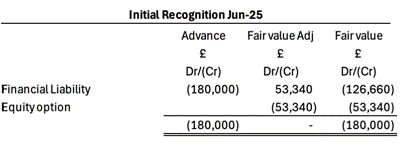 |
In December 2025 the Lender notified the Company that it intended to seek repayment in cash and on 10 December 2025 the Company repaid £50,000 reducing the principal at 31 December 2025 to £130,000. At the year end the Equity Option remained contractually viable and the Company fair-valued the components of the JUNE CLN:
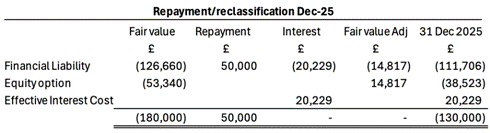
The Company used a Black Scholes valuation model to determine the Equity Option value, assuming Level 2 observations for volatility of 60% and a risk-free rate of 3.839%, and an effective interest rate of 38.44%.
16.2 OCTOBER CLN
In October 2025 the Company and various lenders (the "Lenders") entered into a Convertible Loan Note facility (the "OCTOBER CLN") for £1,000,000 with an 8% 360 day non-compounding coupon, maturing on the third anniversary, principal and interest conversion priced at £0.03 (fixed), conversion at the company's option for the first nine months thereafter conversion at noteholders' option through to maturity, coupon to be converted at maturity. £455,000 was advanced by Lenders in October 2025. On initial recognition the Company valued the OCTOBER CLN, following IFRS guidance and classifying the OCTOBER CLN as a Simple Advance For Equity ('SAFE') Instrument, as Prepaid Equity with an Equity Option:
|
The Company used a Black Scholes valuation model to determine the Equity Option value, assuming Level 2 observations for volatility of 60% and a risk-free rate of 3.637%, calculating the Lenders' option value as £159,178 from which the Company's calculated option value of £75,159 was deducted, a net of £84,019.
16.3 PRIOR YEAR - 2024 CLN
At 31 December 2024 the Company calculated the fair value of a £100,000 convertible loan from a past director (the "2024 CLN") based on the future economic value of the 2024 CLN at the date of the agreement to its cancellation, 12 June 2025 and accounted for the economic values in the Balance Sheet as £78,180 Prepaid Equity, £23,700 accrued interest and a £4,577 financial liability representing present value adjustment. The agreement to the cancellation included a waiver by the past director of all accrued interest.
The Company has continued to account for the Prepaid Equity at historic cost of £78,180. The Company considers the value of the waived interest and present value adjustment to represent a crystalized option cost and accordingly in the Balance Sheet at 31 December 2025 the Company has reclassified the aggregate of the interest and present value adjustment amounting to £28,277 as an Equity Option.
17. WARRANTS
|
|
2025 |
2024 |
||||
|
|
Number of warrants |
Weighted average exercise price (p) |
Weight average remaining contractual life (Yr) |
Number of warrants |
Weighted average exercise price (p) |
Weight average remaining contractual life (Yr) |
|
Balance at beginning of the financial year |
5,400,000 |
2.50 |
1.56 |
5,400,000 |
2.50 |
2.56 |
|
Issuance during the financial year |
33,673,333 |
0.72 |
2.08 |
- |
- |
- |
|
Exercised during the financial year |
(3,800,000) |
2.50 |
- |
- |
- |
- |
|
Balance at the end of the financial year |
35,273,333 |
0.79 |
2.62 |
5,400,000 |
2.50 |
1.56 |
|
Exercisable at the end of the financial year |
14,684,999 |
1.90 |
4.15 |
5,400,000 |
2.50 |
1.56 |
On 30 May 2025 the Company issued 22,750,000 warrants in respect of fundraising and transaction target assistance at an exercise price of £0.00021978 and lapsing on the third anniversary of the date of issue. The warrants may be exercised at any time conditional on the exercise not resulting in the warrant holder (individually or as a concert party) holding 30% or more of the Company's enlarged issued share capital, limiting the number of warrants exercisable at the end of the financial year.
On 22 July 2025 the Company issued 3,340,000 warrants to Directors at an exercise price of £0.003 and lapsing on the fifth anniversary of the date of issue.
On 27 October 2025 the Company issued 7,583,555 "1 for 2" warrant instruments to each subscriber to the OCTOBER CLN on a basis of one warrant for every two shares on conversion of the CLN principal and accrued interest into equity, at an exercise price of £0.03 and lapsing on the third anniversary of the date of issue.
17. WARRANTS (CONTINUED)
The Company used a Black Scholes model to value the warrants issued in the financial year and the assumptions summarized below:
|
|
Number of warrant shares |
Exercise price (p) |
Volatility assumption |
Risk free rate (%) |
Price per share (p) |
Valuation at issue date (£) |
|
30 May 2025 |
22,750,000 |
0.021978 |
60% |
3.839 |
1.81653 |
408,516 |
|
22 July 2025 |
3,340,000 |
0.300000 |
60% |
3.696 |
1.81653 |
51,128 |
|
27 October 2025 |
7,583,333 |
3.000000 |
60% |
3.637 |
3.30000 |
69,678 |
|
|
33,673,333 |
|
|
|
|
529,322 |
The Company assumed a common exercise date of 31 October 2026 for all outstanding warrants, being approximately one year after the issue date of warrants to the OCTOBER CLN subscribers.
18. SHARE BASED PAYMENTS ACCOUNT
|
|
Year ended 31 Dec 2025 |
Year ended 31 Dec 2024
£
|
|
At 1 January |
45,075 |
45,075 |
|
Fair value of warrants issued in year: As Shares Based Payments in Income Statement As Directors' Remuneration in Income Statement |
478,194 51,128 |
- - |
|
At 31 December |
574,397 |
45,075 |
19. CAPITAL MANAGEMENT
The Company manages its capital to ensure that it will be able to continue as a going concern while pursuing a transaction to maximize a return to shareholders through an optimized structure of debt and equity instruments.
The Company reviews the capital structure on an on-going basis. As part of this review, the directors consider the cost of capital and the risks associated with each type and class of capital. The Company will balance its overall capital structure and through the payment of dividends, new share issues and the issue of new debt or the repayment of existing debt.
The Company raised £585,000 net of repayments as convertible loans and £96,000 from the issue of ordinary shares (2024: no capital raised during the year).
20. RELATED PARTY TRANSACTIONS
There is no ultimate controlling party.
The remuneration of the non-executive Directors is set out in note 8. On 22 July 2025 the Company issued 1,670,000 new Warrants priced at £0.003 expiring after five years to each of Mr Carroll and Mr Croft (notes 8 and 17).
Mr Carroll is a director of NE10 Vodka Ltd. Details of the amount due to NE10 Vodka Ltd at 31 December 2025 are set out in Note 16.1 (June CLN) and Note 21(c).
21. EVENTS SINCE THE END OF THE REPORTING PERIOD
All regulatory notices relating to the Company's key events are submitted to the London Stock Exchange via the RNS service. The following relate to key changes since the 31 December 2025 financial year end:
(a) On 21 January 2026 a warrant was exercised, and 3,000,000 ordinary shares were allotted fully paid up at an exercise price of £0.00021978 per share for consideration of £659.
(b) On 22 January 2026 the Company announced that it had entered into a non-binding, conditional, exclusive Heads of Terms for a proposed acquisition and requested the suspension of the Company's shares from trading on the London Stock Exchange until such time the Company publishes a prospectus or notifies the market that the proposed transaction is not proceeding.
(c) On 24 February 2026 the Company and NE10 Vodka Limited agreed to cancel the JUNE CLN with outstanding principal of £130,000 and to enter into a non-interest-bearing repayment loan in the aggregate amount of £140,394 in settlement of the principal and accrued interest.
(d) On 24 April 2026 the Company entered into two subscription agreements for convertible loan notes in the amounts of £35k with B Liceaga and £1 million with Shin Nieh Group.
RNS may use your IP address to confirm compliance with the terms and conditions, to analyse how you engage with the information contained in this communication, and to share such analysis on an anonymised basis with others as part of our commercial services. For further information about how RNS and the London Stock Exchange use the personal data you provide us, please see our Privacy Policy.

Latest directors dealings
- 2 days ago City of London Investment Group
- 2 days ago Kooth
- 2 days ago THG
- 2 days ago Origin Enterprises (CDI)
- 2 days ago Kingfisher