
Results for the year ended 31 December 2025
Summary by AI BETAClose X

ELIXIRR INTERNATIONAL PLC
("Elixirr", the "Company" or the "Group")
Results for the year ended 31 December 2025
FY 25 momentum continues: revenue up 34%, adjusted EBITDA up 42%
Elixirr International plc (ELIX.L), an established, global, award-winning challenger consultancy, is pleased to announce its final results for the year ended 31 December 2025.
Financial Highlights
The Group delivered a record financial performance in FY 25, driven by strong demand for its AI-enabled, technology-led advisory services and continued disciplined execution. The Board is also pleased to recommend a final dividend for FY 25 of 15.0p per share, payable in August, bringing the total dividend for the year to 22.6p, a 27% increase on FY 24.
Key highlights include:
|
Metric |
FY 25 |
FY 24 |
Change (%) |
|
Revenue |
£149.6m |
£111.3m |
+34% |
|
Adjusted EBITDA |
£44.3m |
£31.2m |
+42% |
|
Adjusted EBITDA Margin |
29.6% |
28.0% |
+1.6pp |
|
Adjusted Profit Before Tax |
£41.0m |
£29.7m |
+38% |
|
Adjusted Diluted EPS |
58.7p |
43.1p |
+36% |
|
Free Cash Flow |
£31.1m |
£28.1m |
+11% |
|
Total Dividend per Share |
22.6p |
17.8p |
+27% |
|
Year-end Net Cash/(Debt) |
(£24.1m) |
£7.5m |
|
Operating Highlights
· AI and technology are core growth drivers, with AI-enabled work the fastest-growing segment (AI-related revenue up >260% year-on-year) and over 45 internally developed AI tools embedded across workflows to enhance productivity, while Elixirr's senior-led, agile, non-pyramidal model positions it strongly for an AI-enabled consulting market
· Successfully transitioned to the Main Market of the London Stock Exchange, supporting the Group's next phase of growth and ambition for FTSE 250 inclusion, alongside a material improvement in share liquidity and market quality
· Deepened client relationships and revenue quality, with £1m+ clients increasing from 27 in FY 24 to 34 in FY 25, and more than 65% of top 10 clients retained for over three years, reflecting strong repeat business and long-term partnerships
· Delivered strong cross-sell momentum across the platform, with cross-sell contribution exceeding £80m since IPO and over £37m in FY 25 (~25% of Group revenue), demonstrating the strength of the integrated, multi-capability model
· We maintained strong momentum across all four pillars of our growth strategy (stretch existing Partners, hire Partners, promote Partners and acquire complementary businesses), underpinning the scalability of the Group's platform
o Increased revenue per Partner to £4.4m (FY 24: £4.1m), supported by deeper account penetration, cross-sell and disciplined commercial execution
o Continued to strengthen senior leadership and talent density, with two new Partners appointed, three promoted internally and a further four Partner hires already completed in FY 26, adding deep expertise in AI, data and technology transformation
o Expanded capabilities and industry depth through acquisitions, with TRC Advisory enhancing growth strategy, pricing and commercial effectiveness capabilities and increasing exposure to private equity, and Kvadrant establishing a Nordic foothold and strengthening the European platform
· Further strengthened governance, Board capability and controls to reflect the Group's increasing scale, complexity and Main Market status, supporting disciplined growth and enhancing oversight of risk and internal controls
· Delivered our inaugural Capital Markets Day, showcasing AI, data, tech and digital capabilities through live demonstrations and partner-led sessions, reinforcing the depth, integration and scalability of the Group's platform
· Continued external recognition of performance and culture, with the Group featured in leading industry rankings including the Financial Times and Forbes lists
Current Trading & Outlook
Elixirr has entered FY 26 with a record Q1, trading in line with management expectations and providing a solid foundation for the year ahead. The Group's diversification by geography, capability and industry vertical supports resilience across varying market conditions, while continued demand for AI-enabled, technology-led advisory plays to Elixirr's strengths. As AI reshapes how consulting is delivered, the Board believes the Group's senior-led, agile model is well positioned to adapt and capture this opportunity. With strong fundamentals, a scalable platform and a growing, diversified client base, Elixirr remains confident in its ability to deliver sustainable growth and long-term value.
Commenting on the results, Founder & CEO, Stephen Newton, said:
"FY 25 has been a defining year for Elixirr. We delivered record revenues and sustained industry-leading profitability, completed our transition to the Main Market and further strengthened our capabilities, particularly in AI, whilst also expanding our geographic footprint through acquisitions. This performance reflects the strength of our differentiated, equity-backed model, the quality and ambition of our people, and the deep trust we continue to build with our clients.
"As AI reshapes both client demand and the way consulting is delivered, we believe our senior-led, technology-enabled model is becoming even more relevant. AI was the fastest growing part of our business last year. With a scalable platform, diversified client base and strong financial foundations, we enter our next phase with confidence as we progress towards our ambition of FTSE 250 inclusion."
Investor Presentation
A presentation relating to the Company's FY 25 Results will be held via Investor Meet Company on 21 April 2026, 13:00 BST for all existing and potential shareholders.
Investors can sign up to Investor Meet Company for free and request to meet Elixirr International plc via:
https://www.investormeetcompany.com/elixirr-international-plc/register-investor
After the webcast, a recording will be available at https://www.elixirr.com/en-gb/investors/results/
Enquiries:
For enquiries, please refer to the Company's Investor Contacts page:
https://www.elixirr.com/investors/investor-contacts
Elixirr International plc +44 (0)20 7220 5410
Stephen Newton, Chief Executive Officer
Graham Busby, Deputy Chief Executive Officer
Nicholas Willott, Chief Financial Officer and Company Secretary
investor-relations@elixirr.com
Cavendish Capital Markets Ltd (Broker) +44 (0)20 7220 0500
Stephen Keys, Callum Davidson, Isaac Hooper (Corporate Finance),
Sunila de Silva (ECM)
About Elixirr International plc
Elixirr is an award-winning global consulting firm working with clients across a diverse range of industries, markets and geographies. Founded in 2009, the firm set out to be the 'challenger consultancy' and do things differently than the large corporate consultancies dominating the industry: working openly and collaboratively with clients from start to finish, delivering outcomes based on innovative thinking, not methodology, and treating each client's business like their own. Elixirr was quoted on the AIM market of the London Stock Exchange in 2020 and listed on the Main Market of the London Stock Exchange in July 2025. In addition to strong organic growth, Elixirr has acquired nine boutique firms - Den Creative, Coast Digital, The Retearn Group, iOLAP, Responsum, Insigniam, Hypothesis, TRC Advisory, Kvadrant Consulting - to grow the Group's capabilities, diversify the business, expand into new geographies and access new clients.
This announcement contains inside information for the purposes of Article 7 of the Market Abuse Regulation (EU) 596/2014 as it forms part of UK domestic law by virtue of the European Union (Withdrawal) Act 2018 ("MAR"), and is disclosed in accordance with the company's obligations under Article 17 of MAR.
Non-Executive Chairman's Report
Overview
I am pleased to introduce Elixirr's Annual Results for FY 25, a year that marked a significant step forward in the Group's scale, market maturity and long-term growth trajectory. During the year, Elixirr continued to deliver strong growth and profitability while further scaling its differentiated advisory model and completing its transition to the Main Market of the London Stock Exchange.
In an environment where clients remain selective in their investment decisions, the Elixirr group of companies (Group) has delivered impressive financial performance whilst maintaining strong margins. This reflects not only the quality of our client relationships, but also the strength and adaptability of our operating model. Importantly, this performance demonstrates that the Group can grow in scale and broaden its platform while retaining the profitability and discipline that underpin long-term value creation.
During the year, we continued to strengthen our strategic capabilities, particularly in AI and advanced technology advisory. As AI reshapes both client priorities and the consulting market, Elixirr is well positioned to support senior leaders through this change. Our model, which combines strategic insight, technology expertise and practical implementation, is inherently aligned with a more AI-enabled consulting environment, where value is increasingly driven by speed, adaptability and outcome delivery rather than scale of resource.
We are also seeing this translate into the nature of client demand. AI-enabled engagements are typically broader, more strategic and more closely linked to measurable outcomes, reinforcing our focus on high-value mandates. At the same time, AI is enhancing how we deliver, improving productivity and enabling faster execution, which further strengthens our competitive positioning.
We have also continued to deepen and diversify our client base. The number of significant, long-term "gold" client relationships (where clients have generated >£1m revenue in the financial period) has increased. This evolution strengthens the resilience of the business and provides a strong foundation for sustainable future growth.
Strategy
The Board remains confident in Elixirr's growth strategy, which balances organic expansion with disciplined inorganic investment and is underpinned by our entrepreneurial, equity-backed model. This model is particularly well suited to an AI-enabled consulting market, where success is increasingly determined by the ability to combine experienced judgement with technology and deliver outcomes efficiently.
Our differentiated, equity-based structure ensures strong alignment with long-term value creation. During FY 25, we continued to invest in talent development through the promotion of high-performing Principals to Partner, further strengthening our succession pipeline and leadership continuity. We also welcomed new Partner hires and enhanced our Board capability through an additional Non-Executive Director appointment in January 2026, ensuring our governance framework evolves in line with the Group's growth, scale and increasing technological sophistication.
A defining milestone during the year was Elixirr's transition in July 2025 from AIM to the Main Market of the London Stock Exchange. This was an important step in the Group's evolution as a larger and more institutionally relevant listed business. The strategic rationale behind this move was that the Main Market provides a stronger platform to enhance our profile, attract top talent, and compete more effectively with global consulting firms. It also offers access to broader pools of capital, including investors unable to invest in AIM companies, and supports the potential future inclusion in indices such as the FTSE 250, thus improving liquidity and passive investment. Overall, the move is expected to increase visibility, align our valuation more closely with our peers, and reinforce confidence in our long-term performance as we continue on our journey.
Inorganic growth remained an important strategic lever during the year. The acquisitions of TRC Advisory LLC (TRC) in Chicago in September 2025, and subsequently Kvadrant Consulting A/S (Kvadrant Consulting) in Copenhagen after the end of FY 25, further broadened the Group's platform geographically and by capability, including in areas closely aligned to AI-driven transformation. To support continued strategic flexibility, the Group extended its revolving credit facility. We are focused on ensuring that recent acquisitions are fully embedded operationally and culturally, which is central to sustaining earnings quality and unlocking cross-selling opportunities across the Group. The Board is encouraged by the early benefits of this integration and remains disciplined in evaluating future opportunities.
Together, our organic momentum, strengthened capabilities and disciplined M&A approach provide a strong platform for continued growth, with AI acting as both a driver of demand and an enabler of delivery, and positioning Elixirr to benefit from the structural shift underway in the consulting market.
Dividend
The Group policy continues to be to pay two dividends a year, with an interim dividend in February and a final dividend in August. An interim dividend of 7.6p per ordinary share of 0.005p each in the capital of the Company (Ordinary Share) was paid to shareholders on 24 February 2026.
The Board is pleased to recommend a final dividend for FY 25 of 15.0p per Ordinary Share, payable in August 2026 making a total dividend of 22.6p for the FY 25 financial year, a 27% increase on the FY 24 dividend. The final dividend will be recommended to shareholders at the AGM in June 2026. The FY 25 final dividend will have a total cash cost of £7.5 million.
Governance
As a Main Market listed company, Elixirr is committed to maintaining high standards of corporate governance consistent with the UK Corporate Governance Code 2024 (UKCG). The Board recognises that effective governance is fundamental to sustainable long-term success and to maintaining the confidence of shareholders and stakeholders. During FY 25, the Board continued to strengthen its oversight of strategy, risk management and internal controls, while further developing the governance framework needed to support a larger and more complex Group following the transition to the Main Market.
The appointment of an experienced Non-Executive Director (Bill Michael) shortly after the FY 25 reporting period further enhanced the balance of skills, independence and constructive challenge at Board level. The Board remains focused on maintaining a strong control environment, embedding a culture of accountability and transparency, and regularly reviewing governance effectiveness to support long-term value creation.
Outlook
As AI continues to alter the economics and delivery of parts of the consulting market, the Board believes Elixirr's differentiated, senior-led model leaves the Group well positioned to benefit from that shift.
Looking ahead to FY 26, the Board remains confident about Elixirr's trajectory. The Group's continued profitability, expanding capabilities and diversified client base provide a strong foundation for sustained growth and continued progress towards our ambition of FTSE 250 inclusion.
Gavin Patterson
Non-Executive Chairman
17 April 2026
Chief Executive Officer's Report
Overview
FY 25 was a year in which Elixirr delivered strong growth and continued profitability, completed its move to the Main Market and materially broadened the Group's platform both geographically and by capability.
The Group delivered revenue of £149.6 million (FY 24: £111.3 million), representing growth of 34% year-on-year, while maintaining strong Adjusted EBITDA of £44.3 million and a margin of 29.6% (FY 24: 28.0%). This performance reflects the resilience of our model, the sustained demand for high-impact advisory services and the increasing relevance of a delivery model that combines senior strategic judgement with deep data, technology and AI capabilities.
In July 2025, Elixirr moved from AIM to the Main Market of the London Stock Exchange, marking a significant milestone in our evolution as a public company. The move strengthens our market profile, broadens access to institutional capital, supports our ambition for future FTSE 250 inclusion and further reinforces our governance framework. Taken together, these benefits improve visibility and liquidity and strengthen confidence in our long-term growth trajectory.
Expanded US operations, the TRC acquisition, investments in AI and advanced technology, and growth in senior leadership strengthened the Group, whilst strong margins highlighted the resilience and scalability of our model. During the year, we worked with over 250 active clients, with the US accounting for 63% of Group revenue (FY 24: 55%).
Our differentiated proposition that combines strategy-led advisory with deep technology, data and AI expertise continues to resonate across industries and geographies. Increasingly, we are bringing strategy consultants, change experts, AI specialists and engineers together on the same engagements, enabling clients to move from strategic intent to practical execution faster.
Importantly, we continued to diversify our client base during the year. The number of clients generating more than £1 million of annual revenue rose from 27 in FY 24 to 34 in FY 25. This continued broadening of our revenue base, alongside higher levels of repeat client work, strengthens the resilience of the business and supports long-term, high-quality growth.
AI and Advanced Technology
AI is not new to Elixirr. We have been building AI and machine learning capability for more than a decade. Today, it is an increasingly important part of our client offering and a meaningful enabler across our own business. In FY 25, AI-related engagements accounted for a larger share of Group revenue and were the fastest-growing part of the business. These engagements are typically broader in scope, more strategic, and more closely tied to measurable client outcomes.
Our business model is structurally aligned with this shift. As AI reduces the need for repetitive, lower-value tasks, traditional pyramid-based, time-and-materials models are coming under pressure. Elixirr's senior-led, outcome-focused model enables us to integrate AI without disruption and benefit from these changing dynamics.
Additionally, we are seeing clear operational benefits. Supported by more than 45 internally developed AI tools embedded into our workflows, we achieved significant productivity gains in key consulting processes during the year. In proposal generation, for example, work is now taking around 10% of the time it previously required, with similar improvements being tracked in statement-of-work generation and knowledge management. These capabilities accelerate delivery and enhance the quality and consistency of our work.
Client demand continues to shift towards outcome-focused engagements that move from strategy through to execution and delivery of return on investment. AI enables faster, more targeted delivery, aligned with our outcome-based pricing model. For example, we recently worked with a major European bank to redesign its product development lifecycle using an AI-native model. The programme is expected to deliver them over £200 million in benefits over ten years, reduce product development cycles to as little as 2-6 weeks, and deliver an 18% reduction in long-term technology run costs.
Importantly, we have strengthened the data foundations underpinning our own capabilities through an advanced data layer, enabling AI-driven efficiencies across internal processes including proposal development and legal workflows. Furthermore, a key differentiator is our integrated delivery model, combining strategy consultants, industry specialists and AI engineers to move from insight to implementation more effectively. Finally, we continue to expand our capability to build bespoke AI solutions for clients and are developing proprietary AI agents based on our own data, creating potential for scalable, repeatable solutions over time.
AI is driving a structural shift in consulting, increasing the importance of speed, adaptability and outcome delivery. With our agile structure, senior-led model and continued investment in AI, Elixirr is perfectly positioned to capture this opportunity and deliver sustained value for both us and our clients.
FY 25 Performance
In FY 25 Elixirr generated revenue of £149.6 million - representing a 34% increase on the prior year (£111.3 million). Figure 1 below illustrates the key drivers of revenue growth from £111.3 million in FY 24 to £149.6 million in FY 25.
Figure 1: FY 25 Revenue Bridge (year ending 31 December 2025)
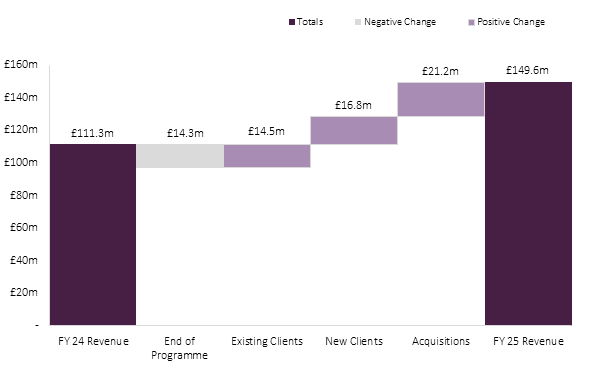
Organic revenue growth increased to 15.3% year-on-year in FY 25 (net +£17 million revenue) compared to a net +£11.1 million in revenue (FY 24: 13% year-on-year) achieved in FY 24. Growth from existing clients accounted for £14.5 million (FY 24: £9.7 million), reflecting deeper account penetration and cross-selling capabilities, while new client wins contributed £16.8 million (FY 24: £11.4 million). This was partially offset by £14.3 million of revenue attrition from end-of-programme projects.
Adjusted EBITDA increased by 42% to £44.3 million (FY 24: £31.2 million), with margin increasing to 29.6% (FY 24: 28.0%). Cash conversion remained strong with free cash flow of £31.1 million and the Group ended the year with net debt of £24.1 million.
To maintain strategic flexibility, we extended the Group's revolving credit facility to £65 million in FY 25 (FY 24: £45 million) and secured a US$20 million term loan, providing additional capacity to support disciplined M&A while limiting equity dilution. At year-end we had £51.0 million of revolving credit facility headroom and our financial covenants (interest cover and leverage ratios) were comfortably within required thresholds.
As we move into FY 26, we are focused on unlocking further cross-capability revenue opportunities, realising operational synergies, and aligning systems across our expanded platform as key drivers of margin sustainability and earnings quality.
Delivering Our Four-Pillar Growth Strategy
Our growth strategy remains grounded in a balanced approach to organic and inorganic expansion, underpinned by our entrepreneurial, equity-backed model. There are four key pillars to our growth strategy:
1. Stretching Existing Partners
Driving productivity and deepening client relationships within our established Elixirr Partner (Partner) cohort remains a core lever of organic growth. In FY 25, revenue per client-facing Partner increased to £4.4 million (FY 24: £4.1 million), reflecting stronger account penetration, cross-selling across capabilities and disciplined rate realisation.
The number of clients generating more than £1 million in annual revenue increased from 27 in FY 24 to 34 in FY 25, demonstrating our ability to scale relationships with strategically important clients. Unlike growth driven primarily by new hires, this pillar reflects the increasing productivity and commercial effectiveness of our established Partner cohort.
2. Hiring New Partners
Selective lateral Partner hiring remains an important contributor to Elixirr's growth. During FY 25, we welcomed two new Partners across key industry verticals and geographies, strengthening our sector depth and expanding our client access.
Stuart Stern joined the Group with over 30 years' experience across consulting and industry. He has held senior leadership roles at Slalom, AWS and Accenture, leading large-scale transformation programmes and complex cloud migrations across sectors including life sciences, insurance, transportation and telecommunications. His experience strengthens our enterprise transformation capability and senior client relationships in priority markets.
We also welcomed Conrad Troy, an expert in ERP strategy and business transformation. He previously led Deloitte's global SAP Transformation Consulting Practice and built Infosys Consulting's European ERP Business Transformation capability. His focus on integrating AI into operating models and developing value-led business cases expands our Enterprise Transformation and AI-enabled advisory proposition.
Early in FY 26, we welcomed Chris Bannocks, Rezwan Shafique, and Hugh Aller as new Partners. Chris brings more than 30 years of experience leading data, analytics and AI transformation across global organisations, including senior roles at ING, Danone and QBE, supporting our continued investment in accelerating the Group's AI capabilities and leadership. Rezwan brings more than 20 years of experience across banking and consulting, adding deep financial services expertise and extensive experience in delivering complex, value-driven transformation. Hugh brings more than 25 years of financial services and consulting experience, including senior leadership roles at Scotiabank and Citi and earlier strategy consulting work at Marakon. He has deep expertise in banking and capital markets having delivered cross-border M&A and large-scale transformation programmes.
Our hiring approach remains disciplined and culturally aligned, ensuring new Partners enhance both capability and long-term value creation. We maintain a strong pipeline of potential candidates as we continue to scale responsibly.
3. Promoting Partners from Within
Internal promotion remains a defining feature of Elixirr's entrepreneurial, ownership-focused model. During FY 25, we promoted three Principal-level employees to Partner (Portia Thornhill, Natasha Rostance and Nicholas Greenwood), reinforcing our leadership pipeline and continuity. Reflecting this continued bench building, two additional Principals, Adam Hofmann and Samuel Alexander, have been promoted to Partner with effect from 1 April 2026. Both Adam and Samuel are key leaders in our AI and data capabilities.
Revenue generated by promoted Partners now represents approximately 32% of total Partner-led revenue, demonstrating the effectiveness of our "grow our own timber" philosophy. This approach strengthens cultural alignment, preserves our performance standards and supports long-term leadership sustainability.
4. Acquiring New Businesses
Inorganic growth continues to play a strategic role in enhancing our capabilities, geographic reach and client access. We target one to two high-quality acquisitions annually, focusing on businesses that are strategically complementary and add meaningful value to the Group. Our dedicated M&A team screened more than 850 potential acquisitions in FY 25, of which approximately 15% progressed to engagement, reflecting our quality bar and disciplined approach.
In September 2025, we completed the acquisition of TRC, further expanding our international footprint. TRC strengthens Elixirr's capabilities across growth strategy and value creation, pricing excellence and commercial effectiveness, complementing our established offering to support clients end-to-end. TRC is performing ahead of our acquisition case.
In January 2026, after the reporting period, the Company acquired Kvadrant Consulting, establishing its first Nordic foothold and strengthening access to Northern Europe and the wider EU market. Kvadrant Consulting is highly complementary to TRC, combining TRC's strengths in growth strategy, value creation, pricing and commercial effectiveness with Kvadrant Consulting's expertise in commercial transformation, go-to market excellence and transaction services. Together, they strengthen the Group's offering to industrial, corporate and private equity clients, broaden cross-sell opportunities across a shared multinational client base, and create a scalable platform for continued European growth.
Our Firm
Our people remain the foundation of Elixirr's success. The entrepreneurial spirit, ownership mindset and commitment to excellence demonstrated across the Group continue to differentiate us in a competitive consulting market. As we scale, preserving this culture remains a strategic priority.
Our equity participation model reinforces alignment between our people and long-term shareholder value creation. Participation in our share schemes remains strong, with 84% of employees in our consulting business enrolled. This broad-based ownership structure fosters accountability, collaboration and a long-term perspective across the firm.
Attracting and retaining high-calibre talent remains central to our strategy. During FY 25, we received over 35,000 applications globally (equating to 417 applicants per hired role) and welcomed 164 new hires into the business, reflecting both the strength of our employer brand and the selectivity of our recruitment process. Our university and professional networks across the UK, US, and Europe continue to provide access to exceptional early-career and experienced talent, facilitated by our growing brand profile.
The way we build teams is also a differentiator. By combining our consultants with digital, data and AI technology specialists on client engagements, we are able to blend commercial insight with technical capability and help clients implement change more effectively. Innovation remains at the heart of how we operate and deliver for clients. We are embedding AI into our internal operations to improve speed and quality across processes such as knowledge management, statement of work generation, and proposal creation. We have developed 45 AI-enabled tools for internal use cases and these are delivering results around 25% faster for our teams, supporting operating leverage, improving responsiveness to clients and enabling more of our time to be focused on higher-value problem solving.
Our commitment to developing future talent and contributing to the communities in which we operate also continued during the year. The Elixirr Data and AI Academy in South Africa, launched in 2024, is progressing well, providing practical training, mentorship and career pathways for high-potential graduates while supporting the development of our global Centre of Excellence capability.
We also remained committed to supporting our communities by developing future talent through our social mobility initiatives. In London, our Early Careers Programme continues in partnership with 26 schools across the Harris Federation, our chosen partner, and we are excited to be progressing plans to launch a similar initiative in South Africa in FY 26 in partnership with Claremont High School.
During the year, the Group's performance and culture continued to receive external recognition across industry rankings and awards, including the Financial Times' Leading UK Management Consultants, Forbes America's Best Management Consulting Firms, and World's Best Management Consulting Firms lists. While we take pride in these achievements, our focus remains firmly on delivering sustainable growth, strengthening our capabilities and creating long-term value for our clients, people and shareholders.
Outlook
Trading in Q1 FY 26 has been in line with management expectations, with record Q1 revenue providing a solid foundation for the year ahead.
Our diversification by geography, capability and industry vertical supports resilience across varying market conditions. While AI and emerging technologies will reshape how consulting is delivered, we believe they are likely to favour firms that can combine trusted human judgement with technical execution in an agile, senior-led model. For Elixirr, this shift supports rather than disrupts our approach. We therefore expect consulting to evolve rather than diminish, with success determined by the ability to adapt quickly.
Clients continue to value independent advice, accountability and contextual understanding, whilst also expecting faster delivery, better use of data and practical implementation. Elixirr's entrepreneurial culture and flexible operating model position us well to embed AI directly into our delivery, enhancing speed, productivity and value creation whilst retaining human insight and judgement at the centre of our work.
Our ambition remains to progress towards inclusion in the FTSE 250, reflecting the increasing scale, liquidity and institutional maturity of our business. Achieving this objective will require profitable growth, continued diversification of our client base and disciplined leadership of our expanded capability platform. With strong fundamentals, a scalable business model, and growing demand for our differentiated approach to solving client challenges, Elixirr is well positioned to deliver sustainable growth and long-term value for its shareholders.
Stephen Newton
Chief Executive Officer & Founder
17 April 2026
Financial Review
Financial results summary
|
|
FY 25 |
FY 24 |
% change |
|
Revenue |
£149.6m |
£111.3m |
+34% |
|
Gross profit |
£49.7m |
£35.8m |
+39% |
|
Adjusted EBITDA* |
£44.3m |
£31.2m |
+42% |
|
Adjusted EBITDA margin* |
29.6% |
28.0% |
+1.6PP |
|
Adjusted profit before tax* |
£41.0m |
£29.7m |
+38% |
|
Adjusted diluted earnings per share* |
58.7p |
43.1p |
+36% |
|
Dividend per share |
22.6p |
17.8p |
+27% |
|
Free cash flow* |
£31.1m |
£28.1m |
+11% |
|
Net cash/(debt) |
(£24.1m) |
£7.5m |
N/A |
* In order to provide better clarity to the underlying performance of the Group, Elixirr uses Adjusted EBITDA, Adjusted profit before tax, Adjusted earnings per share (EPS) and free cash flow as alternative performance measures (APMs). Please refer to note 3 of the Group and Company Financial Statements for further details.
Group Results
The Board is pleased to report another year of strong financial performance for the Group, delivering record revenue, profit and earnings per share in FY 25. The Group achieved double-digit growth across all key financial metrics, reflecting continued strong client demand, the benefits of the Group's differentiated advisory model and the contribution from acquisitions completed during the year.
Revenue increased by 34% to £149.6 million (FY 24: £111.3 million), while Adjusted EBITDA increased by 42% to £44.3 million (FY 24: £31.2 million). Adjusted EBITDA margin improved to 29.6% (FY 24: 28.0%), reflecting operating leverage from strong organic growth and continued cost discipline.
The Group continues to generate strong levels of cash, delivering free cash flow of £31.1 million in FY 25 (FY 24: £28.1 million). Net debt at year end was £24.1 million (FY 24: net cash £7.5 million), reflecting acquisition-related investment and the utilisation of debt facilities to support the Group's growth strategy.
During the year, the Group strengthened its financing platform by extending its revolving credit facility from £45.0 million to £65.0 million and securing an additional US$20 million term loan with National Westminster Bank plc. These facilities provide increased financial flexibility to support the Group's continued organic and inorganic growth strategy, whilst limiting equity dilution. Further details are set out in note 19 of the Group and Company Financial Statements.
Revenue
Revenue increased by 34% to £149.6 million in FY 25 compared with £111.3 million in FY 24. The growth was driven by strong organic growth of 15% across the Group's core consulting capabilities, with the remaining growth from acquisitions.
Organic growth remained robust during the year, reflecting deeper client relationships and continued demand for strategy-led advisory services combined with technology, data and AI expertise. Revenue from existing clients increased through expanded engagements and cross-selling of capabilities, while new client wins continued to contribute meaningfully to growth.
The Group also benefited from the acquisition of TRC during the year, which strengthens the Group's growth strategy, pricing and commercial effectiveness capabilities and expands its presence in the US market.
Revenue growth was achieved across all geographic regions in which the Group operates. The United States continues to represent the Group's largest market and accounted for 63% of Group revenue in FY 25 (FY 24: 55%). This reflects the continued success of the Group's geographic expansion strategy and the increasing scale of its North American operations.
Revenue per client-facing Partner increased to £4.4 million in FY 25 (FY 24: £4.1 million), reflecting stronger account penetration, increased cross-capability selling and the continued productivity of the Group's Partner model.
The Group also continued to diversify its client base. The number of clients generating more than £1 million of revenue increased from 27 in FY 24 to 34 in FY 25. This continued diversification of the revenue base, together with increased levels of repeat client work, enhances the resilience of the business and supports sustainable long-term growth.
Group Profitability
Group gross profit increased by 39% to £49.7 million (FY 24: £35.8 million), reflecting the strong growth in revenue and continued effective management of delivery resources.
Administrative expenses increased during the year primarily as a result of the expansion of the Group through acquisition and the amortisation of intangible assets recognised for those acquisitions.
Adjusted EBITDA increased by 42% to £44.3 million (FY 24: £31.2 million). The Adjusted EBITDA margin improved to 29.6% (FY 24: 28.0%), reflecting operating leverage from the Group's scalable model together with the contribution from acquisitions. The Group continues to deliver industry-leading profitability.
Adjusted EBITDA growth resulted in a 38% increase in adjusted profit before tax to £41.0 million (FY 24: £29.7 million), which includes the finance costs of the revolving credit facility and term loan.
Statutory profit before tax reflects the impact of adjusting items including Main Market Listing and acquisition-related costs, amortisation of intangible assets arising on acquisition, share-based payments and movements in contingent consideration. Further details of adjusting items are set out in note 3 of the Group and Company Financial Statements.
Net Finance Expense
Net finance expense increased during the year reflecting the Group's transition from a net cash position to a net debt position following the expansion of its financing facilities to facilitate the acquisition of TRC.
Finance costs include interest on borrowings under the Group's revolving credit facility and term loan, together with the finance cost associated with contingent consideration liabilities and office lease liabilities. These costs were partially offset by interest income on cash deposits.
The Group maintains prudent leverage levels and retains significant headroom within its financing facilities.
Taxation
The Group's tax charge reflects the geographical mix of profits and the applicable statutory tax rates in the jurisdictions in which the Group operates.
The Group's tax charge for FY 25 was £7.9 million, reflecting a materially consistent effective tax rate on adjusted profit before tax of 24.2% compared with 24.7% in FY 24.
The effective tax rate on adjusted profit before tax is broadly consistent with the UK corporation tax rate, adjusted for overseas tax rates and permanent differences.
Further details on the Group's taxation are provided in notes 7 and 8 of the Group and Company Financial Statements.
Earnings Per Share
Adjusted diluted earnings per share increased by 36% to 58.7p (FY 24: 43.1p).
This increase reflects the strong growth in adjusted profit after tax of 38%, partially offset by the increase in the weighted average number of Ordinary Shares in issue resulting from the acquisition of TRC.
Adjusting items and their tax impacts are set out in note 3 of the Group and Company Financial Statements.
Cash Flow
The Group continues to benefit from strong cash generation driven by the profitability of the business and the asset-light nature of its operating model.
Net debt of £24.1 million represents cash (£5.1 million) net of the revolving credit facility and term loan (£29.1 million). The revolving credit facility and term loan were utilised to facilitate the acquisition of TRC (£29.2 million) and partially fund a combination of net Elixirr International Employee Benefit Trust (EBT) share purchases (£13.7 million) and Elixirr Digital Inc., Elixirr AI Inc., Insigniam LLC and Hypothesis Group, LLC (Hypothesis) earn-out and holdback payments (£7.2 million).
Free cash flow increased by 11% compared to FY 24, a smaller increase than EBITDA, mainly due to a larger FY 25 debtors working capital outflow, reflecting stronger debtor collections at December 2024 (versus December 2023), with the swing in FY 25 coming off a particularly strong base.
Statement of Financial Position
Net assets as at 31 December 2025 totalled £142.5 million (FY 24: £132.1 million). The increase in net assets is as a result of retained earnings for the year of £4.2 million (£19.7 million retained profit, £5.9 million add-back of share-based payment charge and related tax, offset by £8.4 million FY 24 dividend and £13.0 million for exercises of equity awards), a £11.7 million increase in share premium for the share issue associated with the TRC acquisition, net of foreign currency translation losses of £4.4 million, less the increase in cost of shares held by the EBT of £1.1 million.
The Group's balance sheet continues to reflect the value of the intellectual capital and client relationships acquired through its acquisitions, alongside the strong underlying profitability of the business.
The Group remains well capitalised with access to significant liquidity through its extended revolving credit facility and term loan arrangements, providing flexibility to support continued organic and inorganic growth.
Dividends
Elixirr paid an interim dividend in respect of FY 24 of 6.3p per Ordinary Share on 17 February 2025 and a final dividend in respect of FY 24 of 11.5p per Ordinary Share on 20 August 2025, making a total dividend of 17.8p for FY 24.
An interim dividend in respect of FY 25 of 7.6p per Ordinary Share was paid on 24 February 2026. The Board is pleased to recommend a final dividend for FY 25 of 15.0p per Ordinary Share, making a total dividend of 22.6p for the FY 25 financial year, a 27% increase on the FY 24 dividend.
The final dividend will be recommended to shareholders at the AGM in June 2026. The FY 25 final dividend will have a total cash cost of £7.5 million. The dividend payment date, record date and ex-date will be announced in due course.
Group and Company Financial Statements
GROUP STATEMENT OF COMPREHENSIVE INCOME
For the year ended 31 December 2025
|
|
|
Year ended |
Year ended |
|
|
Note |
£'000s |
£'000s |
|
Revenue |
4 |
149,600 |
111,344 |
|
Cost of sales |
4 |
(99,852) |
(75,537) |
|
Gross profit |
|
49,748 |
35,807 |
|
Administrative expenses |
|
(17,664) |
(11,040) |
|
Operating profit before M&A and Main Market-related items |
5 |
32,084 |
24,767 |
|
|
|
|
|
|
Depreciation |
|
1,713 |
1,485 |
|
Amortisation of intangible assets |
|
5,466 |
2,388 |
|
Share-based payments |
|
5,029 |
2,550 |
|
Adjusted EBITDA |
3 |
44,292 |
31,190 |
|
|
|
|
|
|
M&A-related items |
5 |
(878) |
(1,074) |
|
Main Market listing costs |
|
(1,473) |
- |
|
Operating profit |
5 |
29,733 |
23,693 |
|
Finance income |
|
162 |
394 |
|
Finance costs |
|
(2,305) |
(1,198) |
|
Net finance expense |
6 |
(2,143) |
(804) |
|
Profit before taxation |
5 |
27,590 |
22,889 |
|
Taxation |
7 |
(7,894) |
(6,510) |
|
Profit for the year |
|
19,696 |
16,379 |
|
|
|
|
|
|
Other comprehensive income |
|
|
|
|
Items that may be subsequently reclassified to profit or loss: |
|
|
|
|
Currency translation on foreign currency net investments |
|
(4,367) |
1,079 |
|
Other comprehensive income, net of tax |
|
(4,367) |
1,079 |
|
|
|
|
|
|
Total comprehensive income |
|
15,329 |
17,458 |
|
|
|
|
|
|
Basic earnings per Ordinary share (p) |
10 |
41.33 |
34.80 |
|
Diluted earnings per Ordinary share (p) |
10 |
37.18 |
31.64 |
All results relate to continuing operations.
The notes form part of these accounts.
Group and Company Statements of Financial Position
As at 31 December 2025
|
|
|
Group |
Company |
||
|
|
|
|
|
|
|
|
|
Note |
£'000s |
£'000s |
£'000s |
£'000s |
|
Assets |
|
|
|
|
|
|
Non-current assets |
|
|
|
|
|
|
Intangible assets |
12 |
197,319 |
128,809 |
- |
- |
|
Property, plant and equipment |
14 |
4,214 |
4,927 |
- |
- |
|
Investments |
15 |
- |
- |
145,092 |
117,317 |
|
Other receivables |
16 |
3,701 |
3,023 |
3,129 |
2,469 |
|
Loans to shareholders |
16 |
8,566 |
7,399 |
8,566 |
7,399 |
|
Deferred tax asset |
8 |
4,704 |
3,830 |
- |
- |
|
Total non-current assets |
|
218,504 |
147,988 |
156,787 |
127,185 |
|
|
|
|
|
|
|
|
Current assets |
|
|
|
|
|
|
Trade and other receivables |
16 |
26,810 |
18,385 |
44,068 |
782 |
|
Corporation tax receivable |
|
716 |
467 |
311 |
- |
|
Cash and cash equivalents |
17 |
5,054 |
7,527 |
157 |
1,837 |
|
Total current assets |
|
32,580 |
26,379 |
44,536 |
2,619 |
|
|
|
|
|
|
|
|
Total assets |
|
251,084 |
174,367 |
201,323 |
129,804 |
|
|
|
|
|
|
|
|
Liabilities |
|
|
|
|
|
|
Current liabilities |
|
|
|
|
|
|
Trade and other payables |
18 |
30,316 |
25,675 |
16,911 |
13,487 |
|
Loans and borrowings |
19 |
10,589 |
1,530 |
- |
- |
|
Corporation tax |
|
- |
- |
- |
80 |
|
Other creditors |
20 |
22,325 |
5,564 |
21,442 |
- |
|
Total current liabilities |
|
63,230 |
32,769 |
38,353 |
13,567 |
|
|
|
|
|
|
|
|
Net current assets/(liabilities) |
|
(30,650) |
(6,390) |
6,183 |
(10,948) |
|
|
|
|
|
|
|
|
Non-current liabilities |
|
|
|
|
|
|
Loans and borrowings |
19 |
22,933 |
3,366 |
13,970 |
- |
|
Deferred tax liability |
8 |
666 |
833 |
- |
- |
|
Other non-current liabilities |
20 |
21,727 |
5,286 |
18,776 |
- |
|
Total non-current liabilities |
|
45,326 |
9,485 |
32,746 |
- |
|
|
|
|
|
|
|
|
Total liabilities |
|
108,556 |
42,254 |
71,099 |
13,567 |
|
|
|
|
|
|
|
|
Net assets |
|
142,528 |
132,113 |
130,224 |
116,237 |
|
|
|
|
|
|
|
|
Equity |
|
|
|
|
|
|
Share capital |
21 |
52 |
52 |
52 |
52 |
|
Share premium |
21 |
45,384 |
33,702 |
45,384 |
33,702 |
|
Capital redemption reserve |
|
2 |
2 |
2 |
2 |
|
EBT share reserve |
22 |
(4,014) |
(2,897) |
(4,014) |
(2,897) |
|
Merger relief reserve |
21 |
46,870 |
46,870 |
46,870 |
46,870 |
|
Foreign currency translation reserve |
|
(2,910) |
1,457 |
- |
- |
|
Retained earnings |
|
57,145 |
52,927 |
41,930 |
38,508 |
|
Total shareholders' equity |
|
142,528 |
132,113 |
130,224 |
116,237 |
As permitted by Section 408 of the Companies Act, a separate statement of comprehensive income of the parent Company has not been presented. The Company's profit for the year was £20.8 million (FY 24: £18.0 million).
The notes form part of these accounts.
Approval
The Financial Statements were approved by the Board of Directors and were signed on its behalf by:
Stephen Newton
Director & Chief Executive Officer
17 April 2026
Group Statement of Changes in Equity
For the year ended 31 December 2025
|
|
Share capital |
Share premium |
Capital redemption reserve |
EBT share reserve |
Merger relief reserve |
Foreign currency translation reserve |
Retained earnings |
Total |
|
Group |
£'000s |
£'000s |
£'000s |
£'000s |
£'000s |
£'000s |
£'000s |
£'000s |
|
|
|
|
|
|
|
|
|
|
|
As at 31 December 2023 and 01 January 2024 |
52 |
29,922 |
2 |
(1,745) |
46,870 |
378 |
44,083 |
119,562 |
|
|
|
|
|
|
|
|
|
|
|
Comprehensive income |
|
|
|
|
|
|
|
|
|
Profit for the period |
- |
- |
- |
- |
- |
- |
16,379 |
16,379 |
|
Other comprehensive income |
- |
- |
- |
- |
- |
1,079 |
- |
1,079 |
|
Transactions with owners |
|
|
|
|
|
|
|
|
|
Ordinary share issues |
- |
6,402 |
- |
- |
- |
- |
- |
6,402 |
|
Dividends |
- |
- |
- |
- |
- |
- |
(6,907) |
(6,907) |
|
Share-based payments |
- |
- |
- |
- |
- |
- |
2,021 |
2,021 |
|
Deferred tax recognised in equity |
- |
- |
- |
- |
- |
- |
(156) |
(156) |
|
Current tax recognised in equity |
- |
- |
- |
- |
- |
- |
1,419 |
1,419 |
|
Sale of Ordinary Shares |
- |
(2,622) |
- |
10,911 |
- |
- |
(3,912) |
4,377 |
|
Acquisition of Ordinary Shares |
- |
- |
- |
(12,063) |
- |
- |
- |
(12,063) |
|
As at 31 December 2024 and 01 January 2025 |
52 |
33,702 |
2 |
(2,897) |
46,870 |
1,457 |
52,927 |
132,113 |
|
|
|
|
|
|
|
|
|
|
|
Comprehensive income |
|
|
|
|
|
|
|
|
|
Profit for the period |
- |
- |
- |
- |
- |
- |
19,696 |
19,696 |
|
Other comprehensive income |
- |
- |
- |
- |
- |
(4,367) |
- |
(4,367) |
|
Transactions with owners |
|
|
|
|
|
|
|
|
|
Ordinary share issues |
- |
11,682 |
- |
- |
- |
- |
- |
11,682 |
|
Dividends |
- |
- |
- |
- |
- |
- |
(8,402) |
(8,402) |
|
Share-based payments |
- |
- |
- |
- |
- |
- |
3,966 |
3,966 |
|
Deferred tax recognised in equity |
- |
- |
- |
- |
- |
- |
7 |
7 |
|
Current tax recognised in equity |
- |
- |
- |
- |
- |
- |
1,938 |
1,938 |
|
Sale of Ordinary Shares |
- |
- |
- |
22,779 |
- |
- |
(12,986) |
9,793 |
|
Acquisition of Ordinary Shares |
- |
- |
- |
(23,896) |
- |
- |
- |
(23,896) |
|
As at 31 December 2025 |
52 |
45,384 |
2 |
(4,014) |
46,870 |
(2,910) |
57,145 |
142,528 |
The notes form part of these accounts. Please refer to note 28 for explanations of reserve accounts.
Company Statement of Changes in Equity
For the year ended 31 December 2025
|
|
Share capital |
Share premium |
Capital redemption reserve |
EBT share reserve |
Merger relief reserve |
Retained earnings |
Total |
|
Company |
£'000s |
£'000s |
£'000s |
£'000s |
£'000s |
£'000s |
£'000s |
|
|
|
|
|
|
|
|
|
|
As at 31 December 2023 and 01 January 2024 |
52 |
29,922 |
2 |
(1,745) |
46,870 |
29,318 |
104,419 |
|
|
|
|
|
|
|
|
|
|
Comprehensive income |
|
|
|
|
|
|
|
|
Profit for the period |
- |
- |
- |
- |
- |
17,988 |
17,988 |
|
Transactions with owners |
|
|
|
|
|
|
|
|
Ordinary share issues |
- |
6,402 |
- |
- |
- |
- |
6,402 |
|
Dividends |
- |
- |
- |
- |
- |
(6,907) |
(6,907) |
|
Share-based payments |
- |
- |
- |
- |
- |
2,021 |
2,021 |
|
Sale of Ordinary Shares |
- |
(2,622) |
- |
10,911 |
- |
(3,912) |
4,377 |
|
Acquisition of Ordinary Shares |
- |
- |
- |
(12,063) |
- |
- |
(12,063) |
|
As at 31 December 2024 and 01 January 2025 |
52 |
33,702 |
2 |
(2,897) |
46,870 |
38,508 |
116,237 |
|
|
|
|
|
|
|
|
|
|
Comprehensive income |
|
|
|
|
|
|
|
|
Profit for the period |
- |
- |
- |
- |
- |
20,844 |
20,844 |
|
Transactions with owners |
|
|
|
|
|
|
|
|
Ordinary share issues |
- |
11,682 |
- |
- |
- |
- |
11,682 |
|
Dividends |
- |
- |
- |
- |
- |
(8,402) |
(8,402) |
|
Share-based payments |
- |
- |
- |
- |
- |
3,966 |
3,966 |
|
Sale of Ordinary Shares |
- |
- |
- |
22,779 |
- |
(12,986) |
9,793 |
|
Acquisition of Ordinary Shares |
- |
- |
- |
(23,896) |
- |
- |
(23,896) |
|
As at 31 December 2025 |
52 |
45,384 |
2 |
(4,014) |
46,870 |
41,930 |
130,224 |
The notes form part of these accounts. Please refer to note 28 for explanations of reserve accounts.
Group and Company Cash Flow Statements
For the year ended 31 December 2025
|
|
|
Group |
Company |
||
|
|
|
|
|
|
|
|
|
Note |
£'000s |
£'000s |
£'000s |
£'000s |
|
|
|
|
|
|
|
|
Cash flows from operating activities: |
|
|
|
|
|
|
Cash generated from operations |
24 |
39,970 |
35,456 |
17,890 |
11,392 |
|
Taxation paid |
|
(6,964) |
(6,058) |
(411) |
(68) |
|
Net cash generated from operating activities
|
33,006 |
29,398 |
17,479 |
11,324 |
|
|
|
|
|
|
|
|
|
Cash flows from investing activities: |
|
|
|
|
|
|
Purchase of property, plant and equipment |
(73) |
(84) |
- |
- |
|
|
Software development costs |
|
(131) |
(242) |
- |
- |
|
Payment for acquisition of subsidiary, net of cash acquired |
|
(36,358) |
(21,178) |
- |
- |
|
Interest received |
|
41 |
394 |
12 |
303 |
|
Net cash generated/(utilised) in investing activities
|
(36,521) |
(21,110) |
12 |
303 |
|
|
|
|
|
|
|
|
|
Cash flows from financing activities: |
|
|
|
|
|
|
EBT Ordinary share purchases |
|
(20,718) |
(12,178) |
(20,718) |
(12,178) |
|
EBT Ordinary share sales |
|
7,019 |
4,105 |
7,019 |
4,105 |
|
Loans to shareholders |
(2,350) |
(2,500) |
(2,350) |
(2,500) |
|
|
Loans repaid by shareholders |
|
1,198 |
2,592 |
1,198 |
2,592 |
|
s455 tax paid re loans to shareholders |
|
(660) |
(949) |
(660) |
(949) |
|
Proceeds from borrowings |
|
59,999 |
13,723 |
27,150 |
6,800 |
|
Interest and transaction costs paid on borrowings |
|
(1,497) |
(660) |
(1,298) |
(612) |
|
Repayment of borrowings |
|
(31,435) |
(14,419) |
(21,110) |
(6,800) |
|
Lease liability payments |
(1,487) |
(1,103) |
- |
- |
|
|
Interest paid on lease liability |
(249) |
(288) |
- |
- |
|
|
Ordinary share dividends paid to shareholders |
|
(8,402) |
(6,907) |
(8,402) |
(6,907) |
|
Net cash generated/(utilised) in financing activities |
1,418 |
(18,584) |
(19,171) |
(16,449) |
|
|
|
|
|
|
|
|
|
Net decrease in cash and cash equivalents |
(2,097) |
(10,296) |
(1,680) |
(4,822) |
|
|
Cash and cash equivalents at the beginning of the period |
7,527 |
18,130 |
1,837 |
6,659 |
|
|
Effects of exchange rate changes on cash and cash equivalents |
(376) |
(307) |
- |
- |
|
|
Cash and cash equivalents at the end of the period |
5,054 |
7,527 |
157 |
1,837 |
|
The notes form part of these accounts.
NOTES TO THE FINANCIAL STATEMENTS
1. BASIS OF PREPARATION
1.1. General information
Elixirr International plc (the "Company") and its subsidiaries' (together the "Group") principal activities are the provision of consultancy services. The Company is a public company limited by shares incorporated in England and Wales and domiciled in the UK. The address of the registered office is 12 Helmet Row, London, EC1V 3QJ and the Company number is 11723404.
1.2. Basis of preparation
The financial information set out above does not constitute the Company's statutory accounts for the years ended 31 December 2025 or 31 December 2024 but is derived from those accounts. Statutory accounts for 2024 have been delivered to the registrar of companies, and those for 2025 will be delivered in due course. The auditor has reported on those accounts; their reports were (i) unqualified, (ii) did not include a reference to any matters to which the auditor drew attention by way of emphasis without qualifying their report and (iii) did not contain a statement under section 498 (2) or (3) of the Companies Act 2006.
The Group financial statements were prepared in accordance with UK-adopted international accounting standards and the requirements of the Companies Act 2006. Except as described below, the accounting policies applied in the year ended 31 December 2025 are consistent with those applied in the financial statements for year ended 31 December 2024.
1.3. Basis of consolidation
These financial statements consolidate the financial statements of the Company and its subsidiary undertakings as at 31 December 2025.
Subsidiaries are fully consolidated from the date of acquisition, being the date on which the Group obtains control, and continue to be consolidated until the date that such control ceases. The acquisition method of accounting has been adopted. The financial statements of subsidiaries are prepared for the same reporting period as the parent Company, using consistent accounting policies.
All intra-group balances, income and expenses and unrealised gains and losses resulting from intra-group transactions are eliminated in full.
1.4. Measurement convention
The financial statements have been prepared under the historical cost convention, except as otherwise described in the accounting policies.
The preparation of the consolidated financial information in compliance with UK adopted international accounting standards requires the use of certain critical accounting estimates and management judgements in applying the accounting policies. The significant estimates and judgements that have been made and their effects are disclosed in note 2.1.
1.5. Going concern
The Directors have, at the time of approving the financial statements, a reasonable expectation that the Company and the Group have adequate resources to continue in operation for the foreseeable future. The Group's forecasts and projections, taking into account reasonable possible changes in trading performance, show that the Group has sufficient financial resources, together with assets that are expected to generate cash flow in the normal course of business. Accordingly, the Directors have adopted the going concern basis in preparing these consolidated financial statements.
2. MATERIAL ACCOUNTING POLICIES
The principal accounting policies adopted in the preparation of the financial statements of the Group and Company, which have been applied consistently to the period presented, are set out below.
2.1. Judgements and key sources of estimation uncertainty
The preparation of the financial statements requires management to make estimates and judgements that affect the reported amounts of assets, liabilities, costs and revenue in the financial statements. Actual results could differ from these estimates. The judgements, estimates and associated assumptions are based on historical experience and other factors that are considered to be relevant.
In the process of applying the Group's accounting policies, the Directors have made judgements which are considered to have a significant effect on the amounts recognised in the financial statements for the year ending 31 December 2025. These judgements involve estimations for contingent consideration on acquisitions and the recognition of intangibles on acquisitions, including applying the Multi-period Excess Earnings method to estimate the fair value of customer relationships and order books.
The key sources of estimation uncertainty that could cause an adjustment to be required to the carrying amount of assets or liabilities within the next accounting period is contingent consideration arising on business combinations under IFRS 3. Contingent consideration contains estimation uncertainty as the earn-out potentially payable is linked to the future performance of the acquiree. In estimating the fair value of the contingent consideration, at both the acquisition date and financial year end, management has estimated the potential future cash flows of the acquirees and assessed the likelihood of an earn-out payment being made. These estimates could potentially change as a result of events over the coming years. Please refer to note 13 for specifics of the estimation uncertainty relating to the contingent consideration for the acquisition of TRC. As at 31 December 2025, the maximum potential contingent consideration payable for TRC is £47.8 million, of which £39.4 million has been recognised by management.
2.2. Revenue recognition
Revenue is measured as the fair value of consideration received or receivable for satisfying performance obligations contained in contracts with clients, excluding discounts and Value Added Tax. Variable consideration is included in revenue only to the extent that it is highly probable that a significant reversal will not be required when the uncertainties determining the level of variable consideration are resolved.
This occurs as follows for the Group's various contract types:
• Time-and-materials contracts are recognised over time as services are provided at the fee rate agreed with the client where there is an enforceable right to payment for performance or performance-related elements completed to date.
• Fixed-fee contracts are recognised over time, based on the actual service provided to the end of the reporting period as a proportion of the total services to be provided where there is an enforceable right to payment for performance completed to date. This is determined based on the actual inputs of time and expenses relative to total expected inputs.
Where contracts include multiple performance obligations, the transaction price is allocated to each performance obligation based on its stand-alone selling price. Where these are not directly observable, they are estimated based on expected cost-plus margin. Adjustments are made to allocate discounts proportionately relative to the stand-alone selling price of each performance obligation.
Estimates of revenues, costs or extent of progress toward completion are revised if circumstances change. Any resulting increase or decrease in estimated revenues or costs are reflected in the statement of comprehensive income in the period in which the circumstances that give rise to the revision became known.
Fees are normally billed on a monthly basis. If the revenue recognised by the Group exceeds the amounts billed, a contract asset is recognised. If the amounts billed exceed the revenue recognised, a contract liability is recognised. Unbilled revenue is recognised at the fair value of consultancy services provided at the reporting date reflecting the stage of completion determined by costs incurred to date as a percentage of the total anticipated costs of each assignment. Contract assets are reclassified as receivables when billed and the consideration has become unconditional because only the passage of time is required before payment is due.
The Group's standard payment terms require settlement of invoices within 30 days of receipt.
The Group does not adjust the transaction price for the time value of money as it does not expect to have any contracts where the period between the transfer of the promised services to the client and the payment by the client exceeds one year.
2.3. Business combinations, goodwill and consideration
Business combinations
The Group applies the acquisition method of accounting to account for business combinations in accordance with IFRS 3, 'Business Combinations'.
The consideration transferred for the acquisition of a subsidiary is the fair value of the assets transferred, the liabilities incurred and the equity interests issued by the Group. The consideration transferred includes the fair value of any asset or liability resulting from a contingent consideration arrangement. Identifiable assets acquired and liabilities and contingent liabilities assumed in a business combination are measured initially at their fair values at the acquisition date. The excess of the consideration transferred over the fair value of the Group's share of the identifiable net assets acquired is recorded as goodwill. All transaction related costs are expensed in the period they are incurred as operating expenses. If the consideration is lower than the fair value of the net assets of the subsidiary acquired, the difference is recognised in the income statement.
Goodwill
Goodwill is initially measured at cost and any previous interest held over the net identifiable assets acquired and liabilities assumed. If the fair value of the net assets acquired is in excess of the aggregate consideration transferred, the Group re-assesses whether it has correctly identified all of the assets acquired and all of the liabilities assumed and reviews the procedures used to measure the amounts to be recognised at the acquisition date. If the reassessment still results in an excess of the fair value of net assets acquired over the aggregate consideration transferred, then the gain is recognised in the income statement.
After initial recognition, goodwill is measured at cost less any accumulated impairment losses. For the purposes of impairment testing, goodwill is allocated to each of the Group's cash-generating units expected to benefit from the synergies of the combination. Cash-generating units to which goodwill has been allocated are tested for impairment annually, or more frequently when there is an indication that the unit may be impaired.
The Group performs impairment reviews at the reporting period end to identify any goodwill or intangible assets that have a carrying value that is in excess of its recoverable amount. Determining the recoverability of goodwill and the intangible assets requires judgement in both the methodology applied and the key variables within that methodology. Where it is determined that an asset is impaired, the carrying value of the asset will be reduced to its recoverable amount with the difference recorded as an impairment charge in the income statement.
In accordance with IAS 36, the Group has tested goodwill for impairment at the reporting date. No goodwill impairment was deemed necessary as at 31 December 2025. For further details on the impairment review please refer to note 12.
Contingent and non-contingent deferred consideration on acquisition
Contingent and non-contingent deferred consideration may arise on acquisitions. Non-contingent deferred consideration may arise when settlement of all or part of the cost of the business combination falls due after the acquisition date. Contingent deferred consideration may arise when the consideration is dependent on future performance of the acquired company.
Deferred consideration associated with business combinations settled in cash is assessed in line with the agreed contractual terms. Consideration payable is recognised as capital investment cost when the deferred or contingent consideration is not employment-linked. Alternatively, consideration is recognised as remuneration expense over the deferral or contingent performance period, where the consideration is also contingent upon future employment. Where the contingent consideration is settled in a variable number of shares or cash, the consideration is classified as a liability and measured at fair value through profit or loss.
2.4. Taxation
Income tax expense represents the sum of the tax currently payable and deferred tax.
Current tax
The tax currently payable is based on taxable profit for the year. Taxable profit differs from net profits as reported in the income statement because it excludes items of income or expense that are taxable or deductible in other years and it further excludes items that are never taxable or deductible. The Group's and Company's liability for current tax is calculated using tax rates that have been enacted or substantively enacted by the reporting end date.
Deferred tax
Deferred tax is the tax expected to be payable or recoverable on differences between the carrying amounts of assets and liabilities in the financial statements and the corresponding tax bases used in the computation of taxable profit and is accounted for using the balance sheet liability method. Deferred tax liabilities are generally recognised for all taxable temporary differences and deferred tax assets are recognised to the extent that it is probable that taxable profits will be available against which deductible temporary differences can be utilised. Such assets and liabilities are not recognised if the temporary differences arise from goodwill or from the initial recognition of other assets and liabilities in a transaction that affects neither the tax profit nor the accounting profit and at the time of the transaction, does not give rise to equal taxable and deductible temporary differences.
The carrying amount of deferred tax assets is reviewed at each reporting end date and reduced to the extent that it is no longer probable that sufficient taxable profits will be available to allow all or part of the asset to be recovered. Deferred tax is calculated at the tax rates that are expected to apply in the period when the liability is settled or the asset is realised. Deferred tax is charged or credited in the income statement, except when it relates to items charged or credited directly to equity, in which case the deferred tax is also dealt with in equity. Deferred tax assets and liabilities are offset when the Company has a legally enforceable right to offset current tax assets and liabilities and the deferred tax assets and liabilities relate to taxes levied by the same tax authority.
2.5. Foreign currency translation
The presentational currency of these financial statements and the functional currency of the Group is pounds sterling.
Functional and presentational currency
Items included in the financial statements of each of the Group's entities are measured using the currency of the primary economic environment in which the entity operates (the functional currency). The financial statements are presented in 'sterling', which is the Group's and Company's functional currency and presentation currency.
On consolidation, the results of overseas operations are translated into sterling at rates approximating to those ruling when the transactions took place. All assets and liabilities of overseas operations are translated at the rate ruling at the reporting date. Exchange differences arising on translating the opening net assets at opening rate and the results of overseas operations at actual rate are recognised in other comprehensive income.
Transactions and balances
Foreign currency transactions are translated into the functional currency using the exchange rates prevailing at the dates of the transactions. Foreign exchange gains and losses resulting from the settlement of such transactions and from the translation at year-end exchange rates of monetary assets and liabilities denominated in foreign currencies are recognised in the income statement.
2.6. Intangible assets
Intangible assets are measured at cost less accumulated amortisation and any accumulated impairment losses.
Software development
Expenditure on software development activities is recognised as an intangible asset when the Group can demonstrate the technical feasibility of completing the software so that it will be available for use or sale; its intention to complete and its ability to use or sell the asset; how the asset will generate future economic benefits; the availability of resources to complete the asset; and the ability to reliably measure the expenditure during development. Capitalised software development costs are amortised on a straight-line basis over the estimated useful life of 3 years.
Intangible assets acquired in a business combination
Intangible assets acquired in a business combination are initially measured at their fair value (which is regarded as their cost). Subsequent to initial recognition, intangible assets acquired in a business combination are reported at cost less accumulated amortisation and any accumulated impairment losses.
Intangible assets acquired in a business combination are identified and recognised separately from goodwill where they satisfy the definition of an intangible asset under IAS 38. Such assets are only recognised if either:
• They are capable of being separated or divided from the company and sold, transferred, licensed, rented or exchanged, either individually or together with a related contract, identifiable asset or liability, regardless of whether the company intends to do so; or
• They arise from contractual or other legal rights, regardless of whether those rights are transferable or separable from the entity or from other rights and obligations.
The cost of such intangible assets is the fair value at the acquisition date. All intangible assets acquired through business combinations are amortised over their estimated useful lives. The significant intangibles recognised by the Group, their useful economic lives and the methods used to determine the cost of the intangibles acquired in business combinations are as follows:
|
Intangible Asset |
Useful Economic Life |
Valuation Method |
|
Trademark |
33.33% reducing balance |
Relief from Royalty method |
|
Customer relationships |
10 - 25% reducing balance |
Multi-Period Excess Earnings method |
|
Order book |
Over order term |
Multi-Period Excess Earnings method |
2.7. Tangible assets
Tangible fixed assets are stated at cost net of accumulated depreciation and accumulated impairment losses.
Costs comprise purchase costs together with any incidental costs of acquisition.
Depreciation is provided to write down the cost less the estimated residual value of all tangible fixed assets by equal instalments over their estimated useful economic lives on a straight-line basis. The following rates are applied:
|
Tangible fixed asset |
Useful economic life |
|
Leasehold improvements |
Over the life of the lease |
|
Computer equipment |
3 years |
|
Fixtures and fittings |
3 years |
The assets' residual values, useful lives and depreciation methods are reviewed, and adjusted prospectively if appropriate, if there is an indication of a significant change since the last reporting date. Low value equipment including computers is expensed as incurred.
2.8. Impairments of tangible and intangible assets
At each reporting end date, the Group reviews the carrying amounts of its tangible and intangible assets (other than goodwill) to determine whether there is any indication that those assets have suffered an impairment loss. If any such indication exists, the recoverable amount of the asset is estimated in order to determine the extent of the impairment loss (if any). Where it is not possible to estimate the recoverable amount of an individual asset, the Group estimates the recoverable amount of the cash-generating unit to which the asset belongs.
The recoverable amount is the higher of fair value less costs to sell and value in use. In assessing value in use, the estimated future cash flows are discounted to their present value using a pre-tax discount rate that reflects current market assessments of the time value of money and the risks specific to the asset for which the estimates of future cash flows have not been adjusted.
If the recoverable amount of an asset (or cash-generating unit) is estimated to be less than its carrying amount, the carrying amount of the asset (or cash-generating unit) is reduced to its recoverable amount. An impairment loss is recognised immediately in profit or loss.
Where an impairment subsequently reverses, the carrying amount of the asset (or cash-generating unit) is increased to the revised estimate of its recoverable amount, but so that the increased carrying amount does not exceed the carrying amount that would have been determined had no impairment loss been recognised for the asset (or cash-generating unit) in prior years. A reversal of an impairment loss is recognised immediately in profit or loss.
2.9. Employee benefits
Post-retirement benefits
The Group pays into defined contribution pension schemes on behalf of employees that are operated by third parties. The assets of the schemes are held separately from those of the Group in independently administered funds. The amount charged to the income statement represents the contributions payable to the scheme in respect of the accounting period.
Share-based payments
The cost of share-based employee compensation arrangements, whereby employees receive remuneration in the form of share options, is recognised as an employee benefit expense in the statement of profit or loss.
The total expense to be apportioned over the vesting period of the benefit is determined by reference to the fair value (excluding the effect of non-market based vesting conditions) at the grant date. Fair value is measured by use of Black Scholes option valuation model.
At the end of each reporting period the assumptions underlying the number of awards expected to vest are adjusted for the effects of non-market based vesting conditions to reflect conditions prevailing at that date. The impact of any revisions to the original estimates is recognised in the statement of profit or loss, with a corresponding adjustment to equity.
The Group has the obligation to pay employers' national insurance on the exercise of certain UK employee options. The Group has opted to account for the tax obligation under IFRS 2 as a cash-settled share-based payment arrangement as the amount of employers' national insurance due at the time of exercise is based on the share price of the equity instruments of the Company. The cash-settled share-based payment liability is estimated at each period end using the closing share price of the Company and the prevailing employers' national insurance rate. The number of awards expected to vest are consistent with the treatment of equity-settled share-based payments. The cost of employers' national insurance is included within share-based payments expense in the statement of comprehensive income.
Please refer to note 23 for further details.
2.10. Earnings per share
The Group presents basic and diluted EPS.
Basic EPS is calculated by dividing the profit attributable to the Group's Ordinary shareholders by the weighted average number of Ordinary Shares outstanding during the period.
The calculation of diluted EPS assumes conversion of all potentially dilutive Ordinary Shares, which arise from share options outstanding. A calculation is performed to determine the number of share options that are potentially dilutive based on the number of shares that could have been acquired at fair value from the future assumed proceeds of the outstanding share options.
2.11. Financial instruments
The Group classifies financial instruments, or their component parts, on initial recognition as a financial asset, a financial liability or an equity instrument in accordance with the substance of the contractual arrangement. Financial instruments are recognised on trade date when the Group becomes a party to the contractual provisions of the instrument. Financial instruments are recognised initially at fair value plus, in the case of a financial instrument not at fair value through profit or loss, transaction costs that are directly attributable to the acquisition or issue of the financial instrument. Financial instruments are de-recognised on the trade date when the Group is no longer a party to the contractual provisions of the instrument.
Non-derivative financial instruments comprise trade and other receivables, cash and cash equivalents, loans and borrowings and trade and other payables.
Trade and other receivables and trade and other payables
Trade and other receivables are recognised initially at transaction price less attributable transaction costs. Trade and other payables are recognised initially at transaction price plus attributable transaction costs. Subsequent to initial recognition they are measured at amortised cost using the effective interest method, less any expected credit losses in the case of trade receivables. If the arrangement constitutes a financing transaction, for example if payment is deferred beyond normal business terms, then it is measured at the present value of future payments discounted at a market rate of interest for a similar debt instrument.
Interest-bearing borrowings
Interest-bearing borrowings are recognised initially at the present value of future payments discounted at a market rate of interest. Subsequent to initial recognition, interest-bearing borrowings are stated at amortised cost using the effective interest method, less any impairment losses.
Borrowing costs consist of interest and other costs that the Group incurs in connection with the borrowing of funds.
Cash and cash equivalents
Cash and cash equivalents comprise cash balances and call deposits with terms up to 90 days.
Contingent consideration
Contingent deferred consideration may arise on acquisitions where the consideration is dependent on the future performance of the acquired company. In circumstances where the acquiree will receive contingent consideration in a variable number of shares and is not employment-linked, the Group has recognised a financial liability at the fair value of the contingent consideration. Subsequent changes to the fair value of the contingent consideration are recognised in the statement of comprehensive income.
At the balance sheet date the contingent consideration liability represents the fair value of the remaining contingent consideration valued at acquisition. The contingent consideration liability for acquisitions under IFRS 3 contains estimation uncertainty as they relate to future expected performance of the acquired business. In estimating the fair value of the contingent consideration, management has assessed the potential future cash flows of the acquired business and the likelihood of an earn-out payment being made.
2.12. Provisions
A provision is recognised in the statement of financial position when the Group has a present legal or constructive obligation as a result of a past event, that can be reliably measured and it is probable that an outflow of economic benefits will be required to settle the obligation. Provisions are determined by discounting the expected future cash flows at a pre-tax rate that reflects risks specific to the liability.
2.13. Right-of-use assets: Leases
The Group leases two properties in the UK and ten properties outside the UK.
All leases are accounted for by recognising a right-of-use asset and a lease liability, except for leases of low value assets.
Lease liabilities are measured at the present value of contractual payments due to the lessor over the lease term, with the discount rate determined by reference to the rate inherent in the lease unless (as is typically the case) this is not readily determinable, in which case the lessee's incremental borrowing rate on commencement of the lease is used.
Right-of-use assets are initially measured at the amount of the lease liability, reduced for any lease incentives received, and increased for:
• Lease payments made at or before commencement of the lease;
• Initial direct costs incurred; and
• The amount of any provision recognised where the Group is contractually required to dismantle, remove or restore the leased asset.
Subsequent to initial measurement lease liabilities increase as a result of interest charged at a constant rate on the balance outstanding and are reduced for lease payments made. Right-of-use assets are amortised on a straight-line basis over the remaining term of the lease or over the remaining economic life of the asset if, rarely, this is judged to be shorter than the lease term.
When the Group revises its estimate of the term of any lease, it adjusts the carrying amount of the lease liability to reflect the payments to be made over the revised term. These revised lease payments are discounted using a revised discount rate, determined at the date of reassessment, in accordance with IFRS 16. An equivalent adjustment is made to the carrying value of the right-of-use asset, with the revised carrying amount being amortised over the remaining (revised) lease term.
2.14. Financing income and expenses
Financing expenses comprise interest payable on borrowings, interest on lease liabilities using the effective interest method and the unwinding of the discount on contingent consideration.
Financing income includes interest receivable on funds invested.
Interest income and interest payable are recognised in the statement of comprehensive income as they accrue, using the effective interest method.
2.15. Prior period restatement
During the year a reassessment was made of the US tax position regarding intangible assets arising on historic acquisitions. As a result, a prior year adjustment was made to reduce the value of deferred tax liabilities with an off-setting reduction in the value of goodwill by £2.8 million at 1 January 2025 and £1.4 million at 1 January 2024. There is no impact on reported net assets, reported profit after tax or reported cash flows.
2.16. Standards issued but not yet effective
At the date of authorisation of these financial statements, there are no standards that are issued but not yet effective that would be expected to have a material impact on the Group or Company's financial statements in the current or future reporting periods and on foreseeable future transactions.
3. ALTERNATIVE PERFORMANCE MEASURES
In order to provide better clarity to the underlying performance of the Group, Elixirr uses adjusted EBITDA, adjusted EPS and free cash flow as alternative performance measures. These measures are not defined under IFRS. These non-GAAP measures are not intended to be a substitute for, or superior to, any IFRS measures of performance, but have been included as the Directors consider adjusted EBITDA, adjusted EPS and free cash flow to be key measures used within the business for assessing the underlying performance of the Group's ongoing business across periods.
Adjusted EBITDA excludes the following items from operating profit: non-cash depreciation and amortisation charges, share-based payments, non-recurring Main Market listing costs and non-recurring M&A-related items. Adjusted EPS excludes the following items from profit after tax: amortisation charges, share-based payments, non-recurring Main Market listing costs and non-recurring M&A-related items, M&A-related non-cash finance costs and their related tax impacts. Free cash flow is calculated after deducting capital expenditure and office lease costs from net cash generated from operating activities and interest received.
Amortisation of acquired intangible assets primarily relates to customer relationships and order books recognised as part of business combinations. These balances arise from purchase price allocation adjustments required under IFRS 3 and do not represent costs incurred in the period to generate revenue. The amortisation charge is therefore dependent on the valuation and useful economic lives assigned to these assets at the time of acquisition rather than the underlying operating performance of the Group's activities. Management therefore excludes these charges when assessing the operating performance of the business and when monitoring performance against internal budgets and forecasts.
Similarly, share-based payment charges reflect the accounting valuation of long-term incentive arrangements granted to employees and senior management and do not represent cash operating costs incurred in the period. These charges can also vary significantly depending on valuation assumptions and vesting outcomes.
The table below sets out the reconciliation of the Group's adjusted EBITDA and adjusted profit before tax from profit before tax:
|
|
FY 25 |
FY 24 |
|
Group |
£'000s |
£'000s |
|
Profit before tax |
27,590 |
22,889 |
|
Adjusting items: |
|
|
|
M&A-related items (note 5) |
878 |
1,074 |
|
Main Market listing costs (note 5) |
1,473 |
- |
|
Amortisation of intangible assets |
5,466 |
2,388 |
|
Share-based payments |
5,029 |
2,550 |
|
Finance cost - contingent consideration |
610 |
757 |
|
Adjusted profit before tax |
41,046 |
29,658 |
|
Depreciation |
1,713 |
1,485 |
|
Net finance cost - excluding contingent consideration |
1,533 |
47 |
|
Adjusted EBITDA |
44,292 |
31,190 |
The table below sets out the reconciliation of the Group's adjusted profit after tax to adjusted profit before tax:
|
|
FY 25 |
FY 24 |
|
Group |
£'000s |
£'000s |
|
Adjusted profit before tax |
41,046 |
29,658 |
|
Tax charge |
(7,894) |
(6,510) |
|
Tax impact of adjusting items |
(2,036) |
(819) |
|
Adjusted profit after tax |
31,116 |
22,329 |
Adjusted profit after tax is used in calculating adjusted basic and adjusted diluted EPS.
Adjusted profit after tax is stated before adjusting items and their associated tax effects.
Adjusted EPS is calculated by dividing the adjusted profit after tax for the period attributable to the shareholders of the Ordinary Shares by the weighted average number of Ordinary Shares outstanding during the period. Adjusted diluted EPS is calculated by dividing adjusted profit after tax by the weighted average number of shares adjusted for the impact of potential Ordinary Shares.
Potential Ordinary Shares are treated as dilutive when their conversion to Ordinary Shares would decrease EPS. Please refer to note 10 for further details.
|
|
FY 25 |
FY 24 |
|
Group |
p |
p |
|
Adjusted EPS |
65.30 |
47.44 |
|
Adjusted diluted EPS |
58.73 |
43.14 |
The table below sets out the reconciliation of the Group's net cash generated from operating activities to free cash flow:
|
|
FY 25 |
FY 24 |
|
Group |
£'000s |
£'000s |
|
Net cash generated from operating activities |
33,006 |
29,398 |
|
Purchase of property, plant and equipment |
(73) |
(84) |
|
Software development costs |
(131) |
(242) |
|
Interest received |
41 |
394 |
|
Lease liability principal payments |
(1,487) |
(1,103) |
|
Interest paid on lease liability |
(249) |
(288) |
|
Free cash flow |
31,107 |
28,075 |
4. SEGMENTAL REPORTING
|
|
FY 25 |
FY 24 |
|
Group |
£'000s |
£'000s |
|
Revenue from contracts with customers arises from: |
|
|
|
United Kingdom |
32,404 |
29,622 |
|
USA |
94,564 |
61,181 |
|
Rest of World |
22,632 |
20,541 |
|
Total Revenue |
149,600 |
111,344 |
|
|
FY 25 |
FY 24 |
|
Group |
£'000s |
£'000s |
|
Non-current assets: |
|
|
|
United Kingdom |
56,267 |
57,415 |
|
USA |
144,808 |
77,285 |
|
Rest of World |
458 |
561 |
|
Total non-current assets |
201,533 |
135,261 |
Non-current assets disclosed exclude deferred tax and financial assets (loans to shareholders and other receivables) as required by IFRS 8.
IFRS 8 requires that operating segments be identified on the basis of internal reporting and decision-making. The Group is operated as one global business by its executive team, with key decisions being taken by the same leaders irrespective of the geography where work for clients is carried out. Management therefore consider that the Group has one operating segment. As such, no additional disclosure has been provided under IFRS 8.
The Company is a holding Company operating in the UK with its assets and liabilities given in the Company Statement of Financial Position. Other Company information is provided in the other notes to the accounts.
5. PROFIT BEFORE TAXATION
The following items have been included in arriving at profit before taxation:
|
|
FY 25 |
FY 24 |
|
Group |
£'000s |
£'000s |
|
Depreciation of property, plant and equipment: |
|
|
|
- Owned assets |
235 |
269 |
|
- Leased assets |
1,478 |
1,216 |
|
Amortisation of intangible assets |
5,466 |
2,388 |
|
Share-based payments |
5,029 |
2,550 |
|
Foreign exchange losses/(gains) |
289 |
(192) |
|
Main Market listing costs |
1,473 |
- |
|
M&A-related items |
878 |
1,074 |
|
- Transaction costs |
795 |
592 |
|
- Employment-related contingent consideration |
193 |
6 |
|
- Adjustment to contingent consideration |
(110) |
476 |
The M&A-related cost of £0.9 million in FY 25 includes adjustments to contingent consideration associated with the acquisition of Elixirr Digital Inc., employment-related contingent consideration and other non-recurring costs associated with the acquisition of TRC, as well as other non-recurring costs in respect of M&A activity.
The M&A-related cost of £1.1 million in FY 24 includes adjustments to contingent consideration associated with the acquisition of Elixirr AI, employment-related contingent consideration and other non-recurring costs associated with the acquisition of Hypothesis, as well as other non-recurring costs in respect of M&A activity.
During the year the Group obtained the following services from the Company's auditors as detailed below:
|
|
FY 25 |
FY 24 |
|
Group |
£'000s |
£'000s |
|
Services provided by the Company's auditors: |
|
|
|
Audit fees - parent Company and consolidated accounts |
69 |
50 |
|
Audit fees - subsidiary companies |
160 |
117 |
|
Other permitted services - Main Market listing |
127 |
- |
6. Net finance expense
|
|
FY 25 |
FY 24 |
|
Group |
£'000s |
£'000s |
|
Finance income: |
|
|
|
On short term deposits |
162 |
394 |
|
|
162 |
394 |
|
Finance costs: |
|
|
|
On contingent consideration
|
(610) |
(757) |
|
On lease liability |
(230) |
(246) |
|
On revolving credit facility |
(1,252) |
(195) |
|
On term loan |
(213) |
- |
|
|
(2,305) |
(1,198) |
|
Net finance expense |
(2,143) |
(804) |
7. TAXATION ON PROFIT ON ORDINARY ACTIVITIES
Analysis of tax charge:
|
|
FY 25 |
FY 24 |
|
Group |
£'000s |
£'000s |
|
Current tax |
|
|
|
In respect of the current year |
9,028 |
6,804 |
|
Adjustments in respect of prior periods |
(70) |
- |
|
Total current tax |
8,958 |
6,804 |
|
|
|
|
|
Deferred tax |
|
|
|
In respect of the current year |
(1,064) |
(294) |
|
Total deferred tax |
(1,064) |
(294) |
|
|
|
|
|
Income tax expense |
7,894 |
6,510 |
The total current and deferred tax credits recognised directly in equity in relation to share-based payments was as follows:
|
|
FY 25 |
FY 24 |
|
Group |
£'000s |
£'000s |
|
Current tax |
|
|
|
In respect of the current year |
(1,938) |
(1,419) |
|
Total current tax |
(1,938) |
(1,419) |
|
|
|
|
|
Deferred tax |
|
|
|
In respect of the current year |
(7) |
156 |
|
Total deferred tax |
(7) |
156 |
|
|
|
|
|
Net tax credit |
(1,945) |
(1,263) |
Numerical reconciliation of income tax expense:
The tax assessed on the profit on ordinary activities for the year is higher than the standard rate of corporation tax in the UK of 25%.
|
|
FY 25 |
FY 24 |
|
Group |
£'000s |
£'000s |
|
Profit before taxation |
27,590 |
22,889 |
|
Profit on ordinary activities multiplied by the weighted average rate of corporation tax in UK of 25% (FY 24: 25%) |
6,898 |
5,722 |
|
Effects of: |
|
|
|
M&A-related items not deductible |
532 |
396 |
|
Expenses not deductible |
195 |
400 |
|
Difference in overseas tax rates |
339 |
(8) |
|
Adjustments in respect of prior periods |
(70) |
- |
|
Total taxation |
7,894 |
6,510 |
8. DEFERRED TAX
Net deferred tax asset:
The balances comprise temporary differences attributable to:
|
|
Group |
Company |
||
|
|
FY 25 |
FY 24 (restated) |
FY 25 |
FY 24 |
|
|
£'000s |
£'000s |
£'000s |
£'000s |
|
Deferred tax liability |
|
|
|
|
|
Property, plant and equipment |
(22) |
(50) |
- |
- |
|
Intangible assets |
(644) |
(783) |
- |
- |
|
Total deferred tax liability |
(666) |
(833) |
- |
- |
|
|
|
|
|
|
|
Deferred tax asset |
|
|
|
|
|
Share-based payments |
3,514 |
3,160 |
- |
- |
|
Short-term timing differences |
1,190 |
670 |
- |
- |
|
Total deferred tax asset |
4,704 |
3,830 |
- |
- |
|
|
|
|
|
|
|
Net deferred tax asset |
4,038 |
2,997 |
- |
- |
The deferred tax liability on intangible assets relates to customer relationships, order book and goodwill and those on property, plant and equipment relate to accelerated capital allowances.
The deferred tax asset recognised represents the future tax effect of share-based payment charges in respect of options that are yet to be exercised. Deductions in excess of the cumulative share-based payment charge recognised in the statement of comprehensive income are recognised in equity.
Movements in deferred tax:
|
|
Property, plant and equipment |
Intangible assets |
Share-based payments |
Short-term timing differences |
Total |
|
|
£'000s |
£'000s |
£'000s |
£'000s |
£'000s |
|
At 31 December 2023 |
(78) |
(1,922) |
3,117 |
360 |
1,477 |
|
Acquisition of business |
- |
(1,355) |
- |
- |
(1,355) |
|
Charged to equity |
- |
- |
(156) |
- |
(156) |
|
Credited/(charged) to profit or loss |
28 |
(237) |
199 |
304 |
294 |
|
Exchange rate difference |
- |
(68) |
- |
6 |
(62) |
|
At 31 December 2024 |
(50) |
(3,582) |
3,160 |
670 |
198 |
|
Prior period adjustment |
- |
2,799 |
- |
- |
2,799 |
|
At 31 December 2024 (restated) |
(50) |
(783) |
3,160 |
670 |
2,997 |
|
Charged to equity |
- |
- |
7 |
- |
7 |
|
Credited to profit or loss |
28 |
118 |
347 |
570 |
1,063 |
|
Exchange rate difference |
- |
21 |
- |
(50) |
(29) |
|
At 31 December 2025 |
(22) |
(644) |
3,514 |
1,190 |
4,038 |
Please refer to note 2.15 for further details on the prior period restatement.
9. ORDINARY DIVIDENDS
The Company paid an interim Ordinary share dividend in respect of FY 24 of 6.3 pence per Ordinary share on 17 February 2025 and a final Ordinary share dividend in respect of FY 24 of 11.5 pence per Ordinary share on 20 August 2025, making a total dividend of 17.8 pence per Ordinary share for FY 24.
An interim Ordinary share dividend in respect of FY 25 of 7.6 pence per Ordinary share was paid on 24 February 2026.
The Board is pleased to recommend a final dividend for FY 25 of 15.0 pence per Ordinary share, making a total dividend of 22.6 pence per Ordinary share for FY 25. The final dividend will be recommended to shareholders at the AGM in June 2026. The FY 25 final dividend will have a total cash cost of £7.5 million.
10. EARNINGS PER SHARE
The Group presents non-adjusted and adjusted basic and diluted EPS for its Ordinary Shares. Basic EPS is calculated by dividing the profit for the period attributable to Ordinary shareholders by the weighted average number of Ordinary Shares outstanding during the period.
Diluted EPS takes into consideration the Company's dilutive contingently issuable shares. The weighted average number of Ordinary shares used in the diluted EPS calculation is inclusive of the number of share options and ESPP matching awards that are expected to vest (subject to the relevant criteria being met) and the number of shares that may be issued to satisfy contingent M&A deferred consideration.
The profits and weighted average number of shares used in the calculations are set out below:
|
|
FY 25 |
FY 24 |
|
Basic and Diluted EPS |
|
|
|
Profit attributable to the Ordinary equity holders of the Group used in calculating basic and diluted EPS (£'000s) |
19,696 |
16,379 |
|
|
|
|
|
Basic earnings per Ordinary share (p) |
41.33 |
34.80 |
|
Diluted earnings per Ordinary share (p) |
37.18 |
31.64 |
|
|
|
|
|
|
FY 25 |
FY 24 |
|
Adjusted Basic and Diluted EPS |
|
|
|
|
|
|
|
Profit attributable to the Ordinary equity holders of the Group used in calculating adjusted basic and diluted EPS (note 3) (£'000s) |
31,116 |
22,329 |
|
|
|
|
|
Adjusted basic earnings per Ordinary share (p) |
65.30 |
47.44 |
|
Adjusted diluted earnings per Ordinary share (p) |
58.73 |
43.14 |
|
|
|
|
|
|
FY 25 |
FY 24 |
|
|
Number |
Number |
|
Weighted average number of shares |
|
|
|
Weighted average number of Ordinary Shares used as the denominator in calculating non-adjusted and adjusted basic EPS |
47,653,623 |
47,070,665 |
|
Number of dilutive shares |
5,324,493 |
4,691,462 |
|
Weighted average number of Ordinary Shares used as the denominator in calculating non-adjusted and adjusted diluted EPS |
52,978,116 |
51,762,127 |
11. EMPLOYEES AND DIRECTORS
The monthly average number of persons employed by the Group during the year, analysed by category, was as follows:
|
|
FY 25 |
FY 24 |
|
Group |
Number |
Number |
|
Directors, management and Partners |
46 |
38 |
|
Provision of services |
516 |
455 |
|
Administration |
78 |
72 |
|
|
640 |
565 |
The average number of persons employed and staff costs includes both executive and non-executive Directors.
The aggregate payroll costs of these persons were as follows:
|
|
FY 25 |
FY 24 |
|
Group |
£'000s |
£'000s |
|
Wages and salaries |
64,708 |
49,337 |
|
Social security costs |
7,444 |
5,522 |
|
Pension costs |
1,425 |
1,110 |
|
Share-based payment charge |
5,029 |
2,550 |
|
|
78,606 |
58,518 |
Defined contribution pension schemes are operated by third parties on behalf of the employees of the Group. The assets of the schemes are held separately from those of the Group in independently administered funds. The pension charge represents contributions payable by the Group to the funds and amount to £1.4 million for FY 25 (FY 24: £1.1 million). Contributions amounting to £0.2 million (FY 24: £0.3 million) were payable to the fund as at 31 December 2025 and are included in payables.
Key management personnel include the Directors and senior managers across the Group who together have authority and responsibility for planning, directing and controlling the activities of the Group. The total compensation (including employers' national insurance) paid in respect of key management personnel for services provided to the Group is as follows:
|
|
Group |
Company |
||
|
|
FY 25 |
FY 24 |
FY 25 |
FY 24 |
|
|
£'000s |
£'000s |
£'000s |
£'000s |
|
Aggregate emoluments including short term employee benefits |
6,470 |
6,069 |
340 |
210 |
|
|
6,470 |
6,069 |
340 |
210 |
The share-based payment charge in respect of key management personnel was £1.8 million (FY 24: £0.3 million).
Details of the Directors' remuneration, including salary, bonus, share option awards, pension and other benefits are included in the tables within the Directors' Remuneration Report.
12. GOODWILL AND INTANGIBLE FIXED ASSETS
|
|
Goodwill |
Trademarks |
Customer relationships |
Order book |
Software |
Total |
||||
|
Group |
£'000s |
£'000s |
£'000s |
£ 000's |
£ 000's |
£'000s |
||||
|
Cost |
|
|
|
|
|
|
||||
|
At 31 December 2023 |
93,661 |
7,135 |
5,939 |
1,548 |
433 |
108,716 |
||||
|
Acquisition of business (note 13) |
24,658 |
- |
4,666 |
752 |
- |
30,076 |
||||
|
Additions |
- |
- |
- |
- |
242 |
242 |
||||
|
Gains from foreign exchange |
1,210 |
- |
231 |
49 |
61 |
1,551 |
||||
|
At 31 December 2024 |
119,529 |
7,135 |
10,836 |
2,349 |
736 |
140,585 |
||||
|
Measurement period adjustment |
1,274 |
- |
- |
- |
- |
1,274 |
||||
|
Prior period adjustment |
(2,799) |
- |
- |
- |
- |
(2,799) |
||||
|
At 31 December 2024 (restated) |
118,004 |
7,135 |
10,836 |
2,349 |
736 |
139,060 |
||||
|
Acquisition of business (note 13) |
58,614 |
- |
17,457 |
1,837 |
- |
77,908 |
||||
|
Additions |
- |
- |
- |
- |
131 |
131 |
||||
|
Losses from foreign exchange |
(3,811) |
- |
(400) |
(139) |
(44) |
(4,394) |
||||
|
At 31 December 2025 |
172,807 |
7,135 |
27,893 |
4,047 |
823 |
212,705 |
||||
|
|
|
|
|
|
|
|
||||
|
Amortisation |
|
|
|
|
|
|
||||
|
At 31 December 2023 |
- |
(5,577) |
(1,392) |
(842) |
- |
(7,811) |
||||
|
Charge for the year |
- |
(447) |
(1,117) |
(708) |
(116) |
(2,388) |
||||
|
Losses from foreign exchange |
- |
- |
(30) |
(22) |
- |
(52) |
||||
|
At 31 December 2024 |
- |
(6,024) |
(2,539) |
(1,572) |
(116) |
(10,251) |
||||
|
Charge for the year |
- |
(318) |
(2,822) |
(2,127) |
(199) |
(5,466) |
||||
|
Gains from foreign exchange |
- |
- |
188 |
143 |
- |
331 |
||||
|
At 31 December 2025 |
- |
(6,342) |
(5,173) |
(3,556) |
(315) |
(15,386) |
||||
|
|
|
|
|
|
|
|
||||
|
Net book value |
|
|
|
|
|
|
||||
|
At 31 December 2024 (restated) |
118,004 |
1,111 |
8,297 |
777 |
620 |
128,809 |
||||
|
At 31 December 2025 |
172,807 |
793 |
22,720 |
491 |
508 |
197,319 |
||||
The Company has no intangible assets.
Goodwill
Goodwill arising on the acquisition of a business in FY 25 relates to the acquisition of TRC and was calculated as the fair value of initial consideration paid less the fair value of the net identifiable assets at the date of the acquisition (see note 13).
As set out in the FY 24 annual report, the contingent consideration amount recognised at 31 December 2024 for Hypothesis was estimated and pending finalisation. During FY 25 the amount was finalised and agreed with the sellers of Hypothesis, resulting in an adjustment to the fair value of the contingent consideration payable. As a result of this, the table above shows the corresponding measurement period adjustment to goodwill.
At 31 December 2025, £97.1 million of US goodwill and other intangibles recognised on acquisitions is expected to be deductible for tax purposes over the relevant remaining tax period (15 years from the date of the acquisition).
Goodwill arising on the acquisition of a business in FY 24 relates to the acquisition of Hypothesis.
Please refer to note 2.15 for further details on the prior period restatement.
Goodwill impairment review
The breakdown of goodwill by cash-generating unit (CGU) is listed below:
|
|
FY 25 |
FY 24 (restated) |
|
|
£'000s |
£'000s |
|
Consulting |
142,493 |
86,603 |
|
Elixirr Digital Limited |
2,856 |
2,856 |
|
Elixirr Digital Inc. and Elixirr AI Inc. |
27,458 |
28,545 |
|
|
172,807 |
118,004 |
The Consulting CGU comprises goodwill and other assets of Elixirr Consulting Limited, The Retearn Group Limited, Insigniam LLC, Insigniam SAS, Hypothesis and the acquisition of TRC in FY 25 (refer note 13). The Elixirr Digital Limited CGU comprises goodwill and other assets of Elixirr Digital Limited (formerly Coast Digital Limited). The Elixirr Digital Inc. and Elixirr AI Inc. CGU comprises goodwill and other assets of Elixirr Digital Inc. (formerly iOLAP) and Elixirr AI Inc. (formerly Responsum).
Following initial recognition, goodwill is subject to impairment reviews, at least annually, and measured at fair value less accumulated impairment losses. Any impairment is recognised immediately in the consolidated statement of comprehensive income and is not subsequently reversed.
Key assumptions used in value in use calculation
The key assumptions for the value in use calculation are those regarding:
• number of years of cash flows used and budgeted EBITDA growth rate;
• discount rate; and
• terminal growth rate.
• No impairment is indicated for any of the CGUs using the value in use calculation.
Number of years of cash flows used and budgeted growth rate
The recoverable amount of the CGU is based on a value in use calculation using specific cash flow projections over a five-year period and a terminal growth rate thereafter.
The budget for the following financial year forms the basis for the cash flow projections for a CGU. The cashflow projections for the four years subsequent to the budget year reflect the Directors' expectations based on market knowledge, numbers of new engagements and the pipeline of opportunities.
Discount rate
The Group's post-tax weighted average cost of capital has been used to calculate a discount rate of 12% (FY 24: 12%) for the Group and Consulting, 12% (FY 24: 12%) for Elixirr Digital Inc. and Elixirr AI Inc. and 13% (FY 24: 13%) for Elixirr Digital Limited. This reflects current market assessments of the time value of money for the period under review and the risks specific to the Group and relevant cash generating unit.
Terminal growth rate
An appropriate terminal growth rate is selected, based on the Directors' expectations of growth beyond the five-year period. The terminal growth rate used is 2% (FY 24: 2%).
Sensitivity to changes in assumptions
With regard to the value in use assumptions, the Directors believe that reasonably possible changes in any of the above key assumptions would not cause the carrying value of the unit to exceed its recoverable amount. In forming this view, the Directors have considered the following:
|
|
Consulting |
Elixirr Digital Limited |
Elixirr Digital Inc. and Elixirr AI Inc. |
|||
|
|
FY 25 |
FY 24 |
FY 25 |
FY 24 |
FY 25 |
FY 24 |
|
|
£'000s |
£'000s |
£'000s |
£'000s |
£'000s |
£'000s |
|
On current cash flow projections, the discount rate would need to exceed the % alongside for there to be any impairment; and |
38.2% |
29.0% |
93.4% |
92.4% |
35.7% |
26.3% |
|
In the case of no increase in future cash flows above those projected for the following year, the discount rate would have to exceed the % alongside for there to be any impairment. |
31.7% |
25.0% |
83.9% |
88.4% |
31.3% |
22.2% |
Customer relationships
FY 25 additions represent the fair value of customer relationships from the acquisition of TRC. Refer note 13 for further details.
The fair value has been determined by applying the Multi-Period Excess Earnings method to the cash flows expected to be earned from customer relationships.
The key management assumptions are in relation to forecast revenues, margins and discount factors. The fair value represents the present value of the earnings the customer relationships generate.
A useful economic life of 10 years has been deemed appropriate based on the average realisation rate of cumulative cash flows. The projected cash flows have been discounted over this period. The amortisation charge since acquisition is recognised within administrative expenses.
FY 24 additions represent the fair value of customer relationships from the acquisition of Hypothesis.
Order Book
FY 25 additions represent the fair value of the order book from the acquisition of TRC. Refer note 13 for further details.
The fair value has been determined by applying the Multi-Period Excess Earnings method to the cash flows earned from the order book. The key management assumptions relate to forecast margins and discount factors. A useful economic life of 1 year has been deemed appropriate based on the relevant contractual period. The amortisation charge is recognised within administrative expenses.
FY 24 additions represent the fair value of the order book from the acquisition of Hypothesis.
13. BUSINESS COMBINATIONS
On 19 September 2025, the Group, acquired all of the issued and outstanding membership interests of TRC, a US-based consultancy specialising in growth strategy, commercial effectiveness and value acceleration. The acquisition fits with Elixirr's strategy to evolve its capabilities, widen its industry diversification and grow its international presence, particularly within the US, as Elixirr continues to disrupt the traditional consulting model and deliver innovative solutions for its clients globally.
The Group acquired TRC for estimated equity value consideration of £89.1 million (US$121.6 million). The consideration consists of:
• Initial cash consideration of £30.1 million (US$41.1 million);
• Initial share consideration of £11.7 million (US$16.0 million) settled through the issue of 1,428,526 Ordinary Shares at a price of £8.20 per share;
• Contingent consideration of up to £47.3 million (US$64.6 million), comprised of:
• A post-completion contingent top-up payment of £20.9 million (US$28.6 million), to be determined by 30 April 2026 and based on the achievement of agreed FY 25 Adjusted EBITDA performance targets for TRC, will be payable as £15.1 million (US$20.6 million) in cash and £5.9 million (US$8.0 million) to be satisfied by the allotment and issue of further new Ordinary Shares at the higher of market price and £7.20 per share.
• A further contingent performance-based payment of up to £26.4 million (US$36.0 million), payable over three years (FY 26, FY 27 and FY 28) in three instalments, at the Group's discretion, either in cash or through the allotment and issue of further new Ordinary Shares at the higher of market price and £7.20 per share.
Of the £30.1 million (US$41.1 million) initial cash consideration, £29.3 million (US$40.0 million) was paid to the selling shareholder free of restrictions with £0.8 million (US$1.1 million) held back for warranties under the sale and purchase agreement.
The total fair value of the contingent consideration payable recognised in these accounts at 31 December 2025 is £39.4 million (US$53.2 million). This amount represents the Group's current expectation of the contingent consideration payable. As at 31 December 2025, a £39.4 million liability is recorded, with £21.2 million recorded as a current liability and £18.2 million recorded as a non-current liability.
The contingent consideration liabilities are classified as Level 3 within the IFRS 13 fair value hierarchy as the valuation incorporates significant unobservable inputs. The fair value has been determined using probability-weighted forecast scenarios for the acquired business, with expected earn-out payments discounted to present value. Significant unobservable inputs include forecast EBITDA and revenue growth assumptions over the earn-out period and the discount rate applied.
The key quantitative inputs used in the valuation were forecast revenue growth of 5%-25%, forecast EBITDA of US$17.4-US$33.4 million, probability weightings applied to forecast scenarios of 25%-50%, and a discount rate reflecting cost of debt of 5.9%. A 15% increase in forecast EBITDA for TRC's earn-out years would increase the fair value of contingent consideration by US$2.9 million.
The new Ordinary Shares issued are subject to one-year lock-in arrangements and limitations on the Ordinary Shares that each seller can sell in each of the following three years under nominee agreements.
The difference between the fair value of the purchase consideration of £80.4 million and the fair value of the identifiable assets acquired and liabilities assumed of £21.8 million was recognised as goodwill of £58.6 million. The goodwill is attributable to the company's workforce and working methodologies and is deductible over 15 years for tax purposes.
Included within M&A-related items is an amount of £0.8 million for legal and advisory fees in relation to the acquisition.
TRC contributed £8.5 million to the Group's revenue and £1.7 million to the Group's profit before tax for the period from the date of acquisition to 31 December 2025.
If the acquisition of TRC had been completed on 1 January 2025, Group revenues for the year ended 31 December 2025 would have been £168.8 million and Group profit before tax would have been £36.5 million.
In calculating the goodwill arising, the fair value of the net assets of TRC have been assessed, and fair value adjustments were required for the recognition of customer relationship and order book intangibles and the related deferred tax.
Customer relationships and order book intangibles were assessed to be separately identifiable assets, recognised at fair value and are included within intangible assets below. Refer note 12 for further details.
The fair value of trade and other receivables approximates carrying value and there is no material difference between fair value and the gross contractual amounts at the acquisition date.
The table below sets out the amounts recognised as of the acquisition date for each major class of assets acquired and liabilities assumed, the consideration and goodwill on the acquisition of TRC:
|
|
Fair value |
|
|
£'000s |
|
Assets |
|
|
Non-current assets |
|
|
Intangible assets |
19,294 |
|
Property, plant and equipment |
47 |
|
Other receivables |
17 |
|
Total non-current assets |
19,358 |
|
Current assets |
|
|
Trade and other receivables |
5,253 |
|
Cash and cash equivalents |
104 |
|
Total current assets |
5,357 |
|
|
|
|
Total assets |
24,715 |
|
|
|
|
Liabilities |
|
|
Current liabilities |
|
|
Trade and other payables |
2,900 |
|
Total current liabilities |
2,900 |
|
|
|
|
Total liabilities |
2,900 |
|
|
|
|
Fair value of net assets acquired |
21,815 |
|
Goodwill (note 12) |
58,614 |
|
Fair value of purchase consideration |
80,429 |
|
Cash and cash equivalents in subsidiary acquired |
104 |
14. PROPERTY, PLANT AND EQUIPMENT
|
|
Right of use asset |
Furniture and Fittings |
Leasehold Improvements |
Computer Equipment |
Total |
|
Group |
£'000s |
£'000s |
£'000s |
£'000s |
£'000s |
|
Cost |
|
|
|
|
|
|
At 31 December 2023 |
8,149 |
280 |
671 |
388 |
9,488 |
|
Acquisition of business (note 13) |
589 |
- |
- |
- |
589 |
|
Additions |
115 |
16 |
- |
68 |
199 |
|
Losses from foreign exchange |
(12) |
- |
(5) |
- |
(17) |
|
At 31 December 2024 |
8,841 |
296 |
666 |
456 |
10,259 |
|
Acquisition of business (note 13) |
274 |
72 |
- |
91 |
437 |
|
Additions |
617 |
20 |
- |
53 |
690 |
|
Gains/(losses) from foreign exchange |
(47) |
(3) |
(4) |
10 |
(44) |
|
At 31 December 2025 |
9,685 |
385 |
662 |
610 |
11,342 |
|
|
|
|
|
|
|
|
Depreciation |
|
|
|
|
|
|
At 31 December 2023 |
(3,058) |
(136) |
(409) |
(273) |
(3,876) |
|
Charge for the year |
(1,216) |
(71) |
(101) |
(97) |
(1,485) |
|
Gains/(losses) from foreign exchange |
13 |
(1) |
7 |
10 |
29 |
|
At 31 December 2024 |
(4,261) |
(208) |
(503) |
(360) |
(5,332) |
|
Charge for the year |
(1,478) |
(83) |
(71) |
(81) |
(1,713) |
|
Gains/(losses) from foreign exchange |
38 |
(53) |
3 |
(71) |
(83) |
|
At 31 December 2025 |
(5,701) |
(344) |
(571) |
(512) |
(7,128) |
|
|
|
|
|
|
|
|
Net book value |
|
|
|
|
|
|
At 31 December 2024 |
4,580 |
88 |
163 |
96 |
4,927 |
|
At 31 December 2025 |
3,984 |
41 |
91 |
98 |
4,214 |
The Company has no property, plant and equipment.
The lease liability in respect of the right-of-use asset was £4.4 million (FY 24: £4.9 million) and relates to property leases.
15. INVESTMENTS
|
|
Group companies |
|
Company |
£'000s |
|
Cost/carrying value |
|
|
At 31 December 2023 |
95,287 |
|
Capitalisation of subsidiary |
20,009 |
|
Group companies share-based payments |
2,021 |
|
At 31 December 2024 |
117,317 |
|
Capitalisation of subsidiary |
25,067 |
|
Group companies share-based payments |
2,708 |
|
At 31 December 2025 |
145,092 |
The increase in the cost of investments in subsidiaries during the year includes £25.1 million relating to the capitalisation of a subsidiary arising from the acquisition of TRC. The acquisition was initially made by Elixirr International plc. Following completion, Elixirr International plc transferred its shareholding in TRC to Elixirr Inc. In consideration for the transfer, Elixirr Inc. issued shares to Elixirr International plc and recognised an intercompany loan payable to Elixirr International plc. The £25.1 million recognised as a capitalisation of subsidiary represents the value of the shares issued by Elixirr Inc. in connection with this transaction.
The Group has no investments.
The Company has the following subsidiary undertakings at the year-end:
|
Subsidiary undertakings |
Country of incorporation |
Principal activity |
Registered office |
FY 25 |
FY 24 |
|
Elixirr Consulting Limited |
England and Wales |
Consultancy |
12 Helmet Row, London, EC1V 3QJ |
100% |
100% |
|
Elix-IRR Consulting Services (South Africa) Limited (indirect) |
England and Wales |
Services to the Group |
12 Helmet Row, London, EC1V 3QJ |
100% |
100% |
|
Elixirr, LLC (indirect) |
United States |
Consultancy |
2711 Centerville Road, Suite 400, Wilmington, DE 19808 |
100% |
100% |
|
Den Creative Limited |
England and Wales |
Dormant |
12 Helmet Row, London, EC1V 3QJ |
100% |
100% |
|
Elixirr Services Limited (indirect) |
England and Wales |
Dormant |
12 Helmet Row, London, EC1V 3QJ |
100% |
100% |
|
Elixirr Digital Limited
|
England and Wales |
Consultancy |
12 Helmet Row, London, EC1V 3QJ |
100% |
100% |
|
The Retearn Group Limited |
England and Wales |
Consultancy |
12 Helmet Row, London, EC1V 3QJ |
100% |
100% |
|
Elixirr Consulting (Jersey) Limited |
Jersey |
Consultancy |
3rd Floor, 44 Esplanade, St Helier, JE4 9WG |
100% |
100% |
|
Elixirr Inc. |
United States |
Holding Company |
2600 Network Blvd Suite 570 Frisco, TX 75034 |
100% |
100% |
|
Elixirr Digital Inc. (indirect) |
United States |
Consultancy |
2600 Network Blvd Suite 570 Frisco, TX 75034 |
100% |
100% |
|
Elixirr Digital d.o.o. (indirect) |
Croatia |
Consultancy |
Prolaz Marije Krucifikse Kozulić 1, 51000, Rijeka |
100% |
100% |
|
Elixirr GmbH * |
Germany |
Dormant |
Ronsbachweg 6, 36093, Kuenzell |
100% |
100% |
|
Elixirr AI Inc. (indirect)
|
United States |
Consultancy |
2600 Network Blvd Suite 570 Frisco, TX 75034 |
100% |
100% |
|
Insigniam, LLC (indirect) |
United States |
Consultancy |
301 Woodbine Ave, Narberth, PA 19072 |
100% |
100% |
|
Insigniam SAS |
France |
Consultancy |
36 Rue De Ponthieu, 75008, Paris 8 |
100% |
100% |
|
Hypothesis Group, LLC (indirect) |
United States |
Consultancy |
811 West 7th Street, Suite 600, Los Angeles, CA 90017 |
100% |
100% |
|
TRC Advisory, LLC (indirect) |
United States |
Consultancy |
2215 York Rd, Suite 504 Oak Brook, IL 60523 |
100% |
- |
* Elixirr GmbH is in the process of being liquidated.
16. RECEIVABLES
|
|
Group |
Company |
||
|
|
FY 25 |
FY 24 |
FY 25 |
FY 24 |
|
|
£'000s |
£'000s |
£'000s |
£'000s |
|
Non-current assets |
|
|
|
|
|
Loans to shareholders |
8,566 |
7,399 |
8,566 |
7,399 |
|
Other receivables |
3,701 |
3,023 |
3,129 |
2,469 |
|
|
12,267 |
10,422 |
11,695 |
9,868 |
|
Current assets |
|
|
|
|
|
Trade receivables |
23,408 |
15,665 |
- |
- |
|
Less: allowance for doubtful debts |
- |
(42) |
- |
- |
|
Trade receivables - net |
23,408 |
15,623 |
- |
- |
|
Prepayments and deposits |
2,552 |
1,939 |
960 |
777 |
|
Contract assets |
804 |
804 |
- |
- |
|
Amounts owed by group companies |
- |
- |
43,107 |
|
|
Other receivables |
46 |
19 |
1 |
5 |
|
|
26,810 |
18,385 |
44,068 |
782 |
Loans to shareholders represent amounts owed to the Company by shareholders, who are senior employees of the Group. The loans to shareholders are interest-free and expected to be repaid beyond one year. Non-current other receivables include property deposits and section 455 tax receivable.
As at 31 December 2025, the Company is owed £43.1 million from Elixirr Inc. Trade receivables are non-interest bearing and receivable under normal commercial terms. Management considers that the carrying value of trade and other receivables approximates to their fair value. The carrying value of non-current other receivables and loans to shareholders is considered to be a reasonable approximation of their fair value, but has not been discounted to present value.
The expected credit loss on trade and other receivables was not material at the current or prior year ends. For analysis of the maximum exposure to credit risk, please refer to note 25.
The ageing of trade receivables of the Group as at 31 December 2025:
|
|
Gross carrying amount |
Loss allowance |
Net carrying amount |
|
Group |
£'000s |
£'000s |
£'000s |
|
< 31 days |
18,281 |
- |
18,281 |
|
31-60 days |
2,723 |
- |
2,723 |
|
61-90 days |
2,044 |
- |
2,044 |
|
91-120 days |
75 |
- |
75 |
|
121+ days |
285 |
- |
285 |
|
At 31 December 2025 |
23,408 |
- |
23,408 |
The ageing of trade receivables of the Group as at 31 December 2024:
|
|
Gross carrying amount |
Loss allowance |
Net carrying amount |
|
Group |
£'000s |
£'000s |
£'000s |
|
< 31 days |
12,495 |
- |
12,495 |
|
31-60 days |
2,224 |
- |
2,224 |
|
61-90 days |
733 |
- |
733 |
|
91-120 days |
100 |
- |
100 |
|
121+ days |
113 |
(42) |
71 |
|
At 31 December 2024 |
15,665 |
(42) |
15,623 |
17. CASH AND CASH EQUIVALENTS
|
|
Group |
Company |
||
|
|
FY 25 |
FY 24 |
FY 25 |
FY 24 |
|
|
£'000s |
£'000s |
£'000s |
£'000s |
|
Cash at bank and in hand |
5,054 |
7,527 |
157 |
1,837 |
|
|
5,054 |
7,527 |
157 |
1,837 |
18. TRADE AND OTHER PAYABLES
|
|
Group |
Company |
||
|
|
FY 25 |
FY 24 |
FY 25 |
FY 24 |
|
|
£'000s |
£'000s |
£'000s |
£'000s |
|
Trade payables |
2,338 |
2,293 |
145 |
136 |
|
Other taxes and social security costs |
1,933 |
1,590 |
- |
(86) |
|
Accruals |
20,383 |
14,536 |
290 |
233 |
|
Contract liabilities |
5,046 |
6,369 |
- |
- |
|
Other payables |
616 |
887 |
15 |
- |
|
Amounts owed to group companies |
- |
- |
16,461 |
13,204 |
|
|
30,316 |
25,675 |
16,911 |
13,487 |
As at 31 December 2025, the Company owed £12.8 million (FY 24: £13.2 million) to Elixirr Consulting Limited, £1.8 million to Elixirr Digital Limited, £1.2 million to Elixirr Consulting (Jersey) Limited and £0.6m to The Retearn Group Ltd.
The fair value of trade and other payables approximates to book value at the period end. Trade payables are non-interest bearing and are normally settled monthly.
Trade payables comprise amounts outstanding for trade purchases and ongoing costs.
Contract liabilities arise from the Group's revenue generating activities relating to payments received in advance of performance delivered under a contract. These contract liabilities typically arise on short-term timing differences between performance obligations in some milestone or fixed fee contracts and their respective contracted payment schedules.
£6.4 million of revenue was recognised in FY 25 relating to the contract liability balance from FY 24.
At the reporting date, the Group has £33.7 million of remaining performance obligations in respect of contracted but not yet delivered services. These represent the aggregate transaction price allocated to performance obligations that are unsatisfied or partially unsatisfied at the reporting date. The Group expects to recognise substantially all of this amount as revenue within the 12 months following the year end.
19. LOANS AND BORROWINGS
|
|
Group |
Company |
||
|
|
FY 25 |
FY 24 |
FY 25 |
FY 24 |
|
|
£'000s |
£'000s |
£'000s |
£'000s |
|
Current liabilities |
|
|
|
|
|
Right of use lease liability |
1,424 |
1,530 |
- |
- |
|
Term loan |
9,165 |
- |
|
|
|
|
10,589 |
1,530 |
- |
- |
|
Non-current liabilities |
|
|
|
|
|
Right of use lease liability |
2,961 |
3,366 |
- |
- |
|
Term loan |
6,002 |
- |
- |
- |
|
Revolving credit facility |
13,970 |
- |
13,970 |
- |
|
|
22,933 |
3,366 |
13,970 |
- |
During FY 25 the Group agreed an increase in its revolving credit facility with National Westminster Bank plc from £45 million to £65 million and a US$20.25 million term loan to support delivery of the Group's organic and inorganic growth strategy, whilst limiting dilution.
The term loan of US$20.25 million was drawn in October 2025.
The key terms of the revolving credit facility are:
• £65 million facility with the flexibility to be drawn in multiple currencies, including Pound Sterling and United States Dollar;
• Interest rate at a margin of 1.95%-2.60%, dependent on leverage, over SONIA (Sterling Overnight Index Average) or SOFR (Secured Overnight Financing Rate), dependent on currency;
• Revolving facility, with flexibility to be drawn and repaid, with the undrawn portion subject to a commitment fee of 35% of the margin;
• Standard leverage and interest cover covenants; and
• Four-year term maturing in September 2029, with a one-year extension option if mutually agreed.
The key terms of the term loan are:
• US$20.25 million loan drawn in United States Dollar;
• Interest rate margin and covenants equivalent to the revolving credit facility; and
• Quarterly capital repayments commencing in June 2026, with the loan fully repaid by June 2027.
The interest rate on the facility includes a margin that is dependent on the consolidated leverage level of the Group in respect of the most recently completed reporting period. For the year ended 31 December 2025, Group leverage was below 1.5:1 with the margin at 1.95%.
The Group's borrowing facilities are subject to financial covenants, including a maximum leverage ratio (net debt to EBITDA) of 2.5:1 and a minimum interest cover ratio (EBITDA to finance costs) of 4.0:1. These covenants are tested on a quarterly basis based on the Group's consolidated financial results.
At 31 December 2025, the Group had £51.0 million of the facility unutilised and was in compliance with all covenant requirements with a leverage ratio of 0.5:1 and interest cover of 22.0:1, providing significant headroom against the required thresholds.
Revolving credit facility at 31 December 2025:
|
Currency |
Amount outstanding |
Rate |
|
|
000s |
% |
|
GBP |
12,190 |
SONIA + margin%
|
|
USD |
2,400 |
SOFR + margin % |
The movement in liabilities arising from financing activities was as follows:
|
|
Right of use lease liability |
Borrowings under the revolving credit facility |
Borrowings under the term loan |
Debt related to business combinations |
|
Group |
£'000s |
£'000s |
£'000s |
£'000s |
|
At 31 December 2023 |
5,364 |
- |
- |
- |
|
Acquisition of business |
586 |
- |
- |
556 |
|
Additions |
115 |
13,723 |
- |
- |
|
Interest payable |
246 |
211 |
- |
- |
|
Repayments |
(1,391) |
(13,864) |
- |
(556) |
|
Gains from foreign exchange |
(24) |
(70) |
- |
- |
|
At 31 December 2024 |
4,896 |
- |
- |
- |
|
Acquisition of business (note 13) |
274 |
- |
- |
- |
|
Additions |
617 |
59,999 |
15,368 |
- |
|
Interest payable |
230 |
820 |
210 |
- |
|
Repayments |
(1,736) |
(47,576) |
- |
- |
|
Losses/(gains) from foreign exchange |
104 |
727 |
(411) |
- |
|
At 31 December 2025 |
4,385 |
13,970 |
15,167 |
- |
The acquisition of business in FY 25 relates to the acquisition of TRC. The right of use lease liability additions in FY 25 relate to new property leases signed by Hypothesis, Insigniam LLC and Elixirr Digital d.o.o.
The acquisition of business in FY 24 relates to the acquisition of Hypothesis. The right of use lease liability additions in FY 24 relate to a new property lease signed by Insigniam LLC.
For the maturity analysis of contracted undiscounted cashflows of financial liabilities please see note 25.
20. OTHER CREDITORS AND OTHER NON-CURRENT LIABILITIES
|
|
|
Group |
Company |
||
|
|
FY 25 |
FY 24 (restated) |
|
FY 25 |
FY 24 |
|
|
£'000s |
£'000s |
|
£'000s |
£'000s |
|
Other creditors |
|
|
|
|
|
|
Contingent consideration |
22,242 |
5,558 |
|
21,442 |
- |
|
Employment-related contingent consideration |
83 |
6 |
|
- |
- |
|
|
22,325 |
5,564 |
|
21,442 |
- |
|
Other non-current liabilities |
|
|
|
|
|
|
Dilapidations |
330 |
373 |
|
- |
- |
|
Cash-settled share-based payments |
1,429 |
724 |
|
- |
- |
|
Contingent consideration |
19,967 |
4,189 |
|
18,776 |
- |
|
|
21,726 |
5,286 |
|
18,776 |
- |
Contingent consideration in FY 25 includes earn-out payments which are contingent on performance and arose from the acquisition of Insigniam LLC, Hypothesis and TRC.
The employment-related contingent consideration includes post-acquisition employee benefits in relation to the Hypothesis acquisition.
As set out in the note 12, the contingent consideration amount recognised at 31 December 2024 for Hypothesis was estimated and pending finalisation. During FY 25 the amount was finalised and agreed with the sellers of Hypothesis, resulting in an adjustment to the fair value of the contingent consideration payable. As a result of this, the table above shows the corresponding measurement period adjustment to contingent consideration.
Contingent consideration in FY 24 includes earn-out payments which are contingent on performance and arose from the acquisition of Elixirr Digital Inc., Elixirr AI Inc., Insigniam LLC and Insigniam SAS and Hypothesis.
Cash-settled share-based payments include obligations for the Group's employers' NI on options that are yet to vest. Refer note 23 for further details.
Other non-current liability payments fall due beyond 12 months from the reporting date.
21. SHARE CAPITAL, SHARE PREMIUM AND MERGER RELIEF RESERVE
|
|
FY 25 |
|||
|
|
Issued shares |
Par value |
Merger relief reserve |
Share premium |
|
Group and Company |
Number |
£ |
£'000s |
£'000s |
|
£0.00005 Ordinary Shares |
49,615,941 |
2,480 |
46,870 |
45,384 |
|
£1 Redeemable Preference Shares |
50,001 |
50,001 |
- |
- |
|
|
49,665,942 |
52,481 |
46,870 |
45,384 |
|
|
FY 24 |
|||
|
|
Issued shares |
Par value |
Merger relief reserve |
Share premium |
|
Group and Company |
Number |
£ |
£'000s |
£'000s |
|
£0.00005 Ordinary Shares |
48,187,415 |
2,409 |
46,870 |
33,702 |
|
£1 Redeemable Preference Shares |
50,001 |
50,001 |
- |
- |
|
|
48,237,416 |
52,410 |
46,870 |
33,702 |
The total number of voting rights in the Company at 31 December 2025 was 49,615,941 (FY 24: 48,187,415).
Ordinary Shares
On a show of hands every holder of Ordinary Shares present at a meeting, in person or by proxy, is entitled to one vote, and on a poll each share is entitled to one vote. The shares entitle the holder to participate in dividends, and to share in the proceeds of winding up the Company in proportion to the number of and amounts paid on the shares held. These rights are subject to the prior entitlements of the shareholders of the Redeemable Preference Shares.
Movements in Ordinary Shares:
|
|
Issued shares |
Par value |
Merger relief reserve |
Share premium |
|
Group and Company |
Number |
£ |
£'000s |
£'000s |
|
At 31 December 2023 |
47,272,811 |
2,363 |
46,870 |
29,922 |
|
Share issues |
914,604 |
46 |
- |
6,402 |
|
Sale of Ordinary Shares from the EBT |
- |
- |
- |
(2,622) |
|
At 31 December 2024 |
48,187,415 |
2,409 |
46,870 |
33,702 |
|
Share issues |
1,428,526 |
71 |
- |
11,682 |
|
At 31 December 2025 |
49,615,941 |
2,480 |
46,870 |
45,384 |
Share issues in FY 25 represented consideration for the acquisition of TRC.
Redeemable Preference Shares
The Redeemable Preference Shares are entitled to dividends at a rate of 1% per annum of paid up nominal value. The shares have preferential right, before any other class of share, to a return of capital on winding-up or reduction of capital or otherwise of the Company.
The Redeemable Preference Shares are redeemable 100 years from the date of issue or at any time prior at the option of the Company. The Redeemable Preference Shares are held by the Company's Employee Benefit Trust.
22. EBT SHARE RESERVE
The EBT is accounted for under IFRS 10 and is consolidated on the basis that the parent has control, thus the assets and liabilities of the EBT are included in the Group statement of financial position and shares held by the EBT in the Company are presented as a deduction from equity.
The EBT share reserve comprises Ordinary Shares and Redeemable Preference Shares bought and held in the Group's EBT.
The below table sets out the number of EBT shares held and their weighted average cost:
|
|
FY 25 |
||
|
|
Shares held in EBT |
Weighted average cost |
Total cost |
|
Group and Company |
Number |
£ |
£'000s |
|
Ordinary Shares |
519,924 |
7.62 |
3,964 |
|
Redeemable Preference Shares |
50,001 |
1.01 |
50 |
|
|
569,925 |
|
4,014 |
|
|
|
|
|
|
|
|
|
|
|
|
FY 24 |
||
|
|
Shares held in EBT |
Weighted average cost |
Total cost |
|
Group and Company |
Number |
£ |
£'000s |
|
Ordinary Shares |
483,823 |
5.88 |
2,846 |
|
Redeemable Preference Shares |
50,001 |
1.01 |
50 |
|
|
533,824 |
|
2,897 |
23. SHARE-BASED PAYMENTS
The Group recognised a total share-based payment expense of £5.0 million (FY 24: £2.6 million) in the current year, comprising £4.0 million (FY 24: £2.1 million) in relation to equity settled share-based payments, and £1.0 million (FY 24: £0.5 million) relating to relevant social security taxes.
A cash-settled share-based payment liability is recognised relating to social security tax on share options (refer note 20). The liability has been estimated using a closing share price of £8.26 (FY 24: £7.20) and employers' national insurance at 15.0%.
The carrying value of the liability as at 31 December 2025 is £1.4 million (FY 24: £0.7 million), with £1.0 million (FY 24: £0.5 million) recognised in the P&L and payments amounting to £0.3 million (FY 24: £0.1 million) made in the year.
Share Option Plans
The Group operates EMI, CSOP and unapproved share option plans with time-based and performance-based vesting conditions.
During FY 25, a total of 3,446,551 (FY 24: 4,710,732) share options were granted to employees and senior management. The weighted average fair value of the options awarded in the year is £2.17 per share (FY 24: £1.73).
Details of share option awards made are as follows:
|
|
Number of share options (000's) |
Weighted average exercise price (£) |
|
Outstanding at 31 December 2023 |
13,568 |
3.76 |
|
Granted |
4,711 |
6.16 |
|
Exercised |
(1,268) |
0.48 |
|
Forfeited |
(4,258) |
4.55 |
|
Outstanding at 31 December 2024 |
12,753 |
4.71 |
|
Granted |
3,447 |
8.33 |
|
Exercised |
(1,571) |
1.86 |
|
Forfeited |
(1,585) |
5.40 |
|
Outstanding at 31 December 2025 |
13,044 |
5.90 |
|
Exercisable at 31 December 2025 |
1,459 |
3.68 |
For the options exercised during FY 25, the weighted average share price at the date of exercise was £7.82 (FY 24: £5.78).
The options outstanding as at 31 December 2025 had a weighted average remaining contractual life of 2.4 years (FY 24: 2.5 years) and a weighted average exercise price of £5.92 (FY 24: £4.71) per share.
The options were fair valued at the grant date using the Black Scholes option valuation model.
The inputs into the model were as follows:
|
|
FY 25 |
FY 24 |
|
Weighted average share price at grant date (£) |
7.98 |
6.05 |
|
Weighted average exercise price (£) |
8.33 |
6.16 |
|
Volatility (%) |
37.9% |
37.6% |
|
Weighted average vesting period (years) |
5 |
5 |
|
Risk free rate (%) |
4.1% |
3.9% |
|
Expected dividend yield (%) |
3.2% |
2.6% |
Expected volatility was determined by calculating the historic volatility of comparable companies in the market in which the Group operates. The expected expense calculated in the model has been adjusted, based on management's best estimate, for the effects of non-market-based performance conditions and employee attrition.
Reasonable changes in the above inputs do not have a material impact on the share-based payment charge in FY 25.
Fixed Consideration Options
In addition to the share options set out in the table above, share options with an exercise price of £0.00005 were previously issued in connection with the acquisition of Elixirr Digital Limited. These share options are for a fixed monetary consideration where the number of share options is variable and determined with reference to the share price at the date of vesting.
The monetary value of such share options is as follows:
|
|
Value £'000s |
|
Outstanding at 31 December 2023 |
500 |
|
Exercised |
(500) |
|
Outstanding at 31 December 2024 and 31 December 2025 |
- |
|
Exercisable at 31 December 2024 and 31 December 2025 |
- |
The share price at the date of exercise of the Elixirr Digital Limited options in FY 24 was £5.85.
Employee Share Purchase Plan
ESPP
The Group operates an employee share purchase plan where the employees of the Group (excluding Partners) are eligible to contribute a percentage of their gross salary to purchase shares in the Company. The Company makes a matching award of shares that will vest over time dependent on continued employment.
During FY 25, the Company awarded 202,139 (FY 24: 233,690) matching shares on the basis of one matching share for every one employee share purchased during FY 24. The matching shares vest equally over a 5-year period with the first tranche vesting on 31 January 2026.
Details of ESPP awards made are as follows:
|
|
Number of ESPP awards (000's) |
|
Outstanding at 31 December 2023 |
204 |
|
Granted |
234 |
|
Vested and converted to shares |
(42) |
|
Forfeited |
(55) |
|
Outstanding at 31 December 2024 |
341 |
|
Granted |
202 |
|
Vested and converted to shares |
(77) |
|
Forfeited |
(57) |
|
Outstanding at 31 December 2025 |
409 |
|
Exercisable at 31 December 2025 |
- |
Restricted Share Awards
During FY 25 the Company granted restricted share awards to Graham Busby, Deputy Chief Executive Officer, and Nicholas Willott, Chief Financial Officer to further align the incentives of the executive management team with growing shareholder value.
The restricted share awards were granted in respect of Ordinary Shares, comprising 476,000 shares to Graham Busby and 135,870 to Nicholas Willott. The share awards remain subject to forfeiture conditions during the vesting period to 31 December 2027. Until then, the legal title to the shares is held by the EBT on behalf of the beneficiaries. Vesting is subject to the continued tenure of each executive during the vesting term and the achievement of adjusted diluted EPS targets.
24. CASH FLOW INFORMATION
Cash generated from operations:
|
|
Group |
Company |
||
|
|
FY 25 |
FY 24 |
FY 25 |
FY 24 |
|
|
£'000s |
£'000s |
£'000s |
£'000s |
|
Profit before taxation |
27,590 |
22,889 |
20,827 |
18,201 |
|
Adjustments for: |
|
|
|
|
|
Gain on transfer of investment |
- |
- |
(9,752) |
- |
|
Depreciation and amortisation |
7,179 |
3,873 |
- |
- |
|
Net finance expense/(income) |
2,143 |
804 |
385 |
(157) |
|
Share-based payments |
4,718 |
2,478 |
- |
- |
|
Employment-related contingent consideration |
95 |
6 |
- |
- |
|
Adjustment to contingent consideration |
(110) |
476 |
- |
- |
|
Foreign exchange (gains)/losses |
289 |
(192) |
(53) |
(40) |
|
Decrease/(increase) in trade and other receivables |
(2,720) |
2,718 |
1,837 |
144 |
|
Increase/(decrease) in trade and other payables |
786 |
2,404 |
4,646 |
(6,756) |
|
|
39,970 |
35,456 |
17,890 |
11,392 |
Reconciliation of liabilities from financing activities:
|
|
Leases |
Borrowings under the revolving credit facility |
Borrowings under the term loan |
Debt related to business combinations |
Total |
|
Group |
£'000s |
£'000s |
£'000s |
£'000s |
£'000s |
|
Balance 31 December 2023 |
5,364 |
- |
- |
- |
5,364 |
|
Cash flows |
(1,391) |
(141) |
- |
(556) |
(2,088) |
|
Other changes |
923 |
141 |
- |
556 |
1,620 |
|
Balance 31 December 2024 |
4,896 |
- |
- |
- |
4,896 |
|
Cash flows |
(1,736) |
12,423 |
15,368 |
- |
26,055 |
|
Other changes |
1,225 |
1,547 |
(201) |
- |
2,571 |
|
Balance 31 December 2025 |
4,385 |
13,970 |
15,167 |
- |
33,522 |
Other changes in FY 25 include non-cash movements such as foreign exchange losses/(gains), interest accrued, new property leases signed by Hypothesis, Insigniam LLC and Elixirr Digital d.o.o. and an additional property lease on the acquisition of TRC.
Other changes in FY 24 include non-cash movements such as foreign exchange losses/(gains), interest accrued and additional property leases on the acquisition of Hypothesis.
25. FINANCIAL INSTRUMENTS AND FINANCIAL RISK MANAGEMENT
Carrying amount of financial instruments
The Group's and Company's financial instruments may be analysed as follows:
|
|
Group |
Company |
||
|
|
FY 25 |
FY 24 |
FY 25 |
FY 24 |
|
|
£'000s |
£'000s |
£'000s |
£'000s |
|
Financial assets |
|
|
|
|
|
Financial assets measured at amortised cost |
41,578 |
34,490 |
54,959 |
11,705 |
|
Financial liabilities |
|
|
|
|
|
Financial liabilities measured at amortised cost |
41,521 |
14,445 |
30,591 |
13,340 |
|
Financial liabilities at fair value through profit or loss |
44,051 |
9,576 |
40,218 |
- |
Financial assets measured at amortised cost comprise cash, trade receivables and other receivables.
Financial liabilities measured at amortised cost comprise loans and borrowings, trade payables and other payables.
Financial liabilities at fair value through profit or loss comprise acquisition-related contingent consideration and cash-settled share-based payments.
The Group is exposed to a variety of financial risks through its use of financial instruments which result from its operating activities. All of the Group's financial instruments are classified as loans and receivables.
The Group does not engage in the trading of financial assets for speculative purposes. The most significant financial risks to which the Group is exposed are described below.
Credit risk
Generally, the Group's and Company's maximum exposure to credit risk is limited to the carrying amount of the financial assets recognised at the reporting date, as summarised below:
|
|
Group |
Company |
||
|
|
FY 25 |
FY 24 |
FY 25 |
FY 24 |
|
|
£'000s |
£'000s |
£'000s |
£'000s |
|
Trade receivables |
23,408 |
15,623 |
- |
- |
|
Contract assets |
804 |
804 |
- |
- |
|
Other receivables |
12,312 |
10,436 |
11,695 |
9,868 |
|
Cash and cash equivalents |
5,054 |
7,527 |
157 |
1,837 |
|
|
41,578 |
34,390 |
11,852 |
11,705 |
Credit risk is the financial risk to the Group if a counter party to a financial instrument fails to meet its contractual obligation. The nature of the Group's debtor balances, the time taken for payment by clients and the associated credit risk are dependent on the type of engagement.
The Group's trade and other receivables are actively monitored. The ageing profile of trade receivables is monitored regularly by management. Any debtors over 30 days are reviewed by the management group every week and explanations sought for any balances that have not been recovered.
Unbilled revenue is recognised by the Group only when all conditions for revenue recognition have been met in line with the Group's accounting policy.
Other receivables include amounts owed by senior employees for the acquisition of shares in the Company. The EBT holds legal title to these shares which will not be released to the beneficial owner prior to the repayment of the loan.
Cash and cash equivalents are split across multiple counterparties and the Group actively monitors the exposure to different financial institutions.
The Directors are of the opinion that there is no material credit risk at Group level.
Liquidity risk
Liquidity risk is the risk that the Group will encounter difficulty in meeting its obligations associated with its financial liabilities. The Group seeks to manage financial risks to ensure sufficient liquidity is available to meet foreseeable needs and to invest cash assets safely and profitably.
The Group maintains a committed revolving credit facility and term loan alongside its cash balances, designed to ensure that it has sufficient available funds for acquisition opportunities and operations. The Group monitors its levels of working capital to ensure that it can meet its liabilities as they fall due.
The table below analyses the Group's financial liabilities into relevant maturity groupings based on their contractual maturities. The amounts disclosed in the tables are the contractual undiscounted cash flows. Balances due within 12 months equal their carrying balances, because the impact of discounting is not significant.
Contractual maturities of financial liabilities of the Group as at 31 December 2025:
|
|
Less than 6 months |
6-12 months |
1 - 2 years |
2 - 5 years |
Over 5 years |
Total contractual cashflows |
Carrying amount of liabilities |
|
Trade payables |
2,338 |
- |
- |
- |
- |
2,338 |
2,338 |
|
Revolving credit facility |
- |
- |
- |
13,970 |
- |
13,970 |
13,970 |
|
Term loan |
3,161 |
6,003 |
6,003 |
- |
- |
15,167 |
15,167 |
|
Lease liabilities |
705 |
714 |
1,124 |
2,299 |
- |
4,842 |
4,385 |
|
Financial liabilities at fair value through profit or loss |
22,325 |
- |
14,417 |
9,807 |
- |
46,549 |
44,051 |
|
|
28,529 |
6,717 |
21,544 |
26,076 |
- |
82,866 |
79,911 |
Contractual maturities of financial liabilities of the Group as at 31 December 2024:
|
|
Less than 6 months |
6-12 months |
1 - 2 years |
2 - 5 years |
Over 5 years |
Total contractual cashflows |
Carrying amount of liabilities |
|
Trade payables |
2,293 |
- |
- |
- |
- |
2,293 |
2,293 |
|
Lease liabilities |
814 |
760 |
1,023 |
2,537 |
346 |
5,480 |
4,896 |
|
Financial liabilities at fair value through profit or loss |
5,564 |
- |
2,497 |
1,515 |
- |
9,576 |
9,576 |
|
|
8,671 |
760 |
3,520 |
4,052 |
346 |
17,349 |
16,765 |
Interest rate risk
The Group is exposed to interest rate risk primarily on its revolving credit facility and term loan which incur interest at a variable rate. At 31 December 2025, £29.0m of the Group's borrowings were subject to variable interest rates.
A reasonably possible increase/decrease of 100 basis points in interest rates at the reporting date would decrease/increase profit before tax by £0.3m.
The sensitivity analysis assumes that all other variables remain constant.
Foreign currency risk
The Group operates internationally and is exposed to foreign exchange risk arising from various currency exposures, primarily US Dollars. The Group monitors exchange rate movements closely and ensures adequate funds are maintained in appropriate currencies to meet known liabilities.
The Group's exposure to foreign currency risk at the end of the reporting period on monetary assets and liabilities denominated in currencies other than the functional currency of the relevant Group entity, expressed in Currency Units, was as follows:
|
|
FY 25 |
|
FY 24 |
|
|||
|
|
USD '000s |
EUR '000s |
ZAR '000s |
USD '000s |
EUR '000s |
ZAR '000s |
|
|
Cash and cash equivalents |
2 |
855 |
676 |
5,018 |
674 |
428 |
|
|
Trade receivables |
724 |
461 |
- |
10,743 |
574 |
- |
|
|
Contingent consideration |
(54,261) |
- |
- |
- |
- |
- |
|
|
Revolving credit facility |
(2,400) |
- |
- |
- |
- |
- |
|
|
Intercompany receivables/(loans) |
58,130 |
(3,557) |
- |
- |
- |
- |
|
|
Trade payables |
(39) |
(7) |
(136) |
(1,367) |
(191) |
(99) |
|
|
Net exposure |
2,156 |
(2,248) |
540 |
14,394 |
1,057 |
329 |
|
The Group is exposed to foreign currency risk on the relationship between the functional currencies of the Group companies and the other currencies in which the Group's material assets and liabilities are denominated.
The table below summarises the effect on profit or loss had the functional currencies of the Group weakened or strengthened against these other currencies, with all other variables held constant.
|
|
FY 25 |
FY 24 |
|
|
£'000s |
£'000s |
|
10% weakening of functional currency |
(34) |
25 |
|
10% strengthening of functional currency |
34 |
(25) |
The impact of a change of 10% has been selected as this has been considered reasonable given the current level of exchange rates and the volatility observed both on a historical basis and market expectations for future movements.
Fair value of financial instruments
The fair values of all financial assets and liabilities approximates to their carrying value.
Capital risk management
The Group defines capital as being share capital plus all reserves, which amounted to £142.1 million as at 31 December 2025 (FY 24: £132.1 million).
The Group's objectives when managing capital are to:
• Safeguard their ability to continue as a going concern, so that they can continue to provide returns for shareholders and benefits for other stakeholders; and
• Maintain an optimal capital structure to reduce the cost of capital.
In order to maintain or adjust the capital structure, the Group may adjust the amount of dividends paid to shareholders, return capital to shareholders or issue new shares.
26. RELATED PARTY DISCLOSURES
Related parties, following the definitions in IAS 24, are the Group's subsidiary companies, members of the Board, key management personnel and their families, and shareholders who have control or significant influence over the Group. Refer to note 11 for key management personnel compensation disclosures. The Directors' Remuneration Report contains details of Board remuneration.
In FY 25, travel and marketing costs include £14,182 (FY 24: £6,470) for the hire of an aeroplane from Aviation E LLP. Stephen Newton, a member of the Board, is a member of Aviation E LLP.
In FY 25, revenue includes £34,300 (FY 24: nil) for services performed for Fish Hoek Company Investments Limited, £58,797 (FY 24: £41,204) for services performed for Cape Point Guest Lodges (Pty) Ltd and £13,491 (FY 24: £48,824) for services performed for Cape Point Wine (Pty) Ltd. Stephen Newton, a member of the Board, is a Director of Fish Hoek Company Investments Limited, Cape Point Guest Lodges (Pty) Ltd and Cape Point Wine (Pty) Ltd.
Company related party transactions are disclosed in notes 16 and 18.
27. EVENTS AFTER THE REPORTING DATE
An interim Ordinary share dividend in respect of FY 25 of 7.6 pence per Ordinary share was paid on 24 February 2026. The Directors are proposing a final Ordinary share dividend in respect of FY 25 of 15.0 pence per Ordinary share.
On 30 January 2026, the Company completed the acquisition of the entire issued share capital of Kvadrant Consulting for a maximum consideration of £18.0 million (DKK154.8 million). The acquisition represents a non-adjusting post balance sheet event. The initial accounting for the business combination is not yet complete.
At acquisition the initial consideration comprised £9.1 million (DKK 78.4 million) of cash and £3.3 million (DKK 28.4 million) of shares, satisfied by issuing 415,213 new Ordinary Shares. A further amount of up to £5.5 million (DKK 47.4 million), payable in cash or shares at the Company's discretion, is payable contingent on Kvadrant Consulting meeting EBITDA margin and revenue targets in the periods up to 31 December 2028. Kvadrant Consulting's total revenue for FY 25 was £6.2 million (DKK 53.4 million) with adjusted EBITDA of approximately £2.3 million (DKK 19.8 million).
On 20 March 2026, 4,396,040 options issued between October 2024 and January 2026 to employees other than Directors and key management personnel were repriced to an exercise price of £6.45. The weighted average incremental fair value granted as a result of this modification was £0.46. The incremental fair value was measured as the difference between the fair value of the repriced share option and that of the original share option, both estimated as at the date of the modification. The incremental fair value is recognised as an expense over the remaining vesting period from the modification date.
As at 17 April 2026, in accordance with the FCA's Disclosure and Transparency Rules, the Company has 50,031,154 Ordinary Shares in issue, of which none are held in treasury.
The total number of voting rights in the Company is 50,031,154. This figure of 50,031,154 may be used by shareholders in the Company as the denominator for the calculations by which they will determine if they are required to notify their interest in, or a change in their interest in, the share capital of the Company under the FCA's Disclosure and Transparency Rules.
28. RESERVES
|
Share capital |
|
Share capital represents the nominal value of share capital subscribed. |
|
Share premium |
|
The share premium account is used to record the aggregate amount or value of premiums paid when the Company's Ordinary Shares and Redeemable Preference Shares are issued at a premium, net of associated share issue costs. |
|
Capital redemption reserve |
|
The capital redemption reserve is a non-distributable reserve into which amounts are transferred following the redemption or purchase of the Company's own Ordinary Shares and/or Redeemable Preference Shares. |
|
EBT share reserve |
|
The EBT share reserve represents the cost of Ordinary Shares repurchased and held in the EBT. |
|
Merger relief reserve |
|
This reserve records the amounts above the nominal value received for shares sold, less transaction costs in accordance with Section 610 of the Companies Act. |
|
Foreign currency translation reserve |
|
The foreign currency translation reserve represents exchange differences that arise on consolidation from the translation of the financial statements of foreign subsidiaries. |
|
Retained earnings |
|
The retained earnings reserve represents cumulative net gains and losses recognised in the statement of comprehensive income and equity-settled share-based payment reserves and related deferred tax on share-based payments. |
29. ULTIMATE CONTROLLING PARTY
There is no ultimate controlling party as at 31 December 2025.
RNS may use your IP address to confirm compliance with the terms and conditions, to analyse how you engage with the information contained in this communication, and to share such analysis on an anonymised basis with others as part of our commercial services. For further information about how RNS and the London Stock Exchange use the personal data you provide us, please see our Privacy Policy.

Latest directors dealings
- 10 minutes ago Fuller Smith & Turner
- 14 minutes ago Playtech
- 20 minutes ago Watches of Switzerland Group
- 49 minutes ago North Atlantic Smaller Companies Inv Trust
- 52 minutes ago Forterra