
Annual Report and Financial Statements
Summary by AI BETAClose X

This announcement contains information which, prior to its disclosure, was inside information as stipulated under Regulation 11 of the Market Abuse (Amendment) (EU Exit) Regulations 2019/310 (as amended). Upon the publication of this announcement via a Regulatory Information Service, this inside information is now considered to be in the public domain.
22 May 2026
DeFi Development Corporation UK PLC
(the "Company")
Annual Report and Financial Statements
DeFi Development Corporation UK PLC (LSE: DFDV) announces that it has today published its Annual Report and Financial Statements for the period 1 February 2025 to 31 January 2026. The full audited financial statements will be uploaded to the Company's website: https://defidevcorp.co.uk.
The Directors of the Company accept responsibility for this announcement.
For further information:
|
DeFi Development Corporation UK PLC |
|
|
Michael Chan Director
|
|
|
First Sentinel (Financial Adviser)
|
|
|
Brian Stockbridge
|
+44 (0) 20 3855 5551 |
|
Fortified Securities (Corporate Broker) |
|
|
Guy Wheatley
|
+44 (0) 7493 989014 |
CHAIRMAN'S STATEMENT
The Company entered the financial year as Cykel AI PLC, focused on the development and commercialisation of its AI Agent platform. During the period, the Group progressed from product development to early-stage commercialisation, with the launch and continued enhancement of its Recruitment AI Agent ("Lucy"), Research agent ("Samson"), and the launch of its Sales AI Agent ("Eve").
The Group's AI products started to generate revenue, although revenues remained modest and below the level required to cover operational costs.
In 2025, the Company completed two fundraises in the first six months of the financial year raising a total of £1,550,007 to fund the AI business. The company also issued prepaid warrants worth £2.5 million and shortly after entered into a strategic relationship with DeFi Development Corp. listed on Nasdaq, supporting the ongoing development of a digital asset treasury strategy.
In January 2026, the Company formally changed its name to DeFi Development Corporation UK PLC to reflect its broader strategic direction, while retaining the Cykel brand for its AI activities. The company secured a £3.5 million (USD 4.75 million denominated loan, converted at a rate of USD 1: GBP 0.72782), revolving credit facility to be used for the Company's general corporate and working capital purposes.
The period also saw significant changes to the Board. I would like to thank those directors who stepped down during the year for their contributions during an important period of transition for the Group. The Board currently comprises Michael Chan (Chief Executive Officer), Nathalie Maggi (Chief Financial Officer), and Ewan Collinge (Chief AI Officer), alongside myself as Non-Executive Chairman. A search for additional Non-Executive Directors is underway.
The Directors acknowledge that the Group continues to operate at a loss and that a material uncertainty exists which may cast significant doubt on the Group's ability to continue as a going concern. The Group's ability to meet its obligations is currently supported by a revolving credit facility while the successful execution of the digital asset treasury strategy remains a key factor in the Group's longer-term viability. The Board is actively managing this position and will update shareholders as appropriate.
Looking ahead, the Board remains focused on generating further revenues from the AI Agent platform, advancing the digital asset treasury strategy, and maintaining financial discipline. The UK and global regulatory landscape for digital assets continues to evolve, and the Board carefully considers these factors in its approach to risk management and strategic planning.
Hadley Stern
Chairman
Date: 22 May 2026
BOARD OF DIRECTORS AND SENIOR MANAGEMENT
Hadley Stern, Non-Executive Chair (age 54)
Hadley is a veteran cryptoasset executive and specialist in emerging technologies. He currently serves as an advisor to Marinade Finance, where he formerly held the role of Chief Commercial Officer and led partnerships with traditional financial institutions and enterprises expanding to Solana. Hadley began working on cryptoassets in 2014 at Fidelity Labs, where he led design, development, and product management teams exploring wearable computing, VR/AR, mobile applications - including the firm's first app and app brokerage - AI, and other emerging technologies. He went on to found Fidelity's blockchain and bitcoin incubators and subsequently built the firm's digital asset services division. Hadley later launched the first bank-grade digital asset custody platform at BNY Mellon, served in the C-suite at infrastructure company Bloq, and led the innovation lab for Amazon Web Services.
Michael Chan, Chief Executive Officer (age 49)
Michael is a seasoned corporate finance and legal executive with over 20 years of experience in M&A, corporate governance, and complex international transactions across the disruptive technology, financial services, telecommunications, healthcare, luxuries, and infrastructure sectors. He was recently General Counsel for one of the fastest-growing crypto start-ups of 2024 and previously served as Managing Counsel and Global Head of Corporate Legal at Binance. His broader career includes senior roles at VEON and a Middle Eastern sovereign wealth fund, advising on significant M&A and corporate finance transactions.
Nathalie Maggi, Chief Financial Officer (age 36)
Nathalie brings over a decade of international finance leadership across fintech and crypto, with deep experience navigating high-growth, regulated, and innovative markets. She has previously served as Senior Finance Manager at Binance for four years, where she worked directly with senior leadership to deliver financial oversight across Europe. Before that, she spent eight years at Blackhawk Network, a global leader in branded payments, where she worked in financial planning, post-merger integrations, and regulatory reporting. Nathalie combines rigorous financial expertise with a global perspective.
Ewan Collinge, Co-Founder & Chief AI Officer (age 32)
Ewan is an entrepreneur and technologist. He has launched ventures in payments, AI, SaaS, blockchain, consumer products and gaming. His track record includes two successful exits including taking Ora Technology PLC, an environmental investing platform, and Kondor AI PLC public in the UK. He founded Crowdform, a technology venture studio with teams in the UK, Brazil, Canada and Singapore, which has created digital products for over 75 startups as well as major companies like Shell, Sony, and Red Bull. Ewan is also an investor in early-stage companies and advisor to startups in the UK and Canada.
STRATEGIC REPORT
The directors present the strategic report for the period ended 31 January 2026.
Review of business in the period
During the period, the Group continued to focus on the development and commercialisation of its AI Agent platform. Building on the foundations established in the prior period, the Group transitioned from product development to early-stage commercialisation, with its Recruitment and Sales AI Agents gaining initial traction.
The Recruitment AI Agent ("Lucy") became available for commercial use early in the period and has continued to generate early revenues. The Group also launched its Sales AI Agent ("Eve") in June 2025, which has shown early signs of customer adoption.
The Group reported continued growth in user engagement and product adoption, alongside improvements in its underlying technology and capabilities.
During the period, the Company also announced and began developing a digital asset treasury strategy, which remains under development. In January 2026, the Company changed its name to DeFi Development Corporation UK PLC to reflect this broader strategic direction, while continuing to operate its AI activities under the Cykel brand.
Business Strategy
The Group's strategy remains centred on the development and deployment of AI Agents across targeted industry verticals, including recruitment, sales and research. The Directors believe that focusing on specific use cases enables stronger product-market fit and more efficient commercialisation.
The Group continues to leverage a shared technology platform to develop multiple AI Agents, allowing for efficient expansion into adjacent sectors.
In parallel, the Group is developing its digital asset treasury strategy.
Operational Review
The operational focus during the period has been on disciplined product development and the initial scaling of the Group's AI Agents. The Recruitment AI Agent has been enhanced with additional functionality, including candidate sourcing, screening and workflow automation.
The Group successfully launched its Sales AI Agent and advanced development of its Research AI Agent, leveraging a shared architecture across all products to improve efficiency and reduce time to market.
The Group has continued to utilise a multi-model approach to large language models, incorporating both third-party and self-hosted solutions to optimise performance and manage costs.
Operationally, the shift toward AI Agents has enabled a more scalable business model, reducing reliance on large customer success and sales teams compared to the Group's previous approach.
Financial Review
The Group incurred a total comprehensive loss for the period ending 31 January 2026 of £2,927,343 (31 January 2025: loss of £2,681,411).
During the reporting period, the Group continued to incur significant operational expenses. The Group underwent planned changes to its senior leadership team during the year. Further detail on director changes is provided in the Remuneration Report. Additionally, professional fees were incurred in connection with the adoption of a Solana digital asset treasury strategy (that is on-going). The Directors believe that certain digital assets may offer potential long-term value and diversification benefits, though they acknowledge the significant risks and volatility associated with this asset class. Furthermore, linked to the digital asset treasury strategy, DFDVUK Singapore Pte. Ltd was established to assist with group structuring and treasury activities but is currently not operational and has had minimal activity during the period.
While revenues began to develop during the year, they were not sufficient to offset the Group's operational cost base. As a result, the Group recognised an impairment of the intangible asset representing the capitalised cost of developing its AI platform. Further detail is provided in the Notes to the Financial Statements.
The statement of financial position at 31 January 2026 was (£957,886) compared to £187,158 at 1 February 2025. The primary driver is the continued accumulation of retained losses as the Group invests in its early-stage operations.
Loss per share: £0.60 (31 January 2025: loss per share £2.08).
Cash flow
Cash operating outflows for the period ending 31 January 2026 were £2,903,079 (31 January 2025: £2,270,334).
Closing cash
As at 31 January 2026, the Group held £1,325,314 of cash (31 January 2025: £119,282). The significant increase reflects the fundraisings completed during the period in support of the Group's digital asset treasury strategy.
Key Performance Indicators (KPI)
AI Revenue (Invoiced Sales)
The Group tracks invoiced revenue from its AI Agent products as a primary measure of commercial traction. During the reporting period, invoiced AI sales totalled £18,338 (31 January 2025: £817). While modest, this represents the first meaningful commercial revenue generated by the Group and demonstrates early market validation of its AI Agent platform.
Monthly Cash Expenditure
Given the Group's early stage of development, monthly cash expenditure is closely monitored as an indicator of operational efficiency and runway. Average monthly cash operating outflows for the period were approximately £242,000 (total outflows of £2,903,079 over twelve months). The Board reviews this metric regularly and targets a reduction of expenditure as revenues grow and operational costs are optimised.
Fundraising and Capital Position
The Group raised a total of £4,050,007 during the period providing the capital base to pursue its strategic objectives. The Board considers the strength of the balance sheet and ability to fund operations a critical indicator of the Group's viability during this growth phase.
Non-Financial KPIs
The Board acknowledges that during the reporting period, the Group's primary management focus has been on financial sustainability, capital raising, and strategic development, including the development of the Solana focused digital asset treasury strategy. As a result, the Group has not yet established a formalised framework of non-financial KPIs.
The Board recognises that as the Group matures and its AI Agent platform continues to develop commercially, non-financial metrics will become an increasingly important tool for assessing operational progress and communicating that progress to shareholders. The Directors intend to introduce formalised non-financial KPIs during the next reporting period, with a focus on metrics including customer acquisition, agent utilisation rates, customer retention, and platform performance. These will be reported alongside the Group's financial KPIs in future annual reports.
Environmental matters
The Board contains personnel with a good history of running businesses that have been compliant with all relevant laws and regulations and there have been no instances of non-compliance in respect of environmental matters.
Employee information
During the reporting period, the Group comprised a Chairman, Chief Executive Officer, Chief Financial Officer, Chief AI Officer, two Non-Executive Directors and three employees. Of these, one was female and the remainder male.
The Group is committed to ensuring that recruitment and appointments are based on merit, with due regard to equal opportunity. Where future roles are identified, the Group will undertake a broad search to appoint the most appropriate candidate.
Social/Community/Human rights matters
The Group ensures that employment practices take into account the necessary diversity requirements and compliance with all employment laws. The Board has experience in dealing with such issues and sufficient training and qualifications to ensure they meet all requirements.
Anti-corruption and anti-bribery policy
The government of the United Kingdom has issued guidelines setting out appropriate procedures for companies to follow to ensure that they are compliant with the UK Bribery Act 2010. The Group has conducted a review into its operational procedures to consider the impact of the Bribery Act 2010 and the Board has adopted an anti-corruption and anti-bribery policy.
Principal risks and uncertainties
The Group operates in an uncertain environment and is subject to a number of risk factors. The Directors consider the following risk factors are of particular relevance to the Group's activities although it should be noted that this list is not exhaustive and that other risk factors not presently known or currently deemed immaterial may apply.
The Group is at an early stage of development with limited operating history. Investors are relying on the ability of the Group and the Board to raise additional funds and manage the Group. There is limited trading history of the Group's shares on which to evaluate the Group's ability to achieve its objective in accordance with its business strategy. Movements in the price of shares that can occur in relation to announced events, can sometimes be an indication of how successful or not the Group has been in achieving its business objectives.
Early-stage business and funding risk
The Group remains in an early stage of development with limited operating history. Investors are relying on the Board's ability to manage the business effectively and, if necessary, to raise additional funding. There is limited trading history of the Company's shares, which may result in volatility and affect investor perception of the Group's progress against its strategic objectives.
Personnel and talent management
During the period, the Group has undertaken a review of its executive and operational team, resulting in a number of departures. The Board continues to assess the Group's staffing requirements and may appoint additional personnel as necessary to support the development and commercialisation of its AI Agent platform and digital asset strategy.
Unfavourable general economic conditions
The global financial markets are experiencing continued volatility, whilst geopolitical issues and tensions continue to arise. Many countries have continued to experience recession or negligible growth rates, which have had, and may continue to have, an adverse effect on business confidence.
Reputational risk
The Group's reputation is central to its future success, in terms of the way in which it conducts its business and the financial results which it achieves. Failure to meet the expectations of its shareholders, business partners and other stakeholders may have a material adverse effect on the Group's reputation and future revenue.
Competition in the AI Agent sector
The AI Agent and digital asset markets are developing rapidly, with significant global investment. New products are regularly launched in similar subsectors, which may limit market penetration, adoption, and revenue generation for the Group.
Composition of the Board
A full analysis of the Board, its function, composition and policies, is included in the Corporate Governance Statement in this report.
Capital structure
The Company's capital consists of ordinary shares, which rank pari passu in all respects and are traded on the Equity Shares (Transition) category of the Official List of the London Stock Exchange. There are no restrictions on the transfer of the ordinary shares or on voting rights. The Company also has deferred shares in issue that are not traded and which have no voting or dividend rights.
There are no arrangements in place between shareholders that are known to the Group that may restrict voting rights, restrict the transfer of securities, result in the appointment or replacement of Directors, amend the Group's Articles of Association or restrict the powers of the Group's Directors, including in relation to the issuing or buying back by the Group of its shares or any significant agreements to which the Group is a party that take effect after or terminate upon, a change of control of the Group following a takeover bid or arrangements between the Group and its Directors or employees providing for compensation for loss of office or employment (whether through resignation, purported redundancy or otherwise) that may occur because of a takeover bid. A Relationship Agreement was entered into on 4 February 2026, confirming the position above regarding independence of the Company from its shareholders.
Section 172(1) Statement - Promotion of the Group for the benefit of the members as a whole
The Directors believe they have acted in the way most likely to promote the success of the Group for the benefit of its members as a whole, as required by section 172 of the Companies Act 2006.
The requirements of section 172 are for the Directors to:
· Consider the likely consequences of any decision in the long term,
· Act fairly between the members of the Company,
· Maintain a reputation for high standards of business conduct,
· Consider the interests of the Group's employees,
· Foster the Group's relationships with suppliers, customers and others, and
· Consider the impact of the Group's operations on the community and the environment.
The Group operates within a fast-growing and developing AI environment and is partially dependent on fund-raising for continued operation and growth. The Directors are transparent about the Group's cash position and funding requirements.
The Board continues to review staffing requirements to ensure resources are aligned with operational and strategic needs, and may appoint additional personnel as necessary to support the development and commercialisation of the Group's AI Agent platform and digital asset initiatives.
Section 172(1) Statement - Promotion of the Group for the benefit of the members as a whole (continued)
The application of section 172 requirements can be demonstrated in relation to some of the key decisions made during the period:
|
Significant Events/Decisions |
Key section172 Matters affected |
Actions and Consequences |
|
Launch of Recruitment AI Agent ("Lucy") |
Shareholders, customers |
Early-stage revenue generation, validation of AI platform, initial adoption feedback collected |
|
Launch of Sales AI Agent ("Eve")
|
Shareholders, customers |
Expands product offering, strengthens market presence, collects early adoption data |
|
Solana focused digital asset treasury strategy development |
Shareholders, business relationships
|
Evaluates new strategic opportunities, lays foundations for future growth |
|
Staff review and restructuring
|
Employees |
Ensured efficient allocation of resources, Board continues to assess staffing needs to support commercialisation |
The strategic report is only part of the Group's annual accounts and reports and should be read as part of the whole annual report.
Approved by the Board of Directors and signed on its behalf by:
Michael Chan
Chief Executive Officer and Director
Date: 22 May 2026
CORPORATE GOVERNANCE STATEMENT
Introduction
The Group recognises the importance of, and is committed to, high standards of Corporate Governance. Whilst the Group is not formally required to comply with a Corporate Governance Code, the Group has looked to the requirements of the Quoted Company Alliance (QCA) Code of Corporate Governance and sought to apply aspects of the QCA Code for best practice where deemed appropriate but does not comply with the QCA Code in full. The following sections explain how the Group has applied the aspects of the Code that it considers relevant to the Group.
Compliance with the QCA Code
Whilst the Group has not sought to comply with the QCA Code in full, certain provisions are not currently applied due to the Group's size and early-stage nature:
· Principle 6 requires at least half of the Board to be independent non-executive directors.
· Principle 4 recommends that the Board establish a Nomination Committee, an Audit Committee with a majority of independent non-executive directors, and a Remuneration Committee with at least one independent non-executive director.
The Group currently has no independent non-executive directors. As a result, a Nomination Committee has not been established, and the Audit and Remuneration Committees were disbanded during the reporting period.
The Board considers this approach appropriate for the following reasons:
· Proportionate Governance: Given the Group's early-stage development and current headcount, maintaining separate committees with independent directors would create unnecessary administrative complexity.
· Future Implementation: The Board remains committed to high governance standards and intends to re-establish formal Audit, Remuneration, and Nomination Committees once additional independent non-executive directors are appointed and the digital asset treasury strategy is formally implemented.
The Board maintains a share dealing code compliant with the Market Abuse Regulation. All persons discharging management responsibilities (currently comprising only the Directors) are required to comply with this code at all times.
Set out below are the Group's corporate governance practices for the period ended 31 January 2026.
Leadership
The Group is headed by an effective Board which is collectively responsible for the long- term success of the Group.
The role of the Board
The Board sets the Group's strategy, ensuring that the necessary resources are in place to achieve the agreed strategic priorities, and reviews management and financial performance. It is accountable to shareholders for the creation and delivery of strong, sustainable financial performance and long- term shareholder value. To achieve this, the Board directs and monitors the Group's affairs within a framework of controls which enable risk to be assessed and managed effectively. The Board also has responsibility for setting the Group's core values and standards of business conduct and for ensuring that these, together with the Group's obligations to its stakeholders, are widely understood throughout the Group. The Board has a formal schedule of matters reserved which is provided later in this report.
Leadership (Continued)
Board Meetings
The core activities of the Board are carried out in scheduled meetings of the Board and ad hoc Management Meetings. The Board Meetings are timed to link to key events in the Group's corporate calendar and regular reviews of the business are conducted. Ad hoc Management Meetings are arranged to consider matters which require decisions outside the scheduled meetings. During the period, the full Board met on 8 occasions. Outside the scheduled meetings of the Board, the Directors maintain frequent contact with each other to discuss any issues of concern they may have relating to the Group or their areas of responsibility, and to keep them fully briefed on the Group's operations. Where Directors have concerns regarding the running of the Group, or a proposed action, which cannot be resolved, those Directors will ensure that their concerns are recorded in the Board minutes.
Matters reserved specifically for Board
The Board has a formal schedule of matters reserved that can only be decided by the Board. The key matters reserved are the consideration and approval of:
· The Group's overall strategy;
· Financial statements and dividend policy;
· Management structure including succession planning, appointments and remuneration; material acquisitions and disposals, material contracts, major capital expenditure projects and budgets;
· Capital structure, debt and equity financing and other matters;
· Risk management and internal controls;
· The Group's corporate governance and compliance arrangements; and
· Corporate policies.
Summary of the Board's work in the period
During the period, the Board considered all matters within its remit, with particular focus on the Group's strategic development, including the evaluation and implementation of the digital asset treasury strategy, the oversight of early-stage commercialisation of the AI Agent platform, and related investment and operational decisions.
Member Position Meetings attended
Jonathan Bixby Resigned in the period 2/8
Nicholas Lyth Resigned in the period 5/8
Jonathan Hives Non-Executive Director 6/8
Robert Mayfield Non-Executive Director 6/8
Ewan Collinge Chief AI Officer 8/8
Nathalie Maggi Chief Financial Officer 3/8
Michael Chan Chief Executive Officer 5/8
Hadley Stern Chairman 0/8*
*The chairman was appointed on the 16 January 2026 and no board meetings took place between his appointment and 31 January 2026.
Leadership (Continued)
The QCA Code also recommends the submission of all Directors for re-election at annual intervals. The Directors will be required to submit for re-election at the annual general meeting.
The terms and conditions of appointment of Non-Executive Directors will be made available upon written request.
Other governance matters
All of the Directors are aware that independent professional advice is available to each Director in order to properly discharge their duties as a Director.
The Group Secretary
The Group Secretary is Lantern Corporate Services Ltd who is responsible for the Board complying with UK procedures.
As at the date of this report, the Board comprises one Non-Executive Chairman and three Executive Directors. Biographical details of the Directors are set out on page 3.
The Directors are of the view that the Board consists of Directors with an appropriate balance of skills, experience, and diverse backgrounds to enable them to discharge their duties and responsibilities effectively.
Independence
The Group currently has no independent non-executive directors. The Board recognises the value of independent oversight and intends to appoint non-executive directors in due course to strengthen governance as the Group's digital asset treasury strategy is implemented and the business develops.
Appointments
The Board is responsible for reviewing the structure, size and composition of the Board and making recommendations to the Board with regards to any required changes.
Commitments
All Directors have disclosed any significant commitments to the Board and confirmed that they have sufficient time to discharge their duties.
Induction
All new Directors received an informal induction as soon as practical on joining the Board. No formal induction process exists for new Directors, given the size of the Group, but the Chairman ensures that each individual is given a tailored introduction to the Group and fully understands the requirements of the role.
Board performance and evaluation
The Chairman normally carries out an annual informal appraisal of the performance of the other Directors which takes into account the objectives set in the previous period and the individual's performance in the fulfilment of these objectives.
Accountability
The Board is committed to providing shareholders with a clear assessment of the Group's position and prospects. This is achieved through this report and as required other periodic financial and trading statements. The Board has made appropriate arrangements for the application of risk management and internal control principles.
Internal controls
The Board of Directors reviews the effectiveness of the Group's system of internal controls in line with the requirement of the QCA Code. The internal control system is designed to manage the risk of failure to achieve its business objectives. This covers internal financial and operational controls, compliance and risk management. The Group had necessary procedures in place for the period under review and up to the date of approval of the Annual Report and financial statements. The Directors acknowledge their responsibility for the Group's system of internal controls and for reviewing its effectiveness. The Board confirms the need for an ongoing process for identification, evaluation and management of significant risks faced by the Group. The Directors carry out a risk assessment before entering any commitments.
The Directors are responsible for taking such steps as are reasonably available to them to safeguard the assets of the Group and to prevent and detect fraud and other irregularities.
At present, due to the size of the Group, there is no internal audit function. The requirement for internal audit will be kept under regular review.
External auditor
The Group's external auditor is Kreston Reeves Audit LLP. The external auditor has unrestricted access to the Board. The Board is satisfied that Kreston Reeves Audit LLP has adequate policies and safeguards in place to ensure that auditor objectivity and independence are maintained. The external auditors report to the Board annually on their independence from the Group. In accordance with professional standards, the partner responsible for the audit is changed every five years. The current auditor, Kreston Reeves Audit LLP was first appointed by the Group in August 2023, and therefore the current partner is due to rotate off the engagement after completing the audit for the period ended 31 January 2029.
The Board is currently reviewing the Group's external audit requirements to ensure they remain aligned with the new strategic direction and the anticipated scale of the digital asset treasury business. A resolution regarding the appointment of auditors for the ensuing year will be proposed at the 2026 Annual General Meeting.
Total cost incurred during the period ended 31 January 2026 is £50,000, payable to Kreston Reeves Audit LLP, in relation to the audit of the 31 January 2026 financial statements.
Shareholder relations
Communication and dialogue
The Board recognises the importance of open and transparent communication with shareholders. While formal presentations of results are not currently held, the Directors engage regularly with major shareholders to discuss the Group's business, strategy, and governance.
Shareholders can access announcements, results, and other news on the Group's website, and Directors remain available to meet with shareholders or respond to queries on request. Notice of the Annual General Meeting is sent to shareholders in accordance with statutory requirements, and shareholders are given the opportunity to put questions to the Board at the AGM.
Shareholder relations (Continued)
Annual General Meeting
At every AGM individual shareholders will be given the opportunity to put questions to the Chairman and to other members of the Board that may be present. Notice of the AGM is sent to shareholders at least 21 clear days before the meeting. Details of proxy votes for and against each resolution, together with the votes withheld are announced via a Regulatory Information Service and are published on the Group's website as soon as practical after the meeting.
Approved by the Board of Directors and signed on its behalf by:
Hadley Stern
Chairman
Date: 22 May 2026
REMUNERATION REPORT
This remuneration report sets out the Group's policy on the remuneration of Executive and Non-Executive Directors together with details of Directors' remuneration packages and service contracts for the period
ended 31 January 2026.
The Group's Remuneration Committee was disbanded during the period. The Board remains committed to robust governance and is in the process of appointing a new Remuneration Committee, which will oversee executive and director remuneration once established. Until such time, the Remuneration committee function has been taken on by the board. The Remuneration Committee is to meet at least twice a year and has as its remit the determination and review of, among others, the remuneration of executives on the Board and any share incentive plans of the Group.
Remuneration Policy
In setting the policy, the Board will take the following into account:
· The need to attract, retain and motivate individuals of a calibre who will ensure successful leadership and management of the Group;
· The Group's general aim of seeking to reward all employees fairly accordingly to the nature of their role and their performance;
· Remuneration packages offered by similar companies within the same sector;
· The need to align the interests of shareholders as a whole with the long-term growth of the Group; and
· The need to be flexible and adjust with operational changes throughout the term of this policy.
|
Executive Directors |
|
|
|
|
|
Element |
Purpose |
Policy |
Operation |
Opportunity & Performance Conditions |
|
Base salary |
To award for services provided |
Based on recommendations of the remuneration committee, with comparison with other companies of a similar size & sector |
Paid monthly & reviewable annually |
N/A |
|
Pension |
N/A |
Statutory, where appropriate |
N/A |
N/A |
|
Annual Bonus |
Incentives |
Based on recommendations of the remuneration committee in relation to the contributions of the Group |
Paid annually and reviewed annually |
Performance based |
|
Share options |
Incentives |
Based on recommendations of the remuneration committee as part of a management incentive, where appropriate |
N/A |
N/A |
|
Non-Executive Directors |
|
|
|
|
|
Element |
Purpose |
Policy |
Operation |
Opportunity & Performance Conditions |
|
Base salary |
To award for services provided |
Based on recommendations of the remuneration committee, with comparison with other companies of a similar size & sector |
Paid monthly & reviewable annually |
N/A |
|
Pension |
N/A |
Statutory, where appropriate |
N/A |
N/A |
|
Benefits |
N/A |
None provided |
N/A |
N/A |
|
Annual Bonus |
N/A |
Based on recommendations of the remuneration committee in relation to the contributions of the Group |
N/A |
N/A |
|
Share options |
Incentives |
Based on recommendations of the remuneration committee as part of a management incentive, where appropriate |
N/A |
N/A |
Notes to the future policy table
The Directors shall also be paid by the Group all reasonable travelling, hotel and other expenses as they may incur attending meetings of the Directors or general meetings or otherwise in connection with the discharge of their duties.
There are no requirements or guidelines for the director to own shares in the Group.
Directors Remuneration (audited)
Details of Directors' remuneration during the period ending 31 January 2026 is as follows (this includes Directors Fee, Directors Wages and Share Based Payment charges):
|
Name |
Director remuneration period ended 31 January 2026 (£) |
Director remuneration period ended 31 January 2025 (£) |
|
Hadley Stern |
4,328 |
- |
|
Michael Chan |
177,337 |
- |
|
Nathalie Maggi |
24,855 |
- |
|
Ewan Collinge* |
393,836 |
315,781 |
|
Robert Mayfield |
26,000 |
26,000 |
|
Jonathan Hives |
12,000 |
13,000 |
|
Nicholas Lyth |
75,000 |
65,000 |
|
Jonathan Bixby |
190,000 |
130,000 |
*Share based payment charges are £193,336 for period ended 31 January 2026 and £257,781 for period ended 31 January 2025
Terms of appointment:
|
Director |
Year of appointment |
Number of years completed |
Date of current engagement letter |
|
Hadley Stern |
2026 |
- |
15 January 2026 |
|
Michael Chan |
2025 |
- |
09 September 2025 |
|
Nathalie Maggi |
2026 |
- |
15 January 2026 |
|
Ewan Collinge |
2024 |
1 |
08 October 2024 |
|
Robert Mayfield |
2023 |
2 |
18 October 2023 |
|
Jonathan Hives |
2023 |
2 |
18 October 2023 |
Consideration of shareholder views
The Board will consider shareholder feedback received and guidance from shareholder bodies. This feedback, plus any additional feedback received from time to time, is considered as part of the Group's annual policy on remuneration.
Warrants and Options
The Group considers it important that Directors and employees are aligned with the interests of the Company and its shareholders. The issuance of Warrants and Options is used to help achieve this alignment.
Warrants were issued to Directors prior to February 2025 at an exercise price of £1 per warrant. During the current financial year, no warrants or options were issued to incoming Directors.
Options were awarded in previous years to certain employees at an exercise price of £5.25 per option to further align their interests with those of shareholders.
The Group restructured the share capital of the Company so as to divide each existing ordinary share of £0.01 into one ordinary share of £0.001 and one deferred share of £0.009, and consolidate every 100 ordinary shares of £0.001 into one new ordinary share of £0.10. The exercise prices of warrants and options have been adjusted to account for this restructuring.
Policy for new appointments
Base salary levels will take into account market data for the relevant role, internal relativities, the individual's experience and their current base salary. Where an individual is recruited at below market norms, they may be re- aligned over time (e.g. two to three years), subject to performance in the role. Benefits will generally be in accordance with the approved policy.
Policy on payments for loss of office
Notice periods are contractually negotiated and generally follow normal industry practice of one month up to six months for directors. Loss of office payments are in accordance with this notice period.
Share Price
The following graph illustrates the performance of the Company's share price against the FTSE Emerging Small Cap index over the period 27 June 2024 to January 2026. The 27 June 2024 date reflects the completion of the reverse take-over of Cykel AI PLC into Mustang Energy PLC and shows the Company share price existing structure:
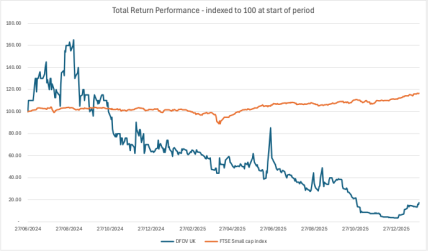
The Company's share price has performed below that of the FTSE Emerging Small Cap Index. The Board has carefully considered the broader strategic context of this underperformance, noting that this period covered two strategic transitions by the Company into high growth areas: since 2024 the Group has operated as an AI-focused business and during 2025 the Company has begun developing and implementing a digital asset treasury strategy focused on Solana. The Board acknowledges that there have been external factors presenting headwinds for this strategy, including rapid market evolution and in particular, the accelerated development of mainstream AI agentic technologies has significantly affected the competitive landscape. Concurrently, heightened volatility in global digital asset markets has affected market sentiment towards the Group's digital asset treasury strategy. These factors, together with broader macroeconomic conditions, may have contributed to weaker investor sentiment.
Notwithstanding these short term challenges, the Board is satisfied that the remuneration for this period appropriately reflects both the Company's performance and development as it positions itself for future long-term value for shareholders.
The FTSE Emerging Small Cap Index has been selected as the comparator as it is considered an appropriate broad market benchmark given the Company's size and listing on the Equity Shares (Transition) category of the Official List of the London Stock Exchange.
Approved by the Board of Directors and signed on its behalf by:
Michael Chan
Director
Date: 22 May 2026
DIRECTORS REPORT
The Directors present their report and financial statements for the period 1 February 2025 to 31 January 2026. A commentary on the business and the Group's governance is included in the Chairman's Statement and the Corporate Governance section of the Annual Report.
Principal activities
During the period, the Group continued to focus on the development and commercialisation of its AI Agent platform, transitioning from product development to early-stage revenue generation. Its Recruitment AI Agent ("Lucy") and Sales AI Agent ("Eve") were launched and have begun to gain initial customer traction and generate early revenues.
The Group has also continued to enhance its underlying technology and expand user engagement across its AI products. In addition, the Company has commenced development of a Solana focussed digital asset treasury strategy, which remains at an early stage.
Results and dividends
The results for the period are set out on page 33.
The Directors do not propose a dividend in respect of the period ended 31 January 2026. No dividend was paid in the year to 31 January 2025.
Directors
The directors who held office during the period and up to the date of signature of the financial statements were as follows:
|
Hadley Stern |
Appointed 15 January 2026 |
|
Michael Chan |
Appointed 9 September 2025 |
|
Nathalie Maggi |
Appointed 15 January 2026 |
|
Ewan Collinge |
Appointed 8 October 2024 |
|
Robert Mayfield |
Resigned 4 March 2026 |
|
Jonathan Hives |
Resigned 4 March 2026 |
|
Nicholas Lyth |
Resigned 3 November 2025 |
|
Jonathan Bixby |
Resigned 2 September 2025 |
Directors' interests
The directors' interests in the shares of the Group at the date of signing were as stated below:
|
Director |
Position |
Appointed |
Ordinary Shares |
Warrants |
Options |
|
Hadley Stern |
Chairman |
15 January 2026 |
- |
- |
- |
|
Michael Chan |
Chief Executive Officer |
09 September 2025 |
- |
- |
- |
|
Nathalie Maggi |
Chief Financial Office |
15 January 2026 |
- |
- |
- |
|
Ewan Collinge |
Chief AI Officer |
8 October 2024 |
38,220 |
53,608 |
200,000 |
|
Robert Mayfield |
Non-Executive Director |
27 June 2024 |
- |
42,886 |
- |
|
Jonathan Hives |
Non-Executive Director |
27 June 2024 |
- |
42,886 |
- |
|
Nicholas Lyth |
Resigned in the period |
27 June 2024 |
16,885 |
192,989 |
- |
|
Jonathan Bixby* |
Resigned in the period |
27 June 2024 |
195,500 |
557,524 |
- |
*Jonathan Bixby's Ordinary Shares and Warrants are held by Toro Consulting Ltd, a company which he controls.
Substantial shareholders
As at 31 January 2026, the total number of issued Ordinary Shares with voting rights in the Group was 5,167,480. Details of the Company's capital structure and voting rights are set out in note 12 to the financial statements.
As at the date of approval of this report the Group had a total number of issued Ordinary Shares with voting rights in the Group of 5,167,480. The Group has been notified of the following interests of 3 per cent or more in its issued share capital.
|
Party name |
Number of Ordinary Shares |
% of Share Capital |
|
Charitable Impact Foundation (Canada) |
640,000 |
12.39% |
|
Toro Consulting Ltd* |
195,500 |
3.78% |
|
Fortified Securities |
262,124 |
5.07% |
* Toro Consulting Ltd is a company controlled by Jonathan Bixby
Financial instruments
Details of the use of the Group's exposure to financial risk are contained in note 25 of the financial statements.
Post reporting date events
The Group made changes to its board following the reporting period. On 4 March 2026, Robert Mayfield and Jonathan Hives, both Non-Executive Directors, ceased to be directors of the Company. Ewan Collinge, Chief AI Officer, will cease to be a director on conclusion of his notice period on 4 September 2026. Under his EMI option agreement, all of the options (approximately £580k) are expected to have vested at that date. As the options may not be exercised during a notice period, they are expected to lapse on or around 4 October 2026 unless the Board determines otherwise. Approximately £451k currently recognised within the share-based payment reserve is expected to be reclassified within equity on lapse.
The Group intends to hire a minimum of two new Non-Executive Directors to strengthen board governance in preparation for full compliance with the Corporate Governance Code.
In January 2026, the Group entered into a USD 4.75 million revolving credit facility. Subsequent to the reporting date, on 15 April 2026, the Group made an initial drawdown of USD 580,000, carrying interest at 10% per annum, payable 18 months from drawdown. As both the facility and drawdown arose after the reporting date, this represents a non-adjusting post balance sheet event under IAS 10 Events after the Reporting Period.
Auditor
Following the April 2025 Institute of Chartered Accountants in England & Wales ("ICAEW") regulatory changes to Audit Eligibility rules, the audit licence previously held by Kreston Reeves LLP has been transferred to the newly established Kreston Reeves Audit LLP. As a result, the Board formally appointed Kreston Reeves Audit LLP as auditors of the Group on 6 October 2025, with Kreston Reeves LLP stepping down on the same date as part of this structural transition. The auditors have expressed their willingness to continue in office, and a decision regarding their reappointment will be made in due course.
Energy and carbon report
The Group is aware that it needs to measure its operational carbon footprint in order to limit and control its environmental impact. However, given the very limited nature of its operations during the period under review, it has not been practical to measure its carbon footprint.
In the future, the Group will only measure the impact of its direct activities, as the full impact of the entire supply chain of its suppliers cannot be measured practically.
The Group is exempt from the Streamlined Energy & Carbon Reporting (SECR) requirements since energy consumption is less than 40,000 kWh of energy in the reporting period.
The Task Force on Climate-related Financial Disclosures (TCFD) aim to provide investors, lenders, and other stakeholders with information necessary to assess climate-related risks and opportunities. The Group takes various actions throughout our local operations to mitigate the potential impacts of our activities.
We recognise the benefits of disclosing climate-related financial information, but due to our small scale and stage of development, have not yet fully implemented the TCFD recommendations.
Future Developments
The Group continues to work towards the implementation of its Solana focused digital asset treasury strategy. The Board carefully considers the evolving regulatory landscape for digital assets as part of this process. Shareholders will be updated on material developments as they occur.
Statement of directors' responsibilities
The directors are responsible for preparing the annual report and the financial statements in accordance with applicable law and regulations.
Company law requires the directors to prepare financial statements for each financial year. Under that law the directors have elected to prepare the financial statements in accordance with UK-adopted international accounting standards (UK-adopted IAS).
Under Company law the directors must not approve the financial statements unless they are satisfied that they give a true and fair view of the state of affairs of the Group and of the profit or loss of the Group for that period. The Directors are also required to prepare financial statements in accordance with the UK Listing Rules and the Disclosure Guidance and Transparency Rules published by the Financial Conduct Authority.
In preparing these financial statements, International Accounting Standard 1 requires that directors:
· Select suitable accounting policies and then apply them consistently;
· Make judgments and accounting estimates that are reasonable and prudent;
· State whether they have been prepared in accordance with UK-adopted international accounting standards, subject to any material departures disclosed and explained in the financial statements;
· Prepare the financial statements on the going concern basis unless it is inappropriate to presume that the Group will continue in business; and
· Prepare a directors' report, a strategic report and directors' remuneration report which comply with the requirements of the Companies Act 2006.
The directors are responsible for keeping adequate accounting records that are sufficient to show and explain the Group's transactions and disclose with reasonable accuracy at any time the financial position of the Group and enable them to ensure that the financial statements comply with the Companies Act 2006. They are also responsible for safeguarding the assets of the Group and hence for taking reasonable steps for the prevention and detection of fraud and other irregularities.
They are also responsible to make a statement that they consider that the annual report and accounts, taken as a whole, are fair, balanced, and understandable and provides the information necessary for the shareholders to assess the Group's position and performance, business model and strategy.
The directors are responsible for the maintenance and integrity of the Group's website. Legislation in the United Kingdom governing the preparation and dissemination of financial statements may differ from legislation in other jurisdictions.
Statement of Directors' responsibilities pursuant to Disclosure and Transparency Rule
Each of the Directors, whose names and functions are listed on page 3 confirm that, to the best of their knowledge and belief:
· the financial statements have been prepared in accordance UK-adopted IAS and give a true and fair view of the assets, liabilities, financial position and loss of the Group; and
· the Annual Report and financial statements, including the Strategic Report, includes a fair review of the development and performance of the business and the position of the Group, together with a description of the principal risks and uncertainties that they face. The financial statements have been prepared in accordance with UK-adopted international accounting standards and with the requirements of the Companies Act 2006 as applicable to companies reporting under those standards.
Strategic report
The Group has chosen in accordance with section 414C(11) Companies Act 2006, to set out in the Group's strategic report information required by Large and Medium-sized Companies and Groups (Accounts and Reports) Regulations 2008, Schedule 7 to be contained in the directors' report. It has done so in respect of the review of the business during the period.
Statement of disclosure to auditor
Each director in office at the date of approval of this annual report confirms that:
· so far as the director is aware, there is no relevant audit information of which Kreston Reeves Audit LLP is unaware, and
· the director has taken all the steps that he / she ought to have taken as a director in order to make himself / herself aware of any relevant audit information and to establish that the Group's auditor is aware of that information.
This confirmation is given and should be interpreted in accordance with the provisions of section 418 of the Companies Act 2006.
Going Concern
The Group has incurred losses from its AI operations and has impaired the carrying value of its AI platform to nil during the year. The Group has a £3.5 million (USD 4.75 million, converted at a rate of USD 1: GBP 0.72782), revolving credit facility available. However, prepaid warrants may become repayable on 1 June 2026, requiring a cash payment of approximately £2.3 million, which would significantly reduce available liquidity and necessitate the securing of additional funding. Discussions are underway to extend this deadline.
The Directors have prepared forecasts indicating the Group can operate within its existing income and debt facilities if the prepaid warrants are extended. However, if the prepaid warrants are not extended and the repayment obligation crystallises, the availability of additional funding cannot be certain. These conditions represent a material uncertainty that may cast significant doubt on the Group's ability to continue as a going concern. Notwithstanding this uncertainty, the Directors consider it appropriate to prepare the financial statements on a going concern basis.
Approved by the Board of Directors and signed on its behalf by:
Michael Chan
Chief Executive Officer and Director
Date: 22 May 2026
Approved by the Board of Directors and signed on its behalf by:
Nathalie Maggi
Chief Financial Officer and Director
Date: 22 May 2026
CONSOLIDATED STATEMENT OF COMPREHENSIVE INCOME
|
|
|
February 2025 to January 2026 |
Restated January 2024 to January 2025 |
|
|
Note |
£ |
£ |
|
|
|
|
|
|
Revenue |
|
18,338 |
817 |
|
Cost of Sales |
|
(18,730) |
- |
|
|
|
|
|
|
Gross Profit/(loss) |
|
(392) |
817 |
|
|
|
|
|
|
Administrative expenses |
5 |
(2,673,546) |
*(1,670,571) |
|
Depreciation and Amortisation |
|
(253,146) |
- |
|
|
|
|
|
|
Operating loss |
|
(2,927,084) |
(1,669,754) |
|
|
|
|
|
|
Reverse acquisition expenses |
8 |
- |
(1,014,405) |
|
Finance income / (expenses) |
9 |
(259) |
2,748 |
|
|
|
|
|
|
Profit/(loss) before taxation |
|
(2,927,343) |
(2,681,411) |
|
|
|
|
|
|
Income tax expense |
11 |
- |
- |
|
|
|
|
|
|
Profit/(loss) after taxation |
|
(2,927,343) |
(2,681,411) |
|
|
|
|
|
|
Other comprehensive income |
|
(22) |
- |
|
|
|
|
|
|
|
|
|
|
|
Profit/(loss) and total comprehensive loss for the period |
|
(2,927,365) |
(2,681,411) |
|
|
|
|
|
|
|
|
|
|
|
Profit/(Loss) per share from continuing operations attributable to the equity owners |
|
|
|
|
Basic profit/(loss) per share (£ per share) |
12 |
(0.60) |
*(2.08) |
|
|
|
|
|
|
|
|
|
|
*Comparative figures have been restated to reflect the correction of a prior period error in relation to share-based payment accounting. Refer to Note 2.3 for further details.
The income statement has been prepared on the basis that all operations are continuing operations.
The notes starting on page 41 form part of these financial statements.
COMPANY STATEMENT OF COMPREHENSIVE INCOME
|
|
|
February 2025 to January 2026 |
Restated January 2024 to January 2025 |
|
|
Note |
£ |
£ |
|
|
|
|
|
|
|
|
|
|
|
Revenue |
|
18,338 |
- |
|
Cost of Sales |
|
(18,730) |
- |
|
|
|
|
|
|
Gross Profit/(loss) |
|
(392) |
- |
|
|
|
|
|
|
Other operating income |
|
- |
3,000 |
|
Administrative expenses |
5 |
(2,618,632) |
*(6,615,646) |
|
Depreciation and Amortisation |
|
(253,146) |
- |
|
Impairment of investment in subsidiary |
|
- |
(18,996,724) |
|
|
|
|
|
|
Operating loss |
|
(2,872,170) |
(25,609,370) |
|
|
|
|
|
|
Finance costs |
9 |
(385) |
(821) |
|
|
|
|
|
|
Profit/(loss) before taxation |
|
(2,872,554) |
(25,610,191) |
|
|
|
|
|
|
Income tax expense |
11 |
- |
- |
|
|
|
|
|
|
Profit/(loss) after taxation |
|
(2,872,554) |
(25,610,191) |
|
|
|
|
|
|
Other comprehensive income |
|
- |
- |
|
|
|
|
|
|
|
|
|
|
|
Profit/(loss) and total comprehensive loss for the period |
|
(2,872,554) |
(25,610,191) |
|
|
|
|
|
|
|
|
|
|
*Comparative figures have been restated to reflect the correction of a prior period error in relation to share-based payment accounting. Refer to Note 2.3 for further details.
The income statement has been prepared on the basis that all operations are continuing operations.
The notes starting on page 41 form part of these financial statements.
CONSOLIDATED STATEMENT OF FINANCIAL POSITION

|
|
Note |
|
As at January 2026 |
Restated as at January 2025 |
|
ASSETS |
|
|
£ |
£ |
|
Non-current assets |
|
|
|
|
|
Property, plant and equipment |
13 |
|
2,665 |
720 |
|
Intangible assets |
14 |
|
- |
252,093 |
|
|
|
|
|
|
|
Total non-current assets |
|
|
2,665 |
252,813 |
|
|
|
|
|
|
|
Current assets |
|
|
|
|
|
Trade and other receivables |
16 |
|
209,789 |
83,620 |
|
Cash and cash equivalents |
|
|
1,325,314 |
119,282 |
|
|
|
|
|
|
|
Total current assets |
|
|
1,535,103 |
202,902 |
|
|
|
|
|
|
|
Total assets |
|
|
1,537,768 |
455,715 |
|
|
|
|
|
|
|
EQUITY AND LIABILITIES |
|
|
|
|
|
Equity |
|
|
|
|
|
Share capital |
17 |
|
5,167,480 |
4,329,266 |
|
Treasury Shares |
17 |
|
(262,124) |
- |
|
Share premium |
18 |
|
18,664,467 |
17,690,550 |
|
Share-based payment reserve |
19 |
|
5,681,063 |
*5,571,033 |
|
Reverse acquisition reserve |
8 |
|
(18,116,825) |
(18,116,825) |
|
Foreign currency translation reserve |
|
|
(22) |
- |
|
Retained earnings |
|
|
(12,091,925) |
*(9,286,867) |
|
Total equity |
|
|
(975,886) |
187,158 |
|
|
|
|
|
|
|
Current liabilities |
|
|
|
|
|
Trade and other payables |
20 |
|
195,654 |
268,557 |
|
Financial liabilities |
21 |
|
2,300,000 |
- |
|
Total current liabilities |
|
|
2,495,654 |
268,557 |
|
|
|
|
|
|
|
Total liabilities |
|
|
2,495,654 |
268,557 |
|
|
|
|
|
|
|
Total equity and liabilities |
|
|
1,537,768 |
455,715 |
*Comparative figures have been restated to reflect the correction of a prior period error in relation to share-based payment accounting. Refer to Note 2.3 for further details.
The notes starting on page 41 form part of these financial statements.
COMPANY STATEMENT OF FINANCIAL POSITION
|
|
Notes |
|
As at January 2026 |
Restated as at January 2025 |
|
ASSETS |
|
|
£ |
£ |
|
Non-current assets |
|
|
|
|
|
Property, plant and equipment |
13 |
|
2,665 |
720 |
|
Intangible assets |
14 |
|
- |
252,093 |
|
Investments |
15 |
|
54,671 |
- |
|
|
|
|
|
|
|
|
|
|
|
|
|
Total non-current assets |
|
|
57,336 |
252,813 |
|
|
|
|
|
|
|
Current assets |
|
|
|
|
|
Trade and other receivables |
16 |
|
209,790 |
83,620 |
|
Cash and cash equivalents |
|
|
1,322,405 |
119,282 |
|
|
|
|
|
|
|
Total current assets |
|
|
1,532,195 |
202,902 |
|
|
|
|
|
|
|
Total assets |
|
|
1,589,531 |
455,715 |
|
|
|
|
|
|
|
EQUITY AND LIABILITIES |
|
|
|
|
|
Equity |
|
|
|
|
|
Share capital |
17 |
|
5,167,480 |
4,329,266 |
|
Treasury Shares |
17 |
|
(262,124) |
- |
|
Share premium |
|
|
3,372,357 |
2,398,440 |
|
Share based payment reserve |
19 |
|
5,681,063 |
*5,571,033 |
|
Retained earnings |
|
|
(14,861,851) |
*(12,111,581) |
|
Total equity |
|
|
(903,075) |
187,158 |
|
|
|
|
|
|
|
Current liabilities |
|
|
|
|
|
Trade and other payables |
20 |
|
192,606 |
268,557 |
|
Financial liabilities |
21 |
|
2,300,000 |
- |
|
Total current liabilities |
|
|
2,492,606 |
268,557 |
|
|
|
|
|
|
|
Total liabilities |
|
|
2,492,606 |
268,557 |
|
|
|
|
|
|
|
Total equity and liabilities |
|
|
1,589,531 |
455,715 |
|
|
|
|
|
|
*Comparative figures have been restated to reflect the correction of a prior period error in relation to share-based payment accounting. Refer to Note 2.3 for further details.
The notes starting on page 41 form part of these financial statements.
The financial statements were approved by the board of directors and authorised for issue on 22 May 2026 and
are signed on its behalf by:
Nathalie Maggi
Chief Financial Officer and Director
Company Registration No. 11155663
CONSOLIDATED STATEMENT OF CHANGES IN EQUITY
|
|
Share Capital |
Share Premium |
Restated Share Based Payment Reserve |
Reverse acquisition reserve |
Restated Retained Earnings |
Restated Total Equity |
|
£ |
£ |
£ |
£ |
£ |
£ |
|
|
As at 1 January 2024 |
205,183 |
1,847,841 |
1,107,266 |
- |
(1,567,265) |
1,593,025 |
|
Loss for the period |
- |
- |
- |
- |
*(2,681,411) |
(2,681,411) |
|
Total comprehensive loss for the period |
- |
- |
- |
- |
(2,681,411) |
(2,681,411) |
|
|
|
|
|
|
|
|
|
Recognition of plc equity at acquisition date |
121,620 |
1,253,355 |
- |
(956,685) |
- |
418,290 |
|
Remove Share capital of Cykel AI Development Ltd |
(205,183) |
(1,847,841) |
(1,107,266) |
2,053,024 |
- |
(1,107,266) |
|
Issue of shares for acquisition of subsidiary |
3,921,054 |
15,292,110 |
- |
(19,213,164) |
- |
- |
|
Shares issued during the period |
286,592 |
1,145,085 |
- |
- |
- |
1,431,677 |
|
Issue of warrants |
- |
- |
*5,571,033 |
- |
(5,038,190) |
469,907 |
|
Total transactions with owners |
4,124,083 |
15,842,709 |
4,463,768 |
(18,116,825) |
(5,038,190)
|
1,212,608 |
|
Restated as at 31 January 2025 |
4,329,266 |
17,690,550 |
5,571,033 |
(18,116,825) |
(9,286,867) |
187,158 |
*Comparative figures have been restated to reflect the correction of a prior period error in relation to share-based payment accounting. Refer to Note 2.3 for further details.
|
|
Share Capital |
Treasury Shares |
Share Premium |
Share Based Payment Reserve |
Reverse acquisition reserve |
Foreign currency translation reserve |
Retained Earnings |
Total Equity |
|
£ |
£ |
£ |
£ |
£ |
£ |
£ |
£ |
|
|
As at 1 February 2025 |
4,329,266 |
- |
17,690,550 |
5,571,033 |
(18,116,825) |
- |
(9,286,867) |
187,158 |
|
Loss for the period |
- |
- |
- |
- |
- |
- |
(2,927,343) |
(2,927,343) |
|
Exchange differences on translation of foreign operations |
- |
- |
- |
- |
- |
(22) |
- |
(22) |
|
Total comprehensive loss for the period |
- |
- |
- |
- |
- |
(22) |
(2,927,343) |
(2,927,365) |
|
|
|
|
|
|
|
|
|
|
|
Shares issued during the period |
838,214 |
- |
973,917 |
- |
- |
- |
- |
1,812,131 |
|
Issue of warrants |
- |
- |
- |
232,314 |
- |
- |
- |
232,314 |
|
Lapsed warrants |
- |
- |
- |
(122,284) |
- |
- |
122,284 |
- |
|
Shares issued for ATM purpose |
|
(262,124) |
|
|
|
|
|
(262,124) |
|
Total transactions with owners |
838,214 |
(262,124) |
973,917 |
110,030 |
- |
- |
122,284
|
1,782,321 |
|
As at 31 January 2026 |
5,167,480 |
(262,124) |
18,664,467 |
5,681,063 |
(18,116,825) |
(22) |
(12,091,925) |
(957,886) |
The notes starting on page 41 form part of these financial statements.
COMPANY STATEMENT OF CHANGES IN EQUITY
|
|
Share Capital |
Share Premium |
Restated Share Based Payment Reserve |
Merger Relief Reserve |
Convertible loan note reserve |
Restated Retained Earnings |
Restated Total Equity |
|
£ |
£ |
£ |
£ |
£ |
£ |
£ |
|
|
As at 1 January 2024 |
121,620 |
1,253,355 |
91,100 |
- |
12,688 |
(1,793,501) |
(314,738) |
|
Loss for the period |
- |
- |
- |
- |
- |
*(25,610,191) |
(25,610,191) |
|
Total comprehensive loss for the period |
- |
- |
- |
|
- |
(25,610,191) |
(25,610,191) |
|
|
|
|
|
|
|
|
|
|
Shares issued during the period |
4,207,646 |
1,145,085 |
*5,571,033 |
15,292,110 |
- |
- |
26,215,875 |
|
Shares cancelled during the period |
- |
- |
(91,100) |
- |
- |
- |
(91,100) |
|
Convertible loan notes |
- |
- |
- |
- |
(12,688) |
- |
(12,688) |
|
Reserve transfer on impairment |
- |
- |
- |
(15,292,110) |
- |
15,292,110 |
- |
|
Total transactions with owners |
4,207,646 |
1,145,085 |
5,479,933 |
- |
(12,688) |
15,292,110 |
26,112,087 |
|
Restated as at 31 January 2025 |
4,329,266 |
2,398,440 |
5,571,033 |
- |
- |
(12,111,581) |
187,158 |
*Comparative figures have been restated to reflect the correction of a prior period error in relation to share-based payment accounting. Refer to Note 2.3 for further details.
|
|
Share Capital |
Share Capital |
Share Premium |
Share Based Payment Reserve |
Retained Earnings |
Total Equity |
|
£ |
£ |
£ |
£ |
£ |
£ |
|
|
As at 1 February 2025 |
4,329,266 |
- |
2,398,440 |
5,571,033 |
(12,111,581) |
187,158 |
|
Loss for the period |
- |
- |
- |
- |
(2,872,554) |
(2,872,554) |
|
Exchange differences on translation of investment in subsidiary |
|
|
|
|
|
|
|
Total comprehensive loss for the period |
- |
- |
- |
- |
(2,872,554) |
(2,872,554) |
|
|
|
|
|
|
|
|
|
Shares issued during the period |
838,214 |
- |
973,917 |
- |
- |
1,812,131 |
|
Issue of warrants |
- |
- |
- |
232,314 |
- |
232,314 |
|
Lapsed warrants |
|
|
|
(122,284) |
122,284 |
- |
|
Shares issued for ATM purpose |
|
(262,124) |
|
|
|
(262,124) |
|
Total transactions with owners |
838,214 |
(262,124) |
973,917 |
110,030 |
122,284 |
1,782,321 |
|
As at 31 January 2026 |
5,167,480 |
(262,124) |
3,372,357 |
5,681,063 |
(14,861,851) |
(903,075) |
The notes starting on page 41 form part of these financial statements.
CONSOLIDATED STATEMENT OF CASH FLOWS
|
|
|
Period ended 31 January |
Restated Period ended 31 January |
|
|
2026 |
2025 |
||
|
|
Note |
£ |
£ |
|
Cash flow from operating activities |
|
|
|
|
Loss for the financial period |
|
(2,927,343) |
*(2,681,411) |
|
Adjustments for: |
|
|
|
|
Depreciation & Amortisation |
|
253,146 |
881 |
|
Share proceeds receivable to equity, non-cash |
|
(262,124) |
- |
|
Reverse acquisition share-based payment expense |
|
- |
1,014,405 |
|
Settlement of fees through equity |
|
- |
207,766 |
|
Share based payments |
|
232,314 |
*(935,986) |
|
Changes in working capital: |
|
|
|
|
Decrease / (Increase) in trade and other receivables |
|
(126,169) |
88,072 |
|
Increase / (decrease) in trade and other payables |
|
(72,903) |
35,939 |
|
Net cash used in operating activities |
|
(2,903,079) |
(2,270,334) |
|
|
|
|
|
|
Cash flows from investing activities |
|
|
|
|
Purchase of property, plant and equipment |
|
(2,998) |
(1,083) |
|
Purchase of intangible assets |
|
- |
(148,963) |
|
Cash acquired on acquisition |
|
- |
15,594 |
|
Net cash used in investing activities |
|
(2,998) |
(134,452) |
|
|
|
|
|
|
Cash flows from financing activities |
|
|
|
|
Proceeds from issue of shares |
|
1,812,131 |
1,301,190 |
|
Cash received on settlement of prepaid warrants |
25 |
2,300,000 |
- |
|
Loans |
|
- |
(173,575) |
|
Net cash (used in)/generated from financing activities |
|
4,112,131 |
1,127,615 |
|
|
|
|
|
|
Net (decrease)/increase in cash and cash equivalents |
|
1,206,054 |
(1,277,171) |
|
Cash and cash equivalents at beginning of the period |
|
119,282 |
1,396,453 |
|
Foreign exchange impact on cash |
|
(22) |
- |
|
Cash and cash equivalents at end of the period |
|
1,325,314 |
119,282 |
*Comparative figures have been restated to reflect the correction of a prior period error in relation to share-based payment accounting. Refer to Note 2.3 for further details.
The accompanying notes starting on page 41 form part of these financial statements.
COMPANY STATEMENT OF CASH FLOWS
|
|
|
Period ended 31 January |
Restated Period ended 31 January |
|
|
2026 |
2025 |
||
|
|
Note |
£ |
£ |
|
Cash flow from operating activities |
|
|
|
|
(Loss) / profit for the financial period |
|
(2,872,554) |
*(25,610,191) |
|
Adjustments for: |
|
|
|
|
Depreciation & Amortisation |
|
253,146 |
881 |
|
Share proceeds receivable to equity, non-cash |
|
(262,124) |
- |
|
Write down / Impairment of investment in subsidiary |
|
- |
15,292,110 |
|
Issue of warrants |
|
- |
*5,479,934 |
|
Share based payments |
|
232,314 |
- |
|
Changes in working capital: |
|
|
|
|
Decrease / (Increase) in trade and other receivables |
|
(126,169) |
(78,163) |
|
Increase / (decrease) in trade and other payables |
|
(75,951) |
99,492 |
|
Net cash used in operating activities |
|
(2,851,338) |
(4,815,936) |
|
|
|
|
|
|
Cash flows from investing activities |
|
|
|
|
Purchase of property, plant and equipment |
|
(2,998) |
- |
|
Purchase of intangible assets |
|
- |
(252,093) |
|
Investments - additions |
|
(54,671) |
(1,083) |
|
Net cash used in investing activities |
|
(57,669) |
(253,175) |
|
|
|
|
|
|
Cash flows from financing activities |
|
|
|
|
Proceeds from issue of shares |
|
1,812,130 |
5,340,043 |
|
Cash received on settlement of prepaid warrants |
25 |
2,300,000 |
- |
|
Loans |
|
- |
(160,887) |
|
Net cash (used in)/generated from financing activities |
|
4,112,130 |
5,179,156 |
|
|
|
|
|
|
Net (decrease)/increase in cash and cash equivalents |
|
1,203,123 |
110,044 |
|
Cash and cash equivalents at beginning of the period |
|
119,282 |
9,238 |
|
Foreign exchange impact on cash |
|
- |
- |
|
Cash and cash equivalents at end of the period |
|
1,322,405 |
119,282 |
*Comparative figures have been restated to reflect the correction of a prior period error in relation to share-based payment accounting. Refer to Note 2.3 for further details.
The accompanying notes starting on page 41 form part of these financial statements.
NOTES TO THE FINANCIAL STATEMENTS
|
1 General Information
DeFi Development Corporation UK PLC (previously called CYKEL AI PLC) is incorporated and domiciled in England and Wales as a public limited company. The registered office and principal place of business is 16 Great Queen Street, London, England, WC2B 5DG.
The Company's principal activities and nature of its operations are disclosed in the Strategic Report.
2 Accounting Policies
IAS 8 requires that management shall use its judgement in developing and applying accounting policies that result in information which is relevant to the economic decision-making needs of users, that are reliable, free from bias, prudent, complete and represent faithfully the financial position, financial performance and cash flows of the entity.
Ordinary course purchases and sales of financial assets are accounted for at trade date.
2.1 Basis of preparation
The financial statements have been prepared in accordance with UK-adopted international accounting standards and with those parts of the Companies Act 2006 applicable to companies reporting under IFRS, except as otherwise stated.
The financial statements are prepared in pounds sterling, which is the functional currency of the Company. Monetary amounts in these financial statements are rounded to the nearest pound sterling.
The Company has adopted the applicable amendments to standards effective for accounting periods commencing on or after 1 January 2025. The nature and effect of these changes as a result of the adoption of these amended standards did not have an impact on the financial statements of the Company and, hence, have not been disclosed.
The Company has not early adopted any standards, interpretations or amendments that have been issued but are not yet effective - see note 3 for reference.
The company changed its accounting reference date from 31 December to 31 January during the prior period. As a result, the current financial statements cover a 12-month period ended 31 January 2026, compared to the prior financial period of 13 months from 1 January 2024 to 31 January 2025.
As a result, the amounts presented in the primary financial statements are not entirely comparable to the prior period figures due to the difference in length of reporting periods, as well as the reverse acquisition that took place in the prior period.
2 Accounting Policies (Continued)
On 27 June 2024, Mustang Energy PLC (subsequently renamed Cykel AI PLC) completed a reverse takeover of Cykel AI PLC (subsequently renamed Cykel AI Development Ltd). Following the transaction, Mustang Energy PLC changed its name to Cykel AI PLC, while Cykel AI PLC was renamed Cykel AI Development Ltd.
The transaction was accounted for as a reverse acquisition in accordance with IFRS 3 (Business Combinations). As the legal structure of the Group changed, the financial statements were presented as a continuation of Mustang Energy PLC (subsequently known as Cykel AI PLC) with the assets, liabilities, and operations of Cykel AI PLC (subsequently known as Cykel AI Development Ltd) included from the acquisition date.
For accounting purposes, Mustang Energy PLC (subsequently known as Cykel AI PLC) was the legal acquirer and the accounting acquiree, and Cykel AI PLC (subsequently known as Cykel AI Development Ltd) was the accounting acquirer. However, due to the name changes, the consolidated financial statements were presented under the name Cykel AI PLC, which represents the combined entity post-acquisition.
Following the reverse acquisition, the consolidated financial statements continued to reflect the Group structure led by Cykel AI PLC (previously called Mustang Energy PLC) as the legal acquirer, with newly acquired subsidiaries consolidated from their respective acquisition dates.
For full details of the transaction, please refer to the prior year's financial statements.
2.2 Going concern
The Group has incurred losses from its AI operations and has impaired the carrying value of its AI platform to nil during the year, reflecting the limited revenues currently being generated.
The Group has a £3.5 million (USD 4.75 million denominated loan, converted at a rate of USD 1: GBP 0.72782), revolving credit facility available. However, warrants expiring on 1 June 2026, will require a cash payment of approximately £2.3 million, which would significantly reduce available liquidity and necessitate the securing of additional funding. Discussions are underway to extend the deadline.
While the Directors have prepared forecasts which indicate that the Group can operate within its existing facilities if the warrants are extended, in the event that the warrants are not extended and the associated repayment becomes due, the Group would be required to secure additional funding. The availability of such funding is uncertain.
2 Accounting Policies (Continued)
These events or conditions indicate the existence of a material uncertainty that may cast significant doubt on the Group's ability to continue as a going concern and, therefore, that it may be unable to realize its assets and discharge its liabilities in the normal course of business.
The financial statements have been prepared on a going concern basis and do not include any adjustments that would result if the Group were unable to continue as a going concern.
2.3 Restatement of comparatives - share-based payments
During the year, the directors identified that the share-based payment charge recognised in the prior period in respect of the warrants granted to directors in October 2024 had been calculated using a single grant date for all warrants issued. Following a review of the underlying agreements and grant documentation, it was determined that the warrants were granted on different dates to individual directors and should therefore have been measured separately based on the respective grant date fair values in accordance with the applicable accounting standard.
As a result, the comparative figures have been restated for both the Company and Group to reflect the correct timing and valuation of the warrant grants. The adjustment has resulted in an increase to the share-based payment reserve of £62,934 and a corresponding decrease in retained earnings of £62,934 as at 31 January 2025. The comparative statement of comprehensive income has also been restated to recognise the revised share-based payment charge for the year of £5,479,934 for the Company and a share-based payment credit for the year of £636,659 for the Group. Share based payments are recognised within administrative expenses. Please see note 5 for reference.
The directors consider this adjustment to represent the correction of a prior period error and the comparative information has therefore been restated accordingly.
There is no associated tax impact arising from the restatement as the company remained loss-making in the affected periods and no deferred tax asset has been recognised in respect of the adjustment. Earnings per share for the comparative period has also been restated to reflect the revised loss attributable to shareholders arising from the corrected share-based payment charge.
2.4 Revenue Recognition
Revenue from subscription-based services is recognised on a straight-line basis over the subscription period, reflecting the continuous transfer of services to the customer. Subscription fees are billed and collected on a monthly basis and recognised as revenue over the period to which they relate.
2.5 Property, plant and equipment
Property, plant and equipment are initially measured at cost and subsequently measured at cost or valuation, net of depreciation and any impairment losses.
2 Accounting Policies (Continued)
Depreciation is recognised so as to write off the cost or valuation of assets less their residual values over their useful lives on the following bases:
Plant and equipment 33% straight line
The gain or loss arising on the disposal of an asset is determined as the difference between the sale proceeds and the carrying value of the asset and is recognised in the income statement.
2.6 Non-current investments
Investments comprise interests in subsidiary undertakings only. Investments in subsidiaries are initially measured at cost and subsequently carried at cost less any accumulated impairment losses.
2.7 Impairment of intangible assets
At each reporting end date, the Company reviews the carrying amounts of its intangible assets to determine whether there is any indication that those assets have suffered an impairment loss. If any such indication exists, the recoverable amount of the asset is estimated in order to determine the extent of the impairment loss (if any). Where it is not possible to estimate the recoverable amount of an individual asset, the Company estimates the recoverable amount of the cash-generating unit to which the asset belongs.
Intangible assets with indefinite useful lives and intangible assets not yet available for use are tested for impairment annually, and whenever there is an indication that the asset may be impaired.
If the recoverable amount of an asset (or cash-generating unit) is estimated to be less than its carrying amount, the carrying amount of the asset (or cash-generating unit) is reduced to its recoverable amount. An impairment loss is recognised immediately in the statement of comprehensive income.
Where an impairment loss subsequently reverses, the carrying amount of the asset (or cash-generating unit) is increased to the revised estimate of its recoverable amount, but so that the increased carrying amount does not exceed the carrying amount that would have been determined had no impairment
loss been recognised for the asset (or cash-generating unit) in prior periods. A reversal of an impairment loss is recognised immediately in the statement of comprehensive income, unless the relevant asset is carried at a revalued amount, in which case the reversal of the impairment loss is treated as a revaluation increase.
2.8 Cash and cash equivalents
Cash and cash equivalents include cash in hand, deposits held at call with banks, other short-term liquid investments with original maturities of three months or less, and bank overdrafts. Bank overdrafts are shown within borrowings in current liabilities.
2 Accounting Policies (Continued)
2.9 Financial assets
Financial assets are recognised in the company's statement of financial position when the company becomes party to the contractual provisions of the instrument. Financial assets are classified into specified categories, depending on the nature and purpose of the financial assets.
At initial recognition, financial assets classified as measured at fair value through profit and loss are measured at fair value and any transaction costs are recognised in profit or loss. This includes the company's equity investments. Financial assets not classified as fair value through profit or loss are initially measured at fair value plus transaction costs.
Financial assets held at amortised cost
Financial assets held at amortised cost comprise trade and other receivables and cash and cash equivalents. These assets are non-derivative financial assets with fixed or determinable payments that are not quoted in an active market. They arise principally through the provision of goods and services to customers (e.g. trade receivables), but also incorporate other types of financial assets where the objective is to hold their assets in order to collect contractual cash flows and the contractual cash flows are solely payments of the principal and interest. They are initially recognised at fair value plus transaction costs that are directly attributable to their acquisition or issue and are subsequently carried at amortised cost using the effective interest rate method, less provision for impairment.
The company applies the expected credit loss (ECL) model in respect of other receivables. The company tracks changes in credit risk, and recognises a loss allowance based on lifetime ECLs at each reporting date. Lifetime ECLs are determined using all relevant, reasonable and supportable historical, current and forward-looking information that provides evidence about the risk that the other receivables will default and the amount of losses that would arise as a result of that default. Analysis indicated that the company will fully recover the carrying value of the other receivables, so no ECL has been recognised in the current period.
Interest is recognised by applying the effective interest rate, except for short-term receivables when the recognition of interest would be immaterial. The effective interest method is a method of calculating the amortised cost of a debt instrument and of allocating the interest income over the relevant period. The effective interest rate is the rate that exactly discounts estimated future cash receipts through the expected life of the debt instrument to the net carrying amount on initial recognition.
Derecognition of financial assets
Financial assets are derecognised only when the contractual rights to the cash flows from the asset expire, or when it transfers the financial asset and substantially all the risks and rewards of ownership to another entity.
2.10 Financial liabilities
Financial liabilities include borrowings and trade and other payables. These are recognised initially at fair value, net of transaction costs incurred, and are subsequently stated at amortised cost, using the effective interest method.
2 Accounting Policies (Continued)
Derecognition of financial liabilities
Financial liabilities are derecognised when, and only when, the company's obligations are discharged,
cancelled, or they expire.
2.11 Equity and reserves
Share capital is determined using the nominal value of shares that have been issued.
The Share premium account includes any premiums received on the initial issuing of the Share capital. Any transaction costs associated with the issuing of shares are deducted from the Share premium account, net of any related income tax benefits.
The Share-based payment reserve is used to recognise the grant date fair value of options and warrants issued but not exercised.
The reserve acquisition reserve represents the difference between the nominal value of the shares issued by the legal parent (accounting acquiree) to effect the business combination, and the share capital and share premium of the accounting acquirer immediately before the reverse acquisition.
Retained losses include the accumulated losses of the current and prior periods as reported in the statement of comprehensive income, net of any dividends declared and paid.
2.12 Earnings per share
The Company presents basic and diluted earnings per share data for its Ordinary Shares.
Basic earnings per Ordinary Share is calculated by dividing the profit or loss attributable to Shareholders by the weighted average number of Ordinary Shares outstanding during the period.
Diluted earnings per Ordinary Share is calculated by adjusting the earnings and number of Ordinary Shares for the effects of dilutive potential Ordinary Shares.
2.13 Equity instruments
Equity instruments issued by the company are recorded at the proceeds received, net of direct issue costs. Dividends payable on equity instruments are recognised as liabilities once they are no longer at the discretion of the company.
|
2.14 Taxation
The tax expense represents the sum of the tax currently payable and deferred tax.
Current tax
The tax currently payable is based on taxable profit for the period. Taxable profit differs from net profit as reported in the income statement because it excludes items of income or expense that are taxable or deductible in other periods and it further excludes items that are never taxable or deductible. The
2 Accounting Policies (Continued)
company's liability for current tax is calculated using tax rates that have been enacted or substantively enacted by the reporting end date.
The company is registered in England and Wales and is taxed at the company standard rate of 25%.
Deferred tax
Deferred tax is the tax expected to be payable or recoverable on differences between the carrying amounts of assets and liabilities in the financial statements and the corresponding tax bases used in the computation of taxable profit, and is accounted for using the balance sheet liability method. Deferred tax liabilities are generally recognised for all taxable temporary differences and deferred tax assets are recognised to the extent that it is probable that taxable profits will be available against which deductible temporary differences can be utilised. Such assets and liabilities are not recognised if the temporary difference arises from goodwill or from the initial recognition of other assets and liabilities in a transaction that affects neither the tax profit nor the accounting profit.
|
The carrying amount of deferred tax assets is reviewed at each reporting end date and reduced to the extent that it is no longer probable that sufficient taxable profits will be available to allow all or part of the asset to be recovered. Deferred tax is calculated at the tax rates that are expected to apply in the period when the liability is settled, or the asset is realised. Deferred tax is charged or credited in the income statement, except when it relates to items charged or credited directly to equity, in which case the deferred tax is also dealt with in equity. Deferred tax assets and liabilities are offset when the company has a legally enforceable right to offset current tax assets and liabilities, and the deferred tax assets and liabilities relate to taxes levied by the same tax authority.
2.15 Foreign exchange
Transactions in currencies other than pounds sterling are recorded at the rates of exchange prevailing at the dates of the transactions. At each reporting end date, monetary assets and liabilities that are denominated in foreign currencies are retranslated at the rates prevailing on the reporting end date. Gains and losses arising on translation in the period are included in profit or loss.
Where a foreign currency intercompany loan forms part of the Group's net investment in a foreign subsidiary, exchange differences arising on retranslation are recognised in other comprehensive income and accumulated in the foreign currency translation reserve.
3 Adoption of new and revised standards and changes in accounting policies
No new UK-adopted IAS, amendments or interpretation became effective in the period ended 31 January 2026 which has a material effect on this financial information.
At the date of authorisation of these financial statements, the following Standards and Interpretations, which have not yet been applied in these financial statements, were in issue but not yet effective:
3 Adoption of new and revised standards and changes in accounting policies (Continued)
Standard Standard name Effective date
|
IFRS 9 & IFRS 7 |
Classification and Measurement of Financial Instruments |
1 January 2026 |
|
IFRS 9 & IFRS 7 |
Power Purchase Agreements (PPAs) |
1 January 2026 |
|
IFRS 18 |
Presentation and Disclosure in Financial Statements |
1 January 2027 |
|
IFRS 19 |
Subsidiaries without Public Accountability: Disclosures |
1 January 2027 |
It is not anticipated that adoption of the standards and interpretations listed above will have a material impact on the current financial position and performance of the company.
4 Critical accounting judgements and key sources of estimation uncertainty
The preparation of the financial statements requires management to make estimates and judgements and form assumptions that affects the reported amounts of the assets, liabilities, revenue and costs during the periods presented therein, and the disclosure of contingent liabilities at the date of the financial information. Estimates and judgements are continually evaluated and based on management's historical experience and other factors, including future expectations and events that are believed to be reasonable.
The estimates and underlying assumptions are reviewed on an ongoing basis. Revisions to accounting estimates are recognised in the period in which the estimate is revised, if the revision affects only that period, or in the period of the revision and future periods if the revision affects both current and future periods.
The estimates and assumptions which have a significant risk of causing a material adjustment to the carrying amount of assets and liabilities are outlined below.
Share-based payments
The directors have applied the Black-Scholes pricing model to assess the costs associated with the share-based payments. The Black-Scholes model is dependent upon several inputs where the directors must exercise their judgement, specifically: risk-free investment rate; expected share price volatility at the time of the grant; and expected level of redemption. The assumptions applied by the directors, and the associated costs recognised in the financial statement are outlined note 19 in these financial statements.
Intangible Assets
Intangible assets are recognised when it is probable that the expected future economic benefits attributable to the asset will flow to the Group, and the cost of the asset can be measured reliably. Intangible assets acquired separately are initially measured at cost. Intangible assets acquired in a business combination are recognised at fair value at the acquisition date.
4 Critical accounting judgements and key sources of estimation uncertainty (Continued)
Following initial recognition, intangible assets are carried at cost less any accumulated amortisation and any accumulated impairment losses. Internally generated intangible assets, excluding capitalised development costs, are not capitalised, and expenditure is recognised in the income statement in the period in which it is incurred.
The useful lives of intangible assets are assessed as either finite or indefinite. Intangible assets with finite lives are amortised on a straight-line basis over their estimated useful economic lives and are assessed for impairment whenever there is an indication that the asset may be impaired. The amortisation period and method are reviewed at least at each financial period end.
Intangible assets with indefinite useful lives are not amortised but are tested for impairment annually or more frequently when an indication of impairment exists. The assessment of indefinite life is also reviewed annually to determine whether the indefinite life continues to be supportable.
5 Operating costs and administrative expenditure
|
GROUP |
Period ended 31 January 2026 |
Restated period ended 31 January 2025 |
|
Administrative Expenses |
£ |
£ |
|
|
|
|
|
Directors' fees* |
(805,632) |
(292,000) |
|
Legal, professional and regulatory fees |
(1,048,144) |
(787,184) |
|
Operations costs |
(587,456) |
(1,227,275) |
|
Other expenses |
- |
(771) |
|
Share based payment charge |
(232,314) |
636,659 |
|
|
(2,673,546) |
(1,670,571) |
|
COMPANY |
Period ended 31 January 2026 |
Restated period ended 31 January 2025 |
|
Administrative Expenses |
£ |
£ |
|
|
|
|
|
Directors' fees* |
(752,765) |
(79,500) |
|
Legal, professional and regulatory fees |
(1,042,589) |
(712,574) |
|
Operations costs |
(590,963) |
(343,638) |
|
Share based payment charge |
(232,314) |
(5,479,934) |
|
|
(2,618,632) |
(6,615,646) |
* Excludes share based payments to Directors
6 Auditors Remuneration
|
GROUP |
Period ended 31 January 2026 |
Period ended 31 January 2025 |
|
|
£ |
£ |
|
Fees payable to the Company's auditor for the audit of the Company financial statements |
(50,000) |
(48,500) |
|
Fees payable to the company's auditor for other non-audit services |
- |
(28,000) |
|
|
(50,000) |
(76,500) |
|
COMPANY |
Period ended 31 January 2026 |
Period ended 31 January 2025 |
|
|
£ |
£ |
|
Fees payable to the Company's auditor for the audit of the Company financial statements |
(50,000) |
(48,500) |
|
Fees payable to the company's auditor for other non-audit services |
- |
(25,000) |
|
|
(50,000) |
(73,500) |
7 Directors' Remuneration
Directors' remuneration for the Company is set out below and as per Directors Remuneration report their aggregate remuneration comprised:
|
GROUP |
Period ended 31 January 2026 |
Period ended 31 January 2025 |
|
|
£ |
£ |
|
Directors' Wages and salaries |
308,520 |
45,500 |
|
Directors' Social security |
42,195 |
- |
|
Directors' Pension |
550 |
- |
|
Directors' fees |
454,367 |
246,500 |
|
Share based payments |
193,336 |
*257,718 |
|
|
998,968 |
549,718 |
Settlement and termination agreements during the period amounted to £164,978 (2025: £Nil), included within the totals above.
As at balance sheet date, three directors of the Company and Group were offered a pension via the company pension scheme.
7 Directors' Remuneration (Continued)
Highest paid director remuneration:
|
|
February 2025 to January 2026 |
January 2024 to January 2025 |
|
Directors' fees |
200,500 |
58,000 |
|
Share based payments |
193,336 |
*257,781 |
|
|
393,836 |
315,781 |
* Comparative figures have been restated to reflect the correction of a prior period error in relation to share-based payment accounting. Refer to Note 2.3 for further details.
The average number of employees (including directors) during the same period was 8 (2025: 10).
|
GROUP |
2026 |
2025 |
2026 |
2025 |
|
Gender Analysis |
Male |
Male |
Female |
Female |
|
|
8 |
10 |
1 |
- |
|
COMPANY |
Period ended 31 January 2026 |
**Period ended 31 January 2025 |
|
|
£ |
£ |
|
Directors' Wages and salaries |
308,520 |
3,500 |
|
Directors' Social security |
42,195 |
- |
|
Directors' Pension |
550 |
- |
|
Directors' fees |
401,500 |
76,000 |
|
Share based payments |
193,336 |
*257,781 |
|
|
946,101 |
337,281 |
* Comparative figures have been restated to reflect the correction of a prior period error in relation to share-based payment accounting. Refer to Note 2.3 for further details.
**Period ended 31 January 2025 is one month of expenses as that is when the transfer of the reverse take-over was complete.
Settlement and termination agreements during the period amounted to £141,250 (2025: £Nil), included within the totals above.
The highest paid director received remuneration of £393,836 (2025: £359,281).
The average number of employees (including directors) during the same period was 8 (2025: 6).
|
PARENT |
2026 |
2025 |
2026 |
2025 |
|
Gender Analysis |
Male |
Male |
Female |
Female |
|
|
7 |
6 |
1 |
- |
8 Reverse Acquisition
On 27 June 2024, Mustang Energy PLC (subsequently renamed Cykel AI PLC and now known as DeFi Development Corporation UK PLC) legally acquired, through a share-for-share exchange, the entire issued share capital of Cykel AI PLC (subsequently renamed Cykel AI Development Ltd), whose principal activity is the provision of advanced artificial intelligence solutions in the technology sector.
Although the transaction resulted in Cykel AI Development Ltd becoming a wholly-owned subsidiary of the Company, the transaction constituted a reverse acquisition. This is due to the former shareholders of Cykel AI Development Ltd obtaining a substantial majority of the ordinary shares of the Company and the executive management of Cykel AI Development Ltd assuming key leadership roles within the enlarged Group.
In substance, the shareholders of Cykel AI Development Ltd obtained control of the listed entity. Accordingly, the transaction has been accounted for as a reverse acquisition in the consolidated financial statements.
Prior to the transaction, Mustang Energy PLC's activities were primarily focused on maintaining its London Stock Exchange listing, raising equity finance and seeking acquisition opportunities. As these activities did not constitute a trading business under IFRS 3 Business Combinations, the reverse acquisition did not meet the definition of a business combination. The transaction was therefore accounted for in accordance with IFRS 2 Share-based Payment and related guidance.
Under the reverse acquisition methodology, the consolidated financial statements are presented as a continuation of the financial statements of Cykel AI Development Ltd, with the legal parent (now DeFi Development Corporation UK PLC) treated as the accounting acquiree. Accordingly, the consolidated financial statements reflect the historical financial information of Cykel AI Development Ltd together with the results of the legal parent from the date of the reverse acquisition.
The difference between the equity value deemed to have been issued by the shareholders of Cykel AI Development Ltd and their share of the fair value of the identifiable net assets of the legal parent was recognised as a share-based payment expense in the prior period. This expense reflected, in substance, the cost of obtaining a London Stock Exchange listing.
Further details of the reverse acquisition, including the share exchange ratio and the accounting impact of the transaction, are disclosed in the Group's financial statements for the 13-month period ended 31 January 2025.
According to IFRS 2, the value of the reverse acquisition expense is calculated as the difference between the deemed cost and the fair value of the net assets as of the acquisition date. The table below summarises the components of the reverse acquisition:
8 Reverse Acquisition (Continued)
|
Component |
£ Amount |
|
Deemed Cost |
(1,014,405) |
|
Office equipment |
(518) |
|
Trade and other receivables |
(1,004) |
|
Cash and Cash Equivalents |
(29,420) |
|
Trade and Other Payables |
30,105 |
|
Net Assets Acquired deemed negligeable |
837 |
|
Reverse acquisition expense |
(1,014,405) |
The difference between the deemed cost of £1,014,405 and the negligible fair value of the net assets of £837 resulted in £1,014,405 being expensed within "reverse acquisition expenses" in accordance with IFRS 2 Share-Based Payments on reverse acquisition, reflecting the economic cost to Cykel Development Ltd's shareholders of acquiring a quoted entity.
The reverse acquisition reserve which arose from the reverse takeover is made up as follows:
|
Component |
£ Amount |
|
Pre-acquisition equity in Cykel AI PLC |
2,053,024 |
|
Retained earnings of Mustang Energy PLC |
(1,971,090) |
|
Investment in Cykel PLC |
(19,213,164) |
|
Reverse acquisition expense |
1,014,405 |
|
Reverse acquisition reserve |
(18,116,825) |
9 Finance income / (costs)
|
GROUP |
February 2025 to January 2026 |
January 2024 to January 2025 |
|
|
£ |
£ |
|
Interest received |
- |
2,748 |
|
Realised currency gains |
(259) |
- |
|
Total Finance income |
(259) |
2,748 |
|
COMPANY |
February 2025 to January 2026 |
January 2024 to January 2025 |
|
|
£ |
£ |
|
Interest on convertible loan notes |
- |
(815) |
|
Other interest payable |
- |
(6) |
|
Realised currency losses |
(385) |
- |
|
Total Finance expense |
(385) |
(821) |
10 Employees excluding Directors
|
|
February 2025 to January 2026 |
January 2024 to January 2025 |
|
|
Number |
Number |
|
Employees |
3 |
3 |
|
Their aggregate remuneration comprised: |
February 2025 to January 2026 |
January 2024 to January 2025 |
|
|
£ |
£ |
|
Wages and salaries |
307,082 |
130,761 |
|
Social security costs |
44,734 |
20,861 |
|
Pensions |
3,758 |
- |
|
Total Remuneration |
355,574 |
151,622 |
11 Income tax expense
The charge for the period can be reconciled to the profit/(loss) per the income statement as follows:
|
|
February 2025 to January 2026 |
January 2024 to January 2025 |
|
|
£ |
£ |
|
Profit/(loss) before taxation |
(2,927,343) |
(2,681,411) |
|
|
|
|
|
Expected tax charge/(credit) based on a corporation tax rate of 25.00% (2025: 25%) |
(731,836) |
(654,619) |
|
Effect of expenses not deductible in determining taxable profit |
1,634,108 |
933,384 |
|
Unutilised tax losses carried forward |
(902,272) |
(278,715) |
|
Depreciation on assets not qualifying for tax allowances |
0 |
(50) |
|
|
|
|
|
Taxation charge for the period |
- |
- |
At the reporting date the company had accumulated tax losses of approximately £3,360,666 (2025 -
£1,726,558) available for carry forward against future trading profits.
A deferred tax asset has not been recognised because of uncertainty over future taxable profits arising from the same trade against which the losses may be used. Tax losses can be carried forward indefinitely.
12 Earnings per share
|
|
|
(Restated) |
|
|
February 2025 to January 2026 |
January 2024 to January 2025 |
|
Number of shares |
Number |
Number |
|
Weighted average number of ordinary shares for basic earnings per share |
4,879,988 |
1,289,562 |
|
Effect of dilutive potential ordinary shares (does not apply for losses): |
|
|
|
Weighted average number outstanding share options |
- |
- |
|
Weighted average number of ordinary shares for diluted earnings per share |
- |
- |
|
|
|
|
|
Earnings |
|
|
|
Continuing operations |
£ |
£ |
|
Profit/loss for the period from continued operations |
(2,927,343) |
(2,681,411) |
|
|
|
|
|
|
2026 |
2025 |
|
Earnings per share for continuing operations |
£ per share |
£ per share |
|
Basic earnings per share |
(0.60) |
(2.08) |
|
Diluted earnings per share |
(0.60) |
(2.08) |
On 30 September 2025, the Company implemented a 100:1 share consolidation, whereby every 100 existing ordinary shares were consolidated into one new ordinary share.
Diluted earnings per share are not calculated as the Group is loss making therefore outstanding warrants are not dilutive.
In accordance with IAS 33 Earnings per Share, the weighted average number of shares used in the calculation of basic and diluted earnings per share for all periods presented has been retrospectively adjusted to reflect the consolidation as if it had occurred at the beginning of the earliest period presented.
Outstanding warrants and options were also adjusted on the same basis, resulting in a proportional reduction in the number of instruments and an increase in the exercise price.
The potential ordinary shares arising from share-based payment arrangements have not been included in the calculation of diluted earnings per share for the period as their inclusion would be anti-dilutive. Accordingly, diluted earnings per share is the same as basic earnings per share.
13 Property, plant and equipment
|
GROUP |
|
|
2026 |
Plant and equipment |
|
|
£ |
|
Cost |
|
|
At 31 January 2025 |
1,083 |
|
Additions |
2,998 |
|
At 31 January 2026 |
4,081 |
|
GROUP |
Plant and equipment |
|
|
£ |
|
Accumulated depreciation and impairment |
|
|
At 31 January 2025 |
363 |
|
Charge for the period |
1,053 |
|
At 31 January 2026 |
1,416 |
|
|
|
|
Net Book value at 31 January 2026 |
2,665 |
|
GROUP |
|
|
2025 |
Plant and equipment |
|
|
£ |
|
Cost |
|
|
At 31 December 2023 |
- |
|
Additions |
1,083 |
|
At 31 January 2025 |
1,083 |
|
GROUP |
Plant and equipment |
|
|
£ |
|
Accumulated depreciation and impairment |
|
|
At 31 December 2023 |
- |
|
Charge for the period |
363 |
|
At 31 January 2025 |
363 |
|
|
|
|
Net Book value at 31 January 2025 |
720 |
13 Property, plant and equipment (Continued)
|
COMPANY |
|
|
2026 |
Plant and equipment |
|
|
£ |
|
Cost |
|
|
At 31 January 2025 |
1,083 |
|
Additions |
2,998 |
|
At 31 January 2026 |
4,081 |
|
COMPANY |
Plant and equipment |
|
|
£ |
|
Accumulated depreciation and impairment |
|
|
At 31 January 2025 |
363 |
|
Charge for the period |
1,053 |
|
At 31 January 2026 |
1,416 |
|
|
|
|
Net Book value at 31 January 2026 |
2,665 |
|
COMPANY |
|
|
2025 |
Plant and equipment |
|
|
£ |
|
Cost |
|
|
At 31 December 2023 |
2,686 |
|
Additions |
1,083 |
|
Disposals |
(2,686) |
|
At 31 January 2025 |
1,083 |
|
COMPANY |
Plant and equipment |
|
|
£ |
|
Accumulated depreciation and impairment |
|
|
At 31 December 2023 |
2,168 |
|
Disposals |
(2,686) |
|
Charge for the period |
881 |
|
At 31 January 2025 |
363 |
|
|
|
|
Net Book value at 31 January 2025 |
720 |
14 Intangible assets
Intellectual property
|
GROUP |
|
|
2026 |
Intangible assets |
|
|
£ |
|
Cost |
|
|
At 31 January 2025 |
252,093 |
|
Additions |
- |
|
At 31 January 2026 |
252,093 |
|
|
|
|
Accumulated amortisation and impairment |
|
|
At 31 January 2025 |
- |
|
Charge for the period |
252,093 |
|
At 31 January 2026 |
252,093 |
|
|
|
|
Net Book value at 31 January 2026 |
- |
|
GROUP |
|
|
2025 |
Intangible assets |
|
|
£ |
|
Cost |
|
|
At 31 December 2023 |
103,130 |
|
Additions |
148,963 |
|
At 31 January 2025 |
252,093 |
|
|
|
|
Accumulated amortisation and impairment |
|
|
At 31 December 2023 |
- |
|
Charge for the period |
- |
|
At 31 January 2025 |
- |
|
|
|
|
Net Book value at 31 January 2025 |
252,093 |
14 Intangible assets (Continued)
Intellectual property
|
COMPANY |
|
|
2026 |
Intangible assets |
|
|
£ |
|
Cost |
|
|
At 31 January 2025 |
252,093 |
|
Additions |
- |
|
At 31 January 2026 |
252,093 |
|
Accumulated amortisation and impairment |
|
|
At 31 January 2025 |
- |
|
Charge for the period (a) |
252,093 |
|
At 31 January 2026 |
252,093 |
|
|
|
|
Net Book value at 31 January 2026 |
- |
|
COMPANY |
|
|
2025 |
Intangible assets |
|
|
£ |
|
Cost |
|
|
At 31 December 2023 |
- |
|
Additions |
252,093 |
|
At 31 January 2025 |
252,093 |
|
Accumulated amortisation and impairment |
|
|
At 31 December 2023 |
- |
|
Charge for the period |
- |
|
At 31 January 2025 |
- |
|
|
|
|
Net Book value at 31 January 2025 |
252,093 |
(a) Given the limited revenue generated to date from the AI Agent platform business, it was estimated that the recoverable amount of the asset was nil. As a consequence, the full carrying value of £252,093 was impaired in the period.
15 Investments in Subsidiaries
|
Subsidiary |
Country |
Ownership |
Carrying value (£) As at January 2026 |
Carrying value (£) As at January 2025 |
|
DFDVUK Singapore Pte Ltd |
Singapore |
100% |
54,671 |
- |
|
Cykel AI Development Ltd |
England |
100% |
- |
- |
Cykel AI Development did not undertake any operations, and all relevant assets and activities have been transferred to the Parent Company.
DFDVUK Singapore Pte Ltd entity was established to explore potential expansion into a new market but is currently not operational and has had minimal activity during the period.
16 Trade and other receivables
|
GROUP |
As at January 2026 |
As at January 2025 |
|
|
£ |
£ |
|
|
|
|
|
VAT recoverable |
191,931 |
73,537 |
|
Trade receivables |
15,498 |
- |
|
Prepayments |
2,360 |
10,083 |
|
|
209,789 |
83,620 |
|
COMPANY |
As at January 2026 |
As at January 2025 |
|
|
£ |
£ |
|
|
|
|
|
VAT recoverable |
191,931 |
73,537 |
|
Trade receivables |
15,498 |
- |
|
Prepayments |
2,360 |
10,083 |
|
|
209,789 |
83,620 |
17 Share capital
On 30 September 2025, the Company undertook a restructuring of its share capital. Each existing ordinary share of £0.01 was subdivided into one ordinary share of £0.001 and one deferred share of £0.009. Subsequently, every 100 ordinary shares of £0.001 were consolidated into one new ordinary share of £0.10 ("New Ordinary Shares").
Following the share capital reorganisation, the Company's issued share capital comprised 5,167,480 New Ordinary Shares of £0.10 each and 516,748,000 deferred shares of £0.009 each.
|
|
New Ordinary Shares £0.10 |
Deferred Shares £0.009 |
Share Capital £ |
|
|
|
|
|
|
As at 31 January 2025 |
4,329,266 |
432,926,600 |
4,329,266 |
|
Shares issued in placing and subscriptions 25 February 2025 (a) |
250,000 |
25,000,000 |
250,000 |
|
Shares issued in placing and subscriptions 9 June 2025 (b) |
326,090 |
32,609,000 |
326,090 |
|
Shares issued in at par as part of an ATM 4 September 2025 (c) |
262,124 |
26,212,400 |
262,124 |
|
As at 31 January 2026 |
5,167,480 |
516,748,000 |
5,167,480 |
(a) On 25 February 2025, the Group issued 250,000 shares raising £800,000 before costs
(b) On 9 June 2025, the Group issued 326,090 shares raising £750,007 before costs
(c) On 4 September 2025, the Group issued shares to Fortified Securities under an At-The-Market subscription agreement. The shares have not yet been sold into the market.
18 Share premium
|
GROUP |
|
Share Premium £ |
|
As at 31 January 2025 |
|
17,690,550 |
|
Shares issued in placing and subscriptions |
|
973,917 |
|
As at 31 January 2026 |
|
18,664,467 |
|
COMPANY |
|
Share Premium £ |
|
As at 31 January 2025 |
|
2,398,440 |
|
Shares issued in placing and subscriptions |
|
973,917 |
|
As at 31 January 2026 |
|
3,372,357 |
The difference between the share premium balances recognised in the Group and the Company arises from the accounting treatment of the reverse takeover.
In the consolidated financial statements, the transaction is treated as a capital reorganisation of the accounting acquirer. Accordingly, the share premium balance in the Group reflects the share premium of the accounting acquirer immediately prior to the transaction, adjusted for the share capital restructuring, rather than that of the legal parent.
In contrast, in the Company financial statements the share premium balance recorded in the Company represents the premium arising on shares issued by the Company as part of the reverse takeover.
This difference in accounting treatment results in a divergence between the share premium balances reported in the Group and the Company financial statements.
19 Share-based payments reserve
On 30 September 2025, the Company implemented a 100:1 share consolidation whereby every 100 existing ordinary shares were consolidated into one new ordinary share. In accordance with the terms of the warrant instruments, the number of warrants outstanding and their exercise prices were adjusted on the same basis.
The consolidation did not result in any incremental fair value and therefore no additional charge has been recognised under IFRS 2.
For ease of comparison, the number of warrants and exercise prices presented below have been restated to reflect the consolidation had it occurred at the beginning of the earliest period presented, unless otherwise indicated.
19 Share-based payments reserve (Continued)
|
|
£ |
|
Balance as at 31 January 2025 |
*5,571,033 |
|
Warrants vested in the period |
232,314 |
|
Warrants cancelled in the period |
(122,284) |
|
Balance as at 31 January 2026 |
5,681,063 |
* Restated from prior year following adjustments to the October 2024 issued warrants individual employee grant dates
On 1 May 2024 the Company granted:
- 74,250 employee warrants with an expiry date of 2.5 years from the grant date and an exercise price of £5. These warrants have vested in full.
On 26 June 2024 the Company granted:
- 836,287 Employee warrants with an expiry date of 2.2 years from the grant date and an exercise price of £1. These warrants have vested in full.
- 192,989 Adviser warrants with an expiry date of 2.2 years from the grant date and an exercise price of £1. These warrants have vested in full.
- 381,171 Adviser warrants with an expiry date of 4.3 years from the grant date and an exercise price of £3. These warrants have vested in full.
On 1 July 2024 the Company granted:
- 20,000 Employee options granted under an EMI scheme with an expiry date of 10 years from the grant date and an exercise price of £5.25. As at January 2026, the remaining options after taking into consideration lapsed options is nil.
On 1 September 2024 the Company granted:
- 20,000 Employee options granted under an EMI scheme with an expiry date of 10 years from the grant date and an exercise price of £5.25. As at January 2026, the remaining options after taking into consideration lapsed options is 20,000.
On 1 October 2024 the Company granted:
- 290,000 Employee options granted under an EMI scheme with an expiry date of 10 years from the grant date and an exercise price of £5.25. As at January 2026, the remaining options after taking into consideration lapsed options is 220,000.
The EMI options vest on a time-based schedule, with 12/36ths vesting on 1 October 2024 and a further 1/36th vesting on the first of each calendar month thereafter until fully vested. Options may not be exercised during any notice period. On cessation of employment, options lapse on the thirtieth day after the cessation date unless the Board determines otherwise in its absolute discretion. In the case of cessation due to injury, ill-health, disability, redundancy or retirement, a 90-day exercise window applies. Options lapse on the tenth anniversary of the grant date if unexercised.
19 Share-based payments reserve (Continued)
The estimated fair values of options which fall under IFRS 2, and the inputs used in the Black-Scholes pricing model to calculate those fair values are as follows:
|
Date of grant warrants |
Number of Warrants /Options |
Share price |
Exercise price |
Expected volatility |
Expected life/year |
Risk Free rate |
Expected dividends |
|
1 May 2024 |
74,250 |
£5.00 |
£5.00 |
100.15% |
0.9 |
4.15% |
0.0% |
|
26 Jun 2024 |
1,029,276 |
£5.00 |
£1.00 |
100.15% |
0.6 |
4.15% |
0.0% |
|
26 Jun 2024 |
381,171 |
£5.00 |
£3.00 |
100.15% |
1.1 |
4.15% |
0.0% |
|
1 Jul 2024 |
- |
£5.00 |
£5.00 |
100.15% |
2.1 |
4.15% |
0.0% |
|
1 Sep 2024 |
20,000 |
£5.00 |
£5.00 |
100.15% |
2.1 |
4.15% |
0.0% |
|
1 Oct 2024 |
220,000 |
£5.00 |
£5.00 |
100.15% |
2.1 |
4.15% |
0.0% |
The following warrants/options over ordinary shares have been granted by the Company and are outstanding:
|
Grant date |
Expiry period |
Exercise price |
Outstanding at 31 January 2026 |
Exercisable at 31 January 2026 |
|
1 May 2024 |
2.5 years from issue |
£5.00 |
74,250 |
74,250 |
|
26 Jun 2024 |
2.2 years from issue |
£1.00 |
1,029,276 |
1,029,276 |
|
26 Jun 2024 |
4.3 years from issue |
£3.00 |
381,171 |
381,171 |
|
1 Sep 2024 |
10 years from issue |
£5.25 |
20,000 |
16,111 |
|
1 Oct 2024 |
10 years from issue |
£5.25 |
220,000 |
171,111 |
|
|
|
|
1,724,697 |
1,671,919 |
As at 31 January 2026
|
|
Weighted average exercise price |
Number of warrants/options |
|
Outstanding at the beginning of the year |
£2.36 |
1,814,697 |
|
Cancelled during the year (options) |
£5.25 |
90,000 |
|
Vested during the year (options) |
£5.25 |
80,000 |
|
Outstanding at the end of the year |
£2.21 |
1,724,697 |
|
Exercisable at the end of the year |
£2.11 |
1,671,919 |
Share-Based Payment Method of Settlement
The Group operates share-based payment schemes under which the entity receives services from employees as consideration for equity instruments (equity-settled) or incurs a liability to transfer cash or other assets based on the value of its shares (cash-settled).
Equity-Settled Share-Based Payments
Equity-settled share-based payments are measured at the fair value of the equity instruments at the grant date. The fair value determined at the grant date is expensed on a straight-line basis over the
vesting period, based on the Group's estimate of the shares that will eventually vest, with a corresponding increase in equity.
19 Share-based payments reserve (Continued)
Key considerations include:
- Fair value is determined using Black-Scholes model.
- Non-market vesting conditions are considered by adjusting the number of awards expected to vest.
- Market conditions are included in the grant-date fair value measurement and are not subsequently adjusted.
Cash-Settled Share-Based Payments
Cash-settled share-based payments are measured at the fair value of the liability incurred. The liability is remeasured at each reporting date and at the date of settlement, with changes in fair value recognised in profit or loss.
Key considerations include:
- Fair value is determined at each reporting date until the liability is settled.
- Changes in fair value are recognised as an expense in the income statement.
- The liability is presented as a provision in the statement of financial position.
Modification of Share-Based Payment Arrangements
If the terms of an equity-settled award are modified, the Group recognises the incremental fair value granted, calculated as the difference between the fair value of the modified award and the original award at the date of the modification.
20 Trade and other payables
|
GROUP |
As at January 2026 |
As at January 2025 |
|
|
£ |
£ |
|
Trade payables |
99,706 |
182,665 |
|
Accruals |
41,376 |
78,700 |
|
Social security and other taxation |
54,572 |
7,192 |
|
|
195,654 |
268,557 |
|
COMPANY |
February 2025 to January 2026 |
January 2024 to January 2025 |
|
|
£ |
£ |
|
Trade payables |
99,706 |
182,665 |
|
Accruals |
38,328 |
78,700 |
|
Social security and other taxation |
54,572 |
7,192 |
|
|
192,606 |
268,557 |
21 Financial Liabilities
Prepaid warrants
Prepaid warrants issued by the Group are assessed under IAS 32 Financial Instruments: Presentation, to determine whether they should be classified as equity or as a financial liability.
Although the prepaid warrants entitle holders to subscribe for a fixed number of the Company's own equity instruments for a fixed amount (and would therefore meet the "fixed-for-fixed" criterion), the terms of the arrangement include a provision requiring the Company to repay the subscription proceeds in cash if specified conditions are not met.
As the Group does not have an unconditional right to avoid delivering cash, the prepaid warrants are classified as financial liabilities on initial recognition.
The financial liability is initially recognised at the amount of proceeds received, net of directly attributable transaction costs, and subsequently measured at amortised cost in accordance with IFRS 9 Financial Instruments.
Upon satisfaction of the conditions, the prepaid warrants are automatically exercised and the carrying amount of the financial liability is reclassified to equity. No gain or loss is recognised on reclassification.
Nature of the prepaid warrants
The Company entered into subscription agreements on 28 August 2025 under which 23,333,333 prepaid warrants were issued. Following a partial cancellation in December 2025, 20,833,333 prepaid warrants remained outstanding at 31 January 2026.
The prepaid warrants will not be capable of exercise until certain conditions have been satisfied. If those conditions have not been satisfied by a longstop date of 1 June 2026 (extended from 30 November 2025), the prepaid warrants will expire, be cancelled and the deposit for the prepaid warrants will be repaid (less pre-agreed contributions to transaction costs).
|
Carrying amount |
£ |
|
At 1 February 2025 |
- |
|
Proceeds received (net of transaction costs) |
2,300,000 |
|
At 31 January 2026 |
2,300,000 |
Proceeds of £2,500,000 were received in respect of the prepaid warrants. After deducting directly attributable transaction costs of £200,000, the financial liability was initially recognised at £2,300,000.
The financial liability represents the amount repayable to investors should the conditions for exercise of the warrants are not satisfied.
21 Financial Liabilities (Continued)
If the warrants are exercised, the Company will issue new ordinary shares to the warrant holders for no further cash consideration. On exercise, the £2.3 million financial liability will be derecognised.
The prepaid warrants expose the Group to liquidity risk, as the Company may be required to repay £2.3 million in cash if the conditions for equity settlement are not met.
The Directors continue to consider the likelihood of the requirement to repay the deposit for the prepaid warrants and monitor compliance with the relevant conditions.
22 Events after the reporting date
On the 4 March 2026, Robert Mayfield and Jonathan Hives, both Non-Executive Directors, ceased to be directors of the Company.
Ewan Collinge, Chief AI Officer, will cease to be a director following the conclusion of his notice period on 4 September 2026. Under the terms of his EMI option agreement, 12/36 of the options vested on grant with a further 1/36 vesting for each completed month of service thereafter. Based on the anticipated timing of the departure, 36/36 of the options, amounting to approximately £580k, are expected to have vested at that date. Under the terms of the Plan Rules, the Option Holder may not exercise options during a notice period. On cessation of employment, the options will lapse on the thirtieth day thereafter unless the Board, in its absolute discretion, determines otherwise before that date. Accordingly, the vested options are expected to lapse on or around 4 October 2026. The Company has previously recognised share-based payment charges in accordance with IFRS 2 Share-based Payment in respect of the vested portion of the award. As a result, approximately £451K currently recognised within the share-based payment reserve in equity is expected to be reclassified within equity on lapse of the options.
In January 2026, the Group entered into a USD 4.75 million revolving credit facility ("RCF").
Subsequent to the reporting date, on 15 April 2026, the Group made an initial drawdown of USD 580,000 under the facility. The RCF carries interest at a rate of 10% per annum, which accrues monthly and is payable 18 months from the date of the drawdown.
As the facility was entered into and the initial drawdown occurred after the reporting date, this represents a non-adjusting post balance sheet event in accordance with IAS 10 Events after the Reporting Period.
23 Related party transactions
Remuneration of key management personnel
The remuneration of key management personnel, including directors, is set out in Note 7 for each of the categories specified in IAS 24 Related Party Disclosures. The company made payments to the following companies in relation to directors' fees:
|
|
|
February 2025 to January 2026 |
January 2024 to January 2025 |
|
|
|
£ |
£ |
|
Mr Jonathan Bixby |
Toro Consulting Ltd |
190,000 |
130,000 |
|
Mr Ewan Collinge |
Aros Ventures Ltd |
130,500 |
58,000 |
|
Mr Robert Mayfield |
Hunter Equity Management B.V. |
26,000 |
26,000 |
|
Mr Nicholas Lyth |
Dark Peak Services Ltd |
55,000 |
32,500 |
|
|
|
401,500 |
246,500 |
The accrued remuneration payable to the directors at the reporting date was as detailed below:
|
|
|
£ |
|
Mr Robert Mayfield |
Hunter Equity Management B.V. |
2,000 |
|
|
|
2,000 |
The company also made payments to the following companies:
|
Company |
Related party |
Amount £ |
Services |
|
Crowdform |
Mr Ewan Collinge |
60,993 |
Rent and subcontractor work |
These related party transactions are at an arm's length basis.
24 Controlling party
The company has no immediate or ultimate controlling party.
25 Financial instruments and associated risks
The Group has the following categories of financial instruments at the period end:
|
|
As at January 2026 |
As at January 2025 |
|
|
£ |
£ |
|
Financial assets at amortised cost: |
|
|
|
Cash and cash equivalents |
1,325,314 |
119,282 |
|
Other receivables |
209,789 |
83,620 |
|
|
1,535,103 |
202,902 |
|
|
|
|
|
Financial liabilities at amortised cost: |
|
|
|
Prepaid warrants liability |
2,300,000 |
- |
|
Trade payables |
154,278 |
189,857 |
|
|
2,454,278 |
189,857 |
25 Financial instruments and associated risks (Continued)
There are no material differences between the fair value and the book value of the financial assets and
liabilities. All financial liabilities are carried as current liabilities therefore there is no difference between present value (carrying value) and undiscounted value (and there is no maturity of financial liabilities in more than one period).
Warrants
On 30 September 2025 the Company granted:
- 20,833,333 prepaid warrants with an expiry date of 5 years from the grant date and an exercise price of £0.12.
- 20,833,333 cash warrants with an expiry date of 5 years from the grant date and an exercise price of 10% premium to the price per share in the proposed future fundraising. They are contingent on a future event and have no value to recognise in the accounts at this time.
Summary of warrant movements
|
|
Prepaid warrants |
Cash warrants |
|
Issued during the year |
20,833,333 |
20,833,333 |
|
Exercised |
- |
- |
|
Expired |
- |
- |
|
Outstanding at 31 January 2026 |
20,833,333 |
20,833,333 |
IFRS 13 requires the provision of information about how the company establishes the fair values of financial instruments. Valuation techniques are divided into three levels based on the quality of inputs:
- Level 1 inputs are quoted prices (unadjusted) in active markets for identical assets or liabilities;
- Level 2 inputs are inputs other than quoted prices included in level 1 that are observable, directly or
indirectly; and
- Level 3 inputs are unobservable.
The company has exposure to the following risks from the use of financial investments:
Liquidity risk
Liquidity risk is the risk that the Group will not be able to meet its financial obligations as they fall due. The Group monitors its liquidity position closely given its early stage of development and limited revenues.
The Group's primary liquidity risk at the reporting date arises from the prepaid warrant liability of £2,300,000. Under the terms of the warrant instrument, if certain conditions are not met on or by the longstop date of 1 June 2026, the Group would be required to repay this amount in cash. Should this obligation crystallise, the Group would need to secure additional funding, the availability of which cannot be certain. Discussions are underway to extend the deadline. This risk is a key component of the material uncertainty disclosed in Note 2.2.
25 Financial instruments and associated risks (Continued)
The Group holds cash of £1,325,314 at the reporting date and has access to a £3.5 million (USD 4.75 million, converted at a rate of USD 1: GBP 0.72782) revolving credit facility. The Directors are actively managing the Group's liquidity position and are monitoring progress toward satisfying the conditions for equity settlement of the prepaid warrants.
Credit risk
The company generates minimal levels of revenue therefore there is little exposure to credit risk from revenue.
The company's financial assets as at the date of financial position were minimal and deemed recoverable.
Equity price risk
Equity price risk is the risk that the fair value of equity instruments held will fluctuate due to changes in market prices. At the reporting date, the Group's exposure to equity price risk is limited. The Group holds an investment in its Singapore subsidiary, DFDVUK Singapore Pte Ltd, at a carrying value of £54,671. This is a wholly-owned subsidiary held at cost and is not subject to market price fluctuation. The Group does not hold any listed equity investments. The Directors consider the Group's exposure to equity price risk to be immaterial at the current stage of development.
Interest rate risk
Interest rate risk is the risk that future cash flows of a financial instrument will fluctuate because of changes in market interest rates. The Group is exposed to interest rate risk through its revolving credit facility of USD 4.75 million, which carries interest at a fixed rate of 10% per annum, accruing monthly. As at the reporting date, an initial drawdown of USD 580,000 was made subsequent to the period end (April 2026). The Directors consider the exposure to interest rate risk to be limited given the fixed rate nature of the facility, but will continue to monitor this as further drawdowns are made.
Capital management
The company's objectives when managing capital are to safeguard the company's ability to continue as a going concern in order to provide returns for shareholders, to provide benefits for other stakeholders, and to maintain an optimal capital structure to reduce the cost of capital. The capital structure of the company consists of equity attributable to the equity holders of the company, comprising issued capital and retained earnings. The capital structure of the company is managed and monitored by the Directors.
|
RNS may use your IP address to confirm compliance with the terms and conditions, to analyse how you engage with the information contained in this communication, and to share such analysis on an anonymised basis with others as part of our commercial services. For further information about how RNS and the London Stock Exchange use the personal data you provide us, please see our Privacy Policy.

Latest directors dealings
- 40 minutes ago Alliance Witan
- 52 minutes ago Mitie Group
- 2 hours ago SSE
- 3 hours ago Ninety One
- 3 hours ago Moneysupermarket.com Group