
Replacement: Titan East Discovery
Summary by AI BETAClose X

The following amendments have been made to the 'Titan East Discovery' announcement released on 17 December 2025 at 7am under RNS No 8137L.
A number of changes have been made at the request of the ASX. Depths have been added to intersection disclosures in the text. References to five of the six holes intersections in phase two showing results consistent with gold bearing systems has been removed. For phase three, detail has been added noting that detailed logging and sampling of the drill core is planned in early January. Detail has been added regarding drill core from hole 25ARDD006 included in Figures 5 and 6:
• There are no identified or reported visual occurrences of gold mineralisation
• There are no visible minerals which could provide an estimate of possible gold abundance
• Samples will be sent for analysis in early January with results expected in March quarter
The Company has also included a Cautionary Statement under Figure 6.
A number of other minor wording edits have been made.
All other details remain unchanged.
The full amended text is shown below.
19 December 2025
Titan East Discovery: 19m @ 1.6g/t Au Confirms Emerging Gold Zone
Follow-up Diamond Drilling underway
Highlights
· Discovery intersection of 19m @ 1.6g/t Au from 127m in hole 25ARRC025 within newly identified Titan East shear zone.
· This follows a standout high-grade intersection of 5m @ 13.1 g/t Au from 132m in hole 25ARRC006[1], announced 29 October, confirming the significance of the Titan East shear zone.
· Results from 25ARRC025 are the first received from a six-hole RC program in November testing a 600m strike length of the shear zone, with numerous assays pending from five RC holes.
· Visual results from other RC holes are very encouraging, with several holes intersecting broad zones of alteration and veining.
· Diamond drilling commenced on 10 December to obtain geological and assay information to assist in defining the scale and orientation of the interpreted shear zone.
· The first diamond hole, 25ARDD006 has drilled across the shear zone with core photos from 25ARDD006 included in Figures 5 & 6.
· The December quarter RC and diamond drilling programs at Titan East are expected to underpin a substantial follow-up drilling campaign planned for early 2026.
Artemis Resources (ASX: ARV) (Artemis or the Company) is pleased to report that recent work at Titan East has evolved from early encouraging drilling results to a standout high-grade intercept, now complemented by a wide gold intersection, supporting the acceleration of drilling as the Company advances exploration of a newly identified gold zone.
Jozsef Patarica, Executive Director, commented:
"Drilling at Titan East continues to demonstrate the potential for a significant, coherent mineralised system beneath shallow cover. The combination of the previously reported high-grade intercept in hole 25ARRC006 and the newly reported wide intersection in 25ARRC025 reinforces our interpretation of a potentially substantial shear-hosted gold structure with encouraging width and continuity.
While numerous assays from five RC holes and one diamond hole remain pending, the consistency of alteration, veining and mineralisation observed across multiple holes provides increasing confidence in the potential of this emerging zone. The commencement of diamond drilling marks an important step in advancing our geological understanding, with structural information from this hole expected to materially inform follow-up targeting and drilling design.
Titan East represents a compelling growth opportunity within the broader Carlow Gold-Copper Project, and results from the current programs are expected to underpin an expanded drilling campaign in early 2026"
Strategic Context and Program Overview
Initial RC drilling earlier this year[2], targeting strong rock-chip samples at surface[3], provided early encouragement that Titan East may host a mineralised structure beneath shallow cover. These results established the area as a credible new target located only 1.5km from the existing Carlow deposit (Inferred Resource 374koz Au and 64kt Cu [4]).
The subsequent drilling program materially upgraded the prospectivity of the area, returning an exceptional high-grade intersection of 5m @ 13.1g/t Au from 132m in hole 25ARRC006. This result identified the potential of the newly identified interpreted shear zone and provided a clear rationale to accelerate follow-up exploration.
Building on this momentum, Artemis completed a follow-up six hole RC drilling program in November along a 600m strike length of the interpreted shear zone. Several holes intersected broad zones of alteration and veining consistent with gold-bearing systems, with selective intervals submitted for fast-track analysis.
Assay results from the first hole of this program returned a wide intersection of 19m @ 1.6g/t Au from 127m in hole 25ARRC025. Encouraged by these early results, the Company has moved quickly to commence diamond drilling to define the geometry and scale of the mineralised structure.
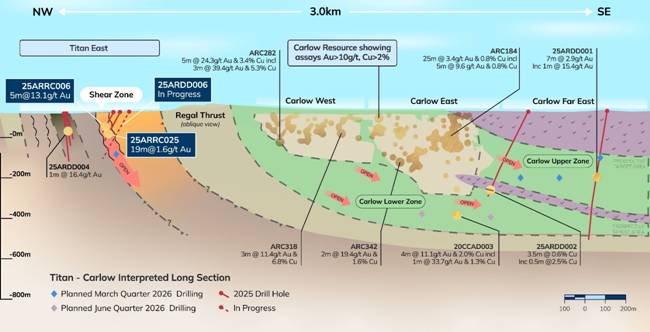
Figure 1: Interpreted Long Section showing geological/structural interpretation, Titan East discovery drill hole intersections, outline of Carlow Resource and planned drill holes to test extensions to known high grade gold and copper mineralisation during March quarter 2026
Titan East - Summary of Recent and Current Drilling
Phase One:
Ten RC holes were drilled in September 2025 to test three priority targets at Titan East (Figure 1). Two of the RC holes intersected a previously untested mineralised structure, interpreted to be a wide north-east trending shear zone beneath shallow cover, with holes 25ARRC006 and 25ARRC024 returning broad intervals of gold mineralisation (Tables 1-2). Drilling away from the interpreted shear zone returned no significant intersections.
Phase Two:
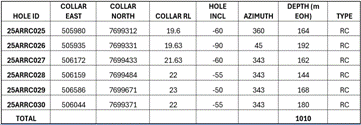
Six follow-up RC holes (25ARRC025-030) were completed in November 2025 along a 600m strike length to assess the potential of the interpreted shear zone highlighted in Phase One. Five of the six holes intersected broad zones of alteration and veining and fast track assay results for the first hole, 25ARRC025 resulted in an intersection 19m @ 1.6g/t Au from 127m, including 6m @ 2.63g/t Au from 131m (Refer to Table 3).
Phase Three:
A 300m diamond drill hole (25ARDD006) commenced on 10 December to provide structural information across the shear zone and test potential for extensions to the high-grade gold mineralisation in 25ARRC006. 25ARDD006 has intersected a wide interval with strong quartz veining above a strongly altered contact at the base of the shear zone (Figures 5 and 6). Drilling was completed on 18 December. Detailed logging and sampling of the drill core is planned in early January with assay results expected later in the March quarter.
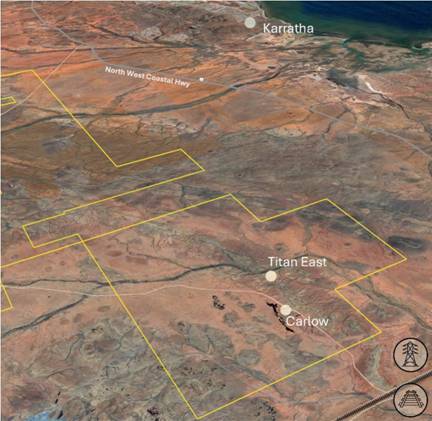
Figure 2: Carlow tenement showing outline of Carlow gold-copper deposit, location of Titan East and access to Carlow Project area from Karratha
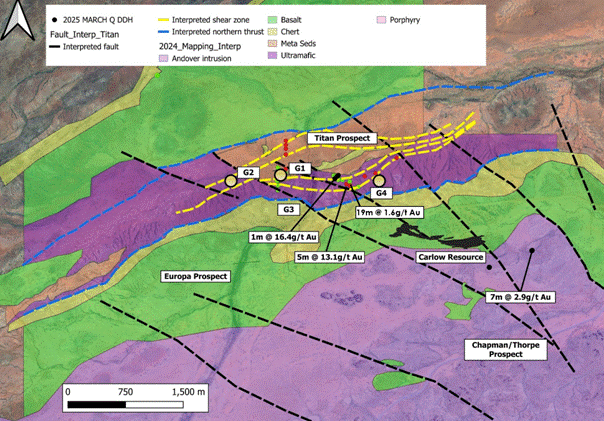
Figure 3: Geological and structural interpretation of Carlow tenement showing Carlow gold-copper deposit, interpreted shear zones and high-grade gold intersections at Titan East
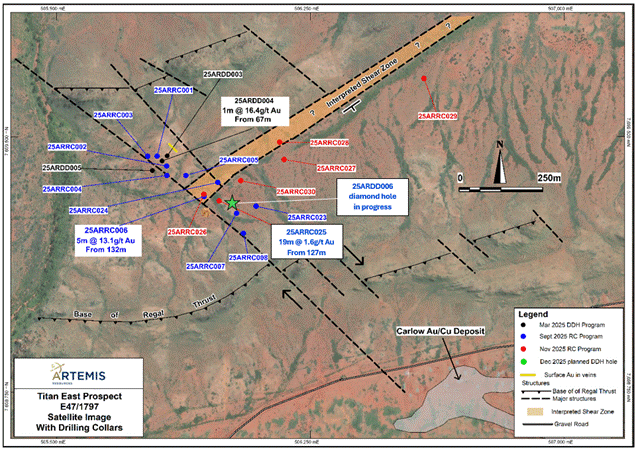
Figure 4: Satellite image of Titan East showing completed RC drill holes and location of the diamond drill hole (25ARDD006 - green star) testing the basal contact of the shear zone.

|
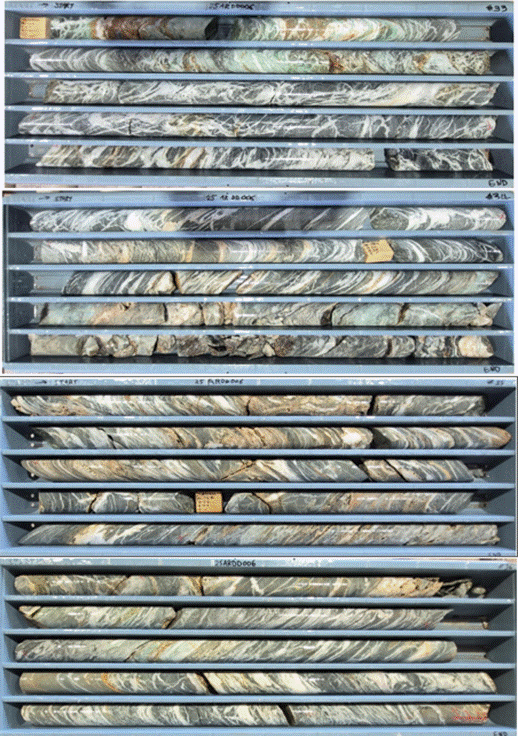
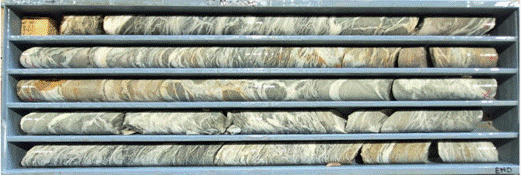
Figure 5: 25ARDD006 - drill core from 140.0-164.8m showing intensive quartz veining and related alteration within interpreted Titan East shear zone (assays pending)
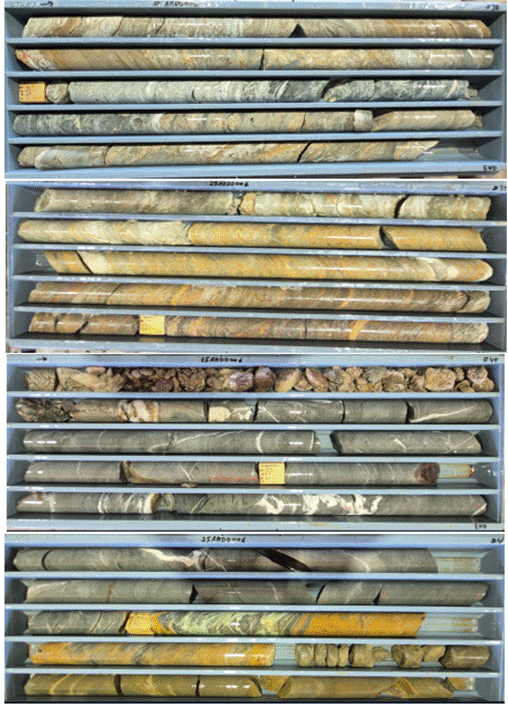
Figure 6: 25ARDD006 - drill core from 164.8-185.0m showing strong alteration associated with basal contact of interpreted Titan East shear zone (assays pending)
Regarding drill core from hole 25ARDD006 included in Figures 5 and 6 above:
· There are no identified or reported visual occurrences of gold mineralisation
· There are no visible minerals which could provide an estimate of possible gold abundance
· Samples will be sent for analysis in early January with results expected in March quarter
|
Titan East - Next Steps
· Complete logging of diamond hole 25ARDD006, send samples for assay in early January
· Receive assay results from 5 RC holes and diamond hole - expected March quarter 2026
· Follow-up RC and diamond drilling along shear zone - planned March quarter 2026
· Updated geological model and next set of targets - planned late March quarter 2026

Figure 7: Project Geologist Tony Sheehan with drill chips from 25ARRC025 (140-160m) including veined, altered ultramafic sequence and sediments (Refer Table 3)
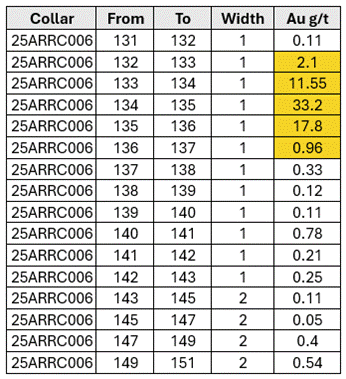
Table 1: 25ARRC006 - high-grade gold intersection announced 29 October 2025 within 20m
wide (131m-151m) interval of strongly elevated gold assays within Titan East shear zone[5]
|
Collar |
From |
To |
Width |
Au g/t |
|
25ARRC024 |
116 |
118 |
2 |
0.34 |
|
25ARRC024 |
118 |
119 |
1 |
0.81 |
|
25ARRC024 |
119 |
120 |
1 |
0.09 |
|
25ARRC024 |
120 |
121 |
1 |
0.03 |
|
25ARRC024 |
121 |
122 |
1 |
0.01 |
|
25ARRC024 |
122 |
123 |
1 |
0.03 |
|
25ARRC024 |
123 |
124 |
1 |
0.13 |
|
25ARRC024 |
124 |
125 |
1 |
0.03 |
|
25ARRC024 |
125 |
126 |
1 |
0.16 |
|
25ARRC024 |
126 |
127 |
1 |
0.39 |
|
25ARRC024 |
127 |
128 |
1 |
0.24 |
|
25ARRC024 |
128 |
129 |
1 |
0.16 |
|
25ARRC024 |
129 |
130 |
1 |
0.19 |
|
25ARRC024 |
130 |
131 |
1 |
0.06 |
|
25ARRC024 |
131 |
132 |
1 |
0.02 |
|
25ARRC024 |
132 |
133 |
1 |
0.05 |
|
25ARRC024 |
133 |
134 |
1 |
0.08 |
|
25ARRC024 |
134 |
135 |
1 |
0.61 |
|
25ARRC024 |
135 |
136 |
1 |
0.5 |
|
25ARRC024 |
136 |
137 |
1 |
0.06 |
|
25ARRC024 |
137 |
138 |
1 |
0.06 |
|
25ARRC024 |
138 |
139 |
1 |
0.06 |
|
25ARRC024 |
139 |
140 |
1 |
0.72 |
Table 2: 25ARRC024 - strongly elevated gold assays for 1m sample intervals within 24m wide (116m-140m) interval within Titan East shear zone. Note: end of hole assay (0.72g/t Au)
|
Collar |
From |
To |
Width |
Au g/t |
|
25ARRC025 |
127 |
128 |
1 |
1.46 |
|
25ARRC025 |
128 |
129 |
1 |
2.6 |
|
25ARRC025 |
129 |
130 |
1 |
0.31 |
|
25ARRC025 |
130 |
131 |
1 |
0.61 |
|
25ARRC025 |
131 |
132 |
1 |
1.76 |
|
25ARRC025 |
132 |
133 |
1 |
6.85 |
|
25ARRC025 |
133 |
134 |
1 |
2.39 |
|
25ARRC025 |
134 |
135 |
1 |
0.97 |
|
25ARRC025 |
135 |
136 |
1 |
0.31 |
|
25ARRC025 |
136 |
137 |
1 |
3.52 |
|
25ARRC025 |
137 |
138 |
1 |
0.27 |
|
25ARRC025 |
138 |
139 |
1 |
0.65 |
|
25ARRC025 |
139 |
140 |
1 |
1.56 |
|
25ARRC025 |
140 |
141 |
1 |
0.84 |
|
25ARRC025 |
141 |
142 |
1 |
0.14 |
|
25ARRC025 |
142 |
143 |
1 |
0.06 |
|
25ARRC025 |
143 |
144 |
1 |
0.44 |
|
25ARRC025 |
144 |
145 |
1 |
0.39 |
|
25ARRC025 |
145 |
146 |
1 |
5.71 |
Table 3: 25ARRC025 - gold assays for 1m sample intervals from 127m-146m
|
HOLE ID |
COLLAR EAST |
COLLAR NORTH |
COLLAR RL |
HOLE INCL |
AZIMUTH |
DEPTH (m EOH) |
TYPE |
|
25ARRC025 |
505980 |
7699312 |
19.6 |
-60 |
360 |
164 |
RC |
|
25ARRC026 |
505935 |
7699331 |
19.63 |
-90 |
45 |
192 |
RC |
|
25ARRC027 |
506172 |
7699433 |
21.63 |
-60 |
343 |
162 |
RC |
|
25ARRC028 |
506159 |
7699484 |
22 |
-55 |
343 |
144 |
RC |
|
25ARRC029 |
506586 |
7699671 |
23 |
-50 |
343 |
168 |
RC |
|
25ARRC030 |
506044 |
7699371 |
22 |
-55 |
343 |
180 |
RC |
|
TOTAL |
|
|
|
|
|
1010 |
|
|
25ARDD006 |
506015 |
7699290 |
21 |
-60 |
340 |
255.5 |
Diam |
Table 4: Drill hole parameters for Phase Two RC holes 25ARRC025 to 25ARRC030; and Phase Three diamond hole 25ARDD006.
This announcement was approved for release by the Board
For further information:
|
Tel: +44 20 3829 5000
|
Qualified / Competent Person Statement
The information in this report that relates to Exploration Results was compiled by Mr Julian Hanna, a Competent Person who is a member of the Australasian Institute of Mining and Metallurgy (MAusIMM). Mr Hanna is Technical Director of Artemis Resources Ltd and has sufficient experience that is relevant to the style of mineralisation and type of deposit under consideration and to the activity being undertaken to qualify as a Competent Person as defined in the 2012 Edition of the 'Australasian Code for Reporting of Exploration Results, Mineral Resources and Ore Reserves". Mr Hanna consents to the inclusion in this report of the matters based on his information in the form and context in which it appears. Mr Hanna is also considered as a Qualified Person for the purposes of the AIM Rules.
No New Information
To the extent that this announcement contains references to prior exploration results which have been cross referenced to previous market announcements made by the Company, unless explicitly stated, no new information is contained. The Company confirms that it is not aware of any new information or data that materially affects the information included in the relevant market announcements and, in the case of estimates of Mineral Resources, that all material assumptions and technical parameters underpinning the estimates in the relevant market announcements continue to apply and have not materially changed.
Forward Looking Statements
This announcement contains historical facts, interpretations and statements relating to the Company's current exploration projects, drill targets, plans, estimates, objectives, and strategies which are forward-looking statements. Such forward-looking statements involve known and unknown risks, uncertainties and other important factors beyond the Company's control that could cause the actual results, performance, or achievements of the Company to be materially different from future results, performance or achievements expressed or implied by such forward-looking statements. Accordingly, any reliance you place on such forward-looking statements will be at your sole risk and the Company expressly disclaims any obligation or undertaking to disseminate any updates or revisions to any forward-looking statements contained in this announcement to reflect any changes in its expectations with regard thereto or any change in events, conditions or circumstances on which any statement is based. The information contained in this announcement is subject to change without notice. No representation or warranty, express or implied, is given as to the accuracy, completeness or fairness of the information or opinions contained in this announcement and no liability is accepted by the Company or any of its directors, members, officers, employees, agents, or advisers for any such information or opinions.
______________________________________________________________________
About Artemis Resources
Artemis Resources (ASX/AIM: ARV) is a gold and copper focused resources company with a highly attractive suite of projects including projects in Western Australia's underexplored North Pilbara Gold Province and at the Cassowary Exploration Project located 440km east of Kalgoorlie in Western Australia.
· Attractive projects:
o Gold/Copper - Karratha Gold Project (100%) multiple prospects incl: Carlow, Titan, Thorpe
o Copper/Gold - Cassowary Exploration Project - large IOCG type targets
o Paterson Gold/Copper Project - adjacent to Havieron Mine (owned Greatland Gold)
o Lithium - Artemis/Greentech Lithium JV: Mt Marie, Kobe, Osborne
· Highly strategic location: Tier 1 jurisdiction, close proximity to major hub at Karratha including regional rail and road infrastructure, administrative centre and Dampier Port
· Significant exploration upside: highly prospective tenure package in the Pilbara Region of Western Australia which is rapidly emerging gold province dominated by >12Moz Au Hemi Project
· Mineral Resource with growth potential: existing high-grade gold-copper Mineral Resource at Carlow[6] with very promising gold results from initial drilling at Titan East located only 1.5km from Carlow
· Established processing site at Radio Hill: strategically located, fully permitted
· Cassowary Exploration Project: Artemis holds a granted 341km2 exploration licence covering the large, interpreted Cassowary Intrusion prospective for IOCG type copper/gold and has four other exploration licence applications to cover other interpreted intrusions within a 30-40km wide interpreted rift zone
Appendix 1 JORC Table
Section 1 Sampling Techniques and Data
(Criteria in this section apply to all succeeding sections.)
|
Criteria |
JORC Code explanation |
Commentary |
|
Sampling techniques |
· Nature and quality of sampling (eg cut channels, random chips, or specific specialised industry standard measurement tools appropriate to the minerals under investigation, such as down hole gamma sondes, or handheld XRF instruments, etc). These examples should not be taken as limiting the broad meaning of sampling. · Include reference to measures taken to ensure sample representivity and the appropriate calibration of any measurement tools or systems used. · Aspects of the determination of mineralisation that are Material to the Public Report. · In cases where 'industry standard' work has been done this would be relatively simple (eg 'reverse circulation drilling was used to obtain 1 m samples from which 3 kg was pulverised to produce a 30 g charge for fire assay'). In other cases, more explanation may be required, such as where there is coarse gold that has inherent sampling problems. Unusual commodities or mineralisation types (eg submarine nodules) may warrant disclosure of detailed information. |
RC Drilling · Reverse Circulation drilling (RC) at Titan East was undertaken to obtain samples that were laid out in one metre intervals. · Samples submitted for assay were either composites of two metre lengths, or single metre samples. Spacing determined by logging geologist. · Single metre samples are ~ 3kg samples obtained directly from the secondary port of the cone splitter. · Composites were produced by representatively sampling each individual drill spoil pile to be included in the composite. · Sampling of the drill spoil for assay was undertaken by scoop method into numbered calico bags.
|
|
· Samples were dispatched to ALS Global Laboratories in Perth for analysis. · Analysis included: - Au-AA26 - Au 50g FA AA finish - ME-MS61 - 48 elements Ultra-Trace Four-Acid Digestion with ICP MS and ICP-AES |
||
|
Drilling techniques |
· Drill type (eg core, reverse circulation, open-hole hammer, rotary air blast, auger, Bangka, sonic, etc) and details (eg core diameter, triple or standard tube, depth of diamond tails, face- sampling bit or other type, whether core is oriented and if so, by what method, etc). |
· Drilling was completed using the RC method. A standard RC hammer bit was used, with chip samples returned within the drill pipe and recovered through a cyclone. · RC Holes were drilled towards North at various dips and to varying depths with drill hole parameters listed in Table 4 . · RC and diamond holes were surveyed using a North Seeking Gyro for downhole surveys undertaken at 5 or 10m intervals. · One diamond drill hole 25ARDD006 was also drilled at Titan East and completed at 255.5m depth on 18 December 2025 · 25ARDD006 was drilled as an initial HQ diameter hole followed by NQ to the end of hole. Further details will be provided when 25ARDD006 is logged in detail and assay results are received. · Drill hole parameters for hole 25ARDD006 are listed in Table 4 and photos of drill core are included in Figures 5 and 6. |
|
Drill sample recovery |
· Method of recording and assessing core and chip sample recoveries and results assessed. · Measures taken to maximise sample recovery and ensure representative nature of the samples. · Whether a relationship exists between sample recovery and grade and whether sample bias may have occurred due to preferential loss/gain of fine/coarse material. |
· The geologist visually assessed and digitally recorded drill sample recoveries during the program. Recoveries were overall very good with 98% of the sample intervals recovered >75%, discounting overburden · Drill cyclone was cleaned regularly between holes if required to minimise down hole or cross-hole contamination. · Samples were almost entirely dry, with little water encountered in the drilling. · No relationship between sample recovery and grade has been recognised. |
|
Logging |
· Whether core and chip samples have been geologically and geotechnically logged to a level of detail to support appropriate Mineral Resource estimation, mining studies and metallurgical studies. · Whether logging is qualitative or quantitative in nature. Core (or costean, channel, etc) photography. · The total length and percentage of the relevant intersections logged. |
RC Drilling · All drill holes have been logged, using sieved rock chips from the drill samples to industry best standards for lithology, alteration, mineralisation using a specific set of logging codes to ensure consistency in logging. · Logging has been quantitative in nature. · The level of geological detail is commensurate with nature and limitations of this exploratory drilling technique. · The current drill-spacing is insufficient for Resource Estimation. · All sampling data has been stored directly into an in-house developed Access data management system. · All drill holes were logged in full. · All logging and sampling undertaken under the supervision of a qualified geologist. |
|
Sub-sampling techniques and sample preparation |
· If core, whether cut or sawn and whether quarter, half or all core taken. · If non-core, whether riffled, tube sampled, rotary split, etc and whether sampled wet or dry. |
RC Drilling · RC drill spoil samples were collected by traversing each sample pile systematically by scoop to obtain similar volumes of representative material for either a single metre interval or a composite interval 2m. |
|
|
· For all sample types, the nature, quality and appropriateness of the sample preparation technique. · Quality control procedures adopted for all sub-sampling stages to maximise representivity of samples. · Measures taken to ensure that the sampling is representative of the insitu material collected, including for instance results for field duplicate/second-half sampling. · Whether sample sizes are appropriate to the grain size of the material being sampled. |
This is regarded as a fit for purpose sampling regime for the type of drilling and the current stage of exploration. · The drill samples were almost entirely dry, with very few moist samples. · Where composite samples were taken, equal amounts of sample were taken from each of the constituent sample piles. · Field duplicate sampling was also undertaken at an approximate ratio of 1:25. · The samples were then sent to ALS Laboratory for sample preparation and analysis. · Sample sizes appropriate for style of mineralisation investigated. |
|
Quality of assay data and laboratory tests |
· The nature, quality and appropriateness of the assaying and laboratory procedures used and whether the technique is considered partial or total. · For geophysical tools, spectrometers, handheld XRF instruments, etc, the parameters used in determining the analysis including instrument make and model, reading times, calibrations factors applied and their derivation, etc. · Nature of quality control procedures adopted (eg standards, blanks, duplicates, external laboratory checks) and whether acceptable levels of accuracy (ie lack of bias) and precision have been established. |
RC Drilling · Samples were dispatched to ALS Global Laboratories in Perth for analysis. · Samples underwent High Grade Fire Assay fusion (50 g) - lead flux with Ag collector and Au amount determined by ALS method Au-AA26 and for multi-element analysis a four-acid "near" total digest (HF-HNO3- HClO4) has been undertaken on a 0.25 g sub-sample to quantitatively dissolve most geological materials, ALS method ME-MS61. · All finalised assay certificates signed off by qualified assayer. · ALS Global Ltd is an ISO certified organisation with industry leading quality protocols. · Analytical technique used for gold considered a total assay technique. |
|
· For multi-element analysis a four-acid digest has been undertaken on a 0.25 g sub-sample to quantitatively dissolve most geological materials, with analysis via ICP-MS + ICP-AES. · Certified Reference Materials (CRM) including three different gold grade standards and blanks have been submitted within the samples stream at a frequency of approximately 1 every 35 samples. · Field duplicates collected at a ration 1:25. · Quality control data has been plotted on charts with control limits at +/-1σ, +/- 2σ and +/-3σ standard deviations to monitor the level of contamination, accuracy, and precision. · QAQC report reviewing field duplicate imprecision (C.V.), field duplicate bias, blanks and CRM actual deviation and lab pulp sizing compiled immediately after laboratory results were received. · All QAQC results have been reviewed by the ARV Competent Person who considers the results to be within acceptable limits. Therefore, the assay results presented are considered accurate and correct. · ALS internal CRMs and duplicates have also reported prior to release of finalised certificates.
|
||
|
Verification of sampling and assaying |
· The verification of significant intersections by either independent or alternative company personnel. · The use of twinned holes. · Documentation of primary data, data entry procedures, data verification, data storage (physical and electronic) protocols. |
RC Drilling · The significant intersections have been reviewed by other ARV geologists. · No hole twinning has been undertaken |
|
· Discuss any adjustment to assay data. |
· All sampling and analytical data has been stored directly into an in- house developed Access data management system, · All data has been maintained, validated, and managed by administrative geologist, · Analytical results received from the lab have been loaded directly into the database with no manual transcription of these results undertaken, · Original lab certificates have been stored electronically. No adjustment to assay data has been undertaken. Below detection limit data presented as 1/2 of the lower detection limit of the method and over the detection limit results presented as the upper detection limit of the method
|
|
Location of data points |
· Accuracy and quality of surveys used to locate drill holes (collar and down-hole surveys), trenches, mine workings and other locations used in Mineral Resource estimation. · Specification of the grid system used. · Quality and adequacy of topographic control. |
RC Drilling · Drill collar locations have been set with handheld GPS (+/-3 m) and collar orientation using Reflex survey method, · During drilling, down hole surveys at every 5 or 10m intervals have been completed using north seeking Gyro. · All locations recorded using GDA94/MGA UTM Zone 50. |
|
Data spacing and distribution |
· Data spacing for reporting of Exploration Results. · Whether the data spacing and distribution is sufficient to establish the degree of geological and grade continuity appropriate for the Mineral Resource and Ore Reserve estimation procedure(s) and classifications applied. · Whether sample compositing has been applied. |
RC Drilling · Drill holes are continuously sampled from top of hole to end of hole. · Drill holes are orientated to Azimuths as included in Table below
· Drill holes are inclined as included in Table above. · The spacing and distribution of the current drill holes is considered sufficient for the testing of specific targets. · This spacing for the holes reported is not adequate to result in a resource estimate. · Drill samples were taken at 1m intervals or composited over 2m intervals prior to being submitted to the laboratory, honouring geological contacts, state of oxidation-weathering and observable mineralisation. |
|
Orientation of data in relation to geological structure |
· Whether the orientation of sampling achieves unbiased sampling of possible structures and the extent to which this is known, considering the deposit type. · If the relationship between the drilling orientation and the orientation of key mineralised structures is considered to have introduced a sampling bias, this should be assessed and reported if material. |
RC Drilling · The regional stratigraphy has a steep southerly dip and the contained mineralisation comprising the Titan East prospect has an interpretive steep southerly dip - refer to table above for six RC holes parameters · The true orientation of potential mineralised bodies in this area is poorly understood.
|
|
Sample security |
· The measures taken to ensure sample security. |
· Sample security is by way of chain of custody. · All drill samples collected during the program are freighted by road transport directly to the ALS laboratory in Perth for submission. · Sample security was not considered a significant risk to the project. Only employees of Artemis Resources and APEX Geoscience were involved in the collection, short term storage (in a remote area), and delivery of samples. |
|
Audits or reviews |
· Results of any audits or reviews of sampling techniques and data. |
· No review of the sampling techniques has been undertaken. |
Section 2 Reporting of Exploration Results - revised
(Criteria listed in the preceding section also apply to this section.)
|
Criteria |
JORC Code explanation |
Commentary |
|
Mineral tenement and land tenure status |
· Type, reference name/number, location and ownership including agreements or material issues with third parties such as joint ventures, partnerships, overriding royalties, native title interests, historical sites, wilderness or national park and environmental settings. · The security of the tenure held at the time of reporting along with any known impediments to obtaining a licence to operate in the area. |
· The RC program was entirely conducted on E47/1797. · All Artemis Project tenures are 100% owned by Artemis Resources subsidiary company KML No 2 Pty Ltd E47/1746 & E47/1797 with the exception of E47/3719 which is subject to a GreenTech Metals/Artemis Resources 51%/49% Joint Venture · Tenements are in good standing with DEMIRS and there are no known impediments for exploration on these tenements. |
|
Exploration done by other parties |
· Acknowledgment and appraisal of exploration by other parties. |
· Previous explorers in the region include but not limited to are Westfield Minerals, Consolidated Gold Areas, Open Pit Mining and Exploration, Legend Mining, Agip Exploration, Titan Resources and Fox Resources. |
|
Geology |
· Deposit type, geological setting and style of mineralisation. |
· Surface mineralisation is interpreted to be consistent with structurally controlled shear zone mineralisation. Implications for intrusion related mineralised systems is also considered. |
|
Drill hole Information |
· A summary of all information material to the understanding of the exploration results including a tabulation of the following information for all Material drill holes: o easting and northing of the drill hole collar o elevation or RL (Reduced Level - elevation above sea level in metres) of the drill hole collar o dip and azimuth of the hole o down hole length and interception depth o hole length. · If the exclusion of this information is justified on the basis that the information is not Material and this exclusion does not detract from the understanding of the report, the Competent Person should clearly explain why this is the case |
· Laboratory analyses are in progress or have been partially completed on all the samples collected from the drilling to date. Holes 25ARRC006, 25ARRC024 and 25ARRC025 have had all laboratory analyses completed and certified. Samples from diamond hole 25ARDD006 are expected to been sent for analysis in January 2026, once core logging is completed.
|
|
Data Aggregation Methods |
· In reporting Exploration Results, weighting averaging techniques, maximum and/or minimum grade truncations (eg cutting of high grades) and cut-off grades are usually Material and should be stated · Where aggregate intercepts incorporate short lengths of high-grade results and longer lengths of low-grade results, the procedure used for such aggregation should be stated and some typical examples of such aggregations should be shown in detail · The assumptions used for any reporting of metal equivalent values should be clearly stated. |
· The announced intersection in hole 25ARRC025 of 19m @ 1.6g/t Au from 127m, was calculated using the average of gold assays from 19 consecutive 1m samples between 127m and 146m down hole depth, listed in Table 3 in the announcement. The grade of the intersection was calculated by aggregating the gold assays in Table 3 and dividing by the number of gold assays (ie 19).
|
|
Relationship Between Mineralisation Widths and intercept lengths |
· These relationships are particularly important in the reporting of Exploration Results. · If the geometry of the mineralisation with respect to the drill angle is known, its nature should be reported · If it is not known and only the down hole lengths are reported there should be a clear statement to this effect (eg 'down hole length, true width not known) |
· The RC holes described in this announcement were exploration in nature. Downhole lengths are only reported. True widths are not known as there is insufficient drilling to determine true widths |
|
Diagrams |
· Appropriate maps and sections (with scales) and tabulations of any intercepts should be included for any significant discovery being reported. These should include but not be limited to a plan view of drill collar locations and appropriate sectional views. |
· All the appropriate maps and plan views showing hole collar locations are provided in this announcement · Refer to figures and tables in this announcement. While significant results have been included in Tables in this announcement, the reconnaissance nature of some of the RC exploration holes may result in no significant intersections but provide useful geological information |
|
|
Balanced reporting |
· Where comprehensive reporting of all Exploration Results is not practicable, representative reporting of both low and high grades and/or widths should be practiced to avoid misleading reporting of Exploration Results. |
· This announcement discusses the findings of completed RC drilling activities and certified assays during November and December 2025. |
|
Other substantive exploration data |
· Other exploration data, if meaningful and material, should be reported including (but not limited to): geological observations; geophysical survey results; geochemical survey results; bulk samples - size and method of treatment; metallurgical test results; bulk density, groundwater, geotechnical and rock characteristics; potential deleterious or contaminating substances. |
· Previous drilling completed by Artemis Resources Titan East Prospect · Total of 6 RC drill holes for 1010m completed at Titan East prospect in November 2025 · Best intercept at Titan East prior to this release was 5m @ 13.1g/t Au from 132m in 25ARRC006 (refer to ASX release on 28 October 2025) · Best intercept at Titan East prior to the release on 28 October 2025 was 1m @ 16.4gpt Au from 67m in 25ARDD004 (refer to ASX release on 28th April 2025) |
|
Further work |
· The nature and scale of planned further work (eg tests for lateral extensions or depth extensions or large-scale step-out drilling). · Diagrams clearly highlighting the areas of possible extensions, including the main geological interpretations and future drilling areas, provided this information is not commercially sensitive. |
· Additional Diamond and RC drilling to commence in March quarter 2026 at Titan East prospect within the Carlow tenement to test orientation of interpreted shear zone, and follow up the high grade intersections in 25ARRC006 and 25ARRC025 · Diagrams included in this announcement include: interpreted long section from Titan to Carlow, interpreted geological and an interpreted structural plan of Carlow tenement and Titan East area |
[1] Refer to Artemis ASX announcement dated 29 October 2025
[2] Refer to Artemis ASX announcement dated 28 April 2025
[3] Refer to Artemis ASX announcement dated 28 January 2025
[4] Refer to Artemis ASX announcement dated 13 October 2022
[5] Refer to Artemis ASX announcement dated 29 October 2025
[6] Refer to Artemis ASX announcement dated 13 October 2022
RNS may use your IP address to confirm compliance with the terms and conditions, to analyse how you engage with the information contained in this communication, and to share such analysis on an anonymised basis with others as part of our commercial services. For further information about how RNS and the London Stock Exchange use the personal data you provide us, please see our Privacy Policy.

Latest directors dealings
- 2 hours ago Greatland Gold
- 2 hours ago Rockhopper Exploration
- 2 hours ago Vertu Motors
- 2 hours ago Acceler8 Ventures
- 2 hours ago Sundae Bar Plc