
Namibia Uranium Drilling Underway
Summary by AI BETAClose X

THIS ANNOUNCEMENT CONTAINS INSIDE INFORMATION FOR THE PURPOSES OF THE MARKET ABUSE REGULATION (EU) 596/2014 (AS AMENDED) AS IT FORMS PART OF THE DOMESTIC LAW OF THE UNITED KINGDOM BY VIRTUE OF THE EUROPEAN UNION (WITHDRAWAL) ACT 2018 (AS AMENDED). UPON PUBLICATION OF THIS ANNOUNCEMENT, THIS INSIDE INFORMATION IS NOW CONSIDERED TO BE IN THE PUBLIC DOMAIN.
17 July 2026
Arkle Resources PLC
("Arkle" or the "Company")
Namibia Uranium Drilling Underway
Maiden Phase I Drilling Expanded to Include Step-Out Holes and First Test of ULG Target Exposed by Recent Trenching
Arkle Resources PLC (LSE:ARK), the energy metals explorer focused on uranium, is pleased to announce that the initial c. 1,500 m RC drilling programme at its Erongo Uranium Project in Namibia, announced on 25 June 2026, is proceeding as planned. Carnotite, a secondary uranium mineral, has been visually logged in RC drill chips in three holes across two fence lines. The drill programme is taking place entirely within one of the Company's Exclusive Prospecting Licences, EPL8995.
Based on programme efficiencies, the Company has decided to add additional drilling and expand this phase, accelerating some of the planned Q3 2026 drill holes.
Highlights
· Drilling Proceeding as Planned: the initial c. 1,500 m RC programme is proceeding as planned, with 52 holes completed for 1,017 m to today's date, drilled on fence lines across the interpreted channel positions and completed as depth-to-basement tests.
· Visual Uranium Mineralisation: carnotite, a secondary uranium mineral and the principal ore mineral of surficial uranium deposits in the region, has been visually logged in RC drill chips in three holes across two fence lines, at downhole depths of between 4 m and 15 m. Laboratory assay is required to determine uranium content.
· Programme Expanded: the Company has decided to add additional drilling to the initial programme, comprising:
o The western paleochannel target previously mapped by HLEM, across which an initial fence of holes was completed this week.
o Step-out holes on the eastern paleochannel target.
o The primary ULG target of EPL8995, brought forward from the planned Q3 2026 follow-on programme representing a first drill test of the target exposed by the recent trenching programme.
· Downhole Spectrometry Commenced This Week: downhole gamma ray spectrometer ("GRS") surveying of the completed drillholes began this week, ahead of assay. The GRS results, together with the geological logging, will determine which drill intervals are submitted for laboratory assay.
· Sampling Strategy: 1,016 one-metre samples collected to date and secured under the Company's QAQC protocols, with selected intervals to be dispatched to Actlabs, Windhoek, for laboratory assay. The number of samples to be assayed will be finalised on review of the downhole GRS survey results and the geological logging. First assay results are expected in early September 2026.
Rory Harding, Chief Executive Officer, commented:
"Our maiden uranium drill programme in Namibia is proceeding as planned and, considering the efficiencies of continuing with the current rig and field team mobilised, we have taken the decision to expand it."
"Carnotite, the uranium mineral that carries the grade at the surficial uranium deposits of the region, has been visually logged in drill chips in three holes across two fence lines."
"This week we completed a first fence of holes across the western paleochannel target that our HLEM surveys mapped earlier this year, meaning both principal channel areas have now seen the drill bit."
"We are also planning step-out holes from the existing fence lines on the eastern paleochannel target, and we are bringing forward drill holes on our primary ULG target from the next programme into this one, to be drilled at the end of the paleochannel drilling phase. That gives us a first drill test of both of our principal uranium styles within a single field season."
"Downhole spectrometry of the completed holes began this week and, together with the geological logging, will determine which drill intervals are submitted for assay, focusing our spend where it matters. Grades will be confirmed by laboratory analysis, and shareholders should expect steady news flow through the second half of the year as results come through."
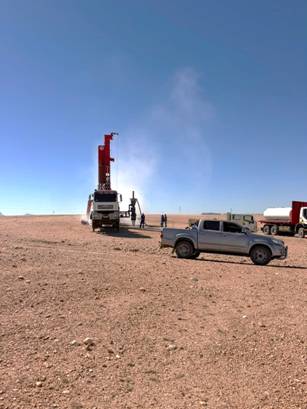
Figure 1: RC drilling underway on the paleochannel targets, EPL 8995.
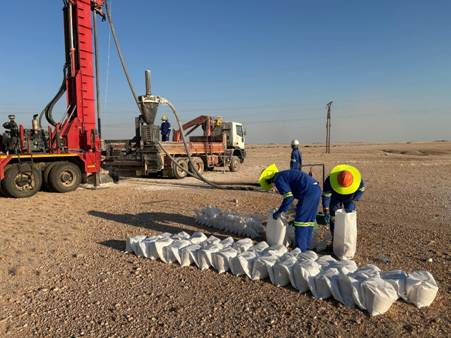
Figure 2: One-metre interval RC samples being split, bagged and logged at the rig, EPL 8995.
Summary
Arkle's maiden RC drilling programme on EPL 8995 follows the Phase 1 geophysical interpretation announced on 22 May 2026, which defined drill targets across two distinct uranium mineralisation styles: paleochannel-hosted uranium, analogous to the adjacent Trekkopje and Marenica deposits, and ULG-hosted uranium, consistent with the broader Erongo alaskite uranium province. The initial c. 1,500 m programme announced on 25 June 2026 is proceeding as planned, with 52 holes completed for 1,017 m to date on fence lines across the interpreted channel positions, each hole completed as a basement test. Carnotite has been visually logged in RC drill chips in three holes across two fence lines, at downhole depths of between 4 m and 15 m.
The Company has decided to add additional drilling to the programme. The decision to expand the programme reflects the efficiency of completing additional holes while the rig and field team are mobilised on the licence, at low incremental cost within the funded programme, and the value of testing each of the Company's priority targets within a single field programme.
An initial fence of holes was completed this week across the western paleochannel target, previously mapped by HLEM, meaning both the eastern and western channel areas have now been drill-tested. Step-out holes are being planned on the eastern paleochannel target, and drill holes on the primary ULG target have been brought forward from the planned Q3 2026 follow-on programme because the recent trenching confirmed and exposed the target at surface, and an early test of the sequence at depth will provide vertical control that directly informs the design of the larger ULG focussed follow-on drill programme.
Further Details
Paleochannel Drilling
The initial programme of approximately 1,500 m of RC drilling is proceeding as planned and is designed to test surface and legacy downhole radiometric anomalies across the paleochannel targets of EPL 8995. To date, 52 holes have been completed for 1,017 m across multiple fence lines. Holes are drilled on fence lines across the interpreted channel positions and completed as basement tests, at depths of between 10 and 20 m, consistent with the shallow channel architecture indicated by the HLEM profiling.
All holes are geologically logged at the rig, with one-metre samples collected under the Company's QAQC protocols. 1,017 lithology intervals have been logged and 1,016 samples collected and secured to date. Carnotite, a secondary uranium mineral and the principal ore mineral at surficial uranium deposits in the region, has been visually logged in RC drill chips in three holes across two fence lines, at downhole depths of between 4 m and 15 m. Visual observations of mineralisation are not a proxy for uranium grade; laboratory assay is required to determine uranium content, and assay results will be reported once received and validated.
Western Paleochannel Target Drilled
The western paleochannel target on EPL 8995 was previously mapped by the Company's HLEM profiling, supported by processed airborne radiometric data and surface mapping, and lies approximately 15 km west-southwest of the initial drilling area, on lower ground toward the west of the licence. Additional holes have been drilled across this target, with a fence of six holes drilled on 200 m spacings across the interpreted channel position and completed this week, confirming a cover sequence over basement and providing initial control on the geometry of the interpreted channel.
Eastern Paleochannel Step-Out Holes
Additional holes are now being planned on the eastern paleochannel target to step out from the existing fence lines and test the interpreted channels along strike. The number, location and spacing of the step-out holes are being designed by the Company's geological team together with its consultants, informed by the geological logging from the completed holes and the downhole spectrometry described below.
Downhole Spectrometry and Assay Selection
GRS surveying of the completed drillholes began this week. The GRS data, together with the geological logging, will determine which drill intervals are submitted for laboratory assay at Actlabs, Windhoek, ensuring that assay expenditure is focused on the intervals of greatest interest. First assay results are expected in early September 2026.
ULG Drill Holes Brought Forward
Five reconnaissance RC holes on the central-north ULG target on EPL 8995 have been brought forward from the planned Q3 2026 follow-on programme and will be drilled at the end of the paleochannel drilling phase. The recent trenching programme exposed multiple stacked leucogranite sheets interleaved with metasediment across this target area of approximately 1 km by 700 m, and the reconnaissance holes are designed to provide a first test of the ULG sequence at depth and initial vertical control ahead of the fully funded follow-on RC programme planned for Q3 2026, which remains subject to the results of the trenching and sampling work. Trench sample assay results from Actlabs remain awaited and will be reported once received and validated.
Next Steps
The Company expects the following news flow through the second half of 2026:
· Completion of the paleochannel drilling, including the eastern step-out holes.
· Completion of the downhole GRS surveying and selection of assay intervals.
· Trench and surface sample assay results.
· ULG reconnaissance holes and other drill sample assay results.
· Continued progress across the wider portfolio of paleochannel and ULG targets on EPLs 8995, 8290 and 8298.
No assay results from the drilling programme have been received to date, and no conclusions as to the grade or continuity of uranium mineralisation in the areas being drilled can be drawn until laboratory assay results have been received, validated and reported.
Enquiries:
|
Arkle Resources Rory Harding, CEO John Teeling, Chairman |
+44 (0)20 3051 5348 +353 (0)1 833 2833 |
|
|
|
|
Strand Hanson Limited Ritchie Balmer / Imogen Ellis |
Nominated & Financial Adviser +44 (0)20 7409 3494 |
|
|
|
|
H&P Advisory Limited Andrew Chubb / Leif Powis |
Joint Broker +44 (0)20 7907 8500 |
|
|
|
|
First Equity Limited Jason Robertson |
Joint Broker +44 (0)20 7374 2212 |
|
|
|
|
Vigo Consulting Ben Simons / Seb Weller |
UK Media & IR +44 (0)20 7390 0234 arkle.ir@vigoconsulting.com |
|
|
|
|
Teneo Luke Hogg / Molly Mooney |
Ireland Media +353 (0)1 661 4055 |
About Arkle Resources
Arkle Resources PLC (AIM: ARK) is a multi-commodity exploration company focused on metals which are essential for the generation and storage of clean energy: uranium, lithium and zinc. Its projects are in tier-1 mining jurisdictions in Namibia, Botswana and Ireland, adjacent to world-class deposits.
Founded in 2004 by John Teeling and Jim Finn, the Company co-discovered the Stonepark zinc deposit in County Limerick, now Ireland's second largest undeveloped resource, in joint venture with Teck Ireland. Teck's interest was acquired by Group Eleven Resources (TSX-V: ZNG), who continue to advance the project alongside Arkle.
In January 2026, the Company announced a transformative deal to acquire Namibia Uranium Pty Ltd, which has introduced four highly prospective uranium licences contiguous to major producing and development assets in what is a world-class uranium jurisdiction. This acquisition, alongside the Company's existing licence portfolio and the introduction of new management, repositions Arkle to become a leading explorer in energy metals.
For more information visit: www.arkleresources.com
Follow us on social media:
www.linkedin.com/company/arkle-resources-plc
Competent Person Statement
The technical and scientific information contained in this announcement has been reviewed and approved by Dr Guy Freemantle, an independent consultant to the Company through The MSA Group (Pty) Ltd., Johannesburg, South Africa. Dr Freemantle holds a Bachelor of Science in Geology and a PhD in Geology, both at the University of the Witwatersrand. He is a member of the Society of Economic Geologists (892905) and current Vice President for the Africa Region; a Fellow of the Geological Society of South Africa (965392); and is registered with SACNASP (Registration 117527). Dr Freemantle has practised his profession continuously for 16 years and has sufficient experience and knowledge that is relevant to the style of mineralisation and type of deposits under consideration as well as to the activity that is being undertaken to fulfil requirements of a Qualified Person as per NI 43-101 / PERC Reporting Standard (2021). Dr Freemantle consents to the inclusion in this announcement of the technical and scientific information in the form and context in which it appears.
Glossary
|
EPL |
Exclusive Prospecting Licence |
|
HLEM |
Horizontal Loop Electromagnetic |
|
QAQC |
Quality Assurance and Quality Control |
|
RC |
Reverse Circulation |
|
ULG |
Uraniferous Leucogranite |
RNS may use your IP address to confirm compliance with the terms and conditions, to analyse how you engage with the information contained in this communication, and to share such analysis on an anonymised basis with others as part of our commercial services. For further information about how RNS and the London Stock Exchange use the personal data you provide us, please see our Privacy Policy.

Latest directors dealings
- 1 hour ago Kooth
- 1 hour ago THG
- 1 hour ago Origin Enterprises (CDI)
- 1 hour ago Kingfisher
- 2 hours ago Power Probe PLC