
Maiden Drilling Confirms Uranium Discovery at ULG
Summary by AI BETAClose X

THIS ANNOUNCEMENT CONTAINS INSIDE INFORMATION FOR THE PURPOSES OF THE MARKET ABUSE REGULATION (EU) 596/2014 (AS AMENDED) AS IT FORMS PART OF THE DOMESTIC LAW OF THE UNITED KINGDOM BY VIRTUE OF THE EUROPEAN UNION (WITHDRAWAL) ACT 2018 (AS AMENDED). UPON PUBLICATION OF THIS ANNOUNCEMENT, THIS INSIDE INFORMATION IS NOW CONSIDERED TO BE IN THE PUBLIC DOMAIN.
13 October 2026
Arkle Resources PLC
("Arkle" or the "Company")
Uranium Discovery Confirmed By Maiden Drilling At The ULG Target
Eight Of Nine Holes Mineralised, From Surface And Open At Depth
Higher-Grade Sheets Within Thick Intercepts
Erongo Uranium Project, Namibia
Arkle Resources PLC (LSE:ARK), the energy metals explorer focused on uranium, is pleased to announce the results of the reconnaissance reverse circulation ("RC") drilling at the primary uraniferous leucogranite ("ULG") target on EPL 8995, part of its Erongo uranium project in Namibia, in an area approximately 12 km west-southwest of the Paleo East channel, where drilling results were released yesterday.
The drilling has confirmed a uranium discovery at the ULG target. Eight of the nine holes intersected uranium above 100 parts per million (ppm) of uranium oxide (U₃O₈) across approximately 1.4 km by 0.6 km, matching the footprint defined at surface. The best hole, R069, is mineralised from surface to the end of the hole, including 41 m at 141 ppm U₃O₈, three holes end in mineralisation, and individual metres grade up to 421 ppm U₃O₈.
Within the thicker intercepts, higher-grade sheets above 200 ppm U₃O₈, including 4 m at 240 ppm U₃O₈ from 64 m in R069, have the potential to lift the overall grade of the system if they prove continuous along strike and at depth. Taken with yesterday's paleochannel results, both of the region's deposit styles, surficial calcrete and primary leucogranite, have now been confirmed on the Company's licences.
Highlights
· Uranium Discovery At The ULG Target: the first drilling beneath the trenched leucogranite sheets intersected uranium above 100 ppm U₃O₈ in eight of nine holes, spread across approximately 1.4 km by 0.6 km and matching the footprint mapped at surface.
· Thick Mineralisation From Surface To Depth: hole R069 is mineralised from surface to the end of the hole, including 41 m at 141 ppm U₃O₈ from 59 m, with further thick intercepts of 18 m at 123 ppm U₃O₈ from 79 m in R064 and 10 m at 123 ppm U₃O₈ from 135 m in R066.
· Higher-Grade Sheets Within Thick Intercepts: individual metres grade up to 421 ppm U₃O₈ in R066, 16 one-metre samples from five holes exceed 200 ppm U₃O₈, and the R069 intercept includes 4 m at 240 ppm U₃O₈ from 64 m and 2 m at 247 ppm U₃O₈ from 87 m.
· Open At Depth: R068, R069 and R070 end in mineralisation, including 3 m at 133 ppm U₃O₈ from 97 m to the end of R070, and R063 intersected 2 m at 114 ppm U₃O₈ from 197 m, close to 200 m downhole.
· Grades Comparable With Regional Resources: intercepts are reported above 100 ppm U₃O₈, the cut-off at which Bannerman Energy (ASX: BMN) reports its headline Etango resource. The region's development projects, Asarian Energy's Norasa (TSX: ARN), Etango and Deep Yellow's Omahola (ASX: DYL), report resources at cut-off grades of 100 ppm U₃O₈ or lower and average grades of about 135 to 225 ppm U₃O₈, the same order as the thick ULG intercepts.
· Follow-Up Drilling Earmarked For November: a fully funded programme, subject to contractor availability, is being planned to test the system at depth, at closer spacing and laterally, to progress the ULG target towards a maiden Mineral Resource estimate.
· Further ULG Targets Across The Licences: at least four further ULG targets with similar characteristics have been identified across the licence package, including several on EPL 8290 (Trekkopje North) and one in the south-west of EPL 8995, and these will be mapped, sampled and trenched in turn.
John Teeling, Chairman, Commented:
"This is a pivotal moment for Arkle. We have found a uranium system with a footprint of 1.4 km by 600 m, and mineralisation extends to almost 200 m downhole. This is a discovery. It is a project worthy of substantial drilling, and our aim is to take it through to a maiden Mineral Resource Estimate in 2027."
Rory Harding, Chief Executive Officer, Commented:
"This is the first time anyone has drilled beneath the leucogranite sheets we exposed in the trenches, and we have been fortunate enough to make a discovery at the target. Hole R069 is mineralised from surface to the bottom of the hole, eight of the nine holes intersected uranium above 100 ppm, and the mineralised holes are spread across much the same area as the footprint we mapped at surface."
"The leucogranite deposits of the central Erongo are bulk-tonnage, open-pit systems in which width and continuity from surface matter as much as grade, and that is what this first programme has shown, with grades of the same order as established alaskite resources nearby, such as Asarian Energy's Norasa and Deep Yellow's Omahola."
"Three of the holes finished in mineralisation, with the best grades coming from the deepest intervals, including 211 ppm in the final metre of R070, so we have not yet found the base of the system and the natural next step is to drill deeper and at closer spacing across the footprint, and to step out to test how far it extends laterally. Following the higher-grade sheets above 200 ppm along strike and at depth will be a priority for that drilling, which the team is now planning and which we hope will take the target towards a maiden resource."
Chris M. Healey, P.Geo, Chief Geologist, Commented:
"I am really excited to see this success so early in our exploration of EPL 8995. We intersected highly significant uranium mineralisation on only the third hole we drilled on our ULG target. Exploration companies can drill many dozens of holes before making a discovery, if they ever succeed at all. In 1988 I was part of the team that discovered Cameco's massive McArthur River deposit in Saskatchewan, and we made our discovery there on hole number 198. Here at the Arkle Erongo project, we have done it at hole number 3."
Next Steps
The Company's planned activity on its ULG targets through the final quarter of 2026 includes:
· Reconciliation of the laboratory assays with the downhole GRS data, refining the correction factor for future drilling
· Trenching, mapping and sampling, underway around the ULG target for the past two weeks, with the samples submitted for assay to improve the understanding and interpretation of the drilling and its structural controls
· First-pass geological interpretation of the ULG target
· A fully funded follow-up drill programme is earmarked to begin in November, subject to contractor availability, and is currently being planned to test the system at depth, at closer spacing and laterally beyond the current footprint, including the continuity of the higher-grade sheets; its objective is to progress the ULG target towards a maiden Mineral Resource estimate, with diamond drilling under consideration to resolve the internal architecture of the stacked leucogranite sheets
· Systematic mapping, sampling and trenching of the further ULG targets, including those on EPL 8290 (Trekkopje North) and in the south-west of EPL 8995
Figures
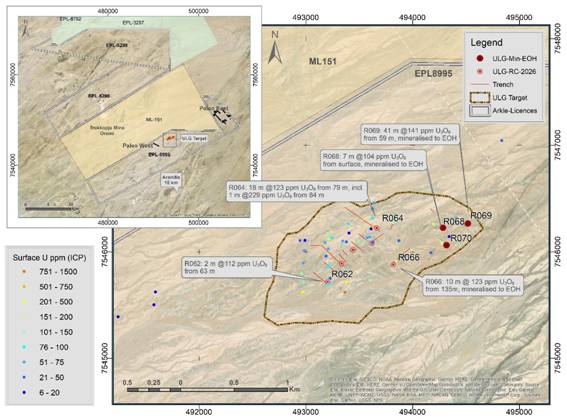
Figure 1: ULG target, EPL 8995, showing the 2026 RC drill collars with selected assay intercepts, the 2026 trench traces and surface uranium (ICP) sample results, with an inset showing the location of the ULG target relative to the Paleo East and Paleo West targets and Orano's Trekkopje mine. Intercepts are reported at a 100 ppm U₃O₈ cut-off on the basis set out under Table 2. EOH means end of hole, and Min means mineralised above 100 ppm U₃O₈ over at least 1 m.
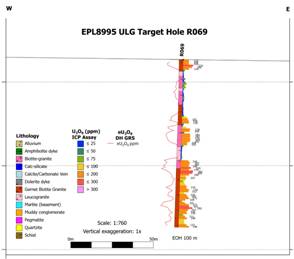
Figure 2: Drill section through hole R069, showing assay intercepts
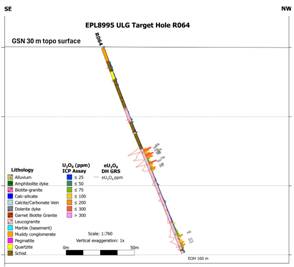
Figure 3: Drill section through hole R064, showing assay intercepts
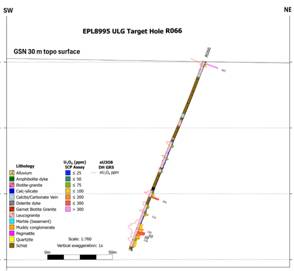
Figure 4: Drill section through hole R066, showing assay intercepts
Further Details
Arkle's primary ULG target has advanced during the 2026 field season from a geophysical and geochemical anomaly to a mapped, trenched, sampled and drill-tested uranium system. Trenching exposed stacked uraniferous leucogranite sheets, with surface and trench sampling defining uranium mineralisation over approximately 1.5 km of strike by up to 0.6 km, open along strike in both directions.
Drilling Programme
The reconnaissance RC programme was designed to provide the first vertical control on the ULG sequence and to test whether the leucogranite sheets persist at depth.
· Drilling comprised 1,154 m across six angled and three vertical RC holes, drilled to downhole depths of between 70 m and 200 m.
· Lithological logging was completed on a per-metre basis, followed by deviation logging of the angled holes and downhole gamma-ray spectrometer surveys of all nine holes at 10 cm sampling resolution.
· Arkle geologists selected sampling intervals using an eU₃O₈ threshold of greater than 50 ppm, with a buffer of at least 5 m above and below anomalous zones and maximum internal waste of 10 m.
The six angled holes were inclined at -70° below horizontal, with the exception of hole EPL 8995_26_R067, which was inclined at -60°. The drill collars were positioned to intersect the prevailing metamorphic fabric at an oblique angle, based on the interpretation that the sheeted leucogranites intrude broadly parallel to the prevailing fabric of the upper Swakop Group metasedimentary host rocks. The drill programme was guided by the recent trenching, which exposed multiple stacked leucogranite sheets and provided surface geological control for the first subsurface test of the target.
Drill holes were all surveyed at 10 cm resolution by four-channel downhole gamma ray spectrometry, and processed with corrections for hole diameter, casing, and water by Terratec Geophysical Services (Terratec). One-metre intervals were calculated by moving average composites of the 10 cm data to generate eU₃O₈ values aligned with the one-metre lithological and laboratory assay sampling resolution.
All nine holes were sampled as set out in Table 1.
|
Hole ID |
Drill Depth (m) |
Vertical Depth (m) |
Sampled Metres |
Sampled (%) |
Best Grade Width, ICP Assay (ppm U₃O₈) |
|
R062 |
120 |
112 |
108 |
90% |
2 m @ 112 from 63 m |
|
R063 |
200 |
188 |
160 |
80% |
2 m @ 114 from 197 m |
|
R064 |
160 |
150 |
136 |
85% |
18 m @ 123 from 79 m |
|
R065 |
150 |
141 |
143 |
95% |
4 m @ 120 from 107 m |
|
R066 |
154 |
145 |
102 |
66% |
10 m @ 123 from 135 m |
|
R067 |
70 |
61 |
33 |
47% |
No intercept |
|
R068 |
100 |
100 |
100 |
100% |
7 m @ 104 from 0 m |
|
R069 |
100 |
100 |
100 |
100% |
41 m @ 141 from 59 m |
|
R070 |
100 |
100 |
93 |
93% |
4 m @ 111 from 50 m |
Table 1: ULG drill hole summary, EPL 8995. Hole IDs are prefixed EPL 8995_26_. Assay intervals are reported on the basis set out under Table 2.
Geology
The reconnaissance drilling confirmed that the ULG system continues below the trenched surface footprint. Granitic rocks were logged over 792 m, or approximately 69% of the 1,154 m drilled, with three holes logged in granitic rocks over their full lengths. The deepest hole intersected leucogranite to the end of hole at 200 m downhole, equivalent to approximately 188 m below surface, supporting continuity of the stacked leucogranite package beneath the mapped and trenched exposure.
Downhole lithology logs confirm the surface geology. The granitic rocks comprise leucogranite, garnetiferous biotite granite, biotite granite and pegmatoid granites, including 563 m logged specifically as leucogranite. The country rock is mainly schistose, with variable quartz-feldspar content, and includes approximately 40 m of carbonate-calcsilicate-quartzite. This lithological association is consistent with the trench exposures, where ULG sheets and leucogranite contacts with schist and gneiss host the principal uranium anomalies.
Mineralised drill intercepts are distributed along the limb and in the hinge zone of a local fold structure, a relationship that should make the geometry of the thick ULG intersections predictable with further geological modelling and will be used to guide the targeting of follow-up drilling.
Drill Intercepts
Downhole intervals are set out in Table 2. The best interval in each mineralised hole is:
· Hole R069: 41 m at 141 ppm U₃O₈ from 59 m to the end of the hole, including 4 m at 240 ppm U₃O₈ from 64 m and 2 m at 247 ppm U₃O₈ from 87 m, and 18 m at 118 ppm U₃O₈ from 34 m.
· Hole R064: 18 m at 123 ppm U₃O₈ from 79 m.
· Hole R068: 7 m at 104 ppm U₃O₈ from surface, and 4 m at 110 ppm U₃O₈ from 96 m to the end of the hole.
· Hole R066: 10 m at 123 ppm U₃O₈ from 135 m, and 3 m at 167 ppm U₃O₈ from surface, including 1 m at 421 ppm U₃O₈ from 1 m.
· Hole R070: 4 m at 111 ppm U₃O₈ from 50 m, and 3 m at 133 ppm U₃O₈ from 97 m to the end of the hole.
· Hole R065: 4 m at 120 ppm U₃O₈ from 107 m.
· Hole R062: 2 m at 112 ppm U₃O₈ from 63 m.
· Hole R063: 2 m at 114 ppm U₃O₈ from 197 m.
· Hole R067 returned no intercept meeting the reporting criteria.
|
Hole ID |
EOH (m) |
From (m) |
To (m) |
Length (m) |
U₃O₈ (ppm) |
|
R062 |
120.0 |
63 |
65 |
2.0 |
112 |
|
|
|
81 |
83 |
2.0 |
103 |
|
|
|
110 |
111 |
1.0 |
102 |
|
R063 |
200.0 |
100 |
101 |
1.0 |
103 |
|
|
|
188 |
189 |
1.0 |
108 |
|
|
|
197 |
199 |
2.0 |
114 |
|
R064 |
160.0 |
79 |
97 |
18.0 |
123 |
|
|
including |
80 |
81 |
1.0 |
228 |
|
|
including |
84 |
85 |
1.0 |
229 |
|
|
including |
90 |
91 |
1.0 |
230 |
|
|
|
146 |
149 |
3.0 |
100 |
|
|
|
152 |
153 |
1.0 |
111 |
|
|
|
154 |
155 |
1.0 |
111 |
|
R065 |
150.0 |
13 |
14 |
1.0 |
142 |
|
|
|
107 |
111 |
4.0 |
120 |
|
|
including |
108 |
109 |
1.0 |
208 |
|
R066 |
154.0 |
0 |
3 |
3.0 |
167 |
|
|
including |
1 |
2 |
1.0 |
421 |
|
|
|
109 |
112 |
3.0 |
105 |
|
|
including |
110 |
111 |
1.0 |
241 |
|
|
|
124 |
125 |
1.0 |
111 |
|
|
|
135 |
145 |
10.0 |
123 |
|
|
including |
138 |
140 |
2.0 |
211 |
|
R067 |
70.0 |
|
|
|
|
|
R068 |
100.0 |
0 |
7 |
7.0 |
104 |
|
|
|
9 |
12 |
3.0 |
111 |
|
|
|
25 |
27 |
2.0 |
118 |
|
|
|
96 |
100 |
4.0 |
110 |
|
R069 |
100.0 |
0 |
7 |
7.0 |
127 |
|
|
including |
3 |
4 |
1.0 |
219 |
|
|
|
34 |
52 |
18.0 |
118 |
|
|
|
59 |
100 |
41.0 |
141 |
|
|
including |
64 |
68 |
4.0 |
240 |
|
|
including |
87 |
89 |
2.0 |
247 |
|
R070 |
100.0 |
21 |
22 |
1.0 |
110 |
|
|
|
42 |
45 |
3.0 |
134 |
|
|
including |
43 |
44 |
1.0 |
225 |
|
|
|
50 |
54 |
4.0 |
111 |
|
|
|
62 |
66 |
4.0 |
111 |
|
|
|
77 |
78 |
1.0 |
100 |
|
|
|
97 |
100 |
3.0 |
133 |
|
|
including |
99 |
100 |
1.0 |
211 |
Table 2: ULG drill intercepts, EPL 8995. Hole IDs are prefixed EPL 8995_26_. All depths reported downhole. Intercepts are reported at a 100 ppm U₃O₈ lower cut, with a 1 m minimum width, a maximum of 5 consecutive metres of internal dilution, up to 1 m of sub-cut-off shoulder at each end and a composite grade of at least 100 ppm U₃O₈; duplicate-depth assays are averaged and intervals are truncated at the end of the hole. Including intervals are reported at a 200 ppm U₃O₈ lower cut. Hole R067 returned no intercept meeting these criteria.
Deposit Style And Regional Analogues
The ULG target is a leucogranite-hosted uranium system of the type that hosts the major uranium deposits of the central Erongo, including the Rössing and Husab mines; the host leucogranites are known locally as alaskites. These are bulk-tonnage deposits mined by open pit, in which the thickness and continuity of mineralisation from surface are central to their economics.
· Asarian Energy Limited's (TSX: ARN, formerly Forsys Metals) Norasa project, comprising the alaskite-hosted Valencia and Namibplaas deposits, hosts Measured and Indicated Resources of 151.9 Mt at 136 ppm eU₃O₈ and Inferred Resources of 224.5 Mt at 86 ppm eU₃O₈, both at a 40 ppm U₃O₈ cut-off (Forsys Metals Corp., Mineral Resource Estimate as at 30 April 2024).
· Bannerman Energy's (ASX: BMN) Etango project hosts a Mineral Resource of 416.1 Mt at 225 ppm U₃O₈ at a 100 ppm U₃O₈ cut-off, increasing to 518.6 Mt at 197 ppm U₃O₈ at a 55 ppm U₃O₈ cut-off (Bannerman Energy, November 2021 JORC 2012 Mineral Resource Estimate; ASX release of 6 December 2022).
· Deep Yellow Limited's (ASX: DYL) Omahola project, comprising the Ongolo, MS7 and Inca deposits in sheeted leucogranites (alaskites) and skarn, hosts a Mineral Resource of 298.2 Mt at 190 ppm U₃O₈, containing 125.4 Mlb U₃O₈, at a 100 ppm U₃O₈ cut-off (Deep Yellow Limited, Omahola Project JORC 2012 Mineral Resource; news release of 12 December 2023 and company website, October 2026).
· All drill intervals in this announcement are reported above 100 ppm U₃O₈.
· Mineralisation at the ULG target has been intersected from surface to depths of almost 200 m, across an area of approximately 1.4 km by 0.6 km, and remains open at depth.
The comparisons above are to deposit style, geological setting and grade only; drill sample grades are not directly comparable with the grade of a Mineral Resource, the comparisons do not imply similar tonnage or economic potential, and no Mineral Resource has been estimated on any of Arkle's licences.
Laboratory Assays And Calibration
974 laboratory assay results from continuous one-metre sampling of the selected intervals on the ULG target have refined the downhole GRS eU₃O₈ corrections and improved the consistency of GRS grade estimates for future exploration drilling, so that future holes on the ULG target can be assessed reliably in the field ahead of laboratory assays.
Reconciliation between the laboratory assays and the downhole GRS data will be undertaken by Terratec to calculate dead time and refine the correction factor between GRS values and laboratory assay values.
Further Work And Comments
ULG dyke and sill orientations appear to be largely governed by the regional metamorphic fabric. Where local-scale folding and shearing are present, axial-planar cleavage, dilation sites and associated structural anisotropies may provide preferential pathways for leucogranite emplacement.
Arkle plans to improve its understanding of the local structural controls at the EPL 8995 ULG target through focused surface mapping, refined trench logging, additional trenching and a second round of exploration drilling. Refining of the local surface geological map will be required to further understand the relationship between the country rocks and the mineralised intrusives' distribution.
Diamond drilling is also being considered to improve subsurface geological resolution, test the internal architecture of the stacked leucogranite sheets and support correlation between radiometric response, assay grade and lithological controls.
Follow-up work will also assess the relationship between uranium and rare earth element enrichment, noting that elevated REE values occur locally within the sampled ULG population but are currently being treated as an additional geochemical discriminator rather than a separate exploration target.
Uranium grades reported in this announcement are laboratory assay results from Activation Laboratories unless stated otherwise. Downhole gamma ray spectrometry results, where referred to, were produced and processed by Terratec and are estimates of uranium content derived from downhole geophysical measurement and not from chemical assay. The drilling reported here is reconnaissance exploration drilling; no Mineral Resource has been estimated and no conclusions as to the grade or continuity of mineralisation beyond the intervals reported should be drawn.
Enquiries:
|
Arkle Resources Rory Harding, CEO John Teeling, Chairman |
+44 (0)20 3051 5348 +353 (0)1 833 2833 |
|
Strand Hanson Limited Ritchie Balmer / Imogen Ellis |
Nominated & Financial Adviser +44 (0)20 7409 3494 |
|
H&P Advisory Limited Andrew Chubb / Leif Powis |
Joint Broker +44 (0)20 7907 8500 |
|
First Equity Limited Jason Robertson |
Joint Broker +44 (0)20 7374 2212 |
|
Vigo Consulting Ben Simons / George Pope |
UK Media & IR +44 (0)20 7390 0234 arkle.ir@vigoconsulting.com |
|
Teneo Luke Hogg / Molly Mooney |
Ireland Media +353 (0)1 661 4055 |
About Arkle Resources
Arkle Resources PLC (AIM: ARK) is a multi-commodity exploration company focused on metals which are essential for the generation and storage of clean energy: uranium, lithium and zinc. Its projects are in tier-1 mining jurisdictions in Namibia, Botswana and Ireland, adjacent to world-class deposits.
Founded in 2004 by John Teeling and Jim Finn, the Company co-discovered the Stonepark zinc deposit in County Limerick, now Ireland's second largest undeveloped resource, in joint venture with Teck Ireland. Teck's interest was acquired by Group Eleven Resources (TSX-V: ZNG), who continue to advance the project alongside Arkle.
In January 2026, the Company announced a transformative deal to acquire Namibia Uranium Pty Ltd, which has introduced four highly prospective uranium licences contiguous to major producing and development assets in what is a world-class uranium jurisdiction. This acquisition, alongside the Company's existing licence portfolio and the introduction of new management, repositions Arkle to become a leading explorer in energy metals.
For more information visit: www.arkleresources.com
Follow us on social media:
www.linkedin.com/company/arkle-resources-plc
Qualified Person Review
The technical and scientific information contained in this announcement has been reviewed and approved by Dr Guy Freemantle, an independent consultant to the Company through The MSA Group (Pty) Ltd., Johannesburg, South Africa. Dr Freemantle holds a Bachelor of Science in Geology and a PhD in Geology, both at the University of the Witwatersrand. He is a member of the Society of Economic Geologists (892905) and current Vice President for the Africa Region; a Fellow of the Geological Society of South Africa (965392); and is registered with SACNASP (Registration 117527). Dr Freemantle has practised his profession continuously for 16 years and has sufficient experience and knowledge that is relevant to the style of mineralisation and type of deposits under consideration as well as to the activity that is being undertaken to fulfil requirements of a Qualified Person as per NI 43-101 / PERC Reporting Standard (2021). Dr Freemantle consents to the inclusion in this announcement of the technical and scientific information in the form and context in which it appears.
Glossary
|
EOH |
End of Hole |
|
EPL |
Exclusive Prospecting Licence |
|
eU₃O₈ |
Equivalent U₃O₈, estimated from downhole gamma ray spectrometry |
|
GRS |
Gamma Ray Spectrometry |
|
GSN |
Geological Survey of Namibia |
|
ICP |
Inductively Coupled Plasma, the laboratory method (optical emission and mass spectrometry) used to assay the samples |
|
ppm |
Parts per million by weight; for example, 100 ppm U₃O₈ means 100 parts of U₃O₈ in every million parts of rock, equivalent to 100 grams per tonne |
|
RC |
Reverse Circulation |
|
REE |
Rare Earth Elements |
|
U₃O₈ |
Triuranium octoxide, the uranium oxide in which uranium grades and resources are conventionally reported and in which uranium is traded, commonly as the concentrate known as yellowcake |
|
ULG |
Uraniferous Leucogranite |
RNS may use your IP address to confirm compliance with the terms and conditions, to analyse how you engage with the information contained in this communication, and to share such analysis on an anonymised basis with others as part of our commercial services. For further information about how RNS and the London Stock Exchange use the personal data you provide us, please see our Privacy Policy.

Latest directors dealings
- 56 minutes ago Gunsynd
- 1 hour ago Galantas Gold Corp.
- 1 hour ago Zotefoams
- 1 hour ago Power Probe PLC
- 1 hour ago Living REIT plc