
Extensive Uranium System Defined at ULG Target
Summary by AI BETAClose X

THIS ANNOUNCEMENT CONTAINS INSIDE INFORMATION FOR THE PURPOSES OF THE MARKET ABUSE REGULATION (EU) 596/2014 (AS AMENDED) AS IT FORMS PART OF THE DOMESTIC LAW OF THE UNITED KINGDOM BY VIRTUE OF THE EUROPEAN UNION (WITHDRAWAL) ACT 2018 (AS AMENDED). UPON PUBLICATION OF THIS ANNOUNCEMENT, THIS INSIDE INFORMATION IS NOW CONSIDERED TO BE IN THE PUBLIC DOMAIN.
14 September 2026
Arkle Resources PLC
("Arkle" or the "Company")
Namibia Uranium Exploration Update; Extensive Uranium System Defined at ULG Target
Trench Assays Define a 1.5 km Uranium Footprint in Stacked Leucogranite Sheets, Confirmed by Drilling to at Least 188 m, at the Erongo Uranium Project, Namibia
Arkle Resources PLC (LSE:ARK), the energy metals explorer focused on uranium, is pleased to announce the results of the first phase of trenching, mapping and geochemical sampling at the primary uraniferous leucogranite ("ULG") target on EPL8995, part of its Erongo uranium project in Namibia.
The results define an extensive uranium system. Trenching has exposed stacked uraniferous leucogranite sheets, the deposit style that hosts the major uranium projects of the central Erongo, and the assays trace mineralisation over approximately 1.5 km of strike by up to 0.6 km, open along strike in both directions. The Company's initial reverse circulation ("RC") drilling programme, completed at the end of July 2026, has confirmed that the leucogranite sheets continue to at least 188 m below surface. Assay results from the drilling are expected during September 2026.
Highlights
· Extensive Uranium System Defined Over 1.5 km of Strike: trench and surface assays define uranium mineralisation over approximately 1.5 km by up to 0.6 km at the primary ULG target, extending the 1 km by 700 m area reported in June. The system remains open along strike in both directions.
· Mineralisation Confirmed to at Least 188 m Below Surface: nine reconnaissance holes drilled beneath the trenches logged leucogranite over 792 m, or 69 per cent, of the 1,154 m drilled, including three holes in leucogranite from top to bottom. Assay results are awaited.
· The Deposit Style of the Erongo's Major Uranium Projects: 1,973 line-metres of trenching has exposed stacked uraniferous leucogranite sheets, the architecture that hosts the regionally-significant deposits of Bannerman Energy's (ASX: BMN) Etango project and Asarian Energy's (TSX: ARN) Norasa project.
· 271 Samples Assayed, Peak Grades of 800 ppm U₃O₈ on Surface and 358 ppm U₃O₈ in Trench: 242 field samples were assayed, 213 of them from the trenches. 39 samples returned over 100 ppm U₃O₈, 26 of them in the trenches, and 13 returned over 200 ppm U₃O₈, 5 of them in the trenches. Every sample above 100 ppm U₃O₈ sits on leucogranite or a leucogranite contact, confirming lithological control on the mineralisation.
· Rare Earths Identified Alongside the Uranium: elevated rare earth elements occur across parts of the sampled population, in places coincident with the uranium, with approximately 28% of the total in the heavy rare earths. Not currently a target, but with positive implications for the potential future basket value of any mineralisation.
· Drill Programme Completed and Expanded: 2,712 m of RC drilling completed at the end of July across 87 holes and all three targets, over 80% more than originally planned, on the strength of results as the programme progressed.
· All 87 Holes Logged Downhole; 1,181 Samples-for-assay Collected: downhole spectrometry was used to select the assay intervals, and 974 samples from the ULG target holes have been submitted to Actlabs, with results expected this month.
· Team Back in the Field: mapping and sampling have resumed, further trenches are being planned, additional ground and further geophysics are under evaluation, and the follow-on drill programme is being prepared. Rehabilitation of the completed trenches is underway.
Rory Harding, Chief Executive Officer, commented:
"We have had a busy few months in Namibia and I am very pleased with what the team has delivered. Having wrapped up the drill programme at the end of July, expanded from the 1,500 metres we originally planned to 2,712 metres across all three targets because the ground kept giving us reasons to keep going, we spent August completing the downhole surveys on every one of the eighty-seven holes and working through the samples so that the right 974 of them went off to the laboratory."
"The trench results we are reporting today are the first of those to come back, and they are encouraging. We now have identified a uranium system at the primary ULG target that we can trace at surface over roughly a kilometre and a half of strike and six hundred metres of width, hosted in the stacked leucogranite sheets that we first exposed in June and still open along strike in both directions. That is the same architecture that hosts the leucogranite-hosted uranium deposits of this part of the Erongo, including Bannerman's Etango and Asarian's Norasa."
"The drilling has taken us into the third dimension for the first time, and the nine holes we put into that footprint logged leucogranite over roughly seventy per cent of the metres drilled, with three of them in leucogranite from top to bottom and the deepest of them still in leucogranite at two hundred metres downhole, close to a hundred and ninety metres below surface. Grades will of course be confirmed by laboratory assay, and I look forward to reporting those, together with the results from the paleochannel targets, during September."
"In the meantime, the team is already back out in the field, mapping and sampling, planning the next round of trenches, looking at additional ground and further geophysics and preparing for the next drill programme, so shareholders should expect a steady flow of news through the rest of the year."
Next Steps
The Company expects the following news flow through the second half of 2026:
· Assay results from the paleochannel drilling, expected to be returned and reported during September 2026
· Assay results from the ULG drilling, expected to be returned and reported during September 2026, together with drill sections and integration of the drilling and surface trenching results
· Completion of refining the trench geological logs
· Planning and excavation of follow-on trenching
· Trench and surface mapping continues in the area to identify new drill sites, together with evaluation of additional ground and further geophysics
· Planning for the follow-on ULG drill programme to expand on the understanding of the target mineralisation potential
· Shallow trench sampling between mineralised drill holes on the Paleo East target, to identify infill drill positions
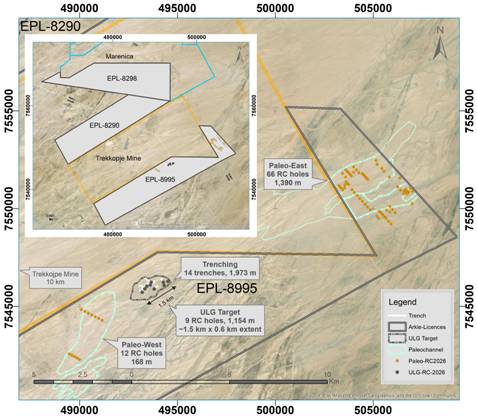
Figure 1: Reverse circulation drilling and trenching completed across the ULG, Paleo East and Paleo West targets, EPL 8995, with licence location inset.
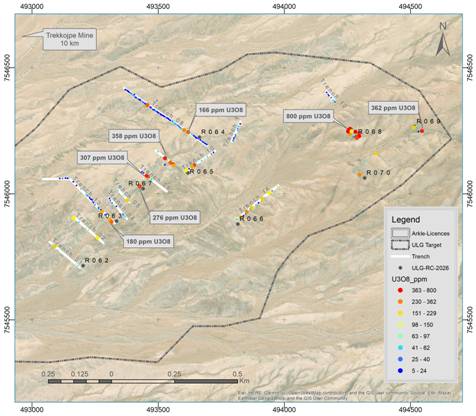
Figure 2: Trench and surface sample locations over the primary ULG target, coloured by U₃O₈ content with peak values annotated, EPL 8995.
Summary
Arkle's recent exploration activities, commencing with field mapping, have advanced the primary ULG target from a geophysical and geochemical anomaly to a mapped, sampled and drill-tested uranium system in a single field season. Since the Company's last operational update on 17 July 2026, the initial RC drill programme was completed at the end of July 2026, expanded to 2,712 m across all three targets. Downhole gamma ray spectrometry was completed on all 87 holes through August and used to select assay intervals, and 974 samples have been submitted to Actlabs, with results expected to be reported during September 2026. Multi-element assays have been received for 271 trench and surface samples. The field team has since returned to the ground and is mapping and sampling, planning follow-on trenches, evaluating additional ground and further geophysics, and preparing the next drill programme.
Further Details
Trenching, Mapping and Surface Geochemistry
Trenching at the primary ULG target is complete, exposing the target rocks across the mapped area and providing the geological control for the reconnaissance drilling that followed.
· 1,973 line-metres excavated in fourteen trenches to between 1 m and 1.5 m depth, with topsoil preserved in separate heaps for rehabilitation, entirely within EPL8995.
· Trenches cut oblique to the prevailing metamorphic fabric to expose the full sequence, extending on the seven trenches and approximately 700 m of strike reported on 25 June 2026.
· 255 geological stations mapped along the trench floors and walls.
· ULG logged at 48 stations, or 19 per cent of the mapped sections, with ULG together with leucogranite contacts against schists and gneiss accounting for more than half of the sections.
· Subordinate marble, calcsilicate, gneiss and quartzite also logged in the Damaran-age country rock population, the area cross-cut by Cretaceous dykes, and surficial calcrete and gypcrete only locally developed within the veneer of recent sediment cover across the ULG target.
The trenching confirms the three mineralisation styles reported in June.
· A mass of leucogranite sheets within the core of a fold structure characterised by Karibib and Arandis Formation lithologies.
· A sequence of multiple stacked leucogranite sheets interleaved with schist and gneiss associated with the fold.
· A leucogranite zone developed against a carbonate contact, a style analogous to the high-grade leucogranite bodies developed beneath carbonate packages at most of the Erongo Region's alaskite type uranium deposits.
Mapping has identified prospective targets within the ULG area based on the Company's understanding of ULG emplacement and mineralisation models, and work continues at the desktop directing follow-up mapping and trench logging. Trench exposures confirm and expand on the surface uranium and rare earth element anomalies and have exposed the relationship between the ULG dykes and sills and the country rocks.
Actlabs have delivered 56-element ICP assays for 271 samples, comprising 213 trench samples and 29 nearby surface samples. The assay population also includes 29 QAQC inserts (1:1 certified U references and blanks) submitted under the Company's protocols. All uranium values are reported as U₃O₈, converted from the reported elemental uranium at a factor of 1.17924.
· 39 samples returned values above 100 ppm U₃O₈, 26 of them in the trenches.
· 13 samples returned values above 200 ppm U₃O₈, 5 of them in the trenches.
· Peak grades of 800 ppm U₃O₈ in a surface pavement sample and 358 ppm U₃O₈ in the trenches.
· Every sample above 100 ppm U₃O₈ lies on leucogranite, uraniferous leucogranite, or a leucogranite contact with schist or gneiss.
The mineralised samples define a consistent east-north-east trend at approximately 077 degrees which tightens as grade increases, indicating a structurally and lithologically controlled system rather than dispersed surface enrichment. At a 200-ppm U₃O₈ threshold the mineralisation defines a corridor of approximately 1,140 m of strike by 91 m in width. Elevated REE values, excluding yttrium, are in places coincident with elevated uranium. Combined with the 2025 derisking sample programme, surface geochemical coverage across Arkle's licences now comprises 403 samples.
Rare Earth Elements
The 56-element assay suite, which includes thirteen rare earth elements, has returned elevated REE values across parts of the trench and surface sample population, in places coincident with elevated uranium.
· Total rare earth plus yttrium values average 438 ppm, with a median of 239 ppm and a maximum of 14,294 ppm.
· 16 samples returned over 1,000 ppm.
· The distribution is enriched in the heavy rare earths, which account for approximately 28% of the total.
· Over 50% of the rare earth content is in the heavy rare earths in 17 samples, excluding yttrium.
Thorium correlates closely with total rare earth content across the dataset, whereas uranium does not, indicating that the REE and uranium enrichment are carried by different mineral phases; the REE data is accordingly being used to assist in discriminating uranium mineralisation from thorium-bearing accessory phases in the leucogranites. The Company is not currently targeting rare earth elements, no assessment of their economic significance has been undertaken, and no REE Mineral Resource is implied or reported.
Deposit Style and Regional Analogues
The ULG target displays the defining characteristics of the leucogranite-hosted, or alaskite-hosted, uranium deposits of the central Erongo, the province which has produced in excess of 350 Mlb U₃O₈ over the past 45 years.
Bannerman Energy's (ASX: BMN) Etango project hosts a Mineral Resource of 416.1 Mt at 225 ppm U₃O₈ for 207 Mlb of contained U₃O₈ at a 100 ppm U₃O₈ cut-off, increasing to 518 Mt at 197 ppm U₃O₈ for approximately 225 Mlb at a 55 ppm U₃O₈ cut-off (Bannerman Energy, November 2021 JORC 2012 Mineral Resource Estimate reported within a US$75 pit shell; ASX release of 6 December 2022, "Etango-8 Definitive Feasibility Study"). Asarian Energy's (TSX: ARN) Norasa project, comprising the Valencia and Namibplaas deposits, is advancing a project with a resource in a similar deposit style.
Arkle's trenching has now exposed ULG mineralisation with comparable architecture of stacked leucogranite sheets at surface across a footprint of approximately 1.5 km by 0.6 km, and the drilling has confirmed that the sheets persist to at least 188 m below surface. The comparison above is to deposit style and geological setting only, and is not a comparison of grade, tonnage or economic potential; no Mineral Resource has been estimated on any of Arkle's licences.
Paleochannel Drilling
The initial drill programme at the Paleo East, Paleo West and ULG targets (see 22 May 2026 RNS) comprised 2,712 m of RC drilling in 87 vertical holes on EPL8995, expanded from the approximately 1,500 m originally planned.
· ULG target: nine holes for 1,154 m.
· Paleo East target: 1,390 m in 66 holes.
· Paleo West target: 168 m in 12 holes.
· Paleochannel drilling totalled 1,558 m across 78 vertical holes on the two paleochannel targets.
Twenty-two of the holes have been sampled on the basis of a 40 ppm eU₃O₈ cut-off grade, as indicated by the downhole GRS survey. The 40-ppm cut-off is in place to ensure a broad enough sampling envelope in a given hole. The higher proportion of assay data covering the lower grades will be used to refine the downhole GRS data processing and correlation to actual assay grades for future drilling. A total of 204 samples has been submitted, along with approximately 10% QAQC inserts.
Western Paleochannel Target Drilled
The western paleochannel target on EPL 8995 was previously mapped by the Company's HLEM profiling, supported by processed airborne radiometric data and surface mapping, and lies approximately 15 km west-southwest of the initial drilling area, on lower ground toward the west of the licence.
Twelve new holes have been drilled across this target, which sits approximately 2.5 km southwest of the ULG target. Two fences, one of seven holes drilled at 200 m spacing and the other of five holes at 100 m spacing, have been completed, all terminating at least one metre into the basement metasediments. The drill lines cross the interpreted channel position at right angles. One of the completed holes yielded sufficient eU₃O₈ grades to warrant sampling for laboratory assay, eight samples in total.
Eastern Paleochannel Target Drilled
Step-out holes have been completed on the eastern paleochannel target from the existing fence lines, testing the interpreted channels along strike. Their number, location and spacing were designed by the Company's geological team together with its consultants, informed by the geological logging from the completed holes and the downhole spectrometry described below. Twenty-one of the completed holes yielded sufficient eU₃O₈ grades to warrant sampling for laboratory assay, 196 samples in total.
Paleochannel Assay samples
All 87 holes were surveyed by four-channel gamma-ray spectrometer probe, with all 2,712 m of probe runs completed and processed by Terratec Geophysical Services and used to select assay intervals. A total of 974 samples has been submitted for multi-element assay by ICP-MS at Actlabs in Ancaster, Ontario, Canada, with all preparation undertaken at the Windhoek facility, Namibia. Results are expected to be reported during September 2026, once received and validated.
Paleochannel Lithology and Mineralisation
The paleochannel holes intersected a cover sequence of alluvium, conglomerate and muddy conglomerate overlying basement metasediments, with 1,236 m of the 1,559 m logged falling within the cover sequence. Carbonate cementation is widespread: a moderate to strong reaction to dilute hydrochloric acid was recorded over 746 m across 70 of the 78 holes, with calcite logged in 1,305 one-metre intervals and gypsum in 70.
Carnotite, the secondary uranium mineral which carries the grade at the surficial uranium deposits of the region, has now been visually logged in six holes across eight separate intervals at downhole depths of between 1 m and 22 m, extending the three holes reported on 17 July 2026. Visual observations of mineralisation are not a proxy for uranium grade, and laboratory assay is required to determine uranium content.
ULG Drill Holes Completed
Nine reconnaissance RC holes on the central-north ULG target on EPL 8995 have been drilled, logged, and sampled for assay. Collar positions were guided by the recent trenching programme which exposed the target rocks:- multiple stacked leucogranite sheets intruded roughly parallel to the pervasive fabric in upper Swakop Group metasediments across this target area of approximately 1 km by 700 m. The reconnaissance holes are designed to provide a first test of the ULG sequence at depth and initial vertical control ahead of the follow-on RC programme planned for Q4 2026.
· Drilled at dips of between -60° and -90° to downhole depths of between 70 m and 200 m.
· Leucogranite logged over 792 m, or 69 per cent, of the 1,154 m drilled.
· Three holes logged as leucogranite over their entire length.
· Leucogranite logged to the bottom of the deepest hole at 200 m downhole, approximately 188 m below surface.
All nine holes were surveyed by four-channel downhole GRS and four were additionally surveyed for downhole deviation, and the survey results were used to select assay intervals. Downhole radiometric results and drill sample assay results for the ULG target will be reported separately once assays have been received and validated.
Downhole gamma ray spectrometry was completed across all 87 drillholes and used to select assay intervals. Downhole radiometric results are estimates of uranium content derived from downhole geophysical measurement and not from chemical assay and are not reported in this announcement.
No assay results from the drilling programme have been received to date, and no conclusions as to the grade or continuity of uranium mineralisation at depth can be drawn until laboratory assay results have been received, validated and reported. Results from the paleochannel targets, and from the ULG target, are expected to be reported during September 2026.
Enquiries:
|
Arkle Resources Rory Harding, CEO John Teeling, Chairman |
+44 (0)20 3051 5348 +353 (0)1 833 2833 |
|
Strand Hanson Limited Ritchie Balmer / Imogen Ellis |
Nominated & Financial Adviser +44 (0)20 7409 3494 |
|
H&P Advisory Limited Andrew Chubb / Leif Powis |
Joint Broker +44 (0)20 7907 8500 |
|
First Equity Limited Jason Robertson |
Joint Broker +44 (0)20 7374 2212 |
|
Vigo Consulting Ben Simons / George Pope |
UK Media & IR +44 (0)20 7390 0234 arkle.ir@vigoconsulting.com |
|
Teneo Luke Hogg / Molly Mooney |
Ireland Media +353 (0)1 661 4055 |
About Arkle Resources
Arkle Resources PLC (AIM: ARK) is a multi-commodity exploration company focused on metals which are essential for the generation and storage of clean energy: uranium, lithium and zinc. Its projects are in tier-1 mining jurisdictions in Namibia, Botswana and Ireland, adjacent to world-class deposits.
Founded in 2004 by John Teeling and Jim Finn, the Company co-discovered the Stonepark zinc deposit in County Limerick, now Ireland's second largest undeveloped resource, in joint venture with Teck Ireland. Teck's interest was acquired by Group Eleven Resources (TSX-V: ZNG), who continue to advance the project alongside Arkle.
In January 2026, the Company announced a transformative deal to acquire Namibia Uranium Pty Ltd, which has introduced four highly prospective uranium licences contiguous to major producing and development assets in what is a world-class uranium jurisdiction. This acquisition, alongside the Company's existing licence portfolio and the introduction of new management, repositions Arkle to become a leading explorer in energy metals.
For more information visit: www.arkleresources.com
Follow us on social media:
www.linkedin.com/company/arkle-resources-plc
Qualified Person Review
The technical and scientific information contained in this announcement has been reviewed and approved by Dr Guy Freemantle, an independent consultant to the Company through The MSA Group (Pty) Ltd., Johannesburg, South Africa. Dr Freemantle holds a Bachelor of Science in Geology and a PhD in Geology, both at the University of the Witwatersrand. He is a member of the Society of Economic Geologists (892905) and current Vice President for the Africa Region; a Fellow of the Geological Society of South Africa (965392); and is registered with SACNASP (Registration 117527). Dr Freemantle has practised his profession continuously for 16 years and has sufficient experience and knowledge that is relevant to the style of mineralisation and type of deposits under consideration as well as to the activity that is being undertaken to fulfil requirements of a Qualified Person as per NI 43-101 / PERC Reporting Standard (2021). Dr Freemantle consents to the inclusion in this announcement of the technical and scientific information in the form and context in which it appears.
Glossary
|
EPL |
Exclusive Prospecting Licence |
|
HLEM |
Horizontal Loop Electromagnetic |
|
QAQC |
Quality Assurance and Quality Control |
|
RC |
Reverse Circulation |
|
ULG |
Uraniferous Leucogranite |
RNS may use your IP address to confirm compliance with the terms and conditions, to analyse how you engage with the information contained in this communication, and to share such analysis on an anonymised basis with others as part of our commercial services. For further information about how RNS and the London Stock Exchange use the personal data you provide us, please see our Privacy Policy.

Latest directors dealings
- 1 minute ago Jardine Matheson Holdings Ltd (Singapore Reg)
- 22 minutes ago Mitchells & Butlers
- 38 minutes ago Prudential
- 1 hour ago Oxford Instruments
- 1 hour ago BHP Group Limited NPV (DI)