
Annual Financial Report
Summary by AI BETAClose X

VINACAPITAL VIETNAM OPPORTUNITY FUND LIMITED
Annual Report and Financial Statements for the year ended 30 June 2026
VinaCapital Vietnam Opportunity Fund Limited ("VOF" or the "Company") is pleased to announce its audited results for the year ended 30 June 2026.
More information on the Company is available at:
The information contained within the announcement is deemed by the Company to constitute inside information as stipulated under the Market Abuse Regulations ("MAR"). Upon the publication of this announcement via Regulatory Information Service ("RIS"), this inside information is now considered to be in the public domain.
ANNUAL REPORT AND FINANCIAL STATEMENTS
FOR THE YEAR ENDED 30 JUNE 2026
VinaCapital Vietnam Opportunity Fund Limited1 is a Guernsey domiciled closed-ended investment company. The Company is classified as a registered closed-ended Collective Investment Scheme under the Protection of Investors (Bailiwick of Guernsey) Law, 2020 and is subject to The Companies (Guernsey) Law, 2008 as amended (the “Guernsey Law”). The Company is managed by VinaCapital Investment Management Ltd2 as its manager and, on 5 November 2025, the Company appointed NSM Funds Limited as its administrator and corporate secretary, replacing Aztec Financial Services (Guernsey) Limited who previously fulfilled this function.
Investment Objective
The Company’s objective is to achieve medium to long-term returns through investment in assets either in Vietnam or in companies with a substantial majority of their assets, operations, revenues, or income in, or derived from, Vietnam.
Investment Strategy
The Company’s strategy allows VinaCapital, which has been managing investments on the ground in Vietnam for over 20 years, to navigate the limitations of Vietnam’s fundamentally illiquid market. Thorough due diligence allows us to identify high quality companies, in which we seek to negotiate significant positions where we can influence the direction of the investee company.
A significant portion of the portfolio will have been entered into through a privately negotiated process over the years and this strategy has proven particularly effective in navigating the challenges and managing the inherent risks of investing in Vietnam, while seeking to deliver superior risk-adjusted returns over the long-term for VOF’s investors.
Investment Policy
All of the Company’s investments will be in Vietnam or in companies with at least 75% of their assets, operations, revenues or income in, or derived from, Vietnam at the time of investment.
● No single investment may exceed 20% of the NAV of the Company at the time of investment.
● The Company may from time to time invest in other funds focused on Vietnam. This includes investments in other funds managed by the Investment Manager. Any investment or divestment of funds managed by the Investment Manager will be subject to prior approval by the Board.
● The Company may from time to time make co-investments alongside other investors in private equity, real estate, or similar assets. This includes, but is not restricted to, co-investments alongside other funds managed by the Investment Manager.
● The Company will not invest in other listed closed-ended funds.
The Company may gear its assets through borrowings which may vary over time according to market conditions and any or all of the assets of the Company may be pledged as security for such borrowings. Borrowings will not exceed 10% of the Company’s total assets at the time that any debt is drawn down.
From time to time the Company may hold cash or low risk instruments such as government bonds or cash funds denominated in either VND or USD, either in Vietnam or outside Vietnam.
1 VinaCapital Vietnam Opportunity Fund Ltd is also referred to as the “Company”, “Fund” or “VOF” throughout this Annual Report and Financial Statements.
2 VinaCapital Investment Management Limited is also referred to as the “Investment Manager”, “manager” or “VinaCapital” throughout this Annual Report and Financial Statements.
HISTORICAL FINANCIAL INFORMATION
|
As at 30 June |
|
|
2022 |
2023 |
2024 |
2025 |
2026 |
|
|
Share information |
|
|
|
|
|
| ||
|
Share price (USD) |
5.79 |
5.46 |
6.26 |
5.77 |
6.09 |
| ||
|
Share price (GBP) |
4.76 |
4.29 |
4.96 |
4.21 |
4.60 |
| ||
|
Net asset value per ordinary share (USD)1 |
7.22 |
7.02 |
7.43 |
7.13 |
7.73 |
| ||
|
Net asset value per ordinary share (GBP)1 |
5.93 |
5.52 |
5.88 |
5.20 |
5.84 |
| ||
1Alternative performance measure
FINANCIAL HIGHLIGHTS
In the year to 30 June 2026, the Company’s Net Asset Value (NAV) per share increased in US Dollar terms by 8.4% to USD7.73, and the share price increased by 5.5% to USD6.09. Taking account of dividends paid in the year to 30 June 2026, the NAV Total Return in USD terms was 10.5%.
|
As at years ended 30 June |
2022 |
2023 |
2024 |
2025 |
2026 |
|
NAV total return1 (%) |
(8.8) |
(0.4) |
7.8 |
(2.2) |
10.5 |
|
Share Price total return2 (%) |
1.1 |
(3.1) |
17.6 |
(5.3) |
8.1 |
|
Dividend per share (US cents) |
16.00 |
14.25 |
14.25 |
14.50 |
14.50 |
1 Expressed in percentage terms, is a measure of the investment return earned by the Company, calculated by taking the change in the NAV over the period in question and dividing by the starting NAV. This assumes that any dividends paid in the period are reinvested at the prevailing NAV per share on the ex-dividend date and that the dividend would grow at the same rate of return as the NAV per share after re-investment. A numerical reconciliation of the NAV total return can be found in the alternative performance measures section of this report. This footnote applies to all disclosures of NAV Total Return throughout this Annual Report and Financial Statements.
2 Expressed in percentage terms, is a measure of the return to shareholders, calculated by taking the change in the share price over the period in question and dividing by the starting share price. This assumes that any dividends paid in the period are reinvested at the prevailing share price on the ex-dividend date and that the dividend would grow at the same rate of return as the share price after re-investment. The Share Price total return is provided by an independent third-party provider of investment statistics – see glossary. This footnote applies to all disclosures of Share Price total return throughout this Annual Report and Financial Statements.
CHAIR’S STATEMENT
Dear Shareholder,
As this is my first annual report to you as Chair of VinaCapital Vietnam Opportunity Fund Limited, I would like to thank my predecessor, Huw Evans, for his commitment and support to VOF, particularly during a period of significant volatility and uncertainty. Along with many other industries, the investment trust sector has faced considerable pressure as it adjusts to a more challenging and activist environment.
Performance
Over the 12 months to 30 June 2026, VOF’s NAV increased by 10.5% in US dollar terms on a total return basis. Although this is a respectable absolute return and is close to the Company’s long-term record of 11% annualised returns, it was significantly behind the VN Index benchmark return of 36.5%. As an opportunity fund, the construction of the VOF portfolio is not driven by the constituents of any benchmark index. Nevertheless, the Board recognises that VOF’s relative performance may disappoint some shareholders. As explained in more detail in the Investment Manager’s Report, part of this relative underperformance was driven by extreme share price movements among Vingroup companies.
In addition, the Private Equity team has continued to work on realising cash from the distressed investments which were discussed at length in recent reports. The Investment Manager provides further detail in its report.
In response to these performance issues, the Investment Manager has reorganised and strengthened its investment team while remaining true to VOF’s long-term philosophy as an opportunity fund. This has resulted in a higher-than-usual level of portfolio activity over the past year. Inertia analysis shows that this more active approach to managing the listed portfolio has added value and is likely to remain an important source of future value creation.
Dividends & Share buybacks
Recognising that many shareholders value regular income, our policy is to pay dividends of approximately 1% of NAV per share twice each year, normally declared in March and October. In March 2026, we declared a dividend of 7.25 US cents per share, and the Board has today declared a maintained dividend of 7.25 US cents per share. This will be payable to shareholders on or around 9 December 2026.
Together with an active share buyback programme, regular dividends can represent a significant return of capital to investors. Since VOF first paid a dividend in September 2017, it has distributed a total of 121.85 US cents per share. An investor who bought a share at the market price of USD3.82 at the 30 June 2017 year-end will have received dividends totalling 129.1 US cents per share by the end of December this year, representing a return of 34% of their investment. At the end of June this year, the market price of their shares was USD6.09, an increase of 59%.
The discount remained under pressure for much of the year under review, and the Company therefore continued its active share buyback programme. During the year, 14.3 million shares were bought back at a cost of USD89.58 million, representing 10.1% of shares in issue at the start of the period. The discounts at which these shares were bought resulted in an increase in NAV of approximately 19.7 US cents per share, to the benefit of continuing shareholders.
Investment Management Fees
In late June, we announced new fee arrangements designed to deliver value to shareholders by reducing costs. We also replaced the absolute return hurdle with a long-term, market-based performance benchmark, reflecting the increasing investment opportunities in the listed Vietnamese market. Full details of the revised fees, including transition arrangements, are set out in Note 20 of these annual accounts. In summary:
The base fee will be reduced, following a transition period, to:
- 1.2% of the first USD500 million of net assets under management.
- 0.8% of net assets in the range of USD500 million to USD1.5 billion.
- 0.5% of net assets in excess of USD1.5 billion.
Based on net assets under management as at 30 June 2026 of USD 934 million, the effective base fee rate will fall to approximately 1.0%, representing a total saving of approximately 0.3% compared with the previous management fee arrangement.
The revised performance fee will be calculated on rolling five-year performance compared with a market-based benchmark. When this change was initially announced the FTSE Vietnam All-Share Index was the preferred benchmark. However, FTSE Russell subsequently revised their suite of Vietnamese indices and our chosen benchmark for the purpose of calculating the performance fee is now the FTSE Vietnam 30 Index. We chose this index because it applies investability criteria to reduce over-concentration in certain companies and also addresses foreign ownership limits. The performance fee will be calculated each year at a rate of 0.03% for each 1% of overperformance relative to the market-based performance benchmark. In the event of underperformance, fees will be clawed back at the same 0.03% rate, subject to a maximum clawback of 0.2% of NAV. Under the new fee arrangements, there will no longer be any carry-forward of performance fees.
To lower the Company’s maximum ongoing charges, the total fee cap was reduced to 2.5% of net assets under management.
The new arrangements took effect from 1 July 2026, with transition arrangements in place for the first four years under the new structure.
Although the new fee arrangements incorporate an equity index benchmark, I would like to emphasise that this does not indicate any change in investment strategy. VOF will continue to focus on opportunities wherever they arise, in both listed and unlisted investments, and without reference to the constituents of the benchmark index.
Marketing
Over the last year, there has been increased interest in emerging markets after a period of uncertainty and volatility, although much of that interest has initially centred on companies exposed to artificial intelligence-related expenditure. We continue to believe strongly in Vietnam’s investment potential. VinaCapital, assisted by our joint brokers, Deutsche Numis and Barclays Bank, and our distribution partner, Cadarn Capital, provides regular communication to both existing and prospective investors on the progress of the Company and the opportunities available from investing in Vietnam. We also provide commentary to print and online media to widen our investor base and encourage new investors to consider Vietnam. A detailed fact sheet is issued each month, and regular written and video updates on the Vietnamese market and economy are posted to our website. Investors can sign up to be notified of new publications at https://vof.vinacapital.com.
The Board
During 2027, the Board will begin the process of identifying successors for both Julian Healy and me as we approach our respective retirement dates which will be at the end of 2027 and 2028 respectively. The total aggregate remuneration for the directors was last changed at the AGM in 2018, when it was set at USD650,000. While at present the total remuneration is lower than the cap, directors' fees have increased over time due to inflation and it may be appropriate to have a period of overlap between newly appointed and retiring directors, which would temporarily increase aggregate fees. In order to make sure that the cap does not impede the ability of the Board to recruit new directors, under Resolution 12 at this year's AGM shareholders will be asked to approve an increase in the cap on aggregate remuneration of the Board from USD650,000 to USD850,000.
Annual General Meeting
All resolutions proposed at the AGM held on 3 December 2025 were passed in line with the Board’s recommendations.
This year’s AGM will take place on 3 December 2026 at NSM Funds Limited, Les Echelons Court, Les Echelons, St Peter Port, Guernsey, GY1 1AR. Notice of the AGM is sent to registered shareholders with the Annual Report and Financial Statements. All shareholders are encouraged to attend the AGM, where there will be an opportunity to ask questions of the Board and the Investment Manager. If you are unable to attend, you are welcome to send any questions or comments to me at any time via the Company Secretary.
Outlook
Vietnam remains an attractive place to invest. Economic growth remains strong, and the government’s target of 10% annual growth should be achievable over the longer term, although geopolitics and global economic uncertainty may make this more challenging for liquidity in the short term. As in other markets, the strong performance of the Vietnamese stock market has been driven by a small number of stocks. Globally, emerging market sector returns have largely been concentrated among beneficiaries of AI-related expenditure. As there are fewer of these opportunities in Vietnam, international equity market investors have been net sellers of the Vietnamese market. This contrasts sharply with the high levels of foreign direct investment that have continued to flow into Vietnam. With strong earnings growth forecast for many listed companies, current share prices appear attractive and offer interesting investment opportunities for investors able to tolerate short-term volatility caused by external events.
We have been pleased to see the reorganisation of the investment management team. The more active approach to managing the listed portfolio, together with good progress in resolving distressed private equity investments, is a welcome improvement. While investing in unlisted investments has been a source of strong returns in the past, the environment for private equity investment has become extremely challenging and the hurdle for any new PE opportunities is high given the low valuation of listed equities at the moment. Therefore, it is not anticipated that any new private equity investments will be made until such time as performance from the portfolio recovers. Over the longer term the board continues to believe that being able to access a wider range of investment opportunities through the inclusion of private equity, will lead to better longer term returns for the shareholders and give VOF the opportunity to capitalise on Vietnam’s high rate of economic growth.
Strong economic growth and very attractive valuations should support a broader stock market recovery and provide the team with exciting investment opportunities in 2027. The Board will continue to monitor performance closely as the Investment Manager seeks to take advantage of these opportunities for the benefit of VOF shareholders and will remain focused on maximising value for all shareholders.
Kathryn Matthews
Chair
VinaCapital Vietnam Opportunity Fund Limited
23 October 2026
INVESTMENT MANAGER’S REPORT – 30 JUNE 2026
Macroeconomic Review
Vietnam’s Growth Engine: Four Pillars, One Foundation
We believe that Vietnam's medium-term growth outlook remains among the strongest in Asia. The Government has set an ambitious objective of achieving average Gross Domestic Product (GDP) growth of around 10% per year over the medium term, supported by an increasingly reform-oriented policy agenda. In our view, this aspiration is underpinned by four mutually reinforcing structural drivers: resilient foreign direct investment, which is deepening Vietnam's integration into global manufacturing supply chains; continued industrialisation and upgrading towards higher value-added production; the steady expansion of the domestic middle class, which should drive consumption growth over time; and an unprecedented pipeline of infrastructure investment that is improving productivity and attracting private capital. These structural themes continue to guide VOF's capital allocation decisions and are prevalent across our portfolio companies.
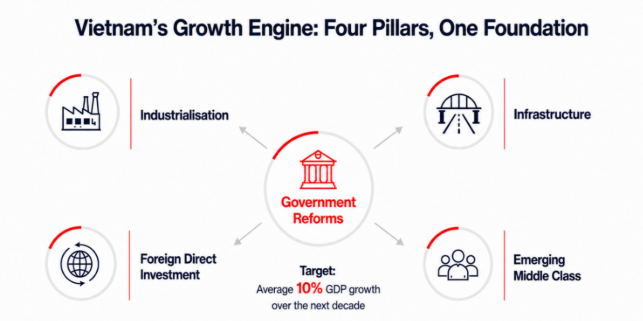
Source: VinaCapital
Growth Accelerates Despite Global Headwinds
Following GDP growth of 8.0% in 2025, economic activity accelerated further during the first half of 2026, with year-on-year GDP growth rising from 7.9% in the first quarter to 8.4% in the second quarter, resulting in 8.2% year-on-year growth in the first half of 2026. Vietnam's economy demonstrated remarkable resilience over the fiscal year despite an increasingly challenging global backdrop and the disruptions caused by the US-Iran conflict. The economy continued to benefit from exceptional growth in high-tech manufacturing, resilient foreign direct investment (FDI), and high public infrastructure investment, while domestic consumption is proving resilient.
Manufacturing Resilience Defies Tariff Uncertainty
Manufacturing remained the principal engine of economic growth throughout the period, supported by robust exports and continued investment in high-tech production. Vietnam's export sector proved considerably more resilient than initially expected following the escalation of US tariffs, with total exports expanding by 17% in 2025. This was supported by a 28% increase in exports to the US and an 80% surge in exports of laptops and other electronics products to the US. The global AI investment cycle sustained this momentum into the first half of 2026, with computer and electronics exports rising by a further 49%, lifting manufacturing output growth to 11.4%. Manufacturing activity moderated slightly toward mid-year, as slower order growth and labour shortages—driven by workers migrating to construction projects—weighed on output. Still, leading indicators point to healthy expansion ahead, reinforcing our positive long-term view on Vietnam's manufacturing ecosystem and trade logistics as the country's role in global trade continues to grow.
Record FDI Underscores Manufacturing Confidence
This manufacturing strength continued to attract investment. Disbursed FDI reached a record USD27.6 billion in 2025 before increasing a further 11.2% year-on-year in the first half of 2026. Even more encouragingly, newly registered FDI projects surged by 55.9%, equivalent to approximately 11% of GDP, underscoring multinational companies' continued confidence in Vietnam as a destination for high-value manufacturing despite heightened geopolitical uncertainty. Strong imports of capital goods and electronics components also point to further expansion in export capacity over the medium term, supporting Vietnam's manufacturing ecosystem and businesses that enable it, particularly industrial park developers that continue to benefit from robust FDI inflows.
Cautious Consumers, Resilient Spending
Domestic consumption presented a more nuanced picture over the fiscal year. Consumer spending remained subdued throughout much of 2025. Real retail sales grew by 6.7%, but underlying domestic consumption—stripping out foreign tourist spending—expanded only by around 5%, well below the 8–9% pre-COVID period, reflecting elevated household savings and cautious consumer sentiment. Despite the sharp rise in petrol prices following the US-Iran conflict and significantly higher mortgage rates, real retail sales growth grew from 7.0% year-on-year in the first quarter of 2026 to 7.3% over the whole of the first half, suggesting that household spending proved considerably more resilient than expected. This improvement, together with continued strength in manufacturing, contributed to the acceleration in overall GDP growth and provides early evidence that Vietnam's long-term consumer growth story remains intact, supporting our positive long-term outlook for high-quality consumer-facing businesses.
Tighter Liquidity, Not Currency Risk, Drives Rates Higher
The principal macroeconomic challenge shifted during the first half of 2026 as geopolitical tensions drove inflation higher while tighter domestic liquidity pushed interest rates higher. Petrol prices surged following the outbreak of the US-Iran conflict, lifting Vietnam's annual inflation rate from an average of 3.3% in 2025 to 4.4% in the first half of 2026. At the same time, rising imports of energy and electronics components temporarily pushed Vietnam from a USD20.1 billion trade surplus in 2025 to a sizeable trade deficit during the first half of 2026. Nevertheless, the Vietnamese Dong remained broadly stable against the US Dollar despite the wider trade deficit. Unlike many regional peers, higher domestic interest rates reflected tight liquidity within the banking system as credit growth continued to outpace deposit growth rather than from efforts to defend the currency. This prompted policymakers to introduce additional liquidity support measures while exploring avenues to attract more foreign capital into the financial system.
Investment performance
As an opportunity fund that invests across public and private markets, VOF has delivered a cumulative return of 910% (or 11% per annum) on a USD total return basis since inception in 2003. Over the financial year to 30 June 2026, VOF’s NAV per share increased by 10.5% and the share price increased by 8.1%, both on a USD total return basis. Although the performance lagged the broad stock market, NAV performance exceeded the Fund's 10% performance hurdle for the financial year and was more consistent with VOF’s long-term annualised track record. The result also marked an improvement on the decline of -2.2% in NAV per share return recorded in the prior financial year. Importantly, this fiscal year’s result is the first full year under the current Portfolio Manager, who took over management of the strategy in March 2025 and has since repositioned the portfolio and reorganised the investment management team.
|
Total Return in USD |
1 year |
3 Years |
5 Years |
|
VOF NAV per share |
10.5% |
16.8% |
5.9% |
|
VOF Share Price |
8.1% |
20.4% |
4.0% |
Data to 30 June 2026; Source: Bloomberg / VinaCapital
Relative Performance
During the fiscal year, the Fund underperformed the VN Index.
The VN Index, which is a capitalisation-weighted index that tracks the performance of all common stocks listed on the Ho Chi Minh Stock Exchange (HOSE), increased by 36.5% for the fiscal year ending 30 June 2026. This strong performance was driven overwhelmingly by one stock: Vingroup (VIC), whose share price increased by over 350% over the year. Given its outsized 19.3% weight on the VN Index as of 30 June 2026, it contributed to 24.2% points of the headline performance or, said differently, represented 66% of the VN Index’s rise during the year. We partially benefited from this narrow rally as we have been a long-term investor in Vinhomes (VHM), Vingroup’s subsidiary and Vietnam’s leading real estate developer, whose share price increased by over 100% during the period. The Vingroup ecosystem now accounts for one-third of the VN Index’s market capitalisation, which means that the headline stock market performance will continue to be heavily influenced by this one conglomerate.
The conglomerate phenomenon that we are experiencing is a result of ongoing reforms, where the Vietnamese government is focused on developing domestic champions and investing heavily into infrastructure development. Vingroup is the clearest beneficiary of this agenda thanks to its long track record. Their project execution is very strong, demonstrated consistently through their ability to launch and complete Vinhomes mega township projects across the country, to the rapid development of a regional electric vehicle business, albeit one that is still loss-making. During the year we did not invest in VIC as we were concerned about disproportionately high valuations compared to the overall stock market, whilst the company was significantly leveraged to its fledgling electric vehicle business. This decision affected the Fund's relative performance, as VIC was the primary contributor of returns for the Vietnam-focused benchmarks, as discussed above. VIC’s fundamentals have recently changed, evidenced from its recent decision to spin-off its electric vehicle subsidiary into a separate manufacturing and operating company. Furthermore, the Government’s willingness to grant VIC several major infrastructure projects (metro, rail and highway) and Transport-Oriented Development (TOD) projects will contribute significantly to its earnings outlook in the coming years.
These changes have prompted us to review the investment case for VIC and we have initiated a position post-year end.
Portfolio activity
During the fiscal year we have actively repositioned the portfolio towards companies and investment opportunities that we believe are best placed to benefit from Vietnam's long-term structural transformation, as mentioned in the Macroeconomic piece to this year’s report. Within the portfolio, repositioning activities resulted in USD 843 million of transactions, including trimming and selling down USD 472 million of holdings in both the public and private markets parts of the portfolio, and reinvesting USD 371 million into new opportunities or adding to existing holdings. In addition, more than USD 108 million was distributed as share buybacks and dividend payments to our investors as part of our ongoing commitment to return capital to our shareholders. Our repositioning resulted in a portfolio turnover of 39%, which is significantly higher than our single-digit historical average; we will be more active as the market remains challenging, but we do not expect portfolio turnover in the foreseeable future to be as high as in the past year.
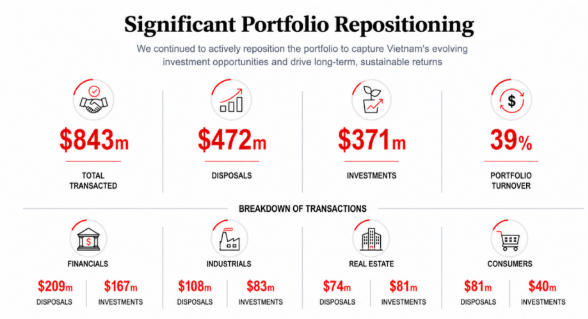
Transactions in FY2026; Source: VinaCapital
We have reinvigorated our deal generation efforts, allowing us to build a pipeline of opportunities across public and private markets, which is in line with our strategy of seeking opportunities which offer the prospect of superior returns to those achievable simply by investing in the publicly listed markets. Of this pipeline, in the last twelve months we have invested in four privately negotiated deals and pre-IPO investments, aggregating to close to USD 100 million and they all have been accretive to our performance.
After repositioning, the portfolio reflects our best investment ideas to deliver long-term growth. Our focus for some time has been on selecting investments which benefit mostly from the growth of the domestic economy, and as a result, we find opportunities in the banking and financial sector, the real estate sector, industrial and materials sectors, and the consumer sector (which includes healthcare and consumer goods). These core sectors directly or indirectly benefit from the four long-term growth drivers of the economy which we introduced at the start of this report, and which are (i) industrialisation, (ii) foreign direct investment, (iii) infrastructure spending, and (iv) the emerging middle class.
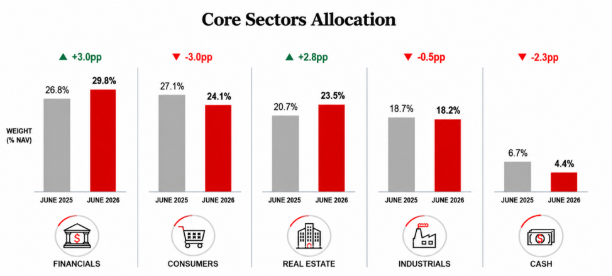
Source: VinaCapital
Financial sector: 29.8% NAV
Our exposure to the Financial sector, which includes banks and non-banks, remains a key part of our strategy as we seek to benefit from the growth of Vietnam’s domestic economy. This sector, which makes up 29.8% of NAV, returned 15.9% for the fiscal year. Currently the liquidity conditions in Vietnam's banking system have tightened as credit growth has consistently outpaced deposit growth over the past two years. This has intensified competition for deposits, driving banks to increase term deposit rates to attract funding. Meanwhile, the State Bank of Vietnam has continued to encourage banks to maintain low lending rates to support economic activity, placing pressure on sector-wide net interest margins. In taking a longer-term view, we believe that the sector remains attractively valued and well positioned to benefit from accelerating credit growth, capital market development, and Vietnam's current investment cycle, which prioritises infrastructure projects and large domestic champions.
During the fiscal year we were most active in this sector, with USD 209 million of investments and USD 167 million of divestments made. We reduced long-held positions in Asia Commercial Bank (ACB) and VPBank (VPB), while increasing exposure to MB Bank (MBB), VietinBank (CTG), BIDV (BID), and Vietcombank (VCB). Capital was reallocated towards banks with stronger funding franchises, higher CASA[1] ratios, lower funding costs, and higher ROE[2] (average 16.7%). These banks are also well positioned to support Vietnam's new investment cycle through their diversified loan books and strong corporate franchises. We also increased exposure to non-banks, specifically to leading securities brokerages, including SSI Securities (SSI), Techcom Securities (TCX) and Vietcap Securities (VCI), reflecting our expectation that an imminent Emerging Market upgrade for the Vietnamese stock market will drive higher trading activity, liquidity, and capital market issuances.
Importantly, three investments were sourced through proprietary negotiated transactions, including private placements (BIDV and Vietcap Securities) at large discounts to their open market prices and a pre-IPO investment (Techcom Securities). These opportunities provided attractive entry valuations, meaningful investment sizing, immediate NAV accretion, and the potential for superior long-term returns without compromising liquidity. Despite improving fundamentals, our banking sector holdings trade at an average price-to-book (P/B) ratio of 1.25x, while many continue to trade below both their historical valuation multiples and those of their peers.
Consumer sector (including Discretionary, Staples, Healthcare and IT): 24.1% NAV
The broad consumer sector, which makes up 24.1% of NAV, returned 2.9% for the fiscal year, reflecting the disbursement of names across several categories within the consumer sector.
This sector remains an important, long-term theme within our portfolio construction as consumption drives approximately 60% of Vietnam’s GDP growth. We continue to favour businesses with strong brands and leading market positions, while increasingly factoring in premiumisation trends in certain consumer categories.
Against this backdrop, we began exiting selected holdings, including our private investments in Chicilon (leading indoor digital advertising company) and KIDO Group (KDC), a consumer-food company where we had optionality to swap into KDC’s steam bun manufacturer subsidiary Tho Phat. We reallocated capital to our highest-conviction holdings, including Mobile World (MWG), which is well positioned to benefit from the continued modernisation of Vietnam's retail sector. MWG’s operating performance has remained strong, with the company reporting an 86% year-on-year increase in profit before tax for the first half of 2026. At the time of writing this report, MWG conducted an initial public offering (IPO) of its main subsidiary, Dien May Xanh (DMX), which is the ICT and consumer electronics retailing business. We decided not to participate in this process on concerns over valuation and a maturing business growth outlook. Instead, we remain invested at the parent company (MWG) and the thesis is simple: we still get exposure to DMX but also get exposure to Bach Hoa Xanh (BHX), their modern grocery and supermarket chain, which is the leading grocery retailer in Vietnam and the next growth catalyst of the company. Mobile World’s share price increased by 21% during the financial year.
We also continued reducing our position in FPT Corporation, Vietnam’s leading software outsourcing company, which we classify within the Consumer sector. FPT has been the biggest drag to this sector’s performance as its share price decreased by 30% over the twelve months. Although the investment has generated a 22% IRR[3] in USD terms over our nine-year holding period, we believe that advances in artificial intelligence are reshaping the competitive dynamics of the IT services, coding and software outsourcing industry. At the time of writing this report, we have fully exited this investment.
Subsequent to the fiscal year-end, Phu Nhuan Jewelry (PNJ), one of the fund's largest holdings, became the subject to market scrutiny following a police investigation into an alleged diamond smuggling ring and fraudulent diamond certification scheme involving two individuals from P-Lab, PNJ’s wholly owned diamond certification subsidiary. Based on publicly available information, the investigation is currently limited to the former leadership of P-Lab. No PNJ executives or employees, nor PNJ or P-Lab as corporate entities, have been publicly charged. PNJ has also stated that none of the approximately 28,000 diamonds under investigation entered its retail network. A distinctive feature of Vietnam's jewellery market is that major jewellery retailers commonly offer product buyback programmes. Following the investigation, heightened customer concerns led to a significant increase in buyback requests for diamond jewellery. During July 2026, PNJ repurchased approximately USD 270 million of jewellery products from customers and recognised a provision of approximately USD 33 million in relation to the programme. At the time of writing, PNJ's share price declined by 69% since the incident. In response to the initial crisis unfolding, we acted swiftly and prudently by selling most of our position to limit downside risk while the implications of the investigation became clearer.
Real Estate sector: 23.5% NAV
This sector makes up 23.5% of NAV and returned 5.6% for the fiscal year. The real estate market has been slowly and unevenly recovering from the 2022-2023 liquidity and credit crunch. Investments in this sector remain a key part of our strategy and we believe that actions and supportive measures by the Vietnamese government will continue to boost residential property development and home ownership as structural demand significantly exceeds supply. Currently, the sector faces headwinds from a high-interest rate environment but as financing conditions improve, we expect the earnings recovery to broaden, particularly among developers with prudent balance sheets, quality landbanks, and exposure to affordable housing.
Activity within our real estate sector focused on portfolio rotation and restructuring legacy private investments. Vinhomes, an investment initiated six years ago, was the largest contributor to this sector and fund performance, appreciating by over 100% during the fiscal year. We continue to favour real estate developers who will benefit from infrastructure development or have direct access to TOD projects (see above), such as Vinhomes. Elsewhere, we trimmed our long-held position in Khang Dien House (KDH), which had a disappointing share price performance (-19% for the period under review) despite reporting a 221% year-on-year increase in net profit after tax and minority interest for the first half of 2026 (albeit without a one-off gain, the result would be flat). The product segment that KDH focuses on is predominantly premium low-rise residential homes, which has been affected by rising mortgage rates but encouragingly they have begun to extend into the mid-end of the market through more affordable units and high-rise apartments. We also redeployed capital into Nam Long Group (NLG), whose focus on affordable and mid-end housing in the wider metropolitan and urban areas of Ho Chi Minh City better aligns with Vietnam's structural housing demand and the broader push toward outward city expansion. The near-term performance of the sector has also been affected by elevated interest rates and weaker residential pre-sales. Given that the companies within our real estate sector portfolio have large sellable inventory, we expect improved sales and profitability once mortgage rates decline.
We also completed the restructuring of our Dat Xanh Services (DXS) investment into Dat Xanh Group (DXG, the parent company with higher liquidity), enabling a mark-to-market valuation. Subsequent to the financial year-end, we also received partial proceeds relating to the sale of the Novaland swap asset and are progressing the restructuring of the remaining receivable into an instrument capable of a mark-to-market valuation with a clear medium-term path to liquidity. For Hung Thinh Land, we agreed to a restructuring of our investment to extend the repayment plan and continue to work with them to enhance our security and collateral position.
Industrial sector (including Materials and Energy) – 18.2% NAV
Vietnam is still in the midst of industrialisation with significant investments in public works, infrastructure and construction, hence this secular trend remains prominent in our portfolio. This broad theme, which makes up 18.2% of NAV, returned 6.5% for the fiscal year. Within Industrials, we continued upgrading portfolio quality by exiting businesses in more mature growth phases while initiating positions with stronger structural growth drivers. We expect continued public investment and Vietnam's expanding role in global supply chains to support long-term growth across the sector.
We fully exited Airports Corporation of Vietnam (ACV), an operator of 21 out of 22 airports in the country. Following a successful ten-year investment in ACV – which we secured through a Government privatisation process – it generated an 18% IRR in USD terms. While ACV continues to benefit from significant competitive advantages, we believe that the estimated USD 16 billion investment in Long Thanh International Airport, coupled with uncertainty regarding the pace at which the airport reaches meaningful utilisation, is likely to weigh on returns over the medium term.
Conversely, we established a new position in Gemadept (GMD), Vietnam’s leading integrated seaport and logistics operator. The company operates a network of six ports and inland container depots across the country, with its two largest ports strategically located near key industrial clusters in the north and south. We believe that the company is well positioned to benefit from Vietnam's growing integration into global supply chains, supported by capacity expansion at its flagship ports. We initiated the position after concluding that the US tariff risks that emerged in April 2025 was not excessively detrimental to Vietnam as initially feared and believed that the company’s share price was oversold. Since initiation, its share price increased by 30% and the company is now one of our top-10 portfolio holdings.
We also participated in the pre-IPO investment of Gelex Infrastructure (GEL), in which VOF was the only institutional investor to secure a large allocation through a privately negotiated transaction. Vietnam’s government is targeting spending of 6-7% of GDP annually to accelerate infrastructure investment, and we believe that this company is well positioned to benefit from this long-term structural theme.
Full Portfolio List (Listed vs Unlisted Investments) as at 30 June 2026
|
Listed Equities |
| ||||
|
# |
Ticker |
Company Name |
Sector |
% of NAV |
Entry Method |
|
1 |
VHM |
Vinhomes |
Real Estate |
7.1% |
On Market |
|
2 |
MWG |
Mobile World Group |
Consumer Discretionary |
6.5% |
On Market |
|
3 |
KDH |
Khang Dien House |
Real Estate |
6.5% |
Privately Negotiated |
|
4 |
MBB |
MB Bank |
Financials |
6.3% |
On Market |
|
5 |
GMD |
Gemadept |
Industrials |
6.0% |
On Market |
|
6 |
PNJ |
Phu Nhuan Jewelry |
Consumer Discretionary |
5.5% |
Privately Negotiated |
|
7 |
HPG |
Hoa Phat Group |
Materials |
5.0% |
Privately Negotiated |
|
8 |
ACB |
Asia Commercial Bank |
Financials |
4.2% |
Privately Negotiated |
|
9 |
CTG |
Vietinbank |
Financials |
4.0% |
On Market |
|
10 |
DXG |
Dat Xanh Group |
Real Estate |
3.4% |
Privately Negotiated |
|
11 |
TCX |
Techcom Securities |
Financials |
3.1% |
Privately Negotiated |
|
12 |
VCB |
Vietcombank |
Financials |
3.1% |
On Market |
|
13 |
VCI |
Vietcap Securities |
Financials |
3.0% |
Privately Negotiated |
|
14 |
KDC |
KIDO Group |
Consumer Staples |
2.9% |
Privately Negotiated |
|
15 |
VPB |
Vietnam Prosperity Bank |
Financials |
2.7% |
Privately Negotiated |
|
16 |
ACG |
An Cuong Wood Working |
Materials |
2.5% |
Privately Negotiated |
|
17 |
GEL |
Gelex Infrastructure |
Industrials |
2.5% |
Privately Negotiated |
|
18 |
BID |
BIDV |
Financials |
2.3% |
Privately Negotiated |
|
19 |
NLG |
Nam Long Investment |
Real Estate |
2.3% |
On Market |
|
20 |
FPT |
FPT Corporation |
Information Technology |
1.1% |
Privately Negotiated |
|
21 |
TCB |
Techcombank |
Financials |
0.6% |
On Market |
|
22 |
PVS |
Petroleum Technical Services |
Energy |
0.6% |
On Market |
|
23 |
VIB |
Vietnam International Bank |
Financials |
0.5% |
Privately Negotiated |
|
24 |
IDC |
IDICO Corporation |
Industrials |
0.3% |
On Market |
|
Total Listed Equities |
82.0% |
| |||
|
25 |
Thu Cuc International |
Healthcare |
4.5% |
Privately Negotiated | |
|
26 |
KIDO Group |
Consumer Staples |
2.0% |
Privately Negotiated | |
|
27 |
Chicilon Media |
Consumer Discretionary |
- * |
Privately Negotiated | |
|
28 |
IN Holdings |
Consumer Discretionary |
- * |
Privately Negotiated | |
|
29 |
Petrolimex Aviation |
Energy |
- * |
Privately Negotiated | |
|
30 |
Ricons |
Industrials |
- * |
Privately Negotiated | |
|
31 |
Novaland |
Real Estate |
- * |
Privately Negotiated | |
|
32 |
Hung Thinh Land |
Real Estate |
- * |
Privately Negotiated | |
|
Unlisted investments* |
13.4% |
Privately Negotiated | |||
|
Other net assets |
4.6% |
| |||
|
|
100.0% |
| |||
* We do not generally publish the values of individual unlisted holdings unless a holding is one of our top ten investments. We provide an explanation of movements in valuations below.
Top-10 Holdings (Listed and Unlisted Investments) as of 30 June 2026
|
# |
Ticker |
Company Name |
NAV % |
12-month Return |
Weighted Contribution |
|
1 |
VHM |
Vinhomes |
7.1% |
75.3% |
3.6% |
|
2 |
MWG |
Mobile World Group |
6.5% |
4.7% |
0.3% |
|
3 |
KDH |
Khang Dien House |
6.5% |
-13.5% |
-1.3% |
|
4 |
MBB |
MB Bank |
6.3% |
20.8% |
1.2% |
|
5 |
GMD |
Gemadept |
6.0% |
14.7% |
0.8% |
|
6 |
PNJ |
Phu Nhuan Jewelry |
5.5% |
10.2% |
0.5% |
|
7 |
HPG |
Hoa Phat Group |
5.0% |
16.8% |
1.4% |
|
8 |
KDC |
KIDO Group* |
4.9% |
25.3% |
1.0% |
|
9 |
Private |
Thu Cuc International |
4.5% |
Private |
Private |
|
10 |
ACB |
Asia Commercial Bank |
4.2% |
16.1% |
1.8% |
* Includes listed equities portion of the investment and unlisted investments; see below for more details.
1 Vinhomes (Quoted, HOSE: VHM, Market Cap: USD23.9 billion):
Established in 2002, Vinhomes was first listed in 2018, and remains a core business within Vingroup, Vietnam’s largest conglomerate. Vinhomes is Vietnam’s largest residential real estate developer, with a strong track record of delivering large scale, mid-to-high-end developments in major cities in Vietnam. Vinhomes possesses Vietnam's largest residential land bank, comprising over 39,000 hectares, providing the company with a potential development pipeline extending over multiple decades. VOF first invested in VHM in 2020.
2 Mobile World Group (Quoted, HOSE: MWG, Market Cap: USD4.4 billion):
Established in 2004, MWG has become the largest electronics retailer in Vietnam with over 3,000 stores across the country. Initially started as a mobile phone store, hence the name of the company, it quickly expanded to all consumer electronics and established itself as a leading retailer in the segment. Subsequently, MWG has ventured into grocery and pharmaceuticals as households started shifting from traditional markets to modern retail channels. MWG's Information and Communication Technology (ICT) business has matured into a stable cash flow generator, while its recently profitable grocery business, Bach Hoa Xanh has emerged as the company's next growth engine. VOF invested in MWG in 2024.
3 Khang Dien House (Quoted, HOSE: KDH, Market Cap: USD0.9 billion):
Established in 2001, KDH is a leading developer of landed property, including townhouses and villas in southern Vietnam. It is particularly known for its strong presence in Ho Chi Minh City and its ability to secure and complete land title and documentation is highly prized by home buyers. The long-term growth prospects for residential real estate developers like KDH remain very promising given their extensive land-bank and ability to convert these into sellable projects which are in high demand. The business is well managed with solid fundamentals and a prudent net debt-to-equity ratio and minimal exposure to corporate bond issuance. VOF first invested in KDH in 2008 through a privately negotiated investment, before helping the company publicly list.
4 MB Bank (Quoted, HOSE: MBB, Market Cap: USD7.8 billion):
Established in 1994, MB Bank is currently the largest private bank in Vietnam in terms of assets and credit. MBB focuses on developing a unique universal banking model, focusing on commercial banking services for both individual and institutional clients. Through its subsidiaries and platforms, the bank provides other financial services such as insurance (life and non-life insurance), consumer finance, wealth management and securities brokerage services, where it is leveraging rapid digitisation and mobile applications to accelerate growth across these services. We invested in MBB in 2024.
5 Gemadept Corp. (Quoted, HOSE: GMD, Market Cap: USD1.2 billion):
Established in 1990, Gemadept is a leading port and logistics operator, with an integrated network of deep-sea ports, inland container depots, distribution centres and logistics services. Its strategically located assets, including the flagship Gemalink deep-sea port, position the company to benefit from Vietnam's growing manufacturing base, rising exports and increasing participation in global supply chains. GMD has high-quality infrastructure assets that offer long-term, volume-driven earnings growth underpinned by Vietnam's structural tailwinds of FDI inflows, industrialisation and trade expansion. We invested in GMD in December 2025.
6 Phu Nhuan Jewelry (Quoted, HOSE: PNJ, Market Cap: USD1.2 billion):
Established in 1988, PNJ has developed into a leading jewellery company in Vietnam that focuses on branded jewellery retail, wholesale jewellery and gold and precious metals trading. PNJ benefits from the fast-growing discretionary and luxury spending of the country’s emerging middle class. VOF first invested in 2007 through a privately negotiated process.
7 Hoa Phat Group (Quoted, HOSE: HPG, Market Cap: USD7.5 billion):
Established in 1992, HPG is Vietnam’s largest steel producer by a wide margin with over 30% market share. The company supplies high-quality construction steel for a variety of sectors, including factories, industrial parks, logistics, infrastructure projects and residential developments. VOF first invested in Hoa Phat in 2007 before it was listed through a privately negotiated transaction. The company was, at the time, outside of the top-10 steel producers in the country, in what was then a highly fragmented market.
8 KIDO Group (Quoted, HOSE: KDC, Market Cap: USD0.6 billion):
KIDO Group was established in 1993 and specialises in confectionery, frozen products and cooking oils. VOF’s very first investment was in KDC and the current investment is our sixth into the group. The previous five investments produced a weighted gross realised IRR in USD terms of over 26% and a multiple of 1.6x invested capital. In 2024, we invested into KDC via a privately negotiated process for both shares and an option to swap into a significant stake of a private steam bun, convenience food manufacturer, Tho Phat. We are in the process of exiting this investment; see more details below.
9 Thu Cuc International Hospital Group (TCI) (Unquoted – Private Equity):
Established in 2011, Thu Cuc developed into Hanoi's largest private healthcare provider, serving mid- and high-income individuals seeking high-quality medical services which are unavailable at local public hospitals. In 2020, VOF invested in the shares of Thu Cuc through a private equity investment, and it remains an important allocation in the portfolio to develop and continue to grow our healthcare investment platform that serves domestic needs.
10 Asia Commercial Bank (Quoted, HOSE: ACB, Market Cap: USD5.0 billion):
Established in 1993, ACB is one of the leading publicly listed commercial banks in Vietnam, focusing on the rapidly growing affluent retail and SME segments. We invested in ACB for its high asset quality, strong credit growth, prudent lending standards, robust risk management philosophy and low exposure to real estate and corporate bonds. VOF first invested in ACB in 2020 through a privately negotiated process to purchase a large block from an institutional investor and increased exposure in 2022, once again through a privately negotiated process.
Valuations of Unlisted Investments
|
# |
Unlisted Investments |
Sector |
|
1 |
Thu Cuc International (TCI) |
Healthcare |
|
2 |
KIDO Group |
Consumer Staples |
|
3 |
Chicilon Media |
Consumer Discretionary |
|
4 |
IN Holdings |
Consumer Discretionary |
|
5 |
Petrolimex Aviation |
Energy |
|
6 |
Ricons |
Industrials |
|
7 |
Novaland |
Real Estate |
|
8 |
Hung Thinh Land |
Real Estate |
As at 30 June 2026, we had eight unlisted investments that are not marked-to-market with an aggregate holding value of 12.1% of NAV. For the fiscal year, the valuation was marginally increased by USD 6.6 million from that at 30 June 2025. These investments are re-valued at least twice per year (at 30 June and 31 December), at exit, or if there is a risk of impairment. Where we are able to restructure or convert an investment into a listed equity investment with daily valuations, these investments are reclassified and carried at marked-to-market value accordingly. For example, we successfully participated in the private placement of DXG shares which replaced collateral for a structured loan investment in DXS. Since the restructuring, these shares have been part of our listed equities portfolio which is revalued daily based on market prices.
1 Thu Cuc International
The investment in hospital chain Thu Cuc International Hospital Group, which is described above, remains stable and we are looking at opportunities to further expand the business. The valuation of this investment increased by USD 5.8million in the fiscal year, reflecting improved business performance and recent expansions with the opening of a new mega-clinic in the north.
2. KIDO Group
During the financial year, we have decided to sell KDC shares along with our optionality which secures our investment’s IRR at 18% in USD terms. As a result of agreeing exit terms, the valuation of this investment increased by USD 5.8 million in the fiscal year to reflect the secured investment’s IRR.
3 Chicilon Media
Chicilon Media was established in 2006 and is a leading digital media company, providing advertising solutions on LCD screens and in-elevator screens in residential and commercial buildings. In 2023, VOF invested in the shares of the company through a private equity investment. We are in the process of exiting our holding in Chicilon and have already recovered our full investment cost. The remaining balance, representing profit, will be paid in instalments through the 2026-2027 financial year with accrued interest.
4 IN Holdings
IN Holdings was founded in 1998 and has been a leading hospitality and events company, that specializes in weddings and corporate conferences and banquets. We initially invested in the company’s shares through a private equity investment. We reported difficulties with our investment in IN Holdings in the last annual report. The conference centre business is largely as we noted in that report, whilst the restaurant portfolio turnaround to profitability remains challenging and unlikely. Simultaneously, we continue to seek enforcement of our shareholder rights as minority investors against the sponsors, which should allow a clearer path to restructuring and the possibility of a recovery of our investment. As at 30 June 2026, the valuation of VOF’s investment in IN Holdings decreased by USD 5.3 million in the fiscal year.
5 Petrolimex Aviation
Established in 2008, Petrolimex Aviation (PAV) is in the aviation fuel business. It supplies jet fuel to over 30 major airlines worldwide and domestic carriers. We invested in this company in 2019 through a Government privatisation process. Despite PAV’s strong operating performance, with 2026 net profit after tax forecast to increase by more than 50% year-on-year, slower receivables collection has weighed on the valuation, resulting in a USD 0.7 million decrease for the fiscal year.
6 Ricons
Ricons (RCI) was founded in 2004 and is a construction contractor and construction materials distributor. We invested in RCI in 2018, making it VOF’s only over-the-counter (OTC) investment. Following RCI’s recent decision to delist, we have reclassified this investment as an Unlisted Investment. RCI benefits from the revival of the real estate development and infrastructure spending. For the fiscal year, the valuation for this investment remained unchanged.
7 Novaland
Novaland (NVL) group was founded in 1992 and once was the second largest publicly listed real estate developer in the country. We have invested in NVL through a private investment structured as a loan in 2020. We continue to work toward resolving amounts due to VOF through asset swaps. We have swapped part of the receivable into a prime landbank asset, currently in the process of being sold; a deposit has been received, and completion is expected by the end of 2026. For the remaining NVL receivable, we are pursuing a swap into the group's listed shares, which would then be marked-to-market. The valuation of our investment in NVL increased by USD 4.8 million in the fiscal year.
8 Hung Thinh Land
Hung Thinh Land (HTL) was founded in 2002 and is a real estate developer focusing on residential, mixed-use and resort projects in coastal cities of Vietnam. We invested in HTL through a private investment structured as a loan in 2022. We continue to work toward resolving amounts due to VOF through improved collateral and security, and renegotiated repayment plans covering both principal and accrued interest. Partial repayments were settled during our 2024/25 financial year, though payment of the remaining balance has been delayed. We have agreed to a new repayment schedule spanning the 2027-2028 financial year, alongside securing liens over attractive landbanks. The valuation of our investment in HTL decreased by USD 2.9 million in the fiscal year. As the real estate sector continues to recover, we expect HTL to relaunch stalled projects and strengthen its liquidity position.
ESG Reporting and Voting
Responsible investing is a core tenet of VinaCapital's investment philosophy. The firm has adopted a Responsible Investment Policy, informed by the UN-supported PRI and the IFC's Performance Standards, to formalise how it incorporates ESG considerations across its investment activities. VinaCapital identifies ESG risks in potential investee companies through external advisors and in-house expertise, incorporates ESG terms into its private investment agreements where appropriate, and monitors remediation post-investment. Rather than screening companies solely on ESG criteria, VinaCapital takes a pragmatic approach suited to developing markets, favouring active stewardship — voting, direct engagement with management, and educational initiatives — over exclusion.
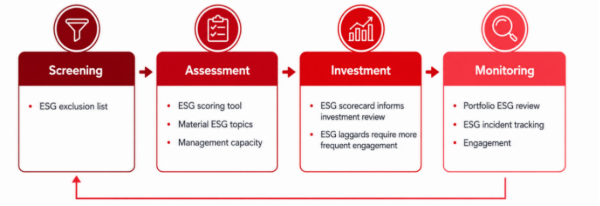
ESG due diligence is central to VinaCapital's private equity process, where its ownership stakes allow it to exert influence over portfolio companies. Due diligence typically identifies gaps against local and international standards; rather than deterring investment, these gaps provide a roadmap for improvement and a test of a sponsor's willingness to change. VinaCapital places the greatest value on this willingness and gravitates toward sponsors and opportunities where it is evident. For listed companies, VinaCapital applies a rigorous framework to assess ESG risks and encourages improvement where warranted.
In the year to 30 June 2026, VinaCapital strengthened its Responsible Investment Policy and published it on its website, giving investors a clearer reference point for the principles guiding its approach to ESG integration and stewardship. ESG considerations are embedded throughout the investment process, from initial screening and assessment through to investment review and ongoing monitoring. As part of this process, VinaCapital applies its proprietary ESG scoring tool to evaluate listed companies across corporate governance, business integrity, and environmental and social management.
During the year to 30 June 2026, 25 VOF portfolio companies held AGMs, including both public and private companies. VinaCapital achieved a 100% voting participation rate, voting on 256 resolutions in line with its voting policy. Of these, VinaCapital supported 250 resolutions, abstained on six (6) and voted against none.
Most votes were concentrated in three categories: Statutory and Reporting (71 votes, 28%), Strategy and Special Business (50 votes, 20%), and Capital Management and Dividends (44 votes, 17%). No resolutions were categorised as Environmental or Social matters, which may reflect the early stage of ESG development in Vietnam's capital markets.
A detailed report outlining the Investment Manager’s approach to ESG is available on VinaCapital’s website at https://vof.vinacapital.com/about-us/esg/.
Investment Outlook
The Vietnamese economy is on track to achieve impressive annual GDP growth of 10% in 2026 according to the government. Importantly, this average level of growth needs to be sustained longer-term and, although this is an ambitious goal, we support this view based on the following factors:
- Robust infrastructure spending: Having increased by almost 40% in 2025, infrastructure spending looks set to grow by another 20-30% in 2026, taking the current level of spending to 6-7% of GDP.
- Resilient exports: Vietnam's year-on-year export growth of computer and electronics products continues to rise, which is even more impressive given that it is building on from a high base.
- Recovery of household savings: Households have largely rebuilt their savings post-COVID, though consumer sentiment has yet to recover to pre-pandemic levels; this should improve once geopolitical tensions ease and both domestic liquidity conditions and rates environment improve.
- Promoting the private sector: Vietnam's Doi Moi 2.0 structural reforms are promoting the private sector and this sector’s contribution should ultimately boost the country's GDP growth rate.
Tight liquidity in Vietnam's banking system is the biggest risk to the positive scenario for Vietnam's economy and stock market in the near-term. Credit growth has outpaced deposit growth since 2022, leaving the country's commercial banks with an estimated USD80 billion deposit shortfall, according to the State Bank of Vietnam. This mismatch and chase for deposits has led some banks to offer 12-month deposit rates of 9-10%, prompting some local investors to shift capital from equities into cash deposits — a rotation that helps to explain the recent decline in stock market liquidity since the beginning of 2026. Critically, Vietnam's policymakers have powerful tools to address the issue, including central bank balance sheet expansion and depositing some of the Government's own cash reserves into the banks to help ease tight liquidity. Other risks to the economic growth and market story include a drop in exports to the US or a muted consumption recovery in Vietnam, although the risks do not seem to be escalating, and potentially will ease as more favourable tariff negotiation outcomes emerge, and the domestic environment improves to help lift consumer confidence.
As we actively deploy capital into new opportunities, we remain disciplined in managing portfolio liquidity. We emphasise ownership of high-quality companies, where our investments can be sold as and when appropriate, to meet our capital return commitments in the form of semi-annual dividends and the share buyback programme, which we recently increased to help narrow the discount.
According to our in-house research the VN lndex is trading at approximately 12x forward P/E with 24% expected earnings growth, or a 0.5x PEG[4] ratio. In comparison, our portfolio at time of writing is trading at a 9x forward P/E with a 29% expected earnings growth. In fact, the current market P/E multiple is trading at almost two standard deviations below historical market valuations. These valuation levels would normally suggest a market crisis, yet the economy is growing strongly and earnings growth remains robust. Part of the explanation lies in lower market liquidity and continuing foreign outflows from the stock market as we have discussed above.
In the medium-term, we believe that positive factors such as anticipated foreign inflows over the next twelve months from FTSE upgrading Vietnam from Frontier to Emerging Market status will present opportunities for public markets to re-rate, which in turn would create a more conducive environment for private companies to access the market via public offerings.
VinaCapital is an active, fundamental investor and we believe that we are well positioned to take advantage of opportunities that both the public and private markets will present. The team is currently evaluating several opportunities in the public and private markets across the Consumer, Financial and Industrial sectors and we look forward to updating our shareholders on the progress and execution of these investment opportunities.
Khanh Vu
Lead Portfolio Manager
VinaCapital Vietnam Opportunity Fund
23 October 2026
VINACAPITAL MANAGEMENT TEAM
Don Lam
Group Chief Executive Officer
Don Lam is a founding partner of the Investment Manager and has more than 30 years’ experience in Vietnam. He has overseen the Investment Manager’s growth from the manager of a single USD10 million fund in 2003 into a leading investment management and real estate development firm in Southeast Asia, with a diversified portfolio of more than USD3 billion in assets under management. Before founding the Investment Manager, Mr Lam was a partner at PricewaterhouseCoopers (Vietnam), where he led the corporate finance and management consulting practices throughout the Indochina region. Additionally, Mr Lam set up the VinaCapital Foundation whose mission is to empower the children and youth of Vietnam by providing opportunities for growth through health and education projects. He is active in the World Economic Forum and is a member of several business task forces and committees in Vietnam. He has a degree in Commerce and Political Science from the University of Toronto and received an honorary doctorate from the Royal Melbourne Institute of Technology Vietnam. He is a Chartered Accountant and is a member of the Institute of Chartered Accountants of Canada. He also holds a Securities Licence in Vietnam.
Brook Taylor
Chief Executive Officer, VinaCapital Asset Management
Brook Taylor is the Group Chief Operating Officer of the Investment Manager and Chief Executive Officer of Asset Management. Mr Taylor has more than 30 years of management experience, including more than eight years as a senior partner with major accounting firms. Previously, he was deputy managing partner of Deloitte in Vietnam and head of the firm’s audit practice. He was also managing partner of Arthur Andersen Vietnam and a senior audit partner at KPMG. Mr Taylor has lived and worked in Vietnam since 1997. Mr Taylor’s expertise spans a broad range of management and finance areas including accounting, business planning, audit, corporate finance, taxation, and risk management. He holds an Executive MBA from INSEAD and a Bachelor of Commerce and Administration from Victoria University of Wellington.
Alex Hambly
Chief Investment Officer
Alex Hambly is the Group Chief Investment Officer of the Investment Manager, appointed in July 2024, and, since 2020, he has served as a member of VOF’s Investment Committee. He has over 30 years of global investment experience working with Barclays, HSBC, British International Investment, Prudential and a leading Asian family office. In this time, he has lived and worked in the UK, India, Vietnam and Singapore. From 2003 to 2007 he served as Chief Executive Officer and Chief Investment Officer of Prudential’s fund management business in Vietnam, and in total he has more than 12 years’ investment experience in Vietnam. He holds a Bachelor of Arts (Hons) degree in Modern History from Durham University, UK.
Tuan Ngo
Head of Investments
Tuan Ngo is the Group Head of Investment, leading all investments teams of the Investment Manager, appointed in November 2025. He has over 30 years of experience across investment banking, asset management, and hedge fund in the UK, the US, France and Vietnam. Previously, Mr Ngo worked at Viet Capital Securities, Thien Huong Group (family office), Alden Global Capital, Longacre, Fonds Stratégique d’Investissements, Credit Suisse First Boston, Bank of America Merrill Lynch, and Goldman Sachs. He holds a BA from Grenoble École de Management (France) and MBA from the Wharton School of the University of Pennsylvania.
Khanh Vu
Portfolio Manager
Khanh Vu is Managing Director and Portfolio Manager of the Investment Manager, where he leads portfolio construction, oversees investments across listed equities and private equity, and manages investor relations. He joined the firm in 2010 and was promoted to his current role in 2025. Khanh is a member of the Investment Committee and has over 20 years of experience across asset management, investment banking, and corporate finance. Prior to joining VinaCapital, he held roles at Macquarie Bank in New York and Sydney, and earlier at Deloitte & Touche and Arthur Andersen in Sydney. He holds both Master’s and Bachelor’s degrees from the University of New South Wales, and a Graduate Diploma in Applied Finance from FINSIA, where he is a Fellow.
Duy Le
Listed Equity Lead
Duy Le joined the Investment Manager in 2013 and leads the listed equity investments within the portfolio. Duy brings over 18 years of experience in asset management and corporate finance in Vietnam. Previously, Duy worked at Blackhorse Asset Management and Ernst & Young. He holds a Bachelor’s degree in Finance and Accounting from International University Ho Chi Minh City, and a Master’s degree in Finance from ESCP Business School. He is a CFA Charter holder.
Michael Schmidt
Private Equity Lead
Michael Schmidt joined the Investment Manager in May 2026 to lead private equity investments. Michael brings over 20 years of local and international PE experience. Previously, Michael was Head of Transactions at Mekong Capital in Vietnam. Prior to that, he was leading regional SE Asia investment for Alchemist Capital Partners and Samena Capital. He started his private equity career at EQT Partners and Credit Suisse. Michael holds a master’s degree in business administration from Goethe University Frankfurt, as well as a MBA from Kellogg School of Management and HKUST Business School.
Michael Kokalari
Chief Economist
Michael Kokalari, CFA serves as VinaCapital’s Chief Economist and is responsible for providing thought leadership and technical acumen on a wide range of global and local macroeconomic issues with a view to maximising the Company’s investment performance. Mr Kokalari has worked in Vietnam for fifteen years and was previously the Head of Research at CIMB Securities Vietnam, and the Chief Investment Officer of Saigon Asset Management. Earlier in his career, Mr Kokalari was a derivatives trader in Tokyo and London where he ran multi-billion dollar trading books for Lehman Brothers, JP Morgan Chase, Credit Suisse First Boston, BNP Paribas and West LB. Mr Kokalari co-authored the CFA guide to Credit Derivatives, and was a contributor to “Risk Management: Foundations for a Changing Financial World” (published in 2010), along with Nobel Prize winners Myron Scholes and William Sharpe of Stanford University. Mr Kokalari holds an MS Engineering in Computational Mathematics from Stanford University, an MS Mathematics from Stanford, an MS Management
from the Graduate School of Business at Stanford, and a BA Mathematics from Clark University, where he was a Gryphon and Pleiades Scholar.
PRINCIPAL RISKS AND UNCERTAINTIES
The Board is committed to maintaining a robust and transparent approach to the management of risk. During the financial year under review, the Board has considered the changes required by the AIC Code and, in particular Provision 34 which is effective for accounting periods starting on or after 1 January 2026. In preparation for reporting against Provision 34, the Board, with assistance from the Audit Committee, has undertaken a full review of the principal risks and uncertainties facing the Company including those that would threaten its business model, future performance, solvency or liquidity.
As part of this review, an updated risk matrix, including a heat map, has been prepared and will be subject to detailed scrutiny by the Audit Committee. These will be the key tools for this review going forward, along with a mechanism at each regular Audit Committee meeting to consider and monitor any emerging risks.
A timeline for the Audit Committee to develop an appropriate process for the identification of material controls, how assurance will be obtained and the evidence to support the Board’s attestation in this regard in the 2027 Annual Report and Financial Statements has been agreed by the Board.
The principal risks are described in the following table together with a description of the mitigating actions taken by the Board.
|
|
Risk |
Mitigation |
Residual Risk Trend |
|
Market / Investor sentiment Risk |
Vietnam may become unattractive to investors.
This could happen as a result of a slow down in Vietnam's growth prospects perhaps as a result of geopolitical drivers, perceived negative impacts from climate change, corporate governance issues or poor relative performance compared to investments in other single frontier countries.
Also, there is a risk that investors may prefer alternative vehicles in which to invest in Vietnam, such as ETFs. |
The Investment Manager takes full account of economic risk in managing the Company's assets and seeks to limit risks by investing in a portfolio with limits on exposure to market sectors and to individual investments and excludes investments deemed to have heightened risk profiles.
The Investment Manager is based in Vietnam and closely monitors all developments which may affect Vietnam as well as investee companies.
The Investment Manager has continued to review existing and potential investments with particular attention to the economic effects of increased global inflation and geopolitical tension.
The Investment Manager has an active Investor Relations programme, keeping shareholders and other interested parties regularly informed on Vietnam in general and on the Company's portfolio in particular.
|
|

|
|
Risk |
Mitigation |
Residual Risk Trend |
|
Portfolio Underperformance |
The performance of the Company’s investment portfolio could be poor, either absolutely or relative to the benchmark and / or to the Company’s peers. |
The Investment Manager runs a concentrated portfolio and aims to have a deep understanding of stocks in the portfolio. Individual companies may be excluded from the portfolio on the basis of the Investment Manager's assessment of risk. The Investment Manager seeks to limit risks by investing in a diversified portfolio with limits on exposure to market sectors and to individual investments. Investments are continually monitored and reviewed in a structured and rigorous investment process. Privately negotiated investments are closely scrutinised at all stages from initial investment, through ongoing regular monitoring and at the exit stage. |
|
|
Discount Risk |
The market price of Company's shares trades at a substantial discount to the NAV per share resulting in lower returns to shareholders. |
The Investment Manager has an active investor relations programme and is in regular communication with investors to understand the latest sentiment.
The discount is monitored on a daily basis by the Corporate Broker, reported to the Board and the Investment Manager.
The Corporate Broker acts in accordance with parameters set by the Board and buys back shares when required. |
|

|
|
Risk |
Mitigation |
Residual Risk Trend |
|
Valuation Risk |
The risks associated with the fair valuation of the portfolio could result in the NAV of the Company being misstated. |
The daily, monthly and year-end NAV calculations are prepared by the Company’s Administrator and reviewed by the Investment Manager.
The Board has appointed an independent external valuer to assist in determining the fair values of certain private equity investments at the year-end in accordance with International Financial Reporting Standards.
The remaining valuations are prepared by the Investment Manager using industry standard methodologies and all valuations are reviewed by the Audit Committee and approved by the Board.
|
|
|
Legal and Regulatory Risk |
Failure to comply with applicable laws, regulations, regulatory requirements, industry standards, or contractual obligations, resulting in financial, operational or reputational damage to the Company. |
The laws and regulations in Vietnam continue to develop. The Investment Manager maintains a risk and compliance department which monitors compliance with local laws and regulations as necessary. Locally based external lawyers (typically members of major international law firms) are engaged to advise on portfolio transactions where necessary.
The Board carries out an annual review of Investment Manager and key service providers.
|
|

|
|
Risk |
Mitigation |
Residual Risk Trend |
|
Legal and Regulatory Risk (continued) |
|
As to its non-Vietnamese regulatory and legal responsibilities: (i) the Company is administered in Guernsey by an independent administrator which reports to the Board at each Board meeting on Guernsey compliance matters and more general issues applicable to Guernsey companies listed on the LSE, and (ii) the Investment Manager monitors legal, regulatory and tax issues in Singapore and the BVI, where the Company owns subsidiaries.
The Investment Manager and other service providers confirm to the Board at least annually that they maintain anti-bribery and corruption policies and are required to disclose any breaches of these policies.
Where available and applicable, Director training on regulatory developments is provided.
An appropriate D&O Insurance policy has been obtained and is reviewed and renewed on an annual basis. |
|
|
Cyber Incidents |
A cyber security incident affecting the Company or its key service providers could result in data loss, operational disruption, regulatory breaches, financial loss and reputational damage. |
The Investment Manager and key service providers maintain cyber security frameworks, policies and procedures designed to prevent, detect, respond to, and recover from cyber incidents.
|
|

|
|
Risk |
Mitigation |
Residual Risk Trend |
|
Cyber Incidents (continued) |
|
The Directors carry out an annual review of service providers’ business continuity plans and cyber policies, including review of external control and assurance reports, if available, to ensure that key service providers maintain adequate cyber security controls and business continuity arrangements.
|
|
|
Breaches and Errors
|
Failures in the Company's governance arrangements or the systems, controls, operational resilience or performance of its key outsourced service providers could result in financial loss, regulatory non-compliance, disruption to the Company's operations, inaccurate financial reporting or damage to the Company's reputation. |
Clearly defined contractual arrangements and service level expectations are in place with all key service providers.
The Management Engagement Committee undertakes an annual review of the performance and continuing appointment of the Investment Manager and other key service providers as applicable. Independent assurance reports (such as ISAE 3402, AAF 01/20 or equivalent) are reviewed where available.
The Board receives regular reports from service providers on operational performance, internal controls, unsatisfactory internal audit reports, business continuity and cyber security matters where appropriate.
|
|

|
|
Risk |
Mitigation |
Residual Risk Trend |
|
Breaches and Errors (continued) |
|
Key service providers are expected to have an insurance policy sufficient to cover operational losses.
Business continuity and disaster recovery arrangements are maintained and tested by key service providers.
The Audit Committee undertakes an annual review of the effectiveness of the Company's risk management and internal control systems. |
|
|
Failure to Invest Responsibly |
Failure to identify, monitor and appropriately oversee climate-related and broader ESG matters affecting the Company's investment portfolio, regulatory obligations and shareholder expectations could adversely affect investment performance, the Company's reputation and shareholder support. |
The Investment Manager integrates ESG considerations into its investment due diligence and portfolio management and reports on ESG matters at each quarterly Board meeting.
The Audit Committee reviews ESG-related disclosures within the Company's Annual Financial Report where appropriate.
Principal and emerging risks are kept under regular review. |
|
|
|
|
|
|
|
The Board considers the residual risk to have increased during the year.
|
| ||
|
The Board considers the residual risk to have decreased during the year.
|
| ||
|
The Board considers the residual risk to have remained unchanged during the year.
|
| ||


Emerging risks
- A further escalation of geopolitical tension could destabilise the Asian region, damaging international trade and the Vietnamese economy.
- Misinformation and fake news may have uncertain direct or indirect consequences for portfolio companies.
- The rising use of Artificial Intelligence may be positive but increases the risk of misuse.
VIABILITY STATEMENT
The Board considers viability as part of its continuing programme of monitoring risk. In preparing the Viability Statement, in accordance with the AIC Code the Directors have assessed the prospects of the Company over a longer period than the 12 months required by the ‘Going Concern’ provision. The Board has considered the Company’s business and investment cycles and is of the view that three years is a suitable time horizon to consider the continuing viability of the Company, balancing the uncertainties of investing in Vietnam against having due regard to viability over the longer term.
In assessing the Company’s viability, the Board has performed a robust assessment of controls over the principal risks. The Board considers, on an ongoing basis, each of the principal and emerging risks as set out above. The Board evaluated various scenarios of possible future circumstances including a material increase in expenses and a continued significant and prolonged fall in the value of its assets and the Vietnamese equity market in general. The Board also considered the latest assessment of the portfolio’s liquidity. The Board monitors income and expense projections for the Company, with the majority of the expenses being predictable and modest in comparison with the assets of the Company. A significant proportion of the Company’s expenses is the ad valorem management fee, which would naturally reduce if the market value of the Company’s assets were to fall.
The Company does not have a fixed life. Accordingly, the Board intends that a special resolution will be proposed every fifth year that the Company ceases to continue as currently constituted requiring a vote to be put to shareholders in 2028, which falls within the three-year viability assessment period. In reaching its conclusion, the Board has considered the implications both of the resolution being passed and of it not being passed. The Board considers that the liquidity of the portfolio would enable the Company to meet its liabilities during any resulting reconstruction, reorganisation or orderly realisation process. If the resolution is not passed, the Company will continue to operate for a further five years.
On the basis of this assessment, and having considered both potential outcomes of the 2028 discontinuation resolution, the Board has a reasonable expectation that the Company will be able to continue in operation and meet its liabilities as they fall due over the three-year assessment period.
Going Concern
Under the AIC Code and applicable regulations, the Directors are required to satisfy themselves that it is reasonable to assume that the Company is a going concern. The Directors have considered carefully the liquidity of the Company’s investments and the level of cash balances as at the reporting date as well as reviewing forecast cash flows up to 31 December 2027. The Company has substantial assets, and the Board monitors the liquidity of the portfolio to ensure that more than enough cash could be realised from asset sales to meet any unexpected liability over the period.
The Company has a USD60 million revolving credit facility. During the year ended 30 June 2026, USD35 million was drawn and subsequently repaid, and no amount was outstanding at the reporting date. The facility expires in May 2027. The Board expects the facility to be renewed or replaced before its expiry. The Directors are satisfied that, given the Company’s cash resources and the liquidity of its portfolio, it would be able to operate without the facility.
Against this background, the Directors believe that it is appropriate to adopt the going concern basis in preparing the financial statements.
BOARD OF DIRECTORS
Kathryn Matthews
Non-executive Chair (Independent)
(Appointed 10 May 2019)
Chair of the Board (Appointed 3 December 2025)
Chair of the Nomination Committee (Appointed 3 December 2025)
Kathryn Matthews has been involved in financial services for the last 40 years. Her last executive role was as Chief Investment Officer, Asia Pacific (ex-Japan), for Fidelity International. Prior to that, Kathryn held senior appointments with William M Mercer, AXA Investment Managers, Santander Global Advisers and Baring Asset Management. She is currently a non-executive director of JPMorgan Asia Growth and Income Trust and was previously a director of a number of investment companies including Fidelity Asian Values and JPMorgan Chinese Investment Trust. Kathryn is a UK resident.
Charlotta Ginman
Non-executive Director (Independent)
(Appointed 2 January 2025)
Chair of the Audit Committee (Appointed 3 December 2025)
Chair of the Management Engagement Committee (Appointed 3 December 2025)
Charlotta Ginman is a member of the Institute of Chartered Accountants in England and Wales and an experienced Non-Executive Director. She previously held investment banking positions at UBS, Deutsche Bank and JP Morgan, before transitioning to senior finance roles at Nokia and Vertu. After a successful executive career, she moved to Non-Executive Director roles at a range of international companies in sectors such as technology, telecommunications, healthcare and financial services. While Charlotta currently serves on Boku, Inc, Gamma Communications plc, JPMorgan India Growth & Income plc, XP Power, two of these appointments are with investment companies that typically only have four or five board meetings a year, and accordingly she has sufficient capacity to devote appropriate time and attention to each role. Charlotta is a UK resident.
Peter Hames
Non-executive Director (Independent)
(Appointed 24 June 2021)
Chair of the Remuneration Committee
Peter Hames spent 18 years of his investment career in Singapore, where in 1992 he co-founded Aberdeen Asset Management’s Asian operation and, as director of Asian Equities, he oversaw regional fund management teams responsible for running a number of top-rated and award-winning funds. Peter is a former director of Polar Capital Technology Trust plc, Syncona Ltd (formerly BACIT Ltd) and a former independent member of the operating board of Genesis Investment Management, LLP. Peter is a Guernsey resident.
Julian Healy
Non-executive Director (Independent) and SID
(Appointed 23 July 2018)
Julian Healy has over thirty years’ experience of banking, private equity and investment management in emerging and frontier markets. He has been a non-executive director of a number of companies and financial institutions in emerging markets. He holds an MA in Modern Languages from Cambridge University and is a member of the Institute of Chartered Accountants in England and Wales. Julian is a UK resident.
Hai Thanh Trinh
Non-executive Director (Independent)
(Appointed 30 June 2022)
Hai Thanh Trinh has over 35 years’ business experience, having held various managerial and senior executive positions at financial services institutions in Vietnam and in the United States including Indochina Capital, New York Life and BAOVIET Insurance Group. He currently serves as an independent director of An Binh Commercial Bank. Hai holds an MBA in Finance and Investment from The George Washington University, a FFSI (Fellow of LOMA Financial Services Institute) and a LLIF granted by LIMRA Leadership Institute and The Wharton School (University of Pennsylvania). He is a Vietnam resident.
Huw Evans
Non-executive Chair (Independent) - Retired 3 December 2025
Huw Evans served as Chair of the Company until his retirement at the AGM of the Company on 3 December 2025, when he was succeeded by Kathryn Matthews.
COMPLIANCE WITH THE AIC CODE
The Board is responsible for strategy and has established an annual programme of agenda items under which it reviews the objectives and strategy for the Company.
To comply with the UK Listing Regime, the Company must comply with the requirements of the UK Code. The Company is also required to comply with the Guernsey Code. The Company is a member of the AIC and, by complying with the AIC Code, the Company is deemed to comply with both the UK Code and the Guernsey Code. The Board has considered the Principles and Provisions of the AIC Code. The AIC Code addresses the Principles and Provisions set out in the UK Code, as well as setting out additional Provisions on issues that are of specific relevance to the Company as an investment company. The Board considers that reporting against the Principles and Provisions of the AIC Code, which has been endorsed by the Financial Reporting Council and the GFSC, provides relevant information to shareholders. The AIC Code is available on the AIC website (www.theaic.co.uk). It includes an explanation of how the AIC Code adopts the Principles and Provisions set out in the UK Code to make them relevant for investment companies.
The UK Code includes provisions relating to the role of the chief executive, executive directors’ remuneration and the need for an internal audit function. For the reasons set out in the AIC Code, and as explained in the UK Code, the Board considers that these provisions are not relevant to the Company, being an externally managed investment company. The Company has therefore not reported further in respect of these provisions.
The Board is of the view that throughout the year ended 30 June 2026, the Company complied with the recommendations of the AIC Code. Key issues affecting the Company’s corporate governance responsibilities, how they are addressed by the Board and application of the AIC Code are presented within these Financial Statements as summarised below:
|
AIC Code Section |
Relevant Disclosure |
|
1. Board leadership and company purpose |
Pages 2-3 (Investment Objective, Strategy & Policy) Pages 4-6 (Chair’s Statement) Pages 7-20 (Investment Manager’s Report) Page 29 (Viability Statement) Pages 34-44 (Corporate Governance Statement) |
|
2. Division of Responsibilities |
Pages 4-6 (Chair’s Statement) Pages 23-28 (Principal Risks and Uncertainties) Pages 34 (Section 172 Statement) Page 34-44 (Corporate Governance Statement) |
|
3. Composition, Succession and Evaluation |
Pages 4-6 (Chair’s Statement) Page 41 (Board Diversity) Pages 30-31 (Board of Directors) Page 40 (Board Composition) |
|
4. Audit, Risk and Internal Control |
Pages 23-29 (Principal Risks and Uncertainties) Page 29 (Viability Statement) Pages 34 (Section 172 Statement) Page 49-51 (Report of the Audit Committee) Pages 34-44 (Corporate Governance Statement) Page 47-48 (Statement of Directors Responsibilities) Pages 56-61 (Independent Auditor’s Report to the Members of VinaCapital Vietnam Opportunity Fund Limited) Pages 66-94 (Notes to the Financial Statements relating to critical accounting estimates, judgements and financial risk management) |
|
5. Remuneration |
Page 40 (Corporate Governance Statement Remuneration Committee); Pages 52-55 (Directors’ Remuneration Report); Pages 66-94 (Notes to the Financial Statements) |
During the financial year under review, the Board has considered the changes required by the AIC Code and, in particular Provision 34 which is effective for accounting periods starting on or after 1 January 2026. In preparation for reporting against Provision 34, the Board, with assistance from the Audit Committee, has undertaken a full review of the principal risks and uncertainties facing the Company as disclosed in the principal risks and uncertainties disclosed on pages 23 to 28.
UKLR 6.6.4R requires the Company to include certain information required under UKLR 6.6.1R in a single identifiable section of these Financial Statements or a cross-reference table indicating where this information is set out. The Board confirms that there are no disclosures to be made in this regard.
CORPORATE GOVERNANCE STATEMENT
Section 172 Statement
Section 172 of the UK Companies Act 2006 applies directly to UK domiciled companies. Nonetheless, the intention of the AIC Code is that the matters set out in section 172 are reported on by all London listed investment companies, irrespective of domicile, provided that this does not conflict with local company law.
Section 172 states that: A director of a company must act in the way he or she considers, in good faith, would be most likely to promote the success of the company for the benefit of its members as a whole, and in doing so have regard (amongst other matters) to the six items (a) to (f) in the following table. A summary of relevant activities is also included in the following table.
|
Section 172(1) statement area |
Response |
|
(a) the likely consequences of any decision in the long term, |
In managing the Company, the aim of the Board and the Investment Manager is always to ensure the long-term sustainable success of the Company and, therefore, the likely long-term consequences of any decision are a key consideration. In managing the Company during the year under review, the Board acted in the way which it considered, in good faith, would be most likely to promote the Company’s long-term sustainable success and to achieve its wider objectives for the benefit of shareholders as a whole, having had regard to the Company’s wider stakeholders and the other matters set out in section 172 of the UK Companies Act 2006.
|
|
(b) the interests of the Company’s employees, |
The Company does not have any employees.
|
|
(c) the need to foster the Company’s business relationships with suppliers, customers and others, |
The Board’s approach is described under “Stakeholders” below.
|
|
(d) the impact of the Company’s operations on the community and the environment, |
The Board’s approach is described under ESG below.
|
|
(e) the desirability of the Company maintaining a reputation for high standards of business conduct, and |
The Board’s approach is described under “Culture and Values” below.
|
|
(f) the need to act fairly as between members of the company. |
The Board’s approach is described under “Stakeholders” below.
|
Actions taken by the Board which fall under the scope of Section 172
During the year, the Board received regular quarterly reports from the Investment Manager, the Joint Corporate Brokers, and its marketing and distribution advisors on market conditions and the views of shareholders.
In renegotiating the management fees, as outlined in the Chair’s Statement, the Directors sought to balance the interests of the Investment Manager and shareholders as key stakeholders.
Purpose
The Company is an investment company, and its purpose is to provide non-Vietnamese shareholders with the opportunity to achieve medium to long-term returns through investment in Vietnam.
Culture and Values
The Directors’ overarching duty is to promote the success of the Company for the benefit of its investors, with due consideration of other stakeholders’ interests. The Company’s approach to investment is explained in the Investment Manager’s Report. The Board applies various policies and practices to ensure that the Board’s culture is in line with the Company’s purpose, values and strategy. The Directors aim to achieve a supportive business culture combined with constructive challenge.
The Company has a number of policies and procedures in place to assist with maintaining a culture of good governance including those relating to diversity, conflicts of interest, and dealings in the Company’s shares. The Company’s policy is to have zero tolerance of corruption, bribery or tax evasion either by the Company and its officers or by its suppliers.
The Board assesses and monitors compliance with these policies regularly through Board meetings and the annual evaluation process. The Board seeks to appoint the most appropriate service providers for the Company’s needs and evaluates the services on a regular basis. The Board considers the culture of the Investment Manager and other service providers through regular reporting and by receiving regular presentations as well as through ad hoc interaction.
The Board also seeks to control the Company’s costs, thereby enhancing performance and returns for the Company’s shareholders. The Directors consider the impact on the community and environment.
ESG
The Board takes a close interest in ESG issues. It receives regular reports from the Investment Manager on the development of best practice in Vietnam and on the Investment Manager’s approach to ESG. It also receives reports on engagement with individual investee companies. As management of the portfolio is delegated to the Investment Manager, the practical implementation of policy rests with the Investment Manager. A description of the Investment Manager’s approach to ESG issues and examples of how the Investment Manager carries out their ESG due diligence are included in the Investment Manager’s Report.
Stakeholders
The Company is an externally managed investment company whose activities are all outsourced. It does not have any employees. The Board has identified its key stakeholders, and how the Company engages with them, in the table below:
|
Stakeholder
|
Key Considerations |
Engagement |
|
Shareholders |
As an investment company, the shareholders are, in effect, both VOF’s owners and its customers, obtaining investment returns from VOF. A well-informed and supportive shareholder base is crucial to the long-term sustainability of the Company. Understanding the views and priorities of shareholders is, therefore, fundamental to retaining their continued support.
In considering shareholders, the Board’s key considerations are: - overall investment returns; - the ability to maintain, and potentially grow, the dividend; - controlling the discount (and potentially the premium) at which shares trade to net asset value; - control of costs; and - an acceptable balance between risk and reward in investments.
|
A detailed explanation of the Company’s approach is set out under Relations With Shareholders below.
The Board receives regular reports from the Investment Manager as well as independent reports from the Joint Corporate Brokers and the other organisations engaged in promoting the Company on relations with, and any views expressed by, shareholders.
The Board provides shareholders with the opportunity to review the future of the Company every five years.
|
|
Investment Manager |
Management of the investment portfolio is delegated to the Investment Manager. Investment performance is crucial to the long-term success of the Company. |
The Board engages in regular, open and detailed communication with the Investment Manager. It reviews in detail the overall performance of the Company and of individual investments. The relationship with and performance of the Investment Manager is monitored and reviewed by the Management Engagement Committee.
In setting investment management fees, the Board seeks to achieve an appropriate balance between value for money and an incentive to retain a strong and capable portfolio management team along with supporting staff and infrastructure. |
|
Stakeholder
|
Key Considerations |
Engagement |
|
Administrator & Company Secretary and other key service providers. |
The Administrator and Company Secretary are key to the effective running of the Company.
The Company has a number of other key service providers, each of which provides an important service to the Company and ultimately to its shareholders.
|
The Administrator and Company Secretary attend all Board meetings.
The Management Engagement Committee undertakes an annual review of the key service providers, encompassing performance, level of service and cost. Each provider is an established business, and each is required to have in place suitable policies to ensure that they maintain high standards of business conduct, treat customers fairly, and employ corporate governance best practice.
All bills and expense claims from suppliers are paid in full, on time and in compliance with the relevant contracts. |
While portfolio investments are not stakeholders in the conventional sense, the Board acknowledges its responsibility to ensure where possible that investee companies adhere to good standards of conduct with regard to their own stakeholders. In some cases, the Investment Manager may have the capacity to affect these matters directly; in others, the scale of the Company’s investment gives it the ability to influence the management of its investee holdings.
Section 54 of the Modern Slavery Act 2015
The Board has considered the Company’s compliance with the reporting requirements under section 54 of the Modern Slavery Act 2015 and concluded that, as the Company has no employees and is not an organisation that supplies goods or services as defined in the act, the act does not apply to the Company.
Relations with Shareholders
The Company aims to provide shareholders with a full understanding of the Company’s investment objective, policy and activities, its performance and the principal investment risks by means of informative annual and half year reports. This is supplemented via the publication by the Investment Manager of a monthly fact sheet, daily estimates of the NAV per share and a regular series of video presentations, all of which are available on the Company’s website (https://vof.vinacapital.com).
A detailed analysis of the substantial shareholders of the Company and reports from the Joint Corporate Brokers on investor sentiment and industry issues are provided to the Directors at each Board meeting. The Chair and representatives of the Investment Manager are available to meet shareholders to discuss strategy and to understand any issues and concerns which they may have. The results of such meetings are reported at the following Board meeting.
The Directors welcome the views of all shareholders and place considerable importance on communications with them. Shareholders wishing to communicate with the Chair, the SID or any other member of the Board, may do so by writing to the Company, for the attention of the Company Secretary, at the Registered Office.
The AGM of the Company provides a forum for shareholders to meet and discuss matters with the Directors of the Company.
Re-election and Tenure of Directors
As set out in the AIC Code, Directors submit themselves for annual re-election and in any event as soon as it is practical after their initial appointment to the Board. The Board has adopted a formal policy requiring that all Directors should stand down at the AGM following the ninth anniversary of their initial appointment. The Board’s formal policy is also that the Chair should stand down at the AGM following the ninth anniversary of their initial appointment as a Director.
The Board last commissioned an independent review of its operations in 2025. For the financial year under review, the individual performance of each director standing for re-election has been reviewed by the Nomination Committee who concluded that the Board, and its committees, were operating effectively with no significant issues reported, and the Board agreed that each of the Directors makes a significant contribution to the work of the Board and to the running of the Company.
The attendance record of each Director at regular and ad hoc meetings of the Board, and their ability to frequently make themselves available to discuss matters relating to the Company outside of formal meetings, is an indication that each Director is fully committed in their roles and each has sufficient time to fulfil them. A recommendation will be made to shareholders to vote in favour of each of the Directors’ re-election at the AGM.
Board Proceedings and Relationship with the Investment Manager
The Chair encourages open debate to foster a supportive and co-operative approach for all participants.
The Board met quarterly during the year; these four meetings covered standard quarterly agenda items, in addition there were four shorter meetings dedicated solely to receiving a presentation on the Company’s portfolio from the Investment Manager, which take place on a quarterly basis, and three further meetings dealt with ad-hoc business.
A representative of the Investment Manager was present for ten of these meetings.
During the year, members of the Board (acting on behalf of the Board or the Audit Committee) met with the Investment Manager in person once in Vietnam. The Board will continue to arrange a combination of video conferences and meetings in person, while recognising the cost and the environmental impact of international travel.
The Board, at its regular meetings, undertakes reviews of key investment and financial data, revenue projections and expenses, analysis of asset allocation, transactions, share price and NAV performance, marketing and shareholder communication strategies, the risks associated with pursuing the investment strategy, peer company information and industry issues. In addition to the scheduled meetings, ad hoc meetings of the Board are held during the year to deal with any significant matters which arise and which are attended by those directors who are available at the time.
The Board has agreed a schedule of matters specifically reserved for decision by the Board. This includes establishing the investment objectives, strategy and benchmarks, the permitted types or categories of investments, the markets in which transactions may be undertaken, the level of permitted borrowings, the amount or proportion of the assets that may be invested in any category of investment or in any one investment, and the Company’s treasury share and share buyback policies. Representatives of the Investment Manager attend each meeting of the Board to address questions on specific matters and to seek approval for specific transactions which the Investment Manager is required to refer to the Board. The Board has delegated discretion to the Investment Manager to exercise voting powers in investee companies on the Company’s behalf.
The Investment Manager is generally responsible for routine announcements of information, but the Board is responsible for communications regarding major corporate issues.
The Directors have access to the advice and services of the Company Secretary, who is responsible to the Board for ensuring that the Directors are aware of the procedures to be followed in relation to corporate governance matters. The Company Secretary is also responsible for ensuring good information flows between all parties.
At Board meetings, the Company Secretary provides a report in which the Directors are given key information on the Company’s regulatory and statutory requirements as they arise, including information on the role of the Board, matters reserved for its decision, the terms of reference for the Board Committees, the Company’s corporate governance practices and procedures and the latest financial information. It is the Chair’s responsibility to ensure that the Directors have sufficient knowledge to fulfil their roles and Directors are encouraged to undertake training courses where appropriate.
Continued appointment of the Investment Manager
Following an annual appraisal carried out by the Management Engagement Committee, on 29 June 2026 the Company announced that a new fee agreement had been reached with the Investment Manager which has been designed to deliver value to shareholders by reducing costs and replacing an absolute return hurdle with a long-term, market-based performance benchmark. Full details of the new fee arrangement can be found in note 18 - Related Parties to the Financial Statements.
This new arrangement took effect from 1 July 2026, with transition arrangements in place for the first four years under the new structure.
The Board considers that it is in the best interests of shareholders to continue with the appointment of VinaCapital Investment Management Ltd as the Investment Manager
Board Committees
There are four Board committees in operation: the Audit Committee, the Management Engagement Committee, the Remuneration Committee and the Nomination Committee. A summary of the duties of each of the committees is provided below. The chair of each committee presents their findings to the Board at the next Board meeting following each committee meeting.
The terms of reference of each committee can be obtained from the website.
Audit Committee
The Audit Committee comprises all of the Directors excluding the Chair and is chaired by Charlotta Ginman. The committee as a whole has competence relevant to the investment companies sector.
The Audit Committee is responsible for monitoring the financial reporting process and ensuring the integrity of the Company’s Financial Statements and reports to the Board on whether the Annual Report and Financial Statements are fair, balanced and understandable. The Audit Committee is also responsible for overseeing the relationship with the External Auditor and the Company’s processes for assessing and managing risk and the effectiveness of internal controls. The responsibilities and activities of the Audit Committee are set out in detail in the Report of the Audit Committee.
Management Engagement Committee
The Management Engagement Committee comprises all of the Directors and is chaired by Charlotta Ginman. The committee’s responsibilities include reviewing the performance of the Investment Manager, its remuneration and considering any variation to the terms of the agreement. The Management Engagement Committee also reviews the performance of the Company Secretary, Joint Corporate Brokers, Custodian, Administrator, Registrar, other key service providers and any matters concerning their respective agreements with the Company.
Remuneration Committee
The Remuneration Committee comprises all of the Directors and is chaired by Peter Hames. The committee’s responsibilities include reviewing the ongoing appropriateness and relevance of the remuneration policy; determining the individual remuneration of the Chair and each non-executive director; and the selection and appointment of any remuneration consultants who advise the Remuneration Committee.
The Directors’ Remuneration Report is set out on pages 52 to 55.
Nomination Committee
The Nomination Committee comprises all of the Directors and is chaired by Kathryn Matthews. The committee’s responsibilities include the composition of the Board; succession planning for the Chair and the remaining non-executive directors; reviewing membership of the Board committees; and recommendations to the Board thereon.
Board Composition
As at the date of this report the Board consists of five non-executive directors, each of whom is independent of the Investment Manager. No member of the Board is a director of another investment company managed by the Investment Manager, nor has any Board member been an employee of the Company, its Investment Manager or any of its service providers.
Julian Healy is the SID. The SID provides shareholders with someone whom they can contact if they have concerns which cannot be addressed through the normal channels. The SID is also available to act as an intermediary between the other Directors and the Chair (if required). The role serves as an important check and balance in the governance process.
The Board reviews the independence of the Directors at least annually.
Board Diversity
The Board believes that each Director has appropriate qualifications, industry experience and expertise to guide the Company and that the Board as a whole has an appropriate balance of skills, experience, background and knowledge. As at the date of this report, the Board comprises three men and two women. One of the directors is Vietnamese and resident in Vietnam. The Directors’ biographies can be found within the Board of Directors section. The gender identity and ethnic background reporting as at 30 June 2026 is provided below:
|
Gender Identity |
Number of Board members |
Percentage of the Board |
|
Male |
3 |
60% |
|
Female |
2 |
40% |
|
Ethnic Background |
Number of Board members |
Percentage of the Board |
|
White British or other White (including minority white groups) |
4 |
80% |
|
Asian |
1 |
20% |
Note: UK Listing Rule 6.6.6R(11): The data in the above table was reviewed by each individual board member.
As an externally managed company, the Company does not have any employees. The Board acknowledges the importance of diversity for the effective functioning of the Board which helps create an environment for success and effective decision making. The Board is aware of the recommendations of the Hampton Alexander Review on gender diversity and the Parker Review on ethnic diversity and inclusion on company boards. The Company’s policy is that in making appointments it will seek to avoid any discrimination based on age, gender, ethnicity, sexual orientation, disability or educational, professional and socio-economic backgrounds. Following Huw Evans’ retirement at the AGM of the Company on 3 December 2025, the Board now meets the targets on gender diversity and ethnic diversity. As the Board is made up wholly of non-executive directors it only has two roles which are classed in the UK Listing Rules as "senior", namely the Chair and SID. Following Huw Evans’ retirement, the role of Chair is now filled by a female director, while the role of SID is filled by a male director. The Board remains focused on all of the relevant targets and, through its Nomination Committee, keeps these matters under regular review and will take account of the targets when appointing further board members in the future.
Appointment of New Directors
The Board seeks to ensure that any vacancies arising are filled by the best qualified candidates. The Board’s policy is that the Company’s Directors should bring a wide range of skills, knowledge, experience, backgrounds and perspectives to the Board. All appointments are made on merit, and in the context of the skills, knowledge and experience that are needed for the Board to be effective. Part of the remit of the Board’s Nomination Committee is, before any new appointment is recommended, evaluating the balance of skills, knowledge, experience and diversity within the Board.
For new appointments to the Board, nominations are sought from the Directors and from other relevant parties, and independent search consultants are appointed when appropriate. Candidates are then interviewed by members of the Nomination Committee. The Board has a breadth of experience relevant to the Company, and the Directors believe that any changes to the Board’s composition can be managed without undue disruption. Any incoming Directors of the Company participate in a full, formal and tailored induction programme.
Board and Committee Meetings
During the year ended 30 June 2026, the number of quarterly Board and committee meetings attended by each Director was as follows (the number in brackets is the number of meetings for which the individual was a director of the Company and so eligible to attend):
|
|
|
Board Meetings |
Audit Committee Meetings |
Management Engagement Committee Meetings |
Nomination Committee Meetings |
Remuneration Committee Meetings |
|
|
|
|
|
|
| |
|
Attendance |
|
|
|
|
| |
|
|
|
|
|
|
| |
|
Huw Evans* |
2(2) |
4(4) |
1(1) |
1(1) |
1(1) | |
|
Charlotta Ginman |
4(4) |
6(6) |
1(1) |
2(2) |
1(1) | |
|
Peter Hames |
4(4) |
6(6) |
1(1) |
2(2) |
1(1) | |
|
Julian Healy |
4(4) |
6(6) |
1(1) |
2(2) |
1(1) | |
|
Kathryn Matthews |
4(4) |
6(6) |
1(1) |
2(2) |
1(1) | |
|
Hai Thanh Trinh |
4(4) |
6(6) |
1(1) |
2(2) |
1(1) | |
|
|
|
|
|
|
| |
*Huw Evans retired as a director of the Company at the AGM on 3 December 2025.
Meetings of the Remuneration Committee and Nomination Committee were held on 6 October 2025, and a further meeting of the Nomination Committee was held on 30 June 2026. The meeting of the Management Engagement Committee was held on 7 October 2025.
In addition to the scheduled meetings noted above, a number of ad hoc Board and committee meetings were held during the year which were attended by those Directors available at the time.
Board Performance
The Board has a formal process to review its own performance, that of its committees and that of its Chair annually. The provisions of the AIC Code require a FTSE 350 company to have its annual evaluation carried out in conjunction with an independent agency every three years and a review was carried out in 2025 by an external evaluator, Lintstock Ltd. The next external review will take place in 2028. During the financial year under review an internal review was performed by the Nomination Committee on behalf of the Board. This review raised no issues of significance, and the Board was satisfied that the structure, mix of skills and operation of the Board and each of its committees continue to be effective and relevant for the Company.
Internal Controls and Risk
(i) Risk Management System
Day to day management of risk is the responsibility of the Investment Manager, whose Enterprise Risk Management (“ERM”) framework provides a structured approach to managing risk across all of its managed funds by establishing a risk management culture through education and training, formalised risk management procedures, defining roles and responsibilities with respect to managing risk, and establishing reporting mechanisms to monitor the effectiveness of the framework. The Audit Committee works closely with the Investment Manager on the application, consideration and review of the ERM framework to the Company’s risk environment.
Regular risk assessments and reviews of internal controls are undertaken by the Audit Committee. At each meeting, the Audit Committee considers both previously identified and emerging risks. The Administrator and Company Secretary and other service providers are also encouraged to provide their views on emerging risks. The reviews cover the strategic, investment, operational and financial risks facing the Company. In arriving at its judgement of the risks which the Company faces, the Board has considered the Company’s operations in light of the following factors:
● the nature and extent of risks which it regards as acceptable for the Company to bear within its overall business objective;
● the threat of such risks becoming reality;
● the Company’s ability to reduce the incidence and impact of risk on its performance; and
● the cost to the Company and related benefits to the Company of third parties operating the relevant controls.
(ii) Internal Control Assessment Process
Responsibility for the establishment and maintenance of an appropriate system of internal control rests ultimately with the Board. However, the Board is dependent on the Investment Manager and other service providers to achieve this and a process has been established which seeks to:
● review the risks faced by the Company and the controls in place to address those risks;
● identify and report changes in the risk environment;
● identify and report changes in the operational controls;
● identify and report on the effectiveness of controls and errors arising; and
● ensure no override of controls by the Investment Manager or Administrator or any other service provider.
The Company’s operations are organised and overseen as follows:
● investment management is provided by the Investment Manager. The Board is responsible for the overall investment policy and monitors the investment performance, actions and regulatory compliance of the Investment Manager at regular meetings;
● accounting for the Company and subsidiaries is provided by NSM Funds Limited;
● fund administration is provided by NSM Funds Limited;
● custody of those assets which can be held by a third-party custodian is undertaken by Standard Chartered Bank;
● the Management Engagement Committee monitors the contractual arrangements with each of the key service providers and their performance under these contracts;
● mandates for authorisation of investment transactions and expense payments are set by the Board and documented in the Investment Management Agreement;
● the Board receives financial information produced by the Investment Manager and by NSM Funds Limited on a regular basis. Board meetings are held regularly throughout the year to review such information; and
● actions are taken to remedy any significant failings or weaknesses, if identified.
(ii) Internal Audit Function
The Audit Committee has reviewed the need for an internal audit function for the Company itself. The committee has concluded that the systems and procedures employed by the Investment Manager and the Administrator currently provide sufficient assurance that a sound system of internal control, which safeguards the Company’s assets, is maintained. As all operations of the Company are outsourced to third parties, an internal audit function specific to the Company is therefore considered unnecessary. The Investment Manager has an internal audit department, and the Administrator has appointed BDO LLP as its internal auditor.
Directors’ Dealings
The Company has adopted a Code of Directors’ Dealings in Securities.
International Tax Reporting
For purposes of the US Foreign Account Tax Compliance Act, the Company registered with the IRS as a Guernsey reporting FFI, received a Global Intermediary Identification Number (GUHZUZ.99999.SL.831), and can be found on the IRS FFI list.
The CRS is a global standard developed for the automatic exchange of financial account information developed by the OECD, which was adopted in Guernsey and which came into effect on 1 January 2016.
The Company made its latest report for CRS and FATCA to the Guernsey Director of Income Tax in June 2026. The Board ensures that the Company is compliant with Guernsey regulations and guidance in this regard.
Share Capital and Treasury Shares
The number of shares in issue at the year-end is disclosed in note 11 to the Financial Statements.
Directors’ Interests in the Company
As at 30 June 2026 and 30 June 2025, the interests of the Directors in shares of the Company are as follows:
|
|
Shares held as at 30 June 2026 |
Percentage of total shares at 30 June 2026 |
Shares held as at 30 |
Percentage of total shares at 30 June |
|
|
June 2025 |
2025 | ||
|
Huw Evans* |
- |
- |
55,000 |
0.041% |
|
Charlotta Ginman |
4,400 |
0.004% |
- |
- |
|
Peter Hames |
8,000 |
0.007% |
8,000 |
0.006% |
|
Julian Healy |
25,000 |
0.021% |
25,000 |
0.018% |
|
Kathryn Matthews |
9,464 |
0.008% |
9,464 |
0.007% |
|
Hai Thanh Trinh |
- |
- |
- |
- |
*Huw Evans retired as a director of the Company at the AGM of the Company on 3 December 2025.
Substantial Shareholdings
As at 30 September 2026, the Directors are aware of the following shareholders with holdings of more than 3% of the ordinary shares of the Company:
|
|
|
30 September 2026 | ||
|
|
|
|
Number of ordinary shares |
Percentage of issued share capital |
|
| ||||
|
Shareholder | ||||
|
City of London Investment Management |
|
|
17,089,431 |
14.45 |
|
Lazard Asset Management |
|
|
15,913,831 |
13.46 |
|
Hargreaves Lansdown, stockbrokers |
|
|
7,315,509 |
6.19 |
|
Interactive Investor |
|
|
5,722,134 |
4.84 |
|
VinaCapital Investment Management |
|
|
4,059,397 |
3.43 |
|
|
|
|
|
|
REPORT OF THE BOARD OF DIRECTORS
The Board submits its Annual Report together with the Financial Statements of the Company for the year ended 30 June 2026.
The Company is a Guernsey domiciled closed-ended investment company. The Company is classified as a registered closed-ended Collective Investment Scheme under the Protection of Investors (Bailiwick of Guernsey) Law, 2020 and is subject to The Companies (Guernsey) Law, 2008 as amended (the “Guernsey Law”). Prior to March 2016 the Company was a limited liability company incorporated in the Cayman Islands.
The Company’s shares are quoted on the Main Market of the London Stock Exchange (ticker: VOF).
The Company’s investments continue to be managed by the Investment Manager.
Life of the Company
The Company does not have a fixed life but the Board considers it desirable that shareholders should have the opportunity to review the future of the Company at appropriate intervals. Accordingly, the Board intends that every fifth year a special resolution will be proposed that the Company ceases to continue. If the resolution is not passed, the Company will continue to operate as currently constituted. If the resolution is passed, the Directors will be required to formulate proposals to be put to shareholders to reorganise, unitise, or reconstruct the Company or for the Company to be wound up. The Board last tabled such a resolution in 2023 and the resolution was not passed, allowing the Company to continue as currently constituted. The next such resolution will be put to shareholders in December 2028.
Investment Objective and Policy
The Company’s Investment Objective and Investment Policy are set out on page 2.
Gearing
The Board sets the Company’s policy on the use of gearing. The Company entered into a USD60 million secured revolving credit facility with Standard Chartered Bank in April 2025 and which will mature in May 2027. Previously, the Company had a USD40 million facility, which was first entered into in March 2022. The Investment Manager draws funds under the facility from time to time to manage the Company’s cash balances and liquidity.
Valuation Policy
The accounting policy for valuations can be found in note 3.1 to the Financial Statements.
Key Performance Indicators
The Chair’s Statement and the Investment Manager’s Report provide details of the Company’s activities and performance during the year.
In light of the Company’s Investment Objective, the KPIs used to measure the progress of the Company are:
● the Company’s NAV total return;
● the Company’s share price total return; and
● the discount of the share price in relation to the NAV.
Information relating to the KPIs can be found in the Financial Highlights section.
A discussion of progress against the KPIs is included in the Chair’s Statement.
Distribution Policy
Dividend Policy
The Company intends to pay a dividend representing approximately 1% of NAV twice each year, normally declared in March and October.
The policy will be subject to shareholder approval at each AGM.
Share Buybacks
The Company may also distribute capital by means of share buybacks when the Board believes that it is in the best interests of shareholders to do so. The share buyback programme will be subject to Shareholder approval at each AGM. Further detail on the Share Buybacks is contained in the Chair’s Statement.
Discount Management
The Board operates the share buyback programme in line with the objective of ensuring that the share price reflects the underlying NAV per share.
The Board retains responsibility for setting the parameters for the discount management policy, for overseeing the management of the buyback programme and for ensuring that its policy is implemented. The Board intends to continue to seek to manage the discount through the continued use of share buybacks and active marketing of the Company. The Board’s objective is to achieve a narrowing of the discount in a manner that is sustainable over the longer term. The Board and the Investment Manager consult regularly with shareholders and with the Joint Corporate Brokers with a view to assessing and improving the effectiveness of the buyback programme. Further comments on the buyback programme are set out in the Chair’s Statement.
Please refer to note 11 of the Financial Statements for details of share buybacks during the year under review.
Subsequent Events after the Reporting Date
On 23 October 2026, the Board declared a dividend of 7.25 US cents per share. The dividend is payable on or around 9 December 2026 to shareholders on record at 6 November 2026.
On behalf of the Board
Kathryn Matthews
Chair
VinaCapital Vietnam Opportunity Fund Limited
STATEMENT OF DIRECTORS’ RESPONSIBILITIES
The Directors are responsible for preparing the Financial Statements for each financial year which give a true and fair view of the state of affairs of the Company and of its profit or loss for that year in accordance with International Financial Reporting Standards (IFRS) as issued by the International Accounting Standards Board and the Guernsey Law. International Accounting Standard 1 – Presentation of Financial Statements requires that financial statements present fairly for each financial period the Company’s financial position, financial performance and cash flows. This requires the faithful representation of the effects of transactions, other events and conditions in accordance with the definitions and recognition criteria for assets, liabilities, income and expenses set out in the IASB’s “Framework for the preparation and presentation of financial statements”. In virtually all circumstances a fair presentation will be achieved by compliance with all applicable IFRS.
The Directors are also responsible for keeping proper accounting records which disclose with reasonable accuracy at any time the financial position of the Company and to ensure that the Financial Statements have been prepared in accordance with the Guernsey Law and IFRS. They are also responsible for safeguarding the assets of the Company and hence for taking reasonable steps for the prevention and detection of fraud and other irregularities.
The Directors are responsible for the oversight of the maintenance and integrity of the corporate and financial information in relation to the Company’s website; the work carried out by the auditors does not involve consideration of these matters and, accordingly, the auditors accept no responsibility for any changes that may have occurred to the financial statements since they were initially presented on the website. Legislation in Guernsey governing the preparation and dissemination of financial statements may differ from legislation in other jurisdictions.
In preparing the Financial Statements, the Directors are required to:
● ensure that the Financial Statements comply with the Company’s Memorandum & Articles of Incorporation and IFRS;
● select suitable accounting policies and apply them consistently;
● present information including accounting policies, in a manner that provides relevant, reliable, comparable and understandable information;
● make judgements and estimates that are reasonable and prudent;
● prepare the Financial Statements on the going concern basis, unless it is inappropriate to presume that the Company will continue in business; and
● provide additional disclosures when compliance with the specific requirements of IFRS is insufficient to enable users to understand the impact of particular transactions, other events and conditions on the Company’s financial position and financial performance.
The Directors confirm that they have complied with these requirements in preparing the Financial Statements.
Responsibility Statement of the Directors in Respect of the Financial Statements
The Directors consider that the Annual Report and Financial Statements, taken as a whole, are fair, balanced and understandable and provide information necessary for shareholders to assess the Company’s position, performance, business model and strategy. Each of the Directors confirms to the best of each person’s knowledge and belief that:
- the Financial Statements have been prepared in accordance with IFRS and give a true and fair view of the assets, liabilities, financial position and profit or loss of the Company as at and for the year ended 30 June 2026; and
- the Annual Report includes a fair review of the development and performance of the business and the position of the Company, together with a description of the principal risks and uncertainties that the Company faces.
Directors’ Statement
So far as each of the Directors is aware, there is no relevant audit information of which the Company’s External Auditor is unaware, and each Director has taken all of the steps that they ought to have taken as a Director to make themselves aware of any relevant audit information and to establish that the Company’s External Auditor is aware of that information. In the opinion of the Board, the Annual Report and Financial Statements taken as a whole, are fair, balanced and understandable and provide the information necessary to assess the Company’s position, performance, business model and strategy.
On behalf of the Board
Kathryn Matthews
Chair
VinaCapital Vietnam Opportunity Fund Limited
REPORT OF THE AUDIT COMMITTEE
I am pleased to present my first report as Audit Committee Chair to shareholders for the year ended 30 June 2026. I would like to take this opportunity to thank my predecessor, Julian Healy, for his support and continued guidance as an ongoing member of the Audit Committee, in ensuring a smooth transition.
Committee Composition
The Audit Committee comprises of all of the independent Directors, except for the Chair of the Board, Kathryn Matthews, who attends Audit Committee meetings by invitation.
The members of the Audit Committee as a whole have competency relevant to the sector in which the Company operates and at least two members, me and Julian Healy, have recent and relevant financial experience. Further detail regarding individual Director experience can be found within the Director biographies on pages 30 and 31.
Committee Role and Responsibilities
The Audit Committee has written terms of reference which clearly define its responsibilities and duties. The terms of reference, which are reviewed annually and approved by the Board, are available to review on the Company’s website www.vof.vinacapital.com.
The Audit Committee conducts formal meetings at least three times a year.
Matters Considered during the Year
During the year, with all members of the Audit Committee attending all meetings, the Audit Committee met six times. At the meetings, the Audit Committee:
- reviewed and, as appropriate, updated the schedule of Principal and Emerging Risks faced by the Company and discussed the mitigating actions of each Principal Risk;
- reviewed the Company’s financial statements for the half year and year end and made formal recommendations to the Board;
- reviewed the effectiveness of the Company’s risk management and internal control systems, including financial, operational and compliance controls. This review included consideration of reports from the Investment Manager, Administrator and other principal service providers, relevant independent assurance reports and the External Auditor’s findings. No significant control deficiencies were identified.
- reviewed the Company’s going concern and viability statements and adjacent work;
- agreed the audit plan with the Auditor and reviewed its fees;
- actively monitored developments in the regulatory environment to address new and ongoing requirements. It discussed the recent revisions to the AIC Corporate Governance Code, particularly those concerning the internal controls and risk management framework. Please see risk related work on page 43; and
- assessed its own performance as a committee and considered its own terms of reference.
Internal Audit
The Audit Committee continues to believe that the Company does not require an internal audit function, as it delegates its day-to-day operations to third parties from whom it receives internal controls reports.
External Auditor Independence
EY was appointed the Company’s external auditor following a competitive audit tender conducted in 2023. In line with industry best practice, the Audit Committee currently expects the audit to be retendered no later than 2033, subject to applicable audit tendering and rotation requirements.
The financial year ended 30 June 2026 was EY’s third year as External Auditor and Ove Svejstrup’s second year as the Audit Engagement Partner. The External Auditor is required to rotate the Audit Engagement Partner responsible for the Company's audit every five years.
The Audit Committee reviews the independence and objectivity of the External Auditor and the terms under which the External Auditor may be appointed to perform any non-audit services. The Audit Committee has established policies and procedures governing the engagement of the External Auditor to provide non-audit services in accordance with FRC’s recommendations. During the year, the only non-audit services performed by EY was a review of the Company’s half-year report.
The Audit Committee reviewed the scope and results of the external audit, its cost effectiveness and the independence and objectivity of the External Auditor, with particular regard to fees for non-audit services, and considered that EY as External Auditor remains independent of the Company.
Effectiveness of Audit
Mr Svejstrup, our Audit Engagement Partner, attended each of our six Audit Committees during the year. The Auditor provided a planning report in advance of both the interim review and full year audit and a completion report following the work undertaken. The Audit Committee had the opportunity to question and challenge the Auditor in respect of each of these reports. In addition, twice during the year, the Audit Committee had an opportunity to discuss at a private meeting, any aspect of the Auditor’s work with the Auditor in the absence of the Investment Manager and Administrator / Fund Accountant. Furthermore, I meet at least twice a year separately in private with our Audit Engagement Partner.
The Audit Committee has considered the principal issues identified by the audit team during the audit of the financial statements for the year. The Auditor demonstrated a good understanding of the Company and had identified and focused on the areas of greatest financial reporting risk. Its reports to the Audit Committee were open and comprehensive. The Audit Committee is satisfied that the Auditor has demonstrated professional scepticism and appropriately challenged management’s judgements during the audit; the Auditor’s opinion on the financial statements can be found on pages 56 to 61.
The Audit Committee acknowledged that the audit team, including the Audit Engagement Partner, comprised staff with appropriate levels of knowledge and experience of the listed investment companies sector. Furthermore, the feedback provided by the Investment Manager and our Administrator / Fund Accountant regarding the audit team’s performance on the audit was positive. On the basis of these factors and assessments, the Audit Committee has concluded that the external audit process has been effective.
After due consideration, the Audit Committee recommended to the Board the re-appointment of EY.
Audit fees and Safeguards on Non-Audit Services
The table below summarises the remuneration paid by the Company to EY and other EY member firms for audit and non-audit services during the years ended 30 June 2026 and 30 June 2025.
|
|
|
|
Year ended |
Year ended |
|
|
|
|
30 June 2026 |
30 June 2025 |
|
|
|
|
USD’000 |
USD’000 |
|
Audit and assurance services |
|
| ||
|
- Annual audit - EY |
648 |
594 | ||
|
- Interim review - EY |
119 |
117 | ||
|
Total |
767 |
711 | ||
Financial Statements and Significant Accounting Matters
- Valuation of Investments with significant judgment or estimate
The Audit Committee, spent a significant amount of time reviewing and challenging valuations, in particular those for unlisted investments at the half and full year ends.
In relation to the listed investments and UPCoM investments where an active market exists, the Audit Committee confirmed that the Investment Manager has used the market values published by the relevant stock exchanges as at the Statement of Financial Position date.
In relation to the private equity investments, the Audit Committee ensured that the Investment Manager and, where relevant, the Independent Valuer have applied appropriate valuation methodologies. The Audit Committee currently engages KPMG Tax and Advisory Limited as the Independent Valuer for some of the Company’s private equity investments where required.
Before the production of financial statements, members of the Audit Committee typically meet with the investment manager and the Independent Valuer to discuss the valuation process and agreed valuation methodologies to be used. Once the valuation work is complete, it is presented to the Audit Committee in an open forum (where all board members and the auditor are invited to attend) where each independent valuation is reviewed in detail, challenged, accepted or modified in order to ensure a fair value is derived for the Company’s investments. Refer to note 3 in the Financial Statements for further information on the valuation of investments held by the Company.
In October 2026, following reviews and discussions with both the Investment Manager and the Independent Valuer in the preceding months, and after robust challenges especially on applied inputs to projected and future returns and on current geopolitical tensions, the Committee recommended the Company’s year-end valuations to the Board for approval.
- Recognition of incentive fees
The incentive fee is calculated by the Administrator, which is independent of the Investment Manager.
The Audit Committee sought assurance both that the incentive fee and associated accruals were correctly calculated in compliance with the investment management agreement. As in previous years, the Audit Committee instructed CES Investments Ltd to perform an independent, full review of the relevant calculations. Following this exercise, the Audit Committee was satisfied that the assumptions used were appropriate and the calculations were accurate.
Fair, Balanced and Understandable
Having taken all available information into consideration and having discussed the content of the annual report and financial statements with the Investment Manager, Administrator and Fund Accountant and other third party service providers, the Audit Committee has concluded that the annual report and financial statements for the year ended 30 June 2026, taken as a whole, are fair, balanced and understandable and provide the information necessary for shareholders to assess the Company’s position and performance, business model and strategy, and has reported these findings to the Board.
Effectiveness of the Committee
During the year, the Board’s performance review included an assessment of the Audit Committee’s effectiveness. I am pleased to report that the Audit Committee was deemed to be working effectively.
Charlotta Ginman
Audit Committee Chair
DIRECTORS’ REMUNERATION REPORT
Directors’ Remuneration Policy
The Board’s policy is that the remuneration of the independent non-executive Directors should reflect the experience and time commitment of the Board as a whole and is determined with reference to comparable organisations and available market information each year.
The non-executive Directors of the Company are entitled to such rates of annual fees as the Board at its discretion shall from time to time determine. In addition to the annual fee, under the Company’s Articles of Incorporation, if any Director is requested to perform extra or special services they will be entitled to receive such additional remuneration as the Board may think fit.
No component of any Director’s remuneration is subject to performance factors.
The rates of fees per Director are reviewed annually, although these reviews will not necessarily result in any changes in remuneration. Annual fees are pro-rated where a change takes place during a financial year.
Limit on Aggregate Total Directors’ Fees
At the AGM on 10 December 2018, a resolution was approved by shareholders to increase the maximum aggregate total remuneration to USD650,000. While at present the total remuneration is lower than the cap, directors' fees have increased over time due to inflation and it may be appropriate to have a period of overlap between newly appointed and retiring directors, which would temporarily increase aggregate fees. In order to make sure that the cap does not impede the ability of the Board to recruit new directors, under Resolution 12 at this year's AGM shareholders will be asked to approve an increase in the cap on aggregate remuneration of the Board from USD650,000 to USD850,000.
Recruitment Remuneration Principles
- The remuneration package for any new Chair or non-executive Director will be the same as the prevailing rates determined on the basis set out below. The fees and entitlement to reclaim reasonable expenses will be set out in Directors’ Letters of Appointment.
- The Board will not pay any introductory fee or incentive to any person to encourage them to become a Director but may pay the fees of search and selection specialists in connection with the appointment of any new non-executive Director.
- The Company intends to appoint only non-executive Directors for the foreseeable future.
Service Contracts
None of the Directors has a service contract with the Company. Non-executive Directors are engaged under Letters of Appointment and are subject to annual re-election by shareholders.
Loss of Office
Directors’ Letters of Appointment expressly prohibit any entitlement to payment on loss of office.
Scenarios
The Chair’s and non-executive Directors’ remuneration is fixed at annual rates, and there are no other scenarios where remuneration will vary unless there are payments for extra or special services in their role as Directors. It is accordingly not considered appropriate to provide different remuneration scenarios for each Director.
Statement of Consideration of Conditions Elsewhere in the Company
As the Company has no employees, a process of consulting with employees on the setting of the Remuneration Policy is not relevant.
Other Items of Remuneration
None of the Directors has any entitlement to pensions or pension-related benefits, medical or life insurance schemes, share options, long-term incentive plans, or performance-related payments. No Director is entitled to any other monetary payment or to any assets of the Company except in their capacity (where applicable) as shareholders of the Company.
Directors’ and Officers’ liability insurance is maintained and paid for by the Company on behalf of the Directors. The Company has also provided indemnities to the Directors in respect of costs or other liabilities which they may incur in connection with any claims relating to their performance or the performance of the Company whilst they are Directors.
No Director was party to any contracts with the Company during the year or subsequently other than in their role as a Director.
Review of the Remuneration Policy
The Board has agreed that there would be a formal review before any change to the Remuneration Policy is made; and, at least once a year, the Remuneration Policy will be reviewed to ensure that it remains appropriate.
Shareholder approval of the Directors’ Remuneration Policy
An ordinary resolution for the approval of the Directors’ Remuneration Policy was last approved by shareholders at the AGM which was held on 3 December 2025.
The policy is formally reviewed every three years.
Directors’ Remuneration Implementation Report
Directors’ Emoluments for the Year
The Directors over the past two years have received the following emoluments in the form of fees:
|
|
|
|
Year ended | ||
|
|
|
Annual fee with effect from 3 December 2025 |
30 June 2026 |
30 June 2025 | |
|
|
|
USD |
USD |
USD | |
|
Kathryn Matthews1 |
|
118,450 |
105,171 |
85,000 | |
|
Charlotta Ginman3 |
|
108,150 |
101,093 |
44,445 | |
|
Julian Healy2 |
|
92,700 |
96,486 |
100,000 | |
|
Peter Hames |
|
97,850 |
97,304 |
95,000 | |
|
Hai Thanh Trinh |
|
87,550 |
87,092 |
85,000 | |
|
Huw Evans1 |
|
- |
49,478 |
115,000 | |
|
|
|
|
536,624 |
524,445 | |
1 Huw Evans retired at the AGM of the Company on 3 December 2025, when he was succeeded by Kathryn Matthews.
2 Julian Healy stepped down as Chair of the Audit Committee at the AGM of the Company on 3 December 2025, when this position was succeeded by Charlotta Ginman.
3 Charlotta Ginman was also appointed Chair of the Management Engagement Committee when Kathryn Matthews stepped down from this position at the AGM of the Company on 3 December 2025.
Effective from 3 December 2025, the directors agreed to increase fees to account for inflation as set out in the table below:
|
Director |
Description |
Total annual remuneration with effect from 3 December 2025 |
|
Kathryn Matthews |
USD118,450 as Chair |
USD118,4502 |
|
Charlotta Ginman |
USD82,400 directors’ fee USD10,300 as Chair of the Audit Committee USD10,300 for additional oversight work on valuations USD5,150 for Chair of the MEC Committee |
USD108,1503 |
|
Julian Healy |
USD82,400 directors’ fee USD10,300 for additional oversight work on valuations
|
USD92,7001 |
|
Peter Hames |
USD82,400 directors’ fee USD5,150 as Chair of the Remuneration Committee USD10,300 for additional oversight work on listed investments |
USD97,850 |
|
Hai Trinh |
USD82,400 directors’ fee USD5,150 for additional work carried out in Vietnam |
USD87,550 |
1This annual fee rate applied from the Annual General Meeting on 3 December 2025, at which point Julian Healy stepped down from his role as Chair of the Audit Committee and his annual fee became USD92,700, being USD82,400 directors’ fee and USD10,300 for work on unlisted investments.
2This annual fee rate applied from the Annual General Meeting on 3 December 2025, at which point Kathryn Matthews assumed the role of Chair and her annual fee became USD118,450.
3This annual fee rate applied from the Annual General Meeting on 3 December 2025, at which point Charlotta Ginman assumed the roles of Chair of the Audit Committee and Chair of the Management Engagement Committee. Her annual fee became USD108,150.
With effect from 1 October 2026, the directors who live in the UK or Guernsey will be paid in GBP. The annual fees for these directors have been set in pounds sterling based on the USD exchange rate as at 30 September 2026. The Board will review the exchange rate annually and may adjust fee rates if the amounts paid to directors in USD deviates significantly from the amounts paid in GBP.
|
Director |
Description |
Total annual remuneration with effect from 1 October 2026 |
|
Kathryn Matthews |
GBP92,730 as Chair |
GBP92,730 |
|
Charlotta Ginman |
GBP64,500 directors’ fee GBP8,100 as Chair of the Audit Committee GBP8,100 for additional oversight work on valuations GBP4,050 for Chair of the MEC Committee |
GBP 84,750 |
|
Julian Healy |
GBP64,500 directors’ fee GBP8,100 for additional oversight work on valuations |
GBP72,600 |
|
Peter Hames |
GBP64,500 directors’ fee GBP4,050 as Chair of the Remuneration Committee GBP8,100 for additional oversight work on listed investments |
GBP76,650 |
|
Hai Trinh |
USD85,700 directors’ fee USD5,400 for additional work carried out in Vietnam |
USD91,100 |
There are no long-term incentive schemes provided by the Company and no performance fees are paid to Directors.
In addition, Directors were reimbursed for their expenses incurred in performance of their duties, including attendance at Board and AGMs.
No external remuneration consultants were engaged during the year ended 30 June 2026.
Shareholder Approval of the Directors’ Remuneration Implementation Report
An ordinary resolution for the approval of the Directors’ Remuneration Implementation Report was put to the shareholders at the AGM held on 3 December 2025. The votes cast were as follows:
|
Vote cast |
Shares voted |
Percentage |
|
In favour |
56,733,479 |
99.83% |
|
Against |
94,860 |
0.17% |
|
Withheld |
61,474 |
- |
On behalf of the Board
Peter Hames
Remuneration Committee Chair
INDEPENDENT AUDITOR’S REPORT
TO THE MEMBERS OF VINACAPITAL VIETNAM OPPORTUNITY FUND LIMITED
We have audited the financial statements of VinaCapital Vietnam Opportunity Fund Limited (the “Company”) for the period ended 30 June 2026, which comprise the Statement of Financial Position, the Statement of Changes in Equity, the Statement of Comprehensive Income, the Statement of Cash Flows and the related notes 1 to 20, including material accounting policy information. The financial reporting framework that has been applied in their preparation is applicable law and International Financial Reporting Standards (“IFRS”) as issued by the International Accounting Standards Board.
In our opinion, the financial statements:
► give a true and fair view of the state of the Company’s affairs as at 30 June 2026 and of its profit for the period then ended;
► have been properly prepared in accordance with IFRS; and
► have been properly prepared in accordance with the requirements of The Companies (Guernsey) Law 2008.
Basis for opinion
We conducted our audit in accordance with International Standards on Auditing (ISAs) and applicable law. Our responsibilities under those standards are further described in the Auditor’s responsibilities for the audit of the financial statements section of our report. We are independent of the Company in accordance with the ethical requirements that are relevant to our audit of the financial statements as required by the Crown Dependencies’ Audit Rules and Guidance, as applied to Guernsey incorporated Market Traded Companies, and we have fulfilled our other ethical responsibilities in accordance with these requirements. We believe that the audit evidence we have obtained is sufficient and appropriate to provide a basis for our opinion.
Overview of our audit approach
|
Key audit matters |
► Misstatement or manipulation of the valuation of the Company’s underlying level 3 investments that contain significant judgement or estimates |
|
Materiality |
► Overall materiality of $18.5m which represents approximately 2% of Total Shareholders’ Equity. |
An overview of the scope of our audit
Tailoring the scope
In accordance with our engagement letter dated 23 May 2024, we have communicated how we have tailored the scope of our audit. Our assessment of audit risk, our evaluation of materiality and our allocation of performance materiality determine our audit scope for the Company. This enables us to form an opinion on the financial statements. We take into account size, risk profile, the organisation of the Company and effectiveness of controls, including controls and changes in the business environment when assessing the level of work to be performed.
The audit was led from Guernsey, and the audit team included individuals from the Guernsey and Ho Chi Minh City offices of Ernst & Young and operated as an integrated audit team. In addition, we engaged our Valuation, Modelling and Economics (“VME”) industry valuation specialists who assisted us in auditing the valuation of unquoted investments held through the underlying subsidiaries.
Climate change
The Company has explained climate-related risks in the ESG section of the Corporate Governance Statement and forms part of the “Other information”, rather than the audited financial statements. Our procedures on these disclosures therefore consisted solely of considering whether they are materially inconsistent with the financial statements or our knowledge obtained in the course of the audit or otherwise appear to be materially misstated.
Our audit effort in considering climate change was focused on the adequacy of the Company’s disclosures in the financial statements where it is explained that there was no further impact of climate change to be taken into account as the investments are valued based on fair value as required by IFRS, which incorporates climate risk into the valuation although this is not assessed to be a significant input. The Company has made reference to how ESG factors have been considered in the valuation of their private equity investments in note 3.1 (a.2) to the financial statements.
Based on our work we have not identified the impact of climate change on the financial statements to be a key audit matter or to impact a key audit matter.
Key audit matters
Key audit matters are those matters that, in our professional judgment, were of most significance in our audit of the financial statements of the current period. These matters were addressed in the context of our audit of the financial statements as a whole, and in forming our opinion thereon, and we do not provide a separate opinion on these matters.
|
Risk |
Our response to the risk |
|
Misstatement or manipulation of the valuation of the Company’s underlying level 3 investments that contain significant judgement or estimates (2026: $116.3 million, consisting of Private equity investments $62.7 million, Real estate $8.1 million, Loans and receivables at FVTPL $45.5 million (2025: $158.3 million) Refer to the Report of the Audit Committee (page 49); material accounting policies (page 66); critical estimates and judgements (page 70); and Note 8 of the financial statements The valuation basis of the Company’s underlying level 3 investments are described in Notes 3.1 and 19(c). In determining the value, the Investment Manager, or their appointed third-party specialist (“specialist”) in selected instances, have used a number of valuation methodologies which utilise significant unobservable inputs, and require significant judgement and estimations. The fair value of the underlying level 3 investment portfolio may be misstated or manipulated due to the application of inappropriate methodologies or inputs to the valuations. The valuation of the Company’s investments is the primary driver of the Company’s Total Shareholders’ Equity and the total return generated for shareholders. |
Our audit procedures consisted of:
|
Our application of materiality
As communicated in our engagement letter on 23 May 2024, we will communicate how we have applied materiality in planning and performing the audit. We apply the concept of materiality in planning and performing the audit, in evaluating the effect of identified misstatements on the audit and in forming our audit opinion.
Materiality
The magnitude of an omission or misstatement that, individually or in the aggregate, could reasonably be expected to influence the economic decisions of the users of the financial statements. Materiality provides a basis for determining the nature and extent of our audit procedures.
We determined materiality for the Company to be $18.5 million, which is approximately 2% of Total Shareholders’ Equity. We believe that Total Shareholders’ Equity provides us with the best measure of materiality as it is the Company’s primary performance measure for internal and external reporting.
During the course of our audit, we reassessed initial materiality and elected to update materiality at 30 June 2026 as it, in our professional judgment, was more appropriate to use the actual results for the financial year.
Performance materiality
The application of materiality at the individual account or balance level. It is set at an amount to reduce to an appropriately low level the probability that the aggregate of uncorrected and undetected misstatements exceeds materiality.
On the basis of our risk assessments, together with our assessment of the Company’s overall control environment, our judgement was that performance materiality was 75% of our materiality, namely $13.875m. This approach remains consistent with the approach taken in the prior year as we note that in our experience the control environment of the Company is sufficient to detect and prevent material misstatements, as demonstrated from the low occurrence of material misstatements in the prior year. Our objective in adopting this approach was to ensure that total uncorrected and undetected audit differences in the financial statements did not exceed our materiality level.
Reporting threshold
An amount below which identified misstatements are considered as being clearly trivial.
We agreed with the Audit Committee that we would report to them all uncorrected audit differences in excess of $0.925m, which is set at 5% of materiality, as well as differences below that threshold that, in our view, warranted reporting on qualitative grounds.
We evaluate any uncorrected misstatements against both the quantitative measures of materiality discussed above and in light of other relevant qualitative considerations in forming our opinion.
Other information
Management is responsible for the other information. The other information comprises all information in the Annual Report but does not include the financial statements and our auditor’s report thereon.
Our opinion on the financial statements does not cover the other information and we do not express any form of assurance conclusion thereon.
In connection with our audit of the financial statements, our responsibility is to read the other information and, in doing so, consider whether the other information is materially inconsistent with the financial statements or our knowledge obtained in the audit or otherwise appears to be materially misstated. If, based on the work we have performed, we conclude that there is a material misstatement of this other information, we are required to report that fact.
We have nothing to report in this regard.
Report on other legal and regulatory requirements
Guernsey Company Law exception reporting
We have nothing to report in respect of the following matters in relation to which the Companies (Guernsey) Law, 2008 requires us to report to you if, in our opinion:
► proper accounting records have not been kept by the Company, or proper returns adequate for our audit have not been received from branches not visited by us; or
► the financial statements are not in agreement with the Company’s accounting records and returns; or
► we have not received all the information and explanations we require for our audit.
Corporate Governance Statement
We have reviewed the Directors’ statement in relation to going concern, longer-term viability and that part of the Corporate Governance Statement relating to the Company’s compliance with the provisions of the UK Corporate Governance Code specified for our review by the UK Listing Rules.
Based on the work undertaken as part of our audit, we have concluded that each of the following elements of the Corporate Governance Statement is materially consistent with the financial statements or our knowledge obtained during the audit:
► Directors’ statement with regards to the appropriateness of adopting the going concern basis of accounting and any material uncertainties identified on page 29.
► Directors’ explanation as to its assessment of the Company’s prospects, the period this assessment covers and why the period is appropriate on page 29.
► Director’s statement on whether it has a reasonable expectation that the Company will be able to continue in operation and meets its liabilities on page 29.
► Directors’ statement on fair, balanced and understandable on page 48.
► Board’s confirmation that it has carried out a robust assessment of the emerging and principal risks on page 23.
► The section of the annual report that describes the review of effectiveness of risk management and internal control systems on pages 42 - 43 and;
► The section describing the work of the audit committee on pages 49 - 51.
Responsibilities of Directors
As explained more fully in the Directors’ responsibilities statement on page 47, the Directors are responsible for the preparation of the financial statements and for being satisfied that they give a true and fair view, and for such internal control as the Directors determine is necessary to enable the preparation of financial statements that are free from material misstatement, whether due to fraud or error.
In preparing the financial statements, the Directors are responsible for assessing the Company’s ability to continue as a going concern, disclosing, as applicable, matters related to going concern and using the going concern basis of accounting unless the Directors either intend to liquidate the Company or to cease operations, or have no realistic alternative but to do so.
Auditor’s responsibilities for the audit of the financial statements
Our objectives are to obtain reasonable assurance about whether the financial statements as a whole are free from material misstatement, whether due to fraud or error, and to issue an auditor’s report that includes our opinion. Reasonable assurance is a high level of assurance, but is not a guarantee that an audit conducted in accordance with ISAs will always detect a material misstatement when it exists. Misstatements can arise from fraud or error and are considered material if, individually or in the aggregate, they could reasonably be expected to influence the economic decisions of users taken on the basis of these financial statements.
As part of an audit in accordance with ISAs, we exercise professional judgment and maintain professional scepticism throughout the audit. We also:
- Identify and assess the risks of material misstatement of the financial statements, whether due to fraud or error, design and perform audit procedures responsive to those risks, and obtain audit evidence that is sufficient and appropriate to provide a basis for our opinion. The risk of not detecting a material misstatement resulting from fraud is higher than for one resulting from error, as fraud may involve collusion, forgery, intentional omissions, misrepresentations, or the override of internal control.
- Obtain an understanding of internal control relevant to the audit in order to design audit procedures that are appropriate in the circumstances, but not for the purpose of expressing an opinion on the effectiveness of the Company’s internal control.
- Evaluate the appropriateness of accounting policies used and the reasonableness of accounting estimates and related disclosures made by management.
- Conclude on the appropriateness of the Directors’ use of the going concern basis of accounting and, based on the audit evidence obtained, whether a material uncertainty exists related to events or conditions that may cast significant doubt on the Company’s ability to continue as a going concern. If we conclude that a material uncertainty exists, we are required to draw attention in our auditor’s report to the related disclosures in the financial statements or, if such disclosures are inadequate, to modify our opinion. Our conclusions are based on the audit evidence obtained up to the date of our auditor’s report. However, future events or conditions may cause the Company to cease to continue as a going concern.
- Evaluate the overall presentation, structure and content of the financial statements, including the disclosures, and whether the financial statements represent the underlying transactions and events in a manner that achieves fair presentation.
We communicate with those charged with governance regarding, among other matters, the planned scope and timing of the audit and significant audit findings, including any significant deficiencies in internal control that we identify during our audit.
We also provide those charged with governance with a statement that we have complied with relevant ethical requirements regarding independence, and to communicate with them all relationships and other matters that may reasonably be thought to bear on our independence, and where applicable, actions taken to eliminate threats or safeguards applied.
From the matters communicated with those charged with governance, we determine those matters that were of most significance in the audit of the financial statements of the current period and are therefore the key audit matters. We describe these matters in our auditor’s report unless law or regulation precludes public disclosure about the matter or when, in extremely rare circumstances, we determine that a matter should not be communicated in our report because the adverse consequences of doing so would reasonably be expected to outweigh the public interest benefits of such communication.
Use of our report
This report is made solely to the Company’s members, as a body, in accordance with Article 262 of the Companies (Guernsey) Law 2008. Our audit work has been undertaken so that we might state to the Company’s members those matters we are required to state to them in an auditor’s report and for no other purpose. To the fullest extent permitted by law, we do not accept or assume responsibility to anyone other than the Company and the Company’s members as a body, for our audit work, for this report, or for the opinions we have formed.
Ove Toennes Svejstrup
for and on behalf of Ernst & Young LLP
Guernsey
23 October 2026
|
STATEMENT OF FINANCIAL POSITION |
Note |
30 June 2026 USD'000 |
30 June 2025 USD'000 |
|
ASSETS |
|
|
|
|
Financial assets at fair value through profit or loss |
8 |
932,269
|
916,619
|
|
Prepayments and other assets |
10 |
344 |
697 |
|
Cash and cash equivalents |
6 |
14,479 |
48,676 |
|
Total assets |
|
947,092 |
965,992 |
|
LIABILITIES |
|
|
|
|
Accrued expenses and other payables |
12 |
12,298 |
1,821 |
|
Total liabilities |
|
12,298 |
1,821 |
|
SHAREHOLDERS' EQUITY |
|
|
|
|
Share capital |
11 |
34,924 |
124,504 |
|
Retained earnings |
|
899,870 |
839,667 |
|
Total shareholders' equity |
|
934,794 |
964,171 |
|
|
|
|
|
|
Total liabilities and Shareholders' equity |
|
947,092 |
965,992 |
|
Net asset value, USD per share |
17
|
7.73 |
7.13 |
|
Net asset value, expressed in GBP per share |
17 |
5.84 |
5.20 |
The Financial Statements on pages 62 to 94 were approved by the Board of Directors on 23 October 2026 and signed on its behalf by:
Kathryn Matthews Charlotta Ginman
Chair Director
 The accompanying notes on pages 66 to 94 are an integral part of these Financial Statements.
|
STATEMENT OF CHANGES IN EQUITY For the year ended 30 June 2025 |
Note |
Share capital USD'000 |
Retained |
Total equity USD'000 |
|
Balance at 30 June 2024 |
|
221,284 |
907,954 |
1,129,238 |
|
Loss for the year |
|
- |
(47,582) |
(47,582) |
|
Total comprehensive loss |
|
- |
(47,582) |
(47,582) |
|
Transactions with shareholders |
|
|
|
|
|
Shares repurchased |
11 |
(96,780) |
- |
(96,780) |
|
Dividends paid |
9 |
- |
(20,705) |
(20,705) |
|
Balance at 30 June 2025 |
|
124,504 |
839,667 |
964,171 |
|
|
|
|
Retained |
|
|
|
|
Share capital |
earnings |
Total Equity |
|
For the year ended 30 June 2026 |
Note |
USD'000 |
USD'000 |
USD'000 |
|
Balance at 30 June 2025 |
|
124,504 |
839,667 |
964,171 |
|
Profit for the year |
|
- |
78,693 |
78,693 |
|
Total comprehensive income |
|
- |
78,693 |
78,693 |
|
Transactions with shareholders |
|
|
|
|
|
Shares repurchased |
11 |
(89,580) |
- |
(89,580) |
|
Dividends paid |
9 |
- |
(18,490) |
(18,490) |
|
Balance at 30 June 2026 |
|
34,924 |
899,870 |
934,794 |
The accompanying notes on pages 66 to 94 are an integral part of these Financial Statements.
STATEMENT OF COMPREHENSIVE INCOME
|
|
Note(s) |
Year ended 30 June 2026 USD'000 |
30 June 2025 USD'000 |
|
Dividend income |
14 |
53,658 |
128,568 |
|
Finance income |
|
173 |
206 |
|
Net gains/(losses) on financial assets at fair value through profit or loss |
8 |
53,152 |
(157,354) |
|
General and administration expenses |
15(a) |
(17,711) |
(18,061) |
|
Interest expense |
|
(528) |
(347) |
|
Facility set-up costs |
|
(535) |
(594) |
|
Incentive fee |
3,15(b),18 |
(9,516) |
- |
|
Operating Profit/(Loss) before tax |
|
78,693 |
(47,582) |
|
Corporate income tax |
16 |
- |
- |
|
Total comprehensive income/(loss) for the year |
|
78,693 |
(47,582) |
|
Earnings per share
|
|
|
|
|
- basic and diluted (USD per share) |
17 |
0.61 |
(0.33) |
|
- basic and diluted (GBP per share) |
17 |
0.46 |
(0.24) |
|
All items were derived from continuing activities. |
|
|
|
The accompanying notes on pages 66 to 94 are an integral part of these Financial Statements.
STATEMENT OF CASH FLOWS
|
|
Note(s) |
Year ended 30 June 2026 USD'000 |
30 June 2025 USD'000 |
|
Operating activities |
|
|
|
|
Profit/(Loss) before tax |
|
78,693 |
(47,582) |
|
Adjustments to reconcile profit/loss before tax to net cash flows from operating activities: |
|
|
|
|
Net (Gain)/Losses on financial assets at fair value through profit or loss |
8 |
(53,152) |
157,354 |
|
Dividend income |
14 |
(53,658) |
(128,568) |
|
Facility set-up costs |
|
535 |
594 |
|
Finance income |
|
(173) |
(206) |
|
Loan interest expense |
|
528 |
347 |
|
|
|
(27,227) |
(18,061) |
|
Decrease/(Increase) in prepayments and other assets |
10 |
351 |
(53) |
|
Finance income received |
|
173 |
206 |
|
Increase/(Decrease) in accrued expenses and other payables |
12 |
9,926 |
(14,234) |
|
|
|
(16,777) |
(32,142) |
|
Purchases of financial assets at fair value through profit or loss |
8 |
(142,861) |
(81,640) |
|
Return of capital from financial assets at fair value through profit or loss |
8 |
180,364 |
115,987 |
|
Dividends received |
14 |
53,658 |
128,568 |
|
Net cash generated from operating activities |
|
74,384 |
130,773 |
|
Financing activities |
|
|
|
|
Purchase of shares into treasury |
11 |
(89,029) |
(97,214) |
|
Proceeds from short term loans and borrowings |
13 |
35,000 |
50,000 |
|
Repayment of short term loans and borrowings |
13 |
(35,000) |
(50,000) |
|
Loan interest paid |
|
(527) |
(347) |
|
Facility set-up costs |
|
(535) |
(600) |
|
Dividends paid |
9 |
(18,490) |
(20,705) |
|
Net cash used in financing activities |
|
(108,581) |
(118,866) |
|
Net change in cash and cash equivalents for the year |
|
(34,197) |
11,907 |
|
Cash and cash equivalents at the beginning of the year |
6 |
48,676 |
36,769 |
|
Cash and cash equivalents at the end of the year |
6 |
14,479 |
48,676 |
The accompanying notes on pages 66 to 94 are an integral part of these Financial Statements.
NOTES TO THE FINANCIAL STATEMENTS
1. GENERAL INFORMATION
The Company registered on 22 March 2016 as a closed-ended investment scheme with limited liability under the Guernsey Law. The Company is registered in Guernsey with registration number 61765. Prior to that date the Company was incorporated in the Cayman Islands as an exempted company with limited liability.
The Company is classified as a registered closed-ended Collective Investment Scheme under the Protection of Investors (Bailiwick of Guernsey) Law 2020 and is subject to the Guernsey Law.
The Company’s objective is to achieve medium to long-term returns through investment either in Vietnam or in companies with a majority of their assets, operations, revenues or income in, or derived from, Vietnam.
On 30 March 2016, the Company’s shares were admitted to the Main Market of the LSE under the ticker symbol VOF. Prior to that date, the Company’s shares were traded on the AIM market of the LSE.
The Company does not have a fixed life but the Board considers it desirable that shareholders should have the opportunity to review the future of the Company at appropriate intervals. Accordingly, the Board intends that every fifth year a special resolution will be proposed that the Company ceases to continue. If the resolution is not passed, the Company will continue to operate as currently constituted. If the resolution is passed, the Directors will be required to formulate proposals to be put to shareholders to reorganise, unitise or reconstruct the Company or for the Company to be wound up. The Board last tabled such a resolution in 2023 and the resolution was not passed, allowing the Company to continue as currently constituted. The next such resolution will be put to shareholders in December 2028.
The Financial Statements for the year ended 30 June 2026 were approved for issue by the Board on 23 October 2026.
2. SUMMARY OF MATERIAL ACCOUNTING POLICY INFORMATION
The material accounting policies applied in the preparation of these Financial Statements are set out below. These policies have been consistently applied to all years presented, unless otherwise stated.
Statement of Compliance
The Financial Statements have been prepared in accordance with IFRS as issued by International Accounting Standards Board (IASB), which comprise standards and interpretations approved by the IASB together with applicable legal and regulatory requirements of the Guernsey Law.
2.1 Basis of preparation
The Financial Statements have been prepared on a going concern basis.
The preparation of Financial Statements in conformity with IFRS requires the use of certain critical accounting estimates. It also requires judgement to be exercised in the process of applying the Company’s accounting policies. The areas involving a higher degree of judgement or complexity, or areas where assumptions and estimates are significant to the Financial Statements, are disclosed in note 3.
2.2 Going concern
Under the AIC Code and applicable regulations, the Directors are required to satisfy themselves that it is reasonable to assume that the Company is a going concern. The Directors have considered carefully the liquidity of the Company’s investments and the level of cash balances as at the reporting date as well as reviewing forecast cash flows up to 31 December 2027. The Company has substantial assets, and the Board monitors the liquidity of the portfolio to ensure that more than enough cash could be realised from asset sales to meet any unexpected liability over the period.
Under the AIC Code and applicable regulations, the Directors are required to satisfy themselves that it is reasonable to assume that the Company is a going concern. The Directors have considered carefully the liquidity of the Company’s investments and the level of cash balances as at the reporting date as well as reviewing forecast cash flows up to 31 December 2027. The Company has substantial assets, and the Board monitors the liquidity of the portfolio to ensure that more than enough cash could be realised from asset sales to meet any unexpected liability over the period.
The Company has a USD60 million revolving credit facility. During the year ended 30 June 2026, USD35 million was drawn and subsequently repaid, and no amount was outstanding at the reporting date. The facility expires in May 2027. The Board expects the facility to be renewed or replaced before its expiry. The Directors are satisfied that, given the Company’s cash resources and the liquidity of its portfolio, it would be able to operate without the facility.
Against this background, the Directors believe that it is appropriate to adopt the going concern basis in preparing the financial statements.
2.3 Future accounting developments
The Board has considered the new standards and amendments that are mandatorily effective from 1 January 2025 and standards that are issued but not yet effective from 1 January 2026 and has determined that these do not have a material impact on the Company and are not expected significantly to affect the current or future periods.
IFRS 18 Presentation and Disclosure in Financial Statements, effective for periods beginning on or after 1 January 2027, will change the presentation of the Statement of Comprehensive Income by introducing new categories and subtotals. However, the valuation and measurement of balances therein will not be impacted. The Company does not intend to early adopt IFRS 18 and will apply for periods beginning 1 July 2027, restating comparative information, in accordance with the transitional provisions.
2.4 Subsidiaries and associates
The Company meets the definition of an Investment Entity within IFRS 10 and therefore does not consolidate its subsidiaries but measures them instead at FVTPL. The Company has also applied the exemption from accounting for its associates using the equity method as permitted by IAS 28.
Any gain or loss arising from a change in the fair value of investments in subsidiaries and associates is recognised in the Statement of Comprehensive Income.
Refer to note 3 for further disclosure on accounting for subsidiaries and associates.
2.5 Segment reporting
In identifying its operating segments, management follows the subsidiaries’ sectors of investment which are based on internal management reporting information. The operating segments by investment portfolio include: capital markets, operating asset*, private equity investments and other net assets (including cash and cash equivalents, bonds, and short-term deposits).
Each of the operating segments is managed and monitored individually by the Investment Manager as each requires appropriate resources and approaches. The Investment Manager assesses segment profit or loss using a measure of operating profit or loss from the underlying investment assets of the subsidiaries. Refer to note 4 for further disclosure regarding allocation to segments.
*The proceeds from the divestment of the last remaining operating asset were received in August 2024.
2.6 Foreign currency translation
(a) Functional and presentation currency
The Company has assessed its primary economic environment and determined that the functional currency is the United States Dollar (USD). Accordingly, the financial statements are presented in USD.
This determination reflects the predominance of USD in the Company’s core financial operations, including financing arrangements, treasury management, dividend distributions, and performance measurement. While the Company maintains investments in Vietnam and its shares are traded in British Pounds Sterling (GBP) on the London Stock Exchange, these factors are not considered primary drivers of the Company’s financial and operational decision-making.
The use of USD ensures consistency and relevance in financial reporting for stakeholders, particularly given the currency’s central role in evaluating the Company’s financial performance and strategic direction.
(b) Transactions and balances
Foreign currency transactions are translated into the functional currency using the exchange rates prevailing at the dates of the transactions or valuation where items are re-measured. Foreign exchange gains and losses resulting from the settlement of such transactions and from the translation at year-end exchange rates of monetary assets and liabilities denominated in foreign currencies are recognised in the Statement of Comprehensive Income.
Non-monetary items measured at historical cost are translated using the exchange rates at the date of the transaction. Non-monetary items measured at fair value are translated using the exchange rates at the date when the fair value was determined.
2.7 Financial instruments
(a) Recognition and derecognition
Financial assets and financial liabilities are recognised when the Company becomes a party to the contractual provisions of the financial instrument. Purchases and sales of financial assets are recognised on the trade date, being the date on which the Company commits to purchase or sell the asset.
Financial assets are derecognised when the rights to receive cash flows from the financial assets have expired or have been transferred and the Company has transferred substantially all of the risks and rewards of ownership. A financial liability is derecognised when it is extinguished, discharged, cancelled or expires.
(b) Classification of financial assets
The Company classifies its financial assets based on the Company’s business model for managing those financial assets and the contractual cashflow characteristics of the financial assets.
The Company has classified all investments in equity securities as financial assets at FVTPL as they are managed, and performance is evaluated on a fair value basis. The Company is primarily focused on fair value information and uses that information to assess the assets’ performance and to make decisions. The Company has not taken the option to designate irrevocably any investment in equity as fair value through other comprehensive income.
The Company’s receivables and cash and cash equivalents are classified as financial assets at amortised cost as these are held to collect contractual cash flows which represent solely payments of principal and interest.
(c) Initial and subsequent measurement of financial assets
Financial assets are initially measured at fair value plus, in the case of a financial asset not at FVTPL, transaction costs that are directly attributable to the acquisition of the financial asset. Transaction costs of financial assets at FVTPL are expensed in the Statement of Comprehensive Income.
Subsequent to initial recognition, investments at FVTPL are measured at fair value with gains and losses arising from changes in the fair value recognised in the Statement of Comprehensive Income.
All other financial assets are subsequently measured at amortised cost using the effective interest rate method, less any impairment.
(d) Impairment of financial assets
At each reporting date, the Company measures the loss allowance on debt assets carried at amortised cost at an amount equal to the lifetime expected credit losses if the credit risk has increased significantly since initial recognition.
If, at the reporting date, the credit risk has not increased significantly since initial recognition, the Company measures the loss allowance at an amount equal to 12-month expected credit losses. The expected credit losses are estimated using a credit-risk parameter approach, based on the Company’s historical credit loss experience, adjusted for factors that are specific to the debtors, general economic conditions and an assessment of both the current as well as the forecast direction of conditions at the reporting date, including time value of money where appropriate. The measurement of expected credit losses is a function of the probability of default, loss given default (i.e., the magnitude of the loss if there is a default) and the exposure at default.
The assessment of the probability of default and loss given default is based on historical data adjusted by forward-looking information.
(e) Classification and measurement of financial liabilities
Financial liabilities are initially measured at fair value plus transaction costs that are directly attributable to their acquisition or issue, other than those classified as at FVTPL in which case transaction costs are recognised directly in profit or loss.
Subsequently, financial liabilities are measured at amortised cost using the effective interest method.
The Company’s financial liabilities include trade and other payables and loans and other borrowings which are measured at amortised cost.
2.8 Cash and cash equivalents
In the Statement of Cash Flows, cash and cash equivalents includes cash at bank and term deposits with original maturities of three months or less.
2.9 Share capital
Ordinary shares are classified as equity. Share capital includes the nominal value of ordinary shares that have been issued and any premiums received on the initial issuance of shares. Incremental costs directly attributable to the issue of new ordinary shares or options are shown in equity as a deduction, net of tax, from the proceeds.
When the Company purchases its equity share capital (treasury shares), the consideration paid, including any directly attributable incremental costs (net of income taxes) is deducted from equity attributable to the Company’s equity holders.
When such treasury shares are subsequently reissued, any consideration received, net of any directly attributable incremental transaction costs and the related income tax effects, is included in equity attributable to the Company’s equity holders.
2.10 Dividend Income
Dividend income is recognised when the right to receive payment is established, it is probable that the economic benefits associated with the dividend will flow to the Company, and the amount of the dividend can be measured reliably.
2.11 Operating expenses
Operating expenses are accounted for on an accrual basis.
2.12 Related parties
Parties are considered to be related if one party has the ability to control the other party or exercise significant influence over the other party in making financial or operational decisions. Enterprises and individuals that directly, or indirectly through one or more intermediary, control, or are controlled by, or under common control with, the Company, including subsidiaries and fellow subsidiaries are related parties of the Company.
Associates are individuals owning directly, or indirectly, an interest in the voting power of the Company that gives them significant influence over the entity, key management personnel, including directors and officers of the Company, the Investment Manager and their close family members. In considering related party relationships, attention is directed to the substance of the relationship and not merely the legal form.
2.13 Dividend distribution
Dividend distributions to the Company’s shareholders are recognised as a liability in the Company’s Financial Statements and disclosed in the Statement of Changes in Equity when a legal obligation to pay the dividend has been established.
3. CRITICAL ACCOUNTING ESTIMATES AND JUDGEMENTS
When preparing the Financial Statements, the Company relies on a number of judgements, estimates and assumptions about recognition and measurement of assets, liabilities, income and expenses. Actual results may differ from the judgements, estimates and assumptions.
3.1 Critical accounting estimates and assumptions
(a) Fair value of subsidiaries and associates and their underlying investments
The Company holds its investments through a number of subsidiaries and associates which were established for this purpose. At the end of each half of the financial year, the fair values of investments in subsidiaries and associates are reviewed and the fair values of all investments held by these subsidiaries and associates are assessed. As at 30 June 2026, 100% (30 June 2025: 100%) of the financial assets at fair value through profit or loss relate to the Company’s investments in subsidiaries and associates that have been fair valued in accordance with the policies set out above.
The shares of the subsidiaries and associates are not publicly traded; return of capital to the Company can only be made by divesting the underlying investments of the subsidiaries and associates. As a result, the carrying value of the subsidiaries and associates may not be indicative of the value ultimately realised on divestment.
For the year to 30 June 2026, and the relevant comparative period, the underlying investments included listed and UPCoM securities, and private equity investments. Where an active market exists (for example, for listed securities), the fair value of the subsidiary or associate reflects the valuation of the underlying holdings and any residual net assets, as disclosed below. Where no active market exists, valuation techniques are used.
Information about the significant judgements, estimates and assumptions which are used in the valuation of the underlying investments is discussed below.
(a.1) Valuation of assets that are traded in an active market
The fair values of listed securities are based on quoted market prices at the close of trading on the reporting date. The fair values of securities which are traded on Vietnam’s Unlisted Public Company Market (“UPCoM”) are based on published prices at the close of business on the reporting date. UPCoM is a stock trading market for limited liability companies or unlisted joint-stock companies. The shares of some companies which have not been registered or do not meet the conditions for listing on the HOSE and HNX exchanges, are traded on
UPCoM. For other UPCoM securities which are traded on an active market, fair value is the average quoted price at the close of trading obtained from a minimum sample of five reputable securities companies at the reporting date. Other relevant measurement bases are used if broker quotes are not available or if better and more reliable information is available.
(a.2) Valuation of investments in private equities
The Board considers a range of valuation methodologies for each individual investment and adopts the appropriate methodology to reach fair value. It seeks to apply these methodologies consistently across reporting periods.
As at the financial year-end, the Company’s underlying investments in private equities are fair valued by an Independent Valuer or by the Investment Manager using a number of methodologies agreed with the Audit Committee such as adjusted net asset valuations, discounted cash flows, comparative income and profitability related multiples and, price-to-book ratios, structured financial arrangements and blended models. The projected future cash flows are driven by management’s business strategies and goals and its assumptions of growth in GDP, market demand, inflation, ESG risk, and other relevant factors.
For the year ended 30 June 2026, methods, assumptions and data were consistently applied when compared to the previous year. Refer to note 19(c) which sets out a sensitivity analysis of the significant unobservable inputs used in the valuations of the private equity investments.
(a.3) Loans and receivables at FVTPL
For the year ended 30 June 2026, the underlying loans and receivables designated at FVTPL are fair valued by an Independent Valuer or by the Investment Manager using methodologies agreed with Audit Committee, such as a scenario-based model using probability-weighted average of discounted cash flows and investment cost plus expected return. Refer to note 19(c) which sets out a sensitivity analysis of the significant unobservable inputs used in the valuations.
(b) Incentive Fee
The following arrangements were in force for the period up to 30 June 2026. Revised fee arrangements took effect from 1 July 2026 and these are set out in Note 20.
In accounting years up to 30 June 2026 an incentive fee was calculated as follows:
- To the extent that the NAV as at any year end was above the higher of a 10% compound annual return and a high water mark initially set in 2019, having accounted for any share buy backs, share issues and/or dividends, the incentive fee payable on any increase in the NAV above the higher of the high water mark and a 10% annual return target was calculated at a rate of 10%;
- The maximum amount of incentive fees that could be paid out in respect of any one year was capped at 1.5% of the average month-end NAV during that year; and
- Any incentive fees earned in excess of this 1.5% cap were accrued if they were expected to be paid out in subsequent years
For the accounting year ended 30 June 2026, USD9.5 million incentive fee is payable (30 June 2025: USDNil).
Any incentive fees payable within 12 months are classified under accrued expenses and other payables in the Statement of Financial Position. The fair values of any additional incentive fees potentially payable beyond 12 months after the end of the reporting period are classified as deferred incentive fees in the Statement of Financial Position.
At the end of each financial period, the Board makes an assessment of the total amount of any accrued incentive fees which is likely to be settled beyond 12 months after the end of the reporting period. In determining the fair value of the non-current liability at a Statement of Financial Position date, the Board may apply a discount to reflect the time value of money and the probability and phasing of payment. An annualised discount rate of 8% is applied where applicable to the deferred incentive fees carried forward. Any unwinding of the discount recorded in the previous financial period is recorded in finance expense in the Statement of Comprehensive Income.
As at 30 June 2026 and 30 June 2025, no discounting was applied, as there were no deferred incentive fees outstanding and likely to be settled beyond 12 months after the end of the reporting period.
3.2 Critical judgements in applying the Company’s accounting policies
(a) Eligibility to qualify as an investment entity
The Company has determined that it is an investment entity under the definition of IFRS 10 as it meets the following criteria:
- The Company has obtained funds from investors for the purpose of providing those investors with investment management services;
- The Company’s business purpose is to invest funds solely for returns from capital appreciation, investment income or both; and
- The performance of investments made by the Company are substantially measured and evaluated on a fair value basis.
The Company has the typical characteristics of an investment entity:
● It holds more than one investment;
● It has more than one investor;
● It has investors that are not its related parties; and
● It has ownership interests in the form of equity or similar interests.
As a consequence, the Company does not consolidate its subsidiaries and accounts for them at FVTPL. The Company has applied the exemption from accounting for its associates using the equity method as permitted by IAS 28.
(b) Judgements about active and inactive markets
The Board considers that the Ho Chi Minh Stock Exchange, the Hanoi Stock Exchange and UPCoM are active markets for the purposes of IFRS 13. Consequently, the prices quoted by those markets for individual shares as at the balance sheet date can be used to estimate the fair value of the Company’s underlying investments.
Notwithstanding the fact that these stock exchanges can be regarded as active markets, the size of the Company’s holdings in particular stocks in relation to daily market turnover in those stocks would make it difficult to conduct an orderly transaction in a large number of shares on a single day.
When taken across the whole portfolio of the Company’s underlying quoted investments, the Board considers that using the quoted prices of the shares on the various active markets is generally a reasonable determination of the fair value of the securities.
In the absence of an active market for quoted or unquoted investments which may include positions that are not traded in active markets, valuations may be adjusted to reflect illiquidity and/or non-transferability, which are generally based on available market information, and in determining the fair value one or more valuation techniques may be utilised.
4. SEGMENT ANALYSIS
Dividend income is allocated based on the underlying investments of subsidiaries which declared dividends. Net gains/losses on financial assets at FVTPL are allocated to each segment with reference to the assets held by each respective subsidiary. Management fees within general and administration expenses, and finance expenses are allocated based on total investment holdings in each investment sector and all other general expenses are unallocated and included in Other Net Assets. Finance costs and loan facility set-up costs are unallocated and included in Other Net Assets. Management fees payable and incentive fees payable to the Investment Manager included in accrued and other expenses are allocated based on total investment holdings in each investment sector. The remaining accrued and other expenses payable are unallocated due to their nature and general use and are included under Other Net Assets.
The financial assets at FVTPL are measured based on the investment sector.
Segment information can be analysed as follows:
Statement of Comprehensive Income
|
|
Capital markets* USD’000 |
Operating Assets USD’000 |
Private equity USD’000 |
Other Net |
Total USD’000 |
|
For the year ended 30 June 2026 |
|
|
|
|
|
|
Dividend income |
53,216 |
- |
87 |
355 |
53,658 |
|
Other income |
- |
- |
- |
173 |
173 |
|
Net gains/(losses) on financial assets at fair value through profit or loss |
38,676 |
- |
16,667 |
(2,191) |
53,152 |
|
General and administration expenses |
(10,925) |
- |
(885) |
(5,901) |
(17,711) |
|
Facility set-up costs |
- |
- |
- |
(535) |
(535) |
|
Loan interest expense |
(438) |
- |
(36) |
(54) |
(528) |
|
Accrued incentive fee |
(7,895) |
- |
(640) |
(981) |
(9,516) |
|
Profit/(loss) before tax |
72,634 |
- |
15,193 |
(9,134) |
78,693 |
Statement of Comprehensive Income
|
|
Capital markets* USD’000 |
Operating Assets USD’000 |
Private equity USD’000 |
Other Net |
Total USD’000 |
|
For the year ended 30 June 2025 |
|
|
|
|
|
|
Dividend income |
127,547 |
- |
1,021 |
- |
128,568 |
|
Other income |
- |
- |
- |
206 |
206 |
|
Net gains/(losses) on financial assets at fair value through profit or loss |
(145,710) |
1,573 |
(13,579) |
362 |
(157,354) |
|
Loan interest expense |
(279) |
- |
(35) |
(33) |
(347) |
|
General and administration expenses
|
(11,129) |
- |
(1,374) |
(5,558) |
(18,061) |
|
Facility set-up costs |
(478) |
- |
(59) |
(57) |
(594) |
|
(Loss)/profit before tax |
(30,049) |
1,573 |
(14,026) |
(5,080) |
(47,582) |
|
|
|
|
|
|
|
* Capital markets include listed securities and UPCoM securities, valued at their prices on UPCoM or using quotations from brokers.
** Other Net Assets is not a segment in itself and has been included to reconcile to the Statement of Comprehensive Income.
|
Statement of Financial Position As at 30 June 2026 Financial assets at fair value through profit or loss |
Capital markets* USD’000 767,959 |
Private equity USD’000 68,113 |
Other net 96,197 |
Total USD’000 932,269 |
|
Prepayments and other assets |
- |
- |
344 |
344 |
|
Cash and cash equivalents |
- |
- |
14,479 |
14,479 |
|
Total assets |
767,959 |
68,113 |
111,020
|
947,092 |
|
Current liabilities |
|
|
|
|
|
Accrued expenses and other payables |
10,131 |
898
|
1,269 |
12,298 |
|
Total liabilities |
10,131 |
898 |
1,269 |
12,298 |
|
Net Asset Value |
757,828 |
67,215 |
109,751 |
934,794 |
|
|
|
|
|
|
|
Statement of Financial Position |
|
|
|
|
|
|
Capital markets* |
Private equity |
Other net assets** |
Total |
|
|
USD’000 |
USD’000 |
USD’000 |
USD’000 |
|
As at 30 June 2025 |
|
|
|
|
|
Financial assets at fair value through profit or loss
|
738,289 |
91,155 |
87,175 |
916,619 |
|
Prepayments and other assets |
- |
- |
697 |
697 |
|
Cash and cash equivalents |
- |
- |
48,676 |
48,676 |
|
Total assets |
738,289 |
91,155 |
136,548 |
965,992 |
|
Current liabilities |
|
|
|
|
|
Accrued expenses and other |
836 |
103 |
882 |
1,821 |
|
Total liabilities |
836 |
103 |
882 |
1,821 |
|
Net Asset Value |
737,453 |
91,052 |
135,666 |
964,171 |
*Capital markets include listed securities and UPCoM securities USD Nil (30 June 2025 40.3 million), valued at their prices on UPCoM or using quotations from brokers.
** Other net assets of USD96.2 million (30 June 2025: USD87.1 million) include cash and cash equivalents, prepayments, loans and receivables at FVTPL and other net assets of the subsidiaries and associates. Other Net Assets is not a segment in itself and has been included to reconcile to the Statement of Financial Position.
5. INTERESTS IN SUBSIDIARIES AND ASSOCIATES
There is no legal restriction to the transfer of funds from the BVI or Singapore subsidiaries to the Company. Cash held in directly owned as well as indirectly owned Vietnamese subsidiaries and associates may be subject to restrictions imposed by co-investors and the Vietnamese government and therefore it cannot be transferred out of Vietnam unless such restrictions are satisfied. As at 30 June 2026, the restricted cash held in these Vietnamese subsidiaries and associates amounted to USD nil (30 June 2025: USD nil).
The Company has not entered into a contractual obligation to, nor has it committed to provide, current financial or other support to an unconsolidated subsidiary during the year.
5.1 Directly owned subsidiaries
The Company had the following directly owned subsidiaries as at 30 June 2026 and 30 June 2025:
|
|
|
|
|
As at |
| ||
|
|
|
|
|
30 June 2026 |
30 June 2025 |
| |
|
Subsidiary |
|
|
Country of incorporation |
% of Company interest |
% of Company interest |
Nature of the business | |
|
Allright Assets Limited |
BVI |
100.00 |
0.00 |
Holding company for listed securities |
|||
|
Asia Value Investment Limited |
BVI |
100.00 |
100.00 |
Holding company for listed and unlisted securities |
|||
|
Belfort Worldwide Limited |
BVI |
100.00 |
100.00 |
Holding company for private equity |
|||
|
Boardwalk South Limited |
BVI |
100.00 |
100.00 |
Holding company for listed securities |
|||
|
Clearfield Pacific Limited |
BVI |
100.00 |
100.00 |
Holding company for investments |
|||
|
Clipper One Limited |
BVI |
100.00 |
0.00 |
Holding company for investments |
|||
|
Clipper Ventures Limited |
BVI |
100.00 |
100.00 |
Holding company for listed securities and private equity |
|||
|
Darasol Investments Limited |
BVI |
100.00 |
100.00 |
Holding company for investments |
|||
|
Foremost Worldwide Limited |
BVI |
100.00 |
100.00 |
Holding company for unlisted securities |
|||
|
Fraser Investment Holdings Pte. Limited |
Singapore |
100.00 |
100.00 |
Holding company for listed securities |
|||
|
Hospira Holdings Limited |
Singapore |
100.00 |
100.00 |
Holding company for investments |
|||
|
Longwoods Worldwide Limited |
BVI |
100.00 |
100.00 |
Holding company for listed securities |
|||
|
Navia Holdings Limited |
BVI |
100.00 |
100.00 |
Holding company for investments |
|||
|
Portal Global Limited |
BVI |
100.00 |
100.00 |
Holding company for listed securities |
|||
|
Preston Pacific Limited |
BVI |
100.00 |
100.00 |
Holding company for listed securities |
|||
|
Rewas Holdings Limited |
BVI |
100.00 |
100.00 |
Holding company for unlisted securities |
|||
|
Turnbull Holding Pte. Ltd. |
Singapore |
100.00 |
100.00 |
Holding company for investments |
|||
|
Vietnam Enterprise Limited |
BVI |
100.00 |
100.00 |
Holding company for listed and unlisted securities |
|||
|
Vietnam Investment Limited |
BVI |
100.00 |
100.00 |
Holding company for listed and unlisted securities |
|||
|
Vietnam Investment Property Holdings Limited |
BVI |
100.00 |
100.00 |
Holding company for listed and unlisted securities |
|||
|
Vietnam Investment Property Limited |
BVI |
100.00 |
100.00 |
Holding company for listed securities |
|||
|
Vietnam Master Holding 2 Limited |
BVI |
100.00 |
100.00 |
Holding company for private equity |
|||
|
Vietnam Ventures Limited |
BVI |
100.00 |
100.00 |
Holding company for listed and unlisted securities |
|||
|
VinaSugar Holdings Limited* |
BVI |
0.00 |
100.00 |
Holding company for investments |
|||
|
VOF Investment Limited |
BVI |
100.00 |
100.00 |
Holding company for listed and unlisted securities and private equity |
|||
|
VOF PE Holding 5 Limited |
BVI |
100.00 |
100.00 |
Holding company for listed securities |
|||
|
Windstar Resources Limited |
BVI |
100.00 |
100.00 |
Holding company for listed securities |
|||
*VinaSugar Holdings Limited was dissolved on 10 June 2026.
5.2 Indirect interests in subsidiaries
The Company had the following indirect interests in subsidiaries at 30 June 2026 and 30 June 2025:
|
|
|
|
|
|
|
|
|
As at | |
|
|
|
|
|
|
|
|
|
30 June 2026 |
30 June 2025 |
|
|
|
|
|
|
|
|
|
% of |
% of |
|
|
|
|
|
|
|
|
|
Company’s |
Company’s |
|
|
|
|
Country of |
|
|
|
Immediate |
indirect |
indirect |
|
Indirect subsidiary |
incorporation |
Nature of the business |
Parent |
interest |
interest | ||||
|
Abbott Holding Pte. Limited |
Singapore |
Holding company for private equity |
Hospira Holdings Limited |
100.00 |
100.00 | ||||
|
Aldrin One Pte. Ltd. |
Singapore |
Holding company for private equity |
Halley One Limited |
81.31 |
81.31 | ||||
|
Aldrin Three Pte. Ltd. |
Singapore |
Holding company for private equity |
Halley Three Limited |
80.07 |
80.07 | ||||
|
Aldrin Two Pte. Ltd. |
Singapore |
Holding company for investments |
Clipper Ventures Limited |
100.00 |
100.00 | ||||
|
Allright Assets Limited* |
BVI |
Holding company for private equity |
Clipper Ventures Limited |
0.00 |
100.00 | ||||
|
Allwealth Worldwide Limited |
BVI |
Holding company for investments |
Clipper Ventures Limited |
80.08 |
80.08 | ||||
|
Chifley Investments Pte. Ltd |
Singapore |
Holding company for investments |
Halley Two Limited |
85.91 |
85.91 | ||||
|
Clipper One Limited* |
BVI |
Holding company for investments |
Clipper Ventures Limited |
0.00 |
100.00 | ||||
|
Goldcity Worldwide Limited |
BVI |
Holding company for investments |
Clipper Ventures Limited |
100.00 |
100.00 | ||||
|
Gorton Investments Pte. Ltd |
Singapore |
Holding company for investments |
Belfort Worldwide Limited |
100.00 |
100.00 | ||||
|
Halley Five Limited |
BVI |
Holding company for investments |
Clipper Ventures Limited |
87.50 |
87.50 | ||||
|
Halley Four Limited |
BVI |
Holding company for investments |
Clipper Ventures Limited |
79.40 |
79.40 | ||||
|
Halley One Limited |
BVI |
Holding company for investments |
Clipper Ventures Limited |
81.31 |
81.31 | ||||
|
Halley Three Limited |
BVI |
Holding company for investments |
Clipper Ventures Limited |
80.07 |
80.07 | ||||
|
Halley Two Limited |
BVI |
Holding company for investments |
Clipper Ventures Limited |
85.91 |
85.91 | ||||
|
Liva Holdings Limited |
BVI |
Holding company for private equity |
Halley Five Limited |
87.50 |
87.50 | ||||
|
Menzies Holding Pte. Ltd. |
Singapore |
Holding company for investments |
Belfort Worldwide Limited |
100.00 |
100.00 | ||||
|
PA Investment Opportunity II Limited |
BVI |
Holding company for investments |
Vietnam Enterprise Limited |
100.00 |
100.00 | ||||
|
Sharda Holdings Limited |
BVI |
Holding company for private equity |
Clipper Ventures Limited |
89.64 |
89.64 | ||||
|
Tempel Four Limited |
BVI |
Holding company for private equity |
Halley Four Limited |
79.40 |
79.40 | ||||
|
Victory Holding Investment Limited |
BVI |
Holding company for listed securities and private equity |
Clipper Ventures Limited |
87.58 |
87.58 | ||||
|
Vietnam Opportunity Fund II Pte. Ltd. |
Singapore |
Holding company for private equity |
Belfort Worldwide Limited |
68.00 |
68.00 | ||||
|
Whitlam Holding Pte. Ltd |
Singapore |
Holding company for listed securities |
Navia Holdings Limited |
61.26 |
61.26 | ||||
*Allright Assets Limited and Clipper One Limited transferred into direct ownership of the Company during the year.
5.3 Direct interests in associates
The company did not have any directly owned associates as at 30 June 2026 or 30 June 2025.
5.4 Indirect interests in associates
The Company had the following indirect interests in associates at 30 June 2026 and 30 June 2025:
|
|
|
|
|
|
|
|
As at | ||
|
|
|
|
|
|
|
|
|
30 June 2026 |
30 June 2025 |
|
|
|
|
|
|
|
|
|
% of |
% of |
|
|
|
|
|
|
|
|
|
Company’s |
Company’s |
|
|
|
Country of |
|
|
Company’s subsidiary holding |
indirect |
indirect | ||
|
Indirect associate |
incorporation |
Nature of the business |
direct interest in the associate |
interest |
interest | ||||
|
Thu Cuc Medical |
BVI |
Private equity investment |
Aldrin One Pte. Ltd |
24.39 |
24.39 | ||||
5.5 Financial risks
At 30 June 2026, the Company owned a number of subsidiaries and associates for the purpose of holding investments in listed and unlisted securities and private equity investments. The Company, via these underlying investments, is subject to financial risks which are further disclosed in note 19. The Investment Manager makes investment decisions after performing extensive due diligence on the underlying investments, their strategies, financial structure and the overall quality of management.
6. CASH AND CASH EQUIVALENTS
|
|
|
|
|
|
30 June 2026 |
30 June 2025 |
|
|
|
|
|
|
USD’000 |
USD’000 |
|
Cash at banks |
|
|
|
|
14,479 |
48,676 |
As at 30 June 2026, cash and cash equivalents were denominated in USD and GBP.
The Company’s overall cash position including cash in directly held subsidiaries as at 30 June 2026 was USD51.7 million (30 June 2025: USD68.6 million). Please refer to note 8 for details of the cash held by the Company's subsidiaries. As mentioned in note 5, the restricted cash held in the Vietnamese subsidiaries and associates amounted to USD nil (30 June 2025: USD nil).
7. FINANCIAL INSTRUMENTS BY CATEGORY
|
|
|
|
|
Financial assets at amortised cost |
Financial assets at FVTPL |
Financial liabilities at amortised cost |
Total |
|
|
|
|
|
USD’000 |
USD’000 |
USD’000 |
USD’000 |
|
As at 30 June 2026 |
|
|
|
| |||
|
Financial assets at FVTPL |
- |
932,269 |
- |
932,269 | |||
|
Financial liabilities |
- |
- |
(12,298) |
(12,298) | |||
|
Cash and cash equivalents |
14,479 |
- |
- |
14,479 | |||
|
Total |
14,479 |
932,269 |
(12,298) |
934,450 | |||
|
|
|
|
|
| |||
|
Financial assets/(liabilities) denominated in: |
|
|
| ||||
|
- GBP |
126 |
- |
- |
126 | |||
|
- USD |
14,353 |
932,269 |
(12,298) |
934,324 | |||
|
As at 30 June 2025 |
|
|
|
|
|
Financial assets at FVTPL |
- |
916,619 |
- |
916,619 |
|
Financial liabilities |
- |
- |
(1,821) |
(1,821) |
|
Cash and cash equivalents |
48,676 |
- |
- |
48,676 |
|
Total |
48,676 |
916,619 |
(1,821) |
963,474 |
|
|
|
|
|
|
|
Financial assets/(liabilities) denominated in: |
|
|
| |
|
- GBP |
21 |
- |
- |
21 |
|
- USD |
48,655 |
916,619 |
(1,821) |
963,453 |
As at 30 June 2026 and 30 June 2025, the carrying amounts of all financial assets carried at amortised cost approximates their fair values.
All financial liabilities are short term in nature and their carrying values approximate their fair values. There are no financial liabilities that must be accounted for at FVTPL (30 June 2025: USD nil).
8. FINANCIAL ASSETS AT FAIR VALUE THROUGH PROFIT OR LOSS
Financial assets at fair value through profit or loss comprise the Company’s investments in subsidiaries and associates. The following table provides a look-through analysis of the underlying assets held through those subsidiaries and associates, together with their expected liquidity profile.
|
|
30 June 2026 |
30 June 2025 | ||
|
|
Within 12 Months |
Over 12 Months |
Within 12 Months |
Over 12 Months |
|
|
USD’000 |
USD’000 |
USD’000 |
USD’000 |
|
Cash and cash equivalents |
37,268 |
- |
20,043 |
- |
|
Ordinary shares – listed |
767,959 |
- |
697,975 |
- |
|
Ordinary shares – UPCoM/OTC |
- |
- |
40,314 |
- |
|
Private equity |
- |
68,113 |
- |
91,155 |
|
Real estate |
8,100 |
- |
10,400 |
- |
|
Loans and Receivables at FVTPL |
15,802 |
29,696 |
46,411 |
- |
|
Other net assets |
5,331 |
- |
10,321 |
- |
|
|
834,460 |
97,809 |
825,464 |
91,155 |
The major underlying investments held by the direct subsidiaries and indirect subsidiaries and associates of the Company were in the following industry sectors.
|
|
|
|
|
|
|
30 June 2026 |
30 June 2025 |
|
|
|
USD’000 |
USD’000 | ||||
|
Financials |
|
295,673 |
258,600 | ||||
|
Real Estate |
|
214,345 |
199,700 | ||||
|
Consumer Discretionary |
|
113,378 |
109,800 | ||||
|
Industrial |
|
85,411 |
40,300 | ||||
|
Materials |
|
74,738 |
115,000 | ||||
|
Consumer Staples |
|
43,019 |
36,300 | ||||
|
Health Care |
|
41,639 |
46,500 | ||||
|
Energy |
|
11,211 |
24,900 | ||||
|
Information Technology |
|
10,256 |
68,300 | ||||
As at 30 June 2026, the largest underlying holding, Vinhomes Joint Stock Company, within financial assets at FVTPL amounted to 7.2% of the NAV of the Company. (As at 30 June 2025: the holding in Asia Commercial Bank amounted to 11.5% of NAV).
The fair values of the Company’s investments in subsidiaries and associates are estimated using approaches as described in note 3.1(a). As observable prices are not available for these investments, the Company classifies them as Level 3 fair values.
|
|
For the year ended | |
|
|
30 June 2026 |
30 June 2025 |
|
|
USD’000 |
USD’000 |
|
Opening balance |
916,619 |
1,108,320 |
|
Purchases |
142,862 |
81,640 |
|
Return of capital |
(180,364) |
(115,987) |
|
Net gain/(losses) for the year |
53,152 |
(157,354) |
|
|
932,269 |
916,619 |
9. DIVIDENDS
The dividends paid in the reporting period were as follows;
|
Year ended |
Dividend rate |
Net dividend |
| ||||||
|
30 June 2026 |
per share |
payable |
| ||||||
|
|
|
|
|
US (cents) |
(USD’000) |
Record date |
Ex-dividend date |
Pay date |
|
|
Dividend |
7.25 |
9,470 |
31 October 2025 |
30 October 2025 |
3 December 2025 |
||||
|
Dividend |
7.25 |
9,020 |
20 March 2026 |
19 March 2026 |
6 May 2026 |
||||
|
|
|
18,490 |
|
|
|
||||
|
Year ended |
Dividend rate |
Net dividend |
| ||||||
|
30 June 2025 |
per share |
payable |
| ||||||
|
|
|
|
|
US (cents) |
(USD’000) |
Record date |
Ex-dividend date |
Pay date |
|
|
Dividend |
7.25 |
10,658 |
1 November 2024 |
31 October 2024 |
4 December 2024 |
||||
|
Dividend |
7.25 |
10,047 |
5 April 2025 |
3 April 2025 |
13 May 2025 |
||||
|
|
|
20,705 |
|
|
|
||||
Under the Companies (Guernsey) Law 2008, the Company can distribute dividends from capital and revenue reserves, subject to the net asset and solvency test. The net asset and solvency test considers whether a company is able to pay its debts when they fall due, and whether the value of a company’s assets is greater than its liabilities. The Board confirms that the Company passed the net asset and solvency test for each dividend paid.
10. PREPAYMENTS AND OTHER ASSETS
|
|
|
|
|
|
30 June 2026 |
30 June 2025 |
|
|
|
|
|
|
USD’000 |
USD’000 |
|
Deferred expenses |
|
- |
551 | |||
|
Prepayments |
|
329 |
116 | |||
|
Receivables |
|
15 |
30 | |||
|
|
|
|
|
|
344 |
697 |
11. SHARE CAPITAL
The Company may issue an unlimited number of shares, including shares of no par value or shares with a par value. Shares may be issued as (a) shares in such currencies as the Directors may determine; and/or (b) such other classes of shares in such currencies as the Directors may determine in accordance with the Articles and the Guernsey Law and the price per Share at which shares of each class shall first be offered to subscribers shall be fixed by the Board. The minimum price which may be paid for a share is USD0.01. The Directors will act in the best interests of the Company and the shareholders when authorising the issue of any shares and shares will only be issued at a price of at least the prevailing Net Asset Value at the time of issue, so that the NAV per share is not diluted.
Issued capital
|
|
30 June 2026 |
30 June 2025 | ||
|
|
Number of shares |
USD’000 |
Number of shares |
USD’000 |
|
Issued and fully paid 1 July |
141,409,760 |
1,414 |
158,213,316 |
1,582 |
|
Shares cancelled during the year |
(14,330,237) |
(143) |
(16,803,556) |
(168) |
|
Total issued and fully paid at year end |
127,079,523 |
1,271 |
141,409,760 |
1,414 |
|
Shares held in treasury |
(6,182,716) |
(62) |
(6,182,716) |
(62) |
|
Outstanding and fully paid at year end |
120,896,807 |
1,209 |
135,227,044 |
1,352 |
|
Share premium reserve |
- |
33,715 |
- |
123,152 |
|
Closing balance at year end |
120,896,807 |
34,924 |
135,227,044 |
124,504 |
|
Treasury shares |
|
|
|
|
|
|
30 June 2026
|
30 June 2025 |
| |
|
|
Number of |
|
Number of |
|
|
|
shares |
USD’000 |
shares |
USD’000 |
|
Opening balance at start of year |
6,182,716 |
20,490 |
6,182,716 |
20,490 |
|
Shares repurchased during the year |
14,330,237 |
89,580 |
16,803,556 |
96,780 |
|
Shares cancelled during the year |
(14,330,237) |
(89,580) |
(16,803,556) |
(96,780) |
|
Closing balance at year end |
6,182,716 |
20,490 |
6,182,716 |
20,490 |
In October 2011, the Board first sought and obtained shareholder approval to implement a share buyback programme. The share buyback programme has been approved again at subsequent general meetings of the Company.
During the year ended 30 June 2026, 14.3 million shares (30 June 2025: 16.8 million) were repurchased at a cost of USD89.6 million (30 June 2025: USD96.8 million) of which USD0.9 million (30 June 2025: USD0.4 million) was payable at the year-end (see note 12) and 14.3 million shares (30 June 2025: 16.8 million) were cancelled.
12. ACCRUED EXPENSES AND OTHER PAYABLES
|
|
|
|
|
30 June 2026 |
30 June 2025 | |
|
|
|
|
|
|
USD’000 |
USD’000 |
|
Incentive fees payable to the Investment Manager (note 18) |
|
9,516 |
- | |||
|
Management fees payable to the Investment Manager (note 18) |
|
1,001 |
1,038 | |||
|
Shares repurchase payable (note 11) |
|
917 |
366 | |||
|
Other payables |
|
819 |
417 | |||
|
Revolving credit facility costs payable |
|
45 |
- | |||
|
|
|
12,298 |
1,821 | |||
Further details on the payables to other related parties are disclosed in note 18.
13. LOANS AND OTHER BORROWINGS
|
|
|
|
|
30 June 2026 |
30 June 2025 | |
|
|
|
|
|
|
USD’000 |
USD’000 |
|
Net loan liability at beginning of the year |
|
- |
- | |||
|
Revolving credit facility drawdowns |
|
35,000 |
50,000 | |||
|
Revolving credit facility repayments |
|
(35,000) |
(50,000) | |||
|
Net loan liability due |
|
- |
- | |||
On 18 March 2022, the Company entered into a USD 40.0 million revolving credit facility with Standard Chartered Bank (Singapore) Limited. Interest charged on the Facility is the aggregate of margin plus the compounded reference rate. On 18 March 2023, the Company exercised an option extending the Facility to 18 March 2024. In March 2024, the Company agreed to extend the Facility for a third year until 31 March 2025. The facility was further extended in April 2025 until 30 May 2027. The Company had drawn USD35.0 million and repaid USD35.0 million during the year ended 30 June 2026. No amount is outstanding on the facility as at 30 June 2026 (30 June 2025: nil). The total size of available facility as at 30 June 2026 was USD60.0 million.
Security for the Facility has been provided by way of a charge over the group’s assets.
In accordance with the loan Facility Agreement the group has various non-financial and financial covenants that are required to be met. The two financial covenants are detailed below. Throughout the year, these financial covenants have been met.
|
Covenants |
Requirement | |||
|
Loan to Value Ratio |
Must not exceed 10% | |||
|
Asset Cover Ratio |
|
Must not be less than 3.25:1 | ||
|
|
|
|
| |
14. DIVIDEND INCOME
|
|
|
|
|
|
Year ended | |
|
|
|
|
|
|
30 June 2026 |
30 June 2025 |
|
|
|
|
|
|
USD’000 |
USD’000 |
|
Dividend income |
|
|
|
|
53,658 |
128,568 |
The above table sets out dividends received by the Company from its subsidiaries. These represent distributions of income received as well as the proceeds from disposals of assets at subsidiaries, and do not reflect the dividends earned by the underlying investee companies. During the year, the subsidiaries received a total amount of USD22.7 million in dividends from their investee companies (30 June 2025: USD10.5 million).
15(a). GENERAL AND ADMINISTRATION EXPENSES
|
|
|
|
|
Year ended | ||
|
|
|
|
|
30 June 2026 |
30 June 2025 | |
|
|
|
|
|
|
USD’000 |
USD’000 |
|
Management fees (note 18(a)) |
|
13,168 |
13,818 | |||
|
Other expenses |
|
1,777 |
1,580 | |||
|
Custodian, secretarial and other professional fees |
|
1,431 |
1,317 | |||
|
Audit fees |
|
767 |
711 | |||
|
Directors’ fees and expenses (note 18(c)) |
|
568 |
530 | |||
|
Expenses recharged by the Investment Manager (note 18(a)) |
- |
105 | ||||
|
|
|
17,711 |
18,061 | |||
15(b). INCENTIVE FEE
The NAV total return for the 12 months ended 30 June 2026 resulted in an incentive fee of USD9.5 million and USD9.5 million of incentive fee remains outstanding as at 30 June 2026 (30 June 2025: USD Nil).
16. INCOME TAX EXPENSE
The Company has been granted Guernsey tax exempt status in accordance with the Income Tax (Exempt Bodies) (Guernsey) Ordinance 1989 (as amended).
The majority of the subsidiaries are domiciled in the BVI and so have a tax-exempt status whilst the remaining subsidiaries are established in Singapore and are subject to corporate income tax in those countries. The income tax payable by these subsidiaries is taken into account in determining their fair values in the Statement of Financial Position.
17. EARNINGS PER SHARE AND NET ASSET VALUE PER SHARE
- Basic
Basic earnings per share is calculated by dividing the profit or loss from operations of the Company by the weighted average number of ordinary shares in issue during the year excluding ordinary shares purchased by the Company and held as treasury shares (note 11).
|
|
|
|
|
Year ended | ||
|
|
|
|
|
30 June 2026 |
30 June 2025 | |
|
Profit/(Loss) for the year (USD’000) |
|
78,693 |
(47,582) | |||
|
Weighted average number of ordinary shares in issue |
|
127,991,577 |
143,640,701 | |||
|
Basic earnings/(loss) per share (USD per share) |
|
0.61 |
(0.33) | |||
|
FX rate (GBP to USD) |
|
1.32 |
1.37 | |||
|
Basic earnings/(loss) per share (GBP per share) |
|
0.46 |
(0.24) | |||
- Diluted
Diluted earnings per share is calculated by adjusting the weighted average number of ordinary shares outstanding to assume conversion of all dilutive potential ordinary shares. The Company has no category of potentially dilutive ordinary shares. Therefore, diluted earnings per share is equal to basic earnings per share.
- NAV per share
NAV per share is calculated by dividing the net asset value of the Company by the number of outstanding ordinary shares in issue as at the reporting date excluding ordinary shares purchased by the Company and held as treasury shares (note 11). NAV is determined as total assets less total liabilities. The basic NAV per share is equal to the diluted NAV per share.
|
|
|
|
|
Year ended |
|
|
|
|
|
30 June 2026 |
30 June 2025 | |
|
Net asset value (USD’000) |
|
934,794 |
964,171 | |||
|
Number of outstanding ordinary shares in issue (note 11) |
|
120,896,807 |
135,227,044 | |||
|
Net asset value per share (USD per share) |
|
7.73 |
7.13 | |||
|
FX rate (GBP to USD) |
|
1.32 |
1.37 | |||
|
Net asset value, expressed in GBP per share |
|
5.84 |
5.20 | |||
18. RELATED PARTIES
The Investment Management Agreement between the Company and the Investment Manager can be terminated by either party giving six months’ notice. In certain circumstances the Company may be required to pay compensation to the Investment Manager of an amount up to six months’ fees in lieu of notice.
(a) Management fees
For accounting years ended 30 June 2026 and 30 June 2025, the Investment Manager received a fee at the annual rates set out below, paid monthly in arrear.
● 1.30% of net assets, levied on the first USD1,000 million of net assets;
● 1.00% of net assets, levied on net assets between USD1,000 million and USD1,500 million;
● 0.75% of net assets, levied on net assets between USD1,500 million and USD2,000 million; and
● 0.50% of net assets, levied on net assets above USD2,000 million.
Total management fees incurred for the year amounted to USD13.2 million (30 June 2025: USD13.8 million), of which USD Nil (30 June 2025: USD0.11 million) was in relation to recharge of expenses incurred. In total USD1.0 million (30 June 2025: USD1.0 million) was payable to the Investment Manager at the reporting date.
(b) Incentive fees
As described in notes 12 and 15(b), as at 30 June 2026, a USD9.5 million incentive fee is payable to the Investment Manager (30 June 2025: USD Nil).
25% of any incentive fee paid to the Investment Manager is used by the Investment Manager to purchase shares in the Company. In practice such purchases are generally made alongside, and at the same price as, share buybacks made by the Company.
- Directors’ Remuneration
The Directors who served during the past two years received the following emoluments in the form of fees:
|
|
|
|
Year ended | |
|
|
|
Annual fee |
30 June 2026 |
30 June 2025 |
|
|
|
With effect |
|
|
|
|
|
from |
|
|
|
|
3 December 2025 |
|
| |
|
|
|
USD |
USD |
USD |
|
Kathryn Matthews1 |
|
118,450 |
105,171 |
85,000 |
|
Charlotta Ginman3 |
|
108,150 |
101,093 |
44,445 |
|
Julian Healy2 |
|
92,700 |
96,486 |
100,000 |
|
Hai Thanh Trinh |
|
87,550 |
87,092 |
85,000 |
|
Peter Hames |
|
97,850 |
97,304 |
95,000 |
|
Huw Evans1 |
|
- |
49,478 |
115,000 |
|
|
|
|
536,624 |
524,445 |
1 Huw Evans retired at the AGM of the Company on 3 December 2025, when he was succeeded by Kathryn Matthews.
2 Julian Healy stepped down as Chair of the Audit Committee at the AGM of the Company on 3 December 2025, when this position was succeeded by Charlotta Ginman.
3 Charlotta Ginman was also appointed Chair of the Management Engagement Committee when Kathryn Matthews stepped down from this position at the AGM of the Company on 3 December 2025.
In addition to annual fee, Directors’ expenses of USD31,308 (30 June 2025: USD5,366) were incurred during the year. In total the annual fees and expenses of Directors for the year were USD567,932 (30 June 2025: USD529,811), of which USD nil was outstanding at 30 June 2026 (30 June 2025: USD nil).
(d) Shares held by related parties
|
|
Shares held |
Shares held |
|
|
as at 30 June 2026 |
as at 30 June 2025 |
|
|
|
|
|
Charlotta Ginman |
4,400 |
- |
|
Peter Hames |
8,000 |
8,000 |
|
Julian Healy |
25,000 |
25,000 |
|
Kathryn Matthews |
9,464 |
9,464 |
|
Hai Thanh Trinh |
- |
- |
|
Huw Evans** |
- |
55,000 |
|
|
46,864 |
97,464 |
*Charlotta Ginman purchased a total of 4,400 shares on 21 July 2025 representing 0.003% of the Company’s total issued share capital as at 21 July 2025.
** Huw Evans retired as a director of the Company at the AGM of the Company on 3 December 2025.
As at 30 June 2026, Stephen Westwood, the co-owner of CES Investments Ltd, which provides consultancy services to the Company, owned 6,000 shares (30 June 2025: 6,000 shares) in the Company.
As at 30 June 2026, the Investment Manager owned 4,059,397 shares (30 June 2025: 4,059,397 shares) in the Company.
(e) Controlling party
In the opinion of the Directors on the basis of shareholdings advised to them, the Company has no immediate nor ultimate controlling party.
19. FINANCIAL RISK MANAGEMENT
- Financial risk factors
The Company has set up a number of subsidiaries and associates for the purpose of holding investments in listed and unlisted securities, and private equity investments in Vietnam and overseas with the objective of achieving medium to long-term capital appreciation and providing investment income. The Company accounts for these subsidiaries and associates as financial assets at FVTPL.
The Company’s overall risk management programme focuses on the unpredictability of financial markets and seeks to minimise potentially adverse effects on the Company’s financial performance. The Company’s risk
management is coordinated by the Investment Manager which manages the distribution of the assets to achieve the investment objectives.
The changes in the management of risk or in any risk management policies during the financial year ended 30 June 2026 are documented in the corporate governance section of the annual report.
The Company is subject to a variety of financial risks: market risk, credit risk and liquidity risk.
(i) Market risk
Market risk comprises price risk, foreign exchange risk and interest rate risk. Market risk is the risk that the fair value or future cash flows of a financial instrument will fluctuate because of changes in market prices, interest rates and/or foreign exchange rates.
The investments are subject to market fluctuations and the risk inherent in the purchase, holding or selling of investments and there can be no assurance that appreciation or maintenance in the value of those investments will occur.
The Company’s subsidiaries and associates invest in listed and UPCoM equity securities, and private equity investments, and are exposed to market price risk of these securities. The majority of the underlying equity investments are traded on either of Vietnam’s stock exchanges, the Ho Chi Minh Stock Exchange or the Hanoi Stock Exchange, as well as UPCoM.
All securities investments present a risk of loss of capital. This risk is managed through the careful selection of securities and other financial instruments within specified limits and by holding a diversified portfolio of listed and unlisted instruments. In addition, the performance of investments held by the Company’s subsidiaries is monitored by the Investment Manager on a regular basis and reviewed by the Board of Directors on a quarterly basis.
Market price sensitivity analysis
If the prices of the underlying listed and UPCoM securities had increased/decreased by 10%, the Company’s financial assets held at FVTPL would have been higher/lower by USD77.3 million (30 June 2025: USD73.6 million).
See note 19(c) for a sensitivity analysis of the fair values of private equity and loans and receivables at FVTPL.
Depending on the development stage of a project and its associated risks, the Independent Valuer uses discount rates in the range from 10 - 25% and terminal growth rates of 5% (30 June 2025: 10 – 25% and 5% respectively).
Foreign exchange risk
The Company makes investments in USD and receives income and proceeds from sales in USD. In addition, the Company has exposure to GBP through operational transactions. The impact of these transactions are not material.
Interest rate risk
The Company’s exposure to interest rate risk relates to the Company’s cash and cash equivalents and loans and other borrowings. The Company is subject to risk due to fluctuations in the prevailing levels of market interest rates. The interest rate risk is not material as the Company had repaid its loans and borrowings in full at year end 30 June 2026 and the Company had no other financial assets which are directly affected by changes in interest rates.
(ii) Credit risk
Credit risk is the risk that a counterparty to a financial instrument will fail to discharge an obligation or commitment that it has entered into with the Company.
The Company’s maximum credit exposure is limited to the carrying amount of the Cash and cash equivalents and Receivables.
|
|
30 June 2026 |
30 June 2025 |
|
|
USD’000 |
USD’000 |
|
Cash and cash equivalents |
14,479 |
48,676 |
|
Receivables |
15 |
30 |
|
|
14,494 |
48,706 |
All cash held by the Company is placed with a financial institution with a credit rating of A+ (30 June 2025: A+). Cash disclosed in the table above is Company amounts only. Refer to Note 6 for cash held by subsidiaries.
(iii) Liquidity risk
Liquidity risk is the risk that the Company may not be able to generate sufficient cash resources to settle its obligations in full as they fall due or can only do so on terms that are materially disadvantageous.
Listed securities held by the Company’s subsidiaries are considered readily realisable, as the majority are listed on Vietnam’s stock exchanges.
At the year end, the Company’s non-derivative financial liabilities have contractual maturities which are summarised in the table below.
|
|
|
|
|
|
|
30 June 2026 |
30 June 2025 | ||
|
|
|
|
|
|
|
Within 12 |
Over 12 |
Within 12 |
Over 12 |
|
|
|
|
|
|
|
Months |
Months |
Months |
Months |
|
|
|
USD’000 |
USD’000 |
USD’000 |
USD’000 | ||||
|
Incentive fee payable/deferred (note 12) |
|
9,516 |
- |
- |
- | ||||
|
Management fee payable (note 12) |
|
1,001 |
- |
1,038 |
- | ||||
|
Other payables (note 12) |
|
1,781 |
- |
783 |
- | ||||
|
|
|
12,298 |
- |
1,821 |
- | ||||
The Company manages its liquidity risk by investing predominantly in securities through its subsidiaries that it expects to be able to liquidate within 12 months or less. The following table analyses the expected liquidity of the assets held by the Company:
|
|
|
|
|
|
|
30 June 2026 |
30 June 2025 | ||
|
|
|
|
|
|
|
Within 12 |
Over 12 |
Within 12 |
Over 12 |
|
|
|
|
|
|
|
Months |
Months |
Months |
Months |
|
|
|
USD’000 |
USD’000 |
USD’000 |
USD’000 | ||||
|
Cash and cash equivalents |
|
14,479 |
- |
48,676 |
- | ||||
|
Financial assets at FVTPL (note 8) |
|
834,460 |
97,809 |
825,464 |
91,155 | ||||
|
|
|
848,939 |
97,809 |
874,140 |
91,155 | ||||
(b) Capital management
The Company’s capital management objectives are:
● To ensure the Company’s ability to continue as a going concern.
● To provide investors with an attractive level of investment income; and
● To preserve a potential capital growth level.
The Company is not subject to any externally imposed capital requirements other than the covenants as disclosed in note 13. The Company has engaged the Investment Manager to allocate the net assets in such a way so as to generate a reasonable investment return for its shareholders and to ensure that there is sufficient funding available for the Company to continue as a going concern.
Capital as at the year-end is summarised as follows:
|
|
30 June 2026 |
30 June 2025 |
|
|
USD’000 |
USD’000 |
|
Total shareholders' equity |
934,794 |
964,171 |
(c) Fair value estimation
The table below analyses financial instruments carried at fair value, by valuation method. The different levels have been defined as follows:
● Level 1: Quoted prices (unadjusted) in active markets for identical assets or liabilities;
● Level 2: Inputs other than quoted prices included within Level 1 that are observable for the asset or liability, either directly (that is, as prices) or indirectly (that is, derived from prices); and
● Level 3: Inputs for the asset or liability that are not based on observable market data (that is, unobservable inputs).
There were no financial liabilities of the Company which were carried at FVTPL as at 30 June 2026 and 30 June 2025.
The level into which financial assets are classified is determined based on the lowest level of significant input to the fair value measurement.
Financial assets measured at fair value in the Statement of Financial Position are grouped into the following fair value hierarchy:
|
|
|
|
|
|
|
Level 3 |
Total |
|
|
|
|
|
|
|
USD’000 |
USD’000 |
|
As at 30 June 2026 |
|
|
|
| |||
|
Financial assets at FVTPL |
|
|
932,269 |
932,269 | |||
|
|
|
|
|
| |||
|
As at 30 June 2025 |
|
|
|
| |||
|
Financial assets at FVTPL |
|
|
916,619 |
916,619 | |||
The Company’s investments in subsidiaries and associates are classified as Level 3. Their fair values are determined using the net asset value of each subsidiary or associate, which is an unobservable input from the Company’s perspective. No adjustments are made to those net asset values. There were no transfers between levels during the years ended 30 June 2026 and 30 June 2025. Effective February 13, 2026 the State Securities Commission announced the cancellation of Ricons Construction Investment Joint Stock Company public company status.
If the investments held by the subsidiaries and associates were instead held at the Company level, they would be presented as follows:
|
|
|
|
|
|
|
|
|
|
|
|
Level 1 |
Level 2 |
Level 3 |
Not measured at fair value |
Total | |
|
|
|
|
|
|
|
|
|
|
|
|
USD’000 |
USD’000 |
USD’000 |
USD’000 |
USD’000 | |
|
As at 30 June 2026 |
|
|
|
|
|
|
| |||||||||
|
Cash and cash equivalents |
- |
- |
- |
37,268 |
37,268 | |||||||||||
|
Ordinary shares – listed |
767,959 |
- |
- |
- |
767,959 | |||||||||||
|
Ordinary shares - OTC/UPCoM |
- |
- |
- |
- |
- | |||||||||||
|
Private equity investments |
- |
5,390 |
62,723 |
- |
68,113 | |||||||||||
|
Real estate |
- |
- |
8,100 |
- |
8,100 | |||||||||||
|
Loans and receivables at FVTPL |
- |
- |
45,498 |
- |
45,498 | |||||||||||
|
Other net assets |
- |
- |
5,331 |
- |
5,331 | |||||||||||
|
|
|
|
767,959 |
5,390 |
121,652 |
37,268 |
932,269 | |||||||||
|
|
| |||||||||||||||
|
|
|
|
Level 1 |
Level 2 |
Level 3 |
Not measured at fair value |
Total | |||||||||
|
|
|
|
USD’000 |
USD’000 |
USD’000 |
USD’000 |
USD’000 | |||||||||
|
As at 30 June 2025 |
|
|
|
|
|
|
| |||||||||
|
Cash and cash equivalents |
- |
- |
- |
20,043 |
20,043 | |||||||||||
|
Ordinary shares – listed |
697,975 |
- |
- |
- |
697,975 | |||||||||||
|
Ordinary shares - OTC/UPCoM |
34,882 |
5,432 |
- |
- |
40,314 | |||||||||||
|
Private equity investments |
- |
- |
91,155 |
- |
91,155 | |||||||||||
|
Real estate |
- |
- |
10,400 |
- |
10,400 | |||||||||||
|
Loans and receivables at FVTPL |
- |
- |
46,411 |
- |
46,411 | |||||||||||
|
Other net assets |
|
|
- |
- |
10,321 |
- |
10,321 | |||||||||
|
|
|
|
732,857 |
5,432 |
158,287 |
20,043 |
916,619 | |||||||||
Investments whose values are based on quoted market prices in active markets, and are therefore classified within Level 1, include actively traded equities on Ho Chi Minh City Stock Exchange, Hanoi Stock Exchange or UPCoM at the Statement of Financial Position date. Financial instruments which trade in markets that are not considered to be active but are valued based on prices quoted by dealers are classified within Level 2. These include investments in OTC equities. As Level 2 investments include positions that are not traded in active markets, valuations may be adjusted to reflect illiquidity and/or non-transferability, which are generally based on available market information.
Private equity investments, loans and receivables at FVTPL and other assets that do not have an active market are classified within Level 3. The Company uses valuation techniques to estimate the fair value of these assets based on significant unobservable inputs as described in the table below.
The Company considers the appropriateness of the valuation model inputs, as well as the valuation results using various valuation methods and techniques which are generally recognised as standard within the industry. The change in the significant unobservable inputs shown in the table below shows the impact which a reasonable potential shift in the input variables would have on the valuation result. The sensitivity analysis has been updated to reflect the valuation techniques and significant unobservable inputs used at 30 June 2026. Consequently, the current-year sensitivities are not directly comparable with those presented at 30 June 2025.
Set out below is the sensitivity analysis which shows the changes in the Company’s net asset value, on a look through basis, based on the significant unobservable input assumptions used in the valuation of Level 3 investments as at 30 June 2026, keeping all other assumptions constant. The changes in discount rates by +/- 1% are considered appropriate for the market in which the Company is operating.
|
|
|
|
|
|
|
| ||||||||||||||||||||
|
Segment |
Valuation |
Valuation |
Discount |
Weighted |
Terminal |
Sensitivities in discount rates and cap rates/terminal | ||||||||||||||||||||
|
|
technique |
(USD’000) |
rate |
Average |
growth rate (TGR) |
growth rate (USD’000) | ||||||||||||||||||||
|
Private equity
|
Discounted cash flows |
41,643 |
14% |
n/a |
5% |
Change in discount rate
| ||||||||||||||||||||
|
Loans at FVTPL |
Impairment at Face Value |
62,133 |
0%-80%* |
36% |
n/a |
Change in Impairment Adjustments
|
*Impairment adjustments
Set out below is the sensitivity analysis which shows the changes in the Company’s net asset value, on a look through basis, based on the significant unobservable input assumptions used in the valuation of Level 3 investments as at 30 June 2025, keeping all other assumptions constant. The changes in discount rates by +/- 1% are considered appropriate for the market in which the Company is operating.
|
|
|
|
|
|
|
|
| ||||||||||||||||||||
|
Segment |
Valuation |
Valuation |
Discount |
Cap |
Terminal |
Multiples |
Sensitivities in discount rates and cap rates/terminal | ||||||||||||||||||||
|
|
technique |
(USD’000) |
rate |
rate |
growth rate |
|
growth rate (USD’000) | ||||||||||||||||||||
|
Private equity
|
Discounted cash flows |
99,187 |
14%-25% |
n/a |
5% |
n/a |
Change in discount rate
| ||||||||||||||||||||
|
Private equity |
Multiples |
6,677 |
n/a |
n/a |
n/a |
6.77 |
| ||||||||||||||||||||
|
Loans at FVTPL |
Discounted cash flows |
46,326 |
10%-17% |
n/a |
n/a |
n/a |
|
*The above sensitivity analysis includes those underlying Level 3 private equity investments that have been valued using the valuation methodologies noted above. The difference between the balance of USD319.0 million recorded as Level 3 private equity investments and loans and receivables at FVTPL earlier in note 19 and the three above balances of USD259.1 million relates to four underlying investments, whose fair value measurement and inputs are not subject to the same sensitivities.
Specific valuation techniques used to value the Company’s underlying investments include:
● Quoted market prices or dealer quotes.
● Use of discounted cash flow techniques to calculate the present value of estimated future cash flows; and
● Other techniques, such as the latest market transaction price.
20. SUBSEQUENT EVENTS
This Annual Report and Financial Statements were approved by the Board on 23 October 2026.
On 23 October 2026, the Board declared a dividend of 7.25 US cents per share. The dividend is payable on or around 9 December 2026 to shareholders on record at 6 November 2026.
On 29 June 2026, the Company announced revised fee arrangements between the Company and the Investment Manager.
Revised fee arrangements took effect on 1 July 2026:
New base fee
The base fee is calculated as follows:
- 1.2% on the first USD500 million of net assets under management.
- 0.8% of net assets in the range of USD500 million to USD1.5 billion.
- 0.5% of net assets in excess of USD1.5 billion.
New performance fee
The previous incentive fee has been replaced by a performance fee, which is calculated on rolling five-year performance compared with a market-based benchmark. The benchmark is the FTSE Vietnam 30 Index which applies investability criteria to reduce over-concentration, address foreign ownership limits, and liquidity.
The performance fee is calculated each year at a rate of 3 basis points for each 100 basis points of performance relative to the market-based performance benchmark. In the event of underperformance, fees will be clawed back at the same 3 basis points rate, subject to a maximum clawback of 0.2% of NAV.
Under the new fee arrangement, there will no longer be any carry forward of performance fees.
The total fee cap, which includes base and performance fees, is 2.5% of the average month-end NAV during the accounting year.
Recognising that the performance fee will not take full effect until the fifth year under the revised rates, the base fees for the first four accounting years will be as set out in the table below:
|
|
|
|
|
|
Year to |
Base fee on assets up to USD500 million |
Base fee on assets USD500 million to USD1,500 million |
Base fee on assets over USD1,500 million |
|
30 June 2027 |
1.2% |
1.2% |
0.5% |
|
30 June 2028 |
1.2% |
1.1% |
0.5% |
|
30 June 2029 |
1.2% |
1.0% |
0.5% |
|
30 June 2030 |
1.2% |
0.9% |
0.5% |
|
30 June 2031 and thereafter |
1.2% |
0.8% |
0.5% |
GLOSSARY
|
Term |
Definition |
|
AGM |
Annual General Meeting
|
|
AIC |
The Association of Investment Companies
|
|
AIC Code |
The AIC Corporate Governance Code which was issued in August 2024
|
|
Aztec or Aztec Group |
Aztec Financial Services (Guernsey) Limited, the Company’s Administrator and Corporate Secretary until 4 November 2025
|
|
Board |
The Board of Directors
|
|
BVI |
British Virgin Islands
|
|
CASA |
Current Account and Savings Accounts
|
|
Company |
VinaCapital Vietnam Opportunity Fund Limited
|
|
COVID |
The disease caused by SARS-CoV-2, the coronavirus that emerged in December 2019
|
|
CRS |
Common Reporting Standard
|
|
EBITDA |
Earnings before interest, tax, depreciation and amortisation. A measure of the gross profit of a company
|
|
ERM |
Enterprise Risk Management |
|
ESG |
Environmental, Social, and Governance
|
|
External Auditor or EY |
Ernst & Young LLP
|
|
Facility |
The revolving credit facility as disclosed in note 13
|
|
FATCA |
The United States Foreign Account Tax Compliance Act
|
|
FFI |
Foreign Financial Institution (as defined under FATCA)
|
|
Financial Statements |
The Audited Financial Statements
|
|
FVTPL |
Fair value through profit or loss
|
|
FY |
Financial year. The Company’s financial year runs from 1 July to 30 June
|
|
GBP |
British Pound Sterling
|
|
GDP |
Gross Domestic Product. GDP is a monetary measure of the market value of all the final goods and services produced in a specific time period in a country or wider region
|
|
Guernsey Code |
The GFSC Finance Sector Code of Corporate Governance
|
|
Guernsey Law |
The Companies (Guernsey) Law, 2008, as amended
|
|
HNX |
The Hanoi Stock Exchange
|
|
HOSE |
The Ho Chi Minh Stock Exchange
|
|
IAS |
International Accounting Standard
|
|
IASB |
International Accounting Standards Board
|
|
ICT |
Information and Communications Technology
|
|
IFC |
International Finance Corporation
|
|
IFRS |
International Financial Reporting Standards
|
|
Independent Valuer |
A qualified independent professional services firm
|
|
IPO |
Initial public offering – the means by which most listed companies achieve their stock market listing
|
|
IRR |
The internal rate of return. A measure of the total return on an investment taking account of the amount and timing of all amounts invested and amounts realised. The IRR is expressed as an annualised percentage. The use of IRR enables different investments with differing cash flow profiles to be compared on a like for like financial basis
|
|
IRS |
US Internal Revenue Service
|
|
KPI |
Key performance Indicator
|
|
LSE |
The London Stock Exchange
|
|
MBA |
Master of Business Administration
|
|
NAV |
Net Asset Value, being the total value of the Company’s assets less its liabilities (the net assets) |
|
NAV per share |
NAV divided by the number of shares in issue
|
|
OECD |
Organisation for Economic Co-operation and Development
|
|
OTC |
Over-The-Counter refers to the trading of financial instruments—such as stocks, bonds, derivatives, or currencies—not on a formal exchange
|
|
Private Equity |
This consists of investments in private companies, structured investments, and bonds with privately negotiated terms
|
|
PEG |
The ratio of a company’s share price to earnings (PE) ratio divided by its annual growth rate.
|
|
ROE |
Return on Equity
|
|
SBV |
State Bank of Vietnam
|
|
Share Price Total Return |
A measure of the investment return to shareholders, taking account of the change in share price over the period in question and assuming that any dividends paid in the period are reinvested at the prevailing share price at the time that the shares begin to trade ex-dividend. Share price total returns are calculated by Bloomberg or a recognised independent provider of market statistics
|
|
SID |
Senior Independent Director
|
|
SME |
Small and Medium size Enterprise |
|
UK Code |
The 2024 UK Corporate Governance Code issued by the Financial Reporting Council
|
|
UPCoM |
UPCoM is the Vietnamese Unlisted Public Company Market. This is a stock trading platform designed for public companies that are not listed on the country's two main exchanges: the Ho Chi Minh Stock Exchange and the Hanoi Stock Exchange
|
|
US |
United States of America
|
|
USD |
United States Dollar
|
|
VND / VN Dong |
Vietnamese Dong
|
|
VN Index |
The Ho Chi Minh Stock Exchange Index, a capitalisation-weighted index of all companies listed on the Ho Chi Minh Stock Exchange
|
|
|
|
|
VOF |
VinaCapital Vietnam Opportunity Fund Limited
|
|
ALTERNATIVE PERFORMANCE MEASURES | ||||||||||||||||||||||||||||||||||||||||||||||
|
For the year ended 30 June 2026 | ||||||||||||||||||||||||||||||||||||||||||||||
|
Basic earnings/(loss) per share (pence per share) |
Basic earnings (loss)/ per share (pence per share) is calculated as follows.
Basic earnings (loss)/ per share (cents per share) divided by the closing USD to GBP exchange rate at 30 June 2026. Being (61 ÷ 1.32 = 46) | |||||||||||||||||||||||||||||||||||||||||||||
|
Discount to NAV per Share |
Discount to NAV per Share is calculated as follows (in USD):
(NAV at year end – Share Price at year end) ÷ NAV at year end Being (7.73 – 6.09) ÷ 7.73 = 21.2% | |||||||||||||||||||||||||||||||||||||||||||||
|
NAV Total Return
|
Expressed in percentage terms, is a measure of the investment return earned by the Company, calculated by taking the change in the NAV over the period in question and dividing by the starting NAV. This assumes that any dividends paid in the period are reinvested at the prevailing NAV per share on the ex-dividend date and that the dividend would grow at the same rate of return as the NAV per share after re-investment.
The NAV Total Return is calculated as follows: Total return over 1 year:
Total return over 3 years:
Total return over 5 years:
* The total return is calculated by assuming that dividends paid out are re-invested into the NAV on the ex-dividend date. After each dividend payment, the value of the amount notionally reinvested is then assumed to change proportionally to subsequent changes in the NAV per share. This is accounted for in the “Effect of dividend reinvestment” row. | |||||||||||||||||||||||||||||||||||||||||||||
|
Net asset value per ordinary share (USD) |
The USD Net asset value per ordinary share is calculated as follows: NAV ÷ shares in issue as at 30 June 2026. | |||||||||||||||||||||||||||||||||||||||||||||
|
Net asset value per ordinary share (GBP) |
The GBP Net asset value per ordinary share is calculated as the USD Net asset value per ordinary share ÷ closing exchange rate at 30 June 2026. | |||||||||||||||||||||||||||||||||||||||||||||
|
Share price at 30 June (USD) |
The USD share price is calculated as the GBP share price x closing exchange rate at 30 June 2026. | |||||||||||||||||||||||||||||||||||||||||||||
|
Share price at 30 June (GBP) |
The GBP share reflects the market value of the shares in Sterling as at 30 June 2026.
| |||||||||||||||||||||||||||||||||||||||||||||
For the year ended 30 June 2025
|
Basic (loss)/earnings per share (pence per share) |
Basic (loss)/earnings per share (pence per share) is calculated as follows.
Basic (loss)/earnings per share (cents per share) divided by the closing USD to GBP exchange rate at 30 June 2025. Being (-33 ÷ 1.37 = -24) | |||||||||||||||||||||||||||||||||||||||||||||
|
Discount to NAV per Share |
Discount to NAV per Share is calculated as follows (in USD):
(NAV at year end – Share Price at year end) ÷ NAV at year end Being (7.13 – 5.77) ÷ 7.13 = 19.1% | |||||||||||||||||||||||||||||||||||||||||||||
|
NAV Total Return
|
Expressed in percentage terms, is a measure of the investment return earned by the Company, calculated by taking the change in the NAV over the period in question and dividing by the starting NAV. This assumes that any dividends paid in the period are reinvested at the prevailing NAV per share on the ex-dividend date and that the dividend would grow at the same rate of return as the NAV per share after re-investment.
The NAV Total Return is calculated as follows: Total return over 1 year:
Total return over 3 years:
Total return over 5 years:
* The total return is calculated by assuming that dividends paid out are re-invested into the NAV on the ex-dividend date. After each dividend payment, the value of the amount notionally reinvested is then assumed to change proportionally to subsequent changes in the NAV per share. This is accounted for in the “Effect of dividend reinvestment” row. | |||||||||||||||||||||||||||||||||||||||||||||
|
Net asset value per ordinary share (USD) |
The USD Net asset value per ordinary share is calculated as follows: NAV ÷ shares in issue as at 30 June 2026. | |||||||||||||||||||||||||||||||||||||||||||||
|
Net asset value per ordinary share (GBP) |
The GBP Net asset value per ordinary share is calculated as the USD Net asset value per ordinary share ÷ closing exchange rate at 30 June 2026. | |||||||||||||||||||||||||||||||||||||||||||||
|
Share price at 30 June (USD) |
The USD share price is calculated as the GBP share price x closing exchange rate at 30 June 2025. | |||||||||||||||||||||||||||||||||||||||||||||
|
Share price at 30 June (GBP) |
The GBP share reflects the market value of the shares in Sterling as at 30 June 2025. |
MANAGEMENT AND ADMINISTRATION
|
Directors |
|
Registrar |
|
Kathryn Matthews |
|
Computershare Limited |
|
Peter Hames |
|
13 Castle Street |
|
Julian Healy |
|
St Helier |
|
Charlotta Ginman |
Jersey JE1 1ES | |
|
Hai Thanh Trinh |
|
Channel Islands |
|
Huw Evans (Retired 3 December 2025) |
|
|
|
|
|
|
|
Registered Office |
|
Independent Auditor |
|
Les Echelons Court |
|
Ernst & Young LLP |
|
Les Echelons |
|
PO Box 9, Royal Chambers |
|
St Peter Port |
|
St Julian's Avenue |
|
Guernsey, GY1 1AR |
|
St Peter Port |
|
(From 5 November 2025) |
|
Guernsey GY1 4AF |
|
|
|
Channel Islands |
|
PO Box 656 |
|
|
|
Trafalgar Court, Les Banques |
|
Investment Valuer |
|
St Peter Port |
|
KPMG Tax and Advisory Limited Branch |
|
Guernsey, GY1 3PP |
|
10th Floor, Sun Wah Tower |
|
Channel Islands |
|
115 Nguyen Hue Street, Sai Gon Ward |
|
(Until 4 November 2025) |
|
Ho Chi Minh City |
|
|
|
Vietnam |
|
|
|
|
|
Investment Manager |
|
Investment Advisor |
|
VinaCapital Investment Management Ltd |
|
VinaCapital Fund Management JSC |
|
1st and 2nd Floors, Elizabeth House |
|
17th Floor, Sun Wah Tower |
|
Les Ruettes Brayes |
|
115 Nguyen Hue Blvd, District 1 |
|
St Peter Port |
|
Ho Chi Minh City |
|
Guernsey, GY1 1EW |
|
Vietnam |
|
Channel Islands |
|
|
|
|
|
|
|
Administrator and Corporate Secretary |
|
UK Marketing and Distribution Partner |
|
NSM Funds Limited |
|
Cadarn Capital Limited |
|
Les Echelons Court |
|
Moor Place |
|
Les Echelons |
|
1 Fore St Avenue |
|
St Peter Port |
|
London EC2Y 9DT |
|
Guernsey, GY1 1AR |
|
|
|
(Appointed 5 November 2025) |
|
Joint Corporate Brokers |
|
|
|
Deutsche Numis |
|
Aztec Financial Services (Guernsey) Limited |
|
21 Moorfields |
|
PO Box 656 |
|
London EC2Y 9DB |
|
Trafalgar Court |
|
United Kingdom |
|
Les Banques |
|
|
|
St Peter Port |
|
Barclays Bank PLC |
|
Guernsey, GY1 3PP |
|
1 Churchill Place, |
|
Channel Islands |
|
London, E14 5HP |
|
(Resigned 4 November 2025) |
|
United Kingdom |
|
|
|
|
|
Public Relations (London) |
|
|
|
Camarco |
|
|
|
40 Strand |
|
|
|
London, WC2N 5RW |
|
|
|
United Kingdom |
|
|
Custodian
Standard Chartered Bank (Vietnam) Limited
Unit 1810-1815, Keangnam
Cau Giay New Urban Area
Me Tri Com Hanoi
Vietnam
Investment Manager’s Offices:
Ho Chi Minh City
17th Floor, Sun Wah Tower
115 Nguyen Hue Blvd., District 1
Ho Chi Minh City
Vietnam
Phone: +84-28 3821 9930
Fax: +84-28 3821 9931
Hanoi
2nd Floor, International Centre Building
17 Ngo Quyen, Hoan Kiem District
Hanoi
Vietnam
Phone: +84-24-3936 4630
Fax: +84-24-3936 4629
Singapore
6 Temasek Boulevard
# 42-01 Suntec Tower 4
Singapore 038986
Phone: +65 6332 9081
Fax: +65 6333 9081
[1] See Glossary
[2] See Glossary
[3] See Glossary
[4] See Glossary
RNS may use your IP address to confirm compliance with the terms and conditions, to analyse how you engage with the information contained in this communication, and to share such analysis on an anonymised basis with others as part of our commercial services. For further information about how RNS and the London Stock Exchange use the personal data you provide us, please see our Privacy Policy.

Latest directors dealings
- 24 minutes ago Sainsbury (J)
- 40 minutes ago Law Debenture Corp.
- 1 hour ago JPMorgan US Smaller Co. Inv Tst
- 1 hour ago Computacenter
- 1 hour ago Computacenter