
Zeb Nickel Project Update
Summary by AI BETAClose X

11 August 2026
URU Metals Limited
Zeb Nickel Project - 3D Modelling Shows Relationship Between Mineralisation and Priority EM Targets
URU Metals Limited ("URU" or the "Company") is pleased to provide an update on the ongoing 3D geological and geophysical modelling programme at the Zeb Nickel Project in Limpopo, South Africa.
The work is being undertaken by Atticus Geoscience, who have extensive experience in the modelling of magmatic nickel-copper-PGE sulphide systems.
The programme brings together the Project's drill hole database, geological interpretation, airborne magnetics, gravity and SpectremPlus™ electromagnetic ("EM") data, together with the recently completed ground frequency-domain electromagnetic ("FDEM") and gravity surveys, into a single 3D geological model.
Highlights
· Leapfrog modelling has shown a close spatial relationship between the Critical Zone rocks hosting known Ni-Cu-PGE mineralisation, semi-massive sulphide intersections and the strongest airborne and ground EM responses.
· The model brings the geology, drilling, gravity, magnetics and EM datasets together in three dimensions, allowing the Company to assess the mineralised system as a whole rather than as separate datasets.
· The strongest EM responses occur within the same broader geological corridor as known semi-massive sulphide intersections in drill holes Z03, Z017, Z024 and Z031.
· The SpectremPlus™ airborne EM anomaly was subsequently refined by the ground FDEM programme as Target 1, a discrete conductor associated with a coincident gravity anomaly.
· Target 1 is located at the interpreted point where the chonolith extending from the Uitloop II ultramafic body enters a larger intrusive body mapped by the gravity and magnetic datasets.
· This conduit-to-chamber transition is considered a favourable geological setting for changes in magma flow and the potential segregation and accumulation of magmatic sulphides.
· Atticus is now constructing a 3D mineralised envelope from the existing drilling and comparing it directly with the airborne EM responses, ground FDEM data and conductor plate models.
· The work is intended to provide a more efficient path for drilling extensions of the higher-grade Zone 2 Critical Zone mineralisation, with the longer-term objective of supporting a maiden mineral resource for Zone 2.
· In parallel, Ground FDEM Target 1 will be prioritised as a proof-of-concept drill target for semi-massive to massive Ni-Cu-PGE sulphides.
An overview of the Leapfrog model is shown in Figure 1a and 1b below, which illustrates the chonolith system connecting the Uitloop I body to the Uitloop II body, and the location of the Ni-Cu-PGE mineralisation in rocks interpreted to belong to the Critical Zone of the Bushveld Complex.
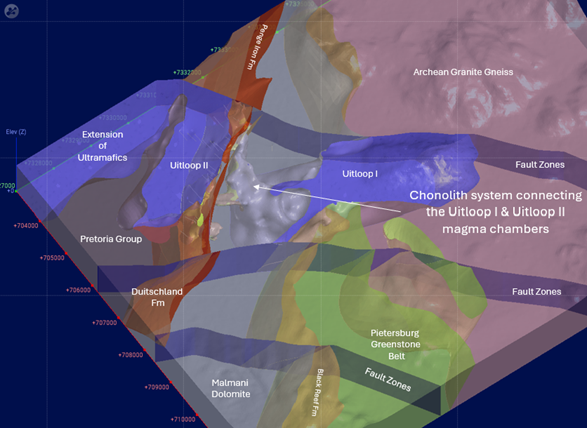
Figure 1a: 3D Overview of the Leapfrog model illustrating the chonolith system connecting the Uitloop I body to the Uitloop II body.
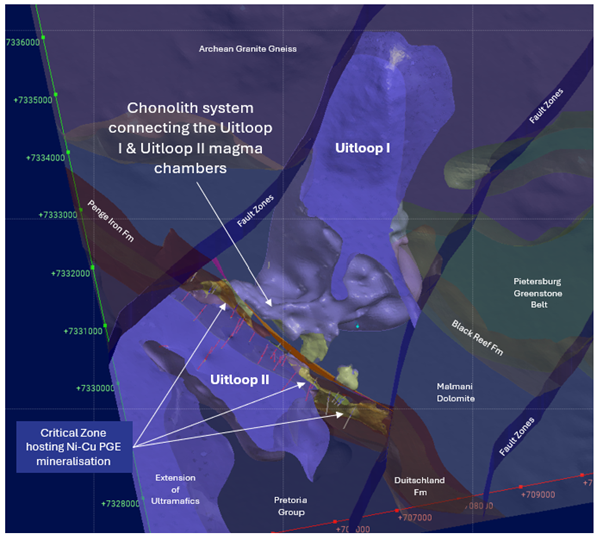
Figure 1b: Overview of the Leapfrog model illustrating the chonolith system connecting the Uitloop I body to the Uitloop II body, as well as the location of the interpreted Critical Zone rocks that host the Ni-Cu-PGE mineralisation
Zone 2 Higher-Grade Ni-Cu-PGE Mineralised Envelope
Atticus is now using the existing drill hole assay data to construct a three-dimensional mineralised envelope through the known Zone 2 Critical Zone mineralisation.
This envelope will be compared directly with the airborne and ground EM responses to determine how closely the geometry of the known mineralisation follows the conductive signature.
If that relationship can be traced beyond the existing drilling, it should allow future drill holes to be positioned more efficiently along the interpreted mineralised corridor.
The Company's objective is to use this work to target extensions of the higher-grade Zone 2 mineralisation and progressively build sufficient geological and drilling information to support a maiden mineral resource estimate for Zone 2, subject to the results of future drilling and the requirements of applicable mineral resource reporting standards.
Massive Sulphide Target
The model also provides a clearer view of the interpreted chonolith system linking the Uitloop I and Uitloop II ultramafic bodies and the fault architecture controlling the intrusive system, which relates to a second key exploration objective targeting massive sulphides.
A particularly important feature of the geological model is the SpectremPlus™ airborne EM anomaly, which was subsequently refined by the ground-based geophysical programme as Target 1.
Target 1 comprises a discrete EM conductor coincident with a gravity anomaly and is located at the interpreted transition between the chonolith extending from the Uitloop II body and a substantially larger intrusive body interpreted from the magnetic and gravity datasets. The location of this conductor sits in a particularly compelling geological position.
In magmatic sulphide systems, changes in conduit geometry and magma flow can create favourable locations for sulphide segregation and accumulation. The widening of a narrower magma conduit into a larger intrusive body may result in changes in magma velocity and flow dynamics, providing a potential physical mechanism for the concentration of dense sulphide liquid.
The position of Target 1 is therefore considered highly prospective, particularly given its relationship to the broader Critical Zone mineralised corridor and nearby semi-massive sulphide intersections.
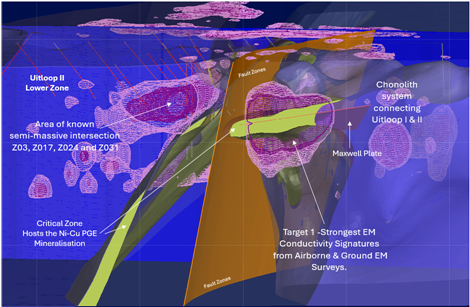
Figure 2: Leapfrog 3D geological and geophysical model showing the interpreted chonolith system between Uitloop I and Uitloop II, Critical Zone Ni-Cu-PGE mineralisation, known semi-massive sulphide intersections, and the coincident airborne and ground EM response at Target 1. The Maxwell plate is shown within the strongest conductivity response adjacent to the interpreted conduit system.
Next steps
Atticus is now using the existing drill hole assay data to construct a 3D mineralised envelope through the known Zone 2 mineralisation.
This work will be compared directly with:
· the modelled Critical Zone geology;
· the SpectremPlus™ airborne EM responses;
· the ground FDEM data and Maxwell plate models;
· gravity and magnetic interpretations; and
· the broader 3D intrusive architecture.
The Company's geological team will then work with Atticus to finalise and rank proposed drill holes.
The next drill programme is expected to have two clear objectives:
· to target extensions of the higher-grade Zone 2 Critical Zone Ni-Cu-PGE mineralisation, with the aim of building towards a maiden Zone 2 mineral resource; and
· to test Ground FDEM Target 1 for a concentration of semi-massive to massive Ni-Cu-PGE sulphides at the interpreted conduit-to-chamber transition.
The final drill programme will be prioritised within the Company's available exploration budget.
The Company expects to provide a further update once the integrated mineralised envelope and proposed drill programme have been completed.
Richard Montjoie, Exploration Manager of URU Metals, commented:
"Zeb is really starting to come together properly in 3D. We can now see the strongest EM responses sitting in the same geological corridor as the Critical Zone and the semi-massive sulphides we have already intersected.
What is particularly interesting is Target 1, where a discrete conductor sits at the point where the interpreted chonolith opens into the larger intrusive body. Geologically, that is exactly the sort of position we want to test for sulphide accumulation.
Atticus is now building the mineralised envelope from the drilling and comparing it directly with the airborne and ground EM. That should give us a much better way of targeting the next holes. We have two clear objectives: build the higher-grade Zone 2 mineralisation towards a maiden resource, and drill Target 1 to test whether the conductor represents a concentration of semi-massive to massive sulphides."
ENDS
For further information, please contact:
URU Metals Limited
John Zorbas
Chief Executive Officer
+1 416 504 3978
SP Angel Corporate Finance LLP
Nominated Adviser and Broker
Ewan Leggat / Caroline Rowe
+44 (0) 203 470 0470
Axis Capital Markets Limited
Joint Broker
Richard Hutchison
+44 (0) 203 026 0320
Market Abuse Regulation (MAR) Disclosure
This announcement contains inside information for the purposes of Article 7 of the Market Abuse Regulation (EU) No. 596/2014 as it forms part of United Kingdom domestic law by virtue of the European Union (Withdrawal) Act 2018 ("UK MAR"). Upon the publication of this announcement via a Regulatory Information Service, this inside information is now considered to be in the public domain.
RNS may use your IP address to confirm compliance with the terms and conditions, to analyse how you engage with the information contained in this communication, and to share such analysis on an anonymised basis with others as part of our commercial services. For further information about how RNS and the London Stock Exchange use the personal data you provide us, please see our Privacy Policy.

Latest directors dealings
- 10 minutes ago SSP Group
- 14 minutes ago Admiral Group
- 21 minutes ago TheWorks.Co.Uk
- 22 minutes ago Schroders Capital Global Innovation Trust
- 47 minutes ago Cohort