
Zeb Nickel Project 3D Modelling
Summary by AI BETAClose X

26 August 2026
URU Metals Limited
Zeb Nickel Project 3D Modelling Defines Higher-Grade Zone 2 Mineralisation Envelopes
URU Metals Limited ("URU" or the "Company") is pleased to provide a further update on the ongoing 3D geological modelling programme at the Zeb Nickel Project in Limpopo, South Africa.
Atticus Geoscience has now completed the first stage of 3D mineralisation modelling of the Project's Zone 2 Ni-Cu-PGE system using historical and recent drill hole data.
The modelling has defined multiple coherent PGE mineralisation envelopes within the Critical Zone rocks and has highlighted a well-developed higher-grade mineralised domain in the southeast of the Project, together with further mineralised zones extending along strike towards the northwest.
Highlights
· 3D modelling has defined multiple coherent PGE mineralisation envelopes within the Critical Zone-hosted Zone 2 Ni-Cu-PGE system.
· The mineralisation is hosted predominantly within the Critical Zone pyroxenitic package.
· The strongest and best-developed higher-grade mineralised domain occurs in the southeast of the Project area, where drilling density is also greatest.
· Additional higher-grade mineralised zones have been identified along strike towards the northwest.
· The apparent break in mineralisation through parts of the central area may reflect the historical drilling pattern, as several older boreholes terminated before reaching the Critical Zone.
· The geological setting and style of Zone 2 mineralisation are consistent with the broader Northern Limb Ni-Cu-PGE mineralising system represented by Ivanhoe Mines' Platreef Mine and Valterra Platinum's Mogalakwena Mining Complex.
· The higher-grade mineralisation lies close to the interpreted chonolith and conduit system between the Uitloop I and Uitloop II ultramafic bodies.
· This relationship provides an important exploration vector, as repeated magma flow through the interpreted plumbing system may have created favourable conditions for sulphide saturation and concentration of Ni-Cu-PGE mineralisation.
· Future drilling will initially focus on the better-developed higher-grade areas in the southeast, with the aim of generating sufficient drilling to support a maiden mineral resource for Zone 2.
· Subsequent step-out drilling will test the central area and the possible continuity between the southeastern and northwestern mineralised domains.
· Ground FDEM Target 1 remains a separate high-priority drill target for semi-massive to massive sulphides within the interpreted chonolith system.
Zone 2 Mineralisation Model
Atticus has used the available Pt, Pd and Rh assay data to construct three-dimensional mineralisation envelopes through the Zone 2 Critical Zone.
For modelling purposes, a 3PGE grade of 0.08 g/t Pt+Pd+Rh was used to define the broader mineralised envelope, while 0.5 g/t 3PGE was used to identify the higher-grade mineralised population. These thresholds are modelling parameters and are not mineral resource cut-off grades.
The resulting model shows that Zone 2 mineralisation is concentrated predominantly within the Critical Zone pyroxenitic package and associated Marginal Facies.
The higher-grade mineralisation is best developed in the southeastern part of the Project, where the current drilling density is greatest. Additional higher-grade mineralised areas occur along strike towards the northwest.
Importantly, the apparent reduction in mineralisation through parts of the central area may not represent a genuine geological break. Several historical boreholes in this area terminated before reaching the interpreted Critical Zone, leaving a material portion of the prospective horizon effectively untested.
The southeastern area also contains the highest PGE grades currently represented in the model, with drilling having intersected grades of up to approximately 6 g/t 3PGE+Au.
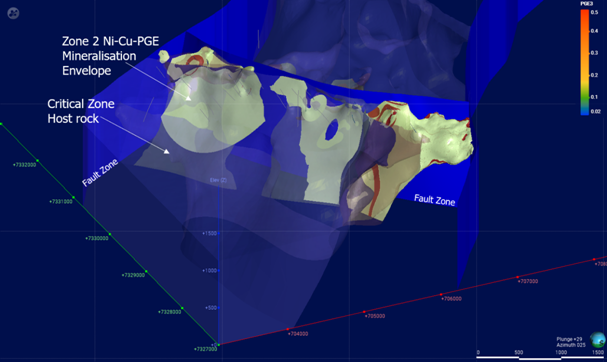
Figure 1: PGE mineralisation envelopes within the Critical Zone rocks.
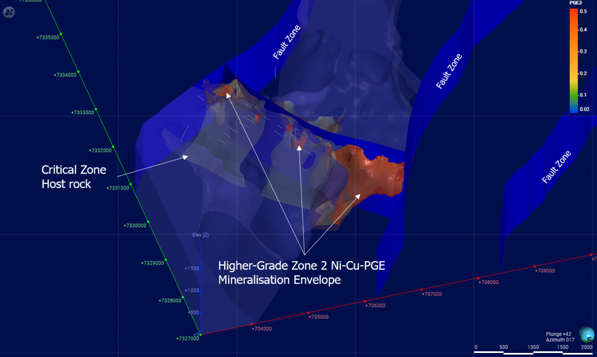
Figure 2: PGE mineralisation envelopes within the Critical Zone rocks, showing a well-developed higher-grade mineralised domain in the southeastern part of the Project area.
Northern Limb Context
The style of Zone 2 mineralisation being modelled at Zeb is consistent with the broader Ni-Cu-PGE mineralising environment of the Northern Limb of the Bushveld Complex.
Approximately the same regional geological package hosts Ivanhoe Mines' Platreef deposit and Valterra Platinum's Mogalakwena Mining Complex, both of which contain substantial PGM mineralisation with associated nickel and copper within thick, pyroxenite-rich intrusive sequences.
Ivanhoe describes the Platreef mineralised sequence as comprising norite, pyroxenite and harzburgite, with its principal mineralised units correlated with the Upper Critical Zone of the Bushveld Complex. At Mogalakwena, Valterra describes the Platreef as a thick, heterogeneous mafic package dominated by pyroxenite and norite, with significant nickel and copper associated with the PGM mineralisation.
URU has previously highlighted the similarity between these Northern Limb mineralisation styles and the Critical Zone-hosted Ni-Cu-PGE mineralisation intersected at Zeb. The new 3D modelling strengthens this interpretation by demonstrating coherent mineralised envelopes within the Critical Zone pyroxenitic package rather than isolated mineralised drill intersections.
Relationship to the Chonolith System
A further important outcome of the modelling is the spatial relationship between the higher-grade Zone 2 mineralisation and the interpreted chonolith and conduit system between the Uitloop I and Uitloop II ultramafic bodies.
The higher-grade mineralised envelopes occur relatively close to these interpreted intrusive conduits.
This is consistent with the Company's broader geological model for Zeb. Repeated or sustained magma flow through a chonolith-style plumbing system may have promoted sulphide saturation and provided favourable conditions for the development and concentration of Ni-Cu-PGE mineralisation.
The relationship between the mineralised envelopes and the interpreted plumbing system gives the Company an additional geological vector for future drilling and will be considered together with the airborne and ground EM responses, gravity and magnetic data and the 3D intrusive model.
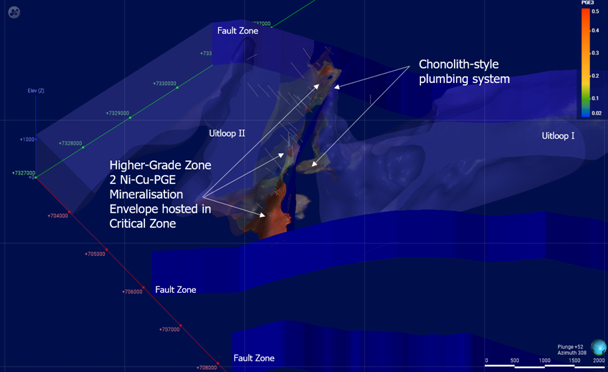
Figure 3: Spatial relationship between the higher-grade Zone 2 mineralisation and the interpreted chonolith and conduit system connecting the Uitloop I and Uitloop II ultramafic bodies.
Building Towards a Maiden Zone 2 Resource
The completed mineralisation model gives the Company a much clearer basis for planning the next phase of drilling.
Initial drilling will focus on the better-developed higher-grade southeastern mineralised domain, where the objective will be to increase drill density and test extensions to the known mineralisation.
The Company intends to use this work to build sufficient geological continuity and drilling density to support a maiden mineral resource estimate for Zone 2.
Further step-out drilling will then test the central area between the southeastern and northwestern mineralised zones. This work will determine whether the currently modelled domains are separate bodies or parts of a more continuous Critical Zone mineralised system that has simply not been adequately tested by the historical drilling.
Ground FDEM Target 1 remains a separate high-priority exploration target. The discrete conductor sits within the interpreted chonolith system at a favourable change in intrusive geometry and will be tested for a possible concentration of semi-massive to massive Ni-Cu-PGE sulphides.
The Company's geological team will now use the completed mineralisation model, together with the airborne and ground EM, gravity and magnetic datasets, to finalise and rank the proposed drill holes within the available exploration budget.
Richard Montjoie, Exploration Manager of URU Metals, commented:
"Simon's work has now given us a proper 3D view of where the Zone 2 mineralisation sits and, importantly, where the higher-grade parts of the system are developing.
The southeast is clearly the most advanced area and gives us a sensible place to start building towards a maiden Zone 2 resource. We are also seeing mineralisation continuing along strike to the northwest, while much of the ground in between has simply not been properly tested because a number of the historical holes stopped short.
The Critical Zone setting is also important. This is the same broad geological environment that hosts the Ni-Cu-PGE mineralisation at Ivanhoe's Platreef and Valterra's Mogalakwena operations nearby. We have talked about that relationship for some time, but the Leapfrog work is now allowing us to see the geometry of the Zeb mineralisation properly in three dimensions.
The fact that the higher-grade envelopes also sit close to the interpreted chonolith system fits well with our geological model and gives us another vector for drilling. We now have a much clearer strategy: build out the higher-grade Zone 2 mineralisation towards a maiden resource, test whether those mineralised areas connect through the central gap, and drill Target 1 for the more concentrated sulphide target."
ENDS
For further information, please contact:
URU Metals Limited
John Zorbas
Chief Executive Officer
+1 416 504 3978
SP Angel Corporate Finance LLP
Nominated Adviser and Broker
Ewan Leggat / Caroline Rowe
+44 (0) 203 470 0470
Axis Capital Markets Limited
Joint Broker
Richard Hutchison
+44 (0) 203 026 0320
Market Abuse Regulation (MAR) Disclosure
This announcement contains inside information for the purposes of Article 7 of the Market Abuse Regulation (EU) No. 596/2014 as it forms part of United Kingdom domestic law by virtue of the European Union (Withdrawal) Act 2018 ("UK MAR"). Upon the publication of this announcement via a Regulatory Information Service, this inside information is now considered to be in the public domain.
RNS may use your IP address to confirm compliance with the terms and conditions, to analyse how you engage with the information contained in this communication, and to share such analysis on an anonymised basis with others as part of our commercial services. For further information about how RNS and the London Stock Exchange use the personal data you provide us, please see our Privacy Policy.

Latest directors dealings
- 15 hours ago DCC Energy PLC
- 15 hours ago On The Beach Group
- 17 hours ago Canal+ SA
- 17 hours ago Galliford Try
- 18 hours ago SSE