
Leapfrog Model Completed
Summary by AI BETAClose X

07 September 2026
URU Metals Limited
("URU" or the "Company")
Zeb Nickel Project
Leapfrog Model Completed and Resource Drill Programme Defined
URU Metals Limited ("URU" or the "Company") is pleased to announce that the updated Leapfrog three-dimensional geological model for the Zeb Nickel Project ("Project") in Limpopo, South Africa has been completed, and that the model has been used to define, position and rank the Company's next drill programme.
The modelling was carried out by Atticus Geoscience Consulting and builds on the geological and geophysical interpretation announced on 11 August 2026 and the first-stage Zone 2 mineralisation modelling announced on 26 August 2026. The completed model integrates the Project's drill hole database and geological interpretation with the airborne magnetic, gravity and SpectremPlus™ electromagnetic ("EM") datasets, together with the recently completed ground frequency-domain electromagnetic ("FDEM") and gravity surveys. It now also includes a three-dimensional mineralised envelope constructed through the Zone 2 Ni-Cu-PGE mineralisation from the existing drill hole assay data.
The drill programme arising from this work has two primary objectives: to define a maiden Mineral Resource on the Zone 2 Ni-Cu-PGE mineralisation, and to drill test Target 1, the most prominent coincident geophysical anomaly on the Project. The holes drilled for the Zone 2 resource have also been designed to test the down-dip extension of the Ni-Cu-PGE mineralisation.
Highlights
· The updated Leapfrog 3D model has been completed and used to position, orientate and rank the holes in the next drill programme.
· The model supports the interpretation of Zone 2 as a coherent, laterally continuous Ni-Cu-PGE horizon hosted in rocks interpreted to belong to the Critical Zone of the Bushveld Complex, rather than a series of isolated intersections.
· The Zone 2 mineralised envelope built from the existing assay data is spatially consistent with the modelled Critical Zone geology and remains open down dip.
· The model indicates that a number of apparent gaps in the Zone 2 horizon correspond to positions where historical holes terminated above the target lithologies, rather than to an absence of mineralisation.
· The primary objective of the programme is to define a maiden Mineral Resource on the Zone 2 Ni-Cu-PGE mineralisation.
· Resource holes are collared in pairs, one shallower, one steeper, from shared drill pads at a nominal spacing of approximately 150-200 m apart, so that each pad tests both the sub-crop position and the down-dip extension of the mineralisation.
· The second objective is to drill test Target 1, a discrete EM conductor coincident with a gravity and magnetic anomaly, located at the interpreted transition where the chonolith opens into a substantially larger intrusive body, a setting considered favourable for the accumulation of magmatic sulphides.
· Target 1 lies within the same geological corridor as the Project's known semi-massive sulphide intersections in drill holes Z017, Z024 and Z031.
The Completed 3D Model
The completed model resolves the Project's geology, drilling and geophysics into a single three-dimensional framework. Four outcomes are material to the Company's exploration strategy.
First, the model supports the chonolith interpretation. The intrusive system linking the Uitloop I and Uitloop II ultramafic bodies is modelled as a coherent body whose geometry is controlled by two intersecting fault sets. This is the magmatic plumbing system the Company has described previously, now defined in three dimensions rather than inferred from surface mapping and geophysical response alone.
Second, the model defines the host of the Zone 2 mineralisation. The Ni-Cu-PGE mineralisation sits within rocks interpreted to belong to the Critical Zone, and those rocks are modelled as a continuous package that can be followed between drill holes and projected down dip. The mineralised envelope constructed from the assay data follows that package closely.
Third, the model offers an explanation for the patchy representation of Zone 2 in the historical drill hole database. Several apparent gaps in the Critical Zone correspond to positions where historical holes terminated above the target lithologies. A structural or basement control on some of these gaps cannot be excluded on the data currently available, and the drill programme has been designed to test this directly. The practical implication is that Zone 2 is under-drilled rather than discontinuous.
Fourth, the model places Target 1 in geological context. The strongest airborne and ground EM responses fall within the same corridor as the semi-massive sulphide intersections in drill holes Z017, Z024 and Z031, and the modelled conductor plate sits adjacent to the interpreted conduit at the point where it opens into a larger intrusive body.
Zone 2 - Maiden Mineral Resource
The primary objective of the drill programme is to define a maiden Mineral Resource on the Zone 2 Ni-Cu-PGE mineralisation.
Zone 2 is the higher-grade Ni-Cu-PGE horizon hosted in pyroxenitic lithologies and is interpreted to represent the same stratigraphic interval being developed at Ivanhoe Mines' Platreef Project and mined at Valterra Platinum's Mogalakwena operations. This is a geological comparison only and does not imply that similar grades, widths or economics will be established at Zeb. Zone 2 has been intersected in drilling over more than 3.5 km of strike and lies largely in a sub-crop position beneath the Transvaal sediments and the Lower Zone rocks that host the Zone 1 nickel mineralisation.
The resource holes have been laid out on the modelled mineralised envelope at a nominal spacing of approximately 150-200 m. Collar positions, azimuths, dips and target depths have been set against the modelled geometry of the horizon rather than against a nominal grid, with the objective of producing a drill hole database of sufficient density and confidence to support an Inferred Mineral Resource estimate.
Sampling and QAQC protocols, density determinations and independent laboratory analysis have been built into the programme from the outset so that the data collected is fit for resource estimation. The Company intends to appoint an appropriately qualified independent consultant to prepare and sign off the Mineral Resource estimate.
Testing the Down-Dip Extension
Zone 2 is open down dip. The mineralised envelope in the completed model terminates at the limit of the existing drilling, not at a geological boundary.
The resource holes have therefore been collared in pairs from shared drill pads. From each pad, a shallower hole tests the sub-crop position of the horizon, and a steeper hole is drilled through the same position and extended to test the down-dip continuation. This configuration delivers two intersections from each pad, reduces pad establishment and land access requirements, and allows the Company to build the resource and test the depth extension of the system in a single pass.
Target 1 - Testing the Conduit for Massive Sulphides
The second objective of the programme is to drill test Target 1.
Target 1 was first identified in the SpectremPlus™ airborne EM survey and subsequently refined by the ground FDEM and gravity programme as a discrete conductor coincident with a gravity anomaly. In the completed model it sits at the interpreted transition where the chonolith extending from the Uitloop II body opens into a substantially larger intrusive body mapped from the magnetic and gravity datasets.
In magmatic sulphide systems, a change in conduit geometry of this kind can alter magma velocity and flow dynamics, providing a physical mechanism for dense sulphide liquid to segregate and accumulate. Target 1 is therefore being tested for a concentration of semi-massive to massive Ni-Cu-PGE sulphides, the mineralisation style the Company describes as Zone 3. Previous drilling has already demonstrated that this style occurs on the Project, most notably in drill hole Z017, which returned 2.25 m at 1.67% Ni with associated copper and PGE values.
Target 1 will be tested by a fan of holes drilled from a single pad on differing azimuths, so that the modelled conductor is intersected from more than one direction. A second, lower-ranked conductive target within the intrusive system is also carried in the programme and will be tested alongside Target 1.
Additional Value from the Programme
The programme has been designed to generate value beyond its two primary objectives.
The mineralised horizons at Zeb are vertically stacked. Zone 1, the large, lower-grade nickel sulphide body defined by historical drilling, outcrops at surface, with Zone 2 occurring beneath it. The two are generally separated by a xenolith horizon which in places is interpreted to host the Zone 3 semi-massive to massive sulphide style. Holes drilled to Zone 2 therefore pass through Zone 1 and through that xenolith horizon and will contribute to future Mineral Resource estimation work on Zone 1 and provide further tests of the Zone 3 style without additional drilling metres.
Holes in the northern and southern part of the programme will also pass through the Zone 4 gold sub-crop, where earlier drilling returned gold intersections interpreted to be associated with remobilisation from the adjacent Pietersburg Greenstone Belt.
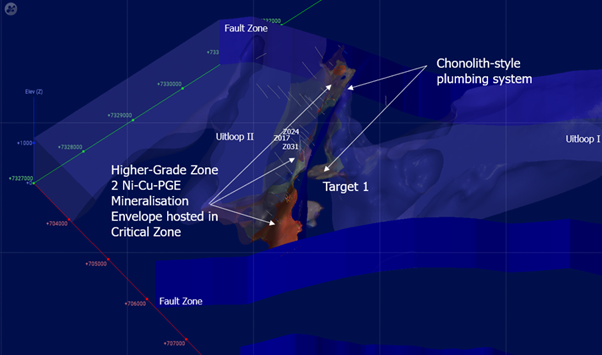
Figure 1: Completed Leapfrog 3D model showing the chonolith system connecting the Uitloop I and Uitloop II ultramafic bodies, the bounding fault architecture, and the position of the interpreted Critical Zone rocks that host the Zone 2 Ni-Cu-PGE mineralisation. The airborne and ground EM conductivity response at Target 1, and the positions of the known semi-massive sulphide intersections in drill holes Z017, Z024 and Z031.
Next Steps
· Finalisation of the drilling contractor appointment and land access agreements.
· Survey of final collar positions.
· Mobilisation and commencement of drilling.
· Progressive reporting of assay results and resource modelling as data is received.
The Company will update the market on the appointment of the drilling contractor and the anticipated commencement date for drilling.
Richard Montjoie, Exploration Manager of URU Metals, commented:
"The model has done what we asked of it. The geology, the drilling and the geophysics are now in one place, and the holes have been positioned against real geological volumes rather than against stand-alone anomalies.
Two things stand out. The first is that Zone 2 looks like a continuous horizon, and a good part of the reason it looks patchy in the historical database is that the older holes simply stopped before they reached it. That is a very different problem to a discontinuous orebody. The second is that Zone 2 is still open down dip, which is why we have paired the resource holes - we can build the resource and test the depth extension at the same time.
Target 1 is the other half of the programme. A discrete conductor, coincident with a gravity high, sitting where the conduit opens into a much larger body is exactly where you would look for accumulated sulphide. Z017 has already shown us that semi-massive to massive sulphide is present on this property. Target 1 is the first proper test of whether it has accumulated in the conduit."
John Zorbas, Chief Executive Officer of URU Metals, commented:
"The objective of this programme is a maiden Mineral Resource on Zone 2 and a first drill test of Target 1. Either outcome would change how this asset is understood; both together would change how it is valued and funded.
The programme has been staged by priority so that the resource drilling and Target 1 come first. We will update shareholders on the contractor appointment and start dates in due course."
About the Company
URU Metals is a mineral exploration and development company focused on advancing high-potential critical metals projects in South Africa. The Company is committed to creating sustainable value through responsible mining practices, regulatory compliance, and active stakeholder engagement. For more information, visit www.urumetals.com
Competent Person Statement
The technical information contained in this announcement has been reviewed by Richard Montjoie, Exploration Manager of URU Metals Limited. Mr Montjoie is a registered member of the South African Council for Natural Scientific Professions, membership number 400131/09. Mr Montjoie holds an M.Sc. in Economic Geology from the University of the Witwatersrand, South Africa, and is a Fellow of the Geological Society of South Africa. Mr Montjoie is not independent of the Company.
ENDS
For further information, please contact:
URU Metals Limited
John Zorbas
Chief Executive Officer
+1 416 504 3978
SP Angel Corporate Finance LLP
Nominated Adviser and Broker
Ewan Leggat / Caroline Rowe
+44 (0) 203 470 0470
Axis Capital Markets Limited
Joint Broker
Richard Hutchison
+44 (0) 203 026 0320
Market Abuse Regulation (MAR) Disclosure
This announcement contains inside information for the purposes of Article 7 of the Market Abuse Regulation (EU) No. 596/2014 as it forms part of United Kingdom domestic law by virtue of the European Union (Withdrawal) Act 2018 ("UK MAR"). Upon the publication of this announcement via a Regulatory Information Service, this inside information is now considered to be in the public domain.
RNS may use your IP address to confirm compliance with the terms and conditions, to analyse how you engage with the information contained in this communication, and to share such analysis on an anonymised basis with others as part of our commercial services. For further information about how RNS and the London Stock Exchange use the personal data you provide us, please see our Privacy Policy.

Latest directors dealings
- 27 minutes ago Octopus Apollo VCT
- 53 minutes ago Cranswick
- 1 hour ago Filtronic
- 1 hour ago Personal Assets Trust
- 1 hour ago Personal Assets Trust