
Final Results
Summary by AI BETAClose X


Unicorn Mineral Resources Plc
("Unicorn" or "the Company")
3 August 2026
Results for the year ended 31 March 2026
Unicorn Mineral Resources Plc (LSE: UMR), a mineral exploration and development company based in Ireland and exploring for zinc, lead, copper and silver, is pleased to announce its audited annual results for the year ended 31 March 2026.
The Annual Report and Financial Statements for the year ended 31 March 2026 will shortly be available on the Company's website at www.UnicornMineralResources.com and will also be available on the National Storage Mechanism website at: https://data.fca.org.uk/#/nsm/nationalstoragemechanism.
The Directors of Unicorn are responsible for the contents of this announcement.
This announcement contains information which, prior to its disclosure, was inside information as stipulated under Regulation 11 of the Market Abuse (Amendment) (EU Exit) Regulations 2019/310 (as amended).
For further information, please visit www.UnicornMineralResources.com or contact:
|
Unicorn Mineral Resources Plc John O'Connor, CFO Tel: +353 (0)86 259 5123 Email: John.OConnor@UMR.ie
|
AlbR Capital Limited Financial Adviser and Broker David Coffman / Daniel Harris Colin Rowbury Tel: +44 (0)20 7469 0903
|
|
focusIr Katrina Perez / Paul Cornelius Tel: +44 7881 622830 Email: UMR@focusir.com
|
|
 CHAIRMAN'S STATEMENT
The Namibian project took up a lot of our time during the year. We focused a lot of attention on the acquisition of the copper mine at Klein Aub while continuing work on our other Irish prospects. The Klein Aub mine has three prospective areas, the abandoned underground workings, the tailings heaps from previous mining, and the copper on surface along strike. The Company identified the copper and silver in the tailings as a relatively immediate revenue source. While the negotiations with several parties continued, our metallurgy team carried out extensive testing on the viability of economically extracting copper from the tailings. The initial results concentrating the ore were not encouraging, but when we engaged Draslovka and their Glycine Leaching Technology rapid progress was made. Glycine has the added advantage of being a green solution, with minimal effect on the environment.
Armed with this method we were confident that an economic case for extracting the copper would be established and the work being carried out presently is to maximise this process. The Board is aware that the due diligence of the extraction process took longer than previously planned, but the belief that Klein Aub could be the first of many similar projects in Namibia kept us searching for a solution.
The negotiations with the current owners were hampered by a takeover of one of the shareholders, but these came back on track and an agreement was reached for the Company to buy 75% of the project. Work was also successfully carried on to cater for the relationship between the Company and the remaining local minority shareholders.
These agreements are due to be signed imminently.
Whilst work was carried out at in Namibia, the Company was also progressing with both Lisheen and Kilmallock at home.
The gravity survey at Lisheen was sent for 3D modelling, which confirmed the presence of four anomalies extending eastwards towards the Galmoy mine, which is being reopened by Shanoon Resources Limited in 2026. We have taken our consultants advice to carry out infill gravity surveying to enable the Company to more accurately plan the next steps.
After the success of the 3D modelling above, the Company carried out 3D modelling on the previously received gravity results at Kilmallock. This confirmed the five anomalies already identified and also a sixth anomaly on the edge of the survey, closer to Group Eleven Resource Corp's Ballywire lead/zinc prospect, which continues to produce very encouraging results. A further infill gravity survey is being carried out at Kilmallock for more accurate detail before a drilling programme may be drawn up.
Exploration is not an exact science but, with the global direction of travel towards a low carbon economy meaning that demand for copper and zinc is unlikely to decrease, we are focused on high value resources with the potential for strong shareholder returns
Paddy Doherty
Chairman
HIGHLIGHTS
Operating Highlights
· A gravity survey was carried out on two licences at Lisheen to extend the data already in our possession. The third licence in Lisheen was surrendered as previously announced.
· 3D modelling on the Lisheen gravity data has shown a series of four interesting anomalies close to the Galmoy zinc mine which are previously untested.
· Further infill gravity testing is planned to follow up for more detailed data.
· 3D modelling on the previous gravity survey at Kilmallock confirmed the five untested anomalies along the fault, as well as a sixth on the edge of the survey.
· Further gravity surveying is ongoing to the east of the previous survey on the sixth anomaly and to infill on the previous data.
· The Company continued due diligence on its targeted copper project at Klein Aub in Namibia, and successfully identified an economic process to release the copper in the tailings. Testing is continuing to hone this method to maximise the returns.
Financial Highlights
· The loss for the year to 31 March 2026 was €598,428 (2025: €467,280); consisting mainly of the professional fees, project costs, insurance, London Stock Exchange fees and salaries.
· Exploration costs during the year were €11,330 (2025: €55,016), which have been capitalised
· Funds raised during the year amounted to €nil (2025: €425,712)
· €171,468 in cash and cash equivalents at 31 March 2026 (31 March 2025: €586,898)
· €436,974 carrying value of intangible assets at 31 March 2026 (31 March 2025: €425,644)
· Loss per share for the year was 1.46 cents (2025: 1.28 cents)
OPERATING REVIEW
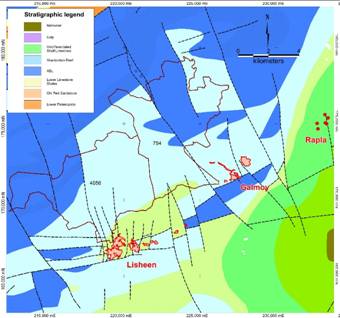
· During 2025 a technical / strategic review was carried out on the three licence Lisheen Block. This review concluded that one of the three licences was not prospective, due to the volume of historic work and limited extent of the untested main target horizon. Accordingly, PL 2447 was surrendered and exploration activity was carried out on remaining PL's, 754 and 4056 (Figure 1) to meet the Minimum Expenditure Requirements to keep the licences in good standing with the regulator.
· The Lisheen Block is located immediately adjacent to the north of the Lisheen Deposit, 22.0Mt grading 13.4% Zn + Pb (Geodata.gov.ie), and immediately along strike to the west of the Galmoy Deposit 9.4Mt grading 16% Zn + Pb (Geodata.gov.ie). The Lisheen Block is c. 75% underlain by prospective Waulsortian Reef. The Galmoy mine is currently in the process of being reopened by Shanoon, and it is anticipated it will be in production by the end of 2026.
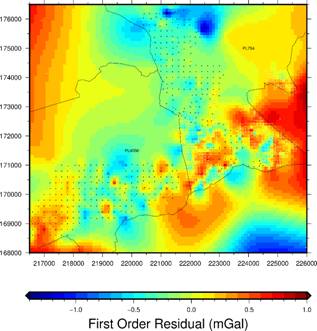
· In 2025 a gravity survey was completed across PL's 754 and 4056. It was designed to extend the historic coverage, and test areas underlain by the main target horizon, the base of the Waulsortian Reef. Experience from other parts of the Irish Midlands Orefield indicated that gravity surveying was the most appropriate geophysical tool in this environment. Primarily because it is not susceptible to cultural interference and it provides excellent data for definition and refinement of the geological / structural model for the area. Given the target depth across the Lisheen Block is generally less than 300m gravity surveying also offers the possibility of directly detecting density anomalies associated with thick, massive sulphide mineralisation. The gravity data acquired by UMR clearly showed a series of significant anomalous responses located in prospective areas along strike from the Galmoy Deposit and up dip from the Lisheen deposit.
|
Figure 1:Lisheen Block Geological Setting
|
Figure 2: Lisheen Gravity - Residual |
|
Figure 3: Lisheen 3D Inversion - Density Anomalies 300m depth slice |
|
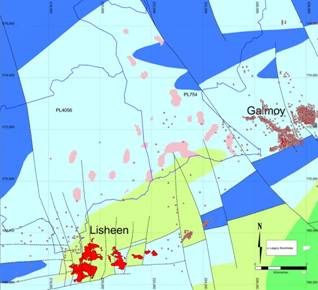
· A 3D model was generated based upon the inversion of the new and historic gravity data for the Lisheen Block. The rationale for this work was partially based upon the successful targeting of massive sulphide mineralisation by Group Eleven Resources at their Ballywire project in County Limerick using modelled gravity. They have identified a series of high density anomalies coincident with known Pb-Zn sulphide mineralisation. A drilling programme was focused along strike and on the flanks of the density features. The drilling programme has intersected robust mineralisation over a 2.6km strike length along a prospective trend of over 6km and it lies just 8km along strike to the east of Unicorn's Kilmallock Block.
· The 3D modelling of the gravity data maps out zones of higher and lower density that can be used to model geological and structural features (e.g. faults) associated with mineralisation. In this way, the 3D density model is a useful tool to delineate geological structure, to identify drilling targets and to guide exploration. Horizontal slices are taken through the 3D model (Figure 3) and plotted with respect to the current geological and structural model, and the historic drilling data. Surprisingly, most of the anomalous zones identified by this work have not been drill tested by the historic drilling programmes.
· 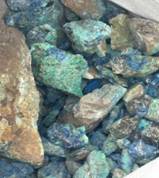 A major focus for the year was the continued investigation of a number of opportunities in Africa to broaden the Company's portfolio of licences, with particular attention being paid to projects that had the potential to generate cash flow in the short to medium term. Efforts continued to be focused on copper opportunities in Namibia. Technical due diligence work was carried out at the Klein Aub deposit in south central Namibia.
· Assessment of the project found there were three main opportunities to develop an economic copper extraction project. Firstly, there are some primary resources remaining in the old mine, secondly there are significant quantities of processed copper rich material (Tailings and Slimes) on surface, and finally there is primary copper mineralisation (Figure 4 & 5) outcropping along strike, with the potential for shallow open pitable resources. Evaluation indicates that the fastest route to commencing an economic project is to develop the tailings and slimes. Evaluation of these resources found that there were some technical challenges relating to the mineralogical nature of the material, but UMR has been working with Draslovka and other global expert partners and have developed a solution to the technical challenges that has responded well in testing and is expected to be the way forward for this project. A pilot plant and phase of bulk testing will take place in the summer of 2026 before an application for a mining licence is submitted.
|
Figure 4 and 5: Copper mineralisation observed along strike from Klein Aub |
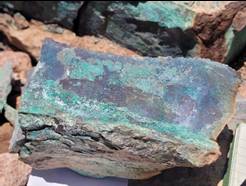
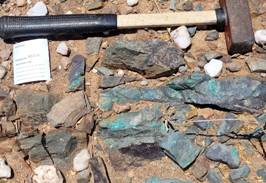
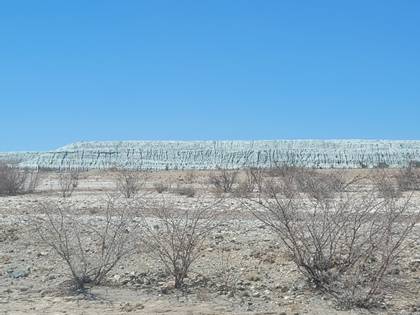
Figure 6: Tailings Facility
FINANCIAL RESULTS AND REVIEW
The loss for the year to 31 March 2026 was €598,428 (2025: €467,280). There was no income during the year and the administrative expenses consisted mainly of Professional Fees of €192,314 (2025: €178,770) and Directors' Remuneration of €221,541 (2025: €241,568). Further details are set out in the Remuneration Report on pages 38-39. The Company also incurred costs of €117,571 (2025: €54,002) for the investigation of a number of opportunities in Namibia in Southwest Africa.
During the year, the Company continued to review and develop its mineral projects in Ireland with exploration costs of €11,330 being incurred in relation to the two gravity surveys carried out in the year. These have been capitalised. As of 31 March 2026, the company's exploration assets had a net book value of €436,974 (2025: €425,644).
As of 31 March 2026, the Company had cash of €171,468 (2025: €586,898). As of 2 August 2026, the Company had cash of €134,084.
STATEMENT OF PROFIT OR LOSS
|
|
|
Year to 31 March 2026 |
|
Year to 31 March 2025 (restated) |
|
|
Note |
€ |
|
€ |
|
Administrative Expenses |
8 |
(646,197) |
|
(628,605) |
|
|
|
|
|
|
|
Loss from Operations |
|
(646,197) |
|
(628,605) |
|
FV gain on share warrants |
19 |
47,769 |
|
161,325 |
|
|
|
|
|
|
|
Loss before Tax |
|
(598,428) |
|
(467,280) |
|
Tax Expense |
|
- |
|
- |
|
|
|
|
|
|
|
Loss for the Year |
|
(598,428) |
|
(467,280) |
|
|
|
|
|
|
|
|
|
|
|
|
|
Earnings per share attributable to ordinary equity holders of the company |
|
|
||
|
|
|
cents |
|
cents |
|
Profit/(Loss) per share - Basic |
13 |
(1.46) |
|
(1.28) |
|
Profit/(Loss) per share -Diluted |
13 |
(1.46) |
|
(1.28) |
STATEMENT OF OTHER COMPREHENSIVE INCOME
|
|
|
Year to 31 March 2026 |
|
Year to 31 March 2025 (restated) |
|
|
Note |
€ |
|
€ |
|
Loss for the year |
|
(598,428) |
|
(467,280) |
|
|
|
|
|
|
|
|
|
|
|
|
|
|
|
|
|
|
|
|
|
|
|
|
|
Total Comprehensive Loss for the year |
|
(598,428) |
|
(467,280) |
STATEMENT OF FINANCIAL POSITION
|
|
|
As at 31 March 2026 |
|
As at 31 March 2025 (restated) |
|
As at 1 April 2024 (restated) |
|
|
Note |
€ |
|
€ |
|
€ |
|
Assets |
|
|
|
|
|
|
|
|
|
|
|
|
|
|
|
Non-current assets |
|
|
|
|
|
|
|
Intangible assets |
14 |
436,974 |
|
425,644 |
|
382,628 |
|
|
|
436,974 |
|
425,644 |
|
382,628 |
|
Current assets |
|
|
|
|
|
|
|
Trade and other receivables |
15 |
36,801 |
|
42,228 |
|
72,858 |
|
Cash and cash equivalents |
20 |
171,468 |
|
586,898 |
|
642,778 |
|
|
|
208,269 |
|
629,126 |
|
715,636 |
|
Total assets |
|
645,243 |
|
1,054,770 |
|
1,098,264 |
|
|
|
|
|
|
|
|
|
Current Liabilities |
|
|
|
|
|
|
|
Warrants & Options |
19 |
60,627 |
|
108,397 |
|
269,722 |
|
Trade and other liabilities |
16 |
565,833 |
|
329,163 |
|
169,764 |
|
Convertible Loan Notes |
|
- |
|
- |
|
271,159 |
|
|
|
626,460 |
|
437,560 |
|
710,645 |
|
Total liabilities |
|
626,460 |
|
437,560 |
|
710,645 |
|
Net assets |
|
18,784 |
|
617,211 |
|
387,619 |
|
|
|
|
|
|
|
|
|
Issued capital and reserves |
|
|
|
|
|
|
|
Share capital |
17 |
408,550 |
|
408,550 |
|
348,550 |
|
Share premium reserve |
17 |
2,948,641 |
|
2,948,641 |
|
2,311,769 |
|
Share based payments reserve |
19 |
413,591 |
|
413,591 |
|
413,591 |
|
Retained earnings |
|
(3,751,999) |
|
(3,153,571) |
|
(2,686,291) |
|
Total Equity |
|
18,784 |
|
617,211 |
|
387,619 |
The Financial Statements on pages 51 to 55 were approved and authorised for issue by the board of directors and were signed on its behalf by:
|
Paddy Doherty Director |
John O'Connor Director |
|
|
|
|
2 August 2026 |
|
STATEMENT OF CHANGES IN EQUITY
|
|
Share capital |
Share premium |
Share based payment reserve |
Other Reserves |
Retained earnings |
Total equity |
|
|
|
€ |
€ |
€ |
|
€ |
€ |
|
|
As at 1 April 2024 |
348,550 |
2,442,071 |
57,343 |
(102,099) |
(2,133,280) |
612,585 |
|
|
Prior period adjustment |
|
(130,302) |
356,248 |
102,099 |
(553,011) |
(224,966) |
|
|
At 1 April 2024 (restated) |
348,550 |
2,311,796 |
413,591 |
- |
(2,686,291) |
387,619 |
|
|
Comprehensive income for the year |
|
||||||
|
Loss for the year |
- |
- |
- |
|
(467,280) |
(467,280) |
|
|
Total comprehensive income for the year |
- |
- |
- |
|
(467,280) |
(467,280) |
|
|
Issue of share capital |
60,000 |
655,887 |
- |
|
- |
715,887 |
|
|
Share issue expenses |
- |
(19,015) |
- |
|
- |
(19,015) |
|
|
Total contributions by and distributions to owners |
60,000 |
636,872
|
- |
|
(467,280) |
229,592
|
|
|
At 31 March 2025 (restated) |
408,550 |
2,948,641 |
413,591 |
- |
(3,153,571) |
617,211 |
|
|
Comprehensive income for the year |
|||||||
|
Loss for the year |
|
|
|
|
(598,428) |
(598,428) |
|
|
Total comprehensive income for the year |
- |
- |
- |
|
(598,428) |
(598,428) |
|
|
At 31 March 2026 |
408,550 |
2,948,641 |
413,591 |
- |
(3,751,999) |
18,784 |
|
STATEMENT OF CASH FLOWS
|
|
|
Year to 31 March 2026 |
|
Year to 31 March 2025 (restated) |
|
|
Note |
€ |
|
€ |
|
Cash flows from operating activities |
|
|
|
|
|
Loss for the year |
|
(598,428) |
|
(467,280) |
|
Adjustments for |
|
|
|
|
|
Impairment losses on intangible assets |
14 |
- |
|
12,000 |
|
Fair value gain on warrants |
|
(47,769) |
|
(161,325) |
|
|
|
(646,197) |
|
(616,605) |
|
Movements in working capital |
|
|
|
|
|
Decrease/(increase) in trade and other receivables |
|
5,427 |
|
30,630 |
|
Increase in trade and other payables |
|
236,670 |
|
159,398 |
|
|
|
|
|
|
|
Cash used in operating activities |
|
(404,100) |
|
(426,576) |
|
|
|
|
|
|
|
Net cash used in operating activities |
|
(404,100) |
|
(426,576) |
|
|
|
|
|
|
|
Cash flows from investing activities |
|
|
|
|
|
Purchase of intangibles |
14 |
(11,330) |
|
(55,016) |
|
Net cash used in investing activities |
|
(11,330) |
|
(55,016) |
|
|
|
|
|
|
|
Cash flows from financing activities |
|
|
|
|
|
Issue of ordinary shares |
17 |
- |
|
425,712 |
|
|
|
|
|
|
|
Net cash from financing activities |
|
- |
|
425,712 |
|
|
|
|
|
|
|
Net cash (decrease)/increase in cash and cash equivalents |
|
(415,430) |
|
(55,880) |
|
|
|
|
|
|
|
Cash and cash equivalents at the start of the year |
|
586,898 |
|
642,778 |
|
Cash and cash equivalents at the end of the year |
20 |
171,468 |
|
586,898 |
|
|
|
|
|
|
NOTES TO THE FINANCIAL STATEMENTS
1. Reporting entity
Unicorn Mineral Resources PLC (the 'Company') is a public limited company incorporated and registered in Ireland. The Company's registered office is at 39 Castleyard, 20/21 St Patrick's Road, Dalkey, Co. Dublin. The Company's principal activity is set out in the Director's Report.
1.1 Basis of Preparation
The financial statements of Unicorn Mineral Resources plc (the "Company") have been prepared in accordance with International Financial Reporting Standards ("IFRS") as adopted by the European Union and the requirements of the Companies Act 2014.
The material accounting policies applied in the preparation of these financial statements are set out below. These policies have been applied consistently to all periods presented, unless otherwise stated.
The financial statements are presented in Euro (€), which is the Company's functional and presentation currency. Amounts are rounded to the nearest Euro, unless otherwise stated.
The preparation of financial statements in accordance with IFRS requires the use of certain accounting estimates and assumptions. It also requires the Directors to exercise judgement in applying the Company's accounting policies. The areas involving significant judgement or estimation uncertainty, including the assessment of the carrying value of exploration and evaluation assets, share-based payments, warrants and going concern, are disclosed in the relevant notes to the financial statements.
The financial statements have been prepared on a historical cost basis, except for financial instruments or other balances that are required to be measured at fair value under IFRS.
2. Accounting Policies
The accounting policies set out below have been applied consistently to all periods presented in these Financial Statements.
2.1. Going concern
The preparation of financial statements requires an assessment on the validity of the going concern assumption. The validity of the going concern concept is dependent on the Company having available adequate financial resources to continue operations for a period of at least 12 months from the date of approval of these financial statements, and thereafter finance being available for the continuing working capital requirements of the Company and finance for the development of the Company's projects becoming available. Based on the assumptions that the Company has adequate financial resources to continue operation and confidence that finance will become available, the Directors believe that the going concern basis is appropriate for these accounts. The Directors recognise that this is a material uncertainty which may cast significant doubt on the Company's ability to continue as a going concern and, should the Company be unable to raise the necessary finance when required, then the going concern basis would not be appropriate, and adjustments would have to be made to reduce the value of the company's assets, in particular the intangible assets, to their realisable values. Further information concerning going concern is outlined in Note 22.
2.2. Share Based Payments
The Company operates a share option scheme. For equity-settled share-based payment transactions (i.e. the issuance of share options), the Company measures the services received by reference to the value of the option or other financial instrument at fair value at the measurement date (which is the grant date) using a recognised valuation methodology for the pricing of financial instruments.
If the share options granted do not vest until the completion of a specified period of service, the fair value assessed at the grant date is recognised in the income statement over the vesting period as the services are rendered by employees with a corresponding increase in equity.
For options granted with no vesting period the fair value is recognised in the income statement at the date of the grant. Where share options granted do not vest until performance-related targets, which include targets outside management's control, have been achieved (i.e. a variable vesting period), the fair value assessed at the grant date is recognised in the income statement over a vesting period estimated by management based on the most likely outcome of the performance condition (IFRS 2.15(b)).
Share options issued by the Company that are subject to market-based vesting conditions, as defined in IFRS 2, are ignored for the purposes of estimating the number of equity shares that will vest; these conditions have already been taken into account when fair valuing the share options.
Non-market vesting conditions are not taken into account when estimating the fair value of share options at the grant date; such conditions are taken into account through adjusting the number of equity instruments included in the measurement of the amount charged to the income statement over the vesting period so that, ultimately, the amount recognised equates to the number of equity instruments that actually vest. The expense in the income statement in relation to share options represents the product of the total number of options anticipated to vest and the fair value of these options at the date of grant.
Where share options have performance conditions that are service-related and non-market in nature, the cumulative charge to the income statement is reversed only where an employee in receipt of share options leaves the Company prior to completion of the service period and forfeits the options granted and/or performance conditions are not expected to be satisfied. Where an equity-settled award is cancelled, it is treated as if it had vested on the date of cancellation, and any expense not yet recognized for the award is recognised immediately.
The proceeds received by the Company on the exercise of share entitlements are credited to share capital and share premium
When share options which have not been exercised reach the end of the original contractual life, the value of the share options is transferred from the share option reserve to retained earnings.
2.3. Taxation
Income tax expense represents the sum of the tax currently payable and deferred tax.
Current tax payable is based on the taxable profit for the year. Taxable profit differs from the loss as reported in the statement of comprehensive income because it excludes items of income or expense that are taxable or deductible in other years and it further excludes items that are never taxable or deductible. The Company's liability for current tax is calculated using tax rates that have been enacted or substantively enacted by the statement of financial position date.
Deferred tax is the tax expected to be payable or recoverable on differences between the carrying amounts of assets and liabilities in the financial statements and the corresponding tax bases used in the computation of taxable profit and is accounted for using the statement of financial position liability method. Deferred tax liabilities are generally recognised for all taxable temporary differences and deferred tax assets are recognised for all deductible temporary differences, carry forward of unused tax assets and unused tax losses to the extent that it is probable that taxable profits will be available against which deductible temporary differences and the carry forward of unused tax credits and unused tax losses can be utilised. Such assets and liabilities are not recognised if the temporary difference arises from the initial recognition of goodwill or from the initial recognition (other than in a business combination) of other assets and liabilities in a transaction that affects neither the taxable profit nor the accounting profit.
Unrecognised deferred tax assets are reassessed at each statement of financial position date and are recognised to the extent that it has become probable that future taxable profits will allow the deferred tax asset to be recovered.
Deferred tax is calculated at the tax rates that are expected to apply in the period when the liability is settled or the asset is realised, based on tax rates (and tax laws) that have been enacted or substantively enacted at the statement of financial position date. Deferred tax is charged or credited in the statement of comprehensive income, except when it relates to items charged or credited directly to equity, in which case the deferred tax is also dealt with in equity.
Deferred tax assets and liabilities are offset when there is a legally enforceable right to set off current tax assets against current tax liabilities and when they relate to income taxes levied by the same taxation authority and the Company intends to settle its current tax assets and liabilities on a net basis.
2.4. Intangible assets
Exploration and evaluation assets
Exploration expenditure relates to the initial search for mineral deposits with economic potential in Ireland.
Evaluation expenditure arises from a detailed assessment of deposits that have been identified as having economic potential.
The costs of exploration properties and cost of licences to explore for or use minerals, which include the cost of acquiring prospective properties and exploration rights and costs incurred in exploration and evaluation activities, are capitalised as intangible assets as part of exploration and evaluation assets.
Exploration costs are capitalised as an intangible asset until technical feasibility and commercial viability of extraction of reserves are demonstrable, when the capitalised exploration costs are reclassed to property, plant and equipment. Exploration costs include an allocation of administration and salary costs (including share based payments) as determined by management.
Prior to reclassification to property, plant and equipment, exploration and evaluation assets are assessed for impairment and any impairment loss recognised immediately in the statement of comprehensive income
Impairment of intangible assets other than goodwill
Exploration and evaluation assets are assessed for impairment on a licence by licence basis when facts and circumstances suggest that the carrying amount may exceed its recoverable amount. The company reviews for impairment on an ongoing basis and specifically if any of the following occurs:
(a) the period for which the Company has a right to explore under the specific licences has expired or is expected to expire;
b) further expenditure on exploration and evaluation in the specific area is neither budgeted or planned;
c) the exploration and evaluation has not led to the discovery of economic reserves;
d) sufficient data exists to indicate that although a development in the specific area is likely to proceed, the carrying amount of the exploration and evaluation asset is unlikely to be recovered in full from successful development or by sale.
2.5. Financial Instruments
Financial assets and financial liabilities are recognised in the Company's statement of financial position when the Company becomes a party to the contractual provisions of the instrument. Financial assets and financial liabilities are initially measured at transaction price. Transaction costs that are directly attributable to the acquisition or issue of financial assets and financial liabilities (other than financial assets and financial liabilities at fair value) are added to or deducted from the fair value of the financial assets or financial liabilities, as appropriate, on initial recognition. Transaction costs that are directly attributable to the acquisition or issue of financial assets and financial liabilities, other than those classified at fair value through profit or loss, are included in the initial measurement of the financial asset or financial liability. Transaction costs directly attributable to financial instruments measured at fair value through profit or loss are recognised immediately in profit or loss.
The Company classifies cash and cash equivalents and other receivables as financial assets measured at amortised cost. Due to the short-term nature of these financial assets, their carrying amounts approximate their fair values.
Impairment of financial assets
The Company only holds receivables at amortised cost, with no significant financing component and which have maturities of less than 12 months and as such, has implemented the simplified approach for expected credit losses (ECL) model under IFRS 9 to account for all receivables.
Therefore, the Company does not track changes in credit risk, but instead, recognises a loss allowance based on lifetime ECLs at each reporting date.
A financial asset is derecognised only when the contractual rights to cash flows from the financial asset expires, or when it transfers the financial asset and substantially all the associated risks and rewards of ownership to another entity. Gains and losses on derecognition are generally recognised in the profit or loss.
Financial liabilities measured subsequently at amortised cost
Financial liabilities that are not:
(i) contingent consideration of an acquirer in a business combination,
(ii) held for trading, or
(iii) designated as at FVOCI,
are measured subsequently at amortised cost using the effective interest method. The Company includes in this category trade and other payables.
The effective interest method is a method of calculating the amortised cost of a financial liability and of allocating interest expense over the relevant period. The effective interest rate is the rate that exactly discounts estimated future cash payments (including all fees and points paid or received that form an integral part of the effective interest rate, transaction costs and other premiums or discounts) through the expected life of the financial liability, or (where appropriate) a shorter period, to the amortised cost of a financial liability.
Equity instruments
Equity instruments issued by the Company are recorded at the proceeds received, net of direct issue costs.
Warrants
Under IAS 32.11(b)(ii), rights, options or warrants to acquire a fixed number of an entity's own equity instruments for a fixed amount of cash are generally classified as equity instruments where they meet the "fixed-for-fixed" criterion. The pro rata requirement applies specifically in the context of foreign currency rights issues, i.e. where rights, options or warrants to acquire a fixed number of the entity's own equity instruments for a fixed amount of any currency are classified as equity only if they are offered pro rata to all existing owners of the same class of non-derivative equity instruments. Where this condition is not met, such instruments would typically be classified as derivative financial liabilities and measured at fair value through profit or loss in accordance with IAS 32 and IFRS 9.
Where the warrants are classified as equity instruments, they are recognised within equity at the proceeds received, with no subsequent remeasurement.
Where the warrants are classified as financial liabilities, they are initially recognised at fair value in accordance with IFRS 9.
Any difference between the transaction price and the fair value at initial recognition that is evidenced by observable market data is recognised immediately in profit or loss in accordance with IFRS 9.B5.1.2A. Where no consideration is allocated to the warrants, initial recognition at fair value may result in a day one loss recognised in profit or loss.
If the instrument is classified as a derivative financial liability (DFL), an amount of the proceeds equal to the fair value of the warrants is credited to a DFL account on the balance sheet. The fair value of the instrument is remeasured at each reporting date and the DFL account adjusted as appropriate, with a corresponding amount recognised in profit or loss. Transaction costs relating to financial instruments measured at fair value through profit or loss, including derivative financial liabilities, are included in administrative expenses.
3. Changes in accounting policies
New accounting standards, interpretations and amendments effective from 1 January 2025
A number of new and amended standards and interpretations issued by IASB have become effective for the first time for financial periods beginning on (or after) 1 January 2025 and have been applied by the Company in these financial statements. None of these new and amended standards and interpretations had a significant effect on the Company because they are either not relevant to the Company's activities or require accounting which is consistent with the Company's current accounting policies.
New standards, interpretations and amendments not yet effective
There are a number of standards, amendments to standards, and interpretations which have been issued by the IASB that are effective in future accounting periods and which have not been adopted early by the Company. Except as mentioned below, these standards are not expected to have a material impact on the Company in the current or future reporting periods nor on foreseeable future transactions.
Presentation and Disclosure in Financial Statements (IFRS 18 )
In April 2024, the IASB published IFRS 18 which will replace IAS 1 Presentation of Financial Statements as the primary source of requirements in IFRS Accounting Standards for financial statement presentation.
IFRS 18 introduces new categories and subtotals in the statement of profit or loss. It also requires disclosure of management-defined performance measures (as defined) and includes new requirements for the location, aggregation and disaggregation of financial information. While IFRS 18 introduces significant changes to financial statement presentation, not all aspects of IAS 1 are being revised
These new requirements include:
• Requirements to classify all income and expenses included in the statement of profit or loss into one of five categories and to present two new mandatory subtotals.
• Requirement to use the operating profit subtotal as the starting point for the indirect method of reporting cash flows from operating activities in the statement of cash flows.
• Specific classification requirements for interest paid/received and dividends received in the statement of cash flows such that interest and dividend receipts are included as investing cash flows and interest paid as financing cash flows.
• Required disclosures about certain non-GAAP measures ('management defined performance measures') in a single note to the financial statements.
• Enhanced guidance on the aggregation of information across all the primary financial statements and the notes.
The Company's evaluation of the effect of adopting IFRS 18 is ongoing.
The material accounting policies adopted are set out above.
Amendments to classification and measurement requirements for financial instruments (Amendments to IFRS 9 and IFRS 7)
In May 2024, the IASB issued targeted amendments to IFRS 9 and IFRS 7 to:
• clarify the date of recognition and derecognition of some financial assets and liabilities, with a new exception for some financial liabilities settled through an electronic cash transfer system;
• clarify and add further guidance for assessing whether a financial asset meets the solely payments of principal and interest (SPPI) criterion;
• update the disclosures for equity instruments designated at fair value through other comprehensive income (FVOCI); and
• add new disclosures for certain instruments with contractual terms that can change cash flows (such as some instruments with features linked to the achievement of environment, social and governance (ESG) targets).
Amendments to Illustrative Examples on IFRS 7, IFRS 18, IAS 1, IAS 8, IAS 36 and IAS 37 Disclosures about Uncertainties in the Financial Statements
On 28 November 2025, the International Accounting Standards Board (IASB) issued illustrative examples demonstrating how companies can apply IFRS Accounting Standards when reporting the effects of uncertainties in financial statements. These illustrative examples are intended to improve the application of existing disclosure requirements by addressing the issue of insufficient or inconsistent information about the effects of uncertainties.
4. Functional and Presentation Currency
These Financial Statements are presented in Euros, which is the Company's functional currency. All amounts have been rounded to the nearest Euro, unless otherwise indicated.
5. Critical accounting judgements and key sources of estimation uncertainty
In the process of applying the Company's accounting policies above, management has made the following judgements that have the most significant effect on the amounts recognised in the financial statements.
Exploration and evaluation assets
The assessment of whether general administration costs and salary costs are capitalised or expensed involves judgement. Management considers the nature of each cost incurred and whether it is deemed appropriate to capitalise it within intangible assets.
Costs which can be demonstrated as project related are included within exploration and evaluation assets. Exploration and evaluation assets relate to prospecting, exploration and related expenditure in Ireland.
The Company's exploration activities are subject to a number of significant and potential risks including:
• uncertainties over development and operational risks;
• compliance with licence obligations;
• ability to raise finance to develop assets;
• liquidity risks; and
• going concern risks;
The recoverability of intangible assets is dependent on the discovery and successful development of economic reserves which is subject to a number of uncertainties, including the ability to raise finance to develop future projects. Should this prove unsuccessful, the value included in the statement of financial position would be written off to the statement of comprehensive income.
Key sources of estimation uncertainty
The preparation of financial statements requires management to make estimates and assumptions that affect the amounts reported for assets and liabilities as at the statement of financial position date and the amounts reported for revenues and expenses during the year. The nature of estimation means that actual outcomes could differ from those estimates. The key sources of estimation uncertainty that may have a significant risk of causing material adjustment to the carrying amounts of assets and liabilities within the next financial year are discussed below. The Company undertakes periodic reviews to assess the risk factors and have concluded that there is little or no risk that will cause material adjustments to be made in the next financial year.
Impairment of Intangible Assets
The assessment of intangible assets for any indications of impairment involves a degree of estimation. If an indication of impairment exists, a formal estimate of recoverable amount is performed, and an impairment loss recognised to the extent that carrying amount exceeds recoverable amount. Recoverable amount is determined as the higher of fair value less costs to sell and value in use. The assessment requires estimates as to the likely future commerciality of the assets and when such commerciality should be determined.
Valuation of Warrants
The issued warrants are classified as financial liabilities and are stated at fair value, with any gains and losses arising on re-measurement recognised in the profit or loss.
The fair value of the warrants is measured using an appropriate option pricing model, taking into account the terms and conditions upon which the warrants were issued. The model used by the Company is the Black Scholes model. The Company has made estimates as to the volatility of its own shares based on the historic volatility for the same period of time as equals the life of the warrant or option.
6. Prior Period Adjustment
During the current year, the Company identified errors in the historical accounting treatment of certain share warrants and share-based payment arrangements. In accordance with IAS 8 Accounting Policies, Changes in Accounting Estimates and Errors, the comparative financial information has been restated.
The share warrants had previously been accounted for incorrectly. Following a reassessment of the terms and conditions of the instruments, management concluded that the warrants should be recognised as derivative financial liabilities and subsequently measured at fair value through profit or loss in accordance with IAS 32 and IFRS 9.(Ref 1 below)
In addition, certain share options had previously been remeasured at each reporting date. These have been restated as equity-settled share-based payment arrangements and measured based on grant-date fair value in accordance with IFRS 2.(Ref 2 below)
As a result of the restatement, the comparative figures at 1 April 2024 and for the year ended 31 March 2025 have been adjusted. The restatement resulted in the elimination of the Other Reserve, amendments to the Share Premium and Share-based Payment Reserves, a corresponding adjustment to retained earnings and changes to the presentation of fair value movements relating to the warrants within the statement of profit or loss.
|
|
Year to 31 March 2025 (restated) |
Adjustment |
Year to 31 March 2025 (as previously reported) |
|
Statement of Profit or Loss |
|
|
|
|
Fair Value gain on share warrants |
161,325 |
161,325(1) |
- |
|
Loss for the year |
(467,280) |
161,325(1) |
(628,605) |
|
Profit/(Loss) per share - Basic (cents) |
(1.28) |
0.48(1) |
(1.76) |
|
Profit/(Loss) per share - Diluted (cents) |
(1.28) |
(0.02)(1) |
(1.26) |
|
|
|
|
|
|
Statement of Other Comprehensive Income |
|
|
|
|
Fair Value gain on share warrants |
- |
(72,334) (1) |
72,334 |
|
Loss for the year |
(467,280) |
161,325(1) |
(628,605) |
|
|
|
|
|
|
|
Year to 31 March 2025 (restated) |
Adjustment |
Year to 31 March 2025 (as previously reported) |
|
Statement of Financial Position |
|
|
|
|
Warrants & Options |
108,397 |
98,255(1)(2) |
10,142 |
|
Total Liabilities |
437,560 |
98,255(1)(2) |
339,304 |
|
Net Assets |
617,211 |
(98,255)(1)(2) |
715,466 |
|
Share Premium Reserve |
2,948,641 |
(130,302)(2) |
3,078,943 |
|
Share based payment reserve |
413,591 |
393,968(2) |
19,623 |
|
Other Reserves |
- |
29,76514(1)(2) |
(29,765) |
|
Retained earnings |
(3,153,571) |
(391,686)(2) |
(2,761,885) |
|
|
|
|
|
|
Statement of Financial Position and Statement of Changes in Equity |
|
|
|
|
Share premium reserve |
2,948,641 |
(130,302)(1) |
3,078,943 |
|
Share based payment reserve |
413,591 |
393,968(1)(2) |
19,623 |
|
Other Reserves |
- |
29,765(1)(2) |
(29,765) |
|
Retained earnings |
(3,153,571) |
(391,686) (1)(2) |
(2,761,885) |
|
|
|
|
|
|
Statement of Cash Flow |
|
|
|
|
Loss for the year |
(467,280) |
161,325(1) |
(628,605) |
|
(Decrease) in fair value of warrants |
(161,325) |
(161,325) (1) |
- |
|
|
|
|
|
|
|
At 1 April 2024 (restated) |
Adjustment |
At 1 April 2024 (as previously reported) |
|
Statement of Financial Position |
|
|
|
|
Warrants & Options |
269,722 |
224,966(1)(2) |
44,756 |
|
Total Liabilities |
710,645 |
224,966(1)(2) |
485,680 |
|
Net Assets |
387,619 |
(224,966)(1)(2) |
612,585 |
|
Share Premium Reserve |
2,311,769 |
(130,302)(2) |
2,442,071 |
|
Share based payment reserve |
413,591 |
515,690(2) |
(102,099 |
|
Retained earnings |
(2,686,291) |
553,011(2) |
(2,133,280) |
7. Segment information
The Company is engaged in one business segment only: exploration of mineral resource projects. Therefore, only an analysis by geographical segment has been presented.
2.1. Segment revenues and results
The following is an analysis of the Company's revenue and results from continuing operations by reportable segment:
|
|
Segment revenue |
|
Segment loss |
||
|
|
2026 |
2025 |
|
2026 |
2025 |
|
|
€ |
€ |
|
€ |
€ |
|
Ireland |
- |
- |
|
(598,428) |
(467,280) |
|
|
- |
- |
|
(598,428) |
(467,280) |
|
Loss before tax (continuing operations) |
|
|
|
(598,428) |
(467,280) |
The accounting policies of the reportable segments are the same as the Company's accounting policies described in Note 2. Segment profit represents the profit before tax earned by each segment without allocation of central administration costs and directors' salaries, share of profit of associates, share of profit of a joint venture, gain recognised on disposal of interest in former associate, investment income, other gains, and losses, as well as finance costs. This is the measure reported to the chief operating decision maker for the purposes of resource allocation and assessment of segment performance.
2.2. Segment assets and liabilities
|
Segment assets |
|
|
|
2026 |
2025 |
|
|
|
|
|
€ |
€ |
|
Ireland |
|
|
|
645,243 |
1,054,770 |
|
Total segment assets |
|
|
|
645,243 |
1,054,770 |
|
|
|
|
|
|
|
|
Total assets |
|
|
|
645,243 |
1,054,770 |
|
|
|
|
|
|
|
|
Segment liabilities |
|
|
|
|
|
|
Ireland |
|
|
|
626,460 |
437,560 |
|
Total segment liabilities |
|
|
|
626,460 |
437,560 |
|
|
|
|
|
|
|
|
Total liabilities |
|
|
|
626,460 |
437,560 |
|
|
|
|
|
|
|
|
Other segment information |
|
|
|
|
|
|
|
|
|
|
||
|
|
|
|
|
||
|
|
Depreciation and amortisation |
|
Additions to non-current assets |
||
|
|
2026 |
2025 |
|
2026 |
2025 |
|
|
€ |
€ |
|
€ |
€ |
|
Ireland |
- |
12,000 |
|
11,330 |
55,016 |
|
|
- |
12,000 |
|
11,330 |
55,016 |
Geographical information
The Company operated in one geographical area - Republic of Ireland - during the period covered by these accounts. The Company also continued to carry out due diligence on the Klein Aub mine in Namibia.
8. Expenses by nature
|
|
|
|
|
2026 |
2025 |
|
|
|
|
|
€ |
€ |
|
Professional fees |
|
|
|
192,314 |
175,784 |
|
Project Acquisition costs |
|
|
|
117,571 |
54,002 |
|
Foreign exchange (gain)/ loss |
|
|
|
21,546 |
491 |
|
Directors' remuneration |
|
|
|
221,541 |
241,568 |
|
Other administrative expenses |
|
|
|
93,225 |
156,760 |
|
|
|
|
|
646,197 |
628,605 |
9. Auditor's remuneration
During the year, the Company obtained the following services from the Company's auditor:
|
|
|
|
|
2026 |
2025 |
|
|
|
|
|
€ |
€ |
|
Fees payable to the Company's auditor for the audit of the Company's financial statements |
|
75,000 |
24,000 |
||
10. Employee benefit expenses
|
|
|
|
|
2026 |
2025 |
|
Employee benefit expenses (including directors) comprise: |
|
€ |
€ |
||
|
Wages and salaries |
|
201,115 |
219,736 |
||
|
National Insurance |
|
20,426 |
21,832 |
||
|
|
|
221,541 |
241,568 |
||
The average monthly number of persons, including the directors, employed by the Company during the year was as follows:
|
|
|
|
|
2026 |
2025 |
|
|
|
No. |
No. |
||
|
Management |
|
5 |
5 |
||
|
|
|
5 |
5 |
||
11. Directors' remuneration
|
|
|
|
|
2026 |
2025 |
|
|
|
€ |
€ |
||
|
Directors' emoluments - Executive |
|
148,729 |
157,673 |
||
|
Directors' emoluments - Non-Executive |
|
72,812 |
83,895 |
||
|
|
|
221,541 |
241,568 |
||
Key Management Compensation and Directors' Remuneration
The remuneration (excluding social security costs) of the directors, who are considered to be the key management personnel, is set out below.
|
|
2026 |
|
2025 |
||||||
|
|
Fees: Services as director |
Fees: Other services |
Share Options |
Total |
|
Fees: Services as director |
Fees: Other services |
Share Options |
Total |
|
|
€ |
€ |
€ |
€ |
|
€ |
€ |
€ |
€ |
|
Jason Brewer |
21,673 |
- |
- |
21,673 |
|
23,931 |
- |
- |
23,931 |
|
David Blaney |
54,542 |
- |
- |
54,542 |
|
59,883 |
- |
- |
59,883 |
|
Patrick Doherty |
43,527 |
- |
- |
43,527 |
|
47,865 |
- |
- |
47,865 |
|
Antony Legge |
26,047 |
- |
- |
26,047 |
|
28,715 |
- |
- |
28,715 |
|
John O'Connor |
54,542 |
- |
- |
54,542 |
|
59,883 |
- |
- |
59,883 |
|
|
200,151 |
- |
- |
200,151 |
|
220,178 |
- |
- |
220,178 |
The Directors have also been issued with vested Options over 1,600,000 Ordinary shares (2025: 1,600,000) and unvested Options over 1,742,747 Ordinary shares (2025: 1,742,747), as set out in Note 19 to the Financial Statements.
12. Related party and other transactions
The Company engaged Gathoni Muchai Investments Limited ("GMI") for PR, website and social media services in December 2023 under normal trading conditions. During the year ended 31 March 2026 it incurred costs of €37,676 (exclusive of VAT) of which €22,849 was outstanding at the year end. Jason Brewer who is a director of the Company, is also a director of GMI, and, with his wife, own 100% of GMI.
13. Earnings per share
The calculation of earnings per share is (EPS) based on the loss attributable to equity holders divided by the weighted average number of shares in issue during the year. The diluted EPS is calculated by adjusting the number of shares for the effects of dilutive vested options and other dilutive potential ordinary shares.
|
|
|
|
|
2026 |
2025 |
|
|
|
€ |
€ |
||
|
Loss attributable to the ordinary equity holders of the Company used in calculating earnings per share: |
|
(598,428) |
(467,280) |
||
|
|
|
|
|
||
|
Weighted average number of shares |
|
40,854,987 |
36,581,014 |
||
|
Potential diluted weighted average number of shares |
|
40,854,987 |
36,581,014 |
||
|
|
|
|
|
||
|
|
|
cents |
cents |
||
|
Basic EPS |
|
(1.46) |
(1.28) |
||
|
Diluted EPS |
|
(1.46) |
(1.28) |
||
14. Intangible assets
|
|
Exploration & Evaluation Assets |
|
Cost |
€ |
|
At 1 April 2024 |
1,042,441 |
|
Additions external |
55,016 |
|
At 31 March 2025 |
1,097,457 |
|
Additions external |
11,330 |
|
At 31 March 2026 |
1,108,787 |
|
|
|
|
|
Exploration & Evaluation Assets |
|
Impairment |
€ |
|
At 1 April 2024 |
659,813 |
|
Impairment for the year |
12,000 |
|
At 31 March 2025 |
671,813 |
|
Impairment for the year |
- |
|
At 31 March 2026 |
671,813 |
|
|
|
|
|
|
|
Net book value |
€ |
|
At 1 April 2024 |
382,628 |
|
At 31 March 2025 |
425,644 |
|
At 31 March 2026 |
436,974 |
At the beginning of the year the Company held five licences which cover areas in Co. Limerick, and Co. Tipperary. Additional expenditure on these licences during the year amounted to €11,330 (2025: €55,016). The five licences were still held by the Company at the end of the year.
15. Trade and other receivables
|
|
|
|
|
2026 |
2025 |
|
|
|
€ |
€ |
||
|
Other receivables |
|
36,801 |
42,228 |
||
|
Total trade and other receivables |
|
36,801 |
42,228 |
||
16. Trade and other payables
|
|
|
|
|
2026 |
2025 |
|
|
|
€ |
€ |
||
|
Trade payables |
|
13,708 |
60,281 |
||
|
Accruals |
|
321,273 |
154,604 |
||
|
Other payables tax and social security payments |
|
230,852 |
114,277 |
||
|
Total trade and other payables |
|
565,833 |
329,162 |
||
It is the Company's normal practice to agree terms of transactions, including payment terms, with suppliers and provided suppliers perform in accordance with the agreed terms, it is the Company's policy that payment is made between 30 - 45 days.
Contingent Liabilities
The Company has a contingent liability of c.€28,000 at the year end (c.€40,000 at 2 August 2026) for development work committed to in Feb 2026 with Draslovka in Australia, which will be invoiced by Draslovka if we do not purchase glycine from them for Klein Aub.
17. Share capital
|
Authorised |
|
|
|
|
|
|
|
2026 |
2026 |
|
2025 |
2025 |
|
|
Number |
€ |
|
Number |
€ |
|
Shares treated as equity |
200,000,000 |
2,000,000 |
|
200,000,000 |
2,000,000 |
|
Issued and fully paid |
|
|
|
|
|
|
Ordinary Shares of €0.01 each |
Number |
|
Share Capital |
|
Share Premium |
|
|
|
|
€ |
|
€ |
|
As at 1 April 2024 (restated) |
34,854,987 |
|
348,550 |
|
2,311,769 |
|
Shares issued during the year |
6,000,000 |
|
60,000 |
|
655,887 |
|
Share issue expenses |
- |
|
- |
|
(19,015) |
|
|
|
|
|
|
|
|
As at 31 March 2025 (restated) |
40,854,987 |
|
408,550 |
|
2,948,641 |
|
Shares issued during the year |
- |
|
- |
|
- |
|
Share issue expenses |
- |
|
- |
|
- |
|
As at 31 March 2026 |
40,854,987 |
|
408,550 |
|
2,948,641 |
Movements in Share Capital
There were no movements in Share Capital during the year.
18. Reserves
Share premium
The share premium reserve comprises of a premium arising on the issue of shares. Share issue expenses are deducted against the share premium reserve when incurred.
Called up share capital
The called up ordinary share capital reserve comprises of the nominal value of the issued share capital of the company.
Retained earnings
Retained deficit comprises of accumulated profits and losses incurred in the current and prior years.
Share based payment reserve
The share-based payment reserve arises on the grant of share options as outlined in Note 19.
19. Warrants and Options
Warrants
The Company has issued warrants over ordinary shares. The accounting treatment of warrants depends on the contractual terms of each instrument. Warrants meeting the definition of an equity instrument are recognised within equity. Warrants that do not meet the fixed-for-fixed requirement are assessed as financial liabilities and measured in accordance with IFRS 9, where applicable.
At 1 April 2025, the Company had 11,001,000 warrants outstanding over ordinary shares at an exercise price of £0.10 per share. No warrants were granted, exercised, expired, modified, cancelled or settled during the year. Accordingly, at 31 March 2026, 11,001,000 warrants remained outstanding and exercisable. The warrants expire between 19 October 2026 and 27 October 2027.
The Company assesses the classification of warrants by reference to the contractual terms of the instruments. Warrants that meet the definition of equity instruments are recognised within equity and are not subsequently remeasured. Warrants that do not meet the equity classification criteria are accounted for as financial liabilities in accordance with IFRS 9 and are measured at fair value at each reporting date, with changes in fair value recognised in profit or loss.
The fair value of the warrants, where applicable, was determined using the Black-Scholes valuation model. The principal valuation inputs applied were as follows:
|
|
|
|
|
|
|
Year to 31 March 2026 |
|
Year to 31 March 2025 |
|
Liability amount |
€60,627 |
|
€108,397 |
|
Fair Value per warrant |
€0.006 |
|
€0.010 |
|
Number of warrants |
11,001,000 |
|
11,001,000 |
|
Exercise price |
£0.10 |
|
£0.10 |
|
Contractual life years |
0.55-1.57 |
|
1.55-2.57 |
|
Expected volatility % |
108.3% - 98.0% |
|
84.6% - 78.0% |
|
Expected dividend yield |
- |
|
- |
|
Risk free rate % |
4% |
|
4% |
For the year ended 31 March 2026, the fair value of the warrants was €60,627 (2025: €108,397). Where the warrants are classified as financial liabilities, any movement in fair value is recognised in profit or loss. Where warrants are classified as equity instruments, no subsequent remeasurement is recognised after initial recognition.
No warrant-related charge or credit arose in the current year other than any fair value movement required on warrants classified as financial liabilities.
Options
The Company operates equity-settled share-based payment arrangements under which share options have been granted to Directors and other eligible participants. The options are granted over ordinary shares of the Company and are settled by the issue of ordinary shares on exercise. The fair value of options granted is recognised as an expense over the relevant vesting period, with a corresponding credit to the share-based payment reserve.
|
|
Year to 31 March 2026 |
|
Year to 31 March 2025 |
||
|
|
Number of Options |
Weighted average exercise price in pence |
|
Number of Options |
Weighted average exercise price in pence |
|
Outstanding at beginning of year |
4,000,901 |
£0.0861 |
|
4,000,901 |
£0.0861 |
|
Granted during the year |
- |
- |
|
- |
- |
|
Expired during the year |
- |
- |
|
- |
- |
|
Exercised during the year |
- |
- |
|
- |
- |
|
Outstanding at the end of the year |
4,000,901 |
£0.0861 |
|
4,000,901 |
£0.0861 |
|
Exercisable at the end of the year |
2,258,154 |
£0.0507 |
|
2,258,154 |
£0.0507 |
At 1 April 2025 there were unexercised vested Options for 2,258,154 Ordinary shares at an average strike price of £0.0507. There were additional unvested Options for 1,742,747 Ordinary shares at an average strike price of £0.1320. During the year, no options were granted, vested, exercised or expired.
At the balance sheet date of 31 March 2026 there were unexercised Options for 2,258,154 Ordinary shares, which expire between 27 October 2028 and 31 March 2030. There were a further 1,742,747 unvested options which expire on 13 December 2030.
Share based payments
The Company plan provides for a grant price equal to the average quoted market price of the ordinary shares on the date of grant. Equity-settled share-based payments are measured at fair value at the date of grant. The fair value of share options granted or modified during the year, where applicable, was determined using an appropriate option pricing model. The Company used the Black-Scholes model for standard options and the Monte Carlo simulation model where options contained market-based vesting conditions.
3,342,747 of the Options have been issued to directors, as set out below.
|
Director |
Options |
Exercise Price |
Date of Grant |
Expiry Date |
|
Patrick Doherty |
- |
- |
- |
- |
|
Jason Brewer1 |
1,742,747 |
£0.06-£0.20 |
14 Dec 2023 |
14 Dec 2030 |
|
John O'Connor |
600,000 |
£0.05 |
28 Oct 2021 |
27 Oct 2028 |
|
David Blaney |
900,000 |
£0.05 |
28 Oct 2021 |
27 Oct 2028 |
|
Antony Legge |
100,000 |
£0.065 |
29 Mar 2023 |
28 Mar 2030 |
Note 1 Jason Brewer has been granted options over 1,742,747 shares with an exercise period of seven years, which had not vested at the balance sheet date of 31 March 2026.
Valuation of Options and Warrants
The Company's share options are accounted for as equity-settled share-based payment arrangements in accordance with IFRS 2 Share-based Payment. Equity-settled share-based payments are measured at the fair value of the equity instruments granted at the grant date. The grant date fair value is recognised as an expense in profit or loss over the relevant vesting period, with a corresponding credit to the share-based payment reserve, based on the Company's estimate of the number of options expected to vest. For awards which have vested, the cumulative expense reflects the number of options that have ultimately vested.
The fair value of share options granted by the Company has been determined using an appropriate option pricing model. The Black-Scholes valuation model has been used for standard option awards. Where options contain market-based vesting conditions, the fair value is determined using a Monte Carlo simulation model, where applicable. Non-market vesting conditions are not taken into account when estimating the grant date fair value of the options, but are considered in estimating the number of options expected to vest.
20. Notes supporting statement of cash flows
|
|
|
|
2026 |
2025 |
|
|
€ |
€ |
||
|
Cash at bank and on hand |
171,468 |
586,898 |
||
|
Cash and cash equivalents in the statement of financial position |
171,468 |
586,898 |
||
21. Financial Instruments and Financial Risk Management
The Company's principal financial instruments comprise cash and cash equivalents. The main purpose of these financial instruments is to provide finance for the Company's operations. The Company has various other financial assets and liabilities such as warrants and options, receivables and trade payables, which arise directly from its operations.
It is, and has been throughout 2026 and 2025, the Company's policy that no trading on derivatives be undertaken.
The main risks arising from the Company's financial instruments are foreign currency risk, credit risk, liquidity risk, interest rate risk and capital risk. The board reviews and agrees policies for managing each of these risks which are summarised below.
Foreign currency risk
The Company undertakes certain transactions denominated in foreign currencies. Hence, exposures to exchange rate fluctuations arise. Exchange rate exposures are managed within approved policy parameters utilising forward exchange contracts where appropriate.
At the year ended 31 March 2026 and 31 March 2025, the Company had no outstanding forward exchange contracts.
Credit Risk
Credit risk refers to the risk that a counterparty will default on its contractual obligations resulting in financial loss to the Company. As the Company does not, as yet, have any sales to third parties, this risk is limited.
The Company's financial assets comprise receivables and cash and cash equivalents. The credit risk on cash and cash equivalents is limited because the counterparties are banks with high credit ratings assigned by international credit rating agencies. The Company's exposure to credit risk arise from default of its counterparty, with a maximum exposure equal to the carrying amount of cash and cash equivalents in its statement of financial position.
The Company does not have any significant credit risk exposure to any single counterparty or any group of counterparties having similar characteristics. The Company defines counterparties as having similar characteristics if they are connected entities.
Liquidity risk management
Liquidity risk is the risk that the Company will not have sufficient funds to meet liabilities. Ultimate responsibility for liquidity risk management rests with the Board of Directors, which has built an appropriate liquidity risk management framework for the management of the Company's short, medium, and long-term funding and liquidity management requirements. The Company manages liquidity by maintaining adequate reserves and by continuously monitoring forecast and actual cash flows and matching the maturity profiles of financial assets and liabilities. Cash forecasts are regularly produced to identify the liquidity requirements of the Company. To date, the Company has relied on shareholder funding and loan arrangements to finance its operations.
The expected maturity of the Company's financial assets (excluding debtors and prepayments) was less than one month as at 31 March 2026 and 31 March 2025, and financial liabilities (excluding creditors and accruals) was eighteen months as at 31 March 2026 and thirty months as at 31 March 2025.
The Company expects to meet its other obligations from operating cash flows with an appropriate mix of funds and equity investments. The Company further mitigates liquidity risk by maintaining an insurance programme to minimise exposure to insurable losses.
Except for the warrants and options (Note 19) the Company had no other derivative financial instruments as at 31 March 2026 and 31 March 2025.
Interest rate risk
The Company's exposure to the risk of changes in market interest rates relates primarily to the Company's holdings of cash and short-term deposits.
It is the Company's policy as part of its disciplined management of the budgetary process to place surplus funds on short-term deposit in order to maximise interest earned.
Capital Risk Management
The primary objective of the Company's capital management is to ensure that it maintains a healthy capital ratio in order to support its business and maximise shareholder value.
The capital structure of the Company consists of issued share capital, share premium and reserves. The Company manages its capital structure and makes adjustments to it, in light of changes in economic conditions. No changes were made in the objectives, policies or processes during the years ended 31 March 2026 and 31 March 2025. The Company's only capital requirement is its authorised minimum capital as a plc.
22. Going concern
The Company incurred a loss for the financial year of €598,428 (2025: loss €467,280) and the Company had net current liabilities of €418,191 as at 31 March 2026 (2025: net current assets €191,566).
The Company had a cash balance of €134,084 at the date of approval of these financial statements (2025: €586,898).
The Directors have prepared cash flow projections and forecasts for a period of not less than 12 months from the date of approval of these financial statements based on the best available estimates of future funding requirements, expenditure and planned operational activities. The forecasts indicate that the Company will require additional funding during the forecast period to meet its working capital requirements and planned project expenditure. As the Company is not currently revenue or cash generating, it remains dependent on securing external sources of funding to support its ongoing operations and development activities.
In preparing the forecasts, the Directors have considered a number of funding initiatives available to the Company, including a committed (but not yet signed) unsecured loan facility of £1,250,000 from the Chairman, and other potential sources of external funding. The Directors have also considered actions available to management to reduce, defer or prioritise expenditure and, where necessary, limit activities to those required to maintain licence compliance and preserve the Company's key assets should funding not be secured in line with forecast assumptions.
The forecasts indicate that, in the absence of the anticipated funding, the Company would not have sufficient cash resources to meet its planned expenditure throughout the forecast period. Accordingly, the Directors have concluded that these circumstances give rise to a material uncertainty that may cast significant doubt on the Company's ability to continue as a going concern.
Nevertheless, having considered the funding initiatives outlined above and the actions available to management to reduce discretionary expenditure, the Directors have a reasonable expectation that the Company will secure the funding required to continue its operations and meet its liabilities as they fall due for a period of at least 12 months from the date of approval of these financial statements. Accordingly, the Directors continue to adopt the going concern basis of accounting in preparing the financial statements.
The financial statements do not include any adjustments that would result if the Company were unable to continue as a going concern and therefore unable to realise its assets and discharge its liabilities in the normal course of business.
23. Post balance sheet events
The Company intends to sign an agreement to purchase 75% of the shares in Q Global Copper Namibia (Pty) Ltd, a mining company with 5.5m tonnes of tailings containing 0.2% copper and 7.4g/t silver. The Company intends to use glycine as the main agent of recovery and is working to maximise the economic method of recovering these metals. Development of the team and facilities at Klein Aub will take place over the next twelve months. The Company is setting up subsidiary companies in South Africa and Namibia to manage Klein Aub and subsequent similar purchases.
The Company is awaiting final documentation to sign an approved one year unsecured £1.25m loan from the Chairman to be used for Klein Aub and other working capital requirements at an interest rate of 10% and a facility fee of 3%.
24. Approval of financial statements
The financial statements were approved by the board of directors on 2 August 2026.
RNS may use your IP address to confirm compliance with the terms and conditions, to analyse how you engage with the information contained in this communication, and to share such analysis on an anonymised basis with others as part of our commercial services. For further information about how RNS and the London Stock Exchange use the personal data you provide us, please see our Privacy Policy.

Latest directors dealings
- 1 hour ago Trufin
- 1 hour ago Everplay Group plc
- 1 hour ago Hilton Food Group
- 1 hour ago Sunbelt Rentals Holdings, Inc.
- 15 hours ago Cambridge Cognition Holdings