
Annual Financial Report
Summary by AI BETAClose X

15 January 2026
LEI: 213800ZHXS8G27RM1D97
Titon Holdings Plc
Final results for the year to 30 September 2025
Titon Holdings Plc ("Titon", or the "Group"), a leading international manufacturer and supplier of ventilation systems, and window and door hardware, is pleased to announce its audited final results for the year ended 30 September 2025 ("FY25").
Summary Financial Results (continuing operations):
|
|
2025 |
2024 |
Change |
|
|
|
£'000 |
£'000 |
|
|
|
Revenue |
15,806 |
15,476 |
2.1% |
|
|
Gross profit margin |
32.9% |
28.0% |
+4.9 ppts |
|
|
Underlying1 EBITDA |
811 |
5 |
16,120% |
|
|
Underlying1 loss before exceptionals and tax |
(40) |
(916) |
95.6% |
|
|
Reported operating profit / (loss) before income tax |
105 |
(2,431) |
n/a |
|
|
|
|
|
|
|
|
Year-end net cash and cash equivalents |
3,516 |
2,281 |
54.1% |
|
Financial overview
· FY25 results in line with expectations, delivering revenue growth and margin improvement alongside strategic execution, positioning the Group to make further progress towards Titon's 2028 targets.
· Net revenue increased by 2.1%, despite the continued weakness in the residential new build market, largely due to our success in growing our mechanical ventilation systems business in the UK.
· Gross margin increased to 32.9% (FY24: 28.0%), with improvements in both business units through tighter control of our cost base, manufacturing productivity improvements and a more focused approach to product mix.
· Underlying EBITDA1 increased to £811,000 (FY24: £5,000), reflecting the benefits of restructuring actions taken in prior periods alongside early efficiency improvements.
· Balance sheet further strengthened with £3.5m of cash at the period end (FY24: £2.3m) and no bank borrowings.
· Net increase in cash of £1.2m (FY24: £0.1m) driven by improved operating cash flows, a 14% reduction in year-end inventory and the receipt of £0.7m consideration from the sale of the South Korean operations.
A year of strategic execution, operational discipline and commercial momentum
· Turnaround strategy embedded with clearer leadership, accountability and cross-functional alignment:
o Enhanced senior team and KPI framework, driving improved execution and focus.
o Commercial operations and customer service materially improved with a more responsive and dynamic culture embedded; Investors in Customers Silver Award achieved with a NPS of 32.
o Operational productivity increased through planning discipline, simplified workflows. manufacturing design value engineering and cost control.
o Product development refocused on commercial discipline; MVHR portfolio simplified.
· Improving organisational productivity and strategic progress reflected in sales per employee (FTE basis) increasing by 14% to c.£133k (FY24: c.£117k).
Current trading and outlook
· Trading in the first quarter of FY26 was in line with the Board's expectations.
· Whilst the Group saw some product mix and margin effect from building safety regulatory bottlenecks which delayed certain projects in the first quarter, UK mechanical ventilation systems sales have continued to grow, and the window and door hardware business unit has shown early signs of stabilisation following the actions taken to support its return to growth.
· The Board continues to expect a further year of growth and strategic progress in FY26, with the Group's performance driven primarily by the strategy to gain market share and improve productivity and margins, notwithstanding core UK residential markets remaining subdued.
· Multiple initiatives implemented during FY25 are gaining traction and are expected to contribute progressively to financial performance as market conditions normalise.
· Supported by a strong balance sheet, the Board is actively reviewing potential bolt-on acquisition opportunities across both business units, with a disciplined focus on strategic fit and appropriate financial returns.
· The Board remains confident in the Group's prospects, underpinned by enhanced commercial leadership, improving operational execution and strong order book growth.
Commenting, Chief Executive, Tom Carpenter said:
"We made clear progress during FY25, converting our strategy into action and strengthening the Group's foundations. The organisation is now operating with greater focus and control, aligned around common priorities, resulting in a meaningful improvement in Group profitability and margins. In mechanical ventilation systems, we reversed the prior year's sales decline and delivered the strongest UK sales performance in the business unit's history, despite challenging conditions. While further work is required to achieve our ambition to return the window and door hardware business unit to growth, the actions taken give us confidence that the business is moving in the right direction.
Looking ahead, with various strategic initiatives in progress and a growing order book, we are confident the Group will make further progress in FY26 towards our medium-term objective of returning the business to sustained profitability and growth."
Investor Presentations
We are pleased to announce that Titon will be attending MelloMonday on Monday 19th January 2026 starting at 5:00pm, taking place via Zoom Webinar. Jamie Brooke, Chairman; Tom Carpenter, Chief Executive; and Carolyn Isom, Chief Financial Officer, will be presenting to webinar participants at 7:20pm and taking questions. If you would like to attend, you can register here [https://www.tickettailor.com/events/melloeventslimited/1884244] for a free ticket with the code MMSHComp25. The recording will be sent out to all registrants within 48 hours of the event.
As announced in October 2025, Titon will also be hosting a live presentation via the Investor Meet Company platform at 10am today. The presentation is open to all existing and potential shareholders.
Investors can sign up to Investor Meet Company for free and add to meet Titon Holdings Plc via: https://www.investormeetcompany.com/titon-holdings-plc/register-investor.
1 Underlying loss before tax and underlying EBITDA are non IFRS measures that the Board use to measure underlying performance excluding exceptional items.
This announcement is released by the Company and contains information that qualified or may have qualified as inside information for the purposes of Article 7 of the Market Abuse Regulation (EU) 596/2014 ("MAR") as it forms part of UK domestic law by virtue of the EUWA ("UK MAR"), encompassing information relating to the Group's final results. For the purposes of UK MAR and Article 2 of the binding technical standards published by the Financial Conduct Authority in relation to MAR as regards Commission Implementing Regulation (EU) 2016/1055, this announcement is made by Carolyn Isom, CFO.
For further information please contact:
Titon Holdings Plc Tel: +44 (0)1206 713800
Tom Carpenter, Chief Executive
Carolyn Isom, Chief Financial Officer
Shore Capital - Nominated Adviser and Broker Tel: +44 (0)20 7408 4090
Daniel Bush
Tom Knibbs
The full text of the Report and Accounts for the year to 30 September 2025 is contained below. This document can be accessed with the benefit of page referencing on the Company's website: https://www.titon.com/financial-statements.
Annual Report and Financial Statements
for the year ended 30 September 2025
Chair's Statement
Over the past year, following the introduction of new leadership, Titon has made meaningful strides in its transformation journey. Our focus has been on reshaping the company into a more streamlined, higher-margin business. Strategic hires in sales and operations have driven process improvements, resulting in enhanced margins. While market conditions have remained challenging, our proactive measures have begun to yield positive results, particularly in our ventilation systems business unit. Looking ahead, I am confident that continued progress in ventilation, coupled with renewed growth in our hardware business unit, will deliver robust revenue and profit improvements.
Financial performance
In the year ended 30 September 2025, the Group's net revenue from continuing operations increased to £15.8m (2024: £15.5m). This translated into a position close to break even, with an underlying operating loss1 before exceptionals and income tax for continuing operations of £0.04m (2024: underlying operating loss of £0.9m). The operating profit before tax including exceptional items was £0.14m (2024: loss of £2.4m). Although overall revenue growth was modest, this was due to a significant shift in our revenue mix, an increased focus on higher margin sales, and productivity improvements. The second half of the year saw stronger growth and an improvement in revenue of 6.5% when compared to H2 in FY24.
Our experience this year has underscored the importance of product mix, disciplined pricing, and operational control. With market recovery unlikely in the near term, our strategy remains focused on internal improvements to boost profitability and simplify operations. Gross margin improved to 32.9% (2024: 28.0%), and underlying EBITDA1 rose to £0.8m (2024: £0.005m). Strong working capital management and proceeds from the sale of our South Korean interests strengthened our cash position to £3.5m (2024: £2.3m), providing a solid foundation for future investment.
We will continue to prioritise margin improvement through product mix, process optimisation, and cost control, aiming for strong cash generation for our shareholders. The progress achieved this year gives us confidence as we move into the new financial year.
Strategy
Our strategic focus remains on driving sustainable, higher-quality earnings rather than relying on market recovery.
Since launching our five-year strategic plan in 2024, we have remained committed to driving value for shareholders and stakeholders. Our people and products are our core strengths. We have invested in targeted training, nurtured existing talent, and welcomed several new key senior colleagues. Titon's reputation for R&D and product quality has been reinforced by our efforts to introduce new products into sectors like social housing and to continually improve existing designs to deliver superior products and enhanced profitability.
As we simplify the business and concentrate on high-margin opportunities, we are building a more agile organisation, ready to respond to changing market needs. We remain confident in the long-term prospects for our markets, supported by stricter building and ventilation standards and growing awareness of air quality and energy efficiency.
Our medium-term priorities are:
· Enhancing margins through value engineering, improved mix, and disciplined pricing.
· Streamlining operations and boosting manufacturing efficiency.
· Improving how we serve customers throughout the whole organisation.
· Accelerating new product development in targeted sectors.
· Investing in talent and technical capabilities.
· Strengthening cash generation while maintaining capital discipline.
Dividends
Last year, the Board decided not to recommend a final dividend, and after review, we believe maintaining a no-dividend policy is still appropriate. Our focus is on rebuilding profitability and investing in opportunities that drive long-term shareholder value. We recognise the importance of dividends to some shareholders and will consider reinstating a progressive dividend policy when justified.
Our people and culture
Our achievements would not have been possible without the dedication and resilience of our employees. Their commitment has driven the changes we have implemented, and I am grateful for their efforts and the culture of ambition and collaboration they have fostered, which is central to Titon's strategy.
Board
The Board has remained stable and fully engaged in the Group's transformation, with no changes in the year. The Board continues to provide active oversight and challenge as we deliver our strategy and manage the operational and market risks facing the Group.
Investors
Open communication with our investors is a cornerstone of our approach. Throughout the year, we have maintained regular engagement and provided updates on our progress. We remain committed to transparency and welcome ongoing dialogue with our shareholders as we continue to pursue our strategic goals.
Outlook
We are pleased with our performance in 2025 but recognise there is more to achieve. Trading conditions entering 2026 remain challenging, with the new build residential market continuing to be subdued. The year has started broadly in line with the Board's expectations, and our pipeline remains strong, and order activity has been encouraging.
While we do not anticipate any material near term improvement in underlying market conditions, the Board expects the Group to deliver a further year of progress in 2026. Our focus will remain on gaining market share, prioritising margin improvement and executing self-help measures within our control.
The operational improvements underway, together with a disciplined approach to cost, capital allocation and customer management, provide a solid foundation for sustainable improvement. The Board remains confident that the actions being taken will deliver a sustained improvement in profitability over the medium term. On behalf of the Board, I thank all our stakeholders for their continued support as we continue to build long term sustainable value.
On behalf of the Board.
Jamie Brooke
Chair
14 January 2026
Notes:
(Non IFRS GAAP measures)
1 The Group uses some alternative performance measures (APMs) to track and assess the underlying performance of the business. These measures include underlying operating loss, underlying loss before tax and underlying EBITDA. The reconciliation of the Group's reported profit before tax to adjusted profit measures of performance is summarised in the table on page 9.
The Strategic Report has been prepared in accordance with Section 414C of the Companies Act 2006 (the "Act"). Its purpose is to inform shareholders of Titon Holdings Plc ("Titon" or "the Company" or "the Group") and help them to assess how the Directors have performed their legal duty under Section 172 of the Act to promote the success of the Group.
Chief Executive's Review
Overview of 2025
As outlined in last year's Annual Report, 2025 was identified as a pivotal year for Titon as we advanced our turnaround strategy and implemented essential improvements to restore the business. The Group has delivered a year of growth, operational improvement, gross margin enhancement and strategic progress. Throughout the year, we strengthened our leadership team, simplified the way we operate and brought sharper focus to decision making. These steps have helped us become a more data-driven organisation with clearer accountability, reduced internal complexity and stronger cross-functional teamwork. The shift towards a more outward-looking and commercially disciplined culture is becoming increasingly evident across the business.
Improving customer service remained a central priority. We made clear progress in responsiveness and operational performance, supported by better planning and more customer focussed production. Average lead times decreased, and the use of premium freight and expedited deliveries reduced significantly. Customers are beginning to recognise these improvements, and the feedback we have received gives us confidence that we are rebuilding trust in our service levels. During the year we also strengthened our consultative and specification-led approach to selling, helping customers navigate ventilation requirements earlier in the project cycle and ensuring our products are positioned more effectively.
From a financial perspective, we delivered substantial gains in both gross profit and margins across the Group. These improvements stemmed from disciplined cost management, enhanced manufacturing productivity, and a targeted product mix strategy. As the year progressed, greater focus on design-for-manufacturing initiatives and Bill of Materials (BOM) costs began to yield structural margin improvements. Maintaining strong cost controls enabled us to preserve a robust, debt-free balance sheet.
We are confident that our strategic direction is producing results. Our mechanical ventilation systems business unit recorded significant revenue growth, with its highest-ever UK sales performance, supported by regulatory tailwinds and stronger customer engagement. Although additional work is required to return our window and door hardware business unit to growth, we have established a clear roadmap to enhance product competitiveness, service quality, and commercial execution. The Group order book grew through most of the year and, despite a softer fourth quarter the quality and depth of the pipeline built during the year gives the Board confidence in trading for the remainder of the financial year, reinforced by encouraging order book growth in the early part of FY26.
Despite ongoing challenges and a demanding external environment, the advancements made over the past year have strengthened the company's resilience and operating capabilities. The Board remains confident in our financial strength and organisational capacity to pursue actions that support the business's long-term health and performance. Accordingly, we believe the Group is well positioned to sustain strategic momentum and achieve our long-term goals for growth and profitability.
Summary Results
Continuing operations
· Revenue increase of 2.1% to £15.8m (2024: £15.5m)
· Group underlying operating loss before tax and exceptional items of £0.04m (2024: £0.9m)
· Group operating profit before tax including exceptional items of £0.1m (2024: loss of £2.4m)
· Group profit after tax was £0.2m (2024: loss of £3.8m)
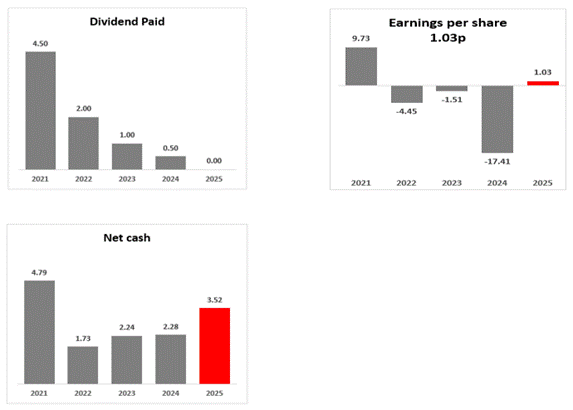
· Basic earnings per share of 1.03 pence (2024: loss of 17.41 pence)
· Year-end net cash of £3.5m (2024: £2.3m)
· Profit for the year from discontinued operations of £0.17m (2024: loss of £1.8m)
Business model
In assessing the performance of the business, the Directors evaluate the two primary operating business units:
· Mechanical Ventilation Systems: Designs, manufactures and sells mechanical ventilation systems tailored for residential applications across UK and Europe. Sales from this business unit accounted for 55% of the Group's revenue from continuing operations in this period (2024: 46%).
· Window and Door Hardware: Designs, manufactures, and sells natural ventilation products (such as trickle vents) and a broad range of hardware solutions for window and door fabricators in the UK, Europe, and the US. In 2025, this unit contributed 45% of Group revenue (2024: 54%).
The principal activities within these business units include design, manufacturing, marketing, and sales.
Titon's strategy is to grow both business units through market expansion, market penetration and the development of new, innovative products. The Group organises its commercial activities into the two business units above, with manufacturing and other supporting functions shared across both. The executive leadership team manages the Group at a business unit level.
In the UK, direct sales teams target developers, architects, engineers, manufacturers, and local authorities, aiming to secure product specifications. Where not specified, products are sold directly to contractors and fabricators. Internationally, the Group uses local distributors and, for mechanical ventilation, also supplies OEM products. The US subsidiary, Titon Inc., is based in Indiana and contributed a small share of revenue 2% (2024: 5%).
Most products are manufactured in the UK (75% of turnover in 2025; 73% in 2024), with the remainder sourced from third parties and sold alongside in-house lines.
Our markets
Both business units primarily serve the UK residential new build market. The UK generated 84% of Group revenue. This market is heavily influenced by regulations on indoor air quality, comfort, security and energy efficiency.
In 2025, the UK residential new build market contracted, particularly in the final quarter of our financial year. Data from the Office for National Statistics indicates that new build completions fell by around 12% year on year. Savills has reported a similar trend, noting a 6% reduction in completions compared with the prior year. Looking ahead, the Spring Construction Products Association forecast anticipates a 3% recovery in 2026 and a further 5 per cent increase in 2027 in new housing output value. However, most other forecasters, including Savills, the Home Builders Federation and Knight Frank, expect the number of new build completions to remain flat or decline due to the continued weakness in planning approvals. Accordingly, the Group anticipates a further 3-5% market decline in 2026, before stabilisation.
Although the new build market is expected to remain subdued, we still plan to grow within it and position us optimally to accelerate once the market begins to recover. Our strategy is to win market share by providing value added customer service, strengthening our relationships with key customers and releasing competitive new products. We believe we are agile enough that low single digit reductions in the wider market, while challenging, should not prevent us from achieving meaningful growth.
Mechanical ventilation systems
Operating in a project-driven environment, this business unit supplies solutions for residential new builds, with MVHR (mechanical ventilation heat recovery) systems as the largest category. Market growth is driven by tighter building regulations and the need for effective ventilation. As modern homes have become more airtight and better insulated, effective ventilation has become essential rather than optional. This market has expanded significantly over the last fifteen years and is expected to see further growth as regulations evolve, for example, the introduction of Part O requirements in June 2021 aimed at reducing overheating risks. These trends present opportunities for Titon to grow by offering innovative and compliant ventilation systems.
Revenue grew 21% in 2025 to £8.6m (2024: £7.1m), with UK sales up 27% which is the unit's strongest year on record. During the year, we strengthened both our sales and customer care teams, while our operations team delivered meaningful improvements in lead times, customer focus and gross margins.
The order book grew for the first three quarters of the year but declined in the final quarter, reflecting delays to multi storey residential projects as Gateway 2 approval bottlenecks constrained construction starts, particularly in London. While this impacted near term order intake and has influenced product mix, the underlying pipeline continued to build and the order book has seen encouraging growth in early FY26.
Window and door hardware
This business unit supplies trickle vents and a wide range of fenestration hardware directly to window, door and profile manufacturers. Titon holds a leading position in the UK market for trickle vents and offers an extensive product range. We also supply complementary products including locks, handles and hinges.
Current sales are dominated by trickle vents, which account for just over 70 per cent of revenue for this business unit. While we aim to continue growing this core product line, a typical trickle vent represents only a small proportion of the total hardware fitted to a window. This provides a significant opportunity to take a larger share of the overall hardware value by increasing sales of Titon branded products such as our Venture friction hinges, Hexalok locking systems and other accessories. Our strategy is therefore centred on cross selling a broader range of hardware to both existing and new customers, supported by strong service levels and reliable supply.
In 2025, the business unit recorded a 13% decline in revenue, falling from £8.3 million in 2024 to £7.2 million. In the UK, revenues fell by 11% year on year. Export sales to Europe, which represent a smaller proportion of total revenue, increased by 6% and remained profitable throughout the year. Sales in the United States, which account for a very small share of overall revenue, declined by 56%. We are conducting a review of our US business' strategy and, if we do not identify a route to meaningful revenue and profitability, we will take appropriate action.
During the year we implemented a series of initiatives to strengthen the commercial performance of the business unit. We appointed a new Sales Director and added capability to the sales team, which has already resulted in new business wins for Titon branded hardware beyond our core trickle vent range. In addition, operational improvements enhanced customer service and supported an increase in gross margins throughout the year.
Looking ahead, we will continue to invest in the development of our hardware product portfolio and focus on strengthening customer engagement and increasing the penetration of Titon branded hardware across our customer base. Our priority for the year ahead is to halt further sales decline in the business unit by executing on areas within our control and to return to modest growth over the next twelve months.
Strategy
Over the past year we have made significant progress in improving the Group's commercial and financial performance, while also laying the groundwork for longer term strategic change. We have implemented a clear five-year strategy centred on improving our competitiveness, strengthening our commercial capability and building a more resilient operating model. While we continue to operate in challenging market conditions, the work undertaken to date gives us confidence that we can deliver a more productive, higher margin and faster growing business.
Improving gross margins and overall productivity remains central to the delivery of our strategy. We are progressing a broad programme of work across product design, supply chain, purchasing, manufacturing and operational processes to simplify our portfolio, reduce cost and increase efficiency. These actions are already contributing to improved customer service and financial performance and will continue to build through the coming year.
Commercially, our strategy is to strengthen the performance of both business units by improving how we serve customers and how our products compete in the market. In the ventilation systems business unit, we are improving customer engagement through consultative selling, ventilation design services, enhancing product performance and bringing competitive new products to market. In the window and door hardware business unit, our priority is to improve customer service and increase our share of the total hardware value on each window by expanding sales of our branded hardware portfolio.
Our strategy is grounded in the belief that Titon has the assets, product range and customer relationships to compete effectively with the best in our industry. Our established positions in ventilation and trickle vents, combined with our engineering, operations and customer service capability, give the Group a strong platform to execute the next phase of its strategy. We are targeting blended organic revenue growth of 10% and net margins of 15% by the end of 2028 and have begun to take the actions required to achieve these ambitions.
Geographically, our priority remains the United Kingdom where we have strong design, testing and commercial capability. We will continue to engage with mainland Europe and the United States where our products are aligned with customer needs and margins are attractive, but our principal strategic focus is on concentrating resources in our core market.
We are delivering against five core strategic priorities that underpin our turnaround plan:
1. Superior Products: A streamlined product portfolio to prioritise differentiation and market relevance.
2. Consultative Selling: Proactive engagement with customers early in the project lifecycle to influence and shape specifications.
3. Excellent Customer Service: Added value delivered through reliability, responsiveness, and comprehensive support.
4. Marketing: Effective communication of our value proposition, brand, and the generation of leads.
5. Efficient Manufacturing and Organisation: Optimised costs, improved processes, and enhanced productivity.
To support these priorities, we have launched internal programmes focused on margin improvement, product rationalisation, commercial effectiveness, organisational efficiency and employee engagement.
These initiatives are designed as long-term efforts focused on sustainable, incremental improvements rather than quick fixes. By simplifying our business, strengthening our operations, and optimising our organisational structure, we aim to build a resilient and profitable business that delivers value to all stakeholders.
In addition to our turnaround strategy, supported by the Group's strong balance sheet, the Board also intends to actively review potential bolt-on acquisition opportunities across both business units. At all times, the Group will maintain a disciplined focus on strategic fit and appropriate financial returns.
Organisational structure
We continued to strengthen our leadership team during the year with the appointment of a new Sales Director for both the mechanical and the window and door hardware business units together with the successful onboarding of our new Operations Director. These appointments are already making a positive impact on commercial performance and operational effectiveness. Beyond these targeted hires, we have taken a disciplined approach to organisational structure and cost control, ensuring resources are focused on priority areas and recruiting only where additional capability is expected to deliver clear value.
Outlook
Although our core markets are expected to remain subdued in the near term, the actions we have taken throughout the year have strengthened our commercial capability, improved operational performance and enhanced our product offerings. We enter the new financial year with a solid order book, a stronger pipeline and a clearer strategic focus. Trading at the start of the year has been broadly in line with expectations, reflecting both this improved position and the well-publicised delays to new building approvals under the Gateway 2 Building Safety Act, which continue to affect construction activity. Notwithstanding this, over the course of the whole year we expect to maintain the positive momentum in our mechanical ventilation systems business, supported by strong customer engagement, improved service levels and continued product development. In the window and door hardware business unit, our priority is to return the business to growth by expanding sales of Titon branded hardware and increasing our share of the total hardware value on each window.
While market conditions may remain challenging, we expect to grow through market share in both business units and to make further progress on improving margins and productivity. The Board is confident that the company is well positioned to deliver continued strategic progress and to return to sustained profitability.
Financial and operational review
The Consolidated Income Statement is set out on page 51. A summary of the results for continuing operations along with other selected Key Performance Indicators ("KPIs") is as follows:
|
|
2025 |
|
2024 |
|
|
|
£'000 |
|
£'000 |
|
|
Revenue |
15,806 |
|
15,476 |
|
|
Gross profit |
5,204 |
|
4,333 |
|
|
Gross profit margin |
32.9% |
|
28.0% |
|
|
Underlying loss before exceptionals and tax1 |
(40) |
|
(916) |
|
|
Exceptional items |
145 |
|
(1,515) |
|
|
Operating profit / (loss) before income tax |
105 |
|
(2,431) |
|
|
Income tax credit |
11 |
|
473 |
|
|
Profit / (loss) after income tax |
116 |
|
(1,958) |
|
|
Revenue per employee |
120 |
|
109 |
|
|
Profit / (loss) after tax per employee |
0.9 |
|
(13.8) |
|
|
Underlying EBITDA1 |
811 |
|
5 |
|
|
Profit / (loss) for the year from discontinued operations |
171 |
|
(1,813) |
|
|
Year-end net cash and cash equivalents |
3,516 |
|
2,281 |
|
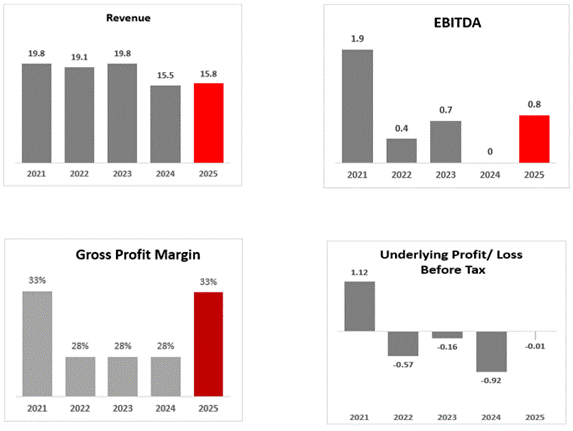
Titon managed to grow revenue by 2.1% to £15.8m from £15.5m in 2024, despite continuing weakness in the residential new build market, which was largely due to our success in growing our mechanical ventilation systems business in the UK.
Gross profit increased from £4.3m in 2024 to £5.2m in 2025, with the gross profit margin growing to 32.9% compared to 28.0% in the previous year. This improvement has been achieved through tighter control of our cost base, manufacturing productivity improvements and a more focused approach to product mix. As we progressed through the year, we increased focus on value engineering our manufacturing designs.
The underlying loss before exceptionals and tax reduced to £0.04m in 2025, compared to a loss of £0.9m in 2024, reflecting the successful execution of the Group's strategic improvement programme.
Exceptional items for the year amounted to a gain of £0.145m, compared with a cost of £1.5m in 2024. These exceptional items primarily comprised £0.04m in restructuring costs and a one-off inventory gain of £0.185m. The inventory gain resulted from the sale of slow-moving stock, previously provided for, back to a supplier.
In 2024, the Board undertook a comprehensive review of the Group's slow-moving and obsolete inventory allowance. During the Covid-19 pandemic, the Company had made substantial purchases of excess inventory in anticipation of extended supply lead times. While this approach was considered necessary to mitigate supply chain risks during the global crisis, the Group subsequently recognised the need to reassess and recalibrate its purchasing strategy.
Given the decline in trading conditions and the operational challenges experienced up to 2024, the decision was taken to increase the allowance for slow-moving and obsolete inventory. This adjustment reflected a more prudent approach to inventory management, ensuring that future procurement is more closely aligned with prevailing market conditions and performance expectations.
Although the resulting write-down was non-cash in nature, it underscored the Company's commitment to strengthening its inventory discipline and supporting its broader turnaround strategy.
As a result, the operating profit before tax but after exceptional items significantly increased to £0.1m in 2025, compared to a loss of £2.4m in the prior year.
The loss on discontinued operations reflects the overall impact on the sale of our Korean business. More details on this can be read in note 25.
On an average per-employee basis, revenue increased from £109,000 in 2024 to £120,000 in 2025, while the loss after tax per employee improved from £13,800 in 2024 to a profit of £1,200 in 2025.
The Group has managed to further improve its cash position, ending the year with net cash and cash equivalents of £3.5m, a 54.2% increase from £2.3m in 2024. This improvement highlights the company's strong cash management practices and provides a solid foundation for executing its turnaround strategy. The Group received a cash consideration payment of £0.7m after the FY24 year end in respect of its disposal of the South Korean operations announced in October 2024.
Alternative performance measures
The Group uses a range of non-IFRS performance measures to monitor the performance of the business. The Group believes these provide information on the ongoing trading of the business to help investors and other stakeholders evaluate the performance of the business and are measures commonly used by certain investors for evaluating the performance of the Group. In particular, the Group uses measures that reflect the underlying performance, on the basis that this aids the user in understanding the core business performance of the Group. The Group reports underlying performance in addition to the financial information prepared under IFRS. The Board believes that underlying performance provides additional and consistent measures of underlying performance by removing items that are not closely related to the Group's day-to-day trading activities, and which would typically be excluded in assessing the value of the business. Underlying performance is used by the Board for internal performance analysis, planning and employee compensation arrangements. This term is not defined under IFRS and may therefore not be comparable with similarly titled measures reported by other companies. They are therefore not intended to be a substitute for, or superior to, IFRS measures of performance. A reconciliation of underlying to IFRS performance is shown below. The Board uses its judgement to consider the classification of items as non-underlying at the beginning of each financial year and prior to commencement of any significant restructuring or similar event, subject to the relevant criteria. Underlying performance may be adjusted for significant one-off items such as restructuring costs, gains and losses on disposal of assets, impairment charges and their reversal, the costs of litigation and its outcome, and one-off non-trading income and costs. Restructuring costs, which may include redundancy costs and associated professional fees, are only included as non-underlying when they will not be incurred in the ongoing business, and they are incremental to normal operations undertaken to add value to the business.
The following table shows how these APMs are calculated:
|
Continuing operations |
2025 |
|
2024 |
|
|
£'000 |
|
£'000 |
|
Profit / (loss) before income tax |
105 |
|
(2,431) |
|
Exceptional items (note 26) |
(145) |
|
1,515 |
|
Underlying operating loss before income tax |
(40) |
|
(916) |
|
Net interest (income) / cost |
(52) |
|
19 |
|
Depreciation and amortisation |
903 |
|
902 |
|
Underlying EBITDA |
811 |
|
5
|
Key Performance Indicators (KPIs)
The Board looks at a range of KPIs to monitor the performance of the Group throughout the financial year. These include KPIs to track delivery of the business strategy. At individual team and departmental level relevant KPIs are also monitored and tracked regularly. The financial KPIs monitored by the Board regularly include:
|
KPI |
Timing |
|
Group Revenue |
Measured against budget and prior year on monthly basis |
|
Group Profit Before Tax EBITDA |
Measured against budget and prior year on monthly basis Measured against budget and prior year on monthly basis |
|
Individual legal entities' performance Individual business unit performance |
Measured against budget and prior year on monthly basis Measured against targets and prior year on weekly basis |
|
Sales, margins and prices of core products |
Top 20 products reviewed monthly (at business unital management levels and operating segments)
|
|
Sales to customers |
Top 20 customers (at business unit management levels and operating segments). Sales by individual area sales managers reviewed weekly |
|
Purchases |
Top 25 suppliers and delivery performance reviewed monthly |
|
Net cash |
Reviewed monthly by Board and by senior management |
|
Working capital |
Inventory, average debtor days and average creditor days reviewed monthly by Board and senior management |
Graphical representations of some of these KPIs and other financial performance measures for continuing operations only for the years ended 30 September are as follows:
2024/25 performance
The financial results for the year are presented above and discussed throughout the Annual Report. The year was characterised by visible progress across leadership, commercial execution, operations, product development and financial discipline. The significant activities were as follows.
Leadership and Organisational Improvements
We embedded the turnaround strategy into the day-to-day running of the business. A clearer leadership structure was established with defined accountability across all functions. This created a more aligned and less reactive senior leadership team with improved coordination between operations, sales and engineering. Cross-functional collaboration strengthened across the company and contributed to more effective execution.
We welcomed several key senior appointments during the year. Lee Caulfield joined as Sales Director for mechanical ventilation systems, strengthening our UK division sales capability and contributing to a record year for revenue. Vesa Nenye joined as Sales Director for window and door hardware, further improving capability and focus across that team. In operations, Rob Girling joined the Group as Operations Director, bringing renewed focus to planning discipline, customer service and operational productivity.
We also introduced a clearer set of strategic and departmental KPIs to track progress and cascade targets throughout the organisation.
During the year we maintained disciplined control of headcount while maintaining targeted investment in the leadership and commercial functions that support growth. We ended the year with 119 full time equivalent employees, delivering a year-end sales per employee of approximately £133,000 compared with £117,000 at the end of last year and about £108,000 the year before. We are not yet at our target levels, but we are demonstrating meaningful improvements in organisational productivity, which will remain a core focus for the foreseeable future.
Commercial Operations and Customer Experience
We continued to develop our commercial operations. The customer service turnaround programme delivered improvements in responsiveness and communication, supported by new measures and targets for customer response times and issue resolution. We strengthened the use of CRM and ERP systems and introduced more structured quoting and order-management processes. These changes have already delivered measurable improvements in responsiveness and a noticeable reduction in expedites. They have also improved internal communication and given us a much stronger foundation for pursue best in class customer management.
At the end of the year, we completed an Investors in Customers assessment to establish a formal benchmark for customer experience. We were encouraged to achieve a Silver Award and a Net Promoter Score of 32 in our first full evaluation. This provides a clear baseline for improvement over the next twelve months. Our goal is to achieve a Gold Award and to lift our Net Promoter Score to above 40.
Operations Productivity and Margin Improvement
Under the new Operations Director, we reorganised planning activities, simplified workflows and strengthened customer focus. As a result, the business delivered higher volumes, improved service levels and achieved this with a reduced headcount. This represents a meaningful improvement in operational productivity.
Gross margin improvement remained a key priority. Progress was achieved through efficiency gains in operations, stronger cost discipline, the commencement of Design for Manufacturing activities, tooling upgrades and early product cost-down initiatives. As a result, we delivered meaningful improvements in gross margins across both business units.
Product Development and Portfolio Focus
The product development function underwent a reset to ensure greater commercial discipline and predictability. We introduced stage gates, project checklists and clearer product roadmaps. Priorities were refocused to focus on commercial factors instead of pure performance and creating a more streamlined development pipeline. During the year we simplified our mechanical ventilation systems product offering, consolidating our MVHR range into a more rationalised core portfolio.
Sales, Market Presence and Commercial Momentum
The Group continued to drive its order book and sales pipeline. Despite a slowdown in orders in the final quarter, we ended the year with a Book-to-Bill ratio of 1.06. The order book has started to recover in the early part of FY26.
We released a new lead-generating website with clearer messaging, improved content and tailored landing pages for each business unit. This has supported stronger engagement and more effective inbound activity.
Financial Discipline and Working Capital
Disciplined working capital management remained a focus throughout the year. This year the Group returned to operating cash flow generation. We reduced inventory from £3.5m to £3.0m and strengthened cash reserves by £1.2m by year end. The Group remains financially stable and has the flexibility to invest in the areas that will support future growth.
2025/26 activities
The focus for FY26 is to maintain the momentum we have built and continue improving the profitability of the Group. We believe the strategy we set out last year is working and we will drive it forward. Our plan is balanced. It recognises that external growth conditions may be harder to influence, so we will continue to focus on the internal improvements that delivered meaningful progress in FY25. By strengthening operational performance, product competitiveness and commercial execution, our goal is to grow regardless of market conditions. We will measure this progress through a range of key indicators including lead-times, service levels, gross margin and sales per employee.
Employee Engagement and Culture
We will continue to embed the cultural changes initiated in recent years, including further development of the "Titon Way". Our focus will remain on accountability, collaboration and customer orientation, with engagement initiatives supporting the capability needed for the next phase of the turnaround.
Operational Improvements
We will continue to improve operational lead-times and responsiveness through ongoing development of planning processes. Greater emphasis will be placed on material cost efficiencies as we consume excess stock and begin to benefit from economies of scale. Investment in manufacturing engineering and process development will support further productivity gains, supported by closer collaboration with New Product Development to ensure new products are designed for manufacturability. In parallel, we will continue to improve our quality performance by strengthening metrics, reducing waste and embedding more structured problem-solving as we progress towards Six Sigma methodologies.
Commercial Operations and Customer Experience
Customer service will remain a priority for the year ahead. Automated order entry will increase capacity for inside sales activity within the Window and Door Hardware team, enabling greater focus on proactive customer engagement. We will also continue to professionalise customer-facing touchpoints across the Group.
We will build on the findings of the Investors in Customers assessment completed at the end of FY25. The recommendations from this programme will guide targeted improvements in the overall customer experience. We will continue with the Investors in Customers framework through FY26, enabling us to measure progress objectively and work towards achieving a Gold Award and an improved Net Promoter Score in the next assessment cycle.
Gross Margin Improvement
Margin improvement will continue through manufacturing efficiencies, value engineering and tighter management of material costs. These activities remain central to restoring sustainable profitability.
Growth and Market Development
In mechanical ventilation systems, we aim to build on the momentum achieved in FY25 by strengthening activity at the specification stage and presenting competitive, well-benchmarked solutions. Continued improvements in customer service and commercial execution will help us retain customers and convert more of our pipeline. In window and door hardware, the priority is to return the business to growth through improved customer service, deeper relationships with key accounts and increased cross-selling. CRM and digital marketing insight will support targeted campaigns. As sales performance allows, we will make targeted investments in sales capability across both business units.
Product Development and Competitiveness
Our product roadmap will focus on performance enhancement, cost reduction and market-driven innovation. Key priorities for the year include progressing patentable technologies, launching a replacement range of plastic trickle vents and expanding both our Titon-branded hardware offering and our mechanical ventilation range. To support this, we will continue to invest in our mechanical engineering capability over the year.
Product Management
We will introduce a product management function to strengthen ownership of product lifecycles, support market-led product requirement specifications and improve competitor benchmarking to guide investment decisions.
Digital and Inbound Marketing
We will continue refining our online presence, strengthening digital lead generation and developing targeted content for each business unit. To make ordering simpler for end users, we will introduce a web shop focused initially on consumable items. This will reduce routine enquiries and free our customer care team to focus on higher-value customer and project support.
Entry Into Adjacent Markets
To create a more balanced business, we will continue evaluating opportunities to enter adjacent markets where our capabilities and product range provide a competitive advantage.
Environmental Social and Governance Report
Environmental, Social and Governance (ESG) reporting remains increasingly important for investors, and we also want to continue demonstrating that we recognise our own responsibilities to the environment. In 2019, we publicly committed to becoming a net zero company by 2050.
The UK Government introduced regulations in April 2023 that require climate-related financial disclosures to be made for publicly quoted companies, large private companies and LLPs. For companies quoted on AIM this applies if the business has more than 500 employees, so Titon is not currently required to make these disclosures but again, the direction of travel is clear and supports our intentions. We intend to disclose as much as is practical of our climate related activities.
We believe Titon contributes to making the world a better place with its purpose being the provision of fresh, clean air. Nothing has changed this belief in 2025, indeed the incidences of poorly ventilated housing, especially in the social housing and private rental markets means that good ventilation is even more necessary than before.
In the drive for energy efficiency and ensuring that buildings are adequately ventilated, we work with a network of stakeholders, including our customers in the window and door market and the house building market in the UK and Europe. We also work with trade association Beama Ltd to promote ventilation in the UK.
Environmental Pillar
The Board recognises its responsibility to minimise the impact of the Group's activities on the environment.
The Group seeks to reduce its environmental impact in a way that benefits a broad group of stakeholders, including customers, shareholders, employees and the local community. The Group follows and is certified and audited to ISO 14001:2015 for Environmental Management Systems within its UK manufacturing operation and places great emphasis on ensuring that it conducts its operations such that:
· Emissions to air, releases to water and land filling of waste do not cause unacceptable environmental impacts and do not offend the community.
· Significant plant and process changes are assessed and positively pursued to prevent adverse environmental impacts.
· Energy is used efficiently, and consumption is monitored.
· Natural resources are used efficiently.
· Raw material waste is minimised.
· Waste is reduced, reused or recycled where practicable.
· The amount of packaging used for our products is minimised.
Titon has engaged a Carbon Partner, Auditel, to assist us in delivering our objective of becoming Carbon Neutral, while on our longer-term journey to reaching Net Zero. This will initially be a three-year programme to calculate our Scope 1,2 and 3 emissions, which will be increasingly necessary to meet customer requests, and will also focus on additional actions we can take to reduce those emissions. Our goal is to align our carbon footprint reduction targets with broader cost-saving initiatives. We will continue to work with our supply chain to reduce the Scope 3 emissions as they will form the largest part of our overall emissions.
We have used the GHG Protocol Corporate Accounting and Reporting Standard (revised edition), data gathered to fulfil our requirements under the CRC Energy Efficiency scheme, and emission factors from UK Government's GHG Conversion Factors for Company Reporting 2024. Auditel (UK) has undertaken to express an independent verification opinion on the Group's GHG/CO2e Assertion spanning 1 October 2023 to 30 September 2025, that assertion having been based upon the requirements set out in the GHG Protocol Corporate Standard and its amendments. Auditel (UK) is a management consultancy that is suitably qualified in carbon emissions measurement and verification.
We remain focussed on reducing our energy usage and maintain detailed records of each area's gas and electricity consumption with the aim of taking prompt action if any unexplained increase is observed. The consumption was recorded as follows:
|
|
2025 |
2024 |
Change |
|
|
kWh |
kWh |
|
|
Natural gas |
1,563,880 |
1,814,358 |
(13.8%) |
|
Electricity |
731,856 |
726,339 |
0.8% |
|
Transport |
84,734 |
118,772 |
(28.7%) |
|
Total kWh |
2,380,469 |
2,659,469 |
(10.5%) |
In accordance with Statutory Instrument 2008/410 the Group presents the following information in respect of its CO2 emissions during the period.
Global Greenhouse Gas (GHG) emissions data for the period are:
|
|
2025 tCO2e |
2024 tCO2e |
Change |
|
Scope 1 |
|
|
|
|
Stationary combustion |
286.13 |
334.11 |
(14.4%) |
|
Mobile combustion |
18.61 |
26.69 |
(30.3%) |
|
Scope 2 |
|
|
|
|
Purchased electricity |
129.55 |
151.06 |
(14.2%) |
|
Scope 3 |
|
|
|
|
Purchased goods and services |
0.74 |
0.52 |
42.3% |
|
Fuel and energy related activities |
102.53 |
112.17 |
(8.6%) |
|
Upstream transport and distribution |
108.35 |
163.23 |
(33.6%) |
|
Waste generated from operations |
74.33 |
84.43 |
(12.0%) |
|
Business travel |
14.91 |
29.81 |
(50.0%) |
|
Employee commuting and homeworking |
97.28 |
153.58 |
(36.7%) |
|
Upstream leased assets |
4.52 |
- |
- |
|
Downstream transport and distribution |
45.01 |
163.30 |
(72.4%) |
|
TOTAL |
881.94 |
1,218.90 |
(27.6%) |
Total emissions and intensity metrics
|
|
Total tCO2e |
tCO2e per £1m turnover |
tCO2e per employee |
|
2025 |
881.94 |
56.17 |
6.94 |
|
2024 |
1,218.90 |
78.80 |
9.10 |
These sources fall within our consolidated financial reporting. We do not have responsibility for any emission sources outside of our consolidated financial reporting.
We have taken action over recent years to reduce our environmental footprint and will continue to do so. Actions we have already taken include:
· An investment of over £150,000 in solar panels, which are installed on the roof of our Haverhill factory. These panels continue to generated over 125 Mwh of electricity per year, which we sell back to the National Grid;
· Installation of LED lighting throughout the Colchester office and the Haverhill factory;
· Replacing all diesel cars in the company car fleet with electric vehicles, wherever possible, when they come up for renewal. We have EV charging points installed at both the Colchester office and Haverhill site. All forklift trucks on site are now electric.
· Purchasing 100% of our electricity through renewable sources.
· Replacement of older fixed asset plant and machinery with new, more efficient units, for example our Amada Press which we purchased in April 2021.
· Installation of a reverse osmosis plant in our paint facility, which has reduced the usage of caustic soda and hydrochloric acid by 50%, with an added health and safety benefit.
· We have an ongoing initiative to reduce single use packaging for raw material supplies and have replaced our own plastic packaging with either cardboard or recycled plastic, wherever possible.
Future reduction measures
· Increased monitoring and targeting of energy use
· Reducing and replacing gas used in buildings
· Minimising lighting demand
· Creation of a sustainability committee
· Reducing supply chain emissions
· More efficient use of compressed air
We apply the waste hierarchy, as laid down in law, and which forms part of our ISO 14001:2015 certification. The basic principles are "Reduce, Reuse and Recycle" and are incorporated in the Titon Recycling Policy under which we aim to reduce waste in all our packaging, products and processes.
We will continue to take all actions that reduce our energy, water and waste usage. We will also look to report our environmental footprint using a third-party reporting mechanism.
Social Pillar
The Group has various published policies relating to the Social pillar. These are communicated through our Intranet, noticeboards and the Employee Handbook. Our comprehensive Employee Handbook published in 2021 and updated in 2025, includes all of our employment policies, a summary of the Health and Safety policy, our Diversity Policy, our Safeguarding and IT Security and our Environmental policies. The chapter entitled "Valuing Diversity and Respect at Work" covers the following matters:
· Equal Opportunities Policy: Titon is committed to encouraging equality and diversity among our workforce. Our objective is to create a working environment in which there is no unlawful discrimination and where all decisions are based on merit. The policy applies to all employees, workers, agency workers, contractors and job applicants and covers all of the nine protected characteristics set out in the Equality Act 2010.
· Bullying and Harassment Policy: we are committed to providing a working environment free from bullying and harassment and this policy covers both at work and out of the workplace, including work trips, work-related events and social functions. It also includes all employees, agency, casual workers and independent contractors.
· Grievance Policy: every employee has the right to raise a grievance if they have a genuine complaint about their job, work or terms and conditions of employment and the policy principles are written down in the Handbook.
· Disciplinary Policy: the policy sets out the process for dealing with disciplinary and performance issues and to ensure that any matters are dealt with fairly and consistently.
· Whistleblowing Policy: Titon is committed to the highest possible standards of ethical, moral and legal business conduct. The policy aims to provide a route for employees to raise any concerns they may have on matters that could have a serious impact on Titon such as incorrect financial reporting, unlawful actions or serious improper conduct.
· Sexual Harassment Policy: this policy exists to ensure a safe, respectful workplace by defining unacceptable behaviour, outlining how to report concerns, and explaining how Titon will respond. Its purpose is to protect employees and promote a positive, professional environment
The Safeguarding and IT Security Policy includes the policies on Anti-Corruption and Modern Slavery and Human Trafficking. Under the Anti-Corruption Policy, the Titon Group lists a number of fundamental principles and values which it believes are the foundation of sound and fair business practice and which are important to uphold. It is the Titon policy to comply with all laws, rules and regulations governing anti-bribery and corruption in all countries in which Titon operates. As a UK company Titon is also bound by English law which covers our conduct both in the UK and abroad. The penalties for breaching this law are significant both for the individuals involved and the Company and we take our legal obligations very seriously.
Titon is committed to the principles of the Modern Slavery Act 2015 and the abolition of modern slavery and human trafficking. We do not enter into business with any organisation which knowingly supports or is found to be involved in slavery, servitude and forced or compulsory labour. Due to the nature of our business, we have assessed that we have a low risk of modern slavery in our business and supply chains. Our supply chains are limited, and we procure goods and services from a restricted range of UK and overseas suppliers. We will continue to embed these principles through our procurement and employment policies and practices.
Employee Gender Breakdown
As at the end of the financial year the analysis by gender of employees, on a head count basis, was as follows:
|
|
|
2025 |
2025 |
2025 |
2024 |
2024 |
2024 |
|||||||
|
|
|
Male |
Female |
Total |
Male |
Female |
Total |
|||||||
|
Directors |
4 |
1 |
5 |
4 |
1 |
5 |
|
|||||||
|
Senior Managers |
8 |
4 |
12 |
7 |
3 |
10 |
|
|||||||
|
Other |
68 |
41 |
109 |
73 |
46 |
119 |
|
|||||||
|
Total |
80 |
46 |
126 |
84 |
50 |
134 |
|
|||||||
We are committed to respecting human rights across our business operations and aim to comply with all local and international legislation and standards.
Corporate Governance Pillar
We have presented our Corporate Governance position for many years, firstly under the UK Corporate Governance Code when we were quoted on the Main Market of the London Stock Exchange and since 2020 under the Quoted Companies Alliance (QCA) code after we moved to AIM. Please see page 36 of this Report for the detailed Corporate Governance Report. Our website also contains more details of the governance disclosure including how we apply the 10 principles identified by the QCA Code.
In summary, we are confident that we applied all 10 principles of the QCA Code throughout the accounting period under review. During the year, we also transitioned to the new QCA Code.
Health and safety
Health and safety is a core priority for Titon, and all employees are expected to take responsibility for their own safety and that of others. As a manufacturing business, it is critical that employees operate in a safe working environment supported by effective health and safety culture, policies, and practices.
During 2025, Titon transitioned from a centralised health and safety management model to a more devolved approach, embedding health and safety ownership within shopfloor and operational areas. Responsibility for day-to-day health and safety management now sits with local leaders and teams, reinforcing accountability at the point of risk and supporting stronger engagement across the business.
Health and safety policies continue to be reviewed and updated regularly to ensure they remain effective and compliant, and adherence to these policies is actively monitored. Increased emphasis was placed during the year on hazard identification, reporting, and resolution by all employees, with significant improvements observed in both participation and outcomes.
Titon has a well-developed Health and Safety roadmap, providing a structured framework to track compliance, training, and priority health and safety initiatives. This roadmap supports ongoing oversight and enables management to monitor progress and manage emerging risks effectively.
The approach to health and safety management for the Group is as follows:
|
Board of Directors |
Overall responsibility for setting policy and performance, promoting excellence in EHS as a personal and organisational core value and role modelling the expected behaviours. |
|
Senior leadership team |
Meets weekly to review statistics, every reported incident and the status of the EHS roadmap. The Chief Executive, Chief Financial Officer and the senior leadership team attend. Also promotes excellence in EHS and shows the expected behaviours. |
|
Local management |
Meets daily to review health and safety incidents and issues. Responsible for setting expectations, following the rules set, managing EHS risks and promptly addressing EHS incidents and issues, including non-compliance. |
|
All employees |
Have the responsibility to look after the health and safety of themselves and others by proactive hazard reporting and resolution, prompt reporting of all incidents and cooperating with instruction and training. |
|
Health and Safety Committee |
Is represented by operational team members across all departments and is chaired by the Production Manager, with the assistance of the Operations Director. The committee meets quarterly to discuss and address operational health and safety issues. Minutes are produced and distributed along with an action plan. |
The accident statistics are measured on a calendar year basis for our UK operations and are as follows:
· January to December 2025 14 reported accidents, 0 RIDDOR reported
· January to December 2024 19 reported accidents, 2 RIDDOR reported
In 2025, we achieved a meaningful 26% reduction in the number of accidents across both sites. Notably, there were zero Health and Safety Executive (HSE) RIDDOR-reportable incidents during the year.
RIDDOR (the Reporting of Injuries, Diseases and Dangerous Occurrences Regulations 2013) requires employers, the self-employed, and those in control of premises to report specified workplace incidents. As at 31 December 2025, we had reached 596 consecutive days without a RIDDOR report being required, reflecting the minor severity of incidents experienced.
We attribute this reduction to the continued promotion of a positive health and safety culture. Our ongoing focus on a "safety first" approach actively encourages the reporting of all incidents, regardless of severity. This enables us to monitor trends and identify root causes, which are reviewed monthly by our internal health and safety committee and employee representatives.
In addition, we operate a robust hazard reporting process that allows anyone to identify and, where possible, resolve hazards. During 2025, over 195 individual hazards (risks) were reported, with 78.5% resolved within the year.
The Group is pleased to see continued improvement in our safety culture, with all incidents being appropriately reported and investigated. We believe that proactive hazard reporting and timely resolution will further reduce risk and help prevent the occurrence of more serious incidents in the future.
Statement by the Directors in relation to their statutory duty in accordance with section 172(1) of the Companies Act 2006
In compliance with the Companies Act 2006, the Board of Directors are required to act in accordance with a set of general duties. During the year to 30 September 2025, the Board of Directors consider that they have, individually and collectively, acted in a way they consider, in good faith, would be most likely to promote the success of the Company for the benefit of its shareholders as a whole, having regard to a number of broader matters including the likely consequence of decisions for the long term and the Company's wider relationships. In doing so, the Board holds regard to the matters contained in section 172(1) (a)-(f) of the Companies Act 2006.
The Directors fulfil their duties by ensuring that there is a strong governance structure in place across the Group's operations, backed up by robust processes.
The strategy for the Group is regularly monitored by the Board during the year. In respect of major matters discussed at board level, the likely impact on all stakeholders are carefully considered and where possible, decisions are carefully explained and discussed with affected stakeholders before actions are implemented to engender the necessary support.
Application of s.172 during the year
During the year, the Board applied these principles when making decisions and overseeing the Company's turnaround programme. The following areas are particularly reflective of how the Board discharged its s.172 duties:
· Strengthening Leadership Structures and Organisational Capability
The Board approved a clearer leadership structure and the appointment of senior leaders in Vent Systems, Window & Door Hardware and Operations. These appointments were made to support employees more effectively, improve operational stability and provide the capability required for long-term success.
· Aligning Leadership Incentives with Shareholder Interests
The Board also approved a new share option issuance for the senior leadership team and the Chair. This decision was taken to ensure that leadership incentives remain closely aligned with the long-term interests of shareholders, to support retention of key individuals and to reinforce a culture of shared accountability for the Company's performance. The Board considered the importance of linking remuneration to sustained value creation and ensuring alignment across all stakeholder groups.
· Introducing a Structured KPI Framework
To enhance governance, visibility and accountability across the organisation, the Board oversaw the introduction of strategic and departmental KPIs. These measures help ensure consistent execution, support employee development and provide the Board with clearer insight into progress.
· Improving Customer Experience and Strengthening Key Relationships
The Board supported the implementation of a customer service improvement programme, including new service-level measures, improved use of CRM systems and more structured order-management processes. These actions were taken with regard to customers as a core stakeholder group and reflect the Board's focus on building trusted, long-term commercial relationships.
· Supporting Employees During Organisational Change
Throughout the year, the Directors considered the interests of employees when overseeing changes to planning processes, operational workflows and departmental structures. The Board monitored engagement, provided clarity around goals and ensured that changes were implemented in a responsible and transparent manner.
· Maintaining Financial Resilience and Acting in the Interests of Stakeholders
The Board closely monitored cash management, inventory levels and capital allocation to ensure the Group remained financially stable while investing in areas critical to the strategic plan. This balanced approach supported the long-term interests of stakeholders and protected the Company's ability to invest for the future.
· Responsible Investment in Product Development
The Board oversaw a reset of the product development process to ensure that resources were used efficiently and aligned to market and customer needs. This included the adoption of stage-gates, clearer governance and prioritisation based on long-term value creation.
· Upholding High Standards of Conduct
The Directors maintained oversight of risk management, compliance, safety and the internal control environment. Across all areas of the turnaround programme, the Board emphasised integrity, transparency and responsible behaviour.
Conclusion
The Board recognises that the long-term success of the Group depends on the quality of its decisions and the way it balances the needs of its stakeholders. During the year, the Directors applied the principles of Section 172 consistently and transparently, ensuring that decisions taken as part of the turnaround were aligned with the interests of shareholders, employees, customers, suppliers and the wider community.
The Group's key stakeholders and why and how we engage with them are set out below:
|
Stakeholder Group |
Why do we engage with them? |
How does the Board engage with them? |
|
Shareholders |
The Board needs to know investors' views so they can be considered when making strategic and governance decisions.
We aim to provide fair, balanced and understandable information about the business to enable informed investment decisions to be made. |
We have regular dialogue with institutional investors and significant individual shareholders in order to develop an understanding of their views. We also consider the views of our Nominated Adviser and Broker in this respect and the feedback they receive from shareholders. Our AGM is an important forum for private shareholders to meet the board and ask any questions they may have. Our website has an investors section which gives investors direct access to reports, press releases and other information. There is also a contact mailbox facility. We use Investor Meet Company to present our interim and final results presentations each year. |
|
Employees |
Employee engagement is critical to our success. We aim to create a diverse and inclusive workplace where employees can reach their full potential. This ensures we can retain and develop talented people.
We have the highest regard for the health, safety and wellbeing of our employees. |
We engage with our employees through site communications, consultation with employees, briefings, question boxes, performance reviews, surveys and notice boards. Employees are also written to individually on matters which are deemed important. Every employee is issued with a comprehensive employee handbook with all of the employment conditions and policies set out clearly so that everyone can see what is expected of them. We perform an annual staff survey and monthly pulse surveys. We continue to make every effort to protect our employees. |
|
Customers |
Our strategy of attaining sustainable growth in profit and building goodwill in our brands will only be achieved through an understanding of the needs of our customers and the markets we serve. |
We engage with our customers through: · Regular visits and meetings including virtual meetings · Industry exhibitions · Customer site tours and presentations · Our website · Supplying samples and supporting literature · Delivering a high standard of technical support · Providing design services and support · Providing accredited Continuing Professional Development (CPD) courses
|
|
Suppliers |
Our suppliers make an important contribution to our business success. Engaging with our supply chain means that we can ensure security of supply and speed to market. Carefully selected high-quality suppliers ensure we deliver market leading innovative products to meet our customers' expectations.
|
Our supplier relationship management is led by our procurement team and supported by R&D and Sales. We engage with our suppliers by holding regular meetings with them and via a feedback process through monitoring their performance.
|
|
Community/ Environment |
The Board has a full understanding of the importance of good community relations. We aim to contribute positively to the communities and environment in which we operate. |
We provide ventilation products that are beneficial to health and that are better for the environment. Many of our capital expenditure projects focus on improving energy efficiency and reducing environmental emissions from our factories. We have ISO 14001 Accreditation in the UK. We work with our stakeholders to promote good indoor air quality |
|
Government and Regulatory Bodies |
Government set the regulatory framework within which we operate. We engage to ensure we can help in shaping new policies, regulations and standards, which assist in improving indoor air quality, and ensure compliance with existing legislation. |
We participate in industry bodies and working groups and selective All-Party Parliamentary Groups and plenary sessions. We participate in and respond to industry and government consultations.
|
Report on Risk Management
Principal risks and uncertainties
The Group has established procedures for monitoring and controlling principal operational risks and these are detailed below. The Board is responsible for ensuring that the Group maintains an effective risk management system. It determines the Group's approach to risk, its policies and the procedures that are implemented to mitigate exposure to risk.
Process for managing risk
The Board continually assesses and monitors the key risks in the business and has developed a risk management matrix to identify, report and manage its principal risks and uncertainties. This includes the recording of all principal risks and uncertainties, which are reviewed annually. Risks are fully analysed, their potential impact on the business assessed and relevant mitigations established. The risk matrix is reviewed regularly at Board Meetings along with the appropriateness and effectiveness of the key mitigating controls.
The table below highlights the principal risks and uncertainties which could have a material impact on the Group's performance and prospects and the mitigating activities which are aimed at reducing the impact or likelihood of a major risk materialising. The Board does recognise, however, that it will not always be possible to eliminate these risks entirely.
Risk Matrix
|
Risk |
Potential Impact |
Mitigations |
|
Business disruption
The Group's manufacturing and distribution operations could be subjected to disruption due to factors including incidents such as a major fire, a failure of essential IT equipment or a major cyber-attack on the Group.
There is also a risk of business disruption if key sub-contractors experience an incident on their site or were to cease trading.
|
Incidents such as a fire at the Group's or sub-contractor premises or the failure of IT systems could result in the temporary cessation in activity or disruption of the Group's production facilities impeding the Group's ability to deliver its products to its customers.
A cyber-attack could leave the Group open to a ransom demand or compromise data security both for the Group and customers. |
The Group has developed business continuity and disaster recovery plans.
The Group maintains a significant amount of insurance to cover business interruption and damage to property from such events. Additional measures have been taken to ensure the security of the Group and customer data.
The Group has an annual building insurance review where actions are raised and subsequently cleared internally, providing evidence to the insurer.
The Group gets a fire risk assessment carried out by an external party every 2 years (last completed 29 October 2024) and annually internally and actions/suggestions raised are reviewed and actioned accordingly.
A fire suppression system is installed in relevant manufacturing areas.
Visits take place by the local fire service to review and provide feedback on fire safety systems and practices.
The Group implemented multifactor authentication for relevant employees. The Group has implemented a Cyber Security training and awareness programme for all employees.
The Group's strategy is to maintain essential systems in the Cloud.
The Group has an email security gateway system in place. The Group has a register of Titon owned tooling held at sub-contractors. The Group looks to review sub-contractor insurance and business continuity policies. |
|
Risk |
Potential Impact |
Mitigations |
|
Supply chain risks
The risk of extended lead times beyond forecast windows due to restricted component availability.
The risk of continued material price inflation and hence margin erosion.
The risk of international trade sanctions or interruption of supply due to geopolitical uncertainty, such as the Russian invasion of Ukraine and supply interruptions in China.
Risk of high value of stock becoming obsolete.
|
Decrease in cash due to increased stock holding.
Loss of customers due to an inability to meet demand or uncompetitive pricing.
Increased risk of obsolescence.
Delays in supplying customers and additional administrative costs.
Prices may increase which could impact our sales and profitability. |
The Group operates strategic purchasing of key long lead time items.
The Group holds weekly Sales Inventory and Operations Planning reviews.
The Group has a policy of dual sourcing key components where possible.
The Group ensures robust supplier relationship management.
The Group can implement customer agreements to incorporate specification changes if required.
The Group will obtain supplier declarations and compliance information when required.
|
|
Recruitment and retention of key staff
The Group is dependent on the continued employment and performance of its senior management and other skilled personnel. |
Loss of any key staff without adequate and timely replacement could disrupt business operations and the Group's ability to implement and deliver its growth strategies and financial targets.
|
The Group aims to provide competitive remuneration packages and bonus schemes to retain and motivate key staff.
The Group has a formalised succession plan for the Board and the senior leadership team. |
|
Recruitment and retention of staff
The Group is dependent on the continued employment and performance of all staff. |
Failure to maintain adequate staffing levels could impact on all business activities and the Group's ability to meet its defined targets. |
The Group reviews market conditions, cost of living and the National Living Wage and aims to provide competitive remuneration packages and bonus schemes to retain and motivate staff.
The Group has a robust recruitment and onboarding process.
The Group has several employee engagement initiatives in place including training and personal development opportunities and performance review and objective setting processes.
The Group has a two-way employee feedback process in place.
|
|
Economic conditions
The Group is dependent on the level of activity in the construction industry in the countries in which it markets its products and is therefore susceptible to any changes in economic conditions.
|
Lower levels of construction industry activity within any of the key markets in which the Group operates could reduce sales and production volumes adversely, thus affecting the Group's financial results. This is a high risk to the Group given the current inflationary pressures and prospects of a long recession.
|
The Group closely monitors trends in the industry using a wide range of external data including the Construction Products Association's reports and forecasts for the UK and other reports in the rest of the world. Current forecasts for residential new-build and refurbishment markets in the UK suggest moderate growth in 2026.
The Group spreads its risk by having multiple product lines and customer bases across multiple markets and channels. We continually monitor our reliance on single key customers and actively seek to expand our customer base.
The Group monitors product demand on a weekly basis and is able to respond accordingly in re-allocating or varying resources.
|
|
Risk |
Potential Impact |
Mitigations |
|
Government action and policy The Group's business is significantly affected by Building Regulations in its core markets as well as by Government action and policies relating to public and private investment. |
Many of the Group's products are provided to customers in order to help them to comply with Building Regulations in respect of ventilation. Changes to Regulations could adversely impact on sales volumes affecting the Group's financial results. Additionally, significant downward trends in Government spending could have an adverse impact on the construction industry which could impact on sales and production volumes affecting the Group's financial results. |
The Group monitors and attempts to influence Building Regulations through its work with industry working groups.
Changes in regulations and Government policy also provide the Group with new commercial opportunities.
|
|
Product liability The Group manufactures electrical products that could cause injury to people or property. The Group's products are also often incorporated into the fabric of a building or dwelling, which could be difficult to access, repair, recall or replace in the event of product failure.
|
A product safety issue or a failure or recall could result in a liability claim for personal injury or other damage leading to substantial money settlements, damage to the Group's brand reputation, costs and expenses and diversion of key management's attention from the operation of the Group, which could all affect the Group's financial results.
|
The Group operates comprehensive quality assurance systems and procedures within its UK manufacturing processes and is subject to regular external audit as part of its ISO 9001 accreditation. Comprehensive end-of-line testing is carried out on all in-house manufactured electrical products. Sample testing is carried out on bought-in hardware products. Wherever required, the Group obtains certifications over its products to the relevant standards of the countries in which it markets its products. These certifications incorporate electrical safety testing. The Group endeavors to ensure that its products are in compliance with relevant fire safety regulations. The Group maintains product liability insurance to cover personal injury and property damage claims from product failures as well as professional indemnity cover for areas of the business where advice about products is provided as part of the sales process. |
|
Financial risk management
The Group's operations expose it to a variety of financial risks including fraud, credit and foreign exchange risk.
|
Losses from any of these financial risks could impact the Group's financial results. |
The Group has financial risk management procedures and controls in place that seek to limit the adverse effects of the financial risks.
The Group has credit insurance to mitigate the risk of losses from bad debts. |
|
Reliance on key customers and suppliers
Parts of the Group's business are dependent on key customers and key suppliers.
|
Failure to manage relationships with key customers and suppliers could lead to a loss of business affecting the financial results of the Group. |
The Group's strategic objective is to broaden its customer base wherever possible.
The Group focuses on delivering high levels of customer service and maintains strong relationships with major customers through direct engagement at all levels. We also maintain close links with suppliers to ensure products are up to date and service levels are maintained.
The Group maintains ISO 9001 standard and a robust complaints process.
The Group closely manages its pricing, rebates and commercial terms with its customers and suppliers to ensure that they remain competitive.
The Group has a policy of dual sourcing key components where possible.
|
This Strategic Report was approved by the Board on 14 January 2026 and signed on its behalf by:
T Carpenter
Chief Executive
Directors' Report
The Directors present their report and the Group and Company financial statements for the year ended 30 September 2025.
Details of the Directors' interests in shares and share options, together with their remuneration, are set out in the Directors' Remuneration Report on pages 32 to 35.
A detailed commentary on the results for the year and discussion of future developments is given in the Financial and Operational Review on pages 7 to 13 and an explanation of the Group's business strategy is included within the Strategic Report on pages 6 to 7.
The Group's compliance with the QCA Code is set out in the report on page 36.
Substantial shareholders
As at 30 September 2025, the Company was aware of the following voting interests in its ordinary share capital, other than Directors' holdings, of 3 per cent or more in the ordinary share capital of the Company:
|
Name |
Shares |
% |
|
Harwood Capital LLP |
3,250,000 |
28.89 |
|
Estate of the late J N Anderson1 |
868,902 |
7.74 |
|
P E Anderson |
718,900 |
6.39 |
|
C Ritchie |
669,280 |
5.95 |
|
D J Barry |
561,500 |
4.99 |
|
Crucible Clarity Fund Plc |
486,473 |
4.32 |
|
Passerelle Ltd |
393,000 |
3.49 |
Further to the above, the Group announced on 24 November 2025, that Mr Simon Hedger and Mrs Kirstie Hedger became a 3% shareholder, holding 338,000 shares.
1 'Shares remain registered in the name of the late John Anderson. The beneficial interest now forms part of the deceased's estate.
Share capital
The total issued ordinary share capital at 30 September 2025 consisted of 11,248,750 Titon Holdings Plc shares of 10p each.
Details of the authorised and issued share capital of the Company as at 30 September 2025 are set out in note 18 of the Notes to the Financial Statements.
All of the Company's shares are ranked equally and the rights and obligations attaching to the Company's shares are set out in the Company's Articles of Association, copies of which can be obtained from Companies House in England and Wales and on the Company's website at www.titon.com/uk/investors/.
There are no restrictions on the voting rights of shares and there are no restrictions on their transfer other than:
· certain restrictions as may from time to time be imposed by laws and regulations (for example insider trading laws); and
· pursuant to Article 19(11) of 'UK MAR' (the EU Market Abuse Regulation as amended by the Market Abuse Exit Regulations 2020) whereby Directors of the Company require approval to deal in the Company's shares (see https://www.fca.org.uk/markets/market-abuse/regulation).
Additionally, the Company is not aware of any agreements between shareholders of the Company that may result in restrictions on the transfer of ordinary shares or voting rights.
Proposed dividends
No interim dividend was paid during the year ended 30 September 2025 (2024: nil pence), and the Directors do not recommend the payment of a final ordinary dividend. Accordingly, no dividend has been paid or is proposed in respect of the year (2024: nil pence).
Research and development
The Directors consider that research and development continues to play an important role in the Group's success as the need to provide increasingly energy efficient ventilation products remains a feature of our market over the coming years. Further details on our research and development activities can be found in the Strategic Report.
Investment in research and development during the year amounted to £471,000 (2024: £613,000), of which £390,000 (2024: £465,000) was expensed to the income statement and £81,000 (2024: £148,000) was capitalised as shown in note 11.
Financial risk management
The Directors assess the financial risks facing the business and spend appropriate time considering them. The Group has a system of risk management, which identifies these items and seeks ways of mitigating such risks as far as is possible. The Report on Risk Management set out on pages 22 to 25 includes information on financial risk and also see note 20 to the Financial Statements.
Employees
The Group recognises the importance of its employees in achieving its objectives and has contractual arrangements in place to encourage and reward loyalty and to safeguard the interests of the Group.
Employees are provided with information about the Group's activities via consultation with employees, other staff meetings and staff notice boards. The Group aims to foster an environment in which employees and management can enjoy a free flow of information and ideas.
The Group is an equal opportunities employer and its policies for recruitment, training, career development and promotion are based on the aptitude and abilities of the individual. All these policies are included in the Employee Handbook which is issued to every employee. See the Strategic Report for more details.The Directors assess the financial risks facing the business and spend appropriate time considering them. The Group has a system of risk management, which identifies these items and seeks ways of mitigating such risks as far as is possible. The Report on Risk Management set out on pages 22 to 25 includes information on financial risk and also see note 20 to the Financial Statements.
Disabled employees
The Group gives full consideration to the career development and promotion of disabled persons, and to applications for employment from disabled persons, where the requirements of the job can be adequately fulfilled by a handicapped or disabled person.
The Group considers the training requirements of each disabled person on an individual basis. Where an employee becomes disabled during the course of their employment, the Group will consider providing the employee with such means, including appropriate training, as will enable the employee to continue to carry out their job, where it reasonably can, or will attempt to provide an alternative suitable position.
Capital management
The Group's objectives when managing capital are to safeguard the Group's ability to continue as a going concern, so that it can continue to provide returns for its shareholders and benefits for its other stakeholders.
The Group considers its capital to comprise ordinary share capital, share premium, the capital redemption reserve and accumulated retained earnings (see 'Consolidated Statement of Changes in Equity' on page 55). The translation reserve is not considered as capital. In order to maintain or adjust its working capital at an acceptable level and to meet strategic investment needs, the Group may adjust the amount of dividends paid to shareholders, return capital to shareholders or sell assets.
The Group does not seek to maintain any particular debt to capital ratio but will consider investment opportunities on their merits and fund them in the most effective manner.
Environmental issues
An explanation of how the Group deals with its environmental responsibilities is included within the Strategic Report, under the heading Environmental Social and Governance.
Directors' responsibilities
The Directors are responsible for preparing the annual report and the financial statements in accordance with applicable law and regulations.
Company law requires the Directors to prepare financial statements for each financial year. The Directors have elected to prepare the Group and Company financial statements in accordance with International Financial Reporting Standards adopted in the United Kingdom ("UK adopted IFRS"). Under company law the Directors must not approve the financial statements unless they are satisfied that they give a true and fair view of the state of affairs of the Group and Company and of the profit or loss for the Group for that period.
· In preparing these financial statements, the Directors are required to:
· Select suitable accounting policies and then apply them consistently.
· Make judgements and accounting estimates that are reasonable and prudent.
· State whether they have been prepared in accordance with IFRSs,, subject to any material departures disclosed and explained in the financial statements.
· Prepare the financial statements on the going concern basis unless it is inappropriate to presume that the group and parent company will continue in business; and
· Prepare a Directors' Report, a Strategic Report and Directors' Remuneration Report which comply with the requirements of the Companies Act 2006.Prepare financial statements in accordance with the rules of the London Stock Exchange for companies trading securities on AIM.
The Directors are responsible for keeping adequate accounting records that are sufficient to show and explain the Group's transactions and disclose with reasonable accuracy at any time the financial position of the Group and enable them to ensure that the financial statements comply with the Companies Act 2006. They are also responsible for safeguarding the assets of the Group and hence for taking reasonable steps for the prevention and detection of fraud and other irregularities.
Website publication
The Directors are responsible for ensuring that the annual report and the financial statements are made available on a website. Financial statements are published on the Company's website, which can be found at www.titon.com/uk/investors/ in accordance with legislation in the United Kingdom governing the preparation and dissemination of financial statements, which may vary from legislation in other jurisdictions. The maintenance and integrity of the Company's website is the responsibility of the Directors. The Directors are also responsible for disclosing additional information under Rule 26 of the AIM Rules, which is available at www.titon.com/uk/investors/. The Directors' responsibility also extends to the ongoing integrity of the financial statements contained therein.
The Directors confirm to the best of their knowledge:
· the Group financial statements have been prepared in accordance with International Financial Reporting Standards (IFRSs) as issued by the IASB and adopted by the UK and give a true and fair view of the assets, liabilities, financial position and profit and loss of the Group; and
· the Annual Report includes a fair review of the development and performance of the business and the financial position of the Group and the parent company, together with a description of the principal risks and uncertainties that they face.
Directors' statement as to disclosure of information to auditors
The Directors at the time of approving the Directors' Report are listed on page 33. Having made enquiries of fellow Directors and of the Officers of the Company, each of the Directors confirms that:
· to the best of each Director's knowledge and belief, there is no relevant audit information of which the Company's auditors are unaware; and
· each Director has taken all steps a Director ought to have taken to make themselves aware of any information needed by the Company's auditors for the purpose of their audit and to establish that the Company's auditors are aware of that information.
Directors' liability insurance and indemnity
The Company has purchased liability insurance cover, which remained in force at the date of the report, for the benefit of the Directors of the Company which gives appropriate cover for legal action brought against them. The Company also provides an indemnity for its Directors (to the extent permitted by law) in respect of liabilities which could occur as a result of their office. This indemnity does not provide cover should a Director be proved to have acted fraudulently or dishonestly.
Purchase of own shares
The Company has authority from shareholders to purchase up to 10% of its own ordinary shares in the market. This authority was not used during the year nor in the period to 14 January 2026 and the Board intends to seek shareholder approval to renew the authority at the forthcoming Annual General Meeting.
In accordance with the Companies (Acquisition of Own Shares) (Treasury Shares) Regulations 2003, companies are permitted to hold purchased shares rather than cancelling them. At 30 September 2025 and 14 January 2026 the Company held no shares in treasury. The Company may use this power in the future depending on market conditions and the financial position of the Company
Events after the reporting date
There have been no events after the reporting date up to the date of approval of the financial statements that require adjustment to, or disclosure in, the financial statements.
Auditors
The auditor, MHA, previously traded through the legal entity MacIntyre Hudson LLP. In response to regulatory changes, MacIntyre Hudson LLP ceased to hold an audit registration with the engagement transitioning to MHA Audit Services LLP. MHA will be proposed for reappointment in accordance with section 485 of the Companies Act 2006.
Going concern
The Group's business activities, its financial position, together with the factors likely to affect the Group's performance, are set out in the Strategic Report. In addition, note 20 to the financial statements includes the Group's risk management objectives and policies, managing its financial risk and its exposures to credit risk, foreign exchange risk and liquidity risk.
The financial statements have been prepared on a going concern basis. In adopting the going concern basis the Directors have considered all of the above factors, including the principal risks set out on pages 22 to 25. Under the worst-case scenario considered, which is severe and considered highly unlikely, the Group remains liquid for a period of 12 months from the date of reporting and the Directors therefore believe, at the time of approving the financial statements that the Group is well placed to manage its business risks successfully and remains a going concern. The key facts and assumptions in reaching this determination are summarised below.
The financial position remains robust with cash of £3.5m available to the Group and no debt and therefore no bank covenants in place. Our base case scenario has been prepared using forecasts from each of our operating companies, with each considering both the challenges and opportunities they are facing because of various market forecasts. Due to the strength of the Group's balance sheet and market outlook, the Directors believe there is no material uncertainty around going concern. To this end a reverse stress test scenario has also been modelled, with the most extreme conditions being considered. 40% of budgeted revenue was removed for all continuing operations within the Group from 1 April 2026 to 31 January 2027 with all direct costs being reduced accordingly but with all other costs and outflows remaining the same. The result of this scenario is that we remain cash positive within 12 months of the signing date. This extreme scenario excludes all other resources we would have at our disposal as means of raising further cash, such as:
· the Group owns the freehold interest in our Haverhill site which had a fair value of £5.8m in September 2025. The fair value if each building was sold separately was £6.7m. This could be used as collateral to borrow funds from our bank in the form of a mortgage;
· the Group has significant fixed assets that would have a second-hand market value that could be realised;
· a rights issue could be made;
· the Group has a large stock balance that could be sold on if there was reduced production;
· salary costs could be reduced by virtue of either restructuring or through pay reductions;
Annual General Meeting
The Annual General Meeting of Titon Holdings Plc ("the Company") will be held at the Company's premises at Falconer Road, Haverhill, CB9 7XU on 19 March 2026 commencing at 10.00 a.m.
Shareholders are being asked to vote on various items set below (the "Resolutions"). Resolutions 1 to 9 as listed below, are required to be passed as ordinary resolutions.
Resolution 1 - to receive and adopt the audited accounts
The Directors recommend that shareholders adopt the reports of the Directors and the Auditors and the audited accounts of the Company for the financial year ended 30 September 2025.
The Directors' Report was approved by the Board on 14 January 2026 and signed by order of the Board.
Resolution 2 - to re-elect Mr Jamie Brooke as a Director
The Deputy Chair confirms that since his appointment 2 January 2024, Mr Brooke has shown to be effective and demonstrates commitment in his role.
Resolution 3 - to re-elect Mr Thomas Carpenter as a Director
The Chair confirms that following performance evaluation Mr Carpenter continues to be effective and demonstrates commitment in his role.
Resolution 4 - to re-elect Ms Carolyn Isom as a Director
The Chair confirms that following performance evaluation Ms Isom continues to be effective and demonstrates commitment in her role.
Resolution 5 - to re-elect Mr Paul Hooper as a Director
The Chair confirms that following performance evaluation Mr Hooper continues to be effective and demonstrates commitment in his role.
Resolution 6 - to re-elect Mr Jeff Ward as a Director
The Chair confirms that following performance evaluation Mr Ward continues to be effective and demonstrates commitment in his role.
Resolution 7 - to re-appoint MHA as auditors
This resolution proposes that MHA should be re-appointed as the Company's Auditors and authorises the Audit Committee to determine their remuneration.
Resolution 8 - to approve the Directors' Remuneration Report
Resolution 8 in the Notice of Annual General Meeting, which will be proposed as an Ordinary Resolution, is to receive and approve the Directors' Remuneration Report as set out on pages 32 to 35.
Resolution 9 - authority to allot shares
The Companies Act 2006 prevents directors of a public company from allotting unissued shares, other than pursuant to an employee share scheme, without the authority of shareholders in general meeting. In certain circumstances this could be unduly restrictive. The Directors' existing authority to allot shares, which was granted at the Annual General Meeting held on 26 March 2025, will expire at the forthcoming Annual General Meeting.
Resolution 10 in the notice of Annual General Meeting will be proposed, as an Ordinary Resolution, to authorise the Directors to allot ordinary shares in the capital of the Company up to a maximum nominal amount of £270,000, representing approximately 24% of the nominal value of the ordinary shares in issue on 14 January 2026.
The authority conferred by the resolution will expire on 20 June 2027 or, if sooner, at the 2027 Annual General Meeting.
The Directors have no present plans to allot unissued shares other than on the exercise of share options under the Company's employee share option schemes. However, the Directors believe it to be in the best interests of the Company that they should continue to have this authority so that such allotments can take place to finance appropriate business opportunities that may arise.
In addition, there are two resolutions, being Resolutions 10 and 11, as listed below, which will be required to be passed as special resolutions.
Resolution 10 - to disapply pre-emption rights
Unless they are given an appropriate authority by shareholders, if the Directors wish to allot any of the unissued shares for cash or grant rights over shares or sell treasury shares for cash (other than pursuant to an employee share scheme) they must first offer them to existing shareholders in proportion to their existing holdings. These are known as pre-emption rights.
The existing disapplication of these statutory pre-emption rights, which was granted at the Annual General Meeting held on 26 March 2025 will expire at the forthcoming Annual General Meeting. Accordingly, Resolution 10 in the Notice of Annual General Meeting will be proposed, as a Special Resolution, to give the Directors power to allot shares or sell treasury shares without the application of these statutory pre-emption rights: first, in relation to offers of equity securities by way of rights issue, open offer or similar arrangements; and second, in relation to the allotment of equity securities for cash up to a maximum aggregate nominal amount of £112,488 (representing approximately 10.0% of the nominal value of the ordinary shares in issue on 14 January 2026). The power conferred by this Resolution will expire on 20 June 2027 or, if sooner, at the 2027 Annual General Meeting.
Resolution 11 - Company's authority to purchase its own shares
Resolution 11 in the Notice of Annual General Meeting, which will be proposed as a Special Resolution, will authorise the Company to make market purchases of up to 1,124,875 ordinary shares. This represents approximately 10% of the Company's ordinary shares in issue on 14 January 2026. The maximum price per share that may be paid shall be the higher of: (i) 5% above the average of the middle market quotations for an ordinary share for the five business days immediately before the day on which the purchase is made (exclusive of expenses); and (ii) the higher of the price of the last independent trade and the highest current independent bid on the trading venue where the purchase is carried out (exclusive of expenses). The minimum price shall not be less than 10p per share. The authority conferred by this resolution will expire on 20 June 2027 or, if sooner, at the 2027 Annual General Meeting.
Your directors are committed to managing the Company's capital and buying back the Company's ordinary shares is one of the options they keep under review. Purchases would only be made after considering the effect on earnings per share and the benefits for shareholders generally.
The Company may hold in treasury any of its own shares that it purchases in accordance with the Companies Act 2006 and the authority conferred by this resolution. This would give the Company the ability to re-issue treasury shares quickly and cost effectively and would provide the Company with greater flexibility in the management of its capital base. The Company does not currently hold any shares in treasury.
As at 14 January 2026 there were options outstanding over 1,936,720 ordinary shares which, if exercised at that date, would have represented 14.7% of the Company's issued ordinary share capital. If the authority given by Resolution 11 was to be fully used, these would then represent 17.2% of the Company's issued ordinary share capital.
Recommendation
The Directors believe that the resolutions which are to be proposed at the Annual General Meeting are in the best interests of the Company and its shareholders as a whole and recommend that all shareholders vote in favour of them, as each of the Directors intends to do, in respect of his or her beneficial holding.
The Directors' Report was approved by the Board on 14 January 2026 and signed on its behalf by:
C V Isom
Company Secretary
Directors' Remuneration Report
Statement from the Chair of the Committee
I am pleased to present the Directors' Remuneration Report for the year ended 30 September 2025.
There has been no change to the Directors' Remuneration Policy during the period and there have been no significant changes in individual Director's levels of base remuneration during the year. There were no performance related bonuses paid in the year as the Group did not meet its targets set out at the beginning of the year.
As part of the company's long-term incentive program, during the year share options were granted to the Senior Leadership Team, including Tom Carpenter, Chief Executive and Carolyn Isom, Chief Financial Officer. Jamie Brooke, Chair, was also issued share options under the non-tax advantaged scheme. These options were issued under the new EMI Share Option Plan 2025 as approved in the 2025 Annual General Meeting. The details of these grants are detailed later in this report.
The Directors' interests in the ordinary share capital of the Company at the year-end are reported below on page 34.
Remuneration Committee
The Committee presently consists of the Chair, Mr J Ward, Mr G P Hooper and Mr J Brooke, all Non-executive Directors. The Committee has been established by the Board to set Remuneration Policy and to deal with all matters relating to Directors' Remuneration and reporting thereon. It has clear Terms of Reference established by the Board and meets as and when is necessary. During the year, the Committee met 4 times and was responsible for:
· Approving the hire and remuneration package for Rob Girling, Operations Director
· Approving the hire and remuneration package for Vesa Nenye, Sales Director WDH
· Approving the recipients and values of the share option grants
· Reviewing the annual pay awards for the Chief Executive and his direct reports
Remuneration Policy
The Company's remuneration policy is designed to:
· Attract and retain high-calibre executives with the skills and experience to deliver strategic goals;
· Align executive and shareholder interests through performance-based incentives; and
· Support long-term, sustainable value creation.
Key elements of remuneration:
|
Element |
Purpose |
Policy Summary |
|
Base salary |
Provides fixed remuneration for day-to-day responsibilities. |
Reviewed annually; benchmarked against AIM peers and company size. |
|
Benefits |
Provides market-competitive benefits. |
Includes pension contributions, company car, private medical cover, and life assurance. |
|
Performance related remuneration |
Rewards annual performance. |
Based on key financial and operational targets; capped at 100% of base salary. |
|
Long-term incentives |
Aligns with shareholder value creation. |
Share options with three-year vesting based on performance. |
|
Non-executive fees |
Reflects time commitment and responsibilities. |
Set at a level that attracts and retains experienced NEDs; no performance-related pay. |
Audited Directors' Remuneration
The remuneration paid to the Directors during the year, together with a comparison of the previous year, is as follows:
|
Year ended 30 September
|
Salary and fees (a) (b) |
Benefits in kind |
Short term performance related remuneration (c) |
Pension benefits |
Total |
|
|
Executive Directors: |
|
£'000 |
£'000 |
£'000 |
£'000 |
£'000 |
|
C V Isom |
2025 |
114 |
2 |
- |
18 |
134 |
|
|
2024 |
106 |
2 |
30 |
23 |
161 |
|
|
|
|
|
|
|
|
|
T Carpenter |
2025 |
164 |
4 |
- |
17 |
185 |
|
|
2024 |
68 |
- |
- |
10 |
78 |
|
|
|
|
|
|
|
|
|
|
|
|
|
|
|
|
|
Non-executive Directors: |
|
|
|
|
|
|
|
T N Anderson (d) |
2025 |
- |
- |
- |
- |
- |
|
|
2024 |
140 |
2 |
- |
8 |
150 |
|
|
|
|
|
|
|
|
|
N C Howlett (e) |
2025 |
- |
- |
- |
- |
- |
|
|
2024 |
74 |
- |
- |
19 |
93 |
|
|
|
|
|
|
|
|
|
G P Hooper (b) |
2025 |
40 |
- |
- |
- |
40 |
|
|
2024 |
40 |
- |
4 |
- |
44 |
|
|
|
|
|
|
|
|
|
J Ward |
2025 |
40 |
- |
- |
- |
40 |
|
|
2024 |
40 |
- |
- |
- |
40 |
|
|
|
|
|
|
|
|
|
K A Ritchie (f) |
2025 |
- |
- |
- |
- |
- |
|
|
2024 |
21 |
- |
- |
- |
21 |
|
|
|
|
|
|
|
|
|
J Brooke |
2025 |
60 |
- |
- |
- |
60 |
|
|
2024 |
45 |
- |
- |
- |
45 |
|
|
|
|
|
|
|
|
|
Totals |
2025 |
418 |
6 |
- |
35 |
459 |
|
|
2024 |
534 |
4 |
34 |
60 |
632 |
(a) A 'salary sacrifice' system is in operation, where the Company makes a pension contribution on behalf of each Director, where applicable, and their salary is reduced by a corresponding amount.
(b) The remuneration package of each Executive Director includes non-cash benefits, which for C V Isom and T Carpenter also included the provision of a company car.
(c) In accordance with the proposals adopted by shareholders, performance related remuneration is not due for this period to Executive Directors. However, in 2024 the Remuneration Committee approved a one-off payment of £30,000 to C V Isom in recognition of 'acting up' for a period of a year while the Chief Executive position was vacant. Also in 2024, a one-off payment of £4,000 was also made to G P Hooper in recognition of him 'acting up' as Chair for the interim period between K Ritchie's resignation and J Brooke's appointment.
(d) T N Anderson was a beneficiary of an agreement with the Company relating to his departure from the Company on 11 July 2024 entitling him to a payment of £19,250 which is included in salary above as well as payment in lieu of notice amounting to £46,890.
(e) N C Howlett was a beneficiary of an agreement with the Company relating to his departure from the Company on 2 September 2024 entitling him to a payment of £21,000 which is included in salary above as well as payment in lieu of notice amounting to £14,500.
(f) K A Ritchie retired from the Group 28 February 2024.
Directors' remuneration compared to certain other distributions are as follows:
|
|
2025 |
2024 |
Percentage change |
|
|
£'000 |
£'000 |
|
|
Directors' remuneration |
459 |
632 |
(27.4%) |
|
Other employee remuneration |
4,917 |
5,567 |
(11.7%) |
|
Dividend payments to shareholders |
- |
56 |
- |
Directors and their interests in shares
The Directors of the Company during the year and at the year-end and their beneficial interests in the ordinary share capital were as follows:
|
|
30 September 2025 Ordinary shares of 10p each
|
30 September 2024 Ordinary shares of 10p each
|
|
|
J Brooke |
Non-executive Director |
166,310 |
- |
|
C V Isom |
Chief Financial Officer |
- |
- |
|
T Carpenter |
Chief Executive |
130,306 |
- |
|
G P Hooper |
Non-executive Director |
35,498 |
35,498 |
|
J Ward |
Non-executive Director |
20,000 |
- |
On 2 December 2025, the Company announced that the following purchases of ordinary shares of 10p each had been made by Directors:
|
J Brooke |
Non-executive Director |
|
22,222 |
|
J Ward |
Non-executive Director |
|
22,164 |
Share options
Details of the interests of Directors, who served during the year, in options over ordinary shares are as follows:
|
|
|
Exercise price per share |
At 1 October 2024 |
Granted during the year |
Exercised during the year |
Lapsed during the year |
At 30 September 2025 |
|
|
|
|
Number |
Number |
Number |
Number |
Number |
|
T Carpenter |
(b) |
70.0p |
150,000 |
- |
- |
- |
150,000 |
|
|
(c) |
74.0p |
- |
540,160 |
- |
- |
540,160 |
|
C V Isom |
(a) |
138.5p |
50,000 |
- |
- |
- |
50,000 |
|
|
(c) |
74.0p |
- |
396,680 |
|
|
396,680 |
|
J Brooke |
(c) |
74.0p |
- |
168,800 |
- |
- |
168,800 |
|
|
|
|
|
|
|
|
|
Share options
The following share options are exercisable between the following dates:
|
(a) |
15 July 2024 |
and |
15 July 2031 |
|
(b) |
16 July 2027 |
and |
15 June 2034 |
The Directors may only exercise share options if the growth in the earnings per share of the Company over any period of three consecutive financial years of the Company following the date of grant, exceeds the growth in the retail price index over the same period by at least 9 per cent.
The following share options were granted during the year under the EMI Scheme 2025, as approved in the 2025 Annual General Meeting and are exercisable between the following dates:
|
(c) |
2 May 2028 |
and |
1 May 2035 |
These options shall only vest as follows:
a. a third shall vest on or after the third anniversary of the vesting commencement date if the total share value reaches £1.20 or more
b. a third shall vest on or after the fourth anniversary of the vesting commencement date if the total share value reaches £1.50 or more
c. a third shall vest on or after the fifth anniversary of the vesting commencement date if the total share value reaches £1.60 or more.
At 30 September 2025 the market price of the Company's shares was 90p. The range during the year was 62p to 95p.
Approval
This Remuneration Report was approved by the Remuneration Committee on 14 January 2026 and signed on its behalf by:
J Ward
Remuneration Committee Chair
Corporate Governance Report
Chair's Introductory Statement
The Board is dedicated to upholding high standards of corporate governance. During the year, the Board adopted the QCA Corporate Governance Code 2023 and undertook a review of our governance arrangements to ensure alignment with its revised principles. This report outlines our approach to applying the Code and demonstrates our ongoing commitment to responsible and transparent leadership. The QCA Code, which is available from the QCA, requires us to adhere to ten general principles and to meet a number of minimum disclosure requirements either in the Annual Report or on the Company's website, www.titon.com/uk/investors/. The way in which we apply the ten principles is determined by the Board.
J Brooke
Chair
Board structure
As at 30 September 2025, the Board consisted of the Non-executive Chair, the Chief Executive, the Chief Financial Officer, and two Non-executive Directors.
The Board comprises a diverse blend of financial, operational, commercial, and strategic expertise, reflecting the broad experience gained from the varied careers of its members:
Jamie Brooke was appointed to the Board on 2 January 2024 as Non-executive Chair. Jamie has extensive experience in quoted fund management and private equity, beginning his career at 3i Plc and later holding senior roles at Hanover Investors and in the Volantis small-cap team within Lombard Odier, Henderson and Gartmore. He currently serves as a Director of Kelso Group Holdings Plc and non-executive Director at Flowtech Fluidpower Plc, Chapel Down Group Plc, Oryx International Growth Fund Plc, Triple Point Venture VCT Plc and is on the Investment Advisory Group to Rockwood Strategic Plc. Jamie trained as a chartered accountant (ACA) with Deloitte. His term of appointment ends at the 2026 AGM unless re-elected.
Tom Carpenter joined Titon in April 2024 as Chief Executive. Tom has a proven record of growing businesses both organically and through acquisitions, with experience in publicly listed companies, including various leadership roles at Belden Inc. since 2016, such as Vice President of Strategy and Business Development and Managing Director of PPC Broadband Fiber Ltd. He previously served as CEO at M2FX Limited and holds an MBA from Loughborough University and a degree in Manufacturing Systems Engineering from Nottingham Trent University.
Carolyn Isom joined Titon in December 2019 as Finance Director of Titon Hardware and was appointed to the Titon Holdings Board as Chief Financial Officer in December 2021. She is ACCA qualified and has worked with several companies in the construction sector.
Jeff Ward joined the Board of Titon on 1 April 2022. Jeff is currently advising companies on strategy, and his largest project is advising PIP Global Safety on the integration of Honeywell's' safety products and services division. Before this, Jeff was Group CEO of Guardian Fall (from 2020 to 2024), one of the largest independent height safety companies in the world. He was previously CEO of Centurion Safety Products from December 2015 until July 2020 and before then held a number of leadership roles in hardware and safety businesses where he was responsible for a range of activities, including sales, marketing, supply chain and strategy. Jeff holds an MBA from Warwick Business School and also serves as a Director of the British Safety Industry Federation. His term of appointment ends at the 2026 AGM unless re-elected.
Paul Hooper joined the Board on 1 April 2022 and is Chief Executive of The Alumasc Group plc, a role held since April 2003. Alumasc is a UK-based supplier of sustainable building products and solutions. Paul's earlier career includes Managing Director roles at BTR plc, Williams Holdings plc, and Rexam PLC. He holds an MBA from Cranfield School of Management. His term of appointment ends at the 2026 AGM unless re-elected.
How we apply the 10 principles
Principle 1. Establish a purpose, strategy and business model which promote long term value for shareholders
Our purpose, business model and strategy are described in the Strategic Report, which also details the progress made during the year and the key actions planned for the year ahead. A principal challenge to delivering our strategy continues to be the subdued housing market. In response, one of our strategic priorities is to diversify and expand into new markets to mitigate this exposure. We have a number of programmes in place that underpin our strategy and continue to drive our focus and execution.
The Board set the Group's strategic direction in 2024 and undertakes an offsite review every six months to evaluate progress and recalibrate priorities where appropriate. In addition, the Executive team provides a strategic progress update at each Board meeting, ensuring ongoing oversight and alignment.
Principle 2. Promote a corporate culture that is based on ethical values and behaviours
The Board regularly reviews the Company's culture and is satisfied that it is aligned with the Company's purpose, strategy and business model. The Board monitors culture through employee engagement, leadership behaviour, and key risk indicators to ensure that it supports the long-term success of the Company. The 'Titon Way' is embedded throughout the business and reflected in performance reviews and reward. The tone from the top plays a critical role in supporting this culture, with the Board and senior management actively championing the behaviours that underpin our strategic objectives. As part of its cultural review, the Board considered several instances where behaviours did not fully meet expectations. Actions taken included targeted coaching, clarification of policies, leadership engagement to reinforce the tone from the top, and, where necessary, formal performance management. These steps ensured that the Company's culture remained aligned with its values and strategic objectives.
The Board strives to foster a positive corporate culture in all its interactions with stakeholders, firmly believing that Titon is viewed favourably by stakeholders and that the Group will fulfil its obligations fairly and transparently.
Further details of the Group's ESG standards and reporting can be found in the ESG report on pages 14 to 18.
Principle 3. Seek to understand and meet shareholder needs and expectations
The Board recognises the importance of maintaining effective communication with shareholders. The Strategic Report provides a comprehensive review of the business, and regular engagement with institutional investors takes place around the announcement of year-end and half-year results, including web presentations hosted via Investor Meet. The Chair, Chief Executive and Chief Financial Officer act as the principal points of contact for shareholders, while the Senior Independent Director, Paul Hooper, is available to shareholders should they have concerns that are inappropriate to raise through the usual channels.
Group results and regulatory announcements are released via the London Stock Exchange's RNS service and are also made available on the Company's website. The Annual General Meeting remains a key forum for dialogue with both private and institutional investors, and shareholder participation is encouraged and welcomed.
Principle 4. Take into account wider stakeholder interest, including social and environment responsibilities, and their implications for long term success.
We recognise that we are responsible not only to our shareholders and employees, but to a wider group of stakeholders and the communities in which we operate. The Group is committed to the highest standards of corporate social responsibility. Details on the Group's key resources and relationships and how it engages with and obtains feedback from these key stakeholder groups are detailed in our Section 172 Statement on pages 19 to 20. Responsibility for stakeholder engagement principally lies with the Executive Directors, other than where remit has been specifically delegated to a Committee of the Board. Details of the environmental and social issues that the Board has identified as being material to the Group (together with any applicable performance measures) are further described in the Group's ESG standards and reporting set out at pages 14 to 18 of this report.
Principle 5. Embed effective risk management, internal controls and assurance activities, considering both opportunities and threats throughout the Group
Risk is assessed by the Board and senior leadership team as part of our regular business activities, with a formal review undertaken quarterly by the Audit and Risk Committee and subsequently reported to the Board.
On the recommendation of the Audit and Risk Committee, the Board has concluded that an internal audit function is not currently required, given the relatively small size of the Group and the high level of Director oversight and authorisation applied to key transactions. This position will be kept under review as the Group evolves. Where appropriate, external specialists are engaged to review specific risk areas and provide independent assurance to the Board.
The independence of the external auditor is formally assessed by the Audit and Risk Committee each year before the audit begins, taking into account the auditor's annual confirmation of independence and disclosure of any non-audit services provided.
A comprehensive budgeting process is undertaken annually and approved by the Board. Group performance against budget and the latest forecast is reported monthly and reviewed in detail at each Board meeting, ensuring robust financial oversight.
The Group's risk appetite defines the level and type of risk the Board is willing to accept in delivering our strategy. While we maintain a prudent approach to financial, operational and compliance risks, we have a higher appetite for risks associated with innovation and market expansion, recognising that these activities are essential to driving long-term growth.
This balanced risk appetite supports disciplined decision-making: encouraging investment in new products, technologies and market opportunities, while ensuring that core financial controls and operational safeguards remain robust. The Board reviews the Group's risk appetite annually to confirm that it remains appropriate to the Group's strategic priorities and operating environment.
Principle 6. Establish and maintain the Board as a well-functioning, balanced team led by the Chair
The Non-executive Chair is responsible for ensuring the proper functioning of the Board and overseeing the strategic development of the Group. The Chief Executive is responsible for following the Group's strategic direction, managing day-to-day operations, and implementing the Board-approved strategy. The two Non-executive Directors and the Non-executive Chair contribute a wide range of skills and experience, as well as independence, as follows:
· Mr G P Hooper is considered independent, having no previous connections with the Group. He was appointed Senior Independent Director in December 2023.
· Mr J Ward is also regarded as independent, with no prior links to the Group.
· Mr J Brooke is similarly deemed independent for the purposes of the Code.
Given the size of the respective holdings, the Board do not consider the shareholdings of the non-executive directors in the Group compromise their independence and remain confident that each non-executive director is independent in character and judgement. The Board operates within a formal schedule of matters reserved for its decision, which includes major capital expenditure, business acquisitions and disposals, treasury policy, significant financial commitments, major litigation, and appointments to the boards of the Company and its subsidiaries. Day-to-day management is delegated to the Executive Directors, and the Group's size enables the Board to respond quickly and effectively to issues affecting stakeholders.
All Directors possess the skills and experience appropriate to their roles, including their responsibilities on Board Committees. Biographical details are provided on page 36 of this report. In accordance with the Company's Articles of Association, each Director is subject to re-election at least every three years; however, in line with best practice and the recommendations of the QCA Code, all Directors continue to offer themselves for re-election at each Annual General Meeting.
The Group is satisfied that the current Board has the appropriate balance of skills, experience and resources to meet its governance responsibilities on behalf of all stakeholders. The Board will keep its composition under review and will consider the appointment of additional non-executive directors as the Group continues to grow. Details of the key decisions taken during the year are included in the s172 statement on pages 18 to 19.
In 2025, scheduled Board meetings were held approximately monthly, with additional ad hoc meetings as needed. Directors are provided with comprehensive and timely information to enable effective decision-making, including detailed management reports and discussion documents. All Directors devote sufficient time to the Group to discharge their responsibilities: Executive Directors on a full-time basis and Non-executive Directors as required.
The attendance for the meetings held in the year was as follows:
|
|
7Main Board |
Remuneration Committee |
Audit Committee |
Nominations Committee |
|
Total meetings held |
11 |
4 |
4 |
- |
|
J Brooke |
11 |
4 |
4 |
- |
|
C V Isom |
11 |
- |
4 |
- |
|
T Carpenter |
11 |
- |
4 |
- |
|
G P Hooper |
10 |
4 |
4 |
- |
|
J Ward |
11 |
4 |
- |
- |
The Board has established 3 committees: Audit and Risk, Remuneration and Nomination, each having written terms of reference which can be viewed on the Group's website. The reports of the three committees are reported separately.
Audit and Risk Committee
The members of the Audit and Risk Committee are appointed by the Board for a three-year term and comprises the Chair, Mr J Brooke and Mr G.P. Hooper. The full report of the Audit and Risk Committee is show on pages 41-42.
Remuneration Committee
The Remuneration Committee Report is set out on pages 32 to 35. The Committee comprises the Chair, Mr J Brooke, Mr G P Hooper and Mr J Ward.
Nominations Committee
The Nominations Committee is responsible for proposing candidates as Directors of the Group for endorsement by the Board. The selection of suitable candidates will be based on the suitability of the person for the position regardless of age, ethnicity or gender. Candidates may be either internal or external and executive search consultants may be used in the process. The Nominations Committee was not active during the year as there were no vacant Board positions. The Nominations Committee at 30 September 2025 comprised the Chair, Mr J Brooke, Mr J Ward and Mr G P Hooper.
Principle 7. Maintain appropriate governance structures and ensure that individually and collectively the Directors have the necessary up to date experience, skills and capabilities
The Board has ultimate responsibility for corporate governance, which it discharges either directly, or through its committees as outlined above and through the management structure outlined below.
The Board holds at least nine scheduled meetings per calendar year; in addition, the Board meets to conduct business and strategic reviews which are not recorded as formal Board meetings. The Board also holds regular ad-hoc discussions as required to consider particular issues. Individual Non-executive Directors will visit sites as required to assist with matters within their area of expertise. The Board is supported by its committees as outlined above. The Board receives a detailed monthly Board report comprising individual reports from each of the Executive Directors, together with any other material necessary for the Board to hold fully informed discussions to discharge its duties, including the review of Group strategy to ensure this aligns with creating shareholder value. It is the Board's responsibility to formulate, review and approve the Group's strategy, budgets, major items of expenditure and commitment, major contract bids, acquisitions and disposals. On occasion, a member of the wider leadership team will be invited to present to the Board on specific current matter of interest. In addition to the matters reserved for the Board, there is a formal Schedule of Authority Policy which is approved by the Board and provides a framework for effective decision making at subsidiary level together with appropriate Board oversight. The Board has a broad range of skills, with particularly deep experience in the building materials sector. The balance of skills and experience of the Board is summarised as follows:
|
||||||||||||||||||||||||||||||||||||||||||
|
|
||||||||||||||||||||||||||||||||||||||||||
|
|
||||||||||||||||||||||||||||||||||||||||||
|
The Group is predominantly a manufacturing company and collectively the Board has experience of engineering, financial, commercial, sales and marketing and general management functions in a range of construction, large and small, operating in and supplying to a number of countries throughout the world. We consider this collective experience to be an important contributor to the Group. Each member of the Board takes responsibility for maintaining their skill set, which includes formal training and attending relevant events and roundtables including on matters within the remit of the Board's Committees. In areas where we don't have the required knowledge or need support, the Board has access to legal counsel and the Nominated Advisor, Shore Capital. |
||||||||||||||||||||||||||||||||||||||||||
|
There is an agreed procedure for Directors to take independent professional advice if necessary and at the Group's expense. This is in addition to the access which every Director has to the Company Secretary. The Company Secretary is charged by the Board with ensuring that Board procedures are followed. When new Directors are appointed, they receive advice from the Company Secretary regarding their role and responsibilities as directors of a public company. Ongoing access to the Company Secretary is available to all Directors throughout their appointment.
Principle 8. Evaluate Board performance based on clear and relevant objectives, seeking continuous improvement
All Executive Directors undergo annual appraisals covering their performance and committee memberships. This process includes a review of previous targets and objectives, a meeting with the appraiser, and setting new goals for the current year. Failures to meet targets are discussed, with agreed changes implemented to improve performance. Persistent underperformance may ultimately result in dismissal. Non-executive Directors also provide feedback and appraisal of Executive Directors on an ad hoc basis, which is incorporated into individual appraisals. We conduct an internal annual Board evaluation to assess the performance of the Chair, as well as the effectiveness of the Board and its committees. This process is carried out by an online questionnaire completed by all Board members. The results are analysed and discussed fully during a Board meeting. This process ensures that opportunities for improvement are identified and appropriately addressed. An externally facilitated Board evaluation is not currently considered necessary due to the size and nature of the Board and the cost involved. The Board will nevertheless continue to review this position and may engage external support in the future should it become appropriate. Over the past year, we have formalised a succession plan for the Board, as well as for direct reports and other key individuals within the Group. This will be updated twice a year or more frequently if required. Principle 9. Establish a remuneration policy which is supportive of long-term value creation and the Group's purpose, strategy and culture The remuneration report sets out our remuneration policy on pages 32-35. This policy supports long term value creation, purpose, strategy and culture. This policy was last presented to the shareholders at the 2025 Annual General Meeting and approved. The remuneration committee reviews performance against targets set under the policy on an annual basis. The Group introduced a new EMI share option scheme in 2025 following approval at the Annual General Meeting. Share options under that scheme were granted during the year to incentivise the senior leadership team in achieving the target share prices as indicated in the scheme rules. A non-tax advantaged scheme was also approved by shareholders and options were granted to the Non-executive Chair as part of his remuneration package.
Principle 10. Communicate how we are governed and how we are performing by maintaining dialogue with our shareholders and other relevant stakeholders
|
||||||||||||||||||||||||||||||||||||||||||
|
As outlined in principle 2, the Group maintains an active dialogue with its shareholders through a planned programme of investor relations. A range of Group information is included on the website.
Details of specific issues and challenges arising during the year, and how they have been addressed and communicated by the Board with shareholders and other key stakeholders are set out in the s.172 Statement at pages 18 to 19 of this report and also in the Strategic Report. No material changes to the Board structure or process were made during the year.
The Group's annual report and accounts, investor presentations and notice of general meetings are available on the Group's website www.titon.co.uk/investors.
|
The Corporate Governance Report was approved by the Board on 14 January 2026 and signed on its behalf by:
J Brooke
Chair
Audit Committee Report
The Audit and Risk Committee reports directly to the Board on matters concerning the Group's internal financial controls, financial reporting and risk management systems. It identifies areas where action or improvement is necessary and makes recommendations regarding the steps to be taken.
Composition of the Audit and Risk Committee
The members of the Audit and Risk Committee are appointed by the Board, typically for three-year terms. The current Committee comprises the Chair, Mr G P Hooper, who brings extensive financial expertise from his career and position as Chief Executive of The Alumasc Group Plc and Mr J Brooke, an ACA qualified professional through Deloitte, with experience chairing and serving on multiple Plc audit committees. It is confirmed that the Titon Audit and Risk Committee continues to possess competence relevant to the sector in which the Group operates.
Role of the Audit and Risk Committee
The Audit and Risk Committee operates within clearly defined terms of reference. Its principal functions are as follows:
· Monitoring the internal financial control and risk management systems relied upon by the Group.
· Assessing the need for the Group to establish its own internal audit function.
· Overseeing the integrity of the Group's financial statements and formal announcements concerning financial performance, including reviewing significant financial reporting judgements.
· Reviewing arrangements that enable staff to confidentially raise concerns about possible improprieties in financial reporting or other matters.
· Meeting with the independent Auditor to review the proposed audit programme and subsequent Audit Report, assessing the effectiveness of the audit process and evaluating audit and non-audit fee levels.
· Making recommendations to the Board regarding the appointment, re-appointment, or removal of the Auditor, as well as negotiating remuneration and terms of engagement for audit and non-audit work.
· Annually monitoring and reviewing the external Auditor's independence, objectivity, effectiveness, resources, and qualifications.
Review of financial statements and risks identified
It is essential that the Group's financial statements are fair, balanced, and understandable. The Committee undertakes a comprehensive review of the Annual Report, subsequently making recommendations to the Board. The Committee has advised that, in its view, the Annual Report and Financial Statements satisfy these criteria and provide shareholders with the necessary information to assess the Group's position, performance, business model, and strategy. The unaudited interim results are also reviewed by the Committee before publication.
Annually, the Committee evaluates the appropriateness of preparing the Group's financial statements on a going concern basis and makes recommendations to the Board, with conclusions documented in the Directors' Report. The Committee has been actively involved in reviewing and challenging management's financial forecasts and cash flow assumptions, recommending the continued use of the going concern basis for financial statement preparation.
In planning its activities and reviewing the Auditors' audit plan, the Committee considers the most significant operational and financial risks that could impact the Group's financial statements.
The Committee identifies the timing of revenue recognition as a significant risk to accurate financial reporting. It reviews management's approach to ensuring that appropriate provisions for credit notes and warranties are recognised.
The carrying value of the Group's assets, particularly inventory, is a key focus of the Committee. Given the wide range of product lines and their fluctuating sales volumes, each line is assessed at year-end to ensure accurate provisions for obsolescence are made.
Internal audit
The Board believes that, due to the size of the business, there is currently no requirement for an internal audit function. This matter is reviewed annually.
Internal control
The responsibilities of the Directors concerning the financial statements are described on pages 27 and 28, while those of the Auditors are detailed in the Independent Auditor's Report on page 49. The Committee is tasked with reviewing the design and effectiveness of internal control systems that are designed to prevent and detect fraud and error.
The Board confirms an ongoing process for identifying, evaluating, and managing significant risks faced by the Group, in accordance with the FRC's Guidance on Risk Management, Internal Control and Related Financial and Business Reporting (September 2014) and Guidance on Audit Committees (April 2016). This process has been maintained throughout the year under review and up to the date of approval of this report and is consistent with the guidance. The Committee has reviewed and updated the process for identifying and evaluating significant risks and the policies for managing them.
Risks associated with control failures are captured in a Risk Matrix (see Risk Management Report, pages 22-25), which is regularly reviewed by the Board. The matrix details the likelihood and severity of such risks and the controls in place to mitigate them.
Internal control systems are tailored to meet the Group's specific needs and risk exposures; however, they cannot completely eliminate the risk of failing to achieve business objectives. Key components of the Group's internal controls include:
· An appropriate control environment through defined organisational structure and authority levels.
· Identification of major business risks and development of procedures and controls to manage these risks.
· A comprehensive budgeting and reporting system, including monthly comparisons of results to budgets and previous years.
· Second reviews of consolidation workings and Board review of the composition of the Group's financial information for consolidated accounts preparation.
The Directors acknowledge their responsibility for establishing and maintaining the Group's system of internal control and risk management, and for reviewing their effectiveness, which has been done during the year. These systems provide reasonable, though not absolute, assurance against material misstatement or loss. Appropriate risk monitoring systems have been in operation throughout the year and up to the approval date of the Annual Report, with regular Board reviews. The Report on Risk Management outlines principal risks, potential impacts, and mitigation measures.
No significant weaknesses have been identified by the Directors during the year.
External audit process
The Audit Committee convenes at least twice a year with the Auditor, who presents a planning report ahead of the annual audit and a subsequent report on the audit. The Committee has an opportunity to question and challenge the Auditor on these reports. No significant deficiencies were noted by the Auditor in respect of the period ended 30 September 2025. The Committee also discussed the basis of preparation of the going concern opinion and the key audit matters with the Auditor.
Following each audit, the Committee reviews the audit process and considers its effectiveness.
Auditor assessment and independence
The Group's external auditor is MHA. The Committee has reviewed MHA's independence policies and procedures, including quality assurance measures, and has confirmed that these are fit for purpose. As such, the Committee recommends MHA's reappointment as the Group's auditor for the next financial year, with a resolution to be proposed at the 2026 Annual General Meeting.
Audit fees paid to MHA for 2025 totalled £121,250 (2024: £143,000). Non-audit services provided by MHA during the financial year ended 30 September 2025 cost £3,655 (2024: £1,100).
G P Hooper
Audit and Risk Committee Chair
14 January 2026
Independent Auditor's Report
To the Members of Titon Holdings Pl
For the purpose of this report, the terms "we" and "our" denote MHA in relation to UK legal, professional and regulatory responsibilities and reporting obligations to the members of Titon Holdings plc. For the purposes of the table on pages 44 to 46 that sets out the key audit matters and how our audit addressed the key audit matters, the terms "we" and "our" refer to MHA. The Group financial statements, as defined below, consolidate the accounts of Titon Holdings plc and its subsidiaries (the "Group"). The "Parent Company" is defined as Titon Holdings plc, as an individual entity. The relevant legislation governing the Company is the United Kingdom Companies Act 2006 ("Companies Act 2006").
Opinion
We have audited the financial statements of Titon Holdings plc for the year ended 30 September 2025.
The financial statements that we have audited comprise:
· the Consolidated Income Statement
· the Consolidated Statement of Comprehensive Income
· the Consolidated Statement of Financial Position
· the Company Statement of Financial Position
· the Consolidated Statement of Changes in Equity
· the Company Statement of Changes in Equity
· the Group and Company Statement of Cash Flows
· Notes 1 to 26 to the consolidated financial statements, including significant accounting policies
· Notes 1 to 26 to the company financial statements, including significant accounting policies.
The financial reporting framework that has been applied in the preparation of the Group and Parent Company's financial statements is applicable law and International Financial Reporting Standards and Interpretations (collectively "IFRSs'") as adopted in the United Kingdom ("UK-adopted IFRS").
In our opinion, the financial statements:
· give a true and fair view of the state of the Group's and of the Parent Company's affairs as at 30 September 2025 and of the Group's loss for the year then ended;
· have been properly prepared in accordance with UK-adopted IFRS; and
· have been prepared in accordance with the requirements of the Companies Act 2006.
Basis for opinion
We conducted our audit in accordance with International Standards on Auditing (UK) (ISAs (UK)) and applicable law. Our responsibilities under those standards are further described in the Auditor Responsibilities for the Audit of the Financial Statements section of our report. We are independent of the Group in accordance with the ethical requirements that are relevant to our audit of the financial statements in the UK, including the FRC's Ethical Standard as applied to listed entities, and we have fulfilled our ethical responsibilities in accordance with those requirements. We believe that the audit evidence we have obtained is sufficient and appropriate to provide a basis for our opinion.
Conclusions relating to going concern
In auditing the financial statements, we have concluded that the Directors' use of the going concern basis of accounting in the preparation of the financial statements is appropriate.
Our evaluation of the Directors' assessment of the Group's and the Parent Company's ability to continue to adopt the going concern basis of accounting included:
· Assessing the Group's business model and principal risks and considering how those risks could affect the Group's trading performance, liquidity and access to financial resources.
· Evaluating management's cash flow forecasts, which cover a period of at least twelve months from the date of approval of the financial statements, including reviewing the mathematical accuracy of the models and assessing whether the key assumptions applied were consistent with our understanding of the Group and external market conditions.
· Considering the Group's liquidity position, including available cash resources and funding arrangements, and assessing whether these provide sufficient headroom under expected trading conditions.
· Reviewing the results of management's base case and stress-tested scenarios and assessing the severity of the downside scenarios considered and the adequacy of management's identified mitigating actions.
· Assessing the availability of assets that could support financing arrangements, where relevant, and the extent to which these could be realised to support the Group's ongoing operations.
Based on the work we have performed, we have not identified any material uncertainties relating to events or conditions that, individually or collectively, may cast significant doubt on the Group's and Parent Company's ability to continue as a going concern for a period of at least twelve months from when the financial statements are authorised for issue.
Our responsibilities and the responsibilities of the directors with respect to going concern are described in the relevant sections of this report.
Overview of our audit approach
|
Scope |
Our audit was scoped by obtaining an understanding of the Group, including the Parent Company, and its environment, including the Group's system of internal control, and assessing the risks of material misstatement in the financial statements. We also addressed the risk of management override of internal controls, including assessing whether there was evidence of bias by the directors that may have represented a risk of material misstatement. We undertook full scope audits on the complete financial information of the Parent Company and main trading subsidiary. Specified audit procedures were performed by the component auditors on other entities over specific material balances. |
||||
|
Materiality |
2025 |
2024 |
|
||
|
Group |
£157k |
£176k |
1% (2024: 1%) of Group revenue |
||
|
Parent Company |
£111k |
£97k |
2% (2024: 2% net assets) of net assets less Group restriction
|
||
|
Key audit matters |
|
||||
|
Recurring |
· Revenue Recognition · Inventory Valuation |
|
|||
|
|
|
|
|||
Key Audit Matters
Key Audit Matters are those matters that, in our professional judgement, were of most significance in our audit of the financial statements of the current period and include the most significant assessed risks of material misstatement (whether or not due to fraud) that we identified. These matters included those matters which had the greatest effect on: the overall audit strategy; the allocation of resources in the audit; and directing the efforts of the engagement team. These matters were addressed in the context of our audit of the financial statements as a whole, and in forming our opinion thereon, and we do not provide a separate opinion on these matters.
|
|
|
|
Revenue Recognition |
|
|
Key audit matter description |
The Group recognised revenue from continuing operations of £15.806m in the financial year (see note 3). Revenue is a key driver of the Group's reported performance and is therefore inherently susceptible to the risk of material misstatement, including the risk of fraud. In accordance with ISA (UK) 240, revenue recognition is presumed to be a significant risk of material misstatement due to fraud. The Group generates revenue from a number of income streams, including trickle ventilation, window and door hardware products, and mechanical ventilation products, across multiple geographic regions. Revenue is recognised in accordance with IFRS 15 based on the satisfaction of performance obligations. The principal risks relate to: • Occurrence - that recorded revenue transactions do not represent genuine sales and revenue is overstated; and • Cut-off - that revenue is recognised in the incorrect accounting period, particularly in respect of transactions occurring around the year end. Given the significance of revenue to the Group's performance, the judgement involved in determining the timing of revenue recognition, and the inherent presumption of fraud risk, this matter required significant audit focus and the involvement of senior members of the engagement team. |
|
How the scope of our audit responded to the key audit matter |
Our audit procedures included, but were not limited to, the following: • We obtained an understanding of, and evaluated the design and implementation of, controls over revenue recognition across each significant revenue stream, including controls designed to ensure that revenue is recorded only when supported by appropriate customer orders and evidence of dispatch or delivery. · We tested the operating effectiveness of key revenue controls, including controls over the approval of sales orders and customer credit limits, and controls designed to prevent the recognition of revenue prior to the satisfaction of performance obligations. · In response to the presumed fraud risk under ISA (UK) 240, we performed substantive procedures to address the risk of revenue overstatement and non-genuine transactions. This included selecting samples of revenue transactions from each significant income stream and tracing them from customer order through dispatch or delivery documentation to subsequent cash receipt, where applicable. · We performed targeted cut-off testing around the year end by selecting transactions recorded immediately before and after the reporting date and corroborating the timing of revenue recognition to underlying dispatch, delivery or other performance obligation evidence, to assess whether revenue had been recognised in the appropriate accounting period. · We used data analytics to identify revenue transactions which would typically be outside the revenue cycle and discussed these with management to support our understanding of the nominal codes which impact revenue. · We evaluated the Group's revenue recognition policies and their application in practice against the requirements of IFRS 15, including the identification of performance obligations and the determination of the point at which control of goods transfers to the customer.
|
|
Key observations communicated to the Group's Audit Committee |
Nothing has come to our attention, based on the results of the testing performed that indicates that the recognition criteria employed by management is materially inconsistent with the requirements of IFRS15. |
|
|
|
|
Inventory Valuation |
|
|
Key audit matter description |
At 30 September 2025, the Group held inventories with a carrying value of £3.017m (see note 13), representing a significant proportion of the Group's current assets. Inventory is a material balance within the Group's financial statements and is integral to the Group's operating activities, being directly linked to both the purchasing and sales cycles. The Group values inventory using a standard costing model, which requires management to apply judgement in determining appropriate labour and overhead recovery rates. The use of judgement in the application of standard costs gives rise to a risk of material misstatement in relation to the accuracy, valuation and allocation of inventory, as inappropriate assumptions or estimates could result in inventory being carried at an amount that is not representative of its underlying cost. Accordingly, inventory valuation required significant audit focus. |
|
How the scope of our audit responded to the key audit matter |
Our audit procedures included, but were not limited to, the following: · We obtained an understanding of, and evaluated the design and implementation of, key controls over the calculation and recording of inventory balances, including controls over the application of standard costs and the identification of slow-moving or obsolete stock. · We attended inventory counts during the year and at the year end, on a sample basis, to evaluate the effectiveness of the managements stock controls which underpin valuation. · We assessed management's process for identifying slow-moving or obsolete inventory, including a review of inventory ageing and challenge of items identified for write-down, and evaluated the adequacy of any provisions recorded. We also re-performed the calculations supporting those provisions. · We performed substantive testing for a sample of inventory items held at the reporting date by tracing to original purchase invoices and to post year-end sales, where applicable, to assess whether inventory was stated at the lower of cost and net realisable value.
|
|
Key observations communicated to the Group's Audit Committee |
Nothing has come to our attention from the outcome of our procedures which indicates any material issues with the valuation of inventory or the provisions for slow moving, damaged or obsolete goods. |
|
|
Our application of materiality
Our definition of materiality considers the value of error or omission on the financial statements that, individually or in aggregate, would change or influence the economic decision of a reasonably knowledgeable user of those financial statements. Misstatements below these levels will not necessarily be evaluated as immaterial as we also take account of the nature of identified misstatements, and the particular circumstances of their occurrence, when evaluating their effect on the financial statements as a whole. Materiality is used in planning the scope of our work, executing that work and evaluating the results.
|
Group |
|||
|
Overall Materiality |
£156,500 (2024: £175,500) |
1% (2024: 1%) of the Group's revenue |
The Group's total revenue was deemed to be the appropriate benchmark for the calculation of Group materiality as this is the main measure by which the users of the financial statements assess the financial performance and success of the Group and is a key performance indicator identified by management. |
|
Performance Materiality |
£109,550 (2024: £122,500) |
70% (2024: 70%) of the above materiality levels |
Performance materiality is the application of materiality at the individual account or balance level, set at an amount to reduce, to an appropriately low level, the probability that the aggregate of uncorrected and undetected misstatements exceeds materiality for the financial statements as a whole. The determination of performance materiality reflects our assessment of the risk of undetected errors existing, the nature of the systems and controls and the level of misstatements arising in previous audits. |
|
De Minimis reporting threshold |
£7,825 (2024: £8,775) |
5% of Overall Materiality |
We agreed to report any corrected or uncorrected adjustments exceeding this threshold to the Audit and Risk Committee as well as differences below that in our view warranted reporting on qualitative grounds. |
|
Parent Company |
|||
|
Overall Materiality |
£111,000 (2024: £97,000) |
2% (2024: 2%) of the net assets |
Net assets were assessed as the most appropriate benchmark for determining the parent company's materiality, as this measure is the principal metric used by users of the financial statements to assess the company's financial position and overall performance, and it is also identified by management as a key performance indicator. Materiality in respect of the Parent Company was initially determined by reference to 2% (2024: 2%) of the Parent Company's net assets. This amount was subsequently restricted to the allocated component materiality, using a mathematical allocation method, to ensure that the aggregate materiality applied across the Group did not exceed Group materiality. As a result, a lower materiality of £111,000 (2024: £97,000) was applied to the Parent Company. |
|
Performance Materiality |
£77,700 (2024: £67,900) |
70% (2024: 70%) of the above materiality levels |
Performance materiality is the application of materiality at the individual account or balance level, set at an amount to reduce, to an appropriately low level, the probability that the aggregate of uncorrected and undetected misstatements exceeds materiality for the financial statements as a whole. The determination of performance materiality reflects our assessment of the risk of undetected errors existing, the nature of the systems and controls and the level of misstatements arising in previous audits. |
|
De Minimis reporting threshold |
£5,550 (2024: £4,850) |
5% of Overall Materiality |
We agreed to report any corrected or uncorrected adjustments exceeding this threshold to the Audit and Risk Committee as well as differences below that in our view warranted reporting on qualitative grounds. |
Materiality in respect of the Group was set at £156,500 (2024: 175,500) which was determined on the basis of 1% (2024: 1%) of the Group's total revenue. Materiality in respect of the Parent Company was set at £111,000 (2024: £97,000), determined on the basis of 2% (2024: 2%) of the Parent Company's net assets less group restriction. For the Parent Company's materiality, a group restriction was then applied using a mathematical distribution method to allocate materiality to components, which resulted in a lower materiality for the Parent Company. Group revenue and net assets were deemed to be the appropriate benchmark for the calculation of materiality as these are key areas of the financial statements and also metrics by which the performance and risk exposure of the Group and Parent Company are principally assessed and with which the users of the financial statements are principally concerned.
Performance materiality is the application of materiality at the individual account or balance level, set at an amount to reduce, to an appropriately low level, the probability that the aggregate of uncorrected and undetected misstatements exceeds materiality for the financial statements as a whole.
Performance materiality for the Group was set at £109,550 (2024: £122,500) and at £77,700 (2024: £67,900) for the Parent Company which represents 70% (2024: 70%) of the above materiality levels.
The determination of performance materiality reflects our assessment of the risk of undetected errors existing, the nature of the systems and controls and the level of misstatements arising in previous audits.
We agreed to report any corrected or uncorrected adjustments exceeding £7,825 and £5,550 in respect of the Group and Parent Company respectively to the Audit Committee as well as differences below this threshold that in our view warranted reporting on qualitative grounds.
Overview of the scope of the Group and Parent Company audits
Our assessment of audit risk, evaluation of materiality and our determination of performance materiality set our audit scope for each component of the Group. Taken together, this enables us to design an audit that provides a sufficient basis for forming an opinion on the consolidated financial statements. In determining the nature and extent of audit work performed at each component, we considered the relative size and risk profile of each component, the Group's organisational structure, the effectiveness of group-wide controls, changes in the business environment and other relevant factors.
In assessing the risks of material misstatement at the consolidated financial statement level, and to ensure appropriate quantitative and qualitative coverage of significant classes of transactions, account balances and disclosures, we evaluated the Group's three reporting components. Two components, Titon Holdings plc and Titon Hardware Ltd, are UK-based and were audited by group audit engagement team. The remaining component, Titon Inc., is based in the United States and was subject to specified audit procedures performed by the group audit engagement team and designed to address the risks of material misstatement relevant to that component.
Audit coverage by component
The table below summarises the extent of audit coverage achieved across the Group through a combination of full scope audits and specified audit procedures.
|
|
Number of Components |
Revenue |
Total Assets |
Profit before tax |
|
Full scope audit |
2 |
98% |
90% |
100% |
|
Specific Procedures |
1 |
2% |
10% |
0% |
|
Total |
3 |
100% |
100% |
100% |
The control environment
We evaluated the design and implementation of those internal controls of the Group, including the Parent Company, which are relevant to our audit, such as those relating to the financial reporting cycle. We also tested operating effectiveness and placed reliance on certain controls over stock cycle, revenue, purchase, and payroll controls.
Climate-related risks
In planning our audit and gaining an understanding of the Group and Parent Company, we considered the potential impact of climate-related risks on the business and its financial statements. We have agreed with managements' assessment that climate-related risks are not material to these financial statements.
Reporting on other information
The other information comprises the information included in the annual report other than the financial statements and our auditor's report thereon. The directors are responsible for the other information contained within the annual report. Our opinion on the financial statements does not cover the other information and, except to the extent otherwise explicitly stated in our report, we do not express any form of assurance conclusion thereon. Our responsibility is to read the other information and, in doing so, consider whether the other information is materially inconsistent with the financial statements or our knowledge obtained in the course of the audit, or otherwise appears to be materially misstated. If we identify such material inconsistencies or apparent material misstatements, we are required to determine whether this gives rise to a material misstatement in the financial statements themselves. If, based on the work we have performed, we conclude that there is a material misstatement of this other information, we are required to report that fact.
We have nothing to report in this regard.
Strategic report and directors report
In our opinion, based on the work undertaken in the course of the audit:
· the information given in the strategic report and the directors' report for the financial year for which the financial statements are prepared is consistent with the financial statements; and
· the strategic report and the directors' report have been prepared in accordance with applicable legal requirements.
In the light of the knowledge and understanding of the Group and the Parent Company and their environment obtained in the course of the audit, we have not identified material misstatements in the strategic report or the directors' report.
Matters on which we are required to report by exception
We have nothing to report in respect of the following matters in relation to which the Companies Act 2006 requires us to report to you if, in our opinion:
· adequate accounting records have not been kept by the parent company, or returns adequate for our audit have not been received from branches not visited by us; or
· the parent company financial statements are not in agreement with the accounting records and returns; or
· certain disclosures of directors' remuneration specified by law are not made; or
· we have not received all the information and explanations we require for our audit.
Responsibilities of directors
As explained more fully in the directors' responsibilities statement, the directors are responsible for the preparation of the financial statements and for being satisfied that they give a true and fair view, and for such internal control as the directors determine is necessary to enable the preparation of financial statements that are free from material misstatement, whether due to fraud or error.
In preparing the financial statements, the directors are responsible for assessing the Group's and the Parent Company's ability to continue as a going concern, disclosing, as applicable, matters related to going concern and using the going concern basis of accounting unless the directors either intend to liquidate the Group or Parent Company or to cease operations, or have no realistic alternative but to do so.
Auditor responsibilities for the audit of the financial statements
Our objectives are to obtain reasonable assurance about whether the financial statements as a whole are free from material misstatement, whether due to fraud or error, and to issue an auditor's report that includes our opinion. Reasonable assurance is a high level of assurance but is not a guarantee that an audit conducted in accordance with ISAs (UK) will always detect a material misstatement when it exists.
Misstatements can arise from fraud or error and are considered material if, individually or in aggregate, they could reasonably be expected to influence the economic decisions of users taken on the basis of these financial statements.
A further description of our responsibilities for the financial statements is located on the FRC's website at: www.frc.org.uk/auditorsresponsibilities . This description forms part of our auditor's report.
Extent to which the audit was considered capable of detecting irregularities, including fraud
Irregularities, including fraud, are instances of non-compliance with laws and regulations. We design procedures in line with our responsibilities, outlined above, to detect material misstatements in respect of irregularities, including fraud.
These audit procedures were designed to provide reasonable assurance that the financial statements were free from fraud or error. The risk of not detecting a material misstatement due to fraud is higher than the risk of not detecting one resulting from error and detecting irregularities that result from fraud is inherently more difficult than detecting those that result from error, as fraud may involve collusion, deliberate concealment, forgery or intentional misrepresentations. Also, the further removed non-compliance with laws and regulations is from events and transactions reflected in the financial statements, the less likely we would become aware of it.
Identifying and assessing potential risks arising from irregularities, including fraud
The extent of the procedures undertaken to identify and assess the risks of material misstatement in respect of irregularities, including fraud, included the following:
· We considered the nature of the industry and sector, the control environment, business performance including remuneration policies and the Group's, including the Parent Company's own risk assessment that irregularities might occur as a result of fraud or error. From our sector experience and through discussion with the directors, we obtained an understanding of the legal and regulatory frameworks applicable to the Group focusing on laws and regulations that could reasonably be expected to have a direct material effect on the financial statements, such as provisions of the Companies Act 2006 and UK tax legislation.
· We enquired of the directors and management including the Audit and Risk Committee concerning the Group's policies and procedures relating to:
- identifying, evaluating and complying with the laws and regulations and whether they were aware of any instances of non-compliance;
- detecting and responding to the risks of fraud and whether they had any knowledge of actual or suspected fraud; and
- the internal controls established to mitigate risks related to fraud or non-compliance with laws and regulations.
· We assessed the susceptibility of the financial statements to material misstatement, including how fraud might occur by evaluating management's incentives and opportunities for manipulation of the financial statements. This included utilising the spectrum of inherent risk and an evaluation of the risk of management override of controls. We determined that the principal risks were related to posting inappropriate journal entries to increase revenue or reduce costs, creating fictitious transactions to hide losses or to improve financial performance, and management bias in accounting estimates.
Audit response to risks identified
In respect of the above procedures:
· we corroborated the results of our enquiries through our review of the minutes of the Group's Board and Audit and Risk Committee meetings.
· audit procedures performed by the engagement team in connection with the risks identified included:
- reviewing financial statement disclosures and testing to supporting documentation to assess compliance with applicable laws and regulations expected to have a direct impact on the financial statements.
- testing journal entries, including those processed late for financial statements preparation, those posted by infrequent or unexpected users, those posted to unusual account combinations;
- evaluating the business rationale of significant transactions outside the normal course of business, and reviewing accounting estimates for bias;
- enquiry of management around actual and potential litigation and claims.
- challenging the assumptions and judgements made by management in its significant accounting estimates; and
- obtaining confirmations from banks to confirm existence of bank balances.
· we communicated relevant laws and regulations and potential fraud risks to all engagement team members, including experts, and remained alert to any indications of fraud or non-compliance with laws and regulations throughout the audit.
Use of our report
This report is made solely to the Parent Company's members, as a body, in accordance with Chapter 3 of Part 16 of the Companies Act 2006. Our audit work has been undertaken so that we might state to the Parent Company's members those matters we are required to state to them in an auditor's report and for no other purpose. To the fullest extent permitted by law, we do not accept or assume responsibility to anyone other than the Parent Company and the Parent Company's members as a body, for our audit work, for this report, or for the opinions we have formed.
Andrew Moyser FCA FCCA
(Senior Statutory Auditor)
for and on behalf of MHA, Statutory Auditor
London, United Kingdom
14 January 2026
MHA is the trading name of MHA Audit Services LLP, a limited liability partnership in England and Wales (registered number OC455542)
Consolidated Income Statement
For the year ended 30 September 2025
|
|
|
|
2025 |
2024 |
|
|
|
Note |
£'000 |
£'000
|
|
Continuing operations |
|
|
|
|
|
Revenue |
3 |
15,806 |
15,476 |
|
|
Cost of sales |
|
(10,602) |
(11,143) |
|
|
Gross profit |
|
5,204 |
4,333 |
|
|
Distribution costs |
|
(1,101) |
(1,106) |
|
|
Administrative expenses |
|
(3,817) |
(3,695) |
|
|
Research and development expenses |
|
(390) |
(465) |
|
|
Other income |
|
13 |
36 |
|
|
Underlying operating loss |
|
(91) |
(897) |
|
|
Finance income |
5 |
66 |
1 |
|
|
Finance expense |
5 |
(15) |
(20) |
|
|
Underlying loss before income tax excluding exceptionals |
6 |
(40) |
(916) |
|
|
Exceptional items |
26 |
145 |
(1,515) |
|
|
Operating profit / (loss) before income tax |
|
105 |
(2,431) |
|
|
Income tax credit |
7 |
11 |
473 |
|
|
Loss for the year after tax from continuing operations excluding exceptional items |
|
(29) |
(443) |
|
|
Profit / (loss) for the year after tax from continuing operations including exceptional items |
|
116 |
(1,958) |
|
|
Profit / (loss) for the year from discontinued operations |
25 |
171 |
(1,813) |
|
|
Profit / (loss) for the year |
|
287 |
(3,771) |
|
|
Attributable to: |
|
|
|
|
|
Equity holders of the parent |
|
280 |
(3,702) |
|
|
Non-controlling interest |
|
7 |
(69) |
|
|
Profit / (loss) for the year |
|
287 |
(3,771) |
|
|
Profit / (loss) per share for continuing operations attributed to equity holders of the parent: |
|
|
|
|
|
Basic |
9 |
1.03p |
(17.41p) |
|
|
Diluted |
9 |
1.03p |
(17.41p) |
|
|
Profit / (loss) per share attributed to equity holders of the parent: |
|
|
|
|
|
Basic |
9 |
2.49p |
(32.92p) |
|
|
Diluted |
9 |
2.47p |
(32.92p) |
|
|
|
|
|
|
|
Consolidated Statement of Comprehensive Income
for the year ended 30 September 2025
|
|
|
2025 |
2024 |
|
|
|
|
£'000 |
£'000 |
|
|
Profit / (loss) for the year |
287 |
(3,771) |
||
|
Other comprehensive income - items which may be reclassified to profit or loss in subsequent periods: |
|
|
||
|
Exchange difference on retranslation of net assets of overseas operations |
(10) |
(2) |
||
|
Reclassification to profit or loss on disposal of overseas operation |
(131) |
- |
||
|
Total comprehensive profit / (loss) for the year |
146 |
(3,773) |
||
|
Total comprehensive profit / (loss) for the year is attributable to: |
|
|
||
|
Equity holders of the parent |
139 |
(3,703) |
||
|
Non-controlling interest |
7 |
(70) |
||
|
|
146 |
(3,773) |
||
. Consolidated Statement of Financial Position
At 30 September 2025
|
|
|
|
2025 |
2024 |
||
|
|
|
Note |
£'000 |
£'000 |
||
|
Assets |
|
|
|
|||
|
Property, plant and equipment |
10 |
2,508 |
2,765 |
|||
|
Right-of-use assets |
10 |
320 |
402 |
|||
|
Intangible assets |
11 |
703 |
825 |
|||
|
Deferred tax assets |
15 |
736 |
741 |
|||
|
Total non-current assets |
|
4,267 |
4,733 |
|||
|
Inventories |
13 |
3,017 |
3,496 |
|||
|
Trade and other receivables |
14 |
3,380 |
2,986 |
|||
|
Cash and cash equivalents |
19 |
3,516 |
2,281 |
|||
|
Total current assets |
|
9,913 |
8,763 |
|||
|
Current assets classified as held for sale |
25 |
- |
788 |
|||
|
Total Assets |
|
14,180 |
14,284 |
|||
|
Liabilities |
|
|
|
|||
|
Lease liabilities |
17 |
148 |
329 |
|||
|
Total non-current liabilities |
|
148 |
329 |
|||
|
Trade and other payables |
16 |
2,661 |
2,759 |
|||
|
Lease liabilities |
17 |
277 |
150 |
|||
|
Total current liabilities |
|
2,938 |
2,909 |
|||
|
Current liabilities directly associated with the assets held for sale |
25 |
- |
138 |
|||
|
Total Liabilities |
|
3,086 |
3,376 |
|||
|
Equity |
|
|
|
|||
|
Share capital |
18 |
1,125 |
1,125 |
|||
|
Share premium |
18 |
1,106 |
1,106 |
|||
|
Capital redemption reserve |
|
56 |
56 |
|||
|
Foreign exchange reserve |
|
(33) |
108 |
|||
|
Retained earnings |
|
8,840 |
8,540 |
|||
|
Total Equity attributable to equity holders of the parent |
|
11,094 |
10,935 |
|||
|
Non-controlling Interest |
|
- |
(27) |
|||
|
Total Equity |
|
11,094 |
10,908 |
|||
|
Total Liabilities and Equity |
|
14,180 |
14,284 |
|||
These financial statements were approved and authorised for issue by the Board on 14 January 2026 and signed on its behalf by:
J Brooke
Chair
Company Statement of Financial Position
At 30 September 2025
Company No. 01604952
|
|
|
|
|
|
|
|
|
|
|
|
|
|
|
|
|
|
2025 |
2024 |
|
|
|
Note |
£'000 |
£'000 |
||
|
Assets |
|
|
|
||
|
Property, plant and equipment |
10 |
1,581 |
1,645 |
||
|
Investments in subsidiaries |
12 |
194 |
194 |
||
|
Trade and other receivables |
14 |
5,676 |
4,962 |
||
|
Deferred tax assets |
15 |
- |
4 |
||
|
Total non-current assets |
|
7,451 |
6,805 |
||
|
|
|
|
|
||
|
Trade and other receivables |
14 |
11 |
6 |
||
|
Cash and cash equivalents |
19 |
59 |
13 |
||
|
Total current assets |
|
70 |
19 |
||
|
Assets classified as held for sale |
25 |
- |
705 |
||
|
Total Assets |
|
7,521 |
7,529 |
||
|
Trade and other payables |
16 |
139 |
182 |
||
|
Total current liabilities |
|
139 |
182 |
||
|
Total Liabilities |
|
139 |
182 |
||
|
Equity |
|
|
|
||
|
Share capital |
18 |
1,125 |
1,125 |
||
|
Share premium account |
18 |
1,106 |
1,106 |
||
|
Capital redemption reserve |
|
56 |
56 |
||
|
Retained earnings |
|
5,095 |
5,060 |
||
|
Total Equity |
|
7,382 |
7,347 |
||
|
Total Liabilities and Equity |
|
7,521 |
7,529 |
||
As permitted by section 408(3) of the Companies Act 2006 the Company has elected not to present its own Statement of Profit and Loss for the year. Titon Holdings Plc reported a profit before tax for the financial year ended 30 September 2025 of £17,000 (2024: £116,000). The notes on pages 58 to 87 form an integral part of these financial statements.
These financial statements were approved and authorised for issue by the Board on 14 January 2026 and signed on its behalf by:
J Brooke
Chair
Consolidated Statement of Changes in Equity
at 30 September 2025
|
|
Share Capital |
Share premium
|
Capital redemption reserve |
Foreign exchange reserve |
Retained earnings |
Total
|
Non- controlling interest |
Total Equity |
|
|
£'000 |
£'000 |
£'000 |
£'000 |
£'000 |
£'000 |
£'000 |
£'000 |
|
At 30 September 2023 |
1,123 |
1,096 |
56 |
109 |
12,320 |
14,704 |
60 |
14,764 |
|
Translation differences on overseas operations |
- |
- |
- |
(1) |
- |
(1) |
(1) |
(2) |
|
Loss for the year |
- |
- |
- |
- |
(3,702) |
(3,702) |
(69) |
(3,771) |
|
Total Comprehensive Income for the year |
- |
- |
- |
(1) |
(3,702) |
(3,703) |
(70) |
(3,773) |
|
Dividends paid |
- |
- |
- |
- |
(56) |
(56) |
- |
(56) |
|
Share-based payment expense |
- |
- |
- |
- |
(22) |
(22) |
- |
(22) |
|
Exercise of share options |
2 |
10 |
- |
- |
- |
12 |
- |
12 |
|
Other |
- |
- |
- |
- |
- |
- |
(17) |
(17) |
|
At 30 September 2024 |
1,125 |
1,106 |
56 |
108 |
8,540 |
10,935 |
(27) |
10,908 |
|
Translation differences on overseas operations |
- |
- |
- |
(10) |
- |
(10) |
- |
(10) |
|
Reclassification to profit or loss on disposal of overseas operations |
- |
- |
- |
(131) |
- |
(131) |
- |
(131) |
|
Profit for the year |
- |
- |
- |
- |
280 |
280 |
7 |
287 |
|
Total Comprehensive Income for the year |
- |
- |
- |
(141) |
280 |
139 |
7 |
146 |
|
Share-based payment expense |
- |
- |
- |
- |
21 |
21 |
- |
21 |
|
Disposal of non-controlling interest |
- |
- |
- |
- |
- |
- |
20 |
20 |
|
Other |
- |
- |
- |
- |
(1) |
(1) |
- |
(1) |
|
At 30 September 2025 |
1,125 |
1,106 |
56 |
(33) |
8,840 |
11,094 |
- |
11,094 |
The notes on pages 58 to 87 form an integral part of these financial statements.
The following describes the nature and purpose of each reserve within equity:
|
Reserve |
Description and purpose |
|
Share capital Share premium |
Nominal value of the issued share capital of the Company Premium on shares issued in excess of nominal value |
|
Capital redemption |
Amounts transferred from share capital on redemption of issued shares |
|
Foreign exchange reserve |
Cumulative gains/losses arising on retranslating the net assets of overseas operations into Sterling |
|
Retained earnings |
All other net gains and losses and transactions with owners (e.g. dividends) not recognised elsewhere |
|
Non-controlling interest |
Interest in subsidiaries not owned by Titon Holdings Plc shareholders |
Company Statement of Changes in Equity
at 30 September 2025
|
|
Share Capital |
Share premium
|
Capital redemption reserve |
Retained earnings |
Total Equity |
|||||
|
|
£'000 |
£'000 |
£'000 |
£'000 |
£'000 |
|||||
|
At 30 September 2023 |
1,123 |
1,096 |
56 |
5,022 |
7,297 |
|||||
|
Profit for the year |
- |
- |
- |
116 |
116 |
|||||
|
Total Comprehensive Income for the year |
- |
- |
- |
116 |
116 |
|||||
|
Share-based credit |
- |
- |
- |
(22) |
(22) |
|||||
|
Dividends paid |
- |
- |
- |
(56) |
(56) |
|||||
|
Exercise of Share options |
2 |
10 |
- |
- |
12 |
|||||
|
At 30 September 2024 |
1,125 |
1,106 |
56 |
5,060 |
7,347 |
|||||
|
Profit for the year |
- |
- |
- |
14 |
14 |
|||||
|
Total Comprehensive Income for the year |
- |
- |
- |
14 |
14 |
|||||
|
Share-based payment expense |
- |
- |
- |
21 |
21 |
|||||
|
At 30 September 2025 |
1,125 |
1,106 |
56 |
5,095 |
7,382 |
|||||
|
Group and Company Statement of Cash Flows for the year ended 30 September 2025 |
|
|
|
|
||||||
|
|
|
Group |
Company |
|
||||||
|
|
|
2025 |
2024 |
2025 |
2024 |
|
||||
|
|
Note |
£'000 |
£'000 |
£'000 |
£'000 |
|
||||
|
Cash generated from operating activities |
|
|
|
|
|
|
||||
|
Profit / (loss) before tax from continuing operations |
|
105 |
(2,431) |
17 |
- |
|
||||
|
Profit / (loss) before income tax from discontinued operations |
|
171 |
(1,813) |
- |
119 |
|
||||
|
Depreciation of property, plant and equipment |
10 |
436 |
531 |
64 |
64 |
|
||||
|
Depreciation of right-of-use assets |
10 |
223 |
195 |
- |
- |
|
||||
|
Amortisation of intangible assets |
11 |
244 |
240 |
- |
- |
|
||||
|
Profit on sale of plant and equipment |
|
(1) |
(12) |
- |
- |
|
||||
|
(Profit) / loss on disposal of investment |
25 |
(186) |
1,558 |
- |
(119) |
|
||||
|
Share based payment expense / (credit) - equity settled |
22 |
21 |
(22) |
11 |
(22) |
|
||||
|
Finance income |
5 |
(66) |
(1) |
- |
- |
|
||||
|
Finance costs |
5 |
15 |
20 |
- |
- |
|
||||
|
Share of associate's post-tax loss |
25 |
15 |
114 |
- |
- |
|
||||
|
|
|
977 |
(1,621) |
92 |
42 |
|
||||
|
Decrease in inventories |
|
479 |
2,643 |
- |
- |
|
||||
|
(Increase) / decrease in receivables |
|
(389) |
698 |
(714) |
(150) |
|
||||
|
(Decrease) / increase in payables and other current liabilities |
|
(99) |
(1,118) |
(42) |
71 |
|
||||
|
Cash generated by / (used in) operations |
|
968 |
602 |
(664) |
(37) |
|
||||
|
Income taxes received |
|
105 |
- |
- |
- |
|
||||
|
Net cash generated by / (used in) operating activities |
|
1,073 |
602 |
(664) |
(37) |
|
||||
|
Cash flows from investing activities |
|
|
|
|
|
|
||||
|
Purchase of plant & equipment |
10 |
(203) |
(92) |
- |
- |
|
||||
|
Purchase of intangible assets |
11 |
(177) |
(221) |
- |
- |
|
||||
|
Proceeds from sale of plant and equipment |
|
(22) |
34 |
- |
- |
|
||||
|
Proceeds from sale of South Korean operations |
25 |
710 |
- |
710 |
- |
|
||||
|
Finance income |
5 |
66 |
1 |
- |
- |
|
||||
|
Net cash generated by / (used in) investing activities |
|
374 |
(278) |
710 |
- |
|
||||
|
Cash flows from financing activities |
|
|
|
|
|
|
||||
|
Dividends paid to equity shareholders of the parent |
8 |
- |
(56) |
- |
(56) |
|
||||
|
Payment of lease liability |
17 |
(194) |
(177) |
- |
- |
|
||||
|
Finance costs |
5 |
(15) |
(20) |
- |
- |
|
||||
|
Exercise of share options |
22 |
- |
12 |
- |
12 |
|
||||
|
Net cash used in financing activities |
|
(209) |
(241) |
- |
(44) |
|
||||
|
Net increase in cash |
|
1,238 |
83 |
46 |
(81) |
|
||||
|
Effect of exchange rate changes |
|
(3) |
(25) |
- |
- |
|
||||
|
Cash at beginning of the year |
|
2,281 |
2,238 |
13 |
94 |
|
||||
|
Cash reclassified to assets held for resale |
|
- |
(15) |
- |
- |
|
||||
|
Cash and Cash Equivalents at end of the year |
|
3,516 |
2,281 |
59 |
13 |
|
||||
The notes on pages 58 to 87 form an integral part of these financial statements.
The following describes the nature and purpose of each reserve within equity:
|
Reserve |
Description and purpose |
|
Share capital |
Nominal value of the issued share capital of the Company |
|
Share premium |
Premium on shares issued in excess of nominal value |
|
Capital redemption |
Amounts transferred from share capital on redemption and cancellation of issued shares |
|
Retained earnings |
All other net gains and losses and transactions with owners (e.g. dividends) not recognised elsewhere
|
Notes to the Consolidated Financial Statements
At 30 September 2025
General information
The consolidated financial statements of the Group for the year ended 30 September 2025 incorporates Titon Holdings Plc ("the Company") and its subsidiaries (together referred to as "the Group").
Titon Holdings Plc is a Company incorporated in England and Wales and domiciled in the United Kingdom. The Company's shares are publicly traded on the AIM market of the London Stock Exchange. The nature of the Group's operations and its principal activities are set out in the Strategic Report on page 5. The consolidated financial statements were approved by the Board of Directors and authorised for issue on 14 January 2026.
1 Material accounting policies
(a) Basis of preparation
Statement of compliance
The Group and Parent Company financial statements have been prepared in accordance with International Financial Reporting Standards and Interpretations (collectively "IFRSs'") as adopted in the United Kingdom ("UK-adopted IFRS").
The material accounting policies adopted in the preparation of the financial statements are set out below. The policies have been consistently applied to all the years presented, unless otherwise stated.
The consolidated financial statements are presented in GBP, which is the functional currency of the Parent and all values are rounded to the nearest thousand (£000), except as otherwise indicated.
The preparation of financial statements in compliance with UK-adopted IFRS requires the use of certain critical accounting estimates. It also requires Group management to exercise judgement in applying the Group's material accounting policies. The areas where significant judgements and estimates have been made in preparing the financial statements and their effect are disclosed in note 2.
Going concern
The financial statements have been prepared on a going concern basis. In adopting the going concern basis the Directors have considered potential worst-case scenarios that could have a material impact on the business and from its other principal risks set out on pages 22 to 25. Under the worst-case scenario considered, which is severe and considered highly unlikely, the Group remains liquid for a period of at least 12 months from the date of approval of these financial statements and that the Group is well placed to manage its business risks successfully and remains a going concern. The key facts and assumptions in reaching this determination are detailed on pages 28 to 29.
Use of judgement and estimates
In the application of the Group's accounting policies, management is required to make judgements, estimates and assumptions about the carrying amounts of assets and liabilities that are not readily apparent from other sources. The estimates and underlying assumptions are reviewed on an ongoing basis. Revisions to accounting estimates are recognised in the period in which the estimate is revised if the revision affects only that period, or in the period of the revision and future periods if the revision affects both current and future periods. The key assumptions concerning the future and other key sources of estimation uncertainty at the reporting date that have a significant risk of causing a material adjustment to the carrying amounts of the assets and liabilities within the next financial year are described in note 2 below.
New and amended standards adopted by the Group
The standards or interpretations listed below have become effective for annual periods beginning on or after 1 January 2024 and had no material impact on these consolidated financial statements:
· Amendments to IAS 1 'Classification of liabilities as current or non-current'.
Adopted IFRS not yet applied
At the date of approval of these financial statements the following standards and interpretations have been published, but have not yet been applied by the Group in these financial statements:
The following amendment becomes effective as at 1 January 2027:
· Amendments to IFRS 18 'Presentation and disclosure in financial statements'
The Directors do not expect that the adoption of the Standard listed above will have a material impact on the consolidated financial statements of the Group in future periods.
(b) Basis of consolidation
Subsidiaries
The Group's consolidated financial statements incorporate the financial statements of the Company (Titon Holdings Plc) and the entities controlled by the Company (its subsidiaries) made up to 30 September 2025. Control exists when the Company is exposed to, or has rights to, variable returns from its involvement with the subsidiary and has the ability to affect those returns through its power over the subsidiary.
Intragroup balances, and any unrealised gains and losses or income and expenses arising from intragroup transactions, are eliminated in preparing the financial statements.
Non-controlling interests
A non-controlling interest is the equity in a subsidiary not attributable, directly or indirectly, to a parent. Non-controlling interests at the end of reporting period represent the non-controlling shareholders' portion of the fair values of the identifiable assets and liabilities of the subsidiary at the acquisition date and the non-controlling interests' portion of movements in equity since the date of the combination. Non-controlling interest is presented within equity, separately from the parent's shareholders' equity.
Losses within a subsidiary are attributed to the non-controlling interest even if that results in deficit balance.
Associates
Where the Group has the power to participate in (but not control) the financial and operating policy decisions of another entity, it is classified as an associate. Associates are initially recognised in the Consolidated Statement of Financial position at cost.
The Group's share of post-acquisition profits and losses is recognised in the consolidated profit or loss, except that losses in excess of the Group's investment in the associate are not recognised unless there is an obligation to make good those losses. Profits or losses arising on transactions between the Group and its associates are recognised only to the extent of unrelated investors' interests in the associate.
The investors' share in the associate's profits or losses resulting from these transactions is eliminated against the carrying value of the associate. Any premium paid for an associate above the fair value of the Group's share of the identifiable assets, liabilities and contingent liabilities acquired is capitalised and included in the carrying amount of the associate. The carrying amount of the investment in associates is subject to impairment in the same way as goodwill arising on a business combination (see accounting policy (h)).
Business combinations
The consolidated financial statements incorporate the results of business combinations using the acquisition method. In the Consolidated Statement of Financial Position, the Group's identifiable assets, liabilities and contingent liabilities are initially recognised at their fair values at the acquisition date. The Group's share of the results of acquired operations are included in the consolidated income statement from the date on which control is obtained
Foreign currency
Transactions entered into by group entities in a currency other than the currency of the primary economic environment in which they operate (their "functional currency") are recorded at the rates ruling when the transactions occur. Foreign currency monetary assets and liabilities are translated at the rates ruling at the reporting date. Exchange differences arising on the retranslation of unsettled monetary assets and liabilities are recognised immediately in the consolidated profit or loss.
On consolidation, the results of overseas operations are translated into Sterling, which is the presentation currency of the Parent and Group, at rates approximating those ruling when the transactions took place. All assets and liabilities of overseas operations are translated at the rate ruling at the reporting date. Exchange differences arising on translating the opening net assets at opening rate and the results of overseas operations at actual rate are recognised directly in other comprehensive income.
Upon disposal of all overseas operations, exchange differences arising from the translation of the financial statements of foreign operations are recycled and taken to the consolidated profit or loss as part of the profit or loss on disposal. The Company has elected, in accordance with IFRS 1, that in respect of all foreign operations, any differences that have arisen before 1 October 2004 have been set to zero. Any gain or loss on the subsequent disposal of those foreign operations would exclude translation differences that arose before the date of transition to IFRS and include only subsequent translation differences.
More than 95% (2024: 94%) of sales from the Group's UK business are invoiced in Sterling.
(c) Property, plant and equipment
Items of property, plant and equipment are stated at cost less accumulated depreciation and impairment losses.
Cost includes the original purchase price of the asset and the costs attributable to bringing the asset to its working condition for intended use. All other repairs and maintenance costs are recognised in the income statement as incurred.
Freehold land is not depreciated. Depreciation is provided on all other items of property, plant and equipment to write down the cost to their residual values over the estimated useful lives. It is applied at the following rates:
Freehold buildings - 2% per annum straight line
Improvements to leasehold property - 10% to 20% per annum straight line (or the lease term, if shorter)
Plant and equipment - 10% to 33.3% per annum straight line
Motor vehicles - 25% per annum straight line
The estimated useful lives, residual values and depreciation methods are reviewed at each year end, with the effect of any changes in estimates accounted for on a prospective basis.
The gain or loss arising on the disposal of an asset is determined as the difference between the sales proceeds and the carrying amount of the asset and is recognised in the statement of comprehensive income.
The carrying values of tangible property, plant and equipment are reviewed for impairment when events or changes in circumstances indicate the carrying value may not be recoverable (see accounting policy (h)).
The Group also recognises right-of-use assets and lease liabilities under IFRS 16 (see note 17), for most leases with the exception of low value assets based on the value of the underlying asset when new or for short-term leases with a lease term of 12 months or less. Right-of-use assets, which include Property (factory units and office accommodation), plant and equipment and motor vehicles are initially measured at an amount equal to the lease liability, adjusted by the amount of any prepaid or accrued lease payments, and are depreciated on a straight-line basis to write off the carrying value of the assets over the contractual term of each lease.
The carrying values of right-of-use assets are reviewed for impairment when events, such as a change in the term of the lease, or in other circumstances indicate the carrying value may not be recoverable (see accounting policy (h)).
(e) Intangible assets
Intangible assets other than goodwill that are acquired by the Group are stated at cost less accumulated amortisation and impairment losses (see accounting policy (h)). Amortisation is charged to Administrative Expenses within the Consolidated Income Statement. The gain or loss arising on the disposal of an intangible asset, other than goodwill, is determined as the difference between the sales proceeds (where appropriate) and the carrying amount of the asset and is recognised in the statement of comprehensive income.
i Goodwill
Goodwill represents the excess of the cost of an acquisition over the fair value of the Group's share of the net identifiable assets of the acquired subsidiary or associate at the date of acquisition and subject to annual impairment testing. Goodwill on acquisitions of subsidiaries is included in intangible assets. Goodwill associated with the acquisition of associates is included within the investment in associates.
Goodwill is not subject to amortisation but is tested for impairment annually. On disposal of a subsidiary the attributable amount of goodwill is included in the determination of the profit or loss recognised in the income statement on disposal.
ii Internally generated intangible assets (development costs)
Capitalised development costs are amortised over the periods the Group expects to benefit from selling the products developed.
Expenditure on internally developed products is capitalised if all of the following can be demonstrated:
· it is technically feasible to complete the intangible asset so that it will be available for use or sale;
· there is an intention to complete the intangible asset and use or sell it;
· an ability to use or sell the intangible asset;
· how the intangible asset will generate probable future economic benefits;
· the availability of adequate technical, financial and other resources to complete the development; and
· the ability to measure reliably the expenditure attributable to the intangible asset during its development.
Development costs are amortised using the straight-line method over their remaining estimated useful lives from the date that the products are available for sale to customers, which is normally between 3 and 5 years. The remaining useful lives of such development assets are assessed by the Directors annually.
Development expenditure not satisfying the above criteria and expenditure on the research phase of internal projects is recognised in the consolidated income statement as incurred.
iii Computer software
Costs incurred on the acquisition of computer software are capitalised if they meet the recognition criteria of IAS 38 as described above. Computer software costs recognised as assets are written off over their estimated useful lives, which is normally between 3 and 10 years.
iv Other intangible assets
Other intangible assets arising on business combinations, including patents, are recorded at fair value at the date of acquisition. Amortisation is charged to the income statement on a straight-line basis over the estimated useful lives, which is normally 5 years. The remaining useful lives of such assets are assessed by the Directors annually.
v Assets under development
Assets under development are not amortised until they are complete and are available for use by the Group.
vi Subsequent expenditure
Subsequent expenditure on capitalised intangible assets is capitalised only when it increases the future economic benefits embodied in the specific asset to which it relates. All other expenditure is expensed as incurred.
(f) Inventories
Inventories are stated at the lower of cost and net realisable value. Cost of purchased finished goods and raw materials is determined using the FIFO method. Cost of manufactured finished goods and work in progress is determined using a standard cost method based on weighted average costs of materials, labour and attributable production overheads.
Net realisable value is based on estimated selling price less further costs to completion and disposal. Slow moving and obsolete inventory is written off to profit or loss. The charge is reviewed at each reporting date.
(g) Cash and cash equivalents
Cash and cash equivalents comprise cash balances and deposits held at call with banks. The Group has no long-term borrowings and any available cash surpluses are placed on deposit with short notice periods, typically 30 days.
(h) Impairment of non-financial assets
For the purposes of assessing impairment, assets are grouped into Cash-Generating Units (CGUs), which represent the smallest identifiable groups of assets that generate cash inflows largely independent of the cash inflows from other assets or groups of assets.
The Group determines its CGUs based on the way it monitors and manages operations internally and how cash inflows are generated.
The Group has identified two CGUs:
(i) Mechanical ventilation systems, and
(ii) Window and door hardware.
These CGUs reflect the Group's internal management reporting structure, the allocation of resources by the Chief Operating Decision Maker, and the way financial performance is monitored.
Intangible assets and other non-financial assets are allocated to these CGUs for impairment testing.
CGUs are tested for impairment whenever events or changes in circumstances indicate that the carrying amount may not be recoverable. An impairment loss is recognised for the amount by which the CGU's carrying amount exceeds its recoverable amount, being the higher of fair value less costs of disposal and value in use.
Impairment losses are reversed when there has been a change in the estimates used to determine the recoverable amount. Impairment losses in respect of goodwill are not reversed.
Reversals of impairment
An impairment loss is reversed if there has been a change in the estimates used to determine the recoverable amount. An impairment loss is reversed only to the extent that the asset's carrying amount does not exceed the carrying amount that would have been determined, net of depreciation or amortisation, if no impairment loss had been recognised.
(i) Employee benefits
Share-based payment transactions
The Group provides share option schemes for Directors and for other members of staff.
In accordance with IFRS 2 - Share-based Payments, the cost of equity-settled transactions is determined by the fair value at the date when the grant is made using the valuation models detailed within note 22 and incorporates an assessment of relevant performance conditions. The cost is recognised in employee benefits expense (note 4), together with a corresponding increase in equity (share-based payment reserve), over the vesting period in which the service and performance conditions are fulfilled. The amount to be expensed over the vesting period is adjusted at each balance sheet date to reflect the number of awards for which conditions are expected to be met, such that the amount ultimately recognised as an expense is based on the number of awards that meet the conditions at the vesting date. The impact of the revision of original estimates, if any, is recognised in the income statement with a corresponding adjustment to equity.
Pension costs
The Group operates a defined contribution pension scheme. The assets of the scheme are held separately from those of the Group in independently administered funds. Contributions to the pension scheme are charged to the income statement in the year in which they become payable.
Accrued holiday pay
Provision is made at each balance sheet date for holidays accrued but not taken at the salary of the relevant employee at that date.
(j) Provisions
A provision is recognised in the balance sheet when the Group has a present legal or constructive obligation as a result of a past event, and it is probable that an outflow of economic benefits will be required to settle the obligation. They are discounted at a pre-tax rate reflecting current market assessments of the time value of money and risks specific to the liability.
(k) Revenue
Sales of Products
Revenue is primarily generated from the sale of goods and is measured at the fair value of the consideration received, which represents the transaction price at the date of the sale, net of any trade discounts, settlement discounts, rebates, and value-added tax. The Group has concluded that it acts as the principal in its revenue arrangements, as it has control over the goods before transferring them to the customer.
The Group evaluates whether there are other promises within the contract that constitute separate performance obligations to which a portion of the transaction price should be allocated, such as warranties and volume rebates. In determining the transaction price for the sale of ventilation products, the Group considers the impact of any variable consideration.
Revenue from the sale of goods arises from transactions with both third parties and related parties. It is recognised when control of the goods is transferred to the customer, which typically occurs upon delivery, in accordance with the terms of the trade contract. Prior to entering into a contract, the Group assesses the customer's creditworthiness using a credit reference agency. If sufficient credit cannot be granted, payment is required in advance of delivery. These advance payments are recorded under other creditors and recognised as revenue once the goods have been delivered.
Volume rebates
The Group provides retrospective volume rebates to certain customers once the quantity of products purchased during the period exceeds a threshold as specified in the agreement. The sales rebate is deducted from sales, and any liability at the period end is included in other payables.
Warranty obligations
Some goods sold by the Group include warranties that require the Group to repair or replace defective products during the warranty period if the products fail to meet agreed specifications. In accordance with IFRS 15, these warranties are not treated as separate performance obligations, and no revenue is allocated to them. Instead, provision is made for the associated costs in accordance with IAS 37 (Provisions, Contingent Liabilities, and Contingent Assets). The warranty provision is included in other payables in note 16 and is calculated as a
percentage of applicable sales over a five-year period. The Group does not offer extended warranties to customers.
(l) Finance income
Finance income comprises interest receivable on funds invested.
(m) Corporation and deferred taxes
Tax on the profit or loss for the periods presented comprises current and deferred tax.
Current tax
Current tax is the expected corporation tax payable on the taxable income for the year, using rates and laws enacted or substantively enacted at the balance sheet date, and any adjustment to tax payable in respect of previous years.
Deferred tax
Deferred tax is provided using the balance sheet liability method, using rates and laws enacted or substantively enacted at the balance sheet date, providing for temporary differences between the carrying amounts of assets and liabilities for financial and reporting purposes and the amounts used for taxation purposes.
Temporary differences are not provided on goodwill that is not deductible for tax purposes or on the initial recognition of assets or liabilities that affect neither accounting nor taxable profit, to the extent that they will probably not reverse in the foreseeable future. The amount of deferred tax provided is based on the expected manner of realisation or settlement of the carrying amount of assets and liabilities, using tax rates enacted or substantively enacted at the balance sheet date.
A deferred tax asset is recognised only to the extent that it is probable that future taxable profits will be available against which the asset can be utilised. Deferred tax assets are reduced to the extent that it is no longer probable that the related tax benefit will be realised.
Deferred tax assets and liabilities are offset when the Group has a legally enforceable right to offset current tax assets and liabilities and the deferred tax assets and liabilities relate to taxes levied by the same tax authority on either:
· the same taxable group company; or
· different Group entities which intend either to settle current tax assets and liabilities on a net basis, or to realise the assets and settle the liabilities simultaneously, in each future period in which significant amounts of deferred tax assets or liabilities are expected to be settled or recovered.
(n) Leased assets
All leases are accounted for by recognising a right-of-use asset and a lease liability except for:
· Leases of low value assets; and
· Leases with a duration of twelve months or less.
Lease liabilities are measured at the present value of the contractual payments due to the lessor over the lease term, with the discount rate determined by reference to the rate inherent in the lease unless (as is typically the case) this is not readily determinable, in which case the Group's incremental borrowing rate on commencement of the lease is used. Variable lease payments are only included in the measurement of the lease liability if they depend on an index or rate. In such cases, the initial measurement of the lease liability assumes the variable element will remain unchanged throughout the lease term. Other variable lease payments are expensed in the period to which they relate. On initial recognition, the carrying value of the lease liability also includes:
· Amounts expected to be payable under any residual value guarantee;
· The exercise price of any purchase option granted in favour of the Group if it is reasonably certain to assess that option;
· Any penalties payable for terminating the lease, if the term of the lease has been estimated on the basis of termination option being exercised.
Right-of-use assets are initially measured at the amount of the lease liability, reduced for any lease incentives received, and increased for:
· Lease payments made at or before commencement of the lease;
· Initial direct costs incurred; and
· The amount of any provision recognised where the Group is contractually required to dismantle, remove or restore the leased asset (typically leasehold dilapidations - see Note 17).
Subsequent to initial measurement lease liabilities increase as a result of interest charged at a constant rate on the balance outstanding and are reduced for lease payments made. Right-of-use assets are depreciated on a straight-line basis over the remaining term of the lease or over the remaining estimated useful life of the asset if, rarely, this is judged to be shorter than the lease term.
When the Group revises its estimate of the term of any lease (because, for example, it re-assesses the probability of a lessee extension or termination option being exercised), it adjusts the carrying amount of the lease liability to reflect the payments to make over the revised term, which are discounted at the same discount rate that applied on lease commencement. The carrying value of lease liabilities is similarly revised when the variable element of future lease payments dependent on a rate or index is revised. In both cases
an equivalent adjustment is made to the carrying value of the right-of-use asset, with the revised carrying amount being amortised over the remaining (revised) lease term.
(o) Dividends
Dividends are recognised when they become legally payable. In the case of interim dividends to equity shareholders, this is when paid. In the case of final dividends, this is when approved by the shareholders at the Annual General Meeting.
(p) Financial assets
The Group's financial assets include cash and cash equivalents and trade receivables. All financial assets are recognised when the Group becomes party of the contractual provisions of the instrument.
Trade receivables are recognised and carried at amortised cost less expected credit loss. IFRS 9 requires the Group to recognise expected credit losses ('ECL') whereby expected losses as well as incurred losses are provided for. The Group applies the simplified approach, using a provision matrix, when determining ECL provisions for trade receivables. In making the assessment of credit risk and estimating ECL provisions, the Group uses reasonable and supportable information about past events, current conditions and forecasts of future events and economic conditions.
From time to time, the Group elects to renegotiate the terms of trade receivables due from customers with which it has previously had a good trading history. Such renegotiations will lead to changes in the timing of payments rather than changes to the amounts owed, and if the revised present value of cash flows is not significantly different from the carrying amount, no impairment is recorded.
Cash and cash equivalents comprise cash balances and deposits held at call with banks.
(q) Financial liabilities
The Group holds only one class of financial liabilities, namely trade payables. Trade payables and other short-term monetary liabilities are initially recognised at fair value and subsequently carried at amortised cost.
(r) Exceptional items
Material items of income or expense that are deemed exceptional due to their size or incidence, such as restructuring costs, are disclosed separately in the Consolidated Income Statement.
2 Critical accounting estimates and judgements
The Group makes estimates and judgements regarding the future. Estimates and judgements are continually evaluated based on historical experience and other factors, including expectations of future events that are believed to be reasonable under the circumstances. In the future, actual experience may differ from these estimates and assumptions.
The directors do not believe there are any significant accounting estimates with a significant risk of a material change to the carrying value of assets and liabilities within the next year which meet the definition of a key source of estimation uncertainty. The financial statements include other areas of judgement and accounting estimates. While these areas do not meet the definition of significant accounting estimates or critical accounting judgements, the recognition and measurement of certain material assets and liabilities are based on assumptions and/or are subject to longer term uncertainties.
Other areas of judgement and accounting estimates:
Valuation of inventory
The Group reviews its inventory on a regular basis and, where appropriate, makes provision for slow moving and obsolete stock based on estimates of future sales activity. The estimate of the future sales activity will be based on both historical experience and expected outcomes based on knowledge of the markets in which the Group operates (see note 13 of the Consolidated Financial Statements). The Group also calculates an amount representing wages and overheads for direct labour and includes an estimate of this amount in the valuation of inventory.
Revenue recognition
The timing of revenue recognition is a significant area of risk to accurate financial reporting and the Group also ensures that accurate estimates of credit note provisions and warranty provisions are made.
Depreciation of property, plant and equipment and right-of-use assets
Depreciation is provided so as to write down the assets to their residual values over their estimated useful lives as set out in note 1 (d). The selection of these estimated lives requires the exercise of management judgement.
Useful lives of intangible assets
Intangible assets are amortised over their useful lives. Useful lives are based on the management's estimates of the period that the assets will generate revenue, which are periodically reviewed for continued appropriateness. Changes to estimates can result in significant variations in the carrying value and amounts charged to the consolidated income statement in specific periods (see notes 1 (e) and 11 of the Consolidated Financial Statements).
Expected credit losses and financial asset impairment
Expected credit losses are assessed under IFRS 9 using reasonable information about past events and current conditions and forecasts of future events. Asset impairment considers the likely returns from financial assets owned by the Group and their recoverability, based on market values and management's judgement of any other relevant factors.
Recognition of deferred tax asset
The extent to which deferred taxation assets can be recognised is based on an assessment of the probability that future taxable income will be available against which the deductible temporary differences and taxation loss carry - forward amounts can be utilised. The deferred tax asset of £736,000 (2024: £741,000) has been recognised on the basis that the Group is forecasting sufficient levels of profits in future periods.
Impairment
The Group reviews all other non-financial assets for impairment, which requires management judgements and estimates on the assets' recoverable amounts. These judgements and estimates are reviewed on an annual basis. The Directors conclude that there are no major sources of estimation uncertainty in relation to these assets that have a material adjustment to the carrying values.
3 Revenue and segmental information
In identifying its operating segments, management generally follows the Group's reporting lines, which represent the main geographic markets in which the Group operates. The segment reporting below is shown in a manner consistent with the internal reporting provided to the Board, which is the Chief Operating Decision Maker (CODM). These operating segments are monitored, and strategic decisions are made on the basis of segment operating results.
The Group operates in three main business segments which are:
|
Segment |
Activities undertaken include: |
|
United Kingdom |
Sales of passive and powered ventilation products to housebuilders, electrical contractors and window and door manufacturers. In addition to this, it is a leading supplier of window and door hardware |
|
North America |
Sales of passive ventilation products to window and door manufacturers |
|
Europe |
Sales of passive and powered ventilation products to distributors, window manufacturers and construction companies |
Inter-segment revenue is transacted on an arm's length basis and charged at prevailing market prices for a specific product and market or cost plus where no direct comparative market price is available. Segment results include items directly attributable to a segment as well as those that can be allocated on a reasonable basis. Research and development entity-wide financial expenses are allocated to the business activities for which R&D is specifically performed. Administration Expenses are currently allocated to operating segments in the Group's reporting to the CODM and include central and parent company overheads relating to Group management, the finance function and regulatory requirements.
The measurement policies the Group uses for segment reporting under IFRS 8 are the same as those used in its financial statements.
The Group recognises revenue at a single point in time in its UK and US subsidiaries.
The Group has no material contract assets.
3 Revenue and segmental information (continued)
The total assets for the segments represent the consolidated total assets attributable to these reporting segments. Parent company results and consolidation adjustments reconciling the segmental results and total assets to the consolidated financial statements, are included within the United Kingdom segment figures stated in the remainder of this note 3.
Operating segment
|
For the year ended 30 September 2025 |
United Kingdom |
North America |
Europe |
Consolidated |
|
|
£'000 |
£'000 |
£'000 |
£'000 |
|
Segment revenue |
13,490 |
341 |
2,183 |
16,014 |
|
Inter-segment revenue |
(208) |
- |
- |
(208) |
|
Total revenue from continuing operations |
13,282 |
341 |
2,183 |
15,806 |
|
Segment profit / (loss) |
203 |
(69) |
(29) |
105 |
|
Tax credit |
3 |
8 |
- |
11 |
|
Profit / (loss) for the year from continuing operations |
206 |
(61) |
(29) |
116 |
|
Depreciation and amortisation |
903 |
- |
- |
903 |
|
Total assets |
13,991 |
189 |
- |
14,180 |
|
Total liabilities |
3,032 |
54 |
- |
3,086 |
|
Additions to non-current assets (other than financial instruments and deferred tax assets) |
380 |
- |
- |
380 |
IFRS 8 requires entity wide disclosures to be made about the regions in which it earns its revenues and holds its non-current assets which are shown below.
|
For the year ended 30 September 2025 |
United Kingdom |
Europe |
USA and Canada |
Total |
|
Revenues from continuing operations |
£'000 |
£'000 |
£'000 |
£'000 |
|
By entities' country of domicile |
15,465 |
- |
341 |
15,806 |
|
By country from which derived |
13,282 |
2,183 |
341 |
15,806 |
|
Non-current assets |
|
|
|
|
|
By entities' country of domicile |
4,245 |
- |
22 |
4,267 |
Operating segment
|
For the year ended 30 September 2024 |
United Kingdom |
North America |
Europe |
Total |
|
|
£'000 |
£'000 |
£'000 |
£'000 |
|
Segment revenue |
12,909 |
777 |
2,228 |
15,914 |
|
Inter-segment revenue |
(438) |
- |
- |
(438) |
|
Total revenue from continuing operations |
12,471 |
777 |
2,228 |
15,476 |
|
Segment (loss) / profit |
(737) |
106 |
(285) |
(916) |
|
Tax credit / (expense) |
582 |
(14) |
- |
568 |
|
(Loss) / profit for the year from continuing operations |
155 (155) |
92 |
(285) |
(348) |
|
Depreciation and amortisation |
902 |
- |
- |
902 |
|
Total assets |
14,120 |
164 |
- |
14,284 |
|
Total liabilities |
3,363 |
13 |
- |
3,376 |
|
Total assets include: Investments in associates |
788 |
- |
- |
788 |
|
Additions to non-current assets (other than financial instruments and deferred tax assets) |
313 |
- |
- |
313 |
The South Korea Segment has been reclassified as discontinued operations.
IFRS 8 requires entity wide disclosures to be made about the regions in which it earns its revenues and holds its non-current assets which are shown below.
|
For the year ended 30 September 2024 |
United Kingdom |
Europe |
North America |
Total |
|
Revenues |
£'000 |
£'000 |
£'000 |
£'000 |
|
By entities' country of domicile |
14,699 |
- |
777 |
15,476 |
|
By country from which derived |
12,471 |
2,228 |
777 |
15,476 |
|
Non-current assets |
|
|
|
|
|
By entities' country of domicile |
4,720 |
- |
13 |
4,733 |
Information about the Group's products
Within geographical segments the Directors also monitor the revenue performance of the Group within its two identified business streams. The Group's operations are separated between background ventilators and window and door hardware products and mechanical ventilation products. The following table provides an analysis of the Group's external revenue, irrespective of the geographical region of sale.
|
|
|
2025 |
2024 |
|
|
|
|
£'000 |
£'000 |
|
|
Background ventilators and window and door hardware products |
7,204 |
8,333 |
||
|
Mechanical ventilation products |
8,602 |
7,143 |
||
|
Revenue |
15,806 |
15,476 |
||
4 Directors and employees
|
|
Group |
Company |
||
|
|
2025 |
2024 |
2025 |
2024 |
|
Staff costs, including Directors, were as follows: |
£'000 |
£'000 |
£'000 |
£'000 |
|
Wages and salaries |
4,980 |
5,669 |
348 |
249 |
|
Employer's social security costs and similar taxes |
598 |
576 |
41 |
19 |
|
Defined contribution pension cost |
396 |
530 |
9 |
4 |
|
Share based payment expense / (credit) - equity settled |
21 |
(22) |
(21) |
(22) |
|
|
5,995 |
6,753 |
377 |
250 |
|
|
|
Group |
Company |
|||||
|
|
2025 |
2024 |
2025 |
2024 |
|
|||
|
The average monthly number of employees during the year was as follows:
|
Number |
Number |
Number |
Number |
|
|||
|
Manufacturing |
81 |
100 |
- |
- |
|
|||
|
Sales, marketing, and administration |
51 |
64 |
4 |
4 |
|
|||
|
|
132 |
164 |
4 |
4 |
|
|||
Details of Directors' emoluments, pension contributions and interests in share options are given in the Directors' Remuneration Report set out on pages 32 to 35. The directors' remuneration disclosures on those pages are an integral part of these financial statements and have been audited.
5 Finance income and expense
|
Finance income |
Group |
Company |
||
|
|
2025 |
2024 |
2025 |
2024 |
|
|
£'000 |
£'000 |
£'000 |
£'000 |
|
Bank interest receivable on short term deposits |
66 |
1 |
- |
- |
|
Finance expense |
Group |
Company |
||
|
|
2025 |
2024 |
2025 |
2024 |
|
|
£'000 |
£'000 |
£'000 |
£'000 |
|
Interest expense on lease liabilities |
15 |
20 |
- |
- |
6 Loss before tax
|
|
|
2025 |
2024 |
||||
|
|
|
£'000 |
£'000 |
||||
|
|
This is arrived at after charging / (crediting): |
|
|
||||
|
|
Depreciation of property, plant & equipment |
436 |
475 |
||||
|
|
Depreciation of right-of-use assets |
223 |
187 |
||||
|
|
Amortisation of intangible assets |
244 |
240 |
||||
|
|
Research and development expenditure written off |
390 |
465 |
||||
|
|
Short term rentals - vehicles and plant & equipment |
35 |
32 |
||||
|
|
Foreign exchange loss / (gain) |
9 |
(23) |
||||
|
|
Share-based payment expense / (credit) |
21 |
(22) |
||||
|
Loss / (profit) on disposal of property, plant & equipment |
1 |
(12) |
|
||||
|
|
|
|
|
||||
|
Auditors' remuneration: |
|
|
|
||||
|
- for the audit of these accounts |
13 |
22 |
|
||||
|
- for the audit of the accounts of the Company's subsidiaries |
108 |
112 |
|
||||
|
- for the audit of the accounts of the Group's associate |
- |
9 |
|
||||
|
- non-audit services - fee for Titon Holdings System change |
3 |
- |
|
||||
|
- non-audit services - review of royalty calculation for third party |
1 |
1 |
|
||||
7 Tax credit
|
|
|
|
2025 |
2024 |
||
|
Current income tax: |
|
£'000 |
£'000 |
|||
|
Corporation tax charge |
|
(1) |
- |
|||
|
Adjustment in respect of prior years |
|
16 |
- |
|||
|
|
|
15 |
- |
|||
|
Deferred tax: |
|
|
|
|||
|
Origination and reversal of temporary differences |
Note 15 |
(4) |
473 |
|||
|
Income tax credit |
|
11 |
473 |
|||
|
|
|
2025 |
2024 |
|
|
The credit for the year can be reconciled to the profit |
£'000 |
£'000 |
||
|
per the income statement as follows: |
|
|
||
|
Profit / (loss) before income tax from continuing operations |
105 |
(2,431) |
||
|
Effect of: |
|
|
||
|
Expected tax credit based on the standard rate of |
|
|
||
|
Corporation tax in the UK of 25% (2024: 25%) |
(26) |
608 |
||
|
R&D claim for 2024 |
16 |
- |
||
|
Expenses not deductible for tax purposes |
(8) |
(7) |
||
|
Unrelieved tax losses |
29 |
(128) |
||
|
Income tax credit |
11 |
473 |
||
8 Dividends
|
|
|
2025 |
2024 |
|
|
|
|
£'000 |
£'000 |
|
|
Final 2023 dividend of 0.50 pence per ordinary share proposed and paid during 2024 |
- |
56 |
||
|
Total |
- |
56 |
||
As in the prior year, the Directors do not propose a dividend for the year under review.
9 Profit / (loss) per ordinary share
The calculation of the basic and diluted earnings per share is based on the following data:
|
|
|
2025 |
2024 |
|
||
|
|
|
£'000 |
£'000 |
|
||
|
Numerator |
|
|
||||
|
Profit / (loss) for the purposes of basic earnings per share being |
|
|
||||
|
profit / (loss) loss after tax attributable to members of Titon Holdings Plc |
280 |
(3,702) |
|
|||
|
Profit / (loss) for the purposes of basic earnings per share being profit / (loss) loss after tax of continuing operations |
116 |
(1,958) |
|
|||
|
Profit / (loss) for the purposes of basic earnings per share being profit / (loss) after tax of discontinued operations |
171 |
(1,813) |
|
|||
|
Denominator |
Number |
Number |
|
|||
|
Weighted average number of ordinary shares for the purposes of basic |
|
|
|
|||
|
loss per share |
11,248,750 |
11,247,056 |
|
|||
|
Effect of dilutive potential ordinary shares: share options |
63,750 |
- |
|
|||
|
Weighted average number of ordinary shares for the purposes of diluted loss per share |
11,312,500 |
11,247,056 |
|
|||
|
Profit / (loss) per share continuing operations |
|
|
|
|||
|
Basic |
1.03p |
(17.41p) |
|
|||
|
Diluted |
1.03p |
(17.41p) |
|
|||
|
Profit / (loss) per share discontinued operations |
|
|
|
|||
|
Basic |
1.52p |
(16.12p) |
|
|||
|
Diluted |
1.51p |
(16.12p) |
|
|||
|
Total profit / (loss) per share |
|
|
|
|||
|
Basic |
2.49p |
(32.92p) |
|
|||
|
Diluted |
2.47p |
(32.92p) |
|
|||
The total number of options in issue is also disclosed in note 22.
10 Property, plant and equipment
|
Group |
Freehold land and buildings |
Improvements to leasehold property |
Plant and equipment |
Motor vehicles |
Total |
|
Cost |
£'000 |
£'000 |
£'000 |
£'000 |
£'000 |
|
At 1 October 2023 |
3,455 |
190 |
9,158 |
176 |
12,979 |
|
Additions |
- |
- |
92 |
- |
92 |
|
Disposals |
- |
(31) |
(684) |
(80) |
(795) |
|
Foreign exchange revaluation |
- |
3 |
59 |
- |
62 |
|
At 1 October 2024 |
3,455 |
162 |
8,625 |
96 |
12,338 |
|
Additions |
- |
- |
172 |
31 |
203 |
|
Disposals |
- |
- |
- |
(41) |
(41) |
|
Transfer |
- |
- |
- |
(2) |
(2) |
|
At 30 September 2025 |
3,455 |
162 |
8,797 |
84 |
12,498 |
|
Depreciation |
|
|
|
|
|
|
At 1 October 2023 |
1,746 |
134 |
7,771 |
145 |
9,796 |
|
Charge for the year |
64 |
16 |
369 |
26 |
475 |
|
Disposals |
- |
(29) |
(588) |
(81) |
(698) |
|
At 1 October 2024 |
1,810 |
121 |
7,552 |
90 |
9,573 |
|
Charge for the year |
64 |
24 |
327 |
21 |
436 |
|
Disposals |
- |
- |
- |
(19) |
(19) |
|
Transfer |
- |
- |
63 |
(63) |
- |
|
At 30 September 2025 |
1,874 |
145 |
7,942 |
29 |
9,990 |
|
Net book value |
|
|
|
|
|
|
At 30 September 2025 |
1,581 |
17 |
855 |
55 |
2,508 |
|
At 30 September 2024 |
1,645 |
41 |
1,073 |
6 |
2,765 |
|
At 1 October 2023 |
1,709 |
56 |
1,387 |
31 |
3,183 |
The Directors are not aware of any events or changes in circumstances during the year which would have a significant impact on the carrying value of the Group's property, plant and equipment at the balance sheet date.
At 30 September 2025, the Group had entered into contractual commitments for the acquisition of plant and equipment amounting to £3,000 (2024: £4,000).
|
Group: right-of-use assets |
Leasehold property |
Plant and equipment |
Motor vehicles |
Total |
|
|
Cost |
£'000 |
£'000 |
£'000 |
£'000 |
|
|
At 1 October 2023 |
547 |
258 |
436 |
1,241 |
|
|
Additions |
- |
11 |
63 |
74 |
|
|
Disposals |
(98) |
- |
(225) |
(323) |
|
|
At 1 October 2024 |
449 |
269 |
274 |
992 |
|
|
Additions |
30 |
9 |
102 |
141 |
|
|
Disposals |
- |
- |
(41) |
(41) |
|
|
At 30 September 2025 |
479 |
278 |
335 |
1,092 |
|
|
Depreciation |
|
|
|
|
|
|
At 1 October 2023 |
277 |
54 |
345 |
676 |
|
|
Charge for the year |
66 |
63 |
58 |
187 |
|
|
Disposals |
(79) |
- |
(194) |
(273) |
|
|
At 1 October 2024 |
264 |
117 |
209 |
590 |
|
|
Charge for the year |
96 |
56 |
71 |
223 |
|
|
Disposals |
- |
- |
(39) |
(39) |
|
|
Adjustment |
- |
- |
(2) |
(2) |
|
|
At 30 September 2025 |
360 |
173 |
239 |
772 |
|
|
Net book value At 30 September 2025 |
119 |
105 |
96 |
320
|
|
|
At 30 September 2024 |
185 |
152 |
65 |
402 |
|
At 30 September 2025, the Group had entered into contractual commitments for the acquisition of motor vehicles under finance leases amounting to £32,000 (2024: £nil).
Company
The Company has no right-of-use assets (2024: £nil).
|
|
Freehold land and buildings |
|
Cost |
£'000 |
|
At 1 October 2023 |
3,455 |
|
At 1 October 2024 |
3,455 |
|
At 30 September 2025 |
3,455 |
|
Depreciation |
|
|
At 1 October 2023 |
1,746 |
|
Charge for the year |
64 |
|
At 1 October 2024 |
1,810 |
|
Charge for the year |
64 |
|
At 30 September 2025 |
1,874 |
|
Net book value |
|
|
at 30 September 2025 |
1,581 |
|
At 30 September 2024 |
1,645 |
|
At 1 October 2023 |
1,709 |
11 Intangible assets
|
Group |
Computer software |
Development costs (internally generated) |
Goodwill |
Patents |
Total |
|
Cost |
£'000 |
£'000 |
£'000 |
£'000 |
£'000 |
|
At 1 October 2023 |
1,414 |
1,555 |
78 |
258 |
3,305 |
|
Additions |
73 |
148 |
- |
- |
221 |
|
Disposals |
- |
- |
(78) |
(258) |
(336) |
|
At 1 October 2024 |
1,487 |
1,703 |
- |
- |
3,190 |
|
Additions |
96 |
81 |
- |
- |
177 |
|
At 30 September 2025 |
1,583 |
1,784 |
- |
- |
3,367 |
|
Amortisation |
|
|
|
|
|
|
At 1 October 2023 |
891 |
1,234 |
- |
254 |
2,379 |
|
Charge for the year |
84 |
156 |
- |
- |
240 |
|
Disposals |
- |
- |
- |
(254) |
(254) |
|
At 1 October 2024 |
975 |
1,390 |
- |
- |
2,365 |
|
Charge for the year |
83 |
161 |
- |
- |
244 |
|
Impairment |
- |
55 |
- |
- |
55 |
|
At 30 September 2025 |
1,058 |
1,606 |
- |
- |
2,664 |
|
Net book value |
|
|
|
|
|
|
at 30 September 2025 |
525 |
178 |
- |
- |
703 |
|
At 30 September 2024 |
512 |
313 |
- |
- |
825 |
|
At 1 October 2023 |
523 |
321 |
78 |
4 |
926 |
Computer software and development cost assets have an average useful life of 5.3 years (2024: 5.4 years).
The Directors are not aware of any events or changes in circumstances during the year which would have a significant impact on the carrying value of the Group's intangible assets at the balance sheet date.
Company
The Company has no intangible assets (2024: £nil).
12 Investments in subsidiaries
Investments comprise direct shareholdings of the ordinary share capital in the following subsidiaries, all of which are included in the Consolidated Financial Statements. A list of the investments in subsidiaries, including the name, country of incorporation and proportion of ownership is as follows:
|
Name of subsidiary |
Principal activity |
Country of incorporation |
Address |
Proportion of voting rights held at 30 September 2024 and 2025 |
|
Titon Hardware Ltd |
Design, manufacture and marketing of window fittings and ventilators |
England |
894 The Crescent, Colchester Business Park, Colchester CO4 9YQ |
100% |
|
Titon Automation Ltd |
Dormant company |
England |
As above |
100% |
|
Titon Components Ltd |
Dormant company |
England |
As above |
100% |
|
Titon Developments Ltd |
Dormant company |
England |
As above |
100% |
|
Titon Investments Ltd |
Dormant company |
England |
As above |
100% |
|
Titon Inc. |
Distribution of Group products |
USA |
PO Box 241, Granger, Indiana 46530 |
100% |
For the subsidiaries listed above, the country of operation is the same as the country of incorporation.
The assets and liabilities were reclassified as held for sale for Titon Korea Co. Ltd in the year to 30 September 2024. The investment in the subsidiary was disposed in December 2024.
|
Company Investment |
2025 |
2024 |
|
|
£'000 |
£'000 |
|
At 30 September |
194 |
194 |
13 Inventories
|
Group |
2025 |
2024 |
|
|
£'000 |
£'000 |
|
Raw materials and consumables |
1,715 |
1,914 |
|
Work in progress |
7 |
15 |
|
Finished goods and goods for resale |
1,295 |
1,567 |
|
|
3,017 |
3,496 |
The carrying value of inventory represents cost less appropriate write down, where the estimated realisable value is less than the carrying value. During the year there was a net credit of (£474,000) (2024: net debit of £1.3m) to the Consolidated Income Statement in relation to an inventory write up, allowing for slow moving and obsolete stock. £185,000 of that credit has been included in exceptional items, as the obsolescence had been written off and recognised as exceptional in 2024. The movements in the inventory write-down are included within cost of sales in the Consolidated Income Statement. The amount of inventory recognised as an expense during the year is £10,602,115 (2024: £11,142,114).
Company
The Company had no inventory at 30 September 2025 (2024: £nil).
14 Trade and other receivables
Current
|
|
|
Group |
Company |
|||
|
|
|
2025 |
2024 |
2025 |
2024 |
|
|
|
|
£'000 |
£'000 |
£'000 |
£'000 |
|
|
Trade receivables |
2,776 |
2,190 |
- |
1 |
||
|
Less: impairment allowance |
(54) |
(53) |
- |
- |
||
|
Trade receivables - net |
2,722 |
2,137 |
- |
1 |
||
|
Other receivables |
47 |
47 |
- |
|
||
|
Current tax debtor |
15 |
121 |
- |
- |
||
|
Prepayments |
564 |
33 |
11 |
5 |
||
|
Accrued income |
32 |
648 |
- |
- |
||
|
Total trade and other receivables |
3,380 |
2,986 |
11 |
6 |
||
Non-current
|
|
Group |
Company |
|||||
|
|
2025 |
2024 |
2025 |
2024 |
|||
|
|
£'000 |
£'000 |
£'000 |
£'000 |
|||
|
Related parties' receivables |
- |
- |
5,676 |
4,962 |
|||
|
Less: Impairment allowance |
- |
- |
- |
- |
|||
|
Total trade and other receivables (See Note 24) |
- |
-- - |
5,676 |
4,962 |
|||
Other than the amounts due from related parties there were no significant concentrations of credit risk at either 30 September 2025 or 30 September 2024.
The average credit period taken on sale of goods by the Group's trade debtors is 55 days (2024: 41 days).
Trade receivables included in the Statement of Financial Position are stated net of expected credit loss (ECL) provisions which have been calculated using a provision matrix grouping trade receivables on the basis of their shared credit risk characteristics. An analysis of the provision held against trade debtors is set out below:
|
|
|
Group |
Group |
|
||||
|
|
|
2025 |
2025 |
2024 |
2024 |
|||
|
|
|
£'000 |
£'000 |
£'000 |
£'000 |
|||
|
|
Gross trade and related party receivables |
Impairment Allowance (ECL) |
Gross trade and related party receivables |
Impairment Allowance (ECL) |
||||
|
Current - not overdue |
1,893 |
(21) |
1,250 |
(3) |
||||
|
Up to 30 days past due |
833 |
(8) |
745 |
(18) |
||||
|
Up to 60 days past due |
38 |
(3) |
140 |
(4) |
||||
|
Up to 90 days past due |
11 |
(22) |
55 |
(28) |
||||
|
Over 90 days past due |
- |
- |
- |
- |
||||
|
|
2,775 |
(54) |
2,190 |
(53) |
||||
The main factors considered in determining the level of the loss provisions set are external customer credit ratings information, prevailing market and economic conditions and the historic levels of losses experienced by the Group.
There are no indications as at 30 September 2025 that the debtors will not meet their payment obligations in respect of the amount of trade and related party receivables recognised in the balance sheet that are overdue and unprovided. The proportion of trade debtors at 30 September 2025 that are overdue for payment is 32% (2024: 43%
The carrying amount of a financial asset is reduced by the impairment loss directly for all financial assets with the exception of trade receivables, where the carrying amount is reduced through the use of a provision account. When a trade receivable is considered uncollectible, based on its age and likely recoverability, it is written off against the provision account. Subsequent recoveries of amounts previously written off are credited against the provision account. Changes in the carrying amount of the provision account are recognised in the income statement.
No expected credit loss provision has been provided for related party receivables at Company level due to the level of materiality of any likely adjustment.
|
|
|
Group |
|
||
|
Movements on the impairment allowance of trade and related party receivables are as follows: |
2025 |
2024 |
|||
|
|
£'000 |
£'000 |
|||
|
At the beginning of the year |
53 |
174 |
|||
|
Impairment allowance |
53 |
52 |
|||
|
Receivables written off during the year as uncollectible |
(41) |
(100) |
|||
|
Unused amounts reversed |
(11) |
(73) |
|||
|
At the end of the year |
54 |
53 |
|||
15 Deferred tax
Group
Deferred tax is calculated in full on temporary differences under the liability method using a tax rate of 25% (2024: 25.0%). The movement on the deferred tax account is as shown below:
|
|
Total deferred tax at 1 October 2024
£'000 |
Foreign exchange movement
£'000 |
Credited / (expensed) to Income Statement
£'000 |
Total deferred tax at 30 September 2025
£'000 |
Asset 2025
UK
£'000 |
Asset 2025
Non-UK
£'000 |
|
UK accelerated capital allowances |
(347) |
- |
65 |
(282) |
(282) |
- |
|
UK other temporary and deductible differences |
48 |
- |
(23) |
25 |
25 |
- |
|
Non-UK other temporary and deductible differences |
3 |
(3) |
- |
- |
- |
- |
|
UK available losses |
1,027 |
- |
(56) |
971 |
971 |
- |
|
Non-UK available losses |
10 |
2 |
10 |
22 |
- |
22 |
|
Total deferred tax |
741 |
(1) |
(4) |
736 |
714 |
22 |
The UK deferred tax asset has been recognised to the extent that it is probable there will be future taxable profits to set the asset against. The Group has considered the carrying value of its deferred tax asset at each reporting date and concluded that based on management's long-term plan, which includes tax adjusted projections, sufficient taxable profits will be generated in future years to recover such recognised deferred tax assets. This has given rise to a non-recognised deferred tax asset of £nil (2024: £128k) on £nil (2024: £512k) of UK tax losses.
|
|
Total deferred tax at 1 October 2023
£'000 |
Effect of rate change on opening balances
£'000 |
Foreign exchange movement
£'000 |
Credited/ (expensed) to Income Statement
£'000 |
Total deferred tax at 30 September 2024
£'000 |
Asset 2024
UK
£'000 |
Asset 2024
Non-UK
£'000 |
|
UK accelerated capital allowances |
(403) |
- |
- |
56 |
(347) |
(347) |
- |
|
UK other temporary and deductible differences |
63 |
- |
- |
(15) |
48 |
48 |
- |
|
Non-UK other temporary and deductible differences |
- |
- |
3 |
- |
3 |
- |
3 |
|
UK available losses |
580 |
- |
- |
447 |
1,027 |
1,027 |
- |
|
Non-UK available losses |
24 |
- |
- |
(14) |
10 |
- |
10 |
|
Total deferred tax |
264 |
- |
3 |
474 |
741 |
728 |
13 |
Company
Deferred tax is calculated in full on temporary differences under the liability method using a tax rate of 25% (2024: 25%). The movement on the deferred tax account is as shown below:
|
|
|
Total deferred tax at 1 October 2024
£'000 |
Effect of rate change on opening balances
£'000 |
Credited / (expensed) to Income Statement
£'000 |
Total deferred tax at 30 September 2025
£'000 |
|
||
|
UK other temporary and deductible differences |
4 |
- |
(4) |
- |
|
|||
|
Total deferred tax |
4 |
- |
(4) |
- |
|
|||
|
|
Total deferred tax at 1 October 2023
£'000 |
Effect of rate change on opening balances
£'000 |
Credited to Income Statement
£'000 |
Total deferred tax at 30 September 2024
£'000 |
|
|
UK other temporary and deductible differences |
4 |
- |
- |
4 |
|
|
UK available losses |
3 |
- |
(3) |
- |
|
|
Total deferred tax |
7 |
- |
(3) |
4 |
|
16 Trade and other payables - current
|
|
|
Group |
Company |
|||||
|
|
2025 |
2024 |
2025 |
2024 |
|
|||
|
|
|
|
|
|
|
|||
|
|
£'000 |
£'000 |
£'000 |
£'000 |
|
|||
|
Trade payables |
1,160 |
1,446 |
7 |
66 |
|
|||
|
Other payables |
521 |
218 |
- |
- |
|
|||
|
VAT payable |
384 |
343 |
49 |
1 |
|
|||
|
PAYE and national insurance |
129 |
107 |
- |
- |
|
|||
|
Accruals and deferred income |
467 |
645 |
83 |
115 |
|
|||
|
|
2,661 |
2,759 |
139 |
182 |
|
|||
Group trade payables and accruals principally comprise amounts outstanding for trade purchases and ongoing costs. Year-end Group trade creditors represent 42 days (2024: 55 days) average purchases. The contractual maturities of these liabilities are from 30 days up to approximately 60 days.
The Directors consider that the carrying amount of trade payables is approximate to their fair value.
17 Leases
Nature of leasing activities (in the capacity as lessee)
The group leases a number of properties in the jurisdictions from which it operates. In some jurisdictions it is customary for lease contracts to provide for payments to increase each year by inflation and in others to be reset periodically to market rental rates. In some jurisdictions the periodic rent for property leases is fixed over the lease term.
The group also leases certain items of plant and equipment. In some contracts for services with distributors, those contracts contain a lease of vehicles. Leases of plant, equipment and vehicles comprise only fixed payments over the lease terms.
The group sometimes negotiates break clauses in its property leases. On a case-by-case basis, the group will consider whether the absence of a break clause would expose the group to excessive risk. Typically factors considered in deciding to negotiate a break clause include:
· the length of the lease term;
· the economic stability of the environment in which the property is located; and
· whether the location represents a new area of operations for the group
At 30 September 2025 the carrying amounts of lease liabilities are not reduced by the amount of payments that would be avoided from exercising break clauses as there are no break clauses available. Lease liabilities are initially measured at the present value of future lease payments, discounted using the Group's incremental borrowing rate.
|
Right-of-Use Assets
|
Freehold land and buildings |
Plant and equipment |
Motor vehicles |
Total |
|
|
£'000 |
£'000 |
£'000 |
£'000 |
|
At 1 October 2024 |
185 |
152 |
65 |
402 |
|
Additions / Disposals |
30 |
9 |
102 |
141 |
|
Depreciation |
(96) |
(56) |
(71) |
(223) |
|
At 30 September 2025 |
119 |
105 |
96 |
320 |
|
Lease Liabilities |
£'000 |
|
At 1 October 2024 |
479 |
|
Additions |
141 |
|
Interest expense |
15 |
|
Lease payments |
(210) |
|
At 30 September 2025 |
425 |
|
Lease liabilities |
Up to 1 year |
Between 1 and 2 years |
Between 2 and 5 years |
Over 5 years |
Total |
|
|
£'000 |
£'000 |
£'000 |
£'000 |
£'000 |
|
At 30 September 2024 |
150 |
144 |
139 |
46 |
479 |
|
At 30 September 2025 |
277 |
101 |
36 |
11 |
425 |
|
Lease expense |
2025 |
|
|
£'000 |
|
Short term lease expense |
34 |
|
Low value lease expense |
- |
|
Aggregate undiscounted commitments for short term leases |
- |
|
|
34 |
18 Share capital
|
|
|
2025 |
2024 |
|
|
Authorised |
£'000 |
£'000 |
||
|
13,600,000 ordinary shares of 10p each |
1,360 |
1,360 |
||
Each share has equal voting and dividend rights.
The Company's issued and fully paid ordinary shares of 10p during the year is:
|
|
|
2025 |
2025 |
2024 |
2024 |
|||||
|
|
|
Number |
£'000 |
Number |
£'000 |
|||||
|
At the beginning of the year |
11,248,750 |
1,125 |
11,228,750 |
1,123 |
|
|||||
|
Share options exercised during the year |
- |
- |
20,000 |
2 |
|
|||||
|
At the end of the year |
11,248,750 |
1,125 |
11,248,750 |
1,125 |
|
|||||
Share premium
|
|
|
2025 |
2024 |
|
|
|
|
£'000 |
£'000 |
|
|
At the beginning of the year |
1,106 |
1,096 |
||
|
Share options exercised during the year |
- |
10 |
||
|
At the end of the year |
1,106 |
1,106 |
||
For additional information on share options please see note 22.
19 Cash and cash equivalents
Financial assets
he Group has floating rate financial assets which comprise treasury deposits, cash to finance its operations together with the retained profits generated by operating companies (refer to the 'Financial Assets' note 1(p) on page 64 for further details).
The Group has no long-term borrowings and any available cash surpluses are placed on deposit. The Group uses cash on deposit to manage short term liquidity risks which may arise. The Group's floating rate financial assets (see below) at 30 September were:
|
|
|
Group |
Company |
|||||||
|
|
|
2025 |
2024 |
2025 |
2024 |
|
||||
|
Currency |
£'000 |
£'000 |
£'000 |
£'000 |
|
|||||
|
Sterling |
3,229 |
2,170 |
59 |
13 |
|
|||||
|
US Dollar |
136 |
89 |
- |
- |
|
|||||
|
Euro |
151 |
22 |
- |
- |
|
|||||
|
|
|
3,516 |
2,281 |
59 |
13 |
|
||||
The Sterling financial assets comprises cash held on current account with banks.
The Group's cash and floating rate financial assets at 30 September comprise:
|
|
|
Group |
Company |
|||||||
|
|
|
2025 |
2024 |
2025 |
2024 |
|||||
|
|
|
£'000 |
£'000 |
£'000 |
£'000 |
|||||
|
Bank current accounts |
3,516 |
2,281 |
59 |
13 |
|
|||||
The Group had no floating term deposits at 30 September 2025 (2024: nil).
Financial liabilities
The Group had no floating rate financial liabilities at 30 September 2025 (2024: £nil). Any liability is offset against bank deposits for the purposes of interest payment calculation. The Board considers the fair value of the Group's financial assets and liabilities to be the same as their book value.
20 Financial instruments - risk management
The Group is exposed through its operations to credit risk, foreign exchange risk and liquidity risk.
In common with other businesses, the Group is exposed to risks that arise from its use of financial instruments. This note, read in conjunction with the 'Capital Management' section of the Directors' Report on page 27, and the Report on Risk Management on pages 22 to 25 describe the Group's objectives, policies and processes for managing those risks. Further quantitative information in respect of these risks is presented throughout these financial statements.
There have been no substantive changes in the Group's exposure to financial instrument risks, its objectives, policies and processes for managing those risks from previous periods unless otherwise stated in this note.
General objectives, policies and processes
The Board has overall responsibility for the determination of the Group's risk management objectives and policies and, whilst retaining ultimate responsibility for them, it has delegated the authority for designing and operating processes that ensure the effective implementation of the objectives and policies to the Group's finance function. The Audit Committee reviews and reports to the Board on the effectiveness of policies and processes put in place.
The overall objective of the Board is to set policies that seek to reduce risk as far as possible without unduly affecting the Group's competitiveness and flexibility. Further details regarding these policies are set out on pages 37 to 38.
Principal financial instruments
The principal financial instruments used by the Group, from which financial instrument risks arise are trade receivables, cash at bank, bank overdrafts, trade and other payables and loans to related parties (see Notes 14, 16 and 19).
Credit risk
Credit risk is the risk of financial loss to the Group if a customer, associate company or counterparty to a financial instrument fails to meet its contractual obligations. The Group is mainly exposed to credit risk from credit sales. It is Group policy, implemented locally, to assess the credit risk of new customers before entering contracts along with local business practices. The Group is not reliant on any key customers.
The Group's finance function has established a credit policy under which each new customer is analysed individually for creditworthiness before the Group's standard payment and delivery terms and conditions are offered. The Group's review includes external ratings, when available, and trade references. Purchase limits are established for each customer, which represents the maximum open amount without requiring senior management's approval. These limits are reviewed on an on-going basis. Customers that fail to meet the Group's benchmark creditworthiness may transact with the Group on a prepayment basis.
Credit risk also arises from cash and cash equivalents and deposits with banks. The Group has cash and cash equivalents with banks with a minimum long term "A" rating.
Quantitative disclosures of the credit risk exposure in relation to Trade and other receivables are provided in note 14.
Liquidity risk
Liquidity risk arises from the Group's management of working capital in that the Group may encounter difficulty in meeting its financial obligations as they fall due. The Group's policy is to ensure that it will always have sufficient cash to allow it to meet its liabilities when they become due (see Note 16). To achieve this aim, it seeks to maintain cash balances to meet expected requirements for a period of 90 days or longer. The Board receives cash flow projections as well as information regarding cash balances. At the reporting date, these projections indicated that the Group expected to have sufficient liquid resources to meet its obligations under all reasonably expected circumstances.
The liquidity risk of each Group entity is managed locally. Each operation has a facility with the Group, the amount of the facility being based on budgets. The budgets are set locally and agreed by the Board in advance, enabling the Group's cash requirements to be anticipated. Where facilities of Group entities need to be increased, approval must be sought from the Board.
Foreign exchange risk
Foreign exchange risk arises because the Group has operations located in various parts of the world whose functional currency is not the same as the functional currency in which the Group companies are operating. Although its global market penetration reduces the Group's operational risk in that it has diversified into several markets, the Group's net assets arising from such overseas operations are exposed to currency risk resulting in gains or losses on retranslation into Sterling. Only in exceptional circumstances would the Group consider hedging its net investments in overseas operations as generally it does not consider that the reduction in foreign currency exposure warrants the cash flow risk created from such hedging techniques.
Foreign exchange risk also arises when individual Group entities enter into transactions denominated in a currency other than their functional currency.
The Group's policy is, where possible, to allow Group entities to settle liabilities denominated in their functional currency (primarily Sterling and US Dollar) with the cash generated from their own operations in that currency. Where Group entities have liabilities denominated in a currency other than their functional currency (and have insufficient reserves of that currency to settle them) cash already denominated in that currency will, where possible, be transferred from elsewhere within the Group.
The Group has one overseas subsidiary in the USA. Their revenues and expenses, other than those incurred with the UK business, are primarily denominated in their functional currency. The Board does not believe that there are any significant risks arising from the movements in exchange rates with these companies due to the insignificance to the Group of Titon Inc.'s net assets.
The UK businesses make purchases from approximately twenty overseas suppliers who invoice in the local currency of that supplier. This, in addition to the Euro and US Dollar cash balances held in the UK and the 5% (2024: 10%) of sales from the UK businesses not invoiced in Sterling, gives rise to foreign currency exposure which is detailed in the table below.
As of 30 September the Group's UK net exposure to foreign exchange risk was as follows:
|
Net foreign currency financial assets / (liabilities) |
2025 |
2024 |
|
|
£'000 |
£'000 |
|
Euro |
258 |
132 |
|
US Dollar |
52 |
316 |
|
Total net exposure |
310 |
448 |
The effect of a 10% weakening of the Euro and the US Dollar against Sterling at the reporting date of 30 September 2025 on these denominated trade and other receivables, trade and other payables and cash balances carried at that date would, had all other variables held constant, have resulted in a decrease in pre-tax profit for the year and decrease of net assets of £28,000 (2024: £41,000). A 10% strengthening in the exchange rate would, on the same basis, have increased pre-tax profit and increased net assets by £31,000 (2024: increase of £45,000).
21 Pension
The Group operates a defined contribution pension scheme. The assets of the scheme are held separately from those of the Group in independently administered funds. The pension cost charge represents contributions payable by the Group to these funds during the year (see note 4). The unpaid contributions outstanding at the year end, included in accruals (note 16) are £33,000 (2024: £52,000).
22 Share-based payments
The Group provides share option schemes for Directors and for other members of staff.
There are presently three equity settled share option schemes; one HMRC approved and one unapproved in which employees may be invited to participate, which were both introduced in March 2010. The third scheme was introduced in July 2021 and is HMRC registered. The exercise of options granted under these schemes is dependent upon the growth in the earnings per share of the Group, over any three consecutive financial years following the date of grant, exceeding the growth in the retail price index over the same period by at least 9 per cent.
The vesting period of all share option schemes is three years. If the options remain unexercised after a period of ten years from the date of grant, or on an employee leaving the Group, the options expire.
In the year to 30 September 2025 there were 75,000 share options granted under these schemes (2024: 150,000).
The Group uses a Black-Scholes pricing model for these schemes, to determine the annual fair value charge for its share-based payments. Expected volatility is based on historical volatility over the last six years' data of the Company. The calculated fair values of the share option awards are adjusted to reflect actual and expected vesting levels.
In accordance with IFRS 2, the fair value of equity-settled share-based payments to employees is determined at the date of grant and is expensed on a straight-line basis over the vesting period on the Group's estimate of shares that will eventually vest. A charge of £4,691 was recognised in respect of share options in the year (2024: credit £22,000) of which £9,198 (2024: £9,000) was the charge made in respect of key management personnel.
At the 2025 Annual General Meeting, shareholders approved a new scheme, the Titon EMI Share Option Plan 2025. The scheme has been approved by HMRC. In addition, a non-tax-advantaged option agreement is available for any options granted under the scheme that do not qualify for EMI tax relief.
The exercise of all options granted under the scheme is subject to specified performance conditions, namely the achievement of defined share price thresholds.
The vesting period of this share option scheme is three, four and five years split into 3 equal tranches. If the options remain unexercised after a period of ten years from the date of grant, or on an employee leaving the Group, the options expire.
In the year to 30 September 2025 there were 1,586,720 share options granted under this scheme.
The Group uses a binomial pricing model for these schemes, to determine the annual fair value charge for its share-based payments. Expected volatility is based on historical volatility for Quoted Comparators of the Group. The calculated fair values of the share option awards are adjusted to reflect actual and expected vesting levels.
In accordance with IFRS 2, the fair value of equity-settled share-based payments to employees is determined at the date of grant and is expensed over the vesting period on the Group's estimate of shares that will eventually vest. A charge of £16,309 was recognised in respect of share options in the year of which £11,416 was the charge made in respect of key management personnel.
|
Tranche |
Earliest vesting date (years) |
Expiry (years from grant date) |
Total share value target |
Fair value per option |
Number of options |
Total fair value |
|
1 |
3 |
10 |
£1.20 |
12p |
528,907 |
63,884 |
|
2 |
4 |
10 |
£1.50 |
9p |
528,907 |
47,528 |
|
3 |
5 |
10 |
£1.60 |
12p |
528,906 |
65,446 |
|
|
|
|
|
|
1,586,720 |
176,858 |
Details of the share options movements during the year are as follows:
|
Date of share option grant |
15/01/14 |
30/01/18 |
15/07/21 |
22/07/24 |
03/03/25 |
|
09/05/25 |
Number of share options |
|
|
Valuation model used |
Black Scholes |
Black Scholes |
Black Scholes |
Black Scholes |
Black Scholes |
|
Binomial |
|
|
|
Exercise price (pence) |
58.0 |
156.5 |
138.5 |
70.0 |
75.0 |
|
74.0 |
|
|
|
Number of share options granted initially |
320,000 |
205,000 |
260,000 |
150,000 |
75,000 |
|
1,586,720 |
|
|
|
Number of share options outstanding at 01/10/23 |
45,000 |
72,000 |
90,000 |
- |
- |
|
- |
207,000 |
|
|
Share options (lapsed) / granted |
(25,000) |
(7,000) |
(20,000) |
150,000 |
- |
|
- |
98,000 |
|
|
Share options exercised |
(20,000) |
- |
- |
- |
- |
|
- |
(20,000) |
|
|
Number of share options outstanding at 30/09/24 |
- |
65,000 |
70,000 |
150,000 |
- |
|
- |
285,000 |
|
|
Share options (lapsed) / granted |
- |
(10,000) |
- |
- |
75,000 |
|
1,586,720
|
1,651,720 |
|
|
Share options exercised |
- |
- |
- |
- |
- |
|
- |
- |
|
|
Number of share options outstanding at 30/09/25 |
- |
55,000 |
70,000 |
150,000 |
75,000 |
|
1,586,720 |
1,936,720 |
|
|
The inputs to the Black-Scholes Model and Binomial Model for each scheme were as follows: |
|
||||||||
|
Expected volatility % |
116 |
88 |
97 |
37 |
37 |
|
30 |
|
|
|
Expected option life (years) |
6 |
6 |
6 |
6 |
6 |
|
10 |
|
|
|
Risk free rate % |
2.18 |
1.13 |
0.46 |
4.71 |
4.75 |
|
3.98 |
|
|
|
Expected dividend yield % |
5 |
3 |
3 |
3 |
0 |
|
0 |
|
|
At the end of the financial year 125,000 share options met the conditions of exercise and have a weighted average exercise price of 146p (2024: 135,000 at 147p). The 1,936,720 share options outstanding at 30 September 2025 had a weighted average exercise price 78p (2024: 285,000 at £1.07) and a weighted average remaining contractual life of 9.2 years (2024: 7.93 years).
The share price at 30 September 2025 was 90.0p (2024: 65.0p). The average market price during the year was 79.4p (2024: 75.8p).
23 Related party transactions
Transactions between the Company and its subsidiaries, which are related parties, have been eliminated on consolidation and are not disclosed in this note.
Related party transactions are made on terms equivalent to those that prevail in arm's length transactions only where such terms can be substantiated.
During the year the Company recharged management service fees and rent to other wholly owned Group members totalling £698,000 (2024: £640,000). See Note 14 for the related party balances at 30 September 2025.
Transactions for the year between the Group companies and the associate company, which was a related party in 2024, were as follows:
|
|
Sales of goods |
Amount owed (to)/ by related party |
||
|
|
2025 |
2024 |
2025 |
2024 |
|
|
£'000 |
£'000 |
£'000 |
£'000 |
|
Browntech Sales Co. Ltd |
- |
2,492 |
- |
47 |
Key management who hold the authority and responsibility for planning, directing and controlling activities of the Group are comprised solely of the Directors. Aside from compensation arrangements including share options, there were no transactions, agreements or other arrangements, direct or indirect, during the year in which the Directors had any interest, The Directors' remuneration is disclosed in the Remuneration Report on page 33 of this document.
Remuneration paid to key management personnel during the year was as follows:
|
|
2025 |
2024 |
|
|
£'000 |
£'000 |
|
Short term benefits |
424 |
624 |
|
Post-employment benefits |
36 |
59 |
|
Share based payments |
21 |
9 |
|
|
481 |
692 |
The Non-executive Directors received fees for their services to the Titon Holdings Plc Board as disclosed in the Directors' Remuneration Report.
24 Contingent liability
A composite company unlimited guarantee has been given by Titon Hardware Limited, to its bankers to secure all the liabilities of Titon Holdings Plc.
25 Discontinued operations
a) Description
On 24 October 2024, the Group announced its intention to exit from Korea and had agreed a conditional sale for both the subsidiary Titon Korea and the associate Browntech Sales Co. Ltd. The associated assets and liabilities were consequently presented as held of sale in these financial statements.
The process was completed 13 December 2024 where all the conditions of the agreement were met by both parties, including the receipt of £710k, and is reported in the current period as a discontinued operation. Financial information relating to the discontinued operation is detailed below.
b) Financial Performance and cash flow information
The financial performance and cash flow information presented are for the 12 months ended 30 September 2025 and 30 September 2024.
|
|
|
|
2025 |
2024 |
|
|
|
Note |
£'000 |
£'000 |
|
Revenue |
3 |
- |
2,492 |
|
|
Cost of sales |
|
- |
(2,298) |
|
|
Gross profit |
|
- |
194 |
|
|
Distribution costs |
|
- |
(44) |
|
|
Administrative costs |
|
15 |
(291) |
|
|
Goodwill write off |
|
- |
(78) |
|
|
Profit / (loss) after income tax from discontinued operations |
|
15 |
(219) |
|
|
Share of post-tax loss from associate |
|
(15) |
(114) |
|
|
Write-down to adjust the carrying value of assets held for sale in associate to fair value less costs to sell |
26(c) |
- |
(1,480) |
|
|
Reclassification of exchange differences to profit or loss on disposal of overseas operation |
|
131 |
- |
|
|
Gain on disposal of investment |
|
40 |
- |
|
|
Profit / (loss) from discontinued operations |
|
171 |
(1,813) |
|
|
|
|
|
|
|
|
Net cash outflow from operating activities |
|
- |
(43) |
|
|
Net cash inflow from investing activities |
|
- |
24 |
|
|
Exchange movement |
|
- |
2 |
|
|
Net decrease in cash generated by subsidiary |
|
- |
(17) |
|
c) Details of the write-down to adjust the carrying value of assets held for sale for the associate
to fair value less costs to sell
|
|
|
|
2025 |
2024 |
|
|
|
|
£'000 |
£'000 |
|
Consideration agreed net of taxes and legal fees |
|
- |
704 |
|
|
Carrying amount of investment |
|
- |
(2,184) |
|
|
Write-down to adjust the carrying value of assets held for sale to fair value less costs to sell |
|
- |
(1,480) |
|
The following assets and liabilities were reclassified as held for sale in relation to the discontinued operation as at 30 September 2024, in relation to the subsidiary Titon Korea Ltd and associate Browntech Sales Co. Ltd:
|
|
|
|
2025 |
2024 |
|
|
|
|
|
£'000 |
£'000 |
|
|
Other receivables |
|
- |
21 |
|
|
|
Amounts owed from related parties |
|
- |
47 |
|
|
|
Cash |
|
- |
15 |
|
|
|
Total assets of subsidiary |
|
- |
83 |
|
|
|
Investment in associate |
|
- |
705 |
|
|
|
Total assets held for sale |
|
- |
788 |
|
|
|
Trade payables |
|
- |
(76) |
|
|
|
Other payables |
|
- |
(62) |
|
|
|
Total liabilities |
|
- |
(138) |
|
|
|
Net liabilities of subsidiary |
|
- |
(55) |
|
|
The only asset held for sale relating to the Company's financial position is the investment in associate was £nil (2024: £705k shown above).
26 Exceptional items
|
|
2025 |
2024 |
|
|
£'000 |
£'000 |
|
Restructuring costs |
40 |
216 |
|
Allowance for slow-moving inventories |
- |
1,299 |
|
One off sale of slow-moving inventory |
(185) |
- |
|
Exceptionals total |
(145) |
1,515 |
27 Events after the reporting date
There have been no events after the reporting date up to the date of approval of the financial statements that require adjustment or disclosure
Summarised consolidated results
|
|
|
2025 |
2024 |
2023 |
2022 |
2021 |
|
|
Continuing operations |
£'000 |
£'000 |
£'000 |
£'000 |
£'000 |
||
|
Revenue |
15,806 |
15,476 |
19,846 |
19,050 |
19,835 |
||
|
Gross profit |
5,204 |
4,333 |
5,921 |
5,817 |
7,350 |
||
|
Exceptional items |
145 |
(1,515) |
(39) |
(349) |
- |
||
|
Operating profit / (loss) |
105 |
(2,431) |
(194) |
(916) |
1,117 |
||
|
Income tax credit / (expense) |
11 |
473 |
25 |
419 |
(35) |
||
|
Profit / (loss) after tax |
116 |
(1,958) |
(169) |
(497) |
1,082 |
||
|
Discontinued operations |
171 |
(1,813) |
(756) |
(46) |
(79) |
||
|
Total profit / (loss) after tax |
287 |
(3,771) |
(925) |
(543) |
1,003 |
||
|
Dividends |
- |
56 |
112 |
502 |
390 |
||
|
Basic earnings / (loss) per share |
2.49p |
(32.92p) |
(6.12p) |
(3.89p) |
9.24p |
||
|
|
|
|
|
|
|
||
|
Assets Employed |
|
|
|
|
|
||
|
Property, plant & equipment |
2,828 |
2,765 |
3,183 |
3,321 |
3,476 |
||
|
Net cash and cash equivalents |
3,516 |
2,281 |
2,238 |
1,726 |
4,794 |
||
|
Net current assets |
6,826 |
6,504 |
7,957 |
7,934 |
9,313 |
||
|
|
|
|
|
|
|
||
|
Financed by |
|
|
|
|
|
||
|
Shareholders' funds: all equity |
11,094 |
10,935 |
14,704 |
15,707 |
16,414 |
||
The five-year summary does not form part of the audited financial statements and is not an IFRS statement.
Directors and Advisers
Directors
Executive
T Carpenter (Chief Executive)
C V Isom (Chief Financial Officer)
Non-executive
J Brooke
G P Hooper
J Ward
Secretary and registered office
C V Isom
894 The Crescent
Colchester Business Park
Colchester
Essex
CO4 9YQ
COMPANY REGISTRATION NUMBER
1604952 (Registered in England & Wales)
WEBSITE
auditor
MHA
6th Floor, 2 London Wall Place
London
EC2Y 5AU
NOMINATED ADVISER
Shore Capital and Corporate Ltd
Cassini House
57-58 St. James's Street
London
SW1A 1LD
BROKER
Shore Capital Stockbrokers Ltd
Cassini House
57-58 St. James's Street
London
SW1A 1LD
REGISTRARS AND TRANSFER OFFICE
MUFG Corporate Markets
Central Square
29 Wellington Street
Leeds
LS1 4DL
RNS may use your IP address to confirm compliance with the terms and conditions, to analyse how you engage with the information contained in this communication, and to share such analysis on an anonymised basis with others as part of our commercial services. For further information about how RNS and the London Stock Exchange use the personal data you provide us, please see our Privacy Policy.

Latest directors dealings
- 2 hours ago Foxtons Group
- 2 hours ago Kier Group
- 2 hours ago Bunzl
- 3 hours ago Next
- 3 hours ago Close Brothers Group