
Mushima North - Phase 4 results and drilling start
Summary by AI BETAClose X

(“Tertiary” or the “Company”)
9 November 2026
Final Results from Phase 4 Drilling, Discovery Zone, Mushima North
Phase 5 Deeper Drilling Underway
Tertiary Minerals plc (AIM: TYM) is pleased to announce the remaining laboratory analytical results from the recent Phase 4 drill programme at the Discovery and Western Zones in Target A1, Mushima North Project in Zambia (“Mushima North” or the “Project”). The new results follow those previously announced in the Company’s news releases on 1, 7, 15 and 17 September 2026 and are from a further eight reverse circulation drill holes.
Six of these eight holes are from the Discovery Zone and intersected near surface, silver-copper-zinc mineralisation and three of the six holes ended in mineralisation. Both increased the known depth of mineralisation beyond the Exploration Target boundary and confirmed that it remains open and at depth. Two holes are from scout drilling at the recently discovered Western Zone and have confirmed the presence of near-surface copper mineralisation.
Mushima North is located in the prospective Iron-Oxide-Copper-Gold region of Zambia and is located 28km to the east of the historic Kalengwa copper-silver mine which is currently under redevelopment.
Target A1 is a polymetallic, silver-copper-zinc prospect, where the Company has previously reported a near surface Exploration Target of 15-30 million tonnes at 40-60 g/t silver equivalent at the Discovery Zone.
Highlights:
Drill intersections from the Discovery Zone include (downhole widths, true widths unknown):
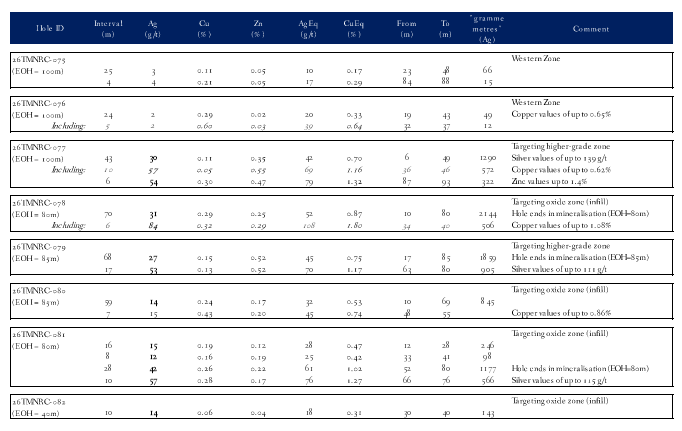
70m at 31 g/t Ag, 0.29% Cu and 0.25% Zn (52 g/t Ag equivalent) from 10m downhole (26TMNRC-078; drillhole ends in mineralisation).
Including: 6m at 84 g/t Ag, 0.32% Cu and 0.29% Zn (108 g/t Ag equivalent) from 34m downhole.
68m at 27 g/t Ag, 0.15% Cu and 0.52% Zn (45 g/t Ag equivalent) from 17m downhole (26TMNRC-079; drillhole ends in mineralisation).
Including: 17m at 53 g/t Ag, 0.13% Cu and 0.52% Zn (70 g/t Ag equivalent) from 63m downhole.
Drill intersections from the Western Zone include (downhole widths, true widths unknown):
24m at 0.29% Cu from 19m downhole (26TMNRC-076).
Including: 5m at 0.60% Cu from 32m downhole.
Phase 5 diamond drilling commenced on 8 November with four planned diamond drill holes to test at depth below the Exploration Target.
Initial metallurgical testwork results expected imminently.
Plan remains to produce a JORC Mineral Resource Estimate before the end of the year.
Richard Belcher, Managing Director of Tertiary Minerals plc, commented:
“We are delighted to report the last of the analytical results from the Phase 4 drilling which marks the end of the largest drill programme undertaken on the Project to date. This had the objective of both infilling the drill density to support the upcoming work on the Mineral Resource Estimate and also extending the known mineralisation beyond the Exploration Target and identifying a new area of copper mineralisation termed the Western Zone.
“The results released today, along with the results over the last month or so, are incredibly compelling and we are excited to be back drilling again with the aim to test the depth extent of mineralisation below the higher-grade zone and the potential for primary sulphide mineralisation.
“The initial metallurgical testwork results are expected imminently and will inform the maiden Mineral Resource Estimate work which will be undertaken in parallel with this deeper drill programme. We look forward to updating our shareholders in due course”.
Drill Programme and Results
Phase 4
A total of 39 (3,639m) Reverse Circulation (“RC”) drill holes were drilled as part of the Phase 4 drill programme. For the drilling at the Discovery Zone, holes were collared along a series of east-west drill lines spaced approximately 100m apart (north-south) and 50m apart along the east-west lines and drilled to vertical depths of up to 128m. This was the maximum depth capability of the drill rig under the drilling conditions, in particular the higher-than-expected water table and resultant wet samples. Drilling was completed in two passes to allow the updating of the Company’s geological model as new data became available and to enable the programme to be more dynamic.
The aim of this drill programme is to provide additional drilling data to increase confidence in the continuity of the mineralisation to the level required to report a JORC-compliant Mineral Resource Estimate. Further information on the drill programme can be found in the Company’s announcement on 8 June 2026.
The results in this announcement are for the remaining eight holes sent for laboratory analysis (Figures 1, 2, 3 and 4). Including these eight holes, results for a total of 37 holes have now been released from across the Exploration Target (Discovery Zone) and the Western Zone, with two holes not submitted for analysis. This total includes infill holes, expansion drilling around the Exploration Target mineralisation margin and drilling targeting the higher-grade mineralisation zone.
Accessory minerals such as bismuth, antimony and cobalt have also been intersected in these holes as well as being present in holes in previous drill phases. While the potential for these metals has yet to be evaluated, they are classified as critical, and, in some cases, strategic raw materials (e.g. by the European Commission). If it’s economically feasible to extract these accessory minerals along with the main silver-copper mineralisation, there could be a positive impact on future Project economics.
Table 1. Remaining analytical results (eight holes only) from the Phase 4 drill programme. Equivalent grades (“Eq”) are for illustrative purposes only.
Note to Table:
- Calculated intersections (downhole, true widths unknown) are weighted averages based on silver or copper (denoted in table by metal in bold). Using a cut-off grade of 10 g/t Ag or 0.1% Cu, respectively. Intervals start and end with ≥10 g/t Ag or 0.1% Cu, respectively and with up to 3m consecutive internal dilution allowed.
- Silver values rounded to whole numbers.
- EOH means End of Hole.
- CuEq (%) and AgEq (g/t) are the copper and silver equivalent grades, respectively, and were calculated assuming commodity prices of Cu: US$4.99 lb, Ag: US$57 oz, Zn: US$1.38 lb and 100% recovery as used in reporting of previous results from Phase 2 and 3 drill programmes. No information on beneficiation recoveries is available at this stage. These are for illustrative purposes only.
- Gramme metres for silver are the silver values (g/t) multiplied by the intervals (m).
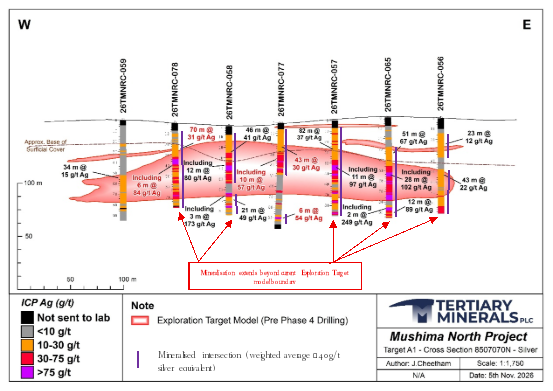
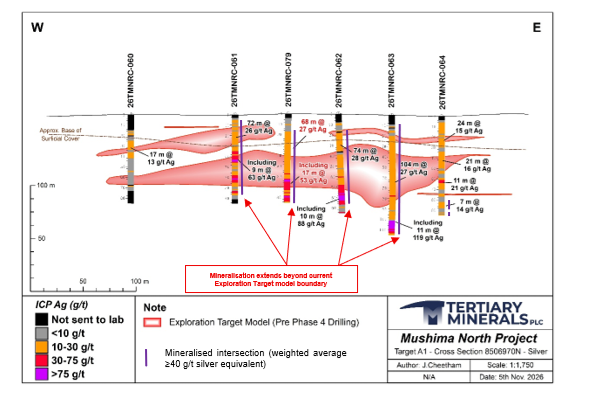
Figure 2. Cross-section (location on Figure 4) showing analytical results for silver for new drill hole 26TMNRC-079 overlaid on the current Exploration Target mineralisation (silver-copper-zinc) boundary (to be updated as part of the Mineral Resource Estimation work).
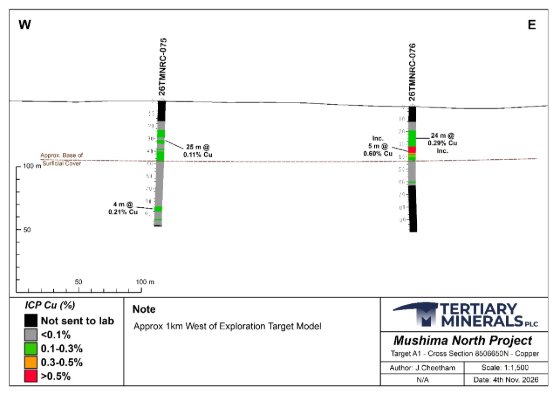
Figure 3. Cross-section (location on Figure 4) showing analytical results for copper for new drill holes 26TMNRC-075 and 26TMNRC-076 overlaid on the current Exploration Target mineralisation (silver-copper-zinc) boundary (to be updated as part of the Mineral Resource Estimation work).
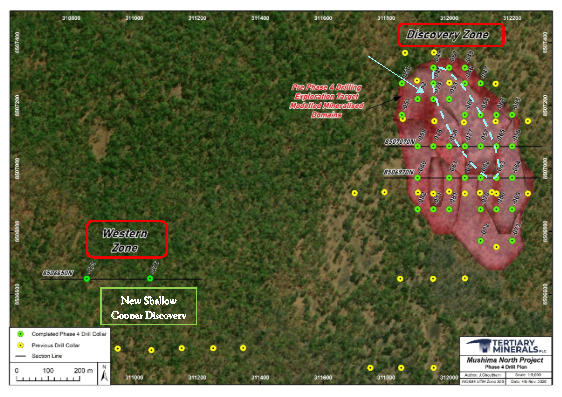
Figure 4. Plan view of 3D mineralisation model of the Discovery Zone used to help derive the Exploration Target (500m long, 300m wide and 75m thick) located at the northern end of the copper-in-soil anomaly at Target A1. Completed holes from this programme (green) and earlier drill phases (yellow).
Phase 5
A programme of approximately 1,000m of diamond drilling is planned as an initial “proof of concept” programme to test for the continuation of mineralisation at depth beyond that delineated by the recent Phase 4 programme. Currently, up to four holes, each between 200m and 250m in length and inclined at approximately -60 to -70°, are planned.
This will test for mineralisation up to a vertical depth of approximately 200m, considerably deeper than the current Exploration Target (~95m vertically) and the recent Phase 4 drill programme (maximum hole depth 125m vertically).
The new drill programme at Target A1 is designed to:
• Test the depth extent of mineralisation below the Discovery Zone and the potential for primary sulphide mineralisation.
• Increase the geological (lithological and structural) understanding of the deposit to support orebody knowledge and future drilling and technical studies.
• Provide drill core samples for additional metallurgical and technical testwork.
The drill programme commenced on 8 November and is estimated to take approximately 4 weeks to complete. Samples will be initially analysed on site using a portable X-Ray Fluorescence (“pXRF”) analyser for copper and zinc. Selected mineralised intervals will also be submitted for external assaying at a certified laboratory for a wider suite of elements than in previous analysis, including silver, copper, zinc, cobalt, bismuth, antimony, gallium, germanium and rare earth elements. These will be submitted in regular batches throughout the drill programme, with the first results expected approximately 6-8 weeks after the initial batch is submitted.
Core Sampling, Analysis and QAQC
The pXRF protocols will include the inclusion of Certified Reference Material, blanks and duplicate samples as part of an internal Quality Assurance (“QA”) procedure. Given the nature of the unprepared sample and point analysis, this method is used as a preliminary analytical technique to provide an approximate quantitative measure of copper and zinc grades and a qualitative assessment of the silver grades.
Sampling from the drilling programme will be on nominal 1m intervals with core cut in the field using a core saw, and a portion of the core sent for analysis to an independent laboratory, ALS Global, located in South Africa, for analysis for a range of elements using a four-acid digest, method code ME-MS61r. QA samples (Certified Reference Material, duplicates, blanks) will be inserted and results will be monitored as part of the Quality Assurance Quality Control (“QAQC”) protocol.
Target A1 Silver Oxide Discovery
The Company has previously reported a JORC-compliant Exploration Target for the Discovery Zone of between 15 and 30 million tonnes with an average grade of between 40 and 60 g/t silver equivalent. As currently defined, this is a near surface, tabular body located within the oxide zone and is some 500m long, 300m wide and up to 75m thick (based on a lower cut-off of 25 g/t silver equivalent). The mineralisation remains open to the northwest, southwest and at depth and so the full extent and true geometry of the mineralisation remain to be determined. Further information on the Exploration Target can be found in the Company’s announcement on 30 March 2026.
Elevated bismuth (up to 0.53%), antimony (up to 0.22%), cobalt (0.39%) and gallium (up to 40 g/t) are also associated with the mineralisation, but, as yet, have not been fully investigated. The potential for the near surface oxide mineralisation to transition to underlying sulphide mineralisation has yet to be tested. Nor has the potential for expanding the mineralisation based on nearby targets, such as at the Western Zone, Target A1.
Mushima North Project
The Mushima North Copper Project (Licence 27068-HQ-LEL) is held through Group company Copernicus Minerals Limited (“Copernicus”), which is 90% owned by Tertiary Minerals (Zambia) Limited and 10% by local partner, Mwashia Resources Limited.
The Project is under a technical cooperation agreement with First Quantum Minerals Limited (“FQM”), which allows Tertiary to benefit from FQM’s historic exploration data in the area, as well as FQM’s geological team’s extensive experience and understanding of the area’s geology. The agreement is non-binding and does not create any obligation to enter into any further agreement. There are no commercial restrictions for Tertiary and FQM does not have a right of first refusal over the Project. Further details can be found in the announcement on 15 September 2022.
Target A1 lies 28km to the east of the Kalengwa Copper (-Silver) Mine in northwest Zambia, one of the highest-grade copper deposits ever to be mined in Zambia. In the 1970s, high-grade ore, averaging approximately 11% Cu copper, was trucked for direct smelting at other mines in the Copperbelt. The Kalengwa Mine is currently under redevelopment.
Numerous other geochemical and/or geophysical targets (B1, B2, B3, C2) are yet to be drill tested, the majority of which are located within a 12km radius of Target A1.
Further Information:
|
Tertiary Minerals plc | |
|
Richard Belcher, Managing Director |
+44 (0) 1625 838 679 |
|
SP Angel Corporate Finance LLP, Nominated Adviser and Broker | |
|
Caroline Rowe/Jen Clarke |
+44 (0) 203 470 0470 |
|
AlbR Capital Limited, Joint Broker | |
|
Lucy Williams/Duncan Vasey |
+44 (0) 207 469 0930 |
Market Abuse Regulation
The information contained within this announcement is deemed by the Company to constitute inside information as stipulated under the Market Abuse Regulation (EU) No. 596/2014 as it forms part of UK domestic law by virtue of the European Union (Withdrawal) Act 2018 (‘MAR’). Upon the publication of this announcement via Regulatory Information Service (‘RIS’), this inside information is now considered to be in the public domain.
Cautionary Note Regarding Forward-Looking Statements
The news release may contain certain statements and expressions of belief, expectation or opinion which are forward looking statements, and which relate, inter alia, to the Company’s proposed strategy, plans and objectives or to the expectations or intentions of the Company’s directors. Such forward-looking statements involve known and unknown risks, uncertainties, and other important factors beyond the control of the Company that could cause the actual performance or achievements of the Company to be materially different from such forward-looking statements. Accordingly, you should not rely on any forward-looking statements and, save as required by the AIM Rules for Companies or by law, the Company does not accept any obligation to disseminate any updates or revisions to such forward-looking statements.
Competent Persons Statement
The technical information in this release has been compiled and reviewed by Dr. Richard Belcher (CGeol, EurGeol) who is a qualified person for the purposes of the AIM Note for Mining and Oil & Gas Companies. Dr. Belcher is a chartered fellow of the Geological Society of London and holds the European Geologist title with the European Federation of Geologists.
About Tertiary Minerals plc
Tertiary Minerals plc (AIM: TYM) is an AIM-traded mineral exploration and development company whose strategic focus is on energy transition metals. The Company’s projects are all located in stable and democratic, geologically prospective, mining-friendly jurisdictions. Tertiary’s current principal activities are the discovery and development of copper and precious metal mineral resources in Nevada and in Zambia.
RNS may use your IP address to confirm compliance with the terms and conditions, to analyse how you engage with the information contained in this communication, and to share such analysis on an anonymised basis with others as part of our commercial services. For further information about how RNS and the London Stock Exchange use the personal data you provide us, please see our Privacy Policy.

Latest directors dealings
- 1 minute ago Wickes Group
- 19 minutes ago Hikma Pharmaceuticals
- 23 minutes ago LSL Property Services
- 38 minutes ago Thungela Resources Limited NPV (DI)
- 53 minutes ago Mondi