
Scoping Study Shows Strategic Rare Earth Potential
Summary by AI BETAClose X


NEWS RELEASE I 9 SEPTEMBER 2026
scoping study confirms kasiya's POTENTIAL as a globally significant AND STRATEGIC source of critical rare earths
Simple, capital-efficient circuit to recover highly sought-after critical rare earths with significant valuable Nd+Pr+Dy+Tb+Y content as a potential monazite by-product - enhancing the exceptional economics of the Kasiya Rutile-Graphite DFS
Sovereign Metals Limited (ASX:SVM; AIM:SVML; OTCQX: SVMLF) (Sovereign or the Company) is pleased to announce the results of the Scoping Study (Scoping Study or Study) for recovery of a monazite concentrate with significantly elevated heavy rare earths content as a by-product from its Kasiya Project in Malawi. Concurrent with the Study, the Project has been renamed the Kasiya Critical Minerals Project (Kasiya or the Project), reflecting its combined rutile (titanium), graphite, and rare earth product suite.
|
CAUTIONARY STATEMENTS The Scoping Study referred to in this announcement assesses the potential incremental recovery of monazite from mineral streams that potentially may be generated by the Kasiya Project as included in the April 2026 Definitive Feasibility Study (DFS). The Scoping Study is based on low-level technical and economic assessments, supported by project-specific metallurgical testwork and the existing DFS production schedule. Consistent with the preliminary nature of a Scoping Study, it is not sufficient to support the estimation of Ore Reserves for the additional products or to provide assurance of an economic development case for those products at this stage. Further evaluation and appropriate studies are required before the additional products can be assessed as to whether they can be estimated as Ore Reserves and be incorporated into a definitive development case. The Scoping Study has been prepared to an accuracy level of ±30%. The results should not be considered a profit forecast or production forecast. The production profile for the production target and forecast financial information of this Study is supported by the existing April 2026 DFS production schedule (excluding years with >50% of plant feed in Inferred category of Mineral Resources). Approximately 99% of the scheduled throughput (production target) of this Scoping Study for the first twelve and half years of estimated production is in the Indicated Mineral Resource category with only 1% in the Inferred Mineral Resource category. For the life of mine of this Scoping Study, approximately 72% of life of mine production target is in the Indicated Mineral Resource category and 28% is in the Inferred Mineral Resource category. The Company has concluded that it has reasonable grounds for disclosing a production target which includes a modest amount of Inferred material and over the life of the mine the amount of Inferred Resources is not the determining factor in project viability. However, there is a low level of geological confidence associated with Inferred mineral resources and there is no certainty that further exploration work on the Kasiya deposit will result in the determination of additional Indicated Mineral Resources or that the production target (or financial forecasts) itself will be realised. The Scoping Study is based on the material assumptions outlined elsewhere in this announcement. These include assumptions about the availability of funding. It also relies on Scoping Study-level assumptions regarding metallurgical recoveries, product yields and quality, costs, prices, payability and logistics. The assessment is incremental to, and integrated with, the underlying Kasiya DFS project and therefore assumes that the DFS project is funded, developed and operated broadly as scheduled (refer to announcement dated 16 April 2026). While the Company considers the material assumptions to be based on reasonable grounds, there is no certainty that they will prove to be correct or that the range of outcomes indicated by the Scoping Study will be achieved. As a Scoping Study, the estimates and outcomes remain subject to the accuracy range, qualifications and risks disclosed in this announcement and to refinement through further technical and commercial work. To achieve the range outcomes indicated in the Scoping Study, additional funding will likely be required. Investors should note that there is no certainty that Sovereign will be able to raise funding when needed. It is also possible that such funding may only be available on terms that dilute or otherwise affect the value of the Sovereign's existing shares. It is also possible that Sovereign could pursue other 'value realisation' strategies such as sale, partial sale, or joint venture of the Project. If it does, this could materially reduce Sovereign's proportionate ownership of the Project. The Company has concluded it has a reasonable basis for providing the forward looking statements included in this announcement and believes that it has a reasonable basis to expect it will be able to fund the development of the Project. Given the uncertainties involved, investors should not make any investment decisions based solely on the results of the Scoping Study. |
 |
|||
 |
|||
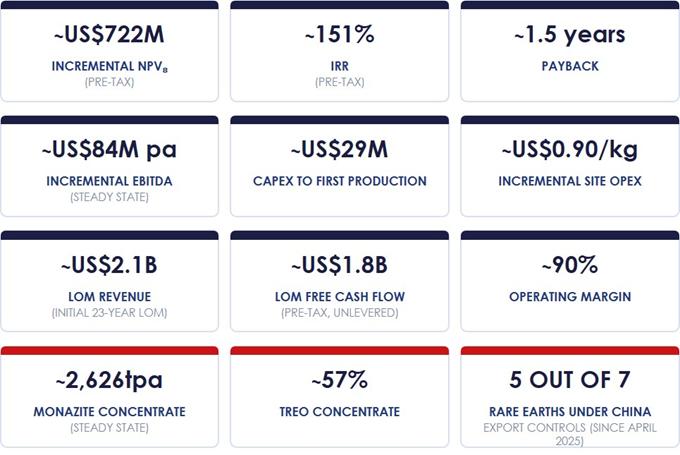
Accuracy range above of ±30%
Managing Director and CEO, Mr Frank Eagar, commented:
"The Kasiya DFS already defines one of the world's largest natural rutile and flake graphite developments. This Study shows the same resource can potentially deliver rare earths and deliver them cheaply. For ~US$29 million of initial capital, using infrastructure the DFS has already designed and costed, we can potentially add ~US$722 million of pre-tax value at a ~151% rate of return, with payback in around 18 months.
Mineral-reliant industries in the United States are worth over US$4 trillion a year - more than an eighth of the entire U.S. economy - and rare earths sit at the centre of them. Last year the U.S. doubled its rare earth production to almost 9,000 tonnes - and still imported 67% of what it consumed. For heavy rare earths like dysprosium, terbium and yttrium, the U.S. produces none at commercial scale and remains completely dependent on imports. That is why Washington is putting stockpiles, price floors and offtake vehicles in place.
Kasiya can potentially provide the supply this effort requires: five of the seven rare earths under Chinese export controls, for at least 23 years, from a project already at the definitive feasibility stage. And because rutile and graphite carry the cost base, our rare earths do not need high rare earth prices or floor prices to be viable.
We will now take these results into our discussions with potential partners and progress the integration of rare earths into Kasiya's definitive development case."
 |
|||
|
|||
HIGHLIGHTS
Kasiya - A Rare Earths Project With No Mine Of Its Own To Build
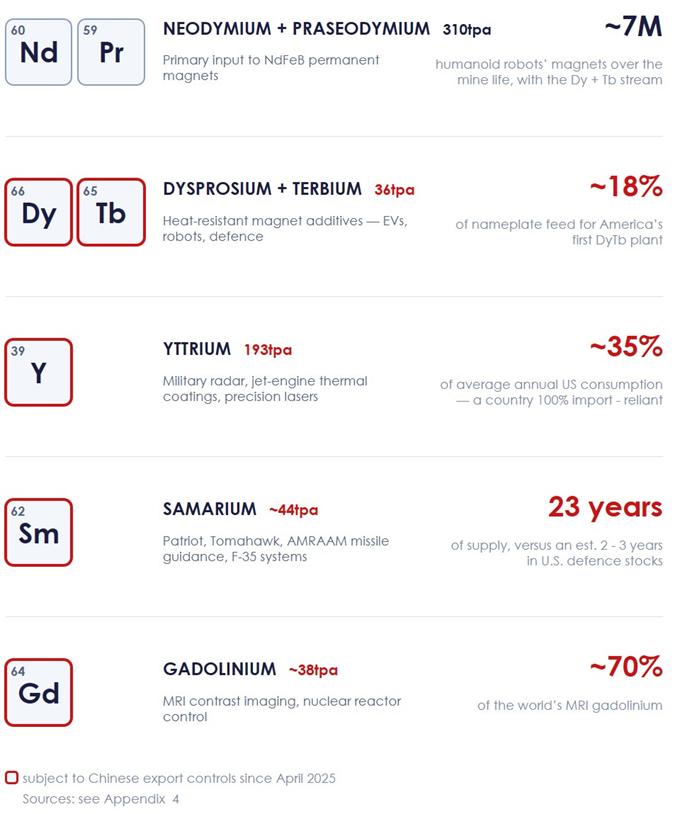
o 2,626tpa of monazite rare earth concentrate (REC) containing 1,485tpa of total rare earth oxides (TREO) at steady state run of mine
Commercially Significant Levels Of China's Export-Controlled Rare Earths
o Scarce dysprosium (Dy), terbium (Tb), yttrium (Y), samarium (Sm) and gadolinium (Gd) oxides in elevated levels - all under Chinese export controls since April 2025
o Neodymium-praseodymium (NdPr), the primary input to Neodymium-Iron-Boron (NdFeB) permanent magnets, also present in levels similar to other Western rare earths mines
o 310tpa of NdPr and 36tpa DyTb - sufficient for the magnets in ~7 million humanoid robots over LOM; DyTb alone equivalent to ~18% of nameplate feed of America's first DyTb separation plant
o 193tpa Y - military radar and jet-engine thermal-barrier coatings; equivalent to ~35% of average annual U.S. consumption, which is 100% import-reliant
o 82tpa Sm + Gd - samarium used to steer Patriot, Tomahawk and AMRAAM missiles depleted to 2-3-year supply; gadolinium equivalent to 70% of the world's annual MRI supply. U.S. defence demand for both: classified
Recovered from mineral streams already generated by the DFS flowsheet
o No additional mining, no additional front-end processing, and none of the development risk of a standalone rare earths project
o Mining, processing, tailings, infrastructure, and environmental and social disciplines already assessed at DFS level with overview by Rio Tinto and Sovereign Technical Committee
operating margin provideS compelling economics
o Base Case ~US$722M Pre-Tax NPV8 uplift to Kasiya from incremental capital to first production of ~US$29M with potential upside NPV8 of US$883M
o Incremental Base Case Pre-Tax IRR of ~151% and payback of approximately 1.5 years
o ~90% operating margin with incremental site operating costs of ~US$0.90/kg REC
o ~US$84M incremental steady state annual EBITDA lifts Kasiya profitability and cash flow generation
o Pre-tax, unlevered free cash flow of ~US$1.8B over potential 23-year initial life of mine (LOM)
o Total Integrated Kasiya Pre-Tax NPV of US$2.9Bn
Maiden monazite mineral resource estimate (MRE) COMPLETED
o 524.4Mt @ 0.0132% monazite by-product underpins the Scoping Study production profile
STRONG RESULTS PROVIDE Clear path forward
o Variability testwork on TREO distribution within REC product with REC marketing and offtake discussions commencing immediately
o PFS completion in 2027
SUMMARY OF STUDY RESULTS
TABLE 1: REC SCOPING STUDY SUMMARY
|
Metric |
|
REC Scoping Study (Accuracy ±30%) |
|
|
Potential Life of Mine |
23 years |
||
|
Production Target (Steady State Average) |
tpa |
% |
|
|
Monazite REC |
2,626 |
||
|
Contained TREO |
1,485 |
56.6% |
|
|
- of which NdPr oxide |
310 |
20.8% |
|
|
- of which Dy + Tb oxide |
36 |
2.5% |
|
|
- of which Yttrium oxide |
193 |
13.0% |
|
|
- of which Samarium + Gadolinium oxides |
82 |
5.5% |
|
|
Financial Performance |
Unit |
Base Case |
Western Supply Case |
|
Rare earth basket price assumption (CIF Texas) |
US$/kg REC |
39.45 |
47.34 |
|
Incremental operating costs (site) |
US$/kg REC |
~0.90 |
|
|
Incremental operating costs (CIF Texas) |
US$/kg REC |
~3.68 |
~4.07 |
|
Operating Margin |
% |
90% |
91% |
|
Annual EBITDA (Steady State) |
US$M |
84 |
102 |
|
Annual Free Cash Flow (Pre-tax, unlevered) |
US$M |
82 |
99 |
|
Incremental Economics (pre-tax, real) |
|||
|
Incremental capital cost to 1st production |
US$M |
29 |
|
|
NPV8 |
US$M |
722 |
883 |
|
IRR |
% |
151% |
172% |
|
Return on incremental capital |
x |
18.2x |
22.3x |
|
Payback on incremental capital |
years |
1.5 |
1.5 |
1. LOM in this Study differs from the 25-year DFS life of mine because Years 24 and 25 have been excluded, as they would otherwise be based solely on Inferred Resources (for which there is a low level of geological confidence), so no financial forecasts or production targets are estimated for those years and they have been excluded from the LOM for the Scoping Study. Steady state = years when run-of-mine is at nameplate capacity of 24Mtpa; all results on a 100% basis; ±30% accuracy.
2. Base Case represents Argus Media group (Argus) rare earths price forecasts with payability of 50%; Western Supply Case represents Argus rare earths price forecasts and payability of 60% representing value attributable to ex-China monazite concentrate supply.
TABLE 2: SIDE-BY-SIDE KASIYA RESULTS
|
Metric |
Unit |
Kasiya DFS (Rutile & Graphite) |
Scoping Study Base Case ±30% (Rare Earths) |
|
Total Revenue |
US$M |
16,210 |
~2,134 |
|
EBITDA |
US$M pa |
476 |
~84 |
|
Free Cash Flow (pre-tax) |
US$M pa |
452 |
~82 |
|
NPV8 (pre-tax) |
US$M |
2,204 |
~722 |
|
Capex to 1st production |
US$M |
727 |
~29 |
The addition of the rare earth circuit leaves the Kasiya DFS physicals unchanged: a 25-year initial mine life, 24Mtpa ore throughput, 222ktpa of natural rutile and 275ktpa of natural flake graphite.
SOVEREIGN ADDS RARE EARTHS TO RUTILE (TITANIUM) AND GRAPHITE PRODUCT SUITE
Sovereign has completed this Scoping Study to assess the operational, commercial and economic viability of adding a third product stream to the Kasiya Project. The Study shows that ~2,626tpa of monazite REC can be recovered from the rutile tailings stream. Together with the results of the Kasiya DFS, which was completed with input from Rio Tinto, Sovereign is potentially positioned to be a multi-decade supplier of a critical minerals products suite essential to the U.S. and U.S.-allied defence and aerospace, AI infrastructure, robotics, energy and other vital industries.
KASIYA - ONE PROJECT TO FEED THE WEST'S CRITICAL SUPPLY COMPLEX
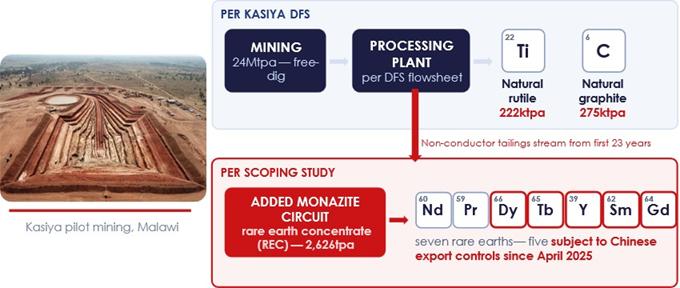
Figure 1: Kasiya Circuit Schematic and Product Suite

Figure 2: Kasiya's life of mine production in end-use equivalents. Sources: see Appendix 4
MONAZITE BY-PRODUCT CONFIRMED WITH MAIDEN MINERAL RESOURCE ESTIMATE
Monazite mineralisation occurs within the same deeply weathered, near-surface residual heavy-mineral system that hosts the Kasiya rutile and graphite Mineral Resource as per the DFS.
To support a by-product MRE for monazite, Sovereign completed a comprehensive programme covering the April 2026 DFS mine plan: 3,250 magnetic heavy-mineral composites, representing 1,012 boreholes within the DFS pit areas, were submitted for XRF analysis, with selected composites also analysed for the full rare earth element suite by ICP to assess variations in rare earth composition across the deposit and through the weathering profile.
The maiden by-product MRE, constrained to the DFS open pits, is 69kt monazite contained in 524.4Mt at 0.0132% monazite and classified 74% Indicated and 26% Inferred. The grade reflects monazite's status as a by-product. Since the monazite MRE sits within pits the DFS has already designed, no additional mining is required to access it.

Figure 3: Monazite contained within the Kasiya 2026 MRE
PREMIUM RARE EARTHS PRODUCT CONTAINING GENUINELY RARE ELEMENTS
In January 2026, Sovereign announced that it had successfully recovered a monazite product containing high-value heavy rare earth elements (REE) alongside common light REEs from the tailings stream generated during rutile processing at its Lilongwe laboratory facilities in Malawi. The concentrate was recovered from material that would otherwise be discarded, i.e. the non-conductor tailings stream from electrostatic separation of a heavy mineral gravity concentrate of Kasiya ore. Independent preliminary chemical analysis of magnetic concentrates from processed resource drilling samples confirmed the favourable rare earth oxide distributions within the monazite concentrate.
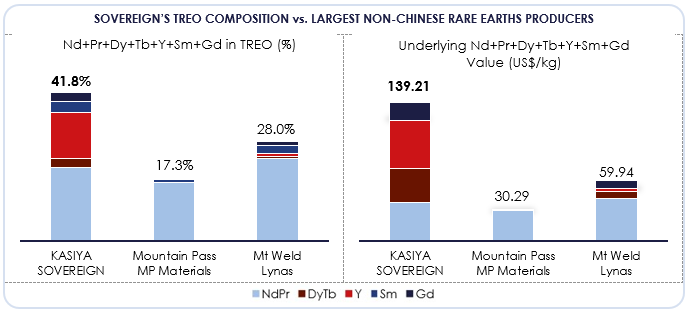
Figure 4: TREO basket composition (Source: see Appendix 5; price data as per average REO prices during LOM)
NEAR-ZERO INCREMENTAL OPERATING COSTS
Kasiya's REC will be recovered from mineral streams the DFS flowsheet already produces. Upstream steps including free-dig mining, ore transport to the plant, the scrubber, wet concentration and electrostatic separation have been defined and costed in the DFS and accordingly attributed to rutile and graphite production. The only incremental processing is the added monazite concentrate circuit which involves spiral gravity separation and flotation treating the non-conductor stream from the Mineral Separation Plant, together with product packaging and storage. There is no additional mining, no early-stage processing and no change to the DFS mining method, wet concentration or graphite recovery strategy.
Incremental operating costs are accordingly low. The incremental site operating cost is ~US$0.90/kg REC at the mine gate. Including transport and port charges, the cost is ~US$1.39/kg REC free-on-board FOB Dar es Salaam. Including ocean freight and insurance, the total cost is ~US$3.68/kg REC delivered CIF Houston, Texas. The Study deliberately costs Kasiya's REC delivered into the United States. On that basis, the operating margin is approximately 90%. Due to its by-product nature, this cost structure holds across rare earth price cycles. Including all other regulatory fees, Sovereign can land REC in America for US$3.85/kg in any market.
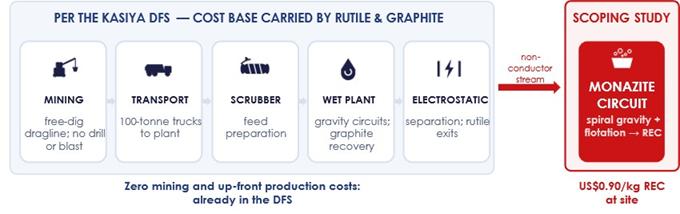
Figure 5: Kasiya's circuit to produce REC is added onto the DFS operation
PROFITABLE EVEN AT U.S. GOVERNMENT FLOOR PRICES
Since Sovereign's REC may be a by-product of the titanium and graphite operation defined in the DFS, Kasiya REC supply does not depend on rare earth prices to remain in production. This is reflected in the Study's two main price cases: the Base Case (using Argus Media price forecasts) delivers the potential for an incremental pre-tax NPV₈ of US$722 million at a 151% IRR, and the Western Supply Case (reflecting higher demand for ex-China supply of monazite concentrate) US$883 million at 172%.
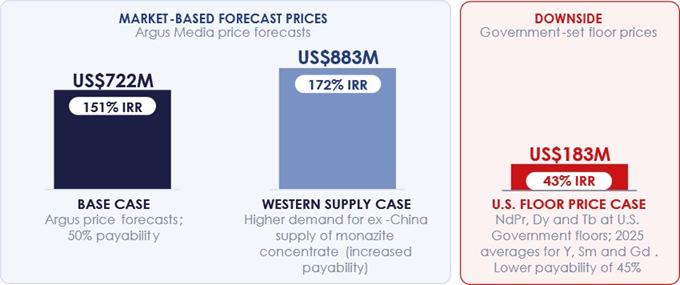
Figure 6: Kasiya pre-tax NPV and IRR in various market and geopolitical scenarios
A third case tests the bottom of the market as the U.S. Government itself has defined it. Since July 2025, guaranteed minimum prices have become a standard feature of U.S. rare earth supply arrangements:
· a US$110/kg floor for NdPr established with MP Materials and repeated with Lynas; and
· the first Western floor prices for heavy rare earths, at US$575/kg for Dy and US$2,050/kg for Tb
The U.S. Floor Price Case applies these floors, with 2025 average prices for yttrium, samarium and gadolinium which do not currently have floor prices but are deemed critical. Even in this scenario, the circuit generates US$183 million of incremental pre-tax NPV₈ and a 43% IRR. These floor prices arise under U.S. Government arrangements with third parties and are applied as a downside assumption only; Kasiya is not party to any such arrangement.
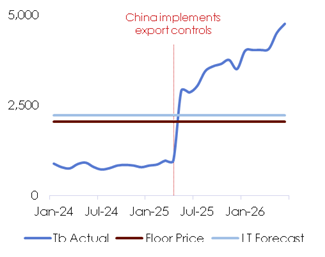
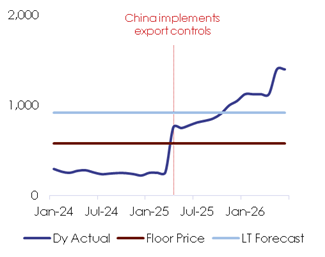 Figure 7: Effect of China's heavy rare earths export controls on Tb and Dy prices in US$/kg (vs. floor price and long-term forecast prices per Study)
A SOLUTION TO CHINA EXPORT CONTROLS AND SUPPLY DOMINANCE
In April 2025, China introduced export controls over seven medium and heavy rare earths - including dysprosium, terbium, yttrium, samarium and gadolinium, each present in Kasiya's concentrate - citing their dual-use applications. Dysprosium, terbium and yttrium together comprise approximately 15% of Sovereign's TREO basket. In October 2025, China added five more REEs - holmium, erbium, thulium, europium and ytterbium.
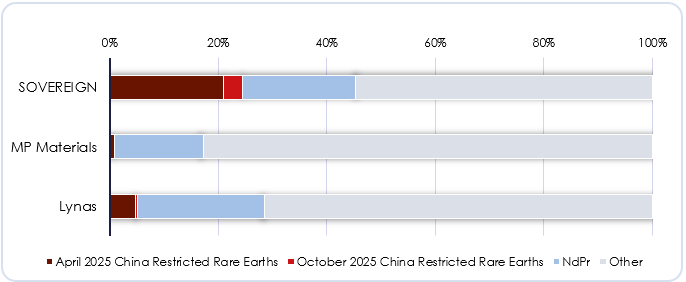
Figure 8: Geopolitical importance of Kasiya's REC vs. current non-Chinese REE producers
(Source: Appendix 5)
China accounts for most global mined production of these elements and effectively all commercial separation capacity. The United States is 100% net import-reliant on yttrium, with nearly all supply derived from concentrates processed in China (Source: USGS Mineral Commodity Summaries, 2026). The U.S. defence industry is estimated to hold a two-to-three-year inventory of samarium with potential replenishment of munitions expended in the 2025 Iran conflict adding to demand.
FEEDSTOCK FOR RARE EARTH REFINING CAPACITY FUNDED BY THE U.S. AND ALLIES
The Western rare earth supply chain comprises four stages: primary mining and concentrate production; separation into individual rare earth oxides; conversion to metals and alloys; and magnet manufacturing. Western governments and industry are investing across all four. Availability of heavy rare earth feedstock is a key choke point determining whether the downstream links can operate at capacity.
Western primary production is dominated by light rare earth deposits, with only trace quantities of dysprosium, terbium and yttrium. New separation capacity is being financed, commissioned and constructed specifically to process heavy rare earths:
· the United States (e.g. MP Materials Corp. with funding from the Department of War (DOW));
· Australia (e.g. Iluka Resources Limited with funding from Export Finance Australia (EFA); Tronox Holdings plc with funding from Export-Import Bank of the United States (EXIM) and EFA); and
· Malaysia (Lynas Rare Earths Limited with funding from the DOW)
This new capacity requires a qualified, scalable supply of heavy rare earth feed. Downstream, metal and alloy producers and magnet manufacturers depend on separated dysprosium and terbium for the high-temperature NdFeB magnets used in defence, aerospace, electric vehicle and robotics applications.
Kasiya's REC product contains approximately 1,485tpa of TREO over an initial 23-year mine life and carries five of the seven rare earths placed under Chinese export controls in April 2025.
The REC is uncommitted, at a time when Western governments have established price floors, government-backed offtake vehicles and bilateral supply frameworks specifically to secure heavy rare earth feed from allied jurisdictions. Kasiya is positioned to supply that feed into Western separation capacity for the duration of its mine life.
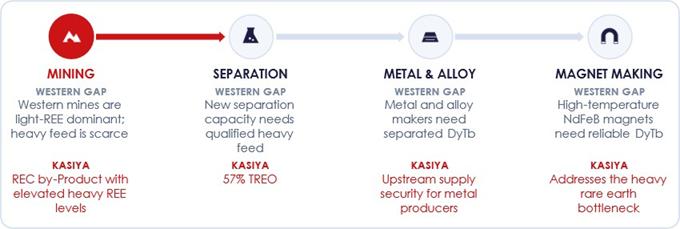
Figure 9: Kasiya's role in the Western rare earth supply chain
CRITICAL ELEMENTS FOR CRITICAL PLATFORMS
Production of heavy rare earths outside China remains negligible yet various critical platforms of the West depend on at least one rare earth Kasiya's REC will contain.
This dependence occurs throughout defence, energy, technology and medical systems. NdFeB permanent magnets - built on NdPr, with dysprosium and terbium added wherever they must perform at high temperature - sit in the actuators, motors and generators of fighter aircraft, guided missiles, submarines, drones, electric vehicles and humanoid robots. Yttrium hardens jet engines and semiconductor plasma-etch chambers and enables military radar and solid-state lasers; samarium-cobalt magnets guide missiles; gadolinium serves naval propulsion, turbine coatings and the world's MRI machines. Publicly reported estimates indicate approximately 410kg of rare earth materials in each F-35-class airframe, approximately 4.2 tonnes in each Virginia-class submarine, and 1-4kg in each electric vehicle or humanoid robot.
Every platform shown in Figure 10 depends on at least one rare earth contained within Kasiya's REC product.
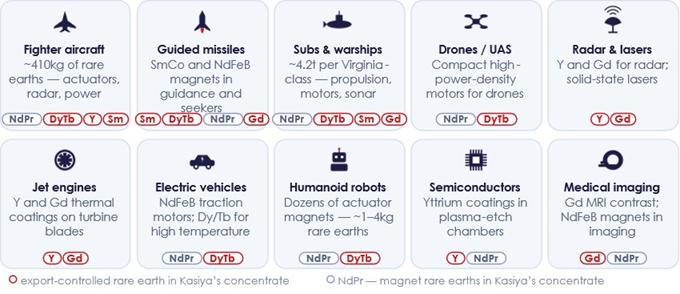
Figure 10: Importance of Heavy Rare Earths to the West
NEXT STEPS
· Variability testwork: confirm monazite recoveries and concentrate quality across the DFS mine schedule
· Product qualification: REC samples from Sovereign's Lilongwe facilities to prospective customers for evaluation
· Marketing: offtake discussions with Western processors and government procurement programmes
· Pre-Feasibility Study: rare earths integrated into Kasiya's definitive development case; completion targeted 2027
· Resource development: Assessment of whether there can be Inferred conversion and extension of the monazite MRE beyond the 25-year DFS pits
|
Enquiries |
|
Frank Eagar, Managing Director & CEO South Africa / Malawi +27 21 140 3190 Sapan Ghai, CCO London +44 207 478 3900 |
|
Nominated Adviser on AIM and Joint Broker |
|
|
SP Angel Corporate Finance LLP |
+44 20 3470 0470 |
|
Ewan Leggat Charlie Bouverat |
|
|
|
|
|
Joint Broker |
|
|
Stifel |
+44 20 7710 7600 |
|
Varun Talwar |
|
|
Ashton Clanfield |
|
-ENDS-
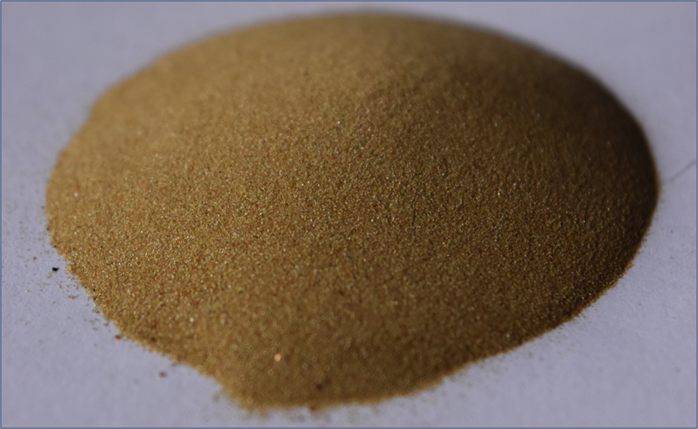
|
Figure 11: Monazite rare earth concentrate (REC) produced from Kasiya
KASIYA CRITICAL MINERALS PROJECT
MONAZITE RARE EARTH CONCENTRATE BY-PRODUCT
SCOPING STUDY TECHNICAL SUMMARY
EXECUTIVE SUMMARY
The April 2026 DFS established Kasiya as a large-scale, long-life natural rutile and natural flake graphite development in central Malawi. The DFS is based on a 25-year mine life, phased throughput of 12 Mtpa in Phase 1 expanding to 24 Mtpa in Phase 2, and 535.8 Mt of Ore Reserve scheduled for processing. At steady state, the DFS forecasts approximately 222 ktpa of natural rutile and 275 ktpa of natural flake graphite, with a pre-tax NPV8 of US$2.204 billion and a pre-tax IRR of 23.4%.
The upstream DFS battery limit is the non-conductor stream from the Mineral Separation Plant (MSP). The incremental scoping study scope principally covers downstream separation of this stream into an REC, product packaging, storage, and logistics. It does not assess a separate mining operation and does not modify the April 2026 Kasiya Ore Reserve, mine schedule, Phase 1 and Phase 2 throughput strategy or primary rutile and graphite production plan.
Basis of the production target
The production profile for the monazite product is derived from the April 2026 DFS production schedule and the characteristics of the MSP stream, together with Scoping Study-level assumptions for recovery, yield, product grade, ramp-up and availability.
· The production target is based on the non-conductor streams generated in the DFS production schedule, the characterisation of those streams with respect to monazite and recovery assumptions are based on metallurgical testwork and benchmarking.
· The Monazite Mineral Resource Estimate, covering the April 2026 DFS life of mine pit shells of which 74% is in the Indicated Category, supports the Monazite bearing non-conductor feed into the REC recovery circuit.
· The study assumes the Kasiya DFS project is funded, constructed and operated substantially as scheduled, such that this scoping study is conducted on an incremental basis to produce the REC product.
· No separate or additional Ore Reserve is being declared for purposes of this scoping study.
TABLE 3: STUDY CONTRIBUTORS
|
Organisation |
Study role |
|
DRA Projects (Pty) Ltd (DRA) |
Project management, process engineering support, process-option assessment and capital cost estimate for the selected flowsheet. |
|
Practara Metals and Mining Advisory (Practara) |
Operating cost estimate (OPEX) and financial modelling. |
|
Alistair Group |
Monazite concentrate logistics review and cost inputs. |
|
MSA Group |
Monazite Mineral Resource Estimate and Competent Person input |
|
Allied Mineral Laboratories (AML) |
Historic metallurgical testwork over the previous Kasiya study stages of nine bulk samples to produce non-conductor concentrate. These samples were used for subsequent analysis and testwork. |
|
Light Deep Earth (LDE) |
Historic metallurgical testwork over the previous Kasiya study stages of a single heavy mineral concentrate sample to produce a non-conductor concentrate. The samples were used for subsequent scoping testwork. |
|
University of Cape Town (UCT) |
QEMSCAN mineralogy and Electron Probe Micro Analyser (EPMA) analysis. QEMSCAN performed on non-conductor concentrate and EPMA performed on monazite within the non-conductor concentrate. |
|
Scientific Services (SS) Cape Town |
XRF and ICP analysis of non-conductor, magnetic concentrates, and gravity concentrates |
KASIYA DFS CONTEXT
April 2026 DFS Reference
Kasiya is located approximately 30 km north-west of Lilongwe, Malawi. The April 2026 DFS defines a phased, owner-operated, shallow free-dig development producing premium natural rutile and natural flake graphite for export via the Nacala Corridor. Tailings are progressively returned to mined-out pits, avoiding a conventional surface tailings storage facility.
This Scoping Study is incremental to the April 2026 Kasiya DFS and does not contemplate a separate mine development. It retains the existing DFS mining and primary-processing basis and assesses the additional downstream facilities and activities required to recover and produce a REC from the non-conductor mineral streams generated within the Kasiya MSP.
The April 2026 DFS basis retained includes:
· the existing Ore Reserve and mine schedule
· the dry-mining method and pit sequence
· Phase 1 and Phase 2 plant throughput
· the primary wet-concentration circuit and rutile-graphite production strategy
· the use of existing site infrastructure and utilities as designed.
The incremental scope assessed in the Scoping Study includes:
· additional treatment of the non-conductor stream to recover and produce a REC
· additional mineral separation and product finishing facilities
· incremental infrastructure tie-ins and utility requirements
· product storage, packaging and containerisation
· product handling, logistics and marketing assumptions
· incremental CAPEX, OPEX, permitting and funding requirements.
All capital costs, operating costs, revenues and financial outcomes reported for the monazite product are assessed on an incremental basis relative to the April 2026 Kasiya DFS base case.
TABLE 4: APRIL 2026 DFS REFERENCE PARAMETERS
|
DFS parameter |
Published reference case |
|
Mine life |
25 years |
|
Phase 1 and Phase 2 throughput |
Phase 1: 12 Mtpa, Phase 2 expansion: 24 Mtpa |
|
Ore Reserve scheduled for processing |
535.8 Mt |
|
Average steady-state production |
222 ktpa natural rutile, 275 ktpa natural flake graphite |
|
Pre-tax NPV8 and IRR |
NPV8: US$2.204bn, IRR: 23.4% |
|
Phase 1 pre-production CAPEX |
US$727m |
|
Phase 2 expansion CAPEX |
US$511m |
|
Base-case export route |
Road and rail to the Port of Nacala, Mozambique |
GEOLOGY AND RESOURCES
The Kasiya deposit is located on the Lilongwe Plain in central Malawi and is hosted by deeply weathered paragneiss and orthogneiss of the Mozambique Belt Basement Complex. The mineralised system forms broad, relatively flat-lying and laterally continuous bodies within a well-developed weathering profile. Rutile is preferentially enriched in the near-surface horizons, while graphite grades generally increase below approximately six metres. Monazite containing elevated concentrations of the heavy rare earth elements dysprosium, terbium and yttrium has also been recovered from the rutile processing circuit, indicating the potential for an additional rare REC product.
The mineralised zones extend for more than 10 kilometres along strike and are approximately one to four kilometres wide. Drilling has been completed on regional 800-metre centres, with progressive infill to 400 metres and 200 metres in key areas. Geological interpretation and continuity have been supported by twin drilling, close-spaced geostatistical drilling, trial-mining channel samples and open-pit sampling. The existing rutile and graphite Mineral Resource Estimate is classified as Measured, Indicated and Inferred in accordance with the JORC Code (2012).
Monazite
Monazite mineralisation occurs within the same deeply weathered, near-surface residual heavy-mineral system that hosts the Kasiya rutile and graphite Mineral Resource. The minerals form part of the naturally occurring heavy-mineral assemblage derived from the weathering of the underlying paragneiss and are distributed throughout the extensive, sub-horizontal mineralised profile. Monazite is an important source of light rare earth elements, including neodymium and praseodymium, while monazite-associated rare earth minerals are enriched in heavy rare earth elements.
Monazite Mineral Resource Estimate
Sovereign has advanced a comprehensive analytical programme to support an additional Mineral Resource estimate for monazite within the April 2026 DFS mine plan. A total of 3,250 magnetic heavy-mineral composites, representing 1,012 boreholes within the DFS pit areas, were submitted for XRF analysis. Selected composites were also submitted for full-suite rare earth element analysis by ICP to assess changes in rare earth composition across the deposit and through the weathering profile.
The analytical and statistical work indicates that monazite occurs with consistent rare earth assemblage, although relative proportions vary with depth and weathering. For resource estimation purposes, lanthanum oxide has been used as the principal analytical proxy and cerium oxide as a supporting validation measure.
The by-product MRE for monazite in-situ mineral percentage constrained to the DFS open pits for the Kasiya rutile and graphite project is 524.4 Mt at 0.0132% Monazite. The MRE is classified as 74% Indicated and 26% Inferred.
TABLE 5: KASIYA 2026 MONAZITE MINERAL RESOURCE ESTIMATE
|
Class |
Tonnes (Mt) |
Grade (%) |
|
Indicated |
386.9 |
0.0135 |
|
Inferred |
137.5 |
0.0125 |
|
Total |
524.4 |
0.0132 |
Notes:
1) The mineral resource is constrained to the Kasiya rutile and graphite DFS open pits to satisfy RPEEE
2) No cut-off is applied and the total volume within the DFS open pits will be processed with monazite concentrate being produced as a by-product of the Kasiya rutile and graphite production
3) The grade % is the in-situ grade of monazite mineral calculated from the recovered magnetic concentrate fraction of the HMS within the sand fraction (>45um <600um)
MINING
Kasiya is planned as a large-scale, conventional dry-mining operation exploiting soft, free-dig material to a maximum depth of approximately 20 metres. Pilot mining demonstrated that the weathered ore can be excavated without drilling, blasting, crushing, grinding or milling. The selected mining method uses draglines equipped with approximately 12.7 cubic metre buckets to load 100-tonne rigid dump trucks, which transport run-of-mine material to the processing plants or designated stockpiles.
Mining will generally be undertaken in two benches: a five-metre upper cut and a lower cut of up to 15 metres. This configuration enables early access to higher-grade near-surface rutile, assists with management of the plant-feed graphite grade and keeps the dragline above the groundwater table, which typically occurs at depths of seven to nine metres. Mining is scheduled to commence before processing to establish ore stockpiles and create void capacity for subsequent in-pit tailings deposition.
Development is based on two 12 Mtpa processing modules. The South operation commences first, followed by the North operation from Year 5, increasing total nameplate capacity to 24 Mtpa. Plant locations were selected near the respective centres of the resource to reduce haulage distances and facilitate progressive backfilling. Recovery of monazite as a REC would use material already mined and delivered for rutile and graphite production.
The Scoping Study is based on the same pit shells and mine plan as the DFS excluding any years in which Inferred Resources account for >50% of the mining inventory i.e. years 24 and 25. It incorporates DFS-level assumptions for the dry-mining method, mining costs, recoveries, exclusion zones and operating constraints. These assumptions have been validated by trial mining and reviewed by the relevant Competent Person. The rare earth recovery circuit does not require additional mining, changes to the Ore Reserve, changes to the mining sequence or additional run-of-mine material.
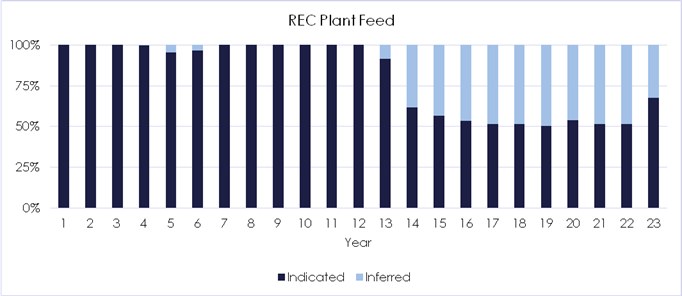
Figure 12: Monazite plant feed over LOM
Sovereign confirms that the potential incremental recovery of monazite from mineral streams the subject of the Scoping Study is financially viable when excluding Inferred Mineral Resources in the production schedule. Also, and as identified above in Figure 12, the Inferred Mineral Resources do not feature as a significant proportion early in the Scoping Study mine plan.
PROCESSING AND METALLURGY
Metallurgy testwork and design basis
The Scoping Study is supported by metallurgical testwork undertaken on Kasiya material, supplemented by relevant benchmark data for the Scoping Study level design. The test work procedure is summarised below.
Rare Earth Concentrate
· Kasiya bulk metallurgical samples previously processed at Allied Mineral Laboratories were utilised.
· Non-conductor concentrates generated from these samples were retrieved from storage for processing.
· QEMSCAN, an automated microscope-based analysis, was used to identify the minerals present and measure the monazite content of each non-conductor concentrate.
· Electron Probe Microanalysis (EPMA) was used to determine the chemical composition of individual monazite particles.
· Scientific Services in Cape Town analysed the concentrates using X-ray Fluorescence (XRF) to measure the major elements present and Inductively Coupled Plasma (ICP) analysis to measure specific elements, including those present in very small quantities.
· Sovereign's laboratory in Malawi used size, gravity, electrostatic and magnetic separation techniques to produce a REC with elevated levels of heavy rare earth oxides in the TREO content.
The design of the gravity circuit and gravity circuit recovery assumptions were informed by the metallurgical testwork programme. Monazite flotation benchmark data was used to inform the flotation circuit design.
Further variability, flowsheet optimisation and locked-cycle testwork will be required in the next study phase to confirm design criteria and product performance.
Please refer to announcements dated 21 January 2026 and 27 May 2026 for further details.
Process design
The Scoping Study process concept to recover the additional minerals is simply an add-on to the Kasiya MSP as defined in the DFS. There is no change to the DFS mining method, wet concentration and graphite recovery strategy.
The non-conductor stream from the MSP passes through the added monazite circuit. This circuit consists of feed preparation and a range of unit operations (including spiral gravity separation and flotation) to produce a monazite concentrate.
Monazite concentrate then reports to the product drumming facilities. The design philosophy uses conventional mineral sands and monazite separation technology, and maximises practical reuse of existing utilities and infrastructure.
|
EXISTING KASIYA |
→ |
FEED PREPARATION |
→ |
SPIRALS |
→ |
FLOTATION |
→ |
|
Existing rutile and graphite production remains unchanged. |
Removal of magnetic minerals and sizing as required. |
Gravity separation and pre-concentration of heavy minerals. |
Floats target rare earth minerals. |


|
REC CLEANER TABLES |
→ |
REC PRODUCT |
→ |
CONCENTRATE HANDLING |
|
Gravity cleaning and upgrading. |
|
The REC product is packed in sealed drums. |
Drums are loaded into shipping containers prior to shipping via the designated export route |



Figure 13: REC production and shipping
Process metrics
Recovery and product assumptions are supported by the metallurgical programme described above.
Monazite feed grade - The non-conductor grades of monazite and % mass reporting to the non-conductor stream were used to back calculate the resource feed grade. The study applies 80% recovery to monazite through the spirals and flotation circuit adopted for the Base Case.
TABLE 6: PROCESS METRICS
|
Item |
Monazite concentrate |
|
Feed stream |
Non-conductor stream |
|
Yield or recovery basis |
Recovery based on gravity testwork and flotation benchmarking |
|
Target product grade |
90% monazite concentrate containing 56.6% TREO |
|
Average recovery |
80% |
|
Testwork basis |
Spirals, flotation and monazite cleaner tables |
|
Sample basis |
Kasiya North Area Crow Kasiya North Area Hawk Kasiya South Area Kingfisher Kasiya South 250 kg composite 2021 Kasiya North Bulk Sample 2020 Kasiya North Bulk Sample Kasiya South Sparrow Mousebird - Lower Kasiya South Sparrow Mousebird - Upper Kasiya South Sparrow Mousebird - Complete Kasiya South Area Dove/Parrot |
|
% monazite and % associated yttrium-bearing mineral in the non-conductor stream |
3.4% |
|
Key remaining work |
Variability, optimisation, radionuclides and qualification |
Production Profile
Recovery and production of the REC follows the phased ramp-up of the existing Kasiya project. Phase 1 is based on 12 Mtpa of DFS plant throughput and Phase 2 reflects the expansion to 24 Mtpa. The incremental product production profile is derived from the non-conductor streams generated under the DFS production schedule, supported by characterisation of its monazite grade and Scoping Study-level metallurgical recovery and processing assumptions.
TABLE 7: PRODUCTION PROFILE
|
Production metric |
Phase 1 |
Phase 2 |
Life-of-mine total |
|
Heavy Rare Earth Concentrate |
1.36ktpa |
2.6 ktpa |
54 kt |
|
First production |
Two and a half years after Financial Closure |
Five years after the start of Phase 1 |
- |
PRODUCT SPECIFICATIONS
REC product
This scoping study builds on the existing DFS adding a REC. The Kasiya Rare REC is dominantly made up of the mineral monazite and also contains minor xenotime (typical of commercial monazite concentrate mine gate specification) plus numerous gangue minerals. As monazite concentrate is a common product term, this concentrate is referred to as both monazite and REC in the text of this document.
Neodymium oxide (Nd₂O₃), representing 16.6% by weight, and praseodymium oxide (Pr₆O₁₁), at 4.2%, are especially significant. Both are essential feedstocks for high-strength neodymium-iron-boron permanent magnets used in electric-vehicle motors, wind-turbine generators, industrial robotics, consumer electronics and defence systems. Their importance to electrification and renewable-energy technologies makes them major drivers of the product's commercial value.
Dysprosium oxide (Dy₂O₃), present at 2.1%, and terbium oxide (Tb₄O₇), at 0.4%, represents highly strategic components. These elements improve the heat resistance and magnetic stability of permanent magnets, enabling reliable operation in demanding applications such as electric drivetrains, aerospace equipment and advanced military systems. Terbium is also used in phosphors, specialised electronics and magneto strictive materials.
TABLE 8: KASIYA REC TREO DISTRIBUTION
|
Rare Earth Oxide (REO) |
Weight % |
|
La₂O₃ |
18.2% |
|
CeO₂ |
36.5% |
|
Pr₆O₁₁ |
4.2% |
|
Nd₂O₃ |
16.6% |
|
Sm₂O₃ |
2.9% |
|
Eu₂O₃ |
0.0% |
|
Gd₂O₃ |
2.6% |
|
Tb₄O₇ |
0.4% |
|
Dy₂O₃ |
2.1% |
|
Ho₂O₃ |
0.5% |
|
Er₂O₃ |
1.2% |
|
Tm₂O₃ |
0.6% |
|
Yb₂O₃ |
1.2% |
|
Lu₂O₃ |
0.0% |
|
Y₂O₃ |
13.0% |
|
Total |
100.0% |
The concentrate contains several other useful rare earth oxides. Yttrium oxide (Y₂O₃), at 13.0%, is widely used in advanced ceramics, thermal-barrier coatings, lasers, phosphors and high-performance alloys. Gadolinium oxide (Gd₂O₃) has commercial applications in medical-imaging contrast agents, neutron-absorbing materials, nuclear technology and specialised magnetic products. Samarium oxide (Sm₂O₃), present at 2.9%, is used in samarium-cobalt permanent magnets valued for their high-temperature performance, corrosion resistance and reliability in aerospace, defence and industrial systems.
Together, these oxides give the product relevance across clean energy, transport, electronics, healthcare, nuclear technology and national defence. The combination of magnet-related rare earths-particularly neodymium, praseodymium, dysprosium and terbium - strengthens its strategic importance as a potential feedstock for downstream separation, refining and advanced-material manufacturing.
TRANSPORT AND LOGISTICS
Route, packaging and cost assumptions
Dar es Salaam has been selected as the base-case export route for the Kasiya REC product, with onward shipping to the United States. The current transport concept involves road haulage of sealed drums in 20-foot containers, with one container per truck, using managed convoys supported by emergency-response capabilities and security escorts as required. The plan incorporates journey management, real-time tracking and route-risk assessments. Matters requiring further confirmation include the final product classification, Class 7 packaging and package payload, licensing, customs, border and port requirements in Malawi and Tanzania, shipping availability, container cycles, export and import documentation and potential demurrage. The final production profile, shipment frequency, route-specific logistics costs and port handling and shipping arrangements will be confirmed during the next study phase.
TABLE 9: TRANSPORT AND LOGISTICS PARAMETERS
|
Assumption |
Monazite concentrate |
|
Indicative route |
Kasiya to Port of Dar es Salaam by road |
|
Transport classification |
Class 7 assumed, subject to final classification and permits |
|
Packaging |
Sealed drums loaded into 20-ft shipping containers |
|
Indicative shipment basis |
4-7 containers per month, approximately 26 t per 20 ft container, one container per truck, and subject to final production profile |
|
Incremental logistics cost |
Specialist road, escort and port cost inputs included in the model; subject to reconfirmation |
|
Key approvals |
Malawi and Tanzania Class 7 material, customs, border, port and export approvals |
|
Transport controls |
Convoys of up to four trucks, emergency-response and security escort as required with journey management and real-time tracking |
RARE EARTH MARKET
TABLE 10: MARKET OUTLOOK FOR KEY ELEMENTS WITHIN KASIYA'S REC
|
Rare earth element |
Principal demand drivers and uses |
|
Neodymium (Nd) and Praseodymium (Pr) |
Core materials in NdFeB permanent magnets. Growth is driven by electric-vehicle traction motors, offshore wind, industrial automation, consumer electronics and, over time, humanoid and mobile robots. |
|
Dysprosium (Dy) and Terbium (Tb) |
Used in smaller quantities than Nd and Pr, but strategically important for high-temperature magnet performance. Demand is driven by many of the same applications as Nd and Pr. |
|
Samarium (Sm) |
Primarily used in SmCo magnets for high-temperature and high-reliability applications, including aerospace, defence and specialised industrial uses. |
|
Yttrium (Y) |
Occupies a middle ground between declining phosphor applications and steady industrial demand. Significant uses in defense application including thermal barrier coatings for jet engines |
|
Gadolinium (Sm) |
Serve specialised, high-value applications including medical imaging, lasers, electronics, scientific instruments and advanced ceramics. |
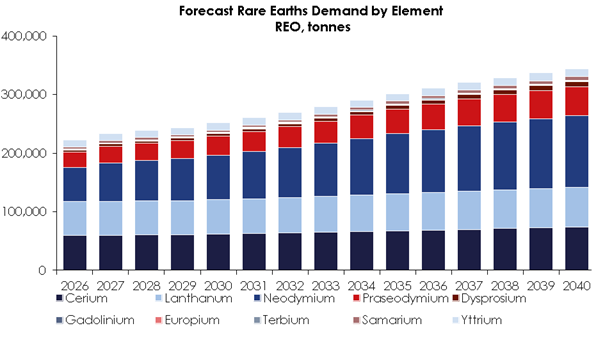
Figure 14: Rare Earth Demand by Element (2026-2040)
(Source: Argus)
Global rare earth demand is forecast to increase from 222,500 tonnes of rare earth oxide (REO) in 2026 to approximately 345,000 tonnes by 2040, representing a compound annual growth rate (CAGR) of 3.2%. This growth is expected to be led by permanent magnets, where demand is forecast to increase by 115% over the same period, at a CAGR of 5.6%.
Permanent magnets are expected to be the principal driver of rare earth demand, substantially outpacing the forecast annual growth of 1.4% across all other applications combined. Key sources of demand include:
· Electric vehicles: Permanent-magnet motors remain widely used in mass-market EVs due to their efficiency, power density and contribution to vehicle range. Although some manufacturers are assessing magnet-light or magnet-free alternatives, performance, weight and cost trade-offs may limit widespread substitution. Continued growth in global EV adoption is therefore expected to support magnet demand through the 2030s.
· Offshore wind: The expansion of offshore wind generation is expected to support demand for large permanent magnets, particularly in direct-drive turbines. Offshore installations are forecast to grow faster than onshore capacity, supported by higher capacity factors and fewer land constraints.
· Advanced robotics: The emergence of humanoid and mobile-service robots could become an additional source of demand from the mid-2030s. These systems typically require numerous compact, precise and energy-efficient actuators - characteristics well suited to permanent-magnet technologies.
Demand from established applications, including glass polishing, ceramics and metallurgical additives, is expected to grow broadly in line with global industrial activity. Cerium-based polishing products and additives should continue to benefit from demand in construction, consumer electronics and precision optics, although improvements in material efficiency may moderate growth.
Pricing
The market assessment uses independent Argus information on rare earth supply, demand and pricing. The financial model applies an oxide basket price derived from the forecast composition of the Kasiya concentrate, Argus price assumptions for the individual rare earth oxides and the adopted TREO content and payability assumptions. The assessment recognises the concentrate's exposure to NdPr and to the supply-constrained heavy and specialised rare earths dysprosium, terbium, yttrium, samarium and gadolinium.
The Study assumes that a saleable heavy REC can be produced and sold into established rare earth processing markets. Product specification, payability, impurity limits, customer qualification, radionuclide acceptance and final commercial terms remain subject to confirmatory testwork, customer engagement and marketing studies in the next phase.
The financial model uses a REO basket price derived from the forecast oxide composition of the REC product and individual rare earth oxide price assumptions.
Payable basket price = REO weights x REO prices x TREO % x Payability %
The REC basket price for Kasiya is calculated using REO prices provided by Argus , applying the contained TREO %, and Argus' recommended payability factor.
COSTS ESTIMATIONS
Capital Costs (Capex)
The incremental pre-production capital expenditure (CAPEX) estimate was developed by DRA.
The estimate has been estimated to Scoping Study accuracy of approximately ±30% and includes the monazite separation circuit, product storage and packaging facilities, as well as incremental utilities, associated buildings, Class 7 handling provisions, EPCM/owners' costs and contingency. The total incremental pre-production CAPEX is US$57 million, comprising:
TABLE 11: PROJECT CAPEX OVER LOM (US$)
|
|
Capex to 1st production |
Expansion Capex |
Total Project Capex |
|
Processing Facility |
21 |
20 |
41 |
|
Indirect |
4 |
4 |
9 |
|
Contingency |
4 |
4 |
7 |
|
Total |
29 |
27 |
57 |
The capital cost estimate base date is Q3 2026. Sustaining Capex over LoM is US$20m.
Operating Costs (Opex)
Sovereign's forecasts for the operating cost has been estimated at a Scoping Study accuracy of ±30% for the production of an REC at Kasiya over the life-of-mine.
TABLE 12: OPERATING COSTS (US$/KG)
|
Area |
US$ / kg REC |
|
Mining and related infrastructure |
- |
|
Processing plant |
0.87 |
|
Tailings management |
- |
|
Central services (engineering) |
- |
|
Rehabilitation |
- |
|
General and admin costs (site costs) |
0.03 |
|
Site Cash Cost |
0.90 |
|
Off-site costs, incl transport |
0.48 |
|
Total FOB Cash Cost |
1.39 |
|
Mineral Royalties |
1.93 |
|
Total Cash Operating Cost (inc. Royalties) |
3.32 |
|
Sea Freight, Insurances & Surcharges |
0.36 |
|
Total CIF Cost |
3.68 |
|
Corporate general and admin |
- |
|
Other Regulatory Fees |
0.18 |
|
Total Operating Cost |
3.85 |
The REC operating cost estimate has been prepared on an incremental basis relative to the April 2026 Kasiya DFS. Accordingly, it includes only the additional costs associated with recovering, handling and transporting the REC product; the existing mining and upstream rutile-graphite processing cost base remains within the DFS. Total incremental operating costs (FOB Dar es Salaam) are estimated at approximately US$74.9 million over the mine life, comprising US$47.1 million of processing costs, US$1.7 million of additional site administration costs and US$26.1 million of off-site costs.
Processing represents approximately 63% of total incremental FOB operating costs. The main components are stores and consumables, including flotation reagents, plant maintenance, product drums and dryer fuel; power consumption for the two REC plants; and additional labour. The operating structure remains relatively lean, with an estimated 19 additional employees during Phase 1, increasing to 38 employees following the Phase 2 expansion.
Off-site costs account for approximately 35% of total FOB operating costs and principally comprise Class 7-compliant road transport to Dar es Salaam and associated port charges. These allowances reflect the specialist packaging, handling, documentation and transport requirements applicable to a concentrate containing naturally occurring thorium and uranium. The estimate has been developed at Scoping Study level and will be refined through further metallurgical testwork, logistics studies, product classification and supplier quotations during the next phase of work
FINANCIAL AND ECONOMIC ANALYSIS
Modelling Assumptions
The economic evaluation is undertaken on an incremental basis relative to the April 2026 Kasiya DFS base case. Only capital, operating costs and revenues attributable to the additional monazite opportunity are included, except where an allocation of existing infrastructure cost is explicitly stated. The model is presented at a discount rate of 8% and a study period aligned with the 25 year DFS mine life. However, years 24 and 25 are excluded from any economic evaluation since plant feed in these years includes more than 50% inferred resources. Accordingly, the life of mine for this Study is 23-years.
Key Economic Outcomes
The base case demonstrates a potentially material incremental value contribution to Kasiya under the adopted technical, market and cost assumptions. Key outcomes are summarised below.
TABLE 13: KEY ECONOMIC OUTCOMES
|
Outcome |
Units |
Result |
|
NPV8 (Pre-Tax) |
US$m |
~722 |
|
IRR (Pre-Tax) |
% |
~151 |
|
REC Produced (LOM Total) |
Kt |
~54 |
|
Operating Margin |
% |
~90 |
|
EBITDA (Avg. Annual Steady State) |
US$m |
~84 |
|
Free Cash Flow (Avg. Annual Steady State, Pre-tax, Unlevered) |
US$m |
~82 |
Sensitivity Analysis
Sensitivity analysis assesses the impact of changes in REE prices, incremental CAPEX, site OPEX and selling/logistics costs on pre-tax NPV. The results indicate that project value is most sensitive to the REE basket price and discount rate applied, with the base case remaining positive under the selected downside scenario, including the Floor Price Scenario as detailed in this announcement.
TABLE 14: NPV (PRE-TAX) SENSITIVITY TO KEY INPUTS
|
|
-30% |
-20% |
-10% |
Base |
10% |
20% |
30% |
|
Payability / Basket Price |
480 |
561 |
642 |
722 |
803 |
883 |
964 |
|
Discount Rate |
925 |
850 |
782 |
722 |
668 |
619 |
575 |
|
Project Capex: Initial |
731 |
728 |
725 |
722 |
719 |
716 |
713 |
|
Project Capex: Expansion |
728 |
726 |
724 |
722 |
720 |
718 |
716 |
|
Site OpEx |
728 |
726 |
724 |
722 |
720 |
718 |
716 |
|
Selling Expenses |
727 |
725 |
724 |
722 |
721 |
719 |
718 |
ENVIRONMENTAL AND SOCIAL
The Environmental and Social Impact Assessment and Environmental, Social and Governance workstreams are supported by multi-season baseline studies, specialist environmental and social studies, trial mining, soil-rehabilitation programmes, agricultural livelihood-restoration programmes and development of an Environmental and Social Management System aligned with the IFC Performance Standards. These workstreams have received substantial review and input from Rio Tinto social and environmental subject-matter experts through strategic workshops, site visits, stakeholder engagement, review of specialist studies and management plans, regular technical sessions and in-country support.
The Study provides for secure, controlled-access storage and handling areas, compliant sealed packaging, appropriate monitoring, trained personnel, real-time shipment tracking, security measures, and comprehensive transport, emergency-response and incident-management procedures.
LEGAL AND TENURE
The Company owns 100% of the relevant Kasiya exploration and retention licences through its wholly owned Malawi-registered subsidiaries. The tenements are in good standing and the established pathway for conversion to mining tenure and project permitting applies to the integrated Kasiya development. No known legal, tenure or third-party constraint has been identified that would materially prevent development of the Project. Applicable government, vendor and community-development royalties and obligations are included in the economic evaluation where relevant.
The rare earth scope introduces additional requirements relating to Class 7 product storage, packaging and transport, cross-border movement, customs, port handling and export documentation. These requirements are incorporated at Scoping Study level and will require final legal, regulatory and specialist confirmation before operations commence.
Following the completion of this DFS in April 2026, Sovereign applied for a Mining Licence (ML) to secure mineral deposits for mining and includes the licence areas covered by the DFS and this Scoping Study. The ML application specifically includes rare earth oxides, which will provide comprehensive coverage for the Project's mineral suite once the ML is awarded. At this point of Kasiya's development, the Company notes no known issues or impediments obtaining a ML under normal course of business.
Under the 2023 Mines Act, the Government of Malawi has a right to equity ownership for large-scale mining licences (>5Mt mined per annum or >US$250m Capex) with the right a negotiation matter, likely as part of any future MDA. The Mkango and Lotus MDAs (refer details below in the modifying factors) included a 10% non-diluting equity interest to the Malawi Government.
RISKS
Key project risks identified and mitigation measures implemented were as follows.
|
Key Risk |
Mitigation Measures |
|
Permitting and approvals |
Ongoing engagement with government, regulators and local communities, supported by structured stakeholder engagement plans |
|
Land acquisition and resettlement |
Development and implementation of land acquisition and resettlement frameworks aligned with international standards |
|
Community health, safety and security |
Integration of safety, environmental and social controls into mine design, including haul road management, water management systems and in-pit backfilling |
|
Stakeholder perception and political/regulatory environment |
Ongoing engagement with government, regulators and local communities, supported by structured stakeholder engagement plans |
|
Availability of suitable construction materials and aggregates |
Infrastructure planning and engagement with logistics providers to mitigate rail and transport constraints |
|
Rail and logistics constraints |
Infrastructure planning and engagement with logistics providers to mitigate rail and transport constraints |
|
Graphite product characteristics (fines / PSD variability) |
Engineering and test work programs to reduce geological, metallurgical and product specification uncertainties |
|
Water resource management and potential contamination |
Integration of safety, environmental and social controls into mine design, including haul road management, water management systems and in-pit backfilling |
|
Inferred Mineral Resources include in the production target have a low level of geological confidence and may not convert to Indicated or Measured Mineral Resources or Ore Reserves |
The potential incremental recovery of monazite from mineral streams the subject of the Scoping Study is financially viable when excluding Inferred Mineral Resources in the production schedule. Further exploration work will be completed as part of the REC PFS to better define Mineral Resources |
In addition, strategic and external risks, including macroeconomic factors, commodity price volatility, and supply chain constraints, were assessed and incorporated into the financial evaluation and ongoing project planning.
Risk management will continue throughout the project lifecycle, with the risk register maintained as a live document and subject to regular review and update as the project progresses.
SUMMARY OF MATERIAL ASSUMPTIONS
The material assumptions underpinning the production target and forecast financial information are summarised below. The production profile for REC is supported by the April 2026 DFS production schedule (excluding years with >50% of plant feed in Inferred category of Mineral Resources) together with metallurgical testwork recovery, product yield and MSP by-product stream information.
TABLE 16: MATERIAL ASSUMPTIONS
|
Assumption |
Units |
Inputs / Outcome |
|
Accuracy variation |
% |
±30% |
|
Life of Mine |
years |
23 |
|
Annual average throughput - Phase 1 |
tpa |
12,000,000 |
|
Annual average throughput - Phase 2 |
tpa |
24,000,000 |
|
REC product recovery |
% |
80 |
|
REC product grade |
% |
90 |
|
REC product TREO |
% |
56.6 |
|
Rare earth basket price assumption (CIF Texas)(base case) |
US$/kg REC |
39.45 |
|
Incremental operating costs (site) |
US$/kg REC |
0.90 |
|
Incremental operating costs (CIF Texas) (base case) |
US$/kg REC |
3.68 |
|
Incremental capital cost to 1st production |
US$M |
29 |
|
Expansion capital costs |
US$M |
27 |
|
Sustaining capitals costs (LoM) |
US$M |
20 |
|
Government Royalty |
% |
5% of gross revenue |
|
Vendor Royalty |
% |
2% of gross profit |
|
Community Development Fund |
% |
0.45% of gross revenue |
|
Discount rate |
% |
8 |
DISCLOSURES & DISCLAIMERS
Competent Person Statements
Monazite Scoping Study
The information in this announcement that relates to the Mineral Resource Estimate (Monazite) is based on, and fairly represents, information compiled by Mr Jeremy Witley, a Competent Person (and qualified person) who is a member of the South African Council for Natural Scientific Professions (SACNASP Pr. Sci. Nat.), a Recognised Professional Organisation (RPO) included in a list promulgated by ASX from time to time. Mr Witley is a principal of MSA Group, an independent consulting company. Mr Witley has sufficient experience relevant to the style of mineralisation and type of deposit under consideration, and to the activity he is undertaking, to qualify as a Competent Person as defined in the 2012 Edition of the 'Australasian Code for Reporting of Exploration Results, Mineral Resources and Ore Reserves' (JORC Code) and a Qualified Person under the AIM Rules for Companies. Mr Witley consents to the inclusion of the matters based on his information in the form and context in which they appear.
The information in this announcement that relates to Exploration Results (Monazite) is and fairly represents, information compiled by Mr Malcolm Titley, a Competent Person (and qualified person) who is a member of The Australasian Institute of Mining and Metallurgy and member of Australian Institute of Geoscientists. Mr Titley is the Technical Services Manager of Sovereign and is a holder of shares and unlisted performance rights in Sovereign. Mr Titley has sufficient experience that is relevant to the style of mineralisation and type of deposit under consideration and to the activity being undertaken, to qualify as a Competent Person as defined in the JORC Code' and a Qualified Person under the AIM Rules for Companies. Mr Titley consents to the inclusion in the announcement of the matters based on his information in the form and context in which it appears.
The information in this announcement that relates to Production Targets is based on, and fairly represents, information provided by Mr Frikkie Fourie, a Competent Person (and qualified person), who is an Associate Member of The South African Institute of Mining and Metallurgy and a Registered Professional Engineer with the Engineering Council of South Africa, a RPO, included in a list promulgated by ASX from time to time. Mr Fourie is employed by Moletech Consulting Pty Ltd, an independent consulting company. Mr Fourie has sufficient experience, which is relevant to the style of mineralisation and type of deposit under consideration, and to the activities undertaken, to qualify as a Competent Person as defined in the JORC Code and a Qualified Person under the AIM Rules for Companies. Mr Fourie consents to the inclusion in the Announcement of the matters based on his information in the form and context in which it appears.
The information in this announcement that relates to metallurgical testwork and performance, monazite processing facilities and operating cost estimate is based on, and fairly represents, information provided by Mr Johann Ludwig Niebuhr, a Competent Person (and qualified person), who is a Registered Professional Engineer with the Engineering Council of South Africa, a RPO, included in a list promulgated by ASX from time to time. Mr Niebuhr is employed by DRA Projects (Pty) Ltd, an independent consulting company. Mr Niebuhr has sufficient experience, which is relevant to the style of mineralisation and type of deposit under consideration, and to the activities undertaken, to qualify as a Competent Person as defined in the JORC Code and a Qualified Person under the AIM Rules for Companies. Mr Niebuhr consents to the inclusion in the Announcement of the matters based on his information in the form and context in which it appears.
The information in this announcement that relates to the Scoping Study (including infrastructure and capital costs) is based on, and fairly represents, information provided by Mr Robin Mark Welsh, a Competent Person (and qualified person), who is a Registered Professional Engineer with the Engineering Council of South Africa, a RPO, included in a list promulgated by ASX from time to time. Mr Welsh is employed by DRA Projects (Pty) Ltd, an independent consulting company. Mr Welsh has sufficient experience, which is relevant to the style of mineralisation and type of deposit under consideration, and to the activities undertaken, to qualify as a Competent Person as defined in the JORC Code and a Qualified Person under the AIM Rules for Companies. Mr Welsh consents to the inclusion in the Announcement of the matters based on his information in the form and context in which it appears.
The information in this announcement that relates to the economic analysis is based on, and fairly represents, information provided by Ruan Albert Daffue, a Competent Person (and qualified person), who is a member of the South African Institute of Mining and Metallurgy, a RPO, included in a list promulgated by ASX from time to time. Mr Daffue is employed by Practara (Pty) Ltd, an independent consulting company. Mr Daffue has sufficient experience, which is relevant to the style of mineralisation and type of deposit under consideration, and to the activities undertaken, to qualify as a Competent Person as defined in the JORC Code and a Qualified Person under the AIM Rules for Companies. Mr Daffue consents to the inclusion in the Announcement of the matters based on his information in the form and context in which it appears.
Definitive Feasibility Study
The information in this announcement that relates to the DFS (including Mine Engineering, Mine Scheduling, Processing, Infrastructure, Capital and Operating Costs, Production Target and Ore Reserves and other financial forecasts) is extracted from an announcement dated 16 April 2026, which is available to view at www.sovereignmetals.com.au.
Sovereign confirms that a) it is not aware of any new information or data that materially affects the information included in the original announcement; b) all material assumptions included in the original announcement continue to apply and have not materially changed; and c) the form and context in which the relevant Competent Persons' findings are presented in this announcement have not been materially changed from the original announcement.
The information in this announcement that relates to the exploration results (metallurgy) is extracted from announcements dated 28 September 2023, 8 May 2024, 15 May 2024, 4 September 2024, 21 January 2026 and 27 May 2026, which is available to view at www.sovereignmetals.com.au. Sovereign confirms that a) it is not aware of any new information or data that materially affects the information included in the original announcement; b) all material assumptions included in the original announcement continue to apply and have not materially changed; and c) the form and context in which the relevant Competent Persons' findings are presented in this announcement have not been materially changed from the original announcement.
Forward-Looking Statements
Certain statements contained in this announcement, including information as to the future financial or operating performance of Sovereign and its project interests are 'forward-looking statements'. They include indications of, and guidance on, future matters. Forward-looking statements include, but are not limited to, statements preceded by words such as "targeted", "planned", "expected", "projected", "estimated", "may", "scheduled", intends", "anticipates", "believes", "potential", "could", "likely", "nominal", "conceptual", "propose", "will", "forecast", "estimate", and other similar expressions within the meaning of securities laws of applicable jurisdictions and include, but are not limited to, anticipated future activities at the Kasiya Project, production targets, financial forecasts, estimates and assumptions in respect of mineral resources and anticipated grades and recovery rates, production and prices, recovery costs and results, capital expenditures and operating expenditures and are or may be based on assumptions and estimates related to future technical, economic, market, political, social and other conditions. These 'forward-looking statements' are necessarily based upon a number of estimates and assumptions that, while considered reasonable by Sovereign, are inherently subject to significant technical, business, economic, competitive, political and social uncertainties and contingencies and involve known and unknown risks and uncertainties that could cause actual events or results to differ materially from estimated or anticipated events or results expressed or implied in any forward-looking statement and deviations are both normal and to be expected.
The forward-looking statements contained in the Scoping Study should be considered in light of those risks and disclosures and the risks and disclosures elsewhere in this announcement. Neither Sovereign, nor any of its directors, officers, employees, agents or advisers makes any representation, assurance, guarantee or warranty, express or implied as to the accuracy, likelihood of achievement or reasonableness of any forward-looking statement contained in this announcement. There is no certainty that the Kasiya Project will be feasible and there can be no assurance of whether it will be funded, permitted, developed, constructed and commence operations, nor whether the Scoping Study results will be accurate.
Sovereign disclaims any intent or obligation to update publicly or release any revisions to any forward‐looking statements, whether as a result of new information, future events, circumstances or results or otherwise after the date of this announcement or to reflect the occurrence of unanticipated events, other than as required by the Corporations Act 2001 (Cth) or the ASX Listing Rules.
Mineral Resource estimates are necessarily imprecise and depend on interpretations and geological assumptions, minerals prices, cost assumptions and statistical inferences (and assumptions concerning other factors, including mining, processing, metallurgical, infrastructure, economic, marketing, legal, environmental, social and governmental factors) which may ultimately prove to be incorrect or unreliable. Mineral Resource estimates are regularly revised based on actual exploration or production experience or new information and could therefore be subject to change. In addition, there are risks associated with such estimates, including (among other risks) that minerals mined may be of a different grade or tonnage from those in the estimates and the ability to economically extract and process the minerals may become compromised or not eventuate. Sovereign's plans, including its mine and infrastructure plans, and timing, for the Kasiya Project, are also subject to change. Accordingly, no assurances can be given that the production targets, financial forecasts or other forecasts or other forward-looking statements or information in this announcement or the Scoping Study will be achieved.
The assumptions and inputs to the financial model may require review as project development progresses. While Sovereign considers all the material assumptions to be based on reasonable grounds, there is no certainty that they will prove to be correct or that the production targets or estimated outcomes indicated by the Scoping Study (such as the financial forecasts) will be achieved.
All 'forward‐looking statements' made in this announcement are qualified by the foregoing cautionary statements (and those below). Investors are cautioned that 'forward‐looking statements' are not a guarantee of future performance and accordingly investors are cautioned not to put undue reliance on 'forward‐looking statements' due to the inherent uncertainty therein.
The information contained within this announcement is deemed by Sovereign to constitute inside information as stipulated under the Regulation 2014/596/EU which is part of domestic law pursuant to the Market Abuse (Amendment) (EU Exit) Regulations (SI 2019/310) ("UK MAR"). By the publication of this announcement via a Regulatory Information Service, this inside information (as defined in UK MAR) is now considered to be in the public domain.
This ASX Announcement has been approved and authorised for release by the Mr Frank Eagar, Managing Director and CEO.
TABLE 17: KASIYA ORE RESERVE - RUTILE (RUT95) + GRAPHITE (TGC)
|
Class |
Tonnes |
Rutile Grade |
Rutile |
TGC |
TGC |
Rutile Eq. |
Dry BD |
|
(Mt) |
(%) |
(Mt) |
(%) |
(Mt) |
(%) |
||
|
Proved |
78 |
1.03 |
0.80 |
1.65 |
1.28 |
1.87 |
1.67 |
|
Probable |
458 |
0.94 |
4.29 |
1.54 |
7.07 |
1.47 |
1.62 |
|
Total |
536 |
0.95 |
5.09 |
1.56 |
8.35 |
1.39 |
1.62 |
The Total Ore Reserve is all rutile and graphite mineralisation within an optimised open pit shell using a Rut95 concentrate revenue price of net US$1,286.81/t and a Graphite product price of net US$1,099.51/t; Mine Opex US$1.35/t; Process Opex US$5.44/t; Rutile recovery of 97.6%; Average Graphite recovery of 70.4%.
Modifying Factors
The Modifying Factors as defined under the JORC Code, including mining, processing, metallurgical, infrastructure, economic, marketing, legal, environmental, social and governmental factors, have been assessed as part of the Study and are reflected in the Study Announcement.
A summary assessment of each relevant Modifying Factor is provided below.
Mining - unchanged to the DFS
Refer to section entitled 'Mining' in the Announcement.
Approximately 99% of the scheduled throughput (production target) of this Scoping Study for the first twelve and half years of estimated production is in the Indicated Mineral Resource category with only 1% in the Inferred Mineral Resource category. For the life of mine of this Scoping Study, approximately 72% of life of mine production target is in the Indicated Mineral Resource category and 28% is in the Inferred Mineral Resource category.
The Company has concluded that it has reasonable grounds for disclosing a production target which includes an amount of Inferred material on the basis that the Inferred Resources included in the early mine plan is modest and over the life of the mine the amount of Inferred Resources is not the determining factor in project viability.
However, there is a low level of geological confidence associated with Inferred mineral resources and there is no certainty that further exploration work on the Kasiya deposit will result in the determination of additional Indicated Mineral Resources or that the production target (or financial forecasts) itself will be realised.
In the unlikely event that the remaining Inferred Mineral Resources are not able to be upgraded, the Project's viability is not affected. This is supported by a stand-alone discounted cash flow analysis prepared that assumes only Indicated Resources are included the mine plan in order to demonstrate the economic viability of the Project.
Metallurgy and Processing - incremental update to the DFS
Refer to section entitled 'Processing and Metallurgy' in the Announcement
The upstream processing basis is unchanged from the DFS. Extensive variability and pilot-scale testwork was completed across the rutile and graphite streams to support DFS-level flowsheets and mass balances, confirming the ability to produce premium-specification rutile and graphite products using conventional processing routes.
The Scoping Study assesses an additional circuit downstream of the MSP to treat the existing non-conductor stream and recover a REC containing monazite. The selected flowsheet comprises feed preparation, spiral gravity separation, flotation and final gravity cleaning, followed by product dewatering, handling and drumming. The design uses conventional mineral-sands separation technology and is supported by Kasiya-specific gravity testwork, mineralogical and chemical characterisation, flotation benchmarking and comparable operating and development-project flowsheets. The Study applies 80% recovery to both monazite and assumes production of a concentrate containing 90% combined monazite and approximately 56%-56.6% TREO. Further representative variability, flowsheet optimisation and locked-cycle testwork, together with final product and radionuclide characterisation, will be completed in the next study phase.
Infrastructure - incremental update to the DFS
Refer to sections entitled 'Transport and Logistics' and 'Cost Estimations' in the Announcement
DFS-level engineering has been completed for power, water, roads, buildings, laboratory capability, load-out facilities, transport and logistics infrastructure, including access to hydropower, established rail corridors and port infrastructure. The infrastructure design is aligned with the mine plan, plant locations and staged development from 12Mtpa to 24Mtpa.
The incremental rare earth scope includes the additional recovery and product-finishing plant, utility tie-ins, product storage and drumming facilities, Class 7-compliant handling and storage provisions, and associated buildings and services. Existing DFS infrastructure and operating systems are reused where practicable. The base-case export concept is road transport of sealed drums in 20-foot containers from Kasiya to the Port of Dar es Salaam, with managed convoy movements, journey management, real-time tracking, emergency-response capability and security escort as required. Final route, port acceptance, package design, licensing, shipping availability and costs remain subject to specialist confirmation.
Marketing - additional marketing for REC
Refer to section entitled 'Rare Earth Market' in the Announcement
The market assessment uses independent Argus information on rare earth supply, demand and pricing. The financial model applies an oxide basket price derived from the forecast composition of the Kasiya concentrate, Argus price assumptions for the individual rare earth oxides and the adopted TREO content and payability assumptions. The assessment recognises the concentrate's exposure to NdPr and to the supply-constrained heavy and specialised rare earths dysprosium, terbium, yttrium, samarium and gadolinium.
The Study assumes that a saleable REC can be produced and sold into established rare earth processing markets. Product specification, payability, impurity limits, customer qualification, radionuclide acceptance and final commercial terms remain subject to confirmatory testwork, customer engagement and marketing studies in the next phase.
Environmental, Social, Legal and Governmental - unchanged to the DFS
Refer to section entitled 'Environmental and Social' in the Announcement
The Environmental and Social Impact Assessment and Environmental, Social and Governance workstreams are supported by multi-season baseline studies, specialist environmental and social studies, trial mining, soil-rehabilitation programmes, agricultural livelihood-restoration programmes and development of an Environmental and Social Management System aligned with the IFC Performance Standards. These workstreams have received substantial review and input from Rio Tinto social and environmental subject-matter experts through strategic workshops, site visits, stakeholder engagement, review of specialist studies and management plans, regular technical sessions and in-country support.
The tailings-management strategy uses integrated in-pit backfilling aligned with the life-of-mine mining schedule and avoids a conventional external tailings storage facility. Tailings are deposited as flocculated co-disposal using engineered slurry handling, pumping, pipeline, drainage, decant and stormwater-control systems. The mining sequence maintains void space for backfilling and incorporates a conservative 12-month consolidation period before traffic accesses backfilled areas. This approach reduces the Project footprint, lowers resettlement requirements and supports progressive rehabilitation and water management.
The REC is expected to contain naturally occurring thorium and uranium and is assumed, for the Scoping Study, to require Class 7 controls. The Study includes allowance for controlled-access storage and handling areas, sealed and compliant packaging, monitoring and dosimetry as required, trained personnel, journey and emergency-response planning, real-time tracking, security controls and incident-management procedures. Final radiological risk assessment, activity-concentration testing, package classification and design, management plans and stakeholder engagement will be completed as the Project advances.
Legal and Tenure
The Company owns 100% of the relevant Kasiya exploration and retention licences through its wholly owned Malawi-registered subsidiaries. The tenements are in good standing and the established pathway for conversion to mining tenure and project permitting applies to the integrated Kasiya development. No known legal, tenure or third-party constraint has been identified that would materially prevent development of the Project. Applicable government, vendor and community-development royalties and obligations are included in the economic evaluation where relevant.
The rare earth scope introduces additional requirements relating to Class 7 product storage, packaging and transport, cross-border movement, customs, port handling and export documentation. These requirements are incorporated at Scoping Study level and will require final legal, regulatory and specialist confirmation before operations commence.
Following the completion of this DFS in April 2026, Sovereign applied for a Mining Licence (ML) to secure mineral deposits for mining and includes the licence areas covered by the DFS and this Scoping Study. The ML application specifically include rare earth oxides, which will provide comprehensive coverage for the Project's mineral suite once the ML is awarded. At this point of Kasiya's development, the Company notes no known issues or impediments obtaining a ML under normal course of business.
Under the 2023 Mines Act, the Government of Malawi has a right to equity ownership for large-scale mining licences (>5Mt mined per annum or >US$250m Capex) with the right a negotiation matter, likely as part of any future MDA. The Mkango and Lotus MDAs (refer details below) included a 10% non-diluting equity interest to the Malawi Government.
Economic
Refer to sections entitled 'Cost Estimations' and 'Financial and Economic Analysis' in the Announcement
Practara Metals and Mining Advisory developed the incremental rare earth financial model. The evaluation retains the DFS mine schedule and primary rutile and graphite operating basis and includes only the additional capital costs, operating costs, product-handling and logistics costs, revenues, royalties and other cash flows attributable to the rare earth opportunity, except where use of shared infrastructure is expressly allocated. The model is prepared in real US dollars, uses the Study's 23-year production period and applies the disclosed discount rate, recovery, ramp-up, availability, product, pricing and payability assumptions.
Capital inputs comprise the additional separation and finishing circuit, utility tie-ins, product storage and packaging, Class 7 provisions, associated buildings, engineering and owners' costs and contingency. Operating inputs include labour, power, reagents and consumables, maintenance, product handling, packaging and off-site logistics. The model supports the reported incremental economic outcomes and has been tested for changes in rare earth prices, capital costs, site operating costs and selling and logistics costs. As a Scoping Study, the estimates and outcomes remain subject to the accuracy range, qualifications and risks disclosed in this announcement and to refinement through further technical and commercial work.
A Government royalty of 5% (applied to revenue) and a vendor profit share of 2% (applied to gross profit) have been included in all project economics. A 0.45% royalty (applied to revenue) has been applied for the community development fund.
The DCF analysis demonstrated compelling economics of the prospective by-product, with an NPV (ungeared, pre-tax, at an 8% discount rate) of US$722 million, and an (ungeared, pre-tax) IRR of 151%.
Sensitivity analysis was performed on all key assumptions used. The robust project economics insulate the Kasiya Project from variations in market pricing, capital expense, or operating expenses. Specifically, the Floor Price Case as defined in this announcement demonstrates the REC by-product's economic viability in a commodity price downside scenario. The monazite Project breakeven REC basket price is ~US$4,140/t which would require a ~90% decline in forecast REE prices used in the Study. Based on the Shanghai Metals Market, the current spot price for basic ~55% monazite concentrate is ~US$6,400/t in China.
Further, a sensitivity analysis with the entire REC basket price 25% lower than the Scoping Study selected prices, the Project still displays a positive NPV (ungeared, pre-tax, 8% discount rate) of US$521 million and pre-tax IRR of 122%.
The Project's REC by-product payback period is 1.5 years from the start of production. The payback period is based on unlevered, pre-tax free cashflow.
Sovereign estimates the incremental capital cost to construct the monazite circuit for first production to be US$29m (which includes a contingency of US$3.8 million).
Key parameters are disclosed in the body of the announcement, and include:
· Life of Mine: 23 years
· Discount rate: 8%
· Royalty rate: 5% royalty (Government), 2% of gross profit (Original Project Vendor) and 0.45% Community Development Fund.
· Pricing: Rare earth oxide price forecasts as per Argus with Base Case at 50% payability for a 56.6% TREO grade concentrate
There is uncertainty in some respects of the tax law applicable to mining companies in Malawi. Specifically with regard to the calculation of and the application of the RRT. The 2023 Mines Act, further provides for the holder of large-scale mining licenses to enter into a fiscal stability agreement, known as a Mine Development Agreement (MDA) with the Government of Malawi. These MDAs provide the opportunity to agree and clarify the application of taxation. At the date of the DFS announcement, Sovereign has not applied for a large-scale mining license or entered into an MDA.
In 2024, mining companies Lotus Resources Limited (Lotus) and Mkango Resources Limited (Mkango) each entered into separate MDAs with the Government of Malawi. These MDAs have deviated from the enacted mining taxation laws and, specifically, the levying of the RRT, with no RRT payable as part of the MDAs. The Government has since proposed an alternative supernormal profits tax (SPT) to replace the current RRT. Profits of up to MWK 10 billion (~US$6 million at the time of writing) are taxed at the standard income tax rate of 30%. Any profits which exceed MWK 10 billion are taxed at a higher rate of 40%. Mkango and Lotus are exempt of SPT under their existing MDAs. As such, and until such time Sovereign has sight of what actual fiscal terms would apply to the Kasiya Project in terms of its own fiscal stability agreement with the Government of Malawi, results for the DFS have been reported on a pre-tax basis only.
Notwithstanding this uncertainty, scenario analysis has been undertaken to indicate a range of potential post-tax outcomes. This analysis considered the impact of key fiscal variables, including RRT, SPT, and capital allowances, on project returns, with the resulting post-tax NPV8% estimated to range between US$458 million and US$535 million.
The financial model has been built and prepared by Practara using inputs from the various expert consultants and has been reviewed by SP Angel Corporate Finance LLP (SPA), the Company's Nominated Advisor and Corporate Broker as defined by the AIM Rules for Companies set out by the London Stock Exchange, to validate the functionality and accuracy of the model.
The Company considers that the required funding for incremental capex costs to first production could be raised through an equity placement within its available 15% placement capacity under ASX Listing Rule 7.1. This assessment is supported by Sovereign's demonstrated access to equity capital markets. Sovereign also has a strong track record of successfully raising equity funds for Kasiya plus it has an experienced and high-quality Board and management team comprising highly respected resource executives with extensive technical, financial, commercial and capital markets experience. The directors have previously raised more than A$2.5 billion from capital markets for a number of exploration and development companies.
Further, the Company has also had preliminary financing discussions with a number of other institutional investors, development finance institutions, U.S. and "Western-aligned" government agencies, end-user customers, and other strategic investors, regarding potential equity and/or debt funding at the Company and/or Project level.
The Company considers that, given the nature of the Project, funding is likely to be sourced from specialist investors. Potential funding sources include, but are not limited to, traditional equity and debt, royalty financing, and off-take agreements at either the corporate and/or Project level.
Since commencing exploration at Kasiya in November 2019, the Company has completed extensive drilling, sampling, metallurgical test work, and geological modelling, and has defined a Measured and Indicated Mineral Resource Estimate that has been converted to Ore Reserves as part of this DFS. The Company is also in a unique position, having collected real-world data through the Pilot Mining Program, which has significantly validated and de-risked the Project. Over this period, and with these key milestones being achieved, the Company's market capitalisation has increased from approximately A$18m to over A$330m.
The Company has a simple and clean corporate and capital structure, is debt-free, and is in a strong financial position, with approximately A$25.1 million in cash on hand as at 30 June 2026 (unaudited). This financial position means the Company is well funded to continue key further project workstreams, including the permitting and financing activities required to advance the Project to the next phase of study's, engineering and final investment decision.
The Company's shares are listed on the ASX and AIM which are premier markets for growth companies and provide increased access to capital from institutional and retail investors in Australia and the UK. The Company's shares are also quoted on the OTCQX and Frankfurt Stock Exchange.
The Company has also entered into multiple agreements that may provide alternative sources of financing, as set out below:
· A Collaboration Agreement with the International Finance Corporation (IFC), a member of the World Bank Group, which provides a clear pathway to international project financing for Kasiya, with a particular focus on debt funding. Through the Collaboration Agreement, IFC holds rights to participate as lender, mandated co-lead arranger and/or investor in the project financing structure, supporting the development of a robust and bankable funding package. As a leading global development finance institution with extensive experience in mining projects in emerging markets, IFC's involvement is expected to enhance lender confidence, support access to competitive long-term debt, and underpin the overall financing strategy for the Project; and
· A non-binding MOU with a PE fund to fund the development and construction of a 132kV transmission line connecting Kasiya to the Malawi national grid. Refer to discussion above in Infrastructure Modifying Factor.
As discussed above, and taking into account the following additional factors: 1) Recently completed funding arrangements for similar or larger scale development projects; 2) The range of potential funding options available; 3) The favourable key metrics generated by the Kasiya Project; 4) Investor interest to date; 5) The Company owns 100% of Kasiya which is highly attractive to potential financiers; and 6) The previously completed DFS demonstrated that the Project is commercially viable and provides justification to progress to the final investment decision and project finance stages, the Company has a high level of confidence that the Project will be able to secure funding in due course.
1 SP Angel, which is authorised and regulated in the United Kingdom by the FCA, is acting exclusively for the Company as nominated adviser and joint broker to the Company in connection with the review to validate the functionality and accuracy of the financial model and will not be responsible to any other person for providing the protections afforded to customers of SP Angel or advising any other person in connection with the review to validate the functionality and accuracy of the financial model. Its responsibilities as the Company's nominated adviser under the AIM Rules for Nominated Advisers are owed solely to the London Stock Exchange and are not owed to the Company, any Directors, or to any other person in respect of his decision to acquire shares in the Company in reliance on any part of the review to validate the functionality and accuracy of the financial model. SP Angel will not be offering advice and will not otherwise be responsible to anyone other than the Company for providing the protections afforded to clients of SP Angel or for providing advice in relation to the review to validate the functionality and accuracy of the financial model or any other matter.
APPENDIX 1- SUMMARY OF RESOURCE ESTIMATE REPORTING CRITERIA
As per ASX Listing Rule 5.8 and the JORC reporting guidelines, a summary of the material information used to estimate the MRE is detailed below.
Geology
Regional Geology
The greater part of Malawi is underlain by crystalline Precambrian to lower Palaeozoic rocks referred to as the Malawi Basement Complex. In some parts, these rocks have been overlain unconformably by sedimentary and volcanic rocks ranging in age from Permo-Triassic to Quaternary. The Basement complex has undergone a prolonged structural and metamorphic history dominated by uplift and faulting, resulting in the formation of the Malawi Rift Valley.
Kasiya is located on the Lilongwe Plain, which is underlain by the Basement Complex paragneisses and orthogneisses, which are part of the Mozambique Belt. The bulk of the gneisses are semi-pelitic, but there are bands of psammitic and calcareous rocks that have been metamorphosed under high pressure and temperature conditions to granulite facies.
Interspersed within the paragneiss units are lesser orthogneisses, often cropping out as conspicuous tors, as well as amphibolites, pegmatites and minor mafic to ultramafic intrusions. Foliation and banding in the gneisses have a broad north-south strike over the general area. Thick residual soils and pedolith with some alluvium overlie the gneisses and include sandy, lateritic and dambo types.
Project Geology
Sovereign's tenure covers 644 km2 over an area to the north, west and south of Malawi's capital city, covering the Lilongwe Plain. The topography is generally flat to gently undulating, and the underlying geology is dominated by paragneiss with pelitic, psammitic and calcareous units.
A particular paragneiss unit is rich in rutile and graphite and is the primary source of both minerals in the area. The same geological unit contains monazite with associated rare earth elements which will be mined as a by-product of the rutile and graphite operation. This area was deeply weathered during the Tertiary, and rutile concentrated in the upper part of the weathering profile, forming residual placers, such as the Kasiya deposit. Once this material is incised and eroded, it is transported and deposited into wide, regional braided river systems, forming alluvial heavy mineral placers such as the Bua Channel.
Kasiya Deposit Geology
The high-grade rutile deposit at Kasiya is best described as a residual placer, or otherwise known as an eluvial heavy mineral deposit. It is formed by weathering of the primary host rock and concentration in place of heavy minerals, as opposed to the high-energy transport and concentration of heavy minerals in a traditional placer.
The presence of abundant kyanite and graphite in the host material suggests a meta-sedimentary protolith. The protolith likely started with a 0.5-1.5Ga basin that also experienced a consistent influx of titanium minerals.
These sedimentary rocks were subject to granulite facies metamorphism under reduced conditions in the Pan-African Orogeny. The metamorphic facies, reduced environment, relatively high titanium content and low iron content resulted in rutile being the most stable titanium mineral under these conditions. Slow exhumation and cooling then resulted in re-crystallisation as paragneisses containing coarse rutile, graphite and monazite.
The final and most important stage of rutile enrichment came as tropical weathering during the Tertiary depleted the top ~8m of physically and chemically mobile minerals. This caused significant volume loss and concurrent concentration of heavy resistate minerals, including rutile, monazite, ilmenite and kyanite.
Rutile and monazite mineralisation therefore lies in laterally extensive, near-surface, flat "blanket" style bodies in areas where the weathering profile is preserved.
Monazite mineralisation shows no clear relationship with either rutile or graphite mineralisation. Indications at this stage are that grades are a function of both weathering and geological variations in a vertical and lateral sense respectively. The results from previous work shows an enrichment in Y2O3 in samples from the upper weathering units compared to that of samples representing the lower weathering units. This is interpreted as a change in the relative abundance of monazite and the primary yttrium-bearing mineral, with the latter enriched in the upper weathering units due to its greater resistance to weathering compared with monazite.
Monazite mineralisation follows distinct lateral orientations indicating that it is determined to some degree by varying geological units within the Kasiya deposit.
Drilling Techniques
Spiral hand-auger (HA) drilling, Push-tube and/or diamond core (PTDD), and Air core (AC) drilling methods have been used extensively at the Kasiya deposit by Sovereign to define mineralisation and to obtain quantitative rutile, monazite and graphite assay information.
HA drilling was executed by Sovereign field teams using a manually operated enclosed-flight Spiral Auger (SP / SOS) system produced by Dormer Engineering in Queensland, Australia. The HA bits are 62mm and 75mm in diameter with 1m long steel rods. Each 1m of drill advance is withdrawn and the contents of the auger flight removed into bags and set aside. An additional 1m steel rod is attached and the open hole is re-entered to drill the next metre. This is repeated until the drill hole is terminated often due to the water table being reached or due to bit refusal. The auger bits and flights are cleaned between each metre of sampling to avoid contamination.
PTDD drilling is undertaken using a drop hammer Dando Terrier MK1 and a drop hammer DL650 by Geo-consult and Thompsons Drilling. The drilling generated 1m runs of 88mm PQ core in the first 2m and then transition to 61mm core for the remainder of the hole. Core drilling is oriented vertically by spirit level.
AC drilling was completed by Thompson Drilling utilising a Smith Capital 10R3H compact track-mounted drill. The drilling is vertical and generates 1m samples with care taken in the top metres to ensure good recoveries of the high-grade surface material. The AC sample is collected by the on-board cyclone into heavy-duty RC sample bags. Drilling continues until bit refusal onto basement ~20-30m. Sample bags are immediately transported back to Sovereign's field laydown yard where they are processed. AC drilling is on a nominal 200m by 200m pattern.
The PTDD and AC twin and density sample holes are selectively placed throughout the deposit to ensure a broad geographical and lithological coverage for the analysis.
MSA has reviewed Standard Operating Procedures (SOPs) for HA, SA, PTDD and AC drilling and found them to be fit for purpose and support the resource classifications as applied to the MRE.
Sampling Techniques
HA samples are obtained at 1m intervals generating on average approximately 2.5kg of drill sample. HA samples are manually removed from the auger bit and sample recovery is visually assessed in the field. As samples become wet at the water table and recovery per metre declines, the drill hole is terminated. Each 1m sample is sun dried, logged and weighed. HA samples are composited based on regolith weathering boundaries defined by geology logging. Each 1m of sample is dried, lightly pressed to remove soft aggregates and riffle-split to generate a total sample weight of 3kg for analysis, generally at 2 - 5m intervals. This primary sample is then riffle split again to provide a 1.5kg sample each for rutile + monazite and graphite analyses.
SA samples are bulk spiral auger samples primarily designed to collect a large sample for metallurgical and pilot plant testwork. Bit sizes range from 300 mm to 700mm diameter. The samples are collected on 1m intervals, laid out on a large tarpaulin to be sun dried before using a cone and quarter method (for the 700mm diameter) to produce a roughly 100kg sample which is then riffle split to produce a 3kg sample, with the file split providing 1.5 kg each for rutile and graphite analysis. Samples are analysed in 1m intervals.
PTDD samples are predominantly from HQ sized core (61mm diameter). Half core 1m samples are sun dried, logged and weighed. Samples are then lightly pressed and composited over 2m intervals. An equal mass is taken from each contributing metre to generate a 1.5kg composite sample. Individual recoveries of core samples are recorded on a quantitative basis. Core recovery is very good overall at >95%.
AC samples are collected in 1m increments. AC samples are dried, riffle split, lightly pressed and composited. Samples are collected and homogenised prior to splitting to ensure sample representivity. ~1.5kg composite samples were defined by the regolith boundaries in earlier drilling. More recent AC drilling utilised regular 2m downhole composites. An equivalent mass is taken from each primary sample to make up the composite.
During 2024 twin drilling campaigns, samples were processed at 1m intervals to get a better understanding of drilling and deposit variability.
The sampling and compositing methods described are considered appropriate and reliable based on accepted industry practice. MSA completed an on-site audit of sampling and sample processing and deemed the processes fit for purpose.
Sample Analysis Methodology
Monazite grade was determined by XRF analysis of the magnetic heavy mineral (HM) fractions that were produced during the processing of drill samples for rutile assessment. The rutile sample analysis methodology has been reported on in the past but is again included for completeness.
All samples arrive at Sovereign's Malawi laboratory where they are sorted and checked in. Graphite samples are identified and prepared for export, while the equivalent rutile and monazite samples begin the sample workflow to generate the rutile non-magnetic concentrate (NMag) for export for TiO2 and multi-element XRF analysis and the monazite magnetic concentrate (Mag) for monazite and REE analysis. Prior to June 2024 XRF analysis was completed at ALS Perth, Western Australia, currently Scientific Services South Africa (SS) laboratory in Cape Town, South Africa is being used. Umpire checks have shown good correlation between the two external laboratories. Audit of Sovereign's laboratory premises, staff, sample analysis and QA procedures was completed by MSA during two site visits in 2024 and 2025.
SVM Malawi Laboratory Rutile Workflow
· Samples are dried in a commercial oven for 1 hour at 105℃ and a dry raw samples mass is recorded.
· Samples are soaked in 1% Tetrasodium pyrophosphate (TSPP) solution overnight and then lightly agitated prior to wet screening.
· Wet screening occurs at 5mm, 600µm and 45µm to remove oversize and slimes (-45µm) material. Each +45µm retained fraction is dried, logged and weighed.
· The resulting SAND fraction +45µm -600mm is oven dried for 1 hour at 105℃ after which its dry weight is recorded.
· The SAND fraction is then passed over a Gemeni wet shaking table at a constant feed rate to generate a heavy mineral concentrate (HMC).
· Heavy Liquid Separation (HLS) at Diamantina Laboratories in Perth was initially trialled as a preferred separation method but was quickly superseded (supported by QA analysis) by wet-table separation on account of substantial near-density gangue material reporting to the HM sink for the HLS technique. The HLS analyses represent 6% of the MRE assay dataset.
· The wet-tabled HMC is then subject to magnetic separation @ 16,800G (2.9Amps), producing the Mag and NMag concentrate fractions. The separation is performed using a Mineral Technologies Reading Pilot IRM (Induced Roll Magnetic) purchased by Sovereign and located at the Company's laboratory in Malawi. Pre-2022, this step was completed by Allied Mineral Laboratories Perth (AML) in Perth, Western Australia.
The Malawi onsite laboratory sample preparation methods are considered quantitative to the point where the Mag (containing monazite) and NMag concentrate (containing the rutile) are produced.
Recovered monazite is determined by using a multiplication factor of 8.3 to convert La2O3 to a combined monazite product and is defined and reported here as: monazite recovered in the SAND +45 to -600um range to the Mag concentrate fraction as a % of the total primary, dry, raw sample mass. i.e recoverable monazite mineral assemblage. Monazite are treated as a single REE-bearing mineral assemblage.
QAQC
Accuracy monitoring is achieved through submission of certified reference materials (CRM's). Sovereign uses internal and externally sourced wet screening reference material inserted into samples batches at a rate of 1 in 20.
For the mag XRF analysis SS use internal CRMs and duplicates on XRF analyses.
Analysis of sample duplicates is undertaken by standard statistical methodologies (Scatter, Pair Difference and QQ Plots) to test for bias and to ensure that sample splitting is representative. Standards determine assay accuracy performance, monitored on control charts, where failure (beyond 2SD from the accepted mean value of the standard) initiates investigation and may trigger re-processing of the affected batch.
Examination of the QA/QC sample data indicates satisfactory performance of field sampling protocols and assay laboratories providing acceptable levels of precision and accuracy.
Magnetic Fraction Selection and Compositing Methodology
Magnetic HM fractions for XRF analysis were selected from boreholes within and on the margins around the pits scheduled in the Kasiya DFS production plan. The magnetic fractions represent intervals based on the weathering units and boundaries interpreted for the Kasiya rutile and graphite mineral resource.
The magnetic fractions from the selected boreholes were composited further within a weathering unit for two reasons:
· The preparation of a fused bead for XRF analysis requires a minimum of 4g of material and where the weight of the magnetic fraction was inadequate, material from adjacent intervals within the same weathering unit were combined to produce the required weight.
· As a time and cost saving measure adjacent magnetic fractions were composited within weathering boundaries to minimise the number of samples sent for XRF analysis. Mining at Kasiya will be done as separate cuts on upper and lower weathering units which aligns with compositing the magnetic fraction to represent weathering units for resource modelling purposes.
Magnetic fractions were composited proportionally so that the contribution of each component is represented in the combined sample by weighted average of bulk.
Monazite Content Determination Methodology
The content of the monazite mineral within the magnetic fraction is determined by multiplying the La2O3 content by a factor of 8.3. The multiplication factor was derived from the XRF and ICP results from several borehole and metallurgical monazite rich samples across the Kasiya MRE summarised below and in Table 18.
· 0m to 6m and 6m to 20m composited magnetic fractions from two AC boreholes from the Sparrow and Kingfisher pits
· Nine electrostatic non-conductor concentrates produced from bulk samples taken from 0m to 6m and 6m to 20m intervals from pit and AC material in Kingfisher, Mousebird and Sparrow.
· 2 electrostatic non-conductor products from two ROM bulk samples from Babbler.
· Non-conductor products from the nine DFS bulk ROM samples from the southern and northern pits.
TABLE 18: MONAZITE CHEMICAL COMPOSITION FROM XRF AND ICP RESULTS
|
Pit |
Description |
Origin |
Sample type |
Monazite composition |
||||||||||||||||
|
Nd2O3 |
CeO2 |
La2O3 |
Y2O3 |
Other REE |
TREO |
P2O5 |
U3O8 |
ThO2 |
||||||||||||
|
Sparrow |
KYAC0479 |
0-6m |
Mag |
7.3 |
25.9 |
11.3 |
11.3 |
10.1 |
65.9 |
30.9 |
1.0 |
2.2 |
||||||||
|
Sparrow |
KYAC0479 |
6-20m |
Mag |
12.9 |
24.3 |
12.6 |
7.6 |
4.6 |
61.9 |
34.8 |
0.9 |
2.5 |
||||||||
|
Kingfisher |
KYAC0486 |
0-6m |
Mag |
9.1 |
28.1 |
12.0 |
9.8 |
6.8 |
65.9 |
31.2 |
0.8 |
2.1 |
||||||||
|
Kingfisher |
KYAC0486 |
6-20m |
Mag |
12.7 |
24.3 |
12.6 |
7.5 |
6.2 |
63.4 |
33.2 |
0.7 |
2.7 |
||||||||
|
Sparrow |
4 x Sparrow pits |
0-6m |
NC1 mag (2,9A) |
11.3 |
21.1 |
11.4 |
13.1 |
7.5 |
64.3 |
32.5 |
1.0 |
2.2 |
||||||||
|
NA |
NC_Stream4 |
NA |
NC1 mag (1.5A) |
13.4 |
24.2 |
13.0 |
3.9 |
13.6 |
68.0 |
28.9 |
0.8 |
2.4 |
||||||||
|
Kingfisher |
2 x pit composites |
0 - 6m |
NC1 mag |
10.9 |
19.8 |
10.7 |
13.6 |
11.7 |
66.7 |
30.3 |
1.0 |
2.0 |
||||||||
|
Kingfisher |
2 x AC composites |
+6m |
NC1 mag |
12.4 |
22.8 |
12.1 |
7.7 |
10.4 |
65.4 |
32.1 |
0.7 |
1.9 |
||||||||
|
Mousebird |
3 x pit composites |
0 - 6m |
NC1 mag |
12.2 |
21.9 |
11.8 |
10.2 |
11.0 |
67.1 |
30.0 |
0.9 |
2.1 |
||||||||
|
Mousebird |
3 x AC composites |
+6m |
NC1 mag |
11.7 |
22.6 |
12.0 |
7.3 |
9.8 |
63.4 |
34.3 |
0.7 |
1.6 |
||||||||
|
Sparrow |
4 x pit composites |
0 - 6m |
NC1 mag |
11.0 |
20.4 |
11.0 |
12.5 |
11.4 |
66.3 |
30.7 |
1.0 |
2.0 |
||||||||
|
Sparrow |
4 x AC composites |
+6m |
NC1 mag |
12.3 |
23.3 |
12.4 |
6.8 |
10.0 |
64.8 |
32.6 |
0.8 |
1.8 |
||||||||
|
Babbler |
KYSA0068 ROM |
0 - 8m |
NC1 mag |
12.8 |
22.7 |
12.1 |
8.5 |
10.9 |
67.0 |
30.3 |
0.8 |
1.9 |
||||||||
|
Babbler |
KYSA0069 ROM |
1 - 20m |
NC1 mag |
12.3 |
22.4 |
12.0 |
9.3 |
10.7 |
66.7 |
30.6 |
0.8 |
2.0 |
||||||||
|
Kasiya South Area Kingfisher |
DFS met sample |
ROM |
NC stream |
10.7 |
23.6 |
12.5 |
10.0 |
9.6 |
66.5 |
30.6 |
0.9 |
2.0 |
||||||||
|
Kasiya South Sparrow Mousebird - Complete |
DFS met sample |
ROM |
NC stream |
11.4 |
23.8 |
12.4 |
9.3 |
7.8 |
64.7 |
32.1 |
1.0 |
2.2 |
||||||||
|
Kasiya North Area Hawk |
DFS met sample |
ROM |
NC stream |
11.0 |
23.3 |
12.4 |
9.7 |
7.2 |
63.6 |
32.8 |
1.3 |
2.3 |
||||||||
|
Kasiya South Area Dove/Parrot |
DFS met sample |
ROM |
NC stream |
8.5 |
22.4 |
11.5 |
9.9 |
13.9 |
66.0 |
30.9 |
0.9 |
2.1 |
||||||||
|
Kasiya South Sparrow Mousebird - Lower |
DFS met sample |
ROM |
NC stream |
11.0 |
24.5 |
12.8 |
8.8 |
7.2 |
64.3 |
32.7 |
0.9 |
2.1 |
||||||||
|
Kasiya South Sparrow Mousebird - Upper |
DFS met sample |
ROM |
NC stream |
7.6 |
21.3 |
11.7 |
12.0 |
14.5 |
67.1 |
29.9 |
1.0 |
2.0 |
||||||||
|
Kasiya North Area Crow |
DFS met sample |
ROM |
NC stream |
11.6 |
24.4 |
13.1 |
8.6 |
6.5 |
64.3 |
32.5 |
0.9 |
2.3 |
||||||||
|
2021 Kasiya North Bulk Sample |
DFS met sample |
ROM |
NC stream |
9.7 |
20.6 |
11.0 |
12.2 |
12.2 |
65.7 |
31.0 |
1.2 |
2.1 |
||||||||
|
2020 Kasiya North Bulk Sample |
DFS met sample |
ROM |
NC stream |
10.4 |
22.3 |
11.5 |
10.3 |
10.3 |
64.8 |
32.1 |
1.0 |
2.2 |
||||||||
|
|
|
|
STD Dev |
1.9 |
0.7 |
|
|
|
|
|
|
|||||||||
|
|
|
|
Average |
23.0 |
12.0 |
|
|
|
|
|
|
|||||||||
|
|
|
|
Mult factor |
4.3 |
8.3 |
|
|
|
|
|
|
|||||||||
Monazite chemical formula for the above samples were estimated from the ICP and XRF results by adding the individual REO, P2O5, U3O8 and ThO2. The content of each REO within the monazite mineral assembly was calculated. La2O3 showed the least variation accounting for 12% of the monazite mineral with a STD of 0.66 compared to that of CeO2 accounting for 23% with a STD Dev of 1.87. A multiplication factor of 8.3 was subsequently used to estimate monazite from La2O3 content of magnetic fraction XRF analysis. Using a 4.3 multiplication factor to calculate monazite for CeO2 produced the same average result, but with increased variability in the near surface material.
Monazite in-situ grade was then calculated for the composite by using the magnetic fraction as percentage of bulk material and the monazite content within the magnetic fraction.
Estimation Methodology
Datamine Studio RM with supporting statistical software was used for the data analysis, variography, geological interpretation and mineral resource estimation.
A 3D block model honouring the geology boundaries which included weathering horizons; barren mafic intrusives; surface clay horizons and presence of amphibolite was created. The model was also coded with the tenement EL codes, DFS 25 year production open pit boundaries, rock in-situ dry bulk density and moisture content.
Eight grade domains (2 in each weathering zone) were created, 4 mineralised and 4 low grade for monazite. The domains are derived from the combination of weathering type inside or outside the mineralisation DTM's. Samples were composited to 1 sample per drillhole per domain.
The composite populations generally approximated log normal distributions with some -ve and/or +ve skewness relating to the imposed mineralisation boundaries.
Ordinary Kriging (OK) was considered the best grade estimator for monazite due to the near log normal grade populations and suitable variograms. Variography analysis was used to determine domain nugget effect and OK search and neighbourhood parameters.
Each grade domain was treated as a 2D seam and estimated using OK with dynamic anisotropy which followed the same broad geology protolith continuity trends as used for the rutile and graphite MRE. No declustering or removal of twin data was required, as OK is an efficient declustering algorithm, and the post OK checks demonstrated very few negative weights in the mineralised zones. Any areas not estimated due to inadequate sample coverage were set to null and excluded from the MRE.
The parent cell size used is roughly equivalent to the average drill hole spacing within the Indicated Resource (200m*200m). XY sub-celling to 50m*50m is adequate resolution for horizontal boundaries. Seam modelling ensured the mineralisation, weathering and topography layers were vertically accurate (within the 50m horizontal resolution). Grade was estimated using the parent cell panel size.
Grade estimation was constrained by hard boundaries (domains) that result from the geological interpretation and mineralisation interpretation.
Top Capping was applied to the composites considered to be outliers to reduce local high grade bias. Generally <1% of samples had a grade cap applied.
Validation of the grade estimate was completed both visually and statistically. Visual validation by loading the model and drill hole files and annotating, colouring and using filtering to check for the appropriateness of the estimate. Distributions of section line averages (swath plots) for drill holes and models were prepared for each zone and orientation for comparison purposes.
The resource model has appropriately utilised the informing drill hole data and is considered suitable to support the resource classifications applied to the estimate.
In-situ dry bulk density was calculated from 400 core samples taken from geographically and lithologically representative sites across the deposit. Dry bulk density is calculated from PT drill core using a cylinder volume wet and dry method performed by Sovereign in Malawi. Shelby tube core samples collected from the 2024 PTDD drill program were analysed by CIVILAB in South Africa.
Bulk density data was coded by weathering horizon. Population distributions were then reviewed and obvious outlies removed. Either the mean or median were used as the average for each weathering and/or rock type domain.
The average in-situ dry bulk density of the total MRE is 1.60 t/m3. This is derived from using an average density of 1.39 t/m3 for the SOIL; 1.58 t/m3 for the FERP, 1.66 t/m3 for the MOTT; 1.68 t/m3 for the PSAP; and 1.77 t/m3 for SAPL. The bulk density is unchanged from the MRE used in the DFS.
Mining and Metallurgy Factors
Dry-mining has been determined as the optimal method of mining for the Kasiya Rutile deposit. The materials competence is loose, soft, fine and friable with no cemented sand or dense clay layers, allowing for a free dig mining method. It is considered that the strip ratio would be zero or near zero. Dilution is not a consideration for monazite, as all the material within the designed DFS 25 year open pits will be bulk processed through the process plant.
Metallurgical test work and benchmarking provided monazite recovery data.
Nine bulk metallurgical testwork samples processed at Allied Mineral Laboratories (AML) though previous scoping, prefeasibility and definitive feasibility studies. These samples provided a starting point for metallurgical testwork for monazite.
Each of the samples processed at AML generated a non-conductor tailing sample from the electrostatic circuit within the MSP. This stream contains most of the monazite. The nine samples were subject to further analysis to determine the mineralogy of the non-conductor stream, and chemical analysis of the non-conductor stream. Chemical analysis of the monazite minerals within the non-conductor stream was also performed.
Mineralogy was determined by QEMscan, monazite chemistry by Electon Probe Microanalysis (EPMA), non-conductor elemental assay by ICP and XRF. Analysis was undertaken at the University of Cape Town (UCT) for the Qemscan and EPMA and Scientific Services (SS) for the XRF and ICP.
As at August 2026 metallurgical test work has been limited to gravity and magnetic separation at Sovereign Services Limited Lilongwe laboratory (SSL). This was performed on a non-conductor sample produced from HMC processed at Light Deep Earths Johannesburg. This testwork provided the monazite recovery from the non-conductor stream to the monazite concentrate. Flotation recovery was benchmarked from flotation testwork performed on monazite samples from mineral sands deposits. Reference data was provided by Mineral Technologies.
A recovery of 80% is applied to monazite processed through the monazite gravity and flotation circuit which accepts feed from the MSP non-conductor stream.
Classification
The Kasiya MRE has been classified as Indicated or Inferred. No material has been classified as Measured due to the use of La2O3 as a proxy to estimate monazite concentration which is still undergoing additional fine tuning, with additional ICP and EPMA analysis.
JORC classification considered geological understanding; mineralisation continuity; drilling and sampling quality and spacing; OK estimation efficiency (KE) and confidence (SoR); with consideration of the proposed mining method and scale.
The dominant control on monazite grade distribution within the mineralised zone is intensity of weathering, with slightly lower average grades with higher variance in the upper more intensely weathered soil and FERP, with increasing grade continuity through MOTT into PSAP and SAPL. Low grade zones are likely related to changes in the protolith lithology.
Monazite mineralisation has been well defined by drilling with appropriate sample analysis to determine in-situ monazite grade. The mineralisation zone is generally broad and continuous with mineralisation grade affected either by changes in the protolith or displaced by mafic intrusives. Recent drainage has also impacted mineralisation continuity. Minor near surface clay lenses and metamorphic 'pegmatitic' zones also displace mineralisation. These very minor internal 'waste' zones are visually identifiable during mining (as seen during the 2024 trial mining exercise) and can be selectively either mined or bypassed.
Regional exploration was completed on a nominal 800m square grid, with infill to 400m followed by either 200m square or 200m offset grid. Twin holes have demonstrated the robustness of the geology interpretation and mineralisation continuity.
KE generally exceeds 0.4 up to 0.8 in areas with detailed infill drilling. SoR generally exceeds 0.5 with most areas exceeding 0.7 where drilling is around 400m x 200m or closer.
On the basis of the high confidence geology interpretation; mineralisation scale and continuity including taking into account the bulk mining method; and very tight grade distributions within the estimation domains, the Competent Person is comfortable classifying all of the monazite mineralisation which lies above the base of drilling as either Indicated or Inferred.
Indicated was defined using a nominal KE >=0.3 to 0.5 and a SOR >=0.5, which generally matches areas with a nominal drill spacing of 200 to 400m. A boundary was used to define both the Indicated and Inferred Mineral Resource.
The monazite MRE is reported with the DFS 25 year plan Kasiya rutile and graphite open pit shells to reflect the JORC Code requirement for Reasonable Prospects for Eventual Economic Extraction (RPEEE). The open pit shells are the results of a full DFS assessment and financial modelling based on the DFS mine production plan.
The MRE is presented in Table 5.
Cuf-off grades
No cut-off grade is applied for estimation of the monazite mineral resource as all material within the DFS mine plan will be processed through the Kasiya processing plant, regardless of monazite grade.
APPENDIX 2 - JORC CODE, 2012 EDITION - TABLE 1
Section 1 - Sampling Techniques and Data
|
Criteria |
JORC Code explanation |
Commentary |
||||||||||||||||||||||||||||||||||||||||||
|
Sampling Techniques |
Nature and quality of sampling (e.g. cut channels, random chips, or specific specialised industry standard measurement tools appropriate to the minerals under investigation, such as down hole gamma sondes, or handheld XRF instruments, etc). These examples should not be taken as limiting the broad meaning of sampling. |
Hand Auger (HA) samples are composited based on regolith boundaries and sample chemistry generated by hand-held XRF (pXRF). Each 1m of sample is dried and riffle-split to generate a total sample weight of 3kg for analysis, generally at 2 - 5m intervals. Spiral Auger (SA) samples are mechanical auger bulk samples collected at 1m intervals. Each 1m of sample is dried and riffle-split to generate a total sample weight of 3kg for analysis. Push-Tube and/or Diamond Core (PTDD) core drilling is sampled routinely at 2m intervals by compositing dried and riffle-split half core. Several PTDD holes were sampled on 1m intervals in a twinning campaign with HA and AC. Air-Core (AC) samples are generally composited on 2m intervals. Each 1m of sample is dried and riffle-split to generate a total sample weight of 3kg for analysis. For all sampling methods the primary sample (nominally 3kg) is split to provide two 1.5kg samples for both rutile and graphite analyses. |
||||||||||||||||||||||||||||||||||||||||||
|
|
Include reference to measures taken to ensure sample representivity and the appropriate calibration of any measurement tools or systems used. |
Drilling and sampling activities are supervised by a suitably qualified company geologist who is present at all times. All drill samples are geologically logged by the geologist at the drill site/core yard. Each sample is sun dried and homogenised. Sub-samples are carefully riffle split to ensure representivity. The 1.5kg composite samples are then processed. An equivalent mass is taken from each sample to make up the composite. A calibration schedule is in place for laboratory scales, sieves and field XRF equipment. Prior to June 2024 Placer Consulting Pty Ltd (Placer), then post June2024 MSA Group Resource Geologists completed site visits and reviewed Standard Operating Procedures (SOPs) for the collection and processing of drill samples and found them to be fit for purpose and support the resource classifications as applied to the MRE. The primary composite sample is considered representative for this style of rutile and graphite mineralisation. Where magnetic HM fractions generated from composited drill samples were composited to generate adequate mass for XRF analysis, the complete mag fractions were added to produce a composite or equal splits were taken from each mag fraction used to ensure representivity across the composited interval. |
||||||||||||||||||||||||||||||||||||||||||
|
|
Aspects of the determination of mineralisation that are Material to the Public Report. In cases where 'industry standard' work has been done this would be relatively simple (e.g. 'reverse circulation drilling was used to obtain 1 m samples from which 3 kg was pulverised to produce a 30 g charge for fire assay'). In other cases more explanation may be required, such as where there is coarse gold that has inherent sampling problems. Unusual commodities or mineralisation types (e.g. submarine nodules) may warrant disclosure of detailed information. |
Logged mineralogy percentages, lithology/regolith information and TiO2% obtained from pXRF are used to assist in determining compositing intervals. Care is taken to ensure that only samples with similar geological characteristics are composited together. |
||||||||||||||||||||||||||||||||||||||||||
|
Drilling Techniques |
Drill type (e.g. core, reverse circulation, open‐hole hammer, rotary air blast, auger, Bangka, sonic, etc) and details (e.g. core diameter, triple or standard tube, depth of diamond tails, face‐sampling bit or other type, whether core is oriented and if so, by what method, etc). |
Several sampling methods have been tested at Kasiya. The drill types deemed suitable for use in the MRE are Hand Auger (HA 62mm), Air Core (AC 75 and 115mm), Push Tube and/or Diamond Core (PTDD 61 and 88mm) and Spiral Mechanical Auger (SA 300 and 700mm). Other sampling methods used for geological and verification purposes included open pit bulk samples (PIT 1x1m), Channel samples (CH 62 and 100mm) from bulk sample pits, the trial mining open pit and rehabilitation trial pits. All sampling was carried out vertically to best intersect the horizontal weathering and grade layers. All material of interest is in the weathered zones located above the saprock boundary, so no collection of oriented core was possible or warranted. |
||||||||||||||||||||||||||||||||||||||||||
|
|
|
Two similar designs of HA drilling equipment are employed. HA drilling with 75mm diameter enclosed spiral bits (SOS) with 1m long steel rods and with 62mm diameter open spiral bits (SP) with 1m long steel rods. The SP bit accounts for less than 10% of the HA drilling, as the enclosed spiral proved to be the more effective tool. Drilling is oriented vertically by eye. Each 1m of drill sample is collected into separate sample bags and set aside. The auger bits and flights are cleaned between each metre of sampling to avoid contamination. Core-drilling is undertaken using a drop hammer, Dando Terrier MK1. The drilling generated 1m runs of 88mm PQ core in the first 2m and then transitioned to 61mm core for the remainder of the hole. Core drilling is oriented vertically by spirit level. AC drilling was completed by Thompson Drilling utilising a Smith Capital 10R3H compact track-mounted drill. Each 1m sample bag is immediately transported back to Sovereign's secure field laydown yard for processing. |
||||||||||||||||||||||||||||||||||||||||||
|
Drill Sample Recovery |
Method of recording and assessing core and chip sample recoveries and results assessed. |
Samples are assessed visually for recoveries. The configuration of drilling and nature of materials encountered results in negligible sample loss or contamination. HA and PT drilling is ceased when recoveries become poor once the water table has been reached. Water table and recovery information is included in lithological logs. Core drilling samples are actively assessed by the driller and geologist onsite for recoveries and contamination. AC drilling recovery in the top few metres is moderate to good. Extra care is taken to maximise sample recovery in these metres. Sample weight is recorded to determine recovery at the rig at the time of drilling by the geologist. Drilling is ceased when recoveries become poor or once Saprock or refusal has been reached. The use of the AC 115mm has been adopted as the standard since October 2025. Improvements in both air pressure and cyclone management have resulted in excellent recovery. This has been combined with the use of SA 300mm twin drilling to the base of the FERP layer (4 to 6m) to further validate the quality of the AC 115mm drilling. |
||||||||||||||||||||||||||||||||||||||||||
|
|
Measures taken to maximise sample recovery and ensure representative nature of the samples. |
The Company's trained geologists supervise drilling on a 1 team 1 geologist basis and are responsible for monitoring all aspects of the drilling and sampling process. For PT drilling, core is extruded into core trays; slough is actively removed by the driller at the drilling rig and core recovery and quality is recorded by the geologist. AC samples are recovered in large plastic bags. The bags are clearly labelled and delivered back to sovereign's laydown yard at the end of shift for processing. Since October 2025 the cyclone is checked every 1m. If there is any hang-up in the cyclone, this material is collected and recombined with the primary sample. |
||||||||||||||||||||||||||||||||||||||||||
|
|
Whether a relationship exists between sample recovery and grade and whether sample bias may have occurred due to preferential loss/gain of fine/coarse material. |
No relationship is believed to exist between grade and sample recovery. The high percentage of silt and absence of hydraulic inflow from groundwater at this deposit results in a sample size that is well within the expected size range. An oversize (>5mm) bias can occur where larger coarse fragments, predominantly near the surface, appear preferentially recovered when using different diameter drilling methods. The use of larger diameter drilling (AC 115mm and SA 300mm) negates the potential for this bias. |
||||||||||||||||||||||||||||||||||||||||||
|
Logging |
Whether core and chip samples have been geologically and geotechnically logged to a level of detail to support appropriate Mineral Resource estimation mining studies and metallurgical studies. |
Geological data is collected in adequate detail for use in Mineral Resource estimation. All individual 1m HA intervals are geologically logged, recording relevant data using company codes. A small representative sample is collected for each 1m interval and placed in chip trays for future reference. All individual 1m PT core intervals are geologically logged, recording relevant data using company codes. Half core remains in the trays and is securely stored in the company warehouse. AC and SA 1m intervals are geologically logged using company codes. A small representative sample is collected for each 1m interval and placed in chip trays for future reference. |
||||||||||||||||||||||||||||||||||||||||||
|
|
Whether logging is qualitative or quantitative in nature. Core (or costean, channel, etc.) photography. |
All logging includes lithological features and estimates of basic mineralogy. Logging is qualitative. The PTDD core is photographed dry. |
||||||||||||||||||||||||||||||||||||||||||
|
|
The total length and percentage of the relevant intersection logged |
100% of samples are geologically logged. |
||||||||||||||||||||||||||||||||||||||||||
|
Sub- sampling techniques and sample preparation |
If core, whether cut or sawn and whether quarter, half or all core taken. |
Due to the soft weathered nature of the material, core samples are carefully cut in half using hand tools. |
||||||||||||||||||||||||||||||||||||||||||
|
|
If non-core, whether riffled, tube sampled, rotary split, etc. and whether sampled wet or dry. |
HA, PTDD, SA and AC hole samples are dried, riffle split and composited. Samples are collected and homogenised prior to splitting to ensure sample representivity. ~1.5kg composite samples are processed. Where drillhole lengths are composited into longer samples for processing, an equivalent mass is taken from each primary sample to make up the composite. The primary composite sample is considered representative for this style of mineralisation and is consistent with industry standard practice. |
||||||||||||||||||||||||||||||||||||||||||
|
|
For all sample types, the nature, quality and appropriateness of the sample preparation technique. |
Techniques for sample preparation are detailed on SOP documents verified by Placer and MSA Resource Geologists. Sample preparation is recorded on a standard flow sheet and detailed QA/QC is undertaken on all samples. Sample preparation techniques and QA/QC protocols are appropriate for mineral determination and support the resource classifications as stated. |
||||||||||||||||||||||||||||||||||||||||||
|
|
Quality control procedures adopted for all sub-sampling stages to maximise representivity of samples. |
The sampling equipment is cleaned after each sub-sample is taken. Field duplicate, laboratory replicate and standard sample statistical analysis is employed to manage sample precision and analysis accuracy. |
||||||||||||||||||||||||||||||||||||||||||
|
|
Measures taken to ensure that the sampling is representative of the in situ material collected, including for instance results for field duplicate/second-half sampling. |
Sample size analysis is completed to verify sampling accuracy. Field duplicates are collected for precision analysis of riffle splitting. SOPs consider sample representivity. Results indicate a sufficient level of precision for mineral resource classification. |
||||||||||||||||||||||||||||||||||||||||||
|
|
Whether sample sizes are appropriate to the grain size of the material being sampled. |
The sample size is considered appropriate for the material sampled. |
||||||||||||||||||||||||||||||||||||||||||
|
Quality of assay data and laboratory tests |
The nature, quality and appropriateness of the assaying and laboratory procedures used and whether the technique is considered partial or total. |
Rutile, monazite All sample preparation is completed at Sovereign Metals Malawi onsite laboratory (SSL) located in Lilongwe. The sample preparation methods are considered quantitative to the point where a magnetic (Mag) and non-magnetic (NMag) concentrate are generated. Since June 2023 SSL has included the magnetic separation process to create the Mag and NMag concentrates, which are then sent to an external laboratory for REE and TiO2 analysis respectively. Prior to 2023 the Heavy Mineral Concentrate (HMC) was sent to AML Laboratory in Perth for separation. Final results generated are for recovered rutile i.e, the % mass of the sample that is rutile that can be recovered to the non-magnetic component of a HMC. Final results also include recovered monazite i.e the % mass of the sample that is monazite and that can be recovered to the magnetic component of a HMC.
The current SSL Laboratory workflow is: Dry sample in oven for 1 hour at 105℃ Soak in water with 1% Tetrasodium pyrophosphate (TSPP) for 12 hours and lightly agitate Wet screen at 5mm, 600µm and 45µm to remove oversize and slimes material, since October 2025 a 2mm to 5mm size fraction has also been screened to represent the +2mm portion produced from the planned processing plant. |
||||||||||||||||||||||||||||||||||||||||||
|
|
|
Dry +45µm -600mm (sand fraction) in oven for 1 hour at 105℃ Pass +45µm -600mm (sand fraction) across wet table to generate a HMC. Dry HMC in oven for 30 minutes at 105℃ Magnetic separation of the HMC by Carpco magnet @ 16,800G (2.9Amps) into a magnetic (Mag) and non-magnetic (NMag) fraction Send NMag to external laboratory for TiO2% (and other elements) XRF analysis Send the Mag to external laboratory for La2O3, CeO2, Y2O3 and Nd2O3% (and other elements) XRF analysis Various workflows were used to produce HMC, Magnetic separation and external laboratory TiO2% plus other XRF analysis prior to June 2023. All magnetic fractions from samples generated in Lilongwe and sent to Perth based laboratories or generated at Perth based laboratories prior to 2023 were shipped to Scientific Services in Cape town for XRF analysis. Work flow codes and number of samples impacted are presented below:
DIA-AML-IT and DIA-AML-ALS The Sand fractions are sent to Diamantina Laboratories, Perth. Split ~150g of sand fraction for HLS using Tetrabromoethane (TBE, SG 2.96g/cc) as the liquid heavy media to generate HMC. (Heavy liquid separation (HLS) of the HM is no longer required and a HM result is not reported in the updated MRE. The HMC prepared via wet-table, gravity separation at the Lilongwe Laboratory provides an ideal sample for subsequent magnetic separation and XRF.) Bag the HMC fraction and send to AML Perth for quantitative separation. The resulting NM fractions are sent to either ALS Metallurgy Perth or Intertek Perth for quantitative XRF analysis. LLW-AML-IT and LLW-AML-ALS Bag HMC fraction and send to Perth, Australia for quantitative separation at AML The resulting NM fractions are sent to either ALS Metallurgy Perth or Intertek Perth for quantitative XRF analysis. LLW-LLW-ALS The NM fractions are sent to ALS Metallurgy Perth for quantitative XRF analysis. Samples receive XRF_MS and are analysed for: TiO2, Al2O3, CaO, Cr2O3, Fe2O3, K2O, MgO, MnO, SiO2, V2O5, ZrO2, HfO2. LLW-LLW-SS The NM fractions are sent to Scientific Services South Africa for quantitative XRF analysis. Samples are analysed for: TiO2, Nd2O3, CeO2, La2O3, BaO, HfO2, Nb2O5, ZrO2, Y2O3, Fe2O3, MnO, Cr2O3, V2O5, CaO, K2O, P2O5, SiO2, Al2O3, MgO, NaO2 The Mag fractions are sent to Scientific Services South Africa for quantitative XRF analysis. Samples are analysed for: TiO2, Nd2O3, CeO2, La2O3, BaO, HfO2, Nb2O5, ZrO2, Y2O3, Fe2O3, MnO, Cr2O3, V2O5, CaO, K2O, P2O5, SiO2, Al2O3, MgO, NaO2 The number of Monazite samples used in the MRE by hole type are:
|
||||||||||||||||||||||||||||||||||||||||||
|
|
For geophysical tools, spectrometers, handheld XRF instruments, etc., the parameters used in determining the analysis including instrument make and model, reading times, calibrations factors applied and their derivation, etc. |
Acceptable levels of accuracy and precision have been established. No pXRF methods are used for quantitative determination. |
||||||||||||||||||||||||||||||||||||||||||
|
|
Nature of quality control procedures adopted (e.g. standards, blanks, duplicate, external laboratory checks) and whether acceptable levels of accuracy (i.e. lack of bias) and precision have been established. |
Sovereign uses internal and externally sourced wet screening reference material inserted into samples batches at a rate of 1 in 20. The externally sourced, certified standard reference material for HM and Slimes assessment is provided by Placer Consulting. |
||||||||||||||||||||||||||||||||||||||||||
|
|
|
REE CRMs for XRF on magnetic HM fractions were inserted by Scientific Services. Examination of the QA/QC sample data indicates satisfactory performance of field sampling protocols and assay laboratories providing acceptable levels of precision and accuracy. Acceptable levels of accuracy and precision are displayed in statistical analyses to support the resource classifications as applied to the estimate. |
||||||||||||||||||||||||||||||||||||||||||
|
Verification of sampling & assaying |
The verification of significant intersections by either independent or alternative company personnel. |
Results are reviewed in cross-section using Datamine Studio RM software and any spurious results are investigated. Extreme high grades are not encountered for Monazite. |
||||||||||||||||||||||||||||||||||||||||||
|
|
The use of twinned holes. |
Twinned holes are drilled across a geographically dispersed area to determine short-range geological and assay field variability for the resource estimation. Twins were primarily: HA and AC; PTDD and AC and more recently SA and AC. A total of 389 twin holes have been drilled of which 135 are twins of the same drilling type, the remainder being comparisons between different drilling methods. All twins are within 5m of each other. The October/November AC 115mm drilling program included SA 300mm twins to the base of the FERP layer, a total of 55 twin holes. The comparison showed lower HM recovery in the AC, with the difference primarily in the higher grade near surface material. This difference was not unexpected due to difference in sample diameter. The results demonstrate the improved quality of AC recovery using the 115mm drill bit. Comparison between the drilling methods shows some bias in the sizing distributions particularly in the volume of +45 um recovered due to behaviour of coarse size fractions at the drill face. Key parameters are: sample diameter; downhole air pressure; cyclone efficiency; moisture content; and drill bit configuration. The variances observed fall within the grades tolerances expected for this type of deposit and have been taken into account in the MRE classification. |
||||||||||||||||||||||||||||||||||||||||||
|
|
Documentation of primary data, data entry procedures, data verification, data storage (physical and electronic) protocols. |
All data is collected electronically using coded templates and logging software. This data is then imported to a SQL Database and validated both automatically (on upload) and manually (by viewing sections). |
||||||||||||||||||||||||||||||||||||||||||
|
|
Discuss any adjustment to assay data. |
Assay data adjustments are made to convert laboratory collected weights to assay field percentages and to account for moisture. Recovered monazite is defined and reported by using a multiplication factor of 8.3 to convert La2O3 to a combined monazite content in the SAND +45 to -600um range to the Mag concentrate fraction as a % of the total primary, dry, raw sample mass. i.e recoverable monazite mineral assemblage. Monazite is reported as a single REE mineral assemblage. |
||||||||||||||||||||||||||||||||||||||||||
|
Location of data points |
Accuracy and quality of surveys used to locate drill holes (collar and down-hole surveys), trenches, mine workings and other locations used in Mineral Resource estimation. |
A Trimble R2 Differential GPS is used to pick up the drill hole collars. Daily capture at a registered reference marker ensures equipment remains in calibration. No downhole surveying of any holes is completed. Given the horizontal nature of geology and mineralisation and shallow depths of the holes, any drill hole deviation will have very limited impact on the estimation of block grades. |
||||||||||||||||||||||||||||||||||||||||||
|
|
Specification of the grid system used. |
WGS84 UTM Zone 36 South. |
||||||||||||||||||||||||||||||||||||||||||
|
|
Quality and adequacy of topographic control. |
The digital terrane model (DTM) was generated by wireframing a 20m-by- 20m lidar drone survey point array, commissioned by SVM in March 2022. Non-topographic features were removed from the survey points file prior to generating the topographical wireframe for resource model construction. The high resolution 3D drone aerial survey was executed utilising a RTK GPS equipped Zenith aircraft with accuracy of <10cm ground sampling distance (GSD). Post-processing includes the removal of features that do not include the undisturbed ground surface (cemeteries, pits, mounds, etc.) Topography for North - South extensions to the mineralisation outside the limits of the lidar DTM was created using the publicly available satellite topography. This was adjusted using DGPS drill hole collars to improve local accuracy. The DTM is suitable for the classification of the MRE |
||||||||||||||||||||||||||||||||||||||||||
|
Data spacing & distribution |
Data spacing for reporting of Exploration Results. |
Preliminary regional exploration is completed on a nominal 800m grid. The infill HA drilling is spaced nominally 400m along the 400m spaced drill- lines. Further infill is completed with PT and AC holes similarly spaced at an offset grid. In some areas recent PT, AC and SA drilling has been completed on a 200m offset grid. The resultant infill 141m and 283m equilateral spacing is deemed to adequately define the mineralisation in the MRE. The PT, AC and SA holes are selectively placed throughout the deposit to ensure a broad geographical and lithological spread for the analysis. |
||||||||||||||||||||||||||||||||||||||||||
|
|
Whether the data spacing and distribution is sufficient to establish the degree of geological and grade continuity appropriate for the Mineral Resource and Ore Reserve estimation procedure(s) and classifications applied. |
The drill spacing and distribution is considered to be sufficient to establish a degree of geological and grade continuity appropriate for the Mineral Resource estimation. Variogram analysis informs the optimal drill and sample spacing for the MRE. Based on these results and the experience of the Competent Person, the data spacing and distribution is considered adequate for the definition of mineralisation and adequate for Mineral Resource Estimation. |
||||||||||||||||||||||||||||||||||||||||||
|
|
Whether sample compositing has been applied. |
All samples were assigned a Weathering domain code based on the geology logging and 3D weathering profile interpretation. Separate grade domains for monazite were interpreted to better honour grade population distributions creating a medium to high grade domain and a low grade domain within each weathering domain. Down hole compositing to create a single composite representing the unique weathering and mineralisation domain for each hole was completed. |
||||||||||||||||||||||||||||||||||||||||||
|
Orientation of data in relation to geological structure |
Whether the orientation of sampling achieves unbiased sampling of possible structures and the extent to which this is known considering the deposit type |
Sample orientation is vertical and approximately perpendicular to the orientation of the mineralisation, which results in true thickness estimates, limited by the sampling interval as applied. Drilling and sampling are carried out on a regular grid. |
||||||||||||||||||||||||||||||||||||||||||
|
|
If the relationship between the drilling orientation and the orientation of key mineralised structures is considered to have introduced a sampling bias, this should be assessed and reported if material. |
There is no apparent bias arising from the orientation of the drill holes with respect to the orientation of the deposit. |
||||||||||||||||||||||||||||||||||||||||||
|
Sample security |
The measures taken to ensure sample security |
Samples are stored in secure storage from the time of drilling, through gathering, compositing and analysis. The samples are sealed as soon as site preparation is complete. A reputable international transport company with shipment tracking enables a chain of custody to be maintained while the samples move from Malawi to South Africa and Australia. Samples are again securely stored once they arrive and are processed at respective laboratories. At each point of the sample workflow the samples are inspected by a company representative to monitor sample condition. Each laboratory confirms the integrity of the samples upon receipt. |
||||||||||||||||||||||||||||||||||||||||||
|
Audits or reviews |
The results of any audits or reviews of sampling techniques and data |
The CP Jeremy Witley has reviewed and advised on all stages of data collection, sample processing, QA protocol and Mineral Resource Estimation. Field and in-country lab visits have been completed by Mr Witley. A high standard of operation, procedure and personnel was observed and reported. |
Section 2 - Reporting of Exploration Results
|
Criteria |
Explanation |
Commentary |
|
Mineral tenement & land tenure status |
Type, reference name/number, location and ownership including agreements or material issues with third parties such as joint ventures, partnerships, overriding royalties, native title interests, historical sites, wilderness or national park and environment settings. |
The Company owns 100% of the following Exploration Licences (EL) and Retention Licences (RTL) EL0609, EL0582, EL0657 and EL0710 and Retention Licences RTL0035/25 to RTL0046/25 (previously EL0492) relevant to this MRE update. The EL's were issued in accordance with Mines and Minerals Act (2023) and are held in the Company's wholly-owned Malawi- registered subsidiaries. The Company has submitted two EL applications, APL0739 (16.2km2) and APL0740 (71.5km2), which remain pending as at the date of this announcement. Following the completion of this DFS in April 2026, Sovereign applied for a Mining Licence (ML) to secure mineral deposits for mining and includes the licence areas covered by the DFS and this Scoping Study. The ML application specifically include rare earth oxides, which will provide comprehensive coverage for the Project's mineral suite once the ML is awarded. A 5% royalty is payable to the government upon mining and a 2% of net profit royalty is payable to the original project vendor. No significant native vegetation or reserves exist in the area. The region is intensively cultivated for agricultural crops. |
|
|
The security of the tenure held at the time of reporting along with any known impediments to obtaining a licence to operate in the area. |
The tenements are in good standing and no known impediments to exploration or mining exist. Refer to discussion above. |
|
Exploration done by other parties |
Acknowledgement and appraisal of exploration by other parties. |
Sovereign is a first-mover in the discovery and definition of residual rutile. monazite and graphite resources in Malawi. No other parties are, or have been, involved in exploration. |
|
Geology |
Deposit type, geological setting and style of mineralisation |
The rutile and monazite deposit type is considered a residual placer formed by the intense weathering of mineralisation-rich basement paragneisses containing monazite with additional variable enrichment by elluvial processes. Rutile and monazite occur in a mostly topographically flat area west of Malawi's capital, known as the Lilongwe Plain, where a deep tropical weathering profile is preserved. A typical profile from top to base is generally soil ("SOIL" 0-1m) ferruginous pedolith ("FERP", 1-4m), mottled zone ("MOTT", 4-7m), pallid saprolite ("PSAP", 7-9m), saprolite ("SAPL", 9-25m), saprock ("SAPR", 25-35m) and fresh rock ("FRESH" >35m). Any monazite located in SAPR and FRESH is not considered in this Mineral Resource Estimate |
|
Drill hole information |
A summary of all information material to the understanding of the exploration results including a tabulation of the following information for all Material drill holes: easting and northings of the drill hole collar; elevation or RL (Reduced Level-elevation above sea level in metres of the drill hole collar); dip and azimuth of the hole; down hole length and interception depth; and hole length |
All drilling relating to the monazite MRE has been included in previous public releases during each phase of exploration and MRE announcements. Releases included all collar data and these can be viewed on the Company website. Drillholes covering the DFS mine plan footprint were selected for the monazite MRE. The results of the analysis of the magnetic concentrate derived from the previously declared Rutile laboratory workstream are presented in Appendix 3. A plan view of the drillholes selected with the DFS pit footprint is also presented in Appendix 3. |
|
|
If the exclusion of this information is justified on the basis that the information is not Material and this exclusion does not detract from the understanding of the report, the Competent Person should clearly explain why this is the case |
Magnetic concentrate samples from the 2024 AC drill program have been excluded from this MRE update as there was an unexpected issue with cyclone hangup which where occurred introduced a material sizing bias which affects the reliability of the monazite grade estimate. Geology logging and the mineralisation domains defined from the 2024 AC drilling have been incorporated to enhance confidence in the geological model. |
|
Data aggregation methods |
In reporting Exploration Results, weighting averaging techniques, maximum and/or minimum grade truncations (e.g. cutting of high-grades) and cut-off grades are usually Material and should be stated. |
All results reported are of a length-weighted average of in-situ grades. No cutoff has been applied as all material in the mine plan will be processed for Rutile and Graphite recovery, with Monazite recovered as a by-product, independent of Monazite grade. |
|
|
Where aggregate intercepts incorporate short lengths of high-grade results and longer lengths of low-grade results, the procedure used for such aggregation should be stated and some typical examples of such aggregations should be shown in detail. |
No data aggregation was required. |
|
|
The assumptions used for any reporting of metal equivalent values should be clearly stated. |
No metal equivalents have been estimated or reported |
|
Relationship between mineralisation widths & intercept lengths |
These relationships are particularly important in the reporting of Exploration Results. |
The mineralisation has been released by weathering of the underlying, layered gneissic bedrock that broadly trends NE-SW at Kasiya North and N-S at Kasiya South and far North. It lies in a laterally extensive superficial blanket with high- grade zones reflecting the broad bedrock strike orientation of ~045° in the North of Kasiya and 360° in the South and far North of Kasiya. |
|
|
If the geometry of the mineralisation with respect to the drill hole angle is known, its nature should be reported. |
The mineralisation is laterally extensive where the entire weathering profile is preserved and not significantly eroded. Minor removal of the mineralised profile has occurred in alluvial channels. These areas are adequately defined by the drilling pattern and topographical control for the resource estimate. |
|
|
If it is not known and only the down hole lengths are reported, there should be a clear statement to this effect (e.g. 'down hole length, true width not known'. |
Downhole widths approximate true widths limited to the sample intervals applied. Mineralisation remains open at depth and in areas coincident with monazite bearing lithologies in basement rocks. |
|
Diagrams |
Appropriate maps and sections (with scales) and tabulations of intercepts should be included for any significant discovery being reported. These should include, but not be limited to a plan view of the drill collar locations and appropriate sectional views. |
Refer to figures and diagrams provided in this announcement including at Appendix 3 below. |
|
Balanced reporting |
Where comprehensive reporting of all Exploration Results is not practicable, representative reporting of both low and high-grades and/or widths should be practiced to avoid misleading reporting of exploration results. |
All results are included in this announcement and in previous releases. These are accessible on the Company's webpage. |
|
Other substantive exploration data |
Other exploration data, if meaningful and material, should be reported including (but not limited to: geological observations; geophysical survey results; geochemical survey results; bulk samples - size and method of treatment; metallurgical test results; bulk density, groundwater, geotechnical and rock characteristics; potential deleterious or contaminating substances. |
Limited lateritic duricrust has been variably developed at Kasiya, as is typical in tropical highland areas subjected to seasonal wet/dry cycles. Lithological logs record drilling refusal in just under 2% of the HA/PT drill database. No drilling refusal was recorded above the saprock interface by AC drilling. Slimes (-45 µm) averages 46wt% in the primary HM mineralisation zone. Separation test work conducted at AML demonstrates the success in applying a contemporary mineral sands flowsheet in treating this material and achieving excellent HM recovery. Sample quality (representivity) is established by statistical analysis of comparable sample intervals. |
|
Further work |
The nature and scale of planned further work (e.g. test for lateral extensions or depth extensions or large-scale step-out drilling). |
Additional waste rock characterisation work relevant to mining scale, related to barren clay horizons related to recent alluvial weathering (dambos), amphibolite and pegmatitic zones. A greater understanding of the lithological character and extent of basement units containing higher grade monazite, may assist in focusing further resource definition and exploration targeting. |
|
|
|
Further laboratory and metallurgical analysis of the Mag fraction to improve the definition of the Rare Earth Elements (REE) associated with the presence of Monazite in the Mag fraction. Further analysis of other potential HM associated with the byproducts of rutile production, including the Non-Mag fraction. |
|
|
Diagrams clearly highlighting the areas of possible extensions, including the main geological interpretations and future drilling areas, provided this information is not commercially sensitive. |
Refer to diagrams in the body of this announcement, including at Appendix 3, and in previous releases. These are accessible on the Company's website. |
Section 3 - Estimation and Reporting of Mineral Resources
|
Criteria |
JORC Code explanation |
Commentary |
||||||||||||||||||
|
Database integrity
|
Measures taken to ensure that data has not been corrupted by, for example, transcription or keying errors, between its initial collection and its use for Mineral Resource estimation purposes. |
Data are manually entered into database tables according to SOPs and conforming to company field names and classifications. These are migrated to Datashed5 (prior to June 2024) and now MX Deposit database managed internally by the Company (with external support from Cape Town based exploration company RES) with validation and quarantine capability. Relevant tables from the database are exported to csv format and forwarded to MSA for independent review. |
||||||||||||||||||
|
|
Data validation procedures used. |
Validation of the primary data include checks for duplicate or overlapping intervals, missing survey data, missing assay data or missing lithological data. Statistical, out-of-range, distribution, error and missing data validation is completed by RES on data sets before being compiled into a de-surveyed drill hole file and interrogated in 3D using Datamine Studio RM software. All questions relating to the input data are forwarded to the client for review and resolution prior to resource estimation. The type and number of holes used in the MRE are:
|
||||||||||||||||||
|
Site visits |
Comment on any site visits undertaken by the Competent Person and the outcome of those visits. |
Field and SSL laboratory visits were completed over a 1-week period in November 2024 and June 2025. A high standard of operation, procedure and personnel was observed and reported. |
||||||||||||||||||
|
|
If no site visits have been undertaken indicate why this is the case. |
Not applicable |
||||||||||||||||||
|
Geological interpretation |
Confidence in (or conversely, the uncertainty of) the geological interpretation of the mineral deposit. |
There is a high degree of repeatability and uniformity in the geological character of the Kasiya Deposit demonstrated by lithological logging of AC, PT core and HA samples. Satellite imagery and airborne geophysical data provided guidance for interpreting the strike continuity of the deposit. Drill hole intercept logging and assay results (AC, PT, SA and HA), stratigraphic interpretations from drill core and geological logs of drill data have formed the basis for the geological interpretation. The drilling exclusively targeted the SOIL, FERP, MOTT and SAPL weathering horizons, with no sampling of the SAPR and below the upper level of the fresh rock (FRESH) domain. |
||||||||||||||||||
|
|
Nature of the data used and of any assumptions made. |
No assumptions were made. |
||||||||||||||||||
|
|
The effect, if any, of alternative interpretations on Mineral Resource estimation. |
No alternative interpretations on Mineral Resource Estimation are offered. |
||||||||||||||||||
|
|
The use of geology in guiding and controlling Mineral Resource estimation. |
The mineral resource is constrained by the drill array plus up to 400m area of influence from nearest drilling. The topographical DTM constrains the vertical extent of the resource. The primary domain control is weathering type - SOIL+FERP, MOTT, PSAP and SAPL. This is further sub-divided into monazite LG and MG/HG mineralisation (LG nominally <=0.006% Monazite. The mineralisation domains are treated independently of each other. The base to mineralisation is constrained by a DTM representing the bottom of drilling. AC drilling has accurately defined depth to basement at the saprock interface, which has been modelled in the MRE where intersected. |
||||||||||||||||||
|
|
The factors affecting continuity both of grade and geology. |
Monazite minerals are released in the weathered environment allowing them to report to the HM fraction within the +45 um -600 um sand fraction. Monazite has been depleted from some of the near surface highly weathered zones. There is no relationship between monazite grade and rutile and/or graphite grades. Deposit stratigraphy and weathering is consistent along and across strike. Monazite grade trends generally follow the protolith stratigraphy and are oriented at 45 degrees at Kasiya North and 360 degrees at Kasiya South and far North. Monazite grade varies across strike as a result of the layering of mineralised and non-mineralised basement rocks. Areas containing near surface clay lenses, amphibolite and narrow cross striking pegmatitic rocks are barren of monazite. These zones have been modelled and excluded from the mineralisation domains. |
||||||||||||||||||
|
Dimensions |
The extent and variability of the Mineral Resource expressed as length (along strike or otherwise), plan width, and depth below surface to the upper and lower limits of the Mineral Resource. |
The Kasiya monazite mineralised footprint is currently constrained to the DFS planned production open pits. See plan view in Appendix 3. The monazite mineralisation is likely to co-exist with the rutile mineralisation extents but has not been tested at this point in time. The monazite mineral resource occurs from surface to the saprolite-saprock interface, which is typically in the order of 15m, although can attain localised thicknesses in excess of 25m. The deposit thins towards the edges to approximately 5m and pinches out in the drainage channels. |
||||||||||||||||||
|
Estimation and modelling techniques |
The nature and appropriateness of the estimation technique(s) applied and key assumptions, including treatment of extreme grade values, domaining, interpolation parameters and maximum distance of extrapolation from data points. If a computer assisted estimation method was chosen include a description of computer software and parameters used. |
Datamine Studio RM supplemented by various statistical packages was used for the data analysis, variography, geological interpretation and resource estimation. A 3D block model honouring the geology boundaries which included weathering horizons; barren mafic intrusives; surface clay horizons, cross striking pegmatitic zones and presence of amphibolite was created. The model was also coded with the tenement EL codes, DFS pit extents, rock in-situ dry bulk density and moisture content. Monazite in-situ grade was estimated for the entire DFS planned mine production volume, as all material will be processed (for Rutile and Graphite recovery) with monazite being concentrated as a by-product from the non-conductor 'waste' stream. Monazite mineralisation was constrained by the 4 primary weathering domains, with each domain being subdivided into a low grade and medium to high grade domain, based on a nominal cutoff of 0.006% monazite. The subdivisions were manually interpreted in 2D plan view using full length weathering domain composites.. As a general rule, monazite grade is lower and more variable at the surface gradually increasing in grade with depth through the MOTT into the PSAP and SAPL zones. Eight grade domains were created, 4 mineralised and 4 low grade / waste for monazite, based on the combination of weathering type inside or outside the LG mineralisation interpretation. Samples were composited to 1 sample per drillhole per domain. The composite populations generally approximated log normal distributions with some -ve and/or +ve skewness relating to the imposed mineralisation boundary. Ordinary Kriging (OK) was considered the best grade estimator due to the near normal grade distributions and adequate variograms. Variography analysis was used to determine population nugget effect and OK search and neighbourhood parameters. Each grade domain was treated as a 2D seam and estimated using OK with dynamic anisotropy which followed the broad mineralisation continuity trends. No declustering or removal of twin data was required, as OK is an optimal declustering algorithm, and the post OK checks demonstrated no negative weights in the mineralised zones. All areas within the DFS pit footprint were estimated. |
||||||||||||||||||
|
|
The availability of check estimates, previous estimates and/or mine production records and whether the Mineral Resource estimate takes appropriate account of such data. |
This is the sixth MRE for the Kasiya Deposit. Metallurgical test work has been completed and results support the view of the Competent Person that an economic deposit of readily separable, high- quality monazite by-product is anticipated from the Kasiya Deposit. |
||||||||||||||||||
|
|
The assumptions made regarding recovery of by-products. |
This report concerns monazite concentrate recovery as a by-product of the primary rutile mining and product recovery process. |
||||||||||||||||||
|
|
Estimation of deleterious elements or other non-grade variables of economic significance (e.g. sulphur for acid mine drainage characterisation). |
No significant deleterious elements are identified. A selection of assay, XRF and mineralogical results have been reviewed. Depending on the concentration of the shipped monazite concentrate, radiation controls may be required. |
||||||||||||||||||
|
|
In the case of block model interpolation, the block size in relation to the average sample spacing and the search employed. |
The parent cell size used is equivalent to the infill drill hole spacing within the Rutile Measured Resource (200m*200m). XY sub-celling to 50m*50m is adequate resolution for horizontal boundaries. Seam modelling ensured the weathering and topography layers were vertically accurate (within the 50m horizontal resolution). Grade was estimated using the parent cell panel size. |
||||||||||||||||||
|
|
Any assumptions behind modelling of selective mining units. |
Dry mining using bulk mining methods such as dragline and/or excavator load and haul has been implemented in the Kasiya DFS. No selectivity will be applied based on monazite in-situ grade. The mine plan is driven by the rutile and graphite grades. Monazite is a by-product of those mining processes. |
||||||||||||||||||
|
|
Any assumptions about correlation between variables. |
Monazite mineralisation has been modelled separately as it is independent of both rutile and graphite. |
||||||||||||||||||
|
|
Description of how the geological interpretation was used to control the resource estimates. |
Grade estimation was constrained by hard boundaries (domains) that result from the geological interpretation and mineralisation interpretation. |
||||||||||||||||||
|
|
Discussion of basis for using or not using grade cutting or capping. |
Top Capping was applied to the composites considered to be outliers to reduce local high-grade bias. Generally <1% of samples had a grade cap applied. |
||||||||||||||||||
|
|
The process of validation, the checking process used, the comparison of model data to drill hole data, and use of reconciliation data if available. |
Validation of the grade estimate was completed both visually and statistically. Visual validation by loading the model and drill hole files and annotating, colouring and using filtering to check for the appropriateness of the estimate. Distributions of section line averages (swath plots) for drill holes and models were prepared for each zone and orientation for comparison purposes. The resource model has appropriately averaged informing drill hole data and is considered suitable to support the resource classifications as applied to the estimate. No production has been carried out, so no reconciliation data is available. |
||||||||||||||||||
|
Moisture |
Whether the tonnages are estimated on a dry basis or with natural moisture, and the method of determination of the moisture content. |
Tonnages are estimated on a dry basis. Average moisture content is included in the model for mine planning purposes. |
||||||||||||||||||
|
Cut-off parameters |
The basis of the adopted cut-off grade(s) or quality parameters applied. |
The mineral resource is confined to the currently planned DFS mine schedule. No cut-off grade is applied for estimation of the monazite mineral resource as all material within the DFS mine plan will be processed through the Kasiya processing plant, regardless of monazite grade. Monazite is currently only being considered as a by-product of the rutile and graphite mining and processing operation. |
||||||||||||||||||
|
Mining factors or assumptions |
Assumptions made regarding possible mining methods, minimum mining dimensions and internal (or, if applicable, external) mining dilution. It is always necessary as part of the process of determining reasonable prospects for eventual economic extraction to consider potential mining methods, but the assumptions made regarding mining methods and parameters when estimating Mineral Resources may not always be rigorous. Where this is the case, this should be reported with an explanation of the basis of the mining assumptions made. |
Dry-mining has been determined as the optimal method of mining for the Kasiya deposit. The materials competence is loose, soft, fine and friable with no cemented sand or dense clay layers, allowing for a free dig mining method. It is considered that the strip ratio would be zero or near zero. Dilution is not considered, as all material mined for rutile and graphite extraction will be processed and monazite recovered as a by-product regardless on the monazite feed grade. |
||||||||||||||||||
|
Metallurgical factors or assumptions |
The basis for assumptions or predictions regarding metallurgical amenability. It is always necessary as part of the process of determining reasonable prospects for eventual economic extraction to consider potential metallurgical methods, but the assumptions regarding metallurgical treatment processes and parameters made when reporting Mineral Resources may not always be rigorous. Where this is the case, this should be reported with an explanation of the basis of the metallurgical assumptions made. |
Metallurgical test work and benchmarking provided monazite recovery data. Nine bulk metallurgical testwork samples processed at Allied Mineral Laboratories (AML) though previous scoping, prefeasibility and definitive feasibility studies. These samples provided a starting point for metallurgical testwork for monazite. Each of the samples processed at AML generated a non-conductor tailing sample from the electrostatic circuit within the mineral separation plant. This stream contains the majority of the monazite. The nine samples were subject to further analysis to determine the mineralogy of the non-conductor stream, and chemical analysis of the non-conductor stream. Chemical analysis of the monazite within the non-conductor stream was also performed. Mineralogy was determined by QEMscan, monazite chemistry by Electon Probe Microanalysis (EPMA), non conductor elemental assay by ICP and XRF. Analysis was undertaken at the University of Cape Town (UCT) for the Qemscan and EPMA and Scientific Services (SS) for the XRF and ICP. As at August 2026 metallurgical test work has been limited to gravity and magnetic separation at Sovereign Services Limited Lilongwe laboratory (SSL). This was performed on a non-conductor sample produced from HMC processed at Light Deep Earths Johannesburg. This testwork provided the monazite recovery from the non-conductor stream to the monazite concentrate. Flotation recovery was benchmarked from flotation testwork performed on monazite samples from mineral sands deposits. Reference data was provided by Mineral Technologies. A recovery of 80% is applied to monazite processed through the monazite gravity and flotation circuit which accepts feed from the mineral separation plant non-conductor stream.
|
||||||||||||||||||
|
Environmental factors or assumptions |
Assumptions made regarding possible waste and process residue disposal options. It is always necessary as part of the process of determining reasonable prospects for eventual economic extraction to consider the potential environmental impacts of the mining and processing operation. While at this stage the determination of potential environmental impacts, particularly for a greenfields project, may not always be well advanced, the status of early consideration of these potential environmental impacts should be reported. Where these aspects have not been considered this should be reported with an explanation of the environmental assumptions made. |
The Project has commenced preparation of the Environmental and Social Impact Assessment (ESIA), and all supporting biological, social and biophysical specialist studies have been concluded, and have been fed into the DFS mine production plan as modifying factors or assumptions. With respect to possible waste and process residue, hydrogeological and geochemical testing has been completed. Metals leaching is deemed a low risk, with most modelled parameters are expected to remain within local and WHO drinking water standards. Risk related to acid mine drainage has been categorized as intermediate - as while the Sulphides are below thresholds (<0.3%) there is near no neutralizing capacity. Long-term kinetic leach testing is required to verify the models; however, no specific or targeted disposal measures is currently required as the risks is not deemed to be material. |
||||||||||||||||||
|
Bulk density |
Whether assumed or determined. If assumed, the basis for the assumptions. If determined, the method used, whether wet or dry, the frequency of the measurements, the nature, size and representativeness of the samples. |
In-situ dry bulk density was calculated from 400 core samples taken from spatially and lithologically-representative sites across the deposit. Dry bulk density is calculated from PT drill core using a cylinder volume wet and dry method performed by Sovereign in Malawi. Shelby tube core samples collected from the 2024 PTDD drill program were analysed by CIVILAB in South Africa. Bulk density data was coded by weathering horizon. Population distributions were then reviewed and obvious outliers removed. Either the mean or median were used as the average for each weathering and/or rock type domain. |
||||||||||||||||||
|
|
The bulk density for bulk material must have been measured by methods that adequately account for void spaces (vughs, porosity, etc.), moisture and differences between rock and alteration zones within the deposit. |
The in-situ volume and dry mass method was used, which accounts for porosity. No significant voids are expected. |
||||||||||||||||||
|
|
Discuss assumptions for bulk density estimates used in the evaluation process of the different materials. |
The average in-situ dry bulk density of the total MRE is 1.60 t/m3. This is derived from using an average density of 1.39 t/m3 for the SOIL; 1.58 t/m3 for the FERP, 1.66 t/m3 for the MOTT; 1.68 t/m3 for the PSAP; and 1.77 t/m3 for SAPL; Density was assigned based on the weathering domain. |
||||||||||||||||||
|
Classification |
The basis for the classification of the Mineral Resources into varying confidence categories. |
The Kasiya Monazite MRE has been classified as Indicated or Inferred. No Measured has been defined due to some variability with the factors used to define in-situ monazite and xenotime. JORC classification considered geological understanding; mineralisation continuity; drilling and sampling quality and spacing; OK estimation efficiency and confidence (SoR); and proposed mining method and scale. The dominant control on grade distribution within the mineralised zone is intensity of weathering. The weathering profiles are consistent and readily defined by logging of drill samples. Monazite mineralisation has been well defined by drilling and appropriate sample analysis to determine in-situ monazite grade recovered to the magnetic concentrate derived from the HM in the sand fraction. La2O3 grade (supported by CeO2) is a robust proxy for estimation of monazite % within the Mag concentrate. The mineralisation is truncated either by changes in the protolith or displaced by mafic intrusives. Recent drainage has also impacted mineralisation continuity. Regional exploration was completed on a nominal 800m square grid, with infill to 400m then either 200m square or 200m offset grid. Twin holes plus some close spaced geostatistical drilling, close spaced channel sampling during the trial mining and open pit sampling have all demonstrated the robustness of the geology interpretation and sampling methods. OK efficiency (KE) generally exceeds 0.4 with SoR exceeding 0.8 in the dominant mineralised zones. On the basis of the high confidence geology interpretation; mineralisation scale and continuity, including taking into account the bulk mining method; and good grade distributions within the estimation domains the Competent Person is comfortable classifying all of the Mineral Resource as either Indicated or Inferred. Indicated was defined using a nominal KE >=0.4 to 0.5 and a SOR >=0.6, which generally fits areas with a nominal drill spacing of 400 to 200m. A boundary was used to define the Indicated Mineral Resource. The Mineral Resource is constrained to the DFS mine production open pit shells to reflect the code requirement for Reasonable Prospects of Eventual Economic Extraction (RPEEE). The open pits were defined as part of the Kasiya Rutile and Graphite DFS. Appropriate DFS level financial and modifying factors were applied to define the production open pits. The MRE is presented in a table showing the tonnes and in-situ monazite grade. |
||||||||||||||||||
|
|
Whether appropriate account has been taken of all relevant factors (i.e. relative confidence in tonnage/grade estimations, reliability of input data, confidence in continuity of geology and metal values, quality, quantity and distribution of the data). |
All relevant factors were assessed by the Competent Person, including data quality, confidence in the geological interpretation and framework for the mineral resource, mineralisation continuity and variability. Geostatistical parameters relative to drillhole spacing was used guide the classification of the Mineral Resource. |
||||||||||||||||||
|
|
Whether the result appropriately reflects the Competent Person's view of the deposit |
The MRE appropriately reflects the Competent Person's view of the monazite by-product in the Kasiya rutile and graphite deposit. |
||||||||||||||||||
|
Audits or reviews |
The results of any audits or reviews of Mineral Resource estimates. |
The Mineral Resource was completed by the SVM technical services team. The final model was reviewed by the Competent Person within the MSA team. |
||||||||||||||||||
|
Discussion of relative accuracy/ confidence |
Where appropriate a statement of the relative accuracy and confidence level in the Mineral Resource estimate using an approach or procedure deemed appropriate by the Competent Person. For example, the application of statistical or geostatistical procedures to quantify the relative accuracy of the resource within stated confidence limits, or, if such an approach is not deemed appropriate, a qualitative discussion of the factors that could affect the relative accuracy and confidence of the estimate. |
Additional mineralisation is expected to occur below the effective depth of HA and PT drilling. This has been confirmed by areas which have included deeper AC drilling. A high-degree of uniformity exists in the broad and contiguous lithological and grade character of the deposit. Drilling, sampling and data collection procedures have been professionally executed. QA protocols and interpretations conform to industry best practice. Assay, mineralogical determinations and metallurgical test work conform to industry best practice and demonstrate a rigorous assessment of product and procedure. The development of a conventional processing flowsheet and marketability studies support the classification of the Kasiya Resource. |
||||||||||||||||||
|
|
The statement should specify whether it relates to global or local estimates, and, if local, state the relevant tonnages, which should be relevant to technical and economic evaluation. Documentation should include assumptions made and the procedures used. |
The block model estimate is of sufficient accuracy to apply modifying factors for mine planning in the portion classified as Indicated Mineral Resources. Inferred Mineral Resources are global in nature and are suitable for economic evaluation at a high level such as a scoping study. Recoverable resource estimates have not been made on a selective mining unit basis. |
||||||||||||||||||
|
|
These statements of relative accuracy and confidence of the estimate should be compared with production data, where available. |
No production data is available to reconcile model results. |
APPENDIX 3 - MONAZITE PLAN VIEW AND ASSAY RESULTS
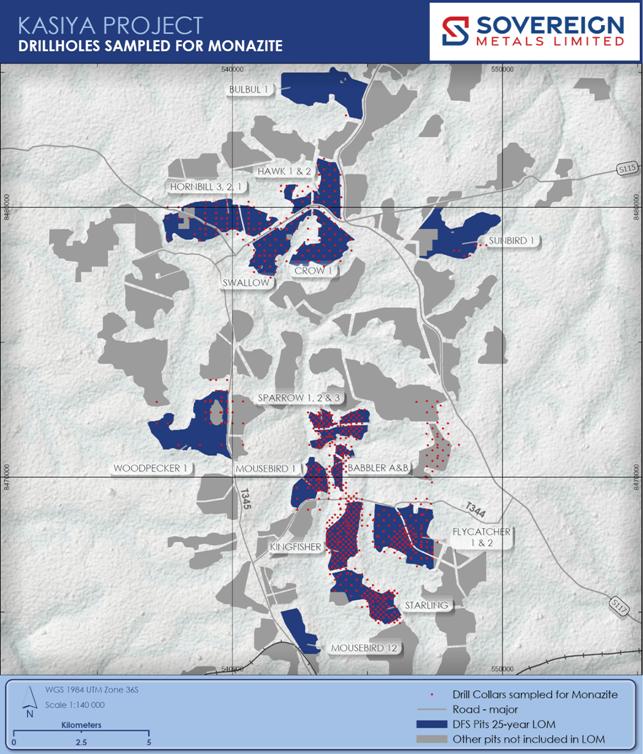
Figure 15: Plan view showing the Kasiya mine plan pits with the drillholes sampled for monazite
|
Drillhole |
FROM |
TO |
Easting |
Northing |
Elevation |
MONAZITE (%) |
|
KYAC0010 |
0 |
26 |
548999.91 |
8478599.68 |
1122.035257 |
0.012962 |
|
KYAC0011 |
0 |
21 |
549179.95 |
8478600.19 |
1120.305469 |
0.014 |
|
KYAC0012 |
0 |
23 |
549399.97 |
8478599.96 |
1113.462519 |
0.011522 |
|
KYAC0017 |
0 |
20 |
544199.73 |
8471799.85 |
1116.54935 |
0.01185 |
|
KYAC0018 |
0 |
27 |
544399.93 |
8471799.78 |
1115.25095 |
0.01763 |
|
KYAC0019 |
0 |
23 |
544599.76 |
8471799.89 |
1119.257233 |
0.017571 |
|
KYAC0020 |
0 |
25 |
544799.74 |
8471800.05 |
1119.350966 |
0.0068 |
|
KYAC0022 |
0 |
16 |
543599.166 |
8468203.999 |
1120.795778 |
0.0185 |
|
KYAC0024 |
0 |
15 |
543999.901 |
8468197.386 |
1131.863383 |
0.011067 |
|
KYAC0026 |
0 |
24 |
544400.531 |
8468200.163 |
1129.758049 |
0.017583 |
|
KYAC0027 |
0 |
30 |
544600.012 |
8468200.01 |
1124.92017 |
0.016867 |
|
KYAC0028 |
0 |
27 |
544797.681 |
8468200.824 |
1122.282722 |
0.010778 |
|
KYAC0029 |
0 |
30 |
544998.401 |
8465398.815 |
1146.802111 |
0.005667 |
|
KYAC0030 |
0 |
21 |
545195.836 |
8465400.739 |
1153.103907 |
0.014905 |
|
KYAC0031 |
0 |
27 |
545398.913 |
8465397.88 |
1151.877119 |
0.013852 |
|
KYAC0032 |
0 |
31 |
545599.762 |
8465400.121 |
1150.884169 |
0.015065 |
|
KYAC0033 |
0 |
18 |
543200.032 |
8472200.065 |
1108.928544 |
0.024778 |
|
KYAC0034 |
0 |
25 |
543399.957 |
8472200.448 |
1106.991773 |
0.01896 |
|
KYAC0035 |
0 |
28 |
543599.989 |
8472199.997 |
1106.165387 |
0.012107 |
|
KYAC0037 |
0 |
27 |
544043.567 |
8472211.534 |
1110.521852 |
0.011222 |
|
KYAC0038 |
0 |
23 |
544201.917 |
8472202.038 |
1114.521998 |
0.003043 |
|
KYAC0039 |
0 |
27 |
544400.388 |
8472200.381 |
1115.308351 |
0.013111 |
|
KYAC0040 |
0 |
25 |
544600.198 |
8472199.841 |
1118.972904 |
0.01064 |
|
KYAC0041 |
0 |
25 |
544600.657 |
8472199.778 |
1118.972186 |
0.024429 |
|
KYAC0042 |
0 |
30 |
544800.927 |
8471999.869 |
1118.010318 |
0.008967 |
|
KYAC0043 |
0 |
26 |
544600.238 |
8472000.112 |
1118.288012 |
0.012769 |
|
KYAC0044 |
0 |
25 |
544393.92 |
8471999.416 |
1116.925161 |
0.01428 |
|
KYAC0045 |
0 |
21 |
544200.224 |
8472001.146 |
1116.811309 |
0.018524 |
|
KYAC0046 |
0 |
30 |
544003.164 |
8472001.011 |
1110.494706 |
0.015233 |
|
KYAC0047 |
0 |
19 |
543800.145 |
8472000.867 |
1114.577394 |
0.013053 |
|
KYAC0049 |
0 |
27 |
543399.919 |
8472000.232 |
1107.866628 |
0.011889 |
|
KYAC0050 |
0 |
11 |
543200.095 |
8472000.184 |
1113.214309 |
0.0128 |
|
KYAC0056 |
0 |
18 |
543997.878 |
8471438.62 |
1105.647074 |
0.0045 |
|
KYAC0057 |
0 |
25 |
544000.058 |
8471600.07 |
1108.900422 |
0.013 |
|
KYAC0058 |
0 |
20 |
544200.019 |
8471599.759 |
1112.737683 |
0.0143 |
|
KYAC0059 |
0 |
14 |
544200.67 |
8471459.085 |
1109.988402 |
0.007286 |
|
KYAC0060 |
0 |
18 |
544395.686 |
8471601.55 |
1115.76231 |
0.012889 |
|
KYAC0061 |
0 |
19.9 |
544599.657 |
8471599.402 |
1116.805071 |
0.015065 |
|
KYAC0062 |
0 |
23.5 |
543400.129 |
8471399.88 |
1105.445053 |
0.016021 |
|
KYAC0063 |
0 |
24 |
543400.553 |
8471399.471 |
1105.185847 |
0.01575 |
|
KYAC0064 |
0 |
15 |
543400.271 |
8471200.057 |
1103.637339 |
0.012067 |
|
KYAC0065 |
0 |
31 |
544200.613 |
8470403.105 |
1111.314194 |
0.001774 |
|
KYAC0067 |
0 |
20 |
543999.703 |
8470600.308 |
1113.92837 |
0.00745 |
|
KYAC0068 |
0 |
24 |
544198.403 |
8470599.281 |
1113.465562 |
0.016042 |
|
KYAC0069 |
15 |
30 |
543999.803 |
8470800.675 |
1099.816803 |
0.009 |
|
KYAC0070 |
0 |
25 |
544199.133 |
8470811.472 |
1111.541421 |
0.01772 |
|
KYAC0071 |
0 |
28 |
544200.382 |
8471000.122 |
1107.457002 |
0.008643 |
|
KYAC0072 |
0 |
12 |
544200.126 |
8471200.041 |
1106.505436 |
0.012667 |
|
KYAC0073 |
3 |
8 |
543997.399 |
8471006.595 |
1113.378289 |
0.002 |
|
KYAC0074 |
0 |
13 |
544000.041 |
8471200.07 |
1105.936948 |
0.007154 |
|
KYAC0075 |
0 |
5 |
543799.535 |
8471192.584 |
1105.235726 |
0.008 |
|
KYAC0076 |
0 |
6 |
543615.352 |
8471150.212 |
1103.112785 |
0.005 |
|
KYAC0077 |
0 |
17 |
544199.786 |
8469199.613 |
1125.088224 |
0.006353 |
|
KYAC0078 |
0 |
19 |
544400.156 |
8469199.172 |
1125.785283 |
0.015421 |
|
KYAC0079 |
0 |
23 |
544400.227 |
8468999.887 |
1124.940531 |
0.016826 |
|
KYAC0080 |
0 |
13 |
544199.947 |
8469000.238 |
1128.921223 |
0.008462 |
|
KYAC0081 |
0 |
21 |
543995.839 |
8469178.519 |
1118.027079 |
0.013333 |
|
KYAC0082 |
0 |
19 |
543952.875 |
8468999.549 |
1119.22652 |
0.010263 |
|
KYAC0084 |
0 |
21 |
543999.803 |
8468850.365 |
1121.362013 |
0.015 |
|
KYAC0085 |
0 |
27 |
544200.11 |
8468799.991 |
1122.970905 |
0.019444 |
|
KYAC0086 |
0 |
19 |
543999.314 |
8468602.404 |
1125.357265 |
0.009895 |
|
KYAC0087 |
0 |
24 |
544199.569 |
8468599.956 |
1125.900731 |
0.016583 |
|
KYAC0088 |
0 |
21 |
544199.841 |
8468400.01 |
1129.166036 |
0.020238 |
|
KYAC0089 |
0 |
21 |
544400.484 |
8468401.613 |
1129.77286 |
0.010619 |
|
KYAC0090 |
0 |
25 |
544400.071 |
8468599.993 |
1126.313319 |
0.01516 |
|
KYAC0092 |
0 |
20 |
544400.108 |
8467999.881 |
1133.315941 |
0.0145 |
|
KYAC0093 |
0 |
20 |
544199.707 |
8467999.991 |
1132.876192 |
0.01455 |
|
KYAC0124 |
0 |
24 |
548400.18 |
8478397.69 |
1129.346124 |
0.015364 |
|
KYAC0126 |
0 |
16 |
548799.02 |
8478199.59 |
1126.57285 |
0.01025 |
|
KYAC0127 |
5 |
13 |
548598.63 |
8478198.24 |
1127.324408 |
0.007 |
|
KYAC0130 |
0 |
25 |
548200.34 |
8478400.73 |
1130.454528 |
0.00676 |
|
KYAC0131 |
0 |
36 |
544600.37 |
8468800.53 |
1117.556922 |
0.016778 |
|
KYAC0132 |
0 |
35 |
544601.02 |
8468598.22 |
1119.501143 |
0.016457 |
|
KYAC0133 |
0 |
35 |
544798.42 |
8468596.85 |
1114.169266 |
0.012886 |
|
KYAC0134 |
0 |
29 |
544597.86 |
8468398.42 |
1124.539221 |
0.01669 |
|
KYAC0135 |
0 |
30 |
544791.54 |
8468405.41 |
1119.317509 |
0.003533 |
|
KYAC0136 |
0 |
21 |
544599.84 |
8467999.99 |
1131.029047 |
0.013476 |
|
KYAC0139 |
0 |
28 |
543597.364 |
8468400.162 |
1112.84464 |
0.012464 |
|
KYAC0140 |
0 |
9 |
543599.059 |
8468000.682 |
1127.457827 |
0.009 |
|
KYAC0142 |
9 |
26 |
544000.463 |
8467999.495 |
1123.886384 |
0.013471 |
|
KYAC0143 |
0 |
25.5 |
544000.19 |
8468000.209 |
1128.632387 |
0.009431 |
|
KYAC0144 |
0 |
25 |
543798.731 |
8467800.539 |
1127.562789 |
0.01684 |
|
KYAC0145 |
0 |
24 |
544000.641 |
8467800.789 |
1130.822871 |
0.008833 |
|
KYAC0146 |
0 |
26.5 |
543598.589 |
8467802.677 |
1121.720837 |
0.013736 |
|
KYAC0147 |
0 |
21 |
543600.285 |
8467600.521 |
1126.067387 |
0.017095 |
|
KYAC0148 |
0 |
21 |
543800.451 |
8467604.646 |
1130.996401 |
0.012952 |
|
KYAC0149 |
0 |
33 |
544000.126 |
8467599.961 |
1127.387406 |
0.011515 |
|
KYAC0150 |
0 |
30 |
543800.007 |
8467401.347 |
1127.668486 |
0.007133 |
|
KYAC0151 |
0 |
24 |
544000.683 |
8467400.754 |
1133.124879 |
0.008917 |
|
KYAC0152 |
0 |
28.6 |
544402.072 |
8467801.145 |
1130.141656 |
0.009427 |
|
KYAC0153 |
0 |
9 |
545000.09 |
8465599.852 |
1157.137726 |
0.008556 |
|
KYAC0154 |
2 |
7 |
545200.112 |
8465600.914 |
1157.958641 |
0.007 |
|
KYAC0155 |
0 |
28 |
545200.666 |
8465798.986 |
1146.243608 |
0.020071 |
|
KYAC0156 |
0 |
24 |
545399.218 |
8465200.72 |
1154.228357 |
0.007333 |
|
KYAC0157 |
0 |
28 |
545200.406 |
8465202.393 |
1149.679668 |
0.014214 |
|
KYAC0158 |
0 |
28 |
544996.459 |
8465204.289 |
1146.610349 |
0.001286 |
|
KYAC0159 |
0 |
34 |
545200.526 |
8464999.751 |
1145.818754 |
0.013765 |
|
KYAC0160 |
0 |
35 |
545397.841 |
8465000.759 |
1148.892327 |
0.012543 |
|
KYAC0161 |
0 |
30 |
545399.547 |
8464800.915 |
1151.406881 |
0.011267 |
|
KYAC0162 |
0 |
35 |
545600.177 |
8465000.371 |
1151.296064 |
0.003943 |
|
KYAC0164 |
0 |
27 |
545599.703 |
8465200.398 |
1154.287369 |
0.024852 |
|
KYAC0165 |
0 |
27 |
545400.15 |
8465600.491 |
1149.823246 |
0.011741 |
|
KYAC0166 |
0 |
29 |
545600.881 |
8465601.709 |
1148.780446 |
0.018552 |
|
KYAC0167 |
17 |
24 |
545399.74 |
8465799.81 |
1139.715633 |
0.01 |
|
KYAC0169 |
0 |
20 |
545800.229 |
8465600.66 |
1152.935456 |
0.0112 |
|
KYAC0170 |
0 |
24 |
545800.364 |
8465799.952 |
1146.758311 |
0.01 |
|
KYAC0171 |
0 |
29 |
545999.889 |
8465799.923 |
1141.790321 |
0.01531 |
|
KYAC0175 |
0 |
19 |
545998.175 |
8467402.602 |
1151.441129 |
0.027211 |
|
KYAC0176 |
0 |
26.6 |
546200.042 |
8467399.787 |
1151.151906 |
0.021526 |
|
KYAC0177 |
0 |
14 |
546400.244 |
8467399.23 |
1160.686865 |
0.010571 |
|
KYAC0178 |
0 |
21.4 |
546400.425 |
8467600.227 |
1157.183546 |
0.016636 |
|
KYAC0180 |
0 |
15.5 |
545998.082 |
8467601.038 |
1153.448654 |
0.011935 |
|
KYAC0181 |
0 |
27 |
546197.908 |
8467797.332 |
1149.807412 |
0.016333 |
|
KYAC0183 |
0 |
32 |
546198.219 |
8467998.617 |
1144.85203 |
0.009656 |
|
KYAC0184 |
0 |
22.8 |
546400.174 |
8468199.045 |
1149.474019 |
0.00157 |
|
KYAC0185 |
0 |
32.7 |
546600.638 |
8468201.265 |
1145.864463 |
0.008697 |
|
KYAC0186 |
0 |
14 |
546398.301 |
8468001.987 |
1156.918008 |
0.015571 |
|
KYAC0187 |
0 |
15 |
546600.434 |
8468000.732 |
1158.300537 |
0.0286 |
|
KYAC0188 |
0 |
25.8 |
546199.572 |
8468200.746 |
1145.960566 |
0.011705 |
|
KYAC0189 |
0 |
22 |
546399.859 |
8467800.731 |
1155.502804 |
0.011591 |
|
KYAC0190 |
0 |
17.4 |
546599.029 |
8467803.389 |
1159.47448 |
0.013632 |
|
KYAC0191 |
0 |
18 |
546598.229 |
8467598.666 |
1161.288462 |
0.019944 |
|
KYAC0192 |
0 |
8 |
546000.176 |
8464604.984 |
1169.044644 |
0.012 |
|
KYAC0193 |
0 |
14 |
546099.958 |
8464700.073 |
1164.91239 |
0.0085 |
|
KYAC0194 |
0 |
16 |
546199.95 |
8464800.028 |
1162.013913 |
0.019875 |
|
KYAC0195 |
0 |
16 |
546100.032 |
8464900 |
1161.938044 |
0.00275 |
|
KYAC0196 |
0 |
16 |
545999.949 |
8465000.088 |
1161.488708 |
0.008813 |
|
KYAC0197 |
0 |
17 |
545899.946 |
8464899.996 |
1162.197903 |
0.006176 |
|
KYAC0198 |
0 |
12 |
545900.088 |
8464700.064 |
1166.107091 |
0.0065 |
|
KYAC0199 |
2 |
17 |
545799.869 |
8464794.094 |
1161.763228 |
0.007667 |
|
KYAC0200 |
0 |
20 |
545699.983 |
8464900.105 |
1159.945107 |
0.002857 |
|
KYAC0201 |
0 |
25 |
545499.938 |
8464900.043 |
1155.583994 |
0.01376 |
|
KYAC0202 |
0 |
21 |
545499.821 |
8464700.019 |
1157.895844 |
0.014286 |
|
KYAC0203 |
0 |
20 |
545299.899 |
8464700.021 |
1154.392195 |
0.01065 |
|
KYAC0204 |
6 |
26 |
545299.999 |
8464894.614 |
1148.411456 |
0.01965 |
|
KYAC0205 |
0 |
21 |
545100.105 |
8464900.093 |
1149.684526 |
0.011667 |
|
KYAC0206 |
0 |
23 |
545099.919 |
8465100.081 |
1150.446682 |
0.015783 |
|
KYAC0207 |
0 |
22 |
545299.978 |
8465100.139 |
1154.052355 |
0.006722 |
|
KYAC0208 |
0 |
25 |
545499.929 |
8465100.039 |
1154.905262 |
0.00624 |
|
KYAC0209 |
0 |
23 |
545699.978 |
8465100.112 |
1157.292028 |
0.002667 |
|
KYAC0210 |
0 |
7 |
545800.002 |
8465200.346 |
1164.678976 |
0.002857 |
|
KYAC0211 |
0 |
2 |
545700.036 |
8465300.168 |
1166.450676 |
0.009 |
|
KYAC0211 |
16 |
23 |
545700.036 |
8465300.168 |
1147.950676 |
0.013 |
|
KYAC0212 |
0 |
17 |
545499.983 |
8465300.113 |
1158.056158 |
0.014647 |
|
KYAC0214 |
0 |
6 |
545099.976 |
8465300.044 |
1159.721844 |
0.01 |
|
KYAC0215 |
0 |
2 |
544899.964 |
8465500.013 |
1160.374601 |
0.011 |
|
KYAC0216 |
0 |
2 |
545100.002 |
8465500.063 |
1161.483645 |
0.01 |
|
KYAC0217 |
8 |
23 |
545299.996 |
8465500.028 |
1148.417984 |
0.016133 |
|
KYAC0218 |
12 |
20 |
545500.026 |
8465500.038 |
1148.900173 |
0.012 |
|
KYAC0219 |
0 |
7 |
545700.03 |
8465500.015 |
1161.347934 |
0.008143 |
|
KYAC0220 |
0 |
21 |
545900.026 |
8465499.98 |
1153.574412 |
0.017333 |
|
KYAC0221 |
0 |
18 |
546099.983 |
8465699.994 |
1148.172579 |
0.022333 |
|
KYAC0222 |
6 |
14 |
545900.487 |
8465700.344 |
1150.293797 |
0.017 |
|
KYAC0224 |
2 |
9 |
545700.048 |
8465700.043 |
1156.159725 |
0.01 |
|
KYAC0226 |
0 |
18 |
545299.997 |
8465700.049 |
1152.754943 |
0.003 |
|
KYAC0227 |
8 |
25 |
545099.594 |
8465700.129 |
1144.677243 |
0.003412 |
|
KYAC0228 |
0 |
9 |
545099.998 |
8465900.027 |
1154.316796 |
0.003667 |
|
KYAC0229 |
0 |
16 |
544899.944 |
8465700.017 |
1152.986825 |
0.015875 |
|
KYAC0234 |
0 |
14 |
543899.996 |
8466300.029 |
1145.148703 |
0.012857 |
|
KYAC0243 |
0 |
31 |
544000.012 |
8466600.013 |
1137.453031 |
0.018935 |
|
KYAC0244 |
0 |
16 |
543899.282 |
8466700.111 |
1142.838212 |
0.021063 |
|
KYAC0245 |
0 |
18 |
544099.997 |
8466700.064 |
1144.580675 |
0.034333 |
|
KYAC0246 |
0 |
16 |
544199.99 |
8466800.045 |
1145.42134 |
0.015437 |
|
KYAC0247 |
0 |
20 |
544099.98 |
8466900.008 |
1141.65806 |
0.01615 |
|
KYAC0248 |
0 |
18 |
543899.983 |
8466900.036 |
1139.942166 |
0.028556 |
|
KYAC0249 |
0 |
17 |
543999.977 |
8467000.003 |
1140.693893 |
0.002647 |
|
KYAC0250 |
0 |
29 |
544100.295 |
8467100.413 |
1135.137272 |
0.002172 |
|
KYAC0251 |
0 |
20 |
544199.972 |
8467200.027 |
1139.398304 |
0.0162 |
|
KYAC0252 |
0 |
19 |
544300.021 |
8467100.038 |
1140.957124 |
0.005684 |
|
KYAC0253 |
0 |
19 |
544299.947 |
8467300.023 |
1139.24367 |
0.002842 |
|
KYAC0254 |
1 |
23 |
546099.57 |
8467300.056 |
1149.886366 |
0.016636 |
|
KYAC0255 |
0 |
24 |
546299.966 |
8467299.998 |
1153.380616 |
0.011667 |
|
KYAC0257 |
0 |
20 |
546699.94 |
8467299.949 |
1159.726298 |
0.014889 |
|
KYAC0258 |
0 |
20 |
546700.014 |
8467500.437 |
1160.583928 |
0.0095 |
|
KYAC0259 |
0 |
19 |
546699.854 |
8467700.312 |
1159.980529 |
0.015316 |
|
KYAC0260 |
0 |
20 |
546500.063 |
8467499.986 |
1159.447133 |
0.0143 |
|
KYAC0261 |
0 |
29 |
546300.472 |
8467505.387 |
1152.116631 |
0.012552 |
|
KYAC0262 |
0 |
17 |
546099.786 |
8467500.054 |
1154.818421 |
0.013294 |
|
KYAC0263 |
0 |
18 |
545900.003 |
8467499.996 |
1150.650925 |
0.021556 |
|
KYAC0264 |
0 |
17 |
545900.008 |
8467699.983 |
1150.378854 |
0.017706 |
|
KYAC0265 |
0 |
32 |
545999.995 |
8467800.008 |
1143.355029 |
0.009594 |
|
KYAC0266 |
0 |
29 |
546099.983 |
8467899.976 |
1145.451209 |
0.005 |
|
KYAC0267 |
0 |
26 |
546299.961 |
8467900.003 |
1150.998769 |
0.005769 |
|
KYAC0268 |
0 |
21 |
546301.587 |
8468102.17 |
1150.994638 |
0.006333 |
|
KYAC0269 |
0 |
10 |
546499.981 |
8468099.986 |
1158.93472 |
0.0212 |
|
KYAC0270 |
0 |
28 |
546699.963 |
8468099.988 |
1150.205507 |
0.014214 |
|
KYAC0271 |
0 |
10 |
546699.991 |
8467900.009 |
1162.049194 |
0.0086 |
|
KYAC0272 |
0 |
14.5 |
546485.52 |
8467898.139 |
1159.417441 |
0.017517 |
|
KYAC0273 |
0 |
22 |
546499.877 |
8467700.019 |
1157.636683 |
0.011545 |
|
KYAC0274 |
0 |
21 |
546300.012 |
8467700.022 |
1155.626783 |
0.02019 |
|
KYAC0275 |
0 |
21 |
546098.737 |
8467703.845 |
1151.859329 |
0.017857 |
|
KYAC0276 |
0 |
22 |
544099.896 |
8467300.134 |
1136.503488 |
0.003273 |
|
KYAC0277 |
0 |
22.8 |
543899.561 |
8467299.954 |
1133.470836 |
0.009 |
|
KYAC0278 |
0 |
23 |
543699.912 |
8467300.041 |
1130.319031 |
0.016652 |
|
KYAC0279 |
0 |
16 |
543500.055 |
8467300.034 |
1128.609825 |
0.01825 |
|
KYAC0280 |
0 |
17 |
543602.67 |
8467396.769 |
1130.398494 |
0.021 |
|
KYAC0281 |
0 |
27.5 |
543499.03 |
8467499.984 |
1120.338184 |
0.013709 |
|
KYAC0282 |
0 |
25 |
543700.097 |
8467499.955 |
1127.501054 |
0.0142 |
|
KYAC0283 |
0 |
22 |
543900.065 |
8467499.974 |
1132.536461 |
0.017364 |
|
KYAC0284 |
0 |
26 |
544100.135 |
8467500.123 |
1132.434523 |
0.013308 |
|
KYAC0285 |
0 |
23 |
544300.077 |
8467499.964 |
1134.939517 |
0.011783 |
|
KYAC0287 |
0 |
21 |
544499.975 |
8467699.983 |
1133.834859 |
0.007952 |
|
KYAC0288 |
0 |
21 |
544299.386 |
8467699.939 |
1135.001722 |
0.00981 |
|
KYAC0289 |
0 |
27.4 |
544099.36 |
8467699.663 |
1130.695335 |
0.004175 |
|
KYAC0290 |
2 |
23 |
543899.429 |
8467700.04 |
1129.853758 |
0.014882 |
|
KYAC0292 |
0 |
20 |
543500.061 |
8467699.961 |
1121.595388 |
0.0174 |
|
KYAC0293 |
0 |
19.5 |
543499.993 |
8467899.993 |
1120.344809 |
0.025615 |
|
KYAC0295 |
0 |
23 |
543899.988 |
8467900.058 |
1129.979541 |
0.014043 |
|
KYAC0297 |
0 |
21 |
544300.004 |
8467899.978 |
1133.612658 |
0.013238 |
|
KYAC0298 |
0 |
22 |
544500.013 |
8467899.996 |
1132.208356 |
0.013773 |
|
KYAC0301 |
0 |
22 |
544294.988 |
8468299.968 |
1130.37545 |
0.017273 |
|
KYAC0306 |
1 |
20 |
543500.022 |
8468099.956 |
1117.048131 |
0.020684 |
|
KYAC0308 |
0 |
17 |
543700.018 |
8468300.013 |
1121.943674 |
0.018353 |
|
KYAC0310 |
0 |
8 |
543899.979 |
8468499.994 |
1128.788182 |
0.01 |
|
KYAC0314 |
0 |
14 |
543699.931 |
8468504.909 |
1120.47802 |
0.011571 |
|
KYAC0320 |
0 |
25 |
544499.894 |
8468700.025 |
1124.893593 |
0.0188 |
|
KYAC0322 |
0 |
21 |
544299.975 |
8468900.112 |
1126.175356 |
0.01855 |
|
KYAC0323 |
0 |
18 |
544499.929 |
8468900.047 |
1127.026838 |
0.009188 |
|
KYAC0325 |
2 |
21 |
544600.127 |
8469200.04 |
1121.924774 |
0.020368 |
|
KYAC0326 |
0 |
21 |
544499.96 |
8469300.157 |
1123.220016 |
0.011762 |
|
KYAC0327 |
0 |
18 |
544500.082 |
8469100.064 |
1126.140061 |
0.016778 |
|
KYAC0328 |
0 |
20 |
544299.914 |
8469099.95 |
1125.424076 |
0.0083 |
|
KYAC0329 |
0 |
22 |
544299.432 |
8469299.941 |
1123.276003 |
0.0312 |
|
KYAC0331 |
4 |
9 |
544199.892 |
8469599.968 |
1124.675487 |
0.001 |
|
KYAC0332 |
0 |
15.4 |
544099.86 |
8469700.008 |
1121.599185 |
0.006472 |
|
KYAC0333 |
0 |
16 |
543999.96 |
8469799.93 |
1118.592651 |
0.007437 |
|
KYAC0334 |
0 |
25 |
543899.87 |
8469700.02 |
1110.650054 |
0.01824 |
|
KYAC0335 |
0 |
11 |
543799.84 |
8469600.03 |
1113.501336 |
0.011455 |
|
KYAC0338 |
0 |
21 |
543899.93 |
8469899.93 |
1111.935862 |
0.018762 |
|
KYAC0340 |
1 |
14 |
543739.49 |
8469700.14 |
1108.248772 |
0.008538 |
|
KYAC0341 |
0 |
19 |
543800 |
8470000.1 |
1107.8261 |
0.011632 |
|
KYAC0342 |
0 |
15 |
543700.04 |
8470100 |
1106.587981 |
0.0102 |
|
KYAC0343 |
0 |
22 |
543900 |
8470100.03 |
1111.751013 |
0.011864 |
|
KYAC0344 |
0 |
21 |
543999.94 |
8470200.15 |
1114.949142 |
0.009048 |
|
KYAC0345 |
0 |
23 |
544099.97 |
8470300.1 |
1115.410183 |
0.015435 |
|
KYAC0346 |
0 |
18 |
543899.82 |
8470300.13 |
1113.543033 |
0.007889 |
|
KYAC0347 |
0 |
24 |
544099.89 |
8470500.12 |
1113.848088 |
0.009458 |
|
KYAC0348 |
22 |
26 |
544300.01 |
8470700.03 |
1099.562303 |
0.001 |
|
KYAC0349 |
0 |
20 |
544299.95 |
8470900.08 |
1112.174852 |
0.0135 |
|
KYAC0350 |
0 |
21 |
544099.92 |
8470700.16 |
1114.032469 |
0.018429 |
|
KYAC0351 |
0 |
16 |
544099.82 |
8470900.07 |
1114.303345 |
0.022 |
|
KYAC0352 |
0 |
11 |
544100.33 |
8471099.97 |
1112.044015 |
0.022111 |
|
KYAC0353 |
0 |
20 |
543899.75 |
8471100.03 |
1104.452006 |
0.01275 |
|
KYAC0355 |
0 |
13 |
543805.17 |
8470800.02 |
1112.226254 |
0.017692 |
|
KYAC0356 |
2 |
20 |
543900 |
8470700.04 |
1110.470361 |
0.018714 |
|
KYAC0357 |
1 |
23 |
543899.86 |
8470499.9 |
1110.779165 |
0.024 |
|
KYAC0358 |
0 |
22 |
543799.93 |
8470400.09 |
1108.468884 |
0.011727 |
|
KYAC0359 |
0 |
11 |
543699.87 |
8470300.03 |
1109.19916 |
0.007182 |
|
KYAC0360 |
0 |
8 |
543599.97 |
8470203.95 |
1105.674062 |
0.011 |
|
KYAC0361 |
0 |
9 |
543499.88 |
8469499.87 |
1113.257945 |
0.015 |
|
KYAC0362 |
0 |
8 |
543576.04 |
8469400.06 |
1109.958772 |
0.012 |
|
KYAC0363 |
0 |
15 |
543300.02 |
8469497.29 |
1116.884931 |
0.0158 |
|
KYAC0364 |
0 |
20 |
543099.96 |
8469500.07 |
1118.936648 |
0.0168 |
|
KYAC0365 |
0 |
26 |
542999.97 |
8469599.88 |
1116.938491 |
0.002346 |
|
KYAC0366 |
0 |
13 |
542900.11 |
8469700.11 |
1123.651977 |
0.00375 |
|
KYAC0367 |
0 |
15 |
543099.99 |
8469700.07 |
1120.269333 |
0.025467 |
|
KYAC0368 |
0 |
18 |
543300.2 |
8469700.01 |
1114.591323 |
0.017389 |
|
KYAC0369 |
0 |
14 |
543399.97 |
8469600.03 |
1114.312425 |
0.015 |
|
KYAC0370 |
2 |
11 |
543505.57 |
8469703 |
1109.501562 |
0.007 |
|
KYAC0371 |
0 |
5 |
543572.46 |
8469799.74 |
1109.095079 |
0.007 |
|
KYAC0372 |
0 |
9 |
543499.87 |
8469900.2 |
1109.540077 |
0.007 |
|
KYAC0373 |
0 |
17 |
543299.67 |
8469899.98 |
1113.374925 |
0.018588 |
|
KYAC0374 |
0 |
15 |
543199.87 |
8469799.88 |
1117.505648 |
0.0208 |
|
KYAC0375 |
0 |
29 |
543100.06 |
8469900.14 |
1111.551963 |
0.015793 |
|
KYAC0376 |
0 |
19 |
542903.12 |
8469899.98 |
1118.615761 |
0.010105 |
|
KYAC0377 |
0 |
21 |
542807.62 |
8469799.91 |
1118.718828 |
0.005619 |
|
KYAC0378 |
0 |
14 |
542700.04 |
8469899.83 |
1121.623696 |
0.0075 |
|
KYAC0379 |
0 |
24 |
543000.03 |
8470000.08 |
1114.094753 |
0.0025 |
|
KYAC0380 |
0 |
18 |
542900.02 |
8470099.94 |
1115.780898 |
0.004778 |
|
KYAC0381 |
0 |
18 |
542800.12 |
8470199.96 |
1114.373376 |
0.0185 |
|
KYAC0382 |
0 |
18 |
542899.99 |
8470299.88 |
1112.623878 |
0.005778 |
|
KYAC0383 |
0 |
19 |
543000.04 |
8470399.93 |
1108.531646 |
0.002474 |
|
KYAC0384 |
0 |
20 |
543099.89 |
8470501.76 |
1104.23656 |
0.013111 |
|
KYAC0385 |
0 |
17 |
543099.9 |
8470300.5 |
1111.828225 |
0.004235 |
|
KYAC0386 |
0 |
14 |
543299.99 |
8470299.86 |
1108.969168 |
0.022 |
|
KYAC0387 |
0 |
11 |
543499.92 |
8470299.97 |
1103.045305 |
0.014 |
|
KYAC0388 |
0 |
7 |
543501.8 |
8470099.78 |
1107.46144 |
0.015 |
|
KYAC0389 |
0 |
10 |
543544.23 |
8470000.3 |
1105.291253 |
0.012 |
|
KYAC0390 |
0 |
10 |
543400.23 |
8470000.19 |
1112.183644 |
0.0147 |
|
KYAC0392 |
0 |
21 |
543199.85 |
8470200.03 |
1110.115442 |
0.013842 |
|
KYAC0393 |
0 |
11 |
543100.14 |
8470100.47 |
1118.042821 |
0.011273 |
|
KYAC0394 |
0 |
19 |
543299.77 |
8471499.98 |
1108.856389 |
0.019421 |
|
KYAC0395 |
0 |
18 |
543200.07 |
8471400.07 |
1107.082878 |
0.016556 |
|
KYAC0396 |
0 |
17 |
543100.05 |
8471300 |
1104.691705 |
0.009882 |
|
KYAC0397 |
4 |
10 |
543099.95 |
8471101.97 |
1101.850216 |
0.004 |
|
KYAC0399 |
0 |
12 |
543300.13 |
8471100.09 |
1103.174591 |
0.013667 |
|
KYAC0400 |
0 |
20 |
543300.02 |
8471300 |
1105.344612 |
0.0135 |
|
KYAC0402 |
0 |
10 |
543700.05 |
8471299.9 |
1105.460149 |
0.0154 |
|
KYAC0403 |
0 |
14 |
543699.98 |
8471500.06 |
1111.965862 |
0.024571 |
|
KYAC0404 |
0 |
21 |
543499.91 |
8471500.06 |
1109.122349 |
0.015476 |
|
KYAC0405 |
0 |
19 |
543098.78 |
8471700.09 |
1105.646528 |
0.019333 |
|
KYAC0406 |
0 |
14 |
543200.04 |
8471800.08 |
1111.353818 |
0.015167 |
|
KYAC0408 |
0 |
23 |
543499.69 |
8471699.96 |
1110.3408 |
0.016174 |
|
KYAC0409 |
0 |
30 |
543700.01 |
8471700.06 |
1108.162115 |
0.020367 |
|
KYAC0411 |
0 |
19 |
544100.03 |
8471700.04 |
1114.868593 |
0.003474 |
|
KYAC0412 |
0 |
16 |
544300.05 |
8471700.07 |
1117.507187 |
0.005625 |
|
KYAC0413 |
0 |
16 |
544300.06 |
8471500.01 |
1111.530293 |
0.015857 |
|
KYAC0414 |
13 |
19 |
544500.04 |
8471500.01 |
1107.173682 |
0.024 |
|
KYAC0415 |
0 |
19 |
544699.68 |
8471500.01 |
1116.528402 |
0.016053 |
|
KYAC0416 |
0 |
18 |
544501.85 |
8471700.31 |
1118.833892 |
0.004786 |
|
KYAC0417 |
0 |
21 |
544699.91 |
8471700.17 |
1119.534695 |
0.017667 |
|
KYAC0422 |
0 |
23 |
544700.28 |
8472100.26 |
1121.052264 |
0.025348 |
|
KYAC0423 |
0 |
24 |
544699.51 |
8471899.89 |
1119.979451 |
0.006167 |
|
KYAC0424 |
0 |
20 |
544500.56 |
8471899.63 |
1120.015596 |
0.0024 |
|
KYAC0427 |
0 |
16 |
544299.72 |
8472300.01 |
1118.949601 |
0.011 |
|
KYAC0428 |
0 |
4 |
544300.01 |
8472098.41 |
1125.844617 |
0.009 |
|
KYAC0429 |
0 |
19 |
544300.07 |
8471899.98 |
1118.626871 |
0.007895 |
|
KYAC0430 |
0 |
16 |
544100 |
8471899.92 |
1118.504962 |
0.015 |
|
KYAC0431 |
0 |
18 |
543900.2 |
8471899.49 |
1115.701259 |
0.017278 |
|
KYAC0433 |
0 |
10 |
543499.66 |
8471899.73 |
1117.464054 |
0.013 |
|
KYAC0437 |
0 |
18 |
543299.92 |
8472100.03 |
1111.662456 |
0.016 |
|
KYAC0440 |
0 |
19 |
543700.13 |
8472299.97 |
1109.235992 |
0.023421 |
|
KYAC0441 |
0 |
21 |
543499.93 |
8472299.91 |
1107.309445 |
0.012714 |
|
KYAC0443 |
0 |
12 |
543397.44 |
8472401.32 |
1109.707921 |
0.016333 |
|
KYAC0444 |
0 |
12 |
543299.61 |
8472499.04 |
1106.580697 |
0.01275 |
|
KYAC0445 |
0 |
22.5 |
547399.643 |
8467000.966 |
1160.801878 |
0.004289 |
|
KYAC0446 |
0 |
29 |
547202.075 |
8466999.904 |
1154.656718 |
0.01131 |
|
KYAC0447 |
0 |
14 |
547399.933 |
8467200.064 |
1163.396399 |
0.002429 |
|
KYAC0449 |
0 |
15 |
547200.007 |
8467399.989 |
1160.15857 |
0.001067 |
|
KYAC0450 |
0 |
32 |
546999.984 |
8467599.885 |
1151.574511 |
0.011154 |
|
KYAC0451 |
0 |
24 |
547200.028 |
8467800.011 |
1151.228594 |
0.011 |
|
KYAC0452 |
0 |
23 |
547000.006 |
8467900.04 |
1153.75733 |
0.011435 |
|
KYAC0453 |
0 |
26 |
546999.993 |
8468100.042 |
1149.967024 |
0.013885 |
|
KYAC0454 |
0 |
22 |
546804.209 |
8467802.094 |
1156.686301 |
0.014727 |
|
KYAC0469 |
0 |
12 |
544299.889 |
8468199.913 |
1135.750785 |
0.012833 |
|
KYAC0479 |
0 |
20 |
543498.612 |
8471501.628 |
1109.649864 |
0.0206 |
|
KYAC0480 |
0 |
18 |
543299.025 |
8472101.196 |
1111.677981 |
0.019333 |
|
KYAC0481 |
0 |
19 |
544299.379 |
8471700.019 |
1115.989466 |
0.011947 |
|
KYAC0482 |
0 |
20 |
544700.452 |
8472099.301 |
1122.546145 |
0.0208 |
|
KYAC0483 |
0 |
20 |
543200.079 |
8470200.413 |
1110.60388 |
0.0192 |
|
KYAC0484 |
0 |
20 |
543100.384 |
8469900.928 |
1116.019743 |
0.0222 |
|
KYAC0485 |
0 |
13.64 |
543399.793 |
8469600.697 |
1114.49322 |
0.018399 |
|
KYAC0486 |
0 |
20 |
543900.232 |
8468100.962 |
1129.349123 |
0.0184 |
|
KYAC0487 |
0 |
20 |
544499.772 |
8468698.955 |
1127.403409 |
0.0166 |
|
KYAC0489 |
0 |
21.5 |
544800.157 |
8472200.9 |
1122.482741 |
0.009442 |
|
KYAC0493 |
0 |
17 |
544900.037 |
8472500.012 |
1121.694406 |
0.015059 |
|
KYAC0494 |
0 |
16 |
544700.126 |
8472500.026 |
1120.90941 |
0.0175 |
|
KYAC0495 |
0 |
10 |
544600.501 |
8472400.381 |
1124.865768 |
0.0096 |
|
KYAC0496 |
0 |
20.3 |
544700.011 |
8472298.981 |
1121.979911 |
0.014887 |
|
KYAC0497 |
0 |
10 |
544501.1 |
8472300 |
1124.714667 |
0.0048 |
|
KYAC0499 |
0 |
23.65 |
544499.6 |
8472098 |
1118.546849 |
0.002015 |
|
KYAC0500 |
0 |
18 |
543099.1 |
8472300 |
1105.367815 |
0.017667 |
|
KYAC0501 |
0 |
18 |
543098.83 |
8472100.401 |
1106.960606 |
0.015111 |
|
KYAC0502 |
0 |
20 |
542998.854 |
8472000.039 |
1102.190308 |
0.0164 |
|
KYAC0503 |
0 |
19 |
542899.086 |
8472100.206 |
1097.96722 |
0.018737 |
|
KYAC0504 |
0 |
11 |
542899.834 |
8472299.377 |
1100.837298 |
0.006273 |
|
KYAC0505 |
0 |
24 |
543499.8 |
8472098 |
1109.141678 |
0.018167 |
|
KYAC0506 |
0 |
26.45 |
543700.2 |
8472101 |
1109.00542 |
0.017195 |
|
KYAC0507 |
0 |
13.55 |
543299.8 |
8471901.1 |
1113.839435 |
0.019391 |
|
KYAC0508 |
0 |
10.88 |
543098.9 |
8471899.5 |
1110.421844 |
0.014404 |
|
KYAC0509 |
0 |
18.1 |
543300.9 |
8472299.9 |
1108.699505 |
0.018696 |
|
KYAC0510 |
0 |
23.76 |
544100.193 |
8472099.394 |
1114.281655 |
0.017852 |
|
KYAC0511 |
0 |
14.83 |
544798.084 |
8468999.852 |
1121.852528 |
0.021099 |
|
KYAC0512 |
0 |
28 |
544700.064 |
8468901.082 |
1119.164783 |
0.019429 |
|
KYAC0514 |
0 |
28 |
544700.779 |
8468700.022 |
1120.652064 |
0.016857 |
|
KYAC0515 |
0 |
18 |
544698.777 |
8468500.132 |
1127.495868 |
0.016667 |
|
KYAC0516 |
0 |
23 |
544499.812 |
8468501.014 |
1127.770916 |
0.016652 |
|
KYAC0517 |
0 |
24 |
544500.728 |
8468300.221 |
1128.57329 |
0.0155 |
|
KYAC0518 |
0 |
28 |
544500.086 |
8468100.775 |
1127.661167 |
0.018357 |
|
KYAC0519 |
0 |
23 |
544300.024 |
8468701.003 |
1126.392702 |
0.01287 |
|
KYAC0520 |
0 |
18 |
544300.062 |
8468499.139 |
1130.457136 |
0.019 |
|
KYAC0522 |
0 |
25 |
544100.535 |
8468301.303 |
1127.233551 |
0.01656 |
|
KYAC0523 |
0 |
19 |
544102.94 |
8468099.938 |
1132.046288 |
0.019895 |
|
KYAC0524 |
0 |
24 |
544099.374 |
8468500.091 |
1125.860881 |
0.01 |
|
KYAC0525 |
0 |
19.75 |
543699.257 |
8468099.992 |
1124.419593 |
0.02062 |
|
KYAC0526 |
0 |
22 |
543699.945 |
8467896.993 |
1126.463238 |
0.017364 |
|
KYAC0527 |
0 |
23 |
543898.966 |
8467700.061 |
1130.842083 |
0.018174 |
|
KYAC0531 |
0 |
24 |
544199.228 |
8467599.908 |
1133.413129 |
0.014167 |
|
KYAC0532 |
0 |
17.62 |
544499.303 |
8467499.934 |
1137.159862 |
0.005687 |
|
KYAC0533 |
0 |
18 |
544601.069 |
8467600.111 |
1135.573202 |
0.007333 |
|
KYAC0534 |
0 |
21 |
544501.058 |
8467699.989 |
1133.822504 |
0.005048 |
|
KYDD0002 |
0 |
19 |
543498.878 |
8468099.925 |
1117.994528 |
0.0195 |
|
KYDD0003 |
0 |
23 |
543699.024 |
8467699.994 |
1127.658812 |
0.017174 |
|
KYDD0004 |
0 |
20 |
544301.232 |
8468099.763 |
1132.450234 |
0.0194 |
|
KYDD0006 |
0 |
18.54 |
544200.551 |
8466800.363 |
1144.154363 |
0.010436 |
|
KYDD0013 |
0 |
18.26 |
544299.698 |
8472099.354 |
1118.70704 |
0.004058 |
|
KYDD0018 |
0 |
22.12 |
543300.222 |
8471700.784 |
1108.791764 |
0.014995 |
|
KYDD0020 |
0 |
16.1 |
542899.89 |
8470100.974 |
1116.714098 |
0.002745 |
|
KYDD0021 |
0 |
13 |
543399.988 |
8470000.903 |
1110.690108 |
0.010923 |
|
KYDD0023 |
0 |
19.37 |
544299.833 |
8470901.25 |
1112.47005 |
0.016101 |
|
KYHA0096 |
0 |
11 |
540798.872 |
8479196.017 |
1103.980578 |
0.005364 |
|
KYHA0097 |
0 |
12 |
541201.042 |
8479201.515 |
1108.757689 |
0.011917 |
|
KYHA0098 |
0 |
13 |
541600.163 |
8479205.587 |
1111.265951 |
0.017923 |
|
KYHA0099 |
0 |
9 |
541999.847 |
8479195.602 |
1111.958533 |
0.001444 |
|
KYHA0100 |
0 |
11 |
542398.262 |
8479204.192 |
1109.117742 |
0.006182 |
|
KYHA0102 |
0 |
11 |
540390.31 |
8478800.941 |
1093.693715 |
0.007182 |
|
KYHA0110 |
0 |
9 |
540797.553 |
8478202.247 |
1095.058367 |
0.013 |
|
KYHA0111 |
0 |
14 |
541199.153 |
8478202.347 |
1101.569099 |
0.017143 |
|
KYHA0112 |
0 |
14 |
541599.182 |
8478202.721 |
1099.053904 |
0.002857 |
|
KYHA0143 |
0 |
9 |
542000.322 |
8479600.964 |
1114.809205 |
0.018667 |
|
KYHA0144 |
0 |
7 |
542399.398 |
8479600.342 |
1118.869339 |
0.020857 |
|
KYHA0145 |
0 |
11 |
541199.677 |
8478802.95 |
1109.044843 |
0.015364 |
|
KYHA0146 |
2 |
8 |
541598.979 |
8478800.836 |
1110.529012 |
0.029333 |
|
KYHA0147 |
0 |
7 |
541999.494 |
8478802.246 |
1108.607009 |
0.025714 |
|
KYHA0149 |
0 |
9 |
541199.466 |
8477602.005 |
1096.326991 |
0.017222 |
|
KYHA0153 |
0 |
9 |
543198.748 |
8479601.211 |
1124.145957 |
0.008333 |
|
KYHA0155 |
0 |
13 |
544000.271 |
8481200.58 |
1137.584387 |
0.015 |
|
KYHA0156 |
0 |
8 |
543997.108 |
8480802.738 |
1141.389865 |
0.015125 |
|
KYHA0157 |
0 |
10 |
544028.969 |
8480381.512 |
1141.058508 |
0.0154 |
|
KYHA0158 |
0 |
11 |
544022.176 |
8480004.208 |
1138.935432 |
0.007182 |
|
KYHA0159 |
0 |
9 |
544000.786 |
8479599.481 |
1141.197462 |
0.016667 |
|
KYHA0160 |
0 |
8 |
543199.084 |
8480000.829 |
1128.477216 |
0.0125 |
|
KYHA0164 |
0 |
9 |
543166.744 |
8481571.794 |
1125.039496 |
0.011889 |
|
KYHA0169 |
0 |
10 |
542403.506 |
8480420.386 |
1117.904201 |
0.0276 |
|
KYHA0173 |
0 |
12 |
543199.38 |
8478001.512 |
1120.705016 |
0.019083 |
|
KYHA0174 |
0 |
8 |
543997.519 |
8478000.25 |
1125.183847 |
0.01775 |
|
KYHA0176 |
0 |
11 |
544001.182 |
8478799.533 |
1139.337719 |
0.023364 |
|
KYHA0177 |
0 |
11 |
543243.258 |
8478790.42 |
1129.298529 |
0.015182 |
|
KYHA0178 |
1 |
7 |
542399.409 |
8478000.942 |
1104.21818 |
0.018667 |
|
KYHA0179 |
0 |
14 |
538999.352 |
8479599.607 |
1087.267568 |
0.013214 |
|
KYHA0180 |
0 |
13 |
539400.784 |
8479598.786 |
1091.014177 |
0.022846 |
|
KYHA0181 |
0 |
11 |
539801.061 |
8479598.331 |
1094.051671 |
0.009727 |
|
KYHA0183 |
0 |
11 |
540600.297 |
8479599.291 |
1099.961868 |
0.009091 |
|
KYHA0185 |
0 |
9 |
541395.563 |
8479605.056 |
1108.13593 |
0.023222 |
|
KYHA0194 |
0 |
3 |
542399.772 |
8480801.991 |
1113.360101 |
0.02 |
|
KYHA0195 |
0 |
8 |
541997.495 |
8480801.363 |
1103.21122 |
0.031 |
|
KYHA0198 |
0 |
12 |
541000.081 |
8479200.059 |
1106.135421 |
0.017 |
|
KYHA0199 |
0 |
10 |
541399.693 |
8479200.132 |
1112.23247 |
0.0156 |
|
KYHA0200 |
0 |
8 |
541799.971 |
8479200.007 |
1112.848695 |
0.029 |
|
KYHA0201 |
0 |
11 |
538999.735 |
8479201.882 |
1087.588775 |
0.012727 |
|
KYHA0203 |
0 |
11 |
539799.98 |
8479200.808 |
1088.481841 |
0.019273 |
|
KYHA0204 |
0 |
11 |
540199.848 |
8479199.115 |
1090.666906 |
0.008 |
|
KYHA0207 |
0 |
12 |
539399.963 |
8480000.007 |
1087.83321 |
0.013333 |
|
KYHA0208 |
0 |
11 |
539799.919 |
8480000.542 |
1091.430121 |
0.008091 |
|
KYHA0209 |
0 |
11 |
540200.079 |
8480001.866 |
1093.650061 |
0.009545 |
|
KYHA0210 |
0 |
7 |
540602.469 |
8480000.493 |
1097.074395 |
0.012714 |
|
KYHA0230 |
0 |
12 |
540802.276 |
8478403.404 |
1097.270081 |
0.020667 |
|
KYHA0231 |
0 |
16 |
541197.566 |
8478397.044 |
1102.743449 |
0.022625 |
|
KYHA0232 |
0 |
14 |
541598.684 |
8478400.123 |
1102.781486 |
0.019 |
|
KYHA0233 |
0 |
6 |
541999.406 |
8478400.282 |
1100.297361 |
0.03 |
|
KYHA0234 |
0 |
11 |
540798.653 |
8477998.988 |
1093.416674 |
0.032636 |
|
KYHA0235 |
0 |
15 |
541200.545 |
8478000.95 |
1098.313939 |
0.011667 |
|
KYHA0236 |
0 |
12 |
541600.429 |
8478001.518 |
1097.340207 |
0.021833 |
|
KYHA0270 |
0 |
8 |
539599.655 |
8472799.745 |
1132.18927 |
0.011 |
|
KYHA0271 |
0 |
10 |
540399.359 |
8472798.079 |
1122.800889 |
0.0132 |
|
KYHA0273 |
0 |
8 |
539598.832 |
8471998.944 |
1149.172178 |
0.0185 |
|
KYHA0293 |
0 |
11 |
540800.61 |
8477599.439 |
1091.062371 |
0.023 |
|
KYHA0294 |
0 |
6 |
541599.589 |
8477598.384 |
1093.323666 |
0.017 |
|
KYHA0311 |
0 |
9 |
543597.921 |
8479601.053 |
1134.712954 |
0.007556 |
|
KYHA0312 |
0 |
14 |
543599.416 |
8480004.693 |
1131.181187 |
0.004143 |
|
KYHA0313 |
0 |
13 |
543599.366 |
8480399.992 |
1134.39879 |
0.008154 |
|
KYHA0314 |
0 |
13 |
543599.392 |
8479200.471 |
1135.629382 |
0.019462 |
|
KYHA0315 |
0 |
9 |
542812.248 |
8479976.701 |
1124.023324 |
0.016111 |
|
KYHA0316 |
0 |
12 |
542799.996 |
8480399.605 |
1123.644155 |
0.019333 |
|
KYHA0318 |
0 |
15 |
543200.03 |
8479200.11 |
1125.573774 |
0.0042 |
|
KYHA0319 |
0 |
8 |
542800.932 |
8479600.51 |
1117.401291 |
0.00775 |
|
KYHA0320 |
0 |
12 |
543998.88 |
8479200.165 |
1140.892913 |
0.006333 |
|
KYHA0321 |
0 |
12 |
543601.445 |
8478798.409 |
1139.209961 |
0.031417 |
|
KYHA0322 |
0 |
9 |
543599.953 |
8478398.53 |
1134.178871 |
0.018778 |
|
KYHA0323 |
0 |
7 |
542798.321 |
8479198.792 |
1114.779647 |
0.016 |
|
KYHA0324 |
0 |
7 |
542800.463 |
8478799.586 |
1114.863415 |
0.012714 |
|
KYHA0325 |
0 |
11 |
543599.757 |
8480799.495 |
1133.893404 |
0.016182 |
|
KYHA0326 |
0 |
12 |
543203.623 |
8480799.504 |
1125.165327 |
0.020833 |
|
KYHA0327 |
0 |
12 |
543601.479 |
8481200.592 |
1130.564044 |
0.015083 |
|
KYHA0328 |
0 |
4 |
543198.986 |
8481200.278 |
1121.882581 |
0.006 |
|
KYHA0329 |
0 |
12 |
543598.707 |
8481601.25 |
1132.915385 |
0.026417 |
|
KYHA0332 |
0 |
11 |
543200.816 |
8478398.887 |
1125.724269 |
0.023182 |
|
KYHA0333 |
0 |
4 |
542795.758 |
8478397.351 |
1115.029077 |
0.029 |
|
KYHA0335 |
0 |
12 |
544400.079 |
8478801.265 |
1135.164295 |
0.008167 |
|
KYHA0336 |
0 |
12 |
543999.278 |
8478399.726 |
1131.648828 |
0.003417 |
|
KYHA0338 |
0 |
7 |
544400.471 |
8478397.714 |
1128.399195 |
0.005 |
|
KYHA0390 |
0 |
7 |
542400.002 |
8478399.98 |
1103.589459 |
0.009143 |
|
KYHA0391 |
0 |
8 |
542800.173 |
8477999.62 |
1110.990966 |
0.0065 |
|
KYHA0392 |
0 |
3 |
542000.762 |
8477999.542 |
1096.328657 |
0.01 |
|
KYHA0396 |
0 |
11 |
543599.855 |
8477999.946 |
1125.701338 |
0.013636 |
|
KYHA0481 |
0 |
8 |
539602.474 |
8473203.046 |
1123.76535 |
0.0185 |
|
KYHA0505 |
0 |
13 |
539999.889 |
8472800.58 |
1128.557254 |
0.014538 |
|
KYHA0506 |
0 |
9 |
540000.171 |
8472400.109 |
1137.158969 |
0.020667 |
|
KYHA0507 |
0 |
10 |
539999.973 |
8472000.098 |
1140.069394 |
0.0178 |
|
KYHA0508 |
0 |
11 |
539595.137 |
8472402.154 |
1145.407594 |
0.027364 |
|
KYHA0509 |
0 |
10 |
539201.853 |
8473600.309 |
1113.092268 |
0.0276 |
|
KYHA0510 |
0 |
6 |
539201.159 |
8472800.614 |
1127.150525 |
0.02 |
|
KYHA0511 |
0 |
10 |
539200.853 |
8472402.328 |
1137.523709 |
0.0328 |
|
KYHA0512 |
0 |
8 |
539201.131 |
8472000.889 |
1140.79801 |
0.033125 |
|
KYHA0514 |
0 |
5 |
540399.659 |
8472000.329 |
1134.194991 |
0.0222 |
|
KYHA0515 |
0 |
11 |
537201.087 |
8472796.9 |
1112.694187 |
0.010273 |
|
KYHA0516 |
0 |
6 |
538799.778 |
8471199.874 |
1128.156153 |
0.021333 |
|
KYHA0517 |
0 |
8 |
539599.905 |
8471201.286 |
1139.648002 |
0.023625 |
|
KYHA0518 |
0 |
4 |
540399.999 |
8471199.981 |
1137.483989 |
0.016 |
|
KYHA0521 |
0 |
5 |
538004.084 |
8471199.639 |
1122.569387 |
0.0164 |
|
KYHA0527 |
0 |
10 |
537200.435 |
8472000.085 |
1113.97757 |
0.0279 |
|
KYHA0537 |
0 |
12 |
538799.334 |
8479199.408 |
1084.730523 |
0.012667 |
|
KYHA0538 |
0 |
11 |
539000.77 |
8480000.576 |
1084.991274 |
0.002455 |
|
KYHA0544 |
0 |
11 |
540807.959 |
8479998.173 |
1095.708457 |
0.017273 |
|
KYHA0547 |
0 |
7 |
542804.064 |
8480764.647 |
1118.822287 |
0.013286 |
|
KYHA0548 |
0 |
6 |
543232.526 |
8481215.75 |
1122.394789 |
0.004667 |
|
KYHA0556 |
0 |
8 |
541603.742 |
8477601.548 |
1092.383348 |
0.00275 |
|
KYHA0557 |
0 |
11 |
542842.36 |
8478394.997 |
1113.431009 |
0.021636 |
|
KYHA0560 |
0 |
2 |
541598.549 |
8478800.88 |
1114.532087 |
0.01 |
|
KYHA0563 |
0 |
11 |
542002.001 |
8479194.81 |
1110.948403 |
0.001909 |
|
KYHA0564 |
0 |
9 |
541799.083 |
8479202.276 |
1112.370692 |
0.002778 |
|
KYHA0566 |
0 |
13 |
539397.002 |
8479194.37 |
1087.654702 |
0.002615 |
|
KYHA0567 |
0 |
11 |
539998.001 |
8479197.494 |
1087.709729 |
0.025545 |
|
KYHA0568 |
0 |
12 |
540596.948 |
8479200.421 |
1099.456607 |
0.01275 |
|
KYHA0569 |
0 |
16 |
540798.268 |
8478800.117 |
1100.257276 |
0.004313 |
|
KYHA0574 |
0 |
12 |
542400.583 |
8479601.108 |
1116.37222 |
0.02125 |
|
KYHA0577 |
0 |
10 |
542402.418 |
8477990.765 |
1103.155962 |
0.024 |
|
KYHA0581 |
0 |
3 |
544000.089 |
8478799.094 |
1143.347364 |
0.011 |
|
KYHA0613 |
0 |
13 |
543197.801 |
8472401.827 |
1108.200676 |
0.022154 |
|
KYHA0614 |
0 |
9 |
543599.575 |
8472398.733 |
1111.52007 |
0.008667 |
|
KYHA0620 |
0 |
8 |
542799.109 |
8472398.612 |
1097.609814 |
0.027625 |
|
KYHA0643 |
0 |
11 |
538008.717 |
8480007.509 |
1066.037749 |
0.007636 |
|
KYHA0644 |
0 |
7 |
537607.288 |
8480002.019 |
1057.192897 |
0.006143 |
|
KYHA0646 |
0 |
6 |
538404.508 |
8479995.836 |
1078.543191 |
0.003 |
|
KYHA0650 |
0 |
12 |
537601.103 |
8479601.124 |
1063.050055 |
0.002667 |
|
KYHA0652 |
0 |
11 |
538398.957 |
8479602.309 |
1079.566828 |
0.008545 |
|
KYHA0657 |
0 |
9 |
538004.927 |
8479606.039 |
1075.292415 |
0.01 |
|
KYHA1050 |
0 |
10 |
542202.205 |
8479802.962 |
1116.922721 |
0.005 |
|
KYHA1065 |
0 |
14 |
539797.963 |
8472799.364 |
1129.907663 |
0.010143 |
|
KYHA1066 |
0 |
12 |
538998.014 |
8472802.799 |
1120.504844 |
0.011 |
|
KYHA1237 |
0 |
8 |
541802.858 |
8480803.714 |
1100.744354 |
0.012625 |
|
KYHA1243 |
0 |
10 |
537598.656 |
8472000.569 |
1118.028436 |
0.0115 |
|
KYHA1450 |
0 |
14 |
544501.173 |
8468699.501 |
1130.389899 |
0.016143 |
|
KYHA1464 |
0 |
13 |
543900.9 |
8468100 |
1132.878956 |
0.018308 |
|
KYHA_AC0106 |
0 |
3 |
544094.102 |
8469505.428 |
1128.981882 |
0.012 |
|
KYHA_AC0118 |
0 |
3 |
543899.667 |
8470500.492 |
1121.271694 |
0.007 |
|
KYHA_AC0121 |
0 |
3 |
544099.778 |
8470700.534 |
1123.033776 |
0.01 |
|
KYHA_AC0129 |
0 |
3 |
543299.949 |
8471300.594 |
1113.847267 |
0.007 |
|
KYHA_AC0130 |
0 |
1 |
543499.948 |
8471300.311 |
1112.850333 |
0.019 |
|
KYHA_AC0131 |
0 |
3 |
543699.252 |
8471300.605 |
1109.033743 |
0.015 |
|
KYHA_AC0169 |
0 |
3 |
544499.876 |
8471700.538 |
1126.316922 |
0.007 |
|
KYHA_AC0170 |
0 |
3 |
544699.898 |
8471700.488 |
1128.533083 |
0.008 |
|
KYHA_AC0173 |
0 |
3 |
544499.799 |
8471500.515 |
1121.686016 |
0.018 |
|
KYHA_AC0184 |
0 |
3 |
543739.611 |
8469700.663 |
1114.248472 |
0.011 |
|
KYHA_AC0187 |
0 |
3 |
546099.147 |
8467300.376 |
1160.382268 |
0.01 |
|
KYHA_AC0195 |
0 |
3 |
545900.125 |
8467500.375 |
1158.158033 |
0.014 |
|
KYHA_AC0217 |
0 |
3 |
543300.168 |
8471100.408 |
1107.692512 |
0.025 |
|
KYHA_AC0242 |
0 |
3 |
543099.881 |
8469500.545 |
1127.431427 |
0.009 |
|
KYPT0003 |
0 |
12 |
538790.251 |
8478777.214 |
1073.991585 |
0.015917 |
|
KYPT0004 |
0 |
14 |
539598.13 |
8479601.174 |
1091.679988 |
0.018429 |
|
KYPT0006 |
0 |
13.5 |
539599.12 |
8479167.126 |
1087.051449 |
0.012111 |
|
KYPT0011 |
0 |
12 |
541200.461 |
8478000.961 |
1099.812884 |
0.015167 |
|
KYPT0012 |
0 |
11 |
543166.216 |
8481571.291 |
1124.001611 |
0.005455 |
|
KYPT0013 |
0 |
10.5 |
543243.022 |
8478790.275 |
1129.545635 |
0.009381 |
|
KYPT0018 |
0 |
13.9 |
541196.093 |
8478395.443 |
1103.788221 |
0.013381 |
|
KYPT0020 |
0 |
13 |
543597.897 |
8479601.627 |
1132.722404 |
0.008692 |
|
KYPT0022 |
0 |
13.5 |
543162.833 |
8480370.108 |
1128.110483 |
0.006593 |
|
KYPT0023 |
0 |
14.5 |
544029.599 |
8480381.802 |
1138.804661 |
0.01631 |
|
KYPT0025 |
0 |
10.8 |
543200.554 |
8478001.231 |
1121.343766 |
0.018648 |
|
KYPT0031 |
0 |
13 |
537600.48 |
8478798.628 |
1057.143232 |
0.022154 |
|
KYPT0037 |
0 |
13 |
539000.123 |
8479399.549 |
1087.709924 |
0.021538 |
|
KYPT0038 |
0 |
12 |
538993.51 |
8479788.825 |
1086.671551 |
0.006833 |
|
KYPT0039 |
0 |
9 |
539000.032 |
8480200.087 |
1081.742237 |
0.016111 |
|
KYPT0040 |
0 |
8 |
539402.207 |
8480203.413 |
1086.088842 |
0.011 |
|
KYPT0041 |
0 |
9 |
539799.987 |
8480200.007 |
1088.66149 |
0.010444 |
|
KYPT0042 |
0 |
7 |
540600.231 |
8480201.477 |
1093.407603 |
0.015429 |
|
KYPT0043 |
0 |
12 |
540200.948 |
8479806.286 |
1094.98244 |
0.009667 |
|
KYPT0044 |
0 |
12 |
540600.013 |
8479800.033 |
1097.563812 |
0.014167 |
|
KYPT0045 |
0 |
12 |
540200.133 |
8479399.892 |
1094.028831 |
0.014167 |
|
KYPT0046 |
0 |
13 |
540599.877 |
8479400.031 |
1099.50899 |
0.017923 |
|
KYPT0047 |
0 |
12 |
540600.056 |
8478999.93 |
1098.642961 |
0.002333 |
|
KYPT0048 |
0 |
12 |
540999.953 |
8478999.931 |
1106.408871 |
0.012 |
|
KYPT0049 |
0 |
9 |
541400.136 |
8479400.002 |
1110.846667 |
0.004222 |
|
KYPT0050 |
0 |
13 |
541399.987 |
8478999.832 |
1110.590508 |
0.009846 |
|
KYPT0051 |
0 |
8 |
541790.5 |
8479414.947 |
1113.505012 |
0.0145 |
|
KYPT0053 |
0 |
13 |
539400.155 |
8479400.007 |
1090.417335 |
0.025154 |
|
KYPT0054 |
0 |
12 |
541007.651 |
8479800.742 |
1100.187386 |
0.0126 |
|
KYPT0055 |
0 |
10 |
539400.036 |
8478999.686 |
1083.507799 |
0.0274 |
|
KYPT0056 |
0 |
11 |
541001.316 |
8479400.367 |
1105.831879 |
0.002182 |
|
KYPT0057 |
0 |
8.5 |
538998.934 |
8478996.032 |
1084.863545 |
0.013059 |
|
KYPT0058 |
0 |
14 |
539399.98 |
8479799.783 |
1089.646442 |
0.019429 |
|
KYPT0059 |
0 |
14 |
538599.977 |
8478999.753 |
1077.153865 |
0.01 |
|
KYPT0060 |
0 |
12 |
539802.01 |
8479799.624 |
1092.955132 |
0.0155 |
|
KYPT0062 |
0 |
14 |
539800.385 |
8479399.993 |
1090.827389 |
0.012286 |
|
KYPT0063 |
0 |
6 |
543399.627 |
8480999.991 |
1128.59242 |
0.004878 |
|
KYPT0064 |
0 |
7 |
539800.265 |
8479000.113 |
1082.784934 |
0.012857 |
|
KYPT0066 |
0 |
5 |
540199.933 |
8478999.97 |
1088.550937 |
0.0028 |
|
KYPT0068 |
0 |
10 |
542200.42 |
8479799.946 |
1116.792426 |
0.0094 |
|
KYPT0069 |
0 |
9 |
542197.241 |
8479398.988 |
1114.822728 |
0.018222 |
|
KYPT0070 |
0 |
8 |
542202.619 |
8480199.974 |
1117.441671 |
0.02575 |
|
KYPT0071 |
0 |
9 |
542596.65 |
8479801.737 |
1120.419345 |
0.019 |
|
KYPT0073 |
0 |
5 |
542999.983 |
8479799.949 |
1124.961555 |
0.004 |
|
KYPT0074 |
0 |
5 |
541800.428 |
8480600.379 |
1102.470175 |
0.009 |
|
KYPT0075 |
0 |
10 |
542598.619 |
8480199.392 |
1122.817317 |
0.0156 |
|
KYPT0076 |
0 |
8 |
542199.828 |
8480599.972 |
1109.715065 |
0.0175 |
|
KYPT0078 |
0 |
10 |
542599.502 |
8480600.089 |
1117.411468 |
0.009 |
|
KYPT0079 |
0 |
6 |
543399.799 |
8479799.97 |
1130.973433 |
0.004667 |
|
KYPT0080 |
0 |
11.58 |
542999.848 |
8480200.022 |
1126.657832 |
0.012601 |
|
KYPT0081 |
0 |
11 |
543400.045 |
8480200.028 |
1131.356171 |
0.023909 |
|
KYPT0082 |
0 |
10 |
543001.275 |
8480601.702 |
1125.64611 |
0.0044 |
|
KYPT0083 |
0 |
10 |
543800.144 |
8480199.998 |
1137.942143 |
0.0022 |
|
KYPT0084 |
0 |
11 |
543399.997 |
8480600.048 |
1131.943823 |
0.014 |
|
KYPT0085 |
0 |
12 |
543799.763 |
8479799.948 |
1135.779767 |
0.016 |
|
KYPT0089 |
0 |
11 |
543800.332 |
8480999.873 |
1136.023631 |
0.004636 |
|
KYPT0092 |
0 |
12 |
543800.409 |
8480600.06 |
1137.87605 |
0.009833 |
|
KYPT0098 |
0 |
13 |
543799.058 |
8481399.307 |
1134.389583 |
0.019692 |
|
KYPT0100 |
0 |
12 |
543400.244 |
8481794.873 |
1129.004907 |
0.0135 |
|
KYPT0101 |
0 |
10.1 |
543400.127 |
8481399.977 |
1127.507892 |
0.015287 |
|
KYPT0129 |
0 |
12.5 |
543803.652 |
8479392.954 |
1137.592168 |
0.01676 |
|
KYPT0131 |
0 |
7.4 |
543400.066 |
8479400.174 |
1132.623068 |
0.005543 |
|
KYPT0133 |
0 |
10.53 |
543398.496 |
8478599.142 |
1132.112146 |
0.02167 |
|
KYPT0134 |
0 |
9.8 |
543800.11 |
8478999.9 |
1141.899587 |
0.014714 |
|
KYPT0135 |
0 |
12.52 |
543001.015 |
8478596.767 |
1120.366632 |
0.018163 |
|
KYPT0136 |
0 |
13.7 |
543399.185 |
8479004.197 |
1132.039546 |
0.009898 |
|
KYPT0137 |
0 |
11.9 |
543003.581 |
8478198.699 |
1118.177433 |
0.012212 |
|
KYPT0138 |
0 |
13.5 |
543800.35 |
8478602.476 |
1136.807986 |
0.004704 |
|
KYPT0140 |
0 |
8 |
542599.996 |
8478599.901 |
1107.205034 |
0.010818 |
|
KYPT0142 |
0 |
11 |
543400.552 |
8477800.197 |
1119.296147 |
0.016545 |
|
KYPT0144 |
0 |
9 |
544200.809 |
8478994.597 |
1140.197048 |
0.010556 |
|
KYPT0145 |
0 |
8.67 |
543799.951 |
8478200.055 |
1130.989168 |
0.023699 |
|
KYPT0146 |
0 |
12 |
543396.806 |
8478198.96 |
1127.451446 |
0.012167 |
|
KYPT0147 |
0 |
14 |
541400.274 |
8478599.382 |
1106.965022 |
0.015857 |
|
KYPT0148 |
0 |
12 |
541002.738 |
8478603.356 |
1104.987431 |
0.002167 |
|
KYPT0149 |
0 |
12 |
541399.404 |
8478202.289 |
1102.994843 |
0.006833 |
|
KYPT0150 |
0 |
10.7 |
540602.733 |
8478596.585 |
1097.403645 |
0.013701 |
|
KYPT0151 |
0 |
8.68 |
540999.955 |
8478199.949 |
1101.3369 |
0.023083 |
|
KYPT0152 |
0 |
7.62 |
541798.626 |
8478604.123 |
1106.873152 |
0.001738 |
|
KYPT0153 |
0 |
8.85 |
541399.98 |
8477800.021 |
1098.380738 |
0.003904 |
|
KYPT0154 |
0 |
10 |
541008.823 |
8477797.387 |
1097.193131 |
0.01 |
|
KYPT0155 |
0 |
9 |
541404.077 |
8477401.886 |
1091.987845 |
0.023556 |
|
KYPT0160 |
0 |
9 |
542599.643 |
8478202.376 |
1107.785301 |
0.015111 |
|
KYPT0173 |
0 |
2.32 |
544200.108 |
8483400.022 |
1122.797125 |
0.006 |
|
KYPT0194 |
0 |
12 |
539801.771 |
8473602.069 |
1120.63962 |
0.020667 |
|
KYPT0195 |
0 |
13 |
539799.004 |
8473199.626 |
1123.279963 |
0.016846 |
|
KYPT0196 |
0 |
10 |
539399.21 |
8473598.43 |
1116.881717 |
0.0162 |
|
KYPT0197 |
0 |
10 |
539399.936 |
8473200.056 |
1118.598314 |
0.0072 |
|
KYPT0199 |
0 |
12 |
538997.996 |
8472802.352 |
1120.510842 |
0.012667 |
|
KYPT0200 |
0 |
14 |
538999.493 |
8472399.258 |
1128.746435 |
0.012857 |
|
KYPT0201 |
0 |
14 |
539800.191 |
8472398.069 |
1138.964342 |
0.015143 |
|
KYPT0220 |
0 |
12 |
543401.253 |
8472201.197 |
1113.476534 |
0.0205 |
|
KYPT0221 |
0 |
9 |
542999.702 |
8472199.414 |
1108.027599 |
0.022889 |
|
KYPT0341 |
1 |
14.57 |
543800.331 |
8470599.962 |
1112.14268 |
0.014347 |
|
KYPT0343 |
0 |
17.5 |
543850.627 |
8471000.287 |
1108.765031 |
0.019029 |
|
KYPT0344 |
0 |
13.72 |
544200.024 |
8470200.277 |
1121.77132 |
0.00691 |
|
KYPT0345 |
0 |
14.45 |
544200.032 |
8469800.23 |
1122.877439 |
0.001708 |
|
KYPT0346 |
0 |
10 |
545111.111 |
8468600.077 |
1126.338298 |
0.015 |
|
KYPT0347 |
0 |
12.34 |
545399.997 |
8468600.064 |
1131.524219 |
0.016 |
|
KYPT0349 |
0 |
9.96 |
545801.72 |
8468597.53 |
1142.332083 |
0.015494 |
|
KYPT0351 |
0 |
15 |
547714.486 |
8472654.331 |
1162.598621 |
0.006704 |
|
KYPT0352 |
0 |
15 |
546199.573 |
8468600.53 |
1145.782108 |
0.012 |
|
KYPT0353 |
0 |
12 |
547400.686 |
8472599.533 |
1162.870584 |
0.0035 |
|
KYPT0359 |
0 |
11 |
547800.488 |
8471800.679 |
1163.436918 |
0.007909 |
|
KYPT0360 |
0 |
12 |
546998.868 |
8468600.581 |
1150.193878 |
0.016134 |
|
KYPT0361 |
0 |
12.93 |
547400.81 |
8471802.627 |
1156.881084 |
0.008536 |
|
KYPT0362 |
2 |
12 |
546999.649 |
8468200.316 |
1154.91367 |
0.011 |
|
KYPT0366 |
0 |
12 |
547400.3 |
8471398.69 |
1154.619085 |
0.007333 |
|
KYPT0367 |
0 |
10.64 |
547400.231 |
8471001.704 |
1154.13913 |
0.019556 |
|
KYPT0368 |
0 |
8.3 |
546200.174 |
8468200.026 |
1154.712828 |
0.003084 |
|
KYPT0369 |
0 |
8.37 |
547399.855 |
8470600.753 |
1154.089691 |
0.011 |
|
KYPT0370 |
0 |
1.47 |
545799.899 |
8468200.262 |
1150.093392 |
0.006 |
|
KYPT0371 |
0 |
12.46 |
547800.875 |
8471000.387 |
1157.435128 |
0.012085 |
|
KYPT0372 |
0 |
15 |
545400.103 |
8468199.874 |
1134.828168 |
0.021 |
|
KYPT0373 |
0 |
14 |
547803.535 |
8471403.098 |
1160.168368 |
0.026839 |
|
KYPT0374 |
0 |
11.43 |
545400.245 |
8467800.284 |
1139.606958 |
0.015119 |
|
KYPT0375 |
0 |
9 |
547799.59 |
8470599.005 |
1153.768755 |
0.011204 |
|
KYPT0378 |
0 |
14 |
545798.882 |
8467800.53 |
1148.454678 |
0.008857 |
|
KYPT0379 |
0 |
9 |
547413.694 |
8470211.832 |
1147.911582 |
0.005 |
|
KYPT0380 |
0 |
2 |
547395.556 |
8469806.869 |
1141.12211 |
0.009 |
|
KYPT0381 |
0 |
8 |
546979.87 |
8468992.285 |
1144.499742 |
0.024 |
|
KYPT0382 |
0 |
4 |
547360.481 |
8469018.792 |
1141.733018 |
0.007 |
|
KYPT0383 |
0 |
8 |
545799.802 |
8467400.063 |
1152.817855 |
0.018 |
|
KYPT0384 |
0 |
15 |
545410.196 |
8467399.997 |
1138.144223 |
0.021355 |
|
KYPT0385 |
0.85 |
4 |
546598.946 |
8469001.759 |
1144.503725 |
0.004 |
|
KYPT0388 |
0 |
14 |
546998.768 |
8467401.355 |
1161.475118 |
0.01285 |
|
KYPT0389 |
0 |
10.7 |
546197.36 |
8467796.327 |
1157.965189 |
0.019009 |
|
KYPT0390 |
0 |
11.5 |
546999.739 |
8467799.741 |
1160.229707 |
0.012783 |
|
KYPT0393 |
0 |
12.77 |
546598.976 |
8467399.339 |
1163.650115 |
0.012512 |
|
KYPT0394 |
0 |
9.55 |
547407.159 |
8467403.806 |
1163.511645 |
0.009581 |
|
KYPT0395 |
0 |
11 |
546602.131 |
8467000.857 |
1158.963805 |
0.010814 |
|
KYPT0396 |
0 |
6.5 |
546998.997 |
8466999.42 |
1163.805265 |
0.003908 |
|
KYPT0397 |
0 |
15 |
546200.138 |
8467000.042 |
1151.54774 |
0.010938 |
|
KYPT0418 |
0 |
13.6 |
544200.149 |
8467000.147 |
1144.684654 |
0.009559 |
|
KYPT0420 |
0 |
11 |
543799.604 |
8467000.122 |
1140.770541 |
0.0017 |
|
KYPT0422 |
0 |
12 |
543800.004 |
8466600.11 |
1143.192958 |
0.0042 |
|
KYPT0424 |
0 |
10.8 |
544199.93 |
8466600.211 |
1149.989835 |
0.015318 |
|
KYPT0425 |
0 |
14 |
544200.181 |
8466200.061 |
1149.388233 |
0.014286 |
|
KYPT0426 |
0 |
9 |
544600.095 |
8466200.751 |
1153.217857 |
0.003778 |
|
KYPT0427 |
0 |
5.46 |
543800.048 |
8466200.019 |
1147.012541 |
0.007366 |
|
KYPT0428 |
0 |
8.7 |
544600.002 |
8465799.952 |
1156.318604 |
0.002637 |
|
KYPT0430 |
0 |
10.6 |
544998.555 |
8465799.705 |
1154.895914 |
0.002189 |
|
KYPT0432 |
0 |
9 |
545000.149 |
8466199.689 |
1149.688023 |
0.002294 |
|
KYPT0436 |
0 |
9 |
545402.855 |
8464597.791 |
1162.175315 |
0.017 |
|
KYPT0437 |
0 |
11.6 |
546199.056 |
8464600.65 |
1166.140413 |
0.002901 |
|
KYPT0438 |
0 |
12 |
545801.009 |
8464599.358 |
1166.263471 |
0.001667 |
|
KYPT0440 |
0 |
11 |
544999.844 |
8468200.032 |
1127.214224 |
0.006 |
|
KYPT0441 |
0 |
11 |
544199.384 |
8465800.331 |
1151.267466 |
0.005164 |
|
KYPT0442 |
0 |
4 |
543799.73 |
8465798.969 |
1147.016253 |
0.009 |
|
KYPT0443 |
0 |
11 |
544552.351 |
8466600.52 |
1149.257639 |
0.001364 |
|
KYSA0001 |
0 |
8 |
544264.341 |
8466436.301 |
1152.494026 |
0.007 |
|
KYSA0003 |
0 |
17 |
545188.79 |
8464977.252 |
1153.978964 |
0.017941 |
|
KYSA0004 |
0 |
1 |
545342.87 |
8465610.027 |
1162.498202 |
0.009 |
|
KYSA0005 |
0 |
16.92 |
545938.696 |
8465730.292 |
1150.56206 |
0.019754 |
|
KYSA0006 |
0 |
20 |
545636.089 |
8465501.349 |
1155.146271 |
0.0158 |
|
KYSA0007 |
0 |
12 |
544157.983 |
8466997.002 |
1145.065351 |
0.00875 |
|
KYSA0008 |
0 |
20 |
543919.039 |
8467579.562 |
1133.427505 |
0.01265 |
|
KYSA0009 |
0 |
10 |
545265.963 |
8467411.887 |
1136.128731 |
0.0134 |
|
KYSA0010 |
0 |
15 |
545369.233 |
8467802.921 |
1136.660673 |
0.012733 |
|
KYSA0011 |
2 |
5 |
545613.032 |
8468379.304 |
1141.354043 |
0.029 |
|
KYSA0012 |
0 |
12 |
545618.79 |
8468775.318 |
1136.865055 |
0.015667 |
|
KYSA0013 |
0 |
6 |
545245.244 |
8468438.857 |
1132.138908 |
0.009 |
|
KYSA0015 |
0 |
10 |
544251.499 |
8469119.601 |
1129.648272 |
0.0118 |
|
KYSA0016 |
0 |
16 |
544258.109 |
8468779.67 |
1129.194086 |
0.016938 |
|
KYSA0017 |
0 |
15.45 |
543512.471 |
8468319.001 |
1117.943551 |
0.010583 |
|
KYSA0018 |
0 |
12 |
543497.478 |
8467582.809 |
1126.502878 |
0.00925 |
|
KYSA0019 |
0 |
14.4 |
543512.306 |
8467918.869 |
1123.053136 |
0.023139 |
|
KYSA0020 |
0 |
17.9 |
543911.74 |
8467925.814 |
1132.161219 |
0.009458 |
|
KYSA0021 |
0 |
17.63 |
543925.317 |
8468325.183 |
1128.73 |
0.015838 |
|
KYSA0022 |
0 |
16 |
544219.631 |
8468360.994 |
1132.700252 |
0.01475 |
|
KYSA0023 |
0 |
18 |
544258.414 |
8467926.1 |
1134.773276 |
0.013333 |
|
KYSA0025 |
0 |
10 |
543691.826 |
8470265.537 |
1109.025056 |
0.0151 |
|
KYSA0026 |
0 |
15.75 |
544051.665 |
8470849.18 |
1114.57161 |
0.018509 |
|
KYSA0027 |
0 |
14 |
543988.85 |
8470403.057 |
1117.364773 |
0.017214 |
|
KYSA0028 |
0 |
8 |
547249.983 |
8467214.715 |
1165.480894 |
0.00725 |
|
KYSA0029 |
0 |
18 |
546587.334 |
8467493.313 |
1161.115797 |
0.0085 |
|
KYSA0030 |
0 |
16 |
546987.985 |
8467492.971 |
1160.46207 |
0.008688 |
|
KYSA0031 |
0 |
15 |
546184.946 |
8467595.15 |
1156.933574 |
0.010867 |
|
KYSA0032 |
0 |
10 |
546800.297 |
8467899.672 |
1161.802674 |
0.005222 |
|
KYSA0033 |
0 |
18.5 |
546398.705 |
8467905.989 |
1156.728831 |
0.017703 |
|
KYSA0034 |
0 |
15 |
546832.1 |
8466692.672 |
1153.392453 |
0.0024 |
|
KYSA0035 |
0 |
10 |
547070.751 |
8468620.32 |
1150.517222 |
0.01 |
|
KYSA0036 |
0 |
15 |
546604.281 |
8468573.086 |
1149.150449 |
0.011 |
|
KYSA0037 |
0 |
14 |
546135.814 |
8468668.762 |
1144.543298 |
0.013857 |
|
KYSA0038 |
0 |
14 |
543199.573 |
8469505.2 |
1119.980383 |
0.012929 |
|
KYSA0039 |
0 |
14 |
543200.232 |
8469904.778 |
1117.411112 |
0.019077 |
|
KYSA0040 |
0 |
15 |
543202.586 |
8470284.524 |
1111.485366 |
0.019933 |
|
KYSA0042 |
0 |
16 |
547599.357 |
8471504.321 |
1156.881332 |
0.00625 |
|
KYSA0043 |
0 |
12 |
547150.926 |
8470003.974 |
1139.699896 |
0.0065 |
|
KYSA0044 |
0 |
16 |
547600.619 |
8470699.245 |
1153.118125 |
0.025375 |
|
KYSA0045 |
0 |
16 |
547599.482 |
8471099.527 |
1155.023333 |
0.01775 |
|
KYSA0048 |
0 |
10 |
544005.329 |
8471901.267 |
1120.800153 |
0.0048 |
|
KYSA0049 |
0 |
14 |
543599.961 |
8472300.457 |
1111.694693 |
0.018357 |
|
KYSA0050 |
0 |
14 |
543600.073 |
8471500.037 |
1112.22054 |
0.015857 |
|
KYSA0051 |
0 |
20 |
543601.342 |
8471900.963 |
1113.395055 |
0.01955 |
|
KYSA0052 |
0 |
12 |
543221.092 |
8471103.265 |
1104.258833 |
0.019667 |
|
KYSA0053 |
0 |
10.66 |
543208.805 |
8472302.97 |
1111.277466 |
0.018559 |
|
KYSA0054 |
0 |
9.59 |
543199.32 |
8471899.411 |
1113.853041 |
0.020749 |
|
KYSA0055 |
0 |
17 |
544404.687 |
8471902.795 |
1120.650049 |
0.024471 |
|
KYSA0057 |
0 |
11.8 |
539600.549 |
8472966.045 |
1126.589211 |
0.013898 |
|
KYSA0058 |
0 |
8 |
539189.378 |
8472834.82 |
1125.270153 |
0.009625 |
|
KYSA0059 |
0 |
14 |
539795.521 |
8472529.407 |
1136.331384 |
0.015083 |
|
KYSA0060 |
1 |
12 |
539004.34 |
8472149.957 |
1131.805189 |
0.010818 |
|
KYSA0061 |
0 |
12 |
539737.115 |
8472024.546 |
1144.683422 |
0.010667 |
|
KYSA0062 |
0 |
19 |
545200.448 |
8465395.144 |
1154.213118 |
0.023632 |
|
KYSA0064 |
0 |
19.9 |
545341.373 |
8465615.161 |
1152.975149 |
0.019312 |
|
KYSA0066 |
0 |
16.55 |
544259.46 |
8467923.921 |
1135.509212 |
0.00997 |
|
KYSA0067 |
0 |
17.25 |
544220.579 |
8468364.743 |
1132.043638 |
0.012638 |
|
KYSA0071 |
0 |
10 |
543899.583 |
8471893.812 |
1119.67202 |
0.013 |
|
KYSA0072 |
0 |
9 |
543098.245 |
8471699.79 |
1110.621066 |
0.016 |
|
KYSA0073 |
0 |
14 |
543300.222 |
8471700.784 |
1112.851764 |
0.018 |
|
KYSA0082 |
0 |
20 |
543599.262 |
8471999.956 |
1112.584351 |
0.0164 |
|
KYSA0083 |
0 |
17.5 |
543699.557 |
8471900.434 |
1115.343396 |
0.019514 |
|
KYSA0153 |
0 |
4 |
543499.226 |
8467701.669 |
1129.562551 |
0.015 |
|
KYSA0158 |
0 |
6 |
543800.129 |
8467202.259 |
1141.448086 |
0.003 |
|
KYSA0160 |
0 |
6 |
543900.348 |
8467100.188 |
1143.735545 |
0.003333 |
|
KYSA0161 |
0 |
4 |
543699.903 |
8467100.092 |
1141.49443 |
0.004 |
|
KYSA0162 |
0 |
6 |
543699.93 |
8466699.942 |
1144.030914 |
0.009 |
|
KYSA0163 |
0 |
6 |
543600.1 |
8466600 |
1142.70298 |
0.011 |
|
KYSA0164 |
0 |
4 |
543700.101 |
8466900.11 |
1143.587012 |
0.0035 |
|
KYSA0165 |
0 |
4 |
543800.278 |
8466800.25 |
1146.133506 |
0.006 |
|
KYSA0170 |
0 |
6 |
544000.6 |
8467000 |
1146.208061 |
0.002333 |
|
KYSA0171 |
0 |
6 |
544099.8 |
8467101 |
1146.630346 |
0.0035 |
|
KYSA0174 |
0 |
4 |
544500.122 |
8467099.71 |
1147.54465 |
0.005 |
|
KYSA0175 |
0 |
4 |
544599.341 |
8467200.276 |
1145.911073 |
0.004 |
|
KYSA0176 |
0 |
4 |
544699.825 |
8467294.104 |
1142.843785 |
0.005 |
|
KYSA0177 |
0 |
4 |
544499.671 |
8467300.107 |
1145.879209 |
0.004 |
|
KYSA0178 |
0 |
4 |
544399.678 |
8467400.038 |
1145.591945 |
0.003 |
|
NSHA0003 |
0 |
9 |
547600.243 |
8472802.763 |
1165.661137 |
0.017778 |
|
NSHA0004 |
0 |
11.5 |
543599.9 |
8471600.105 |
1115.459915 |
0.018565 |
|
NSHA0005 |
0 |
11 |
543999.466 |
8470800.049 |
1116.82393 |
0.014545 |
|
NSHA0006 |
0 |
13 |
542800.152 |
8470000.158 |
1120.755249 |
0.003923 |
|
NSHA0011 |
0 |
6 |
545199.96 |
8467599.935 |
1136.206247 |
0.01 |
|
NSHA0013 |
0 |
12 |
546799.238 |
8467600.023 |
1163.672083 |
0.00975 |
|
NSHA0028 |
0 |
11 |
546809.921 |
8472797.574 |
1153.728459 |
0.006364 |
|
NSHA0029 |
0 |
11 |
547200.04 |
8472817.068 |
1160.012604 |
0.004818 |
|
NSHA0035 |
0 |
13 |
543197.101 |
8471600.174 |
1110.887672 |
0.019 |
|
NSHA0036 |
0 |
10 |
544005.205 |
8471600.018 |
1116.496106 |
0.0095 |
|
NSHA0037 |
0 |
6 |
547235.852 |
8471173.135 |
1152.258988 |
0.005333 |
|
NSHA0038 |
0 |
11 |
547595.014 |
8471197.216 |
1157.693575 |
0.013364 |
|
NSHA0039 |
0 |
10 |
548000.351 |
8471202.85 |
1161.207952 |
0.0051 |
|
NSHA0040 |
0 |
10 |
548392.174 |
8471199.569 |
1164.43882 |
0.0073 |
|
NSHA0045 |
0 |
11 |
543600.026 |
8470800.006 |
1106.659171 |
0.017455 |
|
NSHA0047 |
0 |
11 |
543199.992 |
8470000.009 |
1117.947426 |
0.022818 |
|
NSHA0048 |
0 |
5 |
543540.586 |
8470005.92 |
1107.854628 |
0.007 |
|
NSHA0049 |
0 |
11 |
544007.152 |
8470000.618 |
1120.510543 |
0.017455 |
|
NSHA0051 |
0 |
11 |
542399.999 |
8469200.017 |
1129.814503 |
0.014364 |
|
NSHA0052 |
0 |
11 |
542799.154 |
8469193.136 |
1128.441348 |
0.006909 |
|
NSHA0053 |
0 |
9 |
543199.984 |
8469200.023 |
1122.494817 |
0.004667 |
|
NSHA0054 |
0 |
5 |
543556.336 |
8469200.045 |
1112.365462 |
0.009 |
|
NSHA0055 |
0 |
10 |
543999.984 |
8469216.776 |
1123.952822 |
0.0145 |
|
NSHA0056 |
0 |
10 |
544399.955 |
8469200.013 |
1130.299793 |
0.0131 |
|
NSHA0062 |
0 |
4 |
545199.195 |
8468398.332 |
1132.342114 |
0.008 |
|
NSHA0063 |
0 |
5 |
545600.309 |
8468399.877 |
1141.840331 |
0.006 |
|
NSHA0064 |
0 |
6 |
545999.122 |
8468400.642 |
1149.793588 |
0.007333 |
|
NSHA0065 |
0 |
7 |
546402.502 |
8468399.685 |
1154.467302 |
0.007857 |
|
NSHA0066 |
0 |
10 |
546799.867 |
8468378.392 |
1155.112996 |
0.0064 |
|
NSHA0067 |
0 |
10 |
547200.162 |
8468399.805 |
1152.505184 |
0.008 |
|
NSHA0074 |
0 |
11 |
544395.847 |
8467591.899 |
1140.302439 |
0.009364 |
|
NSHA0075 |
0 |
10 |
545598.682 |
8467615.464 |
1146.765984 |
0.0129 |
|
NSHA0076 |
0 |
11 |
546399.916 |
8467592.221 |
1162.387271 |
0.009909 |
|
NSHA0077 |
0 |
6 |
547201.143 |
8467600.044 |
1162.640653 |
0.005 |
|
NSHA0078 |
0 |
8 |
547586.433 |
8467598.498 |
1161.024953 |
0.014 |
|
NSHA0093 |
0 |
4 |
544000.405 |
8466011.402 |
1151.348409 |
0.01 |
|
NSHA0094 |
0 |
10 |
544793.117 |
8465980.159 |
1154.480426 |
0.0134 |
|
NSHA0108 |
0 |
13 |
547212.889 |
8471999.972 |
1154.476474 |
0.014308 |
|
NSHA0109 |
0 |
12 |
547599.986 |
8472024.783 |
1161.98774 |
0.017 |
|
NSHA0110 |
0 |
10 |
547987.616 |
8471999.99 |
1164.385416 |
0.012 |
|
NSHA0111 |
0 |
12 |
547199.827 |
8470801.569 |
1150.008655 |
0.010333 |
|
NSHA0112 |
0 |
10 |
547608.37 |
8470798.388 |
1155.936197 |
0.0201 |
|
NSHA0113 |
0 |
10 |
547201.369 |
8469998.718 |
1140.378727 |
0.0148 |
|
NSHA0115 |
0 |
7 |
546802.615 |
8469201.529 |
1138.537331 |
0.013143 |
|
NSHA0116 |
0 |
10 |
547200.328 |
8469200.466 |
1138.257212 |
0.02 |
|
NSHA0221 |
0 |
8 |
544401.942 |
8465999.196 |
1154.857211 |
0.0055 |
|
NSHA0222 |
0 |
11 |
545199.376 |
8465991.555 |
1150.936071 |
0.010182 |
|
NSHA0223 |
0 |
11 |
546000.153 |
8465200.11 |
1161.531405 |
0.004364 |
|
NSHA0226 |
0.2 |
14 |
544800.845 |
8465184.513 |
1150.842389 |
0.001391 |
|
NSHA0262 |
0 |
13 |
543599.972 |
8471997.878 |
1116.101734 |
0.014692 |
|
NSHA0263 |
0 |
7 |
543198.689 |
8471997.242 |
1115.17253 |
0.015286 |
|
NSHA0279 |
0 |
13 |
547600.449 |
8472401.044 |
1163.145605 |
0.018692 |
|
NSHA0280 |
0 |
12 |
547200.78 |
8472401.08 |
1157.663505 |
0.01425 |
|
NSHA0281 |
0 |
5 |
547186.511 |
8471608.435 |
1154.329137 |
0.0092 |
|
NSHA0282 |
0 |
12 |
547599.374 |
8471603.409 |
1159.515496 |
0.011667 |
|
NSHA0283 |
0 |
12 |
547999.91 |
8471598.948 |
1163.506726 |
0.01 |
|
NSHA0284 |
0 |
11 |
547201.652 |
8470397.871 |
1148.86593 |
0.009727 |
|
NSHA0285 |
0 |
12 |
547599.579 |
8470399.719 |
1148.872088 |
0.015833 |
|
NSHA0286 |
0 |
12 |
547999.991 |
8470800.042 |
1153.815557 |
0.004667 |
|
NSHA0288 |
0 |
11 |
544399.927 |
8472400.062 |
1121.672868 |
0.002818 |
|
NSHA0289 |
0 |
10 |
544399.995 |
8471599.958 |
1119.75423 |
0.0246 |
|
NSHA0291 |
0 |
9 |
544401.183 |
8471131.231 |
1107.267502 |
0.013222 |
|
NSHA0292 |
0 |
6 |
542846.886 |
8471199.554 |
1097.127369 |
0.006 |
|
NSHA0293 |
0 |
12 |
543200.003 |
8471199.989 |
1107.623759 |
0.017 |
|
NSHA0294 |
0 |
9 |
543609.024 |
8471249.911 |
1103.376618 |
0.018222 |
|
NSHA0295 |
0 |
11 |
543197.973 |
8470398.954 |
1110.853222 |
0.022182 |
|
NSHA0296 |
0 |
7 |
543599.167 |
8470398.465 |
1106.781146 |
0.010571 |
|
NSHA0300 |
0 |
11 |
542800.116 |
8470398.364 |
1112.507669 |
0.020636 |
|
NSHA0302 |
0 |
12 |
542401.988 |
8469599.902 |
1125.022608 |
0.007 |
|
NSHA0303 |
0 |
12 |
542799.539 |
8469600.047 |
1125.354749 |
0.00425 |
|
NSHA0304 |
0 |
13 |
543200.038 |
8469600.028 |
1120.249122 |
0.013 |
|
NSHA0305 |
0 |
8 |
543587.462 |
8469601.447 |
1108.855185 |
0.005875 |
|
NSHA0306 |
0 |
13 |
544000.216 |
8469599.981 |
1120.452351 |
0.019077 |
|
NSHA0308 |
0 |
11 |
544797.392 |
8469189.041 |
1122.8139 |
0.008818 |
|
NSHA0310 |
0 |
8 |
544800.086 |
8468833.803 |
1126.022316 |
0.018 |
|
NSHA0312 |
0 |
11 |
543999.034 |
8468804.298 |
1126.740793 |
0.017545 |
|
NSHA0316 |
0 |
12 |
546400.224 |
8468000.195 |
1157.978231 |
0.017 |
|
NSHA0317 |
0 |
12 |
546000.326 |
8467999.055 |
1151.089605 |
0.006417 |
|
NSHA0318 |
0 |
12 |
545600.575 |
8468000.378 |
1143.096401 |
0.010167 |
|
NSHA0319 |
0 |
3 |
547187.435 |
8468799.738 |
1149.648957 |
0.009 |
|
NSHA0321 |
0 |
13 |
542400.127 |
8468797.847 |
1132.562718 |
0.004923 |
|
NSHA0322 |
0 |
13 |
542801.78 |
8468801.311 |
1127.391043 |
0.003923 |
|
NSHA0323 |
0 |
8 |
543241.112 |
8468800.052 |
1119.072448 |
0.003 |
|
NSHA0336 |
0 |
13 |
546399.973 |
8467200.025 |
1158.922196 |
0.006615 |
|
NSHA0337 |
0 |
13 |
546800.013 |
8467199.946 |
1161.86196 |
0.008923 |
|
NSHA0338 |
0 |
12 |
545994.214 |
8467209.411 |
1152.647767 |
0.017167 |
|
NSHA0339 |
0 |
9 |
545626.648 |
8467228.764 |
1146.461324 |
0.011667 |
|
NSHA0342 |
0 |
7 |
545198.871 |
8468000.633 |
1133.98418 |
0.008 |
|
NSHA0345 |
0 |
11 |
544001.933 |
8468004.374 |
1135.929211 |
0.016818 |
|
NSHA0346 |
0 |
12 |
544400.175 |
8467201.278 |
1143.581287 |
0.016083 |
|
NSHA0347 |
0 |
13 |
544000.782 |
8467200.789 |
1140.903926 |
0.013154 |
|
NSHA0348 |
0 |
9 |
543600.141 |
8467202.132 |
1136.515344 |
0.014667 |
|
NSHA0350 |
0 |
11 |
543601.414 |
8468000.863 |
1126.518261 |
0.010364 |
|
NSHA0353 |
0 |
13 |
543609.134 |
8466405.968 |
1139.636989 |
0.006231 |
|
NSHA0354 |
0 |
13 |
543998.675 |
8466401.193 |
1147.02241 |
0.016077 |
|
NSHA0355 |
0 |
13 |
544398.597 |
8466399.927 |
1150.219503 |
0.022077 |
|
NSHA0356 |
0 |
13 |
544802.07 |
8466400.382 |
1147.509384 |
0.019 |
|
NSHA0361 |
0 |
12 |
544398.314 |
8465600.811 |
1153.157785 |
0.007 |
|
NSHA0362 |
0 |
10 |
544801.749 |
8465599.51 |
1156.17062 |
0.0089 |
|
NSHA0365 |
0 |
10 |
546003.128 |
8465600.029 |
1156.612045 |
0.016 |
|
NSHA0366 |
0 |
11 |
545198.001 |
8464801.414 |
1156.063018 |
0.009273 |
|
NSHA0367 |
0 |
13 |
545600.077 |
8464799.069 |
1163.093102 |
0.009 |
|
NSHA0368 |
0 |
13 |
545996.942 |
8464800.033 |
1165.02141 |
0.006692 |
|
NSHA0404 |
0 |
11 |
544600.12 |
8467800.615 |
1137.374696 |
0.005273 |
|
NSPT0004 |
0 |
5 |
544599.659 |
8471399.477 |
1118.973199 |
0.0224 |
|
NSPT0006 |
0 |
5 |
544208.376 |
8471458.409 |
1114.641711 |
0.01 |
|
NSPT0007 |
0 |
9 |
544200.284 |
8472201.698 |
1121.500693 |
0.011444 |
|
NSPT0008 |
0 |
13 |
543398.518 |
8471802.841 |
1115.431742 |
0.016692 |
|
NSPT0009 |
0 |
12 |
543399.286 |
8471399.138 |
1111.187541 |
0.017333 |
|
NSPT0010 |
0 |
10.9 |
544197.708 |
8470599.229 |
1119.985854 |
0.031495 |
|
NSPT0011 |
0 |
12.64 |
544200.338 |
8469400.202 |
1126.10735 |
0.018722 |
|
NSPT0012 |
0 |
10 |
544600.48 |
8469400.094 |
1126.920086 |
0.0114 |
|
NSPT0013 |
0 |
11.84 |
544201.579 |
8468999.59 |
1129.531655 |
0.011142 |
|
NSPT0015 |
0 |
11.8 |
544199.514 |
8468201.098 |
1135.479732 |
0.013322 |
|
NSPT0016 |
0 |
11 |
542999.416 |
8471799.861 |
1106.433776 |
0.009273 |
|
NSPT0017 |
0 |
11 |
544200.149 |
8467799.976 |
1138.902586 |
0.013545 |
|
NSPT0018 |
0 |
5 |
543799.458 |
8471401.565 |
1111.409819 |
0.0084 |
|
NSPT0019 |
0 |
12 |
544203.5 |
8467402.701 |
1141.505698 |
0.0045 |
|
NSPT0020 |
0 |
11 |
544594.369 |
8468999.848 |
1129.251712 |
0.006364 |
|
NSPT0024 |
0 |
8 |
544595.136 |
8468604.241 |
1133.040275 |
0.014375 |
|
NSPT0025 |
0 |
8 |
543800.435 |
8468200.829 |
1131.886319 |
0.017494 |
|
NSPT0026 |
0 |
10 |
544588.837 |
8468199.134 |
1135.160267 |
0.0118 |
|
NSPT0027 |
0 |
4 |
543794.44 |
8468605.329 |
1125.833939 |
0.0098 |
|
NSPT0035 |
0 |
10 |
544600.02 |
8467399.784 |
1140.955561 |
0.0058 |
|
OBSAC-07 |
0 |
24 |
540197.124 |
8479600.407 |
1089.752176 |
0.019583 |
|
OBSAC-08 |
0 |
17.5 |
539540.803 |
8472407.282 |
1144.09377 |
0.016571 |
APPENDIX 4 - SOURCE DATA
1. U.S. rare earth production, consumption and import reliance
U.S. Geological Survey, Mineral Commodity Summaries 2026 (February 2026)
· U.S. rare earth production of 8,900t REO-equivalent in 2025 (4,300t in 2024);
· net import reliance approximately 67%;
· yttrium among 13 minerals at 100% net import reliance, with China the dominant supplier;
· no U.S. production of heavy rare earths (including Dy, Tb) at commercial scale;
· U.S. mineral-reliant industries US$4.09 trillion of output, more than one-eighth of the U.S. economy
· Yttrium consumption basis (~550tpa) per USGS yttrium statistics, 2021-2025 average.
2. Chinese export controls
Ministry of Commerce of the People's Republic of China: export controls on seven medium and heavy rare earths (samarium, gadolinium, terbium, dysprosium, lutetium, scandium, yttrium), April 2025; controls extended to holmium, erbium, thulium, europium and ytterbium, October 2025.
3. U.S. Government floor prices and supply arrangements
· MP Materials / U.S. Department of Defense partnership announcement (10 July 2025): ten-year US$110/kg NdPr floor price. (LINK)
· Lynas Rare Earths ASX announcement (16 March 2026): U.S. Department of War supply arrangement applying the US$110/kg NdPr floor.(LINK)
· U.S. Department of War / Serra Verde offtake structure (20 April 2026): US$1.55 billion government-backed vehicle; floor prices of US$575/kg dysprosium oxide and US$2,050/kg terbium oxide, escalating 2% per annum under a 15-year take-or-pay arrangement. (LINK)
4. Samarium inventories and defence content
National Defense Magazine, "Stockpiles of Critical Mineral Needed for High-End Magnets Begin to Dwindle" (1 July 2026)
5. Platform rare earth content
U.S. Congressional Research Service / U.S. Department of Defense figures as publicly reported: approximately 410kg of rare earth materials per F-35 airframe; approximately 4.2t per Virginia-class submarine.
Adamas Intelligence: Per-unit content of electric vehicles and humanoid robots (~1-4kg)
6. End-use equivalents - bases of Sovereign's derivations
~7 million humanoid robots: contained NdPr + DyTb over the initial 23-year mine life at per-robot magnet content per item 5 above
≈18% of U.S. Dy/Tb separation nameplate: 36tpa contained DyTb against the 200tpa nameplate of the first U.S. heavy rare earth separation circuit (MP Materials, Q3 2025 results)
≈35% of U.S. yttrium consumption: 193tpa Y₂O₃ against average annual U.S. consumption per item 1.
≈70% of the world's MRI gadolinium: ~43tpa contained Gd against >50t of gadolinium administered annually in MRI worldwide (ACR/NKF consensus statement, Radiology, 2021: ~50 million doses per year; Davies et al., BioMetals, 2022, citing Caravan et al.)
APPENDIX 5 - PEER TREO DISTRIBUTION DATA
|
Project |
Company |
Status |
Source Data |
Link |
|
Mt Weld |
Lynas Rare Earths Ltd. |
Producing |
Vara Mada Feasibility Study NI43-101 & S-K 1300 Technical Summary (7-Jan-26) |
https://www.energyfuels.com/wp-content/uploads/2026/01/FS-Vara-Mada-Project-Report-NI43-101-FINAL-01.07.2026.pdf |
|
Mountain Pass |
MP Materials Corp. |
Producing |
SEC FILING: 10-K - Mineral Resource Estimate (28-Feb-25) |
https://d18rn0p25nwr6d.cloudfront.net/CIK-0001801368/37126578-26fe-49e0-b0d2-12c6053a5a1b.pdf |
RNS may use your IP address to confirm compliance with the terms and conditions, to analyse how you engage with the information contained in this communication, and to share such analysis on an anonymised basis with others as part of our commercial services. For further information about how RNS and the London Stock Exchange use the personal data you provide us, please see our Privacy Policy.

Latest directors dealings
- 54 minutes ago Croda International
- 1 hour ago Lancashire Holdings Limited
- 1 hour ago British American Tobacco
- 1 hour ago CHINA PACIFIC INSURANCE (GROUP) CO., LTD
- 1 hour ago Smith & Nephew