
Updated MRE – 45% increase in contained tin
Summary by AI BETAClose X

This announcement contains inside information for the purposes of Regulation 11 of the Market Abuse (Amendment) (EU Exit) Regulations 2019/310. With the publication of this announcement via a Regulatory Information Service, this inside information is now considered to be in the public domain.
2 September 2026
Rome Resources plc
("Rome Resources" or the "Company")
45% increase in contained tin at Kalayi
and
High-grade updated MRE confirmed with potential substantial exploration upside
Rome Resources plc (AIM: RMR), the DRC focused critical minerals explorer, is pleased to announce the publication of an updated mineral resource estimate ("MRE") for its Kalayi tin deposit at the Bisie North Project in the Democratic Republic of Congo.
The updated Inferred MRE comprises 0.46 million tonnes at 1.47% tin ("Sn"), containing 6.76 thousand tonnes of tin at a 0.80% Sn cut-off grade. Compared with the maiden MRE published by the Company on 30 October 2025 (the "October 2025 MRE") on the same cut-off basis, this represents a 45% increase in contained tin, a 32% increase in resource tonnage and a 10% increase in average grade - representing resource growth achieved without grade dilution.
The updated MRE was prepared by The MSA Group (Pty) Ltd ("MSA") in accordance with the Canadian Institute of Mining, Metallurgy and Petroleum ("CIM") Best Practice Guidelines and reported in accordance with the 2014 CIM Definition Standards for Mineral Resources & Mineral Reserves. The full unedited CIM compliant updated MRE is available for viewing at:
http://www.rns-pdf.londonstockexchange.com/rns/9913S_1-2026-9-1.pdf
MSA have also defined an area immediately southeast of the updated MRE, lying along strike from the existing high-grade resource and, subject to further drilling, represents potential for doubling the resource estimate.
Highlights
· Updated Inferred MRE: 0.46 Mt @ 1.47% Sn containing 6.8 kt tin at 0.80% Sn cut-off - representing a 45% increase in contained tin versus the October 2025 MRE on a like-for-like basis
· Resource growth achieved without grade dilution: both tonnage (+32%) and grade (+10%) have increased simultaneously, from 1.33% to 1.47% Sn
· MSA has defined an area immediately southeast of the updated MRE along the high-grade tin trend. Subject to further drilling, this represents an opportunity to double the resource potential
· MSA's updated geological model now comprises 11 mineralised zones (MINZ1-11), up from 7 in 2025, demonstrating the growing scale of the Kalayi deposit
· MINZ8 and MINZ9, identified in the 20 August 2026 technical update, are insufficiently constrained by current drilling density for inclusion in the updated MRE and represents further resource growth potential within the existing deposit footprint
· Mont Agoma: a separate polymetallic system within Bisie North with a maiden resource of 3.16 Mt at 1.45% Cu, 2.72% Zn and 14.3 g/t Ag, with defined high-priority tin and copper targets largely undrilled
· Rome Resources continues to engage with potential strategic parties regarding the advancement and development of the Bisie North Project
Paul Barrett, Chief Executive Officer of Rome Resources, commented:
"I am delighted with Kalayi's direction of travel. This is a genuinely high-grade tin deposit, and objectively, is getting better. The numbers that matter the most are not just the 45% increase in contained tin, it is also that both tonnage and grade have increased simultaneously, from 1.33% to 1.47% Sn. In the Board's view, resource growth without grade dilution is unusual and reflects improving geological confidence. At 2026 tin prices, we believe that the margin potential of a deposit at this grade, less than 10 km from established tin ore processing infrastructure, is compelling.
Kalayi is only part of the Bisie North story. Mont Agoma is a separate and substantial polymetallic system with its own maiden resource of copper, tin and zinc. With copper prices at record highs, the polymetallic optionality Mont Agoma offers is increasingly significant and the undrilled southeast tin and northwest copper targets represents upside the current resource does not yet reflect.
Kalayi's own upside is equally compelling: an area immediately southeast along the same high-grade trend has the potential for doubling the currently defined resource. Furthermore, mineral zones 8 and 9 are open at depth and require further penetrations to book as additional resource. In the Board's view, the picture emerging at Bisie North, across both assets, is of a growing, multi-commodity critical minerals opportunity in the world's highest-grade tin district.
Bisie North's growing resource base, with 20 kt of contained tin being a realistic, combined target going forward and its strategic location, continues to attract attention. We look forward to updating shareholders as the project advances."
Updated Mineral Resource Estimate
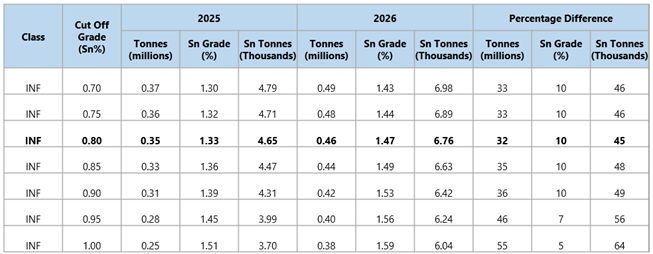
Table 1. Comparative tin tonnages and grades for the 2025 and 2026 Kalayi MRE's
The updated MRE reflects a materially improved geological model developed by MSA following incorporation of results from the 2026 drilling campaign. The model now comprises 11 discrete mineralised zones (MINZ1-11), compared with seven zones in the 2025 model, reflecting the growing understanding of Kalayi's vein system and the identification of additional mineralised intervals during the latest programme.
Critically, the resource expansion has not been achieved through grade dilution. Both tonnage and grade have increased simultaneously with resource tonnage rising 32% from 0.35 Mt to 0.46 Mt, and average grade increasing 10% from 1.33% Sn to 1.47% Sn at the 0.80% cut-off. The Company believes that this reflects the improved geological continuity demonstrated by the wider mineralised intercepts from the 2026 campaign, particularly the broader zones encountered in drill holes KBDD025, KBDD033 and KBDD034.
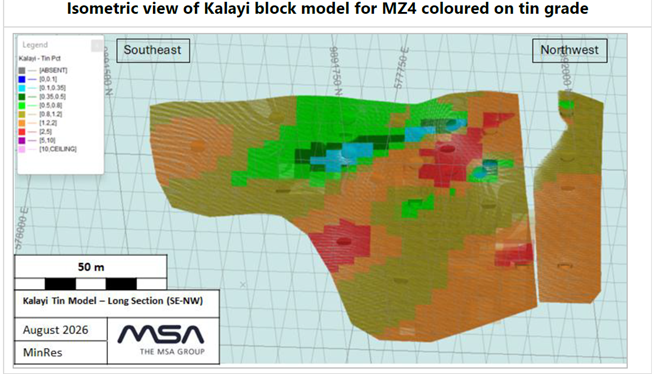
Figure 2. Kalayi block model showing MZ4 grades. Red is above 2% Sn.
The updated model confirms that mineralisation remains open along strike, particularly to the southeast, and at depth, providing the foundation for the exploration target defined by MSA and described in the following section.
Significant exploration upside beyond the current MRE
Southeast Kalayi area
MSA has identified further potential mineralisation zones immediately southeast of the current Kalayi resource. The target lies along the same high-grade tin trend as the current resource and reflects the interpreted continuation of mineralisation beyond the current drilling footprint. Further drilling provides the opportunity to identify an area that could double the quantity of Mineral Resource. It should be noted that the results of the exploration programme are not guaranteed to either intersect tin mineralisation or result in additional Mineral Resources.
MINZ8 and MINZ9
As disclosed on 20 August 2026, MSA identified two additional mineralised zones, MINZ8 and MINZ9, supported by intercepts from drill hole KBDD033. These zones are insufficiently constrained for inclusion in the updated MRE and will require further drilling to establish continuity. They represent additional resource growth potential within the existing Kalayi deposit footprint, separate from the southeast exploration target.
Mont Agoma and wider Bisie North potential
Kalayi is one of two advanced targets within the Bisie North licence package. Mont Agoma is a separate and substantial polymetallic system with a maiden Inferred Resource of 3.16 million tonnes at 1.45% copper, 2.72% zinc, 0.19% tin and 14.3 g/t silver. Drilling has demonstrated that tin grades strengthen with depth, consistent with analogous systems including Alphamin's Bisie mine and Minsur's San Rafael deposit in Peru.
As announced in February 2026, Chemostrat's geological interpretation identified a largely undrilled zone of elevated tin prospectivity southeast of the existing Mont Agoma deposit, as well as a prospective copper target extending to the northwest. With copper at record highs, the polymetallic optionality and resource upside that Mont Agoma offers is increasingly significant.
It is anticipated the interpretation of the airborne geophysics data will be completed by the end of September 2026, and this may additionally direct efforts to further potential on the licences.
Bisie North growth opportunity
|
Area |
Current Position |
Growth Opportunity |
|
Kalayi MRE |
0.46Mt @ 1.47% Sn / 6.76 kt contained tin |
+45% contained tin vs 2025; grade and tonnage both increased |
|
Kalayi Southeast |
Exploration potential along strike from known resource |
Opportunity to double the Kalayi Mineral Resource, subject to further drilling |
|
Kalayi MINZ8 & MINZ9 |
Wide mineralised zones outside current MRE scope |
Further resource growth within existing deposit footprint |
|
Mont Agoma: Tin |
Existing mineralised system |
Southeast tin target, undrilled |
|
Mont Agoma: Copper |
Existing mineralised system |
Prospective northwest copper target, undrilled |
Strategic Positioning of Bisie North
With an updated high-grade resource confirmed, substantial exploration upside defined, and pilot mining advancing towards a full mining licence, Rome Resources will continue discussions with potential strategic parties regarding the advancement and development of the Bisie North project.
Tin market context
Tin is currently trading at approximately $50,000 per tonne, significantly above the $36,600 per tonne assumed in the October 2025 MRE economic parameters. The tin market continues to be characterised by a structural supply deficit, with few new high-grade deposits in development globally and existing producers facing declining grades and reserve depletion.
Against this backdrop, Kalayi's confirmed average grade of 1.47% Sn places it amongst a very small number of deposits worldwide capable of generating compelling project economics at any point in the tin price cycle. Mont Agoma adds further optionality, with copper also trading at or near record highs.
**ENDS**
|
Investor questions on this announcement We encourage all investors to share questions on this announcement via our investor hub
|
https://romeresources.com/link/egLmvr
|
|
Allenby Capital Limited (Nominated Adviser and Joint Broker) John Depasquale / Vivek Bhardwaj (Corporate Finance) Kelly Gardiner / Lauren Wright (Sales & Corporate Broking)
|
Tel. +44 (0)20 3328 5656
|
|
OAK Securities (Joint Broker) Jerry Keen, Head of Corporate Broking Henry Clarke, Head of Sales
|
Tel. +44 (0)20 3973 3678 |
Subscribe to our news alert service: https://romeresources.com/auth/signup
This Announcement is made in accordance with the Company's obligations under Article 17 of UK MAR and the person responsible for arranging for the release of this Announcement on behalf of Rome Resources is Paul Barrett, Chief Executive Officer.
Qualified Person Statement
Dr Deon Vermaakt is a consultant of Rome Resources plc, a qualified geologist and a registered Professional Natural Scientist (Geological Science) with the South African Council for Natural Scientific Professions (SACNASP Reg. No. 400020/00). Dr Vermaakt is a qualified person (QP) under NI 43-101 and as defined by the AIM Note for Mining, Oil and Gas Companies and has reviewed and approved the scientific and technical information contained in this news release.
Glossary of abbreviations
|
"Ag" |
Silver |
|
"CIM" |
Canadian Institute of Mining, Metallurgy and Petroleum |
|
"Cu" |
Copper |
|
"g/t" |
Grams per tonne |
|
"kt" |
Kiloton |
|
"m" |
Metre |
|
"Mt" |
Million tonnes |
|
"Sn" |
Tin |
|
"Zn" |
Zinc |
Glossary of technical terminology
|
"Indicated Mineral Resource" |
An Indicated Mineral Resource is that part of a Mineral Resource for which quantity, grade or quality, densities, shape and physical characteristics are estimated with sufficient confidence to allow the application of Modifying Factors in sufficient detail to support mine planning and evaluation of the economic viability of the deposit. Geological evidence is derived from adequately detailed and reliable exploration, sampling and testing and is sufficient to assume geological and grade or quality continuity between points of observation. An Indicated Mineral Resource has a lower level of confidence than that applying to a Measured Mineral Resource and may only be converted to a Probable Mineral Reserve
|
|
"Inferred Mineral Resource" |
An Inferred Mineral Resource is that part of a Mineral Resource for which quantity and grade or quality are estimated on the basis of limited geological evidence and sampling. Geological evidence is sufficient to imply but not verify geological and grade or quality continuity. An Inferred Mineral Resource has a lower level of confidence than that applying to an Indicated Mineral Resource and must not be converted to a Mineral Reserve. It is reasonably expected that the majority of Inferred Mineral Resources could be upgraded to Indicated Mineral Resources with continued exploration
|
|
"Measured Mineral Resource" |
A Measured Mineral Resource is that part of a Mineral Resource for which quantity, grade or quality, densities, shape, and physical characteristics are estimated with confidence sufficient to allow the application of Modifying Factors to support detailed mine planning and final evaluation of the economic viability of the deposit. Geological evidence is derived from detailed and reliable exploration, sampling and testing and is sufficient to confirm geological and grade or quality continuity between points of observation. A Measured Mineral Resource has a higher level of confidence than that applying to either an Indicated Mineral Resource or an Inferred Mineral Resource. It may be converted to a Proven Mineral Reserve or to a Probable Mineral Reserve
|
|
"Mineral Reserves" |
A Mineral Reserve is the economically mineable part of a measured and/or Indicated Mineral Resource. It includes diluting materials and allowances for losses, which may occur when the material is mined or extracted and is defined by studies at pre-feasibility or feasibility level as appropriate that include application of Modifying Factors. Such studies demonstrate that, at the time of reporting, extraction could reasonably be justified. The reference point at which Mineral Reserves are defined, usually the point where the ore is delivered to the processing plant, must be stated. It is important that, in all situations where the reference point is different, such as for a saleable product, a clarifying statement is included to ensure that the reader is fully informed as to what is being reported
|
|
"Mineral Resources" |
Mineral Resource is a concentration or occurrence of solid material or economic interest in or on the Earth's crust in such form, grade (or quality), and quantity, that there are reasonable prospects for eventual economic extraction. The location, quantity, grade (or quality), continuity and other geological characteristics of a Mineral Resource are known, estimated or interpreted from specific geological evidence and knowledge, including sampling. Mineral Resources are subdivided, in order of increasing geological confidence, into Inferred, Indicated and Measured categories
|
|
"Modifying Factors" |
Modifying Factors are considerations used to convert Mineral Resources to Mineral Reserves. These include, but are not restricted to, mining, processing, metallurgical, infrastructure, economic, marketing, legal, environmental, social and governmental factors
|
|
"Probable Mineral Reserves" |
A Probable Mineral Reserve is the economically mineable part of an indicated, and in some circumstances, a Measured Mineral Resource. The confidence in the Modifying Factors applying to a Probable Mineral Reserve is lower than that applying to a Proven Mineral Reserve
|
|
"Proven Mineral Reserves" |
A Proven Mineral Reserve is the economically mineable part of a Measured Mineral Resource. A Proven Mineral Reserve implies a high degree of confidence in the Modifying Factors |
RNS may use your IP address to confirm compliance with the terms and conditions, to analyse how you engage with the information contained in this communication, and to share such analysis on an anonymised basis with others as part of our commercial services. For further information about how RNS and the London Stock Exchange use the personal data you provide us, please see our Privacy Policy.

Latest directors dealings
- 1 hour ago Kooth
- 1 hour ago THG
- 1 hour ago Origin Enterprises (CDI)
- 1 hour ago Kingfisher
- 2 hours ago Power Probe PLC