
Final Results and Publication of Annual Report
Summary by AI BETAClose X

THE INFORMATION CONTAINED WITHIN THIS ANNOUNCEMENT IS DEEMED BY THE COMPANY TO CONSTITUTE INSIDE INFORMATION AS STIPULATED UNDER THE MARKET ABUSE REGULATION (EU) NO. 596/2014, AS AMENDED WHICH, BY VIRTUE OF THE EUROPEAN UNION (WITHDRAWAL) ACT 2018, FORMS PART OF UK LAW. ON THE PUBLICATION OF THIS ANNOUNCEMENT VIA A REGULATORY INFORMATION SERVICE ("RIS"), THIS INSIDE INFORMATION IS NOW CONSIDERED TO BE IN THE PUBLIC DOMAIN.
RC365 Holding plc
("RC365", the "Group" or the "Company")
Final Results and Publication of Annual Report
RC365 Holding plc (LSE: RCGH), an established payment solutions and fintech company, is pleased to announce its audited final results for the year ended 31 March 2026. The full Annual Report and Accounts for the year ended 31 March 2026 will be available shortly on the Company's website at www.rc365plc.com.
Financial Highlights
- Revenue: Group revenue from continuing operations increased by approximately 57% to HK$22.14 million for FY 2026 (2025: HK$14.11 million after restatement).
- Loss Before Tax: Loss before taxation reduced significantly by 57.94% to HK$12.88 million (2025: HK$30.62 million).
- Loss After Tax: Total comprehensive loss for the year also reduced significantly to HK$12.71 million (2025: HK$33.55 million).
- Customer Base: Total active customer numbers increased by approximately 51% to 113.
Commercial Growth Catalysts after the fiscal year ended
- Next-Gen Application Deployment (June 2026): Successfully completed the soft launch of RC3.0 Application, establishing the core infrastructure for expanded digital wallet, electronic money and virtual account operations.
- Enterprise Merchant POS Win (June 2026): Executed a major Merchant POS agreement with StarCruises International Limited.
- Proprietary SaaS Platform Rollout (July 2026): Officially launched the Group's proprietary SaaS Wealth Management System, unlocking high-margin recurring software-as-a-service revenues.
- Strategic Partners & Expansion Agreements (July 2026):
i) Blacksilver Trust (Hong Kong) Limited ("Blacksilver Trust"): Signed a five-year strategic partnership with Blacksilver Trust to integrate RC Tech's fintech and virtual account solutions, generating direct SaaS fees and ongoing platform revenues.
ii) PyWave Network Technology Limited ("PyWave"): Secured a Cross-border and Local Payment Services Agreement with Canadian payment provider PyWave to expand multi-tier umbrella virtual accounts and drive regional penetration across high-growth African markets.
iii) Nexara Capital Limited ("Nexara"): Formed a strategic partnership with Nexara to expand financial infrastructure distribution and institutional market reach.
iv) Central Wealth Securities Investment Limited ("CWS"): Entered into a five-year referral agreement with CWS under which it will introduce prospective enterprise clients from its network to RCTECH's Business Virtual Account and related SaaS solutions, expanding the Group's customer acquisition channels and supporting the potential generation of recurring subscription and usage-based revenues.
- Placings & US$2 million Credit Facility (July 2026): The Company raised aggregate gross proceeds of £1.25 million through equity placings at 2.0 pence and 2.2 pence per share and secured a US$2.0 million interest-free credit facility, having elected not to proceed with the previously announced £3.0 million convertible financing arrangement at 1.0 pence per share. The revised financing package increased the Group’s financial flexibility and materially reduced potential shareholder dilution.
Investment Outlook & Value Proposition
The Group's performance in FY 2026, highlighted by 57% top-line revenue growth and a 58% reduction in pre-tax loss, reflects the direct results of operational restructuring and product development. The commercial momentum accelerated following the balance sheet date provides compelling catalysts for long-term shareholder value creation:
- High-Margin Scalable Recurring Revenue: The launch of the RC3.0 platform and SaaS Wealth Management System, alongside client integrations with institutional partners such as Blacksilver Trust, shifts the Group toward predictable, high-margin SaaS revenue streams.
- Institutional Validation & Scalability: High-profile commercial wins, including StarCruises and international settlement agreements with PyWave, demonstrate the enterprise capability, regulatory robustness and cross-border agility of RC365's technology stack.
- Fully Funded Growth Strategy: With fresh growth capital secured through the US$2.0 million credit facility and placing, RC365 is fully capitalised to scale operations across target markets in Asia, Africa and Europe throughout FY 2027 and beyond.
Ian Muir, Non-Executive Chairman of RC365, commented:
"I have great pleasure in presenting our audited financial statements to the shareholders of RC365 for the year ended 31 March 2026. The Group delivered revenue growth of about 57% to HK$22.1 million. The majority of Group revenue continued to be generated by our wholly owned subsidiary, Regal Crown Technology Limited ("RCTech"), providing cutting-edge IT support and development for payment and financial systems including ERP solutions and HC Capital Group Limited ("HC Capital"), providing credit card issuance, top-up services and support for Business Virtual Account Operation Services. The development of innovative products and services, as well as geographical expansion to attract new customers, remained a key focus for the Group. A number of new partnership agreements were established during the year to advance this goal. The Board continues to be optimistic about the outlook for FY 2027 given the advances made during FY 2026 and our growing pipeline of potential opportunities for further growth."
-Ends-
Enquires:
|
RC365 Holding plc |
|
|
|
Chi Kit LAW, Chief Executive Officer |
T: +852 2251 1621 |
|
|
|
|
|
|
Bowsprit Partners Limited (Financial Adviser & Corporate Broker) |
T: +44 (0) 203 833 4430 |
|
About RC365 Holding plc
RC365 Holding plc (LSE: RCGH) is an established payment solutions and fintech company. It operates primarily in East and Southeast Asia through its core subsidiaries of Regal Crown Technology and the recently acquired HC Capital. For over 10 years, the Company has delivered efficient and secure payment gateway solutions and IT support and development services for payment and financial systems, including ERP solutions. In 2021, it commenced providing digital remittance and payment services, which expanded to include foreign exchange and asset linked credit card solutions. These services are provided to multinational merchants, SMEs and individuals. RC365 intends to expand into the virtual banking market and geographically, including in the UK and wider Europe.
For more information, visit: https://www.rc365plc.com
Company Registration No. 13289422 (England and Wales)
RC365 HOLDING PLC
ANNUAL REPORT AND FINANCIAL STATEMENTS
FOR THE YEAR ENDED 31 MARCH 2026
RC365 HOLDING PLC
ANNUAL REPORT FOR THE YEAR ENDED 31 MARCH 2026
COMPANY INFORMATION
|
|
|
|
Director |
Chi Kit LAW, Executive Director and CEO Alan King Lun LEUNG, Executive Director Iain Muir, Non-Executive Director Ajay Rajpal, Non-Executive Director
|
|
Company Number |
13289422 |
|
|
|
|
Company Secretary |
MSP Secretaries Limited |
|
|
27-28 East castle House London, W1W 8DH United Kingdom
|
|
Registered address |
Cannon Place |
|
|
78 Cannon Street |
|
|
London, EC4N 6AF |
|
|
United Kingdom |
|
|
|
|
Auditors |
Johnsons Financial Management Limited |
|
|
1-2 Craven Road, Ealing London, W5 2UA United Kingdom
|
|
Registrars |
Share Registrars Limited |
|
|
3 The Millennium Centre |
|
|
Crosby Way |
|
|
Surrey, GU9 7XX |
|
|
United Kingdom |
|
|
|
|
Company Website |
RC365 HOLDING PLC
ANNUAL REPORT FOR THE YEAR ENDED 31 MARCH 2026
CONTENTS
Chairman's Statement
Strategic Report
Board of Directors
Directors' Report
Risk Management Report
Corporate Governance Statement
Audit Committee Report
Remuneration Committee Report
Independent Auditor's Report
Consolidated Statement of Comprehensive Income
Consolidated Statement of Financial Position
Consolidated Statement of Changes in Equity
Consolidated Statement of Cash Flows
Notes to the Financial Statements
RC365 HOLDING PLC
ANNUAL REPORT FOR THE YEAR ENDED 31 MARCH 2026
CHAIRMAN'S STATEMENT
I have great pleasure in presenting our audited financial statements to the shareholders of RC365 Holding Plc ("RC365", the "Company" or the "Group") for the year ended 31 March 2026.
The Group delivered growth of revenue of 57% to HK$22.1 million (2025: HK$14.10 million (after restatement)). The majority of Group revenue continued to be generated by our wholly-owned Regal Crown Technology Limited ("RCTech") subsidiary, where we provide cutting-edge IT support and development for payment and financial systems, including Enterprise Resource Planning ("ERP") solutions and HC Capital Group Limited ("HC Capital") subsidiary, which supplies, the provision of the credit card issuance and topup services and RCPAY Limited providing the support for Business Virtual Account Operation Services for the above fiscal years.
The development of innovative products and services, as well as geographical expansion, to attract new customers remained a key focus for the Group. A number of new partnership agreements were established during the year to advance this goal.
The major activities of the group during the year were as follows:
1 The number of card subscribers
RCPAY Limited (HK) (transferred to HC Capital Group Limited) has an increase for the number of issued cards to 2,077 (2025:1,910) with 9% increment for the number of cards. Most of the cards are issued to our customers located in Japan.
2 The number of co-branders for the Asset Linked Credit Card Program
HC Capital Group Limited has an increase for the number of co-branders for the Credit Card Program related to the card top up and issuance, provision of IT support including the maintenance and Api support service of program to 3 (2025: 2) with an increase of 50% for the number of co-branders. Our co-branders provide credit card related services in Hong Kong, Japan and Middle East countries.
Greenhouse Gas (GHG) Emissions
As the Company has not consumed more than 40,000 kWh of energy in the year period, it qualifies as a low energy user under SI 2018/1155 and is not required to report on its emissions, energy consumption or energy efficiency activities. The Company's energy consumption in the year is 21,590 kwh (2025: 15,412 kwh).
Strategy
Our vision remains unchanged, which is to grow our share of existing markets, develop new capabilities and enter new geographies within the fast growing and attractive industries in which we operate.
In particular, we intend to focus on growing our presence in Japan, ASEAN, Africa regions and the UK; broaden our offering to include virtual banking and expand our card solutions; launch Wealth Management System and Merchant POS licensing solutions and execute the soft launch in RC3.0 to electronic money users in Hong Kong and overseas.
Outlook
The Board continues to be optimistic about the outlook for FY 2027 given the advances made during FY 2026 and our growing pipeline of potential opportunities for further growth.
Finally, we would like to take this opportunity to thank our shareholders for their continued support and we look forward to reporting on our progress as we deliver on our growth strategy.
Iain Muir
Non-Executive Chairman
31 July 2026
STRATEGIC REPORT
The Directors present the Strategic Report of the Group for the year ended 31 March 2026.
Review of business and future developments
The Company was formed to undertake an acquisition of a controlling interest in a company or business. With the Board's experience, the Group is focused on the provision of IT Support and Security Services, Payment Gateway Solutions (online and offline), Prepaid Card Issuance, Computer Graphic Design and Animation services to clients located in the Hong Kong, ASEAN region, UK and Europe.
The Group is looking to expand the prepaid card issuance services, Merchant POS, Wealth Management System, provision of virtual bank accounts to high net worth Individuals and Corporates in the ASEAN and Africa region, including Hong Kong, Japan and further to customers located in Europe, the UK and the Central African states.
Key Performance Indicators
During the reporting period, the Group was focused on the evaluation of various opportunities in the Fintech and Payment Gateway sector. The Directors track the following as the Company's KPIs:
|
|
2026 HK$ |
2025 (restated) HK$ |
|
Revenue (continuing operations) |
22,140,667 |
14,108,210 |
|
Cash and cash equivalents |
2,841,812 |
11,775,409 |
|
No. of Customers |
113 |
75 |
· Revenue
Reflects the element of billings and unbilled (mainly the contractual assets from Mr. Meal Production Limited) generated and recognised during the period from all revenue streams and measures the Group's overall performance at a sales level.
Mr. Meal Production Limited (the company) continues to leverage its core expertise in 3D animation, digital graphic design, AR/VR, and cross-platform creative production to drive media and digital marketing revenues to leading Advertising Companies domiciled in Hong Kong. During the period, the company strategically expanded its international service footprint in the digital marketing management sector by executing a Service Agreement with UK-based Company in servicing the customer in Hong Kong and Macao. The company's strategic direction toward securing long-term retainer engagements with overseas clients requiring specialized Asian regional digital marketing execution. Management remains focused on converting these medium-term contracts into recurring revenue relationships and broadening the scope of high-margin 3D animation and digital production services
· Cash and cash equivalents
The Company's cash balance provides a measure of the Group's financial strength and self-sufficiency to support operations while revenue streams continue to be developed.
· Customers
The quantity of customers provides a basis to measure the growth and acceptance of the Company's services provided during the period.
Impairment Losses
The Group has incurred impairment losses of HK$ 3.49 million (Note 7) for the year ended 31 Mar 2026. The impairment losses of the Company is HK$1.64million. (Note 37)
Principal risks and uncertainties
The principal risks and uncertainties currently faced by the Company are set out further in the Risk Management Report on page 20.
Corporate Social Responsibility
The Group aims to conduct its business with honesty, integrity and openness, respecting human rights and the interests of shareholders and employees. The Group aims to provide timely, regular and reliable information on the business to all its shareholders and conduct its operations to the highest standards.
The Group strives to create a safe and healthy working environment for the wellbeing of its staff and to create a trusting and respectful environment, where all members of staff are encouraged to feel responsible for the reputation and performance of the Group.
The Group aims to establish a diverse and dynamic workforce with team players who have the experience and knowledge of the business operations and markets in which we operate. Through maintaining good communication, members of staff are encouraged to realize the objectives of the Group and their own potential.
Corporate environmental responsibility
The Board contains personnel with a good history of running businesses that have been compliant with all relevant laws and regulations.
Section 172(1)
The Directors believe they have acted in the way most likely to promote the success of the Company for the benefit of its members as a whole, as required by s172 of the Companies Act 2006.
The requirements of s172 are for the Directors to:
a. Consider the likely consequences of any decision in the long term;
b. Act fairly between the members of the Group;
c. Maintain a reputation for high standards of business conduct;
d. Consider the interest of the Group's employees;
e. Foster the Group's relationships with suppliers, customers and others; and
f. Consider the Impact of the Group's operations and the community and the environment.
The Company and the Group is a Fintech company which operate mainly in the internet market, the management believe that the business operations have minimal impact towards the community and environment. Also, the company has taken 5 director meetings in discussing the major company decision including the allotment of shares, the resignation and appointment of Executive Directors and CFO during the period. The key decisions made by the Board during the year, together with the factors and considerations taken into account in reaching those decisions, are set out below.
|
Key Board Decision |
Explanatory Application & Board Consideration |
|
Resignation (Vincent CHEUNG) & Appointment of ED (Alan LEUNG) & CFO (Esther Quah) |
The Board oversaw the structured transition of the Executive Director (ED) and Chief Financial Officer (CFO). Candidates (Alan Leung, worked for the company for about 4 years and Esther Quah has been the Finance Manager of the Group for about 3 years) were vetted for financial oversight capabilities and cultural alignment to preserve operational continuity for our employees and maintain strict regulatory compliance. |
|
Issuance and Cancellation of Convertible Bond |
The Board projected the launch of RC3.0 and the commencement of profitable investment projects in Q4 2025, and planned to raise public funding to support these projects through the issue of convertible bonds, which the Board considered the most beneficial funding structure for the Company's finances at that time. Following delays in the launch of RC3.0 and in the commencement of the profitable investment projects into early 2026, the Board concluded that public fundraising through the issuance of convertible bonds was no longer appropriate in the circumstances. The Board also considered that the issuance of convertible bonds could result in considerable dilution and may not be in the best interests of the Company's minority shareholders. Accordingly, the Board resolved not to proceed with the proposed issuance of convertible bonds. |
|
Allotment of Shares (Jun & Jul 2026) (Post-Balance Sheet Event) |
The Board was of the view that the Company expected to pursue several potentially profitable projects in the third quarter of 2026, including the soft launch of RC3.0 and the launch of the Wealth Management App, and that these projects would require further capital to be raised from the public. Following further progress in the development of RC3.0 and the planned launch of the Wealth Management App, the Board identified a renewed requirement for capital to support these projects and determined that an equity fundraising through share allotments represented a more suitable funding structure for the Company than the previously considered convertible bond issuance. Although the proposed share allotments would result in dilution of existing shareholders' interests, the Board considered that the anticipated enhancement of long-term shareholder value and the strategic benefits arising from the proposed projects outweighed the potential disadvantages associated with such dilution. Accordingly, in June and July 2026 the Company raised total gross proceeds of £1,250,000 through the allotment of 59,090,909 new ordinary shares, as further described in Note 31 (Post Balance Sheet Events) |
The Directors remain committed to engaging with the Group's stakeholders and considering their interests when making key strategic decisions. The Board considers its key stakeholders to be its shareholders, its employees, its clients, its suppliers and the communities in which the Group operates.
In the following section we identify our key stakeholders, how we engage with them and key activities we have undertaken during the period in question.
Our Strategic Partners
The Company works closely with its major service provider, a technology company located in Hong Kong and Malaysia, who is an important strategic partner with the Group. We have developed an open and transparent relationship with this partner, which promotes the long-term success for the Group.
We also continue to build our reputation and strengthen our relationships with our clients based in Hong Kong by providing outstanding service. Furthermore, we continue to expand our services to customers located in Japan, Singapore, Europe and the UK and the Africa region.
Our Shareholders
The Company has been well-supported by its shareholders, including those that subscribed for shares at IPO in 2022 and through several share allotments and issuance work during the financial years. The Company endeavours to keep shareholders updated on regulatory matters, and is committed to provide transparent information to them, both through the annual report and ad-hoc communications.
Our Customers
The Company strives to maintain strong relationships with its customers, which will promote long term growth. The relationships with customers who advertise with the Company are maintained through regular contact and relationship management.
Our Employees
The Company believes that good staff morale engenders increased efficiency and loyalty, and hence promotes staff welfare and well-being. Staff needs are constantly monitored and improved on an ongoing basis.
The strategic report is approved by the Board and is signed on their behalf by:
Iain Muir
Non-Executive Chairman
31 July 2026
BOARD OF DIRECTORS
Chi Kit Law, Executive Director and CEO
Mr. Law (Chinese name: 羅志杰), age 45, has almost 20 years' of payment solution and banking leadership experience, having previously held roles as Head of Banking Systems at MoneySwap plc and Assistant Vice President of Group Technology and Operations at DBS Bank where he was awarded the Chairman's Reward for each year he was there. Mr. Law was also awarded the JP Morgan Services Star Award. Mr. Law has managed multi-national banking projects when he was at Standard Chartered Bank, HSBC, JP Morgan Chase and DBS Bank. Mr. Law holds a Masters in Advanced Management from the University of Liege and a Bachelor of Information Technology (Honours) from West Coast Institute of Management & Technology, Perth, Western Australia.
Ajay Rajpal, Non-Executive Director
Mr. Ajay Rajpal, age 55 is a Chartered Accountant and member of the Institute of Chartered Accountants in England & Wales (ICAEW). During his career, he has gained broad-ranging commercial experience developed in the US, Europe, Middle East and Far East, with a particular focus on M&A, financial management and insolvency/restructuring. Post qualification, Mr. Rajpal held a number of finance-related roles which involved working for periods in the US, Europe, Middle East and Far East. Since 2011, Mr. Rajpal has run his own consultancy business, NAS Corporate Services Ltd, providing companies with various corporate services, such as assistance with their pre-IPO funding, the IPO process and post IPO management. Mr. Rajpal assisted Grand Vision Media Holdings Plc, a special purpose acquisition company listed on the standard segment of the London Stock Exchange, which successfully completed a reverse takeover of an outdoor media business in Hong Kong/China. Mr. Rajpal is currently non-executive director of Grand Vision (which continues to be listed on the standard segment).
Mr. Rajpal has also project managed the initial public offering process and assisted with the associated funding of two businesses on AIM, namely New Trend Lifestyle Group Plc, which provides Feng Shui products and services across Asia, and Zibao Metals Recycling Group Plc, a Hong Kong and China based metals recycling company. He currently acts as a non-executive director for Phimedix Plc (formerly named Zibao Metals Recycling Group Plc), and Dozens Savings Plc.
Iain Muir, Chairman and Non-Executive Director (appointed on 15 August 2024)
Mr. Muir, aged 42, an FCA Qualified Chartered Accountant, has over a decade's leadership experience in business and finance. He is currently Managing Director of Southcott Solutions Limited (formerly MBB Advisory Limited), a provider of professional services to small & medium sized businesses, which he founded in 2022. He also currently holds three directorships in private companies operating in the media, marketing and financial services sectors. Prior to MBB Advisory, Mr. Muir spent six years as Head of Finance and then Director of Operations at Ambassadeurs Group Limited, a leisure and hospitality business, where his varied roles included strategy development, management oversight for multiple business units, improving risk mitigation and project managing an M&A process. After joining PriceWaterhouseCoopers as a trainee graduate in 2008, he spent a total of eight years in Assurance, progressing to Senior Manager after having an 18-month period in commercial finance roles within industry.
Hon Keung CHEUNG, Executive Director and CFO (appointed on 5 January 2025 and resigned on 16 December 2025)
Mr. Cheung, aged 51, has more than 20 years of operational and financial leadership experience in banking and payment solutions. He joined RC365 as CFO of the Group's primary operating entity in 2018 and became CFO and an Executive Director of the Company upon its IPO on the London Stock Exchange. In August 2022, he stepped down from his CFO and Director positions but remained with the Group as part of the finance team. Prior to RC365, Mr. Cheung was Chief Consultant of Mondo Consulting Company providing cross-border taxation and business advisory services to SME clients located in Hong Kong, China and Korea, from 2016 to 2018, and he held various accounting and audit roles, from 1997 to 2016. Mr. Cheung is a member of the Association of Chartered Certified Accountants, The Hong Kong Institute of Certified Public Accountants and the Hong Kong Institute of Taxation.
Mr. King Lun LEUNG (Alan), General Manager and Executive Director (appointed on 16 December 2025)
Mr King Lun Leung (Alan) (age 56), Executive Director, has over 20 years of experience in business development with more than a decade in online/offline payment acquiring. He joined the Group in July 2022 and holds a Bachelor of Mathematics from National Cheng Kung University.
DIRECTORS' REPORT
The Directors present their report together with the financial statements and the Auditor's Report for the year ended 31 March 2026.
Principal activities
The principal activity of the Company is to act as a holding company for a group of subsidiaries engaged in IT software development, credit card issuance, the provision of business virtual account support services, top-up and payment services, and computer graphic design services.
The Group is a fintech solutions service provider based in Hong Kong and serves customers in Hong Kong, Japan, ASEAN countries and United Kingdom and Europe.
The subsidiaries of the Company providing IT and Security Services, ERP and credit card issuance and top up services and supporting services to customers of the above region.
Results and dividends
The results of the Group for the year ended 31 March 2026 are set out in the financial statements.
The Directors do not propose to recommend a dividend for the year ended 31 March 2026. Given the losses incurred to date, it is unlikely that the Board will recommend a dividend in the near-term.
Business review and future developments
Details of the business activities and developments made during the period can be found in the Strategic Report.
Directors
The Directors of the Company who have served during the period and at the date of this report are:
|
Director |
Role |
Date of appointment and resignation |
|
Chi Kit LAW
Hon Keung CHEUNG |
Executive Director and CEO
Executive Director and CFO |
appointed on 24 March 2021 appointed on 5 January 2025 and resigned on 16 December 2025 |
|
Alan King Lun LEUNG
|
Executive Director and General Manager |
appointed on 16 December 2025 |
|
Ajay RAJPAL |
Non-Executive Director |
appointed on 9 March 2022 |
|
Iain Muir |
Chairman and Non-Executive Director |
appointed on 15 August 2024 |
|
|
|
|
Indemnity provision for directors
The Company purchased the indemnity insurance to both Directors and Non-Executive Directors of the Company for the years ended 31 March 2026 and 2025.
Diversity
The Company is committed to ensuring diversity, equality and inclusion and our goal is to foster a positive work ethic. As at the date of this report, all four members of the board are male and therefore the targets under UKLR 22.2.30R of 40% of the board being female and at least one of the four senior positions on the board being occupied by a female have not been met. This is an area that remains under review by the nomination committee.
|
Member of the Board |
Ethnicity (Nationality) |
Gender |
|
Chi Kit Law |
Asian, Chinese |
Male |
|
Alan King Lun Leung |
Asian, Chinese |
Male |
|
Iain Muir |
British |
Male |
|
Ajay Rajpal |
British |
Male |
Across the broader organization, female representation stands at 75.0% within senior management and 27.80% among general employees, bringing total female participation across the workforce to 30.80%.
Gender Diversity Breakdown (as at 31 March 2026)
|
Category |
Male |
Female |
Total |
|
Board of Directors |
4 (100.0%) |
0 (0.0%) |
4 |
|
Senior Management |
1 (25.0%) |
3 (75.0%) |
4 |
|
Other Employees |
13 (72.20%) |
5 (27.8%) |
18 |
|
Total |
18 (69.20%) |
8 (30.8%) |
26 |
Directors' interest in shares
The direct and beneficial shareholdings of the Board in the Company as at 31 March 2026 were as follows:
|
|
Number of Ordinary Shares |
|
Percentage of Issued Share Capital |
|
|
|
Direct |
Beneficial |
Total |
|
|
Chi Kit LAW * |
- |
36,500,000 |
36,500,000 |
17.3% |
* Chi Kit Law holds his shares through LYS Limited.
Substantial shareholders
As at the date of the Report, the total number of issued Ordinary Shares with voting rights in the Group was 211,001,330. The Group has been notified of the following interests of 3 per cent or more in its issued share capital as at the date of this report:
|
|
Number of ordinary shares |
Percent of Issued share capital |
|
LYS Limited Alvar Financial Services Limited |
36,500,000 9,137,005 |
17.3% 4.33% |
Going Concern
The Group's assets as at 31 March 2026 comprised mainly cash at bank. The Directors have set out their strategy for the Group in the Chairman's Statement on page 3.
In assessing the Company's ability to continue as a going concern, the Directors prepared a cash flow forecast covering the period to 31 July 2027. The forecast includes gross proceeds of £1,250,000, (net proceeds to date after expenses of HK$ 11.74 million) from two public share allotments completed in June and July 2026.
In addition, Mr Chi Kit Law, the Company's principal shareholder, has provided a guarantee of up to US$4.0 million in support of the Company. Based on the cash flow forecast, the proceeds from the share allotments and the financial support available from the principal shareholder, the Directors consider that the Group and the Company will have sufficient financial resources to meet their obligations as they fall due until twelve months from the date of approval of the financial statements.
The Directors have a reasonable expectation that the Company and the Group have adequate resources to continue operating for the foreseeable future. Thus, they continue to adopt the going concern basis of accounting in preparing the financial information.
Based on their enquiries and the information available to them and taking into account the other risks and uncertainties set out herein, the Directors have a reasonable expectation that the Company and the Group has adequate resources to continue operating for the foreseeable future. Thus, they continue to adopt the going concern basis of accounting in preparing this financial information.
Corporate Governance
The Group has set out full Corporate Governance Statement on page 25. The Corporate Governance Statement forms part of this Directors' report and is incorporated into it by cross reference.
Statement of directors' responsibilities
The directors are responsible for preparing the Strategic Report, Directors' Report and the financial statements in accordance with applicable law and regulations.
Company law requires the directors to prepare Group and parent company financial statements for each financial year. Under that law the directors have elected to prepare the financial statements in accordance with UK adopted International Accounting Standards. Under company law the directors must not approve the financial statements unless they are satisfied that they give a true and fair view of the state of affairs of the group and company and of the group's profit or loss for that period. In preparing these financial statements, the directors are required to:
· Make judgements and accounting estimates that are reasonable and prudent;
· Select suitable accounting policies in accordance with IAS 8: Accounting Policies, Changes in Accounting Estimates and Errors and then apply them consistently;
· Present information, including accounting policies, in a manner that provides relevant, reliable, comparable and understandable information;
· Provide additional disclosures when compliance with the specific requirements of UK adopted IAS is insufficient to enable users to understand the impact of particular transactions, other events and conditions on the Group and Parent Company's financial position and financial performance and
· Comply with relevant UK adopted IASs, subject to any material departures being disclosed and explained in the financial statements.
The directors are responsible for keeping adequate accounting records that are sufficient to show and explain the Group and Parent Company's transactions and disclose with reasonable accuracy at any time the financial position of the Group and Parent Company and enable them to ensure that the financial statements comply with the Companies Act 2006. They are also responsible for safeguarding the assets of the Group and Parent Company and hence for taking reasonable steps for the prevention and detection of fraud and other irregularities.
The directors are satisfied that the Group and Parent Company has adequate resources to continue in business for the foreseeable future. For this reason, the financial statements are prepared on a going concern basis. The Directors are responsible for the maintenance and integrity of the corporate and financial information included on the Company's website.
Emissions
The Group is not an intensive user of fossil fuels or electricity. As a result, it is not practical to determine carbon emission with any degree of accuracy.
Supplier payment policy
It is the Group's payment policy to pay suppliers in line with industry norms. These payables are paid on a timely basis within contractual terms which is generally 30 to 60 days from date of receipt of invoice.
Branches outside the UK
The Group's head office is in United Kingdom and the subsidiaries are located in Hong Kong and Malaysia
The Directors' have chosen to produce a Strategic Report that discloses a fair review of the Group's business, the key performances metrics that the Directors review along with a review of the key risks to the business.
Financial instruments and risk management
The Company is exposed to a variety of financial risks and the impact on the Company's financial instruments are summarized in the Risk Management Report. Details of the Company's financial instruments and exposure to various risks is disclosed in note 26 to the financial statements.
Environmental, social and Governance
A review of the Group's approach to sustainability and societal impact during the year is set out below:
Climate Change
The Group recognise the importance of climate change triggered by Greenhouse Gases (GHG) from burning fossil fuels.
Total emissions associated with activities under direct control of management (Scope 1 and 2 emissions) remained at the similar level in 2026 versus 2025. In terms of Energy efficiency, our energy usage was on the similar level in 2026 compared with 2025.
Environmental
The Group's operations are conducted in such a manner that compliance is maintained with legal requirements relating to the environment in areas where the Group conducts its business. During the period covered by this report, the Group has not incurred any fines or penalties or been investigated for any breach of environmental regulations.
The Directors consider that due to the nature of the Group's operations, it does not have a significant impact on the environment. However, the Group seeks to minimize its carbon impact and recognizes that its activities should be carried out in an environmentally friendly manner where practicable.
The Group's environment impact is under continual review and the Group considers related initiatives on an ongoing basis. In 2026, these included: continued reduction of waste and, where practicable, re-use and recycling of consumables; conducted reduction of energy, water and other resources.
Office Environments
Management engages with its office provider and its facilities management provider to ensure a safe environment for our employees.
Environmental management is overseen by the Chief Executive Officer. The Group complies with the Companies Act 2006 (Strategic Report and Directors Report) Regulation 2013 and Companies (Directors' Report) and Limited Liability Partnership (Energy and Carbon Report) Regulations 2018 known as SECR (Streamlined Energy Carbon Reporting). Energy consumption and GHG emissions have been calculated in line with the UK Government's Environmental Reporting Guidelines; including streamlined energy and carbon reporting guidance (March 2019). There were no prosecutions or compliance notices for breaches of environmental legislation during the financial year.
Supply Chain
We are committed to ensuring that there is no slavery or human trafficking in our supply chain or in any part of our business. We maintain strong working relationship with our suppliers and partners, in order to enhance the efficiency of our business and create value, and make sure we treat suppliers in line with our values and ethical standards. We continually assess our supplier and partner network, and leverage both internal and external expertise to ensure appropriate relationship and fair economics.
Governance
The Board takes issues of governance seriously and seeks to ensure transparency and streamlined administration. The Directors bring a broad range of technical, commercial, business, accounting, auditor and corporate finance expertise. Culturally, the Board demonstrates a high degree of integrity, fairness and non-discrimination and promotes values through the organization.
TCFD Disclosure
|
Governance
|
|
|
a) Describe the Board's oversight of climate- related risks and opportunities. |
The Board acknowledges the financial implications of climate change and considers the related risks and opportunities through regular communication between the two Executive Directors and the two Non-Executive Directors. This communication is focused on risks and opportunities that arise on an ongoing informal basis.
Through those discussions the Board has assessed that at the current time there are no climate-related risks or opportunities that would have a material impact on the Group or the wider community. This is in the context of the Group currently having 26 employees and substantially all of the climate impact of the Group being driven by regulatory imperatives. The Board will keep this assessment under regular review.
|
|
b) Describe management's role in assessing and managing climate-related risks and opportunities. |
The Board oversees the long-term impact of climate-related risks and opportunities on the organisation's strategy and risk appetite. Senior management regularly attend ESG seminars and relevant updates are provided to the Board. Each staff individually will seek to make personal decisions so as to minimise climate-related risks. This manifests itself in seeking to minimise travel by, for example, working from home and/or use the Zoom/Team portal meeting with business travellers instead of travelling.
|
|
Strategy
|
|
|
c) Describe the climate- related risks and opportunities the organisation has identified over the short, medium and long term. |
The Group has not identified any material climate-related risks and opportunities in the short-term. Medium and longer-term assessments will depend on what acquisitions are made by the Group and accordingly the Board will reassess those climate-related risks and opportunities as soon as practically possible following an acquisition.
|
|
d) Describe the impact of climate-related risks and opportunities on the organisation's businesses, strategy and financial planning. |
The Group has assessed the impact of climate change risks to ensure financial resilience and operational continuity. The conclusion is that climate change represents a negligible impact and that these risks are not material. Individual employees are encouraged to take climate matters into account when planning how they wish to work and management offer maximum flexibility to facilitate this.
|
|
e) Describe the resilience of the organisation's strategy, taking into consideration different climate-related scenarios, including a 2°C or lower scenario.
|
The Group does not foresee any impact on its resilience arising from all foreseeable climate-related scenarios, including a full two degrees of warming. All climate change risks will continue to be monitored. |
|
Risk Management
|
|
|
f) Describe the organisation's processes for identifying and assessing climate- related risks. |
Climate Risk is considered as part of the annual business review. This will be kept under review as the organisation grows.
|
|
g) Describe the organisation's processes for managing climate-related risks. |
The process for managing such risks is to provide all 26 employees with the flexibility to manage those limited risks that are under their control.
|
|
h) Describe how processes for identifying, assessing and managing climate-related risks are integrated into the organisation's overall risk management.
|
The Board assessed the risks across short, medium, and long-term timeframes, ultimately determining that these were immaterial to the balance sheet.
|
|
Metrics and Targets |
|
|
(i) Disclose the metrics used by the organisation to assess climate-related risks and opportunities in line with its strategy and risk management process.
|
The Group does not seek to measure climate-related risks as they are not considered material. The Board will reconsider this position on any material change to the Group or its activities.
|
|
(j) Disclose Scope 1, 2, and, if appropriate, Scope 3 greenhouse gas emissions, and the related risks. |
The Group's activities are outside the scope of the Global GHG Accounting and Reporting Standards.
|
|
(k) Describe the targets used by the organisation to manage climate-related risks and opportunities and performance against target. |
The Group currently has not set specific targets or commitments. Notwithstanding, the Board is pleased to note that employees continue to do what they can to reduce climate risk by working from home and minimise the business travel by each employee. The Board will reconsider this position on any material change to the Group or its activities. |
Disclosures of Information to Auditors
Each of the person who is a director of the Company at the date of approval of the Annual Report confirms that:
· So far as each Director is aware, there is no relevant audit information of which the Group and Company's auditor is unaware; and
· The Directors have taken all steps that they ought to have taken as Directors in order to make themselves aware of any relevant audit information and to establish that the Group and Company's auditor is aware of this information.
Independent auditors
Johnsons Financial Management Limited ("Johnsons, Chartered Accountants") was appointed as statutory auditors of the Group for the year ended 31 March 2026 under section 489 of Companies Act 2006. Johnsons, Chartered Accountants have expressed their willing to continue in office as auditors. A resolution proposing their re-appointment as auditors will be put to the shareholders at the Annual General Meeting.
The Directors' Report has been approved by the Board and signed on its behalf by:
Iain Muir
Non-Executive Chairman
31 July 2026
RISK MANAGEMENT REPORT
To mitigate the risks outlined below, the Group will focus on accelerating product innovation and expanding geographically into key regions such as ASEAN, Europe, Africa, Japan and the UK, while tailoring offerings to local needs. We will enhance competitiveness by implementing dynamic pricing and cost optimization, invest in scalable infrastructure and cybersecurity to safeguard reputation and operational resilience, and strengthen succession planning to reduce dependency on key personnel. Further, we will monitor market trends and regulations closely, diversify payment channels to adapt to shifting consumer behaviour, and maintain strategic agility to respond to economic, political, and social changes, ensuring sustainable growth and profitability.
The Group has undertaken an evaluation of the risks it is exposed to and the according mitigation plan are summarised as follows:
If the Group cannot keep pace with rapid developments and change in its industry and provide new services to its clients, the use of its services could decline, reducing its revenue and profitability
The Group faces competitive pressure from new or existing competitors which may have more significant financial resources, consumer awareness and scale and may introduce new products and services.
Mitigation Action Plan: Establish an agile product roadmap to accelerate the commercial rollout of core initiatives like RC3.0 and regional credit card issuance programs. Adopt an API-first software architecture to allow smooth, rapid integrations of third-party payment features without overhauling existing systems. Allocate a dedicated portion of quarterly operational expenditure directly toward research and development for emerging payment technologies.
The Group's ability to remain competitive depends in part on its ability to offer competitive pricing
Certain of the Group's competitors may have greater financial, technological and marketing resources than it does or, in the case of certain markets (in particular any potential new markets), greater local knowledge and presence, greater customer bases, volume, scale and market share.
Mitigation Action Plan: Conduct systematic quarterly benchmarking to track competitor feature launches, pricing models, and market expansion tactics. Pivot marketing and sales positioning toward specialized niche offerings, high-touch merchant support, and tailored cross-border payment flows where smaller firms can outmanoeuvre larger institutions. Form targeted co-marketing alliances with regional technology partners to expand distribution reach without incurring massive capital costs.
Negative publicity could impact negatively on the Group's business and reputation
The diminution in the perceived quality associated with the Group's products or services as a result of reputational damage or otherwise could harm the Group's business, which can adversely affect its ability to attract and retain customers. The Group's reputation could be damaged by any number of issues, including operational or user experience failures, data breaches, or negative press or social media reports.
Mitigation Action Plan: Maintain a formal crisis communications playbook outlining rapid-response workflows and pre-approved messaging for system outages or incidents. Deploy
real-time social media and online sentiment monitoring tools to detect customer grievances before they escalate publicly. Enforce strict pre-release platform testing protocols to eliminate operational glitches that trigger public criticism.
The Group may fail to successfully execute its strategy, including expanding its share of its existing markets, developing new capabilities and expanding into new geographies
The Group's future growth and profitability depend upon the growth of the markets in which it currently operates, the future expansion of those markets, its ability to develop new products and services (such as RC3.0, Credit Card Issuance in ASEAN, Europe, Africa and UK region) that are commercially successful and its ability to increase its penetration and service offerings within these markets, as well as its ability to penetrate new markets, particularly in Europe.
Mitigation Action Plan: Implement a gated market-entry framework requiring regional expansion teams to meet strict compliance and revenue benchmarks before unlocking subsequent funding phases. Assign dedicated country managers responsible for regional performance metrics, local distribution networks, and licensing timelines. Perform quarterly strategy reviews to assess geographic penetration across target regions including ASEAN, Europe, Africa, and the UK.
Dependence on key personnel
The Group is managed by a number of key personnel, including the Key Executive Directors, some of whom have significant experience within the payments sector and who may be difficult to replace. The loss of the Key Executive Directors and/or key senior personnel could have a material adverse effect on the Group.
Mitigation Action Plan: Bind key executives and senior management to long-term retention agreements featuring equity vesting schedules and competitive incentive structures. Formulate active succession plans that pair junior leaders with senior executives to transfer key sector knowledge and operational duties. Enforce multi-month notice periods alongside non-compete clauses to protect intellectual capital during key transitions.
Demand for the Group's products and services may be affected by global and regional changes, including economic, social and political changes
The Group may be affected by a number of macroeconomic factors, events and conditions, including political and social conditions payment habits and trends including the number of transactions involving the Hong Kong dollar, economic growth rates, and government outlook, spending and regulation, such as protectionist policies and legislation.
Mitigation Action Plan : Restructure Pricing & Fee Models: Implement flexible pricing tiers or lower merchant fee structures during regional economic contractions to maintain client retention and sustain transaction volume. Pivot Payment Routing Capabilities: Immediately re-route transaction flows through alternative payment rails and non-HK$ currency corridors to protect revenue streams if local regulations, protectionist policies, or HK$ transaction volumes take an adverse hit.
Inability to manage growth
The Group intends to grow the business. The Group's future growth may place increasing and significant demands on its management, operational and financial systems, infrastructure and other resources and will therefore depend on its ability to expand and improve operational, financial and management information and control systems in line with its growth. Failure to do so could have an adverse effect on the Group's business and its operating results. Further, any acquisitions will carry an element of risk, including the difficulty of integrating the operations and personnel of the acquired business and the inability to obtain the anticipated return from such investment.
Mitigation Action Plan: Upgrade existing enterprise accounting and management software to scalable cloud systems prior to entering accelerated growth phases. Enforce a standardized post-merger integration framework covering IT infrastructure, staff onboarding, and financial control alignment for all target acquisitions. Periodically stress-test operational capacity to ensure customer support and back-office teams keep pace with transaction growth.
A decline in the use of debit cards as a payments mechanism or adverse developments with respect to the digital payments industry in general could have a material adverse effect on the Group's business, financial condition and results of operations
If customers do not continue to use credit or debit cards as a payments mechanism for their transactions or if there is a change in the mix of payments between cash, alternative currencies, credit and debit cards or new payments systems which is adverse to the Group, it could have a materially adverse effect on it business, financial condition and results of operations. A potential tightening of credit underwriting criteria by financial institutions may make it more difficult or expensive for customers to gain access to credit facilities such as credit cards. Moreover, if there is an adverse development in the digital payments industry in general, such as new legislation or regulation that makes it more difficult for the Group's clients to do business or which results in financial institutions seeking to charge their customers additional fees for card usage, cardholders may reduce their reliance on cards, which could have a material adverse effect on the Group's business, financial condition and results of operations.
Mitigation Action Plan: Integrate account-to-account processing, open banking, and alternative payment methods directly into the gateway platform alongside traditional credit cards. Establish secondary relationships with multiple acquiring banks to shield processing capabilities if primary institutions tighten underwriting terms. Continuously adjust consumer checkout flows to automatically feature locally preferred, lower-cost alternative payment channels.
Compliance with Licensing Terms (HK & UK):
The Group must comply with all conditions under the Hong Kong Money Lender License and UK Money Transfer License, including reporting, operational standards, and regulatory disclosures. Failure to
comply may result in suspension, penalties, or reputational damage. Regular audits, staff training, and legal reviews are essential to maintain licensing integrity and ensure continued business operations.
Mitigation Action Plan: Engage independent external legal auditors to conduct bi-annual reviews of compliance with Hong Kong and UK regulatory conditions. Deploy an automated regulatory reporting system to ensure all mandatory disclosures, and filing deadlines are met consistently. Conduct mandatory annual training modules for all relevant staff to reinforce statutory obligations and licensing standards.
Compliance with Money Laundering Regulations:
Strict adherence to AML and CTF laws is vital. The Group must implement KYC procedures, monitor transactions, report suspicious activity, and maintain records. Staff must be trained regularly, and systems reviewed to meet Hong Kong's AMLO and UK's FCA standards. Non-compliance may lead to fines, legal action, and reputational harm.
Mitigation Action Plan: Implement automated identity verification and screening tools to perform real-time Know Your Customer (KYC) checks on all customer onboardings. Integrate rule-based transaction monitoring software that flags suspicious patterns and automatically triggers Suspicious Activity Reports (SARs). Mandate regular compliance training for staff focused on evolving standards under Hong Kong's AMLO and the UK's FCA.
IT Systems: Data Security Risks:
The Group must protect customer and operational data from breaches and cyber threats. This includes encryption, access controls, regular audits, and incident response plans. Compliance with Hong Kong's Personal Data (Privacy) Ordinance and international standards like ISO 27001 is essential to maintain trust and operational resilience.
Mitigation Action Plan: Enforce end-to-end data encryption across all transaction pathways along with strict role-based access controls for internal databases. Maintain ISO 27001 compliance standards and subject internal networks to quarterly third-party penetration testing. Formulate an incident response team trained to isolate data breaches and comply with notification rules under Hong Kong's Personal Data (Privacy) Ordinance.
Funding Risks:
The Group's growth depends on stable funding. Risks include reliance on limited financiers, credit tightening, and market volatility. Mitigation includes diversifying funding sources, maintaining liquidity buffers, and optimizing cash flow. Transparent financial reporting and proactive investor engagement are key to sustaining capital access and business continuity.
Mitigation Action Plan includes diversifying funding sources, maintaining liquidity buffers, and optimizing cash flow. Transparent financial reporting and proactive investor engagement are key to sustaining capital access and business continuity.
The Group is at risk of fraud
Combating fraud is a challenge because transactions are conducted between parties who are not physically present, which in turn creates opportunities for misrepresentation and abuse. Online businesses are especially vulnerable because of the convenience, immediacy and anonymity of transferring funds from one account to another and subsequently withdrawing them.
Mitigation Action Plan: Mandate 3D Secure 2.0 protocols for payment processing and Multi-Factor Authentication (MFA) across user account platforms. Deploy AI-driven behavioural analytics tools to analyse velocity spikes, device fingerprints, and location anomalies in real time. Enforce automated hold procedures on high-risk transfers to allow manual fraud team reviews before funds are settled or withdrawn.
The Group holds certain licenses for specific regulated activities; namely, RCPAY Limited operates as a Small Payment Institution in the UK under authorization from the Financial Conduct Authority (FCA), and HC Capital Group Limited holds a Money Lending License issued by the Companies Registry to provide financing to the public. Outside of these specific operations, the Group is not generally involved in the broader supply of regulated services that would require additional licensing or authorization (such as the widespread processing of third-party transactions) or the direct handling of client money. As such, it would not normally expect to be primarily responsible should any fraudulent activity impact a particular transaction.
However, it cannot be excluded that the Group could be a party to litigation or investigations in the future in relation to fraudulent transactions, even where the Group is not directly involved. Examples of fraud could include organized criminal activity, or when a person knowingly uses a stolen or counterfeit credit or debit card, card number, or other credentials to record a false sale or credit transaction or intentionally fails to deliver the merchandise or services sold in an otherwise valid transaction. Criminals are using increasingly sophisticated methods to engage in illegal activities, and there is also a risk that the Group's employees could engage in or facilitate fraudulent activity on their own behalf or on behalf of others. Moreover, it is possible that incidents of fraud could increase in the future.
The Group nonetheless takes measures to detect and reduce the risk of fraud, such as carrying out checks on the Dow Jones database before transactions can proceed. Separate checks are also carried out by other parties involved in the value chain. These measures may, however, not be effective against new and continually evolving forms of fraud or in connection with new product offerings. If these measures do not succeed, the Group's business, financial condition, results of operations, and prospects may be materially and adversely affected.
This Risk Management Report has been approved by the Board and signed on its behalf by
Iain Muir
Non-Executive Chairman
31 July 2026
CORPORATE GOVERNANCE STATEMENT
Opening Overview
The Board of the Company is committed to high standards of corporate governance, which it considers critical to business integrity and sustaining long-term investor trust in the Company. For the year ended 31 March 2026 and up to the date of this report, the Company has applied the QCA Corporate Governance Code (2023).
The Board confirms full formal adoption and compliance with all ten principles of the QCA 2023 Code for financial years commencing 1 April 2025, with targeted governance enhancements completed throughout the current reporting period to align with the 2023 Code's expanded requirements on ESG, board independence, director remuneration, workforce stakeholder engagement and formal board succession planning.
The Board of RC365 Holding Plc recognises that robust, forward-looking corporate governance underpins delivery of strategic objectives and sustainable long-term shareholder value. The Company continues to reference the UK Corporate Governance Code as a benchmark framework and has fully transitioned its core governance reporting and internal policies to align with the QCA Corporate Governance Code (2023), tailored to the Group's size, its listing on the Main Market (Equity Shares (Transition) category) of the London Stock Exchange and its cross-border fintech operating model. The QCA 2023 Code retains ten core principles with strengthened mandatory disclosures covering environmental, social and governance (ESG) integration, board diversity and independence, formal remuneration governance, workforce stakeholder obligations, and structured board succession & contingency planning.
The Board has embedded all updated 2023 Code requirements across the Group's global operations, with detailed compliance against each principle set out below.
The Ten Principles of the QCA Corporate Governance Code (2023)
1. Establish a clear corporate purpose, strategy and business model that deliver sustainable long-term value for shareholders, integrated with material environmental and social considerations
2. Promote a corporate culture that is based on ethical values and behaviours
3. Proactively engage with shareholders to understand and respond to their needs, expectations and governance feedback
4. Embed comprehensive stakeholder and ESG accountability, prioritising workforce wellbeing and managing environmental and social risks as core drivers of long-term business success
5. Implement organisation-wide, integrated risk management covering financial, operational, cyber, regulatory, climate and ESG risks, balancing risk mitigation with value-creating opportunities
6. Maintain a balanced, independent, well-functioning Board led by the Chair, with formal segregation of leadership responsibilities and clear oversight of executive management
7. Maintain fit-for-purpose governance structures and processes, and ensure the Board collectively holds diverse, up-to-date skills, experience and industry expertise, with rigorous annual assessment of director independence and board diversity
8. Conduct formal annual Board, committee and individual director performance evaluation, seeking continuous improvement, including structured executive and non-executive succession and contingency planning for key roles
9. Design a transparent remuneration policy aligned with corporate purpose, long-term strategy, ethical culture and sustainable value creation, subject to annual shareholder advisory voting
10. Communicate how the Company is governed and is performing by maintaining an open dialogue with shareholders and other key stakeholders
Principle 1 - Corporate Purpose, Strategy and Business Model
RC365 Holding Plc is a UK-headquartered fintech group (LSE ticker: RCGH) operating principally across East and Southeast Asia via wholly owned subsidiaries Regal Crown Technology Limited, RCPAY Limited (UK) and RC365 Technology SDN BHD (Malaysia). The Group delivers integrated cross-border payment gateway solutions (online & offline), cybersecurity and IT managed support, prepaid card advisory, regulated money services and enterprise ERP systems, serving multinational merchants, SMEs and retail individual clients, with strategic expansion targets for the UK, wider Europe and Singapore.
The Company's formal corporate purpose is to deliver secure, accessible, compliant cross-border fintech infrastructure for Asian diaspora and regional businesses, embedding climate and digital responsibility within all commercial planning per QCA 2023 ESG mandates. The Group's three-year strategic roadmap prioritises innovative AI-powered payment tools. All strategy reviews conducted by the Board include formal assessment of material climate risks, supply chain social impacts and sustainable growth trade-offs, as required under the 2023 Code. Full market analysis, strategic targets, material ESG risks and financial projections are detailed within the Strategic Report, accessible via the corporate website www.rc365plc.com.
Principle 2 - Corporate Culture
The Board recognises that a healthy corporate culture, aligned with the Company's purpose and values, is fundamental to sound decision-making and long-term success. The Company's culture is one of integrity, regulatory compliance and accountability, reflecting the nature of its business as a regulated cross-border payments and fintech group.
The Board seeks to promote this culture through the tone set by the Executive Directors, clear escalation channels for employees to raise concerns, and policies covering anti-bribery and corruption, whistleblowing, and modern slavery, which apply across the Group's operating subsidiaries. The Board monitors whether the Company's culture is consistent with its purpose, values and strategy through regular engagement with management and, where relevant, employee feedback, and would take action if any inconsistency were identified.
Principle 3 - Shareholder Engagement and Expectations
Led jointly by the CEO and supported by the Independent Non-Executive Director, the Board maintains structured, year-round dialogue with all classes of shareholders, institutional investors, brokers and market analysts, complying fully with Market Abuse Regulation (MAR). The CEO acts as primary investor spokesperson, with the Senior Independent Director available for confidential separate shareholder discussions on governance matters per 2023 Code expectations.
Ongoing shareholder engagement channels include:
- Timely regulatory disclosures via Regulatory News Service (RNS), including real-time operational, financial and governance updates
- Full annual and interim reports with granular performance, remuneration and ESG disclosures
- One-on-one investor and broker meetings, roadshows and conference participation
- Annual General Meeting (AGM) with open Q&A sessions covering strategy, board performance and remuneration policy
- Dedicated investor relations contact details published on the corporate website and all RNS announcements
The Group also participates in industry stakeholder events including the Hong Kong Economic Summit (co-sponsored by subsidiary Regal Crown Technology in 2024) and industry summits to gather market and investor feedback, which the Board formally reviews quarterly to adjust disclosure and engagement approaches. All shareholder voting outcomes from AGMs and general meetings are promptly published on the website.
Principle 4 - Stakeholder Engagement, ESG and Social Responsibility
The QCA 2023 Code strengthens requirements for formal workforce, environmental and social accountability, which the Board has fully integrated into its oversight remit. The Group's key stakeholders include employees, global merchant customers, supply chain vendors, banking partners, funders and local communities across its operating jurisdictions: London (UK), Hong Kong, Mainland China, Malaysia.
The Board's stakeholder framework includes formal periodic feedback loops with regional teams, employee wellbeing policies, anti-discrimination and modern slavery safeguards, and ongoing review of cross-border operational social impacts. Material ESG risks (including digital carbon footprint of payment infrastructure, cross-border data privacy and supply chain labour standards) are embedded into quarterly Board risk reviews, with qualitative and quantitative ESG metrics disclosed within the annual Strategic Report as required by the 2023 Code. The diversity and inclusion policy covers all regional subsidiaries, fostering equitable career progression across multi-cultural, multi-jurisdictional teams.
Principle 5 - Integrated Risk Management
The Board retains ultimate accountability for setting the Group's risk appetite, formal risk management policies and oversight frameworks, expanded under the 2023 Code to explicitly cover climate, ESG, cyber and geopolitical risks alongside financial and operational threats. The risk lifecycle includes structured identification, quantitative impact assessment, ongoing monitoring, mitigation action planning and quarterly formal Board review of budgets, forecasts and emerging risks.
As a fintech operator, the Group maintains enhanced IT governance and data breach response protocols to mitigate technology and regulatory compliance risks. All risk registers are updated in real time across regional subsidiaries, with escalation protocols for material risks requiring immediate Board consideration. The risk framework balances threat mitigation with responsible pursuit of strategic growth opportunities, consistent with long-term shareholder value creation.
Principle 6 - Balanced, Independent Board Leadership
The Board comprises two Executive Directors (CEO and General Manager) and two Non-Executive Directors, including Iain Muir, appointed Independent Non-Executive Director (INED) in 2024, and Ajay Rajpal (Non-Executive Director, appointed 9 March 2022). Aligned with QCA 2023 Code guidance, the Board targets a minimum of half its members as independent non-executive directors over the medium term, with formal annual independence assessments for all NEDs, including tenure and conflict-of-interest reviews.
The roles of Chair and Chief Executive Officer are separate, consistent with the 2023 Code's expectations on division of responsibilities. Iain Muir, an independent Non-Executive Director, has served as Chairman since 15 August 2024, and chairs formal Board meetings, providing independent oversight and a confidential channel for shareholder concerns separate from the executive management team. The Board's balanced skill set covers fintech operations, cross-border finance, LSE market regulation, cybersecurity and corporate governance. Core Board responsibilities include setting long-term strategy, approving annual capital budgets, authorising major capital expenditure, monitoring internal controls and validating the Group's enterprise-wide risk management framework.
The Board holds a minimum of four scheduled formal meetings each financial year, with additional ad-hoc sessions convened to review material corporate transactions, cross-border subsidiary expansions and major partnership agreements. All Board minutes record independent challenge from Non-Executive Directors on executive proposals, consistent with 2023 Code expectations.
Principle 7 - Board Skills, Diversity, Independence and Governance Structures
The 2023 Code consolidates board composition, diversity and independence requirements within this principle, mandating ongoing refreshment of director skills and formal consideration of multiple diversity dimensions (gender, ethnicity, nationality, professional background and age) to avoid groupthink.
The Board's current composition delivers sector-relevant expertise for the Group's pan-Asian fintech model:
- Chi Kit Law - Executive Director & CEO: Leads global strategy, cross-border fintech partnerships and new market expansion initiatives
- Iain Muir - Independent Non-Executive Director: Provides independent governance oversight, public market and growth company expertise, leads annual board performance reviews
- Alan King Lun LEUNG - Executive Director & General Manager, a senior and experienced Finance professional with more than 2 decades of experience in IT and payment industry.
- Ajay Rajpal - Non-Executive Director: Brings extensive corporate finance, M&A, IPO and restructuring expertise, together with board-level experience of Hong Kong/China-focused businesses through multiple non-executive directorships (including Grand Vision Media Holdings Plc and Phimedix Plc)
All Directors have unrestricted access to external independent legal, financial and governance advisors at the Company's expense, per 2023 Code provisions. The Board conducts annual skills gap analysis, with targeted training on evolving fintech regulation, ESG disclosure requirements and QCA 2023 governance updates provided to all directors throughout the year. Independence assessments for each NED are completed annually, reviewing shareholdings, contractual relationships and tenure against QCA 2023 independence criteria.
Governance Structures and Continuous Director Development
The Board operates within a robust, scalable governance framework updated to fully comply with the QCA 2023 Code, designed to support agile, effective decision-making across the Group's multi-jurisdictional subsidiary network. Core governance infrastructure includes:
- Clear group-wide organisational structure with documented role delineation for executives, regional finance controllers and subsidiary management teams
- Comprehensive annual budgeting cycle generating consolidated P&L, balance sheet and cash flow forecasts
- Standardised monthly group-wide financial and operational performance reporting, reviewed by the full Board
- Centralised approval controls for all capital expenditure, banking facilities and inter-group funding arrangements
- Formal subsidiary governance protocols, including the recent incorporation of RC365 Solutions SDN in Malaysia to support Southeast Asian expansion
The CEO leads day-to-day corporate governance implementation, while Independent Non-Executive Directors deliver continuous independent challenge and oversight. The Group maintains a formal director training programme covering updated QCA 2023 requirements, ESG reporting, cyber regulation and cross-border financial compliance, ensuring directors retain contemporary industry and governance capabilities at all times.
Principle 8 - Formal Board Performance Evaluation, Succession & Contingency Planning
Consistent with the strengthened 2023 Code rules, the Board undertakes a full annual formal evaluation covering the full Board, informal sub-committees and each individual Director, timed alongside annual report publication. The evaluation process includes one-to-one review sessions with the Senior Independent Director and the Chair of Board meetings, peer feedback and quantitative assessment against pre-agreed financial, strategic, ESG and governance KPIs (including revenue growth, client acquisition, cross-border compliance and stakeholder engagement effectiveness).
A key new requirement under the 2023 Code is formal succession and contingency planning for all executive and non-executive key roles, which the Board has established as a standing annual agenda item. During the year, the Board oversaw the planned transition of the Chief Financial Officer role, with Hon Keung Cheung resigning as Executive Director and CFO on 16 December 2025 and Alan King Lun Leung being appointed as Executive Director and General Manager on the same date, following a structured handover process designed to preserve operational continuity. The Independent Non-Executive Director oversees evaluation of Executive Director performance against agreed long-term value creation metrics, with all evaluation outcomes documented and action plans agreed to address identified areas for continuous board improvement. The Board will commission an externally facilitated independent board evaluation at least once every three years, in line with 2023 Code best practice guidance.
Principle 9 - Remuneration Policy Aligned with Long-Term Value Creation
A dedicated remuneration principle is a material addition in the QCA 2023 Code, requiring formal, transparent remuneration frameworks tied to corporate purpose, strategy, ESG targets and sustainable shareholder returns, with annual shareholder advisory voting on the remuneration report and forward-looking policy.
The Board has established a formal remuneration framework covering all Executive Directors, with pay structures split between fixed base remuneration and performance-linked variable incentives tied to multi-year revenue growth, cross-border expansion milestones, cybersecurity compliance and ESG delivery targets. The remuneration policy prioritises long-term equity alignment between directors and shareholders, discouraging short-term profit-seeking behaviour inconsistent with the Group's sustainable fintech strategy. Full details of director remuneration, incentive scheme structures and performance metrics are published within the dedicated Remuneration Report accompanying this annual report, which will be tabled for an advisory shareholder vote at the forthcoming AGM as mandated by the 2023 Code. The Independent Non-Executive Director leads annual reviews of the remuneration policy to ensure ongoing alignment with market benchmarks and long-term value creation objectives.
Principle 10 - Communication with Shareholders and Stakeholders
The Board recognises the importance of maintaining open and effective communication with shareholders and other key stakeholders regarding how the Company is governed and how it is performing. This Corporate Governance Statement, together with the Company's Strategic Report and Directors' Report, sets out how the Board applies the QCA Code's ten principles in practice, and is published within the Annual Report and on the Company's website at www.rc365plc.com.
The Company communicates with shareholders through its Annual General Meeting, half-yearly and annual financial reporting, RNS announcements, and its corporate website, as further described under Principle 3 above.
Voting results at general meetings are published promptly, and the Board considers any material dissent (20% or more of votes cast against a resolution) and, where this occurs, will explain the actions it proposes to take to understand and address shareholder concerns.
Board Composition and Meeting Procedures
The Board currently consists of Chi Kit Law (Executive Director & CEO), Iain Muir (Chairman and Non-Executive Director), Alan King Lun Leung (Executive Director & General Manager) and Ajay Rajpal (Non-Executive Director). The Board maintains a minimum of four scheduled formal meetings each financial year, with additional extraordinary meetings convened to review material transactions, cross-border subsidiary launches and material risk or ESG developments.
The annual formal board performance evaluation process (including succession planning reviews) is embedded into the annual reporting cycle, with written feedback and agreed improvement actions documented and tracked at subsequent Board meetings. The Board regularly reviews its independence balance against the QCA 2023 Code's guidance to move toward a majority of independent non-executive directors over the medium term, with a formal nomination review process to refresh board skills and diversity as opportunities arise.
Internal Controls
The Board retains ultimate responsibility for designing, maintaining and reviewing the Group's system of internal controls, which delivers reasonable assurance against material financial misstatement, operational loss and regulatory breach, aligned with QCA 2023 risk governance standards. Core control mechanisms include:
- Day-to-day operational oversight by the Executive Directors and regional finance controllers
- Clearly segregated responsibilities within the group organisational chart
- Detailed annual budgeting and monthly consolidated performance reporting
- Centralised authority controls for all capital expenditure, banking facilities and cross-border fund transfers
After reviewing the Group's current scale, geographic footprint and resource capacity, the Board has determined a standalone dedicated internal audit function is not proportionate at this stage of the Group's development, consistent with the comply-or-explain framework of the QCA 2023 Code. The Board will formally re-assess the need for an internal audit team annually, alongside the broader internal control review cycle, to ensure alignment with evolving governance best practice as the Group expands globally.
Post Balance Sheet Events
Further information on events after the reporting date is provided in the notes to the Annual Report.
Global Operating Structure - Branches & Subsidiaries Outside the UK
The Group's registered head office is based in London, United Kingdom. Regional operating subsidiaries are located in Hong Kong and Malaysia
Iain Muir
Non-Executive Chairman
31 July 2026
AUDIT COMMITTEE REPORT
As Chair of the Audit and Risk Committee ("the Committee"), I am pleased to present our Audit Committee Report for the year ended 31 March 2026.
The Board has established an audit committee and a remuneration committee and delegated various responsibilities to these committees, to assist the Board in discharging its duties and overseeing its duties and aspects of the Company and its subsidiaries' activities.
The Audit Committee comprises two Non-Executive Directors: Iain Muir (Chair) and Ajay Rajpal. The Audit Committee receives, and reviews reports from the Group's management and external auditors relating to the interim and annual accounts and the accounting and internal control systems in use throughout the Group.
The key responsibilities of the Committee are to:
• Review the significant issues and judgments of management, and the methodology and assumptions used in relation to the Group's financial statements and formal announcements on the Group's financial performance;
• Review the Group's going concern assumptions;
• Assess the effectiveness of the Group's system of internal controls, including financial reporting and financial controls;
• Consider and make recommendations to the Board on the appointment, reappointment, dismissal or resignation and remuneration of the external auditor; and
• Assess the independence and objectivity of the external auditor and approve and monitor the application of the external auditor business standard.
External auditor
The Company's external auditor is Johnsons Financial Management Limited, who were appointed with effect from the year ended 31 March 2025. Having reviewed the auditor's independence and performance to date, the Committee recommended to the Board to put them forward at the AGM to stand as auditors for the next financial period.
Internal audit
The Board considers the internal control system to be adequate for the Company. The Audit Committee reviews the scope and scale of the non-audit services undertaken by the auditors in order to ensure that their independence and objectivity is safeguarded. The Directors recognise the business will increase in complexity as it grows, and they will review the internal control systems to ensure it responds to any change. The Group currently do not have an internal audit function.
Risk management and internal controls
The principal risks facing the Group are summarised on page 20 of this Report. The internal controls of the Group are set out in the Financial Reporting Procedures Manual . The Committee carries out an annual risk assessment and review of mitigating controls.
This report was approved by the board on 31 July 2026.
Iain Muir
Non-Executive Chairman
REMUNERATION COMMITTEE REPORT
The items included in this report are unaudited unless otherwise stated.
The remuneration committee consists of Ajay Rajpal (Chair) and Iain Muir. This committee's primary function is to review the performance of executive directors and senior employees and set their remuneration and other terms of employment.
The Company has 2 Executive Directors and 2 Non-Executive Directors
The remuneration policy
Policy Overview
The objective of the Remuneration Committee is to establish a clear and transparent remuneration policy that attracts, retains, and motivates executive directors of the quality required to manage the Group successfully. The policy aims to align executive remuneration with the long-term sustainable success and strategy of the Group while maintaining a clear link between pay and performance.
While there is currently no mandatory formal shareholding requirement for directors or senior managers, the Board strongly believes that share ownership among executive management aligns personal interests with those of shareholders and fosters a culture of long-term value creation.
No specific views or objections were expressed by shareholders during the financial period regarding the Group's remuneration policy. The Remuneration Committee remains committed to active engagement with shareholders should significant policy changes be proposed.
Current policy consists of base salary and benefits only; no annual bonus or long-term incentive scheme is currently in place; this remains consistent with the Group's stated remuneration policy objectives.
Service agreements and terms of appointment
The Non-Executive Directors have service contracts with the Group.
Directors' interests
The directors' interests in the share capital of the Company are set out in the Directors' report.
Directors' emoluments (audited)
|
|
Group |
Parent |
|||
|
|
|
2026 HK$ |
2025 HK$ |
2026 HK$ |
2025 HK$ |
|
Chi Kit Law |
Salary |
600,000 |
1,750,000 |
- |
- |
|
Alan King Lun LEUNG |
Salary |
160,000 |
- |
- |
- |
|
Hon Keung CHEUNG |
Salary |
360,000 |
160,000 |
- |
- |
|
Robert Cairns |
Fee |
- |
100,000 |
- |
100,000 |
|
Iain Muir |
Fee |
62,400 |
29,167 |
62,400 |
29,167 |
|
Ajay Rajpal |
Fee |
250,000 |
250,000 |
250,000 |
250,000 |
|
|
Total |
1,432,400 |
2,409,167 |
312,400 |
379,167 |
The highest paid Director of the Company in the period was Mr. Chi Kit Law, who was paid a total remuneration of HK$ 600,000 (2025: HK$1,750,000).
Considerations of shareholder views
The Committee considers shareholder feedback received. This feedback, plus any additional feedback received from the time to time, as part of the Group's annual policy for remuneration.
Policy for salary reviews
The Committee may from time to time seek to review salary levels of Directors, taking into account performance, time spent in the role and market data for the relevant role. It is intended that there will be a salary review during the next fiscal year.
Policy for new appointment
It is not intended that there will be any new appointments to the Board in the near term. It is intended that a full review of the Board will take place on an annual basis.
Total Shareholder Return (TSR) Performance
The graph and table below illustrate the Total Shareholder Return (TSR) performance of RC365 Holding Plc (ticker: RCGH) compared to the FTSE All-Share Index from its admission to the London Stock Exchange (March 2022) through to the end of the current financial year (31 March 2026).
The FTSE All-Share Index was selected by the Remuneration Committee as it represents a broad, recognized equity index against which the Group's relative share price performance and shareholder return can be appropriately benchmarked.
TSR Performance Chart (Rebased to £100 at Admission)
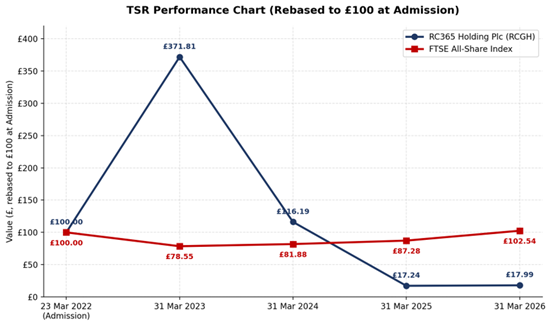
Historical TSR Index Values (Rebased to £100)
|
Financial Year End |
RC365 Holding Plc (RCGH) |
Benchmark: FTSE All-Share Index |
|
23 March 2022 (Admission) |
£100.00 |
£100.00 |
|
31 March 2023 |
£371.81 |
£78.55 |
|
31 March 2024 |
£116.19 |
£81.88 |
|
31 March 2025 |
£17.24 |
£87.28 |
|
31 March 2026 |
£17.99 |
£102.54 |
Note: TSR measures the overall return to shareholders, assuming £100 was invested on the date of admission to the London Stock Exchange and that all dividends were hypothetically reinvested.
During the period since listing, the Committee observed significant volatility in the share price of RC365 Holding Plc. While total employee remuneration increased by 9.99% in FY 2026 to support operational turnarounds across Asia, executive director emoluments were reduced by 40.00% (HK$ 976,967), reflecting board-level cost alignment with the Group's financial position and share price performance.
Consideration by Shareholders of Remuneration Matters for the year ended 31 March 2025
The table below set out the shareholder voting results in respect of the Directors' Remuneration Report and the Directors' Remuneration Policy at the Annual General Meeting (AGM) held of 4 September 2025.
|
Resolution |
Votes For (and Discretionary) |
% For |
Votes Against |
% Against |
Votes Withheld |
Total proxy votes |
|
To Approve the Remuneration Committee Report, as set out on pages 28 and 29 of the Annual Report for the year ended 31 March 2025 |
39,409,680 |
99.96 |
133,756 |
0.34 |
184,395 |
39,726,931 |
The Committee was pleased to receive a strong shareholder support at the 2025 AGM, with over 99.96% of votes cast in favour of our Annual Report of Remuneration.
The Committee maintains an active and open dialogue with all shareholders and proxy advisory agencies. During the year, no significant concerns were raised regarding the implementation of remuneration framework.
Statutory Comparison of Spend on Pay
|
Financial Metric |
FY 2026 (HK$) |
FY 2025 (HK$) |
Absolute Change |
Percentage Change |
|
Directors' Emoluments |
1,432,400 |
2,409,167 |
-976,767 |
-40% |
|
Wages, Salaries and other employment benefits (including Directors' Remuneration) |
7,496,968 |
6,815,679 |
681,289 |
+9.99% |
|
Distribution to Shareholders: |
|
|
|
|
|
Ordinary Dividend Paid/ Proposed |
NIL |
NIL |
NIL |
No Change |
|
Contextual Performance Metrices |
|
|
|
|
|
Profits / (Losses) before taxation from continuing operation |
(12,877,455) |
(30,617,830) |
17,740,375 |
+57.94% |
Commentary on Relative Spend
Overall Employee Pay vs. Shareholder Distributions
During FY 2026, total expenditure on wages, salaries, and other employment benefits (inclusive of Directors' remuneration) increased by 9.99% (HK$ 681,289) to HK$ 7,496,968 (FY 2025: HK$ 6,815,679). This overall increase reflects wider workforce investment and operational support during the financial year.
In contrast, Directors' emoluments decreased by 40% (HK$ 976,967) from HK$ 2,409,167 in FY 2025 to HK$ 1,432,200 in FY 2026, demonstrating executive pay restraint and strategic cost alignment relative to total staff costs.
No ordinary dividends were paid or proposed during FY 2026 or FY 2025 (HK$ NIL), as the Group prioritized prudent liquidity management and capital preservation over shareholder distributions.
Contextual Performance Context
To provide broader context, the Group recorded a loss before taxation of HK$ 12,877,455 in FY 2026 compared to a loss before taxation of HK$ 30,617,830 in FY 2025. This represents a significant performance improvement, narrowing losses before tax by 57.94% (HK$ 17,740,375).
The Remuneration Committee considers the overall spending on workforce remuneration appropriate and balanced in the context of the Group's ongoing operational turnaround and substantial reduction in pre-tax losses.
Other Matters
The Group does not currently have any annual or long-term incentive schemes in place for any of the Directors and senior employees.
Approval by shareholders
At the next annual general meeting of the Group a resolution approving this report is to be proposed as an ordinary resolution.
This report was approved by the board on 31 July 2026.
Ajay Rajpal
Non-Executive Director
INDEPENDENT AUDITOR'S REPORT
to the Members of RC365 Holding Plc
1. Opinion
We have audited the financial statements of RC365 Holding Plc (the "Parent Company") and its subsidiaries (together the "Group") for the year ended 31 March 2026 which comprise the Consolidated Statement of Comprehensive Income, the Consolidated and Company Statement of Financial Position, the Consolidated and Company Statement of Changes in Equity, the Consolidated and Company Statement of Cash Flows, and related notes to the financial statements, including significant accounting policies. The financial reporting framework that has been applied in the preparation of the Group's financial statements is applicable law and UK adopted International Accounting Standards ("UK adopted IAS").
In our opinion the financial statements:
• give a true and fair view of the state of the Group's and of the Parent Company's affairs as at 31 March 2026, and of the Group's loss for the year then ended;
• have been properly prepared in accordance with UK adopted IAS; and
• have been prepared in accordance with the requirements of the Companies Act 2006.
2. Basis for opinion
We conducted our audit in accordance with International Standards on Auditing (UK) (ISAs (UK)) and applicable law. Our responsibilities under those standards are further described in the Auditor's Responsibilities for the audit of the financial statements section of our report. We are independent of the Group and Parent Company in accordance with the ethical requirements that are relevant to our audit of the financial statements in the UK, including the FRC's Ethical Standard applicable to listed entities, and we have fulfilled our other ethical responsibilities in accordance with those requirements. We believe that the audit evidence we have obtained is sufficient and appropriate to provide a basis for our opinion.
3. Conclusions relating to going concern
In auditing the financial statements, we have concluded that the directors' use of the going concern basis of accounting in the preparation of the financial statements is appropriate. Our evaluation of the directors' assessment of the Group's and Parent Company's ability to continue to adopt the going concern basis of accounting included:
· We confirmed our understanding of management's going concern assessment process and engaged with management early to ensure all key factors were considered in their assessment;
· We evaluated management's going concern assessment which included assessing their evaluation of business and strategic plans, liquidity and funding positions for the group and the parent company;
· We assessed the appropriateness of key assumptions made by management in preparing cash flow forecasts for a period of at least twelve months from the date of approving the financial statements;
· We evaluated forecasts prepared by management to recent historical financial information performance to confirm the accuracy of these forecasts;
· We obtained evidence of the post year-end share placings completed in June and July 2026, confirmed the gross proceeds raised of £1,250,000 (before expenses), obtained the breakdown of associated issue costs, and traced receipt of the net funds to the Company's bank statements;
· We obtained written confirmation of financial support from the company's principal shareholder as secondary support in addition to the completed share placings described above, confirming his continued commitment to provide funding to the Group as required throughout the going concern assessment period;
· We assessed the going concern disclosures included in the annual report for compliance with the reporting standards.
Based on the work we have performed, we have not identified any material uncertainties relating to events or conditions that, individually or collectively, may cast significant doubt on the Group's and Parent Company's ability to continue as a going concern for a period of at least twelve months from when the financial statements are authorised for issue.
Our responsibilities and the responsibilities of the directors with respect to going concern are described in the relevant sections of this report. However, because not all future events or conditions can be predicted, this statement is not a guarantee as to the Group's and Parent Company's ability to continue as a going concern.
An overview of the scope of our audit
Our audit was scoped by obtaining an understanding of the Group and its environment, including the Group's system of internal control, and assessing the risks of material misstatement in the financial statements. We also addressed the risk of management override of internal controls, including
assessing whether there was evidence of bias by the directors that may have presented a risk of material misstatement. The scope of our audit was influenced by the level of materiality we determined.
We tailored the scope of our audit to ensure that we performed enough work to be able to give an opinion on the financial statements as a whole, taking into account an understanding of their activities, the accounting processes and controls, and the industry in which the Group operates. Our planned audit testing was directed accordingly and was focused on areas where we assessed there to be the highest risk of material misstatement.
During the audit we reassessed and re-evaluated audit risks and tailored our approach accordingly. The audit testing included substantive testing on significant transactions, balances and disclosures, the extent of which was based on various factors such as our overall assessment of the control environment, the effectiveness of controls and the management of specific risks.
We communicated with those charged with governance regarding, among other matters, the planned scope and timing of the audit and significant findings, including any significant deficiencies in internal control that we identified during the audit.
Our involvement with component auditors
We designed an audit strategy to ensure that we obtained the required audit assurance for each component for the purposes of our Group audit opinion (in accordance with ISA 600 (Revised - UK)). Components were scoped in to address aggregation risk and to ensure sufficient coverage was obtained of group balances on which to base our audit opinion. For the work performed by component auditors in Hong Kong and Malaysia, we determined the level of involvement needed in order to be able to conclude whether sufficient appropriate audit evidence has been obtained as a basis for our opinion on the Group financial statements as a whole.
Our involvement with component auditors included the following:
· Detailed Group reporting instructions were sent, which included the significant areas to be covered by the audits (including areas that were considered to be key audit matters as detailed below), and set out the information required to be reported to the Group audit team.
· The Group audit team performed procedures independently over certain key audit risk areas, as considered necessary, including the key audit matters below.
· Regular communication took place between ourselves as group auditor and the component auditors throughout the planning and execution phases of the audit.
· The Group audit team was actively involved in risk assessment and the direction of the audits performed by the component auditors for Group reporting purposes, review of their working papers, consideration of findings and determination of conclusions drawn.
Key Audit Matters
Key audit matters are those matters that, in our professional judgement, were of most significance in our audit of the financial statements of the current period and include the most significant assessed risks of material misstatement (whether due to fraud or error) we identified, including those which had the greatest effect on the overall audit strategy; the allocation of resources in the audit; and directing the efforts of the engagement team. These matters were addressed in the context of our audit of the financial statements, and in forming our opinion thereon, and we do not provide a separate opinion on these matters.
|
Key audit matter description |
How the matter was addressed in our audit |
|
Going Concern The Directors have prepared a cashflow forecast covering monthly periods through to 31 July 2027. This forecasts that the Group and Company will be able to continue on a going concern basis for at least the next twelve months from the date of this report. Significant auditor attention was focussed in this area because of the existence of events or conditions which may give rise to going concern issues such as the ability of the group to raise financing to fund its operations.
In addition, the Group has incurred losses from operating activities for a number of reporting periods. The loss after tax from continuing operations for the year ended 31 March 2026 was HK$ 12.9 million (2025: HK$ 30.million)
These matters require auditor judgement on whether the Group and Company will be able to fund its operations and future projects for a period at least twelve months from the date of this report.
|
We performed the following audit procedures: a. We confirmed our understanding of management's going concern assessment process and engaged with management early to ensure all key factors were considered in their assessment.
b. We checked cash at bank held at 31 March 2026 of HK$ 2.8 million to supporting documentation, including bank statements. We confirmed significant bank balances held by the Group that are considered in management's going concern assessment.
c. We evaluated management's going concern assessment which included assessing their business and strategic plans, liquidity and funding positions for the group. We checked that the going concern assessment from management covered a period of at least 12 months from the expected date of approval of financial statements. We also challenged the appropriateness of judgements and assumptions considered by management in the cashflow forecasts and obtained corroborative evidence, wherever available, for key assumptions made.
d. We assessed the appropriateness of management's forecasts by comparing them to the Group's recent historical financial performance and evaluating the consistency of underlying assumptions with past trends and available supporting evidence. e. We verified that the proceeds from the post year-end share allotment had been received by inspecting bank statements and confirming that the funds had been credited to the Group's bank account (net proceeds to date of HK$11.7 million.)
f. We obtained a shareholder support letter confirming the availability of funding of up to USD 4 million to support the Group's operations and liquidity requirements throughout the going concern assessment period.
g. We verified the availability of the funds by obtaining evidence that the shareholder held sufficient resources to provide the committed funding of up to USD 4 million, should such support be required by the Group during the going concern assessment period.
h. We obtained written confirmation from the directors and shareholders that amounts due to them will not be demanded for repayment until the group's cashflow position has sufficiently strengthened, supporting management's assessment of the Group's ability to continue as a going concern.
i. We checked whether the disclosures in the financial statements were fairly stated, complete and accurate in all material respects.
Conclusion: We have completed our planned procedures. We are of the view there are no material uncertainties which exist in relation to the Group's and Company's status as going concerns. |
|
Impairment of Intangible assets (Group) Where indicators of impairment exist during the reporting period, management and the directors are required to perform an impairment review over the carrying values of the Group's intangible assets. Management has assessed Group's intangible assets for impairment and has recognised impairment losses of HK$ 3.3 million for the year ended 31 March 2026. (2025:HK$ 19.65 million)
There is significant judgement involved in assessing the recoverable value of intangible assets based on uncertain inputs such as future income amounts.
|
We performed the following audit procedures:
a. We reviewed the impairment assessment performed by management for intangible assets as of year-end. b. We evaluated the basis for management's conclusion that no future cash inflows are expected from the ERP asset (mobile application) and the Money Lending Licence and challenged the supporting evidence for this conclusion in respect of each asset. c. We assessed whether the resulting recoverable amount of nil, and the consequent full impairment of the carrying value of both assets, had been appropriately determined and accounted for in accordance with the applicable accounting standards; d. We assessed the adequacy of the related disclosures in the financial statements
Conclusion: Based on the procedures performed, we conclude that the impairment losses of HK$ 3.3 million recognised by management on the intangible assets during FY26 is appropriate. |
|
Impairment of investment in subsidiaries and receivables from subsidiaries (parent company) Where indicators of impairment exist during the reporting period, management and the directors are required to perform an impairment review over the carrying values of the investment in subsidiaries and receivables from subsidiaries in the books of parent company at year-end. Management has assessed investment in subsidiaries and receivable from subsidiaries for impairment and has recognised impairment losses of HK$ 1 million (2025 : HK$ 7.54 million) and HK$ 0.66 million (2025: HK$ 11.3 million) respectively for the year ended 31 March 2026.
|
We performed the following audit procedures: a. We reviewed the impairment assessment performed by management for investment in subsidiaries and receivable from subsidiaries by the parent company as of year-end.
b. We challenged management on the appropriateness of the assumptions and judgments supporting the cashflow forecasts of subsidiaries.
c. We evaluated the appropriateness of the forecast period applied by management in estimating future free cash flows, considering the nature of the business and industry of each material subsidiary.
d. We assessed management's recoverable amount calculation based on the expected proceeds from an anticipated disposal of Mr Meal Production Limited, based on a fair value less costs to sell methodology, rather than a discounted cash flow calculation (value-in-use basis), and evaluated the reasonableness of the expected proceeds by comparing them to available supporting evidence.
e. We assessed the disclosures in the financial statements for completeness and accuracy.
Conclusion: Based on the procedures performed, we conclude that the impairment losses recognised by the parent company on the investment in subsidiaries and intercompany receivables during FY26 is appropriate. |
Our application of materiality
Our definition of materiality considers the value of error or omission on the financial statements that, individually or in aggregate, would change or influence the economic decision of a reasonably knowledgeable user of those financial statements. Misstatements below these levels will not necessarily be evaluated as immaterial as we also take account of the nature of the identified misstatements, and the particular circumstances of their occurrence, when evaluating their effect on the financial statements as a whole. Materiality is used in planning the scope of our work, executing that work and evaluating the results.
|
Materiality |
Group |
Parent company |
|
Overall materiality |
HK$ 155,000 (2025: HK$ 141,000) |
HK$ 18,000 (2025: HK$:39,000) |
|
Basis for determining overall materiality |
Materiality was determined based on 0.7% (2025: 1%) of the Group's revenue. We believe that the stakeholders of Group are primarily focused on revenue as this determines the success of the products launched by the Company and its recent acquisitions. |
Materiality was determined based on the 1% total assets of the parent company.
The nature of the parent company is that of holding company for the group. We believe that total assets is the most appropriate basis for determining materiality as the stakeholders focus on total assets to assess the parent company's ability to provide support to subsidiaries when required. |
|
Performance materiality |
HK$ 77,000 (2025: HK$ 70,000)
We set performance materiality based on 50% (2025:50%) of overall materiality.
Performance materiality is the application of materiality at the individual account or balance level, set at an amount to reduce, to an appropriately low level, the probability that the aggregate of the uncorrected and undetected misstatements exceeds materiality for the financial statements as a whole. In determining performance materiality, we considered several factors including our understanding of the control environment of the Group.
|
HK$ 9,000 (2025: HK$ 19,500)
We set performance materiality based on 50% (2025:50%) of overall materiality.
Performance materiality is the application of materiality at the individual account or balance level, set at an amount to reduce, to an appropriately low level, the probability that the aggregate of the uncorrected and undetected misstatements exceeds materiality for the financial statements as a whole. In determining performance materiality, we considered several factors including our understanding of the control environment of the parent company. |
|
Error reporting threshold |
We agreed to report any corrected or uncorrected adjustments exceeding HK$ 7,700 (2025: HK$ 7,000) to the Audit Committee as well as differences below this threshold that in our view warranted reporting on qualitative grounds.
This represents 5% of the overall materiality of the Group. |
We agreed to report any corrected or uncorrected adjustments exceeding HK$ 900 (2025: HK$ 1,950) to the Audit Committee as well as differences below this threshold that in our view warranted reporting on qualitative grounds.
This represents 5% of the overall materiality of the parent company. |
Other information
Other information comprises the information in the annual report, including Chairman's Statement, Strategic Report, Board of Directors, Directors Report, Risk Management Report, Corporate Governance Statement, Audit Committee Report and Remuneration Committee Report. The directors are responsible for the other information contained within the annual report. Our opinion on the financial statements does not cover the other information and, except to the extent otherwise explicitly stated in our report, we do not express any form of assurance conclusion thereon.
In connection with our audit of the financial statements, our responsibility is to read the other information and, in doing so, consider whether the other information is materially inconsistent with the financial statements, or our knowledge obtained in the audit or otherwise appears to be materially misstated. If we identify such material inconsistencies or apparent material misstatements, we are required to determine whether this gives rise to a material misstatement in the financial statements themselves. If, based on the work we have performed, we conclude that there is a material misstatement of this other information, we are required to report that fact.
We have nothing to report in this regard.
Opinions on other matters prescribed by the Companies Act 2006
In our opinion, the part of the Remuneration committee report to be audited has been properly prepared in accordance with the Companies Act 2006.
In our opinion, based on the work undertaken during the audit:
• the information given in Strategic Report and Directors' Report for the financial year for which the financial statements are prepared is consistent with the financial statements; and
• the Strategic Report and Directors Report have been prepared in accordance with applicable legal requirements.
Matters on which we are required to report by exception
In the light of the knowledge and understanding of the Group and its environment obtained during the audit, we have not identified material misstatements in the Strategic Report and Directors Report.
We have nothing to report in respect of the following matters in relation to which the Companies Act 2006 requires us to report to you if, in our opinion:
· adequate accounting records have not been kept, or returns adequate for our audit have not been received from branches not visited by us; or
· the financial statements are not in agreement with the accounting records and returns; or
· certain disclosures of directors' remuneration specified by law are not made; or
· we have not received all the information and explanations we require for our audit.
Responsibilities of directors
As explained more fully in the directors' responsibilities statement set out on page 13, the directors are responsible for the preparation of the financial statements and for being satisfied that they give a true and fair view, and for such internal control as the directors determine is necessary to enable the preparation of financial statements that are free from material misstatement, whether due to fraud or error. In preparing the financial statements, the directors are responsible for assessing the Group's and Parent Company's ability to continue as a going concern, disclosing, as applicable, matters related to going concern and using the going concern basis of accounting unless the directors either intend to liquidate the Group or Parent Company or to cease operations, or have no realistic alternative but to do so.
Auditor's responsibilities for the audit of the financial statements
Our objectives are to obtain reasonable assurance about whether the financial statements are free from material misstatement, whether due to fraud or error, and to issue an auditor's report that includes our opinion. Reasonable assurance is a high level of assurance but is not a guarantee that an audit conducted in accordance with ISAs (UK) will always detect a material misstatement when it exists. Misstatements can arise from fraud or error and are considered material if, individually or in the aggregate, they could reasonably be expected to influence the economic decisions of users taken based on these financial statements.
Extent to which the audit was considered capable of detecting irregularities, including fraud
Irregularities, including fraud, are instances of non-compliance with laws and regulations. We design procedures in line with our responsibilities, outlined above, to detect material misstatements in respect of irregularities, including fraud.
These audit procedures were designed to provide reasonable assurance that the financial statements were free from fraud or error. The risk of not detecting material misstatement due to a fraud is higher than the risk of not detecting one resulting from error, as fraud may involve deliberate concealment by, for example, forgery or intentional misrepresentations, or through collusion.
Identifying and assessing potential risks arising from irregularities, including fraud
The extent of the procedures undertaken to identify and assess the risk of material misstatement in respect of irregularities, including fraud, included the following:
We considered the nature of the industry and sector, the control environment, business performance including remuneration policies and the Group's own risk assessment that irregularities might occur as a result of fraud or error. From our sector experience and through discussions with the directors, we obtained an understanding of the legal and regulatory framework applicable to the Group focusing on laws and regulations that could reasonably be expected to have a direct material effect on the financial statements, such as provisions of the Companies Act 2006, UK tax legislation, London Stock Exchange rules and regulations, Hong Kong company law, Malaysia law and tax laws or those that had a fundamental effect on the operations of the Group.
We made enquiries of the directors and management concerning the Group's policies and procedures relating to:
a. Identifying, evaluating, and complying with the laws and regulations and whether they were aware of any instances of non-compliance;
b. Detecting and responding on the risks of fraud and whether they had any knowledge of actual or suspected fraud; and
c. The internal controls established to mitigate risks related to fraud or non-compliance with laws and regulations.
We assessed the susceptibility of the Group's and Parent Company's financial statements to material misstatement, including how fraud might occur by evaluating management's incentives and opportunities for manipulation of the financial statements. This included utilising the spectrum of inherent risk and an evaluation of the risk of management override of controls. We determined that the principal risks were related to posting inappropriate journal entries creating fictitious transactions to improve financial performance, and management bias in accounting estimates specific to impairment of intangible assets, impairment of investment in subsidiary and related party receivables.
Audit response to risks identified
In respect of the above procedures:
• we corroborated the results of our enquiries through review of the minutes of the Board of directors' meetings,
• we reviewed financial statement disclosures to supporting documentation to assess compliance with applicable laws and regulations expected to have a direct impact on the financial statements,
• we performed testing of journal entries, including those processed late for financial statements preparation, those posted by infrequent or unexpected users, those posted to unusual account combinations,
• we evaluated the business rationale of significant transactions outside the normal course of business and reviewed accounting estimates for bias,
• we made enquiries of management around actual and potential litigation and claims,
• we challenged the assumptions and judgments made by management in relation to significant accounting estimates,
• we obtained confirmations from third parties to confirm existence of certain balances, and
• we communicated relevant laws and regulations and potential fraud risks to all engagement team members and remained alert to any indication of fraud or non-compliance with laws and regulations throughout the audit.
Because of the inherent limitations of an audit, there is a risk that we will not detect all irregularities, including those leading to a material misstatement in the financial statements or non-compliance with regulation. This risk increases the more that compliance with a law or regulation is removed from the events and transactions reflected in the financial statements, as we will be less likely to become aware of instances of non-compliance. The risk is also greater regarding irregularities occurring due to fraud rather than error, as fraud involves intentional concealment, forgery, collusion, omission, or misrepresentation.
A further description of our responsibilities for the audit of the financial statements is located on the Financial Reporting Council's website at www.frc.org.uk/auditorsresponsibilities. This description forms part of our auditor's report.
Other requirements
We were appointed by the Group on 13 February 2025 to audit the financial statements of the Group. We first audited the financial statements of the Group for the year ended 31 March 2025, and the total period of uninterrupted engagement is two years, covering the years ended 31 March 2025 and 31 March 2026.
We did not provide non-audit services, and we remain independent of the Group in conducting our audit.
Our opinion is consistent with the additional report to the Audit Committee.
Use of our report
This report is made solely to the Group's members, as a body, in accordance with Chapter 3 of Part 16 of the Companies Act 2006. Our audit work has been undertaken so that we might state to the Group's members those matters we are required to state to them in an auditor's report and for no other purpose.
To the fullest extent permitted by law, we do not accept or assume responsibility to anyone other than the Group and the Group's members as a body, for our audit work, for this report, or for the opinions we have formed.
Edmund Cartwright, FCCA FMAAT (Senior Statutory Auditor)
for and on behalf of Johnsons, Chartered Accountants, Statutory Auditor
London, United Kingdom
Date: 31 July 2026
Consolidated statement of comprehensive income
For the year ended 31 March 2026
|
|
Notes |
31 March 2026 |
31 March 2025 |
|
|
|
HK$ |
HK$ |
|
Continuing operations |
|
|
|
|
Revenue |
4 |
22,140,667 |
14,108,210 |
|
Cost of sales |
|
(13,829,841) |
(1,900,313) |
|
|
|
|
|
|
Gross profit |
|
8,310,826 |
12,207,897 |
|
Other income |
5 |
340,228 |
5,651,524 |
|
Subcontracting fee paid |
|
- |
(4,211,989) |
|
Staff costs |
8 |
(7,849,929) |
(7,099,269) |
|
Other operating expenses |
|
(7,899,780) |
(9,022,893) |
|
Depreciation on property, plant and equipment and right-of-use assets and amortisation of intangible assets |
12, 13, 14 |
(2,156,318) |
(4,269,916) |
|
|
|
|
|
|
Operating (loss)/profit |
|
(9,254,973) |
(6,744,646) |
|
Fair value gain on contingent consideration - shares consideration shares |
|
- |
60,651 |
|
Gain on disposal of a subsidiary |
|
- |
513,060 |
|
Fair value loss on financial assets at FVPL |
|
11,868 |
(661,824) |
|
Impairment losses |
7 |
(3,493,167) |
(23,642,590) |
|
Finance charges |
6 |
(141,183) |
(142,481) |
|
|
|
|
|
|
|
|
|
|
|
Loss before income tax |
7 |
(12,877,455) |
(30,617,830) |
|
Income tax expense |
9 |
(1,237) |
(188,969) |
|
|
|
|
|
|
Loss for the year from continuing operations |
|
(12,878,692) |
(30,806,799) |
|
|
|
|
|
|
Discontinued operations |
|
|
|
|
Loss for the year from discontinued operations |
|
- |
(2,932,762) |
|
Loss for the year after tax |
|
(12,878,692) |
(33,739,561) |
|
Loss per share - basic and diluted (HK$) |
|
|
|
|
-Continuing operations |
10 |
(8.56 cents) |
(21.11 cents) |
|
-Discontinued operations |
10 |
N/A |
(2.01 cents) |
|
|
|
|
|
The accompanying notes to the consolidated financial statements on pages 57 to 111 form an integral part of these consolidated financial statements.
Consolidated statement of comprehensive income for the year ended 31 March 2026
|
|
|
31 March 2026 |
31 March 2025 |
||||
|
|
|
HK$ |
HK$ |
||||
|
|
|
|
|
||||
|
|
|
|
||||
|
Loss for the year |
|
(12,878,692) |
(33,739,561) |
||||
|
|
|
|
|
||||
|
Other comprehensive income, net of tax |
|
|
|
||||
|
Items that may be reclassified subsequently to profit or loss: |
|
173,393 |
185,819 |
||||
|
Exchange differences on translation of financial statements of foreign operations |
|
173,393 |
185,819 |
||||
|
|
|
|
|
||||
|
Total comprehensive loss for the year |
|
(12,705,299) |
(33,553,742) |
The accompanying notes to the consolidated financial statements on pages 57 to 111 form an integral part of these consolidated financial statements.
Consolidated statement of financial position
as at 31 March 2026
|
|
|
Notes |
As at |
As at |
|
|
|
|
31 March 2026 |
31 March 2025 |
|
|
|
|
HK$ |
HK$ |
|
|
|
|
|
|
|
ASSETS |
|
|
|
|
|
Non-current assets |
|
|
|
|
|
Goodwill |
|
11 |
- |
- |
|
Loan receivables |
|
17 |
- |
- |
|
Intangible assets |
|
12 |
6,667 |
4,972,333 |
|
Property, plant and equipment |
|
13 |
394,374 |
559,838 |
|
Right-of-use assets |
|
14 |
536,475 |
- |
|
Financial assets at FVPL |
|
15 |
12,432 |
344,105 |
|
|
|
|
|
|
|
|
|
|
949,948 |
5,876,276 |
|
|
|
|
|
|
|
|
|
|
|
|
|
Current assets |
|
|
|
|
|
Deposit and prepayments |
|
16 |
2,054,384 |
2,798,699 |
|
Trade and other receivables |
|
16 |
429,630 |
772,471
|
|
Intangible assets |
|
12 |
2,162,852 |
|
|
Loan receivables |
|
17 |
2,328,000 |
- |
|
Amount due from a director |
|
|
355,796 |
- |
|
Contract assets |
|
|
- |
855,410 |
|
Cash and cash equivalents |
|
18 |
2,841,812 |
11,775,409 |
|
|
|
|
|
|
|
|
|
|
10,172,474 |
16,201,988 |
|
|
|
|
|
|
|
|
|
|
|
|
|
Current liabilities |
|
|
|
|
|
Trade and other payables |
|
19 |
3,605,911 |
2,939,666 |
|
Borrowings |
|
20 |
3,884,491 |
3,884,491 |
|
Lease liabilities |
|
21 |
413,175 |
- |
|
Tax payables |
|
|
147,847 |
294,939 |
|
Amount due to a shareholder
|
|
19 |
2,599,990 |
2,538,748 |
|
Contract liabilities |
|
19 |
5,677,097 |
5,460,205 |
|
Amount due to a director |
|
19 |
1,609,212 |
1,202,925 |
|
|
|
|
|
|
|
|
|
|
17,937,723 |
16,320,975 |
|
|
|
|
|
|
|
Net current liabilities |
|
|
(7,765,249) |
(118,987) |
|
|
|
|
|
|
|
|
|
|
|
|
|
Non-current liabilities |
|
|
|
|
|
Lease liabilities |
|
21 |
132,452 |
- |
|
Contingent consideration
|
|
|
10,937 |
10,680 |
|
|
|
|
143,389 |
10,680 |
|
|
|
|
|
|
|
Net (liabilities)assets |
|
|
(6,958,690) |
5,746,609 |
|
|
|
|
|
|
|
|
|
|
|
|
|
EQUITY |
|
|
|
|
|
Share capital |
|
22 |
15,722,041 |
15,722,041 |
|
Share premium |
|
|
72,636,015 |
72,636,015 |
|
Group reorganisation reserve |
|
|
677,439 |
677,439 |
|
Exchange Reserve |
|
|
275,646 |
102,253 |
|
Accumulated losses |
|
|
(96,269,831) |
(83,391,139) |
|
|
|
|
|
|
|
Total (deficit) equity |
|
|
(6,958,690) |
5,746,609 |
|
|
|
|
|
- |
The accompanying notes to the consolidated financial statements on pages 57 to 111 form an
integral part of these consolidated financial statements.
Approved by the Board and authorised for issue on 31 July 2026
Chi Kit LAW
Director
Company Registration number: 13289422
Consolidated statement of changes in equity
for the year ended 31 March 2026
|
|
Share capital |
Share premium |
Translation reserves |
Group reorganisation reserves
|
Accumulated losses |
Total |
|
|
HK$ |
HK$ |
HK$ |
HK$ |
HK$ |
HK$ |
|
|
|
|
|
|
|
|
|
|
|
|
|
|
|
|
|
As 1 April 2024 (restated) |
13,535,595 |
68,862,461 |
(83,566) |
589,836 |
(49,651,578) |
33,252,748 |
|
|
|
|
|
|
|
|
|
Loss for the year |
- |
- |
- |
- |
(33,739,561) |
(33,739,561) |
|
Exchange difference on consolidation |
- |
- |
185,819 |
- |
- |
185,819 |
|
Total comprehensive expenses |
- |
- |
185,819 |
- |
(33,739,561) |
(33,553,742) |
|
|
|
|
|
|
|
|
|
Release and reclassification upon deconsolidation of subsidiaries |
- |
- |
- |
87,603 |
- |
87,603 |
|
Reclassification |
|
|
|
|
|
- |
|
Issue of share capital |
2,186,446 |
3,773,554 |
- |
- |
- |
5,960,000 |
|
|
|
|
|
|
|
|
|
At 31 MARCH 2025 |
15,722,041 |
72,636,015 |
102,253 |
677,439 |
(83,391,139) |
5,746,609 |
|
|
|
|
|
|
|
|
|
Loss for the year |
- |
- |
- |
- |
(12,878,692) |
(12,878,692) |
|
|
|
|
|
|
|
|
|
Exchange difference on consolidation |
- |
- |
173,393 |
- |
- |
173,393 |
|
|
|
|
|
|
|
|
|
Total comprehensive expenses |
- |
- |
173,393 |
- |
(12,878,692) |
(12,705,299) |
|
|
|
|
|
|
|
|
|
|
|
|
|
|
|
|
|
At 31 MARCH 2026 |
15,722,041 |
72,636,015 |
275,646 |
677,439 |
(96,269,831) |
(6,958,690) |
The accompanying notes to the consolidated financial statements on pages 57 to 111 form an integral part of these consolidated financial statements.
Consolidated statement of cash flows
for the year ended 31 March 2026
|
|
|
31 March 2026 |
31 March 2025 |
|
|
|
HK$ |
HK$ |
|
|
|
|
|
|
Cash flows from operating activities |
|
|
|
|
Loss before income tax |
|
(12,878,692) |
(33,550,592) |
|
Less: Loss before income from discontinued operation |
|
-
|
(2,932,762) |
|
Less: Loss before income from continuing operation |
- 1 |
(30,617,830) |
|
|
|
|
|
|
|
Adjustments for: |
|
|
|
|
Realised foreign exchange gain |
|
(105,536) |
- |
|
Amortisation of intangible assets |
|
1,664,000 |
4,140,742 |
|
Depreciation of property, plant and equipment |
|
209,645 |
129,174 |
|
Depreciation of right-of-use-assets |
|
282,672 |
- |
|
|
|
|
- |
|
Impairment loss on trade and other receivable |
|
191,500 |
- |
|
Impairment loss on loan receivables |
|
- |
3,257,981 |
|
Fair value (gain) loss on financial assets at FVPL |
|
(11,868) |
661,824 |
|
Interest income |
|
(89,152) |
(342,306) |
|
Fair value gain on contingent consideration -consideration shares |
|
- |
(60,651) |
|
Net gain on disposal of financial assets at FVPL |
|
(105,577) |
- |
|
Impairment loss on goodwill |
|
- |
759,289 |
|
Loss on disposal of property, plant, and equipment |
|
49,440 |
- |
|
Gain on disposal of a subsidiary |
|
- |
(513,061) |
|
Impairment loss on Intangible assets |
|
3,301,667 |
19,625,320 |
|
Finance charges |
|
141,183 |
156,298 |
|
|
|
|
|
|
Operating cashflow before working capital changes |
|
(7350,719) |
(2,803,220) |
|
Decrease/(Increase) in trade and other receivable |
|
151,341 |
1,642,553 |
|
Decrease/(Increase) in contract assets |
|
855,409 |
(855,410) |
|
Decrease in deposits and prepayments |
|
744,315 |
179,245 |
|
Increase in loan receivables |
|
(2,328,000) |
- |
|
Increase/(decrease) in trade and other payables |
|
666,245 |
(1,124,568) |
|
Increase in amount due from a director |
|
(355,796) |
- |
|
Decrease/(increase) in amounts due to a director |
|
406,287 |
(830,102) |
|
Increase in amounts due to a shareholder |
|
61,242 |
|
|
Increase/(decrease) in contract liabilities |
|
216,892 |
(2,964,022) |
|
|
|
|
|
|
Cash generated used in operating activities |
|
(6,932,784) |
(6,755,524) |
|
|
|
|
|
|
Income tax paid including under provision movement |
|
(147,073) |
(6,941)
|
|
Net cash used in operating activities - continuing operations |
|
(7,079,877) |
(6,762,465) |
|
Net cash generated used in operating activities - discontinued operations |
|
- |
(2,538,446) |
|
Net cash used in operating activities
|
|
(7,079,877) |
(9,300,911) |
|
|
|
|
|
|
Cash flow from investing activities |
|
|
|
|
Acquisition of intangible assets |
|
(2,162,852) |
(230,000) |
|
Acquisition of property, plant and equipment |
|
(76,416) |
(317,162) |
|
Proceeds from disposal of financial assets at FVPL |
|
456,537 |
- |
|
Proceeds from disposal of property, plant and equipment |
|
410 |
- |
|
Net cash inflow for the disposal of a subsidiary |
|
- |
400,000 |
|
Interest received |
|
89,153 |
342,306 |
|
Net cash generated from/(used in) investing activities - continuing operations |
|
(1,693,168) |
195,144 |
|
Net cash generated from/(used in) investing activities - discontinued operations |
|
- |
- |
|
Net cash generated from/(used in) investing activities |
|
(1,693,168) |
195,144 |
|
|
|
|
|
|
Cashflow from financing activities |
|
|
|
|
Interest paid for bank borrowing |
|
(117,298) |
(142,481) |
|
Interest paid for lease liabilities |
|
(23,885) |
- |
|
Increase in lease liabilities |
|
(272,415) |
- |
|
Repayment of bank borrowings |
|
- |
(655,371) |
|
Repayment of convertible loan note |
|
- |
(1,523,250) |
|
Proceeds from convertible loan note |
|
- |
4,019,333 |
|
Net cash from financing activities - continuing operations |
|
(413,598) |
1,411,131 |
|
Net cash from financing activities - discontinued operations |
|
- |
(287,100) |
|
Net cash from financing activities |
|
(413,598) |
1,411,131 |
|
|
|
|
|
|
Net (decrease)/increase in cash and cash equivalents |
|
(9,186,643) |
(7,694,636) |
|
Effect of exchange rate changes |
|
253,046 |
151,078 |
|
Cash and cash equivalents at beginning of the year |
|
11,775,409 |
19,318,967 |
|
|
|
|
|
|
Cash and cash equivalents at the end of the year |
|
2,841,812 |
11,775,409 |
|
|
|
|
|
The accompanying notes to the consolidated financial statements on pages 57 to 111 form an integral part of these consolidated financial statements.
Notes to the consolidated financial statements
for the year ended 31 March 2026
1. GENERAL INFORMATION
RC365 Holding Plc (the "Company") was incorporated as a private limited company on 24 March 2021 in the United Kingdom ("UK") under the Companies Act 2006. The Company acted as a holding company and converted to a public limited company on 22 September 2021. The address of the registered office is Cannon Place, 78 Cannon Street, London, United Kingdom, EC4N 6AF. The Company was listed on the Standard List of the London Stock Exchange ("LSE") on 23 March 2022.
The principal activity of the Company is to act as an investment holding company. The Company together with its subsidiaries (the "Group") are mainly engaged in provision of IT software development and payment solutions, remittance and payment services, provision of media production services and money lending services, the provision of business virtual account support services.
2. SUMMARY OF SIGNIFICANT ACCOUNTING POLICIES
2.1 Basis of preparation
These Group and parent company financial statements were prepared in accordance with the UK-adopted International Accounting Standards and with the requirements of the Companies Act 2006 as applicable to companies reporting under those standards.
The financial statements of the Group and parent company have been prepared on an accrual basis and under historical cost convention. The financial statements are presented in Hong Kong Dollars ("HK$"), which is the Group's and Parent Company's functional and presentational currency, and rounded to the nearest dollar.
2.2 New Standards and Interpretations
In the current year, the Group has applied the following new and amendments to IFRS Accounting Standards for the first time, which are mandatorily effective for the Group's annual period beginning on 1 April 2025 for the preparation of the consolidated financial statements:
|
IAS 21 |
Amendments - Lack of exchangeability |
The application of the amendments to IFRS Accounting Standards in the current year has had no material impact on the Group's financial positions and performance for the current and prior years and/or on the disclosures set out in these consolidated financial statements.
The Group has not early applied the following amendments to IFRS Accounting Standards that have been issued but are not yet effective:
|
Standard |
Impact on initial application |
Effective date |
|
IFRS 1, IFRS 7, IFRS 9, IFRS 10 & IAS 7 |
Amendments - Annual Improvements to IFRS Accounting Standards - Volume 11 |
1 January 2026 |
|
IFRS 9 & IFRS 7 |
Amendments - Classification and Measurement of Financial Instruments |
1 January 2026 |
|
IFRS 9 & IFRS 7 |
Amendments - Contract Referencing Nature-dependent Electricity |
1 January 2026 |
|
IFRS 18 |
Presentation and Disclosure in Financial Statements |
1 January 2027 |
|
IFRS 19 |
Subsidiaries without Public Accountability: Disclosures |
1 January 2027 |
|
IFRS10 & IAS 28 |
Amendments - Sales or contribution of assets between an investor and its associate/joint venture |
To be determined |
2.3 Going Concern
The financial statements have been prepared on a going concern basis, as the Directors are confident in the Group and Parent Company's ability to continue in operational existence for the foreseeable future.
The Group and Parent Company have experienced losses and cash outflows from operating activities; however, proactive measures have been taken to address these challenges. The Company obtained two public fundings through the share allotments on June and July 2026 for the amount of GBP1,250,000 (net proceeds to date after expenses of HK$11.74 million). In addition, the principal shareholder provided a commitment to make available up to USD4 million of financial support to the Group. The Company has prepared a cash forecast till the period ended 31 July 2027 and showed that the Company has sufficient cash resources till July 2027.
The Directors are confident that the potential equity investments through the allotment of shares to public and the provision of guarantee from the principal shares, the continue of the commercialization of RC3.0 with the market expansion strategy during the coming quarters.
The continued cost management and the revenue growth from our co-branded and RC3.0 launching work, the Directors believe that there are no material uncertainties
that cast significant doubt over the ability of the Group and Parent Company to continue as a going concern.
Accordingly, the Directors have a reasonable expectation that the Group has adequate resources to continue operation for the foreseeable future for the reason they have adopted a going concern basis in the preparation of the consolidated financial statements.
2.4 Basis of consolidation
i) Business combination not under common control
The Group applies the acquisition method to account for business combinations not under common control. The consideration transferred for the acquisition of a subsidiary is the fair value of the assets transferred, the liabilities incurred to the former owners of the acquiree and the equity interest issued by the Group, as appropriate. The consideration transferred also includes the fair value of any asset or liability resulting from a contingent consideration arrangement. Identifiable assets acquired and liabilities and contingent liabilities assumed in a business combination not under common control is measured initially at their fair values at the acquisition date. Acquisition-related costs are expensed as incurred.
Allocation of total comprehensive income
Profit or loss and each component of other comprehensive income are attributed to the owners of the Company and to the non-controlling interests (if applicable). Total comprehensive income is attributed to the owners of the Company and the non-controlling interest (if applicable) even if this results in the non-controlling interest having a deficit balance. The results of subsidiaries are consolidated from the date on which the Group obtains control and continue to be consolidated until the date that such control ceases.
In the consolidated financial statements, the results of subsidiaries acquired or disposed of during the period are included in the consolidated statement of profit or loss and other comprehensive income from the effective date of acquisition and up to the effective date of disposal, as appropriate.
Intra-Group transactions, balances and unrealised gains and losses on transactions between Group companies are eliminated in preparing the consolidated financial statements. Profits and losses resulting from the inter-Group transactions that are recognised in assets are also eliminated. Amounts reported in the financial statements of subsidiaries have been adjusted where necessary to ensure consistency with the accounting policies adopted by the Group.
When the Group loses control of a subsidiary, the profit or loss on disposal is calculated as the difference between (i) the aggregate of the fair value of the consideration received and the fair value of any retained interest and (ii) the previous carrying amount of the assets (including goodwill), and liabilities of the subsidiary.
2.5 Foreign currency translation
In the individual financial statements of the consolidated entities, foreign currency transactions are translated into the functional currency of the individual entity using the exchange rates prevailing at the dates of the transactions. At the reporting date, monetary assets and liabilities denominated in foreign currencies are translated at the foreign exchange rates ruling at that date. Foreign exchange gains and losses resulting from the settlement of such transactions and from the reporting date retranslation of monetary assets and liabilities are recognised in profit or loss.
Non-monetary items carried at fair value that are denominated in foreign currencies are retranslated at the rates prevailing on the date when the fair value was determined. Non-monetary items that are measured in terms of historical cost in a foreign currency are not retranslated.
In the consolidated financial statements, all individual financial statements of foreign operations, originally presented in a currency different from the Group's presentation currency, have been converted into Hong Kong dollars. Assets and liabilities have been translated into Hong Kong dollars at the closing rates at the reporting date. Income and expenses have been converted into the Hong Kong dollars at the exchange rates ruling at the transaction dates, or at the average rates over the reporting period provided that the exchange rates do not fluctuate significantly. Any differences arising from this procedure have been recognised in other comprehensive income and accumulated separately in the translation reserve in equity.
On the disposal of a foreign operation (i.e., a disposal of the Group's entire interest in a foreign operation, or a disposal involving loss of control over a subsidiary that includes a foreign operation, loss of joint control over a joint venture that includes a foreign operation, or loss of significant influence over an associate that includes a foreign operation), all of the accumulated exchange differences in respect of that operation attributable to the Group are reclassified to profit or loss. Any exchange differences that have previously been attributed to non-controlling interests are derecognised, but they are not reclassified to profit or loss.
2.6 Contingent consideration
Contingent consideration to be transferred by the Group as the acquirer in a business combination is recognised at acquisition-date fair value. Subsequent adjustments to consideration are recognised against goodwill only to the extent that they arise from new information obtained within the measurement period (a maximum of 12 months from the acquisition date) about the fair value at the acquisition date. The subsequent accounting for changes in the fair value of the contingent consideration that do not qualify as measurement period adjustments depends on how the contingent consideration is classified. Contingent consideration that is classified as equity is not remeasured at subsequent reporting dates and its subsequent settlement is accounted for within equity. Contingent consideration that is classified as an asset or a liability is remeasured at subsequent reporting dates with the corresponding gain or loss being recognised in profit or loss.
2.7 Goodwill
Goodwill arising on an acquisition of a subsidiary is measured at the excess of the consideration transferred, the amount of any non-controlling interest in the acquiree and the fair value of any previously held equity interests in the acquiree over the acquisition date amounts of the identifiable assets acquired and the liabilities assumed of the acquired subsidiary.
Goodwill on acquisition of subsidiary is recognised as a separate asset and is carried at cost less accumulated impairment losses, which is tested for impairment annually or more frequently if events or changes in circumstances indicate that the carrying value may be impaired. For the purpose of impairment test and determination of gain or loss on disposal, goodwill is allocated to cash-generating units ("CGU"). An impairment loss on goodwill is not reversed.
On the other hand, any excess of the acquisition date amounts of identifiable assets acquired and the liabilities assumed of the acquired subsidiary over the sum of the consideration transferred, the amount of any non-controlling interests in the acquiree and the fair value of the acquirer's previously held interest in the acquiree, if any, after reassessment, is recognised immediately in profit or loss as an income from bargain purchase.
Any resulting gain or loss arising from remeasuring the previously held equity interests in the acquiree at the acquisition-date fair value is recognised in profit or loss or other comprehensive income, as appropriate.
Goodwill impairment reviews are undertaken annually or more frequently if events or changes in circumstances indicate a potential impairment. The carrying value of goodwill is compared to the recoverable amount, which is the higher of value in use and the fair value less costs of disposal. Any impairment is recognised immediately as an expense and is not subsequently reversed.
2.8 Property, plant and equipment
Property, plant and equipment (other than cost of right-of-use assets as described in note 2.12 are stated at acquisition cost less accumulated depreciation and impairment losses. The acquisition cost of an asset comprises of its purchase price and any direct attributable costs of bringing the assets to the working condition and location for its intended use. Depreciation of assets commences when the assets are ready for intended use.
Depreciation on property, plant and equipment, is provided to write off the cost over their estimated useful life, using the straight-line method, at the following rates per annum:
Furniture & Fixtures 20% per annum
Leasehold Improvement 20% per annum
Office Equipment 20% per annum
The assets' depreciation methods and useful lives are reviewed, and adjusted if appropriate, at each reporting date.
In the case of right-of-use assets, expected useful lives are determined by reference to comparable owned assets or the lease term, if shorter. Material residual value estimates and estimates of useful life are updated as required, but at least annually.
The gain or loss arising on the retirement or disposal is determined as the difference between the sales proceeds and the carrying amount of the asset and is recognised in profit or loss.
Subsequent costs are included in the asset's carrying amount or recognised as a separate asset, as appropriate, only when it is probable that future economic benefits associated with the item will flow to the Group and the cost of the item can be measured reliably. The carrying amount of the replaced part is derecognised. All other costs, such as repairs and maintenance, are charged to profit or loss during the financial period in which they are Incurred.
2.9 Intangible assets
Intangible assets acquired separately
Intangible assets with finite useful lives that are acquired separately are carried at costs less accumulated amortisation and accumulated impairment losses. Amortisation is recognised on a straight-line basis over their estimated useful lives. The estimated useful lives and amortisation method are reviewed at the end of each reporting period, with the effect of any changes in estimate being accounted for on a prospective basis. Intangible assets with indefinite useful lives that are acquired separately are carried at cost less accumulated impairment losses.
Research and development expenditure
Expenditure on research activities is recognised as an expense in the period in which it is incurred.
An internally-generated intangible asset arising from development (or from the development phase of an internal project) is recognised if, and only if, all of the following have been demonstrated:
• the technical feasibility of completing the intangible asset so that it will be available for use or sale;
• the intention to complete the intangible asset and use or sell it;
• the ability to use or sell the intangible asset;
• how the intangible asset will generate probable future economic benefits;
• the availability of adequate technical, financial and other resources to complete the development and to use or sell the intangible asset; and
• the ability to measure reliably the expenditure attributable to the intangible asset during its development.
The amount initially recognised for internally-generated intangible asset is the sum of the expenditure incurred from the date when the intangible asset first meets the recognition criteria listed above. Where no internally-generated intangible asset can be recognised, development expenditure is recognised to profit or loss in the period in which it is incurred.
Subsequent to initial recognition, internally-generated intangible assets are reported at cost less accumulated amortisation and accumulated impairment losses, on the same basis as intangible assets that are acquired separately.
Derecognition of intangible assets
An intangible asset is derecognised on disposal, or when no future economic benefits are expected from use or disposal. Gains and losses arising from derecognition of an intangible asset, measured as the difference between the net disposal proceeds and the carrying amount of the asset, are recognised in profit or loss when the asset is derecognised.
Virtual assets
Virtual assets held by the Group comprise USDT (Tether), a US dollar-pegged stablecoin cryptocurrency asset transacted and held on distributed ledger (blockchain) networks, acquired for the purpose of a short-term investment, which the Group expects to realise within twelve months of the reporting date.
Management has assessed that the Group's virtual assets do not meet the definition of inventories under IAS 2 Inventories, as they are not held for sale in the ordinary course of business, nor are they consumed in the production of goods or the rendering of services for sale. The virtual assets are identifiable, non-monetary assets without physical substance that are held for use by the Group and are accordingly accounted for as intangible assets under IAS 38 Intangible Assets.
Although USDT is designed to maintain a stable value pegged to the US dollar, it does not constitute cash or a cash equivalent, and holding USDT does not give the Group a contractual right to receive cash or another financial asset from Tether Limited (the issuer) or any other party. USDT therefore does not meet the definition of a financial asset under IAS 32 Financial Instruments: Presentation, which supports its classification as an intangible asset under IAS 38.
As the virtual assets are held as a short-term investment which the Group expects to realise within twelve months of the reporting date, they are presented within current assets in the consolidated statement of financial position, in accordance with IAS 1.66(d), separately from the Group's other intangible assets (development costs and the money lending licence), which have longer-term or indefinite useful lives and are presented within non-current assets.
Virtual assets are initially recognised at cost, being the fair value of the consideration given to acquire the asset. Subsequent to initial recognition, virtual assets are carried at cost less accumulated amortisation, where the asset is determined to have a finite useful life, and accumulated impairment losses. As the virtual assets are held as a short-term investment expected to be realised within twelve months, the directors consider them to have a finite useful life; no amortisation has been charged during the year as the asset was acquired shortly before the reporting date. At each reporting date, the Group assesses whether there is any indication that the virtual assets may be impaired, with any impairment loss recognised in profit or loss.
The Group's holding of virtual assets exposes it to custody, credit and liquidity risks. Custody risk arises from the risk of loss, theft or unauthorised access to the virtual assets. Credit risk arises from the risk of default by any custodian, exchange or other counterparty through which the virtual assets are held. Liquidity risk arises from the potential inability to convert the virtual assets into cash at short notice without significant loss in value.
The USDT is held by a component (subsidiary) company within the Group, through a third-party custodian rather than by self-custody, a certified trust company in Hong Kong. As USDT is a stablecoin, the Group is further exposed to the risk that USDT may not maintain its intended one-to-one peg to the US dollar, and to risks relating to the adequacy, composition and verification of the reserve assets maintained by Tether Limited to back the USDT in circulation.
2.10 Financial instruments
IFRS 9 requires an entity to address the classification, measurement and recognition of financial assets and liabilities.
i) Classification
The Company classifies its financial assets in the following measurement categories:
• those to be measured at amortised cost.
The classification depends on the Company's business model for managing the financial assets and the contractual terms of the cash flows.
The Company classifies financial assets at amortised cost only if both of the following criteria are met:
• the asset is held within a business model whose objective is to collect contractual cash flows; and
• the contractual terms give rise to cash flows that are solely payment of principal and interest
ii) Recognition
Purchases and sales of financial assets are recognised on trade date (that is, the date on which the Company commits to purchase or sell the asset). Financial assets are derecognised when the rights to receive cash flows from the financial assets have expired or have been transferred and the Company has transferred substantially all the risks and rewards of ownership.
iii) Measurement
At initial recognition, the Company measures a financial asset at its fair value plus, in the case of a financial asset not at fair value through profit or loss (FVPL), transaction costs that are directly attributable to the acquisition of the financial asset. Transaction costs of financial assets carried at FVPL are expensed in profit or loss.
Amortised cost: Assets that are held for collection of contractual cash flows, where those cash flows represent solely payments of principal and interest, are measured at amortised cost. Interest income from these financial assets is included in finance income using the effective interest rate method. Any gain or loss arising on derecognition is recognised directly in profit or loss and presented in other gains/(losses) together with foreign exchange gains and losses. Impairment losses are presented as a separate line item in the statement of profit or loss.
(iv) Impairment
The Company assesses, on a forward looking basis, the expected credit losses associated with any debt instruments carried at amortised cost. The impairment methodology applied depends on whether there has been a significant increase in credit risk. For trade receivables, the Company applies the simplified approach permitted by IFRS 9, which requires lifetime expected credit losses ("ECL") to be recognised from initial recognition of the receivables.
The Group measures the loss allowance for other receivables equal to 12-month ECL, unless when there has been a significant increase in credit risk since initial recognition, the Group recognises lifetime ECL. The assessment of whether lifetime ECL should be recognised is based on significant increase in the likelihood or risk of default occurring since initial recognition.
Financial liabilities
The Group's financial liabilities include lease liabilities, trade and other payables, borrowings, contingent consideration and convertible loan note.
Financial liabilities are initially measured at fair value, and, where applicable, adjusted for transaction costs unless the Group designated a financial liability at fair value through profit or loss.
Subsequently, financial liabilities are measured at amortised cost using the effective interest method except for derivatives and financial liabilities designated at FVPL, which are carried subsequently at fair value with gains or losses recognised in profit or loss (other than derivative financial instruments that are designated and effective as hedging instruments).
All interest-related charges and, if applicable, changes in an instrument's fair value that are reported in profit or loss are included within finance costs or finance income.
A financial liability is derecognised when the obligation under the liability is discharged or cancelled or expires.
Where an existing financial liability is replaced by another from the same lender on substantially different terms, or the terms of an existing liability are substantially modified, such an exchange or modification is treated as a derecognition of the original liability and the recognition of a new liability, and the difference in the respective carrying amount is recognised in profit or loss.
Convertible loan note
The component of the convertible loan note that exhibits characteristics of a liability is recognised as a liability in the statement of financial position, net of issue costs. The corresponding dividends on those shares are charged as interest expense in profit or loss.
On the issue of the convertible loan note, the fair value of the liability component is determined using a market rate for a similar note that does not have a conversion option; and this amount is carried as a long-term liability on the amortised cost basis until extinguished on conversion or redemption.
The remainder of the proceeds is allocated to the conversion option that is recognised and included in the convertible loan note equity reserve within shareholders' equity, net of issue costs. The value of the conversion option carried in equity is not changed in subsequent years. When the conversion option is exercised, the balance of the convertible loan note equity reserve is transferred to share capital or other appropriate reserve. When the conversion option remains unexercised at the expiry date, the balance remained in the convertible loan note equity reserve is transferred to accumulated profits/losses. No gain or loss is recognised in profit or loss upon conversion or expiration of the option.
Issue costs are apportioned between the liability and equity components of the convertible loan note based on the allocation of proceeds to the liability and equity components when the instruments are first recognised. Transaction costs that relate to the issue of the convertible loan note are allocated to the liability and equity components in proportion to the allocation of proceeds.
A contract is not an equity instrument solely because it may result in the receipt or delivery of the entity's own equity instruments. A contract that will be settled by the entity receiving or delivering a fixed number of its own equity instruments in exchange for a fixed amount of cash or another financial asset is an equity instrument. Accordingly, any derivative instrument that gives one party a choice over how it is settled (e.g., the issuer or the holder can choose settlement net in cash or by exchanging shares for cash) is a financial asset or a financial liability. A convertible loan note that is issued in a currency other than functional currency of the Company is a financial liability.
2.11 Cash and cash equivalents
Cash and cash equivalents comprise cash on hand and call deposits, and other short-term highly liquid investments that are readily convertible to a known amount of cash and are subject to an insignificant risk of changes in value.
2.12 Lease
Definition of a lease and the Group as a lessee
At inception of a contract, the Group considers whether a contract is, or contains a lease. A lease is defined as "a contract, or part of a contract, that conveys the right to use an identified asset (the underlying asset) for a period of time in exchange for consideration". To apply this definition, the Group assesses whether the contract meets three key evaluations which are whether:
- the contracts contain an identified asset, which is either explicitly identified in the contract or implicitly specified by being identified at the time the asset is made available to the Group;
- the Group has the right to obtain substantially all of the economic benefits from use of the identified asset throughout the period of use, considering its rights within the defined scope of the contract; and
- the Group has the right to direct the use of the identified asset throughout the period of use. The Group assess whether it has the right to direct "how and for what purpose" the asset is used throughout the period of use.
For contracts that contains a lease component and one or more additional lease or non-lease components, the Group allocates the consideration in the contract to each lease and non-lease component on the basis of their relative stand-alone prices.
Measurement and recognition of leases as a lessee
At lease commencement date, the Group recognises a right-of-use asset and a lease liability on the consolidated statement of financial position. The right-of-use asset is measured at cost, which is made up of the initial measurement of the lease liability, any initial direct costs incurred by the Group, an estimate of any costs to dismantle and remove the underlying asset at the end of the lease, and any lease payments made in advance of the lease commencement date (net of any lease incentives received).
The Group depreciates the right-of-use assets on a straight-line basis from the lease commencement date to the earlier of the end of the useful life of the right-of-use asset or the end of the lease term unless the Group is reasonably certain to obtain ownership at the end of the lease term. The Group also assesses the right-of-use asset for impairment when such indicator exists.
At the commencement date, the Group measures the lease liability at the present value of the lease payments unpaid at that date, discounted using the interest rate implicit in the lease or, if that rate cannot be readily determined, the Group's incremental borrowing rate.
Lease payments included in the measurement of the lease liability are made up of fixed payments (including in-substance fixed payments) less any lease incentives receivable, variable payments based on an index or rate, and amounts expected to be payable under a residual value guarantee. The lease payments also include the exercise price of a purchase option reasonably certain to be exercised by the Group and payment of penalties for terminating a lease, if the lease term reflects the Group exercising the option to terminate.
Subsequent to initial measurement, the liability will be reduced for lease payments made and increased for interest cost on the lease liability. It is remeasured to reflect any reassessment or lease modification, or if there are changes in in-substance fixed payments. The variable lease payments that do not depend on an index or a rate are recognised as expense in the period on which the event or condition that triggers the payment occurs.
When the lease is remeasured, the corresponding adjustment is reflected in the right-of-use asset, or profit and loss if the right-of-use asset is already reduced to zero.
The Group has elected to account for short-term leases using the practical expedients. Instead of recognising a right-of-use asset and lease liability, the payments in relation to these leases are recognised as an expense in profit or loss on a straight-line basis over the lease term. Short-term leases are leases with a lease term of 12 month or less.
On the consolidated statement of financial position, right-of-use assets and lease liabilities have been presented separately.
2.13 Equity
• "Share capital" represents the nominal value of equity shares.
• "Share premium" represents the amount paid for equity shares over the nominal value.
• "Translation reserve" comprises foreign currency translation differences arising from the translation of financial statements of the Group's foreign entities to HK$.
• "Group reorganisation reserve" arose on the group reorganisation.
• "Accumulated losses" include all current period results as disclosed in the income statements.
No dividends are proposed for the year.
2.14 Revenue recognition
Revenue arises mainly from contracts for IT software development.
To determine whether to recognise revenue, the Group follows a 5-step process:
Step 1: Identifying the contract with a customer
Step 2: Identifying the performance obligations
Step 3: Determining the transaction price
Step 4: Allocating the transaction price to the performance obligations
Step 5: Recognising revenue when/as performance obligation(s) are satisfied
In all cases, the total transaction price for a contract is allocated amongst the various performance obligations based on their relative stand-alone selling prices. The transaction price for a contract excludes any amounts collected on behalf of third parties.
Revenue is recognised either at a point in time or over time, when (or as) the Group satisfies performance obligations by transferring the promised goods or services to its customers.
Where the contract contains a financing component which provides a significant financing benefit to the customer for more than 12 months, revenue is measured at the present value of the amount receivable, discounted using the discount rate that would be reflected in a separate financing transaction with the customer, and interest income is accrued separately under the effective interest method. Where the contract contains a financing component which provides a significant financing benefit to the Group, revenue recognised under that contract includes the interest expense accreted on the contract liability under the effective interest method.
Further details of the Group's revenue and other income recognition policies are as follows:
Services income
Revenue from IT software development is recognised over time as the Group's performance creates and enhances an asset that the customer controls. The progress towards complete satisfaction of a performance obligation is measured based on input method, i.e. the costs incurred up to date compared with the total budgeted costs, which depict the Group's performance towards satisfying the performance obligation.
When the outcome of the contract cannot be reasonably measured, revenue is recognised only to the extent of contract costs incurred that are expected to be recovered.
Remittance and payment service fee income
Remittance and payment service fee income are recognised at the time the related services are rendered.
Media production service income
Media production service income is recognised on an appropriate basis over the relevant period in which the services are rendered.
Interest income
Interest income is recognised on a time-proportion basis using the effective interest method.
Contract assets and contract liabilities
If the Group performs by transferring goods or services to a customer before the customer pays consideration or before payment is due, the contract is presented as a contract asset, excluding any amounts presented as a receivable. Conversely, if a customer pays consideration, or the Group has a right to an amount of consideration that is unconditional, before the Group transfers a good or service to the customer, the contract is presented as a contract liability when the payment is made or the payment is due (whichever is earlier). A receivable is the Group's right to consideration that is unconditional or only the passage of time is required before payment of that consideration is due.
For a single contract or a single set of related contracts, either a net contract asset or a net contract liability is presented. Contract assets and contract liabilities of unrelated contracts are not presented on a net basis.
For certain services provided by the Group, in accordance with the underlying service agreements which negotiated on a case-by-case basis with customer, the Group may receive from the customer the whole or some of the contractual payments before the services are completed or when the goods are delivered (i.e. the timing of revenue recognition for such transactions). The Group recognises a contract liability until it is recognised as revenue. During that period, any significant financing components, if applicable, will be included in the contract liability and will be expensed as accrued unless the interest expense is eligible for capitalisation.
2.15 Government grants and non-government grants
Grants from the government are recognised at their fair value where there is a reasonable assurance that the grant will be received and the Group will comply with all attached conditions. Government grants are deferred and recognised in profit or loss over the period necessary to match them with the costs that the grants are intended to compensate. Government grants relating to income is presented in gross under other income in the consolidated statement of profit or loss and other comprehensive income.
Non-government related grants are recognised as income when there is reasonable assurance that the entity will comply with all attached conditions and the grant will be received. Grants shall be initially measured at the fair value of the assets received or the nominal amount for cash grant where the grant relates to expenses already incurred, it shall be recognized in profit or loss immediately. For grants tied to specific performance obligations or multi-period projects, income shall be recognised using the percentage-of-completion method, systematically matching grant revenue with the related costs.
2.16 Impairment of non-financial assets
Property, plant and equipment (including right-of-use assets) and intangible assets and the Company's interests in subsidiaries are subject to impairment testing.
An impairment loss is recognised as an expense immediately for the amount by which the asset's carrying amount exceeds its recoverable amount. Recoverable amount is the higher of fair value, reflecting market conditions less costs of disposal, and value in use. In assessing value in use, the estimated future cash flows are discounted to their present value using a pre-tax discount rate that reflects current market assessment of time value of money and the risk specific to the asset.
For the purposes of assessing impairment, where an asset does not generate cash inflows largely independent from those from other assets, the recoverable amount is determined for the smallest group of assets that generate cash inflows independently (i.e. a cash-generating unit). As a result, some assets are tested individually for impairment and some are tested at cash-generating unit level. Goodwill in particular is allocated to those cash-generating units that are expected to benefit from synergies of the related business combination and represent the lowest level within the Group at which the goodwill is monitored for internal management purpose and not be larger than an operating segment.
Impairment loss is charged pro rata to the other assets in the cash generating unit, except that the carrying value of an asset will not be reduced below its individual fair value less cost of disposal, or value in use, if determinable.
Impairment loss is reversed if there has been a favourable change in the estimates used to determine the assets' recoverable amount and only to the extent that the assets' carrying amount does not exceed the carrying amount that would have been determined, net of depreciation or amortisation, if no impairment loss had been recognised.
2.17 Employee benefits
Retirement benefits
Retirement benefits to employees are provided through defined contribution plans.
The Group participates in various defined contribution retirement benefit plans which are available to all relevant employees. These plans are generally funded through payments to schemes established by governments or trustee-administered funds. A defined contribution plan is a pension plan under which the Group pays contributions on a mandatory, contractual or voluntary basis into a separate fund. The Group has no legal or constructive obligations to pay further contributions if the fund does not hold sufficient assets to pay all employees the benefits relating to employee services in the current and prior years. The Group's contributions to the defined contribution plans are recognised as an expense in profit or loss as employees render services during the year.
Short-term employee benefits
Liability for wages and salaries, including non-monetary benefits, annual leave, long service leave and accumulating sick leave expected to be settled within 12 months of the reporting date are recognised in other payables in respect of employees' services up to the reporting date and are measured at the amounts expected to be paid when the liabilities are settled.
2.18 Related parties
For the purposes of these consolidated financial statements, a party is considered to be related to the Company if:
(a) the party is a person or a close member of that person's family and if that person:
(i) has control or joint control over the Group;
(ii) has significant influence over the Group; or
(iii) is a member of the key management personnel of the Group or of a parent of the Group.
(i) the entity and the Group are members of the same group.
(ii) one entity is an associate or joint venture of the other entity (or an associate or joint venture of a member of a group of which the other entity is a member).
(iii) the entity and the Group are joint ventures of the same third party.
(iv) one entity is a joint venture of a third entity and the other entity is an associate of the third entity.
(v) the entity is a post-employment benefit plan for the benefit of employees of either the Group or an entity related to the Group.
(vi) the entity is controlled or jointly controlled by a person identified in (a).
(vii) a person identified in (a)(i) has significant influence over the entity or is a member of the key management personnel of the entity (or of a parent of the entity).
(viii) the entity, or any member of a group of which it is a part, provides key management personnel services to the Group or to the parent of the Group.
Close family members of an individual are those family members who may expected to influence, or be influenced by, that individual in their dealings with the entity.
2.19 Accounting for income taxes
Taxation comprises current tax and deferred tax.
Current tax is based on taxable profit or loss for the period. Taxable profit or loss differs from profit or loss as reported in the income statement because it excludes items of income and expense that are taxable or deductible in other years and it further excludes items that are never taxable or deductible. The asset or liability for current tax is calculated using tax rates that have been enacted or substantively enacted by the balance sheet date.
Deferred tax is recognised on differences between the carrying amounts of assets and liabilities in the financial information and the corresponding tax bases used in the computation of taxable profit and is accounted for using the balance sheet liability method. Deferred tax liabilities are generally recognised for all taxable temporary differences and deferred tax assets are recognised to the extent that it is probable that taxable profits will be available against which deductible temporary differences can be utilised. Such assets and liabilities are not recognised if the temporary difference arises from initial recognition of goodwill or from the initial recognition (other than in a business combination) of other assets and liabilities in a transaction that affects neither the taxable profit nor the accounting profit.
Deferred tax liabilities are recognised for taxable temporary differences arising on investments in subsidiaries, except where the Group is able to control the reversal of the temporary differences and it is probable that the temporary differences will not reverse in the foreseeable future.
Deferred tax is calculated, without discounting, at tax rates that are expected to apply in the period the liability is settled or the asset realised, provided they are enacted or substantively enacted at the reporting date.
The carrying amount of deferred tax assets is reviewed at each balance sheet date and reduced to the extent that it is no longer probable that sufficient taxable profits will be available to allow all or part of the asset to be recovered. Deferred tax is calculated at the tax rates that are expected to apply in the period when the liability is settled, or the asset realised. Deferred tax is charged or credited to profit or loss, except when it relates to items charged or credited directly to equity, in which case the deferred tax is also dealt with in equity.
Deferred tax assets and liabilities are offset when there is a legally enforceable right set off current tax assets against current tax liabilities and when they relate to income taxes levied by the same taxation authority and the Company intends to settle its current tax assets and liabilities on a net basis.
2.20 Earnings per ordinary share
The Company presents basic and diluted earnings per share data for its ordinary shares.
Basic earnings per ordinary share is calculated by dividing the profit or loss attributable to Shareholders by the weighted average number of ordinary shares outstanding during the reporting period.
Diluted earnings per ordinary share is calculated by adjusting the earnings and number of ordinary shares for the effects of dilutive potential ordinary shares.
2.21 Segment reporting
Operating segments are reported in a manner consistent with the internal reporting provided to the chief operating decision-makers. The chief operating decision-makers, who are responsible for allocating resources and assessing performance of the operating segments, has been identified as the executive board of Directors.
All operations and information are reviewed together. During the year, in the opinion of the Directors, there is only one reportable operating segment of IT software development in Hong Kong due to its significant portion of operation among all business activities.
3. KEY SOURCES OF ESTIMATION UNCERTAINTY
In the process of applying the Group's accounting policies which are described in note 2, Directors have made the following judgement that might have significant effect on the amounts recognised in the consolidated financial statements. The key assumptions concerning the future, and other key sources of estimation uncertainty at the statement of financial position date, that might have a significant risk of causing a material adjustment to the carrying amounts of assets and liabilities within the next financial year, are also discussed below.
Discount rate of lease liabilities and right-of-use assets determination
In determining the discount rate, the Group is required to exercise considerable judgement in relation to determining the discount rate taking into account the nature of the underlying assets, the terms and conditions of the leases, at the commencement date and the effective date of the modification. The Group's rate is referenced to the related party bank borrowing in Hong Kong.
Fair value measurements and valuation processes
Some of the Group's financial assets are measured at fair value for financial reporting purposes.
In estimating the fair value of an asset or a liability, the Group uses market-observable data to the extent it is available. Where Level 1 and Level 2 inputs are not available, the Group engages an independent firm of professional valuers to perform the valuation. In relying on the valuation report, the Directors have exercised their judgement and are satisfied to establish the appropriate valuation techniques and inputs to the model. The fluctuation in the fair value of the assets and liabilities is reported and analysed periodically.
The Group uses valuation techniques that include inputs that are not based on observable market data to estimate the fair value of certain types of financial instruments. Judgement and estimation are required in establishing the relevant valuation techniques and the relevant inputs thereof. Whilst the Group considers these valuations are the best estimates, the ongoing changes in market conditions that may result in greater market volatility and may cause further disruptions to the investees'/issuers' businesses, which have led to higher degree of uncertainties in respect of the valuations in the current year. Changes in assumptions relating to these factors could result in material adjustments to the fair value of these consolidated financial instruments. Detailed information about the valuation techniques, inputs and key assumptions used in the determination of the fair value of various assets and liabilities are set out in note 15, 22, 24 and 26.6.
Impairment of intangible assets
The Group reviews the carrying amounts of its intangible assets to determine whether there is any indication that these assets have suffered an impairment loss. If any such indication exists, the recoverable amount of the relevant asset is estimated in order to determine the extent of the impairment loss (if any).The recoverable amount of intangible assets are estimated individually. When it is not possible to estimate the recoverable amount individually, the Group estimates the recoverable amount of the CGU to which the asset belongs. In testing a cash-generating unit for impairment, corporate assets are allocated to the relevant cash-generating unit when a reasonable and consistent basis of allocation can be established, or otherwise they are allocated to the smallest group of cash generating units for which a reasonable and consistent allocation basis can be established.
The recoverable amount is determined for the cash-generating unit or group of cash-generating units to which the corporate asset belongs, and is compared with the carrying amount of the relevant cash-generating unit or group of cash-generating units. Recoverable amount is the higher of fair value less costs of disposal and value in use. In assessing value in use, the estimated future cash flows are discounted to their present value using a pre-tax discount rate that reflects current market assessments of the time value of money and the risks specific to the asset (or a CGU) for which the estimates of future cash flows have not been adjusted.
If the recoverable amount of an asset (or a CGU) is estimated to be less than its carrying amount, the carrying amount of the asset (or a CGU) is reduced to its recoverable amount. For corporate assets or portion of corporate assets which cannot be allocated on a reasonable and consistent basis to a CGU, the Group compares the carrying amount of a group of CGUs, including the carrying amounts of the corporate assets or portion of corporate assets allocated to that group of CGUs, with the recoverable amount of the group of CGUs. In allocating the impairment loss, the impairment loss is allocated first to reduce the carrying amount of any goodwill (if applicable) and then to the other assets on a pro-rata basis based on the carrying amount of each asset in the unit or the group of CGUs. The carrying amount of an asset is not reduced below the highest of its fair value less costs of disposal (if measurable), its value in use (if determinable) and zero. The amount of the impairment loss that would otherwise have been allocated to the asset is allocated pro rata to the other assets of the unit or the group of CGUs. An impairment loss is recognised immediately in profit or loss.
Where an impairment loss subsequently reverses, the carrying amount of the asset is increased to the revised estimate of its recoverable amount, but so that the increased carrying amount does not exceed the carrying amount that would have been determined had no impairment loss been recognised for the asset in prior years. A reversal of an impairment loss is recognised immediately in profit or loss.
Impairment of investment in subsidiaries and receivables from group companies
Assets are reviewed for impairment whenever events or changes in circumstances indicate that the carrying amount may not be recoverable. Potential indications of impairment may include significant adverse changes in the technological, market, economic or legal environment in which the assets operate or whether there has been a significant or prolonged decline in value below their cost. "Significant" is evaluated against the original cost of the investment and "prolonged" against the period in which the fair value has been below its original cost.
An impairment loss is recognised for the amount by which the asset's carrying amount exceeds its recoverable amount. The recoverable amount is the higher of an asset's fair value less costs to sell and value in use. For the purposes of assessing impairment, assets are grouped at the lowest levels for which there are separately identifiable cash flows (cash-generating units). Impaired assets are reviewed for possible reversal of the impairment at each reporting date.
In the Company's balance sheet, impairment testing of investments in subsidiaries and receivables from group companies, are also required upon if the carrying amount of that entity in the Company's balance sheet exceeds the carrying amount of that entity's net assets including goodwill in its consolidated balance sheet.
4. REVENUE
The Group is engaged in provision of IT software development and payment solutions, remittance and payment services, provision of media production, provision of business account services support services and money lending services. Revenue was principally derived from IT software development and payment solutions for both years:
|
|
2026 |
2025 |
|
|
|
|
|
|
HK$ |
HK$ |
|
|
|
|
|
Continuing operations |
|
|
|
IT software development and payment solutions
|
10,308,824 |
9,729,150 |
|
Remittance and payment services |
- |
147,289 |
|
Media production services |
11,831,843 |
4,231,771 |
|
|
22,140,667 |
14,108,210 |
|
|
|
|
|
|
|
|
|
|
2026 |
2025 |
|
|
HK$ |
HK$ |
|
|
|
|
|
Discontinued operations |
|
|
|
Remittance and payment services |
- |
150,000 |
|
|
- |
150,000 |
|
|
|
|
|
|
|
|
|
Total |
22,140,667 |
14,258,210 |
Information about geographical areas
The Group's operations are principally located in Hong Kong, the PRC, the UK, Japan and other countries. The following table provides an analysis of the Group's revenue from external customers by geographical market in which the transactions are located:
|
|
2026 |
2025 |
|
|
|
|
|
|
HK$ |
HK$ |
|
|
|
|
|
Continuing operations |
|
|
|
Hong Kong |
10,448,678 |
10,079,197 |
|
The People's Republic of China ("the PRC") |
- |
479,781 |
|
UK |
9,564,371 |
1,589,760 |
|
Japan |
2,127,618 |
1,947,056 |
|
Other countries |
- |
12,416 |
|
|
|
|
|
|
|
|
|
|
22,140,667 |
14,108,210 |
|
|
2026 |
2025 |
|
|
HK$ |
HK$ |
|
|
|
|
|
Discontinued operations |
|
|
|
Hong Kong |
- |
150,000 |
|
|
|
|
|
|
- |
150,000 |
|
Total |
22,140,667 |
14,258,210 |
Information about major customers
Revenue from customers that individually contributing 10% or more of the total revenue of the Group are as follows:
|
|
2026 |
2025 |
|
|
HK$ |
HK$ |
|
|
|
|
|
Continuing operations |
|
|
|
Customer A |
- |
1,681,448 |
|
Customer B |
- |
1,589,760 |
|
Customer C |
- |
1,599,310 |
|
Customer D |
8,942,697 |
- |
|
|
|
|
|
|
|
|
|
|
8,942,697 |
4,870,518 |
Contract assets
The revenue recognised by the Group from contracts with customers included above for the year ended 31 March 2026 is HK$Nil. (2025: HK$855,410).
|
|
|
|
|
|
2026 |
2025 |
|
|
HK$ |
HK$ |
|
|
|
|
|
At 1 April |
855,409 |
-
|
|
Addition |
- |
855,409
|
|
Released |
(855,409) |
-
|
|
|
- |
855,409 |
No impairment loss is recognised on the contract assets recognised by the Group during the year ended 31 March 2026.
Contract liabilities
The revenue recognised by the Group from contracts with customers included above for the year ended 31 March 2026 is HK$1,716,011 (2025: HK$6,924,227).
|
|
|
|
|
|
2026 |
2025 |
|
|
HK$ |
HK$ |
|
|
|
|
|
At 1 April |
5,460,205 |
8,424,227 |
|
Addition |
1,932,902 |
3,960,205 |
|
Revenue recognised |
(1,716,011) |
(6,924,227) |
|
|
5,677,097 |
5,460,205 |
5. OTHER INCOME
|
|
|
|
|
|
2026 |
2025 |
|
|
|
|
|
|
HK$ |
HK$ |
|
|
|
|
|
Continuing operations |
|
|
|
Government subsidy |
- |
684,457 |
|
Sundry income |
252,180 |
124,717 |
|
Grant income |
- |
4,500,000 |
|
Interest income |
88,048 |
342,350 |
|
|
340,228 |
5,651,524 |
|
|
|
|
|
Discontinued operations |
|
|
|
Sundry income |
- |
111,139 |
|
Interest income |
- |
40 |
|
|
- |
111,179 |
During the year ended 31 March 2025, the Group received funding support of HK$684,457 from the Hong Kong Productivity Council under the Dedicated Fund on Branding, Upgrading and Domestic Sales ("BUD Fund"). The funding was provided to support the Group's initiatives in brand development, operational upgrading and restructuring, and sales promotion in economies covered by Free Trade Agreements ("FTAs") and/or Investment Promotion and Protection Agreements ("IPPAs").
During the year ended 31 March 2025, the Group also recognised grant income of HK$4,500,000 from Hatcher Group Limited in support of the development of the RC3.0 application platform.
No grant income was recognised by the Group during the year ended 31 March 2026.
6. FINANCE CHARGES
|
|
2026 |
2025 |
|
|
HK$ |
HK$ |
|
|
|
|
|
Continuing operations |
|
|
|
Interest on bank loan |
116,545 |
142,481 |
|
Finance charges on lease liabilities |
24,587 |
-
|
|
|
141,183 |
142,481 |
|
|
2026 |
2025 |
|
|
HK$ |
HK$ |
|
|
|
|
|
Discontinued operations |
|
|
|
Finance charges on lease liabilities |
- |
13,817 |
|
|
- |
13,817 |
7. LOSS BEFORE INCOME TAX
Loss before income tax is arrived at after charging (crediting):
|
|
2026 |
2025 |
|
|
HK$ |
HK$ |
|
|
|
|
|
Continuing operations |
|
|
|
Amortisation of intangible assets |
1,664,000 |
4,140,742 |
|
Depreciation |
|
|
|
- Property, plant and equipment |
209,646 |
129,174 |
|
- Right-of-use assets |
282,672 |
|
|
Foreign exchange |
103,356 |
152,925 |
|
Subcontracting fees paid |
- |
4,211,989 |
|
Audit fees paid to statutory audit of the Group and the Company: |
1,494,588 |
1,085,400 |
|
Audit fees paid to auditors of subsidiaries |
412,654 |
1,376,389 |
|
|
|
|
|
Non-audit services paid to auditors of subsidiaries |
|
|
|
- Tax returns review and filing fee |
- |
1,091 |
|
|
|
|
|
|
|
|
|
|
2026 |
2025 |
|
|
HK$ |
HK$ |
|
Discontinued operations |
|
|
|
Depreciation |
- |
- |
|
- Property, plant and equipment |
- |
13,382 |
|
- Right-of-use assets |
- |
307,994 |
|
|
|
|
|
Audit services: |
|
|
|
Statutory audit-- Company |
- |
60,685 |
|
|
|
|
|
|
|
|
Details of impairment losses are as follow:
|
|
2026 |
2025 |
|
|
HK$ |
HK$ |
|
|
|
|
|
Impairment losses on intangible assets (note i) |
3,301,667 |
19,625,320 |
|
Impairment losses on trade and other receivables (note ii) |
191,500 |
- |
|
Impairment losses on loan receivables |
- |
3,257,981 |
|
Impairment losses on goodwill |
- |
759,289 |
|
|
|
|
|
|
3,493,167 |
23,642,590 |
(i) Impairment losses on intangible assets of HK$3,301,667 was recognised during the year end 31 March 2026. (2025: HK$19,625,320). Where an indication of impairment exists, or when annual impairment testing for an asset is required, the asset's recoverable amount is estimated.
a. ERP Software (HK$3,071,667): Held by Regal Crown Technology Limited. The impairment was recognised due to a significant decrease in the number of active subscribers post year end, leading to the expectation that no substantial future economic benefits will be generated from this software.
b. Money Lender Licence (HK$230,000): Held by Cast Great Investment Limited which is a subsidiary of the Company. The licence was fully impaired as the subsidiary company of Cast Great Investment Limited, HC Capital Group Limited, remained in a continuous loss position for the financial years ended 31 March 2025 and 31 March 2026, indicating that insufficient future cash flows or economic benefits are expected from money lending operations.
An asset's recoverable amount is determined at the higher of its value in use and its fair value less costs of disposal. As the expected future revenue and cash flows from these assets are negligible, their recoverable amounts were assessed to be near zero (or nominal residual value), resulting in the recognition of the full impairment losses in profit or loss for the year.
(ii) The impairment allowance for trade receivables is determined based on expected credit losses, taking into account historical collection experience, current conditions and the ageing profile of outstanding balances. At 31 March 2026, an impairment allowance of HK$191,500 was recognised using provision rates ranging from 25% to 100% for receivables aged over 181 days.
8. STAFF COSTS AND DIRECTOR'S EMOLUMENTS
The aggregate payroll costs (including Directors' remuneration) were as follows:
|
|
2026 |
2025 |
|
|
HK$ |
HK$ |
|
Continuing operations |
|
|
|
Wages, salaries and other employee benefits |
7,496,968 |
6,815,679 |
|
Contributions to defined contribution plans |
352,961 |
280,891 |
|
Housing allowances |
- |
2,699 |
|
|
|
|
|
|
7,849,929 |
7,099,269 |
|
|
2026 |
2025 |
|
|
HK$ |
HK$ |
|
Discontinued operations |
|
|
|
Wages, salaries and other employee benefits |
- |
1,563,207 |
|
Contributions to defined contribution plans |
- |
88,098 |
|
|
|
|
|
|
- |
1,651,305 |
The average number of persons employed by the Group (including Directors) was 26 during the year (2025: 25).
The Directors' remuneration for the year was as follows:
|
|
2026 |
2025 |
|
|
HK$ |
HK$ |
|
Continuing operations |
|
|
|
Fees |
520,000 |
250,000 |
|
Other emoluments |
912,400 |
1,634,167 |
|
|
|
|
|
|
1,432,400 |
1,884,167 |
|
|
2025 |
2024 |
|
|
HK$ |
HK$ |
|
Discontinued operations |
|
|
|
Fees |
- |
- |
|
Other emoluments |
- |
525,000 |
The remuneration paid to highest paid director, Mr. Chi Kit LAW is HK$600,000. (2025:HK$1,750,000)
Executive Directors based at the Group Head office in Hong Kong are eligible to participate in the local statutory Mandatory Provident Fund (MPF) Scheme in lieu of position. The scheme is a mandatory, privately managed, fully funded retirement savings scheme where both employees and employers contributed 5% of relevant income of each employee for the month with a maximum amount of HK$1,500 per month.
The Company has contributed HK$ 49,500 (2025 : HK$ 44,500) to the Mandatory Provident Fund (MPF) scheme for the year.
9. Income tax expense
|
|
2026 |
2025 |
|
|
HK$ |
HK$ |
|
|
|
|
|
Tax expense for the year |
(1,237) |
188,969 |
|
|
|
|
UK corporation tax is calculated at 25% of the estimated assessable profit for the year (2025: 25%).
For the year ended 31 March 2026 and 2025, Hong Kong Profits Tax calculated at 8.25% on the first HK$2 million of the estimated assessable profits of one of the subsidiaries of the Group and at 16.5% on the estimated assessable profits above HK$2 million of that subsidiary. The profits of other group entities not qualified for the two-tier profits tax regime will continue to be taxed at flat rate of 16.5%. Deferred tax assets have not been recognised in respect of these losses due to the unpredictability of future taxable profits streams of the subsidiaries in Hong Kong.
Reconciliation between tax expense and accounting profit at applicable tax rates:
|
|
2026 |
2025 |
|
|
HK$ |
HK$ |
|
|
|
|
|
|
|
|
|
Loss before taxation |
(12,877,455) |
(33,739,561) |
|
|
|
|
|
Tax at applicable income tax rate |
(3,132,798) |
(858,627) |
|
Tax effect of non-deductible expense |
1,311,952 |
777,380 |
|
Tax effect of non-taxable income |
(39,284) |
(114,271) |
|
Tax effect on temporary differences |
12,237 |
498,200 |
|
Tax effect of tax losses not recognised |
1,864,323 |
- |
|
Utilisation of tax losses brought forward |
- |
- |
|
Under provision in prior year |
(6,452) |
6,452 |
|
Tax reduction |
(3,000) |
(3,000) |
|
Tax at applicable concessionary rate |
(8,214) |
(117,165) |
|
Income tax expense |
(1,237) |
188,969 |
|
|
|
|
A total of tax loss of approximately HK$2,010,000 and GBP 13,000 has been carried forward on individual group entities and these tax losses could be carried forward until the winding up of the relevant entities.
10. LOSS PER SHARE
|
|
2026 |
2025 |
|
|
HK$ |
HK$ |
|
|
|
|
|
Loss attributable to equity shareholders |
(12,878,692) |
(33,739,561) |
|
Weighted average number of ordinary shares |
150,410,420 |
145,926,608 |
|
|
|
|
|
Loss per share in HK$: |
|
|
|
Basic |
|
|
|
- Continuing operations |
(8.56 cents) |
(21.11 cents) |
|
- Discontinued operation |
N/A |
(2.01 cents) |
|
|
|
|
|
Diluted |
|
|
|
- Continuing operations |
(8.56 cents) |
(21.11 cents) |
|
- Discontinued operation |
N/A |
(2.01 cents) |
|
|
|
|
There were no potential dilutive ordinary shares in existence during the years ended 31 March 2026 and 2025, and hence diluted earnings per share is the same as the basic earnings per share.
11. GOODWILL
|
|
|
2026 |
2025 |
|
|
|
HK$ |
HK$ |
|
Cost and net carrying amount |
|
|
|
|
At 1 April |
|
- |
759,289 |
|
Additions |
|
- |
- |
|
Impairment losses |
|
- |
(759,289) |
|
At 31 March |
|
- |
- |
|
|
|
|
|
12. INTANGIBLE ASSETS
|
|
Development cost |
Money Lending License |
Virtual assets |
Total |
|
|
HK$ |
HK$ |
HK$ |
HK$ |
|
Cost |
|
|
|
|
|
1 April 2024 (Restated) |
31,640,585 |
- |
- |
31,640,585 |
|
Additions |
- - |
230,000 |
- |
230,000 |
|
At 31 March 2025 |
31,640,585 |
230,000 |
- |
31,870,585 |
|
Additions |
- |
- |
2,162,852 |
2,162,852 |
|
At 31 March 2026 |
31,640,585 |
230,000 |
2,162,852 |
34,033,437 |
|
|
|
|
|
|
|
Accumulated amortisation |
|
|
|
|
|
1 April 2024 (Restated) |
3,486,127 |
|
|
3,486,127 |
|
Amortization provided for year |
4,140,742 |
- |
|
4,140,742 |
|
Impairment losses for the year |
19,257,909 |
- |
|
19,257,909 |
|
Exchange realignment |
13,562 |
- |
|
13,562 |
|
At 31 March 2025 |
26,898,340 - |
- |
|
26,898,340 |
|
Amortization provided for year |
1,664,000 |
- |
- |
1,664,000 |
|
Impairment losses for the year |
3,071,667 |
230,000 |
- |
3,301,667 |
|
At 31 March 2026 |
31,633,918 |
230,000 |
- |
31,863,918 |
|
|
|
|
|
|
|
Net Book Value |
|
|
|
|
|
At 31 March 2026 |
6,667 |
- |
2,162,852 |
2,169,519 |
|
|
|
|
|
|
|
At 31 March 2025 |
4,742,333 |
230,000 |
- |
4,972,333 |
|
At 31 March 2024 (restated) |
28,154,458 |
- |
- |
28,154,458 |
|
|
- |
- |
|
|
The development cost intangible asset have definite useful lives and is amortised on a straight-line basis ranged over 5 years and 10 years.
During the year ended 31 March 2026, the Group reviewed the recoverable amounts of the development costs, provision of impairment loss has been recognised during the year.
The money lending licence held by the Group has no foreseeable limit to the period over which it could be used to generate net cash inflows and was therefore assessed as having an indefinite useful life on initial recognition. In accordance with IAS 38, the licence was not amortised but was tested for impairment annually.
The licence has not generated any revenue since it was acquired. During the year ended 31 March 2026 the Directors reviewed the recoverable amount of the licence and concluded that, in the absence of any committed or probable lending pipeline, any customer base, or any other identified source of future economic benefit, no future cash inflows are expected to be derived from it. The Directors further concluded that the fair value less costs of disposal of the licence could not be reliably measured, there being no active market for the licence and no identified purchaser. The recoverable amount of the licence was accordingly assessed as nil and an impairment loss of HK$230,000 (2025: HK$Nil) was recognised in profit or loss, reducing the carrying amount of the licence to HK$Nil at 31 March 2026.
Virtual assets
During the year ended 31 March 2026, the Group acquired virtual assets for a total cost of HK$2,162,852 (2025: HK$Nil), comprising USDT (Tether), a US dollar-pegged stablecoin cryptocurrency. The virtual assets are held for the purpose of a short-term investment, which the Group expects to realise within twelve months of the reporting date.
The directors have assessed that the virtual assets do not meet the definition of inventories under IAS 2, as they are not held for sale in the ordinary course of the Group's business. The virtual assets are identifiable, non-monetary assets without physical substance and are accordingly classified and accounted for as intangible assets under IAS 38 (see Note 2.9). No amortisation or impairment has been recognised in respect of the virtual assets during the year ended 31 March 2026, as the asset was acquired shortly before the reporting date and is held as a short-term investment; no indicators of impairment were identified as at 31 March 2026.
Virtual assets are measured at cost less accumulated impairment losses (see Note 2.9). As at 31 March 2026, the carrying amount of the Group's virtual assets was HK$2,162,852 (2025: HK$Nil).
The Group is exposed to custody, credit and liquidity risks in respect of its virtual assets, as described in Note 2.9. The USDT is held by a component (subsidiary) company within the Group through a third-party custodian, a certified trust company in Hong Kong] As the Group's virtual assets comprise USDT, a US dollar-pegged stablecoin, the Group is also exposed to peg-stability and issuer reserve-backing risk in respect of Tether Limited, as described in Note 2.9.
13. PROPERTY, PLANT AND EQUIPMENT
|
|
Office equipment |
Leasehold improvement |
Furniture & fixtures |
Total |
|
|
HK$ |
HK$ |
HK$ |
HK$ |
|
|
|
|
|
|
|
Cost |
|
|
|
|
|
At 1 April 2025 |
845,464 |
147,337 |
78,419 |
1,071,220 |
|
Additions |
76,416 |
- |
- |
76,416 |
|
Disposal |
(9,736) |
(50,428) |
(5,886) |
(66,628) |
|
Exchange realignment |
21,810 |
3,481 |
406 |
31,049 |
|
At 31 March 2026 |
933,954 |
105,164 |
72,939 |
1,112,057 |
|
|
|
|
|
|
|
|
|
|
|
|
|
Accumulated Depreciation |
|
|
|
|
|
At 1 April 2025 |
461,576 |
43,398 |
6,408 |
511,382 |
|
Charge for the year |
166,891 |
27,087 |
15,667 |
209,645 |
|
Exchange realignment |
8,357 |
5,038 |
39 |
13,434 |
|
Eliminated on disposals |
(2,471) |
(12,859) |
(1,448) |
(16,778) |
|
At 31 March 2026 |
634,353 |
62,664 |
20,666 |
717,683 |
|
|
|
|
|
|
|
|
|
|
|
|
|
Net Book Value |
|
|
|
|
|
At 31 March 2026 |
299,601 |
42,500 |
52,273 |
394,374 |
|
|
|
|
|
|
|
At 31 March 2025 |
383,888 |
103,939 |
72,011 |
559,838 |
|
|
|
|
|
|
14. RIGHT-OF-USE ASSETS
|
Lease assets |
HK$ |
|
|
|
|
Cost |
|
|
At 31 March 2024 and 1 April 2024 |
821,212 |
|
Disposal of a subsidiary |
(821,212) |
|
At 31 March 2025 |
- |
|
Addition |
819,147 |
|
At 31 March 2026 |
819,147 |
|
|
|
|
|
|
|
Accumulated Depreciation |
|
|
At 31 March 2024 and 1 April 2024 |
317,258 |
|
Charge for the year |
307,994 |
|
Disposal of a subsidiary |
(625,252) |
|
|
|
|
At 31 March 2025 |
- |
|
Charge for the year |
282,672 |
|
At 31 March 2026 |
282,672 |
|
|
|
|
Net Book Value |
|
|
At 31 March 2026 |
536,475 |
|
At 31 March 2025 |
-
|
|
|
|
|
|
|
15. FINANCIAL ASSETS AT FVPL
|
|
|
2026 |
2025 |
|
|
Notes |
HK$ |
HK$ |
|
|
|
|
|
|
Equity investments listed in Hong Kong |
15(a) |
12,432 |
344,105 |
|
|
|
12,432 |
344,105 |
|
|
|
|
|
(a) The fair values of the equity investments were determined based on quoted market bid prices at the end of the reporting period. In light of the sustained decline in the share price between 2023 and 2025, management decided to dispose of approximately 90% of the shares held by the Company through the Hong Kong Stock Exchange. The disposal was undertaken as a commercial investment decision and is not expected to have any direct or indirect impact on the existing or future business relationship and cooperation arrangements with Hatcher Group Limited
During the year, 1,220,000 shares in Hatcher Group was disposed for consideration of HK$ 456,000, resulting in a gain on disposal of HK$ 105,536, which has been recognised in profit or loss for the year.
During the year ended 31 March 2026, the group held 5,600 shares with fair value gain on equity investments of HK$11,868 (2025: Loss HK$661,824) was recognised in profit or loss.
Details of the fair value measurements are set out in note 24 to the consolidated financial statements.
16. TRADE AND OTHER RECEIVABLES AND DEPOSIT AND PREPAYMENT
|
|
|
2026 |
2025 |
|
|
|
Notes |
HK$ |
HK$ |
|
|
|
|
|
|
|
|
|
|
|
|
|
|
Trade receivables |
16(a) |
384,260 |
772,471 |
|
|
Other receivables |
|
45,370 |
- |
|
|
|
|
429,630 |
772,471 |
|
|
|
|
|
|
|
|
Deposit and prepayment |
|
2,054,384 |
2,798,699 |
|
|
|
|
|
|
|
|
|
|
2,484,014 |
3,571,170 |
|
|
|
|
|
|
|
(a) The Group allows an average credit period of 14 days to its trade customers. Before accepting any new customer, the Group assesses the potential customer's credit quality and defines its credit limits. Credit sales are made to customers with a satisfactory trustworthy credit history. Credit limits attributed to customers are reviewed regularly.
Age of trade receivables that are past due but not impaired are as follows:
|
|
2026 |
2025 |
|
|
HK$ |
HK$ |
|
|
|
|
|
Neither past |
105,585 |
458,643 |
|
Overdue by: |
|
|
|
0 - 30 days |
- |
53,328 |
|
31 - 60 days |
- |
- |
|
61 - 90 days |
32,995 |
122,500 |
|
Over 90 days |
245,680 |
138,000 |
|
|
|
|
|
|
384,260 |
772,471 |
|
|
|
|
Trade receivables that were past due but not impaired relate to a number of customers that have a good track record with the Group. As at 31 March 2026, an impairment loss of HK$191,500 has been provided for trade and other receivables to Mr. Meal Production Limited on trade and other receivable. The Group does not hold any collateral over these balances.
The Directors consider that the fair values of trade and other receivables, and deposit and prepayment are not materially different from their carrying amounts except for the amount as stated above for one of the subsidiary because these balances have short maturity periods on their inception.
17. LOAN RECEIVABLES
|
|
2026 |
2025 |
|
|
HK$ |
HK$ |
|
|
|
|
|
Receivables: |
|
|
|
- within one year |
2,328,000 |
3,257,981 |
|
- in the second to fifth years inclusive |
- |
- |
|
|
|
|
|
|
- |
- |
|
Less: Amount shown under current assets |
2,328,000 |
- |
|
|
|
|
|
Balance due after one year |
- |
3,257,981 |
|
Less: Impairment losses |
- |
(3,257,981) |
|
|
|
|
|
|
2,328,000 |
- |
|
|
|
|
As at 31 March 2025, the Directors consider that their carrying amounts exceeded their recoverable amount in light of the significant increase in the credit risk of the counterparty. Accordingly, the carrying amounts of loan receivables were written down to their recoverable amounts and thus, provision for impairment losses of HK$3,257,981 were recognised against the loan receivables.
As at 31 March 2026, HC Capital Group Limited had provided unsecured loans to independent third parties under its money lending licence. These loans bear interest at 2.4% per annum and are subject to fixed repayment terms. No impairment loss provision was considered necessary for the year ended 31 March 2026. These loans are provided to different counterparties from those impaired in the prior year. No impairment loss provision was considered necessary for the year ended 31 March 2026, as no significant increase in credit risk was identified.
18. CASH AND CASH EQUIVALENTS
|
|
2026 |
2025 |
|
|
HK$ |
HK$ |
|
|
|
|
|
Cash and bank balance |
2,841,812 |
11,775,409 |
|
|
|
|
19. TRADE AND OTHER PAYABLES
|
|
2026 |
2025 |
|
|
HK$ |
HK$ |
|
|
|
|
|
Trade payables |
320,379 |
302,484
|
|
Accrued charges and other payables |
3,285,532 |
2,637,182 |
|
|
3,605,911 |
2,939,666 |
|
|
|
|
|
Contract liabilities |
5,677,097 |
5,460,205 |
|
Amount due to a director |
1,609,212 |
1,202,925 |
|
Amount due to a shareholder |
2,599,990 |
2,538,748 |
|
|
13,492,210 |
12,141,544 |
|
|
|
|
The amount due to a director is unsecured, interest free and repayable on demand. The amount due to a shareholder is unsecured, interest free and repayable within 1 year.
Contract liabilities represent receipt in advance from a customer in relation to its projects placed with the Group. Changes in contract liabilities primarily relate to the Group's performance of services under the projects.
All amounts are short-term and hence the carrying values of trade and other payables are considered not materially different from their fair value.
20. BORROWINGS
|
|
2026 |
2025 |
|
|
HK$ |
HK$ |
|
|
|
|
|
Bank loans - secured |
3,884,491 |
3,884,491 |
|
|
|
|
|
Presented by: |
|
|
|
|
|
|
|
- Carrying amount repayable on demand or within one year |
135,471 |
134,726 |
|
- Carrying amount repayable after one year with repayment on demand clause |
3,749,020 |
3,749,765 |
|
|
|
|
|
|
3,884,491 |
3,884,491 |
|
|
|
|
|
Less: Amount shown under current liabilities |
(3,884,491) |
(3,884,491) |
|
|
|
|
|
Non-current liabilities |
- |
- |
|
|
|
|
Bank borrowings comprise variable interest-bearing facilities obtained for working capital purposes and bear interest at 3.0% below the Prime Rate per annum (2025: 2.5% below the Prime Rate per annum). The facilities contain a repayment-on-demand clause and were originally repayable by 96 unequal monthly instalments commencing one month from the date of drawdown. No material financial covenants are attached to these borrowings.
At 31 March 2025, the banking facilities were secured by the joint and several guarantees provided by Mr. Chi Kit Law, the ultimate controlling party of the Company. On 22 January 2025, the Group and The Bank of East Asia revised the banking facilities, and the repayment schedule was extended to 108 unequal monthly instalments commencing one month from the drawdown date.
At 31 March 2026, the banking facilities continued to be secured by the joint and several guarantees provided by Mr. Chi Kit Law. On 23 January 2026, the lending bank approved a further extension of the loan repayment term from 108 months to 120 months with maturity date extended until July 2031. In accordance with the loan terms, the Group is required to make interest-only payments until January 2027 and thereafter, the outstanding principal together with applicable interest will be repaid over the remaining term of the facility.
The directors assessed the modification and concluded that the revised terms were not substantially different from the original terms and, accordingly, the modification did not result in the derecognition of the existing financial liability.
21. LEASE LIABILITIES
The following table illustrates the remaining contractual maturities of the lease liabilities:
|
|
2026 |
2025 |
|
|
HK$ |
HK$ |
|
|
|
|
|
Total minimum lease payments: |
|
|
|
Due within one year |
429,600 |
- |
|
Due in the second to fifth years |
133,300 |
- |
|
|
|
- |
|
|
562,900 |
- |
|
Future finance charges on lease liabilities |
(17,273) |
- |
|
|
|
- |
|
Present value of lease liabilities |
545,627 |
- |
|
|
|
|
|
|
|
|
|
Present value of liabilities: |
|
|
|
Due within one year |
413,175 |
- |
|
Due in the second to fifth years |
132,452 |
- |
|
|
- |
- |
|
|
545,627 |
- |
|
Less: Portion due within one year included under current liabilities |
(413,175) |
- |
|
|
|
|
|
Portion due after one year included under non-current liabilities |
132,452 |
- |
|
|
|
|
The Group entered into lease arrangements for car parking space and office with contract period of two years. The Group makes fixed payments during the contract periods. At the end of the lease terms, the Group does not have the option to purchase the properties, and the leases do not include contingent rentals.
22. SHARE CAPITAL
|
|
2026 |
2025 |
|
|
No. of shares |
No. of shares |
|
|
|
|
|
Issued shares (nominal value of £0.01 per share) |
|
|
|
At the beginning of the reporting period |
150,410,420 |
128,534,590 |
|
Issue of shares |
- |
21,875,830 |
|
|
|
|
|
At the end of the reporting period |
150,410,420 |
150,410,420 |
|
|
|
|
|
|
2026 |
2025 |
|
|
HK$ |
HK$ |
|
|
|
|
|
Issued shares: |
|
|
|
At the beginning of the reporting period |
15,722,041 |
13,535,595 |
|
Issue of shares |
- |
2,186,446 |
|
|
|
|
|
At the end of the reporting period |
15,722,041 |
15,722,041 |
|
|
|
|
23. MAJOR NON-CASH TRANSACTIONS
During the year ended 31 March 2026, the Group received non-cash consideration in the form of Tether ("USDT"), a fiat-backed stablecoin, in settlement of subscription fees, programme fees and management fee income arising from its business operations. USDT amounting to HK$2,043,481 was received by HC Capital Group Limited under co-branded credit card service arrangements, while RCPAY Limited received USDT14,599 (equivalent to HK$119,371) in settlement of management fee income from the provision of business virtual account services to corporate customers in Hong Kong. In accordance with the accounting policy for virtual assets set out in Note 2.9, the USDT is accounted for as an intangible asset . The crypto-assets are held for administrative and settlement purposes and are maintained in digital wallets under custodian accounts managed by certified trust service providers incorporated and registered in Hong Kong.
24. FINANCIAL RISK MANAGEMENT AND FAIR VALUE MEASUREMENTS
The Group is exposed to financial risks through its use of financial instruments in its ordinary course of operations and in its investment activities. The financial risks include market risk (including foreign currency risk and interest rate risk), credit risk and liquidity risk.
There has been no change to the types of the Group's exposure in respect of financial instruments or the manner in which it manages and measures the risks.
24.1 Categories of financial assets and liabilities
The carrying amounts presented in the consolidated statement of financial position relate to the following categories of financial assets and financial liabilities:
|
|
2026 |
2025 |
|
|
HK$ |
HK$ |
|
|
|
|
|
Financial assets |
|
|
|
Financial assets at fair value |
|
|
|
- Financial assets at FVPL |
12,432 |
344,105 |
|
|
|
|
|
Financial assets at amortised costs |
|
|
|
- Trade receivables |
384,260 |
772,471 |
|
- Contract assets |
- |
855,410 |
|
- Other receivables |
45,370 |
- |
|
- Amount due from director |
355,796 |
|
|
- Deposit and prepayment |
2,054,384 |
1,325,157 |
|
- Cash and cash equivalents |
2,841,812 |
11,775,409 |
|
|
|
|
|
|
5,694,054 |
15,072,552 |
|
|
|
|
|
|
2026 |
2025 |
|
|
HK$ |
HK$ |
|
Financial liabilities |
|
(Restated) |
|
Financial liabilities at amortised cost |
|
|
|
- Trade payables |
320,379 |
302,484 |
|
- Accruals and other payables (note below) |
3,285,532 |
2,637,182 |
|
- Contract liabilities |
5,677,097 |
5,460,205 |
|
- Amount due to a director |
1,609,212 |
1,202,925 |
|
- Amount due to a shareholder |
2,599,990 |
2,538,748 |
|
- Lease liabilities |
545,627 |
- |
|
- Borrowings |
3,884,491 |
3,884,491 |
|
|
|
|
|
|
17,376,701 |
16,026,035 |
|
|
|
|
The 2025 comparative financial liabilities have been restated to include accruals and other payables.
24.2 Foreign currency risk
Foreign currency risk refers to the risk that the fair value or future cash flows of a financial instrument will fluctuate because of changes in foreign exchange rates. The Group's exposure to currency risk mainly arises from the fluctuation of each the following currency against the functional currencies of the relevant entities now comprising the Group. The carrying amounts of the foreign currency denominated monetary assets and monetary liabilities other than the functional currencies of the relevant entities comprising the Group are as follows. The management closely monitors foreign exchange exposure to mitigate the foreign currency risk.
|
|
2026 2025 |
2025
|
||
|
|
Assets |
Liabilities |
Assets |
Liabilities |
|
|
HK$ |
HK$ |
HK$ |
HK$ |
|
GBP |
3,300,536 |
11,549,052 |
3,302,669 |
4,817,368 |
|
SGD |
- |
- |
- |
515,439 |
|
MYR |
507,303 |
333,589 |
377,551 |
153,729 |
|
RMB |
555,808 |
1,087,839 |
520,514 |
91,406 |
|
|
4,363,647 |
12,970,480 |
4,200,734 |
5,577,942 |
A 1% increase in GBP/HKD would have an impact of HK$82,485
24.3 Interest rate risk
The Group has no significant interest-bearing assets. Cash at bank earns interest at floating rates based on daily bank deposits rates.
The Group is exposed to cash flow interest rate risk in relation to variable-rate bank borrowings. It is the Group's policy to keep its borrowings at floating rate of interest to minimize the fair value interest rate risk. The Group currently does not have hedging policy. However, the Directors monitor interest rate exposure and will consider necessary action when significant interest rate exposure is anticipated.
Sensitivity analysis
The sensitivity analyses below have been determined based on the exposure to interest rates for variable-rate borrowings. The analysis is prepared assuming the borrowings outstanding at the end of the reporting period were outstanding for the whole year. A 100 basis point increase or decrease is used when reporting interest rate risk internally to Directors and represents Directors' assessment of the reasonably possible change in interest rates. If interest rates had been 100 basis point higher/lower and all other variables were held constant, the Group's pre-tax loss for the year would increase/decrease by HK$38,845 (2025: HK$38,845). This is mainly attributable to the Group's exposure to interest rates on its variable-rate bank borrowings.
24.4 Credit risk
The Group's exposure to credit risk mainly arises from granting credit to customers and other counterparties in the ordinary course of its operations. The Group's maximum exposure to credit risk for the components of the consolidated statement of financial position at 31 March 2026 refers to the carrying amount of financial assets as disclosed in note 24.5.
The exposures to credit risk are monitored by the Directors such that any outstanding debtors are reviewed and followed up on an ongoing basis. The Group's policy is to deal only with creditworthy counterparties. Payment record of customers is closely monitored. Normally, the Group does not obtain collateral from debtors.
Trade receivables
The Group has applied the simplified approach to assess the ECL as prescribed by IFRS 9. To measure the ECL, trade receivables have been grouped based on shared credit risk characteristics and the past due days. In calculating the ECL rates, the Group considers historical elements and forward-looking elements. Lifetime ECL rate of trade receivables is assessed minimal for all ageing bands as there was no recent history of default and continuous payments were received. The Group determined that the ECL allowance in respect of trade receivables for the years ended 31 March 2026 is HK$191,500 and HK$ Nil for year ended 31 March 2025 but is still minimal as there has not been a significant change in credit quality of the customers.
Other financial assets at amortised cost
Other financial assets at amortised cost include deposits, other receivables, loan receivables and cash and cash equivalents.
The Directors are of opinion that there is no significant increase in credit risk on deposits, other receivables, and cash and cash equivalents since initial recognition as the risk of default is low after considering the factors as following:
- any changes in business, financial or economic conditions that affects the debtor's ability to meet its debt obligations;
- any changes in the operating results of the debtor;
- any changes in the regulatory, economic, or technological environment of the debtor that affects the debtor's ability to meet its debt obligations.
The Group has assessed that the ECL for deposits, other receivables and loan receivables are minimal under the 12-months ECL method as there is no significant increase in credit risk since initial recognition. The credit risk with related parties is limited because the counterparties are fellow subsidiaries. The Directors have assessed the financial position of these related parties and there is no indication of default.
The credit risk for cash and cash equivalents are considered negligible as the counterparties are reputable banks with high quality external credit ratings.
24.5 Liquidity risk
Liquidity risk relates to the risk that the Group will not be able to meet its obligations associated with its financial liabilities that are settled by delivering cash or another financial asset.
The Group's prudent policy is to regularly monitor its current and expected liquidity requirements, to ensure that it maintains sufficient reserves of cash and cash equivalents to meet its liquidity requirements in the short term and longer term.
Analysed below are the Group's remaining contractual maturities for its non-derivative financial liabilities as at the reporting date. When the creditor has a choice of when the liability is settled, the liability is included on the basis of the earliest date when the Group is required to pay. Where settlement of the liability is in instalments, each instalment is allocated to the earliest period in which the Group is committed to pay.
|
|
Carrying amount |
Within 1 year or on demand |
Over 1 year but within 5 years |
Over 5 years |
Total contractual undiscounted cash flow |
|
|
HK$ |
HK$ |
HK$ |
HK$ |
HK$ |
|
|
|
|
|
|
|
|
2026 |
|
|
|
|
|
|
- Trade and other payables |
3,605,911 |
3,605,911 |
- |
- |
3,605,911 |
|
- Amount due to a director |
1,609,212 |
1,609,212 |
- |
- |
1,609,212 |
|
- Amount due to a shareholder |
2,599,990 |
2,599,990 |
- |
- |
2,599,990 |
|
- Bank borrowings |
3,884,491 |
3,884,491 |
- |
- |
3,884,491 |
|
|
|
|
|
|
|
|
|
11,699,604 |
11,699,604 |
- |
- |
11,699,604 |
|
|
|
|
|
|
|
|
|
|
|
|
|
|
|
2025 |
|
|
|
|
|
|
- Trade and other payables |
2,939,666 |
2,939,666 |
- |
- |
2,939,666 |
|
- Amount due to a director |
1,202,925 |
1,202,925 |
- |
- |
1,202,925 |
|
- Amount due to a shareholder |
2,538,748 |
2,538,748 |
- |
- |
2,538,748 |
|
- Bank borrowings |
3,884,491 |
4,254,546 |
- |
- |
4,254,546 |
|
|
|
|
|
|
|
|
|
10,565,830 |
10,935,885 |
- |
- |
10,935,885 |
24.6 Fair values measurement
The following presents the assets and liabilities measured at fair value or required to disclose their fair value in the consolidated financial statements on a recurring basis across the three levels of the fair value hierarchy defined in IFRS 13 "Fair Value Measurement" with the fair value measurement categorised in its entirety based on the lowest level input that is significant to the entire measurement. The levels of inputs are defined as follows:
• Level 1 (highest level): quoted prices (unadjusted) in active markets for identical assets or liabilities that the Group can access at the measurement date;
• Level 2: inputs other than quoted prices included within Level 1 that are observable for the asset or liability, either directly or indirectly;
• Level 3 (lowest level): unobservable inputs for the asset or liability.
(a) Assets measured at fair value
During the year, there were no transfer between Level 1 and Level 2, nor transfer into and out of Level 3 fair value measurements.
(b) Assets and liabilities with fair value disclosure, but not measured at fair value
The carrying amounts of financial assets and liabilities that are carried at amortised costs are not materially different from their fair values at the end of each reporting period.
25. CAPITAL MANAGEMENT
The Group's capital management objectives are to ensure its ability to continue as a going concern and to provide an adequate return for shareholders by pricing services commensurately with the level of risks.
The Group actively and regularly reviews and manages its capital structure and makes adjustments in light of changes in economic conditions. In order to maintain or adjust the capital structure, the Group may adjust the amount of dividends paid to shareholders, issue new shares or raises new debt financing.
26. DISCONTINUED OPERATIONS
During the year ended 31 March 2025, the Group discontinued the following operations:
a. RCPAY Limited ("RCPAY HK") - disposed of on 21 November 2024 pursuant to a sale and purchase agreement with an independent third party for a consideration of HK$400,000.
b. Regal Crown Technology (Singapore) Pte Ltd - struck off on 10 March 2025.
c. RC365 Solution Sdn Bhd - struck off on 30 March 2025.
d. RC365 Business Advisory Limited - struck off on 25 April 2024.
All of the above disposals and strike-offs were completed during the year ended 31 March 2025. There were no discontinued operations during the year ended 31 March 2026.
a. The Group disposed RCPAY Limited during the year ended 31 March 2025:
|
|
1 April 2025 to 31 March 2026 |
1 April 2024 to 21 November 2024 |
|
|
HK$ |
HK$ |
|
Loss from the discontinued operations for the year |
- |
(2,657,442) |
|
Gain on de-consolidation of a subsidiary |
- |
513,061 |
|
|
- |
(2,144,381) |
|
|
|
1 April 2025 to 31 March 2026 |
1 April 2024 to 21 November 2024 |
|
|
|
HK$ |
HK$ |
|
Revenue |
|
- |
150,000 |
|
Cost of sales |
|
- |
(1,098,274) |
|
Gross (loss)/profit |
|
- |
(948,274) |
|
Other income |
|
- |
110,894 |
|
Subcontracting fee paid |
|
- |
- |
|
Staff costs |
|
- |
(1,072,500) |
|
Other operating expenses |
|
- |
(412,370) |
|
Depreciation on property, plant and equipment and right-of-use assets |
|
- |
(321,376) |
|
Operating loss |
|
- |
(2,643,625) |
|
Finance charges |
|
- |
(13,817) |
|
Loss before income tax |
|
- |
(2,657,442) |
|
Income tax |
|
|
- |
|
Loss for the year |
|
- |
(2,657,442) |
|
|
|
|
|
b. On 30 March 2025, Regal Crown Technology (Singapore) Ptd Ltd was struck off on 10 March 2025. The Group discontinued Regal Crown Technology (Singapore) Ptd Ltd during the year ended 31 March 2025:
|
|
|
1 April 2025 to 31 March 2026 |
1 April 2024 to 10 March 2025 |
|
|
|
|
HK$ |
|
Proft/(Loss) from the discontinued operations for the year |
|
- |
617,198 |
|
|
|
- |
617,198 |
|
|
|
1 April 2025 to 31 March 2026 |
1 April 2024 to 10 March 2025 |
|
|
|
|
HK$ |
|
Revenue |
|
- |
- |
|
Gross profit |
|
- |
- |
|
Other income |
|
- |
779,924 |
|
Staff costs |
|
- |
- |
|
Other operating expenses |
|
- |
(136,996) |
|
|
|
|
|
|
Operating loss |
|
- |
642,928 |
|
Exchange difference |
|
- |
(25,729) |
|
Profit/(Loss) before income tax |
|
- |
617,198 |
|
Income tax |
|
- |
- |
|
Profit/(Loss) for the year |
|
- |
617,198 |
c. On 10 March 2025, RC365 Solution Sdn Bhd was struck off on 30 March 2025. The Group discontinued RC365 Solution Sdn Bhd during the year ended 31 March 2025:
|
|
1 April 2025 to 30 Mach 2026 |
1 April 2024 to 30 Mach 2025 |
|
|
HK$ |
HK$ |
|
Loss from the discontinued operations for the year |
- |
(892,518) |
|
|
- |
(892,518) |
|
|
|
1 April 2025 to 30 Mach 2026 |
1 April 2024 to 30 Mach 2025 |
|
|
|
HK$ |
HK$ |
|
Revenue |
|
- |
- |
|
Gross profit |
|
- |
- |
|
Other income |
|
- |
34 |
|
Staff costs |
|
- |
(578,805) |
|
Other operating expenses |
|
- |
(315,854) |
|
|
|
|
|
|
Operating loss |
|
- |
(894,625) |
|
Exchange difference |
|
- |
2,107 |
|
Loss before income tax |
|
- |
(892,518) |
|
Income tax |
|
- |
- |
|
Loss for the year |
|
- |
(892,518) |
d. RC365 Business Advisory Limited was struck off on 25 April 2024. This subsidiary did not contribute to the profit or loss of the Group for the years ended 31 March 2024 and 31 March 2025.
27. MATERIAL RELATED PARTY TRANSACTIONS
Saved as disclosed elsewhere in these consolidated financial statements, the Group had no other significant transactions or balances with related parties.
The remuneration of the directors of the Company during the years ended 31 March 2025 and 2026 is set out in note 8 to the consolidated financial statements.
Other balances with related parties are disclosed in the Company's statement of financial position in note 19 of the consolidated financial statements. All other transactions are within wholly owned entities of the Group.
28. CAPITAL COMMITMENTS
There were no capital commitments at 31 March 2026.
29. CONTINGENT LIABILITIES
As at 31 March 2026, there were contingent liabilities in respect of the following:
(i) The Group is subject to 50% revenue shares payable to Hatcher Group Limited from the revenue generated by RC3.0 APP. This shall continue for a term of 15 years commencing from the date of launch of RC3.0 APP and shall automatically renew for successive term of 1 year.
(ii) The Group is subject to 1% revenue payable to YouneeqAI from the revenue generated from its sales. This will conclude after a period of 10 years and shall automatically renew for successive terms of 5 years.
30. ULTIMATE CONTROLLING PARTY
The Directors are of the opinion that the ultimate controlling party was Mr. Chi Kit Law as at 31 March 2026.
31. POST BALANCE SHEET EVENTS
1. Launch of RC3.0 Application
On 7 June 2026, the Group announced the soft launch of its upgraded flagship mobile application,RC3.0.
Nature of Event: The RC3.0 application represents an expansion of the Group's product roadmap, introducing integrated Banking Virtual Account (BVA) infrastructure for clearing, settlement, and e-banking solutions, alongside a Merchant Owned Ecosystem POS (MOE-POS) system supporting digital currency and QR code transactions.
2. Equity Financings (Placings) and Share Capital Reconstitution
The Company completed two separate equity placings to raise a combined total of £1,250,000 (before expenses) via the issuance of new ordinary shares ranking pari passu with existing shares:
June 2026 Placing: On 9 June 2026, the Company conditionally raised gross proceeds of £500,000 through the placing of 25,000,000 new ordinary shares at a price of £0.02 per share. In connection with this placing, the Company issued 1,500,000 ordinary shares to certain advisors in lieu of professional fees ("Fee Shares"). Dealings in these shares commenced on 15 June 2026.
July 2026 Placing: On 8 July 2026, the Company raised further gross proceeds of £750,000 through a secondary placing of 34,090,909 new ordinary shares at a price of £0.022 per share. Dealings in these shares commenced on or around 14 July 2026.
As a result of these share issuances, the Company's enlarged issued share capital expanded to 211,001,330 ordinary shares (carrying identical total voting rights), representing a significant post period dilution and structural alteration to equity.
3. Facilities
Related Party Standby Credit Facility: On 8 July 2026, the Company's wholly owned indirect subsidiary entered into a US$2.0 million non-dilutive standby credit facility agreement with LYS Limited. LYS Limited is a substantial shareholder wholly owned and controlled by Chi Kit Law, the Executive Director and Chief Executive Officer of the Company, qualifying this transaction as a Related Party Transaction.
The principal commercial terms of the credit facility include:
Term: 24 months from execution.
Cost: Interest-free with zero commitment, arrangement, or utilisation fees.
Security: Unsecured; no charges or corporate guarantees have been granted by the Group.
Drawdowns: Subject to 3 business days' notice and lender availability, with flexible prepayment options without penalty.
LYS Limited, a substantial shareholder wholly owned and controlled by Chi Kit Law, has agreed to provide additional US$2.0 million funding, if required.
4. Derivative Financial Instruments (Warrants Issued)
In tandem with the placings and advisory restructurings, the Company generated subsequent
commitments via the issuance of share options/warrants:
Investor Warrants: Issued on the basis of one warrant for every two shares subscribed for in the June Placing, amounting to 12,500,000 investor warrants. These instruments carry an exercise price of £0.025 per share and remain exercisable for three years from the admission date.
Broker Warrants: Appointed broker Bowsprit Partners Limited received two blocks of performance/service warrants exercisable for a period of three years from their respective admission dates:
1,750,000 warrants exercisable at £0.02 per share (issued June 2026).
2,386,364 warrants exercisable at £0.022 per share (issued July 2026).
5. Corporate Appointments
On 9 June 2026, the Company appointed Bowsprit Partners Limited as its Corporate Broker with immediate effect, expanding their existing mandate as Financial Adviser (held since August 2025) to provide joint corporate broking and advisory functions moving forward.
6. Change in Shareholding: On 3 July 2026, Alvar Financial Services Ltd notified RC365 Holding PLC (the "Company") of a change in its major holding of financial instruments in the Company.
Following the transaction completed on 3 July 2026, Alvar Financial Services Ltd held 9,137,005 voting rights in the Company, representing 4.33% of the Company's total voting rights through an equity swap arrangement with physical settlement.
As this change in shareholding occurred after the reporting date and relates to conditions arising subsequent to 31 March 2026, it is considered a non-adjusting post balance sheet event. Accordingly, no adjustment has been made to the amounts recognised in these financial statements.
As Alvar Financial Services Ltd is not considered a principal shareholder of the Company, the event has been disclosed solely within the post balance sheet events note for information purposes.
Company statement of financial position
as at 31 March 2026
|
|
|
Notes |
2026 |
2025 |
|
|
|
|
HK$ |
HK$ |
|
|
|
|
|
|
|
ASSETS |
|
|
|
|
|
Non-current assets |
|
|
|
|
|
Investment in subsidiaries |
|
37 |
1,000,000 |
2,000,017 |
|
Financial assets at FVPL |
|
15 |
12,432 |
344,105 |
|
|
|
|
|
|
|
|
|
|
1,012,432 |
2,344,122 |
|
|
|
|
|
|
|
|
|
|
|
|
|
Current assets |
|
|
|
|
|
Amount due from a subsidiary |
|
35 |
- |
230,521 |
|
Prepayments |
|
|
313,165 |
257,030 |
|
Cash and cash equivalents |
|
|
548,253 |
347,330 |
|
|
|
|
|
|
|
|
|
|
861,418 |
834,881 |
|
|
|
|
|
|
|
|
|
|
|
|
|
Current liabilities |
|
|
|
|
|
Other payables |
|
|
2,376,487 |
1,820,448 |
|
Amount due to subsidiaries |
|
35 |
5,446,429 |
1,417,321 |
|
Amount due to a director |
|
|
15,600 |
- |
|
Amount due to a shareholder |
|
19 |
2,599,990 |
2,538,739 |
|
|
|
|
|
|
|
|
|
|
10,438,506 |
5,776,507 |
|
|
|
|
|
|
|
Net current liabilities |
|
|
(9,577,088) |
(4,941,627) |
|
|
|
|
|
|
|
|
|
|
|
|
|
Non-current liabilities |
|
|
|
|
|
Contingent consideration - consideration shares |
|
|
10,937 |
10,680 |
|
|
|
|
|
|
|
Net liabilities |
|
|
(8,575,593) |
(2,608,184) |
|
|
|
|
|
|
|
|
|
|
|
|
|
EQUITY |
|
|
|
|
|
Share capital |
|
22 |
15,722,041 |
15,722,041 |
|
Share premium |
|
|
72,636,015 |
72,635,015 |
|
Reserves |
|
|
(59,799) |
- |
|
Accumulated Losses |
|
|
(96,873,850) |
(90,966,240) |
|
|
|
|
|
|
|
Total (deficit)/ equity |
|
|
(8,575,593) |
(2,608,184) |
|
|
|
|
|
|
The accompanying notes to the consolidated financial statements on pages 57 to 111 form an integral part of these consolidated financial statements.
Approved by the Board and authorised for issue on 31 July 2026
Chi Kit LAW
Director
Company Registration number: 13289422
Company statement of changes in equity
for the year ended 31 March 2026
|
|
Share capital |
Share premium |
Translation reserve |
Accumulated losses |
Total |
|
|
HK$ |
HK$ |
HK$ |
HK$ |
HK$ |
|
|
|
|
|
|
|
|
|
|
|
|
|
|
|
At 31 March 2024 and at 1 April 2024 |
13,535,595 |
68,862,461 |
- |
(44,197,219) |
38,200,837 |
|
Loss for the year
|
- |
- |
- |
(46,769,021) |
(46,769,021) |
|
|
|
|
|
|
|
|
Total comprehensive expenses |
- |
- |
|
(46,769,021) |
(46,769,021) |
|
|
|
|
|
|
|
|
Issue of share capital |
2,186,446 |
3,773,554 |
- |
- |
5,960,000 |
|
|
|
|
|
|
|
|
At 31 MARCH 2025 |
15,722,041 |
72,636,015 |
- |
(90,966,240) |
(2,608,184) |
|
|
|
|
|
|
|
|
Loss for the year |
- |
- |
- |
(5,907,610) |
(5,907,610) |
|
|
|
|
|
|
|
|
|
|
|
|
|
|
|
Exchange difference |
- |
- |
(59,799) |
|
(59,799) |
|
Total comprehensive expenses |
- |
- |
(59,799) |
(5,907,610) |
(5,967,409) |
|
|
|
|
|
|
|
|
At 31 MARCH 2026 |
15,722,041 |
72,636,015 |
(59,799) |
(96,873,850) |
(8,575,593) |
The accompanying notes to the consolidated financial statements on pages 57 to 111 form an integral part of these consolidated financial statements.
Company Statement of Cashflows
for the year ended 31 March 2026
|
|
|
|
|
|
|
|
|
|
|
|
|
2026 |
2025 |
|
|
|
HK$ |
HK$ |
|
|
|
|
|
|
Cash flows from operating activities |
|
|
|
|
Loss before income tax |
|
(5,907,610) |
(46,769,021) |
|
Adjustments for: |
|
|
|
|
Amortisation of intangible assets
|
|
- |
2,260,875 |
|
Fair value (gain) loss on financial assets at FVPL |
|
(11,868) |
661,824 |
|
Fair value gain on contingent consideration |
|
- |
(60,651) |
|
impairment of intangible assets |
|
- |
19,029,031 |
|
Impairment losses on investment in and receivables from subsidiary |
|
1,664,445 |
18,876,839 |
|
Gain on disposal of a subsidiary |
|
- |
(398,336) |
|
Loss on strike off of subsidiaries |
|
- |
448,586 |
|
Gain on disposal of financial assets at FVPL |
|
(105,577) |
- |
|
|
|
|
|
|
Operating cashflow before working capital changes |
|
(4,360,610) |
(5,950,853) |
|
(Increase)/ decrease in amount due from a subsidiary |
|
(433,907) |
1,123,659 |
|
Increase in other payables |
|
510,265 |
864,183 |
|
Increase in prepayments |
|
(50,698) |
(253,976) |
|
Decrease/(Increase) in other receivables |
|
- |
103,549 |
|
Increase in amount due to subsidiaries |
|
4,029,108 |
1,418,404 |
|
Increase in amount due to a director |
|
15,600 |
- |
|
Increase in amount due to a shareholder |
|
- |
- |
|
|
|
|
|
|
Net cash used in operating activities |
|
(290,242) |
(2,695,029) |
|
|
|
|
|
|
Cashflow from investing activities |
|
|
|
|
Proceeds from disposal of financial assets at FVPL |
|
456,537 |
- |
|
Net cash inflow for the disposal of subsidiaries - RC Pay HK |
|
|
400,000 |
|
Net cash generated from/(used in) investing activities |
|
456,537 |
400,000 |
|
|
|
|
|
|
Cashflow from financing activities |
|
|
|
|
Repayment of convertible loan note |
|
- |
(1,523,250) |
|
Proceeds from issue of convertible loan note |
|
- |
4,019,333 |
|
|
|
|
|
|
Net cash from financing activities |
|
- |
2,496,083 |
|
|
|
|
|
|
Net change in cash and cash equivalents |
|
166,295 |
201,054 |
|
Effect of exchange rate changes |
|
34,628 |
105,178 |
|
Cash and cash equivalents at beginning of the year |
|
347,330 |
41,098 |
|
|
|
|
|
|
Cash and cash equivalents at the end of the year |
|
548,253 |
347,330 |
|
|
|
|
|
|
|
|
|
|
The accompanying notes to the consolidated financial statements on 57 to 111 form an integral part of these consolidated financial statements.
32. SIGNIFICANT ACCOUNTING POLICIES
Basis of preparation:
The separate financial statements of the Company are presented as required by the Companies Act 2006. As permitted by that Act, the separate financial statements have been prepared in accordance with UK-adopted International Accounting Standards.
The financial statements have been prepared on the historical cost basis. The principal accounting policies adopted are the same as those set out in note 2 to the consolidated financial statements. The financial statements are presented in Hong Kong Dollars ("HK$"), which is the Group's functional and presentational currency, and rounded to the nearest dollar. In addition, investments in subsidiaries are stated at cost less, where appropriate, provision for impairment.
33. LOSS ATTRIBUTABLE TO SHAREHOLDERS
Under section 408 of the Companies Act 2006, the Company is exempt from the requirement to present its own income statement. The loss attributable to the Company for the year ended 31 March 2026 was HK$ 5,907,610. (2025: loss of HK$ 46,769,021)
34. STAFF COSTS
The Company had no employees (other than the Directors) during the years ended 31 March 2026 and 31 March 2025. All staff and Executive Directors are employed and compensated directly by the wholly owned operating subsidiaries of the Group. Consequently, no staff costs or Executive Directors' remuneration were incurred by the Company.
The remuneration of the Non-Executive Directors is borne directly by the Company.
35. AMOUNT DUE FROM A SUBSIDIARY/DUE TO A SUBSIDIARY
The balances receivable and payable from subsidiaries are unsecured, interest-free and repayable on demand. As at 31 March 2026, an impairment loss on receivables from subsidiaries amounted to HK$664,428 was recognised relating to receivable from Cast Great Investment for HK$ 295,493 and HC Capital Group for HK$ 368,935
36. FINANCIAL INSTRUMENTS
36.1 Credit risk
The main credit risk is amount due from a subsidiary and cash and cash equivalents. In order to minimise the credit risk, the management of the Group has delegated a team responsible for determination of credit limits, credit approvals and other monitoring procedures to ensure that follow-up action is taken to recover overdue debts. In addition, the Group reviews regularly the recoverable amount of other receivables and amount due from a subsidiary to ensure that adequate impairment losses are made for irrecoverable amounts. Assessments done based on the Group's historical settlement records, past experience, general economic conditions and an assessment of both the current conditions at the reporting date as well as the forecast of future conditions. In this regard, the management considers that the Group's credit risk is significantly reduced. Other receivables and amount due from a subsidiary are written off when there is no reasonable expectation of recovery.
36.2 Liquidity risk
The main liquidity risk relates to the other payables and amount due to a subsidiary. The Company's prudent policy is to regularly monitor its current and expected liquidity requirements, to ensure that it maintains sufficient reserves to meet its liquidity requirements in the short term and longer term.
36.3 Fair value measurement
The following presents the assets and liabilities measured at fair value or required to disclose their fair value in the consolidated financial statements on a recurring basis across the three levels of the fair value hierarchy defined in IFRS 13 "Fair Value Measurement" with the fair value measurement categorised in its entirety based on the lowest level input that is significant to the entire measurement. The levels of inputs are defined as follows:
• Level 1 (highest level): quoted prices (unadjusted) in active markets for identical assets or liabilities that the Group can access at the measurement date;
• Level 2: inputs other than quoted prices included within Level 1 that are observable for the asset or liability, either directly or indirectly;
• Level 3 (lowest level): unobservable inputs for the asset or liability.
(c) Assets measured at fair value
During the year, there were no transfer between Level 1 and Level 2, nor transfer into and out of Level 3 fair value measurements.
(d) Assets and liabilities with fair value disclosure, but not measured at fair value
The carrying amounts of financial assets and liabilities that are carried at amortised costs are not materially different from their fair values at the end of each reporting period.
36.4 Capital risk management
The Company's capital management objectives are to ensure its ability to continue as a going concern and to provide an adequate return for shareholders.
The Company actively and regularly reviews and manages its capital structure and makes adjustments in light of changes in economic conditions. In order to maintain or adjust the capital structure, the Company may adjust the amount of dividends paid to shareholders, issue new shares or raises new debt financing.
37. INVESTMENT IN SUBSIDIARIES
|
|
2026 |
2025 |
|
|
HK$ |
HK$ |
|
|
|
|
|
At 1 April |
2,000,017 |
10,516,018 |
|
Addition |
- |
8 |
|
Impairment losses |
(1,000,017) |
(8,516,009) |
|
|
1,000,000 |
2,000,017 |
Impairment losses on investment in subsidiaries of HK1,000,017 was recognised during the year end 31 March 2026. (2025: HK$8,516,009). Where an indication of impairment exists, or when annual impairment testing for an asset is required, the asset's recoverable amount is estimated. An asset's recoverable amount is the higher of the asset's or CGU's value in use and its fair value less costs of disposal. An impairment loss is recognised only if the carrying amount of an asset exceeds its recoverable amount.
Particulars of the Company's subsidiaries as at 31 March 2026 are as follows:
|
Name of subsidiary |
Place / country of incorporation and operations |
Particulars of issued and paid-up share / registered capital |
Percentage of interest held by the Company |
Principal activities |
||
|
|
|
|
Directly |
Indirectly |
|
|
|
|
|
|
|
|
|
|
|
|
|
|
|
|
|
|
|
Regal Crown Technology Limited |
Hong Kong |
HK$10,300,001 |
100% |
- |
IT software development. |
|
|
RC365 Global Limited |
British Virgin Islands |
USD50,000 |
- |
100% |
Finance and treasury centre of the Group. |
|
|
RCPAY Limited |
England and Wales |
GBP 1 |
100% |
- |
Provision of exchange and remittance services and licensed small payment services. |
|
|
Mr. Meal Production Limited |
Hong Kong |
HK$ 11,111 |
100% |
- |
Provision of media production services. |
|
|
美得妙 (珠海)文化傳播有限公司 |
The People's Republic of China
|
CNY100,000 |
- |
100% |
Media production. |
|
|
Cast Great Investments Limited |
British Virgin Islands |
USD 1 |
100% |
- |
Investment holding
|
|
|
HC Capital Group Limited |
Hong Kong |
HK$10,000 |
|
100% |
Money lending services |
|
|
RC365 Technology Sdn. Bhd. |
Malaysia |
RM 1,500,000 |
- |
100% |
IT software development |
|
RNS may use your IP address to confirm compliance with the terms and conditions, to analyse how you engage with the information contained in this communication, and to share such analysis on an anonymised basis with others as part of our commercial services. For further information about how RNS and the London Stock Exchange use the personal data you provide us, please see our Privacy Policy.

Latest directors dealings
- 10 minutes ago CloudCoco Group
- 17 minutes ago Schroder Real Estate Investment Trust Ltd
- 19 minutes ago SSE
- 31 minutes ago RentGuarantor Holdings PLC
- 41 minutes ago Centrica