
Annual Results
Summary by AI BETAClose X

30 June 2026
Phoenix Digital Assets (Gibraltar) PLC
("Phoenix" or "the Company")
Annual Results
Phoenix (AQSE: PNIX) is pleased to announce its audited results for the year ended 31 December 2025.
The full Annual Report and Financial Statements will shortly also be available on the Company's website: https://www.getphoenix.co.uk/
The Directors of Phoenix accept responsibility for the contents of this announcement.
For further information please contact:
|
Phoenix Digital Assets (Gibraltar) PLC |
|
|
Jonathan Bixby
|
Via First Sentinel |
|
First Sentinel |
|
|
Corporate Adviser Brian Stockbridge
|
+44 7858 888 007
|
Important Notice
The Company holds cryptocurrencies or cryptoassets. Whilst the Board of Directors of the Company considers holding cryptocurrencies to be in the best interests of the Company, the Board remains aware that the financial regulator in the UK (the Financial Conduct Authority or FCA) considers investment in cryptocurrencies to be high risk. At the outset, it is important to note that an investment in the Company is not an investment in cryptocurrencies, either directly or by proxy and shareholders will have no direct access to the Company's holdings. However, the Board of Directors consider cryptocurrencies to be an appropriate store of value and potential growth and therefore appropriate for the Company. Accordingly, the Company is and intends to continue to be materially exposed to cryptocurrencies.
The Company is neither authorised nor regulated by the FCA, and the purchase of certain cryptocurrencies are generally unregulated in the UK. As with most other investments, the value of cryptocurrencies can go down as well as up, and therefore the value of the Company's cryptocurrencies holdings can fluctuate. The Company may not be able to realise its cryptocurrencies holdings for the same as it paid to acquire them or even for the value the Company currently ascribes to its cryptocurrencies positions due to market movements. Neither the Company nor investors in the Company's shares are protected by the UK's Financial Ombudsman Service or the Financial Services Compensation Scheme.
Cryptocurrencies may present special risks to the Company's financial position. These risks include (but are not limited to): (i) the value of cryptocurrencies can be highly volatile, with value dropping as quickly as it can rise. Investors in cryptocurrencies must be prepared to lose all money invested in cryptocurrencies; (ii) the cryptocurrencies market is largely unregulated. There is a risk of losing money due to risks such as cyber-attacks, financial crime and counterparty failure; (iii) the Company may not be able to sell its cryptocurrencies at will. The ability to sell cryptocurrencies depends on various factors, including the supply and demand in the market at the relevant time. Operational failings such as technology outages, cyber-attacks and comingling of funds could cause unwanted delay; and (iv) cryptoassets are characterised in some quarters by high degrees of fraud, money laundering and financial crime. Prospective investors in the Company are encouraged to do their own research before investing.
Chairman's Statement
I present the results of Phoenix Digital Assets Limited (formerly known as Phoenix Digital Assets PLC) (the "Company", and
together with its subsidiaries, the "Group") for the year ended 31 December 2025.
The Group recorded a loss before tax of £14.3m for the year (2024: profit before tax of £27.1m). Net assets at 31 December 2025 were £16.3m (2024: £29.1m), equivalent to a net asset value of 3.49p per share (2024: 6.31p per share). The loss per share for the year was 2.66p (2024: earnings per share of 2.75p).
The result for the year reflects movements in the value of the Group's digital asset holdings. Having appreciated significantly during 2023 and 2024, digital asset prices declined over the course of 2025. The Group's portfolio is carried at fair value through profit and loss, and the fall in market prices gave rise to a net fair value loss on digital assets and tokens of £11.8m for the year (2024: a fair value gain of £30.0m). These movements are unrealised and reflect the market price of the underlying assets at the balance sheet date. The digital asset markets in which the Group invests remain volatile, and the carrying value of the portfolio will continue to move with them in either direction.
Administrative expenses for the year were £1.7m (2024: £2.6m). The Group recognised finance income of £0.9m (2024: £0.5m). Cash and cash equivalents at 31 December 2025 were £0.2m (2024: £0.2m).
During the year the Company entered into a secured credit facility with AMINA Bank AG of up to US$6.1m, bearing interest at SOFR plus 7.5% per annum and secured against the Company's digital assets. The facility provides the Group with access to liquidity without requiring the disposal of portfolio assets.
The Group continues to hold the substantial majority of its digital assets in cold storage, with the private keys required to access those assets held in bank vaults in more than one country.
After the year end, the Company completed its scheme of arrangement to re-domicile from the United Kingdom to Gibraltar, which became effective on 27 January 2026. A new Gibraltar-incorporated company was put in place as the parent company of the Group, and shareholders received one new share for each existing share held. Dealings in the former parent company's shares were suspended on 27 January 2026 and trading in the new shares commenced on 28 January 2026. The Board considers that Gibraltar's established regulatory framework for distributed ledger technology provides a more suitable environment for the Group's activities. In light of the above, I draw your attention to the Director's going concern assessment, set out in the Directors' Report and Note 1 to the financial statements.
 |
 The Group's results, headed by the new parent company, Phoenix Digital Assets (Gibraltar) PLC, will continue to be determined principally by the performance of digital asset markets, which are inherently volatile and can move materially in either direction over short periods. The Board's strategy is unchanged: to manage the Group's portfolio of digital assets and investments with the objective of creating value for shareholders over the longer term. I would like to thank our shareholders for their continued support.
30 June 2026
Corporate Governance Statement
For the year ended 31 December 2025
As Director of Phoenix Digital Assets Limited (formerly known as Phoenix Digital Assets PLC) (the Company), it is my responsibility to ensure that the Company has sound corporate governance. The Company's focus is on new technologies and the Company was an AQUIS listed Company until 27 January 2026. The Company then re-domiciled from United Kingdom to Gibraltar effective 28 January 2026.
The company has changed the Group's corporate structure by putting in place a new Gibraltar incorporated company as the parent
company of the Group ('New Phoenix'). The principles set out below remain relevant to New Phoenix.
The Company has adopted the principles of the Quoted Companies Alliance Corporate Governance Code (QCA Code) for small and mid-size quoted companies. The QCA Code identifies ten principles that they consider to be appropriate arrangements and asks companies to provide an explanation on how they are meeting the principles. The Board considers that the Company complies with the QCA Code so far as it is practicable having regard to the size, and complexity of the Company and its business.
These disclosures are set out on the basis of the current Company and the Board highlights where it has departed from the Cod e presently.
The following paragraphs set out the Company's compliance with the 10 principles of the QCA code:
1. Establish a purpose, strategy and business model that promotes long-term value for shareholders
The Company's purpose is to generate long-term value for shareholders through disciplined exposure to digital assets and new technologies. Its strategy is to become the premier large cap cryptocurrency fund in the UK public markets.
The Company's business model is to attract businesses through its network of contacts and to offer a proactive and supportive approach to the management of investee companies which fosters confidence and trust. The Board maintains close dialogue with a number of funds, specialist funding businesses and brokers to help identify suitable investment opportunities.
2. Promote a corporate culture that is based on ethical values and behaviours
The Board believes that by acting ethically and promoting strong core values it will gain a reputation for honesty and integrity and that this will attract business and support the long-term objectives of the Company. As such, the Board adopts an open approach to investors, investment opportunities and all advisers and service providers.
The Board further considers the activities of, and persons involved with, potential investee companies as part of its due diligence processes.
The Board places great importance on the preparation of accurate financial statements and on compliance with applicable auditing and ethical standards. Accuracy, honesty and accountability are central to the way the Company conducts its business.
A large part of the Company's activities is centred upon an open and respectful dialogue with stakeholders. The Directors consider that the Company has an open culture that facilitates constructive dialogue and feedback. As the Company grows, the Board intends to maintain and develop strong processes which promote ethical values and behaviours across the Company.
The Company has adopted a code for Directors' dealings appropriate for a company whose shares are admitted to trading on AQSE and takes all reasonable steps to ensure compliance by the Board of Directors.
3. Seek to understand and meet shareholder needs and expectations
The Company is committed to communicating openly with its shareholders to ensure that its strategy, business model and performance are clearly understood. The principal forms of communication are the Annual Report and Accounts, Interim Accounts, other Regulatory News Service announcements and the Company's website.
The Company also maintains a dialogue with shareholders through Annual General Meetings, which provide an opportunity to meet, listen and present to shareholders. Shareholders are encouraged to attend in order to express their views on the Company's business activities and performance.
There is currently only limited broker or analyst coverage. The Company's website is kept updated and contains details of relevant developments and a facility for questions to be addressed to the Company. It is the Board's commitment that all reasonable questions are answered promptly.
Jonathan Bixby is the shareholder liaison and his contact details are included on announcements made by the Company.
4. Take into account wider stakeholder interests, including social and environmental responsibilities, and their implications for long-term success
Part of the Company's business is focused on identifying and appraising opportunities as a minority shareholder. As such, wider stakeholder, social and environmental responsibilities, in terms of impact on society, the communities within which the Company operates and the environment, apply differently from those of an operating company. The Company nevertheless considers such matters as part of its investment appraisal process.
The key resource on which the Company relies is the collective experience of the Directors. All employees within the Company are valued members of the team, and the Board seeks to implement provisions to retain and incentivise them.
As an equal opportunity employer, the Company is committed to embedding equality and inclusion in its practices and aims to establish an inclusive culture that celebrates diversity, is free from discrimination and is based on the values of dignity and respect.
In terms of its shareholders, the Company aims to provide transparent and balanced information to encourage support for, and confidence in, the Board's approach.
The Board recognises that the long-term success of the Company is reliant upon the efforts of its stakeholders and therefore seeks to maintain close ongoing relationships with a broad range of stakeholders.
5. Embed effective risk management, internal controls and assurance activities, considering both opportunities and threats, throughout the organisation
The Board recognises the need for an effective and well-defined risk management process and it oversees and regularly reviews the current risk management and internal control mechanisms.
The Board considers risk management to fall into two broad categories, being the investment activity of the Company and the operations of the Company:
· The investment risk is considered as part of the appraisal process and by way of due diligence and ongoing monitoring.
· The Company uses internal appraisal and annual audit to ensure financial risks are evaluated in detail. Board meetings are also used for the Directors to raise any issues relating to business risk arising from the Company's business model and operations.
Dealings in the Company's shares are monitored and any dealings must first be approved by the Chairman.
The risk assessment matrix below sets out and categorises key risks and outlines the mitigating actions which are in place. This matrix is updated as changes arise in the nature of risks or the mitigating actions implemented, and the Board reviews it on a regular basis. The Company has identified the principal risks to the Company achieving its objectives as follows:
|
Risk |
Potential Impact |
Mitigation |
|
A wallet or private key to access the Company's digital assets may be lost, destroyed or compromised
Loss or impairment on its shareholdings and other Investments
|
Any loss, destruction or compromise of wallets or private keys required to access the Company's crypto assets may be irreversible and could result in significant financial losses, damage the Company's reputation and adversely impact its business The fall in value of investments would have a material adverse effect on our operations and financial performance
|
To mitigate this risk, the Company holds all its digital assets in cold storage wallets with two Directors holding private keys. These private keys are stored in bank vaults in separate countries.
To mitigate this risk, the Company keeps its portfolio of shareholdings and other investments under careful review, only continuing to retain those in which the Company believes there is a strong possibility of profitable exit |
The Board considers that an internal audit function is not necessary or practical due to the size of the Company and the day-to-day control exercised by the Directors. However, the Board will continue to monitor the need for an internal audit function. The Board has established appropriate reporting and control mechanisms to support the effectiveness of its control systems.
6. Establish and maintain the Board as a well-functioning, balanced team led by the chair
The Board recognises the QCA recommendation for a balance between Executive and Non-Executive Directors and the recommendation that there be at least two Independent Non-Executive Directors. On 13 February 2026, Jonathan Bixby, Michael Edwards, Timothy Le Druillenec and Jonathan Hives resigned as Directors although Jonathan Bixby and Michael Edwards remain on the Board of the Gibraltar company. Prior to that, the Board consisted of five directors: the Chairman, the Finance Director and three Non-Executive Directors. The Board's composition is kept under review as the Company develops.
The Company had in place two committees, being the Audit Committee and the Remuneration Committee.
The Directors are committed to the sound governance of the business and each devotes sufficient time to ensure this happens. The Board holds several meetings each year and at least two committee meetings. Board meetings cover regular business, investments, finance and operations. The Chairman prepares the Board agenda and circulates relevant documents. The Chairman is responsible for ensuring that relevant and accurate information is supplied for all Board and committee meetings.
7. Maintain appropriate governance structures and ensure that individually and collectively the directors have the necessary up-to-date experience, skills and capabilities
The Board is committed to, and ultimately responsible for, high standards of corporate governance and notes its current departure from the Code in terms of independence on the Board. The Board reviews the Company's corporate governance arrangements regularly and expects these to evolve over time in line with the Company's growth. The Board delegates responsibilities to committees and individuals as it sees fit.
It is the role of the Chairman to manage the Board and advise on its conduct.
The Chairman is responsible for the day-to-day management of the Company's activities.
The matters reserved for the Board include:
· defining the long-term strategy for the Company;
· approving all major investments;
· approving any changes to the capital and debt structure of the Company;
· approving the full year and half year results and reports;
· approving resolutions to be put to the AGM and any general meetings of the Company;
· approving changes to the advisory team; and
· approving changes to the Board structure.
The Board delegates authority to the Audit Committee and Remuneration Committee to assist in meeting its business objectives and the committees meet independently of Board meetings. The membership and responsibilities of each committee are set out below.
Audit Committee
The Audit Committee consisted of Jonathan Hives (Chair), Michael Edwards and Tim Le Druillenec. The Committee met at least twice a year and more frequently if required. The Committee is responsible for monitoring the quality of internal controls, ensuring the financial performance of the Company is being properly measured and reported on, meeting with the auditors and reviewing reports from the auditors relating to accounting and internal controls.
Remuneration Committee
The Remuneration Committee consisted of Jonathan Hives (Chair) and Jonathan Bixby. The Committee reviews the performance of the Executive Directors, sets the scale and structure of their remuneration and reviews the basis of their service agreements with due regard to the interests of shareholders. The Remuneration Committee also makes recommendations concerning the allocation of share options to Directors and employees, where appropriate. No Director is permitted to participate in discussions concerning his own remuneration. The remuneration and terms of appointment of Non-Executive Directors are set by the Board as a whole. In exercising this role, the members of the Remuneration Committee have regard to the recommendations put forward in the QCA Code and, where appropriate, the UK Corporate Governance Code guidelines.
The Company believes that the Board as a whole has significant experience in the financial services industry and in investments and that it has the requisite mix of skills and experience to successfully execute the business strategy and meet the Company's objectives.
Jonathan Bixby, Former Executive Chairman
Jonathan has significant experience in the technology and networking sectors and, in particular, was a founder and major investor in Argo Blockchain (ARB), Guild Esports (GILD) and Cellular Goods (CBX), all listed on the London Stock Exchange. Prior to this, Jonathan was a founder, board member and investor in Leaf Mobile (LEAF.TO), Koho Financial and Blue Mesa Health (sold to Virgin Pulse). Jonathan was also the CEO of Strangeloop Networks, a networking company which focused on providing hardware appliances in data centres to speed up web-based properties. Strangeloop was sold to Radware (RDWR) in 2013. Jonathan was a founder and Chair of Ironpoint Technology, which provided technology-based content management services. Ironpoint was sold to Active Network (ACTV) in 2006.
Jonathan is also a well-known investor and adviser to numerous healthcare, networking and software companies including Alavida, TSO Logic, Rubikloud, Neurio and Layerboom.
Nicholas Lyth, Finance Director
Nicholas is a UK-based, experienced board director and qualified accountant with over five years' experience advising a number of quoted companies including AIM-listed companies Univision Engineering Ltd, Altona Energy plc and Taihua plc. Prior to his recent public company experience, Nicholas was Group Finance and Purchasing Director of Belle Group, a manufacturer of engineering equipment operating across Europe, the US and Asia. He was also Head of Finance at Fothergill Group, a UK manufacturer of technical industrial fabrics, between 1996 and 2003. In his early career, Nicholas was a management accountant at Courtaulds plc and Rotunda plc.
Michael Edwards, Former Non-Executive Director
Michael (Mike) has started and invested in technology companies for over 20 years. Mike invests in smart people with big ideas and thrives on helping other entrepreneurs turn a napkin sketch into a prosperous business. He has invested in more than 40 technology start-ups including Punch'd, which was sold to Google; Summify, which was acquired by Twitter; Wander, which was acquired by Yahoo; AreaConnect, which was sold to Marchex; Wylie Interactive, which was acquired by Zynga; and PasswordBox, which was acquired by Intel.
Mike is actively involved in growing and supporting the cryptocurrency start-up community and connecting local entrepreneurs with the right investors, mentors and influencers in Silicon Valley, New York, Europe and Asia. Mike co-founded Growlab, a seed stage accelerator focusing on consumer-facing digital products, which later merged with Extreme Startups to create Canada's Highline accelerator, and co-founded and is a board member of Creative Labs, a venture capital-backed start-up foundry that builds consumer technology companies by leveraging Creative Artists Agency's access to talent and audience.
Mike was the co-founder and president of Argo Blockchain plc, a company established to provide cryptocurrency mining services and which was admitted to the Official List (by way of a Standard Listing) and to trading on the London Stock Exchange's Main Market for listed securities in August 2018 with a market capitalisation of £47 million. Argo was the first cryptocurrency company to be admitted to the Main Market.
Mike was also the co-founder of Guild Esports, the first esports business to be admitted to trading on the Main Market, and Cellular Goods, the first producer of biosynthetic cannabinoids to join the London Stock Exchange.
Timothy Le Druillenec, Former Non-Executive Director
Timothy is a Fellow of the Chartered Institute of Management Accountants and has acted as a director of a number of public and private companies over many years and held board positions on several Main Market, AIM and PLUS companies. He was a director of Argo Blockchain, Guild Esports, Cellular Goods and Dukemount Capital and was involved with launching those companies, all of which are listed on the Main Market of the London Stock Exchange.
Jonathan Hives, Former Non-Executive Director
Jonathan's passion for financial services dates back to his university days, where he studied B.A. (Hons) Finance and Investment Management. At the age of 23 he left the UK to begin his journey in international financial planning and, having lived and worked on three continents, he has first-hand experience when it comes to cross-border financial planning. He has built up invaluable experience by advising high net worth individuals and family estates, practising in all areas of wealth and succession planning.
Jonathan prides himself on the service he provides, which is highly personalised, proactive and bespoke to his clients' objectives. He is an active member of the Chartered Insurance Institute, where he holds the Diploma in Financial Planning. In addition, he holds certificates in discretionary investment management, financial services, and life and pensions.
He is also qualified as an investment adviser in the United States (Series 65) from his time working in New York.
Board composition is always a factor for contemplation in relation to succession planning. The Board seeks to take into account any board imbalances for future nominations, including matters such as board independence and gender balance. The Company considers that at this stage of its development, and given the current size of its Board, it is not necessary to establish a formal Nominations Committee. Instead, appointments to the Board are made by the Board as a whole. This position is reviewed on a regular basis by the Board.
8. Evaluate Board performance based on clear and relevant objectives, seeking continuous improvement
The Directors consider that the Company and Board are not yet of a sufficient size and complexity for a full Board evaluation to make commercial and practical sense. The Board acknowledges that it is not yet compliant with formal Board evaluation processes.
In view of the size of the Board, responsibility for proposing and assessing candidates for the Board, as well as succession planning, is retained by the Board. All Directors submit themselves for re-election at AGMs at regular intervals.
9. Establish a supportive remuneration policy aligned with long-term value creation and the Company's purpose, strategy and culture
The Company seeks to maintain remuneration arrangements that are simple, transparent and appropriate for a company of its size and stage of development. The aim of the remuneration policy is to attract, retain and motivate directors and employees while aligning their interests with the creation of long-term shareholder value and with the Company's purpose, strategy and culture.
The Remuneration Committee reviews the performance of the Executive Directors, sets the scale and structure of their remuneration and reviews the basis of their service agreements with due regard to the interests of shareholders. Where appropriate, the Committee may recommend equity incentives, including share options, to align management with long-term value creation.
No Director is permitted to participate in discussions concerning his own remuneration. The remuneration and terms of appointment of Non-Executive Directors are determined by the Board as a whole. In carrying out its responsibilities, the Remuneration Committee has regard to the QCA Code and, where appropriate, the UK Corporate Governance Code guidelines.
10. Communicate how the Company is governed and is performing by maintaining a dialogue with shareholders and other key stakeholders
The Board is committed to maintaining effective communication and having constructive dialogue with shareholders and other key stakeholders. All shareholders are encouraged to attend the Company's Annual General Meeting and the Board discloses the result of general meetings by way of announcement. All AGM resolutions in the financial year were passed comfortably.
The Company's website includes historic Annual Reports, results announcements and presentations, together with other governance-related material. These can be found in the Investor Relations section. This section of the website also includes the results of all AGMs.
Information in the Investor Relations section of the Company's website is kept up to date and contains details of relevant developments, regulatory announcements, financial reports and shareholder circulars.
Nicholas Lyth Director
30 June 2026
The Directors present their strategic report for the year ended 31 December 2025.
Review of Business
The Group results show a loss before tax of £14.3m (2024: £27.1m profit before tax) during the period with total Net Assets of £16.3m (2024: £29.1m), of which £0.2m (2024: £0.2m) was in the form of Cash & Cash Equivalents.
Key Performance Indicators
The Board monitors the activities and performance of the Company on a regular basis. The indicators set out below have been used by the Board to assess performance over the year to 31 December 2025. The main KPIs for the Company are listed as follows:
|
|
2025 |
2024 |
|
Net asset value |
£16,288,044 |
£29,084,462 |
|
Net asset value per share |
3.49p |
6.31p |
Principal risks and uncertainties
The Group has exposure to the following risks and uncertainties:
Early-stage technology companies present an opportunity for potentially high returns but at the same time these companies are pre revenue and their business models may not prove to be as successful as hoped.
Custody risk
All digital assets are held on chain and thus are susceptible to misappropriation or failure of the 3rd party custodian. To minimise this risk, as at the date of signing of the accounts, all of the Group's digital assets are held in Cold Storage (that is, not with a 3rd party custodian) and the private keys which are required to access the assets are held in bank vaults in more than one country.
Financial risk
Financial risk arises through the Group's holdings in financial assets and financial liabilities. The key financial risk is that proceeds from financial assets are insufficient to fund obligations arising from distributions to its shareholders as they fall due. The most important components of financial risk are interest rate risk, foreign currency risk and liquidity risk.
Risk amounts are monitored to ensure these are maintained within permissible ranges based on the Group's economic capital model and are reported to the Board of Directors.
Interest rate risk
Interest rate risk is the risk that the fair value or future cash flows of a financial instrument will fluctuate because of changes in market interest rates.
Management does not believe the Group is any more exposed to financial statement risk factors than others in the industry and has a system of internal controls and procedures that are designed to mitigate such risks.
Liquidity risk
Liquidity risk is the risk that the Group will encounter difficulty in meeting the obligations associated with its financial liabilities. The Group's policy and approach to managing liquidity is to ensure, as far as possible, that it will always have sufficient liquidity to meet its liabilities when due, under both normal and stress conditions, without incurring unacceptable losses or risking damage to the reputation of the Group.
Market risk
The Group's market risk is attributable to the financial instruments that are held at fair value through profit and loss. The potential that future changes in market conditions may make an instrument less valuable, due to fluctuations in security prices, as well as interest and foreign exchange rates. Market risk is directly impacted by the volatility and liquidity in the markets in which the related underlying assets are traded.
Foreign currency risk
Foreign exchange risk is the risk that the fair value of future cash flows of a financial instrument will fluctuate because of changes in foreign exchanges rates. The Group is exposed to a material foreign currency risk as it invests some of its own funds into Centralised Finance businesses. These funds are typically GBP and must be held as USD which creates a GBP/USD foreign exchange rate risk.
The Group also has foreign currency exposure through the Amina loan as well as digital assets and tokens and investments that are denominated in CAD and USD.
FUTURE DEVELOPMENTS
The Company's scheme of arrangement to re-domicile the company from the United Kingdom to Gibraltar became effective on 27 January 2026. This move aims to address regulatory uncertainties and operational challenges faced in the UK, leveraging Gibraltar's bespoke regulations for distributed ledger technologies and its supportive environment for digital asset businesses.
The company has changed the Group's corporate structure by putting in place a new Gibraltar incorporated company as the parent company of the Group ('New Phoenix').
Dealings in Old Phoenix shares were suspended on 27 January 2026 and trading of New Phoenix shares commenced on 28 January 2026. Each shareholder in Old Phoenix received one New Phoenix Share for each Old Phoenix Share that it held.
The principles and statements within these financial statements in respect of the future, compliance etc. would remain relevant in so far that they would apply to New Phoenix.
In light of the above, the Board draws your attention to the Director's going concern assessment, set out in the Directors'
Report and Note 1 to the financial statements.
Promotion of the Company for the benefit of the members as a whole
The Directors believe they have acted in the way most likely to promote the success of the Company for the benefit of Its members as a whole, as required by s172 of the Companies Act 2006.
The requirements of s172 are for the Directors to:
• Consider the likely consequences of any decision in the long term,
• Act fairly between the members of the Company,
• Maintain a reputation for high standards of business conduct,
• Consider the interests of the Company's employees,
• Foster the Company's relationships with suppliers, customers and others, and
• Consider the impact of the Company's operations on the community and the environment.
The following paragraphs summarise how the Directors fulfil their duties:
Stakeholders of the Company include employees, shareholders, suppliers, creditors of the business and the community in which it operates.
The Directors, both collectively and individually, consider that they have acted in good faith to promote the success of the Company for the benefit of its Stakeholders as a whole (having regard to the matters set out in s172 of the Act) in the decisions taken during the period.
To ensure that the Board take account of the likely consequences of their decisions in the long term, they receive regular and timely information on all the key areas of the business including financial performance, operational matters risks and opportunities. The Company's performance and progress is also reviewed regularly.
The Directors' intentions are to behave responsibly towards all stakeholders and treat them fairly and equally, so that they all benefit from the long-term success of the Company.
The Directors have overall responsibility for determining the Company's purpose, values and strategy and for ensuring high standards of governance. The primary aim of the Directors is to promote the long-term sustainable success of the Company, generating value for stakeholders and contributing to the wider society. In the future, the Board will continue to review and challenge how the Company can improve its engagement with its stakeholders.
The Directors take environmental matters into deep consideration as part of their decision-making process and strive to be a responsible member of the wider community, minimising the Company's impact on the environment wherever possible.
|
ON BEHALF OF THE BOARD:
30 June 2026
The Directors present their report together with the audited financial statements for the year ending 31 December 2025.
Results and dividends
The trading results for the years ended 31 December 2025 and the Group's financial position at that date are shown in the attached financial statements.
The Directors do not recommend the payment of a dividend for the year (2024: £Nil).
Principal activities and review of the business
The principal activity of the Group is the management of a portfolio of digital assets and investments. A review of the business is included within the Chairman's Statement and Strategic Report.
Directors serving during the year Jonathan Bixby (resigned 13 February 2026) Nicholas Lyth
Michael Edwards (resigned 13 February 2026) Timothy Le Druillenec (resigned 13 February 2026) Jonathan Hives (resigned 13 February 2026)
Directors interests
The Directors at the date of the financial statements who served, and their interest in the ordinary shares of the Company, are as follows:
31 December 2025 31 December 2024
|
|
Ordinary shares |
Share options held |
Ordinary shares |
Share options held |
|
Jonathan Bixby1 (resigned 13 February 2026) |
107,166,667 |
23,333,333 |
86,166,667 |
8,333,333 |
|
Nicholas Lyth |
5,262,986 |
20,500,000 |
5,262,986 |
13,000,000 |
|
Michael Edwards2 (resigned 13 February 2026) |
27,333,333 |
11,916,667 |
17,333,333 |
4,416,667 |
|
Timothy Le Druillenec (resigned 13 February 2026) |
7,000,000 |
2,500,000 |
5,000,000 |
2,000,000 |
|
Jonathan Hives (resigned 13 February 2026) |
2,900,000 |
5,500,000 |
1,500,000 |
5,000,000 |
1 Jonathan Bixby holdings are held in the name Toro Consulting Ltd which is controlled by the Director
2 Michael Edwards holdings are held in the name Marallo Holdings Inc which is controlled by the Director
Significant shareholders
As at 30 June 2026, so far as the Directors are aware, the parties (other than the interests held by Directors) who are directly or indirectly interested in 3% or more of the nominal value of the Company's share capital is as follows:
|
|
Number of Ordinary shares |
Percentage of issued share capital |
|
Toro Consulting Limited1 |
96,166,667 |
23.37% |
|
Andrew Offit |
48,538,359 |
11.80% |
|
Jupiter Fund Management PLC |
40,000,000 |
9.72% |
|
Saral Global 1 Toro Consulting limited is owned Jonathan Bixby (former executive chairman) |
31,450,000 |
7.64% |
|
Related party transactions |
|
|
|
Related party transactions and relationships are disclosed in note 22. |
|
|
Going concern
As set out in the Strategic Report and note 24 (Post Balance Sheet Events), the Company's trade, assets and liabilities were transferred to Phoenix Digital Assets (Gibraltar) PLC ('New Phoenix') on 27 January 2026 and the Company ('Old Phoenix') subsequently de-listed from AQUIS.
As a result, the Company's trade has ceased. The Director has yet to make any formal decision as to the future of the Company. Given that the trade has ceased, the Director does not think it is appropriate to apply the going concern basis.
However, as the trade and assets/liabilities have been transferred to New Phoenix, the underlying business reflected by the information in these financial statements remains a going concern, albeit in a different entity which is the new parent company. As such, there is no material change in the presentation of these financial statements as a result of the Company not being a going concern. Assets have not been impaired and no provisions have been made, nor have balances been reclassified from non-current to current.
Events after the reporting date
Events after the reporting date are disclosed in note 24 and the Strategic Report.
Streamlined Energy and Carbon Reporting (SECR)
The Company is a low energy user and as such is exempt from reporting under these regulations.
Suppliers
Strong relationships with suppliers are maintained, including by seeking to pay suppliers within their agreed terms at all times.
Provision of information to Auditor
In so far as each of the Directors are aware at the time of approval of the report:
• there is no relevant audit information of which the Group's auditor is unaware; and
• the Directors have taken all steps that they ought to have taken to make themselves aware of any relevant audit information and to establish that the auditor is aware of that information.
On behalf of the Board of Directors
 |
30 June 2026
Directors' responsibilities
The Directors are responsible for preparing the Annual report and the financial statements in accordance with applicable law and regulations.
Company law requires the Directors to prepare financial statements for each financial year. Under that law the Directors have elected to prepare the Group and the Company financial statements in accordance with UK adopted International Accounting Standards (IAS), in conformity with the requirements of the Companies Act.
The financial statements are required by law and IAS to present fairly the financial position and performance of the Group and the Company; the Companies Act 2006 provides in relation to such financial statements that references in the relevant part of tha t Act to financial statements giving a true and fair view and references to their achieving a fair presentation.
Under Company law the Directors must not approve the financial statements unless they are satisfied that they give a true and fair view of the state of affairs of the Group and Company and of the profit or loss of the Group for that period.
In preparing these financial statements, the Directors are required to:
• select suitable accounting policies and then apply them consistently;
• make judgements and accounting estimates that are reasonable and prudent;
• state whether applicable United Kingdom adopted International Accounting Standards (IAS), in conformity with the requirements of the Companies Act, have been followed subject to any material departures disclosed and explained in the financial statements; and
• prepare the financial statements on the going concern basis unless it is inappropriate to presume that the group will continue in business.
The Directors are responsible for keeping adequate accounting records that are sufficient to show and explain the Group's and Company's transactions and disclose with reasonable accuracy at any time the financial position of the Group and Company and enable them to ensure that the financial statements comply with the Companies Act 2006. They are also responsible for safeguarding the assets of the Group and Company and hence for taking reasonable steps for the prevention and detection of fraud and other irregularities.
Website publication
The Directors are responsible for ensuring the annual report and the financial statements are made available on a website. Financial statements are published on the Company's website in accordance with legislation in the United Kingdom governing the preparation and dissemination of financial statements, which may vary from legislation in other jurisdictions.
The maintenance and integrity of the Company's website is the responsibility of the Directors. The Directors' responsibility also extends to the ongoing integrity of the financial statements contained therein.
Opinion
Independent Auditors' Report to the Members of Phoenix Digital Assets Limited
We have audited the financial statements of Phoenix Digital Assets Limited (the 'Parent Company') and its subsidiaries (the 'Group') for the year ended 31 December 2025 which comprise the Group Statement of Comprehensive Income, the Group and Parent Company Statement of Financial Position, the Group and Parent Company Statement of Changes in Equity, the Group Statement of Cash Flows and the related notes to the financial statements, including a summary of significant accounting policies. The financial reporting framework that has been applied in their preparation is applicable law and UK adopted International Accounting Standards, in conformity with the requirements of the Companies Act 2006.
In our opinion:
· the financial statements give a true and fair view of the state of the Group's and of the Parent Company's affairs as at 31
December 2025 and of the Group's loss for the year then ended;
· the Group's financial statements have been prepared in accordance with UK adopted International Accounting Standards in
conformity with the requirements of the Companies Act 2006;
· the Parent Company financial statements have been prepared in accordance with UK adopted International Accounting Standards in conformity with the requirements of the Companies Act 2006; and
· the financial statements have been prepared in accordance with the requirements of the Companies Act 2006.
Basis for opinion
We conducted our audit in accordance with International Standards on Auditing (UK) (ISAs (UK)) and applicable law. Our responsibilities under those standards are further described in the Auditor's responsibilities for the audit of the financial statements section of our report. We are independent of the Group and Parent Company in accordance with the ethical requirements that are relevant to our audit of the financial statements in the UK, including the FRC's Ethical Standard as applied to listed entities, and we have fulfilled our other ethical responsibilities in accordance with these requirements. We believe that the audit evidence we have obtained is sufficient and appropriate to provide a basis for our opinion.
Emphasis of matter - financial statements prepared on a basis other than going concern
We draw attention to note 1 of the financial statements which explains that the Company's trade, assets and liabilities have been transferred to its new parent company, Phoenix Digital Assets (Gibraltar) PLC ('New Phoenix') on 27 January 2026.
Accordingly, the financial statements have been prepared on a basis other than going concern. The Director has concluded that there is no requirement to impair assets or make provisions, nor is it necessary to re-classify balances from non-current to current, in order to reflect the continuing nature of the underlying business, albeit in New Phoenix.
Our opinion is not modified in respect of this matter.
Key audit matters
Key audit matters are those matters that, in our professional judgement, were of most significance in our audit of the financial statements of the current period and include the most significant assessed risks of material misstatement (whether or not due to fraud) we identified, including those which had the greatest effect on: the overall audit strategy, the allocation of resources in the audit; and directing the efforts of the engagement team. These matters were addressed in the context of our audit of the financial statements as a whole, and in forming our opinion thereon, and we do not provide a separate opinion on these matters.
The key audit matters identified were:
· Valuation of Investments and Intangibles (digital assets)
Area of focus
Non-current asset investments in the financial statement comprise equity investments, Simple Agreement for Future Equity ("SAFE notes") and in cryptographic (digital assets and tokens, including cryptocurrency) investments ("crypto"). With reference to the accounting policy on Investments, these are held at market or fair value. Management undertakes a detailed review for impairment of the value of the investments.
Equity investments: These comprise investments in technology start-ups that are generally early stage private companies which do not have readily available fair values. The fair value of equity investments that are not traded on the active market involve significant judgement from management which increases the risk of material misstatement. Management have determined that, where there is no active market or share issue which would determine fair value, the acquisition cost, less impairment, is reflective of the prevailing market value, taking due consideration into market conditions and events between the date of acquisition and the and the balance sheet date.
SAFE notes: SAFE notes are agreements which give the subscribing entity the right to a discounted price on a future fundraise by the investee company. Management determine that investments in SAFE notes are carried at fair value where a reliable valuation of SAFE notes can be determined, for example subsequent SAFE note fund raisers. In the absence of such information, SAFE notes are carried at cost, with a review for impairment, as there is no guarantee that a future equity stake in the investee company will crystalise.
Crypto: The type and form of digital assets can differ significantly. Digital assets and tokens included in Investments comprise crypto currencies traded on an active market exchange (e.g. Bitcoin etc). The fair value of crypto is determined by reference to the wallet/exchange account and market information prevailing at the balance sheet date. As the market is fluid, digital assets can be subject to high levels of volatility. Management do not take into consideration changes in market conditions since the balance sheet date in determining the value at the year end.
How our audit addressed the area of focus
We assessed the reasonableness and support underpinning management's judgements in respect of valuations and carrying values
of investments.
We reviewed and assessed the information in respect of investments, including confirmation of title to the investments, a review of agreements and rights attached to these, substantive testing of additions and disposals. Gains and losses on disposal were re-calculated.
We made enquiries of management regarding the existence of any indications of impairment.
We have reviewed the value of crypto assets to the exchange accounts (wallets) held and compared the listed trading prices with general market prices, including other exchange platforms.
We consider the basis of the valuation and classification of investments in the financial statements to be reasonable.
Our application of materiality
When establishing our overall audit strategy, we set certain thresholds which help is to determine the nature, timing and extent of our audit procedures and to evaluate the effects of misstatements, both individually and on the financial statements as a whole.
We consider materiality to be the magnitude by which misstatement, including omissions could influence the economic decisions of reasonable users, that are taken on the basis of the financial statements.
In order to reduce the probability that any misstatement exceeds materiality to an appropriately low level, we use a lower materiality level, performance materiality, to determine the extent of testing needed. Importantly, misstatements below these levels will not necessarily be evaluated as immaterial as we also take account of the nature of identified misstatements, and the particular circumstances of their occurrence, when evaluating their effect on the financial statements as a whole.
Based on our professional judgement, we determined materiality for the financial statements as a whole and performance materiality as follows:
Group and Parent Company materiality were both set at £298,000, based on 1% of gross assets. In our professional judgement, this benchmark is considered appropriate as it reflects the investment nature of the business, representing a key performance indicator for users of the financial statements in assessing the Group's and the Parent Company's financial performance.
Group and Parent Company performance materiality were both set at £223,000, based on 75% of materiality. In setting the level of performance materiality, we consider a number of factors including the control environment, our testing strategy, the total value of known and likely misstatement (based on past experience and other factors) and management's attitude towards proposed adjustments.
Component materiality
For the purposes of our Group audit opinion, we set materiality for each significant component of the Group based on a percentage of Group materiality, dependent on the size and our assessment of the risk of material misstatement of that component.
Reporting thresholds
We agreed with the Audit Committee that we would report to them all unadjusted audit differences in excess of £20,000, as well as difference below this threshold that, in our view, warranted reporting on qualitative grounds
Our approach to the audit
The audit was scoped to ensure that the audit team obtained sufficient and appropriate audit evidence in relation to the significant operations of the Group during the year ended 31 December 2025. In particular, we looked at areas involving significant accounting estimates and judgement by the Directors, which includes valuation of financial assets at fair value through profit and loss, the recognition and valuation of digital assets and the consideration of future events that are inherently uncertain. We also addressed the risk of management override of internal controls, including an evaluation of whether there was evidence of bias by the Directors that represented a risk of material misstatement due to fraud.
As part of our planning, we assessed the risk of material misstatement including those that required significant auditor consideration at the Group and component level. Procedures were designed and performed to address the risks identified and for the most significant assessed risks of material misstatement, the procedures performed are outlined above in the key audit matters section of this report.
Other information
The Directors are responsible for the other information. The other information comprises the information included in the Annu al Report, but does not include the financial statements and our Report of the Auditors thereon.
Our opinion on the financial statements does not cover the other information and, except to the extent otherwise explicitly stated in our report, we do not express any form of assurance conclusion thereon.
In connection with our audit of the financial statements, our responsibility is to read the other information and, in doing so, consider whether the other information is materially inconsistent with the financial statements or our knowledge obtained in the course of the audit, or otherwise appears to be materially misstated. If we identify such material inconsistencies or apparent material misstatements, we are required to determine whether there is a material misstatement in the financial statements or a material misstatement of the other information. If, based on the work we have performed, we conclude that there is a material misstatement of this other information, we are required to report that fact.
We have nothing to report in this regard.
Opinions on other matters prescribed by the Companies Act 2006
In our opinion, based on the work undertaken in the course of the audit:
· the information given in the Group Strategic Report and the Report of the Directors for the financial year for which the financial statements are prepared is consistent with the financial statements; and
· the Group Strategic Report and the Report of the Directors have been prepared in accordance with applicable legal requirements.
Matters on which we are required to report by exception
In the light of the knowledge and understanding of the Group and the Parent Company and its environment obtained in the course of the audit, we have not identified material misstatements in the Group Strategic Report or the Report of the Directors.
We have nothing to report in respect of the following matters in relation to which the Companies Act 2006 requires us to report to you if, in our opinion:
· adequate accounting records have not been kept by the Parent Company, or returns adequate for our audit have not been received from branches not visited by us; or
· the Parent Company financial statements are not in agreement with the accounting records and returns; or
· certain disclosures of Directors' remuneration specified by law are not made; or
· we have not received all the information and explanations we require for our audit.
Responsibilities of Directors
As explained more fully in the Statement of Directors' Responsibilities, the Directors are responsible for the preparation of the financial statements and for being satisfied that they give a true and fair view, and for such internal control as the Directors determine necessary to enable the preparation of financial statements that are free from material misstatement, whether due to fraud or error.
In preparing the financial statements, the Directors are responsible for assessing the Group's and the Parent Company's abili ty to continue as a going concern, disclosing, as applicable, matters related to going concern and using the going concern basis of accounting unless the Directors either intend to liquidate the Group or the Parent Company or to cease operations, or have no realistic alternative but to do so.
Auditor's responsibilities for the audit of the financial statements
Our objectives are to obtain reasonable assurance about whether the financial statements as a whole are free from material misstatement, whether due to fraud or error, and to issue a Report of the Auditor's that includes our opinion. Reasonable assurance is a high level of assurance but is not a guarantee that an audit conducted in accordance with ISAs (UK) will always detect a material misstatement when it exists.
Misstatements can arise from fraud or error and are considered material if, individually or in the aggregate, they could reas onably be expected to influence the economic decisions of users taken on the basis of these financial statements.
Irregularities, including fraud, are instances of non-compliance with laws and regulations. We design procedures in line with our responsibilities, outlined above, to detect material misstatements in respect of irregularities, including fraud. The extent to which our procedures are capable of detecting irregularities, including fraud is detailed below.
We are not responsible for preventing irregularities. Our approach to identify and assessing the risks of material misstatement in respect of irregularities, including fraud and non-compliance with laws and regulations included, but was not limited to the following:
· We obtained an understanding of the legal and regulatory framework that the Group and the Parent Company operates in, focusing on those laws and regulations that had a direct effect on the financial statements. We obtained an understanding in this regard through discussions with management and the application of our cumulative audit knowledge and experience of this sector. The key laws and regulations we considered in this context included the Companies Act 2006, AQUIS Exchange regulations and applicable tax legislation.
· Enquiry of management to identify any instances of non-compliance with laws and regulations.
· We considered the nature of the industry and sector, control environment and business performance including the design of the Group's and the Parent Company's remuneration policies, key drivers for Director's remuneration, bonus levels and performance targets.
· Discussing matters among the audit engagement team regarding how and where fraud might occur in the financial statements and potential indicators of fraud.
· Undertaking appropriate sample-based testing of bank transactions.
· We addressed the risk of fraud arising from management override of controls by performing audit procedures which included, but were not limited to: the testing of journals; enquiries of management, review of minutes and announcements, reviewing accounting estimates for evidence of bias; and evaluating the business rationale of any significant transactions that are unusual or outside the normal course of business.
Due to the inherent limitations of an audit, there is a risk that we will not detect all irregularities, including those leading to a material misstatement in the financial statements or non-compliance with regulation. This risk increases the more that compliance with a law or regulation is removed from the events and transactions reflected in the financial statements, as we will be less likely to become aware of instances of non-compliance. The risk is also greater regarding irregularities occurring due to fraud rather than error, as fraud involves intentional concealment, forgery, collusion, omission or misrepresentation.
A further description of our responsibilities for the audit of the financial statements is located on the Financial Reporting Council's
website at: www.frc.org.uk/auditorsresponsibilities. This description forms part of our auditor's report.
Use of our report
This report is made solely to the Company's members, as a body, in accordance with Chapter 3 of Part 16 of the Companies Act 2006. Our audit work has been undertaken so that we might state to the Company's members those matters we are required to state to them in an auditor's report and for no other purpose. To the fullest extent permitted by law, we do not accept or assume responsibility to anyone, other than the Company and the Company's members as a body, for our audit work, for this report, or for the opinions we have formed.
Alexander Chrysaphiades FCA (Senior Statutory Auditor)
for and on behalf of Adler Shine LLP
Chartered Accountants and Statutory Auditor Aston House
Cornwall Avenue London N3 1LF
30 June 2026
|
|
Note |
2025 £ |
2024 £ |
|
Revenue |
|
- |
- |
|
Fair value movements (including impairment and exchange differences) in investments |
12 |
(262,353) |
(694,723) |
|
Fair value movements in digital assets and tokens |
11 |
(11,810,261) |
29,972,894 |
|
|
|
(12,072,614) |
29,278,171 |
|
Share based payment |
19 |
(444,446) |
(87,557) |
|
Administrative expenses |
4 |
(1,684,794) |
(2,568,619) |
|
Operating (loss)/profit |
|
(14,201,854) |
26,621,995 |
|
Finance income |
6 |
933,714 |
493,012 |
|
Finance costs |
7 |
(1,012,734) |
- |
|
(Loss)/profit before taxation |
|
(14,280,874) |
27,115,007 |
|
Taxation |
9 |
2,907,953 |
(7,447,528) |
|
(Loss)/profit after taxation and total comprehensive (loss)/ profit for the year |
|
(11,372,921) |
19,667,479 |
|
(Loss)/earnings per ordinary share: |
|
|
|
|
Basic (loss)/earnings per share (pence) |
10 |
(2.66) |
2.75 |
|
Diluted (loss)/earnings per share (pence) |
10 |
(2.66) |
2.63 |
Profit of Company
As permitted by Section 408 of the Companies Act 2006, the statement of comprehensive income of the Company is not presented as part of these financial statements. The Company's loss after tax for the financial year was £11,372,921 (2024: £19,667,479 profit after tax).
The notes on pages 22 to 38 form part of these financial statement
|
|
|
Group |
|
Company |
||
|
|
|
2025 |
2024 |
|
2025 |
2024 |
|
Notes |
£ |
£ |
|
£ |
£ |
|
|
Non-Current Assets |
|
|
|
|
|
|
|
Intangible assets |
11 |
27,705,013 |
38,686,725 |
|
27,705,013 |
38,686,725 |
|
Investments |
12 |
577,864 |
840,217 |
|
577,865 |
840,218 |
|
Deferred tax assets |
15 |
458,260 |
- |
|
458,260 |
- |
|
Total non-current assets |
|
28,741,137 |
39,526,942 |
|
28,741,138 |
39,526,943 |
|
Current Assets |
|
|
|
|
|
|
|
Trade and other receivables |
13 |
872,820 |
2,821 |
|
909,985 |
42,364 |
|
Cash and cash equivalents |
14 |
165,151 |
188,079 |
|
127,985 |
148,535 |
|
Total current assets |
|
1,037,971 |
190,900 |
|
1,037,970 |
190,899 |
|
Total assets |
|
29,779,108 |
39,717,842 |
|
29,779,108 |
39,717,842 |
|
Shareholders' equity |
|
|
|
|
|
|
|
Share capital |
18 |
466,750 |
460,875 |
|
466,750 |
460,875 |
|
Share premium |
18 |
762,750 |
709,875 |
|
762,750 |
709,875 |
|
Share based payments reserve |
19 |
1,313,174 |
1,101,886 |
|
1,313,174 |
1,101,886 |
|
Treasury shares |
18 |
(2,467,914) |
(756,224) |
|
(2,467,914) |
(756,224) |
|
Distributable reserve Retained earnings |
18 |
- 15,588,284 |
- 26,943,050 |
|
- 15,588,284 |
- 26,943,050 |
|
Capital redemption reserve |
18 |
625,000 |
625,000 |
|
625,000 |
625,000 |
|
Total shareholders' equity |
|
16,288,044 |
29,084,462 |
|
16,288,044 |
29,084,462 |
|
Non-Current Liabilities |
|
|
|
|
|
|
|
Deferred tax liabilities |
15 |
- |
1,950,591 |
|
- |
1,950,591 |
|
Total non-current liabilities |
|
- |
1,950,591 |
|
- |
1,950,591 |
|
Current Liabilities |
|
|
|
|
|
|
|
Interest-bearing loans and borrowings |
16 |
4,957,269 |
- |
|
4,957,269 |
- |
|
Trade and other payables |
17 |
260,355 |
830,118 |
|
260,355 |
830,118 |
|
Corporation tax liability |
|
8,273,440 |
7,852,671 |
|
8,273,440 |
7,852,671 |
|
Total current liabilities |
|
13,491,064 |
8,682,789 |
|
13,491,064 |
8,682,789 |
|
Total liabilities |
|
13,491,064 |
10,633,380 |
|
13,491,064 |
10,633,380 |
|
|
|
|
|
|
|
|
|
Total equity and liabilities |
|
29,779,108 |
39,717,842 |
|
29,779,108 |
39,717,842 |
The financial statements were approved by the Board of Directors and authorised for issue on 30 June 2026 and were signed on its behalf by:
...............................................................................
Nicholas Lyth - Director
The notes on pages 22 to 38 form part of these financial statements
|
|
Share- |
|
|
|
Capital |
|
||
|
|
Share |
Share |
based |
|
|
|
redemp |
|
|
|
capital |
Premium |
payments |
Treasury |
Distribut |
Retained |
tion |
Total |
|
|
|
|
reserve |
Reserve |
able |
earnings |
reserve |
|
|
|
|
|
|
|
reserve |
|
|
|
|
|
£ |
£ |
£ |
£ |
£ |
£ |
£ |
£ |
|
As at 31 December |
|
|
|
|
|
|
|
|
|
2024 Comprehensive loss |
460,875 |
709,875 |
1,101,886 |
(756,224) |
- |
26,943,050 |
625,000 |
29,084,462 |
|
for the year Loss for the year |
- |
- |
- |
- |
- |
(11,372,921) |
- |
(11,372,921) |
|
Total comprehensive |
|
|
|
|
|
|
|
|
|
loss for the year |
- |
- |
- |
- |
- |
(11,372,921) |
- |
(11,372,921) |
|
Contributions by and |
|
|
|
|
|
|
|
|
|
distributions to |
|
|
|
|
|
|
|
|
|
owners |
|
|
|
|
|
|
|
|
|
Shares issued in the |
|
|
|
|
|
|
|
|
|
year |
5,875 |
52,875 |
- |
- |
- |
- |
- |
58,750 |
|
Share based payments |
- |
- |
444,446 |
- |
- |
- |
- |
444,446 |
|
Deferred tax on share |
- |
- |
(215,003) |
- |
- |
- |
- |
(215,003) |
|
based payments Warrants exercised in |
- |
- |
(18,155) |
- |
- |
18,155 |
- |
- |
|
the year Purchase of treasury |
- |
- |
- |
(1,711,690) |
- |
- |
- |
(1,711,690) |
|
shares |
|
|
|
|
|
|
|
|
|
Total contributions by |
|
|
|
|
|
|
|
|
|
and distributions to |
|
|
|
|
|
|
|
|
|
owners |
5,875 |
52,875 |
211,288 |
(1,711,690) |
- |
18,155 |
- |
(1,423,497) |
|
At 31 December 2025 |
466,750 |
762,750 |
1,313,174 |
(2,467,914) |
- |
15,588,284 |
625,000 |
16,288,044 |
1 There were no transactions in the Subsidiary and thus no impact on the Statement of Changes in Equity in the current and prior year
|
|
Share- |
|
|
|
Capital |
|
|
|
Share |
Share |
based |
|
|
|
redemp |
|
|
capital |
Premium |
payments |
Treasury |
Distributable |
Retained |
tion |
Total |
|
|
|
reserve |
Reserve |
reserve |
earnings |
reserve |
|
|
£ |
£ |
£ |
£ |
£ |
£ |
£ |
£ |
|
As at 31 December 2023 1,009,000 |
18,000 |
3,049,183 |
- |
33,359,133 |
5,381,281 |
- |
42,816,597 |
|
Comprehensive |
|
|
|
|
|
|
|
|
income for the year Profit for the year - |
- |
- |
- |
- |
19,667,479 |
- |
19,667,479 |
|
Total comprehensive income for the year - |
- |
- |
- |
- |
19,667,479 |
- |
19,667,479 |
|
Contributions by and |
|
|
|
|
|
|
|
|
distributions to |
|
|
|
|
|
|
|
|
owners |
|
|
|
|
|
|
|
|
Shares issued in the |
|
|
|
|
|
|
|
|
year 76,875 |
691,875 |
- |
- |
- |
- |
- |
768,750 |
|
Share based payments - Deferred tax on share |
- |
87,557 |
- |
- |
- |
- |
87,557 |
|
based payments - |
- |
187,803 |
- |
- |
- |
- |
187,803 |
|
Warrants exercised in |
|
|
|
|
|
|
|
|
the year - Warrants lapsed in the |
- |
(1,716,417) |
- |
- |
1,716,417 |
- |
- |
|
year - |
- |
(506,240) |
- |
- |
506,240 |
- |
- |
|
Repurchase and |
|
|
|
|
|
|
|
|
cancellation of shares (625,000) Purchase of treasury |
- |
- |
- |
(33,359,133) |
(328,367) |
625,000 |
(33,687,500) |
|
shares - |
- |
- |
(756,224) |
- |
- |
- |
(756,224) |
|
Total contributions by and distributions to owners (548,125) |
691,875 |
(1,947,297) |
(756,224) |
(33,359,133) |
1,894,290 |
625,000 |
(33,399,614) |
|
At 31 December 2024 460,875 |
709,875 |
1,101,886 |
(756,224) |
- |
26,943,050 |
625,000 |
29,084,462 |
Share capital
Share capital represents the nominal value on the issue of the Company's equity share capital, comprising £0.001 ordinary shares.
Share premium
Share premium represents the amount subscribed for the Company's equity share capital in excess of nominal value.
Any transaction costs associated with the issuing of shares are deducted from share premium, net of any related income tax benefits.
Share based payment reserve
Share based payment reserve represents the cumulative cost of share-based payments.
Distributable reserve
Distributable reserve represents the Share premium that was cancelled during 2023 as part of the share buyback process. These reserves were utilised to implement the share repurchase and cancellation of shares in the prior year.
Treasury shares
Treasury shares represent the Company's own equity instruments that have been reacquired and are held by the Company. Treasury shares are deducted from equity and no gain or loss is recognised in profit or loss on the purchase, sale, issue, or cancellation of such shares. Treasury shares do not carry voting rights or the right to receive dividends while held by the Company. These shares may be reissued or cancelled in accordance with applicable legal and regulatory requirements.
Retained earnings
Retained earnings represent the cumulative net income and losses of the Group recognised through the statement of comprehensive income.
Capital redemption reserve
The capital redemption reserve represents the nominal value of the Company's own shares that have been repurchased out of distributable profits in accordance with the Companies Act 2006. In line with legal requirements, an equivalent amount is transferred from retained earnings to this non-distributable reserve to preserve the Company's capital base. This reserve is not available for distribution to shareholders.
Group Company
|
2025 £ |
2024 £ |
2025 2024 £ £ |
|||
|
Operating activities |
|
|
|
|
|
|
(Loss)/profit for the year |
|
(11,372,921) |
19,667,479 |
(11,372,921) |
19,667,479 |
|
Adjustments: |
|
|
|
|
|
|
Loss/(gain) on revaluation of digital assets and tokens |
11 |
11,810,261 |
(29,972,894) |
11,810,261 |
(29,972,894) |
|
Fair value movement of investments |
12 |
262,353 |
701,655 |
262,353 |
701,655 |
|
Share based payments |
|
444,446 |
87,557 |
444,446 |
87,557 |
|
Foreign exchange |
|
- |
(6,931) |
- |
(6,931) |
|
Finance Income* |
|
(933,714) |
(493,012) |
(933,714) |
(493,012) |
|
Finance costs |
|
1,012,734 |
- |
1,012,734 |
- |
|
Tax (credit)/expense |
|
(2,907,953) |
7,447,528 |
(2,907,953) |
7,447,528 |
|
Working capital adjustments: |
|
|
|
|
|
|
(Increase)/decrease in trade and other receivables |
|
(869,999) |
(1,537) |
(867,621) |
345,992 |
|
Increase in trade and other payables |
|
(569,763) |
84,599 |
(569,763) |
84,599 |
|
Net cash used in operating activities |
|
(3,124,556) |
(2,485,556) |
(3,122,178) |
(2,138,027) |
|
Investing activities |
|
|
|
|
|
|
Purchase of digital assets and tokens* |
|
(3,184,340) |
(26,815,385) |
(3,184,340) |
(26,815,385) |
|
Sale of digital assets and tokens |
11 |
3,289,208 |
62,451,226 |
3,289,208 |
62,451,226 |
|
Interest received |
6 |
297 |
17,008 |
297 |
17,008 |
|
Net cash from investing activities |
|
105,165 |
35,652,849 |
105,165 |
35,652,849 |
|
Financing activities |
|
|
|
|
|
|
Share issue |
18 |
58,750 |
768,750 |
58,750 |
768,750 |
|
Purchase of shares for cancellation |
|
- |
(33,687,500) |
- |
(33,687,500) |
|
Purchase of treasury shares. |
18 |
(1,711,690) |
(756,224) |
(1,711,690) |
(756,224) |
|
Financial Liabilities raised |
|
4,957,269 |
- |
4,957,269 |
- |
|
Interest paid on financial liabilities |
|
(307,866) |
- |
(307,866) |
- |
|
Net cash from/(used for) financing activities |
|
2,996,463 |
(33,674,974) |
2,996,463 |
(33,674,974) |
|
Net decrease in cash and cash equivalents |
|
(22,928) |
(507,681) |
(20,550) |
(160,152) |
|
Cash and cash equivalents at start of year |
14 |
188,079 |
695,760 |
148,535 |
308,687 |
|
Cash and cash equivalents at end of year |
14 |
165 151 |
188,079 |
127 985 |
148,535 |
Non -cash transactions from investing activities:
* During the year the Group earned 6,216 SOL (fair value: £ 801,159) and 501 TAO (fair value: £132 258) (2024: 3,506 SOL (fair value £476,004) and Nil TAO) through staking activities. As these rewards were received in-kind, the transaction has been treated as a non- cash investing activity and is not reflected in the cash flow statement (refer to Note 6).
1. Material Accounting Policies
Corporate Information
The Company's principal activity is the management of a portfolio of digital assets and investments.
The Company is incorporated and domiciled in England and Wales. The registered office is 16 Great Queen Street, 9th Floor, London, WC2B 5DG.
The Company was previously a public limited Company registered under the name Phoenix Digital Assets PLC. On 10 February 2026 the Company was re-registered as a private Company under the name Phoenix Digital Assets Limited.
The Company was listed on the Access segment of the Aquis Stock Exchange Growth Market until 27 January 2026. As of that date the Company delisted from the Exchange and its parent, Phoenix Digital Assets (Gibraltar) plc became the listed entity.
General information
The financial statements are presented in Pound Sterling (£) rounded to the nearest £1.
Summary of significant accounting policies
The principal accounting policies adopted in the preparation of these financial statements are set out below. These policies have been consistently applied to all the years presented, unless otherwise stated.
Basis of preparation
The financial statements have been prepared in accordance with International Financial Reporting Standards, International Accounting Standards and Interpretations (collectively IFRS) issued by the International Accounting Standards Board (IASB) as adopted by the United Kingdom ("adopted IFRSs") and those parts of the Companies Act 2006 which apply to companies preparing their financial statements under IFRSs.
These financial statements have been prepared under the historical cost convention, as modified by the revaluation of certain assets and liabilities at fair value.
The preparation of financial statements in conformity with UK adopted International Accounting Standards requires the use of certain critical accounting estimates. It also requires management to exercise its judgement in the process of applying the Company's accounting policies. The areas involving a higher degree of judgement or complexity, or areas where assumptions and estimates are significant in the financial statements, are disclosed in note 2.
Basis of Consolidation
Where the Company has control over an investee, it is classified as a subsidiary. The Company controls an investee if all three of the following elements are present: power over the investee, exposure to variable returns from the investee, and the ability of the investor to use its power to affect those variable returns. Control is reassessed whenever facts and circumstances indicate that there may be a change in any of these elements of control.
The consolidated financial statements present the results of the Company and its subsidiaries as if they formed a single entity. Intercompany transactions and balances between group companies are therefore eliminated in full. All subsidiaries have a reporting date of 31 December.
The consolidated financial statements incorporate the results of business combinations using the acquisition method. In the statement of financial position, the acquiree's identifiable assets and liabilities are initially recognised at their fair values at the acquisition date. The results of acquired operations are included in the consolidated statement of comprehensive income from the date on which control is obtained. They are deconsolidated from the date on which control ceases.
On consolidation, the results of overseas operations are translated into pounds sterling at rates approximating to those ruling when the transactions took place. All assets and liabilities of overseas operations, including goodwill arising on the acquisition of those operations, are translated at the rate ruling at the reporting date.
Exchange differences arising on translating the opening net assets at opening rate and the results of overseas operations at actual rate are recognised in other comprehensive income and accumulated in the foreign exchange reserve.
Exchange differences recognised in the profit or loss in Group entities' separate financial statements on the translation of long-term monetary items forming part of the Group's net investment in the overseas operation concerned are reclassified to other comprehensive income and accumulated in the foreign exchange reserve on consolidation.
On disposal of a foreign operation, the cumulative exchange differences recognised in the foreign exchange reserve relating to that operation up to the date of disposal are transferred to the consolidated statement of comprehensive
1. Material Accounting Policies continued
Going concern
As set out in the Strategic Report and note 24 (Post Balance Sheet Events), the Company's trade, assets and liabilities were transferred to Phoenix Digital Assets (Gibraltar) PLC ('New Phoenix') on 27 January 2026 and the Company ('Old Phoenix') subsequently de-listed from AQUIS.
As a result, the Company's trade has ceased. The Director has yet to make any formal decision as to the future of the
Company. Given that the trade has ceased, the Director does not think it is appropriate to apply the going concern basis.
However, as the trade and assets/liabilities have been transferred to New Phoenix, the underlying business reflected by the information in these financial statements remains a going concern, albeit in a different entity which is the new parent company. As such, there is no material change in the presentation of these financial statements as a result of the Company not being a going concern. Assets have not been impaired and no provisions have been made, nor have balances been reclassified from non-current to current.
New standards, amendments and interpretations
The Group has adopted and applied for the first time, certain new standards, amended standards or interpretations, which are effective for annual periods beginning on or after 1 January 2025. These include the following:
• Amendments to IAS 21 - Lack of Exchangeability
The Group has not early adopted any other standard, interpretation or amendment that has been issued but is not yet effective. Other than the Amendments to IAS 21 described above, which had no impact, the accounting policies adopted are consistent with those of the previous financial year.
There are no new or amended standards or interpretations adopted from 1 January 2025 onwards, that have a significant impact on the consolidated financial statements of the Group.
Standards issued but not yet effective
Certain standards or interpretations issued but not yet effective up to the date of issuance of the Group's financial
statements. These include the following:
· Amendments to IFRS 9 and IFRS 7 - Classification and Measurement of Financial Instruments (effective for annual reporting period beginning on or after 1 January 2026)
· Amendments to IFRS 9 and IFRS 7 - Power Purchase Agreements (effective for annual reporting period beginning on or after 1 January 2026)
· Annual Improvements to IFRS Accounting Standards - Volume 11 (effective for annual reporting period beginning on or after 1 January 2026)
· IFRS 18 - Presentation and Disclosure in Financial Statements (effective for annual reporting period beginning on or after 1 January 2027)
· IFRS 19 - Subsidiaries without Public Accountability: Disclosures (effective for annual reporting period beginning on or after 1 January 2027)
The Group intends to adopt them when they become effective.
The Group is reviewing the potential impacts of IFRS 18 but the other new or amended standards not yet adopted are not expected to have a material impact on the financial statements.
In addition, the Group does not expect to be eligible to apply IFRS 19.
Intangible assets
Digital assets and tokens
These are assets which do not qualify as cash and cash equivalents or financial assets, and have an active market which provides pricing information on an ongoing basis.
Digital assets and tokens are measured at fair value. A net increase in fair value over the initial cost is recorded in a revaluation reserve through the income statements rather than other comprehensive income as per IAS 38. This departure is because management treat these assets as Investments with the aim of realising a gain on investment. A net decrease below cost is recorded in the income statement.
Cash and Cash Equivalents
Cash and cash equivalents comprise cash in hand and current and deposit balances at banks with maturities of three months or less from inception.
1. Material Accounting Policies continued
Financial assets
The Group and Company classifies its Financial assets into one of the categories discussed below, depending on the purpose for which the asset was acquired. The Group and Company has not classified any of its Financial assets as held to maturity or available for sale.
The Group and Company's accounting policy for each category is as follows:
Amortised cost
The classification depends on the business model for managing the financial assets and the contractual terms of the cash flows. Financial assets are classified as at amortised cost only if both of the following criteria are met:
• The asset is held within a business model whose objective is to collect contractual cash flows; and
• The contractual terms give rise to cash flows that are solely payments of principal and interest.
Financial assets at amortised cost are subsequently measured using the effective interest rate (EIR) method and are subject to impairment. The Group and Company's financial assets at amortised cost include trade and other receivables and cash and cash equivalents. A financial asset (or, where applicable, a part of a financial asset or part of a group of similar financial assets) is primarily derecognised when:
• The rights to receive cash flows from the asset have expired; or
• The Group and Company has transferred its rights to receive cash flows from the asset or has assumed an obligation to pay the received cash flows in full without material delay to a third party under a 'pass-through' arrangement; and either (a) the Group and Company has transferred substantially all the risks and rewards of the asset, or (b) the Group and Company has neither transferred nor retained substantially all the risks and rewards of the asset, but has transferred control of the asset.
The Group and Company recognises an allowance for expected credit losses (ECLs) for all debt instruments not held at fair value through profit or loss. ECLs are based on the difference between the contractual cash flows due in accordance with the contract and all the cash flows that the Group and Company expects to receive, discounted at an approximation of the original EIR. The expected cash flows will include cash flows from the sale of collateral held or other credit enhancements that are integral to the contractual terms.
For trade receivables (not subject to provisional pricing) and other receivables due in less than 12 months, the Group and Company applies the simplified approach in calculating ECLs, as permitted by IFRS 9. Therefore, the Group and Company does not track changes in credit risk, but instead, recognises a loss allowance based on the financial asset's lifetime ECL at each reporting date.
Fair value through profit or loss
Financial assets at fair value through profit or loss are financial assets designated upon initial recognition as at fair value through profit or loss.
Financial assets designated at fair value through the profit or loss are those that have been designated by management upon initial recognition. Management designated the financial assets, comprising equity shares and warrants, at fair value through profit or loss upon initial recognition due to these assets being part of the Group and Company's financial assets, which are managed and their performance evaluated on a fair value basis.
Financial assets at fair value through the profit or loss are recorded in the statement of financial position at fair value. Changes in fair value are recorded in "Fair valuation movements in financial assets designated at fair value through profit or loss".
Financial assets, comprising equity shares and warrants, are valued in accordance with the International Private Equity
and Venture Capital ("IPEVC") guidelines.
(a) Early-stage investments: these are investments in immature companies, including seed, start-up and early-stage investments. Such investments are valued at cost less any provision considered necessary, until no longer viewed as an early stage
(b) or unless significant transactions involving an independent third-party arm's length, values the investment at a
materially different value:
1. Material Accounting Policies continued
Financial assets continued
(c) Development stage investments: such investments are in mature companies having a maintainable trend of sustainable revenue and from which an exit, by way of floatation or trade sale, can be reasonably foreseen. An investment of this stage is periodically re-valued by reference to open market value. Valuation will usually be by one of five methods as indicated below:
I. At cost for at least one period unless such basis is unsustainable;
II. On a third-party basis based on the price at which a subsequent significant investment is made involving a new investor;
III. On an earnings basis, but not until at least a period since the investment was made, by applying a discounted price/earnings ratio to the profit after tax, either before or after interest; or
IV. On a net asset basis, again applying a discount to reflect the illiquidity of the investment.
V. In a comparable valuation by reference to similar businesses that have objective data representing their equity value.
(d) Quoted investments: such investments are valued using the quoted market price, discounted if the shares are subject to any particular restrictions or are significant in relation to the issued share capital of a small quoted Company.
(e) Safe note investments: such investments are initially recognised at cost. Where a reliable valuation can be determined, SAFE notes are recognised at fair value with fair value gains and losses recognised through profit or loss
At each balance sheet date, a review of impairment in value is undertaken by reference to funding, investment or offers in progress after the balance sheet date and provisions is made accordingly where the impairment in value is recognised.
The Group and Company uses the following hierarchy for determining and disclosing the fair value of financial instruments by valuation technique:
Level 1: quoted (unadjusted) prices in active markets for identical assets or liabilities.
Level 2: other techniques for which all inputs which have a significant effect on the recorded fair value are observable, either directly or indirectly.
Level 3: techniques which use inputs which have a significant effect on the recorded fair value that are not based on observable market data.
Current and Deferred Taxation
The tax expense represents the sum of the tax currently payable and deferred tax. The liability for current tax is calculated using tax rates and laws that have been enacted or substantively enacted by the reporting date.
Deferred tax is the tax expected to be payable or recoverable on temporary differences between the carrying amounts of assets and liabilities in the Group or Company financial statements and the corresponding tax bases used in the computation of taxable profit and is accounted for using the balance sheet liability method.
Deferred tax liabilities are generally recognised for all taxable temporary differences and deferred tax assets are recognised to the extent that it is probable that taxable profits will be available against which deductible temporary differences can be recognised. Such assets and liabilities are not recognised if the temporary difference arises from the initial recognition of goodwill or from the initial recognition (other than in a business combination) of other assets and liabilities in a transaction that affects neither the taxable profit nor the accounting profit.
Deferred tax is calculated at the tax rates and laws that are expected to apply in the period when the liability is settled, or the asset is recognised based on tax laws and rates that have been enacted at the reporting date. Deferred tax is charged or credited in the income statement, except when it relates to items charged or credited in other comprehensive income, in which case the deferred tax is also dealt with in other comprehensive income.
Financial liabilities
Financial liabilities are recognised when the Group and Company becomes party to the contractual provisions of the instrument and are initially measured at fair value. They are de-recognised when extinguished, discharged, cancelled or expired.
The Group and Company's financial liabilities comprise trade and other payables. Trade and other payables are recognised initially at their fair value and subsequently measured at amortised cost using the effective interest rate method, less settlement payments.
1. Material Accounting Policies continuedShare based payments
The Company operates a number of equity-settled, share-based compensation plans, under which the entity receives services from employees as consideration for equity instruments (options) of the Company. The fair value of the employee services received in exchange for the grant of options is recognised as an expense. The total amount to be expensed is determined by reference to the fair value of the options granted:
• including any market performance conditions;
• excluding the impact of any service and non-market performance vesting conditions (for example, profitability, sales growth targets and remaining an employee of the entity over a specified time period); and
• excluding the impact of any non-vesting conditions (for example, the requirement of employees to save).
Assumptions about the number of options that are expected to vest include consideration of non-market vesting conditions. The total expense is recognised over the vesting period, which is the period over which all of the specified vesting conditions are to be satisfied. At the end of each reporting period, the entity revises its estimates of the number of options that are expected to vest based on the non-market vesting conditions. It recognises the impact of the revision to original estimates, if any, in the income statement, with a corresponding adjustment to equity.
When the options are exercised, the Company issues new shares. The proceeds received net of any directly attributable transaction costs are credited to share capital (nominal value) and share premium when the options are exercised.
Interest receivable recognition
Interest receivable is recognised in the period in which it is earned.
2. Critical accounting estimates and judgements
The preparation of the financial statements requires management to make judgements, estimates and assumptions that affect the reported amounts in the financial statements. Management continually evaluates its judgements and estimates in relation to assets, liabilities, contingent liabilities, revenue and expenses. Management bases its judgements, estimates and assumptions on historical experience and on other various factors, including expectations of future events, management believes to be reasonable under the circumstances. The resulting accounting judgements and estimates will seldom equal the related actual results. The judgements, estimates and assumptions that have a significant risk of causing a material adjustment to the carrying amounts of assets and liabilities (refer to the respective notes) within the next financial year are discussed below.
Share-based payment transactions
The estimate of share based payments costs requires management to select an appropriate valuation model and make decisions about various inputs into the model including the volatility of its own share price, the probable life of the optio ns, the vesting date of options where non-market performance conditions have been set and the risk free interest rate.
Investments
On acquisition, investments are valued at cost as this is deemed to be the fair value. Subsequent to this, management uses valuation techniques and other relevant information to determine the fair value of financial instruments (where active market quotes are not available) and non-financial assets. This involves developing estimates and assumptions consistent with how market participants would price the instrument. Management bases its assumptions on observable data as far as possible but this is not always available. In that case management uses the best information available. Estimated fair values may vary from the actual prices that would be achieved in an arm's length transaction at the reporting date.
At each balance sheet date, a review of impairment in value is undertaken and the Company follows the guidance of IFRS 9 to determine when a financial asset is impaired. This determination requires significant judgement. In making this judgement, management evaluates, among other factors, the duration and extent to which the fair value of an investment is less than its cost, and the financial health of, and short-term business outlook for, the investee, including factors such as industry and sector performance, changes in technology and operational, financing cash flow and proposed fundraising.
3. Segmental information
The Group is an investing company and as such there is only one identifiable operating segment, being the purchase, holding and sale of digital assets and investments. Similarly, the Group operates in only a single geographic segment, being the United Kingdom. The results and balances and cash flows of the segment are as presented in the primary statements.
|
4. Nature of expenses |
|
||
|
|
2025 £ |
2024 £ |
|
|
Directors' remuneration (see note 8) |
307,200 |
260,267 |
|
|
Directors' fees (see note 8) |
520,800 |
1,211,131 |
|
|
Social security costs |
42,908 |
32,587 |
|
|
Pensions (see note 8) |
57,024 |
49,133 |
|
|
Legal and professional |
517,763 |
653,648 |
|
|
Bank charges |
93,659 |
35,269 |
|
|
Accountancy fees |
79,568 |
92,096 |
|
|
Other expenses |
65,872 |
234,488 |
|
|
|
1,684,794 |
2,568,619 |
|
|
5. Operating Profit |
|
|
|
|
|
2025 £ |
2024 £ |
|
|
This is stated after charging: |
|
|
|
|
Foreign exchange loss |
55,440 |
30,275 |
|
|
Auditor's remuneration - statutory audit fees |
32,500 |
30,000 |
|
|
6. Finance Income |
|
|
|
|
|
2025 £ |
2024 £ |
|
|
Interest income resulting from short-term deposits |
297 |
17,008 |
|
|
Delegator yield |
933,417 |
476,004 |
|
|
|
933,714 |
493,012 |
|
|
7. Finance Costs |
|
|
|
|
|
2025 £ |
2024 £ |
|
|
Loan interest |
307,866 |
- |
|
|
Interest on corporation tax liability |
704,868 |
- |
|
|
|
1,012,734 |
- |
|
The loan interest expense incurred by the Group relates to the secured credit facility agreement with AMINA Bank AG (refer to note 16).
8. Directors' and key management personnel
Directors' remuneration for the year ended 31 December 2025 is as follows:
|
|
Salary £ |
Fees £ |
Share based payments £ |
Benefits £ |
Pension Contribution £ |
Total 2025 £ |
|
T Le Druillenec |
57,600 |
- |
32,166 |
- |
- |
89,766 |
|
N Lyth |
192,000 |
- |
96,499 |
18,330 |
13,824 |
320,653 |
|
M Edwards |
- |
220,800 |
93,774 |
12,668 |
19,200 |
346,442 |
|
J Bixby |
- |
300,000 |
187,419 |
13,910 |
24,000 |
525,329 |
|
J Hives |
57,600 |
- |
32,166 |
- |
- |
89,766 |
|
|
307,200 |
520,800 |
442,024 |
44,908 |
57,024 |
1,371,956 |
During the year, certain directors exercised share options previously granted to them under the Company's share option arrangements. The gains realised on exercise, being the difference between the market price of the Company's ordinary shares at the date of exercise and the exercise price, were as follows:
|
|
Date of exercise |
Number of options exercised |
Exercise price £ |
Market price at exercise £ |
Gain on exercise £ |
||
|
T Le Druillenec |
22 April 2025 |
2,000,000 |
0.01 |
0.041 |
62,000 |
||
|
J Hives |
8 July 2025 |
2,000,000 |
0.01 |
0.055 |
90,000 |
||
|
|
|
4,000,000 |
|
|
152,000 |
||
|
Directors' remuneration for the year ended 31 December 2024 is as follows: |
|||||||
|
|
|
|
Share based |
|
Pension |
Total |
|
|
|
Salary |
Fees |
payments |
Benefits |
Contribution |
2024 |
|
|
|
£ |
£ |
£ |
£ |
£ |
£ |
|
|
T Le Druillenec |
48,800 |
- |
5,150 |
- |
- |
53,950 |
|
|
N Lyth |
162,667 |
216,960 |
15,451 |
16,397 |
12,800 |
424,275 |
|
|
M Edwards |
- |
440,004 |
15,451 |
12,358 |
16,000 |
483,813 |
|
|
J Bixby |
- |
554,167 |
30,902 |
10,939 |
20,333 |
616,341 |
|
|
J Hives |
48,800 |
- |
5,150 |
- |
- |
53,950 |
|
|
|
260,267 |
1,211,131 |
72,104 |
39,694 |
49,133 |
1,632,329 |
|
At year-end £Nil (2024: £258,000) was owing to M Edwards, £67,854 (2024: £329,000) to J Bixby and £Nil (2024: 216,960) to N Lyth. These amounts have been included in trade and other payables and accruals (refer Note 17).
The fees paid to the Directors are paid to the following companies controlled by the respective Directors
· Dark Peak Services Ltd in 2024 - N Lyth
· Marallo Holdings Inc - M Edwards
· Toro Consulting - J Bixby
During the year, the Company had an average of 3 employees who were management (2024: 3). The employees are Directors and key management of the Company. There are no employees other than Directors.
9. Taxation
|
Current tax |
2025 £ (284,099) |
2024 £ 7,852,671 |
|
- Current year |
- |
7,852,671 |
|
- Prior year adjustment |
(284,099) |
- |
|
Deferred tax |
(2,623,854) |
(405,143) |
|
- Origination and reversal of temporary differences |
(2,623,854) |
(458,167) |
|
- Prior year adjustment |
- |
53,024 |
|
Income Tax (credit)/expense |
(2,907,953) |
7,447,528 |
The tax assessed on (loss)/profit before tax for the year differs to the applicable corporation tax rate in the UK for small companies of 25% (2024: 25%). The differences are explained below:
|
(Loss)/profit before tax |
(14,280,874) |
27,115,007 |
|
(Loss)/profit before tax multiplied by effective rate of corporation tax of 25% (2024:25%) |
(3,570,219) |
6,778,751 |
|
Effect of: |
|
|
|
Non-deductible expenses |
56,982 |
331,115 |
|
Fair value of movement on investments |
371,123 |
- |
|
Prior year adjustment - deferred tax |
- |
53,024 |
|
Prior year adjustment - current tax |
(284,099) |
- |
|
Tax exempt gain |
- |
(9,887,454) |
|
Capital gains on disposal of assets |
86 922 |
10,183,373 |
|
Capital losses on disposal of assets |
(36,971) |
(52,445) |
|
Share based payment |
125,275 |
41,164 |
|
Movement in deferred tax not recognised |
343,034 |
- |
|
Tax (credit)/expense in the income statement |
(2,907,953) |
7,447,528 |
10. (Loss)/earnings per ordinary share
The (loss)/earnings and number of shares used in the calculation of (loss)/earnings per ordinary share are set out below:
|
|
2025 |
2024 |
|
Basic: |
|
|
|
(Loss)/profit for the financial period |
(11,372,921) |
19,667,479 |
|
Weighted average number of shares |
427,326,555 |
715,169,861 |
|
(Loss)/profit per share (pence) |
(2.66) |
2.75 |
|
|
2025 |
2024 |
|
Fully Diluted: |
|
|
|
(Loss)/profit for the financial period |
(11,372,921) |
19,667,479 |
|
Weighted average number of shares |
427,326,555 |
747,383,096 |
|
(Loss)/profit per share (pence) |
(2.66) |
2.63 |
For the year ended 31 December 2025, is no difference between the diluted loss per share and the basic loss per share presented due to the loss position of the Company. Share options and warrants could potentially dilute basic earnings per share in the future but were not included in the calculation of diluted earnings per share as they are anti-dilutive for the period presented.
As at the end of the year-ended 31 December 2024 there were 42,125,000 share warrants in issue which had a dilutive effect on the weighted average number of shares.
11. Assets - Digital assets and tokensGroup and Company
|
2025 £ |
2024 £ |
|
|
Cost Balance at 1 January |
38,686,725 |
43,873,668 |
|
Additions |
4,117,757 |
27,291,389 |
|
Disposals |
(3,289,208) |
(62,451,226) |
|
Net fair value movement for the year |
(11,810,261) |
29,972,894 |
|
As at 31 December |
27,705,013 |
38,686,725 |
|
|
|
|
|
Net book value |
27,705,013 |
38,686,725 |
The breakdown for all digital assets and tokens held at 31 December 2025 are listed below:
|
Token name |
Number of tokens |
2025 £ |
|
|
Bitcoin BTC |
245 |
16,126,553 |
|
|
DigitalBits XDB |
751,600 |
- |
|
|
Solana SOL |
106,251 |
10,003,075 |
|
|
IRON |
60,938 |
- |
|
|
TAO |
9,680 |
1,575,385 |
|
|
|
|
27,705,013 |
|
|
12. Investments |
|
|
|
|
|
Group |
Company |
|
|
|||||||||||||||||||||||||||||||
In the prior year, the investments in Afterparty Inc, Big Whale Labs Inc and Oliver Labs Inc were partially impaired.
The country of incorporation and investment class for investments held by the Group at 31 December 2025 are listed below:
|
|
|
Country of £Incorporation |
Investment class |
|
Pioneer Media Holdings Inc |
33,920 |
Canada |
Listed |
|
Ordre Group International Limited (formerly Aeon International Limited) |
237,495 |
Hong Kong |
Unlisted |
|
Afterparty Inc |
26,630 |
USA |
SAFE note |
|
Big Whale Labs Inc |
93,845 |
Canada |
SAFE note |
|
Oliver Labs Inc |
185,974 |
USA |
SAFE note |
|
|
577,864 |
|
|
The Company has the following investment directly in subsidiaries at 31 December 2025
|
Name and registered address of Company |
Share-holding |
Value of share-holding £ |
Country of incorporation |
Nature of business |
|
1319644 B.C. Ltd |
100% |
1 |
Canada |
Company has not |
|
700-401 West Georgia Street, |
|
|
|
traded during the |
|
Vancouver BC |
|
|
|
period |
|
V6B 5A1 |
|
|
|
|
|
Canada |
|
|
|
|
Fair value
The fair value of unquoted investments is established using valuation techniques. These include the use of quoted market prices, recent arm's length transactions and discounted cash flow analysis. Where a fair value cannot be estimated reliably the investment is reported at the carrying value at the previous reporting date in accordance with International Private Equity and Venture Capital ("IPEVC") guidelines.
The Group and Company assesses at each balance sheet date whether there is any objective evidence that the unquoted investments are impaired. The unquoted investments are deemed to be impaired, if and only if, there is objective evidence of impairment as a result of one or more events that have occurred after the initial recognition of the asset (an incurred 'loss event') and that loss event (or events) has an impact on the estimated future fair value of the investments that can be reliably measured.
SAFE Notes allows the Company to invest in a Company in exchange for promised future equity. The value of the investment will be based on a discounted price on a future fundraiser by the investee Company. These investments are stated at cost. There is no guarantee the investment will result in a future equity stake in the investee Company.
|
13. Trade and other receivables |
|
||||
|
|
Group |
|
|
Company |
|
|
|
2025 £ |
2024 £ |
|
2025 £ |
2024 £ |
|
Prepayments |
2,820 |
2,821 |
|
2,820 |
2,821 |
|
Other debtors |
870,000 |
- |
|
907,165 |
39,543 |
|
|
872,820 |
2,821 |
|
909,985 |
42,364 |
Other debtors consist of amounts advanced to Phoenix Digital Assets (Gibraltar) Limited. On 27 January 2026, Phoenix Digital Assets (Gibraltar) Limited, became the parent of the Company.
|
14. Cash and cash equivalents |
|
|||
|
|
Group |
|
|
Company |
|
|
2025 £ |
2024 £ |
|
2025 2024 £ £ |
|
Cash at bank and in hand |
165,151 |
188,079 |
|
127,985 148,535 |
The Directors consider that the carrying value of cash and cash equivalents approximates their fair value.
15. Deferred tax assets/(liabilities)
The deferred tax asset/(liability) is attributable to the following:
Group Company
|
|
2025 £ |
2024 £ |
|
2025 £ |
2024 £ |
|
Unrealised cryptocurrency gains |
(10,538) |
(3,007,771) |
|
(10,538) |
(3,007,771) |
|
Share based payments |
- |
229,167 |
|
- |
229,167 |
|
Unrealised losses on investments |
468,798 |
828,013 |
|
468,798 |
828,013 |
|
|
458,260 |
(1,950,591) |
|
458,260 |
(1,950,591) |
The movement for the year on the deferred tax position is analysed as follows:
Group Company
|
|
2025 £ |
2024 £ |
|
2025 £ |
2024 £ |
|
Deferred tax asset/(liability) at the beginning of the period |
(1,950,591) |
(2,543,536) |
|
(1,950,591) |
(2,543,536) |
|
Credit to the income statement for the period |
2,623,854 |
458 167 |
|
2,623,854 |
458 167 |
|
Prior year adjustments |
- |
(53,025) |
|
- |
(53,025) |
|
Deferred tax on share based payments |
(215,003) |
187,803 |
|
(215,003) |
187,803 |
|
Deferred tax asset/(liability) at the end of the period |
458,260 |
(1,950,591) |
|
458,260 |
(1,950,591) |
Deferred taxes are calculated on all temporary differences using a tax rate of 25% (2024: 25%).
The utilisation of the deferred tax asset is dependent on future taxable profits in excess of the profits arising from the reversal of existing taxable temporary differences.
16. Interest-bearing loans and borrowings
Group Company
|
|
Maturity |
2025 £ |
2024 £ |
|
2025 £ |
2024 £ |
|
Secured credit facility |
Rolling 1 month |
4,957,269 |
- |
|
4,957,269 |
- |
On 27 January 2025, the Group entered into a secured credit facility agreement with AMINA Bank AG, a FINMA-regulated Swiss bank, for a principal amount of up to USD 2 million. The facility was subsequently increased to US$6.1 million during the reporting period. The loan bears interest at a rate of SOFR plus 7.5% per annum.
The facility is secured against the Group's crypto assets, which are held by AMINA Bank AG under a Swiss-law governed custody arrangement. Under Swiss law, the pledged crypto assets remain the legal property of the Group, regardless of the financial position of the custodian bank.
|
17. Trade and other payables |
|
||||
|
|
Group |
|
|
Company |
|
|
|
2025 £ |
2024 £ |
|
2025 £ |
2024 £ |
|
Trade payables |
89,525 |
34,874 |
|
89,525 |
34,874 |
|
Accruals |
156,431 |
782,418 |
|
156,431 |
782,418 |
|
Other payables |
14,399 |
12,826 |
|
14,399 |
12,826 |
|
|
260,355 |
830,118 |
|
260,355 |
830,118 |
|
18. Issued share capital and reserves |
|
|
|
|
|
|
Group and Company Share capital |
|
Issued and fully paid |
|
|
|
Allotted and issued |
2025 |
2025 2024 |
2024 |
|
|
ordinary shares of £0.001 each |
Number |
£ Number |
£ |
|
|
At 1 January |
460,875,000 |
460,875 |
1,009,000,000 |
1,009,000 |
|
Shares issued in the year |
5,875,000 |
5,875 |
76,875,000 |
76,875 |
|
Shares repurchased and cancelled |
- |
- |
(625,000,000) |
(625,000) |
|
At 31 December |
466,750,000 |
466,750 |
460,875,000 |
460,875 |
|
During the year ended 31 December 2025 the following shares were issued: |
||||
|
|
Number |
£ |
Issue price per share |
|
|
22 April 2025 |
3,875,000 |
38,750 |
1p |
|
|
8 July 2025 |
2,000,000 |
20,000 |
1p |
|
|
|
5,875,000 |
58,750 |
|
|
|
During the year ended 31 December 2024 the following shares were issued: |
||||
|
|
Number |
£ |
Issue price per share |
|
|
15 April 2024 |
71,250,000 |
712,500 |
1p |
|
|
31 May 2024 |
5,625,000 |
56,250 |
1p |
|
|
|
76,875,000 |
768,750 |
|
|
|
In the prior year 625,000,000 s
Share premium |
hares were repurchased at a cost of £33,687,500 and then canc |
elled. |
||
|
|
2025 |
2024 |
||
|
|
£ |
£ |
||
|
At 1 January |
709,875 |
18,000 |
||
|
Shares issued in the year |
52,875 |
691 875 |
||
|
At 31 December |
762,750 |
709,875 |
||
The balance at 31 December 2024 and 31 December 2025 reflects the excess of the exercise price over the nominal values of shares issued after the cancellation.
18. Issued share capital and reserves continued
|
|
Distributable reserve |
|
|||
|
|
|
|
|
2025 2024 £ £ |
|
|
At 1 January Cancellation of share premium account Repurchase and cancellation of shares |
|
|
|
- 33,359,133 - - - (33,359,133) |
|
|
At 31 December |
|
|
|
- - |
|
|
Treasury shares |
|
|
|
|
|
|
|
2025 |
|
|
2024 |
|
|
|
Number |
£ |
|
Number £ |
|
|
|
At 1 January |
16,900,295 |
756,224 |
|
- - |
|
|
Acquired during the year |
38,365,000 |
1,711,690 |
|
16,900,295 756,224 |
|
|
At 31 December |
55 265 295 |
2,467,914 |
|
16,900,295 756,224 |
Capital redemption reserve
During the prior year, the Company repurchased and cancelled 625,000,000 ordinary shares of £0.001 each as part of its share buyback programme. In accordance with section 733 of the Companies Act 2006, an amount equal to the nominal value of the shares cancelled, £625,000, was transferred from retained earnings to the capital redemption reserve. This reserve is non-distributable and is maintained to preserve the Company's legal capital base.
19.
Share based payments
Share warrants
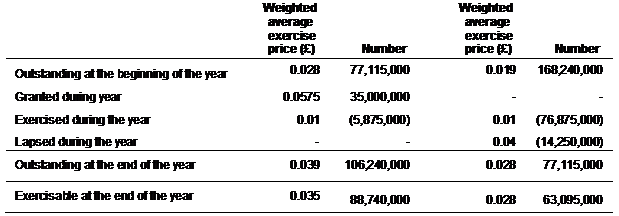 |
The contracted average remaining life of warrants at 31 December 2025 was 2.34 years (2024: 2.28 years).
19. Share based payments continued
At 31 December 2025, the Group and Company had the following warrants in issue:
|
|
19 April |
6 February |
20 August |
|
Date of grant |
2021 |
2023 |
2025 |
|
Number outstanding |
34,990,000 |
38,125,000 |
35,000,000 |
|
Expected life (years) |
1.67 |
1.33 |
4.5 |
|
Exercise price (£) |
0.05 |
0.01 |
0.0575 |
|
Volatility |
113% |
266% |
52.57% |
|
Risk free rate |
0.77% |
3.550% |
4.64% |
The fair value of warrants is determined using the Black-Scholes valuation model. The charge to the profit and loss was
£444,446 (2024: £87,557).
20. Financial Risk Management
The Group and Company has exposure to the following risks and uncertainties:
Financial risk
Financial risk arises through the Group and Company's holdings in financial assets and financial liabilities. The key financial risk is that proceeds from financial assets are insufficient to fund obligations arising from distributions to its shareholders as they fall due. The most important components of financial risk are interest rate risk, foreign currency risk and liquidity risk.
Risk amounts are monitored to ensure these are maintained within permissible ranges based on the Group and Company's economic capital model and are reported to the Board of Directors.
Interest rate risk
The Group and Company' operating cash flows are substantially independent of changes in market interest rates.
The Group and Company does not have any debt and thus is not exposed to any interest rate risk.
Market risk
The Group and Company's market risk is attributable to the financial instruments that are held at fair value through profit and loss. The potential that future changes in market conditions may make an instrument less valuable, due to fluctuations in security prices, as well as interest and foreign exchange rates. Market risk is directly impacted by the volatility and liquidity in the markets in which the related underlying assets are traded.
Sensitivity analysis
The following table considers the impact on net profit or loss based on a given movement in the fair value of all the investments.
|
|
2025 £ |
2024 £ |
|
10% increase or decrease in fair value |
57,786 |
84,022 |
|
20% increase or decrease in fair value |
115,573 |
168,043 |
|
30% increase or decrease in fair value |
173,359 |
252,065 |
Liquidity risk
Liquidity risk is the risk that the Group and Company will encounter difficulty in meeting the obligations associated with its financial liabilities. The Group and Company's policy and approach to managing liquidity is to ensure, as far as possible, that it will always have sufficient liquidity to meet its liabilities when due, under both normal and stress conditions, without incurring unacceptable losses or risking damage to the reputation of the Company
Foreign currency risk
The Group and Company undertakes certain transactions denominated in currencies other than pound sterling, hence exposures to exchange rate fluctuations arise. The fair values of the Group and Company's investments that have foreign currency exposure at 31 December 2025 are shown below:
|
20.Financial Risk Management continued |
|
||||
|
|
|
2025 |
|
2024 |
|
|
|
CAD £ |
|
USD £ |
CAD £ |
USD £ |
|
Fair value of investments |
127,765 |
|
450,099 |
135,798 |
479,418 |
The Group and Company accounts for movements in fair value of financial assets in the comprehensive income. The following table illustrates the sensitivity of the equity in regard to the Group and Company's financial assets and the exchange rates for £/ Canadian Dollar and £/ US Dollar.
It assumes the following changes in exchanges rates:
- £/CAD +/- 20% (2024: +/- 20%)
- £/USD +/- 20% (2024: +/- 20%)
The sensitivity analysis is based on the Group and Company's foreign currency financial instruments held at each balance
sheet date.
If £ Sterling had weakened against the currencies shown, this would have had the following effect:
|
|
2025 |
|
2024 |
|
|
CAD £ |
|
USD £ |
CAD £ |
USD £ |
|
Increase in fair value of investments 25,553 |
|
90,020 |
27,160 |
95,884 |
If £ Sterling had strengthened against the currencies shows, this would have had the following effect:
|
|
2025 |
2024 |
|||
|
|
CAD £ |
|
USD £ |
CAD £ |
USD £ |
|
Reduction in fair value of investments |
21,294 |
|
75,016 |
22,633 |
79,903 |
The Company's functional and presentational currency is the pound sterling. Pound sterling is the functional currency as it is the currency of the primary economic environment in which the entity operates.
Credit risk
The Group and Company's credit risk is attributable to cash and cash equivalents.
The Group and Company's investment policy is to utilise its experience in the Centralised and Decentralised Finance Sector to obtain yield income in excess of what could be obtained by conventional banking, whilst at the same time holding sufficient cash with its conventional banks to meet day to day investment and working capital requirements. This policy introduces risk in that these deposits are held via Smart Contracts. Some Smart Contracts in the past have been hacked, resulting in loss of some or all deposits. The Group and Company assesses the way that its Centralised and Decentralised partners assess which Smart Contracts to deposit with so as to minimise this risk
Capital Management
As in previous years, the Group and Company defines capital as issued capital, reserves and retained earnings as disclosed in statement of changes in equity. The Group and Company manages its capital to ensure that the Group and Company will be able to continue to pursue strategic investments and continue as a going concern. The Group and Company does not have any externally imposed financial requirements.
21. Financial InstrumentsSet out below is an overview of financial instruments held by the Group and Company
Group Company
|
|
|
2025 |
2024 |
|
2025 |
2024 |
|
Notes |
£ |
£ |
|
£ |
£ |
|
|
Financial assets at fair value through profit and loss |
|
|
|
|
|
|
|
Investments excluding SAFE notes |
11 |
271,415 |
516,003 |
|
271,415 |
516,003 |
|
Total |
|
271,415 |
516,003 |
|
271,415 |
516,003 |
|
Financial assets at amortised cost |
|
|
|
|
|
|
|
Trade and other receivables |
12 |
870,000 |
- |
|
907,165 |
39,543 |
|
Cash and cash equivalents |
13 |
165,151 |
188,079 |
|
127,985 |
148,535 |
|
Total |
|
1.035.151 |
188,079 |
|
1,035,150 |
188,078 |
|
Financial assets at amortised cost |
|
|
|
|
|
|
|
Trade payables |
16 |
89,525 |
34,874 |
|
89,525 |
34,874 |
|
Other payables |
16 |
156,431 |
782,418 |
|
156,431 |
782,418 |
|
Total |
|
245,956 |
817,292 |
|
245,956 |
817,292 |
The following tables represents the Group and Company's, financial instruments that are measured at fair value:
Fair value measurement
|
|
Note |
Level 1 £ |
Level 2 £ |
Level 3 £ |
|
At 31 December 2025 Digital assets and tokens |
10 |
27,705,013 |
- |
- |
|
Investments |
11 |
33,920 |
306,449 |
237,495 |
|
At 31 December 2024 Digital assets and tokens |
10 |
38,686,725 |
- |
- |
|
Investments |
11 |
36,030 |
324,214 |
479,973 |
22. Related party transactions
Full details of directors' remuneration are provided at Note 8 to these financial statements.
The Company made payments to the following companies controlled by the Directors in relation to their directors' fees, consultancy fees and expenses
|
|
2025 £ |
2024 £ |
|
Dark Peak Services Limited - NJ Lyth |
- |
222,056 |
|
Marallo Holdings Inc - MS Edwards |
220,800 |
465,457 |
|
Toro Consulting Limited - J Bixby |
389,828 |
672,961 |
At year-end £Nil (2024: £258,000) was owing to M Edwards, £67,854 (2024: £329,000) to J Bixby and £Nil (2024: 216,960) to N Lyth. These amounts have been included in trade and other payables and accruals (refer Note 17).
As disclosed in the Directors Report, Toro Consulting Limited is a significant shareholder, with a 23.37% interest in the share capital of the Company Toro Consulting Limited is controlled by director J Bixby.
22. Related party transactions continued
During the current year, as part of the share buyback process (refer to Note 18), the entire shareholding of Supernova Digital Assets PLC was acquired. MS Edwards and NJ Lyth are directors of Supernova Digital Assets PLC.
 |
In August 2025 (2024: Nil), the Directors were granted share options (refer to Note 19). The following companies controlled by the Directors stated below, received shares:
The following Directors exercised their options during the current and prior year
|
|
2025 Number of shares issued |
2024 Number of shares issued |
|
|
TV Le Druillenec |
2,000,000 |
|
- |
|
NJ Lyth |
- |
2,000,000 |
|
|
MS Edwards |
- |
5,000,000 |
|
|
J Bixby |
- |
10,000,000 |
|
|
J Hives |
2,000,000 |
500,000 |
|
The following companies controlled by the Directors stated below, purchased shares:
|
|
2025 |
|
2024 |
|
Number of shares purchased |
|
Number of shares purchased |
|
|
Toro Consulting Ltd - J Bixby |
|
- |
21,666,667 |
|
Marallo Holdings Inc - MS Edwards |
|
- |
10,583,333 |
23. Ultimate Controlling Party
The Company considers that there is no ultimate controlling party.
24. Post Balance Sheet Events
The Company has changed the Group's corporate structure by putting in place a new Gibraltar incorporated company as the parent company of the Group. Phoenix Digital Assets (Gibraltar) PLC ('New Phoenix') was incorporated as a public limited company limited by shares in Gibraltar on 8 December 2025.
The Company was listed on the Access segment of the Aquis Stock Exchange Growth Market until 27 January 2026. Phoenix Digital Assets (Gibraltar) Plc took over the listing with effect from 28 January 2026.
On 27 January 2026, New Phoenix acquired the entire issued share capital of Old Phoenix and thus each Shareholder in Old Phoenix will receive one New Phoenix Share for each Old Phoenix Share that it held. All assets and liabilities were transferred from Old Phoenix to New Phoenix on 27 January 2026.The assets and liabilities were transferred at their carrying values, which are considered to be the same as the fair value.
At 27 January 2026. New Phoenix became the new parent company of the Group and Old Phoenix became a wholly owned subsidiary of New Phoenix.
The Company was previously a public limited Company registered under the name Phoenix Digital Assets PLC. On 10 February 2026 the Company was re-registered as a private Company under the name Phoenix Digital Assets Limited.
RNS may use your IP address to confirm compliance with the terms and conditions, to analyse how you engage with the information contained in this communication, and to share such analysis on an anonymised basis with others as part of our commercial services. For further information about how RNS and the London Stock Exchange use the personal data you provide us, please see our Privacy Policy.

Latest directors dealings
- 2 hours ago On The Beach Group
- 3 hours ago Foxtons Group
- 4 hours ago Canal+ SA
- 4 hours ago Harworth Group
- 4 hours ago Schroder British Opportunities Trust