
Annual Results
Summary by AI BETAClose X

The information contained within this announcement is deemed by the Company to constitute inside information pursuant to Article 7 of EU Regulation 596/2014 as it forms part of UK domestic law by virtue of the European Union (Withdrawal) Act 2018 as amended. Upon the publication of this announcement via a Regulatory Information Service, this inside information is now considered to be in the public domain.
Onward Opportunities Limited
("Onward Opportunities" or the "Company")
Annual Results
Onward Opportunities Limited (AIM: ONWD), the investment company targeting opportunities in smaller companies within the UK, today reports its audited annual results for the year ended 31 December 2025.
Highlights for the reporting period to 31 December 2025 include:
· Strong one-year NAV performance in FY25
o All-time high Net Asset Value ("NAV") of 143.7 pence per share at 31 December 2025, equating to an audited NAV increase of +11.1% over 12 months, reflecting another encouraging period of investment performance
· Continued outperformance since inception
o Top quartile NAV performance of +50.2% since inception in March 2023, furthering the Company's track record of strong performance versus its target returns and comparator indices
o Outperformed the AIM All Share Index Total Return since inception by +49.8% and the UK Small Cap Index Total Return by +13.1% over the same period
o NAV outperformance relative to peers in the AIC UK Smaller Companies Sector, ranking 3rd in Sector since inception
o Despite challenging market conditions for UK smaller companies, the Company outperformed its target of generating absolute returns of +15% per annum since inception
· Company 12-month Total Shareholder Return ("TSR") to 31 December 2025 of +7.6%, contributing to a Total Shareholder Return of +48.0% since inception
· Completed five capital raises during FY25, each with an issue price at a premium to the prevailing NAVs at the time of issue. These totalled £7.5m and meant that the Company was again one of the top 20 most successful investment companies and trusts at raising capital on the London Stock Exchange
· Post period end, the Company completed its largest single capital raise since inception of £4.5m in early January 2026
Performance Table as at 31 December 2025
|
|
H2 2025 6-months |
FY25 1-Year |
2-Year |
Since Inception |
|
ONWD Total NAV Return 'investment performance'
|
+11.9% |
+11.1% |
+34.9% |
+50.2% |
|
ONWD Total Shareholder Return
|
+11.7% |
+7.6% |
+44.4% |
+48.0% |
Portfolio Update
· Top five contributors to returns in FY25 were Audioboom (+£3.5m), Rent Guarantor Holdings (+£1.6m), Pebble Beach Systems (+£1.0m), Springfield Properties (+£910k), and Angling Direct (+£840k)
· Five largest detractors from FY25 returns were investment declines at Synectics (-£1.4m), MPAC Group (-£1.2m), React Group (-£760k), Vianet (-£620k), and Northcoders (-£570k)
· New core holding post period end - 8% of NAV deployed into Fintel, a UK proprietary data and compliance services business for the financial services sector trading at a deep discount to precedent transaction values for both of its divisions
Laurence Hulse, Founder & Lead Fund Manager, said:
"To have delivered a NAV return of +11.1% for 2025, which contributes to a +50.2% return since inception in 2023, has been the best possible way by which to thank our supportive and expanding shareholder base. The Company is now fast approaching £50m in capitalisation for the first time. It was particularly pleasing to deliver shareholders both an all-time high in NAV per share (143.7p) and ONWD share price (148p) for the second year in succession.
Our investment strategy and its ability to identify companies with idiosyncratic catalysts trading at fundamentally mispriced valuations drove our absolute and relative performance. Exceptional performances from five of our holdings more than offset weakness elsewhere in our concentrated portfolio. While some of these suffered frustrating years operationally, this leaves potential upside to come alongside opportunities in our active pipeline for future investments.
2026 is reputedly the year of the fire horse; symbolising bold action, perseverance and success. Let us see. For now, Onwards."
Andrew Henton, Chairman, added:
"2025 has been another successful year for the Company. As the all-important three-year milestone approaches, the track record associated with the Investment Manager's consistent application of its disciplined process is very pleasing. The geopolitical and macro-economic uncertainty has seemingly become perennial as an investment backdrop for the fund, but this has not impaired value creation from its intelligence led stock picking. Against this backdrop it was pleasing to see a number of supportive shareholders disclose a greater than 5% shareholding in the company in recent months as interest in the strategy grows. There is no reason to suppose that the Company will stop identifying grossly undervalued opportunities on the junior UK market in 2026, helping to catalyse value creation therein for both these new and existing investors."
|
FOR FURTHER ENQUIRIES |
|
|
|
|
|
Onward Opportunities Limited Andrew Henton, Chairman
|
Tel: +44 (0)20 3416 9143 hello@dowgate.co.uk |
|
Dowgate Wealth Limited (Portfolio Manager) Laurence Hulse, Lead Fund Manager
|
Tel: +44 (0)20 3416 9143 hello@dowgate.co.uk |
|
Cavendish Capital Markets Limited (Nominated Adviser and Broker) Ben Jeynes - Corporate Finance Chris West / Matt Lewis - Sales and Corporate Broking
|
Tel: +44 (0)20 7220 0500 |
|
Houston (PR advisers) Charlie Barker / Nick Jackman
|
Tel: +44 (0)77 3303 2695 Onward@houston.co.uk
|
To find out more, please visit: www.onwardopportunities.co.uk
Annual Report and Audited Financial Statements
for the year ended 31 December 2025
Highlights in the reporting period to 31 December 2025 include:
Company Update
· Strong one-year NAV performance in FY25
o All-time high Net Asset Value ("NAV") of 143.7 pence per share at 31 December 2025, equating to an audited NAV increase of +11.1% over 12 months, reflecting another encouraging period of investment performance
· Continued outperformance since inception
o Top quartile NAV performance of +50.2% since inception in March 2023, furthering the Company's track record of strong performance versus its target returns and comparator indices:
o Outperformed the AIM All Share Index Total Return since inception by +49.8% and the UK Small Cap Index Total Return by +13.1% over the same period
o NAV outperformance relative to peers in the AIC UK Smaller Companies Sector, ranking 3rd in Sector since inception
o Despite challenging market conditions for UK smaller companies, the Company outperformed its target of generating absolute returns of +15% per annum since inception
· Company 12-month Total Shareholder Return ("TSR") to 31 December 2025 of +7.6%, contributing to a Total Shareholder Return of +48.0% since inception
· Completed five capital raises during FY25, each with an issue price at a premium to the prevailing NAVs at the time of issue. These totalled £7.5m and meant that the Company was again one of the top 20 most successful investment companies and trusts at raising capital on the London Stock Exchange
· Post period end, the Company completed its largest single capital raise since inception of £4.5m in early January 2026
Performance Table as at 31 December 2025
|
|
H2 2025 6-months |
FY25 1-Year |
2-Year |
Since Inception |
|
ONWD Total NAV Return 'investment performance'
|
+11.9% |
+11.1% |
+34.9% |
+50.2% |
|
ONWD Total Shareholder Return
|
+11.7% |
+7.6% |
+44.4% |
+48.0% |
Portfolio Update
· Top five contributors to returns in FY25 were Audioboom (+£3.5m), Rent Guarantor Holdings (+£1.6m), Pebble Beach Systems (+£1.0m), Springfield Properties (+£910k), and Angling Direct (+£840k)
· Five largest detractors from FY25 returns were investment declines at Synectics (-£1.4m), MPAC Group (-£1.2m), React Group (-£760k), Vianet (-£620k), and Northcoders (-£570k)
· New core holding post period end - 8% of NAV deployed into Fintel, a UK proprietary data and compliance services business for the financial services sector trading at a deep discount to precedent transaction values for both of its divisions
Laurence Hulse, Founder & Lead Fund Manager, said:
"To have delivered a NAV return of +11.1% for 2025, which contributes to a +50.2% return since inception in 2023, has been the best possible way by which to thank our supportive and expanding shareholder base. The Company is now fast approaching £50m in capitalisation for the first time. It was particularly pleasing to deliver shareholders both an all-time high in NAV per share (143.7p) and ONWD share price (148p) for the second year in succession.
Our investment strategy and its ability to identify companies with idiosyncratic catalysts trading at fundamentally mispriced valuations drove our absolute and relative performance. Exceptional performances from five of our holdings more than offset weakness elsewhere in our concentrated portfolio. While some of these suffered frustrating years operationally, this leaves potential upside to come alongside opportunities in our active pipeline for future investments.
2026 is reputedly the year of the fire horse; symbolising bold action, perseverance and success. Let us see. For now, Onwards."
Andrew Henton, Chairman, added:
"2025 has been another successful year for the Company. As the all-important three-year milestone approaches, the track record associated with the Investment Manager's consistent application of its disciplined process is very pleasing. The geopolitical and macro-economic uncertainty has seemingly become perennial as an investment backdrop for the fund, but this has not impaired value creation from its intelligence led stock picking. Against this backdrop it was pleasing to see a number of supportive shareholders disclose a greater than 5% shareholding in the company in recent months as interest in the strategy grows. There is no reason to suppose that the Company will stop identifying grossly undervalued opportunities on the junior UK market in 2026, helping to catalyse value creation therein for both these new and existing investors."
Chairman's Statement
Onward Opportunities Limited ("ONWD" or "the Company") was incorporated on 31 January 2023, and the shares issued at its Initial Public Offering ("IPO") were admitted for trading on the Alternative Investment Market ("AIM") of the London Stock Exchange ("LSE") on 30 March 2023. These accounts have been prepared for the 12-month accounting period covering 1 January 2025 to 31 December 2025.
As at 31 December 2025 the net asset value ("NAV")[1] per share was 143.7p and the share price 148p, representing a premium to NAV of 3.0% and a NAV performance of +50.2% since inception, a pleasing set of figures to reflect on as we approach our three-year anniversary since launch.
Portfolio performance
During the year under review ONWD delivered a NAV return of 11.1%, outperforming the AIM All Share Index Total Return by 2.6%. In both absolute and relative terms this is a very pleasing result, building as it does to a NAV appreciation of over 50% since inception nearly three years ago.
Despite the headline performance, 2025 was a challenging year. A principal tenet of the ONWD investment philosophy is that our chosen opportunity set (companies listed on AIM) is an inefficient market in which high quality assets can be grossly mispriced. It is to be expected that the market will usually be playing catch up - the Investment Manager identifies and buys undervalued companies before the market does and then sells those positions once valuation discounts close. This notwithstanding, the stomach-churning lurches in UK equity markets during the first half of 2025 demanded cool heads, and confidence in the quality of stock selection based on rational earnings analysis when other investors were selling names indiscriminately. Seen in this context, the 2025 performance highlights three elements of the investment strategy that should underpin future returns.
Firstly, the Investment Manager continues successfully to seek out companies with idiosyncratic value catalysts. 2025 was another year when the most common such catalyst was private equity or strategic investors making public offers. Windward was the most dramatic exemplar of this approach for ONWD but the Investment Manager's report highlights a number of other similar situations, most recently the speculated interest in one of the Company's largest investments; Audioboom. Secondly, the detailed analysis performed by the Investment Manager consistently identifies businesses with an undervalued earnings potential or a discounted valuation to intrinsic value These businesses have proven both resilient and flexible in the face of macro events (tariffs and taxes included). Thus, if investee company shares get sold off as part of an indiscriminate market rout, their quality means those shares can also bounce back most quickly as market conditions normalise. Pebble Beach Systems and Angling Direct are two examples of such companies, both delivering earnings upgrades during periods of volatility. Thirdly, the so called "nursery" affords the Investment Manager flexibility to take smaller positions which can be traded up or down, creating optionality in a way not typically associated with a portfolio of thinly traded smaller companies. Audioboom is a good case study in this regard.
These different threads of the ONWD investment strategy are complimentary and, as we approach the three-year anniversary of the fund, now have a demonstrable track record evidencing repeatability. This creates confidence about future portfolio performance, whatever market conditions prevail.
Positioning at the start of 2026
The Investment Manager started 2026 with both an attractive portfolio, but also an extensive bank of researched and highly attractive new investment opportunities. The Company raised an additional £4.5m in January 2026 specifically to take advantage of some of those opportunities. This follows a series of smaller fund raisings during 2025 which collectively raised £7.5m. There remains what can be described as a "target rich environment" for ONWD's investment strategy, which has scope to scale well beyond the current size of the company. We are therefore optimistic about prospects in 2026. One such example would be the recent deployment of proceeds into a new core holding; Fintel - graduating from the nursery where it sat for part of 2025. This investment has got off to a pleasing start with an early re-rating as our share purchases cleared an 'overhang' associated with a selling fund managing redemptions with outflows, and then an encouraging earnings update.
Growing the fund
As ONWD both approaches its three-year anniversary and a market capitalisation of £50m, a number of "resistance points" that have hitherto prevented some institutional investors from buying shares will fall away. Many portfolio managers require a minimum three-year track record and have a minimum fund size threshold that must be crossed before companies such as ONWD can be bought. The first years after a fund's launch will always be arduous, and we are now well positioned to capitalise on what has already been achieved. It has not been a coincidence that there has recently been a step-up in 5% threshold TR-1 holdings announcements from institutions including Callanish Capital and Rathbones. It was no mean feat for an investment company that invests in UK equities to be awarded the 'Best Use of AIM Award 2025' in a period of record outflows for UK equity funds. The award is designed to recognise growth and use of capital markets, so is testament to what the Investment Manager has managed to achieve alongside portfolio management duties.
A prime focus for the Board over the next twelve months will thus be increasing the shareholder base and liquidity of the shares. Whilst creating value for shareholders from NAV appreciation will always be the objective, as a Board and team we passionately believe in the importance of a dynamic SME sector for the long-term growth of the wider economy. We want both to highlight the opportunities presented by smaller companies, and also to showcase the attraction of ONWD as a well-managed vehicle by which to conveniently and easily capture those opportunities. In so doing we hope to attract capital to a most deserving and important part of the UK's commercial eco-system. "Getting the word out" will involve a more deliberate communications programme across multiple channels and platforms with a strong social media bias. Work has already commenced in this regard, and we will be drawing heavily on the charisma and eloquence of our lead manager.
Whilst social media is important, your Board has also very much enjoyed direct engagement with shareholders at "face to face" events in London during 2025. These will remain a recurring feature of our investor relations programme, and I hope we get the opportunity to meet more of you during 2026. Shareholders can contact hello@dowgate.co.uk for more details.
Jay Patel
The sad and unexpected passing of Jay Patel during 2025 was undoubtedly the cloud which marred the year. Jay had been very intimately involved with the genesis and launch of ONWD, both as a staunch supporter of the fund concept and then as a valuable source of insight and challenge as a member of the Investment Committee. He was a man who wore his intellect and wisdom lightly, with no bombast or ego, and was a consistent source of valued counsel. He is sadly missed but fondly remembered by the ONWD team, and I sincerely hope that the future success of the Company will become part of his legacy.
Conclusion
2025 has been another important year in the development and maturation of ONWD. Investment performance has been solid, which has both rewarded those early investors who showed faith in the Company but also served to attract new shareholders. We enter 2026 with a quiet confidence that is borne of now proven processes, and a rich universe of opportunity for our strategy.
On behalf of the Board, I thank all of our investors for their support over the past year, and we look forward to welcoming many more new investors over the years and months to come.
Andrew Henton
Chairman
27 February 2026
Portfolio Manager's Report
Introduction
This has been a year of comebacks as 2025 saw a second half return for UK indices, precious metals, and rate cuts …. And similar comebacks for the Gallagher brothers, Gladiator II, tax rises and the ancient hobby of kite flying. For its part, Onward had its very own bounce back as it delivered some of its best quarters since launch, following a challenging first half; our snow leopard had to cross a ravine of sorts. 2025 was thus a dramatic year for investors that started with a crisis and ended with a crescendo; a trade war followed by rising asset prices across the spectrum. Onward Opportunities experienced this in a pronounced fashion as an investor in smaller companies on the London Stock Exchange; there was a 34% trough to peak rally in the Company's share price from April 22nd to 31st December which saw the shares close the year at their all-time high of 148p.
Markets are renowned for their ability to 'look through' and price ahead, and didn't they just! Any of; tariff induced trade wars, open conflict between Israel and Iran, attacks on trade shipping in various international waters, record tax rises from the most unpopular government in living memory and a UK economy drifting toward a possible technical recession would usually have led to a poor year for equity investors. But all UK indices other than the AIM market had one of their best years since 2016. The spread between the UK 100's 21.5% return and the UK 250's 8.9% is a reminder of the danger of domestic 'black holes' but has perhaps nonetheless started a gravitational pull out of the abyss where UK equity funds have found themselves for a number of years. This may well be because markets are equally well-known as "weighing machines"; whilst the last few years have been torrid, valuations of UK equity markets have been even more challenged and thus it is by now surely 'in-the-price' - if not more. Whilst it remains better to find conviction in individual businesses than in the macro narrative that surrounds them (which is precisely why this Company exists) we happily admit to preferring dawns to dusks. The chart below shows how much of the UK indices strong performance was attributable to things just not getting any worse - the drift of the UK 250 versus the global indices has seemingly hit a floor. Mean reversion would therefore offer even greater upside to come. Longstanding shareholders of Onward will recall this timing and valuation opportunity was the investment thesis behind this Company's foundation. Almost three-years in we are starting to see tentative signs that just maybe we were correct.
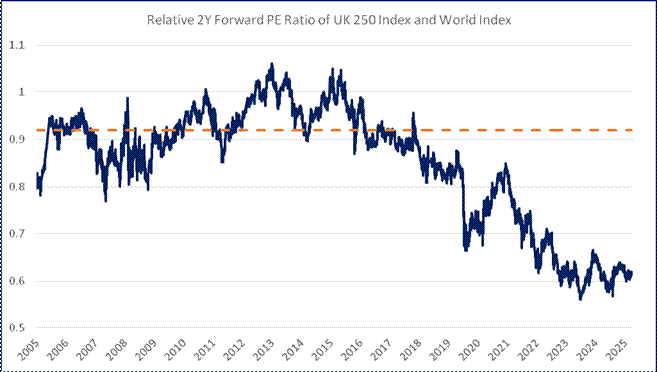
Source: Bloomberg data as at 11 02 2026
For Onward, 2025 was a year of two distinct halves and one very clear lesson: when investing in UK smaller companies, holding cash is not necessarily a drag - it is a competitive advantage when volatility returns and liquidity vanishes. The same is true of our closed-ended fund structure and the two advantages go hand-in-hand. Open-ended fund structures demonstrably struggle with market volatility and cannot exploit large liquid reserves for such times because they must anticipate redemptions and have restrictions on holding liquid reserves (cash). The first half was defined by sharp politically driven swings and a liquidity event early in the year, which created a smaller companies market that repeatedly tried to price all companies as if they were exposed to the same macro risks. The second half reminded us why we do what we do: idiosyncratic catalysts, self-help, and selective "public-to-private" value in plain sight that can still compound - even when the crowd is missing and the floodlights are off in the UK. We were able to capitalise on this volatility with the large 20% cash weighting that was built up during the first quarter from inflows and realised profits.
By year end, the Company closed at new all-time highs for both NAV and share price. The NAV reached 143.7p at 31 December 2025, delivering +11.1% NAV total return over FY25 and taking NAV total return since launch (30 March 2023) to +50.2%. The shares closed 2025 at 148p, producing +7.6% share price total return over FY25 and +48.0% since launch. Importantly, this is not a "rising tide" story. The AIM All Share Index Total Return (from where almost all of our investments are sourced and listed) delivered +8.5% in 2025, while Onward's NAV return was +11.1% - a reminder that absolute returns are crucial, but only sustainable if a strategy can also outperform a rising market; an area where most active funds have struggled versus passive alternatives in recent years. The outperformance of Onward versus the AIM market since inception is now extended to 49.8%.
Against this backdrop, the Company again also continued to scale. At 31 December 2025, total net assets were £42.7m, with 29,691,188 shares in issue. This growth has not been accidental. The increase in the fund's size of over 33% in a funds market that again suffered torrid outflows is proving that the Company is seen to be a repeatable and compelling investment proposition to new and existing investors. Despite the UK 100 Index reaching all-time highs in 2025, the £9.55bn outflows from UK funds came at a similar level to 2024's £9.56bn and marked the tenth consecutive year of withdrawals. 2025 was the worst year for equity fund flows since Calastone started recording the data. We are so grateful for shareholders' support in such uncertain times. It demonstrates a level of conviction on the part of shareholders to match Onward's own contrarian investment beliefs.
As always, shareholders should also remember one of the most important layers to the story: the team's 'skin in the game'. The Board of directors hold c.£300k of stock purchased since launch and the investment committee and lead manager reported during the year a peak £3.3m of "skin in the game", which again grew in the year before tragedy struck and we must share one of the Company's few low-lights since launch.
Investment Committee member and long-time friend of the team Jay Patel passed away unexpectedly at 56 years of age in the second half of the year. We have known Jay for many years, having experienced his value creation capabilities and work ethic firsthand as shareholders in IMI Mobile, which was a tremendously successful investment for this team in a past life. We were delighted when he agreed to join the investment committee at a concept stage for Onward and stated a desire to make a material investment as he also recognized the value on offer in UK smaller companies. Many investors got to meet him for the first and sadly last time at Onward's inaugural investor day during the summer when he was able to talk about arguably his biggest contribution to the fund which was his work helping us to understand Windward's software and its value. Within two years Windward joined IMI Mobile as one of the most successful investments for this team. Jay's sad passing is the reason why the investment committee's aggregated skin in the game has recently dropped to £2.6m; he had put his money where his mouth is. An avid Liverpool fan, Jay made sure your manager never felt they were walking alone during a daunting fundraising trail in 2023 and those early investments. Work is progressing to appoint a suitable new member of the Investment Committee and shareholders will be updated when appropriate.
The key highlights for the year have been:
1. Delivering new all-time highs for shareholders in both the share price and NAV per share
2. Further widening of the outperformance versus the benchmark: the ONWD NAV is now +49.8% ahead of the AIM All Share Total Return Index
3. The strategy got a chance to demonstrate to investors how it handles a crisis
4. Demonstration of a portfolio built for outcomes: performance was driven by catalyst execution at five key holdings whilst the rest of the portfolio suffered with the rest of the UK economy
5. Continued scalable demand for the strategy: the Company was again one of the top 10 capital raisers amongst investment companies on the LSE, growing the trust by 33% to well in excess of £40m
6. Proof that the "nursery + core" construction can be very additive: the year saw outsized contribution from the nursery - most visibly Audioboom (later upweighted to a core holding), Rent Guarantor, and Pebble Beach.
Top Holdings Table as at 31 December 2025
|
Holding |
£ Value |
% of Net Assets |
Thesis Summary |
Catalysts |
Total Return % |
|
Audioboom |
£5.47m |
12.7% |
Scale + operating leverage in podcasting; improving cash conversion; strategic optionality |
H2 advertising seasonality, contract roll offs, margin/cash inflection, potential strategic activity |
148.8% |
|
Angling Direct plc |
£3.82m |
9.0% |
Margin recovery + operational execution; asymmetric upside from strategic refinement |
UK execution, capital allocation, clarity on non-UK strategy, continued operational delivery |
51.5% |
|
Springfield Properties plc |
£3.20m |
7.5% |
De leveraging + land monetisation; recovery optionality as housing affordability improves |
Land disposals, balance sheet de risking, policy/affordability tailwinds as rates ease |
57.6% |
|
RentGuarantor Holdings |
£2.80m |
6.6% |
Platform exposure to structural change in UK lettings; scalable underwriting model |
Legislative/regulatory tailwinds, partner growth, underwriting scale and unit economics |
130.4% |
|
Likewise Group plc |
£2.72m |
6.4% |
Share gains + operating leverage in flooring distribution |
Housing transaction recovery, utilisation/mix, competitor strain, margin expansion |
4.5% |
|
Synectics plc |
£2.66m |
6.2% |
Software led security systems; cyclical recovery potential; strategic asset optionality |
Contract wins, margin progression, recovery in customer capex cycles |
(9.2)% |
|
Transense Technologies plc |
£2.34m |
5.5% |
Under the radar tech with royalty underpin + pipeline optionality |
Conversion of tyre monitoring & sensor pipelines, design ins, scaling commercial execution |
20.6% |
|
Pebble Beach Group |
£2.29m |
5.4% |
Mission critical infrastructure software; operational progress meeting valuation catch up |
New customer wins, recurring revenue growth, operating leverage |
84.6% |
|
Light Science Technologies |
£1.87m |
4.4% |
Specialist technology exposure; valuation catch up as execution improves |
Delivery milestones, commercial traction, better market recognition |
71.7% |
|
Holding |
£ Value |
% of Net Assets |
Thesis Summary |
Catalysts |
Total Return % |
|
Alumasc Group plc |
£1.82m |
4.3% |
Quality building product brands; pricing power; self-help through cycle |
Cost action, demand stabilisation, margin resilience, potential strategic interest |
12.3% |
|
Nursery holdings (13) & cash |
£13.7m |
32.0% |
Diversified set of idiosyncratic opportunities |
Mix of earnings upgrades, corporate activity, and self help |
n/a |
Note: "Other holdings & cash" is the residual derived from Net Assets (£42.7m) less disclosed top‑10 values; weights are from the top‑10 disclosure.
Performance
Portfolio Performance (displayed to 31 December 2025)
The Company delivered a strong finish to the year. The NAV closed 2025 at 143.7p, up +11.1% over the year versus the audited 31 December 2024 NAV, and the shares closed at 148p. Both represent all-time highs and were well in excess of any price where capital has been raised from investors that year.
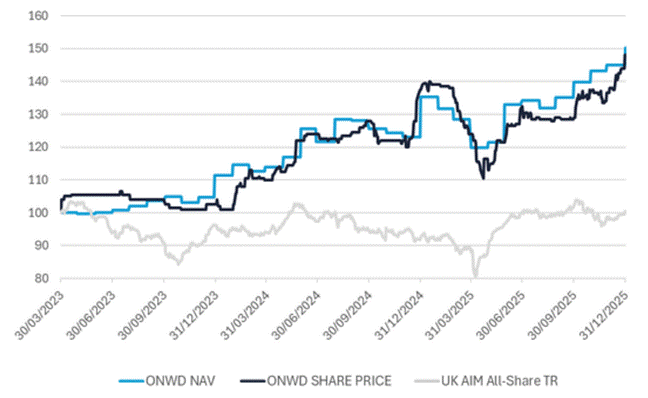
The shape of returns mattered. H1 was defined by volatility and a portfolio that, at times, had to work very hard simply to stand still. At the end of 2024 there had been a palpable Christmas cheer to investors as an incoming Trump administration and AI-driven tech boom sparked hopes of a return to animal spirits for the first time since 2021. Meanwhile in the UK the Chancellor confounded the most brilliant scientific minds with an ability to conjure black holes at will in a way that confounded physics' 'Theory of Everything' with a fiscal 'theory of nothing'. For Onward, domestic and international political volatility created an intense period of highs and lows during the first half.
The Company's first breakout moment (the acquisition of Windward at the end of 2024) gave way to a difficult period of investment performance. Almost half of our +35% NAV returns in the 18-months since we had launched were given back during a highly volatile three months for global asset prices as fears of a trade war intensified. Reassuring updates from a number of our investments, combined with a global relief rally, drove dramatic bounce backs in their share prices which saw losses all but recovered in the second quarter. Shareholders had the chance to learn much about their manager and investments in these arduous six months.
Companies build their reputations with how they handle crises and both the Manager and the portfolio holdings have been given a chance to demonstrate to investors how they handle such volatile circumstances. Of particular highlight was a demonstration of how its investment committee structure enables Onward to run cash balances with discipline.
We had tactically built-up cash reserves in the first couple of months of 2025 from the takeout of Windward (13% NAV), a capital raise (4% NAV) and exiting our first investment into Audioboom from the nursery for a c.+100% return in four months (4% NAV) at c.600p (we would later in the year reinvest as a core holding at 270p). Rather than any prophetic views on US trade policy, this positioning reflected the team having instinctive concerns around an upcoming 'spring statement' by the Chancellor and optimistic sentiment on both sides of the Atlantic appearing to be stretched. The prescience proved fortuitous as we entered the tariff volatility with a c.20% cash balance. Perhaps a manager working in isolation might have been tempted to re-invest quickly off the back of a hubristic success like Windward? Or another without veteran eyes and ears around them may have been tempted to step in with purchases early on in the selloff in an attempt to catch falling knives?
Instead, the Onward team waited for the end of Q1 portfolio meeting with the Investment Committee and assessed the lie of the land. What was clear based on our combined experience was that conditions were then approaching extremities in terms of asset pricing but also the limits of political will for a vain President. Our smaller, less liquid equity holdings had been particularly punished on little volume despite good operating performance in many cases. It was concluded that the team should start to capitalize on the competitive advantage that had been cultivated for Onward (the large cash balance). The team deployed these monies into agreed new and existing holdings through the course of April, three days after what proved to be the market low. These sorts of stress tests are as valuable to the Manager as they are to the shareholders and the Board.
The second half was more recognisable: catalysts from these new and existing investments began to land, operational progress started to translate into price action, and the fund's construction once again showed why the "nursery & core" approach can be more than a marketing slide. Three nursery holdings 'graduated' into the core portfolio - Likewise, Audioboom and Pebble Beach Systems - all through early stellar performance. This return to form was magnified by the team's decision to fully deploy the tactical ~20% cash balance in April "at the lows," which mechanically increases upside capture in a market uptrend and allowed for attractively priced new ideas to add further to returns as well as offset difficulties at holding such as MPAC and Northcoders, where investment losses occurred. While Q1 was about valuation compression and Q2 was about recovery + cash deployment, H2 is notable because the main drivers are classic "Onward-style" catalysts: value realisation / strategic actions (Rent Guarantor Holdings, Springfield Properties, Roadside Real Estate), operational delivery that forces upgrades/re-rating (Pebble Beach Systems, Angling Direct) and event-driven bid dynamics beginning to reappear across the portfolio (Audioboom, Frenkel Topping). The strategy for the third year thus delivered what it was built to do: generate returns from stock specific change, and not just macro mercy. The final quarter in particular was a reminder that UK domestic stocks do not always need a macro tailwind; sometimes they just need the absence of a new headwind as they already have valuation momentum behind them. The Company delivered +7.4% NAV total return in Q4, while the AIM All Share Total Return Index was -1.7%. Much more detail on these is provided in the core portfolio discussion later in this Manager's report.
FY2025 Attribution Table - 5 most significant contributors and detractors from performance
|
Top Five Contributors |
|
Top Five Detractors |
|
|
Audioboom |
£3.50m |
Synectics |
(£1.40m) |
|
Rent Guarantor Holdings |
£1.60m |
Mpac Group |
(£1.20m) |
|
Pebble Beach Systems |
£1.00m |
React Group |
(£0.76m) |
|
Springfield Properties |
£0.91m |
Vianet |
(£0.62m) |
|
Angling Direct |
£0.84m |
Northcoders |
(£0.57m) |
Total Returns to 31 December 2025
|
Total Returns |
H2 2025 (6 months) |
FY25 (12 months) |
Two Year |
Since inception - 30 Mar 2023 |
|
ONWD NAV Total Return (TR) |
+11.9% |
+11.1% |
+34.9% |
+50.2% |
|
ONWD Total Shareholder Return (TSR) |
+11.7% |
+7.6% |
+44.4% |
+48.0% |
|
AIM All Share Index TR |
+0.3% |
+8.5% |
+4.2% |
+0.4% |
|
NAV relative vs AIM All Share Index TR |
+11.6% |
+2.6% |
+30.7% |
+49.8% |
|
TSR relative vs AIM All Share Index TR |
+11.4% |
(0.9)% |
+40.2% |
+47.6% |
Market Commentary
We spoke at the half-year about how lettuce in the stands had given way to total apathy for UK equities with the crowd leaving in droves before full time. It was the tenth consecutive year of net outflows from UK equities. The UK market has spent much of the last few years feeling like a theatre between shows - the seats still there, but the audience gone. But perhaps 2025 will be looked back upon as a year where viewers started to return albeit initially only to catch the timely trailer for 'The Odyssey' due for release in 2026. Perhaps it has been enough for some to recognise that the tickets are too cheap to ignore at the London Stock Exchange. The UK market didn't so much recover as do what Britain often does under pressure: it carried on, mildly annoyed, and then - almost by accident - produced a plucky performance that made outsiders blink.
On the scoreboard, the headline was unambiguous: the UK 100 Index delivered a 21.5% gain in 2025, its best year since 2009, closing just shy of the psychological 10k at ~9,931 by year-end and repeatedly "teetering" toward 10,000. Then, with the smug inevitability of a New Year's resolution made after two glasses of champagne, the index finally cracked 10,000 at the start of 2026. Let us hope the resolution lasts beyond 'dry January'.
But as has often been the case for recent years in UK equities, the number tells you what happened - not why it felt so strange while it was happening. The macro: a slow drip of easing, and inflation that refused to die quietly. Monetary policy in 2025 was less "turning point" and more "carefully easing the handbrake down a notch at a time". The Bank of England cut its Base Rate to 4.5% in February, then to 4.25% in May, to 4.0% in August, and to 3.75% in December - each move arriving with a familiar blend of caution, dissent, and the sense that the Committee would like credit for bravery while still keeping the exit door ajar. Meanwhile, inflation behaved like a guest who insists they're leaving, then stays in the doorway continuing the conversation. UK CPI inflation was 3.8% in August 2025 - not catastrophic, but stubborn enough to keep policymakers (and mortgage-holders) permanently squinting at every release. By December, the Bank noted CPI inflation had fallen to 3.2% versus the prior meeting - progress, yes, but still above target and not exactly a victory parade. That combination - easing rates, but sticky inflation - created a market rhythm that was more stutter-step than strut. Valuations could exhale, but most investors still held their breath.
The market was split with global market leaders listed in London typically leading the pack (as was often the case in the Onward portfolio as well). The UK's 2025 rally was not a simple "Britain is back" story. Global sectors and businesses drove outsized returns within the curious indices; mining, defence and finance were repeatedly cited as key engines of the UK's strength. There were plenty of examples of "big-stock theatre" which often precede similar if not larger moves in operationally geared smaller companies where this fund invests:
• Fresnillo having risen roughly five-fold over the year- an almost rude reminder that boring old London still contains a few explosive levers when the underlying tape turns.
• Rolls Royce and Babcock both roughly doubled amid persistent geopolitical tension and rising defence focus, continuing strong runs from 2024.
• Lloyds nearly doubled as banking shares rode the year's broader financial tailwinds.
In this context, readers are encouraged to study the AIM market's bar in the chart below:
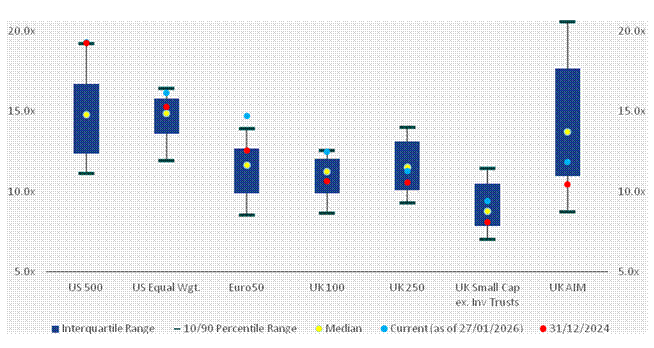
Source: Bloomberg data as at 11 02 2026
April is the time of Easter and, in the Christian faith, recognises the power of resurrection. And so ultimately it proved for UK equities and almost all other asset classes. No interesting year in markets is complete without the market deciding - briefly, theatrically - that the show's over. In 2025, the moment of drama came in early April, when tariff headlines out of the US sent investors scrambling and produced a sharp global wobble and the UK 100 Index suffering its biggest single-day fall since the start of the Covid-19 pandemic, before clawing back and returning to growth thereafter.
That episode mattered not only because it hit prices, but because it reminded everyone that 2025's optimism had a thin varnish and most investors' furniture was coated in the same, US-centric lacquer. US concentration risk became a serious allocation debate for the first time since the pandemic and so started something of a UK paradox in classic self-deprecating manner: domestic investors sold, whilst corporate and international investors increasingly bought UK equities. Large blue chips rallied as UK investors yanked money out of equity funds at a record pace. Calastone data (reported widely in early January) pointed to £6.7bn of net withdrawals from equity funds across 2025, the worst year in its history - with UK-focused funds hit hardest.
So while "allocators" were voting with their feet, "acquirers" were voting with their cheque books. 2025 saw a continued drumbeat of companies choosing to disappear from the public markets - via takeovers, take-privates, and listing migrations. Delistings included Direct Line (Aviva), Windward and Britvic (Carlsberg), while names such as IDS, Hargreaves Lansdown, Frenkel Topping and Spectris were taken private, and Wise signalled a primary listing shift to New York. The private market continues to send a message lit-up like Times-Square: public valuations may have risen in 2025, but private capital still thinks there's plenty left on the table. What was noticeable is how this has finally started to thaw the new entrant's market of IPOs and whilst the ground is still hard; there was definitely a trickle forming from a glacier of private market companies seeking liquidity. For years, the UK narrative has been "no IPOs, no excitement, no hope." Pleasingly this was markedly better than the Euronext which had its worst year ever without a major IPO and less than $1bn raised in total. In contrast PwC's IPO Watch reported that London raised £1.9bn through 11 IPOs in 2025, the strongest year since 2021, with £1.3bn raised in Q4 alone - a late-year surge that had the look of returning confidence in the market. Still, it's worth keeping perspective: a better year for IPOs is not the same as a healthy primary market.
2025 proved something important about equities: the market can rally hard even while the country feels tired. This is because the index is not the economy, it is a set of weighing scales that can recognise an imbalance such as that to where UK relative valuations had sunk. Whilst the UK is by no means leading the charts, it noticeably stopped sliding down the table and large caps have witnessed a meaningful improvement in sentiment. If what has so far been a multiples expansion can be carried forward by rate-cut led earnings recovery, then for those of us that have been hunting in the colder corners - where liquidity is thin, sentiment is thinner, and prices can lose touch from reality - dusk may well break into dawn during 2026. This bodes well for our strategy, which did not blink in the dark.
Top 10 Holdings Updates
Audioboom plc (BOOM LN) - Date of First Investment November 2024 - +444.9% IRR as at 31 December 2025
Audioboom finished the year as the largest position in the portfolio at 12.7%, with a disclosed holding value of £5.47m and 148.8% total return. The very high IRR achieved thus far was achieved by nimble profit taking and reinvestment into the company by the manager during a period in which performance has been very strong. The investment has been held twice with the company trading from below 300p to in excess of 600p, the current holding significantly, so as takeover speculation looms.
Audioboom first entered the nursery in 2024 at 250-300p and went on to deliver a series of profit upgrades that transformed the profitability and future cash generation potential of the company. The shares subsequently rallied strongly to around 600p in Q1 25 when we took profits as trade war uncertainty grew. Following the market volatility of that year we have been able to significantly reinvest in Audioboom, but this time as a core holding because:
1) the value on offer was even greater (the profits this year are higher than last year for the same price);
2) the business is now exiting the last of its onerous contracts, unlocking cash generation at the business for the first time;
3) M&A activity in the podcast sector has ticked up noticeably, with serial acquirers such as Lemonada, Netflix, Spotify and others paying valuations which are at a large premium to Audioboom's; and
4) (most importantly) our understanding of the real value of Audioboom's business model has grown substantially.
Audioboom's business model is to help podcasters produce their shows and distribute them for monetisation. In this we observe a number of attractive qualities versus an entry valuation of 0.7x sales at the point of investment. Most significantly the end markets are in structural growth, with both the volume of listeners growing each year and the amount of advertising budget committed to this growing listener count growing at an even faster rate, creating a structural tailwind for revenues for Audioboom. Within these sales, the company has an emboldening competitive advantage to advertisers; it can provide them with the same, if not more, high-quality eyeballs and earlobes for their campaigns and products at a much lower cost than, say, a TV production house or broadcaster and still make a much better margin.
This is because the cost to produce a podcast for an hour is single digit percentages of the cost of making an hour of TV. To exaggerate for effect, a podcast is three people in a room with some basic recording equipment versus a series of production sets, high paid actors, camera crews and equipment etc in TV. This is why Audioboom's margins are starting to expand and their unit economics are likely to increase further. They can charge advertisers much less than their competition and deliver the same result, whilst making a higher profit margin. Transaction activity for podcasts has picked up, particularly in the USA where Netflix, Fox and Spotify have all been seeking to acquire content.
The investment thesis remains centred on a simple asymmetry: a structurally growing end market (podcast listening and monetisation) meeting a business model that can exhibit real operating leverage as scale increases. The focus in 2026 is less about "does podcasting grow?" (it does) and more about the conversion of that growth into sustainable margin and cash generation - the point where public market valuation frameworks tend to change. We wrote earlier in the year that "the fact Audioboom is the 4th largest publisher in the US, 2nd in the UK and one of the very few that are independently listed makes them stand out as a potential strategic asset for a larger media organisation seeking a 'land grab' in this attractive market." Thus the timing of the announced strategic review, which includes courting offers for the business is intriguing and has the potential to be a material return driver for the fund in 2026 depending on which of numerous possible outcomes transpires. Reassuringly the core business is clearly trading well, recently becoming the largest publisher of video podcasters on YouTube. We look forward to further updates on the typically busy H2 advertising period around the start of the NFL season and Christmas with interest. Any earnings growth from such busy periods ought to drive upgrades and surplus cash from here given the platform nature of the business.
Angling Direct plc (ANG LN) - Date of first investment May 2023 - +28.6% IRR as at 31 December 2025
Angling Direct is the UK's leading retailer of fishing equipment and tackle. Our early returns on this investment demonstrate how we have captured dual optionality on the upside, creating an attractive asymmetric risk profile for shareholders' capital. This position represents either a growth or value investment, depending on various strategic decisions that are taken in the coming months.
The business has a dominant market position in the UK, where it is profitable and cash generative from a repeat customer base of 'anglers'. These metrics are improving materially under new management and look set to benefit from both UK consumer recovery and growth from additional store rollout, which is now accelerating.
The previous management team attempted to enter the much larger European market to provide additional earnings growth. This strategy has not matched the UK success, with over five years of annual losses that are material in the context of overall group profits, whereas the UK business generates a profit that is significantly more than the current group number (which factors in European losses). Our returns thesis is that either the European strategy starts to bear fruit imminently after years of trying and contributes profitable growth to the group, or it can be reviewed to remove the opportunity cost to management. We are now dialling up the intensity, given there has been little evidence that Europe is not an opportunity cost, dilutive to group margins and ROCE and therefore also shareholder value. Management believe that it offers a strategic hook for potential consolidators.
The Company's approach has made a material impact this year on ANG's strategy, increasing shareholder value. The team has been highly engaged with the company for over 12 months on a number of strategic matters and the recently announced capital allocation policy, including a £4m buyback, was well received by shareholders. Behind the scenes, there has been a refinement of operational elements within the strategy under new CEO Steve Crowe, the benefits of which are beginning to reveal themselves in some cracking UK divisional figures and increased growth rates. There was something reassuring about how our very first investment led the recovery out of Q1 with Angling Direct delivering a strong set of figures for a retailer in the UK that saw the shares hit a three-year high. The management team deserve credit for how they are developing what was a low growth loss making retailer five years ago. A bolder but still profitable store roll-out strategy, improving terms of supply, better store management and customer engagement came together to deliver a year of record sales for FY24 and a Q1 25 that was reportedly 17.1% ahead of that. The new 'shop the range' tactic, a loyalty app that has attracted half a million members in just 24 months, and a weakening dollar appear to be the next catalysts to take earnings further forward in the current year. We noted with interest that ANG's YouTube channel recently hit its 30 millionth viewing. We suspect the Sterling summer sunshine may have also been supportive. There is of course the additional upside that a profitable resolution one way or the other to the European strategy question will bring.
Three years on from first investing, it would be natural to expect this debate to be approaching a conclusion following the recent capital allocation commentary by the company. Fishing is a sport of probability maximisation, and in that sense shares many similarities with investment management. Investors can expect the ANG team to be on a path to reducing European losses for shareholders one way or the other, creating material value for all shareholders in the process.
The thesis is largely unchanged and Angling Direct remained a top tier holding at year-end (9.0%, £3.82m). The company is increasingly capitalising on a dominant UK position, improving execution and optionality on strategic decisions that can either unlock value or remove distractions. These have been combining to deliver a series of profit upgrades - extremely rare for any UK retailer at the moment. In a UK consumer landscape still prone to mood swings, the business has continued to demonstrate that "boring" can be profitable - and that operational improvements are often worth more than macro forecasts.
Springfield Properties plc (SPR LN) - Date of first investment July 2023 - +33.1% IRR as at 31 December 2025
Springfield ended 2025 as 7.5% of the portfolio and a 54.4% total return as our thesis of de-risking and value realisation began to play out in earnest. Springfield Properties Plc ("SPR") is one of Scotland's largest housebuilders and crucially owns the largest land bank with planning approval in the country.
The shares experienced a difficult few years post the pandemic and the company traded at a near 50% discount to NAV when Onward first started investing (of which the main asset is the previously mentioned land bank). Whilst these were all fascinating reasons to create a potential entry point, it is of course a recovery that we, as capital allocators, were interested in and we took a position with line of sight on a number of catalysts for such recovery.
Most crucial at first had been the self-help initiatives that we proactively supported. SPR has removed £4m from the central cost base, which is material in the context of a historic EBITDA of around £20m. Second, and really to the core of our thesis, has been the disposal of land parcels at premia to book value which transfers enterprise value to equity value in the form of monetising a portion of the balance sheet assets to pay down debt ahead of forecasts. SPR has already announced a number of profitable disposals, and we expect these efforts to continue to progress for the foreseeable. As these de-risking catalysts complete it is not unreasonable to expect SPR to re-rate from around 0.6x NAV at the point of investment to nearer 1.2-1.3x (which is where the sector typically trades through the cycle).
SPR provided another exciting update in January as our debt-reduction thesis took a very large step forward with a land sale to Barratt of £64m at around 1.3x book value. In tandem we have been following up our work on the group's pivot to the Highlands for housebuilding activity, where SPR owns further large banks of land. Here what is interesting is the structural need for housing to facilitate material investment going into the region's freeport and green power line, where thousands of homes are needed for workers and then communities. This creates supernormal profits potential for SPR as the main landowner and house builder in the area, being thus best placed to facilitate this unusual demand for housing and create we think a supernormal returns opportunity. It was very exciting to see an initial deal for c.300 homes announced for SSE, who recently also raised over £33bn for their projects in the region. The numbers involved imply huge amounts of activity to come for many years, including for Springfield.
There has been significant balance sheet repair, asset monetisation at premia to NAV, and now a route to re-rating as housing affordability begins to respond to easing rates. Springfield sits in that fertile intersection of "too cheap for too long" and "too strategic to ignore," which tends to attract both public and private attention over time. We have seen both with private investors purchasing SPR assets at premium to NAV and public markets investors now purchasing the company's equity at ever reducing discounts to that NAV as the shares rallied strongly in the second half.
Rent Guarantor Holdings plc (RGG LN) - Date of first investment November 2025 - +>1000% IRR as at 31 December 2025*[2]
RentGuarantor was one of the standout performers of the year, representing 6.6% of the portfolio (£2.80m) even though it started out as a nursery holding with a 130.4% total return in only a few months. RentGuarantor Holdings is a UK "professional rent guarantee" platform which is bringing a professional rent guarantor product to the UK residential lettings market for the first time, supported by an underwriting relationship with Aviva and a fast-growing partner network. This is a business model that is well proven in the USA and most of Europe but had never caught on in the UK. We believe this may be about to change. The thesis is that the UK rental market is belatedly moving toward structures that are commonplace elsewhere: professionalised risk transfer and underwriting.
Our investment case has been driven by a very specific structural catalyst: the Renters' Rights Act 2025, which begins taking effect from 1 May 2026 and materially changes how landlords and agents can manage tenant risk. In particular, the new regime limits/blocks the practice of taking large rent-upfront payments (a common substitute for guarantors in the UK), while also changing eviction economics and landlord behaviour. In short, this is one of those opportunities where regulation can create a market rather than merely reshape an existing one.
Positioning-wise, RentGuarantor has moved quickly to embed itself across the ecosystem. In Q4 2025, the Company added 103 new partners (letting agents, charities, councils and universities), taking the partner network to 622, and it reported 1,794 entities now accepting RentGuarantor products, highlighting "marquee" agreements including JLL and Winkworth. That distribution breadth matters: this is a scale game, and a platform business gets more valuable as it becomes a standard option in agents' workflows.
The early operating momentum has been strong. In its FY25 trading update RentGuarantor reported FY25 revenue of about £2.39m (up 88% YoY) driven by 3,125 tenant contracts (up 85%). It also stepped-up marketing spend in Q4 to take advantage of the regulatory window ahead of May 2026. Funding has followed progress: Onward cornerstoned a £2.5m growth capital raise in November at a large discount so that the company can potentially accelerate growth and capitalise on its first mover advantage with increased sales and marketing spend as well as targeting partnerships with landlord estates; potentially winning hundreds of tenants at a time rather than one-by-one as landlords adopt RentGuarantor for their estates.
From Onward's perspective, this has rapidly transitioned from "interesting nursery" to "meaningful holding." At 31 December 2025, RentGuarantor was a top-10 position at 6.6% of the portfolio (£2.80m), and the shares up +79% in Q4 on "numerous partnerships signed."
The thesis is straightforward: if RentGuarantor can keep converting regulatory change into partner adoption and repeatable unit economics, the operating leverage at scale can be substantial-exactly the kind of asymmetric platform outcome the portfolio is built to capture. 'TheGuarantors' in the USA has recently put itself up for sale for $500m; approximately 3x sales. Onward's investment into RGG was at a market cap of c.£15m. The shares have been on a very strong run so one to watch and see how much further the business can execute - as a platform business the economics can be very attractive at scale, which the company must now try and deliver.
Likewise Group Plc (LIKE LN) - Date of First Investment October 2024 - +4.3% IRR as at 31 December 2025
Likewise Flooring (Likewise Group PLC) is a major UK trade flooring distributor, supplying everything from high-end residential carpets to commercial flooring solutions - vinyl, laminate, adhesive, underlay, tiles, matting. They support trade professionals via credit accounts, ordering platforms, technical assistance, demos, and swift logistics from regional hubs. Likewise has been outperforming its competitors in the UK flooring distribution sector due to a combination of strategic, operational, and cultural advantages. This has delivered a purple patch of market outperformance and share gains over the past two years which have coincided with the breakeven and operational gearing point of the business. This is why we have decided now is the time to materially upweight our initial nursery position which was bought at 14p in 2024. This was executed in August 2025.
We believe that Likewise's key competitive advantages will drive top line outperformance married with tight control of costs to drive a material increase in profit margins from operational gearing. These identified advantages include experienced leadership. CEO Tony Brewer and multiple directors are industry veterans with decades of experience, particularly from Headlam Group where they grew the share price from 50p to over 500p twice (2000-07, 2009-15). It is notable that Headlam has been declining since Tony left in 2016 when it was a £500m company - recently Likewise's market value was greater than Headlam's for the first time. Such proven leadership is vital for acquisition integration, logistics scaling, and customer service execution.
Secondly, as a NewCo, the business benefits from efficient, modern logistics infrastructure; a Nationwide network of regional depots (e.g. Birmingham, Glasgow, Derby, Ivybridge) providing fast, next-day service. These depots contain recent capital investments in high-capacity warehousing and cutting lines, funded at the IPO as sunk costs, which Onward can now benefit from. Finally, the business has strong financial discipline which makes for a stark contrast to the balance sheets at Headlam and Victoria. Tony Brewer maintains a lean cost base - his CEO's desk is on the cutting room floor in the Midlands warehouse - with growing operating profit and positive cash flow. The net cash position supports growth investment (e.g. depots, systems, staff share schemes) and has allowed the company to initiate a share buyback program, signalling confidence and shareholder alignment. After a period of strong performance earlier in the year, the position suffered in Q4 as the company cited an economic slowdown since the summer and the shares fell. Likewise ended the year at 6.4% of the portfolio (£2.72m) with 3.3% total return.
Our underlying view is that this is precisely the kind of business where operating leverage works both ways - and whilst painful, the same impacts will be felt much more acutely at Likewise's loss making and heavily indebted rivals, whose downfall is a key part of our competitive dynamics investment thesis with Likewise. This may accelerate the long-term opportunity set which lies in leadership quality, market share gains, and scale economics once end market volumes recover. The near-term question is the pace of that recovery, not the credibility of the operator.
Synectics plc (SNX LN) - Date of first investment September 2024 - -10.8% IRR as at 31 December 2025
Synectics plc ("SNX") is a leader in Advanced Security and Surveillance Systems. Its expertise is in providing solutions for specific markets where security and surveillance are critical to operations. SNXs' core IP comprises an open-architecture, proprietary 'Synergy' software combined with specialist 'COEX' cameras, delivering highly technical, tailored solutions to a high-profile and blue-chip global customer base in markets including Gambling, Oil & Gas, Infrastructure and Transport. It holds best-in-class and market leading positions in some of these sectors which, we believe, makes it a potential strategic asset.
The business used the pandemic to transform its strategy and focus on operations, and this is now starting to bear fruit in the form of contract wins. It was this earnings transformation that some of our screening systems were flagging. Anecdotally, the business has transformed over the past 15 years from one with seven employees in hardware and one software developer, to 50 in software, two in hardware and much higher margins. Over the last 10 years, the Synergy command and control technology platform has become a key driver to SNX both winning and retaining customers as well as improving margins, primarily in systems but also indirectly in security. Synergy is (according to customers and former employees we have spoken to) a user-friendly command and control platform with good flexibility, expandability, and resilience that is 'world leading'. Contract wins such as Marina Bay Sands speak to this.
The mission critical nature of SNXs' products makes this an interesting business to consider for investment now that the turnaround is completed. Two crucial aspects of the Synergy platform are that it increases customer retention stickiness by integrating into their operations but also generates a higher blended margin than a typical hardware only surveillance and security company.
We were able to acquire this world-leading, customer retentive, high-margin business on a sub 10x price/earnings multiple through the second half of 2024, another great example of 'gems amongst the rubble'. The business is now throwing off large amounts of excess cash and there is optionality around the hardware division that offers the potential either for material capital returns to shareholders or to supplement capital growth at the company. We now look to new Chair, Bob Holt, and recently appointed CEO, Amanda Larnder, to maximise extraction of the material earning opportunities facing the business, including data centres in the UK and new Casino openings around the world, particularly the UAE and Far East. The company delivered a record year for FY25, but is seeing capital project slowdown across the sectors in 2026 leading to a likely more modest set of near-term numbers for the business whilst the new CEO beds in the new strategy. This left Synectics ending up as the largest performance detractor last year despite a very strong operating performance - around half the market cap is net cash at a share price of 190p and we model our own current year estimates that calculate the business is likely trading on an EV/EBIDTA of around 3 to 4x.
Transense Technologies plc (TRT LN) - Date of first investment June 2023 - +12.6% IRR as at 31 December 2025
Transense Technologies plc ("TRT") is a very different business, but we believe it is another example of a small UK company quietly working up great prospects for growth. It is fair to say the business has had a checkered history of 'jam tomorrow' as a listed business, with a series of false dawns leading to cash consumption, funding requirements and shareholder value destruction. However, our screens and subsequent due diligence have uncovered that over the past few years, prospects and crucially profits have tangibly changed, and that this success is partly obscured by perceptions from the past. The business has three core market leading technologies at various stages of execution and a valuation of £13m at the point of investment. In 2019 the first of these, iTrack, became profitable through a 10-year royalty deal with Bridgestone that is 100% profit margin, and has as we modelled, peaked at around £3m per annum. This deal, led by the now Executive Chairman Nigel Rogers, has been crucial as it has provided the group with visible long-term profits that have allowed development of its other two exciting technologies - Translogik and Surface Acoustic Wave ("SAW") sensors.
Translogik provides tyre wear monitoring equipment to fleet managers and revenues have more than doubled since 2020 when the new team started to deploy time and effort into the opportunity using iTrack profits. The technology generates a gross margin in excess of 50% for the group and we expect that under the recently appointed Managing Director, Ryan Maughan, revenues can at least double again in the next few years, if not more. Progress is slightly behind in this division versus where we had hoped given it was the simpler and more established of the two technologies. Personnel issues at TRT (poor sales hire) combined with slowdown in capex cycles at the tyre majors resulted in a muted 12-months, though prospects now look more exciting following the appointment of a new head of sales.
Lastly, the patent protected SAW technology, which is the least progressed but with the largest potential for earnings contribution, has accelerated its headway in some of the highest barrier to entry markets - US defence and high-performance motorsport - and is now forming a beach head in the exciting robotics market. SAW is garnering industry and investor interest because of its ability to provide more specific and consistent torque readings in high-intensity and adverse operating environments. The team are targeting opportunities in the industrial, electric drivetrain and aerospace sectors and we are monitoring progress closely following early successes with McLaren and GE aviation. The two major pieces of work won last year appear to be progressing well; Protean's in-wheel motors have recently been designed into the new Renault 5, and the "LANDOne" landing gear program with Airbus, which was a little more speculative as it was a new use case for SAW, is stated to be working well and we think has the potential to lead to other prototype use cases within Airbus.
It is fair to say that the numbers have remained small, SAW has seen some accelerating and broadening growth but a breakout moment of a designed-in production order has not quite landed, which we had modelled for by now. Pipeline commentary implies that this moment has come close but we must now work with the company to increase the chances of success as we work through the third year of our thesis.
Pebble Beach Systems plc (PEB LN) - Date of first investment September 2024 - +117.2% IRR as at 31 December 2025
Pebble Beach finished 2025 as a 5.4% (£2.29m) position within the portfolio, powered by an 84.6% total return. Pebble Beach Systems is a specialist broadcast and streaming software business focused on playout automation and integrated channel solutions. Our investment in Pebble Beach Systems is a good example of how Onward captures asymmetric upside by buying a business with durable, "annuity-like" recurring revenues at a valuation that already discounts a lot of bad news-while engaging hard on the uses of cash and the path to higher shareholder returns. In our June 2025 factsheet we described Pebble explicitly as a "cigar butt" style opportunity, screening as >20% free cash flow yield and c. 3.4x EBITDA, with a c. 30% EBITDA margin and long-standing relationships with major customers including Amazon Prime, Al Jazeera and NVIDIA.
The key development has been a strategic pivot away from heavy PRIMA platform investment and toward a simplified, lower-capex, lower-cost model. We were delighted that the board addressed our questions on cash deployment and communicated a "higher shareholder returns mindset" now that the PRIMA investment phase is complete. From the company's side, Pebble announced (Jan 2025) that it would scale back specific PRIMA R&D while refocusing on core broadcast capabilities, explicitly framing the benefit as more financial flexibility-debt paydown, selective M&A, and potentially improved shareholder returns.
Execution has followed. In its July 2025 H1 trading update, Pebble reported that the cost actions (reduced overheads/R&D) delivered a "step change" in profitability, with management expecting FY25 and FY26 profitability materially ahead of market guidance, alongside £6.5m H1 order intake and improving cash generation and debt reduction. The August 2025 half-year report reinforced the operational momentum (H1 revenue £5.9m, adjusted EBITDA £2.0m, EBITDA margin 33%, net debt £3.4m). Reflecting these upgrades, Pebble was a major Q3 performer (+77.8%) as "large upgrades" came through. We also note supportive insider signalling: in December 2025 the non-exec chair bought shares in the market.
This position was one of the meaningful contributors to Q4 performance as operational progress translated into market recognition. As ever, the next leg depends on execution - but the year has reinforced the value of owning businesses where incremental progress can create a nonlinear share price response when valuations are low and liquidity thin. It was very encouraging to see an ahead of expectations trading update at the end of January with a noticeably upbeat outlook on the company's potential, followed by an exciting contract win with a global tier 1 streaming platform, which we believe has a high probability of growing into more work.
Light Science Technologies plc (LST LN) - Date of first investment May 2025 - +133.5% IRR as at 31 December 2025
Light Science Technologies entered the nursery as our confidence grew in the emerging potential of one its three operating divisions: Injecta Fire Barrier.
Our screening system picked up a flurry of earnings momentum in the group last year which turned out to be some meaningful contracts with high-rise real estate owners to deploy the InjectaClad foam barrier as a much lower cost alternative to complete cladding remediation. Despite being a lower cost solution, LST is still able to generate highly attractive gross margins on installation which offer material operational gearing potential to the Light Science Technologies group P&L. InjectaClad is the world's first remediation system for missing and/or defective cavity fire barriers to be retrospectively installed using a pumped system, alleviating the need for full scale façade removal. Our thesis is that deployment of this product could ramp up dramatically as the value proposition to customers is so strong and the addressable market so large. We were therefore further encouraged by the recent announcement that "following strenuous independent testing, the Injectaclad fire-resistant graphite barrier system, which is installed by the Company's Passive Fire Protection ("PFP") division, has been proven to have a 50-year lifespan - versus an industry barrier system average of c.15 years."
We are actively lobbying the company to expand along the value chain given the opportunity on offer. This is one of the names that reflects the Company's willingness to fish where others are not looking - smaller, specialist, and capable of outsized moves when execution and sentiment align. The emphasis going into 2026 is on operational delivery and ensuring that share price performance is eventually anchored to fundamentals rather than simply relief rallies - we had invested at a market capitalisation of less than £10m that assigned no value to the opportunity in cladding. Light Science ended 2025 at 4.4% (£1.87m) of the portfolio with 71.7% total return.
Alumasc plc (ALU LN) - Date of first investment May 2023 - +7.7% IRR as at 31 December 2025
Alumasc is a building products company split across three divisions: Water Management, Timloc (housebuilding products), and Building Envelope (roofing). Whilst there are limited synergies between the three, Timloc and Water management are both designers and manufacturers of building products, whereas roofing is more akin to distribution and assembly. There is a wide spread of quality of model and leadership across the three with a margin spread from 12% to 23%. We believe Water and Timloc are much higher quality than roofing and this is numerically backed up in the margins and industry referencing.
Our screening system picked up that the group had been producing improving, sector leading margins since COVID, and that these were creating a very attractive Cash Flow Return on Assets versus the company's own history and peers. Whilst this is partly due to disposals of weaker assets, the more intriguing driver we uncovered was that some of the group's brands were demonstrating an ability to pass on cost pressures. Further work has revealed that this is because Alumasc's products are often specified by architects giving them at times almost monopolistic pricing power where their products are required. This is of course immensely attractive, especially when purchased on a single digit P/E multiple.
Having disposed of 6 operating assets in the past 8 years, the group has a much more focused product set and strategy to consolidate their strong market positions in Water Management and building products where margins are most attractive. We believe that self-funded bolt-on acquisitions can combine with increased R&D and an international sales team to drive market share further over the coming years in what should become a recovery period for construction activity.
These market positions and associated brands such as Gattic, Timloc, Harmer and Wade often attract interest from strategic buyers if they trade on single digit multiples for too long.
Alumasc finished 2025 at 4.3% (£1.82m) of the portfolio, with 7.3% total return. The Company flagged a profit warning and cited a weak UK construction PMI reading (39.4) as part of the backdrop. We also noted that management moved early to cut costs, and that the EPS impact was comparatively contained versus what is implied across the broader sector, with the share price reaction pulling the valuation back into the single‑digit P/E "club."
The Alumasc thesis remains that quality brands with pricing power can emerge from cyclical slowdowns with their long‑term economics intact - and that the market often over‑penalizes them at precisely the time when strategic interest is most likely to surface. The Timloc division increasingly looks like an absolute gem of a business given its mid-20s operating margins and significant relative outperformance at the turnover level in recent years, implying large market share gains ahead of any possible housing market recovery.
Outlook
2025 did not deliver a gentle return to "normal" but it offered evidence that the UK small cap market can still generate good outcomes for investors in a world where capital is scarce and sentiment is fickle. A return of capital markets activity, recovering indices and ongoing takeovers of UK companies at healthy premiums imply that 2026 may finally offer more normalised returns for UK investors. The Company ended the year at new highs, with +11.1% NAV total return in FY25, and +50.2% NAV total return since launch and for the first time in a while we have a short-term outlook to match - a long way from the mood music that has blighted UK smaller companies for five years in what has been one of the toughest bear markets in a generation.
The Base Rate has moved down to 3.75% with scope for further cuts, inflation has continued to cool, and the UK's "cost of capital" headwind is at least less violent than it was. That matters because it changes the maths for borrowers, politicians, refinancers, acquirers, and ultimately for equity valuations. We anticipate a series of interest rate cuts this year to take rates to or below 3% by the end of 2026 as inflation cools quicker than current models expect.
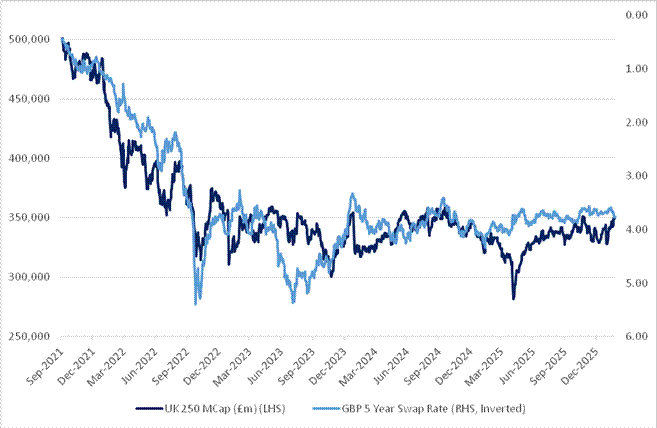
Source: Bloomberg data as at 11 02 2026
Onward Opportunities' branding incorporates a Snow Leopard - a 'crepuscular' creature, most active at dawn and dusk. For three years we have been very much in a dusk mentality, UK equities have felt tired and forgotten about. The mood has been dark. Having used these conditions to harvest overlooked value when most investors had given up, we are starting to ponder how returns might look if the outlook brightens. If the recent return of primary capital markets activity, tentative UK index recoveries and smatterings of inflows at select funds, including Onward, mark the break of dawn after one of the longest bear markets in UK equities for 50 years, what might be the earnings and re-rating potential for many of our holdings? History tells us some of the best vintages for smaller company investors are captured in such conditions. Timing is everything.
Ever Onwards,
Laurence Hulse
Founder and Lead Fund Manager
Investment Objective and Policy
Investment objective
The Company was incorporated with limited liability in Guernsey under The Companies (Guernsey) Law, 2008 (the "Companies Law") on 31 January 2023 as a non-cellular (closed-ended) company limited by shares. The Company's investment objective is to generate risk-adjusted absolute returns for shareholders through investments in UK smaller companies. Returns are expected to be principally derived from capital growth over a target three to five-year holding period with an appropriate diversification of investment risk.
Investment policy
The Company seeks to achieve its investment objective by investing primarily in equity and equity-related securities of UK smaller companies that are predominantly listed or admitted to trading on markets operated by the London Stock Exchange, and where it is considered that there is a material potential valuation upside that can be delivered from catalysing strategic, operational or management initiatives.
In order to ensure that the Company is able to maintain its approach of active engagement with investee companies, and to encourage and support value creation, the Company will typically target meaningful minority stakes in investee companies of between 5% and 25% of the issued share capital.
Whilst the Company has no limitation on the size of the companies in which it can invest, the Company typically expects to invest in companies with market capitalisations of no more than £250 million (with particular focus on those below £100 million) at the time of investment. The Company will therefore focus on investments in the 'micro' smaller companies sector and on companies admitted to trading on AIM.
Investee companies will typically have certain of the following characteristics:
· balance sheet asset backing;
· a competitive advantage and/or strong management track record;
· attractive cash flow potential;
· visibility of earnings/future earnings improvement;
· potential for liquidity and/or exit in line with the Company's targeted hold period;
· scope for an active shareholder to trigger value creation; and/or
· foreseeable events and catalysts to unlock intrinsic value.
Investments may be either direct investments made by the Company, or indirect investments made by the Company through similar funds or investment vehicles. The Company may make its investments for cash or for share consideration. Although investments will not be restricted to specific sectors, the Company does not expect to pursue or make investments into companies in the biotechnology sector or in companies directly involved in extractive industries (such as mining or oil and gas).
Whilst the Company will initially seek to take minority stakes in investee companies of between 5% and 25% and will not typically seek to take majority positions in investee companies, it will not be restricted from taking a majority position if considered appropriate by the Portfolio Manager.
The Company's portfolio is expected to be relatively concentrated, with a typical investment being between 2% and 10% of Net Asset Value at the time of investment. This is expected over time to result in a portfolio of approximately 10 to 15 high conviction investments and a further 5 to 10 smaller portfolio holdings, in companies operating in a number of industries and geographic locations.
Whilst the Company will target an investment holding period of three to five years, actual holding periods and exit strategies will depend on the underlying investment, the availability of exit opportunities and the size of the Company's investment. The Company may therefore dispose of investments outside of the target timeframe should an appropriate opportunity arise.
The Company may hold cash in its portfolio from time to time to maintain investment flexibility. There is no limit on the amount of cash which may be held by the Company at any time.
Investment restrictions
The Company will observe the following investment restrictions:
· the maximum investment in any single investee company will be no more than 15% of Net Asset Value at the time of investment;
· no more than 10% of Gross Asset Value at the time of investment will be invested in securities listed or quoted on listing venues other than markets operated by the London Stock Exchange (without the explicit written consent of the Board);
· no more than 25% of Gross Asset Value at the time of investment(s) will be in unquoted securities including, inter alia, in unlisted shares or other unlisted instruments such as convertible loan notes issued by quoted companies, rights, options, warrants, bonds and notes; and
· no more than 20% in aggregate, of the Gross Asset Value at the time of investment will be in other listed closed-ended investment funds.
Corporate Governance Statement
The Company is listed on AIM and is a member of the Association of Investment Companies (AIC).
The Board has considered the principles and provisions of The AIC Corporate Governance Code ("AIC Code"). The AIC Code addresses the principles and provisions set out in the UK Corporate Governance Code (the "UK Code") as well as setting out additional provisions on issues that are of specific relevance to the Company.
The Board considers that reporting against the principles and provisions of the AIC Code, which has been endorsed by the Financial Reporting Council and the Guernsey Financial Services Commission ("GFSC"), provides the most relevant information to shareholders. The Directors recognise the importance of sound corporate governance, and the Directors observe the requirements of the AIC Code so far as is practicable.
The AIC Code is available on the AIC website (www.theaic.co.uk). It Includes an explanation of how the AIC Code adapts the principles and provisions set out in the UK Code to make them relevant for investment companies.
The GFSC Financial Sector Code of Corporate Governance (the "GFSC Code") also applies to the Company. The GFSC has stated in the GFSC Code that companies which report against the UK Code or the AIC Code are deemed to meet the requirements of the GFSC Code and need take no further action. Accordingly, as the Company will report against the AIC Code, it will be deemed to meet the requirements of the GFSC Code.
The Company has complied throughout the accounting period with the relevant provisions contained within the AIC Code, except provisions relating to:
· the appointment of a senior independent director (provision 14);
· the establishment of a nomination committee (provision 22); and
· the establishment of a remuneration committee (provisions 37, 38 and 42)
The Board considers that provisions 37, 38 and 42 are not relevant to the Company as the Board is fully comprised of independent, non-executive Directors and the Company has no direct employees. Given the size and nature of the Company, it has not been considered necessary to establish a nomination committee or a remuneration committee at this stage in the Company's lifecycle. Instead, the Board as a whole undertakes the functions of remuneration and nomination committees. The Chairman of the Company does not participate in discussions relating to his own remuneration nor would he be involved in discussions regarding his successor.
As set out on page 49, the Board has established an Audit and Risk Committee and a Management Engagement Committee. These committees undertake specific activities through delegated authority from the Board. Terms of reference for each committee have been adopted and are reviewed on a regular basis by the Board.
Key Governance Disclosures
Section 172(1) Statement
Through adopting the AIC Code, the Board acknowledges its duty to apply and demonstrate compliance with section 172 of the UK Companies Act 2006[3] and to act in a way that promotes the success of the Company for the benefit of its Shareholders as a whole, having regard to (amongst other things):
a) consequences of any decision in the long-term;
b) the need to foster business relationships with suppliers, customers and others;
c) impact on community and environment;
d) maintaining reputation; and
e) acting fairly as between members of the Company.
The Board considers its duties under section 172 to be integrated within the Company's culture and values. The Company's culture is one of respect for the opinions of stakeholders, with an aim of carrying out its operations in a fair and sustainable manner that is both instrumental to the Company's long-term success and upholds the Company's ethical values. The Board encourages diversity of thought and opinion and would like to encourage stakeholders to engage freely with the Board of Directors on matters that are of concern to them. Stakeholders may contact the Company via the Company's dedicated e-mail address onwardopportunities@nsm.group or by post via the Company Secretary on any matters that they wish to discuss with the Board of Directors.
The Company does not currently have a formal diversity policy, however, the Board intends to consider this further during the current financial year. This is a function of the fact that the Company's remunerated officers are limited to the directors. The composition and effectiveness of the Board is internally assessed on an annual basis. The periodic rotation or retirement of directors is a trigger event which initiates a formal search and selection process. This prioritises professional experience relevant to the needs of the Company over other more subjective factors which do not lend themselves to formal assessment and testing. Whilst the Company does not therefore have any policy of positive discrimination in relation to age, gender or race, the Company does recognise the value that different perspectives and outlooks can bring to the quality of decision making. Accordingly, whilst remaining focused on merit-based appointments, the Board encourages and seeks to identify candidates who can also enhance the diversity of its composition. However, the Board intends to consider a formal policy during the current financial year.
The Board has continued to work closely with its service providers during 2025 in order to support the maintenance of high standards of service. As part of its annual review process, the Management Engagement Committee enquires about any incidents, breaches or other occurrences within its service providers that might create a reputational risk or other negative consequences for the Company. Further details relating to the service providers can be found within the Directors' Report.
The Board considers that there is a very low risk of modern slavery or human trafficking associated with the Company's activities, given it has no employees, premises, manufacturing or other physical operations. Its suppliers are professional services providers, most of whom are regulated and none of whom operate in jurisdictions that have a poor record on modern slavery or human trafficking. The Company is an externally managed investment company, has no employees, and as such is operationally quite simple.
The Board does not believe that the Company has any material stakeholders other than those set out in the following table.
|
Investors |
Service providers |
Community and environment |
|
Issues that matter to them |
||
|
Performance of the shares
Growth of the Company
Liquidity of the shares
Corporate Governance |
Reputation of the Company
Compliance with applicable laws and regulation
Remuneration |
Compliance with applicable laws and regulation
Impact of the Company and its activities on third parties |
|
Engagement process |
||
|
Annual General Meeting
Ad hoc investor events and presentations
Frequent meetings with investors by brokers and the Portfolio Manager and subsequent reports to the Board
Quarterly factsheets
Key Information Document |
The main service providers engage with the Board in formal quarterly meetings, giving them direct input to Board discussions
Communication between the Board and service providers also occurs informally on an ongoing basis during the year |
Adherence to principles of appropriate ESG policies exists at both Company and investment level |
|
Rationale and example outcomes |
||
|
The Board has engaged with shareholders in relation to the Company's business over the course of the year |
The Company relies on service providers as it has no systems or employees of its own
The Board seeks to act fairly and transparently with all service providers, and this includes such aspects as prompt payment of invoices |
The Portfolio Manager works to ensure that sustainability and ESG factors are carefully considered and reflected in the Company's investment decisions
The Board of Directors travel as infrequently as possible and instead communicate, where they are able to, by video and conference call |
Going Concern Statement
The Going Concern Statement is made on page 41.
Long-Term Viability Statement
The Long-Term Viability Statement is made on pages 41 - 42.
Fair, Balanced and Understandable Statement
The annual report and accounts taken as a whole are considered by the Board to be fair, balanced and understandable and provide the information necessary for shareholders to assess the Company's performance, business model and strategy. Further information on how this conclusion was reached can be found within the Audit and Risk Committee Report.
Continuing Appointment of the Portfolio Manager
Further details relating to the continuing appointment of the Portfolio Manager and how this is in the interests of shareholders as a whole can be found within the Directors' Report.
Assessment of Principal and Emerging Risks
The Board has undertaken a robust assessment of the Company's principal risks, together with the procedures that are in place to identify emerging risks. Further information on this assessment and an explanation on how these risks are being mitigated and managed can be found on pages 43 - 45.
Review of Risk Management and Internal Control
The Audit and Risk Committee is responsible for ensuring that the financial performance of the Company is properly reported and monitored and follows the Financial Reporting Council's Audit Committees and the External Audit: Minimum Standard.
The Audit and Risk Committee reviews the Company's annual and interim accounts, the accounting policies of the Company and key areas of accounting judgment, management information statements, financial announcements, the Company's risk management and internal control framework and the continuing appointment of auditors. It also monitors the whistle blowing policy and procedures over fraud and bribery of the Administrator.
The Audit and Risk Committee is currently consulting with Global Fund Management Services Limited ("GFM" or the "AIFM"), who were appointed on 3 May 2025, in connection with the requirements of provision 34 of the AIC Code that became effective for accounting periods beginning on or after 1 January 2026 in order to be able to ensure compliance with this provision by the 31 December 2026 reporting date.
Due to its size, structure and the nature of its activities, the Company does not have an internal audit function. The Audit and Risk Committee will continue to keep this matter under annual review.
The Board is ultimately responsible for the Company's system of internal controls and for reviewing its effectiveness. The Board has developed a framework that is designed to manage, rather than to eliminate, the risk of failure to achieve the Company's business objectives. The framework involves identifying sources of risk, the potential significance (financial and operational) of any risk impacts, and the associated controls in place to identify, pre-empt and mitigate those potential impacts. This is documented in a Business Risk Assessment which is considered at least annually by the Board. The framework is discussed with the Portfolio Manager, and members of the Management Engagement Committee conduct a detailed meeting with the Portfolio Manager to review the effectiveness of controls and any breaches / errors that have occurred since the last inspection visit. Any such control failures are also recorded on an exceptions basis and reported at quarterly Board meetings or in real time if sufficiently significant. No significant failings or weaknesses have been identified to date. These processes ensure an at least annual review of the Company's system of internal controls, including financial, operational, compliance and risk management. The system can only provide reasonable and not absolute assurance against material misstatements.
The Board has delegated the management of the Company's investment portfolio, the provision of custody services, the administration (including the independent calculation of the Company's NAV), share registration, corporate secretarial functions and the production of the half-yearly and annual independently audited financial reports. The Board retains accountability for the functions it delegates. Formal contractual arrangements have been put in place between the Company and the providers of these services. Compliance reports are provided by the Company's Compliance Officer at each quarterly Board meeting. The Board considers that its internal control processes meet current industry best practice.
Regulatory Compliance
The Company keeps abreast of regulatory and statutory changes and responds appropriately. The Board continues to take advice on Alternative Investment Fund Managers Directive ("AIFMD") from external professional advisers and to implement necessary measures to ensure compliance with relevant requirements of the AIFMD Regulations. The AIFM is also a resource relied upon by the Board in this regard. Although the majority of the obligations associated with AIFMD are applicable to the AIFM, the Board is satisfied that the Company as an Alternative Investment Fund ("AIF") complies fully with its relevant obligations under the AIFMD and the UK's AIFMD Regulations 2013. Key Information Documents ("KIDs") have been updated in accordance with the EU's Packaged Retail and Insurance-based Investment Products Regulations ("PRIIPs") and the UK's amended version thereof and are available at https://onwardopportunities.co.uk/wp-content/uploads/2025/07/2020507-Onward-Opps-UK-KID-Final-for-release.pdf
Board Members
The Board is responsible for the determination of the Company's investment objective and investing policy and has overall responsibility for the Company's activities including the review of investment activity and performance and the control and supervision of the AIFM, the Portfolio Manager and the other service providers.
The Directors meet at least four times a year, and at such other times as may be required. The Directors (including the Chairman) are all independent non-executive directors. Given the size of the Board, it has not been considered necessary to appoint a senior independent director at this stage in the Company's lifecycle.
The Board has been assembled to ensure that the Company has the appropriate breadth of skills and experience in order to ensure that it can be governed effectively and comprises the following persons:
Director Biographies
Andrew Henton (Independent Non-Executive Chairman)
Andrew graduated from Oxford University in 1991 and subsequently qualified as a Chartered Accountant with PricewaterhouseCoopers in London, specialising as a corporate tax consultant. He spent eight years working in the City as a corporate finance advisor with HSBC Investment Bank and as a principal of the Baring English Growth Fund, a private equity fund focussed on mid-market transactions sponsored by ING Barings. In 2002 Andrew was relocated to Guernsey by Close Brothers Group plc to take responsibility for integrating and reorganising a number of regulated banking, custody, asset management and fiduciary administration businesses that the bank had acquired in Jersey, Guernsey and Isle of Man.
He was Head of Offshore Businesses for Close until the division he managed was sold in 2011. Thereafter he chose to remain in Guernsey and to work with a portfolio of companies as a non-executive director. He has wide board experience of both regulated and non-regulated businesses (including listed funds and venture backed companies) in both executive and non-executive capacities. Andrew is British and resident in Guernsey.
Susan Norman (Independent Non-Executive Director)
Susan has over 25 years of boardroom experience formerly in company secretarial roles and most recently through non-executive director roles across a wide range of companies in multiple jurisdictions. Susan started her career within the private banking and fund of hedge funds sectors and now runs her own consultancy business providing company secretarial, governance and independent directorship services to a broad range of clients across various jurisdictions. Susan's board experience covers public and private equity investment companies, family offices, venture capital, real estate investment companies and impact investment funds, amongst others.
Susan holds an LLB (Hons) degree in Scots Law from the University of Strathclyde. She is a Fellow of the Chartered Governance Institute, holds the Institute of Directors' Diploma in Company Direction and has completed Cambridge University's Business and Sustainability Leadership Programme.
Henry Freeman (Independent Non-Executive Director, Chair of Management Engagement Committee)
Henry is an investment professional with over 27 years of investment decision making and over 12 years of Board experience. During his executive career as an investment manager with Lloyds Private Banking/Hill Samuel and Forsyth Partners, and then an investment banker with Liberum (now Panmure Liberum) and Investec Bank, Henry managed institutional and private client funds, investing across equities, investment trusts and alternative investments; and advised London-listed investment companies and funds on strategy, structuring, IPOs and M&A. Henry has also built technology and investment businesses and sat on UK parliamentary policy groups and Downing Street roundtables for fintech and social finance. Henry was a founding member of Innovate Finance.
In addition to Onward Opportunities, Henry sits on a number of commercial fund and investment company boards, as well as the Crown Dependency of Guernsey's sovereign wealth and pension funds. He is proud to have established the GIFA Schools Investment Challenge, encouraging financial literacy and investment education among young people. Henry holds the Institute of Directors' Diploma in Company Direction.
Luke Allen (Independent Non-Executive Director, Chair of Audit and Risk Committee)
Luke is an independent non-executive director with over 30 years' experience working in the financial services sector, the majority of which have been spent in the investment funds industry. Until December 2019 he was the chief executive and managing director of Man Group plc's Guernsey office, which serviced an extensive range of hedge funds and funds of hedge funds. His primary role was to lead Man Group's operations in Guernsey, chairing the local management company boards, setting strategy and ensuring effective risk management, outsourced service provider oversight, and compliance with laws and regulations. He has over 15 years' experience (in both an executive and independent non-executive capacity) of working with, and sitting on the boards of, a wide range of fund and management company structures across various asset classes and international jurisdictions.
He is a chartered accountant (ICAEW) and, prior to running Man Group's Guernsey office, he headed up their fund financial reporting and liquidations team, with responsibility for the production of fund financial statements and for fund terminations across their entire product range. He has completed the Institute of Directors' Diploma in Company Direction and is the holder of a personal fiduciary licence issued by the Guernsey Financial Services Commission.
Public Company Directorships
The following details are of all other public company directorships and employment held by each Director and shared directorships of any commercial company held by two or more Directors:
Andrew Henton
Pershing Square Holdings Limited
The Bank of NT Butterfield & Son Limited
Susan Norman
None to be disclosed
Henry Freeman
None to be disclosed
Luke Allen
Global Private Equity One Limited
Director Attendance
During the year ended 31 December 2025, the Board and Committee meetings held and attended by the Directors were as follows:
|
|
Quarterly Board Meeting |
Audit and Risk Committee Meeting |
Management Engagement Committee Meetings |
Ad-hoc Meetings |
|
Director |
Attended/ Eligible |
Attended/ Eligible |
Attended/ Eligible |
Attended/ Eligible |
|
Andrew Henton
|
4/4 |
3/3 |
1/1 |
12/12 |
|
Susan Norman
|
4/4 |
3/3 |
1/1 |
10/12 |
|
Henry Freeman
|
4/4 |
3/3 |
1/1 |
12/12 |
|
Luke Allen
|
4/4 |
3/3 |
1/1 |
10/12 |
Division of Responsibilities
A schedule of matters reserved for the Board is maintained by the Company and can be summarised as follows:
· Strategic Issues;
· Financial Items such as approval of the annual and half-yearly reports and any preliminary announcement of the final results and the annual report and accounts including the corporate governance statement;
· Legal, Administration and Other Benefits;
· Communications with Shareholders;
· Board Appointments and Arrangements;
· Miscellaneous such as to approve the appointments of professional advisers for any Group company in addition to the Company's Auditor;
· Monetary Limits and payment approvals.
The Directors have also delegated certain functions to other parties such as the Portfolio Manager, the Administrator, the Company Secretary, the Custodian and the Registrar. In particular, the Portfolio Manager has been granted discretion over the management of the investments comprising the Company's portfolio.
The Portfolio Manager reports to the Board on a regular basis both outside of and during quarterly Board and Committee meetings, where the operating and financial performance of the portfolio, together with valuations, are discussed at length between the Board and the Portfolio Manager. The Directors have responsibility for exercising supervision over the Portfolio Manager.
Board Committees
The Company has established an Audit and Risk Committee and a Management Engagement Committee (together the "Committees"). The Terms of Reference for each committee are available on the Company's website.
The Board believes that its established Committees are adequately composed, and that each member has the necessary skills and experience to discharge their duties effectively. The relevant committee and the actions carried out by each committee since the previous quarterly Board meeting are reported at each meeting to the Board by the respective committee chair. Each Committee meeting is attended by the Company Secretary and minutes are kept, as well as a schedule of the action points arising from each meeting.
The Audit and Risk Committee comprises all of the Directors and is chaired by Luke Allen who is considered to have recent and relevant financial experience. The Audit and Risk Committee meets at least twice a year. There are a number of regular attendees at meetings of the Audit and Risk Committee, including the Company's external auditor. A full report regarding the Audit and Risk Committee's activities during the year can be found in the Audit and Risk Committee Report on pages 53 - 58.
The Management Engagement Committee comprises all of the Directors and is chaired by Henry Freeman. The Management Engagement Committee meets at least once a year or more often, if required. Its principal duties are to consider and review the management engagement terms on which each of the AIFM and the Portfolio Manager is engaged. Those terms are reviewed by the Management Engagement Committee annually, scrutinising and holding to account the performance of each of the AIFM, the Portfolio Manager and other service providers prior to the annual results announcement being released. Details of the Management Engagement Committee's activities during the year can be found on page 49.
Annual Review of Performance of Board, its Committees, the Chairman and Individual Directors
Each year, the Company undertakes a performance evaluation of the Board and its committees as a whole, as well as an appraisal of the Chairman and a director's self-evaluation. The Board is committed to the evaluation process, and the Chairman will recognise the strengths and address any weaknesses that may arise. The Chairman will also consider, on an annual basis, having an externally facilitated board performance review.
During the year, the evaluation was carried out by the full Board, with support from the Company Secretary. The evaluation concluded that performance remained adequate and professional and that there were no corporate governance concerns to be addressed.
Investment Committee
The Investment Committee of the Company who served during the year are:
Laurence Hulse (Lead Fund Manager and Founder)
Laurence joined Dowgate Wealth in September 2022 as an Investment Director. Laurence started his career at Gresham House in 2015, around the time of its inception, and worked on a number of outperforming equity products as part of a small team during that time. At the time of his departure from Gresham House, he had co-managed or deputised on a number of equity funds; namely Gresham House Strategic plc (now called Rockwood Strategic plc), Strategic Public Equity Fund LP and Gresham House Smaller Companies Fund. He was awarded both AAA and AA ratings by Citywire during this time and two of these co-managed funds achieved FE '5-crown' ratings while he was part of the team working on them. During his tenure, the company grew from a handful of employees and less than £50m assets to over 200 employees and in excess of £7.5 billion of assets. Gresham House was bid for by Searchlight Capital in Q3 2023 for a value of c.£500m, generating a total return to Gresham House Shareholders since the management buy-in in December 2014 of over 300%.
Laurence joined Dowgate to pursue a long-held ambition to build and manage an investment vehicle tailored for HNWIs and Family Offices focused on special situations in the UK, which perfectly aligns with the Dowgate ethos. The first step of this ambition was achieved with the floatation of Onward Opportunities in March 2023.
As an investor, Laurence strongly believes in creating value through change; whether that be strategic, operational or personnel within a business - particularly in small and micro-cap companies where the impacts of these changes tend to be most tangible. He prides himself on working actively with the Boards and Executive teams of investee companies to drive shareholder value through the investment cycle. He holds a truly active approach to investment management by applying private equity techniques to publicly listed companies. His enthusiasm and drive have allowed him to successfully garner a track record of outperformance and close industry network throughout his early career in the City.
Career highlights for Laurence include when he was nominated for the rising star of investment companies award in 2021 and the flotation of Onward Opportunities, the investment vehicle he founded, on the London stock market in 2023. This subsequently won the 2024 IPO of the Year award and was followed by a nomination for Fund Manager of the Year 2024 at the illustrious plc awards and winning The Best Use of AIM Award 2025. His biggest achievement away from work was climbing Mount Kilimanjaro for charity at the age of 16. In addition to his duties as Investment Director, Laurence loves cycling, driving, and vintage cars.
Tom Teichman (Investment Committee)
Tom started his career at Willis Faber & Dumas and then William Brandt's Sons & Co., becoming head of European merchant banking. Over the next 40 years he has sat on various credit and investment committees whilst working at Bankers Trust Company, Credit Suisse, Finanz AG, Mitsubishi Finance International, Bank of Montréal Nesbitt Thomson, NewMedia Investors, SPARK Ventures (which he co-founded), The Garage Soho (which he co-founded) and Gresham House Strategic, where he worked directly with Laurence Hulse. Tom was personally, or through investment vehicles he established, a very early-stage investor in MAID, Argonaut Games, ARC Risc Cores, lastminute.com, mergermarket.com, System C, Notonthehighstreet.com, made.com, moshimonsters.com, Kobalt Music Group and IMI Mobile.
He served on the boards of most of these companies, in some cases as chairman, advising on growth, funding and exit strategy. Some of these eventually went public or were acquired by major corporations, including The Financial Times and Oracle, and/or achieved valuations of over £1 billion.
Tom has a B.Sc. (Econ.) Hons. from University College, London and was born in Hungary. He has over 30 years' experience in venture capital and banking and has chaired or been a member of several credit and investment committees including the Gresham House Strategic Public Equity Investment Committee where he worked directly with Laurence Hulse from its inception.
Jeremy McKeown (Investment Committee Member)
After obtaining an economics degree from Georgia State University, Jeremy began his career as a trainee investment analyst at the South Yorkshire Pension Fund in 1982. Over the following forty years, Jeremy worked on both the buy and sell sides of the UK stock market, including with companies such as Abbey Life, British Gas Pension Fund, Midland Bank, Charterhouse, Merril Lynch, Investec, Liberum and Royal Bank of Canada. Jeremy obtained an MBA from the City University Business School during this time. Jeremy built a reputation for independent advice to institutional small and mid-cap investors and worked on many equity capital market transactions. He led award-winning teams at Charterhouse, Merrill Lynch and Investec. Since 2020 Jeremy has worked as a consultant for a number of clients, including Dowgate and Progressive Equity Research. Jeremy is passionate about understanding the investment landscape from the macroeconomic backdrop to the entrepreneurs capable of delivering exceptional returns. He started writing a blog during the pandemic and launched a podcast series covering investment issues. Jeremy is a non-executive director at Cranfield University spinout, Loxham Precision.
Mark Wharrier (Investment Committee Member)
Mark has been a professional equity investor for over thirty years and brings deep expertise of the UK stock market. He began his career at Mercury Asset Management in 1994, where he managed over £1bn of UK equity portfolios for institutional clients.
In 2004, he co-founded NewSmith Asset Management with a team of colleagues, focusing on UK equities for pension fund clients. The business was later acquired by Man Group. Mark returned to BlackRock in 2013 as a Managing Director, where he led the UK Equity Income franchise and managed an investment trust. He subsequently held portfolio management roles at Troy Asset Management and Majedie Asset Management, specialising in UK equity income strategies.
Today, Mark remains an active investor in UK public equities. He also serves as a director of several private businesses, is a Trustee of non-profit organisations, and sits on the University of Durham Investment Committee. A passionate advocate for the UK stock market, he recently launched a podcast series featuring CEO interviews titled The Business Case. Mark holds a degree in Economics, History, and Management from Durham University.
Jay Patel (Former Investment Committee Member)
Sadly, Jay passed away unexpectedly at 56 years of age in the second half of the year.
Jay was the Vice President and General Manager of Cisco's Webex CPaaS initiative and joined Cisco when the company he ran, IMImobile, was acquired for US$730m in 2021. He helped start IMImobile PLC in 2003, as CEO led it to a successful IPO in 2014 and then delivered its exit to Cisco.
Jay was an experienced technology executive with over 25 years' commercial experience through operational, investment and advisory roles. He had a successful career working with fast growth businesses and had served as both an executive and non-executive director on the boards of both private and public companies over the last 20 years.
Previously, Jay was a co-founder of venture capital firm Spark Ventures PLC (an early-stage venture capital firm), where he led several successful investments, restructurings and exits in the technology sector across digital media and publishing, B2B software and B2C eCommerce. Jay had also worked in corporate finance roles at UBS Warburg and BSkyB and qualified as a Chartered Accountant with KPMG. He had an MBA from INSEAD and an Economics degree from London School of Economics.
Work is progressing to appoint a suitable new member of the Investment Committee and shareholders will be updated when appropriate.
Directors' Report
The Directors present their Report and the Audited Financial Statements of the Company for the year ended 31 December 2025.
Principal Activities and Business Review
The investment objective of the Company is to generate long term capital growth through investing in a portfolio consisting primarily of equity investments in quoted companies.
The Directors do not envisage any change in these activities for the foreseeable future. A description of the activities of the Company in the year under review is given in the Chairman's Statement and the Portfolio Manager's Report.
Business and Tax Status
The Company has been registered with the GFSC as a closed-ended investment company under the Registered Collective Investment Schemes Rules and Guidance, 2021 (the "RCIS Rules"), as amended, and the Protection of Investors (Bailiwick of Guernsey) Law, 2020 ("POI") Law and was incorporated in Guernsey on 31 January 2023. The Company operates under the Companies Law.
The Company's shares are listed and traded on AIM.
The Company's management and administration takes place in Guernsey and the Company has been granted exemption from income tax within Guernsey by the Administrator of Income Tax. It is the intention of the Directors to continue to operate the Company so that each year this tax-exempt status is maintained.
In respect of the Criminal Finances Act 2017, as amended, and the corporate criminal offence of 'failing to take reasonable steps to prevent the facilitation of tax evasion', the Board confirms that they are committed to zero tolerance towards the criminal facilitation of tax evasion.
Foreign Account Tax Compliance Act ("FATCA")
FATCA requires certain financial institutions outside the United States ("US") to pass information about their US customers to the US tax authorities, the Internal Revenue Service (the "IRS"). A 30% withholding tax is imposed on the US source income and disposal of assets of any financial institution within the scope of the legislation that fails to comply with this requirement.
The Board of the Company has taken all necessary steps to ensure that the Company is FATCA compliant and confirms that the Company is registered and has been issued a Global Intermediary Identification Number ("GIIN") by the IRS. The Company will use its GIIN to identify that it is FATCA compliant to all financial counterparties.
Common Reporting Standard
The Common Reporting Standard is a global standard for the automatic exchange of financial account information developed by the Organisation for Economic Co-operation and Development ("OECD"), which has been adopted in Guernsey and which came into effect in January 2016.
The Company is subject to Guernsey regulations and guidance on the automatic exchange of tax information, and the Board will therefore take the necessary actions to ensure that the Company is compliant in this regard.
Going Concern
The Directors have adopted the going concern basis in preparing the Audited Financial Statements.
In assessing the going concern basis of accounting, the Directors have assessed the guidance issued by the Financial Reporting Council and considered the Company's own financial position, market volatility, the on-going impact of the Russian war on Ukraine and conflict in the Middle East, the imposition of tariffs and the impact on global trade and other uncertainties impacting on the financial position and liquidity requirements of the Company's investments.
At year-end the Company had a net asset position of £42,662,000 including cash of £249,000, a convertible loan note of £250,000, derivative investments of £1,357,000 and listed investments of £41,404,000.
The Company generates liquidity by raising capital and exiting investments. It uses liquidity by making new and follow-on investments and paying company expenses. The Directors ensure it has adequate liquidity by regularly reviewing its financial position and forward-looking liquidity requirements. In assessing its going concern status, the Directors have considered the level of ongoing operating expenses relative to net assets, such expenses approximating to 3% of net assets as at 31 December 2025.
Long-Term Viability Statement
The principal risks facing the Company are documented in the Business Risk Assessment and are described later in this report. The business model and investment strategy are described and evaluated in the Portfolio Manager's report. The Board's review of the effectiveness of the Company's risk management and internal control systems is described in the Audit Committee's report.
Given the liquid, tradeable nature of its assets it would take a general failure in the effective and ongoing operation of financial markets (cessation of market liquidity) to threaten the Company's solvency. Such a market failure could prevent investments held by the Company from being redeemed and thereby leave it potentially unable to meet its financial obligations as they fall due. Notwithstanding the uncertainty caused by market volatility, on-going geopolitical uncertainty, the imposition of tariffs and the impact on global trade and other uncertainties impacting on the Company's investments, the fact that the operating expenses (excluding performance fees) of the Company approximate to 3% of its NAV on an annual basis makes this risk remote.
The Board has conducted a robust assessment of the principal and emerging risks and uncertainties facing the Company and has also assessed its long-term viability. The impact of tariffs and of AI on investee companies (positive and negative) have formed part of this assessment. The key risk to the Company has been identified as a failure of the investment decision making process to generate NAV accretion that is in line with investors' expectations, and which is attractive on a risk adjusted basis when compared with alternative managed investment opportunities.
The Company's performance is measured on a monthly basis via both the NAV of its underlying investments and its share price. Key data inputs used by the Portfolio Manager when making investment decisions comprise company earnings, macro factors and indicators of sentiment. The Company's performance is compared primarily to peer group funds on a regular basis, and performance fees payable to the Portfolio Manager are calculated annually.
The significant majority of investment positions taken by the Company are in relatively liquid assets that can be converted to cash readily in the market and a great effort is made by the Portfolio Manager to minimise drawdowns and to maintain liquidity. Given that the Company's operating costs as a percentage of its realisable investment portfolio are low and that it is a closed-ended fund, the Directors consider there to be significant liquidity headroom available in all but the most extreme market failure scenarios.
Despite the emphasis on short-term performance and resilience described above, not all investment positions are entered into with the expectation of them being unwound within twelve months. Moreover, the 'repeatability' of the investment process is of fundamental importance.
The Portfolio Manager has developed analytical tools and processes that it seeks to apply on a consistent basis over time when making investment decisions. In this way it seeks to generate positive risk adjusted returns using strategies that are sustainable for the medium to long term. The time frame over which it is necessary to identify and respond to 'paradigm shifts' in economic markets is long term in nature. Factors such as government or central bank policies (e.g. quantitative easing) or external events (including wars and regional instability) can cause significant changes in investor sentiment, which can in turn alter market assessments of intrinsic value and correlations between different asset types. For these reasons, the Board considers a three-year time horizon to 28 February 2029 as being the appropriate period over which to assess future prospects and viability.
On the basis of the relevant and rigorous assessment described above, the Board believes that the Company will remain viable as a closed-ended investment company for at least the period ending 28 February 2029.
Results and Dividends
The results attributable to shareholders for the year are shown in the Statement of Comprehensive Income on page 63. The Directors have neither declared nor paid a dividend for the year (2024: £nil).
Directors
The Directors of the Company who served during the year and to date are set out on pages 33 - 34.
Directors' Interests
The Directors held the following interests in the share capital of the Company either directly or beneficially as at 31 December 2025, and as at the date of signing these Audited Financial Statements:
|
|
Number of Ordinary Shares |
% Ordinary Shares in issue as at 31 December 2025 |
|
Andrew Henton |
100,000 |
0.3368 |
|
Susan Norman |
45,104 |
0.1519 |
|
Luke Allen |
25,052 |
0.0844 |
|
Henry Freeman |
20,000 |
0.0674 |
|
Maria Jose Freeman (spouse of Henry Freeman) |
5,500 |
0.0185 |
|
Adrian Norman (spouse of Susan Norman) |
4,878 |
0.0164 |
As at 31 December 2024 the following Directors had holdings in the Company:
|
|
Number of Ordinary Shares |
% Ordinary Shares in issue as at 31 December 2024 |
|
Andrew Henton |
100,000 |
0.4170 |
|
Susan Norman |
45,104 |
0.1881 |
|
Luke Allen |
25,052 |
0.1045 |
|
Henry Freeman |
15,000 |
0.0626 |
|
Adrian Norman (spouse of Susan Norman) |
4,878 |
0.0203 |
Directors Remuneration
Given the size of the Company, and the fact that the whole Board is comprised of independent non-executive directors, the Board as a whole currently discharges remuneration responsibilities.
The Company's Articles of Incorporation limit the annual fees payable to the Board of Directors to no more than £500,000 per annum. The aggregate level of the fees payable to the Directors may only be increased by way of a shareholder resolution. Subject to this overall limit, the remuneration of the Directors should reflect the nature of their duties, responsibilities and the value of their time spent and be fair and comparable to other companies that are similar in size, with a similar capital structure.
The Directors' compensation is reviewed annually by the Board, taking into account workload, responsibilities, benchmarks against public market data and market conditions. However, the Chairman of the Company does not participate in discussions relating to his own remuneration, leaving this for discussion by the remaining Board members. No performance-related pay exists.
Under their terms of appointment, the Directors' total remuneration (including one-off fees) is as disclosed below:
|
|
2025 £ |
2024 £ |
|
Andrew Henton* |
39,000 |
39,000 |
|
Luke Allen** |
31,000 |
31,000 |
|
Henry Freeman |
27,500 |
27,500 |
|
Susan Norman |
27,500 |
27,500 |
* In addition to the basic fee of £27,500 per annum, the Chairman receives an extra £11,500 (2024: £11,500) per annum.
** In addition to the basic fee of £27,500 per annum, the Audit and Risk Committee Chair receives an extra £3,500 (2024: £3,500) per annum.
Procedures for Identifying Risks
Principal Risks and Uncertainties
There are several potential risks and uncertainties which could have a material impact on the Company's performance and could cause actual results to differ materially from expected and historical results.
The AIFM has overall responsibility for risk management and control within the context of achieving the Company's objectives. The Board agrees the strategy for the Company, approves the Company's risk appetite and the AIFM monitors the risk profile of the Company. The AIFM also maintains a risk management process to identify, monitor and control risk concentration.
The Board's responsibility for conducting a robust assessment of the principal and emerging risks is embedded in the Company's risk map, which helps position the Company to ensure compliance with the AIC Code.
The principal risks that the Company faces arising from its financial instruments are:
(i) market risk, including:
- Price risk, being the risk that the value of investments will fluctuate because of changes in market prices;
- interest rate risk, being the risk that the future cash flows of a financial instrument will fluctuate because of changes in interest rates;
(ii) credit risk, being the risk that a counterparty to a financial instrument will fail to discharge an obligation or commitment that it has entered with the Company.
(iii) liquidity risk, being the risk that the Company will not be able to meet its liabilities when they fall due. This may arise should the Company not be able to sell its investments.
(iv) company failure, being the risk that companies invested in may fail and result in loss of capital invested.
To manage such risks the Company complies with the investment restrictions and diversification limits provided for in its Admission Document.
The Company invests and manages its assets with the objective of spreading risk. Further to the investment restrictions referenced, the Company also seeks to manage risk by:
· not incurring debt over 25% of its NAV, calculated at time of drawdown. The Company will target repayment of such debt within twelve months of drawdown; and
· not using derivatives for the purpose of leveraging investment returns. It is expected that the Company's assets will be predominantly denominated in Sterling and, as such, the Company does not intend to engage in hedging arrangements, although the Company may do so if the Board deems it appropriate for efficient portfolio management purposes.
Other operational related risks identified by the Board include the following:
Portfolio concentration risk
The majority of the Company's portfolio is expected to be invested in approximately 10 to 15 companies, with a further 5 to 10 smaller portfolio holdings existing from time to time. As a result, the portfolio carries a higher degree of stock-specific risk than a more diversified portfolio.
This is mitigated by position sizing being relatively evenly spread across the portfolio to ensure that there isn't a disproportionately high level of exposure to a small number of assets within the portfolio itself. In addition, both the AIFM and the Portfolio Manager monitor that the investment restrictions as set out in its Admission Document are adhered to at all times.
Key person risk
At present the Company's investment selection, portfolio management and marketing functions are heavily reliant upon a single individual employed by the Portfolio Manager. This individual presents a key person risk as their departure or inability to continue to provide services to the Company could be significantly detrimental to its performance. This risk is mitigated by the fact that the key individual is reputationally and financially linked to the success of the Company, that there are other staff employed by the Portfolio Manager who could provide cover in the event of any unexpected absence, that there is a plan to procure additional staff resources as the Company grows in size and that contractual notice periods are in place in order to enable the Company sufficient time to find a replacement Portfolio Manager in the event that this became necessary.
Share price risk
There is a risk that the Company's shares trade at a discount to their prevailing Net Asset Value and that any discount may become embedded if it persists for a significant length of time, albeit that this is a function of supply and demand for the Company's shares in the market which cannot be controlled by the Board. The discount risk is mitigated by the fact that the Portfolio Manager, AIFM and Brokers review market conditions on an ongoing basis and will report to the Board if a persistent discount appears to be materialising.
In addition, consideration has been given to discount management options as set out in the Company's Admission Document and the Company is committed to ensuring that secondary market liquidity is maintained via the issuance of informative investor communications and the engagement of active Brokers.
Conflicts of interest
The Portfolio Manager and/or companies with which it is associated may act as advisor in relation to, or be otherwise involved with, other investment funds or accounts which presents the risk of a conflict of interest. There is also a risk that key individuals at the Portfolio Manager may spend time on other structures rather than on providing services to the Company. This risk is mitigated by the fact that the Company has put a formal Conflicts of Interest Policy in place and that it has access to, and receives regular reporting from, the Portfolio Manager.
Emerging Risks
Emerging risks, along with all other risks the directors have identified the Company as being exposed to, are monitored via the Company's Business Risk Assessment. During the year, as part of their regular review and assessment of risk, the Directors have continued to consider the impact of the emerging risks of climate change, the use of artificial intelligence, the impact of rising tariffs on EU economies, and the potentially changing fiscal environment in the UK on the Company's business model and viability, but do not consider these to be material risks at this time.
With respect to climate change risk in particular, the Directors consider that the pricing of the underlying portfolio of the Company's investments reflects market participants' views of climate change risk and that there are no further climate related influences on the NAV of the Company at this point in time.
ESG and Climate Change Risks and Considerations
The Investment Manager seeks to identify externalities (positive and negative) that are not reflected in the share price of (prospective) investee companies. The costs of ESG remediation and compliance are in this context but one type of externality, and the assessment of ESG risks specifically are embedded in the investment process. As ESG processes are further embedded within the wider investment sector the expectation is that improving environmental outcomes will be realised as compliant companies find it easier to access capital via the public markets and to grow relative to their less or non-compliant peers.
Climate change risk has also been considered within the Emerging Risks section above.
Ongoing Charges
The ongoing charges figure for the year was 3%. The ongoing charges represent annualised ongoing expenses of £1,029,000 divided by the average Net Asset Value for the year of £34,594,000. The ongoing charges calculation has been prepared in accordance with the recommended methodology provided by the Association of Investment Companies where performance fees of £476,000 have been excluded and represents the percentage reduction in shareholder returns as a result of recurring operational expenses.
Service Providers
Portfolio Management Agreement and Fees
The portfolio management agreement between the Company, the AIFM, the Portfolio Manager and Laurence Hulse (the "Portfolio Management Agreement") was entered into on 6 February 2025. Under the Portfolio Management Agreement, the AIFM has delegated discretionary portfolio management of the Company's portfolio to the Portfolio Manager with effect from 3 May 2025.
Under the terms of the Portfolio Management Agreement, the Portfolio Manager acts as delegate of the AIFM in relation to portfolio management. The AIFM remains responsible for the portfolio management and risk management functions of the Company in accordance with the UK AIFM regime.
The Portfolio Management Agreement may be terminated by the Company, the AIFM or the Portfolio Manager on not less than 12 months' written notice, such notice not to be given earlier than the third anniversary of Admission. The agreement may also be terminated with immediate effect in certain circumstances, including insolvency, material breach, regulatory requirement, or other specified events.
If the Key Man (being Laurence Hulse or any replacement approved by the Board) ceases to be involved in a material respect with the Portfolio Manager, the Company may terminate the agreement immediately without penalty if the Portfolio Manager is unable, within 30 days of request, to propose a replacement reasonably acceptable to the Board.
Under the terms of the Portfolio Management Agreement, the Portfolio Manager is entitled to an annual management fee, and in certain circumstances the payment of a Performance Fee, together with reimbursement of all reasonable costs and expenses incurred by it in the performance of its duties.
The Company has agreed to indemnify the Portfolio Manager and certain related persons, subject to customary exclusions including negligence, wilful default, fraud or material breach.
Laurence Hulse is a party to the Portfolio Management Agreement to take the benefit of certain provisions. The agreement is governed by English law and subject to the non-exclusive jurisdiction of the English courts. The Board has reviewed the performance of the Portfolio Manager and considers that its continued appointment on the terms of the Portfolio Management Agreement is in the best interests of shareholders.
Administrator and company secretary
Following a competitive tender process for Administrator services, on 3 May 2025, the Company appointed NSM Funds Limited ("NSMF") as its Administrator and Company Secretary, replacing Apex Fund and Corporate Services (Guernsey) Limited who previously fulfilled this function.
Pursuant to the Administration and Secretarial Agreement between NSMF and the Company, NSMF is responsible for the day-to-day administration and company secretarial functions of the Company (including but not limited to the maintenance of the Company's accounting records, the calculation and publication of the Net Asset Value and the production of the Company's annual and interim report). Prospective investors should note that it is not possible for the Administrator to provide any investment advice to investors.
NSMF is responsible for monitoring regulatory compliance and providing support to the Board's corporate governance process and its continuing obligations under UK Market Abuse Regulation (UK MAR).
NSMF is a Guernsey incorporated company which is licensed by the GFSC under the provisions of the POI Law to conduct certain restricted investment and administrative activities in relation to collective investment schemes. NSMF, for the purposes of the POI Law and the RCIS Rules, is the 'designated administrator' of the Company.
Alternative Investment Fund Managers Directive
Following a competitive tender process, on 3 May 2025, the Company appointed Global Fund Management Services Limited as its AIFM, replacing FundRock Management Company (Guernsey) Limited who had previously fulfilled this function. The AIFM acts as the Company's alternative investment fund manager for the purposes of the UK AIFM Regime.
The AIFM has formally delegated portfolio management functions to the Portfolio Manager as portfolio manager to the Company and the AIFM. The AIFM retains risk management functions in relation to the Company and is responsible for oversight of the portfolio management functions delegated to the Portfolio Manager.
The AIFM works closely with the Portfolio Manager in implementing appropriate risk measurement and management standards and procedures. The AIFM carries out the on-going oversight functions and supervision of the Portfolio Manager. The AIFM is legally and operationally independent of the Company and the Portfolio Manager.
Custodian
The Custodian of the Company is Butterfield Bank (Channel Islands) Limited.
Registrar
MUFG Corporate Markets (Guernsey) Limited (previously known as Link Market Services (Guernsey) Limited) was appointed as registrar to the Company pursuant to the Registrar Agreement dated 24 March 2023. In such capacity, the Registrar is responsible for the transfer and settlement of shares held in certificated and uncertificated form. The Register may be inspected at the office of the Registrar.
Corporate Governance Statement
The Corporate Governance Statement forms part of the Directors' Report.
Board Responsibilities
The Board comprises four non-executive Directors, who meet at least quarterly to consider the affairs of the Company in a prescribed and structured manner. All Directors are considered independent of the Portfolio Manager for the purposes of the AIC Code. Biographies of the Directors for the year ended 31 December 2025 appear on pages 33 - 34 which demonstrate the wide range of skills and experience they bring to the Board.
The Directors, in the furtherance of their duties, may take independent professional advice at the Company's expense, which is in accordance with provision 20 of the AIC Code. The Directors also have access to the advice and services of the Company Secretary through its appointed representatives who are responsible to the Board for ensuring that the Board's procedures are followed, and that applicable rules and regulations are complied with.
To enable the Board to function effectively and allow the Directors to discharge their responsibilities, full and timely access is given to all relevant information.
Tenure
Whilst no limit has currently been imposed on the overall length of service of the Directors, at each annual general meeting of the Company, each director retires from office and may offer themselves for election or re-election by the shareholders. This follows provision 23 of the AIC Code which recommends annual re-election of all directors.
When discussing succession planning, the Board is mindful of the principles and provisions of the AIC Code regarding composition, succession and evaluation and has also agreed that consideration would be given to a phased succession plan whereby there would be a gradual change in the composition of the Board to ensure continuity during transition. A formal succession plan will be considered during the current financial year, including the process to be used in relation to appointments, the Board's approach to succession planning and how both support developing a diverse pipeline. The Board will report on the policy and any initiatives on diversity and inclusion, their objectives and link to company strategy, how they have been implemented and progress on achieving the objectives in the next annual financial report.
The Chair is non-executive and independent and has been since appointment. The Board intends to establish a policy on the tenure of the Chair which is consistent with generally accepted best practice. The Chair of the Company will not participate in discussions regarding his successor.
Board Review
In October 2025, the Board completed a performance review of itself and concluded that its performance was still adequate and professional and that no corporate governance concerns existed. As part of the process for board performance reviews, on an annual basis the Board will consider having an externally facilitated board performance review.
Conflicts of Interest
None of the Directors nor any persons connected with them had a material interest in any of the Company's transactions, arrangements or agreements at the date of this report and none of the Directors has or had any interest in any transaction which is or was unusual in its nature or conditions or significant to the business of the Company, and which was affected by the Company during the reporting period.
At the date of this Report, there are no outstanding loans or guarantees between the Company and any Director.
Audit and Risk Committee
Luke Allen is the Chair of the Audit and Risk Committee. A full report regarding the Audit and Risk Committee can be found in the Audit and Risk Committee Report.
Management Engagement Committee
The Management Engagement Committee comprises all of the Directors and is chaired by Henry Freeman. The Management Engagement Committee meets at least once a year or more often, if required. Its principal duties are to consider the terms of appointment of the AIFM and the Portfolio Manager and it reviews these appointments and the terms of the AIFM Agreement and the Portfolio Management Agreement annually. The Management Engagement Committee also reviews the terms of appointment of other key service providers to the Company. Details of the management and performance fees can be found in note 6.
Terms of reference are published on the Company's website at https://onwardopportunities.co.uk/wp-content/uploads/2023/08/Management-Engagement-Committee-Terms-of-Reference.pdf
The Management Engagement Committee met once during the year ended 31 December 2025 to review all service providers. In addition, members of the Management Engagement Committee carried out a separate on-site and in person meeting with the Manager.
As announced in the Company's 2024 annual report, the Board, through the Management Engagement Committee, took the opportunity to review the range of services being received by the Company. In Q4 2024, competitive tender processes for Administrator and AIFM services were initiated, which were completed in Q1 2025. On 3 May 2025, the Company appointed NSM Funds Limited as its Administrator and Company Secretary and Global Fund Management Services Limited as its AIFM, replacing Apex Fund and Corporate Services (Guernsey) Limited and FundRock Management Company (Guernsey) Limited who previously fulfilled these functions. Both developments are positive and made in anticipation of sustained growth in the size of the Company over coming years.
Substantial Shareholdings
On 25 February 2026, the latest practicable date for disclosure in this report, the Company's has been advised of the following beneficial shareholders who owned 5% or more of the issued ordinary share capital of the Company:
|
Shareholder |
Number of Ordinary Shares Held |
% Held |
|
Bank of New York Mellon on behalf of Dowgate Wealth Limited (Discretionary) |
9,775,718 |
29.82% |
|
Bank of New York Mellon on behalf of Callanish Capital Limited |
1,820,200 |
5.55% |
|
Rathbone Nominees Limited |
1,795,256 |
5.48% |
Share Capital and Rights
All issued shares in the Company are Ordinary Shares with equal rights to vote, receive dividends and participate in distributions. For further information, see note 12.
Shareholder Communication
The Company's main method of communication with Shareholders is through its published Half Yearly and Annual Reports which aim to provide Shareholders with a fair, balanced and understandable view of the Company's results and objectives. This is supplemented by the publication of the Company's monthly net asset values on its ordinary shares on AIM and quarterly factsheets. The Company also hosted its inaugural annual investor day at the Dowgate offices where shareholders joined the Manager, Board and Investment Committee for an information session on the portfolio and a chance to ask questions, followed by an informal networking event that lasted most of the day. This will be a recurring annual forum for shareholders.
In line with provision 16 of the AIC Code, the Portfolio Manager communicates with both the Chairman and shareholders and is available to communicate and meet with major shareholders. The Company has also appointed Cavendish Capital Markets Limited to liaise with all major shareholders together with the Portfolio Manager, all of whom report back to the Board at quarterly board meetings ensuring that the Board is fully aware of shareholder sentiment, expectations and analyst views. The Company's website, which is maintained by the Portfolio Manager, is regularly updated with news and announcements. Information published online is accessible in many countries each with differing legal requirements relating to the preparation and dissemination of financial information.
Users of the Company's website are responsible for informing themselves of how the requirements in their own countries may differ from those of Guernsey.
Relations with Shareholders
The share capital of the Company currently consists only of Ordinary Shares and no shares with special rights exist. All holders of Ordinary Shares in the Company have the right to receive notice of, attend and vote at the general meetings of the Company.
At each general meeting of the Company, the Board and the Portfolio Manager will be available to discuss issues affecting the Company.
Shareholders are additionally able to contact the Board, Portfolio Manager and the Chairman directly outside of meetings via the Company's dedicated e-mail address onwardopportunities@nsm.group or by post via the Company Secretary. The Company has adopted a zero-tolerance policy towards bribery and is committed to carrying out business fairly, honestly and openly.
Voting and Stewardship code
The Portfolio Manager is committed to the principles of the Financial Reporting Council's UK Stewardship Code and this also constitutes the disclosure of that commitment required under the rules of the FCA (Conduct of Business Rule 2.2.3).
Signed on behalf of the Board by:
Andrew Henton
Chairman
27 February 2026
Statement of Directors' Responsibilities
The Directors are responsible for preparing this Report and Audited Financial Statements in accordance with applicable law and regulations.
Guernsey Companies Law requires the Directors to prepare audited financial statements for each financial year. Under that law they are required to prepare these Audited Financial Statements in accordance with International Financial Reporting Standards (IFRS) as adopted by the EU and applicable law.
Under the Companies Law the Directors must not approve these Audited Financial Statements unless they are satisfied that they give a true and fair view of the state of affairs of the Company and of its profit or loss for that year. In preparing these Audited Financial Statements, the Directors are required to:
· select suitable accounting policies and then apply them consistently;
· make judgements and estimates that are reasonable, relevant and reliable;
· state whether applicable accounting standards have been followed, subject to any material departures disclosed and explained in the Audited Financial Statements;
· assess the Company's ability to continue as a going concern, disclosing, as applicable, matters related to going concern; and
· use the going concern basis of accounting unless they either intend to liquidate the Company or to cease operations or have no realistic alternative but to do so.
The Directors are responsible for keeping proper accounting records that are sufficient to show and explain the Company's transactions and disclose with reasonable accuracy at any time the financial position of the Company and enable them to ensure that its audited financial statements comply with the Companies Law. They are responsible for such internal control as they determine is necessary to enable the preparation of financial statements that are free from material misstatement, whether due to fraud or error, and have general responsibility for taking such steps as are reasonably open to them to safeguard the assets of the Company and to prevent and detect fraud and other irregularities.
The Directors are responsible for the maintenance and integrity of the corporate and financial information included on the Company's website. Legislation in Guernsey governing the preparation and dissemination of financial statements may differ from legislation in other jurisdictions.
Disclosure of information to auditors
The Directors who held office at the date of approval of this Directors' Report confirm that, so far as they are aware, there is no relevant audit information of which the Company's Auditor is unaware; and that each Director has taken all the steps that they ought to have taken as a director to make themselves aware of any relevant audit information and to establish that the Company's Auditor is aware of that information.
Responsibility statement of the Directors in respect of the Report
We confirm that to the best of our knowledge:
· these Financial Statements, prepared in accordance with the applicable set of accounting standards, give a true and fair view of the assets, liabilities, financial position and profit or loss of the Company; and
· the management report (comprising the Chairman's Statement, the Portfolio Manager's Report, and Directors' Report) includes a fair review of the development and performance of the business and the position of the Company, together with a description of the principal risks and uncertainties that it faces.
We consider this Report and the Audited Financial Statements, taken as a whole, are fair, balanced and understandable and provide the information necessary for shareholders to assess the Company's position and performance, business model and strategy.
Signed on behalf of the Board by:
Andrew Henton
Chairman
27 February 2026
Audit and Risk Committee Report
Role and Responsibility of the Committee
This is the report of the Audit and Risk Committee (herein the "Committee") which has been prepared with reference to the AIC Code and describes the work of the Committee in discharging its responsibilities.
The Committee meets formally at least twice each year and on an ad hoc basis when required and reports to the Board. It has formally delegated duties and responsibilities with written terms of reference which are reviewed and reapproved at least annually. Those terms of reference are published on the Company's website at https://onwardopportunities.co.uk/wp-content/uploads/2025/09/Terms-of-Reference-Audit-and-Risk-Committee-September-2025.pdf
The Committee is mandated by the Board to investigate any activity within its terms of reference and to consult externally with legal or other independent professional advisors, as required, to ensure that the Committee adequately discharges its duties and responsibilities, which include:
a) following the Financial Reporting Council ("FRC") Audit Committees and the External Audit: Minimum Standard;
b) considering the appointment of the external auditor, its letter of engagement and the terms thereof, the audit fee, and any questions of resignation or dismissal of the external auditor and, where applicable, conducting a tender process for the external auditor;
c) reviewing the effectiveness of the audit process and the independence and objectivity of the external auditor;
d) developing and implementing policy on the engagement of the external auditor to supply non-audit services where necessary, ensuring there is prior approval of non-audit services, considering the impact this may have on independence, taking into account the relevant regulations and ethical guidance in this regard, and reporting to the Board, identifying any matters in respect of which it considers that action or improvement is needed and making recommendations as to the steps to be taken;
e) reviewing the integrity of the Company's half-yearly and annual financial reports, not excepting the full Board's responsibility over the reports, focusing particularly on:
· any changes in accounting policies and practice;
· major judgemental areas;
· significant adjustments arising from the audit;
· the going concern assumption;
· compliance with accounting standards (and in particular accounting standards adopted in the financial year for the first time);
· compliance with applicable legal and regulatory requirements;
· a risk management review and assessing the effectiveness of internal controls.
f) discussing any significant issues arising from the final audit, and any other matters which the auditor may wish to discuss (in the absence of the Company's agents where necessary);
g) reviewing the external auditor's Report to the Committee and determining whether any changes have to be implemented as a result;
h) reviewing, on behalf of the Board, the Company's risk management and internal control framework (including financial, operational and compliance) and making recommendations to the Board;
i) considering the major findings of internal investigations and management's response;
j) considering any other matters specifically delegated to the Committee by the Board from time to time;
k) reporting to the Board on how it performs its duties; and
l) confirming to the Board as to whether the annual report and audited Financial Statements taken as a whole, is fair, balanced and understandable and provides the information necessary for shareholders to assess the Company's position and performance, business model and strategy.
The Committee may review any matter that it considers appropriate not withstanding that it is not specifically mentioned in the above list of duties.
Composition
The Committee is comprised of all of the Directors with Luke Allen acting as permanent Chair. The membership of the Committee and its terms of reference are kept under regular review. All members of the Committee have relevant competence in the sector in which the Company operates in addition to relevant financial experience as required by the Code.
Only independent non-executive Directors serve on the Committee and the members do not have any links with the Company's external auditor. They are also independent of the management teams of the Portfolio Manager, administrator and all other service providers. Notwithstanding that Andrew Henton is Chairman of the Board, he was independent upon appointment, so is a member of, but may not chair, the Committee.
The Committee meets the external auditor at least twice a year.
Oversight of Controls and Risk Management Systems
The Board, via its Management Engagement Committee, conducts an annual Business Risk Assessment in conjunction with the Portfolio Manager and the AIFM. The intention of this exercise is to identify and articulate the material risks that might affect the Company and its trading prospects, the likelihood of them occurring and their assessed impact. As part of this process the explicit controls intended to mitigate either or both of the risk of occurrence, or the impact of an occurrence, are also articulated. In this way a residual net impact assessment is derived.
The Management Engagement Committee holds meetings with the Portfolio Manager, the AIFM and the Administrator on a regular basis, to review and inspect operations. The Management Engagement Committee reviews senior staff members responsible for the internal control and oversight functions, and who report as to the proper conduct of the business in accordance with the regulatory environment in which both the Company and the Portfolio Manager operate.
The oversight programme follows a preplanned agenda involving reviews of, inter alia (i) changes that have taken place within operations; (ii) IT systems and controls, including cyber security arrangements; (iii) regulatory compliance; (iv) investor relations; (v) the valuation of any unquoted investments; (vi) the risk register, complaints, errors and breaches logs and business continuity arrangements; (vii) ESG and responsible investment policies; and (vii) the impact of external factors such as the Russia / Ukraine conflict and the conflict in the Middle East. The results of the oversight visits and questionnaires is documented and discussed at a meeting of the Management Engagement Committee.
As part of the oversight programme, the Portfolio Manager, the AIFM and the Administrator report formally to the Committee at least annually on their systems of internal controls. In accordance with the provisions of the AIC Code, the Committee has conducted a review of those systems of internal controls and is satisfied that they are sufficient to withstand the risks to which the Company is subject.
The Audit and Risk Committee is currently consulting with the AIFM in connection with the requirements of provision 34 of the AIC Code that became effective for accounting periods beginning on or after 1 January 2026 in order to be able to ensure compliance with this provision by the 31 December 2026 reporting date.
As the Company is a closed-ended investment company, all of whose Directors are non-executive, and as all executive functions have been delegated to professional third-party advisors, the Committee does not consider it necessary for the Company to have its own internal audit function. However, the Committee keeps this under annual review. Whilst no reliance can be placed on them, reviews conducted on the Portfolio Manager's operations by independent custodians, and on-site due diligence visits by prospective investors and their professional advisers provide a degree of additional third-party comfort.
Whilst the Company does not have any staff, the Committee considers that the arrangements by which staff of the Portfolio Manager, the AIFM and the Administrator may, in confidence, raise concerns about possible improprieties in matters of financial reporting or other matters are of great importance. The Committee reviews such arrangements annually and, as required by the AIC Code, is satisfied that arrangements are in place for the proportionate and independent investigation of such matters and for appropriate follow-up action.
Significant Risks in Relation to the Report and Audited Financial Statements
In discharging its responsibilities, the Committee has specifically considered the following significant issues relating to the Financial Statements:
Valuation of Investments
The Board reviews portfolio valuations on a regular basis throughout the year, and at quarterly meetings with the Portfolio Manager seeks assurance that the pricing basis is appropriate and in line with relevant accounting standards. The Company's net asset value is calculated on a monthly basis by the Administrator.
The impact of the Russia / Ukraine conflict and the conflict in the Middle East on financial markets has been significant, reflecting disruption to international supply chains, the interruption of production generally, higher short and long term interest rates, inflationary pressures, delays in corporate activity and investment, uncertainty about the availability of financing and increased volatility in the value of financial instruments. The Committee has considered the particular circumstances of the Company in light of these issues, in particular the associated risk exposures and implications for financial reporting.
As an investment company, the Company does not have employees, customers or suppliers in a conventional sense as a trading/operating company does. Reliance is, however, placed on service providers, principally the Portfolio Manager, the AIFM and the Administrator. The Committee has been kept appraised of business continuity measures enacted by these key service providers and is receiving updates in relation to any emergent risks, vulnerabilities and the continued effectiveness of internal controls. Information flows between the Portfolio Manager and other advisers have been effective and a key component of oversight in prevailing conditions. Both the Board and the Portfolio Manager are maintaining dialogue with shareholders in order to provide transparency.
Completeness and accuracy of the disclosures in the Financial Statements
The Committee concluded that all appropriate and required disclosures have been incorporated in the Financial Statements and drew comfort from the fact that multiple layers of oversight exist to achieve this objective. Specifically, the Administrator, Portfolio Manager and external auditor have all performed their own checks for completeness.
The Committee continues to give particular attention to the extent of disclosures about the Company's underlying portfolio. Risk measures, sensitivities and performance are driven by the make-up of the portfolio and hence detailed disclosures about it are appropriate to permit a full understanding of the accounts.
Presentation of Financial Statements
The Committee considered the complexity of the Financial Statements in their entirety, and the descriptive narrative supporting the financial disclosures. It was recognised that the sophistication of the investment strategy pursued by the Company does not lend itself to description in 'plain English' and that the use of technical terminology was not always consistent with the goals of ensuring transparency and maximising ease of understanding.
On balance the Committee concluded that the benefits of accurate - but detailed - descriptive narrative outweighed the possible benefit of simplified summaries. The nature of the shareholder base (predominantly sophisticated professional investors) was an important factor in reaching this conclusion.
Performance fee payable to the Portfolio Manager
The Portfolio Manager will be entitled to a performance fee (the "Performance Fee") in certain circumstances.
The Company's performance fee is measured over the 12-month period ending on 31 December in each year (or in respect of a Performance Period in which the Portfolio Management Agreement is terminated, the effective date of such termination) (each a "Performance Period").
A Performance Fee is payable if the Net Asset Value per Ordinary Share on the relevant calculation date on 31 December in each year (or in respect of the Performance Period in which this Agreement is terminated, the effective date of such termination) ("Calculation Date"); as adjusted to: (i) adding back the aggregate value of any dividends per Ordinary Share paid (or accounted as paid for the purposes of calculating the Net Asset Value) to Shareholders since Admission; (ii) removing any enhancement to Net Asset Value per Ordinary Share resulting from the issue or buy back of Ordinary Shares; and, (iii) excluding any accrual for unpaid Performance Fee accrued in relation to the relevant Performance Period) (the "Net Asset Value Total Return per Share") exceeds the higher of:
a) on any Calculation Date, 100p as increased by a non-compounding rate of 6 per cent. per annum, calculated from Admission, and as adjusted from time to time to take into account: (i) any change in the accounting reference date of the Company from 31 December, (ii) any consolidation or sub-division of the Ordinary Shares and/or any C Shares, or (iii) any material change in the Company's normal accounting policies, each of paragraphs (i), (ii), or (iii) being a "Triggering Adjustment Event"), or (iv) any other event agreed between the Company and the Portfolio Manager as constituting a Triggering Adjustment Event (the "Performance Hurdle Price"); and
b) the highest previously recorded Net Asset Value per Ordinary Share as at a Calculation Date in respect of which a Performance Fee was last paid (or the Net Asset Value per Ordinary Share as at Admission, if no Performance Fee has been paid) (the "High Watermark"),
with any resulting excess amount being known as the "Excess Return" and the Excess Return multiplied by the time weighted average number of Ordinary Shares in issue during the relevant Performance Period to which the Calculation Date relates will be known as the "Excess Return Amount."
The Committee annually reviews the calculation of the performance fee.
Going concern
The Committee reviewed the assumptions upon which it is assumed that the Company can continue to operate on a going concern basis as set out in the Directors' Report. In so doing, it assessed outstanding financial obligations and calls on the Company's resources, investment performance and the meeting of shareholders' expectations.
Assessment of the External Audit Process
The Company's auditor was appointed immediately prior to the launch of the Company in March 2023. The Committee, in conjunction with the Board, is committed to reviewing this appointment on a regular basis to ensure that the Company is receiving an optimal level of service. The appointment of the auditor is reviewed on an annual basis. There are no contractual obligations which restrict the Company's choice of auditor and the Board is satisfied that the auditor remains independent.
The Committee does not award any non-audit work and the full Board would have to approve any other non-audit work. Where non-audit services are provided by the auditor, these engagements are pre-approved by the Committee to ensure that the auditor's independence and objectivity is not breached, and a recommendation is made to the Board.
The Committee considered the experience and tenure of the audit partner and staff and the nature and level of services provided. The Committee received confirmation from the auditor that it had complied with the relevant Guernsey professional and regulatory requirements on independence.
The Committee considers the nature, scope and results of the auditor's work and monitors the independence of the external auditor. Formal reports are received from the auditor on an annual basis relating to the extent of their work. The work of the auditor in respect of any significant audit issues and consideration of the adequacy of that work is discussed.
The Chair of the Committee liaises with the Portfolio Manager and the Administrator to discuss the extent of audit work completed to ensure all matters of risk are covered, while the Committee assesses the quality of the draft Financial Statements prepared by the Administrator.
The Committee has an active involvement in and oversight of the preparation of both half yearly and annual Financial Statements. Ultimate responsibility for reviewing and approving the Report and Audited Financial Statements remains with the Board.
The table below summarises the remuneration for services provided to the Company by Grant Thornton Limited Channel Islands for audit services during the year ended 31 December 2025:
|
|
31 December |
|
31 December |
|
|
2025 |
|
2024 |
|
|
£ |
|
£ |
|
Annual audit fee |
25,400 |
|
21,430 |
|
|
|
|
|
|
|
25,400 |
|
21,430 |
Conclusion in respect of the Report and Audited Financial Statements
The production of the Company's Report and Audited Financial Statements is a comprehensive process requiring input from a number of different parties. One of the key governance requirements is that the Company's Report and Audited Financial Statements be fair, balanced and understandable. The Board has requested that the Committee advise on whether it considers that the Report and Audited Financial Statements fulfils these requirements.
As a result of the work performed, the Committee recommended that the Board should conclude that the Report and Audited Financial Statements for the year, taken as a whole, is fair, balanced and understandable and provides the information necessary for shareholders to assess the Company's performance, business model and strategy and has reported on these findings to the Board. The Board's conclusions in this respect are set out in the Directors' Report on pages 40 - 50.
Luke Allen
Chair of Audit & Risk Committee
27 February 2026
INDEPENDENT AUDITOR'S REPORT
To the members[4] of Onward Opportunities Limited
Opinion
We have audited the financial statements of Onward Opportunities Limited (the "Company") for the year ended 31 December 2025, which comprise the Statement of Comprehensive Income, the Statement of Financial Position, the Statement of Changes in Equity, and the Statement of Cash Flows, and Notes to the financial statements, including a summary of significant accounting policies.
In our opinion, the accompanied financial statements:
· give a true and fair view of the financial position of the Company as at 31 December 2025, and of its financial performance and its cashflows for the year then ended;
· are in accordance with IFRS Accounting Standards as adopted by the EU; and
· comply with the Companies (Guernsey) Law, 2008.
Basis for opinion
We conducted our audit in accordance with International Standards on Auditing (ISAs) and applicable law. Our responsibilities under those standards are further described in the 'Auditor's responsibilities for the audit of the financial statements' section of our report. We are independent of the Company in accordance with the International Ethics Standards Board for Accountants' International Code of Ethics for Professional Accountants (including International Independence Standards) (IESBA Code), together with the ethical requirements that are relevant to our audit of the financial statements in Guernsey, and we have fulfilled our other ethical responsibilities in accordance with these requirements and the IESBA Code. We believe that the audit evidence we have obtained is sufficient and appropriate to provide a basis for our opinion.
Key audit matters
Key audit matters are those matters that, in our professional judgement, were of most significance in our audit of the financial statements of the current period. These matters were addressed in the context of our audit of the financial statements as a whole, and in forming our opinion thereon, and we do not provide a separate opinion on these matters.
|
The key audit matter |
How the matter was addressed in our audit |
|
Existence and Valuation of Quoted Equity Instruments - £41,403,639 Due to the use of a custodian, accounting records may not match the custodian's records with respect to securities held; and The fair value measurements at the reporting date may be inaccurate due to the use incorrect inputs. The portfolio of investments is mostly comprised of quoted investments which are held by using publicly available quoted market prices, in accordance with IFRS 9 Financial Instruments and IFRS 13 Fair Value Measurement. Whilst the valuation of these investments is not considered complex, nor does it involve significant judgements and estimates to be made by management, the market value of investments is material to the Company, as it represents 96% of the net asset value as at 31 December 2025 and represents a balance considerably larger than any other reported balance within the Company's financial statements. In addition, due to the regular/frequent trading of investment positions held by the Company, there is a risk that the reported investment portfolio at the year end, may be misstated. Due to the financial significance of the investments held at the year-end, an error or misstatement regarding the recognition/ inclusion of a single investment could lead to a material misstatement |
In responding to the key audit matter, we performed the following audit procedures: · We reviewed information about the trading history of the investee companies to determine whether the shares are traded in an active market to verify the accuracy of an external Custodian and valued the classification as level 1 instruments. · Obtained third party confirmation from the Custodian of the securities owned by the Company and held at the reporting date, and we also confirmed all additions and disposals executed during the year directly with the Custodian · Reviewed information about the trading history of the investee companies to determine whether the shares are traded in an active market to verifying the accuracy of the classification as level 1 instruments. · Obtained the quoted prices as at year end from independent publicly available sources and comparing them to the share prices used by management; and · Recalculated the valuation per the accounting records using quoted share prices obtained from the relevant stock exchanges and the confirmed number of shares. · Ascertained information over the trading history of the investment companies to determine whether the shares are traded in an active market. Our result · We did not note any material issues from our procedures |
|
Valuation of Share Warrants - £1,357,094 During the year, the Company received 9,133,334 warrants from one of its portfolio companies, RentGuarantor Holdings Plc, as part of an equity fundraise. The warrants are exercisable at any point within one year at a fixed exercise price of 17.5 pence and are classified as derivative instruments measured at fair value through profit or loss. Management valued the warrants at the reporting date using the Black‑Scholes option pricing model, resulting in a fair value of £1.357 million. The valuation of the warrants was considered a key audit matter due to the significant judgement and estimation uncertainty involved. The fair value is sensitive to several key inputs, such as expected volatility, risk‑free rate, underlying share price and expected life, many of which require management judgement due to limited directly observable market data. These factors give rise to a risk of material misstatement and led to this area requiring substantial audit attention. |
In responding to the key audit matter, our procedures included, but were not limited to: · Obtained and inspected the warrant agreement and public announcements to understand the key terms, including the one‑year exercisable period and fixed exercise price · Evaluated the appropriateness of the Black‑Scholes valuation methodology with reference to the requirements of IFRS 13 and common market practice for derivative valuation · Verified the key valuation inputs (share price, volatility, risk‑free rate) to observable market data where available · Assessed whether the use of the Black‑Scholes model was appropriate under IFRS 13 for valuing the warrants · Reviewed the financial statements and proposed reclassification of the warrants to current assets based on their one‑year maturity · Assessed the adequacy and accuracy of related disclosures in financial statements with respect to the valuation methodology and fair value hierarchy. Our result: Based on results obtained from procedures performed, we did not identify any material misstatements concerning the valuation of the share warrants. |
Other information in the Annual Report
The directors are responsible for the other information. The other information comprises the information included in the Annual Report and Audited financial statements but does not include the financial statements and our auditor's report thereon.
Our opinion on the financial statements does not cover the other information and, except to the extent otherwise explicitly stated in our report, we do not express any form of assurance conclusion thereon.
In connection with our audit of the financial statements, our responsibility is to read the other information and, in doing so, consider whether the other information is materially inconsistent with the financial statements or our knowledge obtained in the audit or otherwise appears to be materially misstated. If, based on the work we have performed, we conclude that there is a material misstatement of this other information, we are required to report that fact. We have nothing to report in this regard.
Responsibilities of the directors for the financial statements
As explained more fully in the Statement of Directors' Responsibilities set out on page 48, the Directors are responsible for the preparation of the financial statements which give a true and fair view in accordance with IFRS Accounting Standards as adopted by the EU, and for such internal control as the Directors determine is necessary to enable the preparation of financial statements that are free from material misstatement, whether due to fraud or error.
In preparing the financial statements, the Directors are responsible for assessing the Company's ability to continue as a going concern, disclosing, as applicable, matters related to going concern and using the going concern basis of accounting unless the Directors either intend to liquidate the Company or to cease operations, or have no realistic alternative but to do so.
Auditor's responsibilities for the audit of the financial statements
Our objectives are to obtain reasonable assurance about whether the financial statements as a whole are free from material misstatement, whether due to fraud or error, and to issue an auditor's report that includes our opinion. Reasonable assurance is a high level of assurance, but is not a guarantee that an audit conducted in accordance with ISAs will always detect a material misstatement when it exists. Misstatements can arise from fraud or error and are considered material if, individually or in the aggregate, they could reasonably be expected to influence the economic decisions of users taken on the basis of these financial statements.
As part of an audit in accordance with ISAs, we exercise professional judgment and maintain professional scepticism throughout the audit. We also:
· Identify and assess the risks of material misstatement of the financial statements, whether due to fraud or error, design and perform audit procedures responsive to those risks, and obtain audit evidence that is sufficient and appropriate to provide a basis for our opinion. The risk of not detecting a material misstatement resulting from fraud is higher than for one resulting from error, as fraud may involve collusion, forgery, intentional omissions, misrepresentations, or the override of internal control.
· Obtain an understanding of internal control relevant to the audit in order to design audit procedures that are appropriate in the circumstances, but not for the purpose of expressing an opinion on the effectiveness of the Company's internal control.
· Evaluate the appropriateness of accounting policies used and the reasonableness of accounting estimates and related disclosures made by the Directors.
· Conclude on the appropriateness of the Directors' use of the going concern basis of accounting and, based on the audit evidence obtained, whether a material uncertainty exists related to events or conditions that may cast significant doubt on Company's ability to continue as a going concern. If we conclude that a material uncertainty exists, we are required to draw attention in our auditor's report to the related disclosures in the financial statements or, if such disclosures are inadequate, to modify our opinion. Our conclusions are based on the audit evidence obtained up to the date of our auditor's report. However, future events or conditions may cause the Company to cease to continue as a going concern.
· Evaluate the overall presentation, structure and content of the financial statements, including the disclosures, and whether the financial statements represent the underlying transactions and events in a manner that achieves fair presentation.
We communicate with the directors regarding, among other matters, the planned scope and timing of the audit and significant audit findings, including any significant deficiencies in internal control that we identify during our audit.
We also provide the directors with a statement that we have complied with relevant ethical requirements regarding independence, and to communicate with them all relationships and other matters that may reasonably be thought to bear on our independence, and where applicable, actions taken to eliminate threats or safeguards applied.
From the matters communicated with the directors, we determine those matters that were of most significance in the audit of the financial statements of the current period and are therefore the key audit matters. We describe these matters in our auditor's report unless law or regulation precludes public disclosure about the matter or when, in extremely rare circumstances, we determine that a matter should not be communicated in our report because the adverse consequences of doing so would reasonably be expected to outweigh the public interest benefits of such communication.
The engagement partner on the audit resulting in this independent auditor's report is Cyril Swale
Use of our report
This report is made solely to the Company's members, as a body, in accordance with section 262 of the Companies (Guernsey) Law, 2008. Our audit work has been undertaken so that we might state to the Company's members those matters we are required to state to them in an auditor's report and for no other purpose. To the fullest extent permitted by law, we do not accept or assume responsibility to anyone other than the Company and the Company's members as a body, for our audit work, for this report, or for the opinions we have formed.
Matters on which we are required to report by exception
We have nothing to report in respect of the following matters in relation to which the Companies (Guernsey) Law, 2008 requires us to report to you if, in our opinion:
· proper accounting records have not been kept by the Company; or
· the Company's financial statements are not in agreement with the accounting records; or
· we have not obtained all the information and explanations, which to the best of our knowledge and belief, are necessary for the purposes of our audit.
Grant Thornton Limited
Chartered Accountants
St Peter Port
Guernsey
Date: 27 February 2026
Statement of Comprehensive Income
For the year ended 31 December 2025
|
|
|
|
|
|
|
|
||
|
|
|
|
Year ended |
|
|
Year ended |
||
|
|
|
|
31 December 2025 |
|
|
31 December 2024 |
||
|
|
|
|
|
|
|
|
||
|
|
||||||||
|
|
Notes |
Revenue |
Capital |
Total |
|
Revenue |
Capital |
Total |
|
|
|
£'000 |
£'000 |
£'000 |
|
£'000 |
£'000 |
£'000 |
|
Investments |
|
|
|
|
|
|
|
|
|
Net gains on investments held at fair value through profit or loss |
10 |
- |
5,460 |
5,460 |
|
- |
5,745 |
5,745 |
|
Net investment gains |
|
- |
5,460 |
5,460 |
|
- |
5,745 |
5,745 |
|
|
|
|
|
|
|
|
|
|
|
Interest income / (expense) |
5 |
3 |
- |
3 |
|
7 |
19 |
26 |
|
Dividend income |
|
380 |
- |
380 |
|
- |
233 |
233 |
|
Total income |
|
383 |
- |
383 |
|
7 |
252 |
259 |
|
|
|
|
|
|
|
|
|
|
|
Portfolio management and performance fees |
6 |
(521) |
(476) |
(997) |
|
(344) |
(481) |
(825) |
|
Other expenses |
7 |
(508) |
- |
(508) |
|
(352) |
- |
(352) |
|
Total (loss) / gain and comprehensive (loss) / income for the year |
|
(646) |
4,984 |
4,338 |
|
(689) |
5,516 |
4,827 |
|
|
|
|
|
|
|
|
|
|
|
(Loss) / Gain per Ordinary Share (pence) |
8 |
(2.43) |
18.81 |
16.38 |
|
(2.39) |
27.66 |
25.27 |
|
|
|
|
|
|
|
|
|
|
The total column of this statement represents the Statement of Comprehensive Income of the Company prepared in accordance with International Financial Reporting Standards as adopted by the European Union ("IFRS").
The supplementary revenue and capital return columns are prepared under guidance published by the Association of Investment Companies ("AIC").
All items in the above statement derive from continuing operations.
The notes on pages 67 - 86 form an integral part of these Audited Financial Statements.
Statement of Financial Position
As at 31 December 2025
|
|
|
|
31 December |
|
31 December |
|
|
|
|
2025 |
|
2024 |
|
|
|
|
£'000 |
|
£'000 |
|
|
Notes |
|
|
|
|
|
Non-current assets |
|
|
|
|
|
|
Investments held at fair value through profit or loss |
10 |
|
41,404 |
|
30,789 |
|
|
|
|
|
|
|
|
Current assets |
|
|
|
|
|
|
Investments held at fair value through profit or loss |
10 |
|
1,607 |
|
500 |
|
Interest receivable on convertible loan note |
5, 10 |
|
- |
|
10 |
|
Dividend receivable |
|
|
- |
|
12 |
|
Cash and cash equivalents |
|
|
249 |
|
362 |
|
Other receivables |
|
|
22 |
|
13 |
|
|
|
|
|
|
|
|
|
|
|
1,878 |
|
897 |
|
|
|
|
|
|
|
|
Total assets |
|
|
43,282 |
|
31,686 |
|
|
|
|
|
|
|
|
Current liabilities |
|
|
|
|
|
|
Management fee payable |
6 |
|
(55) |
|
(40) |
|
Performance fee payable |
6 |
|
(476) |
|
(481) |
|
Unsettled trades |
11 |
|
(21) |
|
(95) |
|
Other payables |
|
|
(68) |
|
(49) |
|
|
|
|
|
|
|
|
Total liabilities |
|
|
(620) |
|
(665) |
|
|
|
|
|
|
|
|
Net assets |
|
|
42,662 |
|
31,021 |
|
|
|
|
|
|
|
|
Equity |
|
|
|
|
|
|
Share Capital |
12 |
|
31,964 |
|
24,661 |
|
Capital reserve |
|
|
12,096 |
|
7,472 |
|
Revenue reserve |
|
|
(1,398) |
|
(1,112) |
|
|
|
|
|
|
|
|
Total equity |
|
|
42,662 |
|
31,021 |
|
|
|
|
|
|
|
|
Net Asset Value per Ordinary Share (pence) |
13 |
|
143.69 |
|
129.37 |
|
|
|
|
|
|
|
|
Number of Ordinary Shares in issue |
12 |
|
29,691,188 |
|
23,979,754 |
Approved by the Board of Directors and authorised for issue on 27 February 2026 and signed on their behalf:
Director
The notes on pages 67 - 86 form an integral part of these Audited Financial Statements.
Statement of Changes in Equity
For the year ended 31 December 2025
|
|
|
Share Capital |
|
Revenue reserve |
|
Capital reserve |
|
Total |
|
|
||||||||
|
|
|
£'000 |
|
£'000 |
|
£'000 |
|
£'000 |
|
For the year ended |
|
|
|
|
|
|
|
|
|
31 December 2025 |
|
|
|
|
|
|
|
|
|
At 1 January 2025 |
|
24,661 |
|
(1,112) |
|
7,472 |
|
31,021 |
|
Share issue (note 12) |
|
7,464 |
|
- |
|
- |
|
7,464 |
|
Share issue costs (note 12) |
|
(161) |
|
- |
|
- |
|
(161) |
|
Reclassification of 2023 and 2024 dividend income[5] |
|
- |
|
360 |
|
(360) |
|
- |
|
Total (loss) / gain and comprehensive (loss) / income for the year |
|
- |
|
(646) |
|
4,984 |
|
4,338 |
|
|
|
|
|
|
|
|
|
|
|
At 31 December 2025 |
|
31,964 |
|
(1,398) |
|
12,096 |
|
42,662 |
|
|
|
|
|
|
|
|
|
|
|
|
|
Share Capital |
|
Revenue reserve |
|
Capital reserve |
|
Total |
|
|
|
£'000 |
|
£'000 |
|
£'000 |
|
£'000 |
|
For the year ended |
|
|
|
|
|
|
|
|
|
31 December 2024 |
|
|
|
|
|
|
|
|
|
At 1 January 2024 |
|
15,536 |
|
(423) |
|
1,956 |
|
17,069 |
|
Share issue (note 12) |
|
9,450 |
|
- |
|
- |
|
9,450 |
|
Share issue costs (note 12) |
|
(325) |
|
- |
|
- |
|
(325) |
|
Total (loss) / gain and comprehensive (loss) / income for the year |
|
- |
|
(689) |
|
5,516 |
|
4,827 |
|
|
|
|
|
|
|
|
|
|
|
At 31 December 2024 |
|
24,661 |
|
(1,112) |
|
7,472 |
|
31,021 |
|
|
|
|
|
|
|
|
|
|
The notes on pages 67 - 86 form an integral part of these Audited Financial Statements.
Statement of Cash Flows
For the year ended 31 December 2025
|
|
|
|
|
|
|
|
|
Year ended |
|
Year ended |
|
|
|
31 December |
|
31 December |
|
|
|
2025 |
|
2024 |
|
|
Notes |
£'000 |
|
£'000 |
|
|
|
|
|
|
|
Cash flows from operating activities |
|
|
|
|
|
Other expense payments |
14 |
(1,559) |
|
(678) |
|
Interest income |
|
3 |
|
16 |
|
Dividend income |
|
390 |
|
221 |
|
Purchase of investments |
10, 11 |
(25,185) |
|
(27,373) |
|
Sale of investments |
10, 11 |
18,935 |
|
19,144 |
|
Purchase of convertible loan note |
10 |
- |
|
(500) |
|
|
|
|
|
|
|
Net cash outflow from operating activities |
|
(7,416) |
|
(9,170) |
|
|
|
|
|
|
|
Cash flows from financing activities |
|
|
|
|
|
Issue of Ordinary Shares |
12 |
7,464 |
|
9,450 |
|
Share issue costs |
12 |
(161) |
|
(325) |
|
|
|
|
|
|
|
Net cash inflow from financing activities |
|
7,303 |
|
9,125 |
|
|
|
|
|
|
|
|
|
|
|
|
|
Net decrease in cash and cash equivalents |
|
(113) |
|
(45) |
|
Cash and cash equivalents at beginning of year |
|
362 |
|
407 |
|
|
|
|
|
|
|
Cash and cash equivalents at end of year |
|
249 |
|
362 |
|
|
|
|
|
|
|
Cash and cash equivalents comprise of the following: |
|
|
|
|
|
Cash at bank |
|
249 |
|
362 |
|
|
|
|
|
|
|
|
|
249 |
|
362 |
The notes on pages 67 - 86 form an integral part of these Audited Financial Statements.
Notes to the Audited Financial Statements
For the year ended 31 December 2025
1. Reporting Entity
Onward Opportunities Limited (the "Company") is registered in Guernsey and was incorporated on 31 January 2023, with registered number 71526. The Company's registered office is Les Echelons Court, Les Echelons, St Peter Port, Guernsey, GY1 1AR.
The Company is a Registered Closed-ended Collective Investment Scheme regulated by the Guernsey Financial Services Commission ("GFSC"), with reference number 2804577, pursuant to the Protection of Investors (Bailiwick of Guernsey) Law 2020, as amended and the Registered Collective Investment Scheme Rules and Guidance, 2021.
The Company had 23,979,754 shares in issue under ticker ONWD, SEDOL BMZR151 and ISIN GG00BMZR1514 on 31 December 2024. During the current year, the Company admitted a further 5,711,434 shares for a gross consideration of £7,464,000. The Audited Financial Statements of the Company are presented for the year ended 31 December 2025.
The Company and its Alternative Investment Fund Manager received discretionary portfolio management services directly from Dowgate Wealth Limited ("DWL") during the year ended 31 December 2025.
With effect from 3 May 2025 the Company's administration was delegated to NSM Funds Limited ("NSMF"), and Global Fund Management Services Limited ("GFM") were appointed as the Alternative Investment Fund Manager ("AIFM"). Prior to 3 May 2025 the services were provided by Apex Fund and Corporate Services (Guernsey) Limited and FundRock Management Company (Guernsey) Limited respectively.
2. Material accounting policies
(a) Basis of accounting
The Audited Financial Statements have been prepared in compliance with International Financial Reporting Standards as adopted by the European Union ("IFRS"). The Audited Financial Statements give a true and fair view and comply with the Companies (Guernsey) Law, 2008.
Where presentational guidance set out in the Statement of Recommended Practice ("SORP") for investment companies issued by the Association of Investment Companies ("AIC") updated in July 2022 is consistent with the requirements of IFRS, the Directors have sought to prepare the Audited Financial Statements on a basis compliant with the recommendations of the SORP.
The Audited Financial Statements have been prepared on the historical cost basis except for financial instruments at fair value through profit or loss, which are measured at fair value.
(b) Going concern
In assessing the going concern basis of accounting, the Directors have assessed the guidance issued by the Financial Reporting Council and considered the Company's own financial position, market volatility, the on-going impact of the Russian war on Ukraine and conflict in the Middle East, the imposition of tariffs and the impact on global trade, inflation, interest rates and other uncertainties impacting on the financial position and liquidity requirements of the Company's investments.
At year-end the Company had a net asset position of £42,662,000 including cash of £249,000, a convertible loan note of £250,000, derivative investments of £1,357,000 and listed investments of £41,404,000.
The Company generates liquidity by raising capital and exiting investments. It uses liquidity by making new and follow-on investments and paying company expenses. The Directors ensure it has adequate liquidity by regularly reviewing its financial position and forward-looking liquidity requirements. In assessing its going concern status, the Directors have considered the level of ongoing operating expenses relative to net assets, such expenses approximating to 3% of net assets as at 31 December 2025.
The Directors are of the view that the Company will remain a going concern for a period of at least 18 months from the date of approval of these Audited Financial Statements and accordingly have prepared the Audited Financial Statements on the going concern basis.
(b) Segmental reporting
The chief operating decision maker is the Board of Directors. The Directors are of the opinion that the Company is engaged in a single segment of business with the primary objective of investing in securities to generate capital growth for shareholders. Consequently, no business segmental analysis is provided.
The key measure of performance used by the Board is the Net Asset Value of the Company (which is calculated under IFRS). Therefore, no reconciliation is required between the measure of profit or loss used by the Board and that contained in these Audited Financial Statements.
(c) Functional and presentation currency
The Audited Financial Statements of the Company are presented in the currency of the primary economic environment in which it operates (its functional currency). For the purpose of the Audited Financial Statements, the results and financial position of the Company are expressed in pound sterling ("£"). All amounts have been rounded to the nearest thousand, unless otherwise indicated.
(d) Income
Interest income is accounted for on an accruals basis and recognised in profit or loss in the Audited Statement of Comprehensive Income. Interest income includes interest earned on convertible loan and senior notes (UK treasury debts), cash held at bank on call, on deposit and cash held as cash equivalents.
(e) Expenses
Expenses are accounted for on an accruals basis. The Company's portfolio management and administration fees, finance costs and all other expenses are charged through the Audited Statement of Comprehensive Income and are charged to revenue. Performance fee is charged to the capital column in the Audited Statement of Comprehensive Income.
(f) Dividends to shareholders
Dividends are recognised in the year in which they are paid.
(g) Taxation
The Company has been granted exemption from liability to income tax in Guernsey under the Income Tax (Exempt Bodies) (Guernsey) Ordinance, 1989 amended by the Director of Income Tax in Guernsey for the current year. Exemption is applied and granted annually and is subject to the payment of a fee which was £1,600 (2024: £1,600) for the year.
(i) Financial instruments
Recognition and derecognition of financial assets
The Company recognises a financial asset at its fair value, plus, in the case of a financial asset not at fair value through profit or loss, transaction costs that are directly attributable to the acquisition of the financial asset. Transaction costs of financial assets carried at fair value through profit or loss which are directly attributable to the acquisition are capitalised.
A financial asset (in whole or in part) is derecognised either (i) when the Company has transferred substantially all the risks and rewards of ownership; or (ii) when it has neither transferred nor retained substantially all the risks and rewards and when it no longer has control over the assets or a portion of the asset; or (iii) when the contractual right to receive cash flows has expired. The derecognised investments are measured at the weighted average method. Any gain or loss on derecognition is recognised in 'Net gains on investments held at fair value through profit or loss' in the Audited Statement of Comprehensive Income.
Classification
The Company's financial assets are classified in the following measurement categories:
· those to be measured at fair value through profit or loss; and
· those to be measured at amortised cost.
The classification depends on the entity's business model for managing the financial assets and the contractual terms of the cash flows.
At initial recognition, the Company measures a financial asset at its fair value, plus, in the case of a financial asset not at fair value through profit or loss, transaction costs that are directly attributable to the acquisition of the financial asset. Transaction costs of financial assets carried at fair value through profit or loss are expensed in profit or loss.
Financial assets classified at fair value through profit or loss include investments and convertible loan instruments that do not meet the criteria for measurement at amortised cost.
Subsequent measurement of financial assets
Financial assets held at amortised cost
Assets that are held in order to collect contractual cash flows, and whose contractual terms give rise on specified dates to cash flows that are solely payments of principal and interest, are measured at amortised cost. These assets are subsequently measured at amortised cost using the effective interest method.
The Company has elected to apply the simplified approach permitted by IFRS 9 in respect of trade and other receivables. This approach requires expected lifetime losses to be recognised from initial recognition of the receivables.
The Company's financial assets held at amortised cost include trade and other receivables and cash and cash equivalents.
Financial assets at fair value through profit or loss
For investments actively traded in organised financial markets, fair value will generally be determined by reference to Stock Exchange quoted market bid prices at the close of business on the valuation date, without adjustment for transaction costs necessary to realise the asset.
The Company has adopted a valuation policy for unquoted securities to provide an objective, consistent and transparent basis for estimating the fair value of unquoted equity securities in accordance with IFRS as well as The International Private Equity and Venture Capital Valuation ("IPEV") Guidelines.
The Company considers it impractical to perform an in-depth valuation analysis for any unquoted investment on a daily basis (whether internally or with the assistance of an independent third party). Therefore, it is expected that an in-depth valuation of each investment will be performed: (i) on an annual basis; and (ii) where DWL determines that a Triggering Event has occurred.
A "Triggering Event" may include any of the following:
· a subsequent round of financing (whether pro rata or otherwise) by the relevant investee company;
· a significant or material milestone achieved by the relevant investee company;
· a secondary transaction involving the relevant investee company on which sufficient information is available;
· a change in the makeup of the management of the relevant investee company;
· a material change in the recent financial performance or expected future financial performance of the relevant investee company;
· a material change in the market environment in which the relevant investee company operates; or
· a material movement in market indices or economic indicators.
Fair value is the price that would be received to sell an asset or paid to transfer a liability in an orderly transaction between market participants at the measurement date.
The change in fair value is recognised in profit or loss and is presented within 'Net gains on investments held at fair value through profit or loss' in the Audited Statement of Comprehensive Income.
IFRS requires the Company to measure fair value using the following fair value hierarchy that reflects the significance of the inputs used in making the measurements. IFRS establishes a fair value hierarchy that prioritises the inputs to valuation techniques used to measure fair value. The hierarchy gives the highest priority to unadjusted quoted prices in active markets for identical assets or liabilities (Level 1 measurements) and the lowest priority to unobservable inputs (Level 3 measurements).
The three levels of fair value hierarchy under IFRS are as follows:
· Level 1 reflects financial instruments quoted in an active market.
· Level 2 reflects financial instruments whose fair value is evidenced by comparison with other observable current market transactions in the same instrument or based on a valuation technique whose variables include only data from observable markets.
· Level 3 reflects financial instruments whose fair value is determined in whole or in part using a valuation technique based on assumptions that are not supported by prices from observable market transactions in the same instrument and not based on available observable market data. For investments that are recognised in the Audited Financial Statements on a recurring basis, the Company determines whether transfers have occurred between levels in the hierarchy by reassessing the categorisation (based on the lowest material input) at the date of the event that caused the transfer.
There were no unquoted investments at the year-end (2024: None).
Impairment of financial assets
The Company recognises lifetime expected credit losses ("ECL") for other receivables and related party receivables, as the receivables are from loans with non-contractual payment terms. The expected credit losses on these financial assets are estimated using a provision matrix based on the Company's historical credit loss experience, adjusted for factors that are specific to the debtors, general economic conditions and an assessment of both the current as well as the forecast direction of conditions at the reporting date, including time value of money where appropriate.
Equity instruments
An equity instrument is any contract that evidences a residual interest in the assets of an entity after deducting all of its liabilities. Equity instruments issued by the Company are recognised at the proceeds received, net of direct issue costs.
Financial liabilities and equity
Debt and equity instruments are classified as either financial liabilities or as equity in accordance with the substance of the contractual arrangement. Financial liabilities, including borrowings, are initially measured at fair value, net of transaction costs.
Financial liabilities are subsequently measured at amortised cost using the effective interest method, with interest expense recognised on an effective yield basis.
Derecognition of financial liabilities
The Company derecognises financial liabilities when, and only when, the Company's obligations are discharged, cancelled or they expire.
(i) Cash and cash equivalents
Cash comprises cash and demand deposits. Cash equivalents are short-term, highly liquid investments that are readily convertible to known amounts of cash, are subject to insignificant risks of changes in value, and are held for the purpose of meeting short-term cash commitments rather than for investment or other purposes. Included in cash and cash equivalents at the year-end was cash at bank of £249,000 (2024: £362,000).
(j) Other receivables
Other receivables do not carry interest and are short-term in nature and are accordingly recognised at amortised cost.
(k) Foreign currency
Transactions and balances
At each Statement of Financial Position date, monetary assets and liabilities that are denominated in foreign currencies are translated at the rates prevailing at that date.
Non-monetary items carried at fair value that are denominated in foreign currencies are translated at the rates prevailing at the date fair value is measured. Non-monetary items that are measured in terms of historical cost in a foreign currency are not retranslated. Exchange differences are recognised in profit or loss in the year in which they arise. Transactions denominated in foreign currencies are translated into pound sterling ("£") at the rate of exchange ruling at the date of the transaction.
Foreign exchange gains and losses arising from translation are included in the Audited Statement of Comprehensive Income.
Where foreign currency items are held at fair value, the foreign currency movements are presented as part of the fair value change.
(l) Capital reserve
Profits achieved by selling investments and changes in fair value arising upon the revaluation of investments that remain in the portfolio are all charged to profit or loss in the capital column of the Audited Statement of Comprehensive Income and allocated to the Capital reserve. The Capital reserve is also used to fund dividend distributions.
(m) Revenue reserve
The balance of all items allocated to the revenue column of the Audited Statement of Comprehensive Income for the year is transferred to the Company's Revenue reserve.
(n) Investment entities
In accordance with IFRS 10 an investment entity is an entity that:
· obtains funds from one or more investors for the purpose of providing those investor(s) with investment management services;
· commits to its investor(s) that its business purpose is to invest funds solely for returns from capital application, investment income, or both; and
· measures and evaluates the performance of substantially all of its investments on a fair value basis.
The Directors are satisfied that the Company meets each of these criteria and hence is an investment entity in accordance with IFRS 10.
3. Use of estimates and critical judgements
The preparation of Audited Financial Statements in accordance with IFRS requires management to make estimates and assumptions that affect the reported amounts of assets and liabilities and the disclosure of contingent assets and liabilities at the date of the Audited Financial Statements and the reported amounts of income and expenses during the year. Actual results could differ from those estimates and assumptions.
The estimates and underlying assumptions are reviewed on an ongoing basis.
Climate Change
In preparing the Company's Audited Financial Statements the Directors have considered the impact of climate change risk as a principal risk as set out in the Principal Risks and Uncertainties section of the Directors' Report and have concluded that it does not have a material impact on the value of the Company's investments. In line with IFRS, investments are valued at fair value as disclosed in note 10. The Directors consider that the pricing of the underlying portfolio of the Company's investments reflects market participants' views of climate change risk and that there are no further climate related influences on the NAV of the companies in which the Company invests.
Derivative instruments
The Directors have exercised judgement in determining that the warrants meet the definition of derivative financial instruments under IFRS 9. Accordingly, they are classified as financial assets measured at fair value through profit or loss.
As the instruments are not traded in an active market, their fair value has been determined using an appropriate valuation technique. The Directors have applied the Black-Scholes option pricing model to estimate fair value at each reporting date.
The application of this model requires the use of significant estimates and judgements, the inputs used are disclosed in note 10.
There are no other estimates or critical accounting judgements to note in the current year.
Convertible loan note
The OTAQ convertible loan notes are classified as financial assets at fair value through profit or loss.
As they are not traded in an active market, the fair value is determined using an appropriate valuation technique. The valuation requires significant judgement and estimates, including assessment of the issuer's financial position, forecast cash flows, probability and timing of conversion or repayment, and an appropriate discount rate reflecting credit and market risk.
Given the use of unobservable inputs, the valuation is subject to estimation uncertainty and changes in key assumptions could result in a materially different fair value at the reporting date. Further details of the valuation methodology and key inputs are disclosed in note 10.
Fair value measurement and levelling of investments
Investments are measured at fair value in accordance with IFRS 13 and classified within the fair value hierarchy (Levels 1, 2 or 3) based on the lowest level significant input.
Judgement is required in selecting appropriate valuation techniques and determining whether inputs are observable for the purposes of measurement and classification within the fair value hierarchy.
Where investments are not quoted in an active market, fair value may be determined by reference to quoted prices in inactive markets or to observable market data for similar instruments (Level 2). Where observable inputs are not available, valuation techniques incorporating unobservable inputs, such as discount rates, forecast cash flows and credit assumptions, are applied (Level 3).
Classification within Level 3 involves significant estimation uncertainty, and changes in key assumptions could materially affect carrying values. Further details of hierarchy classification are disclosed in note 15.
4. New and revised standards
New standards, amendments and interpretations not yet adopted
Certain new accounting standards, amendments to accounting standards and interpretations have been published that are not mandatory for 31 December 2025 reporting periods and have not been early adopted by the Company.
The key items include:
· Amendments to IFRS 9 and IFRS 7 - Classification and Measurement of Financial Instruments, effective for annual reporting periods beginning on or after 1 January 2026 (subject to adoption requirements);
· Annual Improvements to IFRS Accounting Standards (2024), effective for annual reporting periods beginning on or after 1 January 2026;
· IFRS 18 - Presentation and Disclosure in Financial Statements introduces three sets of new requirements to improve companies' reporting of financial performance and give investors a better basis for analysing and comparing companies that become effective for annual reporting periods beginning on or after 1 January 2027; and
· IFRS 19 - Subsidiaries without Public Accountability: Disclosures, effective for annual reporting periods beginning on or after 1 January 2027.
Standards, amendments and interpretations effective during the year
The following amendment is effective for the year ended 31 December 2025 and has been adopted by the Company:
IAS 21 - Lack of Exchangeability (Amendments to IAS 21 The Effects of Changes in Foreign Exchange Rates), effective for annual reporting periods beginning on or after 1 January 2025.
The amendments clarify when a currency is exchangeable into another currency and specify how an entity estimates the spot exchange rate when exchangeability is lacking, together with related disclosures.
The Directors have assessed the impact of these amendments and concluded that they did not have a material impact on the Company's Audited Financial Statements for the year ended 31 December 2025, as the Company's transactions and exposures are predominantly denominated in currencies that are readily exchangeable.
There are no other standards, amendments to standards or interpretations that are effective for annual reporting periods beginning on or after 1 January 2025 that have a material effect on the Audited Financial Statements of the Company.
5. Interest income
Interest is accounted for using the effective interest method.
Interest income of £3,000 (2024: £8,000) was earned from Butterfield bank accounts.
6. Portfolio management and performance fees
|
|
Year ended 31 December 2025 |
|
Year ended 31 December 2024 |
|
|
£'000 |
|
£'000 |
|
|
|
|
|
|
Portfolio management fees |
521 |
|
344 |
|
Portfolio performance fees |
476 |
|
481 |
|
|
|
|
|
|
Total portfolio management and performance fees |
997 |
|
825 |
|
|
|
|
|
The Company procures portfolio management services directly from DWL, under the Portfolio Management Agreement.
Management fee
The monthly management fee is equal to 1.5% of the Net Asset Value that is up to and including £50 million, and 1% of the Net Asset Value that is above £50 million (the "Management Fee"). The management fee is calculated and paid monthly in arrears.
As at 31 December 2025, an amount of £55,000 (2024: £40,000) was outstanding in respect of management fees.
Performance fee
For the year ending 31 December 2025 a performance fee may be payable to DWL, the sum of which would be equal to 12.5% of the amount by which the Adjusted Net Asset Value at the end of a Calculation Period exceeds the higher of: (i) the Performance Hurdle Price; and (ii) the High Watermark (the "Performance Fee"). The calculation period for the current year will be the period commencing on 1 January 2025 and ending on 31 December 2025 (the "Calculation Period").
As at 31 December 2025, an amount of £476,000 (2024: £481,000) was outstanding in respect of performance fees payable to DWL.
7. Other expenses
|
|
Year ended 31 December 2025 |
|
Year ended 31 December 2024 |
|
|
£'000 |
|
£'000 |
|
|
|
|
|
|
Directors' fees |
125 |
|
125 |
|
Administration fee |
105 |
|
86 |
|
Auditor's remuneration for: |
|
|
|
|
- audit fees |
25 |
|
21 |
|
- non-audit fees (prior year accrual release / reclassification) |
- |
|
(4) |
|
Custodian fees |
15 |
|
11 |
|
Broker fees |
73 |
|
10 |
|
Registrars' fees |
16 |
|
9 |
|
Listing fees |
27 |
|
16 |
|
Regulatory fees |
11 |
|
17 |
|
Legal fees and professional fees: |
|
|
|
|
- ongoing operations |
26 |
|
30 |
|
Directors' liability insurance |
4 |
|
4 |
|
Depositary Fee |
- |
|
2 |
|
Tax advice |
6 |
|
- |
|
Marketing expenses |
32 |
|
- |
|
Sundry expenses |
43 |
|
25 |
|
|
|
|
|
|
Total other expenses |
508 |
|
352 |
8. (Deficit) / Earnings per Ordinary Share
|
|
31 December 2025 |
|
31 December 2024[6] |
||||
|
|
Net return |
|
Per share |
|
Net return |
|
Per share |
|
|
£'000 |
|
pence |
|
£'000 |
|
pence |
|
|
|
|
|
|
|
|
|
|
Revenue return |
(646) |
|
(2.43) |
|
(456) |
|
(2.39) |
|
Capital return |
4,984 |
|
18.81 |
|
5,283 |
|
27.66 |
|
|
|
|
|
|
|
|
|
|
At 31 December |
4,338 |
|
16.38 |
|
4,827 |
|
25.27 |
|
|
|
|
|
|
|
|
|
|
Weighted average number of Ordinary Shares |
|
|
26,491,199 |
|
|
|
19,109,864 |
|
|
|
|
|
|
|
|
|
The return per share is calculated using the weighted average number of Ordinary Shares.
9. Dividends
The Board has not declared or paid any dividends during the year (2024: nil).
10. Investments held at fair value through profit or loss
|
|
Convertible loan note |
Derivative instruments |
Equity instruments |
Total |
|
Convertible loan note |
Equity instruments |
|
|
31 December |
31 December |
31 December |
31 December |
|
31 December |
31 December |
|
|
2025 |
2025 |
2025 |
2025 |
|
2024 |
2024 |
|
|
£'000 |
£'000 |
£'000 |
£'000 |
|
£'000 |
£'000 |
|
|
|
|
|
|
|
|
|
|
Opening book cost |
500 |
- |
23,381 |
23,881 |
|
- |
15,032 |
|
Opening investment holding unrealised gains |
- |
- |
7,408 |
7,408 |
|
- |
1,663 |
|
|
|
|
|
|
|
|
|
|
Opening valuation |
500 |
- |
30,789 |
31,289 |
|
- |
16,695 |
|
|
|
|
|
|
|
|
|
|
Movements in the year |
|
|
|
|
|
|
|
|
Purchases at cost |
- |
- |
25,185 |
25,185 |
|
500 |
27,336 |
|
Sales - proceeds |
- |
- |
(18,935) |
(18,935) |
|
- |
(18,987) |
|
Net gains on investments held at fair value through profit or loss |
(250) |
1,357 |
4,365 |
5,472 |
|
- |
5,745 |
|
|
|
|
|
|
|
|
|
|
Closing valuation |
250 |
1,357 |
41,404 |
43,011 |
|
500 |
30,789 |
|
|
|
|
|
|
|
|
|
|
Closing book cost |
500 |
- |
32,911 |
33,411 |
|
500 |
23,381 |
|
Closing investment holding unrealised gains |
(250) |
1,357 |
8,493 |
9,600 |
|
- |
7,408 |
|
|
|
|
|
|
|
|
|
|
Closing valuation |
250 |
1,357 |
41,404 |
43,011 |
|
500 |
30,789 |
|
|
|
|
|
|
|
|
|
|
Movement in unrealised gains during the year |
(250) |
1,357 |
1,409 |
2,516 |
|
- |
6,198 |
|
Realised gain / (loss) on sale of investments |
- |
- |
2,956 |
2,956 |
|
- |
(453) |
|
|
|
|
|
|
|
|
|
|
Net gain on investments held at fair value through profit or loss |
(250) |
1,357 |
4,365 |
5,472 |
|
- |
5,745 |
|
Total net gain on investments held at fair value through profit or loss |
(250) |
1,357 |
4,365 |
5,472 |
|
- |
5,745 |
|
|
|
|
|
|
|
|
|
|
Current assets |
250 |
1,357 |
- |
1,607 |
|
500 |
- |
|
Non-current assets |
- |
- |
41,404 |
41,404 |
|
- |
30,789 |
|
Closing valuation |
250 |
1,357 |
41,404 |
43,011 |
|
500 |
30,789 |
Derivative instruments
On 28 November 2025, as part of an equity fund raising by RentGuarantor Holdings Plc ("RGG"), the Company was issued with 9,133,334 warrants to subscribe for one new ordinary share in RGG at a price of 17.5 pence, exercisable at any time for a one-year period.
The warrants contain an accelerator clause such that RGG may serve notice on the warrant holders to exercise their warrants in the event that the closing mid-market share price of RGG's ordinary shares reaches 35p or more over a consecutive 14-day trading period.
As at year end, the warrants had not been exercised and the Company has valued the warrants using the Black Scholes methodology at a price of 14.8587 pence.
Key inputs at 31 December 2025 were:
|
Underlying share price |
30.5p |
|
Exercise price |
17.5p |
|
Volatility of the shares |
149.03% |
|
Risk-free interest rate over the expected life of the warrants |
3.554% |
|
Time to maturity |
331 days |
|
Expected dividends |
0p |
Convertible loan note
On 12 July 2024, the Company purchased a convertible loan note in OTAQ plc for a consideration of £500,000. The loan note incurs interest at 10% per annum for the first three years and 12.5% for the next two years if the loan has not yet converted. Interest is payable quarterly in arrears based on calendar quarters. The conversion price on the loan note is £0.03 per share with an option to receive the principal loan amount if the conversion rate is unfavourable.
On 10 June 2025 OTAQ plc appointed voluntary liquidators to wind up the company. This course of action triggered all loan note holders including Onward Opportunities to call in their security on the assets, opting to transfer them into a NewCo, ringfenced from OTAQ plc and its other creditors. This process is now advanced with key terms and structures agreed, including a realisation plan. The Loan Notes are held at 50% of cost which is considered to be a reasonable approximation of fair value as at 31 December 2025 and an even more significant discount to potential realisable value and this methodology will be monitored on an ongoing basis.
NewCo successfully disposed of some initial assets at a material premium to the original and revised carrying value in early 2026.
11. Unsettled trades
At the year end, the net amount in relation to trades that were settled post year-end was £21,000 (2024: £95,000).
12. Share Capital
|
|
|
No of |
|
|
|
|
|
shares |
|
£'000 |
|
Ordinary Shares at no par value |
|
|
|
|
|
|
|
|
|
|
|
Opening balance as at 1 January 2024 |
|
16,027,290 |
|
15,536 |
|
Issue of shares |
|
7,952,464 |
|
9,450 |
|
Issue costs |
|
- |
|
(325) |
|
|
|
|
|
|
|
At 31 December 2024 |
|
23,979,754 |
|
24,661 |
|
|
|
|
|
|
|
Issue of shares |
|
5,711,434 |
|
7,464 |
|
Issue costs |
|
- |
|
(161) |
|
|
|
|
|
|
|
At 31 December 2025 |
|
29,691,188 |
|
31,964 |
|
|
|
|
|
|
The holders of Ordinary Shares have the right to receive notice of and attend, speak and vote in general meetings of the Company. They are also entitled to participate in any dividends and other distributions of the Company.
13. Net Asset Value per Ordinary Share
The Net Asset Value per Ordinary Share and the Net Asset Value at the year-end calculated in accordance with the Articles of Incorporation were as follows:
|
|
31 December 2025 |
|
31 December 2024 |
||||
|
|
NAV |
|
NAV |
|
NAV |
|
NAV |
|
|
per share |
|
attributable |
|
per share |
|
attributable |
|
|
pence |
|
£'000 |
|
pence |
|
£'000 |
|
|
|
|
|
|
|
|
|
|
Ordinary Shares: basic and diluted |
143.69 |
|
42,662 |
|
129.37 |
|
31,021 |
|
|
|
|
|
|
|
|
|
The Net Asset Value per Ordinary Share is based on 29,691,188 (2024: 23,979,754) Ordinary Shares, being the number of Ordinary Shares in issue at the year end.
14. Other expense payments
|
|
31 December |
|
31 December |
|
|
2025 |
|
2024 |
|
|
£'000 |
|
£'000 |
|
|
|
|
|
|
Total gains for the year |
4,338 |
|
4,827 |
|
Net gains on investments held at fair value |
|
|
|
|
through profit or loss |
(5,460) |
|
(5,745) |
|
Interest expense/(income) |
(3) |
|
(26) |
|
Dividend income |
(380) |
|
(233) |
|
Movement in working capital |
|
|
|
|
(Increase) / decrease in other receivables |
(9) |
|
25 |
|
(Decrease) / increase in payables |
(45) |
|
474 |
|
|
|
|
|
|
Total other expense payments |
(1,559) |
|
(678) |
|
|
|
|
|
15. Financial instruments and capital disclosures
The Company's activities expose it to a variety of financial risks; market risk (including other price risk, foreign currency risk and interest rate risk), credit risk and liquidity risk.
Certain financial assets and financial liabilities of the Company are carried in the Audited Statement of Financial Position at their fair value. The fair value is the amount at which the asset could be sold, or the liability transferred in a current transaction between market participants, other than a forced or liquidation sale. For investments actively traded in organised financial markets, fair value is generally determined by reference to Stock Exchange quoted market mid prices and Stock Exchange Electronic Trading Services ("SETS") at last trade price at the year-end date, without adjustment for transaction costs necessary to realise the asset. Other financial instruments not carried at fair value are typically short-term in nature and reprice to the current market rates frequently. Accordingly, their carrying amount is a reasonable approximation of fair value. This includes cash and cash equivalents, other receivables and other payables.
The Company measures fair values using the following hierarchy that reflects the significance of the inputs used in making the measurements. Categorisation within the hierarchy has been determined on the basis of the lowest level input that is significant to the fair value measurement of the relevant assets as follows:
Level 1 - Quoted prices (unadjusted) in active markets for identical assets or liabilities.
An active market is a market in which transactions for the asset or liability occur with sufficient frequency and volume on an ongoing basis such that quoted prices reflect prices at which an orderly transaction would take place between market participants at the measurement date. Quoted prices provided by external pricing services, brokers and vendors are included in Level 1, if they reflect actual and regularly occurring market transactions on an arm's-length basis.
Level 2 - Inputs other than quoted prices included within Level 1 that are observable for the asset or liability, either directly (that is, as prices) or indirectly (that is, derived from prices).
Level 2 inputs include the following:
· quoted prices for similar (i.e., not identical) assets in active markets;
· quoted prices for identical or similar assets or liabilities in markets that are not active. Characteristics of an inactive market include a significant decline in the volume and level of trading activity, the available prices vary significantly over time or among market participants or the prices are not current;
· inputs other than quoted prices that are observable for the asset (for example, interest rates and yield curves observable at commonly quoted intervals); and
· inputs that are derived principally from, or corroborated by, observable market data by correlation or other means (market-corroborated inputs).
Level 3 - Inputs for the asset or liability that are not based on observable market data (unobservable inputs).
The level in the fair value hierarchy within which the fair value measurement is categorised is determined on the basis of the lowest level input that is significant to the fair value measurement as a whole. If a fair value measurement uses observable inputs that require significant adjustment based on unobservable inputs, that measurement is a Level 3 measurement.
Assessing the significance of a particular input to the fair value measurement in its entirety requires judgement, considering factors specific to the asset or liability.
|
At 31 December 2025 |
Level 1 |
|
Level 2 |
|
Level 3 |
|
Total |
|
|
£'000 |
|
£'000 |
|
£'000 |
|
£'000 |
|
|
|
|
|
|
|
|
|
|
Equity instruments |
40,782 |
|
622 |
|
- |
|
41,404 |
|
Derivative instruments |
- |
|
1,357 |
|
- |
|
1,357 |
|
Convertible loan note |
- |
|
- |
|
250 |
|
250 |
|
|
|
|
|
|
|
|
|
|
|
40,782 |
|
1,979 |
|
250 |
|
43,011 |
|
|
|
|
|
|
|
|
|
|
At 31 December 2024 |
Level 1 |
|
Level 2 |
|
Level 3 |
|
Total |
|
|
£'000 |
|
£'000 |
|
£'000 |
|
£'000 |
|
|
|
|
|
|
|
|
|
|
Equity instruments |
30,789 |
|
- |
|
- |
|
30,789 |
|
Convertible loan note |
- |
|
- |
|
500 |
|
500 |
|
|
|
|
|
|
|
|
|
|
|
30,789 |
|
- |
|
500 |
|
31,289 |
The Company has exposure to level 1, level 2 and level 3 instruments in the current year.
The following table shows a reconciliation of the opening balance to the closing balance for fair values:
|
|
31 December 2025 |
|
31 December 2024 |
||||||
|
|
|
||||||||
|
|
£'000 |
|
£'000 |
|
£'000 |
|
£'000 |
|
£'000 |
|
|
Level 1 |
|
Level 2 |
|
Level 3 |
|
Level 1 |
|
Level 3 |
|
|
|
|
|
|
|
|
|
|
|
|
Opening balance |
30,789 |
|
- |
|
500 |
|
16,695 |
|
- |
|
Purchases at cost |
25,185 |
|
- |
|
- |
|
27,336 |
|
500 |
|
Sales at cost |
(18,935) |
|
- |
|
- |
|
(18,987) |
|
- |
|
Reclassification |
(622) |
|
622 |
|
|
|
|
|
|
|
Total gains included in net gains on investments in the Audited Statement of Comprehensive Income |
|
|
|
|
|
|
|
|
|
|
- on assets sold |
2,956 |
|
- |
|
- |
|
(453) |
|
- |
|
- on assets held at year end |
1,409 |
|
1,357 |
|
(250) |
|
6,198 |
|
- |
|
|
|
|
|
|
|
|
|
|
|
|
|
40,782 |
|
1,979 |
|
250 |
|
30,789 |
|
500 |
|
|
|
|
|
|
|
|
|
|
|
Investments are transferred between levels at the point of the trigger event.
During the year one investment was reclassified from Level 1 to Level 2 (2024: none). This reclassification occurred because of low trading volumes which the Directors concluded did not demonstrate an active market as required to be Level 1. Level 2 fair values were determined using quoted prices and valuation techniques incorporating observable market data.
The main risks that the Company faces arising from its financial instruments are:
(i) market risk, including:
- other price risk, being the risk that the value of investments will fluctuate as a result of changes in market prices;
- interest rate risk, being the risk that the future cash flows of a financial instrument will fluctuate because of changes in interest rates;
(ii) credit risk, being the risk that a counterparty to a financial instrument will fail to discharge an obligation or commitment that it has entered into with the Company; and
(iii) liquidity risk, being the risk that the Company will not be able to meet its liabilities when they fall due. This may arise should the Company not be able to liquidate its investments.
Market and other price risk
The management of price risk is part of the portfolio management process and is characteristic of investing in equity securities. The investment portfolio is managed with an awareness of the effects of adverse price movements through detailed and continuing analysis with an objective of maximising overall returns to shareholders. Although it is the Company's current policy not to use derivatives, they may be used from time to time for the purpose of efficient portfolio management and managing any exposure to assets denominated in currencies other than pound sterling.
If the investment portfolio valuation rose or fell by 10% at 31 December 2025, the impact on the net asset value would have been £4,301,000/(£4,301,000) (2024: £3,129,000/(£3,129,000)). The calculations are based on the investment portfolio valuation as at the Audited Statement of Financial Position date and are not necessarily representative of the year as a whole.
Interest rate risk
The financial assets and financial liabilities exposed to interest rate risk are as shown below:
|
|
|
In one year |
|
Greater than |
|
|
|
|
|
or less |
|
one year |
|
Total |
|
2025 |
|
£'000 |
|
£'000 |
|
£'000 |
|
|
|
|
|
|
|
|
|
Convertible loan note |
|
250 |
|
- |
|
250 |
|
Cash at bank |
|
249 |
|
- |
|
249 |
|
|
|
|
|
|
|
|
|
Total |
|
499 |
|
- |
|
499 |
|
|
|
|
|
|
|
|
|
|
|
In one year |
|
Greater than |
|
|
|
|
|
or less |
|
one year |
|
Total |
|
2024 |
|
£'000 |
|
£'000 |
|
£'000 |
|
|
|
|
|
|
|
|
|
Convertible loan note |
|
- |
|
500 |
|
500 |
|
Cash at bank |
|
362 |
|
- |
|
362 |
|
|
|
|
|
|
|
|
|
Total |
|
362 |
|
500 |
|
862 |
Interest risk table
The following tables detail the Company's remaining contractual maturity for its current financial assets and liabilities.
|
2025 |
Interest rate % |
|
Year 1 £'000 |
|
Year 1 - 2 £'000 |
|
Over 2 years £'000 |
|
Total £'000 |
|
Assets |
|
|
|
|
|
|
|
|
|
|
Convertible loan note |
10% |
|
250 |
|
- |
|
- |
|
250 |
|
Derivative instruments |
Interest free |
|
1,357 |
|
- |
|
- |
|
1,357 |
|
Cash at bank |
Daily bank |
|
249 |
|
- |
|
- |
|
249 |
|
Other receivables |
Interest free |
|
22 |
|
- |
|
- |
|
22 |
|
|
|
|
|
|
|
|
|
|
|
|
Total |
|
|
1,878 |
|
- |
|
- |
|
1,878 |
|
|
|
|
|
|
|
|
|
|
|
|
Liabilities |
|
|
|
|
|
|
|
|
|
|
Other current liabilities |
Interest free |
|
620 |
|
- |
|
- |
|
620 |
|
|
|
|
|
|
|
|
|
|
|
|
Total |
|
|
620 |
|
- |
|
- |
|
620 |
|
|
|
|
|
|
|
|
|
|
|
|
2024 |
Interest rate % |
|
Year 1 £'000 |
|
Year 1 - 2 £'000 |
|
Over 2 years £'000 |
|
Total £'000 |
|
Assets |
|
|
|
|
|
|
|
|
|
|
Convertible loan note |
10% |
|
10 |
|
- |
|
500 |
|
510 |
|
Cash at bank |
Daily bank |
|
362 |
|
- |
|
- |
|
362 |
|
Other receivables |
Interest free |
|
25 |
|
- |
|
- |
|
25 |
|
|
|
|
|
|
|
|
|
|
|
|
Total |
|
|
397 |
|
- |
|
500 |
|
897 |
|
|
|
|
|
|
|
|
|
|
|
|
Liabilities |
|
|
|
|
|
|
|
|
|
|
Other current liabilities |
Interest free |
|
665 |
|
- |
|
- |
|
665 |
|
|
|
|
|
|
|
|
|
|
|
|
Total |
|
|
665 |
|
- |
|
- |
|
665 |
|
|
|
|
|
|
|
|
|
|
|
Credit risk
Credit risk is the risk that a counterparty to a financial instrument will fail to discharge an obligation or commitment that it has entered into with the Company. The Audit and Risk Committee has in place a monitoring procedure in respect of counterparty risk which is reviewed on an ongoing basis.
The carrying amounts of financial assets best represent the maximum credit risk exposure at the Audited Statement of Financial Position date, and the main exposure to credit risk is via Butterfield Bank (Channel Islands) Limited, the Company's Custodian (the "Custodian"), who is responsible for the safeguarding of the Company's cash balances.
At the reporting date, the Company's financial assets exposed to credit risk amounted to the following:
|
2025 Total £'000 |
2024 Total £'000 |
||
|
|
|
|
|
|
Convertible loan note (fair value) |
250 |
|
500 |
|
Convertible loan note interest receivable |
- |
|
10 |
|
Cash at bank |
249 |
|
362 |
|
Other receivables |
22 |
|
25 |
|
|
|
|
|
|
Total |
521 |
|
897 |
All the assets of the Company which are traded on a recognised exchange are held on its behalf by the Custodian. Bankruptcy or insolvency of the Custodian may cause the Company's rights with respect to securities held by the Custodian to be delayed or limited.
The credit risk on cash is controlled through the use of counterparties or banks with high credit ratings, rated B or higher, assigned by international credit rating agencies. Bankruptcy or insolvency of such financial institutions may cause the Company's ability to access cash placed on deposit to be delayed, limited or lost.
Cash of £249,000 (2024: £362,000) was held with Butterfield Bank (Channel Islands) Limited and £nil (2024: £nil) with Alpha FX Group plc at year-end.
The credit rating of Butterfield Bank (Channel Islands) Limited was A2 at the year-end[7].
Liquidity risk
Liquidity risk is defined as the risk that the Company does not have sufficient liquid resources to meet its obligations as they fall due. In managing the Company's assets, the Company will seek to ensure that it holds at all times a portfolio of assets (including cash) to enable the Company to discharge its payment obligations as they fall due. The Company may also maintain a short-term overdraft facility that it may utilise from time to time to manage short-term liquidity.
The Company's liquidity risk is maintained by the Board in accordance with established policies, procedures and governance structures in place. Cash flow forecasting is reviewed by the Board to ensure that it has sufficient cash to meet obligations as they fall due.
The maturity profile of the Company's current assets and liabilities is presented in the following table:
|
|
|
Up to 3 months |
|
Between 3 and 12 months |
|
Between 1 and 5 years |
|
Total |
|
2025 |
|
£ |
|
£ |
|
£ |
|
£ |
|
Assets |
|
|
|
|
|
|
|
|
|
Cash at bank |
|
249 |
|
- |
|
- |
|
249 |
|
Other receivables |
|
22 |
|
- |
|
- |
|
22 |
|
Convertible loan note |
|
- |
|
250 |
|
- |
|
250 |
|
Derivative instruments |
|
- |
|
1,357 |
|
- |
|
1,357 |
|
Liabilities |
|
|
|
|
|
|
|
|
|
Current liabilities |
|
(620) |
|
- |
|
- |
|
(620) |
|
|
|
|
|
|
|
|
|
|
|
Total |
|
(349) |
|
1,607 |
|
- |
|
1,258 |
|
|
|
|
|
|
|
|
|
|
|
|
|
Up to 3 months |
|
Between 3 and 12 months |
|
Between 1 and 5 years |
|
Total |
|
2024 |
|
£ |
|
£ |
|
£ |
|
£ |
|
Assets |
|
|
|
|
|
|
|
|
|
Cash at bank |
|
362 |
|
- |
|
- |
|
362 |
|
Other receivables |
|
25 |
|
- |
|
- |
|
25 |
|
Convertible loan note |
|
10 |
|
- |
|
500 |
|
510 |
|
Liabilities |
|
|
|
|
|
|
|
|
|
Current liabilities |
|
(665) |
|
- |
|
- |
|
(665) |
|
|
|
|
|
|
|
|
|
|
|
Total |
|
(268) |
|
- |
|
500 |
|
232 |
The Board ensure that a robust assessment of the principal risks facing the Company has been undertaken (including those risks that would threaten its business model, future performance, solvency or liquidity) and provide advice on the management and mitigation of those risks.
Capital management objectives, policies and procedures
The structure of the Company's capital is described in note 13 and details of the Company's reserves are shown in the Audited Statement of Changes in Equity on page 65.
The Company's capital management objectives are:
· to ensure that it is able to continue as a going concern; and
· to generate long-term capital growth through investing in a portfolio consisting primarily of equity or equity related securities of UK smaller companies that are predominantly listed or admitted to trading on markets operated by the London Stock Exchange.
The Board, with the assistance of the Portfolio Manager, regularly monitors and reviews the broad structure of the Company's capital. These reviews include:
· the extent to which revenue reserves should be retained or utilised; and
· ensuring the Company's ability to continue as a going concern.
16. Related parties
DWL provides portfolio management services to the Company.
|
|
|
|
Year ended |
|
Year ended |
|
|
|
|
31 December |
|
31 December |
|
|
|
|
2025 |
|
2024 |
|
|
|
|
£'000 |
|
£'000 |
|
Fees charged / (recharged) by DWL: |
|
|
|
|
|
|
Management fees |
|
|
|
|
|
|
Total management fee charged |
|
|
521 |
|
344 |
|
Management fee outstanding |
|
|
55 |
|
40 |
|
AIFM recharge[8] |
|
|
|
|
|
|
Total AIFM fee recharged |
|
|
(56) |
|
(55) |
|
AIFM fee recharge outstanding |
|
|
(9) |
|
(5) |
|
Performance fees |
|
|
|
|
|
|
Total Performance fees charged |
|
|
476 |
|
481 |
|
Performance fees outstanding |
|
|
476 |
|
481 |
|
|
|
|
|
|
|
|
AIFM fee charged: |
|
|
|
|
|
|
Total AIFM fee charged by FundRock |
|
|
19 |
|
55 |
|
Total AIFM fee charged by GFM |
|
|
42 |
|
- |
|
AIFM fee outstanding |
|
|
5 |
|
5 |
|
|
|
|
|
|
|
|
Directors' fees: |
|
|
|
|
|
|
Total Directors' fees charged |
|
|
125 |
|
125 |
|
Directors' fees outstanding |
|
|
- |
|
- |
As at 31 December 2025 the following Directors have holdings in the Company:
|
Director |
Number of Ordinary Shares |
% Ordinary Shares in issue as at 31 December 2025 |
|
Andrew Henton |
100,000 |
0.3368 |
|
Susan Norman |
45,104 |
0.1519 |
|
Luke Allen |
25,052 |
0.0844 |
|
Henry Freeman |
20,000 |
0.0674 |
|
Maria Jose Freeman (spouse of Henry Freeman) |
5,500 |
0.0185 |
|
Adrian Norman (spouse of Susan Norman) |
4,878 |
0.0164 |
As at 31 December 2024 the following Directors had holdings in the Company:
|
Director |
Number of Ordinary Shares |
% Ordinary Shares in issue as at 31 December 2024 |
|
Andrew Henton |
100,000 |
0.4170 |
|
Susan Norman |
45,104 |
0.1881 |
|
Luke Allen |
25,052 |
0.1045 |
|
Henry Freeman |
15,000 |
0.0626 |
|
Adrian Norman (husband of Susan Norman) |
4,878 |
0.0203 |
17. Post Statement of Financial Position events
Subsequent to the period end the Company has raised a further £4.5m by way of additional subscription for 3,088,906 new ordinary shares. The Company now has a total of 32,780,094 ordinary shares in issue.
On 5 February 2026 Dowgate Capital Limited ceased to be a broker of the Company and Cavendish Capital Markets Limited became the sole broker.
There has not been any other matter or circumstance occurring subsequent to the end of the financial year that has significantly affected, or may significantly affect, the operations of the Company, the results of those operations, or the state of affairs of the Company in future financial periods.
Corporate Information
Directors
Andrew Henton, Chairman
Henry Freeman
Luke Allen
Susan Norman
Registered office
Les Echelons Court
Les Echelons
St Peter Port
Guernsey
GY1 1AR
Portfolio Manager
Dowgate Wealth Limited ("DWL")
15 Fetter Lane
London
EC4A 1BW
AIFM
Global Fund Management Services Limited ("GFM") (Effective 3 May 2025)
Les Echelons Court
Les Echelons
St Peter Port
Guernsey
GY1 1AR
FundRock Management Company (Guernsey) Limited (Until 3 May 2025)
1 Royal Plaza
Royal Avenue
St Peter Port
Guernsey
GY1 2HL
Nominated Advisor and Joint Broker
Cavendish Capital Markets Limited (Sole broker from 5 February 2026)
1 Bartholomew Close
London
EC1A 7BL
Joint Broker
Dowgate Capital Limited (Until 5 February 2026)
15 Fetter Lane
London
EC4A 1BW
Administrator and Company Secretary
NSM Funds Limited ("NSMF") (Effective 3 May 2025)
Les Echelons Court
Les Echelons
St Peter Port
Guernsey
GY1 1AR
Apex Fund and Corporate Services (Guernsey) Limited (Until 3 May 2025)
1 Royal Plaza
Royal Avenue
St Peter Port
Guernsey
GY1 2HL
Registrar
MUFG Corporate Markets
Mont Crevelt House
Bulwer Avenue
St Sampson
Guernsey
GY2 4LH
Custodian
Butterfield Bank (Channel Islands) Limited
PO Box 25
Martello Court
Admiral Park
St Peter Port
Guernsey
GY1 3AP
English Legal Adviser to the Company
Gowling WLG (UK) LLP
4 More London Riverside
London
SE1 2AU
Guernsey Legal Adviser to the Company
Collas Crill LLP Walkers (Guernsey) LLP
Glategny Court Block B
PO Box 140 Helvetia Court
Glategny Esplanade Les Echelons
St Peter Port St Peter Port
Guernsey Guernsey
GY1 4EW GY1 1AR
Independent Auditor
Grant Thornton Limited
St James Place
St James Street
St Peter Port
Guernsey
GY1 2NZ
[1] The Net Asset Value ("NAV") is the amount of total assets less total liabilities, i.e., the difference between what the Company owns and what it owes., per share.
[2] * denotes less than 12-month holding period for IRR calculation
[3] The section 172 of the Companies Act 2006 applies directly to UK domiciled companies. Nonetheless, the intention of the UK Code and the AIC Code is that the matters set out in section 172 are reported on by all companies, irrespective of domicile, provided this does not conflict with local company law.
[4] Section 262(1) of the Companies (Guernsey) Law, 2008 requires the auditor to make a report to the company's members, not its shareholders.
[5] Dividend income recognised in the years ended 31 December 2023 and 31 December 2024 has been reclassified from "Capital reserve" to "Revenue reserve" to reflect its nature as realised profits available for distribution. The reclassification has no impact on Total equity.
[6] Dividend income has been reclassified as a revenue return for 2024
7 Credit rating obtained from Moody's. Moody's is a leading index provider and data source of independent credit ratings.
[8] AIFM fees are paid by the Company and are reimbursed by DWL
RNS may use your IP address to confirm compliance with the terms and conditions, to analyse how you engage with the information contained in this communication, and to share such analysis on an anonymised basis with others as part of our commercial services. For further information about how RNS and the London Stock Exchange use the personal data you provide us, please see our Privacy Policy.

Latest directors dealings
- 11 minutes ago Canal+ SA
- 33 minutes ago Baronsmead Second Venture Trust
- 33 minutes ago Baronsmead Venture Trust
- 38 minutes ago Baronsmead Second Venture Trust
- 1 hour ago Mcbride