
Binding Option to Acquire Advanced REE Project
Summary by AI BETAClose X

New Frontier Minerals Limited / Index: LSE & LSE / Epic: NFM / Sector: Industrial Metals and Mining
12 February 2026
New Frontier Minerals Limited
("NFM" or the "Company")
Binding Option to Acquire 90% of Advanced Pomme REE Project in Quebec, Partnering with Metallium
New Frontier Minerals Ltd (LSE and ASX: NFM) is pleased to announce that it has entered into a binding option and earn-in agreement providing NFM with the right to acquire a majority (90%) interest in the Pomme REE Project from Australian-listed company Metallium (ASX: MTM), which is located approximately 500 km northwest of Montréal in Québec around 100 km from the service town of Lebel-sur-Quévillon. The Pomme Project consists of 43 mineral claims, covering 2,400 ha. NFM holds the exclusive and binding option to acquire 90% of the Pomme REE-Nb project.
Highlights
· Binding option and staged earn-in agreement executed to acquire 90% of the Pomme Project, which is a large carbonatite-hosted Rare Earth Element (REE) and Niobium (Nb) Project in Québec
· Strategic alignment and acquisition from Metallium Limited (ASX: MTM) deepens the Harts Range vertical integration1 and adds a complementary Canadian asset to create a western world jurisdictional partnership
· Metallium to assist as processing and technology partner, supporting metallurgical test work and downstream development
· Initial activities will target conventional metallurgical studies work and Flash Joule Heating (FJH) test work on existing drill samples to assess the potential for upgrading REE mineralisation
· Limited wide spaced scout drilling undertaken to date with high grade known mineralisation and large areas remaining untested from reconnaissance drilling
· Pomme REE Carbonatite key historical intercepts2,8 include:
o Drillhole POM-23-03: 398m @ 0.54% TREO & 0.05% Nb2O5 from 16m, including:
§ 30.5m @ 1.13% TREO & 0.03% Nb2O5 (from 311.5m) including
· 26.5m @ 1.45% TREO & 0.02% Nb2O5
§ 51m @ 0.92% TREO & 0.06% Nb2O5 (from 216m) including
· 9m @ 1.21% TREO & 0.03% Nb2O5 and
· 8.5m @ 1.62% TREO & 0.03% Nb2O5
§ 36m @ 0.92% TREO & 0.06% Nb2O5 (from 174m) including
· 18m @ 1.16% TREO & 0.03% Nb2O5
o Drillhole POM-23-01: 513m @ 0.33% TREO & 0.08% Nb2O5 from 32m, including:
§ 17.5m @ 0.68% TREO & 0.08% Nb2O5 (from 228.6m) including
· 7.6m @ 0.9% TREO & 0.02% Nb2O5, and
o 94.8m @ 0.55% TREO & 0.05% Nb2O5 (from 333.5m) including
§ 4.5m @ 1% TREO & 0.02% Nb2O5, and
§ 4.9m @ 1.1% TREO & 0.02% Nb2O5, and
§ 4.25m @ 1.28% TREO & 0.02% Nb2O5, and
§ 17m @ 0.72% TREO & 0.06% Nb2O5
· The project comprises easily accessible claims via logging roads, has access to hydro-electric power, relatively flat topography, and is supported by extensive mining infrastructure and services2
· Low cost upfront consideration A$100,000 cash and A$200,000 in shares with contingent payments to earn a majority project interest through staged investment and technical milestones
· Government support and existing arrangements with local Cree First Nations of Waswanipi (CFNW) community2
· NFM (OTCQB:NFMXF) has engaged New York-based Viriathus Investor Advisory to expand its profile and actively promote the Company to US investors and capital markets
Chairman Gerrard Hall commented: "This transaction materially advances NFM's critical minerals strategy. Pomme is a large, carbonatite-hosted REE system in a proven Québec district, with historical drilling having already confirmed scale and continuity. The earn-in structure provides a capital-efficient pathway for growth, while early integration of Metallium as processing and technology partner further enhances the opportunity. The Board believes Pomme's scale, location and upside strongly position NFM to deliver meaningful shareholder value."
John Hannaford, Chairman of Metallium, said: "We are delighted to partner with NFM in advancing and unlocking the full potential of the Pomme rare earths project. New Frontier brings strong exploration capability and a disciplined, value-driven approach to discovery, which we believe can materially enhance the scale and quality of the mineralised system. When combined with Metallium's proprietary processing technologies and a comprehensive metallurgical test-work program, this partnership has the potential to support value uplift across both the resource and downstream development pathways."
POMME CARBONATITE REE PROJECT
The Project is located approximately 500 km northwest of Montréal in Québec, around 100 km from the service town of Lebel-sur-Quévillon, approximately 50 km west of the Waswanipi Cree First Nation community, and benefits from easy access via established logging roads (Figure 1)2. The Project comprises 43 mineral claims, covering approximately 2,400 ha area and is located 7km from the world class Montviel Deposit, which has a total Indicated and Inferred resource of 266 Mt @ 1.46% TREO and 0.14% Nb2O5.
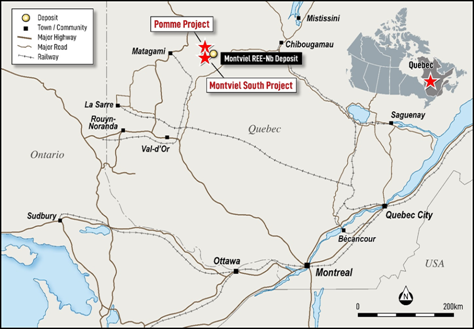 |
Figure 1: Regional location map showing Pomme Project, in Québec, Canada2
MTM Critical Metals (a 100% subsidiary of ASX:MTM) has completed a 13-hole diamond drilling program totalling approximately 5,718 metres at its Pomme Rare Earth Element and Niobium Project in Québec, Canada2. Carbonatite-hosted REE-Nb mineralisation was intersected in every drill hole, confirming the presence of a large, laterally extensive mineralised system exceeding 2 km² that remains open at depth (Figure 2).
The historic work program has significantly advanced the geological understanding of the complex, with early interpretations indicating that higher-grade mineralisation occurs within a ring structure surrounding a magnetic ultramafic carbonatite core.
Drill holes POM-23-03, POM 23-01 and POM 23-07 to the southwest of the mineralised carbonatite returned broad mineralised intervals with multiple high-grade TREO intersections, supporting strong geological similarities to the nearby world-class Montviel carbonatite deposit.
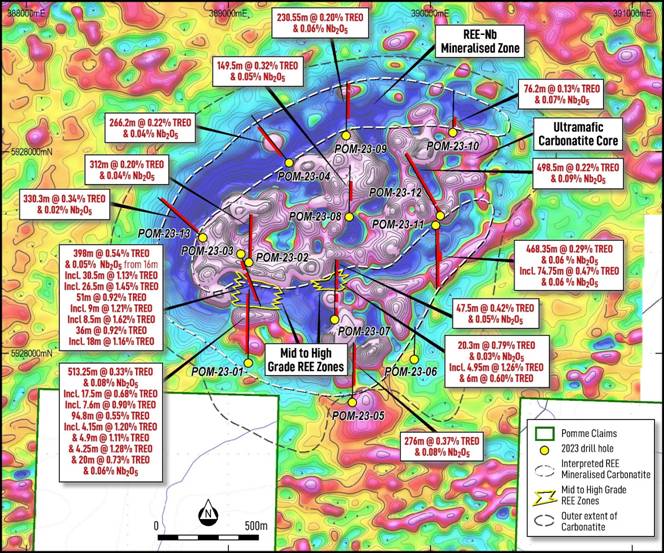 |
Importantly, large portions of this prospective ring structure remain untested due to the broad drill spacing, presenting clear potential for further discovery through follow-up drilling.
Figure 2: MTM scout drilling at the Pomme Project area overlain on airborne magnetic image (TMI, 1VD)
STRATEGY AND DEVELOPMENT OPPORTUNITY
The Pomme Project provides NFM with a highly capital-efficient, low-risk entry into a strategically located Canadian rare earth asset via a two-year option structure requiring upfront consideration of A$100,000 in cash and A$200,000 in NFM shares and minimum annual expenditure of A$100,000 per annum during the option period. This staged earn-in framework enables NFM to progressively earn a majority (90%) interest through defined technical and investment milestones, significantly limiting upfront capital exposure while preserving substantial upside.
1. Initial work programs will focus on conventional metallurgical test work alongside the application of Metallium's proprietary Flash Joule Heating (FJH) technology to existing drill core, targeting the production of upgraded rare earth concentrates and early validation of a scalable, low-cost processing pathway that has the potential to materially enhance project economics.
2. The Pomme Project presents compelling exploration upside, having been subject to only limited, widely spaced drilling to date, with drill lines approximately 500 metres apart2. Despite this early-stage drill density, high-grade rare earth element intersections have already been identified within a large, laterally extensive carbonatite system, highlighting the potential for significant growth through follow-up drilling targeting near surface higher grade zones of rare earth mineralistion.
The existing results indicate that higher-grade zones of mineralisation remain open, providing New Frontier Minerals with a strong opportunity to materially expand the scale and grade of mineralisation through systematic infill and step-out drilling programs.
METALLIUM TECHNOLOGY PARTNERSHIP
The acquisition deepens the Harts Range vertical integration with MTM1, adds a highly complementary Canadian asset, and creates a compelling Western-world partnership with MTM across Australia and Canada, delivering value for shareholders.
NFM's binding commercial framework with Metallium also establishes a strategic technology partnership that is directly applicable to the advancement of the Pomme REE-Nb Project in Québec. Under this framework, MTM's proprietary Flash Joule Heating (FJH) technology has demonstrated encouraging sighter beneficiation results on raw rare earth ore, producing high-grade, Dy/Tb-rich concentrates without conventional flotation, acid leaching or reagent-intensive processing.
The REE concentration enhancement and impurity rejection results observed through the aforementioned FJH test work indicate potential to support alternative downstream processing pathways for carbonatite-hosted rare earth projects such as Pomme, compared to conventional techniques. Alignment with MTM provides NFM with early integration of advanced metallurgical test work, access to MTM's Texas Technology Campus for testing, and a clear potential pathway to Western-aligned rare earth supply chains, including U.S. magnet and defence markets, reinforcing the strategic value of the Pomme Project within a vertically integrated rare earth development strategy.
NEXT STEPS
Preliminary metallurgical test work
Selection of diamond drill core for characterisation tests and accelerate metallurgical assessment on existing diamond core samples, utilising conventional metallurgical test work and tailored MTM Flash Joule Heating (FJH) processing technology to beneficiate and upgrade REE sample.
Model geology, drilling and target high-grade mineralisation
Integration of geological logging, assay results and geophysics into 3D model and identification of continuous higher grade zones for follow-up drilling.
OPTION AND EARN-IN TERMS
The Pomme Project consists of 43 mineral claims, covering 2,400 ha. New Frontier Minerals holds the exclusive and binding option to acquire 90% of the Pomme REE-Nb project from Metallium.
Key Terms Summary - Pomme Rare Earth Project Option & Earn up to 90% interest in the project tenements from Metallium Ltd (via its option to acquire 100% of Critical Element Exploration Pty Ltd, holder of the GeoMega option).
Option Terms and Earn-in Terms
Option Fee:
· A$100,000 cash (A$50,000 already paid as an exclusivity deposit)
· A$200,000 in NFM shares, (issued at 5-day VWAP, 6-months escrow)
· Option Period: Commences on access to historic drill samples for 24-month duration with exclusive rights to manage exploration and technical work during the option period
Stage 1 - Option Exercise (Initial Earn-In)
Upon exercise of the option at any time during the Option Period (subject to conditions precedent), NFM must pay the following option exercise fee:
· Cash: A$150,000
· Equity: A$200,000 in NFM shares (20-day VWAP, 6-month escrow)Result: Entry into Joint Venture and commencement of staged earn-in
· Minimum annual expenditure of A$100,000 per annum
Exercise of the Option is conditional upon the satisfaction (or waiver as applicable) of the following conditions precedent:
· Due diligence: completion of financial, legal and technical due diligence on the Tenements, to the absolute satisfaction of NFM;
· Third party approvals: the Parties obtaining all third party approvals and consents, necessary to lawfully complete the matters set out in this Agreement;
· Deeds of assignment and assumption: MTM, NFM executing a deed of assignment and assumption in relation to all material agreements;
· Joint Venture Agreement: the Parties entering into a definitive Joint Venture Agreement consistent with the terms and conditions set out in the binding Agreement;
· MTM and/ or its subsidiaries being the 100% legal and beneficial owner of the Tenements; and
· Technology Licence Agreement: MTM and NFM entering into a definitive Technology Licence Agreement consistent with the terms and conditions set out in the binding Agreement;
(together, the Conditions Precedent).
Stage 2 - JORC Resource Milestone (within 3 years)
· Minimum Spend: A$2.0 million
· Interest Earned: 80% project interest
· Milestone Payment: A$250,000 cash and A$250,000 in NFM shares (20-day VWAP, 6-month escrow) upon earning an 80% interest
Stage 3 - Pre-Feasibility Study Milestone (within 5 years)
· Minimum Spend: A$3.0 million
· Interest Earned: 90% project interest
· Milestone Payment: A$250,000 cash and A$250,000 in NFM shares (20-day VWAP, 6-month escrow) upon earning a 90% interest
Residual Interest & FJH Royalty
· Vendor retains 10% free-carried interest to DFS
· If diluted below 10%, interest converts to a 1.5% NSR royalty on material processed through Metallium's FJH facility
· Existing third-party royalties (GeoMega/Niogold) remain in place
Technology Alignment
· Metallium retains ownership of its Flash Joule Heating (FJH) processing technology
· Parties may enter into a separate technology licence agreement, including per-tonne fees, annual licence fees, and royalties (commercial terms to be negotiated)
ENDS
This announcement was approved for release by the Board of New Frontier Minerals Ltd.
REFERENCES
1) 18 November 2025 - NFM ASX Release "Binding Commercial Framework with Metallium Post Exceptional Heavy Rare Earth Results from Harts Range"
2) 4 October 2023 - MTM ASX Release "Investor Update Presentation Deck Exploration Success at the Pomme REE-Nb Project in Québec"
3) 28 September 2023 - MTM ASX Release "High grade total rare earth element oxide (TREO) drilling results returned over significant widths at the Pomme REE-Nb Project, Québec"
4) 9 October 2023 - MTM ASX Release "Pomme Project drilling returns more rare earths intercepts. Assay results up to 2.72% (27,200ppm) TREOs"
5) 24 October 2023 - MTM ASX Release "Pomme Project drilling identifies new zones of rare earth and niobium mineralisation"
6) 15 November 2023 - MTM ASX Release "Pomme Project drilling identifies new zones of rare earth and niobium mineralisation within carbonatite complex"
7) 3 January 2024 - MTM ASX Release "New broad zones of REE-Niobium mineralisation identified within Pomme Project carbonatite complex"
8) ALS Canada lab assay results, Montreal, QC, Canada - job certificate VO23203086 (10 September 2023)
For further information, please contact:
|
New Frontier Minerals Limited |
+61 8 6558 0886 |
|
Gerrard Hall (UK), Chairman |
|
|
|
|
|
S. P. Angel Corporate Finance LLP (Corporate Broker) |
+44 (0)1483 413500 |
|
Ewan Leggat |
+44 (0) 20 7409 3494 |
|
|
|
|
St Brides Partners Ltd (Financial PR) |
+44 (0)20 7236 1177 |
|
Ana Ribeiro and Charlotte Page |
|
About New Frontier Minerals
New Frontier Minerals Limited is an Australian-based focussed explorer, with a strategy to develop multi-commodity assets that demonstrate future potential as an economic mining operation. Through the application of disciplined and structured exploration, New Frontier has identified assets deemed core and is actively progressing these interests up the value curve. Current focus will be on advancing exploration activity at the Harts Range Niobium, Uranium and Heavy Rare Earths Project which is circa 140km north-east from Alice Springs in the Northern Territory.
Other interests include the NWQ Copper Project, situated in the copper-belt district circa 150km north of Mt Isa in Queensland.
New Frontier Minerals is listed on the LSE and ASX under the ticker "NFM".
Competent Persons Statement
The scientific and technical information in this announcement, which relates to exploration results, preliminary sequential metallurgical results and the geology of the deposits described, is based on information compiled and approved for release by Mark Biggs. Mark Biggs is a Member of The Australasian Institute of Mining and Metallurgy (AusIMM Member # 107188) and meets the requirements of a Competent Person as defined by the 2012 Edition of the Australasian Code for Reporting of Exploration Results, Mineral Resources and Ore Reserves (JORC Code 2012 Edition). Mark Biggs has 35 years of experience relevant to Rare Earth Elements (REE), industrial mineral copper mineralisation types, as well as expertise in the quality and potential mining methods of the deposits under consideration. Additionally, he has 25 years of experience in the estimation, assessment, and evaluation of exploration results and mineral resource estimates, which are the activities for which he accepts responsibility. He also successfully completed an AusIMM Online Course Certificate in 2012 JORC Code Reporting. Mark Biggs is a consultant with ROM Resources and was engaged by New Frontier Minerals Limited to prepare the documentation for several prospects, specifically those within the Harts Range Prospects upon which the Report is based.
Furthermore, the full nature of the relationship between himself and New Frontier Minerals Limited has been disclosed, including any potential conflicts of interest. Mark Biggs is a director of ROM Resources, a company that is a shareholder of New Frontier Minerals Limited, and ROM Resources provides occasional geological consultancy services to New Frontier Minerals Limited. The Report or excerpts referenced in this statement have been reviewed, ensuring that they are based on and accurately reflect, in both form and context, the supporting documentation relating to exploration results and any mineral resource estimates. The release of the Report and this statement has been consented to by the Directors of New Frontier Minerals Limited. Mr Biggs consents to the inclusion in this announcement of the matters based on his information and supporting documents in the form and context in which it appears.
Forward Looking Statements
Certain information in this document refers to the intentions of New Frontier Minerals Ltd, but these are not intended to be forecasts, forward-looking statements, or statements about future matters for the purposes of the Corporations Act or any other applicable law. The occurrence of events in the future is subject to risks, uncertainties and other factors that may cause New Frontier Minerals Ltd's actual results, performance, or achievements to differ from those referred to in this announcement. Accordingly, New Frontier Minerals Ltd, its directors, officers, employees, and agents, do not give any assurance or guarantee that the occurrence of the events referred to in this announcement will occur as contemplated. The interpretations and conclusions reached in this announcement are based on current geological theory and the best evidence available to the authors at the time of writing. It is the nature of all scientific conclusions that they are founded on an assessment of probabilities and, however high these probabilities might be, they make no claim for complete certainty. Any economic decisions that might be taken based on interpretations or conclusions contained in this announcement will therefore carry an element of risk. The announcement may contain forward-looking statements that involve several risks and uncertainties. These risks include but are not limited to, economic conditions, stock market fluctuations, commodity demand and price movements, access to infrastructure, timing of approvals, regulatory risks, operational risks, reliance on key personnel, Ore Reserve and Mineral Resource estimates, native title, foreign currency fluctuations, exploration risks, mining development, construction, and commissioning risk. These forward-looking statements are expressed in good faith and believed to have a reasonable basis. These statements reflect current expectations, intentions or strategies regarding the future and assumptions based on currently available information. Should one or more of the risks or uncertainties materialise, or should underlying assumptions prove incorrect, actual results may vary from the expectations, intentions and strategies described in this announcement. No obligation is assumed to update forward-looking statements if these beliefs, opinions, and estimates should change or to reflect other future developments.
ASX Listing Rule 5.23.2
New Frontier Minerals Ltd confirms that it is not aware of any new information or data that materially affects the information included in this market announcement and that all material assumptions and technical parameters underpinning the estimates in this market announcement continue to apply and have not materially changed
APPENDIX A - POMME PROJECT DRILL HOLE DETAILS
|
Hole ID |
East |
North |
Elevation (masl) |
Dip (o) |
Azimuth (o) |
EOH Depth (m) |
Status |
|
POM-23-01 |
389,104.80 |
5,526,970.76 |
284.73 |
-50 |
000 |
558 |
Completed |
|
POM-23-02 |
389,106.83 |
5,52,7472.61 |
283.13 |
-50 |
000 |
330 |
Completed |
|
POM-23-03 |
389,063.23 |
5,527,503.65 |
283.32 |
-50 |
160 |
414 |
Completed |
|
POM-23-04 |
389,300.03 |
5,527,958.58 |
279.79 |
-50 |
325 |
405 |
Completed |
|
POM-23-05 |
389,611.51 |
5,526,765.31 |
276.92 |
-50 |
000 |
501 |
Completed |
|
POM-23-06 |
389,919.77 |
5,526,988.35 |
275.74 |
-50 |
000 |
225 |
Completed |
|
POM-23-07 |
389,524.14 |
5,527,208.74 |
279.75 |
-50 |
000 |
444 |
Completed |
|
POM-23-08 |
389,599.10 |
5,527,688.46 |
280.54 |
-50 |
000 |
351 |
Completed |
|
POM-23-09 |
389,586.18 |
5,528,102.00 |
280.05 |
-50 |
000 |
555 |
Completed |
|
POM-23-10 |
390,116.14 |
5,528,057.95 |
274.31 |
-50 |
000 |
393 |
Completed |
|
POM-23-11 |
390,021.82 |
5,527,638.36 |
276.28 |
-50 |
180 |
516 |
Completed |
|
POM-23-12 |
390,052.07 |
5,527,693.66 |
275.93 |
-50 |
335 |
582 |
Completed |
|
POM-23-13 |
388,878.14 |
5,527,594.96 |
284.03 |
-50 |
300 |
444 |
Completed |
Notes:
1. Coordinate system North American Datum 1983 (NAD 83), UTM Zone 18 EOH - End of Hole
APPENDIX B - SIGNIFICANT DRILL INTERSECTIONS
Drill Hole POM-23-01
|
From (m) |
To (m) |
Length (m) |
Grade |
Nd+Pr (%) |
TREO Cut-off (ppm) |
||
|
TREO (%) |
Nb2O5 (%) |
P2O5 (%) |
|||||
|
31.75 |
545 |
513.25 |
0.33 |
0.08 |
1.8 |
22 |
1,000 |
|
31.75 |
37.85 |
6.1 |
0.29 |
0.14 |
4.7 |
25 |
2,000 |
|
45.3 |
49.9 |
4.6 |
0.25 |
0.05 |
2.1 |
25 |
2,000 |
|
54.6 |
59.5 |
4.9 |
0.26 |
0.10 |
2.0 |
25 |
2,000 |
|
66.0 Including: 88.5 |
95.6
92.5 |
29.6
4.0 |
0.31
0.55 |
0.12
0.14 |
2.5
1.9 |
24
20 |
2,000
5,000 |
|
103.0 |
115.0 |
12.0 |
0.21 |
0.11 |
2.3 |
23 |
2,000 |
|
118.0 Including: 122.5 |
147.0
127.0 |
29.0
4.5 |
0.41
0.69 |
0.09
0.11 |
2.2
2.4 |
20
18 |
2,000
5,000 |
|
154.0 |
164.5 |
10.5 |
0.29 |
0.03 |
1.8 |
29 |
2,000 |
|
167.5 |
170.5 |
3.0 |
0.28 |
0.06 |
2.0 |
26 |
2,000 |
|
174.5 Including: 175.6 |
191.0
176.55 |
16.5
0.95 |
0.36
1.74 |
0.14
0.0 |
2.0
0.47 |
19
12 |
2,000
10,000 |
|
198.5 |
212.0 |
13.5 |
0.25 |
0.16 |
1.9 |
26 |
2,000 |
|
216.15 |
259.5 |
43.35 |
0.45 |
0.12 |
2.3 |
19 |
2,000 |
|
Including: |
|
|
|
|
|
|
|
|
228.6 |
232.7 |
4.1 |
0.80 |
0.08 |
0.5 |
16 |
5,000 |
|
238.5 |
246.1 |
7.6 |
0.91 |
0.20 |
3.6 |
15 |
5,000 |
|
262.5 |
274.8 |
12.3 |
0.27 |
0.08 |
3.3 |
27 |
2,000 |
|
283.5 |
304.5 |
21.0 |
0.33 |
0.06 |
0.2 |
24 |
2,000 |
|
309.75 |
314.0 |
4.25 |
0.22 |
0.03 |
1.6 |
23 |
2,000 |
|
317.0 |
448.0 |
131 |
0.47 |
0.05 |
1.4 |
21 |
2,000 |
|
Including: |
|
|
|
|
|
|
|
|
335.0 |
355.0 |
20.0 |
0.68 |
0.06 |
1.2 |
20 |
5,000 |
|
336.85 |
339.5 |
2.65 |
1.47 |
0.02 |
0.4 |
13 |
10,000 |
|
370.0 |
382.55 |
12.55 |
0.50 |
0.08 |
1.9 |
22 |
5,000 |
|
402.5 |
411.9 |
9.4 |
0.86 |
0.02 |
0.8 |
19 |
5,000 |
|
407.0 |
411.9 |
4.9 |
1.11 |
0.02 |
0.0 |
17 |
10,000 |
|
421.35 |
428.3 |
6.95 |
0.96 |
0.0 |
0.0 |
18 |
5,000 |
|
421.35 |
424.0 |
2.65 |
1.48 |
0.0 |
0.0 |
15 |
10,000 |
|
461.5 |
463.5 |
2.0 |
0.26 |
0.05 |
2.6 |
22 |
2,000 |
|
466.5 |
483.0 |
16.5 |
0.40 |
0.03 |
1.2 |
19 |
2,000 |
|
Including: 476.0 |
478.3 |
2.3 |
0.90 |
0.02 |
0.6 |
17 |
5,000 |
|
512.5 |
538.5 |
26.0 |
0.31 |
0.07 |
1.5 |
22 |
2,000 |
|
542.1 |
545.0 |
1.9 |
0.29 |
0.04 |
0.3 |
24 |
2,000 |
|
555.0 |
558 (EOH) |
3.0 |
0.32 |
0.04 |
0.3 |
21 |
2,000 |
Drill Hole POM-23-02
|
From (m) |
To (m) |
Length (m) |
Grade |
Nd+Pr (%) |
TREO Cut-off (ppm) |
||
|
TREO (%) |
Nb2O5 (%) |
P2O5 (%) |
|||||
|
18.0 |
330.0 (EOH) |
312.0 |
0.19 |
0.04 |
0.5 |
25 |
1,000 |
|
Including: |
|
|
|
|
|
|
|
|
61.5 |
99.0 |
37.5 |
0.28 |
0.06 |
0.05 |
26 |
2,000 |
|
79.5 |
84.0 |
4.5 |
0.59 |
0.06 |
0.04 |
26 |
5,000 |
|
103.5 |
118.5 |
15.0 |
0.24 |
0.06 |
0.08 |
26 |
2,000 |
|
166.5 |
168.0 |
1.5 |
0.52 |
0.06 |
0.54 |
31 |
5,000 |
|
180.0 |
193.5 |
13.5 |
0.29 |
0.03 |
0.69 |
22 |
2,000 |
|
198.0 |
213.0 |
15.0 |
0.34 |
0.04 |
0.65 |
25 |
2,000 |
Drill Hole POM-23-03
|
From (m) |
To (m) |
Length (m) |
Grade |
Nd+Pr (%) |
TREO Cut-off (ppm) |
||
|
TREO (%) |
Nb2O5 (%) |
P2O5 (%) |
|||||
|
16.25 |
414.0 (EOH) |
397.75 |
0.54 |
0.05 |
0.63 |
23 |
1,000 |
|
52.0 |
127.0 |
75.0 |
0.22 |
0.05 |
0.61 |
22 |
2,000 |
|
133.0 |
382.0 |
249.0 |
0.73 |
0.05 |
0.58 |
23 |
2,000 |
|
139.5 |
169.5 |
30.0 |
0.67 |
0.06 |
0.91 |
22 |
5,000 |
|
Including: 154.5 |
159.0 |
4.5 |
1.12 |
0.03 |
0.12 |
19 |
10,000 |
|
174.0 |
210.0 |
36.0 |
0.92 |
0.04 |
0.68 |
26 |
5,000 |
|
Including: 184.5 |
202.5 |
18.0 |
1.16 |
0.03 |
0.49 |
27 |
10,000 |
|
216.0 |
267.0 |
51.0 |
0.92 |
0.05 |
0.19 |
25 |
5,000 |
|
Including: 228.0 254.0 |
237.0 262.5 |
9.0 8.5 |
1.21 1.62 |
0.03 0.03 |
0.06 0.46 |
27 20 |
10,000 10,000 |
|
289.5 |
303.0 |
13.5 |
0.53 |
0.06 |
0.26 |
22 |
5,000 |
|
311.5 |
342.0 |
30.5 |
1.13 |
0.03 |
0.18 |
22 |
5,000 |
|
Including: 321.0 |
337.5 |
26.5 |
1.45 |
0.02 |
0.02 |
22 |
10,000 |
|
346.5 |
358.3 |
11.8 |
0.81 |
0.11 |
1.13 |
19 |
5,000 |
|
Including: 349.5 |
357.0 |
7.5 |
0.97 |
0.12 |
1.31 |
19 |
10,000 |
|
367.5 |
379.1 |
11.6 |
0.68 |
0.06 |
0.51 |
25 |
5,000 |
Drill Hole POM-23-04
|
From (m) |
To (m) |
Length (m) |
Grade |
Nd+Pr (%) |
TREO Cut-off (ppm) |
||
|
TREO (%) |
Nb2O5 (%) |
P2O5 (%) |
|||||
|
36.8 |
303.0 |
266.2 |
0.22 |
0.04 |
0.7 |
26 |
1,000 |
|
79.0 |
118.5 |
39.5 |
0.46 |
0.05 |
0.8 |
27 |
2,000 |
|
Including |
94.75 |
4.25 |
0.88 |
0.07 |
0.7 |
28 |
5,000 |
|
90.5 |
|||||||
|
126.0 |
147.0 |
21.0 |
0.25 |
0.12 |
1.3 |
26 |
2,000 |
Drill Hole POM-23-05
|
From (m) |
To (m) |
Length (m) |
Grade |
Nd+Pr (%) |
TREO Cut-off (ppm) |
||
|
TREO (%) |
Nb2O5 (%) |
P2O5 (%) |
|||||
|
225.0 |
501.0 (EOH) |
276.0 |
0.37 |
0.08 |
1.5 |
26 |
1,000 |
|
226.5 |
235.5 |
9.0 |
0.94 |
0.02 |
0.0 |
32 |
2,000 |
|
Including |
|
|
|
|
|
|
|
|
229.4 |
233.2 |
3.8 |
1.46 |
0.01 |
0.0 |
31 |
10,000 |
|
240.0 |
255.9 |
15.9 |
0.25 |
0.05 |
0.8 |
30 |
2,000 |
|
261.0 |
271.5 |
10.5 |
0.22 |
0.15 |
1.6 |
30 |
2,000 |
|
292.5 |
369.0 |
76.2 |
0.31 |
0.08 |
1.2 |
26 |
2,000 |
|
375.0 |
432.0 |
57.0 |
0.47 |
0.10 |
1.0 |
23 |
2,000 |
|
Including |
|
|
|
|
|
|
|
|
381.5 |
384.9 |
3.4 |
1.99 |
0.02 |
0.0 |
22 |
10,000 |
|
404.4 |
415.5 |
11.1 |
0.83 |
0.04 |
0.3 |
21 |
5,000 |
|
437.5 |
501.0 (EOH) |
63.5 |
0.48 |
0.06 |
2.7 |
23 |
2,000 |
|
Including |
|
|
|
|
|
|
|
|
439.0 |
451.7 |
12.7 |
1.04 |
0.04 |
1.4 |
20 |
10,000 |
Drill Hole POM-23-06
|
From (m) |
To (m) |
Length (m) |
Grade |
Nd+Pr (%) |
TREO Cut-off (ppm) |
||
|
TREO (%) |
Nb2O5 (%) |
P2O5 (%) |
|||||
|
20.65 |
25.0 |
4.35 |
0.11 |
0.01 |
0.2 |
29 |
1,000 |
|
59.5 |
63.65 |
4.15 |
0.12 |
0.03 |
0.9 |
30 |
1,000 |
|
76.0 |
77.5 |
1.5 |
0.74 |
0.03 |
0.0 |
40 |
5,000 |
|
80.5 |
88.0 |
7.5 |
0.10 |
0.03 |
0.1 |
31 |
1,000 |
|
123.5 |
130.5 |
7.0 |
0.14 |
0.04 |
1.6 |
27 |
1,000 |
|
156.0 |
160.6 |
4.6 |
0.16 |
0.04 |
2.3 |
27 |
1,000 |
|
163.7 |
168.0 |
4.3 |
0.16 |
0.04 |
2.0 |
27 |
1,000 |
|
173.5 |
182.2 |
8.7 |
0.17 |
0.06 |
3.0 |
30 |
1,000 |
|
191.7 |
197.5 |
5.8 |
0.19 |
0.02 |
2.6 |
27 |
1,000 |
|
208.5 |
223.5 |
15.0 |
0.19 |
0.08 |
1.4 |
29 |
1,000 |
Drill Hole POM-23-07
|
From (m) |
To (m) |
Length (m) |
Grade |
Nd+Pr (%) |
TREO Cut-off (ppm) |
||
|
TREO (%) |
Nb2O5 (%) |
P2O5 (%) |
|||||
|
18.8 |
82.2 |
63.4 |
0.27 |
0.10 |
1.28 |
29 |
1,000 |
|
including: |
|
|
|
|
|
|
|
|
18.8 |
36.15 |
17.35 |
0.33 |
0.10 |
0.65 |
29 |
2,000 |
|
62.2 |
73.5 |
11.3 |
0.30 |
0.08 |
1.65 |
29 |
2,000 |
|
133.0 |
162.0 |
29.0 |
0.34 |
0.11 |
1.75 |
29 |
2,000 |
|
including: |
|
|
|
|
|
|
|
|
144.5 |
146.0 |
1.5 |
1.07 |
0.19 |
0.85 |
24 |
10,000 |
|
170.5 |
190.8 |
20.3 |
0.79 |
0.03 |
0.70 |
24 |
5,000 |
|
Including: |
|
|
|
|
|
|
|
|
170.5 |
172.1 |
1.6 |
1.25 |
0.06 |
1.98 |
20 |
10,000 |
|
181.85 |
186.80 |
4.95 |
1.26 |
0.02 |
0.01 |
23 |
10,000 |
|
190.8 |
237.0 |
47.8 |
0.30 |
0.07 |
1.15 |
27 |
2,000 |
|
including: |
|
|
|
|
|
|
|
|
213.0 |
214.5 |
1.5 |
1.40 |
0.11 |
0.01 |
22 |
10,000 |
|
249.0 |
355.5 |
106.5 |
0.27 |
0.04 |
0.93 |
26 |
2,000 |
|
including: |
|
|
|
|
|
|
|
|
331.5 |
336.0 |
4.5 |
0.53 |
0.06 |
0.83 |
26 |
5,000 |
|
378.0 |
425.5 |
47.5 |
0.42 |
0.05 |
1.12 |
25 |
2,000 |
|
including: |
|
|
|
|
|
|
|
|
387.0 |
393.0 |
6.0 |
0.60 |
0.06 |
1.58 |
25 |
5,000 |
|
401.9 |
402.9 |
1.0 |
1.80 |
0.04 |
0.73 |
22 |
10,000 |
|
419.5 |
420.75 |
1.25 |
3.34 |
0.03 |
1.58 |
19 |
10,000 |
|
439.0 |
444.0 EOH |
5.0 |
0.31 |
0.12 |
1.89 |
29 |
2,000 |
Drill Hole POM-23-08
|
From (m) |
To (m) |
Length (m) |
Grade |
Nd+Pr (%) |
TREO Cut-off (ppm) |
||
|
TREO (%) |
Nb2O5 (%) |
P2O5 (%) |
|||||
|
15.55 |
20.5 |
4.95 |
0.23 |
0.05 |
0.6 |
24 |
2,000 |
|
24.0 |
25.5 |
1.5 |
0.70 |
0.0 |
6.2 |
19 |
5,000 |
|
122.0 |
271.5 |
149.5 |
0.32 |
0.05 |
1.0 |
24 |
1,000 |
|
122.0 |
140.0 |
18.0 |
0.29 |
0.06 |
0.5 |
25 |
2,000 |
|
including: |
|
|
|
|
|
|
|
|
138.5 |
140.0 |
1.5 |
0.60 |
0.05 |
1.6 |
22 |
5,000 |
|
146.0 |
257.0 |
111.0 |
0.35 |
0.05 |
1.1 |
24 |
2,000 |
|
including: |
|
|
|
|
|
|
|
|
171.5 |
174.5 |
3.0 |
0.73 |
0.05 |
0.5 |
20 |
5,000 |
|
204.5 |
216.5 |
12.0 |
0.73 |
0.06 |
1.3 |
22 |
5,000 |
|
including: |
|
|
|
|
|
|
|
|
206.0 |
207.5 |
1.5 |
1.14 |
0.05 |
2.9 |
20 |
10,000 |
|
215.0 |
216.5 |
1.5 |
1.31 |
0.06 |
2.2 |
21 |
10,000 |
|
262.5 |
270.0 |
7.5 |
0.33 |
0.05 |
0.5 |
26 |
2,000 |
Drill Hole POM-23-09
|
From (m) |
To (m) |
Length (m) |
Grade |
Nd+Pr (% TREO) |
TREO Cut-off (ppm) |
||
|
TREO (%) |
Nb2O5 (%) |
P2O5 (%) |
|||||
|
24.0 |
75.0 |
51.0 |
0.16 |
0.04 |
1.7 |
24 |
1,000 |
|
including: |
|
|
|
|
|
|
|
|
30.0 |
47.0 |
17.0 |
0.21 |
0.05 |
3.4 |
24 |
2,000 |
|
79.5 |
112.5 |
33.0 |
0.12 |
0.04 |
1.5 |
30 |
1,000 |
|
123.0 |
151.0 |
28.0 |
0.16 |
0.06 |
2.8 |
31 |
1,000 |
|
including: |
|
|
|
|
|
|
|
|
130.5 |
135.5 |
5.0 |
0.24 |
0.03 |
2.7 |
37 |
2,000 |
|
156.0 |
166.5 |
10.5 |
0.16 |
0.08 |
4.7 |
26 |
1,000 |
|
174.0 |
404.55 |
230.55 |
0.20 |
0.06 |
3.3 |
25 |
1,000 |
|
including: |
|
|
|
|
|
|
|
|
225.0 |
231.0 |
6.0 |
0.25 |
0.03 |
4.3 |
29 |
2,000 |
|
237.0 |
244.5 |
7.5 |
0.21 |
0.07 |
1.0 |
28 |
2,000 |
|
250.95 |
253.15 |
2.2 |
0.47 |
0.03 |
1.4 |
26 |
2,000 |
|
259.5 |
286.5 |
27.0 |
0.28 |
0.08 |
4.2 |
23 |
2,000 |
|
310.5 |
325.5 |
15.0 |
0.30 |
0.05 |
3.1 |
24 |
2,000 |
|
including: |
|
|
|
|
|
|
|
|
321.0 |
322.5 |
1.5 |
0.73 |
0.04 |
2.4 |
18 |
5,000 |
|
331.5 |
363.0 |
31.5 |
0.29 |
0.05 |
5.2 |
24 |
2,000 |
|
including: |
|
|
|
|
|
|
|
|
360.0 |
361.5 |
1.5 |
0.64 |
0.05 |
2.8 |
17 |
5,000 |
|
367.5 |
390.0 |
22.5 |
0.25 |
0.03 |
3.2 |
23 |
2,000 |
|
including: |
|
|
|
|
|
|
|
|
376.7 |
378.0 |
1.3 |
0.82 |
0.02 |
2.6 |
18 |
5,000 |
|
409.5 |
430.5 |
21.0 |
0.18 |
0.05 |
3.6 |
34 |
1,000 |
|
459.0 |
519.0 |
60.0 |
0.23 |
0.04 |
6.6 |
27 |
1,000 |
|
including: |
|
|
|
|
|
|
|
|
474.2 |
476.7 |
2.5 |
0.57 |
0.02 |
22.9 |
31 |
5,000 |
|
474.2 |
482.3 |
8.1 |
0.35 |
0.03 |
14.3 |
29 |
2,000 |
|
495.2 |
516.0 |
20.8 |
0.30 |
0.03 |
8.0 |
25 |
2,000 |
|
545.75 |
555.0 (EOH) |
9.25 |
0.20 |
0.01 |
2.2 |
22 |
1,000 |
Drill Hole POM-23-10
|
From (m) |
To (m) |
Length (m) |
Grade |
Nd+Pr (%) |
TREO Cut-off (ppm) |
||
|
TREO (%) |
Nb2O5 (%) |
P2O5 (%) |
|||||
|
15.8 |
92.0 |
76.2 |
0.13 |
0.07 |
3.7 |
28 |
1,000 |
|
101.3 |
120.0 |
18.7 |
0.09 |
0.05 |
2.0 |
27 |
1,000 |
|
183.0 |
192.0 |
9.0 |
0.13 |
0.07 |
0.9 |
28 |
1,000 |
|
195.0 |
199.5 |
4.5 |
0.16 |
0.15 |
2.3 |
28 |
1,000 |
|
226.5 |
250.5 |
24.0 |
0.17 |
0.07 |
2.4 |
29 |
1,000 |
|
including: |
|
|
|
|
|
|
|
|
234.0 |
235.5 |
1.5 |
0.53 |
0.13 |
0.9 |
32 |
5,000 |
|
252.5 |
255.0 |
2.5 |
0.27 |
0.10 |
4.0 |
30 |
1,000 |
|
258.8 |
261.8 |
3.0 |
0.22 |
0.04 |
2.9 |
28 |
1,000 |
|
321.2 |
337.0 |
15.8 |
0.18 |
0.11 |
3.4 |
24 |
1,000 |
Drill Hole POM-23-11
|
From (m) |
To (m) |
Length (m) |
Grade |
Nd+Pr (% TREO) |
TREO Cut-off (ppm) |
||
|
TREO (%) |
Nb2O5 (%) |
P2O5 (%) |
|||||
|
22.65 |
491.0 |
468.35 |
0.29 |
0.06 |
2.4 |
28 |
1,000 |
|
including: |
|
|
|
|
|
|
|
|
22.65 |
33.0 |
10.35 |
0.26 |
0.05 |
2.9 |
29 |
2,000 |
|
54.0 |
60.0 |
6.0 |
0.29 |
0.03 |
2.2 |
29 |
2,000 |
|
70.45 |
74.95 |
4.5 |
0.48 |
0.03 |
3.0 |
27 |
2,000 |
|
79.5 |
138.0 |
58.5 |
0.28 |
0.07 |
1.9 |
32 |
2,000 |
|
including: |
|
|
|
|
|
|
|
|
88.5 |
91.3 |
2.8 |
0.57 |
0.04 |
0.2 |
28 |
5,000 |
|
142.5 |
159.0 |
16.5 |
0.26 |
0.06 |
3.3 |
32 |
2,000 |
|
163.5 |
190.5 |
27.0 |
0.27 |
0.07 |
3.0 |
33 |
2,000 |
|
213.0 |
235.85 |
22.85 |
0.23 |
0.12 |
3.5 |
33 |
2,000 |
|
239.7 |
245.9 |
6.2 |
0.23 |
0.13 |
3.2 |
33 |
2,000 |
|
252.0 |
326.75 |
74.75 |
0.47 |
0.06 |
2.3 |
25 |
2,000 |
|
including: |
|
|
|
|
|
|
|
|
259.5 |
277.5 |
18.0 |
0.57 |
0.06 |
1.9 |
26 |
5,000 |
|
261.0 |
262.5 |
1.5 |
1.02 |
0.09 |
0.7 |
25 |
10,000 |
|
286.75 |
288.4 |
1.65 |
2.00 |
0.03 |
1.2 |
16 |
10,000 |
|
294.5 |
309.25 |
14.75 |
0.55 |
0.06 |
2.7 |
22 |
5,000 |
|
294.5 |
296.0 |
1.5 |
1.09 |
0.04 |
2.4 |
18 |
10,000 |
|
331.5 |
349.5 |
18.0 |
0.26 |
0.04 |
3.7 |
28 |
2,000 |
|
353.5 |
409.0 |
55.5 |
0.34 |
0.05 |
3.5 |
26 |
2,000 |
|
including: |
|
|
|
|
|
|
|
|
384.0 |
390.0 |
6.0 |
0.55 |
0.06 |
5.2 |
23 |
5,000 |
|
422.5 |
478.5 |
56.0 |
0.35 |
0.05 |
1.9 |
26 |
2,000 |
|
including: |
|
|
|
|
|
|
|
|
457.5 |
462.0 |
4.5 |
0.55 |
0.07 |
1.3 |
28 |
5,000 |
Drill Hole POM-23-12
|
From (m) |
To (m) |
Length (m) |
Grade |
Nd+Pr (% TREO) |
TREO Cut-off (ppm) |
||
|
TREO (%) |
Nb2O5 (%) |
P2O5 (%) |
|||||
|
19.6 |
79.5 |
59.9 |
0.23 |
0.05 |
5.6 |
31 |
1,000 |
|
including: |
|
|
|
|
|
|
|
|
21.0 |
33.0 |
12.0 |
0.25 |
0.14 |
4.9 |
31 |
2,000 |
|
37.5 |
60.0 |
22.5 |
0.24 |
0.05 |
5.6 |
31 |
2,000 |
|
64.5 |
79.5 |
15.0 |
0.25 |
0.03 |
6.3 |
30 |
2,000 |
|
83.5 |
582.0 (EOH) |
498.5 |
0.22 |
0.09 |
2.9 |
29 |
1,000 |
|
including: |
|
|
|
|
|
|
|
|
88.5 |
115.5 |
27.0 |
0.23 |
0.05 |
4.5 |
31 |
2,000 |
|
123.0 |
139.5 |
16.5 |
0.24 |
0.09 |
3.1 |
27 |
2,000 |
|
147.0 |
178.5 |
31.5 |
0.29 |
0.06 |
3.8 |
24 |
2,000 |
|
including: |
|
|
|
|
|
|
|
|
148.7 |
151.4 |
2.7 |
0.58 |
0.02 |
0.1 |
16 |
5,000 |
|
207.0 |
238.5 |
31.5 |
0.25 |
0.04 |
3.8 |
31 |
2,000 |
|
258.0 |
280.5 |
22.5 |
0.24 |
0.05 |
3.7 |
31 |
2,000 |
|
316.5 |
345.0 |
28.5 |
0.26 |
0.11 |
2.2 |
29 |
2,000 |
|
349.5 |
369.0 |
19.5 |
0.25 |
0.09 |
2.8 |
28 |
2,000 |
|
including: |
|
|
|
|
|
|
|
|
363.0 |
364.6 |
1.6 |
0.50 |
0.11 |
0.9 |
25 |
5,000 |
|
379.5 |
400.9 |
21.4 |
0.23 |
0.08 |
3.4 |
29 |
2,000 |
|
415.55 |
441.0 |
25.45 |
0.30 |
0.11 |
2.3 |
27 |
2,000 |
|
including: |
|
|
|
|
|
|
|
|
415.55 |
417.0 |
1.45 |
0.52 |
0.05 |
5.6 |
28 |
5,000 |
|
420.0 |
421.5 |
1.5 |
0.56 |
0.31 |
0.6 |
24 |
5,000 |
|
424.1 |
425.2 |
1.1 |
1.00 |
0.14 |
0.5 |
23 |
10,000 |
|
462.0 |
488.0 |
26.0 |
0.28 |
0.08 |
1.9 |
29 |
2,000 |
|
537.0 |
558.0 |
21.0 |
0.28 |
0.11 |
2.3 |
29 |
2,000 |
|
including: |
|
|
|
|
|
|
|
|
537.0 |
538.5 |
1.5 |
0.66 |
0.17 |
3.8 |
30 |
5,000 |
Drill Hole POM-23-13
|
From (m) |
To (m) |
Length (m) |
Grade |
Nd+Pr (% TREO) |
TREO Cut-off (ppm) |
||
|
TREO (%) |
Nb2O5 (%) |
P2O5 (%) |
|||||
|
22.5 |
27.0 |
4.5 |
0.22 |
0.04 |
0.3 |
20 |
2,000 |
|
32.4 |
37.5 |
5.1 |
0.51 |
0.04 |
1.6 |
23 |
2,000 |
|
including: |
|
|
|
|
|
|
|
|
33.75 |
35.8 |
2.05 |
0.92 |
0.01 |
2.53 |
23 |
5,000 |
|
71.7 |
402.0 |
330.3 |
0.34 |
0.02 |
1.1 |
21 |
1,000 |
|
including: |
|
|
|
|
|
|
|
|
75.7 |
93.0 |
17.3 |
0.52 |
0.03 |
0.4 |
20 |
2,000 |
|
84.0 |
93.0 |
9.0 |
0.71 |
0.02 |
0.1 |
18 |
5,000 |
|
84.0 |
85.0 |
1.0 |
2.09 |
0.02 |
0.0 |
16 |
10,000 |
|
90.75 |
93 |
2.25 |
1.15 |
0.04 |
0.1 |
20 |
10,000 |
|
97.6 |
115.5 |
17.9 |
0.39 |
0.03 |
0.3 |
20 |
2,000 |
|
including: |
|
|
|
|
|
|
|
|
103.5 |
108.0 |
4.5 |
0.74 |
0.03 |
0.5 |
18 |
5,000 |
|
126.0 |
138.0 |
12.0 |
0.48 |
0.05 |
0.7 |
19 |
2,000 |
|
including: |
|
|
|
|
|
|
|
|
130.5 |
135.0 |
4.5 |
0.68 |
0.10 |
0.7 |
18 |
5,000 |
|
159.0 |
211.5 |
52.5 |
0.30 |
0.03 |
1.1 |
22 |
2,000 |
|
217.4 |
252.3 |
34.9 |
0.39 |
0.02 |
1.3 |
21 |
2,000 |
|
including: |
|
|
|
|
|
|
|
|
231.0 |
232.5 |
1.5 |
1.50 |
0.02 |
0.3 |
20 |
10,000 |
|
256.1 |
297.0 |
40.9 |
0.38 |
0.02 |
2.0 |
21 |
2,000 |
|
including: |
|
|
|
|
|
|
|
|
267.0 |
277.5 |
10.5 |
0.62 |
0.03 |
1.7 |
21 |
5,000 |
|
273.0 |
274.8 |
1.8 |
1.03 |
0.02 |
0.6 |
21 |
10,000 |
|
301.5 |
327.0 |
25.5 |
0.40 |
0.02 |
0.8 |
21 |
2,000 |
|
including: |
|
|
|
|
|
|
|
|
305.2 |
307.1 |
1.9 |
1.05 |
0.01 |
0.13 |
19 |
10,000 |
|
331.55 |
402.0 |
70.45 |
0.37 |
0.02 |
0.7 |
20 |
2,000 |
|
including: |
|
|
|
|
|
|
|
|
363.0 |
370.4 |
7.4 |
0.69 |
0.01 |
0.8 |
18 |
5,000 |
|
366.0 |
367.35 |
1.35 |
1.48 |
0.0 |
0.9 |
16 |
10,000 |
|
381.0 |
382.5 |
1.5 |
1.15 |
0.01 |
0.8 |
16 |
10,000 |
|
417.95 |
420.75 |
2.8 |
1.0 |
0.03 |
0.2 |
17 |
5,000 |
Notes:
2. Downhole intervals shown, true width not known. Appropriate rounding of grade values has been applied.
3. TREO (Total Rare Earth Oxide) grade includes CeO2, Dy2O3, Er2O3, Eu2O3, Gd2O3, Ho2O3, La2O3, Lu2O3, Nd2O3, Pr6O11, Sm2O3, Tb4O7, Tm2O3, Yb2O3 and Y2O3 and is calculated using standard oxide conversion factors for each element (see Appendix C).
4. Nd+Pr (Neodymium-Praseodymium or NdPr) includes Nd2O3 and Pr6O11. Shown as a percentage of TREO. Significant intersections are based on 1,000ppm, 2,000ppm, 5,000ppm and 10,000ppm TREO cut-off grades with up to 2 consecutive samples of internal dilution.
APPENDIX C - JORC Compliance Tables Section 1 Sampling Techniques and Data
|
|
Criteria |
JORC Code Explanation |
Commentary |
|
|
|
· 100% of the drill core and the relevant mineralisation intersections have been logged. · Drill core is currently stored at the field camp site. |
|
Sub-sampling techniques and sample preparation |
· If core, whether cut or sawn and whether quarter, half or all core taken. · If non-core, whether riffled, tube sampled, rotary split, etc and whether sampled wet or dry. · For all sample types, the nature, quality and appropriateness of the sample preparation technique. · Quality control procedures adopted for all sub-sampling stages to maximise representivity of samples. · Measures taken to ensure that the sampling is representative of the in situ material collected, including for instance results for field duplicate/second-half sampling. · Whether sample sizes are appropriate to the grain size of the material being sampled. |
· Half-core samples from diamond drill core were taken. · Typical 1.5 metre length samples, locally adjusted to account for geological boundaries were bagged and submitted to the analytical laboratory for sample preparation. · Non-mineralised intervals (as identified by visual logging) were not systematically sampled. · Samples were weighed, dried, crushed and pulverised to produce a 250g assay charge with 85% passing 75 microns. This is considered industry-standard and appropriate. · QAQC procedures involved the use of certified reference materials (standards), blanks and ¼ core field duplicates which account for approximately 8% of the total submitted samples. · The sample sizes are considered appropriate for the style of rare earth element and niobium mineralisation previously recorded for the area. |
|
Quality of assay data and laboratory tests |
· The nature, quality and appropriateness of the assaying and laboratory procedures used and whether the technique is considered partial or total. · For geophysical tools, spectrometers, handheld XRF instruments, etc, the parameters used in determining the analysis including instrument make and model, reading times, calibrations factors applied and their derivation, etc. · Nature of quality control procedures adopted (eg standards, blanks, duplicates, external laboratory checks) and whether acceptable levels of accuracy (ie lack of bias) and precision have been established. |
· Drilling samples have been submitted to ALS Canada for a multi-element assay technique (ME-MS61r) including REE using multi-acid (4 acid) digestion with an ICP-MS or ICP-AES finish. Samples were also assayed using a whole rock technique (ME-XRF26) utilising fusion/XRF finish. · Selected samples were also assayed for gold by fire assay with a AAS finish (Au-AA25). · Over-range REE samples were re-assayed by a lithium borate fusion technique, analysed by ICP-AES (REE-OGREE) or analysed by ICP-MS (Nd-MS85). · Over-range Nb samples were re-assayed by fusion/XRF (Nb-XRF10). · The assay techniques are considered appropriate and are industry best standard. · The techniques are considered to be a near total digest, only the most resistive minerals are only partially dissolved. · An internal QAQC procedure involving the use of certified reference materials (standards), blanks and ¼ core duplicates accounts for approximately 8% of the total submitted samples. · The certified reference materials used have a representative range of values typical for REE and Nd mineralisation. Standard results for drilling samples demonstrated assay values are both accurate and precise. Blank results demonstrate there is negligible cross-contamination between samples. Duplicate results suggest there is reasonable repeatability between samples. |
|
Criteria |
JORC Code Explanation |
Commentary |
|
Verification of sampling and assaying |
· The verification of significant intersections by either independent or alternative company personnel. · The use of twinned holes. · Documentation of primary data, data entry procedures, data verification, data storage (physical and electronic) protocols. · Discuss any adjustment to assay data. |
· Significant intersections have not been verified. · Primary data is collected digitally and is validated and stored in an industry standard master database. · No adjustments have been made to primary assay data. · Element oxide conversion calculations have been applied to assay results (see details below). · Length-weighted intersections are reported. |
|
Location of data points |
· Accuracy and quality of surveys used to locate drill holes (collar and down-hole surveys), trenches, mine workings and other locations used in Mineral Resource estimation. · Specification of the grid system used. · Quality and adequacy of topographic control. |
· Drill hole collar locations have been surveyed using differential GPS with an accuracy of approximately ±5mm. · Downhole surveys have been completed using a non-continuous multishot REFLEX EZ-TRAC device. · The grid system used for is North American Datum 1983 (NAD 83), UTM Zone 18. · Topographic control is based on differential GPS with an accuracy of approximately ±5mm. |
|
Data spacing and distribution |
· Data spacing for reporting of Exploration Results. · Whether the data spacing and distribution is sufficient to establish the degree of geological and grade continuity appropriate for the Mineral Resource and Ore Reserve estimation procedure(s) and classifications applied. · Whether sample compositing has been applied. |
· Reported results are from 4 diamond drill holes only, part of a broad-spaced drilling grid (500m x 500m) over the target area. · Data spacing between drillholes is currently not suitable to establish geological and grade continuity. · No sample compositing has been applied. |
|
Orientation of data in relation to geological structure |
· Whether the orientation of sampling achieves unbiased sampling of possible structures and the extent to which this is known, considering the deposit type. · If the relationship between the drilling orientation and the orientation of key mineralised structures is considered to have introduced a sampling bias, this should be assessed and reported if material. |
· Results are from an angled drill hole and the orientation of the mineralisation structures is not known. · Information is not yet available to determine if the orientation of the drill hole could potentially introduce a sampling bias. |
|
Sample security |
· The measures taken to ensure sample security. |
· Sample chain of custody is managed by the geological consultants on-site, employed by Kintavar Exploration inc. (Kintavar). · Sampling was carried out by Kintavar field staff at the project field camp. · Samples were transported to a sample preparation facility in the town of Val d'Or by Kintavar field staff. · Assay samples were managed and transported by ALS Canada. |
|
Audits or reviews |
· The results of any audits or reviews of sampling techniques and data. |
· No audits or reviews have been completed. · Sampling techniques are considered to comply with industry best practice. |
Section 2 Reporting of Exploration Results
(Criteria listed in the preceding section also apply to this section.)
|
Criteria |
JORC Code Explanation |
Commentary |
|
Mineral tenement and land tenure status |
· Type, reference name/number, location and ownership including agreements or material issues with third parties such as joint ventures, partnerships, overriding royalties, native title interests, historical sites, wilderness or national park and environmental settings. · The security of the tenure held at the time of reporting along with any known impediments to obtaining a licence to operate in the area. |
· The tenements relevant to this announcement are 24 claims located in Québec, Canada. · The claims are held 100% by Geomega Resources Inc. · A net smelter royalty of no more than 3% is payable to Geomega and Osisko Gold Royalties. · MTM Critical Metals Ltd has executed an option agreement to acquire a 100% interest in the claims subject to cash and share based payments and exploration expenditure requirements. · The tenements are located on Category II Lands of the Cree First Nation of Waswanipi. Mining, exploration and geoscientific works must be carried out in such a manner as to avoid unreasonable conflict with the rights of the First Nation people. · 16 claims are located wholly or in part within restricted areas associated with government hydro-electric schemes, but this is not considered to be an impediment to exploration or future development. · The tenements are secure and there are no known impediments to obtaining a licence to operate in the area. |
|
Exploration done by other parties |
· Acknowledgment and appraisal of exploration by other parties. |
· Previous exploration of the project area is limited. · In the early 1990's airborne magnetic surveys identified a circular magnetic anomaly that was considered as a potential kimberlite-hosted diamond target. No drilling was completed. · Detailed geological mapping of the area was undertaken in 2005 but carbonatite was not identified, probably due to limited bedrock exposures. · Geomega Resources Inc. completed a reconnaissance exploration program for REE mineralisation comprising surface geochemical sampling (MMI) and airborne geophysics (magnetics-radiometrics) in 2011. The program culminated in the drilling of 2 diamond drill holes in 2012 to test geochemical and geophysical anomalies. Drilling confirmed the presence of a REE-Nb mineralised carbonatite. |
|
Geology |
· Deposit type, geological setting and style of mineralisation. |
· The Pomme project is centred on a carbonatite intrusive complex containing REE-Nb mineralisation. The carbonatite is interpreted to be Paleoproterozoic in age and has intruded a metamorphosed sequence of basalts within the Abitibi Province of the Canadian Shield. |
|
Criteria |
JORC Code Explanation |
Commentary |
|
|
|
· The carbonatite is characterised by a prominent, ellipsoidal, km-scale magnetic anomaly that is similar in character and magnitude to the nearby Montviel carbonatite intrusive located 7km to the south. · The carbonatite complex is composed of four main intrusive carbonatitic rock types: silicocarbonatite, calciocarbonatite, ferrocarbonatite and ultramafic silicocarbonatite. · The carbonatite complex is undeformed, but magmatic and/or hydrothermal breccia intervals are frequently observed in every carbonatite unit with different levels of intensity. · Two general types of REE mineralisation are recognised in the current drill holes. The first is present as interstitial, relatively coarse fluoro-carbonate mineralisation. The second type of mineralisation occurs as pervasive phosphate mineralisation (alteration-replacement). · The host rock units intersected on the margins of the carbonatite complex are altered wacke and/or mudstone (metasediments) part of a volcano-sedimentary sequence. Metasediments intervals are frequently defined by a foliation/ lamination, and locally disturbed bedding. Contact zones seems to be very gradual in character, with carbonatite intrusions decreasing in abundance over several hundred of metres. |
|
Drill hole Information |
· A summary of all information material to the understanding of the exploration results including a tabulation of the following information for all Material drill holes, including Easting and northing of the drill hole collar, Elevation or RL (Reduced Level - elevation above sea level in metres) of the drill hole collar, dip and azimuth of the hole, down hole length and interception depth plus hole length. · If the exclusion of this information is justified on the basis that the information is not Material and this exclusion does not detract from the understanding of the report, the Competent Person should clearly explain why this is the case. |
· All material information is summarised in Appendix A and in the Tables and Figures included in the body of the announcement. |
|
Data aggregation methods |
· In reporting Exploration Results, weighting averaging techniques, maximum and/or minimum grade truncations (e.g. cutting of high grades) and cut-off grades are usually Material and should be stated. · Where aggregate intercepts incorporate short lengths of high-grade results and longer lengths of low-grade results, the procedure used for such aggregation should be stated and some typical examples of such aggregations should be shown in detail. |
· Length-weighted average grades are reported. · No maximum grade truncations have been applied. · Significant intersections are reported based on a 1,000ppm or 2,000ppm total rare earth oxide (TREO) cut-off grade with a maximum of 2 consecutive samples of internal dilution. · Where appropriate higher-grade intersections are reported based on a 5,000ppm or 10,000ppm TREO cut-off with a maximum of 2 consecutive samples of internal dilution. |
|
Criteria |
JORC Code Explanation |
Commentary |
||||||||||||||||||||||||||||||||||||||||||||||||||||||
|
|
· The assumptions used for any reporting of metal equivalent values should be clearly stated.
|
· No metal equivalent values have been reported. · Multi-element results are converted to stoichiometric oxide values using element-to-stoichiometric oxide conversion factors. · These stoichiometric conversion factors are stated in the table below and can be referenced in appropriate publicly available technical data. · Rare earth oxide (REO) is the industry accepted form for reporting rare earths. · Total rare earth oxide (TREO) values were derived by the simple addition of grades for lanthanum (La2O3), cerium (CeO2), praseodymium (Pr6O11), neodymium (Nd2O3), samarium (Sm2O3), europium (Eu2O3), gadolinium (Gd2O3), terbium (Tb4O7), dysprosium (Dy2O3), holmium (Ho2O3), erbium (Er2O3), thulium (Tm2O3), ytterbium (Yb2O3), lutetium (Lu2O3) and yttrium (Y2O3). · Nd+Pr REO (NdPr) grade includes Nd2O3 and Pr6O11. Reported as percentage of TREO.
|
|
Criteria |
JORC Code Explanation |
Commentary |
|
Relationship between mineralisation widths and intercept lengths |
· These relationships are particularly important in the reporting of Exploration Results. · If the geometry of the mineralisation with respect to the drill hole angle is known, its nature should be reported. · If it is not known and only the down hole lengths are reported, there should be a clear statement to this effect (eg 'down hole length, true width not known'). |
· Intervals are shown as downhole lengths only, the true width is not yet known. · The geometry and orientation of the REE mineralised structures has not been determined and its relationship to the angle of the drill hole is unknown. · Further drilling is required to determine the geometry of the mineralisation with respect to the drill hole angle. |
|
Diagrams |
· Appropriate maps and sections (with scales) and tabulations of intercepts should be included for any significant discovery being reported. These should include, but not be limited to a plan view of drill hole collar locations and appropriate sectional views. |
· Refer to Figures included in the body of the announcement. |
|
Balanced reporting |
· Where comprehensive reporting of all Exploration Results is not practicable, representative reporting of both low and high grades and/or widths should be practiced to avoid misleading reporting of Exploration Results. |
· Comprehensive reporting of assay results is not practicable due to the number of elements assayed and length of the drill hole intervals. · Reporting of significant TREO intersections at cut-off grades of 1,000ppm, 2,000ppm, 5,000ppm and 10,000ppm and other related elements is provided in Appendix II. |
|
Other substantive exploration data |
· Other exploration data, if meaningful and material, should be reported including (but not limited to): geological observations; geophysical survey results; geochemical survey results; bulk samples - size and method of treatment; metallurgical test results; bulk density, groundwater, geotechnical and rock characteristics; potential deleterious or contaminating substances. |
· None. |
|
Further work |
· The nature and scale of planned further work (e.g. tests for lateral extensions or depth extensions or large-scale step-out drilling). · Diagrams clearly highlighting the areas of possible extensions, including the main geological interpretations and future drilling areas, provided this information is not commercially sensitive. |
· Preliminary metallurgical test work is planned along with modeling of existing drilling and geological interpretation to identify extensions of the known carbonatite REE mineralisation. |
RNS may use your IP address to confirm compliance with the terms and conditions, to analyse how you engage with the information contained in this communication, and to share such analysis on an anonymised basis with others as part of our commercial services. For further information about how RNS and the London Stock Exchange use the personal data you provide us, please see our Privacy Policy.

Latest directors dealings
- 13 minutes ago SSP Group
- 16 minutes ago Admiral Group
- 23 minutes ago TheWorks.Co.Uk
- 24 minutes ago Schroders Capital Global Innovation Trust
- 49 minutes ago Cohort