
Final Results
Summary by AI BETAClose X

7 July 2026
Metir plc
("Metir" or the "Company")
Final Results for the year ended 31 December 2025
Strong commercial delivery; platform set for accelerating growth
Metir plc (AIM: MET), the international provider of advanced water and environmental monitoring technologies, today announces its audited financial results for the year ended 31 December 2025 ("FY25").
The Company's FY25 Annual Report is included at the end of this announcement and is now available on the website at https://www.metirplc.com.
The Company will post its FY25 Annual Report and the Notice of the Company's Annual General Meeting to those shareholders who have elected to receive hard-copy communications on Friday, 10 July 2026. A further announcement in relation to the Notice of the Company's Annual General Meeting will be made in due course, in advance of the documents being posted.
Operational highlights
• Revenue grew 521% to £1.44m (2024: £0.23m), driven by strong Microtox® LX instrument sales, growing reagent volumes, and recognition of Qatar CTM project income.
• Successfully installed 27 Continuous Toxicity Monitors (CTMs) in Doha, Qatar, for the state water authority Kahramaa, in partnership with Avanceon Limited, providing 24/7 potable water monitoring across a large part of the city, with full commissioning expected in 2026.
• Advanced proprietary PFAS (forever chemicals) detection platform with Swansea University; successful field trials on a river and soils in Wales in April 2025, confirmed world-leading detection capabilities; progressing commercialisation research with a major US distribution partner.
• Launched proprietary QuickChek® Sulphate Reducing Bacteria (SRB) kits in June 2025, adding a new revenue stream.
• Commenced production of upgraded Microtox® FX portable handheld instrument and fulfilled Microtox® LX orders with increasing enquiries for H2 delivery.
• Announced collaboration with Aptamer Group plc in September 2025 to develop a real-time continuous Pathogen Detector targeting Cryptosporidium; Phase 1 successfully completed on time and within budget.
• November 2025 announcement on advancement of PFAS detection technology, including engagement with UK authorities and industry bodies.
• Appointment of Dr Christopher Potts as Independent Non-Executive Director in February 2025, strengthening Board governance and execution capability.
• Appointment of Claire Smith as Chief Financial Officer (non-board), a Business Development Manager and Technical Support Specialist in November 2025.
Financial summary
• Total revenue increased 521% to £1.44m (2024: £0.23m), reflecting strong Microtox® LX instrument and reagent sales and Qatar project income recognition.
• Operating expenses reduced to £1.43m (2024: £1.59m), reflecting continued cost discipline.
• Operating loss reduced to £0.87m (2024: £1.72m).
• Loss before tax reduced to £0.87m (2024: £1.70m).
• Gross profit of £0.56m (2024: £0.13m gross loss), demonstrating significant operational leverage as volumes scaled.
• Cash and cash equivalents at 31 December 2025 were £1.06m (2024: £0.19m) as a result of the successful fundraises of £0.85m (gross) on 10 June 2025 and £1.0m, before expenses, completed on 22 December 2025.
Post-period end
• Phase 1 of the Pathogen Detector collaboration with Aptamer Group plc was successfully completed in February 2026; Phase 2 is underway, targeting completion in Q2 2026, with a Proof of Concept device targeted for H2 2026 and a commercial launch in early 2027.
• Appointment of new authorised distributors covering the Kingdom of Saudi Arabia and Bahrain, Malaysia, Indonesia and Brunei, Senegal, the United Arab Emirates, Egypt, significantly expanding the Group's international commercial footprint across the Middle East, North Africa, Asia and West Africa.
• Completed the first commercial sale of the Group's PFAS detector platform to Nasdaq-listed Veralto, a global leader in water and product quality solutions, representing the first commercial deployment of the technology in the United States.
• Agreed to acquire sole ownership of the intellectual property underpinning the Group's PFAS measurement methodology, developed in collaboration with Swansea University.
• Signed a Memorandum of Understanding with FIDCHEM to evaluate the integration of AI/ machine learning functionality into the Group's PFAS platform and to explore commercial opportunities in the European market.
• Commenced evaluation of commercial field-testing opportunities with ProDecon Services, a leading UK PFAS decontamination specialist, and initiated assessment of PFAS monitoring applications within the global semiconductor manufacturing sector.
• Positioned for a potential Phase 2 Kahramaa tender to significantly expand CTM deployment across the wider Doha region, if issued.
Outlook
• The Group enters 2026 with a materially improved revenue base, a diversified product portfolio and a strengthened balance sheet.
• Near-term priorities: scaling Microtox® LX and FX production, growing reagent and consumable revenues, and converting SRB kit order book into recurring income.
• The Group is actively pursuing additional large-scale international CTM projects, similar to the Qatar deployment.
• The PFAS detection platform and the Pathogen Detector programme represent the most significant medium- to long-term value-creation opportunities for the Group.
• The Board remains committed to deploying capital prudently and will continue to update shareholders on progress.
Bob Moore, Executive Chairman and Chief Executive Officer, Metir plc, commented:
"2025 marked a year of real delivery for Metir, translating the transformation work of 2024 into tangible commercial progress. Revenue grew by over 500%, with profitability improved, driven by strong Microtox® LX instrument sales and growing reagent volumes. The Group also completed the installation of the landmark Qatar project, a 24/7 smart-city water-quality monitoring system that supports critical water-security infrastructure and demonstrates the capabilities of our integrated technology platform.
We also made significant strides in developing our next-generation products. The Group's PFAS detection platform is advancing towards commercialisation; our SRB kits have attracted strong initial customer interest, including from major global energy companies; and our Pathogen Detector collaboration with Aptamer Group plc reached its first technical milestone ahead of schedule.
Since the period end, we have also been pleased to announce the appointment of a number of new authorised distributors across the Kingdom of Saudi Arabia and Bahrain, the United Arab Emirates, Egypt, Malaysia, Indonesia, Brunei, and Senegal, further expanding our international commercial footprint and creating additional channels for revenue growth across the Middle East, Asia, and West Africa.
In June 2026, the Group also achieved the first commercial deployment of our PFAS detection technology in the United States, secured full ownership of the underlying intellectual property and expanded our commercial and technical development activities through new partnerships in both the UK and Europe. These milestones with AI and machine learning integration will further strengthen our confidence in the significant long-term opportunity represented by our PFAS platform.
With a stronger balance sheet, growing revenues and a clear product and commercial strategy, the Board is focused on sustaining this momentum, driving the Group towards sustainable cash generation and delivering long-term value for shareholders."
- Ends -
Enquiries:
|
Metir plc Bob Moore, Executive Chairman and Chief Executive Officer |
+44 (0) 20 3657 0050 via TPI |
|
|
|
|
SPARK Advisory Partners Limited Andrew Emmott / James Keeshan |
+44 (0)20 3368 3550 |
|
|
|
|
Turner Pope Investments (TPI) Limited Andrew Thacker / Guy McDougall |
+44 (0) 20 3657 0050 |
|
Northstar Communications (Investor Relations) Sarah Hollins |
+44 (0) 113 730 3896 |
About Metir
Metir plc is a leading global provider of several fast-response, mobile and point-of-use water and environmental monitoring technologies. Through its two established trading divisions, Modern Water, which supplies the gold standard Microtox® wide screening water toxicity testing brand and Microsaic Systems, a specialist in mobile PFAS detection monitoring, the Company develops and supplies innovative, easy-to-use solutions that deliver rapid, accurate water and liquids quality results, helping industries, utilities and regulators monitor safety and compliance in real time.
With a strong focus on data-driven insight and field-ready design, Metir's technology supports critical decision-making across sectors, including environmental monitoring, public health and industrial process management.
Headquartered in York, UK, Metir serves worldwide customers and is dedicated to advancing water testing standards through innovative, accessible solutions.
For more information, please visit: https://www.metirplc.com
Annual Report and Accounts for the year ended 31 December 2025
Chairman and Chief Executive Officer's Statement
2025 represented an important transition year for Metir, with the Group moving from operational restructuring towards commercial delivery and revenue growth. The Group, comprising Metir plc and its two wholly owned subsidiaries, Microsaic Systems Trading Limited ("Microsaic") and Modern Water (U.K.) Limited ("Modern Water") (together, "the Group"), entered the year with a clear strategic mandate: to grow revenue, increase the number of revenue streams, improve gross margins and build the foundations for sustainable profitability. The Board is pleased to report that substantial progress has been made against each of these objectives.
The formal rebranding to Metir plc, which took effect in February 2025, provided a unified identity for the Group's expanded capabilities, reflecting the integration of Modern Water's established Microtox® water toxicity monitoring portfolio with Microsaic Systems' proprietary miniaturised mass spectrometry technology now focusing primarily on detection and measurement of PFAS (forever chemicals) outside of the laboratory and on site. This integrated proposition positions the Group as a differentiated global provider of fast-response, mobile and point-of-use water, PFAS and environmental testing technology.
Operational and Financial Progress
The Group's financial performance in 2025 reflected the successful execution of its strategic reset. Total revenue increased by 521% to £1.44 million (2024: £0.23 million), driven principally by Microtox® LX instrument deliveries, growing reagent sales, and the recognition of income from the Qatar project. This strong top-line growth represents an inflection point for the Group following the operational rebuild undertaken in 2024. Operating expenses continued to decline to £1.43 million (2024: £1.59 million), driven by disciplined cost control.
As a result, the Group reported a reduced operating loss of £0.87 million (2024: £1.72 million). The loss before tax amounted to £0.87 million (2024: £1.70 million), after depreciation and amortisation of £0.08 million (2024: £0.16 million). The Group recorded a gross profit during the period of £0.56 million (2024: £0.13 million gross loss). The Group ended the year with cash and cash equivalents of £1.06 million (2024: £0.19 million), reflecting strong and prudent cash management.
Fundraising
In June 2025, the Group raised gross proceeds of £0.85 million through a placing and Director subscription, comprising an initial placing of £0.78 million and a further Director participation of £0.10 million, with net proceeds of £0.70 million. A further £1.0 million in fundraising, before expenses, was completed on 22 December 2025, strengthening working capital and providing additional resources to accelerate manufacturing output and convert a growing order book into revenue.
Commercial Progress and Product Deployment
During the period, revenue growth was driven by increased international demand for Microtox® LX instruments, Microtox® reagents and QuickChek™ sulphate reducing bacteria ("SRB") kits, alongside continued progress in large-scale potable water monitoring projects, including the installation of the online live data Continuous Toxicity Monitoring ("CTM") system in Qatar.
Customer demand for Microtox® LX instruments and associated reagents remained strong. By the year-end, a total of 56 Microtox® LX instruments had been ordered in FY25. Demand exceeded outsourced manufacturing capacity during Q4 2025. As a result, 10 of the 56 instruments ordered during the year were not fulfilled within FY25 but they were subsequently manufactured and delivered in early 2026.
The growing installed base of Microtox® LX and FX instruments is expected to drive demand for high-margin Microtox® reagents and the Board believes that unlocking this high-margin recurring revenue stream is a significant financial objective for the business. Production of the Microtox® FX portable handheld device was also restarted following a components upgrade programme. Increasing the outsourced manufacturing capacity for both Microtox® LX and FX instruments is an objective so that sufficient units can be manufactured for sale from stock meeting near term demand.
In June 2025, the Group launched its Modern Water acquired proprietary QuickChek™ Sulphate Reducing Bacteria ("SRB") test kits, which deliver results within minutes compared with days for competing products. Customer interest increased materially due to the unique nature of the product. This launch added a new revenue stream to the Group's portfolio, with an increasing order book including supply to major end customer Saudi Aramco for pipeline corrosion monitoring. Unfortunately, the Group was unable to meet demand due to the technical constraints in upscaling the manufacturing method to produce the antibody used in the kits.
During Q4 2025, the Group started a proactive manufacturing quality assurance review of SRB kit production processes to support scalable commercial rollout. The production method for the SRB antibody, a critical component of the kit, was not ideal for such scaling with the reliability required for increased commercial sales. A new optimised method is under development, with the objective of restarting production as soon as practicable to fully meet market demand, a process that is expected to be completed in H2 2026. The focus is to ensure Modern Water's QuickChek™ SRB kit sales are maximised and it retains its position as the market-leading fast-response product in this segment.
Qatar CTM Project
A landmark achievement for the Group during the year was the successful installation of 27 CTMs deployed at water pumping stations across central Doha and its suburbs in Qatar, delivered for the state water authority Kahramaa in partnership with the installation and maintenance contractor, Avanceon QFZ, with full commissioning expected later in 2026.
The system, which now provides 24/7 monitoring of potable water for toxins with rapid early warning capability, was confirmed and fully installed on 26 September 2025 following completion of all equipment performance testing. The phase one contract, valued at €570,000 including a performance warranty component, was completed on time and in full. The balance of the project payment of £198,000 is due within 60 days of final handover of the project after a fully operational run-in period is completed.
The objective of Kahramaa, the state water company in Doha, is to increase water monitoring coverage over the entire city region. To achieve this the Group is ready for a Phase 2 tender that may be issued by Kahramaa for a significant number of additional CTMs to extend coverage across a wider area of Doha. The Group believes it is well placed to secure this tender, given its unique proprietary online live data Microtox® technology. This project reinforces Metir's strategic positioning in the Middle East and in the broader 'smart cities' water quality monitoring market.
During November 2025, the Group participated in a UK-backed trade mission to the Kingdom of Saudi Arabia ("KSA"), engaging with government-linked organisations involved in major national water infrastructure programmes. The Group's objective is to establish a marketing presence in Riyadh to support the pursuit of opportunities for real-time potable water monitoring and screening technologies in KSA and across the region. The Group also secured space on the UK Trade Pavilion at the IFAT Riyadh exhibition in January 2026, with support from the UK Department for Business and Trade.
The conflict in the Gulf region started in February 2026, severely impacting the ability of the Group to provide services enabling Avanceon to maintain the CTM's with Microtox® reagents and other consumables. This was due to constraints during the conflict on sending technical personnel to Qatar and shipping of reagents. Consequently, final project handover has been delayed into H2 2026 which the Group expects will be completed during the period.
International Distributor Network Expansion
Following the year-end, the Group further strengthened its international commercial infrastructure by appointing new authorised distributors covering KSA and Bahrain, Malaysia, Indonesia and Brunei, Senegal, the United Arab Emirates and Egypt.
These appointments materially expand the Group's access to several strategically important regions where investment in water quality monitoring, desalination, environmental compliance and industrial process monitoring continues to increase. Initial focus will be on the sale of Microtox® LX and FX instruments, with opportunities to introduce additional technologies from the Group's portfolio as market development progresses.
The Middle East remains a key expansion target region for the Group, supported by increasing investment in water infrastructure and the successful deployment of the Qatar CTM project. The appointments complement the Group's existing regional activities and strengthen its ability to pursue future opportunities in potable water monitoring, desalination and industrial applications.
The expanded distributor network now provides the Group with enhanced routes to market across the Gulf region, North Africa, Southeast Asia and West Africa, supporting the Board's strategy of accelerating international revenue growth through a combination of direct sales, regional partnerships and large-scale infrastructure opportunities.
Innovation and Technology Development
The Group's proprietary PFAS ('forever chemicals') detection platform represents one of the most significant long-term opportunities for Metir. PFAS contamination is an escalating global environmental and public health concern, with increasingly stringent regulatory requirements, particularly in the United States and now in Europe, driving urgent demand for accurate, mobile, field-deployable testing solutions. Metir's miniaturised mass spectrometry platform, with low energy usage and mobile deployment capability, is uniquely positioned to address this market, with the ability to detect a broader range of PFAS compounds to the required few parts-per-trillion sensitivity levels that only mass spectrometry techniques can accurately achieve.
In April 2025, the Group successfully completed field trials of its PFAS technology on a river in Wales, in collaboration with Swansea University, thereby advancing validation of the platform's real-world capability. Research led by Dr Ruth Godfrey at Swansea University, supported by Metir's three-and-a-half-year PhD sponsorship, confirmed that the Group's system can identify a broader range of PFAS compounds with exceptional accuracy. The Group is working with a major US-based distribution and instrumentation partner to examine optimisation, simplify operator use to scale the platform for commercial deployment, and progress was announced in November 2025.
Subsequent to the year-end, the Group achieved the first commercial placement of its PFAS detection platform with Nasdaq-listed Veralto in the United States. The Board views this as an important commercial validation of the technology and a significant step towards broader market adoption.
The Group also entered into a Memorandum of Understanding with FIDCHEM, an innovative European water-treatment technology developer, to evaluate integrating AI and machine-learning capabilities into the PFAS platform. The objective is to simplify data interpretation and broaden the technology's accessibility to non-specialist operators which will enable it to be deployed into a wider market for field based PFAS testing.
In addition, the Group, in accordance with its original objective, agreed to acquire full ownership of the proprietary intellectual property associated with the PFAS field-testing methodology developed through its collaboration with Swansea University. This strengthens the Group's long-term strategic position in what is expected to become a rapidly expanding global market driven by increasingly stringent environmental regulation.
In September 2025, the Group announced a collaboration with Aptamer Group plc to develop novel Optimer® binders for integration into Metir's real-time, continuous Pathogen Detector platform, targeting the rapid detection of Cryptosporidium parvum oocysts in water within minutes. Phase 1 of this collaboration, completed on time and within budget, achieved all agreed technical feasibility objectives. Phase 2 is now underway, with targeted completion in Q2 2026. Subject to successful development, the Group targets a Proof of Concept operational device for field testing in H2 2026 and commercial launch in early 2027.
The Group's active patent portfolio of nine patents registered across 61 countries provides a robust intellectual property foundation for its commercial activities.
Leadership and Governance
The Board was strengthened during the period by the appointment of Dr Christopher ("Chris") Potts as an Independent Non-Executive Director on 6 February 2025. Chris brings over 20 years of senior executive and chair experience across international technology businesses and holds a PhD from the University of Cambridge and an MBA from Cranfield School of Management. His appointment further enhances the Board's capacity to oversee the execution of the Group's growth strategy and to discharge its corporate governance obligations.
The Group also appointed Claire Smith as Chief Financial Officer (non-board). Claire brings over 25 years of financial and operational experience, most recently as Chief Executive Officer and previously as Chief Financial Officer and Company Secretary of Zytronic plc. Alongside her appointment, Metir established a dedicated business development function, comprising a new Business Development Manager and Technical Support Specialist, focused on driving sales growth and expanding the Group's international distributor network. Together, these appointments strengthen the Group's operational and commercial capability.
The Group's commitment to governance and operational excellence was further demonstrated by the successful completion of an ISO 9001 audit and the implementation of a robust Quality Management System across the business.
Outlook
The Board began 2026 with the confidence of developing multi and diverse revenue streams. The Group entered 2026 with a substantially improved revenue base, a diversified and growing product portfolio, a strengthened balance sheet, and a clear pipeline of commercial and technology development opportunities.
Metir's immediate priorities are to continue scaling Microtox® LX and FX instrument production, to grow the associated reagent and consumable revenue streams, and to convert its strong SRB kit order book into recurring revenues. In parallel, the Group is actively pursuing additional large-scale international CTM projects.
The PFAS detection platform and the Pathogen Detector programme represent the most significant medium- to long-term value-creation opportunities for the Group. Following the first commercial deployment of the PFAS platform in the United States, the Board is focused on accelerating commercial adoption through strategic partnerships, field-testing programmes, AI/machine learning-enabled software integration and expansion into additional high-value markets, including environmental remediation, industrial process monitoring and semiconductor manufacturing.
The Board believes that increasing global regulatory scrutiny of PFAS contamination, combined with growing demand for rapid field-deployable testing solutions, creates a substantial commercial opportunity for the Group over the coming years.
Whilst challenges remain, particularly in scaling operations and expanding international market share, Metir remains committed to positioning itself to delivering growth in the rapidly expanding global water quality monitoring market through its unique, real-time, rapid and field-deployable detection technologies.
The Board remains committed to deploying capital prudently, enhancing its commercial infrastructure and delivering long-term value for shareholders.
We would like to thank the Group's employees for their dedication and commitment throughout a period of considerable operational change, and to our shareholders, both new and existing, for their continued support.
Bob Moore
Executive Chairman and CEO
Metir plc
6 July 2026
STRATEGIC REPORT
For the year ended 31 December 2025
Stakeholder Engagement
Section 172 of the Companies Act 2006 ("S.172") recognises that companies are run for the benefit of shareholders, but that the long-term success of a business is dependent on maintaining relationships with stakeholders and considering the external impact of the Group and Company's activities.
Metir plc's key stakeholders are our employees, shareholders, partners (including distributors, OEMs and collaborators on new products) and our key suppliers, such as our manufacturing contractors and key R&D subcontractors. By working with all stakeholder groups, the Group can unlock the potential of the business and maximise the value created. The key principles and values adopted by the Group are detailed under Principle 2 of the QCA Corporate Governance Code (2023).
For Metir plc, engagement with our key stakeholders is part of how we operate as a business. Actively seeking to understand the concerns and aspirations of our employees, how we can better engage with them, how we can work more closely with the partners who distribute our products and those that we collaborate with, plus the challenges faced by our manufacturing partner and other suppliers.
The Group has shifted the focus to growth in commercial sales across both product and service offerings targeting solutions to meet the requirements of existing clients and investigating markets to capitalise on the value of the new business model. The Directors continue to engage with shareholders and key stakeholders keeping them up to date on progress.
Under S.172, a company's directors have a duty to discharge their responsibilities having regard to:
a) the likely consequences of any decision in the long term - the focus of the Board during 2025 was the completion of the restructuring of the business, which began in 2024 to ensure economic viability and to deliver a more commercial focus with emphasis on the delivery of solutions, beyond equipment sales.
b) the interests of the company's employees - the Board regards the expertise and contributions of its employees as critical to its future success. Executive management regularly update employees on the progress of the business. The Board seeks to remunerate its employees fairly and has adopted a flexible working hours policy to cater for employee needs. Full and fair consideration is given to applications for employment received regardless of age, gender, colour, ethnicity, disability, nationality, religious beliefs or sexual orientation.
c) the need to foster the company's business relationships with suppliers, customers and others - customer satisfaction and trust are critical for our success. By providing a high-quality product, solution or service to meet those demands, we increase customer satisfaction. This has allowed us to build trust within the community we operate in and with our customers showing our commitment to quality and continuous improvement. This includes our ongoing commitment to ensure that our suppliers continued to be paid on time.
d) the impact of the company's operations on the community and the environment - the Group meets operational efficiencies and systematic processes that come with our certification of ISO 9001, leading indirectly to positive community and environmental impacts.
As part of the ISO 9001 process, we are required to consistently monitor and manage our operations. This has led to improvements in efficiency and effectiveness.
ISO 9001 requires us to have a process for selecting and managing suppliers. This has led us to selecting suppliers who also have a commitment to sustainability, thus extending the environmental and community impact.
ISO 9001 requires us to identify and address risks in our daily operations, which indirectly benefit the environment and the community by preventing incidents that could have negative effects.
e) the desirability of the company maintaining a reputation for high standards of business conduct - the Group acted in a professional manner during 2025, liaising with key stakeholders and followed the principles and values of the Group as outlined on pages 21 to 31 of the Corporate Governance Report.
f) the need to act fairly as between members of the company - the Board treated shareholders fairly and made sure it kept them up to date through regulatory news releases. Significant shareholders were given the opportunity to meet and discuss with senior management and members of the Board.
Performance Measurement
The ongoing performance of the Group is managed and monitored using several key financial and non- financial performance indicators as detailed below:
|
Revenue |
2025 £'000 |
2024 £'000 |
Increase / (Decrease) £'000 |
|
Equipment sales |
1,077 |
84 |
993 |
|
Reagent sales |
233 |
118 |
115 |
|
Consumables, spare parts, product support and services income |
130 |
30 |
100 |
|
|
1,440 |
232 |
1,208 |
The Group's revenue increased over all areas in 2025 due to a concerted effort to grow the profile of the Group.
Revenue comprises the sale of equipment, reagents, and product support including consumables, spare parts and service.
|
Profit/(Loss) & Cash Metrics |
2025 £'000 |
2024 £'000 |
Increase / (Decrease) £'000 |
|
Loss from operations before share-based payments, interest, and tax |
(867) |
(1,715) |
848 |
|
Net cash from financing activities |
1,671 |
1,845 |
(174) |
|
Net cash used in operating and investing activities |
(801) |
(1,830) |
(1,029) |
|
Cash and cash equivalents |
1,058 |
188 |
870 |
The Group's profitability is monitored against budget monthly. Revenue increased year on year while other operating expenses were reduced. The Group monitors its cash position closely and forecasts are updated on a regular basis.
Non-financial key performance indicators measure a number of key areas, including commercial and operational targets, such as number of sales orders, unit production, new products transferred to manufacturing, number of collaborations, agreements signed with new customers and quality measures from the Group's ISO 9001:2015 system. Direct analysis has not yet been possible, but these metrics are being monitored going forward.
Financial Results - 2025
Income and Expenditure
Total revenue of £1.44 million increased 521% compared to the prior year (2024: £0.23 million).
There was a gross profit of £0.56 million in 2025 (2024: gross loss £0.13 million) which is as a result of the considerable increase in revenue in 2025.
Total operating expenses of £1.43 million (2024: £1.59 million), decreased by £0.16 million driven by cost reduction measures.
There was no finance income received over 2025 (2024: less than £0.03 million). The outstanding R&D tax claim for 2023 was successfully received in the first half of 2025.
The total comprehensive loss for the year of £0.87 million reduced considerably by over the prior year (2024: £1.58 million). The basic loss per share was 0.35 pence versus 0.91 pence per share in 2024.
Balance Sheet
There were small additions to non-current assets over 2025, which closed at £0.17 million (2024: £0.21 million). Current assets at £1.85 million were up £0.66 million (2024: £1.19 million). The increase was mainly due to the fund raise towards the end of the financial year, increasing cash to £1.06 million. Total assets at £2.01 million at year end were £0.62 million higher than the prior year (2024: £1.40 million). Total equity at £1.24 million was £0.82 million more than the prior year (2024: £0.42 million), reflecting the net funds raised in the financing of £1.69 million less the loss for the year. Total liabilities of £0.78 million were £0.21 million lower than in the prior year (2024: £0.98 million).
Cash Flow
Net cash used in operating activities in 2025 of £0.77 million was lower than the previous year (2024: £1.66 million) due to the trading increase.
There were small investing activities made into intangible assets during 2025, resulting in a net cash outflow of less than £0.01m (2024: £0.18 million).
Net cash generated by financing activities in 2025 were £1.61 million. This is mainly due to the fundraising in June and December 2025. In 2024, net cash generated was £1.85 million due to other major funding initiatives.
The net increase in cash for the year of £0.87 million (2024: less than £0.10 million) resulted in a cash balance as at 31 December 2025 of £1.06 million (2024: £0.19 million).
Bob Moore
Executive Chairman and CEO
6 July 2026
DIRECTORS' REPORT
The Directors present their report for the year ended 31 December 2025.
Principal Activity, Business Review and Business Risks
From January 2025 the Group is principally focused on monitoring water for toxins and pathogens by integrating the wider equipment portfolio together with in-house manufacture of specialised Microtox® bio-reagent consumables with the related equipment manufacturing being outsourced. A review of the business is contained within the Chairman and Chief Executive Officer's Statement.
Going Concern
The Company and its subsidiaries (the Group) is loss making and has raised funds in the past by issuing equity in discrete tranches. The most recent fundraises were completed in June 2025 and December 2025 where the Group raised £0.85 million and £1.00 million respectively before expenses from new and existing shareholders.
For the year to 31 December 2025 the Group recorded a loss of £0.87 million (2024: £1.58 million). At 31 December 2025, the Group held total assets of £2.01 million (2024: £1.40 million) and cash balances totalling £1.06 million (2024: £0.19 million).
Following the December 2025 fundraise, the directors focused on improving Microtox® equipment production and accelerating further product development of QuickChek® Sulphate Reducing Bacteria Kits and commercialisation of the Cryptosporidium Pathogen Detector and the PFAS Detector.
In assessing the ability of the Group and parent Company to continue as a going concern, the directors have prepared sales projections and cashflow forecasts to 31 July 2027 alongside undertaking a thorough review of the Group and parent Company's reserves and working capital requirements from the date of approval of the financial statements. The directors have not included in these cashflow forecasts any revenues from further projects in Qatar and in other regions similar to the current Phase 1 Qatar project which for Qatar Phase 2 is first contingent on completion of a fully operational run-in period of Phase 1.
However, included in these cash flow forecasts are assumptions relating to a fundraise that the Directors target completion of in the near future, and acknowledge is significant to the Group and parent Company remaining a going concern.
The Directors have modelled a reasonable and plausible downside assumption whereby revenue is reduced. Under this scenario, subject to raising additional working capital of at least £0.50 million and executing certain mitigating actions, the Directors are confident that cash will remain positive for at least 12 months from the date of approval of these financial statements. These mitigating actions are:
1. Cost savings initiatives with a focus on areas of discretionary spend such as marketing, travel and certain professional fees;
2. Reduction in longer term stock purchases to reflect the lower sales projections; and
3. Reductions in project, IT and CAPEX spend including external contractor costs, which for a short period of time would not adversely impact our sales and customer propositions.
Going concern assessment
Having considered the targeted minimum fundraise, and having regard to a reasonable but plausible downside scenario thereafter as mentioned above, the Directors have a reasonable expectation that the Group and parent Company has adequate resources to continue operating for a period of at least 12 months from the date of approval of these financial statements.
However, the uncertainty surrounding the minimum value of fundraise required of £0.50 million indicates that a material uncertainty exists that may cast significant doubt on the Group and parent Company's ability to continue as a going concern.
Results and Dividends
The results for the Group are given in the statement of comprehensive income set out on page 41. The Group is currently making losses and has retained losses which have to be recovered before it can pay a dividend. Therefore, the Directors do not recommend the payment of a dividend (2024: £nil).
Business Development and Sales
Revenues are made through OEM and distribution sales channels with direct and collaboration partners currently in place, covering certain GCC countries, North and South America, Europe, China, Southeast Asia and Japan.
Research and Development ("R&D")
R&D is important for the Group's success. The cost of the R&D work carried out in the financial year ending 2025 and 2024 were £50k and £153k respectively. The Group conducts periodic reviews of its patent portfolio to align it with current business strategy. After the most recent review in 2025, the active patent portfolio is 9 main patents registered in 61 countries.
Directors
Between 1 January 2025 and 31 December 2025, the following Directors held office:
Dr Nigel Burton, Non-Executive Director (Age 68) Bob Moore, Executive Chairman and CEO (Age 68)
Dr Chris Potts, Non-Executive Director (Age 70)
Directors' interests
The Directors' historic interests in the shares of the Company were:
|
Ordinary shares of 0.01p |
2025 Number Thousands |
2025 % |
2024 Number Thousands |
2024 % |
|
Dr Nigel Burton |
16,809,502 |
3.79 |
2,480,800 |
1.38 |
|
Bob Moore |
12,105,134 |
2.73 |
9,040,000 |
5.05 |
|
|
28,914,636 |
6.52 |
11,824,800 |
6.60 |
The above table highlights the historic director's shareholding interests in the Company.
Directors and significant shareholdings
|
Ordinary shares of 0.001p each at 11 June 2026 |
Number |
% |
|
Holder |
|
|
|
Nigel Burton |
16,809,502 |
3.79 |
|
Bob Moore |
12,105,134 |
2.73 |
|
Vidacos Nominees Limited |
139,375,737 |
31.44 |
|
Spreadex Limited |
32,467,948 |
7.33 |
|
Goldman Sachs Securities (Nominees) Limited |
31,386,211 |
7.08 |
|
Lawshare Nominees Limited |
27,307,558 |
6.16 |
|
Hargreaves Lansdown (Nominees) Limited HLNOM |
19,528,919 |
4.41 |
|
Hargreaves Lansdown (Nominees) Limited 15942 |
17,796,172 |
4.02 |
|
Nortrust Nominees Limited |
16,333,333 |
3.68 |
|
Pershing Nominees Limited |
15,692,308 |
3.54 |
|
Fiske Nominees Limited |
14,358,975 |
3.24 |
|
Interactive Investor Services Nominees Limited |
13,613,766 |
3.07 |
|
Hargreaves Lansdown (Nominees) Limited VRA |
13,356,995 |
3.01 |
Employees
The Board regards the expertise and contributions of its employees as critical to its future success. Executive management regularly updates employees on the progress of the business. The Board seeks to remunerate its employees fairly and has adopted a flexible working hours policy to cater for employee needs. Full and fair consideration is given to applications for employment received regardless of age, gender, colour, ethnicity, disability, nationality, religious beliefs or sexual orientation.
The Board would like to thank all the Group's employees for their contributions to date.
Company share ownership plans
During the year the Company operated two Employee Share Option Schemes ("ESOS"), an approved
scheme and an unapproved scheme.
The ESOS were formed to enable the incentivisation of employees to be aligned to the performance of the Group. Under the ESOS, the Company grants employees options to acquire the Company's ordinary shares subject to:
· Vesting periods (normally three years for new grants) and an exercise period of up to ten years from the date of grant;
· The exercise price is normally the market price of the ordinary shares at the close of business the day before the date of grant unless the award is linked to an equity fundraise; and
· Performance and time-based vesting conditions as appropriate.
Options are granted up to the maximum amount allowed under the limits of the Enterprise Management Incentive ("EMI") Scheme - these options are called 'Approved Options'. The EMI Scheme is subject to the provisions of Schedule 5 of the Income Tax (Earnings and Pensions) Act 2003 and has tax advantages for the employee and employer. There is an unapproved scheme, which has no tax advantages, for those awards which do not qualify under the Approved Option scheme.
No options were awarded in 2025.
Management of risk
The management of operational risk is covered in the Corporate Governance Report while financial risk is detailed under note 25 Financial Instruments.
Health and safety and the environment
The Group is committed to providing a safe environment for its staff and other parties for whom it has a responsibility. It has set up systems and processes to ensure compliance with health and safety legislation and the Board reviews an update on health and safety matters at each main Board meeting.
The Group is also mindful of its corporate responsibilities concerning the impact of its activities on the environment and seeks to minimise this impact where practicable.
Quality management system
The Group's mission is to deliver miniaturised micro-electronic equipment and Internet of Things designed to monitor and analyse data primarily in the water safety sector to monitor toxins harmful to human health including PFAS chemicals. The Group is developing use of AI machine learning analytical services to simplify instrument use, demanded by clients that include, but are not exclusively related to, miniaturised micro-electronic instruments that provide innovative compact detection with high quality and reliability.
The Group's quality policy applies to the development, marketing and support of our products. In all its
activities the Group is strongly focused on commitment to the requirements of its customers including:
· Management of risks to prevent operational and product problems that may adversely impact customer satisfaction and the interests of other parties; and
· Management of any externally provided products and services to ensure that they meet specified requirements including changing needs.
To help management achieve its policy, the business management system has been developed using a process approach including a Plan-Do-Check cycle, risk-based thinking, and a fundamental commitment to the continual improvement of the system and its effectiveness and integration into the Group's activities.
The Group's Quality Management System is based on ISO 9001:2015. This standard puts considerable
emphasis on risk management and management involvement within the quality management system.
Directors' indemnity and insurance
The Company has granted an indemnity to its Directors and Officers under which the Company indemnifies them, subject to the terms of the deed of indemnity, against costs, charges, losses, damages and liabilities incurred by them in the performance of their duties. The Company also maintains Directors and Officers liability insurance against the consequences of actions brought against them in relation to their duties for the Group.
Related party transactions
The interests of the Directors are shown in the Directors' Report while their remuneration is detailed in the Directors' Remuneration Report. There are no related party transactions involving the Directors.
Directors' responsibilities
The directors are responsible for preparing the Strategic Report, Directors' Report, and the financial
statements in accordance with applicable law and regulations.
Company law requires the directors to prepare financial statements for each financial year. Under that law the directors have elected to prepare Group financial statements in accordance with applicable law and UK adopted international accounting standards and the parent Company financial statements in accordance with applicable law and United Kingdom Accounting Standards, including Financial Reporting 101 'Reduced Disclosure Framework' (United Kingdom Generally Accepted Accounting Practice). Under company law, the directors must not approve the financial statements unless they are satisfied that they give a true and fair view of the state of affairs of the Group and of the parent Company and of the profit or loss of the Group for that period.
In preparing the financial statements the Directors are required to:
⦁ Select suitable accounting policies and then apply them consistently;
⦁ Make judgements and accounting estimates that are reasonable and prudent;
⦁ Prepare the financial statements on the going concern basis unless it is inappropriate to presume that the Group and Parent Company will continue in business;
⦁ State whether applicable UK adopted international accounting standards have been followed, subject to any material departures disclosed and explained in the financial statements.
The Directors are responsible for keeping adequate accounting records that are sufficient to show and explain the Group's and Company's transactions and disclose with reasonable accuracy at any time the financial position of the Group and Company and enable them to ensure that the financial statements comply with the Companies Act 2006. They are also responsible for safeguarding the assets of the Group and Company and hence for taking reasonable steps for the prevention and detection of fraud and other irregularities.
Statement of disclosure to auditors
So far as each Director is aware, there is no relevant audit information of which the Group's Auditor is unaware. Additionally, the Directors have taken all the steps that they should have taken to make themselves aware of any relevant audit information and to establish that the Group's auditor is aware of that information.
Auditors
James Cowper Kreston Audit have expressed its willingness to remain in office as auditor of the Group and a resolution for its reappointment will be proposed at the forthcoming Annual General Meeting.
Future developments
An indication of likely future developments in the business of the Group is included in the Strategic Report.
Events after the Reporting Date
There are no events after the reporting date to note.
This Directors' Report was approved by the Board of Directors on 6 July 2026 and signed on its behalf by:
Bob Moore
Executive Chairman and CEO
Company number 03568010
REMUNERATION COMMITTEE REPORT
For the year ended 31 December 2025
Dr Nigel Burton chairs the Remuneration Committee which includes Bob Moore.
This report has been prepared with reference to the Quoted Companies Alliance guide "Remuneration Committee Guide for Small and Mid-Size Quoted Companies." The Group has sought to comply with the overarching principles of the guidance, although not all recommended disclosures have been included on the basis that they are not relevant to the current circumstances of the Group.
This report sets out the Group's policy on the remuneration of Executive and Non-Executive Directors, together with details of Directors' remuneration packages and service contracts.
Remuneration policy
The remuneration policy for Executive Directors, determination of their individual remuneration packages
and their performance appraisals have been delegated to the Board's Remuneration Committee.
Remuneration of the Executive Directors
In setting the remuneration for the Executive Directors, the Remuneration Committee considers several factors including:
· Basic salaries and benefits available to Executive Directors of comparable companies;
· Need to pay Executive Directors a competitive salary in line with the nature and complexity of their work;
· Need to attract and retain Executive Directors of an appropriate calibre;
· Need to ensure Executive Directors' commitment to the continued success of the Company by means
of incentive schemes; and
· Need for the remuneration awarded to reflect performance.
The remuneration of the Executive Directors consists of basic salary. There are no other payments currently in place. A discretionary bonus scheme based on performance against individual and business objectives did not operate during the year (2024 bonus: Nil). Bob Moore as Executive Chairman and acting CEO has continued his Non-Executive Director's salary without increase throughout 2025 and to date as part of the strict cost control during the rebuilding and business reset of the Group in the year.
Remuneration of the Non-Executive Chairman and Non-Executive Directors
The Chairman of the Remuneration Committee discusses the remuneration of the Non-Executive Directors with the Executive Directors. The remuneration is then discussed and agreed by the Board (excluding Directors with a conflict of interest) following recommendation by the Remuneration Committee, having a view to rates paid in comparable organisations. All Directors received fixed fees with no other remuneration, options or other employment related incentives in the year and continue to do so. Dr Nigel Burton received 6,666,667 warrants on the same terms as other investors, as a result of his subscription for shares in December 2025. The Non-Executive Directors do not receive any pension, bonus or other benefits from the Group.
Share options and shares
There were no new share options granted to the Directors during 2025.
Details of the shares held by Directors are listed in the Directors' Report.
Directors' notice periods
Details of the Director's notice periods as per their service contract are as follows:
|
|
Contract date |
Term |
Notice period |
|
Nigel Burton |
5 February 2021 |
Twelve months |
3 months |
|
Bob Moore |
15 March 2022 |
Twelve months |
3 months |
|
Dr Chris Potts |
6 February 2025 |
Three years |
3 months |
Directors' emoluments
Directors' remuneration in 2025 is detailed below:
|
|
Salaries & fees |
Non-cash payments |
Pension contributions |
Share- based payments |
Year to 31 December 2025 |
Year to 31 December 2024 |
|
|
£ |
£ |
£ |
£ |
£ |
£ |
|
Nigel Burton |
35,000 |
- |
- |
- |
35,000 |
35,000 |
|
Bob Moore1 |
40,000 |
- |
- |
- |
40,000 |
30,000 |
|
Dr Chris Potts2 |
16,520 |
- |
- |
- |
16,520 |
- |
|
TOTAL |
81,520 |
- |
- |
- |
81,520 |
65,000 |
1 A company named Swiftpipe Ltd, controlled by a common director invoiced fees of £40K in relation to director fees. Amounts outstanding as at 31 December 2025 were £40,000 (2024: £9,000).
2 Dr Chris Potts was appointed to the Board on 6 February 2025.
Directors' share options
There were no Share options over the Company's ordinary shares held by the Directors at the
year-end.
The Directors' Remuneration Committee Report was approved by the Remuneration Committee on 6 July 2026 and signed on its behalf by:
Dr Nigel Burton
Chairman of the Remuneration Committee
FINANCE & AUDIT COMMITTEE REPORT
For the year ended 31 December 2025 Introduction
Dr Nigel Burton chairs the Finance & Audit Committee ("the Committee") which includes Bob Moore. Given the current size and complexity of the Group, the Board considers that the size and composition of the Committee is appropriate.
This report details how the Committee has met its responsibilities under its terms of reference. The Committee is a sub-committee of the Board. As Non-Executive Directors, the members of the Committee are, together with the Board as a whole, responsible for the integrity and probity of the Group. The work of the Committee is aimed at supporting the creation of long-term value for shareholders.
The Committee continues to act as an oversight sub-committee of the Board, considering and challenging but not itself performing the relevant processes. The ultimate responsibility for reviewing and approving the Annual Report and Accounts and interim financial statements remains with the Board.
The Committee does not believe there is a requirement for an internal audit function due to the Group's size and level of complexity.
Role and Responsibilities
The Board has established a Finance & Audit Committee to monitor the integrity of the Group's financial statements and the effectiveness of the Group's internal financial controls. The Committee's role and responsibilities are set out in the terms of reference which are available from the Group's website. The terms of reference are reviewed regularly and amended where appropriate. During the year, the Committee worked with management and the external auditors in fulfilling these responsibilities.
The Committee report deals with the key areas in which it plays an active role and has responsibility. These areas are as follows:
i. Financial reporting and related primary areas of judgement;
ii. The external audit process;
iii. Risk management and internal controls; and
iv. Whistleblowing procedures.
The members of the Finance & Audit Committee are Dr Nigel Burton and Bob Moore. The Board considers that the Committee has an appropriate and experienced blend of commercial, financial and industry expertise to enable it to fulfil its duties.
Financial Reporting and External Audit Process
The Chairman of the Committee participated in the Audit Planning meeting held on 28 October 2025 with the external auditors to plan the financial audit, discussed potential key audit matters and along with the Committee reviewed the Audit Planning Memorandum.
The Board as a whole reviewed the going concern paper prepared by management, including detailed financial forecasts for the period 2026 to July 2027, related assumptions, risks and opportunities, sensitivities, and areas for mitigation. The outcome of the Board's discussions on going concern is explained in more detail in note 3.
The Committee has satisfied itself that the 2025 Annual Report and Group Accounts have been prepared in accordance with UK adopted international accounting standards, and with those parts of the Companies Act 2006 applicable to companies reporting under UK adopted international accounting standards and provide the information necessary for shareholders to assess the Group's performance, business model and strategy.
Risk Management and Internal Controls
The Board considered as part of its review of risks those risks detailed in the Corporate Governance Report including mitigating actions. At the date of this report, the Group is exploring additional equity and debt funding, without which it will not continue to be a going concern.
Another key responsibility of the Committee is to review the Group's internal control systems, including internal financial controls. An independent and qualified chartered accountant was contracted to review and update the Group's Financial Procedures Manual to ensure it was in line with current practice. There were no reported instances of fraud during the year.
The Group's Auditors is encouraged to raise comments on internal control in their management letter following the annual audit. The points raised and actions arising are monitored through to completion by the Finance & Audit Committee.
Whistleblowing
The Committee had no whistleblowing incidents reported during 2025 (2024: nil). Dr Nigel Burton was appointed Primary Designated Officer during 2023.
Committee Meetings
The Committee met twice in the year. Both meetings related to the Annual Report and Accounts.
Auditors Fees and Non-Audit Services
The Committee reviewed and agreed to the proposed audit fee of £40.5k (2024: £40k).
Auditor Independence
The Committee satisfied itself on the auditor's independence. James Cowper Kreston Audit were appointed in February 2025 and retained over the year. No non-audit services have been provided in the current financial year.
The Report of the Finance & Audit Committee was approved by the Board of Directors on 6 July 2026 and signed on its behalf by:
Dr Nigel Burton
Chairman of the Finance & Audit Committee
CORPORATE GOVERNANCE REPORT
For the year ended 31 December 2025
Board composition
Bob Moore was appointed as Executive Chairman on 25 September 2023 and served in this role throughout the year. Dr Nigel Burton continued as a Non-Executive Director and Senior Independent Non-Executive Director throughout the year. Dr Chris Potts was appointed as a Non-Executive Director on 6 February 2025. Their biographies are detailed under Principle 6 in this Report.
Board Committees
The Finance & Audit and Remuneration Committees are chaired by Dr Nigel Burton, and Bob Moore is a member of both committees.
Chairman's Corporate Governance Statement
The full corporate governance statement is published and maintained up to date on the Group's website at https://www.metirplc.com/investors/#corporate-governance. This extract from that statement is included in the Annual Report & Accounts as required by the Quoted Companies Alliance's ("QCA") Corporate Governance Code for small and mid-size quoted companies (2023) (the "2023 Code").
The Board is committed to maintaining high standards of corporate governance and, with effect from 1 January 2025, the Board adopted the 2023 Code.
The 2023 Code sets out ten broad principles of corporate governance. It states what are considered to be appropriate corporate governance arrangements for growing companies and requires companies to provide an explanation about how they are meeting the principles through certain prescribed disclosures.
The Chairman leads the Board and is responsible for its overall effectiveness in directing the Group. He manages the Board agenda and ensures that all Directors receive accurate, timely and clear information and effectively contribute their various talents and experience in the development and implementation of the Group's strategy. He ensures that the nature and extent of the significant risks which the Group is willing to embrace in the implementation of its strategy are challenged and determined by the Board. The Chairman is responsible for ensuring that the Board implements, maintains and communicates effective corporate governance processes and for promoting a culture of openness and debate designed to foster a positive governance culture throughout the Group.
The Board has considered how each principle is applied and provides below an explanation of the approach taken in relation to each principle and how they support the Group's medium to long-term success.
The Board agenda is regularly reviewed to ensure that all matters which the Board should consider are addressed. This allows for presentations from the Management Team so that the Board benefits from their input.
The Group includes a Remuneration Committee Report and a Finance & Audit Committee Report in its Annual Report and Accounts.
The Board has recruited a further independent Non-Executive Director and intends to appoint a non- executive Chair, enabling Bob Moore to continue as CEO. Claire Smith was appointed CFO in November 2025. The Company Secretary role has been undertaken by John Mottram since November 2023.
Save in respect of Principle 6 in consideration of the independence of the Non-Executive Directors, which is considered in more detail below, the Board considers that it does not depart from any of the principles of the 2023 Code.
PRINCIPLES TO DELIVER GROWTH
PRINCIPLE 1: Establish a purpose, strategy and business model which promote long-term value for shareholders.
Strategy:
Metir plc's strategic aim is to capitalise on its strengths in point of need detection systems, and access high- growth and emerging Life Science and Environmental applications, as well as niches in traditional small molecule markets. The Group intends to achieve its strategy with a business model built on customer focus, collaborations, and technology innovation subject to the available resources.
Business Model:
The Group's business model is outlined in the Strategic Report.
Challenges:
Staying relevant to future customer needs
Customer needs evolve rapidly. Future product specifications are driven by end-user requirements, and the Group has identified water toxicity monitoring as its main target sector particularly given there is a greatly increased public awareness for the essential need for pure and safe potable water. This will inform Microsaic's product strategy as its Mass Spectrometer detectors move from customer laboratories into production and front-line operating environments including the potentially large market for PFAS (forever chemicals) monitoring. The Group aims to ensure that its strategic product development remains focused on meeting demand in life sciences and Modern Water's water and environmental testing applications.
Remaining innovative in an advancing technological landscape
Metir plc has successfully developed and implemented advanced technology and has acquired additional intellectual property, instrument designs and trademarks with the acquisition of the Modern Water business. This has led to a solid foundation serving scientists in the laboratory, increasingly in life and environmental science markets. The Group conducts periodic reviews of its patent portfolio to align it with current business strategy. After the most recent review in 2025, the active patent portfolio is 9 patents.
The Group made substantial cost reductions via a major restructuring in 2023 and 2024, and continued to exercise tight control over costs throughout the year. As a result, the new and substantially smaller organisation will continue to operate selective elements of the Microsaic business with a focus on developing this in conjunction with the Modern Water portfolio.
PRINCIPLE 2: Promote a corporate culture that is based on ethical values and behaviours.
The Group is committed to achieving the highest possible ethical standards in conducting its business. The Group expects all employees and Directors to maintain the same high standards. To achieve these ends, Metir plc encourages freedom of expression and speech whilst not accepting prejudice of any kind.
Ethics is based on a set of principles and clear moral and ethical values. The Group takes its principles and values very seriously and expects staff at all levels to look to these principles and values for guidance.
Principles:
The Board has adopted the following four principles:
1. Management must lead by example. Good ethics should be most noticeable at the top. Every employee must be accountable to the same rules.
2. Corporate values must be implemented throughout the Group. Every forum and medium should be used to spread the message and, most of all, the Group must practice what it preaches.
3. Meetings with staff (both one on one and group) to discuss the values and what they mean to each employee must be undertaken when implementing a value system. This will help to get everyone in the Group on the same page and committed.
4. The values of the Group must endure changes in leadership. The longer ethical values last, the more ingrained they will become.
Values
The Group conducts its business around seven core values:
1. Integrity - applying high ethical standards and being honest. The Group will conduct its business with honesty to all stakeholders and will uphold high moral principles.
2. Mutual respect, empathy and trust in dealing with others. An environment of mutual respect, empathy and trust is necessary to promote integrity. Trust in the workplace is critical to organisational success.
3. Innovation - a passion to experiment and deliver new solutions. A focus on research and development is very important to the future success of the Group. The Group is continually looking to deliver innovative solutions and has a collaborative approach to meeting customer needs.
4. Teamwork - drives high performance. Metir plc relies heavily on teamwork. The Group adopts a lean but highly skilled staffing model acting as a team with the assistance of the same high level specialist contractors. A team approach is more efficient, faster, benefits from multi-skills especially in problem solving, increases learning opportunities and encourages a sense of belonging, which often translates to a greater sense of ownership and accountability for the work.
5. Quality - we take pride in everything we do. The Group is strongly focused on quality from the products it produces to the processes it operates. The Group is ISO 9001:2015 compliant.
6. Customer focus - go the extra mile for our customers. The Group assigns the highest priority to customer satisfaction. We listen to our customers and create solutions for unmet customer needs.
7. Shareholder value - striving to deliver value to shareholders. The key objective of the Group is achieving sustainable profitability. Every employee understands how they fit into the profitability picture. Everyone's common goal is to build a strong, profitable Group that will endure and provide a reasonable return to shareholders.
The Group's culture is focused on delivering environmental testing and monitoring equipment and services which are beneficial to industry and the community as a whole. Our internal and external actions and decisions reflect these cultural values.
PRINCIPLE 3: Seek to understand and meet shareholder needs and expectations.
The Group's aim is to maintain and enhance good relations with its shareholders. The Group's interim and annual reports are supplemented by capital market presentations to analysts and shareholder groups.
The Group is available to meet with shareholders outside these times if required. The Group keeps shareholders up to date with the latest developments through its website, social media and regulatory news service announcements on technological, commercial and financial progress.
The Executive Chairman is primarily responsible for maintaining dialogue with shareholders, supported by the Group's brokers. The Executive Chairman meets shareholders, including following the announcement of the annual and interim results. Following these meetings, the Group receives feedback on shareholders' views and concerns.
The AGM is the principal forum for dialogue with private shareholders, and we encourage all shareholders to attend and participate. Directors attend the AGM and are available to answer questions raised by shareholders. The Directors contact larger shareholders before AGMs and general meetings to ensure they have submitted their proxy voting forms, and this also provides an opportunity to hear any concerns.
Where feedback is received directly from shareholders or shareholder advisory groups, for example relating to voting intentions on general meeting motions, this is brought to the attention of and discussed by the Board.
During the year the Directors measured the success of shareholder engagement by the support for proposals at the General Meeting to approve the funding proposals in August 2025, which received over 98% support for all resolutions.
PRINCIPLE 4: Take into account wider stakeholder interests, including social and environmental responsibilities and their implications for long-term success.
Stakeholder: Staff
Our ability to implement the long-term strategy is heavily dependent on hiring and retaining specialist technical and commercial staff.
Reason for engagement:
High quality communications with staff is a key requirement for high levels of engagement, fostering a culture of innovation.
How we engage:
· Regular staff briefings where there is a two-way dialogue where staff are updated on the progress of the business and the longer term strategy.
· Share options are granted to all staff, which link shareholder goals to longer term company performance.
· The Company is mindful of the importance of work-life balance for employees and their families and within the constraints of a small organisation offers flexible working hours and home working where-ever possible.
· Where-ever possible the Company offers training and career development opportunities which are very important in retaining staff.
· The Company provides a supportive work environment where dialogue is open and honest and where all staff are treated equally.
· Science is a creative discipline, and diversity of thought fundamentally underpins successful outcomes. The Company has an active Diversity and Inclusion program, initiated, promoted, and supported by the Chief Executive Officer directly.
Stakeholder: Clients
Our success and competitive advantage are dependent upon fulfilling client requirements, both in the short term (shipping product), and in the longer-term (customised R&D specific to that customer).
Reason for engagement:
Understanding current and emerging requirements of clients enables the Group to develop new and enhanced product specification and application areas.
How we engage:
· We specifically seek customer requirements during business development meetings with new and existing clients.
· Obtain fulfilment metrics employed by clients to measure on-going performance.
· Provide robust and reliable products which meet our rigorous quality standards. The Group is ISO 9001 2015 compliant.
· Ensure warranty terms on units are in line with industry standards.
This has led to an increase in new business development opportunities and collaborations, bringing to market products that customers have specifically asked for, and on-going improvements in our products and service.
Stakeholder: Suppliers
Our outsourced manufacturing partner is a key stakeholder.
Reason for engagement:
We outsource our manufacturing and assembly to a specialist high-technology manufacturing facility in the UK.
How we engage:
· We have documented all assembly and sub-assembly processes, with a view to simplifying outsource and removing subjective communications.
· We co-invest in supplier set-up and infrastructure.
· We invest in regular supplier training.
· We operate systems to ensure supplier quality, which are discussed on a regular basis.
· We pay our suppliers in accordance with their terms.
This has resulted in a long-term relationship, founded on a large body of data, metrics and mutual trust.
Stakeholder: Shareholders
As a public company we provide transparent, easy-to-understand and balanced information to ensure support and confidence.
Reason for engagement:
Meeting regulatory requirements and understanding shareholder sentiments on the business, its prospects and performance of management.
How we engage:
· Regulatory news releases. In accordance with the Market Abuse Regulation, where regulatory announcements include inside information this is indicated in the announcement itself.
· Keeping the investor relations section of the website up to date.
· Annual and half-year reports and presentations provided to analysts and key shareholders.
· The AGM gives shareholders the ability to ask questions of the Board.
· Social media. The Company is increasing its social media presence to better engage with shareholders and other stakeholders.
· Capital market events.
Stakeholder: Industry bodies
The services we provide must meet certain requirements.
Reason for engagement:
The membership of certain industry groups, including certain regulatory standards (e.g. CE marking, ISO) are influential in the way the group is perceived by new and existing clients.
How we engage:
· Ongoing product certification is central to our product development.
Stakeholder: Environment
As a company dealing with a complex range of raw and processed materials, we must ensure that our business is conducted sustainably.
Reason for engagement:
Whilst not of substantial impact compared with many other manufacturing businesses, the Company recognises its activities have an impact on the environment and acknowledges its responsibility to ensure this is minimised.
How we engage:
· In accordance with the requirements of the Waste Electrical and Electronic Equipment Regulations (WEEE), the Company is registered with the UK Environment Agency as a Small WEEE Producer and disposes of electrical equipment waste responsibly.
· The Company reviews the substances it uses within its design and manufacturing processes with the aim of using environmentally friendly products commensurate with producing high quality products and the RoHS directive (Restriction of the use of certain hazardous substances).
· Where possible, products are recycled within the Company.
· Paper, cardboard, batteries and printer cartridge recycling collection facilities are in place and are regularly used in the Company's offices.
· Redundant computer equipment is disposed of in accordance with good practice.
Stakeholder: Health and Safety
As a Company we believe our employees have the right to come home safe and well from their job.
Reason for engagement:
It is our mission to prevent work related accidents, ill health and keep our employees safe.
How we engage:
· Assessing the risk to the health and safety of employees and others who may be affected and identifying what measures are needed to comply with its health and safety obligations.
· Providing and maintaining locations, equipment, protective clothing and systems of work that are safe and without risks to health.
· Ensuring that all necessary safety devices are installed and maintained on equipment.
· Providing information, instruction, training and supervision in safe working methods and procedures.
· Promoting the co-operation of employees to ensure safe and healthy conditions.
· Establishing a safety committee, safety representatives and accident investigations where applicable.
· Establishing emergency procedures as required.
· Monitoring and reviewing the management of health and safety at work.
PRINCIPLE 5: Embed effective risk management, internal controls and assurance activities, considering both opportunities and threats, throughout the organisation.
The Board aims to ensure that the Group's risk management framework and internal controls identify and addresses all relevant risks and opportunities in order to execute and deliver the strategy.
The Directors recognise their responsibility for the Group's systems of internal control and have established systems to ensure that an appropriate and reasonable level of oversight and control is provided. The Group's systems of internal controls are designed to help the Group meet its business objectives by appropriately managing and wherever possible mitigating risks faced by the Group. The controls can only provide reasonable, not absolute, assurance against material misstatement or loss.
The Group's new Management Team, which reports into the Executive, meets regularly to review commercial, technical, operational, and financial risks facing the business. These risks are assessed according to their nature and magnitude based on the seriousness of the risk and the likelihood of the risk occurring. The effectiveness of the controls implemented to minimise the risks are also reviewed. The aim of these reviews is to provide reasonable assurance that material risks are identified, and appropriate action is taken at an early stage to minimise or eliminate them. From this review the Group maintains its internal risk register.
Risk Management
The Group manages risk from an operational perspective, where it assesses and weighs up the potential risks to the business and how it can mitigate these risks. The Board has identified the following risks and associated mitigating actions as follows:
|
Description |
Risk |
Risk rating pre- mitigation |
Mitigating actions |
Risk rating post- mitigation |
|
Unable to grow sales required to achieve sustainable profitability |
Sales growth is too slow to achieve targets |
MEDIUM |
Pursuing a new strategy involving services and investing in solution- based business development to promote these as well as developing new sales channels. |
MEDIUM |
|
Unable to raise additional funds if required in the future |
Inability to continue as a going concern |
HIGH |
Communicate effectively with shareholders and potential investors. Ensure the business plan is implemented effectively with the focus on expanding sales channels and growing revenues, whilst adjusting variable costs in line with actual revenues. |
MEDIUM |
|
Reliance on third party manufacturing facilities |
A replacement manufacturer is necessary |
MEDIUM |
Work closely with our manufacturing partner and hold regular review meetings. Ensure contingency plans are prepared and reviewed. |
MEDIUM |
|
Retention and recruitment of key employees |
Loss of key employees and subsequent difficulty in recruiting suitable replacements |
MEDIUM |
Ensure the Group's remuneration package is competitive and aligned to performance. Retain key staff by investing in their development. |
MEDIUM |
|
Loss of competitive advantage in miniaturised mass spectrometry |
Competitors developing competing products |
MEDIUM |
The Group continues to innovate, invest in IP, and focus on its core strengths around point of care, ease of use and simplicity of maintenance. |
MEDIUM |
The annual budget is reviewed and approved by the Board. Financial results, with comparisons to budget, and latest forecasts are reported monthly to the Board together with a report on operational achievements, objectives and issues encountered. Significant variances from plan are discussed at Board meetings and actions set in place to address them.
Measures continue to be taken to review and improve internal controls and risk management procedures. The Group has a Financial Procedures Manual which includes approval levels for authorisation of expenditure, potential fraud scenarios, payment approval process, expenses guidelines etc. This is updated as necessary.
The Group's auditors are encouraged to raise comments on internal control in their management letter following the annual audit. The points raised and actions arising are monitored through to completion by the Finance & Audit Committee.
PRINCIPLES TO MAINTAIN A DYNAMIC MANAGEMENT FRAMEWORK
PRINCIPLE 6: Establish and maintain the Board as a well-functioning, balanced team led by the Chairman.
The Board currently consists of one Executive Chairman, and two Non-Executive Directors. Bob Moore was initially appointed as an independent Non-Executive Director in March 2022, however following the resignation of the former Executive Chairman in September 2023, Mr Moore was appointed as Executive Chairman. The Board recruited Dr Christopher Potts as a further independent Non-Executive Director in February 2025 and intends to appoint at least one executive director so that Mr Moore can return to his non-executive role. Mrs Claire Smith was appointed CFO in November 2025.
The Group held weekly management meetings and 6 Board meetings during 2025 (2024: 4).
The Group has an equal opportunity policy to recruitment at Board level and within the Group at large and seeks diversity as opportunities arise, within the framework of selecting the most suitable person, based on relevant skills, abilities, experience and location, as required for the role.
The principal role of the Chairman of the Board is to manage and provide leadership to the Board of Directors of the Group. The Chairman is accountable to the Board and acts as a direct liaison between the Board and the management of the Group. The Chairman acts as the communicator for Board decisions where appropriate.
Given the Chairman's current capacity as an Executive Chairman and CEO, the other Non-Executive Directors provide the appropriate level of challenge to both the Chairman and management. The intended recruitment of a further director is expected to achieve the appropriate Board and management structure.
The Chairman is responsible for the effective leadership, operation and governance of the Board and its Committees. He ensures that all Directors contribute effectively to the development and implementation of the Group's strategy, while ensuring that the nature and extent of the significant risks the Group is willing to embrace in the implementation of its strategy are determined and challenged.
The Board believes that the advice, behaviour and character of its Chairman and Non-Executive Directors are always in the best interests of the Group and its shareholders. In addition, the skills and business judgement which they possess and regularly exercise contributes to the efficient and effective running of the Group.
The Group appreciates that circumstances which might or might appear to affect a Director's judgement may well include financial dependence on the Group and whether the Director is, or represents, a major shareholder. The Chairman and Non-Executive Directors are not financially dependent on the Group as they have other sources of income, however Dr Nigel Burton does represent as a significant shareholder, as his holding is 3.79% of the issued shares.
The Board recognises the importance of good governance arrangements.
The Board has an established Finance & Audit Committee and Remuneration Committee. The Group believes it is currently too small to have a separate Nominations Committee, so this role is taken on by the Board of Directors as a whole.
Details and links to the terms of reference of the Finance & Audit Committee and Remuneration Committee are set out on the website.
Details of Directors and their time commitment are set out under Principle 6 below. The attendance of the Directors at the regular Board and Committee Meetings during the year ended 31 December 2025 were as follows.
|
Name |
Position during 2025 |
Regular Board Meetings |
Finance & Audit Committee |
Remuneration Committee |
|
Nigel Burton |
Non-Executive Director |
6 (4) |
2 (2) |
0 (0) |
|
Bob Moore |
Executive Chairman and CEO |
6 (4) |
2 (1) |
0 (0) |
|
Dr Chris Potts |
Non-Executive Director |
4 (0) |
0 (0) |
0 (0) |
Numbers in brackets denote the total number of meetings that each Director was eligible to attend during the year.
PRINCIPLE 7: Maintain appropriate governance structures and ensure that individually and collectively the Directors have the necessary up-to-date experience, skills and capabilities.
Biographical details of the Board of Directors, their skills, suitability and availability are set out below.
Mr Robert ("Bob") Moore, Executive Chairman and CEO (formerly Non-Executive Director)
Term of office: Appointed a Director on 15 March 2022 by the Board of Directors of the Company. Mr Moore is also a member of the Finance & Audit Committee and the Remuneration Committee and is also acting CEO. Mr Moore was Senior Independent Non-Executive until 25 September 2023, when he replaced the former Executive Chairman Brandon following his resignation
Background and suitability for the role: Bob is a UK qualified barrister and brings over 40 years' commercial and legal experience to the Board. Bob has acted as Head of International Legal Affairs at Enterprise Oil plc (a UK FTSE 100 company prior to its acquisition by Shell in 2002) and as co-founder and Commercial Director of Granby Oil & Gas plc, which was listed on AIM from 2005 until its sale in 2008. Bob also acted as Non- Executive Chairman of Mobile Streams plc, an AIM listed company, having been appointed to the role in July 2021 until he resigned in September 2024.
Dr Nigel Burton, Non-Executive Director
Term of office: Appointed a Director on 5 February 2021 at a General Meeting of the Company. Dr Burton is also Chairman of the Finance & Audit Committee and the Remuneration Committee.
Background and suitability for the role: Nigel is currently a Non-Executive Director of BlackRock Throgmorton Trust plc and several AIM listed companies including eEnergy Group plc and Sorted Group Holdings plc. He spent over 14 years as an investment banker at leading City institutions including UBS Warburg and Deutsche Bank, including as the Managing Director responsible for the energy and utilities industries. Nigel also spent 15 years as Chief Financial Officer or Chief Executive Officer of a number of private and public companies.
Dr Chris Potts, Non-Executive Director
Term of office: Appointed a Director on 6 February 2025.
Background and suitability for the role: Chris brings over 20 years of senior executive and chair experience of international technology businesses. He is presently Chair of proSapient Ltd. Chris's prior CEO experience includes leading privately owned firms, private equity backed businesses and divisions of listed public companies. He has a proven track record of steering manufacturing, software development, and service-based firms, while managing diverse, multidisciplinary teams of technical, scientific, and business leaders. He has led several large international corporate transactions. He has also served as a trustee or non-executive director of three university or educational institutions. Chris holds a PhD from the University of Cambridge, an MBA from Cranfield School of Management.
The Group uses external advisers.
The Board has appointed the following advisers:
· SPARK Advisory Partners as Nominated Adviser;
· Turner Pope Investments as Joint Broker;
· James Cowper Kreston Audit for annual audit;
· Freeths as solicitors for the Group;
· Neville Registrars Ltd as the Group's registrar; and
· Menzies LLP for ongoing advice on Corporation tax, R&D tax credits, VAT and PAYE.
PRINCIPLE 8: Evaluate Board performance based on clear and relevant objectives, seeking continuous improvement.
Board Evaluation Process
The Board believes that, in addition to dealing with any matters as they arise, it is appropriate to carry out a formal evaluation of the performance of the Board each year. This is intended to ensure that the Board remains effective, well-informed and able to make high quality and timely decisions for the benefit of all stakeholders in the Group.
The formal evaluation involves each Director completing an evaluation questionnaire which covers effectiveness from multiple angles including Board structure and committees; Board arrangements, frequency and time; content of Board meetings; Board culture; Board evaluation and succession; and individual contributions. The completed questionnaires are anonymised and collated independently into a summary, and comments and any areas of concern are highlighted for discussion with the Board.
An informal evaluation process, with input from an external adviser, took place in 2025.
Succession Planning
As is common with many small AIM quoted companies, the Group does not have internal candidates to succeed the Executive Directors. This will be kept under review, especially when recruiting for senior roles as vacancies arise. However, the Board does not believe it is appropriate to recruit additional Directors or senior personnel solely for the purpose of Board succession planning.
Training of Directors
It is recognised that there continues to be more regulation of which Directors need to be aware. The Board will continue to ensure that Directors receive appropriate support to keep up to date.
PRINCIPLE 9: Establish a remuneration policy which is supportive of long-term value creation and the Group's purpose, strategy and culture.
Due to the small size of the Group, and limited financial resources, executive remuneration at Board level is below commercial norms. It is the intention of the Board to revise remuneration once an adequate level of cashflow and profitability has been established. All other employees are remunerated competitively. The Board expects to introduce incentives including share options during 2026.
PRINCIPLE 10: Communicate how the Group is governed and is performing by maintaining a dialogue with shareholders and other relevant stakeholders.
The following committee reports are included in these Annual Report & Accounts as shown below. They include details of the work of those committees:
· The Remuneration Committee Report - pages 17 to 18; and
· The Finance & Audit Committee Report - pages 19 to 20.
The Corporate Governance Report was approved by the Board of Directors on 2 July 2026 and signed on its behalf by:
Bob Moore
Executive Chairman and CEO
INDEPENDENT AUDITOR'S REPORT TO THE MEMBERS OF METIR PLC
For the year ended 31 December 2025
We have audited the financial statements of Metir plc (the 'Parent Company') and its subsidiaries (the 'Group') for the year ended 31 December 2025 which comprise the Consolidated Statement of Comprehensive Income, the Consolidated Statement of Financial Position, the Company Statement of Financial Position, the Consolidated Statement of Changes in Equity, the Company Statement of Changes in Equity, the Consolidated Statement of Cash Flows and notes to the financial statements, including significant accounting policies. The financial reporting framework that has been applied in the preparation of the Group financial statements is applicable law and UK adopted international accounting standards. The financial reporting framework that has been applied in the Parent Company financial statements is applicable law and United Kingdom Accounting Standards, including Financial Reporting 101 Reduced Disclosure Framework (United Kingdom Generally Accepted Accounting Practice).
In our opinion:
· the financial statements give a true and fair view of the state of the Group and of the Parent Company's affairs as at 31 December 2025 and of the Group's loss for the year then ended;
· the Group financial statements have been properly prepared in accordance with UK adopted international accounting standards;
· the Parent Company financial statements have been properly prepared in accordance with United Kingdom Generally Accepted Accounting Practice; and
· have been prepared in accordance with the requirements of the Companies Act 2006.
Basis for opinion
We conducted our audit in accordance with International Standards on Auditing (UK) (ISAs (UK)) and applicable law. Our responsibilities under those standards are further described in the Auditor's responsibilities for the audit of the financial statements section of our report. We are independent of the Group and Parent Company in accordance with the ethical requirements that are relevant to our audit of the financial statements in the UK, including the FRC's Ethical Standard as applied to listed entities, and we have fulfilled our other ethical responsibilities in accordance with these requirements. We believe that the audit evidence we have obtained is sufficient and appropriate to provide a basis for our opinion.
Material uncertainty related to going concern
We draw attention to Note 3 in the financial statements, which describes the principal events and conditions relating to the Group and parent Company's ongoing fundraising target and future trading and cash flow expectations. As stated in note 3, these events or conditions indicate that a material uncertainty exists that may cast significant doubt on the Group and parent Company's ability to continue as a going concern. Our opinion is not modified in respect of this matter.
In auditing the financial statements, we have concluded that the Directors' use of the going concern basis of accounting in the preparation of the financial statements is appropriate.
In evaluating the Directors' assessment of going concern, we:
· obtained an understanding through discussions with management of the process in place for assessing going concern;
· reviewed budgets and forecasts prepared by the Directors and considered the assumptions made for reasonableness and against expectation;
· considered a range of severe but plausible downside scenarios and reviewed the impact on management's assessment of the Group and parent Company being a going concern; and
· considered the assessment made by management for a successful targeted future fundraise; and
· assessed the adequacy and appropriateness of the disclosures in respect of going concern.
Our responsibilities and the responsibilities of the Directors with respect to going concern are described in the relevant sections of this report.
Our approach to the audit
We conducted our audit in accordance with International Standards on Auditing (UK) (ISAs (UK)). We designed our audit by determining materiality and assessing the risks of material misstatement in the financial statements. In particular, we looked at where the Directors made subjective judgements, for example in respect of significant accounting estimates that involved making assumptions and considering future events that are inherently uncertain. As in all our audits we also addressed the risk of management override of internal controls, including evaluating whether there is evidence of bias by the Directors that represented a risk of material misstatement due to fraud.
We tailored the scope of our audit to ensure that we obtained sufficient evidence to support our opinion on the financial statements as a whole, taking into account our understanding of the Group and Parent Company and their environment, the accounting processes and controls, and the industry in which the Group and Parent Company operates.
The risks of material misstatement that had the greatest effect on our audit, including the allocation of our resources and effort, are identified in the Key audit matters section below. We have also set out how we tailored our audit to address these specific areas in order to provide an opinion on the financial statements as a whole, and any comments we make on the results of our procedures should be read in this context. This is not a complete list of all risks identified by our audit.
The Group consists of 3 companies, including the parent company, which are registered in the UK. Based on the nature and size of the companies in the Group, we performed procedures on the entire financial information of Modern Water (U.K.) Limited and Microsaic Systems Trading Limited. These procedures were performed using component performance materiality levels determined for each of them.
Key audit matters
Key audit matters are those matters that, in our professional judgement, were of most significance in our audit of the financial statements of the current period and include the most significant assessed risks of material misstatement (whether or not due to fraud) we identified, including those which had the greatest effect on: the overall audit strategy; the allocation of resources in the audit; and directing efforts of the engagement team. These matters were addressed in the context of our audit of the financial statements as a whole, and in forming our opinion thereon, and we do not provide a separate opinion on these matters.
|
Key audit matter |
How the scope of our audit addressed the key audit matter |
|
Revenue recognition The Group's revenue recognition policy is included within the accounting policies in note 1 and the components of revenue are set out in note 5. Under ISA (UK) 240 there is a presumed risk of material misstatement of revenue recognition due to fraud. We have assessed this risk to be in relation to occurrence and cut-off of revenue, and revenue being recognised in the correct period. The Group's revenue is a key performance indicator upon which results will be assessed. We therefore identified improper revenue recognition as one of the most significant risks of material misstatement due to fraud and therefore a key audit matter. |
To assess the appropriateness and occurrence and cut-off of revenue recognised in the year we performed the following procedures: · discussed the revenue recognition policy with management and performed a walkthrough to confirming our understanding of the revenue recognition process; · examined a sample of revenue transactions by reference to underlying contractual terms; · examined, on a sample basis, sales invoices, evidence items are available for collection and/or despatched in the period they relate to, and postings for items despatched during the year and around the period end; · considered the appropriateness and application of the Group's accounting policy for revenue recognition; and · considered the disclosures in the financial statements regarding revenue. Key observations The results of our testing were satisfactory, and we consider the disclosures surrounding revenue to be appropriate.
|
|
Valuation of inventory The Group's accounting policy for inventory valuation is included within note 1 and the significant judgements are set out in note 4. The inventory note is included on note 15. As at 31 December 2025, the Group held inventories of £168,000, net of a provision of £18,000. The Group's activities have undergone a continued refocus and consolidation during the year ended 31 December 2025 with the plans to expand the sales of water testing equipment. As such, the inventory holdings in the Group have required the Directors to assess for specific provisions on inventory taking into consideration the Group's current and future projections of sales and use of inventories. The quantum of the total inventory balance and the level of judgement involved to ensure that inventories are stated net of a provision and held at the lower of cost and net realisable value made this an area of focus as a key audit matter. |
During the course of our audit we performed the following procedures to address the risk of valuation of inventory: · gained an understanding through discussions with management of the process in place for assessing inventory for obsolete and slow-moving provisions; · tested the mathematical accuracy of any provision calculations; · assessed management's plans for sales or use of inventory subsequent to the year-end including a review of budgets and forecasts and considered the assumptions made for reasonableness; · reviewed the prior year inventory provision and assessed any write offs in the year to consider the outcome and accuracy of prior year estimates; and · reviewed the adequacy of the disclosures in respect of inventory. Key observations The results of our testing were satisfactory, and we consider the disclosures surrounding valuation of inventory to be appropriate.
|
|
Recoverability of an individually material trade receivable The Group has a significant trade receivable balance due from a customer as at the year end, as disclosed in note 16 within receivables owed more than 180 days. The balance is individually material and remained outstanding at the reporting date. The assessment of recoverability requires management to exercise judgement in estimating expected credit losses in accordance with IFRS 9, including consideration of the customer's financial position, payment history, any disputes, and the broader economic and regulatory environment in the relevant jurisdiction. Given the magnitude of the balance and the judgement involved in assessing for expected credit loss allowances in relation to this receivable, we considered this to be a key audit matter.
|
To assess the recoverability, and therefore valuation of this individual receivable recognised in the year, we performed the following procedures: · obtained an understanding of the Group's processes for monitoring receivables and assessing expected credit losses; · reviewed the contractual terms underlying the receivable and assessed whether any disputes or variations existed; · reviewed post year-end receipts to assess the extent of cash collected after the reporting date; · evaluated the ageing profile of the balance and the customer's historical payment behaviour; · considered publicly available information and other evidence regarding the financial position of the counterparty; · assessed the appropriateness of management's expected credit loss allowance, including assumptions regarding the timing and probability of recovery; and · assessed whether the disclosures related to credit risk and receivables were appropriate and adequately described the judgement involved. Key observations The results of our testing were satisfactory, and we consider the disclosures surrounding the recoverability of this individually material trade receivable to be appropriate. |
|
Broker and Investor Warrants The Group's accounting policy for warrants is included within note 1 and the significant judgements are set out in note 4. The warrants note is included on note 25. During the year, the Group issued two sets of broker warrants, and one set of investor warrants. The broker warrants were issued as consideration to the broker for two fundraises in the year, therefore are in scope of IFRS 2 Share-Based Payments. The investor warrants were issued to all members of the fundraise on a one-for-one basis. Given the magnitude of the balance and the estimation involved in assessing the valuation of the warrants, we considered this to be a key audit matter. |
To assess the treatment and valuation of broker and investor warrants, we performed the following procedures: · obtained an IFRS 2 assessment from management for the broker warrants; · reviewed whether the investor warrants satisfied the fixed-for-fixed criterion in accordance with IAS 32; · verified the terms of the warrants to the warrant agreements; · verified the terms of the warrants to the RNS releases at each fundraise; · recalculated the Black-Scholes option fair value for each tranche of warrant; · challenged management on their assumptions used with their Black-Scholes valuation; · considered the prior period's valuation and treatment of the broker warrants issued in the prior year that have been subject to a prior year adjustment; and · assessed whether the disclosures relating to broker and investor warrants were appropriate and adequately described the estimation involved. Key observations The results of our testing were satisfactory, and we consider the disclosures surrounding the broker and investor warrants to be appropriate.
|
Our application of materiality
We apply the concept of materiality in planning and performing our audit, in evaluating the effect of misstatements and in forming our opinion. Our overall objective as auditor is to obtain reasonable assurance that the financial statements as a whole are free from material misstatement, whether due to fraud or error. We consider materiality to be the magnitude by which misstatements, including omissions, could influence the economic decisions of reasonable users that are taken on the basis of the financial statements.
In order to reduce to an appropriately low level the probability that any misstatements exceed materiality, we use a lower materiality level, performance materiality, to determine the extent of testing needed. Importantly, misstatement below this level will not necessarily be evaluated as immaterial as we also take account of the qualitative nature of identified misstatements, and the circumstances of their occurrence, when evaluating their effect on the financial statements as a whole.
Based on our professional judgement, we determined materiality for the financial statements as a whole and performance materiality as follows:
|
|
Group financial statements |
Parent Company financial statements |
||
|
|
2025 |
2024 |
2025 |
2024 |
|
Materiality |
£64,000 |
£96,000 |
£58,000 |
£40,000 |
|
Basis for determining materiality |
5% of loss before tax, 2-year average |
5% of loss before tax |
5% of loss before tax, 2-year average |
5% of loss before tax |
|
Rationale for the benchmark applied |
The Group is in a refocussed strategic period and incurring greater expenditure with the intention of transitioning the Group to future profitability. Therefore, a loss before tax benchmark was considered the most appropriate. |
The Parent Company does not generate significant sales and incurs significant expenditure as a holding company. Therefore, a loss before tax benchmark was considered the most appropriate. |
||
|
Performance materiality |
£44,800 |
£67,000 |
£40,600 |
£28,000 |
|
Basis for determining |
70% of Group materiality |
70% of Group materiality |
70% of Parent Company materiality |
70% of Parent Company materiality |
|
Basis for change in materiality benchmark |
The loss for the current year has significantly reduced from the prior year. We consider that an average of this 2-year period more appropriately reflects this period of transition of the Group. |
Due to certain significant costs in the parent Company, the loss for the current year has significantly increased from the prior year. We consider that an average of this 2-year period more appropriately reflects this level of activity in the parent Company. |
||
Component performance materiality
For the purposes of our Group audit opinion, we set performance materiality for each component of the Group, apart from the Parent Company whose materiality is set out above, based on a measure relevant to the component itself as a risk of material misstatement of the Group. Component performance materiality ranged from £6,800 to £20,100 (2024: £4,200 to £22,400).
Reporting threshold
We agreed with the Board that we would report to them on all individual audit differences in excess of £3,200 (2024: £4,800). We also agreed to report differences below this threshold that, in our view, warranted reporting on qualitative grounds.
Other information
The other information comprises the information included in the annual report, other than the financial statements and our auditor's report thereon. The Directors are responsible for the other information. Our opinion on the financial statements does not cover the other information and, except to the extent otherwise explicitly stated in our report, we do not express any form of assurance conclusion thereon.
Our responsibility is to read the other information and, in doing so, consider whether the other information is materially inconsistent with the financial statements or our knowledge obtained in the course of the audit or otherwise appears to be materially misstated. If we identify such material inconsistencies or apparent material misstatements, we are required to determine whether this gives rise to a material misstatement in the financial statements themselves. If, based on the work we have performed, we conclude that there is a material misstatement of this other information we are required to report that fact.
We have nothing to report in this regard.
Opinions on other matters prescribed by the Companies Act 2006
In our opinion, based on the work undertaken in the course of the audit:
· the information given in the Strategic Report and the Directors' Report for the financial year for which the financial statements are prepared is consistent with the financial statements; and
· the Strategic Report and the Directors' Report have been prepared in accordance with applicable legal requirements.
Matters on which we are required to report by exception
In the light of the knowledge and understanding of the Group and Parent Company and its environment obtained in the course of the audit, we have not identified material misstatements in the Strategic Report or the Directors' Report.
We have nothing to report in respect of the following matters in relation to which the Companies Act 2006 requires us to report to you if, in our opinion:
· adequate accounting records have not been kept by the Parent Company, or returns adequate for the audit have not been received from branches not visited by us; or
· the Parent Company financial statements are not in agreement with the accounting records and returns; or
· certain disclosures of Directors' remuneration specified by law are not made; or
· we have not received all the information and explanations we require for our audit.
Responsibilities of Directors
As explained more fully in the Directors' Responsibilities Statement set out on page 16, the Directors are responsible for the preparation of the financial statements and for being satisfied that they give a true and fair view, and for such internal control as the Directors determine is necessary to enable the preparation of financial statements that are free from material misstatement, whether due to fraud or error.
In preparing the financial statements, the Directors are responsible for assessing the Group and Parent Company's ability to continue as a going concern, disclosing, as applicable, matters related to going concern and using the going concern basis of accounting unless the Directors either intend to liquidate the Group and Parent Company or to cease operations, or have no realistic alternative but to do so.
Auditor's responsibilities for the audit of the financial statements
Our objectives are to obtain reasonable assurance about whether the financial statements as a whole are free from material misstatement, whether due to fraud or error, and to issue an Auditor's Report that includes our opinion. Reasonable assurance is a high level of assurance, but is not a guarantee that an audit conducted in accordance with ISAs (UK) will always detect a material misstatement when it exists. Misstatements can arise from fraud or error and are considered material if, individually or in the aggregate, they could reasonably be expected to influence the economic decisions of users taken on the basis of these financial statements.
Because of the inherent limitations of an audit, there is a risk that we will not detect all irregularities, including those leading to a material misstatement in the financial statements or non-compliance with regulation. This risk increases the more that compliance with a law or regulation is removed from the events and transactions reflected in the financial statements, as we will be less likely to become aware of instances of non-compliance.
The risk is also greater regarding irregularities occurring due to fraud rather than error, as fraud involves intentional concealment, forgery, collusion, omission or misrepresentation.
The specific procedures for this engagement that we designed and performed to detect material misstatements in respect of irregularities, including fraud, were as follows:
· Obtained an understanding of the legal and regulatory requirements applicable to the Group and parent Company, and considered that the most significant are the Companies Act 2006, UK‑adopted international accounting standards, the rules of the Alternative Investment Market, UK taxation legislation, and applicable water‑related and environmental laws and regulations in the jurisdictions in which the Group operates (including the UK, United States, European Union, China and Qatar);
· Enquiry of management and those charged with governance around actual and potential litigation and claims;
· Reviewing minutes of meetings of those charged with governance;
· Reviewing financial statement disclosures and testing to supporting documentation to assess compliance with applicable laws and regulations;
· Reviewing the robustness of, and compliance with, the Group's internal control procedures in the identification of irregularities, including fraud;
· Examined, using a software generated risk based approach, manual journals deemed to be higher risk, gaining an appropriate understanding of the business rationale as well as confirming the accuracy of postings and reviewing accounting estimates for bias.
A further description of our responsibilities for the audit of the financial statements is located on the Financial Reporting Council's website at: www.frc.org.uk/auditorsresponsibilities. This description forms part of our auditor's report.
Use of our report
This report is made solely to the Group and Parent Company's members, as a body, in accordance with Chapter 3 of Part 16 of the Companies Act 2006. Our audit work has been undertaken so that we might state to the Group and Parent Company's members those matters we are required to state to them in an auditor's report and for no other purpose. To the fullest extent permitted by law, we do not accept or assume responsibility to anyone other than the Group and Parent Company and the Group and Parent Company's members as a body, for our audit work, for this report, or for the opinions we have formed.
Samuel Britton FCCA (Senior Statutory Auditor)
for and on behalf of
James Cowper Kreston Audit
Chartered Accountants and Statutory Auditor
201 Cumnor Hill
Oxford
Oxfordshire
OX2 9PJ
Date: 7 July 2026
CONSOLIDATED STATEMENT OF COMPREHENSIVE INCOME
For the year ended 31 December 2025
|
|
Notes |
Year to 31 December 2025 £000s |
Year to 31 December 2024 £000s restated |
|
|
Revenue |
|
5 |
1,440 |
232 |
|
Cost of sales |
|
|
(876) |
(357) |
|
Gross Profit/(Loss) |
|
|
564 |
(125) |
|
Other operating expenses |
|
|
(1,431) |
(1,590) |
|
|
|
|
|
|
|
Total operating expenses |
|
6 |
(1,431) |
(1,590) |
|
|
|
|
|
|
|
Loss from operations |
|
|
(867) |
(1,715) |
|
|
|
|
|
|
|
Finance income |
|
8 |
- |
25 |
|
Loss before tax |
|
|
(867) |
(1,690) |
|
Tax on loss on ordinary activities |
|
9 |
- |
113 |
|
Total comprehensive loss for the year |
|
|
(867) |
(1,577) |
|
Loss per share attributable to the equity holders of the Company |
|
|
|
|
|
Basic and diluted loss per ordinary share (pence) |
|
10 |
(0.35)p |
(0.91)p |
The notes form part of these financial statements.
CONSOLIDATED AND COMPANY STATEMENT OF FINANCIAL POSITION
As at 31 December 2025
|
|
Notes |
Group 2025 £000s |
Group 2024 £000s restated |
Company 2025 £000s |
Company 2024 £000s restated |
|
ASSETS |
|
|
|
|
|
|
Non-current assets |
|
|
|
|
|
|
Intangible assets |
11 |
131 |
142 |
119 |
125 |
|
Property, plant and equipment |
12 |
37 |
68 |
- |
12 |
|
Investment in subsidiaries |
13 |
- |
- |
100 |
100 |
|
Total non-current assets |
|
168 |
210 |
219 |
237 |
|
Current assets |
|
|
|
|
|
|
Inventories |
15 |
168 |
193 |
21 |
21 |
|
Trade and other receivables |
16 |
620 |
695 |
450 |
846 |
|
Corporation tax receivable |
9 |
- |
113 |
- |
113 |
|
Cash and cash equivalents |
|
1,058 |
188 |
1,026 |
165 |
|
Total current assets |
|
1,846 |
1,189 |
1,497 |
1,145 |
|
TOTAL ASSETS |
|
2,014 |
1,399 |
1,716 |
1,382 |
|
EQUITY AND LIABILITIES |
|
|
|
|
|
|
Equity |
|
|
|
|
|
|
Share capital |
20 |
1,735 |
1,733 |
1,735 |
1,733 |
|
Share premium |
21 |
31,273 |
29,878 |
31,273 |
29,878 |
|
Retained losses |
|
(32,294) |
(31,427) |
(32,149) |
(30,774) |
|
Warrant Reserve |
|
522 |
232 |
522 |
232 |
|
Total equity |
|
1,236 |
416 |
1,381 |
1,069 |
|
Current liabilities |
|
|
|
|
|
|
Trade and other payables |
17 |
773 |
962 |
330 |
292 |
|
Lease liability |
14 |
5 |
19 |
5 |
19 |
|
Total current liabilities |
|
778 |
981 |
335 |
311 |
|
Non-current liabilities |
|
|
|
|
|
|
Provisions |
18 |
- |
2 |
- |
2 |
|
Total non-current liabilities |
|
- |
2 |
- |
2 |
|
Total liabilities |
|
778 |
983 |
335 |
313 |
|
TOTAL EQUITY AND LIABILITIES |
|
2,014 |
1,399 |
1,716 |
1,382 |
Under section 408 of the Companies Act 2006, the Company has not included its own profit and loss account
in these financial statements. The parent company's loss for the year was £1.38 million (2024 restated: £0.93 million).
The financial statements were approved for issue by the Board of Directors on 2 July 2026 and signed on its behalf by:
Bob Moore
Executive Chairman and CEO
Company number 03568010
The notes form part of these financial statements.
CONSOLIDATED STATEMENT OF CHANGES IN EQUITY
For the year ended 31 December 2025
|
|
Share Capital |
Share premium |
Warrant Reserve |
Retained losses |
Total equity |
|
|
£000 |
£000 |
£000 |
£000 |
£000 |
|
At 1 January 2024 |
1,731 |
28,263 |
- |
(29,850) |
144 |
|
Total comprehensive loss for the year |
- |
- |
- |
(1,577) |
(1,577) |
|
Transaction with owners: |
|
|
|
|
|
|
Shares issue |
2 |
2,112 |
- |
- |
2,114 |
|
Share issue costs |
- |
(265) |
- |
- |
(265) |
|
Warrant |
- |
(232) |
232 |
- |
- |
|
At 31 December 2024 |
1,733 |
29,878 |
232 |
(31,427) |
416 |
|
Total comprehensive loss for the year |
- |
- |
- |
(867) |
(867) |
|
Transaction with owners: |
|
|
|
|
|
|
Shares issue |
2 |
1,849 |
- |
- |
1,851 |
|
Share issue costs |
- |
(164) |
- |
- |
(164) |
|
Warrant |
- |
(290) |
290 |
- |
- |
|
At 31 December 2025 |
1,735 |
31,273 |
522 |
(32,294) |
1,236 |
The notes form part of these financial statements.
CONSOLIDATED STATEMENT OF CHANGES IN EQUITY
For the year ended 31 December 2025
|
|
Share Capital |
Share premium |
Warrant Reserve |
Retained losses |
Total equity |
|
|
£000 |
£000 |
£000 |
£000 |
£000 |
|
At 1 January 2024 |
1,731 |
28,263 |
- |
(29,850) |
144 |
|
Total comprehensive loss for the year |
- |
- |
- |
(924) |
(924) |
|
Transaction with owners: |
|
|
|
|
|
|
Shares issue |
2 |
2,112 |
- |
- |
2,114 |
|
Share issue costs |
- |
(265) |
- |
- |
(265) |
|
Warrants |
- |
(232) |
232 |
- |
- |
|
At 31 December 2024 |
1,733 |
29,878 |
232 |
(30,774) |
1,069 |
|
Total comprehensive loss for the year |
- |
- |
- |
(1,375) |
(1,375) |
|
Transaction with owners: |
|
|
|
|
|
|
Shares issue |
2 |
1,849 |
- |
- |
1,851 |
|
Share issue costs |
- |
(164) |
- |
- |
(164) |
|
Warrants |
- |
(290) |
290 |
- |
- |
|
At 31 December 2025 |
1,735 |
31,273 |
522 |
(32,149) |
1,381 |
The notes form part of these financial statements.
CONSOLIDATED STATEMENT OF CASH FLOWS
For the year ended 31 December 2025
 |
|
|
|
Year to 31 December |
Year to 31 December |
|
Note |
2025 £000s |
2024 £000s |
|
|
Cash flows from operating activities |
|
|
|
|
Cash used by operations |
29 |
(880) |
(1,917) |
|
Corporation tax received |
|
113 |
262 |
|
Net cash used in operating activities |
|
(767) |
(1,655) |
|
Cash flows from investing activities |
|
|
|
|
Purchases of intangible assets |
|
(34) |
(122) |
|
Purchases of property, plant and equipment |
|
- |
(78) |
|
Interest received |
|
- |
25 |
|
Net cash used in investing activities |
|
(34) |
(175) |
|
Cash flows from financing activities |
|
|
|
|
Proceeds from share issues |
|
1,849 |
2,112 |
|
Share issue costs |
|
(164) |
(265) |
|
Repayment of lease liabilities |
|
(14) |
(2) |
|
Net cash generated from financing activities |
|
1,671 |
1,845 |
|
Net increase in cash and cash equivalents |
|
870 |
15 |
|
Cash and cash equivalents at the beginning of the year |
|
188 |
173 |
|
Cash and cash equivalents at the end of the year |
|
1,058 |
188 |
The notes form part of these financial statements
NOTES TO THE FINANCIAL STATEMENTS
For the year ended 31 December 2025
The principal activity of the Group continues to be the research, development and commercialisation of miniaturised mass spectrometry instruments that are designed to improve the efficiency of pharmaceutical R&D. The Company is incorporated as a public limited company (plc) in England and its registered address is. The Company has two subsidiaries, Microsaic Systems Trading Ltd and Modern Water (U.K.) Limited.
1. Accounting policies
The following principal accounting policies have been used consistently in the preparation of these financial statements.
Basis of preparation
The financial reporting framework that has been applied in the preparation of the Group financial statements is applicable law and UK adopted international accounting standards. The financial reporting framework that has been applied in the preparation of the Company financial statements is applicable law and United Kingdom Accounting Standards, including Financial Reporting Standard 101 'Reduced Disclosure Framework' (United Kingdom Generally Accepted Accounting Practice). The financial statements have been prepared on the going concern basis.
The financial statements have been prepared in sterling, which is the functional currency of the Group. Monetary amounts in these financial statements are rounded to the nearest £000.
These financial statements have been prepared under the historical cost basis, unless otherwise stated.
Financial Reporting Standard 101 - reduced disclosure exemptions
The Company has taken advantage of the following disclosure exemptions under FRS 101:
• the requirements of IFRS 7 Financial Instruments: Disclosures;
• the requirements of the second sentence of paragraph 110 and paragraphs 113(a), 114, 115, 118, 119(a) to (c), 120 to 127 and 129 of IFRS 15 Revenue from Contracts with Customers;
• the requirements of paragraph 52, the second sentence of paragraph 89, and paragraphs 90, 91 and 93 of IFRS 16 Leases.
• the requirement in paragraph 38 of IAS 1 'Presentation of Financial Statements' to present comparative information in respect of:
• paragraph 79(a)(iv) of IAS 1;
• the requirements of paragraphs 10(d), 10(f), 16, 38A, 38B, 38C, 38D, 40A, 40B, 40C, 40D, 111 and 134- 136 of IAS 1 Presentation of Financial Statements;
• the requirements of IAS 7 Statement of Cash Flows;
• the requirements of paragraphs 30 and 31 of IAS 8 Accounting Policies, Changes in Accounting Estimates and Errors;
• the requirements of paragraph 74A(b) of IAS 16;
• the requirements of paragraph 17 and 18A of IAS 24 Related Party Disclosures;
• the requirements in IAS 24 Related Party Disclosures to disclose related party transactions entered into between two or more members of a group, provided that any subsidiary which is a party to the transaction is wholly owned by such a member.
Basis of consolidation
The Group accounts for business combinations using the acquisition method of accounting. The costs of the business combination are measured as the aggregate of the fair values of assets given, liabilities incurred or assumed and equity instruments issued. Costs directly attributable to the business combination are expensed as incurred.
The consolidated annual financial statements incorporate the annual financial statements of the Company and all investees which are controlled by the Company.
The Company has control of an investee when it has power over the investee; it is exposed to, or has rights to, variable returns from involvement with the investee; and it has the ability to use its power over the investee to affect the amount of the investor's returns.
The results of the subsidiaries are included in the consolidated annual financial statements from the effective date of acquisition to the effective date of disposal.
Adjustments are made when necessary to the annual financial statements of subsidiaries to bring their accounting policies in line with those of the Group.
All inter-Company transactions, balances, income and expenses are eliminated in full on consolidation.
Investments in subsidiaries
Investments in subsidiaries are measured at cost less accumulated impairment losses.
Provisions
Provisions are recognised when:
· The Group has a present obligation as a result of a past event;
· It is probable that an outflow of resources embodying economic benefits will be required to settle the obligation; and
· A reliable estimate can be made of the obligation.
The amount of the provision is the present value of the expenditure expected to be required to settle the obligation.
Provisions are not recognised for future operating leases. If an entity has a contract that is onerous, the present obligation under the contract shall be recognised and measured as a provision.
Parent company profit or loss
As permitted by s408 of the Companies Act 2006, no separate profit and loss account or statement of comprehensive income is presented in respect of the Parent Company. The profit attributable to the Company is disclosed in the footnote to the Company's Statement of Financial Position.
Revenue recognition
IFRS 15 provides a single, principles based five-step model to be applied to all contracts with customers. The five-step framework includes:
1. Identify the contract(s) with a customer;
2. Identify the performance obligations in the contract;
3. Determine the transaction price;
4. Allocate the transaction price to the performance obligations in the contract; and
5. Recognise revenue when the entity satisfies a performance obligation.
The Group recognises revenue from the following four sources:
1. Sale of products;
2. Sale of consumables and spare parts;
3. Product support services; and
4. Consultancy services.
All revenues and trade receivables arise from contracts with customers. Revenue is measured based on the consideration which the Group expects to be entitled in a contract with a customer and excludes amounts collected on behalf of third parties. The sale of products, consumables and spare parts is recognised when the sole performance obligation is met which is usually on the goods being made available for collection. For product support services and consultancy services revenue, the performance obligation is satisfied over the duration of the service period and revenue is recognised in line with the satisfaction of the performance obligation.
There is no variable consideration or non-cash consideration.
Sale of products
The Company sells compact mass spectrometers (Microsaic 4500 MiD®) and the Modern Water MicroTox® CTM, FX and LX toxicity monitors mainly through OEMs and Distributors. A small proportion of its sales are direct to the customer. Discounts are offered and agreed as part of the contractual terms. Terms are generally Ex Works so control passes when the goods are made available to the customer, although some sales require installation and acceptance testing before payment. Payment terms are generally 30 days from the date of invoice.
Sales of consumables and spare parts
The Group sells consumables and spare parts mainly through OEMs and Distributors. Terms are generally Ex Works so control passes when the goods are made available to the customer. Discounts are offered and agreed as part of the contractual terms. Payment terms are generally 30 days from the date of invoice.
Product support services revenue
Product support services to our OEMs and Distributors includes training their sales and service teams and servicing the products from time to time. Discounts are offered and agreed as part of the contractual terms. Payment terms are generally 30 days from the date of invoice.
Usually, there is no obligation on the Group for returns, refunds or similar arrangements. Also, the Group does not manufacture specific items to a customer's specification and no financing component is included in the terms with customers.
The Company provides assurance warranties which are 15 months from the date of shipment for OEMs and Distributors. These warranties confirm that the product complies with agreed-upon specifications.
Consultancy services revenue
 Consultancy services comprise science and engineering consultancy, laboratory services, and monitoring services. These services are delivered over a period of time, usually in accordance with a master services agreement and/or statement of works with an agreed outcome at the end of the project or project phase.
Payment terms are generally 30 days from the date of the invoice.
Consultancy services revenue is recognised by reference to the stage of completion of the project or project phase at the balance sheet date as follows:
· Where there are defined project or project phase milestones, the revenue is recognised in full on completion of the project or project phase and on a time basis for the stage of completion where the project or project phase is not completed at the balance sheet date. The stage of completion is recognised as the proportion of time spent on the project or project phase compared with the total time anticipated to complete the project or project phase; and/or
· Where the project is defined with the client in terms of time spent, the revenue is recognised based on consulting time spent on the project by the Group at the time-based rates agreed with the client.
Cost of sales
Cost of sales of products
The cost of sales of mass spectrometers and related equipment is the bought in purchase cost of the product or the transfer value from stock value if a unit has been previously written down.
Cost of sales of consumables and spare parts
The cost of sales of consumable and spare parts is the bought in purchase cost of the consumable or spare part or the transfer value from stock value if an item has been previously written down.
Cost of sales of product support services
The cost of sales of product support services income is the time-based apportionment of the employment costs of the relevant staff spent on the delivery of the product support services income plus any related costs of fulfilment such as travel expenses and any externally incurred direct costs. For the purposes of cost of sales, the employment costs are salaries, pensions and employers national insurance but cost of sales does not include share-based payments nor any apportionment of training or overheads.
Cost of sales of consultancy services
The cost of sales of consultancy services (comprising science and engineering consultancy, laboratory services and monitoring services) is the time-based apportionment of the employment costs of the relevant staff spent on the delivery of this revenue plus any related costs of fulfilment such as travel expenses and any externally incurred direct costs. For the purposes of cost of sales, the employment costs are salaries, pensions and employers' and employees national insurance but does not include share-based payments nor any apportionment of training or overheads.
Intangible assets
Trademarks and patents are stated at historic cost of registration less accumulated amortisation and any accumulated impairment losses. Amortisation is charged to operating expenses and calculated to write off the cost in equal annual instalments over five years, which is an estimate of their useful economic lives.
Certain software is stated at historic cost less accumulated amortisation and any accumulated impairment losses. Amortisation is charged to operating expenses and calculated to write off the cost in equal annual instalments over five years, which is a prudent estimate of its useful economic life.
Property, plant and equipment
Items of property, plant and equipment are stated at cost of acquisition or production costs less accumulated depreciation and impairment losses. Depreciation is charged to the statement of comprehensive income on a straight-line basis to write-off the carrying value of each asset to residual value over its estimated useful economic life as follows:
Plant and equipment - 33.3% on a straight-line basis Fixtures and fittings - 33.3% on a straight-line basis
Impairment
The Group assesses at each reporting period, whether there is any indication that an asset may be impaired. If any such indication exists, the Group estimates the recoverable amount of the asset.
If there is any indication that an asset may be impaired, the recoverable amount is estimated for the individual asset. If it is not possible to estimate the recoverable amount of the individual asset, the recoverable amount of the cash-generating unit to which the asset belongs is determined.
The recoverable amount of an asset or cash-generating unit is the higher of its fair value less costs to sell and its value in use. If the recoverable amount of an asset is less than its carrying amount, the carrying amount of the asset is reduced to its recoverable amount. The reduction is an impairment loss. An impairment loss of assets carried at cost less any accumulated depreciation or amortisation is recognised immediately in profit or loss.
Pensions
The Group has an auto-enrolment defined contribution pension scheme for employees. Contributions are charged to the statement of comprehensive income in the period they are payable.
Inventories
Inventories are stated at the lower of cost and net realisable value. Cost is based on the first-in first-out principle and includes expenditure incurred in acquiring the inventories and bringing them to their present location and condition. The cost of finished goods and work in progress comprises raw materials, direct labour and other direct costs. Net realisable value is the estimated selling price in the ordinary course of business less applicable selling expenses. The inventory provision is based on identifying slow moving stock items from recent historic and anticipated future sales and providing where appropriate for those items which may be surplus to anticipated or identifiable demand.
Taxation
Current taxes are based on the results of the Group and are calculated according to local tax rules using the tax rates that have been enacted by the balance sheet date.
The Group recognises research and development tax credits receivable in cash as a current asset under the heading corporation tax receivable. Any difference to amounts received are dealt with as adjustments to prior period tax.
Deferred tax is provided in full using the balance sheet liability method for all taxable temporary differences arising between the tax bases of assets and liabilities and their carrying values for financial reporting purposes. Deferred tax is measured using currently enacted or substantially enacted tax rates. Deferred tax assets are recognised to the extent the temporary difference will reverse in the foreseeable future and that it is probable that future taxable profit will be available against which the asset can be utilised.
Foreign currency translation
Monetary assets and liabilities denominated in foreign currencies are translated into sterling at the rates of exchange ruling at the balance sheet date. Transactions in foreign currencies are recorded at the rate ruling at the date of transaction, or forward contract rate, if applicable. All differences are taken to the statement of comprehensive income.
Financial instruments
Financial assets and financial liabilities are recognised in the Group's statement of financial position when the Group becomes a party to the contractual provisions of the instrument. Examples of the Group's financial instruments include:
Cash and cash equivalents
The fair value of cash and cash equivalents is their carrying amount due to their short-term maturity.
Trade receivables
The Group's trade receivables do not carry a significant financing element as defined by IFRS 15. Therefore, trade receivables are recorded at transaction price (e.g., invoice amount excluding costs collected on behalf of third parties) and throughout the life of the receivable at an amount equal to lifetime expected credit losses ("ECL"). The Group has applied a simplified formula for calculating expected credit losses as a practical expedient.
Under IFRS 9 impairment for receivables including trade receivables is assessed using an expected loss model. For trade receivables this focuses on the risk that, and an extent to which, a receivable will default. Accordingly, the Group calculates the allowance for credit losses by considering the cash shortfalls it would incur in various default scenarios and multiplying the shortfalls by the probability of each scenario occurring. The Group only has short-term receivables and has adopted a simplified approach in assessing impairment.
The Group has applied a simplified formula for calculating expected losses as a practical expedient (e.g., for trade receivables), as the Directors believe that this is consistent with the general principles for measuring expected losses. The formula is based on an entity's historical default rates over the expected life of the trade receivables and is adjusted for forward-looking estimates.
The loss allowance is recognised in profit or loss, with a corresponding reduction in the carrying amount of trade receivables. Receivables are written off when there is no reasonable expectation of recovery, for example following the customers insolvency or where all reasonable collection activities have been exhausted. Any subsequent recoveries of amounts previously written off are recognised in profit or loss.
Financial liability and equity
Financial liabilities and equity instruments are classified according to the substance of the contractual arrangements entered into. An equity instrument is any contract that evidences a residual interest in the assets of the Group after deducting all its liabilities.
Bank borrowings
The Group had no bank borrowings on 31 December 2025 and 2024.
Trade payables
Trade payables are not interest bearing and are stated at their nominal value.
Equity instruments
Equity instruments issued by the Group are recorded at the value of the proceeds received net of direct issue costs.
Leases
For all leases, the Group recognises a right of use asset and corresponding lease liability on the balance sheet, which are depreciated and amortised respectively over the lease term. However, where leases are low value or of less than 12 months old, the Group has taken advantage of the practical expedient allowing the expense to be recognised on a straight-line basis over the lease term.
Research and development
Expenditure on research is recognised as an expense in the period in which it is incurred.
Development costs incurred on specific projects are capitalised when all the following conditions are satisfied:
· Completion of the intangible asset is technically feasible so that it will be available for use or sale;
· The Group intends to complete the intangible asset and use or sell it;
· The Group could use or sell the intangible asset;
· The intangible asset will generate probable future economic benefits. Among other things, this requires that there is a market for the output from the intangible asset or for the intangible asset itself, or, if it is to be used internally, the asset will be used in generating such benefits;
· There are adequate technical, financial and other resources to complete the development and to use or sell the intangible asset; and
· The expenditure attributable to the intangible asset during its development can be measured reliably.
Costs incurred which do not meet all the above criteria are expensed as incurred. No development costs have been capitalised to date.
Share-based payments
In accordance with IFRS 2 "Share-based payments", the Company reflects the economic cost of awarding shares and share options to Directors, employees and advisors by recording an expense in the statement of comprehensive income equal to the fair value of the benefit awarded; fair value being determined by reference to option pricing models. The expense is recognised in the statement of comprehensive income over the vesting period of the award.
Warrants
Warrants issued in exchange for goods or services are accounted for as equity-settled share-based payment transactions in accordance with IFRS 2 Share-based Payment.
The fair value of the goods or services received is recognised as the goods are received or the services are rendered. Where the fair value of the goods or services cannot be measured reliably, they are measured indirectly by reference to the grant-date fair value of the warrants issued.
The grant-date fair value of the warrants is determined using an appropriate option pricing model, such as the Black-Scholes option pricing model, taking into account the terms and conditions upon which the warrants were granted. The significant assumptions used in the valuation include the share price at the grant date, exercise price, expected volatility, expected life of the warrants, expected dividend yield and the risk-free interest rate.
Equity-settled share-based payments are not subsequently remeasured after the grant date. A corresponding credit is recognised within the warrant reserve, which forms part of equity.
Where warrants are issued in connection with an equity financing and represent consideration for services that are incremental and directly attributable to the issuance of the Company's equity instruments, the corresponding amount is recognized as a deduction from equity as share issue costs in accordance with IAS 32 Financial Instruments: Presentation. Otherwise, the corresponding debit is recognised in profit or loss or as part of the cost of the related asset or service, as appropriate.
Upon exercise of the warrants, the proceeds received, together with the related balance in the warrant reserve, are transferred to share capital and share premium (or other contributed equity accounts, as applicable). Where warrants expire unexercised, the related balance in the warrant reserve remains within equity and may be transferred to retained earnings or another component of equity in accordance with the Group's accounting policy.
2. Adoption of new and revised standards Standards issued but not yet effective:
There have been no material impacts arising from new standards and interpretations that have been
effective as at 31 December 2025.
At the date of authorisation of these financial statements, the following standards and interpretations relevant to the Group and which have not been applied in these financial statements, were in issue but were not yet effective.
|
Standard |
Effective date, annual period beginning on or after |
|
Lack of Exchangeability (Amendments to IAS 21) |
1 January 2025 |
|
IFRS 18 - Presentation and Disclosure in Financial Statements |
1 January 2027 |
|
IFRS 19 - Subsidiaries without Public Accountability: Disclosures |
1 January 2027 |
|
Amendments to IFRS 9 Financial Instruments and IFRS 7 Financial Instruments Disclosures - Classification and Measurement of Financial Instruments |
1 January 2026 |
The directors are evaluating the impact that these standards will have on the financial statements of the Group.
3. Going concern
The Company and its subsidiaries (the Group) is loss making and has raised funds in the past by issuing equity in discrete tranches. The most recent fundraises were completed in June 2025 and December 2025 where the Group raised £0.85 million and £1.00 million respectively before expenses from new and existing shareholders.
For the year to 31 December 2025 the Group recorded a loss of £0.87 million (2024: £1.58 million). At 31 December 2025, the Group held total assets of £2.01 million (2024: £1.40 million) and cash balances totalling £1.06 million (2024: £0.19 million).
Following the December 2025 fundraise, the directors focused on improving Microtox® equipment production and accelerating further product development of QuickChek® Sulphate Reducing Bacteria Kits and commercialisation of the Cryptosporidium Pathogen Detector and the PFAS Detector.
In assessing the ability of the Group and parent Company to continue as a going concern, the directors have prepared sales projections and cashflow forecasts to 31 July 2027 alongside undertaking a thorough review of the Group and parent Company's reserves and working capital requirements from the date of approval of the financial statements. The directors have not included in these cashflow forecasts any revenues from further projects in Qatar and in other regions similar to the current Phase 1 Qatar project which for Qatar Phase 2 is first contingent on completion of a fully operational run-in period of Phase 1.
However, included in these cash flow forecasts are assumptions relating to a fundraise that the Directors target completion of in the near future, and acknowledge is significant to the Group and parent Company remaining a going concern.
The Directors have modelled a reasonable and plausible downside assumption whereby revenue is reduced. Under this scenario, subject to raising additional working capital of at least £0.50 million and executing certain mitigating actions, the Directors are confident that cash will remain positive for at least 12 months from the date of approval of these financial statements. These mitigating actions are:
1. Cost savings initiatives with a focus on areas of discretionary spend such as marketing, travel and certain professional fees;
2. Reduction in longer term stock purchases to reflect the lower sales projections; and
3. Reductions in project, IT and CAPEX spend including external contractor costs, which for a short period of time would not adversely impact our sales and customer propositions.
Going concern assessment
Having considered the targeted minimum fundraise, and having regard to a reasonable but plausible downside scenario thereafter as mentioned above, the Directors have a reasonable expectation that the Group and parent Company has adequate resources to continue operating for a period of at least 12 months from the date of approval of these financial statements.
However, the uncertainty surrounding the minimum value of fundraise required of £0.50 million indicates that a material uncertainty exists that may cast significant doubt on the Group and parent Company's ability to continue as a going concern.
4. Critical accounting estimates and judgements
Accounting estimates and judgements are continually evaluated and are based on past experience and other factors, including expectations of future events that are believed to be reasonable under the circumstances.
The Group makes estimates and assumptions concerning the future. The resulting accounting estimates could, by definition, differ from the actual outcome.
The estimates and assumptions that have a risk of causing a material adjustment to the carrying amounts of assets and liabilities within the next financial year are summarised below:
Revenue
The Directors have made significant judgement in the determination of performance obligations arising in respect of a material customer contract. This judgement has had a material determination on the impact of revenue to be recognised under this contract.
Expected credit losses
The Group recognises expected credit losses on financial assets measured at amortised cost in accordance with IFRS 9.
For trade receivables, the Group applies the simplified approach and recognises lifetime expected credit losses at each reporting date. The loss allowance is determined using a provision matrix based on historical loss experience, adjusted for current conditions and forward-looking information where these are expected to have a significant impact on the recoverability of receivables.
Inventory provision
There is a provision to write inventory down to the lower of cost or net realisable value. Management has made estimates of the selling price and direct cost to sell on certain inventory items.
Share warrants
The measurement of warrant liabilities at fair value requires management to make estimates and assumptions in applying an appropriate valuation model. The Company uses the Black-Scholes option pricing model to estimate the fair value of the warrants.
Significant inputs to the valuation include the expected share price volatility, expected term of the warrants, risk-free interest rate and expected dividend yield, where applicable. These inputs are based on management's best estimates at the reporting date and involve significant judgement.
Recoverability of intercompany loan balances (Parent Company only)
The Parent Company applies judgement in assessing the recoverability of intercompany loan balances with subsidiary undertakings. The assessment considers the financial position and future cash-generating ability of the relevant subsidiaries and may require the use of estimates and assumptions.
5. Revenue
Throughout 2025, revenue comprises the sale of products and the supply of services. Products are sold ex- works, and the attribution of revenue is based on the country or group of countries to where the goods are shipped. Services are generally delivered at the customer's site of installation. In 2025 the revenue of our two largest customers amounted to 27% and 24% of the total Group sales respectively (2024: two customers 17% and 11%).
The geographical analysis of revenue was as follows:
|
|
Year to 31 December 2025 £000s |
Year to 31 December 2024 £000s |
|
UK |
68 |
11 |
|
USA |
105 |
97 |
|
EU |
311 |
42 |
|
China |
114 |
14 |
|
ROW |
842 |
68 |
|
Total |
1,440 |
232 |
The analysis of revenue by product or service was as follows:
|
Revenue |
|
Year to 31 December 2025 £000s |
Year to 31 December 2024 £000s |
|
Equipment sales |
|
1,077 |
84 |
|
Reagent sales |
|
233 |
118 |
|
Consumables, spare parts, product support and services income |
|
130 |
30 |
|
Total |
|
1,440 |
232 |
6. Expenses by nature
|
|
Year to 31 December 2025 £000s |
Year to 31 December 2024 £000s |
|
Loss from operations after share-based payments is stated after charging/(crediting) |
|
|
|
Amortisation and impairment of intangible assets |
45 |
34 |
|
Movement in inventory provision |
- |
103 |
|
Inventory items expensed |
895 |
134 |
|
Depreciation of property, plant and equipment |
31 |
124 |
|
Research and development expenses |
67 |
31 |
|
Professional fees |
446 |
312 |
|
Pension costs |
8 |
15 |
|
Exchange (gain)/loss |
(8) |
6 |
7. Auditor's remuneration
|
|
Year to 31 December 2025 £000s |
Year to 31 December 2024 £000s |
|
Fees payable to the Group's auditor for the audit of the financial statements |
40 |
40 |
|
Fees payable in respect of prior years |
18 |
69 |
|
|
58 |
109 |
8. Finance income and costs
|
|
Year to 31 December 2025 £000s |
Year to 31 December 2024 £000s |
|
Bank interest receivable |
- |
25 |
|
|
- |
25 |
9. Tax on loss on ordinary activities
|
|
Year to 31 December 2025 |
Year to 31 December 2024 restated |
|
|
£000s |
£000s |
|
|
|
|
|
Current tax |
|
|
|
Research and development tax credit in respect of prior period |
- |
(113) |
|
Tax on loss on ordinary activities |
- |
(113) |
|
|
|
|
|
Factors affecting the current tax credit for the period: |
|
|
|
Loss before tax |
(865) |
(1,690) |
|
Loss before tax multiplied by standard rate of UK corporation tax of 25% (2024: 25%) |
(216) |
(423) |
|
Effects of: |
|
|
|
Expenses not deductible for tax purposes |
3 |
51 |
|
Fixed asset differences |
1 |
19 |
|
Movement in deferred tax not recognised |
212 |
383 |
|
Other tax adjustments, reliefs and transfers |
- |
(30) |
|
Adjustments to tax charge in respect of previous periods |
- |
(113) |
|
Current tax credit |
- |
(113) |
The Group has estimated tax losses of £30.93 million (2024: tax loss £30.17 million) available for carry forward against future trading profits. Deferred tax is detailed in note 19.
10. Basic and diluted loss per ordinary share
|
|
Year to 31 December 2025 |
Year to 31 December 2024 restated |
|
|
£000s |
£000s |
|
Loss after tax attributable to equity shareholders £000s |
(865) |
(1,577) |
Weighted average number of ordinary 0.01p shares for the purpose of basic and diluted loss per share
248,549,758 172,695,99
 |
Basic and diluted loss per ordinary share (0.35)p (0.91)p
The basic loss per share decreased to 0.35p per share versus 0.91p per share in the prior year. This reflects the reduction in the loss after tax to equity shareholders and a substantial increase in the weighted average shares outstanding in the year ended 31 December 2025 compared to year ended 31 December 2024, after the two tranches of further share issues in June and December 2025.
Potential ordinary shares are not treated as dilutive as the Group is loss making, therefore the weighted average number of ordinary shares for the purposes of the basic and diluted loss per share are the same.
11. Intangible assets
Intangible assets comprise patents, trademarks and software owned by the Group. The cost is amortised on a straight-line basis over their estimated useful life.
|
Year ended 31 December 2025: |
Group |
Company |
|
|
£000s |
£000s |
|
Cost |
|
|
|
At 1 January 2025 |
746 |
726 |
|
Additions |
34 |
34 |
|
At 31 December 2025 |
780 |
760 |
|
Amortisation |
|
|
|
At 1 January 2025 |
604 |
601 |
|
Charge for the year |
45 |
40 |
|
At 31 December 2025 |
649 |
641 |
|
Net book value |
|
|
|
At 31 December 2025 |
131 |
119 |
|
Year ended 31 December 2024: |
Group |
Company |
|
|
£000s |
£000s |
|
Cost |
|
|
|
At 1 January 2024 |
624 |
624 |
|
Additions on acquisition |
20 |
- |
|
Additions |
102 |
102 |
|
At 31 December 2024 |
746 |
726 |
|
Amortisation |
|
|
|
At 1 January 2024 |
570 |
570 |
|
Charge for the year |
34 |
31 |
|
At 31 December 2024 |
604 |
601 |
|
Net book value |
|
|
|
At 31 December 2024 |
142 |
125 |
At the year end, both Group and Company (Metir plc) had £0.12 million of Patents at net book value.
12. Property, plant and equipment
Year ended 31 December 2025:
Plant and equipment Fixtures and fittings Total
|
|
Group |
Company |
Group |
Company |
Group |
Company |
|
£000s |
£000s |
£000s |
£000s |
£000s |
£000s |
|
|
Cost |
|
|
|
|
|
|
|
At 1 January 2025 |
1,111 |
1,039 |
6 |
- |
1,117 |
1,039 |
|
Additions |
- |
- |
- |
- |
- |
- |
|
At 31 December 2025 |
1,111 |
1,039 |
6 |
- |
1,117 |
1,039 |
|
Plant and equipment Fixtures and fittings Total |
||||||
|
|
Group |
Company |
Group |
Company |
Group |
Company |
|
|
£000s |
£000s |
£000s |
£000s |
£000s |
£000s |
|
Depreciation |
|
|
|
|
|
|
|
At 1 January 2025 |
1,048 |
1,027 |
1 |
- |
1,049 |
1,027 |
|
Charge for the year |
29 |
12 |
2 |
- |
31 |
12 |
|
At 31 December 2025 |
1,077 |
1,039 |
3 |
- |
1,080 |
1,039 |
|
Net book value |
|
|
|
|
|
|
|
At 31 December 2025 |
34 |
- |
3 |
- |
37 |
- |
|
Year ended 31 December 2024: |
|
|
|
|
|
|
|
Plant and equipment Fixtures and fittings Total |
||||||
|
|
Group |
Company |
Group |
Company |
Group |
Company |
|
|
£000s |
£000s |
£000s |
£000s |
£000s |
£000s |
|
Cost |
|
|
|
|
|
|
|
At 1 January 2024 |
1,039 |
1,039 |
- |
- |
1,039 |
1,039 |
|
Additions on acquisition |
67 |
- |
- |
- |
67 |
- |
|
Additions |
5 |
- |
6 |
- |
11 |
- |
|
At 31 December 2024 |
1,111 |
1,039 |
6 |
- |
1,117 |
1,039 |
Plant and equipment Fixtures and fittings Total
Group
Company
Group
Company
Group
Company
|
|
£000s |
£000s |
£000s |
£000s |
£000s |
£000s |
|
Depreciation |
|
|
|
|
|
|
|
At 1 January 2024 |
925 |
925 |
- |
- |
925 |
925 |
|
Charge for the year |
123 |
102 |
1 |
- |
123 |
102 |
|
At 31 December 2024 |
1,048 |
1,027 |
1 |
- |
1,048 |
1,027 |
|
Net book value |
|
|
|
|
|
|
|
At 31 December 2024 |
63 |
12 |
5 |
- |
68 |
12 |
13. Metir plc Investments in Subsidiary Undertakings
Company £000s

As at 1 January 2025 100
Additions/(Disposals) -
 As at 31 December 2025 100
Net Book Value
As at 31 December 2025 100

During the year ended 31 December 2024, Metir plc acquired the trade and assets of the Modern Water business from DeepVerge plc for £100,000. These trade and assets were subsequently hived down to Modern Water (U.K.) Limited at book value, which Modern Water (U.K.) Limited settled with an issue of equity to Metir plc.
Subsidiary Undertakings
As at 31 December 2025 the Company had the following subsidiary undertakings:
|
|
Principal Activity |
Proportion Held |
Country of Incorporation |
|
Modern Water (U.K.) Limited |
Operating Company |
100% |
UK |
|
Microsaic Systems Trading Limited |
Operating Company |
100% |
UK |
The Group currently has two business segments, being the sale of compact mass spectrometers (Microsaic 4500 MiD®) by Microsaic Systems Trading Limited and the sale of MicroTox® CTM, FX and LX toxicity monitors and related consumables by Modern Water (U.K.) Limited.
The Companies Modern Water (U.K.) Limited and Microsaic Systems Trading Limited, which are wholly-owned subsidiaries of Metir Plc, and registered in England and Wales with registered numbers 15457484 and 15727191 respectively, are exempt from the requirement of the Companies Act 2006 in relation to the audit of the individual financial statements by virtue of Section 479A and Section 479C of the Companies Act 2006.
14. Lease reporting
|
Lease liability |
|
Server |
Group |
Property |
Group |
Equipment |
Group |
Total |
|
|
Group |
Company |
Company |
Company |
Company |
|||
|
|
£000s |
£000s |
£000s |
£000s |
£000s |
£000s |
£000s |
£000s |
|
At 1 January 2025 |
16 |
16 |
- |
- |
3 |
3 |
19 |
19 |
|
Repayment of lease liabilities |
(14) |
(14) |
- |
- |
- |
- |
(14) |
(14) |
|
At 31 December 2025 |
2 |
2 |
- |
- |
3 |
3 |
5 |
5 |
|
|
|
|
|
|
|
|
|
|
|
|
|
|
|
|
|
|
|
|
|
Lease liability |
|
Server |
Group |
Property |
Group |
Equipment |
Group |
Total |
|
|
Group |
Company |
Company |
Company |
Company |
|||
|
|
£000s |
£000s |
£000s |
£000s |
£000s |
£000s |
£000s |
£000s |
|
At 1 January 2024 |
18 |
18 |
- |
- |
3 |
3 |
21 |
21 |
|
Repayment of lease liabilities |
(2) |
(2) |
- |
- |
- |
- |
(2) |
(2) |
|
At 31 December 2024 |
16 |
16 |
- |
- |
3 |
3 |
19 |
19 |
|
Lease liability maturity analysis |
|
|
|
|
|
|
|
|
|
|
2025 |
|
|
2024 |
|
|
Server |
Property |
Equipment |
Server |
Property |
Equipment |
|
Gross lease payments due: |
£000s |
£000s |
£000s |
£000s |
£000s |
£000s |
|
Within one year |
2 |
- |
3 |
5 |
- |
3 |
|
Between two and five years |
- |
- |
- |
11 |
- |
- |
|
|
2 |
- |
3 |
16 |
- |
3 |
|
Less future financing charges |
- |
- |
- |
- |
- |
- |
|
|
2 |
- |
3 |
16 |
- |
3 |
15. Inventories
|
|
Year to 31 December 2025 |
Year to 31 December 2024 |
||
|
|
Group £000s |
Company £000s |
Group £000s |
Company £000s |
|
Raw materials |
145 |
16 |
231 |
96 |
|
Finished goods |
41 |
5 |
65 |
28 |
|
Subtotal |
186 |
21 |
296 |
124 |
|
Provision for inventories |
(18) |
- |
(103) |
(103) |
|
Total |
168 |
21 |
193 |
21 |
Inventory consists of raw materials and finished goods which are held with two of the Group's trading
partners. During 2024, a significant amount of inventory was reviewed and provided against in full.
16. Trade and other receivables
|
|
As at 31 December 2025 |
As at 31 December 2025 |
As at 31 December 2024 |
As at 31 December 2024 |
|
|
|
Group |
Company |
Group |
Company |
|
|
|
£000s |
£000s |
£000s |
£000s |
|
|
Amounts falling due within one year |
|
|
|
|
|
|
Trade receivables |
471 |
56 |
438 |
49 |
|
|
Provision for expected credit losses |
(40) |
(40) |
(40) |
(40) |
|
|
Prepayments and accrued income |
83 |
45 |
248 |
27 |
|
|
Amounts owed by group undertakings |
- |
366 |
- |
797 |
|
|
Other receivables |
106 |
23 |
49 |
13 |
|
|
|
620 |
450 |
695 |
846 |
|
|
Ageing of trade receivables |
|
|
|
|
|
|
|
As at 31 December 2025 |
As at 31 December 2025 |
As at 31 December 2024 |
As at 31 December 2024 |
|
|
|
Group |
Company |
Group |
Company |
|
|
|
£000s |
£000s |
£000s |
£000s |
|
|
Not past due |
151 |
- |
194 |
- |
|
|
1 to 30 days past due |
27 |
- |
- |
- |
|
|
61 to 90 days past due |
4 |
- |
195 |
- |
|
|
Over 180 days past due |
289 |
56 |
49 |
49 |
|
|
|
471 |
56 |
438 |
49 |
|
Amounts receivable from Group undertakings are unsecured, non-interest bearing and repayable on demand.
|
|
As at 31 December 2025 |
As at 31 December 2025 |
As at 31 December 2024 |
As at 31 December 2024 |
|
|
Group |
Company |
Group |
Company |
|
|
£000s |
£000s |
£000s |
£000s |
|
Provision for expected credit losses on trade receivables: Balance brought forward |
(40) |
(40) |
(6) |
(6) |
|
Utilised in year |
- |
- |
- |
- |
|
Provided during the year |
- |
- |
(34) |
(34) |
|
Balance carried forward |
(40) |
(40) |
(40) |
(40) |
17. Trade and other payables
|
|
As at 31 December 2025 |
As at 31 December 2025 |
As at 31 December 2024 |
As at 31 December 2024 |
|
|
Group |
Company |
Group |
Company |
|
|
£000s |
£000s |
£000s |
£000s |
|
Amounts falling due within one year Trade payables |
671 |
278 |
519 |
271 |
|
Other taxes and social security |
14 |
9 |
22 |
12 |
|
Other payables |
4 |
(9) |
(1) |
(5) |
|
Accruals and deferred income |
84 |
52 |
36 |
14 |
|
Contract liability |
- |
- |
386 |
- |
|
|
773 |
330 |
962 |
292 |
18. Provisions
Dilapidations Warranties TOTAL
|
year
Dilapidations Warranties TOTAL
|
The provision for anticipated dilapidations was in respect of the Company's former leasehold premises at
Woking which were vacated on 23 December 2023. The dilapidation charge was agreed in the amount of
£70,000 and was substantially settled in December 2023 through the non-return of the deposit of £60,000 and a balance of £10,000 written off in 2024.
The Group provides OEMs and distributors with a 15-month warranty on Mass Spectrometer products. The provision represents the anticipated cost of servicing those warranty claims. The provision is based on historical costs including product, replacement parts and the cost-of-service engineers that may have to be incurred over the warranty period. The provision for warranty at the end of the year was £Nil (2024: £2k).
|
19. Deferred tax
Deferred taxation provided in the financial statements: |
|
|
|
|
Year to 31 December 2025 |
Year to 31 December 2024 |
|
|
£000s |
£000s |
|
Accelerated capital allowances |
- |
3 |
|
Tax losses carried forward |
- |
(3) |
|
|
- |
- |
A deferred tax asset in respect of tax losses has only been recognised to the extent of the deferred tax liability in respect of accelerated capital allowances at a tax rate of 25% (2024: 25%). The Group has estimated tax losses of £30.93 million (2024: £30.17 million) available for carry forward against future taxable profits.
20. Share capital
The total share capital of the Company comprises Ordinary and Deferred shares as follows:
|
Allotted, called up and fully paid: |
2025 Number |
2025 £000s |
2024 Number
|
2024 £000s
|
|
Ordinary shares of 0.001p each |
443,239,487 |
4 |
179,178,185 |
2 |
|
Deferred shares of 0.24p each |
456,365,146 |
1,095 |
456,365,146 |
1,095 |
|
Deferred shares of 6.249p each |
10,178,185 |
636 |
10,178,185 |
636 |
|
As at 31 December 2025 |
909,782,818 |
1,735 |
645,721,516 |
1,733 |
The ordinary share capital of the Company comprises:
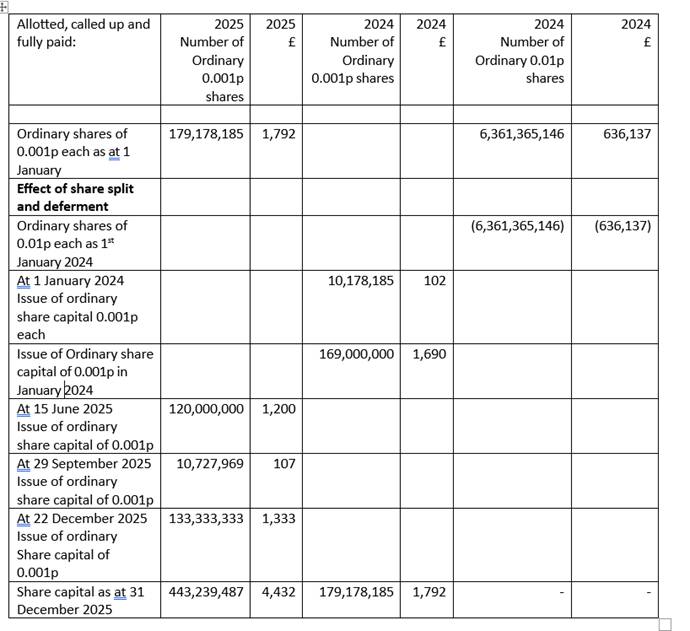
In January 2024 the Company executed a 625:1 share consolidation to yield 10,178,185 new shares of 0.001p and 10,178,185 deferred shares of 6.249p nominal value. A fundraising took place immediately thereafter via a placing with the issuance of 169,000,000 new shares at a price of 1.25p raising total gross proceeds of £2.1m and net proceeds of £1.8m. The resulting number of shares immediately after this placing was 179,178,185.
The Deferred share capital of the Company comprised:
2025 2025 2025 2024 2024
Number of Number of
|
As part of the share consolidation an additional 10,178,185 deferred shares of nominal value 6.249p were created.
Each deferred share has very limited rights. The Deferred Shares, as their name suggests, have very limited rights (which are deferred to the New Ordinary Shares) and effectively carry no value as a result. The holders of the Deferred Shares are not entitled (unless they also hold New Ordinary Shares) to receive notice of, attend or vote at general meetings of the Company, nor entitled to receive any dividends or any payment on a return of capital until at least £10,000,000 has been paid on each New Ordinary Share. No application will be made for the Deferred Shares to be admitted to trading on AIM.
The Ordinary shares have the normal rights expected of ordinary shares - holders are entitled to receive notice of, attend, or vote at general meetings of the Company, and to receive any dividends or any payment on a return of capital. The ordinary shares are admitted to trading on AIM under the name Metir plc (ticker symbol MET).
Reserves
The share premium account represents the excess over the nominal value for shares allotted less issue costs.
The warrant reserve comprises the cumulative fair value of share warrants issued by the Company that are classified as equity. The reserve includes warrants issue to investors and brokers in connection with equity financing transactions. The fair value of broker warrants issued in exchange for services directly attributable to equity financing is recognised as a share issue cost and credited to the warrant reserve.
|
21. Share premium |
|
|
|
|
Year to 31 |
Year to 31 |
|
|
December |
December |
|
|
2025
£000s |
2024 restated £000s |
|
Opening balance brought forward |
29,878 |
28,263 |
|
Share issue in the year |
1,849 |
2,112 |
|
Share issue costs Warrants |
(164) (290) |
(265) (232) |
|
Closing balance carried forward |
31,273 |
29,878 |
22. Director's emoluments
|
|
Year to 31 December |
Year to 31 December |
|
2025 |
2024 |
|
|
£000s |
£000s |
|
|
Salaries and fees |
82 |
65 |
|
|
82 |
65 |
|
There are no key management personnel other than the Directors. |
|
|
|
23. Employees |
Year to 31 |
Year to 31 |
|
|
December 2025 |
December 2024 |
|
|
Number |
Number |
|
Directors |
3 |
2 |
|
Other staff |
2 |
2 |
|
Average Headcount |
5 |
4 |
|
|
Year to 31 |
Year to 31 |
|
December 2025 December 2024 |
||
|
|
£000s |
£000s |
|
Employment costs (including Directors) |
|
|
|
Wages and salaries |
227 |
264 |
|
Social security costs |
13 |
16 |
|
Pension costs |
8 |
15 |
|
|
248 |
295 |
24. Share Warrants
Broker warrants to subscribe for up to 30,712,000 ordinary shares, which represented 20 per cent of the placing shares, were granted to Turner Pope Investments (TPI) Ltd as part of the fundraising in January 2024. The broker warrants are capable of exercise for a period of five years from 5 February 2024.
Broker warrants to subscribe for up to 24,000,000 ordinary shares, were granted to Turner Pope Investments (TPI) Ltd as part of the fundraising in June 2025 and 13,333,333 were granted as part of the fundraising in December 2025. The broker warrants are capable of exercise for a period of five years from 10 June 2025 and 20 December 2025 respectively.
As at 31 December 2024 and 31 December 2025, outstanding broker warrants to subscribe for ordinary shares of 1p each in the Company, granted in accordance with warrant instruments issued by the Company were as follows:
|
2025 |
|
Number of shares |
Weighted average remaining contractual life (years) |
Weighted average exercise price (pence) |
|
|
|
Brought forward |
30,712,000 |
3.10 |
1.25 |
|
|
|
|
Granted in the year |
24,000,000 |
4.45 |
0.65 |
|
|
|
|
|
|
13,333,333 |
4.97 |
0.75 |
|
|
|
Carried forward |
68,045,333 |
4.17 |
0.88 |
|
|
|
|
|
|
|
|
|
|
|
|
|
|
|
|
|
|
|
|
2024 |
|
Number of shares |
Weighted average remaining contractual life (years) |
Weighted average exercise price (pence) |
|
|
|
Granted in the year |
30,712,000 |
4.10 |
1.25 |
|
|
|
|
Carried forward |
30,712,000 |
3.10 |
1.25 |
|
|
|
|
|
|
|
|
|
|
|
|
As of 31 December 2025, none of these warrants have been converted into shares. |
|
|||||
|
|
|
|
|
|
|
|
|
The following table lists the inputs to the model used for the broker warrants outstanding as at 31 December 2025: |
||||||
|
|
|
|
|
|
|
|
|
Date granted |
|
|
22/12/2025 |
15/06/2025 |
05/02/2024 |
|
|
Number of shares |
|
13,333,333 |
24,000,000 |
30,712,000 |
|
|
|
Expiry date |
|
|
21/12/2030 |
14/06/2030 |
04/02/2029 |
|
|
Expected life of warrants (years) |
|
5 |
5 |
5 |
|
|
|
Exercise price £ |
|
0.75 |
0.65 |
1.25 |
|
|
|
Fair value at grant date |
|
|
|
|
|
|
|
Dividend yield |
|
|
0% |
0% |
0% |
|
|
Expected volatility |
|
60% |
42% |
33% |
|
|
|
Risk-free interest rate |
|
3.75% |
3.75% |
3.00% |
|
|
|
Model used |
|
|
Black-Scholes |
Black-Scholes |
Black-Scholes |
|
The 133,333,333 investor warrants issued in December 2025 fall outside the scope of IFRS 2 - Share-based payments and as such no charge has been made in respect of these.
25.Financial instruments
The Group's financial instruments comprise cash and various other receivables and other payables that arise directly from its operations. No trading in financial instruments is undertaken. The main risks arising from the Group's financial instruments are liquidity, exchange rates, interest rate and credit risks. The Board oversees the management of these risks, which are summarised below.
|
31 December 2025 |
Amortised Cost £000 |
Group Carrying amount Total £000 |
|
Financial assets not measured at fair value |
|
|
|
Trade and other receivables |
508 |
508 |
|
Cash and cash equivalents |
1,058 |
1,058 |
|
|
1,566 |
1,566 |
|
Financial liabilities not measured at fair value |
|
|
|
Trade and other payables |
(726) |
(726) |
|
|
(726) |
(726) |
|
31 December 2024 |
Amortised Cost |
Group Carrying amount Total |
|
|
£000 |
£000 |
|
Financial assets not measured at fair value |
|
|
|
Trade and other receivables |
398 |
398 |
|
Cash and cash equivalents |
188 |
188 |
|
|
586 |
586 |
|
Financial liabilities not measured at fair value |
|
|
|
Trade and other payables |
(546) |
(546) |
|
|
(546) |
(546) |
Liquidity risk
The Group finances its operations from equity funding provided by shareholders and revenues generated by the business. The Group seeks to manage liquidity risk to ensure enough funds are available to meet working capital requirements.
The Group invests its cash reserves in bank and money market deposits as a liquid resource to fund its operations. The Group's strategy for managing cash is to balance interest income with counterparty risk ensuring the availability of cash to match the profile of the Group's cash flows.
In reviewing the Group as a going concern, as outlined in note 3, management identified that there is a significant risk that performance will fall below management expectation. Contingency plans and mitigating actions have been identified and are due to be commenced following the publication of these accounts to ensure that liquidity can be maintained, in the first instance by raising equity. The business scenarios include exploration of the use of export trade financing, short term debt, letters of credit, performance/surety bonds on larger orders and equity funding options. The primary objective is to secure further fundraising via an equity issue and broker assurance has been provided to confirm investor appetite to do so.
|
Contractual maturities of financial liabilities |
Less than 6 months |
6-12 months |
Between 1 and 2 years |
Between 2 and 5 years |
Over 5 years |
Total contractual cash flows |
Carrying amount (assets)/ liabilities |
|
At 31 December 2025 |
£000s |
£000s |
£000s |
£000s |
£000s |
£000s |
£000s |
|
Trade and other payables |
667 |
115 |
(9) |
- |
- |
773
|
773 |
|
Total |
667 |
115 |
(9) |
- |
- |
773 |
773 |
|
Contractual maturities of financial liabilities |
Less than 6 months |
6-12 months |
Between 1 and 2 years |
Between 2 and 5 years |
Over 5 years |
Total contractual cash flows |
Carrying amount (assets)/ liabilities |
|
At 31 December 2024 |
£000s |
£000s |
£000s |
£000s |
£000s |
£000s |
£000s |
|
Trade and other payables |
962 |
- |
- |
- |
- |
962 |
962 |
|
Total |
962 |
- |
- |
- |
- |
962 |
962 |
Interest rate risk
The Group does not face any significant interest rate risk as it has no borrowings. Surplus funds are invested to maintain a balance between accessibility of funds, competitive rates, and counterparty risk while investing funds safely.
Credit risk
The Group manages its credit risk in cash and cash equivalents by spreading surplus funds between creditworthy financial institutions. The Group is also exposed to credit risk attributable to trade and other receivables. The maximum credit risk in respect of the financial assets at each period end is represented by the balance outstanding on trade and other receivables, which the Group considers an expected loss allowance of £0.04 million (2024: £0.04 million) is appropriate. The Group monitors the credit worthiness of its customers on a regular basis.
Credit control with related parties is managed by direct communication with the counterparty and all significant transactions required the approval of the Board of Directors of the Company.
Foreign currency risk
The majority of the Group's transactions are denominated in foreign currencies. The Group has no long- term commitments to purchase goods or services in foreign currencies. Purchases denominated in foreign currency are expensed at the exchange rate prevailing at the date of the transaction and represents an immaterial proportion of the Group's total expenditure.
The only assets and liabilities denominated in foreign currencies relate to trade receivables and trade payables with overseas counterparties together with small balances of US dollar and Euro currencies to settle these liabilities. Exchange rate fluctuations may affect the amount ultimately paid to settle these liabilities but management do not consider these to be material. Euro balances are kept under constant management review and control.
Our exposure to exchange rates results from costs ostensibly in GBP (although many components are imported and therefore not really priced in GBP) and revenues in other currencies.
Fair values
The Directors consider that there is no material difference between the book value and the fair value of the financial instruments on 31 December 2025 and 31 December 2024.
The matter of the warrants is dealt with under note 24.
Capital management
The Group's capital base comprises equity attributable to shareholders. As the Group's focus has been on establishing itself as a successful supplier of equipment design and engineering services, the primary objective in managing cash spend has been to achieve progress on product development and commercialisation in a cost-efficient manner and in managing liquidity risk to ensure the Group continues as a going concern.
26. Related party transactions
During 2025 a company named Swiftpipe Ltd controlled by a common director, Bob Moore, invoiced director service fees of £30,000 in relation to director fees, (2024: £30,000). The year end payable balance outstanding as at 31 December 2025 was £40,000, (2024: £9,000).
On 21 July 2025, Bob Moore, Executive Chairman and Chief Executive Officer, and Dr Nigel Burton, Non-Executive Director, participated in the Company's fundraising announced on 10 June 2025. Bob Moore subscribed £20,000 for 3,065,134 ordinary shares and Dr Nigel Burton subscribed £50,000 for 7,662,835 ordinary shares, in each case on the same terms as other investors. As directors of the Company, their participation constituted related party transactions pursuant to Rule 13 of the AIM Rules for Companies. The Company's independent director, Dr Chris Potts, having consulted with the Company's nominated adviser at that time being Singer Capital Markets Advisory LLP, considered the terms of their participation to be fair and reasonable insofar as the Company's shareholders were concerned.
On 22 December 2025, Dr Nigel Burton participated in the Company's placing, subscribing £50,000 for 6,666,667 ordinary shares on the same terms as other investors. As a director of the Company, his participation constituted a related party transaction pursuant to Rule 13 of the AIM Rules for Companies. The Company's independent directors, being Bob Moore and Dr Chris Potts, having consulted with the Company's nominated adviser at that time being Singer Capital Markets Advisory LLP, considered the terms of Dr Burton's participation to be fair and reasonable insofar as the Company's shareholders were concerned.
27. Control
As at 31 December 2025, no individual shareholder had a controlling interest in the Company.
28. Events after the Reporting Date
a. There are no events after the reporting date.
|
29. Cash absorbed by operations (Group) |
Year to 31 |
Year to 31 |
|
|
December 2025 |
December 2024 restated |
|
|
£000s |
£000s |
|
Total comprehensive loss for the year |
(867) |
(1,577) |
|
Adjustments for: |
|
|
|
Amortisation of intangible assets |
45 |
34 |
|
Depreciation of property, plant and equipment |
31 |
124 |
|
Tax on loss on ordinary activities |
- |
(113) |
|
Interest received |
- |
(25) |
|
Movements in working capital |
|
|
|
Decrease/(increase) in inventories |
25 |
(90) |
|
Decrease/(increase) in trade and other receivables |
75 |
(688) |
|
(Decrease)/increase in trade and other payables |
(187) |
60 |
|
Decrease in provisions for dilapidations & warranty |
(2) |
(28) |
|
Increase in contract liabilities |
- |
386 |
|
Cash absorbed by operations |
(880) |
(1,917) |
30. Segmental reporting
The Group currently has two trading subsidiaries; Microsaic Systems Trading Limited (being the sale of compact mass spectrometers (Microsaic 4500 MiD®)) and Modern Water (U.K.) Limited (being the sales of MicroTox® CTM, FX and LX toxicity monitors and related consumables). The sales by Modern Water Revenue by geographical market are analysed in note 5.
Under IFRS 8, operating segments are defined as a component of the entity that engages in business activities from which it may earn revenues and incur expenses whose operating results are regularly reviewed and for which discrete financial information is available. The Group management is organised in UK and this factor identifies the Group's reportable segments.
Year ended 31 December 2025
Modern Water (U.K.) Limited
£000
Microsaic Systems Trading Limited
£000
Corporate (Metir plc)
£000
Total
£000
|
|
2025 |
2024 |
2025 |
2024 |
2025 |
2024 |
2025 |
2024 |
|
External |
|
|
|
|
|
|
|
|
|
Revenue |
1,406 |
162 |
34 |
- |
- |
70 |
1,440 |
232 |
|
Profit / (Loss) |
543 |
(643) |
(32) |
(123) |
(1,376) |
(924) |
(865) |
(1,690) |
|
Segment Non- |
|
|
|
|
|
|
|
|
|
current Assets |
48 |
70 |
1 |
1 |
119 |
138 |
168 |
209 |
|
Segment |
|
|
|
|
|
|
|
|
|
Current Assets |
708 |
816 |
26 |
25 |
1,112 |
348 |
1,846 |
1,189 |
|
Segment |
|
|
|
|
|
|
|
|
|
Current |
|
|
|
|
|
|
|
|
|
Liabilities |
381 |
633 |
86 |
37 |
311 |
311 |
778 |
981 |
31. Prior year adjustment
During the preparation of the financial statements, the Directors considered the treatment of broker warrants issued during the year ended 31 December 2024 and consider that these should have been accounted for in accordance with IFRS 2 and be accounted for directly in equity, as these broker warrants represent a cost in respect of fundraising. To correct for this error, the Directors have restated the prior period comparatives. The effect of this adjustment has resulted in a decrease in loss for the year ended 31 December 2024, and an increase in net assets as 31 December 2024, by £232,000.
RNS may use your IP address to confirm compliance with the terms and conditions, to analyse how you engage with the information contained in this communication, and to share such analysis on an anonymised basis with others as part of our commercial services. For further information about how RNS and the London Stock Exchange use the personal data you provide us, please see our Privacy Policy.

Latest directors dealings
- 38 minutes ago Rathbones Group
- 2 hours ago Sirius Real Estate Ltd.
- 2 hours ago Getbusy
- 2 hours ago Currys
- 3 hours ago Helical