
Molly Gold Project, Brazil - Drilling Update
Summary by AI BETAClose X

Jangada Mines plc / EPIC: JAN.L / Market: AIM / Sector: Mining
27 May 2026
Jangada Mines plc ('Jangada' or 'the Company')
Molly Gold Project, Brazil - Drilling Update
High-grade gold intersections confirm multi-target polymetallic discovery
Jangada Mines plc (AIM: JAN), a Brazil-focused natural resources company, is pleased to provide an update from its ongoing exploration programme at its Molly Gold Project ("Molly" or the "Molly Project") in Brazil, including high-grade drill results.
OVERVIEW
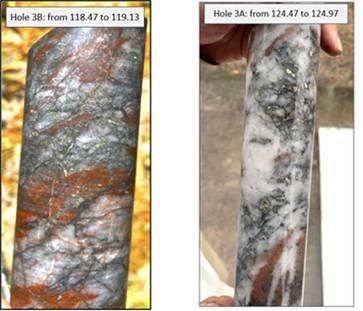
· Molly 1 - High-Grade Gold Confirmed: Drill holes 3A and 3B intercept significant gold, silver and copper mineralisation, confirming eastward continuity toward the East Pot sector
· Hole 3A returns exceptional high-grade intersections including:
o 20.70 g/t Au, 0.58% Cu and 6.30 g/t Ag from 124.47m over 0.5m and,
o 11.50 g/t Au, 21.30 g/t Ag and 0.47% Cu from 103.32m over 0.58m and,
o 5.75 g/t Au, >1.0% Cu and 9.00 g/t Ag from 131.05m over 0.50m.
· Molly 2 - Discovery Confirmed: Maiden Discovery Hole 7A demonstrates previously undrilled deposit related to the Molly 1 system, open toward the Vivi target westward, with 3.11 g/t Au, 30.4 g/t Ag and 0.13% Cu from 71.75m over 0.87m
· Expanding Gold Corridor: Results reinforce a structurally controlled, laterally continuous polymetallic corridor encompassing gold, silver, copper, zinc and lead at both advanced targets
· Open on Multiple Fronts: Both Molly 1 (east) and Molly 2 (west toward Vivi) remain open along strike and down dip, supporting a significant resource expansion programme
· Proven Geological Setting: Results and historic data confirm that the Molly geology is characterised as high grade shallow narrow vein structures that are comparable to other producing projects in the Tapajós Gold Belt
· Additional results awaited: While the initial targeted deadline for completion of Phase 1 has been delayed significantly, due to an exceptional lab backlog and logistics, new procedures are now in place aimed at improving turnaround from drilling. Full results from the initial drill campaign will be reported when all are back from testing.
Jangada Chief Executive, Paulo Misk, said: "These results are genuinely exciting. The Molly Gold Project is rapidly evolving into one of the most compelling gold-polymetallic discoveries in Brazil, with high-grade intercepts across two advanced targets that both remain open along strike. Molly is very typical of the thin high-grade vein projects that are in production across the Tapajós Gold Belt. These thin high-grade veins and grade variance are symptomatic of the regional geology and are in line with and complement the existing high grade historic drill results.
"We are moving swiftly to expand drilling at Molly 1's East Pot sector and to advance the Molly 2 Vivi Corridor, where we believe the true scale of this system is yet to be revealed. We are also looking at the wider potential of the licence including the extensive Boomerang structure which has kilometres of artisanal alluvial workings and which we believe overlays a significant hard rock source structure or is from the surrounding elevated areas, also on the licence. Jangada Gold is at an inflection point, and I look forward to the next stages of the funded exploration plan."
DETAILS
Molly 1 Deposit - High-Grade Continuity Confirmed Eastward
Drill holes 3A and 3B at the Molly 1 deposit have confirmed historical drill results and the lateral continuity of high-grade polymetallic mineralisation extending eastward from the central Molly 1 zone toward the East Pot sector. This represents a significant step forward in the understanding of the ore bodies geometry and resource size potential.
The historically defined mineral resource delineated a strike length of c. 300m with holes 3A and 3B now extending the mineralised envelope by an additional 100-150m. The results demonstrate that the mineralised system remains open along strike, reinforcing the geological interpretation of a structurally controlled and laterally persistent ore body. The recurrence of sulphide-rich intervals, carrying gold, silver, copper, zinc and lead, indicates that the East Pot area may represent a material extension of the Molly 1 mineralised corridor, with the potential for additional high-grade shoots and localised zones of enhanced metal concentration.
Crucially, holes 3A and 3B reveal that mineralising fluids remained active across a broader structural framework than previously modelled. This enhances the exploration upside of the eastern portion of the system and underpins the Company's plans to advance additional drilling to delineate the full extent, geometry, and grade variability of the mineralised zones.
Molly 1 - Drill Results Summary
|
Hole ID |
From (m) |
To (m) |
Width (m) |
Au(g/t) |
Ag (g/t) / Cu (%) |
|
3A |
103.32 |
103.90 |
0.58 |
11.50 Au |
21.30 Ag, 0.47% Cu |
|
3A |
124.47 |
124.97 |
0.50 |
20.70 Au |
6.30 Ag, 0.58% Cu |
|
3A |
131.05 |
160.00 |
0.50 |
5.75 Au |
9.00 Ag, >1.0% Cu |
|
3B |
118.47 |
119.13 |
0.66 |
2.87 Au |
6.20 Ag, 0.36% Cu |
|
3B |
126.93 |
127.82 |
0.89 |
2.29 Au |
1.60 Ag |
Note: Widths represent drilled core lengths and do not represent true widths. All assays are uncut.
Molly 2 Advanced Target - New Discovery Confirmed with Mineralisation Open to the Western Vivi Target
The Molly 2 advanced target continues to deliver compelling results, with hole 7A demonstrating the persistence of high-grade polymetallic mineralisation along the western strike extension toward the Vivi target area. Gold, silver, copper, zinc and lead grades remain elevated, and the spatial continuity of sulphide-rich horizons and structurally controlled mineralised zones strongly supports the interpretation of a regionally significant polymetallic corridor.
The continuity of quartz veins carrying sulphide mineralisation toward Vivi, combined with the recurrence of hydrothermal alteration and brecciation, indicates that Molly 2 and the Vivi target may be connected through the same mineralising event and structural architecture. Additional mineralised shoots and zones of enhanced metal concentration are likely to exist in the intervening and western sectors, which remain largely untested.
These results substantially increase the prospectivity of the Molly 2; Vivi trend and provide a compelling rationale for the advancement of further drilling, trenching, structural interpretation, and integrated geophysical and geochemical surveys aimed at delineating the full extent and economic significance of this mineralised system. The high-grade shallow intersections are symptomatic of other producing entities in the region.
Importantly, the Molly 2 results support the historical geophysical interpretation of systemic mineralisation associated with Molly 1. The geophysical and surface mapping data indicates that the Molly 2 strike length to be at least as extensive as Molly 1 while remaining open toward the west and down dip. This elucidates the potential to materially increase the mineral resources at the Molly tenement in the short term with continued growth potential as the strike and dip continuations are followed.
Molly 2 - Drill Results Summary
|
Hole ID |
From (m) |
To (m) |
Width (m) |
AU (g/t) |
Other Metals |
|
7A |
71.75 |
72.62 |
0.87 |
3.11 Au |
30.4 Ag, 0.13% Cu, 0.24% Pb |
|
7A |
122.82 |
125.93 |
3.11 |
- |
0.75% Pb, 0.14% Zn |
|
7A (incl.) |
123.82 |
125.93 |
2.11 |
- |
0.96% Pb |
Note: Widths represent drilled core lengths and do not represent true widths. All assays are uncut.
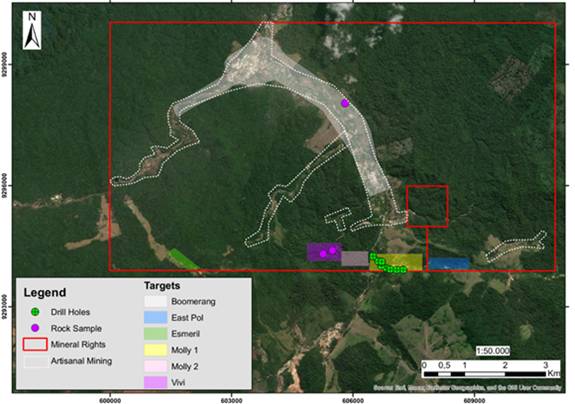 |
Existing and additional target areas plus drill and sample sites across Molly - extensive artisanal mining throughout the project area
About the Molly Polymetallic Project
Molly comprises two confirmed polymetallic mineralised deposits, Molly 1 and Molly 2, characterised by heterogeneous metal grades and complex geochemical signatures associated with significant anomalies of gold, silver, copper, zinc and lead. The distribution and intensity of these anomalies demonstrate notable spatial variability, reflecting the geological complexity of multiple phases of hydrothermal alteration and metal enrichment recognised across the target areas.
Both Molly 1 deposit and Molly 2 advanced target remain open along strike and at depth, and their structural settings suggest meaningful potential for resource growth as drilling advances. The Molly 1 - East Pot corridor and the Molly 2 - Vivi trend, represent two separately compelling exploration/development vectors within what is emerging as a district-scale polymetallic system in Brazil.
The Project also hosts the Boomerang target area, a major historical placer gold producing valley which indicates a major primary source of gold mineralisation within the tenement-contained watershed.
Molly Geological Context
In order to fully understand the geological context of Molly, the Company has done extensive analysis of regional geology and is pleased to provide the following summary opinion.
The Molly tenement and related gold deposits form part of the Tapajós Gold Belt. The Tapajós Gold Belt of northern Brazil is increasingly regarded by many as one of the most geologically significant under-explored gold provinces remaining globally. Although the region has produced enormous quantities of gold through artisanal mining over the past five decades, systematic. modern exploration only began comparatively recently. The comparison between historical placer production and currently defined hard-rock resources remains one of the most striking aspects of the province. Despite estimated artisanal production of 20-30 million ounces, formal hard-rock resource inventories across the belt remain comparatively modest relative to many mature gold camps globally.
Modern interpretations increasingly compare Tapajós with globally important mineral belts such as the Abitibi Greenstone Belt in Canada, portions of the West African Craton, and parts of the Yilgarn Craton in Australia. The province is notable not only for its size, but also for the diversity of mineralisation styles identified within it, and is currently characterised by medium tonnage, high-grade gold deposits.
The most important industrial-scale gold project currently operating in the province is the Tocantinzinho mine operated by G Mining Ventures. The mine Mineral Resource is estimated to contain 1.9 million Au in 48 Mt at 1.3 g/t. Furthermore, Cabral Gold is advancing the Cuiu Cuiu Project with c.1 million ounces Au resource at 1.1 g/t.
Another major operator in the region is Serabi Gold exploiting and developing the Palito Mining Complex and the Coringa Project. The Palito Complex is an underground mine characterised by narrow but high-grade quartz-sulphide veins. Reserve grades are significantly higher than those at Tocantinzinho and commonly range between approximately 5 and 10 g/t gold. Processing incorporates gravity recovery, flotation and cyanidation. Serabi, with a market cap of US$330m, has historically produced approximately 30,000 to 40,000 ounces of gold annually.
The Company believes that the local geology, mineralisation style and grade profile at the Molly Project bears resemblance to those at Serabi gold, underpinning the Directors' belief that Molly has the potential to materially grow its high-grade vein hosted deposits into resources that could sustain economic production.
Beyond these flagship projects, numerous junior exploration companies and regional operators remain active across the belt. The district has increasingly attracted interest from larger mining companies due to the combination of demonstrated production, extensive artisanal workings, improving infrastructure and the geological evidence for large-scale mineral systems.
From a global mining perspective, Tapajós is simultaneously a historically prolific gold-producing district and an emerging frontier exploration province. Industrial mining development has only recently accelerated, modern geological understanding continues to evolve rapidly, and large areas remain minimally explored by contemporary standards. The combination of extensive historical placer production, favourable Paleoproterozoic geology, demonstrated million-ounce deposits, and multiple active producers increasingly supports the view that Tapajós may ultimately emerge as one of the world's major gold provinces over coming decades.
Next Steps for Molly
The Company has a defined funded development programme to further quantify the resource potential of Molly. This includes:
· Advance additional drill holes to extend the Molly 1 East Pot mineralised corridor eastward and at depth.
· Initiate follow-up drilling along the Molly 2 target in particular the Vivi Corridor to test the western strike extension.
· Commission integrated geophysical and geochemical surveys to refine structural interpretation across both deposits.
· Progress resource estimation work to underpin a preliminary economic assessment.
· Continue tenement-wide reconnaissance geological, geochemical and geophysical work to drive discovery of source of substantial historical placer mining within the Boomerang area.
QUALIFIED PERSON
The resource information in this announcement has been reviewed by Mr. Emerson Ricardo Re who is a senior professional geologist with 25 years of experience in the mining industry, which is relevant to the style of mineralisation and type of deposit under consideration and to the activity which he has undertaken to qualify as a Competent Person as defined in the 2012 edition of the JORC Code. Mr. Re also meets the requirements of a competent person under the AIM Note for Mining, Oil and Gas Companies. Mr. Re has no economic, financial or pecuniary interest in the Company, and he consents to the inclusion in this document of the matters based on his technical information in the form and context in which it appears.
INSIDE INFORMATION
This announcement contains inside information for the purposes of Article 7 of EU Regulation 596/2014. Upon publication of this announcement, this inside information is now considered to be in the public domain.
**ENDS**
For further information, please visit www.jangadamines.com, follow us on social media, LinkedIn and X: @Jangada Mines Plc, or contact:
|
Hugo de Salis |
Jangada Mines plc |
info@jangadamines.com |
|
Ritchie Balmer James Spinney Harry Hiley |
Strand Hanson Limited Nominated & Financial Adviser |
Tel: +44 (0)20 7409 3494 |
|
Jonathan Evans |
Tavira Financial Ltd Broker |
Tel: +44 (0)20 7100 5100 |
About Jangada Mines Plc
Jangada Mines Plc (AIM: JAN) is a natural resource development company with assets in Brazil. It is led by a team with deep industry, financial and in-country experience, and has a dual growth strategy to advance its portfolio projects including the high-grade Molly Gold Project, the Paranaíta Gold Project and the 100%-owned Pitombeiras vanadium titanomagnetite Project; and utilise its proven in-country and geological expertise to identify/acquire additional projects that it can rapidly advance to build value for shareholders.
The information contained within this announcement is deemed by the Company to constitute inside information as stipulated under the Market Abuse Regulation (EU) No. 596/2014 as it forms part of United Kingdom domestic law by virtue of the European Union (Withdrawal) Act 2018, as amended by virtue of the Market Abuse (Amendment) (EU Exit) Regulations 2019.
RNS may use your IP address to confirm compliance with the terms and conditions, to analyse how you engage with the information contained in this communication, and to share such analysis on an anonymised basis with others as part of our commercial services. For further information about how RNS and the London Stock Exchange use the personal data you provide us, please see our Privacy Policy.

Latest directors dealings
- 25 minutes ago Rio Tinto
- 27 minutes ago Trustpilot Group
- 30 minutes ago Ruffer Investment Company Ltd Red PTG Pref Shares
- 49 minutes ago Renalytix (Reg S)
- 58 minutes ago Zigup