
Final Results
Summary by AI BETAClose X

JADE ROAD INVESTMENTS LIMITED
("Jade Road Investments", "JADE" or the "Company)
Final Results
Jade Road Investments Limited (AIM:JADE), the London quoted investment company that looks to provide investors exposure to private mid / late stage technology companies, is pleased to announce the publication of its final results for the year ended 31 December 2025.
Hard copies of the Annual Results are available upon request. The Results will also be available on Jade Road's website: https://jaderoadinvestments.com/investors/financial-reports.
For further information, please contact:
Jade Road Investments Limited
+44 (0) 778 531 5588
John Croft
Zeus - Nominated Adviser & Sole Broker
+44 (0) 203 829 5000
James Joyce / Andrew de Andrade
Company Description & Investing Policy
Jade Road Investments Limited ("Jade Road" or the "Company") is an Investing Company operating under AIM rules. The Company has an indefinite life, is sector agnostic and is targeting assets in any class which will produce income returns, with a secondary focus on capital gains over time for its Shareholders. The Company's ordinary share capital is publicly traded on the Alternative Investment Market ("AIM") market of the London Stock Exchange, under the ticker symbol "JADE".
Current Investing Policy
The investing policy of Jade Road is the following:
1. The Company has an indefinite life, is sector-agnostic, and is primarily focused on and weighted towards mid / late-stage technology investments with a lesser weighting on earlier stage technology investments. The overarching objective of the Company is generating long-term capital gains for its shareholders.
2. The Company will seek the best risk-adjusted returns globally, with a preference for opportunities in the United States, Europe, and Asia.
3. The Company will primarily take direct stakes in private companies, either through cash
investments or through issuing its own shares as consideration. It may also invest through indirect structures (including but not limited to special purpose vehicles) and in listed securities, futures, Exchange Traded Funds, Money Market Funds, over-the-counter traded securities, currencies, convertible securities, forward contracts and contractual obligations or similar such assets. The Company could take long or short positions in such assets.
4. At the time of entering into any investment, the Company shall ensure that such investment does not represent more than 20% of the Company's net asset value immediately following the relevant transaction, except while the Company's net asset value is less than $100m. There is no limit to the number of investments the Company may undertake.
5. With respect to early-stage investments, the Company shall ensure that, on a cumulative basis, such investments do not represent more than 25% of the Company's net asset value immediately following the relevant transaction.
6. There are no restrictions on the duration for which the Company may hold any investment, nor on the timeframe within which the Company must make its investments. There are no restrictions on the Company's ability to realise or sell any of its investment portfolio at any time.
7. The Company will pursue a predominantly passive management strategy. However, on a case-by-case basis, it may seek to secure additional governance rights, such as observer or board appointments, where circumstances or specific assets justify enhanced oversight.
8. The Company may utilise gearing when appropriate, applying it selectively and prudently, and guided by market conditions, liquidity, and investor expectations.
9. Where the Company issues its own shares as consideration for interests in other companies, such cross holdings will be limited to 20 per cent of the Company's issued shares in aggregate from time to time
Chairman's Statement
The 2025 year has been a very busy and transformational time, culminating in the substantial US$ 1.7 million investment by NOIA Capital, and its support and engagement in developing a new and exciting investment strategy for Jade Road Investments. We were delighted to have Nicolas Vassaux, NOIA Capital's Head of Direct Investment, join the Company's Board as a non-executive Director in November 2025.
Towards the end of the year, completing on 9 February 2026, the Company partnered with NOIA Capital to raise US$ 8.35 million from new investors on which suspension the Company's shares was lifted and the enlarged capital was re-admitted to trading on the London Stock Exchange Alternative Investment Market (AIM). This further raise has positioned the Company, with the continuing strategic engagement of NOIA Capital, to raise further and more substantial new funding and to commence deployment in execution of its new Investment Strategy.
In March 2026 our long-serving non-executive directors Hugh Trenchard and Stuart Crocker, whose contributions I wish to acknowledge with gratitude, left the Board and we welcomed Yunus Olçer and Christian Reyntjens to the Board who will chair respectively the Company's Audit, and Investment & Valuation, committees. Your Board of Directors is very much looking forward to updating our shareholders on its next development steps, and on taking opportunities we plan to arise for the Company in pursuing a new and increasingly value enhancing future.
John Croft
27 April 2026
Chairman of the Board
Biographies of Directors
Board of Directors
Mr. John Croft, Executive Chairman
John Croft is an experienced Chairman, non-executive Director and executive with a successful international career in the technology and financial services sectors.
He is also a non-executive Director at Aura Renewable Acquisitions PLC and Golden Rock Global PLC, both Special Purpose Acquisitions Companies (SPACs) quoted on the Standard List (Cash Shells) and AIM respectively of the London Stock Exchange, and non-executive Director at Brazilian Nickel Limited which is developing a Nickel and Cobalt project in North-Eastern Brazil.
He has previously held senior Director level positions in Racal Electronics and NCR Corporation, following an early career in banking with HSBC and Citibank.
Mr Yunus Olçer, Non-executive Director
Yunus Olcer is an experienced investment manager and currently consults to NOIA Capital, a Dubai-based multi-family office specialising in growth capital investments, acting as Portfolio Manager of its public equities hedge fund investments. He began his career in investment banking at Goldman Sachs in London, before moving into investment management roles at BlueMountain Capital, Sikra Capital (Leucadia Investment Management) and Berry Street Capital, where he focused on global equities, credit and special situations investments.
He holds a degree in Industrial Engineering and Management from the Technical University of Berlin, graduating with first-class honours, and also studied Corporate Finance and Management at Tongji University in Shanghai.
Mr. Christian Reyntjens, Non-executive Director
Christian Reyntjens is the founder of A Black Square, a family office focused on investments in special situations, real estate, and private equity. The family office also oversees the family's art collection and maintains engagement with cultural institutions.
Prior to founding A Black Square, Christian was a Partner at York Capital Management, where he led the European equity group and co-managed the York European Opportunities and York European Focus funds. Earlier in his career he worked in Mergers & Acquisitions at Merrill Lynch in London.
Christian holds an M.S. in Banking and Finance from HEC Lausanne and a B.S. and M.S. in Management Engineering from the Catholic University of Leuven.
Mr. Nicolas Vassaux, Non-executive Director
Nicolas Vassaux is a Belgian entrepreneur and investor, currently Head of Direct Deals at NOIA Capital, a Luxembourg-based multi-family office specializing in growth capital. He co-founded NOIA Capital in 2019, initially launching one of Europe's earliest regulated digital asset investment funds. Since then, he has helped expand the firm into a diversified investment platform deploying internal and external capital across four verticals: listed equities, direct deals, digital assets, and alternative managers. Nicolas sits on the board of multiple private companies.
Before founding NOIA Capital, Nicolas worked in the direct investments division of a Belgian family office, focusing on tech venture capital and small to mid-sized non-tech companies, where he also took on operational roles such as CFO and COO within portfolio companies. Earlier in his career, he spent time at Deloitte in the Growth & Turnaround practice and nearly five years at Roland Berger, advising on growth strategies, cost-reduction programs, reorganizations, and M&A.
Nicolas began his career at Degroof Petercam in private wealth portfolio management. He holds a first-class honours degree from the Solvay Brussels School and is fluent in French, English, and Spanish.
Directors' Report
The Board (the "Board") of Directors (the "Directors") are pleased to present their report on the affairs of the Company and its subsidiaries (collectively referred to as the "Group"), together with the audited financial statements for the year ended 31 December 2025.
PRINCIPAL ACTIVITIES
The Company was incorporated with limited liability under the laws of the British Virgin Islands ("BVI"). The Company's shares were admitted to the AIM Market of the London Stock Exchange on 19 October 2009. The Company, along with its subsidiaries, act as an investment group in pursuit of its stated Investment Strategy.
RESULTS AND DIVIDENDS
The Company recorded a loss before taxation of US$0.8 million (2024: loss US$1.2 million).
The loss reflects administration expenses of US$0.8 million and adjustments for non-cash interest expense of US$0.1 million on account of fair value charges relating to extinguishment of convertible loan notes (2024: US$0.9 million and US$0.4 million respectively).
The Directors are not recommending the payment of a dividend for the year (2024: US$nil).
REVIEW OF THE BUSINESS
The Group's audited net asset value as at 31 December 2025 stood at US$0.5 million (2024: net liabilities of US$0.8 million) equivalent to approximately US$0.005 per share (2024: US$0.002), excluding the effect of treasury shares held by the Group.
There were no investment assets held by the Company at either year-end.
EVENTS AFTER THE REPORTING PERIOD
The significant events after the reporting period are set out in Note 19 of the financial statements, none of which impact on the results and net assets reported in these financial statements.
Since the 31 December 2025 year end the Company has raised, and will continue to raise, further funding for working capital having issued in January 2026 and converted into equity in February 2026, unsecured convertible loan notes raising US$ 8.35 million (before expenses).
DIRECTORS AND DIRECTORS' INTERESTS
The Directors who served during the year and up to the date of this report were as follows:
Mr. John Croft (Chairman)
Hugh Viscount Trenchard (resigned 18 March 2026)
Mr. Stuart Crocker (resigned 18 March 2026)
Mr. Nicolas Vassaux (appointed 17 November 2025)
Mr. Christian Reyntjens (appointed 18 March 2026)
Mr. Yunus Olcer (appointed 18 March 2026)
With the exception of the Convertible loan notes disclosed in Note 16 to the Financial Statements, other than Directors' contracts of service there were no contracts in which any Director had a material interest. The Directors holding office at the date of this report had the following beneficial interests in the shares of the Company and Group companies as follows:
Number of ordinary shares of no par value as at 31 December:
|
|
2025 |
2024 |
|
||
|
|
Direct(3)(4) |
Indirect(3)(4) |
Direct(3)(4) |
Indirect(3)(4) |
|
|
Mr. John Croft |
13,046 |
1,073 |
13,046 |
1,073 |
|
|
Hugh Viscount Trenchard |
6,063 |
- |
6,063 |
- |
|
|
Mr. Stuart Crocker |
8,084 |
- |
8,084 |
- |
|
|
Mr. Nicolas Vassaux(1) |
- |
20,000,000 |
- |
- |
|
|
Mr. Christian Reyntjens(2) |
- |
- |
- |
- |
|
|
Mr. Yunus Olcer(2) |
- |
- |
- |
- |
|
|
|
|||||
Number of warrants over ordinary shares of no par value as at 31 December:
|
|
2025 |
2024 |
||
|
|
Direct(3)(4) |
Indirect(3)(4) |
Direct(3)(4) |
Indirect(3)(4) |
|
Mr. John Croft |
80,000 |
- |
80,000 |
- |
|
Hugh Viscount Trenchard |
40,000 |
- |
40,000 |
- |
|
Mr. Stuart Crocker |
- |
- |
- |
- |
|
Mr. Nicolas Vassaux(1) |
- |
- |
n/a |
n/a |
|
Mr. Christian Reyntjens(2) |
- |
- |
- |
- |
|
Mr. Yunus Olcer(2) |
- |
- |
- |
- |
Notes:
1. Appointed 17 November 2025. NV has a 10% interest in the holding of NOIA Capital (DIFC) Limited.
2. Appointed 18 March 2026.
3. Prior year comparative numbers have been adjusted by a factor of 10:1 to reflect the share combination dated 11 April 2025.
4. All numbers are unadjusted for the further 100:1 share combination carried out by the Company on 8 January 2026 (note 19).
SUBSTANTIAL SHAREHOLDINGS IN THE COMPANY
As far as the Directors are aware at 31 March 2026, the following persons were interested in 3% or more of the issued share capital of the Company:
|
Beneficial owner |
Number of ordinary shares(5) |
Percentage of issued share capital |
|
Bariç Çakmakçi |
2,500,000 |
23.20% |
|
NOIA Capital (DIFC) Limited |
2,000,000 |
18.56% |
|
FEY AG |
1,200,000 |
11.13% |
|
Askin Gur |
1,000,000 |
9.28% |
|
United First Partners Holdings LLC |
800,000 |
7.42% |
|
Alexandre Hurbain |
500,000 |
4.64% |
|
HDG Marysa Beteiligungs GmbH |
500,000 |
4.64% |
|
Stephane Mardel |
400,000 |
3.71% |
Notes:
5. Number of shares resulting from 100:1 share combination on 8 January 2026.
FINANCIAL INSTRUMENTS
The Group's use of financial instruments is set out in Note 9 and in Notes 14 -16.
FINANCIAL RISK MANAGEMENT OBJECTIVES
Management has adopted certain policies on financial risk management with the objective of ensuring that appropriate funding strategies are adopted to meet the Group's short-term and long-term funding requirements, taking into consideration the cost of funding, gearing levels, and cash flow projections. The policies are also set to ensure that appropriate strategies are adopted to manage related interest and currency risk funding and to ensure that credit risks on receivables are properly managed. In addition, Note 14 to the financial statements include the Group's objectives, policies, and processes for managing its capital, its financial risk management objectives, details of its financial instruments and its exposures to credit risk, interest rate risk, liquidity risk, price risk, and currency risk.
POLICY AND PRACTICE ON PAYMENT OF CREDITORS
The Group seeks to maintain good terms with all of its trading partners. In particular, it is the Group's policy to agree appropriate terms and conditions for its transactions with suppliers and, provided the supplier has complied with its obligations, to abide by the terms of payment agreed
SHARE CAPITAL
The Company has a single class of shares which is divided into ordinary shares of no par value.
At 1 January 2025, the number of ordinary shares in issue was 383,193,134, of which 7,480,000 were held in treasury by the group. Details of movements in the issued share capital during the year are set out in Note 13 to the financial statements.
On 11 April 2025 the Company carried out a 10:1 combination of its ordinary shares. The consolidation was directly proportionate to the number of shares held by each shareholder and did not change the rights attached to the ordinary shares. Following combination there were 38,522,365 ordinary shares in issue. The consolidation was also reflected in a reduction of the number of shares held in treasury, and following a partial cancellation at the date of consolidation, to 264,780 ordinary shares held in treasury.
On 8 January 2026 the Company carried out a further 100:1 combination of its ordinary shares. The consolidation was again directly proportionate to the number of shares held by each shareholder and did not change the rights attached to the ordinary shares. Following consolidation there were 2,410,193 ordinary shares in issue. The consolidation was also reflected in a reduction of the number of shares held in treasury, and following a partial cancellation at the date of consolidation to 2,647 ordinary shares held in treasury.
DIRECTORS' INDEMNITY
The Company's Articles of Association provide, subject to the provisions of BVI legislation, an indemnity for Directors and officers of the Company in respect of liabilities they may incur in the discharge of their duties or in the exercise of their powers, including any liabilities relating to the defence of any proceedings brought against them which relate to anything done or omitted, or alleged to have been done or omitted, by them as officers or employees of the Company.
The Company's policy is to have appropriate Directors' and officers' liability insurance cover is in place in respect of all of the Directors.
EMPLOYEE INFORMATION
As at 31 December 2025, the Group had Nil (2024: Nil) employees excluding Directors.
CHARITABLE DONATIONS
The Group made no charitable donations during the year (2024: Nil).
GOING CONCERN
The Directors have approved a business plan and cash flow forecast for a period of twelve months after the date of this report. The forecast is funded by the recent conversion of US$8.35 million of convertible loan notes into equity which the Board has determined is sufficient to meet the Company's ongoing working capital requirement and to pursue its Investment Policy.
Accordingly, the financial statements have been prepared on a going concern basis and do not include any adjustments that would result if the group was unable to continue as a going concern.
STATEMENT OF DIRECTORS' RESPONSIBILITIES
The Directors are responsible for preparing the Annual Report and Financial Statements in accordance with applicable laws and regulations.
Company Law requires the Directors to prepare financial statements for each financial year. Under that law the Directors have prepared the Group financial statements in conformity with EU-adopted International Financial Reporting Standards. Under Company Law the directors must not approve the financial statements unless they are satisfied that they give a true and fair view of the state of affairs of the Group and the profit and loss of the Group for that period.
In preparing the financial statements the Directors are required to and confirm that they have:
• Select suitable accounting policies and then apply them consistently.
• Make judgements and accounting estimates that are reasonable and prudent;
• Ensure statements are in conformity with EU-adopted International Financial Reporting Standards; and
• prepare the financial statements on the going concern basis unless it is inappropriate to presume that the Group will continue in business.
The Directors are responsible for keeping adequate accounting records that are sufficient to show and explain the Group's transactions and disclose with reasonable accuracy at any time the financial position of the Group and enable them to ensure that the Group financial statements comply with EU-adopted International Financial Reporting Standards. They are also responsible for safeguarding the assets of the Group and hence for taking reasonable steps for the prevention and detection of fraud and other irregularities.
The Financial Statements are published on the Group's website https://jaderoadinvestments.com. The work carried out by the Auditor does not involve consideration of the maintenance and integrity of this website and accordingly, the Auditor accepts no responsibility for any changes that have occurred to the financial statements since they were initially presented on the website. Visitors to the website need to be aware that legislation in the United Kingdom covering the preparation and dissemination of the financial statements may differ from legislation in their jurisdiction.
The company is compliant with AIM Rule 26 with regard to the company website.
AUDITOR INFORMATION
The Directors who held office at the date of approval of the Directors' Report confirm that, so far as they are each aware, there is no relevant audit information of which the Group's Auditor is unaware; and each Director has taken all the steps that he ought to have taken as a director to make himself aware of any relevant audit information and to establish that the Group's Auditor is aware of that information.
On behalf of the Board
John Croft
27 April 2026
Chairman
Corporate Governance Statement
THE BOARD
The Board of Jade Road Investments Limited, in accordance with the AIM Rules, adopted an appropriate corporate governance code. It decided to apply the Quoted Companies Alliance (QCA) Corporate Governance Code (updated 2023). The QCA Code is a pragmatic and practical corporate governance tool which adopts a proportionate, principles-based approach which the Board believes will enable the explanation of how the Company applies the QCA Code and its overall corporate governance arrangements. The QCA Code is constructed around 10 broad principles which are set out below together with an explanation of how the Company complies with each principle, and where it does not do so, an explanation for that.
As suggested by the QCA, our Chairman, John Croft makes the following statement in relation to corporate governance:
"As Chairman of the Company, I lead our Board of Directors and have primary responsibility for ensuring that the Company meets the standards of corporate governance expected of an AIM investment company of our size. Our over-arching role as a Board is to monitor the Company's progress with its investing policy and to ensure that it is being properly pursued. In pursuing that strategy, our second key focus is to supervise, manage and objectively assess the performance of our investments. Given there is no executive team in the Company and no other employees, this direct responsibility is critically important in terms of delivering value to our shareholders.
We set out below how we as a Board seek to apply the QCA Code, bearing in mind the particular nature of the Company and its business. Being an investment company means we are naturally focused on investment strategy and deploying our cash resources in the most efficient way to produce returns for shareholders in the medium to long term, balancing the potential risks and rewards of each investment which our Investment Manager proposes. We have a rigorous investment process including third-party legal, commercial, and financial due diligence, site visits, management meetings, and independent valuations where relevant. The output of this work is consolidated and presented to the Board by the Investment Manager in high-quality investment presentations which are reviewed and discussed at length at investment board meetings. We are not a large corporate with multiple stakeholders and, as noted above, our Board is primarily non-executive as at the year end. We, therefore, intend to take a pragmatic approach to governance structures and processes and whilst retaining a high-performance culture at Board level, adopt policies and procedures which we think are appropriate to an investment company on AIM."
The Board, the Investment Manager and Board Committees
The Board is responsible for reviewing and approving the Company's Investing Policy. The Company holds board meetings as required and not less than four times annually. The Board has constituted committees with responsibility for overseeing audit, remuneration, valuation and investment matters.
The Board has constituted the following Committees:
The Remuneration Committee Chair: Nicolas Vassaux
The Remuneration Committee reviews the scale and structure of the Directors' remuneration and the terms of their service or employment contracts, including warrant schemes and other bonus arrangements. The remuneration and terms and conditions of the non-executive Directors are set by the entire Board, with Directors absenting themselves, at the appropriate time, from discussions on matters directly reflecting their remuneration.
The Investment Committee Chair: Christian Reyntjens
The Investment Committee has the primary authority to develop the Company's investment objectives and corporate policies on investing. It reviews and approves investment opportunities identified by and presented to the Company. The Committee will at all times be constituted by all the Company's directors.
The Audit Committee Chair: Yunus Olcer
The Audit Committee appoints and determines the terms of engagement of the Group's auditors and will determine, in consultation with the auditors, the scope of the audit. The Audit Committee monitors the independence of the Group's auditor, and the appropriateness of any non-audit services. The Audit Committee receives and reviews reports from management and the Group's auditors relating to the interim and annual accounts and the accounting and internal control systems in use throughout the Group. The Audit Committee has unrestricted access to the Group's auditors. The Audit Committee makes recommendations to the Board.
DELIVER GROWTH
Principle 1: Establish a purpose, strategy and business model which promotes
long-term value for shareholders
Application
(a) The board must be able to express a shared view of the company's purpose, business model and strategy.
(b) A company's purpose is its essential reason for being. The business model and strategy should fall out of this. A board should be able to explain, beyond a simple description of products and corporate structures, how the company intends to deliver shareholder value in the medium to long-term.
(c) In explaining the strategy, the board should have specific long-term objectives against which it can determine if the company is succeeding and in so doing delivering on its purpose.
(d) The board should demonstrate that the delivery of long-term growth is underpinned by a clear set of values aimed at protecting the company from unnecessary risk and securing its long-term future.
Compliance
The Company currently has no investments. It will seek to create value through its Investment Policy by investing in direct financings, pre-IPO investments, growth private equity, event driven special situations, opportunistic special situations, and indirect financing.
The Company is sector agnostic in its investment activities. New investments will be managed actively, including through appropriate investor protections which will be negotiated on each transaction as appropriate and relevant.
The Company will consider using debt to finance transactions on a case-by-case basis and may assume debt on its own balance sheet when appropriate to enhance returns to Shareholders and/or to bridge the financing needs of its investment pipeline.
The Board maintains a vigilant watch over the current investment climate and macro-economic conditions worldwide. These factors have the potential to impact and pose challenges to the Company's execution strategy. This includes considerations of regulatory and governmental policy changes that may arise, requiring the Company to adapt and navigate accordingly.
Principle 2: Promote a corporate culture that is based on ethical values and behaviours
Application
(a) The board should embody and promote a corporate culture that is based on sound ethical values and behaviours, and which is supportive of the delivery of the company's established purpose, strategy and business model.
(b) The desired culture should be reflected in the actions and decisions of the board and executive management team. Corporate values should guide the objectives and strategy of the company.
(c) The culture should be visible throughout the company's operations, including recruitment, nominations, training, and engagement. The performance and reward system throughout the company should reflect and reinforce the maintenance of this culture.
(d) The corporate culture should be recognisable throughout the disclosures in the annual report, website, and any other communications by the company, both internal and external.
Compliance
The Board is focused on investment returns for its shareholders and will at all times seek to make ethical investments, but this is not an investment focus or determinant for an asset being included in the portfolio. As discussed above, given the Company is an investment company with no employees or other internal stakeholders, the Board does not drive a corporate culture within the business.
Principle 3: Seek to understand and meet shareholder needs and expectations
Application
(a) Directors must develop a good understanding of the needs and expectations of all elements of the company's shareholder base.
(b) Where not already required, companies with a controlling shareholder (for example, an investor controlling 30% or more of the votes able to be cast at a general meeting of the company) should consider putting in place arrangements to protect minority shareholders which may include a relationship agreement or other measures.
(c) The board should ensure proactive engagement with shareholders on governance matters. This should be led by the chair or, where appropriate, the Senior Independent Director. Other directors, such as the chairs of the board's sub-committees, should also make themselves available for engagement with shareholders.
(d) The board must manage shareholders' expectations and should seek to understand the motivations behind shareholder voting decisions.
Compliance
The Board is aware of the need to protect the interests of minority shareholders and the balancing of these interests with those of the majority shareholder. The Board also considers the terms of the relationship agreement the Company has entered with its largest shareholder and, where necessary, will enforce any relevant terms.
The Company regularly updates the market via its RNS news feed of any disclosable matters and where appropriate, also uses social media platforms to engage with a wider audience.
The Company publishes all relevant materials, according to QCA definitions, on its website. This includes annual reports and shareholder circulars.
Principle 4: Take into account wider stakeholder interests, including social and environmental responsibilities, and their implications for long-term success
Application
(a) Long-term success relies upon good relations with a range of different stakeholder groups.
(b) The board should periodically identify the company's key stakeholders - for example, suppliers, customers, employees, communities, regulators, or others. The board should understand their needs, interests, and expectations.
(c) Feedback is an essential part of all control mechanisms. Systems need to be in place to solicit, consider and act on feedback from all stakeholders.
(d) The company should devote particular attention to its workforce and ensure that its practices towards its employees (direct and indirect) are consistent with the company's values. Arrangements should be in place to enable employees to raise concerns in confidence and processes to ensure that such matters are considered and where appropriate actions are taken.
(e) The governance and appropriate oversight of a company's approach towards relevant environmental and social issues is a responsibility of the board. Matters that relate to the company's impact on society, the communities within which it operates, or the environment - including those relating to or stemming from climate change - have the potential to affect the company's ability to deliver shareholder value over the medium to long-term. These matters must be integrated into the company's strategy, risk management and business model.
Compliance
The balance of economic value to the Group and environmental and social impact will be carefully considered, not only throughout acquisition due diligence for any potential investments but also in the ongoing monitoring of performance indicators of invested projects, with the maintenance of high environmental and social standards is a key priority. The Board is conscious of its responsibilities in relation to society, particularly in developing economies.
The key resources for the Company are principally its Board of Directors and the Company's advisory team, including its nominated adviser, brokers, solicitors, and auditors. The Company rely on a network of intermediaries to originate investment deal flow. The Board speaks to the advisory team on a regular basis and takes feedback from it throughout the year. In particular, it seeks advice in relation to compliance with the AIM Rules and their impact on its investments from the nominated adviser and solicitors and from the auditors in relation to accounting matters including net asset value and the annual audit.
Principle 5: Embed effective risk management, internal controls and assurance activities,
considering both opportunities and threats, throughout the organisation
Application
(a) The board needs to ensure that the company's risk management framework identifies and addresses all relevant risks in order to execute and deliver on its stated purpose and strategy. Companies need to consider not only the enterprise view but also their extended business, including the company's entire supply chain, other material third-parties (including suppliers of outsourced services) and any reliance on strategic partners.
(b) Setting strategy includes determining the extent of exposure to the identified principal risks that the company is able to bear and willing to take (risk tolerance and risk appetite). The company should ensure that a balanced view of risk is achieved, and, as well as threats should consider opportunities and the potential for value creation.
(c) The board should ensure that all potential risks are considered, on a proportionate and material basis, including those relating to climate change.
(d) The board should review and consider whether the company's enterprise-wide internal controls are sufficiently robust to manage the identified risks adequately.
(e) To achieve effective risk management, the board, and in particular the audit committee, must ensure that there are appropriate assurance activities in operation. This may be based on access to internal resources, or particularly in specialist or technical areas, the utilisation of external experts.
(f) It is important to ensure that the company auditor is and is seen to be sufficiently independent of management.
Compliance
Effective risk management in relation to the Company's portfolio is key to the Board's assessment of investment management and performance. Measuring risk in each investment case, in terms of both how it can be mitigated and the potential upside of taking on such risk are critical elements of the analysis to be produced by the Company and reviewed by the Investment Committee on each proposed investment. Similarly, in conducting a managed disposal programme, the Board will focus on achieving the best possible value for the assets being disposed of. At the same time, the Board assesses the risk of maintaining those positions with the potential for further value to be eroded at the same time as it requires additional time to be spent by the Board. The Board also considers at all times the requirement under the AIM Rules, to avoid the risk of delisting, to make and hold investments consistent with its Investment Policy and to ensure those investments continuing qualification.
MAINTAIN A DYNAMIC MANAGEMENT FRAMEWORK
Principle 6: Establish and maintain the board as a well-functioning, balanced team led by the chair
Application
(a) The board members have a collective responsibility and legal obligation to promote the interests of the company and are collectively responsible for defining corporate governance arrangements. The board should not be dominated by one person or a group of people, and each director must be able to commit the time necessary to fulfil their role. Ultimate responsibility for the quality and effectiveness of the board lies with the chair.
(b) Shareholders should be given the opportunity to vote annually on the (re-)election of all individual directors to the board.
(c) In order to uphold the quality of board independence (see section 4 for more guidance), the board should be comprised of an appropriate balance between executive and non-executive directors. The independent non-executive directors should comprise at least half of the board. The chair, if independent upon appointment and still considered independent (see paragraph e), can be included in this calculation. However, as a minimum there should be at least two non-executive directors whom the board considers to be independent.
(d) Key committees, in particular the audit committee and remuneration committee, should comprise at least a majority of independent NEDs and ideally aim for full independence. The company should consider whether it is appropriate to have a senior independent director.
(e) Boards should be sensitive to both real and perceived impediments to independence. Consideration should be given to those factors which may impede independence which include (but are not limited to): length of board tenure; size of shareholding; prior and/or current commercial or contractual relationships with the company; prior and/or current commercial or contractual relationships with executive directors; and significant incentive pay arrangements beyond a director's fee.
(f) Since independence can be easily compromised, NEDs should rarely participate in performance-related remuneration schemes or have a significant interest in a company share option scheme. Where performance-related remuneration is considered beneficial, it should be proportionate, and shareholders should be consulted before proceeding.
(g) The board should reflect on its own levels of diversity. Of most importance is ensuring the board possesses the necessary knowledge and skillset - while avoiding groupthink. Consideration should be given to factors such as socio-economic backgrounds, nationality, educational attainment, gender, ethnicity and age. Boards should assess how their collective and individual perspectives add to board discussions and ensure there is sufficiently wide-ranging and business relevant input, to deliver the best decision-making process in the context of the company's business model, geographic footprint and forward-looking strategy. This assessment should feed into ongoing succession planning for the board.
Compliance
The Board currently consists of the Executive Chairman, Mr. John Croft, and three Non-executive Directors.
The Executive Chairman has been involved with the Company since its predecessor company, China Private Equity Investment Holdings Limited, was admitted to AIM in 2009. Mr. Nicolas Vassaux was appointed in 2025 and is a director and shareholder of NOIA Capital. Mr. Christian Reyntjens and Mr. Yunus Olcer were appointed in 2026; these individuals are regarded as independent members of the Board.
Each Non-executive Director is engaged on a rolling contract basis with three months' notice on either side and is required to commit to a minimum of two days per calendar month.
The Executive Chairman's roles and responsibilities include but are not limited to engaging potential clients across Jade Road's domain globally, initiating and agreeing Terms of Engagement with clients, providing the lead consultancy services to clients and support the business development of the Company, liaising with the Company's NOMAD and other advisors in London, and being the main representative of the Board for making public announcements, engaging with Shareholders, Investors and other Stakeholders to promote the Company and its business objectives.
Principle 7: Maintain appropriate governance structures and ensure that, individually and collectively, directors have the necessary up-to-date experience, skills and capabilities
Application
(a) The company should maintain governance structures and processes in line with its desired corporate culture and appropriate to its:
(i) size and complexity; and
(ii) capacity, appetite and tolerance for risk.
(b) The governance structures, processes and policies should evolve over time in parallel with its size, strategy and business model to reflect its maturity and stage of development.
(c) The board should be supported by committees - typically at least an audit, remuneration and nomination committee - that also have the necessary skills and knowledge to discharge their duties and responsibilities effectively.
(d) The board should ensure that it has the necessary skills and experience to fulfil its governance responsibilities, including among other things with respect to cyber security, emerging technologies, and relevant sustainability matters such as climate change. The board should consider any need to establish further dedicated sub-committees and, where appropriate, seek input from external advisers on such matters.
(e) All directors should continually update their skills and knowledge. As a company and the external environment evolves, the mix of skills and experience required on the board will change. The board should consider its training and development needs in this context, plan ahead and structure such provision accordingly.
(f) The board (and any committees) should be provided with high quality information in a timely manner to facilitate proper assessment of the matters requiring a decision or insight. The board should consider this and the design and implementation of its decision-making processes to ensure they are effective.
Compliance
Directors who have been appointed to the Company have been chosen because of the skills and experience they offer. The identity of each Director and his full biographical details are provided on the website, which include each Director's relevant experience, skills, personal qualities, and capabilities. The current team of Directors offer a mix of investment, quoted company, sector and geographical expertise and exposure.
The Board has not taken any specific external advice on a specific matter, other than in the normal course of business as an AIM-quoted company and in pursuit of the investment policy. There are no internal advisors to the Board. The Directors rely on the Company's advisory team to keep their skills up to date and through attending market updates and other seminars provided by the advisory team, the London Stock Exchange plc, and other intermediaries.
The Investment Manager role is currently performed internally by the full Board.
Principle 8: Evaluate Board performance based on clear and relevant objectives, seeking continuous improvement
Application
(a) The board should regularly review its performance as a unit, as well as that of its committees and the individual directors.
(b) The board performance review should be carried out on an annual basis and include opportunities for improvement with respect to the performance of the chair, and the operation of the board and its committees. The review should identify development or mentoring needs of individual directors and/or the wider senior management team.
(c) The annual review can be carried out internally and should, ideally, be supplemented periodically by an external independent third-party review.
(d) It is healthy for membership of the board to be periodically refreshed. No member of the board should become indispensable.
(e) Succession planning for both the executives and non-executives is a vital task for boards. This should extend to contingency planning for the absence of key staff. There should be a robust process for the orderly appointment of new directors to the board and senior management positions. Consideration should be given to establishing a nomination committee to help with the process and ensure a diverse pipeline - both internally and externally - for succession. The skills, experience, capabilities and background required for directors and senior management to support the next stage of the company's development should be identified and factored into succession planning.
Compliance
The Board consists predominantly of Non-Executive Directors, the Company having no employees. In this regard, Board performance and oversight lies predominantly with the Chairman and other stakeholders, particularly shareholders. In early 2020, it was determined by the Remuneration Committee that John Croft be designated as Executive Chairman to align with his time commitment and contribution to the Company's affairs.
Events are held with shareholders where feedback on the Company's progress is sought on a periodic basis, and this interaction provides valuable input on Board performance. Advice is also sought on Board composition on an ongoing basis from the Company's NOMAD.
The composition of the Board is reviewed regularly, and changes made where appropriate. As the Company disposed of its historic asset portfolio and is now raising new capital to invest, the Company may look to broaden its skills and experience base by the appointment of additional Directors, Officers and/or advisors in due course.
The Board does not carry out a formal review process.
Principle 9: Establish a remuneration policy which is supportive of long-term value creation and the company's purpose, strategy and culture
Application
(a) It is the board's responsibility to establish an effective remuneration policy which is aligned with the company's purpose, strategy and culture, as well as its stage of development.
(b) A remuneration policy should motivate management and promote the long-term growth of shareholder value. Remuneration practices across the company, in particular for senior management, should support and reinforce the desired corporate culture and promote the right behaviours and decisions.
(c) Pay structures for senior management should be simple and easy for participants to understand and foster alignment with shareholders through the building and holding of a meaningful shareholding in the company.
(d) The remuneration committee should, as necessary, consult with other board committees in order to set appropriate incentive targets and to appraise performance in respect of those targets.
(e) The annual remuneration report should be put to an advisory shareholder vote. Where not mandated to be put to a binding vote, remuneration policies should at least be put to an advisory vote. Larger companies may wish to follow best practice and put their remuneration policy to a binding shareholder vote. Given the significance and dilutive impact of such plans, new (or significant amendments to existing) share schemes or long-term incentive plans should be put to a shareholder vote.
Compliance
Compliance with this section is currently limited in its application, due to the Company having only one remunerated director, the Executive Chairman whose remuneration is set by the Non-executive Directors. The Company intends to create a Remuneration Committee and to adopt a Remuneration Policy at an appropriate stage of the Company's strategic development and operational expansion of its Board, Officers and senior management.
BUILD TRUST
Principle 10: Communicate how the company is governed and is performing by maintaining a dialogue with shareholders and other relevant stakeholders
Application
(a) A healthy dialogue should exist between the board and all of its key stakeholders, including shareholders, to enable all interested parties to come to informed decisions about the company. Board members, in particular the chair, should be proactive in their effort.
(b) In particular, appropriate communication and reporting structures should exist between the board and all constituent parts of its shareholder base and other key stakeholders. This will assist:
(i) the communication of shareholders' and other key stakeholders' views to the board; and
(ii) the shareholders' and other key stakeholders' understanding of the unique circumstances and constraints faced by the company.
(c) Boards should ensure that corporate disclosures, in particular through annual reporting, are appropriate to satisfy the reporting needs of investors, including, but not limited to, sustainability matters.
(d) It should be clear where communication practices are described (annual report or website).
Compliance
The Board attaches great importance to providing shareholders with clear and transparent information on the Group's activities, strategy, and financial position. Details of all shareholder communications are provided on the Company's website, including historical annual reports and governance-related material together with notices of all general meetings for the last five years. The Company discloses outcomes of all general meeting votes.
The Company works with its advisors on managing its communications strategy and to assist in the review and distribution of regular news and regulatory announcements. Periodic announcements are made regarding the Company's activities and in accordance with its reporting calendar, as well as other market and regional news relevant to the Company's business.
The Company lists contact details on its website and on all announcements released via RNS, should shareholders wish to communicate with the Board.
Independent Auditor's Report to the Members of Jade Road Investments Limited
Opinion
We have audited the financial statements of Jade Road Investments Limited (the 'group') for the year ended 31 December 2025, which comprise which comprise the Consolidated Statement of Comprehensive Income, the Consolidated Statement of Financial Position, the Consolidated Statement of Changes in Equity, the Consolidated Statement of Cash Flows, and notes to the financial statements, including significant accounting policies. The financial reporting framework that has been applied in their preparation is applicable law and International Financial Reporting Standards (IFRSs) as adopted by the European Union.
In our opinion, the financial statements:
· give a true and fair view of the state of the company's affairs as at 31 December 2025 and of its loss for the year then ended;
· have been properly prepared in accordance with IFRSs as adopted by the European Union.
Basis for opinion
We conducted our audit in accordance with International Standards on Auditing (UK) (ISAs (UK)) and applicable law. Our responsibilities under those standards are further described in the Auditor's responsibilities for the audit of the financial statements section of our report. We are independent of the company in accordance with the ethical requirements that are relevant to our audit of the financial statements in the UK, including the FRC's Ethical Standard as applied to listed entities, and we have fulfilled our other ethical responsibilities in accordance with these requirements. We believe that the audit evidence we have obtained is sufficient and appropriate to provide a basis for our opinion.
Conclusions relating to going concern
In auditing the financial statements, we have concluded that the directors' use of the going concern basis of accounting in the preparation of the financial statements is appropriate. Our evaluation of the directors' assessment of the company's ability to continue to adopt the going concern basis of accounting included:
· Reviewing management's assessment of going concern and discussing with management the future strategic plans of the group and sources of funding that are expected to be available, as well as plans for cash preservation;
· Reviewing management-prepared cash flow forecasts at least 12 months from the date of the approval of the financial statements, including checking the mathematical accuracy, and assessing their reasonableness through reference to current year actual financial information;
· Obtaining corroborative evidence for, and providing appropriate challenge to, the key assumptions and inputs used in the cashflow forecast;
· Reviewing the post year end issuance of the convertible loan and conversion to equity, and reconciling to bank statements; and
· Reviewing the adequacy and completeness of disclosures surrounding going concern in the financial statements.
· Reviewing and corroborating post balance sheet events and any impact on the assumptions used in the forecast
Based on the work we have performed, we have not identified any material uncertainties relating to events or conditions that, individually or collectively, may cast significant doubt on the company's ability to continue as a going concern for a period of at least twelve months from when the financial statements are authorised for issue.
Our responsibilities and the responsibilities of the directors with respect to going concern are described in the relevant sections of this report.
Our application of materiality
For the purposes of determining whether the financial statements are free from material misstatement, we define materiality as a magnitude of misstatement, including omission, that makes it probable that the economic decisions of a reasonably knowledgeable person, relying on the financial statements, would be changed, or influenced. We have also considered those misstatements including omissions that would be material by nature and would impact the economic decisions of a reasonably knowledgeable person based our understanding of the business, industry and complexity involved.
We apply the concept of materiality both in planning and throughout the course of our audit, and in evaluating the effect of misstatements. Materiality is used to determine the financial statements areas that are included within the scope of our audit and the extent of sample sizes during the audit.
We also determine a level of performance materiality which we use to assess the extent of testing needed to reduce to an appropriately low level the probability that the aggregate of uncorrected and undetected misstatements exceeds materiality for the financial statements as a whole.
In determining materiality and performance materiality, we considered the following factors:
· our cumulative knowledge of the group and its environment;
· the change in the level of judgement required in respect of the key accounting estimates;
· significant transactions during the year;
· the stability in key management personnel; and
· the level of misstatements identified in prior periods
Materiality for the overall financial statements was set at $16,100 (2024: $18,200) based on the draft financial statements. We set the materiality threshold at 2% (2024: 2%) of total expenses. We applied total expenses as the materiality benchmark because Jade Road is currently operating as a cash shell. In this context, the entity is a non-revenue generating activity, and the primary flows through the financial statements relate to its operating expenses. As a result, total expenses provide a more meaningful and representative basis for assessing the risk of material misstatement, as they best reflect the ongoing operational activity and the areas where errors or irregularities are most likely to arise.
Performance materiality for the financial statements was set at $11,200 (2024: $12,600) being 70% (2024: 70%) of the materiality for the financial statements as a whole. This threshold was considered appropriate in light of the current size and level of complexity of the group, and our assessment of inherent risk. Audit work on all the components were performed using a lower performance materiality, consistent with group audit planning considerations.
We agreed to report to those charged with governance all corrected and uncorrected misstatements we identified through our audit with a value higher than $803 (2024: $900) for the group. We also agreed to report any other audit misstatements below that threshold that we believe warranted reporting on qualitative grounds.
No significant changes have come to light during the audit which required a revision of our materiality for the financial statements as a whole.
Our approach to the audit
Our audit was risk based and was designed to focus our efforts on the areas at greatest risk of material misstatement, as well as aspects subject to significant management judgement or greatest complexity, risk and size. In designing our audit, we determined materiality, as above, and assessed the risk of material misstatement in the financial statements. We tailored the scope of our audit to ensure that we performed sufficient work to be able to give an opinion on the financial statements, having regard to the structure of the group.
The group includes the listed parent company, Jade Road Investments Limited ('Jade BVI') in British Virgin Islands, and its subsidiary, Jade Road Investments (HK) Limited ('Jade HK') in Hong Kong.
The scope of our audit was based on the materiality and significance of component operations. Each component was assessed as to whether they were significant to the group on the basis of size and risk. Based on the assessment, we have undertaken a full scope audit on Jade BVI and no testing over Jade HK.
The group's key accounting function is based in the United Kingdom and our audit was performed by our team in London with regular contact maintained with group management throughout.
In designing our audit approach, we considered those areas which were deemed to involve significant judgement by the directors, such as the key audit matters relating to the classification and valuation of convertible loans. Other judgemental areas were the consideration of future events that are inherently uncertain impacting going concern. We also addressed the risk of management override of controls, including evaluating whether there was evidence of bias by the directors that represented a risk of material misstatement due to fraud.
Key audit matters
Key audit matters are those matters that, in our professional judgment, were of most significance in our audit of the financial statements of the current period and include the most significant assessed risks of material misstatement (whether or not due to fraud) we identified, including those which had the greatest effect on: the overall audit strategy, the allocation of resources in the audit; and directing the efforts of the engagement team. These matters were addressed in the context of our audit of the financial statements as a whole, and in forming our opinion thereon, and we do not provide a separate opinion on these matters.
|
Key Audit Matter |
How our scope addressed this matter |
|
Classification and valuation of convertible loans (Note 16) During the year the group held and settled a number of convertible loans which were outstanding at the previous year end The loans fall within the scope of scope of IAS 32 Financial Instruments: Presentation ("IAS 32"), IFRS 9 Financial Instruments ("IFRS 9") and IFRS 7 Financial Instruments: Disclosures ("IFRS 7"). Per IAS 32, management is required to classify the instrument, or its component parts, on initial recognition as a financial liability, embedded derivative or compound instrument in accordance with the substance of the contractual arrangement. There is a risk that the classification and valuation of the convertible loan notes is not in accordance with the requirements of IAS 32, IFRS 9 and IFRS 13, and the subsequent settlement has not been appropriately reflected in the financials statements. This is considered a significant risk, and a Key Audit Matter, due to the material nature of the balance as well as the level of estimation and judgement required to be exercised by management and management's expert. |
Our work in this area included: • Obtaining the convertible loan agreements and confirming key terms; • Reviewing management's assessment and rationale paper regarding the classification and identification of the different components; • Reviewing management valuation of the instrument and challenging the estimates and assumptions and given conclusion on the classification of the convertible notes, no auditor expert was required; • Ensuring the presentation of the convertible loans is in accordance with IAS 32, IFRS 9 and IFRS 7 and that all necessary disclosures have been made within the financial statements.; • Challenging the assumptions, methods, and conclusions of management's expert; • Assessing the independence, competence, and objectivity of management's expert engaged by management. |
Other information
The other information comprises the information included in the annual report, other than the financial statements and our auditor's report thereon. The directors are responsible for the other information contained within the annual report. Our opinion on the financial statements does not cover the other information and, except to the extent otherwise explicitly stated in our report, we do not express any form of assurance conclusion thereon. Our responsibility is to read the other information and, in doing so, consider whether the other information is materially inconsistent with the financial statements or our knowledge obtained in the course of the audit, or otherwise appears to be materially misstated. If we identify such material inconsistencies or apparent material misstatements, we are required to determine whether this gives rise to a material misstatement in the financial statements themselves. If, based on the work we have performed, we conclude that there is a material misstatement of this other information, we are required to report that fact.
We have nothing to report in this regard.
Responsibilities of directors
As explained more fully in the directors' responsibilities statement, the directors are responsible for the preparation of the financial statements and for being satisfied that they give a true and fair view, and for such internal control as the directors determine is necessary to enable the preparation of financial statements that are free from material misstatement, whether due to fraud or error.
In preparing the financial statements, the directors are responsible for assessing the company's ability to continue as a going concern, disclosing, as applicable, matters related to going concern and using the going concern basis of accounting unless the directors either intend to liquidate the company or to cease operations, or have no realistic alternative but to do so.
Auditor's responsibilities for the audit of the financial statements
Our objectives are to obtain reasonable assurance about whether the financial statements as a whole are free from material misstatement, whether due to fraud or error, and to issue an auditor's report that includes our opinion. Reasonable assurance is a high level of assurance but is not a guarantee that an audit conducted in accordance with ISAs (UK) will always detect a material misstatement when it exists. Misstatements can arise from fraud or error and are considered material if, individually or in the aggregate, they could reasonably be expected to influence the economic decisions of users taken on the basis of these financial statements.
Irregularities, including fraud, are instances of non-compliance with laws and regulations. We design procedures in line with our responsibilities, outlined above, to detect material misstatements in respect of irregularities, including fraud. The extent to which our procedures are capable of detecting irregularities, including fraud is detailed below:
· We obtained an understanding of the group and the sector in which it operates to identify laws and regulations that could reasonably be expected to have a direct effect on the financial statements. We obtained our understanding in this regard through discussions with management, industry research, application of cumulative audit knowledge and experience of the sector. We also selected a specific audit team with experience of auditing entities facing similar audit and business risks.
· We determined the principal laws and regulations relevant to the group in this regard to be those arising from:
- IFRS (EU adopted)
- AIM rules;
- Disclosure and Transparency Rules;
- General Data Protection Regulations;
- Anti-Bribery Act;
- Anti Money Laundering Regulations; and
- Local tax laws and regulations.
· We designed our audit procedures to ensure the audit team considered whether there were any indications of non-compliance by the Group with those laws and regulations.
These procedures included, but were not limited to:
- Making enquiries of management;
- Reviewing board meeting minutes;
- Reviewing Regulatory News Service announcements;
- Reviewing legal and professional fees.
· We also identified the risks of material misstatement of the financial statements due to fraud. We considered, in addition to the non-rebuttable presumption of a risk of fraud arising from management override of controls assessment in the financial statements and management bias in determining key accounting estimates and judgements used in relation to the classification and valuation of convertible loan notes. We addressed this by challenging the estimates/judgements made by management when auditing these significant accounting estimates/judgements.
· As in all of our audits, we addressed the risk of fraud arising from management override of controls by performing audit procedures, which included, but were not limited to testing of journals, reviewing key accounting judgements for evidence of bias (refer to the key audit matter) and evaluating the business rationale of any significant transactions that are unusual or outside the normal course of business.
· We addressed matters of non-compliance with laws and regulations by reviewing board minutes and RNSs, enquiring about provisions or contingent liabilities and enquiring about any pending litigation and claims.
Because of the inherent limitations of an audit, there is a risk that we will not detect all irregularities, including those leading to a material misstatement in the financial statements or non-compliance with regulation. This risk increases the more that compliance with a law or regulation is removed from the events and transactions reflected in the financial statements, as we will be less likely to become aware of instances of non-compliance. The risk is also greater regarding irregularities occurring due to fraud rather than error, as fraud involves intentional concealment, forgery, collusion, omission or misrepresentation.
A further description of our responsibilities for the audit of the financial statements is located on the Financial Reporting Council's website at: www.frc.org.uk/auditorsresponsibilities. This description forms part of our auditor's report.
Use of our report
This report is made solely to the company's members, as a body, in accordance with our engagement letter dated 16 January 2026. Our audit work has been undertaken so that we might state to the company's members those matters we are required to state to them in an auditor's report and for no other purpose. To the fullest extent permitted by law, we do not accept or assume responsibility to anyone, other than the company and the company's members as a body, for our audit work, for this report, or for the opinions we have formed.
Nicholas Joel (engagement partner) 30 Churchill place
For and on behalf of PKF Littlejohn LLP Canary Wharf
Statutory Auditor London E14 5RE
27April 2026
Consolidated Statement of Comprehensive Income
For the year ended 31 December 2025
|
|
|
2025 |
|
2024 |
|
|
|
Notes |
US$'000 |
|
US$'000 |
|
|
|
|
|
|
|
|
|
Finance income from financial assets |
4 |
2 |
|
7 |
|
|
Foreign exchange gains |
|
- |
|
8 |
|
|
|
|
|
|
|
|
|
Gross portfolio income |
|
2 |
|
15 |
|
|
|
|
|
|
|
|
|
Fair value changes on financial assets at fair value through profit or loss |
4 |
(-) |
|
(26) |
|
|
|
|
|
|
|
|
|
Net portfolio income/(loss) |
|
2 |
|
(11) |
|
|
|
|
|
|
|
|
|
Other income |
5 |
31 |
|
- |
|
|
|
|
|
|
|
|
|
Management fees |
|
(23) |
|
- |
|
|
Administrative expenses |
|
(800) |
|
(857) |
|
|
|
|
|
|
|
|
|
Operating loss |
5 |
(791) |
|
(868) |
|
|
|
|
|
|
|
|
|
Fair value credit on financial liabilities |
16 |
60 |
|
33 |
|
|
Realised gains on financial liabilities |
16 |
58 |
|
- |
|
|
Foreign exchange losses on financial liabilities |
16 |
(16) |
|
- |
|
|
Shared based payment charge |
|
- |
|
(4) |
|
|
Finance expense |
|
(70) |
|
(400) |
|
|
|
|
32 |
|
(371) |
|
|
|
|
|
|
|
|
|
Loss before taxation |
|
(758) |
|
(1,239) |
|
|
|
|
|
|
|
|
|
Taxation |
8 |
- |
|
- |
|
|
|
|
|
|
|
|
|
Total comprehensive loss for the year |
|
(758) |
|
(1,239) |
|
|
|
|
|
|
|
|
|
Loss per share |
|
|
|
|
|
|
Basic and diluted loss per share |
18 |
(0.77) cents |
|
(0.34) cents |
|
|
|
|
|
|
|
|
|
|
|
|
|
|
|
The results reflected above relate to continuing operations.
Consolidated Statement of Changes in Equity
For the year ended 31 December 2025
|
|
Share capital |
Treasury share reserve |
Share based payment reserve |
Accumulated losses |
Total |
|
|
US$'000 |
US$'000 |
US$'000 |
US$'000 |
US$'000 |
|
|
|
|
|
|
|
|
|
|
|
|
|
|
|
Group balance at 1 January 2024 |
151,686 |
(754) |
2,936 |
(153,816) |
52 |
|
Loss for the year |
|
|
|
|
|
|
Other comprehensive expense |
- |
- |
- |
(1,239) |
(1,239) |
|
|
|
|
|
|
|
|
Total comprehensive loss for the year |
- |
- |
- |
(1,239 |
(1,239) |
|
|
|
|
|
|
|
|
|
|
|
|
|
|
|
Issue of shares net of issue costs |
371 |
- |
- |
- |
371 |
|
Issue of warrant instruments |
- |
- |
4 |
- |
4 |
|
Total from funding activities |
371 |
- |
4 |
- |
375 |
|
|
|
|
|
|
|
|
Group balance at 31 December 2024 |
152,057 |
(754) |
2,940 |
(155,055) |
(812) |
|
|
|
|
|
|
|
|
Loss for the year |
|
|
|
|
|
|
Other comprehensive expense |
- |
- |
- |
(758) |
(758) |
|
|
|
|
|
|
|
|
Total comprehensive loss for the year |
- |
- |
- |
(758) |
(758) |
|
|
|
|
|
|
|
|
Issue of shares net of issue costs |
1,914 |
- |
- |
- |
1,914 |
|
Issue of warrant instruments |
- |
139 |
- |
- |
139 |
|
Total from funding activities |
1,914 |
139 |
- |
- |
2,053 |
|
|
|
|
|
|
|
|
Group balance at 31 December 2025 |
153,971 |
(615) |
2,940 |
(155,813) |
(483) |
|
|
|
|
|
|
|
The following describes the nature and purpose of each reserve within owners' equity.
|
Share capital |
Amount subscribed for share capital at no par value |
|
|
|
|
Treasury share reserve |
Cost of the Company's shares re-purchased and held by the Group |
|
|
|
|
Share based payment reserve |
The share-based payment reserve represents amounts in previous and the current periods, relating to share-based payment transactions granted as options/warrants and under the Group's compensation scheme (Note 15) |
|
|
|
|
Accumulated losses |
Represents the cumulative net gains and losses recognised in the statement of comprehensive income |
Consolidated Statement of Financial Position
As at 31 December 2025
|
|
|
2025 |
|
2024 |
|
|
|
|
|
|
|
|
|
|
Notes |
US$'000 |
|
US$'000 |
|
|
|
|
|
|
|
|
|
Current Assets |
|
|
|
|
|
|
|
|
|
|
|
|
|
Other receivables |
10 |
29 |
|
26 |
|
|
Cash and cash equivalents |
|
648 |
|
27 |
|
|
|
|
|
|
|
|
|
|
|
|
|
|
|
|
Total assets |
|
677 |
|
53 |
|
|
|
|
|
|
|
|
|
Current Liabilities |
|
|
|
|
|
|
|
|
|
|
|
|
|
Other payables and accruals |
11 |
194 |
|
664 |
|
|
Convertible debt-host liabilities |
12 |
- |
|
145 |
|
|
Convertible debt-derivative liabilities |
12 |
- |
|
56 |
|
|
|
|
|
|
|
|
|
Total liabilities |
|
194 |
|
865 |
|
|
|
|
|
|
|
|
|
Net assets/(liabilities) |
|
483 |
|
(812) |
|
|
|
|
|
|
|
|
|
Equity and reserves |
|
|
|
|
|
|
|
|
|
|
|
|
|
Share capital |
13 |
153,971 |
|
152,057 |
|
|
Treasury share reserve |
13 |
(615) |
|
(754) |
|
|
Share based payment reserve |
|
2,940 |
|
2,940 |
|
|
Accumulated losses |
|
(155,813) |
|
(155,055) |
|
|
|
|
|
|
|
|
|
Total equity and reserves attributable to owners of the parent |
|
(483) |
|
(812) |
|
|
|
|
|
|
|
|
The financial statements were approved by the Board of Directors and authorised for issue on
27 April 2026 and signed on its behalf by:
John Croft
Chairman
Consolidated Cash Flow Statement
For the year ended 31 December 2025
|
|
|
2025 |
|
|
2024 |
|
|
|
|
US$'000 |
|
|
US$'000 |
|
|
Cash flows from operating activities |
|
|
|
|
|
|
|
|
|
|
|
|
|
|
|
Loss before taxation |
|
(758) |
|
|
(1,239) |
|
|
|
|
|
|
|
|
|
|
Adjustments for: |
|
|
|
|
|
|
|
Income from unquoted financial assets |
|
(-) |
|
|
(7) |
|
|
Share based payment charge |
|
- |
|
|
4 |
|
|
Finance expense |
|
68 |
|
|
400 |
|
|
Foreign exchange |
|
16 |
|
|
(4) |
|
|
Fair value changes on convertible debt and receivables at fair value through profit or loss |
|
(60) |
|
|
(33) |
|
|
Realised loss on disposal of unquoted assets |
|
- |
|
|
26 |
|
|
Realised gains on financial liabilities |
|
(58) |
|
|
- |
|
|
Decrease in other receivables |
|
(3) |
|
|
(7) |
|
|
(Decrease)/increase in other payables and accruals |
|
(470) |
|
|
461 |
|
|
|
|
|
|
|
|
|
|
Net cash used in operating activities |
|
(1,265) |
|
|
(399) |
|
|
|
|
|
|
|
|
|
|
Cash flows from investing activities |
|
|
|
|
|
|
|
|
|
|
|
|
|
|
|
Sale proceeds of unquoted financial assets at fair value through profit or loss |
|
- |
|
|
474 |
|
|
Finance income |
|
2 |
|
|
7 |
|
|
|
|
|
|
|
|
|
|
Net cash from/(used in) investing activities |
|
2 |
|
|
481 |
|
|
|
|
|
|
|
|
|
|
Cash flows from financing activities |
|
|
|
|
|
|
|
|
|
|
|
|
|
|
|
Issue of shares net of issue costs |
|
2,053 |
|
|
- |
|
|
Proceeds of convertible loan notes issued |
|
- |
|
|
100 |
|
|
Repayment of convertible loan notes |
|
(169) |
|
|
- |
|
|
Payment of interest on loan |
|
- |
|
|
(232) |
|
|
|
|
|
|
|
|
|
|
Net cash generated from/(used in) financing activities |
|
1,884 |
|
|
(132) |
|
|
|
|
|
|
|
|
|
|
Net increase/(decrease) in cash and cash equivalents |
|
621 |
|
|
(50) |
|
|
Cash and cash equivalents and net debt at the beginning of the year |
|
27 |
|
|
77 |
|
|
|
|
|
|
|
|
|
|
Cash and cash equivalents and net debt at the end of the Year |
|
648 |
|
|
27 |
|
Notes to the Financial Statements
For the year ended 31 December 2025
1. GENERAL INFORMATION
Jade Road Investments Ltd ("Company") is a company limited by shares incorporated in the British Virgin Islands ("BVI") under the BVI Business Companies Act 2004 on 18 January 2008. The address of the registered office is Commerce House, Wickhams Cay 1, PO Box 3140, Road Town, Tortola, British Virgin Islands VG1110 and its principal place of business is Unit GA-00-SZ-L1-RT-201, Level 1, Gate Avenue - South Zone, Dubai International Financial Centre, Dubai, UAE.
The Company is the holding company of a group of companies comprising the parent and two non-trading subsidiaries: Jade Road Investments (Hong Kong) Limited registered in Hong Kong with registered office address Room 3516, 35/F, Infinitus Plaza, 100 Des Vouex Road Central, Hong Kong; and Jade Road Investments UK Limited registered in England & Wales with registered office address Rouen House, Rouen Road, Norwich, NR1 1RB, United Kingdom.
The Company is quoted on the Alternative Investment Market of the London Stock Exchange (code: JADE).
The Company is an Investing Company operating under AIM rules. The Company has an indefinite life, is sector-agnostic, and is primarily focused on and weighted towards mid / late-stage technology investments with a lesser weighting on earlier stage technology investments. The overarching objective of the Company is generating long-term capital gains for its shareholders.
2. ACCOUNTING POLICIES
a) Basis of Preparation
The principal accounting policies adopted in the preparation of the financial statements are set out below.
The Group's financial statements have been prepared in accordance with International Financial Reporting Standards (IFRSs and IFRIC interpretations) as adopted by the EU. The financial statements have been prepared under the historical cost convention. Financial instruments are measured at fair value at the end of each reporting period.
Historical cost is generally based on the fair value of the consideration given in exchange for goods and services.
Fair Value Measurements:
Fair Value is the price that would be received to sell an asset or paid to transfer a liability in an orderly transaction between market participants at the measurement date under current market conditions.
The fair value of investments is first based on quoted prices, where available. Where quoted prices are not available, the fair value is estimated using consistent valuation techniques across periods of measurement.
The Group's private credit and equity investments are recorded at fair value or at amounts whose carrying values approximate fair value. Net gains and losses, including any interest or dividend income, are recognised in its profit or loss statement.
In accordance with IFRS 13, fair value measurements are categorised into Level I, II or III based on the degree to which the inputs to the fair value measurements are observable and the significance of the inputs to the fair value measurement in its entirety. These are described as follows:
Level I Fair value measurements are those derived from quoted prices (unadjusted) in active markets for identical assets or liabilities.
Level II Fair value measurements are those derived from inputs other than quoted prices included within Level I that are observable for the assets or liability, either directly or indirectly.
2. ACCOUNTING POLICIES (CONTINUED)
Level III Fair value measurements are those derived from inputs that are not based on observable market data.
b) Basis of Consolidation
The consolidated financial statements incorporate the financial statements of the Company and entities (other than structured entities) controlled by the Company. Control is achieved where the Company:
§ has the power over the investee;
§ is expected, or has rights, to variable returns from its involvement with the investee; and
§ has the ability to use its power to affect its returns.
The Company reassesses whether or not it controls a subsidiary if facts and circumstances indicate that there are changes to one or more of the three elements of control listed above.
Consolidation of a subsidiary other than those held for investment purposes begins when the Company obtains control over the subsidiary and ceases when the Company loses control of the subsidiary. Specifically, income and expenses of a subsidiary acquired or disposed of during the year are included in the consolidated statement of profit or loss and other comprehensive income from the date the Company gains control until the date when the Company ceases to control the subsidiary.
The results of subsidiaries acquired or disposed of during the year are included in the consolidated statement of comprehensive income from the effective date of acquisition and up to the effective date of disposal, as appropriate.
Where necessary, adjustments are made to the financial statements of subsidiaries to bring their accounting policies into line with those used by other members of the Group.
All intra-group transactions, balances, income and expenses are eliminated in full on consolidation. Associates are those entities in which the Group has significant influence, but not control, over the financial and operating activities.
Investments that are held as part of the Group's investment portfolio are carried in the balance sheet at fair value even though the Group may have significant influence over those companies. This treatment is permitted by IAS 28 - Investment in Associates, which requires investment held by venture organisations to be excluded from its scope where those investments are designated, upon initial recognition, as at fair value through profit or loss and accounted for in accordance with IFRS 9, with changes in fair value recognised in the statement of comprehensive income in the period of change. The Group has no interests in associates through which it carries on its business.
c) Going Concern
The Directors have approved a business plan and cash flow forecast for a period of twelve months after the date of this report. The forecast is funded by the conversion in February 2026 of US$8.35 million of convertible loan notes into equity which the Board has determined is sufficient to meet the Company's ongoing working capital requirement and to pursue its Investing Policy.
Accordingly, the financial statements have been prepared on a going concern basis and do not include any adjustments that would result if the group was unable to continue as a going concern.
2. ACCOUNTING POLICIES (CONTINUED)
d) Segment Reporting
Operating segments are reported in a manner consistent with the internal reporting provided to the senior management and Board members. The senior management and Board members, who are responsible for allocating resources and assessing performance of the operating segments, have been identified as the senior management and Board members that make strategic decisions. The Group is principally engaged in investment business. The Directors consider there is only one business activity significant enough for disclosure. This activity consists of entities which operate in a single geographical location, the UAE.
e) Revenue Recognition
Revenue is recognised when it is probable that the economic benefits will flow to the Group and when the revenue and costs, if applicable, can be measured reliably and on the following basis:
§ Dividend income is recognised when the Company's right to receive payment is established.
§ Interest revenue is accrued on a time basis, by reference to the principal outstanding and at the effective interest rate applicable, which is the rate that exactly discounts estimated future cash receipts through the expected life of the financial asset to that asset's net carrying amount.
§ Fair value changes on financial assets represents the overall changes in net assets from the investment portfolio net of deal-related costs.
f) Impairment of Non-Financial Assets
At each balance sheet date, the Group reviews internal and external sources of information to determine whether its fixtures, fittings and equipment and investment in subsidiaries have suffered an impairment loss or impairment loss previously recognised no longer exists or may be reduced. If any such indication exists, the recoverable amount of the asset is estimated, based on the higher of its fair value less costs to sell and value in use. Where it is not possible to estimate the recoverable amount of an individual asset, the Group estimates the recoverable amount of the smallest group of assets that generates cash flows independently (i.e., cash-generating unit).
If the recoverable amount of an asset or a cash-generating unit is estimated to be less than its carrying amount, the carrying amount of the asset or cash-generating unit is reduced to its recoverable amount. Impairment losses are recognised as an expense immediately.
A reversal of impairment loss is limited to the carrying amount of the asset or cash-generating unit that would have been determined had no impairment loss been recognised in prior years. Reversal of impairment loss is recognised as income immediately.
g) Financial Instruments
Financial assets and financial liabilities are recognised on the balance sheet when a group entity becomes a party to the contractual provisions of the instrument. Financial assets and financial liabilities are initially measured at fair value. Financial assets at fair value through profit or loss includes loans and receivables.
Transaction costs that are directly attributable to the acquisition or issue of financial assets and financial liabilities (other than financial assets and financial liabilities at fair value through profit or loss) are added to or deducted from the fair value of the financial assets or financial liabilities, as appropriate, on initial recognition.
Transaction costs directly attributable to the acquisition of financial assets or financial liabilities at fair value through profit or loss are recognised immediately in profit or loss.
Financial assets are classified, at initial recognition, as subsequently measured at amortised cost or fair value through profit or loss. The classification of financial assets at initial recognition depends on the financial asset's contractual cash flow characteristics and the Group's business model for managing them.
2. ACCOUNTING POLICIES (CONTINUED)
Unquoted Financial Assets:
Classification
The Group classifies unquoted financial assets as financial assets at fair value through profit or loss. These financial assets are designated by the directors as at fair value through profit or loss at inception.
Financial assets designated as at fair value through profit or loss at inception are those that are managed as part of an investment portfolio and their performance evaluated on a fair value basis in accordance with the Group's Investment Strategy.
Recognition/Derecognition
Regular-way purchases and sales of investments are recognised on the trade date - the date on which the Group commits to purchase or sell the investment.
A fair value through profit or loss asset is derecognised when the Group loses control over the contractual rights that comprise that asset. This occurs when rights are realised, expire or are surrendered and the rights to receive cash flows from the investments have expired or the Group has transferred substantially all risks and rewards of ownership. Realised gains and losses on fair value through profit or loss assets sold are calculated as the difference between the sales proceeds and cost. Fair value through profit or loss assets that are derecognised and corresponding receivables from the buyer for the payment are recognised as of the date the Group has transacted an unconditional disposal of the assets.
Measurement
Financial assets at fair value through profit or loss are initially recognised at fair value. Transaction costs are expensed through the profit or loss. Subsequent to initial recognition, all financial assets at fair value through profit or loss are measured at fair value in accordance with the Group's valuation policy, as the Group's business is to invest in financial assets with a view to profiting from their total return in the form of capital growth and income. Gains and losses arising from changes in the fair value of the financial assets at fair value through profit or loss are presented in the period in which they arise. For more information on valuation principles applied, please see section 2(o) Critical accounting estimates and judgements.
Quoted Financial Assets:
The fair values of financial assets with standard terms and conditions and traded on active liquid markets are determined with reference to quoted market bid prices and are classified as current assets. Purchases and sales of quoted investments are recognised on the trade date where a contract of sale exists whose terms require delivery within a time frame determined by the relevant market.
In the opinion of the Directors, cash flows arising from transactions in equity investments represent cash flows from investing activities.
Allowance for Expected Credit Losses:
An allowance for ECLs may be established for amounts due from credit contracts within Loans and Receivables where evidence of credit deterioration is observed. In order to assess credit deterioration, the Group considers reasonable and supportable information that is relevant and available without undue cost or effort. This includes both quantitative and qualitative information and analysis, based on its historical experience and informed credit assessment, that includes forward-looking information. The main factors considered include material financial deterioration of the borrower, breach of contract such as default or delinquency in interest or principal repayments, probability that a borrower will enter bankruptcy or financial re-organisation and material decline in the value of the underlying applicable security. ECL allowances are distinguished from Likely Credit Loss ("LCL") allowances based on the expectation of a loss. An LCL reserve is established when a loss is both probable and the amount is known. ECLs are a probability-weighted estimate of lifetime credit losses. Under the ECL model, the Group calculates the allowance for credit losses by considering on a discounted basis the cash shortfalls it would incur in various default scenarios for prescribed future periods and multiplying the shortfalls by the probability of each scenario occurring.
2. ACCOUNTING POLICIES (CONTINUED)
Allowance for Expected Credit Losses (continued):
The allowance is the sum of these probability weighted outcomes. Credit losses are measured as the present value of all cash shortfalls (i.e., the difference between the cash flows due to the entity in accordance with the contract and the cash flows that the Group expects to receive) with a discount factor applied.
Cash and Cash Equivalents:
For the purpose of the cash flow statement, cash equivalents represent short-term highly liquid investments which are readily convertible into known amounts of cash, and which are subject to an insignificant risk of change in value, net of bank overdrafts.
Financial Liabilities
The Group's financial liabilities include other payables and accruals and amounts due to related parties. All financial liabilities except for derivatives are recognised initially at their fair value and subsequently measured at amortised cost, using effective interest method, unless the effect of discounting would be insignificant, in which case they are stated at cost.
Equity Instruments
Equity instruments issued by the Group are recorded at the proceeds received, net of direct issue costs.
h) Investment in Subsidiaries
Investments in subsidiaries are stated at cost less provision for any impairment in value. Under IFRS 10, where the parent company is qualified as an investment entity, the subsidiaries have been deconsolidated from the Group financial statements.
i) Taxation
The charge for current income tax is based on the results for the period as adjusted for items that are non-assessable or disallowed. It is calculated using tax rates that have been enacted or substantively enacted by the balance sheet date.
Deferred tax is provided, using the liability method, on all temporary differences at the balance sheet date between the tax bases of assets and liabilities and their carrying amounts in the financial statements. However, if the deferred tax arises from initial recognition of an asset or liability in a transaction other than a business combination that at the time of the transaction affects neither the accounting profit nor taxable profit or loss, it is not accounted for.
The deferred tax liabilities and assets are measured at the tax rates that are expected to apply to the period when the asset is recovered or the liability is settled, based on tax rates and tax laws that have been enacted or substantively enacted at the balance sheet date. Deferred tax assets are recognised to the extent that it is probable that future taxable profit will be available against which the deductible temporary differences, tax losses and credits can be recognised.
j) Dividends
Dividends payable are recorded in the financial statements in the period in which they meet the IAS 32 definition of having been declared.
k) Share Based Payments
The Group has applied the requirements of IFRS 2 "Share Based Payments". The Group issues share options/warrants as an incentive to certain key management including Directors. The fair value of options/warrants granted to key management including Directors under the Company's share option/warrant scheme is recognised as an expense with a corresponding credit to the share-based payment reserve. The fair value is measured at grant date and spread over the period during which the awards vest. The fair value is measured using the Black Scholes Option pricing model.
The Group, on events as determined appropriate by the Directors, may issue options/warrants to key consultants, advisers and suppliers in payment or part payment for services or supplies provided to the Group. The fair value of options/warrants granted is recognised as an expense with a corresponding credit to the share-based payment reserve. The fair value is measured at grant date and spread over the period during which the options/warrants vest. The fair value is measured at the fair value of receivable services or supplies.
2. ACCOUNTING POLICIES (CONTINUED)
The options/warrants issued by the Group are subject to both market-based and non-market based vesting conditions. Non-market vesting conditions are not taken into account when estimating the fair value of awards as at grant date; such conditions are taken into account through adjusting the equity instruments that are expected to vest.
The proceeds received, net of any attributable transaction costs, are credited to share capital when options/warrants are converted into ordinary shares.
l) Earnings Per Share
The Group calculates both basic and diluted earnings per share in accordance with IAS 33 "Earnings per Share". Under IAS 33, basic earnings per share is computed using the weighted average number of shares outstanding during the period. Diluted earnings per share is computed using the weighted average number of shares during the period plus the period dilutive effect of options outstanding during the period. Potential ordinary shares are only treated as dilutive if their conversion to shares would decrease earnings per share or increase loss per share from continuing operations.
m) Share Issue Expenses
Share issue expenses are written off against the share capital account arising on the issue of share capital.
n) Convertible Loan Notes ("CLN")
CLN that demonstrate the same attributes as the Company's issued are treated as equity instruments. CLN that are not equity are compound instruments, adjusted to account for the underlying host debt component which is treated as a financial liability and for the convertible component which is treated as a derivative liability. The liabilities are fair valued on initial recognition (issue date) and at each year end, the change in fair value charged or credited, and the effective interest cost charged, through profit or loss.
o) Critical Accounting Estimates and Judgements
Preparation of financial statements in conformity with IFRS requires management to make judgements, estimates and assumptions that affect the application of accounting policies and the reported amounts of assets, liabilities, income and expenses. The estimates and associated assumptions are based on historical experience and various other factors that are believed to be reasonable under the circumstances, the results of which form the basis of making judgements about carrying values of assets and liabilities that are not readily apparent from other sources.
In particular, significant areas of estimation, uncertainty and critical judgements in applying accounting policies that have the most significant effect on the amount recognised in the Financial Statements are in the following areas:
Embedded derivative liability - convertible loan notes
The Group issued CLN with embedded derivative features, which necessitates significant judgement in determining the classification of the derivative as either equity or a financial liability. This judgement considers the contractual terms of the conversion option, assessing whether the derivative meets the criteria for classification as equity in accordance with the requirements of IAS 32 - Financial Instruments: Presentation. The CLN was classified as a derivative financial liability (DFL) and is held at fair value through profit or loss (FVTPL).
In respect of CLN where the embedded derivative is classified as a financial liability, an option-pricing model is applied to determine fair value, considering the complex terms and variability of the conversion feature. For CLN classified as containing a DFL held at FVTPL, the Group uses a risk weighted Black Scholes model to estimate the fair value of the DFL on initial recognition, at each reporting date, and upon conversion events. Key inputs in the risk weighted Black Scholes model include the Company's share price, share price volatility, the risk-free interest rate, and assumptions regarding the timing and probability of conversion.
2. ACCOUNTING POLICIES (CONTINUED)
Embedded derivative liability - convertible loan note s(continued)
Changes in any of these assumptions may significantly impact the fair value of the derivative liability, potentially resulting in profit or loss variations. Management regularly reassesses these inputs, utilizing historical data and market-based assumptions to ensure that the fair value estimation reflects the economic substance of the convertible instrument.
p) Foreign currency translation
Functional and Presentation Currency
Both the functional and presentational currency of the Group's entities are the United States Dollar. The financial statements are presented in United States Dollars and rounded to the nearest thousand dollars, except when otherwise indicated.
Transactions in foreign currencies are converted into the functional currency on initial recognition, using the exchange rates approximating those ruling at the transaction dates. Monetary assets and liabilities at the end of the reporting period are translated at the rates ruling as of that date. Non-monetary assets and liabilities are translated using exchange rates that existed when the values were determined. All exchange differences are recognised in profit or loss.
q) Assets held for sale
In the prior year an agreement to dispose of legacy assets held by the Group was completed in May 2024. Conditions required for the sale completed had not all been met at the previous year-end and, as the sale was highly probably and a buyer for the assets had already been agreed at 31 December 2023, those assets had met the criteria to be considered assets held for sale under IFRS 5 Non-current Assets Held for Sale and Discontinued Operations.
The legacy assets were transferred at nil consideration. The corporate loans then extant were also transferred and their value was considered to represent the fair value of the assets transferred; the assets were impaired to that value in the prior year and no fair value adjustment was required in the 31 December 2024 financial statements for the completion in May 2024.
2. ACCOUNTING POLICIES (CONTINUED)
r) New Standards, Amendments to Standards or Interpretations adopted in these financial statements:
i) New and amended standards adopted by the Group
The following new standards have come into effect this year however they have no impact on the Group:
|
|
||
|
Accounting Standard |
Effective period commencing on or after
|
|
|
|
|
|
|
IAS 21 (Amendments) |
The Effects of Changes in Foreign Exchange Rates: Lack of Exchangeability |
1 January 2025 |
ii) New EU-adopted International Standards and Interpretations not yet adopted
The following amendments are effective for the period beginning 1 January 2026:
|
|
||
|
Accounting Standard |
Effective period commencing on or after
|
|
|
IFRS 7 |
Financial instruments: Disclosures |
1 January 2026 |
|
IFRS9
|
Classification and measurement of Financial Instruments |
1 January 2026 |
|
Annual Improvements Volume 11 |
Annual improvements are limited to changes that either clarify the wording in an Accounting Standard or correct relatively minor unintended consequences |
1 January 2026 |
|
IFRS 18 |
Presentation of disclosures in Financial Statements |
1 January 2027 |
|
IFRS 19 |
Subsidiaries without Public Accountability: Disclosures |
1 January 2027 |
|
|
|
|
The Group is evaluating the impact of the new and amended standards above which are not expected to have a material impact on the Group's results or shareholders' funds.
There are no other IFRSs or IFRIC interpretations that are not yet effective that would be expected to have a material impact on the Company.
3. SEGMENT INFORMATION
The operating segment has been determined and reviewed by the senior management and Board members to be used to make strategic decisions. The senior management and Board members consider there to be a single business segment, being that of investing activity. The reportable operating segment derives its revenue primarily from structured equity and debt investment in several companies and unquoted investments.
4. FAIR VALUE CHANGES ON FINANCIAL ASSETS AT FAIR VALUE THROUGH PROFIT OR LOSS
|
|
|
|
|
|
2025 |
|
2024 |
|
|
Unquoted Financial Assets |
|
|
|
|
US$'000 |
|
US$'000 |
|
|
Income through profit or loss |
|
|
|
|
- |
|
7 |
|
|
Equity fair value adjustments: |
|
|
|
|
|
|
|
|
|
- Other |
|
|
|
|
(-) |
|
(26) |
|
|
|
|
|
|
|
|
|
|
|
|
Foreign exchange on unquoted financial assets at fair value through profit or loss |
|
|
|
|
- |
|
8 |
|
|
|
|
|
|
|
|
|
|
|
|
Total fair value changes on unquoted financial assets at fair value through profit or loss |
|
|
|
|
(-) |
|
(11) |
|
|
|
|
|
|
|
|
|
|
|
5. OPERATING LOSS
Operating loss is stated after charging/(crediting) expenses:
|
|
|
|
|
|
2025 |
|
2024 |
|
|
|
|
|
|
|
US$'000 |
|
US$'000 |
|
|
Fees to the Group's auditor |
|
|
|
|
60 |
|
40 |
|
|
Directors' remuneration |
|
|
|
|
181 |
|
274 |
|
|
Management fees |
|
|
|
|
23 |
|
- |
|
|
Professional fees |
|
|
|
|
422 |
|
518 |
|
|
Business travel expenses |
|
|
|
|
7 |
|
8 |
|
|
Share based payment charge |
|
|
|
|
- |
|
4 |
|
|
Foreign exchange loss (net) |
|
|
|
|
68 |
|
14 |
|
|
Other expenses |
|
|
|
|
63 |
|
17 |
|
|
Other income |
|
|
|
|
(31) |
|
- |
|
6. NET FINANCE EXPENSE
|
|
|
|
|
|
2025 |
|
2024 |
|
|
|
|
|
|
|
US$'000 |
|
US$'000 |
|
|
Interest from financial assets measured at fair value through profit and loss |
|
|
|
|
2 |
|
7 |
|
|
|
|
|
|
|
|
|
|
|
|
Finance income |
|
|
|
|
2 |
|
7 |
|
|
|
|
|
|
|
|
|
|
|
|
|
Fair value of share settled expense |
|
|
|
|
60 |
|
(371) |
|
|
|
Fair value of share warrants expense |
|
|
|
|
(-) |
|
(4) |
|
|
|
Interest payable on debt |
|
|
|
|
(70) |
|
(29) |
|
|
|
|
|
|
|
|
|
|
|
|
|
|
Finance cost |
|
|
|
|
(10) |
|
(404) |
|
|
|
|
|
|
|
|
|
|
|
|
|
|
Net finance expense |
|
|
|
|
(8) |
|
(393) |
|
|
7. DIRECTORS' REMUNERATION
|
Short term employment benefits |
|
|
|
2025 |
|
2024 |
|
|
|
|
|
|
US$ |
|
US$ |
|
|
|
|
|
|
|
|
|
|
|
John Croft |
|
|
|
119,038 |
|
144,757 |
|
|
Hugh Trenchard |
|
|
|
31,200 |
|
40,866 |
|
|
Lee George Lam (resigned 31 August 2024) |
|
|
|
n/a |
|
30,705 |
|
|
Stuart Crocker |
|
|
|
31,200 |
|
57,302 |
|
|
Nicolas Vassaux (appointed 17 November 2025) |
|
|
|
- |
|
- |
|
|
|
|
|
|
|
|
|
|
|
|
|
|
|
181,438 |
|
273,630 |
|
Directors' remuneration includes all fees, bonuses, commission payable and housing allowance. There were no social security liabilities arising. There was no pension cost incurred during 2025 (2024:US$ Nil).
Mr. Vassaux receives no remuneration or other benefits from the Group.
There are no employees within the group other than the Directors (2024: Nil)
8. TAXATION
The Group companies are incorporated in the BVI, Hong Kong and the United Kingdom. Companies are not subject to any income tax in the BVI. The Group does not engage in any business activities or generate income in Hong Kong or the United Kingdom; no liability therefore arises to taxation in either jurisdiction.
9. UNQUOTED FINANCIAL ASSETS AT FAIR VALUE THROUGH PROFIT OR LOSS
|
|
2025 Unquoted financial assets |
2025 Loans and receivables |
2024 Unquoted financial assets |
2024 Loans and receivables |
|
|
US$'000 |
US$'000 |
US$'000 |
US$'000 |
|
|
|
|
|
|
|
Balance as at 1 January |
- |
- |
500 |
- |
|
|
|
|
|
|
|
Fair value changes through profit or loss |
(-) |
- |
(26) |
- |
|
Disposal |
(-) |
- |
(474) |
- |
|
Balance as at 31 December |
- |
- |
- |
- |
The Group disposed of all unquoted financial assets on completion in May 2024 of the legacy assets divestment. There were no unquoted financial assets at 31 December 2025 and 31 December 2024.
10. LOANS AND OTHER RECEIVABLES AT FAIR VALUE THROUGH PROFIT OR LOSS
|
|
2025 |
|
2024 |
|
|
|
US$'000 |
|
US$'000 |
|
|
|
|
|
|
|
|
Other receivables- prepayments |
29 |
|
26 |
|
|
|
|
|
|
|
|
|
29 |
|
26 |
|
|
|
|
|
|
|
11. OTHER PAYABLES AND ACCRUALS
|
|
2025 |
|
2024 |
|
||
|
|
US$'000 |
|
US$'000 |
|
||
|
|
|
|
|
|
||
|
Accounts payable |
39 |
|
456 |
|
||
|
Directors Remuneration accrued |
68 |
|
147 |
|
||
|
Other accruals |
87 |
|
61 |
|
||
|
|
|
|
|
|
||
|
Other payables and accruals |
194 |
|
664 |
|
||
|
|
|
|
|
|
|
|
12. LOANS AND BORROWINGS
|
|
2025 |
|
2024 |
|
|
||
|
|
US$'000 |
|
US$'000 |
|
|
||
|
|
|
|
|
|
|
||
|
Convertible debt-host liabilities at amortised cost |
- |
|
145 |
|
|
||
|
Convertible debt-derivative liabilities at fair value through profit and loss |
- |
|
56 |
|
|
||
|
|
|
|
|
|
|
||
|
Total loans and borrowings |
- |
|
201 |
|
|
||
|
|
|
|
|
|
|
||
|
The movement in loans and borrowings is as follows |
|
|
|
|
|
||
|
|
2025 |
|
2024 |
|
|
||
|
|
US$'000 |
|
US$'000 |
|
|
||
|
|
|
|
|
|
|
||
|
Opening balance |
145 |
|
3,843 |
|
|
||
|
Interest expense accrued |
68 |
|
29 |
|
|
||
|
Forex |
16 |
|
(4) |
|
|
||
|
Transferred on completion of divestment |
- |
|
(3,611) |
|
|
||
|
Repayments |
(168) |
|
- |
|
|
||
|
Interest paid |
- |
|
(232) |
|
|
||
|
Proceeds of convertible debt |
312 |
|
100 |
|
|
||
|
Extinguishment of liability through issue |
(312) |
|
109 |
|
|
||
|
Fair value adjustment |
(61) |
|
(89) |
|
|
||
|
Closing balance |
- |
|
145 |
|
|
||
|
|
|
|
|
|
|||
i. The terms and conditions of the convertible loan notes are set out in Note 16.
ii. Reconciliation of movements of liabilities & equity to cashflows arising from financing activities (over page):
12. LOANS AND BORROWINGS (CONTINUED)
|
|
Share capital/ premium |
Treasury reserve |
Convertible loan notes |
|
|
US$'000 |
US$'000 |
US$'000 |
|
|
|
|
|
|
Opening balance at 1 January 2025 |
152,057 |
(754) |
145 |
|
|
|
|
|
|
Changes through cash flows: |
|
|
|
|
Proceeds of convertible loan notes |
- |
- |
312 |
|
Proceeds of issue of shares |
1,716 |
- |
- |
|
Total changes from financing cashflows |
1,716 |
- |
312 |
|
|
|
|
|
|
Other changes: |
|
|
|
|
Interest expense accrued |
- |
- |
68 |
|
Forex |
- |
- |
16 |
|
Extinguishment of liability through share issue |
312 |
- |
(312) |
|
Extinguishment of liability through repayment |
- |
- |
(168) |
|
Fair value adjustment |
- |
- |
(61) |
|
Cancellation of shares held in treasury |
(139) |
139 |
- |
|
|
|
|
|
|
Total other changes to liabilities |
173 |
139 |
(457) |
|
|
|
|
|
|
Closing balance at 31 December 2025 |
153,946 |
(615) |
- |
|
|
Corporate debt |
Share capital/ premium |
Treasury reserve |
Convertible loan notes |
|
|
US$'000 |
US$'000 |
US$'000 |
US$'000 |
|
|
|
|
|
|
|
Opening balance at 1 January 2024 |
3,843 |
151,686 |
(754) |
- |
|
|
|
|
|
|
|
Changes through cash flows: |
|
|
|
|
|
Proceeds of Convertible Debt |
- |
- |
- |
100 |
|
Payment of interest |
(232) |
- |
- |
- |
|
|
|
|
|
|
|
Total changes from financing cashflows |
(232) |
- |
- |
100 |
|
|
|
|
|
|
|
Other changes: |
|
|
|
|
|
Issue of shares as Share based payment |
- |
371 |
- |
- |
|
Interest expense accrued |
- |
- |
- |
29 |
|
Forex |
- |
- |
- |
(4) |
|
Extinguishment of liability through issue |
- |
- |
- |
109 |
|
Fair value adjustment |
- |
- |
- |
(89) |
|
Transferred as part divestment |
(3,611) |
- |
- |
- |
|
|
|
|
|
|
|
Total other changes to liabilities |
(3,611) |
371 |
- |
45 |
|
|
|
|
|
|
|
Closing balance at 31 December 2024 |
- |
152,057 |
(754) |
145 |
For non-cash FVTPL movement on account of investing activities refer to Note 9.
For Convertible loan notes refer to Note 16.
13. SHARE CAPITAL AND TREASURY SHARE RESERVE
|
|
Share capital |
||
|
|
Number of shares |
|
amount |
|
Issued share capital net of treasury shares |
|
|
US$'000 |
|
At 1 January 2025 |
375,713,130 |
|
151,303 |
|
Issued in year (before 10:1 share combination) |
6,863,000 |
|
89 |
|
Cancelled in year (before 10:1 share combination) |
(4,832,200) |
|
- |
|
Issued share capital excluding treasury shares, at 11 April 2025 (before 10:1 share combination) |
382,576,130 |
|
151,392 |
|
Issued share capital excluding treasury shares, at 11 April 2025 (after 10:1 share combination) |
38,257,585 |
|
151,392 |
|
Issued in year (after 10:1 share combination) |
202,500,000 |
|
1,939 |
|
Issued share capital excluding treasury shares, at 31 December 2025 |
240,757,585 |
|
153,331 |
|
|
|
|
|
|
Consisting of authorised, called-up and fully paid ordinary shares of no par value each: |
|
|
|
|
At 1 January 2025 |
383,193,134 |
|
152,057 |
|
At 11 April 2025 (after 10:1 share combination) |
38,522,365 |
|
152,007 |
|
At 31 December 2025 |
241,022,365 |
|
153,946 |
|
|
|
|
|
|
Held as treasury shares by the Company: At 1 January 2025 |
7,480,004 |
|
754 |
|
Cancelled in year (before 10:1 share combination) |
(4,832,200) |
|
(139) |
|
At 11 April 2025 (before 10:1 share combination) |
2,647,804 |
|
615 |
|
At 11 April 2025 (after 10:1 share combination) |
264,780 |
|
615 |
|
At 31 December 2025 |
264,780 |
|
615 |
On 8 January 2026 the Company completed a 100:1 share combination and consolidated its authorised, called-up and fully paid share capital at that date into 2,410,193 ordinary shares (Note 19) with 2,647 of those shares held in treasury.
14. FINANCIAL INSTRUMENTS
Financial Risk Management Objectives and Policies
Management has adopted certain policies on financial risk management with the objective of ensuring that:
(i) appropriate funding strategies are adopted to meet the Company's and Group's short-term and long-term funding requirements taking into consideration the cost of funding, gearing levels, and cash flow projections;
(ii) appropriate strategies are also adopted to manage related interest and currency risk funding; and
(iii) credit risks on receivables are properly managed.
14. FINANCIAL INSTRUMENTS (CONTINUED)
Financial instruments by category
The accounting policies for financial instruments have been applied to the line items below:
Financial assets
|
|
|
|
|
|
2025 |
|
2024 |
|
|
|
|
|
|
|
US$'000 |
|
US$'000 |
|
|
|
|
|
|
|
|
|
|
|
|
Unquoted financial assets at fair value through P&L |
|
|
|
|
- |
|
- |
|
|
Other receivables at amortised cost |
|
|
|
|
29 |
|
26 |
|
|
Cash and cash equivalents at amortised cost |
|
|
|
|
648 |
|
27 |
|
|
|
|
|
|
|
|
|
|
|
|
Financial assets |
|
|
|
|
677 |
|
53 |
|
Financial liabilities
|
|
|
|
|
|
2025 |
|
2024 |
|
|
|||
|
|
|
|
|
|
US$'000 |
|
US$'000 |
|
|
|||
|
|
|
|
|
|
|
|
|
|
|
|||
|
Other payables and accruals at amortised cost |
|
|
|
|
194 |
|
663 |
|
|
|||
|
Convertible debt- host liability at amortised cost |
|
|
|
|
- |
|
145 |
|
|
|||
|
Convertible debt- derivative liability at fair value through profit and loss account |
|
|
|
|
- |
|
56 |
|
|
|||
|
|
|
|
|
|
|
|
|
|
|
|||
|
Financial liabilities |
|
|
|
|
194 |
|
864 |
|
|
|||
|
|
|
|
|
|
|
|
|
|
||||
All financial liabilities are due within 12 months.
Financial assets at fair value through profit or loss
There were no financial assets at fair value through profit or loss held at the 31 December 2025 and 2024 year-ends.
Financial liabilities at fair value through profit or loss
The following table provides an analysis of financial instruments that are measured subsequent to initial recognition at fair value, grouped into Levels 1, 2, or 3 based on the degree to which the fair value is observable as described in Note 2(a) Basis of preparation:
|
|
2025 |
|
2024 |
|
|
|
US$'000 |
|
US$'000 |
|
|
Level 3 |
|
|
|
|
|
Convertible debt- derivative liability |
- |
|
56 |
|
|
|
|
|
|
|
|
|
- |
|
56 |
|
The terms of the convertible loan notes and Level 3 valuation inputs are set out in Note 16.
There were no transfers between levels in the current period. Carrying values of all financial assets and liabilities (not measured at fair value through profit or loss) are approximate to their fair values.
Credit Risk
The Group's credit risk is primarily attributable to other receivables. Management has a credit policy in place and the exposure to credit risks are monitored on an ongoing basis.
The Group's maximum exposure to credit risk is represented by the total financial assets held by the Group.
14. FINANCIAL INSTRUMENTS (CONTINUED)
Interest Rate Risks
The Group currently operates with positive cash and cash equivalents as a result of issuing £1.2 million (US$1.7 million) of Sterling-denominated equity for current funding requirements.
Effective interest cost of non-interest bearing CLN is measured by the Company based on comparable market borrowing rates of interest for similar loans, without a conversion feature, which may change at each date of measurement.
Liquidity Risk
The Group manages its liquidity requirements by the use of both short-term and long-term cash flow forecasts. The Group's policy to ensure facilities are available as required is to issue equity share capital and/or loan notes in accordance with long-term cash flow forecasts.
The Group's financial liabilities are primarily administrative expenses. All such expenses are due for payment in accordance with agreed settlement terms with professional firms, and all are due immediately. The Company has no debt to be cash settled.
Market (Price and valuation) Risk
The Group completed the divestment of its investment portfolio of legacy assets in May 2024. The Group had no market price risk exposure at the year end.
During the year under review and the prior year, the Group did not hedge against movements in the value of its investments prior to divestment.
Currency Risks
Management considers that foreign currency exposure is not significant to the Group and as such, there is no hedging of foreign currencies.
Capital Management
The Group's financial strategy is to utilise its resources to grow a Group portfolio. The Group keeps investors and the market informed of its progress through regular announcements and raises additional finance at appropriate times when market conditions allow.
The Company will regularly review and manage its capital structure for any portfolio to maintain a balance between the higher shareholder returns that might be possible with certain levels of borrowings for a portfolio and the advantages and security afforded by a sound capital position and makes adjustment to the capital structure of the portfolio in the light of changes in economic conditions.
The capital structure of the Company and the Group consists of cash and cash equivalents, convertible loan notes the components of which are variously classified as prepaid equity and derivative liability, and equity comprising issued capital and reserves.
15. SHARE BASED PAYMENTS
15.1 Ownership-Based Compensation Scheme for Key Management
The Group had an ownership-based compensation scheme for key management (including Directors of the Company). In accordance with the provisions of the plan, key management were granted warrants to purchase ordinary shares. Each warrant converts into one ordinary share of Jade Road Investments Limited on exercise. No amounts were paid or are payable by the recipient of the warrants. The warrants carry neither rights to dividends nor voting rights. Warrants may be exercised at any time from the date of vesting to the date of their expiry.
At 31 December 2025 there were, adjusted for the 10:1 share combination on 11 April 2025, 160,000 warrants outstanding (2024 (adjusted): 160,000), issued to the Company's Directors in 2017 in respect of services provided to the Group, at an exercise price of US$12.10 per share. The warrants will expire in November 2027, on the tenth anniversary of the date of grant.
In the event that a Director's appointment is terminated for any reason, then in such circumstances each Director's subscription rights shall, to the extent he/she has not been issued or exercised either (i) prior to the date of termination (Date of Termination); or (ii) within the period of 60 days immediately following the Date of Termination, be immediately cancelled.
15.2 Equity Compensation Scheme for Investment Manager
The Group had an historic equity compensation scheme for its Investment Manager of the Group under the terms of which the Investment Manager was granted warrants for 8 million ordinary shares which ceased to be exercisable on termination of its appointment in the previous year.
15.3 Compensation Schemes Warrants
|
|
2025 |
2024 Adjusted(1) |
2024 |
|
||||
|
|
Number of warrants |
Weighted average exercise price US$ |
Number of warrants |
Weighted average exercise price US$ |
Number of warrants |
Weighted average exercise price US$ |
|
|
|
|
|
|
|
|
|
|
|
|
|
Balance at beginning of the financial year |
1,963,675 |
1.14 |
2,060,402 |
1.30 |
20,604,063 |
0.13 |
||
|
|
|
|
|
|
|
|
||
|
Issuance during the financial year |
|
|
|
|
|
|
||
|
- Shareholders and advisors |
- |
- |
703,273 |
0.30 |
7,032,738 |
0.03 |
||
|
Expired during the financial year |
(43,888) |
(0.25) |
(800,000) |
- |
(8,000,000) |
- |
||
|
|
|
|
|
|
|
|
||
|
Balance at end of financial year |
1,919,787 |
1.17 |
1,963,675 |
1.14 |
19,636,801 |
0.11 |
||
|
|
|
|
|
|
|
|
||
|
Exercisable at end of financial year |
1,919,787 |
1.17 |
1,963,675 |
1.14 |
19,636,801 |
0.11 |
||
|
|
|
|
|
|
|
|
|
|
Note 1: On 11 April 2025 the Company's shares were subject to a 10:1 combination. The adjustment provision in the warrant instruments provides for the adjustment to number of warrant shares and price per warrant share such that the economic value of the warrants are unchanged. 2024 has been presented as if the adjustment had occurred at 31 December 2024.
The weighted-average remaining contractual life of outstanding warrants at 31 December 2025 was 0.75 years (2024: 1.73 years).
16. CONVERTIBLE LOAN NOTES
The Company issued unsecured GBP-denominated Convertible loan notes in September 2024, to an advisor in respect of capital raising, and to Non-executive directors in full settlement of unpaid remuneration, the Notes constituting financial instruments. The Notes do not carry an interest coupon and have a maturity and conversion period of 10 months from the date of issue. The Notes may be converted by either the holders or the Company giving notice at any time before or on the maturity date; or be redeemed for cash at the option of the Company. Conversion is conditional only on giving of notice. The Notes may be converted at a 30% discount to the average closing market price of the Company's shares over the 30 business days preceding the date of notice.
The Company assessed the Convertible loan note instrument and deemed it to be a hybrid instrument in accordance with IFRS9 and has determined that the instrument has the attributes of a financial liability with a derivative conversion feature. As the instrument is not interest-bearing, fair value adjustment is made to recognise a comparable market interest rate for a similar loan without the benefit of the convertible feature. The Company used the Black Scholes valuation method which was undertaken for a variety of scenarios, being conversion at different market prices and rates of price change, and in different timeframes over the period of convertibility of the loan, with a fair value determined for each and being assigned a risk weighting based on management's assessment of the probability of each scenario being the likely outcome, with the risk weighted average fair value being taken as the best estimate for fair value of the embedded derivative:
16. CONVERTIBLE LOAN NOTES (CONTINUED)
|
|
On initial recognition and as at 31 December 2024 |
|
Estimated life to date of exercise |
(range) 3.5 - 10.0 months |
|
Discounted price per US$ 1.00 unit of Notes |
US$ 0.70 |
|
Market price per US$ 1.00 unit of Notes |
US$ 1.00 |
|
Annual risk free rate(1) |
4.30% |
|
Effective Interest Rate |
(range) 75-123% |
|
Share price change velocity (standard deviation)(2) |
(range) 20-75% |
|
Dividend yield |
Nil |
|
Market price of ordinary share |
£0.0017 |
(1) Source data: average market yield of UK Government 1-Year Bonds
(2) Source: data London Stock Exchange daily trading data of JADE.L
The Notes were not converted at their maturity dates in July 2025 and repayment was subsequently agreed with the noteholders. The Note principal was repaid in full to the advisor in September 2025. Repayment of Note principal to each Non-executive directors was agreed to be paid in full and final settlement at 50% of Note value; repayment was made in December 2025.
The following tables set out the host and derivative liabilities, at 1 January 2025, at Maturity, and at 31 December 2025 together with reconciliation of effective interest cost, fair value adjustment at maturity, and foreign exchange on translation to the cash repayment and settlement reduction values:
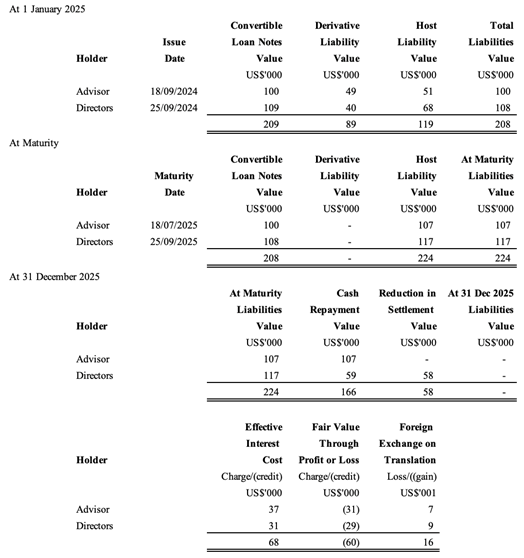
16. CONVERTIBLE LOAN NOTES (CONTINUED)
On 7 February 2025 the Company issued a GBP-denominated £250,000 non-interest bearing convertible loan Note to Woollard & Hall Limited raising US$311,552, with a maturity of 12 months and conversion into 25,000,000 shares at a price of 1p per share which represented a significant premium to JADE's share price of 0.2p at the date of issuance. The Note was convertible to ordinary shares of the Company at the option of either the Company or the Note holder at any date within the twelve-month period from the date of issuance.
On 11 April 2025 the Company's shares were subject of a 10:1 share combination and the conversion terms were adjusted in accordance with the provisions of the convertible loan note instrument to conversion into 2,500,000 shares at a price of 10p per share.
On 23 December 2025 the Company issued a conversion notice to the Note holder and the shares were converted to shares on 30 December 2025.
The Company assessed the convertible loan note instrument and deemed it to be an equity instrument in accordance with IFRS9. The Company determined that the instrument has the attributes of being wholly equity as the Company had a genuine, unconditional right to avoid delivering cash by choosing to deliver its own shares in satisfaction of the Note. Further, the share alternative was not more valuable at the time of issuance and in management's view would not be substantially more valuable than the cash value on conversion.
On 30 December 2025 the Company accounted for the proceeds of US$ 336,880 as consideration for the issue of ordinary share capital.
17. RELATED PARTY TRANSACTIONS
Directors
As reported in Note 17 convertible loan Notes totalling £86,920 (US$108,833) were issued to Directors on 25 September 2024. These were issued to: G Lam £25,350, H Trenchard £23,570, and S Crocker £38,000, all in settlement of unpaid fees to 31 August 2024. In July 2025 the Notes all matured without being converted into shares and in December 2025 these Note holders agreed to receive cash payment calculated at 50% of the Note principal, in full and final settlement of the Notes.
During the year, the Company and the Group entered into the following transactions with related parties and connected parties under existing contracts:
|
|
|
2025 |
|
2024 |
|
|
|
|
US$'000 |
|
US$'000 |
|
|
|
|
|
|
|
|
|
Remuneration payable to Directors (see Note 7) |
|
181 |
|
274 |
|
|
Heirloom Investment Management LLC(1): Administration Fee |
|
- |
|
150 |
|
|
GHCP Services Limited(2): Administrative fees and expenses |
|
38 |
|
- |
|
|
|
|
|
|
|
|
Notes:
(1) Agreement terminated March 2025
(2) Provides the services of Adrian Harvey, a director of subsidiary Jade Road Investments UK Limited.
At the year end, the Company and the Group owed the following amounts to those related parties and connected parties under existing contracts:
|
|
|
2025 |
|
2024 |
|
|
|
|
US$'000 |
|
US$'000 |
|
|
|
|
|
|
|
|
|
Directors |
|
68 |
|
147 |
|
|
Heirloom Investment Management LLC |
|
- |
|
150 |
|
|
GHCP Services Limited |
|
- |
|
- |
|
18. LOSS PER SHARE
The calculation of the basic and diluted loss per share attributable to the ordinary equity holders of the Company is based on the following:
|
|
|
2025 |
|
2024 |
|
|
|
|
US$'000 |
|
US$'000 |
|
|
Numerator |
|
|
|
|
|
|
Basic/Diluted: |
Net loss |
(758) |
|
(1,239) |
|
|
|
|
|
|
|
|
|
|
|
No. of shares |
|
No. of shares* |
|
|
|
|
'000 |
|
'000 |
|
|
Denominator |
|
|
|
|
|
|
|
|
|
|
|
|
|
Basic/Diluted: |
Weighted average shares |
98,348 |
|
360,139 |
|
|
|
|
|
|
|
|
|
Loss per share: |
|
|
|
|
|
|
Basic/Diluted |
|
(0.77) cents |
|
(0.34) cents |
|
Ordinary shares held in Treasury by the company as at 31 December 2025 totalling 264,780 shares (2024: 7,480,004 shares*) have been excluded from the weighted average shares calculation.
* The numbers of shares, and the loss per share, reported for the 2024 comparative year have not been restated for the 10:1 share combination on 11 April 2025.
19. EVENTS AFTER THE REPORTING PERIOD
On 8 January 2026 the Company's shares were subject to a 100:1 share combination, reducing the number of shares issued to 2,410,193 combined shares of which the Company holds 2,647 combined shares in treasury.
On 8 January 2026 the Company's outstanding warrants were adjusted for the 100:1 share combination and were reduced in number from 1,919,787 warrants at an average exercise price of US$ 1.17 to 19,190 warrants at an average exercise price of US$ 117.00.
On 21 January 2026 the Company's shares were re-denominated for trading on the London Stock Exchange Alternative Investment Market from GBP to USD price quoting.
On 9 February 2026 the Company completed a US$ 8.35 million convertible loan note fundraising, immediately converting and issuing 8,350,000 ordinary shares at a price of US$1.00, following which the Company's enlarged issued share was 10,763,193 shares.
On 9 February 2026 following the issue of 8,350,000 ordinary shares the Company's suspension was lifted and its ordinary shares re-admitted to trading on the London Stock Exchange Alternative Investment Market.
On 18 March 2026 Hugh Trenchard and Stuart Crocker resigned as directors, and Yunus Olçer and Christian Reyntjens were appointed directors, of the Company.
Between 20 February 2026 and 22 March 2026 certain warrant instruments lapsed and outstanding warrants were reduced in number from 19,190 warrants at an average exercise price of US$ 1.17 to 8,638 warrants at an average exercise price of US$ 244.15.
RNS may use your IP address to confirm compliance with the terms and conditions, to analyse how you engage with the information contained in this communication, and to share such analysis on an anonymised basis with others as part of our commercial services. For further information about how RNS and the London Stock Exchange use the personal data you provide us, please see our Privacy Policy.

Latest directors dealings
- 8 hours ago Unilever
- 9 hours ago Sequoia Economic Infrastructure Income Fund Limited
- 9 hours ago Cohort
- 10 hours ago Seplat Energy (DI)
- 11 hours ago GSK