
Annual Financial Report
Summary by AI BETAClose X

THIS ANNOUNCEMENT CONTAINS INSIDE INFORMATION FOR THE PURPOSES OF ARTICLE 7 OF THE MARKET ABUSE REGULATION (596/2014/EU) AS THE SAME HAS BEEN RETAINED IN UK LAW AS AMENDED BY THE MARKET ABUSE (AMENDMENT) (EU EXIT) REGULATIONS (SI 2019/310) ("UK MAR"). UPON THE PUBLICATION OF THIS ANNOUNCEMENT, THIS INSIDE INFORMATION IS NOW CONSIDERED TO BE IN THE PUBLIC DOMAIN.
NOT FOR RELEASE, PUBLICATION OR DISTRIBUTION IN WHOLE OR IN PART, DIRECTLY OR INDIRECTLY IN, INTO OR FROM ANY JURISDICTION WHERE TO DO SO WOULD CONSTITUTE A VIOLATION OF THE RELEVANT LAWS OR REGULATIONS OF SUCH JURISDICTION.
30 January 2026
Zoyo Limited
(the "Company" or "Zoyo")
Final Results for the year ended 30 September 2025
The Directors of Zoyo Group are pleased to announce the Company's audited final results for the year ended 30 September 2025. The Annual Report will be available on the Company's website: www.zoyo.com
The Directors accept responsibility for this announcement.
Further information
Zoyo Limited Shaun Carew-Wootton
nnShaun.Wootton@zoyoglobal.com
Highlights for the 2025 Financial Year
During the financial year, Zoyo Limited (formerly Honye Financial Services Limited "Honye") completed, via a reverse takeover transaction, its transition from an Equity Shares (Shell Companies) category ("Shell Companies Category") into a fully operation trading enterprise listed on the Equity Shares (Transition) category of the Official List and to trading on the Main Market of the London Stock Exchange.
Honye was set up to undertake one or more acquisitions of a company or businesses in the financial services and in particular the fintech sector principally in Europe and Asia.
On 9 June 2021, Honye announced that it had signed non-binding heads of agreement with the shareholders of Zoyo Capital Limited ("Zoyo Capital"), which set out the key terms for the proposed acquisition of the entire issued share capital of Zoyo Capital. It is anticipated that it will be satisfied entirely by the issue of new Honye shares to the Zoyo Capital's shareholders.
On 4 April 2025, Honye has created and authorised the issue of up £1,500,000 of unsecured Convertible loan note with interest payable thereon at 6% per annum and with a 3-year maturity, of which £500,000 in aggregate has been issued as at the date of this annual report.
In June 2025, Mr Weng Jian Xiong has made an equity subscription in the sum of £2,500,000 at a price subscribed to 10,869,565 at a price of £0.23 per share.
On 23 July 2025, Honye acquired through a share for share exchange, 100% of the share Capital of Zoyo Capital Limited (which constituted a reverse takeover under the Listing Rules) and the Company's shares were re-admitted to trading. On 26 July 2025, Honye changed its name to Zoyo Limited (" Company") and commenced trading under the ticker "Zoyo". The Group includes Zoyo Limited and its subsidiaries.
On consolidation and presentation of the Group's financial position, performance and cash flows, Zoyo Capital was treated as the accounting acquirer, and the legal parent company, Zoyo Ltd, was treated as the accounting subsidiary, as if Zoyo Capital had acquired Zoyo Ltd. As a result, and unlike a traditional acquisition, the value of £26 million ascribed to Zoyo Capital was not capitalised as a non-current asset but instead recorded as shareholders' equity in the consolidated balance sheet.
The Statement of Financial Position as at 30 September 2025 shows the acquisition of Zoyo Capital by Zoyo Ltd, which occurred on 23 July 2025. The Income Statement, Statement of Financial Position and Statement of Cashflows show for the period ended 30 September 2025, the results of Zoyo Capital with the inclusion of Zoyo Ltd from 23 July 2025. The Income Statement, Statement of Financial Position and Statement of Cashflows at 30 June 2024 are those of Zoyo Capital and its subsidiaries on a standalone basis.
In addition, the accounting for the reverse acquisition itself is deemed to be the issue of shares to the original Honye shareholders by Zoyo Capital and this is accounted for as a share-based payment which gives rise to a non-cash charge in the income statement of £3,864,279, which is included within the reverse acquisition reserve. The Reverse Acquisition Accounting is described in more detail in note 7 to these financial statements.
Following Completion of the Acquisition, the principal activity of the Company will be to act as a holding company for a group of diverse FinTech companies.
Chairman's Statement
Shaun Carew-Wootton (Chairman)
This Annual Report covers more than a years' of fundamental change for Honye Financial Services Limited ("the Company").
At the beginning of the financial year, the Company operated as a cash shell, with no trading activities and a mandate to identify and evaluate suitable acquisition opportunities. During the year, the Company completed the reverse takeover (the "Reverse Takeover") of Zoyo Capital Limited, was re-admitted to the Main Market of the London Stock Exchange in the Equity Shares (Transition) Category and subsequently changed its name to Zoyo Limited ("the Company"). The completion of the Reverse Takeover and the associated Admission represent the defining events of the period under review.
As a result, the financial year comprises two clearly distinct phases. Prior to completion of the Reverse Takeover, the Company's activities were limited to capital preservation, compliance with its listing obligations and the execution of the transaction. Following completion, the Company became the holding company of an early-stage operating group with a defined strategy, new management and a materially different risk profile. The Board considers it important that shareholders read this report with that context firmly in mind.
Completion of the Reverse Takeover resulted in a fundamental transformation of the Company's purpose, governance and operations. The Board was reconstituted on completion, new Board committees were established and a governance framework appropriate for a Main Market listed operating group was put in place. Policies, internal controls and reporting structures were implemented to support the Group's new activities and regulatory obligations.
In the period following completion, the Board's focus was not on short-term financial performance, but on ensuring that the Group was properly structured, governed and controlled. Particular emphasis was placed on governance, regulatory planning and risk management, which the Board considers essential given the Group's early stage of development and the regulatory environment in which it operates.
The Group's strategy is described in more detail elsewhere in this Annual Report. At a high level, the Board's objective is to oversee the development of a technology-enabled financial services business through a phased and controlled approach. The strategy adopted seeks to balance ambition with discipline, placing regulatory compliance, governance and capital management alongside technological and commercial development.
During the period in review , the Company changed its financial year end to September from July on 26 July 2025 in order to better align the Group's reporting cycle with its operational and governance requirements following completion of the Reverse Takeover.
Post-admission and post year-end developments
Following Admission and subsequent to the financial year end, the Company announced a number of matters relating to the completion and implementation of the Reverse Takeover. These included confirmation of Admission and first day of dealings, the change of the Company's name, the publication of the prospectus in connection with the Reverse Takeover and announcements relating to the acquisition and associated subscription.
Since Admission on the 23 July 2025, the Board and management have focused on the orderly integration of the acquired business into the listed group structure, the establishment of appropriate governance and reporting arrangements and the progression of regulatory and operational planning in line with the strategy set out at Admission. No material deviations from the strategy described in the prospectus have been announced during the period.
The Board would like to record its thanks to Xu Wanbao, who resigned as an Executive Director on Admission, for his contribution to the Company during the period in which it operated as a cash shell and through the early stages of the Reverse Takeover process.
The Board recognises that the Group remains at an early stage of development and that the period ahead will continue to involve investment, execution risk and regulatory engagement. The Board's priorities remain unchanged: to maintain robust governance, ensure regulatory compliance and support management in executing the Group's strategy in a disciplined and controlled manner.
Looking ahead, the Board remains confident in the strategic direction set at the time of Admission and believes that the foundations established during the period position the Group appropriately for its next phase of development. The coming year will be focused on progressing regulatory engagement, advancing platform readiness and maintaining a disciplined approach to capital deployment. The Board will continue to prioritise strong governance, regulatory compliance and prudent oversight as the Group executes its strategy in a controlled and measured manner.
Shaun Carew-Wootton
Chairman
Chief Executive's Statement
Wei (Ivy) Wang (Chief Executive Office)
The financial year under review marked the Group's transition from a cash shell to an early-stage operating business following completion of the Reverse Takeover and Admission to the Main Market of the London Stock Exchange.
Prior to completion of the Reverse Takeover, the Company undertook no trading activities. Following completion, management's focus was on establishing the operational, regulatory and organisational foundations required to support the Group's strategy. Performance during the post-completion period is therefore best assessed by reference to progress against delivery milestones rather than financial outcomes.
Operational focus post-completion
Following Admission, management prioritised the integration of the acquired business into the listed group structure and the establishment of appropriate governance, reporting and control processes. This included the implementation of internal policies, reporting lines and third-party arrangements consistent with the Group's status as a Main Market listed company.
Technology and platform development
The Group's strategy is underpinned by the development of a technology-enabled financial services platform. During the period, activity focused on platform architecture, system resilience, data security considerations and alignment with anticipated regulatory requirements.
Regulatory and compliance progress
The Group operates in a regulated environment. Regulatory engagement and compliance planning therefore remain central to the Group's strategy. During the post-completion period, management reviewed inherited regulatory arrangements and progressed planning towards direct regulatory authorisation. The Group is preparing to revive Zoyo Securities 2019 FCA regulatory application and has and has retained the in-house compliance resource who helped with the drafting the regulatory business plan and supporting policies.
People and organisation
Given the Group's early-stage status, management has prioritised flexibility and cost discipline while ensuring that key functions are appropriately resourced. The Group continues to operate with a lean organisational structure, supported by external advisers and service providers where appropriate.
Financial overview
The Group's financial results for the period primarily reflect the Capital with Statement of Financial Position at 30 September 2025 shows the acquisition of Zoyo Capital by Zoyo Ltd, which occurred on 23 July 2025. The Income Statement, Statement of Financial Position and Statement of Cashflows were for the period ended 30 September 2025 the results of Zoyo Capital with the inclusion of Zoyo Ltd from 23 July 2025. The Income Statement, Statement of Financial Position and Statement of Cashflows at 30 June 2024 are those of Zoyo Capital and its subsidiaries on a standalone basis.
On consolidation and presentation of the Group's financial position, performance and cash flows, Zoyo Capital was treated as the accounting acquirer, and the legal parent company, Zoyo Ltd, was treated as the accounting subsidiary, as if Zoyo Capital had acquired Zoyo Ltd. As a result, and unlike a traditional acquisition, the value of £26 million ascribed to Zoyo Capital was not capitalised as a non-current asset but instead recorded as shareholders' equity in the consolidated balance sheet.
In addition, the accounting for the reverse acquisition itself is deemed to be the issue of shares to the original Honye shareholders by Zoyo Capital and this is accounted for as a share-based payment which gives rise to a non-cash charge in the income statement of £3,864,279, which is included within the reverse acquisition reserve. The Reverse Acquisition Accounting is described in more detail in note 7 to these financial statements.
Post year-end development
Following the financial year end, management has continued to focus on progressing the Group's strategy in line with the framework set out at Admission. To date, focus has been on the successful integration of the Sage Intacct accounting system, which went live in October 2025 which has improved operational efficiency and controls, and the development of Zoyo's proprietary Anti-Money Laundering (AML) Customer Screening Platform, which completed its first development sprint to demonstrate functionality in January 2026.
The platform was independently developed by Zoyo Group, with BadDino, an award-winning digital agency, supporting system build and implementation. It leverages advanced algorithms and machine learning to streamline customer due diligence and enhance compliance efficiency for financial institutions. The project previously received the Innovate UK Smart Grant, which is a flagship funding program initiated by the British Government, recognising its innovation and potential impact in combating financial crime.
Following the completion of Beta testing, the AML technology will be used by Zoyo's own trading platform. In addition, Zoyo will officially launch its B2B service, enabling financial institutions and corporate clients to integrate the AML platform into their operations seamlessly. The company anticipates strong adoption driven by regulatory compliance requirements and the increasing demand for automated, reliable screening solutions.
Furthermore, the Company has recently engaged KSA Catalyst to advise on its expansion into the Middle East, focusing initially on Saudi Arabia and the wider Gulf region. This strategic partnership aims to support Zoyo's growth in digital assets, trading platforms, tokenisation, and related financial technologies, facilitating the establishment of regional partnerships and accelerating market access. The engagement is expected to enhance Zoyo's commercial positioning and regulatory navigation within these key jurisdictions.
Outlook
The Group remains at an early stage of development. Management's priorities remain the establishment of robust operational and regulatory foundations and the disciplined execution of the Group's strategy. In the period ahead, focus will continue to be placed on progressing regulatory engagement, advancing platform readiness and ensuring that capital is deployed in a controlled and proportionate manner, consistent with the framework set out at Admission.
Wei (Ivy) Wang
Chief Executive Officer
Strategic Report
Introduction
This Strategic Report describes the Group's business model, strategy and principal considerations for the period ended 30 September 2025. It should be read in conjunction with the Chairman's Statement, the Executive Officer's Report and the Principal Risks and Uncertainties section of this Annual Report.
Business Model
Following completion of the Reverse Takeover and Admission, the Group operates as an early-stage, technology-enabled financial services business. The Group's model combines the development of proprietary technology with regulated market access, delivered through a phased and controlled approach.
The Group is at an early stage of development and has not yet commenced material commercial operations. The Board and management have therefore focused on establishing the operational, governance and regulatory foundations required to support the Group's strategy.
Market and regulatory context
The Group operates in a market characterised by regulatory complexity and ongoing technological change. Regulatory compliance is a prerequisite for participation and is a core element of the Group's strategy. The Board considers early and ongoing regulatory engagement to be essential to the long-term viability of the business.
Strategy and objectives
The Board has adopted a phased strategy designed to balance ambition with discipline and risk management. The strategy comprises an initial foundation phase, followed by development and, subject to regulatory progress and market conditions, growth.
During the foundation phase, the Group's priorities include the establishment of appropriate governance and internal controls, progression of regulatory planning and the development of the Group's technology platform.
Performance against objectives
Given the timing of the Reverse Takeover and the Group's early stage of development, performance during the period is best assessed by reference to progress against organisational, regulatory and operational objectives rather than financial outcomes. During the post-completion period, the Board have focused on agreeing partners to deliver the various platforms and build out of the AML/KYC application.
Operating model
The Group operates with a lean organisational structure appropriate to its current stage of development. Key functions are supported by external advisers and third-party service providers where appropriate, allowing the Group to remain flexible and cost-efficient while maintaining access to specialist expertise.
Use of capital
At Admission, the Company stated that capital raised would be used to support technology development, regulatory and compliance costs, recruitment of key personnel and general working capital. The Board continues to oversee capital deployment closely and reviews expenditure against strategic priorities on a regular basis.
Key performance indicators
Given the Group's stage of development, the Board considers that traditional financial key performance indicators are not yet the most appropriate measures of performance. Progress is therefore assessed against milestone-based indicators linked to regulatory, operational and technology development.
The following KPIs are available for review, and this has been supported by the integration of the Sage Intacct accounting system in October 2025:
|
· Group profit and loss (Actual - month, year to date, quarter to date, half year to date); |
|
· Group profit and loss (month actual vs month budget, month to date actual vs month to date budget, commentary on significant differences); |
|
· Group profit and loss (month actual vs month forecast, month to date actual vs month to date forecast, commentary on significant differences); |
|
· Group balance sheet (at month end, against budget and forecast and commentary on significant differences); |
|
· Group revenue analysis by stream (actual to date with charts); |
|
· Group cost of providing a service analysis by type (actual to date with charts); |
|
· Group cash flows analysis (monthly and year to date, against budget and commentary on significant differences); |
|
· Group capital expenditure analysis (monthly and year to date and commentary on significant differences); |
|
· Group personnel cost reconciliation; |
|
· Aged trade creditors at month end; |
|
· Aged trade debtors at month end;
|
Stakeholder and governance statement
The Company is incorporated outside the United Kingdom and is therefore not subject to the provisions of Section 172 of the Companies Act 2006. Notwithstanding this, the Board recognises the importance of maintaining high standards of corporate governance and of considering the interests of stakeholders when making decisions.
In discharging its duties during the year, the Board has had regard to the long-term consequences of its decisions, the interests of the Company's shareholders, the need to maintain constructive relationships with regulators, advisers and other counterparties, and the desirability of maintaining high standards of business conduct and governance.
Environmental and climate-related matters
The Group's operations are currently limited in scale and do not involve material environmental impact. The Board considers that climate-related risks and opportunities are not material to the Group at this stage of its development. The Board will continue to monitor environmental and climate-related matters as the business evolves and will keep the appropriateness of any formal environmental, social and governance considerations and disclosures under review as the Group's activities expand and its operational footprint develops.
Principal risks and uncertainties
The Board recognises that effective risk management is central to the Group's ability to execute its strategy in a controlled and compliant manner. As an early-stage operating group in a regulated sector, the Group faces a range of risks which could materially affect its business, financial position and prospects.
The risks set out below are those which the Board considers to be the principal risks facing the Group at the date of this report. They are not presented in any order of priority.
Regulatory authorisation and compliance risk
The Group operates in a highly regulated environment. The ability to carry on certain activities is dependent on obtaining and maintaining appropriate regulatory permissions and complying with ongoing regulatory obligations.
There is a risk that regulatory authorisations may take longer than anticipated to obtain, may be subject to conditions, or may not be granted at all. There is also a risk that changes in regulatory requirements, supervisory expectations or regulatory interpretation could require modifications to the Group's operating model, systems or strategy.
The Board seeks to mitigate this risk through early and ongoing engagement with regulators, the use of experienced advisers and the establishment of internal governance, compliance and reporting frameworks appropriate to the Group's activities.
Early-stage business risk
Following completion of the Reverse Takeover, the Group is at an early stage of development and has limited operating history as a listed operating group. The business has not yet commenced material commercial operations.
There is a risk that the Group may not be able to execute its strategy as planned, that development milestones may be delayed, or that the business model may need to be adapted in response to regulatory, technological or market factors.
The Board mitigates this risk through a phased development strategy, disciplined capital allocation and close oversight of progress against strategic priorities.
Technology development and execution risk
The Group's strategy is underpinned by the development of a technology-enabled platform. Technology development involves inherent risks, including delays, cost overruns, design limitations and integration challenges.
There is also a risk that systems may not perform as intended, may require significant modification, or may be subject to cyber security or data protection issues.
The Board oversees technology development closely and seeks to mitigate this risk through structured development processes, third-party assurance where appropriate and consideration of resilience, security and scalability from the outset.
Dependence on key personnel
The Group currently relies on a small number of individuals with specialist skills and experience. The loss of one or more key personnel could adversely affect the Group's ability to execute its strategy and manage regulatory and operational requirements.
The Board recognises this risk and seeks to mitigate it through succession planning, the use of external advisers and the gradual strengthening of the Group's organisational structure as resources permit.
Funding and liquidity risk
The Group is in a development phase and is not currently generating material revenue. The execution of the Group's strategy is therefore dependent on the availability of sufficient financial resources.
There is a risk that the Group may require additional funding to progress its strategy and that such funding may not be available on acceptable terms, or at all.
The Board mitigates this risk through careful management of cash resources, close oversight of expenditure and consideration of funding requirements as part of strategic planning.
Third-party and outsourcing risk
The Group makes use of third-party service providers for certain operational, technology and advisory functions. Reliance on third parties creates risks relating to service continuity, quality, compliance and dependency.
The Board seeks to mitigate these risks through due diligence, contractual protections, ongoing oversight and contingency planning where appropriate.
Legal and jurisdiction risk
The Company is incorporated outside the United Kingdom and operates across multiple jurisdictions. This exposes the Group to legal and regulatory regimes that may differ from those applicable to UK-incorporated companies.
There is a risk that changes in law, regulation or interpretation could adversely affect the Group's operations or compliance obligations.
The Board mitigates this risk through the use of legal advisers and by maintaining awareness of relevant legal and regulatory developments The company has in house compliance resource who keep abreast of the regulatory landscape, and a Legel Counsil which specialist knowledge of data protection. The Company will additionally be looking to rejoin the Biometrics Institute to develop best practices and industry guidance on the responsible, ethical, and effective use of biometrics.
Internal control and governance risk
As a relatively young operating group, the Group's systems of internal control and risk management continue to evolve.
There is a risk that controls may not yet be fully embedded or may not operate as intended as the business develops.
The Board addresses this risk by establishing governance frameworks, Board committees and reporting processes appropriate to the Group's size and stage of development, and by keeping these arrangements under regular review.
Risk management and review
The Board is responsible for the Group's risk management and internal control systems. These systems are designed to manage, rather than eliminate, the risk of failure and can therefore only provide reasonable, not absolute, assurance.
The Board reviews principal risks on a regular basis and considers both existing and emerging risks as part of its ongoing oversight of the Group.
Viability Statement
The Directors have assessed the prospects of the Company over a period of 12 months from the date of approval of these financial statements (the "Assessment Period"). This period has been selected as it aligns with the Company's detailed working capital forecasts and reflects the Company's current stage of development following completion of the reverse takeover.
In making this assessment, the Directors have considered:
· the Company's current financial position;
· the working capital forecasts and cash flow projections prepared by management;
· the base case and downside scenarios reviewed as part of the working capital assessment process;
· the principal risks and uncertainties described in the Strategic Report; and
· the Company's operating cost base, funding structure and stage of development as a newly established operating group.
The Directors note that the Company is at an early stage of its development and remains reliant on the execution of its business plan and financial forecasts. The projections are inherently dependent on assumptions regarding revenue development, cost control and operational execution.
Based on this review, the Directors have a reasonable expectation that the Company will be able to continue in operation and meet its liabilities as they fall due over the Assessment Period.
However, this assessment is subject to material uncertainty in relation to funding execution and delivery of forecast assumptions. The Company's ability to maintain adequate liquidity over the Assessment Period depends on the achievement of forecast operational and financial assumptions. Should these assumptions not be met, the Company may need to seek access to additional capital in order to continue implementing its strategy.
The Directors will continue to monitor the Company's financial performance, liquidity position and risk profile on an ongoing basis.
Sustainability Statement
Overview
The Group is an early‑stage fintech company commercialising an equity trading application. During the reporting period the Group has not generated revenue and operating activities have been largely inactive. Planned activity over the next few months will be minimal while the Group focuses on product development and the commercial roll‑out of its platform.
Relevance of sustainability reporting and materiality conclusion
Following a materiality assessment aligned with the Group's current scale and activities, the Board has concluded that formal sustainability reporting is not currently material to the users of these financial statements. The Group's limited operations, absence of revenue and minimal on‑going operational footprint mean that environmental, social and governance (ESG) matters have had no significant financial or operational impact during the period and are not expected to be significant in the immediate term.
Current sustainability considerations and activities
Product development: The Group is deploying external developer contractors to enhance its technology platform. Contractor engagements are managed under standard procurement and contracting processes.
Operational footprint: With minimal on‑site operations and no active trading or customer operations during the period, the Group's direct environmental footprint (energy use, travel, waste) is negligible.
People and governance: The Group maintains appropriate governance arrangements for contractor oversight, data protection and information security as part of its product development and commercialisation activities. No material workforce‑related issues arose during the period.
Directors skills: The board is composed of seasoned corporate financiers and finance professionals who advise several companies, and this includes corporate advisory, consultancy and the provision of financial training; work which complements running the business and helps to maintain and expand the director's competencies. Additionally, the Group has a specific provision for Staff Training in its working capital budget to provide specific training as required.
Monitoring and future reporting approach
The Board will continue to monitor the Group's activities, stakeholder expectations and regulatory developments relating to sustainability reporting. If the Group's scale, operational footprint, customer base or regulatory obligations change such that ESG matters become material, the Group will expand its sustainability disclosures in future reporting periods to reflect those developments.
Where this statement appears and responsibility
This sustainability statement forms part of the notes to the consolidated financial statements. The Board is responsible for the assessment described above and for ensuring that disclosures remain appropriate to the Group's circumstances.
Approved by the Board on: 30 January 2026
Signed on behalf of the Board: Wei Wang
Ethical Standards
The Board recognises that maintaining high standards of ethical conduct is fundamental to the long-term success and reputation of the Company. The Company is committed to operating in a responsible, transparent and lawful manner and to promoting a culture of integrity across the organisation.
The Company applies the principles of the Quoted Companies Alliance Corporate Governance Code and seeks to ensure that its governance framework supports ethical decision-making at Board and operational level.
An employee handbook sets out the standards of conduct expected of all employees and contractors, including requirements relating to honesty, integrity, professional behaviour and compliance with applicable laws and regulations. These standards are reinforced through internal policies and Board oversight.
The Company has procedures in place requiring Directors and relevant personnel to declare conflicts of interest. The Board reviews any such conflicts and ensures that appropriate safeguards are applied.
Policies addressing anti-bribery and corruption are in place, and the Board has a zero-tolerance approach to bribery and unethical business practices. The Company is also subject to applicable market abuse and share dealing regulations as a listed company, and procedures are in place to support compliance in these areas.
Arrangements exist for individuals to raise concerns about potential wrongdoing or unethical behaviour. The Board considers that these arrangements are appropriate for the size and stage of development of the Company.
The Board reviews the Company's ethical framework periodically and will continue to develop policies and procedures as the business grows.
Taskforce on Climate-Related Financial Disclosure ("TCFD")
Statement of non-compliance
The Group is pleased to release its first integrated TCFD report for the financial year ended 30 September 2025 (FY25). Following the reverse takeover of Zoyo Capital in July 2025 and the subsequent listing of Zoyo Ltd on the Main Market of the London Stock Exchange on 23 July 2025, the Group entered a significant transitional phase.
Our primary focus for FY25 has been to effectively integrate the operations and governance structures of Zoyo Ltd and Zoyo Capital. Given the timing of the reverse takeover, the integration of climate-related considerations across the business is in its early stages and is still under development. However, we recognise the importance of addressing climate-related risks and opportunities across the business and remain committed to developing the internal processes required to fully comply with the recommendations set forth under UKLR22.2.24R.
Furthermore, we recognise the need for transparency on climate-related issues by investors and other stakeholders and aim to provide the necessary assurances in this report and going forward. The following sections of the report communicate our progress to date, as well as our plans to enhance the Group's alignment with the TCFD disclosure requirements in future years. Currently, the Group is reporting on an 'explain' basis for all 11 TCFD disclosure requirements. The Company aims to develop a comprehensive action plan for compliance in the future years and timelines for this are documented in the below.
TCFD Recommendations
In 2015, the Financial Stability Board (FSB) established the TCFD to develop recommendations for more effective climate-related disclosures to promote more informed decisions and, in turn, enable stakeholders to understand better the concentrations of carbon-related assets and exposures to climate-related risks.
TCFD's aim is for these disclosures to promote the management of climate-related financial risks and opportunities across the economy and financial system.
This was followed by the release of the TCFD disclosure recommendations, serving as a framework to support companies with accurate and timely disclosures of climate-related risks and opportunities. The TCFD disclosure recommendations are structured around four key pillars, outlined below, and supported by 11 recommended disclosures.
In October 2023, the TCFD disbanded, with the IFRS Foundation taking over the monitoring of companies' progress against climate-related disclosures. As a result, the TCFD recommendations have been fully incorporated into the ISSB Standards, specifically IFRS S2, structured around the same core pillars.
TCFD Pillar
1. Governance - Disclose the organisation's governance around climate related risks and opportunities
2. Strategy - Disclose the actual and potential impacts of climate-related risks and opportunities on the organisation's businesses, strategy, and financial planning where such information is material
3. Risk management - Disclose how the organisation identifies, assesses, and manages climate-related risks
4. Metrics and targets - Disclose the metrics and targets used to assess and manage relevant climate-related risks and opportunities where such information is material
TCFD pillar-based summary
Governance
With the reverse takeover taking place less than 2 months before the end of the financial year, the Group is still in the process of setting up internal processes and governance structures. As such, we are working towards creating formal processes for the oversight and integration of climate-related risk management processes within the Company. The Group will be in the process of assigning the responsibility for assessing, managing and reviewing climate-related risks and opportunities and developing of climate-related KPIs to the Audit and Risk Committee, with the CFO responsible for the overall review of the climate-related risks and opportunities.
The Group is committed to fully integrating climate-related oversight and responsibilities across its governance structures in Q3 of the next financial year (FY26). This includes integrating management roles and responsibilities for climate-related issues into the Board, and ensuring consistent processes for the monitoring, assessment and management of climate-related risks, in line with current risk management processes.
Strategy
The Group acknowledges the importance of understanding both its physical and transition climate risks relevant to its business model and sector exposure. As this is the first year of TCFD reporting following its July 2025 re-admission, the Group has focused initial efforts on establishing governance processes and understanding regulatory requirements. This includes monitoring IFRS S2 developments and the UK Sustainability Reporting Standards. The Group will prioritise the identification of climate-related risks and opportunities over the short, medium and long term, in H2 of FY26.
Upon identification and assessment of short, medium and long-term climate related risks and opportunities, the Group will look at integrating material considerations into its broader business strategy and financial planning. In future years, climate scenario analysis under different warming scenarios will also form part of these considerations.
Risk Management
The Group plans to develop and integrate the processes for identifying, assessing and managing climate-related risks into its current risk management framework. Specifically, The Group is committed to formalising its processes for identifying and assessing climate-related risks in Q3 of FY26. Thereafter, the Group will prioritise the development of processes for managing climate-related risks in Q4 FY26 for reporting in FY26.
The Group is committed to fully integrating climate-related issues in its risk management framework and aims to do this progressively in future years. This includes updating risk policies and integrating climate-related risks into existing risk committee oversight responsibility and business risk practices.
By integrating climate-related risks across our risk management processes, such risks will also form part of the Board's annual risk assessment and quarterly review, as well as our regular internal reviews.
Metrics and targets
The Group will be the data requirements for calculating its greenhouse gas (GHG) emissions and is committed to conducting a carbon footprint assessment in Q3 of FY26 and report in the FY26 TCFD report. In preparation, the Group is in the process of identifying relevant business activities for assessment and evaluating potential data sources. In line with global best practice, the Group intends to align its emissions disclosures with recognised frameworks such as the GHG Protocol.
Upon completion of the carbon footprint assessment, and once material climate-related risks and opportunities have been assessed, the Group will develop appropriate KPIs and targets that support the progressive integration of climate considerations into its wider business and risk strategy. This will
ensure transparency regarding the Group's management and performance towards climate-related issues.
Section 172 Statement
This statement is made by the directors of Zoyo Limited ("Company"). Although the Company is incorporated in the Cayman Islands, the board has chosen to disclose this statement in the spirit of transparency and good governance and to explain how the directors have had regard to the matters set out in section 172 of the UK Companies Act 2006 when making decisions during the financial year.
During the financial year the board's principal focus was the completion of a reverse acquisition by which the Company acquired Zoyo Capital ("Zoyo Capital"), a start-up fintech business. Zoyo Capital has had minimal trading activity and has generated a minimal revenue to date. Directors devoted the majority of their time to negotiating, structuring and completing the transaction and to the immediate post transaction matters required to position the combined group for development and future fundraising.
In considering the long-term consequences of decisions, the board prioritised completing the reverse acquisition to provide a listed vehicle for the Company's growth and to create a platform for future capital raises. The board assessed the long-term prospects of the combined group, the funding required to support product development, and the need to establish appropriate governance and controls to support sustainable growth.
The board recognised the limited number of employees across the Group and engaged with key personnel to ensure continuity through the transaction. Directors considered fair treatment and continuity of employment where applicable and identified resourcing needs for the next phase, including recruitment of technical and compliance expertise as the business develops.
Given the early stage of the Zoyo Capital, supplier and partner relationships are limited. The board sought to preserve existing supplier arrangements and to identify strategic partners, advisers and technology providers necessary for product development and regulatory engagement. There were no material customer revenues during the financial year; the board considered the timing and approach to customer acquisition as part of the post transaction plan.
The Company's and Target's activities have had no material environmental footprint during the financial year. The board will continue to consider environmental and community impacts as operations scale and intends to adopt appropriate policies consistent with regulatory expectations and stakeholder expectations.
Maintaining a reputation for high standards of business conduct was a key consideration in structuring and completing the transaction. The board prioritised establishing appropriate governance, financial reporting and regulatory engagement processes following the reverse acquisition and considered reputational risk when selecting advisers and service providers.
The board considered the interests of existing and prospective shareholders when structuring the transaction, including disclosure, fairness of terms and the need to provide a clear plan for value creation. Majority of the creditors' interests were related to the Acquisition during the financial year, with directors mindful of the need to preserve liquidity pending further fundraising.
The principal risks identified by the board include funding risk, execution risk in developing and commercialising early stage fintech products, regulatory risk given evolving requirements in relevant jurisdictions, and market and commercial risk relating to customer adoption and revenue timelines. The board has sought to mitigate these risks through careful cash management, adviser engagement and prioritising regulatory and compliance planning.
Key decisions taken during the financial year included completing the reverse acquisition to provide a public listing for the Zoyo Capital and establishing immediate post transaction priorities: integration planning, governance and compliance enhancements, preparation for fundraising, and recruitment of critical personnel. In making these decisions the board considered valuation and structure, regulatory and listing requirements, adviser selection, timing and the impact on stakeholders.
Having considered the matters set out in section 172, the directors believe that the decisions taken during the financial year were in the best interests of the Company and its stakeholders as a whole.
The board recognises that the Company is at an early stage following the reverse acquisition and that the focus for the coming year will be on delivering the business plan, securing funding, strengthening governance and progressing product and regulatory milestones.
Approved by the board of directors on date: 30 January 2026
For and on behalf of the board: Wei Wang
The Board of Directors
Shaun Carew-Wootton
Non-Executive Chairman
Mr Carew-Wootton is currently a director of a boutique private equity and advisory business and has been active in the venture capital and start-up market for over 20 years, initially as an entrepreneur and then as an investor. He has been a party to more than 40 investments across a broad range of sectors, stages and geographies, including FinTech, Telecom, Property and Aviation.
John Treacy
Non-Executive Director
John Treacy is an experienced London-based financier who specialises in working with growing companies. He qualified as a solicitor in the London office of a major international law firm where he specialised in Capital Markets and Mergers & Acquisitions. From there he moved on to practice corporate finance in the advisory teams of several prominent UK brokerages where he acted as an adviser to a number of the Main Market of the London Stock Exchange companies and advised on numerous initial public offerings, acquisitions, debt restructurings and placings.
Yu Xing (Terry) Liu
Executive Director
Liu Yu Xing, known as Terry Liu, is owner of L&S Group, a successful cross-border M&A and corporate and financial consultancy firm. Mr. Liu has extensive experience in the areas of cross-border, foreign-direct investment and general corporate advisory. Mr. Liu has established himself as a trusted advisor to Chinese corporates, family offices and high net-worth individuals in relation to acquisitions, corporate structuring, listings in major markets (e.g., London, US, Hong Kong, Shanghai) and organic business scaling (e.g., sales and market exploitation). Mr. Liu has helped over 12 companies list on stock exchanges in China, Hong Kong, US and UK. In addition to his directorships and shareholdings connected with L&S Group Ltd, Mr. Liu is also an indirect shareholder of the Zoyo Group. Mr. Liu is a certified Fund Practitioner and is authorised and regulated by the Asset Management Association of China.
Wei (Ivy) Wang
Chief Executive Officer
Combining an extensive corporate finance background with a natural entrepreneurial flair, Ivy is highly numerate and has worked with a wide variety of clients across the globe. Her technical expertise covers M&A, investor relations, venture capital and compliance. She has obtained an Institute of Directors' Certificate in Company Direction and has over 10 years' experience in the city where she has worked in a variety of boutique investment banks. Ivy will be responsible for investor relations and for the successful execution of the business strategy.
David Powell
Chief Operations Officer
Prior to founding Zoyo, David had 17 years' experience contracting at firms such as Barclays, HSBC, BP, RBS and Credit Suisse. He has held a senior governance position within a multinational PLC and has a background in process reengineering with a proven track record in the timely delivery of complex projects, with a strong technical proficiency in process re-engineering, complex systems modelling, systems architecture, trading platform development, process mapping and project and programme management. David has specialist knowledge of relational database design, project and programme governance, MI systems, process automation and finance change. David read Economics, Politics and History at the University of Exeter. David will be responsible for technology development and general operations of the Enlarged Group.
Xu Wanbao (resigned on 23 July 2025)
Executive director of Honye Financial Services Ltd
Xu Wanbao entered into a service agreement with the Honye Financial Services Ltd ("Honye") on 3 December 2018 and pursuant to an amendment agreement entered into between Honye and Mr Wanbao dated 24 February 2022, Mr Wanbao has agreed to waive in full any payment of salary to him from 1 August 2021 under the terms of the service agreement, including any amounts accrued in respect of such obligations in the Honye's financial statements. Mr Wanbao has resigned on 23 July 2025.
The Board Structure
The Board as at 30 September 2025 and the Directors' respective roles on committees of the Board are detailed below:
|
Name |
Role |
Committee membership |
|
Shaun Carew-Wootton |
Independent Non-executive Chairman |
Audit, Remuneration (Chair) and Nomination |
|
John Treacy |
Independent Non-executive Director |
Audit (Chair), Remuneration and Nomination (Chair) |
|
Terry Liu |
Executive Director |
Remuneration and Nomination |
|
Wei (Ivy) Wang |
Chief Executive Officer |
|
|
David Powell |
Chief Operations Officer, also acting Finance Director |
|
Corporate Governance
The Directors recognise the importance of sound corporate governance and are committed to maintaining high standards of governance appropriate to the Company's size, stage of development and regulatory environment.
The Company is incorporated outside the United Kingdom and its ordinary shares are admitted to the Main Market of the London Stock Exchange. The Board has adopted the Quoted Companies Alliance Corporate Governance Code (the "QCA Code") as the framework for its corporate governance arrangements. The Board considers that the QCA Code provides a proportionate and principles-based framework suitable for an overseas-incorporated, early-stage operating company.
As this is the Company's first annual report following completion of the Reverse Takeover, the governance disclosures set out below focus on arrangements in place following Admission. The Board expects its governance arrangements to evolve as the Group grows and as its operations develop.
The Board has also adopted a code of conduct for dealings in the Company's shares by directors and applicable employees and is committed to maintaining the highest standards of integrity, ethical behaviour and regulatory compliance.
The corporate governance arrangements adopted by the Board are designed to support the delivery of long-term value for shareholders and to ensure that shareholders have the opportunity to express their views and expectations for the Company in a manner that encourages open and constructive dialogue with the Board.
The Board recognises that its decisions regarding strategy and risk directly influence the culture of the Company. The Board is mindful that the tone and culture set at Board level will shape behaviour throughout the Group and considers this to be an important factor in the long-term success of the business.
THE BOARD
At the balance sheet date, the Board comprised the following directors:
· Shaun Carew-Wootton - Non-Executive Chairman
· John Treacy - Non-Executive Director
· Yu Xing (Terry) Liu - Executive Director
· Wei (Ivy) Wang - Executive Director
· David Powell - Executive Director
The Board was reconstituted on completion of the Reverse Takeover. Xu Wanbao resigned as an Executive Director on Admission.
The Company does not have a Chief Executive Officer. The Board considers that, at this stage of the Group's development, appropriate oversight and leadership are provided by the current Board structure. The composition of the Board will continue to be reviewed as the business develops.
Board operation and meetings
The Board retains full responsibility for the direction and control of the Company, with day-to-day operational matters delegated to the executive directors. The Board meets regularly and as otherwise required. During the post-completion period, the Board met 7 times on a monthly basis.
Board committees
The Board has established Audit, Remuneration and Nomination Committees, each with formal terms of reference approved by the Board.
The Audit Committee comprises John Treacy (Chair) and Shaun Carew-Wootton and met two times during the period. The Audit Committee is responsible for monitoring the integrity of the financial statements, reviewing internal controls and risk management systems and overseeing the relationship with the external auditor.
The Remuneration Committee comprises Shaun Carew-Wootton (Chair), John Treacy and Yu Xing (Terry) Liu. The Remuneration Committee is responsible for setting executive remuneration and overseeing incentive arrangements.
The Nomination Committee comprises John Treacy (Chair), Shaun Carew-Wootton and Yu Xing (Terry) Liu. The Nomination Committee is responsible for Board composition and succession planning.
Diversity and culture
The Board recognises the benefits of diversity in terms of skills, experience, background and perspective. As at the balance sheet date, the Board comprised one female director and directors from a range of ethnic backgrounds. The Board does not currently operate a formal diversity policy but will keep this under review as the Group develops.
Shareholder and stakeholder engagement
The Board is committed to maintaining effective communication with shareholders. Shareholders are encouraged to attend the Company's Annual General Meeting, at which they have the opportunity to engage directly with the Board. The Company also maintains a corporate website through which regulatory announcements and other information are made available.
The Board recognises the importance of maintaining constructive relationships with regulators, advisers, suppliers and other stakeholders and considers this to be essential to the successful execution of the Group's strategy.
QCA corporate governance code of compliance
The QCA Code sets out ten principles of good corporate governance. The following section explains how the Company has applied each of the principles during the year.
· Principle 1 - Establish a strategy and business model which promote long-term value for shareholders
The Board has adopted a clear strategy focused on the development of a technology-enabled financial services business through a phased and disciplined approach, as described in the Strategic Report.
· Principle 2 - Seek to understand and meet shareholder needs and expectations
The Board seeks to maintain open communication with shareholders through regulatory announcements, the Annual Report, the Company's website and the Annual General Meeting.
· Principle 3 - Take into account wider stakeholder and social responsibilities and their implications for long-term success
The Company is not incorporated in the United Kingdom and is not subject to section 172 of the Companies Act 2006. Notwithstanding this, the Board recognises the importance of considering the interests of stakeholders and the long-term consequences of its decisions.
· Principle 4 - Embed effective risk management, considering both opportunities and threats, throughout the organisation
The Board is responsible for the Group's risk management and internal control framework. Principal risks are described in the Principal Risks and Uncertainties section of this Annual Report.
· Principle 5 - Maintain the Board as a well-functioning, balanced team led by the Chair
The Board is chaired by a Non-Executive Chairman and comprises executive and non-executive directors with relevant experience. Board composition is kept under review.
· Principle 6 - Ensure that between them the directors have the necessary up-to-date experience, skills and capabilities
The Board believes that the directors collectively have appropriate skills and experience for the Group's current stage of development.
· Principle 7 - Evaluate Board performance based on clear and relevant objectives, seeking continuous improvement
As this is the first year following the Reverse Takeover, the Board has not undertaken a formal external evaluation. The Board intends to keep its performance under review.
· Principle 8 - Promote a corporate culture that is based on ethical values and behaviours
The Board seeks to promote a culture of integrity, accountability and regulatory compliance throughout the Group.
· Principle 9 - Maintain governance structures and processes that are fit for purpose and support good decision-making by the Board
The Board has established appropriate committee structures and governance processes, which will continue to evolve as the business develops.
· Principle 10 - Communicate how the Company is governed and is performing by maintaining a dialogue with shareholders and other relevant stakeholders
The Company communicates its governance arrangements through regulatory announcements, the Annual Report and its website.
Audit & Risk Committee Report
Introduction
The Audit and Risk Committee (the "Committee") is responsible for overseeing the integrity of the Company's financial reporting, reviewing the effectiveness of internal controls and risk management systems, and supporting the Board in discharging its responsibilities in relation to audit, accounting and financial governance matters.
The Committee applies the principles of the Quoted Companies Alliance Corporate Governance Code (the "QCA Code"), taking into account the Company's size, complexity and stage of development following completion of the reverse takeover.
This report is unaudited.
Composition of the Audit and Risk Committee
During the financial period, the Committee comprised:
· John Treacy (Chair)
· Shaun Carew-Wootton
Both members are independent Non-Executive Directors.
Meetings and Attendance
The Audit and Risk Committee met two times during the financial period.
Director Meetings attended
John Treacy 2 of 2
Shaun Carew-Wootton 2 of 2
The Company's external auditors attended meetings when invited, where matters relevant to the audit and financial reporting were discussed.
Responsibilities of the Committee
The principal responsibilities of the Audit and Risk Committee include:
· monitoring the integrity of the Company's financial statements and any formal announcements relating to financial performance;
· reviewing significant financial reporting judgements and accounting policies;
· overseeing the effectiveness of internal controls and risk management processes;
· reviewing the scope and results of the external audit;
· assessing the independence and effectiveness of the external auditors; and
· advising the Board on risk matters arising from financial and operational activities.
Financial Reporting
The Committee reviewed the interim and annual financial information during the period and considered whether the financial statements, taken as a whole, were fair, balanced and understandable.
Particular focus was given to accounting judgements arising from the reverse takeover, the transition from cash shell status, and the preparation of financial information following Admission.
Internal Controls and Risk Management
The Committee reviewed the Company's internal control framework and risk management processes, recognising that, given the Company's size and stage of development, these are necessarily less formal than those of larger listed companies.
The Committee considered that the internal controls and procedures in place during the period were appropriate to the Company's operations and risk profile. Controls and risk management arrangements were reviewed as part of the reverse takeover process.
The Committee did not identify any matters requiring immediate remedial action during the period.
External Audit
The Committee considered the appointment, independence and performance of the external auditors.
The external auditors were provided with full access to the Committee and management and attended Committee meetings when invited. No issues arose during the period that required escalation to the Board.
The Committee is satisfied that the external auditors remain independent.
Non-Audit Services
No material non-audit services were provided by the external auditors during the period [or: details are disclosed in the financial statements].
Whistleblowing and Fraud
Given the size of the Company and the nature of its operations, the Committee considered that existing arrangements for raising concerns were appropriate. No instances of fraud or whistleblowing were reported during the period.
Post-Period Matters
There were no significant audit or risk matters arising after the end of the financial period that require disclosure in this report.
Conclusion
The Committee is satisfied that it has discharged its responsibilities effectively during the period and that the Company's financial reporting, risk management and internal control arrangements are appropriate.
This report was approved by the Board on 30 January 2026 and signed on behalf of the Audit and Risk Committee.
John Treacy
Chair of the Audit and Risk Committee
Nomination Committee Report
Due to the size of the Company, the nominations of proposed directors will be a matter for the whole Board.
Consideration will be given by the Nominations Committee to future succession plans for Board members as well as to whether the Board has the skills required to effectively manage the Group.
Key responsibilities:
• be responsible for identifying candidates to fill Board vacancies as and when they arise;
• evaluate the balance of skills, knowledge and experience on the Board and, in the light of this evaluation, prepare a description of the role and capabilities required for a particular appointment;
• review annually the time required from a Non-Executive Director and assess whether the Non-Executive Director is spending enough time to fulfil their duties;
• consider candidates from a wide range of backgrounds;
• give full consideration to succession planning in the course of its work, taking into account the challenges and opportunities facing the Group, and the skills and expertise therefore needed on the Board;
• regularly review the structure, size and composition (including the skills, knowledge and experience) of the Board and make recommendations to the Board with regard to changes;
• keep under review the leadership needs of the Group, both executive and non-executive, with a view to ensuring the continued ability of the Group to compete effectively in the marketplace;
• make a statement in the annual report about its activities; the process used for appointments and explain if external advice or open advertising has not been used; the number of remuneration meetings and the attendance over the course of the year;
• ensure that on appointment to the Board, Non-Executive Directors receive a formal letter of appointment setting out clearly what is expected of them in terms of time commitment, committee service and involvement outside board meetings;
• consider and make recommendations to the Board about the re-appointment of any Non-Executive Director at the conclusion of their specified term of office or retiring in accordance with the Company's Articles of Association; and
• consider and make recommendations to the Board on any matter relating to the continuation in office of any Director at any time.
Remuneration Committee Report
Directors' remuneration report for the period ended 30 September 2025
The Company has established a Remuneration Committee. The Committee reviews the scale and structure of the Directors' remuneration, taking into account the interests of shareholders, the long-term strategy of the Group and the performance of the Company and its Directors.
The items included in this report are unaudited unless otherwise stated.
Statement by the chair of the remuneration committee
As Chair of the Remuneration Committee, I am pleased to present the Directors' Remuneration Report for the period ended 30 September 2025.
The Remuneration Committee's objective is to ensure that the Company's remuneration policy supports the long-term success of the Group, aligns the interests of Directors with those of shareholders and reflects the Company's size, stage of development and regulatory environment.
Given the early-stage nature of the Group and the fact that this is the first financial year following Admission and completion of the reverse takeover, the Board has adopted a cautious and proportionate approach to remuneration. Fixed remuneration and equity-based incentives are intended to support retention and alignment with shareholder interests, without encouraging excessive risk-taking.
Key activities of the remuneration committee
The key activities of the Remuneration Committee are to:
· determine and agree with the Board the framework and policy for the remuneration of Executive Directors;
· review and recommend the remuneration of Non-Executive Directors, within the limits set out in the Company's Articles of Association;
· ensure that no Director is involved in decisions regarding their own remuneration;
· review and have regard to remuneration arrangements across the Group;
· review the ongoing appropriateness and relevance of the remuneration policy;
· oversee the operation of any share-based incentive arrangements;
· consider termination arrangements to ensure they are fair to both the Company and the individual; and
· consider any other matters referred to it by the Board.
Membership of the remuneration committee
The Remuneration Committee comprises the following Directors:
• John Treacy (Chair)
• Terry Liu
• Shaun Wootton
The Remuneration Committee met once during the financial year.
Remuneration policy
The Company's remuneration policy is designed to attract, retain and motivate Directors of appropriate calibre, experience and skill, whilst ensuring that remuneration levels are proportionate and aligned with shareholder interests.
As the Group is at an early stage of development, the current components of Directors' remuneration consist primarily of fixed fees or salaries and, where appropriate, equity-based incentives. The Company does not currently operate annual bonus arrangements.
The Remuneration Committee anticipates that, as the Group develops and becomes revenue-generating, additional elements of remuneration may be introduced, including performance-related bonuses and other benefits.
Remuneration components
The principal components of Directors' remuneration are:
· basic fees or salaries;
· reimbursement of reasonable expenses; and
· participation in share-based incentive arrangements.
Service agreements and letters of appointment
Executive Directors are engaged under service agreements or appointment letters. Non-Executive Directors are engaged under letters of appointment.
Details of service agreements and notice periods are set out below:
|
|
|
Date of appointment |
|
Expiry date of service agreement or letter of appointment |
|
Executive director: |
|
|
|
|
|
Yu Xing (Terry) Liu |
|
4 April 2020 |
|
Re-elect every 3 years |
|
Wei (Ivy) Wang |
|
23 July 2025 |
|
Re-elect every 3 years |
|
David Powell |
|
23 July 2025 |
|
Re-elect every 3 years |
|
|
|
|
|
|
|
Non-executive director: |
|
|
|
|
|
Shaun Carew-Wootton |
|
23 November 2018 |
|
Re-elect every 3 years |
|
John Treacy |
|
3 May 2022 |
|
Re-elect every 3 years |
Directors' remuneration for the period (audited)
Details of remuneration paid to Directors during the period are set out in the table below:
|
|
Salary |
Fees |
Social Security |
Pension |
Total |
|
Executive director: |
|
|
|
|
|
|
Yu Xing (Terry) Liu |
- |
8,333 |
- |
- |
8,333 |
|
Wei (Ivy) Wang |
12,500 |
- |
1,750 |
625 |
14,875 |
|
David Powell |
12,500 |
- |
1,750 |
625 |
14,875 |
|
|
|
|
|
|
|
|
Non-executive director: |
|
|
|
|
|
|
Shaun Carew-Wootton |
- |
4,000 |
- |
- |
4,000 |
|
John Treacy |
- |
4,000 |
- |
- |
4,000 |
Share-based incentives (audited)
The Company does not currently operate a share based incentive scheme.
Remuneration of non-executive directors (audited)
|
|
|
|
Fees |
|
|
Non-executive director: |
|
|
|
|
Shaun Carew-Wootton |
|
4,000 |
|
|
John Treacy |
|
4,000 |
Relative importance of remuneration
The Remuneration Committee considers the level of Directors' remuneration in the context of the Group's overall cost base, cash resources and funding requirements.
Pension arrangements
The Company does not operate any defined benefit pension schemes. Pension contributions, where applicable, are made to defined contribution schemes.
Historical share price performance
The graph below compares the share price performance of the Company with appropriate market indices from Admission to 30 September 2025.
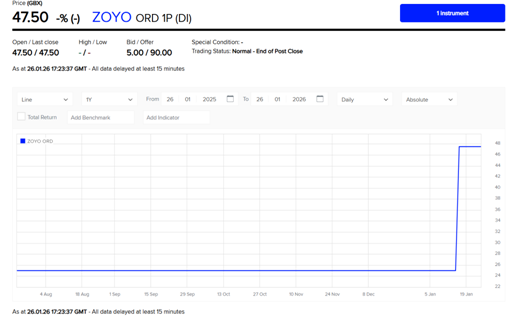
Source: London Stock Exchange
Consideration of shareholders' views
The Board considers shareholder feedback received through meetings, correspondence and the Annual General Meeting when reviewing remuneration policy and outcomes.
Approval
This Directors' Remuneration Report was approved by the Board on 30 January 2026 and signed on its behalf by:
John Treacy
Chair of the Remuneration Committee
Directors' Report
The Directors present the annual report and audited financial statements of the Company and the Group for the year ended 30 September 2025.
Principal activity, business review and future developments
For part of the financial period under review, the Company operated as a cash shell. On completion of the reverse takeover (the "Reverse Takeover") and Admission to the Main Market of the London Stock Exchange ("Admission"), the Company acquired the Zoyo operating group and became an early-stage operating holding company focused on the development of a technology-enabled financial services business.
A review of the Group's strategy, business model and principal risks and uncertainties is set out in the Strategic Report, the Chairman's Statement and the Executive Officer's Report.
Dividends
No dividend is proposed in respect of the year ended 30 September 2025.
Financial risk management
Information in respect of the Group's financial risk management objectives and policies, exposure to credit, liquidity and other relevant financial risks is outlined in Note 4 to the financial statements.
Directors
The Directors of the Company who served during the year and up to the date of approval of these financial statements were:
· Shaun Carew-Wootton
· John Treacy
· Yu Xing (Terry) Liu
· Wei (Ivy) Wang
· David Powell
Xu Wanbao resigned as an Executive Director on Admission. The Board has recorded its thanks to Xu Wanbao for his contribution and support in the period leading up to Admission and completion of the Reverse Takeover.
Board responsibility and corporate governance
The Board is responsible for approving the interim and annual financial statements, formulating and monitoring the Group's strategy, approving financial plans and reviewing performance, as well as overseeing legal, regulatory and corporate governance matters. The Board is committed to maintaining appropriate standards of corporate governance and, as set out in the Corporate Governance Statement and QCA Corporate Governance Code Compliance section of this Annual Report, has adopted the Quoted Companies Alliance Corporate Governance Code (the "QCA Code") as the governance framework applied by the Company.
Employees
At 30 September 2025, the total number of employees in the Group was 8, which consisted of 3 executive directors, 2 non-executive directors, and 3 other employees. The Group's employment policies are designed to attract, retain and motivate individuals with appropriate skills and experience and to provide equality of opportunity.
Climate-related matters
The Directors consider climate-related matters in a manner proportionate to the Group's size and stage of development. The Group's operations are currently limited in scale and do not involve material environmental impact. Climate-related matters are addressed in the Strategic Report.
Capital structure
Details of the issued share capital of the Company are set out in Note 43 to the financial statements.
During the year, the Company issued shares in connection with the Reverse Takeover and associated subscription and related transactions. Details of shares issued during the year are set out in Note 43 to the financial statements. Prior to the Reverse Takeover, the Company's total share capital issue was 24,671,350 Ordinary Shares. Upon completion of Reverse Takeover, the Company issued 113,043,478 Ordinary Shares ("Consideration Shares") at £0.23 per share and allotted to the Seller Zoyo Capital Ltd pursuant to the terms of the Acquisition Agreements in relation to the Reverse Takeover. In addition, the Company issued 10,869,565 Ordinary Shares ("Subscription Shares") at £0.23 per share through the subscription agreement. As of today, the Company's total issue share capital is 148,584,393 Ordinary Shares.
There are no restrictions on the size of a holding or on the transfer of the Company's ordinary shares other than those set out in the Company's constitutional documents and applicable law.
The Ordinary Shares are freely transferable and tradeable and there are no restrictions on transfer, save that lock-in arrangements apply to Wei (Ivy) Wang, David Powell, TickTech Company Limited, L&S Global Limited and L&S Group Limited who shall not transfer their Ordinary Shares for 12 months from Admission. Each Shareholder may transfer all or any of their Ordinary Shares which are in certified form by means of an instrument of transfer in any usual form or in any other form which the Directors may approve. Each Shareholder may transfer all or any of their Ordinary Shares which are in uncertified form by means of a 'relevant system' (i.e. the CREST System) in such manner provided for, and subject as provided in, the Uncertified Securities Regulations 2001 (SI 2001 No. 3755) (the "Regulations").
Directors' interests
The interests of the Directors in the Company's shares, together with details of any share options or other equity interests, are set out in Note 10 to the financial statements and, where relevant, in the Directors' Remuneration Report.
Details of the Directors' Interest are as below:
Liu Yu Xing, the executive director holds 15% of the Company through L&S Group Ltd and 1% of the Company through L&S Global Ltd.
David Powell, the executive director holds 17% of the Company.
Wei Wang, the executive director holds 9%
Donations
No political or charitable donations were made by the Group during the financial year.
Share issues
Details of shares issued during the year are set out in Note 43 to the financial statements. Upon completion of Reverse Takeover in July 2025, the Company issued 113,043,478 Ordinary Shares ("Consideration Shares") at £0.23 per share and allotted to the Seller Zoyo Capital Ltd pursuant to the terms of the Acquisition Agreements in relation to the Reverse Takeover. In addition, the Company issued 10,869,565 Ordinary Shares ("Subscription Shares") at £0.23 per share through the subscription agreement. As of today, the Company's total issue share capital is 148,584,393 Ordinary Shares
Going concern
The Directors have adopted the going concern basis in preparing the financial statements for the period ended 30 September 2025. In reaching this conclusion, the Directors have considered the Group's forecasts and cash flow projections and the current and projected funding position for the period assessed in the audited accounts.
Ultimately the going concern status of the Group is dependent on the successful development of the Zoyo App and finding adequate working capital to facilitate its launch.
On 23 July 2025, Zoyo Limited (previously named Honye Financial Services Limited) acquired through a share for share exchange, 100% of the share Capital of Zoyo Capital Limited (including its subsidiaries), this will help to support the Zoyo Group's cashflow by giving the Zoyo Group access to readily-available finance and commercialisation of a white labelled equity trading platform and appointed representative ("AR") regulatory status with the FCA to undertake regulated activities.
On 26 June 2025, prior to the reversed acquisition, Zoyo Limited has received gross proceeds of £2.5 million, this will support the working capital needs for the Group in running the business at its development stage, which includes developing its own applications, for at least 12 months from the date of the annual report.
To further support the going concern of the Group, deeds of amendments were drawn up on 15 June 2025 to defer loan repayment dates to 31 December 2027 for all directors and related party loans. Should the need arise, the Group has a £1,000,000 Convertible Loan Note facility available to be drawn down.
Post balance sheet events
Details of events occurring after the balance sheet date are set out in Note 31 to the financial statements. In addition, the Company has made regulatory announcements since the year end in relation to matters including Admission and related corporate actions.
There have been two post-year end announcements:
1. 15 Jan 2026 - Zoyo Limited announced the successful completion of the first development sprint for its proprietary Anti-Money Laundering (AML) Customer Screening Platform.
2. 09 Jan 2026 - Zoyo Limited has engaged KSA Catalyst to advise on its expansion into the Middle East, focusing initially on Saudi Arabia and the wider Gulf region
Disclosure of information to the auditor
Each of the Directors who held office at the date of approval of this report confirms that, so far as he is aware, there is no relevant audit information of which the Company's auditor is unaware, and each Director has taken all the steps that he ought to have taken as a Director to make himself aware of any relevant audit information and to establish that the Company's auditor is aware of that information.
Auditor
RPG Crouch Chapman LLP has expressed its willingness to continue in office. A resolution to reappoint RPG Crouch Chapman LLP as the Group's auditor will be proposed at the forthcoming Annual General Meeting.
Annual general meeting
The Annual Report is made available to shareholders in advance of the Annual General Meeting ("AGM"), together with the notice of AGM. Shareholders are given the opportunity to vote on each separate resolution proposed at the AGM.
Website publication
The Directors are responsible for ensuring that the Annual Report and financial statements are made available on the Company's website. The maintenance and integrity of the Company's website is the responsibility of the Directors.
Approved by the Board and signed on its behalf by:
Shaun Carew-Wootton
Directors' Responsibilities Statements
The Directors are responsible for preparing the Strategic Report, the Directors' Report, the Corporate Governance Statement and the financial statements in accordance with applicable law, regulation and International Financial Reporting Standards as adopted in the United Kingdom.
The Directors are required to prepare financial statements for each financial year. In preparing the Group and Company financial statements, the Directors have elected to prepare the financial statements in accordance with UK-adopted international accounting standards. The Directors must not approve the financial statements unless they are satisfied that they give a true and fair view of the state of affairs of the Group and the Company and of the profit or loss of the Group and the Company for that period.
In preparing these financial statements, the Directors are required to:
· select suitable accounting policies and apply them consistently;
· make judgements and accounting estimates that are reasonable and prudent;
· state whether applicable accounting standards have been followed, subject to any material departures disclosed and explained in the financial statements; and
· prepare the financial statements on a going concern basis unless it is inappropriate to presume that the Group and the Company will continue in business.
The Directors are responsible for keeping adequate accounting records that are sufficient to show and explain the Group and Company's transactions and disclose with reasonable accuracy at any time the financial position of the Group and Company and to enable them to ensure that the financial statements comply with applicable accounting and regulatory requirements. They are also responsible for safeguarding the assets of the Group and Company and for taking reasonable steps for the prevention and detection of fraud and other irregularities.
The Directors are also responsible for ensuring that the Annual Report and financial statements, taken as a whole, are fair, balanced and understandable and provide the information necessary for shareholders to assess the Group and Company's position and performance, business model and strategy.
Directors' responsibility statement pursuant to the disclosure and transparency rules
Each of the Directors, whose names and functions are set out on page 24, confirm that to the best of their knowledge and belief:
· the financial statements, prepared in accordance with UK-adopted international accounting standards, give a true and fair view of the assets, liabilities, financial position and results of the Group and Company; and
· the Annual Report and financial statements include a fair review of the development and performance of the business and the position of the Group and Company, together with a description of the principal risks and uncertainties that they face.
Independent auditor's report to the members of the Zoyo Group
Opinion on the financial statements
In our opinion the financial statements:
· give a true and fair view of the state of the Group's and of the parent company's affairs as at 30 September 2025 and of the Group's loss for the year then ended;
· have been properly prepared in accordance with International Financial Reporting Standards (IFRSs) as adopted by the United Kingdom.
We have audited the financial statements of Zoyo Limited (the 'Parent company') and its subsidiaries (the 'group') for the year ended 30 September 2025 which comprise the Consolidated statement of comprehensive income, the Consolidated statement of financial position, the Consolidated statement of changes in equity, the Consolidated statement of cash flows and notes to the financial statements, including a summary of significant accounting policies. The financial reporting framework that has been applied in their preparation is applicable law and International Financial Reporting Standards (IFRSs) as adopted by the United Kingdom.
Basis for opinion
We conducted our audit in accordance with International Standards on Auditing (UK) (ISAs (UK)) and applicable law. Our responsibilities under those standards are further described in the Auditor's responsibilities for the audit of the financial statements section of our report. We believe that the audit evidence we have obtained is sufficient and appropriate to provide a basis for our opinion. Our audit opinion is consistent with the additional report to the audit committee.
Independence
Following the recommendation of the Board, we were appointed to audit the financial statements for the year ended 30 September 2025. This is our first period of engagement covering the year to 30 September 2025. We remain independent of the Group in accordance with the ethical requirements that are relevant to our audit of the financial statements in the UK, including the Financial Reporting Council's (FRC's) Ethical Standard as applied to listed public interest entities, and we have fulfilled our other ethical responsibilities in accordance with these requirements. The non-audit services prohibited by that standard were not provided to the Group.
Conclusions relating to going concern
In auditing the financial statements, we have concluded that the Directors' use of the going concern basis of accounting in the preparation of the financial statements is appropriate. We considered going concern to be a key audit matter.
Our evaluation of the Directors' assessment of the Group's ability to continue to adopt the going concern basis of accounting and in response to the key audit matter included:
· Review of management's cash flow projections;
· Review of management's assumptions based on historical expenditure and contractual commitments;
· Sensitivity analysis on cash flow forecast to consider the available headroom under different reasonably possible scenarios;
· Review of working capital reports prepared by BDO;
· Review of post year-end bank statements and management accounts;
· Review of adequacy and completeness of disclosures in the financial statements in respect of the going concern assumption.
· Obtained support for agreed Convertible Loan Note facilities that can be drawn down upon.
Based on the work we have performed, we have not identified any material uncertainties relating to events or conditions that, individually or collectively, may cast significant doubt on the Group's or the parent Company's ability to continue as a going concern for a period of at least twelve months from when the financial statements are authorised for issue.
Our responsibilities and the responsibilities of the directors with respect to going concern are described in the relevant section of this report.
Our approach to the audit
In planning our audit, we determined materiality and assessed the risks of material misstatements in the financial statements. In particular, we looked at where the directors made subjective judgements, for example in respect of significant accounting estimates. As in all of our audits, we also addressed the risk of management of internal controls, including evaluating whether there was evidence of bias by the directors that represented a risk of material misstatement due to fraud.
We tailored the scope of our audit to ensure that we performed sufficient work to be able to issue an opinion on the financial statements as a whole, taking into account the structure of the group and the parent company, the accounting processes and controls.
We performed the audits of the UK-registered material components of the group, being Zoyo Capital Limited, Zoyo Trading Limited, Zoyo Technology Limited and Zoyo Securities Limited.
Key audit matters
Key audit matters are those matters that, in our professional judgement, were of most significance in our audit of the financial statements of the current period and include the most significant assessed risks of material misstatement (whether or not due to fraud) that we identified, including those which had the greatest effect on: the overall audit strategy, the allocation of resources in the audit, and directing the efforts of the engagement team. This matter was addressed in the context of our audit of the financial statements as a whole, and in forming our opinion thereon, and we do not provide a separate opinion on these matters.
|
Key Audit Matter |
How the scope of our audit addressed the key audit matter |
|
Completeness, existence and accuracy of administrative expenses
The Group has not started earning any revenue and hence administrative expenses form the most significant assessed risk of misstatements.
Therefore, completeness, existence and accuracy of administrative expenses is considered to be a significant risk and key audit matter.
|
Our work involved the following:
· Obtained a list of expenses and agreed total to the trial balance; · Selected a sample of expenses and agreed to supplier invoices; · Gained an understanding of the nature of expenses and evaluated whether the expenses expected to be incurred by a main board listed entity and evaluated whether the expenses included reflected our expectations; · Checked the names of suppliers for indication of any additional related parties not previously identified by management; · Obtained supplier statements for top suppliers to confirm the completeness of liabilities; · Obtained a list of suppliers' invoices received post year end. For a sample of these, obtained detail of the business rationale of the expenses and the period the services cover to determine if the invoices have been accounted for in the correct accounting period; · For Directors' fees, obtained service agreements with each Director and re-calculated the charge for the year based on the agreed amount per the agreements; · For all advisors used, obtained statements, service agreements/ engagement letters and re-calculated the charge for the year based on the agreed amount per the agreements.
Key observations From our procedures performed above, we have not identified any material misstatements relating to administrative expenses.
|
|
During the period a reverse takeover of Zoyo Capital Limited.
The accounting for reverse takeovers can be complex, and estimates and judgment are required. It is therefore important to ensure that the appropriate accounting treatment has been used to recognise this in the financial statements. |
Our work involved the following:
· Review the rationale that management has used to prepare the disclosure around the transaction; · Compare the disclosure and accounting treatment to relevant IFRS guidance; · Performing a review of consolidation workings provided by the client to ensure it has been calculated correctly; · Test a sample of pre RTO expenses to ensure they have been correctly recorded.
From our procedures performed above, we have reasonable assurance that the correct accounting treatment has been used to record the RTO.
|
Our application of materiality
We apply the concept of materiality both in planning and performing our audit, and in evaluating the effect of misstatements. We consider materiality to be the magnitude by which misstatements, including omissions, could influence the economic decisions of reasonable users that are taken on the basis of the financial statements.
In order to reduce to an appropriately low level the probability that any misstatements exceed materiality, we use a lower materiality level, performance materiality, to determine the extent of testing needed. Importantly, misstatements below these levels will not necessarily be evaluated as immaterial as we also take account of the nature of identified misstatements, and the particular circumstances of their occurrence, when evaluating their effect on the financial statements as a whole.
Based on our professional judgement, we determined materiality for the financial statements as a whole and performance materiality as follows:
|
Group |
2025 |
|
Materiality |
38,000 |
|
Basis for determining materiality |
5% of loss before tax |
|
Rationale for the benchmark applied |
The Group is still in its early stages of development and incurring costs. In addition, it has not earned any income and hence the loss before tax i.e. the net total expenditure incurred during the year has been considered as the most appropriate measure as it is the main factor of particular interest to the users of the financial statements at this stage.
|
|
Performance materiality |
£29,000 at 75% of materiality |
|
Basis for determining performance materiality |
On the basis of our risk assessments, together with our assessment of the overall control environment, the complexity of the Group's financial statements, and Directors' attitude toward proposed adjustments, we set performance materiality at 75% of materiality. |
|
Parent |
2025 |
|
Materiality |
10,000 |
|
Basis for determining materiality |
5% of loss before tax |
|
Rationale for the benchmark applied |
The Parent is still in its early stages of development and incurring costs. In addition, it has not earned any income and hence the loss before tax i.e. the net total expenditure incurred during the year has been considered as the most appropriate measure as it is the main factor of particular interest to the users of the financial statements at this stage. |
|
Performance materiality |
£8,000 at 75% of materiality |
|
Basis for determining performance materiality |
On the basis of our risk assessments, together with our assessment of the overall control environment, the complexity of the Parent's financial statements, and Directors' attitude toward proposed adjustments, we set performance materiality at 75% of materiality. |
Previous financial year (Honye Financial Services Ltd)
|
Materiality |
19,000 |
|
Basis for determining materiality |
5% of loss before tax |
|
Rationale for the benchmark applied |
The Company is still in its early stages of development and incurring cost relating to potential investments opportunities. In addition, it has not earned any income and hence the loss before tax i.e. the net total expenditure incurred during the year has been considered as the most appropriate measure as it is the main factor of particular interest to the users of the financial statements at this stage. |
|
Performance materiality |
£14,000 at 75% of materiality |
|
Basis for determining performance materiality |
On the basis of our risk assessments, together with our assessment of the overall control environment, the complexity of the Company's financial statements, and Directors' attitude toward proposed adjustments, we set performance materiality at 75% of materiality. |
We agreed with the Audit Committee that we would report on all differences in excess of 5% of materiality relating to the Group financial statements. We also report to the Audit Committee on financial statement disclosure matters identified when assessing the overall consistency and presentation of the consolidated financial statements.
Other information
The other information comprises the information included in the annual report other than the financial statements and our auditor's report thereon. The Directors are responsible for the other information contained within the financial statements. Our opinion on the financial statements does not cover the other information and, except to the extent otherwise explicitly stated in our report, we do not express any form of assurance conclusion thereon. Our responsibility is to read the other information and, in doing so, consider whether the other.
Information is materially inconsistent with the financial statements, or our knowledge obtained in the course of the audit, or otherwise appears to be materially misstated. If we identify such material inconsistencies or apparent material misstatements, we are required to determine whether this gives rise to a material misstatement in the financial statements themselves. If, based on the work we have performed, we conclude that there is a material misstatement of this other information, we are required to report that fact.
We have nothing to report in this regard.
Matters on which we are required to report by exception
In the light of the knowledge and understanding of the group and the parent company and its environment obtained in the course of the audit, we have not identified material misstatements in the strategic report or the directors' report.
We have nothing to report in respect of the following matters in relation to the Companies Act 2006 requires us to report to you if, in our opinion:
· adequate accounting records have not been kept by the parent company,
· the parent company financial statements are not in agreement with the accounting records; or
· certain disclosures of directors' remuneration specified by law are not made; or
· we have not received all the information and explanations we require for our audit.
Responsibilities of Directors
As explained more fully in the Statement of Directors' responsibilities, the Directors are responsible for the preparation of the financial statements and for being satisfied that they give a true and fair view, and for such internal control as the Directors determine is necessary to enable the preparation of financial statements that are free from material misstatement, whether due to fraud or error.
In preparing the financial statements, the Directors are responsible for assessing the group's and the parent company's ability to continue as a going concern, disclosing, as applicable, matters related to going concern and using the going concern basis of accounting unless the Directors either intend to liquidate the group or the parent company or to cease operations, or have no realistic alternative but to do so.
Those charged with governance are responsible for overseeing the company's financial reporting process.
Auditor's responsibilities for the audit of the financial statements
Our objectives are to obtain reasonable assurance about whether the financial statements as a whole are free from material misstatement, whether due to fraud or error, and to issue an auditor's report that includes our opinion. Reasonable assurance is a high level of assurance, but is not a guarantee that an audit conducted in accordance with ISAs (UK) will always detect a material misstatement when it exists. Misstatements can arise from fraud or error and are considered material if, individually or in the aggregate, they could reasonably be expected to influence the economic decisions of users taken on the basis of these financial statements.
Irregularities, including fraud, are instances of non-compliance with laws and regulations. We design procedures in line with our responsibilities, outlined above, to detect material misstatements in respect of irregularities, including fraud. The extent to which our procedures are capable of detecting irregularities, including fraud is detailed below:
· We obtained an understanding of the legal and regulatory frameworks within which the Company operates focusing on those laws and regulations that have a direct effect on the determination of material amounts and disclosures in the financial statements. The laws and regulations we considered in this context were the Companies Act 2006 and relevant taxation legislation.
· We identified the greatest risk of material impact on the financial statements from the irregularities, including fraud, to be the override of controls by management. Our audit procedures to respond to these risks included enquiries of management about their own identification and assessment of the risks of irregularities, sample testing on the posting of journals and reviewing accounting estimates for biases.
Because of the inherent limitations of an audit, there is a risk that we will not detect all irregularities, including those leading to a material misstatement in the financial statements or non-compliance with regulation. This risk increases the more that compliance law or regulation is removed from the events and transactions reflected in the financial statements, as we will be less likely to become aware of instances of non-compliance. The risk is also greater regarding the irregularities occurring due to fraud rather than error, as fraud involves intentional concealment, forgery, collusion, omission or misrepresentation.
A further description of our responsibilities is available on the Financial Reporting Council's website at: www.frc.org.uk/auditorsresponsibilities. This description forms part of our Auditor's Report.
Use of our report
This report is made solely to the Group's members, as a body, in accordance Chapter 3 of Part 16 of the Companies Act 2006. Our audit work has been undertaken so that we might state to the Group's members those matters we are required to state to them in an auditor's report and for no other purpose. To the fullest extent permitted by law, we do not accept or assume responsibility to anyone other than the Group and the Group's members as a body, for our audit work, for this report, or for the opinions we have formed.
Paul Randall FCA ( Senior Statutory Auditor)
For and on behalf of RPG Crouch Chapman LLP
Chartered Accountants
Statutory Auditor
40 Gracechurch Street
London
United Kingdom EC3V 0BT
Date: 30 January 2026
Consolidated Statement of Comprehensive Income for the 15 months ended 30 September 2025
|
|
|
|
|
15 months ended |
|
Year ended |
|
|
|
|
|
30 September 2025 |
|
30 June 2024 |
|
|
|
Notes |
|
£ |
|
£ |
|
|
|
|
|
|
|
|
|
|
CONTINUING OPERATIONS |
|
|
|
|
|
|
|
|
|
|
|
|
|
|
|
Revenue |
8 |
|
- |
|
- |
|
|
|
|
|
|
|
|
|
|
Cost of providing services |
|
|
- |
|
- |
|
|
|
|
|
|
|
|
|
|
GROSS PROFIT |
|
|
- |
|
- |
|
|
|
|
|
|
|
|
|
|
Administrative expenses |
11 |
|
(405,731) |
|
(34,600) |
|
|
|
|
|
|
|
|
|
|
Profit on disposal of a subsidiary |
12 |
|
7,036 |
|
- |
|
|
|
|
|
|
|
|
|
|
|
|
|
|
|
|
|
|
OPERATING PROFIT / (LOSS) |
|
|
(398,695) |
|
(34,600) |
|
|
|
|
|
|
|
|
|
|
Finance income |
|
|
- |
|
- |
|
|
|
|
|
|
|
|
|
|
Finance expense |
13 |
|
(402,671) |
|
(330,273) |
|
|
|
|
|
|
|
|
|
|
(LOSS) BEFORE INCOME TAX |
14 |
|
(801,366) |
|
(364,873) |
|
|
|
|
|
|
|
|
|
|
Income tax |
15 |
|
- |
|
- |
|
|
|
|
|
|
|
|
|
|
(LOSS) FOR THE YEAR AND TOTAL COMPREHENSIVE (LOSS) |
|
|
(801,366) |
|
(364,873) |
|
|
|
|
|
|
|
|
|
|
(Loss) attributable to: |
|
|
|
|
|
|
|
Owners of the parent |
|
|
(801,366) |
|
(364,873) |
|
|
|
|
|
|
|
|
|
|
LOSS PER SHARE |
|
|
|
|
|
|
|
Basic |
16 |
|
(0.02) |
|
(39) |
|
|
|
|
|
|
|
|
There is no difference between basic and diluted loss per share.
Consolidated Statement of Financial Position as at 30 September 2025
|
|
|
|
|
30 September |
|
30 June |
|
|
|
|
|
2025 |
|
2024 |
|
|
|
|
|
|
|
|
|
|
|
Notes |
|
£ |
|
£ |
|
|
ASSETS |
|
|
|
|
|
|
|
NON-CURRENT ASSETS |
|
|
|
|
|
|
|
Intangible assets |
18 |
|
- |
|
- |
|
|
Property, plant and equipment |
|
|
- |
|
- |
|
|
|
|
|
|
|
|
|
|
TOTAL NON-CURRENT ASSETS |
|
|
- |
|
- |
|
|
|
|
|
|
|
|
|
|
CURRENT ASSETS |
|
|
|
|
|
|
|
Trade and other receivables |
19 |
|
41,603 |
|
1,000 |
|
|
Cash and cash equivalents |
20 |
|
2,613,529 |
|
395 |
|
|
|
|
|
|
|
|
|
|
TOTAL CURRENT ASSETS |
|
|
2,655,132 |
|
1,395 |
|
|
|
|
|
|
|
|
|
|
TOTAL ASSETS |
|
|
2,655,132 |
|
1,395 |
|
|
|
|
|
|
|
|
|
|
|
|
|
|
|
|
|
|
EQUITY |
|
|
|
|
|
|
|
SHAREHOLDERS' EQUITY |
|
|
|
|
|
|
|
Called up share capital |
21 |
|
1,485,844 |
|
233 |
|
|
Share premium |
21 |
|
4,644,197 |
|
499,994 |
|
|
Capital Contribution |
22 |
|
1,157,540 |
|
947,052 |
|
|
Retained losses |
|
|
(8,132,669) |
|
(3,849,835) |
|
|
Other reserves |
23 |
|
(630,208) |
|
- |
|
|
|
|
|
|
|
|
|
|
TOTAL EQUITY |
|
|
(1,475,296) |
|
(2,402,556) |
|
|
|
|
|
|
|
|
|
|
|
|
|
|
|
|
|
|
LIABILITIES |
|
|
|
|
|
|
|
NON-CURRENT LIABILITIES |
|
|
|
|
|
|
|
Bank loans and other borrowings |
26 |
|
1,721,726 |
|
1,451,432 |
|
|
|
|
|
|
|
|
|
|
CURRENT LIABILITIES |
|
|
|
|
|
|
|
Trade and other payables |
25 |
|
2,251,415 |
|
945,454 |
|
|
Bank loans and other borrowings |
26 |
|
157,287 |
|
7,065 |
|
|
|
|
|
|
|
|
|
|
TOTAL CURRENT LIABILITIES |
|
|
2,408,702 |
|
952,519 |
|
|
|
|
|
|
|
|
|
|
TOTAL LIABILITIES |
|
|
4,130,428 |
|
2,403,951 |
|
|
|
|
|
|
|
|
|
|
|
|
|
|
|
|
|
|
TOTAL EQUITY AND LIABILITIES |
|
|
2,655,132 |
|
1,395 |
|
|
|
|
|
|
|
|
|
|
|
|
|
|
|
|
Consolidated Statement of Changes in Equity for the 15 months ended 30 September 2025
|
|
|
Called up share capital |
|
Accumulated losses |
|
Capital contribution |
|
Share premium |
|
Reverse Acquisition Reserve |
|
Merger Reserve |
|
Total equity |
|
Changes in equity |
|
£ |
|
£ |
|
£ |
|
£ |
|
£ |
|
£ |
|
£ |
|
Balance brought forward 1 July 2023 |
|
233 |
|
(3,803,589) |
|
948,610 |
|
499,994 |
|
- |
|
- |
|
(2,354,752) |
|
Discounting of non-interest-bearing related parties' loans |
|
- |
|
- |
|
317,069 |
|
- |
|
- |
|
- |
|
317,069 |
|
Reserve transfer re unwinding |
|
- |
|
318,627 |
|
(318,627) |
|
- |
|
- |
|
- |
|
- |
|
Total comprehensive loss |
|
- |
|
(364,873) |
|
- |
|
- |
|
- |
|
- |
|
(364,873) |
|
Balance at 30 June 2024 |
|
233 |
|
(3,849,835) |
|
947,052 |
|
499,994 |
|
- |
|
- |
|
(2,402,556) |
|
Discounting of non-interest-bearing related parties' loans |
|
- |
|
- |
|
593,296 |
|
- |
|
- |
|
- |
|
593,296 |
|
Reserve transfer re unwinding |
|
- |
|
382,808 |
|
(382,808) |
|
- |
|
- |
|
- |
|
- |
|
Total comprehensive loss |
|
- |
|
(801,363) |
|
- |
|
- |
|
- |
|
- |
|
(801,363) |
|
Reverse acquisition movement: |
|
|
|
|
|
|
|
|
|
|
|
|
|
|
|
Recapitalisation of ordinary share capital of Zoyo Capital Ltd |
|
(233) |
|
- |
|
- |
|
- |
|
233 |
|
- |
|
- |
|
Recapitalisation of share premium of Zoyo Capital Ltd |
|
- |
|
- |
|
- |
|
(499,994) |
|
499,994 |
|
- |
|
- |
|
Honye Financial Services share capital at acquisition, to share capital of Zoyo Ltd |
|
246,714 |
|
- |
|
- |
|
|
|
(246,714) |
|
- |
|
- |
|
Honye Financial Services share premium at acquisition, to Share premium |
|
- |
|
- |
|
- |
|
2,252,892 |
|
(2,252,892) |
|
- |
|
- |
|
Issue of shares for the acquisition of Zoyo Capital |
|
1,130,435 |
|
- |
|
- |
|
- |
|
(26,000,000) |
|
24,869,565 |
|
- |
|
Subscription of shares |
|
108,695 |
|
- |
|
- |
|
2,391,305 |
|
- |
|
- |
|
2,500,000 |
|
Zoyo Ltd (previously Honye Financial Services Ltd) P&L reserve at acquisition |
|
- |
|
(3,864,279) |
|
- |
|
- |
|
3,864,279 |
|
- |
|
- |
|
Zoyo Ltd (previously Honye Financial Services Ltd) net liabilities at acquisition |
|
- |
|
- |
|
- |
|
- |
|
(1,364,673) |
|
- |
|
(1,364,673) |
|
Balance at 30 September 2025 |
|
1,485,844 |
|
(8,132,669) |
|
1,157,540 |
|
4,644,197 |
|
(25,499,773) |
|
24,869,565 |
|
(1,475,296) |
Consolidated Statement of Cash Flows for the 15 months ended 30 September 2025
|
|
|
|
15 months ended |
|
Year ended |
|
|
|
|
30 September 2025 |
|
30 June 2024 |
|
|
|
|
£ |
|
£ |
|
|
|
|
|
|
|
|
|
Cash flows used in operating activities |
|
|
|
|
|
|
Loss for the period / year |
|
(801,366) |
|
(364,873) |
|
|
Finance expense |
|
402,671 |
|
330,273 |
|
|
(Increase) / decrease in trade and other receivables |
|
(66,978) |
|
- |
|
|
Increase in trade and other payables |
|
441,295 |
|
26,787 |
|
|
|
|
|
|
|
|
|
Cash used in operations |
|
(24,378) |
|
(7,813) |
|
|
|
|
|
|
|
|
|
Net cash used in operating activities |
|
(24,378) |
|
(7,813) |
|
|
|
|
|
|
|
|
|
Cash flows used in investing activities |
|
|
|
|
|
|
Purchase of intangible fixed assets |
|
- |
|
- |
|
|
|
|
|
|
|
|
|
Net cash used in investing activities |
|
- |
|
- |
|
|
|
|
|
|
|
|
|
Cash flows from financing activities |
|
|
|
|
|
|
Cash held at Parent Company at Acquisition |
|
2,551,701 |
|
|
|
|
Loans from a shareholder |
|
80,984 |
|
- |
|
|
Loans from directors |
|
4,829 |
|
158 |
|
|
Interest paid |
|
(2) |
|
(595) |
|
|
Issue of shares |
|
- |
|
- |
|
|
|
|
|
|
|
|
|
Net cash used in financing activities |
|
2,637,512 |
|
(437) |
|
|
|
|
|
|
|
|
|
Increase / (decrease) in cash and cash equivalents |
|
2,613,134 |
|
(8,250) |
|
|
|
|
|
|
|
|
|
Cash and cash equivalents at beginning of period |
|
395 |
|
8,645 |
|
|
|
|
|
|
|
|
|
Cash and cash equivalents at end of period |
|
2,613,529 |
|
395 |
|
|
|
|
|
|
|
|
|
|
|
|
|
|
Notes to the Financial Statements
1. General information & principal activities
Zoyo Limited ("Zoyo" or the "Company"), formerly Honye Financial Services Limited, was incorporated and registered as a private company limited by shares on 25 April 2018 under the Companies Law (as revised) of The Cayman Islands (company number 336262). The Company's registered office is located at Ogier Global (Cayman) Limited, 89 Nexus Way, Cayman Bay, Grand Cayman, KY1-9901, Cayman Islands.
In the period up to 22 July 2025, the activity of the Company is to undertake acquisitions in companies or businesses principally in the financial services and fintech sectors, in particular companies which have the potential of growing in the Asian market.
On 23 July 2025, the Company completed the acquisition of Zoyo Capital Limited ("Zoyo Capital") through issuing of 113,043,478 new ordinary shares. The principal activity of the Company and its subsidiaries is further development on its own stand-alone trading platform and research customer onboarding technologies while applying for its own regulatory authorisation in jurisdictions where the Zoyo App(s) have strong commercial opportunities with the objective of eventually replacing the white-labelled solution with its own proprietary and fully authorised application. Also the Company will generate returns for shareholders through raising new capital through the enlarged listed entity, and operational improvement, economics of scale and the subsequent performance of the acquired business.
These Consolidated Financial Statements as at and for the period ended 30 September 2025 comprising the Company and its subsidiaries (together referred to as the "Group").
2. Basis of preparation
The financial information is presented in British Pound Sterling, which is also the functional currency of the Zoyo and that of its subsidiaries.
The Financial Statements have been prepared in accordance with UK adopted International Accounting Standards ("IFRS") and the requirements of the Companies Law (as revised) of The Cayman Islands.
The preparation of Financial Statements in compliance with adopted IFRS requires the use of certain critical accounting estimates. It also requires the management of the Group to exercise judgment in applying the Group's accounting policies.
The audited financial statements for the Group have been prepared on a historical cost basis, as modified by the revaluation of financial instruments measured at fair value through profit or loss otherwise required under IFRS.
All Group companies have changed their accounting reference date to 30 September 2025 in the period; this is to align with the Group.
Notes to the Financial Statements (continued)
Reverse Takeover of Zoyo Ltd and the creation of the Zoyo group of companies
On 23 July 2025, the Company, then named Honye Financial Services Limited, became the legal parent of Zoyo Capital Limited (Zoyo Capital). These financial statements are presented to present the substance of a reverse takeover transaction.
Honye Financial Services Limited was renamed Zoyo Limited on the 31 July 2025.
The results for the 15 months ended 30 September, are those of Zoyo Capital with the inclusion of the Zoyo at the acquisition date of 23 July 2025 through to 30 September 2025.
The comparative results for the year ended, and as at 30 June 2024, represent the position of Zoyo Capital prior to the reverse acquisition.
The transaction is to be deemed outside the scope of IFRS 3 (Revised 2008) and not considered a business combination because the Directors have made a judgement that, prior to the transaction, Honye Financial Services Ltd was not a business under the definition of IFRS 3 (Appendix A) and the application guidance in IFRS 3.B7-B12 due to that Company being a company that had no processes or capability for outputs (IFRS 3. B7). On this basis, the Directors have developed an accounting policy for this transaction applying the principles set out in IAS 8. 10-12 and in accordance with IFRS 2, in that policy adopted is:
• Relevant to the users of the financial information
• More representative of the financial position, performance and cash flows of the Group
• Reflects the economic substance of the transaction, not merely the legal form; and
• Free from bias, prudent and complete in all material aspects.
The accounting policy adopted by the Directors applies the principles of IFRS 3 in identifying the accounting acquirer (Zoyo Capital) and the presentation of the consolidated financial statements of the legal acquirer (Zoyo) as a continuation of the accounting acquirer's financial statements (Zoyo Capital).
This policy reflects the commercial substance of this transaction as:
• The shareholders of Zoyo Capital after the business combination and readmission to the Official List of the Financial Conduct Authority and to trading on the Main Market for listed securities of the London Stock Exchange (Readmission), owning 84.5 per cent of the issued share capital; and
• The executive management team of Zoyo Capital became the executive management of Zoyo.
Notes to the Financial Statements (continued)
Accordingly, the following accounting treatment and terminology has been applied in respect of the reverse acquisition:
• the assets and liabilities of the legal subsidiary Zoyo Capital are recognised and measured in the Group financial statements at the pre-combination carrying amounts, without remeasurement to fair value
• the retained earnings and other equity balances recognised in the Group financial statements reflect the retained earnings and other equity balances of Zoyo Capital immediately before the business combination; and
• the results of the period from 1 July 2024 to 22 July 2025 are those of Zoyo Capital and its subsidiaries only.
However, in the Group financial statements:
• the equity structure presented reflects the equity structure of the legal parent (Zoyo), including the equity instrument issued under the share-for-share exchange to effect the business combination; and
• the cost of the combination has been determined from the perspective of Zoyo Capital.
• Transaction costs of equity transaction relating to the issue and re-admission of the Company's ordinary shares are accounted for as a deduction from equity where they relate to the issue of new ordinary shares, and listing costs are charged to the consolidated statement of comprehensive income.
The legal parent, Zoyo Ltd changed its accounting reference date to 30 September during the year to align with all the group companies. The separate parent financial statements presented from pages 88 to 105 are for the 14-month period ending 30 September 2025.
The financial statements are presented in British Pound Sterling which is the functional currency of the operating company, Zoyo Capital Ltd.
The following accounting policies have been applied consistently in dealing with items which are considered material in relation to the Group's Financial Statements.
Basis on Consolidation
The consolidated financial statements incorporate the financial statements of the Company and entities controlled by the Company (its subsidiary undertaking). Where necessary, adjustments are made to the financial statements of the subsidiary to bring its accounting policies in line with those of the Group. All intra-Group transactions balances, income and expenses are eliminated on consolidation.
Subsidiaries are entities controlled by the Group. The Group "controls" an entity when it is exposed to, or has rights to, variable returns from its involvement with the entity and has the ability to affect those returns through its power over the entity. The financial statements of the subsidiary are included in the consolidated financial statements from the date on which control commences until the date on which control ceases.
Notes to the Financial Statements (continued)
Going Concern
The Directors have a reasonable expectation that the Group has adequate resources to continue in operational existence for the foreseeable future and for at least 12 months from the publication of the annual report. For reasons detailed below, the directors have concluded it appropriate to adopt the going concern basis in preparing the annual report.
Ultimately the going concern status of the Group is dependent on the successful development of the Zoyo App and finding adequate working capital to facilitate its launch.
On 23 July 2025, Zoyo Limited (previously named Honye Financial Services Limited) acquired through a share for share exchange, 100% of the share Capital of Zoyo Capital Limited (including its subsidiaries), this will help to support the Zoyo Group's cashflow by giving the Zoyo Group access to readily-available finance and commercialisation of a white labelled equity trading platform and appointed representative ("AR") regulatory status with the FCA to undertake regulated activities.
On 26 June 2025, prior to the reversed acquisition, Zoyo Limited has received gross proceeds of £2.5 million, this will support the working capital needs for the Group in running the business at its development stage, which includes developing its own applications, for at least 12 months from the date of the annual report.
To further support the going concern of the Group, deeds of amendments were drawn up on 15 June 2025 to defer loan repayment dates to 31 December 2027 for all directors and related party loans. Should the need arise, the Group has a £1,000,000 Convertible Loan Note facility available to be drawn down.
On 9 January 2026, Zoyo Limited has engaged KSA Catalyst to advise on its expansion into the Middle East, focusing initially on Saudi Arabia and the wider Gulf region. This strategic partnership aims to support Zoyo's growth in digital assets, trading platforms, tokenisation, and related financial technologies, facilitating the establishment of regional partnerships and accelerating market access. The engagement is expected to enhance Zoyo's commercial positioning and regulatory navigation within these key jurisdictions.
Also on 15 January 2026, Zoyo Limited has announced the successful completion of the first development sprint for its proprietary Anti-Money Laundering (AML) Customer Screening Platform, which was independently developed by Zoyo Group with support from BadDino and previously received an Innovate UK Smart Grant. This advanced technology utilizes machine learning to enhance customer due diligence and compliance efficiency for financial institutions. Following beta testing, the platform will be integrated into Zoyo's own trading platform and will be offered as a B2B service to financial institutions and corporate clients, anticipating strong adoption due to regulatory demands and the need for automated screening solutions.
Notes to the Financial Statements (continued)
Changes in accounting policies
a) New standards, interpretations and amendments which are adopted for the first time in this accounting period:
• Amendments to IAS 7 and IFRS 7 Supplier Finance arrangements (disclosures)
• Amendments to IFRS 16 Lease (liability in a sale and leaseback)
• Amendments to IAS 1 Presentation of Financial Statements (Classification of liabilities as Current or Non-current)
• Amendments to IAS 1 Presentation of Financial Statements (Non-current liabilities with covenants)
None of the standards or amendments which became effective in the year had a significant impact on the Group
b) New standards, interpretations and amendments which are effective:
There are a number of standards and interpretations which have been issued by the International Accounting Standards Board what are effective for periods beginning subsequent to 30 September 2025 that the Group has decided not to adopt early;
• Amendments to IAS 21 to clarify the accounting when there is a lack of exchangeability
• Amendments to IFRS 9 and IFRS 7 - Classification and Measurement of Financial Instruments
• IFRS 18 Presentation and disclosure in Financial Statements
• IFRS 19 Subsidiaries without Public Accountability
The Directors do not believe these standards and interpretations will have a significant impact on the financial statements once adopted.
3. Accounting Policies
Details of significant accounting policies are set out below:
Loss of control of a subsidiary
When a parent loses control of a subsidiary, the parent:
a) Derecognise:
i) the assets (including any goodwill) and liabilities of the subsidiary at their carrying amounts at the date when control is lost; and
ii) the carrying amount of any non-controlling interests in the former subsidiary at the date when control is lost (including any components of other comprehensive income attributable to them)
Notes to the Financial Statements (continued)
b) Recognise:
i) The fair value of the consideration received, if any, from the transaction, event or circumstances that resulted in the loss of control;
ii) If the transaction, event or circumstances that resulted in the loss of control involves a distribution of shares of the subsidiary to owners in their capacity as owners, that distribution; and
iii) Any investment retained in the former subsidiary at its fair value at the date when control is lost.
c) Reclassify to profit or loss, or transfer directly to retained earnings if required by other IFRSs, the amounts recognised in other comprehensive income in relation to the subsidiary on the basis described in paragraph B99. In accordance with IFRS 10 B99, if a parent loses control of a subsidiary, the parent shall account for all amounts previously recognised in other comprehensive income in relation to that subsidiary on the same basis as would be required if the parent had directly disposed of the related assets or liabilities. Therefore, if a gain or loss previously recognised in other comprehensive income would be reclassified to profit or loss on the disposal of the related assets or liabilities, the parent shall reclassify the gain or loss from equity to profit or loss (as a reclassification adjustment) when it loses control of the subsidiary. If a revaluation surplus previously recognised in other comprehensive income would be transferred directly to retained earnings on the disposal of the asset, the parent shall transfer the revaluation surplus directly to retained earnings when it loses control of the subsidiary.
d) Recognise any resulting difference as a gain or loss in profit or loss attributable to the parent.
Exceptional Items
Exceptional items are significant, one-time events that are not expected to reoccur in the foreseeable future. They are reported separately in the income statement to provide transparency and allow stakeholders to assess the company's ongoing performance. These items are important for understanding a company's financial health, as they can significantly impact the financial results.
Finance income and expense
(i) Finance income
Finance income comprises of interest received on surplus funds at the bank.
(ii) Finance expense
Finance expense comprises of the unwinding of the discounts on all related party loans which are non-interest bearing, plus interest paid on bank loans and penalties incurred due to the late payment of PAYE / NI.
Notes to the Financial Statements (continued)
Taxation
Income tax expense represents the sum of the tax currently payable and deferred taxation. Taxable profit differs from net profit as reported in the statement of comprehensive income because it excludes items of income and expense that are taxable or deductible in other years, and it further excludes items that are never taxable or deductible.
Income tax expense is recognised in the profit or loss, except when they relate to items that are recognised in other comprehensive income, in which case it is also recognised in other comprehensive income or directly in equity respectively. Where income tax expense arises from the initial accounting for a business combination, the tax effect is included in the accounting for the business combination.
Deferred tax is recognised on temporary differences between the carrying amount of assets and liabilities in the consolidated financial statements and corresponding tax bases used in the computation of taxable profit. Deferred tax liabilities are generally recognised for all taxable temporary differences.
Deferred tax assets are recognised for all deductible temporary differences to the extent that it is probable that future profits will be available to utilise those temporary differences and losses. Such deferred assets and liabilities are not recognised if the temporary difference arises from the initial recognition of goodwill or from the initial recognition (other than in a business combination) of other assets and liabilities in a transaction that affects neither the taxable profit/(loss) nor the accounting profit/(loss).
The amount of the deferred tax asset or liability is determined using tax rates (and laws) that have been enacted or substantively enacted at the reporting date and are expected to apply when the deferred tax asset is realised or the deferred liability is settled.
The carrying amount of deferred tax assets is reviewed at each reporting date and reduced to the extent that it is no longer probable that sufficient taxable profits will be available to allow all, or part of, the asset to be recovered.
Deferred tax assets and liabilities are offset when there is a legally enforceable right to set off current tax assets against current tax liabilities and when they relate to income taxes levied by the same taxation authority and the Group intends to settle its current tax assets and liabilities on a net basis.
Research and Development Reliefs
Research and Development (R&D) reliefs are provided by the government which supports companies that work on innovative projects in science and technology.
The R&D tax credit is not taxable income. It is a below the line benefit and will be disclosed in the consolidate profit or loss as a corporation tax credit.
An R&D tax credit is recognised at the reporting date when as at that date the underlying expenses are eligible to form part of a claim, and the directors intend to make such a claim and are not aware of any issues that would render a claim invalid.
Notes to the Financial Statements (continued)
Property, plant and equipment
Property, plant and equipment under the cost model are stated at historical cost less accumulated depreciation and accumulated impairment losses. Historical cost includes expenditure that is directly attributable to bringing the asset to the location and condition necessary for it to be capable of operating in the manner intended by management.
Depreciation is a charge to allocate the cost of assets less their residual value over their estimated useful lives, using the straight-line method.
Depreciation is provided on the following basis:
Office equipment - 25 per cent. on cost (over 48 months)
Computer equipment - 33 per cent. on cost (over 36 months)
The assets' residual values, useful lives and depreciation methods are reviewed. and adjusted prospectively if appropriate.
Gains or losses on disposal are determined by comparing the proceeds with the carrying amount and are recognized in the Statement of Comprehensive Income.
Non-current assets are reviewed for impairment whenever events or changes in circumstances indicate that the carrying amount may not be recoverable. An impairment loss is recognised for the amount by which the asset's carrying value exceeds its recoverable amount. The recoverable amount is the higher of an asset's fair value less costs to sell and value in use. Value in use is based on the present value of the future cash flows relating to the asset and is determined over periods which are deemed to appropriately reflect the minimum expected period that the cash generating unit will operate for.
Intangible assets - development costs
Development costs relate to internally developed software which consist of labour directly attributable to the project and software used in the development project.
Expenditure on internally developed products is capitalised if it can be demonstrated that:
• it is technically feasible to develop the product for it to be sold
• adequate resources are available to complete the development
• there is an intention to complete and sell the product
• the Zoyo Group is able to sell the product
• sale of the product will generate future economic benefits, and
• expenditure on the project can be measured reliably
Development expenditure not satisfying the above criteria and expenditure on the research phase of internal projects are recognised in the consolidated statement of comprehensive income as incurred.
All development costs to date have been expensed.
Notes to the Financial Statements (continued)
Intangible assets - patents and trademarks
Patents and trademarks are capitalised and stated at cost, including any associated costs with their application.
Capitalised costs of patents and trademarks are amortised over the periods the Zoyo Group expects to benefit from selling the products it developed. Amortisation of the asset begins when development is complete, and the asset is available for use.
During the period, the asset is tested annually for impairment.
Equity
An equity instrument is any contract that evidences a residual interest in the assets of the Company after deducting all of its liabilities. Equity instruments issued by the Company are recorded at fair value on initial recognition net of transaction costs.
Equity comprises the following:
Called up share capital represents the nominal value of the equity shares.
Share premium represents the amount received in excess of the nominal (or par) value of its shares when those shares are issued. It is recorded in a separate reserve within equity, known as share premium account.
Capital contribution represents the fair value of cash and other assets introduced into the group by shareholders. It also represents the discounting on the initial recognition of non-interest-bearing shareholders' loans by the Zoyo Group or where a loan extension occurs, which represents a refinancing event. A reserve movement is made every year to transfer to accumulated losses an amount equivalent to the unwinding of the discount on shareholders' and related parties' loans which had been recognised as an expense in the Statement of Comprehensive Income.
Retained earnings / losses represents accumulated net gains and losses from incorporation recognised in the Statement of Comprehensive Income.
Merger Relief Reserve is a non-statutory reserve that is credited instead of a company's share premium account from shares issued to acquire Zoyo Capital. It is a profit but not a realized profit and cannot be distributed to shareholders.
Reverse Acquisition Reserve includes the accumulated losses incurred prior to the reverse acquisition and the share capital and share premium of Honye Financial Services Ltd (renamed Zoyo Ltd) at acquisition; the value of the share issued to acquire all of the share capital of Zoyo Capital.
Notes to the Financial Statements (continued)
Provisions
Provisions are recognised when the Group has a present obligation (legal or constructive) as a result of a past event, it is probable that the Group will be required to settle that obligation and a reliable estimate can be made of the amount of the obligation.
The Group has recognised provisions for liabilities of uncertain timing or amount including those for legal disputes. The provision is measured at the best estimate of the expenditure required to settle the obligation at the reporting date, discounted at a pre-tax rate reflecting current market assessments of the time value of money and risks specific to the liability.
Employee benefit costs
The Group contributes to a defined contribution pension scheme. Contributions payable to the Group's pension scheme are charged to the Statement of Comprehensive Income in the period to which they relate.
Financial instruments
Financial assets and liabilities are recognised in the statement of financial position when the Group becomes a party to the contractual provisions of the instrument. Financial instruments are de-recognised when they are discharged or when the contractual terms expire. The policies in respect of financial instruments transactions are explained below:
Financial assets
The Group's financial assets are measured at amortised cost; this comprises cash & cash equivalents and trade & other receivables in the consolidated statement of financial position.
Trade and other receivables
Trade and other receivables are initially measured at transaction price, net of direct transaction costs and subsequently measured at amortised cost.
Cash and cash equivalents
The Group manages short-term liquidity through the holding of cash. Only deposits that are readily convertible into cash with maturities of three months or less from inception, with no penalty of lost interest, which are subject to an insignificant risk of changes in value, are shown as cash and cash equivalents.
Financial liabilities
Financial liabilities are contractual obligations that requires an entity to deliver cash, another financial asset, or exchange financial instruments under potentially unfavourable conditions. The Group classifies all of its financial liabilities at amortised cost.
Notes to the Financial Statements (continued)
Trade and other payables
Trade and other payables are initially measured at transaction price, net of direct transaction costs and subsequently measured at amortised cost.
Bank loans
Bank loans are initially recorded at fair value and subsequently carried at amortised cost, with the difference between the proceeds, net of transaction costs, and the amount due on redemption being recognised as a charge to the income statement over the period of the relevant borrowing. Interest expense is recognised on the basis of the effective interest method and is included in finance expense. Bank loans are classified as current liabilities unless the Group has an unconditional right to defer settlement of the liability for at least 12 months after the reporting date.
Convertible loan note
Convertible loan note is initially recorded at fair value and subsequently carried at amortised cost, with the difference between the proceeds, net of transaction costs, and the amount due on redemption being recognised as a charge to the income statement over the period of the relevant borrowing. Interest expense is recognised on the basis of the effective interest method and is included in finance expense.
The convertible loan note cannot be converted, even though the name of the instrument suggests it does, therefore the convertible loan note is treated as a loan.
Directors' and related parties' loans - non-interest bearing
Loans are one type of financial instrument. As such they are governed by IFRS9 Financial Instruments which requires all financial instruments to be initially recognised at fair value. The non-interest-bearing loans, which were provided by shareholders and their related parties are made at below-market rates of interest.
Normally the transaction price of a loan (i.e. the loan amount) will represent its fair value. For loans from related parties however, this is not the case as such loans are not on commercial terms. The fair value of the loans has been calculated and the difference between fair value and transaction price accounted for.
The credit on the discounted non-interest-bearing loans from shareholders and their related parties is accounted for as a capital contribution and recognised in equity.
During the life of the loan the discounting is unwound and recognised as a finance expense in the profit or loss. To the extent that the interest charge reverses the discount that was recognised initially as a capital contribution, then a transfer is made in equity from capital contributions to accumulated losses to release the associated capital contribution.
Where the maturity date of non-interest-bearing loan is renegotiated, it is then assessed whether this represents a significant variation in the agreement or not. This is undertaken by comparing the current carrying value of the loan at the date of variation to the value that would recognise if the capital value of the loan was discounted from the new maturity date to the date of variation.
Where there is a 10 per cent. difference in these two figures, the extensions are treated as extinguishment, the original loan is deemed to have been effectively settled by the new arrangement entered into, this triggers the recognition of an additional capital contribution given the loans are from shareholders or companies controlled by the shareholders with nil interest rate.
Where the difference is less than 10 per cent, the original undiscounted amount is simply unwound over the new term to the new maturity date.
Notes to the Financial Statements (continued)
4. Financial Risk Management
In common with all other businesses, the Zoyo Group is exposed to risks that arise from its use of financial instruments. This note describes the Zoyo Group's objectives, policies and processes for managing those risks and the methods used to measure them. Further quantitative information in respect of these risks is presented throughout the financial information.
The principal financial instruments used by the Zoyo Group, from which financial instrument risk arises, are as follows:
• Other receivables
• Cash and cash equivalents
• Trade and other payables
• Loans and borrowings
General objectives, policies and processes
The board of directors have overall responsibility for the determination of the Group's risk management objectives and policies and, whilst retaining ultimate responsibility for them, it has delegated the authority for designing and operating processes that ensure the effective implementation of the objectives and policies to the Group's finance function. The directors receive monthly reports from the head of finance through which it reviews the effectiveness of the processes put in place and the appropriateness of the objectives and policies it sets.
The overall objective of the directors is to set policies that seek to reduce risk as far as possible without unduly affecting the Group's competitiveness and flexibility. Further details regarding these policies are set out below:
Cash in bank and short-term deposits
The directors monitor the credit ratings of counterparties regularly and at the reporting date does not expect any losses from non-performance by the counterparties. For all financial assets to which the impairment requirements have not been applied, the carrying amount represents the maximum exposure to credit loss.
Market risk
Market risk is the risk of losses in positions arising from movements in market variables like prices and volatility. It is the risk that changes in market prices, e.g. foreign exchange rates, interest rates and equity prices, that will affect the Group's income or the value of its holdings of financial instruments. The objective of market risk management is to manage and control market risk exposures within acceptable parameters, while optimising the return.
Notes to the Financial Statements (continued)
Foreign exchange risk
Foreign exchange risk arises when individual group entities enter into transactions denominated in a currency other than their functional currency. The Group's policy is, where possible, to allow group entities to settle liabilities (denominated in their functional currency) with the cash generated from their own operations in that currency. Where group entities have liabilities denominated in a currency other than their functional currency (and have insufficient reserves of that currency to settle them), cash already denominated in that currency will, where possible, be transferred from elsewhere within the Group.
Apart from these particular cash-flows the Group aims to fund expenses and investments in the respective currency and to manage foreign exchange risk at a local level by matching the currency in which revenue is generated and expenses are incurred.
Foreign exchange risk is assessed at each group entity level for any financial assets or liabilities denominated in other currencies other than their functional currency. During the reporting period, none of the group entities have material financial assets or liabilities denominated in other currencies other than their functional currency.
No sensitivity analysis on foreign exchange risk has been performed as management assess the impact to be immaterial.
Interest rate risk
The Group aims to mitigate interest rate risk by entering into fixed-rate instruments and does not use any financial hedging instruments. As at 30 September, the Zoyo Group's borrowings include a bank loan with an interest rate of 2.5 per cent. At the same date, the balance was at £40,000, which represents the principal amount.
The Group is exposed to the effects of fluctuations in the interest rate on its bank loan. The sensitivity analysis below has been determined based on an increase in the interest rate of 2 per cent on the average outstanding balance throughout the year.
|
|
|
|
30 September |
|
30 June |
|
|
|
|
2025 |
|
2024 |
|
|
|
|
£ |
|
£ |
|
|
|
|
|
|
|
|
|
Bank loan interest rate increases by 2% |
|
(800) |
|
(800) |
|
|
Bank loan interest rate decreases by 2% |
|
800 |
|
800 |
|
|
|
|
|
|
|
The Convertible loan note is not subject to changes in interest rate fluctuation.
Notes to the Financial Statements (continued)
Liquidity risk
Liquidity risk arises from the Group's management of working capital, the finance charges and principal repayments on its debt instruments. It is the risk that the Group will encounter difficulty in meeting its financial obligations as they fall due.
The Group manages its working capital requirements primarily through the utilisation of bank loans and interest-free loans from its directors, shareholders and related parties. The maturity analysis can be found in note 27.
Following completion of the Transaction, the Zoyo Group businesses formed an enlarged group and as part of the Transaction the Group has received an external funding of £2.5 million. This new investment will be available to provide additional funding to the Group post Transaction. The directors have prepared monthly cashflow projections for the Enlarged Group and the Board reviews cashflow position and its requirements on a regular basis and has authority controls in place to ensure that the Group will not commit to material expenditure without being satisfied that sufficient funding is available.
The liquidity risk of each group entity is managed centrally by the Group's treasury function. Each operation has a facility with group treasury; the amount of the facility being based on budgets. The budgets are set locally and agreed by the board in advance, enabling the Group's cash requirements to be anticipated. Where facilities of group entities need to be increased, approval must be sought from the directors. Where the amount of the facility is above a certain level, agreement of the board is needed.
Credit risk
Credit risk is the risk of loss that may occur from the failure of any party to abide by the terms and conditions of any financial contract, principally, the failure to make required payments on loans due to an entity.
Credit risk arises from cash and cash equivalents and deposits with banks and financial institutions. For banks and financial institutions, only independently rated parties with minimum rating "A" are accepted. Santander plc and DBS Singapore are the Group's principal banks. DBS Bank Ltd has a LT rating of "AA-" by S&P and a Short-term rating of "A-1+" by S&P. Santander has a LT rating of "A" by S&P and a Short-term rating of "A-1" by S&P.
During the reporting period, the Group did not generate revenue from customers and has not been exposed to any credit risk in this respect. The maximum exposure to credit risk is the carrying value of its other receivables and cash and cash equivalents as disclosed in the notes to the financial statements.
No sensitivity analysis on credit risk has been performed as management assess the impact to be immaterial.
Notes to the Financial Statements (continued)
5. Critical accounting judgements and key sources of estimation uncertainty
Preparation of the financial statements requires management to exercise judgements in applying accounting policies and make estimates and assumptions that affect the reported amounts of assets and liabilities at the date of the financial statements and the reported amounts of revenue and expenses arising during the period.
There are no areas of significant estimation that are at significant risk of material adjustment to the carrying amounts of assets or liabilities within the next financial year. The critical judgements that the directors have made in the process of applying the Group's accounting policies that have the most significant effect on the amounts recognized in the statutory financial information are discussed below.
Development costs
Development costs that are directly attributable to the development of the project are capitalised based on management's assessment of the likelihood of a successful outcome for the project. This is based on the management's judgement that the project is technologically, commercially and economically feasible in accordance with IAS38 Intangible Assets. In determining the amount to be capitalised, management makes assumptions regarding the expected future cash generation of the project, discount rates to be applied and the expected period of benefits. In the 15 months ended 30 September 2025 and the year ended 30 June 2024; any development costs were expensed to the Statement of Comprehensive Income as it was considered that not all of the recognition criteria in IAS 38: Intangible Assets were met.
Discount rates used in non-interest-bearing loans
IFRS 9 requires all financial instruments to be measured on initial recognition at fair value. This will normally be the transaction price in a transaction between unrelated parties. If a loan is made on normal commercial terms (both in terms of principal and interest), no specific accounting issues arise and the fair value at inception will usually equal the loan amount. On initial recognition the fair value of loans from related parties can be estimated by discounting the future loan payments using the rate the borrower would pay to an unrelated lender for a loan with otherwise similar conditions (e.g. amount, duration, currency, ranking). The estimated future loan payments will usually be the same as the contractual loan provisions, but this is not the case.
If the loan amount does not represent fair value, the loan should be split into the element that represents the below-market element of the loan and the remainder of the loan that is on market terms. Where a loan from a related party is not on normal commercial terms, the substance will then determine the accounting for this part of the loan payable.
Under normal circumstances, discounting rate should be based on the general rates in the market, however, since the Zoyo Capital is a start-up business which has limited access to mainstream high street borrowing, this will be considered unreasonable.
The directors of the Group have assessed that the discount rate of 24 per cent. to be appropriate for calculating the discounting of the non-interest-bearing related parties' loans. During the reporting periods, this continued to be assessed as the appropriate discount rate.
Notes to the Financial Statements (continued)
6. Capital management
The Group's objectives when managing capital are to maximise shareholder value whilst safeguarding the Group's ability to continue as a going concern.
The Group's policy is to maintain a capital base and funding structure that retains creditor and market confidence, provides flexibility for business development, ensures adherence to regulatory requirements, whilst optimising returns to shareholders.
The Group monitors its total capital as its total equity as shown in the consolidated statement of financial position. In order to maintain or adjust the capital structure, the Group may issue new shares or adjust the dividends paid to shareholders.
7. Reverse acquisition of Zoyo Capital Ltd
On 23 July 2025, Honye Financial Services Limited (subsequently renamed Zoyo Limited) acquired through a share for share exchange, 100% of the share Capital of Zoyo Capital Limited (including its subsidiaries), whose primary business activity is the development on its own stand-alone trading platform and research customer onboarding technologies while applying for its own regulatory authorisation in jurisdictions where the Zoyo App(s) have strong commercial opportunities with the objective of eventually replacing the white-labelled solution with its own proprietary and fully authorised application.
Although the transaction resulted in Zoyo Capital Ltd becoming a subsidiary of the Company, the transaction constitutes a reverse acquisition, as the previous shareholders of Zoyo Capital own a substantial majority of the ordinary shares of the Zoyo Limited and the executive management of Zoyo Capital became the executive management of Honye Financial Services Limited (renamed Zoyo Limited).
In substance, the shareholders of Zoyo Capital acquired a controlling interest in Honye Financial Services and the transaction has therefore been accounted for as a reverse acquisition. As Honye Financial Services Limited's activities prior to the acquisition was to undertake acquisitions in companies or businesses principally in the financial services and fintech sectors, in particular companies which have the potential of growing in the Asian market, manging cash payments to suppliers, it did not meet the definition of a business in accordance with IFRS 3.
Accordingly, this reverse acquisition does not constitute a business combination and was accounted for in accordance with IFRS 2 "Share-based Payments" and associated IFRIC guidance.
Although the reverse acquisition is not a business combination, the Company has become a legal parent and is required to apply IFRS10 and prepare consolidated financial statements. The Directors have prepared these financial statements using the reverse acquisition methodology, but rather than recognising goodwill, the difference between the equity value given up by the Zoyo Capital's shareholders and the share of the fair value of net assets gained by the Zoyo Capital's shareholders and the share of the fair value of net assets gained by the Zoyo Capital shareholders is charged to the statement of comprehensive income as a cost of listing on reverse acquisition.
Notes to the Financial Statements (continued)
In accordance with reverse acquisition accounting principles, these consolidated financial statements represent a continuation of the consolidated statements of Zoyo Capital and include:
1. The assets and liabilities of Zoyo Capital at their pre-acquisition carrying value amounts and the results for the periods presented; and
2. The assets and liabilities of the Company as at 22 July 2025 and its results from the date of the reverse acquisition (23 July 2025) to 30 September 2025.
On 23 July 2025, Honye Financial Services Limited (renamed Zoyo Limited) issued 113,043,278 ordinary shares to acquire the entire share capital of Zoyo Capital at a share price of £0.23 per share.
On consolidation and presentation of the Group's financial position, performance and cash flows, Zoyo Capital, was treated as the accounting acquirer, and the legal parent company Honye Financial Services Ltd (renamed Zoyo Ltd), was treated as the accounting acquiree.
The fair value of the ordinary shares deemed to have been issued by Zoyo Capital was calculated at £2,499,606 based on an assessment of the purchase consideration for a 100% holding of Honye Financial Services (renamed Zoyo Ltd) on 23 July 2025.
The fair value of the net liabilities of Honye Financial Services Ltd (renamed Zoyo Ltd) at acquisition was as follows:
|
|
£ |
|
Cash and equivalents |
2,551,701 |
|
Othe assets |
88,664 |
|
Accounts payable and other liabilities |
(4,005,038) |
|
|
|
|
Net liabilities |
(1,364,673) |
The difference between the deemed cost £2,499,606 and the fair value of the net liabilities assumed per above £1,364,673 resulted in £3,864,279 being expensed to the income statement with a corresponding credited to the reverse acquisition reserve in accordance with IFRS2 Share Based Payments, reflecting the economic cost to Zoyo Capital shareholders of forming a quoted entity.
The professional fees incurred by the Group for the reverse acquisition transaction, in the period were £226,171, and they were expensed to the income statement.
Notes to the Financial Statements (continued)
The Reverse Acquisition Reserve which arose from the reverse takeover is made up as follows:
|
|
|
Reverse Acquisition Reserve £ |
|
Pre-acquisition total net liabilities of Honye Financial Services Ltd |
1 |
(1,364,673) |
|
Investment in Zoyo Capital Ltd |
2 |
(26,000,000) |
|
Reverse acquisition expense |
3 |
3,864,279 |
|
Recapitalisation of: |
|
|
|
- Honye Financial Services share capital at acquisition, to share capital of Zoyo Ltd |
4 |
(246,714) |
|
- Honye Financial Services share premium at acquisition, to Share premium |
5 |
(2,252,892) |
|
- Recapitalisation of ordinary share capital of Zoyo Capital Ltd |
6 |
233 |
|
- Recapitalisation of share premium equity of Zoyo Capital Ltd |
7 |
499,994 |
|
|
|
|
|
|
|
(25,499,773) |
|
|
|
|
1. Recognition of pre-acquisition equity of Honye Financial Services Ltd (renamed Zoyo Ltd) as at 22 July 2025
2. The value of the ordinary shares issued by the Company in exchange for the entire share capital of Zoyo Capital Ltd
3. The reverse acquisition expense represents the difference between the value of the equity issued by the Company, and the deemed consideration given by Zoyo Capital Ltd to acquire the Company
4. Recapitalisation of share capital of Honye Financial Services Ltd (renamed Zoyo Ltd), before the issue of new ordinary shares
5. Recapitalisation of share premium of Honye Financial Services Ltd (renamed Zoyo Ltd), before the issue of new ordinary shares - £2,252,892 (share premium)
6. Recapitalisation of ordinary share capital of Zoyo Capital Ltd
7. Recapitalisation of share premium of Zoyo Capital Ltd
8. Revenue
During the 15 months ended 30 September 2025 and the year ended 30 June 2024, no revenue has been generated.
Where consultancy services are provided, revenue comprises amounts chargeable to clients for services performed during the period, exclusive of value added tax and net of discounts where applicable. The services provided are bespoke advice specific to the contract with no alternative use for the advice created and the Group has an enforceable right to receive payment for services rendered to date. Revenue from a contract to provide services is recognised in the period in which the services are provided in accordance with the stage of completion of the contract.
Notes to the Financial Statements (continued)
9. Segmental Reporting
The Chief Operating Decision Maker ("CODM") has been identified as the Board of the Group. The CODM reviews the Group's internal reporting in order to assess performance and allocate resources. The CODM has determined that, during the reporting period, there is one operating segment being the development of the Zoyo equity trading application platform. This involves the planning, design and the initial setup of a core trading business function. It's a necessary step to eventually facilitate the buying and selling of equity shares and other financial instruments.
10. Employees and directors
Staff cost, including Directors' remuneration, were as follows:
|
|
|
|
15 months ended |
|
Year ended |
|
|
|
|
30 September 2025 |
|
30 June 2024 |
|
|
|
|
£ |
|
£ |
|
|
Staff costs, including directors' remuneration, were as follows: |
|
|
|
|
|
|
Wages and subcontractor costs |
|
49,683 |
|
5,850 |
|
|
Directorship fees |
|
16,333 |
|
- |
|
|
Social security costs |
|
6,625 |
|
- |
|
|
Other pension costs |
|
2,417 |
|
- |
|
|
|
|
|
|
|
|
|
|
|
75,058 |
|
5,850 |
The average number of people employed under a contract of service (including directors) during the period was as follows:
|
|
|
|
15 months ended |
|
Year ended |
|
|
|
|
30 September 2025 |
|
30 June 2024 |
|
|
|
|
£ |
|
£ |
|
|
Management |
|
3 |
|
2 |
|
|
Legal and finance |
|
1 |
|
1 |
|
|
Compliance |
|
- |
|
- |
|
|
Technology |
|
- |
|
1 |
|
|
|
|
|
|
|
|
|
|
|
4 |
|
4 |
Directors' remuneration included in staff costs for the Group above was as follows:
|
|
|
|
15 months ended |
|
Year ended |
|
|
|
|
30 September 2025 |
|
30 June 2024 |
|
|
|
|
£ |
|
£ |
|
|
Wages and subcontractor costs |
|
25,000 |
|
- |
|
|
Directorship fees |
|
16,333 |
|
- |
|
|
Social security costs |
|
3,500 |
|
- |
|
|
Other pension costs |
|
1,250 |
|
- |
|
|
|
|
|
|
|
|
|
|
|
46,083 |
|
- |
Further details of Directors' remuneration are included in the Remuneration Committee Report.
Notes to the Financial Statements (continued)
11. Administrative expenses
|
|
|
|
15 months ended |
|
Year ended |
|
|
|
|
30 September 2025 |
|
30 June 2024 |
|
|
|
|
£ |
|
£ |
|
|
|
|
|
|
|
|
|
Staff and subcontractor costs |
|
75,058 |
|
5,850 |
|
|
Operating expenses |
|
330,673 |
|
28,750 |
|
|
|
|
|
|
|
|
|
|
|
405,731 |
|
34,600 |
12. Gain on disposal of a subsidiary
On 24 September 2024, the Zoyo Research Limited was placed into compulsory strike-off and dissolved. The strike-off was the result of an administrative error following the failure to file annual accounts by an extended accounting reference date. Zoyo Research Limited was a 100% owned subsidiary of Zoyo Capital Limited, due to its lack of assets and operations, the directors decided not to restore the company to the register following its dissolution.
|
|
|
|
15 months ended |
|
|
|
|
30 September 2025 |
|
|
|
|
£ |
|
|
Sale proceeds |
|
- |
|
|
Add: carrying amount of net liabilities |
|
7,036 |
|
|
Less: goodwill |
|
- |
|
|
Less: non-controlling interests (NCI) |
|
- |
|
|
|
|
|
|
|
Profit on disposal |
|
7,036 |
13. Finance expense
|
|
|
|
15 months ended |
|
Year ended |
|
|
|
|
30 September 2025 |
|
30 June 2024 |
|
|
|
|
£ |
|
£ |
|
|
Finance expense: |
|
|
|
|
|
|
Bank loan interest |
|
1,404 |
|
595 |
|
|
Convertible loan note interest |
|
5,000 |
|
- |
|
|
Interest on late payment of PAYE / NI |
|
13,457 |
|
11,051 |
|
|
Deemed interest on discounted non-interest-bearing loans |
|
382,810 |
|
318,627 |
|
|
|
|
|
|
|
|
|
|
|
402,671 |
|
330,273 |
Notes to the Financial Statements (continued)
14. Loss before income tax
|
|
|
|
15 months ended |
|
Year ended |
|
|
|
|
30 September 2025 |
|
30 June 2024 |
|
|
|
|
£ |
|
£ |
|
|
The loss before income tax is stated after charging: |
|
|
|
|
|
|
Depreciation - owned assets |
|
- |
|
- |
15. Income tax
|
|
|
|
15 months ended |
|
Year ended |
|
|
|
|
30 September 2025 |
|
30 June 2024 |
|
|
|
|
£ |
|
£ |
|
|
|
|
|
|
|
|
|
Current tax: |
|
|
|
|
|
|
UK corporation tax charge on the loss for the period |
|
- |
|
- |
|
|
Reversal of 2021 R&D tax credit |
|
- |
|
- |
|
|
Over estimation of 2020 R&D tax credit |
|
- |
|
- |
|
|
|
|
|
|
|
|
|
Total current tax (charge) / credit |
|
- |
|
- |
|
|
|
|
|
|
|
|
|
Factors affecting tax charge for the period: |
|
|
|
|
|
|
Loss on ordinary activities before tax |
|
(801,366) |
|
(364,873) |
|
|
Loss on ordinary activities multiplied by the effective standard rate of 25%/19% (2023: 25%/19%) |
|
(187,598) |
|
(89,562) |
|
|
Disallowable interest on PAYE/NI |
|
2,925 |
|
2,403 |
|
|
Disallowable penalties re CT600 |
|
630 |
|
744 |
|
|
Disallowable penalties re late filing of accounts |
|
918 |
|
- |
|
|
Unrelieved tax losses carried forward |
|
183,125 |
|
86,415 |
|
|
|
|
|
|
|
|
|
Total tax charge for the period |
|
- |
|
- |
|
|
|
|
|
|
|
Unused tax losses for which no deferred tax asset is provided are £2,940,852 (2024: £2,542,957 restated).
Due to the non-submission of CT600 for several years, tax losses carried forward have not been agreed by HMRC.
On 24 September 2024, Zoyo Research Limited was dissolved, this resulted in the group with a tax charge of £2,993.
Notes to the Financial Statements (continued)
16. Loss per share
|
|
|
|
15 months ended |
|
Year ended |
|
|
|
|
30 September 2025 |
|
30 June 2024 |
|
|
|
|
£ |
|
£ |
|
|
|
|
|
|
|
|
|
Basic and diluted |
|
|
|
|
|
|
Loss used in calculation of loss per share: |
|
|
|
|
|
|
Total loss attributable to equity holders |
|
(801,366) |
|
(364,873) |
|
|
Weighted average number of shares in issue |
|
44,741,772 |
|
9,324 |
|
|
Loss per share |
|
|
|
|
|
|
On total losses attributable to equity holders |
|
(0.02) |
|
(39) |
|
|
|
|
|
|
|
Basic and diluted earnings per share is calculated by dividing the loss after tax attributable to the owners of the Parent company, by the weighted average number of ordinary shares in issue during the period.
The calculation of loss per share is based on the following losses and number of ordinary shares. In calculating the weighted average number of ordinary shares outstanding (the denominator of the earnings per share calculation) during the period in which the reverse acquisition occurs:
· The number of ordinary shares outstanding from the beginning of that period to the acquisition date shall be computed, on the basis of the weighted average number or ordinary shares of the legal acquiree (accounting acquirer) outstanding during the period multiplied by the exchange ratio established in the merger agreement; and
· The number of ordinary shares outstanding from the acquisition date to the end of that period shall be the actual number ordinary shares of the legal acquirer (the accounting acquiree) outstanding during that period.
The basic and diluted loss per share for each comparative period before the acquisition date presented in the consolidated financial statements following a reverse acquisition shall be calculated by dividing:
The loss of the legal acquiree attributable to ordinary shareholders in each of those periods by
The legal acquiree's historical weighted average number of ordinary shares outstanding multiplied by the exchange ratio establish in the acquisition agreement.
Notes to the Financial Statements (continued)
17. Subsidiaries
The Group's subsidiaries are as at 30 September 2025 are as follows:
|
|
|
|
Country of incorporation and principal place of business |
Date of incorporation |
Proportion of ordinary shares held |
|
|
Zoyo Trading Limited (previously named Honye Trading Limited) - 13937343 |
|
England & Wales |
24 February 2022 |
100% |
|
|
Zoyo Capital Limited - 11261748 |
|
England & Wales |
19 March 2018 |
100% |
|
|
Zoyo Technology Limited - 11353699 |
|
England & Wales |
10 May 2018 |
100% |
|
|
Zoyo Securities Limited - 11401321 |
|
England & Wales |
20 March 2018 |
100% |
On 23 July 2025, the Company has purchased 100% share capital of Zoyo Capital Limited through a reverse takeover acquisition.
Zoyo Technology Limited and Zoyo Securities Limited were incorporated and set up by Zoyo Capital Limited, both were 100% owned by Zoyo Capital Limited.
18. Intangible assets
|
|
|
|
Patents and trademarks |
|
|
|
|
£ |
|
|
Cost |
|
|
|
|
|
|
|
|
|
At 1 July 2023 |
|
- |
|
|
|
|
|
|
|
Additions for the year ended 30 June 2024 |
|
- |
|
|
|
|
|
|
|
At 30 June 2024 |
|
- |
|
|
|
|
|
|
|
Additions for the 15 months ended 30 September 2025 |
|
- |
|
|
|
|
|
|
|
At 30 September 2025 |
|
- |
|
|
|
|
|
|
|
Net book value |
|
|
|
|
|
|
|
|
|
At 30 June 2024 |
|
- |
|
|
|
|
|
|
|
At 30 September 2025 |
|
- |
The aggregate research and development costs that have been recognised in the consolidated statement of comprehensive income in the 15 months ended 30 September 2025 amounted to £nil (2024: £145).
Notes to the Financial Statements (continued)
Intangible assets relate to capitalised patents and trademarks associated with the Zoyo brand. These costs are amortised over the periods the Zoyo Group expects to benefit from selling the products it developed.
On the grounds of immaterially, the extensive disclosure requirements of IAS 36 Impairment of Assets (as adopted by the UK) have not been given.
19. Trade and other receivables
|
|
|
|
30 September 2025 |
|
30 June 2024 |
|
|
|
|
£ |
|
£ |
|
|
Other receivables |
|
1,040 |
|
1,000 |
|
|
Prepayments |
|
40,563 |
|
- |
|
|
|
|
|
|
|
|
|
|
|
41,603 |
|
1,000 |
20. Cash and cash equivalents
|
|
|
|
30 September 2025 |
|
30 June 2024 |
|
|
|
|
£ |
|
£ |
|
|
Bank accounts - Santander (£) |
|
85,558 |
|
395 |
|
|
Bank accounts - DBS (£) |
|
2,527,170 |
|
- |
|
|
Bank accounts - DBS (US$) |
|
801 |
|
- |
|
|
|
|
|
|
|
|
|
|
|
2,613,529 |
|
395 |
Majority of the Group's cash is held at DBS Bank located in Singapore.
21. Share capital
Ordinary shares
The authorised share capital consists of 1,000,000,000 shares with a nominal value of £0.01.
Allotted, issued and fully paid, as at
|
|
|
|
No of shares |
|
Share Capital |
|
|
|
|
|
|
£ |
|
|
30 September 2025 |
|
148,584,393 |
|
1,485,844 |
|
|
31 July 2024 |
|
24,671,350 |
|
246,714 |
Notes to the Financial Statements (continued)
Share premium account
|
|
|
|
30 September 2025 |
|
|
|
|
£ |
|
|
|
|
|
|
|
As at 1 August 2024 |
|
2,252,892 |
|
|
Subscription of parent company's shares at RTO - 10,869,565 |
|
2,391,305 |
|
|
|
|
|
|
|
As at 30 September 2025 |
|
4,644,197 |
22. Capital contribution
|
|
|
|
30 September 2025 |
|
30 June 2024 |
|
|
|
|
£ |
|
£ |
|
|
|
|
|
|
|
|
|
Capital contribution from shareholders |
|
408,000 |
|
408,000 |
|
|
Discounting of non-interest-bearing loans |
|
2,165,946 |
|
1,572,650 |
|
|
Reserve transfer re unwinding |
|
(1,416,406) |
|
(1,033,598) |
|
|
|
|
|
|
|
|
|
|
|
1,157,540 |
|
947,052 |
On 21 June 2019, the Company intended to buy back shares from W Wang (director) at par and to re-issue to Y X Liu (director) at a premium. However, this transaction was unintentionally undertaken as a simple transfer between the two directors. The consideration paid for the shares has been treated in the Company's financial statements as a capital contribution of £300,000, as neither W Wang nor Y X Liu consider this to be a debt due to them.
During the year ended 30 June 2023, the directors have reversed an accrual of £108,000 relating to unbilled consultancy services previously provided by Maxima Consultants Limited, a company controlled by DPH Powell. This has been treated in the Group's financial statements as a capital contribution for the same amount as DPH Powell no longer considers this to be a debt due to him.
The remaining element of capital contributions relates to directors and related party loans, these solely relate to directors who are shareholders, and companies that they control, these loans are non-interest bearing and on receipt or substantial modification were discounted with the discounting being recognised as a capital contribution.
23. Other reserves
Reverse acquisition reserve
The reverse acquisition reserve represents the difference between the issue equity of the legal parent (Zoyo Ltd) and the capital structure of the legal subsidiary (Zoyo Capital Ltd) at the date of the reverse acquisition. This is a result of applying the reverse acquisition accounting method, which has been disclosed in detail in note 7.
Notes to the Financial Statements (continued)
Merger relief reserve
The merger reserve represents the difference between the consideration issued and the share capital of the merged entity (Zoyo Ltd), for the shares in issue on the date of acquisition. It is recognised in equity and is not distributable.
|
|
|
|
No of shares |
|
£ |
|
|
|
|
|
|
|
|
|
At 1 July 2023 |
|
|
|
|
|
|
Movement in the year 2023-2024 |
|
- |
|
- |
|
|
|
|
|
|
|
|
|
At 30 June 2024 |
|
- |
|
- |
|
|
Issue of ordinary shares in a share for share exchange, premium of £0.22 |
|
113,043,478 |
|
24,869,565 |
|
|
|
|
|
|
|
|
|
At 30 September 2025 |
|
113,043,478 |
|
24,869,565 |
On 23 July 2025, the Company issued 113,043,478 ordinary shares at a premium of £0.22 per share towards the acquisition of Zoyo Capital Ltd. As the shares were issued by the Company as consideration for acquiring 100% interest in Zoyo Capital Ltd, in accordance with IFRS 3 , the premium on the shares is recorded as a separate merger reserve, instead of share premium. The merger reserve is non-distributable.
24. Share-based payments
On 23 July 2025, Honye Financial Services Ltd (subsequently renamed Zoyo Ltd) acquired through a share for share exchange, 100% of the share capital of Zoyo Capital Ltd. Although the transaction resulted in Zoyo Capital Ltd becoming a subsidiary of the Company, the transaction constitutes a reverse acquisition.
Accordingly, this reverse acquisition does not constitute a business combination and was accounted for in accordance with IFRS 2 "Share-based Payments" and associated IFRIC guidance.
The directors have prepared these financial statements using the reverse acquisition methodology, but rather than recognising goodwill, the difference between the equity value given up by the Zoyo Capital Ltd's shareholders and the share of the fair value of net liabilities obtained by the Zoyo Capital Ltd's shareholders is charged to the consolidated income statement as a cost of listing on reverse acquisition. See Note 7 for further information.
The shares in issue on the date of the transaction were 24,671,350 at a fair value of £0.10 and the net liabilities of the Company on the transaction date nominal value was £1,364,673.
Notes to the Financial Statements (continued)
The expense recognised as share-based payment, during the period is shown in the following table:
|
|
|
|
£ |
|
|
Consideration for shares in issue in Honye Financial Services Ltd on the date of acquisition (24,671,350 x £0.10 per share) |
|
2,499,606 |
|
|
|
|
|
|
|
Add: net liabilities of Honye Financial Services Ltd |
|
1,364,673 |
|
|
|
|
|
|
|
Total expense to reflect the cost of listing on reverse acquisition |
|
3,864,279 |
|
|
|
|
|
25. Trade and other payables
|
|
|
|
|
|
Restated |
|
|
|
|
30 September 2025 |
|
30 June 2024 |
|
|
|
|
£ |
|
£ |
|
|
Current: |
|
|
|
|
|
|
Trade payables* |
|
900,038 |
|
145,678 |
|
|
Accrued expenses* |
|
535,876 |
|
45,485 |
|
|
Amounts due to related parties* |
|
372,800 |
|
372,800 |
|
|
PAYE / NI |
|
260,249 |
|
189,417 |
|
|
Other payables |
|
135,045 |
|
126,010 |
|
|
Corporation tax liabilities |
|
7,700 |
|
6,600 |
|
|
VAT payable |
|
39,707 |
|
59,464 |
|
|
|
|
|
|
|
|
|
|
|
2,251,415 |
|
945,454 |
Secured creditors included in trade payables amounted to £1,000 (2024: £1,000). The floating charge is a legacy instrument which was put in place to mitigate the risk of Zoyo Technology not being in position to settle its debts with a supplier. The charge was settled on 15 July 2025.
*Restatement of amounts due to related parties: Amounts due to related were included within Trade payables and accrued expenses in the note above for the year ended 30 June 2024. The directors have restated the amounts due to related parties and presented these balances under a separate line item in the above note. The impact to profit or loss or nets assets are nil.
Notes to the Financial Statements (continued)
26. Bank loans and other borrowings*
|
|
|
|
|
|
Restated |
|
|
|
|
30 September 2025 |
|
30 June 2024 |
|
|
|
|
£ |
|
£ |
|
|
Current: |
|
|
|
|
|
|
Bank loan (due < 1 year) |
|
40,000 |
|
5,783 |
|
|
Directors' loans (due < 1 year) |
|
36,303 |
|
1,282 |
|
|
Other loans (due < 1 year) |
|
80,984 |
|
- |
|
|
|
|
157,287 |
|
7,065 |
|
|
|
|
|
|
|
|
|
|
|
|
|
|
|
|
Non-current: |
|
|
|
|
|
|
Bank loans (due > 1 year) |
|
- |
|
34,217 |
|
|
Directors' loans (due > 1 year) |
|
558,738 |
|
656,115 |
|
|
Related parties' loans (due > 1 year) |
|
647,988 |
|
761,100 |
|
|
Other loans (due > 1 year) |
|
515,000 |
|
- |
|
|
|
|
1,721,726 |
|
1,451,432 |
|
|
|
|
|
|
|
|
|
|
|
|
|
|
|
|
Aggregate amounts |
|
1,879,013 |
|
1,458,497 |
|
|
|
|
|
|
|
*Restatement of bank loans and other borrowings: Bank loans and other borrowings were previously included within Note 22 Trade and other payables in the statutory financial statements for the year ended 30 June 2024. The directors have restated the Bank loans and other borrowings and presented these balances under a separate line item in the consolidated statement of financial position in accordance with IAS 1 Presentation of Financial Statements as shown in this Note. The impact to profit or loss or net assets are nil.
Bank loan (due < 1 year)
On 10 May 2020, Zoyo Technology Limited entered into a Government Bounce Back Loan scheme with Santander UK plc for £50,000.
On 11 October 2022, the loan repayment term has been extended to 7 years from 6 years 6 months. Also on 11 October 2022, Zoyo Technology has agreed to take a six-month (November - April 2023) interest only repayment plan.
On 7 June 2023, the loan repayment term has been extended to 7 years 6 months from 7 years. Also on 7 June 2023, Zoyo Technology has agreed to take a six-month (June - November 2023) interest only repayment plan.
On 12 November 2023, the loan repayment term has been extended to 10 years from 7 years 6 months.
On 01 December 2023, Zoyo Technology has agreed to take a six-month (January - June 2024) interest only repayment plan.
Notes to the Financial Statements (continued)
The above extensions to loan repayment terms do not result in a substantial modification. The present value of the bank loan is not materially different as a result of the respective extension. In addition, there are no qualitative factors that result in the modification being considered to be substantial, and the assessment to the Consolidated statement of Comprehensive Income impact being immaterial.
All Zoyo's business bank accounts were suspended between Q3 2024 and Q1 2025, during which Zoyo Capital Group's companies were unable to make or receive payments. Zoyo Technology Limited's bank account was subsequently closed, resulting in an alleged breach of loan covenant relating to a business banking bounce-back loan instrument. Zoyo believes it was the victim of financial misconduct and has an active complaint with the Financial Ombudsman. The last correspondence with the Ombudsman was received on 20/06/2025, confirming that the case has now been assigned an investigator. On 12 January 2026, Santander has assigned Zoyo Technology's bank loan debt to a credit management company which is keen to resolve the matter, the balance due is therefore included in current liabilities.
Directors' loans (due < 1 year)
Current directors' loans consist of payments which directors have made on the Group's behalf.
Other loans (due <1 year)
Convertible loan note
On 4 April 2025, the Company has by resolution of its Board passed on, created and authorised the issue of up to £1,500,000 unsecured Convertible loan note with interest payable thereon at 6% per annum. On 4 April 2025, £500,000 of Convertible loan note has been subscribed to by Ms. Gu Qian.
The loan notes, together with all accrued interest and any outstanding sums, becomes due and payable by Zoyo Ltd (previously named Honye Financial Services Ltd) on 4 April 2028, being the 36-month anniversary of the date which the Convertible loan note certificate is issued in respect of each respective Tranche, unless previously redeemed, converted or cancelled.
The convertible loan note cannot be converted, even though the name of the instrument suggests it does, therefore the convertible loan note is treated as a loan.
Loan from a shareholder
On 30 September 2025, Zoyo Ltd borrowed an unsecured short-term loan of £80,984 at 0% from Mr Li Wei Huan (a shareholder of Zoyo Ltd), and the loan shall be repaid in full within three months from the date of each of the advances.
Directors' loans (due >1 year)
The directors' loans are non-interest-bearing loans therefore they need to be discounted to initially measured them at fair value and then to build them back to their respective settlement amounts.
Notes to the Financial Statements (continued)
On 3 May 2019, Zoyo Capital Limited borrowed an unsecured loan of £60,000 at 0% interest from W Wang, and the repayment on the first of the following events: (i) 3 May 2022; or (ii) sale of Zoyo; or (iii) winding up (or similar) of Zoyo Capital Limited. The loan has been discounted at an annual interest rate of 24% throughout the financial period. At 30 September 2025, the loan was valued at £36,962 (2024: £43,415). On 15 June 2025, a deed of amendment in respect of the above loan agreement was entered into to agree the deferral of the repayment date to 31 December 2027. On 28 March 2025, a deed of amendment in respect of the above loan agreement was entered into to agree the deferral of the repayment date to 31 December 2026.
On 9 August 2019, Zoyo Capital Limited borrowed an unsecured loan of £100,000 at 0% interest from D Powell, and the repayment on the first of the following events: (i) 9 August 2022; or (ii) sale of Zoyo; or (iii) winding up (or similar) of Zoyo Capital Limited. The loan has been discounted at an annual interest rate of 24% throughout the financial period. At 30 September 2025, the loan was valued at £61,604 (2024: £72,357). On 15 June 2025, a deed of amendment in respect of the above loan agreement was entered into to agree the deferral of the repayment date to 31 December 2027. On 28 March 2025, a deed of amendment in respect of the above loan agreement was entered into to agree the deferral of the repayment date to 31 December 2026.
On 10 January 2020, Zoyo Capital Limited borrowed an unsecured loan of £38,000 at 0% interest from W Wang, and the repayment on the first of the following events: (i) 10 January 2023; or (ii) sale of Zoyo; or (iii) winding up (or similar) of Zoyo Capital Limited. The loan has been discounted at an annual interest rate of 24% throughout the financial period. At 30 September 2025, the loan was valued at £23,410 (2024: £27,496). On 15 June 2025, a deed of amendment in respect of the above loan agreement was entered into to agree the deferral of the repayment date to 31 December 2027. On 28 March 2025, a deed of amendment in respect of the above loan agreement was entered into to agree the deferral of the repayment date to 31 December 2026.
On 14 June 2021, Zoyo Capital Limited borrowed an unsecured loan of £71,000 at 0% interest from W Wang, and the repayment on the first of the following events: (1) 1 January 2023; or (ii) sale of Zoyo; or (iii) winding up (or similar) of Zoyo Capital Limited. The loan has been discounted at an annual interest rate of 24% throughout the financial period. At 30 September 2025, the loan was valued at £45,730 (2024: £53,374). On 15 June 2025, a deed of amendment in respect of the above loan agreement was entered into to agree the deferral of the repayment date to 31 December 2027. On 28 March 2025, a deed of amendment in respect of the above loan agreement was entered into to agree the deferral of the repayment date to 31 December 2026.
On 30 August 2021, Zoyo Capital Limited borrowed an unsecured loan of £149,998 at 0% interest from W Wang, and the repayment on the first of the following events: (1) 1 January 2023; or (ii) sale of Zoyo; or (iii) winding up (or similar) of Zoyo Capital Limited. The loan has been discounted at an annual interest rate of 24% throughout the financial period. At 30 September 2025, the loan was valued at £92,405 (2024: £108,535). On 15 June 2025, a deed of amendment in respect of the above loan agreement was entered into to agree the deferral of the repayment date to 31 December 2027. On 28 March 2025, a deed of amendment in respect of the above loan agreement was entered into to agree the deferral of the repayment date to 31 December 2026.
Notes to the Financial Statements (continued)
On 30 November 2021, Zoyo Capital Limited borrowed an unsecured loan of £149,998 at 0% interest from W Wang, and the repayment on the first of the following events: (1) 1 July 2023; or (ii) sale of Zoyo; or (iii) winding up (or similar) of Zoyo Capital Limited. The loan has been discounted at an annual interest rate of 24% throughout the financial period. At 30 September 2025, the loan was valued at £92,405 (2024: £108,535). On 15 June 2025, a deed of amendment in respect of the above loan agreement was entered into to agree the deferral of the repayment date to 31 December 2027. On 28 March 2025, a deed of amendment in respect of the above loan agreement was entered into to agree the deferral of the repayment date to 31 December 2026.
On 28 February 2022, Zoyo Capital Limited borrowed an unsecured loan of £149,998 at 0% interest from W Wang, and the repayment on the first of the following events: (1) 31 December 2023; or (ii) sale of Zoyo; or (iii) winding up (or similar) of Zoyo Capital Limited. The loan has been discounted at an annual interest rate of 24% throughout the financial period. At 30 September 2025, the loan was valued at £92,405 (2024: £108,535). On 15 June 2025, a deed of amendment in respect of the above loan agreement was entered into to agree the deferral of the repayment date to 31 December 2027. On 28 March 2025, a deed of amendment in respect of the above loan agreement was entered into to agree the deferral of the repayment date to 31 December 2026.
On 31 May 2022, Zoyo Capital Limited borrowed an unsecured loan of £186,462 at 0% interest from W Wang, and the repayment on the first of the following events: (1) 31 December 2023; or (ii) sale of Zoyo; or (iii) winding up (or similar) of Zoyo Capital Limited. The loan has been discounted at an annual interest rate of 24% throughout the financial period. At 30 September 2025, the loan was valued at £114,868 (2024: £134,919). On 15 June 2025, a deed of amendment in respect of the above loan agreement was entered into to agree the deferral of the repayment date to 31 December 2027. On 28 March 2025, a deed of amendment in respect of the above loan agreement was entered into to agree the deferral of the repayment date to 31 December 2026.
The remaining balance of £1,051 relates to other immaterial transactions with the directors.
The above extensions to directors' loan repayment terms resulted in a substantial modification, the extensions are treated as extinguishment, the original loan is deemed to have been effectively settled by the new arrangement entered into, this triggers the recognition of an additional capital contribution within the Consolidated Statement of Changes in Equity and the impact to the Consolidated statement of Comprehensive Income is £nil.
Related parties' loans (due > 1 year)
On 27 March 2018, L&S Capital Limited has agreed to lend an unsecured loan of £129,000 at 0% interest to Zoyo Capital Limited, repayment on the first of the following events: (i) 30 May 2022; or (ii) sale of Zoyo; or (iii) winding up (or similar) of Zoyo Capital Limited. The loan has been discounted at an annual interest rate of 24% throughout the financial period. At 30 September 2025, the loan was valued at £75,579 (2024: £98,484). On 15 June 2025, a deed of amendment in respect of the above loan agreement was entered into to agree the deferral of the repayment date to 31 December 2027. On 28 March 2025, a deed of amendment in respect of the above loan agreement was entered into to agree the deferral of the repayment date to 31 December 2026.
Notes to the Financial Statements (continued)
On 30 May 2019, L&S Capital Limited has agreed to lend an unsecured loan of £134,000 at 0% interest to Zoyo Capital Limited, repayment on the first of the following events: (i) 30 May 2022; or (ii) sale of Zoyo; or (iii) winding up (or similar) of Zoyo Capital Limited. The loan has been discounted at an annual interest rate of 24% throughout the financial period. At 30 September 2025, the loan valued at £86,439 (2024: £91,816). On 15 June 2025, a deed of amendment in respect of the above loan agreement was entered into to agree the deferral of the repayment date to 31 December 2027. On 28 March 2025, a deed of amendment in respect of the above loan agreement was entered into to agree the deferral of the repayment date to 31 December 2026.
On 25 March 2019, L&S Group Limited has agreed to lend an unsecured loan of £152,000 at 0% interest to Zoyo Capital Limited, repayment on the first of the following events: (i) 30 May 2022; or (ii) sale of Zoyo; or (iii) winding up (or similar) of Zoyo Capital Limited. The loan has been discounted at an annual interest rate of 24% throughout the financial period. At 30 September 2025, the loan was valued at £93,632 (2024: £109,976). On 15 June 2025, a deed of amendment in respect of the above loan agreement was entered into to agree the deferral of the repayment date to 31 December 2027. On 28 March 2025, a deed of amendment in respect of the above loan agreement was entered into to agree the deferral of the repayment date to 31 December 2026.
On 30 August 2021, L&S Group Limited has agreed to lend an unsecured loan of £149,998 at 0% interest to Zoyo Capital Limited, repayment on the first of the following events: (i) 01 January 2023; or (ii) sale of Zoyo; or (iii) winding up (or similar) of Zoyo Capital Limited. The loan has been discounted at an annual interest rate of 24% throughout the financial period. At 30 September 2025, the loan valued at £92,405 (2024: £108,535). On 15 June 2025, a deed of amendment in respect of the above loan agreement was entered into to agree the deferral of the repayment date to 31 December 2027. On 28 March 2025, a deed of amendment in respect of the above loan agreement was entered into to agree the deferral of the repayment date to 31 December 2026.
On 30 November 2021, L&S Group Limited has agreed to lend an unsecured loan of £149,998 at 0% interest to Zoyo Capital Limited, repayment on the first of the following events: (i) 01 July 2023; or (ii) sale of Zoyo; or (iii) winding up (or similar) of Zoyo Capital Limited. The loan has been discounted at an annual interest rate of 24% throughout the financial. At 30 September 2025, the loan was valued at £92,405 (2024: £108,535). On 15 June 2025, a deed of amendment in respect of the above loan agreement was entered into to agree the deferral of the repayment date to 31 December 2027. On 28 March 2025, a deed of amendment in respect of the above loan agreement was entered into to agree the deferral of the repayment date to 31 December 2026.
On 28 February 2022, L&S Group Limited has agreed to lend an unsecured loan of £149,998 at 0% interest to Zoyo Capital Limited, repayment on the first of the following events: (i) 31 December 2023; or (ii) sale of Zoyo; or (iii) winding up (or similar) of Zoyo Capital Limited. The loan has been discounted at an annual interest rate of 24% throughout the financial period. At 30 September 2025, the loan was valued at £92,405 (2024: £108,535). On 15 June 2025, a deed of amendment in respect of the above loan agreement was entered into to agree the deferral of the repayment date to 31 December 2027. On 28 March 2025, a deed of amendment in respect of the above loan agreement was entered into to agree the deferral of the repayment date to 31 December 2026.
Notes to the Financial Statements (continued)
On 31 May 2022, L&S Group Limited has agreed to lend an unsecured loan of £186,876 at 0% interest to Zoyo Capital Limited, repayment on the first of the following events: (i) 31 December 2023; or (ii) sale of Zoyo; or (iii) winding up (or similar) of Zoyo Capital Limited. The loan has been discounted at an annual interest rate of 24% throughout the financial period. At 30 September 2025, the loan was valued at £115,123 (2023: £135,219). On 15 June 2025, a deed of amendment in respect of the above loan agreement was entered into to agree the deferral of the repayment date to 31 December 2027. On 28 March 2025, a deed of amendment in respect of the above loan agreement was entered into to agree the deferral of the repayment date to 31 December 2026.
The above extensions to related party loan repayment terms resulted in a substantial modification, the extensions are treated as extinguishment, the original loan is deemed to have been effectively settled by the new arrangement entered into, this triggers the recognition of an additional capital contribution within the Consolidated Statement of Changes in Equity and the impact to the Consolidated statement of Comprehensive Income is £nil.
27. Financial Instruments
(i) The principal financial instruments used by the Group, from which financial risk, are as follows:
· Cash and cash equivalents
· Trade and other receivables
· Trade and other payables
· Loans and borrowings
(ii) Financial instruments by category
|
|
|
|
|
|
Restated |
|
|
|
|
30 September 2025 |
|
30 June 2024 |
|
|
|
|
£ |
|
£ |
|
|
Financial assets: |
|
|
|
|
|
|
Cash and cash equivalents |
|
2,613,529 |
|
395 |
|
|
Trade and other receivables |
|
41,603 |
|
1,000 |
|
|
|
|
|
|
|
|
|
|
|
2,655,132 |
|
1,395 |
|
|
|
|
|
|
|
|
|
Financial liabilities: |
|
|
|
|
|
|
Trade and other payables |
|
1,943,759 |
|
689,973 |
|
|
Loans and borrowings |
|
|
|
|
|
|
- Directors' loans |
|
595,041 |
|
657,397 |
|
|
- Related parties' loans |
|
647,988 |
|
761,100 |
|
|
- Bank loan |
|
40,000 |
|
40,000 |
|
|
- Convertible loan note |
|
515,000 |
|
- |
|
|
- Shareholder loan |
|
80,984 |
|
- |
|
|
|
|
|
|
|
|
|
Total loans and borrowings |
|
1,879,013 |
|
1,458,497 |
|
|
|
|
|
|
|
|
|
|
|
|
|
|
|
|
Total financial liabilities |
|
3,822,772 |
|
2,148,470 |
|
|
|
|
|
|
|
Notes to the Financial Statements (continued)
Financial instruments not measured at fair value includes cash and cash equivalents, trade and other receivables, trade and other payables, and loans and borrowings.
Due to their nature, the carrying value of cash and cash equivalents, trade and other receivables, and trade and other payables approximates their fair value.
Non-interest-bearing loans from shareholders or related parties-issued below market rates- are recorded initially at fair value, with the difference from transaction price treated as a capital contribution. Discount unwinds over time as finance expense. Loan term changes trigger reassessment, potentially recognising new contributions or adjusting discount rates (see Financial Instruments accounting policy under Note 3 for details).
A maturity analysis of the Group's financial liabilities is shown below (without discounting):
|
|
|
|
|
|
Restated |
|
|
|
|
30 September 2025 |
|
30 June 2024* |
|
|
|
|
£ |
|
£ |
|
|
|
|
|
|
|
|
|
Less than 1 year |
|
|
|
|
|
|
Trade and other payables |
|
1,943,759 |
|
689,973 |
|
|
Directors' loans |
|
36,303 |
|
1,282 |
|
|
Related parties' loans |
|
- |
|
- |
|
|
Bank loan |
|
40,000 |
|
5,783 |
|
|
Shareholder loan |
|
80,984 |
|
- |
|
|
|
|
|
|
|
|
|
|
|
2,101,046 |
|
697,038 |
|
|
|
|
|
|
|
|
|
Later than 1 year and less than 5 years |
|
|
|
|
|
|
Directors' loans |
|
904,405 |
|
904,405 |
|
|
Related parties' loans |
|
1,051,870 |
|
1,051,870 |
|
|
Bank loan |
|
- |
|
23,133 |
|
|
Convertible loan note |
|
515,000 |
|
- |
|
|
|
|
|
|
|
|
|
|
|
2,471,275 |
|
1,979,408 |
|
|
|
|
|
|
|
|
|
Later than 5 years |
|
|
|
|
|
|
Bank loan |
|
- |
|
11,084 |
|
|
|
|
|
|
|
|
|
|
|
- |
|
11,084 |
|
|
|
|
|
|
|
|
|
|
|
|
|
|
|
|
Total |
|
4,572,321 |
|
2,687,530 |
|
|
|
|
|
|
|
*Restatement of maturity analysis: Maturity analysis of the Group's financial liabilities is shown above (without discounting) has been restated in the year ended 30 June 2024. This was due to incorrect amount disclosed by using the discounted amounts previously. The balance has been restated by replacing the amounts disclosed with the undiscounted amounts in line with the relevant accounting standard.
Notes to the Financial Statements (continued)
28. Related party transactions
The parent company of the Group is Zoyo Ltd (previously Honye Financial Services Ltd).
Transactions between the Group and its subsidiaries have been eliminated on consolidation and are not disclosed in this note.
During the 15 months ended 30 September 2025, group companies entered into the following transactions with related parties who are not members of the Zoyo Group.
|
|
|
Relationship |
Supply of services |
Amounts owed by related parties |
Amounts owed to related parties |
|
|
|
|
2025 |
2025 |
2025 |
|
|
|
|
£ |
£ |
£ |
|
|
Y X Liu |
Director |
- |
339 |
30,192 |
|
|
DPH Powell |
Director |
- |
- |
62,467 |
|
|
W Wang |
Director |
- |
- |
502,721 |
|
|
L&S Capital Limited |
Majority shareholder - W Wang |
- |
- |
162,018 |
|
|
L&S Group Limited |
Majority shareholder - Y X Liu |
- |
- |
485,970 |
|
|
Maxima Consultants Limited |
Majority shareholder - DPH Powell |
- |
- |
372,800 |
During the year ended 30 June 2024, group companies entered into the following transactions with related parties who are not members of the Zoyo Group.
|
|
|
Relationship |
Supply of services |
Amounts owed by related parties |
Amounts owed to related parties |
|
|
|
|
2024 |
2024 |
2024 |
|
|
|
|
£ |
£ |
£ |
|
|
Y X Liu |
Director |
- |
339 |
- |
|
|
DPH Powell |
Director |
- |
- |
72,757 |
|
|
W Wang |
Director |
- |
- |
584,979 |
|
|
L&S Capital Limited |
Majority shareholder - W Wang |
- |
- |
190,300 |
|
|
L&S Group Limited |
Majority shareholder - Y X Liu |
- |
- |
570,800 |
|
|
Maxima Consultants Limited |
Majority shareholder - DPH Powell |
- |
- |
372,800 |
29. Ultimate controlling party
During the 15 months ended 30 September and the year ended 30 June 2024, there is no ultimate controlling party of the Group.
Notes to the Financial Statements (continued)
30. Contingencies and commitments
There are no contingencies or commitments during the reporting period.
31. Non-adjusting subsequent events
During October 2025, Sage Intacct has been implemented as the Group's accounting system.
Subsequent to the year end, the Company announced the engagement of KSA Catalyst as Middle East advisers to support the development and expansion of its footprint across the region. The mandate includes strategic market entry support, local partnership development, regulatory navigation and commercial positioning, with an initial focus on the Kingdom of Saudi Arabia and the wider Gulf. The engagement forms part of the Company's broader growth strategy across digital assets, trading platforms, tokenisation and related financial technologies.
The Company also announced progress in the development of its proprietary Anti-Money Laundering customer screening platform. The first development sprint has been completed to demonstrate functionality. The platform, developed by Zoyo Group with system build support from BadDino, previously received an Innovate UK Smart Grant. Following beta testing, the technology is expected to be deployed within the Company's own trading platform and offered as a B2B service to financial institutions and corporate clients.
On 17 January 2026, Zoyo Technology has received correspondence from Santander via a credit management company, who was keen to resolve the dispute regarding the Bounce Back Loan. They are offering a discounted settlement, however, the settlement discount hasn't been confirmed in writing therefore the loan remains as outstanding at the full amount at the year end as current liabilities.
Company Statement of Financial Position as at 30 September 2025
|
|
|
|
|
|
|
Restated |
|
|
|
|
|
30 September |
|
31 July |
|
|
|
|
|
2025 |
|
2024 |
|
|
|
Notes |
|
£ |
|
£ |
|
|
ASSETS |
|
|
|
|
|
|
|
NON-CURRENT ASSETS |
|
|
|
|
|
|
|
Investments |
40 |
|
26,000,000 |
|
- |
|
|
|
|
|
|
|
|
|
|
TOTAL NON-CURRENT ASSETS |
|
|
26,000,000 |
|
- |
|
|
|
|
|
|
|
|
|
|
CURRENT ASSETS |
|
|
|
|
|
|
|
Trade and other receivables |
41 |
|
178,371 |
|
37,538 |
|
|
Cash and cash equivalents |
42 |
|
2,527,971 |
|
94,284 |
|
|
|
|
|
|
|
|
|
|
TOTAL CURRENT ASSETS |
|
|
2,706,342 |
|
131,822 |
|
|
|
|
|
|
|
|
|
|
TOTAL ASSETS |
|
|
28,706,342 |
|
131,822 |
|
|
|
|
|
|
|
|
|
|
EQUITY |
|
|
|
|
|
|
|
SHAREHOLDERS' EQUITY |
|
|
|
|
|
|
|
Called up share capital |
43 |
|
1,485,844 |
|
246,714 |
|
|
Share premium |
43 |
|
4,644,197 |
|
2,252,892 |
|
|
Retained losses |
|
|
(4,088,203) |
|
(2,922,167) |
|
|
Merger reserve |
44 |
|
24,869,565 |
|
- |
|
|
|
|
|
|
|
|
|
|
TOTAL EQUITY |
|
|
26,911,403 |
|
(422,561) |
|
|
|
|
|
|
|
|
|
|
LIABILITIES |
|
|
|
|
|
|
|
NON-CURRENT LIABILITIES |
|
|
|
|
|
|
|
Bank loans and other borrowings |
46 |
|
515,000 |
|
- |
|
|
|
|
|
|
|
|
|
|
CURRENT LIABILITIES |
|
|
|
|
|
|
|
Trade and other payables |
45 |
|
1,168,763 |
|
524,191 |
|
|
Bank loans and other borrowings |
46 |
|
111,176 |
|
30,192 |
|
|
|
|
|
|
|
|
|
|
TOTAL CURRENT LIABILITIES |
|
|
1,279,939 |
|
554,383 |
|
|
|
|
|
|
|
|
|
|
TOTAL LIABILITIES |
|
|
1,794,939 |
|
554,383 |
|
|
|
|
|
|
|
|
|
|
TOTAL EQUITY AND LIABILITIES |
|
|
28,706,342 |
|
131,822 |
The Company recorded a (loss) for the 14 months ended 30 September2025 of £1,166,036 (2024: loss of £411,190 restated).
The financial information on pages 88 to 105 was approved and authorised for issue by the Board of Directors on 30 January 2026 and were signed on its behalf by:
Director
Company number: 336262 incorporated and registered in the Cayman Islands
Company Statement of Changes in Equity as at 30 September 2025
|
|
|
|
|
Restated |
|
|
|
|
|
Restated |
|
|
|
Called up share capital |
|
Accumulated losses |
|
Share premium |
|
Merger Reserve |
|
Total equity |
|
|
|
£ |
|
£ |
|
£ |
|
£ |
|
£ |
|
Changes in equity |
|
|
|
|
|
|
|
|
|
|
|
Balance brought forward 1 August 2023 |
|
246,714 |
|
(2,510,977) |
|
2,252,892 |
|
- |
|
(11,371) |
|
|
|
|
|
|
|
|
|
|
|
|
|
Total comprehensive loss |
|
- |
|
(411,190) |
|
- |
|
- |
|
(411,190) |
|
|
|
|
|
|
|
|
|
|
|
|
|
Balance at 31 July 2024 |
|
246,714 |
|
(2,922,167) |
|
2,252,892 |
|
- |
|
(422,561) |
|
|
|
|
|
|
|
|
|
|
|
|
|
Total comprehensive loss |
|
- |
|
(1,166,036) |
|
- |
|
- |
|
(1,166,036) |
|
|
|
|
|
|
|
|
|
|
|
|
|
Issue of shares for the acquisition of Zoyo Capital |
|
1,130,435 |
|
- |
|
- |
|
24,869,565 |
|
26,000,000 |
|
Subscription of shares |
|
108,695 |
|
- |
|
2,391,305 |
|
- |
|
2,500,000 |
|
|
|
|
|
|
|
|
|
|
|
|
|
Balance at 30 September 2025 |
|
1,485,844 |
|
(4,088,203) |
|
4,644,197 |
|
24,869,565 |
|
26,911,403 |
Company Statement of Cash Flows for the 14 months ended 30 September 2025
|
|
|
|
|
|
Restated |
|
|
|
|
14 months ended |
|
Year ended |
|
|
|
|
30 September 2025 |
|
31 July 2024 |
|
|
|
|
£ |
|
£ |
|
|
|
|
|
|
|
|
|
Cash flows used in operating activities |
|
|
|
|
|
|
Loss for the period / year |
|
(1,166,036) |
|
(411,190) |
|
|
Finance expense |
|
15,000 |
|
- |
|
|
(Increase) / decrease in trade and other receivables |
|
(140,833) |
|
3,629 |
|
|
Increase in trade and other payables |
|
725,556 |
|
203,173 |
|
|
|
|
|
|
|
|
|
Cash used in operations |
|
(566,313) |
|
(204,388) |
|
|
|
|
|
|
|
|
|
Net cash used in operating activities |
|
(566,313) |
|
(204,388) |
|
|
|
|
|
|
|
|
|
Cash flows used in investing activities |
|
|
|
|
|
|
Purchase of intangible fixed assets |
|
- |
|
- |
|
|
|
|
|
|
|
|
|
Net cash used in investing activities |
|
|
|
|
|
|
|
|
|
|
|
|
|
Cash flows from financing activities |
|
|
|
|
|
|
Convertible loan note |
|
500,000 |
|
- |
|
|
Repayment of directors' loan |
|
- |
|
(4,135) |
|
|
Interest paid |
|
- |
|
- |
|
|
Issue of shares |
|
2,500,000 |
|
- |
|
|
|
|
|
|
|
|
|
Net cash generated from / (used in) financing activities |
|
3,000,000 |
|
(4,135) |
|
|
|
|
|
|
|
|
|
Increase / (decrease) in cash and cash equivalents |
|
2,433,687 |
|
(208,523) |
|
|
|
|
|
|
|
|
|
Cash and cash equivalents at beginning of period |
|
94,284 |
|
302,807 |
|
|
|
|
|
|
|
|
|
Cash and cash equivalents at end of period |
|
2,527,971 |
|
94,284 |
|
|
|
|
|
|
|
Notes to the Company Financial Statements
32. Corporate information
The Company was incorporated and registered in the Cayman Islands as a private company limited by shares on 25 April 2018 under the Companies Law (as revised) of The Cayman Islands, with the name Honye Financial Services Limited (renamed to Zoyo Limited on 31 July 2025), and registered number 336262.
The Company's registered office is located at Ogier Global (Cayman) Limited, 89 Nexus Way, Camana Bay, Grand Cayman, KY1-9901, Cayman Islands.
The principal activity of the Company is as a cash shell company.
Honye Trading Limited (renamed to Zoyo Trading Ltd on 17 July 2025), the Company's wholly owned subsidiary ("HTL"), entered into the Appointed Representative Agreement as the appointed representative and the Master Services Agreement and the Market Data Agreement as the client, each of which having an effective date of Admission (23 July 2025).
The Company entered into the Subscription Agreement with Mr Weng Jian Xiong, pursuant to which Mr Jian Xiong has conditionally agreed to make an equity subscription in the capital of the Company in the sum of £2,500,000 at a price of £0.23 per share.
The Company constituting up to £1,500,000 of principal amount of Convertible loan note with interest payable thereon at 6% per annum and with a 3-year maturity, of which £500,000 in aggregate has been issued as at the date of this annual report.
Following Completion of the Acquisition, the principal activity of the Company will be to act as a holding company for a group of diverse FinTech companies.
33. Significant accounting policies
Basis of preparation
The audited annual financial statements of the Company have been prepared on a historical cost basis, as modified by the revaluation of financial instruments at fair value through profit or loss, otherwise required under IFRS.
The Financial Statements have been prepared in accordance with UK-adopted international accounting standards ("IAS") and the requirements under the Companies Law (as revised) of The Cayman Islands.
The financial information is presented in British Pound Sterling, which is also the functional currency of the Company.
The preparation of Financial Statements in compliance with adopted IFRS requires the use of certain critical accounting estimates. It also requires the management of the Company to exercise judgment in applying the Company's accounting policies.
During the period under review, the Company was not engaged in any activities other than those which are required in connection with the selection, structuring and completion of an acquisition in a target business.
Notes to the Company Financial Statements (continued)
During the period, the Company has changed its accounting reference date to 30 September; this is to align the year end with its subsidiaries.
The Company had no operations and therefore no segmental information is presented.
The following accounting policies have been applied consistently in dealing with items which are considered material in relation to the Company's financial statements.
Company Profit and Loss Account
The Company has not presented its own profit and loss account in these financial statements. The parent company's loss for the financial period was £1,166,306 (2024: £411,190 restated).
Going concern basis of preparation
The Directors have a reasonable expectation that the Company has adequate resources to continue in operational existence for the foreseeable future and for at least 12 months from the publication of the annual report. For reasons detailed below, the directors have concluded it appropriate to adopt the going concern basis in preparing the annual report.
On 26 June 2025, prior to the reversed acquisition, the Company has received gross proceeds of £2.5 million, this will support the working capital needs for the Group in running the business at its development stage, which includes developing its own applications, for at least 12 months from the date of the annual report. This new investment will be available to provide additional funding to the Group post Transaction. The directors have prepared monthly cashflow projections for the Enlarged Group and the Board reviews cashflow position and its requirements on a regular basis and has authority controls in place to ensure that the Group will not commit to material expenditure without being satisfied that sufficient funding is available.
On 23 July 2025, Zoyo Limited (previously named Honye Financial Services Limited) acquired through issuing of 113,043,478 new ordinary shares, 100% of the share Capital of Zoyo Capital Limited. The principal activity of its subsidiaries is further development on its own stand-alone trading platform and research customer onboarding technologies while applying for its own regulatory authorisation in jurisdictions where the Zoyo App(s) have strong commercial opportunities with the objective of eventually replacing the white-labelled solution with its own proprietary and fully authorised application. Also the Company will generate returns for shareholders through raising new capital through the enlarged listed entity, and operational improvement, economics of scale and the subsequent performance of the acquired business.
On 9 January 2026, Zoyo Limited has engaged KSA Catalyst to advise on its expansion into the Middle East, focusing initially on Saudi Arabia and the wider Gulf region. This strategic partnership aims to support Zoyo's growth in digital assets, trading platforms, tokenisation, and related financial technologies, facilitating the establishment of regional partnerships and accelerating market access. The engagement is expected to enhance Zoyo's commercial positioning and regulatory navigation within these key jurisdictions.
Notes to the Company Financial Statements (continued)
Also on 15 January 2026, Zoyo Limited has announced the successful completion of the first development sprint for its proprietary Anti-Money Laundering (AML) Customer Screening Platform, which was independently developed by Zoyo Group with support from BadDino and previously received an Innovate UK Smart Grant. This advanced technology utilizes machine learning to enhance customer due diligence and compliance efficiency for financial institutions. Following beta testing, the platform will be integrated into Zoyo's own trading platform and will be offered as a B2B service to financial institutions and corporate clients, anticipating strong adoption due to regulatory demands and the need for automated screening solutions.
Changes in accounting policies
c) New standards, interpretations and amendments which are adopted for the first time in this accounting period:
|
· Amendments to IAS 7 and IFRS 7 Supplier Finance arrangements (disclosures) |
|
· Amendments to IFRS 16 Lease (liability in a sale and leaseback) |
|
· Amendments to IAS 1 Presentation of Financial Statements (Classification of liabilities as Current or Non-current) |
|
· Amendments to IAS 1 Presentation of Financial Statements (Non-current liabilities with covenants) |
None of the standards or amendments which became effective in the year had a significant impact on the Company.
d) New standards, interpretations and amendments which are effective:
There are a number of standards and interpretations which have been issued by the International Accounting Standards Board what are effective for periods beginning subsequent to 30 September 2025 that the Company has decided not to adopt early;
|
· Amendments to IAS 21 to clarify the accounting when there is a lack of exchangeability |
|
· Amendments to IFRS 9 and IFRS 7 - Classification and Measurement of Financial Instruments |
|
· IFRS 18 Presentation and disclosure in Financial Statements |
|
· IFRS 19 Subsidiaries without Public Accountability |
The Directors do not believe these standards and interpretations will have a significant impact on the financial statements once adopted.
Investments
Investments in subsidiary is measured at cost less accumulated impairment.
Income tax
The Company is incorporated in the Cayman Islands, and its activities are subject to taxation at a rate of 0%.
Notes to the Company Financial Statements (continued)
Share capital and premium
Ordinary shares are classified as equity. Equity represents the residual interest in the assets of the Company after deducting all of its liabilities.
Merger reserve
The merger reserve represents the difference between the fair value of the consideration issued in the form of equity shares and the nominal value of those shares, where shares have been issued by the Company as consideration for acquiring at least a 90% interest in another company.
This reserve arises in a group reconstruction or business combination where merger relief is applied. Under this relief, the premium that would normally be recorded in the share premium account on the issue of shares is instead recorded in a separate merger reserve within Equity. See note 44 For disclosure on shares issued during the period.
This reserve is non-distributable and remains in equity unless otherwise realised in accordance with Company Law.
Equity
Equity is classified according to the substance of the contractual arrangements entered into. An equity instrument is any contract that evidences a residual interest in the assets of the Company after deducting all of its liabilities. Equity is recorded at the amount of proceeds received, net of issue costs.
Share issue costs
Share issue costs are costs incurred in relation to the issue of the Ordinary Shares where identifiable, these costs are allocated against Share Premium Reserve. There were no identifiable share issue costs for the shares issued for the acquisition during the period.
Financial instruments
Financial assets and liabilities are recognised in the statement of financial position when the Company becomes a party to the contractual provisions of the instrument. Financial instruments are de-recognised when they are discharged or when the contractual terms expire. The policies in respect of financial instruments transactions are explained below:
Financial assets
The Company's financial assets are measured at amortised cost; this comprises cash & cash equivalents and other receivables in the statement of financial position.
Other receivables
Other receivables are initially measured at transaction price, net of direct transaction costs and subsequently measured at amortised cost.
Notes to the Company Financial Statements (continued)
Cash and cash equivalents
The Company manages short-term liquidity through the holding of cash. Only deposits that are readily convertible into cash with maturities of three months or less from inception, with no penalty of lost interest, which are subject to an insignificant risk of changes in value, are shown as cash and cash equivalents.
Financial liabilities
Financial liabilities are contractual obligations that requires an entity to deliver cash, another financial asset, or exchange financial instruments under potentially unfavourable conditions. The Company classifies all of its financial liabilities at amortised cost.
Trade and other payables
Trade and other payables are initially measured at transaction price, net of direct transaction costs and subsequently measured at amortised cost.
Convertible loan note
Convertible loan note are initially recorded at fair value and subsequently carried at amortised cost, with the difference between the proceeds, net of transaction costs, and the amount due on redemption being recognised as a charge to the income statement over the period of the relevant borrowing. Interest expense is recognised on the basis of the effective interest method and is included in finance expense.
The convertible loan note cannot be converted, even though the name of the instrument suggests it does, therefore the convertible loan note is treated as a loan.
Critical accounting estimates and judgements
Preparation of the financial statements requires management to exercise judgements in applying accounting policies and make estimates and assumptions that affect the reported amounts of assets and liabilities at the date of the financial statements and the reported amounts of revenue and expenses arising during the period.
There are no areas of significant estimation that are at significant risk of material adjustment to the carrying amounts of assets or liabilities within the next financial year.
Impairment of cost of investment
Management assesses whether there are any indicators that an investment in a subsidiary may be impaired. Common indicators include operating losses, significant adverse changes in the economic or legal environment and unfavourable key ratios. The assessment of these indicators often involves significant management judgment and may require disclosure.
Notes to the Company Financial Statements (continued)
34. Financial risk management
The Company is exposed to risks that arise from its use of financial instruments. This note describes the Company's objectives, policies and processes for managing those risks and the methods used to measure them. Further quantitative information in respect of these risks is presented throughout the financial information.
The principal financial instruments used by the Company, from which financial instrument risk arises, are as follows:
• Other receivables
• Cash and cash equivalents
• Trade and other payables
• Loans and borrowings
General objectives, policies and processes
The board of directors have overall responsibility for the determination of the Company's risk management objectives and policies and, whilst retaining ultimate responsibility for them.
The overall objective of the directors is to set policies that seek to reduce risk as far as possible without unduly affecting the Company's competitiveness and flexibility. Further details regarding these policies are set out below:
Cash in bank and short-term deposits
The directors monitor the credit ratings of counterparties regularly and at the reporting date does not expect any losses from non-performance by the counterparties. For all financial assets to which the impairment requirements have not been applied, the carrying amount represents the maximum exposure to credit loss.
Foreign exchange risk
Foreign exchange risk arises when the Company enters into transactions denominated in a currency other than their functional currency. The Company's policy is, wherever possible, settles liabilities in their functional currency.
The Company aims to fund expenses and investments in the respective currency and to manage foreign exchange risk at Company level.
Foreign exchange risk is assessed at Company level for any financial assets or liabilities denominated in other currencies other than their functional currency. During the reporting period, none of the Company has material financial assets or liabilities denominated in other currencies other than their functional currency.
No sensitivity analysis on foreign exchange risk has been performed as management assess the impact to be immaterial.
Notes to the Company Financial Statements (continued)
Interest rate risk
The Company aims to mitigate interest rate risk by entering into fixed-rate instruments and does not use any financial hedging instruments. As at 30 September, the Company's borrowing includes a Convertible loan note with interest rate of 6 per cent (fixed). At the same date, the balance was at £515,000, which represents the principal and accrued interest amount.
The Convertible loan note is not subject to changes in interest rate fluctuation.
Liquidity risk
Liquidity risk arises from the Company's management of working capital, the finance charges and principal repayments on its debt instruments. It is the risk that the Company will encounter difficulty in meeting its financial obligations as they fall due.
On 26 June 2025, prior to the reversed acquisition, the Company has received an external funding of £2.5 million. This new investment will be available to provide additional funding to the Company and its subsidiaries. The directors have prepared monthly cashflow projections for the Enlarged Group and the Board reviews cashflow position and its requirements on a regular basis and has authority controls in place to ensure that the Company and its subsidiaries will not commit to material expenditure without being satisfied that sufficient funding is available.
Credit risk
Credit risk is the risk of loss that may occur from the failure of any party to abide by the terms and conditions of any financial contract, principally, the failure to make required payments on loans due to an entity.
Credit risk arises from cash and cash equivalents and deposits with banks and financial institutions. For banks and financial institutions, only independently rated parties with minimum rating "A" are accepted. DBS Singapore is the Company's principal bank and it has a LT rating of "AA-" by S&P and a Short-term rating of "A-1+" by S&P.
During the reporting period, the maximum exposure to credit risk is the carrying value of its other receivables and cash and cash equivalents as disclosed in the notes to the financial statements.
No sensitivity analysis on credit risk has been performed as management assess the impact to be immaterial.
35. Segmental reporting
The Chief Operating Decision Maker ("CODM") has been identified as the Board of directors. The CODM reviews the Company and its subsidiaries' internal reporting in order to assess performance and allocate resources. The CODM has determined that, during the reporting period, there is one operating segment being the development of the Zoyo equity trading application platform. This involves the planning, design and the initial setup of a core trading business function. It's a necessary step to eventually facilitate the buying and selling of equity shares and other financial instruments.
Notes to the Company Financial Statements (continued)
36. Staff costs
There were no staff costs other than directors' remuneration during the period ended 30 September 2025 (2024: £nil). See note 37 for details of directors' remuneration.
37. Directors' remuneration
The Directors are regarded as the key management personnel.
|
|
|
|
14 months ended |
|
Year ended |
|
|
|
|
30 September 2025 |
|
31 July 2024 |
|
|
|
|
£ |
|
£ |
|
|
Key management personnel |
|
|
|
|
|
|
|
|
|
|
|
|
|
Directors' salaries and fees |
|
80,333 |
|
211,000 |
|
|
|
|
|
|
|
|
|
|
|
80,333 |
|
211,000 |
The remuneration of the key management was as follows:
|
|
|
|
14 months ended |
|
Year ended |
|
|
|
|
30 September 2025 |
|
31 July 2024 |
|
|
|
|
£ |
|
£ |
|
|
|
|
|
|
|
|
|
Executive directors |
|
|
|
|
|
|
Wanbao Xu |
|
- |
|
- |
|
|
Yu Xing Liu |
|
8,333 |
|
- |
|
|
|
|
|
|
|
|
|
Non-executive directors |
|
|
|
|
|
|
Shaun Carew-Wootton |
|
48,000 |
|
187,000 |
|
|
John Treacy |
|
24,000 |
|
24,000 |
|
|
|
|
|
|
|
|
|
|
|
80,333 |
|
211,000 |
Included within other payables is £249,378 (2024: £189,045), which related to unpaid directors' remuneration.
38. Taxation
The Company is incorporated in the Cayman Islands, and its activities are subject to taxation at a rate of 0%.
Notes to the Company Financial Statements (continued)
39. Subsidiaries
The Company's subsidiaries are as at 30 September 2025 are as follows:
|
|
|
|
Country of incorporation and principal place of business |
Date of incorporation |
Proportion of ordinary shares held |
|
|
Zoyo Trading Limited (previously named Honye Trading Limited) - 13937343 |
|
England & Wales |
24 February 2022 |
100% |
|
|
Zoyo Capital Limited - 11261748 |
|
England & Wales |
19 March 2018 |
100% |
|
|
Zoyo Technology Limited - 11353699 |
|
England & Wales |
10 May 2018 |
100% |
|
|
Zoyo Securities Limited - 11401321 |
|
England & Wales |
20 March 2018 |
100% |
Zoyo Trading Limited was incorporated on 24 February 2022 and is a 100% owned subsidiary of Zoyo Limited (Previously named Honye Financial Services Limited).
On 23 July 2025, the Company has purchased 100% share capital of Zoyo Capital Limited through a reverse takeover acquisition.
Zoyo Technology Limited and Zoyo Securities Limited were incorporated and set up by Zoyo Capital Limited, and both were 100% owned by Zoyo Capital Limited.
40. Investment in subsidiary
|
|
|
|
30 September 2025 |
|
31 July 2024 |
|
|
|
|
£ |
|
£ |
|
|
Cost |
|
|
|
|
|
|
Balance at 1 August 2024 |
|
- |
|
- |
|
|
Additions for the period ended 30 September 2025 |
|
26,000,000 |
|
- |
|
|
|
|
|
|
|
|
|
Balance at 30 September 2025 |
|
26,000,000 |
|
- |
|
|
|
|
|
|
|
|
|
|
|
|
|
|
|
|
Impairment |
|
|
|
|
|
|
Balance at 1 August 2024 |
|
- |
|
- |
|
|
Impairment for the period ended 30 September 2025 |
|
- |
|
- |
|
|
|
|
|
|
|
|
|
Balance at 30 September 2025 |
|
- |
|
- |
|
|
|
|
|
|
|
|
|
Net Book Value |
|
|
|
|
|
|
Balance at 30 September 2025 |
|
26,000,000 |
|
- |
|
|
|
|
|
|
|
Notes to the Company Financial Statements (continued)
41. Trade and other receivables
|
|
|
|
30 September 2025 |
|
31 July 2024 |
|
|
|
|
£ |
|
£ |
|
|
Amounts due from subsidiary undertaking |
|
147,819 |
|
28,100 |
|
|
Prepayments |
|
30,552 |
|
9,438 |
|
|
|
|
|
|
|
|
|
|
|
178,371 |
|
37,538 |
42. Cash and cash equivalents
|
|
|
|
30 September 2025 |
|
31 July 2024 |
|
|
|
|
£ |
|
£ |
|
|
|
|
|
|
|
|
|
Cash at bank |
|
2,527,971 |
|
94,284 |
43. Share capital
|
|
|
30 September 2025 |
30 September 2025 |
31 July 2024 |
31 July 2024 |
|
|
|
Number |
£ |
Number |
£ |
|
|
Authorised |
|
|
|
|
|
|
Ordinary shares of £0.01 each |
1,000,000,000 |
10,000,000 |
1,000,000,000 |
10,000,000 |
|
|
|
|
|
|
|
|
|
Issued and fully paid |
|
|
|
|
|
|
Ordinary shares of £0.01 each |
148,584,393 |
1,485,844 |
24,671,350 |
246,714 |
All of the issued Ordinary Shares are in registered form and the Registrar is responsible for maintaining the Company's share register. There are no restrictions on the distribution of dividends and the repayment of capital.
The ISIN number of the Ordinary Shares is KYG4598W1024 and SEDOL number is BGR5JO2.
Ordinary shares
On 23 July 2025, the Company issued 113,043,478 ordinary shares, with a nominal value of £0.01 per share, issued at a price on £0.23 per share as consideration for the acquisition of Zoyo Capital Ltd. See note 7 for further disclosure on the acquisition. At the same time, a shareholder subscribed to 10,869,565 ordinary shares, with a nominal value of £0.01 per share, issued at a price of £0.23.
Notes to the Company Financial Statements (continued)
Share premium
|
|
|
|
No of shares |
|
£ |
|
|
|
|
|
|
|
|
|
At 1 Aug 2023 |
|
|
|
|
|
|
Ordinary share, premium of £0.09 |
|
24,671,350 |
|
2,252,892 |
|
|
Movement in the year 2023-2024 |
|
- |
|
- |
|
|
|
|
|
|
|
|
|
At 31 July 2024 |
|
24,671,350 |
|
2,252,892 |
|
|
Ordinary shares at premium of £0.22 |
|
10,869,565 |
|
2,391,305 |
|
|
|
|
|
|
|
|
|
At 30 September 2025 |
|
35,540,915 |
|
4,644,197 |
On 23 July 2025, the Company issued 113,043,478 ordinary shares at a premium of £0.22 per share towards the acquisition of Zoyo Capital Ltd. See note 7 for further disclosure on the acquisition.
44. Merger reserve
|
|
|
|
No of shares |
|
£ |
|
|
|
|
|
|
|
|
|
At 1 Aug 2023 |
|
|
|
|
|
|
Movement in the year 2023-2024 |
|
- |
|
- |
|
|
|
|
|
|
|
|
|
At 31 July 2024 |
|
- |
|
- |
|
|
Issue of ordinary shares in a share for share exchange, premium of £0.22 |
|
113,043,478 |
|
24,869,565 |
|
|
|
|
|
|
|
|
|
At 30 September 2025 |
|
113,043,478 |
|
24,869,565 |
On 23 July 2025, the Company issued 113,043,478 ordinary shares at a premium of £0.22 per share towards the acquisition of Zoyo Capital Ltd. As the shares were issued by the Company as consideration for acquiring 100% interest in Zoyo Capital Ltd, the premium on the shares is recorded as a separate merger reserve, instead of share premium. The merger reserve is non-distributable.
45. Trade and other payables
|
|
|
|
30 September 2025 |
|
31 July 2024 |
|
|
|
|
£ |
|
£ |
|
|
|
|
|
|
|
|
|
Trade payables |
|
662,748 |
|
289,980 |
|
|
Other payables |
|
37,125 |
|
- |
|
|
Accruals |
|
468,890 |
|
234,211 |
|
|
|
|
|
|
|
|
|
|
|
1,168,763 |
|
524,191 |
|
|
|
|
|
|
|
Notes to the Company Financial Statements (continued)
46. Bank loans and other borrowings
|
|
|
|
30 September 2025 |
|
31 July 2024 |
|
|
|
|
£ |
|
£ |
|
|
Current: |
|
|
|
|
|
|
Directors' loan account (due < 1 year) |
|
30,192 |
|
30,192 |
|
|
Other loans (due < 1 year) |
|
80,984 |
|
- |
|
|
|
|
111,176 |
|
30,192 |
|
|
|
|
|
|
|
|
|
|
|
|
|
|
|
|
Non-current: |
|
|
|
|
|
|
Other loans (due > 1 year) |
|
515,000 |
|
- |
|
|
|
|
515,000 |
|
- |
|
|
|
|
|
|
|
|
|
|
|
|
|
|
|
|
Aggregate amounts |
|
626,176 |
|
30,192 |
|
|
|
|
|
|
|
Directors' loans (due < 1 year)
Directors' loan account consists of payments which directors have made on the Company's behalf.
Other loans:
Convertible loan note (due >1 year)
On 4 April 2025, the Company has by resolution of its Board passed on, created and authorised the issue of up to £1,500,000 unsecured Convertible loan note notes with interest payable thereon at 6% per annum. On 4 April 2025, £500,000 of Convertible loan note has been subscribed by Ms. Gu Qian.
The loan notes, together with all accrued interest and any outstanding sums, becomes due and payable by Zoyo Ltd (previously named Honye Financial Services Ltd) on 4 April 2028, being the 36-month anniversary of the date which the Convertible loan note certificate is issued in respect of each respective Tranche, unless previously redeemed, converted or cancelled.
The convertible loan note cannot be converted, even though the name of the instrument suggests it does, therefore the convertible loan note is treated as a loan.
Loan from a shareholder
On 30 September 2025, Zoyo Ltd borrowed an unsecured short-term loan of £80,984 at 0% from Mr Li Wei Huan (a shareholder of Zoyo Ltd) for general working capital and business purposes, and the loan shall be repaid in full within three months from the date of each of the advances.
Notes to the Company Financial Statements (continued)
47. Financial Instruments
(iii) The principal financial instruments used by the Company, from which financial risk, are as follows:
· Cash and cash equivalents
· Trade and other receivables
· Trade and other payables
· Loans and borrowings
(iv) Financial instruments by category
|
|
|
|
30 September 2025 |
|
31 July 2024 |
|
|
|
|
£ |
|
£ |
|
|
Financial assets: |
|
|
|
|
|
|
Cash and cash equivalents |
|
2,527,971 |
|
94,284 |
|
|
Trade and other receivables |
|
178,371 |
|
37,538 |
|
|
|
|
|
|
|
|
|
|
|
2,706,342 |
|
131,822 |
|
|
|
|
|
|
|
|
|
Financial liabilities: |
|
|
|
|
|
|
Trade and other payables |
|
1,168,763 |
|
524,191 |
|
|
Loans and borrowings |
|
|
|
|
|
|
- Directors' loans |
|
30,192 |
|
30,192 |
|
|
- Convertible loan note notes |
|
515,000 |
|
- |
|
|
- Shareholder's loan |
|
80,984 |
|
- |
|
|
|
|
|
|
|
|
|
Total loans and borrowings |
|
626,176 |
|
30,192 |
|
|
|
|
|
|
|
|
|
|
|
|
|
|
|
|
Total financial liabilities |
|
1,794,939 |
|
554,383 |
|
|
|
|
|
|
|
Financial instruments not measured at fair value includes cash and cash equivalents, trade and other receivables, trade and other payables, and loans and borrowings.
Due to their nature, the carrying value of cash and cash equivalents, trade and other receivables, and trade and other payables approximates their fair value.
Notes to the Company Financial Statements (continued)
A maturity analysis of the Company's financial liabilities is shown below (without discounting):
|
|
|
|
30 September 2025 |
|
31 July 2024 |
|
|
|
|
£ |
|
£ |
|
|
|
|
|
|
|
|
|
Less than 1 year |
|
|
|
|
|
|
Trade and other payables |
|
1,168,763 |
|
524,191 |
|
|
Directors' loans |
|
30,192 |
|
30,192 |
|
|
Shareholder's loan |
|
80,984 |
|
- |
|
|
|
|
|
|
|
|
|
|
|
1,279,939 |
|
554,383 |
|
|
|
|
|
|
|
|
|
Later than 1 year and less than 5 years |
|
|
|
|
|
|
Convertible loan note notes |
|
515,000 |
|
- |
|
|
|
|
|
|
|
|
|
|
|
515,000 |
|
- |
|
|
|
|
|
|
|
|
|
|
|
|
|
|
|
|
|
|
|
|
|
|
|
Total |
|
1,794,939 |
|
554,383 |
|
|
|
|
|
|
|
48. Related party transactions
Zoyo Trading Limited was incorporated on 24 February 2022 and is a 100% owned subsidiary of Zoyo Limited (Previously names Honye Financial Services Limited).
On 23 July 2025, Zoyo Capital Limited, Zoyo Technology Limited and Zoyo Securities Limited became 100% subsidiaries of Zoyo Limited via reverse acquisition of the Zoyo Capital Limited.
During the period ended 30 September 2025, the Company entered into the following transactions with related parties
|
|
|
Relationship |
Supply of services |
Amounts owed by related parties |
Amounts owed to related parties |
|
|
|
|
2025 |
2025 |
2025 |
|
|
|
|
£ |
£ |
£ |
|
|
Zoyo Trading Limited |
Subsidiary of the parent company |
- |
835 |
- |
|
|
Zoyo Capital Limited |
Subsidiary of the parent company |
- |
146,984 |
- |
|
|
Y X Liu |
Director |
- |
- |
30,192 |
Notes to the Company Financial Statements (continued)
49. Ultimate controlling party
During the 14 months ended 30 September and the year ended 31 July 2024, there is no ultimate controlling party of the Company.
50. Contingencies and commitments
There are no contingencies or commitments during the reporting period.
51. Non-adjusting subsequent events
During October 2025, Sage Intacct has been implemented as the Company's accounting system.
Subsequent to the year end, the Company announced the engagement of KSA Catalyst as Middle East advisers to support the development and expansion of its footprint across the region. The mandate includes strategic market entry support, local partnership development, regulatory navigation and commercial positioning, with an initial focus on the Kingdom of Saudi Arabia and the wider Gulf. The engagement forms part of the Company's broader growth strategy across digital assets, trading platforms, tokenisation and related financial technologies.
The Company also announced progress in the development of its proprietary Anti-Money Laundering customer screening platform. The first development sprint has been completed to demonstrate functionality. The platform, developed by Zoyo Group with system build support from BadDino, previously received an Innovate UK Smart Grant. Following beta testing, the technology is expected to be deployed within the Company's own trading platform and offered as a B2B service to financial institutions and corporate clients.
Shareholder Information
Registered office & Company Secretary
Ogier Global (Cayman) Limited
89 Nexus Way, Camana Bay
Grand Cayman KY1-9009
Cayman Islands
Corporate broker
AlbR Capital Limited (Previously named Peterhouse Capital)
80 Cheapside
London
EC2V 6EE
Share Registrars
Computershare Investor Services Plc
The Pavilions
Bridgwater Road
Bristol
BS99 6ZZ
Depositary
Computershare Investor Services (Cayman) Limited
Windward 1
Regatta Office Park
West Bay Road
Grand Cayman KY1-1103
Cayman Islands
Auditors
RPGCC
RPG Crouch Chapman LLP
40 Gracechurch Street
London
EC3V 0BT
Legal Advisers
Troutman Pepper Locke UK LLP
201 Bishopsgate
Second Floor
London
EC2M 3AB
Shareholder Information (continued)
Bankers
DBS Bank Ltd
Asia Central
Marina Bay Financial
Central Tower
Singapore 018982
Santander UK Plc
2 Triton Square
Regent's Place
London
NW1 3AN
RNS may use your IP address to confirm compliance with the terms and conditions, to analyse how you engage with the information contained in this communication, and to share such analysis on an anonymised basis with others as part of our commercial services. For further information about how RNS and the London Stock Exchange use the personal data you provide us, please see our Privacy Policy.

Latest directors dealings
- 2 days ago Ondo Insurtech
- 2 days ago Ondo Insurtech
- 2 days ago Sunbelt Rentals Holdings, Inc.
- 2 days ago Savannah Energy
- 2 days ago Savills