
Final Results
Summary by AI BETAClose X

THE INFORMATION CONTAINED WITHIN THIS ANNOUNCEMENT IS DEEMED BY THE COMPANY TO CONSTITUTE INSIDE INFORMATION AS STIPULATED UNDER THE MARKET ABUSE REGULATION (EU) NO. 596/2014 AS IT FORMS PART OF UK DOMESTIC LAW PURSUANT TO THE EUROPEAN UNION (WITHDRAWAL) ACT 2018, AS AMENDED. UPON THE PUBLICATION OF THIS ANNOUNCEMENT VIA A REGULATORY INFORMATION SERVICE, THIS INFORMATION IS CONSIDERED TO BE IN THE PUBLIC DOMAIN.
30 April 2026
Hemogenyx Pharmaceuticals plc
("Hemogenyx Pharmaceuticals" or the "Company")
Final Results
Hemogenyx Pharmaceuticals plc (LSE: HEMO), the biopharmaceutical group developing new therapies and treatments for blood diseases, announces its final audited results for the year ended 31 December 2025. The Annual Report is available to view on the Company's website at https://hemogenyx.com/.
Key Highlights
· The Company commenced the Phase 1 clinical trial of HG-CT-1, its lead CAR-T cell therapy candidate.
· The independent Data Safety Monitoring Board authorised the Phase 1 trial of HG-CT-1 to progress into the dose-expansion phase.
· The Company opened a paediatric arm of the Phase 1 clinical trial of HG-CT-1.
The Company successfully raised £2.7 million (before expenses) through the allotment and issue of new ordinary shares during the year ended 31 December 2025, with a further £5.5 million raised in early 2026.
Further details of these developments are set out in the full text of the final results for the year ended 31 December 2025 below.
Enquiries:
|
Hemogenyx Pharmaceuticals plc |
|
|
Dr Vladislav Sandler, Chief Executive Officer & Co-Founder |
|
|
Peter Redmond, Director |
|
|
|
|
|
SP Angel Corporate Finance LLP |
Tel: +44 (0)20 3470 0470 |
|
Matthew Johnson, Vadim Alexandre, Adam Cowl |
|
|
|
|
|
AlbR Capital Limited |
Tel: +44 (0)20 7469 0930 |
|
Lucy Williams, Duncan Vasey, Charles Goodfellow |
|
Chairman's Statement
It is my privilege to present the Chairman's statement for Hemogenyx Pharmaceuticals plc (the "Company", and together with its subsidiaries, the "Group") for the financial year ended 31 December 2025.
In last year's report, I described 2024 as a pivotal period of transition. If 2024 was the year in which Hemogenyx became a clinical-stage company, 2025 was the year in which we proved that we can operate as one. Against a continuing backdrop of tight capital markets for small-cap biotechnology, we dosed our first three patients, generated the earliest signals of efficacy for HG-CT-1, secured regulatory clearance to expand into paediatrics, forged strategic partnerships in manufacturing, clinical operations and early commercialisation, and set the trial on a clear path to dose escalation. These are the milestones that, taken together, define a clinical-stage company beginning to deliver.
We have achieved these milestones despite market conditions and challenges in accessing capital. Ultimately, we were able to do this through a series of small tranches raised in a combination of equity placings, convertible loan notes and warrant exercises requiring frequent engagement with brokers and supportive shareholders. We are particularly grateful for the support of some of our long term shareholders; with their help, we raised a significant sum - £2.5 million after the year end. This financing in itself would take us through and beyond the next phase of our Phase 1 trials, which involves the treatment of a further three patients with an escalated dose. In addition, we have just announced the raise of a further equity raise of £3 million, which we believe will be sufficient to allow us to take the full Phase 1 trials to completion. Full details of these capital raises are provided in note 26 of these accounts. The Board has been candid about the capital we needed to see the Phase I clinical trials through to completion, and about the discipline with which that capital must be deployed. Each successful step on the way through those trials helps to validate our progress.
In addition, we have now taken significant steps, including the engagement of an outside manufacturer, to reduce and manage our future operating costs. The substantial savings to operating costs resulting from this approach to cell manufacturing for our clinical trials was a function of recent reductions in the cost of using outside manufacturers across the sector. These benefits are not reflected in the year under review but are expected to be fully captured in operating costs for the current year.
On every operational and scientific measure that matters to the long-term value of the business, 2025 was a year of tangible, externally visible progress.
Clinical progress: from first-in-human to dose escalation
The defining event of the year was the first-in-human administration of HG-CT-1, our proprietary chimeric antigen receptor T cell ("CAR-T") therapy for adult patients with relapsed or refractory acute myeloid leukaemia ("R/R AML"), on 24 February 2025. This was followed within weeks by confirmation that the first patient had tolerated the treatment well, with no dose-limiting toxicities observed and encouraging early indications of biological activity. A second patient was recruited in March, and a third patient was treated in August, completing the initial dose cohort.
In October 2025, the independent Data Safety Monitoring Board ("DSMB") overseeing the trial reviewed the safety data from all three patients treated at the lowest dose level and recommended that the study proceed with escalation to the second dose level. This is a significant inflection point: it is an external, independent endorsement that HG-CT-1 has an acceptable safety profile at the starting dose, and it opens the path to the dose levels at which meaningful efficacy is most likely to emerge. The DSMB simultaneously authorised the initiation of paediatric enrolment at the same starting dose used in adults.
Taken together, these clinical developments represent precisely the progression that a first-in-human trial in a high-risk patient population is designed to deliver: safety established, tolerability confirmed, early signals of biological activity observed, and the study cleared to move to doses at which the therapeutic hypothesis can be tested in earnest. For a novel CAR-T therapy targeting an indication in which patients have exhausted standard options, this is a meaningful achievement.
Regulatory and operational infrastructure
Behind each clinical milestone stands a regulatory and operational foundation that was substantially strengthened during the year. In April 2025, the Company filed its first Annual IND Report with the U.S. Food and Drug Administration ("FDA") for HG-CT-1, meeting its obligations as an IND sponsor and setting out a roadmap for continued enrolment. In May we submitted a protocol amendment to enable paediatric expansion of the trial, and in June the FDA cleared the Company to proceed, reflecting our intention to address the particularly acute unmet need in childhood AML. In October the Institutional Review Board at MD Anderson Cancer Center approved the amended protocol, and by the year-end we were fully positioned to commence paediatric recruitment alongside adult dose escalation.
On the manufacturing side, we announced in September a partnership with Made Scientific, a contract development and manufacturing organisation with GMP-ready facilities in Newark and Princeton, New Jersey, to undertake the technology transfer of HG-CT-1 production and provide capacity for clinical supply. This partnership is a strategic step, not merely an operational one: it moves HG-CT-1 towards a manufacturing footprint that is capable of supporting a pivotal trial, and it reduces the execution risk that would otherwise accompany scale-up on our own.
In clinical operations, we extended our relationship with Prevail InfoWorks, the contract research organisation affiliated with Prevail Partners LLC, to support the paediatric expansion. Prevail Partners also made a strategic investment in the Company, which alongside the CRO agreement demonstrates the kind of aligned long-term partner capital that is difficult to secure in the current environment for clinical-stage biotech and that the Board considers particularly valuable.
Early commercialisation: the Cellin Technologies letter of intent
One of the year's more quietly significant developments was the signing of a letter of intent with Cellin Technologies OÜ, an Estonian cell therapy company, to explore commercialisation of HG-CT-1 through the hospital exemption pathway under Estonia's Medicinal Products Act. Under the framework contemplated by the letter of intent, the Company would retain full ownership of intellectual property, data and regulatory rights, and would be entitled to revenues from commercialisation; Cellin would act as our local partner, providing manufacturing, regulatory and operational support.
The hospital exemption route will not be a substitute for full marketing authorisation, and the letter of intent is non-binding pending definitive agreements. Nevertheless, the arrangement offers the Company its first potential pathway to early revenue for HG-CT-1, and - equally importantly - the opportunity to gather real-world patient data that can supplement and strengthen the evidence generated by the ongoing Phase I trial. For a company of our size, that combination of near-term commercial optionality and additional clinical data is a meaningful prize.
Financial position and capital strategy
The Group's financial results for the year reflect the transition to active clinical operations. Operating expenditure rose materially relative to the prior year, driven principally by clinical trial costs, manufacturing tech-transfer expenditure and the scaling of our regulatory and operational capabilities. This was the planned consequence of becoming a clinical-stage company, but it places a continuing premium on disciplined capital management. As mentioned above, the appointment of a third party manufacturer has enabled us to make reductions in our operating costs and the benefit of this should be seen more fully in the current financial year.
During 2025, the Company raised funds through a combination of equity placings, convertible loan notes and warrant exercises. The principal instruments of that programme included an equity placing of £340,000 in January, a convertible loan note issuance of £285,000 in February, placings of £451,250 in June and £250,000 in August, and a further convertible loan note issuance of £620,000 in September, together with warrant exercises that contributed additional cash during the year. In November the Company published a prospectus in connection with the admission of shares arising from the conversion of those loan notes and the exercise of the associated warrants.
The Board recognises that reliance on a succession of smaller fundraisings is not an ideal long-term structure, and that the cumulative dilution to existing shareholders has been significant. However, in market conditions that have remained consistently challenging for life sciences companies, this approach has enabled us to maintain clinical momentum without committing to dilution on terms that the Board considered inadequate. We are extremely grateful to the shareholders who have continued to support us through each step.
As already mentioned earlier in my statement, we have raised further equity funds since the year end - firstly £2.5 million on 10 February 2026 and £3 million as recently as 28 April 2026. The purpose of these fundraises is to provide us with sufficient cash resources to finance in full the completion of the Phase I programme on the current envisaged timelines, while also continuing the development of our CDX bi-specific antibody and our CBR chimeric bait receptor platform. The Board is actively engaged in evaluating the most appropriate structures to meet that requirement, including further equity issuance, non-dilutive funding where available, and strategic partnerships that could combine capital with commercial and development leverage. Shareholders should expect the Company to remain transparent about its capital needs and about the progress of those discussions
People, governance and thanks
The achievements of 2025 were made possible by a small team whose commitment and technical capability I continue to find remarkable. On behalf of the Board, I thank our scientists, clinical operations colleagues, external collaborators and advisers for a year of sustained delivery. The Board's composition remained stable during the year, and governance arrangements continue to be reviewed to ensure that the Company's internal controls and reporting keep pace with its growing operational complexity.
We also extend our gratitude to the patients and families who have consented to participate in the HG-CT-1 trial. A first-in-human study in relapsed or refractory AML is demanding for everyone involved; without their willingness to engage, nothing else the Company has achieved this year would have been possible.
Outlook for 2026 and beyond
With the tech transfer to Made Scientific complete and paediatric expansion cleared, the Company is entering what the Board believes will be the most clinically informative period in its history. In the near term, we expect to dose the first adult patient at the second dose level of HG-CT-1 and, in parallel, to commence paediatric recruitment at the starting dose.
Over the course of 2026 we anticipate that the trial will progress through further dose levels, that preliminary efficacy data from higher doses will begin to emerge, and that discussions under the Cellin letter of intent will mature into definitive agreements. In parallel, the Company will continue to advance its CDX antibody platform and broader pipeline, which remain important sources of long-term value even as HG-CT-1 takes the centre of attention.
The most important point in this statement is also the simplest: Hemogenyx Pharmaceuticals enters 2026 with a clinical trial that is demonstrably active and successful to date and will move forward definitively in the coming months. There is much work ahead, and the risks inherent to early-stage oncology drug development remain real. But the trajectory of 2025 is one that, in my view, justifies confidence in the strategy, in the team, and in the potential of HG-CT-1 to change the outlook for patients with relapsed and refractory AML.
On behalf of the Board, I thank my board colleagues and staff for their efforts and shareholders for their continued support, and I look forward to reporting further progress in the coming year.
Professor Sir Marc Feldmann, AC, FRS
Non-Executive Chairman
30 April 2026
Board of Directors and Senior Management
Professor Sir Marc Feldmann - Non-Executive Director & Chairman - appointed 9 April 2018
Professor Sir Marc Feldmann is a pre-eminent medically trained immunologist at the University of Oxford where he was Head of the Kennedy Institute of Rheumatology until 2014 and now Emeritus Professor, and a Visiting Professor at Rockefeller University, New York. He trained in medicine at Melbourne University and then earned a Ph.D. in Immunology at the Walter & Eliza Hall Institute with Sir Gus Nossal, before working in London at the Imperial Cancer Research Fund. Sir Marc's main research interests are immunoregulation, understanding mechanisms of autoimmunity and the role of cytokines in disease, and working out how to fill unmet medical needs.
His work in London led to the generation of a new hypothesis for the mechanism of autoimmunity, linking upregulated antigen presentation and cytokine expression. Testing this hypothesis led to the discovery, with colleague Sir Ravinder Maini, of the pivotal role of TNFα (Tumour Necrosis Factor alpha) in the pathogenesis of rheumatoid arthritis. This major discovery has revolutionised therapy not only of rheumatoid arthritis but other chronic inflammatory diseases (e.g. inflammatory bowel disease, psoriasis, and ankylosing spondylitis), and helped change the perception of monoclonal antibodies from niche products to mainstream therapeutics. Anti-TNF therapeutics are the current leading drug class with 2022 sales exceeding US$42 billion.
This has led to much scientific recognition, for example election to the Royal Society and Academy of Medical Sciences in London, the National Academy of Sciences USA and the Australian Academy of Science, and multiple major International prizes including the Crafoord Prize of the Royal Swedish Academy of Sciences, the Albert Lasker Clinical Research Award (NY), the Ernst Schering Prize, the Paul Janssen Award for Biomedical Research, the Canada-Gairdner Award, and more recently the Tang prize. He was also the first recipient in biology or medicine of the EU/European Patent Office Inventor of the Year Award in the Lifetime Achievement category. In addition, Sir Marc has advised more than 20 of the largest pharmaceutical and biotech companies in the world and has mentored some of the most successful scientists, many of whom have become senior figures in the commercial pharmaceutical world. Sir Marc was knighted in the 2010 Queen's Birthday Honours, and was honoured in Australia with the knighthood equivalent, the Companion of the Order of Australia.
Sir Marc has been at the forefront of promoting effective scientific-medical-pharmaceutical interactions. He has built up a huge network of friends and collaborators who meet regularly in Oxford and who will help Hemogenyx Pharmaceuticals to grow.
Dr Vladislav Sandler - Chief Executive Officer - appointed 4 October 2017
Dr Vladislav Sandler is the Co-Founder and CEO of Hemogenyx Pharmaceuticals. Dr Sandler is a widely published stem cell scientist with decades of experience in scientific research. In particular, Dr Sandler has extensive experience developing novel methods of direct reprogramming of somatic cells into functional and engraftable hematopoietic stem cells, as well as developing novel sources of pluri- and multi-potent cells.
Dr Sandler has conducted his research at many leading institutions in Russia, Israel, Canada and the United States, including at the Children's Hospital at Harvard Medical School, the Salk Institute for Biological Sciences, Harvard University and Albert Einstein College of Medicine, among others. He also led a team of scientists at Advanced Cell Technologies, Inc. and was most recently on the faculty of Weill Cornell Medical College. While at Cornell, Dr Sandler made the significant discovery that the cells that give rise to blood stem cells during mammalian development continue to exist after birth, and he developed the method of isolation of these cells from humans. As a result of this important work, Dr Sandler was awarded the inaugural Daedalus Fund Award for Innovation at Cornell. He went on to found Hemogenyx Pharmaceuticals in order to further pursue this significant scientific discovery and his dedication to the translation of science into clinical practice.
Dr Sandler has published numerous peer-reviewed papers and has received a number of awards and fellowships for his scientific research. Dr Sandler received his PhD from the University of British Columbia. He is a member of the International Society for Stem Cell Research.
Alexis Sandler - Non-Executive Director - appointed 4 October 2017
Alexis M. Sandler is the co-founder of Hemogenyx Pharmaceuticals, for which she has served as the Chief Operating Officer. Ms Sandler is an attorney specialising in intellectual property, with over 20 years of experience representing a range companies and institutions.
Ms Sandler is the General Counsel of The Frick Collection. A talented and respected attorney with a wide range of experience and expertise, Ms Sandler previously served for nearly a decade as in-house counsel for The Museum of Modern Art. Prior to that, she worked as the director of business and legal affairs for a major media and entertainment company, and in private practice for several prominent law firms.
Ms Sandler received her AB from Harvard University and her JD from the UCLA School of Law and is a member of the State Bar of New York and the State Bar of California.
Peter Redmond - Non-Executive Director - appointed 29 July 2015
Peter Redmond is a corporate financier with over 40 years' experience in corporate finance and venture capital. He has acted on and assisted a wide range of companies to attain a listing over many years on the former Unlisted Securities Market, the Main Market of the London Stock Exchange and AIM, whether by IPO or in many cases via reverse takeovers, across a wide range of sectors, ranging from pharmaceuticals, through technology, financial services and natural resources. In recent years has done so as a director and investor in the companies concerned.
He was a founder director of a number of investment companies listed on the Standard List of the Stock Exchange, all of which went on to complete significant reverse takeovers resulting in admission as active businesses on AIM or back onto the Standard List. In particular, he was a founder director of Silver Falcon plc, the Company into which Hemogenyx Pharmaceuticals reversed, and he took a leading role in negotiating and effecting the reverse takeover. He undertook the same role in the rescue, reconstruction and refinancing of many AIM-quoted companies that had previously run into difficulties and took a significant active part in fundraising for the above companies - in particular Standard-listed GEM Resources plc, of which he remains a director.
Directors' Strategic Report for the year ended 31 December 2025
The Directors present their Strategic Report of Hemogenyx Pharmaceuticals plc for the year ended 31 December 2025.
Introduction
This Strategic Report comprises several sections, namely: the Group's objectives, the Group's strategy and business model, a review of the Group's business using key performance indicators, and the principal risks and uncertainties facing the business.
The disclosures under s172 of the Companies Act 2006 are included in the Governance Report on page 26.
Objectives
The Group's objective is to develop breakthrough therapies for the treatment of blood and autoimmune diseases, rare cancers and of certain viral infections.
Strategy and Business Model
The Group's long-term strategy is to create a suite of products to address current problems associated with the treatment of blood disorders such as leukemia-type cancers and autoimmune diseases, with the treatment of viral infections and certain non-blood cancer conditions, and advanced methods of conditioning of blood stem-cell transplants. The latter represents an important part of the solution to treating blood-related diseases, with the opportunity to improve outcomes through reduced blood stem cell transplant rejection and relapse, and if successful potentially provides long-term cures for these diseases.
The Group's business model aims to advance its therapies through clinical proof-of-concept, taking them towards a final stage of development. This is intended to be achieved either through the Company itself taking the product into and through clinical trials or by the licensing of one or more of its therapies to partners in return for potential upfront payments, research funding support, success milestone and royalty payments.
Operational Review and Outlook
The operational review and outlook are set out in the Chairman's Statement on page 3.
Financial Review
The Group incurred a loss for the year to 31 December 2025 of £9,767,253 (31 December 2023: £5,625,478 loss).
In the year to 31 December 2025 the loss mainly arose from operational expenses pursuing the Group's objectives listed above as well as salaries, consulting and professional fees, and general administration expenses. These expenses have been met from the proceeds of equity placings that were undertaken during the period. The Group also incurred a fair value loss of £2,293,128 upon the revaluation of various derivative financial instruments.
Cash flow and cash position
Cash used in operations totalled £5,818,886 (31 December 2024: £4,140,059).
As at 31 December 2025, the Group had a cash balance of £1,586,430 (31 December 2024: £159,265).
Key Performance Indicators ("KPIs")
The Directors have identified the KPIs below that they feel are the most vital measurements for the Group to monitor given its current stage of development. KPIs are monitored on an annual basis to ensure that they remain the most important and relevant measure of performance and progress.
Cash management
In the year the Company undertook several fundraises in furtherance of its research and development strategy, raising a total of £5,522,403 (before expenses). As of 31 December 2025, the cash position was £1,586,430 (31 December 2024: £159,265).
The Group carefully plans expenditure with rolling cash flow forecasts and tight financial control. The Group takes a collaborative cost sharing approach with business partners and avoids long-term commitments as far as possible.
As detailed in the Future Developments and Events Subsequent to the Year End note on page 22, shortly after the year end, the Company raised a further £2,500,000 by way of a placing, £118,632 through the exercise of warrants and a further £3,000,000 through a direct subscription.
Intellectual property
The Group is focused on developing new drugs and cell therapy products for blood and autoimmune diseases, HSC/BM transplantation, rare cancers and certain viral infections. The Group, or its licensors, has applied for patents to protect its proprietary technology and future products, which are in varying stages of development.
The success of the Group will depend largely on the Group's ability to implement successful drug development programmes, obtain the required regulatory approvals (in various territories), protect and exploit its own intellectual property and know-how and the intellectual property and know-how licensed to it, and to generate a cash flow in accordance with the strategy of the Group. Intellectual property is protected by the Group through taking a pro-active approach to filing patents over its products and technologies, as well as the diligent maintenance and protection of such patents and licences.
The Group patent portfolio currently includes:
CDX bi-specific antibodies ("CDX")
The patent application relating to CDX bi-specific antibodies was filed by Hemogenyx Pharmaceuticals LLC in the USA on 4 April 2016 ("CDX Patent") and awarded as Patent Number US 11,021,536 B2 on 1 June 2021. The invention summarised in the patent application is a method of eliminating hematopoietic stem cells/hematopoietic progenitors ("HSC"/"HP") in a patient using bi-specific antibodies specifically binding to a protein predominantly expressed on the surface of HSC/HP and to a protein uniquely expressed on a surface of immune cells. The bound bi-specific antibodies redirect immune cells to eliminate HSC/HP. The invention relates to the required conditioning of a patient prior to a BM/HSC transplant. In this respect, the invention serves two main purposes:
§ it provides adequate immunosuppression of the patient and clears sufficient niche space in the bone marrow for the transplant of HSC. This allows transplanted cells to engraft in the recipient; and
§ it could potentially help to eradicate the source of malignancy.
On 4 April 2017, an international PCT (Patent Cooperation Treaty) application was filed by Hemogenyx Pharmaceuticals which includes additional claims that extend the CDX Patent set out in the provisional patent application. These claims protect specific sequences of several high-quality clones discovered and validated by the Group. The claim extension transforms the original "method" provisional patent application into a "composition of matter" PCT application. A patent was granted in China in July 2022 covering both transplant conditioning and AML treatment applications. An additional composition of matter patent application titled Bispecific Anti-FLT3/CD3 Antibodies and Methods of Use (covering novel sequences of the antibodies discovered and validated by the Company in collaboration with Eli Lilly & Company) was filed following completion of the Lilly collaboration agreement and was published by the World Intellectual Property Organization on 23 February 2023 as publication number WO/2023/023489.
Furthermore, on the 2 February 2024 the United States Patent and Trademark Office granted a patent to the Company entitled Method of Eliminating Hematopoietic Stem Cells/Hematopoietic Progenitors (HSC/HP) in s Patient Using Bi-specific Antibodies. The original patent application is issued as U.S. Patent No. 11,945,866 on 2 April 2024.
Monoclonal antibodies
In July 2019 the Group filed a composition of matter patent application entitled Monoclonal Antibodies to Human FLT3/FLK2 Receptor Protein in relation to newly-discovered monoclonal antibodies against a target protein expressed on the surface of hematopoietic stem cells/hematopoietic progenitors and a number of leukemias, such as acute myeloid leukemia ("AML"). The patent was granted on 31 August 2021 as Patent Number US 11,104,738. This patent covers composition of matter (sequences) of monoclonal antibodies to the human FLT3/FLK2 receptor protein that is found on the surface of acute myeloid leukaemia cells, hematopoietic (blood-forming) stem cells and progenitors ("HSC/HP"), and dendritic cells. It also covers a method of application of the Group's bi-specific CDX antibodies for conditioning patients for bone marrow transplantation.
HG-CT-1
A PCT patent application titled Anti-FLT3 Antibodies, CARs, CAR T Cells and Methods of Use was published by the World Intellectual Property Organization on 23 February 2023 under number WO/2023/023491, detailing the Company's Chimeric Antigen Receptor sequences including anti-FLT3 antibodies.
Hu-PHEC cell therapy
The patent relating to Hu-PHEC was filed by Cornell University in several jurisdictions on 13 November 2014. The patent was approved and issued in the United States of America on 25 February 2020 and published by the European Patent Office on 13 May 2020. The invention summarises a method of isolation and identification of post-natal hemogenic endothelial cells, as well as the provision of substantially purified populations of post-natal hemogenic endothelial cells, compositions of post-natal endothelial cells and methods to utilise post-natal hemogenic endothelial cells to regenerate the hematopoietic system in a patient. The Company's license over the patent was forfeited in February 2025 to allow the Company to direct cash resources towards other projects.
Advanced Hematopoietic Chimeras
The provisional patent application relating to the Group's proprietary humanised mouse model, the Advanced Hematopoietic Chimera ("AHC"), is an application filed by Dr Sandler and Dr Rita Simone in the USA on 20 February 2018. The invention summarised in the patent application is mice whose hematopoietic system is at least 40% humanised and methods for preparing the same. The patent was assigned to the Group's subsidiary Immugenyx LLC on 24 May 2018. In June 2019 the Group announced that Immugenyx LLC has further refined its work to develop the Advanced peripheral blood Hematopoietic Chimera ("ApbHC") as a research and development tool. The major advantage of the ApbHC compared to other humanised mouse models known to the Group is the absence of Graft versus Host Disease, a disease that complicates and often renders impossible the efficient use of peripheral blood mononuclear cells in transplanted mice. The ApbHC can potentially be used for testing multi-specific antibodies, including its own bi-specific CDX antibody, as well as for the development and testing of new cell therapies involving immune cell programming such as CAR-T. ApbHC can also potentially be used for the modelling of autoimmune diseases, such as Systemic Lupus Erythematosus (aka Lupus), with a goal of developing fundamentally new treatments for those diseases.
Chimeric Bait Receptor ("CBR")
In March 2022, the Company filed a seminal provisional patent application protecting its rights to the intellectual property covering its CBR platform technology, a new paradigm for treating viral infections from which constructs targeting viral pathogens and potentially malignancies may be derived and for certain cancer and neurological conditions On 7 September 2023 the Company filed patent application number WO2023168292 Chimeric Bait Receptors and Uses Thereof with the World Intellectual Property Organization. At the time of reporting, it remains to be reviewed and approved by national patent authorities.
Product development
The Group develops therapies for the treatment of AML, for the treatment of a range of viral conditions and certain rare cancers and conditions as well as for the improvement of bone marrow and blood stem cell transplant procedures.
HG-CT-1 is a therapy for the treatment of AML in which a patient's own T-cells, a type of immune cell, are modified to recognise and kill the patient's cancer cells. The procedure involves: isolating T-cells from the patient; modifying the isolated T-cells in a laboratory using a CAR gene construct (which allows the cells to recognise the patient's cancer); amplifying (growing to large numbers) the newly modified cells; and re-introducing the cells back into the patient.
CBR is a broad and versatile range of potential treatments based on the methodology of programming immune cells using a novel type of modifiable synthetic receptor to destroy viral pathogens. This approach can also potentially be used to programme immune cells to destroy malignant cells causing certain types of cancer and potentially also some neurological conditions.
CDX aims to treat AML as well as to replace the need for existing methods of preparation of patients for transplantation, such as chemotherapy and radiation treatments, and at the same time address the problem of finding matching stem cell donors whilst reducing the risk of blood stem cell rejection after transplantation.
The Group's lead product, HG-CT-1, is at the stage of conducting clinical trials. Its other key products, CDX antibodies, the CBR platform, and CBR, are currently in preclinical development. In addition, the Group's advanced hematopoietic chimeric ("AHC") mice have been the subject of collaborations with other pharmaceutical companies to evaluate AHCs' effectiveness as platforms for disease modelling and drug discovery and are being used by the Company currently for its own product development.
The Directors monitor product development through pre-clinical results. The CDX and CAR-T products have been successfully evaluated in the Group's proprietary humanised mouse model, achieving proof of concept. Furthermore, we have achieved notable demonstrations of both CDX's and HG-CT-1's activity versus AML cells in vitro and in vivo. If successful, the Company may be able to use the CDX and/or CAR-T products to eliminate relapsed or refractory acute myeloid leukaemia ("R/R AML") in patients who qualify for bone marrow transplantation. HG-CT-1 has already entered clinical trials. The Company is also investigating the possibility of using its CDX antibodies in combination with other treatments for AML to increase their effectiveness.
A CBR construct designed to target SARS-CoV-2 has been tested in vitro, and in vivo tests against live replicating viruses are ongoing, as is work on CBR for use against certain cancers such as Non-Hodgkin Lymphoma ("NHL") certain solid tumours and neurological conditions.
Diversity
Hemogenyx Pharmaceuticals is committed to workplace diversity which includes but is not limited to gender, age, ethnicity and cultural background.
Hemogenyx Pharmaceuticals' Diversity Policy defines initiatives which assist the Company in maintaining and improving the diversity of its workforce. The table below highlights the proportion of men and women engaged by the Group:
|
|
Men |
Women |
|
Organisation as a whole |
2 |
2 |
|
Executive management team |
1 |
- |
|
Board |
3 |
1 |
The board is comprised of individuals from white British and other white ethnic backgrounds.
Board of Advisors
The Group engages the services of a Board of Advisors who are highly experienced in both the clinical development of treatments and regulatory processes to commercialisation. In addition to Professor Sir Marc Feldmann, who runs the Board of Advisors in addition to his role as Chairman, the advisors are:
Dr H. Michael Shepard, Ph.D.
SCIENTIFIC ADVISOR
§ Led the discovery and development of many successful cancer treatments including Herceptin/trastuzumab - annual sales exceed $6.5 billion worldwide
§ Received Harvard Medical School's prestigious Warren Alpert Prize in recognition of contributions to the field of cancer treatment research
§ Founded NewBiotics, Inc., by Kiadis Pharma
§ Founded BioLogix, acquired by Symphogen
Dr Koen van Besien M.D.
CLINICAL ADVISOR/MEDICAL DIRECTOR
§ Hematology Chief and Director of the Wesley Center for Immunotherapy at University Hospitals Seidman Cancer Center
§ Professor of Medicine at NYP-Weill Cornell College of Medicine
§ Developed novel methods of transplantation for those patients who lack matching donors
§ >200 publications in peer reviewed journals
§ Editor in Chief of the journal Leukemia and Lymphoma
Corporate Responsibility
We have defined the scope of our Group's responsible business practices as falling within the following key focus areas:
§ Health and Safety - ensuring the safety and well-being of our staff
§ Environment - managing our environmental impact areas of waste, energy and water
§ Employees - supporting our people to develop and flourish within the business
§ Community - positive interaction with the communities in which we operate
§ Ethical Standards - operating to the highest ethical standards
We remain committed to ensuring these activities become embedded in how we operate and contribute towards the success of our business. This includes not only identifying and managing business risk but exploring opportunities to add value to the business.
Greenhouse Gas Emissions
Given the nature of its activities, there is limited scope for the Group to have a major impact on environmental matters. Nevertheless, the Directors are mindful of their responsibilities in this regard and strive to seek opportunities where improvements may be made.
Climate-related Financial Disclosures
The Financial Stability Board's Task Force on Climate-related Financial Disclosures (TCFD) recommendations serve as a global foundation for effective reporting on the operational and financial implications of the interrelationship between climate change and business, and set out recommended disclosures structured under four core elements:
· Governance - The organisation's governance around climate-related risks and opportunities
· Strategy - The actual and potential impacts of climate-related risks and opportunities for an organisation's businesses, strategy, and financial planning
· Risk Management - The processes used by the organisation to identify, assess, and manage climate-related risks; and
· Metrics and Targets - The metrics and targets used to assess and manage relevant climate-related risks and opportunities.
These are supported by recommended disclosures that build on the framework with information intended to help investors and others understand how reporting companies assess climate-related risks and opportunities.
The table below shows our current progress against the TCFD recommendations.
|
TCFD Pillar |
Recommended Disclosure |
Hemogenyx Pharmaceuticals Summary |
|
Governance |
· Board's oversight of climate-related risks and opportunities · Management's role in assessing and managing climate-related risks and opportunities |
As a development stage biopharmaceutical business, the Group's operations are at a relatively small scale and so therefore is its environmental impact. Nevertheless, the Board recognises its responsibility to protect the environment (particularly as the business scales up). The Board has oversight of climate-related matters (which include risks and opportunities). The board is supported by the Audit Committee, which is responsible for keeping under review the adequacy and effectiveness of the Group's internal control and risk management systems, which consider climate-related risks. |
|
Strategy |
· Climate-related risks and opportunities identification · Climate-related risks and opportunities impacts · Resilience of the organisation's strategy |
Hemogenyx Pharmaceuticals is committed to a net zero and healthier planet, and this is part of the Group's strategic long-term priorities. The Board is committed to conserving natural resources and striving for environmental sustainability, by ensuring that its facilities (and the facilities of academic and contracted collaborators) are operated to optimise energy usage; minimising waste production; and protecting nature and people. As Hemogenyx Pharmaceuticals enters the next stage of its development, clinical trials, ESG will be at the heart of the Board and management's vision and strategy to enable climate-related risks and opportunities to be identified and suitably mitigated/actioned. The information collected will allow the Board to challenge the Group's strategy to ensure it is as resilient as possible. In the short-term, clinical trials are not expected to have any impact on the Company's environmental impact as research will remain small and within the same facilities it currently operates from. However, this will be continually monitored. |
|
Risk Management |
· Identifying and assessing climate-related risks · Managing climate-related risks · Integration into overall risk management |
Given the small scale of its current operations, Hemogenyx Pharmaceuticals has the ability to embed climate-related risk management systems into its overall internal control systems from an early stage of its journey, thus almost eliminating the occurrence of transition risk. As operations scale up in the coming years, the identification, assessment and effective management of climate-related risks and opportunities will be actively discussed during Board and management meetings. |
|
Metrics and Targets |
· Climate-related metrics · Scope 1, Scope 2, and Scope 3 emissions. · Climate-related targets
|
As the Group's operations scale up, it will continue to monitor its energy use. The Group will seek to collect, structure, and effectively disclose related performance data for the material climate-related risks and opportunities identified where relevant. The Board will also look to adopt SASB recommended disclosures in the next 2-3 years. The Group already minimises business travel, and therefore energy use and emissions, through the use of Internet-based communications tools. It has a policy of preferring devices with low energy consumption where a choice is available, and switching them off when not in use. |
Principal Risks and Uncertainties
The Group operates in an uncertain environment and is subject to a number of risk factors. The Directors have carried out a robust assessment of the principal risks facing the Group, including those that threaten its business model, future performance, solvency or liquidity. They consider the following risk factors are of particular relevance to the Group's activities and to any investment in the Group. It should be noted that the list is not exhaustive and that other risk factors not presently known or currently deemed immaterial may apply.
The risk factors are summarised below:
Risks relating to the Group's business strategy
The Group's business is relatively undeveloped
The operations of Hemogenyx Pharmaceuticals are at a relatively early stage and, to date, no commercial sales of its products have been made. The ability of the Group to achieve commercialisation is dependent on a number of factors, many of which are outside of the Group's control. Examples of factors outside of the Group's control are capital market conditions, FDA approval and competition.
Business strategy of the Group
The development of clinical products for new medical treatments is inherently uncertain, with high failure rates in clinical studies for both early and late-stage development products and such clinical studies can be expensive, time-consuming and complicated and there is no certainty as to the outcome of such studies. Even once clinical studies have been successfully carried out, later phase trials may not successfully replicate or improve on such outcomes.
Staffing and key personnel
The Group is reliant on a number of the key personnel, in particular Dr Vladislav Sandler who is the founder of Hemogenyx Pharmaceuticals (refer to Corporate Governance Report for further detail). Whilst the Group has endeavoured to ensure that it has contractual arrangements which include non-compete restrictions in place with such persons to lessen the risk of them ceasing to be involved with the Group, in the event that the Group was to lose the services of such individuals, its results could be adversely affected.
Costs of commercialisation
The ability of the Group to bring its products to first commercial sale will be dependent in part on the overall costs of manufacturing and the costs involved could be significant and there is no guarantee that the sale prices achievable for its products will be viable and sustainable.
Clinical studies and timelines risk
Hemogenyx Pharmaceuticals is currently progressing its product candidates through preclinical development and the first stages of clinical trials. Although encouraging results have been achieved so far, there can be no certainty that these results can be reproduced in clinical trials and as existing clinical trial progresses. The monies raised in Placings and Subscriptions support those preclinical and clinical development activities.
The development of clinical products for new medical treatments is inherently uncertain, with high failure rates in clinical studies for both early- and late-stage development products. Furthermore, such clinical studies (Phase 1, Phase 2a/2b, Phase 3) are typically expensive, complex, can take considerable time to complete and have uncertain outcomes.
Furthermore, as a result of adverse, undesirable, unintended or inconclusive results from any testing or clinical trials, the future progress, planning and potential treatment outcome of the products and clinical programmes may be affected and may potentially prevent or limit the commercial use of one, many or all of the Company's products. In addition, later phase clinical trials may fail to show the desired safety and efficacy obtained in earlier studies, and a successful completion of one stage of clinical development of an investigational clinical product does not ensure that subsequent stages of clinical development will be successful.
Failure can occur at any stage of clinical development and, as a result, enforced delays to the clinical development plan could delay or prevent commercialisation of the Company's product candidates. Various factors associated with the potential failure or delay in completing a clinical programme include, but are not limited to:
§ Delays in securing clinical investigators or clinical study sites;
§ Delays in securing any regulatory authority, hospital ethics committee, or institutional review board approval or approvals necessary to commence a clinical study;
§ Delays or failure to recruit a sufficient number of clinical study participants in accordance with the clinical study protocol;
§ Difficulty or inability to monitor subjects adequately during or after treatment;
§ Inability to replicate in Phase 3 controlled studies any safety and efficacy data obtained from controlled Phase 2a/2b clinical studies;
§ Difficulty or inability to secure clinical investigator compliance to follow the approved clinical study protocol; and
§ Unexpected adverse events or any other safety or related issues.
Research and development risk
The Group operates in the biotechnology and bio-pharmaceutical development sectors and carries out complex scientific research. If the research or preclinical testing or clinical trials of any of Hemogenyx Pharmaceuticals' product candidates fail, meaning that these candidates will not be licensed or marketed, this would result in a complete absence of revenue from these failed candidates. Positive results from preclinical and early clinical studies do not guarantee positive results from clinical trials required to permit application for regulatory approval. Furthermore, the Group may discontinue the development of candidates if results are not positive or unlikely to further its progress towards a meaningful outcome or collaboration.
Intellectual property (IP) infringement
The Group may be subject to future litigation concerning its own IP and the IP of others. Adverse judgements in relation to its IP would likely have negative outcomes for its results of operations.
Environmental and other regulatory requirements
The event of a breach with any environmental or regulatory requirements may give rise to reputational, financial or other sanctions against the Group, and therefore the Board considers these risks seriously and designs, maintains and reviews its policies and processes so as to mitigate or avoid these risks. Whilst the Board has a good record of compliance, there is no assurance that the Group's activities will always be compliant.
Financing
The Group's ability to develop its products through to commercial sales will depend upon the Group's ability to obtain financing primarily through a further raising of new equity capital. Although the Group has been successful in raising new equity capital, there can be no guarantee that it will be able to do so in the future. The Group may not be successful in procuring the requisite funds on terms which are acceptable to it (or at all) and, if such funding is unavailable, would raise questions over its ability to further develop its products through to commercialisation. Further, Shareholders' holdings of Ordinary Shares may be materially diluted if debt financing is not available.
Market conditions
Market conditions, including general economic conditions and their effect on exchange rates, interest rates and inflations rates, may impact the ultimate value of the Group regardless of its operating performance. The Group also faces competition from other organisations, some of which may have greater resources or be more established in a particular territory. The Board considers and reviews all market conditions to try and mitigate any risks that may arise from these.
Political and country risk
The departure of the UK from the EU continues to have a negligible impact on the business as current operations are principally in the US. Any further changes in international trade, tariff and import/export regulations may impose unexpected duty costs or other non-tariff barriers on the Group. The Company is monitoring matters and will seek advice, where necessary, as to how to mitigate the risks arising. The Company has not experienced and does not anticipate that there will be any impact, including on its personnel or supply chain, as a result of the on-going war in Ukraine and the Middle East save for a general increase in inflation such as of the cost of energy.
Directors' Report for the year ended 31 December 2025
The Directors present their report with the audited financial statements of the Group for the year ended 31 December 2025.
The Company's Ordinary Shares were admitted to listing on the London Stock Exchange under the name Silver Falcon plc, on the Official List pursuant to Chapters 14 of the Listing Rules, which sets out the requirements for Standard Listings, on 9 November 2015.
On 4 October 2017 the Company's shareholders voted in favour of acquiring the biotechnology company Hemogenyx Pharmaceuticals Limited, with shares being readmitted to trading on 5 October 2017 under the name Hemogenyx Pharmaceuticals plc.
Principal Activity
The Group's principal activity is the discovery, development and commercialisation of a suite of products to address current problems associated with the treatment of blood disorders such as cancers and autoimmune diseases, and with viral infections. Hemogenyx Pharmaceuticals' distinct and complementary products include immunotherapy product candidates for the treatment of AML and other blood malignancies and potentially patient conditioning for bone marrow transplantation (the CDX bi-specific antibody and CAR-T therapy). Each of these products holds the potential to revolutionise the way diseases of the blood are treated, offering solutions that mitigate the dangers and limitations associated with the current standard of care. Additionally, the Group has two platform technologies: its Advanced peripheral blood Hematopoietic Chimeras, a form of humanised mouse used to model diseases including autoimmune conditions and to test multi-specific antibody treatments; and Chimeric Bait Receptors or CBR, a novel way to create constructs potentially capable of programming immune cells to attract and destroy a wide range of viruses and malignant (cancer-causing) cells.
The Group has two companies that are located outside of the UK. The principal laboratory of the Group is located in Manhattan, New York, USA.
Results and Dividends
The Consolidated Statement of Comprehensive Income set out on page 45 shows a loss for the year amounting to £9,767,253 (2024: £5,625,478). The Directors do not propose a dividend in respect of the year ended 31 December 2025 (31 December 2024: nil).
Directors and Directors' Interests
The Directors who held office during the year and up to the date of this report were as follows:
|
|
Date Appointed |
Date Resigned |
|
Professor Sir Marc Feldmann |
9 April 2018 |
- |
|
Dr Vladislav Sandler |
4 October 2017 |
- |
|
Alexis Sandler |
4 October 2017 |
- |
|
Peter Redmond |
29 July 2015 |
- |
The Directors of the Company who held office at 31 December 2025 had the following beneficial interests in the Ordinary shares of the Company at 31 December 2025 according to the register of directors' interests:
|
Director |
At 31 December 2025 |
At 31 December 2024 |
|
Professor Sir Marc Feldmann |
- |
- |
|
Peter Redmond* |
13,991 |
13,991 |
|
Dr Vladislav Sandler |
113,861 |
103,861 |
|
Alexis Sandler |
187,726 |
187,726 |
* Peter Redmond holds the majority of these shares through Catalyst Corporate Consultants Ltd of which he is the sole shareholder.
At the date of this report, there have been no further changes to the Directors' beneficial interest in the Ordinary shares of the Company as disclosed in the table above.
According to the Register of Directors' Interests, no rights to subscribe for shares in or debentures of Group companies were granted to any of the Directors or their immediate families, or exercised by them, during the financial year, save for the annual grant of 10,000 ownership units in Immugenyx LLC due to Dr Vladislav Sandler under the terms of his appointment as CEO and Chief Scientific Officer of that company. Grants of options are as indicated below (see Note 18 for detail on option plans):
|
|
Options |
|||||
|
Name |
Date of grant |
Number of options at start of year |
Options granted or acquired during year |
Options lapsed during year |
Number of options at end of year |
|
|
|
|
|
|
|
|
|
|
Professor Sir Marc Feldmann |
9 Apr 2018 |
18,753 |
- |
(15,002) |
3,751 |
|
|
|
|
18,753 |
- |
(15,002) |
3,751 |
|
|
|
|
|
||||
|
Dr Vladislav Sandler |
20 August 2020 |
212,350 |
- |
(12,500) |
199,850 |
|
|
|
|
212,350 |
- |
- |
199,850 |
|
|
|
|
|
|
|
|
|
|
Peter Redmond |
13 July 2020 |
5,500 |
- |
(5,500) |
- |
|
|
|
|
5,500 |
- |
(5,500) |
- |
|
Qualifying Third Party Indemnity Provision
At the date of this report, the Company has a third-party indemnity policy in place for all Directors.
Substantial Shareholders
As at 31 December 2025, the total number of issued Ordinary Shares with voting rights in the Company was 6,041,255. The Company has been notified of the following interests of 3 per cent or more in its issued share capital as at the date of approval of this report:
|
Party Name |
Number of Ordinary Shares |
% of Share Capital |
|
David John Smith |
399,478 |
6.61 |
|
Alexis Sandler |
187,726 |
3.11 |
Share Capital
Details of the issued share capital, together with details of the movement in issued share capital during the year, are shown in Note 16 to the financial statements.
Share capital comprises 6,041,255 Ordinary shares (0.43%) and 1,401,815,988 Deferred shares (99.57%).
Financial Instruments
Details of the use of the Company's financial risk management objectives and policies as well as exposure to financial risk are contained in the Accounting Policies and Note 22 of the financial statements.
Future Developments and Events Subsequent to the Year End
Details of the Group's future developments and events subsequent to the year end are set out in the Chairman's Statement and Directors' Strategic Report on pages 3 and 10 respectively.
Corporate Governance
The Corporate Governance report is disclosed on page 25.
Going Concern
The Company's business activities, together with facts likely to affect its future operations and financial and liquidity positions are set out in the Chairman's Statement and Directors' Strategic Report on pages 3 and 9 respectively. In addition, Note 22 to the financial statements discloses the Company's capital risk management policy and Note 2 details further considerations made by the Directors in respect of going concern.
The Directors, having made due and careful enquiry, are of the opinion that the Company has or will have access to sufficient funding in order to execute its operations over the next 12 months. The Directors have made an informed judgment, at the time of approving the financial statements, that there is a reasonable expectation that the Company has adequate resources to continue in operational existence for the foreseeable future. As a result, the Directors have adopted the going concern basis of accounting in the preparation of the annual financial statements.
Political Donations
The Group made no political donations during the year (2024: £nil).
Charitable Donations
There were no charitable donations made by the Group in the current or prior year.
Greenhouse gas emissions
The Company used less than 40,000kWh of energy in the United Kingdom during 2025 and therefore does not report on energy consumption and emissions under the Companies (Directors' Report) and Limited Liability Partnerships (Energy and Carbon Report) Regulations 2018.
Statement of Directors' Responsibilities
The Directors are responsible for preparing the Annual Report and the financial statements in accordance with applicable law and regulations.
Company law requires the Directors to prepare financial statements for each financial year. Under that law the Directors have elected to prepare the Group and Company financial statements in accordance with UK-adopted international accounting standards.
Under Company law the Directors must not approve the financial statements unless they are satisfied that they give a true and fair view of the state of affairs of the Group and Company and of the profit or loss of the Group for that year.
In preparing these financial statements, the Directors are required to:
· Select suitable accounting policies and then apply them consistently;
· Make judgments and accounting estimates that are reasonable and prudent;
· State whether applicable UK-adopted international accounting standards have been followed,
subject to any material departures disclosed and explained in the financial statements; and
· Prepare the financial statements on the going concern basis unless it is inappropriate to presume that the Group and Company will continue in business.
The Directors are responsible for keeping adequate accounting records that are sufficient to show and explain the Group and parent company's transactions and disclose with reasonable accuracy at any time
the financial position of the Group and parent company and enable them to ensure that the financial statements and the Directors' remuneration report comply with the Companies Act 2006. They are also responsible for safeguarding the assets of the Group and parent company and hence for taking reasonable steps for the prevention and detection of fraud and other irregularities. They are also responsible to make a statement that they consider that the annual report and accounts, taken as a whole, is fair, balanced, and understandable and provides the information necessary for the shareholders to assess the Group and parent company's position and performance, business model and strategy.
The Directors are responsible for the maintenance and integrity of the corporate and financial information included on the Company's website. Legislation in the United Kingdom governing the preparation and dissemination of the financial statements may differ from legislation in other jurisdictions.
Directors' Responsibility Statement Pursuant to Disclosure and Transparency Rules
Each of the Directors, whose names and functions are listed on page 1, confirms that, to the best of their knowledge and belief:
· the group and company financial statements have been prepared in accordance with UK-adopted international accounting standards, and give a true and fair view of the assets, liabilities, financial position and loss of the Group; and
· the Annual Report and financial statements, including the Business review, includes a fair review of the development and performance of the business and the position of the Group and parent company, together with a description of the principal risks and uncertainties that they face.
Disclosure of Information to Auditors
So far as the Directors are aware, there is no relevant audit information of which the Company's auditors are unaware, and each Director has taken all the steps that he ought to have taken as a Director in order to make himself aware of any relevant audit information and to establish that the Company's auditors are aware of that information.
Approved by the Board on 30 April 2026
Dr Vladislav Sandler
CEO
Governance Report
Introduction
The Company recognises the importance of, and is committed to, high standards of Corporate Governance. The Company has voluntarily applied the main and supporting principles set out in the UK Code of Corporate Governance published by the Financial Reporting Council in 2018 ("the Code"). The Code has been followed to the extent practicable for a company of its size and nature. The Code can be found at https://www.frc.org.uk/library/standards-codes-policy/corporate-governance/uk-corporate-governance-code. The ways in which the Company has applied the Code are explained below:
§ The Code requires that a smaller company should have at least two Independent Non-Executive Directors. As at 31 December 2025 the Board consisted of an Executive Director and three Non-Executive Directors. The Non-Executive Directors are interested in either ordinary shares in the Company, options over ordinary shares in the Company, or both, and cannot therefore be considered fully independent under the Code. The remuneration of the Non-Executive Directors includes options and this is contrary to best practice, and thus the Company is not in full compliance. However, the Directors consider the present structure and arrangements to be adequate given the size and stage of development of the Company, and all are considered to be independent in character and judgement.
§ Directors appointed by the Board are subject to election by shareholders at the Annual General Meeting of the Company following their appointment and thereafter are subject to re-election in accordance with the Company's articles of association. The terms and conditions of appointment of Non-Executive Directors will be made available upon written request.
The Board has voluntarily adopted a code for Directors' dealings based on the Model Code contained in the Listing Rules of the UK Listing Authority that was previously in force. The Board will be responsible for taking all proper and reasonable steps to ensure compliance with the code by the Directors. Compliance with the code is being undertaken on a voluntary basis and the FCA will not have the authority to (and will not) monitor the Company's voluntary compliance with it, nor to impose sanctions in respect of any failure by the Company to so comply. In addition, the Company will take all proper and reasonable steps to ensure compliance by the Founders with the Code for dealings in the Ordinary Shares.
The Company is small with a modest resource base. The Company has a clear mandate to optimise the allocation of limited resources to support its development plans. As such, the Company strives to maintain a balance between conservation of limited resources and maintaining robust corporate governance practices. As the Company evolves, the Board is committed to enhancing the Company's corporate governance policies and practices deemed appropriate for the size and maturity of the organisation.
Set out below are the Company's corporate governance practices for the year ended 31 December 2025.
Committees
The Company has established audit, remuneration and nomination committees.
Audit Committee
The Audit Committee has responsibility for, among other things, the monitoring of the integrity of the financial statements of the Company and its Group and the involvement of the Group's auditors in that process. It focuses in particular on compliance with accounting policies and ensuring that an effective system of external audit and financial control is maintained, including considering the scope of the annual audit and the extent of the non-audit work undertaken by external auditors and advising on the appointment of external auditors. The ultimate responsibility for reviewing and approving the annual report and accounts and the half-yearly reports remains with the Board. The Audit Committee will meet at least three times a year at the appropriate times in the financial reporting and audit cycle.
The members of the Audit Committee are Peter Redmond, who acts as chairman of the committee, and Alexis Sandler.
The Group's external auditor is PKF Littlejohn LLP who has served as external auditor for eleven years. The role of external auditor last went to tender in 2025 in respect of the year ended 31 December 2025 and PKF Littlejohn LLP was deemed to be the most appropriate candidate to serve as the Group's external auditor.
The Audit Committee closely monitors the level of audit and non-audit services that it provides to the Company and Group.
During the year to 31 December 2025 the Audit Committee considered the following key issues in relation to the Financial Statements:
|
Issue |
Action |
|
· Accounting policies |
The Committee reviewed and discussed the significant accounting policies with management and the external auditor and reached the conclusion that each policy was appropriate to the Group. |
|
· Carrying value of investment in Hemogenyx Pharmaceuticals LLC |
The Committee reviewed the impairment assessment report prepared by management and agreed that given the reasonable expectation that the Group will achieve its milestone targets over the next 18 months no impairment to the value of the investment in Hemogenyx Pharmaceuticals LLC was required as at 31 December 2025. |
|
· Carrying value of licensed intangible assets |
The Committee reviewed the impairment assessment report prepared by management and agreed that given the licenses are still active and the licensing parties have not expressed a want to revoke the Company's rights no impairment to the value of licensed intangible assets, being rights to certain intellectual property of Eli Lilly and Company, was required as at 31 December 2025. |
|
· Going concern review |
The Committee considered the ability of the Group to operate as a Going Concern considering cash flow forecasts for the next 12 months and milestone achievements. It was determined by the Committee that it was reasonable to expect that the Group has or will have access to sufficient funding in order to achieve its 12-month milestone targets. The Board believes it is appropriate to adopt the going concern basis in the preparation of the financial statements. |
|
· Review of audit and non-audit services and fees |
The external auditor is engaged by the Group to carry out a review of the interim financial statements which represents non-audit work. The Committee reviewed the fees charged for the provision of audit and non-audit services and determined that they were in line with fees charged to companies of similar size and stage of development. The Committee considered and was satisfied the external auditor's assessment of its own independence. |
|
· Classification and valuation of warrants |
The Committee reviewed management\s assessment that the instruments fail the fixed for fixed criterion and are appropriately classified as derivative financial liabilities. It considered the valuation methodology, including the use of a Monte Carlo model and key assumptions applied. |
Remuneration Committee
The remuneration committee reviews the performance of the Executive Directors and makes recommendations to the Board on matters relating to their remuneration and terms of employment. The committee also makes recommendations to the Board on proposals for the granting of share awards and other equity incentives pursuant to any share award scheme or equity incentive scheme in operation from time to time. The Remuneration Committee will meet at least twice a year.
The members of the Remuneration Committee are Peter Redmond, who acts as chairman of the committee, and Alexis Sandler.
Nomination Committee
The Nomination Committee is responsible for considering and making recommendations to the Board in respect of appointments to the Board, the Board committees and the chairmanship of the Board committees. It is also responsible for keeping the structure, size and composition of the Board under regular review, and for making recommendations to the Board with regard to any changes necessary, taking into account the skills and expertise that will be needed on the Board in the future. The Nomination Committee meets at least once a year.
The members of the Nomination Committee are Peter Redmond, who acts as chairman of the committee, Professor Sir Marc Feldmann, and Alexis Sandler.
Leadership
The Company is headed by an effective Board which is collectively responsible for the long-term success of the Company.
The role of the Board: the Board sets the Company's strategy, ensuring that the necessary resources are in place to achieve the agreed strategic priorities, and reviews management and financial performance. It is accountable to shareholders for the creation and delivery of strong, sustainable financial performance and long-term shareholder value. To achieve this, the Board directs and monitors the Company's affairs within a framework of controls which enable risk to be assessed and managed effectively. The Board also has responsibility for setting the Company's core values and standards of business conduct and for ensuring that these, together with the Company's obligations to its stakeholders, are widely understood throughout the Company. The Board has a formal schedule of matters reserved which is provided later in this report.
Board Meetings: the core activities of the Board are carried out in scheduled meetings of the Board. These meetings are timed to link to key events in the Company's corporate calendar and regular reviews of the business are conducted. Additional meetings and conference calls are arranged to consider matters which require decisions outside the scheduled meetings. During the year, the Board met formally on 31 occasions.
Outside the scheduled meetings of the Board, the Directors maintain frequent contact with each other to discuss any issues of concern they may have relating to the Company or their areas of responsibility, and to keep them fully briefed on the Company's operations.
Matters reserved specifically for the Board: the Board has a formal schedule of matters reserved that can only be decided by the Board. The key matters reserved are the consideration and approval of:
· The Company's overall strategy;
· Financial statements and dividend policy;
· Management structure including succession planning, appointments and remuneration; material acquisitions and disposal, material contracts, major capital expenditure projects and budgets;
· Capital structure, debt and equity financing and other matters;
· Risk management and internal controls;
· The Company's corporate governance and compliance arrangements; and
· Corporate policies
Summary of the Board's work in the year: during the year, the Board considered all relevant matters within its remit, but focused in particular on the development and risk diversification of the Company.
Attendance at Board meetings
|
|
Number held and entitled to attend |
Number attended |
|
Dr Vladislav Sandler |
26 |
26 |
|
Professor Sir Marc Feldmann |
26 |
8 |
|
Alexis Sandler |
26 |
26 |
|
Peter Redmond |
26 |
20 |
|
|
|
|
The Board is pleased with the high level of attendance and participation of Directors at Board and committee meetings.
The Chairman sets the Board Agenda and ensures adequate time for discussion.
Non-Executive Directors: the Non-Executive Directors bring a broad range of business and commercial experience to the Company and have a particular responsibility to challenge independently and constructively the performance of the Executive management (where appointed) and to monitor the performance of the management team in the delivery of the agreed objectives and targets.
All directors with the exception of the CEO and Professor Sir Marc Feldmann were appointed for an initial term of 12 months. These terms were extended by mutual agreement after satisfactory performance and re-election by shareholders.
Other governance matters: all of the Directors are aware that independent professional advice is available to each Director in order to properly discharge their duties as a Director. In addition, each Director and Board committee has access to the advice of the Company Secretary.
The Company Secretary: the Company Secretary during the year Westend Corporate LLP.
Effectiveness
For the period under review the Board comprised a Chief Executive Officer, a Non-Executive Chairman, and two Non-Executive Directors. Biographical details of the Board members are set out on page 7 of this report.
The Directors are of the view that the Board and its committees consist of Directors with an appropriate balance of skills, experience and diverse backgrounds to enable them to discharge their duties and responsibilities effectively.
The Non-Executive Directors bring a broad range of business and commercial experience to the Company. The Board has considered the independence of each Non-Executive Director and taken into account relevant guidance and best practice including factors such as tenure, external appointments and any relationships that give rise to conflicts. Whilst the board is satisfied, they exercise independent judgement, the auditor has noted certain factors perceived to impact non-independence under applicable governance guidelines. The Board continues to keep these matters under review and will take them into consideration in future board composition and succession planning.
Appointments: the Board is responsible for reviewing and the structure, size and composition of the Board and making recommendations to the board with regards to any required changes.
Commitments: all Directors have disclosed any significant commitments to the Board and confirmed that they have sufficient time to discharge their duties.
Induction: all new Directors received an induction as soon as practical on joining the Board.
Conflict of interest: a Director has a duty to avoid a situation in which he or she has, or can have, a direct or indirect interest that conflicts, or possibly may conflict with the interests of the Company. The Board had satisfied itself that there is no compromise to the independence of those Directors who have appointments on the Boards of, or relationships with, companies outside the Company. The Board requires Directors to declare all appointments and other situations which could result in a possible conflict of interest.
Board performance and evaluation: Hemogenyx Pharmaceuticals plc has a policy of appraising Board performance annually. Having reviewed various approaches to Board appraisal, it has concluded that for a company of its current scale, an internal process in which all Board members submit answers to a questionnaire that considers the functionality of the Board and its committees is most appropriate at this stage.
Accountability
The Board is committed to providing shareholders with a clear assessment of the Company's position and prospects. This is achieved through this report and as required in other periodic financial and trading statements.
Going concern: the Company's business activities, together with factors likely to affect its future operations, financial position, and liquidity position are set out in the Chairman's Statement and the principal risks and uncertainties sections of the Directors' Strategic Report. In addition, the Notes to the Financial Statements disclose the Company's financial risk management practices with respect to its capital structure, liquidity risk, interest rate risk, credit risk, and other related matters.
The Directors, having made due and careful enquiry, are of the opinion that the Company has or will have adequate working capital to execute its operations and has the ability to access additional financing over the next 12 months. The Directors, therefore, have made an informed judgement, at the time of approving financial statements, that there is a reasonable expectation that the Company has adequate resources to continue in operational existence for the foreseeable future. As a result, the Directors have continued to adopt the going concern basis of accounting in preparing the annual financial statements.
Internal controls: the Board of Directors reviews the effectiveness of the Company's system of internal controls in line with the requirement of the Code. The internal control system is designed to manage the risk of failure to achieve its business objectives. This covers internal financial and operational controls, compliances and risk management. The Company has necessary procedures in place for the year under review and up to the date of approval of the Annual Report and financial statements. The Directors acknowledge their responsibility for the Company's system of internal controls and for reviewing its effectiveness. The Board confirms the need for an ongoing process for identification, evaluation and management of significant risks faced by the Company. The Directors carry out a risk assessment before signing up to any commitments.
Workforce policies and practices
The Board is responsible for ensuring that workforce policies and practices are consistent with the Group's values and support its long-term sustainable success, and that staff are able to raise any matters of concern. The Non-executive Director designated to engage with the workforce on these matters is Alexis Sandler. Ms Sandler, and in turn the Board, review the Group's policies and procedures, including anti-harassment and discrimination policies, sexual harassment reporting procedures, and procedures for reporting grievances or other concerns, and oversee the proportionate and independent investigation of any matters arising from
them. These policies are provided to workers prior to the start of their work with the Group, and hard copies are posted prominently in the Group's operating premises together with other legally required notices.
Relations with stakeholders
The Company is committed to a continuous dialogue with shareholders as it believes that this is essential to ensure a greater understanding of and confidence amongst its shareholders in the medium- and longer-term strategy of the Group and in the Board's ability to oversee its implementation. It is the responsibility of the Board as a whole to ensure that a satisfactory dialogue takes place.
Section 172 of the Companies Act 2006 requires Directors to take into consideration the interests of stakeholders in their decision making. The Board is committed to understanding and engaging with all key stakeholder groups of the Company in order to maximise value and promote long-term Company success in line with our strategic objectives. The Board recognises its duties under Section 172 and continuously has regard to how the Company's activities and decisions will impact employees, those with which it has a business relationship, the community and environment and its reputation for high standards of business conduct. In weighing all of the relevant factors, the Board, acting in good faith and fairly between members, makes decisions and takes actions that it considers will best lead to the long-term success of the Company.
During the year, the Board assessed its current activities between the Board and its stakeholders, which demonstrated that the Board actively engages with its stakeholders and takes their various objectives into consideration when making decisions. Specifically, actions the Board has taken to engage with its stakeholders in 2025 include:
· Attended the 2025 AGM and GM, and prepared to answer any questions raised by shareholders;
· Arranged meetings with certain stakeholders to provide them with updates on the Company's research and development activities and other general corporate updates;
· Made presentations at conferences and published recordings and slide decks on the Company's research and development;
· Evaluated the relationships with the Company's various collaborators through management and identified ways to strengthen relationships and arrangements with key collaborations; and
· Monitored company culture and engaged with employees on efforts to continuously improve company culture and morale;
· Released regular RNS's.
The Board believes that appropriate steps and considerations have been taken during the year so that each Director has an understanding of the various key stakeholders of the Company. The Board recognises its responsibility to contemplate all such stakeholder needs and concerns as part of its discussions, decision-making, and in the course of taking actions, and will continue to make stakeholder engagement a top priority in the coming years.
The Board's primary shareholder contact is through Peter Redmond, the Non-Executive Director responsible for shareholder relations. The Chairman, the CEO and other Directors, as appropriate, make themselves available for contact with major shareholders and other stakeholders in order to understand their issues and concerns.
The Company plans to use the AGM as an opportunity to communicate with its shareholders. Notice of the AGM will be issued shortly and at least 21 days before the date of the meeting. To ensure compliance with the Governance Code, the Board proposes separate resolutions for each issue, and proxy forms allow shareholders who are unable to attend the AGM to vote for or against or to withhold their vote on each resolution. The results of all proxy voting will be published on the Group's web site after the AGM. Shareholders who attend the AGM will have the opportunity to ask questions.
The Group's web site at https://hemogenyx.com is the primary source of information on the Group. The web site includes an overview of the activities of the Group and all recent Group announcements.
Viability statement
In accordance with the UK Corporate Governance Code published in July 2018, the Directors have assessed the prospects of the Group and concluded that it is appropriate to adopt the going concern basis of accounting based on the amount of cash on hand at the end of the year and at the time of publication of this report. The assessment of going concern is disclosed in Note 2.
In reviewing the Company's viability over a period that extends out two years from the year end, management understands that the Company will need to seek further funding in order to continue to execute its strategy. The Directors have considered the Group's current financial position, its forecast cash flows, and the principal risks and uncertainties facing the business, including the timing and outcome of clinical development milestones and the availability of future financing.
Based on this assessment, the Directors have a reasonable expectation that the Group will be able to continue in operation and meet its liabilities as they fall due over the assessment period. Accordingly, the Directors confirm that they have a reasonable expectation that the Company will be able to continue in operation and meet its liabilities as they fall due over that period.
The Board's assessment of the Group's current position and principal risks are disclosed in the Directors' Strategic Report on page 9 of this report.
Dr Vladislav Sandler
CEO
Directors' Remuneration Report
The Company has an established remuneration committee. The Committee reviews the scale and structure of the Directors' fees, taking into account the interests of shareholders and the performance of the Company and directors.
The items included in this report are unaudited unless otherwise stated.
Statement of Hemogenyx Pharmaceutical plc's Policy on Directors' Remuneration by the Chairman of the Remuneration Committee
As Chairman of the Remuneration Committee I am pleased to introduce our Directors' Remuneration Report. One of the Remuneration Committee's aims is to provide clear, transparent remuneration reporting for our shareholders which adheres to the best practice corporate governance principles that are required for listed organisations.
The Directors' Remuneration Policy, which is set out in this report, will be submitted to shareholders for approval at our Annual General Meeting.
A key focus of the Directors' Remuneration Policy is to align the interests of the Directors to the long-term interests of the shareholders and aims to support a high-performance culture with appropriate reward for superior performance, without creating incentives that will encourage excessive risk taking or unsustainable company performance. This is underpinned through the implementation and operation of incentive plans.
Key Activities of the Remuneration Committee
The key activities of the Remuneration Committee are:
§ to determine and agree with the Board the framework or broad policy for the remuneration of the Company's chairman, chief executive, the executive directors, the company secretary and such other members of the executive management as it is designated to consider;
§ in determining such policy, take into account all factors which it deems necessary including relevant legal and regulatory requirements, the provisions and recommendations of the UK Corporate Governance Code (the "Code") and associated guidance. The objective of such policy shall be to ensure that members of the executive management of the Company are provided with appropriate incentives to encourage enhanced performance and are, in a fair and responsible manner, rewarded for their individual contributions to the success of the Company;
§ recommend and monitor the level and structure of remuneration for senior management;
§ when setting remuneration policy for directors, review and have regard to the remuneration trends across the Company, and review the on-going appropriateness and relevance of the remuneration policy;
§ obtain reliable, up-to-date information about remuneration in other companies. To help it fulfil its obligations the Committee shall have full authority to appoint remuneration consultants and to commission or purchase any reports, surveys or information which it deems necessary, within any budgetary restraints imposed by the Board;
§ be exclusively responsible for establishing the selection criteria, selecting, appointing and setting the terms of reference for any remuneration consultants who advise the Committee;
§ approve the design of, and determine targets for, any performance related pay schemes operated by the Company and approve the total annual payments made under such schemes;
§ review the design of all share incentive plans for approval by the Board and shareholders. For any such plans, determine each year whether awards will be made, and if so, the overall amount of such awards, the individual awards to executive directors, company secretary and other designated senior executives and the performance targets to be used;
§ ensure that contractual terms on termination, and any payments made, are fair to the individual, and the Company, that failure is not rewarded and that the duty to mitigate loss is fully recognised; and
§ oversee any major changes in employee benefits structures throughout the Company.
Members
The Remuneration Committee comprises the following independent Non-Executive Directors:
|
Name |
Position |
Date of appointment |
|
Peter Redmond |
Chairman |
5 October 2017 |
|
Alexis Sandler |
Member |
5 October 2017 |
Remuneration Components
The Company remunerates directors in line with best market practice in the industry in which it operates. The components of Director remuneration that are considered by the Board for the remuneration of directors in future years are likely to consist of:
· Base salaries
· Pension and other benefits
· Annual bonus
· Share incentive arrangements
The Executive Director has entered into a service agreement with the Company and the Non-Executive Directors have entered into letters of appointment with the Company.
All such contracts impose certain restrictions as regards the use of confidential information and intellectual property and the Executive Director's service contract imposes restrictive covenants which apply following the termination of the agreement.
The Executive Director Dr Vladislav Sandler is entitled to pay at a rate of £1,500 per day for time spent in the UK on the Company's business. In addition, Dr Sandler has a separate contract with Hemogenyx Pharmaceuticals LLC effective 1 September 2017 appointing him as CEO and Chief Scientific Officer of that company for an initial three-year term with automatic continuation and setting out his duties in relation to his day-to-day to work in connection with Hemogenyx Pharmaceuticals' product candidates. Pursuant to this contract, Dr Sandler was entitled to receive $389,000 in December 2025 and four weeks' holiday a year. Dr Sandler is also subject to certain non-compete and non-interference covenants in the event of its termination (subject to certain limited exceptions). Dr Sandler also has a separate contract with Immugenyx LLC effective from 1 January 2019 appointing him as CEO and Chief Scientific Officer of that company for an initial three-year term with automatic continuation and setting out his duties in relation to his day-to-day work in connection with Immugenyx's development of its AHC. Pursuant to this contract, Dr Sandler receives $64,889 (2024: $64,889) and 10,000 ownership units in Immugenyx LLC per annum. This contract has the same noncompete and non-interference covenants in the event of its termination as his contract with Hemogenyx Pharmaceuticals LLC.
Other Matters
The Company does not currently have any annual or long-term incentive schemes or any other scheme interests in place for any of the Directors.
The Company has established a workplace pension scheme but it does not presently have any employees qualifying under the auto-enrolment pension rules who have not opted out of the scheme. It makes matching contributions to a 401(k) pension plan for employees in the US of up to 4%. The Company has not paid out any excess retirement benefits to any Directors or past Directors. The Company has not paid any compensation to past Directors.
Recruitment Policy
Base salary levels will take into account market data for the relevant role, internal relativities, their individual experience and their current base salary. Where an individual is recruited at below market norms, they may be re-aligned over time (e.g. two to three years), subject to performance in the role. Benefits will generally be in accordance with the approved policy.
For external and internal appointments, the Board may agree that the Company will meet certain relocation and/or incidental expenses as appropriate.
Payment for Loss of Office
The Committee will honour Executive Directors' contractual entitlements. Service contracts do not contain liquidated damages clauses. If a contract is to be terminated, the Committee will determine such mitigation as it considers fair and reasonable in each case. There is no agreement between the Company and its Executive Directors or employees, providing for compensation for loss of office or employment that occurs because of a takeover bid.
The Committee reserves the right to make additional payments where such payments are made in good faith in discharge of an existing legal obligation (or by way of damages for breach of such an obligation); or by way of settlement or compromise of any claim arising in connection with the termination of an Executive Director's office or employment.
Service Agreements and Letters of Appointment
The Executive Director's service agreement had an initial term of two years and may subsequently be terminated by the Company or the Executive Director by giving 6 months' notice.
|
Name |
Date of service agreement |
Notice period by Company (months) |
Notice period by Director (months) |
|
Dr Vladislav Sandler |
4 October 2017 |
6 |
6 |
|
|
|
|
|
The Non-Executive Directors of the Company do not have service contracts but are appointed by letters of appointment. Each Non-Executive Director's term of office runs for an initial period of one year unless terminated earlier upon written notice or upon their resignations.
The terms of the Non-Executive Directors' appointments are subject to their re-election by the Company's shareholders at any Annual General Meeting at which the Non-Executive Directors stand for re-election.
The details of each Non-Executive Director's current term are set out below:
|
Name |
Date of service agreement |
Current term (years) |
Notice period by Company (months) |
Notice period by Director (months) |
Date of resignation |
|
Alexis Sandler |
4 October 2017 |
8 |
3 |
3 |
- |
|
Peter Redmond |
4 October 2017 |
8 |
3 |
3 |
- |
|
Professor Sir Marc Feldmann |
11 October 2024 |
2 |
3 |
3 |
- |
Executive Directors' Remuneration (audited)
The table below sets out the remuneration received by each Executive Director for the years ended 31 December 2025 and 2024. Dr Vladislav Sandler was the highest paid Director:
|
Executive Directors |
Basic salary 2025 £'000 |
Pension 2025 £'000 |
Total 2025 £'000 |
|
Dr Vladislav Sandler |
350 |
8 |
358 |
|
|
|
|
|
|
Total |
350 |
8 |
358 |
At 31 December 2025, an amount of £115,217 was included within trade and other payables representing accrued compensation owed to Dr Vladislav Sandler, Chief Executive Officer, in respect of remuneration shortfalls at the subsidiary level.
|
Executive Directors |
Basic salary 2024 £'000 |
Pension 2024 £'000 |
Total 2024 £'000 |
|
Dr Vladislav Sandler |
351 |
5 |
356 |
|
|
|
|
|
|
Total |
351 |
5 |
356 |
Non-Executive Directors' Remuneration (audited)
The table below sets out the remuneration received by each Non-Executive Director during the years ended 31 December 2025 and 2024:
|
|
Basic salary 2025 £'000 |
Total 2025 £'000 |
|
Alexis Sandler |
58 |
58 |
|
Peter Redmond |
60 |
60 |
|
Professor Sir Marc Feldmann |
60 |
60 |
|
Total |
178 |
178 |
|
|
Basic salary 2024 £'000 |
Total 2024 £'000 |
|
Alexis Sandler |
60 |
60 |
|
Peter Redmond |
58 |
58 |
|
Professor Sir Marc Feldmann |
49 |
49 |
|
Total |
167 |
167 |
Relative importance of spend on pay
The table below illustrates the year-on-year change in total remuneration compared to distributions to shareholders and loss before tax for the financial years ended 31 December 2024 and 2023:
|
|
Distributions to shareholders £ |
Total employee pay (including stock based compensation) £ |
Operational cash outflow £ |
|
Year ended 31 December 2025 |
- |
1,443,904 |
5,818,886 |
|
Year ended 31 December 2024 |
- |
2,259,424 |
4,140,059 |
|
Percentage change |
N/A |
-56.5% |
+40.6% |
Total employee pay includes wages and salaries, social security costs, healthcare cost, 401K scheme cost and share-based payments for employees in continuing operations. Further details on Employee remuneration are provided in Note 6.
Operational cash outflow has been shown in the table above as cash flow monitoring and forecasting is an important consideration for the Remuneration Committee and Board of Directors when determining cash-based remuneration for directors and employees.
Historical share price performance comparison
The chart below compares the share price performance (based on a notional investment of £100) of Hemogenyx Pharmaceuticals plc against the FTSE SmallCap and FTSE Techmark Mediscience for the period November 2015 to December 2025 calculated on a month end spot basis. The FTSE SmallCap has been chosen to provide a wider market comparator constituting companies of an appropriate size and the FTSE Techmark Mediscience chosen due to sector relevance:
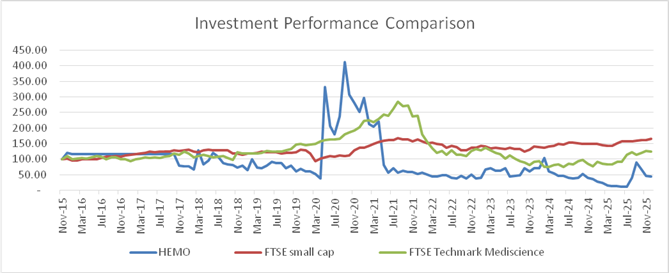
Hemogenyx Pharmaceuticals plc was listed in November 2015 (under the name Silver Falcon plc) and therefore no historical share price data exists prior to this period. There was also no data between December 2015 and October 2017 pending completion of a transaction. It is for these reasons that the historical investment performance is not reflective of the current Group.
Consideration of shareholder views
The Board considers shareholder feedback received and guidance from shareholder bodies. This feedback, plus any additional feedback received from time to time, is considered as part of the Company's annual policy on remuneration.
Approved on behalf of the Board of Directors
Peter Redmond
Director & Remuneration Committee Chairman
30 April 2026
Independent Auditor's Report to the Members of Hemogenyx Pharmaceuticals Plc
Opinion
We have audited the financial statements of Hemogenyx Pharmaceuticals Plc (the 'parent company') and its subsidiaries (the 'group') for the year ended 31 December 2025 which comprise the Consolidated Statement of Comprehensive Income, the Consolidated and Company Statements of Financial Position, the Consolidated and Company Statements of Changes in Equity, the Consolidated and Company Statements of Cash Flows and notes to the financial statements, including significant accounting policies. The financial reporting framework that has been applied in their preparation is applicable law and UK-adopted international accounting standards and as regards the parent company financial statements, as applied in accordance with the provisions of the Companies Act 2006.
In our opinion:
· the financial statements give a true and fair view of the state of the group's and of the parent company's affairs as at 31 December 2025 and of the group's loss for the year then ended;
· the group financial statements have been properly prepared in accordance with UK-adopted international accounting standards;
· the parent company financial statements have been properly prepared in accordance with UK-adopted international accounting standards and as applied in accordance with the provisions of the Companies Act 2006; and
· the financial statements have been prepared in accordance with the requirements of the Companies Act 2006.
Basis for opinion
We conducted our audit in accordance with International Standards on Auditing (UK) (ISAs (UK)) and applicable law. Our responsibilities under those standards are further described in the Auditor's responsibilities for the audit of the financial statements section of our report. We are independent of the group and parent company in accordance with the ethical requirements that are relevant to our audit of the financial statements in the UK, including the FRC's Ethical Standard as applied to listed public interest entities, and we have fulfilled our other ethical responsibilities in accordance with these requirements. We believe that the audit evidence we have obtained is sufficient and appropriate to provide a basis for our opinion.
Conclusions relating to going concern
In auditing the financial statements, we have concluded that the directors' use of the going concern basis of accounting in the preparation of the financial statements is appropriate. Our evaluation of the directors' assessment of the group's and parent company's ability to continue to adopt the going concern basis of accounting included:
· Reviewing management's assessment of going concern for a period of 18 months and assessed the reasonableness of key assumptions and inputs used by management;
· Evaluating and corroborating the key assumptions and inputs underlying the budgets and cash flow forecasts, including sensitivity analysis against the base case scenario;
· Discussing with management how they intend to fund the clinical trials and other clinical programs, including an assessment of the funding options currently under negotiation;
· Comparing management's forecasts to actual results through the subsequent events period and performed inquiries to the date of this report;
· Obtaining corroborative evidence of the fund raise announced on April 28 2026 to ensure it is committed and irrevocable; and
· Assessing the disclosures made regarding going concern in the financial statements for consistency with management's assessment.
Based on the work we have performed, we have not identified any material uncertainties relating to events or conditions that, individually or collectively, may cast significant doubt on the group's or parent company's ability to continue as a going concern for a period of at least twelve months from when the financial statements are authorised for issue.
In relation to the entities reporting on how they have applied the UK Corporate Governance Code, we have nothing material to add or draw attention to in relation to the directors' statement in the financial statements about whether the director's considered it appropriate to adopt the going concern basis of accounting.
Our responsibilities and the responsibilities of the directors with respect to going concern are described in the relevant sections of this report.
Our application of materiality
For the purposes of determining whether the financial statements are free from material misstatement, we define materiality as the magnitude or nature of misstatement that makes it probable that the economic decisions of a reasonably knowledgeable person, relying on the financial statements, would be changed, or influenced. We also determine a level of performance materiality which we use to assess the extent of testing needed to reduce to an appropriately low level the probability that the aggregate of uncorrected and undetected misstatements exceeds materiality for the financial statements as a whole.
Materiality for the group financial statements as a whole was set at £150,000 (2024: £115,000). This was calculated based on 2% of total expenses, which is unchanged from the prior year. Using our professional judgement, we have determined this to be the principal benchmark within the financial statements as it will be most relevant to stakeholders in assessing the financial performance of the group during its years of development as the group is not currently revenue generating.
Materiality for the parent company financial statements as a whole was set at £16,000 (2024: £22,000) based on 2% of total expenses, which is unchanged from the prior year. We have determined this level of materiality for the parent company to gain sufficient coverage of expenses.
Performance materiality for the group financial statements was set at £100,000 (2024: £80,000) and the parent company was set at £11,000 (2024: £15,000), being 70% of materiality for the financial statements as a whole. A benchmark of 70% was applied in determining performance materiality, which is unchanged from the prior year, in accordance with ISA (UK) 320, to address aggregation risk by reducing the risk that the aggregate of uncorrected and undetected misstatements exceeds overall group materiality to an appropriately low level.
We agreed to report to those charged with governance all corrected and uncorrected misstatements we identified through our audit with a value in excess of £7,500 (2024: £5,000) for the group financial statements and £800 (2024: £1,000) for the parent company financial statements. We also agreed to report any other audit misstatements below those thresholds that we believe warranted reporting on qualitative grounds.
Our approach to the audit
The scope of our audit was influenced by our application of materiality. The quantitative and qualitative thresholds for materiality determine the scope of our audit and the nature, timing, and extent of our audit procedures.
The group includes the listed parent company and its US-based subsidiaries. We assessed the structure of the group, its accounting processes and controls, and the industry in which it operates in order to determine the scope of our audit work and ensure that we obtained sufficient and appropriate audit evidence on which to base our group audit opinion. The parent company and its subsidiary, Hemogenyx Pharmaceuticals LLC, were audited directly by the group audit team. No component auditors were used. Audit procedures were designed and performed by the group auditor to respond to the assessed risks of material misstatement at both group and component level.
As part of our planning, we assessed the risk of material misstatement including those that required significant auditor consideration at the component and group level. Procedures were then performed to address the risk identified and for the most significant assessed risks of material misstatement. The procedures performed are outlined below in the Key audit matters section of this report.
Key audit matters
Key audit matters are those matters that, in our professional judgment, were of most significance in our audit of the financial statements of the current period and include the most significant assessed risks of material misstatement (whether or not due to fraud) we identified, including those which had the greatest effect on: the overall audit strategy, the allocation of resources in the audit; and directing the efforts of the engagement team. These matters were addressed in the context of our audit of the financial statements as a whole, and in forming our opinion thereon, and we do not provide a separate opinion on these matters.
|
Key Audit Matter |
How our scope addressed this matter |
|
Carrying value of investments in, and loans to, subsidiary undertakings (Parent company only - Note 2, Note 13 and Note 14) |
|
|
Investments held by the parent company in subsidiaries, as at 31 December 2025, totalled £8,000,000 in the Company Statement of Financial Position. Loans to those subsidiaries, as at 31 December 2025, are reported at £24,138,025. These are significant balances due to the parent company. If the subsidiary undertakings are unable to generate sufficient future profits in the foreseeable future, there is a risk that both the investment and loans held in those entities are overstated. This matter was considered to be one of the most significant risks in the audit, having regard to the size of the balances involved.
Given the aforementioned, the carrying value of investments in and loans to subsidiary undertakings was deemed to be a key audit matter. |
As part of our audit, we have performed the following procedures: · Reviewed and challenged the directors' assessment of the carrying value of investments and loans to subsidiary undertakings, and their conclusions thereon; · Reviewed and assessed the subsidiary undertakings' financial performance and development progress to corroborate the directors' evaluation of recoverability; · Reviewed and assessed the current state of development, and scientific and commercial progress of the products under development; · Agreed ownership documents of all the subsidiaries in the group; and · Reviewed the market capitalisation of the group to provide further assurance of the carrying value of the investments and loans to subsidiary undertakings subsequent to the year end.
Key observation Through the performance of the above testing, we conclude that management's assessment of the carrying value of investments in, and loans to, subsidiary undertakings is reasonable. |
Other information
The other information comprises the information included in the Annual report, other than the financial statements and our auditor's report thereon. The directors are responsible for the other information contained within the annual report. Our opinion on the group and parent company financial statements does not cover the other information and, except to the extent otherwise explicitly stated in our report, we do not express any form of assurance conclusion thereon. Our responsibility is to read the other information and, in doing so, consider whether the other information is materially inconsistent with the financial statements or our knowledge obtained in the course of the audit, or otherwise appears to be materially misstated. If we identify such material inconsistencies or apparent material misstatements, we are required to determine whether this gives rise to a material misstatement in the financial statements themselves. If, based on the work we have performed, we conclude that there is a material misstatement of this other information, we are required to report that fact.
We have nothing to report in this regard.
Opinions on other matters prescribed by the Companies Act 2006
In our opinion the part of the directors' remuneration report to be audited has been properly prepared in accordance with the Companies Act 2006.
In our opinion, based on the work undertaken in the course of the audit:
· the information given in the strategic report and the directors' report for the financial year for which the financial statements are prepared is consistent with the financial statements; and
· the strategic report and the directors' report have been prepared in accordance with applicable legal requirements.
Matters on which we are required to report by exception
In the light of the knowledge and understanding of the group and the parent company and their environment obtained in the course of the audit, we have not identified material misstatements in the strategic report or the directors' report.
We have nothing to report in respect of the following matters in relation to which the Companies Act 2006 requires us to report to you if, in our opinion:
· adequate accounting records have not been kept by the parent company, or returns adequate for our audit have not been received from branches not visited by us; or
· the parent company financial statements and the part of the directors' remuneration report to be audited are not in agreement with the accounting records and returns[1]; or
certain disclosures of directors' remuneration specified by law are not made; or
· we have not received all the information and explanations we require for our audit.
Corporate governance statement
We have reviewed the directors' statement in relation to going concern, longer-term viability and that part of the Corporate Governance Statement relating to the group's and parent company's compliance with the provisions of the UK Corporate Governance Code specified for our review by the Listing Rules.
Based on the work undertaken as part of our audit, we have concluded that each of the following elements of the Corporate Governance Statement is materially consistent with the financial statements or our knowledge obtained during the audit:
· Directors' statement with regards the appropriateness of adopting the going concern basis of accounting and any material uncertainties identified set out on page 26;
· Directors' explanation as to their assessment of the group's prospects, the period this assessment covers and why the period is appropriate set out on page 31;
· Directors' statement on whether they have a reasonable expectation that the group will be able to continue in operation and meet its liabilities set out on page 31;
· Directors' statement that they consider the annual report and the financial statements, taken as a whole, to be fair, balanced and understandable set out on page 23;
· Board's confirmation that it has carried out a robust assessment of the emerging and principal risks set out on page 16;
· The section of the annual report that describes the review of effectiveness of risk management and internal control systems set out on page 29; and
· The section describing the work of the audit committee set out on page 26.
Responsibilities of directors
As explained more fully in the statement of directors' responsibilities, the directors are responsible for the preparation of the group and parent company financial statements and for being satisfied that they give a true and fair view, and for such internal control as the directors determine is necessary to enable the preparation of financial statements that are free from material misstatement, whether due to fraud or error.
In preparing the group and parent company financial statements, the directors are responsible for assessing the group's and the parent company's ability to continue as a going concern, disclosing, as applicable, matters related to going concern and using the going concern basis of accounting unless the directors either intend to liquidate the group or the parent company or to cease operations, or have no realistic alternative but to do so.
Auditor's responsibilities for the audit of the financial statements
Our objectives are to obtain reasonable assurance about whether the financial statements as a whole are free from material misstatement, whether due to fraud or error, and to issue an auditor's report that includes our opinion. Reasonable assurance is a high level of assurance but is not a guarantee that an audit conducted in accordance with ISAs (UK) will always detect a material misstatement when it exists. Misstatements can arise from fraud or error and are considered material if, individually or in the aggregate, they could reasonably be expected to influence the economic decisions of users taken on the basis of these financial statements.
Irregularities, including fraud, are instances of non-compliance with laws and regulations. We design procedures in line with our responsibilities, outlined above, to detect material misstatements in respect of irregularities, including fraud. The extent to which our procedures are capable of detecting irregularities, including fraud is detailed below:
· We obtained an understanding of the group and parent company and the sector in which they operate to identify laws and regulations that could reasonably be expected to have a direct effect on the financial statements. We obtained our understanding in this regard through discussions with management, and application of our cumulative audit knowledge and experience of the sector.
· We determined the principal laws and regulations relevant to the group and parent company in this regard to be those arising from the Companies Act 2006, Listing Rules, the Disclosure Guidance and Transparency Rules, the UK Corporate Governance Code and US Food and Drug Administration.
· We designed our audit procedures to ensure the audit team considered whether there were any indications of non-compliance by the group and parent company with those laws and regulations. These procedures included, but were not limited to:
o Making inquiries of management;
o Reviewing legal and professional fees;
o Reviewing board and audit committee minutes; and
o Reviewing regulated news service publications.
· We also identified the potential risks of material misstatement of the financial statements due to fraud. We considered, in addition to the non-rebuttable presumption of a risk of fraud arising from management override of controls, that a potential for management bias exists in relation to the carrying value of investments in, and loans to, subsidiary undertakings - parent company. See key audit matters section above.
· As in all our audits, we addressed the risk of fraud arising from management override of controls by performing audit procedures which included, but were not limited to: the testing of journals; reviewing accounting estimates for evidence of bias; and evaluating the business rationale of any significant transactions that are unusual or outside the normal course of business.
· Compliance with laws and regulations at the subsidiary level was evaluated through inquiry of management and review of correspondence for any instances of non-compliance.
Because of the inherent limitations of an audit, there is a risk that we will not detect all irregularities, including those leading to a material misstatement in the financial statements or non-compliance with regulation. This risk increases the more that compliance with a law or regulation is removed from the events and transactions reflected in the financial statements, as we will be less likely to become aware of instances of non-compliance. The risk is also greater regarding irregularities occurring due to fraud rather than error, as fraud involves intentional concealment, forgery, collusion, omission or misrepresentation.
A further description of our responsibilities for the audit of the financial statements is located on the Financial Reporting Council's website at: www.frc.org.uk/auditorsresponsibilities. This description forms part of our auditor's report.
Other matters which we are required to address
We were appointed by the audit committee on 2 September 2015 to audit the financial statements for the period ending 31 December 2015 and subsequent financial periods. Our total uninterrupted period of engagement is 11 years, covering the periods ending 31 December 2015 to 31 December 2025.
The non-audit services prohibited by the FRC's Ethical Standard were not provided to the group or the parent company and we remain independent of the group and the parent company in conducting our audit.
Our audit opinion is consistent with the additional report to the audit committee.
Use of our report
This report is made solely to the company's members, as a body, in accordance with Chapter 3 of Part 16 of the Companies Act 2006. Our audit work has been undertaken so that we might state to the company's members those matters we are required to state to them in an auditor's report and for no other purpose. To the fullest extent permitted by law, we do not accept or assume responsibility to anyone, other than the company and the company's members as a body, for our audit work, for this report, or for the opinions we have formed.
Timothy Harris (Senior Statutory Auditor) 30 Churchill Place
For and on behalf of PKF Littlejohn LLP London
Statutory Auditor E14 5RE
Date: 30 April 2026
Consolidated Statement of Comprehensive Income
For the Year Ended 31 December 2025
|
Group - Continuing Operations |
Note |
Year Ended 31 December 2025 |
Year Ended 31 December 2024 |
|
|
|
£ |
£ |
|
Revenue |
|
- |
- |
|
|
|
|
|
|
Administrative and Research and Development Expenses |
5 |
(6,391,505) |
(4,737,802) |
|
Depreciation Expense |
10,11 |
(588,753) |
(639,285) |
|
Operating Loss |
|
(6,980,258) |
(5,377,087) |
|
|
|
|
|
|
Fair value loss on derivative financial instruments |
23 |
(2,293,128) |
- |
|
Sublease Income |
|
7,118 |
- |
|
Gain on disposal of property and equipment |
|
17,555 |
- |
|
Loss on closure of dormant subsidiary |
|
(22,156) |
- |
|
Impairment loss on intangible assets |
|
(267,969) |
|
|
|
|
|
|
|
Loss before Finance Items |
|
(9,538,838) |
(5,377,087) |
|
|
|
|
|
|
Finance income |
|
1,131 |
23,164 |
|
Finance costs |
|
(229,546) |
(271,555) |
|
|
|
|
|
|
Loss before Taxation |
|
(9,767,253) |
(5,625,478) |
|
|
|
|
|
|
Income tax |
8 |
- |
- |
|
|
|
|
|
|
Loss for the year |
|
(9,767,253) |
(5,625,478) |
|
|
|
|
|
|
Loss attributable to: |
|
|
|
|
Owners of Hemogenyx Pharmaceuticals plc |
|
(9,760,364) |
(5,619,181) |
|
Non-controlling interests |
|
(6,889) |
(6,297) |
|
|
|
(9,767,253) |
(5,625,478) |
|
|
|
|
|
|
Items that may be reclassified subsequently to profit or loss: |
|
|
|
|
Translation of foreign operations |
|
2,181,510 |
(358,396) |
|
- Other comprehensive income for the year |
|
2,181,510 |
(358,396) |
|
- |
|
|
|
|
Total comprehensive loss for the year |
|
(7,585,743) |
(5,983,937) |
|
|
|
|
|
|
Attributable to: |
|
|
|
|
Owners of Hemogenyx Pharmaceuticals plc |
|
(7,578,854) |
(5,977,640) |
|
Non-controlling interests |
|
(6,889) |
(6,297) |
|
Total comprehensive loss for the year |
|
(7,585,743) |
(5,983,937) |
|
|
|
|
|
|
Basic and diluted earnings loss per share attributable to the equity owners of the Company |
9 |
(1.706) |
(1.811) |
|
|
|
|
|
The Notes to the Financial Statements form an integral part of these Financial Statements.
Consolidated Statement of Financial Position
|
Group |
Note |
31 December 2025 |
31 December 2024 |
|
|
|
|
|
|
Assets |
|
£ |
£ |
|
Non-current assets |
|
|
|
|
Property, plant and equipment |
10 |
386,957 |
759,408 |
|
Right of use asset |
11 |
1,415,682 |
1,967,813 |
|
Security deposit |
|
156,773 |
167,888 |
|
Intangible asset |
12 |
182,025 |
477,403 |
|
Total non-current assets |
|
2,141,437 |
3,372,512 |
|
|
|
|
|
|
Current assets |
|
|
|
|
Trade and other receivables |
15 |
448,089 |
679,783 |
|
Cash and cash equivalents |
|
1,586,430 |
159,265 |
|
Total current assets |
|
2,034,519 |
839,048 |
|
|
|
|
|
|
Total assets |
|
4,175,956 |
4,211,560 |
|
|
|
|
|
|
Equity and Liabilities |
|
|
|
|
Equity attributable to shareholders |
|
|
|
|
Paid-in Capital |
|
|
|
|
Called up share capital |
16 |
60,412 |
35,045 |
|
Share premium |
16 |
29,239,910 |
21,388,546 |
|
Deferred share capital |
16 |
13,983,115 |
13,983,115 |
|
Other reserves |
18 |
1,074,980 |
1,508,572 |
|
Reverse asset acquisition reserve |
|
(6,157,894) |
(6,157,894) |
|
Foreign currency translation reserve |
|
1,745,555 |
(435,955) |
|
Retained Earnings |
|
(38,750,687) |
(29,423,915) |
|
Equity attributable to owners of the Company |
|
1,195,391 |
897,514 |
|
Non-controlling interests |
|
(50,909) |
(44,020) |
|
Total equity |
|
1,144,482 |
853,494 |
|
|
|
|
|
|
Liabilities |
|
|
|
|
Non-current liabilities |
|
|
|
|
Lease liabilities |
11 |
1,561,830 |
2,199,413 |
|
Total non-current liabilities |
|
1,561,830 |
2,199,413 |
|
|
|
|
|
|
Current liabilities |
|
|
|
|
Trade and other payables |
20 |
1,027,228 |
734,980 |
|
Lease liabilities |
11 |
442,416 |
423,673 |
|
Total current liabilities |
|
1,469,644 |
1,158,653 |
|
|
|
|
|
|
Total liabilities |
|
3,031,474 |
3,358,066 |
|
|
|
|
|
|
Total equity and liabilities |
|
4,175,956 |
4,211,560 |
This report was approved by the Board and authorised for issue on 30 April 2026 and signed on its behalf by:______________________
Dr Vladislav Sandler
CEO
The Notes to the Financial Statements form an integral part of these Financial Statements.
Company Statement of Financial Position
|
Company |
Note |
31 December 2025 |
31 December 2024 |
|
|
|
|
|
|
|
|
£ |
£ |
|
Assets |
|
|
|
|
Non-current assets |
|
|
|
|
Loan to subsidiaries |
14 |
24,137,529 |
21,862,118 |
|
Investment in subsidiary |
13 |
8,061,200 |
8,000,000 |
|
Total non-current assets |
|
32,198,729 |
29,862,118 |
|
|
|
|
|
|
Current assets |
|
|
|
|
Trade and other receivables |
15 |
16,300 |
19,463 |
|
Cash and cash equivalents |
|
280,421 |
52,262 |
|
Total current assets |
|
296,721 |
71,725 |
|
|
|
|
|
|
Total assets |
|
32,495,450 |
29,933,843 |
|
|
|
|
|
|
Equity and Liabilities |
|
|
|
|
Equity attributable to shareholders |
|
|
|
|
Paid-in Capital |
|
|
|
|
Called up share capital |
16 |
60,412 |
35,045 |
|
Share premium |
16 |
29,239,910 |
21,388,546 |
|
Deferred share capital |
16 |
13,983,115 |
13,983,115 |
|
Other reserves |
18 |
1,073,876 |
1,507,468 |
|
Retained Earnings |
|
(12,276,496) |
(7,359,622) |
|
Total Equity |
|
32,080,817 |
29,554,552 |
|
|
|
|
|
|
Liabilities |
|
|
|
|
Current liabilities |
|
|
|
|
Trade and other payables |
20 |
414,633 |
379,291 |
|
Total current liabilities |
|
414,633 |
379,291 |
|
|
|
|
|
|
Total liabilities |
|
414,633 |
379,291 |
|
|
|
|
|
|
Total equity and liabilities |
|
32,495,450 |
29,933,843 |
Hemogenyx Pharmaceuticals Plc has used the exemption granted under s408 of the Companies Act 2006 that allows for the non-disclosure of the Statement of Comprehensive Income of the parent company. The after-tax loss attributable to Hemogenyx Pharmaceuticals plc for the year ended 31 December 2025 was £5,350,466 (2024: loss of £638,537).
This report was approved by the Board and authorised for issue on 30 April 2026 and signed on its behalf by
Dr Vladislav Sandler
CEO
The Notes to the Financial Statements form an integral part of these Financial Statements.
Consolidated Statement of Changes in Equity
|
|
Group |
|
|
|
|
|
|
|||
|
|
|
|
|
|
|
|
|
|
|
|
|
|
Called up Share Capital |
Deferred Share capital |
Share Premium |
Other reserves |
Reverse acquisition reserve |
Foreign currency translation reserve |
Retained earnings |
Non- Controlling interests |
Total Equity |
|
|
|
£ |
|
£ |
£ |
£ |
£ |
£ |
£ |
£ |
|
|
As at 1 January 2024 |
11,755,660 |
- |
19,938,556 |
1,164,637 |
(6,157,894) |
(77,496) |
(23,804,734) |
(37,723) |
2,781,006 |
|
|
Loss in year |
- |
- |
- |
- |
- |
- |
(5,619,181) |
(6,297) |
(5,625,478) |
|
|
Other Comprehensive Income |
- |
- |
- |
- |
- |
(358,459) |
- |
- |
(358,459) |
|
|
Total comprehensive income for the year |
- |
- |
- |
- |
- |
(358,459) |
- |
- |
(358,459) |
|
|
Issue of shares |
2,262,500 |
- |
1,662,500 |
- |
- |
- |
- |
- |
3,925,000 |
|
|
Cost of capital |
- |
- |
(212,510) |
- |
- |
- |
- |
- |
(212,510) |
|
|
Capital reorganization |
(13,983,115) |
13,983,115 |
|
|
|
|
|
|
- |
|
|
Issue of options |
- |
- |
- |
343,935 |
- |
- |
- |
- |
343,935 |
|
|
As at 31 December 2024 |
35,045 |
13,983,115 |
21,388,546 |
1,508,572 |
(6,157,894) |
(435,955) |
(29,423,915) |
(44,020) |
853,494 |
|
|
Loss in year |
- |
- |
- |
- |
- |
- |
(9,760,364) |
(6,889) |
(9,767,253) |
|
|
Other Comprehensive Income |
- |
- |
- |
- |
- |
2,181,510 |
- |
- |
2,181,510 |
|
|
Total comprehensive income for the year |
- |
- |
- |
- |
- |
2,181,510 |
(9,760,364) |
(6,889) |
(7,585,742) |
|
|
|
|
|
|
|
|
|
|
|
|
|
|
Expiration of options |
- |
- |
- |
(433,592) |
- |
- |
433,592 |
- |
- |
|
|
Issue of shares |
18,247 |
- |
4,083,651 |
- |
- |
- |
- |
- |
4,101,898 |
|
|
Cost of capital |
- |
- |
(218,803) |
- |
- |
- |
- |
- |
(218,803) |
|
|
Exercise of derivative warrants |
5,000 |
- |
3,083,630 |
- |
- |
- |
- |
- |
3,088,630 |
|
|
Conversion of convertible loan notes |
2,120 |
- |
902,885 |
- |
- |
- |
- |
- |
905,005 |
|
|
As at 31 December 2025 |
60,412 |
13,983,115 |
29,239,910 |
1,074,980 |
(6,157,894) |
1,745,555 |
(38,750,687) |
(50,909) |
1,144,482 |
|
|
|
|
|
|
|
|
|
|
|
|
|
The notes to the financial statements form an integral part of these financial statements.
Company Statement of Changes in Equity
Company
|
|
Called up Share Capital |
Deferred share capital |
Share Premium |
Other reserves |
Retained earnings |
Total Equity |
|
|
|
£ |
|
£ |
£ |
£ |
£ |
|
|
As at 31 December 2023 |
11,755,660 |
- |
19,938,556 |
1,163,533 |
(6,721,085) |
26,136,664 |
|
|
Loss in year |
- |
- |
- |
- |
(638,537) |
(638,537) |
|
|
Other Comprehensive Income |
- |
- |
- |
- |
- |
- |
|
|
Total comprehensive income for the year |
- |
- |
- |
- |
(638,537) |
(638,537) |
|
|
Issue of shares |
2,262,500 |
- |
1,662,500 |
- |
- |
3,925,000 |
|
|
Cost of capital |
- |
- |
(212,510) |
- |
- |
(212,510) |
|
|
Capital reorganization |
(13,983,115) |
13,983,115 |
|
|
|
- |
|
|
Issue of options |
- |
- |
- |
343,935 |
- |
343,935 |
|
|
|
|
|
|
|
|
|
|
|
As at 31 December 2024 |
35,045 |
13,983,115 |
21,388,546 |
1,507,468 |
(7,359,622) |
29,554,552 |
|
|
Loss in year |
- |
- |
- |
- |
(5,350,466) |
(5,350,466) |
|
|
Other Comprehensive Income |
- |
- |
- |
- |
- |
- |
|
|
Total comprehensive income for the year |
- |
- |
- |
- |
(5,350,466) |
(5,350,466) |
|
|
Expiration of options |
- |
- |
- |
(433,592) |
433,592 |
- |
|
|
Issue of shares |
18,247 |
- |
4,083,651 |
- |
- |
4,101,898 |
|
|
Cost of capital |
- |
- |
(218,803) |
- |
- |
(218,803) |
|
|
Exercise of derivative warrants |
5,000 |
- |
3,083,630 |
- |
- |
3,088,630 |
|
|
Conversion of convertible loan notes |
2,120 |
- |
902,885 |
- |
- |
905,005 |
|
|
As at 31 December 2025 |
60,412 |
13,983,115 |
29,239,910 |
1,073,876 |
(12,276,496) |
32,080,817 |
|
|
|
|
|
|
|
|
|
|
|
|
|
|
|
|
|
|
|
The notes to the financial statements form an integral part of these financial statements.
Consolidated Statement of Cash Flows
|
Group |
Note |
Year Ended |
Year Ended |
|
|
|
|
|
|
|
|
£ |
£ |
|
Cash flows generated from operating activities |
|
|
|
|
Loss before income tax |
|
(9,767,253) |
(5,625,478) |
|
Depreciation and amortisation |
10, 11 |
588,753 |
639,285 |
|
Interest income |
|
(1,131) |
(23,164) |
|
Interest expense |
|
229,546 |
271,555 |
|
Fair value loss on derivative financial instruments |
|
2,293,128 |
- |
|
Loss on closure of dormant subsidiary |
|
22,156 |
|
|
Gain on disposal of property and equipment |
|
(17,555) |
- |
|
Share based payments |
18 |
63,152 |
343,935 |
|
Impairment loss on intangible assets |
|
267,969 |
- |
|
Changes in right of use asset and lease liability, net |
|
208,415 |
277,284 |
|
Foreign exchange loss |
|
1,915,645 |
(626,240) |
|
|
|
|
|
|
Operating cash flows before working capital movements |
|
(4,197,175) |
(4,742,823) |
|
|
|
|
|
|
Increase in trade and other payables |
|
429,486 |
346,521 |
|
Increase in trade and other receivables |
|
(5,457) |
(2,637) |
|
Decrease in prepaid and deposits |
|
325,154 |
258,880 |
|
|
|
|
|
|
Net cash outflow used in operating activities |
|
(3,447,992) |
(4,140,059) |
|
|
|
|
|
|
Cash flows generated from financing activities |
|
|
|
|
Proceeds from issuance equity securities, net of issue costs |
|
5,522,403 |
3,712,490 |
|
Payment of lease liabilities |
|
(632,575) |
(635,037) |
|
|
|
|
|
|
Net cash flow generated from financing activities |
|
4,889,828 |
3,077,453 |
|
|
|
|
|
|
Cash flows used in investing activities |
|
|
|
|
Interest income |
|
1,131 |
23,164 |
|
Payment of security deposit for lease |
|
(4,007) |
(11,611) |
|
Purchase of property & equipment |
|
(3,921) |
(13,285) |
|
|
|
|
|
|
Net cash flow used in investing activities |
|
(6,797) |
(1,732) |
|
|
|
|
|
|
Net increase (decrease) in cash and cash equivalents |
|
1,435,039 |
(1,064,338) |
|
|
|
|
|
|
Effect of exchange rates on cash |
|
(7,874) |
(23,998) |
|
|
|
|
|
|
Cash and cash equivalents at the beginning of the year |
|
159,265 |
1,247,601 |
|
Cash and cash equivalents at the end of the year |
|
1,586,430 |
159,265 |
The notes to the financial statements form an integral part of these financial statements.
Company Statement of Cash Flows
|
Company |
Note |
Year Ended |
Year Ended |
|
|
|
|
|
|
|
|
£ |
£ |
|
|
|
|
|
|
Cash flows generated from operating activities
|
|
|
|
|
Loss before income tax
|
|
(5,350,466) |
(638,537) |
|
|
|
|
|
|
Foreign exchange gain |
|
- |
(347,134) |
|
Fair value loss on derivative financial instruments |
|
2,293,128 |
- |
|
Share based payments |
18 |
- |
343,935 |
|
|
|
|
|
|
Operating cash flows before working capital movements |
|
(736,823) |
(641,736) |
|
|
|
|
|
|
Increase/(decrease) in trade and other receivables |
|
3,163 |
(4,643) |
|
Increase in trade and other payables |
|
35,342 |
184,042 |
|
|
|
|
|
|
Net cash outflow used in operating activities |
|
(3,018,833) |
(462,337) |
|
|
|
|
|
|
Cash flows generated from financing activities |
|
|
|
|
Proceeds from issuance of equity securities, net of issue costs |
|
5,522,403 |
3,712,490 |
|
|
|
|
|
|
Net cash flow generated from financing activities |
|
5,522,403 |
3,712,490 |
|
|
|
|
|
|
Cash flows (used in) investing activities |
|
|
|
|
Loan (to) from related parties |
|
(2,275,411) |
(3,417,325) |
|
|
|
|
|
|
Net cash flow used in investing activities |
|
(2,275,411) |
(3,417,325) |
|
|
|
|
|
|
4Net (decrease)/increase in cash and cash equivalents |
|
228,159 |
(167,172) |
|
|
|
|
|
|
Effect of exchange rates on cash |
|
- |
198 |
|
|
|
|
|
|
Cash and cash equivalents at the beginning of the year |
|
52,262 |
219,236 |
|
Cash and cash equivalents at the end of the year |
|
280,421 |
52,262 |
The Notes to the Financial Statements form an integral part of these Financial Statements.
Notes to the Financial Statements
1. General information
Hemogenyx Pharmaceuticals Plc (the "Company") is a public limited company and is incorporated and domiciled in the UK. The Company's registered office is located at 6 Heddon Street, London, W1B 4BT, and the Company's shares are listed on the main market of the London Stock Exchange. The consolidated financial statements consolidate those of the Company and its subsidiaries (together the "Group").
The principal activity of the Group is being a clinical-stage biotechnology focused on the discovery, development and commercialisation of innovative treatments relating to the treatment of blood cancers, certain solid cancers, autoimmune diseases, and viral infections. The products under development are designed to address a range of problems that occur with current standard of care treatments.
2. Material accounting policies
The principal accounting policies applied in the preparation of these financial statements are set out below. These policies have been consistently applied to all the years presented, unless otherwise stated.
Basis of preparation
The financial statements have been prepared in accordance with UK-adopted international accounting standards ("IAS" or "IFRS") and with requirements of the Companies Act 2006 and in accordance with Listing Rules. The consolidated and company financial statements have been prepared under the historical cost convention, except for revaluation of certain financial instruments.
The preparation of financial statements in conformity with IAS requires the use of certain critical accounting estimates. It also requires management to exercise its judgement in the process of applying the Group's accounting policies. The areas involved a higher degree of judgement or complexity, or areas where assumptions and estimates are significant to the financial statements are disclosed in note 3.
Basis of consolidation
The consolidated financial statements comprise the financial statements of the Company and entities controlled by the Company and its subsidiaries as at 31 December 2025. Control is achieved when the Group is exposed, or has rights, to variable returns from its involvement with the investee and has the ability to use its power over the investee to affect those returns.
Generally, there is a presumption that a majority of voting rights results in control. To support this presumption and when the Group has less than a majority of the voting or similar rights of an investee, the Group considers all relevant facts and circumstances in assessing whether it has power over an investee, including:
· The contractual arrangement with the other vote holders of the investee;
· Rights arising from other contractual arrangements; and
· The Group's voting rights and potential voting rights.
The Group re-assesses whether or not it controls and investee if facts and circumstances indicate that there are changes to one or more of the three elements of control.
The financial statements of the subsidiaries are prepared for the same reporting period as the Company, using consistent accounting policies. Where necessary, adjustments are made to the financial statements of subsidiaries to bring the accounting policies used in line with those used by other members of the Group.
Subsidiaries are fully consolidated from the date of acquisition, being the date on which the Group obtains control, and continue to be consolidated until the date that such control ceases. Assets, liabilities, income and expenses of a subsidiary acquired or disposed of during the period are included in the consolidated financial statements from the date the Group gains controls until the Group ceases to control the subsidiary.
All intra-group assets and liabilities, equity, income, expenses and cash flows resulting from intra-group transactions are eliminated in full on consolidation.
Non-controlling interest in subsidiaries are identified separately from equity attributable to the owner of the Company. On acquisition of subsidiaries, non-controlling interests are measured at a proportion share of the fair value of the acquiree's identifiable net assets. Profit or loss and each component of other comprehensive income are attributed to the owners of the Company and to non-controlling interests.
Going concern
The preparation of financial statements requires an assessment on the validity of the going concern assumption.
The Company successfully raised £5.2 million (before expenses) through the allotment and issue of new ordinary shares, warrant exercises and the conversion of convertible loan notes during the year ended 31 December 2025, and a further £2.6 million in early 2026 through a placing and the exercise of warrants. These proceeds were raised in order to facilitate the progression of the Company's HG-CT-1 product candidate into clinical trials and to enable the Company to continue development of product candidates for the treatment of viral infections and cancers based on its CBR platform.
Funding will be required for the Company to complete Phase I clinical development and to continue executing its research and development strategy. This includes plans to dose a target number of patients as part of the clinical programme. Should cash resources become constrained, the Company has the ability to scale back these plans, however this would delay progress and is therefore not considered desirable.
The Company cannot be certain that such additional funding will be available on acceptable terms, or at all. To the extent that the Company raises additional funds by issuing equity securities, the Company's stockholders may experience dilution. Any debt financing, if available, may involve restrictive covenants. If the Company is unable to raise additional capital when required or on acceptable terms, it may have to (i) significantly delay, scale back or discontinue the development and/or commercialisation of one or more product candidates; (ii) seek collaborators for product candidates at an earlier stage than otherwise would be desirable and on terms that are less favourable than might otherwise be available; or (iii) relinquish or otherwise dispose of rights to technologies, product candidates or products that it would otherwise seek to develop or commercialise on unfavourable terms.
The Directors are of the opinion that the Company has adequate working capital to execute its operations for the present time and is confident in its ability to access additional financing over the next 12 months. The Directors, therefore, have made an informed judgement, at the time of approving these financial statements, that there is a reasonable expectation that the Company has adequate resources to continue in operational existence for the foreseeable future, however this relies upon the Company raising additional capital. The Directors have continued to adopt the going concern basis of accounting in preparing the annual financial statements.
Intangible assets
Research and development
Expenditure on research activities, undertaken with the prospect of gaining new scientific or technical knowledge and understanding, is recognised as an expense in the statement of comprehensive income as incurred. The Group's current projects are in the research phase and have not yet met the criteria for capitalisation as development assets.
Development activities involve a plan or design for the production of new or substantially improved products and processes. Development expenditure is capitalised when all the following conditions are satisfied:
· Completion of the intangible asset is technically feasible so that it will be available for use or sale;
· The Group intends to complete the intangible asset and use or sell it;
· The Group has the ability to use of sell the intangible asset;
· The intangible asset will generate probable future economic benefits. Amongst other things, this requires that there is a market for the output from the intangible asset or for the intangible asset itself, or, if it is to be used internally, the asset will be used in generating such benefits;
· There is adequate technical, financial and other resources to complete the development and to use or sell the intangible asset, and
· The expenditure attributable to the intangible asset during its development can be measured reliably.
Capitalised development costs are measured at cost less accumulated amortisation and accumulated impairment losses. The Group applies the cost model to all intangible assets.
The Group assesses the useful life of all capitalised development assets as finite. Amortisation begins when the asset is available for use, that is, when it is in the location and condition necessary for it to be capable of operating in the manner intended by management. Amortisation is calculated on a straight-line method to allocate the costs of development over the estimated useful economic lives. The estimated useful economic life is determined by reference to the remaining patent life and may be adjusted after taking into consideration product and market characteristics such as fundamental building blocks and product life cycle specific to the category of expenditure.
Useful lives, residual values and amortisation methods are reviewed at least at the end of each financial year.
Clinical trial expenses
Clinical trial-related expenses form part of the Group's research and development costs. These expenses include fees paid to contract research organisations, clinical sites, and other organisations who conduct development activities on behalf of the Group. Clinical trial expenses are recognised in the period in which the related services are performed, based on an accrual basis using estimates of work completed. These estimates incorporate factors such as patient enrolment, services provided, contractual terms, and prior experience with similar contracts.
Intellectual property (IP)
IP assets comprise patents, know-how, copyright and licences. IP acquired separately are recognised at cost. IP assets acquired in a business combination is recognised at fair value at the acquisition date.
Internally generated IP costs are recognised as an expense in the period in which they are incurred, except to the extent they satisfy the development capitalisation criteria set out above, in which case they are capitalised.
The Group assesses the useful life of all capitalised IP assets as finite. Amortisation begins when the asset is available for use. For IP assets that relate to products or processes requiring regulatory approval, the Group considers the assets to be available for use only once the necessary trials have been successfully completed and the product has obtained the required regulatory accreditations and clearances. Amortisation is charged on a straight-line basis over the estimated useful economic lives of the assets. Useful lives, residual values and amortisation methods are reviewed at least at the end of each financial year. The estimated useful life economic life is determined by reference to the life of the patent or licence.
Useful lives, residual values and amortisation methods are reviewed at lease at the end of each financial year.
Impairment
Intangible assets are tested for impairment whenever events or changes in circumstances indicate that the carrying amount may not be recoverable. In addition, intangible assets that are not yet available for use (and intangibles with an indefinite useful life) are tested for impairment annually by comparing their carrying amount with their recoverable amount, irrespective of whether any impairment indicators exist. Any impairment loss is recognised immediately in the statement of comprehensive income.
Property, plant and equipment
Property, plant and equipment are stated at cost, net of accumulated depreciation and impairment losses, if any. Depreciation is provided at the following rates calculated to write off the cost less estimated residual value of each asset over its expected useful economic life.
|
Computer equipment |
33% |
Straight-line |
|
Leasehold improvements |
12.5% |
Straight-line |
|
Property, plant and equipment |
20% - 50% |
Straight-line |
An item of property, plant and equipment is derecognised upon disposal or when no future economic benefits are expected from the use or disposal. Any gain or loss arising on de-recognition of the asset (calculated the difference between the net disposal proceeds and the carrying amount of the asset) is included in the statement of comprehensive income when the asset is derecognised.
The residual values, useful economic lives and methods of depreciation are reviewed at each financial year and adjust prospectively, if appropriate.
Impairment of non-financial assets
The Group assesses at the end of each reporting period whether there is any indication that a non-financial asset (or cash-generating unit ("CGU") may be impaired. If any such indication exists, the Group estimates the recoverable amount of the asset or CGU.
Irrespective of whether there is any indication of impairment, the Group tests intangible assets with an indefinite useful life and intangible assets that are not yet available for use for impairment at least annually by comparing their carrying amount with their recoverable amount.
An impairment loss is recognised in the statement of comprehensive income for the amount by which the carrying amount of an asset or CGU exceeds its recoverable amount. The recoverable amount is the higher of its fair value less costs of disposal and its value in use. Value in use is calculated as the present value of the future cash flows expected to be derived from the asset or CGU, using a pre-tax discount rate that reflects current market assessments of the time value of money and the risks specific to the asset or CGU for which the future cash flow estimate have not been adjusted. Where an individual asset does not generate cash flows that are largely independent of those from other assets (or groups of assets), the recoverable amount is determined for the CGU to which the asset belongs.
In the event that an intangible asset will no longer be used, for example, when a patent is abandoned or a development project is terminated, the carrying amount of the asset is written off in full and the loss is immediately recognised in the statement of comprehensive income.
Investment in subsidiaries
In the Company financial statements, equity investments in the Company's subsidiaries are held at cost, less any provision for impairment.
Foreign currencies
Functional and presentation currency
Items included in the financial statements of each Group entity are measured using the currency of the primary economic environment in which it operates ("the functional currency").
The consolidated financial statements of the Group are presented in Pound Sterling ("GBP"), which is the Group's presentation currency. The functional currency of the Company is GBP.
Transactions and balances
Foreign currency transactions are translated into the functional currency of the relevant Group entity using the exchange rates prevailing on the dates of the transactions.
Monetary assets and liabilities denominated in foreign currencies are translated into the functional currency at the exchange rate at the reporting date. Non-monetary assets and liabilities measured at historical cost in a foreign currency are translated using the exchange rate at the date of the transaction. Non-monetary assets and liabilities measured at fair value in a foreign currency are translated into the functional currency at the exchange rate when the fair value is determined.
Foreign exchange gains and losses resulting from the settlement of such transactions and from the translation at reporting date exchange rates of monetary assets and liabilities denominated in foreign currencies are recognised in profit or loss.
Foreign operations
The assets and liabilities of foreign operations are translated into GBP at the exchange rate at the reporting date. The income and expenses of foreign operations are translated into GBP at average exchange rates.
Exchange differences arising on the translation of foreign operations are recognised in other comprehensive income and accumulated in the foreign exchange reserve within equity, except to the extent that the translation difference is allocated to non-controlling interests.
On the disposal of a foreign operation (i.e a disposal of the Group's entire interest in a foreign operation, or a disposal that involves loss of control over a subsidiary that includes a foreign operation), all the exchange differences accumulated in the foreign exchange reserve attributable to the owners of the Company are reclassified to profit or loss as part of the gain or loss on disposal.
Equity
An equity instrument is any contract that evidences a residual interest in the assets of a company after deducting all its liabilities. Equity instruments issued are recorded at the proceed received, net of direct issue costs.
Cash and cash equivalents
Cash and cash equivalents consists of cash at bank and in hand and short-term deposits.
Share-based payments
The Group issues equity-settled share-based payments to the directors, senior management and employees ("Employee Share Options"), to corporate finance advisers for assistance in raising private equity, and to its Scientific Advisory Board members ("Non-employee Share Options"). Awards granted under the 2021 Equity Incentive Plan may take the form of share options, restricted shares or restricted stock units.
Equity-settled share-based payment transactions with parties other than employees are measured at the fair value of the goods or services received, except where that fair value cannot be estimated reliably, in which case they are measured at the fair value of the equity instruments granted, measured at the date the entity obtains the goods or the counterparty renders the service.
Equity settled share-based payments to employees and others providing similar services are measured at the fair value of the equity instruments at the grant date.
The grant date fair value of share-based payment awards granted to employees and others providing similar services is recognised in profit or loss, with a corresponding increase in equity, over the period that the employees become unconditionally entitled to the awards. The amount recognised as an expense is adjusted to reflect the number of awards for which the related service and non-market performance conditions are expected to be met, such that the amount ultimately recognised as an expense is based on the number of awards that meet the related service and non-market performance conditions at the vesting date. For share-based payment awards with non-vesting conditions, the grant-date fair value of the share-based payment is measured to reflect such conditions and there is no true-up for differences between expected and actual outcomes. Market vesting conditions are factored into the fair value of the award at the grant date. As long as all other vesting conditions are satisfied, a charge is made irrespective of whether market vesting conditions are satisfied. The cumulative expense is not adjusted for failure to achieve a market vesting condition.
When the terms and conditions of equity-settled share-based payments at the time they were granted are subsequently modified, the fair value of the share-based payment under the original terms and conditions and under the modified terms and conditions are both determined at the date of the modification. Any excess of the modified fair value over the original fair value is recognised over the remaining vesting period in addition to the grant date fair value of the original share-based payment. The share-based payment expense is not adjusted if the modified fair value if less than the original fair value. In the event of forfeitures of share-based payment awards, any charges previously recorded for those awards are reversed.
Cancellations or settlements (including those resulting from employee redundancies) are treated as an acceleration of vesting and the amount that would have been recognised over the remaining vesting period is recognised immediately.
When share-based payments awards are exercised, the Company issues new shares. The proceeds received, net of any directly attributable transaction costs, are credited to share capital and the share premium account. Amounts previously recognised in the share-based payment reserve are transferred within equity to accumulated losses upon exercise or lapse of the awards.
Restricted stock units that entitle the holder to receive ordinary shares upon vesting, with no exercise price and no cash settlement alternative, are measured at the share price on the grant date. As there is no optionality, no option pricing model is required. The grant-date fair value is recognised as an expense over the vesting period, with a corresponding credit to equity.
In 2021, the Group adopted the "Hemogenyx Pharmaceuticals plc 2021 Equity Incentive Plan with Non-Employee Sub-Plan" (the "EIP") for the grant of options, restricted shares, and restricted share units to employees, directors and consultants of the Company and its subsidiaries over ordinary shares in the capital of the Company, which was approved by the Company's shareholders at the 2022 AGM. Awards to employees and others providing similar services are measured at fair value at the grant date, and awards to non-employees are measured at fair value at the date of service.
Leases
At inception of a contract, the Group assess whether a contract is, or contains, a lease. A contract is, or contains, a lease if the contract conveys the right to control the use of an identified asset for a period of time in exchange for consideration.
The Group recognises a right-of-use (ROU) asset and a lease liability at the lease commencement date. The ROU asset is initially measured at cost, which comprises the initial amount of the lease liability adjusted for any lease payments made at or before the commencement date, plus any initial direct costs incurred, less any lease incentives received.
ROU assets are subsequently depreciated using the straight-line method from the commencement date to the earlier of the end of the useful life of the right-of-use asset or the end of the lease term. The lease term is determined at the commencement date and includes the non-cancellable period of the lease, together with periods covered by an option to extend the lease if the Group is reasonably certain to exercise that option, and periods covered by an option to terminate the lease if the Group is reasonably certain not to exercise that option. Break clauses are considered in determining the lease term when the Group has the unilateral right to terminate the lease early, assessing the likelihood of exercising such clauses based on economic incentives and operational requirements. The estimated useful lives of the ROU assets are based on the lease term, unless the Group expects to use the asset beyond the lease term. ROU assets are periodically reduced by impairment losses, if any, and adjusted for certain remeasurements of the lease liability.
The lease liability is initially measured at the present value of the lease payments that are not paid at the commencement date, discounted using the interest rate implicit in the lease or, if that rate cannot be readily determined, the Group's incremental borrowing rate. Lease payments include fixed payments, variable payments based on an index or rate amounts expected to be paid under residual value guarantees, and payments related to purchase or termination options reasonably certain to be exercised, with the lease term determined consistently with the ROU asset, including the non-cancellable period, extension options reasonably certain to be exercised, termination options reasonably certain not to be exercised, and break clauses assessed based on the likelihood of exercise considering economic incentives and operational requirements.
The lease liability is measured at amortised cost using the effective interest method. It is remeasured when there is a change in future lease payments arising from a change in an index or rate, or if the Group changes its assessment of whether it will exercise a purchase, extension or termination option.
When the lease liability is remeasured in this way, a corresponding adjustment is made to the carrying amount of the right-of-use asset, or is recorded in profit and loss if the carrying amount of the right-of-use asset has been reduced to zero.
Taxation
Income tax expense represents the sum of the current tax and deferred tax charge for the year.
Current tax
Current tax is based on the results for the year as adjusted for items that are non-assessable or disallowed. It is calculated using rates that have been enacted, or substantially enacted, by the end of the reporting period. Current income tax assets and liabilities are measured at the amount expected to be recovered from or paid to the relevant taxation authorities.
Deferred tax
Deferred income tax is recognised on all temporary differences arising between the tax bases of assets and liabilities and their carrying amounts in the financial statements, with the following exceptions:
§ where the temporary difference arises from the initial recognition of goodwill or of an asset or liability in a transaction that is not a business combination and, at the time of the transaction, affects neither accounting nor taxable profit or loss;
§ in respect of taxable temporary differences associated with investment in subsidiaries, associates and joint ventures, where the timing of the reversal of the temporary differences can be controlled, and it is probable that the temporary differences will not reverse in the foreseeable future; and
§ deferred income tax assets are recognised only to the extent that it is probable that taxable profit will be available against which the deductible temporary differences, carried forward tax credits or tax losses can be utilised.
Deferred income tax assets and liabilities are measured on an undiscounted basis at the tax rates that are expected to apply when the related asset is realised or liability is settled, based on tax rates and laws enacted or substantively enacted at the statement of financial position date.
The carrying amount of deferred income tax assets is reviewed at each statement of financial position date. Deferred income tax assets and liabilities are offset, only if a legally enforcement right exists to set off current tax assets against current tax liabilities, the deferred income taxes related to the same taxation authority and that authority permits the Company to make a single net payment.
Income tax is charged or credited directly to equity if it relates to items that are credited or charged to equity. Otherwise, income tax is recognised in the statement of comprehensive income.
Financial Instruments
Financial assets
The Group classifies its financial assets into one of the categories discussed below, depending on the purpose for which the asset was acquired.
Amortised cost
Financial assets held at amortised cost comprise trade and other receivables and cash and cash equivalents.
These assets are non-derivative financial assets with fixed or determinable payments that are not quoted in an active market. They arise principally through the provision of goods and services to customers, but also incorporate other types of financial assets where the objective is to hold their assets in order to collect contractual cash flows and the contractual cash flows are solely payments of the principal and interest. They are initially at fair value plus transaction costs that are directly attributable to their acquisition or issue and subsequently carried at amortised cost using the effective interest rate method, less provision for impairment.
Impairment provisions for trade and other receivables are recognised based on the simplified approach within IFRS 9 Financial Instruments using the lifetime expected credit losses ("ECL") method. During this process the probability of the non-payment of the receivables is assessed. This probability is then multiplied by the expected loss arising from default to determine the lifetime ECL for the receivables. For trade and other receivables, which are reported net, such provisions are recorded in a separate provision account with the loss being recognised within administrative expenses in the statement of comprehensive income. On confirmation that the trade or other receivables will not be collectable, the gross carrying value of the asset is written off against the associated provision.
Financial Liabilities
All financial liabilities are recognised when the Group becomes a party to the contractual provision of the instrument. The Group's financial liabilities are classified into two categories: amortised cost and fair value through profit or loss ("FVTPL").
Amortised cost
The Group's financial liabilities measured at amortised cost comprise trade and other payables. These liabilities are initially measured at fair value net of any transaction costs directly attributable to the issue of the instrument and subsequently measured at amortised cost using the effective interest rate method. The effective interest method calculates the amortised cost of a financial liability and allocates interest expense over the relevant period. The effective interest rate is the rate that exactly discounts estimated future cash payments (including all fees and points paid or received that form an integral part of the effective interest rate, transaction costs, and other premiums or discounts) through the expected life of the financial liability to the amortised cost of the financial liability.
FVTPL
The Group's financial liabilities measured at FVTPL comprise derivative financial liabilities. They are initially recognised at fair value and subsequently remeasured at fair value using a valuation model. Net gains and losses, including any interest expense, are recognised in the statement of comprehensive income. These financial liabilities are categorised within Level 3 of the fair value hierarchy.
All instruments for which fair value is recognised or disclosed are categorised within the fair value hierarchy, which consists of the following three levels:
· Level 1: Quoted prices (unadjusted) in active markets for identical assets or liabilities.
· Level 2: Inputs other than quoted prices included within Level 1 that are observable for the asset or liability, either directly or indirectly.
· Level 3: Inputs for the asset or liability that are not based on observable market data (unobservable inputs).
Derivative financial instruments
Derivative financial instruments are initially recognised at fair value on the trade date and subsequently remeasured at fair value at each reporting date, with changes recognised in profit or loss. Derivatives are presented as financial liabilities when their fair value is negative and as financial assets when positive. Further information on the key assumptions used in fair value measurement is set out in Note 3 (Significant accounting judgements, estimates and assumptions)
Warrants issued in connection with equity placings are classified as derivative financial liabilities where the exercise price is subject to reset or anti-dilution adjustments that vary the number of shares to be issued. Such warrants are measured at fair value through profit or loss using a Monte Carlo simulation model. On exercise, the carrying value of the derivative is derecognised and, together with the exercise proceeds, recognised in share capital and share premium.
Convertible loan notes
Convertible loan notes are classified as equity in their entirety where the conversion feature requires settlement in a fixed number of shares for a fixed amount of consideration and the instrument contains no contractual obligation to deliver cash. Such notes are recognised at the proceeds received with no subsequent remeasurement, and on conversion the carrying amount is reclassified within equity between share capital and share premium.
Loans and Borrowings
Interest-bearing loans and borrowings are initially recognised at the fair value of consideration received less directly attributable transaction costs. After initial recognition, borrowings are subsequently measured at amortised cost using the effective interest rate method. Where borrowings are provided by shareholders at an interest rate discounted to market rates, the difference on initial fair value is taken to equity as a capital contribution.
Interest expense is recognised on the basis of the effective interest method and is included in finance costs.
Borrowings are classified as current liabilities unless the Group has an unconditional right to defer settlement of the liability for at least 12 months after the reporting date.
Segmental reporting
Operating segments are reporting in a manner consistent with internal reporting provide to the chief decision-maker ("CODM"). The CODM, who is responsible for allocating resources and assessing performance of the operating segments, has been identified as the Board of Directors that makes strategic decisions.
Segment results, assets and liabilities include items directly attributable to a segment as well as those that can be allocated on a reasonable basis.
Net finance costs
Finance expense
Finance expense comprises of interest payable and lease interest which are expensed in the period in which they are incurred and reported in finance costs.
Finance income
Finance income comprises interest on bank deposits and interest on loans and is recognised in profit and loss when it is earned.
Amendments to IFRS Accounting Standards applicable from 1 January 2025
The Group has adopted the following amendments to IFRS Accounting Standards, with no material impact to the Group in the year ended 31 December 2025:
· IAS 21 (Amendments) - Lack of Exchangeability
· IAS 1 (Amendments) - Classification of Liabilities as Current or Non-current and Non-current Liabilities with Covenants
· IAS 7 and IFRS 7 (Amendments) - Supplier Finance Arrangements
New IFRS Accounting Standards and amendments issued but not yet effective
Certain amendments to IFRS Accounting Standards and interpretations have been published that are not mandatory for the 31 December 2025 reporting period and have not been early adopted by the Group.
The following amendments are effective for the period beginning on or after 1 January 2026:
· IFRS 9 and IFRS 7 (Amendments): Classification and Measurement of Financial Instruments
The following amendments are effective for the period beginning 1 January 2027:
· IAS 21 (Amendments): Translation to a Hyperinflationary Presentation Currency
· IFRS 18: Presentation and Disclosure in Financial Statements
· IFRS 19: Subsidiaries without Public Accountability: Disclosures*
*subject to endorsement by the UKEB.
|
|
|
|
The Group is currently assessing the impact of these standards and amendments but does not expect them to have a material impact on its consolidated financial statements.
3. Significant accounting judgements, estimates and assumptions
The Group makes certain critical accounting estimates and assumptions regarding the future. It also requires management to exercise its judgement in the process of applying the Company's accounting policies.
Estimates and judgements are continually evaluated, and are based on historical experience and other factors, including expectations of future events that are believed to be reasonable under the circumstances. The estimates and assumptions that have a significant risk of causing a material adjustment to the carrying amounts of assets and liabilities within the next financial year are discussed below.
Key accounting estimates and assumptions
Valuation of derivative financial instruments
The Group measures the fair value of the warrants classified as derivative financial liabilities using a Monte Carlo simulation model. The model requires assumptions regarding share price volatility, the risk-free interest rate and the remaining term to exercise. Volatility in particular is an unobservable Level 3 input and changes in this assumption could materially affect the fair value recognised in profit or loss. See Note 23 for details.
Intangible assets impairment assessment
When there is an indicator of a significant and permanent reduction in the value of intangible assets, an impairment review is carried out. The impairment analysis is principally based on estimated discounted future cash flows. The determination of the assumptions is subjective and requires the exercise of considerable judgement about the outcome of research and development activity, probability of technical and regulatory success, amount and timing of projected future cash flow or changes in market conditions. Any changes in key assumptions could materially affect whether an impairment exists. See Note 12 for further details.
Valuation of investment in and long-term loans to subsidiaries
Management has assessed the recovery profile of the Company loans granted to subsidiaries and noted the research and development timetable would mean that repayment of the amounts loaned would not commence in the short to medium term and accordingly the loans were considered to be long-term. Management has assessed the recoverability of the loans to subsidiaries and its investment in subsidiaries using the same metrics and assumptions. The determination of the assumptions is subjective and requires the exercise of considerable judgement about the outcome of research and development activity, probability of technical and regulatory success, amount and timing of projected future cash flow or changes in market conditions. Any changes in key assumptions could materially affect whether an impairment exists. Several factors such as the progression of the Phase I trial of HG-CT-1 gives management comfort that no impairment indicators exist over both balances. Management were satisfied that all amounts were receivable and no impairment or credit loss was required.
Classification of convertible loan notes
The Company issued two tranches of convertible loan notes during the year. Management assessed the terms of each tranche and judged that both should be classified as equity in their entirety, on the basis that the notes converted into a fixed number of shares for a fixed amount of consideration and contained no obligation to deliver cash.
Classification of warrants
Warrants issued in connection with the May and June 2025 placings contain a reset feature under which the exercise price adjusts if the Company subsequently issues shares at a lower price. Management judged that this feature means the number of shares to be issued is not fixed, and classified both tranches as derivative financial liabilities. Other warrants issued during the year without such features were classified as equity.
4. Segment Information
The Group has one reportable segment, the discovery, development, and commercialisation of innovative treatments relating to blood and immune system disorders and viral infections, and administrative functions in the United Kingdom, and therefore the segmental information is the same as that presented in the primary statements.
The following tables present expenditure and certain asset information regarding the Group's geographical information for the year ended 31 December 2025 and 2024:
|
|
|
Year Ended |
Year Ended |
|
|
|
£ |
£ |
|
|
|
|
|
|
Segment assets |
|
|
|
|
United Kingdom |
|
|
|
|
- Non-current |
|
- |
- |
|
- Current |
|
296,721 |
71,725 |
|
United States |
|
|
|
|
- Non-current |
|
2,145,078 |
3,372,512 |
|
- Current |
|
1,737,798 |
693,790 |
|
Belgium (Discontinued operation) |
|
|
|
|
- Non-current |
|
- |
- |
|
- Current |
|
- |
19,532 |
|
Total |
|
|
|
|
- Non-current |
|
2,145,078 |
3,372,512 |
|
- Current |
|
2,034,519 |
785,047 |
|
|
|
|
|
|
Capital expenditure |
|
|
|
|
United Kingdom |
|
- |
- |
|
United States |
|
3,921 |
13,285 |
|
Belgium (Discontinued operation) |
|
- |
- |
|
|
|
3,921 |
13,285 |
Capital expenditure consists of the purchase of property, plant and equipment.
5. Expenses by nature
|
|
|
Group |
Group |
|
|
|
|
|
|
|
|
Year Ended 31 December 2025 |
Year Ended 31 December 2024 |
|
|
|
|
|
|
|
|
£ |
£ |
|
|
|
|
|
|
Laboratory expenses |
|
582,916 |
236,722 |
|
Consumable equipment and supplies |
|
929,890 |
1,301,692 |
|
Contractors & consultants |
|
242,577 |
286,556 |
|
Travel |
|
16,006 |
39,303 |
|
Staff Costs |
|
1,443,904 |
2,259,424 |
|
Insurance |
|
138,341 |
118,065 |
|
Other |
|
281,451 |
137,829 |
|
Legal and professional fees |
|
437,051 |
707,818 |
|
Foreign exchange loss / (gain) |
|
2,319,369 |
(349,607) |
|
Total Administrative Expenses |
|
6,391,505 |
4,737,802 |
6. Employees
|
|
Group |
Group |
Company |
Company |
||
|
|
Year Ended 31 December 2025 |
Year Ended 31 December 2024 |
Year Ended 31 December 2025 |
Year Ended 31 December 2024 |
||
|
|
|
|
|
|
||
|
|
£ |
£ |
£ |
£ |
||
|
|
|
|
|
|
||
|
Wages and salaries |
1,294,293 |
1,749,625 |
140,000 |
146,250 |
||
|
Social security |
51,128 |
115,778 |
2,274 |
4,484 |
||
|
Share based payments |
63,152 |
343,935 |
- |
343,935 |
||
|
Pension contributions |
35,330 |
50,086 |
- |
- |
||
|
|
1,443,903 |
2,259,424 |
142,274 |
494,669 |
||
Average number of people (including Executive Directors) employed:
|
|
Group |
Group |
Company |
Company |
|
|
Year Ended 31 December 2025 |
Year Ended 31 December 2024 |
Year Ended 31 December 2025 |
Year Ended 31 December 2024 |
|
|
|
|
|
|
|
Research & development |
14 |
14 |
- |
- |
|
Administration |
2 |
2 |
3 |
3 |
|
|
16 |
16 |
3 |
3 |
7. Auditor's remuneration
|
|
|
Group |
Group |
|
|
|
Year Ended 31 December 2025 |
Year Ended 31 December 2024 |
|
|
|
£ |
£ |
|
Fees payable to the Company auditor: |
|
|
|
|
Audit of the financial statements of the Group and Company |
|
56,000 |
55,000 |
|
|
|
56,000 |
55,000 |
8. Income tax
|
|
|
Group |
Group |
|
|
|
Year Ended 31 December 2025 |
Year Ended 31 December 2024 |
|
|
|
£ |
£ |
|
|
|
|
|
|
Current Tax |
|
- |
- |
|
|
|
|
|
|
Deferred Tax |
|
- |
- |
|
|
|
|
|
|
Total tax charge for the year |
|
- |
- |
Reconciliation of effective tax rate
|
|
|
Group Year Ended 31 December 2025 £ |
Group Year Ended 31 December 2025 £ |
|
Loss on ordinary activities before tax |
|
(9,767,253) |
(5,625,478) |
|
|
|
|
|
|
Analysis of charge in the year: |
|
|
|
|
Loss on ordinary activities multiplied by weighted average tax rate for the group of 25.78% (2024: 25.78%) |
|
(2,517,998) |
(1,450,248) |
|
Disallowed items |
|
- |
91,216 |
|
US R&D credit and timing differences |
|
159,331 |
243,230 |
|
Tax losses carried forward |
|
2,358,667 |
1,115,802 |
|
Current tax credit |
|
- |
- |
Weighted average tax rate is calculated by reference to the tax rates effective in each of the jurisdictions. The tax rates effective at 31 December 2025 are 25% and 28% in the UK and the USA respectively.
The Group has accumulated tax losses arising in the UK of approximately £9,863,000 (31 December 2024: £4,512,000) that should be available, under current legislation, to be carried forward against future profits. No deferred tax asset has been recognised against these losses.
The Group has tax losses carried forward in the US of approximately $30,163,000 (31 December 2024: $21,122,000) available under current rules until 2037. Of the total Federal net operating losses, the amounts incurred after 2017 of approximately $9,000,000 will carry forward indefinitely. No deferred tax asset has been recognised against these losses. Sections 382 and 383 of the US Internal Revenue Code, and similar state regulations, contain provisions that may limit the tax loss carried forward available to be used to offset income in any given year upon the occurrence of certain events, including changes in the ownership interests of significant stockholders. In the event of a cumulative change in ownership in excess of 50% over a three-year period, the amount of the NOL carry forwards that the Company may utilise in any one year may be limited.
9. Earnings per share
The calculation of the basic and fully diluted earnings per share is calculated by dividing the loss for the year from continuing operations attributable to equity owners of the Group of £9,760,364 (2024: £ 5,619,181) by the weighted average number of ordinary shares in issue during the year of 4,442,691 (2024: 3,301,431).
Dilutive loss per Ordinary Share equals basic loss per Ordinary Share as, due to the losses incurred in 2025 and 2024, there is no dilutive effect from the subsisting share options. See Note 18 for details of stock options and warrants outstanding.
10. Property and equipment
|
Group |
Property, plant & equipment |
Computer equipment |
Leasehold Improvements |
Total |
|
|
£ |
£ |
£ |
£ |
|
Cost |
|
|
|
|
|
31 December 2023 |
934,937 |
44,480 |
687,653 |
1,667,070 |
|
Additions |
13,285 |
- |
- |
13,285 |
|
Foreign exchange movement |
14,657 |
684 |
10,574 |
25,915 |
|
Disposals |
- |
- |
- |
- |
|
31 December 2024 |
962,879 |
45,164 |
698,227 |
1,706,270 |
|
Additions |
3,921 |
- |
- |
3,921 |
|
Foreign exchange movement |
(63,660) |
(4,009) |
(61,958) |
(129,627) |
|
Disposals |
(394,227) |
- |
- |
(394,227) |
|
31 December 2025 |
508,913 |
41,156 |
636,269 |
1,186,337 |
|
|
|
|
|
|
|
Accumulated depreciation and impairment losses |
|
|
|
|
|
31 December 2023 |
516,616 |
26,444 |
157,587 |
700,647 |
|
Depreciation |
136,088 |
9,015 |
85,475 |
230,578 |
|
Foreign exchange movement |
10,815 |
595 |
4,227 |
15,637 |
|
31 December 2024 |
663,519 |
36,054 |
247,289 |
946,862 |
|
Depreciation |
98,032 |
6,659 |
84,234 |
188,925 |
|
Foreign exchange movement |
(50,055) |
(3,571) |
(26,644) |
(80,270) |
|
Disposal |
(256,136) |
- |
- |
(256,136) |
|
31 December 2025 |
455,360 |
39,142 |
304,879 |
799,381 |
|
Carrying amounts |
|
|
|
|
|
31 December 2023 |
418,321 |
18,036 |
530,066 |
966,423 |
|
31 December 2024 |
299,360 |
9,110 |
450,938 |
759,408 |
|
31 December 2025 |
53,553 |
2,014 |
331,390 |
386,957 |
On 3 September 2025, Hemogenyx Pharmaceuticals LLC entered into a Capacity Reservation and Project Readiness Agreement with a US-based contract development and manufacturing organisation, to support the technology transfer and scale-up of HG-CT-1 manufacturing.
On the effective date of the agreement, the Company transferred ten items of laboratory equipment to the manufacturing organisation. Five of these items had been capitalised and carried on the balance sheet at a combined net book value of £138,090 at the date of transfer. The remaining five items had been expensed through profit or loss at the time of purchase and carried a net book value of nil. Title to all ten items transferred unconditionally on the execution date.
In exchange for the equipment, the Company received a non-monetary manufacturing services credit of £155,645 ($201,840), representing the stated procurement cost of the transferred items as set out in the agreement.
11. Leases
The Group leases one laboratory facility. Information about the lease for which the Group is a lessee is presented below.
One of the US subsidiaries has an agreement for the lease of laboratory facilities.
The key impacts on the Statement of Comprehensive Income and the Statement of Financial Position are as follows:
Group
|
|
Right of use asset £ |
|
Lease £ |
|
Income statement £ |
|
Carrying value at 31 December 2023 |
2,346,015 |
|
(2,945,886) |
|
- |
|
Additions |
- |
|
- |
|
- |
|
Depreciation |
(408,707) |
|
- |
|
(408,707) |
|
Interest |
- |
|
(271,555) |
|
(271,555) |
|
Lease payments |
- |
|
635,037 |
|
- |
|
Foreign exchange movements
|
30,505 |
|
(40,682) |
|
(10,177) |
|
Carrying value at 31 December 2024 |
1,967,813 |
|
(2,623,086) |
|
|
|
Additions |
- |
|
- |
|
- |
|
Depreciation |
(399,827) |
|
- |
|
(399,827) |
|
Interest |
- |
|
(229,546) |
|
(229,546) |
|
Lease payments |
- |
|
632,575 |
|
- |
|
Foreign exchange movements
|
(152,304) |
|
215,811 |
|
63,507 |
|
Carrying value at 31 December 2025 |
1,415,682 |
|
(2,004,246) |
|
|
|
|
31 December 2025 £ |
31 December 2024 £ |
|
Non-current |
|
|
|
Lease liability |
1,561,830 |
2,199,413 |
|
|
1,561,830 |
2,199,413 |
|
Current |
|
|
|
Lease liability |
442,416 |
423,673 |
|
|
442,416 |
423,673 |
|
|
|
|
|
Total lease liability |
2,004,246 |
2,623,086 |
12. Intangible assets
On 15 January 2015, the Company entered into an Exclusive License Agreement with Cornell University to grant to the Company patent rights to patent PCT/US14/65469 entitled Post-Natal Hematopoietic Endothelial Cells and Their Isolation and Use and rights to any product or method deriving therefrom. The Company paid Cornell University USD $347,500 for such licence rights.
In February 2025, the Company terminated the agreement. As it no longer provides the Group with future economic benefits, the carrying value of the license, as at the date of termination, was written off in full during the year and recognised as an expense of £267,969 within the consolidated statement of comprehensive income.
In October 2021, the Company entered into a licence with Eli Lilly & Company ("Lilly") relating to a patented product derived from jointly-developed intellectual property in the CDX antibody. The Company made an up-front payment of £181,743 ($250,000) and has committed to milestone payments of up to $1 million through to Phase II clinical trials. Lilly is eligible for additional milestone payments, tiered single-digit royalties on sales and a share of any sublicence income. No development or sales-based payment obligations have been incurred as at 31 December 2025.
|
Cost |
Intellectual Property £ |
|
31 December 2023 |
470,173 |
|
Additions |
- |
|
Exchange movements |
7,230 |
|
31 December 2024 |
477,403 |
|
Additions |
- |
|
Disposals - Cornell University License |
(267,969) |
|
Exchange movements |
(27,409) |
|
31 December 2025 |
182,025 |
The carrying value of intangible assets is reviewed for impairment whenever events or changes in circumstances indicate that the carrying value may not be recoverable. The products are not yet available for sale. The directors consider that no impairment is required, as test results to date have been very positive and the products are progressing towards the clinical trial phase.
The Group expects the products to attain the necessary accreditation and clearance in due course. Amortisation will commence using the straight-line method over the estimated useful economic lives once the products are available for use and will be charged to operating costs in the Statement of Comprehensive Income when sales of the products are achieved.
13. Investments in subsidiaries
|
Name |
Address of the registered office |
Nature of business |
Proportion of ordinary shares held directly by parent (%) |
Proportion of ordinary shares held ultimately by parent (%) |
|
|
|
|
|
|
|
Hemogenyx UK Limited |
6 Heddon Street, London, W1B 4BT |
Holding Company |
100 |
- |
|
Hemogenyx Pharmaceuticals LLC |
9 East Lookerman Street, Suite 3A, Dover, Kent, Delaware, USA, 19901 |
Biomedical sciences |
- |
100 |
|
Immugenyx LLC |
c/o Corporation Service Company, 251 Little Falls Drive, Wilmington, Delaware, USA, 19808 |
Biomedical sciences |
- |
87.3 |
|
|
|
|
|
|
The remaining shares in Immugenyx LLC are held by Dr Vladislav Sandler and by a prior employee, Carina Sirochinsky, as part of their compensation under their respective roles as CEO and Director of Operations. Ms Sirochinsky's role as Director of Operations ended on the termination of her employment on 1 July 2021. Dr Sandler and Ms Sirochinsky receive(d) 10,000 and 1,000 shares respectively for each year of employment from January 2019. At 31 December 2025, Hemogenyx Pharmaceuticals LLC, Dr Sandler, and Ms Sirochinsky each own 500,000, 70,000, and 2,500 shares in Immugenyx LLC, respectively.
HemoGenyx Cell SA, a wholly-owned subsidiary incorporated in Belgium, was dissolved on 30 March 2022. Following a review of intercompany balances during the year, the Group determined that amounts owed to the Company by HemoGenyx Cell SA were no longer recoverable. A loss on write-down of £71,487 has been recognised within the consolidated statement of comprehensive income for the year ended 31 December 2025 (2024: £2,671).
14. Loans to subsidiaries
|
|
|
Company |
Company |
|
|
|
Year Ended 31 December 2025 £ |
Year Ended 31 December 2024 £ |
|
Hemogenyx Pharmaceuticals LLC |
|
24,136,982 |
21,861,622 |
|
Immugenyx LLC |
|
547 |
496 |
|
|
|
24,137,529 |
21,862,118 |
The Company has made cumulative loans to Hemogenyx Pharmaceuticals LLC of US$33,150,640 (£24,137,529) as at 31 December 2025 (31 December 2024: US$27,361,227 (£21,862,118)) and Immugenyx LLC of US$752 (£547) as at 31 December 2025 (31 December 2024: US$621 (£496)).
The loans are interest free and will be repaid when Hemogenyx LLC's operational cash flow allows. Management has undertaken an impairment assessment of the loan as at 31 December 2025 and has determined that that there was no impairment required due to continued progress of the product candidates. The interest rate and impairment assessment are reviewed on an annual basis.
15. Trade and other receivables
|
|
Group |
Group |
Company |
Company |
|
|
Year Ended 31 December 2025 |
Year Ended 31 December 2024 |
Year Ended 31 December 2025 |
Year Ended 31 December 2024 |
|
|
£ |
£ |
£ |
£ |
|
Trade and other receivables |
8,776 |
3,768 |
2,519 |
2,519 |
|
VAT receivable |
4,064 |
4,089 |
4,064 |
4,089 |
|
Prepayments |
435,249 |
671,926 |
9,717 |
12,855 |
|
Total trade and other receivables |
448,089 |
679,783 |
16,300 |
19,463 |
There are no material differences between the fair value of trade and other receivables and their carrying value at the year-end. No receivables were past due or impaired at the year end.
On 3 September 2025, Hemogenyx Pharmaceuticals LLC entered into a Capacity Reservation and Project Readiness Agreement with Made Scientific, a US-based contract development and manufacturing organisation, to support the technology transfer and scale-up of HG-CT-1 manufacturing.
On the effective date of the agreement, the Company transferred ten items of laboratory equipment to Made Scientific (See note 10 for details).
In exchange for the equipment, the Company received a non-monetary manufacturing services credit of $201,840, representing the stated procurement cost of the transferred items as set out in the agreement. The services credit was recognised as a prepaid asset at the fair value of the consideration received.
The services credit is non-cash and non-transferable and is to be applied against future manufacturing milestones as follows: 50% ($100,920) against M3 GMP Readiness services and 50% ($100,920) against the first two runs of M4 Clinical Manufacturing. The services credit remaining at 31 December 2025 comprised £130,227 presented within prepaid assets, reflecting expected utilisation of the M3 and M4 credits respectively. Outstanding invoices and accruals relating to pass-through costs and GMP Readiness billings are included within trade and other payables.
In connection with the agreement, the Company paid a non-refundable reservation fee of $50,000, which was credited as a deposit against future work order invoices. The reservation fee was fully applied against invoices received during the year and carried a nil balance at 31 December 2025.
16. Called up share capital
Capital Reorganisation
On 31 December 2024, the Company carried out a subdivision and reclassification of the Existing Ordinary Shares by 1:2 so that each Existing Ordinary Share was subdivided and reclassified into 1 new ordinary share of £0.000025 each (the New Ordinary Shares) and 1 deferred share of £0.009975 each (the Deferred Shares) (the Subdivision), followed by a consolidation of the New Ordinary Shares by 400:1 so that every 400 New Ordinary Shares will be consolidated into 1 New Ordinary Share of £0.01 each (the Consolidation, together with the Subdivision, the Capital Reorganisation).
The Deferred Shares will have no right to vote or participate in the capital of the Company (save as set out under the 'New Articles') and the Company will not issue any certificates or credit CREST accounts in respect of them. The Deferred Shares will not be admitted to trading on any exchange. The rights of the New Ordinary Shares and the Deferred Shares will be set out in the New Articles proposed to be adopted by the Company. The purpose of the Capital Reorganisation is to reduce the nominal value of the Existing Ordinary Shares and to reduce the number of shares in issue.
|
Group & Company |
Number of ordinary shares |
Share Capital £ |
Share premium £ |
|
As at 31 December 2023 |
1,175,565,988 |
11,755,660 |
19,938,556 |
|
Issue of shares - placement 7 Mar 2024 |
72,750,000 |
727,500 |
727,500 |
|
Issue of shares - placement 11 Mar 2024 |
86,000,000 |
860,000 |
860,000 |
|
Issue of shares - placement 12 Mar 2024 |
7,500,000 |
75,000 |
75,000 |
|
Issue of shares - placement 1 Nov 2024 |
60,000,000 |
600,000 |
- |
|
Cost of capital |
- |
- |
(212,510) |
|
Capital reorganisation |
(1,398,311,448) |
(13,983,115) |
- |
|
As at 31 December 2024 |
3,504,540 |
35,045 |
21,388,546 |
|
|
|
|
|
|
Issue of shares - placement 15 Jan 2025 |
100,000 |
1,000 |
339,000 |
|
Conversion of convertible loan notes - 8 Mar 2025 |
95,000 |
950 |
284,050 |
|
Issue of shares - placement 15 Mar 2025 |
394,000 |
3,940 |
705,260 |
|
Issue of shares - placement 14 May 2025 |
250,000 |
2,500 |
448,750 |
|
Issue of shares - placement 13 Jun 2025 |
250,000 |
2,500 |
448,750 |
|
Issue of shares - placement 29 Jul 2025 |
133,690 |
1,337 |
248,663 |
|
Issue of shares - placement 26 Aug 2025 |
316,667 |
3,167 |
566,833 |
|
Conversion of convertible loan notes - 1 Sept 2025 |
116,982 |
1,170 |
618,835 |
|
Exercise of derivative warrants - placement 3 Sept 2025 |
250,000 |
2,500 |
1,216,788 |
|
Exercise of warrants - placement 5 Sept 2025 |
67,371 |
674 |
235,125 |
|
Exercise of derivative warrants - placement 24 Nov 2025 |
250,000 |
2,500 |
2,335,336 |
|
Exercise of warrants - placement 24 Nov 2025 |
50,000 |
500 |
249,500 |
|
Exercise of warrants - placement 24 Nov 2025 |
129,629 |
1,296 |
34,900 |
|
Exercise of CLN warrants - placement 24 Nov 2025 |
10,000 |
100 |
452,405 |
|
Exercise of warrants - placement 18 Dec 2025 |
105,556 |
1,056 |
188,945 |
|
Issue of RSU shares - placement 18 Dec 2025 |
6,000 |
60 |
61,140 |
|
Warrant Deed Variation - placement 18 Dec 2025 |
11,821 |
118 |
104,379 |
|
Recognition of derivative warrant liability |
- |
- |
(468,494) |
|
Cost of capital |
- |
- |
(218,803) |
|
At 31 December 2025 |
6,041,256 |
60,412 |
29,239,909 |
New shares allotted
On 11 March 2025, the Company raised a total of £709,200 for the issue of 394,000 new ordinary shares in the Company at £1.80 per share. This was to an institutional investor that wished to make an investment into the Company.
Placings
On 8 January 2025, 100,000 new ordinary shares of £0.01 were issued in the Company to raise £340,000, at a placing price of £3.40 per share.
On 7 May 2025, 250,000 new ordinary shares of £0.01 were issued in the Company to raise £451,250, at a placing price of 180.5 pence per share.
On 3 June 2025, 250,000 new ordinary shares of £0.01 were issued in the Company to raise £451,250, at a placing price of 180.5 pence per share.
On 29 July 2025, 133,690 new ordinary shares of £0.01 were issued in the Company to raise £250,000, at a placing price of 187 pence per share.
On 26 August 2025, 316,667 new ordinary shares of £0.01 were issued in the Company to raise £570,000, at a placing price of 180 pence per share.
Convertible loan notes
On 8 March 2025 the convertible loan notes issued for £285,000 at a fixed conversion price of 300 pence per share automatically converted into 95,000 ordinary shares.
On 1 September 2025 the convertible loan notes issued for £620,005 at a fixed conversion price of 530 pence per share automatically converted into 116,982 ordinary shares.
Further details on the convertible loan notes can be found in note 17.
Rights, preferences and restrictions
All ordinary shares are equally eligible to receive dividends and the repayment of capital and represent equal votes at meetings of Shareholders. There are no rights of redemption attaching to the ordinary shares.
|
Deferred share capital |
|
|
|
Group & Company |
Number of deferred shares |
£ |
|
As at 31 December 2023 |
- |
- |
|
Capital reorganisation |
1,401,815,988 |
13,983,115 |
|
As at 31 December 2024 |
1,401,815,988 |
13,983,115 |
|
|
- |
- |
|
As at 31 December 2025 |
1,401,815,988 |
13,983,115 |
17. Convertible Loan Notes
During the year ended 31 December 2025, the Company issued convertible loan notes in two tranches, both of which converted into ordinary shares before the year end. Neither tranche was outstanding at 31 December 2025.
Tranche 1 - February 2025
On 19 February 2025, the Company raised £285,000 through the issuance of convertible loan notes to a group of investors, the majority of whom were existing shareholders. The notes were non-interest bearing and contained no redemption right and no cash settlement alternative. Conversion was automatic upon the Company obtaining sufficient headroom under the FCA's Prospectus Rules and occurred at a fixed price of £3.00 per share. The notes converted automatically on 8 March 2025 into 95,000 ordinary shares, which were admitted to trading on 14 March 2025.
The Company assessed the classification of the February 2025 notes under IAS 32. The conversion feature satisfied the fixed-for-fixed condition, as the notes converted into a fixed number of shares for a fixed amount of consideration with no variability in the conversion ratio. The notes contained no contractual obligation to deliver cash and no holder redemption right. On initial recognition the full proceeds of £285,000 were classified as equity and allocated between called up share capital and share premium on conversion.
On conversion, subscribers also received one warrant per conversion share, being 95,000 warrants in aggregate exercisable at £4.00 per share and expiring on 31 May 2026. These warrants are equity-classified and are described further in Note 16.
Tranche 2 - September 2025
In September 2025, the Company raised £620,000 through the issuance of a further series of convertible loan notes. The notes were non-interest bearing and provided for conversion into a fixed number of 116,982 ordinary shares at a fixed price of £5.30 per share, with conversion occurring no earlier than 15 November 2025. The subscription letters contained no contractual obligation to repay cash, no holder redemption right, no variability in the conversion price, and no alternative settlement mechanism.
The Company assessed the classification of the September 2025 notes under IAS 32. As the instruments required settlement in a fixed number of shares for a fixed amount of consideration and contained no repayment obligation or variable conversion feature, they satisfied the fixed-for-fixed condition in their entirety and were classified as equity instruments on initial recognition. The full proceeds of £620,000 were allocated between called up share capital and share premium on conversion, which occurred before 31 December 2025.
No warrants were attached to the September 2025 notes.
Equity Warrants
The following warrants over ordinary shares were outstanding or active during the year ended 31 December 2025. All warrants described in this section are classified as equity instruments under IAS 32, as each entitles the holder to subscribe for a fixed number of ordinary shares at a fixed price and contains no reset or variable settlement provisions. No fair value remeasurement is required or recorded in respect of these instruments.
Warrants are issued in connection with equity placings and subscriptions, and in the case of the February 2025 convertible loan notes, as detachable instruments forming part of the conversion terms. On issuance, placing proceeds are allocated between shares and warrants on the basis of relative fair values, with both components recognised directly in equity. On exercise, proceeds are allocated between share capital at nominal value and share premium in the ordinary way. No gain or loss is recognised in profit or loss on exercise or expiry.
The movement in equity warrants during the year was as follows:
|
Group & Company |
Issued |
Exercised |
Outstanding |
|
As at December 31 2024 |
- |
- |
- |
|
January 2025 - placing |
50,000 |
(50,000) |
- |
|
March 2025 - convertible loan notes |
95,000 |
(10,000) |
85,000 |
|
March 2025 - placing |
197,000 |
(197,000) |
- |
|
July 2025 - placing |
133,690 |
- |
133,690 |
|
August 2025 - placing |
316,667 |
(105,556) |
211,111 |
|
As at December 31 2025 |
792,357 |
(362,556) |
429,801 |
18. Other reserves
|
Group: |
|
|
Year Ended 31 December 2025 |
|
Year Ended 31 December 2024 |
|
|
|
|
|
|
|
|
|
|
|
£ |
|
£ |
|
|
|
|
|
|
|
|
As at start of year |
|
|
1,508,572 |
|
1,164,637 |
|
Charge for the year - employees |
|
|
- |
|
343,935 |
|
Expiration of options |
|
|
(433,592) |
|
- |
|
As at end of year |
|
|
1,074,980 |
|
1,508,572 |
|
Company: |
|
|
Year Ended 31 December 2025 |
|
Year Ended 31 December 2024 |
|
|
|
|
|
|
|
|
|
|
|
£ |
|
£ |
|
|
|
|
|
|
|
|
As at start of year |
|
|
1,507,468 |
|
1,163,533 |
|
Charge for the year - employees |
|
|
- |
|
343,935 |
|
Expiration of options |
|
|
(433,592) |
|
- |
|
As at end of year |
|
|
1,073,876 |
|
1,507,468 |
The expense recognised for employee and non-employee services during the year is shown in the following table:
|
Group and Company: |
Year Ended 31 December 2025
|
|
Year Ended 31 December 2024
|
|
|
£ |
|
£ |
|
|
|
|
|
|
Expense arising from equity-settled share-based payment transactions |
61,200 |
|
343,935 |
|
Total expense arising from share-based payment transactions |
61,200 |
|
343,935 |
2021 Equity Incentive Plan with Non-Employee Sub-Plan
Under the 2021 Equity Incentive Plan with Non-Employee Sub-Plan" (the "EIP") share options, restricted shares, and restricted share units may be granted to employees, directors and consultants of the Company and its subsidiaries at the discretion of the Company in an aggregate amount up to 188 shares. This was increased to 563 shares in April 2023. The fair value of awards made under this plan is determined in the same way as for the EMP and NEMP described above.
A schedule of options granted since inception for all plans is below:
|
|
Number options |
|
Employees, including directors* |
266,184 |
|
Members of the Scientific Advisory Board |
31,205 |
|
Total |
297,389 |
* Details of options held by individual directors are disclosed in the Directors' Report.
In October 2022, the expiration date of options to acquire 12,016 ordinary shares (which were scheduled to expire in October 2022) was extended by two years by the Board of Directors of the Company. The Company recognised this transaction as a modification of a share-based instrument for financial reporting purposes. The change in the fair value of the stock option before and after the modification amounted to approximately $5,400, which was recorded as part of expense related to share-based payment transactions. The fair value was determined using the Black Scholes model using the assumptions noted below.
|
Group & Company: |
2025 Number |
2025 Weighted Average Exercise Price, pence |
2024 Number |
2024 Weighted Average Exercise Price, pence |
|
|
|
|
|
|
|
Outstanding at the beginning of the year |
200,995 |
14.1 |
219,747 |
13.6 |
|
Granted during the year |
- |
- |
- |
- |
|
Lapsed during the year |
(40,282) |
24.7 |
(18,753) |
14.0 |
|
Extended during the year |
- |
- |
- |
- |
|
Outstanding at end of year |
160,713 |
11.3 |
200,995 |
14.1 |
|
Exercisable at end of year |
160,713 |
11.3 |
200,995 |
14.1 |
The weighted average remaining contractual life for the share options outstanding as at 31 December 2025 is 1.59 years (2024: 2.58 years).
The following table lists the inputs to the models used for the two plans for the years ended 31 December 2025 and 31 December 2024:
|
|
|
|
April 2023 (EMP) |
|
|
|
|
|
|
Expected volatility % |
|
|
92 |
|
Risk-free interest rate % |
|
|
3.75 |
|
Expected life of options (years) |
|
|
3 |
|
WAEP - pence |
|
|
10.8 |
|
Expected dividend yield |
|
|
- |
|
Model used |
|
|
Black Scholes |
Restricted Stock Units
On 29 October 2025, the Company granted 6,000 restricted stock units to three employees under the 2021 Equity Incentive Plan. Each RSU entitled the holder to receive one ordinary share of £0.01 nominal value upon vesting, with no cash settlement alternative and no performance conditions attached. The RSUs vested in December 2025 and were settled through the issuance of 6,000 ordinary shares.
As RSUs represent a right to receive shares without optionality, no option pricing model is required under IFRS 2. The awards were measured at the grant-date share price of £10.20 per share, giving a total grant-date fair value of £61,200. As the grant and vesting both occurred within the 2025 financial year, the full £61,200 was recognised as a share-based payment expense during the year, with a corresponding credit to share capital of £60 and share premium of £61,140.
No RSUs were outstanding at 31 December 2025.
19. Capital and reserves
The nature and purpose of equity and reserves are as follows:
Called up share capital: comprises the nominal value of the ordinary issued share capital of the Company.
Share premium: represents consideration less nominal value of issued shares and costs directly attributable to the issue of new shares.
Deferred share capital: represents shares which do not carry voting rights, dividends, distributions or redemption.
Other reserves: represents the value of options in connection with share-based payments and warrants connected with share placements issued by the Company.
Reverse asset acquisition reserve: represents the reserve created in accordance with the acquisition of Hemogenyx Pharmaceuticals LLC on 5 October 2017.
Foreign currency translation reserve: used to recognise the exchange differences arising on translation of the assets and liabilities of foreign branches and subsidiaries with functional currencies other than Pounds Sterling, as well as the revaluation of intercompany loans.
Retained earnings represent the cumulative retained losses of the Company at the reporting date.
Non-controlling interest: relates to the cumulative net profit/(losses) and exchange difference in relation to non-controlling interest
20. Trade and other payables
|
|
Group |
Group |
Company |
Company |
|
Current |
Year Ended 31 December 2025 |
Year Ended 31 December 2024 |
Year Ended 31 December 2025 |
Year Ended 31 December 2024 |
|
|
£ |
£ |
£ |
£ |
|
Trade and other payables |
965,148 |
683,284 |
352,553 |
327,595 |
|
Accruals and deferred income |
62,080 |
51,696 |
62,080 |
51,696 |
|
Total |
1,027,228 |
734,980 |
414,633 |
379,291 |
21. Related party disclosures
There were no related party disclosures other than Directors' remuneration as disclosed in the Remuneration Report section of the Directors' Report. There are no key management personnel other than the Directors and the Company Secretary, and the transaction described below.
At 31 December 2025, an amount of £115,217 was included within trade and other payables representing accrued compensation owed to Dr Vladislav Sandler, Chief Executive Officer, in respect of remuneration shortfalls at the subsidiary level. The balance is unsecured, non-interest bearing and has no fixed repayment date.
Details of loans made by the Company to its subsidiaries are set out in Note 13.
22. Financial instruments
The Group's financial instruments consist of cash, amounts receivable, accounts payable and accrued liabilities.
Fair value of financial assets and liabilities
Fair values have been determined for measurement and/or disclosure purposes based on the following methods. When applicable, further information about the assumptions made in determining fair values is disclosed in the notes specific to that asset or liability.
The carrying amount for cash, accounts receivable, and accounts payable and accrued liabilities on the statement of financial position approximate their fair value because of the limited term of these instruments. The fair value of deferred payment approximates its fair value. The investment is carried at cost as it is not traded on an active market.
Financial risk management objectives and policies
The Company has exposure to the following risks from its use of financial instruments:
· Credit risk
· Liquidity and funding risk
· Market risk
The following table sets out the amortised costs categories of financial instruments held by the Company as at the year ended 31 December 2025 and year ended 31 December 2024:
|
|
Group |
Group |
Company |
Company |
|
|
Year Ended 31 December 2025 |
Year Ended 31 December 2024 |
Year Ended 31 December 2025 |
Year Ended 31 December 2024 |
|
|
£ |
£ |
£ |
£ |
|
|
|
|
|
|
|
Financial Assets |
|
|
|
|
|
Trade and other receivables, except prepayments |
12,840 |
7,856 |
- |
- |
|
Cash and cash equivalents |
1,586,430 |
159,265 |
280,421 |
52,262 |
|
|
1,599,270 |
167,121 |
280,421 |
52,262 |
|
|
|
|
|
|
|
Financial Liabilities |
|
|
|
|
|
Trade and other payables |
(965,148) |
(683,284) |
(352,553) |
(327,595) |
|
Lease liabilities |
(2,004,246) |
(2,623,086) |
- |
- |
|
|
(2,969,394) |
(3,306,370) |
(352,553) |
(327,595) |
a) Credit risk
The Group had receivables of £0 owing from customers (31 December 2024: £0). All bank deposits are held with Financial Institutions with a minimum credit rating of B.
b) Liquidity and funding risk
The Group regularly reviews its major funding positions to ensure that it has adequate financial resources in meeting its financial obligations. The Group takes liquidity risk into consideration when deciding its sources of funds. The principle liquidity risk facing the business is the risk of going concern which has been discussed in Note 2.
c) Market risk
Interest rate risk
Interest rate risk is the risk that the value of financial instruments will fluctuate due to changes in market interest rates. The Group's income and operating cash flows are substantially independent of changes in market interest rates as the Group has no significant interest-bearing assets. The borrowings issued at fixed rates expose the Group to fair value interest rate risk. The Company's management monitors the interest rate fluctuations on a continuous basis and acts accordingly.
The Company has floating rate financial assets in the form of deposit accounts with major banking institutions; however, it is not currently subjected to any other interest rate risk.
Based on cash balances as above as at the statement of financial position date, a rise in interest rates of 1% would not have a material impact on the profit and loss of the Company and such is not disclosed.
In relation to sensitivity analysis, there was no material difference to disclosures made on financial assets and liabilities.
At the reporting date the interest rate profile of interest-bearing financial instruments was:
|
|
Group |
Group |
Company |
Company |
|
|
Year Ended 31 December 2025 |
Year Ended 31 December 2024 |
Year Ended 31 December 2025 |
Year Ended 31 December 2024 |
|
|
£ |
£ |
£ |
£ |
|
|
|
|
|
|
|
Financial Assets |
|
|
|
|
|
Cash and cash equivalents |
1,586,430 |
159,265 |
280,421 |
52,262 |
|
|
|
|
|
|
Foreign currency risk
The Group operates internationally and has monetary assets and liabilities in currencies other than the functional currency of the operating company involved.
The Group seeks to manage its exposure to this risk by ensuring that where possible, the majority of expenditure and cash of individual subsidiaries within the Group are denominated in the same currency as the functional currency of that subsidiary.
The Group has not entered into any derivative instruments to manage foreign exchange fluctuations.
The following table shows a currency of net monetary assets and liabilities by functional currency of the underlying companies for the years ended 31 December 2025 and 31 December 2024:
|
31 December 2025 |
||||
|
Functional Currency
|
||||
|
Currency of net monetary assets/(liabilities) |
Pound Sterling £ |
US Dollars
£ |
Euro
£ |
Total
£ |
|
|
|
|
|
|
|
Pounds Sterling |
268,682 |
- |
- |
268,682 |
|
US Dollars |
11,739 |
1,306,009 |
- |
1,317,748 |
|
Euros |
- |
- |
- |
- |
|
Total |
280,421 |
1,306,009 |
- |
1,586,430 |
|
31 December 2024 |
||||
|
Functional Currency
|
||||
|
Currency of net monetary assets/(liabilities) |
Pound Sterling £ |
US Dollars
£ |
Euro
£ |
Total
£ |
|
|
|
|
|
|
|
Pounds Sterling |
39,303 |
- |
- |
39,303 |
|
US Dollars |
12,959 |
87,471 |
- |
100,430 |
|
Euros |
- |
- |
19,532 |
19,532 |
|
Total |
52,262 |
87,471 |
19,532 |
159,265 |
Capital risk management
The Group defines capital as the total equity of the Company. The Group's objectives when managing capital are to safeguard the Group's ability to continue as a going concern in order to provide returns for shareholders and benefits for other stakeholders and to maintain an optimal capital structure to reduce the cost of capital.
In order to maintain or adjust the capital structure, the Group may adjust the amount of dividends paid to shareholders, return capital to shareholders, issue new shares or sell assets to reduce debt.
Fair value of financial assets and liabilities
There are no material differences between the fair value of the Group's financial assets and liabilities and their carrying values in the financial statements.
Fair value hierarchy
The fair value hierarchy of financial instruments measure at fair value is provided below. The different levels have been defined as follows:
· Quoted prices (unadjusted), in active markets for identical assets or liabilities (Level 1);
· Inputs other than quoted priced included within Level 1 that are observable for the asset or liability, either directly or indirectly (Level 2);
· Inputs for the asset or liability that are not based on observable market data (that is, unobservable inputs) (Level 3).
There have been no transfers between levels during the year. Additions to level 3 during the period are based on third party valuation reports. See note 23 for further detail.
|
|
Level 1 £ |
Level 2 £ |
Level 3 £ |
Total £ |
|
Derivative financial liabilities held at fair value through profit or loss |
- |
- |
(2,293,128) |
(2,293,128) |
|
|
|
|
(2,293,128) |
(2,293,128) |
The following summarises the valuation methodologies and inputs used for derivative liabilities categories in level 3.
|
|
Fair value (£) |
Valuation methodologies |
Unobservable inputs |
|
Derivative liabilities |
2,293,128 |
Monte Carlo Simulation |
Volatility |
23. Derivative Financial Instruments
During the year ended 31 December 2025, the Company issued warrants in connection with equity placings completed in May and June 2025. These warrants contain anti-dilution provisions under which the exercise price adjusts downward if the Company subsequently issues shares or grants rights to subscribe for equity securities at a price below the prevailing exercise price. As a result of this feature, the number of shares that would be issued upon exercise is not fixed at inception, and the warrants therefore fail the fixed-for-fixed condition under IAS 32. Both tranches were classified as derivative financial liabilities on initial recognition and measured at fair value through profit or loss in accordance with IFRS 9. Fair values were determined using a Monte Carlo simulation model, incorporating inputs including the Company's share price, expected volatility, the risk-free rate, and the remaining term to expiry at each measurement date.
The fair value of the derivative was calculated at the grant date using the Monte Carlo model with the following key assumptions:
|
Grant date |
14 May 2025 |
13 June 2025 |
|
|
|
|
|
Exercise price |
£2.70 |
£2.70 |
|
Risk free rate |
3.7% |
3.7% |
|
Annualised volatility |
87.2% |
87.3% |
|
Expected dividend yield |
0.00% |
0.00% |
|
Exercise date |
7 May 2028 |
3 June 2028 |
|
Contractual life |
3 years |
2.93 years |
May 2025 tranche
On 14 May 2025, 250,000 warrants were issued in connection with an equity placing at an initial exercise price of £2.70 per share, exercisable for a period of 36 months. Following a subsequent share issuance at a lower price, the exercise price was reset to £1.80 per share in accordance with the reset provisions. The warrants were recognised as a derivative financial liability at an initial fair value of £232,451, with the residual placing proceeds allocated to equity. On 27 August 2025 and 29 August 2025, 82,500 and 167,500 warrants respectively were exercised at £1.80 per share for gross proceeds of £450,000. Immediately prior to exercise the liability was remeasured to its fair value of £769,288. Upon exercise the carrying value of the derivative was derecognised and the combined amount of the exercise proceeds and derivative carrying value was recognised within share capital and share premium.
June 2025 tranche
On 13 June 2025, a further 250,000 warrants were issued in connection with an equity placing on the same terms as the May tranche, with an initial exercise price of £2.70 per share, subject to the same reset provisions. The exercise price was similarly reset to £1.80 per share. The warrants were recognised as a derivative financial liability at an initial fair value of £236,043, with the residual placing proceeds allocated to equity. On 24 November 2025 all 250,000 warrants were exercised at £1.80 per share for gross proceeds of £450,000. Immediately prior to exercise the liability was remeasured to its fair value of £1,887,836. Upon exercise the carrying value of the derivative was derecognised and the combined amount of the exercise proceeds and derivative carrying value was recognised within share capital and share premium.
Deed of Variation
On 16 September 2025, the Company entered into a Deed of Variation amending the terms of previously issued warrants. The amendment introduced a compensation feature under which the Company was required to make a payment to the warrant holder if specified conditions were met, settleable either in cash or through the issuance of a variable number of ordinary shares equal to a specified monetary amount. As the settlement mechanism involved either a cash payment or a variable number of shares, the amended feature failed the fixed-for-fixed condition under IAS 32 and was recognised as a financial liability at fair value on the date of the variation.
The warrants subject to the amendment comprised two tranches. The first tranche, covering 30,000 shares with a floor price of 910 pence, was out of the money at the variation date based on the prevailing share price of 1,232.5 pence and carried a nil intrinsic value. The second tranche, covering 20,000 shares with a floor price of 1,367.5 pence, was in the money at the variation date, giving rise to an intrinsic value of £27,000, which was recognised as the initial fair value of the financial liability with a corresponding charge to profit or loss.
The liability was subsequently remeasured to fair value through profit or loss in accordance with IFRS 9. In December 2025 the Company settled the obligation in full through the issuance of 11,821 ordinary shares at a deemed value of £8.84 per share, for a total settlement value of £104,498. Upon settlement the carrying value of the liability was derecognised and the shares issued were recognised within share capital and share premium. The remeasurement loss recognised in profit or loss in respect of this instrument totalled £77,498.
The movement in the derivative liability during the year was as follows:
|
Group & Company |
Warrants |
Derivative Financial Liability £ |
|
As at 31 December 2024 |
- |
- |
|
May 2025 tranche - initial recognition |
250,000 |
232,451 |
|
June 2025 tranche - initial recognition |
250,000 |
236,043 |
|
Recognition of deed variation liability |
- |
27,000 |
|
Fair value movement - H1 2025 |
- |
66,552 |
|
Fair value movement - H2 2025 (to exercise dates) |
- |
2,122,078 |
|
Fair value movement - deed variation to settlement |
- |
77,498 |
|
Exercise - August 2025 |
(250,000) |
(769,288) |
|
Exercise - November 2025 |
(250,000) |
(1,887,836) |
|
Settlement by share issuance - December 2025 |
- |
(104,498) |
|
As at 31 December 2025 |
- |
- |
The total fair value movement recognised in profit or loss during the year in respect of the deed of variation and both derivative financial instruments tranches was £2,293,128 (2024: nil), representing a loss. This amount is presented within Fair value loss on derivative financial instruments in the statement of comprehensive income.
No derivative financial liabilities were outstanding at 31 December 2025.
24. Commitments
Licences
Milestone and royalty payments that may become due under licence agreements are dependent on, among other factors, clinical trials, regulatory approvals and ultimately the successful development of new drugs, the outcomes and timings of which are uncertain.
For the licence to Lilly contributions to the intellectual property in the CDX bispecific antibody, future payments will be contingent upon meeting certain similar development, regulatory and commercialisation milestones and so do not meet the definition of commitments pending further developments. This licence is subject to an up-front payment to Lilly of $250,000 and milestone payments of up to $1 million through to Phase II clinical trials. Lilly is also eligible to receive substantial additional milestone payments based on the achievement of prespecified milestones, as well as tiered single-digit royalties on sales. In addition, the Company will pay Lilly a percentage of any cash payments received in respect of any sublicence of the licensed intellectual property.
Leases
In August 2021, Hemogenyx LLC entered into a lease for a 9,357 square foot purpose-built laboratory for eight years beginning on 1 April 2022. The lease contains escalating monthly payments ranging from approximately $64,300 to $76,500 per month over the lease term. The Group paid a security deposit of £156,114 ($188,005) during the year ended 31 December 2021 for such facility lease.
Sublease Agreement
In December 2025, Hemogenyx Pharmaceuticals LLC entered into a sublease agreement for one laboratory bay within the premises at 1361 Amsterdam Avenue, Suite 320, New York. The sublease commenced on 1 December 2025 and has a term of 13 months ending 31 December 2026, with monthly rent of $10,000 commencing 1 January 2026. December 2025 was a rent-free month under the terms of the agreement.
The sublease has been classified as an operating sublease under IFRS 16, by reference to the remaining term of the right-of-use asset underlying the head lease. Sublease income is recognised on a straight-line basis over the 13-month term. Total contractual receipts under the sublease amount to $120,000. Income of £7,118 was recognised in the year ended 31 December 2025.
Service agreements
In December 2021, Hemogenyx Pharmaceuticals LLC entered into a service agreement to establish Research Cell Banks (RCBs) for production of the Company's proprietary recombinant protein(s) encoded by cDNAs. From 31 December 2021 through 31 December 2022, Hemogenyx Pharmaceuticals LLC has paid £200,778 (CHF 214,063) under this agreement. Under the terms of the agreement, Hemogenyx Pharmaceuticals LLC may pay up to CHF 590,000 at its discretion in aggregate, inclusive of the amounts already paid.
In December 2021, Hemogenyx Pharmaceuticals LLC entered into service agreements with another party to produce components of the Company's CAR-T product candidate. Under the terms of the agreement, Hemogenyx Pharmaceuticals LLC must pay an aggregate of £1,970,911 ($2,109,957) in milestone payments during the term of production. From 31 December 2021 through 31 December 2025, Hemogenyx Pharmaceuticals LLC has paid £2,128,854 ($2,868,121) under these agreements.
In September 2023, Hemogenyx Pharmaceuticals entered into a Master Services and Contract Agreement for a third party to provide clinical services and technologies for the forthcoming Phase I clinical trials for an initial term of 38 months, paying an aggregate of £1,979,753 ($2,530,057). This includes an upfront payment of £772,097 ($986,713) and monthly instalments over 38 months of £32,639 ($41,712) commencing in April 2024. From April 2024 through 31 December 2025, Hemogenyx Pharmaceuticals LLC has paid £371,454 ($500,544) under the agreement.
Share options
As detailed further in Note 18, certain share options contain contingent vesting conditions.
25. Ultimate controlling party
The Directors have determined that there is no controlling party as no individual shareholder holds a controlling interest in the Company.
26. Subsequent events
February 2026 Placing
In February 2026, the Company raised £2,475,000 through the placing of 330,000 ordinary shares at £7.50 per share. In connection with the placing, the Company issued 333,333 warrants exercisable at 900 pence per share for a period of 36 months from the date of issue. The warrants satisfy the fixed-for-fixed condition under IAS 32 and are classified as equity instruments.
April 2026 Fundraise
In April 2026, the Company raised £3,000,000 through a direct subscription for 374,532 ordinary shares at £8.01 per share.
27. Copies of the annual report
Copies of the annual report will be available on the Company's web site at https://hemogenyx.com and from the Company's registered office 6 Heddon Street, London, W1B 4BT.
RNS may use your IP address to confirm compliance with the terms and conditions, to analyse how you engage with the information contained in this communication, and to share such analysis on an anonymised basis with others as part of our commercial services. For further information about how RNS and the London Stock Exchange use the personal data you provide us, please see our Privacy Policy.

Latest directors dealings
- 7 minutes ago Sylvania Platinum Ltd (DI)
- 11 minutes ago Mothercare
- 15 minutes ago Rank Group
- 50 minutes ago Croda International
- 1 hour ago Record