
Signs Binding Term Sheet for Gold Project in Ghana
Summary by AI BETAClose X


NOT FOR RELEASE, PUBLICATION OR DISTRIBUTION, IN WHOLE OR IN PART, DIRECTLY OR INDIRECTLY IN OR INTO AUSTRALIA, CANADA, JAPAN, THE REPUBLIC OF SOUTH AFRICA, THE UNITED STATES, ANY TERRITORY OR POSSESSION THEREOF OR ANY OTHER JURISDICTION WHERE TO DO SO WOULD CONSTITUTE A VIOLATION OF THE RELEVANT LAWS OF SUCH JURISDICTION.
3 December 2025
Hamak Strategy Limited
("Hamak" or the "Company")
Hamak Signs Binding Term Sheet for 276,500 ounce Gold Project in Ghana
Hamak Strategy Ltd. (LSE: HAMA / OTCQB: HASTF), a company combining traditional gold exploration in Africa with a Digital Asset Treasury Management strategy, is pleased to announce that it has entered into a Binding Term Sheet ("Term Sheet") with UK registered private company, CAA Mining Limited ("CAA"), which holds a purchase option with a private Ghanian company, Topago Mining Limited ("Topago"), to acquire the highly prospective Akoko gold licence in Ghana ("Akoko"). Significant historical work on Akoko led to the definition of an Inferred gold resource of 276,500 ounces, much of which is hosted in surficial and highly weathered oxide material that may be amenable to low-cost open pit mining and heap leach gold recovery.
Highlights:
· Historical work by CAA and others has identified an Inferred gold resource at Akoko of 276,500 ounces of contained gold at a grade of 1.6 grammes per tonne ("g/t").
· Initial due diligence conducted by Hamak, based upon the CAA data room, has returned very positive results, even using a more conservative modelling approach, to define a robust, indicated gold resource of 252,659 ounces of contained gold at an average grade of 0.58g/t.
· Hamak will pay CAA £20,000 for a 120-day exclusivity period to conclude technical and legal due diligence on Akoko.
· Subject to a successful outcome of the due diligence, Hamak will commit to spend a minimum of £500,000 on further exploration and confirmatory work at Akoko during 2026 with the objective to define, with enhanced confidence and potentially increase, the gold resource at Akoko, and conduct an economic scoping study for an open pit, heap-leach gold mining operation.
· Subject to satisfactory confirmatory work, Hamak will have the right to exercise its option any time prior to 14 December 2026 to purchase the Akoko licence via the CAA option with Topago through;
o Payment of £50,000 cash to CAA
o Issue of £1 million of new Hamak shares to CAA or its nominees
§ Such issued shares subject to a six-month escrow period
§ Shares issued at a 10% premium to the 30-day VWAP prior to the notice of exercise
o Payment of US$1.9 million to Topago.
· CAA will have the right to appoint its CEO and seasoned gold executive Douglas Chikohora to the Board of Hamak once Hamak has exercised its option to purchase Akoko and has issued the shares to CAA.
· On completion of the acquisition and on entering commercial production, CAA will be awarded the following Net Smelter Royalty ("NSR");
o 0.5% on gold production up to 250,000 ounces
o 1.0% on gold production from 250,000 ounces to 1 million ounces, capped
· Hamak will have the first right of refusal to purchase the NSR from CAA.
· Proposed acquisition price of cash and shares equates to US$8 to 10 per ounce of gold.
Executive Director Karl Smithson commented:
"Hamak has secured the binding rights to acquire a high potential gold project in the heart of one of the most prolific gold areas in West Africa. The current Akoko gold resource of over 250,000 ounces provides a great opportunity for Hamak to quickly assess the economic viability of a low-cost open pit mining operation. Furthermore, based on the historical data and results, we see the potential for a much larger gold resource in the Akoko licence.
"The relative acquisition cost of US$8 to 10 per ounce of gold, we believe, provides shareholders with a significant value accretive transaction opportunity, particularly considering the current strong and positive outlook for the gold price.
"We look forward to providing further updates as the final stages of due diligence are completed in the first quarter of 2026."
Akoko Project Location and Regional Geology
The Akoko Project is situated 25km south of Tarkwa in the Ashanti greenstone belt of Ghana (Figure 1) centred approximately 45km west northwest of Takoradi, Ghana's second port and primary locus for the import and fabrication of mining equipment and approximately a three-hour drive from the capital Accra. It lies close to the primary mining centres at Tarkwa and Obuasi where major equipment suppliers and internationally accredited laboratory services are readily available.
The Ashanti belt of Ghana is the most significant area of gold mineralization in the Paleoproterozoic terrane of West Africa. The area, located in southwest Ghana, is covered by lithologies of the volcanic-sedimentary Birimian Supergroup and the overlying clastic sedimentary Tarkwaian Group. Both packages are highly deformed with widespread isoclinal folding and regional bedding-parallel cleavage attributed to regional northwest-southeast compression during the peak of the Eburnian Orogeny c. 2100 Ma. Regional northeast striking shear zones parallel to the belt margins are also assumed to have developed during peak Eburnian and appear to be fundamentally important in the development of the famous Birimian gold deposits for which Ghana is well known including Ashanti, Prestea-Bogosu, Konongo, and Bibiani. The proposed Akoto acquisition is in the south-western margin of the famous Ashanti Gold Belt.
Four major types of primary gold mineralization are present in the Ashanti belt: (a) mesothermal, generally steeply dipping quartz veins in shear zones mainly transecting Birimian sedimentary rocks, (b) sulphide ores with auriferous arsenopyrite and pyrite, spatially closely associated with the quartz veins, (c) sulphide disseminations and stockworks in granitoids, and (d) palaeoplacers within the Tarkwaian Group. Deep tropical weathering has oxidized and focussed gold mineralization within the surface weathering profile.
Ghana's gold production is expected to increase by around 6.25% to approximately 5.1 million ounces in 2025, up from the previous year's record output of 4.8 million ounces. Much of this production coming from mines in the Western Region where the Akoko Project is located.
The Nzema gold mine, owned by Adamus Resources Ltd, is located approximately 17km west of Akoko and is exploiting both oxide and sulphide ores from open pit mining and has potential for expansion through adjacent license areas held by the Company and by infrastructure upgrades.
The Iduapriem Mine, 22km along strike to the NNE of Akoko operated by Anglo-Gold Ashanti is a multiple open-pit operation which produced 237,000ozs in 2024 and has 1.79Mozs in reserves.
The Tarkwa mine, owned by Goldfields, is located approximately 30km NNE of Akoko, is one of the largest gold mines in Ghana, the mine has estimated reserves of 15.1Mozs of gold. In 2024 Tarkwa mine produced 551,000ozs of gold and held Proved and Probable attributable Mineral Reserves amounting to 4.35Mozs. Goldfields also operate the Damang Mine, some 60km NNE of Akoto.
The Prestea Gold Mine is located around 35km NNE of Akoko, Blue Gold Corp recently announced that it had secured US$140m in committed funding to finance the restart of the Bogoso and Prestea gold mines where reserves total 5.1Mozs.
The Wassa Mine located 75km NE of Akoko, 90% owned by Golden Star Resources, a multi-deposit operation commenced production from surface operations in 2005 and in 2018 transitioned into an underground-focused operation with reserves of 10.8Mt @ 3.1 g/t Au and annual gold production of around 150,000ozs per annum. Wassa's Southern Extension project provided additional life of mine and as of December 2024, the Wassa Underground Mining Project was under construction.
The geology seen on the Akoko Permit and the known mineralization seen in previous drilling confirms the potential of the licence to hoist economic gold mineralization in similar geologic settings to that elsewhere in the district.
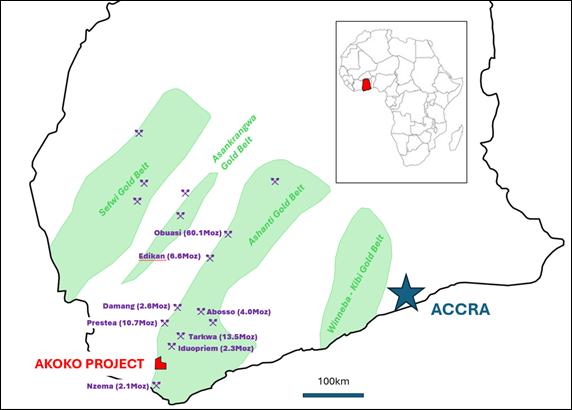 |
Figure 1: Outline map of southern Ghana showing the Birimian gold belts, the location of major gold mines and the Akoko Licence area.
Akoko Licence
The Akoko Prospecting Licence is held by Ghanian registered private company Topago Mining Limited and covers a total area of 89.79km², through two separate non-contiguous areas being Akoko North 11.33km2 and Akoko South 78.46km2 (Figure 2). The licence was recently renewed on the 7 June 2024 for a period of three further years, expiring on the 6 June 2027.
The licence area covers part of the southwestern portion of the Ashanti Belt and occurs within a wide band of Birimian metavolcanics and metasediments just south of the Tarkwaian sediments to the north and the large Prince's Town type granitoid intrusive complex to the south. The concession area extends onto the Prince's Town granitoids and extends westward to cover its western contact with the metavolcanics. This area has not been mapped in recent times and the geology and structure of the area remains poorly understood.
The Birimian is dominated by metavolcanics and interbedded volcaniclastics and metasediments. Bands of higher magnetism are possible mafic intrusive sills and dykes. The large intermediate Prince's Town intrusive complex in the southern part of the licence area has been mapped as mainly tonalite. However, towards the west and south-west of Akoko, the granitoids are metaluminous and typically dioritic to granodioritic of "Dixcove-type".
The structure in the area is poorly understood. A major NNE regional feature has been interpreted to extend northwards to join up with a series of NNE trending structures along the Tarkwaian contact zone extending to become the Damang fault. A similar NNE trending structure has been interpreted between Simpa and Akoko.
Residual weathering has resulted in formation of a mature lateritic profile, variously eroded and incised by recent drainage.
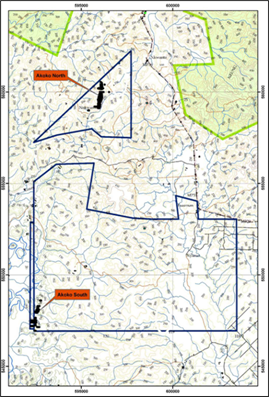
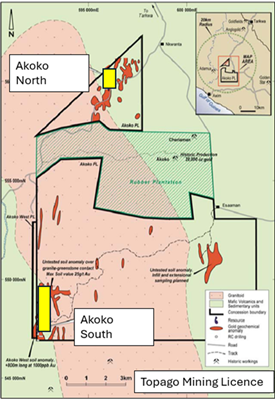
Figure 2: Maps of the Akoko Permit, on the left is a simple terrain map showing the permit boundaries and locations of the two presently known resource areas; on the right is a simplified geological map with soil gold geochemical anomalies shown and the outlines of the resource areas.
Historical Exploration at Akoko
Various phases of work have been undertaken on the Akoko licence areas since 2007. Overall, some 2,670 soil geochemical samples were collected, and assay results are available. Most of these samples have been focussed on the southwestern corners of the Akoko North and South licences (Figure 3).
The eastern portion of the Akoko Project has been subject to very limited exploration. Soil traverses were completed on mainly 1,600m spacings to extend soil coverage to the eastern limits of the licence area. This work successfully defined several new extensive gold anomalies and trends that now require infill sampling and mapping. At Akoko North nine well defined anomalies that aggregate of over 10 strike kilometres are also defined offering immediate targets for drill testing.
The CAA data room on Akoko also contains information for 16,628m of 202 reverse circulation drilling and 4 diamond drill holes. The reverse circulation drilling at Akoto North and South indicates that significant gold mineralization occurs within near surface horizontal zones up to 150m wide. These zones are laterally continuous and can be traced along strike for at least one kilometre. The mineralized zones are typically hosted within weathered basalts and quartz veining is common
The results from the diamond cored holes are consistent with the interpretation that the oxide gold mineralization at Akoko North and South is part of a flat lying supergene enriched zone. Significant intersections from this work included 12m@ 2.68 g/t gold from 24m in hole 11ANDD02 and 11.8m @ 3.24 g/t gold from 0.7m in hole 11ANDD03.
The mineralized zones are strongly weathered offering excellent physical mining characteristics by simple ripping and at low cost.
Akoko Gold Mineralization
The Akoko gold deposits are hosted within metasediments and metavolcanics. The mineralised lodes are flat lying with a slight plunge to the north. Mineralization ranges from 20-50m wide and 5-20m thick, is often associated with quartz veining. The majority of the Resources defined occur within surficial materials produced by extensive weathering and complete oxidation to 20-40m below surface and which show no obvious lithological controls. Mineralization is interpreted to be primary in nature with little movement from source.
The former producing Akoko Gold mine is located between the Akoko North and South licence blocks and was historically mined in the late 1890's and early 1900's, with gold grades of 25g/t Au reported. In the 1930's mining from deep shafts exploited quartz veins with grades of 20-30g/t Au reported, before the mine closed.
More recent work from 2007, including by Topago, has defined two separate resources at Akoko North and Akoko South totalling 276,500 ounces at a grade of 1.6g/t gold (0.2g/t cut-off). However there remains significant exploration potential to the north, south and east of these resources, as evidenced by extensive, untested gold in soil geochemical anomalies (Figure 3).
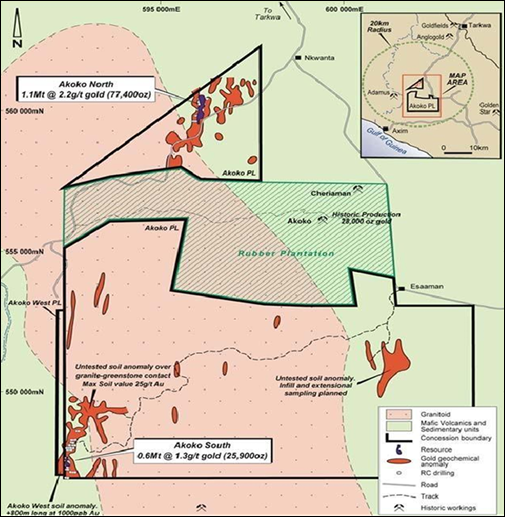
Figure 3: Enlargement of Figure 2 showing outline bedrock geology and soil gold geochemical anomalies.
CAA/Topago Resource Modelling of Akoko
The most recent resource modelling on Akoko for CAA/Topago was in 2016 and compiled to JORC standard of reporting by local Ghanaian consultant geologist Andrew Owusu Asante, which declared an inferred gold resource of 276,500 oz at a 0.2g/t cut off (Figure 4).
Schematic figures of the flat lying oxide resource of Akoko North and drill intersections are showing in Figure 5). These oxide resources are amenable to open pit mining with a stripping ratio of <1.
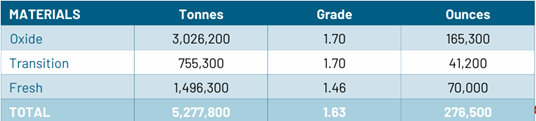
Figure 4: CAA/Topago mineral resource complied by Andrew Owusu Asante.
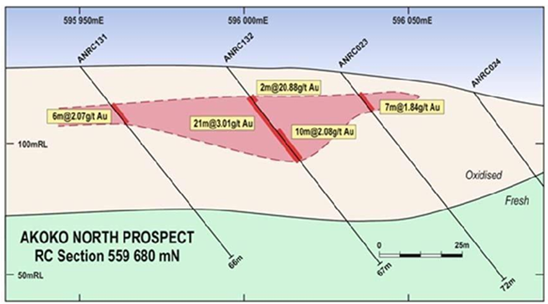
Figure 5: Simplified geological section through the Akoko North resource area showing the outline of the mineralization within the oxide zone.
Hamak Due Diligence and Resource Estimation
Hamak's independent consulting geologist Dr. Colin Andrew has taken a more conservative approach to the resource modelling, essentially to provide a worst-case scenario so the Company can assess the downside risk to the project. Using an economic cut-off grade of 0.3g/t Au, the resource has been defined as having a much larger tonnage potential but at a lower grade, however delivering essentially a similar gold resource of 252,569 oz Au for both the oxide and sulphide material (Figure 6).
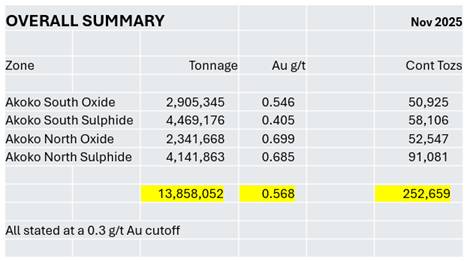
Figure 6: Tabulation of the most recent resource estimation
Taking a further conservative view, Hamak's consultant also looked at the mining potential of just the oxide material that can be exploited in an open pit mine scenario, with overall pit walls at a 25% angle and gold recovery assumed at 75%. Three readily exploitable pits have been identified and modelled, two on the Akoko South resource (Pits 1S and 2S) and one on the Akoko North resource (Pit 3N). Combined these pits could deliver over 68,000 oz of extractable gold ore at a strip ratio of 0.78 (Figure 7). Based on the detail of the drilling and modelling, Dr. Colin Andrew stated that these resources could be classified in the Indicated Resource category with high level of confidence. A minimum four-year life of mine at 750,000 tons per annum could be envisaged, which could be extended further by mining laterally and deeper into more gold mineralized oxide material and at greater depths into the gold bearing sulphide material, as open pit operations with staged pit pull-backs.
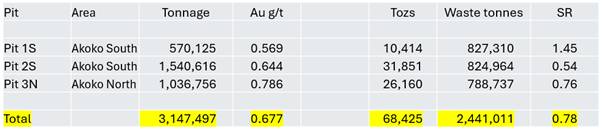
Figure 7: Tabulation of the potential tonnages constrained by initial pit design.
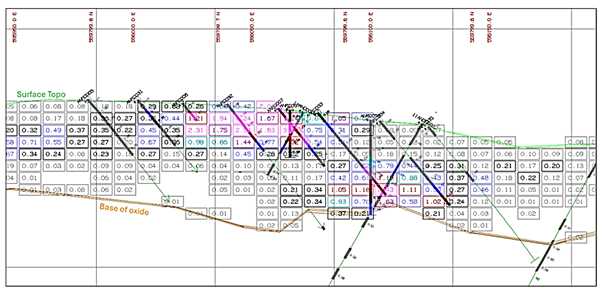
Figure 8: Example of output from the most recent block model (Section through Pit 3N) showing block gold grades in g/t and 5m interval composited drillhole assays.
Financial Modelling by CAA
Hamak has reviewed a financial model by CAA and its consulting group Senet (South Africa) to interrogate the potential economic returns for an open pit, heap-leach gold mining operation.
It should be stressed that this model is not to be relied upon but simply provides an economic scenario as envisaged by CAA that needs to be further developed and refined through the exploration work and various evaluation studies that Hamak plans to conduct after the initial due diligence is completed.
CAA has assumed a starting capex cost of US$50 million for an open-pit heap leach operation with an annual throughput of 550,000 tons. Assumptions are made on the gold recovery (85%) and gold price (US$3,500) which Hamak deems reasonable. The key economic indicators are show in Figure 9.
Based on Hamak's technical due diligence completed to date, including the conclusions and recommendations of its independent consultant Dr. Colin Andrew, who also ran a more conservative financial model, Hamak is confident that the Akoko project represents a viable exploration and development opportunity.
However, further exploration and resource definition work, along with metallurgical test work and economic scoping studies are required to reach a commercial decision whether Hamak should exercise the exclusive purchase option and thereafter seek to enter the mining phase.
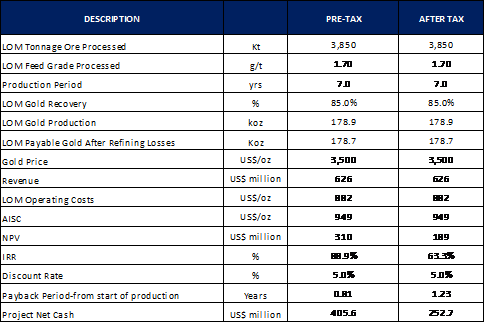 |
Figure 9: Basic economic indicators and parameters of the CAA economic model.
Next Steps
After being granted an exclusivity period Hamak intends to complete further technical due diligence including a site visit to Akoko in January 2026. Furthermore, legal and corporate/licence due diligence will be undertaken by retained Ghanaian legal groups.
Subject to satisfactory due diligence, Hamak will proceed to commence a systematic and structured work programme that will include, but not be limited to, further and confirmatory reverse circulation drilling to verify and potentially expand on the known gold resource at Akoko. The resource statement will be updated and re-stated according to reliable industry standards.
In addition, metallurgical testing of both oxide and sulphide ore will be conducted to better understand the potential gold recovery factors in a mining scenario. Thereafter an independent consulting group will be retained to work with Hamak to conduct a Preliminary Economic Assessment of the Akoko gold mine potential, to include accurate estimates of capex, opex, production and revenues.
It is envisaged that all this work will be completed before the end of 2026 and allow for Hamak to make an informed decision on whether to exercise its exclusive option to acquire the Akoko gold project on the binding terms outlined above.
Further updates on progress and conclusion of the due diligence progress will be made in due course.
For further information on Hamak you are invited to view the Company's website at https://hamakstrategy.com/ or please contact:
|
Hamak Strategy Limited Nick Thurlow Karl Smithson |
|
|
AlbR Capital Limited (Corporate Broker) Yellow Jersey PR Annabelle Wills |
+44 (0) 20 7469 0930
+44 (0) 20 3004 9512 |
About Hamak Strategy Limited
Hamak Strategy Limited (LSE: HAMA / OTCQB: HASTF) is a UK listed company focussed on gold exploration in Africa and with a strategy of pursuing an appropriate and compliant BTC/ crypto treasury management policy.
About CAA Mining
CAA is a private exploration and development company focused on gold and lithium in Africa.
Qualified Person
The technical information in this announcement that relates to exploration results is based on information reviewed by Hamak Strategy's expert consultant Dr Colin Andrew, who is an independent Consulting Economic Geologist, and graduate of Imperial College London and the Royal School of Mines and is a Member of the Institute of Materials, Minerals and Mining, a Fellow of the Geological Society of London, a Member of the Society of Economic Geologists, and a registered Chartered Engineer with the Engineering Council.
Colin Andrew has over forty-five years of diverse mining industry experience, relevant to the nature of exploration, the style of mineralization and type of deposit under consideration and to the activity that he is reviewing, to qualify as a "an "Independent Qualified Person" as such term is defined in NI 43-101 and JORC Standards.
Dr. Andrew independently checked and verified the data disclosed to Hamak by CAA / Topago including all sampling, analytical and test data underlying the information or opinions contained in this news release.
This data verification included (but was not limited to):
· Review of all standard operating and sampling procedures in RC and diamond drilling,
· Review of methodologies used in surveying of drillhole collars,
· Review of QA/QC methodologies (blanks, duplicates and laboratory standards)
· Review of all QA/QC analytical results,
· Checking and correcting minor errors within the various databases downloaded from the dataroom,
No material flaws were detected during the data verification exercise
Cautionary Note Regarding Forward-Looking Statements
This news release includes statements that contain "forward-looking information" within the meaning of the applicable securities legislation ("forward-looking statements"). All statements, other than statements of historical fact, are forward-looking statements and are based on expectations, estimates and projections as at the date of this news release. Any statement that involves discussion with respect to predictions, expectations, beliefs, plans, projections, objectives, assumptions, future events or performance (often, but not always using phrases such as "plans", "expects", "is expected", "budget", "scheduled", "estimates", "forecasts", "intends", "anticipates", or "believes" or variations (including negative variations) of such words and phrases, or state that certain actions, events or results "may", "could", "would", "might" or "will" be taken, occur or be achieved) are not statements of historical fact and may be forward-looking statements.
In this news release, forward-looking statements relate, among other things, to: timing of completion of further drilling; the completion of the technical report; the development, operational and economic results of these studies, including potential cash flows, capital expenditures, development costs, extraction rates, recovery rates, mining cost estimates; estimation of mineral resources; statements about the estimate of mineral resources; magnitude or quality of mineral deposits; anticipated advancement of the Akoko Gold Project mine plan; future operations; future exploration prospects; the completion and timing of future development studies; anticipated advancement of mineral properties or programs; future exploration prospects; and the future growth potential of the Akoko Project.
These forward-looking statements, and any assumptions upon which they are based, are made in good faith and reflect our current judgment regarding the direction of our business. The assumptions underlying the forward-looking statements are based on information currently available to Hamak. Although the forward-looking statements contained in this news release are based upon what management of Hamak believes, or believed at the time, to be reasonable assumptions, Hamak cannot assure its shareholders that actual results will be consistent with such forward-looking statements, as there may be other factors that cause results not to be as anticipated, estimated or intended. Forward-looking information also involves known and unknown risks, uncertainties and other factors which may cause the actual results, performance or achievements of the Company to be materially different from any future results, performance or achievements expressed or implied by the forward-looking information. Such factors include, among others: risks related to interpretation of metallurgical characteristics of the mineralization, changes in project parameters as plans continue to be refined, future metal prices, availability of capital and financing on acceptable terms, uninsured risks, regulatory changes, delays or inability to receive required approvals, taxes, mining title, the speculative nature of the Company's business; the Company's formative stage of development; the Company's financial position; possible variations in mineralization, grade or recovery rates; actual results of current exploration activities; fluctuations in general macroeconomic conditions; fluctuations in securities markets; fluctuations in spot and forward prices of gold and other commodities; fluctuations in currency markets (such as the Pound Sterling to United States dollar exchange rate); change in national and local government, legislation, taxation, controls, regulations and political or economic developments; risks and hazards associated with the business of mineral exploration, development and mining (including environmental hazards, unusual or unexpected geological formations); the presence of laws and regulations that may impose restrictions on mining; employee relations; relationships with and claims by local communities; the speculative nature of mineral exploration and development (including the risks of obtaining necessary licenses, permits and approvals from government authorities); and title to properties.
Forward-looking statements contained herein are made as of the date of this news release and the Company disclaims any obligation to update any forward-looking statements, whether as a result of new information, future events or results, except as may be required by applicable securities laws. There can be no assurance that forward-looking information will prove to be accurate, as actual results and future events could differ materially from those anticipated in such statements. Accordingly, readers should not place undue reliance on forward-looking information.
Important Notice
The Company maintains some of its treasury reserves and surplus cash in Bitcoin, a form of cryptocurrency. The Company is not authorised or regulated by The Financial Conduct Authority (FCA) and Bitcoin investments are generally not subject to regulation by the FCA or otherwise in the United Kingdom. Neither the Company nor investors in the Company's shares are protected by the UK's Financial Ombudsman Service or the Financial Services Compensation Scheme.
The FCA considers Bitcoin investments to be high-risk. The value of Bitcoin can go up as well as down, leading to fluctuations in the value of the Company's Bitcoin holdings, and the Company may not be able to realise its Bitcoin holdings for the same amount it paid to acquire them, or even for the value the Company currently attributes to its Bitcoin positions.
The Company's Board of Directors have identified the following risks in relation to the holding of Bitcoin, which are not exhaustive:
• The value of Bitcoin can be highly volatile, with its value falling as quickly as it rises. Investors in Bitcoin must be prepared to lose all money invested.
• The Bitcoin market is largely unregulated. There is a risk of losing money due to factors such as cyber-attacks, financial crime, and counterparty failure.
• The Company may not be able to sell its Bitcoin at will. The ability to sell Bitcoin depends on various factors, including the supply and demand in the market at the relevant time. Operational failings such as technology outages, cyber-attacks, and comingling of funds could cause unwanted delays.
• Cryptoassets carry a perception of fraud, money laundering, and financial crime.
An investment in the Company is not an investment in Bitcoin itself, but prospective investors in the Company are encouraged to conduct their own research before investing and should be aware that they will have indirect exposure to the high-risk nature of cryptoassets, including their volatility, and could therefore sustain large or total losses of their investment.
RNS may use your IP address to confirm compliance with the terms and conditions, to analyse how you engage with the information contained in this communication, and to share such analysis on an anonymised basis with others as part of our commercial services. For further information about how RNS and the London Stock Exchange use the personal data you provide us, please see our Privacy Policy.

Latest directors dealings
- 2 days ago Rathbones Group
- 2 days ago Georgia Capital
- 2 days ago Hays
- 2 days ago BP
- 2 days ago Unilever