
Maiden Independent 43-101 Resource at Akoko
Summary by AI BETAClose X


NOT FOR RELEASE, PUBLICATION OR DISTRIBUTION, IN WHOLE OR IN PART, DIRECTLY OR INDIRECTLY IN OR INTO AUSTRALIA, CANADA, JAPAN, THE REPUBLIC OF SOUTH AFRICA, THE UNITED STATES, ANY TERRITORY OR POSSESSION THEREOF OR ANY OTHER JURISDICTION WHERE TO DO SO WOULD CONSTITUTE A VIOLATION OF THE RELEVANT LAWS OF SUCH JURISDICTION.
29 July 2026
Hamak Strategy Limited
("Hamak" or the "Company")
Maiden Independent 43-101 Resource at Akoko Oxide Gold Project in Ghana
Hamak Strategy Limited (LSE: HAMA / OTCQB: HASTF), a Company combining advanced gold exploration in West Africa with a Digital Asset Treasury Management strategy, is pleased to announce its maiden independent Mineral Resource Estimate (MRE) in accordance with the Canadian disclosure National Instrument 43-101, for the Company's Akoko Oxide Gold Project in southwest Ghana.
Highlights
· Measured, Indicated & Inferred NI43-101 resource of 210,430oz at 0.76 g/t Au
· Over 120,000oz of 'free digging' oxide material within 50m of surface at 0.81 g/t Au
· MRE comprises:
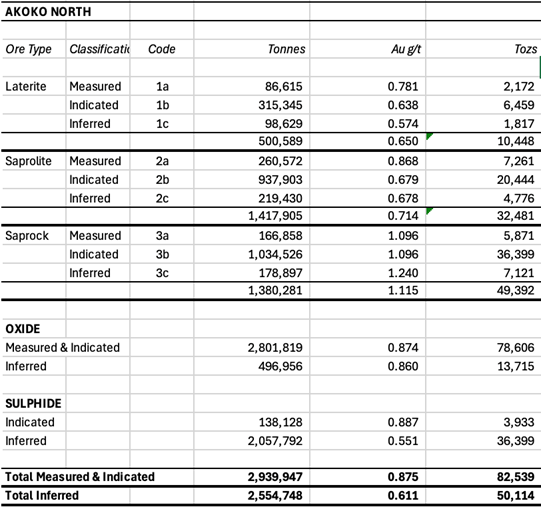
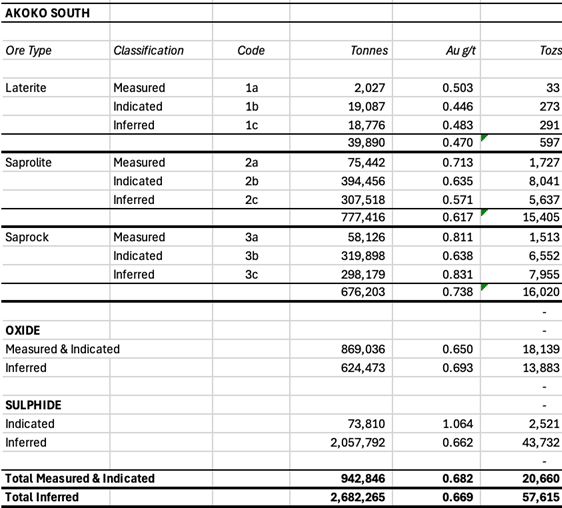
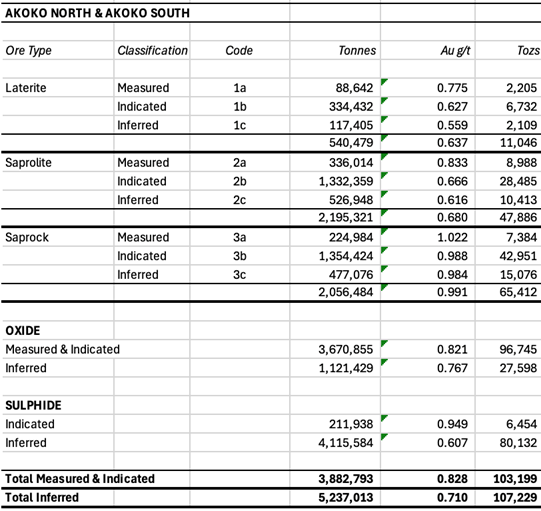
o Measured & Indicated: 3,882,800 tonnes at 0.83 g/t Au for 103,200 ounces
o Inferred: 5,237,000 tonnes at 0.71 g/t Au for 107,230 ounces
· Encouraging initial metallurgy returning oxide gold recoveries between 85% to 94%
· Significant expansion potential with resource open at depth and along strike
· Less than 35% of 15 km long geochemical signature tested by drilling to date
· Independent Preliminary Economic Assessment (PEA) to now be commissioned
· PEA to assess potential for fast-tracking a low-capex, open-pit, heap-leach gold mine
· Hamak has the option to acquire a 100% interest in the Akoko project for a cash and shares consideration of just US$15 per ounce of gold
CEO and Executive Director Karl Smithson commented:
"Today is a defining milestone for Hamak. Akoko is no longer simply an exploration concept: it has an independently estimated mineral resource of over 210,000 ounces, with nearly half already in the Measured and Indicated categories. The most development-relevant part of the resource is the 124,000 ounces of shallow oxide gold close to surface, where initial metallurgical test work has returned encouraging gold recoveries and the weathered material may be amenable to free-dig mining.
"The resource provides a compelling platform from which to build. We have drilled only 35% of the 15km gold-in-soil anomaly, while mineralization remains open along strike and at depth. This gives us a clear opportunity to both advance a near-term development case and to grow the resource through targeted drilling.
"At an approximate cash and shares acquisition cost of US$15 per current resource ounce, the option terms offer Hamak a highly attractive entry into a quantified West African gold asset. We intend to move directly into an independent PEA, focussed on a simple open-pit, heap-leach operation and targeting a potential production profile of at least 20,000 ounces per annum. We believe that Akoko has the potential to become a cornerstone gold asset for Hamak's growth strategy in the region."
Background
Mineral Resource Estimate ("MRE")
The maiden Akoko MRE has been prepared by independent consulting geologist Dr. Colin Andrew and is declared according to Canadian NI43-101 standards. The report has been uploaded to the company's website and can be accessed by following this link: https://hamakstrategy.com/media-hub/documents/
Dr. Andrew utilised a comprehensive database, which included both historical and the more recent drilling undertaken by Hamak, to compile the MRE. This database comprised 26,409m of drilling in 334 drillholes, providing 19,789 sample assays for gold. This data was incorporated into the block model to derive individual ore resource blocks of 5m x 5m x 5m dimensions across the Akoko mineralization. The interpreted mineralization model used for the resource update was generated using a combination of implicit and explicit reiterative modelling approaches in Leapfrog Geo and Gemcom, which also was used for statistical and geostatistical analysis. Final block modelling and estimation were then completed using Gemcom software using both Inverse Distance Squared (ID2) and variography.
The majority of the drilling at Akoko has focussed on defining mineralized ore bodies in the oxide zones close to surface (0 to 50m depth). The density of drilling and other statistical parameters in this horizon is sufficient to enable 49% of the resource (>103,000oz Au) to be declared in the Measured and Indicated categories defined as being to a sufficient level of confidence to allow the application of Modifying Factors in sufficient detail to support mine planning and evaluation of the economic viability of the deposit.
For the deeper sulphide zones (50m to 80m depth), limited drilling density resulted in the bulk of the sulphide resource to be declared in the Inferred category. However, some high-grade intersections were encountered within the sulphide zone and there is clear potential that through further drilling a larger and more robust resource declaration can be achieved for the deeper zones. Notably, this mineralization lies in a similar geological position to, and along strike from, the major gold mines at Tarkwa 25km to the NNE.
Two separate areas of resource have been defined in the Akoko North (132,653 ounces) and Akoko South (76,275 ounces) licence areas respectively, at a cut-off of 0.25g/t Au, as follows:
Metallurgical Testing and Gold Recovery
An initial programme of metallurgical leach test work was performed on selected drill samples from the various ore-hosting lithologies identified, these being laterite, saprolite, saprock and sulphides. From these results average gold recovery factors demonstrate that, based on the samples analysed, the ores are readily leachable with excellent recoveries of between 85% and 94% for the oxide material, and 68% for the sulphide material. Further metallurgical test work will be conducted as part of the PEA work programme.
MRE Conclusion for Potential Future Mining Scenario
When applied to the in-situ gold resource, the recovery factors would suggest that, of the 210,000oz gold resource so far defined, 199,000oz could potentially be recovered in the mining stages, from two open pits at Akoko North and South respectively, likely to be extracted by free-dig due to the soft competency of the oxide material.
The project currently hosts a shallow, open pittable oxide resource containing 4.8 million tonnes of ore grading at 0.81g/t Au containing 124,000 ounces of gold. Applying an average oxide gold recovery factor of 87.4%, a total of 108,700 ounces of gold is considered to be recoverable in a mining scenario through shallow free digging open pits. In addition, there is significant additional resource, 4.3 million tonnes grading at 0.6g/t Au (86,000 ounces gold) hosted in the shallow sulphides below the oxides, that could be mined through deepening of the open pits.
Resource Upside Potential
The NI43-101 report proposes that there is potential to extend the oxide resources as the soil geochemistry suggests that the gold mineralization stretches over a 15km trend along the renowned Ashanti gold belt trend (NNE) that runs through the Akoko South and North resource areas and hosts numerous multi-million ounce gold mines and deposits (Figures 1 and 2). It is believed that additional drilling can potentially add further shallow oxide resources to the Akoko resource base.
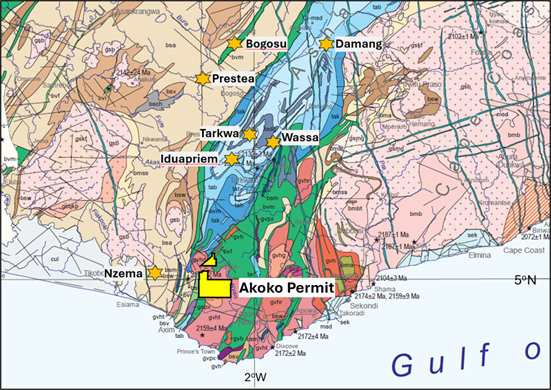
Figure 1: Location of the Akoko Licence Area and Nearby Mines
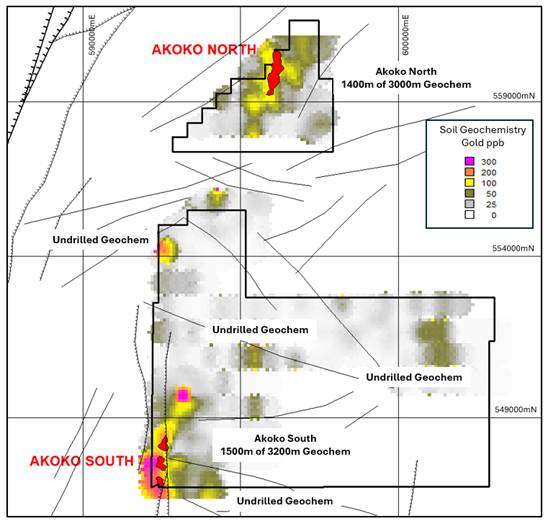 |
Figure 2:
Figure 2: Akoko Licences and Geochemical Gold in Soil Anomalies (Red outlines drilled resource areas in this MRE)
Economic Assessment
Whilst the NI43-101 is not required to undertake a detailed economic assessment, there is a requirement for a high-level assessment of whether the resource can have Reasonable Prospects for Eventual Economic Extraction ("RPEEE"). Based on the modelling and gold content, the NI43-101 suggests a current economic cut-off grade of 0.18g/t Au at a 100% recovery, and therefore the elected cut-off grade for resource modelling is estimated to be 0.25g/t Au. This cut-off grade for the MRE can be justified based on current gold prices and the overall resource grade, likely operating costs and comparatives with other similar open pit / heap leach mining operations in Ghana and around the globe at the present time.
The resource grades determined in this MRE are higher than the cut off grades and therefore the Competent Person of the NI43-101 opined that there is a RPEEE for the Akoko MRE.
Based on previous studies, a high-level mine plan and financial model was created for the exploitation of certain resource areas of Akoko. Open pit mining with heap leach gold processing and recovery methods was assumed. Figure 3 represents schematic sections showing potential pit profiles and the contained ore zones at Akoko North and South. This will be further evaluated during the PEA.
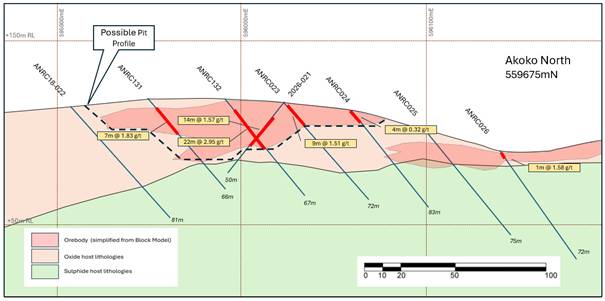
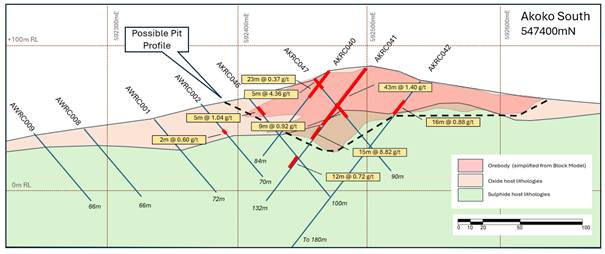
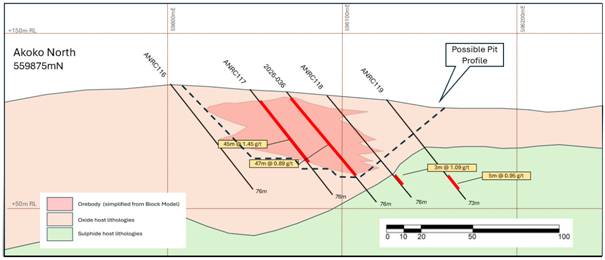
Figure 3: Schematic sections facing north through the Akoko deposits showing the potential open pit profiles for eventual extraction.
Recommendations for Future Work
The results presented in this NI43-101 MRE suggest that the Akoko Gold Project is potentially technically and economically viable. It is recommended to continue advancing the development of the Project towards the PEA stage.
The Akoko South drill programme, recently paused for the height of the rainy season, should be completed with a view to converting more of the inferred resource ounces to the indicated and measured category. In addition, drilling of the deeper sulphide zones is required as there is excellent potential as the geology and gold mineralization is likely to be similar to Tarkwa and other gold mines along this NNE trending Ashanti Gold Belt strike.
Further metallurgical studies, including additional leach test work, metallic screen assays and additional studies will be required as part of the PEA.
The PEA study will focus on analysing the economic potential of an open pit gold mining operation with gold recovery via heap leach methods. The capital and operating costs as well as potential future cash flows and margins will all be evaluated. Based on similar scale operations in the region, and high-level financial modelling already undertaken on the Akoko gold project.
Hamak's Option to Acquire the Akoko Gold Project
Hamak, as reported in a public announcement dated 3 November 2025, has the option to acquire a 100% interest in the Akoko gold project, with such election to be made by 14 December 2026. Hamak has satisfied the minimum spend commitment of £500,000 on exploration activities. If Hamak exercises the option, the acquisition price would be the payment of US$1.9M in cash to Topago Mining, the owner of the Akoko project licence, and the payment of £1M in Hamak shares to CAA Mining, valued at a 10% premium to the 30-day Volume Weighted Average Price prior to exercise of the option. A production royalty of 0.5% on gold production up to 250,000ozs and then 1.0% on production to 1 million ounces (capped) will be paid to CAA Mining.
Based on the maiden MRE of 210,000 ounces, the cash acquisition price of Akoko is US$9 per ounce of gold, or US$15 per ounce when including the Hamak share issues. This represents a compelling value opportunity for Hamak.
Qualified Person
The technical information in this announcement, that relates to exploration results, is based on information reviewed by Hamak Strategy's retained consultant Dr Colin Andrew, who is an independent Consulting Economic Geologist, and graduate of Imperial College London and the Royal School of Mines and is a Member of the Institute of Materials, Minerals and Mining, a Fellow of the Geological Society of London, a Member of the Society of Economic Geologists, and a registered Chartered Engineer with the Engineering Council. Colin Andrew has over forty years of diverse mining industry experience, relevant to the nature of exploration, the style of mineralization and type of deposit under consideration and to the activity that he is reviewing, to qualify as a an "Independent Qualified Person" as such term is defined in NI43-101.
NOTES TO AKOKO MRE MODEL:
The model is undiluted, so appropriate dilution needs to be incorporated in any evaluation of the deposit.
- The Mineral Resource Estimate has been estimated using the Canadian Institute of Mining, Metallurgy and Petroleum (CIM) Definitions Standards for Mineral Resource and Mineral Reserve in accordance with National Instrument 43-101 - Standards of Disclosure for Mineral Projects. These standards are generally similar to those of JORC.
- The resource estimate was completed using the following parameters:
· 334 drill holes completed by Castle, Star Goldfields and Hamak in the database were used in the resource estimate for a total of 26,409.6m of drilling. Drillhole separation varied from 50m by 30m to 40m and 100m by 30m over the deposit. Most drill holes are orientated at (nominally) 50° to the west.
· The RC sampling procedures were reviewed by the author and are considered to be of industry standard.
· Bulk samples were collected at 1m intervals below a free-standing cyclone in large plastic retention bags. The 1m bulk samples were split using a riffle splitter at the time of drilling and then stored off site. Five metre composite 'spear' samples were prepared which were submitted to the laboratory. If the 5m composite returned an assay greater than 0.1g/t Au, the individual 1m samples in the interval were assayed.
· Samples collected by Hamak were sent to SGS Laboratory in Tarkwa, Ghana for analysis. . Castle and Star Goldfields used the Transworld and Intertek Laboratories respectively, also in Tarkwa. Samples were prepared by drying, crushing to -6mm and then pulverizing to <75 microns (-200 mesh). Analysis for Au was by 50g Fire Assay with an atomic absorption spectrometry (AAS) finish. Castle and Star Goldfields used the Transword and Intertec Laboratories respectively, also in Tarkwa.
· Quality control samples were collected and analysed on a regular basis and the results have been reviewed by the author and are considered to be satisfactory.
· Castle and Star Goldfields drillhole collars have been surveyed using a Sokkia Stratus DGPS to an accuracy of 10mm whilst Hamak used Garmin GPS with accuracy to <3m.
· Lithological wireframes were constructed using 25m interval cross sectional interpretations in Gemcom software and thus used to create the 3-dimensional constraining solids.
· Samples within the wireframes were composited to even 1.0m intervals. A 25g/t Au high grade cut was determined by statistical analysis and applied to the 1m composite values.
· A Gemcom© block model was used for the estimate with a block size of 5m NS by 5m EW by 5m vertical.
· Inverse Distance (ID2) interpolation was used for grade interpolation with the search ellipse orientated to match the general modelled orientation of the mineralization., Resource estimations used average densities for lithological types were applied for tonnage calculation purposes.
· Bulk density values based upon an extensive test work program of 146 samples of various lithotypes were used in the model - Laterite (Type 1) - 1.75 t/m3, Saprolite (Type 2) -1.70 t/m3, Saprock (Type 3) - 2.08 t/m3 and Fresh Rock (Sulphides) - 2.54 t/m3
· The portion of the resource returning standard deviations of less than 1 are classified as a Measured Mineral Resource, that with <2 std devs is classified as Indicated Mineral Resource and those > 2 std devs as Inferred Mineral Resource. Mineral Resources which are not Mineral Reserves, do not have demonstrated economic viability. Inferred Mineral Resources are exclusive of the Measured and Indicated Resources.
· The QP is not aware of any metallurgical, environmental, permitting, legal, title, taxation, socio-economic, marketing, political, or other risk factors that might materially affect the estimate of Mineral Resources.
· Figures have been rounded to an appropriate level for the reporting of the Mineral Resources and may not compute exactly as shown.
· The effective date of the Mineral Resource Estimate is 21 July 2026
For the purposes of UK MAR, the person responsible for arranging release of this announcement on behalf of Hamak is Karl Smithson, CEO and Executive Director.
For further information on Hamak you are invited to view the company's website at https://hamakstrategy.com/ or please contact:
|
Hamak Strategy Limited Karl Smithson, CEO and Executive Director Mike Murphy, CSO and Executive Director
|
|
|
AlbR Capital Limited (Corporate Broker) |
+44 (0) 20 7469 0930 |
|
Yellow Jersey PR Annabelle Wills |
+44 (0) 20 3004 9512
|
About Hamak Strategy Limited
Hamak Strategy Limited (LSE: HAMA / OTCQB: HASTF) is a UK listed company focussed on gold exploration in Africa and with a strategy of pursuing an appropriate and compliant BTC / crypto treasury management policy.
Important Notice
The Company maintains some of its treasury reserves and surplus cash in Bitcoin, a form of cryptocurrency. The Company is not authorised or regulated by The Financial Conduct Authority (FCA) and Bitcoin investments are generally not subject to regulation by the FCA or otherwise in the United Kingdom. Neither the Company nor investors in the Company's shares are protected by the UK's Financial Ombudsman Service or the Financial Services Compensation Scheme.
However, the FCA considers Bitcoin investments to be high-risk. The value of Bitcoin can go up as well as down, leading to fluctuations in the value of the Company's Bitcoin holdings, and the Company may not be able to realise its Bitcoin holdings for the same amount it paid to acquire them, or even for the value the Company currently attributes to its Bitcoin positions.
The Company's Board of Directors have identified the following risks in relation to the holding of Bitcoin, which are not exhaustive:
• The value of Bitcoin can be highly volatile, with its value falling as quickly as it rises. Investors in Bitcoin must be prepared to lose all money invested.
• The Bitcoin market is largely unregulated. There is a risk of losing money due to factors such as cyber-attacks, financial crime, and counterparty failure.
• The Company may not be able to sell its Bitcoin at will. The ability to sell Bitcoin depends on various factors, including the supply and demand in the market at the relevant time. Operational failings such as technology outages, cyber-attacks, and comingling of funds could cause unwanted delays.
• Cryptoassets carry a perception of fraud, money laundering, and financial crime.
An investment in the Company is not an investment in Bitcoin itself, but prospective investors in the Company are encouraged to conduct their own research before investing and should be aware that they will have indirect exposure to the high-risk nature of cryptoassets, including their volatility, and could therefore sustain large or total losses of their investment.
RNS may use your IP address to confirm compliance with the terms and conditions, to analyse how you engage with the information contained in this communication, and to share such analysis on an anonymised basis with others as part of our commercial services. For further information about how RNS and the London Stock Exchange use the personal data you provide us, please see our Privacy Policy.

Latest directors dealings
- 3 hours ago Cohort
- 3 hours ago Schroder Real Estate Investment Trust Ltd
- 3 hours ago Glenveagh Properties (CDI)
- 4 hours ago Inchcape
- 4 hours ago Mitie Group