
2026 Annual Report
Summary by AI BETAClose X


NEWS RELEASE 30 SEPTEMBER 2026
2026 ANNUAL REPORT
GreenX Metals Limited (GreenX or the Company) advises that its 2026 Annual Report, has been published and is available at https://api.investi.com.au/api/announcements/grx/906a9d2e-fa6.pdf, with results provided below.
The 2026 Annual Report will also be uploaded to the National Storage Mechanism which will be available at https://data.fca.org.uk/#/nsm/nationalstoragemechanism.
Hard copies of the 2026 Annual Report will be sent by post to those shareholders who have elected to receive them, or they can be obtained free of charge on request.
The Company also advises that an Appendix 4G (Key to Disclosures: Corporate Governance Council Principles and Recommendations) and 2026 Corporate Governance Statement have been released today and are also available on the Company's website at https://api.investi.com.au/api/announcements/grx/c0381711-d6a.pdf.
For further information please contact:
Dylan Browne
Company Secretary
+61 8 9322 6322
MESSAGE FROM THE CEO
Dear Shareholders,
2026 was a transformational year for GreenX Metals Limited (GreenX or the Company), marked by significant progress across our diversified asset portfolio and the continued strengthening of the Company's strategic position. During the year, and subsequent to year-end, GreenX acquired and advanced the Tannenberg Copper Project in Germany, progressed exploration at the Eleonore North Project in Greenland and achieved an important milestone in its ongoing international arbitration proceedings against the Republic of Poland.
Tannenberg Copper Project
During the year, the Company completed the acquisition of a 90% interest in Group 11 Exploration GmbH (Group 11), the company which holds the Tannenberg exploration licences in Germany, following the exercise of GreenX's acquisition option.
Since the original agreement was signed in 2024, the licence area has expanded approximately seven-fold and now covers approximately 1,900 km² across the Tannenberg 1 and Tannenberg 2 exploration licences. GreenX's acquisition applies to this entire expanded Project area.
A major milestone during the year was the announcement of a historical estimate of 728,000 tonnes of contained copper (1,605 Mlbs) at an average grade of 2.6% copper across part of the Tannenberg Copper Project.
The estimate was based on an extensive drilling campaign undertaken between 1935 and 1938 across the Ronshausen, Hönebach, Wolfsberg and Schnepfenbusch zones. Importantly, this historical work targeted only the thin Kupferschiefer horizon, focused solely on copper and excluded potentially valuable by-product metals. In addition, approximately 250,000 tonnes of contained copper was excluded from the historical estimate to account for areas where surface features were considered at the time to potentially constrain mining.
Subsequent drilling undertaken by St Joe Exploration GmbH between 1980 and 1984 provided further validation of the historical estimate. Although St Joe drilled only approximately 28% of the Ronshausen zone, its work identified mineralisation up to 3.45 metres thick extending beyond the Kupferschiefer into the limestone hanging wall and sandstone footwall. The resulting 1984 historical estimate reported consistent grades of approximately 2.1% copper and 25 g/t silver, containing approximately 169,000 tonnes of copper and 6.5 million ounces of silver.
(Cautionary statement: The historical estimates in this announcement are not reported in accordance with the JORC Code (2012) (JORC Code). A competent person has not done sufficient work to classify the historical estimate as a mineral resource or ore reserve in accordance with the JORC Code. It is uncertain that following evaluation and/or further exploration work that the historical estimate will be able to be reported as a mineral resource or ore reserve in accordance with the JORC Code).
This work is particularly significant because it demonstrates that mineralisation at Tannenberg is not necessarily confined to the Kupferschiefer horizon itself. Under a modern geological interpretation, substantial exploration and development potential may exist within the surrounding limestone hanging wall and sandstone footwall, including areas extending up to approximately 30 metres above and 60 metres below the Kupferschiefer.
Building on this historical foundation, GreenX subsequently announced an Exploration Target for Tannenberg, demonstrating the potential for a globally significant copper endowment.
The Exploration Target incorporates mineralisation within the hanging wall and footwall units above and below the Kupferschiefer shale - a modern interpretation of the system that was not contemplated in the 1940 historical estimate. This geological model is supported by operating Kupferschiefer mines in Poland, where a substantial proportion of mineable copper at KGHM Polska Miedź S.A.'s operations is hosted within the same sandstone footwall and limestone hanging wall units.
The Exploration Target builds on the historical drilling and estimates, GreenX's re-logging and re-sampling of 1980s drill core, and the extensive digitisation and interpretation of archive material undertaken since August 2024. The technical work was completed at Palsatech's specialist core logging facility in Sweden, with MSA Mining Consulting UK Ltd's independent competent person compiling the Exploration Target.
The establishment of the Exploration Target represents an important inflection point for Tannenberg. The Company is now transitioning from historical archive synthesis and geological interpretation into active technical evaluation.
Mineralogy And Processing Study:
Subsequent to announcing the Exploration Target, GreenX completed an early-stage mineralogy and processing study for Tannenberg.
The study confirmed that Tannenberg mineralisation is mineralogically consistent with the producing Kupferschiefer mines of Poland and supports the potential suitability of a conventional flotation-based processing route.
Independent review by MSA Mining Consulting UK Ltd identified the established Kupferschiefer processing flowsheet as an appropriate baseline for future Tannenberg studies. Comparable KGHM operations process approximately 30 Mtpa at grades of around 1.6% copper and 45 g/t silver, achieving aggregate recoveries of approximately 89% for copper and 86% for silver from blended Kupferschiefer shale, sandstone and carbonate-hosted mineralisation.
Mineralogical analysis completed by SGS Lakefield on ten drill core samples found that copper mineralisation is predominantly hosted in chalcocite, with additional bornite, chalcopyrite and covellite - minerals typical of Kupferschiefer deposits.
The study also identified a bi-modal copper sulphide grain-size distribution, comprising both relatively coarse material and very fine disseminated sulphides. These findings will help inform future comminution and flotation circuit design.
The extensive history of copper production from the Tannenberg district also provides important evidence of metallurgical recoverability. Historical mines at Tannenberg produced approximately 416,500 tonnes of copper and 33.7 million ounces of silver, predominantly during the 1930s to 1950s, using processing technologies substantially less advanced than those available today.
Modern technologies, including high-pressure grinding rolls, fine-particle flotation systems and advanced reagent schemes, provide opportunities to investigate potential improvements in liberation and recovery relative to historical flowsheets.
These results support progression to scoping-level metallurgical testwork using representative samples from each principal lithology to further evaluate comminution characteristics, flotation performance and recoveries.
Tannenberg - Next Steps
GreenX continues to advance a coordinated technical work program at Tannenberg, including:
o Ongoing monitoring and risk assessment to potentially access historical underground mines for scoping study-level metallurgical test work, chip sampling, as well as mapping and surveying for 3D modelling;
o continuing the collation and digitisation of historical geological, mine development and production data;
o assessing the application of seismic surveying to assist future drilling, including petrophysical measurements and seismic forward modelling;
o undertaking a seismic survey, subject to the outcome of this technical assessment; and
o commencing an initial drilling program.
Eleonore North Project
GreenX also continued to advance its Eleonore North Project in East Greenland, where the Company is targeting gold, tungsten and antimony mineralisation.
Subsequent to year-end, fieldwork was completed across the Project, with the 2026 program designed to advance the North Margeries, South Margeries and Noa Pluton prospects towards drill-ready status.
At Noa Pluton, a specialist in Reduced Intrusion-Related Gold Systems is evaluating the prospect and a number of previously untested targets.
At the North and South Margeries prospects, bulk samples of tungsten- and antimony-mineralised material were collected to support scoping study-level metallurgical sighter testwork. Archive drill core from both deposits was also sampled ahead of the field program and is currently being assayed.
During the year, GreenX announced historical estimates demonstrating the high-grade nature of mineralisation at the Margeries prospects, including:
o 83kt of mineralised rock with a mean grade of 4.6% Sb at North Margeries
o 58kt of mineralised rock grading at 3.2% W at South Margeries
o 32kt of mineralised rock grading at 1% W at North Margeries
(Cautionary statement: The Historical Estimates in this announcement are not reported in accordance with the JORC Code. A competent person has not done sufficient work to classify the Historical Estimate as a mineral resource or ore reserve in accordance with the JORC Code. It is uncertain that following evaluation and/or further exploration work that the Historical Estimate will be able to be reported as a mineral resource or ore reserve in accordance with the JORC Code.)
The Company also identified multiple surface anomalies along strike from, and adjacent to, these historical mineralised zones. At North Margeries, a prospectivity anomaly extends for approximately two kilometres adjacent to a major east-west fault structure, while several additional anomalies have been identified surrounding the South Margeries historical estimate.
These targets were generated through the application of modern processing techniques to a heritage hyperspectral dataset acquired from an airborne survey flown across the East Greenland licences in 2000.
Both tungsten and antimony are recognised as critical raw materials by the European Union and the United States, and global supply remains heavily concentrated in China. This strategic backdrop enhances the significance of GreenX's exploration opportunity in Greenland.
In August 2026, the Company announced the grant of two additional exploration licences at Eleonore North. The Company has secured exclusive rights to ~1,600 km2 of tenure prospective for RIRGS. These new licences complement the Company's existing licences located 100 km to the north.
Arbitration Set-Aside Proceedings
The Company also achieved an important legal milestone during the year when the Singapore Court rejected, in its entirety, Poland's application to set aside GreenX's Energy Charter Treaty (ECT) award.
The decision upheld the Company's previously announced entitlement to compensation under the ECT.
A redacted version of the Singapore Court judgment has since been released and has been brought to the attention of the English courts as part of the separate Bilateral Investment Treaty (BIT) set-aside proceedings.
The Singapore Court also awarded GreenX approximately A$1.6 million in legal costs, which has been paid by Poland in reimbursement of costs incurred by the Group in defending the unsuccessful ECT set-aside application.
Poland subsequently appealed the Singapore Court's decision. That appeal was heard by the Singapore Court of Appeal in September 2026, following which Poland will have no further rights of appeal within the Singapore court system.
As previously announced, in October 2024 GreenX was awarded approximately £252 million (A$519 million / PLN 1.2 billion) in compensation and interest under the Australia-Poland BIT, following the Tribunal's unanimous finding that Poland had breached its obligations under both the BIT and the ECT.
Approximately £183 million (A$378 million / PLN 900 million) was awarded pursuant to the ECT, with payments made under one award to be offset against the other.
In addition, approximately £22 million (A$43 million / PLN 15 million) of further interest had accrued between the date of the Award in October 2024 and the end of June 2026. Interest will continue to compound annually until full and final payment is received from Poland.
Following the Singapore Court's initial rejection of Poland's ECT set-aside application, the Company is preparing to commence its enforcement activities.
Looking Ahead
GreenX enters the next phase of its development with a substantially strengthened and diversified asset portfolio.
At Tannenberg, the Company has progressed from consolidating and interpreting a significant body of historical information to defining a substantial Exploration Target and commencing the technical exploration and development programs required to test it.
At Eleonore North, the combination of high-grade historical tungsten and antimony mineralisation, emerging gold potential and newly generated exploration targets provides several opportunities for further value creation.
At the same time, the initial favourable decision of the Singapore Court represents another important step towards enforcement of the arbitration awards against Poland.
We remain focused on disciplined execution of our technical programs and on progressing the Company's legal rights for the benefit of shareholders.
On behalf of the Board and management team, I thank our shareholders for their continued support and look forward to reporting further progress during the year ahead.
Yours sincerely,
Benjamin Stoikovich
Chief Executive Officer
DIRECTORS' REPORT
The Directors of GreenX Metals Limited present their report on the Consolidated Entity consisting of GreenX Metals Limited (Company or GreenX) and the entities it controlled at the end of, or during, the year ended 30 June 2026 (Consolidated Entity or Group).
OPERATING AND FINANCIAL REVIEW
GreenX intends to create long-term shareholder value by focusing on the exploration and development of critical mineral resources across its projects. The Company is also strongly defending the set-aside motions filed by Poland in relation to its successful Claim.
Operations
Tannenberg Copper Project (Germany)
The Tannenberg Copper Project (Tannenberg) is a large scale, relatively shallow and potential high-grade copper brownfields exploration project that is strategically located in central Germany.
Copper is currently recognised as a strategic raw material by the European Union.
Prior to closure in the 1950's, the Richelsdorf mines produced 416,500 tonnes of copper and 33.7 million ounces of silver from Kupferschiefer type deposits. These historic mines consisted of shallow underground workings originally accessed from surface outcrops.
Kupferschiefer style deposits are a well-known and prolific subtype of sediment-hosted copper deposit that are the second most prevalent source of copper production and reserves in the world and have been historically mined in Germany and are still mined in Poland.
Germany has been a significant mining jurisdiction in the past and continues its mining tradition, including the K+S potash mines which operate 4 km away from the license area and are located in the State of Hesse.
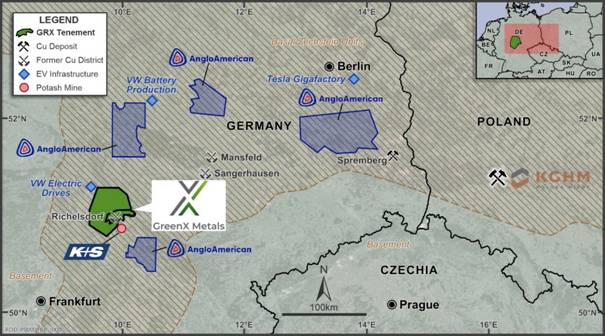
Figure 1: Tannenberg is located in the industrial centre of Europe within the Basal Zechstein trend
(brown shading)
Tannenberg Copper Project Acquisition:
The Company announced the completion of the acquisition of 90% of Group 11 which holds the Tannenberg exploration licences
Since signing the Joint Venture and Earn-in Agreement (JVA) in 2024, the Project area has expanded seven-fold to cover approximately 1,900 km², comprising the Tannenberg 1 and Tannenberg 2 exploration licences
Exploration Target Highlights Potential for Large Scale Copper Silver Project
During the year, GreenX announced an Exploration Target at Tannenberg. The estimated range of potential mineralisation in the Exploration Target is: 144 to 279 Mt at 0.9% to 1.4% Cu and 15 to 21 g/t Ag for 1.3 to 3.9 Mt Cu and 69 to 188 Moz Ag.
Cautionary Statement: The Exploration Target has been reported in accordance with the 2012 edition of the JORC Code (JORC Code). The potential quantity and grade of the Exploration Target is conceptual in nature. There has been insufficient exploration to estimate a Mineral Resource for the reported target areas. It is uncertain if further exploration will result in the estimation of a Mineral Resource.
|
Table 1: Exploration Target for Tannenberg |
|||||
|
Prospect |
Tonnes Range |
Cu Grade Range |
Ag Grade Range |
Contained Cu Range |
Contained Ag Range |
|
Zone 1 |
8 to 16 Mt |
0.9 to 1.4% Cu |
15 to 21 g/t Ag |
0.1 to 0.2 Mt Cu |
3.9 to 10.8 Moz Ag |
|
Zone 2 |
40 to 78 Mt |
0.4 to 1.1 Mt Cu |
19.3 to 52.7 Moz Ag |
||
|
Zone 3 |
96 to 186 Mt |
0.9 to 2.6 Mt Cu |
46.3 to 125.6 Moz Ag |
||
|
Total |
144 to 279 Mt |
1.3 to 3.9 Mt Cu |
69.4 to 188.4 Moz Ag |
||
The Exploration Target provides a modern view of the copper potential at Tannenberg. Unlike the 1940 historical estimate, which assessed only the thin Kupferschiefer shale horizon (refer to announcement dated 20 October 2025), the Exploration Target captures mineralisation in the hanging wall above and footwall below the shale. This is consistent with the modern understanding of Kupferschiefer deposits as evidenced at KGHM Polska Miedź S.A's (KGHM) mining operations in Poland.
From Historical Mining District to Exploration Target
The Tannenberg Project has a long-documented history of drilling, mining, and estimation work, providing well-defined and historically validated copper-silver mineralisation that underpins the Exploration Target.
A 95-hole drilling campaign was completed by the National Socialist Government between 1935 and 1938 across the Richelsdorf Mining District. This dataset formed the geological basis for the construction of three Kupferschiefer copper mines within the Tannenberg licence area, Reichenberg, Wolfsberg and Schnepfenbusch. These mines operated between the late 1930's and in some cases up to the mid 1950's. GreenX has digitised and integrated this drillhole database into its geological models (refer to announcement dated 11 September 2025).
The 1940 historical estimate, produced by Mansfeldsche Kupferschieferbergbau AG (Mansfeld AG), is based on a spatially relevant subset of 18 holes from the 95-hole database and established 728,000 tonnes of contained copper at an average grade of 2.6% copper (in the narrow Kupferschiefer shale only) between the Wolfsberg and Schnepfenbusch mines in the north and the Ronshausen area in the south. The historical estimate covers mineralisation from a depth of 100 m in the north to 400 m in the southern end area near Ronshausen (refer to announcement dated 20 October 2025).
A later historical estimate from 1984 was produced by St Joe Explorations GmbH (St Joe), based on limited drilling between 1980 and 1984 (refer to announcements dated 2 August 2024 and 28 April 2025). The St Joe historical work estimated 169,000 tonnes of contained copper and 6.5 million ounces of contained silver within the small section of zone 3 (see Figure 2). St Joe assayed wider intersections and found that the mineralisation was up to 3.45 m thick. This is considerably thicker than the narrow Kupferschiefer shale assayed and estimated by Mansfeld AG in 1940. St Joe provided the first modern indication that economic mineralisation extends beyond the Kupferschiefer shale itself.
Cautionary statement: The historical estimates in this announcement are not reported in accordance with the JORC Code. A competent person has not done sufficient work to classify the historical estimates as a mineral resource or ore reserve in accordance with the JORC Code. It is uncertain that following evaluation and/or further exploration work that the historical estimates will be able to be reported as a mineral resource or ore reserve in accordance with the JORC Code.
Modern Thickness Model
The modern understanding of the Kupferschiefer deposit model, as evidenced at KGHM's Polish mining operations on the same geological setting as Tannenberg, shows that up to 95% of mineable copper can be hosted in the footwall sandstone and hanging wall limestone, with mineralisation often occurring up to 30 m above and 60 m below the Kupferschiefer shale horizon.
Applying the thick mineralisation concept to the historically defined Tannenberg footprint produces a statistically-derived mineralised thickness of 1.7 m to 3.3 m, compared with the 20 cm to 60 cm (shale-only) thickness used in the 1940 historical estimate. The 1.7 m to 3.3 m thickness is consistent with the wider intercepts confirmed by St Joe in the 1980s and has now been independently validated by GreenX's resampling of available archived core.
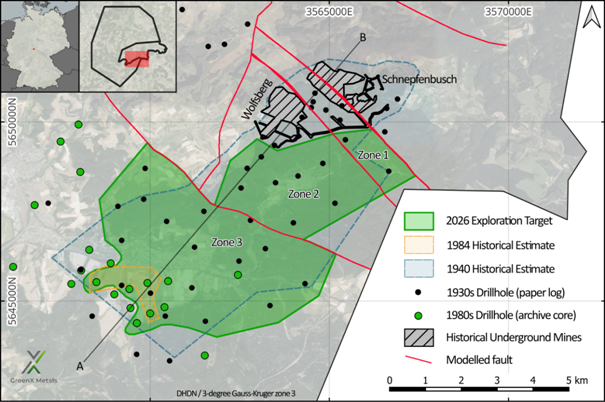
Figure 2: Outline of the Exploration Target and its relationship to previous historical estimates and historical underground mining operations at Tannenberg
Mineralogy Study Confirms Tannenberg Consistent with Polish Kupferschiefer Mines
During the year, GreenX completed an early-stage mineralogy and processing study for Tannenberg (refer to announcement dated 17 June 2026). The mineralogy study was completed by SGS Canada Inc. at its Lakefield Ontario facility (SGS Lakefield). It was followed by an independent metallurgical review undertaken by MSA Mining Consulting UK Ltd (MSA-UK) through Principal Associate Metallurgist, Mr Gordon Cunningham. The review has benchmarked Tannenberg against operating and development Kupferschiefer mines in Poland, confirming that copper mineralisation at Tannenberg is consistent with copper-silver deposits in the region and is considered amenable to conventional flotation-based processing methods.
Typical Processing Methods - Kupferschiefer Operations (KGHM and Lumina Metals Analogues)
The sediment-hosted (Kupferschiefer) copper-silver deposits in Poland provide a well-established processing analogue for GreenX's Tannenberg Project, with both long-running operations at KGHM and a recent Preliminary Economic Assessment (PEA) for Lumina Metals' Nowa Sól Project applying similar flotation-based processing routes with selective regrinding.
At KGHM's operations, approximately 30 Mtpa of ore is treated from the Kupferschiefer sequence at an average feed grade of around 1.6% copper and 45 g/t silver. The plant processes a blended feed comprising Kupferschiefer shale, sandstone and carbonate-hosted mineralisation. Processing is based on a conventional sulphide flotation flowsheet, starting with crushing followed by two-stage grinding (rod-ball or ball-ball milling) to a primary grind size of approximately 75 μm (Source: KGHM, Micon, 2013 (see Appendix 4)).
Following grinding, the slurry is treated through flotation circuits consisting of two stages of rougher flotation. The rougher concentrate is then reground to a much finer size, typically less than 20 μm, before passing through multi-stage cleaning circuits. This combination of initial grinding and subsequent fine regrinding is critical to liberate the fine-grained copper sulphide minerals characteristic of Kupferschiefer deposits. The process produces a copper concentrate grading approximately 23% Cu and containing significant silver, with typical metallurgical performance of around 89% copper recovery and 86% silver recovery. The final concentrate is then transported to smelting and refining facilities, where copper metal is produced and silver and other by-products are recovered.
The PEA stage Nowa Sól Cu-Ag Project, owned by Lumina Metals and located within the same Kupferschiefer belt as both Tannenberg and the KGHM mines, provides a modern comparison and follows a similar processing philosophy (Source: Lumina Metals, Micon, 2026 (see Appendix 4)). The proposed flowsheet incorporates semi-autogenous grinding (SAG) with ball milling and pebble crushing, targeting a primary grind size of approximately 60 μm, followed by flotation processing. As with KGHM, the flotation circuit includes two stages of rougher flotation, with the rougher concentrate subjected to fine regrinding (to approximately 11 μm) and multiple cleaning stages to improve concentrate grade and recovery.
The Nowa Sól flowsheet is designed to produce a copper concentrate grading greater than 26% Cu, with strong silver credits (in excess of 1,200 g/t Ag), and expected recoveries of more than 88% for copper and approximately 86% for silver. The final concentrate is planned to be thickened and filtered prior to sale.
Together, these operating and development analogues demonstrate that Kupferschiefer mineralisation can be successfully processed using conventional flotation circuits that incorporate fine grinding, concentrate regrinding and multi-stage cleaning. They also highlight the importance of achieving sufficient liberation of fine-grained copper minerals, a key factor in maximising recovery and concentrate quality in this style of deposit. In the cases of both KGHM and Lumina, there remains a strong opportunity to refine and optimise the flowsheets. In KGHM's case, the plant was built many decades ago, and the Lumina flowsheet used a limited amount of sample material.
Comparison of Tannenberg Copper-Silver Mineralisation with Polish Analogues
The new mineralogical work was completed by SGS Lakefield on ten selected historical drill core samples distributed throughout the mineralised area. The analysis covered three types of mineralisation, including shale, sandstone and carbonate, and provided confirmation of the deportment of the Tannenberg mineralisation, allowing for an important comparison to the Polish deposits. The study utilised TESCAN Integrated Mineral Analyzer (TIMA) and Scanning Electron Microscopy (SEM) techniques to characterise mineral composition, grain size and liberation behaviour.
The results indicate that copper mineralisation is dominated by chalcocite, with additional contributions from bornite, chalcopyrite and covellite, together with minor pyrite, galena and sphalerite. Copper occurs across Kupferschiefer shale, sandstone and carbonate lithologies, with the shale generally hosting the highest grades.
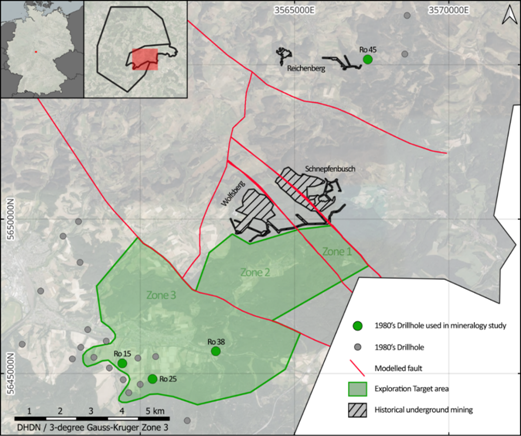
Figure 3: Map showing location of drill holes, indicating those used in the mineralogy study.
A key outcome of the study is the identification of a distinctly bi-modal grain size distribution of copper sulphides, with both coarse particles (>25 to 30 µm) and very fine disseminated material (<5 to 10 µm) present within the host rocks. This fine-grained component is pervasive, with all analysed sections containing copper mineralisation below 5 µm. The presence of this bi-modal distribution is considered a critical factor influencing comminution requirements, flotation performance and overall metallurgical recovery.
When compared to Polish Kupferschiefer operations and development projects, the Tannenberg mineralisation shows strong similarities in grain-size distribution. The presence of fine and disseminated sulphide mineralisation is consistent with observations from these analogue deposits, where fine grinding and regrinding are required to achieve adequate liberation.
Based on these similarities, conventional flotation processing is considered an appropriate baseline metallurgical approach for Tannenberg. The Polish analogues demonstrate that crushing, primary grinding, flotation, concentrate regrinding and multi-stage cleaning can achieve strong recoveries of copper and silver from Kupferschiefer ores.
As with all such operations, the bi-modal grain size distribution identified at Tannenberg suggests that particular attention will need to be given to comminution strategy, including the potential requirement for finer grinding to effectively liberate ultra-fine copper minerals.
The mineralogical data also indicates the presence of organic carbon and minor deleterious elements, which may report to concentrate and influence product quality. As a result, future metallurgical testwork will evaluate additional processing steps, such as carbon pre-flotation or specialised reagent schemes, to optimise concentrate grade and marketability.
Based on the mineralogy report, it has been concluded that the Tannenberg mineralisation is materially similar to Polish analogue ores and that the Tannenberg mineralisation is potentially well suited to a flotation-based processing flowsheet and that, subject to further test work, metallurgical recoveries are comparable to, or potentially better than the ~89% Cu and ~86% Ag recoveries reported from Polish mines may be achievable at Tannenberg. Further, the Tannenberg project may potentially produce a copper-silver concentrate of a type that could have strong market acceptance.
Recent Developments in Copper Processing Technologies
While Kupferschiefer deposits in Poland have been processed for decades using conventional flotation circuits, more recent technological developments offer opportunities to enhance metallurgical performance.
Advances in comminution technologies, such as high-pressure grinding rolls, can improve the liberation of fine-grained copper minerals by breaking ore along natural grain boundaries. This is particularly important for Kupferschiefer mineralisation, where a significant portion of copper occurs in very fine particles.
In addition, modern flotation technologies and specialised fine-particle recovery systems can improve recovery of ultra-fine sulphide minerals, while advanced reagent schemes and pre-treatment steps, such as carbon pre-flotation, may further enhance concentrate grade.
These developments indicate that modern flowsheets have the potential to achieve improved copper and silver recoveries compared to historic operations, particularly for fine-grained Kupferschiefer ores.
This initial mineralogical assessment at Tannenberg also highlights the importance of detailed metallurgical testwork to optimise grind size, concentrate quality and recovery for the Project. The shallow depth of the Tannenberg project, with the existence of spoil heaps and potentially accessible old workings will facilitate metallurgical test work being conducted during early project study phases.
Ongoing Exploration Work Programs at Tannenberg
GreenX continues to advance a coordinated suite of exploration activities at the Project, which test the validity of the Exploration Target identified at Tannenberg and includes:
· Ongoing monitoring and risk assessment with specialist German consultancy for potential to access historical underground mines for scoping study-level metallurgical test work, chip sampling, as well as mapping and surveying for 3D modelling - 2H 2026;
· Collation and digitisation of historical geological, mine development, and production data - ongoing;
· Analysis of the use of seismic surveys to aid future drilling campaigns including collecting petrophysical measurements for seismic forward modelling - Q2 2026;
· Seismic survey, if appropriate - commencement H2 2026; and
· Initial drill program - commencement in the coming months.
Eleonore North Project
Eleonore North is located in East Greenland on Ymer Island, where four licences covering have been granted that are prospective for gold, antimony, copper and tungsten (Eleonore North or ELN). The project comprises licence MEL 2023-39, which hosts the Noa Prospect targeting a potentially large-scale bulk tonnage gold/antimony system with the potential to host a RIRGS; and MEL 2018-19, which hosts the Margeries Prospects, where high-grade tungsten and antimony mineralisation has been identified as historical estimates.
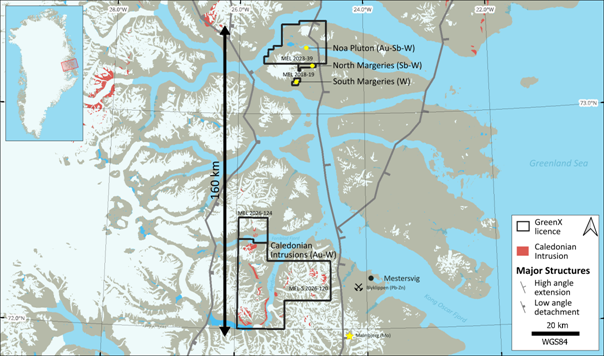
Figure 4: GreenX's Eleonore North Project now comprises a portfolio of four exploration licences in East Greenland.
2026 Fieldwork Complete
Subsequent to the year, GreenX announced that fieldwork had commenced at Eleonore North. The exploration programme is targeting gold (Au), tungsten (W), and antimony (Sb).
Fieldwork at Eleonore North this year covers multiple objectives. At Noa Pluton, a Reduced Intrusion-related Gold System (RIRGS) specialist will conduct mapping and sampling to evaluate the intrusion-related gold potential and identify potential drill targets. At both North (Sb-W) and South Margeries (W), the team will collect 50 kg to 100 kg bulk samples of mineralised material for scoping study level sighter test work. Recent hyperspectral analysis and prospectivity mapping have also highlighted alteration anomalies along strike and adjacent to both deposits (refer to announcement dated 14 May 2026). These untested hyperspectral anomalies have the potential to be satellite discoveries.
The field team has also visited newly generated RIRGS targets in the broader region for reconnaissance style prospecting.
|
|
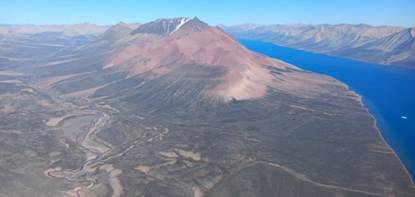
Photo 1: Helicopter view of southern Ymer Island en route to Eleonore North.
|
|
|
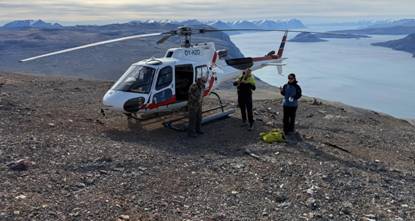
Photo 2: Field team at South Margeries (W). |
New High Priority Tungsten and Antimony Targets Identified to be used in the field
During the year, GreenX announced that the reprocessing of a historical airborne hyperspectral survey has identified multiple new high-priority tungsten, antimony, and gold targets at Eleonore North. The new targets sit along strike and adjacent to the existing high-grade tungsten and antimony historical estimates identified at North and South Margeries, providing the Company with potential walk-up surface targets to test during the ongoing field season.
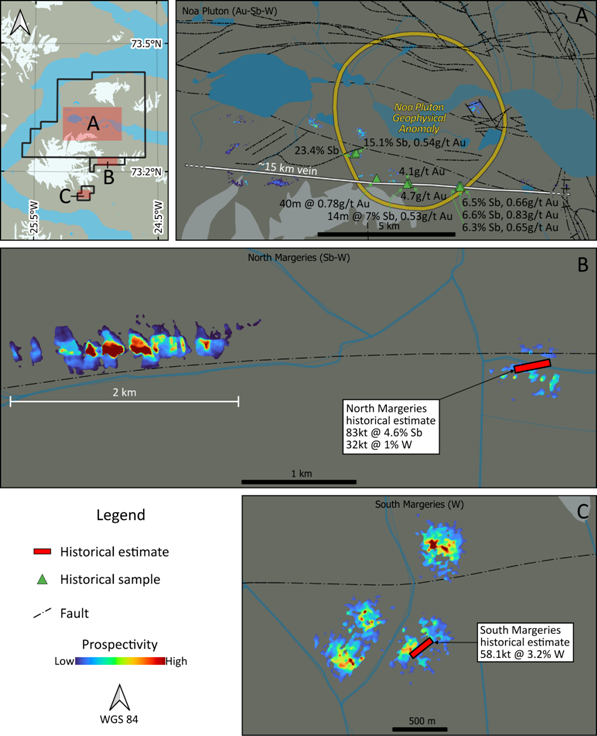
Figure 5: Prospectivity analysis by TheiaX highlights new areas for investigation around Noa Pluton, and North and South Margeries Prospects
Cautionary statement: The historical estimates in this announcement are not reported in accordance with the JORC Code. A competent person has not done sufficient work to classify the historical estimate as a mineral resource or ore reserve in accordance with the JORC Code. It is uncertain that following evaluation and/or further exploration work that the historical estimate will be able to be reported as a mineral resource or ore reserve in accordance with the JORC Code.
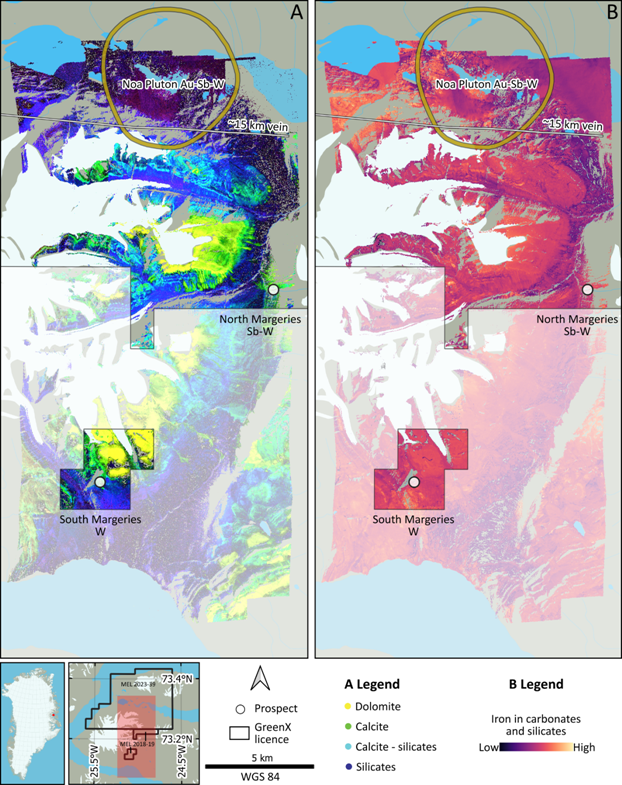
Figure 6: Location of the airborne hyperspectral survey with examples of spectral data products. A: False colour composite illustrating the dominant distribution of four mineral groups. B: Relative abundance of iron in carbonates and silicates.
Survey Background and Processing
Flown in 2000, the airborne hyperspectral survey was part of "Project HyperGreen". The Geological Survey of Denmark and Greenland (GEUS) commissioned the project, which was financed by Greenland's Bureau of Minerals and Petroleum. Data acquisition was contracted to HyVista Corporation (Australia), which used a HyMap system mounted in a Dornier 228 aircraft. Six flight lines covering 186 line-km produced a survey area with dimensions of approximately 12 km x 25 km. The survey produced a pixel size of 5 m, making it high resolution compared to typical satellite surveys, which range from 15 m to 30 m.
Raw data from the survey has been stored by GEUS and was recently made available to GreenX. Data processing was completed by TheiaX GmbH (TheiaX) in Germany. Processing involved converting the raw data from radiance to reflectance values, orthorectification, mosaicking, spectral index calculations and culminated in a prospectivity analysis.
Results and Prospectivity Analysis
The prospectivity analysis identified surface anomalies that share spectral patterns observed at the known historical estimate occurrences at North and South Margeries. These prospective areas represent surface anomalies that have the potential to be walk-up discoveries.
At North Margeries (Figure 6B), a 2 km-long prospectivity anomaly sits 3 km west of the historical estimate and adjacent to a large east-west fault structure.
At South Margeries (Figure 6C), multiple prospectivity anomalies surround the Historical Estimate and likely sit in faults that do not appear in the 1:500,000 scale geological maps.
The anomalies were identified by recognising patterns in spectral indexes proximal to the known mineral occurrences, then applying those patterns across the broader licence area. Various spectral index maps were produced during processing. False colour composites can illustrate the dominant distribution of mineral groups. Two band indexes can separately illustrate the relative abundance of a mineral group or their compositional variation, e.g., abundance of iron ± magnesium silicates or compositional variation of those silicates from iron-rich to magnesium-rich end members. Various one band index maps were produced to show relative abundance, e.g., iron in carbonates and silicates.
Upcoming Work Programs
With the ground fieldwork at ELN currently complete, upcoming results and work includes the following:
· Collection of samples for multielement analysis;
· Collect bulk sample material for both tungsten and antimony metallurgical sighter test work;
· Field mapping and sampling to ground-truth RIRGS targets and identify drill targets;
· Reprocessing of historic geophysics/hyperspectral data and field mapping to identify drill targets; and
· RIRGS specialist to evaluate the prospect for future field season drill targets.
Arctic Rift Copper Project (ARC) And Joint Venture
Given the prospectivity and focus on Tannenberg in Germany and at Eleonore North, and following a review of its portfolio of projects and the most efficient and effective use of the Company's resources, GreenX has agreed to wind up the ARC joint venture and as a result it has fully impaired the exploration and evaluation asset. The Company is currently in the process of relinquishing the ARC exploration licence held in Greenland and winding up the joint venture entity which is now expected to be completed in the second half of 2026.
Singapore Court Dismissed Poland's Set Aside Application
During the period, the Singapore International Commercial Court of the Republic of Singapore (Singapore Court) rejected, in its entirety, Poland's application to set aside the Energy Charter Treaty (ECT) award, thereby upholding GreenX's previously announced right to compensation under the ECT.
In October 2024, GreenX was awarded approximately £252 million (A$480 million / PLN 1.3 billion) in compensation and interest in the Australia-Poland Bilateral Investment Treaty (BIT) award after a Tribunal had unanimously held that Poland breached its obligations under the BIT and ECT.
At the time of the award, approximately £183 million (A$350 million / PLN 930 million) was awarded pursuant to the ECT (with payments under one award offset against the other).
Interest of approximately £12 million (A$26 million / PLN 71 million) per annum is currently continuing to accrue and will continue to compound annually until full and final payment is made by Poland.
In 2025, Poland lodged a request to set-aside the ECT award in the Singapore Court (having also lodged a request to set-aside the BIT award in the courts of England and Wales in late 2024). The hearing for the ECT set-aside was held in the Singapore Court in July 2025.
Subsequently, the Singapore Court issued a judgment rejecting, in its entirety, Poland's application to set aside the ECT award.
A redacted judgment has been released by the Singapore Court and the Company has brought the judgment to the attention of the English courts as part of the BIT set-aside proceedings which is being heard in October 2026. Under the English Arbitration Act 1996, the threshold to succeed on a set-aside application in the courts of England and Wales is exceptionally high, and courts typically reject these challenges unless there has been a serious procedural irregularity.
In February 2026, GreenX submitted a request to the Singapore Court to order Poland to reimburse it for its costs claimed in defending its rights in the set-aside proceedings, which amounted to A$1.6 million.
Following this request, the Singapore Court issued an order requiring Poland to pay the A$1.6 million, which has now been paid in full.
Poland has applied to the Court of Appeal of the Republic of Singapore (Court of Appeal) to challenge the rejection of its ECT set-aside application. The appeal has now been heard by the Court of Appeal, with its decision pending. The Court of Appeal represents Poland's final level of appeal within the Singapore courts.
The threshold for successfully setting aside an arbitral award in either the Singapore or English courts is very high, and set-aside applications are rejected in the substantial majority of cases.
The Company will continue to defend its awards and update the market in line with its continuous disclosure requirements.
Results of Operations
The net loss of the Consolidated Entity for the year ended 30 June 2026 was $12,339,989 (2025: $6,022,365). Significant items contributing to the current year loss and the substantial differences from the previous financial year include:
(i) Arbitration related expenses of $3,288,577 (2025: $3,077,540) relating to the ongoing claim against the Republic of Poland including set-aside defence costs (which are currently unfunded). This has been offset by the arbitration funding income of nil (2025: $251,593). However, during the year $1,591,586 (2025:nil) of arbitration costs incurred in relation to defending its rights in the ECT set-aside proceedings were recouped;
(ii) Exploration and Evaluation expenses of $2,243,082 (2025: $723,481), which is attributable to the Group's accounting policy of expensing exploration and evaluation expenditure incurred by the Group subsequent to the acquisition of rights to explore and up to the commencement of a bankable feasibility study for each separate area of interest;
(iii) Non-cash share-based payment expense of $1,373,037 (2025: $136,955) due to incentive securities issued to key management personnel and other key employees and consultants of the Group as part of the long-term incentive plan to reward key management personnel and other key employees and consultants for the long-term performance of the Group;
(iv) Business development expenses of $583,232 (2025: $416,338) which includes expenses relating to the Group's review of new business and project opportunities; including business development costs for the Tannenberg acquisition, plus also investor relations activities during the year including public relations, digital marketing, and business development consultant costs;
(v) Exploration and evaluation asset impairment of $4,415,000 (2025: nil), relating to the impairment of the exploration and evaluation asset previously recognised in relation to the ARC project as a result of the Company agreeing to wind up the ARC joint venture and relinquish the exploration licence in Greenland; and
(vi) Interest income of $308,459 (2025: $244,867) earned on cash and cash equivalents held by the Group.
Financial Position
At 30 June 2026, the Company had cash reserves of $13,417,445 (2025: $6,826,337) placing it in a good financial position to strongly defend the set-aside motions and continue with exploration activities at its projects.
At 30 June 2026, the Company had net assets of $18,076,853 (2025: $14,322,747) an increase of 21% compared with the previous year. This is largely attributable to the increase in cash and cash equivalents following completion of the A$13.6 million placement conducted during the year. This increase has been offset by the decrease in exploration and evaluation assets following the impairment of ARC and the ongoing expenditure in relation to operations.
Select Financial Data (AUD Converted into PLN and EUR)
For purposes of its listing on the Warsaw Stock Exchange, the Company provides select financial data in relation to the year ended 30 June 2026.
|
|
Year Ended |
Year Ended |
Year Ended |
Year Ended |
|
|
|
|
|
|
|
Arbitration finance facility income |
- |
635,110 |
- |
149,118 |
|
Recoupment of arbitration costs |
3,949,241 |
- |
928,600 |
- |
|
Exploration and evaluation expenses |
(5,447,509) |
(1,826,319) |
(1,280,893) |
(428,803) |
|
Arbitration related expenses |
(8,160,029) |
(7,768,790) |
(1,918,698) |
(1,824,041) |
|
Net loss for the period |
(30,283,919) |
(15,183,675) |
(7,120,769) |
(3,564,989) |
|
Net cash flows from operating activities |
(15,498,335) |
(7,633,903) |
(3,644,180) |
(1,792,371) |
|
Net cash flows from investing activities |
(1,746,441) |
(6,422,286) |
(410,647) |
(1,507,894) |
|
Net cash flows from financing activities |
33,599,460 |
11,192,242 |
7,900,364 |
2,627,837 |
|
Net increase/(decrease) in cash and cash equivalents |
16,354,684 |
(2,863,9470 |
3,845,537 |
(672,429) |
|
Basic and diluted loss per share (Grosz/EUR cents per share) |
(10.17) |
(5.41) |
(2.39) |
(1.27) |
|
|
30 June 2026 |
30 June 2025 |
30 June 2026 |
30 June 2025 |
|
|
|
|
|
|
|
Cash and cash equivalents |
34,816,927 |
16,141,555 |
8,103,933 |
3,805,265 |
|
Total Assets |
56,717,340 |
43,238,938 |
13,201,438 |
10,193,295 |
|
Total Liabilities |
9,809,717 |
9,371,373 |
2,283,294 |
2,209,239 |
|
Net Assets |
46,907,626 |
33,867,566 |
10,918,145 |
7,984,056 |
|
Contributed equity |
295,720,132 |
225,081,124 |
68,831,351 |
53,061,393 |
In compliance with Polish reporting requirements, figures of the consolidated statement of profit or loss and other comprehensive income and consolidated statement of cash flows have been converted into PLN and EUR (from the Group's presentation currency) by applying the arithmetic average for the final day of each month for the reporting period, as published by the National Bank of Poland (NBP). These exchange rates were 2.4813 AUD:PLN and 4.2529 PLN:EUR for the twelve months ended 30 June 2026, and 2.5244 AUD:PLN and 4.2591 PLN:EUR for the twelve months ended 30 June 2025.
Assets and liabilities in the consolidated statement of financial position have been converted into PLN and EUR by applying the exchange rate on the final day of each respective reporting period as published by the NBP. These exchange rates were: 2.5949 AUD:PLN and 4.2963 PLN:EUR on 30 June 2026, and 2.3646 AUD:PLN and 4.2419 PLN:EUR on 30 June 2025.
Business Strategies and Prospects for Future Financial Years
GreenX's strategy is to create long-term shareholder value through the discovery, exploration, development and acquisition of technically and economically viable mineral deposits. This also includes defending the set-aside motions relating to the Claim, and subsequently enforcing the Award against Poland in the short to medium term.
To date, the Group has not commenced production of any minerals, nor has it identified any Ore reserves in accordance with the JORC Code. To achieve its objective, the Group currently has the following business strategies and prospects over the medium to long term:
· Continue to strongly defend the set-aside motions and prepare to enforce the ECT Award against Poland;
· Continue ongoing exploration programs at Tannenberg including commencing an initial drill program to verify historical estimates and underpin a Mineral Resource;
· Continue with exploration activities at Eleonore North in Greenland following the receipt of results from it July field program; and
· Identify and assess other suitable business opportunities in the resources sector.
All of these activities are inherently risky and the Board is unable to provide certainty of the expected results of these activities, or that any or all of these likely activities will be achieved. Furthermore, GreenX will continue to take all necessary actions to preserve the Company's rights and defend its BIT and ECT awards made against Poland. The material business risks faced by the Group that could have an effect on the Group's future prospects, and how the Group manages these risks, include the following:
· Litigation risk - All industries, including the mining industry, are subject to legal and arbitration claims. Specifically, and as noted above, the Company was successful in its arbitration claim against Poland and has been awarded £252 million in compensation (plus ongoing interest) for breach of Poland's obligations under the BIT and ECT treaties. Subsequently, in November 2024, Poland lodged a request to set-aside the BIT award in the courts of England and Wales and in January 2025 Poland lodged it's request to set-aside the ECT award in the Singapore Courts. In January 2026, the Singapore Court issued a judgment whereby it rejected, in its entirety, Poland's application to set aside the ECT award. Poland has since applied to the Court of Appeal of the Republic of Singapore to appeal the Singapore Courts dismissal of its ECT set-aside motion (refer to announcement dated 12 January 2026). If Poland's set-aside motions and appeals are not rejected, and the original award is not upheld or the damages amount is altered compared to original amount awarded, then this may have a material impact on the value of the Company's securities.
· Operations in overseas jurisdictions risk - The Company's exploration projects are located overseas, in Germany and Greenland, and as such, the operations of the Company will be exposed to related risks and uncertainties associated with overseas country, and with regional and local jurisdictions. Opposition to the projects, or changes in local community support for the projects, along with any changes in mining or investment policies or in political attitude in Germany or Greenland and, in particular to the mining, processing or use of copper or gold, may adversely affect the operations, delay or impact the approval process or conditions imposed, increase exploration and development costs, or reduce profitability of the Company. Moreover, logistical difficulties may arise due to the assets being located overseas such as the incurring of additional costs with respect to overseeing and managing the projects, including expenses associated with taking advice in relation to the application of local laws as well as the cost of establishing a local presence in Greenland. Fluctuations in the currency of Germany or Greenland may also affect the dealings and operations of the Company.
Failure to comply strictly with applicable laws, regulations and local practices relating to mineral rights applications and tenure, could result in loss, reduction or expropriation of entitlements, or the imposition of additional local or foreign parties as joint venture partners with carried or other interests. Further, the outcomes in courts in Germany or Greenland may be less predictable than in Australia, which could affect the enforceability of contracts entered into by the Company.
Eleonore North is remotely located in an area that has an arctic climate and that is categorised as an arctic desert, and as such, the operations of the Company will be exposed to related risks and uncertainties of arctic exploration, including adverse weather or ice conditions which may and has prevented access to the project, which can impact exploration and field activities or generate unexpected costs. It is not possible for the Company to predict or protect the Company against all such risks.
The Company also had previous operations in Poland which may be subject to regulations concerning protection of the environment, including at the Debiensko and Kaczyce projects which have both been relinquished by the Company. As with all exploration projects and mining operations, activities will have an impact on the environment including the possible requirement to make good any disturbed or damaged land.
Existing and possible future environmental protection legislation, regulations and actions could cause additional expense, capital expenditures and restrictions, the extent of which cannot be predicted which could have a material adverse effect on the Company's business, financial condition and results of operations.
· Joint venture contractual risk - The Company's Tannenberg project is subject to a joint venture agreement with Group 11. The Company's ability to achieve its objectives may be dependent on it and the joint venture party complying with their obligations under the joint venture agreement. Any failure to comply with these obligations may result in the Company being unable to achieve its commercial objectives, which may have a material adverse effect on the Company's operations and the performance and value of its shares. There is also the risk of disputes arising with the Company's joint venture partner, the resolution of which could lead to delays in the Company's proposed development activities or financial loss. The nature of the joint venture may change in future, including the ownership structure and voting rights, which may have an effect on the ability of the Company to influence decisions at Tannenberg. The operations of the Company require the involvement of a number of third parties, in addition Group 11, including consultants, contractors and suppliers. Financial failure, default or contractual non-compliance on the part of such third parties may have a material impact on the Company's operations and performance. It is not possible for the Company to predict or protect the Company against all such risks.
· The Group's exploration and development activities will require further capital - The exploration and any development of the Company's exploration properties will require substantial additional financing. Failure to obtain sufficient financing may result in delaying or indefinite postponement of exploration and any development of the Company's properties or even a loss of property interest. There can be no assurance that additional capital or other types of financing will be available if needed or that, if available, the terms of such financing will be favourable to the Company.
· The Group's exploration properties may never be brought into production - The exploration for, and development of, mineral deposits involves a high degree of risk. Few properties which are explored are ultimately developed into producing mines. To mitigate this risk, the Company will undertake systematic and staged exploration and testing programs on its mineral properties and, subject to the results of these exploration programs, the Company will then progressively undertake a number of technical and economic studies with respect to its projects prior to making a decision to mine. However, there can be no guarantee that the studies will confirm the technical and economic viability of the Company's mineral properties or that the properties will be successfully brought into production.
· The Group may be adversely affected by fluctuations in commodity prices - The price of commodities (in the case of the Company - gold, copper, tungsten and antimony) fluctuates widely and is affected by numerous factors beyond the control of the Group. Future production, if any, from the Group's mineral properties will be dependent upon commodity prices being adequate to make these properties economic. The Group currently does not engage in any hedging or derivative transactions to manage commodity price risk. As the Group's operations change, this policy will be reviewed periodically going forward.
· The Group may be adversely affected by competition within the resources industry - The Group competes with other domestic and international exploration and development companies, some of whom have larger financial and operating resources. Increased competition could lead to higher supply or lower overall pricing. There can be no assurance that the Company will not be materially impacted by increased competition. In addition, the Group is continuing to secure additional surface and mineral rights, however there can be no guarantee that the Group will secure additional surface and mineral rights, which could impact on the results of the Group's operations.
· The Company may be adversely affected by fluctuations in foreign exchange - Current and planned activities are predominantly denominated in Sterling, Euros and/or Danish krone and the Company's ability to fund these activates may be adversely affected if the Australian dollar continues to fall against these currencies. The Company currently does not engage in any hedging or derivative transactions to manage foreign exchange risk. As the Company's operations change, this policy will be reviewed periodically going forward.
DIRECTORS
The names and details of the Group's Directors in office at any time during the financial year or since the end of the financial year are:
Current Directors:
Mr Ian Middlemas Chairman
Mr Benjamin Stoikovich Director and CEO
Mr Garry Hemming Non-Executive Director
Mr Mark Pearce Non-Executive Director
Unless otherwise stated, Directors held their office from 1 July 2025 until the date of this report.
CURRENT DIRECTORS AND OFFICERS
Mr Ian Middlemas B.Com, CA
Chairman
Mr Middlemas is a Chartered Accountant who also holds a Bachelor of Commerce degree. He worked for a large international Chartered Accounting firm before joining the Normandy Mining Group where he was a senior group executive for approximately 10 years. He has had extensive corporate and management experience, and is currently a Director with a number of publicly listed companies in the resources sector.
Mr Middlemas was appointed a Director of the Company on 25 August 2011. During the three year period to the end of the financial year, Mr Middlemas has held directorships in GBM Resources Limited (June 2025 - present), NGX Limited (April 2021 - present), Constellation Resources Limited (November 2017 - present), Apollo Minerals Limited (July 2016 - present), Berkeley Energia Limited (April 2012 - present), Salt Lake Potash Limited (Receivers Appointed) (January 2010 - present), Equatorial Resources Limited (November 2009 - present), Sovereign Metals Limited (July 2006 - present), Odyssey Gold Limited (September 2005 - present) and Terra Metals Limited (October 2013 - June 2026).
Mr Benjamin Stoikovich B.Eng, M.Eng, M.Sc, CEng, CEnv
Director and CEO
Mr Stoikovich is a mining engineer and professional corporate finance executive. He has extensive experience in the resources sector gained initially as an underground Longwall Coal Mining Engineer with BHP Billiton where he was responsible for underground longwall mine operations and permitting, and more recently as a senior executive within the investment banking sector in London where he gained experience in mergers and acquisitions, debt and off take financing.
He has a Bachelor of Mining Engineering degree from the University of NSW; a Master of Environmental Engineering from the University of Wollongong; and a M.Sc in Mineral Economics from Curtin University. Mr Stoikovich also holds a 1st Class Coal Mine Managers Ticket from the Coal Mine Qualifications Board (NSW, Australia) and is a registered Chartered Engineer (CEng) and Chartered Environmentalist (CEnv) in the United Kingdom. Mr Stoikovich was appointed a Director of the Company on 17 June 2013. During the three year period to the end of the financial year, Mr Stoikovich held a directorship in Sovereign Metals Limited (October 2020 - present).
Mr Garry Hemming BAppSc(AppGeol), MAusIMM, FGS
Non-Executive Director
Audit Committee (Member)
Mr Hemming has been involved in all aspects of discovering projects and taking them from detailed exploration and through feasibility study. Mr Hemming has lead teams that have discovered, acquired and/or developed ore-bodies including the Yilgarn Star Gold deposit in Western Australia, Hadleigh Castle/Rishton in Queensland and the Acoje Nickel PGE deposit in the Philippines.
Mr Hemming was appointed a Director of the Company on 6 October 2021. Mr Hemming has not been a Director of another listed company in the three years prior to the end of the financial year.
Mr Mark Pearce B.Bus, CA, FCIS, FFin
Non-Executive Director
Audit Committee (Chair)
Mr Pearce is a Chartered Accountant and is currently a Director of several listed companies that operate in the resources sector. He has had considerable experience in the formation and development of listed resource companies. Mr Pearce is also a Fellow of the Institute of Chartered Secretaries and Administrators and a Fellow of the Financial Services Institute of Australasia.
Mr Pearce was appointed a Director of the Company on 25 August 2011. During the three year period to the end of the financial year, Mr Pearce has held directorships in Zinc of Ireland Limited (April 2026 - present), NGX Limited (April 2021 - present), Constellation Resources Limited (July 2016 - present), Equatorial Resources Limited (November 2009 - present), Sovereign Metals Limited (July 2006 - present) and Terra Metals Limited ((Alternate Director) (June 2022 - January 2026).
Mr Dylan Browne B.Com, CA, AGIA
Company Secretary
Mr Browne is a Chartered Accountant and Associate Member of the Governance Institute of Australia (Chartered Secretary) who is currently Company Secretary for a number of ASX and European listed companies that operate in the resources sector. He commenced his career at a large international accounting firm and has since been involved with a number of exploration and development companies operating in the resources sector, based in London and Perth, including Sovereign Metals Limited, Berkeley Energia Limited and Papillon Resources Limited. Mr Browne successfully listed GreenX on the Main Board of the London Stock Exchange and the Warsaw Stock Exchange in 2015 and also oversaw Berkeley's listings on the Main Board LSE and the Spanish Stock Exchanges in 2018. Mr Browne was appointed Company Secretary of the Company on 25 October 2012.
PRINCIPAL ACTIVITIES
The principal activities of the Group during the financial year consisted of the exploration and evaluation of its exploration projects and the defence of its Award made against Poland.
EARNINGS PER SHARE
|
|
2026 |
2025 |
|
Basic and diluted loss per share |
(4.10) |
(2.14) |
ENVIRONMENTAL REGULATION AND PERFORMANCE
The Group's operations are subject to various environmental laws and regulations under the relevant government's legislation. Full compliance with these laws and regulations is regarded as a minimum standard for all operations to achieve.
Instances of environmental non-compliance by an operation are identified either by external compliance audits or inspections by relevant government authorities.
There have been no significant known breaches by the Group during the financial year.
DIVIDENDS
No dividends were paid or declared since the start of the financial year. No recommendation for payment of dividends has been made (2025: nil).
SIGNIFICANT CHANGES IN THE STATE OF AFFAIRS
There were no significant changes in the state of affairs of the Group during the year other than the following:
(i) On 20 October 2025, the Company announced an Historical Estimate at Tannenberg, which reinforced the potential for a large-scale and high-grade brownfield copper project at Tannenberg;
(ii) On 12 December 2025, the Company announced, following the exercise of its option, to acquire 90% of Group 11, the holder of the Tannenberg Project;
(iii) On 12 January 2026, GreenX advised that the Singapore Court issued a judgment whereby it rejected, in its entirety, Poland's application to set aside the ECT award. Poland subsequently appealed the Singapore Court's decision. That appeal was heard by the Singapore Court of Appeal in September 2026, following which Poland will have no further rights of appeal within the Singapore court system. The Company was also awarded A$1.6 million by the Singapore Court that was paid by Poland to reimburse the Company for legal costs associated defending Poland's failed ECT set-aside motion;
(iv) On 30 January 2026, the Company issued deferred consideration of $1 million GreenX shares to retain its 100% interest in Eleonore North;
(v) In February 2026, the Company completed a placement to raise gross proceeds of approximately $13.6 million from new and existing investors; and
(vi) On 28 May 2026, the Company announced an Exploration Target at the Tannenberg Copper Project, in Germany.
SIGNIFICANT EVENTS AFTER BALANCE DATE
On 4 August 2026, the Company announced the grant of two additional exploration licences at Eleonore North. The Company has secured exclusive rights to ~1,600 km2 of tenure prospective for RIRGS. These new licences complement the Company's existing licences located 100 km to the north.
There are no other matters or circumstances, which have arisen since 30 June 2026 that have significantly affected or may significantly affect:
· the operations, in financial years subsequent to 30 June 2026, of the Consolidated Entity;
· the results of those operations, in financial years subsequent to 30 June 2026, of the Consolidated Entity; or
· the state of affairs, in financial years subsequent to 30 June 2026, of the Consolidated Entity.
RELATED PARTY DISCLOSURE
Balances and transactions between the Company and its subsidiaries, which are related parties to the Company, have been eliminated on consolidation. There have been no other transactions with related parties during the period, other than remuneration for Key Management Personnel (KMP).
SUBSTANTIAL SHAREHOLDERS (shareholder with voting power of at least 5%)
Substantial Shareholder notices have been received by the following:
|
Substantial Shareholder |
Number of Shares/Votes |
Voting Power |
|
CD Capital Natural Resources Fund III LP |
50,487,925 |
18.10% |
ORDINARY SHARES HELD BY DIRECTORS'
|
|
At the Date of this Report |
30 June 2026 |
30 June 2025 |
|
Mr Ian Middlemas |
11,660,000 |
11,660,000 |
11,660,000 |
|
Mr Benjamin Stoikovich |
2,047,995 |
2,047,995 |
819,406 |
|
Mr Garry Hemming |
- |
- |
- |
|
Mr Mark Pearce |
2,943,113 |
2,943,113 |
2,700,000 |
DIRECTORS' INTERESTS
As at the date of this report, the Directors' interests in the securities of the Company are as follows:
|
Interest in securities at the date of this report |
||
|
|
Ordinary Shares1 |
Incentive Options2 |
|
Mr Ian Middlemas |
11,660,000 |
- |
|
Mr Benjamin Stoikovich |
2,047,995 |
5,400,000 |
|
Mr Garry Hemming |
- |
- |
|
Mr Mark Pearce |
2,943,113 |
1,800,000 |
Notes:
1 "Ordinary Shares" means fully paid Ordinary Shares in the capital of the Company.
2 "Incentive Options" means an unlisted option to subscribe for one Ordinary Share in the capital of the Company.
SHARE OPTIONS AND PERFORMANCE RIGHTS
At the date of this report the following unlisted securities have been issued over unissued Ordinary Shares of the Company:
· 4,025,000 Incentive Options exercisable at $0.55 each on or before 30 November 2026;
· 7,600,000 Incentive Options exercisable at $1.05 each on or before 31 May 2029;
· 7,600,000 Incentive Options exercisable at $1.20 each on or before 31 May 2030;
· 7,700,000 Incentive Options exercisable at $1.20 each on or before 31 May 2031;
· 5,000,000 Class A Performance Rights that have an expiry date 8 October 2026; and
· 6,000,000 Class B Performance Rights that have an expiry date 8 October 2026.
During the year ended 30 June 2026, 3,442,671 Ordinary Shares (2025: nil) have been issued as a result of the exercise of Incentive Options. Subsequent to year end and up until the date of this report, no Ordinary Shares have been issued as a result of the exercise/conversion of Incentive Options or Performance Rights.
INDEMNIFICATION AND INSURANCE OF OFFICERS AND AUDITORS
The Constitution of the Company requires the Company, to the extent permitted by law, to indemnify any person who is or has been a Director or officer of the Company or Group for any liability caused as such a Director or officer and any legal costs incurred by a Director or officer in defending an action for any liability caused as such a Director or officer.
During or since the end of the financial year, no amounts have been paid by the Company or Group in relation to the above indemnities.
During the financial year, an annualised insurance premium was paid to provide adequate insurance cover for directors and officers against any potential liability and the associated legal costs of a proceeding.
To the extent permitted by law, the Company has agreed to indemnify its auditors, UHY Haines Norton, as part of the terms of its audit engagement agreement against claims by third parties arising from the audit (for an unspecified amount). No payment has been made to indemnify UHY Haines Norton during or since the financial year.
REMUNERATION REPORT (AUDITED)
This Remuneration Report, which forms part of the Directors' Report, sets out information about the remuneration of KMP of the Group.
Details of KMP
Details of the KMP of the Group during or since the end of the financial year are set out below:
Current Directors
Mr Ian Middlemas Chairman
Mr Benjamin Stoikovich Director and CEO
Mr Garry Hemming Non-Executive Director
Mr Mark Pearce Non-Executive Director
Other KMP
Mr Simon Kersey Chief Financial Officer
Mr Dylan Browne Company Secretary
Unless otherwise disclosed, the KMP held their position from 1 July 2025 until the date of this report.
Remuneration Policy
The Group's remuneration policy for its KMP has been developed by the Board taking into account the size of the Group, the size of the management team for the Group, the nature and stage of development of the Group's current operations, and market conditions and comparable salary levels for companies of a similar size and operating in similar sectors. In addition to considering the above general factors, the Board has also placed emphasis on the following specific issues in determining the remuneration policy for KMP:
(a) the Group is currently focused on undertaking exploration, appraisal and development activities;
(b) risks associated with small cap resource companies whilst exploring and developing projects; and
(c) other than profit which may be generated from asset sales, the Company does not expect to be undertaking profitable operations until sometime after the commencement of commercial production on any of its projects.
Executive Remuneration
The Group's remuneration policy is to provide a fixed remuneration component and a performance-based component (short term incentive and long term incentive). The Board believes that this remuneration policy is appropriate given the considerations discussed in the section above and is appropriate in aligning executives' objectives with shareholder and business objectives.
Fixed Remuneration
Fixed remuneration consists of base salaries, as well as employer contributions to superannuation funds and other non-cash benefits. Non-cash benefits may include provision of car parking and health care benefits.
Fixed remuneration is reviewed annually by the Board. The process consists of a review of company and individual performance, relevant comparative remuneration externally and internally and, where appropriate, external advice on policies and practices.
Performance Based Remuneration - Short Term Incentive (STI)
Some executives are entitled to an annual cash incentive payment upon achieving various key performance indicators (KPI's), as set by the Board. Having regard to the current size, nature and opportunities of the Company, the Board has determined that these KPI's may include measures such as successful commencement and/or completion of exploration activities (e.g. commencement/completion of exploration programs within budgeted timeframes and costs), establishment of government relationship (e.g. establish and maintain sound working relationships with government and officialdom), development activities (e.g. completion of infrastructure studies and commercial agreements), corporate activities (e.g. recruitment of key personnel and representation of the company at international conferences) and business development activities (e.g. corporate transactions and capital raisings). On an annual basis, and subsequent to year end, the Board assesses performance against each individual executive's KPI criteria. During the 2026 financial year, a total cash incentive sum of nil (2025: NIL) was paid, or is payable, to KMP on achieving business development KPIs.
Performance Based Remuneration - Long Term Incentive
The Group has adopted a long-term equity incentive plan (LTIP) comprising the grant of Incentive Options and/or Performance Rights to reward KMP and key employees and contractors for long-term performance of the Company. Shareholders approved the LTIP on 22 November 2024.
To achieve its corporate objectives, the Group needs to attract, incentivise, and retain its key employees and contractors. The Board believes that grants of Incentive Options and/or Performance Rights to KMP will provide a useful tool to underpin the Group's employment and engagement strategy.
(i) Incentive Options
The Group's LTIP provides for the issuance of Incentive Options as part of KMP and key employees and contractors remuneration and incentive arrangements in order to attract and retain them and to provide an incentive linked to the performance of the Company.
The LTIP enables the Group to: (a) recruit, incentivise and retain KMP and other key employees and contractors needed to achieve the Group's business objectives; (b) link the reward of key staff with the achievement of strategic goals and the long-term performance of the Group; (c) align the financial interests of participants of the Plan with those of Shareholders; and (d) provide incentives to participants of the Plan to focus on superior performance that creates Shareholder value.
The Board's policy is to grant Incentive Options to KMP with exercise prices at or above market share price (at the time of agreement). As such, any Incentive Options granted to KMP are generally only of benefit if the KMP performed to the level whereby the value of the Group increased sufficiently to warrant exercising the Incentive Options granted.
Other than service-based vesting conditions (if any) and the exercise price required to exercise the Incentive Options, there are no additional performance criteria attached to any Incentive Options granted to KMP, as given the speculative nature of the Group's activities and the small management team responsible for its running, it is considered that the performance of the KMP and the performance and value of the Group are closely related.
The Company prohibits executives entering into arrangements to limit their exposure to Incentive Options and Performance Rights granted as part of their remuneration package.
During the financial year, 10,100,000 (2025: 13,600,000) Incentive Options were granted to KMP and key employees. 6,275,000 (2025: nil) Incentive Options were exercised by KMP and key employees during the financial year.
(ii) Performance Rights
The LTIP also enables the Group to issue unlisted Performance Rights which, upon satisfaction of the relevant performance conditions attached to the Performance Rights, will result in the issue of an Ordinary Share for each Performance Right. Performance Rights are issued for no consideration and no amount is payable upon conversion thereof.
Performance Rights granted under the LTIP to eligible participants will be linked to the achievement by the Company of certain performance conditions as determined by the Board from time to time. These performance conditions must be satisfied in order for the Performance Rights to vest. Upon Performance Rights vesting, Ordinary Shares are automatically issued for no consideration. If a performance condition of a Performance Right is not achieved by the expiry date then the Performance Right will lapse.
(iii) Management Incentive Program
In 2021 and following the Litigation Funding Agreement (LFA) with LCM being executed, the Company established a Management Incentive Program (MIP) which is a LTIP to retain key Company personnel who had important historical information and knowledge to contribute towards the Claim. The MIP provides that if the Claim is successful and the Company receives damages proceeds, 6% of these proceeds will be directed to the MIP for distribution to its participants. The MIP required that each participant must satisfy specific Claim related duties and if they do so, each participant may be entitled to a pre-defined percentage of the proceeds received by the MIP. In this regard, of the 6% of any future Claim monetary proceeds, Mr Stoikovich (or his nominee personal services entity) will be entitled to 30% of the MIP distribution (i.e. 30% of the 6% Claim proceeds), Mr Kersey (or his nominee personal services entity) will be entitled to 20% of the MIP distribution (i.e. 20% of the 6% Claim proceeds), Mr Pearce and Mr Browne will each be entitled to 7.5% of the MIP distribution (i.e. 7.5% of the 6% Claim proceeds). The remaining 35% of the MIP distribution has been allocated to other key staff who contributed to the Claim.
Non-Executive Director Remuneration
The Board's policy is for fees to Non-Executive Directors to be no greater than market rates for comparable companies for time, commitment and responsibilities. Given the current size, nature and risks of the Company, Incentive Options may also be used to attract and retain Non-Executive Directors. The Board determines payments to the Non-Executive Directors and reviews their remuneration annually, based on market practice, duties and accountability. Independent external advice is sought when required.
The maximum aggregate amount of fees that can be paid to Non-Executive Directors is subject to approval by shareholders at a General Meeting. Director's fees paid to Non-Executive Directors accrue on a daily basis. Fees for Non-Executive Directors are not linked to the performance of the economic entity. However, to align Directors' interests with shareholder interests, the Directors are encouraged to hold shares in the Company and given the current size, nature and opportunities of the Company, Non-Executive Directors may receive Incentive Options in order to secure and retain their services.
Fees for the Chairman were set at $36,000 per annum (2025: $36,000) (excluding post-employment benefits).
Fees for Non-Executive Directors' were set at $20,000 per annum (2025: $20,000) (excluding post-employment benefits). These fees cover main board activities only. Non-Executive Directors may receive additional remuneration for other services provided to the Company, including but not limited to, membership of committees.
During the 2026 financial year, no Incentive Options (2025: nil) were granted to Non-Executive Directors, other than to Mr Pearce who was granted 600,000 Incentive Options (2025: 1,200,000) that were subject to shareholder approval and issued on 14 July 2026.
The Company prohibits Non-Executive Directors entering into arrangements to limit their exposure to Incentive Options granted as part of their remuneration package.
Relationship between Remuneration of KMP and Shareholder Wealth
During the Company's exploration and development phases of its business, the Board anticipates that the Company will retain earnings (if any) and other cash resources for the exploration and development of its resource projects. Accordingly, the Company does not currently have a policy with respect to the payment of dividends and returns of capital. Therefore, there was no relationship between the Board's policy for determining, or in relation to, the nature and amount of remuneration of KMP and dividends paid and returns of capital by the Company during the current and previous four financial years.
The Board did not determine, and in relation to, the nature and amount of remuneration of the KMP by reference to changes in the price at which shares in the Company traded between the beginning and end of the current and the previous four financial years. Discretionary annual cash incentive payments are based upon achieving various non-financial key performance indicators as detailed under "Performance Based Remuneration - Short Term Incentive" and are not based on share price or earnings. However, as noted above, certain KMP may receive Incentive Options in the future which generally will be of greater value to KMP if the value of the Company's shares increases sufficiently to warrant exercising the Incentive Options.
Relationship between Remuneration of KMP and Earnings
As discussed above, the Company is currently undertaking exploration and development activities, and does not expect to be undertaking profitable operations (other than by way of material asset sales, none of which is currently planned) until sometime after the successful commercialisation, production and sales of commodities from one or more of its projects. Accordingly, the Board does not consider earnings during the current and previous four financial years when determining, and in relation to, the nature and amount of remuneration of KMP.
Remuneration of Directors and other KMP
Details of the nature and amount of each element of the remuneration of each Director and other KMP of GreenX Metals Limited are as follows:
|
|
|
Short-term benefits |
|
Non-Cash |
|
|
|
|
|
Cash Incentive Payments |
||||||
|
Current Directors |
|
|
|
|
|
|
|
|
Ian Middlemas |
2026 |
36,000 |
- |
4,320 |
- |
40,320 |
- |
|
|
2025 |
36,000 |
- |
4,140 |
- |
40,140 |
- |
|
Benjamin Stoikovich |
2026 |
493,109 |
- |
- |
218,460 |
711,569 |
30.7 |
|
|
2025 |
501,984 |
- |
- |
10,245 |
512,229 |
2.0 |
|
Garry Hemming1 |
2026 |
60,080 |
- |
- |
- |
60,080 |
- |
|
|
2025 |
60,080 |
- |
- |
- |
60,080 |
- |
|
Mark Pearce |
2026 |
20,000 |
- |
2,400 |
108,159 |
130,559 |
82.8 |
|
|
2025 |
20,000 |
- |
2,300 |
5,123 |
27,423 |
18.7 |
|
Other KMP |
|
|
|
|
|
|
|
|
Simon Kersey |
2026 |
315,225 |
- |
- |
102,412 |
417,637 |
24.5 |
|
|
2025 |
321,500 |
- |
- |
4,870 |
326,370 |
1.5 |
|
Dylan Browne2 |
2026 |
- |
- |
- |
103,204 |
103,204 |
100 |
|
|
2025 |
- |
- |
- |
4,870 |
4,870 |
100 |
|
Total |
2026 |
924,414 |
- |
6,720 |
532,235 |
1,463,369 |
|
|
|
2025 |
939,564 |
- |
6,440 |
25,108 |
971,112 |
|
Notes:
1 Mr Hemming also has a services agreement with the Company which provides for a consultancy fee for geological services provided by Mr Hemming.
2 Mr Browne provided services as the Company Secretary through a services agreement with Apollo Group Pty Ltd (Apollo Group) a company of which Mr Mark Pearce is a Director and beneficial shareholder Mr Browne is an employee of Apollo Group. During the year, Apollo Group was paid or is payable A$330,000 (2025: A$312,000) for the provision of administrative, secretarial and corporate services to the Group.
Incentive Options Granted to KMP
Details of the value of Incentive Options granted or lapsed for KMP of the Group during the year ended 30 June 2026 are as follows:
|
2026 |
No. of options granted |
No. of options vested |
No. of options lapsed |
Value of options lapsed |
No. of options exercised |
Value of options exercised1 $ |
Value of options granted during the year2 |
Value of options included in remuneration for the year |
|
Directors |
|
|
|
|
|
|
|
|
|
Benjamin Stoikovich |
1,500,0003 |
- |
- |
- |
1,500,000 |
568,390 |
560,202 |
218,460 |
|
Mark Pearce |
600,0003 |
- |
- |
- |
1,000,000 |
396,131 |
224,081 |
108,159 |
|
Other KMP |
|
|
|
|
|
|
|
|
|
Simon Kersey |
600,000 |
- |
- |
- |
375,000 |
142,109 |
246,428 |
102,412 |
|
Dylan Browne |
600,000 |
- |
- |
- |
1,250,000 |
511,395 |
232,353 |
103,204 |
Notes:
1 Determined at the time exercise at the intrinsic value, being the difference between the exercise and share price.
2 Values determined at the grant date per AASB 2. For details on the valuation of Incentive Options, including models and assumptions used, please refer to Note 19 of the financial statements.
3 Incentive Options issued to Directors following shareholder approval on 14 July 2026, following agreement to issue Incentive Options on 27 May 2026.
Details of Incentive Options granted to each KMP of the Group during the 2026 financial year are as follows:
|
2025 |
Issue Date |
Grant Date |
Expiry Date |
Exercise Price |
Grant Date Fair Value1 |
No. Granted |
|
Directors |
|
|
|
|
|
|
|
Benjamin Stoikovich |
14 July 20262 |
14 July 20262 |
31 May 2031 |
1.50 |
0.374 |
1,500,000 |
|
Mark Pearce |
14 July 20262 |
14 July 20262 |
31 May 2031 |
1.50 |
0.374 |
600,000 |
|
Other KMP |
|
|
|
|
|
|
|
Simon Kersey |
4 June 2026 |
4 June 2026 |
31 May 2031 |
1.50 |
0.411 |
600,000 |
|
Dylan Browne |
4 June 2026 |
27 May 2026 |
31 May 2031 |
1.50 |
0.387 |
600,000 |
Notes:
1 For details on the valuation of Unlisted Incentive Options, including models and assumptions used, please refer to Note 19 of the financial statements.
2 Incentive Options issued to Directors following shareholder approval on 14 July 2026, following the agreement to issue Incentive Options on 27 May 2026.
Employment Contracts with Current Directors and KMP
Mr Stoikovich has an appointment letter dated 21 June 2018, under the terms of which he agrees to serve as a Director of the Company. Mr Stoikovich's appointment letter is terminable, pursuant to the Company's Constitution, by giving the Company notice in writing. Under the updated appointment letter, Mr Stoikovich receives a fixed fee of £25,000 per annum.
Selwyn Capital Limited (Selwyn), a company of which Mr Stoikovich is a director and shareholder, has a consulting agreement with the Company to provide project management and capital raising services. Under this agreement, Selwyn is paid a fixed annual consultancy fee of £225,000 per annum and can earn an annual incentive payment of up to £100,000 payable upon the successful completion of key milestones as determined by the Board. In addition, Selwyn, is entitled to receive a payment incentive worth the aggregate fixed yearly director's fees and consultancy fee in the event of a change of control clause being triggered with the Company. The consulting contract can be terminated by either Selwyn or the Company by giving twelve months' notice. No amount is payable to Selwyn in the event of termination of the contract arising from negligence or incompetence in regard to the performance of services specified in the contract.
Mr Hemming, Non-Executive Director, has an appointment letter dated 5 October 2021 confirming the terms and conditions of his appointment including a fee of $20,000 per annum. Roscoria Pty Ltd, a company of which Mr Hemming is a director and shareholder, has a services agreement with the Company dated 6 October 2021, which provides for a consultancy fee at the rate of $3,340 per month for geological services provided by Mr Hemming. Either party may terminate the agreement without penalty or payment by giving one months' notice.
Mr Simon Kersey, Chief Financial Officer, is engaged under a consultancy deed with Cheyney Resources Limited (Cheyney). The agreement specifies the duties and obligations to be fulfilled by Mr Kersey as the Chief Financial Officer. The Company may terminate the agreement with six months written notice. No amount is payable in the event of termination for material breach of contract, gross misconduct or neglect. Cheyney receives an annual consultancy fee of £160,000 and will be eligible for a cash incentive of up to £50,000 per annum to be paid upon successful completion of KPIs. In addition, Cheyney, will be entitled to receive a payment incentive worth six months of the annual consultancy fee in the event of a change of control clause being triggered with the Company.
Mr Browne, Company Secretary, has a services agreement with the Company to provide corporate and financial services with the Company. Either party may terminate the agreement by giving one month written notice. Under the services agreement, Mr Browne receive cash and/or incentive securities in the Company. Mr Browne is also entitled to receive a fee worth $100,000 in the event of a change of control clause being triggered with the Company.
Loans from KMP
No loans were provided to or received from KMP during the year ended 30 June 2026 (2025: Nil).
Other Transactions
Apollo Group, a company of which Mr Mark Pearce is a Director and beneficial shareholder, was paid or is payable $330,000 (2025: $312,000) for the provision of administrative, secretarial and corporate services to the Group. This item has been recognised as an expense in the Statement of Profit or Loss and other Comprehensive Income. The amount is based on a current monthly retainer of $27,500 (2025: $26,000) due and payable in advance, with no fixed term, and is able to be terminated by either party with one month's notice.
Equity instruments held by KMP
Incentive Option holdings of KMP
|
2026 |
Held at |
Granted as Remuner-ation |
Exercised |
Expired/ |
Held at |
Vested and exercise- able at 30 June 2026 |
|
Current Directors |
|
|
|
|
|
|
|
Ian Middlemas |
- |
- |
- |
- |
- |
- |
|
Benjamin Stoikovich |
5,400,000 |
1,500,0001 |
(1,500,000) |
- |
5,400,000 |
1,500,000 |
|
Garry Hemming |
- |
- |
- |
- |
- |
- |
|
Mark Pearce |
2,200,000 |
600,0001 |
(1,000,000) |
- |
1,800,000 |
- |
|
Other KMP |
|
|
|
|
|
|
|
Simon Kersey |
1,950,000 |
600,000 |
(375,000) |
- |
2,175,000 |
375,000 |
|
Dylan Browne |
2,450,000 |
600,000 |
(1,250,000) |
- |
1,800,000 |
- |
Note:
1 Incentive Options issued to Directors following shareholder approval on 14 July 2026, following agreement to issue the Incentive Options on 27 May 2026.
Shareholdings of KMP
|
2026 |
Held at |
Granted as Remuneration |
Options Exercised |
Net other movement |
Held at |
|
Directors |
|
|
|
|
|
|
Ian Middlemas |
11,660,000 |
- |
- |
- |
11,660,000 |
|
Benjamin Stoikovich |
819,406 |
- |
1,228,589 |
- |
2,047,995 |
|
Garry Hemming |
- |
- |
- |
- |
- |
|
Mark Pearce |
2,700,000 |
- |
443,113 |
(200,000) |
2,943,113 |
|
Other KMP |
|
|
|
|
|
|
Simon Kersey |
- |
- |
171,441 |
- |
171,441 |
|
Dylan Browne |
65,000 |
- |
564,208 |
- |
629,208 |
End of Remuneration Report
NON-AUDIT SERVICES
During the financial year, the Company's current auditor, UHY Haines Norton and related entities, provided no non-audit services (2025: nil).
DIVIDENDS
No dividends have been declared, provided for or paid in respect of the financial year ended 30 June 2026 (2025: nil).
AUDITOR'S INDEPENDENCE DECLARATION
The lead auditor's independence declaration for the year ended 30 June 2026 has been received and can be found on page 27 of the Directors' Report.
Signed in accordance with a resolution of the Directors.
Benjamin Stoikovich
Director
24 September 2026
Competent Persons Statement
The information in this report that relates to exploration results were extracted from the ASX announcements dated 15 July 2024, 2 August 2024, 27 November 2024, 28 April 2025, 9 September 2025, 20 November 2025, 14 May 2026, and 17 June 2026 which are available to view at www.greenxmetals.com.
GreenX confirms that (a) it is not aware of any new information or data that materially affects the information included in the original announcements; (b) all material assumptions and technical parameters underpinning the content in the relevant announcements continue to apply and have not materially changed; and (c) the form and context in which the Competent Person's findings are presented have not been materially modified from the original announcements.
The information in this announcement that relates to the Exploration Target is based on information compiled by Mr Rui Goncalves, a Competent Person who is registered with the South African Council of Natural Scientific Professions, a Recognised Professional Organisation' included in a list promulgated by ASX from time to time. Mr Goncalves is a full-time employee of MSA Mining Consulting UK Ltd, an independent consulting company. Mr Goncalves has sufficient experience that is relevant to the style of mineralisation and type of deposit under consideration and to the activity being undertaken, to qualify as a Competent Person as defined in the 2012 Edition of the 'Australasian Code for Reporting of Exploration Results, Mineral Resources and Ore Reserves'. Mr Goncalves consents to the inclusion in this announcement of the matters based on his information in the form and context in which it appears.
The information in this announcement that relates to historical estimates for Tannenberg were extracted from the ASX announcement dated 20 October 2025 entitled 'GreenX Uncovers Historical Estimate at Tannenberg Copper Project' (Original Announcement).
GreenX confirms that (a) it is not in possession of any new information or data relating to the historical estimates that materially impacts on the reliability of the estimates or GreenX's ability to verify the historical estimates as mineral resources or ore reserves in accordance with the JORC Code; (b) that the supporting information provided in the Original Announcement referred to in ASX Listing Rule 5.12 continues to apply and has not materially changed; and (c) the form and context in which the Competent Person's findings are presented have not been materially modified from the Original Announcement.
The information in this announcement that relates to the historical estimate for Eleonore North were extracted from the ASX announcement dated 24 November 2025, entitled 'Greenx Targeting Gold, Tungsten & Antimony At Eleonore North Project In Greenland' (ELN Original Announcement).
GreenX confirms that (a) it is not in possession of any new information or data relating to the historical estimate that materially impacts on the reliability of the estimates or GreenX's to verify the historical estimates as mineral resources or ore reserves in accordance with the JORC Code; (b) that the supporting information provided in the ELN Original Announcement referred to in ASX Listing Rule 5.12 continues to apply and has not materially changed; and (c) the form and context in which the Competent Person's findings are presented have not been materially modified from the ELN Original Announcement.
Forward Looking Statements
This release may include forward-looking statements. These forward-looking statements are based on GreenX's expectations and beliefs concerning future events. Forward looking statements are necessarily subject to risks, uncertainties and other factors, many of which are outside the control of GreenX, which could cause actual results to differ materially from such statements. GreenX makes no undertaking to subsequently update or revise the forward-looking statements made in this release, to reflect the circumstances or events after the date of that release.
CONSOLIDATED STATEMENT OF PROFIT OR LOSS AND OTHER COMPREHENSIVE INCOME
FOR THE YEAR ENDED 30 JUNE 2026
|
|
|
2026 |
2025 |
|
|
|
$ |
$ |
|
|
|
|
|
|
Interest Income |
|
308,459 |
244,867 |
|
Other income |
|
1,591,586 |
279,076 |
|
Exploration and evaluation expenses |
|
(2,243,082) |
(723,481) |
|
Employment expenses |
|
(913,455) |
(968,000) |
|
Administration and corporate expenses |
|
(902,667) |
(820,478) |
|
Occupancy expenses |
|
(520,984) |
(403,516) |
|
Business development expenses |
|
(583,232) |
(416,338) |
|
Share-based payment expenses |
|
(1,373,037) |
(136,955) |
|
Arbitration related expenses |
|
(3,288,577) |
(3,077,540) |
|
Exploration and evaluation assets impairment |
|
(4,415,000) |
- |
|
Loss before income tax |
|
(12,339,989) |
(6,022,365) |
|
Income tax expense |
|
- |
- |
|
Net loss for the year |
|
(12,339,989) |
(6,022,365) |
|
|
|
|
|
|
Other comprehensive income |
|
|
|
|
Items that may be reclassified subsequently to profit or loss: |
|
|
|
|
Exchange differences on translation of foreign operations |
|
170,932 |
(130,192) |
|
Total other comprehensive loss for the year, net of tax |
|
170,932 |
(130,192) |
|
Total comprehensive loss for the year, net of tax |
|
(12,169,057) |
(6,152,557) |
|
|
|
|
|
|
Net loss attributable to: |
|
|
|
|
Owners of the parent |
|
(12,204,736) |
(6,014,885) |
|
Non-controlling interests |
|
(135,253) |
(7,480) |
|
|
|
(12,339,989) |
(6,022,365) |
|
|
|
|
|
|
Total comprehensive loss for the year, net of tax attributable to: |
|
|
|
|
Owners of the parent |
|
(12,033,804) |
(6,145,077) |
|
Non-controlling interests |
|
(135,253) |
(7,480) |
|
|
|
(12,169,057) |
(6,152,557) |
|
|
|
|
|
|
Basic and diluted loss per share from (cents per share) |
14 |
(4.10) |
(2.14) |
CONSOLIDATED STATEMENT OF FINANCIAL POSITION
AS AT 30 JUNE 2026
|
|
|
2026 |
2025 |
|
|
|
$ |
$ |
|
ASSETS |
|
|
|
|
Current Assets |
|
|
|
|
Cash and cash equivalents |
|
13,417,445 |
6,826,337 |
|
Trade and other receivables |
|
545,528 |
559,586 |
|
Total Current Assets |
|
13,962,973 |
7,385,923 |
|
|
|
|
|
|
Non-current Assets |
|
|
|
|
Exploration and evaluation assets |
|
7,045,740 |
10,663,185 |
|
Property, plant and equipment |
|
642,091 |
17,945 |
|
Other |
|
206,432 |
218,890 |
|
Total Non-current Assets |
|
7,894,263 |
10,900,020 |
|
|
|
|
|
|
TOTAL ASSETS |
|
21,857,236 |
18,285,943 |
|
|
|
|
|
|
LIABILITIES |
|
|
|
|
Current Liabilities |
|
|
|
|
Trade and other payables |
|
2,318,612 |
2,347,703 |
|
Other financial liabilities |
|
263,608 |
533,161 |
|
Provisions |
|
547,815 |
777,756 |
|
Total Current Liabilities |
|
3,130,035 |
3,658,620 |
|
|
|
|
|
|
Non-Current Liabilities |
|
|
|
|
Other financial liabilities |
|
367,148 |
- |
|
Provisions |
|
283,200 |
304,576 |
|
Total Non-Current Liabilities |
|
650,348 |
304,576 |
|
|
|
|
|
|
TOTAL LIABILITIES |
|
3,780,383 |
3,963,196 |
|
|
|
|
|
|
NET ASSETS |
|
18,076,853 |
14,322,747 |
|
|
|
|
|
|
EQUITY |
|
|
|
|
Contributed equity |
|
113,962,053 |
95,187,822 |
|
Reserves |
|
8,114,196 |
10,883,812 |
|
Accumulated losses |
|
(103,948,005) |
(91,743,269) |
|
Equity Attributable to Members of GreenX Metals Limited |
|
18,128,244 |
14,328,365 |
|
Non-controlling interests |
|
(51,391) |
(5,618) |
|
TOTAL EQUITY |
|
18,076,853 |
14,322,747 |
CONSOLIDATED STATEMENT OF CHANGES IN EQUITY
FOR THE YEAR ENDED 30 JUNE 2026
|
|
Equity Attributable to Members of GreenX Metals Limited |
|
|
|||||
|
|
Contributed Equity |
Share- Based Payments Reserve |
Foreign Currency Translation Reserve |
Other Equity Reserve |
Accumulated Losses |
Total |
Non-controlling interest |
Total |
|
|
$ |
$ |
$ |
$ |
$ |
$ |
$ |
$ |
|
|
|
|
|
|
|
|
|
|
|
Balance at 1 July 2025 |
95,187,822 |
4,616,748 |
55,806 |
6,211,258 |
(91,743,269) |
14,328,365 |
(5,618) |
14,322,747 |
|
Net loss for the year |
- |
- |
- |
- |
(12,204,736) |
(12,204,736) |
(135,253) |
(12,339,989) |
|
Other comprehensive income: |
|
|
|
|
|
|
|
|
|
Exchange differences on translation of foreign operations |
- |
- |
170,932 |
- |
- |
170,932 |
- |
170,932 |
|
Total comprehensive loss for the year |
- |
- |
170,932 |
|
(12,204,736) |
(12,033,804) |
(135,253) |
(12,169,057) |
|
Transaction with owners recorded directly in equity |
|
|
|
|
|
|
|
|
|
Recognition of non-controlling interest |
- |
- |
- |
(82,398) |
- |
(82,398) |
89,480 |
7,082 |
|
Issue of shares |
18,790,500 |
- |
- |
- |
- |
18,790,500 |
- |
18,790,500 |
|
Share issue costs |
(705,455) |
- |
- |
- |
- |
(705,455) |
- |
(705,455) |
|
Transfer of SBP Reserve |
689,186 |
(689,186) |
- |
- |
- |
- |
- |
- |
|
Lapse of unvested Performance Rights (note 6) |
- |
(3,355,000) |
- |
- |
- |
(3,355,000) |
- |
(3,355,000) |
|
Recognition of share-based payments |
- |
1,186,036 |
- |
- |
- |
1,186,036 |
- |
1,186,036 |
|
Balance at 30 June 2026 |
113,962,053 |
1,758,598 |
226,738 |
6,128,860 |
(103,948,005) |
18,128,244 |
(51,391) |
18,076,853 |
|
|
|
|
|
|
|
|
|
|
|
Balance at 1 July 2024 |
89,918,183 |
4,560,793 |
185,998 |
6,211,258 |
(85,728,384) |
15,147,848 |
1,862 |
15,149,710 |
|
Net loss for the year |
- |
- |
|
|
|
|
|
|
|
Other comprehensive income: |
|
|
- |
- |
(6,014,885) |
(6,014,885) |
(7,480) |
(6,022,365) |
|
Exchange differences on translation of foreign operations |
- |
- |
(130,192) |
- |
- |
(130,192) |
- |
(130,192) |
|
Total comprehensive loss for the year |
- |
- |
(130,192) |
- |
(6,014,885) |
(6,145,077) |
(7,480) |
(6,152,557) |
|
Transaction with owners recorded directly in equity |
|
|
|
|
|
|
|
|
|
Issue of shares |
5,465,623 |
- |
- |
- |
- |
5,465,623 |
- |
5,465,623 |
|
Share issue costs |
(195,984) |
- |
- |
- |
- |
(195,984) |
- |
(195,984) |
|
Recognition of share-based payments |
- |
55,955 |
- |
- |
- |
55,955 |
- |
55,955 |
|
Balance at 30 June 2025 |
95,187,822 |
4,616,748 |
55,806 |
6,211,258 |
(91,743,269) |
14,328,365 |
(5,618) |
14,322,747 |
CONSOLIDATED STATEMENT OF CASH FLOWS
FOR THE YEAR ENDED 30 JUNE 2026
|
|
|
2026 |
2025 |
|
|
|
$ |
$ |
|
CASH FLOWS FROM OPERATING ACTIVITIES |
|
|
|
|
Payments to suppliers and employees |
|
(5,929,391) |
(4,293,167) |
|
Interest received from third parties |
|
280,135 |
235,863 |
|
Recoupment of arbitration costs |
|
1,591,586 |
- |
|
Payments for exploration and evaluation |
|
(2,188,322) |
(723,443) |
|
NET CASH FLOWS USED IN OPERATING ACTIVITIES |
|
(6,245,992) |
(4,780,747) |
|
|
|
|
|
|
CASH FLOWS FROM INVESTING ACTIVITIES |
|
|
|
|
Payments for plant and equipment |
|
(18,118) |
(4,020) |
|
Payments for exploration and evaluation |
|
(685,716) |
(783,473) |
|
Receipts from BHP Xplor funding |
|
- |
790,071 |
|
NET CASH FLOWS USED IN INVESTING ACTIVITIES |
|
(703,834) |
2,578 |
|
|
|
|
|
|
CASH FLOWS FROM FINANCING ACTIVITIES |
|
|
|
|
Proceeds from issue of ordinary shares |
|
14,095,000 |
4,628,036 |
|
Payments for share issue costs |
|
(222,589) |
(144,397) |
|
Payments for lease liabilities |
|
(331,477) |
(49,926) |
|
NET CASH FLOWS FROM FINANCING ACTIVITIES |
|
13,540,934 |
4,433,713 |
|
|
|
|
|
|
Net increase/(decrease) in cash and cash equivalents |
|
6,591,108 |
(344,456) |
|
Cash and cash equivalents at beginning of year |
|
6,826,337 |
7,170,793 |
|
CASH AND CASH EQUIVALENTS AT THE END OF THE YEAR |
|
13,417,445 |
6,826,337 |
To view the full version of the 2026 Annual Report including the notes to the financial statements, please refer to https://api.investi.com.au/api/announcements/grx/906a9d2e-fa6.pdf.
The information contained within this announcement is deemed to constitute inside information as stipulated under the Regulation 2014/596/EU which is part of domestic law pursuant to the Market Abuse (Amendment) (EU Exit) Regulations (SI 2019/310) ("UK MAR"). By the publication of this announcement via a Regulatory Information Service, this inside information (as defined in UK MAR) is now considered to be in the public domain.
RNS may use your IP address to confirm compliance with the terms and conditions, to analyse how you engage with the information contained in this communication, and to share such analysis on an anonymised basis with others as part of our commercial services. For further information about how RNS and the London Stock Exchange use the personal data you provide us, please see our Privacy Policy.

Latest directors dealings
- 4 minutes ago Symphony International Holdings Ltd.
- 28 minutes ago Liontrust Asset Management
- 29 minutes ago Quantum Helium Limited
- 2 hours ago Microsalt
- 3 hours ago Arrow Exploration Corp. (Cdi)