
Scout RC Drilling Results
Summary by AI BETAClose X


THIS ANNOUNCEMENT CONTAINS INSIDE INFORMATION AS STIPULATED UNDER THE UK VERSION OF THE MARKET ABUSE REGULATION NO 596/2014 WHICH IS PART OF ENGLISH LAW BY VIRTUE OF THE EUROPEAN (WITHDRAWAL) ACT 2018, AS AMENDED. ON PUBLICATION OF THIS ANNOUNCEMENT VIA A REGULATORY INFORMATION SERVICE, THIS INFORMATION IS CONSIDERED TO BE IN THE PUBLIC DOMAIN.
01 September 2026
Great Southern Copper plc
("GSC" or the "Company")
Scout RC Drilling Results Confirm Porphyry Copper Mineralisation at Especularita with
106m @ 0.33% Cu and 42ppm Mo Intersected From Surface
New copper discovery validates exploration model and strategy for Especularita
Great Southern Copper plc (LSE: GSCU), the company focused on copper-gold-silver exploration in Chile, is pleased to announce first assay results received for four of the scout RC (reverse circulation) drill holes of the recent Especularita drilling programme.
Highlights:
· Artemisa North scout RC hole RC009 tested beneath artisanal workings with oxide copper and intersected;
§ 106m @ 0.33% Cu and 42 ppm Mo, from surface, and including
§ 54m @ 0.46% Cu and 66ppm Mo, from 16m
· Disseminated and vein-hosted chalcopyrite-bornite-molybdenite mineralisation is hosted in potassic alteration and strongly indicative of porphyry copper type mineralisation
· Mineralisation is open in all directions with the hole terminated in chalcopyrite-mineralised granodiorite
· Hole RC011 at Victoria prospect also intersected broad potassic alteration including multiple narrow mineralised zones with grades up to 0.85% Cu and 0.53g/t Au
· Results confirm significant potential for large-scale porphyry copper-style mineralisation at Especularita and specifically beneath and surrounding the La Colorada lithocap
· Assay results are pending for the remaining 13 RC holes
· GSC holds rights to own 100% of the Especularita Project
· Project located at low elevation with excellent access to infrastructure and mining services and along trend of major copper mines and deposits including Los Pelambres, Altar and El Pachon
Sam Garrett, Chief Executive Officer of Great Southern Copper, said: "This outstanding result for hole RC009 has greatly exceeded our expectations for the reconnaissance drilling programme and sets the scene for a very exciting exploration campaign to follow-up this porphyry copper discovery.
"Hole RC009 targeted artisanal workings located beneath an outer remnant of the La Colorada lithocap. The hole has intersected a broad zone of porphyry copper style mineralisation with anomalous molybdenum that appears to be open in all directions. This result validates the Company's aggressive 'drill-early' exploration strategy and confirms our working model that the La Colorada lithocap has the potential to conceal large-scale porphyry copper deposits.
"This is an excellent reward for our exploration team that has worked hard and now produced three significant discoveries at Especularita in the last two years, including high-grade Cu-Ag at Mostaza and Maricunga-type porphyry gold at Viuda. As with the earlier discoveries, what is key here is that the mineralisation has been intersected from surface and is located near to the coast with excellent access to mining infrastructure and services. The discovery of porphyry copper mineralisation is an important compliment to our advanced high-grade copper-silver discovery at Cerro Negro in that it has the potential to significantly increase the global copper endowment of the project and increases our confidence in the exploration potential of the lithocap itself.
"Whilst we await the results for the final drill holes our team will immediately commence the work of detailed mapping and sampling of the hole RC009 area to prepare for follow-up geophysics surveys and drilling."
Especularita Project Overview:
The Company's Especularita Project is situated at low altitude within the Cretaceous-age coastal metallogenic belt, within a northwest-southeast trending structural lineament that links the Project with notable large-scale porphyry Cu-Au mines and projects, including Los Pelambres, Altar and El Pachon (Figure 1). The exploration Project is centred upon the La Colorada lithocap, a giant high-sulphidation advanced argillic alteration system that is highly prospective for concealed porphyry copper deposits as well as other porphyry-related types of mineralisation which may occur within or marginal to the lithocap environment. These include the advanced Cerro Negro prospect, located on the eastern side of the lithocap, where the Company recently discovered high-grade Cu-Ag mineralisation beneath the old Mostaza mine workings.
Unlike the younger porphyry copper belts that make up the high Andes, the Cretaceous-age coastal metallogenic belt is notable in Chile in that it hosts multiple types of copper deposits including porphyry copper deposits (PCD), iron-oxide copper deposits (IOCG) and intrusive-related gold-copper systems (IRGS). All of these deposit types are recognised within GSC's Especularita project area.
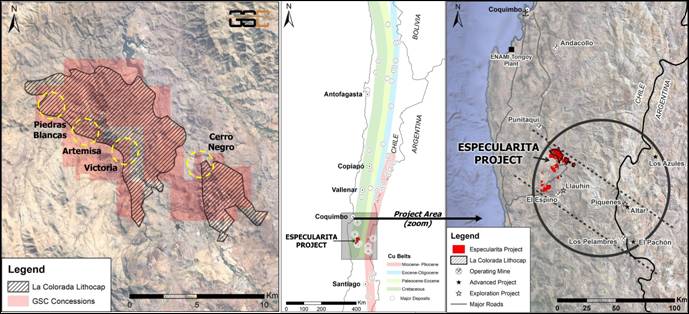
Figure 1: GSC's Especularita Project is located at low altitude within the coastal metallogenic belt of northern Chile and within 50km radius of over 50Mt of contained copper metal defined in mines and advanced projects.
Scout RC Drilling Programme:
Whilst the La Colorada lithocap covers a vast area (>75km2), previous work by GSC geologists has identified silica-sericite-pyrite (phyllic) alteration outcropping over large areas surrounding the lithocap suggesting that the high-sulphidation advanced argillic style alteration (La Colorada lithocap) potentially once extended to the west and south well beyond its present mapped area. This observation is significant as it allows for the potential for porphyry copper systems to occur where the lithocap has been eroded away potentially exposing the tops of porphyry copper systems.
To evaluate this idea GSC designed a "Proof-of-Concept" drill programme comprising short, broadly-spaced RC holes ("reconnaissance" or "scout" holes) spread across a number of prospects allowing the Company to rapidly and cheaply assess the potential of the targets prior to committing significant time and resources to larger more costly programmes.
A total of 17 drill holes (comprising 2,474m) were completed across four target areas on the western and southern flanks of the advanced argillic lithocap alteration including Piedras Blancas1, Artemisa North2, Victoria3 and Artemisa South4 (Figure 2). Assay results for this release are reported for RC001 and RC002 (Piedras Blancas), RC009 (Artemisa North) and RC011 (Victoria). Results for holes RC003 - RC008, RC010, and RC012 - RC017 are pending.
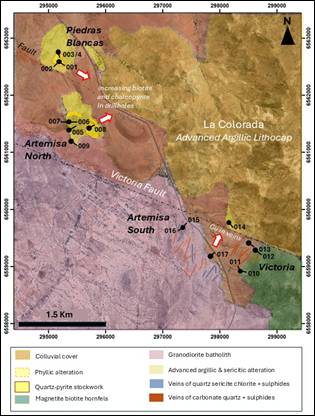
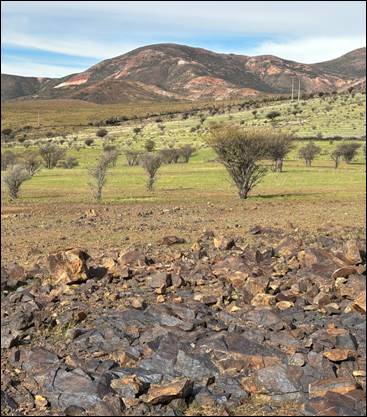
Figure 2: Geology and summary drill hole plan map for the scout RC programme, Especularita Project (left). Photograph (right) shows the mineralised microdiorite at Artemisa North in the foreground with black oxide copper staining and hills of the advanced argillic altered La Colorada lithocap in the background.
Artemisa North (ART26-RC009):
Drillhole RC009 was drilled at the Artemisa North target, testing beneath outcropping copper oxide mineralisation in artisanal workings (Figure 2). The hole intersected microdiorite, diorite and granodiorite intrusives exhibiting strong biotite-magnetite (potassic) alteration (Figure 3) and returning significant down-hole assay grades including:
· RC009: 106m @ 0.33% Cu and 42ppm Mo from surface (0m), including
§ 54m @ 0.46% Cu and 66ppm Mo, from 16m, and
§ 20m @ 0.57% Cu and 116ppm Mo from 16m
Mineralisation is associated with copper oxides and sulphides down to depths of approximately 54m from surface, transitioning to disseminated and veinlet-hosted chalcopyrite-bornite at depth (Figure 4). Mineralisation is hosted in all of the intrusive phases with the highest and most consistent grades associated with the microdiorite intrusive that represents a high priority target for follow up drilling (Figure 3).
Mapping and sampling at Artemisa North has defined a broad zone (>1 km2) of quartz-sericite-pyrite "phyllic" alteration and stockworking confirmed by ASD spectrography. The phyllic alteration zones upwards to quartz-alunite "advanced argillic" alteration on the surrounding hilltops that is interpreted to represent a distal remnant of the La Colorada lithocap alteration (Figure 2). Despite intense oxidation and leaching, rock chip and soil samples define local anomalies in Cu and Mo, and abundant green and black Cu-oxides are observed in historical artisanal mines exposed on the western and eastern margins of the phyllic zone3.
The alteration zone remains open under shallow cover to the east towards the La Colorada lithocap, and to the north where it is interpreted to merge with the Piedras Blancas alteration zone3.
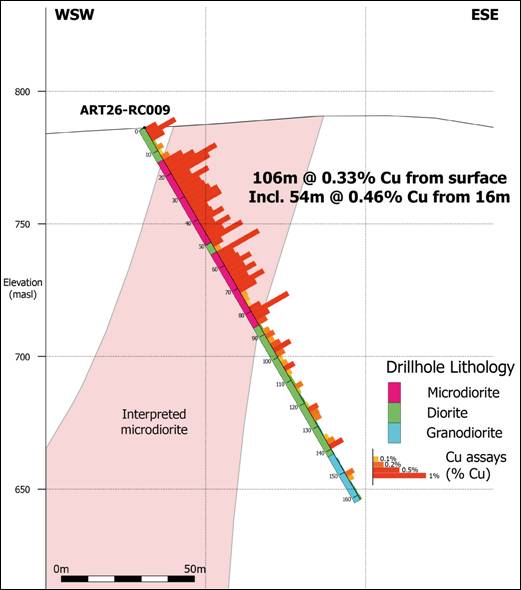
Figure 3: Drilling cross-section for scout hole RC009 at Artemisa North with summary geology and copper grade intercepts.
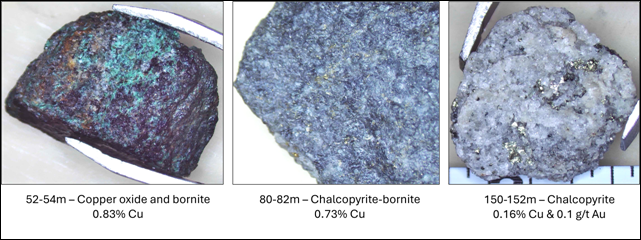
Figure 4: Examples of porphyry copper type mineralisation identified in chip samples of drill hole RC009.
Victoria (VIC26-RC011):
RC011 tested the Victoria target3 (Figure 2) and intersected a microdiorite intrusive displaying strong biotite-magnetite (potassic) alteration together with localised copper mineralisation, returning down-hole assay grade intervals inlcuding:
· RC011: 14m @ 0.23% Cu and 0.18 g/t Au from 6m, including
§ 2m @ 0.85% Cu and 0.48 g/t Au from 8m
And:
· RC011: 2m @ 0.64% Cu and 0.14 g/t Au from 38m
The occurrence of biotite-magnetite altered microdiorite at Victoria is similar to the alteration-lithology association observed in RC009 at Artemisa North and supports the interpretation of a broad porphyry system within the outer margins of the La Colorada lithocap. Further geological and assay interpretation will be used to assess the significance of this relationship and refine future drill targeting.
Piedras Blancas (PDB26-RC001 & RC002):
Drillholes RC001 and RC002 intersected diorite and granodiorite intrusives with intense quartz-sericite-pyrite phyllic alteration and quartz-pyrite veinlets, transitioning to biotite-magnetite alteration (potassic alteration) at depth with evidence of 5 - 15% disseminated and veinlet hosted pyrite, traces of chalcopyrite and quartz veinlets. Both drillholes show anomalous Cu up to 0.13% Cu supporting the presence of porphyry style mineralisation at the prospect.
The style and intensity of alteration and mineralisation identified in holes RC001 and RC002, in particular the potassic alteration, confirm that a porphyry copper type setting has been identified at Piedras Blancas at depths shallower than expected. These results further confirm and enhance the potential of the La Colorada lithocap to host one or more porphyry copper type systems at reasonable depths from surface. Further work will now focus on vectoring to the possible copper-rich core of the systems.
Scout RC Drill Programme and Sampling:
Scout RC drilling recently commenced at several prospects around the southern margins of the La Colorada lithocap with a view to test the prospects for evidence of porphyry copper-gold mineralisation and to provide vectors towards targets beneath the undrilled Colorada lithocap. A preliminary "Prro-of-Concept" test comprising 17 holes and 2,474m of drilling was completed across 4 prospect areas, namely Piedras Blancas, Artemisa North, Artemisa South and Victoria.
The RC drilling method employed at Especularita collects samples on two-metre intervals. Representative samples for each sample of the cuttings are collected in large, individually numbered plastic bags, which are then weighed and transferred to a riffle splitter where they are separated (or split), and homogenised, three times into two duplicate samples of approximately 5kg each. GSC personnel then ticket and label one of the ±5kg samples using preprinted ticket books.
Finally, standard reference materials ("SRM's" or "Standards"), blanks, and duplicate samples are inserted into the sample sequence for the purpose of quality assurance / quality control ("QAQC"). The second ±5kg sample is used for geological description and stored for reference. An additional reference selection of cuttings for each two-metre sample is also retained in labelled boxes as a record of the geology of the drill hole.
At the completion of each hole, the representative 5kg samples are transported as a batch from the field and delivered by Company employees to ALS Laboratories in Santago or La Serena where they are prepared for analysis (weighed, dried, crushed and pulverised). A subsequent 200g split of each sample pulp is then forwarded to the ALS geochemical laboratory in Lima, Peru, where samples are assayed for gold (30g fire assay with ICP-AES finish, ALS code AU-ICP21) and 48 major, base and trace elements by ICP-MS following a four-acid digest (ALS code ME-MS61).
RC drilling was selected for this initial proof-of-concept stage as it is faster and cheaper than diamond drilling and allows for the rapid testing of more targets for the same cost.
Next Steps:
Assay results are awaited for the final 13 scout RC holes in this programme which may affect the forward plans for follow-up exploration in this area. However, the results for discovery hole ART26-RC009 are highly significant and the company will immediately begin detailed mapping and sampling in the Artemisa North area to prepare for possible IP geophysics and further RC drilling.
References:
1. RNS 0949B (20 April 2026): Drilling Commences with First Test of Porphyry Copper Targets at Especularita
2. RNS 1366E (13 May 2026): Scout RC Drilling Commences at Artemisa North Porphyry Copper Target
3. RNS 5465G (02 June 2026): Scout RC drilling commences at Victoria target
4. RNS 3799I (16 June 2026): Scout RC drilling commences at Artemisa South copper-gold target
Engage with the GSC management team directly by asking questions, watching video summaries and seeing what other shareholders have to say. Navigate to our Interactive Investor hub here: https://gscplc.com/
Enquiries:
|
Great Southern Copper plc |
|
|
Sam Garrett, Chief Executive Officer |
+44 (0) 20 7138 3204 |
|
|
|
|
SI Capital Limited |
|
|
Nick Emerson |
+44 (0) 1483 413500 |
|
|
|
|
BlytheRay |
|
|
Tim Blythe / Megan Ray |
+44 (0) 20 7138 3204 GSC@blytheray.com |
Subscribe to our news alert service: https://gscplc.com/auth/signup
Notes for Editors:
About Great Southern Copper
Great Southern Copper PLC is a UK-listed mineral exploration company focused on the discovery of copper-gold-silver deposits in Chile. The Company has the option to acquire mining rights to 100% of Especularita project in the under-explored coastal belt of Chile that is prospective for large scale copper-gold-silver deposits. Chile is a globally significant mining jurisdiction being the world's largest producer and exporter of copper.
The Especularita Project is located in the coastal metallogenic belt of Chile which hosts significant copper mines and deposits, including Teck's Carmen de Andacollo copper mine, and boasts excellent access to infrastructure such as roads, power and ports. Significant historical small-scale and artisanal workings for both copper and gold are readily evident in the exploration project area. The coastal belt offers deposit type optionality for copper including porphyry and IOCG style deposits as well as newly recognised intrusive-related copper and gold deposits.
Great Southern Copper is strategically positioned to support the global market for copper - a critical battery metal in the clean energy transition around the world. The Company is actively engaged in exploration and evaluation work programmes targeting both large tonnage, low to medium grade Cu-Au as well as high-grade Cu-Ag-Au deposits.
Further information on the Company is available on the Company's website: https://gscplc.com
Competent Person Statement
The information in this announcement that relates to exploration results is based on and fairly represents information reviewed or compiled by Mr Sam Garrett, a Competent Person who is a Member of the Australian Institute of Geoscientists and a Fellow of the Society of Economic Geologists. Mr Garrett is the CEO and a shareholder of Great Southern Copper PLC. Mr Garrett has sufficient experience that is relevant to the styles of mineralisation and types of deposit under consideration and to the activity being undertaken to qualify as a Competent Person as defined in the 2012 Edition of the "Australasian Code for Reporting of Exploration Results, Mineral Resources and Ore Reserves". Mr Garrett has provided his prior written consent to the inclusion in this announcement of the matters based on information in the form and context in which it appears.
This announcement includes information that relates to Exploration Results prepared and first disclosed under the JORC Code (2012) and extracted from the Company's previous LSE announcements as noted, and the Company's Prospectus dated 20 December 2021. Copies of these announcements are available from the LSE Announcements page of the Company's website: www.gscplc.com.
The Company confirms that it is not aware of any new information or data that materially affects the information included within the Prospectus dated 20 December 2021.
Forward Looking and Cautionary Statements
Some statements in this announcement regarding estimates or future events are forward-looking statements. They include indications of, and guidance on, future earnings, cash flow, costs and financial performance. Forward-looking statements include, but are not limited to, statements preceded by words such as "planned", "expected", "projected", "estimated", "may", "scheduled", "intends", "anticipates", "believes", "potential", "predict", "foresee", "proposed", "aim", "target", "opportunity", "could", "nominal", "conceptual" and similar expressions. Forward-looking statements, opinions and estimates included in this report are based on assumptions and contingencies which are subject to change without notice, as are statements about market and industry trends, which are based on interpretations of current market conditions. Forward-looking statements are provided as a general guide only and should not be relied on as a guarantee of future performance. Forward-looking statements may be affected by a range of variables that could cause actual results to differ from estimated or anticipated results and may cause the Company's actual performance and financial results in future periods to materially differ from any projections of future performance or results expressed or implied by such forward-looking statements. So, there can be no assurance that actual outcomes will not materially differ from these forward-looking statements.
RNS may use your IP address to confirm compliance with the terms and conditions, to analyse how you engage with the information contained in this communication, and to share such analysis on an anonymised basis with others as part of our commercial services. For further information about how RNS and the London Stock Exchange use the personal data you provide us, please see our Privacy Policy.

Latest directors dealings
- 56 minutes ago Staffline Group
- 1 hour ago Shell
- 1 hour ago Genedrive
- 1 hour ago Avacta Group
- 1 hour ago South32 Limited (DI)