
Phase IV Drilling to Commence at Cerro Negro
Summary by AI BETAClose X


THIS ANNOUNCEMENT CONTAINS INSIDE INFORMATION AS STIPULATED UNDER THE UK VERSION OF THE MARKET ABUSE REGULATION NO 596/2014 WHICH IS PART OF ENGLISH LAW BY VIRTUE OF THE EUROPEAN (WITHDRAWAL) ACT 2018, AS AMENDED. ON PUBLICATION OF THIS ANNOUNCEMENT VIA A REGULATORY INFORMATION SERVICE, THIS INFORMATION IS CONSIDERED TO BE IN THE PUBLIC DOMAIN.
26 October 2026
Great Southern Copper plc
(“GSC” or the “Company”)
Phase IV Diamond Drilling Set to Commence at Mostaza, Cerro Negro Prospect
Drilling to infill and extend high-grade Cu-Ag mineralisation at Mostaza plus first exploration holes to test Monolith Cu-Ag target
Great Southern Copper plc (LSE: GSCU), the company focused on copper-gold-silver exploration in Chile, is pleased to announce the start of its Phase IV diamond drilling programme at the Cerro Negro prospect. All permits have been finalised and the rig is currently being mobilised to the project site.
Highlights:
- Phase IV diamond drilling set to commence at Cerro Negro with up to 5,000 metres (“m”) planned
- Mostaza deposit growth: Drilling to infill the high-grade mineralised system and test deep extensions
- Near-mine targets: Follow-up drilling of mineralised lodes identified in previous campaigns
- First-ever drilling at Monolith: Extensive surface Cu-Ag mineralisation identified in channel sampling
- Recent IP geophysics integrated into drill targeting, with selected chargeability-resistivity anomalies to be tested
- Follow-up metallurgy test-work also commencing on lower grade ore samples from Mostaza
- GSC holds rights to own 100% of the Cerro Negro prospect
- Prospect located at low elevation with excellent access to infrastructure and mining services and along trend of major copper deposits including Los Pelambres, Altar and El Pachon
Sam Garrett, Chief Executive Officer of Great Southern Copper, said: "We are very excited to commence this next drilling programme at Cerro Negro – our fourth drilling programme of the prospect since the discovery of high-grade copper-silver beneath the historic Mostaza mine last year.
“The drilling programme has three aims – to infill and extend the known high-grade copper-silver mineralisation at Mostaza; explore for and add new copper-silver lodes along the Mostaza Fault Zone trending south of the Mostaza deposit, and; discover potential new copper-silver lodes at Monolith where the Company has identified anomalous copper-silver over a broad area in altered dacite dome rock that is closely consistent with the Mostaza mineralisation.”
“With multiple targets to test and an increasing understanding of the detailed Cerro Negro mineralised system, we are aiming to build the foundations for the projects potential maiden resource estimate.”
High-grade Cu-Ag discovery at Mostaza, Cerro Negro Prospect:
In 2025, GSC discovered high-grade Cu-Ag mineralisation beneath the historical Mostaza mine at the Cerro Negro prospect in Chile1. On-going exploration, including three phases of diamond and RC drilling for 6,658m, is establishing that the Cu-Ag mineralisation, with associated Pb-Zn, is related to a porphyry-epithermal system – an observation consistent with the prospects location at the eastern margin of the La Colorada lithocap, which is the Company’s principal geological indicator for porphyry copper style mineralisation within its Especularita Project.
The Cerro Negro prospect, including the historical Mostaza mine, is located at low altitude within the Cretaceous-aged coastal metallogenic belt of northern Chile that includes large-scale copper mines and development projects including Carmen de Andacollo and El Espino (Figure 1). Significantly, the project is also located within a northwest-southeast trending structural lineament that links Especularita with notable large-scale porphyry Cu-Au mines and projects, including Los Pelambres, Altar-Piuquenes and El Pachon (Figure 1).
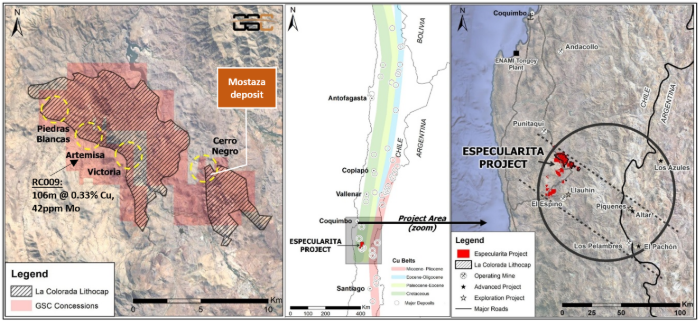
Figure 1: GSC’s Especularita project is located at low altitude within the coastal metallogenic belt of northern Chile and within 50km radius of over 85Mt of contained copper metal defined in mines and advanced projects.
Phase IV drilling programme, Cerro Negro:
All necessary permits have now been finalised and the rig is being mobilised to the project. Up to 5,000m of diamond drilling is being planned with the principal objectives:
- Infill and grow the established high-grade deposit discovered beneath the historical Mostaza open-pit
- Test near-mine extensions to Mostaza
- Explore the Mostaza Fault Zone following up discoveries in previous RC programme
- Undertake the first-ever drill test at Monolith
- Initiate Phase II of the metallurgy test-work programme
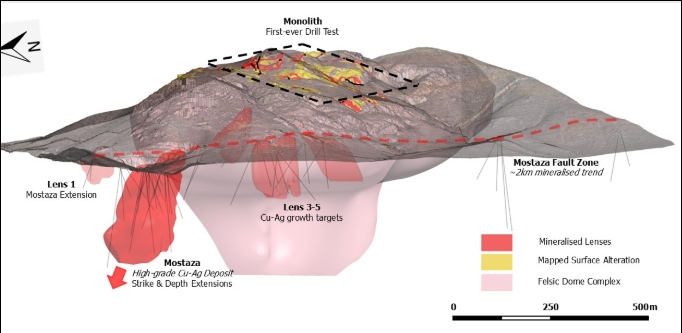
Figure 2: Schematic long-section of the Mostaza Fault Zone (MFZ) illustrating the Phase IV drilling target areas.
Infill drilling, Mostaza Cu-Ag mine:
Since the discovery of 20m @ 3.3% Cu and 270g/t Ag in hole CNG25-DD001 drilled beneath the historical Mostaza mine1 three phases of exploration drilling have been completed at the Mostaza mine. Chalcocite-rich Cu-Ag mineralisation occurs as tabular bodies (or lodes) of replacement-style mineralisation preferentially hosted in silica-clay altered dacitic volcanic units within a package of andesitic volcanics, itself intruded by high-level dacitic lavas and domes (resurgent dome porphyry to epithermal geological environment). In places the mineralised lenses have been overprinted by late faulting and intrusion of mafic dykes resulting in dislocation of the bodies. Anomalous Pb-Zn-Ag is consistently observed in the hangingwall to the Cu-Ag mineralisation associated with silicificed and brecciated contact margins within the andesitic volcanics.
Significant Cu-Ag intercepts to date at Mostaza include;
- CNG25-DD001: 20m @ 3.31% Cu and 269.9g/t Ag from 27m
- CNG25-DD005: 21m @ 2.9% Cu and 246.7 g/t Ag from 35m
- CNG25-DD016: 6.7m @ 5.0% Cu & 381 g/t Ag from 89.8m
- CNG25-DD036: 19.2m @ 1.0% Cu & 58.4 g/t Ag from 170.6m
Phase IV drilling at Mostaza aims to infill the existing drilling in order to progress the project toward a potential JORC resource plus advance step-out drilling along strike and down-dip. A priority Phase IV drillhole is planned to test the projected down-dip continuation of the mineralised system approximately 70m beyond existing drilling (Figure 3). This significant step-out will investigate the down-dip potential of the high-grade Cu-Ag lodes, which remain open at depth.
Additional drilling will target shallow extensions of known mineralisation and provide infill intersections to better define the geometry, continuity and grade distribution of the deposit.
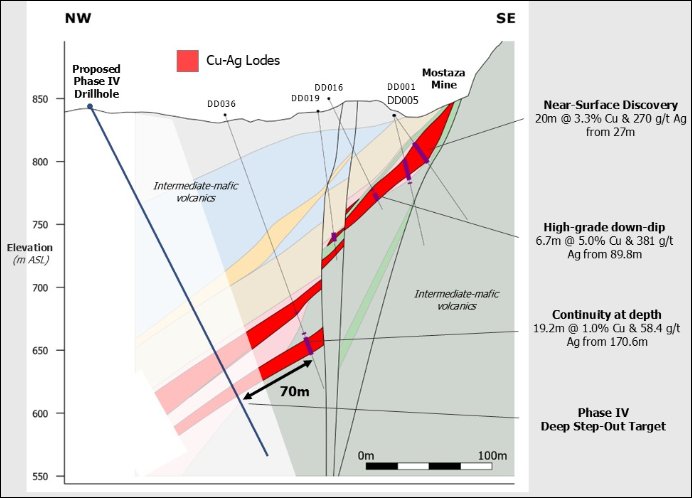
Figure 3: Cross-section through the Mostaza mine illustrating summary geology and mineralisation defined by Phases I – III drilling.
Near-mine exploration and Mostaza Fault Zone trend:
Mapping and rock chip sampling together with IP geophysics has defined a structural trend of anomalous Cu-Ag geochemistry and IP chargeability extending up to 2.5km south of the Mostaza mine (the Mostaza Fault Zone or MFZ). Phases II and III drilling tested the potential for Cu-Ag mineralisation within the MFZ2,3. Exploration holes tested beneath silicified lenses 3-5 and chargeability anomalies which define the N-S trending MFZ.
Phase IV drilling is planned to target extensions to mineralised lenses identified during previous exploration campaigns in the Lens 3–5 area, 200-500m south of the Mostaza mine.
Previous drilling at Lens 4 intersected 3m @ 3.43% Cu and 164.7g/t Ag from 24m in CNG25-DD012, immediately beneath a broad zone of strongly oxidised and leached alteration. The result highlights the potential for higher-grade sulphide mineralisation beneath the near-surface oxide zone.
Recent pole-dipole induced polarisation (PDIP) surveys have identified a chargeability anomaly spatially associated with the interpreted down-dip continuation of the Lens 4 mineralised structure. Phase IV diamond drillholes are planned to test this target approximately 100m down-dip from the previous intersection, with further drilling planned subject to results (Figure 4).
Additional drilling will investigate prospective mineralised zones identified during Phases II and III, with the aim of discovering further Cu-Ag lodes within the broader Mostaza system.
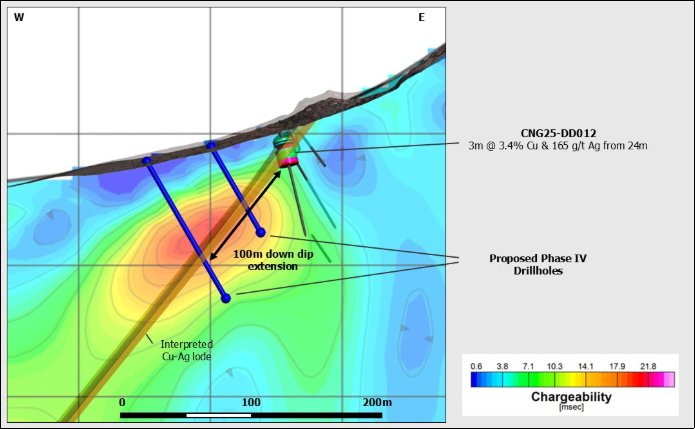
Figure 4: IP chargeability anomalies identified along the MFZ will be tested with Phase IV exploration drilling.
Monolith Cu-Ag mineralisation:
Phase IV will include the first-ever scout diamond drilling at the Monolith Cu-Ag prospect, located approximately 400m southeast of Mostaza (Figure 5).
Detailed geological mapping and surface sampling have identified extensive anomalous Cu-Ag mineralisation associated with silica-clay altered dacitic rocks, quartz vein stockworks and hydrothermal breccias. Surface alteration and mineralisation has been mapped over a 700m trend and remains open along strike.
Previous surface channel sampling returned grades up to 2.09% Cu and 271g/t Ag, with significant continuous intervals including:
- CH021-A: 56m @ 28.5 g/t Ag & 1,745 ppm Cu, including 6m @ 81.5 g/t Ag & 7,890 ppm Cu
- CH041: 78m @ 10.1 g/t Ag & 736 ppm Cu, including 12m @ 31.0 g/t Ag & 1,459 ppm Cu
- CH035-C: 10m @ 32.4 g/t Ag & 2,026 ppm Cu, including 2m @ 100.0 g/t Ag & 6,970 ppm Cu
The initial Phase IV drillholes will target beneath these mineralised outcrops to investigate the subsurface extent, geometry and grade of the Cu-Ag mineralisation. Successful drilling at Monolith would demonstrate the potential for additional mineralised centres beyond the established Mostaza deposit.
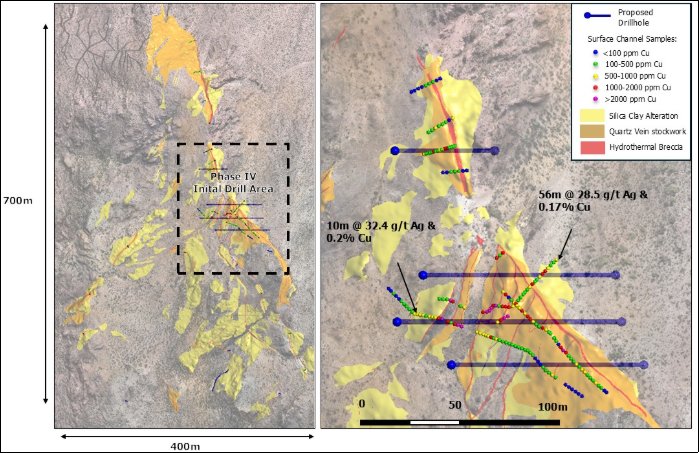
Figure 5: Exploration scout drilling plan for Monolith Cu-Ag target.
Metallurgy test-work:
Preliminary metallurgy test-work on high-grade samples of Mostaza mineralisation demonstrated that high copper and silver recoveries are achievable via conventional flotation process4. The tests achieved recoveries of over 90% for Cu and 85% for Ag, producing concentrate grades averaging 27% Cu and 1,414g/t Ag.
A second phase of test-work has now commenced on composites of lower grade ore previously prepared by Aminpro Chile SpA.
References:
- RNS 5182Y (26 February 2026): Cerro Negro Assays return 20m of 3.3% Cu and 270g/t Ag
- RNS 6908V (18 August 2025): Phase II drilling results extend Mostaza deposit
- RNS 1749L (11 December 2025): Drilling extends mineralisation at Cerro Negro
- RNS 5513V (21 September 2026): Tests confirm excellent metallurgical recovery
Engage with the GSC management team directly by asking questions, watching video summaries and seeing what other shareholders have to say. Navigate to our Interactive Investor hub here: https://gscplc.com/
Enquiries:
|
Great Southern Copper plc |
|
|
Sam Garrett, Chief Executive Officer |
+44 (0) 20 7138 3204 |
|
|
|
|
SI Capital Limited |
|
|
Nick Emerson |
+44 (0) 1483 413500 |
|
|
|
|
BlytheRay |
|
|
Megan Ray / Said Izagaren |
+44 (0) 20 7138 3204 GSC@blytheray.com |
Subscribe to our news alert service: https://gscplc.com/auth/signup
Notes for Editors:
About Great Southern Copper
Great Southern Copper PLC is a UK-listed mineral exploration company focused on the discovery of copper-gold-silver deposits in Chile. The Company has the option to acquire mining rights to 100% of Especularita project in the under-explored coastal belt of Chile that is prospective for large scale copper-gold-silver deposits. Chile is a globally significant mining jurisdiction being the world’s largest producer and exporter of copper.
The Especularita Project is located in the coastal metallogenic belt of Chile which hosts significant copper mines and deposits, including Teck’s Carmen de Andacollo copper mine, and boasts excellent access to infrastructure such as roads, power and ports. Significant historical small-scale and artisanal workings for both copper and gold are readily evident in the exploration project area. The coastal belt offers deposit type optionality for copper including porphyry and IOCG style deposits as well as newly recognised intrusive-related copper and gold deposits.
Great Southern Copper is strategically positioned to support the global market for copper – a critical battery metal in the clean energy transition around the world. The Company is actively engaged in exploration and evaluation work programmes targeting both large tonnage, low to medium grade Cu-Au as well as high-grade Cu-Ag-Au deposits.
Further information on the Company is available on the Company’s website: https://gscplc.com
Competent Person Statement
The information in this announcement that relates to exploration results is based on and fairly represents information reviewed or compiled by Mr Sam Garrett, a Competent Person who is a Member of the Australian Institute of Geoscientists and a Fellow of the Society of Economic Geologists. Mr Garrett is the CEO and a shareholder of Great Southern Copper PLC. Mr Garrett has sufficient experience that is relevant to the styles of mineralisation and types of deposit under consideration and to the activity being undertaken to qualify as a Competent Person as defined in the 2012 Edition of the "Australasian Code for Reporting of Exploration Results, Mineral Resources and Ore Reserves". Mr Garrett has provided his prior written consent to the inclusion in this announcement of the matters based on information in the form and context in which it appears.
This announcement includes information that relates to Exploration Results prepared and first disclosed under the JORC Code (2012) and extracted from the Company’s previous LSE announcements as noted, and the Company’s Prospectus dated 20 December 2021. Copies of these announcements are available from the LSE Announcements page of the Company’s website: www.gscplc.com.
The Company confirms that it is not aware of any new information or data that materially affects the information included within the Prospectus dated 20 December 2021.
Forward Looking and Cautionary Statements
Some statements in this announcement regarding estimates or future events are forward-looking statements. They include indications of, and guidance on, future earnings, cash flow, costs and financial performance. Forward-looking statements include, but are not limited to, statements preceded by words such as “planned”, “expected”, “projected”, “estimated”, “may”, “scheduled”, “intends”, “anticipates”, “believes”, “potential”, "predict", "foresee", "proposed", "aim", "target", "opportunity", “could”, “nominal”, “conceptual” and similar expressions. Forward-looking statements, opinions and estimates included in this report are based on assumptions and contingencies which are subject to change without notice, as are statements about market and industry trends, which are based on interpretations of current market conditions. Forward-looking statements are provided as a general guide only and should not be relied on as a guarantee of future performance. Forward-looking statements may be affected by a range of variables that could cause actual results to differ from estimated or anticipated results and may cause the Company’s actual performance and financial results in future periods to materially differ from any projections of future performance or results expressed or implied by such forward-looking statements. So, there can be no assurance that actual outcomes will not materially differ from these forward-looking statements.
RNS may use your IP address to confirm compliance with the terms and conditions, to analyse how you engage with the information contained in this communication, and to share such analysis on an anonymised basis with others as part of our commercial services. For further information about how RNS and the London Stock Exchange use the personal data you provide us, please see our Privacy Policy.

Latest directors dealings
- 1 hour ago Power Probe PLC
- 1 hour ago Primary Health Properties
- 1 hour ago IG Group Holdings
- 2 days ago City of London Investment Group
- 2 days ago Kooth