
Homase Pit Definition & JORC Exploration Plan
Summary by AI BETAClose X

26 October 2026
GOLDSTONE RESOURCES LIMITED
("GoldStone" or the "Company")
Homase Mine Pit Definition Update and JORC Exploration Plan
GoldStone Resources Limited (AIM: GRL), the AIM-quoted gold producer and exploration company, provides an update on pit-definition drilling at its Homase Mine, and announces the re-appointment of SEMS Exploration Services ("SEMS") to lead the next phase of its JORC Mineral Resource evaluation and expansion programme.
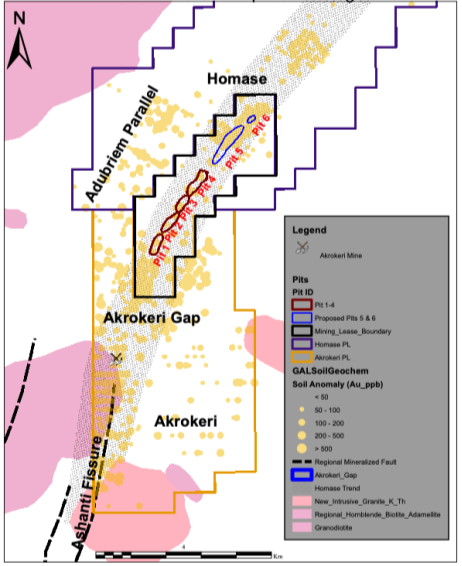
The programme forms part of GoldStone's strategy to build on its 602,000 ounce Mineral Resource reported in November 2012, under JORC Code (2004), within a 4.4 km-long well-defined structural zone. This mineralised zone is part of a much longer "Homase Trend" structural corridor that extends over a total distance of >8 km, as defined by a strong gold-in-soil geochemical and geophysical anomaly, along strike (refer announcement dated 20 June 2018, Figure 1).
Highlights
· Pit-definition drilling: Completed the northern component, and the first five southern holes of the reverse circulation ("RC") pit-definition drilling programme first announced on 3 August 2026 (since expanded to c.2,700 m, announced 30 September 2026), targeting the proposed Pits 5 and 6 and extension to existing oxide mineralisation to support future mine planning and production.
· Encouraging results: The pit-definition drilling has identified significant results including:
- 26MLRC007: 16 m @ 1.26 g/t from 11 m
- 26MLRC006: 5 m @ 2.76 g/t from 19 m
- 26MLRC017: 8 m @ 2.17 g/t from 44 m, including 2 m @ 4.04 g/t
- 26MLRC002: 8 m @ 1.49 g/t from 25 m
- 26MLRC016: 16 m @ 0.99 g/t from surface
- 26MLRC018: 24 m @ 0.68 g/t from 41 m to the end of the hole
· The results may that Pits 5 and 6 might be combined with commensurate benefits in logistics and stripping ratio.
· Importantly, the drilling has demonstrated gold mineralisation at depth in areas where earlier surface sampling returned relatively weak results, highlighting the potential for further exploration within the Homase Trend
· SEMS appointment: SEMS which prepared the 2012 Mineral Resource estimate, was re-appointed to manage the Company's JORC Mineral Resource evaluation and expansion programme at Homase.
· Phase 1 resource expansion programme: SEMS has proposed a detailed programme comprising 32 RC and diamond drill holes totalling ~7,770 m across four target areas along the Homase Trend.
· Priority drilling targets: An initial 23-hole priority programme totalling ~5,200 m, targeting known mineralisation beneath and adjacent to the existing and proposed mining areas.
· Wider exploration potential: Ongoing evaluation of the Homase Trend along the mineralised structural corridor, including potential extensions south towards the former Akrokeri Underground Mine and parallel mineralised structures.
Recently Completed Oxide Drilling for Pit Definition - Northern Sector
As announced on 3 August 2026 and noted in the Company's Interim Results (30 September 2026), RC drilling has since been completed on the priority northern extension of the Homase area, previously defined by gold-in-soil geochemistry, geophysical modelling, trenching, and reconnaissance RC drilling.
The results indicate mineralisation extending ~850 m beyond Pit 4 along the Homase Trend with additional parallel mineralised zones that have also been identified. These areas may provide potential future oxide feed for the proposed Pit 5 and Pit 6 subject to further mine planning and technical evaluation.
This programme targeted the previously identified soil geochemistry anomaly extending northwards from hole 26MLRC019 to hole 26MLRC013 along the Homase Trend. Intersections above 0.3 g/t Au were returned along much of the 850m sector but a central section of ~180 m reported only 0.1-0.3 g/t Au, and requires further evaluation in terms of open-pittable potential.
The drilling also confirmed the presence of an eastern parallel mineralised zone (26MLRC008 and 009) which is consistent with the integrity of the soil geochemistry, and a western zone (26MLRC016-020), with intersections exceeding 0.3 g/t Au. Collectively these results indicate that the mineralised zone within this northern sector can extend up to 200 m in width and merits further evaluation in terms of pit modelling.
In several instances, RC assay results showed higher gold contents at depth than surface sampling of the same zones in trenches. 26MLRC001 and 26MLRC002 lie beneath trenches that showed extremely weak surface mineralisation, yet returned 7 m @ 1.21 g/t and 8 m @ 1.49 g/t, confirming mineralisation at depth. This positive factor will need to be considered as exploration continues to probe northwards and laterally.
Table 1: Northern drilling (Pits 5 & 6), intercepts above 0.3 g/t Au
|
Hole |
From (m) |
To (m) |
Width (m) |
Au (g/t) |
Including |
|
26MLRC001 |
32 |
36 |
4 |
0.38 |
- |
|
26MLRC001 |
40 |
47 |
7 |
1.21 |
2 m @ 2.20 g/t |
|
26MLRC001 |
49 |
51 |
2 |
0.78 |
1 m @ 1.13 g/t |
|
26MLRC001 |
56 |
60 (EOH) |
4 |
0.57 |
1 m @ 1.10 g/t |
|
26MLRC002 |
25 |
33 |
8 |
1.49 |
3 m @ 2.90 g/t |
|
26MLRC003 |
1 |
5 |
4 |
0.33 |
- |
|
26MLRC003 |
34 |
50 |
16 |
0.75 |
2 m @ 1.85 g/t |
|
26MLRC004 |
2 |
8 |
6 |
0.35 |
- |
|
26MLRC004 |
10 |
17 |
7 |
0.36 |
- |
|
26MLRC005 |
47 |
49 (EOH) |
2 |
0.49 |
- |
|
26MLRC006 |
19 |
24 |
5 |
2.76 |
2 m @ 4.65 g/t |
|
26MLRC006 |
27 |
35 |
8 |
0.49 |
- |
|
26MLRC006 |
46 |
49 |
3 |
0.42 |
- |
|
26MLRC007 |
11 |
27 |
16 |
1.26 |
2 m @ 2.80 g/t |
|
26MLRC008 |
37 |
41 |
4 |
0.95 |
1 m @ 2.75 g/t |
|
26MLRC009 |
23 |
25 |
2 |
0.42 |
- |
|
26MLRC009 |
50 |
57 |
7 |
0.63 |
1 m @ 2.12 g/t |
|
26MLRC012 |
20 |
24 |
4 |
0.68 |
1 m @ 1.78 g/t |
|
26MLRC014 |
42 |
44 |
2 |
0.38 |
- |
|
26MLRC014 |
47 |
51 |
4 |
0.52 |
- |
|
26MLRC014 |
58 |
60 (EOH) |
2 |
0.51 |
- |
|
26MLRC016 |
0 |
16 |
16 |
0.99 |
3 m @ 1.52 g/t |
|
26MLRC016 |
31 |
36 |
5 |
0.58 |
1 m @ 1.10 g/t |
|
26MLRC017 |
44 |
52 |
8 |
2.17 |
2 m @ 4.04 g/t |
|
26MLRC018 |
41 |
65 (EOH) |
24 |
0.68 |
14 m @ 0.86 g/t |
|
26MLRC019 |
29 |
42 |
13 |
0.52 |
2 m @ 1.70 g/t |
|
26MLRC019 |
46 |
48 |
2 |
1.02 |
- |
|
26MLRC020 |
65 |
70 |
5 |
0.50 |
- |
Notes: No intercepts above 0.3 g/t: 26MLRC010, 011, 013 and 015.
Widths are downhole - true widths are not yet determined.
EOH - end of hole.
Samples were analysed in-house using fire assay with a QA/QC insertion frequency of 13%.
The interpretation is preliminary.
Recently Completed Oxide Drilling for Pit Definition - Southern Sector
The southern component of the programme is investigating extensions to known oxide mineralisation previously exploited via Pits 1 & 2 and extending towards the old Akrokeri Mine, located ~6 km south-south-west.
Three of the first five holes, drilled between Pits 1 and 2, intersected 7 to 13 m of gold at 0.61 to 1.02 g/t - 26MLRC021 at 22-35 m, 26MLRC023 at 50-57 m and 26MLRC024 at 46-58 m. Set out in Table 2 are the intercepts above 0.3 g/t Au.
Table 2: Southern drilling, intercepts above 0.3 g/t Au (26MLRC021-025)
|
Hole |
From (m) |
To (m) |
Width (m) |
Au (g/t) |
Including |
|
26MLRC021 |
22 |
35 |
13 |
0.61 |
4 m @ 1.19 g/t |
|
26MLRC023 |
50 |
57 |
7 |
1.02 |
1 m @ 2.35 g/t |
|
26MLRC024 |
46 |
58 |
12 |
0.65 |
5 m @ 0.96 g/t |
Note: No intercepts above 0.3 g/t: 26MLRC022 and 025.
The results will also be integrated into the mine planning to assess potential additional oxide feed for the existing heap-leach operation and also with the proposed SEMS drilling programme, which is designed to test the continuity of mineralisation beneath the oxides currently being mined from the existing and proposed new open pit mines of the Homase Mine.
SEMS Appointment and JORC Mineral Resource Expansion Programme
GoldStone has re-appointed SEMS, a Ghanaian geological and exploration consultancy who prepared the Company's 2012 Mineral Resource estimate, to manage and implement the next phase of the Company's exploration and JORC Mineral Resource expansion programme at Homase: They will be responsible for preparing the resulting updated JORC Mineral Resource Estimate.
SEMS has undertaken a comprehensive technical review of the existing geological database and has submitted a structured programme to investigate the continuity of known mineralisation at depth beneath the existing pits and the proposed Pits 5 and 6, together with potential extensions along the Homase Trend.
The full resource-drilling programme comprises 32 planned holes totalling ~7,770 m, including 5,300 m of RC drilling and 2,470 m of diamond drilling. Of these, 23 holes, totalling ~5,200 m, have been identified as priorities, selected to test significant mineralised targets along the Homase Trend and provide geological information to guide subsequent drilling.
The Homase Mineral Resource (reported on 22 November 2012) comprised 10.6 Mt at an average grade of 1.77 g/t Au for 602,000 ounces of gold (Measured 1.61 Mt @ 2.24 g/t, indicated 4.41 Mt @ 1.73 g/t and Inferred 4.56 Mt @ 1.64 g/t). The estimate used a cut-off grade of 0.5 g/t Au and was prepared under JORC Code (2004). It has not been updated to reflect oxide mining undertaken since 2021.
The current programme is intended to build on previous resource estimates through a systematic programme of geological interpretation, infill drilling, and exploration of depth and strike-extensions to known mineralisation, including both oxide and longer-term sulphide material.
The four principal target areas that the SEMS programme has set out, in order of priority:
Pits 5 and 6 - Northern extension
A proposed 14-hole RC drilling programme totalling ~2,250 m will investigate mineralisation beneath the recently confirmed oxide zone in the Pit 5 and Pit 6 areas, with the results reported today providing focus for this deeper drilling and informing mine planning for potential near-term oxide mining and processing.
The drilling will test the down-dip continuity of mineralisation, with scope for further step-back drilling subject to results particularly where parallel zones within the wider structural corridor have been identified.
Pit 4 - Deeper mineralisation
This pit was formerly mined by AngloGold Ashanti in 2002/03; known high-grade mineralised shoots sit beneath Pit 4. Two RC-collar diamond drill holes, totalling ~800 m are planned to investigate the continuation of this known mineralisation at depth, with targets ~340-380 m below surface.
Pits 1 and 2 - Southern mineralised zones
Ten RC diamond drill holes totalling ~2,475 m are proposed to investigate mineralisation beneath the previously exploited Pits 1 and 2, including potential sub-parallel mineralised structures.
Pit 3 - Resource extension
Six RC diamond drill holes totalling ~2,245 m are planned to investigate extensions to known mineralisation beneath Pit 3.
Subject to drilling results and the necessary geological and technical studies, GoldStone intends to progress towards an updated JORC Mineral Resource estimate, targeted for H1 2027.
Wider Homase structural corridor
GoldStone continues to evaluate the broader exploration potential of the Homase Trend that sits within a mineralised structural corridor. Historical geochemical surveys and reconnaissance drilling in the Adubriem area west of Homase Pits 5 and 6 indicate that this "corridor" could be up to 1,500 m wide.
Beyond the proposed Phase 1 drilling programme, the Company is considering further exploration along the southern continuation of the Homase Trend towards the former underground Akrokeri Mine, which includes the area known as the "Akrokeri Gap" (See Fig. 1).
Although structurally complex, historical soil-geochemistry surveys, trenching and limited RC drilling have identified mineralisation within the ~6 km strike length area between Homase Pit 1 and the historical Akrokeri Mine.
Emma Priestley, Chief Executive Officer, commented:
"The progress we are making at Homase is an important step in our strategy to strengthen the existing mining operation while unlocking the wider potential of the project. The latest drilling results reinforce our confidence in the prospectivity of the Homase Trend and provide a valuable foundation for our next phase of exploration, as we seek to extend the mine life and build a stronger resource base for the future.
The reappointment of SEMS represents an important step in advancing our longer-term growth strategy. With an established Mineral Resource of 602,000 ounces, reported in 2012, a substantial geological database and a clearly defined drilling programme, we now have a structured approach to evaluating extensions to the known mineralisation, both at depth and along strike.
Our immediate priority remains supporting the existing Homase operation while systematically progressing the exploration work required to evaluate the wider resource potential of the project. We believe this approach provides a strong foundation for the next phase of GoldStone's development."
Qualified Person's statement
The technical information in this announcement has been reviewed and approved by Dr Bob Foster, PhD, FIMMM, CEng, FGS, CGeol, a Non-Executive Director of the Company, who has over 45 years' relevant experience in gold exploration. He is a Competent Person as defined in the JORC Code (2012), and accordingly a qualified person for the purposes of the AIM Note for Mining, Oil & Gas Companies. He has consented to the inclusion of this information in the form and context in which it appears.
Figure 1: Homase Mine and Exploration Targets
ENDS
For further information, please contact:
|
GoldStone Resources Limited |
|
|
Emma Priestley / Mike Jones |
Tel: +44 (0)1534 487 757 |
|
Strand Hanson Limited |
|
|
James Dance / James Bellman |
Tel: +44 (0)20 7409 3494 |
|
|
|
|
Marex Financial Angelo Sofocleous / Matt Bailey |
Tel: +44 (0)20 7650 4075 corporate@marex.com |
|
St Brides Partners Ltd Susie Geliher / Ana Ribeiro |
Tel: +44 (0)20 7236 1177 goldstone@stbridespartners.co.uk |
About GoldStone Resources Limited
GoldStone Resources Limited (AIM: GRL) is an AIM-quoted gold mining, development and exploration company with its principal operations in Ghana, West Africa.
The Company is focused on the operation and development of the Akrokeri-Homase Gold Project in south-western Ghana, which hosts a Mineral Resource of 10.6 Mt at an average grade of 1.77 g/t for 602,000 ounces of gold (Measured, Indicated and Inferred), reported in November 2012 under the JORC Code (2004) and not yet updated for mining since 2021. The resource is contained within a 4.4 km section of the Homase Trend, comprising Homase North, Homase Pit and Homase South.
The project includes two historical gold mines: the Akrokeri Ashanti Mine, which produced approximately 75,000 ounces of gold at a recovered grade of 24 g/t in the early 1900s, and the Homase Pit, which was developed by AngloGold Ashanti in 2002-2003 and produced approximately 52,000 ounces of gold at a recovered grade of 2.5 g/t.
GoldStone's current operations are focused on gold production at the Homase Mine, alongside the evaluation of opportunities to expand the existing mineral resource, enhance processing capabilities and advance the wider Akrokeri-Homase project.
In addition to its Ghanaian operations, GoldStone has an interest in a gold project in Sierra Leone, providing the Company with an opportunity to broaden its exploration and development activities in West Africa.
The Company's strategy is to develop a portfolio of high-quality gold assets, with a particular focus on prospective gold-bearing regions of West Africa, including the Birimian Gold Belt.
The person responsible for arranging the release of this announcement on behalf of the Company is Emma Priestley, Chief Executive Officer.
The information contained within this announcement is deemed by the Company to constitute inside information as stipulated under the Market Abuse Regulation (EU) No. 596/2014 as it forms part of United Kingdom domestic law by virtue of the European Union (Withdrawal) Act 2018, as amended by virtue of the Market Abuse (Amendment) (EU Exit) Regulations 2019.
Glossary
Au gold
Competent Person as defined in the JORC Code, a minerals industry professional who is a member or fellow of a recognised professional organisation and has at least five years' relevant experience
cut-off grade the minimum grade at which mineralisation is included in a Mineral Resource estimate
DD diamond drilling, which uses a diamond-set bit to recover a continuous core of rock
downhole width the length of an intercept measured along the drill hole, which may differ from its true width
EOH end of hole
fire assay a laboratory method that measures the gold content of a sample by fusing it at high temperature
g/t grams per tonne
heap leach a processing method in which crushed ore is stacked on lined pads and irrigated with a solution that dissolves the gold
JORC Code the Australasian Code for Reporting of Exploration Results, Mineral Resources and Ore Reserves
Measured, Indicated and Inferred the categories of Mineral Resource under the JORC Code, in decreasing order of geological confidence
Mineral Resource a concentration of material of economic interest in or on the Earth's crust in such form, grade and quantity that there are reasonable prospects for eventual economic extraction, as defined in the JORC Code
Mt million tonnes
ounces or oz troy ounces
oxide near-surface material that has been weathered, which is generally softer and easier to process
QA/QC quality assurance and quality control, the procedures used to check the reliability of sampling and assay results, including the insertion of standards, blanks and duplicates
RC reverse circulation drilling, which returns rock chips to surface through the inside of the drill rods
sulphide unweathered material below the oxide zone, in which gold is generally associated with sulphide minerals
RNS may use your IP address to confirm compliance with the terms and conditions, to analyse how you engage with the information contained in this communication, and to share such analysis on an anonymised basis with others as part of our commercial services. For further information about how RNS and the London Stock Exchange use the personal data you provide us, please see our Privacy Policy.

Latest directors dealings
- 1 hour ago Power Probe PLC
- 1 hour ago Primary Health Properties
- 1 hour ago IG Group Holdings
- 2 days ago City of London Investment Group
- 2 days ago Kooth