|
Key Results
· Exceptional high grades with a peak assay result of 7.74 g/t Au (7,739 ppb Au) returned from trial soil geochemistry survey at the Gorge Mine target area.
· Gold was detected in 99.6% of soil samples collected during the site reconnaissance visit in May 2026, with 244 of 245 samples returning detectable gold values (greater than 1 ppb Au).
· Five of the soil samples returned gold values exceeding 1.0 g/t Au (1,000 ppb Au), highlighting multiple areas of high-grade gold response within the surveyed area.
· Significant anomalism identified, with a peak assay result of 0.37 g/t Au (371 ppb Au) returned from trial soil geochemistry survey at the 401 Prospect target area.
· Pathfinder elemental analysis indicates IRGS and Orogenic Gold mineral system signatures.
· Revised soil geochemical survey programme design consisting of 1,188 sites to further test the 5km strike of known gold mineralisation including the 12 priority targets previously recognised.
GEO Exploration Limited (AIM: GEO) is pleased to announce highly encouraging laboratory assay results from the trial soil geochemistry programme completed at the Gorge Project in Western Australia, including an exceptional peak result of 7.74 g/t Au (7,739 ppb Au) at the Gorge Mine target.
The programme was designed and interpreted by Mr Callum Baxter, who has extensive experience in the application of multi-element geochemistry to gold exploration and the identification of priority exploration targets.
The trial programme comprised 245 soil samples collected across the Gorge Mine and 401 Prospect target areas. Gold was detected in 99.6% of samples (244 of 245), demonstrating a widespread gold-in-soil response across the areas surveyed.
Approximately 57% of samples (140 samples) returned gold values above 0.01 g/t Au (10 ppb Au), being the approximate normal level of gold typically present in the surrounding soils. Values above this level are considered anomalous, meaning that they contain more gold than would normally be expected and may indicate a nearby source of gold mineralisation.
Importantly, approximately 11% of samples (27 samples) returned strongly anomalous gold values above 0.1 g/t Au (100 ppb Au), while approximately 2% of samples (five samples) returned extremely anomalous values above 1.0 g/t Au (1,000 ppb Au).
Soil geochemistry is used in early-stage gold exploration to identify areas of elevated gold in near-surface soils which may point towards underlying or nearby mineralisation. The results can therefore be used to refine the strongest areas for follow-up exploration and future drilling.
The peak result of 7.74 g/t Au (7,739 ppb Au) was returned approximately 150 metres southwest of the mapped vertical shafts at the Gorge Mine target, where the strongest and most coherent gold anomalism was identified. The scale and distribution of the gold-in-soil response are considered highly encouraging and reinforces the Gorge Mine target as a priority area for further exploration.
Assay Results & Interpretation
The assay results demonstrate a strong gold-in-soil response associated with the known gold occurrences tested at the Gorge Project. The strongest and most coherent anomalism was identified at the Gorge Mine target, with significant anomalism also confirmed at the 401 Prospect.
Three particle sizes (3mm, 0.66mm and 0.177mm) were sieved at each location and a total of 245 soil samples were collected and analysed.
In summary:
· The peak assay result of 7,739 ppb Au (7.74 g/t Au) was returned approximately 150 metres southwest of the mapped vertical shafts at the Gorge Mine target.
· Gold was detected in 99.6% of soil samples (244 of 245 samples), with only one sample returning a result below the detection limit.
· Approximately 2% of soil samples (5 samples) returned gold values above 1,000 ppb Au (1.0 g/t Au). These results are considered extremely anomalous and may indicate the presence of a high-grade gold system.
· Approximately 11% of soil samples (27 samples) returned gold values above 100 ppb Au (0.1 g/t Au) and are considered strongly anomalous.
· Approximately 57% of soil samples (140 samples) returned anomalous gold values above the approximate local background level of 10 ppb Au (0.01 g/t Au).
· Only minor variation was observed between the three particle-size fractions trialled, with variation in certain higher-grade results interpreted to reflect the uneven distribution of coarse gold within the samples.
The strongest and most coherent gold anomalism was observed at the Gorge Mine target. Results show that an area of significant gold anomalism >0.1 g/t Au (100 ppb Au) occurs proximal to the historic workings where visible gold has been identified. Furthermore, coherent gold anomalism occurs to the northeast, northwest, and southwest of the area of historic workings. These geochemical anomalies remain largely open in all directions.
Results from the 401 Prospect target area confirmed historical results showing elevated gold anomalism >0.1 g/t Au (100 ppb Au) associated with an east-west-trending zone of auriferous quartz veining.
The correlation between gold and other elements was determined via correlation and covariance analysis. It was observed that positive relationships occurred between gold and a number of pathfinder elements, including silver, scandium, molybdenum, tungsten, tin and arsenic.
Multi-element pathfinder anomalies are commonly used by geochemists to indicate the potential style of mineral system present. The elemental associations observed are consistent with both IRGS and orogenic gold systems being present at the Gorge Project.
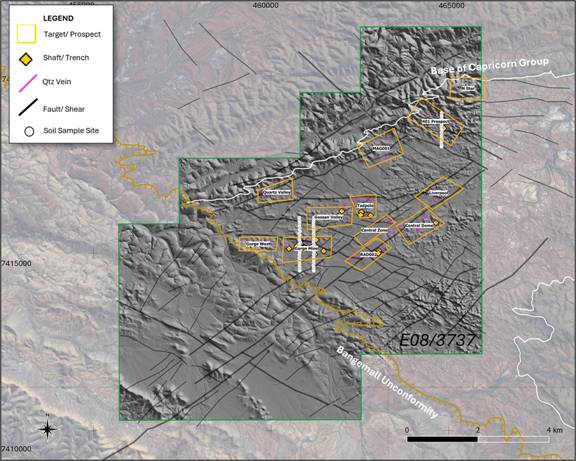
Figure 1 - Trial soil geochemical sample locations on LiDAR DTM image with targets and geological interpretations.
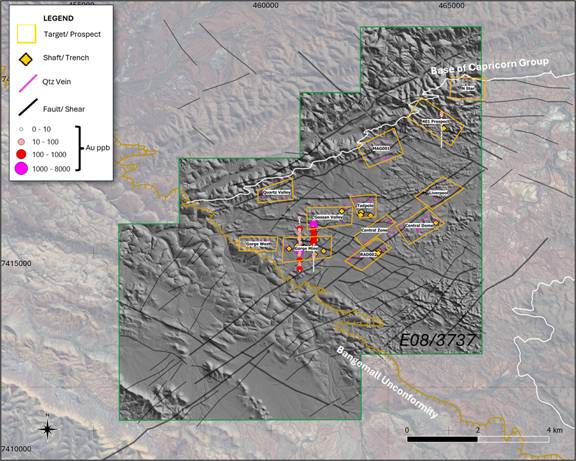
Figure 2 - The soil geochemical assay results for gold ppb, 3mm particle size only, on LiDAR DTM. Same site locations for the 0.66mm and 0.177mm samples (not shown).
Data Collection & Methodology
In total, 245 soil samples were collected by GEO's field team during the site reconnaissance visit in May 2026. Three orientation lines were collected proximal to historic workings and elevated rock chip results at the Gorge Mine and 401 Prospect targets.
Samples were collected at depths of 30 cm below surface at 50m spaced stations along N-S-orientated lines. Three particle sizes (3mm, 0.66mm and 0.177mm) were sieved at each location in order to determine the most optimal data collection method.
The samples were sent to Intertek's laboratory in Perth for analysis using the AR25/MS/OE low-sulphur 52 multi-element suite. Samples that returned gold results above the maximum detection limit of 2g/t Au (2000 ppb Au) were further analysed using a 25g fire assay. Standard QAQC procedures were implemented including repeats for all samples that returned gold results greater than 0.1 g/t Au (100 ppb Au).
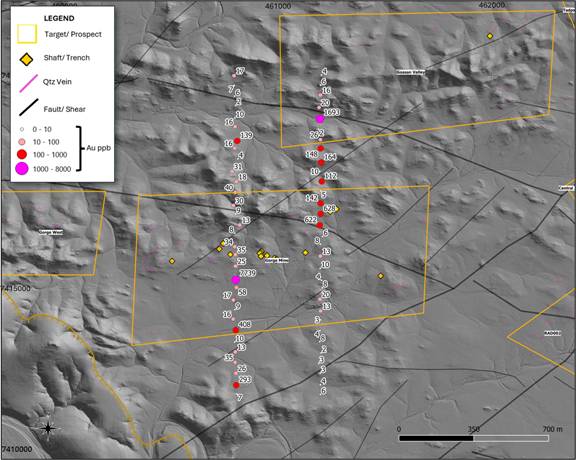
Figure 3 - The Gorge Mine soil geochemical assay results for gold ppb, 3mm particle size only, on LiDAR DTM. Same site locations for the 0.66mm and 0.177mm samples (not shown).
Forward Programme
The results of the trial programme will materially inform the upcoming field programme, which will comprise an extensive soil and rock-chip geochemistry survey, detailed geological mapping and controlled sampling of mullock heaps associated with historic shafts and trenches.
The expanded soil geochemistry programme will comprise approximately 1,188 samples collected on a 200 metre by 50 metre grid across the known 5km mineralised corridor and priority targets identified from the airborne geophysical surveys.
The programme is expected to further define, rank and refine the highest-priority targets and assist with planning for the proposed maiden drilling programme. Drilling remains subject to completion of the required heritage and government permitting processes.
Callum Baxter, GEO's Technical Consultant, commented:
"It is pleasing to see the very positive results from the orientation soil sampling. This provides us with a solid foundation to expand the soil sample activities across more than 5km of strike. I look forward to further work and subsequent results from this very exciting gold project."
Tom Harris, GEO's Exploration Manager, commented:
"I consider the results from the orientation soil geochemical programme to be outstanding. The association of gold in soils anomalism with historic workings has confirmed the effectiveness of the method to further drive target generation at the Gorge Project. I look forward to seeing the broader soil geochemical programme completed, followed by drill testing of the highest-ranked targets."
Omar Ahmad, Chief Executive Officer, commented:
"These are highly encouraging results, with a number of exceptional assays returned from the initial trial soil geochemistry programme at the Gorge Project.
The peak result of 7.74 g/t Au is an outstanding result for a soil geochemistry programme and highlights the strength of the gold response at Gorge Mine. Importantly, this is supported by multiple samples exceeding 1.0 g/t Au, further reinforcing the significance of the target.
The results provide further confidence in the prospectivity of both the Gorge Mine and 401 Prospect target areas and give us a strong platform from which to advance the next stage of exploration across the wider Project.
Gorge is quickly developing into the Company's flagship exploration project. The results achieved to date have been excellent and have exceeded our expectations at this stage of exploration.
I would like to thank Tom Harris, Callum Baxter and the wider technical and field teams for the quality of the work completed. These results demonstrate the high calibre of the team we have assembled and the quality of the exploration work being undertaken at Gorge.
We are extremely encouraged by the progress made to date and look forward to progressing the expanded field programme, building on these results and further advancing the potential of the Gorge Project."
Gorge Project Overview
The Gorge Project comprises Exploration Licence E08/3737, located approximately 110km west of Paraburdoo in Western Australia. The licence covers 81km² within the Capricorn Orogen and is held through GEO's 100%-owned subsidiary, Gorge Gold Pty Ltd.
Historical exploration, prospecting and mining activity has identified gold occurrences over approximately 5km of strike, including rock-chip results of up to 134 g/t Au, soil results of up to 233 g/t Au, historical drilling including 1m at 35 g/t Au and the recovery of near-surface gold nuggets ranging from less than 2g to more than 100g.
GEO commenced a systematic modern exploration programme at Gorge during 2026. High-resolution LiDAR, aerial photography, magnetic and radiometric surveys have improved the definition of the known gold trend and identified new priority targets, including the MAG001 magnetic anomaly and the RAD001 and RAD002 radiometric anomalies. MAG001 has an interpreted depth to top of approximately 300m, significant vertical extent and is coincident with a LiDAR-defined topographic feature and iron-oxide staining observed at surface.
Field reconnaissance in May/June 2026 has confirmed priority areas at the Gorge Mine, 401 and Central Zone prospects. Work completed includes geological and structural mapping, confirmation of historic workings and drill locations, collection of 35 rock-chip samples and 245 orientation soil samples, and identification of visible gold in quartz vein material, significant quartz veining and alteration, and copper-rich gossan at the Central Zone. GEO is integrating the geophysical, geological and geochemical datasets to refine targets for follow-up sampling and the proposed maiden drilling programme.
These results, along with the proximity of the nugget recoveries, suggest the potential presence of a primary bedrock gold source within the licence area.
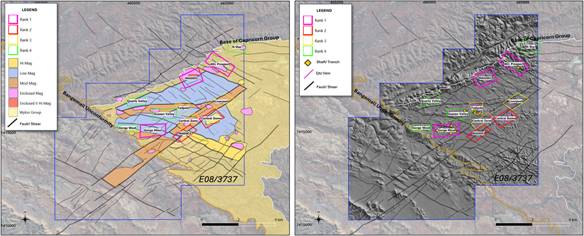
Figure 4 - Ranked targets: (Left) Solid geological interpretation.
(Right) LiDAR DTM with interpreted workings and quartz veins.
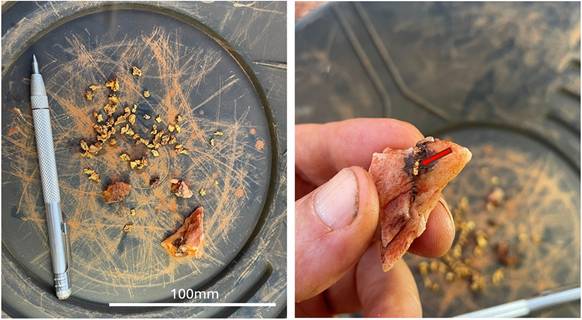
Figure 5 - Gold-bearing material recovered by metal detecting around the Central Zone target area during a single day of prospecting on 28 May 2026. Coarse free gold is observed in association with quartz veining and sulphide alteration along fractures. The angular nature of the quartz vein sample suggests limited transport from the bedrock source.
|




