
MRE Upgrade at Pitfield Titanium Project
Summary by AI BETAClose X

Empire Metals Limited / LON: EEE, OTCQX: EPMLF / Sector: Natural Resources
19 August 2026
Empire Metals Limited
("Empire" or "the Company")
MRE Upgrade Confirms Pitfield Project as the World's Largest Titanium Resource
Empire Metals Limited, the AIM-quoted and OTCQX-traded exploration and development company, is pleased to report an upgraded Mineral Resource Estimate ('MRE') at its Pitfield Project in Western Australia ('Pitfield' or the 'Project'), confirming the Project as the world's largest titanium resource. The MRE is reported in accordance with the Joint Ore Reserves Committee ('JORC') 2012 Code (The Australasian Code for Reporting of Exploration Results, Mineral Resources, and Ore Reserves) and includes Measured, Indicated and Inferred categories.
Highlights
· World's largest titanium resource1: upgraded MRE of 8.16 billion tonnes at 4.3% TiO2 for 349 million tonnes of contained TiO2, across the Thomas and Cosgrove deposits
· Including Resource Classifications:
o Measured: 374 million tonnes at 5.8% TiO2 for 21.6 million tonnes of contained TiO2
o Indicated: 3.65 billion tonnes at 4.3% TiO2 for 154.7 million tonnes of contained TiO2
o Inferred: 4.2 billion tonnes at 4.1% TiO2 for 173 million tonnes of contained TiO2
· First Measured Resource declared at Pitfield, defines high-grade material coupled with
Indicated Resources, strengthens confidence to progress mine planning and economic studies
· Near-surface, in-situ weathered zone of 4.39 billion tonnes at 4.4% TiO2 for 194.5 million tonnes of contained TiO2: comprising soft, friable material from surface containing naturally formed anatase and rutile, with minimal overburden and no inter-burden, supporting simple, efficient mining methods
· High-grade TiO2 cores define early mining targets with continuous zones averaging above 6% TiO2 over a 5km strike length and up to 1.25km width at Thomas, and over a 4.0km strike length at Cosgrove
· Flowsheet based on conventional processing steps with direct access to global markets: integrated flowsheet demonstrated to produce high-purity (99%+) TiO2 targeting pigment and titanium sponge feedstocks (announced 11 June 2026), with established rail links to deep-water ports serving Asia, the USA, Europe and Saudi Arabia
1 Source: US Geological Survey, Mineral Commodity Summaries 2025, World Resources of Titanium Minerals; comparison against publicly reported JORC (or equivalent) titanium MRE statements on a contained TiO2 basis. USGS national inventory figures are not reported under the JORC Code.
Shaun Bunn, Managing Director, said: "This upgraded MRE is a landmark moment for Empire Metals and confirms Pitfield as the world's largest titanium resource. To have defined 8.16 billion tonnes at 4.3% TiO2, containing 349 million tonnes of TiO2, underlines the sheer scale of this discovery.
"The scale is only part of the story. The declaration of our first Measured Resource of 374 million tonnes at 5.8% TiO2 containing 21.6 million TiO2, together with a substantial Indicated component, provides the platform for mine planning and the economic studies that will underpin Pitfield's development. This milestone comes just weeks after we demonstrated an integrated flowsheet based on conventional processing steps, producing TiO2 at better than 99% purity, targeting both pigment and titanium metal feedstocks. The high-grade weathered zone sits at surface and lends itself to simple, efficient mining methods. We now have both halves of the equation: a titanium resource of exceptional scale, and an integrated processing route designed to produce high-value products.
"Pitfield has the hallmarks of a tier-one titanium project: scale, grade, simple mining methods, processing route based on conventional processing steps and direct access to global markets, in a strategically important mining friendly jurisdiction."
Pitfield Mineral Resource Statement (100% basis)
The Pitfield MRE incorporates the titanium mineralisation hosted within the interbedded succession of sandstones, siltstones and conglomerates as delineated through Diamond Core ('DD'), Reverse Circulation ('RC') and Aircore (AC) drilling, that is supplemented with geophysical surveys, surface mapping and soil and rock chip sampling.
The Pitfield MRE is being reported in accordance with the 2012 JORC Code and estimated by a Competent Person as defined by the Code. The Pitfield MRE contains Measured and Indicated categories as well as Inferred, highlighting the elevated confidence level of the resource within the upgraded resource statement.
The MRE consists of two distinct near-surface in-situ weathered bedrock zones referred to as the Thomas and Cosgrove Deposits, which are defined by an area of 25.5km2 and 39.8km2 respectively, for a total MRE area of 65.3km2 (refer Figure 2).
The MRE has been subdivided to show the potential mineralisation at each prospect separately. It has been further subdivided to show the range of mineralisation within the in-situ saprolite zone and weathered bedrock zones, both being enriched in titanium dioxide minerals (anatase and rutile) and extending from surface to an average depth of approximately 30m to 50m (Table 1). Additionally, the MRE includes the uppermost portion of the underlying fresh bedrock mineralisation, which is primarily enriched with the titanium mineral titanite, as well as some rutile and titanium-iron oxides, and is completely open at depth.
Table 1 below summarises the MRE for Pitfield's Thomas and Cosgrove deposits effective as of 19 August 2026 on a 100% basis. Empire owns 70% of Pitfield in a Joint Venture (JV) with Century Minerals Pty Ltd, which holds the remaining 30% JV interest. Empire is manager of the JV and the sole operator of the Project. Snowden Optiro was engaged to prepare a geological resource model for the MRE for Empire on the Pitfield Project. The MRE was reviewed and signed off in accordance with the JORC Code (2012) by Andrew Faragher (MAusIMM), Exploration Manager for Empire.
Table 1. Pitfield Project Mineral Resource Statement - Updated August 2026
|
Mineral Resource Estimate for the Thomas Deposit, Pitfield - August 2026 |
||||||||||||||
|
Domain |
Cut-off |
Measured |
Indicated |
Inferred |
Total Mineral Resource |
|||||||||
|
Material Type |
TiO2 (%) |
Tonnes (Mt) |
Grade (%) |
Tonnes (kt) |
Tonnes (Mt) |
Grade (%) |
Tonnes (kt) |
Tonnes (Mt) |
Grade (%) |
Tonnes (kt) |
Tonnes (Mt) |
Grade (%) |
TiO2 Tonnes (kt) |
|
|
Laterite |
2.5 |
17 |
4.3 |
718 |
24 |
3.7 |
909 |
11 |
3.2 |
345 |
52 |
3.8 |
1,973 |
|
|
Saprolite |
73 |
5.8 |
4,240 |
124 |
4.7 |
5,826 |
60 |
4.4 |
2,612 |
257 |
4.9 |
12,678 |
||
|
Weathered |
225 |
6.0 |
13,570 |
523 |
4.8 |
25,172 |
267 |
4.3 |
11,446 |
1,015 |
4.9 |
50,189 |
||
|
Fresh |
58 |
5.3 |
3,112 |
61 |
4.5 |
2,735 |
1,113 |
4.4 |
48,561 |
1,233 |
4.4 |
54,407 |
||
|
Total |
|
374 |
5.8 |
21,640 |
732 |
4.7 |
34,643 |
1,451 |
4.3 |
62,964 |
2,557 |
4.7 |
119,246 |
|
|
Mineral Resource Estimate for the Cosgrove Deposit, Pitfield - August 2026 |
||||||||||||||
|
Domain |
Cut-Off |
Measured |
Indicated |
Inferred |
Total Mineral Resource |
|||||||||
|
Material Type |
TiO2 (%) |
Tonnes (Mt) |
Grade (%) |
Tonnes (kt) |
Tonnes (Mt) |
Grade (%) |
Tonnes (kt) |
Tonnes (Mt) |
Grade (%) |
Tonnes (kt) |
Tonnes (Mt) |
Grade (%) |
TiO2 Tonnes (kt) |
|
|
Laterite |
2.5 |
- |
- |
- |
145 |
3.6 |
5,172 |
53 |
3.8 |
2,022 |
198 |
3.6 |
7,194 |
|
|
Saprolite |
- |
- |
- |
553 |
4.4 |
24,224 |
93 |
4.3 |
4,027 |
646 |
4.4 |
28,251 |
||
|
Weathered |
- |
- |
- |
1,692 |
4.3 |
72,731 |
528 |
4.1 |
21,499 |
2,219 |
4.2 |
94,231 |
||
|
Fresh |
- |
- |
- |
463 |
3.9 |
17,884 |
2,076 |
4.0 |
82,438 |
2,539 |
4.0 |
100,322 |
||
|
Total |
|
- |
- |
- |
2,853 |
4.2 |
120,011 |
2,749 |
4.0 |
109,986 |
5,602 |
4.1 |
229,998 |
|
|
Combined Mineral Resource Estimates for the Pitfield Project - August 2026 |
||||||||||||||
|
Domain |
Cut-Off |
Measured |
Indicated |
Inferred |
Total Mineral Resource |
|||||||||
|
Material Type |
TiO2 (%) |
Tonnes (Mt) |
Grade (%) |
Tonnes (kt) |
Tonnes (Mt) |
Grade (%) |
Tonnes (kt) |
Tonnes (Mt) |
Grade (%) |
Tonnes (kt) |
Tonnes (Mt) |
Grade (%) |
TiO2 Tonnes (kt) |
|
|
Laterite |
2.5 |
17 |
4.3 |
718 |
169 |
3.6 |
6,082 |
64 |
3.7 |
2,367 |
249 |
3.7 |
9,167 |
|
|
Saprolite |
73 |
5.8 |
4,240 |
677 |
4.4 |
30,050 |
152 |
4.4 |
6,639 |
903 |
4.5 |
40,928 |
||
|
Weathered |
225 |
6.0 |
13,570 |
2,214 |
4.4 |
97,904 |
795 |
4.1 |
32,945 |
3,235 |
4.5 |
144,419 |
||
|
Fresh |
58 |
5.3 |
3,112 |
525 |
3.9 |
20,619 |
3,189 |
4.1 |
130,999 |
3,772 |
4.1 |
154,729 |
||
|
Total |
|
374 |
5.8 |
21,640 |
3,585 |
4.3 |
154,654 |
4,200 |
4.1 |
172,950 |
8,159 |
4.3 |
349,244 |
|
Notes:
The preceding statements of Mineral Resources conforms to the Australasian Code for Reporting of Exploration Results, Mineral Resources and Ore Reserves (JORC Code) 2012 Edition. All tonnages reported are dry metric tonnes. Minor discrepancies occur due to rounding to appropriate significant figures. The MRE is reported above a 2.5% TiO2 cut-off, constrained to a Reasonable Prospects for Eventual Economic Extraction (RPEEE) pitshell.
About the Pitfield Project
Located within the Mid-West region of Western Australia, near the northern wheatbelt town of Three Springs, the Pitfield titanium project lies 313km north of Perth and 156km southeast of Geraldton, the Mid-West region's capital and major port. Western Australia is a Tier 1 mining jurisdiction, with mining-friendly policies, stable government, transparency, and advanced technology expertise. Pitfield has existing connections to port (both road & rail), HV power substations, and is nearby to natural gas pipelines as well as a wind and solar renewable energy hub, which is under development (refer Figure 1).
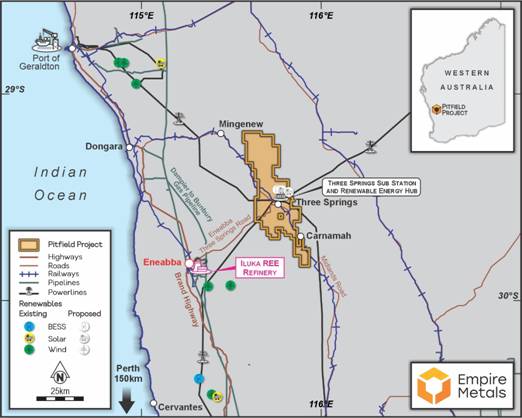
Figure 1. Pitfield Project Location showing the Mid-West Region Infrastructure, Services and Regional Projects (Mining and Renewables)
Thomas and Cosgrove MRE
The updated MRE has been completed on the Thomas and Cosgrove eposits, which are located approximately 10km south-west and north-west of the town of Three Springs respectively. The drilling at Thomas was primarily designed to increase the confidence level of the resource, with drilling also designed to identify infrastructure options where no mineralisation occurs. The drilling at Cosgrove was designed to significantly increase the size of the known resource there. Previous drilling had focussed on the central part of Cosgrove, this drilling was to increase geological knowledge and resource size.
It is important to note that the upgraded MRE presented herein is constrained by the current number, and density of drill holes, geology and extent of TiO2 mineralisation.
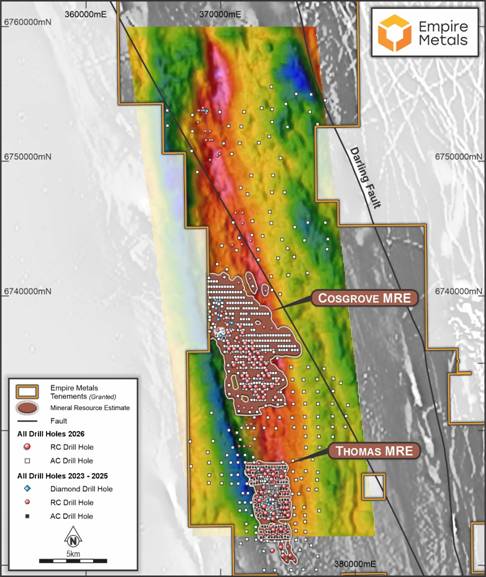
Figure 2: MRE outlines for Thomas and Cosgrove deposits with background images of airborne gravity survey results with the location of the AC, RC and DD drillholes
Geology and Mineralisation Style
Pitfield lies in a unique geological setting along the western boundary of the Yilgarn Craton, within the Yandanooka Basin which consists mainly of interbedded sandstones, siltstone and conglomerates. The Basin is situated between the Eurella Fault to the west and the Darling Range Fault to the east and is interpreted to be approximately 9km deep. Crustal mapping by Geoscience Australia shows there are several deep crustal faults intersecting beneath the Yandanooka Basin and these faults are potentially the conduits of hydrothermal fluids that have strongly altered the host sediments and provided an upgrade to the titanium mineralisation.
The titanium mineralisation is associated predominantly with anatase and rutile in the weathered cap and titanite and rutile in the underlying fresh bedrock. Three distinct events have controlled the formation and nature of the titanium mineralisation. A Ti-rich magmatic intrusion was initially formed, uplifted and eroded into a shallow basin whereby titanium minerals were concentrated into beds as the sediments were sorted by a natural density-based segregation on a significantly larger extent than occurs in surficial mineral sand type deposits. A subsequent hydrothermal event and regional greenschist metamorphism then altered the host sediments and titanium minerals within the sediments and produced an alteration assemblage dominated by titanite (CaTiSiO5), hematite, epidote, carbonate and chlorite. The titanium mineralisation was further upgraded by intense weathering altering the titanite to anatase by removal of the calcium and silica. The consequence of this geological history has been the upgrading of TiO2 content in the ore mineralogy ultimately to >95% TiO2 in the anatase found in the weathered cap. Uniquely, nature has in fact done much of the processing for Empire at Pitfield.
The mineralisation is completely stratabound and the best mineralisation is found within the in-situ weathered cap whereby the sandstones, siltstone and conglomerates have been altered to saprolite, predominantly quartz and kaolin and the titanite has altered to anatase (TiO2). The weathered bedrock consists of altered rock, but weathering is less intense, quartz and kaolin are predominant but as the weathering profile turns to fresher material there is an increase in chlorite, epidote, mica, hematite and carbonate; the anatase content decreases and the titanite content increases.
The upgraded Pitfield MRE incorporates the Thomas and Cosgrove deposits. At Thomas the upgraded MRE now has 43% of the resource reporting to the Measured and Indicated categories and the remainder reporting to the Inferred category. At Cosgrove 51% of the resource reports to the Indicated category and the remainder reports to the Inferred category. Thomas and Cosgrove both have large, high-grade central cores as per the block model. The in-situ weathered cap at both Thomas and Cosgrove can now form the basis for economic and engineering studies, targeting mine planning to support a long-life mining operation.
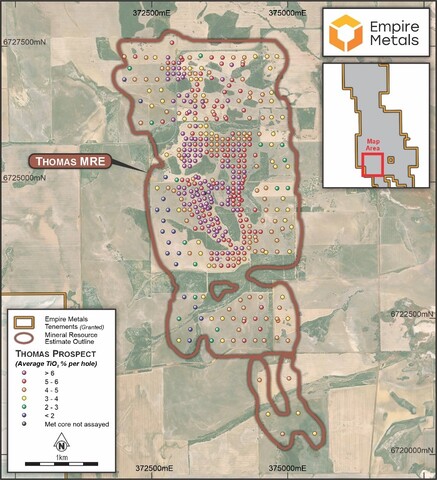
Figure 3. Thomas Deposit: Location with MRE outline and drill collars by grade
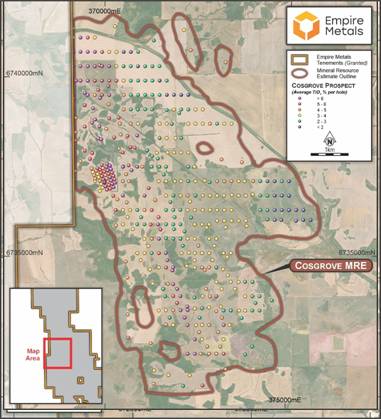
Figure 4. Cosgrove Deposit: Location with MRE outline and drill collars by grade
Drilling Techniques
Drilling was undertaken between 2023 and 2026 with all drilling managed entirely by Empire using primarily Wallis Drilling and Strike Drilling. RC holes were drilled at a diameter of 146mm, AC holes were drilled at a diameter of 90mm or 76mm. Diamond core holes were drilled using PQ3 (85mm,) HQ3 (61mm) or NQ2 (51mm) equipment. Drill core was oriented using the industry standard Reflex orientation tool.
Table 2: Drilling (drillholes with assays) metrics by prospect, year and hole type
|
|
|
Thomas |
Cosgrove |
Other Areas |
|||
|
Year |
Hole Type |
Count |
Metres |
Count |
Metres |
Count |
Metres |
|
2023 |
RC |
11 |
1,712 |
13 |
1,848 |
36 |
5,343 |
|
DD |
1 |
408 |
1 |
400 |
1 |
408 |
|
|
2024 |
RC |
19 |
2,926 |
20 |
3,006 |
1 |
154 |
|
DD |
7 |
771 |
7 |
715 |
|
|
|
|
2025 |
AC |
183 |
8,679 |
42 |
2111 |
|
|
|
RC |
40 |
3,776 |
|
|
|
|
|
|
DD |
8 |
745 |
|
|
|
|
|
|
2026 |
AC |
148 |
6,828 |
269 |
12,140 |
224 |
8,788 |
|
RC |
30 |
2,988 |
41 |
4,100 |
|
|
|
|
Totals |
|
447 |
28,833 |
393 |
24,320 |
262 |
14,693 |
Since commencing the maiden drilling campaign at Pitfield on 27 March 2023, Empire has completed 1,102 drill holes for a total 67,846 metres comprising:
• 25 DD drill holes for 3,447 m;
• 211 RC drill holes for 25,853 m; and,
• 866 AC drill holes for 38,546 m.
Sampling Techniques
Sampling at Thomas and Cosgrove utilised standard procedures employed across all drilling methods, with samples considered representative for the purposes of reporting.
• Air core (AC) samples were collected directly from an AC drill rig using a cone splitter at intervals every 2m downhole.
• Reverse circulation (RC) samples were collected directly from an RC drill rig using a cone splitter at intervals every 2m downhole.
• Diamond core samples were taken from the diamond core (HQ and NQ) that was sawn in half, with half going for assay and other half retained in core tray. Hole drilled with PQ, predominantly for metallurgical samples, were cut in half and then one half cut in quarter. The quarter was sent for assay and the remaining three quarters retained for metallurgical sampling. Samples were taken based on the geological logging of the drill holes.
Sample Preparation and Assay
Sample preparation for all AC, RC and DD samples was undertaken at Intertek Minerals laboratory in Maddington WA, where the samples received were sorted and dried. Primary preparation for diamond core samples was to crush each sample in its entirety to 3mm. AC and RC samples were primarily crushed to 3mm. Larger volume samples (>5kg) were split with a riffle splitter. All samples were pulverised via robotic pulveriser. Internal screen sizing QAQC is done at 90% passing 75um.
Prior to October 2024 a 4-acid digestion was used with ICP-MS finish (procedure 4A/MS48) as the initial assay technique. If the initial Ti values exceeded 2% Ti, the samples were re-assayed using a borate fusion digestion to ensure complete dissolution of Ti-bearing minerals, with a ICP-OES analytical finish (procedure FP1/OM).
In October 2024 the analytical methodology was modified to reduce the number of initial elements analysed to 33. The samples underwent a 4-acid digestion and were analysed by ICP-OES finish (procedure 4A/OE33). All samples with initial values exceeding 2% Ti were analysed again with an ICP-OES finish, but with a borate fusion digestion to ensure complete sample dissolution and total TiO2 mineral assaying.
Certified analytical standards were inserted with sample numbers ending in 00, 25, 50 and 75 within the numbering sequence for all AC, RC and DD samples.
Duplicates were inserted with sample numbers ending in 20, 40, 60 and 80 sample numbers within the numbering sequence for all AC and RC samples.
Bulk Density
A total of 109 bulk density values were collected from diamond drill core from both Thomas and Cosgrove; the samples came from the saprolite, weathered bedrock and fresh bedrock zones and were sent to Terra Petrophysics in O'Connor, Perth. The density determinations were made using conventional laboratory procedures. The buoyancy (specific gravity) method is used to determine bulk rock densities, after the samples are saturated with distilled water for 24 hours. Dry bulk densities are determined by dry weight divided by the buoyancy determined volume of each sample. Porosities are calculated from water saturated weights, dry weights, and the buoyancy-determined volume.
The accuracy of the buoyancy technique of density measurement is better than 0.1 grams per cubic centimetre. The results of the laboratory density determinations are reported in grams per cubic centimetre.
Estimation Methodology
Geological interpretation was completed using Leapfrog Geo (v 2025.2.1) software to construct a material type (cover, saprolite, weathered and fresh rock domains) model, which used a combination of geological logging and element geochemical data. A further geological model representing the principle lithological units was constructed using logging codes to represent the Enokurra sandstone and interbedded conglomerate units present at both deposits. Mineralisation domains were defined using a lower modelling cut-off approximating a 2.5% TiO2 threshold, with a clear northwest-southeast trending boundary striking through both the Cosgrove and Thomas deposits.
Exploratory data analysis was then conducted by reviewing multi-element geochemical relationships for TiO2 with Al, Fe, Ca, Mg, K and Na in each of the forementioned domains. Estimation domains were defined based on weathering intensity and above and below the TiO2 modelling cut-off.
Drillholes were composited to 2m increments, representing the typical sampling interval used. Geostatistical analysis and grade continuity modelling was reviewed using Datamine's Snowden Supervisor Software (v8.15.2) and estimation conducted using Datamine's Studio RM Pro (v2.1.125.0).
The TiO2 grade was estimated using ordinary kriging, employing a three-pass estimation strategy within parent blocks measuring 50 m(X) by 50 m(Y) by 10 m(RL). Sub-blocking was permitted to 2m in all directions.
Variograms were modelled separately for each deposit using normal scores transformed data, which was back-transformed on export. At Thomas, the nugget effect was modelled at <20% of total variance, with the remaining three structures modelled at 120m (0.21), 210m (0.25), and 700m (0.37). The variogram is aligned 000->345 for the major direction, 00->255 for the semi-major and 90->000 for the minor (vertical). At Cosgrove, the nugget effect accounted for approximately <25% of variance of the data. The remaining three structures were modelled at 95m (0.23), 542m (0.20) and 1000 m (0.38). The orientations were the same as those used at Thomas.
Density was assigned to the parent blocks based on bulk densities determined from the Archimedes water immersion method, conducted at Terra Resources. A total of 109 samples from both deposits were submitted across all weathering types. Density was assigned to the block model on the basis of material type, as per Table 3 below.
Table 3: Bulk densities applied at Cosgrove and Thomas deposits
|
Material type |
Number of samples |
Applied bulk density t/m3 |
|
Cover (sand) |
1 |
1.07 |
|
Laterite |
8 |
2.35 |
|
Saprolite |
22 |
2.09 |
|
Weathered sandstone |
57 |
2.17 |
|
Fresh sandstone/conglomerate |
21 |
3.05 |
|
Total |
109 |
N/a |
Due to the size of the deposits, any un-estimated blocks were hard-coded and were flagged in the model by way of an indicator variable and excluded from classified Mineral Resources.
Cut-off grade(s) and basis of selection
A cut-off grade of 2.5% TiO2 was used and determined from optimisation studies which indicated a break-even cut-off of 2.36% TiO2. Grade and tonnes have been reported within a constrained pit shell reported from a Whittle optimisation. The underlying parameters are listed in Table 4.
This decision was based on a high-level preliminary evaluation of potential modifying factors.
Table 4: Open pit RPEEE optimisation inputs
|
Item |
Units |
Value |
Comment |
|
Factors |
|||
|
Dilution |
% |
0 |
Snowden Optiro assumption - bulk commodity |
|
Mining recovery |
% |
100 |
Snowden Optiro assumption - bulk commodity |
|
Process recovery |
% |
70 |
Empire provided data |
|
Financial |
|||
|
Price - TiO2 |
US$/t TiO2 (FOB) |
2,500 |
Empire provided data to Snowden Optiro based on external expert advice |
|
Costs |
|||
|
Mining |
US$/t rock |
3 |
Empire provided data |
|
Incremental ore cost |
US$/t rock |
0.5 |
Snowden Optiro assumption |
|
Processing |
US$/t rock |
38 |
Empire provided assumption |
|
G&A |
US$/t rock |
1.5 |
Snowden Optiro assumption |
|
Total ore cost |
|
40 |
|
|
Product transport |
US$/t TiO2 |
20 |
160 km to Geraldton Port |
|
Royalty |
% price |
2.5 |
WA state royalty |
|
|
|
Geotech |
|
|
Saprolite |
degrees |
40 |
Snowden Optiro assumption |
|
Weathered/fresh |
degrees |
45 |
Snowden Optiro assumption |
|
Marginal cut-off calculation |
% TiO2 |
2.36 |
Calculation |
NB* Calculation derived from Total ore cost / (Process recovery*(Price*(1-Royalty)-Product Transport))*100
See JORC Table 1 Section 2 for more detailed explanation.
Future Drilling, project studies and process flow sheet development to support MRE Upgrade in 2027
The MRE model is currently being reviewed to ensure future drilling supports an MRE upgrade in mid CY 2027, focused on conversion of further Indicated Resources to Measured at Thomas and Cosgrove deposits, as well as process flow sheet and economic studies to support a move to Probable Ore Reserves. A future MRE upgrade would further assist with mine development planning, primarily from increased confidence categories as the Company seeks to progress through to feasibility stage. Future upgrades would require further bulk density work to increase the number of density figures used, ongoing metallurgical test work focused on increasing the confidence level in the Company's process flow sheet and end product specifications.
The Company is in the process of preparing additional Programme of Works with the WA government's Department of Mining, Petroleum and Exploration to support a bulk sampling program as well as further grid drilling to infill the Cosgrove deposit over the next twelve months to increase the confidence level of the resource. Empire will consider other on ground activities as part of the supporting process development work and engineering studies.
Classification
The MRE has been classified following the guidelines of the Australasian Code for Reporting of Exploration Results, Mineral Resources and Ore Reserves, 2012 (the JORC Code). The updated MRE at Thomas has been classified as Measured, Inferred and Indicated on the basis of confidence in geological and grade continuity, the quality of the sampling and assay data, and confidence in the estimation of titanium across the deposit (see Figure 5). This is based on the robustness of the grade estimate as determined from the drillhole spacing, geological confidence and grade continuity.
The updated MRE at Cosgrove has been classified as Indicated and Inferred on the basis of confidence in geological and grade continuity, the quality of the sampling and assay data, and confidence in the estimation of titanium across the deposit (see Figure 6). This is based on the robustness of the grade estimate as determined from the drillhole spacing, geological confidence and grade continuity. The drilling at Cosgrove is predominantly on a 400m x 200m grid and therefore the MRE classification has lower confidence.
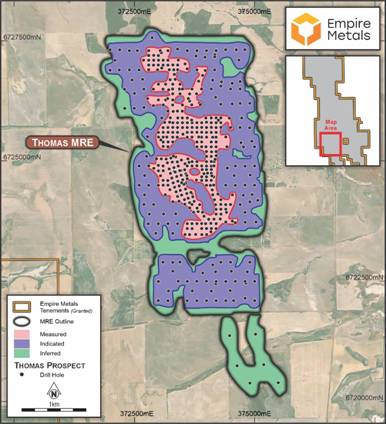
Figure 5. Thomas Deposit Classification: MRE Outline with Measured, Indicated and Inferred Categories
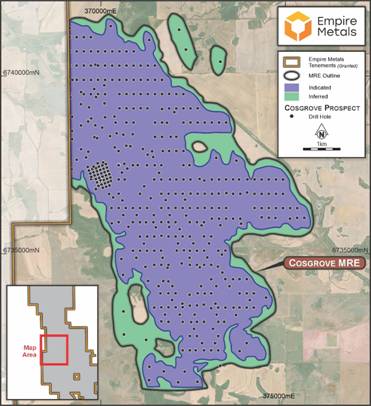
Figure 6. Cosgrove Deposit Classification: MRE Outline with Indicated and Inferred categories
Mineralogy and Metallurgical Factors or Assumptions
The main titanium minerals at Pitfield are anatase (TiO2) within the saprolite and weathered bedrock and titanite (CaTiSiO5) within the fresh bedrock, rutile (TiO2) is found within all rock types. The minerals have been identified from thin section petrography, SEM and microprobe work. The microprobe work has identified that there are no deleterious elements within the anatase, rutile or titanite.
Metallurgical testwork has been undertaken on a range of samples from the exploration and resource drilling programmes. The focus of the testwork has been on the weathered zones, as this is near-surface and extensive. There has been some limited testwork in the underlying fresh bedrock zone and this will continue in subsequent testwork programmes as the flowsheet details start to be confirmed. It is likely that some modifications to the process flowsheet would be required in order to treat the fresh bedrock ore, this assumption will be tested as the project progresses.
Multiple samples from Diamond core drilling and AC drilling programmes have been selected for metallurgical testwork. Testwork is being managed by Empire's inhouse technical team with the assistance of external experts and being undertaken at a number of commercial laboratories in Perth, Western Australia. The programme has four key areas:
· Understanding the mineralogy and physical characteristics of the mineralisation that influence metallurgical performance
· Mineral separation process development
· Elemental extraction process development
· Product finishing to meet industry standard specifications
Whilst the process flowsheet has been identified through the metallurgical testwork to date, there is still work to be undertaken in this area. The focus has now moved from testing a wide range of potential unit operations to developing a deeper understanding of the selected process, including impact on performance of a range of operating and mineralogical variables.
Progress results have been reported previously via RNS, including most recently:
· "Pitfield Process Flowsheet and Product Development" 11/06/2026
· "Pitfield Project Development Update" 27/01/26
· "Breakthrough in Process development" 28/08/25
· "Team Expansion and Bulk Met testing commences" 16/07/25
· "Exceptional High-Purity TiO2 Product Achieved" 09/06/25
· "High-Purity TiO2 Product achieved" 10/03/25
· "Significant Progress Achieved on Process Flowsheet" 13/02/25
Competent Person Statement
The technical information in this report that relates to the Pitfield Project has been compiled by Mr Andrew Faragher, an employee of Empire Metals Australia Pty Ltd, a wholly owned subsidiary of Empire. Mr Faragher is a Member of the Australian Institute of Mining and Metallurgy (AusIMM). Mr Faragher has sufficient experience that is relevant to the style of mineralisation and type of deposit under consideration and to the activity being undertaken to qualify as a Competent Person as defined in the 2012 Edition of the 'Australasian Code for Reporting of Exploration Results, Mineral Resources and Ore Reserves'. Mr Faragher consents to the inclusion in this release of the matters based on his information in the form and context in which it appears.
The scientific and technical information in this report that relates to process metallurgy is based on information reviewed by Ms Narelle Marriott, an employee of Empire Metals Australia Pty Ltd, a wholly owned subsidiary of Empire. Ms Marriott is a member of the AusIMM and has sufficient experience relevant to the style of mineralisation and type of deposit under consideration and to the activity being undertaken to qualify as a Competent Person as defined in the JORC Code 2012. Ms. Marriott consents to the inclusion in this announcement of the matters based on their information in the form and context in which it appears.
Market Abuse Regulation (MAR) Disclosure
Certain information contained in this announcement would have been deemed inside information for the purposes of Article 7 of Regulation (EU) No 596/2014, as incorporated into UK law by the European Union (Withdrawal) Act 2018, until the release of this announcement.
**ENDS**
For further information please visit www.empiremetals.com or contact:
|
Empire Metals Ltd Shaun Bunn / Greg Kuenzel / Arabella Burwell
|
Tel: 020 4583 1440
|
|
S. P. Angel Corporate Finance LLP (Nomad & Joint Broker) Ewan Leggat / Adam Cowl
|
Tel: 020 3470 0470
|
|
Canaccord Genuity Limited (Joint Broker) James Asensio / Christian Calabrese / Rory Blundell / Charlie Hammond
|
Tel: 020 7523 8000
|
|
Zeus Capital Limited (Joint Broker) Harry Ansell / Katy Mitchell
|
Tel: 020 3829 5000 |
|
Tavistock (Financial PR) Emily Moss / Josephine Clerkin
|
Tel: 020 7920 3150
|
|
Chapter One Advisors (Australian Financial PR) David Tasker
|
dtasker@chapteroneadvisors.com.au Tel: +61 433 112 936 |
About Empire Metals Limited
Empire Metals Ltd (AIM: EEE and OTCQX: EPMLF) is an exploration and resource development company focused on the commercialisation of the Pitfield Titanium Project, located in Western Australia. The titanium discovery at Pitfield is of unprecedented scale and hosts the largest titanium resource reported globally (to JORC or equivalent standard), and among the highest grade, with a Mineral Resource Estimate (MRE) totalling 8.16 billion tonnes grading 4.3% TiO₂ for 349 million tonnes of contained TiO₂.
Titanium mineralisation at Pitfield occurs from surface and displays exceptional grade continuity along strike and down dip.
Conventional processing has already produced a high-purity product grading 99.25% TiO₂, targeting pigment and titanium sponge metal feedstock. With excellent logistics and established infrastructure, Pitfield is strategically positioned to supply the growing global demand for titanium and other critical minerals.
GLOSSARY OF TERMS AND ABBREVIATIONS
The following definitions are extracted from the JORC Code, 2012 Edition
|
Indicated Mineral Resource |
An 'Indicated Mineral Resource' is that part of a Mineral Resource for which quantity, grade (or quality), densities, shape and physical characteristics are estimated with sufficient confidence to allow the application of Modifying Factors in sufficient detail to support mine planning and evaluation of the economic viability of the deposit. Geological evidence is derived from adequately detailed and reliable exploration, sampling and testing gathered through appropriate techniques from locations such as outcrops, trenches, pits, workings and drill holes, and is sufficient to assume geological and grade (or quality) continuity between points of observation where data and samples are gathered. An Indicated Mineral Resource has a lower level of confidence than that applying to a Measured Mineral Resource and may only be converted to a Probable Ore Reserve. |
|
Inferred Mineral Resource |
An 'Inferred Mineral Resource' is that part of a Mineral Resource for which quantity and grade (or quality) are estimated on the basis of limited geological evidence and sampling. Geological evidence is sufficient to imply but not verify geological and grade (or quality) continuity. It is based on exploration, sampling and testing information gathered through appropriate techniques from locations such as outcrops, trenches, pits, workings and drill holes. An Inferred Mineral Resource has a lower level of confidence than that applying to an Indicated Mineral Resource and must not be converted to an Ore Reserve. It is reasonably expected that the majority of Inferred Mineral Resources could be upgraded to Indicated Mineral Resources with continued exploration. |
|
JORC |
JORC stands for Australasian Joint Ore Reserves Committee (JORC). The Code for Reporting of Exploration Results, Mineral Resources and Ore Reserves (the JORC Code) is widely accepted as the definitive standard for the reporting of a company's resources and reserves. The latest JORC Code is the 2012 Edition. |
|
Measured Mineral Resource |
A 'Measured Mineral Resource' is that part of a Mineral Resource for which quantity, grade (or quality), densities, shape, and physical characteristics are estimated with confidence sufficient to allow the application of Modifying Factors to support detailed mine planning and final evaluation of the economic viability of the deposit. Geological evidence is derived from detailed and reliable exploration, sampling and testing gathered through appropriate techniques from locations such as outcrops, trenches, pits, workings and drill holes, and is sufficient to confirm geological and grade (or quality) continuity between points of observation where data and samples are gathered. A Measured Mineral Resource has a higher level of confidence than that applying to either an Indicated Mineral Resource or an Inferred Mineral Resource. It may be converted to a Proved Ore Reserve or under certain circumstances to a Probable Ore Reserve |
|
Mineral Reserves or Ore Reserves
|
An 'Ore Reserve' is the economically mineable part of a Measured and/or Indicated Mineral Resource. It includes diluting materials and allowances for losses, which may occur when the material is mined or extracted and is defined by studies at Pre-Feasibility or Feasibility level as appropriate that include application of Modifying Factors. Such studies demonstrate that, at the time of reporting, extraction could reasonably be justified. |
|
Mineral Resource |
A 'Mineral Resource' is a concentration or occurrence of solid material of economic interest in or on the Earth's crust in such form, grade (or quality), and quantity that there are reasonable prospects for eventual economic extraction. The location, quantity, grade (or quality), continuity and other geological characteristics of a Mineral Resource are known, estimated or interpreted from specific geological evidence and knowledge, including sampling. Mineral Resources are sub-divided, in order of increasing geological confidence, into Inferred, Indicated and Measured categories. |
JORC Code, 2012 Edition - Table 1 report template
Section 1 Sampling Techniques and Data
(Criteria in this section apply to all succeeding sections.)
|
|
|
|
|
Sampling techniques |
· Nature and quality of sampling (eg cut channels, random chips, or specific specialised industry standard measurement tools appropriate to the minerals under investigation, such as down hole gamma sondes, or handheld XRF instruments, etc). These examples should not be taken as limiting the broad meaning of sampling. · Include reference to measures taken to ensure sample representivity and the appropriate calibration of any measurement tools or systems used. · Aspects of the determination of mineralisation that are Material to the Public Report. · In cases where 'industry standard' work has been done this would be relatively simple (eg 'reverse circulation drilling was used to obtain 1 m samples from which 3 kg was pulverised to produce a 30 g charge for fire assay'). In other cases more explanation may be required, such as where there is coarse gold that has inherent sampling problems. Unusual commodities or mineralisation types (eg submarine nodules) may warrant disclosure of detailed information. |
· Air core (AC) samples were collected directly from an AC drill rig using a cone splitter at intervals every 2m downhole. · Reverse circulation (RC) samples were collected directly from an RC drill rig using a cone splitter at intervals every 2m downhole. · Diamond core samples were taken from the diamond core (HQ and NQ) that was sawn in half, with half going for assay and other half retained in core tray. Hole drilled with PQ, predominantly for metallurgical samples, were cut in half and then one half cut in quarter. The quarter was sent for assay and the remaining three quarters retained for metallurgical sampling. Samples were taken based on the geological logging of the drill holes. · Duplicates were inserted with sample numbers ending in 20, 40, 60 and 80 within the numbering sequence and were collected at the same time as the original sample through the chute of the cone splitter. Blanks were inserted at the beginning of each hole and certified reference materials (CRM) were inserted every 25 samples. The Ti grade range of the CRM's went from <0.5% to <9% Ti to ensure coverage over the range of Ti values that have been seen at Pitfield. · Sample preparation was undertaken at Intertek Minerals laboratory in Maddington WA, where the samples received were sorted and dried. Primary preparation for diamond core samples, crush each sample in its entirety to 3mm. RC samples were primarily crushed to 3mm. Larger volume samples (>5kg) were split with a riffle splitter. All samples were pulverised via robotic pulveriser. Internal screen sizing QAQC is done at 90% passing 75um. |
|
Drilling techniques |
· Drill type (eg core, reverse circulation, open-hole hammer, rotary air blast, auger, Bangka, sonic, etc) and details (eg core diameter, triple or standard tube, depth of diamond tails, face-sampling bit or other type, whether core is oriented and if so, by what method, etc). |
· Diamond drilling techniques varied dependent on which phase of drilling, during phase 2 rock rollers were used at the top of hole until competent rock intersected and HQ sized core was drilled (63.5mm diameter) to a depth of approximately 100m and then NQ2 sized core was drilled (50.6mm diameter) to the bottom of the hole. · Drilling in phase 3 and 4 employed PQ size core (83mm diameter) from surface to obtain core for geological, geochemical and metallurgical samples, once PQ core hit competent bedrock HQ size core was drilled to the bottom of the hole. · Where RC drilling techniques were employed holes were drilled from surface using a nominal 140mm face sampling RC drill bit. · AC drilling was carried out from surface with a 76mm air core blue bit |
|
Drill sample recovery |
· Method of recording and assessing core and chip sample recoveries and results assessed. · Measures taken to maximise sample recovery and ensure representative nature of the samples. · Whether a relationship exists between sample recovery and grade and whether sample bias may have occurred due to preferential loss/gain of fine/coarse material. |
· Diamond core was reconstructed into continuous runs. Depths were measured from the core barrel and checked against marked depths on the core blocks. Core recoveries are very high with >95% of the drill core having recoveries of >99% · RC sample quality was monitored by the onsite geologist. The sampling methodology from the rig was consistent throughout the drilling program. · AC sample quality was monitored by the onsite geologist. The sampling methodology from the rig was consistent throughout the drilling program. · Overall high drill sample recoveries limit the potential to introduce any sample bias. Duplicate samples are all within tolerance limits and therefore no sample bias has been introduced. |
|
Logging |
· Whether core and chip samples have been geologically and geotechnically logged to a level of detail to support appropriate Mineral Resource estimation, mining studies and metallurgical studies. · Whether logging is qualitative or quantitative in nature. Core (or costean, channel, etc) photography. · The total length and percentage of the relevant intersections logged. |
· Detailed diamond drill core logging was carried out, recording weathering, lithology, alteration, mineralisation, structure and mineralogy. Drill core was logged by Empire Metals full time geologists. Drill core logging is qualitative. Drill core was photographed wet and dry in core trays prior to sampling. Core from the entire drill hole was logged. · Detailed RC drill chip logging of every entire drill hole was carried out, recording weathering, lithology, alteration, veining, mineralisation and mineralogy. RC logging on the project has been carried out by Empire Metals full time geologists and contractors. RC logging is qualitative. RC chips were collected in chip trays. Photographs of chip trays were captured. · Detailed AC drill chip logging of every entire drill hole was carried out, recording weathering, lithology, alteration, veining, mineralisation and mineralogy. AC logging on the project has been carried out by Empire Metals full time geologists and contractors. AC logging is qualitative. RC chips were collected in chip trays. Photographs of chip trays were captured. · Rock chips were collected as part of a detailed surface geological mapping program. Qualitative field logging of the rocks was completed in the field including assessment of weathering, lithology, alteration, veining, mineralisation and mineralogy by Empire Metals geologists and consultants. |
|
Sub-sampling techniques and sample preparation |
· If core, whether cut or sawn and whether quarter, half or all core taken. · If non-core, whether riffled, tube sampled, rotary split, etc and whether sampled wet or dry. · For all sample types, the nature, quality and appropriateness of the sample preparation technique. · Quality control procedures adopted for all sub-sampling stages to maximise representivity of samples. · Measures taken to ensure that the sampling is representative of the in situ material collected, including for instance results for field duplicate/second-half sampling. · Whether sample sizes are appropriate to the grain size of the material being sampled. |
· Air core (AC) samples were collected directly from an AC drill using a static cone splitter at 2m intervals down hole. Both dry and wet samples were collected. Duplicates were inserted with sample numbers ending in 20, 40, 60 and 80 within the numbering sequence. CRM's inserted with sample numbers ending in 00, 25, 50 and 75 within the numbering sequence. Blanks inserted at the beginning of the hole. · Reverse circulation (RC) samples were collected directly from an RC drill using a static cone splitter at 2m intervals down hole. Both dry and wet samples were collected. Duplicates were inserted with sample numbers ending in 20, 40, 60 and 80 within the numbering sequence. CRM's inserted with sample numbers ending in 00, 25, 50 and 75 within the numbering sequence. Blanks inserted at the beginning of the hole. · Diamond core samples were taken from the diamond core (PQ, HQ and NQ) that was sawn in half and then one half cut for assay samples and metallurgical samples. Samples were taken based on the geological logging of the drill holes. Standards inserted with sample numbers ending in 00, 25, 50 and 75 within the numbering sequence. · Sample preparation was undertaken at Intertek Minerals laboratory in Maddington WA, where the samples received were sorted and dried. Primary preparation for diamond core samples, crush each sample in its entirety to 3mm. RC samples were primarily crushed to 3mm. Larger volume samples (>5kg) were split with a riffle splitter. All samples were pulverised via robotic pulveriser. Internal screen sizing QAQC is done at 90% passing 75um. · Duplicate samples are all within tolerance limits and therefore no sample bias has been introduced. |
|
Quality of assay data and laboratory tests |
· The nature, quality and appropriateness of the assaying and laboratory procedures used and whether the technique is considered partial or total. · For geophysical tools, spectrometers, handheld XRF instruments, etc, the parameters used in determining the analysis including instrument make and model, reading times, calibrations factors applied and their derivation, etc. · Nature of quality control procedures adopted (eg standards, blanks, duplicates, external laboratory checks) and whether acceptable levels of accuracy (ie lack of bias) and precision have been established. |
· Sample preparation for all AC, RC and diamond samples was undertaken at Intertek Minerals laboratory in Maddington WA, where the samples received were sorted and dried. Primary preparation for diamond core samples was to crush each sample in its entirety to 3mm. AC and RC samples were primarily crushed to 3mm. Larger volume samples (>5kg) were split with a riffle splitter. All samples were pulverised via robotic pulveriser. Internal screen sizing QAQC is done at 90% passing 75um. · Prior to October 2024 a 4 acid digest was used with ICPMS finish (4A/MS48) as the initial assay technique, if the Ti assay values were >2% Ti, the samples were re-assayed using a borate fusion digest to ensure complete digest of Ti minerals, these were then analysed by ICPOES (FP1/OM). · In October 2024 the analytical methodology was altered to reduce the number of initial elements analysed to 33. This was done with a 4-acid digest and samples analysed by ICPOES (4A/OE33). If Ti >2% then the samples were re-assayed using a borate fusion digest used and analysed by ICPOES (FP1/OM). · Certified analytical standards were inserted with sample numbers ending in 00, 25, 50 and 75 within the numbering sequence for all AC, RC and diamond samples. · Duplicates were inserted with sample numbers ending in 20, 40, 60 and 80 sample numbers within the numbering sequence for all AC and RC samples. |
|
Verification of sampling and assaying |
· The verification of significant intersections by either independent or alternative company personnel. · The use of twinned holes. · Documentation of primary data, data entry procedures, data verification, data storage (physical and electronic) protocols. · Discuss any adjustment to assay data. |
· Senior technical personnel from the Company (Exploration Manager and Senior Geologist) verified significant intersections. · Logging and sampling were recorded on digital logging and digital sample sheets. Data validation was completed by geologist on the rig. Information was imported into Empire Metals database after data validation by Empire geologists. Geological consultants were also used for data QAQC. · Digital data storage is managed by the company at its offices in Perth. · No adjustments or calibrations have been made to any assay data. · Two twinned holes were drilled at the Thomas prospect, the original RC holes were twinned with AC holes to determine if the AC would provide equivalent sample integrity and similar grade. The analysis done on the results showed that there was no problem with sample size or integrity and the grade over the length of the same size hole was within 0.5% TiO2 i.e. 6.5% TiO2 in original RC hole and 6.1% TiO2 in twinned AC hole. · All QAQC samples, blanks, duplicates and CRM's display results within acceptable levels of accuracy and precision. |
|
Location of data points |
· Accuracy and quality of surveys used to locate drill holes (collar and down-hole surveys), trenches, mine workings and other locations used in Mineral Resource estimation. · Specification of the grid system used. · Quality and adequacy of topographic control. |
· Drill hole collar locations drilled between March 2023 and February 2025 were surveyed by Empire geologists using a handheld Garmin GPS with the expected relative accuracy of 4m for easting, northing and elevation coordinates. Drill hole collars from March 2025 were picked up by a licenced surveyor using a digital GPS to an accuracy of 20mm in easting, northing and elevation coordinates. Collar locations are recorded in the Empire Metals database · The grid system used is GDA94. · Downhole surveys for all angled RC and diamond holes were completed every 10-30m downhole using a Reflex Ez-GyroN tool after the completion of drilling. Downhole azimuth and dip data is recorded in the Empire Metals database. · Rock chip sample locations are determined by handheld GPS with and accuracy of approximately 4m. |
|
Data spacing and distribution |
· Data spacing for reporting of Exploration Results. · Whether the data spacing and distribution is sufficient to establish the degree of geological and grade continuity appropriate for the Mineral Resource and Ore Reserve estimation procedure(s) and classifications applied. · Whether sample compositing has been applied. |
· Drillhole spacing is considered sufficient to establish the degree of geological and grade continuity appropriate for a Mineral Resource estimation. · Drillhole spacing is mainly in the range 400m x 200m, closer spaced drilling (100m x 100m) was done to test geological continuity and grade variability whilst also generating samples for bulk metallurgy testwork. · Rock chip sample spacing has been determined solely by geological mapping and no grade continuity is implied. · Sample compositing has been applied to reported exploration results of diamond drillholes as the sample length of individual samples varies and therefore a weighted average has been used to provide the TiO2 intercepts for those holes. |
|
Orientation of data in relation to geological structure |
· Whether the orientation of sampling achieves unbiased sampling of possible structures and the extent to which this is known, considering the deposit type. · If the relationship between the drilling orientation and the orientation of key mineralised structures is considered to have introduced a sampling bias, this should be assessed and reported if material. |
· Angled drilling has been in 2 orientated directions, initially at 270° as strike of underlying rocks not certain and then orientated perpendicular to the strike of the beds (240°). · No sampling bias is considered to have been introduced by the existing sampling orientation. The grade continuity of the mineral resource has been demonstrated across every hole that has contained mineralisation. · The orientation of the drilling is not considered to have introduced sampling bias due to the highly homogeneous nature of the deposit. |
|
Sample security |
· The measures taken to ensure sample security. |
· Diamond core samples were collected and placed in calico sample bags pre-printed with a unique sample ID at Empire Metals core facility in Three Springs. 5 calico sample bags were placed in a poly weave bags which was cabled tied closed at the top and put in order in the core yard. · RC samples were collected directly from the drill rig in calico sample bags which are pre-printed with a unique sample number. 5 calico sample bags were placed in a poly weave bag and cabled-tied closed at the top. Poly weave bags were transported back to Empire Metals core facility in Three Springs and stored there in order before transport to Perth. · AC samples were collected directly from the drill rig in calico sample bags which are pre-printed with a unique sample number. 5 calico sample bags were placed in a poly weave bag and cabled-tied closed at the top. Poly weave bags were transported back to Empire Metals core facility in Three Springs and stored there in order before transport to Perth. · Rock chip samples were placed in numbered calico bags which were placed in a poly weave bag and cabled tied closed at the top. Poly weave bags were transported back to Empire Metals core facility in Three Springs and stored there in order before transport to Perth. · Poly weave sample bags were transported to Intertek Minerals, Maddington WA. Samples were shipped using Empire vehicles or using transport haulage from Geraldton or Perth for larger sample dispatches. · Refinement of the transportation process meant that the polyweave bags were placed into industrial bulka bags which were individually numbered and the samples contained in the bulka bag recorded on the bag for enhanced chain of custody. · Sample dispatch orders containing the sample numbers, the amount of samples and the method of analysis were generated by Empire geologists and digitally sent to Intertek in Maddington where the samples had been taken. |
|
Audits or reviews |
· The results of any audits or reviews of sampling techniques and data. |
· No audits or reviews have been conducted in relation to the current drilling program. |
Section 2 Reporting of Exploration Results
(Criteria listed in the preceding section also apply to this section.)
|
|
|
|
|||||||||||||||||||||||||||||||||||||||||||||||||||||||||||||||||||||||||||||||||||||||||||||||||||||||||||||||||||||||||||||||||||||||||||||||||||||||||||||||||||||||||||||||||||||||||||||||||||||||||||||||||||||||||||||||||||||||||||||||||||||||||||||||||||||||||||||||||||||||||||||||||||||||||||||||||||||||||||||||||||||||||||||||||||||||||||||||||||||||||||||||||||||||||||||||||||||||||||||||||||||||||||||||||||||||||||||||||||||||||||||||||||||||||||||||||||||||||||||||||||||||||||||||||||||||||||||||||||||||||||||||||||||||||||||||||||||||||||||||||||||||||||||||||||||||||||||||||||||||||||||||||||||||||||||||||||||||||||||||||||||||||||||||||||||||||||||||||||||||||||||||||||||||||||||||||||||||||||||||||||||||||||||||||||||||||||||||||||||||||||||||||||||||||||||||||||||||||||||||||||||||||||||||||||||||||||||||||||||||||||||||||||||||||||||||||||||||||||||||||||||||||||||||||||||||||||||||||||||||||||||||||||||||||||||||||||||||||||||||||||||||||||||||||||||||||||||||||||||
|
Mineral tenement and land tenure status |
· Type, reference name/number, location and ownership including agreements or material issues with third parties such as joint ventures, partnerships, overriding royalties, native title interests, historical sites, wilderness or national park and environmental settings. · The security of the tenure held at the time of reporting along with any known impediments to obtaining a licence to operate in the area. |
· Exploration Licences E70/5465, E70/5876, E70/6320 and E70/6323 are held in a Joint Venture between Empire Metals Australia Pty Ltd (70%) a wholly owned subsidiary of Empire Metals Ltd and Century Minerals Pty Ltd (30%). · There are no overriding royalties on the project. · The project is centred 310km north of Perth and 150km southeast of Geraldton, WA. The tenement area is approximately 1,000km2 in area. · Native flora assessments using the WA Governments Department of Biodiversity, Conservation and Attractions flora database were completed to identify priority flora species that should be avoided when carrying out exploration. · There are 2 nature reserves within the tenement package totalling 37 km2. · The tenements sit within the Yamatji Southern Corporation determined land area. There are only 2 registered sites within the main areas of interest. · The tenements are kept in good standing with all regulatory approvals having been met. There are no known impediments to operate in the area |
|||||||||||||||||||||||||||||||||||||||||||||||||||||||||||||||||||||||||||||||||||||||||||||||||||||||||||||||||||||||||||||||||||||||||||||||||||||||||||||||||||||||||||||||||||||||||||||||||||||||||||||||||||||||||||||||||||||||||||||||||||||||||||||||||||||||||||||||||||||||||||||||||||||||||||||||||||||||||||||||||||||||||||||||||||||||||||||||||||||||||||||||||||||||||||||||||||||||||||||||||||||||||||||||||||||||||||||||||||||||||||||||||||||||||||||||||||||||||||||||||||||||||||||||||||||||||||||||||||||||||||||||||||||||||||||||||||||||||||||||||||||||||||||||||||||||||||||||||||||||||||||||||||||||||||||||||||||||||||||||||||||||||||||||||||||||||||||||||||||||||||||||||||||||||||||||||||||||||||||||||||||||||||||||||||||||||||||||||||||||||||||||||||||||||||||||||||||||||||||||||||||||||||||||||||||||||||||||||||||||||||||||||||||||||||||||||||||||||||||||||||||||||||||||||||||||||||||||||||||||||||||||||||||||||||||||||||||||||||||||||||||||||||||||||||||||||||||||||||||
|
Exploration done by other parties |
· Acknowledgment and appraisal of exploration by other parties. |
· Between the years 1966-1993 Kennecott, Carpentaria (MIM), BHP and CRA explored for sediment hosted copper deposits in the Pitfield Project area. · Kennecott (1966) completed surface geochemistry and drilled 10 diamond holes in the vicinity of Baxter's which intersected anomalous copper just outside the Pitfield licence. · Carpentaria Exploration (MIM) in early 1980's, again focussed their exploration work close the Baxter's mine and adjacent areas towards Arrino, and completed 460 shallow RAB holes over or immediately adjacent to the current Pitfield licence to the SSE of Baxter's. Carpentaria identified maximum copper values exceeding 1000ppm, with a further 44 holes exceeding 500ppm copper. The work defined a clear 2,500m NNW-SSE copper anomalous trend partly on the Pitfield licence and open to the south and east. · Carpentaria drilled 4 diamond holes which returned strongly anomalous copper including in DH3a, the only hole collared on Pitfield, which returned numerous values exceeding 500ppm up to 1280 ppm Cu with fracture controlled and disseminated native copper and chalcopyrite observed. · BHP (1984) completed shallow RAB and 4 stratigraphic diamond holes successfully testing the western contact of the Yandanooka basin with basement Mullingarra gneiss. BHP failed to intersect any significant metal anomalism. In addition, BHP completed several lines of IP geophysics over the drilled area. · CRA (1993) completed soil sampling, auger sampling building on the work of Carpentaria and 2 diamond holes, the southern hole being located on the Pitfield licence recording moderate copper anomalism with a maximum value of 570ppm (4m composite samples of chipped drill core) associated with fracture-controlled malachite and minor native copper. The auger work defined a significant Cu anomaly (plus Ag) over some 7km strike length. · No other significant exploration happened between 1993 and 2022. |
|||||||||||||||||||||||||||||||||||||||||||||||||||||||||||||||||||||||||||||||||||||||||||||||||||||||||||||||||||||||||||||||||||||||||||||||||||||||||||||||||||||||||||||||||||||||||||||||||||||||||||||||||||||||||||||||||||||||||||||||||||||||||||||||||||||||||||||||||||||||||||||||||||||||||||||||||||||||||||||||||||||||||||||||||||||||||||||||||||||||||||||||||||||||||||||||||||||||||||||||||||||||||||||||||||||||||||||||||||||||||||||||||||||||||||||||||||||||||||||||||||||||||||||||||||||||||||||||||||||||||||||||||||||||||||||||||||||||||||||||||||||||||||||||||||||||||||||||||||||||||||||||||||||||||||||||||||||||||||||||||||||||||||||||||||||||||||||||||||||||||||||||||||||||||||||||||||||||||||||||||||||||||||||||||||||||||||||||||||||||||||||||||||||||||||||||||||||||||||||||||||||||||||||||||||||||||||||||||||||||||||||||||||||||||||||||||||||||||||||||||||||||||||||||||||||||||||||||||||||||||||||||||||||||||||||||||||||||||||||||||||||||||||||||||||||||||||||||||||||
|
Geology |
· Deposit type, geological setting and style of mineralisation. |
· This is a globally unique stratabound sediment hosted titanium deposit. The titanium mineralisation is found within the sediments of the Yandanooka Basin which is located about 350km northeast of Perth. The basin margin in the west is the Mullingarra Complex and in the east the Darling Range, it is interpreted to be Neoproterozoic in age. · The basin fill comprises coarse to fine grained sandstones, conglomerates and interbedded sandstones and siltstones with the basin interpreted to be up to 9km thick. The dominant strike of the beds is 330° with beds dipping 45-65º to the east, field work has not identified any major faulting. However, both airborne magnetics and gravity show strong crustal lineaments in the data. · The titanium mineralisation is associated predominantly with anatase and rutile in the weathered cap and titanite and rutile in the fresh bedrock. The Ti mineralisation is associated with 3 distinct phases whereby a Ti-rich magma was intruded close to surface and eroded into a shallow basin whereby Ti upgrading happened as the sediments were sorted by a natural density-based segregation. A subsequent hydrothermal event related to regional greenschist metamorphism has altered the host sediments and Ti minerals within the sediments and produced an alteration assemblage dominated by titanite (CaTiSiO5), hematite, epidote, carbonate and chlorite. The mineralisation was further upgraded by intense weathering altering the titanite to anatase by removal of the Ca and Si. · The mineralisation is completely stratabound and the best mineralisation is found within the weathered cap whereby the sandstones, siltstone and conglomerates have been altered to saprolite, predominantly quartz and kaolin and the titanite (CaTiSiO5) has altered to anatase (TiO2). The weathered bedrock consists of altered rock, but weathering is less intense, quartz and kaolin are predominant but as the weathering profile turns to fresher material there is an increase in chlorite, epidote, mica, hematite and carbonate. The anatase becomes less and the titanite increases. |
|||||||||||||||||||||||||||||||||||||||||||||||||||||||||||||||||||||||||||||||||||||||||||||||||||||||||||||||||||||||||||||||||||||||||||||||||||||||||||||||||||||||||||||||||||||||||||||||||||||||||||||||||||||||||||||||||||||||||||||||||||||||||||||||||||||||||||||||||||||||||||||||||||||||||||||||||||||||||||||||||||||||||||||||||||||||||||||||||||||||||||||||||||||||||||||||||||||||||||||||||||||||||||||||||||||||||||||||||||||||||||||||||||||||||||||||||||||||||||||||||||||||||||||||||||||||||||||||||||||||||||||||||||||||||||||||||||||||||||||||||||||||||||||||||||||||||||||||||||||||||||||||||||||||||||||||||||||||||||||||||||||||||||||||||||||||||||||||||||||||||||||||||||||||||||||||||||||||||||||||||||||||||||||||||||||||||||||||||||||||||||||||||||||||||||||||||||||||||||||||||||||||||||||||||||||||||||||||||||||||||||||||||||||||||||||||||||||||||||||||||||||||||||||||||||||||||||||||||||||||||||||||||||||||||||||||||||||||||||||||||||||||||||||||||||||||||||||||||||||
|
Drill hole Information |
· A summary of all information material to the understanding of the exploration results including a tabulation of the following information for all Material drill holes: o easting and northing of the drill hole collar o elevation or RL (Reduced Level - elevation above sea level in metres) of the drill hole collar o dip and azimuth of the hole o down hole length and interception depth o hole length. · If the exclusion of this information is justified on the basis that the information is not Material and this exclusion does not detract from the understanding of the report, the Competent Person should clearly explain why this is the case. |
|
|||||||||||||||||||||||||||||||||||||||||||||||||||||||||||||||||||||||||||||||||||||||||||||||||||||||||||||||||||||||||||||||||||||||||||||||||||||||||||||||||||||||||||||||||||||||||||||||||||||||||||||||||||||||||||||||||||||||||||||||||||||||||||||||||||||||||||||||||||||||||||||||||||||||||||||||||||||||||||||||||||||||||||||||||||||||||||||||||||||||||||||||||||||||||||||||||||||||||||||||||||||||||||||||||||||||||||||||||||||||||||||||||||||||||||||||||||||||||||||||||||||||||||||||||||||||||||||||||||||||||||||||||||||||||||||||||||||||||||||||||||||||||||||||||||||||||||||||||||||||||||||||||||||||||||||||||||||||||||||||||||||||||||||||||||||||||||||||||||||||||||||||||||||||||||||||||||||||||||||||||||||||||||||||||||||||||||||||||||||||||||||||||||||||||||||||||||||||||||||||||||||||||||||||||||||||||||||||||||||||||||||||||||||||||||||||||||||||||||||||||||||||||||||||||||||||||||||||||||||||||||||||||||||||||||||||||||||||||||||||||||||||||||||||||||||||||||||||||||||
|
Data aggregation methods |
· In reporting Exploration Results, weighting averaging techniques, maximum and/or minimum grade truncations (eg cutting of high grades) and cut-off grades are usually Material and should be stated. · Where aggregate intercepts incorporate short lengths of high grade results and longer lengths of low grade results, the procedure used for such aggregation should be stated and some typical examples of such aggregations should be shown in detail. · The assumptions used for any reporting of metal equivalent values should be clearly stated. |
· Sample compositing has been applied to reported exploration results of diamond drillholes as the sample length of individual samples varies and therefore a weighted average has been used to provide the TiO2 intercepts for those holes. |
|||||||||||||||||||||||||||||||||||||||||||||||||||||||||||||||||||||||||||||||||||||||||||||||||||||||||||||||||||||||||||||||||||||||||||||||||||||||||||||||||||||||||||||||||||||||||||||||||||||||||||||||||||||||||||||||||||||||||||||||||||||||||||||||||||||||||||||||||||||||||||||||||||||||||||||||||||||||||||||||||||||||||||||||||||||||||||||||||||||||||||||||||||||||||||||||||||||||||||||||||||||||||||||||||||||||||||||||||||||||||||||||||||||||||||||||||||||||||||||||||||||||||||||||||||||||||||||||||||||||||||||||||||||||||||||||||||||||||||||||||||||||||||||||||||||||||||||||||||||||||||||||||||||||||||||||||||||||||||||||||||||||||||||||||||||||||||||||||||||||||||||||||||||||||||||||||||||||||||||||||||||||||||||||||||||||||||||||||||||||||||||||||||||||||||||||||||||||||||||||||||||||||||||||||||||||||||||||||||||||||||||||||||||||||||||||||||||||||||||||||||||||||||||||||||||||||||||||||||||||||||||||||||||||||||||||||||||||||||||||||||||||||||||||||||||||||||||||||||||
|
Relationship between mineralisation widths and intercept lengths |
· These relationships are particularly important in the reporting of Exploration Results. · If the geometry of the mineralisation with respect to the drill hole angle is known, its nature should be reported. · If it is not known and only the down hole lengths are reported, there should be a clear statement to this effect (eg 'down hole length, true width not known'). |
· The drilling at Pitfield has intersected TiO2 mineralisation in a significant proportion of the drill holes. Recent drilling along the western margin of the Thomas Deposit has identified the western margin of the mineralisation with holes returning background levels of TiO2. . · Exploration drilling carried out as part of the large drill programme undertaken in March and April 2026 has identified the eastern and western edges of the mineralisation. The mineralisation halo is up to 6km wide. The drilled strike extent of the mineralisation is now 36km, however the north and south extents are not known as mineralisation is open in both these directions. |
|||||||||||||||||||||||||||||||||||||||||||||||||||||||||||||||||||||||||||||||||||||||||||||||||||||||||||||||||||||||||||||||||||||||||||||||||||||||||||||||||||||||||||||||||||||||||||||||||||||||||||||||||||||||||||||||||||||||||||||||||||||||||||||||||||||||||||||||||||||||||||||||||||||||||||||||||||||||||||||||||||||||||||||||||||||||||||||||||||||||||||||||||||||||||||||||||||||||||||||||||||||||||||||||||||||||||||||||||||||||||||||||||||||||||||||||||||||||||||||||||||||||||||||||||||||||||||||||||||||||||||||||||||||||||||||||||||||||||||||||||||||||||||||||||||||||||||||||||||||||||||||||||||||||||||||||||||||||||||||||||||||||||||||||||||||||||||||||||||||||||||||||||||||||||||||||||||||||||||||||||||||||||||||||||||||||||||||||||||||||||||||||||||||||||||||||||||||||||||||||||||||||||||||||||||||||||||||||||||||||||||||||||||||||||||||||||||||||||||||||||||||||||||||||||||||||||||||||||||||||||||||||||||||||||||||||||||||||||||||||||||||||||||||||||||||||||||||||||||||
|
Diagrams |
· Appropriate maps and sections (with scales) and tabulations of intercepts should be included for any significant discovery being reported These should include, but not be limited to a plan view of drill hole collar locations and appropriate sectional views. |
· Please refer to figures within the text and previous Empire Metals AIM announcements. |
|||||||||||||||||||||||||||||||||||||||||||||||||||||||||||||||||||||||||||||||||||||||||||||||||||||||||||||||||||||||||||||||||||||||||||||||||||||||||||||||||||||||||||||||||||||||||||||||||||||||||||||||||||||||||||||||||||||||||||||||||||||||||||||||||||||||||||||||||||||||||||||||||||||||||||||||||||||||||||||||||||||||||||||||||||||||||||||||||||||||||||||||||||||||||||||||||||||||||||||||||||||||||||||||||||||||||||||||||||||||||||||||||||||||||||||||||||||||||||||||||||||||||||||||||||||||||||||||||||||||||||||||||||||||||||||||||||||||||||||||||||||||||||||||||||||||||||||||||||||||||||||||||||||||||||||||||||||||||||||||||||||||||||||||||||||||||||||||||||||||||||||||||||||||||||||||||||||||||||||||||||||||||||||||||||||||||||||||||||||||||||||||||||||||||||||||||||||||||||||||||||||||||||||||||||||||||||||||||||||||||||||||||||||||||||||||||||||||||||||||||||||||||||||||||||||||||||||||||||||||||||||||||||||||||||||||||||||||||||||||||||||||||||||||||||||||||||||||||||||
|
Balanced reporting |
· Where comprehensive reporting of all Exploration Results is not practicable, representative reporting of both low and high grades and/or widths should be practiced to avoid misleading reporting of Exploration Results. |
· The Company believes that the AIM announcement is a balanced report with all material results reported. |
|||||||||||||||||||||||||||||||||||||||||||||||||||||||||||||||||||||||||||||||||||||||||||||||||||||||||||||||||||||||||||||||||||||||||||||||||||||||||||||||||||||||||||||||||||||||||||||||||||||||||||||||||||||||||||||||||||||||||||||||||||||||||||||||||||||||||||||||||||||||||||||||||||||||||||||||||||||||||||||||||||||||||||||||||||||||||||||||||||||||||||||||||||||||||||||||||||||||||||||||||||||||||||||||||||||||||||||||||||||||||||||||||||||||||||||||||||||||||||||||||||||||||||||||||||||||||||||||||||||||||||||||||||||||||||||||||||||||||||||||||||||||||||||||||||||||||||||||||||||||||||||||||||||||||||||||||||||||||||||||||||||||||||||||||||||||||||||||||||||||||||||||||||||||||||||||||||||||||||||||||||||||||||||||||||||||||||||||||||||||||||||||||||||||||||||||||||||||||||||||||||||||||||||||||||||||||||||||||||||||||||||||||||||||||||||||||||||||||||||||||||||||||||||||||||||||||||||||||||||||||||||||||||||||||||||||||||||||||||||||||||||||||||||||||||||||||||||||||||||
|
Other substantive exploration data |
· Other exploration data, if meaningful and material, should be reported including (but not limited to): geological observations; geophysical survey results; geochemical survey results; bulk samples - size and method of treatment; metallurgical test results; bulk density, groundwater, geotechnical and rock characteristics; potential deleterious or contaminating substances. |
· Everything meaningful and material is disclosed in the body of the report. Geological observations have been factored into the report and can also be found in previous Empire Metals Ltd AIM announcements. |
|||||||||||||||||||||||||||||||||||||||||||||||||||||||||||||||||||||||||||||||||||||||||||||||||||||||||||||||||||||||||||||||||||||||||||||||||||||||||||||||||||||||||||||||||||||||||||||||||||||||||||||||||||||||||||||||||||||||||||||||||||||||||||||||||||||||||||||||||||||||||||||||||||||||||||||||||||||||||||||||||||||||||||||||||||||||||||||||||||||||||||||||||||||||||||||||||||||||||||||||||||||||||||||||||||||||||||||||||||||||||||||||||||||||||||||||||||||||||||||||||||||||||||||||||||||||||||||||||||||||||||||||||||||||||||||||||||||||||||||||||||||||||||||||||||||||||||||||||||||||||||||||||||||||||||||||||||||||||||||||||||||||||||||||||||||||||||||||||||||||||||||||||||||||||||||||||||||||||||||||||||||||||||||||||||||||||||||||||||||||||||||||||||||||||||||||||||||||||||||||||||||||||||||||||||||||||||||||||||||||||||||||||||||||||||||||||||||||||||||||||||||||||||||||||||||||||||||||||||||||||||||||||||||||||||||||||||||||||||||||||||||||||||||||||||||||||||||||||||||
|
Further work |
· The nature and scale of planned further work (eg tests for lateral extensions or depth extensions or large-scale step-out drilling). · Diagrams clearly highlighting the areas of possible extensions, including the main geological interpretations and future drilling areas, provided this information is not commercially sensitive. |
· Drilling in the next 12 months will consist of several AC, RC and diamond programs. There is infill drilling planned at the Thomas prospect that will be designed to take the inferred resources to indicated and indicated to measured where appropriate. Diamond drilling is planned to aid in the geotechnical understanding of the mineralisation as well as generate samples for metallurgical test work. · An exploration drill program will take place to identify the eastern and western limits of the mineralisation to determine the extent of this giant deposit. This drilling will also aid studies into mine planning and infrastructure location. · A mineral resource drill program with AC and RC will be undertaken at the Cosgrove Project with the aim of delivering a mineral resource estimate that will include both inferred and indicated resources.
|
Section 3 Estimation and Reporting of Mineral Resources
(Criteria listed in section 1, and where relevant in section 2, also apply to this section.)
|
|
|
|
|
Database integrity |
· Measures taken to ensure that data has not been corrupted by, for example, transcription or keying errors, between its initial collection and its use for Mineral Resource estimation purposes. · Data validation procedures used. |
· Data is verified by Empire geologists before being placed in the Empire database. · All data is stored and verified in an Access database. · Geological data is captured in Excel logging templates using referential validation. Once checked data is uploaded to MaxGeo Datashed software, managed by an external database consultant. · CSV tables for geological data are exported for use in geological modelling software. · De-surveying (the process of creating a three-dimensional drillhole trace) is conducted in either Leapfrog Geo or Datamine RM Pro. Inbuilt validation checks in both software packages are used to verify the data. · Empire Metals Australia Pty Ltd (Empire) assume responsibility for the validity and accuracy of the data that supports the estimation of Mineral Resources at both Cosgrove and Thomas deposits (Pitfield Project).
|
|
Site visits |
· Comment on any site visits undertaken by the Competent Person and the outcome of those visits. · If no site visits have been undertaken indicate why this is the case. |
· The competent persons are employees of Empire Metals and have spent time at site. · SnowdenOptiro, geological consultants who have put the MRE model together have been to site to see site activities including AC drilling and sampling and looking at diamond drill core. · A site visit was conducted by Snowden Optiro, who is acting as a technical consultant to Empire. · Snowden Optiro have reviewed drilling and sampling procedures and provided guidance through drill spacing analysis. · Snowden Optiro are independent of Empire Metals Australia Pty Ltd and have no interest in the Project, other than providing technical support through written contractual agreements. An independent data QA/QC process was undertaken by SnowdenOptiro geological consultants. |
|
Geological interpretation |
· Confidence in (or conversely, the uncertainty of ) the geological interpretation of the mineral deposit. · Nature of the data used and of any assumptions made. · The effect, if any, of alternative interpretations on Mineral Resource estimation. · The use of geology in guiding and controlling Mineral Resource estimation. · The factors affecting continuity both of grade and geology. |
· Interpretation of mineralisation geometry is based on geological interpretation of the logging of AC, RC and diamond samples and assay results. · Geological interpretation of the underlying sediments and their current orientation has had a control on the mineralisation. The intense weathering of these sediments and the subsequent alteration of the existing mineralisation upgrading the titanite to anatase has also had a significant impact on the modelling of the deposit. · The deposit is extremely large and very homogeneous in the medium to large scale and therefore the grade and continuity of grade is not affected to any degree. · Geological and material type models have been constructed across both deposits at the Pitfield Project, which has used the extensive geochemical and lithological data available. · Diamond drilling has helped in understanding style of mineralisation at Pitfield and the extent of the weathering overprint (texture and nature of contacts). This work is further supported by multiple technical studies including metallurgy, mineralogy, and petrography. · The underlying geological model should be considered a fair representation of the lithological units at the Pitfield Project. The model is supported by orientated diamond drilling and inclined reverse circulation drilling that has been drilled perpendicular to the stratigraphic sequence. The objective of shallower air core drilling was primarily focused on understanding the depth and lateral extent of weathered cap. · The geological model has been simplified to represent the distribution of the conglomerate horizons, with all other units where not cover or laterite determined to be the remaining Yandanooka silt/sandstone package. The orientation and thickness of the conglomerate can be traced across multiple drill sections. An observation is that the conglomerate interbeds appear to demonstrate a lower grade of titanium mineralisation, than that of the sands/siltstones. · The material model details the distribution of cover (sands/soil/organics), laterite, saprolite (both upper and lower), weathered sandstone/conglomerates (transitional and saprock) and fresh rock. · Secondary weathering processes are interpreted to have acted both vertically and laterally, as such the search and continuity modelling honour this observation. It is plausible that the mineralisation event could be inclined to the east to follow the stratigraphic bedding which strikes northwest-southeast at approximately 340° and dipping 40-65° towards the northeast. However, secondary weathering events are assessed as a higher priority. · Mineralisation is ubiquitous throughout the sandstone package, with a lower modelling cut-off approximately 2.5% TiO2 demarking a northwest corridor on the western side of the deposits The eastern contact is not fully resolved by drilling and appears more gradational. · Both deposits have undergone extensive haematite-carbonate-epidote-chlorite alteration and an associated titanium mineralisation event. Secondary weathering is pervasive with both lateritic and kaolinsation processes, leading to an extensive 'weathered cap' extending to an average of 30-50 m below surface. Weathering has resulted in a chemical alteration of the primary titanite to anatase. Associated gauge minerals are hematite, quartz, carbonate, and albite (sodium feldspar). · Both deposits share similar characteristics, albeit the weathering profile is deeper at Thomas than that at Cosgrove. As with all deposits further drilling will improve the geological understanding of the mineralisation/weathering processes. The Competent Person has reflected this in the resource classification applied. |
|
Dimensions |
· The extent and variability of the Mineral Resource expressed as length (along strike or otherwise), plan width, and depth below surface to the upper and lower limits of the Mineral Resource. |
· The mineral resource estimate at the Thomas prospect is a subset of the much larger TiO2 mineralisation found at Pitfield. Currently the mineralisation at Pitfield has been identified in drilling over a strike length of 35km and a width of 5km. · The Cosgrove deposit is modelled to cover an area 10.0 km(N) and 6.0 km(E) and to a depth of 100 m. · The Thomas deposit is modelled to cover an area 8.0 km(N) by 4.0 km(E) and to a depth of 100 m. |
|
Estimation and modelling techniques |
· The nature and appropriateness of the estimation technique(s) applied and key assumptions, including treatment of extreme grade values, domaining, interpolation parameters and maximum distance of extrapolation from data points. If a computer assisted estimation method was chosen include a description of computer software and parameters used. · The availability of check estimates, previous estimates and/or mine production records and whether the Mineral Resource estimate takes appropriate account of such data. · The assumptions made regarding recovery of by-products. · Estimation of deleterious elements or other non-grade variables of economic significance (eg sulphur for acid mine drainage characterisation). · In the case of block model interpolation, the block size in relation to the average sample spacing and the search employed. · Any assumptions behind modelling of selective mining units. · Any assumptions about correlation between variables. · Description of how the geological interpretation was used to control the resource estimates. · Discussion of basis for using or not using grade cutting or capping. · The process of validation, the checking process used, the comparison of model data to drill hole data, and use of reconciliation data if available. |
· The listed Mineral Resources are upgraded from the initial Mineral Resource at the Pitfield Project. · Geological modelling was conducted using Leapfrog Geo software, with statistical and geostatistical evaluation completed using Datamine's Snowden Supervisor software and estimation and reporting finalised using Datamine Studio RM Pro. · The estimation of Mineral Resources uses all available drill data (air core, reverse circulation, and diamond). Thomas comprises 447 holes, for 28,883 meters of drilling. Cosgrove totals 393 holes for 24,320 metres drilling. · As part of the initial Mineral Resource twin drillhole studies were completed to evaluate and test for sampling bias between drilling methods, given the style of mineralisation no material bias was determined, and no factoring was applied between drill types. · Drilling at the Thomas deposit varies from the close spaced drilling at 100 m by 100 m centres but generally honours a dice five configuration of air core drilled on a 400 m(N) by 200 m(E) grid, which is infilled with an offset grid of reverse circulation drilling using a 400 m(N) by 400 m(E) pattern. All Measured Resources comprise a drill spacing between 100 m by 100 m (in the close spaced drilling area) and no more than 300 m between drillholes. · Various drillhole spacing exercises were conducted prior to the Mineral Resource Estimate and subsequent 2025 drill campaign. The objective of these studies was to determine the appropriate drill spacing derived from conditional simulation studies. The results from these studies indicated that a drill spacing using an offset grid approximating a 200 m(E) and 400 m(N) grid would be sufficient given the low variability in the grade and homogenous nature of mineralisation, with the deposit sharing parallels with other bulk commodity deposits such as bauxite. · Cosgrove comprises close spaced drilling with the vast majority of the drilling on a 400m x 200m grid which is infilled with an offset grid of reverse circulation drilling using a 400 m(N) by 400 m(E) pattern The Indicated and Inferred classification applied at Cosgrove represents this data configuration. · All geochemical data are reported parts per million, which was converted to percentage All elements of interest were converted to their respective oxide minerals using established stoichiometric conversion ratios. Iron was assessed to be hematite (Fe2O3). · Exploratory data analysis was used to assess lower mineralisation cut-offs. Support from geological modelling indicated a lower threshold approximating 2% TiO2 was reasonable threshold which marks a mineralised corridor, striking northwest-southwest on the western margin. The eastern margin appears more gradational in nature. · Elemental distributions varied between weathering domains, and as such estimation domains were defined from a combination of weathering and mineralisation domains. · Four estimation domains were defined for TiO2, Fe and Al. 500 - cover, 1000 - laterite, 2000 - combined saprolite, weathered and fresh, 3000 - fresh conglomerate. At both deposits these were further sub-divided to account for low grade (100) and higher-grade TiO2 mineralisation. · Six estimation domains were defined for Ca, Mg, Na and K. 500 - cover, 1000 - laterite, 2000 - saprolite, 3000 - weathered, 4000 - fresh and 5000 - fresh conglomerate. These were then further sub-divided on for low and high-grade mineralisation at both deposits. · All data was composited honouring material type domains. The compositing length chosen was 2 m and reflects the typical sampling interval as most of the drill data was derived from air core or reverse circulation drilling. No residuals were discarded, and metal checks confirmed the validity of the compositing process. · No top-cutting was required due to the low coefficients of variation exhibited by the sample population and typical for this style of mineralisation. · All the elements used their own variogram models but honoured the same sample neighbourhoods and search orientations. · Variograms were modelled separately for each deposit using normal scores transformed data, which was back transformed on export. At Thomas, the nugget effect was modelled at <20% of total variance, with the remaining three structures modelled at 120m (0.21), 210m (0.25), and 700m (0.37). The variogram is aligned 000->345 for the major direction, 00->255 for the semi-major and 90->000 for the minor (vertical). At Cosgrove, the nugget effect accounted for <25% of variance of the data. The remaining three structures were modelled at 95m (0.23), 542 m (0.20) and 1000m (0.38). The orientations were the same as those used at Thomas. · TiO2, was estimated into parent block cells using ordinary kriging. The parent blocks were discretised to a 5 by 5 by 5 grids of points. The block size was chosen from a consideration of mining selectivity, kriging neighbourhood analysis and drillhole sample configuration. · A parent block size of 50 m(X) by 50 m(Y) by 10 m(Z) was used with sub-celling 2 m in all directions permitted. · The block model was coded for material type, lithology, mineralisation domains. · A three-pass estimation strategy was adopted. o The first pass searching to the full range of the modelled variograms for TiO2 analyte and using a minimum of ten and a maximum of 24 samples and a bore hole restrictor of a max of five samples from anyone hole. o The second pass expanded the search radius by 1.5 times, whilst maintaining the sample pairs and bore hole restrictor. o The third pass used a further expanded search criteria of three times, however with a reduction in sample pairs to a minimum of five and maximum of ten samples, maintaining the bore hole restrictor of five samples per hole. · Any blocks not estimated in three passes were hard coded the mean grade of the estimation domain and flagged in the model and excluded from classified resources. · Due to the size of the deposits and extrapolation on the margins, validation was only conducted on classified resources and corresponding samples within the classified resource perimeter. This comprised an assessment of the kriging metrics (kriging variance, efficiency, and slope of regression). An assessment of number of samples used the average distance of samples to the block centre and drill hole spacing. Additionally, previous conditional simulation drillhole spacing studies were compared back to the ordinary kriged estimate. · Density was assigned based on weathering (see density section). · Internal workings were captured in a supporting Mineral Resource workbook, which documents decision points and analysis. · Grade tonnage sensitivity reporting was assessed using incremental cut-offs of 0.5% from 0% to 6% TiO2. |
|
Moisture |
· Whether the tonnages are estimated on a dry basis or with natural moisture, and the method of determination of the moisture content. |
· Tonnes have been estimated on a dry basis. |
|
Cut-off parameters |
· The basis of the adopted cut-off grade(s) or quality parameters applied. |
· A marginal cut-off grade of 2.36% TiO2 is calculated is derived from Total ore cost / (Process recovery*(Price*(1-Royalty)-Product Transport))*100 · The Mineral Resource is reported above a 2.5% TiO2 cut-off. · Sensitivity to cut-off grade is presented in the main body of the text along with a grade-tonnage curve. |
|
Mining factors or assumptions |
· Assumptions made regarding possible mining methods, minimum mining dimensions and internal (or, if applicable, external) mining dilution. It is always necessary as part of the process of determining reasonable prospects for eventual economic extraction to consider potential mining methods, but the assumptions made regarding mining methods and parameters when estimating Mineral Resources may not always be rigorous. Where this is the case, this should be reported with an explanation of the basis of the mining assumptions made. |
· Reasonable Prospects of Economic Extraction have been demonstrated for both Cosgrove and Thomas deposits via the use of an optimised pit shell (RF1) to spatially constrain the Mineral Resources. · Mining is expected to reflect a bulk mining scenario via conventional truck and shovel equipment. However, no studies have been conducted at this stage due to no declared Mineral Resources existing for Pitfield. · The region is well services by infrastructure; rail and road and port facilities located within 120 km of Geraldton. The Three-Springs area comprises gas and high voltage infrastructure. Empire is also assessing low carbon options such as wind/solar and potentially geothermal energy. · The optimisaiton has assumed certain early-stage engineering criteria which are outlined below for transparency. o No dilution or recover modifiers have been applied, assuming a bulk mining scenario and inline with Mineral Sands operations o A process recovery of 70% is applied irrespective of weathering type. o A titanium product price of US$2,500/t is supported with the production of a high value finishing product. Empire provided guidance to Snowden Optiro, which reflects a conservative five-year historical Tier-1 pigment price, informed by industry expert TiPMC o Mining cost is estimated at US$3/t with an incremental ore cost of US$0.5/t and inline with other bulk commodity costs. o Processing costs are estimated at US$38/t and assume that a high value end use product is produced. Further work is required with respect to locating a suitable hydrometallurgical facility. o G&A costs are envisaged to be US$1.5/t. o Transport costs are benchmarked by noting a 160 km haulage to Geraldton Port at US$20/t. o State royalty is benchmarked at 2.5%. o Geotechnical parameters range between 40-45 degrees for open pit wall angles. The open pit is expected to be shallow targeting the weathered cap. |
|
Metallurgical factors or assumptions |
· The basis for assumptions or predictions regarding metallurgical amenability. It is always necessary as part of the process of determining reasonable prospects for eventual economic extraction to consider potential metallurgical methods, but the assumptions regarding metallurgical treatment processes and parameters made when reporting Mineral Resources may not always be rigorous. Where this is the case, this should be reported with an explanation of the basis of the metallurgical assumptions made. |
· Metallurgical testwork has been undertaken on a range of samples from the exploration program. · Focus of the testwork has been on the weathered zones. · Multiple samples from diamond drilling and AC drilling programmes have been selected for metallurgical testwork. The program has three key areas - understanding the mineralogy and physical characteristics of the mineralisation that influence metallurgical performance, mineral separation process development and elemental extraction process development. · Testwork is being managed by Empire Metals' technical team and being undertaken at a number of commercial laboratories in Perth, Western Australia. · Progress results have been reported, including most recently: o "Preliminary integrated process flowsheet" (11/06/2026) o "Breakthrough in Process development 28/08/25 o "Team Expansion and Bulk Met testing commences" 16/07/25 o "Exceptional High-Purity TiO2 Product Achieved" 09/06/25 o "High-Purity TiO2 Product achieved" 10/03/25 o "Significant Progress Achieved on Process Flowsheet" 13/02/25 · Further testwork is in progress and planned. The identified process flowsheet was developed through testing of a wide range of possible unit processes. Focus of the testwork program is now on developing a detailed understanding of the flowsheet performance for a range of variables. · The metallurgical development testwork is being undertaken in conjunction with engineering studies. A desk top study is currently in progress, with plans to complete more detailed studies as the testwork program and wider project progresses · Empire Metals Australia Pty Ltd has committed substantial financial resources to the development of metallurgical flowsheets and commercialisation of different titanium products (high and low-value products, pigments, feedstock, or sponge metals). · The approach has involved extensive metallurgical field programmes on exploration diamond core, bulk samples, and finalised test products. This is supported by a dedicated full-time Process Development Manager, Commercial Manager and Marketing Manager. · Testwork programs (see announcement dated 4 September 2025) indicate that a conceptual flow sheet using conventional processing routes can produce a high-purity (+99% TiO2 product). Additionally, that the mineralisation and potential ore is non-refractory and free of deleterious elements (radioactive elements, phosphorus, vanadium, chromium). Recoveries from the weathered material are expected to achieve between 60-77%. · Detailed mineralogical test work has been collected using TIMA and XRD analysis on metallurgical drill core samples and supported by microprobe analysis conducted by CSIRO in Melbourne. · Future studies are on track to address scalability studies / bulk material handling trials and pilot plant processing. · Commercialisation and/or product marketing studies are ongoing to understand end user requirements and sales and marketability of final products.
|
|
Environmen-tal factors or assumptions |
· Assumptions made regarding possible waste and process residue disposal options. It is always necessary as part of the process of determining reasonable prospects for eventual economic extraction to consider the potential environmental impacts of the mining and processing operation. While at this stage the determination of potential environmental impacts, particularly for a greenfields project, may not always be well advanced, the status of early consideration of these potential environmental impacts should be reported. Where these aspects have not been considered this should be reported with an explanation of the environmental assumptions made. |
· Empire Metals Australia Pty Ltd is not aware of any current constraints pertaining to ESG. With current land holder agreements in place and in good standing. · Metallurgical test work does not identify any deleterious elements that would feature in waste rock. · Any waste rock landforms are likely to comprise inert material with no known PAF forming capability and situated adjacent to open pits given the bulk mining methods envisaged. · Concept studies suggest that back filling of the shallow open pits is viable once the saprolite and weathered material has been mined. · The deposits are located on disturbed farming freehold land, with no native title issues identified at this stage. The Pitfield tenure falls under Yamatji Southern Regional Corporation. · Empire Metals Australia Pty Ltd also employees a full time Environmental Manager. · Base line studies are well advanced, and into their third year of study for ecology, noise, and dust. · Options for process waste storage facilities have been discussed, including volumes, types, potential environmental impact, potential for reuse and form in which the wastes will be stored. Locations for the waste storage facilities are being considered. Multiple options are being discussed.
|
|
Bulk density |
· Whether assumed or determined. If assumed, the basis for the assumptions. If determined, the method used, whether wet or dry, the frequency of the measurements, the nature, size and representativeness of the samples. · The bulk density for bulk material must have been measured by methods that adequately account for void spaces (vugs, porosity, etc), moisture and differences between rock and alteration zones within the deposit. · Discuss assumptions for bulk density estimates used in the evaluation process of the different materials. |
· Bulk density determined using diamond drill core samples. · Density has been assigned based on material type (weathering horizon). · Density is determined from bulk density measurements conducted on 109 drill core samples analysed at Terra Resources, Perth. The measurements consider material type, moisture and grainsize. A dry bulk density value is determined through the water immersion method. · The values applied are listed below: o Cover - 1.07 t/m3 o Laterite - 2.35t/m3 o Saprolite - 2.09 t/m3 o Weathered sandstone/conglomerate - 2.17 t/m3 · There is the risk that the density assumptions may be over-or-underestimated given the scale of the deposit. The Competent Person considers that the density measurements are generally conservative for the weathered cap, and the fresh density is reliable given the homogenous nature of the sandstone. · The accuracy in the assignment of density is acceptable given that there will be variance in the exact position of the weathering surfaces due to uncertainty between drillholes. |
|
Classification |
· The basis for the classification of the Mineral Resources into varying confidence categories. · Whether appropriate account has been taken of all relevant factors (ie relative confidence in tonnage/grade estimations, reliability of input data, confidence in continuity of geology and metal values, quality, quantity and distribution of the data). · Whether the result appropriately reflects the Competent Person's view of the deposit. |
· Resources classified based on confidence in geological interpretation, and QA/QC of assay data. · Empire Metals Australia Pty Ltd Exploration Manager Andrew Faragher is acting as the Competent Person who the purposes of reporting Mineral Resources under the 2012 version of the JORC Code. Mr. Faragher is a member of AusIMM (Australian Institute of Mining and Metallurgy). · Mineral Resources have been classified in accordance with the 2012 version of the JORC Code. The following criteria have been applied to determine Indicated and Inferred Resources. · Inferred Resources are classified whereby: o Kriging variance is below 0.6. o Where the average distance from the block centre to all samples used for estimation was less than 350 m. o In addition, no further than 20 m extrapolation below the base of the air core drilling (creating uniform, best fit surface). · Indicated Resource are classified whereby: o The kriging variance is below 0.45. o Where the average distance from the block centre to all samples used for estimation approximated 200 m or less. o Resources have been tested using air core, reverse circulation, and diamond drilling. o Metallurgical test work has been conducted to a suitable study level to demonstrate recovery viability. o Where drill spacing gaps exist between fence lines due to native flora. · Measured Resources are classified whereby: o The kriging variance is below 0.2. o Where the average distance from the block centre to all samples used for estimation approximated 100 m or less. o Resources have been tested using air core, reverse circulation, and diamond drilling. o Metallurgical test work has been conducted which demonstares a saleable product can be produced o Where drill spacing gaps exist between fence lines due to native flora. · All reportable resources are constrained to an open pit optimisation (revenue factor 1 shell) demonstrating Reasonable Prospects for Eventual Economic Extraction (RPEEE). Mineral Resources are reported above a 2.5% TiO2 cut-off which is above the calculated marginal cut-off of 2.36% TiO2. The classification applied appropriately reflects the Competent Person's view of the location and confidence in the Mineral Resource estimate. |
|
Audits or reviews |
· The results of any audits or reviews of Mineral Resource estimates. |
· The Mineral Resources have been reviewed by Snowden Optiro, who are acting as an independent technical consultancy to Empire Metals Australia Pty Ltd and who have no commercial interest in the Project. |
|
Discussion of relative accuracy/ confidence |
· Where appropriate a statement of the relative accuracy and confidence level in the Mineral Resource estimate using an approach or procedure deemed appropriate by the Competent Person. For example, the application of statistical or geostatistical procedures to quantify the relative accuracy of the resource within stated confidence limits, or, if such an approach is not deemed appropriate, a qualitative discussion of the factors that could affect the relative accuracy and confidence of the estimate. · The statement should specify whether it relates to global or local estimates, and, if local, state the relevant tonnages, which should be relevant to technical and economic evaluation. Documentation should include assumptions made and the procedures used. · These statements of relative accuracy and confidence of the estimate should be compared with production data, where available. |
· Mineral Resources has been classified using a combination of geological, metallurgical, geostatistical and drill spacing parameters. Additionally demonstrate and satisfy the RPEEE criterion using both a spatial constraint (optimised pit shell and suitable reporting cut-off grade). · The relative accuracy of the Pitfield MRE is reflected in the reporting of Mineral Resource in accordance with the 2012 version of the JORC Code. · The Mineral Resource statement relates to the global estimate of tonnes and grade. · No production data or previous estimates are available for comparison. |
RNS may use your IP address to confirm compliance with the terms and conditions, to analyse how you engage with the information contained in this communication, and to share such analysis on an anonymised basis with others as part of our commercial services. For further information about how RNS and the London Stock Exchange use the personal data you provide us, please see our Privacy Policy.

Latest directors dealings
- 9 minutes ago Gran Tierra Energy Inc. (CDI)
- 30 minutes ago IRISH RESIDENTIAL PROPERTIES REIT P IRISH RESIDENTIAL PROPERTIES ORD SHS
- 1 hour ago Schroder Asia Pacific Fund
- 1 hour ago Schroder Asia Pacific Fund
- 1 hour ago Land Securities Group