
Final Results for the year ended 31 December 2025
Summary by AI BETAClose X

26 May 2026
EARNZ plc
("EARNZ", the "Company", or the "Group")
Final Results for the year ended 31 December 2025 and Notice of AGM
Pivotal stage in the Group's evolution reached, with positive adjusted EBITDA in FY25
EARNZ plc ("EARNZ" or the "Company") (AIM: EARN), an energy services company whose objective is to capitalise on the drive for global decarbonisation, is pleased to announce its audited results for the year ended 31 December 2025 (the "Full Year").
Financial Highlights
· Revenue increased to £11.8m (FY25: £2.6m)
o Full year impact from the acquisitions of Cosgrove & Drew Ltd ("C&D") and South West Heating Services ("SWH") in September 2024
· EBITDA[1] of £0.1m (FY25: (£1.0m loss))
o Achieved despite significant increase in central support costs to support business growth.
· Loss before tax of £1.7m (FY24: £3.6m)
· Net debt of £1.2m (net cash FY24: £0.3m), excluding IFRS16 lease liabilities net debt was £0.7m (net cash FY24: £0.6m)
Operational Highlights
· The Group is benefitting from significant opportunities for growth, following the first phase of the buy and build strategy.
· In July 2025 the Group acquired A&D Carbon Solutions Limited ("A&D"), which has been integrated into the Group and has provided the platform for two new startup businesses, Warm Low Living ("WLL") and National Retrofit Solutions Limited ("NRS").
· Significant contract wins with Equans announced in FY25, and post year end further contract wins with Fortem, working on behalf of Sanctuary Housing announced in February and May 2026.
· During the year the Board was strengthened with the appointment of Peter Smith as CEO.
· Post year end, the business acquired Zero Carbon Group Limited ("ZCG"), which enhances the Group's scale and activities in the North of England.
The Group has had a successful first full year at the start of its journey to build a significant group in the energy services sector focussing on delivering for the key objectives of energy efficiency, reducing fuel poverty and building energy security across the UK through decarbonisation. The strengthened central support teams are in place for significant future growth.
We continue to develop our active list of potential acquisition targets across the decarbonisation agenda. Due to the difficulties of the capital restrictions to date, our acquisition strategy has been highly selective as we work within our financial constraints. As we have established a profitable platform for growth, the Board is looking at more significant opportunities for acquired growth which will enhance service offerings and provide a more stable base.
Outlook
· Momentum has continued with further contract wins announced in Q1 2026
· Strong pipeline of opportunities in all the businesses within the Group
· Further opportunities for growth through acquisition in line with our buy and build strategy.
· The Board remains confident in the outlook for FY26.
Peter Smith, CEO of EARNZ, said: "I am delighted with the progress to date. I would like to thank the whole EARNZ team across the Group for their hard work during the year. The business is well placed to benefit from the opportunities that lie ahead."
The Report & Accounts for the Full Year, the contents of which are set out below, together with the Notice of Annual General Meeting ("AGM"), will be posted to shareholders and will be made available later today on the Company's website at www.earnzplc.com. The AGM will be held at 10.30am on 23 June 2026 at EARNZ's office, Blackwell House, Guildhall Yard, London EC2V 5AE.
Engage with the Earnz PLC management team directly by asking questions, watching video summaries and seeing what other shareholders have to say. Navigate to our interactive investor hub here: https://investors.earnzplc.com/link/PnJ98P
For further information, please contact: https://investors.earnzplc.com/link/PnJ98P
|
Investor questions on this announcement We encourage all investors to share questions on this announcement via our investor hub
|
https://investors.earnzplc.com/link/PnJ98P |
|
Earnz Plc Peter Smith/ Elizabeth Lake
|
Via our investor hub |
|
Nominated Adviser and Broker Zeus Investment Banking Antonio Bossi / Andrew de Andrade / Oscar Stack Corporate Broking Dominic King / Alex Bartram
|
+44 (0) 203 829 5000 |
CHAIR'S REVIEW
I am pleased to announce another satisfactory year for the Group during a period of uncertainty in the energy services sector. We have continued to invest in both organic and inorganic growth with the acquisition of A&D Carbon Solutions Limited and toward the end of the year the formation of two start-up businesses, Warm Low Living Limited and National Retrofit Solutions Limited. These two start up opportunities became possible as a result of vendors from competitors wanting to join the Group at the start of our journey. We aspire to be a partner of choice to major property landlords in both the public and private sector.
Post year end we announced the acquisition of Zero Carbon Group Limited, for a total consideration of £9.5 million. The management team headed by Peter Jones bring an exciting range of skills which we believe add significant value to the business - welcome!
I have managed businesses in this sector for over 30 years and believe the opportunity to be just as big as it was when I floated Mears Group PLC which built a market leading position of revenues in excess of £1 billion; and Sureserve plc which became very successful under my Chairmanship and subsequently was acquired by private equity. I'm particularly proud to confirm that both businesses have continued their earlier successes under subsequent ownership.
The primary market we operate in is believed to be worth more than £10 billion.
We continue to seek out potential acquisition targets across the energy services. In the immediate short term we look to build partnerships with landlords across the full range of decarbonisation and general maintenance services. These budgets are vast and our determination to provide value for money services in periods of tight fiscal times will provide excellent long-term rewards.
As the business grows, we are seen as an attractive home for vendors and competitors' management teams, and our organic growth will be substantial in the short medium and long term.
I must congratulate all employees who have to work harder in a small company to demonstrate the skills they possess and why we should be the beneficiary of significant contract awards.
The primary responsibility of the Board is to ensure that our capital application is sound capital, as we continue to work within our financial constraints.
We have established the profitable platform for growth that was our priority.
We are looking at more significant opportunities for acquired growth. Our shareholders and other stakeholders have been great support to date for which I am very grateful.
I look forward to bringing news of further growth in earnings in the coming months.
Bob Holt OBE,
Chair
22 May 2026
CEO REPORT
2025 marked an important milestone in the progress of the Group. Our two original businesses, Cosgrove & Drew (C&D) and South West Heating Services (SWHS) were joined by the newly acquired A&D Carbon Solutions (A&D) in July and then the formation of two new businesses, Warm Low Living (WLL) and National Retrofit Solutions (NRS) in October.
These five businesses have allowed us to broaden our service offering considerably across the energy services sector. A&D gives us both a presence in Wales and opportunities around decarbonisation schemes and commercial solar, whilst WLL and NRS have a focus on the Social Housing sector, whether operating via Tier One contractors, or directly with Local Authorities and Housing Associations. With C&D continuing dual focus on mechanical engineering projects and facilities management, and SWHS focused on boiler servicing, repairs and maintenance, we are well positioned for growth on multiple levels.
It is worth adding that with businesses based in Plymouth, Bristol, Swansea, Stafford and Leeds, our geographical reach has increased substantially.
We were particularly pleased to be awarded a multi-year contract with Equans for Bradford City Council, not least because the opportunity came about through the accreditations held by A&D and delivered by WLL. Strength of the Group approach already evident and I am delighted to report that in 2026 we have already been awarded further multi-year contracts via Equans for Leeds Federated Housing Association (WLL) and via Fortem for Sanctuary Housing in Stoke-on-Trent and Chester (NRS). Alongside the existing pipeline of work for C&D, in particular, our Order Book is strong.
The post Year End acquisition of Zero Carbon Group (ZCG) continues the growth theme, increasing our reach in Social Housing and the Midlands and North West, in particular.
With these strong foundations in place, we welcomed the publication of the Government's Warmer Homes Plan in early 2026, which sets out plans for the next five years, with £15bn of funding set aside, £5bn of it for those on low incomes. Whilst we await further details, we are confident that this will only provide increased opportunities for the Group.
With growth comes the need to ensure functional support is appropriate. We have a strong Board in place and have strengthened our PLC team with the recruitment of an experienced People Director and Head of Health & Safety. We have taken space in a small managed office in London for the team. We will continue to review the support we give to the operators in the field, on whom we are so dependent.
I would like to thank all employees for their contributions over the past year and look forward to continuing our growth story.
Peter Smith,
CEO
22 May 2026
STRATEGIC REPORT
The Directors present their strategic report on the Group for the year ended 31 December 2025.
EARNZ plc disposed of its interests in its Solar Business on 29 February 2024. The Company's principal business is targeting acquisitions in the energy services sector. Going forward the Company will build a leading business in the energy services sector focusing on decarbonisation of public and private sector building fabric, leveraging UK Government investment in Net Zero transition and UK clean energy industries.
The sector is hugely fragmented, providing significant growth opportunities, by acquisition and organically.
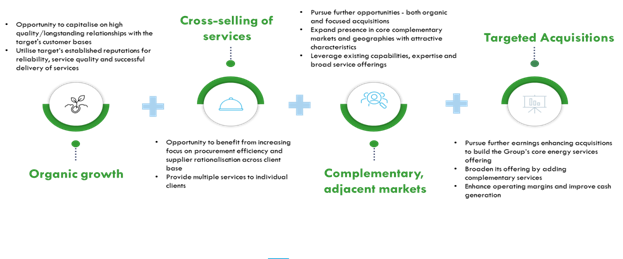
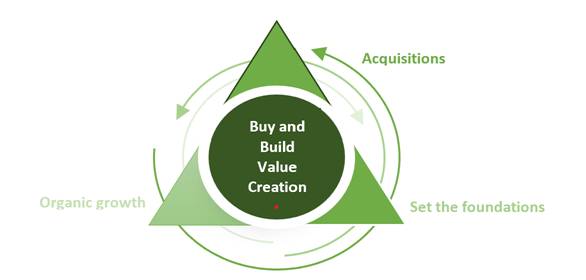
The Group's buy and build strategy is designed to create shareholder value through bringing together businesses in the energy services sector, providing consolidation in a fragmented sector, and extensive industry experience gained over many years. This creates improved service experience for customers and a virtuous circle of value creation. The foundations have been set through the addition of three businesses to the Group and the opportunity for organic growth and further acquisitions set.
For a review of the business during the year, please refer to the Chair's Review on page 1 of this report. For an analysis of financial performance indicators, please refer to the Financial Review set out on page 5.
Principal risks and uncertainties facing the business
A full review of principal risks and uncertainties facing the business during the year and going forward is given on pages 8 to 9 of this report .
S172 Statement
As required by Section 172 of the Companies Act, a director of a company must act in the way he or she considers, in good faith, would likely promote the success of the company for the benefit of the shareholders. In doing so, the director must have regard, amongst other matters, to the following issues:
• the likely consequences of any decisions in the long term (see Corporate Governance Report, pages 12 to 15);
• the interests of the company's employees (see Corporate Social Responsibility report on page 19)
• the need to foster the company's business relationships with suppliers/customers and others (see Corporate Governance Report, pages 12 to 15);
• the impact of the company's operations on the community and environment (see Corporate Social Responsibility report on page 19);
• the company's reputation for high standards of business conduct (see Corporate Governance Report, pages 12 to 15); and
• the need to act fairly between members of the company (see Corporate Governance Report, pages 12to 15).
On behalf of the Board
Peter Smith
CEO
22 May 2026
FINANCIAL REVIEW
The Financial Review covers aspects of the consolidated statements of comprehensive income, financial position and cash flows.
Group revenue increased from £2.6m in 2024 to £11.8m in 2025. This performance was driven by the full year impact of the acquisitions made in August 2024 plus contribution from the acquisition of A&D Carbon Solutions Limited on 1 July 2025.
The Group posted break even adj. EBITDA for the first time since it started trading 15 months ago in August 2024. Group adj. EBITDA was £0.0m in 2025 against a loss of £1.0m in 2024. This represents a milestone for the Group, with the first full year of the initial acquisitions (Cosgrove & Drew, and South West Heating Services) covering the Group PLC operating costs.
Adjusted Profits
The Group uses a number of Alternative Performance Measures ("APMs") in addition to those measures reported in accordance with IFRS. Such APMs are not defined terms under IFRS and are not intended to be a substitute for any IFRS measure. The Directors believe that APMs are important when assessing the underlying financial and operating performance of the Group.
The exceptional items identified as non-recurring in nature are set out below and were considered in calculating the adjusted profits.
|
Adjusted EBITDA from continuing operations £'000 |
Year ended 31 December 2025 |
Restated Year ended 31 December 2024 |
|
Operating Loss |
(1,349) |
(3,486) |
|
Depreciation & amortization |
310 |
73 |
|
Share based payment |
71 |
23 |
|
Exceptional items: |
|
|
|
Transaction costs |
304 |
1,622 |
|
Impairment Restructuring costs |
71 29 |
704 - |
|
Pre-trading start up costs |
642 |
- |
|
Non-recurring audit fee |
16 |
68 |
|
Total items added back |
1,443 |
2,490 |
|
Adjusted EBITDA |
94 |
(996) |
The performance of the two businesses that were in the Group for the full 12 months of FY25, C&D and SWH generated sufficient EBITDA to cover the costs of running the PLC.
Gross Profit
Gross profit for the year was £3.1m, 26%, a significant improvement on 2024 as can be seen in the table below.
|
Continuing Operations £'000 |
Year ended 31 December 2025 |
Year ended 31 December 2024 |
|
Revenue |
11,785 |
2,637 |
|
Cost of sales |
(8,734) |
(2,289) |
|
Gross profit |
3,051 |
348 |
|
Gross Profit % |
25.9% |
13.1% |
The key driver for this performance has come from C&D, which delivered £2.8m of margin at 29.3% v's £214k of margin at 9% in 2024. This improvement has been achieved through control of the cost base and the introduction of financial rigor in forecasting and controlling costs on projects and facilities management.
The margin in SWHS was lower year on year at 27% v's 33% in 2024, as expected, due to seasonality, with FY 2024 only containing 4 peak activity winter months, September to December.
For the six months that A&D has been in the Group, the margin they have achieved has been lower than the Group's overall margin and has had a diluting effect. We have been improving financial rigor and reporting and balancing the business portfolio with solar in A&D and going forward into 2026 we will see the benefits of this work.
Finance Costs
Net finance costs were £0.4m (2024: £0.1m). The increase year on year is attributable to the annualised costs for C&D and SWHS, together with costs within A&D brought into the Group from 1 July 2025. Just over half the total balance relates to loan interest with the remainder arising from the unwinding of contingent consideration discount and lease interest.
Taxation
Loss after tax from continuing operations was £1,747k (2024: £3,363k)
Loss per share
The basic and diluted loss per share was 0.015p (2024: 0.057p).
Financial Position
As at 31 December 2025, the Group's net assets were £3,752k (2024: 3,297k).
Non-current assets
Goodwill of £3,839k is the principal item in our balance sheet. This has arisen on the acquisitions of C&D, SWH and A&D and has been recognised at cost, representing the excess of the consideration paid over the fair value of the net assets acquired. The details relating to the acquisitions are set out in Note 12. As required by IAS 36, an impairment review has been carried out and concluded an impairment was necessary in SWH for the prior year, see Note 14.
The intangible assets are the value of the customer relationships acquired, and these are amortised each year.
Current assets excluding cash
Current assets excluding cash have increased from £1,733k in 2024 to £2,599k at the end of 2025. The main drivers of the movement comprise accrued revenue in C&D, A&D and NRS, reflecting revenue growth. See Note 16 for further details.
Liabilities excluding borrowings
The largest balance is trade and other payables at £1,836k (2024: £1,947k) which is consistent with the prior year.
Also included is the contingent deferred consideration arising from the acquisitions of C&D, SWH & A&D. The total balance of contingent consideration is £1,141k of which £348k is due within 12 months of the FY25 year end.
Lease liabilities amount to £394k (2024: £245k).
See Note 16 for further details.
Liquidity
The Group cash balance as at 31 December 2025 was £1,076k (2024: £1,965k).
Details of borrowings are shown in Note 16(vii)
Cashflow
|
£'000 |
Year ended 31 December 2025 |
Year ended 31 December 2024 |
|
Net cash (used in) operating activities |
(2,307) |
(3,083) |
|
Payment for acquisitions net of cash acquired |
(306) |
(747) |
|
Other |
(76) |
(28) |
|
Cash flows from investing activities |
(382) |
(775) |
|
Net proceeds from issues of shares |
1,942 |
5,663 |
|
Net proceeds/(repayment) of borrowings |
98 |
(89) |
|
Repayment of lease liabilities |
(179) |
(73) |
|
Other |
(61) |
431 |
|
Cash generated from financing activities |
1,800 |
5,932 |
|
Net cash outflow from discontinued operations |
- |
(162) |
|
Net increase/(decrease) in cash and cash equivalents |
(889) |
1,912 |
Net cash used in operations includes £642k of exceptional costs supporting the start-ups NRS and WLL and £304k for transaction costs for the acquisition of A&D
Issue of New Shares
New shares have been issued during the period to raise funds for the acquisition of A&D and for additional working capital to support the Group continuing with its buy and build strategy.
Dividends
No dividend is recommended (2024: £nil).
Events after the reporting period
On 11 March 2026, the Group signed a sale and purchase agreement to acquire all the share capital of Zero Carbon Group Limited at a cost of £9.5m with initial consideration of up to £5m, £1.5m in cash and £1.5m in new ordinary shares of EARNZ plc, to be adjusted for net debt and normalised working capital and a further £2m of which is contingent on meeting certain targets. When EBITDA of £0.5m has been achieved following completion, £1m becomes payable, 50% in cash and 50% in Consideration Shares at the Placing Price. The final £1.0m of the initial consideration is payable when EBITDA of £1.0m is achieved post completion, payable 50% cash and 50% in new ordinary shares in EARNZ plc.
The remaining consideration in the sale and purchase agreement is deferred and contingent upon reaching EBITDA targets for up to 3 years post completion and is payable 60% in cash and 40% in new ordinary shares in EARNZ plc.
On 12 March 2026 the Company raised £3.5m through a share placing, to fund the acquisition and provide additional working capital for the Group. The purchase completed on 31 March 2026 following shareholders' approval at a general meeting to authorise the directors to issue the consideration shares.
Events after the reporting period are described in Note 25 to the financial statements.
Elizabeth Lake
Chief Financial Officer
22 May 2026
RISK REPORT
Risk Management Framework
The Group has a risk register which includes all principal risks critical to the business.
The Board retains responsibility and accountability for the effectiveness of the risk management framework and internal control systems. As the business grows the risks will continue to evolve and grow in complexity and so will the risk management processes. This will ensure continuous improvement in the organisation's risk maturity.
Approach to Risk Management
The Audit Committee, under delegated authority from the Board, is accountable for overseeing the effectiveness of the risk management process, including identification of the principal and emerging risks facing the Group. The Audit Committee has particular focus on those risks that affect accounting in general and safeguarding the Group's assets.
Principal Risks and Uncertainties
The current Board has identified the Group risks.
|
DETAIL OF RISK |
MITIGATION and MANAGEMENT |
ASSESSMENT |
|
Continued Global political and economic uncertainty diverts resources away from the decarbonization agenda and increases costs |
The Group has diversified its operations to move away from government funded schemes and to increase work directly with landlords. In addition, the solar offering for both commercial and residential has been expanded. The Group is moving towards centralising procurement to achieve economies of scale to mitigate any cost increases of key materials. |
High risk |
|
Insufficient working capital to fund growth opportunities in delivery of the Group's buy and build strategy. |
The Board has reviewed medium-to-long-term cashflow forecasts (including sales forecast) and aims to ensure sufficient funding is in place to meet requirements. The Board is continually engaged with its investors and potential investors. With the Group now moving into positive EBITDA there will be an opportunity for facilities with our banking partner |
Medium risk |
|
Underperformance of target businesses |
Focusing on building relationships with key partners in the social housing sector. Build in contingencies in budgets and forecasts. Strong management teams are in place within the target businesses. |
Medium risk |
|
HSE violations in Group operating companies. |
The Group is directly responsible for installing and auditing an HSE culture. Documented operating procedures are in place in the operating businesses. Health & Safety is reviewed at each Board meeting and a Group Head of Health & Safety has been appointed. |
Medium risk |
|
Failure of business systems or loss of data, potentially causing issues such as delay in sales, reduced financial performance, reputational damage. |
The Group uses external IT support to carry out regular penetration testing and auditing security and processes. Robust insurance policy in place in case the event of ransom, including obtaining cyber essentials and training. |
Medium risk |
|
Attracting and retaining key employees. There is a general shortage of labour across the construction industry. Each operating company has a key management team, including the founders. The loss of any of these staff would have a detrimental impact on the growth of the business. |
Founders are incentivised with earn outs and bonuses. Executives have an LTIP in place, and senior management have bonus schemes. The Group is committed to improving working conditions, work life balance, progression, and training.
|
Medium risk |
|
Failure to meet AIM corporate governance requirements. |
The executive benchmarked its corporate governance, policies and procedures against published QCA guidelines to ensure compliance. The Company has regular discussions with its nominated adviser and external counsel. |
Low risk
|
GOVERNANCE
BOARD OF DIRECTORS
The Directors of EARNZ plc as at the date of signing the report and accounts comprised:
Bob Holt OBE (Chair) - appointed 29 February 2024 as Executive Chair, became Non-Executive Chair on 1 July 2025
Bob Holt is a highly accomplished executive with over 35 years' experience in senior leadership roles across various sectors, most recently serving as CEO of Revolution Beauty Plc after joining its board as interim COO. Prior to that, he successfully led Sureserve Group Plc as Chair, overseeing its successful turnaround that resulted in over a fivefold increase in the company's share price. He is perhaps most widely known for his role in the rise of Mears Group PLC. Since being appointed as Chair in 1996, he guided the company through its successful IPO on AIM and played a pivotal role in building its order book value to £3 billion, establishing Mears as a market leader in its sector. Bob has been awarded the OBE for his services to philanthropic causes.
Peter Smith (Chief Executive Officer) - appointed 1 July 2025
Peter was the former CEO of Sureserve Group PLC, (an AIM listed company) where he was responsible for growth strategy which delivered significant results and then oversaw its sale to PE in July 2023. Peter also has previous considerable experience as CFO/FD with widespread success in delivering results. Peter has worked in and specialises in highly regulated industries and has experience of extensive stakeholder engagement.
Peter is a qualified finance professional with a Henley Business School MBA
Elizabeth Lake FCA (Chief Financial Officer) - appointed 3 June 2024
(appointed non-executive director from 13 March 2024 - 3 June 2024)
Elizabeth is an accomplished executive with more than 25 years' finance and commercial experience. Previously, Elizabeth joined the board of Revolution Beauty Group as CFO in May 2022 and was instrumental in turning around the business following the suspension of its shares from trading on AIM. Prior to Revolution Beauty, she was CFO of AIM quoted, Everyman Media Group. During her time at Everyman, Elizabeth successfully led the company through the challenges presented by the Covid 19 pandemic, demonstrating her ability to navigate uncertainty with strong financial and operational acumen. Prior to Everyman, Elizabeth was Chief Financial Officer at AIM quoted, Science in Sport, and before that finance director at Hugo Boss UK and Ireland. She brings extensive UK plc experience to EARNZ having also worked in finance roles at Marks & Spencer, Pearson and Thomson Reuters. Elizabeth is ACA qualified, having trained at Coopers and Lybrand (now PwC).
Linda Main (Senior Independent Director) - appointed 1 May 2024
Linda is a chartered accountant who retired from KPMG LLP in September 2023 after a long career leading its Capital Markets Advisory Group. Linda has advised on well over 100 IPOs and significant transactions by listed companies of all sizes ranging from start-ups to members of the FTSE 100. She was also a member of the UK board of KPMG where she chaired the Risk Committee and sat on the Audit Committee. Until December 2023, Linda was a member of the London Stock Exchange's AIM Advisory Group and earlier in her career sat on a number of the Quoted Companies Alliance ("QCA")'s technical committees. She also sits on the QCA board. Linda is a non-executive director at MHA PLC and Princes Group Plc and is a Trustee at United Response. Linda chairs the Company's Audit and Remuneration committees.
Sandra Skeete (Independent Non-Executive Director) - appointed 3 June 2024
Sandra has over 25 years' experience working in social housing, holding senior roles in organisations such as the Peabody Trust and Refugee Housing Association Limited, and was previously a director of One Housing Group and the Duke of Lancaster Housing Trust. She was the Chief Executive of Octavia Housing Association Group, a not-for-profit organisation offering social housing and care services for vulnerable members of the community in central and west London. She was previously a non-executive board associate of Principality Building Society. Sandra sits on the Company's Audit and Remuneration committees.
Directors in post during the year included:
John Charlton (Director) - resigned 1 July 2025
The Board and responsibilities
The Board holds bi-monthly meetings to review, formulate and approve the Group's strategy, budgets, corporate actions and oversee the Group's progress towards its goals. There is an Audit Committee and a Remuneration Committee in place with formally delegated duties and responsibilities and with specific terms of reference. From time-to-time separate committees may be set up by the Board to consider specific issues when the need arises. Due to the size of the Group, the Directors have decided that issues concerning the nomination of directors will be dealt with by the Board rather than by a committee but will regularly reconsider whether a nominations committee is required.
Details of board meetings held in the reporting period, and attendance of Board directors is shown below:
|
Board Members |
Eligible to attend |
Attended |
|
|
|
|
|
Executive Directors |
|
|
|
Bob Holt OBE (appointed 29 February 2024) |
15 |
15 |
|
Elizabeth Lake FCA (appointed Non-Executive Director 13 March 2024 and as Chief Financial Director 3 June 2024) |
15 |
15 |
|
John Charlton (appointed 29 February 2024, resigned 1 July 2025) Peter Smith (appointed CEO 1 July 2025) |
9 |
9 |
|
|
6 |
6 |
|
Non-Executive Directors |
|
|
|
Linda Main (appointed 3 June 2024) |
15 |
15 |
|
Sandra Skeete (appointed 1 May 2024) |
15 |
15 |
The Audit Committee
The Audit Committee comprises Linda Main (appointed 1 May 2024) as Chair and Sandra Skeete (appointed 3 June 2024).
The Audit Committee determines the terms of engagement of the Group's auditors and will determine, in consultation with the auditors, the scope of the audit. The Audit Committee receives, and reviews reports from management and the Group's auditors relating to the interim and annual accounts and the accounting and internal control systems in use throughout the Group. The Audit Committee has unrestricted access to the Group's auditors. The Audit Committee Report is presented on page 16.
The Remuneration Committee
The Remuneration Committee comprises Linda Main (appointed 1 May 2024) as Chair and Sandra Skeete (appointed 3 June 2024).
The Remuneration Committee reviews the scale and structure of the executive Directors' and senior employees' remuneration and the terms of their service or employment contracts, including share option schemes and other bonus arrangements. The remuneration and terms and conditions of the non-executive Directors are set by the entire Board. The Directors' Remuneration Report is presented on pages 17-18.
Investor relations
The Annual General Meeting is the principal forum for dialogue with shareholders. Updates on the progress of the business are regularly published on the Group's website.
On behalf of the Board
Bob Holt OBE
Chair
22 May 2026
CORPORATE GOVERNANCE REPORT
The Chair has overall responsibility for corporate governance and good corporate governance is central to the Group's approach to creating sustainable growth and enhancing long-term shareholder value. The Directors are expected to always act ethically and responsibly, reflecting the Group's core values.
The Directors recognise that good corporate governance is a key foundation for the long-term success of the Group. As the Company is listed on the AIM market of the London Stock Exchange it is subject to the continuing obligation of the AIM Rules. The Board has therefore adopted the principles set out in the Corporate Governance Code for small and midsized companies published by the Quoted Companies Alliance (the "QCA Code").
|
QCA Code Principle |
What we do and why |
|
1. Establish a strategy and business model which promotes long-term value for shareholders |
The Company's strategy is explained fully within the Chair's Review section of the Report and Accounts for the year ended 31 December 2025.
Our strategy is identifying potential acquisitions in the energy services sector, to create a consolidated Group with scale and breadth of offering in the energy services sector, growing revenues and profitability.
The key challenges to the business and how these are mitigated are detailed on pages 8 to 9 of the Report and Accounts for the year ended 31 December 2024. |
|
2. Promote a corporate culture that is based on ethical values and behaviours |
The Corporate and Social Responsibility section on page 19 of the Report & Accounts for the year ended 31 December 2025 details the ethical values of the Company.
The Board continues to review policies and will amend as required. These policies and procedures are made available to staff and consultants and anti-bribery and anti-corruption training, and data protection training is mandatory.
Staff and consultants are encouraged to ask questions and seek clarifications from senior members of the team on these policies and procedures. |
|
3. Seek to understand and meet shareholder expectations
|
Whilst the Company is early stage, the Board is committed to returning value to shareholders through execution of our strategy.
The Board recognises the AGM as an important opportunity to meet shareholders. All the Directors are available to listen to the views of shareholders informally immediately after the AGM The people responsible for shareholder liaison are: The Chair The Executive Directors NOMAD (Zeus) The Company's website maintains a channel to provide information and receive feedback from all stakeholders. The Company has also invested in a subscription to Investor Hub to enhance the opportunities for communication with shareholders In addition the Company will present results directly to Investors and provide opportunities for questions at the AGM.
|
|
4. Take into account wider stakeholder interests, including social and environmental responsibilities, and their implications for long term success. |
The executive maintained communications with trade and interest groups working in the markets where its products are sold and applied. A number of mechanisms are in place to solicit feedback from shareholders including the Company's website and face to face meetings as well as the AGM and Investor Hub. |
|
Going forward, much of the Group's business will be involved in decarbonisation of public, commercial and private buildings, leading to greater fuel efficiency and energy security.
The Company has a whistleblowing policy in place which is given to all new employees. This provides a confidential mechanism for employees to raise concerns. The business model is focussed on decarbonisation of buildings in the public, commercial and private sector, together with energy efficiency. The culture of the business reinforces social and environmental responsibility. |
|
|
5. Embed effective risk management, internal controls and assurance activities, considering both opportunities and threats, throughout the organisation. |
Risk management on pages 8 to 9of our Annual Report and Accounts details the risks to the business and how these are mitigated. The Board considers risks to the business at its monthly meetings and reviews the principal risks to the business and the risk register quarterly. Risks are reviewed in the business monthly and quarterly by the Board. The enterprise-wide controls are continually reviewed and the FPPP (Financial Position and Prospects Procedures) manual updated if required. All Board members are entitled to engage external experts as part of their roles where they see fit. The Company's auditor HaysMac is independent of management. |
|
6. Establish and maintain the Board as a well-functioning, balanced team, led by the Chair. |
All members of the Board are experts in their fields with no one individual dominating. All Directors are seasoned Board members and understand the responsibilities of being a company Director. The shareholders have the opportunity annually at the AGM to vote for the (re-)election of all the Directors The new Board comprises 2 executive Directors, the Chair and 2 non-executive Directors. The 2 non-executive Directors are independent. Both the audit and remuneration committees comprise non-executive Directors only, with Linda Main being the Senior Independent Director. The Board is relatively newly constituted. Any related parties are excluded from Board discussions concerning their interests to maintain independence. Directors' remuneration is set by the Remuneration Committee which comprises the independent non-executive Directors. |
|
7. Maintain appropriate governance structures and ensure that individually and collectively the Directors have the necessary up-to-date experience, skills and capabilities. |
The Corporate Governance report on pages 10 to 11 details the Company's governance structures and why they are appropriate and suitable for the Company. The Board has a formal schedule of matters reserved for the Board and is supported by the Audit and Remuneration committees. Due to the size of the Company, the Board has decided that issues concerning the nomination of Directors will be dealt with directly by the Board but will reconsider on a regular basis whether a Nominations committee is needed. The Audit and Remuneration committees have specific terms of reference under which they operate. The Directors have a proven track record of previously serving on Boards. Where an expert view is needed the Board will seek input from external advisers Further information about the Board's skillset, including each Director's biography is set out on the Company website and additional information is set out on page 8 in this report. Each director attends industry events and seminars to continually update their skills and knowledge. Through the FPPP process a new Board pack has been developed and this will continue to evolve as the business grows. |
|
8. Evaluate board performance based on clear and relevant objectives, seeking continuous improvement. |
The Board is relatively new, a performance evaluation process will be developed. The annual review process will be implemented following the appointment of the CEO, together with succession planning.
|
|
9. Establish a remuneration policy which is supportive of long-term value creation and the Company's purpose and culture |
The Remuneration Committee has been established comprising 2 independent non-executive Directors. The Committee are reviewing the remuneration strategy on a regular basis. The remuneration policy includes long term incentive schemes to promote long term growth of shareholder value. The remuneration policy includes share options and plans to include a Save-As-You-Earn scheme for wider participation in shareholding across the Group. The Remuneration Committee will consult with the Audit Committee and the Board, as appropriate, when developing the remuneration policy. The Chair of the Remuneration Committee will consult with major shareholders on the design of incentives. Whilst this will not be binding, it will give shareholders the opportunity for input. |
|
10. Communicate how the company is governed and is performing by maintaining a dialogue with shareholders and other relevant stakeholders. |
The Company encourages two-way communication with its investors and responds quickly to all queries received.
The Board recognises the AGM as an important opportunity to meet private shareholders. The Directors are available to listen to the views of shareholders informally immediately following the AGM.
The Chair is responsible for ensuring appropriate communication and reporting to shareholders.
A range of corporate information (including Company announcements, historical annual reports and other governance related material) is also available on the Company's website. The Company will disclose outcomes of all votes at shareholder meetings in a clear and transparent manner by releasing a market announcement and by including it on the Company website. |
AUDIT COMMITTEE REPORT
The Audit Committee helps the Board discharge its responsibilities regarding financial reporting, external and internal audits and controls as well as reviewing the Group's annual and half-year financial statements, other financial information and internal Group reporting.
This includes:
• considering whether the Company has followed appropriate accounting standards and, where necessary, made appropriate estimates and judgments taking into account the views of the external auditors;
• reviewing the clarity of disclosures in the financial statements and considering whether the disclosures made are set properly in context;
• where the audit committee is not satisfied with any aspect of the proposed financial reporting of the Company, reporting its view to the Board of Directors;
• reviewing material information presented with the financial statements and corporate governance statements relating to the audit and to risk management; and
• reviewing the adequacy and effectiveness of the Company's internal financial controls and, review the Company's internal control and risk management systems and, except where dealt with by the Board, review and approve the statements included in the annual report in relation to internal control and the management of risk.
The Audit Committee assists by reviewing and monitoring the extent of non-audit work undertaken by external auditors, advising on the appointment of external auditors and reviewing the effectiveness of the Group's internal audit activities, internal controls and risk management systems. The ultimate responsibility for reviewing and approving the Annual Report and financial statements and the half-yearly reports remains with the Board.
For the year under review, there were no non-audit services rendered to the Group and the Company. Fees paid for audit services are provided in Note 5a.
Significant reporting issues considered during the year included the following:
· Revenue recognition under IFRS 15 and the application within the Group.
· Application of IFRS 3 and calculations to allocate the purchase price of acquisitions made in the period.
· Impairment reviews of acquired subsidiaries.
Going concern
The Committee considered the Going Concern basis on which the accounts have been prepared and can refer shareholders to the Group's accounting policy set out in Note 2.2. The directors are satisfied that the going concern basis is appropriate for the preparation of the financial statements
Linda Main
Audit Committee Chair
22 May 2026
DIRECTORS' REMUNERATION REPORT
This report sets out the remuneration policy operated by the Company in respect of the Chair, Executive and Non-Executive Directors. The remuneration policy is the responsibility of the Remuneration Committee, a sub-committee of the Board. No Director is involved in discussions relating to their own remuneration.
Remuneration policy
The objective of the remuneration policy is to attract, retain and motivate high calibre executives to deliver outstanding shareholder returns and at the same time maintain an appropriate compensation balance with the other employees of the Group. There is no formal requirement for Directors to own shares in the Group.
The Remuneration Committee comprises independent Non-Executive Directors, and is appointed by the Board. The Remuneration Committee has terms of reference approved by the Board, which sets out a framework for determining the remuneration of the Company's Chair and Executive Directors including pension rights and compensation payments. The remuneration of Non-Executive Directors is a matter reserved for the Board. No Director or senior manager shall be involved in any decisions as to their own remuneration. The Remuneration Committee recommends and monitors the level and structure of remuneration for senior management.
The Remuneration Committee has regard to the following factors when determining remuneration:
· The pay and employment conditions across the Company and/or the Group when setting remuneration policy for Directors, especially when determining salary increases.
· The Company's appetite for risk and long-term strategic goals.
· Remuneration in other companies of comparable scale
The Remuneration Committee sets appropriate Directors' compensation to reward long-term success:
· A significant proportion of Executive Directors' remuneration should be structured to link rewards to corporate and individual performance and be designed to promote the long-term success of the Company. The Remuneration Committee approves the design of, and determines targets for, any performance-related pay schemes operated by the Company and approves any payments made under such schemes.
The Remuneration Committee has regard to the following factors when reviewing remuneration:
· The Remuneration Committee reviews the performance of share incentive plans and discretionary bonus schemes. Each year the Remuneration Committee determines whether awards will be made, and if so, the overall amount of such awards, the individual awards to Executive Directors and other senior management and the performance targets to be used.
· The Remuneration Committee periodically reviews the ongoing appropriateness and relevance of the remuneration policy.
Directors' remuneration
The normal remuneration arrangements for Executive Directors consist of base salary, performance bonuses and other benefits as determined by the Board. The Company currently has two Executive Directors, who have service agreements that can be terminated at any time by either party giving to the other six months' written notice.
The remuneration package for an Executive Director is detailed below:
Base Salary:
Annual review of the base salary of the Executive Director considering the Executive Director's role, responsibilities and contribution to the Group performance.
Performance Bonus:
No bonuses were paid in relation to the reporting period. Going forward the remuneration committee will be establishing a performance bonus scheme with relevant targets.
Benefits:
Benefits include Company pension contributions of 5%. On 1 November 2025 the Group established a Private Healthcare Scheme which all employees of the Group are eligible to join. Post the year end the Group has also established death-in-service benefits scheme which all employees are enrolled in.
Longer term incentives:
To incentivise the Directors, and align their interests with shareholders, the Company granted share options in the period. The share options will vest at a future date as described in Note 19 in the financial statements. The vesting conditions are exclusively share price related.
Non-Executive Directors are currently remunerated solely in the form of Directors' fees and pension contributions.
Re-election of Directors
All Directors stand for re-election on an annual basis and all Directors are aware of the need to maintain their independence and to demonstrate their continued commitment to the role. Succession planning is limited due to the current size of the Board.
|
The emoluments of the Directors were as follows (Audited): |
||||||
|
|
Year ended 31 December 2025 |
Year ended 31 December 2024 |
||||
|
|
Salary & Directors' fees |
Pension contributions |
Share-based payments |
Other Benefits |
Total |
Total |
|
|
£ |
£ |
£ |
£ |
£ |
£ |
|
Executive Directors |
|
|
|
|
|
|
|
Bob Holt OBE (appointed 1 March 2024) |
50,000 |
2,500 |
34,663 |
834 |
87,997 |
57,122 |
|
Peter Smith (appointed 1 July 2025) |
56,667 |
4,583 |
1,642 |
353 |
63,245 |
- |
|
Elizabeth Lake (appointed 13 March 2024) |
125,000 |
6,249 |
13,196 |
424 |
144,869 |
86,690 |
|
John Charlton (resigned 1 July 2025) |
25,000 |
1,250 |
11,554 |
- |
37,804 |
37,340 |
|
Robert Richards (resigned 1 March 2024) |
- |
- |
- |
- |
- |
28,272 |
|
Non-Executive Directors |
|
|
|
|
|
|
|
Linda Main (appointed 1 May 2024) |
31,917 |
2,208 |
- |
- |
34,125 |
17,500 |
|
Sandra Skeete (appointed 3 June 2024) |
29,288 |
4,837 |
- |
- |
34,125 |
15,750 |
|
George Katzaros (resigned 29 February 2024) |
- |
- |
- |
- |
- |
- |
|
Gavin Mayhew (resigned 2 January 2024) |
- |
- |
- |
- |
- |
- |
|
Total |
317,872 |
21,627 |
61,055 |
1,611 |
402,165 |
242,674 |
The remuneration of the Directors in EARNZ plc who held office during the years to 31 December 2025 and 2024 were as follows:
Linda Main
Chair - Remuneration Committee
22 May 2026
CORPORATE AND SOCIAL RESPONSIBILITY
The Company understands that its impact reaches beyond that of its core business and into the environment and society in which it operates. With integrity at the heart of our corporate social goals our aim is to make a lasting positive contribution to all our stakeholders.
In view of the limited number of stakeholders, the Company has not adopted a specific policy on Corporate Social Responsibility. However, it does seek to protect the interests of stakeholders in the Company through its policies, combined with ethical and transparent business operations.
Environment
EARNZ Plc is sensitive to the environment in which it operates. Previously the Group established well defined operating guidelines with some of the manufacturing partners where it sought their compliance with ISO14001 (a recognized standard for Environmental Management Systems) when relevant, to ensure certain environmental standards are complied with. Going forward the Company will be operating in the energy services sector, and as such will be instrumental in assisting with the delivery of de-carbonisation across the public and private sector.
Human Rights
EARNZ plc is committed to socially and morally responsible business practices for the benefit of all stakeholders. The activities of the Company are in line with applicable laws on human rights.
Employees
Employees are key to achieving the business objectives of the Company. The Board's priority is to provide a working environment in which our employees can develop to achieve their full potential and have opportunities for both professional and personal development. We aim to invest time and resource in supporting, engaging and motivating our employees to feel valued, to be able to develop rewarding careers and want to stay with us. The Company embraces employee participation in issue raising and resolution through regular meetings with managers and values contributions from all levels regardless of their position in the business.
Shareholders
The Board of Directors actively encourages communication, and they seek to protect the interest of shareholders at all times. The Company updates shareholders regularly through regulatory news, financial reports and research notes. The Company also engages directly with investors at our General Meetings or investor events.
Health and Safety
Company and Group activities are carried out in accordance with its health and safety policies which adhere to all applicable laws.
DIRECTORS' REPORT
The Directors present their report and the audited financial statements for EARNZ plc ("EARNZ" or the "Company") for the year ended 31 December 2025.
The preparation of financial statements is in compliance with UK adopted International Accounting Standards and the Companies Act 2006. The Group financial statements comprise of the financial information of the parent Company and its subsidiaries (together the "Group"). The parent Company's financial statements present information about the Company as a separate entity and not about its Group.
Principal activities
EARNZ plc is a holding company based in UK. The principal activity of the Group is to build a leading business in the energy services sector focusing on decarbonisation of public and private sector building fabric, leveraging UK Government investment in Net Zero transition and UK clean energy industries.
A detailed review of the business activities of the Group is contained in the Strategic Report.
Business review and future developments
The review of the business' operations, future developments and key risks is contained in the Strategic Report. The Directors do not recommend the payment of a final dividend for the year (2024: £nil).
Directors and directors' interests
The directors who held office during the year or subsequently were as follows:
|
Bob Holt |
Appointed 29 February 2024 |
|
Peter Smith |
Appointed 1 July 2025 |
|
Elizabeth Lake |
Appointed 13 March 2024 |
|
Linda Main |
Appointed 1 May 2024 |
|
Sandra Skeete |
Appointed 3 June 2024 |
|
John Charlton |
Appointed 29 February 2024, resigned 1 July 2025 |
Regarding the appointment and replacement of Directors, the Company is governed by its articles of association, the Companies Act and related legislation. The articles themselves may be amended by special resolutions of the shareholders.
Directors' interests
The Directors held the following beneficial interests in the shares of EARNZ plc at 31st December 2025:
|
|
Ordinary shares |
Issued share capital % |
|
of £0.04 each |
||
|
Bob Holt OBE |
12,400,000 |
9.3% |
|
Peter Smith |
1,013,888 |
0.8% |
|
Elizabeth Lake |
3,819,443 |
2.9% |
|
John Charlton |
1,339,083 |
1.0% |
|
Linda Main |
255,555 |
0.2% |
|
Sandra Skeete |
27,221 |
0.0% |
The Directors held the following beneficial interests in the shares of EARNZ plc at 31st December 2024:
|
|
Ordinary shares |
Issued share capital % |
|
of £0.04 each |
||
|
Bob Holt OBE |
11,300,000 |
11.06% |
|
Peter Smith |
- |
- |
|
Elizabeth Lake |
1,666,666 |
1.63% |
|
John Charlton |
1,100,000 |
1.08% |
|
Linda Main |
200,000 |
0.20% |
|
Sandra Skeete |
13,333 |
0.01% |
|
|
|
|
|
|
|
|
|
Directors' indemnities
The Company has taken out Directors' and Officers' indemnity insurance for the benefit of its Directors.
Events after the reporting date
See Note 25 of the accounts.
Financial Risk management
Details of financial risk management are provided in [Note 21] to the accounts.
Political and charitable contributions
The Group made no charitable or political contributions during the year.
Going Concern
The Director' considered the Going Concern basis on which the accounts have been prepared and can refer shareholders to the Group's accounting policy set out in Note 2.2. The directors are satisfied that the going concern basis is appropriate for the preparation of the financial statements
Substantial shareholdings:
The Company has been advised of the following interests in more than 3% of its ordinary share capital as at 31 December 2025:
|
Shareholder |
|
No. of Shares (nominal value £0.04) |
% |
|
Gresham House Asset Management |
|
35,436,474 |
26.5% |
|
Bob Holt |
|
12,400,000 |
9.3% |
|
Pentwater Capital Management |
|
6,944,444 |
5.2% |
|
UBS Group AG |
|
5,802,146 |
4.3% |
|
Bank of America Securities |
|
5,555,555 |
4.2% |
|
Hargreaves Lansdown PLC |
|
5,024,244 |
3.8% |
|
Andrew Custer |
|
4,666,666 |
3.5% |
|
Philip J Milton & Co |
|
4,396,597 |
3.3% |
|
Aberdeen PLC |
|
4,026,579 |
3.0% |
At the signing date the Company had been advised of the following interests in more than 3% of its ordinary share capital:
|
Shareholder |
|
No. of Shares (nominal value £0.004) |
% |
|
Gresham House Asset Management |
|
63,936,474 |
27.20% |
|
Pentwater Capital Management |
|
46,749,998 |
19.89% |
|
Bob Holt |
|
13,480,000 |
5.76% |
|
Peter Jones |
|
9,000,000 |
3.83% |
|
Debra Jones |
|
9,000,000 |
3.83% |
|
Elizabeth Lake |
|
8,219,443 |
3.35% |
Statement of Disclosure to the Auditors
The Directors at the date of approval of this report confirm that:
· As far as each director is aware, there is no relevant audit information of which the Company's and the Group's auditor is unaware; and
· Each Director has taken all reasonable steps that they ought to have taken as a Director to make themselves aware of any relevant information and to establish that the Company's and the Group's auditor is aware of that information.
Auditors appointment
HaysMac LLP were re-appointed as auditors to the Company during the year. In accordance with section 485 of the Companies Act 2006, a resolution proposing that they be re-appointed will be put to the vote at the AGM.
By order of the Board
John Charlton
Company Secretary
22 May 2026
STATEMENT OF DIRECTORS' RESPONSIBILITIES
The Directors are responsible for preparing the Annual Report and the financial statements in accordance with applicable law and regulations.
Company law requires the Directors to prepare Group and Company financial statements for each financial year. Under that law the Directors have elected to prepare the Group consolidated financial statements in accordance with UK adopted International Accounting Standards (UK IAS) and elected to prepare the parent company financial statements under United Kingdom Generally Accepted Accounting Practice (United Kingdom Accounting Standards and applicable laws including FRS 101 Reduced Disclosure Framework).
Under company law the Directors must not approve the financial statements unless they are satisfied that they give a true and fair view of the state of affairs of the Group and the Company and of the profit or loss of the Group for that period.
In preparing each of the Group and Company financial statements, the Directors are required to:
• Select suitable accounting policies and then apply them consistently;
• Make judgments and estimates that are reasonable and prudent;
• State whether they have been prepared in accordance with UK-adopted International Accounting Standards (IASs) and International Financial Reporting Standards (IFRSs) have been followed, subject to any material departures disclosed and explained;
• Prepare the Strategic Report and Directors' report which comply with the requirements of the Companies Act 2006; and
• Prepare the financial statements on the going concern basis unless it is inappropriate to presume that the Group and the Company will continue in business.
The Directors are responsible for keeping adequate accounting records that are sufficient to show and explain the Group and the Company's transactions and disclose with reasonable accuracy at any time the financial position of the Group and the Company and enable them to ensure that the financial statements comply with the Companies Act 2006. They are also generally responsible for taking such steps as are reasonably open to them to safeguard the assets of the group and to prevent and detect fraud and other irregularities.
The Directors are responsible for the maintenance and integrity of the corporate and financial information included on the Company's website. Information published on the website is accessible in many countries and legislation in the United Kingdom governing the preparation and dissemination of financial statements may differ from legislation in other jurisdictions.
The Directors consider that the annual report and accounts, taken as a whole, is fair, balanced and understandable and provides the information necessary for shareholders to assess the Group's position and performance, business model and strategy. Each of the directors confirms that, to the best of their knowledge:
The Group financial statements, which have been prepared in accordance with UK IAS and Companies Act 2006, give a true and fair view of the assets, liabilities, financial position and profit of the Group; and the Annual Report includes a fair review of the development and performance of the business and the position of the Group, together with a description of the principal risks and uncertainties that it faces.
Independent auditors' report
to the members of Earnz Plc
Opinion
We have audited the financial statements of Earnz Plc (the 'company') and its subsidiaries (the 'group') for the year ended 31 December 2025 which comprise:
|
Group |
Company |
|
the Consolidated Statement of Comprehensive Income; |
the Company Balance Sheet; |
|
the Consolidated Balance Sheet; the Consolidated Statement of Changes in Equity; the Consolidated Statement of Cash flows; and related notes to the financial statements
|
the Company Statement of Changes in Equity;
and related notes to the financial statements
|
The financial reporting framework that has been applied in their preparation is applicable law and United Kingdom adopted International Financial Reporting Standards (IFRSs).
In our opinion:
the financial statements give a true and fair view of the state of the group's and of the company's affairs as at 31 December 2025 and of the group's loss for the year then ended;
the group financial statements have been properly prepared in accordance with UK adopted International Financial Reporting Standards (IFRS).
the company financial statements have been properly prepared in accordance with United Kingdom Generally Accepted Accounting Practice; and
the financial statements have been prepared in accordance with the requirements of the Companies Act 2006.
Basis for opinion
We conducted our audit in accordance with International Standards on Auditing (UK) (ISAs (UK)) and applicable law. Our responsibilities under those standards are further described in the auditor's responsibilities for the audit of the financial statements section of our report.
We are independent of the group and the company in accordance with the ethical requirements that are relevant to our audit of the financial statements in the UK, including the Financial Reporting Council's (the FRC's) Ethical Standard as applied to listed public interest/listed entities, and we have fulfilled our other ethical responsibilities in accordance with these requirements. We believe that the audit evidence we have obtained is sufficient and appropriate to provide a basis for our opinion.
An overview of the scope of our audit
The group comprises a parent holding company, an additional holding company, two existing subsidiaries (acquired in the prior year), a newly acquired subsidiary, and two newly formed entities. The material components of the group for which we performed full scope audit procedures following an assessment at the audit planning phase were Earnz Plc, Southwest Heating Services Limited ("SWH") and Cosgrove & Drew Limited ("C&D") with analytical review or specific scope procedures as well as verification of bank balances to third party confirmation completed on other group entities that were determined to be less significant to the group based on our assessment of materiality.
The scope of the audit and our audit strategy was developed by using our audit planning process to obtain and update our understanding of the group and its environment, including the group's system of internal control, and assessing the risks of material misstatement at the group level.
We communicated with both the Directors and the Audit Committee our planned audit work via our audit planning report and relevant discussion. We communicated audit progress with the Audit Committee through interim audit progress.
Conclusions relating to going concern
In auditing the financial statements, we have concluded that the directors' use of the going concern basis of accounting in the preparation of the financial statements is appropriate.
Our evaluation of the Directors' assessment of the group's ability to continue to adopt the going concern basis of accounting included consideration of the inherent risks to the group's business model and analysed how those risks might affect the group's financial resources or ability to continue operations over the period 12 months from the date of the signing of the financial statements.
The risks that we considered most likely to affect the group's financial resources or ability to continue operations over this period were adverse circumstances impacting the underlying profitability of the trading subsidiaries and being able to fund potential contingent consideration relating to historic acquisitions, as well as the acquisition that was undertaken of Zero Carbon Group post year end.
We considered these risks through a review of the application of reasonably foreseeable downside scenarios that could arise with reference to the level of available financial resources indicated by the group's financial forecasts and management's assessment of these risks, including potential mitigations available.
Our audit procedures to evaluate the Director's assessment of the group and the company's ability to continue to adopt the going concern basis of accounting included:
- Undertaking an initial assessment at the planning stage of the audit to identify events or conditions that may cast significant doubt on the group and the company's ability to continue as a going concern;
- Evaluating the methodology used by the Directors to assess the group and the company's ability to continue as a going concern;
- Reviewing the Directors' going concern assessment and evaluating the key assumptions used and judgements applied;
- Reviewing the sensitivities performed by management to understand the going concern implications;
- Performing our own review of the liquidity headroom and applying sensitivities to the base trading and cashflow forecast assessments of the Directors to ensure there was sufficient headroom to adopt the going concern basis of accounting;
- Reviewing the availability of the group's existing cash balances for use in the day to day running of the business;
- Considered the reasonableness of management's reasonable worst case scenarios which included significant reductions in gross margin generated by newly acquired entities as well as entities which have been set up in the year, these included reductions in gross profit of 50%, consideration of the mitigating levers at managements disposal such as cutting of overhead costs and the timeliness in which these could be enacted should adverse scenarios occur;
- We evaluated management's ability to meet future contingent consideration obligations under a range of adverse scenarios to ensure there were no 'cliff edge' outcomes within the assessment prepared by management;
- We considered how reasonable the potential mitigants presented by management were, that would be required in adverse scenarios modelled as part of their going concern assessment, as well as in a range of further sensitivities prepared by ourselves;
- For newly acquired entities (both in year and post year end acquisitions, as well as entities set up in the year (being A&D Carbon Solutions Ltd, NRS Ltd, WLL Ltd, and Zero Carbon Energy Ltd), we reviewed management's pipeline forecasts to assess whether it was reasonable to expect revenues and profits to be generated by these entities - our further sensitivities assessed, considered delays in revenue generation and slower revenue generation than was included in management's base case forecast;
- We reviewed post year end cash balances to ensure the appropriate starting position was used in both the base case scenario, and all sensitised scenarios prepared by management;
- A review of post year end actuals compared to forecasts prepared by the Directors to note whether there was any adverse trading or change in underlying performance of the trading subsidiaries within the group that would impact the going concern assessment. Where adverse variances were noted, we obtained appropriate justification for these variances to determine whether there were fundamental issues with the forecasted revenues and profits of the entities included within the cashflow forecast;
- We ensured that management's forecasts included covenant testing review in both the base case and sensitised cases to determine whether any covenants relating to the bank loans held by the group would be in breach and, if so, whether there were suitable mitigants to enable the group to remain a going concern;
- For the acquisition of Zero Carbon Group made post year end, we completed a review of the revenue pipeline alongside supporting documentation to determine whether forecast overhead costs were included on a reasonable basis. We also reviewed the SPA to ensure that we understood the structure of future consideration payable, and ensured that this was factored into the cashflow forecast;
- Reviewing and assessing the appropriateness of the Directors' disclosures regarding going concern in the financial statements.
Based on the work we have performed, we have not identified any material uncertainties relating to events or conditions that, individually or collectively, may cast significant doubt on the group and the company's ability to continue as a going concern for a period of at least twelve months from when the financial statements are authorised for issue;
Our responsibilities and the responsibilities of the Directors with respect to going concern are described in the relevant sections of this report.
Key audit matters
Key audit matters are those matters that, in our professional judgement, were of most significance in our audit of the financial statements of the current period and include the most significant assessed risks of material misstatement (whether or not due to fraud) that we identified, including those which had the greatest effect on:
· the overall audit strategy,
· the allocation of resources in the audit; and
· directing the efforts of the engagement team.
These matters were addressed in the context of our audit of the financial statements as a whole, and in forming our opinion thereon, and we do not provide a separate opinion on these matters.
In determining the key audit matters we considered the:
· Areas of higher risks of material misstatement or significant risks identified in accordance with ISA (UK) 315
· Significant audit judgements on financial statement line items that involved significant management judgement such as accounting estimates, and
· The impact of significant events and transactions during the period covered by the audit.
The following table summarises the key audit matters we have identified and rationale for their identification together we how we responded to each in our audit. The table also shows how our judgement of the magnitude of each risk has changed since the previous audit.
Risk magnitude key
|
|
|
|
|
|
||
|
Key audit matter |
How we addressed the key audit matter in the audit |
|||||
|
|
Fraud in revenue recognition The risk of incorrect or inappropriate treatment and recognition of revenue under IFRS 15. We consider there to be a significant risk of misstatement in the financial statements arising as a result of incorrect application of IFRS 15 and recording revenue when the performance obligations have not been met, thus resulting in a material misstatement of revenue.
The Group recognised revenue at a point in time and had revenue recognised over time. There is a risk that revenue is materially overstated if revenue has been recorded prior to the relevant performance obligations being satisfied.
Specifically, there is a risk in relation to the cut-off of revenue around the year-end and occurrence of revenue. Specific testing was planned to ensure this risk had been appropriately tested for.
|
We performed specific tests to consider whether revenue has been recorded in the correct period and is free from misstatement. These included: · We assessed the group's accounting policy for each material revenue stream and performed walkthrough procedures to assess the design and implementation of controls. · We performed substantive tests of detail for a sample of revenue items recorded during the year to assess whether revenue recognition was in accordance with the standard, including consideration of identification of performance obligations such that revenue had not been materially misstated. · We performed specific targeted cut-off testing around the year-end, with sales in December 2025 and January 2026 selected for testing to supporting documentation to ensure that revenue had been included within the correct period. · We utilised data analytics to identify unusual or unexpected revenue journal entries, including those posted outside normal business processes, and investigated any items identified. · We obtained and critically evaluated management's revenue recognition policy and whether the application of IFRS 15 was reasonable and appropriate. · For revenue recorded over time, we performed relevant testing on accrued and deferred income to ensure that revenue was being appropriately recognised during the year ended 31 December 2025. |
||||
|
|
Acquisition accounting and valuation of intangible assets
There is a risk that the acquisition accounting in relation to the acquisition of two trading subsidiaries during the year have been accounted for incorrectly with reference to IFRS 3 'Business Combinations'.
The risks we identified were as follows: · The accounting entries of the newly acquired entities in the group accounts · Over/misstatement of the fair value of the net assets acquired and the resulting goodwill being recorded · Identification and accounting of separately identifiable intangible assets arising on acquisition in accordance with IFRS 3 · Cut-off of the income and expenses from the point of acquisition to be recognised in the consolidated accounts · Completeness and cut-off of balance sheet of the entities being acquired at the date of acquisition. · Appropriateness of the disclosures in the financial statements relating to the acquisition of the new businesses. · Any impairment of the intangible assets including goodwill recognised as part of the acquisition may be materially overstated.
|
To address the risks associated with acquisition accounting and the valuation of intangible assets, our audit procedures consisted of but were not limited to:
• We reviewed the assessment prepared by management regarding whether the transaction constituted a business combination in accordance with IFRS 3 • We reviewed the work of managements expert used to complete the purchase price allocation assessment to assess whether the intangible assets considered to meet the relevant criteria as per IFRS 3 were appropriate • We utilised our internal valuations expert to review the appropriateness of the methodology and assumptions used in the WACC calculation and the intangible asset valuation at acquisition date. • We reviewed and challenged the valuation exercise undertaken by management and their expert for the purposes of valuing separately identifiable assets arising from the acquisition to ensure these were reasonable • We reviewed the consideration payable in accordance with the share purchase agreements in place to ensure that the calculation of goodwill was appropriate • We performed substantive audit testing on the opening balance sheet at the acquisition date for A&D Carbon Solutions Limited to ensure that the net asset value acquired that was incorporated in the acquisition accounting journals was appropriate • We reviewed and assessed management's judgements for reasonableness concerning the conditions that existed at the acquisition date;
|
||||
|
|
Impairment of intangible assets arising from acquisitions
There is a risk that intangible assets, namely goodwill and separately identified assets from acquisitions, is materially misstated where impairment indicators exist.
· Where goodwill or other intangible assets are allocated to cash generating units (subsidiaries) where there are indicators of impairment, namely losses in the financial year, there is a risk that these intangible assets should be impaired.
|
To address the risks associated with acquisition accounting and the valuation of intangible assets, our audit procedures consisted of but were not limited to:
• We reviewed the impairment assessment prepared by management to assess whether indicators of impairments had been addressed and to ensure that it was in line with IAS 36 • We reviewed the mathematical accuracy of the calculations prepared by management for their IAS 36 assessment • We reviewed key inputs to the value in use calculation such as the discount rate (WACC) and inputs in relating to expected trading results to ensure these were consistent with other areas of forecasting • We challenged management on key assumptions such as revenue growth and the forecasted levels of cost obtaining supporting information to enable us to assess the reasonableness of the key assumptions made by management in their forecasts • We reviewed the work of managements expert used to complete the purchase price allocation assessment to assess whether the intangible assets considered to meet the relevant criteria as per IFRS 3 were appropriate • Following discussions with management regarding known costs that had been omitted from the forecasts of one of the entities acquired in the prior year (SWH Ltd), we asked management to prepare revised forecasts. We reviewed and challenged the updated forecast to confirm that the omitted costs were known or could have been reliably estimated both at the acquisition date and at 31 December 2024 confirming a prior year adjustment was appropriate;
|
||||


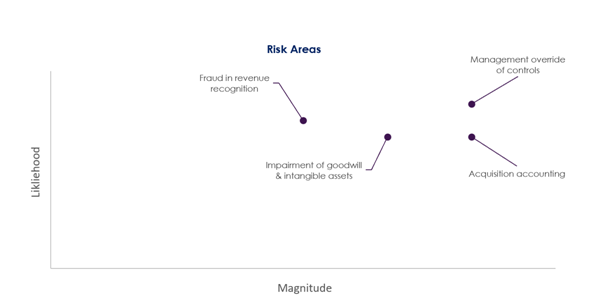
Our application of materiality
The scope and focus of our audit were influenced by our assessment and application of materiality. We define materiality as the magnitude of misstatement that could reasonably be expected to influence the readers and the economic decisions of the users of the financial statements. We use materiality to determine the scope of our audit and the nature, timing and extent of our audit procedures and to evaluate the effect of misstatements, both individually and on the financial statements as a whole.
|
|
Group Financial Statements |
Company Financial Statements |
|
Materiality |
£177,000 (2024: £199,000) |
£88,000 (2024: £83,600) |
|
Benchmark |
1.5% of total revenue (2024: 2.5% of gross assets) |
This was determined as being 25% of the full scope MACM benchmark. |
|
Basis for, and judgements used in the determination of materiality |
Revenue has been selected as the benchmark for determining materiality, as it is a primary KPI for the group and provides a stable, representative measure of the scale of operations. The majority of the group activity occurs in the two main trading entities, which due to acquisition in the prior year, we have a full 12m of revenue results for. The group is currently in a loss-making and growth phase, with a volatile cost base driven by acquisitions and restructuring activities. Alternative benchmarks were considered, including: adjusted EBITDA, loss before tax, gross assets, net assets and gross margin. However, adjusted EBITDA is subject to management discretion due to the exclusion of non-recurring and judgemental items, and both EBITDA and loss before tax are volatile and less consistent measures of performance. Gross profit and margin are also subject to fluctuations, while net assets are not a key performance metric for the group given its service-based nature. Revenue is consistently reported, forms a key focus of management reporting, and aligns with industry practice. It also underpins external market expectations and consensus forecasts used by shareholders. As such, revenue provides the most appropriate, stable and relevant basis for determining materiality. |
Materiality has been based on an allocation of 25% of the component materiality multiplier for full scope entities, as it does not generate external revenue and primarily acts as a holding company for its subsidiaries. While the company has significant balance sheet balances, profit-based measures are not considered meaningful due to the nature of its activities. Therefore, an allocation of the full scope component materiality provides the most appropriate basis for determining materiality, which is largely in line with the prior year allocation. |
Performance materiality - Based on our risk assessment, our experience of the prior year audits and review of the group's control environment, performance materiality was set at 70% of materiality, being £124,000 (2024: £129,000) for group and £61,600 (2024: £54,340) for the company. This threshold was revised upwards from 65% in the prior year to reflect our assessment and understanding of the control environment from the prior year and also taking account of the control findings raised in the 2024 audit.
Reporting threshold - The reporting threshold to the audit committee was set as 5% of materiality, being £8,850 (2024: £9,950) for the group. If, in our opinion in differences below this level warranted reporting on qualitative grounds, these would also be reported.
Differences in materiality levels from the previous audit
Gross assets were used in the prior year due to the group not having a full year of trade. With the group now being a trading group for a full reporting period, gross assets is not considered to be an appropriate metric.
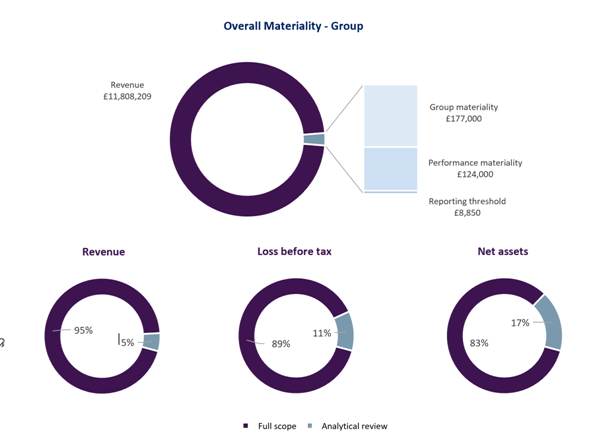
Other information
The directors are responsible for the other information. The other information comprises the information included in the annual report, other than the financial statements and our auditor's report thereon. Our opinion on the financial statements does not cover the other information and, except to the extent otherwise explicitly stated in our report, we do not express any form of assurance conclusion thereon.
In connection with our audit of the financial statements, our responsibility is to read the other information and, in doing so, consider whether the other information is materially inconsistent with the financial statements, or our knowledge obtained in the audit or otherwise appears to be materially misstated. If we identify such material inconsistencies or apparent material misstatements, we are required to determine whether there is a material misstatement in the financial statements or a material misstatement of the other information. If, based on the work we have performed, we conclude that there is a material misstatement of this other information, we are required to report that fact. We have nothing to report in this regard.
Opinions on other matters prescribed by the Companies Act 2006
In our opinion, based on the work undertaken in the course of the audit:
the information given in the strategic report and the directors' report for the financial year for which the financial statements are prepared is consistent with the financial statements; and
the strategic report and the directors' report have been prepared in accordance with applicable legal requirements.
Matters on which we are required to report by exception
In the light of the knowledge and understanding of the group and the company and its environment obtained in the course of the audit, we have not identified material misstatements in the strategic report or the directors' report.
We have nothing to report in respect of the following matters in relation to which the Companies Act 2006 requires us to report to you if, in our opinion:
adequate accounting records have not been kept by the company, or returns adequate for our audit have not been received from branches not visited by us; or
the company financial statements are not in agreement with the accounting records and returns; or
certain disclosures of directors' remuneration specified by law are not made; or
we have not received all the information and explanations we require for our audit.
Responsibilities of directors
As explained more fully in the directors' responsibilities statement, the directors are responsible for the preparation of the financial statements and for being satisfied that they give a true and fair view, and for such internal control as the directors determine is necessary to enable the preparation of financial statements that are free from material misstatement, whether due to fraud or error.
In preparing the financial statements, the directors are responsible for assessing the group's and the company's ability to continue as a going concern, disclosing, as applicable, matters related to going concern and using the going concern basis of accounting unless the directors either intend to liquidate the group or the company or to cease operations, or have no realistic alternative but to do so.
Auditor's responsibilities for the audit of the financial statements
Our objectives are to obtain reasonable assurance about whether the financial statements as a whole are free from material misstatement, whether due to fraud or error, and to issue an auditor's report that includes our opinion. Reasonable assurance is a high level of assurance but is not a guarantee that an audit conducted in accordance with ISAs (UK) will always detect a material misstatement when it exists. Misstatements can arise from fraud or error and are considered material if, individually or in the aggregate, they could reasonably be expected to influence the economic decisions of users taken on the basis of these financial statements.
Irregularities, including fraud, are instances of non-compliance with laws and regulations. We design procedures in line with our responsibilities, outlined above, to detect material misstatements in respect of irregularities, including fraud. The extent to which our procedures are capable of detecting irregularities, including fraud is detailed below. However, the primary responsibility for the prevention and detection of fraud rests with both those charged with governance and management of the group and company. Explanation as to what extent the audit was considered capable of detecting irregularities, including fraud
Based on our understanding of the group/company and industry, we identified that the principal risks of non-compliance with laws and regulations related to UK adopted international accounting standards, the Companies Act 2006, relevant tax legislation in the jurisdictions the group operates and regulatory requirements for AIM listed companies, and we considered the extent to which non-compliance might have a material effect on the financial statements. We also considered those laws and regulations that have a direct impact on the preparation of the financial statements including from those relevant laws and regulations listed above.
We evaluated management's incentives and opportunities for fraudulent manipulation of the financial statements (including the risk of override of controls) and determined that the principal risks were related to posting inappropriate journal entries to revenue and management bias in accounting estimates. Audit procedures performed by the engagement team included:
Discussions with management including consideration of known or suspected instances of non-compliance with laws and regulation and fraud;
Challenging management on the overhead costs included in the prior year SWH Ltd forecast underpinning the impairment review, with a particular focus on costs that were known and existed or were reasonably foreseeable both at the acquisition date and FY24 year-end and therefore should have been reflected in the original PPA and impairment models;
We involved our internal valuations expert to review the appropriateness of the methodologies and assumptions used within the revised impairment and intangible asset valuations;
Challenge and critical assessment of areas containing significant amounts of management judgement or estimation, for example in areas such as revenue;
The evaluation of management's controls designed to prevent and detect irregularities;
Utilisation of our audit software to select journals for further inspection that met certain risk criteria as determined by the engagement team;
Review of tax working papers prepared by management experts and utilising our own experts to review these areas;
The identification and review of manual journals, in particular journal entries which shared key risk characteristics;
The review and challenge of assumptions, estimates and judgements made by management in their recognition of accounting estimates.
Because of the inherent limitations of an audit, there is a risk that we will not detect all irregularities, including those leading to a material misstatement in the financial statements or non-compliance with regulation. This risk increases the more that compliance with a law or regulation is removed from the events and transactions reflected in the financial statements, as we will be less likely to become aware of instances of non-compliance. The risk is also greater regarding irregularities occurring due to fraud rather than error, as fraud involves intentional concealment, forgery, collusion, omission or misrepresentation.
A further description of our responsibilities for the audit of the financial statements is located on the FRC's website at: www.frc.org.uk/auditorsresponsibilities. This description forms part of our auditor's report.
Use of our report
This report is made solely to the company's members, as a body, in accordance with Chapter 3 of Part 16 of the Companies Act 2006. Our audit work has been undertaken so that we might state to the company's members those matters we are required to state to them in an Auditor's report and for no other purpose. To the fullest extent permitted by law, we do not accept or assume responsibility to anyone other than the company and the company's members as a body, for our audit work, for this report, or for the opinions we have formed.
Jonathan Maddison (Senior Statutory Auditor)
For and on behalf of HaysMac LLP, Statutory Auditors
10 Queen Street Place
London EC4R 1AG
22 May 2026
Consolidated statement of profit or loss and other comprehensive income
for the year ended 31 December 2025
|
|
|
|
Restated |
|
|
Note |
2025 |
2024 |
|
|
|
£'000 |
£'000 |
|
Continuing operations |
|
|
|
|
Revenue |
3,4 |
11,785 |
2,637 |
|
Cost of sales |
5 |
(8,734) |
(2,289) |
|
Gross profit |
|
3,051 |
348 |
|
Administrative expenses |
5 |
(4,400) |
(3,834) |
|
Operating loss |
|
(1,349) |
(3,486) |
|
Net finance costs |
6 |
(353) |
(70) |
|
Other (expenses)/income |
|
(19) |
1 |
|
Loss before taxation |
|
(1,721) |
(3,555) |
|
Taxation |
7 |
(26) |
192 |
|
Loss for the year from continuing operations |
|
(1,747) |
(3,363) |
|
Loss from discontinued operations |
13 |
- |
(77) |
|
Loss on disposal of discontinued operations |
13 |
- |
(58) |
|
Loss for the year |
|
(1,747) |
(3,498) |
|
Loss attributable to owners of Earnz Plc arises from: |
|
|
|
|
Continuing operations |
|
(1,747) |
(3,363) |
|
Discontinued operations |
13 |
- |
(135) |
|
|
|
(1,747) |
(3,498) |
|
Other comprehensive income/(loss), net of tax: |
|
|
|
|
Items that may be reclassified subsequently to profit or loss: |
|
|
|
|
Exchange differences on translation of discontinued operations |
13 |
- |
9 |
|
Other comprehensive income |
|
- |
9 |
|
Total comprehensive loss for the year |
|
(1,747) |
(3,489) |
|
Total comprehensive loss for the year attributable to owners of Earnz Plc arises from: |
|
|
|
|
Continuing operations |
|
(1,747) |
(3,363) |
|
Discontinued operations |
13 |
- |
(126) |
|
|
|
(1,747) |
(3,489) |
|
Earnings per Share |
|
|
|
|
Basic and diluted (£) |
8 |
(0.015) |
(0.057) |
The accompanying notes on pages 29 to 77 are an integral part of these financial statements.
Consolidated statement of financial position
for the year ended 31 December 2025
|
|
|
|
Restated |
|
|
Note |
2025 |
2024 |
|
|
|
£'000 |
£'000 |
|
Non-current assets |
|
|
|
|
Property, plant and equipment |
9 |
316 |
310 |
|
Right-of-use assets |
10 |
380 |
220 |
|
Goodwill |
11 |
3,840 |
2,954 |
|
Intangible assets |
11 |
572 |
557 |
|
Deferred tax asset |
7 |
233 |
242 |
|
Total non-current assets |
|
5,341 |
4,283 |
|
|
|
|
|
|
Current assets |
|
|
|
|
Cash and cash equivalents |
16(i) |
1,076 |
1,965 |
|
Trade and other receivables |
16(ii) |
1,766 |
1,221 |
|
Contract assets |
16(iii) |
210 |
170 |
|
Inventories |
15 |
154 |
145 |
|
Other current assets |
16(iv) |
469 |
197 |
|
Total current assets |
|
3,675 |
3,698 |
|
|
|
|
|
|
Current liabilities |
|
|
|
|
Trade and other payables |
16(v) |
(1,836) |
(1,947) |
|
Contingent consideration |
16(vi) |
(348) |
(42) |
|
Loans and borrowings |
16(vii),16(viii) |
(1,235) |
(1,110) |
|
Lease liabilities |
16(ix) |
(188) |
(92) |
|
Tax liabilities |
16(x) |
- |
(64) |
|
Provisions |
17 |
(19) |
- |
|
Total current liabilities |
|
(3,626) |
(3,255) |
|
Net current assets |
|
49 |
443 |
|
|
|
|
|
|
Non-current liabilities |
|
|
|
|
Contingent consideration |
16(vi) |
(793) |
(1,015) |
|
Loans and borrowings |
16(vii) |
(639) |
(261) |
|
Lease liabilities |
16(ix) |
(206) |
(153) |
|
Total non-current liabilities |
|
(1,638) |
(1,429) |
|
Net assets |
|
3,752 |
3,297 |
|
|
|
|
|
|
Capital and reserves |
|
|
|
|
Share capital |
18 |
5,356 |
4,088 |
|
Share premium |
18 |
16,555 |
15,621 |
|
Share-based payment reserve |
19 |
94 |
39 |
|
Retained earnings |
|
(18,253) |
(16,451) |
|
Total equity |
|
3,752 |
3,297 |
The accompanying notes on pages 29 to 77 are an integral part of these financial statements.
These financial statements were approved and authorised for issue by the board on 22 May 2026 and signed on its behalf by:
Peter Smith
Chief Executive Officer
Consolidated statement of changes in equity
for the year ended 31 December 2025
|
|
Share capital |
Share Premium |
Share-based payment reserve |
Currency translation reserve |
Retained earnings |
Total equity |
|
|
£'000 |
£'000 |
£'000 |
£'000 |
£'000 |
£'000 |
|
Balance at 1 January 2024 |
222 |
12,626 |
179 |
(9) |
(13,116) |
(98) |
|
Loss for the year (as previously reported) |
- |
- |
- |
- |
(2,819) |
(2,819) |
|
Prior period adjustment |
- |
- |
- |
- |
(679) |
(679) |
|
Other comprehensive income |
- |
- |
- |
9 |
- |
9 |
|
Total comprehensive loss (restated) |
- |
- |
- |
9 |
(3,498) |
(3,489) |
|
Transactions with owners: |
|
|
|
|
|
|
|
Shares issued, net of costs |
3,227 |
2,436 |
- |
- |
- |
5,663 |
|
Consideration shares issued on acquisitions |
639 |
559 |
- |
- |
- |
1,198 |
|
Transfer of lapsed share-based payments |
- |
- |
(163) |
- |
163 |
- |
|
Equity settled share-based payments |
- |
- |
23 |
- |
- |
23 |
|
Total transactions with owners |
3,866 |
2,995 |
(140) |
- |
163 |
6,884 |
|
Balance at 31 December 2024 (restated) |
4,088 |
15,621 |
39 |
- |
(16,451) |
3,297 |
|
Total comprehensive loss |
- |
- |
- |
- |
(1,747) |
(1,747) |
|
Transactions with owners: |
|
|
|
|
|
|
|
Shares issued, net of costs |
1,124 |
818 |
- |
- |
- |
1,942 |
|
Consideration shares issued on acquisitions |
144 |
116 |
- |
- |
- |
260 |
|
Transfer of lapsed share-based payments |
- |
|
(16) |
- |
16 |
- |
|
Fair value to statutory value adjustment on investment elimination |
- |
- |
- |
- |
(71) |
(71) |
|
Equity-settled share-based payments |
- |
|
71 |
- |
- |
71 |
|
Total transactions with owners |
1,268 |
934 |
55 |
- |
(55) |
2,202 |
|
Balance at 31 December 2025 |
5,356 |
16,555 |
94 |
- |
(18,253) |
3,752 |
The accompanying notes on pages 29 to 77 are an integral part of these financial statements.
Nature and purpose of reserves:
Share capital
This reserve represents the nominal value of shares issued by the company. It arises from the issue of ordinary shares and reflects the legal capital that is not distributable to shareholders.
Share premium
This reserve represents the excess of proceeds received over the nominal value of shares issued by the company, in addition to any costs incurred on the issuance of shares. It is a non-distributable reserve.
Share-based payment reserve
This reserve represents the cumulative fair value of equity-settled share-based payments recognised as an expense in the profit or loss account in accordance with IFRS2. This reserve is not distributable and is transferred to retained earnings upon exercise or lapse of the related share-based payment arrangement.
Currency translation reserve
This reserve represents the currency translation differences arising from the consolidation of foreign operations. This reserve is not distributable and is reclassified to profit or loss on disposal of the relevant foreign operation.
Retained Earnings
This reserve represents the cumulative net profits or losses of the group after dividends and other appropriations. It includes all undistributed earnings since incorporation and reflects the portion of profits that is available for distribution to shareholders, subject to any legal or contractual obligations.
It also includes adjustments relating to changes in accounting policies or the corrections of prior period errors, where applicable, in accordance with IAS 8.
Consolidated cash flow statement for the year ended 31 December 2025
|
|
|
|
|
Restated |
|
|
|
Note |
2025 |
2024 |
|
|
|
|
£'000 |
£'000 |
|
Cash flows from operating activities |
|
|
|
|
|
Loss before taxation |
|
(1,721) |
(3,555) |
|
|
Adjustments to cash flows from non-cash items: |
|
|
|
|
|
Depreciation |
9,10 |
204 |
81 |
|
|
Amortisation |
11 |
61 |
19 |
|
|
Impairment charge |
|
7 |
694 |
|
|
Share based payment expense |
19 |
71 |
23 |
|
|
Loss on disposal of subsidiary |
13 |
- |
(77) |
|
|
Gain on disposal of asset |
|
6 |
- |
|
|
Loss utilisation of onerous contract provision |
17 |
- |
(240) |
|
|
Gain on remeasurement of contingent consideration |
|
15 |
|
|
|
Bad debt expense |
16(ii) |
5 |
40 |
|
|
Less finance income |
6 |
(16) |
(39) |
|
|
Add back finance costs |
6 |
200 |
109 |
|
|
|
|
|
(1,168) |
(2,945) |
|
Working capital adjustments: |
|
|
|
|
|
Decrease in inventories |
15 |
2 |
8 |
|
|
(Increase) / decrease in trade and other receivables |
|
(654) |
162 |
|
|
(Decrease) in trade and other payables |
|
(344) |
(308) |
|
|
Cash outflows from operating activities |
|
(2,164) |
(3,083) |
|
|
Income tax paid |
|
(143) |
- |
|
|
Net cash outflows from operating activities |
|
(2,307) |
(3,083) |
|
|
|
|
|
|
|
|
Cash flows from investing activities |
|
|
|
|
|
Interest received |
6 |
16 |
39 |
|
|
Payment for acquisition of subsidiaries net of cash acquired |
12 |
(306) |
(747) |
|
|
Purchase of property, plant and equipment |
9 |
(78) |
(64) |
|
|
Proceeds from sale of property, plant and equipment |
9 |
8 |
1 |
|
|
Capitalised development costs |
|
(22) |
- |
|
|
Staff loans issued |
|
- |
(4) |
|
|
Net cash outflows from investing activities |
|
(382) |
(775) |
|
|
|
|
|
|
|
|
Cash flows from financing activities |
|
|
|
|
|
Proceeds from issue of shares, net of share issue costs |
18 |
1,942 |
5,663 |
|
|
(Repayment) / Proceeds from unauthorised overdraft |
|
(2) |
2 |
|
|
Net (repayment) / proceeds from factoring of trade receivables |
16(viii) |
(47) |
139 |
|
|
Factoring fees and interest paid |
|
- |
(39) |
|
|
Proceeds from related parties |
|
- |
339 |
|
|
Proceeds from borrowings |
|
489 |
- |
|
|
Repayment of borrowings |
|
(389) |
(89) |
|
|
Repayment of lease liabilities |
|
(179) |
(73) |
|
|
Interest paid |
6 |
(14) |
(10) |
|
|
Net cash inflows from financing activities |
|
1,800 |
5,932 |
|
|
|
|
|
|
|
|
Net cash outflows from discontinued operations |
13 |
- |
(162) |
|
|
|
|
|
|
|
|
Net (decrease) /increase in cash and cash equivalents |
|
(889) |
1,912 |
|
|
|
|
|
|
|
|
Cash and Cash Equivalents at the start of the period |
|
1,965 |
54 |
|
|
Net foreign exchange differences on cash and cash equivalents |
|
- |
(1) |
|
|
Cash and Cash Equivalents at the end of the year |
|
1,076 |
1,965* |
|
The accompanying notes on pages 29 to 77 are an integral part of these financial statements.
*Includes restricted cash of £100k, see note 16(i) for further details.
Notes to the financial statements
for the year ended 31 December 2025
1.0 Corporate Information
Energy Advisory Regeneration Net Zero, EARNZ Plc ("EARNZ", "the Company"), is a public company limited by share capital, incorporated in the UK, registered in England and Wales (Company number: 10114644) and domiciled in the UK.
The address of its registered office is:
St James House First Floor,
St James House,
St James' Square
Cheltenham,
Gloucestershire,
United Kingdom,
GL50 3PR
The Company's ordinary shares are traded on the Alternative Investment Market (AIM) of the London Stock Exchange under the ticker symbol EARN.
The Company's strategy is to pursue a buy-and-build approach, focusing on the acquisition and development of businesses aligned with decarbonisation and net zero objectives.
1.1 Statement of compliance
These consolidated financial statements have been prepared in accordance with UK-adopted International Accounting Standards in conformity with the requirements of the Companies Act 2006 as applicable to companies reporting under IFRS.
These financial statements also comply with International Financial Reporting Standards (IFRS) as issued by the International Accounting Standards Board (IASB) and interpretations issued by the International Financial Reporting Interpretations Committee (IFRIC) as adopted by the UK.
2.1 Basis of preparation
These consolidated financial statements present the results of the Earnz Plc and its subsidiaries ('the Group'), for the year ended 31 December 2025. The Parent Company's financial statements present information about the Company as a separate stand-alone entity.
During the previous year, the Group disposed of Verditek Solar Italy srl, which has been classified as a discontinued operation in accordance with IFRS 5 - Non-current Assets Held for Sale and Discontinued Operations. The results of the discontinued operation have been presented separately from continuing operations in the consolidated statement of profit or loss in the prior year. This reclassification has no impact on the total loss for the year, net assets, or the total comprehensive income in the prior year.
The material accounting policy information adopted in the preparation of the consolidated financial statements is set out below. The policies have been consistently applied to all years presented, unless otherwise stated.
The preparation of financial statements, in compliance with the UK adopted IFRS Accounting Standards, requires the use of certain judgements, estimates and assumptions that affect the reported amounts of assets, liabilities, income and expenses. Actual results may differ from these estimates. Estimates and underlying assumptions are reviewed on an ongoing basis. Revisions to accounting estimates are recognised in the period in which the estimate is made and in any future periods affected. Significant areas where the Group has applied critical accounting judgements and key sources of estimation uncertainty are disclosed in Note 2.6.
The Group and Parent Company financial statements of Earnz Plc for the year ended 31 December 2025 were authorised for issue in accordance with a resolution of the Directors on 22 May 2026.
2.2 Going concern
The consolidated financial statements have been prepared on a going concern basis, under the historical cost convention as modified by financial assets and financial liabilities.
The Directors have made an assessment of the Group's ability to continue as a going concern for a period of at least 12 months from the date of approval of these financial statements. In making this assessment the Directors have considered:
· The Group's current financial position and cash flow forecasts;
· The availability of existing banking and financing facilities, and consideration of the net leverage covenant attached to the existing facility;
· The expected performance of the businesses in light of the current and forecasted market conditions and;
· Any significant risks and uncertainties, including revenue reductions and cost inflations.
As at the date of approval of these financial statements, the base case cash flow forecast based on the Board-approved forecasts to 30 June 2027, indicated that no additional cash resources will be required over the course of the next 12 months. This base case included the acquisition of Zero Carbon Group Limited on 31 Mar 2026 but assumed that no further acquisitions took place in the period to 31 May 2027.
The Group stress tested two scenarios, using the Board-approved forecasts to 30 June 2027.
Scenario 1 The impact of a 10% reduction of revenue across the Group with a corresponding reduction in cost of sales whilst taking no mitigating actions.
Scenario 2 The impact of material costs increasing by 10% whilst taking no mitigating actions.
Under both forecasts and scenarios, the Group is able to generate profits and cash, and has positive net cash available at the end of the period considered.
In the year, the business set up 2 new entities, WLL and NRS, the revenues in these businesses come from government funded schemes to deliver energy efficiency in homes within the social housing sector. As these are start-up businesses they have no track record of delivery. Whilst the Board are confident in the forecasts for these businesses, more significant sensitivities have been modelled as reasonable worst-case scenarios. This included modelling delays in revenue delivery and reduced margins. In these worst case scenarios the Group remained able to generate profits and cash. Management have seen the forecast revenues from these starts-up start to be delivered post year end.
Should the actual scenarios be worse than those modelled, the Board have other mitigants such as reviewing and reducing variable cost, that could be employed to ensure that there was sufficient cash in the Group. Examples of the actions that could be taken if needed are;
· Reduction in staffing costs through consolidation
· Reduction in vehicle costs
· Reduction in travel and entertainment costs
· Reduction in contingent deferred consideration payments if performance targets are not met to trigger the payment of contingent deferred consideration.
Based on this assessment, the Directors consider that the Group has adequate resources and mitigation levers at its disposal to meet its liabilities as and when they fall due in the forecast period, including when considering reasonable worst-case scenarios. Accordingly, they continue to adopt the going concern basis of accounting in preparing the financial statements.
2.3 Basis of measurement
The financial statements are prepared on the basis of the following measurement categories:
Non-current assets including property, plant and equipment are measured at historical cost, less accumulated depreciation and accumulated impairment losses.
Inventory is measured at the lower of cost or net realizable value.
Financial instruments are classified into categories based on their nature and are measured as follows:
· Financial assets at amortised cost using the effective interest rate method
· Financial assets at fair value through profit or loss (FVTPL) with any gains or losses on the remeasurement of the fair value being recognised in profit or loss
Impairment of non-financial assets is measured using the value-in-use method, whereby the recoverable amount of an asset or cash-generating unit is determined based on the present value of future cash flows expected to be derived from the asset.
Liabilities are generally measured at amortised cost, except liabilities related to leases.
Leases are measured at the present value of future lease payments, discounted using the appropriate discount rate (see Note 16(ix) for further details on leases).
2.4 Changes in accounting policies, disclosures, standards and interpretations
New and amended standards adopted by the Group
The Group has considered all new and amended accounting standards and interpretations that are effective for annual periods beginning on or after 1 January 2025.
The adoption of these standards and interpretations has not had, and is not expected to have, a material impact on the Group's financial statements.
New standards, interpretations, and amendments not yet effective
There are a number of standards, amendments to the standards and interpretations which have been issued by the IASB that are effective in future accounting periods that the Group has decided not to adopt early.
The following amendments are effective for the period beginning 1 January 2026:
· Amendments to the Classification and Measurement of Financial Instruments (Amendments to IFRS 9 Financial Instruments)
The following amendments are effective for the period beginning 1 January 2027:
· IFRS 18 Presentation and Disclosure in Financial Statements
· IFRS 19 Subsidiaries without Public Accountability: Disclosures
The Group is currently assessing the impact of these new accounting standards and amendments but does not expect these or any other standards issued by the IASB that are yet to be effective, to have a material impact on the group.
2.5 Accounting policies
Basis of consolidation
Subsidiaries are all entities (including structured entities) over which the Group has control. The Group controls an entity when the Group is exposed to, or has rights to, variable returns from its involvement with the entity and has the ability to affect those returns through its power over the entity. Subsidiaries are fully consolidated from the date on which control is transferred to the Group. They are deconsolidated from the date that control ceases.
The acquisition method of accounting is used to account for business combinations by the Group.
All intra-group transactions, balances, income and expenses, and gains and losses are eliminated on consolidation.
Accounting policies of subsidiaries are changed where necessary to ensure consistency with the policies adopted by the Group.
See Note 20 for full details on subsidiaries.
The Group acquired A&D Carbon Solutions Limited on 1 July 2025. (29 August 2024: The Group acquired Cosgrove & Drew Ltd and South West Heating Services Limited)
The acquisitions were assessed and determined to meet the definition of a business combination in accordance with IFRS 3 - Business Combinations. Accordingly, the Group has applied the acquisition method to account for these transactions, recognising identifiable assets acquired and liabilities assumed at their fair values, at the acquisition date. The results of the acquired entities have been consolidated from the date control was obtained. Further disclosure is provided in Note 12.
On 29 February 2024, the Group disposed of Verditek Solar Italy srl. The subsidiary's results have been included in the consolidated financial statements up to the date of disposal and have been
accounted for in accordance with IFRS 5 Non-current Assets Held for Sale and Discontinued Operations. Further disclosure is provided in Note 13.
Foreign currency transactions and balances
Functional and presentation currency
The financial statements are presented in pounds sterling which is the presentational currency of the Group, and all values are rounded to the nearest thousand pounds (£'000) unless otherwise stated.
Items included in the financial statements of each of the Group's entities are measured using the currency of the primary economic environment in which the entity operates ('the functional currency').
Transactions and balances
Foreign currency transactions are translated into the entity's functional currency using the exchange rates prevailing at the dates of the transactions. Foreign exchange gains and losses resulting from the settlement of such transactions, and from the translation of monetary assets and liabilities denominated in foreign currencies at year end exchange rates, are generally recognised in profit and loss. Non-monetary items that are measured at historical cost are not retranslated at year end.
Foreign exchange gains and losses that relate to borrowings are presented in the statement of profit and loss, within finance costs. Other exchange gains and losses are included in the line items to which they relate.
Group companies
The results and financial position of foreign operations that have a functional currency different from the presentation currency are translated into the presentation currency as follows:
· Assets and liabilities for each balance sheet presented are translated at the closing rate at the date of that balance sheet.
· Income and expenses for each statement of profit or loss and statement of comprehensive income are translated at average exchange rates (unless this is not a reasonable approximation of the cumulative effect of the rates prevailing on the transaction dates, in which case income and expenses are translated at the dates of the transactions); and
· All resulting exchange differences are recognised in other comprehensive income.
On consolidation, exchange differences arising from the translation of any net investment in foreign entities, and of borrowings and other financial instruments designated as hedges of such investments, are recognised in other comprehensive income. When a foreign operation is sold or any borrowings forming part of the net investment are repaid, the associated exchange differences are reclassified to profit & loss, as part of the gain or loss on sale.
Revenue Recognition
Revenue is recognised when the Group satisfies a performance obligation by transferring control of a good or service to the customer, in an amount that reflects the consideration to which the Group expects to be entitled in exchange for those goods or services. Revenue is measured net of VAT, trade discounts and other similar deductions.
The Group earns revenue from multiple income streams and revenue recognition can vary depending on the type of contract and the specific terms and conditions outlined within it. Different types of contracts may involve varying performance obligations, timing of revenue recognition and methods for measuring the transaction price but currently the Group has three broad categories for revenue recognition:
· Major projects and small works
Revenue is recognised over time for services in project contracts and small works. Progress towards complete satisfaction of the overall performance obligation is measured using the output method of certification of work completed, agreed with the customer in advance of a month end.
Revenue is recognised at a point in time for materials in project contracts, on delivery to site, which represents the transfer of control of the goods.
· Repairs, maintenance and reactive works
Revenue is recognised at a point in time when the entity satisfies the performance obligation by transferring a promised service to a customer.
· Turnkey Retrofit Services
Revenue is recognised at a point in time for distinct deliverables, or over time where the contract requires continuous transfer of control (e.g multi-phase or programme-based projects with contractors).
The following criteria must be met in order to recognise revenue:
- A contract, with a customer exists, either written, verbal or implied;
- The company has identified performance obligations in the contract or contract milestones;
- The transaction price can be reliably estimated; and
- It is probable that the company will collect the consideration to which it is entitled in exchange for the goods or services.
Performance obligations and milestones
Performance obligations define the goods or services that the entity promises to transfer to the customer, where milestones represent significant points in the fulfilment of those obligations. At the start of the contract the Group establishes the most appropriate basis to determine the timing and pattern of revenue recognition relating to that contract.
Performance obligations: Performance obligations are promises in a contract with a customer to transfer distinct goods or services. They represent the obligations of the entity to the customer and are the basis for revenue recognition. Performance obligations can be explicit or implicit and each distinct performance obligation must be separately identified and evaluated for revenue recognition.
Milestones: Milestones are significant events or stages of completion that trigger revenue recognition. They represent key points in the fulfilment of performance obligations or the achievement of contractual objectives. Revenue can be recognised upon the achievement of contract milestones if they represent progress towards satisfying a performance obligation.
Transaction price
At the start of the contract, the total transaction price is estimated as the amount of consideration to which the Group expects to be entitled in exchange for transferring the promised goods and services to the customer, excluding sales taxes. Variable consideration, such as price escalation, is included based on the expected value, or most likely amount, only to the extent that it is highly probable that there will not be a material reversal of the cumulative revenue recognised. The transaction price does not include estimates of consideration resulting from contract modification, such as change orders, until they have been approved by parties to the contract.
The total transaction price is allocated to the performance obligations or milestones identified in the contract in proportion to their relative, stand-alone selling prices. Given the nature of the Group's services, which are carried out under contract to customers individual specifications, there are typically no observable stand-alone selling prices. Instead, stand-alone selling prices are typically estimated based on expected costs plus contract margin consistent with the Group's pricing principles.
Payment terms vary from contract to contract, and an element of the transaction price may be received in advance of the delivery. The Group may therefore have contract liabilities depending on the contract's status at a period end.
The Group's contracts are not considered to include significant financing components on the basis that there is no difference between the consideration and the cash selling price.
Timing
At the start of the contract the Group defines the timing of revenue recognition having considered the nature of the of the goods or services provided, the terms of the contract, and the transfer of control.
Sale of goods: Revenue from the sale of goods is typically recognised at a point in time when control of the goods is transferred to the customer. This may occur upon delivery, shipment or when the customer takes possession of the goods depending on the terms of the contract.
Rendering of services: Revenue from services may be recognised over time as the services are performed, if the customer simultaneously receives and consumes the benefits provided by the services. Alternatively, revenue may be recognised at a point in time when the service is completed or when control of the service is transferred to the customer.
Long-Term contracts: Revenue from long-term contracts may be recognised over time using a percentage-of-completion method or based on milestones achieved, if certain criteria are met. Alternatively, revenue may be recognised at a point in time, if the performance obligation is satisfied at a single point in time.
Variable consideration: Revenue recognition may be impacted by variable consideration, such as performance bonuses, discounts or rebates, which may require estimation and adjustment of the transaction price over time as uncertainties are resolved.
If it is expected that the total contract costs will exceed total contract revenue, the expected loss is recognised immediately as an expense.
Segment reporting
Operating segments are reported in a manner consistent with the internal reporting provided to the chief operating decision maker ("CODM") as required by IFRS 8 Operating Segments. The chief operating decision-maker, who is responsible for allocating resources and assessing performance of the operating segments, has been identified as the Board of Directors.
Detailed information is provided in Note 4 of the financial statements.
Government grants
Government grants are recognised only when there is a reasonable assurance that the Group will comply with the conditions attaching to the grant and that the grants will be received. The amounts received are reported under other income in the financial statements. The income is reported in the period necessary to match the related costs that they are intended to compensate.
Employee benefits
Short-term employee benefits
Short-term employee benefits include wages and salaries, paid annual sick leave, bonuses and non-monetary benefits (such as healthcare). These are recognised as an expense in the period in which the employee provides the service. Any unpaid amounts at the reporting date are recorded as current liabilities in the statement of financial position.
Post-employment benefits - Defined contribution schemes
The Group operates defined contribution pension schemes for its employees. During the year the Group transitioned the majority of employees to a scheme administered by Scottish Widows, from the National Employment Savings Trust ("NEST") scheme. Contributions are recognised as an expense in the profit or loss statement in the periods in which the related employee services are rendered. The Group has no further payment obligation once the contributions have been paid. Unpaid contributions at the reporting date are recognised within current liabilities.
Share-based payment transactions
Employees (including senior executives) of the Group may receive remuneration in the form of share-based payment transactions, whereby consideration is received in the form of equity instruments for services rendered (equity-settled transactions). The Group has four equity-settled share-based payments schemes in place at the year end.
Detailed information is provided in Note 19 of the financial statements.
The cost of equity-settled transactions with employees is measured by reference to the fair value at the date on which they were granted, determined using an appropriate valuation model. The choice of model is determined by features of the awards. The Black-Scholes model is used for awards with fixed exercise prices, service-based vesting conditions, and no market-based performance conditions. Conversely the Monte Carlo simulation model is applied when awards include market-based conditions as it enables the modelling of multiple potential future outcomes and incorporates the probability of meeting those conditions over the performance period.
The cost of equity-settled transactions is recognised, together with a corresponding increase in equity, over the period in which the performance or service conditions are fulfilled and ending on the date on which the relevant employee becomes fully entitled to the award (the vesting date).
The cumulative expense recognised for equity settled transactions at each reporting date until the vesting date reflects the extent to which the vesting period has expired and the Group's best estimate of the number of equity instruments that will ultimately vest. The profit or loss charge for a period represents the movement in cumulative expense recognised at the beginning and end of that period. No expense is recognised for awards that do not ultimately vest, except for awards where vesting is conditional upon a market condition, which are treated as vesting irrespective of whether or not the market condition is satisfied provided that all other performance conditions are satisfied.
Where an equity-settled award is cancelled, it is treated as if it had vested on the date of cancellation, and any expense not yet recognised for the award is recognised immediately. However, if a new award is substituted for the cancelled award, and designated as a replacement award on the date that it is granted, the cancelled and new awards are treated as if they were a modification for the original award, as described in the previous paragraph.
Leases
The Group assesses whether a contract is, or contains, a lease at the inception of the contract in accordance with IFRS 16 - Leases.
For all contracts in which the Group is a lessee, and which convey the right to control the use of an identified asset for a period of time in exchange for consideration as defined by IFRS 16 - Leases, the Group recognizes a right-of-use-asset and a corresponding lease liability at the lease commencement, except for:
· Short-term leases (12 months or less), and
· Leases of low-value assets (such as laptops or small office equipment).
These are recognised on a straight-line basis over the lease term in operating expenses.
Right-of -Use Asset
Initially the right-of-use asset is measured at cost, comprising:
· The initial lease liability amount
· Any lease payments made at or before the commencement date
· Any initial direct costs
· Estimated costs of dismantling or restoring the asset (if applicable)
Subsequently, the right-of-use asset is depreciated over the shorter of the asset's useful life or the lease term, adjusted for any remeasurement of the lease liability.
Lease Liability
Initially the lease liability is measured at the present value of future lease payments, discounted using the interest rate implicit in the lease, or the lessee's incremental borrowing rate if the implicit rate cannot be readily determined.
Lease payments include:
· Fixed payments (including in-substance fixed payments)
· Variable payments that depend on an index or rate
· Amounts expected to be payable under residual value guarantees
· Purchase or termination option payments if reasonably certain to be exercised
The liability is subsequently measured at amortised cost using the effective interest method and remeasured upon certain events (e.g. lease modification, change in lease term, or change in future payments).
Financial instruments
Financial assets and liabilities are recognised in the Group's statement of financial position when the Group becomes a party to the contractual provisions of the instrument. The Group currently does not use derivative financial instruments to manage or hedge financial exposures or liabilities.
Financial assets
The financial assets held by the Group are classified as financial assets held at amortised cost. These assets are non-derivative financial assets with fixed or determinable payments that are not quoted in an active market. They are initially recognised at fair value plus transaction costs that are directly attributable to their acquisition or issue, and are subsequently carried at amortised cost using the effective interest rate method.
Trade receivables
Trade receivables are recognised when the Group has an unconditional contractual right to receive consideration from customers in the ordinary course of business. These are initially measured at the transaction price determined in accordance with IFRS 15 Revenue from Contracts with Customers as they typically do not contain a significant financing component.
Subsequently, trade receivables are measured at amortised cost which, due to their short-term nature, generally approximates their nominal (invoiced) value.
The Group applies the simplified approach to measuring expected credit losses as permitted by IFRS 9 for trade receivables. Under this approach, a lifetime expected credit loss is recognised for all trade receivables, regardless of whether they are past due or not.
Trade receivables are written off when there is no reasonable expectation of recovery, such as in the case of customer insolvency, liquidation, or prolonged non-payment. Any subsequent recoveries are recognised in profit or loss.
The Group and Company derecognise a financial asset when the contractual rights to the cash flows from the asset expire, or they transfer the asset, and substantially all the risk and rewards of ownership of the asset, to another party.
Cash and cash equivalents
Cash and cash equivalents comprise cash on hand, deposits held at call with financial institutions and other short-term, highly liquid investments with original maturities of three months of less, that are readily convertible to known amounts of cash, and which are subject to an insignificant risk of change in value.
Bank overdrafts are included within borrowings in current liabilities in the balance sheet.
Financial liabilities
Financial liabilities are recognised when the Group becomes a party to the contractual provisions of the instrument.
Financial liabilities are initially recognised at fair value, net of directly attributable transaction costs, where applicable. Subsequent measurement depends on the classification of the financial liability:
Financial liabilities measured at amortised cost are subsequently carried at the amortised cost using the effective interest method. This category includes borrowings, lease liabilities and trade and other payables.
Contingent consideration is initially recognised at fair value at the acquisition date and is subsequently remeasured at fair value at each reporting date, with changes recognised in profit and loss. The unwinding of the discount on contingent consideration liabilities is included within finance costs, with other changes arising from changes in expected performance conditions or probability weighted outcomes recognised in other income or losses.
Trade payables
Trade payables are recognised initially at the transaction price and subsequently measured at amortised cost using the effective interest method.
Accounts payable are classified as current liabilities if payment is due within one year or less (or in the normal operating cycle of the business if longer). If not, they are presented as non-current liabilities.
Borrowings
Borrowings are initially recorded at fair value, net of transaction costs incurred. Borrowings are subsequently carried at amortised cost, with the difference between the proceeds, net of transaction costs, and the amount due on redemption being recognised as a charge to the income statement over the period of the relevant borrowing.
Interest expenditure is recognised on the basis of the effective interest method and is included in finance costs.
Borrowings are classified as current liabilities unless the Group has an unconditional right to defer settlement for at least 12 months after the reporting date.
The Group assesses any change in the terms and conditions of borrowing by reference to the original debt agreement and accounts for the non-substantial or substantial modification in accordance with IFRS 9 'Financial Instruments'.
Inventories
Inventories are stated at the lower of cost and net realisable value. Cost is determined using the weighted average cost method.
Inventories acquired on acquisition are initially recognised at fair value.
The cost of finished goods and work in progress comprises direct materials and, where applicable, direct labour costs and those overheads that have been incurred in bringing the inventories to their present location and condition.
At each reporting date, inventories and work in progress are assessed for impairment. If inventory or work in progress is impaired, the carrying amount is reduced to its selling price less costs to complete and sell. The impairment loss is recognised immediately in profit or loss.
Income tax
Income tax expenditure comprises current tax and deferred tax. It is recognised in profit or loss, except to the extent that it relates to items recognised in other comprehensive income or directly in equity, in which case the tax is also recognised in other comprehensive income or equity respectively.
Current tax
Current tax is the expected tax payable or receivable on the taxable profit or loss for the year, using tax rates enacted, or substantively enacted, at the reporting date. It also includes any adjustment to tax payable in respect of previous years.
Current tax assets and liabilities are offset only if the Group:
· Has a legally enforceable right to set off the recognised amounts; and
· Intends to settle on a net basis or to realize the asset and settle the liability simultaneously.
Deferred tax
Deferred tax is recognised using the balance sheet liability method on all temporary differences between the carrying amounts of assets and liabilities in the financial statements and their corresponding tax bases.
Deferred tax is not recognised for:
· Temporary differences arising from the initial recognition of goodwill;
· The initial recognition of assets or liabilities in a transaction that is not a business combination and that affects neither accounting nor taxable profit.
Deferred tax is measured at tax rates that are expected to apply when the temporary differences reverse, based on laws that have been enacted, or substantively enacted, at the reporting date.
Deferred tax assets
Deferred tax assets are recognised to the extent that it is probable that future taxable profits will be available against which the temporary differences or unused tax losses can be utilised. The carrying amount of deferred tax assets is reviewed at each reporting date and reduced to the extent that it is no longer probable that sufficient taxable profit will be available.
Uncertain tax position
Where there is uncertainty over the tax treatment of a transaction, the Group evaluates whether it is probable that the tax authority will accept the position. If it is not probable, the Group reflects the effect of the uncertainty in its accounting for current and deferred tax using either the most likely amount or expected value method.
Tax consolidation and Group relief
The Group applies group relief where available under UK tax law. Tax losses are surrendered or claimed between group companies to minimize the overall tax liability. Current tax is calculated on a standalone basis for each legal entity, and adjustments for group relief received or surrendered are reflected in the current tax expenditure of the respective entities.
When compensation is paid between entities for tax losses surrendered or received, this is treated as an intercompany transaction and eliminated on consolidation.
R&D tax credits
R&D tax credits are accounted for under IAS 12 - Income Taxes, as they are considered a form of income tax relief. These credits are recognised as a reduction in current tax payable in the period in which the qualifying expenditure is incurred, provided there is reasonable assurance that the credits will be received and the Group is compliant with the relevant conditions.
Where R&D credits exceed the current tax liability and are repayable by the tax authority, the excess is recognised as a current tax asset.
The benefit of R&D tax credits is presented within the income tax line in the consolidated statement of profit or loss.
Goodwill
Goodwill arises on the acquisition of subsidiaries and is recognised at cost, representing the excess of the consideration transferred over the net identifiable assets acquired and liabilities assumed at the acquisition date.
Goodwill is not amortised as it is deemed to have an indefinite useful life, but is tested for impairment at least annually, or immediately if there are indicators of impairment in accordance with IAS 36 - Impairment of Assets.
The impairment review compares the carrying amount of the cash-generating unit ('CGU') including goodwill, to its recoverable amount, being the higher of fair value less costs of disposal, and value-in-use. If the recoverable amount is less than the carrying amount, an impairment loss is recognised immediately in profit or loss. As goodwill impairment is irreversible under IFRS, any impairment loss recognised is permanent and will not be reversed in future periods.
Intangibles
The Group has intangible assets, acquired in business combinations, which are recognised at fair value at the date of acquisition and subsequently carried less amortisation and any impairment losses.
Customer relationship intangible assets are amortised on a straight-line basis over their estimated useful economic lives. The estimated useful lives are determined based on expected customer retention patterns, historical churn rates and contract terms.
Useful economic lives typically range from 5 to 10 years depending on the acquired business and customer profile.
Amortisation
Amortisation is charged on a systematic basis over the finite useful life of the intangible asset. The method of amortisation and the estimated useful life are reviewed at least annually. If there is any change in the expected pattern of consumption of future economic benefits, the amortisation method or useful life is adjusted prospectively.
Tangible assets
Property, plant and equipment
Property, plant and equipment is stated in the statement of financial position at cost, less any subsequent accumulated depreciation and subsequent accumulated impairment losses.
The cost of property, plant and equipment includes directly attributable incremental costs incurred in their acquisition and installation.
Tangible assets acquired on a business combination are recognised at fair value at the acquisition date.
Depreciation
Depreciation is charged to allocate the depreciable amount of an asset, being its cost less residual value, over its estimated useful economic life.
The depreciation method, useful life and residual value are reviewed at least annually and adjusted if necessary.
The following are the typical estimated useful lives for the various categories of tangible assets:
|
Asset Class |
Depreciation method and rate |
|
Freehold land |
Not depreciated |
|
ROU Assets |
Shorter of lease term or useful life |
|
Motor vehicles |
Over 6 years straight line basis |
|
Machinery & equipment |
Over 8 years straight line basis |
|
Tools & small equipment |
Over 8 years straight line basis |
|
Furniture & fittings |
Over 8 years straight line basis |
|
Office equipment |
Over 5 years straight line basis |
|
Computers and electronics |
Over 5 years straight line basis |
Provisions and contingent liabilities
Provisions are recognised when the Group has a present legal or constructive obligation as a result of a past event, it is probable that an outflow of economic resources will be required to settle the obligation, and the amount can be reliably estimated. Provisions are measured at the best estimate of the expenditure required to settle the obligation and are reviewed at each reporting date.
A provision for an onerous contract is recognised when the unavoidable costs of fulfilling the contract exceed the expected economic benefits to be received under it. The provision is measured at the lower of the cost to fulfil the contract and any compensation of penalties arising from failure to fulfil it. Prior to recognising a provision, any impairment losses on assets related to the contract are recognised.
Contingent liabilities are possible obligations or present obligations, where payment is not probable or the amount cannot be measured reliably. Contingent liabilities are not recognised but are disclosed unless the possibility of outflow of resources is remote.
2.6 Critical accounting judgements and estimation uncertainty
Preparation of the Group's financial statements requires judgements, estimates and assumptions that affect the reported amounts of assets, liabilities, income and expenditure.
These judgements and estimates are based on historical experience, external information and any other factors believed to be relevant and reasonable under the circumstances. Despite being under continuous review and being updated as necessary, actual results may differ from these estimates.
The estimates and assumptions that have the most significant risk of adjustment to the carrying amounts of assets and liabilities within the next financial year are discussed below.
Revenue recognition
Judgement
The Group is required to make judgements that will determine how and when revenue is recognised in accordance with IFRS 15 - Revenue from Contract with Customers.
Significant judgements in applying the revenue recognition policy include, but are not limited to, the following:
· Identifying distinct performance obligations that should be accounted for separately in contracts
· Determining if the Group is acting as a principal or agent in the provision of any goods or services
· Determining if revenue should be recognised over time or at a point in time, based on when control of the goods or services is transferred to the customer
· Identifying appropriate revenue recognition methods for revenue to be recognised over time.
These judgements are evaluated based on the nature of the Group's business and the specific terms and conditions of each customer contract.
Estimation uncertainty
Significant estimates are required in:
· Determining transaction prices, especially in contracts with variable consideration
· Estimating contract progress, particularly for revenue recognised over time based
· Allocating the transaction price to performance obligations and estimating standalone selling prices or bundled goods or services.
Business combinations
Judgement
The Group is required to make judgements in the following areas for potential business combination transactions:
· Identifying the accounting acquiror under IFRS 3 - Business Combinations based on the relative size of combining entities, composition of board and senior management post-transaction and control over decision-making and voting rights
· Identifying and distinguishing intangible assets acquired from goodwill.
· Judging whether contingent consideration arrangements meet the definition of a liability or equity.
Estimation uncertainty
Significant estimation uncertainty arises in the following areas during a business combination:
· Measuring the fair value of identifiable assets acquired and liabilities assumed, particularly intangible assets such as customer relationships.
· Measurement of consideration on an acquisition
· The calculation of Goodwill which is based on the accuracy of other fair value estimates of assets acquired and liabilities assumed.
· Valuation techniques used for fair value estimation, which often require assumptions about future cash flows, discount rates, and useful lives.
· The probability of achievement of performance targets triggering contingent consideration in addition to timing and discounting of amounts to be recognised.
Prior period restatement of comparative information
An impairment review was performed for the cash-generating unit ("CGU") associated with the prior year acquisition of South West Heating Services Limited. During the year ended 31 December 2025, the Group identified an error in the forecast model used in the acquisition accounting and subsequent impairment assessment relating to the acquisition. The error arose due to the inadvertent omission of certain overhead costs from the forecast models, despite those costs being known and available at the time the calculations were performed.
The omitted costs impacted multiple elements of the acquisition accounting and subsequent impairment review:
· the fair value assessment of contingent consideration recognised on acquisition;
· the multi-period excess earnings method ("MEEM") valuation used to determine the fair value of acquired customer-related intangible assets; and
· the value in use calculation prepared as part of the impairment assessment at 31 December 2024.
As a result of the error:
· contingent consideration recognised on acquisition was overstated;
· acquired customer-related intangible assets recognised as part of the purchase price allocation were overstated;
· goodwill recognised on acquisition was understated as a consequence of the overstatement of acquired intangible assets, but also overstated as a consequence of the overstatement of contingent consideration; and
· the value in use calculation used in the impairment assessment was overstated, resulting in an impairment charge not being recognised against the corrected goodwill balance at 31 December 2024.
The correction has been accounted for retrospectively as a prior period error in accordance with IAS 8. Comparative information has therefore been restated to reflect the revised acquisition accounting and impairment assessment.
Following reassessment using the corrected assumptions, management concluded that the performance conditions associated with the contingent consideration would not have been achieved and, accordingly, the contingent consideration recognised on acquisition was derecognised, with a corresponding reduction to goodwill. The corrected MEEM valuation further indicated that no separately identifiable customer-related intangible assets should have been recognised as part of the purchase price allocation, with the value attributable instead to goodwill.
Following reperformance of the impairment assessment at 31 December 2024 using the corrected assumptions, the recoverable amount of the CGU was determined to be lower than its carrying amount. As a result, the goodwill relating to the acquisition was fully impaired at 31 December 2024. No further impairment was recognised against other assets within the CGU, as the remaining material asset related to right-of-use assets, for which fair value less costs of disposal was assessed to support the existing carrying value.
Comparative information has been restated accordingly.
The following tables summarise the impact of the retrospective correction on each affected financial statement line item.
|
Statement of financial position: |
|
|
|
|
31 December 2024 |
Previously reported |
Adjustment |
Restated |
|
|
£'000 |
£'000 |
£'000 |
|
Goodwill |
3,577 |
(623) |
2,954 |
|
Intangibles |
1,003 |
(446) |
557 |
|
Deferred tax asset |
130 |
112 |
242 |
|
Contingent consideration < 1 year |
(180) |
138 |
(42) |
|
Contingent consideration > 1 year |
(1,155) |
140 |
(1,015) |
|
Retained earnings |
(15,772) |
(679) |
(16,451) |
|
Statement of profit or loss: |
|
|
|
|
31 December 2024 |
Previously reported |
Adjustment |
Restated |
|
|
£'000 |
£'000 |
£'000 |
|
Administrative expenses |
(3,154) |
(680) |
(3,834) |
|
Net finance costs |
(74) |
4 |
(70) |
|
Taxation |
195 |
(3) |
192 |
The impact on retained earnings is reflected in the Statement of Changes of Equity.
Net cash flows are unaffected.
Goodwill and other intangible assets impairment
Judgement
There are two main areas of judgement relating to impairment assessments under IAS 36 - Impairment of Assets:
· Determining if indicators of impairment exist which would require an immediate impairment test for goodwill or other intangible assets
· The allocation of goodwill to cash-generating units (CGU) that will affect whether impairment is identified and to what extent.
Estimation uncertainty
Impairment assessments involve significant estimation uncertainty. Assets are tested by comparing their carrying amount with their recoverable amount, which is the higher of fair value less costs of disposal and value in use.
The value in use is based on discounted cash flow models that require key assumptions and estimates, including:
· Revenue growth, operating margin and capital expenditure assumptions.
· Terminal growth rates used to extrapolate cash flows based on expected inflation and economic outlook.
· Discount rates and the Group's weighted average cost of capital, adjusted for the specific risks associated with each cash-generating unit.
These estimates are inherently uncertain and sensitive to changes in assumptions. A reasonably possible change in one or more key inputs could lead to a materially different outcome in the impairment test. Where applicable, management performs and discloses sensitivity analysis to assess the impact of changes in key assumptions on the recoverable amount.
Leases (IFRS 16)
Judgement
The Group exercises significant judgment in applying the principles of IFRS 16 - Leases to determine the appropriate accounting treatment for leases. The key judgments made include the following:
· Determining whether a contract is, or contains, a lease in accordance with IFRS 16.
· Determining the lease term, particularly regarding the likelihood of exercising renewal or termination option, based on operational plans and market conditions.
· Determining the incremental borrowing rate when the rate implicit in the lease is not readily available. (This is specific to the entity with the lease agreement).
Estimation uncertainty
· Business environment or economic conditions that influence decisions such as whether to extend of terminate a lease.
· The incremental borrowing rate (IBR) to discount future lease payments where the interest rate is not implicit in the lease based on market interest rates and the entity credit risk.
Share based payments (IFRS 2)
Judgement
The Group has made significant judgements in applying IFRS 2 to its share-based payment arrangements. The key judgements include:
· Determining whether arrangements are equity-settled or cash-settled, based on the terms and substance of the transaction.
· Selection of the most appropriate model to determine the grant date fair value of the share-based payment awards.
· Establishing the grant date, particularly where there is a time lag between board approval and communication to participants.
· Assessing whether the performance conditions are market-based or non-market based, as this affects both the valuation methodology and the recognition pattern.
· Evaluating modifications or cancellations of awards and their accounting treatment.
These judgements directly affect the timing, classification, and measurement of the expenditure recognised in the financial statements.
Estimation uncertainty
The measurement of share-based payments expenditure involves the use of valuation models that require a number of subjective assumptions and estimates which may have a material impact on the financial statements.
Key areas of estimation uncertainty include:
· Expected volatility which is estimated using historical share price data, but may not be indicative of future volatility.
· The expected life of the options which is based on historical exercise behaviour and management expectations.
· Risk-free interest rates which are based on current government bond yields applicable to the expected life of the options.
· Fair value at grant date which is determined using valuation techniques that are sensitive to input assumptions.
Any changes in these assumptions could significantly affect the amount of share-based payment expenditure recognised.
Income taxes (IAS 12)
Judgement
The determination of the Group's tax position involves complex judgements and estimates. Tax laws are subject to interpretation and outcomes may differ from the amounts recorded. The main areas of judgement in accounting for income taxes include:
· Recognition of Deferred Tax Assets in relation to losses based on the expectation of sufficient taxable profits being generated.
· The classification of transactions for tax purposes (such as R&D credits)
· Assessment of probability of availability of future taxable profits against which to utilise tax losses.
· Assessment of uncertain tax positions
· Application of OECD guidelines and local tax law for intra-group transactions and transfer pricing.
Estimation uncertainty
The most significant sources of estimation uncertainty in relation to income taxes are forecasts of future taxable profits and the assumption that current enacted tax rates will remain unchanged when temporary differences reverse, and deferred tax assets and liabilities are settled.
3. Revenue
The Group derives revenue from the transfer of goods and services over time, and at a point in time.
|
|
|
2025 |
2024 |
|
|
|
£'000 |
£'000 |
|
Rendering of services from contracts with customers over time - continuing operations |
|
4,407 |
1,250 |
|
Rendering of services from contracts with customers at a point in time - continuing operations |
|
7,378 |
1,387 |
|
Rendering of services from contracts with customers at a point in time- discontinued operations |
|
- |
40 |
|
Revenue - continuing |
|
11,785 |
2,637 |
|
Revenue - discontinued |
|
- |
40 |
Revenue is disaggregated further in Note 4, which is the level at which it is analysed within the business. Further information on the timing of revenue recognition is included in Note 2.5.
4. Segment information
Operating segments are reported in a manner consistent with the internal reporting provided to chief operating decision-maker ("CODM") as required by IFRS 8 'Operating Segments'. The chief operating decision-maker, who is responsible for allocating resources and assessing performance of the operating segments, has been identified as the Board of Directors.
As at 31 December 2025, the Group was organised into a number of legal entities, five of which are operating entities, each of which operates in a distinct market segment and performs a specific function. The CODM reviews financial performance and allocates resources at the entity level. Accordingly, each operating entity is considered to represent an operating segment for the purposes of IFRS 8.
While certain entities operate within the same broader retrofit market, management has determined that these entities do not meet the aggregation criteria set out in IFRS 8 due to differences in their economic characteristics, stages of maturity and operational profiles. As such they are not aggregated for segmental reporting purposes.
For the year ended 31 December 2024 the Group comprised two operating entities: Cosgrove & Drew Ltd, with a focus on provision of mechanical and electrical engineering services across the commercial and industrial sectors, and South West Heating Services Limited with a focus on provision of domestic maintenance services and heating installations.
Inter-segment transactions are not reviewed by the CODM and are not presented separately in segment disclosures.
|
Segmental revenue and gross profit: |
|
Revenue Restated |
|
Results Restated |
|
|
2025 |
2024 |
2025 |
2024 |
|
|
£'000 |
£'000 |
£'000 |
£'000 |
|
Continuing operations |
|
|
|
|
|
Commercial and Industrial mechanical and electrical engineering services |
9,583 |
2,169 |
1,570 |
199 |
|
Domestic maintenance and heating installations |
1,391 |
468 |
(52) |
149 |
|
Retrofit and solar services |
736 |
- |
(744) |
- |
|
Social housing retrofit services |
75 |
- |
(371) |
- |
|
Energy efficiency retrofit services |
- |
- |
(284) |
- |
|
Discontinued operations |
|
|
|
|
|
Development and commercialisation of clean technologies |
- |
40 |
- |
(28) |
|
Segmental revenue/profit - continuing operations |
11,785 |
2,637 |
119 |
348 |
|
Segmental revenue/profit/(loss) - discontinued operations |
- |
40 |
- |
(28) |
|
|
|
|
|
|
|
Head office costs - continuing operations |
|
|
(1,205) |
(2,213) |
|
Head office costs - discontinued operations |
|
|
- |
(49) |
|
Operating loss before acquisition and disposal costs - continuing operations |
|
(1,086) |
(1,865) |
|
|
Operating loss before acquisition and disposal costs - discontinued operations |
- |
(77) |
||
|
Acquisition related costs - continuing operations |
|
|
(265) |
(1,622) |
|
Loss on disposal of discontinued operations |
|
|
- |
(58) |
|
Other income - continuing operations |
|
|
2 |
1 |
|
Other income - discontinued operations |
|
|
- |
- |
|
Operating loss - continuing operations |
|
|
(1,349) |
(3,486) |
|
Operating loss - discontinued operations |
|
|
- |
(135) |
|
Finance income - continuing operations |
|
|
16 |
39 |
|
Finance income - discontinued operations |
|
|
- |
- |
|
Finance costs - continuing operations |
|
|
(369) |
(109) |
|
Finance costs - discontinued operations |
|
|
- |
- |
|
Other income - continuing operations |
|
|
- |
1 |
|
Other losses - continuing operations |
|
|
(19) |
- |
|
Loss before taxation - continuing operations |
|
|
(1,721) |
(3,555) |
|
Loss before taxation - discontinued operations |
|
|
- |
(135) |
|
Taxation - continuing operations |
|
|
(26) |
192 |
|
Loss for the year from continuing operations |
|
|
(1,747) |
(3,363) |
|
Loss for the year from discontinued operations |
|
|
- |
(135) |
|
Loss for the year |
|
|
(1,747) |
(3,498) |
|
Segmental assets and liabilities |
|
Assets |
|
Liabilities |
||
|
|
2025 |
2024 |
2025 |
2024 |
||
|
|
£ |
£ |
£ |
£ |
||
|
Commercial and Industrial mechanical and electrical engineering services |
5,967 |
5,654 |
(2,847) |
(3,178) |
||
|
Domestic maintenance and heating installations |
640 |
817 |
(275) |
(370) |
||
|
Retrofit and solar services |
1,391 |
- |
(1,683) |
- |
||
|
Social housing retrofit services |
179 |
- |
(560) |
- |
||
|
Energy efficiency retrofit services |
81 |
- |
(366) |
- |
||
|
Segment assets / (liabilities) |
8,258 |
6,471 |
(5,731) |
(3,548) |
||
|
Unallocated assets / (liabilities) |
758 |
1,510 |
467 |
(1,136) |
||
|
|
9,016 |
7,981 |
(5,264) |
(4,684) |
||
Unallocated assets predominantly relate to cash balances and prepayments. (2024: cash balances and prepayments).
Unallocated liabilities include intercompany loan amounts owed to the parent company by operating segments, these balances reflect the adjustment from the CODM reporting basis to the IFRS consolidation basis and are eliminated on consolidation.
Segmental depreciation and amortisation
|
|
|
|
|
|
|
|
|
|
Non-current asset additions |
Depreciation (Fixed assets and ROU) |
Amortisation |
|||
|
|
2025 |
2024 |
2025 |
2024 |
2025 |
2024 |
|
|
£'000 |
£'000 |
£'000 |
£'000 |
£'000 |
£'000 |
|
Commercial and Industrial mechanical and electrical engineering services |
7 |
- |
(109) |
(32) |
(56) |
(19) |
|
Domestic maintenance and heating installations |
11 |
60 |
(45) |
(8) |
- |
- |
|
Retrofit and solar services |
9 |
- |
(42) |
- |
(2) |
- |
|
Social housing retrofit services |
20 |
- |
(6) |
- |
(1) |
- |
|
Energy efficiency retrofit services |
11 |
- |
(1) |
- |
- |
- |
|
Development and commercialisation of clean technologies |
- |
- |
- |
(40) |
- |
- |
|
Segment assets / (liabilities) |
58 |
60 |
(203) |
(80) |
(59) |
(19) |
|
Unallocated assets / (liabilities) |
20 |
4 |
(1) |
(1) |
(2) |
- |
|
Total |
78 |
64 |
(204) |
(81) |
(61) |
(19) |
|
Continuing |
78 |
64 |
(204) |
(41) |
(61) |
(19) |
|
Discontinued |
- |
- |
- |
(40) |
- |
- |
Geographical segments
|
Revenue location of generation: |
|
2025 |
2024 |
|
|
|
£'000 |
£'000 |
|
United Kingdom - continuing operations |
|
11,785 |
2,637 |
|
Italy - discontinued operations |
|
- |
40 |
Following the disposal of Verditek Solar srl on 29 February 2024, all of the Group's operations and revenue-generating activities are conducted in the United Kingdom. As such, no geographical segment disclosures are provided as the Group operates entirely within one geographic area.
All non-current assets are also located within the United Kingdom.
Country of Customer
The Group had revenues from customers in the following countries that were determined to be material:
|
|
|
|
Revenue |
|
Country |
|
2025 |
2024 |
|
|
|
£'000 |
£'000 |
|
Continuing operations |
|
|
|
|
United Kingdom - continuing operations |
|
11,785 |
2,637 |
|
Discontinued operations |
|
|
|
|
Denmark |
|
- |
1 |
|
Germany |
|
- |
11 |
|
Rest of the world |
|
- |
28 |
|
Total |
|
11,785 |
2,677 |
|
Revenue - continuing |
|
11,785 |
2,637 |
|
Revenue - discontinued |
|
- |
40 |
Customer concentration
In 2025 there were 2 customers that individually accounted for over 10% of the Group's revenue. The revenue, derived from the two single external customers, was £2.56m and £1.52m respectively, both amounts are included in the revenue of Cosgrove & Drew Ltd.
In 2024 there were 2 customers that individually accounted for over 10% of the Group's revenue. The revenue, derived from the two single external customers, was £0.40m and £0.38m respectively, both amounts are included in the revenue of Cosgrove & Drew Ltd.
5. Other operating income and expenses
Operating profit from continuing operations is stated after charging:
|
|
|
2025 |
2024 |
|
Breakdown of expenses by nature |
|
£'000 |
£'000 |
|
Cost of Sales: |
|
|
|
|
Materials |
|
(2,448) |
(720) |
|
Employee costs |
5(a) |
(3,181) |
(867) |
|
Agency labour |
|
(2,314) |
(768) |
|
Other |
|
(791) |
(174) |
|
Onerous contracts utilisation** |
|
- |
240 |
|
Total cost of goods sold - continuing operations |
|
(8,734) |
(2,289) |
|
Total cost of goods sold - discontinued operations |
|
- |
(67) |
|
Administrative expenses: |
|
|
|
|
Employee costs |
5(a) |
(2,318) |
(548) |
|
Training & development |
|
(15) |
(18) |
|
Accommodation |
|
(107) |
(35) |
|
Legal & professional |
|
(360) |
(252) |
|
Audit & accountancy |
|
(366) |
(294) |
|
IT & communication |
|
(265) |
(82) |
|
Insurance |
|
(202) |
(72) |
|
Repairs & maintenance |
|
(84) |
(24) |
|
Travel & entertainment |
|
(67) |
(43) |
|
Acquisition costs |
|
(265) |
(1,622) |
|
Depreciation - continuing operations |
|
(204) |
(40) |
|
Depreciation - discontinued operations |
|
- |
(219)* |
|
Impairment |
|
(7) |
(694) |
|
Amortisation |
|
(61) |
(19) |
|
Bad debts |
|
(35) |
(28) |
|
Other |
|
(44) |
(63) |
|
Other - discontinued operations |
|
- |
- |
|
Total cost of administrative expenses - continuing operations |
|
(4,400) |
(3,834) |
|
Total cost of administrative expenses - discontinued operations |
|
- |
(49) |
* Discontinued values
** The Group utilised a provision of £240k relating to an onerous contract provided for at the point of acquisition in C&D.
Other operating income and expenses
|
|
|
2025 |
2024 |
|
Other income |
|
£'000 |
£'000 |
|
Apprenticeship income and minor loss on disposal of fixed asset |
|
2 |
1 |
|
Loss on disposal of fixed assets |
|
(6) |
- |
|
Loss on remeasurement of contingent consideration amount (C&D) |
(15) |
- |
|
|
|
|
(19) |
1 |
5(a) Staff costs
Average monthly number of persons employed by the Group during the year:
|
|
|
2025 |
2024 |
|
|
|
No. |
No. |
|
Directors and key management personnel |
|
10 |
5 |
|
Administration |
|
17 |
4 |
|
Operations |
|
69 |
19 |
|
|
|
96 |
28 |
Staff costs and key management personnel compensation
|
|
2025 £'000 KMP |
2025 £'000 Total |
2024 £'000 KMP |
2024 £'000 Total |
|
Wages & salaries and fees |
899 |
4,627 |
328 |
1,236 |
|
Social security contributions |
124 |
565 |
36 |
126 |
|
Pension costs (defined contribution schemes) |
42 |
124 |
10 |
27 |
|
Share-based payment expenses |
70 |
71 |
23 |
23 |
|
Other short-term employee benefits |
12 |
18 |
3 |
3 |
|
Total employee benefits |
1,147 |
5,405 |
400 |
1,415 |
Consisting of:
|
Employee costs included in direct costs |
|
3,181 |
867 |
|
Employee costs included in administrative expenses |
|
2,224 |
548 |
|
|
|
5,405 |
1,415 |
|
Other employee costs |
|
94 |
- |
|
Total employee costs |
|
5,499 |
1,415 |
Directors of Earnz Plc
|
|
|
2025 |
2024 |
|
|
|
£'000 |
£'000 |
|
Aggregate emoluments |
|
361 |
212 |
|
Pension contributions |
|
22 |
8 |
|
Share-based payment charge |
|
61 |
23 |
|
Total directors' remuneration |
|
444 |
243 |
Detailed remuneration disclosures are provided in the remuneration report.
Auditor remuneration
|
|
|
2025 |
2024 |
|
|
|
£'000 |
£'000 |
|
Fees payable to the Company's auditors for the audit of the Company's and Group financial statements |
|
170 |
161 |
|
Fees relating to prior year audit services |
|
35 |
- |
|
Fees payable to the company's auditors and its associates for other services* |
|
- |
433 |
|
|
|
205 |
594 |
*Non-audit fees, included in acquisition costs, relate to financial due diligence on the two acquisitions completed in the year to 31 December 2024 in addition to a further acquisition that was aborted.
6. Finance costs
|
|
|
|
Restated |
|
|
|
2025 |
2024 |
|
|
|
£'000 |
£'000 |
|
Finance income |
|
|
|
|
Interest income on bank deposits |
|
16 |
39 |
|
Total finance income |
|
16 |
39 |
|
Finance costs |
|
|
|
|
Interest expense on loans, borrowings and hire purchase |
|
(96) |
(31) |
|
Interest expense on lease liabilities |
|
(38) |
(12) |
|
Invoice factoring costs |
|
(115) |
(39) |
|
Unwinding of interest on contingent consideration |
|
(69) |
(14) |
|
Bank charges |
|
(12) |
(5) |
|
Other finance costs including foreign exchange gains and losses |
|
(39) |
(8) |
|
Total finance costs |
|
(369) |
(109) |
|
Net finance costs |
|
(353) |
(70) |
7. Taxation
Tax charged in the consolidated statement of profit or loss is as follows:
|
|
2025 |
2024 |
|
|
£'000 |
£'000 |
|
Current tax |
- |
- |
|
Deferred tax |
(26) |
192 |
|
Total current tax in profit or loss |
(26) |
192 |
Reconciliation of tax charge
The tax charge in the consolidated profit or loss statement for the year is lower (2024: lower) than the average standard rate of corporation tax in the UK of 25% (2024:25%). The differences are reconciled below:
|
|
|
Restated |
|
|
2025 |
2024 |
|
Current tax |
£'000 |
£'000 |
|
Loss before taxation: |
(1,721) |
(3,555) |
|
|
|
|
|
Loss at UK corporation tax rate of 25% (2023:19%) |
(430) |
(889) |
|
Non-deductible expenses |
116 |
623 |
|
Difference between depreciation and capital allowances |
(3) |
(15) |
|
Other timing differences |
2 |
- |
|
Deferred tax assets not recognised |
663 |
281 |
|
Tax effect of accounting differences between entity and group accounting basis |
4 |
- |
|
Tax losses utilised |
(352) |
- |
|
Tax charge in the profit or loss statement |
- |
- |
*Includes discontinued operations
Deferred tax
Deferred tax credited in the consolidated statement of profit or loss is as follows:
|
|
|
Restated |
|
|
2025 |
2024 |
|
Deferred tax |
£'000 |
£'000 |
|
Recognition of previously unrecognised deferred tax assets |
(41) |
187 |
|
Reversal of temporary differences |
15 |
5 |
|
Tax charge in the profit or loss statement |
(26) |
192 |
Deferred tax included in the balance sheet is as follows:
|
|
|
Restated |
|
|
2025 |
2024 |
|
Deferred tax assets |
£'000 |
£'000 |
|
Opening balance |
242 |
- |
|
Deferred tax liabilities recognised on business combinations |
(13) |
(144) |
|
Deferred tax asset acquired on business combination |
- |
194 |
|
(Derecognition)/recognition of deferred tax assets in the year |
(11) |
187 |
|
Reversal of temporary differences |
15 |
5 |
|
Total Deferred tax assets |
233 |
242 |
Deferred tax assets and liabilities are offset and reported net where appropriate and permitted.
Deferred tax assets are recognised to the extent that the realisation of the related tax benefit through future taxable profits is probable.
All deferred tax movements arise from losses brought forward, and the origination and reversal of temporary differences.
Deferred taxes at the balance sheet date have been measured using the appropriate and substantively enacted tax rates at the date.
As at 31 December 2025, the Group has unrecognised deferred tax assets of £2.3m. (2024:£1.7m)
8. Earnings per share
|
|
|
Restated |
|
|
2025 |
2024* |
|
|
£'000 |
£'000 |
|
Loss for the year attributable to equity holders of Parent Company - continuing |
(1,747) |
(3,363) |
|
Loss for the year attributable to equity holders of Parent Company - discontinued |
- |
(135) |
|
Weighted average number of ordinary shares - basic and diluted |
115,764,357 |
61,387,896 |
|
|
|
|
|
Basic and diluted loss per share - continuing operations |
(1.51p) |
(5.48p) |
|
Basic and diluted loss per share - discontinued operations |
- |
(0.22p) |
|
Basic and diluted loss per share |
(1.51p) |
(5.70p) |
The effects of anti-dilutive potential ordinary shares are ignored in calculating diluted EPS.
As the Group incurred a loss in the current year and the prior year, the impact of potential ordinary shares is also anti-dilutive and therefore excluded from the diluted earnings per share calculation.
Therefore, basic and diluted loss per share is the same for the year ended 31 December 2025, this was also the case for the year ended 31 December 2024.
*On 4 April 2024 there was a share consolidation of every 100 ordinary shares of 0.04 pence each into one new ordinary share of 4 pence each. The weighted average number of shares in the year
to 31 December 2024 and the comparative weighted average number of shares at 31 December 2023 have been retrospectively adjusted.
9. Property, plant and equipment
|
|
|
|
Land and buildings |
Office equipment |
Motor Vehicles |
Plant & Machinery |
Total |
|
|
|
|
£'000 |
£'000 |
£'000 |
£'000 |
£'000 |
|
Cost |
|
|
|
|
|
|
|
|
At 1 January 2025 |
|
|
42 |
32 |
231 |
14 |
319 |
|
Additions |
|
|
- |
74 |
- |
4 |
78 |
|
Arising on acquisition |
|
|
- |
10 |
6 |
7 |
23 |
|
Disposals |
|
|
- |
(2) |
(48) |
- |
(50) |
|
At 31 December 2025 |
|
|
42 |
114 |
189 |
25 |
370 |
|
Depreciation |
|
|
|
|
|
|
|
|
At 1 January 2025 |
|
|
(3) |
(3) |
(2) |
(1) |
(9) |
|
Charged during the year |
|
|
(10) |
(15) |
(47) |
(5) |
(77) |
|
Disposals |
|
|
- |
- |
32 |
- |
32 |
|
At 31 December 2025 |
|
|
(13) |
(18) |
(17) |
(6) |
(54) |
|
Net book value at 31 December 2025 |
|
|
29 |
96 |
172 |
19 |
316 |
|
|
|
|
Land and buildings |
Office equipment |
Motor Vehicles |
Plant & Machinery |
Total |
|
|
|
|
£'000 |
£'000 |
£'000 |
£'000 |
£'000 |
|
Cost |
|
|
|
|
|
|
|
|
At 1 January 2024 |
|
|
- |
5 |
- |
302 |
307 |
|
Additions |
|
|
- |
4 |
59 |
1 |
64 |
|
Arising on acquisition |
|
|
42 |
28 |
176 |
13 |
259 |
|
Disposals |
|
|
- |
(5) |
(4) |
(298) |
(307) |
|
Foreign exchange |
|
|
- |
- |
- |
(4) |
(4) |
|
At 31 December 2024 |
|
|
42 |
32 |
231 |
14 |
319 |
|
Depreciation |
|
|
|
|
|
|
|
|
At 1 January 2024 |
|
|
- |
(2) |
- |
(207) |
(209) |
|
Charged during the year |
|
|
(3) |
(3) |
(5) |
(6) |
(17) |
|
Disposals |
|
|
- |
2 |
3 |
209 |
214 |
|
Foreign exchange |
|
|
- |
- |
- |
3 |
3 |
|
At 31 December 2024 |
|
|
(3) |
(3) |
(2) |
(1) |
(9) |
|
Net book value at 31 December 2024 |
|
|
39 |
29 |
229 |
13 |
310 |
10. Right-of-use assets
|
|
|
|
Land and buildings |
Motor vehicles |
Equipment |
Total |
|
|
|
|
|
£'000 |
£'000 |
£'000 |
£'000 |
|
|
Cost |
|
|
|
|
|
|
|
|
At 1 January 2025 |
|
|
108 |
140 |
- |
248 |
|
|
Additions |
|
|
119 |
56 |
- |
175 |
|
|
Arising on acquisition |
|
|
- |
104 |
4 |
108 |
|
|
Modifications |
|
|
- |
32 |
- |
32 |
|
|
Disposals |
|
|
(28) |
(13) |
- |
(41) |
|
|
At 31 December 2025 |
|
|
199 |
319 |
4 |
522 |
|
|
Depreciation |
|
|
|
|
|
|
|
|
At 1 January 2025 |
|
|
(8) |
(20) |
- |
(28) |
|
|
Charged during the year |
|
|
(41) |
(84) |
(2) |
(127) |
|
|
Disposals |
|
|
3 |
10 |
- |
13 |
|
|
At 31 December 2025 |
|
|
(46) |
(94) |
(2) |
(142) |
|
|
Net book value at 31 December 2025 |
|
|
153 |
225 |
2 |
380 |
|
|
|
|
|
Land and buildings |
Motor vehicles |
Total |
|
|
|
|
|
£'000 |
£'000 |
£'000 |
|
|
Cost |
|
|
|
|
|
|
|
At 1 January 2024 |
|
|
432 |
- |
432 |
|
|
Arising on acquisition |
|
|
108 |
140 |
248 |
|
|
Disposals |
|
|
(427) |
- |
(427) |
|
|
Foreign exchange |
|
|
(5) |
- |
(5) |
|
|
At 31 December 2024 |
|
|
108 |
140 |
248 |
|
|
Depreciation |
|
|
|
|
|
|
|
At 1 January 2024 |
|
|
(126) |
- |
(126) |
|
|
Charged during the year |
|
|
(44) |
(20) |
(64) |
|
|
Disposals |
|
|
160 |
- |
160 |
|
|
Foreign exchange |
|
|
2 |
- |
2 |
|
|
At 31 December 2024 |
|
|
(8) |
(20) |
(28) |
|
|
Net book value at 31 December 2024 |
|
|
100 |
120 |
220 |
|
11. Goodwill and intangible assets
The carrying amounts of goodwill and acquired intangible assets at 31 December 2024 have been restated following correction of a prior period error. Further details are provided on page 43 - Prior period restatement of comparative information.
|
|
|
|
|
|
|
|
|
Restated |
|
|
|
|
|
|
Goodwill |
Intangibles |
Intangibles |
Total |
|
|
|
|
|
|
|
Customer relationships |
Other |
|
|
|
|
|
|
|
£'000 |
£'000 |
£'000 |
£'000 |
|
Cost |
|
|
|
|
|
|
|
|
|
At 1 January 2025 |
|
|
|
|
2,954 |
557 |
- |
3,511 |
|
Additions |
- |
- |
22 |
22 |
||||
|
Arising on acquisition |
886 |
50 |
- |
936 |
||||
|
Reclassification |
|
|
|
|
- |
- |
11 |
11 |
|
Impairment |
- |
- |
(7) |
(7) |
||||
|
Amortisation |
- |
(58) |
(3) |
(61) |
||||
|
At 31 December 2025 |
3,840 |
549 |
23 |
4,412 |
||||
|
|
|
|
|
|
Goodwill |
Customer relationships |
Other |
Total |
|
|
|
|
|
|
£'000 |
£'000 |
£'000 |
£'000 |
|
At 1 January 2024 |
|
|
|
|
|
|
|
|
|
Arising on acquisition |
3,577 |
576 |
- |
4,153 |
||||
|
Impairment |
(623) |
- |
- |
(623) |
||||
|
Amortisation |
- |
(19) |
- |
(19) |
||||
|
At 31 December 2024 |
2,954 |
557 |
- |
3,511 |
||||
In 2025 the Group acquired A&D Carbon resulting in goodwill of £0.9m and £0.05 of intangible assets. (2024: the Group made acquisitions resulting in goodwill of £3.58m and £0.6m of intangible assets)
Intangible assets relate to Customer relationships, amortised based on their estimated useful life, typically ranging from 5 to 10 years. No intangibles held are considered to have an indefinite useful life.
Amortisation charges in the year are included in administrative expenses in the profit and loss statement.
12. Business combinations
2025
A&D Carbon Solutions Limited
On 1 July 2025, Earnz Plc, through its intermediate holding company, Earnz Holdings Limited, acquired 100% of the issued share capital of A&D Carbon Solutions Limited. Management concluded that the transaction constitutes a business combination under IFRS 3 Business Combinations, as the Group acquired 100% of the share capital and therefore obtained control, being the power to govern the financial and operating policies of the acquiree to obtain benefits from its activities.
Initial consideration comprised £1.3m (£1.04 cash and £0.26m consideration shares).
The cash element was split £0.35m (£0.84m payable on completion, adjusted for net debt and normalised working capital of £0.49m) and £0.2m to be held in escrow and payable on achieving EBITDA targets. Following an addendum to the Share Purchase Agreement, the £0.2m was returned and included as an increased amount agreed as contingent consideration.
The remaining initial consideration of £0.26m was settled in new ordinary shares in EARNZ plc at an agreed placing price of 7.2p.
Further consideration is deferred and contingent upon reaching EBITDA targets for up to 3 years post completion and is payable 60% cash and 40% new ordinary shares in EARNZ plc.
Goodwill of £0.89m is attributable to the team acquired, their sector expertise and long-standing reputation in the industry, in addition to accreditations held. It will not be deductible for tax purposes.
The acquisition aligns with the Group's strategic focus on decarbonisation, marking its entry into the retrofit sector and enhancing its market positioning.
As at 31 December 2025, the full discounted contingent consideration has not been recognised in line with management's expectation, at that date, that the targets will not be achieved.
The following table summarises the consideration paid, book value and the fair value of assets acquired, and the liabilities assumed.
|
2025
|
|
|
A&D Ltd Book value £'000 |
A&D FV Adjustment £'000 |
A&D FV Adjustment £'000 |
|
Intangible assets |
|
|
- |
50 |
50 |
|
Property, plant and equipment |
|
|
23 |
- |
23 |
|
Right-of-use assets |
|
|
108 |
- |
108 |
|
Inventories |
|
|
10 |
- |
10 |
|
Trade and other receivables |
|
|
262 |
- |
262 |
|
Cash and cash equivalents |
|
|
43 |
- |
43 |
|
Total assets |
|
|
446 |
50 |
496 |
|
Trade and other payables |
|
|
(337) |
- |
(337) |
|
Lease liabilities |
|
|
(110) |
- |
(110) |
|
Borrowings |
|
|
(379) |
- |
(379) |
|
Deferred tax liabilities |
|
|
(5) |
(13) |
(18) |
|
Total Liabilities |
|
|
(831) |
(13) |
(844) |
|
|
|
|
|
|
|
|
Net identifiable assets acquired |
|
|
(385) |
37 |
(348) |
|
Goodwill |
|
|
|
|
886 |
|
Total consideration |
|
|
|
|
538 |
|
Less consideration paid in shares |
|
|
|
|
(189) |
|
Consideration paid in cash |
|
|
|
|
349 |
The acquired business contributed revenues of £0.8m and net loss of (£0.8m) to the group for the period from 1 July to 31 December 2025.
If the acquisition had occurred on 1 January 2025, consolidated pro-forma revenue and loss for the year ended 31 December 2025 would have been £2.16m and (£1.22m) respectively.
The table below sets out the net cash outflow of the acquisitions:
|
|
|
2025 £'000 |
2024 £'000 |
|
A&D Carbon Solutions Limited |
|
349 |
- |
|
Cosgrove & Drew Ltd cash consideration |
|
- |
405 |
|
South West Heating Services Limited cash consideration |
|
- |
772 |
|
|
|
349 |
1,177 |
|
Less: cash acquired |
|
(43) |
(391) |
|
Less: Non-cash transaction offsetting amount owed by owner |
|
- |
(39) |
|
Net outflow of cash - investing activities |
|
306 |
747 |
Acquisition related costs in the year of £0.25m relate to finder fees, legal due diligence and corporate advisory fees on the acquisition and are included in administrative expenses in the statement of profit or loss, and in operating cash flows in the statement of cash flows.
(2024:Acquisition related costs of £1.62m, predominantly relating to the financial and legal due diligence on the two acquisitions noted above, in addition to one further aborted acquisition, are included in administrative expenses in the statement of profit or loss, and in operating cash flows in the statement of cash flows.)
2024
Cosgrove & Drew Ltd
On 29 August 2024, Earnz Plc, through its intermediate holding company, Earnz Holdings Limited, acquired 100% of the issued share capital of Cosgrove & Drew Ltd.
Initial consideration comprised cash of £0.41m and £0.3m consideration shares in Earnz Plc. Discounted contingent consideration of up to £1.043m (£1.226m undiscounted), payable in shares and /or cash at the Board of Director's discretion, is dependent on the achievement of post-transaction earnings targets and ongoing employment of the managing directors. The amount will become payable following confirmation of exceeding an annual adjusted EBITDA of £0.5m, to 31 August each year, until the maximum consideration is reached. The fair value of the contingent consideration was estimated by calculating the present value of future expected cash flows based on a discount rate of 6.2%.
This acquisition represents a strong strategic fit, enabling immediate entry into the maintenance and installation of energy efficient products market, in commercial and industrial sectors.
Goodwill of £2.95m is attributable to the team acquired, their deep sector knowledge and strategic benefits arising from integrating their expertise into the Group. It will not be deductible for tax purposes.
South West Heating Services Limited
On 29 August 2024, Earnz Plc, through its intermediate holding company, Earnz Holdings Limited, acquired 100% of the issued share capital of South West Heating Services Limited.
Initial consideration comprised £0.78m and £0.35m consideration shares. Discounted contingent consideration of up to £0.27m (£0.30m undiscounted) was to be payable, in cash or shares, dependent on the achievement of post-transaction earning targets and ongoing employment of the managing director, this was retrospectively derecognised as a prior year adjustment. For further details see page 43 - Prior period restatement of comparative information.
This acquisition was a great strategic fit, providing access into the domestic maintenance and installation market covered by national insurers, a client base with significant barriers to entry.
Revised goodwill of £0.69m was initially attributable to the team acquired, their sector expertise and long-standing reputation in the industry. While these underlying attributes of the business remain, the revised impairment assessment concluded that the forecast cash flows of the CGU did not support the carrying value of goodwill at 31 December 2024, and, accordingly, the goodwill was fully impaired. It was not deductible for tax purposes.
The following table summarises the consideration paid, book value and the fair value of assets acquired, and the liabilities assumed.
|
|
|
|
|
|
|
Restated |
|
2024
|
C&D Ltd Book value £'000 |
C&D FV Adjustment £'000 |
C&D FV
£'000 |
SWH FV Book value £'000 |
SWH FV Adjustment £'000 |
SWH FV
£'000 |
|
Intangible assets |
- |
576 |
576 |
- |
- |
- |
|
Property, plant and equipment |
203 |
- |
203 |
56 |
- |
56 |
|
Right-of-use assets |
208 |
- |
208 |
40 |
- |
40 |
|
Inventories |
40 |
- |
40 |
114 |
- |
114 |
|
Trade and other receivables |
1,780 |
- |
1,780 |
104 |
- |
104 |
|
Cash and cash equivalents |
41 |
- |
41 |
350 |
- |
350 |
|
Deferred tax asset |
194 |
- |
194 |
- |
- |
- |
|
Total assets |
2,466 |
576 |
3,042 |
664 |
- |
664 |
|
Trade and other payables |
(2,144) |
- |
(2,144) |
(166) |
- |
(166) |
|
Lease liabilities |
(231) |
- |
(231) |
(37) |
- |
(37) |
|
Provisions |
(240) |
- |
(240)* |
- |
- |
- |
|
Borrowings |
(1,472) |
- |
(1,472) |
(40) |
- |
(40) |
|
Deferred tax liabilities |
- |
(144) |
(144) |
- |
- |
- |
|
Total Liabilities |
(4,087) |
(144) |
(4,231) |
(243) |
- |
(243) |
|
|
|
|
|
|
|
|
|
Net identifiable assets acquired |
(1,621) |
432 |
(1,189) |
421 |
- |
421 |
|
Goodwill |
|
|
2,953 |
|
|
694 |
|
Total consideration |
|
|
1,764 |
|
|
1,115 |
|
Less consideration paid in shares |
|
|
(316) |
|
|
(343) |
|
Less contingent consideration |
|
|
(1,043) |
|
|
- |
|
Consideration paid in cash |
|
|
405 |
|
|
772 |
*At the date of the acquisition, Cosgrove & Drew had recognised an onerous contract provision of £240k in respect of two long-term contracts, where forecasted costs to complete exceeded expected revenues, in line with IAS 37. During the 4-month period to 31 December 2024, the Group exited one contract and completed the other. The costs to terminate the contracts were fully offset by the utilisation of the £240k onerous contract provision. As a result, no net impact was recognised in the income statement in respect of either onerous contract in the period from acquisition to 31 December 2024.
The table below details the revenue and net profit after tax contributed to the Group from the acquisition date to 31 December 2024:
|
|
|
Cosgrove & Drew Ltd £'000 |
South West Heating Limited £'000 |
|
Revenue contributed since acquisition |
|
2,169 |
468 |
|
Net (loss)/profit after tax since acquisition |
|
(117) |
29 |
13. Discontinued operations
There were no discontinued operations in the current year to 31 December 2025.
On 29 February 2024, the company completed the disposal of Verditek Solar srl, (100% wholly owned sole operating subsidiary in Italy) in return for the satisfaction of the outstanding secured convertible loan notes and accrued interest totalling £528,340, to Verditek Solar Limited, a company owned by the convertible loan note holders.
13a. Financial performance and cash flow information
The financial performance and cashflow information presented below are for the two months ended 29 February 2024.
|
Results of discontinued operations |
|
2025 £'000 |
2024 £'000 |
|
|
|
|
|
|
Revenue |
|
- |
40 |
|
Expenses |
|
- |
(117) |
|
Post tax results from operating activities |
|
- |
(77) |
|
Loss on sale of discontinued operation |
|
- |
(58) |
|
Loss from discontinued operation, net of tax |
|
- |
(135) |
|
|
|
|
|
|
Loss attributable to: |
|
|
|
|
Equity owners of the parent company |
|
- |
(135) |
|
|
|
|
|
|
Earnings per Share |
|
|
|
|
Basic and diluted |
|
- |
(0.002p) |
|
|
|
|
|
|
Other comprehensive income |
|
|
|
|
Items that may be reclassified subsequently to profit or loss: |
|
|
|
|
Translation of foreign operations |
|
- |
9 |
|
Total comprehensive loss from discontinued operations |
|
- |
(126) |
|
Cashflows |
|
|
|
|
Net cash inflow / (outflow) from operating activities |
|
- |
31 |
|
Net cash inflow/(outflow) from investing activities |
|
- |
(162) |
|
Net cash inflow / (outflow) from financing activities |
|
- |
(28) |
|
Net decrease in cash generated by discontinued operations |
|
- |
(159) |
|
Cash and cash equivalents at beginning of period |
|
- |
7 |
|
|
|
- |
(152) |
|
Costs of disposal paid in cash |
|
- |
(152) |
|
Cash and cash equivalents disposed of |
|
- |
(10) |
|
Cash cost of disposal |
|
- |
(162) |
13b. Details of the sale of the subsidiary
|
|
|
|
|
|
|
|
Verditek Solar srl |
|
|
|
|
|
|
|
|
£'000 |
|
Property, plant and equipment |
|
|
82 |
||||
|
Right-of-use assets |
|
|
267 |
||||
|
Inventories |
|
|
414 |
||||
|
Trade and other receivables |
|
|
147 |
||||
|
Cash and cash equivalents |
|
|
10 |
||||
|
Trade and other payables |
|
|
(211) |
||||
|
Lease liabilities |
|
|
(270) |
||||
|
Provisions |
|
|
(30) |
||||
|
Carrying amount of net assets sold |
|
409 |
|||||
|
Non-cash consideration - convertible loan principal and interest satisfied |
|
|
528 |
|
Cost of disposal paid in cash |
|
|
(152) |
|
Carrying amount on net assets on disposal |
|
|
(409) |
|
Carrying amount of Company plant & equipment on disposal |
|
|
(10) |
|
Foreign exchange including reversal of translation reserve |
|
|
(15) |
|
Loss on sale of discontinued operation |
|
(58) |
|
14. Impairment testing of goodwill and intangibles
The Group performs an annual goodwill impairment test at the year-end date or at any point throughout the year, if there are indictors of impairment in accordance with IAS 36 Impairment of Assets.
Goodwill is allocated to cash-generating units ('CGUs') that are expected to benefit from the business combination in which the goodwill arose.
The Group's intangible assets consist solely of customer relationships which are subject to amortisation over their useful economic lives in accordance with IAS 38. Impairment testing of these intangible assets is only carried out if there is an indicator of impairment. Based on stable performance of the related businesses and the absence of adverse market or operational conditions, management has concluded there are no indicators of impairment and therefore no impairment test has been carried out in relation to the intangible assets.
The carrying amount of goodwill acquired through business combinations of £3,840k (2024: £2,954k) after impairment is allocated to the following CGUs:
|
|
|
|
|
|
|
2025 |
2024 |
|
|
|
|
|
|
|
£'000 |
£'000 |
|
A&D Carbon Solutions Limited ('A&D') |
|
886 |
- |
||||
|
Cosgrove & Drew Ltd ('C&D') |
|
2,954 |
2,954 |
||||
|
|
3,840 |
2,954 |
|||||
The recoverable amount of each CGU is determined based on a value-in-use calculation. The value-in-use is derived from projected cash flows based on financial budgets approved by the Directors covering a 5-year period. The Directors consider these estimates to be reasonably
achievable based on current performance. Cash flows beyond that period are extrapolated using a terminal growth rate that reflects expected business long-term growth rates.
Key assumptions used in the value-in-use calculations include:
· Revenue growth rates : 5%
· EBITDA margins: 1%-2% (C&D) / 4-10% (A&D)
· Pre-tax discount rate: 13.4% (C&D) / 13.59% (A&D)
· Terminal growth rate: 2%
These assumptions reflect past experience, current operating performance, and external market data.
Sensitivity Analysis:
Management has performed sensitivity analysis on key assumptions as follows:
For the two CGUs that did not require an impairment, a base case and two further scenarios were equally weighted to provide a sensitised scenario. The assumed independent sensitivities in the scenarios were decreasing revenue by 10% and increasing Cost of sales and operating expenses by 10%.
15. Inventories
|
|
|
|
|
|
|
2025 |
2024 |
|
|
|
|
|
|
|
£'000 |
£'000 |
|
Raw materials |
|
154 |
145 |
||||
|
|
154 |
145 |
|||||
On 1 July 2025 £10k inventories were acquired on the acquisition of A&D Carbon Solutions Limited. (On 29 August 2024, inventories with a combined value of £154k, comprising raw materials only, were acquired on the acquisition of Cosgrove & Drew Ltd and South West Heating Services Limited).
During the period £42k inventories relating to revenue were recognised as a cost in the P&L (2024: £32k).
No write-downs or reversals occurred in the year and no inventories were pledged as security. (2024: none)
16. Financial assets and financial liabilities
The group holds the following financial instruments:
|
|
|
|
|
|
|
2025 |
2024 |
|
|
Financial assets |
|
|
|
|
|
£'000 |
£'000 |
|
|
Cash and cash equivalents |
(i) |
1,076 |
1,965 |
|||||
|
Trade and other receivables |
(ii) |
1,766 |
1,221 |
|||||
|
Contract assets |
(iii) |
210 |
170 |
|||||
|
Other current assets |
(iv) |
20 |
29 |
|||||
|
Total current financial assets |
3,072 |
3,385 |
||||||
|
Non-financial current assets |
(iv) |
603 |
313 |
|||||
|
Total current assets |
3,675 |
3,698 |
||||||
|
|
|
|
||||||
|
|
|
|
||||||
|
Financial liabilities |
£'000 |
£'000 |
||||||
|
Trade and other payables |
(v) |
(1,402) |
(1,533) |
|||||
|
Contingent consideration |
(vi) |
(1,141) |
(1,057) |
|||||
|
Loans and other borrowings (incl. Hire Purchase) |
(vii) |
(1,322) |
(772) |
|||||
|
Loans and other borrowings - Factoring liabilities |
(viii) |
(552) |
(599) |
|||||
|
Lease liabilities |
(ix) |
(394) |
(245) |
|||||
|
Total financial liabilities |
(4,811) |
(4,206) |
||||||
|
Non-financial liabilities |
(x) |
(453) |
(478) |
|||||
|
Total liabilities |
(5,264) |
(4,684) |
||||||
Fair values
In accordance with IFRS 13, financial instruments measured at fair value are classified within a three-level hierarchy based on the observability of inputs used in their valuation. This hierarchy provides transparency regarding the reliability and source of data used to determine fair values:
Level 1: Quoted prices in active markets for identical assets or liabilities
Level 2: Inputs other than quoted prices that are observable, either directly or indirectly
Level 3: Unobservable inputs requiring significant management judgement and estimation.
The Group's only financial instrument measured at fair value on a recurring basis is the contingent consideration related to business combinations. This financial instrument is classified as Level 3 due to reliance on unobservable inputs, including estimates of future performance and probabilities (See note 16(vi)).
16(i). Cash and cash equivalents
Cash and cash equivalents comprise cash at bank and in hand, and short-term deposits with original maturities of three months or less.
|
|
|
|
|
2025 |
2024 |
|
|
|
|
|
£'000 |
£'000 |
|
Unrestricted cash and bank |
|
|
|
976 |
1,382 |
|
Restricted cash (Performance bond) |
|
|
|
100 |
583 |
|
Total |
|
|
(i) |
1,076 |
1,965 |
The restricted cash of £0.1m is held by HCC International Insurance Company Plc as collateral for a performance bond issued in connection with the Equans contract held by A&D Carbon Solutions Limited.
The amount is repayable upon the earlier of the completion of the underlying contract or 31 March 2026, the contractual release date.
2024: The restricted cash balance of £0.6m represents funds raised through Venture Capital Trust (VCT) investments. These funds are subject to investment restrictions under VCT regulations and are held in segregated accounts pending deployment in qualifying investments.
16(ii). Trade and other receivables
|
|
|
|
|
||||||
|
|
|
|
|
2025 |
2024 |
||||
|
|
|
|
|
£'000 |
£'000 |
||||
|
Trade receivables |
|
|
|
1,501 |
995 |
||||
|
Less: Loss allowance |
|
|
|
(69) |
(40) |
||||
|
Certified works not yet invoiced |
|
|
|
334 |
266 |
||||
|
|
|
|
(ii) |
1,766 |
1,221 |
||||
The Group's trade receivables are all denominated in pounds sterling (£) therefore there is no foreign exchange risk on realisation of receivables.
Trade receivables are non-interest bearing and generally on terms payable within 60 days. As at 31 December 2025, the allowance for impairment of trade receivables was £69k (2024: £40k).
The Group applies the IFRS 9 simplified approach to measuring expected credit losses. The allowance is based on management experience and judgement, adjusted for forward-looking macroeconomic information where necessary.
The following table shows the exposure to credit risk and expected credit losses of trade receivables as at 31 December:
|
|
ECL base rate % |
Adjusted ECL rate* % |
Gross carrying amount £'000 |
Expected loss allowance £'000 |
Net carrying amount £'000 |
ECL loss rate % |
Gross carrying amount £'000 |
Expected loss allowance £'000 |
Net carrying amount £'000 |
|
0-30 days |
1% |
1% |
1,221 |
(7) |
1,214 |
1.8% |
831 |
(15) |
816 |
|
31-60 days |
3% |
4% |
155 |
(7) |
148 |
0.5% |
98 |
- |
98 |
|
61-90 days |
10% |
58% |
21 |
(12) |
9 |
12.9% |
5 |
(1) |
4 |
|
Over 90 days |
100% |
43% |
104 |
(43) |
61 |
39% |
61 |
(24) |
37 |
|
|
|
|
1,501 |
(69) |
1,432 |
|
995 |
(40) |
955 |
*The ECL rates have been adjusted where appropriate to reflect actual cash receipts received and known bad debt right offs after the year-end but prior to reporting finalisation. These adjustments were made to better reflect the recoverability of aged balances that are presented in the table above.
Movements in the loss allowance for trade receivables were as follows:
|
|
|
|
|
2025 £'000 |
2024 £'000 |
||
|
At 1 January |
|
|
|
40 |
44 |
||
|
Release of loss allowance |
|
|
|
(11) |
(44) |
||
|
Receivable written off during the year as uncollectible |
|
|
|
(15) |
- |
||
|
Increase in loss allowance |
|
|
|
55 |
40 |
||
|
At 31 December |
|
|
|
69 |
40 |
||
16(iii). Contract assets
Contract assets represent amounts due from customers for major project work completed but not yet invoiced at the reporting date. These include:
· Revenue accruals for performance obligations satisfied over time where the right to payment was not unconditional at the year-end date; and
· Retention amounts contractually withheld by customers pending defect liability periods.
As at 31 December 2025, contract assets were as follows:
|
|
|
|
|
|
2025 |
2024 |
|
Description |
|
£'000 |
£'000 |
|||
|
Retentions |
|
210 |
170 |
|||
|
Total contract assets |
(iii) |
210 |
170 |
|||
Contract assets relating to accrued revenue are expected to be invoiced and collected within 2 months. Contract assets relating to retentions are typically invoiced at the end of a major project (50%) and on the first anniversary of the end of the major project (50%) The expectation is that materially all retention balances will be invoiced and collected within 12 months.
16(iv). Other current assets
|
|
|
|
|
2025 £'000 |
2024 £'000 |
|
Other current assets (incl. staff advances and cash- settled supplier rebates) |
20 |
29 |
|||
|
Total other current assets (financial assets) |
|
|
(iv) |
20 |
29 |
|
Supplier rebates |
|
|
|
23 |
- |
|
Inventories (see Note15) |
|
|
|
154 |
145 |
|
Contract fulfilment costs |
|
|
|
7 |
- |
|
Other current assets - prepayments |
|
|
|
313 |
127 |
|
Current tax asset |
|
39 |
- |
||
|
Other current assets - VAT and other indirect taxes |
|
67 |
41 |
||
|
Total other current assets (non-financial assets) |
(iv) |
603 |
313 |
||
|
Total other current assets (excluding inventories) |
(iv) |
469 |
197 |
||
16(v). Trade and other payables
|
|
|
|
|
||
|
|
|
|
|
2025 |
2024 |
|
|
|
|
|
£'000 |
£'000 |
|
Trade payables |
|
|
|
1,019 |
1,224 |
|
Accruals |
|
|
|
321 |
288 |
|
Other financial liabilities |
|
|
|
62 |
21 |
|
|
|
|
(v) |
1,402 |
1,533 |
|
Trade and other payables - non financial liabilities - see Note 16 (x) |
(x) |
434 |
414 |
||
|
Total trade and other payables |
|
|
(v) |
1,836 |
1,947 |
16(vi). Contingent consideration
As part of the consideration transferred for the acquisition of Cosgrove & Drew Ltd and South West Heating Services Limited, the Group recognised a contingent consideration for additional payments that may be required to the former shareholders, contingent on the future performance of the acquired businesses.
There is no specified timeframe for the contingent consideration arrangement with C&D, payments will become due only on the achievement of defined performance targets.
For SWH, the additional amount payable was contingent on certain performance milestones over a period of 2 years from the date of acquisition. The full amount of contingent consideration for South West Heating Services Limited was retrospectively derecognised as a prior year adjustments - see page 43.
At 31 December 2025, the fair value of the contingent consideration relating to Cosgrove & Drew Limited was remeasured, resulting in a loss of £15k recognised in profit or loss. The liability has been reassessed based on actual performance achieved to date against agreed targets, together with management's best estimate of future performance over the remaining earn-out period.
The movement reflects stronger-than-previously-anticipated trading performance, which has resulted in the expected milestone being achieved earlier than initially forecast. This has reduced the remaining discounting period and increased the present value of the expected payout, giving rise to a charge in the income statement
At the acquisition date, the fair value of total contingent consideration was estimated to be £1.3m and was included in the total consideration transferred. The fair value was determined using a probability -weighted expected payment approach and classified as a financial liability measured at fair value through profit or loss.
Subsequent changes in the fair value of the contingent consideration that do not relate to measurement period adjustments are recognised in profit or loss in accordance with IFRS 9.
The key assumptions used in estimating the fair value include:
· Estimated probability of achieving performance targets;
· Forecasts of EBITDA of the acquired businesses;
· A discount rate of 6.21% applied to expected future payments.
|
|
|
Restated |
|||
|
Movement in contingent consideration |
2025 |
2024 |
|||
|
|
|
|
|
£'000 |
£'000 |
|
Opening balance at 1 January |
|
1,057 |
- |
||
|
Addition on acquisitions |
|
- |
1,043 |
||
|
Unwinding of discount |
|
|
|
69 |
14 |
|
Loss on remeasurement of contingent consideration |
15 |
|
|||
|
Closing balance at 31 December |
|
|
(viii) |
1,141 |
1,057 |
|
Included in current liabilities |
|
|
|
348 |
42 |
|
Included in non-current liabilities |
|
|
|
793 |
1,015 |
16(vii). Loans and Borrowings
|
|
|
|
2025 |
2024 |
|
|
|
|
£'000 |
£'000 |
|
Included in current liabilities |
|
|
1,235 |
1,110 |
|
Included in non-current liabilities |
|
|
639 |
261 |
|
Total loans and borrowings |
|
|
1,874 |
1,371 |
|
|
|
|
|
|
|
2025 |
2024 |
|
|
Maturity analysis - contractual undiscounted liability at year end |
|
|
£'000 |
£'000 |
||||
|
On demand |
|
|
289 |
307 |
||||
|
Less than one year |
|
|
497 |
259 |
||||
|
One to two years |
|
|
340 |
216 |
||||
|
Two to five years |
|
|
406 |
68 |
||||
|
More than five years |
|
|
- |
- |
||||
|
Total undiscounted cash flows |
|
|
1,532 |
850 |
||||
|
Total discounted borrowings |
(vii) |
|
1,322 |
772 |
||||
|
Current - related party loan |
|
|
|
225 |
225 |
|||
|
Current - credit cards |
|
|
|
65 |
82 |
|||
|
Current - bank borrowings |
|
|
|
362 |
158 |
|||
|
Current - HP |
|
|
|
|
|
32 |
46 |
|
|
Non-current - bank borrowings |
|
|
611 |
200 |
||||
|
Non-current -HP |
|
|
|
|
|
27 |
61 |
|
|
|
|
|
|
|
|
1,322 |
772 |
|
|
Current - Invoice factoring - see Note 16(viii) |
|
|
552 |
599 |
||||
|
Total loans and borrowings |
|
|
|
1,874 |
1,371 |
|||
On 5 November 2025, Earnz Plc agreed a sterling loan facility of £0.5m with HSBC. The loan is repayable over three years from the date of drawdown, in monthly instalments. Interest is charged at 3% per annum above the Bank of England base rate. The facility is supported by Group security arrangements including cross guarantees and debentures over certain subsidiary undertakings. As at the reporting date, the carrying value of the loan was £0.48m (2024: nil)
Hire purchase and finance lease contracts are secured against the assets to which they relate.
The total Group cash outflow relating to repayment of loans and HP in the year was £600k (2024: £89k)
|
|
|
|
|
2025 |
2024 |
|
Amounts recognised in the consolidated income statement |
£'000 |
£'000 |
|||
|
Interest on borrowings |
|
|
|
97 |
31 |
All loans and borrowings are interest bearing, except for the related party loan.
16(viii). Factoring liability
The Group has an invoice factoring arrangement under which legal title to certain trade receivables is transferred to a third-party finance provider. The Group retains substantially all the risks and rewards of ownership, including credit and late payment risk, and accordingly the receivables continue to be recognised, with a corresponding financial liability recognised in accordance with IFRS 9.
At 31 December 2025, trade receivables of £1.5m (2024: £1.0m) remained recognised on the statement of financial position in respect of the factoring arrangement, with an associated liability of £0.55m (2024:£0.6m). Included in the debtor balance used as a basis for drawdowns on the £0.6m facility is £0.2m relating to project applications yet to be invoiced, included in contract assets.(2024:£0.2m)
16(ix). Lease liabilities - Group
The Group has recognised lease liabilities under IFRS 16 for property and vehicle leases. These liabilities represent the present value of future lease payments, discounted using an entity specific incremental borrowing rate. The IBR reflects the rate at which the entity would obtain borrowings over a similar term, with similar security, in a comparable environment.
The table below includes the total contractual payments due on leases held by the Group.
|
|
|
|
|
2025 |
2024 |
|
Maturity analysis - contractual undiscounted cash flows |
£'000 |
£'000 |
|||
|
Less than one year |
|
|
|
222 |
108 |
|
One to two years |
|
|
|
127 |
88 |
|
Two to five years |
|
|
|
103 |
84 |
|
More than five years |
|
|
|
- |
- |
|
Total undiscounted cash flows |
452 |
280 |
|||
|
Total discounted lease liabilities (vii) |
394 |
245 |
|||
|
Included in current liabilities |
|
|
|
188 |
92 |
|
Included in non-current liabilities |
|
|
|
206 |
153 |
The total Group cash outflow for leases during 2025 was £173k (2024: £73k)
|
|
|
|
|
2025 |
2024 |
|
|
Amounts recognised in the consolidated income statement |
£'000 |
£'000 |
||||
|
Interest on lease liabilities - continuing operations |
|
38 |
31 |
|||
|
Interest on lease liabilities - discontinued operations |
- |
3 |
||||
|
Expenses relating to short-term leases |
57 |
4 |
||||
|
|
|
|
||||
The Group manages lease-related liquidity risk by maintaining adequate cash reserves and continuous forecasting of its lease payment obligations. Management believes the Group has sufficient resources to meet its lease obligations as they fall due.
16(x). Other liabilities (non-financial liabilities)
|
|
|
|
|
2025 £'000 |
2024 £'000 |
|
Payroll taxes |
|
|
|
237 |
288 |
|
VAT and other indirect taxes |
|
|
|
162 |
115 |
|
Pension accrual |
|
|
|
35 |
11 |
|
Trade and other payables |
|
|
|
434 |
414 |
|
Corporation tax |
|
|
|
- |
64 |
|
Provisions (see Note 17) |
|
|
|
19 |
- |
|
Total other liabilities (non-financial) |
|
|
|
453 |
478 |
17. Provisions
The Group recognises provisions when there is a present legal or constructive obligation as a result of past events, it is probable that an outflow of resources will be required to settle the obligation, and a reliable estimate can be made of the amount of that obligation.
In accordance with IAS 37, a provision for an onerous contract is recognised when:
· The contract is non-cancellable, or cancellation would incur significant penalties, and
· The unavoidable costs of meeting the obligations exceed the economic benefits expected to be received.
All provisions are reviewed at each reporting date and adjusted to reflect the current best estimate.
|
|
|
|
|
||
|
|
|
|
|
2025 |
2024 |
|
|
|
|
|
£'000 |
£'000 |
|
Opening balance at 1 January |
|
|
|
- |
(30) |
|
Onerous contracts recognised on acquisitions |
|
- |
(240) |
||
|
Provision for contractual penalties |
|
|
|
(19) |
- |
|
Utilised |
|
|
|
- |
270 |
|
Total provisions |
|
|
|
(19) |
- |
The provision in the year to 31 December 2025 relates to estimated contractual penalties arising on a shortfall in delivery of agreed monthly completion schedules.
In 2024, on the acquisition of Cosgrove & Drew Limited, the Group recognised a provision of £240k in relation to two long-term contracts where forecast costs to fulfil or terminate the contract exceeded the expected revenue. In the period to 31 December 2024, one contract was settled through termination and agreement with the counterparty, and the other contract was completed in full, resulting in the fulfilment of the Group's obligations under the arrangement and the provision was utilised accordingly.
18. Share capital
|
|
|
31 December 2025 |
31 December 2024 |
||
|
|
|
No. |
£ |
No. |
£ |
|
All issued shares are ordinary shares, which are fully paid |
|
133,908,362 |
5,356,335 |
102,206,397 |
4,088,256 |
The Company's articles do not specify an authorised share capital.
Ordinary shares
The Ordinary shares in issue all rank equally with regards to the Company's residual assets, and each carries the right to exercise once vote at a general meeting. There are no special voting or dividend rights beyond those prescribed in the Companies Act 2006. There are no redemption rights.
Movements in ordinary shares:
|
|
Note |
No. shares |
Par value |
Share Premium |
Total |
|
|
|
|
£ |
£ |
£ |
|
Opening balance 1 January 2024 |
|
554,649,417 |
221,860 |
12,626,283 |
12,848,143 |
|
Share subscription 5 March 2024 |
18(i) |
400,000,000 |
160,000 |
118,000 |
278,000 |
|
Share issue 4 April 2024 |
18(ii) |
83 |
- |
- |
- |
|
Share consolidation 4 April 2024 |
18(iii) |
(945,103,005) |
- |
- |
- |
|
Loan conversion 8 April 2024 |
18(iv) |
4,000,000 |
160,000 |
140,000 |
300,000 |
|
Share placing 8 April 2024 |
18(v) |
39,554,667 |
1,582,187 |
1,166,672 |
2,748,859 |
|
Share subscription 8 April 2024 |
18 (vi) |
9,778,666 |
391,147 |
320,878 |
712,025 |
|
VCT placing 28 August 2024 |
18(vii) |
20,798,491 |
831,940 |
625,372 |
1,457,312 |
|
Loan conversion 29 August 2024 |
18(viii) |
3,000,000 |
120,000 |
105,000 |
225,000 |
|
Consideration-share issue 29 August 2024 |
18(ix) |
8,975,119 |
359,005 |
314,129 |
673,134 |
|
Share placing 29 August 2024 |
18(x) |
6,552,959 |
262,118 |
204,780 |
466,898 |
|
Balance at 31 December 2024 |
|
102,206,397 |
4,088,257 |
15,621,114 |
19,709,371 |
|
Share placing 17 June 2025 |
18(xi) |
14,201,965 |
568,079 |
414,237 |
982,316 |
|
Consideration-share issue 1 July 2025 |
18(xii) |
3,611,112 |
144,444 |
115,556 |
260.000 |
|
Share placing 17 September 2025 |
18(xiii) |
13,888,888 |
555,555 |
403,944 |
959,499 |
|
Balance at 31 December 2025 |
|
133,908,362 |
5,356,335 |
16,554,851 |
21,911,186 |
(i) On 5 March 2024, 400,000,000 new ordinary shares were issued at 0.075 pence, raising £300,000 before share issue costs of £22,000.
(ii) On 4 April 2024, 83 ordinary shares were allotted solely to facilitate the share consolidation on a 1-for-10 basis. These shares were not issued for consideration and did not change total shareholder rights or ownership.
(iii) On 4 April 2024, there was a share consolidation of every 100 ordinary shares of 0.04 pence each into one new ordinary share of 4 pence each.
(iv) On 8 April 2024, 4,000,000 new ordinary shares were issued at 7.5 pence on conversion of a £300,000 loan, made to the Company by Bob Holt, prior to his appointment as director of the Company.
(v) On 8 April 2024, there was a placing of 39,554,667 new ordinary shares at a price of 7.5 pence raising £2,966,600 before share issue costs of £217,741.
(vi) On 8 April, there was a share subscription for 9,778,666 new ordinary shares at 7.5 pence, raising £733,400 before share issue costs of £21,375.
(vii) On 28 August 2024, there was a VCT placing of 20,798,491 new ordinary shares at 7.5 pence raised £1,559,887 before share issue costs of £102,574.
(viii) On 29 August 2024, 3,000,000 new ordinary shares at 7.5 pence were issued on conversion of a £225,000 loan, made to Cosgrove & Drew Ltd by Robert Holt prior to the acquisition.
(ix) On 29 August 2024, consideration shares were issued to acquire Cosgrove & Drew Ltd (4,308,452) and South West Heating Services Limited (4,666,667) at an agreed placing price of 7.5 pence
(x) On 29 August 2024, there was a placing of 6,552,959 new ordinary shares at 7.5 pence, raising £491,472 before share issue costs of £24,574.
(xi) On 17 June 2025, there was a placing of 14,201,965 new ordinary shares at 7.2 pence, raising £1,022,541 before share issue costs of £40,225.
(xii) On 1 July 2025, 3,611,112 consideration shares were issued to acquire A&D Carbon Solutions Limited at an agreed placing price of 7.2 pence.
(xiii) On 17 September 2025, there was a placing of 13,888,888 new ordinary shares at 7.2 pence raising a total of £1,000,000 before share issue costs of £40,500.
19. Share-based payment
The Group operates an equity-settled share-based remuneration scheme, the Earnz plc Long Term Incentive Plan 2024 (the "LTIP") effective from the re-admission to AIM, 29 August 2024. All employees of the group are eligible however currently share awards have only been granted to the Executive Board and Directors of A&D Carbon Solutions Limited.
Prior to the re-admission the Group operated an equity settled share-based remuneration scheme for Senior Executives, the Verditek plc EMI and Non-Qualifying Share Option Plan (the "Option Plan"). All awards under this plan lapsed during the year.
The Group also operates a Save As You Earn (SAYE) scheme, which is an all-employee equity-settled share-based payment arrangement. The SAYE scheme allows eligible employees to acquire shares in the Company at a future date at a pre-determined price, subject to continued employment over the vesting period.
The fair value of the employee services received in exchange for the grant of options is recognised as an expense. The total amount to be expensed is determined by reference to the fair value of the options granted including any market performance conditions but excluding the impact of any service or non-market performance vesting conditions.
Non-market vesting conditions are included in the assumptions regarding the number of options that are expected to vest. The total expense is recognised over the vesting period. At the end of each period the Group revises its estimates of the number of options expected to vest based on the non-market vesting conditions. It recognises the impact of any revision in the income statement with a corresponding adjustment to equity.
The total expense recognised for equity-settled share-based payments during the year was £71k (2024: £23k). This is included within administrative expenses.
General terms and conditions of each award and key assumptions used for the fair value calculations are noted in the table below:
|
|
Option Plan |
LTIP 2024 |
LTIP 2024 |
LTIP 2024 |
SAYE |
|
Type of instrument |
Option |
Nil- cost option |
Nil- cost option |
Nil- cost option |
Nil- cost option |
|
Grant date |
17 September 2021 |
9 September 2024 |
23 October 2025 |
1 July 2025 |
21 November 2025 |
|
Vesting period |
3rd anniversary of grant date |
3rd anniversary of grant date |
3rd anniversary of grant date |
3rd anniversary of grant date |
37 months |
|
Exercise date |
17 September 2022 (2023 &2024) |
9 September 2027 |
23 October 2028 |
1 July 2028
|
1 January 2029 |
|
Holding period |
N/A |
To 9 September 2028 |
1 year from vesting date |
1 year from vesting date |
Not specified |
|
Service condition |
1/3 entitlement pa from grant date |
Not specified |
Continuous employment |
Continuous employment |
Continuous employment |
|
Performance conditions |
N/A |
N/A |
N/A |
EBITDA target |
N/A |
|
Market conditions |
N/A |
Share price at vesting date |
TSR Growth at vesting date |
N/A |
N/A |
|
Expiry term |
10 years from date of grant |
10 years from date of grant |
10 years from date of grant |
- |
6 months from bonus date |
|
Forfeiture |
1st anniversary of leaving date |
on leaving date |
on leaving date |
on leaving date |
on leaving date |
|
Option valuation model |
Black Scholes model |
Monte Carlo model |
Monte Carlo model |
Black Scholes model |
Black Scholes model |
|
Exercise price |
£3.80 (£0.038 pre-share consolidation) |
£0.00 |
£0.00 |
£0.00 |
£0.042 |
|
Share price at grant date |
3.8p |
7.35p |
4.86p |
5.25p |
5.00p |
|
Expected volatility |
100% |
48.88% |
56.84% |
50.95% |
61.13% |
|
Expected life (months) |
36 |
48 |
48 |
36 |
37 |
|
Risk-free interest rate |
0.07088% |
3.64% |
3.72% |
3.77% |
3.73% |
|
Dividend yield |
0% |
0% |
0% |
0% |
0% |
The following tables illustrates the number of, and movements in, share options during the year in addition to weighted average contractual life and exercise price (WAEP)
|
Movement in year to 31 December 2025
|
No. share options (Option plan) |
No. share options (LTIP) |
No. share options (SAYE) |
WAEP (pence) |
Weighted average term (years) |
|
|
|
|
|
|
|
|
Opening balance 1 January 2025 |
6,667 |
5,110,320 |
- |
0.49 |
9.35 |
|
Lapsed in year |
(6,667) |
- |
- |
- |
- |
|
Granted in year |
- |
4,777,778 |
- |
0.00 |
|
|
Granted in year |
- |
- |
186,845 |
4.20 |
- |
|
Outstanding balance at 31 December 2025 |
- |
9,888,098 |
186,845 |
0.07 |
7.39 |
|
Movement in year to 31 December 2024
|
No. share options (Option plan) |
No. share options (LTIP) |
No. warrants |
WAEP (pence) |
Weighted average term (years) |
|
|
|
|
|
|
|
|
Opening balance 1 January 2024 |
3,700,000 |
- |
2,250,000 |
4.68 |
3.81 |
|
Forfeited in year |
(3,033,334) |
- |
- |
- |
- |
|
Adjustment on share consolidation*1 |
(659,999) |
- |
(2,227,500) |
- |
- |
|
Lapsed in year |
- |
- |
(22,500) |
- |
- |
|
Granted in year |
- |
5,110,320 |
- |
- |
- |
|
Outstanding balance at 31 December 2024 |
6,667 |
5,110,320 |
- |
0.49 |
9.35 |
*1 Following the share consolidation of 100:1 on 4 April 2024 the share options in issue were adjusted accordingl
20. Subsidiaries
Earnz Plc held investments in the following subsidiaries as at 31 December 2025. All shares in subsidiaries are ordinary share capital unless otherwise stated.
|
Name of subsidiary |
Principal activity |
Registered office |
Proportion of ownership interest and voting rights held |
Audit exemption** |
|
|
|
|
|
2025 |
2024 |
|
|
Earnz Holdings Limited* |
Intermediate holding |
1st Floor, St James House, St James' Square, Cheltenham, Gloucestershire, GL50 3PR |
100% |
100% |
Yes |
|
A&D Carbon Solutions Limited |
Provision and installation of residential energy efficiency and heating solutions |
1st Floor, St James House, St James' Square, Cheltenham, Gloucestershire, GL50 3PR |
100% |
- |
Yes |
|
Cosgrove & Drew Ltd |
Commercial and industrial mechanical and electrical installation services |
1st Floor, St James House, St James' Square, Cheltenham, Gloucestershire, GL50 3PR |
100% |
100% |
Yes |
|
National Retrofit Solutions Limited (Previously Earnz Regeneration Limited) |
Provision and installation of residential energy efficiency and heating solutions |
1st Floor, St James House, St James' Square, Cheltenham, Gloucestershire, GL50 3PR |
100% |
100% |
Yes |
|
South West Heating Services Limited |
Domestic maintenance and heating installation services |
1st Floor, St James House, St James' Square, Cheltenham, Gloucestershire, GL50 3PR |
100% |
100% |
Yes |
|
South West Heating Services Bristol Limited |
Domestic maintenance and heating installation services |
1st Floor, St James House, St James' Square, Cheltenham, Gloucestershire, GL50 3PR |
100% |
100% |
Yes |
|
Warm Low Living Limited (Previously SW Assessors Limited) |
Provision and installation of residential energy efficiency and heating solutions |
1st Floor, St James House, St James' Square, Cheltenham, Gloucestershire, GL50 3PR |
100% |
100% |
Yes |
|
Verditek USA Limited* |
Dormant |
Corporation Trust Centre, 1209 Orange Street, Wilmington, Delaware 19801 |
100% |
100% |
Yes |
*Indicates direct investment in the company
** All current subsidiaries have taken advantage of audit exemptions available under the Companies Act 2006 (sections 479 and 480) due to their size or dormant status and are therefore not subject to a statutory audit.
21. Financial risk management
The Group's activities expose it to a variety of financial risks: credit risk, liquidity risk, and market risk. The Group's overall risk management program focuses on the unpredictability of financial markets and seeks to minimize or mitigate where possible the potential adverse effects on the Group's financial performance.
Risk management is carried out by the Board of Directors. The Group identifies, evaluates, and manages financial risks in close cooperation with its operating entities. The Group does not engage in speculative trading of financial instruments.
Credit risk
Credit risk refers to the risk of financial loss if a customer or counterparty to a financial instrument fails to meet its contractual obligations. The Group is exposed to credit risk from operating activities, primarily trade receivables, and from its financing activities including deposits with banks and financial institutions.
To minimize the credit risk exposure of cash and cash equivalents, which are considered a low credit risk, the Group only places cash and cash equivalents with established banks that maintain high credit ratings and monitors the concentration of exposure to any single institution.
In relation to trade receivables, which are considered a moderate credit risk, the Group conducts credit evaluations and actively monitors outstanding balances to reduce the risk of default. The analysis of trade receivables and expected credit loss allocation is detail in Note 16(ii).
At the reporting date, the maximum exposure to credit risk was £3.1m (2024:£3.38m).
Liquidity risk
Liquidity risk is the risk that the Group will not be able to meet its financial obligations as they fall due. The Group monitors its liquidity requirements on a regular basis to ensure it has sufficient funds to meet its operational needs.
To minimize the liquidity risk, the Group continuously monitors forecasted and actual cash flows with the objective of ensuring sufficient funds are available to meet its liabilities when due, under both normal and stressed conditions. The Group also maintains strong relationships with its principal banking partners and 3rd party credit facility providers, increasing the prospect of them facilitating access to funding if required.
The following table details the Group's remaining contractual maturities for its financial liabilities. The amounts disclosed are the contractual undiscounted cash flows.
|
|
|
|
< 1 year |
Between 1 and 2 years |
Between 2 and 5 years |
Over 5 years |
|
|
|
|
£'000 |
£'000 |
£'000 |
£'000 |
|
Wages and pensions payable |
|
|
49 |
- |
- |
- |
|
Trade payables |
|
|
1,019 |
- |
- |
- |
|
Accruals |
|
|
321 |
- |
- |
- |
|
Lease liabilities |
|
|
221 |
127 |
103 |
- |
|
Loans and borrowings |
|
|
1,337 |
340 |
406 |
- |
|
Contingent consideration |
|
|
348 |
550 |
328 |
- |
|
Total at 31 December 2025 |
|
|
3,295 |
1,017 |
837 |
- |
|
|
|
|
< 1 year |
Between 1 and 2 years |
Between 2 and 5 years |
Over 5 years |
|
|
|
|
£'000 |
£'000 |
£'000 |
£'000 |
|
Wages and pensions payable |
|
|
21 |
- |
- |
- |
|
Trade payables |
|
|
1,224 |
- |
- |
- |
|
Accruals |
|
|
288 |
- |
- |
- |
|
Lease liabilities |
|
|
92 |
73 |
78 |
- |
|
Loans and borrowings |
|
|
1,165 |
217 |
68 |
- |
|
Contingent consideration |
|
|
150 |
150 |
- |
- |
|
Total at 31 December 2024 |
|
|
2,940 |
440 |
146 |
- |
*The invoice factoring facility included in loans and borrowings is a revolving facility secured on trade receivables. Contractual outflows are presented in line with expected receivable maturities. While individual drawdowns are short-term, the facility is expected to be continually utilised, and therefore total exposure may extend beyond 3 months. The facility limit is £600k, £552k was drawn down at the year-end.
Market risk
In the prior year, the Group was exposed to foreign exchange risk, primarily through its investment in a foreign subsidiary, Verditek Solar srl, whose functional currency (euros), differed from that of the parent company. The Group's exposure related to translation of net assets and intercompany balances denominated in foreign currency in addition to supplier payables and customer receivables denominated in foreign currency.
During the year, the Group disposed of the foreign subsidiary, eliminating its material exposure to foreign currency risk. As such, the Group is no longer subject to foreign exchange currency risk as at the reporting date.
All of the Group's financial instruments are denominated in pounds sterling, which is the Group's functional and presentational currency. Accordingly, no sensitivity analysis has been presented for foreign currency risk.
Interest rate risk
Interest rate risk is the risk that changes in market interest rates will adversely affect the Group's financial performance or the value of its financial instruments.
Capital Risk
The Group's objectives when managing capital are to:
· Safeguard its ability to continue as a going concern
· Provide returns to shareholders
· Maintain an optimal capital structure to reduce the cost of capital, and
· Comply with externally imposed capital requirements, if any.
The Group manages its capital structure and makes adjustments in light of economic conditions and the requirements of its operations. In order to maintain or adjust the capital structure, the Group may:
· Issue new shares
· Return capital to shareholders
· Adjust or abstain from payments of dividends, and/or
· Adjust levels of debt
Capital structure overview
The Group regularly reviews its gearing ratio to ensure alignment with strategic goads and compare to industry benchmarks.
22. Employee benefits
The Group operates a defined contribution pension scheme only. The assets of the schemes are held separately from those of the Group in independently administered funds.
The amount recognised as an expense in the statement of profit or loss in respect of defined contribution schemes was £124k (2024:£27k).
23. Related party transactions
The ultimate parent company of the Group is Earnz Plc, which is listed on the AIM market of the London Stock Exchange. No individual shareholder or group of shareholders holds more than 50% of the voting rights or exercises control over the Group. Accordingly, control is considered to be dispersed amount a wide range of shareholders.
The remuneration of key management personnel, which includes the directors of the Company, is set out below in aggregate for each of the applicable categories as required by IAS 24. Further details of individual directors' remuneration are provided in the Directors' Remuneration Report.
Key management personnel compensation
|
|
2025 £'000 KMP |
2024 £'000 KMP |
|
Short-term employee benefits |
911 |
331 |
|
Post-employment benefits |
42 |
10 |
|
Share-based payment expenses |
71 |
23 |
|
Total employee benefits |
1,024 |
364 |
Transactions between Group entities have been eliminated on consolidation and are not disclosed in this note.
Transactions with related parties
|
Related party |
Nature of relationship |
Nature of transaction |
2025 value £'000 |
2024 value £'000 |
|
Bob Holt |
Director |
Share placing 17 June 25 [1,319,444 shares @ 7.2p] |
94 |
- |
|
Bob Holt |
Director |
Share placing 17 September 25 [972,222 shares @ 7.2p] |
70 |
- |
|
Elizabeth Lake |
Director |
Share placing 17 June 25 [1,319,444 shares @7.2p] |
94 |
- |
|
Elizabeth Lake |
Director |
Share placing 17 September 25 [416,667 shares @ 7.2p] |
30 |
- |
|
Peter Lake |
Director spouse |
Share placing 17 June 25 [416,666 @7.2p] |
30 |
- |
|
Peter Smith |
Director |
Share placing 17 June 25 [347,222 shares @ 7.2p] |
25 |
- |
|
John Charlton |
Director |
Share placing 17 June 25 |
13 |
- |
|
|
|
[180,555 shares @ 7.2p] |
|
|
|
Linda Main |
Non-executive Director |
Share placing 17 June 25 [55,555 shares @ 7.2p] |
4 |
- |
|
|
|
|
|
|
|
Sandra Skeete |
Non-executive Director |
Share placing 17 June 25 [13,888 shares @ 7.2p] |
1 |
- |
|
Quoted Companies Alliance |
Common Directorship |
Annual membership subscription |
4 |
3 |
|
Logical Utilities Company |
Common Directorship |
Cost reimbursement relating to potential acquisition |
- |
(60) |
|
Bob Holt |
Director |
Loan to Company (prior to becoming Director) |
- |
300 |
|
Bob Holt |
Director |
Loan share conversion |
- |
(300) |
|
|
|
|
|
|
|
Bob Holt |
Director |
Loan to subsidiary |
- |
450 |
|
Bob Holt |
Director |
Reimbursement of personal invoice in full |
- |
12 |
|
|
|
|
|
|
|
Bob Holt |
Director |
Loan share conversion |
- |
(225) |
|
Bob Holt |
Director |
Consideration shares on acquisition of subsidiary |
- |
189 |
|
Bob Holt |
Director |
Contingent consideration agreed |
- |
405 |
|
|
|
|
|
|
|
|
|
|
|
|
In accordance with IAS 24, the current year share placing is disclosed as a related party transaction due to participation by Directors in a selective placing arrangement. In the prior year, although Directors also participated, the placing was open to a wider investor base and conducted on identical market terms for all participants; accordingly, it was not considered a related party transaction requiring separate disclosure under IAS 24.
Outstanding balances with related parties
|
Related party |
Nature of relationship |
Type |
31.12.25 £'000 |
Terms |
|
Bob Holt |
Director |
Interest free loan repayable on demand |
(225) |
Unsecured, interest-free, repayable on demand |
|
Bob Holt |
Director |
Advance payment in respect of services to be provided in the future |
(48) |
N/A (amount VAT inclusive) |
|
Bob Holt |
Director |
Contingent consideration |
(376) |
Fair value of payable amount - discounted |
24. Commitments, contingencies and guarantees
There were no capital commitments as at 31 December 2025 (2024: none)
There are instances that the Group is engaged in litigation in the ordinary course of business. The Group has professional indemnity insurance.
25. Events after the reporting period
On 31 March 2026, Earnz Plc, through its intermediary holding company, Earnz Holdings Limited, acquired 100% of the issued share capital of Zero Carbon Group Limited for a maximum consideration of £9.5m on a debt free, cash-free basis. The transaction was financed through a Placing of 70,000,000 Placing Shares at 5p per ordinary share, raising gross proceeds of £3.5m, together with a Retail Offer at 5p per ordinary share raising £0.3m
Initial consideration of up to £5m comprises £1.5m in cash, £1.5m consideration shares at the placing price and a further £2m payable subject to the achievement of specified EBITDA targets, to be settled 50% in cash and 50% in shares.
Zero Carbon Group Limited are specialists in multi-measure retrofit and renewable energy solutions. The acquisition represents a strategic expansion of the Group's operations, strengthening its capability and market position in the retrofit and low-carbon energy transition space.
As the acquisition occurred after the reporting date, the results and financial position of the acquired company have not been included in these financial statements.
The assessment of the fair value of the identifiable assets and liabilities acquired is ongoing and has not yet been finalised.
The amounts presented below are provisional and reflect the book values of assets and liabilities at the acquisition date. No fair value adjustments or separately intangible assets have been recognised at this stage. Consequently, goodwill has not been finalised and remains subject to change on completion of the purchase price allocation exercise.
|
|
|
|
|
|
ZCG Book Value £'000 |
|
Intangible assets |
|
|
|
|
1 |
|
Property, plant and equipment |
|
|
|
|
24 |
|
Trade and other receivables |
|
|
|
|
746 |
|
Cash and cash equivalents |
|
|
|
|
258 |
|
Total assets |
|
|
|
|
1,029 |
|
Trade and other payables |
|
|
|
|
(747) |
|
Total Liabilities |
|
|
|
|
282 |
Company statement of financial position
for the year ended 31 December 2025
|
|
|
|
Restated |
|
|
Note |
2025 |
2024 |
|
|
|
£'000 |
£'000 |
|
Non-current assets |
|
|
|
|
Investments in subsidiaries |
I |
0 |
0 |
|
Property, plant and equipment |
J |
21 |
3 |
|
Intangible assets |
K |
10 |
- |
|
Total non-current assets |
|
31 |
3 |
|
|
|
|
|
|
Current assets |
|
|
|
|
Cash and cash equivalents |
M(i) |
634 |
1,341 |
|
Trade and other receivables |
M(ii)/M(iii) |
174 |
133 |
|
Net amounts due from subsidiaries |
M(ii) |
5,990 |
4,048 |
|
Total current assets |
|
6,798 |
5,522 |
|
|
|
|
|
|
Current liabilities |
|
|
|
|
Trade and other payables |
M(iv)/M(vii) |
(192) |
(329) |
|
Loans and other borrowings <1 year |
M(v) |
(150) |
- |
|
Contingent consideration <1 year |
M(vi) |
(348) |
(42) |
|
Total current liabilities |
|
(690) |
(371) |
|
Net current (liabilities) / assets |
|
6,108 |
5,151 |
|
|
|
|
|
|
Non-current liabilities |
|
|
|
|
Loans and other borrowings >1 year |
M(v) |
(327) |
- |
|
Contingent consideration >1 year |
M(vi) |
(793) |
(1,015) |
|
Total non-current liabilities |
|
(1,120) |
(1,015) |
|
Net assets |
|
5,019 |
4,139 |
|
|
|
|
|
|
Capital and reserves |
|
|
|
|
Share capital |
|
5,356 |
4,088 |
|
Share premium |
|
16,555 |
15,621 |
|
Share-based payment reserve |
|
94 |
39 |
|
Retained earnings |
|
(16,986) |
(15,609) |
|
Total equity |
|
5,019 |
4,139 |
The accompanying notes on pages 79-86 are an integral part of these financial statements.
The Company's loss for the year was £1.4m (2024: £2.7m)
These financial statements were approved and authorised for issue by the board on 22 May 2026 and signed on its behalf by:
Peter Smith
Chief Executive Officer
Company statement of changes in equity
for the year ended 31 December 2025
|
|
Share capital |
Share Premium |
Share-based payment reserve |
Retained earnings |
Total equity |
|
|
£'000 |
£'000 |
£'000 |
£'000 |
£'000 |
|
Balance at 1 January 2024 |
222 |
12,626 |
179 |
(13,109) |
(82) |
|
Loss for the year |
- |
- |
- |
(2,663) |
(2,663) |
|
Total comprehensive loss |
- |
- |
- |
(2,663) |
(2,663) |
|
Transactions with owners: |
|
|
|
|
|
|
Shares issued, net of costs |
3,227 |
2,436 |
- |
- |
5,663 |
|
Consideration shares issued on acquisitions |
639 |
559 |
- |
- |
1,198 |
|
Transfer of lapsed share-based payments |
- |
- |
(163) |
163 |
- |
|
Equity settled share-based payments |
- |
- |
23 |
- |
23 |
|
Total transactions with owners |
3,866 |
2,995 |
(140) |
163 |
6,884 |
|
Balance at 31 December 2024 |
4,088 |
15,621 |
39 |
(15,609) |
4,139 |
|
Total comprehensive loss |
- |
- |
- |
(1,393) |
(1,393) |
|
Transactions with owners: |
|
|
|
|
|
|
Shares issued, net of costs |
1,124 |
818 |
- |
- |
1,942 |
|
Consideration shares issued on acquisitions |
144 |
116 |
- |
- |
260 |
|
Transfer of lapsed share-based payments |
- |
- |
(16) |
16 |
- |
|
Equity-settled share-based payments |
- |
- |
71 |
- |
71 |
|
Total transactions with owners |
1,268 |
934 |
55 |
16 |
2,273 |
|
Balance at 31 December 2025 |
5,356 |
16,555 |
94 |
(16,986) |
5,019 |
The accompanying notes on pages 79-86 are an integral part of these financial statements.
Notes to the financial statements
A Statement of compliance
The financial statements of Earnz Plc, the Company, have been prepared in accordance with Financial Reporting Standard 101 - Reduced Disclosure Framework ('FRS101') and the Companies Act 2006 as applicable to companies using FRS101.
B Basis of preparation
The financial statements have been prepared under the historical cost convention, as modified and in accordance with the Companies Act 2006.
The Company's financial statements are presented in pounds sterling, which is the Company's functional and presentation currency. All amounts are rounded to the nearest £1,000, unless otherwise stated.
The Company has taken advantage of s.408 of the Companies Act 2006 in not preparing its own statement of profit or loss and statement of other comprehensive income.
As permitted by FRS101, Earnz Plc has taken advantage of disclosure exemptions on the basis that equivalent disclosures are, where required, given in the consolidated financial statements of Earnz Plc. On the basis the Company is a qualifying entity, the following exemptions have been applied in the preparation of these financial statements:
(a) Paragraphs 45(b) and 46 to 52 of IFRS 2, 'Share-based payment' (details of the number and weighted average exercise prices of share options, and how the fair value of goods or services received was determined) - permitted by FRS101 para.8(a).
(b) IFRS 7, 'Financial instruments: Disclosures - permitted by FRS101 para.8(d).
(c) Paragraphs 91 to 99 of IFRS 13, 'Fair value measurement' (disclosure of valuation techniques and inputs used for fair value measurement of assets and liabilities) - permitted by FRS101 para.8(e).
(d) Paragraph 38 of IAS 1, 'Presentation of financial statements' - comparative information requirements in respect of: - Paragraph 79(a)(iv) of IAS 1, - Paragraph 73(e) of IAS 16, 'Property, plant and equipment', and - Paragraph 118(e) of IAS 38, 'Intangible assets' (reconciliations between the carrying amount at the beginning and end of the period) - permitted by FRS101 para.8(f).
(e) The following paragraphs of IAS 1, 'Presentation of financial statements': - 10(d) (statement of cash flows), - 16 (statement of compliance with all IFRS), - 38A (requirement for minimum of two primary statements, including cash flow statements), - 38B-D (additional comparative information), - 111 (statement of cash flows information), and - 134-136 (capital management disclosures) - permitted by FRS101 para.8(g).
(f) IAS 7, 'Statement of cash flows' - permitted by FRS101 para.8(h)
(g) The requirements of paragraphs 88C and 88D of IAS 12 Income Taxes - permitted by FRS 101 para.8(iZA)
(h) Paragraphs 30 and 31 of IAS 8, 'Accounting policies, changes in accounting estimates and errors' (requirement for the disclosure of information when an entity has not applied a new IFRS that has been issued but is not yet effective) - permitted by FRS101 para.8(i)
(i) Paragraph 17 of IAS 24, 'Related party disclosures' (key management compensation)-permitted by FRS101 para.8(j)
(j) The requirements in IAS 24, 'Related party disclosures', to disclose related party transactions entered into between two or more members of a group - permitted by FRS101 para.8(k).
Going concern
The Directors have assessed the Company's ability to continue as a going concern and are satisfied that the Company has adequate resources to continue in operational existence for the foreseeable future.
For a more detailed assessment of going concern, please refer to the consolidated financial statements.
C Critical accounting judgements and estimates
The critical accounting judgements and estimates applied in the preparation of the parent company accounts are consistent with those disclosed in the consolidated financial statements. For further details on the key assumptions and estimates, refer to the consolidated financial statements.
D Prior period restatement of comparative information
During the year, the Company identified an error in the forecast model used to determine contingent consideration relating to the acquisition undertaken by its subsidiary undertaking, Earnz Holdings Limited. Following reassessment, management concluded that the contingent consideration recognised in prior periods was overstated. Comparative information has therefore been restated to reduce both the contingent consideration liability and the corresponding receivable included within amounts due from subsidiary undertakings.
The following tables summarise the impact of the retrospective correction on each affected financial statement line item:
|
Statement of financial position: |
|
|
|
|
31 December 2024 |
Previously reported |
Adjustment |
Restated |
|
|
£'000 |
£'000 |
£'000 |
|
Net amounts due from subsidiaries |
4,326 |
(278) |
4,048 |
|
Contingent consideration < 1 year |
(180) |
138 |
(42) |
|
Contingent consideration > 1 year |
(1,155) |
140 |
(1,015) |
The correction had no impact on the Company's loss for the year, retained earnings or net cash flows.
E Accounting policies
The accounting policies applied in the preparation of the Parent Company financial statements are the same as those set out in Note 2 to the consolidated financial statements, except for the following additional policies.
Investment in subsidiaries
The Company does not hold direct equity investments in its trading subsidiaries. Instead, all operating subsidiaries are held through an intermediate holding company, which is a 100% wholly owned subsidiary of the Company.
Impairment of investments
The Company's investment in subsidiaries is primarily reflected in the intercompany loan receivable from its holding company that has direct ownership of all trading entities.
This loan is classified as a financial asset and is measured at amortised cost, less any impairment. The recoverability of the loan is assessed based on the net asset position and expected future cash flows of the wider group structure. Any impairment is recognised in the profit or loss when there is objective evidence that the carrying amount is not fully recoverable.
Share-based payments
The Company operates equity-settled share-based payment arrangements for certain employees. The cost of these arrangements is measured at fair value at grant date and recognised over the vesting period.
The Company has taken advantage of the exemption available under FRS101 and therefore has not disclosed detailed information about share-based payments. Equivalent disclosures are included in the consolidated financial statements.
Intercompany receivables
Amounts due from group undertakings are initially recognised at fair value and subsequently measured at amortised cost. No unconditional right to defer settlement for at least 12 months after the reporting date exists and therefore all intercompany loans are classified as current.
F Staff costs
Average monthly number of persons employed by the Company during the year:
|
|
|
2025 |
2024 |
|
|
|
No. |
No. |
|
Directors |
|
5 |
4 |
|
Administration |
|
3 |
1 |
|
Total average number of employees |
|
8 |
5 |
The cost of employees (including directors) during the period was made up as follows:
|
|
|
2025 |
2024 |
|
|
|
£'000 |
£'000 |
|
Salaries (including directors) |
|
528 |
285 |
|
Share-based payments |
|
71 |
23 |
|
Social security costs |
|
70 |
29 |
|
Pension costs |
|
35 |
12 |
|
Short-term employee benefits |
|
2 |
- |
|
Total staff costs |
|
706 |
349 |
Directors' remuneration is disclosed separately in Note 5.
G Auditor remuneration
The Company paid £65k audit fees in the year to 31 December 2025. This included £49k for the audit of the company and consolidated financial statements and £16k for work on the acquisition of A&D Carbon Solutions Limited. A further £35k of fees was paid in 2025 relating to overruns on the 2024 audit. (2024: The Company paid all audit and non-audit fees for the Group. The audit included £161k for the audit of the company and consolidated financial statements and £433k for non-audit services relating to financial due diligence on acquisition targets in the year).
H Operating expenses
Included in operating expenses are costs associated with the acquisition of A&D Carbons Solutions Ltd and other reorganisation costs, incurred by the Company, totalling £0.27m (2024: £1.6m).
I Investments in subsidiary undertakings
|
|
|
2025 |
2024 |
|
Cost |
|
£'000 |
£'000 |
|
At 1 January |
|
0 |
609 |
|
Investment |
|
- |
0* |
|
Disposal |
|
0* |
(609) |
|
At 31 December |
|
0 |
0 |
|
|
|
2025 |
2024 |
|
Impairment |
|
£'000 |
£'000 |
|
At 1 January |
|
- |
(600) |
|
Disposal |
|
- |
600 |
|
At 31 December |
|
- |
- |
|
Net book value |
|
- |
0 |
During the year the Company transferred ownership of its 100% wholly owned subsidiary, National Retrofit Solutions Limited (previously named Earnz Regeneration Limited), to its 100% wholly owned subsidiary Earnz Holdings Limited.
Earnz Holdings Limited was incorporated in 2024 as the Group's intermediate holding company.
*The investment on incorporation in both entities was a nominal amount of £1 , which has been rounded to £0 in the table above.
Full details of the Company's subsidiaries, held directly or indirectly through Earnz Holdings Limited, are provided in Note 20 of the consolidated financial statements.
J Property, plant and Equipment
|
|
|
|
|
|
Computers & Electronic equipment |
Plant & Machinery |
Total |
|
|
|
|
|
|
£'000 |
£'000 |
£'000 |
|
Cost |
|
|
|
|
|
|
|
|
At 1 January 2025 |
|
|
|
|
4 |
- |
4 |
|
Additions |
|
|
|
|
19 |
- |
19 |
|
Disposals |
|
|
|
|
- |
- |
- |
|
At 31 December 2025 |
|
|
|
|
23 |
- |
23 |
|
Depreciation |
|
|
|
|
|
|
|
|
At 1 January 2025 |
|
|
|
|
(1) |
- |
(1) |
|
Charged during the year |
|
|
|
|
(1) |
- |
(1) |
|
Disposals |
|
|
|
|
- |
- |
- |
|
At 31 December 2025 |
|
|
|
|
(2) |
- |
(2) |
|
Net book value at 31 December 2025 |
|
|
21 |
- |
21 |
||
|
|
|
|
|
|
Computers & Electronic equipment |
Plant & Machinery |
Total |
|
|
|
|
|
|
£'000 |
£'000 |
£'000 |
|
Cost |
|
|
|
|
|
|
|
|
At 1 January 2024 |
|
|
|
|
5 |
14 |
19 |
|
Additions |
|
|
|
|
4 |
- |
4 |
|
Disposals |
|
|
|
|
(5) |
(14) |
(19) |
|
At 31 December 2024 |
|
|
|
|
4 |
- |
4 |
|
Depreciation |
|
|
|
|
|
|
|
|
At 1 January 2024 |
|
|
|
|
(3) |
(6) |
(9) |
|
Charged during the year |
|
|
|
|
(1) |
(1) |
(2) |
|
Disposals |
|
|
|
|
3 |
7 |
10 |
|
At 31 December 2024 |
|
|
|
|
(1) |
- |
(1) |
|
Net book value at 31 December 2024 |
|
|
|
|
3 |
- |
3 |
K Intangible assets
Intangible assets comprise capitalised website development costs. Costs directly attributable to the development of the website are capitalised and amortised over their estimated useful economic life.
At 31 December 2025, the carrying amount of intangible assets was £10k (2024:nil). Amortisation charged during the year was £1k.
L Financial Instruments
The Company's principal financial instruments comprise intercompany receivables, trade receivables, trade payables and interest-bearing borrowings.
At 31 December 2025 the carrying amounts of financial instruments were:
|
|
|
|
Restated |
|
|
|
2025 |
2024 |
|
Category |
|
£'000 |
£'000 |
|
Cash and cash equivalents |
M(i) |
634 |
1,341 |
|
Intercompany receivables |
|
5,990 |
4,048 |
|
Trade and other receivables |
M(ii) |
47 |
14 |
|
Total financial assets |
|
6,671 |
5,403 |
|
Non-financial assets |
M(iii) |
127 |
119 |
|
Total assets |
|
6,798 |
5,522 |
|
Trade and other payables |
M(iv) |
(158) |
(311) |
|
Loans and borrowings |
M(v) |
(477) |
- |
|
Contingent consideration |
M(vi) |
(1,141) |
(1,057) |
|
Total financial liabilities |
|
(1,776) |
(1,368) |
|
Other non-financial liabilities |
M(vii) |
(34) |
(18) |
|
Total liabilities |
|
1,810 |
(1,386) |
The Company has applied the exemptions available in FRS101 and has not disclosed further information required by IFRS7 and IFRS 13 relating to financial risk management and fair value hierarchy. Equivalent disclosures are included in the consolidated financial statements of the group.
M(i) Cash and cash equivalents
|
|
|
2025 |
2024 |
|
|
|
£'000 |
£'000 |
|
|
|
|
|
|
Cash at bank and in hand |
|
534 |
512 |
|
Restricted cash |
|
100 |
829 |
|
Total cash and cash equivalents |
|
634 |
1,341 |
The restricted cash of £0.1m at 31 December 2025 is held by HCC International Insurance Company Plc as collateral for a performance bond issued in respect of the Equans contract held by A&D Carbon Solutions Limited.
(2024:Restricted cash of £829k relates to cash held arising from capital raised under VCT tax-advantaged status. These funds are ring-fenced and are not available for general use by the Company. The Company can only use this money in accordance with the qualifying investment criteria of the VCT regulations.)
M(ii) Trade and other receivables
|
|
|
2025 |
2024 |
|
|
|
£'000 |
£'000 |
|
Rent deposits |
|
8 |
- |
|
Trade receivables |
|
39 |
14 |
|
Total trade and other receivables |
|
47 |
14 |
Net amounts due from subsidiaries
Amounts due from group undertakings are non-interest bearing and repayable on demand. AS the Group entities do not have an unconditional right to defer settlement for at least twelve months from the reporting date, the balances are classified within current assets. The balances principally comprise cash advances, payments made on behalf of group entities and management recharges.
M(iii) Other non-financial assets
|
|
|
2025 |
2024 |
|
|
|
£'000 |
£'000 |
|
Prepayments |
|
93 |
76 |
|
VAT receivable |
|
34 |
43 |
|
Total trade and other receivables |
|
127 |
119 |
M(iv) Trade and other payables
|
|
|
2025 |
2024 |
|
|
|
£'000 |
£'000 |
|
Trade payables |
|
(115) |
(64) |
|
Accruals and deferred income |
|
(43) |
(247) |
|
Total trade and other receivables |
|
(158) |
(311) |
M(v) Loans and borrowings
|
|
|
2025 |
2024 |
|
Non-current - movement |
|
£'000 |
£'000 |
|
Balance 1 January |
|
- |
(523) |
|
Proceeds from borrowing |
|
(489) |
- |
|
Interest on loan |
|
(4) |
|
|
Repayment |
|
16 |
|
|
Accrued interest on corporate bonds |
|
- |
(5) |
|
Derecognition on disposal of subsidiary |
|
- |
528 |
|
Balance 31 December |
|
(477) |
- |
On 5 November 2025, Earnz Plc agreed a sterling loan facility of £0.5m with HSBC. The loan is repayable over three years from the date of drawdown in monthly instalments. Interest is charged at 3% per annum above the Bank of England base rate. The facility is supported by Group security arrangements including cross guarantees and debentures over certain subsidiary undertakings. As at the reporting date, the carrying value of the loan was £0.48m (2024:nil)
On 27 February 2024, the convertible loan note holders incorporated Verditek Solar Limited, and on 28 February 2024, Earnz Plc (previously Verditek Plc until 6 March 2024) disposed of its sole operating subsidiary, Verditek Solar Italy srl, to Verditek Solar Limited in return for satisfaction of the outstanding secured convertible loan notes and accrued interest of £528k.
M(vi) Contingent consideration
The Company has recognised a financial liability, relating to the obligation to issue shares or settle in cash, the contingent consideration on behalf of its 100% wholly owned subsidiary Earnz Holdings Limited.
An equal and corresponding receivable of £1.14m has been recognised as a financial asset in the balance 'net amounts due from subsidiaries'. (2024: £1.06m)
M(vii) Non-financial liabilities
|
|
|
2025 |
2024 |
|
|
|
£'000 |
£'000 |
|
Social security & other taxes payable |
|
(26) |
(14) |
|
Pension cost |
|
(8) |
(4) |
|
Total trade and other receivables |
|
(34) |
(18) |
N Taxation
(i) There is no current tax or deferred tax charge for the year in respect of the Company.
(ii) No deferred tax asset has been recognised in respect of accumulated tax losses due to the uncertainty over availability of future taxable profits against which these losses can be utilised.
At 31 December 2025, the Company had unrecognised tax losses of £7.7m that may be available for relief against taxable profits of its subsidiaries, subject to relevant tax rules and elections. (2024: £5.7m)
O Share capital and reserves
For details of share capital see Note 18 in the consolidated financial statements.
P Commitments
At 31 December 2025, the Company had no material commitments for capital expenditure or other contractual obligations, including guarantees given in respect of subsidiaries or third parties.
Q Contingent liabilities
At 31 December 2025, the Company had no contingent liabilities, including potential liabilities arising from guarantees or indemnities provided to subsidiaries or other parties.
R Ultimate controlling party
The Company is the ultimate parent undertaking and controlling party of the Group.
S Events after the reporting period
There were no material events after the reporting period specific to the company. Refer to Note 25 of the consolidated financial statements for details of events after the reporting period affecting the Group.
[1] EBITDA is operating profit before impairment of goodwill, amortisation of acquisition related intangibles, and exceptional, one-off items.
RNS may use your IP address to confirm compliance with the terms and conditions, to analyse how you engage with the information contained in this communication, and to share such analysis on an anonymised basis with others as part of our commercial services. For further information about how RNS and the London Stock Exchange use the personal data you provide us, please see our Privacy Policy.

Latest directors dealings
- 2 days ago Ondo Insurtech
- 2 days ago Ondo Insurtech
- 2 days ago Sunbelt Rentals Holdings, Inc.
- 2 days ago Savannah Energy
- 2 days ago Savills