
Final Results for the 18 months to 30 Sep 2025
Summary by AI BETAClose X

THIS ANNOUNCEMENT CONTAINS INSIDE INFORMATION FOR THE PURPOSES OF ARTICLE 7 OF EU REGULATION 596/2014 (WHICH FORMS PART OF DOMESTIC UK LAW PURSUANT TO THE EUROPEAN UNION (WITHDRAWAL) ACT 2018), AS AMENDED BY REGULATION 11 OF THE MARKET ABUSE (AMENDMENT) (EU EXIT) REGULATIONS 2019/310.
30 January 2026
Chill Brands Group plc
("Chill Brands" or the "Company")
Final Results for the 18 months to 30 September 2025
Chill Brands, the consumer packaged-goods distribution company, announces its final results and the publication of its audited annual report and accounts for the extended 18 month period to 30 September 2025 (the 'Annual Report').
The Annual Report will be published today on the Company's website in compliance with its articles of association and the electronic communications provisions of the Companies Act 2006.
Please click on the link below for a full text version of the Chill Brands Group plc audited annual report and accounts for the 18 months to 30 September 2025:
https://chillbrandsgroup.com/wp-content/uploads/2026/01/CBG-FY25-Annual-Report.pdf
Key elements from the Annual Report can also be viewed at the bottom of this announcement.
Further information on current trading and the Company's ongoing operational progress will be provided in due course.
-ENDS-
About Chill Brands Group
Chill Brands Group plc (LSE: CHLL, OTCQB: CHBRF) is a distribution-led consumer packaged goods company focused on bringing novel fast-moving consumer products (FMCG) to market. The Company specialises in the sale and distribution of tobacco alternatives, functional beverages, and other innovative consumer goods, with a particular emphasis on the convenience store channel. Chill Brands partners with a mix of established FMCG businesses and emerging high-potential brands to provide comprehensive route-to-market solutions. Chill Brands also operates the chill.com e-commerce website, on which it is building a marketplace of products from third-party brands.
Publication on website
A copy of this announcement is also available on the Group's website at http://www.chillbrandsgroup.com
Media enquiries:
|
Chill Brands Group plc |
contact@chillbrandsgroup.com |
|
Allenby Capital Limited (Financial Adviser and Broker) |
+44 (0) 20 3328 5656 |
|
Nick Harriss/Nick Naylor (Corporate Finance) Kelly Gardiner/Lauren Wright (Equity Sales)
|
|
KEY SECTIONS OF CHILL BRANDS' ANNUAL REPORT FOR THE 18 MONTH PERIOD ENDED 30 SEPTEMBER 2025
Chairman's Statement
As we present this annual report for Chill Brands Group Plc, it is essential to contextualise the unique circumstances of the 18-month period covered.
This timeframe extends beyond the usual financial calendar, marking a period that has proven exceptional and, at times, challenging for the company. It has also been a significant transitional phase for our business, requiring adaptability and strategic recalibration.
During this period, we have experienced governance disruptions that necessitated a comprehensive reset of our operations and oversight mechanisms. The current Board has made it our priority to focus on enhancing control and transparency across all facets of our organization. Despite the considerable challenges faced, we remain committed to building a resilient and accountable business that can deliver value to our stakeholders.
We encountered inherited issues that led to a suspension and audit delays, which had a tangible operational impact. Addressing these legacy challenges was paramount for us, as resolution was fundamental to moving forward and enabling our growth aspirations. We took proactive steps to rectify these matters, ensuring that the foundations of our business were robust enough for future endeavours.
In line with this reset, we embarked on a strategic repositioning of our operations. On page 5 of the annual report, our CEO's explains the rationale behind the launch of Chill Connect which we believe is a near-term value driver. This strategic pivot allows us to respond to market demands more effectively, positioning Chill Connect as a more viable and competitive alternative in our sector. From the legacy business, we view Chill.com as a long-term strategic asset that has the potential to expand our growth as we enhance our digital footprint and deliver value to our customers.
Acknowledgements
I would like to thank everyone who has contributed to the Group's success in the past year, including employees, customers, suppliers, partners, other stakeholders and the Board. In particular, I want to thank our executive management team and all of our colleagues for their hard work and dedication to the Group. Without them, our achievements would not be possible. I would also like to extend my gratitude to our supportive shareholders.
Looking Forward
We recognise the ongoing funding requirements and the cost burdens associated with being a publicly listed company. The Board is acutely aware of our responsibilities to all stakeholders and is committed to maintaining transparency as we navigate these complexities.
We remain steadfast in our efforts to ensure that Chill Brands Group not only overcomes current challenges but emerges as a leader within our industry. I look forward to updating you on our progress.
Harry Chathli
Chairman
Chief Executive's Review
This Annual Report covers an extended 18-month period from 1 April 2024 to 30 September 2025, following the Company's decision to change its accounting reference date. This period has been highly unusual and should not be viewed as directly comparable to prior reporting periods for the reasons explained herein. It spans two very distinct phases in the Company's recent history.
The early part of the period was dominated by significant governance and operational disruption, which materially constrained the Company's ability to trade, report, and execute against its strategy. The latter part of the period has been focused on regaining control, resolving legacy matters, stabilising the business, and repositioning the Group around a more viable and scalable commercial model.
While the challenges faced during this period have been considerable, the Company has emerged with a clearer strategic focus, restored control over its key assets, and early evidence that its revised distribution-led model can gain traction in the market.
Governance disruption and operational impact
In April and May 2024, the Company entered a period of significant governance disruption following the receipt of a shareholder requisition and the subsequent initiation of connected actions by members of the prior Board. During this time, an internal investigation was commenced, new external advisers were engaged, and a number of decisions were taken that had far-reaching consequences for the Company's operations, finances, and ability to function as a listed entity.
The speed and nature of events during this period resulted in a breakdown of effective oversight and a loss of operational continuity. Significant professional fees were incurred, management focus was diverted away from trading activity, assets were removed from the business, and the Company's internal processes were placed under strain. These events culminated in a General Meeting in June 2024 at which the composition of the Board was materially changed and the current Board assumed responsibility for the stewardship of the business.
The operational consequences of this disruption were severe. Following the governance changes and associated public disclosures, the Company experienced restrictions on its banking facilities. Access to certain bank accounts was frozen while financial institutions conducted their own reviews, and the Company was temporarily unable to make or receive payments in the ordinary course of business. At the same time, access to complete and up-to-date financial records was impaired, significantly limiting visibility over cash positions, liabilities, and historic transactions.
In parallel, the Company lost control of certain key assets during this period, including both cash and digital and intellectual property assets that were fundamental to its brand and online strategy. Addressing these issues required the engagement of specialist legal advisers and the commencement of formal recovery actions, further increasing costs and consuming management time. Until control of these assets was restored, the Company's ability to progress commercial initiatives and support the audit process was materially constrained.
As a result of these combined factors, the business was unable to operate in a normal or efficient manner for a prolonged period. Trading activity was disrupted, supplier and creditor relationships were strained, and management was forced to prioritise stabilisation, information gathering, and risk mitigation over growth and execution. The Company's systems, controls, and reporting infrastructure all required rebuilding in an environment where liquidity was extremely tight and external scrutiny was heightened.
During this period I was suspended from my role as Chief Executive Officer while an investigation was undertaken by the prior Board. That investigation ultimately concluded that the allegations made against me by former Board colleagues were unsubstantiated, and I was subsequently reinstated. The suspension occurred at a critical point for the business and materially disrupted the execution of the growth strategy that had been developed and delivered up to that point. Prior to April 2024, the Company had successfully launched and scaled its Chill ZERO nicotine-free disposable vape range, secured meaningful retail distribution, and built commercial momentum in a rapidly evolving market. The timing of the suspension was particularly damaging, as it coincided with a pivotal period for operators in the UK vaping industry, with regulatory change imminent and consumer behaviour beginning to shift in anticipation of the ban on disposable vapes. As a result of the disruption to leadership and decision-making, the Company was unable to progress new product launches or adapt its range at the pace required to respond effectively to changing market conditions, which significantly constrained its ability to build on the progress already achieved.
The current Board inherited these conditions and was required to focus first on re-establishing basic operational functionality. This included restoring banking access, reasserting control over assets, reconstructing financial records, and ensuring that governance and decision-making processes were properly constituted. Only once these foundational issues were addressed was it possible to turn attention back to strategy, commercial recovery, and forward planning.
The impact of this period cannot be overstated. For a company of the Group's size, the combination of governance disruption, loss of operational control, and inhibited liquidity created a level of challenge that would have been existential for many businesses. The fact that the Company remained operational throughout this period, albeit in a highly constrained form, reflects the necessity of the stabilisation measures taken and the priority placed on preserving the business while legacy issues were worked through.
Share suspension and audit delays
On 3 June 2024, trading in the Company's shares was suspended. The suspension occurred against a backdrop of ongoing investigations and an inability, at that time, to provide the market with a complete and reliable update on the Company's financial position and prospects.
The suspension and the subsequent delay in completing the audit for the year ended 31 March 2024 were closely linked to the loss of access to banking facilities and financial information following the governance disruption. Without full access to records and confirmation of asset control, the audit process could not be completed within the normal timetable.
Throughout the period, the Company worked to restore banking arrangements, re-establish core finance functions, and support the audit process. This proved more time-consuming than would ordinarily be expected, particularly given the Company's involvement in regulated product categories and the heightened scrutiny applied by financial institutions following the publicised governance issues.
The audited accounts for the year ended 31 March 2024 were ultimately published in June 2025, followed by the publication of interim financial information. With reporting obligations brought back up to date, the Company was able to progress the process for the lifting of the suspension during August 2025.
Financial performance and cash flow constraints
The financial results for the period reflect the significant disruption experienced by the business. Revenues were materially lower than in prior periods, and gross margins were adversely affected by a combination of reduced trading activity, regulatory pressures in the UK vaping market, and the sell-through of inventory in a deteriorating pricing environment.
In addition to the impact on trading, the Company incurred substantial exceptional costs, primarily in the form of legal, advisory, and professional fees associated with governance matters, asset recovery, and the restoration of operational control. These costs, while non-recurring, placed considerable strain on the Company's cash position.
In the financial year ended 31 March 2024, the Company demonstrated a clear ability to execute and scale when operating under more stable conditions. Over that period, revenues increased from less than £100,000 to almost £2 million, driven primarily by the successful launch and rapid distribution of the Chill ZERO nicotine-free disposable vape range. This growth reflected not only strong execution by the team, but also the inherent scalability of the categories in which the Company operates and the strength of its relationships with UK retailers and wholesalers.
That progress is important context for understanding the subsequent performance of the business. The decline in revenues and deterioration in margins during the period under review were not the result of a lack of market opportunity or execution capability, but rather the consequence of the governance disruption, operational paralysis, regulatory uncertainty, and loss of leadership continuity and available capital described elsewhere in this report. The combination of these factors materially impaired the Company's ability to build on the momentum established in the prior period, at a time when speed, decisiveness, and access to capital were particularly critical.
The Group has operated under very tight liquidity conditions throughout the period in review. As a distributor of fast-moving consumer goods, the business is inherently working-capital intensive, requiring ongoing investment in inventory and the ability to bridge payment cycles with retailers and suppliers. These demands are challenging under normal circumstances and were exacerbated during this period by legacy liabilities and the fixed costs associated with maintaining a listed company structure.
Businesses at the Company's stage of development would typically benefit from several years of compounding growth in order to achieve operational stability, margin optimisation, and ultimately profitability. In contrast, Chill Brands has been required to reinvent itself on more than one occasion simply to remain viable and preserve any form of shareholder value. Each strategic reset has demanded time, capital, and management focus, often in circumstances where resources were constrained and external conditions were far from benign.
The current executive management has led this process twice: first through the creation and scaling of the Chill ZERO brand, and more recently through the establishment of Chill Connect as a distribution and services-led business. Both initiatives required upfront investment in people, infrastructure, inventory, and relationships before meaningful revenues could be realised. Neither could be bootstrapped into immediate profitability, nor could they deliver overnight results.
It is also important to recognise the limits imposed by the Company's current capital position. Progress has been achieved despite a significant proportion of available cash being absorbed by legacy costs, professional fees, and the fixed overheads associated with maintaining a listed company structure. While the Board remains confident in the underlying potential of the distribution model now being built, its viability and the pace at which it can be scaled is inevitably constrained by available funding. Rebuilding a business in this manner takes time and disciplined investment, and while meaningful progress has been made, expectations must remain grounded in the practical realities of capital availability and cash flow.
Strategic pivot and establishment of distribution services division
Against this backdrop, the Board undertook a fundamental reassessment of the Company's strategy. While the Group had previously focused heavily on the development and commercialisation of its own branded products, particularly in the vaping category, this approach was recognised as capital intensive, operationally complex, and increasingly exposed to regulatory risk. While the Company had intended to launch further products under its own brand, better capitalised vaping industry competitors had already secured market share with analogous products and it was determined that it would be difficult for the Company to contend with them.
The Company therefore made a strategic decision to prioritise the development of Chill Connect, its sales and distribution services division. This business leverages the retail relationships, field sales capability, and regulatory experience built during earlier phases of the Company's development, but applies them in a way that reduces reliance on the success of any single proprietary product.
Chill Connect provides route-to-market, sales representation, and merchandising services to third-party brands operating in regulated and high-growth consumer categories. While distribution remains a capital-hungry activity and cannot be scaled or made profitable overnight, it offers a more diversified and repeatable revenue opportunity than own-brand product launches alone. As such, the division combines inventory-backed distribution where required with sales agency and merchandising services that are more working-capital efficient.
During the latter part of the period, Chill Connect moved from concept to proof of capability. The Company secured a number of distribution and partnership agreements, demonstrating both demand for its services and confidence from highly respected brand partners. These early wins represent the conversion of a developing pipeline into contracted relationships, rather than isolated transactions.
Chill.com and long-term prospects
Alongside the development of Chill Connect, the Group continues to own and operate chill.com, which the Board regards as a long-term strategic digital asset. To date, no material marketing spend has been allocated to the platform, and its current revenue performance should be viewed in that context. Successful e-commerce businesses typically require sustained investment over time - not only in marketing, but also in data, technology, content, and customer acquisition - before scale and profitability can be achieved. Chill.com has not yet benefited from that level of investment, nor has it been positioned as a short-term driver of group revenues.
Despite this, the Board continues to believe in the underlying model and the long-term potential of the platform. The chill.com domain itself is a highly valuable digital asset, and the concept of a curated marketplace focused on wellness and functional consumer products remains compelling. However, management recognises that greater clarity of purpose and execution discipline are required if that potential is to be realised.
Looking ahead, the Company intends to refine and clarify chill.com's value proposition. This includes a deliberate move to further reduce and, where appropriate, eliminate exposure to CBD, nicotine, and other tightly regulated product categories on the platform. By doing so, the Company aims to unlock greater flexibility across key operational areas, including paid advertising channels, payment processing, platform tools, and analytics. These changes are expected to improve the site's ability to scale in a compliant and commercially efficient manner, while also broadening the range of brands and partners that can be supported.
In the near term, investment in chill.com will remain measured and aligned with available resources. The platform is being developed with a focus on improving fundamentals and optionality rather than forcing near-term growth. Over time, the Board believes that a clearer proposition, combined with a more flexible operating environment, will place the platform in a stronger position to contribute meaningfully to the Group's strategy, whether through organic growth, partnerships, or alternative commercial outcomes.
Regulation, market conditions and execution risk
The markets in which the Company operates are complex, highly regulated, and subject to rapid structural change. Nowhere has this been more evident than in the UK vaping sector, where increasing regulatory intervention, culminating in the ban on disposable products in June 2025, has materially altered both consumer behaviour and industry economics. These changes have reinforced the importance of adaptability, compliance, and operational discipline, while also increasing execution risk for businesses operating at scale.
The Company continues to see significant opportunity in the independent convenience retail channel, which represents its strongest and most established sales network. Independent stores remain highly responsive to new products and benefit from close, relationship-driven sales engagement, making them well suited to the Company's field sales and route-to-market capabilities. However, this channel also presents structural challenges. Unlike national multiples and large wholesale groups, sales into independent retailers typically do not attract the support of invoice financing, factoring, or extended credit facilities that can materially improve liquidity when supplying larger chains. As a result, growth through this channel can place greater short-term pressure on working capital, even where underlying demand is strong.
The Company's operating model is also shaped by the standards it applies as a UK listed company. As a company operating on a regulated exchange, Chill Brands operates with a high degree of transparency and integrity in its dealings with clients, suppliers, regulators, and other stakeholders. The Company seeks to provide a holistic route-to-market service that is compliant with applicable regulations and aligned with long-term sustainability rather than short-term opportunism. In sectors such as vaping, this can present competitive challenges when operating alongside private incumbents that do not always adhere to the same standards. Practices such as non-compliance with tax rules, circumvention of product regulations, or the use of unapproved marketing and promotional tactics can distort pricing, erode margins, and place pressure on legitimate operators across the market.
While these dynamics can be challenging in the near term, the Board believes that increased regulatory scrutiny will ultimately favour compliant businesses. As nicotine and vaping products continue to face tighter regulation, enforcement, and oversight, operators that have invested in compliant infrastructure, transparent reporting, and responsible market behaviour should be better positioned to compete and consolidate market share over time. The Company's commitment to operating within the rules is therefore viewed not as a disadvantage, but as a strategic investment in long-term credibility and resilience.
In parallel, the Company is taking steps to broaden its commercial horizons by reducing its overall exposure to nicotine products. While nicotine alternatives remain an important category, management recognises the benefits of diversifying into other fast-moving consumer goods with more stable regulatory profiles. The Chill Connect model is inherently well suited to this approach, enabling the Company to support a wider range of FMCG staples and emerging consumer brands through the same distribution infrastructure. By expanding the catalogue beyond nicotine-adjacent products, the Company aims to smooth revenue volatility, improve capital efficiency, and access categories where marketing, financing, and operational tools are more readily available.
Execution risk remains a key consideration. Building a compliant, diversified distribution business takes time, scale, and capital. Margin pressure, working capital demands, and competitive behaviour will continue to test the business as it grows. The Board believes that by focusing on its core strengths - trusted relationships with independent retailers, a disciplined approach to compliance, and an expanding multi-category distribution platform - the Company is positioning itself to navigate these challenges and capitalise on opportunities as market conditions evolve.
Going concern and outlook
As set out elsewhere in this report, a material uncertainty exists related to going concern. While the Board believes that the underlying strategy and operating model now being pursued are credible and capable of delivering long-term value, the Company continues to operate with limited financial headroom and remains dependent on access to further funding to support its activities along with the deferral of some supplier and tax liabilities with agreed payment plans.
During the period under review, when capital has been available to the Company, a significant proportion of it has necessarily been allocated to addressing legacy matters rather than funding growth. These costs have included substantial legal and professional fees arising from governance disruption and asset recovery, as well as very significant audit and reporting costs associated with restoring compliance, re-establishing financial records, and bringing the Company's reporting timetable back on track. While these expenditures were non-recurring in nature, they materially constrained the Company's ability to deploy capital into revenue-generating activities at the pace that would ordinarily be expected.
The Company's distribution model also places inherent demands on working capital. Where the Group purchases and resells inventory on behalf of third-party brands - an essential component of providing a full route-to-market service - cash is required upfront to secure stock, support logistics, and bridge payment terms with retailers. In periods of constrained liquidity, this can limit the Company's ability to accept new opportunities, even where demand exists and commercial terms are attractive. As a result, growth has at times been governed not by market appetite or execution capability, but by the availability of capital to support inventory cycles.
It is important to recognise that a distribution business of this nature cannot be bootstrapped into scale. Unlike asset-light service models, distribution requires capital to fund stock, people, systems, and infrastructure well in advance of cash collection. Scale and profitability are achieved through volume, repeatability, and operating leverage, all of which depend on the ability to invest ahead of revenue. Without sufficient capitalisation, growth becomes episodic and constrained, and the business is unable to compound its progress in the way required to deliver a sustainable recovery.
If the Company is to move beyond stabilisation and deliver the level of recovery - and ultimately returns - that shareholders and the market reasonably expect, it will need to be appropriately capitalised to do so. This includes funding not only working capital and inventory, but also the expansion of sales coverage, operational support, systems, and management capacity. The Board therefore wishes to make clear the need for additional funding as the business continues to scale, and will consider a range of financing options in due course, with a focus on maintaining flexibility and aligning capital deployment with demonstrable commercial traction.
The Board would like to express its sincere thanks to the Company's shareholders for their continued support during an exceptionally challenging period. In particular, the Board recognises the ongoing backing of the Company's largest shareholder, Jonathan Swann, whose support has been instrumental in maintaining the Company's operational continuity and providing the time and stability needed to reset the business.
Looking ahead, despite the financial constraints outlined above, there are clear signs of progress. The Chill Connect division continues to grow across all key dimensions, including headcount, operational reach, client base, and turnover. The sales team has expanded, new distribution relationships have been secured, and the Company is increasingly being entrusted by third-party brands to represent and scale their products in the UK market. While the business remains at an early stage of this transition, the momentum achieved to date provides the Board with confidence that the strategy is gaining traction.
The period ahead will remain challenging, and progress will not be linear. Despite this, with governance stabilised, a clearer strategic focus, and an expanding distribution platform, the Company believes it is now better positioned to build a more resilient and scalable business. Continued discipline, measured investment, and the support of shareholders will be essential as the Company works toward long-term sustainability and value creation.
Strategic priorities
Looking ahead, the Company's objective is to build a credible, scalable route-to-market platform for consumer brands operating in regulated and competitive categories. Through Chill Connect, the Group aims to establish itself as a trusted partner for brands that require disciplined sales execution, regulatory fluency, and access to fragmented retail channels, particularly within the UK independent convenience sector.
Success for the Company will be defined by the consistency and quality of its distribution relationships rather than by short-term revenue milestones. Over time, management expects Chill Connect to develop into a platform that supports multiple brands across a broader range of FMCG categories, generating repeatable revenues and operating leverage as scale is achieved. Management is focused on growth in active stockists, revenue per sales representative, gross margin discipline, and working capital efficiency. This will not be a rapid transformation, but a progression toward a more resilient and diversified business model that is less exposed to single-product risk.
Given the Company's current capital position, management has been clear about the need for prioritisation and discipline. In the near term, resources are being directed toward activities that directly support the growth and delivery of the distribution business, including expanding sales coverage, onboarding and servicing clients, and strengthening operational processes.
At the same time, certain initiatives are being deprioritised. Large-scale own-brand product launches and non-core international expansion will not be pursued unless and until the Company has the financial capacity to do so in a responsible manner. Investment in chill.com will remain measured and focused on clarifying its proposition and improving optionality rather than forcing near-term scale and incurring material costs that are unlikely to be recovered in the near term.
This disciplined approach reflects the Board's recognition that progress must be earned through execution, not accelerated through overextension.
The Company's confidence in its strategy is grounded in the capabilities it has developed through experience, including periods of significant adversity. The Group has built a field sales infrastructure with direct relationships across thousands of independent retailers, supported by operational systems and a team that understands the practical realities of selling, distributing, and supporting products in tightly regulated markets.
The executive team has demonstrated its ability to identify opportunity, adapt strategy, and execute under challenging conditions. This includes successfully scaling the Chill ZERO brand in a highly competitive environment and, more recently, establishing Chill Connect as a functioning distribution business with a growing client base. These experiences have sharpened the Company's understanding of what works, what does not, and where capital and effort must be concentrated to deliver sustainable progress.
While the Company operates at a smaller scale than many of its competitors, it increasingly competes on capability, credibility, and trust rather than on size alone. These attributes are critical in regulated categories and form the foundation of the Company's value proposition to brand partners.
Outlook
The period covered by this report has been the most complex and demanding in the Company's history. It has been characterised by governance disruption, operational constraint, and financial pressure, all of which have required sustained effort to address. While the impact of these events continues to be felt, the business now operates from a position of greater clarity, restored control, and a more realistic understanding of both its opportunities and its limitations.
The Company enters the next phase of its development with a strategy that is grounded in experience rather than aspiration. Through Chill Connect, we are building a distribution platform that reflects the realities of the markets in which we operate - markets that are competitive, regulated, and capital intensive, but also capable of supporting long-term, repeatable value creation when approached with discipline. Progress to date, including growth in headcount, operational reach, client relationships, and turnover, provides early evidence that this strategy is gaining traction, albeit from a modest base.
At the same time, the Board maintains a realistic view of the challenges ahead. The business continues to operate with limited financial headroom and remains reliant on further funding to support working capital, inventory cycles, and operational expansion. The legacy costs incurred during the earlier part of this period, combined with the fixed obligations of maintaining a listed company, have constrained the pace at which recovery can be delivered. These constraints mean that progress will continue to be incremental rather than transformative in the short term.
Despite these challenges, there is a renewed sense of purpose across the organisation. Governance has been stabilised, reporting has been brought up to date, and the Company now has a clearer framework for decision-making and capital allocation. Management is focused on executing within these constraints, prioritising opportunities that strengthen the core distribution platform, deepen retailer and brand relationships, and build operational resilience over time.
The Board recognises that rebuilding trust with shareholders, partners, and the market more broadly will be earned through consistent delivery rather than statements of intent. Expectations must therefore remain realistic. The path forward will require patience, continued financial support, and disciplined execution. However, with the foundations now in place, the Company believes it is better positioned than at any point during the past eighteen months to progress toward a more stable and sustainable footing.
Our objective is not to promise rapid recovery, but to deliver credible, measurable progress. If we remain focused, properly capitalised, and aligned around the strategy we have set out, we believe Chill Brands can continue to rebuild and, over time, create a business that is both resilient and capable of delivering long-term value for its shareholders.
The Board also remains open-minded as to how best to maximise value within the listed company structure. While the immediate focus is on executing the current strategy and scaling the distribution platform, the Board will continue to assess a broad range of strategic options as the business evolves. Where opportunities arise to accelerate growth, strengthen the balance sheet, or unlock shareholder value more effectively than organic progression alone, the Board will consider them carefully and act decisively where it believes doing so is in the best interests of shareholders. This may include changes to structure, capital allocation, or strategic direction, provided such actions are consistent with maintaining appropriate governance standards and protecting the long-term integrity of the Company.
I would like to conclude by expressing my gratitude to those who have once again continued to support the Company through an exceptionally difficult period. To our shareholders, partners, clients, and suppliers, your patience and trust have not been taken for granted. In particular, I want to acknowledge the commitment shown by those shareholders who have stood by the business when circumstances were at their most challenging. I am also grateful to our employees and contractors, who have shown resilience, professionalism, and determination in the face of uncertainty and constraint. The past eighteen months have tested this Company in ways few businesses experience, but they have also reinforced why it is worth rebuilding properly. On behalf of the Board and the management team, I would like to express my sincere thanks to all those who have supported the Company and look forward to better times ahead.
Callum Sommerton
Chief Executive Officer
Overview of Business Model
Chill Brands Group plc now operates as a UK-focused distribution and services business for third-party consumer brands, supported by a long-term digital marketplace asset. The Group's activities are organised around two complementary components:
· Chill Connect, a sales, distribution, and route-to-market services division, which represents the Group's primary near-term commercial focus; and
· Chill.com, a digital marketplace platform focused on products intended to support stress management and wellbeing, which is being developed as a longer-term strategic asset.
This structure reflects a simplification of the Group's operating model following a period of disruption and reassessment. The current model prioritises repeatable revenues, regulatory compliance, and capital discipline, while retaining optionality for future growth through digital channels.
Geographic focus on the UK
The Group's activities are now deliberately concentrated on the UK market. This represents a material change from earlier periods, during which the Company pursued opportunities across multiple jurisdictions including in the United States.
The Board considers this UK focus to be both prudent and strategically appropriate. The UK is a large, sophisticated FMCG market with a dense and fragmented independent retail sector, particularly within convenience stores. It is also a jurisdiction in which the Company has established regulatory understanding, long-standing retail relationships, and an operational infrastructure capable of supporting national coverage.
By concentrating on a single core market, the Group has reduced complexity, regulatory risk, and execution strain. This focus enables management to deploy limited capital more effectively, maintain tighter operational control, and build depth as well as breadth in its retailer and brand relationships.
Approach to own brand products
Historically, the Group pursued a strategy centred on the development and commercialisation of its own branded consumer products, most notably the Chill ZERO nicotine-free disposable vape range. While this approach demonstrated the Company's ability to identify market opportunity and execute at pace, it also exposed the business to a number of structural challenges.
Own-brand product development is inherently capital intensive and operationally complex. It requires upfront investment in product development, manufacturing, inventory, regulatory approval, marketing, and ongoing working capital support. In regulated categories such as vaping, it also carries heightened exposure to regulatory change, pricing pressure, and inventory obsolescence.
Following the governance disruption and liquidity constraints experienced during the period under review, the Board concluded that continuing to pursue own-brand products as a core strategy would not represent the most efficient or resilient use of capital. While the Company retains the capability to support own-brand initiatives in the future, this is no longer the primary focus of the business model.
Creation and rationale of Chill Connect
In response, the Group established Chill Connect, a sales and distribution services division designed to leverage the Company's existing capabilities while reducing reliance on the success of any single proprietary product.
Chill Connect provides route-to-market services to third-party brands, including sales representation, retail onboarding, merchandising, and distribution support. The business is differentiated by its practical understanding of the challenges faced by emerging and regulated consumer brands. Having previously operated as an own-brand business itself, the Group is able to advise clients not only on sales execution, but also on pricing, regulatory considerations, product positioning, and retailer expectations.
A core point of differentiation is Chill Connect's focus on the independent convenience retail channel. This channel is often underserved by larger distributors, yet remains critical for product discovery and volume in many FMCG categories. The Company's sales model emphasises direct-to-retail engagement through a field sales team, enabling brands to achieve rapid distribution without reliance on national multiples or purely wholesale-led strategies.
Chill Connect operates a dual revenue model comprising:
· Retainer-based income, where brands engage the Company on a contracted basis for sales representation, retail access, and ongoing commercial support; and
· Distribution income, where the Company purchases and resells inventory on behalf of brand partners, generating margin through distribution activity.
This blended approach allows the Group to balance recurring service income with higher-volume distribution revenues, while tailoring its offering to the needs and maturity of each client. In some cases, the Company acts primarily as a sales agent; in others, it provides a full inventory-backed distribution solution. This flexibility is central to the Chill Connect proposition, but also contributes to the working-capital demands of the business.
Operational infrastructure and plans for expansion
To support the growth of Chill Connect, the Group has invested in core operational infrastructure. During the period, the Company launched a dedicated warehouse facility in Hull, enabling greater control over inventory handling, fulfilment, and logistics. This facility supports both distribution activity and improved service levels for brand partners and retailers.
The Group also plans to launch a wholesale ordering platform to streamline retailer ordering and improve operational efficiency. This platform is under development and subject to the completion of a review of payment processing arrangements.
Further expansion is expected to come from:
· broadening the range of products represented within Chill Connect;
· reducing overall exposure to nicotine-only categories; and
· selectively entering adjacent FMCG categories with more stable regulatory profiles.
Chill.com digital marketplace and long-term vision
Alongside Chill Connect, the Group owns and operates chill.com, a digital marketplace designed to simplify access to products intended to support stress management, wellbeing, and everyday mental resilience. The platform exists to address a growing but fragmented wellness market in which consumers are faced with an overwhelming volume of products, inconsistent claims, and little practical guidance on what is credible, appropriate, or effective for their needs.
The core proposition of chill.com is not to compete on breadth or price, but to offer a calmer, more curated environment where customers can discover products that are relevant, understandable, and responsibly presented. This positioning reflects the belief that wellness and supplements are increasingly difficult for consumers to navigate, particularly as traditional retail and online marketplaces place responsibility for due diligence almost entirely on the individual.
The marketplace is structured around a commission-based revenue model, whereby chill.com earns a percentage of sales generated through the platform. This approach aligns the Company's incentives with those of its brand partners and avoids the capital intensity associated with holding inventory.
Over time, and as scale is achieved, the Company also expects to introduce brand participation fees for enhanced visibility, content, and partnership opportunities. These may include featured placements, category sponsorships, or subscription-style arrangements for brands seeking deeper integration with the platform. Any such evolution will be implemented carefully and in a way that preserves trust and avoids compromising the platform's curated nature.
chill.com currently operates on a pure dropship model, with products fulfilled directly by brand partners. This approach minimises working capital requirements and reduces operational complexity while the platform remains at an early stage of development.
In the future, subject to capital availability or the ability to secure consignment inventory, the Company may adopt a hybrid fulfilment model. This would allow greater control over customer experience, delivery speed, and packaging, while still maintaining a disciplined approach to inventory risk. No such transition will be undertaken unless it can be done responsibly and without placing undue strain on the Group's resources. For brands operating in the wellness and functional products space, chill.com offers a number of differentiated benefits.
Why brands use chill.com
First, the platform provides access to a curated, values-led audience that is actively seeking support with stress, wellbeing, and lifestyle balance, rather than browsing passively or purely price shopping. This can result in more engaged customers and lower customer acquisition costs relative to large-scale advertising platforms.
Second, the platform emphasises content-led discovery rather than aggressive promotion. Brands are able to tell their story, explain their formulation and purpose, and build credibility with customers who are often sceptical of exaggerated claims and opaque marketing.
Finally, the strength and memorability of the chill.com domain itself provides brands with a halo effect and a level of credibility that would be difficult to achieve independently, particularly for emerging businesses.
Brand relationships are non-exclusive by default, although the Company remains open to exploring deeper partnerships in specific categories where this aligns with customer benefit and platform integrity.
Why customers use chill.com
The target customer for chill.com is someone who feels overwhelmed, stressed, or uncertain about how to navigate the modern wellness landscape. In practice, this includes individuals who may be confronted with hundreds of supplements, functional products, and lifestyle solutions, each claiming to offer relief, focus, or balance, but with little clarity on quality, suitability, or evidence.
Customers increasingly encounter wellness products through social media, influencer marketing, or algorithm-driven recommendations, often without meaningful context. chill.com seeks to counter this by providing curation, explanation, and reassurance, helping customers make informed choices without requiring specialist knowledge.
The platform aims to be helpful rather than prescriptive. It does not attempt to replace medical advice, but to offer a more transparent and considered alternative to impulse-driven or confusing online purchasing. Over time, the Company expects this approach to foster trust, repeat usage, and long-term customer relationships.
Customer acquisition and brand building
To date, chill.com has not benefited from material paid customer acquisition. Traffic and engagement have primarily been driven by organic activity, brand relationships, and limited pilot campaigns. This has constrained scale, but has also allowed the Company to observe customer behaviour without incurring significant marketing spend.
Looking forward, the Company recognises that sustainable growth will require a broader approach. As the product mix becomes more flexible and advertising constraints are reduced, management intends to expand into scalable paid acquisition channels. In parallel, the brand will increasingly be taken into the real world through activations, partnerships, and out-of-home initiatives, subject to capital availability. These efforts are expected to reinforce brand awareness and credibility rather than drive short-term transactional volume.
In the long term, chill.com is intended to serve multiple strategic purposes. It has the potential to become a standalone, profitable marketplace; a platform that supports and complements the Chill Connect distribution business; and a strategic digital asset that offers partnership or alternative commercial opportunities.
Routes to value creation
The Group's business model has been shaped to balance near-term commercial execution with longer-term optionality, while operating within the practical constraints of capital availability and regulatory complexity. At its core, the model is built around providing services rather than relying on the success of individual products, and around deploying infrastructure that can support multiple revenue streams over time.
Chill Connect represents the Group's primary engine for near-term activity, leveraging existing sales capabilities, retailer relationships, and regulatory experience to deliver repeatable route-to-market services for third-party brands. The model is designed to scale through increased coverage, client depth, and category expansion.
In parallel, chill.com provides a digital platform that reflects longer-term consumer trends and offers strategic flexibility. While the scope of its brand development to date has been limited, the platform remains a valuable asset that can evolve alongside the distribution business, support partnerships, and create additional routes to value as capital and market conditions allow.
Taken together, these activities form a coherent and complementary operating framework. Both are underpinned by the same principles: disciplined capital deployment, regulatory compliance, operational credibility, and a focus on building sustainable relationships with brands, retailers, and consumers. The Board believes that this approach provides a more resilient foundation than the Company's prior operating models and positions the Group to pursue growth in a controlled and pragmatic manner.
Strategic Report
Principal activities and strategy
Chill Brands Group plc is a UK-based consumer brands and distribution group. During the period under review, the Group's activities evolved materially following a reassessment of strategy and operating focus. At the start of the period, the Company was engaged in a combination of own-brand product development, primarily through the Chill ZERO nicotine-free disposable vape range, and exploratory sales and marketing activities in both the UK and the United States. As the period progressed, the Group refocused its activities exclusively on the UK market and transitioned toward a services-led distribution model.
Today, the Group's principal activities comprise the provision of sales, distribution, and route-to-market services to third-party fast-moving consumer goods brands in the UK through its Chill Connect division, alongside the operation and development of a digital marketplace platform, chill.com, focused on stress management and wellbeing products. The Group no longer prioritises the development of own-brand consumer products as a core activity, having determined that this approach was less aligned with its capital position and long-term risk profile.
The Group's objective is to build a resilient and sustainable business capable of operating without continual reliance on external fundraising. This is being pursued through the development of a scalable, compliant distribution platform that can generate repeatable revenues, improve operating leverage over time, and progress toward breakeven. In parallel, the Group seeks to preserve longer-term flexibility through the disciplined development of its digital marketplace asset. The Board believes that this strategy, focused on capital discipline, operational credibility, and regulatory compliance, provides the most appropriate foundation for stabilising the business and supporting sustainable value creation over the longer term.
Board composition and governance overview
During the period under review, the composition of the Board changed materially following a period of governance disruption and a subsequent General Meeting held in June 2024. These changes were implemented to stabilise governance, restore effective oversight, and support the repositioning of the Group around its revised strategy.
At the start of the period, the Board included Antonio Russo and Trevor Taylor as executive directors, alongside Eric Schrader and Scott Thompson as non-executive directors. Antonio Russo and Trevor Taylor were removed from office in June 2024, Eric Schrader resigned in June 2024, and Scott Thompson resigned in September 2024.
Following these changes, the Board was reconstituted and, as at the date of approval of these financial statements, comprises:
· Callum Sommerton, Chief Executive Officer (appointed April 2022)
· Harry Chathli, Non-Executive Chair (appointed June 2024)
· Graham Duncan, Finance Director (appointed June 2024)
· Nick Tulloch, Non-Executive Director (appointed September 2024)
The Board considers that its current composition provides an appropriate balance of executive and non-executive experience, taking into account the size, complexity, and stage of development of the Group. The Board operates as a lean and highly engaged decision-making body, reflecting both the Company's capital constraints and the need for close oversight during a period of recovery and transition.
Governance structure and committees
Given the size of the Board, the Audit Committee, Remuneration Committee, and Nomination Committee are each comprised of the non-executive directors. These committees operate on a proportionate basis, with formal terms of reference in place, and meet as required to discharge their responsibilities. The Board considers this structure to be appropriate and effective in the context of the Group's current scale and resources.
The Board retains overall responsibility for strategy, risk management, capital allocation, financial reporting, and compliance with applicable laws and regulations. Matters reserved for the Board include approval of strategic initiatives, oversight of funding arrangements, and the monitoring of operational and financial performance against agreed objectives.
Executive and senior operational management
In addition to the Board, the Group has a small senior operational management team responsible for day-to-day execution of the business strategy. This includes a Chief Marketing Officer with responsibility for the development and operation of the chill.com platform, and a Head of Sales/Sales Director responsible for managing the Chill Connect distribution business.
The Board works closely with senior management to ensure alignment between strategic objectives and operational delivery, while maintaining appropriate separation between governance oversight and executive execution.
Events after the financial period
Since the end of the financial period on 30 September 2025, the Company has continued to focus on stabilising operations, executing its revised strategy, and maintaining compliance with its reporting and regulatory obligations.
Following the publication of the Company's audited annual financial statements for the year ended 31 March 2024 and subsequent interim financial information, trading in the Company's shares was restored during August 2025. The lifting of the suspension followed the completion of the audit process, the bringing up to date of the Company's financial reporting, and the restoration of operational and governance stability.
In the period following the financial period end, the Company has continued to develop the Chill Connect distribution business, including the onboarding of additional brand partners and the expansion of sales coverage within the UK independent convenience retail channel. These developments are consistent with the strategy set out elsewhere in this report and reflect the continued transition toward a services-led distribution model.
The Company has also continued to progress operational infrastructure initiatives in support of this strategy, including the utilisation of its warehouse facility in Hull and further work on systems and processes to support scalable distribution and wholesale activity. Any further expansion of infrastructure or systems remains subject to capital availability and ongoing review by the Board.
Subsequent to the financial period end, the Company commenced a claim against a former professional adviser in connection with matters arising during the governance dispute that took place in 2024. The Board considered that the adviser had acted improperly in relation to its billing practices and had failed to manage conflicts of interest appropriately. The matter was resolved following a mediation process conducted in October, and a full and final settlement was announced on 23 October, pursuant to which the adviser agreed to pay £210,000 to the Company, gross and before costs.
There have been no other material events since the end of the financial period that require adjustment to, or disclosure in, these financial statements.
Key performance indicators
The Board uses a combination of financial and non-financial key performance indicators to monitor performance, assess progress against strategy, and support decision-making. However, given the extraordinary circumstances that characterised the 18-month reporting period, including significant governance disruption and operational constraint, the Board's primary focus during this time was on maintaining business continuity, preserving liquidity, and keeping the Company operational. As a result, less emphasis was placed on formal KPI reporting and monitoring than would ordinarily be the case. As stability has been restored and the business transitions into its next phase, the Board intends to implement more structured reporting frameworks and enhanced performance monitoring to support effective oversight and disciplined execution going forward.
Chill Connect distribution and services business
As Chill Connect represents the Group's primary near-term commercial focus, the majority of operational KPIs will relate to the performance and development of this division. In future, indicators are expected to include:
· Retail reach and active stockists: measured by the number of independent retailers actively serviced by the sales team. This reflects the breadth of market penetration and the effectiveness of the Group's direct-to-retail sales model.
· Brand partners onboarded: tracking the number and quality of third-party brands engaging Chill Connect for sales representation and distribution services. This provides insight into market demand for the Group's offering and the strength of its commercial proposition.
· Sales coverage and headcount: monitoring the size and deployment of the field sales team to ensure coverage expands in line with operational capacity and capital availability.
· Distribution revenue trends: assessed on a directional basis to evaluate growth in service and distribution income as the business transitions away from own-brand activity.
· Gross margin discipline: reviewed qualitatively to ensure pricing, discounting, and inventory decisions remain aligned with capital constraints and long-term sustainability.
· Working capital efficiency: monitored through cash utilisation, inventory cycles, and payment terms to ensure growth does not place undue strain on liquidity.
These indicators will be reviewed regularly by the Board to ensure that growth is achieved in a controlled and repeatable manner.
chill.com digital marketplace
chill.com remains at an early stage of development and is not currently a material contributor to Group revenues. Accordingly, KPIs for the platform are focused on foundational progress rather than financial scale. Going forward, key indicators are expected to include:
· Website traffic and reach: recognising that increased awareness and customer acquisition are prerequisites for commercial performance.
· Customer engagement: measured through basic engagement metrics to assess the relevance of content and product curation.
· Platform development milestones: including improvements to user experience, category mix, and operational flexibility.
The Board recognises that meaningful progress across these indicators will require increased marketing activity and broader brand reach, which will be pursued as capital availability allows.
Other KPIs relevant to the Group
In addition to divisional KPIs, the Board intends to monitor a number of overarching indicators relating to financial resilience and sustainability, including cost control to maintaining discipline over overheads and discretionary spend; and progress toward breakeven.
Together, it is hoped that these KPIs will provide the Board with a framework for monitoring progress and maintaining focus on the Group's strategic objective of building a resilient and sustainable business.
Principal risks and uncertainties
The Board recognises that the Group faces a number of risks and uncertainties arising from its operating environment, capital position, and stage of development. These risks are actively monitored and managed, but they remain material and could have a significant impact on the Group's performance, financial position, and prospects. The principal risks set out below are consistent with those disclosed in prior reports, updated to reflect the Group's revised business model and current circumstances.
The risks described above are not exhaustive, and additional risks and uncertainties may arise that are not currently known or considered material. The Board will continue to monitor the Group's risk profile and take appropriate actions as circumstances evolve.
Funding and going concern risk
The Group continues to operate with limited financial headroom and remains dependent on access to additional funding to support working capital requirements and ongoing operations. The Chill Connect distribution model is inherently capital intensive, particularly where inventory is purchased and resold on behalf of brand partners. In addition, the Group continues to carry the fixed cost base associated with being a listed company.
While the Board believes that the underlying business model is viable and capable of delivering sustainable value over time, there can be no assurance that further funding will be available on acceptable terms, or at all. A failure to secure additional funding as required could materially impact the Group's ability to continue trading and execute its strategy. The Board manages this risk through active cash management, prioritisation of expenditure, and ongoing engagement with shareholders and funding providers.
Liquidity and cash flow risk
The Group's operations place significant demands on liquidity. Distribution activities require upfront investment in inventory, logistics, and sales infrastructure, while cash receipts from customers are often received over extended payment cycles. This mismatch can constrain growth and limit the Group's ability to take advantage of new commercial opportunities, even where demand exists.
The Board mitigates this risk through careful working capital management, selective acceptance of distribution opportunities, and a flexible approach to service versus inventory-backed arrangements with brand partners. However, liquidity risk remains heightened given the Group's scale and capital position.
Execution risk in scaling Chill Connect
The success of the Group's strategy depends on its ability to scale the Chill Connect distribution and services business in a controlled and repeatable manner. Execution risk arises from the need to recruit, train, and retain sales personnel; onboard and service brand partners effectively; and manage operational complexity as volumes increase.
The Board mitigates this risk by prioritising disciplined growth, expanding sales coverage in line with operational capacity, and leveraging management's experience in regulated FMCG markets. Notwithstanding these measures, execution risk remains material as the business continues to develop.
Regulatory risk
The Group operates in regulated consumer categories, including nicotine-adjacent and wellness products, where regulatory frameworks continue to evolve. Changes to product regulation, advertising standards, labelling requirements, or enforcement practices could adversely affect the Group's operations or those of its brand partners.
Increased regulatory scrutiny may also impact payment processing, marketing channels, and retailer behaviour. The Board mitigates this risk through a strong compliance culture, ongoing monitoring of regulatory developments, and a strategic move to reduce overall exposure to the most tightly regulated product categories. Nevertheless, regulatory risk remains a key uncertainty.
Market and competitive risk
The markets in which the Group operates are highly competitive and subject to pricing pressure. In certain categories, competition from private operators that do not always adhere to the same regulatory or tax standards can distort pricing and commercial behaviour, placing pressure on compliant businesses.
While the Board believes that increased regulation will ultimately favour legitimate operators, competitive pressures may persist in the near term and could impact margins, volumes, or customer retention.
Operational and systems risk
As the Group expands its distribution activities, it becomes increasingly reliant on operational infrastructure, including warehousing, logistics, and information systems. Failures or inefficiencies in these areas could disrupt service delivery, damage relationships with brand partners or retailers, and increase costs.
The Board mitigates this risk through investment in core infrastructure, including the Group's warehouse facility, and through ongoing review of systems and processes. However, operational risk will increase as the business scales.
Key person risk
The Group is dependent on a small senior management team with specialist experience. The loss of one or more key individuals could significantly disrupt operations or delay execution of the Group's strategy.
The Board mitigates this risk by maintaining close oversight of management activities and by seeking to build depth within the organisation as resources allow. Nonetheless, key person risk remains material.
Legal and legacy matters
While the majority of legacy legal and governance matters arising earlier in the period have been substantially resolved, residual risks remain in the form of ongoing professional costs and the potential for unforeseen issues to arise. These matters continue to place pressure on cash resources and management time.
The Board mitigates this risk through careful management of professional engagements and by seeking to resolve outstanding matters efficiently. Despite this, the financial impact of legacy issues cannot be entirely eliminated.
Reputational risk
The Group's reputation was adversely affected by the governance disruption and share suspension earlier in the period. Although significant progress has been made in restoring compliance and operational stability, reputational risk remains, particularly with investors, partners, and regulators.
The Board seeks to mitigate this risk through transparent reporting, consistent delivery, and adherence to appropriate governance standards. Rebuilding trust will take time and remains an ongoing focus.
Technology, data protection and cyber risk
The Group relies on technology platforms to support its operations, including the chill.com marketplace. Cyber security breaches, data protection failures, or system outages could result in financial loss, regulatory sanctions, or reputational damage.
The Board mitigates this risk through appropriate system controls, third-party service providers, and compliance with data protection requirements. However, technology-related risks cannot be entirely eliminated.
Statement of the Directors in Performance of Their Statutory Duties in Accordance with s172(1) Companies Act 2006
Section 172(1) of the Companies Act 2006 requires directors to act in the way they consider, in good faith, would be most likely to promote the success of the Company for the benefit of its members as a whole. In doing so, directors must have regard to a range of factors, including the long-term consequences of decisions, the interests of employees, relationships with suppliers and customers, the impact of operations on the community and environment, and the desirability of maintaining a reputation for high standards of business conduct.
During the period under review, the Board was required to discharge its statutory duties in the context of significant governance disruption, operational constraint, and financial pressure. In these circumstances, the Board's decision-making was necessarily focused on preserving the viability of the business, maintaining compliance with legal and regulatory obligations, and protecting residual shareholder value while longer-term strategic options were assessed.
Key decisions taken by the Board during the period included the reconstitution of the Board and the stabilisation of governance arrangements, the prioritisation of business continuity and liquidity over growth initiatives, and the strategic decision to pivot away from capital-intensive own-brand product development toward a services-led distribution model through Chill Connect. In making these decisions, the Board considered the long-term sustainability of the business and concluded that preserving operational continuity and rebuilding a credible platform for future growth were in the best interests of shareholders as a whole.
The Board also gave careful consideration to the interests of employees and contractors. The Group operates with a small team, and during the period the Board sought to provide continuity of employment, clarity of direction, and appropriate support in an environment characterised by uncertainty and constraint. Decisions relating to cost control and prioritisation of expenditure were taken with regard to maintaining core operational capability and morale.
Relationships with brand partners, suppliers, retailers, and professional advisers were a further key consideration. The Board sought to act transparently and responsibly in its dealings with stakeholders, recognising the importance of trust and long-term relationships, particularly in regulated markets. Where difficult decisions were required in relation to payment timing, contractual commitments, or the sequencing of growth initiatives, the Board sought to balance competing interests in a manner that supported the continued operation of the business.
The Board also had regard to the need to maintain high standards of business conduct and regulatory compliance, particularly given the Company's status as a UK listed entity operating in regulated consumer categories. Decisions were taken with an emphasis on transparency, adherence to applicable laws and regulations, and the restoration of confidence among regulators and the market more broadly.
Looking forward, while this statement relates primarily to decisions taken during the period under review, the Board remains mindful of its ongoing statutory duties. As the business continues to stabilise and execute its revised strategy, the Board will continue to consider the long-term implications of its decisions and the interests of stakeholders, with the objective of building a resilient and sustainable business capable of delivering value over time.
Employees and gender diversity
During the period under review, the Group operated with a small number of employees and contractors, reflecting both its stage of development and the significant operational constraints experienced during the period. The Board recognises that the success of the business depends on the skills, commitment, and resilience of its people, particularly in a lean organisation where individuals often perform multiple roles.
Throughout the period, the Board sought to maintain continuity of employment where possible, provide clarity of direction during a time of uncertainty, and prioritise the preservation of core operational capability. Engagement with employees and contractors has been informal but direct, with senior management maintaining close day-to-day communication to ensure alignment with the Company's objectives and to address challenges as they arose.
As the business stabilises and scales, the Board intends to develop more structured people policies and processes that are appropriate to the Group's size and resources, including approaches to performance management, development, and engagement.
Gender diversity
The Board recognises the importance of diversity, including gender diversity, in promoting effective decision-making and long-term business success. The composition of the Board and senior management during the period reflects the exceptional circumstances faced by the Company and the need to prioritise continuity, relevant experience, and governance stability.
A split of our employees (excluding contractors) and Directors by gender at the period-end on 30 September 2025 is shown below:
|
|
Male |
Female |
|
Directors |
4 |
None |
|
Employees |
4 |
3 |
As at the date of approval of these financial statements, the Board comprised four directors, all of whom are male. The Board acknowledges that this does not represent gender diversity and considers this to be an outcome of timing, scale, and circumstance rather than policy. Given the current size of the Board and the Company's capital constraints, appointments have been made on the basis of experience and suitability for the immediate needs of the business.
The Company remains committed to equal opportunity and does not discriminate on the basis of gender or any other protected characteristic.
Looking ahead, as the Group grows and its governance structures evolve, the Board intends to consider diversity, including gender diversity, as part of future succession planning and appointments, consistent with the Company's scale, resources, and regulatory obligations.
Corporate social responsibility
The Board recognises that corporate social responsibility is an important consideration for a UK listed company, particularly one operating in regulated consumer markets. The Group's approach to CSR is grounded in responsible business conduct, regulatory compliance, and the maintenance of transparent and constructive relationships with stakeholders, rather than formal programmes that would be disproportionate to the Company's current scale.
A core element of the Group's CSR approach is its commitment to operating within applicable legal and regulatory frameworks. This includes adherence to product regulations, advertising standards, and consumer protection requirements across the categories in which the Group operates. The Board considers responsible trading and compliance to be fundamental to the long-term sustainability of the business and to maintaining trust with customers, brand partners, retailers, and regulators.
The Group also seeks to act responsibly in its commercial relationships. This includes engaging openly with brand partners and suppliers, supporting independent retailers through consistent and compliant route-to-market services, and seeking to manage creditor relationships transparently during periods of financial constraint. Where difficult commercial decisions have been required, the Board has sought to balance competing interests with the objective of preserving the long-term viability of the business.
In relation to people and workplace practices, the Group operates with a small team and places emphasis on professionalism, integrity, and mutual respect. While the Company does not currently have formal CSR programmes, it aims to foster a working environment that supports ethical behaviour, inclusion, and personal responsibility.
The Board also recognises its responsibility to the wider community and to the reputation of the markets in which it operates. In sectors such as vaping and wellness, where public scrutiny is high, the Company seeks to engage responsibly, avoid practices that could undermine consumer trust, and contribute to raising standards through compliant and transparent business practices.
As the Group grows and its operational footprint expands, the Board intends to keep its approach to CSR under review and to develop more structured policies where appropriate, ensuring that responsibility and sustainability remain embedded in the way the business operates.
Environmental responsibility
The Board recognises the importance of environmental responsibility and the need to consider the environmental impact of the Group's operations, proportionate to its size, activities, and resources. The Group's current operations are relatively limited in environmental intensity, with no manufacturing activities and a business model primarily focused on sales, distribution, and digital services.
The Group's environmental footprint arises principally from its distribution activities, including warehousing, logistics, and transportation, as well as from office-based operations and the use of third-party service providers. The Board is mindful of the environmental impact associated with these activities and seeks to manage them responsibly within the constraints of the Group's operational and financial position.
Where practicable, the Group seeks to work with suppliers and logistics partners that demonstrate an awareness of environmental standards and compliance with applicable regulations. The establishment of the Group's warehouse facility has also enabled greater oversight of inventory handling and distribution processes, which can support more efficient logistics and reduced unnecessary movement of goods.
The Group's digital operations, including the chill.com platform, have a relatively low direct environmental impact. The Board recognises, however, the importance of responsible data and infrastructure usage and relies on established third-party technology providers that operate within recognised environmental and energy efficiency standards.
Given the Group's current scale, the Board has not adopted formal environmental targets or reporting frameworks beyond those required by regulation. However, environmental considerations are taken into account in operational decision-making where relevant, and the Board intends to keep its approach under review as the business grows and its activities evolve.
Environmental considerations relating to vape products
The Group particularly recognises the environmental concerns associated with disposable vaping products, particularly in relation to battery waste, single-use plastics, and challenges around recycling. These concerns have been widely acknowledged across the industry and have contributed to increased regulatory scrutiny and the introduction of measures aimed at reducing environmental harm.
Historically, disposable vaping products have presented specific environmental challenges due to their combination of electronic components, lithium-ion batteries, and consumable materials, which are not easily separated or recycled through conventional waste streams. Improper disposal of such products can result in environmental damage and the loss of recoverable materials.
As consumer behaviour and regulation continue to evolve away from single-use disposable products, the Board believes that this transition has the potential to deliver environmental benefits. A shift toward reusable, rechargeable, or non-disposable alternatives can reduce the volume of battery waste entering the environment and support more responsible product lifecycles. This trend aligns with broader sustainability objectives and encourages greater accountability across the supply chain, from product design through to end-of-life management.
Within its distribution activities, the Group seeks to engage with brand partners that demonstrate awareness of these issues and a willingness to operate within emerging regulatory frameworks. While the Group does not manufacture products, it recognises its role in influencing responsible market behaviour through the selection of partners and the categories it supports.
The Board considers the reduction of exposure to disposable products post ban, alongside broader diversification into non-nicotine and non-electronic FMCG categories, to be consistent with both regulatory expectations and environmental responsibility. As the market continues to adjust, the Group will keep these considerations under review and seek to align its activities with practices that support a more sustainable operating environment.
Task force on Climate-Related Financial Disclosures (TCFD) Statement
The Company acknowledges its obligations under the Financial Conduct Authority's Listing Rules in respect of climate-related disclosures consistent with the recommendations of the Task Force on Climate-Related Financial Disclosures (TCFD). This statement sets out the Group's current position with reference to the four TCFD pillars: Governance, Strategy, Risk Management, and Metrics and Targets.
The Board recognises the growing importance of climate-related considerations to investors, regulators, and other stakeholders. However, it also considers the application of the TCFD framework in the context of the Group's size, activities, and stage of development. During the period under review, the Company experienced significant governance disruption and financial constraint, which necessarily limited the extent to which climate-related matters could be prioritised relative to more immediate operational and regulatory requirements. Notwithstanding this, the Board remains committed to progressively enhancing its climate-related governance and disclosure as the business stabilises and scales.
Governance
The Board of Directors has overall responsibility for overseeing climate-related risks and opportunities as part of its broader remit for governance, risk management, and strategic oversight. Given the size of the Group and the direct involvement of Board members in day-to-day operations, climate-related matters are considered within existing governance structures rather than through a dedicated committee or standalone governance process.
During the period, the Board's primary focus was on stabilising the business, restoring operational control, and ensuring compliance with legal and regulatory obligations. As a result, climate-related risks did not form a material part of formal Board consideration of strategy, budgets, performance objectives, or capital expenditure. This reflected the exceptional circumstances faced by the Company rather than a lack of recognition of the importance of environmental issues.
The Board nevertheless receives updates on environmental and regulatory developments where relevant and considers climate-related factors when making strategic and operational decisions, including those relating to product categories supported, supplier selection, and the evolution of the Group's distribution model. The Board acknowledges that, as the business matures and resources allow, more structured oversight mechanisms will be required, including clearer internal objectives and periodic review of climate-related considerations.
Strategy
The Group's operations are not materially exposed to acute physical climate risks. The Company does not operate manufacturing facilities and relies primarily on third-party logistics providers, warehousing partners, and digital infrastructure. On this basis, the Board has assessed that physical climate risks do not currently pose a significant threat to the Group's business model or short-term strategy.
Transition risks are more relevant to the Group. These include changes in regulation, consumer behaviour, and market expectations relating to environmental sustainability, particularly in consumer goods categories involving electronic components, packaging, and waste management. These factors have already influenced the Group's strategic direction.
In particular, the Board's decision to reduce exposure to single-use disposable products and to diversify into non-electronic and non-nicotine FMCG categories reflects both regulatory developments and environmental considerations. While these strategic changes were primarily driven by regulation and commercial sustainability, the Board recognises that they are also aligned with broader environmental objectives, including the reduction of battery waste and single-use materials.
Given the Group's current financial position and its focus on recovery and stabilisation, detailed climate scenario analysis has not been undertaken during the period. The Board considers such analysis to be disproportionate at this stage but will keep this under review as the Group's operations expand and its environmental footprint evolves.
Risk management
The Group does not currently maintain a standalone climate risk register. Climate-related risks are instead considered as part of the Group's broader risk management framework, alongside regulatory, operational, financial, and market risks. This integrated approach reflects the Group's size and the early stage of development of its formal risk management processes.
The most material environmental risks identified to date have related to product lifecycle considerations, particularly in relation to disposable vaping products and battery waste. These risks have informed the Board's strategic decisions regarding product categories supported by the business and the gradual reduction of exposure to environmentally contentious formats.
The Board mitigates relevant climate-related and environmental risks through:
· reducing exposure to product categories associated with heightened environmental and regulatory risk where appropriate;
· engaging with suppliers and logistics partners that operate within applicable environmental and waste management regulations; and
· maintaining flexibility within the business model to adapt to changes in regulation, enforcement, and consumer expectations.
Given the nature of the Group's activities, climate-related risks are currently assessed as secondary to other principal risks, including funding, liquidity, execution, and regulatory compliance. The Board recognises, however, that climate-related risks may become more prominent over time and intends to evolve its risk management approach accordingly.
Metrics and targets
At this stage, the Group has not established climate-specific metrics or targets. A number of factors have contributed to this position, including:
· the Group's strategic transformation and the resulting lack of continuity in historical data;
· reliance on third-party providers for logistics and infrastructure, limiting direct control over emissions;
· resource constraints during a period of operational and governance disruption; and
· the need to prioritise financial viability and regulatory compliance.
The Board considers the adoption of detailed emissions reporting or formal climate targets to be disproportionate given the Group's current scale and limited direct environmental impact. The Company continues to monitor regulatory developments in relation to climate-related reporting, including Streamlined Energy and Carbon Reporting (SECR) requirements where applicable.
As the business stabilises and grows, the Board intends to reassess its approach to climate-related metrics and targets. Over time, this may include establishing baseline measurements, integrating environmental data into operational reporting, and developing proportionate performance indicators aligned with the Group's activities and resources.
Current position and forward approach
The period under review was characterised by significant disruption, which necessarily limited the Company's ability to advance its climate-related governance and reporting beyond a foundational level. While climate-related considerations have not yet formed a central part of strategic planning, the Board recognises their increasing importance and views this statement as a foundation for future development.
The Company recognises the UK's net zero target and acknowledges that alignment with national and international climate objectives will become increasingly relevant as its operations mature. As capacity and resources allow, the Board expects climate-related considerations to play a greater role in strategic planning, risk assessment, and disclosure.
The Board believes this approach represents a realistic and responsible balance between the Group's current priorities and its longer-term environmental responsibilities, while remaining consistent with the principles of the TCFD framework and the expectations of investors and regulators.
Future developments
Looking ahead, the Board's focus is on continuing to stabilise the business, strengthen operational execution, and progress the Group's strategy within the constraints of capital availability and regulatory complexity. The immediate priority is to build on the foundations established during the latter part of the period under review and to continue developing the Chill Connect distribution business in a controlled and disciplined manner.
Future developments are expected to include further expansion of Chill Connect's client base and retail reach within the UK independent convenience sector, alongside selective broadening of the product categories supported by the distribution platform.
The Board also intends to continue refining the Group's operating infrastructure to support scalability where appropriate. This includes the ongoing utilisation of the Group's warehouse facility, the potential introduction of systems to support wholesale ordering and improved operational visibility, and further development of internal reporting and performance monitoring processes.
In parallel, the Group will continue to assess the development of the chill.com digital marketplace. Near-term activity will focus on clarifying the platform's value proposition, reducing regulatory friction, and improving fundamental performance metrics. Any material increase in investment in the platform will be considered carefully in the context of capital availability and competing priorities.
The Board remains open to considering strategic options that could accelerate progress, strengthen the balance sheet, or unlock value for shareholders, where such options are consistent with appropriate governance standards and the long-term interests of the Company. No decisions have been taken in this regard, and any future action would be subject to regulatory requirements and, where applicable, shareholder approval.
Overall, the Board believes that the period ahead will continue to present challenges but, with governance stabilised and early evidence of commercial traction, the Company is better positioned to pursue sustainable progress than at any point during the period under review.
Compliance and cross-reference statement
This Strategic Report has been prepared in accordance with the requirements of the Companies Act 2006 and the Disclosure Guidance and Transparency Rules of the Financial Conduct Authority.
The Strategic Report is intended to provide a fair review of the development and performance of the Group's business during the period and of its position at the end of the period, together with a description of the principal risks and uncertainties facing the Group. It includes an analysis using key performance indicators, where appropriate, and considers matters relating to employees, social and community issues, environmental responsibility, and climate-related risks, to the extent relevant and proportionate to the Group's activities.
The Board confirms that the following statutory disclosures are included within this Strategic Report or elsewhere in this Annual Report, as indicated below:
· Principal activities and strategy - set out in the section titled Principal activities and strategy
· Business review - included within the Chief Executive's Review and Overview of Business Model
· Principal risks and uncertainties - set out in the section titled Principal risks and uncertainties
· Key performance indicators - set out in the section titled Key performance indicators
· Section 172(1) statement - set out in the section titled Statement of the Directors in Performance of Their Statutory Duties in Accordance with s172(1) Companies Act 2006
· Employee matters and gender diversity - set out in the section titled Employees and gender diversity
· Social and community matters - set out in the section titled Corporate social responsibility
· Environmental matters - set out in the sections titled Environmental responsibility and Environmental impact of vaping products and batteries
· Climate-related financial disclosures (TCFD) - set out in the section titled Task Force on Climate-Related Financial Disclosures (TCFD) Statement
· Future developments - set out in the section titled Future developments
The Strategic Report does not include non-financial information that is not considered necessary for an understanding of the development, performance, position, or future prospects of the Group, taking into account the nature and scale of the Group's operations.
The Strategic Report was approved by the Board and signed on its behalf by:
Callum Sommerton
Chief Executive Officer
Financial Review
This Financial Review covers an extended 18-month period from 1 April 2024 to 30 September 2025, following the Company's decision to change its accounting reference date. As such, the results for the period are not directly comparable with prior 12-month reporting periods and should be read in the context of the exceptional operational and governance challenges faced by the Group during this time.
During the prior financial year ended 31 March 2024, the Group delivered a period of significant revenue growth driven by the successful launch and distribution of its own branded nicotine-free disposable vape products. That performance demonstrated both market demand and the Company's ability to execute at pace when adequately resourced and operationally stable. Regrettably, that momentum could not be sustained into the current reporting period due to the governance disruption, leadership interruption, and operational paralysis experienced during 2024, which materially constrained the Company's ability to launch new products or respond to rapidly changing market conditions.
During the period under review, the Group's focus necessarily shifted away from growth and toward preserving liquidity, maintaining basic trading operations, and addressing legacy matters. At the same time, the Company began the transition toward a distribution-led model, building early Chill Connect revenues to replace the declining contribution from own-brand product sales.
Financial Performance
For the 18-month period, the Group recorded revenue of £555,749, compared with £1,908,020 in the prior 12-month period. The reduction in revenue reflects the loss of momentum in own-brand product sales following the governance disruption, the inability to launch successor products in a timely manner, and the discontinuation of US trading activities. The prior year's revenue was heavily weighted toward the Chill ZERO nicotine-free disposable vape range, which benefitted from a favourable market window that could not be replicated during the period under review.
Revenue during the period was generated primarily from residual sell-through of existing Chill ZERO inventory and early Chill Connect distribution and service activities. Chill Connect revenues have continued to grow since the UK ban on disposable vapes came into effect on 1 June 2025.
The Group recorded a gross loss of £526,627, compared with a gross profit of £472,810 in the prior period. This adverse movement reflects a combination of factors, including lower overall revenues, under-absorption of fixed distribution and logistics costs, and the write-off of residual Chill ZERO inventory following regulatory changes and the ban on disposable vaping products. Pricing pressure in the vaping sector and the need to clear legacy inventory further impacted gross margins.
The operating loss before exceptional items for the period was £3,778,8787, compared with £3,523,507 in the prior period. While underlying operating costs were actively managed, the operating loss was materially impacted by non-recurring items. These included significant legal and professional costs associated with governance disputes, asset recovery, and regulatory compliance, as well as funds extracted from the business during the governance dispute between April and June 2024. These matters are addressed elsewhere in this report and represent non-recurring costs that distorted the financial performance of the period.
The Group recorded an overall loss for the period of £4,327,100, compared with a loss of £3,370,293 in the prior year. The increase in loss reflects the combined impact of reduced revenues, gross margin deterioration, exceptional costs, and finance expenses associated with the Company's funding arrangements.
Revenue
As noted above, revenue for the period totalled £555,749, a significant reduction compared with the prior period. The prior period benefited from the rapid scale-up of Chill ZERO sales into major UK retailers and distributors, following the successful establishment of UK trading infrastructure. That growth relied on the ability to launch, support, and iterate products quickly in a fast-moving market.
During the period under review, governance disruption, suspension of senior management, loss of banking access, and delays in decision-making prevented the Company from launching new products or adapting its range ahead of significant regulatory change. As a result, own-brand revenues declined materially. US trading activities did not materially contribute to the sales output of the Group and were formally discontinued during the period as they no longer represent a focus of the business.
Looking forward, the Group's revenue mix will continue to reflect a combination of distribution and service income generated through Chill Connect, supplemented over time by marketplace revenues from chill.com.
Expenditure
Administrative expenses during the period remained elevated, reflecting both the fixed cost base of operating as a listed company and the exceptional circumstances faced during the period. Legal, advisory, and professional fees increased materially as a result of governance disputes, asset recovery actions, and the delayed audit and reporting process. These costs absorbed a significant proportion of available capital and constrained the Company's ability to invest in growth.
As referenced elsewhere in this report, the Group incurred significant legal and professional costs in connection with governance disputes, asset recovery actions, and the restoration of operational control. Legal spend alone exceeded £480,000, representing a material and non-recurring use of capital that would otherwise have been available to support trading activity and business development.
In addition, during the period the Group experienced a material cash outflow of approximately £304,000 arising from payments and transactions that occurred in connection with the governance dispute involving former directors between April and June 2024. These amounts were incurred during a period of disrupted oversight and were not related to the ordinary trading activities of the business. The loss of these funds further constrained liquidity at a critical time and had a direct impact on the Company's ability to deploy capital toward operational recovery and growth.
The cost of sales was impacted by lower volumes, inventory write-downs, and inefficiencies associated with operating at reduced scale. The write-off of residual Chill ZERO inventory following regulatory change also contributed to the gross loss recorded during the period.
The Board has taken steps to reduce the underlying cost base where possible and to align expenditure more closely with the Group's revised distribution-led strategy. The Board recognises that meaningful progress toward breakeven will require both revenue growth and appropriate capitalisation.
Liquidity, cash and cash equivalents
At the end of the period, the Group held £99,957 at the bank. Liquidity remained extremely constrained throughout the period, reflecting the combined impact of trading losses, exceptional costs, and working capital demands. During and subsequent to the period, the Group has continued to receive funds from the convertible loan note facility as announced in May 2025.
Cash management was a central focus for the Board, with expenditure prioritised to support continued trading, compliance obligations, and the preservation of key relationships with suppliers and partners.
The governance and accounting disruption experienced during the period resulted in delays to the preparation and submission of certain VAT returns. Based on current assessments of VAT paid during the period, the Company expects that, once filings are brought up to date, a material VAT rebate will be receivable, which is anticipated to provide a positive contribution to liquidity in due course.
Funding and Going Concern
The Group's activities during the period were supported by funds raised in January 2024 and by receipts from trading activities undertaken in the prior financial period. However, the period was characterised by significant cash outflows relating to legal and professional costs arising from governance disputes, which materially impacted the Group's financial position.
As set out in more detail elsewhere in this report, the Company has continued to rely on the support of existing shareholders and creditors, including through the use of convertible loan notes.
During the period, and in order to support the continued operation of the business and the execution of its revised strategy, the Company undertook further fundraising activity during summer 2025, raising £1 million in additional financing. The fundraising was completed through the issue of convertible loan notes to existing and new investors, providing the Company with much-needed working capital at a critical point in its recovery. The financing was structured to offer flexibility in drawdown and to align investor support with the staged development of the business. The proceeds have been used to support ongoing trading, rebuild operational capacity, and fund the continued development of the Chill Connect distribution business. Further details of the terms of the fundraising are set out in the notes to the financial statements and in the Company's regulatory announcements.
The Board recognises that the Group will require additional funding in order to continue trading and to execute its strategy. The distribution business being built through Chill Connect is capital intensive and cannot be scaled without appropriate working capital and operational investment. The Company therefore remains reliant on its ability to raise further funds as and when required.
The Company's shareholders have continued to support the Company during an exceptionally challenging period. In particular, the ongoing backing of the Company's largest shareholder, whose support has been instrumental in maintaining the Company's operational continuity and providing the time and stability needed to reset the business. During January 2026, the Company has drawn further funds in the sum of £150,000 from existing funding facilities to support working capital needs.
These conditions give rise to a material uncertainty that may cast significant doubt on the Group's ability to continue as a going concern. The ability of the Company to continue in operational existence is dependent on securing additional funding. Notwithstanding this material uncertainty, after making appropriate enquiries and considering the options available, the Directors have a reasonable expectation that the Company will be able to continue in operational existence for at least 12 months from the date of approval of these financial statements. Accordingly, the financial statements have been prepared on a going concern basis.
Financial outlook
The financial performance of the period reflects an extended and highly disruptive phase in the Company's history. The reversal of prior period progress was not due to a lack of market opportunity or execution capability, but rather the interruption of momentum caused by governance issues that have since been rectified and the diversion of capital and management attention into non-trading matters. With governance stabilised and a revised business model in place, the Board believes the focus must now be on rebuilding revenues through distribution activity, restoring financial discipline, and securing the capital required to support recovery.
Since the end of the financial period, the Group has continued to make progress in developing the Chill Connect distribution business. Distribution revenues and retainer-based service income have continued to grow post-period, reflecting increased sales coverage, additional brand partnerships, and deeper engagement across the UK independent convenience retail channel. Importantly, this progress has been achieved despite ongoing capital constraints and a challenging market backdrop, providing the Board with confidence that the underlying proposition is gaining traction. As Chill Connect scales, the mix of contracted retainer income and repeat distribution revenues is expected to improve revenue visibility and reduce reliance on one-off transactions. Consistent with previous guidance, the Board expects this momentum to translate into a material improvement in sales during the financial period ending 30 September 2026, subject to the availability of appropriate working capital and continued execution against the strategy.
DIRECTORS' REPORT
The Directors present their report and the financial statements for the 18 months ended 30 September 2025.
Principal Activities
The principal activities of the Group during the period were the provision of sales, distribution, and route-to-market services to third-party consumer brands in the UK, together with the operation and development of a digital e-commerce marketplace focused on stress management and wellbeing products.
During the earlier part of the period, the Group also engaged in the development and distribution of its own branded nicotine-free vaping products. As the period progressed, the Group transitioned away from own-brand product activity and refocused its operations on a services-led distribution model through its Chill Connect division, alongside the continued development of the chill.com marketplace platform
The Group's activities are now concentrated in the UK market. The Group no longer pursues trading activities in the United States, and own-brand product development is no longer a core focus of the business.
A detailed review of the Group's activities during the period is set out in the Chief Executive's Review and Strategic Report.
Results
The Group recorded a loss for the period after taxation from continuing and discontinued activities of £4,327,100 (2024: loss £3,370,293) and further details are given in the preceding Financial Review. No dividend has been paid during the period nor do the Directors recommend the payment of a final dividend (2024: nil).
Directors
The Directors who served at any time during the period up to the date of publication were:
|
C Sommerton |
Chief Executive Officer |
|
|
|
|
A Russo |
Chief Commercial Officer (Removed 4 June 2024) |
|
|
|
|
T Taylor |
Chief Operating Office (Removed 4 June 2024) |
|
|
|
|
E Schrader |
Non-Executive Director (Resigned 7 June 2024) |
|
|
|
|
Scott E. Thompson |
Independent Non-Executive Director (Resigned 30 September 2024 ) |
|
A Chathli |
Non-Executive Chairman (Appointed 4 June 2024) |
|
|
|
|
G Duncan |
Finance Director (Appointed 4 June 2024) |
|
N Tulloch |
Non-Executive Director (Appointed 5 September 2024) |
Details of the Directors' interests in the shares and warrants of the Company are set out in the Directors' Remuneration Report on page 46.
Further details of the interests of the Directors in the share options and warrants are set out in Note 22 to the financial statements.
Substantial Interests
At 27 January 2026 the Company had been informed of the following substantial interests in the issued share capital of the Company:
|
|
Number of Issued Shares |
Percentage of Capital |
|
Jonathan Mark Swann |
84,710,787 |
16.20% |
|
Ox Distributing* |
42,739,994 |
8.17% |
*Includes shares held personally by members of the Schrader family.
Share Capital
Chill Brands Group PLC is incorporated as a public limited company and is registered in England and Wales with the registered number 09309241. Details of the Company's issued share capital, together with the details of the movements during the period, are shown in Note 21. The Company has one class of ordinary shares and all shares have equal voting rights and rank pari passu for the distribution of dividends and repayment of capital.
Corporate Governance Statement
The Board is committed to maintaining appropriate standards of corporate governance, recognising its responsibility to ensure effective oversight and management of the Group's affairs in the interests of shareholders and other stakeholders. The statement below explains how the Company has approached corporate governance during the period and includes the information required under section 7 of the Disclosure Guidance and Transparency Rules of the UK Financial Conduct Authority.
The Company is listed on the Main Market of the London Stock Exchange and is aware of the provisions of the UK Corporate Governance Code ("the Code"). However, the Company has not formally adopted the Code and does not apply it in full, given its current size, scale and resources. The Board instead seeks to observe and apply the principles of good governance contained in the Code to the extent considered appropriate and proportionate to the Company's circumstances. The Board continues to review its corporate governance framework regularly and intends to adopt additional elements of the Code as the Group grows and its operations mature.
Approach to Governance, Strategy and Risk Management
The Group operates as a consumer packaged goods distribution company, focused on the distribution of wellness products and fast-moving consumer goods (FMCG), including nicotine pouches, vapes, beverages, supplements and wellness products through both its e-commerce platform and its Chill Connect distribution division.
The Board recognises that effective governance plays a central role in supporting the Group's ability to deliver its strategic objectives and create long-term shareholder value. The Board maintains oversight of all key matters, including capital allocation, entry into material contracts and partnerships, regulatory compliance, and financial reporting. The Board receives regular updates from the executive team and engages in active oversight of business performance, strategic direction, key transactions and risk exposure.
The principal strategic risks considered by the Board include:
· The regulatory environment in relation to the sale, marketing and distribution of regulated consumer products, for which the Group obtains legal advice as appropriate;
· Cash flow and working capital management, common to all product-based trading businesses, now addressed through enhanced financial planning under the oversight of the Group's Chief Financial Officer;
· The viability and market acceptance of product lines, requiring active management of product mix and commercial partnerships.
The Board actively monitors these risks and oversees management's response to them as part of its regular cycle of meetings and decision-making.
Sustainability of the Business Model
The Board is focused on building a resilient and scalable operating platform to support the Group's long-term growth. In prior years, many of the Group's business functions were outsourced to external partners. The current strategic focus is on building internal operational capabilities and diversifying the product offering to adapt to changing consumer preferences and evolving regulatory requirements. The Board considers that these steps are critical to the long-term sustainability of the business model.
While the Group does not yet operate formal ESG or sustainability programmes, the Board recognises the growing importance of such considerations and will keep its approach to sustainability, governance and stakeholder engagement under review as the Group grows.
Board Composition and Committees
Since the constitution of the new Board of Directors on 4 June 2024, steps have been taken to strengthen the Company's corporate governance framework. The Board currently comprises four directors, including two independent non-executive directors. Following recent changes, the Audit Committee and the Remuneration Committee have both been reconstituted, although further development of their roles and procedures is ongoing. The Board is informed regularly by the executive team to ensure that non-executive directors are kept abreast of material developments and operational performance.
The Board remains committed to keeping its governance arrangements under regular review and will seek to implement further governance measures as appropriate to the Group's size, complexity and stage of development.
Board of Directors
During the period under review, the composition of the Board changed materially following governance events and a subsequent reconstitution of the Board in June 2024.
Mr Callum Sommerton serves as the Group's Chief Executive Officer. In June 2024, Mr Antonio Russo and Mr Trevor Taylor were removed from the Board. At the same time, Mr Harry Chathli was appointed as Non-Executive Chairman and Mr Graham Duncan was appointed as Finance Director.
Mr Eric Schrader resigned from his position as a Non-Executive Director on 7 June 2024, and Mr Scott E. Thompson resigned on 30 September 2024. Mr Nick Tulloch was appointed as a Non-Executive Director on 5 September 2024.
As at the date of approval of these financial statements, the Board comprises one Executive Director, one Executive Finance Director, and two Non-Executive Directors. There have been no changes to the composition of the Board since those appointments.
The Board meets regularly throughout the year to discuss key issues and to monitor the overall performance of the Company. All corporate and operational matters are considered by the Board as a whole while consideration of matters relating to the preparation of financial statements, audit of such statements, the nomination of directors and their remuneration are deferred to the relevant committees. More information about the Board can be found on the Group's corporate website www.chillbrandsgroup.com.
The Board confirms that it has carried out a robust assessment of the Company's emerging and existing risks, including those that could threaten its business model, future performance, solvency or liquidity. The principal risks and uncertainties facing the Group are described elsewhere in this report. The Board continues to monitor these risks on an ongoing basis and ensures that appropriate controls and mitigating actions are in place to support the Company's long-term viability.
As the Company continues to expand its operations and build internal capabilities, the Board recognises the importance of investing in and incentivising its growing workforce. In support of this, the Board intends to establish a range of incentive structures designed to attract, motivate and retain talent. These will include performance-driven cash incentive schemes, particularly focused on rewarding the sales teams for commercial success, as well as the development of a broader equity-based incentive plan that will allow employees to participate in the long-term growth and value creation of the Company by receiving a direct stake in its future performance.
The Board is committed to adopting a formal Code of Corporate Governance when it is appropriate to do so.
Audit Committee
The Board seeks to present a balanced and understandable assessment of the Group's position and prospects in all interim, final, and price-sensitive reports, together with any information required to be disclosed by statute or regulation.
The Audit Committee is comprised of the Company's Non-Executive Directors, Harry Chathli and Nick Tulloch. The Committee is responsible for overseeing the integrity of the Group's financial reporting, reviewing the effectiveness of internal controls and risk management systems, and monitoring the independence and performance of the external auditor.
For a company of the Group's size, the UK Corporate Governance Code provides that an audit committee should comprise at least two independent non-executive directors and that the chair of the Board should not be a member of the committee. While the current composition does not fully align with these guidelines, the Board considers the arrangements to be appropriate and proportionate given the size, complexity, and current stage of development of the Group.
In particular, the Board presently comprises two executive directors and two non-executive directors, including the Non-Executive Chairman. Until such time as the Company is able to appoint additional independent non-executive directors, the Board considers it appropriate for the existing Non-Executive Directors to serve on the Audit Committee in order to ensure oversight of financial reporting and audit matters.
The Audit Committee operates under delegated authority from the Board and is in the process of continuing to formalise its procedures and practices in line with the Group's evolving governance framework. The financial statements and the Annual Report were reviewed and considered by the Board as a whole prior to approval.
External Independent Auditor
The Audit Committee meets with the external auditor at least twice a year to consider audit findings, internal procedures and controls, and any matters raised by the auditor. The Board reviews the independence and objectivity of the external auditor and the effectiveness of the audit process. It also considers the nature and extent of any non-audit services provided, reviewing the ratio of audit to non-audit fees to ensure that an appropriate and independent relationship is maintained between the Company and its auditor.
The Company has a policy governing the provision of non-audit services by the external auditor, designed to safeguard auditor objectivity and independence. Any proposed non-audit services are subject to review and approval by the Audit Committee.
The audit of the financial year ended 31 March 2024 was subject to significant delay and complexity, which resulted in substantially higher audit fees than would ordinarily be expected for a company of the Group's size. These increased costs reflected the extended duration of the audit process and additional work required to complete the audit following governance and operational disruption. At the end of the reporting period, a portion of the fees relating to the prior period audit remained outstanding and payable to the Company's former auditors.
In relation to the period under review, the Company undertook a competitive audit tender process. Following this process, RPG Crouch Chapman LLP was appointed as the Company's external auditor. In recommending the appointment, the Board considered a number of factors, including audit quality, relevant experience, independence, and value, as well as the results of its review of audit effectiveness.
There are no contractual obligations restricting the Board's choice of external auditor.
Remuneration Committee
During the period under review, the Company established a Remuneration Committee. The Remuneration Committee is comprised of the Company's Non-Executive Directors, Harry Chathli and Nick Tulloch.
The Remuneration Committee meets as required to consider all aspects of directors' and staff remuneration, including salary, incentives, share-based payments, and service contracts. The Board considers the composition and operation of the Remuneration Committee to be appropriate and proportionate given the size, structure, and stage of development of the Group.
Nominations Committee
During the period under review, the Company established a Nomination Committee. The Nomination Committee is comprised of the Company's Non-Executive Directors, Harry Chathli and Nick Tulloch. The Committee meets as required to consider Board composition, succession planning, and the appointment of new directors, taking into account the size, structure, and strategic needs of the Group.
Internal Financial Control
The Company has instituted a range of internal financial controls aimed at safeguarding its assets and ensuring the maintenance of accurate and reliable accounting records. The Company is committed to continuous improvement and enhancement of these measures to protect its assets effectively and the policy outlined here has been adopted by the current Board as constituted on 4 June 2024.
The maintenance of proper records is a key component of these internal financial controls. This responsibility is overseen by the Finance Director, Graham Duncan, and the records are prepared by an independent bookkeeper appointed specifically for this function in the UK. This separation of duties ensures that the records are not only accurate but also impartial, providing a strong foundation for the Company's financial reporting and decision-making processes.
To further safeguard assets, the Company involves the entire Board and its advisors in all decisions related to the treatment and potential disposal of any assets. This collective approach ensures that all perspectives are considered, and the best possible decisions are made in the interest of the Company and its stakeholders.
Additionally, a payments policy has been implemented wherein all material payments require the approval of both the CEO and the Finance Director. This dual-approval mechanism acts as a critical checkpoint, preventing unauthorised or potentially detrimental financial transactions.
The Board continues to evaluate procedures to ensure thorough transaction approval, comprehensive risk assessment, and careful consideration of capital expenditures. By adopting these strategies, the Board aims to maintain robust financial controls that are suitable for a business of the Company's size. This proactive approach is designed to create a secure financial environment that supports the Company's growth and operational integrity.
The Board is particularly mindful of the need for these measures, and for additional financial safeguards, in light of the issues that arose at the start of the period - specifically those relating to the treatment of the Company's capital and assets. These events have reinforced the Board's commitment to rigorous internal controls and heightened oversight of all financial transactions.
While no system of internal financial control can provide absolute assurance against material misstatement or loss, the Board considers that the controls currently in place provide reasonable assurance that the Group's assets are safeguarded and that accounting records are reliable and complete, taking into account the size, nature, and complexity of the Group's operations.
Shareholder Communications
The Company considers open and transparent communication with shareholders to be a high priority and seeks to keep shareholders informed of developments in the business in a timely and responsible manner. The Board is committed to providing meaningful information to the market while also protecting the Company's legitimate commercial interests and its obligations to clients, suppliers, partners, and regulators.
The Group uses its corporate website (www.chillbrandsgroup.com) as a central source of information for shareholders, including the publication of regulatory announcements, reports, and other relevant company documentation. In addition, the Company seeks to provide broader context and insight through more detailed narrative commentary in its annual and interim reports.
Where appropriate, the Company also engages with other communication channels to enhance understanding of the business and its operating environment. These have included webinars, podcasts, and other media formats, which are intended to provide background and explanation rather than to disclose price-sensitive information.
The Group also makes use of social media platforms, including accounts associated with its underlying businesses, to provide non-material updates regarding operational activity and to support brand and customer engagement. While such communications are not intended as a forum for the discussion of corporate or price-sensitive matters, they may nonetheless be of interest to shareholders as part of a broader picture of the Group's activities.
The Board remains mindful of its obligations under market abuse, regulatory, and confidentiality requirements. Certain information cannot be disclosed publicly without the consent of clients or counterparties, and disclosures relating to regulatory processes, legal matters, or commercially sensitive arrangements may be restricted. Within these constraints, the Company will continue to use a range of appropriate channels to communicate with shareholders and promote transparency as the business evolves.
DIRECTORS' REMUNERATION REPORT
The Directors' Remuneration Report for the period ended 30 September 2025 and the Directors' Remuneration Policy will be proposed for approval by shareholders at the Group's reconvened 2024 Annual General Meeting and 2025 Annual General Meeting that will be announced in due course.
The Annual Report for the period ending 31 March 2024 was not published prior to the AGM held on 30 September 2024, as a result, that AGM was adjourned in relation to those resolutions connected to the Annual Report (including the Directors' Remuneration Report for the year ended 31 March 2024 and the Directors' Remuneration Policy).
During the period, the Board has been required to prioritise the preservation and survival of the business in the context of significant operational and financial challenge. In determining directors' remuneration, the Board therefore seeks to balance any incentivisation for future success with the Company's current financial performance, liquidity position, and the need for strict cost control. The Remuneration Policy has been reviewed with regard to the wider working and pay conditions across the Group, with the objective of ensuring that remuneration arrangements remain fair, responsible, and closely aligned with performance and the long-term interests of the Company.
|
Future policy table |
||||
|
|
Base Salary |
Pension Contribution |
Benefits in kind |
Bonus or incentive plan |
|
Executive Directors |
|
|
|
|
|
C Sommerton |
GBP £85,000 |
|
Nil |
Ad hoc basis |
|
G Duncan |
GBP £36,000 |
|
Nil |
Ad hoc basis |
|
Non-Executive Directors |
|
|
|
|
|
A Chathli |
GBP £24,000 |
Nil |
Nil |
Nil |
|
N Tulloch |
GBP £24,000 |
Nil |
Nil |
Nil |
The service contracts are reviewed annually.
Benefits in Kind
At the start of the Period, the Group paid healthcare premiums for its US staff at the prevailing rates.
Bonus or Incentive Plan
At the date of approval of these financial statements, the Company does not have an active bonus or long-term incentive plan in operation for the executive management team. Since their appointment, the current Board, including the Chief Executive Officer, has not been awarded any bonuses, incentive payments, or share-based incentive awards.
During the prior period, shareholders approved proposals relating to the establishment of an Enterprise Management Incentive (EMI) plan in connection with a potential award to the Company's Chief Executive Officer. While shareholder approval was obtained, the relevant EMI arrangements were not formally adopted by the prior Board, and no award documentation was issued or implemented.
The Board recognises the importance of aligning management incentives with shareholder interests over the long term. In due course, and once the business is operating from a more stable financial position, the Board intends to revisit the introduction of appropriate incentive arrangements under the guidance of the Remuneration Committee. Any future incentive plans will be structured to reflect the Company's financial position, strategic priorities, and the need for responsible capital management, and will be subject to appropriate governance and, where required, shareholder approval.
Service Contracts
Mr. Sommerton was initially employed from 1 December 2021 in his previous capacity as International Brand Director. His Director's Service Contract in relation to his role as Chief Executive Officer commenced on 15 April 2022. Mr. Sommerton is paid at an annual rate of GBP £85,000 per annum plus contributions to the Group's statutory workplace pension scheme and the ability to participate in any bonus awards that the Board may adopt or implement.
Mr. Russo and Mr. Taylor were employed on an initial fixed term of one year from 1 April 2019 and their contracts automatically renewed annually for a further one year period unless either party gave at least 60 days' notice of termination prior to a renewal date, save in the case of a material breach of contract when the Executive could be dismissed without notice. Mr. Russo was paid at a rate of $175,000 per annum. Mr. Taylor was paid at a rate of US$100,000 per annum with provisions for his salary to increase in line with revenue and at the confirmation of the Board. Both Mr. Russo and Mr. Taylor received healthcare benefits and participated in any bonus awards.
Mr. Thompson was appointed as an Independent Non-Executive Director in accordance with the terms of an appointment letter dated 21 January 2021. For his service, he was entitled to fees amounting to $15,000 and did not receive any additional financial benefits. Upon his appointment, he was awarded 100,000 ordinary shares.
Mr. Schrader was appointed as a Non-Executive Directors in accordance with the terms of an appointment letter dated 27 May 2022. For his service on the Board he was entitled to fees amounting to $10,000 and was further contracted to provide sales services at a rate of $2,500 per month. This fee was revised to $5,000 per month from February 2024.
Mr. Duncan was appointed on 4 June 2024 following a General Meeting of the Company's shareholders. He is paid at a rate of £36,000 per annum.
Mr. Chathli was appointed on 4 June 2024 following a General Meeting of the Company's shareholders. He provides his services to the Company in accordance with a letter of appointment dated 16 July 2024 and is paid at a rate of £24,000 per annum.
Mr. Tulloch was appointed to the Board on 5 September 2024 and he provides his services to the Company in accordance with a letter of appointment dated 4 September 2024. He is paid at a rate of £24,000 per annum for his services.
In the event of a termination or loss of office the Director is entitled only to payment of his basic salary (plus contractual benefits if applicable) in respect of his notice period. In the event of a termination or loss of office in the case of a material breach of contract the Director is not entitled to any further payment. Executive Directors are allowed to accept external appointments with the consent of the Board, provided that these do not lead to conflicts of interest. Executive Directors are allowed to retain the fees paid. The service contracts are available for inspection at the Company's registered office.
Approval by Members
The Group's remuneration policy will be put before the members for approval at the next Annual General Meeting to be held on the earliest practical date in 2026. Further information regarding this reconvened meeting will be announced in due course.
IMPLEMENTATION REPORT
Particulars of Directors' Remuneration (audited)
Particulars of directors' remuneration, including directors' warrants which, under the Companies Act 2006 are required to be audited, are given in Note 6 and further referenced in the Directors' report.
Remuneration paid to the Directors during the 18 month period ended 30 September 2025 was:
|
Executive Director |
Base Salary |
Benefits in Kind |
Pension Contributions |
Total |
|
|
£ |
£ |
£ |
£ |
|
C Sommerton |
127,500 |
- |
2,642 |
130,142 |
|
A Russo |
21,605 |
- |
- |
21,605 |
|
T Taylor |
12,345 |
- |
- |
12,345 |
|
E Schrader |
11,753 |
- |
- |
11,753 |
|
S Thompson |
16,840 |
- |
- |
16,840 |
|
A Chathli |
32,000 |
- |
- |
32,000 |
|
G Duncan |
49,000 |
- |
- |
49,000 |
|
N Tulloch |
26,000 |
- |
- |
26,000 |
|
Totals |
297,043 |
- |
2,642 |
299,685 |
Remuneration paid to the Directors during the year ended 31 March 2024 was:
|
Executive Director |
|
Base Salary |
|
Benefits in Kind |
|
Pension contributions |
|
|
Total |
|
|
|
£ |
|
£ |
|
£ |
|
|
£ |
|
C Sommerton* |
|
85,000 |
|
- |
|
2,642 |
|
|
87,642 |
|
A Russo |
|
140,382 |
|
23,998 |
|
- |
|
|
164,380 |
|
T Taylor |
|
82,720 |
|
25,223 |
|
- |
|
|
107,943 |
|
E Schrader |
|
25,986 |
|
- |
|
- |
|
|
25,986 |
|
S Thompson |
|
13,993 |
|
- |
|
- |
|
|
13,993 |
|
Totals |
|
348,081 |
|
49,221 |
|
2,642 |
|
|
399,944 |
The benefits in kind represents healthcare and pension premiums that the Group pays for its directors at the prevailing rates.
The benefits in kind represents healthcare and pension premiums that the Group pays for its directors at the prevailing rates.
Payments to Past Directors (audited)
During the period ended 30 September 2025, no payments were made to former directors in respect of services rendered following their departure from the Board.
As disclosed elsewhere in this report, during the period between April and June 2024, amounts totalling approximately $400,000 were paid out of the Company in connection with arrangements involving former directors during a period of governance disruption. These payments did not relate to ongoing services provided to the Company during the period under review and arose prior to the reconstitution of the Board. No such payments have been made since that time.
Payments for Loss of Office (audited)
There were no payments to past directors for loss of office during the period ended 30 September 2025.
Bonus and Incentive Plan (audited)
On 11 September 2023, the Company announced proposals relating to a Management Incentive Plan intended to align the interests of executive management with those of shareholders. The proposed plan involved the grant of share options to executive directors, subject to shareholder approval and final authorisation by the Board. Although shareholder approval was obtained at the Annual General Meeting held on 19 September 2023, the plan was not formally adopted by the Board and no award certificates or letters were issued. As a result, no options were granted under the proposed plan.
At the date of approval of these financial statements, the Company does not have any active bonus, short-term incentive, or long-term incentive arrangements in place for executive management or the Board. No bonuses, incentive payments, or share-based awards have been made to the current Board or executive management team since their appointment.
Percentage Change in the Remuneration of the Chief Executive (audited)
The following table shows the percentage change in the remuneration of the Chief Executive in 2025 and 2024 compared to that of all employees, except directors, within the Group.
|
|
|
|
|
18 months 2025 £ |
|
12 months 2024 £ |
|
Change %* |
|
Base Salary |
|
Chief Executive |
|
127,500 |
|
85,000 |
|
0% |
|
|
|
All* |
|
263,042 |
|
384,359 |
|
(54.4%) |
|
Bonuses |
|
Chief Executive |
|
- |
|
- |
|
- |
|
|
|
All* |
|
- |
|
- |
|
- |
|
Benefits in Kind |
|
Chief Executive |
|
- |
|
- |
|
- |
|
|
|
All* |
|
- |
|
57,281 |
|
- |
|
Total Remuneration |
|
Chief Executive |
|
127,500 |
|
85,000 |
|
0% |
|
|
|
All* |
|
263,042 |
|
441,640 |
|
(60.3%) |
*: calculated on a pro rata basis
Relative Importance of Expenditure on Remuneration
|
|
|
18 months 2025 £ |
|
12 months 2024 £ |
|
Year on Year pro rata |
|
Total Chief Executive's Remuneration (including share based payments) |
|
127,500 |
|
85,000 |
|
0% |
|
|
|
|
|
|
|
|
|
Distributions to Shareholders |
|
- |
|
- |
|
N/A |
Total Shareholder Return
The following graph illustrates the percentage movement in the Company's share price over the year compared to the percentage movements over the same period of the FTSE 100 and FTSE-AIM All Share indices.
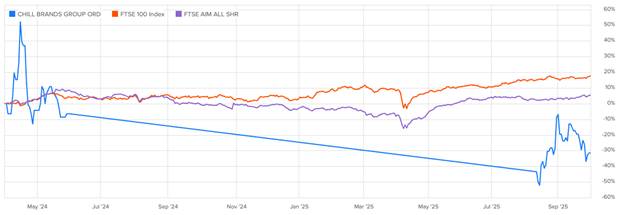
Historic Remuneration of the Chief Executive
|
Year |
|
Salary |
|
Bonus |
|
Benefits in Kind |
|
Share Based Payments |
|
Total |
|
|
|
£ |
|
£ |
|
£ |
|
£ |
|
£ |
|
2020 |
|
193,151 |
|
- |
|
39,718 |
|
- |
|
232,869 |
|
2021* |
|
152,673 |
|
- |
|
36,998 |
|
1,410,268 |
|
1,599,939 |
|
2022* |
|
188,829 |
|
- |
|
53,831 |
|
470,090 |
|
712,750 |
|
2023 |
|
90,000 |
|
- |
|
- |
|
- |
|
90,000 |
|
2024 |
|
85,000 |
|
- |
|
- |
|
- |
|
85,000 |
|
2025 |
|
127,500 |
|
- |
|
- |
|
- |
|
127,500 |
*The role of Chief Executive was fulfilled by two individuals concurrently during the years ended 31 March 2022 and 2021. The figures for "Chief Executive" are the combined total payments for the two individuals during the period. Additionally in the year ended 31 March 2020, the Chief Executive role was performed by other individuals.
Directors' Interest in Shares (audited)
The Company has no Director shareholding requirement.
The beneficial interest of the Directors in the ordinary share capital of the Company at both 31 March 2025 and 30 September 2025 was:
|
Number of Shares |
|
Percentage of Issued Shared Capital |
|
Percentage Change |
||||||
|
Director |
|
31 March 2024 |
|
31 March 2025 |
|
31 March 2024 |
|
31 March 2025 |
|
|
|
A Russo |
|
6,950,000 |
|
6,950,000 |
|
2.67% |
|
2.42% |
|
(0.25%) |
|
T Taylor |
|
6,950,227 |
|
6,950,227 |
|
2.67% |
|
2.42% |
|
(0.25%) |
|
C Sommerton |
|
266,668 |
|
266,668 |
|
0.00% |
|
0.00% |
|
0.00% |
|
E Schrader |
|
26,755,416 |
|
26,755,416 |
|
10.25% |
|
9.41% |
|
(0.84%) |
|
S Thompson |
|
100,000 |
|
100,000 |
|
0.00% |
|
0.00% |
|
0.00% |
|
G Duncan |
|
- |
|
- |
|
- |
|
- |
|
- |
|
A Chathli |
|
- |
|
- |
|
- |
|
- |
|
- |
|
N Tulloch |
|
- |
|
- |
|
- |
|
- |
|
- |
No Directors held any options or warrants at the end of the period.
Remuneration Committee
The Remuneration Committee, which was formed after the end of the Period in review following the appointment of new directors on 4 June 2024, is comprised of the Company's two non-executive directors, Harry Chathli and Nick Tulloch. The Committee meets as required to consider all aspects of directors' and staff remuneration, including share options and service contracts.
Where appropriate, the Committee may consult with the wider Board and external advisors, but decisions on remuneration are taken independently by the non-executive members.
Shareholder Voting at the Annual General Meeting
In accordance with applicable regulatory requirements, the Company's remuneration policy and any proposed changes to it will be submitted to shareholders for approval at the reconvened 2024 Annual General Meeting and at subsequent Annual General Meetings.
This is the Company's ninth period of operation. There have been no major changes during the period either in the policy on directors' remuneration or its implementation, including terms of service for the Directors.
This Directors' Remuneration Report was approved by the Board and signed on its behalf by:
Callum Sommerton, Chief Executive Officer
STATEMENT OF DIRECTORS' RESPONSIBILTIES IN RESPECT OF THE ANNUAL REPORT AND THE FINANCIAL STATEMENTS
The Directors are responsible for preparing the Annual Report and the financial statements in accordance with applicable United Kingdom law and regulations and UK adopted International Accounting Standards.
Company law requires the Directors to prepare financial statements for each financial period which give a true and fair view of the state of affairs of the Group and of the profit or loss and cash flows of the Group for that period.
In preparing those financial statements, the Directors are required to:
· select suitable accounting policies and apply them consistently;
· make judgements and estimates that are reasonable, relevant, and prudent;
· present information, including accounting policies, in a manner that provides relevant, reliable, comparable, and understandable information;
· state whether UK adopted International Accounting Standards have been followed, subject to any material departures disclosed and explained in the financial statements;
· assess the Group's ability to continue as a going concern, disclosing, as applicable, matters related to going concern and using the going concern basis of accounting unless it is inappropriate to presume that the Group will continue in business; and
· provide additional disclosures where compliance with specific requirements of UK adopted International Accounting Standards is insufficient to enable users to understand the impact of particular transactions, events, and conditions on the Group's financial position and financial performance.
The Directors are responsible for keeping adequate accounting records that are sufficient to show and explain the Group's transactions and disclose with reasonable accuracy at any time the financial position of the Group, and to enable them to ensure that the financial statements comply with the Companies Act 2006 and Article 4 of the IAS Regulation. They are also responsible for safeguarding the assets of the Group and for taking reasonable steps for the prevention and detection of fraud and other irregularities.
Under applicable law and regulation, the Directors are also responsible for preparing a Strategic Report, Directors' Report, Directors' Remuneration Report, and Corporate Governance Statement that comply with the Companies Act 2006, the Disclosure Guidance and Transparency Rules, and the Listing Rules of the Financial Conduct Authority, and for ensuring that the Annual Report as a whole is fair, balanced, and understandable.
So far as each of the Directors is aware, there is no relevant audit information, as defined in Section 418 of the Companies Act 2006, of which the Group's auditors are unaware, and each Director has taken all the steps that they ought to have taken as a director to make themselves aware of any relevant audit information and to establish that the Group's auditors are aware of that information.
The Annual Report and Consolidated Financial Statements are published on the Group's website at www.chillbrandsgroup.com. The Directors are responsible for the maintenance and integrity of the Group's website. Legislation in the United Kingdom governing the preparation and dissemination of financial statements may differ from legislation in other jurisdictions.
The Directors confirm that, to the best of their knowledge:
· the Group financial statements, prepared in accordance with UK adopted International Accounting Standards, give a true and fair view of the assets, liabilities, financial position, and profit or loss of the Group;
· the Strategic Report includes a fair review of the development and performance of the business and the position of the Group, together with a description of the principal risks and uncertainties that it faces; and
· the Annual Report and financial statements, taken as a whole, are fair, balanced, and understandable and provide the information necessary for shareholders to assess the Group's performance, business model, and strategy.
ENVIRONMENTAL RESPONSIBILITY AND GREENHOUSE GAS DISCLOSURES
The Directors recognise the importance of assessing and managing the environmental impact of the Group's activities. During the period under review, the Company has continued to operate in a state of transition, with its business model, geographic footprint, and operational structure evolving materially. In this context, it has not always been appropriate or proportionate to undertake comprehensive new measurements of emissions and environmental impact. Nevertheless, the Company remains committed to complying with all applicable environmental laws and reporting obligations and to improving its environmental practices as the business stabilises.
The principal environmental risks relevant to the Group include carbon emissions arising from manufacturing, transportation, and energy consumption; the management of waste, including packaging and end-of-life products; and the sourcing of raw materials. Historically, particular attention has been paid to the environmental impact of vape products, especially in relation to battery waste and disposal. While the Group has since reduced its exposure to own-brand vaping products, the Board remains committed to working with suppliers, partners, and stakeholders to minimise environmental harm associated with any products distributed by the business.
Streamlined Energy and Carbon Reporting (SECR)
Under the Companies (Directors' Report) and Limited Liability Partnerships (Energy and Carbon Report) Regulations 2019, the Company is required to disclose its UK energy use and associated greenhouse gas (GHG) emissions in accordance with the Streamlined Energy and Carbon Reporting (SECR) framework. This includes, as a minimum, emissions relating to electricity, gas, and transport fuel, together with an appropriate intensity ratio, where relevant.
During the period, the Company did not undertake a full recalculation of its greenhouse gas emissions. The Directors consider this appropriate given the lack of material change to the nature of the Company's internal operations that fall within the scope of SECR reporting, together with the significant operational disruption and restructuring experienced during the year. The Company has therefore relied on the same methodology and baseline assumptions used in the prior year, which were developed with reference to external expert guidance.
During the period the Group discontinued its US operations. The Board expects that this change will have reduced the Group's overall environmental footprint although this has not yet been quantified.
Emissions methodology and scope
For reporting purposes, emissions have been classified in accordance with the Greenhouse Gas Protocol.
· Scope 1 emissions: The Company recorded no Scope 1 emissions during the period, as it does not own or operate vehicles, combustion facilities, or refrigeration equipment.
· Scope 2 emissions: Scope 2 emissions arose from the purchase of electricity associated with office space and home-working arrangements used by Company staff.
· Scope 3 emissions: Scope 3 emissions, including those associated with supply chain activity, logistics, and product distribution, have not been calculated. The majority of these activities are outsourced to third-party providers, and the Directors consider that reliable data is not currently available on a consistent basis.
Consistent with the prior year, electricity and natural gas usage were estimated using industry-standard intensity factors based on occupied space, and appropriate emissions factors were applied to calculate carbon dioxide equivalent (CO₂e). The Directors consider this approach to be reasonable and proportionate given the Company's size, structure, and reliance on third-party service providers.
Energy consumption and emissions
All reported energy consumption and associated greenhouse gas emissions during the period related primarily to office-based activity and home-working arrangements. The Group did not operate energy-intensive facilities.
The principal energy efficiency measure undertaken during the period continued to be the Group's use of a remote and flexible working model, which reduces emissions associated with office occupancy, commuting, and business travel.
The table below sets out the Company's estimated energy consumption and associated greenhouse gas emissions, consistent with the prior reporting methodology:
|
|
Consumption: kWh |
Consumption: Cubic Feet of Gas |
Emissions: tC02e |
|
Electricity |
65,174 |
- |
30.60 |
|
Natural Gas |
- |
109,853 |
5.99 |
|
|
|
Total: |
36.59 |
The Company will continue to monitor its environmental footprint and seek to minimise its carbon emissions, balancing commercial needs with environmentally responsible choices. In particular, we intend to take proactive steps to reduce environmental harms associated with the production and distribution of batteries in our vape products. As part of our broader energy efficiency strategy, we are planning to reduce reliance on air freight by shifting to sea and consolidated freight wherever feasible, and to adopt more efficient packaging and distribution practices across our consumer goods portfolio. Further reporting, analysis and commentary will be provided in future reports as the Company's operations mature.
DISCLOSURE AND TRANSPARENCY RULES
Details of the Company's issued share capital, together with information on share options and warrants, are set out in Notes 21 and 22 to the financial statements. There are no restrictions on the transfer of the Company's ordinary shares, and none of the shares carry any special rights with regard to the control of the Company. There are no known arrangements under which the financial rights attached to the shares are held by a person other than the registered holder, and there are no known agreements or restrictions affecting the transfer of shares or voting rights.
So far as the Directors are aware, there are no persons who hold a significant direct or indirect interest in the Company's issued share capital other than the Directors and those shareholders disclosed in the section of this Annual Report dealing with significant shareholdings.
The rules governing the appointment and replacement of directors are set out in the Company's articles of association, any amendment to which requires shareholder approval. There are no significant agreements to which the Company is a party that take effect, alter, or terminate upon a change of control of the Company following a takeover bid. In addition, there are no agreements in place that provide for compensation for loss of office or employment that would become effective as a result of such a bid.
REQUIREMENTS OF THE LISTING RULES
The following table provides references to where the relevant information required by listing rule 9.8.4R is disclosed:
|
Listing Rule requirement |
|
|
Details of long-term incentive schemes as required by Listing Rule 9.4.3R |
See Directors' Remuneration Report page 44 |
|
Details of any arrangement under which a Director of the Company has waived emoluments from the Company |
n/a |
|
Details of any allotment for cash of equity securities made during the period otherwise than to the holders of such equity shares other than in proportion to their holdings of such equity shares and which has not been specifically authorised by the Company's shareholders |
n/a |
|
Details of any contract of significance subsisting during the period to which the Company is a party and to which a Director of the Company is or was materially interested |
Note 28 on page 96 |
|
Details of remaining service contract period for director standing for re-election this year |
See service contracts details on page 42 |
FINANCIAL INSTRUMENTS
The Company has exposure to credit risk, liquidity risk and market risk. Note 27 presents information about the Company's exposure to these risks, along with the Company's objectives, processes and policies for managing the risks.
EVENTS AFTER THE REPORTING PERIOD
Following the end of the reporting period on 30 September 2025, the Company continued to execute the strategy described elsewhere in this Annual Report. There were no changes to the Group's strategic direction or principal activities during this time.
Subsequent to the period end, the Company completed a competitive audit tender process and appointed RPG Crouch Chapman LLP as its external auditor.
In addition, the Company reached a settlement with former professional advisers in relation to historic matters. The settlement resulted in a gross cash inflow to the Company of approximately £210,000, before associated legal costs. The Directors consider this settlement to be non-adjusting in nature for the purposes of these financial statements.
There have been no other events after the reporting period that, in the opinion of the Directors, require adjustment to, or disclosure in, these financial statements.
DIRECTORS' INDEMNITY PROVISIONS
The Company is permitted, pursuant to its articles of association and applicable legislation, to indemnify its directors in respect of liabilities incurred in connection with the performance of their duties, subject to the limitations set out in the Companies Act 2006.
The Board keeps the availability and appropriateness of directors' indemnity arrangements, including insurance, under review as part of its broader governance framework.
GOING CONCERN
The Directors have carefully considered the Group's financial position, liquidity forecasts, and funding requirements in assessing the appropriateness of adopting the going concern basis in preparing these financial statements.
As set out elsewhere in this Annual Report, the Group has experienced a prolonged period of operational disruption and financial constraint, which has placed pressure on liquidity and resulted in continued trading losses. The Group's ability to continue as a going concern is dependent on the successful execution of its revised strategy, the continued development of its distribution-led operating model, and access to further funding as required to support working capital and ongoing operations.
In making their assessment, the Directors have reviewed detailed cash flow forecasts covering a period of at least twelve months from the date of approval of these financial statements. These forecasts reflect the Directors' best estimates of future trading performance, expected receipts and payments, and the anticipated availability of funding, taking into account the Group's current cost base and planned activities.
The Directors recognise that the Group will require additional funding during the forecast period. While there can be no certainty that such funding will be available when required, the Directors note the Group's recent history of securing financial support from existing and new investors and the continued engagement of key stakeholders in supporting the business through its recovery phase.
These conditions indicate the existence of a material uncertainty that may cast significant doubt on the Group's ability to continue as a going concern. Nevertheless, having considered the Group's funding history, the level of engagement with existing and potential capital providers, and the actions available to it, the Directors have a reasonable expectation that the Group will be able to secure appropriate funding as required. In addition, the Directors remain prepared to take such steps as they consider necessary and appropriate to preserve liquidity, strengthen the balance sheet, and support the continued operation of the business. On this basis, the Directors believe that the Group will have adequate resources to continue in operational existence for at least twelve months from the date of approval of these financial statements, and accordingly the financial statements have been prepared on a going concern basis.
DONATIONS
The Company made no political donations during the period.
These statements of the Directors' Responsibilities were approved by the Board and signed on its behalf by:
Callum Sommerton, Chief Executive Officer
INDEPENDENT AUDITOR'S REPORT TO THE MEMBERS OF CHILL BRANDS GROUP PLC
Opinion
We have audited the financial statements of Chill Brands Plc (the 'parent company') and its subsidiaries (the 'group') for the period ended 30 September 2025 which comprise the Consolidated statement of Comprehensive income, the Consolidated and Parent Company Statements of financial position, the Consolidated and Parent Company Statements of Changes in Equity, the Consolidated and Parent Company Statement of Cashflows and notes to the financial statements, including material accounting policy information. The financial reporting framework that has been applied in their preparation is applicable law and UK adopted international accounting standards.
In our opinion:
· the financial statements give a true and fair view of the state of the group's affairs and of the parent company's affairs as at 30 September 2025, and of the group's loss for the period then ended;
· the group financial statements have been properly prepared in accordance with UK adopted international accounting standards;
· the parent company financial statements have been properly prepared in accordance with UK adopted international reporting standards and
· the financial statements have been prepared in accordance with the requirements of the Companies Act 2006.
Basis for opinion
We conducted our audit in accordance with International Standards on Auditing (UK) (ISAs (UK)) and applicable law. Our responsibilities under those standards are further described in the Auditor responsibilities for the audit of the financial statements section of our report.
We are independent of the group and parent company in accordance with the ethical requirements that are relevant to our audit of the financial statements in the UK, including the FRC's Ethical Standard, and we have fulfilled our other ethical responsibilities in accordance with these requirements. We believe that the audit evidence we have obtained is sufficient and appropriate to provide a basis for our opinion.
Material uncertainty related to going concern
We draw attention to the Going Concern section within the accounting policies, which explains that the ability of the Group and Company to continue as a going concern is dependent on continued shareholder financing for at least the 12 months following the approval of the financial statements. At the date of signing these financial statements there is no binding written agreement and therefore no guarantee that the funding will be received and within the necessary timeframe. These conditions indicate the existence of a material uncertainty that may cast significant doubt on the Group's and the Parent Company's ability to continue as a going concern and therefore it may be unable to realise its assets and discharge its liabilities in the normal course of business.
Our opinion is not modified in respect of this matter.
For the reason set out above and based on our risk assessment, we determined going concern to be a key audit matter.
In auditing the financial statements, we have concluded that the Directors' use of the going concern basis of accounting in the preparation of the financial statements is appropriate. Our evaluation of the Directors' assessment of the Group and the Parent Company's ability to continue to adopt the going concern basis of accounting included (but not limited to):
· Obtaining and challenging the Directors' cash flow forecast for the period to January 2027 and assessing the key underlying assumptions;
· Evaluating the mathematical accuracy and integrity of the cash flow model and comparing the forecasts to actuals achieved in the period and post-period end to assess management's forecasting accuracy;
· Performing sensitivity analysis on the cash flow forecast for changes in key assumptions and considering impact on headroom;
· Performing audit procedures around the availability, intention and resources of support offered from key stakeholders, we have also secured a letter of support from said key stakeholders.
· Reviewing and considering the adequacy of the disclosure within the financial statements relating to the Directors' assessment of the going concern basis of preparation; and
· Verifying funds raised post period end.
Our responsibilities and the responsibilities of the directors with respect to going concern are described in the relevant sections of this report.
Key audit matters
Key audit matters are those that, in our professional judgement, were of most significance in our audit of the Financial Statements of the current period and include the most significant assessed risks of material misstatement (whether or not due to fraud) we identified, including those which had the greatest effect on: the overall audit strategy, the allocation of resources in the audit and directing the efforts of the engagement team. These matters were addressed in the context of our audit of the financial statements as a whole, and in forming our opinion thereon, and we do not provide a separate opinion on these matters.
In addition to the matter described in the Material uncertainty related to going concern section, we have determined the matters described below to be the key audit matters to be communicated in our report.
|
Key audit matter |
How our work addressed this matter |
|
Governance Issues & Director Disagreement (refer to note 5)
During the year the Group made a payment of £304,867 to previous directors following the governance issues and Director disagreement.
During this period the Group lost access to certain assets which were recovered following legal proceedings and the Group has since reviewed its internal controls and processes and implemented additional controls.
This has been determined as a key audit matter due to the significance and nature of the incident and the amount of the audit team's time spent addressing this risk and as a proportion of the total audit. |
Our audit work included, but was not restricted to:
· We increased the level of seniority of team members working on the audit and consulted internally to discuss the issues and appropriateness of our audit response; · We made enquiries of management regarding events in the period to gain a complete understanding of their investigation and challenged the conclusions reached; · Vouching management representations using third party documents such as legal filings and external correspondence with regulators; · Detailed reviews of bank payments and receipts to ensure the transactions disclosed to the audit team are materially complete and not only a part of the irregular activity; · Walkthroughs of the new controls in place to ensure deficiencies have since been rectified; · Reviewed minutes of board meetings held during the period and any subsequent to the period end. · Obtaining legal letters from relevant legal counsel to further vouch the established series of events; · Discussions with the audit committee to understand those charged with governance's understanding of events; · Verified recovery of assets misappropriated by the US directors through legal filings and review of Chill's domain host's records; · Review of the final settlement agreement to confirm there were no further provisions, contingent liabilities or litigation to consider; and · Reviewed the appropriateness of the accounting entries made for the settlement agreement and the adequacy of the disclosures made in the financial statements.
Key observations: Based on the procedures performed we consider managements accounting and disclosures to be appropriate. |
|
Intangible Asset (see note 15)
The group has an intangible asset with a carrying value of £1.1m at the period-end, pertaining to the domain name "Chill.com" which was acquired by the Group in the year ended 31 March 2022.
The domain name is considered by management to be critical to the long term success of the group, with value being attributed to future cash inflows derived from the intangible fixed asset.
Under IAS 36 Impairment of Assets, the domain name should be assessed at the end of each reporting period for indicators of impairment. Where indicators of impairment are subsequently identified in the financial period, an assessment of the asset's carrying value must be performed by management against its recoverable amount.
There is the prevailing risk that the carrying value of the domain name exceeds the recoverable amount as at 30 September 2025, given that the group has made a significant trading loss for the period ended 30 September 2025 and historically in successive periods.
Any impairment assessment on the carrying value of the Chill.com domain name will involve significant judgement and estimation from management due to the inherent uncertainty and subjectivity around key assumptions incorporated into the assessment,
Due to the estimation uncertainty on the determination of an appropriate recoverable amount and the material nature of the carrying value of the domain name, this was considered to be a key audit matter in the audit for the period ended 30 September 2025.
|
· Confirming a successful recovery of the asset by review of the settlement agreement, deed of assignment back to Chill and reviewing the GoDaddy ownership documentation. · Management provided a valuation report from Domain valuers Seedo Limited, demonstrating the carrying value was not materially overstated. · We assessed the credentials of Seedo Limited as domain name valuers by review of their history, number of domains valued and number of domain sales facilitated. • Review of the amortisation policy used by the Company. · Verification of the existence of the domain asset by review of GoDaddy documents and a simple internet search |
Our application of materiality
We apply the concept of materiality both in planning and performing our audit, and in evaluating the effect of misstatements. We consider materiality to be the magnitude by which misstatements, including omissions, could influence the economic decisions of reasonable users that are taken on the basis of the financial statements.
In order to reduce to an appropriately low level the probability that any misstatements exceed materiality, we use a lower materiality level, performance materiality, to determine the extent of testing needed. Importantly, misstatements below these levels will not necessarily be evaluated as immaterial as we also take account of the nature of identified misstatements, and the particular circumstances of their occurrence, when evaluating their effect on the financial statements as a whole.
Based on our professional judgement, we determined materiality for the financial statements as a whole and performance materiality as follows:
|
|
Group financial statements |
Parent company financial statements |
|
|
£346,200 |
£285,800 |
|
Materiality |
|
|
|
Basis for determining materiality |
8% on loss before tax |
8% on loss before tax |
|
Rationale for the benchmark applied |
Reasonable for a listed trading group with recurring losses, and of the assessed risk profile. |
Reasonable for a listed trading group with recurring losses, and of the assessed risk profile. |
|
Performance materiality |
£247,200 |
£203,900 |
|
Basis for determining performance materiality |
Based on 75% of materiality |
Based on 75% of materiality |
|
Rationale for the percentage applied for performance materiality |
In determining the performance materiality, we have considered the following factors: · The level of significant judgements and estimates; · The risk assessment and aggregation of risk and the effectiveness of controls; · The control environment and the group's financial reporting controls; and · The stability of key management personnel. |
|
We agreed with the Audit Committee that we would report on all differences in excess of £17,300. We also report to the Audit Committee on financial statement disclosure matters identified when assessing the overall consistency and presentation of the financial statements.
An overview of the scope of our audit
In designing our audit approach, we determined materiality and assessed risk of material misstatement in the financial statements. In particular, we looked at areas involving significant accounting estimates and judgements by the directors, including the recognition of revenue, the carrying value and recoverability of intangible assets and going concern. Procedures were then performed to address the risk identified and for the most significant assessed risks of misstatement, the procedures performed are outlined below in the key audit matters section of this report. We re-assessed the risks throughout the audit process and concluded that the scope remained in line with that determined at the planning stage of the audit.
We considered the sole component in scope for full audit procedures of the group to be Chill Brands Group PLC by virtue of the financial significance and the presence of group risks in that component. Zoetic Corporation LLC was assessed as in scope for audit for specific balances. Highlands Natural Resources and it's subsidiary entities were dormant in the period and had no substantial contribution to the group consolidated financial statements.
We are not engaging with any Component auditors in the course of the group audit and audits of Trading UK entities, nor are we relying on any work performed by any Component auditors of subsidiaries within the group.
Other information
The other information comprises the information included in the annual report, other than the financial statements and our auditor's report thereon. The directors are responsible for the other information contained within the annual report. Our opinion on the financial statements does not cover the other information and, except to the extent otherwise explicitly stated in our report, we do not express any form of assurance conclusion thereon. Our responsibility is to read the other information and, in doing so, consider whether the other information is materially inconsistent with the financial statements or our knowledge obtained in the course of the audit or otherwise appears to be materially misstated. If we identify such material inconsistencies or apparent material misstatements, we are required to determine whether this gives rise to a material misstatement in the financial statements themselves. If, based on the work we have performed, we conclude that there is a material misstatement of this other information, we are required to report that fact.
We have nothing to report in this regard.
Opinions on other matters prescribed by the Companies Act 2006
In our opinion, based on the work undertaken in the course of the audit:
· the information given in the strategic report and the directors' report for the financial period for which the financial statements are prepared is consistent with the financial statements; and
· the strategic report and the directors' report have been prepared in accordance with applicable legal requirements.
Matters on which we are required to report by exception
In the light of the knowledge and understanding of the group and the parent company and their environment obtained in the course of the audit, we have not identified material misstatements in the strategic report and the directors' report.
We have nothing to report in respect of the following matters in relation to which the Companies Act 2006 requires us to report to you if, in our opinion:
· adequate accounting records have not been kept by the Parent Company, or returns adequate for our audit have not been received from branches not visited by us; or
· the parent company financial statements and the part of the directors remuneration report to be audited are not in agreement with the accounting records and returns; or
· certain disclosures of directors' remuneration specified by law are not made; or
· we have not received all the information and explanations we require for our audit.
Responsibilities of directors
As explained more fully in the directors' responsibilities statement the directors are responsible for the preparation of the financial statements and for being satisfied that they give a true and fair view, and for such internal control as the directors determine is necessary to enable the preparation of financial statements that are free from material misstatement, whether due to fraud or error.
In preparing the financial statements, the directors are responsible for assessing the group and the parent company's ability to continue as a going concern, disclosing, as applicable, matters related to going concern and using the going concern basis of accounting unless the directors either intend to liquidate the group or the parent company or to cease operations, or have no realistic alternative but to do so.
Auditor responsibilities for the audit of the financial statements
Our objectives are to obtain reasonable assurance about whether the financial statements as a whole are free from material misstatement, whether due to fraud or error, and to issue an auditor's report that includes our opinion. Reasonable assurance is a high level of assurance, but is not a guarantee that an audit conducted in accordance with ISAs (UK) will always detect a material misstatement when it exists. Misstatements can arise from fraud or error and are considered material if, individually or in the aggregate, they could reasonably be expected to influence the economic decisions of users taken on the basis of these financial statements.
Irregularities, including fraud, are instances of non-compliance with laws and regulations. We design procedures in line with our responsibilities, outlined above, to detect material misstatements in respect of irregularities, including fraud. The extent to which our procedures are capable of detecting irregularities, including fraud is detailed below:
· We obtained an understanding of the legal and regulatory frameworks within which the Company operates focusing on those laws and regulations that have a direct effect on the determination of material amounts and disclosures in the financial statements. The laws and regulations we considered in this context were the Companies Act 2006, Listing Rules, The Proceeds of Crime Act, relevant taxation legislation, and the Tobacco and Related Products Regulations 2016.
· We identified the greatest risk of material impact on the financial statements from irregularities, including fraud, to be the override of controls by management. Our audit procedures to respond to these risks included enquiries of management about their own identification and assessment of the risks of irregularities, sample testing on the posting of journals and reviewing accounting estimates for biases.
· We designed our audit procedures to ensure the audit team considered whether there were any indications of non-compliance by the group and parent company with those laws and regulations.
These procedures included, but were not limited to:
o Enquiries of management;
o Review of Board meeting minutes;
o Review of Regulatory News Announcements;
o Review of legal correspondence; and
o Review of correspondence with the FCA
Because of the inherent limitations of an audit, there is a risk that we will not detect all irregularities, including those leading to a material misstatement in the financial statements or non-compliance with regulation. This risk increases the more that compliance with a law or regulation is removed from the events and transactions reflected in the financial statements, as we will be less likely to become aware of instances of non-compliance. The risk is also greater regarding irregularities occurring due to fraud rather than error, as fraud involves intentional concealment, forgery, collusion, omission or misrepresentation.
A further description of our responsibilities is available on the Financial Reporting Council's website at: www.frc.org.uk/auditorsresponsibilities. This description forms part of our auditor's report.
Other matters that we are required to address
We were appointed on 20 November 2025 and this is the first period of our engagement as auditors for the Group.
The non-audit services prohibited by the FRC's Ethical Standard were not provided to the group or the parent company and we remain independent of the group and the parent company in conducting our audit.
Our audit opinion is consistent with the additional report to the audit committee.
Use of our report
This report is made solely to the company's members, as a body, in accordance with our engagement letter. Our audit work has been undertaken so that we might state to the company's members those matters we are required to state to them in an auditor's report and for no other purpose. To the fullest extent permitted by law, we do not accept or assume responsibility to anyone other than the company and the company's members as a body, for our audit work, for this report, or for the opinions we have formed.
Paul Randall FCA (Senior Statutory Auditor)
For and on behalf of RPG Crouch Chapman LLP
Chartered Accountants
Statutory Auditors
40 Gracechurch Street
London
EC3V 0BT
Chill Brands Group PLC |
|
|||||||||||||||||||||||||||||||||||||||||||||||||||||||||||||||||||||||||||||||||||||||||||||||||||||||||||||||||||||||||||||||||||||||||||||||||||||||||||||||||||||||||||||||||||||||||||||||||||||||||||||||||||||||||||||||||||||||||||||||||||||||||||||||||||||||||||||||||||||||||||||||||||||||||||||||||||||||
|
Registered Number: 09309241 |
|
|||||||||||||||||||||||||||||||||||||||||||||||||||||||||||||||||||||||||||||||||||||||||||||||||||||||||||||||||||||||||||||||||||||||||||||||||||||||||||||||||||||||||||||||||||||||||||||||||||||||||||||||||||||||||||||||||||||||||||||||||||||||||||||||||||||||||||||||||||||||||||||||||||||||||||||||||||||||
|
Consolidated Statement of Financial Position |
|
|||||||||||||||||||||||||||||||||||||||||||||||||||||||||||||||||||||||||||||||||||||||||||||||||||||||||||||||||||||||||||||||||||||||||||||||||||||||||||||||||||||||||||||||||||||||||||||||||||||||||||||||||||||||||||||||||||||||||||||||||||||||||||||||||||||||||||||||||||||||||||||||||||||||||||||||||||||||
|
At 30 September 2025 and 31 March 2024 |
|
|||||||||||||||||||||||||||||||||||||||||||||||||||||||||||||||||||||||||||||||||||||||||||||||||||||||||||||||||||||||||||||||||||||||||||||||||||||||||||||||||||||||||||||||||||||||||||||||||||||||||||||||||||||||||||||||||||||||||||||||||||||||||||||||||||||||||||||||||||||||||||||||||||||||||||||||||||||||
|
|
|
|
|
|
|
|
|
|||||||||||||||||||||||||||||||||||||||||||||||||||||||||||||||||||||||||||||||||||||||||||||||||||||||||||||||||||||||||||||||||||||||||||||||||||||||||||||||||||||||||||||||||||||||||||||||||||||||||||||||||||||||||||||||||||||||||||||||||||||||||||||||||||||||||||||||||||||||||||||||||||||||||||||||||
|
|
|
Notes |
|
At 30 September 2025 £ |
|
At 31 March 2024 £ |
|
|||||||||||||||||||||||||||||||||||||||||||||||||||||||||||||||||||||||||||||||||||||||||||||||||||||||||||||||||||||||||||||||||||||||||||||||||||||||||||||||||||||||||||||||||||||||||||||||||||||||||||||||||||||||||||||||||||||||||||||||||||||||||||||||||||||||||||||||||||||||||||||||||||||||||||||||||
|
Non-Current Assets |
|
|
|
|
|
|
|
|||||||||||||||||||||||||||||||||||||||||||||||||||||||||||||||||||||||||||||||||||||||||||||||||||||||||||||||||||||||||||||||||||||||||||||||||||||||||||||||||||||||||||||||||||||||||||||||||||||||||||||||||||||||||||||||||||||||||||||||||||||||||||||||||||||||||||||||||||||||||||||||||||||||||||||||||
|
Property, plant, and equipment |
|
13 |
|
4,087 |
|
28,780 |
|
|||||||||||||||||||||||||||||||||||||||||||||||||||||||||||||||||||||||||||||||||||||||||||||||||||||||||||||||||||||||||||||||||||||||||||||||||||||||||||||||||||||||||||||||||||||||||||||||||||||||||||||||||||||||||||||||||||||||||||||||||||||||||||||||||||||||||||||||||||||||||||||||||||||||||||||||||
|
Right of use lease asset |
|
14 |
|
46,538 |
|
178,118 |
|
|||||||||||||||||||||||||||||||||||||||||||||||||||||||||||||||||||||||||||||||||||||||||||||||||||||||||||||||||||||||||||||||||||||||||||||||||||||||||||||||||||||||||||||||||||||||||||||||||||||||||||||||||||||||||||||||||||||||||||||||||||||||||||||||||||||||||||||||||||||||||||||||||||||||||||||||||
|
Intangible assets |
|
15 |
|
1,058,216 |
|
1,135,497 |
|
|||||||||||||||||||||||||||||||||||||||||||||||||||||||||||||||||||||||||||||||||||||||||||||||||||||||||||||||||||||||||||||||||||||||||||||||||||||||||||||||||||||||||||||||||||||||||||||||||||||||||||||||||||||||||||||||||||||||||||||||||||||||||||||||||||||||||||||||||||||||||||||||||||||||||||||||||
|
Total Noncurrent Assets |
|
|
|
1,108,841 |
|
1,342,395 |
|
|||||||||||||||||||||||||||||||||||||||||||||||||||||||||||||||||||||||||||||||||||||||||||||||||||||||||||||||||||||||||||||||||||||||||||||||||||||||||||||||||||||||||||||||||||||||||||||||||||||||||||||||||||||||||||||||||||||||||||||||||||||||||||||||||||||||||||||||||||||||||||||||||||||||||||||||||
|
Current Assets |
|
|
|
|
|
|
|
|||||||||||||||||||||||||||||||||||||||||||||||||||||||||||||||||||||||||||||||||||||||||||||||||||||||||||||||||||||||||||||||||||||||||||||||||||||||||||||||||||||||||||||||||||||||||||||||||||||||||||||||||||||||||||||||||||||||||||||||||||||||||||||||||||||||||||||||||||||||||||||||||||||||||||||||||
|
Inventories, net of provisions |
|
17 |
|
461,056 |
|
139,838 |
|
|||||||||||||||||||||||||||||||||||||||||||||||||||||||||||||||||||||||||||||||||||||||||||||||||||||||||||||||||||||||||||||||||||||||||||||||||||||||||||||||||||||||||||||||||||||||||||||||||||||||||||||||||||||||||||||||||||||||||||||||||||||||||||||||||||||||||||||||||||||||||||||||||||||||||||||||||
|
Trade and other receivables |
|
18 |
|
470,025 |
|
2,467,704 |
|
|||||||||||||||||||||||||||||||||||||||||||||||||||||||||||||||||||||||||||||||||||||||||||||||||||||||||||||||||||||||||||||||||||||||||||||||||||||||||||||||||||||||||||||||||||||||||||||||||||||||||||||||||||||||||||||||||||||||||||||||||||||||||||||||||||||||||||||||||||||||||||||||||||||||||||||||||
|
Cash and cash equivalents |
|
19 |
|
99,957 |
|
1,315,289 |
|
|||||||||||||||||||||||||||||||||||||||||||||||||||||||||||||||||||||||||||||||||||||||||||||||||||||||||||||||||||||||||||||||||||||||||||||||||||||||||||||||||||||||||||||||||||||||||||||||||||||||||||||||||||||||||||||||||||||||||||||||||||||||||||||||||||||||||||||||||||||||||||||||||||||||||||||||||
|
Total Current Assets |
|
|
|
1,031.038 |
|
3,922,831 |
|
|||||||||||||||||||||||||||||||||||||||||||||||||||||||||||||||||||||||||||||||||||||||||||||||||||||||||||||||||||||||||||||||||||||||||||||||||||||||||||||||||||||||||||||||||||||||||||||||||||||||||||||||||||||||||||||||||||||||||||||||||||||||||||||||||||||||||||||||||||||||||||||||||||||||||||||||||
|
Total Assets |
|
|
|
2,139,879 |
|
5,265,226 |
|
|||||||||||||||||||||||||||||||||||||||||||||||||||||||||||||||||||||||||||||||||||||||||||||||||||||||||||||||||||||||||||||||||||||||||||||||||||||||||||||||||||||||||||||||||||||||||||||||||||||||||||||||||||||||||||||||||||||||||||||||||||||||||||||||||||||||||||||||||||||||||||||||||||||||||||||||||
|
Non-Current Liabilities |
|
|
|
|
|
|
|
|||||||||||||||||||||||||||||||||||||||||||||||||||||||||||||||||||||||||||||||||||||||||||||||||||||||||||||||||||||||||||||||||||||||||||||||||||||||||||||||||||||||||||||||||||||||||||||||||||||||||||||||||||||||||||||||||||||||||||||||||||||||||||||||||||||||||||||||||||||||||||||||||||||||||||||||||
|
Long-term debt, excluding current maturities |
|
26 |
|
2,154,408 |
|
1,411,755 |
|
|||||||||||||||||||||||||||||||||||||||||||||||||||||||||||||||||||||||||||||||||||||||||||||||||||||||||||||||||||||||||||||||||||||||||||||||||||||||||||||||||||||||||||||||||||||||||||||||||||||||||||||||||||||||||||||||||||||||||||||||||||||||||||||||||||||||||||||||||||||||||||||||||||||||||||||||||
|
Right of use lease liability, net of current portion |
|
14 |
|
32,149 |
|
92,243 |
|
|||||||||||||||||||||||||||||||||||||||||||||||||||||||||||||||||||||||||||||||||||||||||||||||||||||||||||||||||||||||||||||||||||||||||||||||||||||||||||||||||||||||||||||||||||||||||||||||||||||||||||||||||||||||||||||||||||||||||||||||||||||||||||||||||||||||||||||||||||||||||||||||||||||||||||||||||
|
Total Non-current Liabilities |
|
|
|
2,186,557 |
|
1,503,998 |
|
|||||||||||||||||||||||||||||||||||||||||||||||||||||||||||||||||||||||||||||||||||||||||||||||||||||||||||||||||||||||||||||||||||||||||||||||||||||||||||||||||||||||||||||||||||||||||||||||||||||||||||||||||||||||||||||||||||||||||||||||||||||||||||||||||||||||||||||||||||||||||||||||||||||||||||||||||
|
Current Liabilities |
|
|
|
|
|
|
|
|||||||||||||||||||||||||||||||||||||||||||||||||||||||||||||||||||||||||||||||||||||||||||||||||||||||||||||||||||||||||||||||||||||||||||||||||||||||||||||||||||||||||||||||||||||||||||||||||||||||||||||||||||||||||||||||||||||||||||||||||||||||||||||||||||||||||||||||||||||||||||||||||||||||||||||||||
|
Current maturities of long-term debt |
|
26 |
|
460,811 |
|
211,017 |
|
|||||||||||||||||||||||||||||||||||||||||||||||||||||||||||||||||||||||||||||||||||||||||||||||||||||||||||||||||||||||||||||||||||||||||||||||||||||||||||||||||||||||||||||||||||||||||||||||||||||||||||||||||||||||||||||||||||||||||||||||||||||||||||||||||||||||||||||||||||||||||||||||||||||||||||||||||
|
Trade, other payables and accrued liabilities |
|
20 |
|
712,196 |
|
886,941 |
|
|||||||||||||||||||||||||||||||||||||||||||||||||||||||||||||||||||||||||||||||||||||||||||||||||||||||||||||||||||||||||||||||||||||||||||||||||||||||||||||||||||||||||||||||||||||||||||||||||||||||||||||||||||||||||||||||||||||||||||||||||||||||||||||||||||||||||||||||||||||||||||||||||||||||||||||||||
|
Right of use lease liability, current portion |
|
14 |
|
14,389 |
|
92,393 |
|
|||||||||||||||||||||||||||||||||||||||||||||||||||||||||||||||||||||||||||||||||||||||||||||||||||||||||||||||||||||||||||||||||||||||||||||||||||||||||||||||||||||||||||||||||||||||||||||||||||||||||||||||||||||||||||||||||||||||||||||||||||||||||||||||||||||||||||||||||||||||||||||||||||||||||||||||||
|
Total Current Liabilities |
|
|
|
1,187,396 |
|
1,190,351 |
|
|||||||||||||||||||||||||||||||||||||||||||||||||||||||||||||||||||||||||||||||||||||||||||||||||||||||||||||||||||||||||||||||||||||||||||||||||||||||||||||||||||||||||||||||||||||||||||||||||||||||||||||||||||||||||||||||||||||||||||||||||||||||||||||||||||||||||||||||||||||||||||||||||||||||||||||||||
|
Total Liabilities |
|
|
|
3,373,953 |
|
2,694,349 |
|
|||||||||||||||||||||||||||||||||||||||||||||||||||||||||||||||||||||||||||||||||||||||||||||||||||||||||||||||||||||||||||||||||||||||||||||||||||||||||||||||||||||||||||||||||||||||||||||||||||||||||||||||||||||||||||||||||||||||||||||||||||||||||||||||||||||||||||||||||||||||||||||||||||||||||||||||||
|
Net (Liabilities) / Assets |
|
|
|
(1,234,074) |
|
2,570,877 |
|
|||||||||||||||||||||||||||||||||||||||||||||||||||||||||||||||||||||||||||||||||||||||||||||||||||||||||||||||||||||||||||||||||||||||||||||||||||||||||||||||||||||||||||||||||||||||||||||||||||||||||||||||||||||||||||||||||||||||||||||||||||||||||||||||||||||||||||||||||||||||||||||||||||||||||||||||||
|
Equity |
|
|
|
|
|
|
|
|||||||||||||||||||||||||||||||||||||||||||||||||||||||||||||||||||||||||||||||||||||||||||||||||||||||||||||||||||||||||||||||||||||||||||||||||||||||||||||||||||||||||||||||||||||||||||||||||||||||||||||||||||||||||||||||||||||||||||||||||||||||||||||||||||||||||||||||||||||||||||||||||||||||||||||||||
|
Share capital |
|
21 |
|
5,119,527 |
|
4,953,169 |
|
|||||||||||||||||||||||||||||||||||||||||||||||||||||||||||||||||||||||||||||||||||||||||||||||||||||||||||||||||||||||||||||||||||||||||||||||||||||||||||||||||||||||||||||||||||||||||||||||||||||||||||||||||||||||||||||||||||||||||||||||||||||||||||||||||||||||||||||||||||||||||||||||||||||||||||||||||
|
Share premium account |
|
21 |
|
14,804,346 |
|
14,755,570 |
|
|||||||||||||||||||||||||||||||||||||||||||||||||||||||||||||||||||||||||||||||||||||||||||||||||||||||||||||||||||||||||||||||||||||||||||||||||||||||||||||||||||||||||||||||||||||||||||||||||||||||||||||||||||||||||||||||||||||||||||||||||||||||||||||||||||||||||||||||||||||||||||||||||||||||||||||||||
|
Shared based payment reserve |
|
23 |
|
4,516,608 |
|
4,516,608 |
|
|||||||||||||||||||||||||||||||||||||||||||||||||||||||||||||||||||||||||||||||||||||||||||||||||||||||||||||||||||||||||||||||||||||||||||||||||||||||||||||||||||||||||||||||||||||||||||||||||||||||||||||||||||||||||||||||||||||||||||||||||||||||||||||||||||||||||||||||||||||||||||||||||||||||||||||||||
|
Compound loan note equity component reserve |
|
24 |
|
275,326 |
|
19,052 |
|
|||||||||||||||||||||||||||||||||||||||||||||||||||||||||||||||||||||||||||||||||||||||||||||||||||||||||||||||||||||||||||||||||||||||||||||||||||||||||||||||||||||||||||||||||||||||||||||||||||||||||||||||||||||||||||||||||||||||||||||||||||||||||||||||||||||||||||||||||||||||||||||||||||||||||||||||||
|
Foreign currency translation reserve |
|
|
|
235,393 |
|
203,704 |
|
|||||||||||||||||||||||||||||||||||||||||||||||||||||||||||||||||||||||||||||||||||||||||||||||||||||||||||||||||||||||||||||||||||||||||||||||||||||||||||||||||||||||||||||||||||||||||||||||||||||||||||||||||||||||||||||||||||||||||||||||||||||||||||||||||||||||||||||||||||||||||||||||||||||||||||||||||
|
Other reserve |
|
|
|
400,116 |
|
400,116 |
|
|||||||||||||||||||||||||||||||||||||||||||||||||||||||||||||||||||||||||||||||||||||||||||||||||||||||||||||||||||||||||||||||||||||||||||||||||||||||||||||||||||||||||||||||||||||||||||||||||||||||||||||||||||||||||||||||||||||||||||||||||||||||||||||||||||||||||||||||||||||||||||||||||||||||||||||||||
|
Retained loss |
|
|
|
(26,585,390) |
|
(22,277,342) |
|
|||||||||||||||||||||||||||||||||||||||||||||||||||||||||||||||||||||||||||||||||||||||||||||||||||||||||||||||||||||||||||||||||||||||||||||||||||||||||||||||||||||||||||||||||||||||||||||||||||||||||||||||||||||||||||||||||||||||||||||||||||||||||||||||||||||||||||||||||||||||||||||||||||||||||||||||||
|
Total Equity |
|
|
|
(1,234,074) |
|
2,570,877 |
|
|||||||||||||||||||||||||||||||||||||||||||||||||||||||||||||||||||||||||||||||||||||||||||||||||||||||||||||||||||||||||||||||||||||||||||||||||||||||||||||||||||||||||||||||||||||||||||||||||||||||||||||||||||||||||||||||||||||||||||||||||||||||||||||||||||||||||||||||||||||||||||||||||||||||||||||||||
|
|
|
|
|
|
|
|
||||||||||||||||||||||||||||||||||||||||||||||||||||||||||||||||||||||||||||||||||||||||||||||||||||||||||||||||||||||||||||||||||||||||||||||||||||||||||||||||||||||||||||||||||||||||||||||||||||||||||||||||||||||||||||||||||||||||||||||||||||||||||||||||||||||||||||||||||||||||||||||||||||||||||||||||||
|
The notes on pages 66 to 97 form an integral part of the financial statements. The financial Statements were approved by the Board of Directors on 30 January 2026 and signed on their behalf by: |
|
|||||||||||||||||||||||||||||||||||||||||||||||||||||||||||||||||||||||||||||||||||||||||||||||||||||||||||||||||||||||||||||||||||||||||||||||||||||||||||||||||||||||||||||||||||||||||||||||||||||||||||||||||||||||||||||||||||||||||||||||||||||||||||||||||||||||||||||||||||||||||||||||||||||||||||||||||||||||
|
Callum Sommerton - Chief Executive Officer
Chill Brands Group PLC |
|
|||||||||||||||||||||||||||||||||||||||||||||||||||||||||||||||||||||||||||||||||||||||||||||||||||||||||||||||||||||||||||||||||||||||||||||||||||||||||||||||||||||||||||||||||||||||||||||||||||||||||||||||||||||||||||||||||||||||||||||||||||||||||||||||||||||||||||||||||||||||||||||||||||||||||||||||||||||||
|
Registered Number: 09309241 |
|
|||||||||||||||||||||||||||||||||||||||||||||||||||||||||||||||||||||||||||||||||||||||||||||||||||||||||||||||||||||||||||||||||||||||||||||||||||||||||||||||||||||||||||||||||||||||||||||||||||||||||||||||||||||||||||||||||||||||||||||||||||||||||||||||||||||||||||||||||||||||||||||||||||||||||||||||||||||||
|
Company Statement of Financial Position at 30 September 2025 and 31 March 2024 |
|
|||||||||||||||||||||||||||||||||||||||||||||||||||||||||||||||||||||||||||||||||||||||||||||||||||||||||||||||||||||||||||||||||||||||||||||||||||||||||||||||||||||||||||||||||||||||||||||||||||||||||||||||||||||||||||||||||||||||||||||||||||||||||||||||||||||||||||||||||||||||||||||||||||||||||||||||||||||||
|
|
|
Notes |
|
At 30 September 2025 £ |
|
At 31 March 2024 £ |
|
|||||||||||||||||||||||||||||||||||||||||||||||||||||||||||||||||||||||||||||||||||||||||||||||||||||||||||||||||||||||||||||||||||||||||||||||||||||||||||||||||||||||||||||||||||||||||||||||||||||||||||||||||||||||||||||||||||||||||||||||||||||||||||||||||||||||||||||||||||||||||||||||||||||||||||||||||
|
Non-Current Assets |
|
|
|
|
|
|
|
|||||||||||||||||||||||||||||||||||||||||||||||||||||||||||||||||||||||||||||||||||||||||||||||||||||||||||||||||||||||||||||||||||||||||||||||||||||||||||||||||||||||||||||||||||||||||||||||||||||||||||||||||||||||||||||||||||||||||||||||||||||||||||||||||||||||||||||||||||||||||||||||||||||||||||||||||
|
Property, plant, and equipment |
|
13 |
|
4,087 |
|
- |
|
|||||||||||||||||||||||||||||||||||||||||||||||||||||||||||||||||||||||||||||||||||||||||||||||||||||||||||||||||||||||||||||||||||||||||||||||||||||||||||||||||||||||||||||||||||||||||||||||||||||||||||||||||||||||||||||||||||||||||||||||||||||||||||||||||||||||||||||||||||||||||||||||||||||||||||||||||
|
Right of use lease asset |
|
14 |
|
46,538 |
|
- |
|
|||||||||||||||||||||||||||||||||||||||||||||||||||||||||||||||||||||||||||||||||||||||||||||||||||||||||||||||||||||||||||||||||||||||||||||||||||||||||||||||||||||||||||||||||||||||||||||||||||||||||||||||||||||||||||||||||||||||||||||||||||||||||||||||||||||||||||||||||||||||||||||||||||||||||||||||||
|
Intangible assets |
|
15 15 |
|
1,058,216 |
|
- |
|
|||||||||||||||||||||||||||||||||||||||||||||||||||||||||||||||||||||||||||||||||||||||||||||||||||||||||||||||||||||||||||||||||||||||||||||||||||||||||||||||||||||||||||||||||||||||||||||||||||||||||||||||||||||||||||||||||||||||||||||||||||||||||||||||||||||||||||||||||||||||||||||||||||||||||||||||||
|
Total Noncurrent Assets |
|
|
|
1,108,841 |
|
- |
|
|||||||||||||||||||||||||||||||||||||||||||||||||||||||||||||||||||||||||||||||||||||||||||||||||||||||||||||||||||||||||||||||||||||||||||||||||||||||||||||||||||||||||||||||||||||||||||||||||||||||||||||||||||||||||||||||||||||||||||||||||||||||||||||||||||||||||||||||||||||||||||||||||||||||||||||||||
|
|
|
|
|
|
|
|
|
|||||||||||||||||||||||||||||||||||||||||||||||||||||||||||||||||||||||||||||||||||||||||||||||||||||||||||||||||||||||||||||||||||||||||||||||||||||||||||||||||||||||||||||||||||||||||||||||||||||||||||||||||||||||||||||||||||||||||||||||||||||||||||||||||||||||||||||||||||||||||||||||||||||||||||||||||
|
Current Assets |
|
|
|
|
|
|
|
|||||||||||||||||||||||||||||||||||||||||||||||||||||||||||||||||||||||||||||||||||||||||||||||||||||||||||||||||||||||||||||||||||||||||||||||||||||||||||||||||||||||||||||||||||||||||||||||||||||||||||||||||||||||||||||||||||||||||||||||||||||||||||||||||||||||||||||||||||||||||||||||||||||||||||||||||
|
Inventories, net of provisions |
|
17 |
|
461,056 |
|
106,735 |
|
|||||||||||||||||||||||||||||||||||||||||||||||||||||||||||||||||||||||||||||||||||||||||||||||||||||||||||||||||||||||||||||||||||||||||||||||||||||||||||||||||||||||||||||||||||||||||||||||||||||||||||||||||||||||||||||||||||||||||||||||||||||||||||||||||||||||||||||||||||||||||||||||||||||||||||||||||
|
Trade and other receivables |
|
18 |
|
470,025 |
|
2,314,002 |
|
|||||||||||||||||||||||||||||||||||||||||||||||||||||||||||||||||||||||||||||||||||||||||||||||||||||||||||||||||||||||||||||||||||||||||||||||||||||||||||||||||||||||||||||||||||||||||||||||||||||||||||||||||||||||||||||||||||||||||||||||||||||||||||||||||||||||||||||||||||||||||||||||||||||||||||||||||
|
Cash and cash equivalents |
|
19 |
|
99,881 |
|
1,225,912 |
|
|||||||||||||||||||||||||||||||||||||||||||||||||||||||||||||||||||||||||||||||||||||||||||||||||||||||||||||||||||||||||||||||||||||||||||||||||||||||||||||||||||||||||||||||||||||||||||||||||||||||||||||||||||||||||||||||||||||||||||||||||||||||||||||||||||||||||||||||||||||||||||||||||||||||||||||||||
|
Total Current Assets |
|
|
|
1,030,962 |
|
3,646,649 |
|
|||||||||||||||||||||||||||||||||||||||||||||||||||||||||||||||||||||||||||||||||||||||||||||||||||||||||||||||||||||||||||||||||||||||||||||||||||||||||||||||||||||||||||||||||||||||||||||||||||||||||||||||||||||||||||||||||||||||||||||||||||||||||||||||||||||||||||||||||||||||||||||||||||||||||||||||||
|
Total Assets |
|
|
|
2,139,803 |
|
3,646,649 |
|
|||||||||||||||||||||||||||||||||||||||||||||||||||||||||||||||||||||||||||||||||||||||||||||||||||||||||||||||||||||||||||||||||||||||||||||||||||||||||||||||||||||||||||||||||||||||||||||||||||||||||||||||||||||||||||||||||||||||||||||||||||||||||||||||||||||||||||||||||||||||||||||||||||||||||||||||||
|
Non-Current Liabilities |
|
|
|
|
|
|
|
|||||||||||||||||||||||||||||||||||||||||||||||||||||||||||||||||||||||||||||||||||||||||||||||||||||||||||||||||||||||||||||||||||||||||||||||||||||||||||||||||||||||||||||||||||||||||||||||||||||||||||||||||||||||||||||||||||||||||||||||||||||||||||||||||||||||||||||||||||||||||||||||||||||||||||||||||
|
Long-term debt, excluding current maturities |
|
26 |
|
2,154,408 |
|
1,411,001 |
|
|||||||||||||||||||||||||||||||||||||||||||||||||||||||||||||||||||||||||||||||||||||||||||||||||||||||||||||||||||||||||||||||||||||||||||||||||||||||||||||||||||||||||||||||||||||||||||||||||||||||||||||||||||||||||||||||||||||||||||||||||||||||||||||||||||||||||||||||||||||||||||||||||||||||||||||||||
|
Right of use lease liability, Non-current portion |
|
|
|
32,149 |
|
- |
|
|||||||||||||||||||||||||||||||||||||||||||||||||||||||||||||||||||||||||||||||||||||||||||||||||||||||||||||||||||||||||||||||||||||||||||||||||||||||||||||||||||||||||||||||||||||||||||||||||||||||||||||||||||||||||||||||||||||||||||||||||||||||||||||||||||||||||||||||||||||||||||||||||||||||||||||||||
|
Total Non-Current Liabilities |
|
|
|
2,186,557 |
|
1,411,001 |
|
|||||||||||||||||||||||||||||||||||||||||||||||||||||||||||||||||||||||||||||||||||||||||||||||||||||||||||||||||||||||||||||||||||||||||||||||||||||||||||||||||||||||||||||||||||||||||||||||||||||||||||||||||||||||||||||||||||||||||||||||||||||||||||||||||||||||||||||||||||||||||||||||||||||||||||||||||
|
Current Liabilities |
|
|
|
|
|
|
|
|||||||||||||||||||||||||||||||||||||||||||||||||||||||||||||||||||||||||||||||||||||||||||||||||||||||||||||||||||||||||||||||||||||||||||||||||||||||||||||||||||||||||||||||||||||||||||||||||||||||||||||||||||||||||||||||||||||||||||||||||||||||||||||||||||||||||||||||||||||||||||||||||||||||||||||||||
|
Current maturities of long-term debt |
|
26 |
|
460,811 |
|
202,000 |
|
|||||||||||||||||||||||||||||||||||||||||||||||||||||||||||||||||||||||||||||||||||||||||||||||||||||||||||||||||||||||||||||||||||||||||||||||||||||||||||||||||||||||||||||||||||||||||||||||||||||||||||||||||||||||||||||||||||||||||||||||||||||||||||||||||||||||||||||||||||||||||||||||||||||||||||||||||
|
Right of use lease liability, current portion |
|
|
|
14,389 |
|
- |
|
|||||||||||||||||||||||||||||||||||||||||||||||||||||||||||||||||||||||||||||||||||||||||||||||||||||||||||||||||||||||||||||||||||||||||||||||||||||||||||||||||||||||||||||||||||||||||||||||||||||||||||||||||||||||||||||||||||||||||||||||||||||||||||||||||||||||||||||||||||||||||||||||||||||||||||||||||
|
Trade and other payables |
|
18 |
|
1,055,193 |
|
528,403 |
|
|||||||||||||||||||||||||||||||||||||||||||||||||||||||||||||||||||||||||||||||||||||||||||||||||||||||||||||||||||||||||||||||||||||||||||||||||||||||||||||||||||||||||||||||||||||||||||||||||||||||||||||||||||||||||||||||||||||||||||||||||||||||||||||||||||||||||||||||||||||||||||||||||||||||||||||||||
|
Total Current Liabilities |
|
|
|
1,530,393 |
|
730,403 |
|
|||||||||||||||||||||||||||||||||||||||||||||||||||||||||||||||||||||||||||||||||||||||||||||||||||||||||||||||||||||||||||||||||||||||||||||||||||||||||||||||||||||||||||||||||||||||||||||||||||||||||||||||||||||||||||||||||||||||||||||||||||||||||||||||||||||||||||||||||||||||||||||||||||||||||||||||||
|
Total Liabilities |
|
|
|
3,716,950 |
|
2,141,404 |
|
|||||||||||||||||||||||||||||||||||||||||||||||||||||||||||||||||||||||||||||||||||||||||||||||||||||||||||||||||||||||||||||||||||||||||||||||||||||||||||||||||||||||||||||||||||||||||||||||||||||||||||||||||||||||||||||||||||||||||||||||||||||||||||||||||||||||||||||||||||||||||||||||||||||||||||||||||
|
Net Assets / (Liabilities) |
|
|
|
(1,577,147) |
|
1,505,245 |
|
|||||||||||||||||||||||||||||||||||||||||||||||||||||||||||||||||||||||||||||||||||||||||||||||||||||||||||||||||||||||||||||||||||||||||||||||||||||||||||||||||||||||||||||||||||||||||||||||||||||||||||||||||||||||||||||||||||||||||||||||||||||||||||||||||||||||||||||||||||||||||||||||||||||||||||||||||
|
Equity |
|
|
|
|
|
|
|
|||||||||||||||||||||||||||||||||||||||||||||||||||||||||||||||||||||||||||||||||||||||||||||||||||||||||||||||||||||||||||||||||||||||||||||||||||||||||||||||||||||||||||||||||||||||||||||||||||||||||||||||||||||||||||||||||||||||||||||||||||||||||||||||||||||||||||||||||||||||||||||||||||||||||||||||||
|
Share capital |
|
21 |
|
5,119,527 |
|
4,953,169 |
|
|||||||||||||||||||||||||||||||||||||||||||||||||||||||||||||||||||||||||||||||||||||||||||||||||||||||||||||||||||||||||||||||||||||||||||||||||||||||||||||||||||||||||||||||||||||||||||||||||||||||||||||||||||||||||||||||||||||||||||||||||||||||||||||||||||||||||||||||||||||||||||||||||||||||||||||||||
|
Share premium account |
|
21 |
|
14,804,346 |
|
14,755,570 |
|
|||||||||||||||||||||||||||||||||||||||||||||||||||||||||||||||||||||||||||||||||||||||||||||||||||||||||||||||||||||||||||||||||||||||||||||||||||||||||||||||||||||||||||||||||||||||||||||||||||||||||||||||||||||||||||||||||||||||||||||||||||||||||||||||||||||||||||||||||||||||||||||||||||||||||||||||||
|
Shared based payment reserve |
|
23 |
|
4,516,608 |
|
4,516,608 |
|
|||||||||||||||||||||||||||||||||||||||||||||||||||||||||||||||||||||||||||||||||||||||||||||||||||||||||||||||||||||||||||||||||||||||||||||||||||||||||||||||||||||||||||||||||||||||||||||||||||||||||||||||||||||||||||||||||||||||||||||||||||||||||||||||||||||||||||||||||||||||||||||||||||||||||||||||||
|
Compound loan note equity component reserve |
|
24 |
|
275,326 |
|
19,052 |
|
|||||||||||||||||||||||||||||||||||||||||||||||||||||||||||||||||||||||||||||||||||||||||||||||||||||||||||||||||||||||||||||||||||||||||||||||||||||||||||||||||||||||||||||||||||||||||||||||||||||||||||||||||||||||||||||||||||||||||||||||||||||||||||||||||||||||||||||||||||||||||||||||||||||||||||||||||
|
Other reserve |
|
|
|
400,116 |
|
400,116 |
|
|||||||||||||||||||||||||||||||||||||||||||||||||||||||||||||||||||||||||||||||||||||||||||||||||||||||||||||||||||||||||||||||||||||||||||||||||||||||||||||||||||||||||||||||||||||||||||||||||||||||||||||||||||||||||||||||||||||||||||||||||||||||||||||||||||||||||||||||||||||||||||||||||||||||||||||||||
|
Retained loss |
|
|
|
(26,693,070) |
|
(23,139,270) |
|
|||||||||||||||||||||||||||||||||||||||||||||||||||||||||||||||||||||||||||||||||||||||||||||||||||||||||||||||||||||||||||||||||||||||||||||||||||||||||||||||||||||||||||||||||||||||||||||||||||||||||||||||||||||||||||||||||||||||||||||||||||||||||||||||||||||||||||||||||||||||||||||||||||||||||||||||||
|
Total Equity |
|
|
|
(1,577,147) |
|
1,505,245 |
|
|||||||||||||||||||||||||||||||||||||||||||||||||||||||||||||||||||||||||||||||||||||||||||||||||||||||||||||||||||||||||||||||||||||||||||||||||||||||||||||||||||||||||||||||||||||||||||||||||||||||||||||||||||||||||||||||||||||||||||||||||||||||||||||||||||||||||||||||||||||||||||||||||||||||||||||||||
|
The Company has taken advantage of Section 408 of the Companies Act 2006 and has not included its own profit and loss account in these financial statements. The loss for the financial period dealt with in the accounts of the Company amounted to £3,572,852 (2024: loss £2,629,036). The Parent Company has elected to prepare its financial statements in accordance with UK-adopted IAS. The notes on pages 66 to 97 form an integral part of the financial statements. The financial statements were approved by the Board of Directors on 30 January 2026 and signed on their behalf by: |
|
|||||||||||||||||||||||||||||||||||||||||||||||||||||||||||||||||||||||||||||||||||||||||||||||||||||||||||||||||||||||||||||||||||||||||||||||||||||||||||||||||||||||||||||||||||||||||||||||||||||||||||||||||||||||||||||||||||||||||||||||||||||||||||||||||||||||||||||||||||||||||||||||||||||||||||||||||||||||
|
|
|
|||||||||||||||||||||||||||||||||||||||||||||||||||||||||||||||||||||||||||||||||||||||||||||||||||||||||||||||||||||||||||||||||||||||||||||||||||||||||||||||||||||||||||||||||||||||||||||||||||||||||||||||||||||||||||||||||||||||||||||||||||||||||||||||||||||||||||||||||||||||||||||||||||||||||||||||||||||||
Callum Sommerton - Chief Executive Officer
Notes to the Financial Statements
1. General Information
1.1 Group
Chill Brands Group, PLC ("the Company") and its subsidiaries (together "the Group") are involved in the sale and distribution of nicotine-free vape products and other fast-moving consumer packaged-goods products. The Company, a public limited company incorporated and domiciled in England and Wales, is the Group's ultimate parent company. The Company was incorporated on 13 November 2014 with Company Registration Number 09309241 and its registered officed and principle place of business is 27/28 Eastcastle Street, London W1W 8DH.
1.2 Company Income Statement
The Company has taken advantage of Section 408 of the Companies Act 2006 and has not included its own profit and loss account in these financial statements. The loss for the financial period dealt with in the accounts of the Company amounted to £3,572,852 (2024: loss £2,629,036). The Parent Company has elected to prepare its financial statements in accordance with UK-adopted IAS.
2. Basis of Preparation
The Consolidated Financial Statements of the Group have been prepared in accordance with UK-adopted International Accounting Standards . The Consolidated Financial Statements have been prepared under the historical cost convention as adjusted to fair values where applicable. The principal accounting policies are set out below and have, unless otherwise stated, been applied consistently for all periods presented in these Consolidated Financial Statements. The financial statements are prepared in pounds sterling and presented to the nearest pound.
2.1 Basis of Consolidation
The Group financial information incorporates the financial information of the Company and its controlled subsidiary undertakings, drawn up to 30 September 2025. Control is achieved where the Company:
· Has power over the investee;
· Is exposed, or has rights, to variable return from its involvement with the investee; and
· Has the ability to use its power to affect its returns.
Consolidation of a subsidiary begins when the Company obtains control over the subsidiary and ceases when the Company loses control of the subsidiary.
Where necessary, adjustments are made to the financial information of subsidiaries to bring accounting policies into line with those used for reporting the operations of the Group. All intra-group transactions, balances, income and expenses are eliminated on consolidation.
2.2 Going Concern
The financial statements have been prepared on a going concern basis, which assumes that the Group will continue in operational existence for the foreseeable future, being a period of at least twelve months from the date of approval of these financial statements. In forming their conclusion, the Directors have undertaken a comprehensive assessment of the Group's current financial position, cash flow forecasts, available funding arrangements, and associated risks.
While the Board believes that the underlying strategy and operating model now being pursued are credible and capable of delivering long-term value, the Company continues to operate with limited financial headroom and remains dependent on access to further funding to support its activities along with the deferral of some supplier and tax liabilities with agreed payment plans.
During the period under review, when capital has been available to the Company, a significant proportion of it has necessarily been allocated to addressing legacy matters rather than funding growth. These costs have included substantial legal and professional fees arising from governance disruption and asset recovery, as well as very significant audit and reporting costs associated with restoring compliance, re-establishing financial records, and bringing the Company's reporting timetable back on track. While these expenditures were non-recurring in nature, they materially constrained the Company's ability to deploy capital into revenue-generating activities at the pace that would ordinarily be expected.
The Company's distribution model also places inherent demands on working capital. Where the Group purchases and resells inventory on behalf of third-party brands - an essential component of providing a full route-to-market service - cash is required upfront to secure stock, support logistics, and bridge payment terms with retailers. In periods of constrained liquidity, this can limit the Company's ability to accept new opportunities, even where demand exists and commercial terms are attractive. As a result, growth has at times been governed not by market appetite or execution capability, but by the availability of capital to support inventory cycles.
It is important to recognise that a distribution business of this nature cannot be bootstrapped into scale. Unlike asset-light service models, distribution requires capital to fund stock, people, systems, and infrastructure well in advance of cash collection. Scale and profitability are achieved through volume, repeatability, and operating leverage, all of which depend on the ability to invest ahead of revenue. Without sufficient capitalisation, growth becomes episodic and constrained, and the business is unable to compound its progress in the way required to deliver a sustainable recovery.
If the Company is to move beyond stabilisation and deliver the level of recovery - and ultimately returns - that shareholders and the market reasonably expect, it will need to be appropriately capitalised to do so. This includes funding not only working capital and inventory, but also the expansion of sales coverage, operational support, systems, and management capacity. The Board therefore wishes to make clear the need for additional funding as the business continues to scale, and will consider a range of financing options in due course, with a focus on maintaining flexibility and aligning capital deployment with demonstrable commercial traction.
The Company's shareholders have continued to support the Company during an exceptionally challenging period. In particular, the ongoing backing of the Company's largest shareholder, whose support has been instrumental in maintaining the Company's operational continuity and providing the time and stability needed to reset the business.
Nevertheless, it will be necessary for the Company to raise additional funding in the immediate future in order to remain viable as a going concern, particularly in the event of unforeseen operational costs or if strategic growth opportunities are to be pursued.
Looking ahead, despite the financial constraints outlined above, there are clear signs of progress. The Chill Connect division continues to grow across all key dimensions, including headcount, operational reach, client base, and turnover. The sales team has expanded, new distribution relationships have been secured, and the Company is increasingly being entrusted by third-party brands to represent and scale their products in the UK market. While the business remains at an early stage of this transition, the momentum achieved to date provides the Board with confidence that the strategy is gaining traction.
The period ahead will remain challenging, and progress will not be linear. Despite this, with governance stabilised, a clearer strategic focus, and an expanding distribution platform, the Company believes it is now better positioned to build a more resilient and scalable business. Continued discipline, measured investment, and the support of shareholders will be essential as the Company works toward long-term sustainability and value creation.
Based on the Company's demonstrated ability to secure financial backing from both new and existing investors in recent periods, and the continued support of major shareholders, the Directors are confident in their ability to raise further funds if and when required.
However, there remains a material uncertainty which may cast significant doubt on the Company's ability to continue as a going concern. The ability of the Company to continue its operations is dependent on the successful raising of additional funding as and when required. These conditions indicate the existence of a material uncertainty which may cast significant doubt upon the Company's ability to continue as a going concern and, therefore, it may be unable to realise its assets and discharge its liabilities in the normal course of business.
The Directors have reviewed detailed cash flow projections covering the period to 30 June 2027, which take into account the projected cost base of the Group under various trading scenarios. These projections indicate that the Group will have sufficient financial resources to meet its liabilities as they fall due, subject to successful execution of the fundraising strategy and timely access to committed capital.
However, the Directors acknowledge that material uncertainty exists in relation to the Group's ability to raise additional capital beyond the currently committed facility in the event that revenue growth does not accelerate in line with management expectations. In such a scenario, it may be necessary to implement further cost reduction measures to preserve liquidity. These may include the deferral or reduction of Directors' remuneration, the scaling back of commercial operations to a core cost base, the renegotiation or termination of supplier agreements, and a reduction in personnel. While these actions could have an adverse impact on commercial performance, they are expected to materially reduce operating expenses and thereby extend the Group's cash runway.
The Company's shareholders have continued to support the Company during an exceptionally challenging period. In particular, the ongoing backing of the Company's largest shareholder, whose support has been instrumental in maintaining the Company's operational continuity and providing the time and stability needed to reset the business. During January 2026, the Company has drawn further funds in the sum of £150,000 from existing funding facilities to support working capital needs.
Notwithstanding this material uncertainty, after making enquiries and considering the options available to the Company, the Directors have a reasonable expectation that the Company has adequate resources to continue in operational existence for at least 12 months from the date of approval of these financial statements. Accordingly, the Directors continue to adopt the going concern basis of accounting in preparing these financial statements.
2.3 Business Combinations
There were no Business Combinations as defined by IFRS 3 (revised) during the period.
The acquisition of subsidiaries is accounted for using the acquisition method of accounting. The cost of acquisition is measured at the aggregate of the fair values, at the date of exchange, of assets given, liabilities incurred or assumed, and equity instruments issued by the Group in exchange for control of the acquiree, plus any costs directly attributable to the business combination. The acquiree's identifiable assets, liabilities and contingent liabilities that meet the conditions for recognition under IFRS 3 are recognised at their fair values at the acquisition date.
2.4 Revenue Recognition
The Group has received revenue during the period from the sale of vape and other consumer products and other related products and from the provision of services to third party brands. The Group has both online sales of these products and retail sales through distribution channels in the United States and United Kingdom.
Online sales; the Group recognises revenues from the sales of products as the performance obligations are met. These performance obligations are met once the product has been invoiced and shipped to the purchaser under the terms of the contract and the significant risks and rewards of ownership have been transferred to the customer.
Retail sales; the Group has distribution agreements with wholesale distributors who distribute the products to retail stores throughout the United States and United Kingdom. Revenue on distributor sales is recognised as the performance obligation is satisfied when the distributor initiates a purchase order and the product has shipped. For retail customer revenue, the performance obligation is satisfied when all contractual terms are met and ownership has been transferred to the customer.
Market Place Arrangement Sales; the Group has marketplace agreements with vendors who sell products on the Chill.com domain and pay Chill a commission fee. Revenue on Market Place Arrangement sales is recognised as the performance obligation is satisfied once the product owned by the vendor has been delivered to the purchaser under the terms of the contract and the significant risks and rewards of ownership have been transferred to the customer.
All revenues have been recognised at a point in time under IFRS 15 Revenue from Contracts with Customers.
2.5 Segmental Reporting
Operating segments are reported in a manner consistent with the internal reporting provided to the chief operating decision-maker ("CODM"). The CODM, who is responsible for allocating resources and assessing performance of the operating segments, is Callum Sommerton, CEO.
A business segment is a group of assets and operations engaged in providing products or services that are subject to risks and returns that are different from those of other operating segments.
The Board of Directors assess the performance of the operating segments (by geographical location, being the UK and US) based on the measures of revenue, gross profit, operating profit and assets employed.
2.6 Foreign Currency Translation
The Company's consolidated financial statements are presented in Sterling (£), which is also the functional currency of the parent company. The individual financial statements of each group entity are presented in the currency of the primary economic environment in which the entity operates (its functional currency). For UK based companies the functional currency is Sterling and for all USA based companies the functional currency is US Dollars.
In preparing the financial statements of the individual entities, transactions in currencies other than the entity's functional currency (foreign currencies) are recorded at the rates of exchange prevailing on the dates of the transactions. At each balance sheet date, monetary items denominated in foreign currencies are retranslated at the rates prevailing on the balance sheet date. Non-monetary items carried at fair value that are denominated in foreign currencies are retranslated at the rates prevailing on the date when the fair value was determined.
Exchange differences arising on the settlement of monetary items, and on the retranslation of monetary items, are included in the income statement for the period. When a gain or loss on a non-monetary item is recognised directly in equity, any exchange component of that gain or loss is also recognised directly in equity. When a gain or loss on a non-monetary item is recognised in the income statement, any exchange component of that gain or loss is also recognised in the income statement.
For the purpose of presenting consolidated financial statements, the assets and liabilities of the Group's foreign operations (including comparatives) are expressed in Sterling using exchange rates prevailing on the balance sheet date. Income and expense items (including comparative) are translated at the average exchange rates for the period. Exchange differences arising, if any, are recognised in equity. Cumulative translation differences are recognised in profit or loss in the period in which the foreign operation is disposed of.
2.7 Defined Contribution Pension Funds
The Group pays contributions related to salary to certain UK employees' individual pension schemes. The pension cost charged against profits represents the amount of the contributions payable to the schemes in respect of the accounting period. No separate provision is made in respect of non-UK employees.
2.8 Investment In Subsidiaries
Investment in subsidiaries comprises shares in the subsidiaries stated at cost less provisions for impairment.
2.9 Property, Plant, and Equipment
All plant and machinery is stated in the financial statements at cost of acquisition less a provision for depreciation and impairment.
Depreciation is charged to write off the cost less estimated residual values of plant and equipment on a straight line basis over their estimated useful lives and included in administrative expenses in the statement of comprehensive income. Estimated useful lives and residual values are reviewed each year and amended if necessary.
|
Fixed Assets |
Useful lives |
|
Office and field equipment and furniture |
3-7 years |
|
|
|
Right of Use Lease Assets
The Group determines if an arrangement is a lease at inception if the contact conveys the right to control the use and obtain substantially all the economic benefits from the use of an identified asset for a period of time in exchange for consideration.
The Group identifies a lease as a finance lease if the agreement includes any of the following criteria: transfer of ownership by the end of the lease term; an option to purchase the underlying asset that the lessee is reasonably certain to exercise; a lease term that represents 75 percent or more of the remaining economic life of the underlying asset; a present value of lease payments and any residual value guaranteed by the lessee that equals or exceeds 90 percent of the fair value of the underlying asset; or an underlying asset that is so specialised in nature that there is no expected alternative use to the lessor at the end of the lease term. A lease that does not meet any of these criteria is considered an operating lease.
Lease right-of-use assets represent the Group's right to use an underlying asset for the lease term and lease liabilities represent the Group's obligation to make lease payments arising from the lease. Right-of-use assets and liabilities are recognised at the commencement date of a lease based on the present value of lease payments over the lease term. The Group's lease terms may include options to extend or terminate the lease. The Group includes these extension or termination options in the determination of the lease term when it is reasonably certain that the Group will exercise that option. The Group does not recognise leases having a term of less than one year in our consolidated statement of financial position.
Lease modifications are accounted for as a separate lease if the modification increases the scope of the lease by adding the right to use one or more underlying assets, and the consideration for the lease increases by an amount commensurate with the stand-alone price for the increase in scope. Other modifications are remeasured by adjusting the lease liability and the right-of-use asset using a revised discount rate at the effective date of the modification.
2.10 Intangible Fixed Assets
The Group purchased the domain name Chill.com in June 2021. This domain name is the only intangible asset held by the Group.
This domain name is stated in the financial statements at its cost of acquisition less accumulated amortisation. The domain name is amortised over 25 years using the straight line method. The amortisation expense is included in administrative expenses in the statement of comprehensive income. The balance as at 30 September 2025 is £1,058,216 (31 March 2024: £1,135,497). The amortisation expense for the period ended 30 September was £77,281 (year ended 31 March 2024: £51,521). The net impact of translation adjustments on the intangible asset in the period ended 30 September 2025 was £nil (year ended 31 March 2024: £22,406) .
In accordance with IAS 36 Impairment of Assets, the Group assesses impairment of the intangible asset if internal or external factors or events cause the discounted fair value to be below the carrying value of the intangible asset. Assessment is performed as to whether indicators are met; at which point if they are an impairment assessment is performed whereby the Company assesses the carrying value versus the recoverable amount. Any impairment is recognised within administrative expenses in the statement of comprehensive income. Management has deemed the recoverable amount to be the value in use, which is determined via discounting future cash flows using an appropriate discount rate.
2.11 Impairment Testing of Property, Plant and Equipment
At each balance sheet date, the Group assesses whether there is any indication that the carrying value of any asset may be impaired. If any such indication exists, the recoverable amount of the asset is estimated in order to determine the extent of the impairment loss (if any). Where it is not possible to estimate the recoverable amount of an individual asset, the Group estimates the recoverable amount of the cash-generating unit to which the asset belongs.
For the purposes of assessing impairment, assets are grouped at the lowest levels for which there are separately identifiable cash flows (cash-generating units).
Individual assets or cash-generating units are tested for impairment whenever events or changes in circumstances indicate that the carrying amount may not be recoverable.
An impairment loss is recognised for the amount by which the asset's or cash-generating unit's carrying amount exceeds its recoverable amount. The recoverable amount is the higher of fair value, reflecting market conditions less costs to sell, and value in use, based on in internal discounted cash flow evaluation. Any remaining impairment loss is charged pro rate to the other assets in the cash generating unit.
2.12 Inventories
Inventories are stated at lower of cost and net realisable value. Costs of inventories are determined on a first-in-first-out basis. Net realisable value represents the estimated selling price for inventories less all estimated costs of competition and costs necessary to make the sale.
Given the shelf‐life of the Company's products, along with their relative saleability depending on remaining useful life, the following inventory provisioning policies shall apply. Exceptions may be applied at the discretion of the Board.
|
Label Life Remaining |
|
Recognised Value (%) |
|
Receipt of Product |
|
100% |
|
Six Months |
|
75% |
|
Four Months |
|
50% |
|
Two Months |
|
25% |
|
One Month |
|
10% |
|
Post-Expiry Date |
|
0% |
2.13 Convertible loan notes
The convertible loan note agreements entered into by the Company have been classified as compound financial instruments under IAS 32 Financial Instruments: Presentation. The fair value of the liability component is valued at the net present value of the contracted future cash flows, discounted at the Group's estimated cost of borrowing and is reported within loans and current maturity of loans. Interest imputed on the liability component is amortised to the statement of comprehensive income on a straight-line basis over the life of the instrument. The equity component represents the residual amount after deducting the amount for the liability from the value of the loan note principal. Further details of the loan note can be found in Note 26.
2.14 Equity
Share capital is determined using the nominal value of shares that have been issued.
The Share premium account includes any premiums received on the initial issuing of the share capital. Any transaction costs associated with the issuing of shares are deducted from the Share premium account, net of any related income tax benefits. Equity-settled share-based payments are credited to a Share-based payment reserve as a component of equity until related options or warrants are exercised.
Shares to be issued are credited to the shares to be issued reserve as a component of equity until related shares are issued.
Retained loss includes all current and prior period results as disclosed in the income statement.
2.15 Share-based payments
The Group has in previous years issued warrants to investors and certain counterparties and advisors as well as share options to its Directors and US based staff.
Equity-settled share-based payments are measured at fair value (excluding the effect of non-market based vesting conditions) at the date of grant. The fair value so determined is expensed on a straight-line basis over the vesting period, based on the Group's estimate of the number of shares that will eventually vest and adjusted for the effect of non-market based vesting conditions.
Fair value is measured using either a Black Scholes or Monte Carlo pricing model, depending upon which methodology is most appropriate in relation to the terms and conditions of the options or warrants granted. The key assumptions used in the models have been adjusted, based on management's best estimate, for the effects of non-transferability, exercise restrictions and behavioral considerations.
The Group has issued shares as compensation to its US based staff and Directors. Upon vesting date, the shares are valued at the stated par value and share premium and recorded as compensation expense and share premium in the financial statements.
2.16 Taxation
Tax currently payable is based on taxable profit for the period. Taxable profit differs from profit as reported in the income statement because it excludes items of income or expense that are taxable or deductible in other years and it further excludes items that are never taxable or deductible. The Group's liability for current tax is calculated using tax rates that have been enacted or substantively enacted by the balance sheet date.
Deferred tax is recognised on differences between the carrying amounts of assets and liabilities in the financial statements and the corresponding tax bases used in the computation of taxable profit and is accounted for using the balance sheet liability method. Deferred tax liabilities are generally recognised for all taxable temporary differences and deferred tax assets are recognised to the extent that it is probable that taxable profits will be available against which deductible temporary differences can be utilized. Such assets and liabilities are not recognised if the temporary difference arises from initial recognition of goodwill or from the initial recognition (other than in a business combination) of other assets and liabilities in a transaction that affects neither the taxable profit not the accounting profit.
Deferred tax liabilities are recognised for taxable temporary differences arising on investments in subsidiaries and associates, and interests in joint ventures, except where the Group is able to control the reversal of the temporary difference and it is probable that the temporary difference will not reverse in the foreseeable future.
The carrying amount of deferred tax assets is reviewed at each balance sheet date and reduced to the extent that it is no longer probable that sufficient taxable profits will be available to allow all or part of the asset to be recovered.
Deferred tax is calculated at the tax rates that are expected to apply in the period when the liability is settled or the asset realised. Deferred tax is charged or credited to profit or loss, except when it relates to items charged or credited directly to equity, in which case the deferred tax is also dealt with in equity.
Deferred tax assets and liabilities are offset when there is a legally enforceable right to offset current tax assets against current tax liabilities and when they relate to income taxes levied by the same taxation authority and the Group intends to settle its current tax assets and liabilities on a net basis.
2.17 Financial Assets and Liabilities Financial Assets
(a) Classification
The Group classifies its financial assets at amortised cost. The classification depends on the purpose for which the financial assets were acquired. Management determines the classification of its financial assets at initial recognition.
(b) Recognition and measurement
Amortised cost
Regular purchases and sales of financial assets are recognised at cost on the trade date, the date on which the Group commits to purchasing or selling the asset. Financial assets are derecognised when the rights to receive cash flows from the assets have expired or have been transferred, and the Group has transferred substantially all of the risks and rewards of ownership.
(c) Impairment of Financial Assets
The Group recognises an allowance for expected credit losses ("ECLs") for all debt instruments not held at fair value through profit or loss. ECLs are based on the difference between the contractual cash flows due in accordance with the contract and all the cash flows that the Group expects to receive, discounted at an approximation of the original expected interest rate ("EIR"). The expected cash flows will include cash flows from the sale of collateral held or other credit enhancements that are integral to the contractual terms.
ECLs are recognised in two stages. For credit exposures for which there has not been a significant increase in credit risk since initial recognition. ECLs are provided for credit losses that result from default events that are possible within the next 12-months (a 12-month ECL). For those credit exposures for which there has been a significant increase in credit risk since initial recognition, a loss allowance is required for credit losses expected over the remaining life of the exposure, irrespective of the timing of the default (a lifetime ECL).
For trade receivables (not subject to provisional pricing) and other receivables due in less than 12 months, the Group applied the simplified approach in calculation ECLs, as permitted by IFRS 9. Therefore, the Group does not track changes in credit risk, but instead, recognised a loss allowance based on the financial asset's lifetime ECL at each reporting date.
The Group considers a financial asset to be in default when internal or external information indicates that the Group is unlikely to receive the outstanding contractual amounts in full before taking into account any credit enhancements held by the Group. A financial assets is written off when there is no reasonable expectation of recovering the contractual cash flows and usually occurs when past due for more than one year and not subject to ongoing negotiations or enforcement activity.
Additionally, the Group will also take into account any circumstances relating to trade debtors when determining whether an asset is in default or not. Where the Group considers there to be a reasonable prospect of recovery, especially where there is an ongoing trading relationship with the debtor, the Group may consider it appropriate not to deem an asset in default.
(d) Derecognition
The Group derecognises a financial asset only when the contractual rights to the cash flows from the asset expire, or when it transfers the financial asset and substantially all the risks and rewards of ownership of the asset to another entity.
On derecognition of a financial asset measured at amortised cost, the difference between the asset's carrying amount and the sum of the consideration received and receivable is recognised in profit or loss.
Financial liabilities
(a) Classification
Financial liabilities are classified, at initial recognition, as financial liabilities at fair value through profit or loss, loans and borrowings, payables, or as derivatives designated as hedging instruments in an effective hedge, as appropriate. All financial liabilities are recognised initially at fair value and, in the case of loans and borrowings and payables, net of directly attributable transaction costs. The Group's financial liabilities include trade and other payables and loans.
(b) Subsequent measurement
The measurement of financial liabilities depends on their classification, as described below:
Financial liabilities at fair value through profit or loss
Financial liabilities at fair value through profit or loss include financial liabilities designated upon initial recognition as at fair value through profit or loss. Financial liabilities are classified as held for trading if they are incurred for the purpose of repurchasing in the near term. This category also includes derivative financial instruments entered into by the Group that are not designated as hedging instruments in hedge relationships as defined by IFRS 9. Separated embedded derivatives are also classified as held for trading unless they are designated as effective hedging instruments. Gains or losses on liabilities held for trading are recognised in the statement of profit or loss and other comprehensive income.
Trade and other payables
After initial recognition, trade and other payables are subsequently measured at amortised cost using the EIR method. Gains and losses are recognised in the statement of profit or loss and other comprehensive income when the liabilities are derecognised, as well as through the EIR amortisation process.
Amortised cost is calculated by taking into account any discount or premium on acquisition and fees or costs that are an integral part of the EIR. The EIR amortisation is included as finance costs in the statement of profit or loss and other comprehensive income.
(c) Derecognition
A financial liability is derecognised when the associated obligation is discharged or cancelled or expires. When an existing financial liability is replaced by another from the same lender on substantially different terms, or the terms of an existing liability are substantially modified, such an exchange or modification is treated as the derecognition of the original liability and the recognition of a new liability. The difference in the respective carrying amounts is recognised in profit or loss and other comprehensive income.
Liabilities within the scope of IFRS 9 are classified as financial liabilities at fair value through profit and loss or other liabilities, as appropriate. A financial liability is derecognised when the obligation under the liability is discharged or cancelled or expires. Financial liabilities included in trade and other payables are recognized initially at fair value and subsequently at amortised cost.
2.18 Significant estimates and judgements
In the process of applying the entity's accounting policies, management makes estimates and assumptions that have an effect on the amounts recognised in the financial information. Although these estimates are based on management's best knowledge of current events and actions, actual results may ultimately differ from those estimates. The key assumptions concerning the future, and other key sources of estimation uncertainty at the balance sheet date, that have a significant risk of causing a material adjustment to the carrying amounts of assets and liabilities within the next financial period, are those relating to:
· the carrying value and recoverability of investments in, and loan to, subsidiary companies (Note 16)
· Useful life, lifespan and carrying value of the domain name Chill.com (Note 15)
· the provisions for inventory assets (Note 17)
· the calculation of the debt and equity component of the convertible loan notes (Note 26)
Carrying Value and recoverability of Investment in, and Loan to, Subsidiary Companies
The Company has invested in the subsidiary companies which, whilst generating revenues, are not yet profitable or providing cash flows. The estimates used in forecasting the potential future cash generation by the own-branded product operations focus on business sensitive factors such as distribution agreements, sales volume, pricing and cost of sales. The Directors considered the recoverability of the loans to subsidiaries and do not expect to recover the loans in the near future. Due to this the Group has considered it necessary to impair the entirety of the loans to subsidiary companies.
Fair Value of Options and Warrants Granted
Fair value is measured using either a Black Scholes or Monte Carlo pricing model, depending upon which methodology is most appropriate in relation to the terms and conditions of the options or warrants granted. The key assumptions used in the models have been adjusted, based on management's best estimate, for the effects of non-transferability, exercise restrictions and behavioral considerations.
Useful life and Recoverability of the Carrying Value of the Domain Name
The domain name is amortised over 25 years using the straight line method, which was determined to be the estimated useful life of the domain name asset by the Group based on industry analysis. The Group analyses impairment of the domain name if internal or external factors or events cause the recoverable amount to be below the carrying value of the intangible asset. An impairment loss is recognised within administrative costs within the statement of comprehensive income for the amount by which the asset's carrying amount exceeds its estimated recoverable amount less costs to sell.
Provisions for Inventory Assets
Given the shelf‐life of the Company's products, along with their relative salability depending on remaining useful life, the Group provides inventory provisions based on estimated shelf live, discussed above in note 2.12. Provisions for inventory are recorded when events or changes in circumstances indicate the carrying cost of inventories will not be fully realised.
Convertible Loan Note Classification
The convertible loan note agreements, entered into by the Company have been classified as compound financial instruments under IAS 32. The fair value of the liability component is valued at the net present value of the contracted future cash flows, discounted at the Group's estimated cost of borrowing of 15%. The equity component represents the residual amount after deducting the amount for the liability from the value of the funds received.
Measurement of expected credit losses
The measurement of both the initial and ongoing ECL allowance for trade receivables measured at amortised cost is an area that requires the use of significant assumptions about credit behaviour such as likelihood of customers defaulting and the resulting losses. In assessing the probability of default, the Board has taken note of the experience and loss history of its customers which may not be indicative of future losses. The default probabilities are based on a number of factors including customer and sectoral trends which the Board believes to be a good predictor of the probability of default. The Group has applied the simplified approach to recognise lifetime expected credit losses for its trade receivables as required or permitted by IFRS 9.
Management has performed a calculation to ascertain the expected credit loss provision, which for the year ended 30 September 2025 amounted to £28,508 (year ended 31 March 2024: £180,000). The movement has been recognised in the statement of comprehensive income.
2.18 Standards, Amendments and Interpretations to Existing Standards that are not yet Effective and Have not been Early Adopted by the Group
(a) New and amended Standards and Interpretations adopted by the Group and Company
No standards or Interpretations that came into effect for the first time for the financial year beginning 1 April 2024 have had an impact on the Group.
(b) New and amended Standards and Interpretations issued but not effective for the financial year beginning 1 October 2025
At the date of approval of these financial statements, the following standards and interpretations which have not been applied in these financial statements were in issue but not yet effective (and in some cases had not been adopted by the UK):
- Amendments to IAS 21: Lack of exchangeability - effective 1 January 2025*
- Amendments to IFRS 18: Presentation and Disclosures in Financial Statements - effective 1 January 2027*
- Amendments to IFRS 19: Subsidiaries without Public Accountability: Disclosures - effective 1 January 2027*
*subject to UK endorsement
The new and amended Standards and Interpretations which are in issue but not yet mandatorily effective are not expected to be material.
3. Revenue
|
|
|
2025 |
|
2024 |
|
|
|
£ |
|
£ |
|
Sales of consumer packaged goods products |
|
555,479 |
|
1,908,020 |
The geographical split of revenues which all related to nicotine-free vapes or sales of third party branded products can be seen in note 4 below.
4. Segment Reporting
Under IFRS 8, there is a requirement to show profit or loss for each reportable segment and total assets and total liabilities for each reportable segment if such amounts are regularly provided to the CODM, being the Chief Executive Officer. The Company considers there is only one business segment and the Group has analysed the Group's activity based on geographical location. Results by geographical location:
|
|
|
US Operations |
|
UK Operations |
|
Intra-Group Eliminations |
|
Total |
|
Period ended 30 September 2025 |
|
£ |
|
£ |
|
£ |
|
£ |
|
Revenue |
|
19,741 |
|
536,008 |
|
- |
|
555,749 |
|
Cost of revenue |
|
(10,162) |
|
(1,039,111) |
|
- |
|
(1,049,273) |
|
Obsolete inventory expense |
|
(33,103) |
|
- |
|
- |
|
(33,103) |
|
Gross profit (loss) |
|
(23,524) |
|
(503,103) |
|
- |
|
(526,627) |
|
Exceptional costs |
|
(304,867) |
|
- |
|
- |
|
(304,867) |
|
Other operating costs |
|
(391,219) |
|
(2,860,842) |
|
(192) |
|
(3,252,253) |
|
Finance costs |
|
(3,029) |
|
(333,593) |
|
- |
|
(336,622) |
|
Finance income |
|
5,730 |
|
16,841 |
|
- |
|
22,571 |
|
Other income |
|
35,444 |
|
35,252 |
|
- |
|
70,696 |
|
Net loss from continuing activities |
|
(681,465) |
|
(3,645,443) |
|
(192) |
|
(4,327,100) |
|
|
|
|
|
|
|
|
|
|
|
Total assets |
|
4,459,832 |
|
1,689,095 |
|
(4,009,049) |
|
2,139,879 |
|
Net assets / (liabilities) |
|
334,452 |
|
(1,568,526) |
|
- |
|
(1,234,074) |
|
|
|
US Operations |
|
UK Operations |
|
Intra-Group Eliminations |
|
Total |
|
Year ended 31 March 2024 |
|
£ |
|
£ |
|
£ |
|
£ |
|
Revenue |
|
68,719 |
|
1,839,301 |
|
- |
|
1,908,020 |
|
Cost of revenue |
|
(83,541) |
|
(956,512) |
|
- |
|
(1,040,053) |
|
Obsolete inventory expense |
|
(367,507) |
|
(27,650) |
|
- |
|
(395,157) |
|
Gross profit (loss) |
|
(382,329) |
|
855,139 |
|
- |
|
472,810 |
|
Other operating costs |
|
(1,461,021) |
|
(2,072,934) |
|
10,448 |
|
(3,523,507) |
|
Finance costs |
|
(5,149) |
|
(371,933) |
|
- |
|
(377,082) |
|
Finance income |
|
12 |
|
87,021 |
|
- |
|
87,033 |
|
Other income |
|
25 |
|
245 |
|
- |
|
270 |
|
Recovery (impairment) of intercompany loan |
|
1,104,240 |
|
(1,093,792) |
|
(10,448) |
|
- |
|
|
|
|
|
|
|
|
|
|
|
Net loss from continuing activities |
|
(744,222) |
|
(2,596,254) |
|
- |
|
(3,340,476) |
|
|
|
|
|
|
|
|
|
|
|
Total assets |
|
1,618,577 |
|
3,646,648 |
|
- |
|
5,265,225 |
|
Net assets |
|
1,065,635 |
|
1,505,241 |
|
- |
|
2,570,876 |
All of the Group's activities related to its business in the United States and UK.
5. Nature of Expenses
|
|
|
2025 |
|
2024 |
|
|
|
£ |
|
£ |
|
Administrative expenses include the following: |
|
|
|
|
|
Depreciation of property, plant and equipment |
|
402 |
|
13,150 |
|
Depreciation of right of use asset |
|
- |
|
150,200 |
|
Amortisation of the domain name "Chill.com" |
|
77,821 |
|
51,521 |
|
Provision for expected credit losses |
|
28,508 |
|
180,000 |
|
Loss on lease modification |
|
87,842 |
|
- |
|
Auditor's remuneration |
|
|
|
|
|
- Audit of Group (note 7) |
|
110,000 |
|
122,000 |
|
- Non-audit services |
|
- |
|
45,000 |
|
Director's remuneration |
|
330,691 |
|
423,437 |
|
Staff costs (including Directors) |
|
613,066 |
|
550,559 |
|
Exceptional item - transfers made to former directors |
|
304,867 |
|
- |
|
Finance costs: |
|
|
|
|
|
Convertible loan note interest |
|
321,869 |
|
343,300 |
|
Loss on modification of convertible loan note |
|
9,499 |
|
- |
|
Interest on shareholder loan |
|
10,711 |
|
- |
|
Other |
|
(5,457) |
|
33,782 |
|
Finance costs |
|
336,622 |
|
377,082 |
|
|
|
|
|
|
Exceptional costs
As disclosed elsewhere in this report, during the period between April and June 2024, amounts totalling approximately $400,000 (equivalent to £304,867) were paid out of the Company in connection with arrangements involving former directors during a period of governance disruption. These payments did not relate to ongoing services provided to the Company during the period under review and arose prior to the reconstitution of the Board. No such payments have been made since that time.
6. Directors and Staff Costs
The average number of staff during the year, including Directors, was 7 (2024: 7). As shown staff costs for the Group, for the year, including Directors, were:
|
|
|
2025 |
|
2024 |
|
|
|
£ |
|
£ |
|
Salaries |
|
571,975 |
|
469,359 |
|
Pension contributions |
|
6,237 |
|
2,642 |
|
Healthcare Costs |
|
- |
|
57,281 |
|
|
|
578,212 |
|
529,282 |
|
Social Security and other payroll tax costs |
|
34,854 |
|
21,277 |
|
|
|
613,066 |
|
550,559 |
The Directors have determined that there are no key management personnel other than the Directors during the year. Management remuneration paid and other benefits supplied to the Directors during the period plus the associated social security costs were as follows:
|
|
|
2025 |
|
2024 |
|
|
|
£ |
|
£ |
|
Salaries and fees |
|
297,043 |
|
348,081 |
|
Pension contributions |
|
2,642 |
|
2,642 |
|
Healthcare costs |
|
- |
|
49,221 |
|
|
|
299,685 |
|
399,944 |
|
Social security and other payroll tax costs |
|
19,116 |
|
27,403 |
|
|
|
318,801 |
|
427,347 |
|
|
|
|
|
|
7. Auditor's remuneration
|
|
|
2025 |
|
2024 |
|
Chill Brand Group PLC |
|
£ |
|
£ |
|
Fees payable to the Company's auditor for the audit of the individual and group accounts |
|
110,000 |
|
67,200 |
|
Non-audit services |
|
- |
|
45,000 |
|
Chill Corporation |
|
|
|
|
|
Fees payable to the Company's auditor for the audit of the individual accounts |
|
- |
|
54,800 |
8. Finance income
|
|
|
2025 |
|
2024 |
|
|
|
£ |
|
£ |
|
Interest income |
|
12,546 |
|
87,033 |
|
Foreign currency gains |
|
10,025 |
|
- |
|
|
|
22,571 |
|
87,033 |
|
|
|
|
|
|
9. Other income
|
|
|
2025 |
|
2024 |
|
|
|
£ |
|
£ |
|
Oil and gas settlement income |
|
35,444 |
|
- |
|
Other income |
|
35,252 |
|
270 |
|
|
|
70,696 |
|
270 |
|
|
|
|
|
|
During the period, the Company reached an agreement with a former project partner for the return of approximately £35,000. These funds, relating to maturing bonds previously issued in connection with natural resources sites in Colorado, provided helpful financial support during the period.
10. Taxation
|
|
|
2025 |
|
2024 |
|
|
|
£ |
|
£ |
|
Current tax |
|
- |
|
- |
|
Deferred tax |
|
- |
|
- |
|
Total |
|
- |
|
- |
|
|
|
|
|
|
|
The charge/credit for the period is made up as follows: |
|
|
|
|
|
Corporate taxation on the results for the period |
|
- |
|
- |
|
UK |
|
- |
|
- |
|
Non-UK |
|
- |
|
- |
|
Taxation charge/credit for the period |
|
- |
|
- |
|
A reconciliation of the tax charge/credit appearing in the income statement to the tax credit that would result from applying the standard rate of tax to the results for the period is: |
||||
|
Loss per accounts |
|
(4,327,100) |
|
(3,370,293) |
|
Tax credit at the standard rate of corporation tax at a combined rate of 24% (2024:24%) |
|
(1,038,504) |
|
(808,870) |
|
Impact of unrelieved tax losses carried forward |
|
1,038,504 |
|
808,870 |
|
Taxation credit for the period |
|
- |
|
- |
The Directors consider that there are no material disallowable costs or timing differences in respect of the current year.
Estimated tax losses of approximately £19 million (2024: £14.9 million) may be available for relief against future profits, however, the estimated tax losses are dependent on eradication of losses on the change from a natural resources business to a consumer packaged-goods business. The deferred tax asset not provided for in the accounts based on the estimated tax losses and the treatment of temporary timing differences, is approximately £4.50 million (2024: £3.2 million). Utilisation of these losses in future may or may not be possible depending upon future profitability within the Group and the continued availability of the losses due to the change in the Group's core activities. The losses from the previous oil and gas activities have been excluded from the above due to the uncertainty of the value of the losses due to the change in activities.
No deferred tax asset has been recognised by the Group due to the uncertainty of generating sufficient future profits and tax liability against which to offset the tax losses. Although current tax rates in the U.S. differ to those in the UK, due to the uncertainty of timing of any available relief and the Corporation tax rates that would be applicable at that time in either the UK or the U.S., where the Group's operations principally occur, the Directors have assumed that the applicable tax rate will be 24%, which is a blended rate given that the tax rate in the USA is 21 percent and the main profits rate in the UK is 25 percent.
11. Loss for the Period from Discontinued Activities
During the year ended 31 March 2020, the Board decided that the Group should withdraw from all oil and gas activities due to the continued volatility in the sector and the lack of progress in establishing profitable niche positions for the Group. The Group disposed of its interest in its East Denver producing wells, its Kansas operations and its patent portfolio along with its premises leases during the current year. The Group continued to incur costs on this sector through to the year ended 31 March 2024 in relation to the growing of the vegetation of the land in order to retrieve the bond deposit with the state.
The results of the discontinued operations which have been included in the consolidated income statement were as follows:
|
|
|
Period ended 30 September 2025 |
|
Year ended 31 March 2024 |
|
|
|
£ |
|
£ |
|
Revenue and other income |
|
- |
|
- |
|
Administrative expenses |
|
- |
|
(29,817) |
|
Operating loss |
|
- |
|
(29,817) |
|
Loss on ordinary activities before taxation |
|
- |
|
(29,817) |
|
Taxation on loss on ordinary activities |
|
- |
|
- |
|
Loss for the period from discontinued activities |
|
- |
|
(29,817) |
|
Cash flows from discontinued activities: |
|
|
|
|
|
Operating activities |
|
- |
|
(29,817) |
|
Investing activities |
|
- |
|
- |
|
Financing activities |
|
- |
|
- |
|
|
|
- |
|
(29,817) |
12. Loss Per Share
|
|
Loss (£) |
Weighted average number of shares |
Per share amount (£) |
|
For the period ended 30 September 2025 |
|
|
|
|
Basic loss per share: |
|
|
|
|
- Continuing activities |
(4,327,100) |
506,443,811 |
(0.85)p |
|
- Discontinued activities |
- |
506,443,811 |
- |
|
Totals |
(4,327,100) |
506,443,811 |
(0.85)p |
|
For the year ended 31 March 2024 |
|
|
|
|
Basic loss per share: |
|
|
|
|
- Continuing activities |
(3,340,476) |
345,693,745 |
(0.96)p |
|
- Discontinued activities |
(29,817) |
345,693,745 |
(0.01)p |
|
Totals |
(3,370,293) |
345,693,745 |
(0.97)p |
Basic earnings per share is based on net income and is calculated based upon the daily weighted-average number of common shares outstanding during the periods presented, Also, this calculation includes fully vested stock awards that have not been issued as common stock.
Diluted loss per share is calculated by dividing the results after tax attributable to members by the weighted average number of shares in issue, adjusted for potentially dilutive share options. Given that the Group is in a loss position, diluted loss per share has not been presented and the basic measure has been used.
13. Property, Plant and Equipment
|
Group Cost |
|
Plant and Equipment |
|
Total |
|
|
|
£ |
|
£ |
|
At 31 March 2023 |
|
95,510 |
|
95,510 |
|
Translation adjustment |
|
(1,808) |
|
(1,808) |
|
At 31 March 2024 |
|
93,702 |
|
93,702 |
|
Additions |
|
4,489 |
|
4,489 |
|
At 30 September 2025 |
|
98,191 |
|
98,191 |
|
Depreciation |
|
|
|
|
|
At 31 March 2023 |
|
52,898 |
|
52,898 |
|
Charge for the year |
|
13,150 |
|
13,150 |
|
Translation adjustment |
|
(1,126) |
|
(1,126) |
|
At 31 March 2024 |
|
64,922 |
|
64,922 |
|
Charge for the period |
|
29,182 |
|
29,182 |
|
At 30 September 2025 |
|
94,104 |
|
94,104 |
|
Net book Value |
|
|
|
|
|
At 31 March 2024 (Group) |
|
28,780 |
|
28,780 |
|
At 30 September 2025 (Group and Company) |
|
4,087 |
|
4,087 |
|
|
|
|
|
|
14. Right-of-Use Asset
|
|
|
Asset |
|
Liability |
|
|
|
£ |
|
£ |
|
As of 31 March 2024 (Group) |
|
178,118 |
|
(184,636) |
|
Lease additions |
|
46,538 |
|
(46,538) |
|
Lease modifications |
|
(178,118) |
|
94,563 |
|
Depreciation of right of use assets |
|
- |
|
- |
|
Lease liability principal repayments |
|
- |
|
90,073 |
|
As of 30 September 2025 (Group and Company) |
|
46,538 |
|
(46,538) |
|
Future minimum lease payments under non-cancellable operating leases |
|
30 September 2025 |
|
31 March 2024 |
|
|
|
£ |
|
£ |
|
Within one year |
|
14,389 |
|
92,393 |
|
Within two to five years |
|
32,149 |
|
92,243 |
|
Total |
|
46,538 |
|
184,636 |
The Group leased an office and warehouse space in the US under non-cancelable operating leases with remaining lease terms expiring on 30 April 2026 (with an option to extend for another 5 years) and 31 May 2024, respectively. The warehouse lease expired in May 2024 and the office lease was terminated by way of a settlement agreement in June 2025. These modifications have resulted in a decrease in the total amounts payable under the leases and a derecognition of both of the right-of-use asset and existing lease liabilities with effect from the date of modification. Accordingly, the Group recognised a lease modification expense of £87,842.
In September 2025, the Company entered into a three year lease for its UK warehouse, expiring in September 2028.
For leases with a term of 12 months or less (short-term leases) with no purchase option, IFRS 16 permits a lessee to make an accounting policy election by class of underlying asset not to recognise lease assets and lease liabilities. If a lessee makes this election, it should recognise the lease expense for such leases generally on a straight line basis over the lease term.
15. Intangible Assets
|
|
Domain Name "Chill.com" £ |
|
Cost |
|
|
Balance at 31 March 2023 |
1,300,456 |
|
Translation adjustments |
(24,616) |
|
Balance at 31 March 2024 and 30 September 2025 |
1,275,840 |
|
|
|
|
Accumulated amortisation |
|
|
Balance at 31 March 2023 |
(91,032) |
|
Charge for the year |
(51,521) |
|
Translation adjustments |
2,210 |
|
Balance at 31 March 2024 |
(140,343) |
|
Charge for the year |
(77,281) |
|
Balance at 30 September 2025 |
(217,624) |
|
|
|
|
Net book value at 31 March 2024 (Group) |
1,135,497 |
|
Net book value at 30 September 2025 (Group and Company) |
1,058,216 |
The Group entered into an agreement to purchase the domain name "Chill.com" and all intellectual property rights that it has accrued in connection with the domain name and its use. The Group values the intangible assets at cost in accordance with IAS 38 Intangible Assets.
For the purposes of recognition of the asset's value, the Group has determined that the Chill.com domain has an estimated useful life of 25 years, and its value should therefore be amortised over that same period. As at 30 September 2025, the remaining useful life was approximately 20 years.
In determining the appropriate estimated useful life of the Asset, the Group's management has given consideration to the following factors:
· the treatment of domain assets by international regulatory bodies;
· the impact of the Asset on revenues generated by the Group;
· the continued development of an e-commerce platform under the Asset;
· the commercial opportunities attracted by ownership of the Asset; and
· the likelihood of realising the assets full purchase value on any future disposal.
In accordance with IAS 36 Impairment of Assets, the Group assesses impairment of the intangible asset if internal or external factors or events cause the recoverable amount to be below the carrying value of the intangible asset. Assessment is performed as to whether indicators are met; at which point if they are an impairment assessment is performed whereby the Company assesses the carrying value versus the recoverable amount. Impairment charges are recognised within administrative expenses in the statement of comprehensive income.
Whilst sales of third-party brands made through the domain during the financial year were lower than previously forecasted, the bearing of this performance on future growth is, in the opinion of the Company's management, limited. This is because while the domain was acquired with ambitious growth aspirations, little was done in practice to realise these goals or to deliver growth. In particular, the Company did not:
· Consistently execute a search engine optimisation strategy to enhance the organic visibility of the site on search engines;
· Execute any paid advertising program to drive targeted traffic to the site from Google or Meta platforms, including Instagram and Facebook;
· Operate an effective affiliate or influencer marketing campaign;
· Allocate any meaningful budget to attract user traffic to the site or build an extended email marketing list.
Consequently, we do not consider that the past performance of the domain reflects its potential under a properly resourced and executed strategy.
16. Investment in Subsidiary and Loan to Group Companies
|
Company |
|
2025 |
|
2024 |
|
|
|
£ |
|
£ |
|
Investment in subsidiaries at cost |
|
15,746,468 |
|
15,746,468 |
|
Less: impairment provision |
|
(15,746,468) |
|
(15,746,468) |
|
Investment in subsidiaries |
|
- |
|
- |
The Company has four wholly-owned subsidiaries as at 30 September 2025 (31 March 2024: three).
All subsidiary companies are consolidated in the Group's financial statements.
|
Name |
|
Place of Incorporation and Operation |
|
Proportion of Ownership Interest |
|
|
Highlands Natural Resources Corporation |
|
USA |
|
100% |
|
|
Highlands Montana Corporation |
|
USA |
|
100% |
|
|
Zoetic Corporation |
|
USA |
|
100% |
|
|
Chill Connect Limited |
|
England and Wales |
|
100% |
|
The principal activity of Zoetic Corporation is as a developer and producer of nicotine-free vape products and other consumer packaged-goods products.
Highlands Natural Resources Corporation and Highlands Montana Corporation were dormant throughout the period ended 30 September 2025. The registered office of the USA based subsidiaries is 1601 Riverfront Drive Suite 201, Grand Junction, Colorado 81501. The ownership in all cases is 100% of the issued ordinary shares of each company and in all cases represents 100% of the voting rights.
The investments in the shares of the subsidiaries are long term holdings and were initially made for the long term financing of the Group's oil and gas activities. Given the withdrawal of the Group from the oil and gas sector, and the associated losses generated from those discontinued activities, the Board has taken the view that there is no certainty of any significant sums being generated in the future from those activities to support the initial investment values. Consequently, the Company has made full provision against the investment in the shares of its US based subsidiaries.
During the year ended 31 March 2024, the Company made further loans to Zoetic Corporation and Highlands Natural Resource Corporation to fund the US operations. The Board does not consider that in due course such loans will be recoverable in full. In particular, management has assessed the non-performative elements of the business and the Company is in the process of shutting its US operations while it focuses on developing its core business. Due to this, it was considered reasonable to impair the loans as of 31 March 2024. See Critical accounting judgements and key sources of estimation uncertainty at note 2.18.
The registered office of Chill Connect Limited which was incorporated on 29 May 2025 is 71-75 Shelton Street, Covent Garden, London WC2H 9JQ.
|
Loan to Group Undertaking |
|
Loan at Cost |
|
Impairment Provision |
|
Net Total |
|
|
|
£ |
|
£ |
|
£ |
|
At 31 March 2023 |
|
11,580,990 |
|
(11,580,990) |
|
- |
|
Additions |
|
1,093,789 |
|
- |
|
1,093,789 |
|
Impairment |
|
- |
|
(1,093,789) |
|
(1,093,789) |
|
At 31 March 2024 and 30 September 2025 |
|
12,674,779 |
|
(12,674,779) |
|
- |
|
|
|
|
|
|
|
|
17. Inventories
|
|
|
Group 2025 |
|
Company 2025 |
|
Group 2024 |
|
Company 2024 |
|
|
|
£ |
|
£ |
|
£ |
|
£ |
|
Finished goods |
|
461,056 |
|
461,056 |
|
667,807 |
|
222,949 |
|
Raw materials |
|
- |
|
- |
|
351,129 |
|
- |
|
Impairment provisions |
|
- |
|
- |
|
(879,098) |
|
(116,214) |
|
Totals |
|
461,056 |
|
461,056 |
|
139,838 |
|
106,735 |
|
Obsolete inventory expense (Group) |
|
2025 |
|
2024 |
|
Impairment of hemp inventory |
|
- |
|
351,129 |
|
Inventory provisions based on "best by" date |
|
- |
|
29,835 |
|
Write-off of inventory due to slow movement |
|
33,103 |
|
14,193 |
|
Total charge for the period / year |
|
33,103 |
|
395,157 |
The Group's inventory of hemp seeds was fully impaired in the year ended 31 March 2024. Despite the seeds' strong genetic profile, proven cultivation viability, and potential for alternative applications, the Company acknowledged the uncertainty surrounding their commercialisation. The failure to meet EU uniformity standards limits their immediate marketability in Europe, while regulatory and market dynamics in other regions, such as the United States, remain subject to external factors.
Given the uncertainty introduced by these factors, the Directors elected to fully impair the value of the feminised hemp seed inventory in the year ended 31 March 2024. This decision does not diminish the seeds' inherent potential but reflects a cautious approach given the challenges associated with their immediate monetisation.
Below is a reconciliation of the movement of the accumulated provision for obsolete inventory for the Group.
|
|
|
|
|
|
|
|
2025 |
2024 |
|
Accumulated provision for obsolete inventory brought forward |
|
(879,098) |
(544,796) |
|
Provisions during the period |
|
- |
(395,157) |
|
Inventory allowance released in the year |
|
879,098 |
53,068 |
|
Translation adjustment |
|
- |
7,787 |
|
Accumulated provision carried forward |
|
- |
(879,098) |
Management reviews inventory best by dates and creates a provision for inventory based on the inventory provisioning policy discussed in Note 2.12.
18. Trade & Other Receivables
|
|
|
Group 2025 |
|
Company 2025 |
|
Group 2024 |
|
Company 2024 |
|
|
|
£ |
|
£ |
|
£ |
|
£ |
|
Trade receivables (gross) |
|
445,546 |
|
445,546 |
|
1,546,308 |
|
1,501,808 |
|
ECL provision |
|
(207,061) |
|
(207,061) |
|
(180,000) |
|
(180,000) |
|
Trade receivables (net of ECL provision) |
|
238,485 |
|
238,485 |
|
1,366,308 |
|
1,321,808 |
|
Prepayments & other debtors |
|
231,540 |
|
231,540 |
|
1,101,396 |
|
992,193 |
|
|
|
470,025 |
|
470,025 |
|
2,467,704 |
|
2,314,001 |
The ageing of trade receivables is as follows:
|
|
|
Group 2025 |
|
Company 2025 |
|
Group 2024 |
|
Company 2024 |
|
|
|
£ |
|
£ |
|
£ |
|
£ |
|
Not past due |
|
45,884 |
|
45,884 |
|
38,611 |
|
23,144 |
|
Past-due 1-30 days |
|
16,366 |
|
16,366 |
|
51,282 |
|
24,510 |
|
Past due 31-60 days |
|
1,410 |
|
1,410 |
|
26,235 |
|
19,159 |
|
Past due 61-90 days |
|
1,226 |
|
1,226 |
|
1,430,180 |
|
1,434,995 |
|
Past due more than 90 days |
|
380,660 |
|
380,660 |
|
- |
|
- |
|
Gross trade receivables |
|
445,546 |
|
445,546 |
|
1,546,308 |
|
1,501,808 |
The Group applies the IFRS9 simplified approach to measuring expected credit losses using a lifetime expected credit loss provision for trade receivables. To measure expected credit losses on a collective basis, trade receivables are grouped based on similar credit risk and ageing. The Group's customer base is of a similar bracket and share the same characteristics, as such these have been treated as one population. The expected lifetime losses in respect of trade receivables are considered to be £207,061 (2024: £180,000).
The expected credit losses have been based on historical, current and forward-looking information. The Group does not change the classification of a trade receivable if payment is delayed where the value is considered to be recoverable. The Group assesses trade receivables and the associated debtors to determine the appropriateness of this treatment and the likelihood of recovery.
|
Provision for expected credit losses (Group) |
|
2025 |
|
2024 |
|
Brought forward |
|
180,000 |
|
- |
|
Movement in expected credit loss provision |
|
27,061 |
|
180,000 |
|
Carried forward |
|
207,061 |
|
180,000 |
19. Cash & Cash Equivalents
|
|
|
Group 2025 |
|
Company 2025 |
|
Group 2024 |
|
Company 2024 |
|
|
|
£ |
|
£ |
|
£ |
|
£ |
|
Cash at bank |
|
99,957 |
|
99,881 |
|
1,315,289 |
|
1,225,912 |
Cash at bank comprises of balanced held by the Group in current bank accounts.
The carrying amount of these assets approximated to their fair value.
20. Trade & Other Payables
|
|
|
Group 2025 |
|
Company 2025 |
|
Group 2024 |
|
Company 2024 |
|
|
|
£ |
|
£ |
|
£ |
|
£ |
|
Trade and other payables |
|
455,731 |
|
373,021 |
|
658,143 |
|
439,131 |
|
Amounts due to subsidiary |
|
- |
|
450,707 |
|
- |
|
- |
|
Accruals |
|
256,465 |
|
231,465 |
|
228,798 |
|
89,272 |
|
|
|
712,196 |
|
1,055,193 |
|
886,941 |
|
528,403 |
Trade payables, accruals and other payables principally comprise amounts outstanding for trade purchases and continuing costs and are stated at amortised cost.
The Directors consider that the carrying amount of trade and other payables approximates to their fair value.
Amounts due to subsidiary
The amounts due to a subsidiary are payable to Zoetic Corporation and are unsecured, interest-free and repayable on demand.
21. Share Capital
|
|
|
2025 |
|
2024 |
|
|
|
£ |
|
£ |
|
Allotted called up and fully paid: |
|
|
|
|
|
522,926,812 ordinary 1p shares (2024:506,291,025 ordinary 1p shares) |
|
5,119,527 |
|
4,953,169 |
The Company has only one class of share. All ordinary shares have equal voting rights and rank pari passu for the distribution dividends and repayment of capital.
|
|
|
|
|
Share capital |
Share premium |
|
|
|
Number |
|
£ |
£ |
|
At 31 March 2023 |
|
261,115,305 |
|
2,611,153 |
10,923,000 |
|
15 May 2023: issue of shares at 4.0p per share |
|
26,500,000 |
|
265,000 |
795,000 |
|
5 December 2023: issue of shares at 2.0p per share |
|
154,675,220 |
|
1,546,752 |
1,546,752 |
|
Adjustment on convertible loan note conversion |
|
- |
|
(109,741) |
(109,741) |
|
26 January 2024: issue of shares at 3.75p per share |
|
64,000,500 |
|
640,005 |
1,760,014 |
|
Total number of shares in issue at 31 March 2024 |
|
506,291,025 |
|
4,953,169 |
(159,455) |
|
26 September 2025: issue of shares at 1.2932p per share |
|
16,635,787 |
|
166,358 |
48,776 |
|
As at 30 September 2025 |
|
522,926,812 |
|
5,119,527 |
14,804,346 |
On 26 September 2025, the Company 16,635,787 new ordinary shares of 1 pence in settlement of an accrued interest payment due to the Company's largest shareholder, Jonathan Swann, for his 20,000,000 convertible loan notes issued in 2023 with an aggregate principal value of £1.6 million, originally announced on 3 April 2023 (the "2023 CLN"). This payment relates to outstanding accrued interest of £215,134, with the issue price of the new Ordinary Shares calculated at the volume-weighted average price ("VWAP") over the ten trading days following the lifting of the suspension of trading in the Ordinary Shares, i.e. 11-25 August 2025. The VWAP was 1.2932 pence.
22. Share Options and Warrants
At 30 September 2025 there were options and warrants outstanding over 73,638,096 unissued ordinary shares (2024: 39,146,205). Details of the options and warrants outstanding are as follows:
|
Issued |
|
Exercisable From |
|
Exercisable Until |
|
Number Outstanding |
|
Exercise Price (p) |
|
12 October 2016 |
|
Any time until |
|
11 October 2026 |
|
250,000 |
|
27.75 |
|
8 October 2019 |
|
8 October 2021 |
|
8 October 2029 |
|
65,000 |
|
10.00 |
|
8 October 2019 |
|
8 October 2022 |
|
8 October 2029 |
|
65,000 |
|
10.00 |
|
8 October 2019 |
|
Any time until |
|
8 October 2029 |
|
1,000,000 |
|
10.00 |
|
28 May 2021 |
|
Any time until |
|
28 May 2026 |
|
10,000,000 |
|
60.00 |
|
1 June 2021 |
|
1 June 2022 |
|
1 May 2026 |
|
1,200,000 |
|
10.00 |
|
27 September 2021 |
|
23 September 2022 |
|
23 September 2026 |
|
10,391,432 |
|
10.00 |
|
23 May 2025 - 8 September 2025 |
|
23 May 2025 |
|
23 May 2028 |
|
50,666,664 |
|
1.89 |
|
Total |
|
|
|
|
|
73,638,096 |
|
|
During the period ended 30 September 2025, the Company issued 50,666,664 share warrants in connection with a £810,000 fundraising through convertible loan notes. Each warrant entitles the holder to subscribe for one ordinary share, with an exercise price determined as 1.25× the volume-weighted average price of the Company's ordinary shares over the ten trading days prior to the relevant drawdown.
As the Company's shares were suspended from trading until 12 August 2025, the exercise price for these warrants was deemed to be based on a VWAP of 1.5 pence per share.
The Directors held the following options and warrants at the beginning and end of the period:
|
Director |
|
At 31 March 2024 |
|
Granted in the Period |
|
Exercised in the Period |
|
Lapsed in the Period |
|
At 30 September 2025 |
|
|
T Taylor |
|
2,887,273 |
|
- |
|
- |
|
(2,887,273) |
|
- |
|
|
A Russo |
|
2,887,500 |
|
- |
|
- |
|
(2,887,500) |
|
- |
|
|
C Sommerton |
|
- |
|
- |
|
- |
|
- |
|
- |
|
|
Total |
|
5,774,773 |
|
- |
|
- |
|
(5,774,773) |
|
- |
|
The options held by T. Taylor and A. Russo issued in October 2019 and exercisable until 8 October 2029 lapsed on their departure from the Group. All other options are exercisable between 8 September 2024 and 8 September 2029.
The market price of the shares at the year-end was 1.575 p per share.
23.Equity-settled Share-based Payments Reserve
|
|
|
2025 |
|
2024 |
|
|
|
£ |
|
£ |
|
Brought forward and carried forward |
|
4,516,608 |
|
4,516,608 |
The details of the exercise price and exercise period of options outstanding at the year-end are given in Note 22 above.
Details of the options and warrants outstanding at the period end are as follows:
|
Options and Warrants |
|
2025 Number |
|
2025 Weighted average exercise price - pence |
|
|
2024 Number |
|
2024 Weighted average exercise price-pence |
|
Outstanding at the beginning of the period |
|
39,146,205 |
|
22.83p |
|
|
48,496,779 |
|
18.82p |
|
Granted |
|
50,666,664 |
|
1.89p |
|
|
- |
|
- |
|
Lapsed during the period |
|
(16,174,773) |
|
9.88p |
|
|
(9,350,574) |
|
2.0p |
|
Outstanding at the period end |
|
73,638,096 |
|
11.27p |
|
|
39,146,205 |
|
22.83p |
|
|
|
|
|
|
|
|
|
|
|
The options and warrants outstanding at the period end have a weighted average remaining contractual life of 2.09 years (2024: 2.55 years).
Full details of the exercise price and potential exercise dates are given in Note 22 above.
24. Compound Loan Note Equity Component Reserve
The Company has issued convertible loan notes which constitute compound financial instruments under IAS 32.
A further breakdown of the equity component of the loan notes that have been recorded in the Compound Loan Note Equity Component Reserve is shown in Note 26.
25. Capital Commitments
There were no capital commitments at 30 September 2025 or 31 March 2024.
26. Borrowings
|
|
|
Group 2025 |
|
Company 2025 |
|
Group 2024 |
|
Company 2024 |
|
|
|
£ |
|
£ |
|
£ |
|
£ |
|
Bounce Back Loan Scheme loan |
|
- |
|
- |
|
22,500 |
|
22,500 |
|
Shareholder loan |
|
460,811 |
|
460,811 |
|
- |
|
- |
|
Other loan |
|
- |
|
- |
|
9,771 |
|
- |
|
Convertible loan notes |
|
2,154,408 |
|
2,154,408 |
|
1,590,501 |
|
1,590,501 |
|
|
|
2,615,219 |
|
2,615,219 |
|
1,622,772 |
|
1,613,001 |
|
Current |
|
460,811 |
|
460,811 |
|
211,017 |
|
202,000 |
|
Non-current |
|
2,154,408 |
|
2,154,408 |
|
1,411,755 |
|
1,411,001 |
|
|
|
2,615,219 |
|
2,615,219 |
|
1,622,772 |
|
1,613,001 |
|
|
|
Group 2025 |
|
Company 2025 |
|
Group 2024 |
|
Company 2024 |
|
|
|
£ |
|
£ |
|
£ |
|
£ |
|
Balances brought forward |
|
1,622,772 |
|
1,613,001 |
|
4,503,619 |
|
4,484,558 |
|
Issue of CLNS |
|
810,000 |
|
810,000 |
|
- |
|
- |
|
Equity component on issue of CLNS |
|
(163,326) |
|
(163,326) |
|
|
|
|
|
Amount transferred to equity on modification of CLN |
|
(112,000) |
|
(112,000) |
|
- |
|
- |
|
Non-cash accretion |
|
19,734 |
|
19,734 |
|
343,300 |
|
343,300 |
|
Interest capitalised as share capital |
|
- |
|
- |
|
(192,000) |
|
(192,000) |
|
Interest paid |
|
- |
|
- |
|
(127,490) |
|
(127,490) |
|
Loss on modification |
|
9,499 |
|
9,499 |
|
- |
|
- |
|
Receipt of shareholder loan |
|
450,100 |
|
450,100 |
|
- |
|
- |
|
Interest accrued on shareholder loan |
|
10,711 |
|
10,711 |
|
- |
|
- |
|
Repayment of loans |
|
(32,271) |
|
(22,500) |
|
(19,269) |
|
(9,979) |
|
Conversion of CLNs |
|
- |
|
- |
|
(2,885,388) |
|
(2,885,388) |
|
Balances carried forward |
|
2,615,219 |
|
2,615,219 |
|
1,622,772 |
|
1,613,001 |
Convertible Loan Notes
Between May and September 2025, Chill Brands raised £810,000 through the issue of convertible loan notes (the "Fundraising" or the "2025 CLNS'') and secured agreement from its largest shareholder, Jonathan Swann, to extend the terms of convertible loan notes entered into during 2023 (the"2023 CLNs").
2023 Convertible Loan Notes
On 31 March 2023, the Company issued convertible loan notes with an aggregate value of £1,600,000 with an interest rate of 12%. Originally, the lender had the right between the date of issuance and 1 April 2026 to serve a conversion notice on the Group to convert all or some of the notes outstanding into the applicable number of conversion shares up to 20,000,000 at the conversion price of 8 pence per share. To the extent not already redeemed or converted, the notes in issue were to be paid to the lender on 1 April 2026.
On 23 May 2025, the Company agreed to vary the terms of these convertible loan notes such that their maturity date is extended to 15 May 2028, and their conversion price is amended to 2.15 pence per ordinary share, resulting in a potential issuance of up to 74,418,605 conversion shares.
In summary, the Company entered into a deed of variation with Mr Swann to amend the terms of the 2023 CLN as follows:
· The maturity date has been extended from 1 April 2026 to 15 May 2028;
· The conversion price has been reduced from 8 pence per share to 2.15 pence per share, being the price at which the Company's shares were suspended on 3 June 2024;
· Outstanding accrued interest of £215,134 was settled by the issue of new ordinary shares in the Company, priced at the volume-weighted average price ("VWAP") over the ten trading days following the lifting of the current suspension in the Company's shares;
· The 2023 CLN was assigned by Mr Swann to his wholly-owned company, Denstone Investments Ltd.
2025 Convertible Loan Notes
On 11 March 2025, the Company announced its intention to raise funds through the issue of up to 66,666,666 new Convertible Loan Notes of 1.5 pence each (the "2025 CLNs"). The Company raised £870,000 from its largest shareholder, Jonathan Swann, and a number of other investors. The terms of the fundraising were as follows:
· the CLNs have a conversion price of 1.5 pence per new ordinary share, being a 30.2% discount to the closing price of the Company's shares on the day prior to the suspension of trading in the Company's shares on 3 June 2024;
· the CLNs attract interest at a rate of 10% per annum with a maturity date three years from the date of their issue;
· the principal, along with the fixed interest, may be converted into new ordinary shares solely at the election of the subscriber and following the suspension of trading in the Company's shares being lifted;
· the minimum investment amount under the Fundraising was set at £10,000. Investors subscribing for up to £50,000 of CLNs (the "Initial Subscribers") were required to remit funds to the Company at the time of subscription. For subscriptions in excess of £50,000, drawdown of funds were at the discretion of the Company and may occur at any time within 12 months from the date of issue of the CLNs, the first drawdown having been made; and
· the Company also issued to subscribers a warrant to subscribe for one New Ordinary Share per CLN. The exercise price of each warrant shall be equal to 1.25 times the volume-weighted average (the "VWAP") of the Company's Ordinary Shares over the ten trading days immediately preceding the date of the relevant Drawdown Notice. As at the date of the announcement, the Company's Ordinary Shares were suspended from trading. Accordingly, in respect of drawdowns made prior to the resumption of trading in the Company's Ordinary Shares, the VWAP for the purposes of calculating the exercise price of the associated warrants was deemed to be 1.5 pence per Share. Warrants awarded to the Initial Subscribers, as opposed to those resulting from future drawdowns after trading in the Company's shares resumed, shall be deemed to be issued during the suspension. The exercise price of warrants awarded to the Initial Subscribers was therefore calculated in line with a VWAP of 1.5 pence per Ordinary Share. A total of 50,666,664 warrants were issued.
Jonathan Swann participated in the Fundraising through his wholly owned company, Denstone Investments Ltd.
The proceeds of the Fundraising are primarily being used for the following: the ongoing development, launch and distribution of new, compliant rechargeable, reuseable pod-based vaping products; the expansion of marketing campaigns for the chill.com marketplace website to drive brand awareness and customer acquisition; the expansion of the Company's sales and distribution infrastructure to enable it to attract and serve additional brands through enhanced field sales operations; and to support the Company's general working capital requirements, including potentially examining and pursuing synergistic and value generative bolt-on acquisitions.
The loan notes each constitute a compound financial instrument under IAS 32. The liability component represents the net present value of future contractual cash flows. See below for a breakdown of the classification of the loan notes.
|
Reconciliation of movements: |
CLN equity component £ |
Liability component £ |
Totals £ |
|
|
Amounts as at 31 March 2023 |
419,168 |
4,452,079 |
4,871,247 |
|
|
Conversion in the year |
(400,116) |
(2,885,388) |
(3,285,504) |
|
|
Interest charged |
- |
343,300 |
343,300 |
|
|
Interest capitalised as share capital |
- |
(192,000) |
(192,000) |
|
|
Interest paid |
- |
(127,490) |
(127,490) |
|
|
Amounts outstanding at 31 March 2024 |
19,052 |
1,590,501 |
1,609,553 |
|
|
|
|
|
|
|
|
Amounts issued recognised as a liability component |
- |
810,000 |
810,000 |
|
|
Amounts issued and recognised as equity |
163,326 |
(163,326) |
- |
|
|
Total of 2025 CLNs issued |
163,326 |
646,674 |
810,000 |
|
|
Non-cash accretion |
- |
19,734 |
19,734 |
|
|
Amount transferred to equity on modification of CLN |
112,000 |
(112,000) |
- |
|
|
Transfer to retained earnings on modification of 2023 CLNs |
(19,052) |
- |
(19,052) |
|
|
Loss on modification of 2023 CLNs, recognised in income statement |
- |
9,499 |
9,499 |
|
|
Amounts outstanding at 30 September 2025 |
275,326 |
2,154,408 |
2,429,734 |
|
|
|
|
|
|
|
|
Summary of CLN liability components:
|
|
|
|
|
|
As at 30 September 2025: |
|
|
|
|
|
Liability due within one year |
|
- |
|
|
|
Liability due after more than one year |
|
2,154,408 |
|
|
|
Total |
|
2,154,408 |
|
|
|
As at 31 March 2024: |
|
|
|
|
|
Liability due within one year |
|
192,000 |
|
|
|
Liability due after more than one year |
|
1,398,501 |
|
|
|
Total |
|
1,590,501 |
|
|
Shareholder loan
The loan from a shareholder comprises an unsecured drawdown facility of up to £1,000,000, with a one year maturity, bearing interest at 2% per month. As at 30 September 2025, a total of £450,100 had been drawn.
Net Debt
The table below outlines the changes in net debt for the Group during the period.
|
|
|
At 31 March 2024 |
|
Cash Flows |
|
Foreign currency adjustments |
|
Other adjustments and reclassifications |
|
At 30 September 2025 |
|
Cash and cash equivalents |
|
1,315,289 |
|
(1,215,332) |
|
- |
|
- |
|
99,957 |
|
Borrowings |
|
|
|
|
|
|
|
|
|
|
|
Debt due within one year |
|
211,017 |
|
417,829 |
|
- |
|
(168,035) |
|
460,811 |
|
Debt due after one year |
|
1,411,755 |
|
810,000 |
|
- |
|
(67,347) |
|
2,154,408 |
|
|
|
1,622,772 |
|
1,227,829 |
|
- |
|
(235,382) |
|
2,615,219 |
|
Total net debt |
|
(307,483) |
|
(2,443,161) |
|
- |
|
(235,382) |
|
(2,515,262) |
|
|
|
At 31 March 2023 |
|
Cash Flows |
|
Foreign currency adjustments |
|
Other adjustments and reclassifications |
|
At 31 March 2024 |
|
Cash and cash equivalents |
|
3,767,426 |
|
(2,447,912) |
|
(4,225) |
|
- |
|
1,315,289 |
|
Borrowings |
|
|
|
|
|
|
|
|
|
|
|
Debt due within one year |
|
468,893 |
|
(19,289) |
|
- |
|
(238,587) |
|
211,017 |
|
Debt due after one year |
|
4,034,726 |
|
- |
|
- |
|
(2,622,971) |
|
1,411,755 |
|
|
|
4,503,619 |
|
(19,289) |
|
- |
|
(2,861,558) |
|
1,622,772 |
|
Total net debt |
|
(736,193) |
|
(2,428,623) |
|
(4,225) |
|
2,861,558 |
|
(307,483) |
27. Financial Instruments and Risk Management
The Group's financial instruments comprise primarily cash and various items such as trade debtors and trade creditors which arise directly from its operations. The main purpose of these financial instruments is to provide working capital for the Group's operations.
The Group does not utilise complex financial instruments or hedging mechanisms in respect of its non-sterling operations.
Financial Assets by Category
The categories of financial assets included in the balance sheet and the heading in which they are included are as follows:
|
|
|
Group 2025 |
|
Company 2025 |
|
Group 2024 |
|
Company 2024 |
|
|
|
£ |
|
£ |
|
£ |
|
£ |
|
Non-current assets |
|
|
|
|
|
|
|
|
|
Loan to group undertaking |
|
- |
|
- |
|
- |
|
- |
|
Current assets |
|
|
|
|
|
|
|
|
|
Trade receivables |
|
238,485 |
|
238,485 |
|
1,366,307 |
|
1,321,808 |
|
Other receivables |
|
- |
|
- |
|
5,742 |
|
- |
|
Cash and cash equivalents |
|
99,997 |
|
99,881 |
|
1,315,289 |
|
1,225,912 |
|
Categorised as financial assets measured at amortised cost |
|
338,482 |
|
338,366 |
|
2,687,338 |
|
2,547,720 |
The loan to group undertaking has no fixed repayment date and its future repayment will depend upon the financial performance of subsidiary. All other amounts are short term and none are past due at the reporting date.
Financial Liabilities by Category
The categories of financial liabilities included in the balance sheet and the heading in which they are included are as follows:
|
|
|
Group 2025 |
|
Company 2025 |
|
Group 2024 |
|
Company 2024 |
|
|
|
£ |
|
£ |
|
£ |
|
£ |
|
Current liabilities |
|
|
|
|
|
|
|
|
|
Trade and other payables |
|
498,155 |
|
415,445 |
|
658,142 |
|
439,131 |
|
Borrowings |
|
2,615,219 |
|
2,615,2197 |
|
1,622,772 |
|
1,618,001 |
|
Categorised as financial liabilities measured at amortised cost |
|
3,113,374 |
|
3,030,6641 |
|
2,280,864 |
|
2,057,132 |
All amount, excluding loans, are short term payables.
Credit Risk
The maximum exposure to credit risk at the reporting date by class of financial asset was:
|
|
|
Group 2025 |
|
Company 2025 |
|
Group 2024 |
|
Company 2024 |
|
|
|
£ |
|
£ |
|
£ |
|
£ |
|
Trade and other receivables |
|
238,485 |
|
237,485 |
|
1,366,307 |
|
1,321,808 |
Credit and Liquidity Risk
Credit risk is managed on a Group basis. Funds are deposited with financial institutions with a credit rating equivalent to, or above, the main UK clearing banks. The Group's liquid resources are invested having regard to the timing of payments to be made in the ordinary course of the Group's activities. All financial liabilities are payable in the short term (normally between 0 and 3 months) and the Group maintains adequate bank balances to meet those liabilities as they fall due.
Capital Management
The Group considers its capital to be equal to the sum of its total equity. The Group monitors its capital using a number of metrics including cash flow projections, working capital ratios, the cost to achieve development milestones and potential revenue from partnerships and ongoing licensing activities. The Group's objective when managing its capital is to ensure it obtains sufficient funding for continuing as a growing concern, The Group funds its capital requirements through the issue of new share to investors.
Interest Rate Risk
The maximum exposure to interest rate risk at the reporting date by class of financial asset was:
|
|
|
Group 2025 |
|
Company 2025 |
|
Group 2024 |
|
Company 2024 |
|
|
|
£ |
|
£ |
|
£ |
|
£ |
|
Bank balances and receivables |
|
99,997 |
|
99,881 |
|
1,315,289 |
|
1,225,912 |
The Group uses liquid resources to meet the cost of future development activities. Consequently, it seeks to minimise risk in the holding of its bank deposits. The Group is not financially dependent on the small rate of interest income earned on these resources and therefore the risk of interest rate fluctuations is not significant to the business and the Directors have not performed a detailed sensitivity analysis. Nonetheless, the Directors take steps when possible and cost effective to secure rates of interest which generate a return for the Group by depositing sums which are not required to meet the immediate needs of the Group in interest-bearing deposits. Other balances are held in interest-bearing, instant access accounts. All deposits are placed with main clearing banks to restrict both credit risk and liquidity risk. The deposits are placed for the short term, between one and three months, to provide flexibility and access to the funds and to avoid locking into potentially unattractive interest rates.
Market Risk
Market risk arises from changes in interest rates, foreign exchange rates and equity prices, as well as in their correlations and volatility levels. Market risk is managed on a Group basis in the ordinary course of the Group's activities.
Currency Risk
The Group operates in a global market with income possibly arising in a number of different currencies, principally in Sterling or US Dollars.
The majority of the operating costs are incurred in Sterling with the rest predominantly in US Dollars. The Group does not hedge potential future income or costs, since the existence, quantum and timing of such transactions cannot be accurately predicted.
Financial assets and liabilities denominated in US Dollars and translated into Sterling at the closing rate were:
|
|
|
Group 2025 |
|
Company 2025 |
|
Group 2024 |
|
Company 2024 |
|
|
|
£ |
|
£ |
|
£ |
|
£ |
|
Financial assets |
|
76 |
|
- |
|
50,241 |
|
- |
|
Financial liabilities |
|
(107,704) |
|
- |
|
(228,783) |
|
- |
|
Net financial (liabilities)/assets |
|
(107,628) |
|
- |
|
(178,542) |
|
- |
The following table illustrates the sensitivity of the net result for the period and the reported financial assets of the Group in regard to the exchange rate for Sterling: US Dollar:
|
|
|
2025 as reported |
|
If Sterling Rose 20% |
|
If Sterling Fell 20% |
|
|
|
£ |
|
£ |
|
£ |
|
Group result for the period |
|
(4,327,100) |
|
(4,110,636) |
|
(4,543,564) |
|
US Dollar denominated net financial liabilities |
|
(107,628) |
|
(86,102) |
|
(129,154) |
|
Total equity at 30 September 2025 |
|
(1,234,074) |
|
(1,390,283) |
|
(1,077,865) |
|
|
|
2024 as reported |
|
If Sterling Rose 20% |
|
If Sterling Fell 20% |
|
|
|
£ |
|
£ |
|
£ |
|
Group result for the period |
|
(3,370,293) |
|
(3,285,701) |
|
(3,454,885) |
|
US Dollar denominated net financial liabilities |
|
(178,542) |
|
(161,515) |
|
(195,569) |
|
Total equity at 31 March 2024 |
|
2,570,877 |
|
2,834,231 |
|
2,287,523 |
28. Related Party Transactions
Eric Schrader, a former director of the Company, owns Racquette Hanger, LLC which let property to the Group during year for the storage and distribution of products. During the period ended 30 September 2025, the Group made rental payments to Racquette Hanger, LLC of £nil (2024: £79,202).
Scott Thompson, a former director of the Company, is a partner at Lippes Mathias which provided legal advice to the Group. During the period ended 30 September 2025, the Group made payments to Lippes Mathias of £16,840 (2024: £76,983).
A total of £27,000 is outstanding to Graham Duncan, a director of the Company, as at 30 September 2025. These amounts are unsecured and interest-free.
In 2021, the Group entered into a distribution agreement with Ox Distributing LLC, a brokerage firm specialising in ecommerce shipping in convenience stores, grocery stores and other retail chains in the Unites States. Ox Distributing, LLC is owned by Eric Schrader, a related party to the Group given that he was a director of the Company and had significant influence over the entity. During the period ended 30 September 2025, the Group made sales net of promotional discounts on products to Ox Distributing, LLC, with terms equivalent to those that prevail in an arm's length transaction, of £nil (2024:£35,086) resulting from the sale of products to the Company.
29. Events After the Reporting Period
In October 2025, the Company announced that it had reached a settlement with a former professional adviser in relation to the various disputes that affected the Company during 2024.
The settlement, which provided for a cash payment of approximately £210,000 to Chill Brands, was agreed amicably and reflected a commitment by both parties to resolve their issues constructively and professionally. The settlement sum was received in full in November 2025.
Both parties consider this matter fully resolved.
No other matters or events occurring after 30 September 2025 are considered relevant to the Company's financial statements for the Period.
30. Ultimate controlling party
In the opinion of the Directors there is no ultimate controlling party.
RNS may use your IP address to confirm compliance with the terms and conditions, to analyse how you engage with the information contained in this communication, and to share such analysis on an anonymised basis with others as part of our commercial services. For further information about how RNS and the London Stock Exchange use the personal data you provide us, please see our Privacy Policy.

Latest directors dealings
- 14 minutes ago Cohort
- 21 minutes ago Severn Trent
- 22 minutes ago SSE
- 28 minutes ago TotalEnergies SE
- 33 minutes ago Close Brothers Group