
MCB defines maiden JORC Ore Reserve Estimate
Summary by AI BETAClose X

ASX/AIM RELEASE
12 December 2025
MCB defines maiden JORC
Ore Reserve Estimate
HIGHLIGHTS:
· Maiden Under Ground Gross Total Ore Reserves: 130.2 Mt @ 0.66% Cu and 0.21 g/t Au, for 856 kt contained copper and 891 koz contained gold at a 0.84% CuEq grade.
· The Ore Reserve forms the basis of the current updated Feasibility Study mine plan and supports ongoing project financing discussions with prospective partners and institutions.
· Metallurgical test work confirms the production of a clean, high-quality copper-gold concentrate, with strong flotation recoveries and no expected penalty elements.
_______________________________________________________________________________
Celsius Resources Limited ("Celsius" or the "Company") (ASX,AIM:CLA) is pleased to announce a Maiden JORC compliant Ore Reserve Estimate ("ORE") for the Maalinao-Caigutan-Biyog Copper-Gold Project ("Project" or "MCB"), held under its Philippine Affiliate Company, Makilala Mining Co., Inc. ("MMCI").
The Maiden Ore Reserve Estimate has been derived from the recently reported Mineral Resource Estimate[1] and reflects the technical and economic parameters developed to date through previous studies along with the ongoing JORC-compliant updated Feasibility Study and the front-end engineering ("FEED") program. In accordance with the JORC Code, the Maiden Ore Reserve Estimate has been prepared and signed off by DMT Consulting Limited, a suitably qualified and independent Competent Person, who has no commercial interest in Celsius or MCB. The planned underground operation will utilise sub-level open stoping with paste backfill and dry-stack tailings, supported by a conventional concentrator process plant design. The Ore Reserve table follows.
Table 1. MCB Project Ore Reserve Estimates.
|
|
Gross |
Net Attributable |
|||||||
|
Tonnes (Mt) |
Copper Grade (%) |
Gold Grade (g/t) |
Copper Equivalent Grade (%) |
Contained Cu (Mt) |
Contained Au (oz) |
Tonnes (Mt) |
Copper Metal (Mt) |
Gold Metal (oz) |
|
|
Proven |
22,074,084 |
0.90 |
0.34 |
1.19 |
197,563 |
244,136 |
8,829,634 |
79,025 |
97,654 |
|
Probable |
108,198,583 |
0.61 |
0.19 |
0.77 |
658,929 |
647,031 |
43,279,433 |
263,572 |
258,812 |
|
Total |
130,272,667 |
0.66 |
0.21 |
0.84 |
856,492 |
891,167 |
52,109,067 |
342,597 |
356,467 |
The MCB Project is owned and operated by MMCI an affiliate company of Celsius.
Celsius has a 40% working interest in MCB. As announced on 20 March 2023 Celsius conditionally agreed to transfer a 60% working interest in the MCB Project to Sodor, Inc, subject to certain conditions, which remain outstanding.
MMCI Technical Director Peter Hume said:
"The Maiden JORC Ore Reserve Estimate for the MCB Copper-Gold Project is a major milestone that confirms the strength and long-term potential of the deposit, reinforcing our confidence in the Project's capacity to deliver sustained value for shareholders and stakeholders.
We extend our sincere appreciation to the Balatoc community whose partnership and support-especially during the recent drilling and field activities-were vital in completing the technical work that underpins this Reserve Estimate. Their cooperation continues to guide our commitment to responsible project development.
We also acknowledge the dedication of MMCI staff and our young professional engineers, whose hard work and technical discipline have been instrumental in achieving this outcome. Their contribution reflects the growing capability of the next generation of Filipino mining professionals.
This Ore Reserve Estimate is a testament to the collective effort and professionalism of everyone involved. We look forward to advancing the MCB Project in a way that brings enduring benefits to our shareholders, our host communities, and the country."
MCB COPPER-GOLD PROJECT LOCATION
The MCB Copper-Gold Project (MCB) covers an area of 2500 Ha is in the Cordillera Administrative Region in the Philippines, approximately 320km north of Manila. The MCB Project is located in Barangay Balatoc, Municipality of Pasil, Province of Kalinga. At the Project area settlements are generally small, compact and occupy a limited area within the main Barangay of Balatoc. The closest major centre is the city of Tabuk which is approximately a 3-hour drive from the Project location. (Figure 1).
The Exploration Tenement (EP-003-2006-CAR) was originally approved in 2006 and had its 3rd renewal approved by the Mines and Geosciences Bureau ("MGB") on 26 November 2020. The Exploration Permit was extended on 31 March 2022 until May 2023 and was further automatically extended pending the completion of the Declaration of Mining Project Feasibility ("DMPF") approval and the processing of the Mineral Production Sharing Agreement ("MPSA") application. The MGB issued the MPSA (MPSA-356-2024-CAR) to MMCI on 15 March 2024.
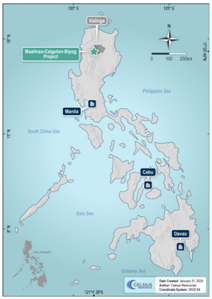
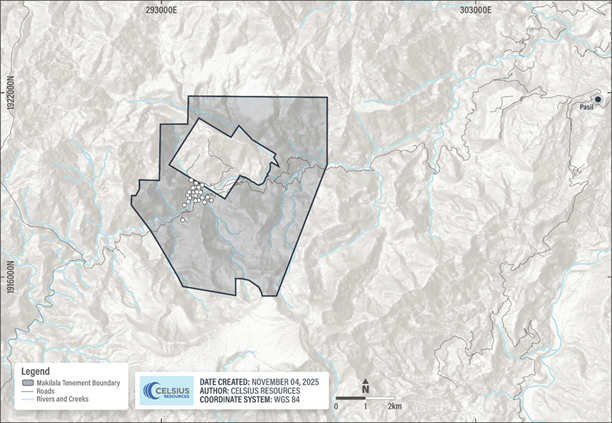 Figure 1. Location of MCB Exploration Tenement area and associated drilling related to the reported MRE.
Study Status
The MCB Ore Reserve Estimate has been informed by a series of comprehensive technical studies undertaken since 2006, including the results of a Scoping Study announced on 1 December 2021. Subsequently, the Company delivered a Feasibility Study to the MGB, including an Ore Reserve Estimate that was prepared in accordance with the Philippine Mineral Reporting Code for Reporting of Exploration Results, Mineral Resources, and Mineral Reserves ("PMR") Code[2]. This Feasibility Study was accepted and approved through the issuance of a DMPF[3], after which the Project received its MPSA[4].
As the PMR Code is not recognised by the ASX or AIM reporting regimes, the previously submitted Ore Reserve could not be disclosed to ASX or AIM. To support public reporting under JORC, the Company is now in the final stages of completing an updated Feasibility Study and FEED program in line with JORC standards and forming the basis of the Ore Reserve Estimate.
Geology and Mineral Resource Estimate ("MRE")
The geological interpretations and technical information announced as part of the updated MRE on 24 November 2025, are based largely on surface mapping and analysis of 60 diamond drill holes (31,616.20 m) completed by MMCI from 2006 to 2025.
Drilling at MCB has broadly defined a large-scale copper mineralisation interpreted to be a typical porphyry copper style of mineralisation, common throughout the Philippine archipelago.
The mineralisation and associated alteration exist across the contact between a genetically related intrusive body (tonalite) and the surrounding host rock material. In most cases the surrounding host rock is an older mafic volcanic rock (see Figures 2 to 4).
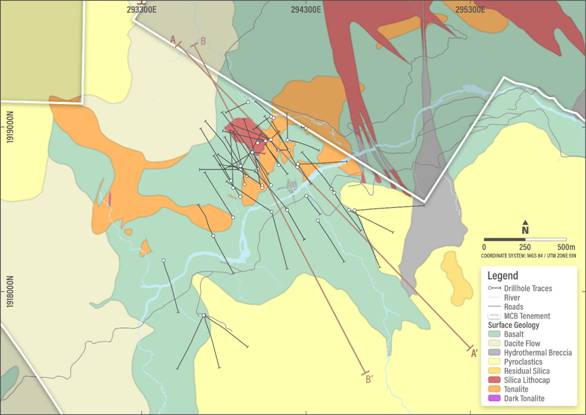
Figure 2. MCB Project drill hole locations and interpreted surface geological plan view diagram
The location and trend of the copper-gold mineralisation is influenced by two dominant structural trends that exist at MCB. The broad fabric and trend of the intrusive bodies and associated alteration extends in a north-east direction, or at approximately 050 degrees with a near to vertical dip. This orientation is also parallel to some major faulting.
The broad copper-gold domains as defined by the MCB MRE were defined based on the continuous zones of copper and gold mineralisation which coincides with the controlling geological host rocks, structures, and alteration features.
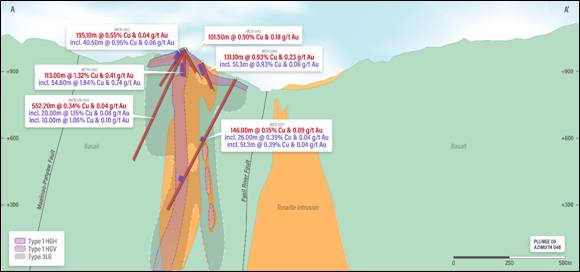
Figure 3. Section 1 with the interpreted host rock geology relative to the defined copper mineralised domains. Drill holes completed after the 2022 Mineral Resource Estimate on this cross section are identified (holes MCB-042, MCB-043, MTPH-001, and MCB-UG-002). View looking Northeast[5].
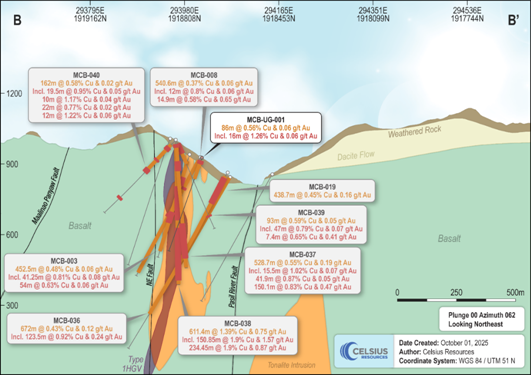
Figure 4. Section 2 with the interpreted host rock geology relative to the defined copper mineralised domains. Drill hole completed after the 2022 Mineral Resource Estimate on this cross section is identified (MCB-UG-001). View looking Northeast[6].
There is also evidence at MCB for epithermal vein deposit types that exist within close proximity to the large-scale porphyry copper-gold mineralisation. At this stage the only deposit type that is defined in the MRE for MCB is a porphyry copper-gold style.
Drilling Techniques
The MRE was defined using diamond drill holes, which was the preferred drilling method in MCB. Drilling was completed over two broad stages. The first stage was managed by the previous owner of MMCI, Freeport McMoRan, with a total of 25,481 metres from 46 drill holes completed within December 2006 to July 2013. The second drilling program was implemented by MMCI, with a total of 6,135.2 meters from 14 drill holes completed from 2021 to 2025. All diamond drilling utilised a triple tube core barrel for the entire length to ensure maximum sample recovery.
Sampling and Sub-sampling Techniques
Half core samples were collected from diamond holes drilled from the surface. All drill cores were generally sampled at 2m intervals. In cases where geological and mineralogical characteristics change, the sample length is reduced to best fit the geological contact. The minimum observed sample size is one metre. Sampling typically commenced after the overburden horizon.
The following sub sampling and sample preparations were observed for all the diamond drilling at MCB.
A. Drying and Weighing: Samples were weighed, dried in an oven at 105 Celsius for 6 to 8 hours. For samples with high clay content, drying time is extended up to 16 hours. After drying, samples were weighed again to calculate the moisture content.
B. Crushing: Samples were then primary crushed to a size of <4mm. Using a Boyd crusher, secondary crushing produces <2mm product size. The 1kg crushed material is retained for final preparation.
C. Pulverising: The 1kg split is pulverised to -200 mesh with a grinding time of 4 to 6 minutes for 1kg ground samples.
D. Splitting: 1kg sample is split successively to obtain four samples of 250 grams each. Out of the four pulp samples, one sample is being dispatched to the laboratory for analysis while the pulp samples are retained to be used later for duplicate assays and inter-laboratory checks.
Sample Analysis Method
All drill samples were prepared and sent to Intertek in Manila, an internationally recognised and ISO-accredited independent laboratory. Gold was analysed using fire-assay methods, while copper and other elements were tested using industry-standard multi-element analytical techniques.
Assay procedures have evolved across the two drilling programs (2007-2013 and 2021-2025), with more recent drilling using updated multi-element, four-acid digestion methods to ensure accurate copper results. Higher-precision analytical methods were used whenever copper values exceeded standard detection limits to ensure the most reliable grades were reported.
Quality control procedures were rigorously followed, with standards and blanks included in nearly 10% of all samples. Independent checks of the laboratory data confirmed no material issues, ensuring the assay results used in the MCB MRE are accurate and reliable.
Geology Estimation Methodology
Based on the general dimensions of the interpreted ore domains, and the likely mining method, a parent cell block size of 10m x 10m x 10m was chosen for the MRE.
Basic statistical information and variogram analysis was reviewed for both copper and gold within the various defined high grade and low-grade domains. The interpreted domains of Type 1HGH, Type 1HGV and Type 3LG were the only 3 domains that were considered to have sufficient data distributed to provide a basis for the use of a more sophisticated interpolation method such as Ordinary Kriging. The parameters for the Ordinary Kriging were based on an analysis of the variograms for each domain. The variograms (defined within the Leapfrog Edge software package) were located along the plane of the interpreted controlling geological trend which is striking at 050 degrees at a near vertical dip.
A broad review of the statistics for each domain did not identify significant high value outliers that are considered likely to result in an overestimated either locally or globally to the grade distribution within the block model. Therefore, no top cut was applied to the MRE.
Resource Classification Criteria
The Measured Mineral Resource was defined using additional drilling completed between 2022 and 2025, with blocks estimated in the first-pass search using variogram sill distances for each domain. Measured classification required 8-18 samples from at least two drill holes using 2 m composites.
Indicated Mineral Resources were assigned using a second-pass search at ~1.5 times the sill distance, with 4-20 composite samples per block.
Inferred Mineral Resources were estimated using a search distance twice that used for Indicated classification, requiring 2-10 samples per block. No drill-hole count restrictions were applied for Indicated and Inferred classifications.
Resource Cut-off Grade
A preferred lower cut-off grade of 0.2% copper has been used in the reported MRE. This is considered appropriate based on the geological continuity associated with copper mineralisation above 0.2% copper in addition to a broad economic cut-off point based on a US$5.00/lb copper price.
Dimensions
The copper-gold mineralisation at MCB is classified as a porphyry copper-gold deposit which at deeper levels (below 400m depth) has a broad geometry of up to 1km along strike towards the north-east and true widths of up to 280m. At shallower levels, the copper mineralisation is broken up into multiple domains which are individually up to 600m along strike and with true widths of up to 150m.
Resource Table of Results
Table 2 below identifies the results from the block model at cut-off grades up to 0.2% copper.
Table 2. Summary results for the updated MRE at MCB at a cut-off grade of 0.20% copper.
|
|
|
Gross |
Net Attributable |
|||||||||
|
Classification |
Domain |
Tonnes (Mt) |
Copper Grade (%) |
Gold Grade (g/t) |
Copper Metal (kt) |
Gold Metal (koz) |
Tonnes (Mt) |
Copper Metal (kt) |
Gold Metal (koz) |
|||
|
Measured |
Type 1HGV |
13 |
1.15 |
0.50 |
145 |
202 |
5 |
58 |
81 |
|||
|
Type 1HGH |
4 |
0.72 |
0.10 |
32 |
14 |
2 |
13 |
6 |
||||
|
Type 3LG |
32 |
0.37 |
0.08 |
119 |
84 |
13 |
48 |
34 |
||||
|
Totals |
49 |
0.60 |
0.19 |
296 |
300 |
20 |
118 |
120 |
||||
|
Indicated |
Type 1HGV |
48 |
0.66 |
0.28 |
316 |
433 |
19 |
126 |
173 |
|||
|
Type 1HGH |
11 |
0.79 |
0.12 |
83 |
41 |
4 |
33 |
16 |
||||
|
Type 3LG |
190 |
0.35 |
0.07 |
674 |
438 |
76 |
270 |
175 |
||||
|
Totals |
248 |
0.43 |
0.11 |
1,072 |
913 |
99 |
429 |
365 |
||||
|
Inferred |
Type 1HGV |
19 |
0.50 |
0.12 |
94 |
72 |
8 |
38 |
29 |
|||
|
Type 1HGH |
0.1 |
0.80 |
0.14 |
0.5 |
0.3 |
0 |
0 |
0 |
||||
|
Type 3LG |
26 |
0.49 |
0.08 |
129 |
71 |
10 |
52 |
28 |
||||
|
Totals |
45 |
0.49 |
0.10 |
224 |
143 |
18 |
90 |
57 |
||||
|
Total |
Type 1HGV |
79 |
0.70 |
0.28 |
554 |
708 |
32 |
222 |
283 |
|||
|
Type 1HGH |
15 |
0.77 |
0.11 |
115 |
55 |
6 |
46 |
22 |
||||
|
Type 3LG |
248 |
0.37 |
0.07 |
922 |
593 |
99 |
369 |
237 |
||||
|
Totals |
343 |
0.46 |
0.12 |
1,592 |
1,356 |
137 |
637 |
542 |
||||
Note for table of results: Estimates have been rounded to the nearest Mt of ore, two significant figures for Cu and Au grade and to the nearest kt of Cu metal and koz of Au metal. Some apparent errors may occur due to rounding. The MCB Project is an affiliate company of Celsius and MMCI will be the operator of the MCB Project.
Mining and Reserve Estimate
The mine design, schedules, and plans are based on a comprehensive development program spanning the full mine life.
The mining program supports both development ore and production ore, with lateral advances comprising ore drives, slot drives, and drain hole cuddies. Paste-fill is incorporated into the stope sequence to provide ground support, maintain stope stability, and enable safe extraction of ore while minimising dilution.
Capital works-including ramps, footwall drives, return air raises, sumps, pump stations, substations, stockpiles, and truck loading bays-are advanced in parallel with production development to ensure operational continuity and efficient access to ore zones throughout the mine life.
Estimation Methodology Mining
The basis for the mine planning was in the updated Mineral Resource Estimate announced on 24 November 2025. Mine planning and stope optimisation were carried out using industry-standard software, including Deswik.CAD, Deswik.SO, and Deswik.Sched, to ensure technical accuracy and economic viability. These tools supported the development of stope shapes, mine sequencing, and scenario analysis in accordance with the defined Modifying Factors and operational constraints. The mine planning approach includes applying blending strategies for harder ores in later years to achieve target throughputs.
Stope optimisation was performed using a combination of geometric and economic parameters, including cut-off grade, minimum mining width, dilution assumptions, and recovery factors. The optimisation process considered the defined stope dimensions of 20m width × 20m length × 30m height, and incorporated retreat mining sequences toward capital infrastructure.
To further refine the mine plan, a Revenue Factor Ranking approach was employed. This involved applying varying revenue factors to simulate different metal price scenarios and assess the sensitivity of stope viability. Stopes that remained economically feasible at lower revenue factors ("RF"), therefore, (RF < 0.7) were prioritised, indicating high-margin zones with strong resilience to market fluctuations. Conversely, stopes that only became viable at higher revenue factors (e.g., RF ≥ 0.7) were considered marginal and scheduled later in the mine life.
Mining Cut Off inputs
The cut-off grade for the MCB Project Ore Reserve has been determined in accordance with JORC (2012) and AIM reporting requirements, using project-specific average metallurgical recoveries, the planned underground mining method, and long-term commodity price assumptions. The inputs in table 3 reflect the current economic parameters appropriate for this stage of the Project. The key parameters indicated below were used to establish a cut-off grade of 0.46% CuEq.
Table 3. Economic input parameters
|
Parameters |
Details |
|
Process Plant Parameters |
|
|
Average Copper Recovery |
95.0% |
|
Average Gold Recovery |
77.0% |
|
Mine Parameters |
|
|
Cutoff Grade |
0.46% Copper Equivalent |
|
Mine Dilution |
10% |
|
Mine Recovery |
95% |
|
Economics |
|
|
Copper Price |
4.5 US$/lb |
|
Gold Price |
3,200 US$/oz |
|
Payability |
96.65% |
|
Mining Cost |
18.79 US$/ton |
|
Milling Cost |
14.89 US$/ton |
|
General Admin Cost |
2.88 US$/ton |
The cut-off grade is considered appropriate for the planned underground mining operation and provides a reasonable basis for reporting the Ore Reserve.
Metallurgical Inputs
Metallurgical test work undertaken by MMCI on multiple defined ore types and representative grade ranges has confirmed the findings of the 2021 metallurgical test program. The latest results reaffirm the potential for strong metallurgical performance at the MCB deposit, demonstrating consistently high recoveries of both copper and gold into a saleable copper-gold concentrate. Average recoveries remained in line with previous outcomes, at approximately 95% for copper and 77% for gold[7].
Cost Inputs
Mining costs were derived from quotations from suppliers and contractors currently operating in similar mines in the Philippines and internationally using similar equipment under the same conditions.
Mining Method and Mine Design
Transverse Sublevel Open Stoping ("SLOS") is the selected and confirmed mining method. The method was previously evaluated and justified in earlier technical studies, and the current study reconfirms its suitability based on updated geotechnical assessments, orebody geometry, operational requirements, and life-of-mine production objectives. The method is fully aligned with the geotechnical recommendations provided by AMH Philippines Inc., and supports safe, productive, and economically viable extraction of the deposit.
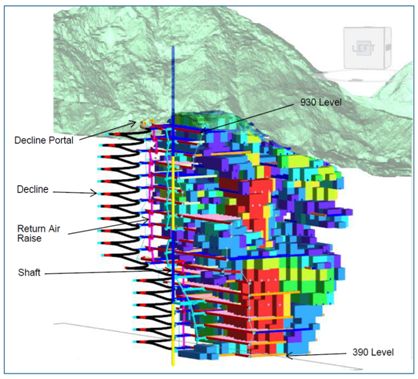
Figure 5. Image of stoping and decline development
Underground Geotechnical
Comprehensive geotechnical investigations have been completed for the Project, with earlier studies enhanced through additional drilling and analysis conducted during the recent work program. Mine design and geotechnical evaluation have been closely aligned, with coordination between the DMT Consulting Limited ("DMT")[8] mine planner and AMH Philippines Inc. ("AMH") to ensure that geotechnical considerations are fully incorporated into the underground design.
The assessment establishes the geological and geotechnical context for modelling, outlining both the regional setting and the detailed investigation program. Based on this work, AMH provided recommendations on excavation strategies and ground support requirements.
A high-resolution 3D geological model Refer (Figures 6 and 7) was developed through spatial and statistical integration of geotechnical data, exploration logs, and field observations. From this, a Rock Mass Rating ("RMR") model was constructed following Bieniawski (1989). The underground infrastructure predominantly intersects Rock Class III (Fair) ground conditions (78.13%), followed by Rock Class IV (Poor) at 16.75%, with only 4.99% in Rock Class V (Very Poor) and 0.13% in Rock Class II (Good). A uni-axial compressive strength geotechnical model ("UCS") model was also generated, constrained by lithological domains to ensure realistic representation of rock strength and mechanical properties.
|
|
|
|
Figure 6. AMH Interpolated 3D RMR Block |
Figure 7. AMH Interpolated 3D RMR Block |


Processing and Flowsheet
The process plant design basis defines the methodology, limits and operating parameters applied in the design of the MCB processing plant, to treat Run-of-mine ore from the underground mine for the life of mine operation.
The MCB Copper-Gold Project is designed to process copper sulphide ore at a rate of 2.28 Mt/y during Years 1-2. The throughput will increase to 2.6 Mt/y from Year 3 onward. Variability test work and geometallurgical assessments indicate the potential for harder basalt ore in the mine plan. Additional capital and appropriate blending strategies may be required to achieve the target throughput.
The process facility will receive ore from an underground mine utilising the SLOS mining method. The process plant consists of a SSAG circuit followed by rougher flotation, regrind, cleaner flotation and dewatering of concentrate and tailings. Tailings are either mixed with binder and returned underground or transported to a dry stack location for permanent storage.
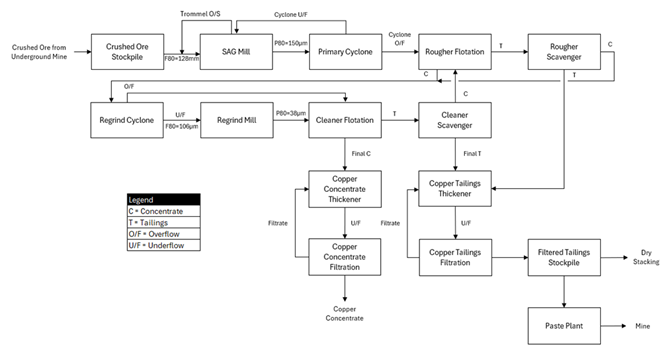
Figure 8. Process Flow Block Model
Non- Process Infrastructure
The non-process infrastructure ("NPI") required for the MCB Copper-Gold Project has been defined to ensure safe, reliable, and efficient operations. NPI includes all supporting facilities, utilities, and services necessary for mine and plant operations but not directly involved in ore processing.
Key infrastructure components include a consolidated site layout, administration buildings, accommodation facilities, workshops, warehousing, laboratories, mine surface installations, and essential utilities such as power distribution, water supply, wastewater treatment, fuel storage, and communications. The infrastructure includes a HV transmission line to connect to the Luzon Grid, and a new access road to site. These are designed to meet operational safety, and regulatory requirements.
Remote infrastructure to support logistics and concentrate export-such as transport corridors and off-site handling facilities-is incorporated into the Project's execution plan to ensure dependable year-round product shipment.
The design-basis population for both construction and steady-state operations underpins the sizing of all NPI elements, including accommodation, administration areas, maintenance facilities, medical services, utilities, and emergency-response capabilities. These assumptions ensure the infrastructure is appropriately scaled to support the full workforce over the life of the Project.
Environmental and Regulatory Summary
The MCB Copper-Gold Project is being advanced in full compliance with Philippine mining laws, environmental regulations, and applicable international standards. MMCI holds a valid MPSA granting exclusive rights to explore, develop, and operate within the tenement[9].
The Project has secured its Free, Prior and Informed Consent- Certification Pre-condition ("FPIC / CP")[10], completed its Environmental Impact Statement ("EIS"), and obtained an Environmental Compliance Certificate ("ECC") under the Philippine EIS System[11]. These approvals are supported by extensive environmental and social baseline studies.
MMCI has established a comprehensive environmental and social management framework designed to ensure responsible development and long-term stewardship of the MCB Project. Proactive engagement with regulators, local government units, and community stakeholders-particularly Indigenous Peoples-remains foundational to Project delivery.
With the MPSA, FPIC, EIS and ECC in place, the Project is well positioned to transition from FEED to development and to operate sustainably throughout its mine life.
Financial and Cost Assumptions
Revenue
Revenue assumptions for the Ore Reserve estimation reflect contributions from the payable metals contained within each ore type. Metal price inputs and exchange rates were based on a combination of independent consensus forecasts and prevailing market conditions at the time of assessment. These revenue parameters, together with estimates of mining, processing, and site operating costs, informed the economic evaluation used to determine cut-off grades and underpin the declaration of the Ore Reserve.
Capital and Operating Costs
Ausenco[12] prepared capital and operating costs for the process plant facility and on-site infrastructure with a target estimate accuracy of ±15% for the initial throughput case of 2.28 Mt/y. Geometallurgical interpretation of recent test work is in progress to validate the design throughput. Additional costs may be required for the milling and tailings filtration areas subject to the assessment which is in progress.
DMT provided the mining related costs. Additional scope items such as the access road, power transmission, substation, and Owner's costs were provided by MMCI. MMCI have advised that the power transmission infrastructure will be constructed by the power provider as an inclusion in the power supply rate.
Ausenco's capital estimate was developed from material take-offs, and budget quotations (approximately 63% of the estimate), supported by appropriate growth and contingency provisions. VAT and customs duties are excluded, consistent with MMCI's Board of Investments ("BOI") application for VAT exemption. The delivery strategy supported by an Owner's team for construction and commissioning while the company is still evaluating an EPC delivery model.
Process plant operating costs were developed by Ausenco. Mining operating costs were developed by DMT. MMCI provided inputs for G&A, reagents, fuel, and power. Reagent and consumable costs reflect laboratory test work and benchmark pricing, with paste binder pricing based on cement and fly-ash pending completion of ongoing test work. Dry-stack tailings costs were derived from first principles using fleet selection, contractor rates, and fuel consumption. Process plant operating cost accuracy is estimated at ±15%. Escalation is excluded from both capital and operating estimates.
The model includes all applicable royalties and statutory obligations under the Philippine Mining Act of 1995 (RA 7942)[13] and its Implementing Rules and Regulations (IRR).
Economic Evaluation
Financial evaluation of the MCB Ore Reserve was undertaken using a detailed spreadsheet-based financial model, incorporating all cost, revenue, and physical inputs as outlined in the relevant sections of this announcement. The model has been constructed in real terms, with operating and capital costs assumed to remain constant over the evaluation period and no escalation applied.
The analysis indicates that the MCB Project delivers robust economic returns based on the planned mine schedule, associated waste and ore movements, and the applied cost and revenue assumptions. Sensitivity analyses were completed across a range of metal price scenarios-from independent long-term consensus forecasts to prevailing spot prices and corresponding exchange rates-and confirm the Project's resilience under varying market conditions.
Ore Reserve Summary and Classification
The MCB Ore Reserve comprises 22.1 Mt of Proven Ore Reserves and 108.2 Mt of Probable Ore Reserves, for a total of 130.3 Mt at average grades of 0.66% Cu and 0.21 g/t Au, containing approximately 0.86 Mt of copper and 0.89 Moz of gold. The Proven category reflects areas supported by Measured Mineral Resources, while the Probable category is derived predominantly from Indicated Mineral Resources.
Inferred material and internal waste captured within the final stope and mine designs are treated as planned dilution and have not been classified as Ore Reserves. The classification is consistent with the level of geological confidence, data quality, and the application of all relevant Modifying Factors evaluated as part of the study.
Ore Reserve Confidence and Accuracy
The Competent/Qualified Person has a high level of confidence in the technical and economic viability of the MCB Ore Reserve, which is underpinned by Measured and Indicated Mineral Resources and supported by extensive studies undertaken over several years. The geological model, mining designs, metallurgical performance, and permitting framework all provide strong assurance that the Ore Reserve is robust and economically extractable in accordance with the JORC Code (2012). Inferred material has been excluded from the Reserve and is treated only as planned dilution, ensuring appropriate classification. While normal study-level uncertainties remain, none are considered material. Overall, the Ore Reserve has been determined with a high degree of confidence consistent with Proven and Probable classifications.
This announcement has been authorised by the Board of Directors of Celsius Resources Limited.
Compliance Statements
The Company confirms that it is not aware of any new information or data that relates to previously reported Exploration Results and Mineral Resources at the MCB Project. In respect of previously reported Mineral Resource Estimates, apart from additional data that has been used in the 24 November 2025 MRE update, all originally reported material assumptions and technical parameters underpinning the estimates continue to apply and have not been materially changed or qualified. The form and context in which the relevant Competent Person's findings are presented have not been materially modified from the original document.
Competent Person Statement
Information in this report relating to the Ore Reserve Estimate is based on information compiled, reviewed and assessed by the following Competent Persons: Mr. Steven Olsen (Geology) from Global Geologica, Mr. John Burgess (Metallurgy) from BMECS Pty Ltd, Mr. Florian Beier (Mining) From DMT, and Mr. Matt Pyle (Process Plant and on-site infrastructure capital and operating costs) from Ausenco Australia, who are all Members of the Australasian Institute of Mining and Metallurgy. Each is a consultant through their relevant companies to Makilala Mining Company, Inc., an affiliate of Celsius Resources Limited, and has sufficient experience relevant to the style of mineralisation, the type of deposit, and mining project under consideration, the activities undertaken to qualify as a Competent Person as defined by the 2012 Edition of the Australasian Code for Reporting of Exploration Results, Mineral Resources and Ore Reserves (JORC Code) and to be considered as a Qualified Person for the purposes of the AIM Rules.
Definitions
Cut-off Grade |
The minimum grade of a mineralised material considered economically viable to process. For this announcement, a preferred lower cut-off grade of 0.2% copper has been applied, consistent with industry practice and economic assumptions. |
Dry-stack Tailings |
Dry-stack tailings is a storage method where tailings are mechanically dewatered to form a low-moisture, semi-solid cake that is transported, placed, and compacted into a stable, stackable landform instead of being stored as a slurry in a conventional tailings dam. |
Epithermal vein deposit |
An epithermal vein deposit is a shallow, low-temperature mineral system formed when hot, metal-rich fluids circulate near the Earth's surface and precipitate gold, silver, and other metals within fractures and veins. |
Feasibility Study |
A comprehensive technical and economic assessment conducted to determine the viability of a proposed mining project. The feasibility study evaluates all key aspects of the project, including geology, mineral resources, mining methods, processing, infrastructure, environmental and social impacts, capital and operating costs, and financial returns. Its purpose is to provide sufficient detail and confidence to support a final investment decision and project financing. The outcomes of a feasibility study typically include detailed engineering designs, cost estimates, implementation schedules, and risk assessments. |
Front-End Engineering Design (FEED) |
A detailed engineering phase undertaken prior to the commencement of project construction, during which the technical requirements, design specifications, cost estimates, and project execution plans are developed. In mining, FEED typically includes studies of process flows, plant layout, equipment selection, infrastructure, and environmental considerations. The FEED process provides the basis for final investment decisions and forms the foundation for subsequent detailed engineering, procurement, and construction activities |
Indicated Mineral Resource |
The part of a Mineral Resource for which quantity, grade or quality, densities, shape, and physical characteristics are sufficiently well established to allow for a reasonable level of confidence in the estimate, but not as high as for Measured Resources. |
Inferred Mineral Resource |
The part of a Mineral Resource for which quantity and grade or quality are estimated on the basis of limited geological evidence and sampling, resulting in a lower level of confidence. |
Measured Mineral Resource |
The part of a Mineral Resource for which quantity, grade or quality, densities, shape, and physical characteristics are so well established that they can be estimated with confidence sufficient to allow for detailed mine planning. |
Mine Recovery |
The proportion of ore successfully extracted during mining compared to the in-situ resource, accounting for losses due to dilution, geotechnical constraints, and mining method. |
Mineral Resource Estimate/MRE |
The estimate of mineral resources as calculated and presented in accordance with a minerals code or standard |
Mineral Resource |
A concentration or occurrence of solid material of economic interest in or on the earth's crust in such form, grade (or quality), and quantity that there are reasonable prospects for eventual economic extraction. The location, quantity, grade (or quality), continuity and other geological characteristics of a Mineral Resource are known, estimated or interpreted from specific geological evidence and knowledge, including sampling. Mineral Resources are sub-divided, in order of increasing geological confidence, into Inferred, Indicated and Measured categories |
Ordinary Kriging |
A geostatistical estimation technique that predicts block grades by weighting nearby sample data, assuming a constant but unknown local mean. |
Ore Reserve |
The economically mineable portion of a Mineral Resource, defined by detailed mine planning, applying modifying factors that demonstrate technical, economic, and regulatory viability. |
Porphyry Copper Deposit |
A large, disseminated copper system associated with porphyritic intrusive rocks, characterised by broad alteration zones and low-grade but bulk-mineable mineralisation. |
Proven Reserves |
The highest confidence category of Ore Reserves, based on detailed and reliable information, where geological continuity and modifying factors are well established. |
Probable Reserves |
The Ore Reserve category with lower confidence than Proven, derived from Indicated Resources where geological and economic factors are reasonably assumed but not fully confirmed. |
Sublevel Open Stoping/SLOS |
An underground mining method where ore is extracted in large, vertical or inclined stopes, accessed from multiple sublevels, typically requiring drill-and-blast and remote mucking. |
Tonalite |
A coarse-grained intrusive igneous rock composed mainly of plagioclase feldspar with lesser quartz and amphibole, typically associated with calc-alkaline magmatic arcs. |
Type 1HGV |
Vertically oriented high-grade copper mineralisation, following geological contacts |
Type 1HGH |
Shallow, flat-lying high-grade copper mineralisation, near-surface |
Type 3LG |
Broad zones of mineralisation with copper grades generally below high-grade thresholds, modelled for continuity and tonnage estimation |
Forward Looking Statements
Some of the statements appearing in this announcement may be in the nature of forward-looking statements. You should be aware that such statements are only predictions and are subject to inherent risks and uncertainties. Those risks and uncertainties include factors and risks specific to the industries in which the Company operates and proposes to operate as well as general economic conditions, prevailing exchange rates and interest rates and conditions in the financial markets, among other things. Actual events or results may differ materially from the events or results expressed or implied in any forward-looking statement.
No forward-looking statement is a guarantee or representation as to future performance or any other future matters, which will be influenced by a number of factors and subject to various uncertainties and contingencies, many of which will be outside the Company's control.
The Company does not undertake any obligation to update publicly or release any revisions to these forward-looking statements to reflect events or circumstances after today's date or to reflect the occurrence of unanticipated events. No representation or warranty, express or implied, is made as to the fairness, accuracy, completeness or correctness of the information, opinions or conclusions contained in this announcement. To the maximum extent permitted by law, none of the Company's Directors, employees, advisors, or agents, nor any other person, accepts any liability for any loss arising from the use of the information contained in this announcement. You are cautioned not to place undue reliance on any forward-looking statement. The forward-looking statements in this announcement reflect views held only as at the date of this announcement. As at the date of this announcement there are studies ongoing to update the Feasibility Study for the MCB Project which are scheduled for completion by December 2025.
The information contained within this announcement is deemed by the Company to constitute inside information as stipulated under the Market Abuse Regulations (EU) No. 596/2014 as it forms part of UK Domestic Law by virtue of the European Union (Withdrawal) Act 2018.
Celsius Resources Contact Information
Level 5, 191 St. Georges Terrace
Perth WA 6000
PO Box 7059
Cloisters Square PO
Perth WA 6850
P: +61 8 9324 4516
E: info@celsiusresources.com.au
|
Celsius Resources Limited |
|
|
Neil Grimes |
P: +61 419 922 478 |
|
Multiplier Media (Australia Media Contact) Jon Cuthbert |
M: +61 402 075 707 E: jon.cuthbert@multiplier.com.au
|
|
Zeus Capital Limited (Nominated Adviser) James Joyce/ James Bavister (Broking) Harry Ansell |
P: +44 (0) 20 3 829 5000 |
Zeus Capital Limited ("Zeus") is the Company's Nominated Adviser and is authorised and
regulated by FCA. Zeus's responsibilities as the Company's Nominated Adviser,
including a responsibility to advise and guide the Company on its responsibilities under
the AIM Rules for Companies and AIM Rules for Nominated Advisers, are owed solely to
the London Stock Exchange. Zeus is not acting for and will not be responsible to any
persons for providing protections afforded to customers of Zeus nor for advising them in
relation to the proposed arrangements described in this announcement or any matter referred to in it.
Appendix 1: The following tables are provided to ensure compliance with the JORC Code (2012) requirements for the reporting of Exploration Results for the MCB Project.
SECTION 1:
Sampling Techniques and Data
(Criteria in this section apply to all succeeding sections.)
|
Criteria |
JORC Code Explanation |
Commentary |
|
Sampling techniques |
· Nature and quality of sampling (e.g. cut channels, random chips, or specific specialised industry standard measurement tools appropriate to the minerals under investigation, such as down whole gamma sondes, or handheld XRF instruments, etc). These examples should not be taken as limiting the broad meaning of sampling. · Include reference to measures taken to ensure sample representivity and the appropriate calibration of any measurement tools or systems used. · Aspects of the determination of mineralisation that are Material to the Public Report. In cases where 'industry standard' work has been done this would be relatively simple (e.g. 'reverse circulation drilling was used to obtain 1 m samples from which 3 kg was pulverised to produce a 30 g charge for fire assay'). In other cases, more explanation may be required, such as where there is coarse gold that has inherent sampling problems. Unusual commodities or mineralisation types (e.g. submarine nodules) may warrant disclosure of detailed information. |
· Samples were collected from diamond core drilled from the surface. All drill core was generally sampled on 2-meter intervals. In cases where geological and mineralogical characteristics change, sample length was not less than 1 meter. · Core samples cut into half using diamond core saw following the cutting lines marked by the Geologist. Split cores returned to its respective core tray. · Samples were shipped by company vehicle to Intertek Testing Services which is an external laboratory located in Manila, Philippines. · Crushed samples were fire assayed for gold (Au) using a 30-gram charge, with a detection limit of 0.005 ppm. Gold values greater than 50 ppm were determined by gravimetric fire assay. · Copper (Cu) values were assayed using Four acid digestion. Elements determined by AAS finish with final reporting for a total of 36 elements. |
|
Drilling techniques |
· Drill type (e.g. core, reverse circulation, open-hole hammer, rotary air blast, auger, Bangka, sonic, etc) and details (e.g. core diameter, triple or standard tube, depth of diamond tails, face-sampling bit or other type, whether core is oriented and if so, by what method, etc). |
· Previous exploration and drilling were conducted between December 2006 and July 2013 by Freeport-McMoRan, completing a total of 46 drill holes with an aggregate meterage of 25,480.55 meters. · An exploration program managed by MMCI commenced in February 2021up to early 2022 with a total of 9 drill holes added to the updated MRE, with a cumulative depth of 4641.7 meters. · Five additional drillholes were drilled in the late 2022 and in 2025 with a total meterage of 1,427.3 meters. · The core drilling utilised a triple-tube core barrel from collar to end-of-hole to ensure optimum core recovery, with the deepest downhole depth being 893.8 meters (MCB-029). · Diamond drilling was used to capture the rock samples for the new drill hole intercepts, with the following drill core size summarised as follows: · PQ sized drill core with a core diameter of 81.1 mm was used from surface to more competent lithology. Core samples of this size are estimated to comprise about 43%of the total length of the recently drilled holes. · HQ sized drill core, with a core diameter of 61.1mm, was then substituted at greater depths to accommodate variations of subsurface conditions. Core samples of this size is estimated to comprise about 57% of the total length of the recently drilled holes. |
|
Drill sample recovery |
· Method of recording and assessing core and chip sample recoveries and results assessed. · Measures taken to maximise sample recovery and ensure representative nature of the samples. · Whether a relationship exists between sample recovery and grade and whether sample bias may have occurred due to preferential loss/gain of fine/coarse material. |
· Core recovery has been recorded for every interval as part of the routine geomechanical logging. · Recovered core lengths on average were measured to be over 98% for the total length of the drill hole, indicating a high recovery and minimal lost core. · All drilling activities were supervised by company Geologists. Trained Core house Technician were responsible for the core recovery determination. · Core was arranged to fit the breakages before the actual core length from the start to the end of the drill run was measured. Percent recovery was calculated from dividing the measured core length over the total drill run multiplied by 100. |
|
Logging |
· Whether core and chip samples have been geologically and geotechnically logged to a level of detail to support appropriate Mineral Resource estimation, mining studies and metallurgical studies. · Whether logging is qualitative or quantitative in nature. Core (or costean, channel, etc) photography. · The total length and percentage of the relevant intersections logged. |
· Geologists were tasked to oversee the daily quick log report down to sampling. Daily quick log form was completed to identify the geological details such as lithology, alteration and mineralisation with corresponding percentage estimate of Cu minerals and Cu grade, using an established geological code. · Detailed logging proceeds describing geological characteristics present in the core, i.e. lithology, alteration, mineralogy, structures, etc. · Core photography was undertaken after completing the geomechanical logging. |
|
Sub-sampling techniques and sample preparation |
· If core, whether cut or sawn and whether quarter, half or all core taken. · If non-core, whether riffled, tube sampled, rotary split, etc and whether sampled wet or dry. · For all sample types, the nature, quality and appropriateness of the sample preparation technique. · Quality control procedures adopted for all sub-sampling stages to maximise representivity of samples. · Measures taken to ensure that the sampling is representative of the in-situ material collected, including for instance results for field duplicate/second-half sampling. · Whether sample sizes are appropriate to the grain size of the material being sampled. |
· Samples were routinely taken over a 2m interval, and cut in half, with half of the drill core sent for analysis and half of the drill core retained for future reference. · Samples were cut on site using a hand core saw. Samples were then selected and bagged on site prior to delivery to the laboratory (Intertek) in Manila for sample preparation. · The sample size is considered appropriate for type of material being samples. |
|
Quality of assay data and laboratory tests |
· The nature, quality and appropriateness of the assaying and laboratory procedures used and whether the technique is considered partial or total. · For geophysical tools, spectrometers, handheld XRF instruments, etc, the parameters used in determining the analysis including instrument make and model, reading times, calibrations factors applied and their derivation, etc. · Nature of quality control procedures adopted (e.g. standards, blanks, duplicates, external laboratory checks) and whether acceptable levels of accuracy (i.e. lack of bias) and precision have been established. |
· Samples were fire assayed for gold (Au) using a 30-gram charge, with a detection limit of 0.005 ppm. Gold values greater than 50 ppm were determined by gravimetric fire assay. Copper (Cu) values were assayed using four acid digestion. Elements determined by AAS finish · The procedures for the submission of samples to the laboratory also include the regular insertion of QA/QC samples in every transmittal form or batch, which was typically delivered to the laboratory in batches of 50 numbered samples. For each batch of 50 samples a total of 43 came from core samples and an additional 7 samples were included for QA/QC checks, which were as follows: o Four referenced standards o One referenced Blank o One coarse (unrecognisable) blank o One field duplicate taken from the quartered core · After sample preparation, all samples were sent for final analysis to Intertek at their laboratory in Manila. Intertek is an internationally recognised and ISO/IEC 17025:2005 & ISO/IEC 17020:2004 certified independent laboratory. |
|
Verification of sampling and assaying |
· The verification of significant intersections by either independent or alternative company personnel. · The use of twinned holes. · Documentation of primary data, data entry procedures, data verification, data storage (physical and electronic) protocols. · Discuss any adjustment to assay data. |
· Analytical procedures provided by an internationally certified laboratory is considered in line with industry standard for the type of deposit and mineralisation identified at the Property. · Apart from the verification of the procedures and results as described above, no further verification of the sampling and assaying have been undertaken. · None of the diamond drill holes in this report are twinned. |
|
Location of data points |
· Accuracy and quality of surveys used to locate drill holes (collar and down-hole surveys), trenches, mine workings and other locations used in Mineral Resource estimation. · Specification of the grid system used. · Quality and adequacy of topographic control. |
· All data reference points and maps for the Makilala database, including drill hole collar co-ordinates are recorded in WGS 84/UTM Zone 51N. · Compass measurements taken by Geologists were used to establish the dip and azimuth of the collar hole as part of their initial collar surveys. Drill collar locations were positioned using a handheld Garmin GPS unit, set to UTM WGS 84 Zone 51N coordinate reference system, with an accuracy expected to be within 2 metres. Downhole surveys were also completed using a Keeper Gyro at 50m intervals. · Drill collar locations were recently re-surveyed by Datum Engineering and Surveying Consultancy including elevation checks against an updated drone-based Lidar survey which has a reported "x-y-z" accuracy of 10 cm. · Collar surveys were then logged into the master MS Access database after validation checks were completed against the updated Lidar survey. |
|
Data spacing and distribution |
· Data spacing for reporting of Exploration Results. · Whether the data spacing and distribution is sufficient to establish the degree of geological and grade continuity appropriate for the Mineral Resource and Ore Reserve estimation procedure(s) and classifications applied. · Whether sample compositing has been applied. |
· The broad drilling pattern is at 100m spacing for a series of diamond drill holes which are oriented in a north-west direction and dipping at predominantly at 60 degrees. These drill holes are augmented by some drill holes which have a west-north-west orientation or a north-east orientation or are vertical. (see figure 2 for Drill Hole Locations). · Drill holes at the MCB deposit are distributed broadly on eight grid lines, giving coverage of 1,000 metres from east to west. · The drill hole spacing where significant copper-gold mineralisation has been identified is sufficient to determine the geology and grade continuity of the area, as well as the ore body and mineralisation extents. · In the MRE, drill hole assays were composited to 2 metres which matches closely with the sample length down hole for all drill hole sampling completed at MCB. |
|
Orientation of data in relation to geological structure |
· Whether the orientation of sampling achieves unbiased sampling of possible structures and the extent to which this is known, considering the deposit type. · If the relationship between the drilling orientation and the orientation of key mineralised structures is considered to have introduced a sampling bias, this should be assessed and reported if material. |
· In the resource estimation, drill hole assays were composited to 2 metres downhole intervals. · The dominant trend of the tonalite intrusion, which is directly related to the broader lower grade copper-gold mineralisation has an overall strike of 50 degrees and a sub-vertical dip. Drill hole directions vary relative to this dominant orientation, with some more optimal drill holes dipping at 60 degrees towards 320 degrees. There are a number of vertical drill holes which are not optimal for assessing the geological contacts or grade distribution, however, in most cases these drill holes are also close to other drill holes which are dipping across the mineralised domains, typically at 60 degrees. · There is also a defined horizontal control to the copper-gold mineralisation which appears to extend away from the source feeder structures which are vertical in orientation. Some shallow drilling was completed to fill in gaps in the drill hole data existed where possible, often at 50-to-60-degree angles which are considered still reasonable for testing the horizontal orientations identified as part of the copper-gold distribution at MCB. |
|
Sample security |
· The measures taken to ensure sample security. |
· The following standard procedures were enforced for the drilling of new intercepts: o Sample bags are arranged in sequence according to its sample number. These are then weighed and jotted down to a sample dispatch note which details the sample numbers, sample type and laboratory processing required. Geologists ensures that the transmittal form is correct for encoding and submission. The bags of samples are sent directly to the Intertek Laboratory in Manila by company vehicle. No unsupervised third parties were given access prior to the chain of custody procedure. o Samples were delivered to Intertek Testing Services along with two copies of the sample dispatch form. One copy for the laboratory to accept custody of the sample, and the signed/received copy return to database custodian at the Core House facility in Tabuk, Kalinga. |
|
Audits or reviews |
· The results of any audits or reviews of sampling techniques and data. |
· No other specific audit or review was conducted other than the validation checks by the author documented earlier with regard to the sample preparation, analysis or security for the information in the new drillholes. |
SECTION 2:
Reporting of Exploration Results
(Criteria listed in the preceding section also apply to this section.)
|
Criteria |
JORC Code Explanation |
Commentary |
|
Mineral tenement and land tenure status |
· Type, reference name/number, location and ownership including agreements or material issues with third parties such as joint ventures, partnerships, overriding royalties, native title interests, historical sites, wilderness or national park and environmental settings. · The security of the tenure held at the time of reporting along with any known impediments to obtaining a licence to operate in the area. |
· The Maalinao-Caigutan-Biyog (MCB) Copper-Gold project is situated in Luzon Central Cordillera in the Barangay of Balatoc, Municipality of Pasil, Province of Kalinga. · The Project is covered by MPSA-356-2024-CAR, which encompasses approximately 2,501 hectares and was granted on 14 March 2024. · The tenement is held by Makilala Mining Company Inc. (MMCI), a Philippines registered corporation that is 100% owned by Makilala Holdings Ltd, · The Project site is located within the Ancestral Domain of Balatoc, and Free and Prior Informed Consent (FPIC) has been secured from the Balatoc tribe for development and operation of the mine within the designated tenement area. · The MPSA grants exclusive rights for exploration, development, and commercial production of copper and associated minerals for 25 years, renewable for another 25 years, providing secure tenure for the Project. · The MCB Project has obtained all National Government statutory permits to commence development and mining operations, |
|
Exploration done by other parties |
· Acknowledgment and appraisal of exploration by other parties. |
· Exploration work and drilling was completed by Makilala Mining Company Inc. from year 2006 to 2025, the details of which have been documented in CLA announcements. · The relative quality and detail associated with the drilling information is considered to be of a high standard. This has enabled the author to establish a high level of confidence associated with the historical drilling information. |
|
Geology |
· Deposit type, geological setting and style of mineralisation. |
· The geological setting for the MCB copper-gold mineralisation is typical of a porphyry copper + gold + moly deposit as commonly defined in many academic papers (Hedenquist and Lowernstern, 1994; Sillitoe, R. H., 2010. Corbett and Leach, 1997). The mineralisation and associated alteration exist across the contact between the genetically related intrusive body (tonalite) and the surrounding host rock material. In most cases the surrounding host rock is a mafic volcanic, however, in some instances the older (not genetically related to copper-gold mineralisation) intrusive bodies also exist in contact with the younger intrusive resulting in broad sections of mineralisation and alteration within a series of intrusive bodies. · There is also evidence at MCB for epithermal vein deposit types which exist within close proximity to the large-scale porphyry copper-gold mineralisation. At this stage, only the deposit type that is identified from the drilling information for MCB is a porphyry copper-gold style. · Basalt lava flows make up the majority of the host rocks in the tenement area, which is part of the oldest exposed unit, Basement Complex. This Cretaceous-Paleogene Metavolcanics has been intruded by quartz diorite complex, which in Kalinga, ranges in composition from gabbro to tonalite. · A later stage Tonalite intrusion exists throughout the project area and is interpreted to be genetically related to the copper-gold mineralisation at MCB deposit. · A dacite flow and dacitic pyroclastic blankets the older basalt host rock and tonalitic intrusive rocks. · There are four types of ore mineralisation that were emphasised in the project: o Type 1 - Early high-grade porphyry Cu-Au mineralisation, hosted both in tonalite and basalt. o Type 2 - Mix of high-grade porphyry Cu-Au (Type 1) and high-sulphidation mineralisation (Type 4). Hosted in basalt and tonalites, but with strong Type 1 mineralisation that was partially overprinted by ore Type 4. o Type 3 - Medium grade porphyry-copper o Type 4 - High-sulphidation epithermal mineralisation (See Figure and Figure for a representative Cross Section of the Geology and its relationship to the copper-gold mineralisation at the MCB Deposit). |
|
Drill hole Information |
· A summary of all information material to the understanding of the exploration results including a tabulation of the following information for all Material drill holes: · easting and northing of the drill hole collar · elevation or RL (Reduced Level - elevation above sea level in metres) of the drill hole collar · dip and azimuth of the hole · down hole length and interception depth · hole length. · If the exclusion of this information is justified on the basis that the information is not Material and this exclusion does not detract from the understanding of the report, the Competent Person should clearly explain why this is the case. |
· See Section 1 (Sampling Techniques and Data) for all details regarding the drill hole information for the MCB Property in addition to a full list of all significant drill intersections which have been reported. · In addition to the drilling information that has been reported from previous MRE, 5 new drill holes were completed by MMCI and included as part of this updated Mineral Resource estimate for MCB. · In summary the drill hole database used for the updated MCB MRE consists of 64 diamond drill holes with an accumulated meterage of 31,616.20. · No drill hole information has been excluded. |
|
Data aggregation methods |
· In reporting Exploration Results, weighting averaging techniques, maximum and/or minimum grade truncations (eg cutting of high grades) and cut-off grades are usually Material and should be stated. · Where aggregate intercepts incorporate short lengths of high-grade results and longer lengths of low-grade results, the procedure used for such aggregation should be stated and some typical examples of such aggregations should be shown in detail. · The assumptions used for any reporting of metal equivalent values should be clearly stated. |
· No exploration results are reported in this release. · Only individual weighted average assay results have been reported and no metal equivalent values have been reported. |
|
Relationship between mineralisation widths and intercept lengths |
· These relationships are particularly important in the reporting of Exploration Results. · If the geometry of the mineralisation with respect to the drill hole angle is known, its nature should be reported. · If it is not known and only the down hole lengths are reported, there should be a clear statement to this effect (eg 'down hole length, true width not known'). |
· There are several drilling orientations, but generally drill holes were designed in a rough grid pattern on lines oriented N30W-S30E spaced at 100 to 200 meters apart, with an inclination of -60 degrees. For the drilling which is at an angle of -60 degrees, there is a relative angle against the contact of the near to vertical intrusive Tonalite and associated copper-gold mineralisation of approximately 30 degrees. In this case, the estimated true widths of the copper-gold mineralisation is approximately half of the reported down hole length. · In some instances, there are vertical drill holes which are still useful in defining the extent of the copper-gold mineralisation, but at a relatively poor angle to define the distribution of the copper-gold mineralisation due to being sub-parallel to the mineralisation direction. · Recent drilling completed by MMCI has improved the distribution of assay information over the central portion of the defined copper mineralisation to improve confidence in the continuity and for the purpose of increasing the category from Indicated to Measured at some important locations. |
|
Diagrams |
· Appropriate maps and sections (with scales) and tabulations of intercepts should be included for any significant discovery being reported These should include but not be limited to a plan view of drill hole collar locations and appropriate sectional views. |
· See figure 3 and figure 4 for representative Cross Section of the Geology and its relationship to the copper-gold mineralisation at MCB. |
|
Balanced reporting |
· Where comprehensive reporting of all Exploration Results is not practicable, representative reporting of both low and high grades and/or widths should be practiced to avoid misleading reporting of Exploration Results. |
· All data for the project has been collected, validated and reported and is considered to be a fair representation of the MRE from MCB which is the subject of this which is the subject of this release. |
|
Other substantive exploration data |
· Other exploration data, if meaningful and material, should be reported including (but not limited to): geological observations; geophysical survey results; geochemical survey results; bulk samples - size and method of treatment; metallurgical test results; bulk density, groundwater, geotechnical and rock characteristics; potential deleterious or contaminating substances. |
· Historical exploration since the date of the original grant of EP-003-2006-CAR in 2006 was undertaken under the ownership and management of Makilala Mining Company Inc. Exploration work conducted by Makilala Mining Company Inc include surface mapping and sampling (2007), ground magnetic survey (2007), induced polarisation (IP) geophysical surveys (2010), and an extended period of diamond drilling from 2006 through to 2025 for a total of 46 diamond drill holes. |
|
Further work |
· The nature and scale of planned further work (eg tests for lateral extensions or depth extensions or large-scale step-out drilling). · Diagrams clearly highlighting the areas of possible extensions, including the main geological interpretations and future drilling areas, provided this information is not commercially sensitive. |
· There are a few locations where the potential extension to the current Minerals Resource could be tested. These locations are initially defined at depth plunging steeply to the west underneath the high-grade copper-gold mineralisation, and also to the west of the Maalinao-Panyaw fault. The location for the possible high-grade copper-gold to the west include at depth, due to the interpretation that the fault has downthrown the geology on its western side, or toward the north-west, as a possible trend exists to the mineralisation in this direction which has not been tested. · Apart from the direct extensions to the currently defined copper-gold mineralisation, there is considerable scope for further discoveries of two defined deposit types at the MCB Tenement. Porphyry copper-gold deposit types o There are extensive intrusions in the area that are directly related to the copper-gold mineralisation, and which could at multiple locations formed significant high-grade copper-gold deposits. Epithermal vein hosted deposit types o It is considered likely that there could be a combination of narrow high grade, and/or more broad large scale and lower grade epithermal deposit types that are closely related to the porphyry copper-gold deposits at MCB. |
SECTION 3:
Estimation and Reporting of Mineral Resources
(Criteria listed in section 1, and where relevant in section 2, also apply to this section.)
|
Criteria |
JORC Code Explanation |
Commentary |
||||||||||||||||||||||||||||||||||||||||||||||||||||||||||||||||||||||||||||||||||||||||||||||||||||||||||||
|
Database integrity |
· Measures taken to ensure that data has not been corrupted by, for example, transcription or keying errors, between its initial collection and its use for Mineral Resource estimation purposes. Data validation procedures used. |
· The original assay sheets and drill logs were checked against the drill hole database by the author and no systematic or random errors were identified as part of this validation check of the database. · In addition, the original laboratory reports were checked against the drill hole database. This data review did not identify any systematic or isolated errors in the drill hole database. · Outliers in the specific gravity measurements were excluded from the dataset. · Drill core observations and validation steps were completed in August 2020 which included a review of all the defined Ore Domains and broad contact positions between the high grade and low-grade domains in addition to the low-grade ore to waste domain boundaries. · All drill core from the MCB Project which were used to define the 2025 Mineral Resources have been preserved and were available for the author to visually check against the drill logs and recorded assay results. · Geological observations that are recorded in the drill logs leading to the definition of the mineralised domains at MCB appear consistent and reflective of what could be observed from the drill core by the Author. In addition, copper sulphides and recently weathered copper-sulphides (due to exposure of the drill core at the surface) are observable in the drill core where high grade copper mineralisation has been reported. The relative presence of copper sulphides and oxidised copper minerals appear reasonably reflective of the assay results reported in the database based on the observations made by the author of the drill core. |
||||||||||||||||||||||||||||||||||||||||||||||||||||||||||||||||||||||||||||||||||||||||||||||||||||||||||||
|
Site visits |
· Comment on any site visits undertaken by the Competent Person and the outcome of those visits. · If no site visits have been undertaken indicate why this is the case. |
· The Author has completed site inspections of the property including detailed review of the drill core which relate to the Mineral Resource Estimate. The field inspections included validation of the drill collar locations for drill holes (using a handheld GPS) which contained significant copper mineralisation that are included in the Mineral Resource estimate. |
||||||||||||||||||||||||||||||||||||||||||||||||||||||||||||||||||||||||||||||||||||||||||||||||||||||||||||
|
Geological interpretation |
· Confidence in (or conversely, the uncertainty of) the geological interpretation of the mineral deposit. · Nature of the data used and of any assumptions made. · The effect, if any, of alternative interpretations on Mineral Resource estimation. · The use of geology in guiding and controlling Mineral Resource estimation. · The factors affecting continuity both of grade and geology. |
· The geological interpretation associated with the MCB Mineral Resource estimate is considered by the author to have a high level of confidence, with limited variability considered likely due to a difference in the geological interpretation. · The interpretation and Mineral Resource estimate have been compared directly with the previous Mineral Resource estimate in 2022. The copper and gold mineralisation defined in the Mineral Resource estimate has a high level of consistency relative to the geological interpretation completed by Freeport-McMoRan. · The geological controls on the copper-gold mineralisation at the MCB copper-gold mineralisation is typical of a porphyry copper + gold + moly deposit as commonly defined in many academic papers (Hedenquist and Lowernstern, 1994; Sillitoe, R. H., 2010. Corbett and Leach, 1997). |
||||||||||||||||||||||||||||||||||||||||||||||||||||||||||||||||||||||||||||||||||||||||||||||||||||||||||||
|
Dimensions |
· The extent and variability of the Mineral Resource expressed as length (along strike or otherwise), plan width, and depth below surface to the upper and lower limits of the Mineral Resource. |
· The copper-gold mineralisation at MCB is typical for a porphyry copper-gold deposit with the geometry of a very thick body, up to 100m in true width for the high-grade core and surrounded by over 400m in true width of additional lower grade copper mineralisation, as a relatively elongate body which stretches out parallel to the contact between the intrusive tonalite and the host rock basaltic rocks. · Away from the central core, the high-grade copper-gold mineralisation extends further as a narrow structurally controlled sheet, interpreted again to be mostly parallel to the tonalite - basalt contact, with some possible extensions extending along interpreted structures which exist in a north-north-west orientation. Both structural sets are close to vertical, and their intersection points also are very steeply dipping |
||||||||||||||||||||||||||||||||||||||||||||||||||||||||||||||||||||||||||||||||||||||||||||||||||||||||||||
|
Estimation and modelling techniques |
· The nature and appropriateness of the estimation technique(s) applied and key assumptions, including treatment of extreme grade values, domaining, interpolation parameters and maximum distance of extrapolation from data points. If a computer assisted estimation method was chosen include a description of computer software and parameters used. · The availability of check estimates, previous estimates and/or mine production records and whether the Mineral Resource estimate takes appropriate account of such data. · The assumptions made regarding recovery of by-products. · Estimation of deleterious elements or other non-grade variables of economic significance (eg sulphur for acid mine drainage characterisation). · In the case of block model interpolation, the block size in relation to the average sample spacing and the search employed. · Any assumptions behind modelling of selective mining units. · Any assumptions about correlation between variables. · Description of how the geological interpretation was used to control the resource estimates. · Discussion of basis for using or not using grade cutting or capping. · The process of validation, the checking process used, the comparison of model data to drill hole data, and use of reconciliation data if available. |
· The MCB geological models, ore domain models and associated interpolation were all completed in the 3D software modelling package Leapfrog Geo and Leapfrog Edge (Version 2025.1.1).
Ore Domains o A combination of features was utilised to review and subsequently domain the copper mineralisation to an appropriate level for the purpose of estimating the copper and gold contents. High Grade Copper Domain (s) o A high-grade ore type called "Ore Type 1" was based on alteration features, magnetic susceptibility readings and copper grades. o In addition, the spatial location of this ore type was predominantly situated across a tonalite and mafic volcanic contact position. o For the purpose of defining an ore domain that obeyed the observed trends and geological controls on the mineralisation, the Type 1 ore positions were reviewed relative to the potential continuity of this ore type. o In locations where this ore type was very narrow, or patchy and no observable continuity, this ore type was not defined as a Type 1HG domain. o In positions where the larger and more continuous Type 1 sections were observed, the ore domain was further reviewed for possible continuity along the trend of the tonalite/mafic volcanic contact position. In some cases, the Type 1HG domain was extended into a larger body, where there appeared to be additional high-grade copper mineralisation that extended as part of this mineralised domain in 3D space along the tonalite/mafic contact position. o The original Type 1HG high-grade domain has been divided into two separate domains. The Type 1HG domain was segregated into a shallow horizontal high-grade domain (Type 1 HGH) representing shallow and relatively flat-lying higher grade copper mineralisation, and the remaining vertically oriented high-grade material which forms the Type 1 HGV (High Grade Vertical) domain. Both domains are predominantly characterised by Type 1 style mineralisation. Low Grade Copper Domain o Further grade continuity models were created surrounding the high-grade material, with observable boundaries which are parallel to the older volcanics and diorite intrusions position. o There appear to be a natural geological boundary at close to 0.2% copper, which has been used as the basis for developing a surrounding low-grade domain which is substantially mineralised. The position for copper mineralisation is not necessarily at exactly 0.2% copper, however, it is observable that there are distinct trends with grade distributions roughly above and then below into waste domains across this position. For example, there is a distinct low-grade trend in the middle of the tonalite body which is parallel to the dip and strike of the main structural trend. This observation and apparent close link to the grade trends with the geological contacts and alteration was the basis for creating a low-grade domain which ensured that the data from the waste material was not mixed with the broader lower grade trends as part of the Mineral Resource estimate o Therefore, a low-grade domain boundary was created which obeyed the general trend of the contact position between assay results which were above and below 0.2% copper and for which this contact position was distinctly parallel to the dominant geological trends. BLOCK SIZE o A parent cell size of 10m x 10m x 10m was used as the final model block size which appear to appropriately fill the model with cells and is considered appropriate for any potential economic evaluation of the Mineral Resource, which is most likely considered to be via the block caving method, or large-scale open stoping mining with back fill. ORE CONTINUITY AND STATISTICAL ANALYSIS o After applying the constraints on the ore domains for the high-grade and low-grade domain boundaries, each dataset was reviewed in terms of their basic statistics and also a review of their potential continuity based on their variograms. STATISTICS AND TOP CUT o The summary basic statistical information for copper, gold and specific gravity associated with each domain, based on the 2-meters composited datasets from within each domain are summarised in the following tables. o A review of the statistics for each domain did not identify significant high value outliers that are considered likely to result in an overestimated either locally or globally to the grade distribution within the block model. Therefore, no top cut was applied to the Mineral Resource estimate.
VARIOGRAM ANALYSIS o Variograms were completed for all of the reported mineralised domains. The results were generally in line with the geological interpretations with a high level of confidence up to in initial structure or inflection point in the variogram between 50m and 70m for all three mineralised domains. This distance when supported by multiple drill holes is considered to have a high degree of confidence with regards to the copper and gold grade estimates based on the observations of the copper grade information in 3D space relative to the host rock geology and influencing or cross cutting major faults. o The Sill for the variograms for each mineralised domains extended further, but at a lower level of confidence than the initial structure defined within each variogram. Details for each mineralised domain are summarised below. · Type 1HGV Domain: This ore domain occurs as a vertical high-grade copper mineralisation situated across a tonalite and mafic volcanic contact position. The major axis has a strike of 050 degrees which is very close to the observable trend of the geology and interpreted boundaries to the copper mineralisation. · Type 1HGH Domain: This ore domain occurs as a shallow and relatively flat lying higher grade copper mineralisation. The variogram analysis has strong support for over 60m, up to an inflection point where the sill in modelled. · Type 3LG Domain: A distinct low-grade trend in the middle of the tonalite body and surrounding the higher-grade mineralisation domains within the host rock mafic rocks which is parallel to the dip and strike of the main structural trend.
INTERPOLATION METHOD o After definition of the ore domains and subsequent statistical and variogram analysis were completed for each ore domain, Ordinary Kriging (OK) was used as a standard estimator for both copper and gold values. |
||||||||||||||||||||||||||||||||||||||||||||||||||||||||||||||||||||||||||||||||||||||||||||||||||||||||||||
|
Moisture |
· Whether the tonnages are estimated on a dry basis or with natural moisture, and the method of determination of the moisture content. |
· The tonnes estimated for the MCB deposit block models were calculated on a dry basis. |
||||||||||||||||||||||||||||||||||||||||||||||||||||||||||||||||||||||||||||||||||||||||||||||||||||||||||||
|
Cut-off parameters |
· The basis of the adopted cut-off grade(s) or quality parameters applied. |
· The MCB deposit has been limited to a defined body of copper and gold mineralisation which are predominantly above 0.2% copper on average. · The 0.2% lower limit is also broadly in line with the expected lower economic limits of the likely mining and processing options considered for MCB. · Therefore, a preferred lower cut-off grade of 0.2% copper was applied to the reporting of the Mineral Resource estimate which is based on the information provided in this report. |
||||||||||||||||||||||||||||||||||||||||||||||||||||||||||||||||||||||||||||||||||||||||||||||||||||||||||||
|
Mining factors or assumptions |
· Assumptions made regarding possible mining methods, minimum mining dimensions and internal (or, if applicable, external) mining dilution. It is always necessary as part of the process of determining reasonable prospects for eventual economic extraction to consider potential mining methods, but the assumptions made regarding mining methods and parameters when estimating Mineral Resources may not always be rigorous. Where this is the case, this should be reported with an explanation of the basis of the mining assumptions made. |
· Benchmark mining costs of US$16/ t and processing costs of US$10/t respectively for a medium sized (2.25Mt per annum) underground block caving mining method and processing using floatation to produce a copper-gold concentrate have been assumed where applicable for the Mineral Resource estimate. · A lower cut-off grade of between 0.2% and .25copper has been used as the preferred lower cut-off grade for the reported Mineral Resource estimate, which is considered appropriate based on the geological continuity associated with copper mineralisation above 0.2% copper in addition to a broad economic cut-off point based on a US$5/lb copper price. · A preliminary economic assessment ( Study - see CLA announcement on 1 December 2021) was completed for the MCB deposit which identified that an initial mining method of sub-level open stoping with back-fill would be the preferred mining method. The closest approximation with regards to a lower cut-off grade for this type of mining method is close to 0.5% copper, similar to the defined boundaries of the high-grade mineralised domains. · A review is also ongoing with regards to some surface at stabilisation work and block caving mining methods, both of which are considered to identified mining options which would have economic cut-off closer to the reported Mineral Resource of 0.2% copper. |
||||||||||||||||||||||||||||||||||||||||||||||||||||||||||||||||||||||||||||||||||||||||||||||||||||||||||||
|
Metallurgical factors or assumptions |
· The basis for assumptions or predictions regarding metallurgical amenability. It is always necessary as part of the process of determining reasonable prospects for eventual economic extraction to consider potential metallurgical methods, but the assumptions regarding metallurgical treatment processes and parameters made when reporting Mineral Resources may not always be rigorous. Where this is the case, this should be reported with an explanation of the basis of the metallurgical assumptions made. |
· Test work for the multiple mineralisation types over various grade ranges have been completed at both ALS laboratory in Perth and Brisbane Met Labs. The results from this test work identified that high copper and gold recoveries (95% and 77% respectively) are possible from the MCB copper mineralisation using conventional floatation technology to recover a saleable copper-gold concentrate (See CLA announcement dated 11 November 2025).
|
||||||||||||||||||||||||||||||||||||||||||||||||||||||||||||||||||||||||||||||||||||||||||||||||||||||||||||
|
Environmental factors or assumptions |
· Assumptions made regarding possible waste and process residue disposal options. It is always necessary as part of the process of determining reasonable prospects for eventual economic extraction to consider the potential environmental impacts of the mining and processing operation. While at this stage the determination of potential environmental impacts, particularly for a greenfields project, may not always be well advanced, the status of early consideration of these potential environmental impacts should be reported. Where these aspects have not been considered this should be reported with an explanation of the environmental assumptions made. |
· The MCB deposit exists within a relatively high mountain range with local regions containing high topographic relief, ranging from 800m in the valleys to over 1,300m at the surrounding mountain peaks. · Work completed as part of the study announced by CLA on 1 December 2021 identified a number of mining options which are considered viable options for the mining of the MCB deposit which take into account the environmentally sensitive nature of the high mountain range and local environment at MCB. · It is assumed at this stage that there are no additional impediments or environmental controls which would prevent the proposed mining operation from proceeding outside of the assumptions made in this release. |
||||||||||||||||||||||||||||||||||||||||||||||||||||||||||||||||||||||||||||||||||||||||||||||||||||||||||||
|
Bulk Density |
· Whether assumed or determined. If assumed, the basis for the assumptions. If determined, the method used, whether wet or dry, the frequency of the measurements, the nature, size and representativeness of the samples. · The bulk density for bulk material must have been measured by methods that adequately account for void spaces (vugs, porosity, etc), moisture and differences between rock and alteration zones within the deposit. · Discuss assumptions for bulk density estimates used in the evaluation process of the different materials. |
· Bulk density measurements were routinely taken throughout the drilling campaign and are available for all the defined ore domains. The method used to collect the specific gravity information for each drill hole is summarised in the sampling and core management procedures report by by the company. These procedures are summarised as follows: o Specific gravity is determined by weighing a dry core sample in air and as submerge in water. o Two 10 to 15 cm long split core samples are collected from each sampling interval, one near the start and the other near the end of the interval. o Samples were weighed in air, weighed suspended in water, and weighed in air again to determine its saturated weight. · A review of the bulk density measurements identified that there is minimal variability in the bulk density measurements, apart from some generally lower values that exist closer to the surface, or within the top 100m from surface. · Given that the basic statistics for specific gravity in each domain showed very low standard deviation for both uncomposited and 2m composited drill hole data, the mean specific gravity value for each domain was applied as the default throughout the respective block model domains. These default values were derived from the basic statistics of the drill hole data for each ore domain. |
||||||||||||||||||||||||||||||||||||||||||||||||||||||||||||||||||||||||||||||||||||||||||||||||||||||||||||
|
Classification |
· The basis for the classification of the Mineral Resources into varying confidence categories. · Whether appropriate account has been taken of all relevant factors (i.e., relative confidence in tonnage/grade estimations, reliability of input data, confidence in continuity of geology and metal values, quality, quantity and distribution of the data). · Whether the result appropriately reflects the Competent Person's view of the deposit. |
Measured Mineral Resource Classification o The updated Mineral Resource for MCB increased the confidence on the Measured component of the 2025 Mineral Resource Estimate. The criteria for the Measured Mineral Resource for each domain was based on search ellipse parameters with a maximum direction length of 60m which was less than 60% of the defined Sill distance for all the mineralised domains and corresponded to an inflection point in the variogram within which the confidence level for the continuity of the copper distribution is higher. Minimum selection criteria for the Measured criteria also included a minimum of 8 samples from at least 2 drill holes and a maximum total of 18 samples derived from the 2m composited data. Indicated Mineral Resource Classification o The Indicated Resource for the MCB model was based on the second pass which was defined by a search distance which is approximately the ~1.5x the Sill distance based off the Variogram analysis for each domain. The additional selection criteria for the Indicated category included minimum number of samples of 4 and a maximum of 20 samples derived from the 2m composited data. Inferred Mineral Resource Classification o The Inferred Mineral Resource was extended for twice the distances applied to the Indicated Mineral Resource using a minimum of 2 samples and maximum of 10 samples defined for each block. Samples derived from only 1 drill hole were required to fill the blocks for the Inferred category. |
||||||||||||||||||||||||||||||||||||||||||||||||||||||||||||||||||||||||||||||||||||||||||||||||||||||||||||
|
Audits or reviews |
· The results of any audits or reviews of Mineral Resource estimates. |
· No independent audit or review has been undertaken on the updated Mineral Resource estimate for the MCB Project which is the subject of this JORC Report. |
||||||||||||||||||||||||||||||||||||||||||||||||||||||||||||||||||||||||||||||||||||||||||||||||||||||||||||
|
Discussion of relative accuracy/ confidence |
· Where appropriate a statement of the relative accuracy and confidence level in the Mineral Resource estimate using an approach or procedure deemed appropriate by the Competent Person. For example, the application of statistical or geostatistical procedures to quantify the relative accuracy of the resource within stated confidence limits, or, if such an approach is not deemed appropriate, a qualitative discussion of the factors that could affect the relative accuracy and confidence of the estimate. · The statement should specify whether it relates to global or local estimates, and, if local, state the relevant tonnages, which should be relevant to technical and economic evaluation. Documentation should include assumptions made and the procedures used. · These statements of relative accuracy and confidence of the estimate should be compared with production data, where available. |
· The relative quality and detail associated with the drilling information which underpins the Mineral Resource estimate for MCB is considered to be of high standard. This has enabled the author to establish a high level of confidence associated with the geological interpretations and definition of the various ore domains. · The analysis of the drill hole data statistics within each respective ore domain has identified a relatively good correlation and consistency of assay data for hundreds of meters, with some local variations being consistent with what would be expected within a relatively large porphyry copper style of mineral deposit. · The current level of Measured, Inferred and Indicated Mineral Resource estimates are considered appropriate relative to the data distribution and confidence in the distribution of the copper and gold mineralisation. |
SECTION 4:
Estimation and Reporting of Ore Reserves
(Criteria listed in Section 1 and where relevant in Sections 2 and 3, also apply to this section.)
|
Criteria |
JORC Code Explanation |
Commentary |
||||||||||||||||||||||||||||||||||||||||||||||||||||||
|
Mineral Resource estimate for conversion to Ore Reserves |
· Description of the Mineral Resource estimate used as a basis for the conversion to an Ore Reserve. · Clear statement as to whether the Mineral Resources are reported additional to, or inclusive of, the Ore Reserves. |
· An updated MRE was published in November 2025 · The MI&I Mineral Resource is based on 343Mt @ 0.46% Copper and 0.12g/t gold (@0.2% Cu cut-off); · The MI part of the resource has 297 mt @ 0.2% Cu cut off · The mineral resource is inclusive of the ore reserves |
||||||||||||||||||||||||||||||||||||||||||||||||||||||
|
Site Visits |
· Comment on any site visits undertaken by the Competent Person and the outcome of those visits. · If no site visits have been undertaken indicate why this is the case. |
· The Project area was not visited by the DMT Competent Persons Florian Beier. For this statement, the CPs relied on project reports and discussions with other DMT experts/CPs who visited the site 05th 07th and 08th July 2025 |
||||||||||||||||||||||||||||||||||||||||||||||||||||||
|
Study status |
· The type and level of study undertaken to enable Mineral Resources to be converted to Ore Reserves. · The Code requires that a study to at least Pre-Feasibility Study level has been undertaken to convert Mineral Resources to Ore Reserves. Such studies will have been carried out and will have determined a mine plan that is technically achievable and economically viable, and that material Modifying Factors have been considered. |
· The MCB Ore Reserve has been informed by a series of comprehensive technical studies undertaken since 2006. In 2021, the Company completed its first full technical assessment, which-while announced on the ASX as a Scoping Study due to contractual obligations-was prepared to a Pre-Feasibility Study level of confidence. Subsequently, the Company delivered a Feasibility Study to the Mines and Geosciences Bureau (MGB), including an Ore Reserve prepared in accordance with the Philippine Mineral Reporting (PMR) Code. This study was accepted and approved through the issuance of a DMPF, after which the Project received its MPSA. · As the PMR standard is not recognised by the ASX or AIM reporting regimes, the previously submitted Ore Reserve could not be disclosed to the market. To support public reporting under JORC, the Company is now in the final stages of completing an updated Feasibility Study and FEED program to JORC-compliant standards, with both currently in the final stages of completion and forming the basis of the Ore Reserve presented herein. |
||||||||||||||||||||||||||||||||||||||||||||||||||||||
|
Cut-off parameters |
· The basis of the cut-off grade(s) or quality parameters applied. |
· As part of the company's ESG program, specific design decisions were made to minimise environmental and social impacts. The use of backfilling in primary-secondary stoping sequences was incorporated to reduce surface tailings and limit land disturbance. · No mining activities will be conducted beneath the Maalinao community, located southeast of the deposit, in order to preserve the integrity of the local dwellings and uphold community trust. Additionally, mining methods that could result in surface subsidence were deliberately excluded to prevent any potential disturbance to the Pasil River, a major waterway that serves the surrounding community. |
||||||||||||||||||||||||||||||||||||||||||||||||||||||
· Using the economic parameters outlined above, the copper equivalent grade contribution from gold credits was calculated to be approximately 0.85. The copper equivalent grade (Cu_Eq) was determined using the following formula:
Where: · Cu_Eq = Copper Equivalent Grade (%), · Cu = Copper Grade (%), and · Au = Gold Grade (g/t). · This conversion factor reflects the relative economic value of gold compared to copper, based on prevailing metal prices, recovery rates, and payability. · Furthermore, based on these same parameters, a cut-off grade of 0.46% CuEq was established as economically viable for the project. This threshold supports the delineation of ore reserves that can be mined profitably under current cost and market conditions. · Mine planning and stope optimisation were conducted using industry-standard software, primarily Deswik.CAD, Deswik.SO, and Deswik.Sched, to ensure technical accuracy and economic viability. These tools facilitated the design of stope shapes, sequencing, and scenario analysis based on defined modifying factors and operational constraints. · Stope optimisation was performed using a combination of geometric and economic parameters, including cut-off grade, minimum mining width, dilution assumptions, and recovery factors. The optimisation process considered the defined stope dimensions of 20 m width × 20 m length × 30 m height, and incorporated retreat mining sequences toward capital infrastructure. · To further refine the mine plan, a Revenue Factor Ranking approach was employed. This involved applying varying revenue factors to simulate different metal price scenarios and assess the sensitivity of stope viability. Stopes that remained economically feasible at lower revenue factors (RF < 0.7) were prioritised, indicating high-margin zones with strong resilience to market fluctuations. Conversely, stopes that only became viable at higher revenue factors (e.g., RF ≥ 0.7) were considered marginal and scheduled later in the mine life. · The optimisation process was conducted within the framework of several key constraints: · Geotechnical Constraints: Minimum stope dimensions and level spacing were based on ground stability assessments and support requirements. · ESG Constraints: No mining was permitted beneath the Biyog community, and mining methods that could cause surface subsidence were excluded to protect the Pasil River, a major waterway for the local community. · Economic Constraints: A cut-off grade of 0.46% CuEq was applied, derived from current metal prices, recovery rates, and operating costs. · Operational Constraints: Primary-secondary stoping sequences were enforced to facilitate backfilling and maintain stope integrity. · Production Constraint: The mine plan was optimised to support a sustained production rate of 2.6 million tonnes per annum (MTPA) commencing in year three, ensuring alignment with processing capacity and strategic output targets. Reporting
|
||||||||||||||||||||||||||||||||||||||||||||||||||||||||
|
Mining factors or assumptions |
· The method and assumptions used as reported in the Pre-Feasibility or Feasibility Study to convert the Mineral Resource to an Ore Reserve (i.e. either by application of appropriate factors by optimisation or by preliminary or detailed design). · The choice, nature and appropriateness of the selected mining method(s) and other mining · parameters including associated design issues such as pre-strip, access, etc. · The assumptions made regarding geotechnical parameters (e.g. pit slopes, stope sizes, etc), grade control and pre-production drilling. · The major assumptions made and Mineral Resource model used for pit and stope optimisation (if appropriate). · The mining dilution factors used. · The mining recovery factors used. · Any minimum mining widths used. · The manner in which Inferred Mineral Resources are utilised in mining studies and the sensitivity of the outcome to their inclusion. · The infrastructure requirements of the selected mining methods. |
|
||||||||||||||||||||||||||||||||||||||||||||||||||||||
|
Metallurgical factors or assumptions |
· The metallurgical process proposed and the appropriateness of that process to the style of mineralisation. · Whether the metallurgical process is well-tested technology or novel in nature. · The nature, amount and representativeness of metallurgical test work undertaken, the nature of the metallurgical domaining applied and the corresponding metallurgical recovery factors applied. · Any assumptions or allowances made for deleterious elements. · The existence of any bulk sample or pilot scale test work and the degree to which such samples are considered representative of the orebody as a whole. · For minerals that are defined by a specification, has the ore reserve estimation been based on the appropriate mineralogy to meet the specifications? |
· The MCB Copper-Gold Project is designed to process copper sulphide ore at a rate of 2.28 Mt/y during Years 1-2. The throughput will increase to 2.6 Mt/y from Year 3 onward. Variability test work and geometallurgical assessments indicate the potential for harder basalt ore in the mine plan. Additional capital and appropriate blending strategies may be required to achieve the target throughput. · The processing route for the copper sulphide or body assumes standard crush, single stage SAG grind and a three stage Jameson flotation circuit to produce a copper- gold concentrate for sale. · The essential elements of the process plant design utilised conventional flotation technology to produce a copper-gold concentrate. · The process plant comprises the following major processing circuits: o Ore preparation - crushing, stockpile and reclaim o SSSAG grinding o Flotation o Thickening o Filtration (both concentrate & tailings) o Paste fill (preparation) & dry stacking of tails · The process plant is designed to produce a nominal 22,789 tpa of copper metal and 30,644 oz pa gold in a copper concentrate, over the first 10 years of operation. · Makilala has shown through metallurgical test work that deleterious elements are unlikely to exist in any quantities that could affect concentrate payment terms. · Makilala and its previous consultants have carried out a significant amount of metallurgical test work in 2021 representing ore types from year 6 to 11 of operations. The FS test work program was designed to represent ore from year 1 to year 5 and provide Ausenco with data to finalise the process plant design including: · Bulk test work to produce a sample of product for Makilala to potential buyers, is on-going. · Variability test work to test conditions outside the nominal design parameters based. · Confirmatory test work to address uncertainties identified from review of previous test work results and analysis. · Dilution testing for Jameson cells. · Locked cycle testing (LCT) is ongoing. · Bulk samples for ore handling, thickening, filtration and backfill operations have been tested. · The Makilala orebody testwork forms the basis for the first 10 years of mining and processing operations and, as such, testwork for the FS has concentrated on the assessment of the metallurgical and geo-metallurgical characteristics for this orebody. Based on an independent Geo-metallurgy Report. · The geo-metallurgical evaluation of orebody reveals a complex yet well zoned porphyry copper gold system exhibiting significant vertical and lateral heterogeneity in lithology, alteration, ore type distribution, and metallurgical behaviour. The deposit is mainly hosted in Tonalite in the east and centre during early to mid-mine life transitioning to Basalt in the west an at depth in later stages. · Metallurgical test-work has been undertaken on drill core samples from ore sources included in the Ore Reserve estimate and appropriate recoveries and concentrate grades applied. This testwork enabled the development of a regression model to determine expected copper and gold recovery from a given feed grade. This model is then used predict future expected plant performance including for project financial modelling. |
||||||||||||||||||||||||||||||||||||||||||||||||||||||
|
Environmental |
· The status of studies of potential environmental impacts of the mining and processing operation. Details of waste rock characterisation and the consideration of potential sites, status of design options considered and, where applicable, the status of approvals for process residue storage and waste dumps should be reported. |
· The MCB Project has secured all major environmental approvals required for development, including its Environmental Impact Statement (EIS) and Environmental Compliance Certificate (ECC). In accordance with Philippine regulations, the Multi-Partite Monitoring Team and the Mine Rehabilitation Fund Committee (MRFC) have been formally established to oversee environmental compliance and performance throughout the Project. · The Project's approved Environmental Protection and Enhancement Program (EPEP) and Final Mine Rehabilitation and Decommissioning Plan (FMRDP) provide comprehensive frameworks covering all aspects of mining, processing, tailings management, water and waste management, and long-term rehabilitation. These approvals and management plans ensure that environmental safeguards, monitoring systems, and closure planning are fully integrated into the Project's design and operational approach. |
||||||||||||||||||||||||||||||||||||||||||||||||||||||
|
Infrastructure |
· The existence of appropriate infrastructure: availability of land for plant development, power, water, transportation (particularly for bulk commodities), labour, accommodation; or the ease with which the infrastructure can be provided, or accessed. |
· The Project is located at Barangay Balatoc, Municipality of Pasil, Province of Kalinga, Philippines. An existing road to site supports early construction development only, being approximately 24km of rough dirt road with narrow tunnels and passing through villages. · A new access road is required to be constructed for the project, including approximately 30km of new road and 6km of road upgrades. These roads will connect to an existing national highway, distance from site to the Salomague Port is 118km to which is the nominated port for concentrate export. The new road will also support construction of the process plant. · There is currently no infrastructure at MCB Project Site. There is adequate land available to construct all infrastructure to support the mining operation and processing facilities, · The terrain is steep and mountainous therefore of earthworks cut is required to create internal connecting roads and level pads for the infrastructure. The available surface Geotech has confirmed the viability of the civil foundations, being predominately in rippable material with cut batter stabilisation required during construction. · A site access bridge over the Pasil River will connect early works and camp facilities to the mining portal and process plant. · Water management: there is sufficient raw water available from Karatangus creek (within 2km of the process plant) to support site water demand. · Power to site: 80km of new 69kV transmission line will connect the Luzon Power Grid to MCB Project Site, including a 69kV/13.8kV substation on site. · Power reticulation at site: 13.8kV powerlines with emergency power generation · Site accommodation: Permanent capacity of 272 bed camp with additional 200 beds provided by the mining contractor · Non-process buildings: administration, crib room, plant maintenance workshop, process plant stores, ablutions/toilet block, security hut, laboratory, weighbridge and mining infrastructure (covered above under mining assumptions). · Labour required for both construction and operations will be locally employed with the Balatoc community having priority for employment, with the remainder of the employees and contractors coming from within the Philippines with additional with specific technical expertise coming from overseas. · Salomague Port is the nominated port for concentrate export. The port may require 1-2m of dredging to facilitate concentrate exports to support larger vessels. · MMCI intends to lease 10,000m2 of land near the port for concentrate container laydown. |
||||||||||||||||||||||||||||||||||||||||||||||||||||||
|
Costs |
· The derivation of, or assumptions made, regarding projected capital costs in the study. · The methodology used to estimate operating costs. · Allowances made for the content of deleterious elements. · The source of exchange rates used in the study. · Derivation of transportation charges. · The basis for forecasting or source of treatment and refining charges, penalties for failure to meet specification, etc. · The allowances made for royalties payable, both Government and private. |
· The capital cost estimate was compiled by Ausenco Services Pty Ltd (Ausenco) on behalf of MMCI and includes cost elements provided by DMT, which include Capex/Opex for mining development and production, and by MMCI, which include the main access road, power transmission, sub-station and Owners costs · The capital cost estimate is presented in USD and 62% of the estimate was sourced in USD, 19% in PHP, and 16% in AUD, with the remainder in EUR and CAD. · The exchange rates in the estimates are AUD/USD=0.64, PHP/USD=0.0174 · The base date of the estimate is Q4 2025. · Additional process plant costs may be required for the milling and tailings areas subject to a geometallurgical assessment of harder basalt material which is in progress. · The capital cost estimate for Ausenco's scope was developed in accordance with the preliminary design drawings and material take-offs based on drawings, aligned with the work breakdown structure (WBS) by plant areas and disciplines and applied to budget quotes and in-house pricing. About 63% of the capital cost is from budget quotes. · A growth provision was allocated to each element of the costs to reflect the level of definition in pricing strategy and design maturity relating to that element. · A contingency provision has been allowed for with combined direct and indirect costs included. · VAT is excluded from the estimate on the assumption that MMCI will obtain VAT exemption for the project which has already been applied for with favourable response from the Philippine Board of Investments (BOI) · Customs duties are excluded from the estimate · The estimate has an accuracy target range of ±15%for the costs estimated by Ausenco. · The project delivery cost was estimated based on an Engineering and Procurement (EP) delivery strategy with an Owners team to manage construction and commissioning, with EP Contractor support. · The process plant operating cost estimate was compiled by Ausenco on behalf of MMCI and includes cost elements provided by DMT for mining and MMCI for Owners General and Administration (G&A) costs, reagent prices, power price, fuel price. · The operating estimate is considered to have an accuracy of ±15% · Mining costs were completed by DMT and were derived from first principles with contractor pricing. · The cost of reagents and consumables were derived from first principles using the consumption rates indicated by laboratory test work with benchmark prices. · The cost for paste plant binder was derived from prices quoted for cement and fly-ash, and benchmark consumption rates as backfill testwork are ongoing · The dry stacking operating costs were derived from first principles with mobile equipment fleet selection, contractor rates and fuel consumption with fuel cost · The dry stacking sustaining capital costs were derived from first principles with material costs and contractor supplied rates · MMCI have advised that the power transmission infrastructure will be constructed by the power provider as an inclusion in the power supply rate. · Escalation is excluded from the capital cost estimate and the operating estimate · Royalties and allowances were included under the Philippine Mining of Act of 1995 and implementing rules and regulations (IRR) of RA 7942; |
||||||||||||||||||||||||||||||||||||||||||||||||||||||
|
Revenue factors |
· The derivation of, or assumptions made regarding revenue factors including head grade, metal or commodity price(s) exchange rates, transportation and treatment charges, penalties, net smelter returns, etc. · The derivation of assumptions made of metal or commodity price(s), for the principal metals, minerals and co-products. |
· Revenue assumptions for the Ore Reserve estimation reflect contributions from the payable metals contained within each ore type. Metal price inputs and exchange rates were based on a combination of independent consensus forecasts and prevailing market conditions at the time of assessment. These revenue parameters, together with estimates of mining, processing, and site operating costs, informed the economic evaluation used to determine cut-off grades and underpin the declaration of the Ore Reserve. |
||||||||||||||||||||||||||||||||||||||||||||||||||||||
|
Market assessment |
· The demand, supply and stock situation for the particular commodity, consumption trends and factors likely to affect supply and demand into the future. · A customer and competitor analysis along with the identification of likely market windows for the product. · Price and volume forecasts and the basis for these forecasts. · For industrial minerals the customer specification, testing and acceptance requirements prior to a supply contract. |
· A market assessment has been undertaken for the MCB Project's copper-gold concentrate, considering global demand, supply, and stock conditions together with long-term consumption trends. The analysis highlights a tightening copper supply environment driven by declining global ore grades, limited new project development, and increasing ESG and permitting constraints. At the same time, demand continues to grow, underpinned by electrification, renewable energy systems, and the rapid expansion of AI and high-performance data centres, which require significant electrical infrastructure and energy capacity. Gold demand remains robust due to its dual industrial and financial roles. · A review of potential customers and competitors confirms a strong and diversified market for clean copper-gold concentrates, with established smelters and traders across Asia-particularly China, Japan, and South Korea-representing the most likely market windows. The anticipated high-quality, low-impurity profile of the MCB concentrate aligns with smelter requirements for clean feedstock amid tightening environmental and operating standards. · Price and volume forecasts used in the financial assessment are based on independent long-term consensus pricing and prevailing market conditions and are supported by the fact that the Company has received multiple term sheet offers from reputable concentrate traders, offtakers, and interested parties. These offers provide direct evidence of market demand and confirm the acceptability of the MCB concentrate. · As the product is not an industrial mineral, no specialised downstream qualification testing is required beyond standard concentrate characterisation. Metallurgical testwork confirms that the concentrate meets typical smelter specifications for copper, gold, and deleterious elements, supporting broad market acceptance and strong offtake optionality. |
||||||||||||||||||||||||||||||||||||||||||||||||||||||
|
Economic |
· The inputs to the economic analysis to produce the net present value (NPV) in the study, the source and confidence of these economic inputs including estimated inflation, discount rate, etc. · NPV ranges and sensitivity to variations in the significant assumptions and inputs. |
· Financial evaluation of the MCB Ore Reserve was undertaken using a detailed spreadsheet-based financial model, incorporating all cost, revenue, and physical inputs as outlined in the relevant sections of this announcement. The model has been constructed in real terms, with operating and capital costs assumed to remain constant over the evaluation period and no escalation applied. · The analysis indicates that the MCB Project delivers robust economic returns based on the planned mine schedule, associated waste and ore movements, and the applied cost and revenue assumptions. Sensitivity analyses were completed across a range of metal price scenarios-from independent long-term consensus forecasts to prevailing spot prices and corresponding exchange rates-and confirm the Project's resilience under varying market conditions. |
||||||||||||||||||||||||||||||||||||||||||||||||||||||
|
Social |
· The status of agreements with key stakeholders and matters leading to social licence to operate. |
· The MCB Project has established strong social acceptability, underpinned by a Memorandum of Agreement (MOA) entered into with the Balatoc Indigenous Cultural Community as part of the FPIC process, and the issuance of a Certification Precondition (CP) in accordance with the IPRA Law. The Project has also received formal resolutions of support from the relevant local government units, which are a prerequisite for the issuance of the DMPF under the Philippine Mining Act. These agreements and endorsements collectively provide a solid foundation for the Project's ongoing social licence to operate. |
||||||||||||||||||||||||||||||||||||||||||||||||||||||
|
Other |
· To the extent relevant, the impact of the following on the project and/or on the estimation and classification of the Ore Reserves: · Any identified material naturally occurring risks. · The status of material legal agreements and marketing arrangements. · The status of governmental agreements and approvals critical to the viability of the project, such as mineral tenement status, and government and statutory approvals. There must be reasonable grounds to expect that all necessary Government approvals will be received within the timeframes anticipated in the Pre-Feasibility or Feasibility study. Highlight and discuss the materiality of any unresolved matter that is dependent on a third party on which extraction of the reserve is contingent. |
· The MCB Project has secured all key regulatory and social approvals required to advance toward construction, including the Environmental Compliance Certificate (ECC), DMPF, and a Certification Precondition issued following completion of the FPIC process with the Indigenous Cultural Community. The Project is covered by a valid MPSA, and no material legal, environmental, or naturally occurring risks have been identified that would prevent development. · The Maharlika Investment Corporation (MIC) has invested in the Project, demonstrating confidence in its technical and commercial viability. Additional funding will, however, be required to support full development. While the Company has received several funding offers, there is no guarantee that the remaining debt and equity requirements will be secured on the terms or within the timeframes assumed. · Construction planning is well advanced, and no resettlement of host communities is required under the current mine plan and site layout. No unresolved third-party matters have been identified that would materially impact the Company's ability to progress the Project toward development.
|
||||||||||||||||||||||||||||||||||||||||||||||||||||||
|
Classification |
· The basis for the classification of the Ore Reserves into varying confidence categories. · Whether the result appropriately reflects the Competent Person's view of the deposit. · The proportion of Probable Ore Reserves that have been derived from Measured Mineral Resources (if any). |
· The Proven category reflects areas supported by Measured Mineral Resources, while the Probable category is derived predominantly from Indicated Mineral Resources. · Inferred material and internal waste captured within the final stope and mine designs are treated as planned dilution and have not been classified as Ore Reserves. The classification is consistent with the level of geological confidence, data quality, and the application of all relevant Modifying Factors evaluated as part of the study. |
||||||||||||||||||||||||||||||||||||||||||||||||||||||
|
Audits or reviews |
· The results of any audits or reviews of Ore Reserve estimates. |
· An internal independent Peer audit was conducted on the mine engineering aspects of the Ore Reserve Estimate. |
||||||||||||||||||||||||||||||||||||||||||||||||||||||
|
Discussion of relative accuracy/ confidence |
· Where appropriate a statement of the relative accuracy and confidence level in the Ore Reserve estimate using an approach or procedure deemed appropriate by the Competent Person. For example, the application of statistical or geostatistical procedures to quantify the relative accuracy of the reserve within stated confidence limits, or, if such an approach is not deemed appropriate, a qualitative discussion of the factors which could affect the relative accuracy and confidence of the estimate. · The statement should specify whether it relates to global or local estimates, and, if local, state the relevant tonnages, which should be relevant to technical and economic evaluation. Documentation should include assumptions made and the procedures used. · Accuracy and confidence discussions should extend to specific discussions of any applied Modifying Factors that may have a material impact on Ore Reserve viability, or for which there are remaining areas of uncertainty at the current study stage. · It is recognised that this may not be possible or appropriate in all circumstances. These statements of relative accuracy and confidence of the estimate should be compared with production data, where available. |
· The Competent Person has a high level of confidence in the technical and economic viability of the reported Ore Reserve. The Reserve is derived from Measured and Indicated Mineral Resources and is supported by studies-both current and previous-that incorporate detailed geological, geotechnical, mining, metallurgical, environmental, and economic assessments. The Ore Reserve is considered robust within the limits of the current geological, geotechnical, and economic information. · Confidence in the estimate is reinforced by: · A well-defined geological model supported by extensive drilling, geostatistical analysis, and independent technical reviews completed as part of these studies. · Conservative treatment of Inferred material, which is excluded from the Ore Reserve and treated only as planned dilution where captured in mine designs, ensuring appropriate classification under the JORC Code. · Strong metallurgical performance, with testwork demonstrating consistent recoveries and confirming that MCB will produce a clean, high-quality copper-gold concentrate suitable for conventional flotation processing. · An integrated mine plan and infrastructure configuration developed through current and previous study phases, with mine design, production scheduling, operating parameters, and cost estimates aligned with industry benchmarks. · A comprehensive permitting and social licence framework, including the ECC, FPIC Certification Precondition, and approval of the mining studies, demonstrating regulatory and community support for project development. · While minor uncertainties typical of study-level evaluations remain-such as commodity price variability, operating cost movements, and the future conversion potential of adjacent mineralisation-these do not materially affect the reasonableness or reliability of the reported Ore Reserve. · Overall, the Ore Reserve represents an assessment of economic extractability at a confidence level consistent with Proven and Probable classifications under the JORC Code (2012).
|

[1] ASX/AIM announcement 24 November 2025
[2] https://geolsocphil.com/materials/1hJPE22uN9e39c0ssWR0Loq5VV4BMJKu.pdf
[3] ASX/AIM announcement 28 September 2023
[4] ASX/AIM announcement 18 March 2024
[5] ASX/AIM announcements 15 September 2025, 6 October 2025 and 28 February 2023
[6] ASX announcement 16 September 2020 (MCB-003, MCB-008 and MCB-019, ASX announcement 19 October 2022 (MCB-041), ASX announcement 4 October 2022 (MCB-040), ASX announcement 3 August 2022 (MCB-039), ASX announcement 4 July 2022 (MCB-038), ASX announcement 23 May 2022 (MCB-037), ASX announcement 13 December 2021 (MCB-036).
[7] ASX/AIM Announcement 11 November 2025
[8] ASX/AIM announcement 18 June 2025
[9] ASX/AIM Announcement 18 March 2024
[10] ASX/AIM Announcement 4 September 2024
[11] ASX/AIM Announcement 31 May 2023
[12] ASX/AIM announcement 19 May 2025
RNS may use your IP address to confirm compliance with the terms and conditions, to analyse how you engage with the information contained in this communication, and to share such analysis on an anonymised basis with others as part of our commercial services. For further information about how RNS and the London Stock Exchange use the personal data you provide us, please see our Privacy Policy.

Latest directors dealings
- 13 minutes ago SSP Group
- 17 minutes ago Admiral Group
- 23 minutes ago TheWorks.Co.Uk
- 24 minutes ago Schroders Capital Global Innovation Trust
- 49 minutes ago Cohort