
AI-Assisted Exploration Identifies Copper Targets
Summary by AI BETAClose X

21st May 2026
Botswana Minerals plc
("Botswana Minerals" or the "Company")
AI-Assisted Exploration Analysis Identifies Copper Targets in Botswana
Highlights
- 36 copper anomalies identified by AI-assisted analysis across two of the Company's eight licences in Botswana
- Six exploration "corridors"
- Widespread carbonate host rocks and other features across the licences, key in many of the world's copper mines
- On the ground field exploration is being planned to rank the anomalies for next-stage drilling of the top targets
- Field work to begin within three months
- The AI evaluation is being extended to the other six licences on the block
Botswana Minerals plc, the AIM- and Botswana Stock Exchange-listed copper and diamond exploration company, announces that an AI-assisted exploration study across two of its eight northern Botswana licences has identified 36 copper anomalies grouped within six exploration "corridors" (geological trends containing clusters of anomalies).
The licences lie within an under-explored geological corridor linking Namibia's Damara Belt with the Central African Copperbelt of Zambia and the DRC: two of Africa's most important copper regions. The anomalies identified share the geological characteristics of several major operating and historical deposits and fieldwork to identify the top targets for drilling will commence shortly. The ongoing work is evaluating the remaining six licences.
John Teeling, Chairman of Botswana Minerals, commented:
"There is no doubt that AI techniques are revolutionising identification of mineral targets. The ongoing analysis of our huge database continues to provide outstanding results.
"The work complete to date, covering two of our eight licences in northern Botswana, has identified 36 copper anomalies.
"The analysis uses data from copper mines around the world to identify areas with similar geological characteristics, with the next step to rank these anomalies to better focus future fieldwork and any subsequent drilling decisions. This involves deeper AI analysis to support targeted field work."
Next steps
Botswana Minerals will proceed by undertaking the following workstreams:
• Initial field work expected to begin within three months;
• Apply the same AI-assisted methodology across its six remaining northern Botswana licences;
• Refine and rank the 36 target areas identified to date;
• Plan field programmes across the highest-priority corridors; and
• Prepare the next phase of exploration work based on the integrated target inventory.
Further announcements will be made in due course.
Background Information
Strategic context
The Company's eight licences lie along the geological corridor linking Namibia's Damara Belt with the Lufilian Arc of the Central African Copperbelt in Zambia and the DRC, via northern Botswana. Geological evidence supports a single, continuous belt formed during the Pan-African collision of the Congo and Kalahari Cratons: the ancient tectonic plates of central and southern Africa, and this belt hosts the world's largest sediment-hosted copper province.
The Company's northern licences sit on the southern edge of the Congo Craton, in the same geological setting and carbonate host rocks that host the Tsumeb polymetallic mine and the Kaoko Copper Belt of northern Namibia. Despite this favourable geology, the area has historically seen limited modern exploration and is therefore considered by the Company to be highly prospective.
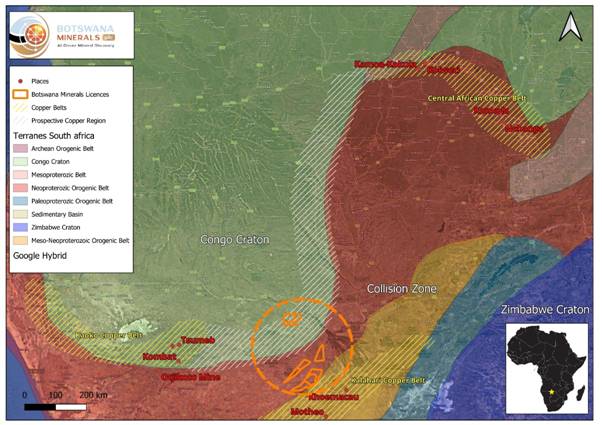
Figure 1: [Location of the Company's northern Botswana licences and interpreted exploration corridors]
Data integration
The assessment was completed using Planetary AI's Xplore platform, which combines machine-learning techniques with expert geological reasoning to identify prospective ground from very large, multi-disciplinary datasets. The work integrated:
• geological mapping and rock-type boundaries;
• structural data and interpreted fault patterns;
• magnetic and gravity geophysical data;
• multi-element geochemistry; and
• remote-sensing data.
These datasets were interpreted together to identify major structures, potential pathways for mineralised fluids, alteration zones and favourable rock units, and to produce a ranked inventory of exploration target areas.
Outputs were reviewed and validated by experienced geologists throughout and tested against multiple deposit models to ensure that the targets identified are supported by multiple lines of evidence rather than relying on isolated anomalies.
Preliminary results
The work has identified 36 priority targets across the two northern licences, grouped into six corridors, each with characteristics consistent with a different style of mineralisation. Key features include:
• geochemical and geophysical anomalies aligned with major faults that can act as pathways for ore-bearing fluids;
• widespread favourable carbonate host rocks across the licences, suitable for both sediment-hosted and structurally controlled copper and base-metal mineralisation;
• evidence of hydrothermal copper systems, including possible IOCG-style mineralisation; and
• magnetic features and alteration in several corridors, consistent with mineralisation across a wider mineral district.
Geological analogues
The targets share a similar geological setting to several major operating and historic deposits that will be familiar to investors:
• Tara, Navan, Ireland (Boliden): carbonate-hosted lead-zinc (Irish-type / MVT); one of Europe's largest zinc mines.
• Kamoa-Kakula, DRC (Ivanhoe Mines, TSX: IVN): a giant sediment-hosted copper deposit of the Central African Copperbelt.
• Tsumeb, northern Namibia: historic copper-lead-zinc-silver mine; one of the world's premier carbonate-hosted polymetallic deposits.
• Olympic Dam, South Australia (BHP): a globally significant IOCG deposit; among the largest copper deposits in the world.
These references are provided for geological context only, to illustrate the deposit styles being targeted; no inference is drawn or implied as to the scale of any mineralisation that may be present on the Company's licences.
Enquiries
|
Botswana Minerals PLC |
|
|
John Teeling, Chairman |
+353 1 833 2833 |
|
James Campbell, Managing Director |
+27 83 457 3724 |
|
Jim Finn, Director |
+353 1 833 2833 |
|
Nominated & Financial Adviser Strand Hanson Limited |
+44 (0) 20 7409 3494 |
|
Ritchie Balmer |
|
|
Rory Murphy |
|
|
Edward Foulkes |
|
|
Joint Broker First Equity Limited |
+44 (0) 20 7374 2212 |
|
Jason Robertson |
|
|
Joint Broker VSA Capital Limited |
+44 (0) 20 3005 5000 |
|
Andrew Monk |
|
|
Andrew Raca |
|
|
Public Relations BlytheRay |
+44 (0) 20 7138 3204 |
|
Megan Ray |
|
|
Said Izagaren |
|
|
Teneo |
+353 (0) 1 661 4055 |
|
Luke Hogg |
|
|
Ciara McNamee |
|
|
Molly Mooney |
|
Competent Person Statement
This release has been approved by James Campbell, Managing Director of Botswana Minerals plc, a qualified geologist (Pr.Sci.Nat), a Fellow of the Geological Society of South Africa, a Fellow of the Southern African Institute of Mining and Metallurgy, a Fellow of the Institute of Materials, Metals and Mining (UK) and with over 40 years' experience in the diamond sector, specifically focusing on exploration, resource assessment and mining.
This announcement contains inside information for the purposes of Article 7 of the Market Abuse Regulation (EU) 596/2014 as it forms part of UK domestic law by virtue of the European Union (Withdrawal) Act 2018, as amended.
RNS may use your IP address to confirm compliance with the terms and conditions, to analyse how you engage with the information contained in this communication, and to share such analysis on an anonymised basis with others as part of our commercial services. For further information about how RNS and the London Stock Exchange use the personal data you provide us, please see our Privacy Policy.

Latest directors dealings
- 51 minutes ago City of London Investment Group
- 2 hours ago Kooth
- 2 hours ago THG
- 2 hours ago Origin Enterprises (CDI)
- 2 hours ago Kingfisher