
Uranium Targets Defined; Drilling Accelerated
Summary by AI BETAClose X

THIS ANNOUNCEMENT CONTAINS INSIDE INFORMATION FOR THE PURPOSES OF THE MARKET ABUSE REGULATION (EU) 596/2014 (AS AMENDED) AS IT FORMS PART OF THE DOMESTIC LAW OF THE UNITED KINGDOM BY VIRTUE OF THE EUROPEAN UNION (WITHDRAWAL) ACT 2018 (AS AMENDED). UPON PUBLICATION OF THIS ANNOUNCEMENT, THIS INSIDE INFORMATION IS NOW CONSIDERED TO BE IN THE PUBLIC DOMAIN.
22nd May 2026
Arkle Resources PLC
("Arkle" or the "Company")
Uranium Targets Defined; Drilling Accelerated
Multiple Paleochannel and Leucogranite-Hosted Uranium Targets Defined and Drilling Programme Accelerated at Namibian Licences
Arkle Resources PLC (LSE:ARK), the energy metals explorer focused on uranium, is pleased to announce that interpretation of its Phase 1 geophysical programme is now complete across the Company's three northern Exclusive Prospecting Licences ("EPLs") (8290, 8298 and 8995) at its Erongo uranium project in Namibia, with highly encouraging results. These developments combine data from the recent airborne radiometric and magnetic surveys, ground horizontal loop electromagnetic ("HLEM") surveys and 2025 assay results.
Highlights
• Two Distinct Mineralisation Styles Defined: paleochannel hosted uranium (analogous to Trekkopje and Marenica) and uraniferous leucogranite ("ULG") hosted uranium (consistent with the broader Erongo alaskite uranium province including Rössing, Husab and Etango)
• Drilling Programme Accelerated: Arkle previously guided several months of post-interpretation mapping and sampling work, but, on the strength of these results, drilling on the Eastern EPL 8995 paleochannel target has been accelerated to June 2026 (or at the earliest contractor availability)
• 1,500m of RC Drilling: planned to test parallel paleochannel structures at the Eastern EPL 8995 target, with up to four individual sub-paleochannels inferred from HLEM
• Trenching and Sampling Commences Next Week: across a large ULG target on EPL 8995 extending approximately 1Km by 700m and interpreted as a potentially large assemblage of leucogranite sheets
• 2,500m ULG Drilling Programme to Commence in Q3 2026: subject to the results of the trenching and sampling work
• Multiple Additional Paleochannel and ULG Targets: identified across EPLs 8290, 8298 and 8995, to be advanced in parallel through further HLEM survey lines, mapping and sampling
• Strong ULG Potential on EPL 8290: multiple ULG anomaly clusters identified across both the Eastern and Western blocks of EPL 8290, with four prominent uranium anomalies on the Eastern block (confirmed by uranium-to-thorium ratios) and further confirmed anomalies on the Western block; the ULG trend extends north-east into the eastern part of EPL 8298, indicating an extensive ULG mineralisation pattern across the Company's licence package
• High Surface Sample Grades: 2025 surface sampling programme returned uranium grades of up to 3,855 ppm U₃O₈ in alaskite (ULG-style) samples and up to 2,782 ppm U₃O₈ in calcrete (paleochannel-style) samples across EPLs 8995 and 8290
• Downhole GRS Survey of Legacy Drillholes on EPL 8995 is Ongoing, with approximately 50% of the planned 95 holes surveyed to date; results, when received, are expected to lead to further refinement of drill targets
Rory Harding, Interim Chief Executive Officer, commented:
"Completion of the Phase 1 geophysics interpretation is a defining moment for Arkle's uranium strategy. The integrated work, supported by 2025 surface sampling and the input of our technical advisers, has fast-tracked a portfolio of high-priority uranium drill targets across two of the most productive mineralisation styles in the Erongo belt. The maps in Figures 1 and 2 speak to the quality of the work and the scale of the opportunity in front of us."
"When we announced the start of the Phase 1 geophysics programme in February, we guided to several months of post-interpretation mapping and sampling before moving to drill. The quality of the data has allowed us to compress that timeline. The Eastern paleochannel target on EPL 8995 is now drill-ready and we are working to commence RC drilling in June. In parallel, trenching and sampling across the large uraniferous leucogranite target on EPL 8995 begins next week, leading into a 2,500-metre drilling programme during Q3 2026."
"With approximately 4,000 metres of fully funded drilling now planned across both of the major uranium mineralisation styles in the Erongo belt, and multiple additional targets being advanced behind these, Arkle's shareholders should expect a sustained period of news flow through the year."
Further Details
Geophysical Interpretation Complete
The geophysical interpretation of recent airborne radiometric and magnetic surveys, ground HLEM surveys and 2025 assay results, has generated multiple high-priority uranium drill targets of two distinct mineralisation styles: paleochannel hosted uranium analogous to the adjacent Trekkopje and Marenica deposits, and uraniferous leucogranite host rocks, of a mineralisation style ubiquitous within the broader Erongo alaskite uranium province which includes the major established deposits at Rössing, Husab and Etango.
Orano's Trekkopje Mine is one of the most significant calcrete-hosted uranium deposits globally while a doubling of resource grade was recently confirmed at Marenica by Elevate Uranium. The interpretation is illustrated in Figures 1, 2 and 3 below.
The interpretation integrates the Xcalibur airborne radiometric and magnetic survey, HLEM ground surveys, and assay results from the 2025 surface sampling programme. A downhole gamma ray spectrometer ("GRS") survey of legacy drillholes on EPL 8995 is also ongoing.
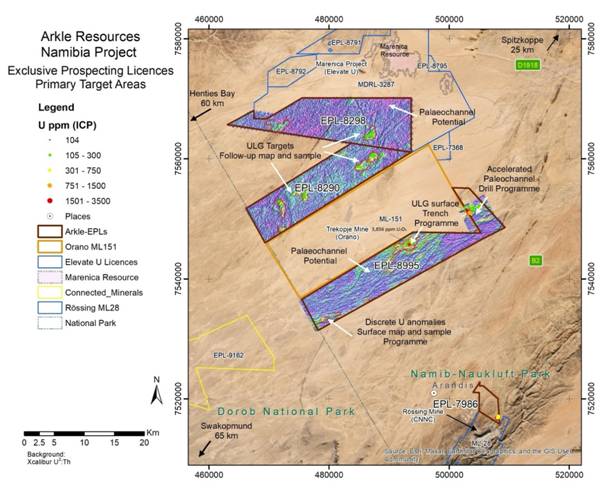
Figure 1: Integrated interpretation of the airborne radiometric/magnetic surveys with surface sampling and HLEM surveys across Arkle's three s northern EPLs (8290, 8298 and 8995) showing the location of paleochannel and uraniferous leucogranite (ULG) targets
Next Steps and Indicative Timeline
• June 2026: Trenching, mapping and sampling commences on the centre-north EPL 8995 primary ULG target
• June 2026: c. 1,500m RC drilling programme to commence on the Eastern EPL 8995 paleochannel target (at the earliest contractor availability)
• Q2 / Q3 2026: Completion of the ongoing downhole GRS survey of legacy drillholes on EPL 8995 (c. 50% surveyed to date; c. 50 of 95 planned holes) and integration of results into the target interpretation
• Q3 2026: c. 2,500m RC drilling programme to commence on the ULG target, subject to the results of the trenching and sampling work
• Q3 and Q4 2026: Additional HLEM survey lines, mapping and sampling across further paleochannel and ULG targets on EPLs 8290, 8298 and 8995, to develop the next generation of drill targets
Eastern EPL 8995 Paleochannel
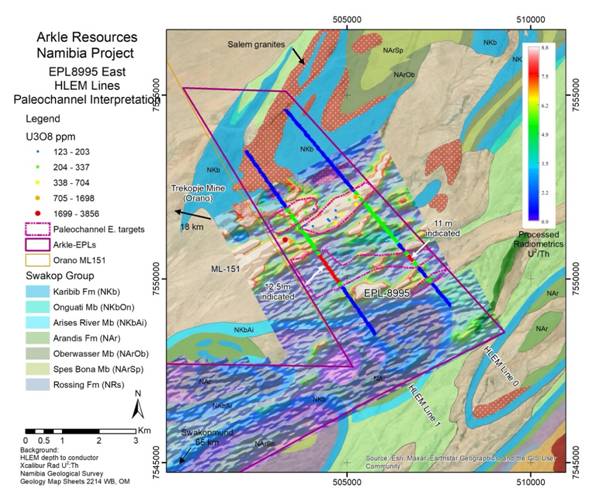 |
Figure 2: Zoomed view of EPL 8995, showing the Eastern paleochannel targets (drill-ready)
Interpretation of the Xcalibur Smart Mapping airborne survey, combined with HLEM ground surveys completed in March 2026, has confirmed and extended the paleochannel targets first identified at the Eastern margin of EPL 8995. The HLEM data has resolved parallel paleochannel structures, with up to four individual sub-paleochannels inferred along the surveyed lines, interpreted as extending north-easterly toward and being contiguous with the channel systems which host the adjacent Trekkopje (Orano) and Marenica (Elevate Uranium) deposits.
Sediment transport directions interpreted from the channel architecture indicate eastward flow toward the Trekkopje deposit on the Orano Mining Licence 151 immediately to the east, supporting the interpretation of a contiguous paleochannel system between Arkle's licence and the deposit currently under recommissioning at Trekkopje.
The Eastern target on EPL 8995 is supported by the recent airborne geophysics, 26 surface samples from the 2025 mapping programme and the two HLEM lines completed in March 2026. The HLEM data has provided useful information toward interpreting channel geometry, depth and basement architecture, and has identified channel-margin dykes which are interpreted as potential structural controls on paleochannel flow, and consequently uranium mineralisation. Once complete, the downhole GRS survey results will be integrated into the interpretation and refinement of the drill programme, with twin-holes to selected historic drillholes a potential element of the planned drilling programme.
The 2025 surface sampling programme returned uranium grades of up to 2,782 ppm U₃O₈ in calcrete-hosted samples across EPLs 8995 and 8290, confirming surficial uranium mineralisation analogous to that hosted within the adjacent Trekkopje and Marenica calcrete-hosted paleochannel deposits.
The additional surface mapping and sampling work previously envisaged on this target is continuing in parallel with the design of the drilling programme. The location and spacing of drillholes, and the indicative number of holes, are currently being finalised by the Company's geological team together with its consultants, with the optimum design intended to test the channel architecture identified by the HLEM survey.
ULG Target - EPL 8995 - Trenching, Sampling and Follow-On Drilling
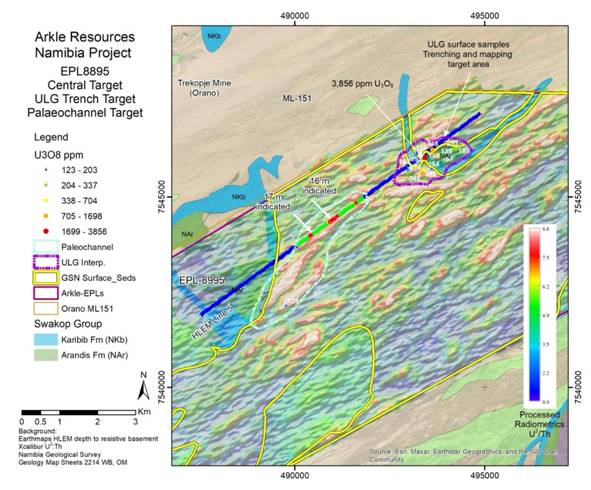 |
Figure 3: Zoomed view of EPL 8995 showing the centre-north uraniferous leucogranite(ULG) target and the additional Central target
A target has been defined over a large body of leucogranites in the centre-north of EPL 8995 through integrated interpretation of the airborne radiometric and magnetic data, supported by results from the 2025 surface mapping and sampling programme, which returned encouraging assay grades of up to 3,855 ppm U₃O₈.in ULG samples. The typical host style for hard-rock uranium mineralisation in Namibia is uraniferous leucogranite, or, as it is more commonly referred to in the district, "alaskite". ULGs are the host rock for a number of the largest uranium deposits in the Erongo Region, including Rössing, Husab, and Bannerman Energy's Etango Project. These type localities are guiding the ongoing geological interpretation of the ULGs found on the Company's Licences.
The primary ULG target identified extends across an area of approximately 1 km by 700 m in the Central-north portion of the EPL and the target is defined by coincident radiometric and magnetic anomalies, surface mapping of ULG outcrop, and the absence of overlying marbles which are interpreted as a stratigraphic control on the preservation of the ULG sequence. The size and character of the anomaly are consistent with a potentially large assembly of leucogranite sheets, and the target remains open along strike to both the north and the southwest.
The ULG target is flanked by two further paleochannels mapped from the HLEM and ASTER multispectral remote sensing data; a smaller far-western paleochannel of approximately 41 hectares and a larger western paleochannel of approximately 631 hectares, both of which show encouraging elevated uranium and uranium-to-thorium ratio responses in the airborne radiometric data.
A follow-up, on-ground programme commences next week, comprising detailed surface mapping, trenching along the length of the ULG target with systematic sampling to characterise the extent, grade and continuity of the ULG-hosted mineralisation. The results of this work will support the design and refinement of a fully funded c. 2,500 metre RC drilling programme, designed to provide initial vertical control on the ULG sequence and to test grade and continuity at depth.
Further Targets - Additional Paleochannels and ULGs
Interpretation of the Xcalibur dataset has identified multiple further paleochannel and ULG targets across all three contiguous northern EPLs (8290, 8298 and 8995), which will be advanced in parallel with the drilling programmes described above.
Additional Paleochannel Targets - EPLs 8290 and 8298
Additional paleochannel potential exists on EPL 8290, where surface mapping has indicated mineralised paleochannel sequences not fully resolved by the recent airborne survey, and across the north-east of EPL 8298, which hosts surficial sediment cover with drainage patterns immediately downstream of the Marenica deposit on Elevate Uranium's Mineral Deposit Retention Licence 3287. The Company plans to advance these targets through additional HLEM survey lines, surface mapping and sampling during Q3 and Q4 2026.
Additional ULG Targets and Analogues
Additional ULG analogues have been identified at several locations across the northern EPLs from coincident radiometric and magnetic signatures consistent with the primary centre-north ULG target of EPL8995. These include a second Central target on EPL 8995 focused on two prominent dome structures, where ULGs are present in outcrop and interpreted in the subsurface, and a potential paleochannel occurrence identified between the two domes which has been surveyed by a single HLEM line. The Western portion of EPL 8995 contains dome and fold structures within Swakop Group metasediments and outcropping syn-tectonic Damaran granitoids (Salem Suite), with several encouraging, localised, occurrences of elevated eU:eTh ratios mapped, by radiometric suvey across the western and south-western portions of the licence for follow-up sampling.
Beyond EPL 8995, the recent airborne radiometric and magnetic survey has identified extensive ULG prospectivity on EPL 8290, with multiple ULG anomaly clusters distributed across the licence. The Eastern block of EPL 8290 hosts four prominent uranium anomalies, three of which are confirmed by elevated uranium-to-thorium ratios consistent with ULG-style mineralisation. The Western block of EPL 8290 hosts further uranium anomalies, with all anomalies confirmed by uranium-to-thorium ratio analysis to represent true uranium occurrences. The pattern of multiple distributed anomaly clusters on EPL 8290 contrasts with the single, large, concentrated target on EPL 8995 and adds materially to the Company's ULG target inventory.
On EPL 8298, a prominent uranium anomaly has been identified in the east of the licence, confirmed by U:Th ratio analysis and interpreted as the north-east extension of the ULG-mineralised trend identified on EPL 8290. The continuation of this trend across two contiguous licences indicates an extensive ULG mineralisation pattern within the Company's licence package and provides further encouragement for follow-up exploration across the broader Northern EPL portfolio.
Regional Context and Analogues
The Erongo uranium province is one of the most productive uranium regions globally, containing approximately 1.2 Blb U₃O₈ in Measured and Indicated Resources and approximately 235 Mlb U₃O₈ in Inferred Resources, and having produced in excess of 350 Mlb U₃O₈ over the past 45 years. Arkle's northern EPLs are contiguous with the Trekkopje (Orano) and Marenica (Elevate Uranium) paleochannel uranium deposits and sit within the same regional geological framework as the leucogranite and alaskite-hosted uranium deposits which have defined the district.
The major established deposits of the Erongo uranium district include Rössing (the world's longest continuously operating open-pit uranium mine), Husab (one of the world's largest uranium mines by production), Bannerman Energy's Etango project (ASX: BMN), which has supported the definition of a substantial uranium resource and has advanced to development decision stage, and Forsys Metals' Valencia project advancing toward pre-feasibility stage. Each of these is an alaskite-hosted (leucogranite-hosted) uranium deposit. Arkle's targets sit within the same broader Erongo uranium district and with established mining and processing infrastructure.
The region is host to a third operating uranium mine at Langer Heinrich which exploits a paleochannel system; and a uranium mine at Trekkopje, adjacent to Arkle's Licences, that is progressing toward recommissioning and eventual production from an extensive paleochannel-type deposit. Reptile Uranium are developing a mine project at their Tumas deposits, located to the southwest of Langer Heinrich and southeast of the Etango Project.
Stratigraphic and Structural Framework
Valencia, Rössing, Husab and Etango sit at the centre of a NE-SW trend known within the district as "alaskite alley", situated within the metamorphic core of the Damara Orogen Central Zone. Regional occurrences of ULG-hosted uranium, such as those identified on Arkle's licences, continue to be prospective targets that expand the known extent of this style of uranium mineralisation. Etango is situated at the base of the Nosib Group, close to Abbabis MMC basement rock, which represents a somewhat different stratigraphic setting to that mapped to date on the Northern EPLs; however, the licences host complex structural features which are analogous to those interpreted as structural pathways, or plumbing systems, that facilitated granite dyke and sill intrusions in the broader district. These structural settings, together with the ULG and paleochannel targets defined to date, are a primary focus of the Company's exploration programme. The surficial type deposits such as Langer Heinrich and Trekkopje are hosted in near surface paleochannels, that have accumulated uranium mineralisation through erosion of uraniferous (granitoid) bedrock and episodic drainage and deposition in 'recent' geologic time. These structural- and morphological settings, together with the ULG and paleochannel targets defined to date, are a primary focus of the Company's exploration programme.
Technical Team and Advisers
The Phase 1 interpretation, and the design and execution of the ongoing exploration programme on the ground in Namibia, are led by the Company's Namibia Exploration Manager, Willem Kotzé, supported by an experienced team of independent technical advisers. Dr Guy Freemantle of The MSA Group has been engaged as the Company's Uranium Qualified Person and independent consultant, bringing extensive uranium geology and exploration expertise to the project.
Processing and interpretation of the airborne radiometric and magnetic data acquired by Xcalibur Smart Mapping has been delivered by Arrow Geosciences, with Theo Aravanis (formerly Chief Geophysicist of Rio Tinto for over 20 years) supporting the geophysical interpretation work that has contributed to the definition of the paleochannel and ULG drill targets announced today.
In addition, leading Namibian uranium experts Dr Paul Nex and Professor Judith Kinnaird visited several uraniferous leucogranite outcrop and paleochannel sites on the Northern EPLs during the Phase 1 programme, providing technical input on the mapping and classification of the ULGs and on the broader geological framework of the licences. Their input has been integrated into the interpretation announced today and will continue to inform the design of follow-on mapping, sampling and drilling programmes.
Investor Webinar and Q&A
The Company intends to convene an investor webinar and live Q&A session in June 2026, at which the Chief Executive Officer will present the results of the Phase 1 geophysical interpretation, the maps and the planned Phase 2 drilling programme. Further details, including registration information, will be announced in due course.
Enquiries
|
Arkle Resources Rory Harding, Interim CEO John Teeling, Chairman |
+44 (0)20 3051 5348 +353 (0)1 833 2833 |
|
|
|
|
Strand Hanson Limited Ritchie Balmer / Imogen Ellis |
Nominated & Financial Adviser +44 (0)20 7409 3494 |
|
|
|
|
First Equity Limited Jason Robertson |
Joint Broker +44 (0)20 7374 2212 |
|
|
|
|
Vigo Consulting Ben Simons / Seb Weller |
UK Media & IR +44 (0)20 7390 0234 arkle.ir@vigoconsulting.com |
|
|
|
|
Teneo Luke Hogg / Molly Mooney |
Ireland Media +353 (0)1 661 4055 |
About Arkle Resources
Arkle Resources PLC (AIM: ARK) is a multi-commodity exploration company focused on metals which are essential for the generation and storage of clean energy: uranium, lithium and zinc. Its projects are in tier-1 mining jurisdictions in Namibia, Botswana and Ireland, adjacent to world-class deposits.
Founded in 2004 by John Teeling and Jim Finn, the Company co-discovered the Stonepark zinc deposit in County Limerick, now Ireland's second largest undeveloped resource, in joint venture with Teck Ireland. Teck's interest was acquired by Group Eleven Resources (TSX-V: ZNG), who continue to advance the project alongside Arkle.
In January 2026, the Company announced a transformative deal to acquire Namibia Uranium Pty Ltd, which has introduced four highly prospective uranium licences contiguous to major producing and development assets in what is a world-class uranium jurisdiction. This acquisition, alongside the Company's existing licence portfolio and the introduction of new management, repositions Arkle to become a leading explorer in energy metals.
For more information visit: www.arkleresources.com
Follow us on social media:
www.x.com/ArkleResources
www.linkedin.com/company/arkle-resources-plc
Competent Person Statement
The technical and scientific information contained in this announcement has been reviewed and approved by Dr Guy Freemantle, an independent consultant to the Company through The MSA Group (Pty) Ltd., Johannesburg, South Africa. Dr Freemantle holds a Bachelor of Science in Geology and a PhD in Geology, both at the University of the Witwatersrand. He is a member of the Society of Economic Geologists (892905) and current Vice President for the Africa Region; a Fellow of the Geological Society of South Africa (965392); and is registered with SACNASP (Registration 117527). Dr Freemantle has practised his profession continuously for 16 years and has sufficient experience and knowledge that is relevant to the style of mineralisation and type of deposits under consideration as well as to the activity that is being undertaken to fulfil requirements of a Qualified Person as per NI 43-101 / PERC Reporting Standard (2021). Dr Freemantle consents to the inclusion in this announcement of the technical and scientific information in the form and context in which it appears.
RNS may use your IP address to confirm compliance with the terms and conditions, to analyse how you engage with the information contained in this communication, and to share such analysis on an anonymised basis with others as part of our commercial services. For further information about how RNS and the London Stock Exchange use the personal data you provide us, please see our Privacy Policy.

Latest directors dealings
- 11 minutes ago Cohort
- 18 minutes ago Severn Trent
- 19 minutes ago SSE
- 25 minutes ago TotalEnergies SE
- 30 minutes ago Close Brothers Group