
Namibia Uranium Exploration Update
Summary by AI BETAClose X

THIS ANNOUNCEMENT CONTAINS INSIDE INFORMATION FOR THE PURPOSES OF THE MARKET ABUSE REGULATION (EU) 596/2014 (AS AMENDED) AS IT FORMS PART OF THE DOMESTIC LAW OF THE UNITED KINGDOM BY VIRTUE OF THE EUROPEAN UNION (WITHDRAWAL) ACT 2018 (AS AMENDED). UPON PUBLICATION OF THIS ANNOUNCEMENT, THIS INSIDE INFORMATION IS NOW CONSIDERED TO BE IN THE PUBLIC DOMAIN.
25 June 2026
Arkle Resources PLC
("Arkle" or the "Company")
Namibia Uranium Exploration Update
Uranium Identified in Trenching and Legacy Drillholes; Drilling to Commence Imminently at the Erongo Uranium Project, Namibia
Arkle Resources PLC (LSE:ARK), the energy metals explorer focused on uranium, is pleased to announce that field work, including geological mapping and trench sampling, is progressing on schedule at its Erongo Uranium Project in Namibia, ahead of Arkle's imminent maiden drill programme.
Highlights
• Downhole GRS Survey Complete: 106 legacy drillholes have been surveyed across EPLs 8995 and 8298. 16 holes returned intercepts exceeding 50 ppm eU₃O₈ over one metre or more, of which seven exceeded 100 ppm eU₃O₈, with peak intercepts of 1 m at 303 ppm eU₃O₈ from 6.5 m (RC28) and 2 m at 215 ppm eU₃O₈ from 15.5 m (RC27).
• Trenching and Sampling Underway: Seven trenches have been excavated so far, with lengths between 70 m and 170 m, to depths between 0.5 m and 2 m across a large ULG target of the centre-north area on EPL 8995 extending approximately 1Km by 700m. Excavations continue to expose bedrock geology, including uraniferous leucogranites for sampling. Trenching has exposed multiple stacked leucogranite sheets interleaved with metasediment, with the secondary uranium mineral carnotite logged in fractures; field radiometric readings indicate uranium across these zones, subject to confirmation by laboratory assay.
• Geological Mapping Ongoing: Mapping is in its second week and continues to improve on the 1:250K resolution Geological Survey of Namibia Map sheets (2114 Omaruru and 2214 Walvis Bay). The work continues to add surface information that will inform and improve understanding of the ULG geological setting.
• 1,500 m of RC Drilling: A initial programme of approximately 42 RC drillholes is planned to test surface and legacy downhole radiometric anomalies across the Eastern and Central paleochannel target area of EPL 8995; the drill contractor has been engaged, with the drill-site inspection and pad preparation carried out this week and rig mobilisation to site set for Monday, 29 June 2026.
• Q3 2026 planned activities: Fully funded c. 2,500 m additional RC drilling programme to commence on the ULG target, subject to the results of the trenching and sampling work.
• Q3 and Q4 2026 planned activities: Additional HLEM survey lines, mapping and sampling across further paleochannel and ULG targets on EPLs 8290, 8298 and 8995, to develop the next generation of drill targets.
Rory Harding, Chief Executive Officer, commented:
"We are now firmly into the field, and the early signs from the ground are encouraging. Within weeks of completing the Phase 1 interpretation, our team in Namibia has trenches open across the centre-north leucogranite target on EPL 8995 and has exposed exactly the style of stacked leucogranite sheets we hoped to see, along with carnotite in the fractures, which is a clear visual marker of uranium. Grades will be confirmed by laboratory assay, and the first samples are already with the laboratory."
"The completed downhole gamma ray survey of the legacy drillholes across EPLs 8995 and 8298 complements our surface and airborne geophysics and has given us real subsurface confidence. Several legacy holes in the eastern paleochannel target returned narrow but encouraging uranium intercepts that are directly guiding the design of our first 1,500-metre drill programme. On the central-east channel, the survey points to broader mineralisation, with over 100 ppm eU₃O₈ indicated across 9.4 metres. These are radiometric indications rather than laboratory assays, but they guide us where to drill."
"With the contractor engaged and making preparations, we expect to be drilling within days."
"This is the start of a sustained, fully funded drilling campaign of around 4,000 metres across both of our principal uranium styles, with multiple further targets behind it. Shareholders should expect steady news flow through the second half of the year as assays return and drilling gets underway."
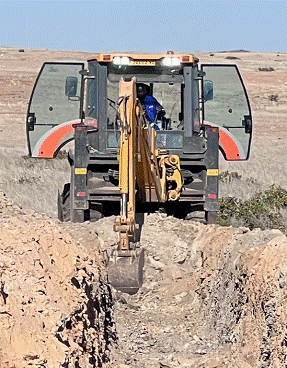
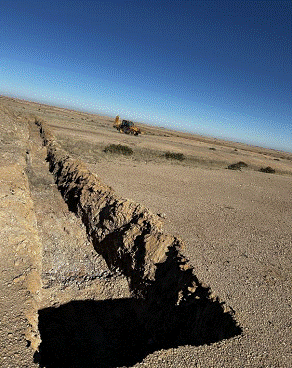
Figure 1: Trenching programme underway on EPL 8995.
Further Details
Legacy Downhole GRS survey complete
The downhole probe programme completed in June 2026 was planned by Arkle to gather subsurface radiometric data, and successfully executed by Terratec Geophysical Services, Namibia. A total of 106 holes were surveyed by a four-channel spectrometer tool, and sixteen of these holes returned intercepts of >50 ppm eU₃O₈ over one-metre or more, seven surveyed holes have intercepts of >100 ppm eU₃O₈. Exceptional intercepts include 1 m of 303 ppm eU₃O₈ from 6.5 m in RC28 and 2 m of 215 ppm eU₃O₈ from 15.5 m in RC27. Elsewhere on EPL 8995, the survey indicates broader mineralisation, with over 100 ppm eU₃O₈ over 9.4 m returned from the central-east of the licence. Mineralised intercepts in historical drillholes have provided useful guidance to Arkle's planned exploration drill campaign, which commences in the coming weeks at the eastern paleochannel target of EPL 8995.
Eastern EPL 8995 Paleochannel
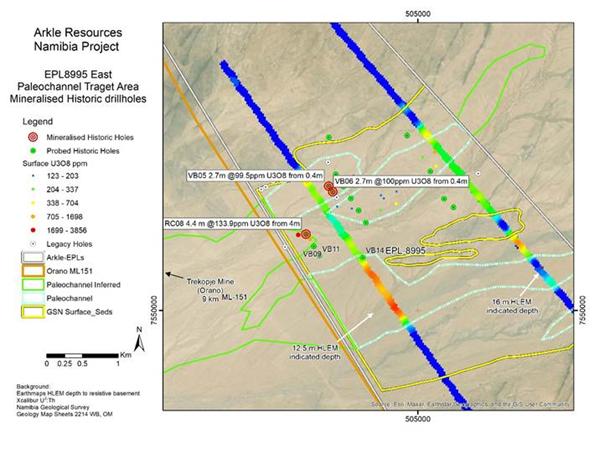
Figure 2: Zoomed view of EPL 8995, showing the distribution of surveyed historical holes, processed airborne radiometric data, HLEM profiles and the current interpreted extent of paleochannels. HLEM profiles indicate a potential max depth for paleochannels of 12.5 m.
ULG Target - EPL 8995 - Trenching, Mapping and Sampling and Follow-On Drilling
The primary ULG target on EPL8995 is being explored through a trenching programme, which currently exposes target rocks in seven trenches excavated perpendicular to the prevailing metamorphic fabric. Approximately 700 m of strike length have been exposed in the seven trenches; work is ongoing and aims to provide representative sampling material from the subsurface across a target area of 1 km by 700 m.
Trenching has exposed three styles of uranium-associated mineralisation within the target: a large central leucogranite within the core of the fold structure; a sequence of multiple stacked leucogranite sheets interleaved with schist and gneiss; and a leucogranite zone developed against the carbonate (marble) contact, the last of these analogous to the high-grade leucogranite bodies developed beneath the marble at the Rössing mine. The secondary uranium mineral carnotite has been logged in fractures within both the leucogranites and the adjacent metasediments. Field scintillometer and spectrometer readings recorded elevated radiometric responses across these zones, consistent with the presence of uranium; these are preliminary field measurements and are subject to confirmation by laboratory assay.
Systematic sampling of the trenches, to characterise the extent, grade and continuity of the ULG-hosted mineralisation, is underway. 62 samples have been collected to date, with a first batch of 45 submitted to ACT Labs in Windhoek, Namibia, on 19 June 2026, together with certified reference materials and blanks for quality control. Assay results are awaited and, once received and validated, will be reported in due course, with multi-element assays to follow. The results of this work will support the design and refinement of a fully funded additional c. 2,500 metre RC drilling programme, designed to provide initial vertical control on the ULG sequence and to test grade and continuity at depth.
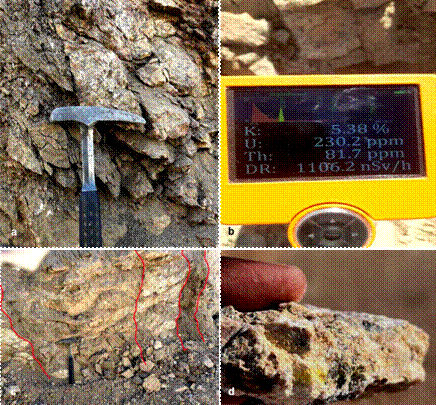
Figure 3: Snapshots of the trench and sample programme underway on the central ULG target area of EPL 8995; (a) ULG exposure showing smoky quartz characteristic of radioactive mineralisation (b) K, Th, and U field assay of a ULG by GS Instruments VB6 spectrometer (c) Fabric-parallel ULG sheet in schistose country rock in one of the trenches, and (d) Secondary uranium minerals (uranophane and/or carnotite on a fracture surface of ULG.
Surface Mapping
Surface mapping progress to date has identified ULG outcrop, and outcropping carbonate, calcsilicate, and pelitic rocks that represent metasedimentary packages of the Arandis Formation, a cyclic package of carbonates and reduced-facies siliciclastic rocks with similarities to the older Rössing Formation that typifies the uranium-prospective ground in the vicinity of the Rössing and Husab mines and active exploration projects in the surrounding region. Refinement of the Geological Survey Map data will be informed by the ongoing geological mapping underway on EPLs 8995, 8290 and 8298.
Key deposits occur along the NE-SW corridor "alaskite alley" within the Damara Orogen. Structural features on Arkle's licences are analogous to known mineralising pathways, supporting both ULG and palaeochannel targets that remain central to exploration. The alaskite-alley corridor is characterised by ULG intrusives that were emplaced within a stratigraphic interval between the Etuis Formation and the Chuos Formation, with much of the mineralised sheets occurring within the Khan Formation and Rossing Formation interval between. This interval is part of the upper Nosib Group and lower Swakop Group sequence.
In the locale of Arkle's exploration endeavours the country rocks are predominantly of the Swakop Group, where the role of the Arandis Formation is a reasonable analogue to the role played by the Rössing Formation as a REDOX control that focusses uranium mineralisation during ULG emplacement. In this regard the Arandis Formation is viewed as a worthwhile mapping and sampling target for ground work, trenching, and drill programme design.
Encouraging Progress on Exploration Campaign
Arkle has commenced a campaign of focussed activities across its Namibian uranium licences, commencing with a systematic trenching and sampling programme on a primary ULG target supplemented by geological mapping and surface sampling and a 1,500 m initial drill programme on its eastern paleochannel target, all advancing in parallel on EPL8995. The Company looks forward to reporting trench and surface sample assay results; progress and outcome of the imminent 1,500 m paleochannel drilling programme; and continued progress across its wider portfolio of paleochannel and ULG targets across EPL8995 and to the north on EPLs 8290 and 8298 through the second half of 2026.
Further announcements will be made as and when appropriate.
Enquiries
|
Arkle Resources Rory Harding, CEO John Teeling, Chairman |
+44 (0)20 3051 5348 +353 (0)1 833 2833 |
|
|
|
|
Strand Hanson Limited Ritchie Balmer / Imogen Ellis |
Nominated & Financial Adviser +44 (0)20 7409 3494 |
|
|
|
|
First Equity Limited Jason Robertson |
Joint Broker +44 (0)20 7374 2212 |
|
|
|
|
Vigo Consulting Ben Simons / Seb Weller |
UK Media & IR +44 (0)20 7390 0234 arkle.ir@vigoconsulting.com |
|
|
|
|
Teneo Luke Hogg / Molly Mooney |
Ireland Media +353 (0)1 661 4055 |
About Arkle Resources
Arkle Resources PLC (AIM: ARK) is a multi-commodity exploration company focused on metals which are essential for the generation and storage of clean energy: uranium, lithium and zinc. Its projects are in tier-1 mining jurisdictions in Namibia, Botswana and Ireland, adjacent to world-class deposits.
Founded in 2004 by John Teeling and Jim Finn, the Company co-discovered the Stonepark zinc deposit in County Limerick, now Ireland's second largest undeveloped resource, in joint venture with Teck Ireland. Teck's interest was acquired by Group Eleven Resources (TSX-V: ZNG), who continue to advance the project alongside Arkle.
In January 2026, the Company announced a transformative deal to acquire Namibia Uranium Pty Ltd, which has introduced four highly prospective uranium licences contiguous to major producing and development assets in what is a world-class uranium jurisdiction. This acquisition, alongside the Company's existing licence portfolio and the introduction of new management, repositions Arkle to become a leading explorer in energy metals.
For more information visit: www.arkleresources.com
Follow us on social media:
www.linkedin.com/company/arkle-resources-plc
Competent Person Statement
The technical and scientific information contained in this announcement has been reviewed and approved by Dr Guy Freemantle, an independent consultant to the Company through The MSA Group (Pty) Ltd., Johannesburg, South Africa. Dr Freemantle holds a Bachelor of Science in Geology and a PhD in Geology, both at the University of the Witwatersrand. He is a member of the Society of Economic Geologists (892905) and current Vice President for the Africa Region; a Fellow of the Geological Society of South Africa (965392); and is registered with SACNASP (Registration 117527). Dr Freemantle has practised his profession continuously for 16 years and has sufficient experience and knowledge that is relevant to the style of mineralisation and type of deposits under consideration as well as to the activity that is being undertaken to fulfil requirements of a Qualified Person as per NI 43-101 / PERC Reporting Standard (2021). Dr Freemantle consents to the inclusion in this announcement of the technical and scientific information in the form and context in which it appears.
Glossary
|
EPL |
Exclusive Prospecting Licence |
|
eU₃O₈ |
Equivalent (U₃O₈). eU₃O₈ is a uranium grade derived from downhole gamma ray spectrometry rather than chemical assay and is reported as parts per million (ppm). All eU₃O₈ values are radiometric estimates and remain subject to confirmation by laboratory assay. |
|
HLEM |
Horizontal Loop Electromagnetic |
|
K |
Potassium |
|
Ppm |
Parts per million |
|
RC |
Reverse Circulation |
|
Th |
Thorium |
|
U |
Uranium |
|
ULG |
Uraniferous Leucogranite |
RNS may use your IP address to confirm compliance with the terms and conditions, to analyse how you engage with the information contained in this communication, and to share such analysis on an anonymised basis with others as part of our commercial services. For further information about how RNS and the London Stock Exchange use the personal data you provide us, please see our Privacy Policy.

Latest directors dealings
- 6 minutes ago Hilton Food Group
- 6 minutes ago Crimson Tide
- 6 minutes ago Grafton Group Ut (CDI)
- 6 minutes ago Grafton Group Ut (CDI)
- 12 hours ago Cohort