
Revised PFS for Optimised Dokwe Gold Project
Summary by AI BETAClose X



26 May 2026
AIM: AAU
ASX: AA2
Optimised Dokwe Gold Project PFS Yields Excellent Metrics
Ariana Resources plc (AIM: AAU, ASX: AA2, "Ariana" or the "Company"), the mineral exploration and development company with gold project interests in Africa and Europe, is pleased to report the completion of a revised Pre-feasibility Study ("PFS") for the 100%-owned Dokwe Gold Project ("Dokwe") in Zimbabwe.
Highlights:
o Long-life, low capital cost, high margin gold production occurring in two phases: 12-year initial open-pit Life of Mine ("LoM") phase at c.80,000oz p.a. and 8-year stockpile processing phase at c.20,000oz p.a. for total Life of Project ("LoP") production of 1.06Moz and peak production of 100,000oz p.a.1
o Ore Reserve increased by c.42% to 1.13Moz of gold at Dokwe North, comprising the following Proved and Probable categories, at a 0.2 g/t Au cut-off (Table 4 below):
§ High Grade: 11.0Mt @ 1.91 g/t Au (for 674,300 oz Au)
§ Medium Grade: 16.3Mt @ 0.57 g/t Au (for 297,700 oz Au)
§ Low Grade: 18.6Mt @ 0.27 g/t Au (for 163,200 oz Au)
o Mineral Resource Estimate increased by 13% to 1.6Moz of gold at Dokwe North and Dokwe Central, at a 0.2 g/t Au cut-off (Table 1 below).
o Pre-tax LoP NPV10 of US$1,056m (A$1,509m), post-tax NPV10 of US$740m (A$1,057m), approximate 1-year payback period from commissioning and 92% IRR at a US$4,250/oz gold price; total EBITDA of US$1,993m.
o Low average strip ratio of 3.7, LoM C1 (operating) cost of US$1,685/oz2, and low total pre-production CAPEX of US$164m.
o Production schedule based on a maximum 2.5Mtpa plant throughput and a high-grading production strategy, reflecting the Strategic Optimisation Study ("SOS") undertaken by Whittle Consulting in 2025.
o Production schedule includes 1.8Mt @1.38 g/t Au of Indicated Resources from Dokwe Central, accessible via open-pit but not yet converted to Ore Reserve3.
o Dokwe sits within granted mining claims, which are wholly-owned by a subsidiary of Ariana, providing an uninhibited pathway to production.
o Ariana remains well-funded with pro-forma cash and investments of A$53M and no debt.4
o The completion of this revised PFS, together with the advanced stage of the metallurgical and geotechnical drilling underway, are important prerequisites for the work in progress for the Definitive Feasibility Study ("DFS").
Notes to Highlights:
1. Mill recovered ounces from mining activity.
2. C1 costs include mining, processing and G&A OPEX (mine site costs) during the LoM mining and processing phase. Mining and energy cost assumptions are based on indicative commercial terms to a PFS level of accuracy, which involved a scaling of mining fleet requirements from the 1.5Mtpa case to the 2.5Mtpa case. The C1 costs plus sustaining and growth capital costs, in addition to royalties/refining costs (off-site costs), provide an AISC of US$1,995/oz.
3. As demonstrated from pit optimisation undertaken on the same basis as Dokwe North and representing less than 4% of LoP process feed tonnes, which are only mined and processed beyond expected payback period. Additional geotechnical and metallurgical data is required to complete a conversion to Ore Reserves.
4. Including the implied value of the remaining 9.9% interest in Zenit based on the recent sale of 13.6% interest and excluding 76% interest in Western Tethyan Resources Ltd, 61% of Venus Minerals Ltd and other minority interests.
Dr. Kerim Sener, Managing Director, commented:
"This is a major milestone for the Company as it progresses its DFS, which is due for delivery in Q1 2027. With the total ore reserve significantly increasing by 42% to 1.13Moz, this is a genuinely outstanding result and sets the scene for a significantly expanded mining and processing rate, which yields an NPV10 in excess of US$1bn.
"The PFS update brings together a revised Mineral Resource Estimate, the SOS completed with Whittle Consulting in 2025 and an update to project input parameters enabling an increase to our Ore Reserves at Dokwe North.
"The results provide further impetus to test other strategic opportunities identified in the SOS as we progress Dokwe into production. In particular, refinements to the mining fleet configuration and processing route may further improve the NPV and will be examined further in our ongoing studies. The Company is already ahead of schedule with its three-rig c.3,700m diamond drilling programme at Dokwe, supported by the Xinhai Mining Group, to provide additional geotechnical and metallurgical data for the DFS.
"There are immediate opportunities to further increase Ore Reserves through the conversion of Resources at Dokwe Central and recently reported extensions to Dokwe North and Dokwe Central identified in recent RC drilling. Geotechnical drilling and the metallurgical testwork programme for the DFS are expected to lead to further improvements to the Ore Reserves during H2 2026."
Summary of Pre-Feasibility Report
The Dokwe Gold Project consists of the Dokwe North and Dokwe Central deposits and is located approximately 110km west-northwest of Bulawayo, Zimbabwe.
The objective of this PFS revision was to revise the Resources last announced in March 2025, review the 2022 Minxcon PFS and update to a process feed rate of 2.5Mtpa (from 1.5Mtpa in the original PFS), as recommended from a Strategic Optimisation Study carried out by Whittle Consulting in 2025. This revision to the PFS also reports an updated Ore Reserve, key financial outputs and updated processing and operating costs estimated by Xinhai Mining Group.
This PFS was undertaken by Auralia Mining Consulting Pty Ltd (Auralia), which commenced in March 2026 and comprised a review of existing technical work and operating inputs and the acquisition of new data, to form the basis of new pit optimisation and designs, production scheduling and cashflow modelling.
Mineral Resource Estimate
The Dokwe North and Central Resource models provided by Ariana, which were announced in accordance with JORC (2012) as a Mineral Resource Estimate on 4 March 2025 (and to the AIM on 8 September 2025), were updated to reflect the increase in the gold price. Table 1 shows the updated 2026 MRE, reported at a cut-off grade of 0.2g/t Au within a pit shell generated using a US$5,000/oz gold price to demonstrate Reasonable Prospects for Eventual Economic Extraction.
Table 1: Dokwe Mineral Resource Estimate
|
Deposit |
Classification |
Tonnage |
Grade |
Contained Gold |
|
Dokwe North |
Measured |
21,055 |
0.92 |
621,500 |
|
Indicated |
27,224 |
0.71 |
617,400 |
|
|
Inferred |
11,963 |
0.67 |
258,500 |
|
|
Total |
60,242 |
0.77 |
1,497,400 |
|
|
Dokwe Central |
Indicated |
2,107 |
1.39 |
94,300 |
|
Inferred |
117 |
1.66 |
6,200 |
|
|
Total |
2,225 |
1.41 |
100,600 |
|
|
Total |
Measured |
21,055 |
0.92 |
621,500 |
|
Indicated |
29,331 |
0.75 |
711,700 |
|
|
Inferred |
12,080 |
0.68 |
264,700 |
|
|
Total |
62,467 |
0.80 |
1,598,000 |
|
Notes:
The Dokwe Mineral Resource Estimate is reported within a Dokwe North pit-shell optimised at US$5,000/oz Au. The Mineral Resource Estimate is reported in accordance with the JORC (2012) Code, using a cut-off grade of 0.2g/t Au. Errors may be present due to rounding. The Dokwe Mineral Resource Estimate is inclusive of Reserves. Figures presented above are both gross and net attributable to Ariana, via its subsidiary Canister Resources (Pvt) Ltd in Zimbabwe. This Mineral Resource Estimate was prepared by Ruth Woodcock, a member of Recognised Professional Organisations as defined by JORC 2012: a Chartered Geologist (CGeol, Geological Society of London) and European Geologist (EurGeol, European Federation of Geologists) and has sufficient experience which is relevant to the style of mineralisation and type of deposit under consideration and to the activity upon which she is reporting as a Competent Person.
Processing
Processing capital and operating costs have been re-estimated by the Xinhai Mining Group using the 2022 PFS design criteria, with modifications for an increase in throughput from 1.5Mtpa to 2.5Mtpa, the exclusion of a heap leach process and the use of traditional wet disposal of process tailings.
Geotechnical
A geotechnical stable slope design study was completed by Open House Management Solutions for Dokwe North in 2021. The study and corresponding report are of a level of detail suitable for use in this PFS.
Mining Costs
Updated mining costs were obtained through a request for quotation ("RFQ") process carried out by Auralia in 2025, whereby mining contractors operating in southern Africa were approached to provide full costs for a contract mine operation. The mining and energy cost assumptions are based on indicative commercial terms to a PFS level of accuracy, which involved a scaling of mining fleet requirements from the 1.5Mtpa case to the 2.5Mtpa case. It is expected that improvements can be made to the mining cost with appropriate fleet selection at the DFS stage.
Strategic Optimisation Study
Whittle Consulting carried out a Strategic Options Study in 2025 for the Dokwe Project. The objective was to generate a view of the scale and economic potential of the project based on the most significant strategic optimisation mechanisms to the 2025 MRE. The intended result was a significant upgrade in the project economics and a clearer view of the preferred development path.
The conclusion of the SOS was to set a processing limit of 2.5Mtpa and a mining capacity of 30-35Mt/y. By providing sufficient mining capacity and utilising long-term stockpiling, it is possible to raise the cut-off grade in early years and retime lower-grade ore to later in the plant life. The SOS also considered the optimal positioning of mine infrastructure (Figure 1).
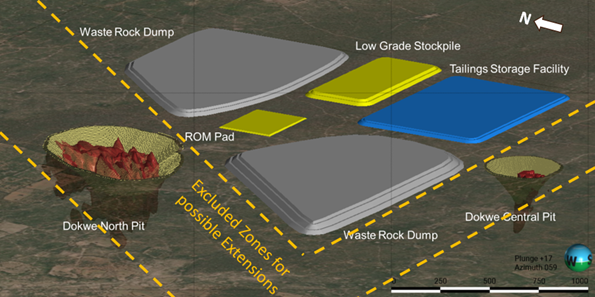
Figure 1: Dokwe Gold Project preliminary surface layout
Pit Optimisation and Design
The industry benchmark Geovia Whittle open pit optimisation software was used to run base case optimisations for Dokwe North and Central using a gold price of US$4,000/oz and inputs generated through work for this PFS or using the 2022 PFS inputs where still relevant (Figures 2 and 3).
The 2025 SOS indicated that 2.5Mtpa was an optimal target and that using elevated cut-offs for process feed material would 'significantly shorten mining life, but at significant NPV upside'. As such, further optimisations were undertaken using elevated cut-offs and stockpiles to determine a cut-off that maximises discounted cashflow.
The results of the optimisations indicate that operating with an elevated cut-off would not only increase the head grade, but in doing so improve the discounted cashflow. A range of cut-offs were tested and a 0.6 g/t Au cut-off run returned the highest discounted cashflow. Given the 0.6 g/t Au cut-off total pit size was close to the base case pit shell, and it was determined that the base case optimisation shell would form the basis of the pit design, with elevated cut-offs applied in the scheduling process.
To allow faster access to ore and defer waste stripping to later in the mine life, it is necessary to mine Dokwe North in four stages (Figure 4). Dokwe Central is to be mined as a single-stage pit.
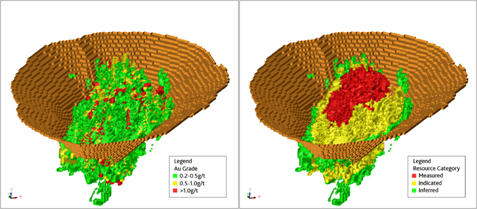
Figure 2: Dokwe North RF1 pit shell with grade distribution (left) and resource classification (right).
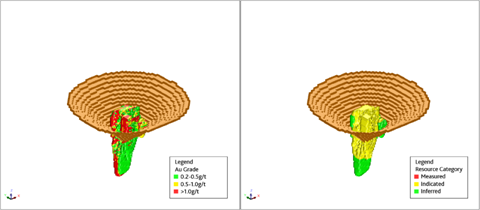
Figure 3: Dokwe Central RF1 pit shell with grade distribution (left) and resource classification (right).
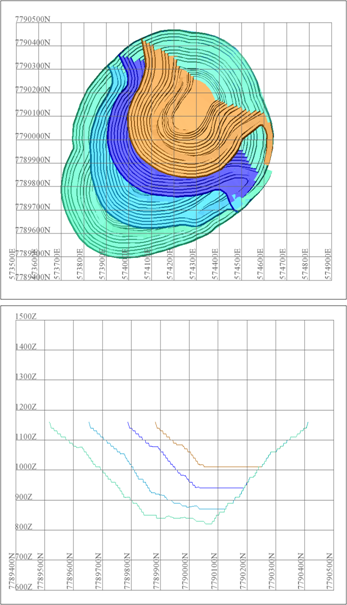
Figure 4: Dokwe North all stages plan view (top) and long-section (north-east to south-west) view (bottom).
Production Schedule
The nameplate capacity of the processing plant is 2.5Mtpa (625kt/qtr) with the mining rate varying from 36Mtpa for the first three quarters, 30Mtpa for a further nine quarters, reducing to 18Mtpa (Figure 5).
The Dokwe production schedule includes 1.8Mt @ 1.38g/t Au of mineralised material from Dokwe Central, accessible via open-pit mining, which has not been converted to Ore Reserve. It is expected that conversion to Ore Reserve is possible once sufficient geotechnical and metallurgical data is obtained.
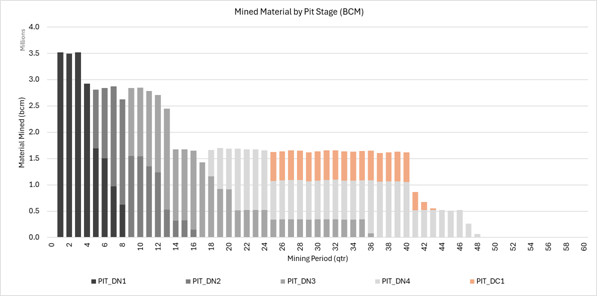
Figure 5: Quarterly mining schedule by pit stage. Dokwe North (DN) stages 1 to 4 and Dokwe Central (DC) stage 1.
Mined material was separated into different categories based on grade, weathering and resource classification (Table 2). All 'unclassified' material was considered waste, as was all material with an in-situ gold grade less than 0.2g/t (the calculated economic cut-off grade, rounded to one decimal place and applied to all weathering types). Inferred material greater than or equal to 0.2g/t Au in-situ was grouped without further delineation between grade. For both Measured and Indicated mineral resources, ore was separated by in-situ grade into three grade bins, low-grade (LG, 0.2-0.5g/t Au), medium-grade (MG, 0.5-1.0g/t Au) and high-grade (HG, >=1.0g/t Au).
Table 2: Material classification of Mineral Resources (0.2 g/t Au to >1 g/t Au: Measured and Indicated) by grade for scheduling.
|
Deposit |
Material |
Volume (Mbcm) |
Tonnes (Mt) |
Grade (g/t) |
|
Dokwe North |
Waste |
60.8 |
161.4 |
|
|
High Grade (>1.0 g/t Au) |
3.9 |
11.0 |
1.91 |
|
|
Medium Grade (0.5-1.0 g/t Au) |
5.8 |
16.3 |
0.57 |
|
|
Low Grade (0.2-0.5 g/t Au) |
6.6 |
18.5 |
0.27 |
|
|
Inferred (>0.2 g/t Au) |
1.0 |
2.7 |
0.51 |
|
|
Dokwe Central |
Waste |
8.8 |
23.6 |
|
|
High Grade (>1.0 g/t Au) |
0.3 |
0.8 |
2.59 |
|
|
Medium Grade (0.5-1.0 g/t Au) |
0.2 |
0.5 |
0.57 |
|
|
Low Grade (0.2-0.5 g/t Au) |
0.2 |
0.5 |
0.28 |
|
|
Inferred (>0.2 g/t Au) |
0.0 |
0.1 |
1.67 |
|
|
Total |
Waste |
69.6 |
185.0 |
|
|
High Grade (>1.0 g/t Au) |
4.2 |
11.8 |
1.95 |
|
|
Medium Grade (0.5-1.0 g/t Au) |
6.0 |
16.8 |
0.57 |
|
|
Low Grade (0.2-0.5 g/t Au) |
6.8 |
19.0 |
0.27 |
|
|
Inferred (>0.2 g/t Au) |
1.0 |
2.8 |
0.56 |
Annual mining by material classification is shown in Figure 6, with Year 0 representing the pre-production mining period prior to the commencement of commissioning of the process plant.
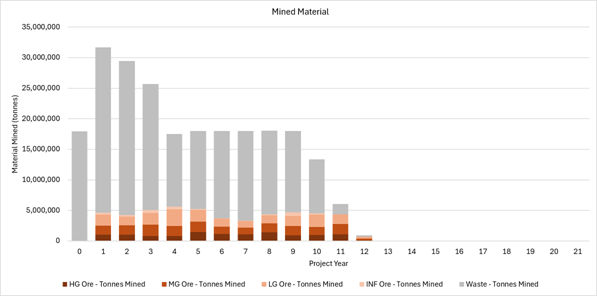
Figure 6: Annual mining schedule by material classification, including Ore Reserves, diluted Inferred resources and waste.
High-grade and medium-grade ore will be preferentially processed with low-grade ore stockpiled on a long-term stockpile and processed once high-grade ("HG") and medium-grade ("MG") ore stocks are exhausted, which is almost coincident with completion of the approximate 12-year mining operations. Low-grade ("LG") ore will extend the processing life by approximately eight years (Figure 7). None of the Inferred material has been included in the processing schedule.
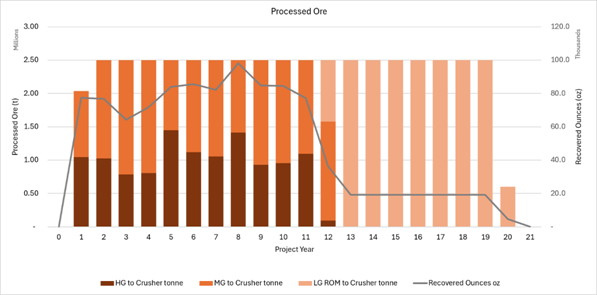
Figure 7: Annual processing schedule by grade classification. None of the Inferred material has been included in the processing schedule.
Ore mined from Dokwe Central is included in the processing schedule despite not being reported as Ore Reserves. Dokwe Central is likely to be included in the Ore Reserve Estimate once appropriate metallurgical and geotechnical studies have been completed. Mining and processing of Dokwe Central has been scheduled to occur well beyond the expected payback period to limit the impact on the financial analysis.
Cashflow Analysis
Capital costs for site establishment and construction have been estimated at US$117.4m, with a further US$46.5m for pre-production mining expenses to be capitalised for a peak funding requirement of US$163.9m. Sustaining capital costs of US$33.1m are to be expensed over the approximate 20-year mine life.
Life of Project operating costs for the project were calculated to be US$890.5m for mining operations, US$1,027.3m for processing operations, US$152.6m for general and administration costs and US$301.5m for refining and royalties. Mining and G&A costs are inclusive of capitalised pre-production expenses.
Gross gold sales over the LoP total US$4,515.9m, resulting in an overall cashflow of US$1,993.5m, generating a Pre-Tax Net Present Value ("NPV") of US$1,056.0m at a discount rate of 10%; post-tax NPV10 of US$740m (A$1,057m). Project payback is expected approximately one year after the commencement of processing operations with an internal rate of return of 92% (Table 3).
Sensitivity analyses indicated that a change to the gold price ±10% has the single greatest impact on the project financials (Figure 8), followed by the discount rate ±2.5% (i.e., 7.5% and 12.5%).
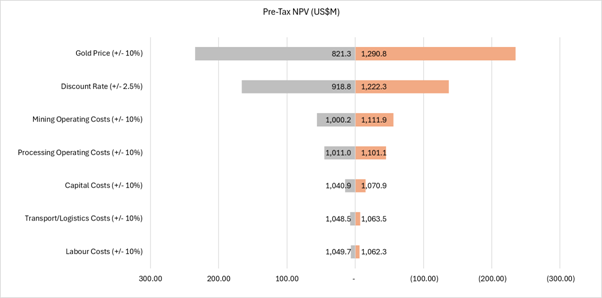
Figure 8: Project sensitivity cyclone chart.
Table 3: Gold price sensitivity in US$500 increments.
|
Gold Price |
$3,250 |
$3,750 |
$4,250 |
$4,750 |
$5,250 |
|
NPV10 (US$M) |
503.7 |
779.8 |
1,056.0 |
1,332.2 |
1,608.4 |
|
IRR |
50% |
71% |
92% |
114% |
136% |
|
Payback (years) |
2.7 |
1.6 |
1.2 |
0.9 |
0.8 |
|
Cashflow (US$M) |
989.4 |
1,491.4 |
1,993.5 |
2,495.6 |
2,997.6 |
The LoM C1 (operating) cost is US$1,685/oz, and the AISC is US$1,995/oz. The C1 costs include mining, processing and G&A OPEX (mine site costs) during the LoM mining and processing phase. The AISC includes mining, processing and G&A OPEX (mine site costs) during the LoM mining and processing phase, plus sustaining and growth capital costs and royalties/refining costs (off-site costs).
Reserve Statement
Measured Resources suitable for inclusion in the Ore Reserve Estimate were classified as Proved Ore Reserves and Indicated Resources suitable for inclusion in the Ore Reserve Estimate were classified as Probable Ore Reserves. Dokwe Central was not included in the Ore Reserve Estimate due to the lack of detail for process recovery and pit wall slope data.
The Ore Reserve Estimate has been reported by grade bin to highlight the elevated grade of the high and medium-grade ore that will be preferentially processed in the first 11 years of the project. Stated Ore Reserves are inclusive of mining dilution and mining recovery factors and reported above an in-situ grade of 0.2g/t Au (Table 4).
Table 4: Dokwe Project Ore Reserve grade differentiation.
|
Grade Bin |
Reserve Classification |
Mined Ore (kt) |
Mined Ore Grade (g/t) |
Mined Au (oz) |
|
High Grade >1.0g/t Au |
Proved |
6,298 |
1.88 |
379,700 |
|
Probable |
4,709 |
1.95 |
294,600 |
|
|
Total |
11,007 |
1.91 |
674,300 |
|
|
Medium Grade 0.5-1.0 g/t Au |
Proved |
8,043 |
0.58 |
150,600 |
|
Probable |
8,273 |
0.55 |
147,200 |
|
|
Total |
16,316 |
0.57 |
297,700 |
|
|
Low Grade 0.2-0.5 g/t Au |
Proved |
6,615 |
0.28 |
59,000 |
|
Probable |
11,932 |
0.27 |
104,200 |
|
|
Total |
18,548 |
0.27 |
163,200 |
|
|
Grand Total |
Proved |
20,956 |
0.87 |
589,200 |
|
Probable |
24,915 |
0.68 |
546,000 |
|
|
Total |
45,871 |
0.77 |
1,135,200 |
Notes
The Dokwe North Ore Reserves are reported within the Dokwe North pit design and include mining dilution and recovery. The Ore Reserves are reported in accordance with the JORC (2012) Code, using a cut-off grade of 0.2g/t Au, calculated and used to constrain the Ore Reserves, as at 22 May 2026. Errors may be present due to rounding. Figures presented above are both gross and net attributable to Ariana, via its subsidiary Canister Resources (Pvt) Ltd in Zimbabwe. This Ore Reserve Estimate was prepared by Anthony Keers, a Competent Person who is a Member and Chartered Professional (CP Mining) of The Australasian Institute of Mining and Metallurgy and has sufficient experience that is relevant to the type of deposit and proposed mining method under consideration and to the activity being undertaken to qualify as a Competent Person.
Mineral Resource Estimate - ASX Listing Rule 5.8.1 Requirements
Geology and Interpretation:
The Dokwe North deposit consists of a sequence of Archaean intermediate to felsic volcanic rocks, interbedded with layers of agglomerate and tuff. A quartz-feldspar porphyry is intruded into the upper part of the sequence. The Archaean rocks have been folded, metamorphosed to greenschist facies and sheared. Gold is particularly concentrated where a NE-trending sub-vertical shear zone interacts with lithological contacts, which typically dip towards the southeast at a moderate angle. All Archaean rock types exhibit some degree of gold mineralisation, with the principal host rocks being dacite, tuff and porphyry (in order of decreasing significance). Coarse visible gold is a characteristic feature of this deposit, with higher-grade zones developing along discrete shear zones.
Dokwe Central is a smaller, higher-grade pipe-like deposit containing abundant quartz veins and several steeply plunging high-grade zones. The Dokwe North and Central deposits are strongly structurally controlled, occupying two distinct structural domains within a broader ENE-trending shear zone. The Dokwe Central geological model includes a second fault zone constraining the resources towards the west.
Previous Resource Estimates:
Since 2004, the Dokwe Project area has undergone many phases of drilling involving over 53,000 metres, three MRE's, and several geotechnical and metallurgical studies. Of this drilling, 48,000m lies within the resource areas and have been included in the Mineral Resource Estimate. Over 40,000 metres of drill core have been analysed with a portable XRF to improve the geological model. This enabled the geology and mineralisation to be modelled utilising geological rather than assay domains, which is considered more appropriate for the style of mineralisation seen at Dokwe. This resulted in a Measured, Indicated and Inferred Resource totalling 1.6 million ounces of gold, across Dokwe North and Dokwe Central, as announced in this release.
This latest iteration of the MRE is constrained by a pit shell optimised at a US$5,000/oz gold price (previous estimate at US$2,750/oz), as shown in Figure 9. The updated resource is reported at a lower cut-off grade of 0.2g/t Au, as the PFS studies have shown this to be economic. The previous resource estimate was reported at a cut-off grade of 0.3g/t Au.
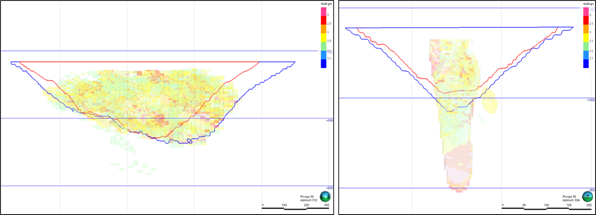
Figure 9: Cross-section through Dokwe North (left) and Dokwe Central (right) showing resource (blue) and reserve (red) pit outlines. The majority of blocks falling between the resource and reserve pits are currently classified as Inferred Resources.
MRE Sampling and Sub-Sampling Techniques:
Diamond drill core was logged from the top to the bottom of the drillhole, including all of the intersections. After logging, the drill core was marked for sampling by a senior geologist. The core was sampled nominally at 1m lengths, apart from where sampling crossed lithological boundaries, where each side of the boundary was sampled separately. Drill core was split in half with a diamond saw, with one half core sample bagged in a plastic bag and then sent to the laboratory and the other half retained in the core trays. In most drillholes, the entire core was sampled, apart from the younger sedimentary cover. In later drillholes, only the mineralised portions of the drill core were sampled. During reverse circulation percussion drilling, samples were collected every 1m into a large plastic bag and then split using a riffle splitter to the desired amount for laboratory analysis. Sample representivity was tested by taking field duplicates and internal laboratory duplicates (pulp and coarse). Sample size is in line with international practice and is appropriate to the grain size of the material being sampled.
MRE Drilling Techniques:
The extent of gold mineralisation at the two deposits is defined by 141 diamond drill holes, 57 percussion drill holes and 31 RC holes across both resource areas. For Dokwe North, the total metres included in the MRE is 34,470m (125 holes) and for Dokwe Central, 5,271m (25 holes), for a combined total of 37,957m of drilling (this excludes the 2025-26 RC drilling). Average collar spacing is approximately 50m and 30m in Dokwe North and Dokwe Central, respectively. At both deposits, there are indications that the mineralisation remains open in several directions. The results of the 2025-2026 RC Drilling Programme and ongoing Geotechnical and Metallurgical Drilling Programmes are not included in this resource estimate.
MRE Classification Criteria:
The Dokwe Project MRE (Dokwe North and Dokwe Central) is classified in accordance with the JORC (2012) Code, including Measured, Indicated and Inferred. The style of mineralisation has been identified, the controls on mineralisation are well understood, and measurements and sampling have been completed to a high degree of confidence for the mineralisation present (Further details in JORC Table 1). It is considered reasonable to expect that some of the Inferred Mineral Resources could be re-classified as Indicated Mineral Resources with continued exploration; however, due to the uncertainty of Inferred Mineral Resources, it should not be assumed that such upgrading will always occur. It is also reasonable to expect that portions of the Indicated Mineral Resources could be upgraded to Measured Mineral Resources with some additional infill data. Reporting of tonnages and metal content is based on the application of a 0.2g/t Au reporting cut-off for both Dokwe North and Dokwe Central. Confidence in the MRE is sufficient to allow the results of the application of technical and economic parameters to be used for further planning in a Feasibility Study. However, additional drilling is underway to help support metallurgical and other technical studies. In addition to supporting a Feasibility Study, this revised MRE will assist in the targeting of future exploratory and resource drilling to expand the resource, particularly in areas surrounding the northern and southwestern extents of Dokwe North and the deeper extents of Dokwe Central.
MRE Sample Analysis Method:
All diamond drill core samples used in this Mineral Resource Estimate have been processed at the ISO-credited Antech Laboratory in Zimbabwe. As part of Ariana's normal operational procedures, 10% of samples are duplicated from split core and sent to a second commercial laboratory (ALS Global in Johannesburg), for check assay. All samples were assayed for gold using a 50g fire assay. Reviews of the assay results have determined that all Quality Control and Quality Assurance samples (blanks, standards and duplicates) passed the quality control checks established by the company, with duplicate samples showing excellent correlation. Laboratory sample preparation, assaying procedures and chain of custody are appropriately controlled. The Company maintains an archive of core samples and a photographic record of all cores for future reference.
MRE Estimation Methodology:
Composites of gold grade within each domain were completed using a 1m best fit routine. The application of a "semi-soft" boundary with a 1-4 metre range (depending on the domain) was used in the estimation to allow data points outside (to a maximum distance of 4m) of the domain boundaries to influence the estimation of grade in blocks inside the boundary, realistically influencing the mineralisation domains at both a local and larger scale.
The core of the shear zone was mapped out by relogging multiple holes, paying particular attention to deformation textures and lithological offsets. From this, a central "core" plane was constructed to simulate the zone of maximum ductile deformation within Dokwe North. This was further modelled using rock fabric and lithological contact measurements collected from orientated drill core.
The Dokwe North shear zone has been defined to be approximately 150m wide, after which foliation intensity in the surrounding rocks decreases rapidly along with gold grades. Mineralisation, particularly in the high-grade domain, is not strictly constrained by ductile deformation features, but is significantly influenced by lithological contacts and changes in the characteristics of each rock unit. Therefore, to incorporate this into the modelling, the various geological contacts defined from over 40,000 pXRF readings and logging were coded into the structural model in Leapfrog, for more precise application of estimation search directions.
Gold grade within each domain was evaluated to identify the effect of higher gold values exceeding 20g/t Au. A closer evaluation of the data showed a reasonable clustering of higher-grade data exceeding 0.7g/t Au, which outlines the core of a major shear zone with several smaller parallel shear zones. Therefore, it was decided to sub-domain this population of data from the main shear zone model.
To preserve some of the high grades within the high-grade domain, it was determined that a hybrid method consisting of a 200g/t Au top-cut and an Outlier Restriction should be applied. The 200g/t Au top-cut reduces the outlier high grades to within range of other very high grades. The Outlier Restriction further reduces the bias by constraining the effect of high grades at a distance (approximately 5-10 metres in this case). Values beyond the restricted distance were clamped to 100g/t Au to prevent the excess influence of very high grades. The capping of the other domains was evaluated through variography analysis to support the Ordinary Kriging estimation method, and then it was backed up by an Outlier Restriction.
Variogram modelling for Dokwe North was completed to support the Ordinary Kriging estimation method. Each domain contained a single search pass, extrapolated to a maximum search of 180 metres. Good variograms were achieved for each domain in all ellipse axes. The Coefficient of Variation values within the supporting statistics were reviewed and deemed satisfactory, given the moderate nugget effect of the deposit.
The Dokwe North block model has been rotated to an azimuth of 47 degrees. The model is sub-blocked, using the mineralisation domain boundaries as a sub-blocking trigger. The parent blocks are 10m x 20m x 10m (X,Y,Z), with sub-blocks of 5m x 5m x 5m (X,Y,Z). The Dokwe Central block model is made up of 5m x 5m x 5m blocks, is not sub-blocked and is not rotated.
MRE Cut-off Grade:
The Mineral Resource has been reported at 0.2g/t Au cut-off grade. This cut-off grade has been used to approximate potential marginal mining cut-off grades for open-pit mining methods.
MRE Modifying Factors:
Modifying factors have not been applied to the Resources, but have been studied in detail for the Ore Reserve Estimate. Mining factors such as dilution, ore loss, recoverable resources at selective mining block sizes, etc. have been applied at the reserve estimation stage.
Ore Reserve Estimate - ASX Listing Rule 5.9.1 Requirements
Material Assumptions:
The material assumptions and outcomes from the updated PFS, which support the forecast financial information derived from the production target, are disclosed in the body of this announcement.
Criteria Used for the Classification of Ore Reserves:
Measured Resources suitable for inclusion in the Ore Reserve Estimate were classified as Proved Ore Reserves, and Indicated Resources suitable for inclusion in the Ore Reserve Estimate were classified as Probable Ore Reserves. Dokwe Central was not included in the Ore Reserve Estimate due to the lack of detail for process recovery and pit wall angle data.
Mining Method and Assumptions:
Updated mining costs were obtained through a request for quotation process carried out by Auralia in 2025, whereby mining contractors operating in southern Africa were approached to provide full costs for a contract mine operation.
The RFQ process consisted of a data pack shared with the contractors with schedules based on work completed in March 2025 and the utilisation of both rigid and articulated dump trucks and small to medium class excavators. An indicative site layout was also included, which assumed 2km haul distances to the ROM pad located next to the processing plant from both deposits and waste dumps being located proximally to the deposits. The schedules required contractor unit rate inputs for load and haul, drill and blast, fixed quarterly costs, and site establishment.
Processing Method and Assumptions:
The nameplate capacity of the processing plant is 2.5Mtpa (625kt/qtr) with the mining rate varying from 36Mtpa for the first three quarters, 30Mtpa for a further nine quarters, reducing to 18Mtpa.
High-grade ("HG") and medium-grade ("MG") ore will be preferentially processed, with low-grade ("LG") ore stockpiled on a long-term stockpile and processed once HG and MG ore stocks are exhausted, which is almost coincident with completion of the approximate 12-year mining operations. LG ore will extend the processing life by approximately eight years.
Processing capital and operating costs have been re-estimated by the Xinhai Mining Group using the 2022 PFS design criteria, with modifications for an increase in throughput from 1.5Mtpa to 2.5Mtpa, the exclusion of a heap leach process and the use of traditional wet disposal of process tailings.
Cut-Off Grades:
Mined material was separated into different categories based on grade, weathering and resource classification. All "unclassified" material was considered waste, as was all material with an in-situ gold grade less than 0.2g/t (the calculated economic cut-off grade, rounded to one decimal place and applied to all weathering types). Inferred material greater than or equal to 0.2g/t Au in-situ was grouped without further delineation between grade. For both Measured and Indicated mineral resources, ore was separated by in-situ grade into three grade bins, low-grade (LG, 0.2-0.5g/t Au), medium-grade (MG, 0.5-1.0g/t Au) and high-grade (HG, >=1.0g/t Au). Stated Ore Reserves are inclusive of mining dilution and mining recovery factors and reported above an in-situ grade of 0.2g/t Au. Mining dilution and mining recovery were applied as 5% and 95%, respectively.
Estimation Methodology:
The industry benchmark Geovia Whittle open pit optimisation software was used to run base case optimisations using a gold price of US$4,000/oz and inputs generated through work for this PFS or using the 2022 PFS inputs where still relevant.
Material Modifying Factors:
Material modifying factors have been discussed previously in this document. There are no known environmental, permitting, legal, title, taxation, socio-economic, marketing, political or other factors that will materially affect the Ore Reserve Estimate.
Glossary of Technical Terms
"Au" chemical symbol for gold;
"CIL" Carbon in Leach gold processing;
"g/t" grams per tonne;
"High Grade" In the context of the Dokwe Project, mineralised material which exceeds 1 g/t Au in grade;
"In Pit Resources" Resources which are constrained by optimisation pit shells, with "current" economic inputs, which define minable mineralisation, and demonstrates reasonable prospects for economic extraction;
"Inferred Mineral Resource" is that part of a Mineral Resource for which quantity and grade (or quality) are estimated on the basis of limited geological evidence and sampling. Geological evidence is sufficient to imply but not verify geological and grade (or quality) continuity. It is based on exploration, sampling and testing information gathered through appropriate techniques from locations such as outcrops, trenches, pits, workings and drill holes. An Inferred Mineral Resource has a lower level of confidence than that applying to an Indicated Mineral Resource and must not be converted to an Ore Reserve. It is reasonably expected that the majority of Inferred Mineral Resources could be upgraded to Indicated Mineral Resources with continued exploration;
"Indicated Mineral Resource" is that part of a Mineral Resource for which quantity, grade (or quality), densities, shape and physical characteristics are estimated with sufficient confidence to allow the application of Modifying Factors in sufficient detail to support mine planning and evaluation of the economic viability of the deposit. Geological evidence is derived from adequately detailed and reliable exploration, sampling and testing gathered through appropriate techniques from locations such as outcrops, trenches, pits, workings and drill holes, and is sufficient to assume geological and grade (or quality) continuity between points of observation where data and samples are gathered. An Indicated Mineral Resource has a lower level of confidence than that applying to a Measured Mineral Resource and may only be converted to a Probable Ore Reserve;
"IRR" Internal Rate of Return (IRR) is the discount rate that makes the net present value (NPV) of all cash flows from an investment equal to zero. It represents the expected annualized effective compounded return rate of the investment.
"JORC" Joint Ore Reserves Committee;
"k" thousand
"km" Kilometres;
"LoP" Life of Project, relating to the processing-only phase;
"LoM" Life of Mine, relating to the mining and processing phase;
"Low Grade" In the context of the Dokwe Project, mineralised material which occupies a grade range between 0.2 g/t Au and 0.5 g/t Au in grade;
"m" Metres;
"Measured Mineral Resource" is that part of a Mineral Resource for which quantity, grade (or quality), densities, shape, and physical characteristics are estimated with confidence sufficient to allow the application of Modifying Factors to support detailed mine planning and final evaluation of the economic viability of the deposit. Geological evidence is derived from detailed and reliable exploration, sampling and testing gathered through appropriate techniques from locations such as outcrops, trenches, pits, workings and drill holes, and is sufficient to confirm geological and grade (or quality) continuity between points of observation where data and samples are gathered. A Measured Mineral Resource has a higher level of confidence than that applying to either an Indicated Mineral Resource or an Inferred Mineral Resource. It may be converted to a Proved Ore Reserve or under certain circumstances to a Probable Ore Reserve;
"Medium Grade" In the context of the Dokwe Project, mineralised material which occupies a grade range between 0.5 g/t Au and 1 g/t Au in grade;
"MRE" Mineral Resource Estimate;
"M" million;
"Mtpa" Million tonnes per annum;
"NPV" Net Present Value (NPV) is a financial method used to assess the value of an investment by calculating the present value of expected future cash flows and comparing it to the initial investment cost. A positive NPV indicates that the investment is likely to be profitable, while a negative NPV suggests a loss;
"oz" Troy ounces;
"Probable Ore Reserve" is the economically mineable part of an Indicated, and in some cases, Measured Mineral Resource. The confidence in the Modifying Factors applying to a Probable Ore Reserve is lower than that applying to a Proved Ore Reserve;
"Proved Ore Reserve" is the economically mineable part of a Measured Mineral Resource. A Proved Ore Reserve implies a high degree of confidence in the Modifying Factors;
"Reasonable Prospects for Eventual Economic Extraction" or RPEEE is a term used in the JORC code which states that the resource as reported should have an assumed profitability within a realistic and defined time period. It is accepted that the method of extraction (open pit or underground) and the method of processing needs to have been reasonably determined (but not necessarily finalised) at the time of reporting;
"t" tonnes.
Compliance Statements
The information in this announcement relating to Mineral Resources and Ore Reserves has been reported by the Company in accordance with the 2012 Edition of the 'Australasian Code for Reporting of Exploration results, Mineral Resources and Ore Reserves' (JORC Code) previously (refer to the Company's replacement prospectus which was released to the ASX market platform on 8 September 2025 (Prospectus) and is available on the Company website at http://www.arianaresources.com/) (Previous Market Announcement).
The Company confirms that it is not aware of any new information or data that materially affects the information included in the Previous Market Announcement and, in the case of estimates of Mineral Resources and Ore Reserves, that all material assumptions and technical parameters underpinning the estimates in the Previous Market Announcement continue to apply and have not materially changed.
Competent Persons Statement
The information in the Investment Overview Section of the prospectus (included at Section 3), the Company and Projects Overview (included at Section 5), and the Independent Geologist's Report (included at Annexure A of the prospectus), which relate to exploration targets, exploration results, mineral resources, Ore Reserves and forward looking financial information is based on, and fairly represents, information and supporting documentation prepared by Alfred Gillman, Ruth Woodcock, Izak van Coller, Hovhannes Hovhannisyan (together, the JORC Competent People), and Richard John Siddle, Andrew Bamber and Daniel Van Heerdan (together, the Qualified People). Refer to the Independent Geologist's Report for further information in relation to the information compiled by each of the JORC Competent People and the Qualified People, their professional memberships, their relevant qualifications and experience, and their relationship with the Company.
The information in this announcement relating to the Mineral Resource Estimate at the Dokwe Gold Project is based on, and fairly represents, information and supporting documentation prepared by Ms. Ruth Woodcock, Exploration Group Leader, Ariana Resources plc. Ms. Woodcock is a member of Recognised Professional Organisations as defined by JORC 2012: a Chartered Geologist (CGeol, Geological Society of London) and European Geologist (EurGeol, European Federation of Geologists) and has sufficient experience which is relevant to the style of mineralisation and type of deposit under consideration and to the activity upon which she is reporting as a Competent Person as defined in the 2012 Edition of "The Australasian Code for Reporting of Exploration Results, Mineral Resources and Ore Reserves." Ms. Woodcock consents to the inclusion in this report of the matters based on the information compiled by her, in the form and context in which it appears.
The information in this announcement that relates to Ore Reserves is based on information compiled by Anthony Keers, a Competent Person who is a Member and Chartered Professional (CP Mining) of The Australasian Institute of Mining and Metallurgy. Anthony Keers is Managing Director of Auralia Mining Consulting. Anthony Keers has sufficient experience that is relevant to the type of deposit and proposed mining method under consideration and to the activity being undertaken to qualify as a Competent Person as defined in the 2012 Edition of the Australasian Code for Reporting of Exploration Results, Mineral Resources and Ore Reserves. Mr. Keers consents to the inclusion in this report of the matters based on the information compiled by him, in the form and context in which it appears.
The Company confirms that the form and context in which the Competent Persons' findings are presented have not been materially modified from the previous announcements.
Forward-looking statements and disclaimer
This announcement contains certain "forward-looking statements". Forward-looking statements can generally be identified by the use of forward looking words such as "forecast", "likely", "believe", "future", "project", "opinion", "guidance", "should", "could", "target", "propose", "to be", "foresee", "aim", "may", "will", "expect", "intend", "plan", "estimate", "anticipate", "continue", "indicative" and "guidance", and other similar words and expressions, which may include, without limitation, statements regarding plans, strategies and objectives of management, anticipated production dates, expected costs or production outputs for the Company, based on (among other things) its estimates of future production of the Projects.
To the extent that this document contains forward-looking information (including forward-looking statements, opinions or estimates), the forward-looking information is subject to a number of risk factors, including those generally associated with the gold exploration, mining and production businesses. Any such forward-looking statement also inherently involves known and unknown risks, uncertainties and other factors that may cause actual results, performance and achievements to be materially greater or less than estimated. These factors may include, but are not limited to, changes in commodity prices, foreign exchange fluctuations, general economic and share market conditions, increased costs and demand for production inputs, the speculative nature of exploration and project development (including the risks of obtaining necessary licenses and permits and diminishing quantities or grades of reserves), changes to the regulatory framework within which the Company operates or may in the future operate, environmental conditions including extreme weather conditions, geological and geotechnical events, and environmental issues, and the recruitment and retention of key personnel.
- ENDS -
The Board of Ariana Resources plc has approved this announcement and authorised its release.
For further information on the Company, please visit the website, or please contact the following:
Contacts:
|
Ariana Resources plc Michael Atkins, Non-Executive Chairman Dr Kerim Sener, Managing Director |
|
info@arianaresources.com |
|
|
|
|
|
Beaumont Cornish Limited (Nominated Adviser) Roland Cornish / Felicity Geidt |
|
Tel: +44 (0) 20 7628 3396 |
|
|
|
|
|
Zeus Capital (Joint Broker) Harry Ansell / Katy Mitchell
Fortified Securities (Joint Broker) Guy Wheatley
Yellow Jersey PR Limited (UK Financial PR) Dom Barretto / Shivantha Thambirajah
M&C Partners (Aus Financial PR) Christina Granger / Ben Henri
Shaw and Partners Limited (Lead Manager - ASX) Damien Gullone
|
|
Tel: +44 (0) 203 829 5000
Tel: +44 (0) 203 411 7773
Tel: +44 (0) 7983 521 488 arianaresources@yellowjerseypr.com
Tel: +61 438 227 286 christina.granger@mcpartners.com.au
Tel: +61 (0)2 9238 1268
|
Beaumont Cornish Limited ("Beaumont Cornish") is the Company's Nominated Adviser and is authorised and regulated by the FCA. Beaumont Cornish's responsibilities as the Company's Nominated Adviser, including a responsibility to advise and guide the Company on its responsibilities under the AIM Rules for Companies and AIM Rules for Nominated Advisers, are owed solely to the London Stock Exchange. Beaumont Cornish is not acting for and will not be responsible to any other persons for providing protections afforded to customers of Beaumont Cornish nor for advising them in relation to the proposed arrangements described in this announcement or any matter referred to in it.
About Ariana Resources:
Ariana is a mineral exploration and development company dual listed on AIM (AIM: AAU) and ASX (ASX: AA2), with an exceptional track record of creating value for its shareholders through its interests in active mining projects and investments in exploration companies. Its current interests include a major gold development project in Zimbabwe, gold-silver operations in Türkiye and copper-gold-silver exploration and development projects in Kosovo and Cyprus.
For further information on the vested interests Ariana has, please visit the Company's website at www.arianaresources.com.
Zeus Capital Limited, Fortified Securities and Shaw and Partners Limited are the brokers to the Company, and Beaumont Cornish Limited is the Company's Nominated Adviser.
Ends.
JORC Table 1 - Dokwe
Section 1 Sampling Techniques and Data
(Criteria in this section apply to all succeeding sections.)
|
Criteria |
JORC Code explanation |
Commentary |
|
Sampling techniques |
· Nature and quality of sampling (eg cut channels, random chips, or specific specialised industry standard measurement tools appropriate to the minerals under investigation, such as down hole gamma sondes, or handheld XRF instruments, etc). These examples should not be taken as limiting the broad meaning of sampling. · Include reference to measures taken to ensure sample representivity and the appropriate calibration of any measurement tools or systems used. · Aspects of the determination of mineralisation that are Material to the Public Report. · In cases where 'industry standard' work has been done this would be relatively simple (eg 'reverse circulation drilling was used to obtain 1 m samples from which 3 kg was pulverised to produce a 30 g charge for fire assay'). In other cases more explanation may be required, such as where there is coarse gold that has inherent sampling problems. Unusual commodities or mineralisation types (eg submarine nodules) may warrant disclosure of detailed information. |
· Soil samples were collected from 15cm deep pits, screened to -1mm, on lines 400m apart with 50m samples composited over 400m. The samples were analysed by Intertek Genalysis in Perth Australia using their partial extraction method (TL1) to determine Au, Ag, As, Co, Cu, Sb by ICP-MS. Sampling was carried in the Regional, Intermediate, follow-up and Detailed phases. For regional samples +-2kg samples were collected and sent to Peacock & Simpson & Associates laboratory in Harare for heavy mineral concentration, and the concentrate sent to Intertek Genalysis laboratory in Perth. Intermediate, follow-up, and detailed samples were passed through a -1mm sieve, and +-100g of the fine sample was sent to Intertek Genalysis. There was no QA/QC on the soil analyses apart from internal lab checks. · Portable XRF analysis for approximately 40,000 readings was taken across 138 archived diamond drill holes. Readings were taken at 1m intervals directly onto cleaned core surfaces. The results obtained were used to identify relative geochemical characteristics of the Dokwe geology. The pXRF unit used was an Olympus Vanta. QA/QC samples were utilised at the start of each session and then at approximately every 100 readings. · Portable XRF analysis for a total of 10,086 soil samples were collected across the tenement area. Samples were collected on a grid of 50 m by 200 m, reducing spacing to 50 m by 100 m in areas of priority interest. Once the soil sample is dry, a pXRF reading is taken from the soil sample to obtain multi-element geochemistry. The pXRF unit used was an Olympus Vanta. QA/QC samples were utilised at the start of each session and then at approximately every 100 readings. · Next, a 250g sub-sample is weighed and placed into a plastic pouch with 500ml of reagent added and a collector device (CD) attached to the inside of the cap of the pouch. The pouches are placed in a barrel and tumbled for 12 hours. After this, the pouches are removed from the drum and CDs are removed from the pouches, rinsed gently in water, and dried in a dehydrator oven for three hours. This detectORETM technology has been used to analyse 811 of the pXRF soil samples from priority areas. · Reverse circulation drill samples taken in 2025 - 2026 were split using a multi-tiered splitter to obtain a 3-5kg representative sample for dispatch to the laboratory. RC chip samples for every meter were collected straight from the drill rig using a sample cyclone. Wet samples were speared multiple times to obtain a representative sample mass. Less than 10% of the obtained samples were wet. · The drill rig cyclone was typically cleaned after every rod run (3m). |
|
Drilling techniques |
· Drill type (eg core, reverse circulation, open-hole hammer, rotary air blast, auger, Bangka, sonic, etc) and details (eg core diameter, triple or standard tube, depth of diamond tails, face-sampling bit or other type, whether core is oriented and if so, by what method, etc). |
· Diamond drillholes were collared with HQ core size (63.5mm diameter) to a more competent ground and then continued with NQ core size (47.6mm diameter) to the end of drillhole. Some drillholes drilled between 2003 and 2007 were drilled with narrower BQ core size (36.4mm diameter). The diameter of the percussion drillholes was 152mm. Diamond drillholes drilled in 2020 for metallurgical purposes were collared with PQ core size (85mm) to more competent ground and then continued with HQ core to the end of hole and the diameter of sterilisation percussion drillholes was 133mm. Diamond drillholes drilled in 2023-2024 for due diligence purposes were predominantly drilled using standard HQ drill rods. However, some holes were collared with PQ-sized rods to approximately 100m. Deeper holes (>250 metres), were drilled to final depth using NQ rods after HQ (DPD132). · The drill core since 2019 was oriented using the Boart Longyear TruCoreTM UPIX core orientation system. The NQ core was oriented but highly weathered and broken HQ core was not oriented. The whole of the geotechnical drillhole core was oriented. The due diligence drillholes (DPD129 - DPD132) core were oriented. · Reverse Circulation drilling completed in 2025 - 2026 used a Thor 5000 drill rig with a 5-inch hammer size and 24 bars of air pressure on the rig, with an additional 14 bars of pressure from an off-rig booster. All RC holes drilled were surveyed using a multishot and later gyroscopic survey tool on approximately 20m intervals. |
|
Drill sample recovery |
· Method of recording and assessing core and chip sample recoveries and results assessed. · Measures taken to maximise sample recovery and ensure representative nature of the samples. · Whether a relationship exists between sample recovery and grade and whether sample bias may have occurred due to preferential loss/gain of fine/coarse material. |
· Drillhole recoveries were measured during each diamond drilling campaign and a total average recovery of 94% was achieved for the diamond drillholes to 2020, whereas 73% was achieved for the 2021 sterilisation percussion drillholes. However, recovery data pertaining to the percussion drillholes (32 drillholes) and five additional diamond drillholes drilled between 2003 and 2004 were not available at the time of reporting. Recovery for the 2023-2024 programme was 98.62%. · The sample recoveries were maximised through drilling techniques and consistent monitoring. · Sample recoveries versus grade relationships were not assessed. It is the CP's opinion that there is no bias with respect to drilling technique and sampling methodology utilised. · Drill sample recovery for the 2025 - 2026 RC drilling was monitored by weighing each raw sample directly from the cyclone for every meter. The average sample mass of all samples was 32kg (80% recovery). Samples with poor recovery (i.e. <40%) were dominantly samples from within 10 meters of the surface, where poor recoveries are expected due to the lithology (Kalahari sands). No mineralisation intervals were documented within the first 10 metres of any of the holes drilled. |
|
Logging |
· Whether core and chip samples have been geologically and geotechnically logged to a level of detail to support appropriate Mineral Resource estimation, mining studies and metallurgical studies. · Whether logging is qualitative or quantitative in nature. Core (or costean, channel, etc) photography. · The total length and percentage of the relevant intersections logged. |
· All drillholes drilled on Dokwe Project were logged geologically and the logging included "from" and "to" depth, lithology, colour, grain size, weathering, oxidation, and mineralisation. · All drillholes have been geologically logged to a level of detail to support Mineral Resource estimation. · Drillhole logging is qualitative in nature. During the 2019 drilling, the diamond drill core was also photographed both wet and dry at the drill site and photos. · All diamond core and percussion chips were completely logged from the top to the bottom of drillhole including all intersections. · RC chips for every metre of drilling completed during the 2025 - 2026 campaign were sieved, washed and logged. A full archive of chips has been retained for every metre drilled. These have been photographed in their respective chip trays for further documentation. Geological logs are digitised and loaded into Leapfrog software to review. |
|
Sub-sampling techniques and sample preparation |
· If core, whether cut or sawn and whether quarter, half or all core taken. · If non-core, whether riffled, tube sampled, rotary split, etc and whether sampled wet or dry. · For all sample types, the nature, quality and appropriateness of the sample preparation technique. · Quality control procedures adopted for all sub-sampling stages to maximise representivity of samples. · Measures taken to ensure that the sampling is representative of the in situ material collected, including for instance results for field duplicate/second-half sampling. · Whether sample sizes are appropriate to the grain size of the material being sampled. |
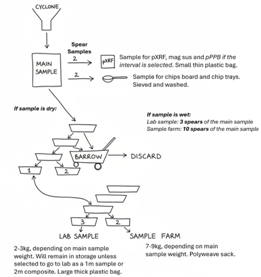
· During sampling, samples were marked at 1m intervals apart from where the sampling crossed lithological boundaries where each side of the lithological contact was sampled separately. · After logging and marking of samples, the diamond drill core was then split in half by a diamond saw with one half stored for future reference and the other half core was sent to the laboratory for analyses. · Diamond drill core was logged from the top to the bottom of the drillhole including all the intersections, after logging, the drill core was marked for sampling by a senior geologist. The core was sampled nominally in 1m length apart from where sampling crossed lithological boundaries where each side of the boundary was sampled separately. Drill core was split in half with a diamond saw with one half core sample bagged in a plastic bag and then sent to the laboratory and the other half was retained in the core trays. In most drillholes, the entire core was sampled apart for the younger sedimentary cover. In later drillholes, only the mineralised portions of the drill core were sampled. · During percussion drilling, samples were collected every 1m into a large plastic bag and then split using a riffle splitter to desired amount for the laboratory analysis. · Sample representativity was tested by taking field duplicates and internal laboratory duplicates. · Sample size is in line with international practice and is appropriate to the grain size of the material being sampled. · Sample preparation and handling for the 2025 - 2026 RC drilling were all completed at the drill site as each hole progressed. The illustration below is a summary of the sample splitting procedure used during this programme. · |
|
Quality of assay data and laboratory tests |
· The nature, quality and appropriateness of the assaying and laboratory procedures used and whether the technique is considered partial or total. · For geophysical tools, spectrometers, handheld XRF instruments, etc, the parameters used in determining the analysis including instrument make and model, reading times, calibrations factors applied and their derivation, etc. · Nature of quality control procedures adopted (eg standards, blanks, duplicates, external laboratory checks) and whether acceptable levels of accuracy (ie lack of bias) and precision have been established. |
· Sample analyses were carried out at Antech, SGS Lakefield Research Africa, Intertek Genalysis Laboratories and ALS Global in South Africa. · Sample preparation at Antech laboratories involved drying the sample, crushing, pulverising, riffle splitting, and packaging. A small portion of the pulverised material, 50g, was analysed for gold by fire assay with atomic absorption ("AA") finish. · At Intertek Genalysis South Africa, the sample preparation involved drying the sample, crushing, pulverising, riffle splitting, and packaging. After going through the sample preparation stages, the final sample for analysis weighed approximately 50g and was shipped to Australia for analysis. All samples were assayed for gold by 50g fire assay with optical emission spectrometers ("OES") finish. · Details pertaining to the analytical procedure at SGS Lakefield Research Africa was not available at the time of reporting. · Analytical techniques utilised at the laboratories are considered total. · No assay methods other than those conducted at the accredited laboratory (Antech, Intertek Genalysis, SGS Lakefield Research Africa Laboratory), were utilised in the generation of the Dokwe sampling database. Note that the details pertaining to the accreditation status for SGS Lakefield Research Africa Laboratory was not available, however, this data was not used in the MRE work outlined here. · Between 2003 and 2007, blanks and duplicates were inserted into the sampling sequence. Between 2008 and 2011, CRMs, blanks and duplicates were inserted into the sampling sequence. · During 2019 and 2020 sampling campaigns, the QA/QC protocol for insertion of QA/QC samples was that one in every 10th sample sent to the laboratory will either be a blank or one of the four CRM. · During the 2023 sampling, every batch of 34 samples sent to Antech included 1 CRM, 1 blank, 1 field duplicate and 1 pulp duplicate. · An adequate number of control samples were utilised during core sampling. · During Ariana's 2023 due diligence review of the Dokwe Project approximately 10% of samples extracted from DPD129 (Dokwe North) and DPD131 (Dokwe Central) were duplicated as quarter core and sent to ALS Global in South Africa for check analysis against the Antech laboratory in Zimbabwe. Results are satisfactory. · pXRF readings are taken on diamond drill core using a 3-beam Vanta M Series (VMR) with test timings set to Beam 1: 30s - Beam 2: 20s - Beam 3: 20s. Soil samples for pXRF are collected and air dried prior to analysis. Test timings for soils are set to Beam 1: 40s - Beam 2: 30s - Beam 3: 30s. For all pXRF analyses the unit is calibrated (cal check) at the start of the session. Following this, other QA/QC samples (blank, CRM, calibration disc) were utilised at the start and end of each session and at approximately every 100 readings. · For detectORETM analyses, each batch of 90 samples contains two reference materials supplied by Portable PPB which are processed and analysed in the same way as the other samples. The reference materials are not certified but have known concentrations of gold. They are used to check that the leach and collection process has worked as intended for that batch. In addition, two blanks and two field duplicates were included in every 90 samples. The pXRF detectORETM mode is firmware installed on portable XRF devices to allow detection of gold values from the CD's, controlled via API coupled to pLIMS™ software that also manages the QA/QC. The pXRF detectORETM mode is calibrated using five Calibrated Collector Devices of varying concentrations of gold from 0 to 1,000 ppb equivalent. Once dried, the CDs are analysed for gold using Evident's detectORETM mode on a Vanta M Series (VMR) pXRF. · RC samples from DRC1 - DRC22 were submitted to the Antech Laboratory and subjected to the same 50g shot assay procedure as used in all other programs described above. Samples from DRC22 - DRC31 were submitted to Performance Laboratories. · Antech: 17 samples per batch (including 1 CRM and alternating 1 duplicate or 1 blank) at a 11.8% insertion rate. Performance: 19 samples per batch (including 1 CRM and alternating 1 duplicate or 1 blank) at a 10.5% insertion rate. Each lab also includes their own internal CRMs, blanks and duplicates. QA/QC results are satisfactory. · Umpire laboratory checks are underway. · An adequate number of control samples were utilised during RC sampling. · Antech Laboratories and Performance Laboratories are both SADCAS accredited (ISO/IEC 17025:2017). |
|
Verification of sampling and assaying |
· The verification of significant intersections by either independent or alternative company personnel. · The use of twinned holes. · Documentation of primary data, data entry procedures, data verification, data storage (physical and electronic) protocols. · Discuss any adjustment to assay data. |
· Dokwe North is an advanced exploration property that has a database with 103 diamond drillholes, 7 RC drillholes, 15 percussion drillholes and 25 sterilisation RC drillholes. · Less than 2km SE, Dokwe Central has 24 diamond drillholes, 12 RC drillholes and 5 percussion holes and has been audited by Digital Mining Services (DMS) in the past. · In addition to the Dokwe North and Central holes 42 holes have been drilled in prospects in the vicinity of Dokwe. · As part of verification, the QA/QC for the various drilling campaigns were reviewed and the drilling database was verified. · The original Dokwe drilling database was in the form of Microsoft Access database. The Dokwe drillhole database included 2003-2004, 2007, 2008, 2009, 2010, 2019 and 2020 drilling campaigns. The database was checked for duplicates, overlapping, and missing intervals, whilst all fields were checked for spurious or out-of-range values. The database has been uploaded to MXDeposit as part of the Due Diligence study. · The Due Diligence drilling included a twin hole (DPD129), which correlated very well with its twin DPD49. · For detectORETM analyses all samples and sample information are tracked using the bar codes on the pouches and the CD's. The sample numbers are entered into proprietary pLIMSTM software, Portable PPB's software interface for sample management and results. The barcodes prevent manual errors in data entry. · For detectORETM analyses the gold concentration is calculated based on the weight of the original sample and moisture content, and the amount of gold on the CD (i.e., gold leached into solution). The gold concentration is given as dU (detectORETM units), where a dU represents the leached and collected gold in micrograms of gold. This is a partial extraction, not a total gold result. The laboratory results from the trial batches are compared to the detectORETM results, and a correlation coefficient is established. This equation is used to predict the ppm (g/t) values the dU correlates with, and thus help define samples to be analysed at a laboratory using conventional assay. The detectORE™ results when compared to fire assays also provide detailed geometallurgical insights and leach characteristics, further adding value to this process. · During pXRF analyses, samples are analysed in numerical order, and a sheet is completed to note the inserted QA/QC samples. These are digitised and combined with the data export from the pXRF on a daily basis. No adjustment is made to pXRF data for soils or core in the raw data set. |
|
Location of data points |
· Accuracy and quality of surveys used to locate drill holes (collar and down-hole surveys), trenches, mine workings and other locations used in Mineral Resource estimation. · Specification of the grid system used. · Quality and adequacy of topographic control. |
· The coordinate utilised for Dokwe is WGS84 Universal Transverse Mercator ("UTM") Zone 35 South. · All drillhole collars up have been surveyed by qualified professional surveyors Drysdale and Associates using RTK GPS (3 - 5mm accuracy) which is linked to the national grid. The coordinates were provided in Universal Transverse Mercator ("UTM") on Cape Datum. · During 2019 and 2020 drilling programme, all drillholes were downhole surveyed at 6m intervals using Boart Longyear - TruShotTM digital survey tools. In order to obtain the complete survey of the holes, the surveys were done separately for the HQ and NQ diameter of the holes. Earlier drillholes (DPD001 - 010) were downhole surveyed at 50m intervals using Reflex EZ- Shot™ equipment. Subsequently drillholes were downhole surveyed with Reflex EZ-Shot (Reflex single shot) and DeviFlexi tools and were surveyed at 25m and from DPD060 to DPD084 the interval decreased to 4m to 6m. No downhole survey was carried out on the percussion drillholes and six diamond drillholes drilled between 2003 and 2004 as well as the sterilisation drillholes drilled in 2021. Downhole surveys were carried out for the 2023-24 drilling. · In 2016, Southern Mapping Company (Pty) Ltd, was contracted by Canister to carry out a LiDAR survey of the topography. This was tied into WGS84 with better than 10cm accuracy, non-ground points were filtered out and an orthophoto and topographical contours were generated at 0.5m contour intervals. · In 2023, a drone survey over the Dokwe North area captured 2,600 detailed 12-megapixel aerial images to produce a high- resolution (4cm/pixel) photogrammetry map. This was used to validate and locate all historic collars within the immediate Dokwe North area to within 1m accuracy. · Collar positions of the 2025 - 2026 RC drilling were recorded in the field by handheld GPS, and later by DGPS. Each collar was preserved by a concrete block with the hole ID and coordinates clearly engraved. Downhole surveys for the 2025 - 2026 RC drilling were completed on 20m intervals using an OMNIx42 multishot tool, and then later after the first four holes a DeviGyro gyroscopic survey tool. |
|
Data spacing and distribution |
· Data spacing for reporting of Exploration Results. · Whether the data spacing and distribution is sufficient to establish the degree of geological and grade continuity appropriate for the Mineral Resource and Ore Reserve estimation procedure(s) and classifications applied. · Whether sample compositing has been applied. |
· Data spacing and distribution are sufficient to establish the degree of geological and grade continuity appropriate for the Mineral Resource estimation and classification. · A 1m compositing interval was selected and applied to the de- surveyed drillholes. Composites were selected from all drill holes except sterilisation RC holes. DOKWE NORTH · A total of 150 drillholes (including percussion and geotechnical drillholes) have been drilled at Dokwe North. At Dokwe North, drillholes were systematically laid out on 15 section lines (approximately 320º azimuth) spaced 50m apart and the collars were also spaced at 50m along the section lines. · Of these 150 holes, a total of 25 sterilisation percussion drillholes were drilled on a square grid of 350m over the proposed waste dump, plant, heap leach, tailings dam, and solar farm sites to the southeast of Dokwe North. · The total metres drilled within the resource area (i.e. excluding sterilisation holes) is 32,727m (116 holes). DOKWE CENTRAL · A total of 41 drillholes (including percussion drillholes) have been drilled at Dokwe Central. At Dokwe Central, most drillholes were systematically laid out on 3 section lines (E-W azimuth) spaced 50m apart and the collars were also spaced at 25m along the section lines, resulting in an average of 30m between holes. · In the resource area there are 6,834m (24 holes). |
|
Orientation of data in relation to geological structure |
· Whether the orientation of sampling achieves unbiased sampling of possible structures and the extent to which this is known, considering the deposit type. · If the relationship between the drilling orientation and the orientation of key mineralised structures is considered to have introduced a sampling bias, this should be assessed and reported if material. |
· Dokwe North drillholes were systematically laid out on a section line (approximately 320º azimuth) generally perpendicular to the strike and most of the drillholes were drilled towards the northwest to intersect the mineralised orebodies very close to normal relative to the reef plane. · At Dokwe Central, drillholes were systematically laid out on section lines (E-W azimuth) generally perpendicular to the strike and most of the drillholes were drilled towards the north to intersect the mineralised orebodies very close to normal relative to the reef plane. · Available information indicates that the drilling orientation would provide unbiased sampling of the mineralisation zones. · Due diligence drilling in 2023 drilled from various orientations to better test the mineralisation and confirm that the drilling has provided unbiased sampling. · The geotechnical drilling was also completed in various orientations. |
|
Sample security |
· The measures taken to ensure sample security. |
· The core was then transported to the core yard for geological logging and sampling. After logging and marking of samples, the diamond drill core was then cut in half by a diamond saw with one half stored for future reference and the other half core was sent to the laboratory for analyses. · During percussion drilling, samples were collected in large bags and then split using a sample riffle splitter. After splitting, samples were bagged in plastic bags, the remaining bulk sample was transported to the main office about 125km from site and stored at a shed in the early years, but stored on site in the recent sterilization programme. · All samples were transported by company personnel to the laboratory. They were signed off for dispatch from the core yard and on receipt to the laboratory. · All drill core is stored at the Dokwe Camp. · RC drilling completed during 2025 - 2026: all samples were handled on the active drill sites. Split samples for laboratory analysis were bagged, securely sealed, and stored at the base camp sample dispatch (approximately 2km from the drill sites) until ready to be sent directly to Antech Laboratories and Performance Laboratories. |
|
Audits or reviews |
· The results of any audits or reviews of sampling techniques and data. |
· In 2008 Digital Mining Services completed a data review and verification of the drilling results to date. · The sampling for the Due Diligence study has been supervised by the CP of this MRE. |
Section 2 Reporting of Exploration Results
(Criteria listed in the preceding section also apply to this section.)
|
Criteria |
JORC Code explanation |
Commentary |
|
Mineral tenement and land tenure status |
· Type, reference name/number, location and ownership including agreements or material issues with third parties such as joint ventures, partnerships, overriding royalties, native title interests, historical sites, wilderness or national park and environmental settings. · The security of the tenure held at the time of reporting along with any known impediments to obtaining a licence to operate in the area. |
· Ariana owns 100% of the Dokwe Project following the all-share merger with Rockover Holdings Limited in June 2024. · Dokwe is held through 81 blocks of gold claims and 22 copper base metal claims totalling 4,040ha which are protected up until at least August 2026. The claims can be extended through annual inspection. Canister made application to the Ministry of Mines and Mining Development in March 2021 under Part VIII of the Mines and Minerals Act (MMA) to convert the claims into a Mining Lease with the aim is to facilitate the development of a significant new gold mine at Dokwe. The Mining Lease application is for gold and base metals, and the area applied for is 6,622ha. The Ministry requested additional information in support of the application which has been submitted. · The Project is currently not subjected to payment of royalties or other payments. Government royalties will be payable once mining operations are developed. A private royalty of 0.5% will also be payable once production starts. · As far as the CP is aware, no statutory instrument has been gazetted implementing an environmental fund as yet, so no fees are due or anticipated. In addition, the CP is not aware of any requests being made to Rockover by the Minister to implement an environmental fund. As such, no environmental rehabilitation trusts and guarantees have been established for Dokwe.
|
|
Exploration done by other parties |
· Acknowledgment and appraisal of exploration by other parties. |
· Acknowledgement is hereby made for the historical exploration conducted by Reunion Mining in 1993. Reunion Mining undertook a detailed airborne magnetic survey over an area of approximately 1,000km2. The detailed airborne magnetic survey indicated the presence of an east-northeast trending linear magnetic feature buried beneath the younger sedimentary cover. This magnetic data forms part of the database used in the interpretation of the Exploration Results. |
|
Geology |
· Deposit type, geological setting and style of mineralisation. |
GENERAL DOKWE AREA · The Dokwe gold deposits are situated in Archaean basement rocks buried by up to 40 metres of Karoo and Kalahari sedimentary cover. · The Dokwe area can be subdivided into a number of litho-structural domains which are juxtaposed against each other by a series of shear zones. The three known gold occurrences within the Claims Area are within shear zones, which have a combined strike length of approximately 12km. DOKWE NORTH · The geology of Dokwe North primarily consists of a sequence of Late Archean-aged greenstone volcaniclastics. These include dacite-to-andesite flows featuring amygdaloidal rich horizons, interbedded felsic tuffs, agglomerates, and irregular rhyolite flows. · The sequence is intruded by earlier quartz-feldspar porphyries and later altered dolerite. Brittle deformation, characterised by fracturing, is common in felsic tuff whilst more ductile deformation characterises dacite and andesite. · A major brittle fault, the "Western" fault is post-mineralised structure dissecting offsetting mineralisation.
· The main Dokwe North orebody occurs within a NE-SW trending shear zone that displays a central core with intense foliation and mylonitisation of the host rocks. · Primary gold mineralisation at Dokwe is preserved as free gold and occasionally as inclusions in quartz veins, micro-fractures in pyrite, and other open-space micro-features. · The mineralisation is primarily structurally controlled and associated with the intensity of shearing and with lithological contacts. Visible gold has been documented multiple times and is often associated within the foliation planes formed by shearing. · Overlying all the basement stratigraphy is a sequence of barren sedimentary rocks. DOKWE CENTRAL · Dokwe Central is higher-grade pipe-like deposit containing abundant quartz veins and several steeply plunging high-grade zones. Mineralisation is contained within a series of strongly sheared intermediate chlorite schists and biotite-chlorite schists in a covered Archean Greenstone Belt, extending from the border with Botswana (Maitengwe Greenstone Belt) and linking up with the Bulawayo-Bubi Greenstone Belt to the east. The Archaean greenstone units are overlain by Karoo and Kalahari sedimentary units of up to 25-40m in thickness. · Mineralisation appears to be dominantly constrained within intensely sheared and brecciated zones, and in association with disseminated sulphides (dominantly pyrite). · The defined mineralisation extent is abruptly terminated against a package of sedimentary rocks to the north, marking a major east-west trending fault. |
|
Drill hole Information |
· A summary of all information material to the understanding of the exploration results including a tabulation of the following information for all Material drill holes: o easting and northing of the drill hole collar o elevation or RL (Reduced Level - elevation above sea level in metres) of the drill hole collar o dip and azimuth of the hole o down hole length and interception depth o hole length. · If the exclusion of this information is justified on the basis that the information is not Material and this exclusion does not detract from the understanding of the report, the Competent Person should clearly explain why this is the case. |
DOKWE NORTH · Drillhole database consists of a total of 141 drillholes totalling 34,477m. The database is split with: o 101 diamond drillholes (incl. 5 geotechnical holes) totalling 31,286m. o 15 percussion drillholes totalling 1,441m. o 25 RC sterilisation holes totalling 1,750m. o 7 RC drillholes totalling 1,177m. DOKWE CENTRAL · Drillhole database consisted of a total of 24 drillholes, totalling 5,166m. The database is split with: o 19 diamond drillholes totalling 4,816m. o 5 percussion drillholes totalling 350m. o 12 RC drillholes totalling 2,321m. DOKWE AREA · Drilling across the wider area includes 42 drillholes totalling 7,382m.
· All collar information has been previously announced.
|
|
Data aggregation methods |
· In reporting Exploration Results, weighting averaging techniques, maximum and/or minimum grade truncations (eg cutting of high grades) and cut-off grades are usually Material and should be stated. · Where aggregate intercepts incorporate short lengths of high grade results and longer lengths of low grade results, the procedure used for such aggregation should be stated and some typical examples of such aggregations should be shown in detail. · The assumptions used for any reporting of metal equivalent values should be clearly stated. |
· The sample intervals from the raw de-surveyed drillhole dataset were analysed for the most appropriate composite length to be applied for geostatistical analysis. The mean of the population is 1.13m, with approximately 75% of the population being exactly 1m in length. Given the data, a 1m compositing interval was selected and applied to the de-surveyed drillholes. Composites were selected from all drill holes, except RC sterilisation drilling data. · No metal equivalents were calculated.
|
|
Relationship between mineralisation widths and intercept lengths |
· These relationships are particularly important in the reporting of Exploration Results. · If the geometry of the mineralisation with respect to the drill hole angle is known, its nature should be reported. · If it is not known and only the down hole lengths are reported, there should be a clear statement to this effect (eg 'down hole length, true width not known'). |
· At Dokwe North, drillholes were systematically laid out on section lines (approximately 320º azimuth) generally perpendicular to the strike, and most of the drillholes were drilled towards the northwest to intersect the mineralised orebodies very close to normal relative to the structural plane. · At Dokwe Central, drillholes were systematically laid out on section lines (E-W azimuth) generally perpendicular to the strike and most of the drillholes were drilled towards the north to intersect the mineralised orebodies very close to normal relative to the reef plane. · Downhole true widths are not calculated. All significant grades presented represent the value attributable to the real sample length and not corrected true width. |
|
Diagrams |
· Appropriate maps and sections (with scales) and tabulations of intercepts should be included for any significant discovery being reported. These should include, but not be limited to a plan view of drill hole collar locations and appropriate sectional views. |
· All relevant diagrams pertaining to sampling type and its distribution, as well as geological and block models are presented in their respective sections and have been generated in accordance with the guidelines described in the JORC Code.
|
|
Balanced reporting |
· Where comprehensive reporting of all Exploration Results is not practicable, representative reporting of both low and high grades and/or widths should be practiced to avoid misleading reporting of Exploration Results. |
· The Mineral Resource Estimate is based on the information resulting from sampling and drilling campaigns. This Mineral Resource estimation summary contains information for all sampling and drilling campaigns within the Project Area to date. · All material intercepts have been previously announced. |
|
Other substantive exploration data |
· Other exploration data, if meaningful and material, should be reported including (but not limited to): geological observations; geophysical survey results; geochemical survey results; bulk samples - size and method of treatment; metallurgical test results; bulk density, groundwater, geotechnical and rock characteristics; potential deleterious or contaminating substances. |
· Exploration works other than drilling conducted by or on behalf of the issuer includes soil geochemistry, geophysical survey (induced polarisation survey, real section induced polarisation, magnetic survey), and lidar survey. Some of this data has been incorporated into the Mineral Resource Estimation work completed here. · Soil geochemistry surveys have been completed in the periphery of Dokwe North and at the Dokwe Central prospect. A total of 10,086 samples have been collected to date. detectORETM technology has been used to analyse 811 of these samples in the first instance. · pXRF soil sampling grid.
· detectORETM soil sampling grid.
|
|
Further work |
· The nature and scale of planned further work (eg tests for lateral extensions or depth extensions or large-scale step-out drilling). · Diagrams clearly highlighting the areas of possible extensions, including the main geological interpretations and future drilling areas, provided this information is not commercially sensitive. |
· Further exploration will be carried out in the region, particularly exploring the downdip of Dokwe North. Additional target areas defined previously will also be followed up. · pXRF work is ongoing across all Dokwe North drillholes, and is being used in the geological modelling. Over 40,000 readings have been taken to date. · Follow up of significant grades intercepted in DPD004 approximately 800m east of Dokwe Central. · Exploration drilling at Dokwe North and Dokwe Central extensions. |
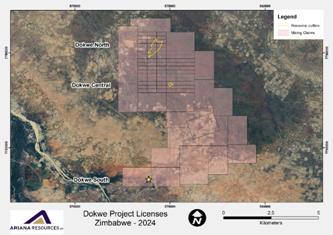
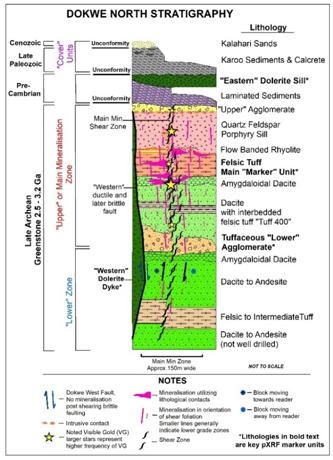
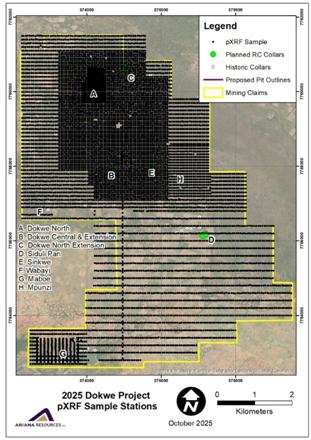
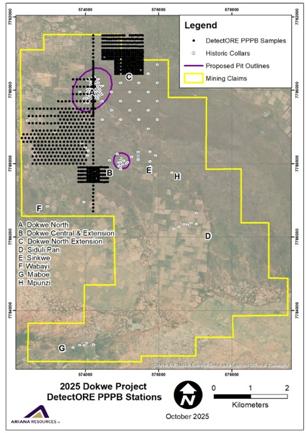
Section 3 Estimation and Reporting of Mineral Resources
(Criteria listed in the preceding section also apply to this section.)
NOTE: THIS SECTION IS ONLY RELEVANT FOR DOKWE NORTH AND DOKWE CENTRAL.
|
|
|
|
|
Database integrity |
· Measures taken to ensure that data has not been corrupted by, for example, transcription or keying errors, between its initial collection and its use for Mineral Resource estimation purposes. · Data validation procedures used. |
· The original Dokwe drilling database was in the form of a Microsoft access database. The Dokwe drillhole database included all drilling prior to 2023. This data was imported to MXDeposit. All data collected during the 2023-2024 due diligence drilling programme was added directly to MXDeposit, and similarly for all consequent drilling. · The QA/QC for the various drilling campaigns was reviewed and deemed suitable for the results to be used in a mineral resource estimate. The Dokwe drillhole database was checked for duplicates, overlapping and missing intervals on import into Leapfrog, whilst all fields were checked for spurious or out-of-range values. Any errors were corrected prior to modelling. |
|
Site visits |
· Comment on any site visits undertaken by the Competent Person and the outcome of those visits. · If no site visits have been undertaken indicate why this is the case. |
· As Competent Person for the Mineral Resources presented in this Report, Ruth Woodcock has conducted many site visits, with the first one in April 2024 and most recently in November 2025 during the RC drilling programme. Drillhole collar positions were confirmed, and diamond drill core was inspected in the core yard. It was confirmed that the mineralisation is disseminated and not related to a distinct lithology or structural feature. Varying degrees of deformation were observed in association with more mineralisation. |
|
Geological interpretation |
· Confidence in (or conversely, the uncertainty of ) the geological interpretation of the mineral deposit. · Nature of the data used and of any assumptions made. · The effect, if any, of alternative interpretations on Mineral Resource estimation. · The use of geology in guiding and controlling Mineral Resource estimation. · The factors affecting continuity both of grade and geology. |
· There is a high level of confidence in the geological interpretation, the deposit is well sampled, and the density of data allows for a suitable interpretation of the grade distribution. · A sub-selection of the original drillhole logs and laboratory assay certificates were compared to the final Dokwe drillhole database. The CP was present during the logging of the 2023-2024 drillholes, and again in January 2025 for detailed review of high-grade zones. DOKWE NORTH · Digital Mining Services completed an MRE as an updated statement in January 2020. This estimate was largely focused around two explicitly modelled grade wireframes at 0.5g/t and 0.2g/t Au. Only composites from within the 0.5g/t Au grade shell were considered in that estimate, whilst for the 0.2g/t Au shell estimate, the remainder of the composites (excluding composites from within the 0.5g/t Au shell) were used for interpolation of that shell. This resulted in a distinct grade boundary between the two shell estimates. This "hard" boundary in grades may not necessarily be evident in the distribution of grades present in the drillhole data. · The estimation and Mineral Resource categorisation methodologies between the January 2020 estimate and the estimate presented in the 2022 PFS, are significantly different, and have resulted in significant differences in terms of both volume and grade for all Mineral Resource categories. · The 2022 Minxcon Mineral Resource estimate presented in the PFS represents a broader implicit grade shell (at 0.2g/t Au) estimate, and an internal 0.7g/t Au sub-domain, and would result in larger volumes and lower average grades than the previous estimation methodology. · 2024 Estimation: A lithological model was used to constrain the estimation of grade into the block model, with gold estimated separately into each lithology domain. Grade clamping was applied (instead of a top-cut) so as to preserve the high grades, but minimise the distance the grade can be spread. This was a 50, 20 and 10g/t Au clamp for passes 1, 2 and 3, respectively. · 2025 Estimation: The biggest change since the previous resource work was the new mineralisation model, which constrained mineralisation in three geologically and structurally defined domains, leading to a far more robust mineralisation interpretation model. A high-grade interpolant model at a modelling cut-off of 0.7g/t Au was used to isolate high-grade data through the deposit. High-grade within this particular domain was capped to 200g/t Au and then further constrained with the application of an Outlier Restrictor, clamping of high grades were set to 100g/t Au and limited to 5-10 meter extrapolation. High grades were also evaluated during the variography analysis stage of the estimation, where further capping was applied to improve variogram correlation. · 2026 Estimation: This estimate is the same as the 2025 estimate, but is reported at a lower cut-off grade of 0.2g/t Au (previously 0.3g/t Au) and constrained to a pit optimised at US$5,000 (previously US$3,000). DOKWE CENTRAL · DMS completed an MRE in 2011. The 2011 estimation domains were manually constructed wireframes base on three vertically dipping bodies. The 2011 MRE was evaluated to be very conservative with wireframe boundaries being very restrictive in joining clusters of mineralised composites. · 2024-2026 Ariana Estimates: A lithological model was used to constrain the estimation of grade into the block model, with gold estimated separately into each lithology domain. A top-cut of 30g/t Au was applied to minimise the distance the grade can be spread. The estimate was completed in two search passes of 10x20x40m and 20x40x80m. · The 2024-2026 estimation domains are based on a lithological model between two primary geological packages (hanging wall biotite schists (mineralised) and footwall sedimentary gritstones/conglomerates (barren)). Separating the two geological packages is a significant east-west trending fault (very similar to the 2011 interpretations). Mineralisation was restricted from extrapolating across to the "barren" sedimentary units. Within the biotite mineralisation package search ellipse inputs were used from the 2011 MRE to re-establish and validate mineralisation continuity in the new model. · Interpolation modelling with support from pXRF data from eight diamond drill holes, as well as additional new drill holes drilled at the deposit since 2011 (mainly two new holes drilled by Ariana in 2023), is thought to have made more representative iso-surface volumes as an update to mineralisation interpretations. · In 2025 the Dokwe Central geological model was further refined to include a second major N-S fault zone, adding restrictions to the model's mineralisation extrapolation. As a result, Inferred resources were reduced to better reflect the influence of the bounding structures. |
|
Dimensions |
· The extent and variability of the Mineral Resource expressed as length (along strike or otherwise), plan width, and depth below surface to the upper and lower limits of the Mineral Resource. |
· The Dokwe North orebody is 780m along strike, 470m across strike (across the thickest portion of the deposit), and the depth from the surface is between 42m and 320m. · The Dokwe Central orebody is 260m by 200m across and the depth from the surface is between 25m and 350m. |
|
Estimation and modelling techniques |
· The nature and appropriateness of the estimation technique(s) applied and key assumptions, including treatment of extreme grade values, domaining, interpolation parameters and maximum distance of extrapolation from data points. If a computer assisted estimation method was chosen include a description of computer software and parameters used. · The availability of check estimates, previous estimates and/or mine production records and whether the Mineral Resource estimate takes appropriate account of such data. · The assumptions made regarding recovery of by-products. · Estimation of deleterious elements or other non-grade variables of economic significance (eg sulphur for acid mine drainage characterisation). · In the case of block model interpolation, the block size in relation to the average sample spacing and the search employed. · Any assumptions behind modelling of selective mining units. · Any assumptions about correlation between variables. · Description of how the geological interpretation was used to control the resource estimates. · Discussion of basis for using or not using grade cutting or capping. · The process of validation, the checking process used, the comparison of model data to drill hole data, and use of reconciliation data if available. |
· Leapfrog Geo 2026.1.0 software was used to construct the geological wireframes/mineralised halos, while Leapfrog Edge 2026.1.0 was used to conduct statistical and geostatistical analyses and generate the estimated block model. · No assumptions were made in terms of selective mining units with respect to the cell size selected. · No assumptions were made regarding correlation between variables. · Several data-model reconciliations were performed. Firstly, a visual inspection of drillhole composite values with respect to the estimated block model was completed. DOKWE NORTH · An Ordinary Kriging estimate was completed. Swath plots indicate a good correlation between drilling data and estimated block grades. · A variography study was completed for each mineralisation domain used in the estimation. All domains produced good variograms. To reduce bias and improve the variography, a top-cut analysis was completed during the variography study. This is separate from the additional top-cut and Outlier Restriction analysis completed later in the estimation. · In summary, the various validations and reconciliation techniques demonstrate that the block model estimates show a good correlation between interpolation methods and with the informing composites. Furthermore, the estimation quality and low conditional bias parameters appear to indicate that the estimation technique has provided an acceptable estimate without excessive smoothing. · A 47 degree rotated sub-block model was established using block sizes determined to be optimal for the dataset (50m collar spacing) and wireframe geometry, with sub-blocks triggered by mineralisation boundaries. For Dokwe North the parent blocks are 10m x 20m x 10m (X,Y,Z), with sub-blocks of 5m x 5m x 5m (X,Y,Z). · Three domains were modelled and estimated. 1) Zones of intense ductile deformation logged through the deposit as foliation intensity; as a means to map out the primary extent of a mineralising shear zone (Shear Zone Domain) 2) A sub-domain within the Shear Zone Domain, which is statistically defined to be a sub-population of "high-grade" data, which uses a 0.7g/t Au interpolant shell with extrapolation to a maximum distance of 150m (High-grade Domain) 3) A wider interpolant, modelling the maximum footprint of mineralisation in all peripheral areas away from the main shear zone; modelled at a 0.1g/t Au model cut-off with a 150m extrapolation (Low-grade Domain). Table below: Kriging ellipse input for all domains:
Table below from top to bottom, Low-grade domain, High-grade domain and wider Shear Zone domain:
Summary of Variography inputs used for the High Grade Domain:
Summary of Variography inputs used for the Low Grade Domain:
Summary of Variography inputs used for the Shear Zone Domain:
DOKWE CENTRAL · An IDW2, Inverse Distance estimation, was used for Dokwe Central, as this was deemed most appropriate for the nature of the deposit, and statistical outputs. An Ordinary Kriging estimate was also completed as a means to check the IDW2 estimation. This produced similar grades and tonnages to the IDW2 method. However, suitable variograms were not defined. · In summary, the various validations and reconciliation techniques demonstrate that the block model estimates show a good correlation between various interpolation methods and with the informing composites. Furthermore, the estimation quality and conditional bias parameters appear to indicate that the estimation technique has provided an acceptable estimate without excessive smoothing. · An orthogonal non-rotated block model was established using block sizes determined to be optimal for the dataset (30m collar spacing) and wireframe geometry. For Dokwe Central this was 10m x 10m x 5m (X,Y,Z).
|
|
Moisture |
· Whether the tonnages are estimated on a dry basis or with natural moisture, and the method of determination of the moisture content. |
· The density is based on water displacement measurements which give the dry rock mass. |
|
Cut-off parameters |
· The basis of the adopted cut-off grade(s) or quality parameters applied. |
· Using the mining factors refined from the 2022 pre-feasibility study on Dokwe, the actual cut-off grade that was determined was 0.26g/t Au. The 2026 PFS determined a cut-off grade of 0.2g/t Au to be economic. The CP have opted for 0.2g/t Au reporting cut-off for the 2026 Mineral Resource Estimate. |
|
Mining factors or assumptions |
· Assumptions made regarding possible mining methods, minimum mining dimensions and internal (or, if applicable, external) mining dilution. It is always necessary as part of the process of determining reasonable prospects for eventual economic extraction to consider potential mining methods, but the assumptions made regarding mining methods and parameters when estimating Mineral Resources may not always be rigorous. Where this is the case, this should be reported with an explanation of the basis of the mining assumptions made. |
· Optimisation inputs used for the 2026 MRE work for Dokwe North and Dokwe Central are the same as the 2026 PFS (See JORC Table 1 Section 4), but with a gold price of US$5,000. DOKWE NORTH · Measured, Indicated and Inferred Mineral Resources have been stated within an optimised resource pit shell based on a $5,000 gold price. DOKWE CENTRAL · Indicated and Inferred Mineral Resources have been stated within an optimised resource pit shell based on a $5,000 gold price. These were not converted to Ore Reserves due to insufficient metallurgical and geotechnical data. |
|
Metallurgical factors or assumptions |
· The basis for assumptions or predictions regarding metallurgical amenability. It is always necessary as part of the process of determining reasonable prospects for eventual economic extraction to consider potential metallurgical methods, but the assumptions regarding metallurgical treatment processes and parameters made when reporting Mineral Resources may not always be rigorous. Where this is the case, this should be reported with an explanation of the basis of the metallurgical assumptions made. |
DOKWE NORTH · The processing of oxide material is envisaged to be done using conventional CIL processing as limited preg-robbing properties were identified. The transitional and sulphide material will likely be processed through flotation with high-intensity leaching (CIP) of the flotation concentrate. · The table below shows the metal recoveries determined from metallurgical test work. In summary, of the total gold content, 25.9% is recovered by gravity, with 61.35% by flotation and intense leach - giving a total recovery of 87.35%.
DOKWE CENTRAL · Detailed metallurgical testwork has not been completed on Dokwe Central but some samples were included in early composites. There are no indications that gold recovery will be problematic, particularly following the results of the detectORETM analysis undertaken on the due diligence drilling core. · Oxide and Transitional components of the sulphide zone dominant Dokwe Central mineralisation have been defined and make up a small proportion of the mineralisation. Since Dokwe Central will be processed alongside Dokwe North, it is assumed processing of oxide material will be done using conventional CIL processing. The transitional and sulphide material will likely be processed through flotation with high-intensity leaching (CIP) of the flotation concentrate. |
|
Environmental factors or assumptions |
· Assumptions made regarding possible waste and process residue disposal options. It is always necessary as part of the process of determining reasonable prospects for eventual economic extraction to consider the potential environmental impacts of the mining and processing operation. While at this stage the determination of potential environmental impacts, particularly for a greenfields project, may not always be well advanced, the status of early consideration of these potential environmental impacts should be reported. Where these aspects have not been considered this should be reported with an explanation of the environmental assumptions made. |
· No environmental factors or assumptions were applied to this Mineral Resource Estimation. · Flora and Fauna surveys have been undertaken and there is not expected to be any significant impact on the environment or conservation values. · Waste material remaining on site are not considered to pose any environmental risk. |
|
Bulk density |
· Whether assumed or determined. If assumed, the basis for the assumptions. If determined, the method used, whether wet or dry, the frequency of the measurements, the nature, size and representativeness of the samples. · The bulk density for bulk material must have been measured by methods that adequately account for void spaces (vugs, porosity, etc), moisture and differences between rock and alteration zones within the deposit. · Discuss assumptions for bulk density estimates used in the evaluation process of the different materials. |
· Specific gravity measurements have been collected during the resource drilling at Dokwe. A programme of sampling across strike on 3 lines was undertaken on the pre-2019 drilling resulting in 100 density measurements. During the 2019 drilling campaign, 6 drillholes on 6 lines in the south-eastern portion of the project were sampled for density in a much more comprehensive programme, with 327 measurements being taken. · On average, 18cm core samples were measured. The samples were weighed in the air, and then weighed in water, the SG was calculated, by dividing the weight of the sample in the air by the weight of the sample in the water. Samples were sealed with grease to prevent water ingress and ensure that they any porosity was taken into account. The table below presents average SG for different oxidation type. · A Specific Gravity ("SG") estimation model was established for Dokwe North. 475 SG readings from 22 drillholes were coded into the final block model. This data includes 158 verification samples taken by Ariana during the company's due diligence review. Average SG measurements across Dokwe North range from 2.71g/cm3 in the oxide zone, 2.76g/cm3 in the transitional zone to 2.81g/cm3 in the sulphide zone. · No historical SG data exists for Dokwe Central. However, Ariana acquired 92 measurements through the deposit profile from two drill holes completed during its 2023 due diligence drilling programme. The average SG for these 92 measurements is 2.69g/cm3. This was applied to the Dokwe Central model as a representative flat rate. |
|
Classification |
· The basis for the classification of the Mineral Resources into varying confidence categories. · Whether appropriate account has been taken of all relevant factors (ie relative confidence in tonnage/grade estimations, reliability of input data, confidence in continuity of geology and metal values, quality, quantity and distribution of the data). · Whether the result appropriately reflects the Competent Person's view of the deposit. |
DOKWE NORTH · The Mineral Resource is classified and reported in accordance with the 2012 JORC Code as Measured, Indicated, and Inferred. The classification is determined based on kriging efficiency and distance from drilling. These are given in more detail under the section "Estimation and modelling techniques". · Measured Mineral Resources have been defined using a search pass ellipse with a search diameter of 30mx15mx10m, as well as a review of kriging efficiency and slope of regression statistics. From this, a volume was built to capture the most appropriate volume for the highest confidence-spaced data. · Indicated Mineral Resources have been defined using a search pass ellipse with a search diameter of 60mx30mx20m, as well as a review of kriging efficiency and slope of regression statistics. From this, a volume was built to capture the most appropriate volume for the next highest confidence-spaced data. · Inferred Mineral Resources have been defined using a search pass ellipse with a search diameter of 180mx60mx40m, as well as a review of kriging efficiency and slope of regression statistics. From this, the remaining available volume within the mineralisation model was filled to maximise the expanse of mineralisation extrapolation to a maximum distance of 180m. DOKWE CENTRAL · The Mineral Resource is classified and reported in accordance with the 2012 JORC Code as Indicated and Inferred. The classification is determined based on search pass spacing, with increasing confidence with proximity to drill holes. These are given in more detail under section "Estimation and modelling techniques". · Measured Mineral Resources have not been defined. · Indicated Mineral Resources have been defined by Pass 1 (up to 10m x 20m x 40m). · Inferred Mineral Resources have been defined in areas beyond the Indicated search radius to the limits of the resource wireframes in Pass 2 (up to 20m x 40m x 80m). |
|
Audits or reviews |
· The results of any audits or reviews of Mineral Resource estimates. |
· Internal reviews of the Mineral Resource estimate were completed. |
|
Discussion of relative accuracy/ confidence |
· Where appropriate a statement of the relative accuracy and confidence level in the Mineral Resource estimate using an approach or procedure deemed appropriate by the Competent Person. For example, the application of statistical or geostatistical procedures to quantify the relative accuracy of the resource within stated confidence limits, or, if such an approach is not deemed appropriate, a qualitative discussion of the factors that could affect the relative accuracy and confidence of the estimate. · The statement should specify whether it relates to global or local estimates, and, if local, state the relevant tonnages, which should be relevant to technical and economic evaluation. Documentation should include assumptions made and the procedures used. · These statements of relative accuracy and confidence of the estimate should be compared with production data, where available. |
· Several data-model reconciliations were performed. Firstly, a visual inspection of drillhole composite values with respect to the estimated block model was completed. Visually there is a good correlation between the estimated ordinary kriging gold values and the composite gold values, and the raw assay data. · Basic statistics have been compiled comparing the model estimates and composites. · In summary, the various validations and reconciliation techniques demonstrate that the block model estimates show a good correlation between various interpolation methods and with the informing composites. Furthermore, the estimation quality and conditional bias parameters appear to indicate that the estimation technique has provided an acceptable estimate without excessive smoothing. · Overall wider block distribution accuracy is considered acceptable as evidenced by direct drillhole verses block model checks, ensuring acceptable localised accuracy. · Accuracy of the estimate relative to production data cannot be ascertained at this point as there is no production. |

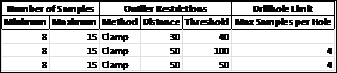
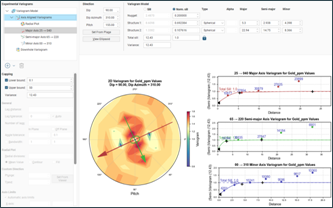
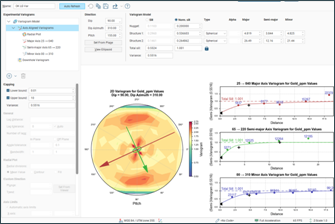
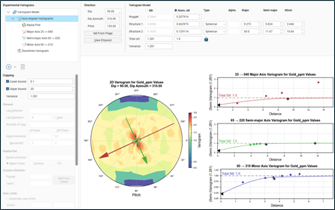
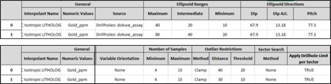
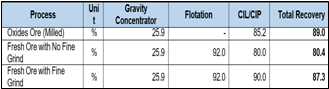
Section 4 Estimation and Reporting of Ore Reserves
(Criteria listed in the preceding section also apply to this section.)
NOTE: THIS SECTION IS ONLY RELEVANT FOR DOKWE NORTH.
|
Criteria |
JORC Code Explanation |
Commentary |
|||||||||||||||||||||||||||||||||||||||||||||||||||||
|
Mineral Resource estimate for conversion to Ore Reserves
|
Description of the Mineral Resource estimate used as a basis for the conversion to an Ore Reserve. Clear statement as to whether the Mineral Resources are reported additional to, or inclusive of, the Ore Reserves. |
· The Mineral Resources of the Dokwe Gold Project were estimated by Ms Ruth Woodcock of Ariana Resources, and announced on 21 May 2026. · The following comprises the Mineral Resources reported at a cut-off grade of 0.2g/t Au within a pit shell generated using a US$5,000/oz gold price:
· The following table comprises the Ore Reserves for the Dokwe Project inclusive of mining dilution and recovery, within pit designs based on pit shells generated using a US$4,000/oz gold price and reported at a cut-off grade of 0.2g/t Au as at May 22, 2026.
Notes: Figures in tables may not sum due to rounding. The Mineral Resources are reported as wholly inclusive of the Ore Reserves. |
|||||||||||||||||||||||||||||||||||||||||||||||||||||
|
Site visits |
A site visit is to be carried out by the competent person(s) signing off on the Ore Reserve. |
· Mr Anthony Keers, Competent Person for the Ore Reserve Estimate, conducted a site visit in February 2026. |
|||||||||||||||||||||||||||||||||||||||||||||||||||||
|
Study status |
The type and level of study undertaken to enable Mineral Resources to be converted to Ore Reserves. The Code requires that a study to at least Pre-Feasibility Study level has been undertaken to convert Mineral Resources to Ore Reserves. Such studies will have been carried out and will have determined a mine plan that is technically achievable and economically viable, and that material Modifying Factors have been considered. |
· This work was undertaken at Preliminary Feasibility Study level, the Ore Reserve portion of which was carried out on supplied Mineral Resource models. · Any material classified as an Inferred Mineral Resource was not included in the Ore Reserve calculations. · Dokwe North was included in the Ore Reserve Estimate. · Dokwe Central was not included in the Ore Reserve Estimate given a lack of detail in geotechnical analysis and processing recoveries. |
|||||||||||||||||||||||||||||||||||||||||||||||||||||
|
Cut-off parameters |
The basis of the cut-off grade(s) or quality parameters applied. |
· A cut-off grade of 0.2g/t Au was calculated based on the base case cost and processing recovery inputs and used to generate the production schedule and estimate the Ore Reserve. · Ore was split by in-situ grade with high-grade (>1.0g/t Au) and medium-grade (0.5-1.0g/t Au) preferentially fed to the process, low-grade ore (0.2-0.5g/t Au) was stockpiled and processed once high and medium-grade ore stocks were exhausted. |
|||||||||||||||||||||||||||||||||||||||||||||||||||||
|
Mining factors or assumptions |
The method and assumptions used as reported in the Pre-Feasibility or Feasibility Study to convert the Mineral Resource to an Ore Reserve (i.e. either by application of appropriate factors by optimisation or by preliminary or detailed design). The choice, nature and appropriateness of the selected mining method(s) and other mining parameters including associated design issues such as pre-strip, access, etc. The assumptions made regarding geotechnical parameters (e.g. pit slopes, stope sizes, etc), grade control and pre-production drilling. The major assumptions made and Mineral Resource model used for pit and stope optimisation (if appropriate). The mining dilution factors used. The mining recovery factors used. Any minimum mining widths used. The manner in which Inferred Mineral Resources are utilised in mining studies and the sensitivity of the outcome to their inclusion. The infrastructure requirements of the selected mining methods. |
· The Pre-Feasibility Study includes mining from two separate deposits, some of which contain multiple pits and or multiple stages/cutbacks. · Pit optimisations were completed using Geovia Whittle software. · Complete extraction of ore within pit designs is planned via standard excavator and truck methods. · Ore will be trucked directly from its mined location to the main ROM pad. · Waste material will be stockpiled on the surface adjacent to the pits. · Drill and blast operations will be required for all material types except soil profiles/cover material. · Mining will be undertaken in multiple stages to reduce pre-stripping period. · Wall angles of 38° to 51° have been recommended from completed geotechnical studies. Slope angles vary by weathering profile and deposit based on geotechnical investigations. · The pit design contains benches up to a maximum of 10m high at a batter angle of between 50° and 70° separated by berms between 5 and 7m wide. Geotechnical berms of up to 24m are recommended every 5 benches (50m). · Mining recovery was based on review of the mineralisation and estimated at 95%, applied to the optimisations, production schedule and Ore Reserve. · Mining dilution was estimated at 10% and applied to the optimisations, production schedule and Ore Reserve. · Inferred material was treated as waste during optimisations, designs and scheduling. · Material mined from Dokwe Central was included in the production schedule, but not converted or reported as Ore Reserves. · Wet tailings will be produced from the processing plant and will be stored in a tailings storage facility proximal to the processing plant. |
|||||||||||||||||||||||||||||||||||||||||||||||||||||
|
Metallurgical factors or assumptions |
The metallurgical process proposed and the appropriateness of that process to the style of mineralisation. Whether the metallurgical process is well-tested technology or novel in nature. The nature, amount and representativeness of metallurgical test work undertaken, the nature of the metallurgical domaining applied and the corresponding metallurgical recovery factors applied. Any assumptions or allowances made for deleterious elements. The existence of any bulk sample or pilot scale test work and the degree to which such samples are considered representative of the orebody as a whole. For minerals that are defined by a specification, has the ore reserve estimation been based on the appropriate mineralogy to meet the specifications? |
· Ore material will be crushed and ground before entering a gravity circuit and standard carbon-in-leach (CIL) process for oxide/transitional material and carbon-in-pulp (CIP) for fresh material. · Industry standard metallurgical processes and equipment are proposed for the Project. · Representative samples taken from drill holes located in the mining areas were used for testwork. · The samples were processed through a bench scale testwork laboratory. |
|||||||||||||||||||||||||||||||||||||||||||||||||||||
|
Environmental |
The status of studies of potential environmental impacts of the mining and processing operation. Details of waste rock characterisation and the consideration of potential sites, status of design options considered and, where applicable, the status of approvals for process residue storage and waste dumps should be reported. |
· Flora and Fauna surveys have been undertaken and there is not expected to be any significant impact on the environment or conservation values. · Waste material remaining on site are not considered to pose any environmental risk. |
|||||||||||||||||||||||||||||||||||||||||||||||||||||
|
Infrastructure |
The existence of appropriate infrastructure: availability of land for plant development, power, water, transportation (particularly for bulk commodities), labour, accommodation; or the ease with which the infrastructure can be provided, or accessed. |
· The Project is located approximately 110km west-northwest of Bulawayo in Zimbabwe. · The Project has been an exploration project since approximately 2004. An exploration camp and core shed exist on site, and a new camp will need to be constructed for mining and processing operations. · Additional infrastructure or upgrades may be required for the Project. |
|||||||||||||||||||||||||||||||||||||||||||||||||||||
|
Costs |
The derivation of, or assumptions made, regarding projected capital costs in the study. The methodology used to estimate operating costs. Allowances made for the content of deleterious elements. The derivation of assumptions made of metal or commodity price(s), for the principal minerals and co- products. The source of exchange rates used in the study. Derivation of transportation charges. The basis for forecasting or source of treatment and refining charges, penalties for failure to meet specification, etc. The allowances made for royalties payable, both Government and private. |
· Processing capital and operating costs were estimated by Xinhai Australia (Xinhai). · Mining capital and operating costs were determined by Auralia based on responses to a RFQ for contractor operations. · Other site infrastructure capital costs and general and administrative operating costs were estimated by a combination of Xinhai and Auralia. · No deleterious elements have been encountered. · A government royalty of 5% of product revenue was applied to the project cashflow model. · A third-party royalty of 0.5% of product revenue was applied to the project cashflow model. |
|||||||||||||||||||||||||||||||||||||||||||||||||||||
|
Revenue factors |
The derivation of, or assumptions made regarding revenue factors including head grade, metal or commodity price(s) exchange rates, transportation and treatment charges, penalties, net smelter returns, etc. The derivation of assumptions made of metal or commodity price(s), for the principal metals, minerals and co-products. |
· A gold price of US$4,000/oz was used for the base case optimisation. · A gold price of US$4,250/oz was used for the cashflow modelling.
|
|||||||||||||||||||||||||||||||||||||||||||||||||||||
|
Market assessment |
The demand, supply and stock situation for the particular commodity, consumption trends and factors likely to affect supply and demand into the future. A customer and competitor analysis along with the identification of likely market windows for the product. Price and volume forecasts and the basis for these forecasts. For industrial minerals the customer specification, testing and acceptance requirements prior to a supply contract.
|
· Gold is a readily tradeable commodity and as such no detailed market assessment was undertaken. · The optimisation gold price of US$4,000/oz was selected as being the expected long term floor price at the time of the optimisation work. · The cashflow modelling gold price of US$4,250/oz was selected as lowest spot price in calendar year 2026 up to the date of publishing. |
|||||||||||||||||||||||||||||||||||||||||||||||||||||
|
Economic |
The inputs to the economic analysis to produce the net present value (NPV) in the study, the source and confidence of these economic inputs including estimated inflation, discount rate, etc. NPV ranges and sensitivity to variations in the significant assumptions and inputs. |
· A discount rate of 10% pa was used and applied mid-year relative to commencement of processing. · Inputs to the economic analysis include Modifying Factors as described above. · Sensitivity studies were carried out. Standard linear deviations were observed for all tested variables. |
|||||||||||||||||||||||||||||||||||||||||||||||||||||
|
Social |
The status of agreements with key stakeholders and matters leading to social licence to operate. |
· Consultation with the community and regulatory agencies in relation to the Project has commenced, involving consultation activities with identified key stakeholders. |
|||||||||||||||||||||||||||||||||||||||||||||||||||||
|
Other |
To the extent relevant, the impact of the following on the project and/or on the estimation and classification of the Ore Reserves: Any identified material naturally occurring risks. The status of material legal agreements and marketing arrangements. The status of governmental agreements and approvals critical to the viability of the project, such as mineral tenement status, and government and statutory approvals. There must be reasonable grounds to expect that all necessary Government approvals will be received within the timeframes anticipated in the Pre-Feasibility or Feasibility study. Highlight and discuss the materiality of any unresolved matter that is dependent on a third party on which extraction of the reserve is contingent. |
· There are no known significant naturally occurring risks to the project. |
|||||||||||||||||||||||||||||||||||||||||||||||||||||
|
Classification |
The basis for the classification of the Ore Reserves into varying confidence categories. Whether the result appropriately reflects the Competent Person's view of the deposit. The proportion of Probable Ore Reserves that have been derived from Measured Mineral Resources (if any). |
· Measured Resources have been converted to Proved Ore Reserves at Dokwe North. · Indicated Resources have been converted to Probable Ore Reserves at Dokwe North. · No Ore Reserves have been reported for Dokwe Central. · The estimated Ore Reserves are, in the opinion of the Competent Person, appropriate for this style of deposit. |
|||||||||||||||||||||||||||||||||||||||||||||||||||||
|
Audits or reviews |
The results of any audits or reviews of Ore Reserve estimates. |
· Auralia Mining Consulting Pty Ltd has completed an internal review of the Ore Reserve Estimate resulting from this study. |
|||||||||||||||||||||||||||||||||||||||||||||||||||||
|
Discussion of relative accuracy/ confidence |
Where appropriate a statement of the relative accuracy and confidence level in the Ore Reserve estimate using an approach or procedure deemed appropriate by the Competent Person. For example, the application of statistical or geostatistical procedures to quantify the relative accuracy of the reserve within stated confidence limits, or, if such an approach is not deemed appropriate, a qualitative discussion of the factors which could affect the relative accuracy and confidence of the estimate. The statement should specify whether it relates to global or local estimates, and, if local, state the relevant tonnages, which should be relevant to technical and economic evaluation. Documentation should include assumptions made and the procedures used. Accuracy and confidence discussions should extend to specific discussions of any applied Modifying Factors that may have a material impact on Ore Reserve viability, or for which there are remaining areas of uncertainty at the current study stage. It is recognised that this may not be possible or appropriate in all circumstances. These statements of relative accuracy and confidence of the estimate should be compared with production data, where available. |
· The level of study carried out as part of this Ore Reserve is to a Pre-Feasibility Study level. The relative accuracy of the estimate is reflected in the reporting of the Ore Reserves as per the guidelines re: modifying factors, study levels and Competent Persons contained in the JORC 2012 Code. · This statement relates to global estimates of tonnes and grade. · Sensitivity studies were carried out. Standard linear deviations were observed. · Globally, the project is susceptible to fluctuations in commodity price. |
|||||||||||||||||||||||||||||||||||||||||||||||||||||
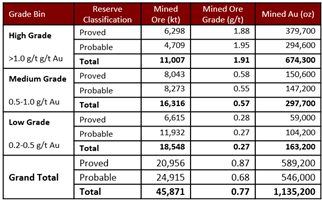
NOTE: Section 5 is not relevant to this work as there is no estimation or reporting of diamonds or other gemstones in this project.
RNS may use your IP address to confirm compliance with the terms and conditions, to analyse how you engage with the information contained in this communication, and to share such analysis on an anonymised basis with others as part of our commercial services. For further information about how RNS and the London Stock Exchange use the personal data you provide us, please see our Privacy Policy.

Latest directors dealings
- 7 hours ago DCC Energy PLC
- 7 hours ago On The Beach Group
- 9 hours ago Canal+ SA
- 9 hours ago Galliford Try
- 9 hours ago SSE