
Final Results for period to 31 December 2025
Summary by AI BETAClose X


30 April 2026
African Pioneer Plc
("African Pioneer" or the "Company")
Final Results for period to 31 December 2025
African Pioneer plc, the exploration and resource development company with advanced projects in Namibia, Botswana, and Zambia, reports its full year results for the year ended 31 December 2025.
The Annual Report and Financial Statements for the year ended 31 December 2025 will shortly be available on the Company's website at https://africanpioneerplc.com/. A copy of the Annual Report and Financial Statements will also be uploaded to the National Storage Mechanism where it will be available for viewing at: https://data.fca.org.uk/#/nsm/nationalstoragemechanism.
Please note that page references in the text below refer to the page numbers in the Annual Report and Financial Statements.
The information contained within this announcement is deemed by the Company to constitute inside information as stipulated under the Market Abuse Regulation (EU) No. 596/2014 as it forms part of UK Domestic Law by virtue of the European Union (Withdrawal) Act 2018 ("UK MAR").
For further information, please contact:
|
African Pioneer Plc Colin Bird Executive Chairman
|
+44 (0) 20 3416 3695 |
|
Beaumont Cornish Limited (Financial Adviser)
|
+44 (0) 20 7628 3396 |
|
AlbR Capital Limited (Joint Broker) Jon Belliss
|
+44 (0) 20 7399 9425 |
|
Shard Capital Partners LLP (Joint Broker) Damon Heath |
+44 (0) 20 7186 9952 |
or visit https://africanpioneerplc.com/
Beaumont Cornish Limited, which is authorised and regulated in the United Kingdom by the Financial Conduct Authority, is Financial Adviser to the Company in relation to the matters referred herein. Beaumont Cornish Limited is acting exclusively for the Company and for no one else in relation to the matters described in this announcement and is not advising any other person and accordingly will not be responsible to anyone other than the Company for providing the protections afforded to clients of Beaumont Cornish Limited, or for providing advice in relation to the contents of this announcement or any matter referred to in it.
KEY HIGHLIGHTS
· Consolidated Net assets - £ 4,467,588 (2024 - £ 4,640,962)
· Consolidated (Loss)/Profit - Loss - £ (612,466) (2024 - £ (650,973))
· The Group reports its results and raises funds in Pounds Sterling (GBP).
· Its primary assets are in Namibia, Zambia, and Botswana
CHAIRMAN' STATEMENT
Dear Shareholder
African Pioneer continues to make progress in all aspects of its business and have reached the point where the full potential of the Ongombo Project has been determined. It is apparent that Ongombo, on a stand-alone basis, has immense potential since it potentially has over 200,000 tonnes of contained copper and is open ended. Fieldwork has indicated that the adjacent Ongeama Project has potential to add to the overall resource as well as the open pit potential.
There exists opportunity in the immediate area to acquire significant additional ore resources, which could be fed to a central plant, which is our ultimate objective but not essential for the viability of Ongombo. We are about to embark upon drilling programs at both Ongeama and Ongombo.
During the period under review, we have received financing approaches regarding Ongombo and are optimistic that we will be able to make an investment decision during 2026. The order of magnitude of the mine is expected to be annual copper production in the region of 10,000 tonnes sustainable with production potential increasing according to resource definition and acquisition. When designing the plant, the ability to expand will be integrated into the mining design.
Our exploration and activities in Zambia have been revisited and whilst we continue to investigate the potential for Kamoa style mineralisation, we have not dismissed the potential for near surface bulk mining of a lower grade copper. Drilling has demonstrated that this potential exists, but the concept has been subordinated to the quest to identify Kamoa style mineralisation. We will continue to explore in parallel both routes now that the dry season has commenced.
We did not carry out any drilling programmes in Botswana during the year and the licences are , under review by the Company in cooperation with its external geological consultant with specific expertise of Botswanan copper geology. The region represents a significant copper exploration and resource development destination and as such all exploration ground has potential strategic importance particularly in the case of African Pioneer which has several licences in the general area.
During the year we raised £420K(gross) in February 2025 and post the period end in February 2026 raised £1.8 m (gross).
More detailed information regarding the Company's operations and policies are included in the following sections of the Financial Statements, Financial, Corporate and Operational review, Director's report, Director's remuneration report, Corporate Governance report and Strategic report.
Outlook: During late 2025, the copper price strengthened materially, reaching levels in excess of US$11,000 per tonne and, at times, trading close to US$12,000 per tonne, reflecting tightening supply conditions and strong demand from electrification, renewable energy and infrastructure investment. Moving into 2026, copper prices have remained elevated and volatile, with spot prices generally trading in a range between US$12,000 and US$13,000 per tonne, and market consensus forecasts continuing to point to structurally higher long‑term price levels.
Notwithstanding this price volatility, forecasts for the price of copper and its by‑product metals remain positive. The outlook for copper supply is widely regarded as constrained, as a significant number of large‑scale copper mining projects have been deferred or cancelled due to political, regulatory and economic factors. This supply shortfall is expected to result in the development of smaller but profitable mining operations and to increase consolidation activity, with junior mining companies holding high‑quality copper resources in stable jurisdictions becoming potential acquisition targets for major mining groups.
Against this backdrop, the Board feels the Group has assembled an enviable portfolio of projects is well positioned across its portfolio of projects, particularly our Namibian projects, to benefit from a potential acquisition cycle within the copper sector or, alternatively, to attract project financing for the development of its own operations. We look forward to advancing all our projects and providing our shareholders with the prospects of enhanced value flowing into next year.
AGM and Resolutions: The resolutions for the forthcoming Annual General Meeting will be contained in a separate Notice which will be made available to shareholders and on the website https://africanpioneerplc.com/ , The Directors will recommend shareholders to vote in favour of all the resolutions and a form of proxy will be dispatched to all shareholders for this purpose.
Finally, I would like to thank my fellow directors and management for their untiring efforts, in a difficult environment to make progressive progress.
Yours sincerely,
Colin Bird, Executive Chairman
African Pioneer Plc
29 April 2026
BOARD OF DIRECTORS
Colin Bird - Executive Chairman
Colin is a chartered mining engineer and a Fellow of the Institute of Materials, Minerals and Mining with more than 40 years' experience in resource operations management, corporate management, and finance. Colin has multi commodity mine management experience in Africa, Spain, Latin America and the Middle East. He has been the prime mover in a number of public company listings in the UK, Canada and South Africa. His most notable achievement was founding Kiwara Resources Plc and selling its prime asset, a copper property in Northern Zambia, to First Quantum Minerals for US$260 million in January 2010.
Raju Samtani - Finance Director
Raju is currently also finance director of Bezant Resources Plc, traded on AIM. His previous experience includes three years as Group Financial Controller at marketing services agency WTS Group Limited, where he was appointed by the Virgin Group to oversee their investment in the WTS Group Ltd. He was also involved as founder shareholder and finance director of Kiwara Plc which was acquired by First Quantum Minerals Ltd in January 2010. Over the last few years, he has been involved in senior managerial positions for several AIM/Johannesburg Stock Exchange listed companies predominantly in the resource sector and has also been involved in FCA compliance work within the investment business sector.
Christian Cordier - Business Development Director
Christian has had considerable involvement in corporate finance and investments in both public and private mining and exploration companies for over 26 years. His portfolio includes joint ventures with major international mining houses, investments in listed companies in the United Kingdom, Australia, Canada and Southern Africa as well as private mining operations. He has extensive experience in sourcing natural resource projects and nurturing them through the value curve by packaging and arranging venture funding, managing the permitting and exploration process, negotiating off-take agreements and the formation of a strong management team. He worked as CFO and senior accountant as well as company secretary for private and public companies and is a member of SA Institute for Professional Accountants ("SAIPA"). Christian has done various transactions in Coal, Platinum Group Metals, Chrome, Copper, Silver, Potash, Phosphates, Diamonds, Gold, Lithium and Manganese. Christian focuses on business development and wealth creation for private and publicly listed companies in the mining and exploration sector.
Kjeld Thygesen - Independent Non-Executive Director
Kjeld Thygesen is mining investment veteran of more than 45 years. After being a mining analyst at James Capel in the latter half of the 1970's he was manager of the commodities department at Rothschild Asset Management between 1980-89. In 1990 he formed Lion Resource Advisors (LRA) as a specialist adviser in the mining and natural resource sectors. LRA was the advisor to the Midas Fund in the US between 1992 - 2000, which was one of the top performing finds during that period. From 2002-2008 he was Investment director of Resources Investment Trust Limited, a London listed investment trust which returned a threefold investment during that period. He has served on several mining company boards over the past twenty years.
James Cunningham-Davis - Non-Executive Director
James Cunningham- Davis is a qualified solicitor who is currently non-practising. He is the Founder and Managing Director of Cavendish Trust Company Limited and Cavendish Secretaries Limited, both headquartered in the Isle of Man. Through these firms, he oversees the delivery of a broad suite of professional services to a diverse portfolio of private companies and publicly listed entities across multiple jurisdictions, with particular focus on the natural resources and mining, technology, and property sectors. He brings over 30 years of experience spanning international legal practice, corporate finance, and professional services. Throughout his career, he has served as a director of numerous private and publicly traded companies.
FINANCIAL CORPORATE AND OPERATIONAL REVIEW
INTRODUCTION
African Pioneer Plc a company engaging in development of natural resources exploration projects in Sub-Saharan Africa presents its year-end results for the year ended 31 December 2025.
The Directors are required to provide a year-end report in accordance with the Financial Conduct Authorities ("FCA") Disclosure Guidance and Transparency Rules ("DTR"). The Directors consider this Financial, Corporate and Operational Review along with the Chairman's Report, the Strategic Review and the Director's Report provides details of the important events which have occurred during the period and their impact on the financial statements as well as the outlook for the Company going forward.
The Company's short to medium term strategic objectives are to enhance the value of its mineral resource Projects through exploration and technical studies conducted by the Company or through joint venture or other arrangements (such as the Option Agreement with First Quantum on its 4 North-West Zambian licences) with a view to establishing the Projects can be economically mined for profit. With a positive global outlook for both base and precious metals, the Directors believe that the Company's Projects provide a base from which the Company will seek to add significant value through the application of structured and disciplined exploration and development of the Ongombo copper gold project in Namibia into an operating mine.
Financial Review
Financial highlights:
· Consolidated Loss: £612k loss after tax (2024: £651k - loss)
· Approximately £23k cash at bank at the period end (2024: £13k)
· The basic and diluted profit (losses) per share are summarised in the table below
|
Profit (Loss) per share (pence) |
|
|
|
|
|
|
2025 |
2024 |
|
Basic & Diluted |
Note 6 |
(0.23)p |
(0.29)p |
|
|
|
|
|
· Net assets as at 31 December 2025 was £4.5m (31 December 2024 £4.6m)
Fundraisings and issue of shares:
On 10 February 2025 the Company announced it had raised £420,000 before expenses at 1 pence per Ordinary Share ("Fundraising Price") through the issue of 42,000,000 new Ordinary Shares of no par value each ("Ordinary Shares") (the "Fundraising Shares"). Each participant in the Fundraising also received one (1) warrant exercisable at 1.75 pence per ordinary share from 12 months to 36 months after admission on 13 February 2025 ("Admission") for each Fundraising Share issued. The Company also issued a warrant to Shard Capital Partners LLP to subscribe for a total of 2,100,000 new Ordinary Shares exercisable at the Fundraising Price for a period of three years from Admission.
On 13 February 2025 the Company issued 207,039 new Ordinary Shares to Strategic Investments International Ltd a company controlled by PDMR Mike Allardice at 3.5 pence per share to settle £7,246 of accrued fees and 1,000,000 new Ordinary Shares will be issued at the Fundraising Price to settle £10,000 of accrued fees due to a consultant.
On 23 May 2025 the Company issued 5,970,149 Ordinary Shares at 0.67 pence to settle £40,000 of accrued fees and 252,307 Ordinary Shares at 1.95 pence to settle £4,920 of accrued fees.
Post the period end on 2 February 2026 the Company announced it had raised £1,800,000 before expenses at 0.9 pence per Ordinary Share. Each participant in this fundraising will, subject to general meeting approval, receive one (1) warrant for each fundraising share issued exercisable at 1.6 pence each for two years from 16 February 2026 . The issue of these warrants is conditional on the passing of a resolution at a General Meeting to allow their issue. The Company also issued a warrant to Shard Capital Partners LLP to subscribe for a total of 2,973,750 new Ordinary Shares exercisable at 1.6 pence for a period of two years from 16 February 2026 these broker warrants are not subject to shareholder approval at a General Meeting.
Corporate Review
Company Board: The Board of the Company comprises Colin Bird, Executive Chairman Raju Samtani, Finance Director Christian Cordier, Business Development Director Kjeld Thygesen, Independent Non-executive Director James Nicholas Cunningham-Davis, Non-executive Director
Listing: The Company was admitted to the Official List (by way of Standard Listing under Chapter 14 of the Listing Rules) and commenced trading on the Main Market for listed securities of the London Stock Exchange on 1 June 2021 (the "Listing" or "IPO. On 29 July 2024, the Listing Rules were replaced by the UK Listing Rules ("UKLR") under which the existing Standard Listing category was replaced by the Equity Shares (transition) category under Chapter 22 of the UKLR. Consequently, with effect from that date the Company is admitted to Equity Shares (transition) category of the Official List under Chapter 22 of the UKLR and to trading on the London Stock Exchange's Main Market for listed securities.
Corporate Transactions during the period: There were no corporate transactions during the period.
Operational Review
The Company completed an Initial Public Offering (IPO) on the Standard List of the London Stock Exchange and the acquisition of its projects in Zambia, Namibia, and Botswana in 2021. The primary metal in all countries is copper with by-product potential in all of our projects. In Zambia we have potential for cobalt, in Namibia for gold and in Botswana for silver. In 2022 the Company granted an option to First Quantum in relation to 4 of the 5 Zambian exploration licences held by African Pioneer Zambia (the "First Quantum Option Agreement"). On 16 October 2023 the Company announced that First Quantum had exercised its option in relation to 2 of the 4 Zambian exploration licences the subject of the First Quantum Option Agreement and on 16 February 2024 that First Quantum had issued an Option Exercise Notice in relation to the 2 other Zambian exploration licences the subject of the First Quantum Option Agreement. Prior to exercising its option First Quantum had met is initial expenditure requirement by spending US500,000 on each of the exploration licences 27767-HQ-LEL, 27768-HQ-LEL, 27770-HQ-LEL, and 27771-HQ-LEL. An update on the First Quantum Option Agreement is provided in the Post Period End and Outlook section of this report.
The Company's main focus during the period was on evaluating and advancing its 85% owned Namibian Projects, including the Ongombo mining licence application, and Botswana Projects (100% owned) that are not the subject of options.
Namibia:
On 25 June 2025 the Company announced that it had received the official, unconditional Mining Licence (ML 240) which is valid until 23 March 2045 for its 85%-owned Ongombo Copper-Gold Project, located approximately 40 km northeast of Windhoek in the Khomas Region of Namibia. The formal receipt of the physical licence marked the final step in the government permitting process and follows the award in early April 2025 of the Environmental Clearance Certificate (ECC No. 2302356, dated 24 March 2025).
Key Highlights
· All required Namibian government approvals now formally granted
· Mining Licence No. 240 is fully active and unconditional and is valid to 23 March 2045
· Company is engaging with external mining and resource advisors who provided updated resource estimates for the open pit mineralisation who will provide recommendations for infill drilling and colour locations that will maximise increases in the global resource
· Planning discussions are ongoing with preferred mining contractor for both open pit and underground mining. Specifically looking to build a database of unit costs for key components of the mine plan to update the financial model
The company is investigating nearby mining concessions which have known resources and access. The company believes there is synergy between a number of projects and that Ongombo can be enlarged by collaboration or acquisition
· Independent updated total (gross)* Indicated Mineral Resource Estimate (MRE) of 5.7Mt at 1.1% Cu Equivalent (CuEq), 0.94% Cu and 0.23g/t Au and a very substantial Inferred underground potential Resources of 23Mt at 1.1% CuEq, 0.95% Cu and 0.24g/t Au as announced on 16 May 2023
· Advanced discussions with multiple parties about project level funding of the Ongombo Project.
*gross representing 100% MRE and African Pioneer has 85% interest in the Project
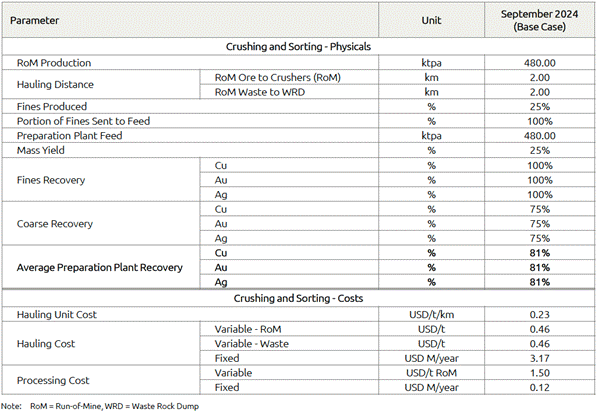
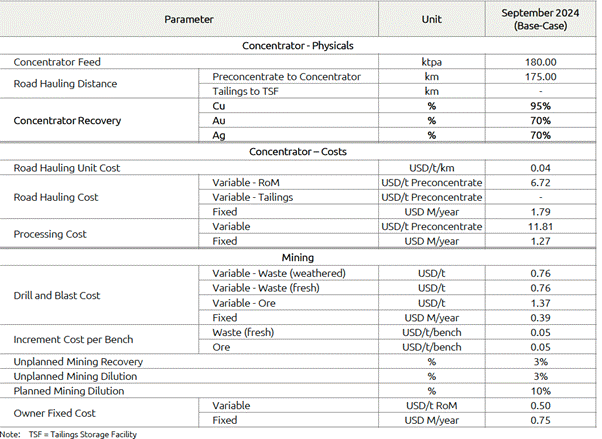
Optimisation studies have been undertaken by external consultant Sound Mining with the mandate to investigate the potential for development of the Ongombo Mineral Resource, to review the Addison geological block model, develop a set of mine design criteria, complete a base case for optimisation and generate sensitivity analysis of the base case under a range of operating scenarios.
The Addison Mineral Resource Estimate was based on a total of 295 drillholes completed between 1988 and 1991 with a further 33 holes drilled between 2008 and 2014 followed by 54 holes drilled by African Pioneer. All drill data was incorporated in Sound Mining's study.
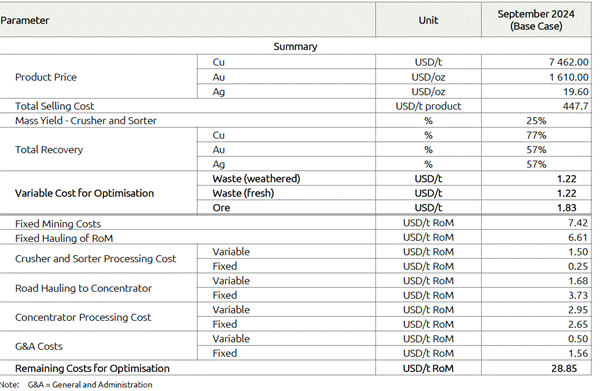
Mine design criteria used assumed for the base case a discount rate of 10%, and metal prices including copper at US$9,100 per tonne, gold at US$2,300 per ounce and silver at US$28 per ounce. Payability factors of 82%, 70% and 0% respectively were applied to all copper, gold and silver assumed to be recovered.
Other mine design criteria included the following:
The resulting pit optimisation results returned the "Ultimate Pit" scenario:
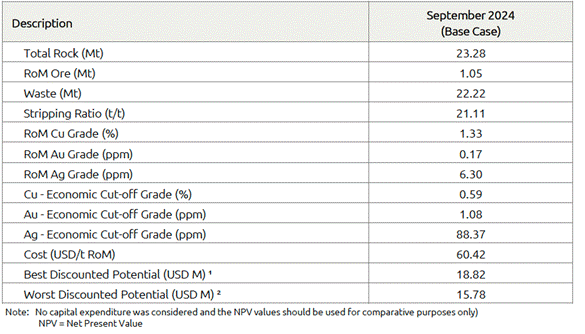
When compared to the Mineral Resource (as at 16 May 2023), the optimisation increased the run of mine estimation by approximately 13 % and increased the estimated copper grade by approximately 124%.
The resulting 2024 Ultimate Pit resulted in the creation of two separate open pits duly named the South and north Pits which better reflect a more realistic mining methodology and recognise two separate phases on mining. Phased development and preliminary planning indicates a preference for the development of the North Pit in the first instance.
Further work required ahead of completion of a final mine plan and schedule includes some geotechnical drilling and infill drilling especially in areas where historically no gold assays were completed.
Project Background: The Ongombo project is situated in Exclusive Prospecting License (EPL) 5772 in the Khomas region of the Windhoek District of Namibia, 45 km from Windhoek, the capital of Namibia. The project area has relatively well-developed infrastructure on the farms Ongombo Ost and Ongombo West. The property is easily accessed by a tar road from Windhoek to Gobabis and then on a gravel road up to the project area. There is also a railway line from Gobabis to Walvis Bay, via Windhoek running parallel to the tarred road. The Ongombo Project is located 15km northeast from Otjihase Mine which consists of two underground mines (Otjihase and Matchless) and an 800ktpa copper concentrator.
The Ongombo project lies within the Matchless Member of the Kuiseb Formation, a conspicuous assemblage of lenses of foliated amphibolites, chlorite-amphibolite schist, talc schist and metagabbro. This belt, up to 5km wide in the Otjihase area, stretches 350km east-north-eastwards in the Southern Zone of the Damara Orogen from the Gorob - Hope area. The deposit is generally described as a Besshi-type massive sulphide. These are described as thin sheet-like bodies of massive to well-laminated pyrite, pyrrhotite, and chalcopyrite within thinly laminated clastic sediments and mafic tuffs. At the Ongombo project mineralisation occurs in one continuous zone approximately 7 km long and 0.5 - 1 km wide. The mineralisation zone dips consistently 15-20° northwest and plunges 5° northeast. Mineralisation is gradually thinning westward.
On 25 June 2025 the Company announced that it had received the official, unconditional Mining Licence (ML 240) which is valid until 23 March 2045 for its 85%-owned Ongombo Copper-Gold Project, ML 240 is within EPL 5772 and the pending renewal of EPL 5772 which expired on 1 February 2026 is reflected on the Namibian Mines and Energy Cadastre Map Portal. The Company's 85% owned subsidiary Manmar Investments One Three Six (Pty) Ltd holds EPL 6011 which expires on 5 December 2026.
Zambia:
As mentioned above First Quantum has issued Option Exercise Notices in relation to all 4 of the Zambian exploration licences having spent in excess of US$500,000 on each of these 4 licences prior to issuing the Option Exercise Notices.
The licence package the subject of the First Quantum Option Agreement covers part of the north-western extension of the Zambian Copperbelt. The properties are located within 80-100km of First Quantum's giant Sentinel copper mine, one of the largest copper mines in Africa, with a reported Measured and Indicated Resources of 891Mt @ 0.45% Cu. They also lie close to the Enterprise nickel deposit (37.7Mt @ 1.03% Ni) which is being reportedly moved towards development.
The Projects lie on the Lufilian Fold Belt in the Domes region of the Central African Copperbelt, straddling the western boundary of the Kabompo Dome, underlain principally by rocks of the Lower and Upper Roan, as well as the stratigraphically higher Kundelungu and Nguba Groups. This geological package is similar in age and rock type to that hosting the major copper deposits of the Copperbelt, including Sentinel. Therefore, the licence areas are considered to be strongly prospective for Copperbelt-type copper/cobalt and/or nickel deposits. They are historically underexplored, representing the westerly extension of the Copperbelt which has not been investigated in detail, as previous work focussed primarily on the central part of the zone.
Highlights
· Drilling confirmed proof of concept that licences are in the right lithology confirming Congo-style mineralisation.
· 4 diamond drill holes completed at the Turaco target for 1,297.1m.
· A 772.3m deep diamond drill hole completed over the Ikatu on an Audio Magneto Telluric ("AMT") generated target. Awaiting results.
· 9 reverse circulation ("RC") holes drilled at the Chipopa target for a total of 780m.
First Quantum continue to evaluate the licences under the option agreement based on licence-wide geochemical analysis and drilling completed to date. A number of targets have been identified, some of which warrant more detailed follow up. This geological environment classified as the Fold and Thrust Belt is complex and the Company benefits from the expertise and local knowledge gained by First Quantum following years of exploration in the region. The Fold and Thrust Belt and adjoining Western Foreland are currently the focus of intense exploration and speculation from exploration companies of varying size and the information being generated by African Pioneer and First Quantum represents extremely valuable data and knowledge of a region with little detailed exploration having taken place but where the exploration prize is potentially significant.
First Quantum: is one of the world's top 10 copper producers operating in several countries including Zambia where it owns the Sentinel and Kansanshi mines in North west Zambia and is known for its specialist technical engineering construction and operational skills which have allowed it to develop and successfully run complex mines and processing plants. Colin Bird, the chairman of African Pioneer, was a founder of and floated Kiwara Plc in around 2008 which discovered copper in northwest Zambia and was sold to First Quantum in January 2010 for U$260 million. First Quantum then developed the Kiwara Plc projects into the Sentinel mine which is the world's 14th largest copper mine.
BOTSWANA
The Botswana projects comprise 5 prospecting licences which have been renewed through 31 March 2026 and are now pending renewal and comprise approximately 770 sq. km. in the Kalahari Copperbelt. If the all the prospecting licences are not renewed then the Company would have to make an impairment provision against the Groups exploration and evaluation asset in relation to its Botswana project of £446K Whilst the exploration to date on the licences which were the subject of the Sandfire Option Agreement does not currently indicate prospectivity for a large-scale mining operation the Board believes that there is prospectivity for a smaller to medium sized mining operation targeting in the range of 5,000 to 10,000 tonnes of contained copper per annum. Although too small for a large-scale miner a mine of this size would fit very well into the demand for small to medium mines to help bridge the gap in the predicted shortfall of copper to meet future projected demand.
All the Botswana licences are currently under review by the Company in cooperation with its external geological consultant with specific expertise of Botswanan copper geology. The region represents a significant copper exploration and resource development destination and as such all exploration ground has potential strategic importance particularly in the case of African Pioneer which has several licences in the general area.
Sandfire Option Agreement: The Sandfire Option Agreement was announced on 4 October 2021 and was for two years from 2 October 2021 and relates to PL 100/2020, PL 101/2020, PL 102/2020 and PL 103/2020 (the "Included Licences"). Sandfire paid US$500K and issued 107,272 Sandfire ordinary shares to the Company at the time of entering into the Sandfire Option Agreement. As announced on 29 September 2023 Sandfire notified the Company that it would not be exercising its option under the Sandfire Option Agreement. Sandfire's Exploration Commitment under the Sandfire Option Agreement was to fund US$1 million of exploration expenditure on the Included Licences (the "Exploration Commitment") within the Option Period with 60% of the Exploration Commitment to be on drilling and assay costs. If the Exploration Commitment is not spent, any shortfall is due to be paid by Sandfire to African Pioneer. The Company is reviewing the Exploration Commitment with Sandfire. Sandfire have confirmed that they will provide Exploration Information that it holds in relation to the Included Licences.
POST PERIOD END EVENTS AND Outlook
Corporate Transactions: Post the year end First Quantum has informally notified the Company that they will be looking to exit the First Quantum Option Agreement due to First Quantum's current focus in Zambia being on their mining operations. Prior to exercising its option First Quantum had met is initial expenditure requirement by spending US500,000 on each of the exploration licences 27767-HQ-LEL, 27768-HQ-LEL, 27770-HQ-LEL, and 27771-HQ-LEL (the "Zambian Projects"). The Company has in the meantime received interest from third parties in acquiring an interest in / jointly developing its Zambian Projects and will be looking to conduct further exploration work on the Zambian Projects where a number of targets which have been identified.
Fundraising: Post the period end on 2 February 2026 the Company announced it had raised £1,800,000 before expenses at 0.9 pence per Ordinary Share. Each participant in this fundraising will, subject to general meeting approval, receive one (1) warrant for each fundraising share issued exercisable at 1.6 pence each for two years from 16 February 2026 . The issue of these warrants is conditional on the passing of a resolution at a General Meeting to allow their issue. The Company also issued a warrant to Shard Capital Partners LLP to subscribe for a total of 2,973,750 new Ordinary Shares exercisable at 1.6 pence for a period of two years from 16 February 2026 these broker warrants are not subject to shareholder approval at a General Meeting.
The net proceeds from the February 2026 fundraising are planned to be used in relation to the project activities with the main focus on the Ongombo and Ongeama copper gold projects in Namibia, AFP's projects in Zambia and Botswana and general working capital requirement of the group.
Information on the Company's Projects and work planned subject to ongoing exploration results.
Namibia: Ongombo and Ongeama Resource Development Update
The Company has completed an in-house review of the Ongombo and adjoining Ongeama copper - gold project and will now undertake a mine development drill programme to provide final geotechnical data for both open pit and underground detailed mine design together with resource drilling to confirm orebody continuity aimed at extending the open pit footprint.
Highlights
· Current escalation in metal prices has warranted a mine design and plant throughput capacity as project economics have benefitted from substantial prices rises in all three relevant metals, copper, gold and silver.
· Drilling has been proposed to facilitate detailed mine design for both the Ongombo and Ongeama projects.
Drilling aims to increase the existing Ongombo starter pit (1.0Mt @ Cu 1.33%, Au 0.17 g/t and Ag 6.3 g/t) with further up-dip extensions to the northeast of the current pit outline
· Additional underground resources will benefit from closer spaced drilling to provide geotechnical data for development planning, confirmation of the most appropriate underground mining method and a reclassification of the Mineral Resource.
Ongombo - Ongeama Programme
Work will be undertaken within Ongombo mining licence ML240 located within exploration licence EPL5772 and the Ongeama exploration licence, EPL6011.
The original JORC (2012) Mineral Resource Estimate determined a total Resource of 29 million tonnes at 1.1% CuEq ** Recent studies have also estimated a starter open pit containing 1.0Mt @ Cu 1.33%, Au 0.17 g/t and Ag 6.3 g/t
Work planned comprises the following:
· Ongombo Eastern Shoot is open up-dip from historic drilling. The proposed drilling will aim to delineate the mineralisation extension to surface.
· Ongombo Ost North Shoot has been under-explored. A ground magnetic geophysical survey will be undertaken following which a provisional drill programme has been recommended.
· Ongeama South Project has defined higher grade mineralised shoots within low-grade envelopes. Two shoots have been targeted to test the up-dip extension towards surface.
Zambia: External Fold and Thrust Belt Exploration
· Ground Geophysics: Additional geophysical surveys planned to better define drill targets within the 4 exploration licences
· Drill Programme: Targeting near-surface mineralisation broadly defined by regional-wide geochemical surveys that highlighted extensive areas anomalous in copper.
Botswana: The Company is continuing with its review of options and strategies for these projects in consultation with an external geological consultant with specific expertise of Botswanan copper geology. The region represents a significant copper exploration and resource development destination and as such all exploration ground has potential strategic importance particularly in the case of African Pioneer which has several licences in the general area.
Outlook for Copper: During late 2025, the copper price strengthened materially, reaching levels in excess of US$11,000 per tonne and, at times, trading close to US$12,000 per tonne, reflecting tightening supply conditions and strong demand from electrification, renewable energy and infrastructure investment. Moving into 2026, copper prices have remained elevated and volatile, with spot prices generally trading in a range between US$12,000 and US$13,000 per tonne, and market consensus forecasts continuing to point to structurally higher long‑term price levels.
Notwithstanding this price volatility, forecasts for the price of copper and its by‑product metals remain positive. The outlook for copper supply is widely regarded as constrained, as a significant number of large‑scale copper mining projects have been deferred or cancelled due to political, regulatory and economic factors. This supply shortfall is expected to result in the development of smaller but profitable mining operations and to increase consolidation activity, with junior mining companies holding high‑quality copper resources in stable jurisdictions becoming potential acquisition targets for major mining groups.
Against this backdrop, the Board feels the Group has assembled an enviable portfolio of projects and the Company is well positioned across its portfolio of projects to benefit from a potential acquisition cycle within the copper sector or, alternatively, to attract project financing for the development of its own operations. We look forward to advancing all our projects and providing our shareholders with the prospects of enhanced value flowing into next year.
Colin Bird
Chairman
29 April 2026
DIRECTORS' REPORT
The directors present their report on the affairs of African Pioneer Plc (the "Company") for the year ended 31 December 2025. The Company was incorporated on 20 July 2012.
PRINCIPAL ACTIVITIES
The principal activity of the Company and its subsidiaries (the "Group") is the exploration for and development of base metals project in Zambia, Namibia and Botswana. In Namibia the Group's Ongombo project has a mining licence through to 2045.
Investing in small natural resource projects and mineral exploration projects can be very rewarding, but because of the issues and uncertainties arising from exploration, resource estimation, commodity price volatility, politics and the financing of such projects, there is a significant possibility of such reward not materialising. As a result of the nature and size of the Company it will, in the early years particularly, be exposed to a concentration of risk either by sector or geographically, or possibly both. These risks are outlined in more detail in the Strategic Report.
REVIEW OF THE BUSINESS
During the year, the Group made a loss of £612,466 - (2024: loss of £650,974).
A review of the current and future development of the Group's business are included in the Strategic Report.
The Directors do not recommend the payment of a dividend (2024: £nil).
SUBSEQUENT EVENTS
Details of subsequent events after the year end are disclosed in note 17 of the financial statements
DIRECTORS
The names of the Directors who served throughout the period and subsequent to the year end, are as follows:
C Bird
|
R. Samtani |
|
C Cordier |
|
K Thygesen |
|
J Cunningham-Davis |
Directors' interests in the ordinary share capital of the Company at the date of this report are disclosed within the Directors Remuneration Report
DIRECTOR'S REMUNERATION
The Directors' remuneration is detailed in the Directors' Remuneration Report on pages 19 to 22.
DIRECTORS' AND OFFICERS' INDEMNITY INSURANCE
The Group has purchased Directors' and Officers' liability insurance which provides cover against liabilities arising against them in that capacity.
USE OF FINANCIAL INSTRUMENTS AND FINANCIAL RISK MANAGEMENT
Details of the use of financial instruments and associated risk management by the Group are included in note 3 to the financial statements.
SUBSTANTIAL SHAREHOLDINGS
Other than Directors interests which are set out below on a separate table in this report, the following shareholders held 3% or more of the issued share capital of the Company on 24 April 2026. These holdings are extracted as they appear in the relevant custodian account on the Company's share register.
|
Registered Shareholder |
No. of shares |
Percentage |
|
The Bank Of New York (Nominees) Limited * |
80,309,871 |
15.33% |
|
Vidacos Nominees Limited. IGUKCLT * |
78,050,876 |
14.90% |
|
GHC Nominees Limited * |
61,114,558 |
11.67% |
|
Vidacos Nominees Limited. FGN * |
46,196,709 |
8.82% |
|
Interactive Brokers LLC IBLLC2 * |
28,205,587 |
5.38% |
|
Securities Services Nominees Limited 2832050 * |
24,277,778 |
4.63% |
|
Hargreaves Lansdown (Nominees) Limited HLNOM * |
20,421,677 |
3.90% |
|
|
338,577,056 |
64.63% |
*Nominee shareholder; not beneficial owner.
UK STREAMLINED ENERGY AND CARBON REPORTING
The Group's UK energy and carbon information is not disclosed as the Company qualifies as it consumed less than 40MWh and is a Low Energy user in the UK as defined in the Environmental Reporting Guidelines Including streamlined energy and carbon reporting guidance March 2019 (Updated Introduction and Chapter 1) and as such is not required to provide detailed disclosures of energy and carbon information. The Company is based in the Isle of Man and has no UK-based subsidiaries and its overseas subsidiaries, some of which own exploration licences and conduct exploration activities outside the U.K. are not required to report U.K. energy consumption in their own right. The Company was also below this threshold in 2025.
POLITICAL DONATIONS
The Group made no political donations during the year (2024: none).
STATEMENT AS TO THE DISCLOSURE OF INFORMATION TO
THE AUDITORS AND DIRECTORS' RESPONSIBILITIES
The Directors (being Colin Bird-Chairman, Raju Samtani-Finance Director, Christian Cordier-Business Development Director, Kjeld Thygesen -Independent Non-Executive Director and James Cunningham-Davis Non-Executive Director, who were in office at the date of approval of this report, confirm that, so far as they are aware, there is no relevant audit information of which the Company's auditor is unaware of and that they have taken all reasonable steps to take themselves aware of any relevant audit information and to establish that the Company's auditor is aware of that information.
The Directors are responsible for preparing the financial statements in accordance with the Disclosure Guidance and Transparency Rules of the United Kingdom's Financial Conduct Authority ("DTR") and with International Financial Reporting Standards as adopted by the United Kingdom.
The Directors confirm to the best of their knowledge that:
· the financial statements have been prepared in accordance with the relevant financial reporting framework and give a true and fair view of the assets, liabilities, financial position and profit or loss of the Group and the Company; and
· the Strategic Report and Directors' Report include a fair review of the development and performance of the business and the financial position of the Group and the Company, together with a description of the principal risks and uncertainties that it faces; and
· the annual report and financial statements, taken as a whole, are fair, balanced, and understandable and provide the information necessary for shareholders to assess the Group's position, performance, business model and strategy.
AUDITORS
The auditors, RPG Crouch Chapman LLP have indicated their willingness to continue in office. A resolution to re-appoint them will be proposed at the forthcoming Annual General Meeting.
Signed on behalf of the Board:
29 April 2026
Colin Bird Raju Samtani
Executive Chairman Director
DIRECTORS' REMUNERATION REPORT
This Remuneration Report sets out the Group's policy on the remuneration of Directors, together with details of Directors' remuneration packages and service contracts for the year ended 31 December 2025.
The Company's policy is to maintain levels of remuneration to attract, motivate, and retain Directors and Senior Executives of the highest calibre who can contribute their experience to deliver industry-leading performance with the Company's operations. The Company is nonetheless mindful of the need to balance this objective with the fact that it is pre-revenue.
Since listing on 1 June 2021, the Company's Directors have largely remunerated through a combination of modest salaries and/or fees and where relevant, equity positions as founders and as a result the total salaries and fees payable to directors has been relatively modest. Since listing the Director's remuneration has remained the same and in light of this and the fact that the Company has only been listed since 2021 it was not considered meaningful to provide a Ten-year summary of CEO remuneration.
As the Company grows, and increasingly makes hires, it will become necessary to move to a more long-term and sustainable policy, which continues to align the interests of Directors and senior staff with those of shareholders while recognising that new hires will not initially have a significant equity position.
Accordingly, it is likely that compensation packages for Executive Directors will need to move over time to a level more consistent with the market. Currently, Directors' remuneration is not subject to specific performance targets. The Company is sufficiently small that the Board does not consider that it is necessary to impose such targets as a matter of principle but believes that exceptional performance can be rewarded on an ad hoc basis.
The Board proposed and shareholders approved at the 2022 AGM a share option scheme which is to incentivise both Executive and non-Executive Directors as well individuals holding positions of responsibility in or whom are consultants to the Company ("Share Option Scheme"). On 24 January 2023 the Company announced that pursuant to the Share Option Scheme approved at the Company's Annual General Meeting ("AGM") held on 23 August 2022 16,850,000 options over Ordinary Shares ("Options") were awarded, 6,600,000 of the Options were awarded to directors of the Company, as detailed further in Note 15 and the balance of 10,250,000 Options to other eligible participants. The Company had not previously issued any Options.
The 2024 Annual General Meeting also approved the Company establishing updated incentive schemes to more closely align the interest of directors, officers, employees and consultants ("Eligible Participants") with those of shareholders by providing for the payment of short-term, annual and transaction incentive awards in cash or Company shares (the "Proposed Incentive Schemes"). Awards under the Proposed Incentive Schemes are not intended to replace the Share Option Scheme arrangements. The Proposed Incentive Schemes shall continue in place until the Board of the Company have put an alternative incentive scheme to the Company's shareholders which the Company's shareholders have approved.
The Proposed Incentive Schemes included Annual Incentive Awards: These will be awarded to Eligible Participants with a minimum of 80% of their awards being related to Company performance and the balance related to individual key performance indicators determined by the Board until such time as a remuneration committee is formed. The foregoing percentages are so as to more closely align the annual incentive awards with the interest of shareholders which is primarily increases in the Company's share price. Eligible Participants annual incentive award based the Company performance will be based on improvements in the Company's share price in the preceding 12-month period ("Company Share Price Increase"). Following shareholder approval an annual Company Share Price Increase measure was introduced with effect from 30 June 2024. The base share price for the Company Share Price Increase was 3.32 pence per share for the initial year being the higher of i) the VWAP for June 2024 and ii) the highest calendar monthly VWAP during the 12 months to 30 June 2024 in both cases multiplied by 120% (the "Initial Base Share Price"). In the second and subsequent years the Company Share Price Increase will be "high water marked" by the Base Share Price for the relevant year being the higher of i) the Initial Base Share Price and ii) the highest Year End Share Price (as defined below) for each previous year since the Initial Year multiplied by 120%. The year end share price for each year will be the 30 day VWAP in the last month of the 12 month period (the "Year End Share Price"). The participation rate in the Company Share Price Increase above the Base Share Price for the applicable year will be 5% (the "Participation Rate"). In the year ended 30 June 2025 there was no awards made under the Annual Incentive Awards,
The Board considers the remuneration of Directors and senior staff and their employment terms and makes recommendations to the Board of Directors on the overall remuneration packages. No Director takes part in any decision directly affecting their own remuneration. No third parties have been engaged to advice the Board on remuneration and no discretion has been exercised in the award of director's remuneration other than the issue of Options.
There has been no correspondence to date from shareholders relating to Directors' remuneration matters and therefore no such matters have been considered by the Board in formulating the Company's remuneration policy.
In determining Executive Director remuneration policy and practices, the Board aims to address the following factors:
• Clarity - remuneration arrangements should be transparent and promote effective engagement with shareholders and the workforce;
• Simplicity - remuneration structures should avoid complexity and their rationale and operation should be easy to understand;
• Risk - remuneration arrangements should ensure reputational and other risks from excessive rewards, and risks that can arise from target-based incentive plans, are identified and mitigated;
• Predictability - the range of possible values of rewards to individual directors and any other limits or discretions are identified and explained at the time of approving the policy;
• Proportionality - the clarity of the link between individual awards, the delivery of strategy and the long-term performance of the company should be clear; and
• Alignment to culture - incentive schemes, when implemented will drive behaviours consistent with company purpose, values and strategy.
Directors' remuneration
Remuneration of the Directors for the years ended 31 December 2025 and 2024 was as follows:
|
|
2025 |
|
2024 |
||
|
|
Directors' Fees |
Consulting Fees |
Total |
|
Total |
|
|
£ |
£ |
£ |
|
£ |
|
|
|
|
|
|
|
|
C. Bird |
18,000 |
42,000 |
60,000 |
|
60,000 |
|
R. Samtani |
18,000 |
32,000 |
50,000 |
|
50,000 |
|
C Cordier |
18,000 |
12,000 |
30,000 |
|
30,000 |
|
K Thygesen |
18,000 |
- |
18,000 |
|
18,000 |
|
James Cunningham-Davis |
14,400 |
- |
14,400 |
|
14,400 |
|
|
|
|
|
|
|
|
Total |
86,400 |
86,000 |
172,400 |
|
172,400 |
Each of the Directors entered into service agreements at the time of the Company's admission to the market on 1 June 2021. Details of Directors' Letters of Appointment and Service Agreements as disclosed in Note 16 of these Financial Statements and to date no discretionary payments have been made to directors under these agreements.
There were no pensions or other similar arrangements in place with any of the Directors during the years ended 31 December 2025 or 2024.
Payments to past directors
The Company did not pay any compensation to past Directors in 2025 and 2024.
DIRECTORS' INTERESTS
The beneficial interest of the directors, their spouses and minor children in the share capital of the Company are as follows:
Ordinary Shares of No Par Value
|
|
Date of this report |
31 December 2025 |
31 December 2024 |
|
|
|
|
|
|
C Bird* |
42,270,061 |
24,492,284 |
24,492,284 |
|
R Samtani |
33,580,245 |
18,395,061 |
18,395,061 |
|
J Cunningham-Davis*** |
- |
- |
- |
|
C Cordier** |
27,222,221 |
17,222,222 |
17,222,222 |
|
K Thygesen |
9,033,333 |
1,033,334 |
1,033,334 |
* Colin Bird's shareholding includes 5,000,000 ordinary shares held by Campden Park Trading, a company owned and controlled by Colin Bird, the Company's Chairman
** Christian Cordier's shareholding is held via Tonehill Pty Ltd as trustee for The Tonehill Trust, Coreks Super Pty Ltd as trustee for Coreks Superannuation Fund both of which companies are owned and controlled by Christian Cordier and by Breamline Pty Ltd of which Christian Cordier is a director and which is a trustee company for Breamline Ministries
The Directors have also been granted fully vested options over ordinary shares detailed below, the options are exercisable at 4.5 pence per Ordinary Share and expire on 23 January 2033 one day prior to the tenth anniversary of the grant of the options. Further details of the terms of the options are in note 15
|
Directors |
No. of Options |
|
Executive Directors: |
|
|
Colin Bird Executive Chairman |
5,000,000 |
|
Christian Cordier Commercial Director |
500,000 |
|
Raju Samtani Finance Director |
600,000 |
|
Non Executive Directors: |
|
|
Kjeld Thygesen Independent |
500,000 |
|
James Cunningham-Davis |
Nil |
|
Total Directors |
6,600,000 |
There have been no further changes in directors' interests in the Company's shares since the year end other than those noted above.
Approved by the Board on 29 April 2026.
Coilin Bird
Executive Chairman
CORPORATE GOVERNANCE REPORT
The Board guides and monitors the business and affairs of the Company on behalf of the Shareholders to whom it is accountable and is responsible for corporate governance matters. While certain key matters are reserved for the Board, it has delegated responsibilities for the day-to-day operational, corporate, financial and administrative activities to the Business Development Director, the Executive Chairman and the Finance Director.
In assessing the composition of the Board, the Directors have had regard to the following principles:
· the role of the Executive Chairman and the other directors should not be exercised by the same person;
· the Board should include at least one independent non-executive director, increasing where additional expertise is considered desirable in certain areas, or to ensure a smooth transition between outgoing and incoming non-executive directors; and
· the Board should comprise of directors with an appropriate range of qualifications and expertise.
The Company believes it complies with each of these principles.
Given the size and nature of the Company, and the fact that its only employees are the members of the Board, the Company has not established a formal process for evaluating Board performance. All directors have over 26 years' experience in mining and exploration companies and remain actively involved in the sector (save for James Cunningham- Davis who is a qualified solicitor (non-practicing) with 30 years of experience. Board performance is instead reviewed on an ongoing and informal basis through the assessment of decision‑making effectiveness, and the Company's progress against its strategic and operational objectives. The Board considers this approach to be appropriate and proportionate for the Company at its current stage of development.
Both James Cunningham-Davis and Kjeld Thygesen are the Non-Executive Directors of the Company. James Cunningham-Davis is one of the directors of Cavendish Secretaries Limited, a subsidiary of Cavendish Trust Company Limited, which provides secretarial services to the Company in the Isle of Man and is therefore for these purposes not considered independent.
Kjeld Thygesen has a holding of Ordinary Shares representing 1.7 per cent. of the issued share capital and he is considered independent given this holding is less than 3%.
Directors appointed by the Board are subject to election by shareholders at the Annual General Meeting of the Company following their appointment and thereafter are subject to re-election in accordance with the Company's Articles of Association.
The QCA Corporate Governance Code, as published by the Quoted Companies Alliance, is tailored for small and mid-size quoted companies in the United Kingdom. The Company follows, to the extent practicable for a company of its size and nature, follow the QCA Corporate Governance Code (2023). The Directors are aware that there are currently certain provisions of the QCA Corporate Governance Code that the Company is not in compliance with, given the size and early stage nature of the Company. These include, inter alia:
· The Company does not currently have a remuneration, nomination or risk committee. The Board as a whole will review remuneration, nomination and risk matters, on the basis of adopted terms of reference governing the matters to be reviewed and the frequency with which such matters are considered. The Board as a whole will also take responsibility for the appointment of auditors and payment of their audit fee, monitor and review the integrity of the Company's financial statements and take responsibility for any formal announcements on the Company's financial performance.
· Unless further independent non-executive directors are appointed, the Board will not comply with the provision of the QCA Corporate Governance Code that there should be an appropriate balance between executive and non-executive directors. The recommendation is that the independent directors should comprise at least half of the board an as a minimum there should be at least two non-executive directors determined by the Board to be independent.
· The Executive Chairman of the Company is an executive director rather than an independent non-executive director as suggested by the QCA corporate governance code.
· Directors retire by rotation in accordance with the Articles of the Company rather than all directors standing for re-election every year.
· In assessing the composition of the Board, the directors apply those articulated in this report rather than all the QCA Code principles.
· The Directors remuneration report is included in these financial statements but will not be put to an advisory vote at the forthcoming AGM
The Company holds board meetings as issues arise which require the attention of the Board and also discuss matters amongst themselves prior to passing written resolutions of all the Directors which happened 5 times during the year. The Board is responsible for the management of the business of the Company, setting the strategic direction of the Company and establishing the policies of the Company. It is the Directors' responsibility to oversee the financial position of the Company and monitor the business and affairs of the Company, on behalf of the Shareholders, to whom they are accountable. The primary duty of the Directors is to act in the best interests of the Company at all times. The Board also addresses issues relating to internal control and the Company's approach to risk management and has formally adopted an anti-corruption and bribery policy.
The Board have allocated these responsibilities so that the executive directors are responsible for the day‑to‑day management of the Company and are closely involved in the oversight of exploration activities, engagement with technical consultants, review of budgets and expenditure, regulatory compliance and the execution of the Company's strategy. Their time commitment is ongoing and reflects their operational responsibilities. The non‑executive directors provide independent oversight, strategic guidance and challenge to management, and are actively involved in reviewing corporate transactions, financing activities and governance matters. Although not engaged in daily operations, the non‑executive directors maintain regular contact with the executive directors and advisers and dedicate sufficient time to fulfil their duties effectively. The Board considers that the time commitment of both executive and non‑executive directors which has not changed from 2024 is appropriate to the Company's needs and that effective governance is maintained through regular communication and involvement beyond formal Board meetings
The Company's short to medium term strategic objectives are to enhance the value of its mineral resource Projects through exploration and technical studies conducted by the Company or through joint venture or other arrangements (such as the Option Agreement with First Quantum on its 4 North-West Zambian licences) with a view to establishing the Projects can be economically mined for profit. The experience and background of the directors is summarised in the Board of Director's section of the financial statements. The directors, other than James Cunningham-Davis, have between 26 and 40 years' experience in the mining and exploration industry, maintain and update their skills and knowledge through ongoing involvement in active exploration and development projects, regular engagement with technical advisers and industry specialists, participation in industry conferences and professional forums, and continuous review of regulatory, technical and market developments relevant to the minerals sector. James Cunningham- Davis is a qualified solicitor with 30 years of experience who is currently non-practising and through the corporate services group he founded oversees the delivery of a broad suite of professional services to a diverse portfolio of private companies and publicly listed entities across multiple jurisdictions, with particular focus on the natural resources and mining, technology, and property sectors.
Share Dealing Code
The Company has adopted, with effect from Admission, a share dealing policy regulating trading and confidentiality of inside information for the Directors and other persons discharging managerial responsibilities (and their persons closely associated) which contains provisions appropriate for a company whose shares are admitted to trading on the Official List (particularly relating to dealing during closed periods which will be in line with the Market Abuse Regulation). The Company takes all reasonable steps to ensure compliance by the Directors and any relevant employees with the terms of that share dealing policy.
Audit Committee
The Audit Committee is chaired by James Cunningham-Davis and its other member is Christian Cordier whose qualifications and experience is summarised in their profiles in the Board of Directors on page 5. The Audit Committee meets at least twice a year, or more frequently if required. The Audit Committee is responsible, amongst other things, for making recommendations to the Board on the appointment of auditors and the audit fee, monitoring and reviewing the integrity of the Company's financial statements and any formal announcements on the Company's financial performance as well as reports from the Company's auditors on those financial statements.
In addition, the Audit Committee considers and reviews the Company's internal financial control and risk management systems to assist the Board in fulfilling its responsibilities relating to the effectiveness of those systems, including an evaluation of the capabilities of such systems in light of the expected requirements for any specific acquisition target.
The audit committee have received confirmations from RPG Crouch Chapman LLP of their independence. RPG Crouch Chapman LLP were appointed as auditors in relation to the 2023 accounts so have only been in office for three years and have not provided any non-audit services to the Company or its subsidiaries.. On this basis of the foregoing the audit committee consider RPG Crouch Chapman LLP to be independent.
Meetings of the Directors
The number of meetings of the board of directors of the Company and its committees held during the year ended 31 December 2025 and the number of meetings attended by each director is tabled below.
2025
|
|
Meetings |
|
Meetings attended |
||
|
|
Board |
Audit |
|
Board |
Audit |
|
C. Bird |
2 |
- |
|
2 |
- |
|
R. Samtani |
2 |
- |
|
2 |
- |
|
J. Cunningham-Davis |
2 |
2 |
|
2 |
2 |
|
K Thygesen |
2 |
- |
|
2 |
- |
|
C. Cordier |
2 |
2 |
|
2 |
2 |
2024
|
|
Meetings |
|
Meetings attended |
||
|
|
Board |
Audit |
|
Board |
Audit |
|
C. Bird |
2 |
- |
|
2 |
- |
|
R. Samtani |
2 |
- |
|
2 |
- |
|
J. Cunningham-Davis |
2 |
2 |
|
2 |
2 |
|
K Thygesen |
2 |
- |
|
2 |
- |
|
C. Cordier |
2 |
2 |
|
2 |
2 |
Diversity Policy
The Board operates a policy whereby Directors and other individuals considered for employment and professional services across the Group are selected on the basis of their experience, professional qualifications and ability and a such the Company does not discriminate on aspects such as age, gender or educational and professional background.
The Company is a small exploration and development company and the Company's only employees comprising of the 5 Board Directors who have been in office since the Listing on 1 June 2021 and were the Board members on the basis of whose experience and expertise investors invested in the Company at the time of the Listing. The Company has at the date of these accounts not expanded or changes the composition of its Board and accordingly has not met the following targets on board diversity
(i) at least 40% of the individuals on its board of directors are women; and
(ii) at least one of the following senior positions on its board of directors is held by a woman (A) the chair; (B) the chief executive; (C) the senior independent director; or (D) the chief financial officer.
The Company has met the target that at least one individual on its board of directors s from a minority ethnic background
The diversity composition of the Board is shown in the table below:
Ethnic Background of Board members
|
Internal controls
The Board is responsible for establishing and maintaining the Group's system of internal control. Internal control systems manage rather than eliminate the risks to which the Group is exposed and such systems, by their nature, can provide reasonable but not absolute assurance against misstatement or loss.
There is a continuous process for identifying, evaluating and managing the significant risks faced by the Group. The key procedures which the Directors have established with a view to providing effective internal control, are as follows:
· Identification and control of business risks The Board identifies the major business risks faced by the Group and determines the appropriate course of action to manage those risks.
· Budgets and business plans Each year the Board approves the business plan and annual budget. Performance is monitored and relevant action taken throughout the year through the regular reporting to the Board of changes to the business forecasts.
· Investment appraisal Capital expenditure is controlled by budgetary process and authorisation levels. For expenditure beyond specified levels, detailed written proposals must be submitted to the Board. Appropriate due diligence work is carried out if a business or asset is to be acquired.
Environmental, Social and Governance (ESG) Policy
African Pioneer plc practises responsible exploration as reflected in our ESG policy and our activities. By doing so we reduce project risk, avoid adverse environmental and social impacts, optimising benefits for all stakeholders while adding value to our projects.
Our business associates, consultants and contractors perform much of our primary activities at our projects and therefore we require that all representatives and contractors working on our behalf or for our subsidiaries accept and adhere to the principles set out in this policy. We encourage input from those with local knowledge and we review this policy on a regular basis.
Our ESG policy is guided by the Prospectors & Developers Association of Canada's (PDAC) Framework for Responsible Exploration (known as e3 Plus) which encourages mineral exploration companies to complement and improve social, environmental and health and safety performance across all exploration activities around the world.
Adopting Responsible Governance and Management: African Pioneer is committed to environmentally and socially responsible mineral exploration and has developed and implemented policies and procedures for corporate governance and ethics. We ensure that all staff and key associates are familiar with these and have the appropriate level of knowledge of these policies and procedures. and has developed and implemented policies and procedures relating to corporate governance, ethics and responsible business conduct. The Company ensures that all directors, staff and key associates are familiar with these policies and procedures and maintain an appropriate level of knowledge of their application.
The Board recognises the importance of maintaining open and transparent dialogue with all shareholders, including minority shareholders. Shareholders are encouraged to engage with the Company through a range of channels, including direct communication with the Board and management, attendance at the Company's Annual General Meeting, and via the Company's website and regulatory announcements. The Board seeks to ensure that the views of shareholders are considered in decision‑making, where appropriate, and that material matters are communicated clearly and in a timely manner.
During the period, the Company did not receive any formal shareholder feedback requiring specific action by the Board. Accordingly, no material changes to strategy, governance arrangements or operations were made as a direct result of shareholder engagement during the year.
The Company employs persons and engages contractors with the required experience and qualifications relevant to their specific tasks and, where necessary, seeks the advice of specialists to improve understanding and management of social, environmental, human rights and security, and health and safety.
African Pioneer's Corporate Governance Statement can be viewed on our website and the Company has an Anti-Bribery and Corruption policy and an Anti-Slavery policy.
· Applying Ethical Business Practices: As well as our shareholders and staff, our stakeholders include local communities and local leadership, government and regulatory authorities, suppliers, contactors and consultants, our local business partners and other interested parties. Our corporate culture and policies require honesty, integrity, transparency and accountability in all aspects of our work and when interacting with all stakeholders.
The Company takes all necessary steps to ensure that activities in the field minimise or mitigate any adverse impacts on both the environment and on local communities.
· Respecting Human Rights: The exploration activities of African Pioneer are carried out in line with applicable laws on human rights and the Company does not engage in activities that have adverse human rights impacts.
· Commitment to Project Due Diligence and Risk Assessment: We make sure we are informed of the laws, regulations, treaties and standards that are applicable with respect to our activities. We ensure that relevant parties are informed and prepared before going into the field in order to minimise the risk of miscommunication, unnecessary costs and conflict, and to understand the potential for creating opportunities with local communities where possible.
· Engaging Host Communities and Other Affected and Interested Parties: African Pioneer is committed to engaging positively with local communities, regulatory authorities, suppliers and other stakeholders in its project locations, and encourages feedback through this engagement. Through this process, the Company develops and fosters the relationships on which our business relies for success.
· Protecting the Environment: We are committed to ensuring that environmental standards are met or exceeded in the course of our exploration activities. Applicable laws and local guidelines in all project jurisdictions are followed diligently and exploration programmes are only carried out once relevant permits and approvals have been secured from the appropriate regulatory bodies.
African Pioneer is committed to good practices in rehabilitation and repair during its mineral exploration activities and, where possible, choose less impactful exploration methods to limit disturbance.
· Safeguarding the Health and Safety of Workers and the Local Population: Company activities are carried out in accordance with good practice and applicable laws related to Health and Safety.
Environment Health, safety and community statement
The Group is committed to providing a safe working environment for all its employees and to responsibly manage all of the environmental interactions of its business. Its objective is to perform and achieve at a level notably in excess of the regulatory minima required by the host countries in which it does business.
The following specific principles are adhered to by the Group:
Health & Safety
• Provision of health and safety training to all employees;
• All necessary measures are taken to minimise workplace injuries, and
• Establishment of management and advisory programmes for the prevention of transmissible diseases.
Environment
The Group prides itself on being a skilled and responsible operator. It functions with the clear mandate of being in full compliance with, applicable environmental laws, regulations and permit requirements. It has an internal monitoring programme in place that plays a critical role in continuously improving its environmental performance.
The Group strives to minimise its environmental effects wherever and to:
• Comply with applicable laws, regulations and commitments wherever it operates;
• Ensure it has the necessary resources, procedures, training programmes and responsibilities in place to achieve its environmental objectives;
• Strive to protect air and water quality, minimise consumption of water and energy, and protect natural habitats and biodiversity;
• Promote an ongoing environmental dialogue with its stakeholders in the communities where it conducts business;
• Collaborate with stakeholders to define environmental priorities and to protect the environment, and
• Consider the requirement for environmental protection in all aspects of exploration and development.
Communities
As well as recognising the need to protect the natural environment the Group follows best practices in:
• its interactions with local communities,
• respecting customs and cultural practices, and
• minimising intrusion upon lifestyles and traditions.
The Group will not violate human rights and will, wherever possible, favour employment for local people when it recruits. It will strive to be recognised as a socially aware and responsible business
Task Force on Climate-related Financial Disclosures (TCFD)
As in 2024 the Company has not included climate-related financial disclosures consistent with any of the TCFD Recommendations and Recommended Disclosures, as required by Listing Rule 14.3.27, neither in this annual financial report or any other document as it has not yet established the metrics and obtained the data to do this. Set out below is a summary of the Company's activities and how the Company proposes to align with the TCFD recommendations. The Company will provide an update of its alignment with the TCFD recommendations in next year's Annual Report.
The Company's business strategy is to explore for and develop base metals projects focusing on Southern Africa. Base metals are materials used to produce diverse products used in modern living in a safe and sustainable environment for all its stakeholders with a focus on copper projects. As an organisation, we recognise the growing importance of understanding the impact of climate change on the environment in which we operate and its potential impact on the business.
TCFD was established in 2015 to improve and increase reporting of climate-related financial information and to provide information to investors about the actions companies are taking to mitigate the risks of climate change, as well as to provide increased clarity on the way in which they are governed.
The Company's exploration activities are "asset" light as the Company does not own its drilling and exploration equipment and instead uses contractors and it is a standard operating procedure for exploration activities to be conducted in accordance with applicable environmental regulations. The effect of this is that the Company's demand for and use of carbon fuels is very low though its contractors will use carbon fuels. An opportunity arising for the Company from climate change is that copper is projected to increase in response to the global green energy transition in particular for electric vehicles, charging stations and the generation and distribution of renewable energy.
The Company is planning to adopt the TCFD framework and recommendations to the extent that it is appropriate given the size of the company and its activities. The framework is useful as a guide to understand how climate change could impact a broad range of business drivers and will provide a structured approach for the Group, to work towards embedding climate into our decision-making and will enable us to learn from and apply best practice on reporting and disclosures.
We see this as a means to increase the quality and transparency in our climate related disclosures whilst taking the first steps on the roadmap of TCFD reporting. We aim to ensure our stakeholders will have a better understanding of the Company's operational and business resilience to climate change and how we will incorporate the consideration of climate-related risks and opportunities in our business model. The table below provides a brief statement on our current thought process to understand and begin aligning with the TCFD recommendations.
Governance: The Group's governance relating to climate-related risks and opportunities is the responsibility of the Board.
Strategy: The actual and potential impacts of climate-related risks and opportunities will have effects on the business policies, strategy and financial planning of the Company.
Risk Management: The financial director is responsible for Company's risk assessment and identifying, assessing, and managing climate related risks is part of that function.
Metrics & Targets: The formulation of metrics and targets used to assess and manage relevant climate related risks and opportunities will be considered.
STRATEGIC REPORT
The Directors present their strategic report on the group for the year ended 31 December 2025.
PRINCIPAL ACTIVITY
African Pioneer Plc ("the Company") is a public limited company which is listed on the main market of the London Stock Exchange and incorporated and domiciled in the Isle of Man. The Company's registered address is 19-21 Circular, Douglas, Isle of Man IM1 1AF.
The Company is the parent company of African Pioneer Zambia Ltd (80% owned), African Pioneer Chongwe Ltd (80% owned), Resource Capital Partners Pty Ltd (100% owned) and Zamcu Exploration Pty Ltd (100% owned), which has an 85% equity holding in Ongombo Mine (Pty) Limited and Manmar Investments One Hundred and Thirty Six (Pty) Ltd. (see note 9 for further details).
The principal activity of the Company and its subsidiaries (the "Group") is the exploration for base metals in Zambia, Namibia and Botswana which has not changed during the period.
GOING CONCERN
As disclosed in Note 2 the Group made a loss from all operations for the year ended 31 December 2025 after tax of £(612K) (2024: £651K). In February 2025, the Company raised £420K (gross) and at the year end had cash of £22,753 (2024 £12,690) and post the year end on 2 February 2026 the Company raised £1,800,000 (gross). An operating loss is expected in the year subsequent to the date of these accounts and as a result the Company will need to raise funding to provide additional working capital to finance its ongoing activities. The management team has successfully raised funding for exploration projects in the past, but there is no guarantee that adequate funds will be available when needed in the future.
Based on its current cash balance of approximately £1.2M and the Board's assessment that the Company will be able to raise additional funds, as and when required, to meet its working capital and capital expenditure requirements, the Board have concluded that they have a reasonable expectation that the Group can, based on a cash flow forecast to 30 July 2027 which anticipates future fundraising continue in operational existence for the foreseeable future. For these reasons the financial statements have been prepared on the going concern basis, which contemplates continuity of normal business activities and the realisation of assets and discharge of liabilities in the normal course of business.
However, the Group has not reached a contractual agreement to raise funds at the date of this report, and this represents a material uncertainty that the Group will be able to successfully raise additional funds and in the timeframe required. This may cast significant doubt on the Group's and Company's ability to continue as a going concern for the period to 30 June 2027.
KEY PERFORMANCE INDICATORS
The key performance indicators in assessing the completion of this activity are monitored on a regular basis:
• Progress with exploration, monitoring licence commitments and environmental compliance; and
• Cash management - ensuring that the Company is well funded and has adequate cash to meet its obligations as they fall due.
REVIEW OF THE BUSINESS
Details of the Company's strategy, results and prospects are set out in the Chairman's Statement on page 3 and in the Financial, Corporate and Operational Review on page 6. There has been no significant change to the Company's business model or the principal risks and uncertainties as summarised in this report.
Financial highlights:
· £612k consolidated loss after tax (2024: £651k - loss)
· Approximately £23k cash at bank at the year-end (2024: £13k).
· The basic and diluted losses per share are summarised in the table below
|
Profit/(Loss) per share (pence) |
|
2025
|
2024
|
|
Basic & Diluted |
Note 6 |
(0.23)p |
(0.29)p |
|
|
|
|
|
· The net assets of the Group at as at 31 December 2025 were £4.5m (31 December 2024 £4.6m)
PRINCIPAL RISKS AND UNCERTAINTIES
This business carries a high level of risk and uncertainty, although the potential rewards can be outstanding. The Directors have identified the following principal risks in regards to the Group's future. The relative importance of risks faced by the Group can, and is likely to, change as the Group executes its strategy and as the external business environment evolves the strategy as may be required based on developments and exploration results. Key elements of this process are the Group's reporting and Board meetings.
Strategic risk
The Group's strategy may not deliver the results expected by shareholders. The Directors regularly monitor the appropriateness of the strategy, taking into account both internal and external factors, together with progress in and modify.
Exploration risk
Exploration at the Namibia, Zambia and Botswana Projects may not result in success.
Whilst the Directors endeavour to apply what they consider to be the latest technology to assess projects, the business of exploration for and identification of minerals and metals, is speculative and involves a high degree of risk. The mineral and metal potential of the Group's projects in Namibia, Zambia and Botswana, may not contain economically recoverable volumes of minerals, base metals, or precious metals of sufficient quality or quantity. To mitigate this risk, the Group has acquired the rights to carry out exploration and earn an interest in certain licences in the specific areas.
Even if there are economically recoverable deposits, delays in the construction and commissioning of mining projects or other technical difficulties may make the deposits difficult to exploit. The exploration and development of any project may be disrupted, damaged or delayed by a variety of risks and hazards which are beyond the control of the Group. These include (without limitation) geological, geotechnical and seismic factors, environmental hazards, technical failures, adverse weather conditions, acts of God and government regulations or delays.
Exploration is also subject to general industrial operating risks, such as equipment failure, explosions, fires and industrial accidents, which may result in potential delays or liabilities, loss of life, injury, environmental damage, damage to or destruction of property and regulatory investigations. The Group may also be liable for the mining activities of previous miners and previous exploration works. Although the Group intends, itself or through its operators, to maintain insurance in accordance with industry practice, no assurance can be given that the Group or the operator of an exploration project will be able to obtain insurance coverage at reasonable rates (or at all), or that any coverage it obtains will be adequate and available to cover any such claims. The Group may elect not to become insured because of high premium costs or may incur a liability to third parties (in excess of any insurance cover) arising from pollution or other damage or injury.
Licensing and title risk
Governmental approvals, licences and permits are, as a practical matter, subject to the discretion of the applicable governments or government offices. The Group must generally and specifically in relation to future projects comply with known standards, existing laws and regulations that may entail greater or lesser costs and delays depending on the nature of the activity to be permitted and the interpretation of the laws and regulations by the permitting authorities. New laws and regulations, amendments to existing laws and regulations, or more stringent enforcement could have a material adverse impact on the Group's result of operations and financial condition. The Group's exploration activities are dependent upon the grant of appropriate licences, concessions, leases, permits and regulatory consents which may be withdrawn or made subject to limitation.
Environmental and other regulatory risks
In relation to the Group's existing projects the environmental impact to date is limited to activities associated with exploration. The ultimate development of any project into a mining operation will inevitably impact considerably on the local landscape and communities. These projects sit in an area of considerable natural beauty and therefore there is likely to be opposition to mining by some parties. This may impact on the cost and/or Group's ability to sell or move these projects into production.
While the Group believes that its operations and future projects are currently, and will be, in substantial compliance with all relevant material environmental and health and safety laws and regulations, including relevant international standards, there can be no assurance that new laws and regulations, or amendments to, or stringent enforcement of, existing laws and regulations will not be introduced.
Nevertheless, the Group will continue to vigorously apply international standards to the design and execution of any and all of its activities, including engagement and consultation with local communities, and non-governmental and Governmental organisations to ensure any impacts of current and future activities are minimised and appropriately managed. The Group has organisations to ensure any impacts of current and future activities are minimised and appropriately managed. The Group has established a comprehensive suite of health, safety, environmental and community policies which will underpin all future activities.
Financing
The successful exploration or exploitation of natural resources on any project will require significant capital investment. The only sources of financing currently available to the Group are through the issue of additional equity capital in the Company convertible loans or through bringing in partners to fund exploration and development costs. The Group's ability to raise further funds will depend on the success of their investment strategy and conditions in financial and commodity markets. The Group may not be successful in procuring the requisite funds on terms which are acceptable to it (or at all) and, if such funding is unavailable, the Group may be required to reduce the scope of its investments or anticipated expansion.
Political, economic and regulatory regime
The licences and operations of the Group are in jurisdictions outside the United Kingdom and accordingly there will be a number of risks which the Group will be unable to control. Whilst the Group will make every effort to ensure it has robust commercial agreements covering its activities, there is a risk that the Group's activities will be adversely affected by economic and political factors such as the imposition of additional taxes and charges, cancellation or suspension of licences and changes to the laws governing mineral exploration and operations.
The Group's activities will be dependent upon the grant of appropriate licences, concessions, leases, permits, and regulatory consents that may be withdrawn or made subject to limitations. There can be no assurance that they will be granted or renewed or if so, on what terms. There is also the possibility that the terms of any licence may be changed other than as represented or expected.
The current focus of the Group's activities, offer stable political frameworks and actively support foreign investment. The countries have well-developed exploration and mining code and proactive support for foreign companies. Through a programme of proactive engagement with each Government at all levels the Group is able to partially mitigate these risks by establishing professional working relationships.
Dependence on key personnel
The Group is dependent upon its executive management team and various technical consultants. Whilst it has entered into contractual agreements with the aim of securing the services of these personnel, the retention of their services cannot be guaranteed. The development and success of the Group depends on its ability to recruit and retain high quality and experienced staff. The loss of the service of key personnel or the inability to attract additional qualified personnel as the Group grows could have an adverse effect on future business and financial conditions. Nevertheless, through programmes of incentivising staff, appropriate succession planning, and good management these risks can be largely mitigated.
Uninsured risk
The Group, as a participant in exploration and development programmes, may become subject to liability for hazards that cannot be insured against or third-party claims that exceed the insurance cover. The Group may also be disrupted by a variety of risks and hazards that are beyond its control, including geological, geotechnical and seismic factors, environmental hazards, industrial accidents, occupation and health hazards and weather conditions or other acts of God.
Other business risks
In addition to the current principal risks identified above and those disclosed in note 3 to the financial statements, the Group's business is subject to risks relating to the financial markets and commodity markets. The buoyancy of both the aforementioned markets can affect the ability of the Group to raise funds for exploration. The Group has identified certain risks pertinent to its business including:
Strategic and Economic:
• Business environment changes
• Limited diversification
Operational:
• Difficulty in obtaining / maintaining / renewing Licences / approvals
Commercial:
• Failure to maximise value from its Namibia/Zambia/Botswana projects
• Loss of interest in key assets
• Regulatory compliance and legal
Human Resources and Management:
• Failure to recruit and retain key personnel
• Human error or deliberate negative action
• Inadequate management processes
Financial:
• Restrictions in capital markets impacting available financial resources
• Cost escalation and budget overruns
• Fraud and corruption
The Directors regularly monitor such risks, using information obtained or developed from external and internal sources, and will take actions as appropriate to mitigate these. Effective risk mitigation may be critical to the Group in achieving its strategic objectives and protecting its assets, personnel and reputation. The Group assesses its risk on an ongoing basis to ensure it identifies key business risks and takes measures to mitigate these. Other steps include regular Board review of the business, monthly management reporting, financial operating procedures and antibribery management systems. The Group reviews its business risks and management systems on a regular basis
PROMOTION OF THE COMPANY FOR THE BENEFIT OF THE MEMBERS AS A WHOLE
The Director's believe they have acted in the way most likely to promote the success of the Company for the benefit of its members as detailed below.
• Consider the likely consequences of any decision in the long term
• Act fairly between the members of the Company,
• Maintain a reputation for high standards of business conduct,
• Consider the interests of the Company's employees,
• Foster the Company's relationships with suppliers, customers, and others, and
• Consider the impact of the Company's operations on the community and the environment.
Our Board of Directors remain aware of their responsibilities both within and outside of the Group. Within the limitations of a Group with so few employees we endeavour to follow these principles, and examples of the application of the s172 are summarised and demonstrated below.
The Group operates as a mining exploration and development business which is speculative in nature and at times may be dependent upon fund-raising for its continued operation. The nature of the business is well understood by the Company's members, employees and suppliers, and the Directors are transparent about the cash position and funding requirements.
The Company is investing time in developing and fostering its relationships with its key suppliers.
As a mining exploration company with future operations based in Namibia, Zambia and Botswana, the Board intends to take seriously its ethical responsibilities to the communities and environment in which it works.
The interests of future employees and consultants are a primary consideration for the Board, and we have introduced an inclusive share-option programme allowing them to share in the future success of the company. Personal development opportunities are encouraged and supported.
OUTLOOK
During late 2025, the copper price strengthened materially, reaching levels in excess of US$11,000 per tonne and, at times, trading close to US$12,000 per tonne, reflecting tightening supply conditions and strong demand from electrification, renewable energy and infrastructure investment. Moving into 2026, copper prices have remained elevated and volatile, with spot prices generally trading in a range between US$12,000 and US$13,000 per tonne, and market consensus forecasts continuing to point to structurally higher long‑term price levels.
Notwithstanding this price volatility, forecasts for the price of copper and its by‑product metals remain positive. The outlook for copper supply is widely regarded as constrained, as a significant number of large‑scale copper mining projects have been deferred or cancelled due to political, regulatory and economic factors. This supply shortfall is expected to result in the development of smaller but profitable mining operations and to increase consolidation activity, with junior mining companies holding high‑quality copper resources in stable jurisdictions becoming potential acquisition targets for major mining groups.
Against this backdrop, the Board feels the Group has assembled an enviable portfolio of projects and the Company is well positioned across its portfolio of projects to benefit from a potential acquisition cycle within the copper sector or, alternatively, to attract project financing for the development of its own operations. We look forward to advancing all our projects and providing our shareholders with the prospects of enhanced value flowing into next year.
STATEMENT OF DIRECTORS' RESPONSIBILITIES
STATEMENT AS TO THE DISCLOSURE OF INFORMATION TO THE AUDITORS
The directors are responsible for preparing the Report of the Directors and the financial statements in accordance with applicable law and regulations.
Company law requires the directors to prepare financial statements for each financial year. Under the law the directors have prepared the financial statements in accordance with International Financial Reporting Standards (IFRSs) as adopted by the European Union. Under company law the directors must not approve the financial statements unless they are satisfied that the financial statements give a true and fair view of the state of affairs and profit or loss of the Company for that period. In preparing these financial statements, the directors are required to:
• select suitable accounting policies and then apply them consistently;
• make judgements and accounting estimates that are reasonable and prudent;
• prepare the financial statements on the going concern basis unless it is inappropriate to presume that the Company will continue in business;
• state whether applicable IFRS's have been followed, subject to any material departures disclosed and explained in the financial statements.
The directors are responsible for keeping adequate accounting records that are sufficient to show and explain the Company's transactions and disclose with reasonable accuracy at any time the financial position of the Company and enable them to ensure that the financial statements comply with the Companies Act 2006 and Article 4 of the IAS Regulation. They are also responsible for safeguarding the assets of the Company and hence for taking reasonable steps for the prevention and detection of fraud and other irregularities.
The directors confirm that:
• so far as each director is aware, there is no relevant audit information of which the Company's auditor is unaware; and
• the directors have taken all the steps that they ought to have taken as directors in order to make themselves aware of any relevant audit information and establish that the auditors are aware of that information.
Legislation in the Isle of Man governing the preparation and dissemination of financial statements may differ from legislation in other jurisdictions.
Signed on behalf of the Board:
29 April 2026
Colin Bird
Executive Chairman
INDEPENDENT AUDITOR'S REPORT TO THE MEMBERS OF AFRICAN PIONEER PLC FOR THE YEAR ENDED 31 DECEMBER 2025
Opinion on the financial statements
In our opinion:
• the financial statements give a true and fair view of the state of the Group's and of the Parent Company's affairs as at 31 December 2025 and of the Group's Loss for the year then ended;
• the Group financial statements have been properly prepared in accordance with UK adopted international accounting standards,
• the Parent Company financial statements have been properly prepared in accordance with UK adopted international accounting standards and as applied in accordance with the provisions of the Isle of Man Companies Act 2006; and
• the financial statements have been prepared in accordance with the requirements of the Isle of Man Companies Act 2006.
We have audited the financial statements of African Pioneer (the 'Parent Company') and its subsidiaries (the 'Group') for the year ended 31 December 2025 which comprise the Consolidated Statement of Comprehensive Income, the Consolidated Statement of Financial Position, the Companies Statement of Financial Position, the Consolidated Statement of Changes in Equity, the Companies Statement of Changes in Equity, the Consolidated Statement of Cash Flows, the Companies Statement of Cash Flows, the Company Statement of Financial Position, the Company Statement of Changes in Equity, the Company Statement of Cash Flows and notes to the financial statements, including material accounting policy information. The financial reporting framework that has been applied in their preparation is applicable law and UK adopted international accounting standards and, as regards the Parent Company financial statements, as applied in accordance with the provisions of the Isle of Man Companies Act 2006.
Basis for opinion
We conducted our audit in accordance with International Standards on Auditing (UK) (ISAs (UK)) and applicable law. Our responsibilities under those standards are further described in the Auditor's responsibilities for the audit of the financial statements section of our report. We believe that the audit evidence we have obtained is sufficient and appropriate to provide a basis for our opinion.
Independence
We remain independent of the Group and the Parent Company in accordance with the ethical requirements that are relevant to our audit of the financial statements in the UK, including the FRC's Ethical Standard as applied to listed entities, and we have fulfilled our other ethical responsibilities in accordance with these requirements.
Conclusions relating to going concern
We draw your attention to Note 2 to the financial statements, which explains that the Group and Parent Company are required to raise additional funds to meet its working capital and capital expenditure requirements which has not been secured at the date of approval of these financial statements. As stated in Note 2, these events and conditions, along with other matters set out in Note 2, indicate a material uncertainty that may cast significant doubt on the Group and Parent Company's ability to continue as a going concern. The financial statements do not include the adjustments that would result from the basis of preparation being inappropriate. Our opinion is not modified in respect of this matter.
Given the material uncertainty noted above and our risk assessment, we considered going concern to be a key audit matter. In auditing the financial statements, we have concluded that the Directors' use of the going concern basis of accounting in the preparation of the financial statements is appropriate.
Our evaluation of the Directors' assessment of the Group and the Parent Company's ability to continue to adopt the going concern basis of accounting and our response to this key audit matter included the following:
· Obtaining the going concern assessment, including the cash flow forecasts for the going concern period and assessing the appropriateness of the process undertaken by management in preparing the assessment;
· Reviewing the cash flow model adopted by Management to support the going concern basis of preparation, the controls around the model and sensitivities considered within the model;
· Corroborating the opening balance per cash flow forecast to bank statements;
· Performing sensitivity analysis by including a repayment of the group's borrowings and payables in the model to assess the impact on cash balances;
· Making enquiries of management about the current repayment terms of the Sanderson facility given the contractual maturity has lapsed and it has not been restructured post year end;
· Challenging key assumptions and sensitivity scenarios used in the model and cross referencing to the work performed in the impairment review for consistency;
· Assessing the mathematical accuracy and integrity of the model;
· Reviewing evidence of post year-end funding activities; and
· Reviewing and challenging the proposed disclosure within the financial statements for transparency.
Our responsibilities and the responsibilities of the Directors with respect to going concern are described in the relevant sections of this report.
Overview
|
Key audit matters |
|
||||||||||||
|
Materiality |
Group financial statements as a whole
£84,000 (2024: £82,000) based on 1.5% (2024: 1.5%) of gross assets. |
An overview of the scope of our audit
Our Group audit was scoped by obtaining an understanding of the Group and its environment, the applicable financial reporting framework and the Group's system of internal control. On the basis of this, we identified and assessed the risks of material misstatement of the Group financial statements including with respect to the consolidation process. We then applied professional judgement to focus our audit procedures on the areas that posed the greatest risks to the group financial statements. We continually assessed risks throughout our audit, revising the risks where necessary, with the aim of reducing the group risk of material misstatement to an acceptable level, in order to provide a basis for our opinion.
Components in scope
From our risk assessment and planning procedures, we determined which of the Group's components were likely to include risks of material misstatement relevant to the Group's financial statements. We then determined the type of procedures to be performed at these components, and the extent to which component auditors were required to be involved.
For components in scope, we used a combination of risk assessment procedures and further audit procedures to obtain sufficient appropriate evidence. As part of performing our Group audit, we have determined the components in scope as follows:
|
Component |
Component Name |
Entity |
Group Audit Scope |
|
1 |
Parent Company |
African Pioneer Plc |
Statutory audit and procedures on the entire financial information of the component. |
|
2 |
Botswana |
Resource Capital Partners Pty Ltd
|
Procedures on one or more classes of transactions, account balances or disclosures. |
|
3 |
Zambia |
African Pioneer Zambia Ltd
|
Procedures on one or more classes of transactions, account balances or disclosures. |
|
4 |
Namibia |
Manmar investments One Three Six (Pty) Ltd
|
Procedures on one or more classes of transactions, account balances or disclosures. |
The remaining entities were not assessed as in the scope of the group audit.
In determining components, we have considered how components are organised within the Group, and the commonality of control environments, legal and regulatory framework, and level of aggregation associated with individual entities. Whilst there is relative commonality of controls across the Group, differences in jurisdictional risk, and the legal and regulatory frameworks under which the entities operate, prevent the further amalgamation of components.
The Group engagement team has performed all procedures directly, and has not involved component auditors in the Group audit.
Key audit matters
Key audit matters are those matters that, in our professional judgement, were of most significance in our audit of the financial statements of the current period and include the most significant assessed risks of material misstatement (whether or not due to fraud) that we identified, including those which had the greatest effect on: the overall audit strategy, the allocation of resources in the audit, and directing the efforts of the engagement team. These matters were addressed in the context of our audit of the financial statements as a whole, and in forming our opinion thereon, and we do not provide a separate opinion on these matters. In addition to the matter described in the Material uncertainty related to going concern section, we have determined the matters described below to be the key audit matters to be communicated in our report.
|
Key audit matter |
How the scope of our audit addressed the key audit matter |
|
|
Carrying value of Exploration and Evaluation Assets
Note 3 - Accounting policies (Exploration assets) and Note 9 - Exploration and evaluation assets. |
At 31 December 2025, the Group held exploration and evaluation assets with a carrying amount of £5,608,941 (2024: £5,424,520).
The Directors are required to assess whether impairment indicators exist in accordance with IFRS 6 and perform impairment testing if such indicators are identified.
This assessment involves significant judgement, particularly in evaluating licence tenure, ongoing exploration activity, technical results, future expenditure plans and broader macroeconomic factors such as commodity prices and jurisdictional stability. There is a risk that impairment indicators may not be identified where they exist.
Given the financial significance of the balance and the level of judgement involved, we considered this to be a key audit matter.
|
We evaluated management's assessment of impairment indicators and challenged whether this had been performed in accordance with IFRS 6. Our procedures included: · Reviewing management's assessment of impairment indicators, including licence expiry dates, renewal status, minimum expenditure commitments and planned exploration activity; · Obtaining evidence of legal title to exploration licences and verifying that licences remained valid and in good standing, including evidence of renewals where applicable; · Assessing budgets and forecasts to confirm that substantive expenditure is planned to continue exploration and maintain licence tenure; · Reviewing technical reports, exploration results and progress across the Group's project portfolio to assess whether results indicated potential abandonment or impairment; · Considering broader macroeconomic and industry factors, including commodity price trends and jurisdictional conditions, to identify any additional indicators of impairment; · Challenging key assumptions through discussions with management and corroborating these with available supporting evidence; · Evaluating whether the disclosures in the financial statements appropriately reflect the key judgements and estimates involved.
Key observations: We found the key judgements made by management in assessing the exploration assets for impairment indicators to be reasonable. We noted that there are pending licence renewals for certain exploration assets which are expected to be forthcoming. If they were not received as expected that could lead to an impairment indicator being identified. |
|
Carrying value of Investments (Parent Company)
Refer to Note 3 - Accounting policies and the parent company financial statements. |
The parent company holds material investments in subsidiaries, which are carried at cost less accumulated impairment. The recoverable value of these investments is inherently linked to the underlying value of the subsidiaries' net assets, including exploration and evaluation assets.
There is a risk that the carrying value of investments may be overstated if impairment indicators are not identified or if the assumptions underpinning any assessment are inappropriate. This area requires significant judgement, particularly given the reliance on exploration asset valuations.
We therefore considered this to be a key audit matter. |
Our procedures in this area included: · Agreeing opening balances to prior year audited financial statements · Reviewing management's assessment of impairment indicators in accordance with IAS 36 · Assessing the recoverability of investments by reference to the underlying net asset position of subsidiaries and consistency with Group-level impairment conclusions · Challenging key assumptions, including project status, licence position, development plans and commodity outlook · Considering whether any impairment recognised at Group level should be reflected in the parent company valuation · Reviewing post year-end events and other available information for additional indicators of impairment
Key observations: Based on the procedures performed, we are satisfied that management's assessment of impairment is reasonable and that the carrying value of investments is appropriately stated as at 31 December 2025. No impairment has been identified and no material misstatements have been noted. |
Our application of materiality
We apply the concept of materiality both in planning and performing our audit, and in evaluating the effect of misstatements. We consider materiality to be the magnitude by which misstatements, including omissions, could influence the economic decisions of reasonable users that are taken on the basis of the financial statements.
In order to reduce to an appropriately low level the probability that any misstatements exceed materiality, we use a lower materiality level, performance materiality, to determine the extent of testing needed. Importantly, misstatements below these levels will not necessarily be evaluated as immaterial as we also take account of the nature of identified misstatements, and the particular circumstances of their occurrence, when evaluating their effect on the financial statements as a whole.
Based on our professional judgement, we determined materiality for the financial statements as a whole and performance materiality as follows:
|
|
Group financial statements |
Parent company financial statements |
||
|
|
2025 £ |
2024 £ |
2025 £ |
2024 £ |
|
Materiality |
84,000 |
82,000 |
71,000 |
65,000 |
|
Basis for determining materiality |
1.5% of Gross Assets |
1.5% of Gross Assets |
||
|
Rationale for the benchmark applied |
We consider total assets to be the most significant determinant of the Group's financial performance for users of the financial statements, as the Group continues to develop its exploration projects. |
|||
|
Performance materiality |
54,600 |
61,500 |
46,000 |
49,000 |
|
Basis for determining performance materiality |
65% of Group Materiality |
75% of Group Materiality |
65% of Group Materiality |
75% of Group Materiality |
|
Rationale for the percentage applied for performance materiality |
The level of performance materiality was set after considering a number of factors including the expected value of known and likely misstatements and Management's attitude towards proposed misstatements based on past audits. |
|||
Component performance materiality
For the purposes of our Group audit opinion, we set performance materiality for each component of the Group, apart from the Parent Company whose materiality and performance materiality are set out above, based on a percentage of 65% Group performance materiality dependent on a number of factors including the size of the component and our assessment of the risk of material misstatement of that component.
Reporting threshold
We agreed with the Audit Committee that we would report to them all individual audit differences in excess of £4,200 (2024: £4,100). We also agreed to report differences below this threshold that, in our view, warranted reporting on qualitative grounds.
Other information
The directors are responsible for the other information. The other information comprises the information included in the document entitled "Annual Report and Financial Statements For the year ended 31 December 2025" other than the financial statements and our auditor's report thereon. Our opinion on the financial statements does not cover the other information and, except to the extent otherwise explicitly stated in our report, we do not express any form of assurance conclusion thereon. Our responsibility is to read the other information and, in doing so, consider whether the other information is materially inconsistent with the financial statements or our knowledge obtained in the course of the audit, or otherwise appears to be materially misstated. If we identify such material inconsistencies or apparent material misstatements, we are required to determine whether this gives rise to a material misstatement in the financial statements themselves. If, based on the work we have performed, we conclude that there is a material misstatement of this other information, we are required to report that fact.
We have nothing to report in this regard.
Responsibilities of Directors
As explained more fully in the Statement of Directors' responsibilities, the Directors are responsible for the preparation of the financial statements and for being satisfied that they give a true and fair view, and for such internal control as the Directors determine is necessary to enable the preparation of financial statements that are free from material misstatement, whether due to fraud or error.
In preparing the financial statements, the Directors are responsible for assessing the Group's and the Parent Company's ability to continue as a going concern, disclosing, as applicable, matters related to going concern and using the going concern basis of accounting unless the Directors either intend to liquidate the Group or the Parent Company or to cease operations, or have no realistic alternative but to do so.
Auditor's responsibilities for the audit of the financial statements
Our objectives are to obtain reasonable assurance about whether the financial statements as a whole are free from material misstatement, whether due to fraud or error, and to issue an auditor's report that includes our opinion. Reasonable assurance is a high level of assurance, but is not a guarantee that an audit conducted in accordance with ISAs (UK) will always detect a material misstatement when it exists. Misstatements can arise from fraud or error and are considered material if, individually or in the aggregate, they could reasonably be expected to influence the economic decisions of users taken on the basis of these financial statements.
Extent to which the audit was capable of detecting irregularities, including fraud
Irregularities, including fraud, are instances of non-compliance with laws and regulations. We design procedures in line with our responsibilities, outlined above, to detect material misstatements in respect of irregularities, including fraud. The extent to which our procedures are capable of detecting irregularities, including fraud is detailed below:
Non-compliance with laws and regulations
Based on:
· Our understanding of the Group and the industry in which it operates;
· Discussion with management and those charged with governance, and;
· Obtaining an understanding of the Group's policies and procedures regarding compliance with laws and regulations,
we considered the significant laws and regulations to be the Isle of Man Companies Act 2006, UK-adopted International Accounting Standards, tax legislation, FCA Listing Rules, the Bribery Act 2010, and terms and requirements included in the Group's exploration and evaluation licences.
The Group is also subject to laws and regulations where the consequence of non-compliance could have a material effect on the amount or disclosures in the financial statements, for example through the imposition of fines or litigations. We identified such laws and regulations to be tax legislation.
Our procedures in respect of the above included:
· Review of minutes of Board meetings for any instances of non-compliance with laws and regulations;
· Review of correspondence with regulatory and tax authorities for any instances of non-compliance with laws and regulations;
· Review of financial statement disclosures and agreeing to supporting documentation;
· Involvement of tax specialists in the audit, and;
· Review of legal expenditure accounts to understand the nature of expenditure incurred.
Fraud
We assessed the susceptibility of the financial statements to material misstatement, including fraud. Our risk assessment procedures included:
· Enquiry with management and those charged with governance regarding any known or suspected instances of fraud;
· Obtaining an understanding of the Group's policies and procedures relating to:
o Detecting and responding to the risks of fraud; and
o Internal controls established to mitigate risks related to fraud.
· Review of minutes of Board meetings for any known or suspected instances of fraud;
· Discussion amongst the engagement team as to how and where fraud might occur in the financial statements;
· Performing analytical procedures to identify any unusual or unexpected relationships that may indicate risks of material misstatement due to fraud;
Based on our risk assessment, we considered the areas most susceptible to fraud to be management override of controls through inappropriate journal entries and bias in key estimates in judgements.
Our procedures in respect of the above included:
· Enquiring with management and those charged with governance regarding any known or suspected instances of fraud;
· Reviewing minutes of meetings of those charged with governance for any known or suspected instances of fraud;
· Testing a sample of journal entries throughout the year, which met a defined risk criteria, by agreeing to supporting documentation;
· Reviewing the Group's year end adjusting entries, consolidation entries and investigating any that appear unusual as to nature or amount by agreeing to supporting documentation; and
· Assessing the significant judgement and estimates made by Management for bias (refer to Going Concern and Carrying value of the Exploration & Evaluation assets key audit matters).
We also communicated relevant identified laws and regulations and potential fraud risks to all engagement team members who were all deemed to have appropriate competence and capabilities and remained alert to any indications of fraud or non-compliance with laws and regulations throughout the audit.
Our audit procedures were designed to respond to risks of material misstatement in the financial statements, recognising that the risk of not detecting a material misstatement due to fraud is higher than the risk of not detecting one resulting from error, as fraud may involve deliberate concealment by, for example, forgery, misrepresentations or through collusion. There are inherent limitations in the audit procedures performed and the further removed non-compliance with laws and regulations is from the events and transactions reflected in the financial statements, the less likely we are to become aware of it.
A further description of our responsibilities is available on the Financial Reporting Council's website at: www.frc.org.uk/auditorsresponsibilities. This description forms part of our auditor's report.
Use of our report
This report is made solely to the Parent Company's members, as a body, in accordance with Chapter 3 of Part 16 of the Isle of Man Companies Act 2006. Our audit work has been undertaken so that we might state to the Parent Company's members those matters we are required to state to them in an auditor's report and for no other purpose. To the fullest extent permitted by law, we do not accept or assume responsibility to anyone other than the Parent Company and the Parent Company's members as a body, for our audit work, for this report, or for the opinions we have formed.
Paul Randall (Senior Statutory Auditor)
For and on behalf of RPG Crouch Chapman LLP, Statutory Auditor
London, UK
29 April 2026
RPG Crouch Chapman LLP is a limited liability partnership registered in England and Wales (with registered number OC375705).
CONSOLIDATED STATEMENT OF COMPREHENSIVE INCOME
For the year ended 31 December 2025
|
|
Notes |
Year ended 31 December 2025 |
Year ended 31 December 2024
|
|
|
|
£ |
£ |
|
CONTINUING OPERATIONS |
|
|
|
|
Income: |
|
|
|
|
Dividend receivable |
|
- |
- |
|
Realised gain on sale of investments |
|
- |
- |
|
Unrealised loss on investments |
|
|
|
|
Total Income Administrative expenses |
|
- |
- |
|
Administrative expenses |
4 |
(556,578) |
(650,973) |
|
Total Administrative Expense
|
|
(556,578) |
(650,973) |
|
OPERATING (LOSS)FOR THE YEAR |
|
(556,578) |
(650,973) |
|
Finance Expense |
7 |
(55,888) |
- |
|
Interest income |
|
- |
- |
|
(LOSS) BEFORE TAX |
|
(612,466) |
(650,973) |
|
|
|
|
|
|
Taxation |
7 |
- |
- |
|
|
|
|
|
|
NET (LOSS) FOR THE YEAR |
|
(612,466) |
(650,973) |
|
|
|
|
|
|
Other comprehensive income:
|
|
|
|
|
Other comprehensive income |
|
- |
- |
|
(Loss)/Profit for the financial year |
|
|
|
|
Items that may be reclassified to profit or loss: |
|
|
|
|
Foreign currency reserve movement |
|
926 |
55,814 |
|
|
|
|
|
|
Total comprehensive (loss) for the financial year |
|
(611,540) |
(595,159) |
|
|
|
|
|
|
Attributable to: Owners of the Company |
|
(611,540) |
(595,159) |
|
Non-controlling interest |
|
- |
- |
|
|
|
(611,540) |
(595,159) |
|
Basic & Diluted loss per share |
6 |
(0.23) p |
(0.29) p |
|
All results are derived from continuing operations. |
|
|
|
CONSOLIDATED STATEMENT OF FINANCIAL POSITION
As at 31 December 2025
|
|
Notes |
Year ended 31 December 2025 |
Year ended 31 December 2024
|
As at 1 January 2024 |
|
|
|
£ |
£ |
£ |
|
|
|
|
Restated |
Restated |
|
|
|
|
(Note 2) |
(Note 2) |
|
NON-CURRENT ASSETS |
|
|
|
|
|
Exploration and evaluation assets |
9 |
5,608,941 |
5,424,520 |
5,221,534 |
|
Total Non-Current Assets |
|
5,608,941 |
5,424,520 |
5,221,534 |
|
CURRENT ASSETS |
|
|
|
|
|
Trade and other receivables |
10 |
21,656 |
20,584 |
12,026 |
|
Cash and cash equivalents |
|
22,753 |
12,690 |
372,156 |
|
Total Current Assets |
|
44,409 |
33,274 |
384,182 |
|
|
|
|
|
|
|
TOTAL ASSETS |
|
5,653,350 |
5,457,794 |
5,605,716 |
|
CURRENT LIABILITIES |
|
|
|
|
|
Trade and other payables |
11 |
(1,033,959) |
(663,976) |
(269,313) |
|
Borrowings |
12 |
(50,000) |
(50,000) |
- |
|
Taxation |
7 |
(101,802) |
(102,856) |
(122,222) |
|
Total Current Liabilities |
|
(1,185,761) |
(816,832) |
(391,535) |
|
|
|
|
|
|
|
NET CURRENT (LIABILITIES) |
|
(1,141,352) |
(783,558) |
(7,353) |
|
TOTAL LIABILITIES |
|
(1,185,761) |
(816,832) |
(391,535) |
|
|
|
|
|
|
|
NET ASSETS |
|
4,467,588 |
4,640,962 |
5,214,181 |
|
EQUITY |
|
|
|
|
|
Share capital |
13 |
6,744,311 |
6,306,145 |
6,247,022 |
|
Warrant reserve |
14 |
328,070 |
328,070 |
365,253 |
|
Foreign exchange reserve |
|
(61,703) |
(62,629) |
(118,443) |
|
Retained earnings |
|
(3,230,438) |
(2,617,972) |
(1,966,999) |
|
|
|
3,780,240 |
3,953,614 |
4,526,833 |
|
Non controlling interest |
|
687,348 |
687,348 |
687,348 |
|
TOTAL EQUITY |
|
4,567,588 |
4,640,962 |
5,214,181 |
The notes on pages 54-78 are an integral part of these financial statements.
The financial statements of African Pioneer Plc (registered number 008591V) were approved by the board on 29 April 2026 and signed on its behalf by:
C Bird R Samtani
Executive Chairman Director
CONSOLIDATED STATEMENT OF CHANGES IN EQUITY
For the year ended 31 December 2025
|
|
Share capital |
Retained earnings
|
Foreign exchange reserve |
Other reserves |
Attributable to shareholders |
Non Controlling interest
|
Total Equity
|
|
|
£ |
£ |
£ |
£ |
£ |
£ |
£ |
|
|
|
|
|
|
|
|
|
|
As at 1 January 2024 |
6,247,022 |
(1,966,999) |
(118,443) |
365,253 |
4,526,833 |
687,348 |
5,214,181 |
|
|
|
|
|
|
|
|
|
|
Loss for the year |
- |
(650,973) |
|
|
(650,973) |
|
(650,973) |
|
Foreign exchange reserve |
|
|
55,814 |
|
55,814 |
|
55,814 |
|
Share based payment charge |
37,183 |
- |
|
(37,183) |
- |
- |
- |
|
Total comprehensive loss for the year |
37,183 |
(650,973) |
55,814 |
(37,183) |
(595,159) |
|
(595,159) |
|
Net proceeds from shares issued |
21,940 |
- |
- |
- |
21,940 |
- |
21,940 |
|
As at 31 December 2024 |
6,306,145 |
(2,617,972) |
(62,629) |
328,070 |
3,953,614 |
687,348 |
4,640,962 |
|
As at 1 January 2025 |
6,306,145 |
(2,617,972) |
(62,629) |
328,070 |
3,953,614 |
687,348 |
4,640,962 |
|
|
|
|
|
|
|
|
|
|
Loss for the year |
- |
(612,466) |
|
|
(612,466) |
|
(612,466) |
|
Foreign exchange reserve |
|
|
926 |
|
926 |
|
926 |
|
Total comprehensive loss for the year |
|
(612,466) |
926 |
|
(611,540) |
|
(611,540) |
|
Net proceeds from shares issued |
438,166 |
- |
- |
- |
438,166 |
- |
438,166 |
|
As at 31 December 2025 |
6,744,311 |
(3,230,438) |
(61,703) |
328,070 |
3,780,240 |
687,348 |
4,467,588 |
The notes on pages 54-78 are an integral part of these financial statements. For the year ended 31 December 2025
CONSOLIDATED STATEMENT OF CASH FLOWS
|
|
Notes |
Year ended 31 December 2025 |
Year ended 31 December 2024
|
|
|
|
|
£ |
£ |
|
|
CASH FLOW FROM OPERATIONS |
|
|
|
|
|
Profit/(Loss) before taxation |
|
(612,466) |
(650,974) |
|
|
Adjustments for: |
|
|
|
|
|
Interest expense |
|
- |
- |
|
|
Operating (loss) before movements in working capital |
|
(612,466) |
(650,974) |
|
|
(Increase in receivables) |
|
(1,072) |
(8,557) |
|
|
Increase in payables |
|
432,149 |
394,662 |
|
|
|
|
|
|
|
|
NET CASH OUTFLOW FROM OPERATING ACTIVITIES |
|
(181,389) |
(264,869) |
|
|
|
|
|
|
|
|
|
|
|
|
|
|
TAXATION PAID |
|
|
|
|
|
|
|
|
|
|
|
CASH FLOW FROM INVESTING ACTIVITIES |
|
|
|
|
|
Purchases of Exploration and evaluation assets |
|
(184,421) |
(202,986) |
|
|
NET CASH INFLOW FROM INVESTING ACTIVITIES |
|
(184,421) |
(202,986) |
|
|
|
|
|
|
|
|
CASH FLOW FROM FINANCING ACTIVITIES |
|
|
|
|
|
Proceeds from Issue of shares, net of issue costs |
|
376,000 |
21,940 |
|
|
Proceeds from Borrowings |
|
- |
50,000 |
|
|
|
|
|
|
|
|
NET CASH INFLOW FROM FINANCING ACTIVITIES |
|
376,000 |
71,940 |
|
|
|
|
|
|
|
|
Net (decrease)/increase in cash and cash equivalents in the period |
|
10,190 |
(395,915) |
|
|
Effect of foreign exchange rate changes |
|
(127) |
36,449 |
|
|
Cash and cash equivalents at the beginning of the period |
|
12,690 |
372,156 |
|
|
Cash and cash equivalents at the end of the period |
|
22,753 |
12,690 |
|
The notes on pages 54-78 are an integral part of these financial statements.
COMPANY STATEMENT OF FINANCIAL POSITION
As at 31 December 2025
|
|
Notes |
31 December 2025 |
31 December 2024
|
As at 1 January 2024 |
|
||||||
|
|
|
£ |
£ |
£ |
|
||||||
|
|
|
|
Restated |
Restated |
|
||||||
|
NON-CURRENT ASSETS |
|
|
|
|
|||||||
|
Investment in subsidiaries |
9 |
2,796,500 |
2,796,500 |
2,796,500 |
|||||||
|
Total Non-Current Assets |
|
2,796,500 |
2,796,500 |
2,796,500 |
|||||||
|
CURRENT ASSETS |
|
|
|
|
|||||||
|
Trade and other receivables |
10 |
1,933,507 |
1,834,973 |
1,712,138 |
|||||||
|
Cash and cash equivalents |
|
22,605 |
12,276 |
371,525 |
|||||||
|
|
|
|
|
|
|||||||
|
Total Current Assets |
|
1,956,112 |
1,847,249 |
2,083,663 |
|||||||
|
|
|
|
|
|
|||||||
|
TOTAL ASSETS |
|
4,752,612 |
4,643,749 |
4,880,163 |
|||||||
|
CURRENT LIABILITIES |
|
|
|
|
|||||||
|
Trade and other payables |
11 |
(1,307,457) |
(1,014,824) |
(648,256) |
|||||||
|
Borrowings |
12 |
(50,000) |
(50,000) |
- |
|||||||
|
Total Current Liabilities |
|
(1,357,457) |
(1,064,824) |
(648,256) |
|||||||
|
NET CURRENT ASSETS / (LIABILITIES) |
|
598,655 |
782,424 |
1,435,407 |
|||||||
|
TOTAL LIABILITIES |
|
(1,357,457) |
(1,064,824) |
(648,256) |
|||||||
|
NET ASSETS |
|
3,395,155 |
3,578,925 |
4,231,907 |
|||||||
|
EQUITY |
|
|
|
|
|||||||
|
Share capital |
13 |
6,744,311 |
6,306,145 |
6,247,022 |
|||||||
|
Warrant reserve |
14 |
328,070 |
328,070 |
365,253 |
|||||||
|
Retained earnings |
|
(-3,677,226) |
(3,055,290) |
(2,380,368) |
|||||||
|
TOTAL EQUITY |
|
3,395,155 |
3,578,925 |
4,231,907 |
|||||||
The notes on pages 54-78 are an integral part of these financial statements.
The financial statements of African Pioneer Plc (registered number 008591V) were approved by the board on 29 April 2026 and signed on its behalf by:
C Bird R Samtani
Executive Chairman Director
COMPANY STATEMENT OF CHANGES IN EQUITY
For the year ended 31 December 2025
|
|
Share capital |
Retained earnings
|
Warrant reserve |
Total equity
|
|
|
|
£ |
£ |
£ |
£ |
|
|
|
|
|
|
|
|
|
As at 1 January 2024 |
6,247,022 |
(2,380,368) |
365,253 |
4,231,907 |
|
|
|
|
|
|
|
|
|
Loss for the year |
- |
(674,922) |
|
(674,922) |
|
|
Share based payment charge |
37,183 |
- |
(37,183) |
- |
|
|
Total comprehensive loss for the year |
37,183 |
(674,922 |
(37,183) |
(674,922) |
|
|
|
|
|
|
|
|
|
Net proceeds from shares issued |
21,940 |
- |
- |
21,940 |
|
|
|
|
|
|
|
|
|
As at 31 December 2024 |
6,306,145 |
(3,055,290) |
328,070 |
3,578,925 |
|
|
As at 1 January 2025 |
6,306,145 |
(3,055,290) |
328,070 |
3,578,925 |
|||
|
|
|
|
|
|
|||
|
Loss for the year |
- |
(621,936) |
|
(621,936) |
|||
|
Total comprehensive loss for the year |
- |
(621,936) |
|
(621,936) |
|
||
|
Net proceeds from shares issued |
438,166 |
- |
- |
438,166 |
|||
|
As at 31 December 2025 |
6,744,311 |
(3,677,226) |
328,070 |
3,395,155 |
|||
The notes on pages 54- 78 are an integral part of these financial statements.
COMPANY STATEMENT OF CASH FLOWS
For the year ended 31 December 2025
|
|
Notes |
Year ended 31 December 2025 |
Year ended 31 December 2024
|
|
|
|
|
£ |
£ |
|
|
CASH FLOW FROM OPERATIONS |
|
|
|
|
|
Profit/(Loss) before taxation |
|
(621,936) |
(674,923) |
|
|
Adjustments for: |
|
|
|
|
|
Interest expense |
|
- |
- |
|
|
Operating (loss) before movements in working capital |
|
(621,936) |
(674,923) |
|
|
(Increase) in receivables |
|
(1,073) |
(8,557) |
|
|
Increase in payables |
|
376,262 |
394,680 |
|
|
NET CASH OUTFLOW FROM OPERATING ACTIVITIES |
|
(246,747) |
(288,800) |
|
|
|
|
|
|
|
|
TAXATION PAID |
|
|
|
|
|
|
|
|
|
|
|
CASH FLOW FROM INVESTING ACTIVITIES |
|
|
|
|
|
Interest received |
|
- |
- |
|
|
Increase / (decrease) in loans to subsidiaries |
|
(118,924) |
(142,389) |
|
|
|
|
- |
- |
|
|
NET CASH INFLOW FROM INVESTING ACTIVITIES |
|
(118,924) |
(142,389) |
|
|
|
|
|
|
|
|
CASH FLOW FROM FINANCING ACTIVITIES |
|
|
|
|
|
Proceeds from Issue of shares, net of issue costs |
|
376,000 |
21,940 |
|
|
Proceeds from borrowings |
|
- |
50,000 |
|
|
|
|
|
|
|
|
NET CASH INFLOW FROM FINANCING ACTIVITIES |
|
376,000 |
71,940 |
|
|
|
|
|
|
|
|
Net increase/(decrease) in cash and cash equivalents in the period |
|
10,329 |
(359,249) |
|
|
Cash and cash equivalents at the beginning of the period |
|
12,276 |
371,525 |
|
|
Cash and cash equivalents at the end of the period |
|
22,605 |
12,276 |
|
The notes on pages 54-78 are an integral part of these financial statements
NOTES TO THE FINANCIAL STATEMENTS
FOR THE YEAR ENDED 31 DECEMBER 2025
1. GENERAL INFORMATION
This financial information is for African Pioneer Plc ("the Company") and its subsidiary undertakings. The principal activity of African Pioneer Plc (the 'Company') and its subsidiaries (together the 'Group') is the development of natural resources exploration projects in Sub-Saharan Africa.
The Company is a public limited company and was listed on to the Official List (Standard Segment) and commenced trading on the Main Market for listed securities of the London Stock Exchange on 1 June 2021 and is currently listed on the FCA's Official List Equity Shares (transition) Category. The Company is domiciled in the Isle of Man and was incorporated on 20th July 2012 under the Isle of Man Companies Act 2006 with company registration number 00859IV, and with registered address being 19-21 Circular, Douglas, Isle of Man IM1 1AF.
2. ACCOUNTING POLICIES
Basis of preparation
The financial statements have been prepared under the historical cost convention except for the measurement of certain non-current asset investments at fair value. The measurement basis and principal accounting policies of the Group are set out below. The financial statements have been prepared in accordance with International Financial Reporting Standards (IFRS) issued by the International Accounting Standards Board (IASB) and endorsed by the UK Endorsement Board.
New and amended IFRS Standards that are effective for the current year
There are a number of standards, amendments to standards, and interpretations which have been issued by the IASB that are effective from 1 January 2024, none of which have a material impact on these financial statements.
New and revised IFRS Standards in issue but not yet effective
There are a number of standards, amendments to standards, and interpretations which have been issued by the IASB that are effective in future accounting periods that the Group has decided not to apply early.
The following amendments were not effective for the year ended 31 December 2025:
· IAS 1 (Amendments) - Classification of Liabilities as Current or Non-current (effective date 1 January 2027
· IAS 7 and IFRS 7 (Amendments) - Supplier Finance Arrangements (effective date 1 January 2027)
· IFRS 10 and IAS 28 (Amendments) - Sale or Contribution of Assets between an Investor and its Associate or Joint Venture (effective date deferred indefinitely)
· IFRS 18 - Presentation and Disclosure in Financial Statements (effective 1 January 2027)
· IFRS 19 - Subsidiaries without Public Accountability: Disclosures (effective date 1 January 2027)
It is not expected that the amendments listed above, once adopted, will have a material impact on the financial statements
Basis of consolidation
The consolidated financial statements incorporate the financial statements of the Company and entities controlled by the Company (its subsidiaries). Control is achieved where the Company has power over the investee, is exposed or has rights to variable returns from its involvement with the investee and has the ability to use its power to affect its returns.
The results of subsidiaries acquired or disposed of are included in the consolidated Statement of Comprehensive Income from the effective date of acquisition or up to the effective date of disposal, as appropriate.
Where necessary, adjustments are made to the financial statements of subsidiaries to bring the accounting policies used in line with those used by other members of the Group.
All intragroup assets and liabilities, equity, income, expenses, and cash flows relating to transactions between members of the Group are eliminated in full on consolidation.
Profits/(losses) attributable to non-controlling interests are shown separately in the Statement of Comprehensive income and the portion of net assets attributable to non-controlling interest is shown on the Statement of Financial Position.
Going concern
The Group made a loss from all operations for the year ended 31 December 2025 after tax of £(612k) (2024: £651k). In February 2025, the Company raised £420k (gross) and at the year end had cash of £22,753 (2024 £12,690) and post the year end on 2 February 2026 the Company raised £1,800,000 (gross). An operating loss is expected in the year subsequent to the date of these accounts and as a result the Company will need to raise funding to provide additional working capital to finance its ongoing activities. The management team has successfully raised funding for exploration projects in the past, but there is no guarantee that adequate funds will be available when needed in the future.
Based on its current cash balance of approximately £1.1M and the Board's assessment that the Company will be able to raise additional funds, as and when required, to meet its working capital and capital expenditure requirements, the Board have concluded that they have a reasonable expectation that the Group can, based on a cash flow forecast to 30 July 2027 which anticipates future fundraising, continue in operational existence for the foreseeable future. For these reasons the financial statements have been prepared on the going concern basis, which contemplates continuity of normal business activities and the realisation of assets and discharge of liabilities in the normal course of business.
However, the Group has not reached a contractual agreement to raise funds at the date of this report, and this represents a material uncertainty that the Group will be able to successfully raise additional funds and in the timeframe required. This may cast significant doubt on the Group's and Company's ability to continue as a going concern for the period to 30 June 2027.
There is a material uncertainty relating to the conditions above that may cast significant doubt on the Group's ability to continue as a going concern and therefore the Group may be unable to realise its assets and discharge its liabilities in the normal course of business.
This financial report does not include any adjustments relating to the recoverability and classification of recorded assets amounts or liabilities that might be necessary should the entity not continue as a going concern.
Exploration assets accounting policy
The Company's exploration assets accounting policy is in line with IFRS6. Exploration, evaluation and development expenditure incurred is accumulated in respect of each identifiable area of interest. These costs are only carried forward to the extent that they are expected to be recouped through the successful development of the area or where activities in the area have not yet reached a stage which permits reasonable assessment of the existence of economically recoverable reserves. Accumulated costs in relation to an abandoned area are written off in full in the year in which the decision to abandon the area is made. When technical feasibility and commercial viability of extracting a mineral resource are demonstrable the accumulated costs for the relevant area of interest are transferred to development assets and amortised over the life of the area according to the rate of depletion of the economically recoverable reserves. A regular review is undertaken of each area of interest to determine the appropriateness of continuing to carry forward costs in relation to that area of interest.
Valuation of investments
The company has adopted the provisions of IFRS9 and has elected to treat all available for sale investments at fair value with changes through the profit and loss.
Available-for-sale investments under IFRS9 are initially measured at fair value plus incidental acquisition costs. Subsequently, they are measured at fair value in accordance with IFRS 13. This is either the bid price or the last traded price, depending on the convention of the exchange on which the investment is quoted. All gains and losses are taken to profit and loss.
Equity and reserves
An equity instrument is any contract that evidences a residual interest in the assets of a company after deducting all of its liabilities. Equity instruments issued are recorded at the proceeds received net of direct issue costs.
Share capital represents the amount subscribed for shares with no par nominal value. Any transaction costs associated with the issuing of shares are deducted from share capital, net of any related income tax benefits.
Foreign exchange reserve - amounts arising on re-translating the net assets of overseas operations into the presentational currency
The capital contribution reserve represents the value of the equity component of loans made from parent undertakings.
The warrant reserve presents the proceeds from issuance of warrants, net of issue costs. Warrant reserve is non-distributable and will be transferred to share capital account and accumulated losses upon exercise of warrants. Shares to be issued reserve arises on the timing difference between the Company making a commitment to issue shares and the shares being issued. Once the shares are issued a transfer is made to the share capital account. Accumulated losses include all current and prior period results as disclosed in the statement of comprehensive income, less dividends paid to the owners of the parent.
Functional and presentational currency
The presentation and functional currency of the Company is Sterling.
Expenses
All expenses are accounted for on an accruals basis. Expenses are charged to the statement of comprehensive income except for expenses incurred on the acquisition of an investment, which are included within the cost of that investment, expenses arising on the disposal of investments are deducted from the disposal proceeds.
Financial instruments
Recognition of financial assets and financial liabilities
Financial assets and financial liabilities are recognised on the Group's balance sheet when the Group becomes a party to the contractual provisions of the instrument.
De-recognition of financial assets and financial liabilities
The Group derecognises a financial asset only when the contractual rights to cash flows from the asset expire; or it transfers the financial asset and substantially all the risks and rewards of ownership of the asset to another entity. If the Group neither transfers nor retains substantially all the risks and rewards of ownership and continues to control the transferred asset, the Group recognises its retained interest in the asset and an associated liability for the amount it has to pay. If the Group retains substantially all the risks and rewards of ownership of a transferred financial asset, the Group continues to recognise the financial asset and also recognises a collateralised borrowing for the proceeds received. The Group derecognises financial liabilities when the Group's obligations are discharged, cancelled or expired.
Loans and receivables
Trade and other receivables are measured at initial recognition at fair value, and are subsequently measured at amortised cost less any provision for impairment.
Cash and cash equivalents
Cash and cash equivalents comprise cash on hand and demand deposits, and other short-term highly liquid investments that are readily convertible to a known amount of cash with three months or less remaining to maturity and are subject to an insignificant risk of changes in value.
Impairment of financial assets
The Group assesses on a forward-looking basis the expected credit losses associated with its receivables carried at amortised cost. The impairment methodology applied depends on whether there has been a significant increase in credit risk. For trade and other receivables, the Group applies the simplified approach permitted by IFRS 9, resulting in trade and other receivables recognised and carried at amortised cost less an allowance for any uncollectible amounts based on expected credit losses.
Trade and other payables
Trade and other payables are initially measured at fair value, and are subsequently measured at amortised cost, using the effective interest rate method.
Taxation
The Company is subject to tax in the Isle of Man in the period at a rate of 0% and accordingly, interest and gains payable to the Company are received by the Company without any deduction relating to Isle of Man taxed. and during the period the Company had no income subject to taxation in other jurisdictions.
Earnings per share
The earnings per share are calculated by dividing the net result attributed to the equity shareholders by the weighted average number of participating shares in issue in the period.
Geographical segments
A segment is a distinguishable component of the Company that is engaged either in providing products or services (business segment) or in providing products or services within a particular economic environment (geographical segment), which is subject to risk and rewards that are different from those of other segments. The internal management reporting used by the chief operating decision maker consists of one segment. Hence in the opinion of the directors, no separate disclosures are required under IFRS 8. The Company's revenue in the year is not material and consequently no geographical segment information has been disclosed.
Critical accounting estimates and judgements
The preparation of the Group's financial statements under IFRS requires the Directors to make estimates and assumptions that affect the reported amounts of assets and liabilities and the disclosure of contingent assets and liabilities. Estimates and judgements are continually evaluated and are based on historical experience and other factors including expectations of future events that are believed to be reasonable under the circumstances. Actual results may differ from these estimates.
Details of the Group's significant accounting judgements used in the preparation of these financial statements include:
Recoverability of intangible exploration and evaluation assets
Where a project is sufficiently advanced, the recoverability of intangible exploration and evaluation assets is assessed by comparing the carrying value to internal and operator estimates of the net present value of projects. Intangible exploration assets are inherently judgemental to value. The amounts for intangible exploration and evaluation assets represent active exploration projects. These amounts will be written-off to the profit and loss as exploration costs unless commercial reserves are established, or the determination process is completed and there are no indications of impairment. The recoverability of this carrying value, and thus potential impairment, requires use of significant judgments and estimates. No impairment has been made against the carrying value of exploration assets in the consolidated financial statements as at 31 December 2025 is £5,608,941 (2024 £5,424,520) as .none of the desktop analysis and exploration work undertaken by the Company or its partners on the Group's projects since the acquisition of the Projects has suggested any diminution in value of the Projects. In terms of macro economic factors the Projects are for copper whose demand is anticipated to increase and where there is a shortage of copper projects to meet the ever increasing demand for copper , part of which is driven by its use in energy solutions. It is for these reasons that the company does not intend to make any impairment provisions against the carrying values of the Group's exploration assets. The details of these exploration and evaluation assets are outlined in note 10.
Whether Exploration assets should be considered development assets.
The Company's exploration assets accounting policy is in line with IFRS6. Exploration, evaluation and development expenditure incurred is accumulated in respect of each identifiable area of interest. When technical feasibility and commercial viability of extracting a mineral resource are demonstrable in relation to an exploration and evaluation asset the accumulated costs for the relevant area of interest are transferred to development assets and amortised over the life of the area according to the rate of depletion of the economically recoverable reserves. The classification of assets under IFRS 6 requires use of significant judgments and estimates. No transfer of exploration and evaluation assets to development asset has been made as at the reporting date the Group has not yet completed all the technical and commercial feasibility studies including but not limited to completion of a mine development drill programme to provide final geotechnical data for both open pit and underground detailed mine design together with resource drilling to confirm
orebody continuity aimed at extending the open pit footprint.
Recoverability of investment in subsidiaries and intragroup receivables
In the Company financial statements, the carrying value of the Company's investment in subsidiaries and intragroup receivables is £4,709,093 (2024 £4,611,632). The recoverability of this balance is driven by the same judgements and uncertainties as the recoverability of the exploration and evaluation assets held by the subsidiaries.
Valuation of share-based payments
Equity-settled share-based payment transactions with parties other than employees are measured at the fair value of the goods or services received, except where that fair value cannot be estimated reliably, in which case they are measured at the fair value of the equity instruments granted, measured at the date the entity obtains the goods or the counterparty renders the service. The share-based payment expense is recognised as deduction in share capital. A corresponding increase in the warrant reserve is also recognised The fair value of these payments is calculated by the Company using the Black Scholes option pricing model. The model requires the Directors to make assumptions regarding the share price volatility, risk free rate and expected life of awards in order to determine the fair values of the awards at grant dates.
Correction of an error
A new Share Option Scheme for directors, senior management, consultants and employees was approved at the Annual General Meeting on 23 August 2022. On 24 January 2023, the Company announced that, pursuant to the Share Option Scheme, 16,850,000 options over ordinary shares were granted, of which 6,600,000 options were granted to directors and 10,250,000 options were granted to other eligible participants. The fair value of the share options was determined at the grant date using the Black‑Scholes option pricing model. The total grant‑date fair value of the options was calculated to be £328,070.
In the financial statements for the year ended 31 December 2023, a share‑based payment charge of £30,740 was recognised; however, this amount was incorrectly deducted from share capital rather than being recognised as an expense in the profit and loss account in accordance with IFRS 2 Share‑based Payment. A further amount of £32,807 was similarly incorrectly treated in the year ended 31 December 2024.
Under IFRS 2, the grant‑date fair value of equity‑settled share options should be recognised as an expense in the profit and loss account, with a corresponding credit to equity, over the vesting period. As the options granted were not subject to service or performance vesting conditions, the full grant‑date fair value of £328,070 should have been recognised as a share‑based payment expense in the year ended 31 December 2023.
In accordance with IAS 8 Accounting Policies, Changes in Accounting Estimates and Errors, the above misstatement has been treated as a prior‑period error and has been corrected by restating the comparative information. As a result: the loss for the year ended 31 December 2023 was understated by £328,070; and share capital was understated by £30,740 in 2023 and by a further £32,807 in 2024, resulting in a total understatement of £63,547.
The impact of the correction on the financial statements is summarised below:
Impact on the statement of profit or loss
|
|
Year ended 31 December 2023 |
|
Year ended 31 December 2024 |
|
Increase in share‑based payment expense |
£ (328,070) |
|
£ Nil |
|
Increase in loss for the year |
£ (328,070) |
|
£ Nil |
2. ACCOUNTING POLICIES (continued)
Impact on equity
|
|
31 December 2023 |
31 December 2024 |
|
Increase in share capital |
£ 30,740 |
£ 32,807 |
|
Reduction in warrant reserve |
£ (30,740) |
£ (32,807) |
|
Increase in retained loss at year end |
£ (328,070) |
£ (328,070) |
Restated comparatives
The comparative figures for the year ended 31 December 2023 have been restated to reflect the correction of this prior‑period error. The correction has no impact on cash flows.
3. FINANCIAL RISK MANAGEMENT
Prior to the Company's listing in May 2021 it was an investment company and its objective was to achieve capital growth through investing in selection of equity and other instruments. However all available for sale investments were sold by the year end and there's no intention to invest in any in the future. The Company's financial instruments comprise:
· Cash, short-term receivables and payables
Throughout the period under review, it was the Company's policy that no trading in derivatives shall be undertaken. The main financial risks arising from the Company's financial instruments are market price risk and liquidity risk. The
Board regularly reviews and agrees policies for managing each of these risks and they are summarised below. These policies have remained constant throughout the period. There have been no material changes in risks identified compared to the prior year.
Market risk
Market risk consists of interest rate risk, foreign currency risk and other price risk. There are no foreign currency exposures. Hence, no foreign currency risk. It is the Board's policy to maintain an appropriate spread of investments in the portfolio whilst maintaining the investment policy and aims of the Company. The Investment Committee actively monitors market prices and other relevant information throughout the year and reports to the Board, who is ultimately responsible for the Company's investment policy.
Interest rate risk
Changes in interest rates would affect the Company returns from its cash balances. A floating rate of interest, which is linked to bank base rates, is earned on cash deposits. The exposure to cash flow interest rate risk at 31 December 2025 for the Company was £23,096 (2024: £12,690). As the Company does not have any interest bearing borrowings and finances its operations through its share capital and retained revenues, it does not have any interest rate risk except in relation to cash balances.
Other price risk
Other price risk which comprises changes in market prices other than those arising from interest rate risk or currency risk may affect the value of quoted and unquoted equity investments. The Board of directors manages the market price risks inherent in the investment portfolio by regularly monitoring price movements and other relevant market information. The Company accounts for movements in the fair value of its available-for-sale financial assets in other comprehensive income. As at the year end the Company held no quoted equity investments.
Liquidity risk
The Company maintains appropriate cash reserves and the majority of the Company's assets comprise of realisable securities, most of which can be sold to meet funding requirements, if necessary. Given the Company's cash reserves, it has been able to settle all liabilities on average within 1 month. Given the current level of cash resources the liquidity risk is not considered to be material.
Credit risk
Credit risk is the risk of financial loss to the Company if a customer or counterparty to a financial instrument fails to meet its contractual obligations.
The carrying amount of financial assets represents the maximum credit exposure. The maximum exposure to credit risk as at 31 December 2025 is detailed below:
For the Group, credit risk arises primarily from cash balances held at banks. The risk is mitigated by using only reputable financial institutions with a high credit rating.
The Company is additionally exposed to credit risk on the intercompany balances with its subsidiaries. The recoverability of these balances is linked directly to the success of the exploration activities of the Group.
As discussed in note 9, no impairment indicators exist on the exploration assets and thus the balances are deemed to be recoverable. The Company and Group do not hold any collateral as security. The credit rating bands are provided by independent ratings agencies:
|
As at 31 December 2025 |
|
|
Not rated /not readily available |
Total |
|
Cash and cash equivalents |
|
|
22,753 |
22,753 |
|
Total assets subject to credit risk |
|
|
22,753 |
22,753 |
|
As at 31 December 2024 |
|
|
Not rated /not readily available |
Total |
|
Cash and cash equivalents |
|
|
12,690 |
12,690 |
|
Total assets subject to credit risk |
|
|
12,690 |
12,690 |
Financial liabilities
There are no currency or interest rate risk exposures on financial liabilities as they are denominated in £ Sterling.
Capital management
The Company actively reviews its issued share capital and reserves and manages its capital requirements in order to maintain an efficient overall financing structure whilst avoiding any leverage.
4. EXPENSES BY NATURE
|
|
|
31 December 2025 |
31 December 2024 |
||
|
Directors' fees |
|
172,400 |
172,400 |
||
|
Audit fees |
|
57,260 |
60,500 |
||
|
Stock exchange related costs |
|
58,488 |
39,731 |
||
|
Legal, professional and consultancy fees |
|
77,186 |
82,703 |
||
|
Consultancy fees |
|
120,606 |
128,840 |
||
|
Management services |
|
10,800 |
10,800 |
||
|
Insurance |
|
24,294 |
16,417 |
||
|
Other administration expenses |
|
59,954 |
56,784 |
||
|
Travel |
|
278 |
626 |
||
|
Investor relations |
|
32,220 |
34,620 |
||
|
Foreign currency (losses)/gains |
|
56,908 |
47,553 |
||
|
Total Expense |
|
556,578
|
650,974
|
||
|
|
31 December 2025 |
31 December 2024 |
|||
|
|
£ |
£ |
|||
|
Auditor's remuneration |
|
|
|||
|
Audit of the financial statements of the Company |
57,260 |
60,500 |
|||
5. DIRECTORS' EMOLUMENTS
Other than directors, there were no employees or key management personnel in the year.
|
|
31 December 2025 |
31 December 2024 |
|
|
£ |
£ |
|
|
|
|
|
Colin Bird |
60,000 |
60,000 |
|
Raju Samtani |
50,000 |
50,000 |
|
Christian Cordier |
30,000 |
30,000 |
|
Kjeld Thygesen |
18,000 |
18,000 |
|
James Cunningham-Davis |
14,400 |
14,400 |
|
Total |
172,400 |
172,400 |
The emoluments paid to the directors relate to both the Company and the Group
|
|
2025 |
2024 |
|
|
Number |
Number |
|
Directors |
5 |
5 |
|
Employees * |
- |
- |
|
Consultants who are directors of subsidiary companies |
2 |
2 |
|
The average monthly number of employees |
7 |
7 |
* The Company and Group has no employees and instead uses the services of consultants
6. EARNINGS PER SHARE
|
|
31 December 2025 |
31 December 2024
|
|
|
|
|
|
Loss after tax for the purposes of earnings per share attributable to equity shareholders |
£(612,466) |
£(650,973) |
|
Weighted average number of shares |
271,468,401 |
228,308,506 |
|
Weighted average number of shares and warrants |
323,645,385
|
282,346,695 |
|
Basic & Diluted loss per ordinary share |
(0.23) p |
(0.29) p |
The use of the weighted average number of shares in issue in the period recognises the variations in the number of shares throughout the period and this is in accordance with IAS 33 as is the fact that the diluted earnings per share should not show a more favourable position that the basic earnings per share.
7. TAXATION
The Company is subject to Isle of Man income tax at 0%, and during the period had no income subject to taxation in other jurisdictions, and has no capital allowances or deferred tax implications. Accordingly, the Directors have made no provision for taxation charges or liabilities for the period and have not presented the formal reconciliation required under IAS 12. A provision of £101,802 (2024 - £102,856) for taxation translated at the prevailing exchange rate at the year end has been include in respect of one of the Group's subsidiaries as this tax has not been paid at the year end a provision of £55,888 (2024 - £Nil) has been accrued in respect of potential interest on the tax liability.
8. PRIOR YEAR ADJUSTMENT
The prior year adjustment related to the accounting treatment of the share based payment charge for 2023 in relation to the issue of shares options on 24 January 2023. The details of the adjustment and its impact on the financial statements is detailed in Norte 2 Accounting Policies - Correction of Error.
9. EXPLORATION AND EVALUATION ASSETS
|
|
Group |
Company |
Group |
Company |
|
|
Exploration and evaluation assets |
Investment in subsidiary |
Exploration and evaluation assets |
Investment in subsidiary |
|
|
31 December 2025 |
31 December 2025 |
31 December 2024
|
31 December 2024 |
|
|
£ |
£ |
£ |
£ |
|
|
|
|
|
|
|
Balance at beginning of period |
5,424,520 |
2,796,500 |
5,221,534 |
2,796,500 |
|
Exploration expenditure - |
184,421 |
- |
202,986 |
- |
|
Carried forward at end of year |
5,608,941 |
2,796,500 |
5,424,520 |
2,796,500 |
Investments in subsidiaries are recorded at cost, which is the fair value of the consideration paid less impairment.
The Company conducted an impairment review and is satisfied that the carrying value of £2,796,500 is reasonable and no impairment is necessary. (2024- £Nil).
The Company's principal business is to explore opportunities within the natural resources sector in Sub-Saharan Africa, with a focus on base and precious metals including but not limited to copper, nickel, lead and zinc. The Company acquired the Namibia Projects, Zambia Projects and Botswana Projects in 2021 (see Note 9 for details):
No current JORC 2012 compliant Mineral Resources exist for the Zambia and Botswana Projects and no Mineral Reserve estimates have been completed for the Zambia and Botswana Projects. The Ongombo project in Namibian has a JORC (2012) Mineral Resource Estimate determined a total Resource of 29 million tonnes at 1.1% CuEq ** Recent studies have also estimated a starter open pit containing 1.0Mt @ Cu 1.33%, Au 0.17 g/t and Ag 6.3 g/t
The Company's main focus during the period was on evaluating and advancing its 85% owned Namibian Projects, including the Ongombo mining licence application, and Botswana Projects (100% owned) that are not the subject of options. The Company is continuing with its review of options and strategies for its Botswana projects in consultation with an external geological consultant with specific expertise of Botswanan copper geology. The region represents a significant copper exploration and resource development destination and as such all exploration ground has potential strategic importance particularly in the case of African Pioneer which has several licences in the general area.
During 2024 it was announced that First Quantum has exercised its option in relation to all 4 of the Zambian exploration licences which formed part of its option agreement. Post the year end First Quantum has informally notified the Company that they will be looking to exit the First Quantum Option Agreement due to First Quantum's current focus in Zambia being on their mining operations at Sentinel and Kansanshi mines and more advanced brownfield development projects. First Quantum will as part of this exit provide the Company will a full data set on relation to all exploration activities undertaken by First Quantum during the period of the First Quantum Option Agreement. Prior to exercising its option First Quantum had met is initial expenditure requirement by spending US500,000 on each of the exploration licences 27767-HQ-LEL, 27768-HQ-LEL, 27770-HQ-LEL, and 27771-HQ-LEL (the "Zambian Projects"). The Company has in the meantime received interest from third parties in acquiring an interest in / jointly developing its Zambian Projects and will be looking to conduct further exploration work on the Zambian Projects where a number of targets which have been identified.
As announced in the Company's interim accounts to 30 June 2023 Sandfire has notified the Company that it has decided not to exercise its option in relation to 4 of the Groups' Botswana exploration licences. During 2024 two of the exploration licences in the Kalahari Copperbelt and the two exploration licences in the Limpopo Mobile Belt in Botswana were relinquished due to low prospectivity.
Whilst the exploration to date on the Botswana licences which were the subject of the Sandfire Option Agreement does not currently indicate prospectivity for a large-scale mining operation the Board believes that there is prospectivity for a smaller to medium sized mining operation targeting in the range of 5,000 to 10,000 tonnes of contained copper per annum. Although too small for a large-scale miner a mine of this size would fit very well into the demand for small to medium mines to help bridge the gap in the predicted shortfall of copper to meet future projected demand.
Principal Subsidiaries
|
Name & registered office address |
Country of incorporation and residence |
Nature of business |
Proportion of equity shares held by Company |
|
Resource Capital Partners Pty Ltd Plot 102, Unit 13 Gaborone International Commerce Park, Gaborone, Botswana |
Botswana |
Base Metals Exploration |
100% |
|
African Pioneer Zambia Ltd Plot No397/0/1 Chipwenupwenu Road Makeni, Lusaka PO Box 34033, Zambia |
Zambia |
Base Metals Exploration |
80% |
|
African Pioneer Chongwe Ltd Plot No397/0/1Chipwenupwenu Road Makeni, Lusaka PO Box 34033, Zambia |
Zambia |
Base Metals Exploration |
80% |
|
Zamcu Exploration Pty Ltd 5 Eze Terrace, Hillarys WA, 6025 AUSTRALIA |
Australia |
Holding Company |
100% |
|
Ongombo Mine (Pty) Ltd 36 Simeon Kambo Shixungileni Street, Windhoek, Namibia |
Namibia |
Base Metals Exploration |
85% via Zamcu |
|
Manmar investments One Three Six (Pty) Ltd 36 Simeon Kambo Shixungileni Street, Windhoek, Namibia |
Namibia |
Base Metals Exploration |
85% via Zamcu |
10. TRADE AND OTHER RECEIVABLES
|
|
Group |
Company |
Group |
Company |
|
|
31 December 2025 |
31 December 2025 |
31 December 2024 |
31 December 2024
|
|
|
£ |
£ |
£ |
£ |
|
Loans to subsidiaries * |
- |
1,912,593 |
- |
1,815,132 |
|
Prepayments |
20,913 |
20,913 |
19,841 |
19,841 |
|
Other debtors |
743 |
- |
743 |
- |
|
Total |
21,656 |
1,933,506 |
20,584 |
1,834,973 |
* Loans to subsidiaries are interest free and payable on demand.
Group Receivables and other current assets are all due within one year. The fair value of all receivables is the same as their carrying values stated above.
11. TRADE AND OTHER PAYABLES
|
|
Group |
Company |
Group |
Company |
|
|
31 December 2025 |
31 December 2025 |
31 December 2024 |
31 December 2024
|
|
|
£ |
£ |
£ |
£ |
|
Creditors |
545,654 |
545,654 |
362,459 |
362,459 |
|
Accrued expenses |
446,855 |
390,967 |
260,067 |
260,067 |
|
Loans from subsidiaries |
- |
370,836 |
- |
392,298 |
|
Other creditors |
245 |
- |
245 |
- |
|
Loan from directors |
41,205 |
- |
41,205 |
- |
|
Total |
1,033,959 |
1,307,457 |
663,976 |
1,014,824 |
Carrying amounts of trade and other payables approximate their fair value.
12. BORROWINGS
|
|
|
|
|
|
|
|
31 December 2025
|
31 December 2024 |
|
|
|
£ |
£ |
|
|
|
|
|
|
|
Convertible Loan Facility |
50,000 |
50,000 |
|
|
|
50,000 |
50,000 |
On 1 May 2024 the Company entered into an unsecured convertible loan funding facility agreement for up to £1,000,000 (the "Facility"). The Facility was originally convertible at 2.8 pence per ordinary share ("Share") but in light of the fundraising on 10 February 2025 at 1 pence per Share is now convertible at 0.1.2727 pence per Share.
Working Capital Facility Agreement
The Facility is for £1,000,000 in total, is unsecured, interest free and the Company was able to be drawn down in four loan tranches of £250,000 each. The Company has made two Loan Tranche drawdowns of £250,000 each under the Facility and is not permitted to make any additional drawdowns. To date £50,000 has been paid by the Lender which is due to be repaid to the Lender. The Facility was created as a standby facility and the Company is re-negotiating the terms of the Facility with the Lender who is a long-term shareholder in the Company.
The directors have assessed the components of the convertible loan instrument and identified the conversion feature represents a derivative liability because the conversion adjustment mechanism described below modifies the potential number of shares to be issued to a variable number and therefore fails the fixed for fixed criteria in IAS 32. The amount assessed at initial recognition and subsequently are not material to the financial statements and have not been reflected in the accounting for that reason.
Repayment and Conversion
Repayment
Unless otherwise converted, the Company must repay each Loan Tranche on the first anniversary of the advance by the Lender of the applicable Loan Tranche ("Maturity Date"). The Company may prepay the whole or part of the Facility on any day prior to the Maturity Date for a Loan Tranche upon giving not less than 14 days' prior written notice to the Lender and paying in cash a prepayment fee of 5% of the amount which the Company prepays in cash before the Maturity Date. The Lender can during the 14 days' notice period make an election for all or part of the Loan subject to a prepayment notice to be repaid in Shares in which case the 5% fee shall not apply to that proportion of the Loan repaid in Shares.
Conversion of Loan Tranche by Lender
The Lender may at any time during the Facility Period elect to convert all or part of any drawn down amount into such number of new Shares equal to the amount of the Loan Tranche that is to be repaid at the date of the election divided by the conversion price. The original conversion price was 2.8 pence ("Original Conversion Price") which under the conversion adjustment mechanism described below was reduced to 1.2727 pence due to the fundraising at 1 pence per share announced by the Company on 10 February 2025 ("February 25 Fundraising") and to 1.1455 pence due to the fundraising at 0.9 pence per share announced by the Company post the period end on 2 February 2026 (see Note 16) ("February 26 Fundraising") ("New Conversion Price").
Conversion of Loan by the Company
The Company may at any time during the Loan Period elect to convert all or part of a Loan if the Share price exceeds a target conversion price for a period of five or more business days. The original target conversion price was 3.6 pence per share ("Original Target Conversion Price") which under the conversion adjustment mechanism described below was reduced to 1.6362 pence following the February 2025 Fundraising and by the February 26 Fundraising to 1.4728 pence ("New Target Conversion Price").
Conversion Adjustment Mechanism
If the Company before i) the Maturity Date for a Loan Tranche and before ii) the Loan Tranche has been repaid issues Shares for cash consideration ("Issue Price") at a discount to 2.2 pence per Share (the "Base Issue Price") then the Conversion Price and the Target Conversion Price in respect of that Loan Tranche shall be multiplied by a fraction, the numerator of which will be the Issue Price and the denominator of which will be 2.2 pence.
Interest and Fees
The Loan is interest free. The Lender shall be paid an arrangement fee of 10% of the amount of the Facility to be settled by the issue of 5,089,177 new Shares ("Facility Fee Shares") credited as fully paid by at an issue price of 1.965p per Share (being the Five Day VWAP on the date of the announcement of the Facility) with the Facility Fee Shares to be issued on or before 31 December 2024 or such other date agreed by the parties. The Facility Fee Shares have not yet been issued.
On the drawdown of any Loan Tranche the Lender shall be paid a further fee of 2% of the amount of the relevant Loan Tranche which is to be settled by the issue of new Shares credited as fully paid at the five-day VWAP on the date of the relevant Loan drawdown notice ("Drawdown Fee Shares") with the Drawdown Fee Shares to be issued on or before 31 December 2024 or such other date agreed by the parties. The Drawdown Fee Shares have not yet been issued.
Option to Extend Facility
If the Company had drawn down in full or in part against all four loan tranches then it had the option to elect to be able to drawdown up to an additional GBP500,000 ("Optional Loan Tranche"). As the Company only made drawdowns against two of the loan tranches it does not have this option.
Warrants
On the drawdown of any Loan Tranche, the Lender shall be issued three year warrants over Shares ("Warrants") with a face value equal to 50% of the amount drawn down under the Loan Tranche. The exercise price for the Warrants applicable to each of the tranches are as follows:
· 4 pence per share for the drawdown of the four loan tranches; and
· 5.7 pence per share for the drawdown of the Optional Loan Tranche;
If there were no drawdowns under two or more of the loan tranches then, the Company would be due to issue a three year warrant to the Lender for an amount equal to 25% of the Facility that has not been drawn down with an exercise price of 3.5 pence per share ("No Draw Down Warrants"). The Company has not issued the No Draw Down Warrant pending the re-negotiation of the terms of the Facility with the Lender.
13. CALLED UP SHARE CAPITAL
The share capital of African Pioneer Plc consists only of fully paid ordinary shares with no par value. All issued shares rank pari passu and confer equal rights on their holders in respect of dividends, voting and the return of capital. Each share entitles the holder to one vote at shareholders' meetings, and none of the shares are subject to any restrictions.
|
|
Number |
£ |
|
Authorised: |
|
|
|
1,000,000,000 ordinary shares of no par value |
1,000,000,000 |
n/a |
|
|
2025 |
2024 |
||
|
Issued equity share capital |
Number |
£ |
Number |
£ |
|
Issued and fully paid Ordinary Shares |
278,420,596 |
6,744,311 |
228,991,101 |
6,306,145 |
|
|
|
|
|
|
|
Group and Company |
Number of shares |
Share capital |
|
|
|
£ |
|
As at 1 January 2025 |
228,991,101 |
6,306,145 |
|
Shares issued during the period (Note 1) |
49,429,495
|
482,166
|
|
Share issue costs * |
- |
(44,000) |
|
As at 31 December 2025
|
278,420,596 |
6,744,311
|
Note 1 On 10 February 2025 the Company announced it had raised £420,000 before expenses at 1 pence per Ordinary Share ("Fundraising Price") through the issue of 42,000,000 new Ordinary Shares of no par value each ("Ordinary Shares") (the "Fundraising Shares"). On 13 February 2025 the Company issued 207,039 new Ordinary Shares to Strategic Investments International Ltd a company controlled by PDMR Mike Allardice at 3.5 pence per share to settle £7,246 of accrued fees and 1,000,000 new Ordinary Shares will be issued at the Fundraising Price to settle £10,000 of accrued fees due to a consultant. On 23 May 2025 the Company issued 5,970,149 Ordinary Shares at 0.67 pence to settle £40,000 of accrued fees and 252,307 Ordinary Shares at 1.95 pence to settle £4,920 of accrued fees.
14. WARRANTS SHARE OPTIONS AND SHARE BASED PAYMENT
At 31 December 2025 the warrants in the table below over ordinary shares in the issued share capital of the Company were issued and at the period end had not been exercised.
|
|
Number of Warrants |
Exercise price (p) |
Expiry |
|
At 1 January 2024 |
|
|
|
|
Broker Warrants |
2,500,000 |
3.5 |
1 June 2024 |
|
Consultant Warrants |
1,420,947 |
3.5 |
1 June 2024 |
|
At 31 December 2024 |
3,920,947 |
|
|
|
Expired during period |
|
|
|
|
Broker Warrants |
(2,500,000) |
3.5 |
1 June 2024 |
|
Consultant Warrants |
(1,420,947) |
3.5 |
1 June 2024 |
|
Issued in period |
|
|
|
|
Broker Warrants |
2,100,000 |
1.0 |
14 February 2028 |
|
Fundraising Warrants |
42,000,000 |
1.75 |
14 February 2028 |
|
At 29 December 2025 |
44,100,000 |
|
|
In relation to the warrants which expired during 2024 a share-based credit for these warrants for the year to 31 December 2024 was put through amounting to £37,183, (2023: £13,282 charge), which has been taken to the share-based payment reserve and the resultant fair value of the warrants as at 31 December 2024 was determined to be £Nil (2023: £37,183).
On 13 February 2025 the Company issued 2,100,000 Broker Warrants exercisable at 1.0 pence for three years in relation to the fundraising announced on 10 February 2025 The fair value of the warrants was determined at the date of the grant as £7,661 using the Black Scholes model, using the following inputs but has not been provided for in these financial statements:
Share price at the date of issue 1.025p
Strike price 1.000 p
Volatility ** 45.22%
Expected life 3 years
Risk free rate 3.9865%
** The volatility rate is based on the average volatility of the share price in the year prior to issue of the warrants.
On 13 February 2025 the Company issued 42,000,000 Fundraising Warrants exercisable at 1.75 pence for three years in relation to the fundraising announced on 10 February 2025 The fair value of the warrants was determined at the date of the grant as £75,233 using the Black Scholes model, using the inputs shown on the next page but has not been provided for in these financial statements:
Share price at the date of issue 1.025p
Strike price 1.75 p
Volatility ** 45.22%
Expected life 3 years
Risk free rate 3.9865%
** The volatility rate is based on the average volatility of the share price in the year prior to issue of the warrants.
In addition a new Share Option Scheme for the directors, senior management, consultants and employees was approved at the AGM on 23 August 2022. On 24 January 2023 the Company announced that pursuant to the Share Option Scheme approved 16,850,000 options over Ordinary Shares ("Options") were awarded, 6,600,000 of the Options were awarded to directors of the Company, as detailed below and the balance of 10,250,000 Options to other eligible participants. The Company had not previously issued any Options.
Summary of the Options awarded:
|
Total number of options: |
A total of 16,850,000 Options have been awarded. |
|||||
|
Exercise prices & award date: |
All the Options have an exercise price of 4.5 pence per Ordinary Share and vested on issue.
|
|||||
|
Purpose of options:
|
To incentivise and retain directors, officers, consultants and employees critical to enhancing the future market value of the Company and have been issued at a significant premium to the 30 day volume weighted average share price ("VWAP") when the Options were approved.
|
|||||
|
30 day VWAP when Options approved: |
The 30 day VWAP to 23 January 2023, being the latest practicable date prior to the approval of the Options by the Company's Remuneration Committee and Board, was 2.945 pence per share.
|
|||||
|
|
|
|||||
|
Prevailing share price: |
The Company's mid-market closing share price on 23 January 2023, being the latest practicable date prior to the announcement of the Options, was 3.3 pence.
|
|||||
|
Exercise prices versus abovementioned VWAP and prevailing share price:
|
|
Premium to: |
|
|||
|
|
Prevailing closingshare price
|
30 dayVWAP |
|
|||
|
Exercise price of 4.5 pence |
36% |
53% |
|
|||
|
|
|
|||||
|
Life of Options: |
The options expire on 23 January 2033 being the date one day prior to the tenth anniversary of the award of the Options.
|
|||||
|
Exercise period: |
The Options can be exercised any time after vesting and prior to their scheduled expiry and must be exercised within 6 months of an option holder leaving the Company or within 12 months of the death of an option holder.
|
||||||||||||||||||
|
Options awarded to the Directors |
|
As a result of this the fair value of the share options was determined at the date of the grant using the Black Scholes model, using the following inputs:
Share price at the date of amendment 3.3p
Strike price 4.5p
Volatility 50%
Expected life 10 years
Risk free interest rate 4%
The 50% volatility rate is based on the average volatility from historical data in this sector
In the financial statements for the year ended 31 December 2023, a share‑based payment charge of £30,740 was recognised; however, this amount was incorrectly deducted from share capital rather than being recognised as an expense in the profit and loss account in accordance with IFRS 2 Share‑based Payment. A further amount of £32,807 was similarly incorrectly treated in the year ended 31 December 2024.
Under IFRS 2, the grant‑date fair value of equity‑settled share options should be recognised as an expense in the profit and loss account, with a corresponding credit to equity, over the vesting period. As the options granted were not subject to service or performance vesting conditions, the full grant‑date fair value of £328,070 should have been recognised as a share‑based payment expense in the year ended 31 December 2023. The details of the adjustment and its impact on the financial statements is detailed in Note 2 Accounting Policies - Correction of Error.
15. FINANCIAL INSTRUMENTS
Capital risk management
The Company manages its capital to ensure that it will be able to continue as a going concern, while maximising the return to shareholders.
The capital resources of the Company comprises issued capital, reserves and retained earnings as disclosed in the Statement of Changes in Equity. The Company's primary objective is to provide a return to its equity shareholders through capital growth. Going forward the Company will seek to maintain a yearly ratio that balances risks and returns of an acceptable level and also to maintain a sufficient funding base to the Company to meet its working capital and strategic investment needs.
Categories of financial instruments
|
|
2025 |
2024 |
|
|
£ |
£ |
|
Financial assets |
|
|
|
Cash and cash equivalents |
22,753 |
12,690 |
|
Trade and other receivables |
21,656 |
20,584 |
|
|
44,409 |
33,274 |
|
|
|
|
|
Financial liabilities classified as held at amortised cost |
|
|
|
Trade and other payables |
545,654 |
362,459 |
|
|
545,654 |
362,459 |
|
** includes £20,913 of prepayments (2024: £19,841) |
|
|
All financial assets are held at amortised costs except current asset investments as detailed below.
Fair value of financial assets and liabilities
Fair value is the amount at which a financial instrument could be exchanged in an arm's length transaction between informed and willing parties, other than a forced or liquidation sale and excludes accrued interest. Where available, market values have been used to determine fair values. The current asset investment is Level 1 in the fair value hierarchy and is held at fair value.
Fair value hierarchy
The Group uses the following hierarchy for determining and disclosing the fair value of financial instruments which are measured at fair value by valuation technique:
Level 1: Quoted (unadjusted) prices in active markets for identical assets or liabilities;
Level 2: Other techniques for which all inputs which have a significant effect on the recorded fair value are observable, either directly or indirectly; and
Level 3: Techniques which use inputs that have a significant effect on the recorded fair value that are not based on observable market data.
Management assessed that the fair values of current asset investment, cash and short-term deposits, other receivables, trade and other payables, borrowings and other current liabilities approximate their carrying amounts largely due to the short-term maturities of these instruments.
Financial risk management objectives
Management provides services to the business, co-ordinates access to domestic and international financial markets, monitors and manages the financial risks relating to the operations of the Group through internal risks reports which analyse exposures by degree and magnitude of risks. These risks include foreign currency risk, credit risk, liquidity risk and cash flow interest rate risk. The Group does not enter into or trade financial instruments, including derivative financial instruments, for speculative purposes.
The Company entered into an unsecured convertible loan funding facility, which is subject to an arrangement fee of 10% of the amount of the Facility to be settled by the issue of new shares as detailed in note 12. The Loan is interest free and so the Group is not exposed to any risks associated with fluctuations in interest rates on the loan. Otherwise the Group has no other committed borrowings. Fluctuation in interest rates applied to cash balances held at the balance sheet date would have minimal impact on the Group.
Foreign exchange risk and foreign currency risk management
Foreign currency exposures are monitored on a monthly basis. Funds are transferred between the Sterling and US Dollar accounts in order to minimise foreign exchange risk. The Group holds the majority of its funds in Sterling.
The carrying amounts of the Group's foreign currency denominated financial assets and monetary liabilities at the reporting date are as follows:
|
|
Financial liabilities |
Financial assets |
|
||||
|
|
|
2025 |
2024 |
2025 |
2024 |
||
|
|
|
£ |
£ |
£ |
£ |
||
|
|
US Dollars |
40,597 |
12,225 |
79 |
172 |
||
|
|
Namibia Dollars |
3,277 |
13,586 |
- |
- |
||
|
|
AUD |
16,307 |
9,944 |
18 |
108 |
||
|
|
South African Rand |
2,511 |
1,136 |
1 |
1 |
||
|
|
Botswana Pula |
158,744 |
103,076 |
- |
- |
||
Credit risk management
Credit risk refers to the risk that a counter party will default on its contractual obligations resulting in financial loss to the Group. The Group does not have any significant credit risk exposure on trade receivables. The Group makes allowances for impairment of receivables where there is an identified event which, based on previous experience, is evidence of a reduction in the recoverability of cash flows. The directors consider the foreign exchange risk exposure is limited.
The credit risk on liquid funds (cash) is considered to be limited because the Group banks with counterparties which are financial institutions with high credit ratings assigned by international credit-rating agencies with the Group's principal banker being Standard Bank Isle of Man branch which is not separately rated by the major credit agencies as it is a part of the Standard Bank Group Limited which is rated Ba2 by Moody's.
The carrying amount of financial assets recorded in the financial statements represents the Company's maximum exposure to credit risk.
Liquidity risk management
Liquidity risk is the risk that the Company will not be able to meet its financial obligations as they fall due. Management monitor forecasts of the Company's liquidity reserve, comprising cash and cash equivalents, on the basis of expected cash flow. At 31 December 2025, the Group held cash and cash equivalents of £22,753 (2024: £12,690) and the directors assess the liquidity risk as part of their going concern assessment (see note 2).
The maturity of the Group's financial liabilities at the Statement of Financial Position date, based on the contracted undiscounted payments as disclosed in note 11, falls within one year and payable on demand. The Group aim to maintain appropriate cash balances in order to meet its liabilities as they fall due.
Maturity analysis
|
Group 2025 |
|
On |
In |
Between 1 and 6 |
Between 6 and 12 |
Between 1 and 3 |
|
|
Total |
demand |
1 month |
months |
months |
years |
|
|
£ |
£ |
£ |
£ |
£ |
£ |
|
Trade and other payables |
1,033,959
|
- |
144,271 |
889,688 |
- |
- |
|
Convertible Loan |
50,000 |
- |
- |
50,000 |
- |
- |
|
Other creditors |
101,802 |
- |
- |
101,802 |
- |
- |
|
Group |
|
|
|
|
|
|
|
2024 |
|
On |
In |
Between 1 and 6 |
Between 6 and 12 |
Between 1 and 3 |
|
|
Total |
demand |
1 month |
months |
months |
years |
|
|
£ |
£ |
£ |
£ |
£ |
£ |
|
Trade and other payables |
663,976 |
- |
120,299 |
543,677 |
- |
- |
|
Convertible Loan |
50,000 |
- |
- |
50,000 |
- |
- |
|
Other creditors |
102,856 |
- |
- |
102,856 |
- |
- |
16. RELATED PARTY TRANSACTIONS
Cavendish Trust Company Limited (CTC) provides company administration and secretarial services to the Company on normal commercial terms as part of their normal business activity. As such it is not normally treated as a related party. Fees invoiced by CTC during the year include £14,400 (2024: £14,400), relating to director's fees for the services of J. Cunningham-Davis, a director of CTC. At the year-end a balance of £66,472 (2024: £56,435), was outstanding.
Lion Mining Finance Limited, a company in which Colin Bird is director and shareholder, has provided financial and technical services to the Company amounting to £10,800 in the year (2024 - £10,800). At the year-end a balance of £16,200 (2024: £6,300) was outstanding. The Board considers this transaction to be on normal commercial terms and on an arm's length basis.
In October 2020 a loan of US$ 54,940 (£41,250) was advanced to African Pioneer Zambia Ltd jointly by Colin Bird (US$ 27,470) and Raju Samtani (US$ 27,470) in order to acquire certain licenses.
Intragroup Loans
African Pioneer Plc Loans due from / (due to) balances with group companies at the end of the year are as follows. Loans are interest free and repayable on demand.
|
|
2025 |
2024
|
|
|
£ |
£ |
|
Zamcu Exploration Pty Ltd |
1,780,403 |
1,701,499 |
|
Resource Capital Partners Pty Ltd |
(370,836) |
(392,299) |
|
African Pioneer Zambia Ltd |
128,496 |
110,222 |
Directors' Letters of Appointment and Service Agreements as disclosed in the May 2021 Prospectus
(a) Pursuant to an agreement dated 24 May 2021, the Company renewed the appointment of James Cunningham-Davis as a Director. The appointment continues unless terminated by either party giving to the other 3 months' notice in writing. James Cunningham-Davis is entitled to director's fees of £12,000 per annum for being a director of the6Company plus reasonable and properly documented expenses incurred during the performance of his duties which will be invoiced by Cavendish Trust Company Ltd an Isle of Man Trust Company that James Cunningham-Davis is a founder and managing director of. James Cunningham-Davis is not entitled to any pension, medical or similar employee benefits. The agreement replaces all previous agreements with James Cunningham-Davis and/or Cavendish Trust Company Ltd in relation to the appointment of James Cunningham-Davis as a director of the Company.
(b) Pursuant to an agreement dated 24 May 2021, the Company appointed Kjeld Thygesen as a non-executive Director with effect from the date of the IPO. The appointment continues unless terminated by either party giving to the other 3 months' notice in writing and Kjeld Thygesen is entitled to director's fees of £18,000 per annum for being a director of the Company plus reasonable and properly documented expenses incurred during the performance of his duties. Kjeld Thygesen is not entitled to any pension, medical or similar employee benefits.
(c) Pursuant to an agreement dated 24 May 2021, the Company renewed the appointment of Colin Bird as a Director. The appointment continues unless terminated by either party giving to the other 3 months' notice in writing. Colin Bird is entitled to director's fees of £18,000 per annum for being a director of the Company plus reasonable and properly documented expenses incurred during the performance of his duties. Colin Bird is not entitled to any pension, medical or similar employee benefits. The agreement replaces all previous agreements with Colin Bird in relation to his appointment as a director of the Company.
16. RELATED PARTY TRANSACTIONS (continued)
(d) Pursuant to a consultancy agreement dated 24 May 2021, the Company has, with effect from the date of the IPO, appointed Colin Bird as a consultant to provide technical advisory services in relation to its current and future projects including but not limited to assessing existing geological data and studies, existing mine development studies and developing exploration programs and defining the framework of future geological and mine study reports (the "Colin Bird Services"). The appointment continues unless terminated by either party giving to the other 3 months' notice in writing. Colin Bird is entitled to fees of £3,500 per month for being a consultant to the Company plus reasonable and properly documented expenses incurred during the performance of the Colin Bird Services.
(e) Pursuant to an agreement dated 24 May 2021, the Company renewed the appointment of Raju Samtani. The appointment continues unless terminated by either party giving to the other 3 months' notice in writing. Raju Samtani is entitled to director's fees of £18,000 per annum for being a director of the Company plus reasonable and properly documented expenses incurred during the performance of his duties. Raju Samtani is not entitled to any pension, medical or similar employee benefits. The agreement replaces all previous agreements with Raju Samtani in relation to his appointment as a director of the Company.
(f) Pursuant to a consultancy agreement dated 24 May 2021, the Company has ,with effect from the date of Admission, appointed Raju Samtani as a financial consultant to provide financial advisory services to the Company (the "Raju Samtani Services"). The appointment continues unless terminated by either party giving to the other 3 months' notice in writing. Raju Samtani is entitled to fees of £2,667 per month for being a consultant to the Company plus reasonable and properly documented expenses incurred during the performance of the Raju Samtani Services.
(g) Pursuant to an agreement dated 24 May 2021, the Company appointed Christian Cordier as a Director with effect from the date of Admission. The appointment continues unless terminated by either party giving to the other 3 months' notice in writing. Christian Cordier is entitled to director's fees of £18,000 per annum for being a director of the Company plus reasonable and properly documented expenses incurred during the performance of his duties. Christian Cordier is not entitled to any pension, medical or similar employee benefits.
(h) Pursuant to a consultancy agreement dated 24 May 2021, with Mystic Light Pty Ltd a personal service company of Christian Cordier the Company has secured the services of Christian Cordier, with effect from the date of the IPO, as a business development consultant to provide business development l advisory services to the Company in relation to its existing and future projects (the "Christian Cordier Services"). The appointment continues unless terminated by either party giving to the other 3 months' notice in writing. Mystic Light Pty Ltd is entitled to fees of £1,000 per month for providing the Christian Cordier Services plus reasonable and properly documented expenses incurred during the performance of the Christian Cordier Services.
17. POST BALANCE SHEET EVENTS
Corporate Transactions: Post the year end First Quantum has informally notified the Company that they will be looking to exit the First Quantum Option Agreement due to First Quantum's current focus in Zambia being on their mining operations. Prior to exercising its option First Quantum had met is initial expenditure requirement by spending US500,000 on each of the exploration licences 27767-HQ-LEL, 27768-HQ-LEL, 27770-HQ-LEL, and 27771-HQ-LEL (the "Zambian Projects"). The Company has in the meantime received interest from third parties in acquiring an interest in / jointly developing its Zambian Projects and will be looking to conduct further exploration work on the Zambian Projects where a number of targets which have been identified.
Fundraising: Post the period end on 2 February 2026 the Company announced it had raised £1,800,000 before expenses at 0.9 pence per Ordinary Share. Each participant in this fundraising will, subject to general meeting approval, receive one (1) warrant for each fundraising share issued exercisable at 1.6 pence each for two years from 16 February 2026 . The issue of the these warrants is conditional on the passing of a resolution at a General Meeting to allow their issue.. The Company also issued a warrant to Shard Capital Partners LLP to subscribe for a total of 2,973,750 new Ordinary Shares exercisable at 1.6 pence for a period of two years from 16 February 2026 these broker warrants are not subject to shareholder approval at a General Meeting.
Other than mentioned above there are no significant events which have occurred subsequent to the reporting date that would have a material impact on the consolidated financial statements.
RNS may use your IP address to confirm compliance with the terms and conditions, to analyse how you engage with the information contained in this communication, and to share such analysis on an anonymised basis with others as part of our commercial services. For further information about how RNS and the London Stock Exchange use the personal data you provide us, please see our Privacy Policy.

Latest directors dealings
- 2 hours ago Gran Tierra Energy Inc. (CDI)
- 2 hours ago IRISH RESIDENTIAL PROPERTIES REIT P IRISH RESIDENTIAL PROPERTIES ORD SHS
- 3 hours ago Schroder Asia Pacific Fund
- 3 hours ago Schroder Asia Pacific Fund
- 3 hours ago Land Securities Group