
Annual Report
Summary by AI BETAClose X
29 December 2025
Tamar Minerals plc
("Tamar" or the "Company")
Annual Report and Financial Statements for the period ended 30 June 2025
Tamar Minerals plc (AQSE: TMR), the exploration company primarily focused on tin and copper in the South West of England is pleased to announce its Annual Report and Financial Statements for the period ended 30 June 2025
Chief Executive’s Review
During year ended 30 June 2025 Tectonic Gold concluded a merger with UK company Godolphin Exploration Limited and the group was renamed Tamar Minerals Plc. This marked a shift in strategy away from existing minority interests in predominantly copper/gold assets in Australia to tin and copper exploration assets in Devon and Cornwall in the UK.
Tamar holds three assets in the UK – two of which are options on minerals leases at Devon Great Consols and at Great Wheal Vor. These mining areas are two of the highest grade and highest volume producing areas of the 19th Century and have had little or no exploration work carried out on them since they closed. Tamar’s third asset is a 3D model of the mine workings of some 350 historic mines – this is an extremely valuable asset in determining targets and priorities for the acquisition of additional mining rights, as we very frequently see mining terminate on surface rights boundaries instead of for geological reasons.
Tamar’s expectation is that within the next three years there will be two operating processing plants in the region – Tungsten West’s 4 Mtpa plant at the Hemerdon Tungsten Mine, and a new plant at South Crofty. Hemerdon in particular should have large excess capacity due to their intention to insert ore-sorting into the circuit. This should create the opportunity for a hub-and-spoke approach of several smaller mines being able to feed additional tonnages on a toll-processing basis into these plants. To support the long-term viability of mining in the South West of the UK it is crucial that additional resources are delineated – hence the need for an exploration company like Tamar, and we seek to fill that requirement. This optionality of having nearby processing capacity is readily evident in the performance of shares like Strategic Minerals Plc this last year.
Tamar has actively been pursuing the acquisition of additional minerals rights since the merger with Tectonic Gold, but mineral rights in the UK can be a complex matter and take time to close transactions. In 2026 we hope our efforts in 2025 will be rewarded with additional mineral rights acquired to make Tamar a very valuable exploration company. Our intention had been to prioritise drilling at Devon Great Consols, targeting depth and strike extension to the high-grade mineralisation, but we do not want to drill until we have consolidated all of the appropriate mineral rights in the area.
In order to be actively exploring, 2026 will see us instead prioritising drilling at Great Wheal Vor – targeting the depth extensions below the Main Lode. Mining stopped on the main lode in 1878 due to a dip of the lode to the North encroaching on adjacent mineral rights – rights that Tamar now has an option over. Historic grades at the bottom of GWV are estimated at 5m @ 3.5% Sn. This is an exciting moment, and this is a hole that I have wanted to drill for many years. We hope to update shareholders on when in 2026 we will start drilling soon as we are very aware that drilling is what shareholders want.
There is, in my view, no doubt that interest in mining in Cornwall and Devon is growing and gaining Government support and interest globally as the resources are all critical metals. This will only grow in 2026. Tamar has so far not featured nearly as much as many of the other mining companies in the region but in 2026 we hope to change that and be much more prominent.
Outside of the UK the Company is also evaluating opportunities to acquire tin exploration assets in good jurisdictions.
With the recent very strong gold price it is our expectation that the White Energy earn-in on Specimen Hill will complete in H1 2026, resulting in a final payment of A$2m to Tamar in H1 2026. We will also be looking to monetise the retained royalty on this ground and to use proceeds towards exploration in the UK. We are also hopeful that we can get some additional value from the Mt Cassidy asset in Australia as third party interest is being shown in these licences.
I would also like to welcome Andrew Wilson to the board. Andrew has been in the mining space for over 20 years and will be a valuable addition in helping to promote Tamar to the financial markets. We will also look to continue to strengthen the executive Board as we fully migrate from Australia to the South West of England.
Mark Thompson
Chief Executive Officer
29 December 2025
A copy of the Annual Report and Financial Statements for the period ended 30 June 2025 can be found on the Company’s website at https://tamarminerals.com/financial-reports/
For further information, please contact:
Tamar Minerals plc +44 (0) 7469 152 119
Mark Thompson (Chief Executive)
VSA Capital Limited +44 (0) 7469 152 119
Aquis Corporate Adviser and Broker
Andrew Raca/Dylan Sadie (Corporate Finance)
Andrew Monk (Corporate Broking)
TAMAR MINERALS PLC
Company Registration No. 05173250
Annual Report and Financial Statements for the period ended 30 June 2025
COMPANY INFORMATION
|
DIRECTORS: |
Brett Boynton (Non-Executive Chairman) Mark Thompson (Chief Executive Officer – appointed 12 May 2025) Andrew Wilson (Non-Executive Director – appointed 13 November 2025) Sam Quinn (Non-Executive Director)
|
|
SECRETARY: |
Sam Quinn |
|
REGISTERED OFFICE: |
167-169 Great Portland Street Fifth Floor, London, W1W 5PF
|
|
REGISTRATION NUMBER: |
05173250 |
|
REGISTRAR: |
Neville Registrars Limited Neville House Steelpark Road Halesowen B62 8HD
|
|
SOLICITORS: |
Mildwaters Consulting LLP
Walton House, 25 Bilton Road, Rugby
CV22 7AG
|
|
INDEPENDENT AUDITOR: |
Moore Kingston Smith LLP
6th Floor
London EC2A 2AP
|
|
AQUIS CORPORATE ADVISER AND BROKER |
VSA Capital Limited 42 New Broad Street London EC2M 1JD
|
|
BANKERS: |
Coutts & Co 440 Strand London WC2R 0QS
|
STRATEGIC REPORT
For the period ended 30 June 2025
The Directors present their strategic report for Tamar Minerals Plc (formerly Tectonic Gold Plc) (“Tamar” and/or “the Company”) and its controlled entities (“the Group”) for the period ended 30 June 2025 (“the reporting period”).
REVIEW OF THE BUSINESS
In May 2025 the Company completed the acquisition of Godolphin Exploration Limited (“Godolphin”). Incorporated in 2021, Godolphin is a private English exploration company focused on tin and copper exploration, initially in the South-West of England (Devon and Cornwall). Its strategy is to acquire, digitise, and consolidate historical geological and mine data, alongside modern terrain data, satellite photography and geophysical information into a single database. With this data, the Company intends to pursue additional mineral rights with the intention of undertaking exploration activities.
There has been little, large scale systematic modern exploration carried out in Devon and Cornwall since the end of the 19th Century mining boom. In May 2021 Godolphin entered into an exclusive licence agreement for a 3-D model of 338 historic mines in Devon and Cornwall. This model is the work of many years of painstaking work to digitise historical records and mine closure plans of former tin and copper mines. Management has successfully identified and advanced numerous exploration projects worldwide and intends to bring this experience to bear in Devon and Cornwall. The value of Godolphin results from the years of detailed data acquisition, together with successful identification and acquisition of options over two attractive assets, Devon Great Consols (copper-tin, potentially with gold & silver credits) and Great Wheal Vor (tin).
The Company will continue to progress its joint venture in respect of Specimen Hill and expects to announce further progress following drilling results in the future. In the meantime, the Company’s principal efforts will be focused on making progress in respect of its assets in Devon and Cornwall.
The Company also intends to continue to execute on its acquisition strategy. The Company intends to continue selectively pursuing strategic acquisitions that it believes can be effectively integrated with its properties or overall strategic vision although no further acquisition opportunities are currently under consideration. The Company believes that its management’s past experience in mergers and acquisitions and other critical areas provides the Company with the necessary skills and experience to effectively identify and evaluate opportunities. All potential future mergers and acquisitions, joint ventures and partnerships will be subject to satisfactory completion of comprehensive due diligence by the Company.
For further details see the Chairman’s Statement.
RESULTS AND COMPARATIVE INFORMATION
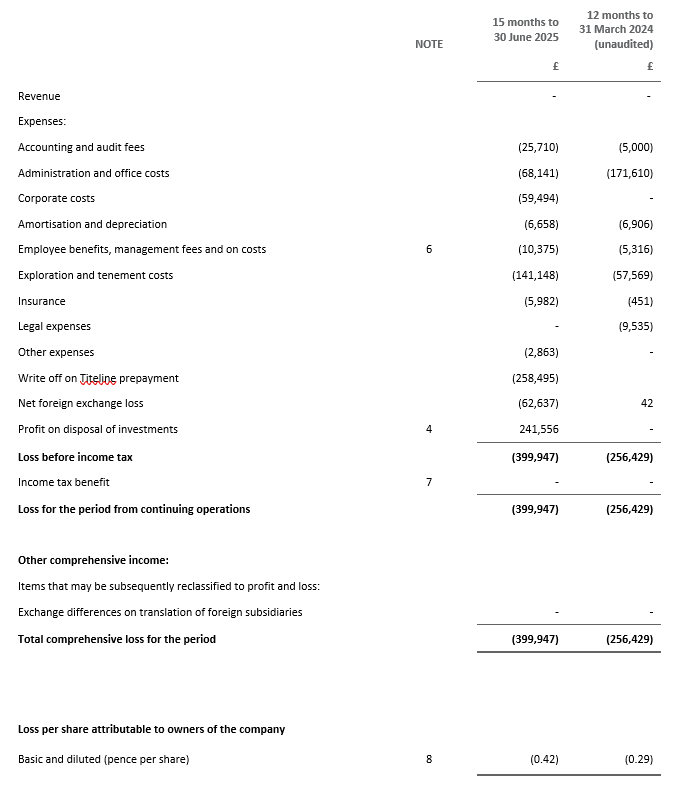
The Group reports a loss after tax for the reporting period of £399,947 from continuing operations (2024: £ 256,429 loss).
DIVIDENDS
The Directors do not recommend the payment of a dividend and no amount has been paid or declared by way of a dividend to the date of this report (2024: £nil).
K EY PERFORMANCE INDICATORS
The key performance indicators are set out below:
|
STATISTICS |
30 June 2025 |
|
Net asset value |
£2,863,422 |
|
Net asset value per share |
1.8p |
|
Closing share price at the end of the reporting period |
2.65p |
|
Market capitalisation |
£3.82m |
By virtue of the accounting treatment for the Reverse Takeover of Godolphin Exploration Limited, comparative figures in the financial statements reflect the accounts of Godolphin Exploration Limited only. As such any KPIs relating to the comparative period are not considered by the Directors to be comparable or relevant to the enlarged Group, and as such have not been included above.
STRATEGIC REPORT (continued)
For the period ended 30 June 2025
PRINCIPAL RISKS AND UNCERTAINTIES
Currently the principal risk lies in securing additional funding as and when necessary to continue with the core research and exploration business. The Company’s projects are in the exploration phase of development, which is risky in itself, and do not generate revenue. If the Company is unsuccessful in monetising its research developments or its exploration projects by attracting development partners or divesting assets it may need to raise additional capital as other junior exploration companies do from time to time. This risk is mitigated through the Company’s corporate development efforts and active engagement with a number of gold mining companies, project funders and other investors for the purpose of attracting investment in one or more of the Company’s projects or acquisition of one of the assets in line with the business plan.
FINANCIAL RISK MANAGEMENT OBJECTIVES AND POLICIES
Details of the Company's financial risk management objectives and policies are set out in Note 20 to these financial statements.
ENVIRONMENTAL REGULATIONS
The Group conducts a range of activities in the field which require accessing remote sites with heavy vehicles and equipment and minimally disturbing the land surface with sample taking to test geological structures. This work is conducted under very strict regulatory oversight and once completed the test sites are fully rehabilitated to ensure there is no long-term impact from the Company's activities on the environment. The Group is subject to environmental regulations under the laws of the Commonwealth and the State it operates in Australia and in the United Kingdom. The Board of Directors monitors compliance with environmental regulations and as at the date of this report the Directors are not aware of any breach of such regulations during the reporting period.
SECTION 172 STATEMENT
The Director’s believe they have acted in the way most likely to promote the success of the Company for the benefit of its members as a whole, as required by s172 of the Companies Act 2006.
The requirements of s172 are for the Directors to:
- Consider the likely consequences of any decision in the long term;
- Act fairly between the members of the Company;
- Maintain a reputation for high standards of business conduct;
- Consider the interests of the Company’s employees;
- Foster the Company’s relationships with suppliers, customers and others; and
- Consider the impact of the Company’s operations on the community and the environment.
The Company is quoted on the AQUIS Stock Exchange and its members will be fully aware, through detailed announcements, shareholder meetings and financial communications, of the Board’s broad and specific intentions and the rationale for its decisions.
When selecting investments, issues such as the impact on the community and the environment have actively been taken into consideration.
The Group pays its creditors promptly and keeps its costs to a minimum to protect shareholders funds. Currently, other than the directors, the Group engages all staff as contractors and has no employees.
The Group acknowledges the Traditional Owners of the land on which it operates and participates in supporting Native Title and Cultural Heritage. The Group has interests in projects around the world and supports the basic rights of all people. For example the ongoing annual reviews on Native Title in the Group’s Queensland, Australia, projects.
The Group adheres to the strictest anti-corruption protocols and does not trade in any non-compliant or conflict related resources. The Group utilises its technology platform and expertise to identify and delineate natural resource projects which it monetises by selling or partnering to bring into production.
The Group utilises its technology platform and expertise to identify and delineate natural resource projects which it monetises by selling or partnering to bring into production. The Group adheres to the ten principles set out in the QCA Code which it has adopted. The outcome of adherence to the QCA Code is the development of a best practice governance structure in the Group to pursue each of the ten principles.
STRATEGIC REPORT (continued)
For the period ended 30 June 2025
The principal risks identified are a failure to meet stakeholder commitments as a result of the inappropriate behaviour by members of the Group or the consultants and contractors which it engages. The Group is aware of its impact in operating in remote locations and the potential damage it can cause to the environment and property if its operations are not conducted with the utmost care. With these risks in mind, all contractors and consultants are vetted for appropriate expertise and experience prior to engagement and upon engagement are taken through thorough pre site induction training to ensure all standards are met in execution of their tasks.
This report was approved by the Board of Directors on 23 December 2025 and signed on its behalf by:
Mark Thompson
Chief Executive Officer
DIRECTORS’ REPORT
For the period ended 30 June 2025
The Directors present their report and the audited consolidated financial statements of Tamar Minerals Plc (formerly Tectonic Gold Plc) (“Tamar” or the “Company”) and its controlled entities (“Consolidated Entity” or “Group”) for the period ended 30 June 2025.
COMPARATIVES
The group’s comparatives are the unaudited figures of its subsidiary, Godolphin Exploration Limited as the Group was formed when the Reverse Takeover took place on 12 May 2025.
DIRECTORS
The Board comprised the following directors who served throughout the year and up to the date of this report save where disclosed otherwise:
|
Name |
Position |
Date Appointed |
|
Brett Boynton |
Non-Executive Chairman |
Appointed 26 May 2015 |
|
Mark Thompson |
Chief Executive Officer |
Appointed 12 May 2025 |
|
Andrew Wilson |
Non-Executive Director |
Appointed 13 November 2025 |
|
Sam Quinn |
Non-Executive Director |
Appointed 20 February 2017 |
|
Bruce Fulton |
Non-Executive Chairman |
Appointed 25 June 2018 (resigned 12 May 2025) |
|
Jonathan Robbeson |
Executive Director |
Appointed 15 August 2023 (resigned 12 May 2025) |
PRINCIPAL ACTIVITIES
The principal activity of the Company during the reporting period was the development of its assets in Devon and Cornwall and the progression of its joint venture in respect of its gold assets in Australia
DIRECTORS’ INTERESTS
The Directors’ interests in the share capital of the Company at 30 June 2025, held either directly or through related parties, were as follows:
|
Name of director |
Number of ordinary shares |
% of ordinary share capital and voting rights |
|
Mark Thompson |
17,500,000 |
12.11 |
|
Brett Boynton |
8,617,993 |
5.97 |
|
Sam Quinn |
252,613 |
0.17 |
|
|
26,370,606 |
18.25 |
In addition, Mark Thompson holds 33.33% of the ordinary shares of Godolphin Minerals Plc which held 5,672,000 ordinary shares in the Company at 30 June 2025.
D etails of the options granted to or held by the Directors at 30 June 2025 are as follows:
|
Name of director or former director |
Balance 30 June 2024 |
Options exercised |
Options lapsed |
Balance 30 June 2025 |
Number vested |
Grant date |
Exercise price |
Date of expiry |
||
|
B Fulton |
|
|
|
|
|
|
|
|
||
|
Series (ii) |
14,550,000 |
- |
14,550,000 |
- |
- |
08-Sep 20 |
£0.00275 |
08-Sep 24 |
||
|
Total |
14,550,000 |
- |
14,550,000 |
- |
- |
|
|
|
||
|
B Boynton |
|
|
|
|
|
|
|
|
||
|
Series (ii) |
6,913,637 |
- |
6,913,637 |
- |
- |
08-Sep 20 |
£0.00275 |
08-Sep 24 |
||
|
Total |
6,913,637 |
- |
6,913,637 |
- |
- |
|
|
|
||
|
S Quinn |
|
|
|
|
|
|
|
|
||
|
Series (ii) |
14,550,000 |
- |
14,550,000 |
- |
- |
08-Sep 20 |
£0.00275 |
08-Sep 24 |
||
|
Total |
14,550,000 |
- |
14,550,000 |
- |
- |
|
|
|
||
|
J Robbeson |
|
|
|
|
|
|
|
|
||
|
Series (ii) |
7,275,000 |
- |
7,275,000 |
- |
- |
08-Sep 20 |
£0.00275 |
08-Sep 24 |
||
|
Total |
7,275,000 |
- |
7,275,000 |
- |
- |
|
|
|
||
DIRECTORS’ REPORT (continued)
For the period ended 30 June 2025
The Company has made qualifying third-party indemnity provisions for the benefit of the Directors in the form of Directors’ and Officers’ Liability insurance during the year which remain in force at the date of this report.
DONATIONS
The Company did not make any political or charitable donations during the reporting period (30 June 2024: £ nil).
EMPLOYEE CONSULTATION
The only employees of the Company and the Group are Directors.
POST YEAR END EVENTS
Details of post year events has been included in Note 24.
GOING CONCERN
The Directors have prepared a cash flow assessment for the period to December 2026, being 12 months from the date of signing these financial statements which shows that the Group will require additional funding from May 2026 onwards in order to meet its liabilities as they fall due.. The Group has minimal expenditure requirements in relation to its licences and is committed to maintaining a low overhead at corporate level, commensurate with the Group’s stage of development. As an exploration company, by its nature the Group will need to raise additional funds to develop existing and potential future projects and to meet its ongoing corporate costs Such funding could come from the receipt of the final acquisition payment from White Energy for its acquisition of the Group’s Specimen Hill project, further monetisation of existing assets in Australia, but also in the form of a capital raise in the first half of 2026.
Given the ongoing positive results from the Specimen Hill farm out, the current portfolio of projects held by the Group, including those acquired in May 2025 through the acquisition of Godolphin Exploration Ltd, and the continued strength in commodity prices linked to the Group’s projects, the Directors are confident that the Group and Company will be able to raise sufficient funds to meet its obligations and continue as a going concern. However, the Directors note the requirement to raise additional funds in May 2026 does, by its nature, create a material uncertainty as to the Group’s and Company’s ability to continue to operate as envisaged.
Notwithstanding this material uncertainty, the Directors are confident in their ability to raise such funds as required and therefore have prepared these financial statements on a going concern basis.
STATEMENT OF DIRECTORS’ RESPONSIBILITIES
The Directors are responsible for preparing the annual report and the financial statements in accordance with applicable law and regulations.
Company law requires the directors to prepare financial statements for each financial year. Under that law the directors have prepared the Group and Company financial statements in accordance with UK adopted International Accounting Standards and as regards the Company financial statements, as applied in accordance with the provisions of the Companies Act 2006. Under company law, the directors must not approve the financial statements unless they are satisfied that they give a true and fair view of the state of affairs of the Group and Company and of the profit or loss of the Group for that period. In preparing these financial statements, the directors are required to:
- select suitable accounting policies and then apply them consistently;
- state whether applicable UK adopted International Accounting Standards have been followed, subject to any material departures disclosed and explained in the financial statements;
- make judgements and accounting estimates that are reasonable and prudent; and
- prepare the financial statements on the going concern basis unless it is inappropriate to presume that the Group and Company will continue in business.
The directors are responsible for keeping adequate accounting records that are sufficient to show and explain the Group and Company’s transactions and disclose with reasonable accuracy at any time the financial position of the Group and Company and enable them to ensure that the financial statements comply with the Companies Act 2006. The directors are also responsible for safeguarding the assets of the Group and Company and hence for taking reasonable steps for the prevention and detection of fraud and other irregularities. The directors are responsible for the maintenance and integrity of the corporate and financial information included on the Company’s website. Legislation in the United Kingdom governing the preparation and dissemination of financial statements may differ from legislation in other jurisdictions.
DIRECTORS’ REPORT (continued)
For the period ended 30 June 2025
DISCLOSURE OF INFORMATION TO THE AUDITORS
In the case of each of the persons who are directors of the Company at the date when this report is approved:
- So far as each director is aware, there is no relevant audit information of which the Company’s auditors are unaware; and
- Each of the directors has taken all steps that they ought to have taken as a director to make themselves aware of any relevant audit information and to establish that the auditors are aware of the information.
AUDITOR
Moore Kingston Smith LLP have expressed their willingness to continue in office as auditor and it is expected that a resolution to reappoint them will be proposed at the next annual general meeting.
CORPORATE GOVERNANCE
The Company has set out its full Corporate Governance Statement on page 12.
BOARD OF DIRECTORS
The Company supports the concept of an effective Board leading and controlling the Company. The Board of Directors is responsible for approving Company policy and strategy. It meets regularly and has a schedule of matters specifically reserved to it for decision. All Directors have access to advice from independent professionals at the Company's expense. Training is available for new and existing Directors, as necessary.
The Board consists of the Chairman, Brett Boynton, Managing Director and Chief Executive Officer, Mark Thompson, and Non-Executive Directors, Sam Quinn and Andrew Wilson.
Since Admission to the AQUIS Stock Exchange on 25 June 2018, the Board has established properly constituted audit, remuneration and AQUIS Stock Exchange compliance committees with formally delegated duties and responsibilities, a summary of which is set out below.
AUDIT COMMITTEE
The Audit and Risk Committee comprises Brett Boynton (Chairman) and Andrew Wilson. The Committee meets at least twice a year and is responsible for ensuring the financial performance of the Company is properly reported on and monitored. It liaises with the auditor and reviews the reports from the auditor relating to the financial statements.
The Board as a whole considers the appointment of external auditors, including their independence, specifically including the nature and scope of non-audit services provided.
REMUNERATION COMMITTEE
The Remuneration Committee comprises Sam Quinn (Chairman) and Brett Boynton. The Committee meets at least twice a year and is responsible for reviewing the performance of Executive Directors and sets the scale and structure of their remuneration on the basis of their service agreements, with due regard to the interests of the shareholders and the performance of the Company.
AQUIS STOCK EXCHANGE COMPLIANCE COMMITTEE
The role of the AQUIS Stock Exchange Compliance Committee is to ensure that the Company has in place sufficient procedures, resources and controls to enable it to comply with the AQUIS Stock Exchange Rules. The Committee make recommendations to the Board and proactively liaise with the Company’s AQUIS Stock Exchange Corporate Adviser on compliance with the AQUIS Stock Exchange Rules. The Committee also monitors the Company’s procedures to approve any share dealings by directors or employees in accordance with the Company’s share dealing code. The members of the Committee are Andrew Wilson (Chairman) and Sam Quinn.
SHARE DEALING CODE
The Company has adopted a share dealing code for dealings in securities of the Company by directors and certain employees which is appropriate for a company whose shares are traded on the AQUIS Stock Exchange. This will constitute the Company’s share dealing policy for the purpose of compliance with UK legislation including the Market Abuse Regulation and the relevant part of the AQUIS Stock Exchange Rules. It should be noted that the insider dealing legislation set out in the UK Criminal Justice Act 1993, as well as provisions relating to market abuse, also apply to the Company and dealings in Ordinary Shares.
DIRECTORS’ REPORT (continued)
For the period ended 30 June 2025
COMMUNICATIONS WITH SHAREHOLDERS
Communications with shareholders are given a high priority by the management. In addition to the publication of an annual report and an interim report, there is regular dialogue with shareholders and analysts. The Annual General Meeting is viewed as a forum for communicating with shareholders, particularly private investors. Shareholders may question the Chief Executive Officer and other members of the Board at the Annual General Meeting.
SIGNIFICANT SHAREHOLDERS
The following shareholders held over 3% at 30 June 2025:
|
Shareholder Name |
Number of Shares |
Holding |
|
HENRY MAXEY |
18,359,375 |
12.71% |
|
MARK THOMPSON |
17,500,000 |
12.11% |
|
DAVID LILLEY |
17,500,000 |
12.11% |
|
BRETT BOYNTON |
8,617,993 |
5.97% |
|
GODOLPHIN MINERALS LTD |
5,672,000 |
3.93% |
INTERNAL CONTROL
The Directors acknowledge they are responsible for the Company’s system of internal control and for reviewing the effectiveness of these systems. The risk management process and systems of internal control are designed to manage rather than eliminate the risk of the Company failing to achieve its strategic objectives. It should be recognised that such systems can only provide reasonable and not absolute assurance against material misstatement or loss. The Company has well established procedures which are considered adequate given the size of the business.
REMUNERATION
The remuneration of the directors has been fixed by the Board as a whole. The Board seeks to provide appropriate reward for the skill and time commitment required so as to retain the right calibre of director at a cost to the Company which reflects current market rates. Details of directors’ fees and of payments made to directors for professional services rendered are set out in Note 6 to the financial statements and details of the directors’ share options are set out in the Directors’ Report.
FUTURE DEVELOPMENTS
Likely developments in the operations of the Group and the expected results of those operations in future financial years have not been included in this report as the directors believe, on reasonable grounds, that the inclusion of such information would be likely to result in unreasonable prejudice to the Company.
ENERGY AND CARBON REPORT
As the Group has not consumed more than 40,000 kWh of energy in this reporting period, it qualifies as a low energy user under these regulations and is not required to report on its omissions, energy or energy efficiency activities.
RESPONSIBILITY STATEMENT OF THE DIRECTORS IN RESPECT OF THE ANNUAL FINANCIAL REPORT
We confirm that to the best of our knowledge that the financial statements, prepared in accordance with the applicable set of accounting standards, give a true and fair view of the assets, liabilities, financial position and profit or loss of the Company and the undertakings included in the consolidation taken as a whole; and the Directors’ report includes a fair review of the development and performance of the business and the position of the issuer and the undertakings included in the consolidation taken as a whole, together with a description of the principal risks and uncertainties that they face.
This information is given and should be interpreted in accordance with the provisions of Section 418 of the Companies Act 2006.
This report was approved by the Board of Directors on 23 December 2025 and signed on its behalf by:
Mark Thompson
Chief Executive Officer
CORPORATE GOVERNANCE STATEMENT
For the period ended 30 June 2025
The Company is committed to maintaining the highest standards in corporate governance throughout its operations and to ensure all of its practices are conducted transparently, ethically and efficiently. The Company believes scrutinising all aspects of its business and reflecting, analysing and improving its procedures will result in the continued success of the Company and deliver value to shareholders. Therefore, and in accordance with the Aquis Growth Market Apex Rule Book, (the “AQSE Rules”), the Company has formalised its governance policies by complying with the UK's Quoted Companies Alliance Corporate Governance Code 2023 (the "QCA Code").
The Board consisted of four Directors during the year: a Chief Executive Officer (Mark Thompson) a Non-Executive Chairman (Brett Boynton), and two independent Non-Executive Directors being Sam Quinn and Andrew Wilson. The Board considers that appropriate oversight of the Company is provided by the currently constituted Board.
QCA Code
The ten principles set out in the QCA Code are listed below, with an explanation of how the Company applies each of the principles and the reason for any aspect of non-compliance.
Principle 1 - Establish a strategy and business model which promotes long-term value for shareholders.
The strategic vision of the Company is to fund and develop the identification and delineation of mineral resources for future divestment or partnering to bring into development.
The Company’s business model and strategy is outlined on a yearly basis in the Chairman’s Statement in the Annual Report.
Principle 2 - Seek to understand and meet shareholder needs and expectations.
The Board values the importance of interacting with our shareholders, explaining strategy and developments in the businesses and seeking shareholder views and opinions. We also value the input of our advisers, including our AQSE Growth Market Corporate Adviser and broker and auditors. The Board is committed to maintaining good communications and having constructive dialogue with its shareholders. Institutional shareholders and analysts have the opportunity to discuss issues and provide feedback at meetings with the Company. As a policy, all shareholders are encouraged to attend the Company’s Annual General Meeting and any other General Meetings that are held throughout the year.
Investors also have access to current information on the Company through its website www.tamarminerals.com . The Company provides regulatory, financial and business news updates through the Regulatory News Service in accordance with AQSE Rules.
Principle 3 - Take into account wider stakeholder and social responsibilities and their implications for long term success.
There are a number of key relationships and resources that are fundamental to the Company's success, which include, amongst other things, relationships with, advisors, consultant suppliers, contractors, employees, potential investors and local stakeholders in the areas around the Group’s various projects. These relationships are key components to the successful running of the Company’s investments and are reviewed by the Board and management on a regular basis to ensure that all potential risks are mitigated. To the extent any issues or concerns come to light following such review, or upon engagement with such stakeholders, the Company seeks to address matters in an expeditious manner in order to preserve and strengthen relationships.
The Board recognises that the long-term success of the Company will be enhanced by good relations with different internal and external groups and to understand their needs, interest and expectations, the Board has established a range of processes and systems to ensure that there is ongoing two-way communication, control and feedback processes in place with to enable appropriate and timely response.
Principle 4 - Embed effective risk management, considering both opportunities and threats, throughout the organisation.
The Board regularly reviews the risks to which the Company is exposed and ensures through its meetings and regular reporting that these risks are minimised as far as possible whilst recognising that its business opportunities carry an inherently high level of risk. The principal risks and uncertainties facing the Company are detailed in the Risk Factors report of the Company’s Admission Document and updated in the annual report and accounts, which are available on the Company’s website www.tamarminerals.com .
The Board has established an Audit and Risk Committee with formally delegated duties and responsibilities.
CORPORATE GOVERNANCE STATEMENT (continued)
For the period ended 30 June 2025
Principle 5 - Maintain the Board as a well-functioning, balanced team led by the Non-Executive Chairman.
The Board’s role is to agree the Company’s long-term direction and strategy and monitor achievement of key milestones against its business objectives. The Board meets formally at least four times a year for these purposes and holds additional meetings when necessary to transact other business. The Board receives reports for consideration on all significant strategic, operational and financial matters.
The Board is comprised of a Chief Executive Officer, a Non-Executive Chairman and two Non-Executive Directors. Each Director retires by rotation and serves on the Board until the Annual General Meeting following his election or appointment. Each member of the Board is committed to spending sufficient time to enable them to carry out their duties as a Director. The Board meets regularly throughout the year as deemed appropriate formally and informally using video conferencing technology.
The Company constantly keeps under review the constitution of the Board and may seek to add more members as required as the Company grows and develops.
The Board as a whole considers the Non-Executive Directors to be independent of management and free from any business or other relationship which could materially interfere with the exercise of their independent judgement.
The Board has implemented an effective committee structure to assist in the discharge of its responsibilities. All committees of the Board have written terms of reference dealing with their authority and duties. Membership of the Audit and Risk, and Remuneration Committees is comprised exclusively of Non-Executive Directors. The Company Secretary acts as secretary to each of these committees.
The table below sets out the number of Board and Committee meeting held during the period and each Director’s attendance at those meetings.
|
|
BOARD |
AUDIT AND RISK |
REMUNERATION |
|||
|
|
HELD |
ATTENDED |
HELD |
ATTENDED |
HELD |
ATTENDED |
|
M Thompson |
1 |
1 |
- |
- |
- |
- |
|
B Boynton |
5 |
5 |
2 |
2 |
- |
- |
|
S Quinn |
5 |
5 |
- |
- |
- |
- |
|
J Robbeson |
4 |
4 |
2 |
2 |
- |
- |
|
B Fulton |
4 |
4 |
2 |
2 |
- |
- |
The Company did not hold any Aquis Stock Exchange Compliance Committee meetings during the year and compliance was instead managed directly by the executive with support from the Company’s Aquis Corporate Advisor and Broker.
Principle 6 - Ensure that between them the Directors have the necessary up-to-date experience, skills and capabilities.
The Board considers the current balance of sector, financial and public market skills and experience which it embodies is appropriate for the size and stage of development of the Company and that the Board has the skills and requisite experience necessary to execute the Company’s strategy and business plan whilst also enabling each Director to discharge their fiduciary duties effectively. Biographies for each member of the Board is provided on the Company’s website www.tamarminerals.com .
All Directors, through their involvement in other listed companies as well as the Company, including attendance at seminars, forums and industry events and through their memberships of various professional bodies, keep their skill sets up to date.
The Board reviews annually, and when required, the appropriateness of its mix of skills and experience to ensure that it meets the changing needs of the Company.
The Company has a professional Company Secretary in the UK who assists the Chief Executive Officer in preparing for and running effective Board meetings, including the timely dissemination of appropriate information. The Company Secretary provides advice and guidance to the extent required by the Board on the legal and regulatory environment. In addition, the Board’s finance function is supported by Silvertree Partners LLP who is engaged by the Company to provide accounting and finance services .
CORPORATE GOVERNANCE STATEMENT (continued)
For the period ended 30 June 2025
Principle 7 - Evaluate Board performance based on clear and relevant objectives, seeking continuous improvement.
Review of the Company’s progress against the long-term strategy and aims of the business provides a means to measure the effectiveness of the Board. This progress is reviewed in Board meetings held at least four times a year. The Chief Executive Officer’s performance is reviewed once a year by the rest of the Board and measured against a definitive list of short, medium and long-term strategic targets set by the Board.
The Company conducts periodic reviews of its Board succession planning protocols which includes an assessment of the number of Board members and relative experience of each Board member vis-a-vis the Company’s requirements given its stage of development, with the goal of having in place an adequate and sufficiently experienced Board at all times.
Principle 8 - Promote a corporate culture that is based on ethical values and behaviours.
The corporate culture of the Company is promoted throughout its employees and contractors and is underpinned by compliance with local regulations and the implementation and regular review and enforcement of various policies including a Share Dealing Policy and Code, Anti-Corruption and Anti-Bribery and Media and Communications Policy so that all aspects of the Company are run in a robust and responsible way.
The Board recognises that its decisions regarding strategy and risk will impact the corporate culture of the Company and that this will impact performance. The Board is very aware that the tone and culture set by the Board will greatly impact all aspects of the Company and the way that employees behave. The exploration for, and development of, mineral resources can have a significant impact in the areas where the Company and its investments are active and it is important that the communities view its activities positively. Therefore, the importance of sound ethical values and behaviours is crucial to the ability of the Company to successfully achieve its corporate objectives. The Board places great importance on this aspect of corporate life and seeks to ensure that this is reflected in all the Company does.
Principle 9 - Maintain governance structures and processes that are fit for purpose and support good decision-making by the Board.
The Board is responsible for setting the vision and strategy for the Company to deliver value to the Company’s shareholders by effectively putting in place its business model.
The roles and responsibility of the Chief Executive Officer, Non-Executive Chairman and other Non-Executive Directors are laid out below:
• The Chief Executive Officer’s primary responsibilities are to: implement the Company’s strategy in consultation with the Board; take responsibility for the Company’s projects; run the Company on a day-by-day basis; implement the decisions of the Board; monitor, review and manage key risks; act as the Company’s primary spokesman; communicate with external audiences such as investors, analysts and media; and be responsible for the administration of all aspects of the Company.
• The Non-Executive Chairman’s primary responsibilities are to: lead the Board and to ensure the effective working of the Board; in consultation with the Board, ensure good corporate governance and set clear expectations with regards to the Company culture, values and behaviour; set the Board’s agenda and ensures that all Directors are encouraged to participate fully in the decision-making process of the Board and take responsibility for relationships with the Company’s professional advisers and major shareholders.
• The Company’s NED'S participate in all Board level decisions and play a particular role in the determination and articulation of strategy. The Company’s NED’s provide oversight and scrutiny of the performance of the Executive Directors, whilst both constructively challenging and inspiring them, thereby ensuring the business develops, communicate and execute the agreed strategy and operate within the risk management framework.
• The Company Secretary is responsible for ensuring that Board procedures are followed and applicable rules and regulations are complied with.
The Board is supported by the Audit and Risk, and Remuneration Committees as described below.
The Board has not established a Nominations Committee. The Board considers that a separately established committee is not warranted at this stage of the Group’s development and that the functions of such a committee are being adequately discharged by the Board as a whole.
CORPORATE GOVERNANCE STATEMENT (continued)
For the period ended 30 June 2025
Audit and Risk Committee
The Audit and Risk Committee comprises Brett Boynton as Chairman and Andrew Wilson. The Audit and Risk Committee reviews reports from management and from Moore Kingston Smith LLP, the Company’s statutory auditor, relating to the interim and annual accounts and to the system of internal financial control.
The Audit and Risk Committee is responsible for assisting the Board’s oversight of the integrity of the financial statements and other financial reporting, the independence and performance of the auditor, the regulation and risk profile of the Company and the review and approval of any related party transactions. The Audit and Risk Committee may hold private sessions with management and the auditor without management present. Further, the Audit and Risk Committee is responsible for making recommendations to the Board on the appointment of the auditor and the audit fee and reviews reports from management and the auditor on the financial accounts and internal control systems used throughout the Group. The Audit and Risk Committee meets at least two times a year and is responsible for ensuring that the Company’s financial performance is properly monitored, controlled and reported. The Audit and Risk Committee is responsible for the scope and effectiveness of the external audit and compliance by the Company with statutory and other regulatory requirements.
With respect to the auditor, the Audit and Risk Committee:
• Monitors, in discussion with the auditor, the integrity of the financial statements of the Company, any formal announcements relating to the Company’s financial performance and reviews significant financial reporting judgments contained in them;
• reviews the Company’s internal financial controls and reviews the Company’s internal control and risk management systems;
• considers annually whether there is a need for an internal audit function and makes a recommendation to the Board;
• makes recommendations to the Board for it to put to the shareholders for their approval in the general meeting, in relation to the appointment, re-appointment and removal of the auditor and to approve the remuneration and terms of engagement of the auditor;
• reviews and monitors the auditor’s independence and objectivity and the effectiveness of the audit process, taking into consideration relevant professional and regulatory requirements;
• develops and implements policy on the engagement of the auditor to supply non-audit services, taking into account relevant external guidance regarding the provision of non-audit services by the auditor; and
• reports to the Board, identifying any matters in respect of which it considers that action or improvement is needed and making recommendations as to the steps to be taken.
The Audit and Risk Committee also reviews arrangements by which the staff of the Company and the Company may, in confidence, raise concerns about possible improprieties in matters of financial reporting or other matters and ensure that arrangements are in place for the proportionate and independent investigation of such matters with appropriate follow-up action.
Where necessary, the Audit and Risk Committee obtains specialist external advice from appropriate advisers. No such advice has been obtained in the period.
Remuneration Committee
The Remuneration Committee comprises Sam Quinn (Chairman) and Brett Boynton.
The Remuneration Committee is responsible for considering all material elements of remuneration policy, the remuneration and incentivisation of Executive Directors and senior management (as appropriate) and to make recommendations to the Board on the framework for executive remuneration and its cost. The role of the Remuneration Committee is to keep under review the Company’s remuneration policies to ensure that the Company attracts, retains and motivates the most qualified talent who will contribute to the long-term success of the Company. The Remuneration Committee also reviews the performance of the Chief Executive Officer and sets the scale and structure of his remuneration, including the implementation of any bonus arrangements, with due regard to the interests of shareholders.
The Remuneration Committee is also responsible for granting options under the Company’s share option plan and, in particular, the price per share and the application of the performance standards which may apply to any grant, ensuring in determining such remuneration packages and arrangements, due regard is given to any relevant legal requirements, the provisions and recommendations in the AQSE Rules and The QCA Code.
CORPORATE GOVERNANCE STATEMENT (continued)
For the period ended 30 June 2025
The Remuneration Committee:
• determines and agrees with the Board the framework or broad policy for the remuneration of the Chief Executive Officer and senior management;
• determines the remuneration of Executive Directors;
• determines targets for any performance-related pay schemes operated by the Company;
• ensures that contractual terms on termination and any payments made are fair to the individual, the Company, that failure is not rewarded and that the duty to mitigate loss is fully recognised;
• determines the total individual remuneration package of the Chief Executive Officer and senior management, including bonuses, incentive payments and share options;
• is aware of and advises on any major changes in employees’ benefit structures throughout the Company;
• ensures that provisions regarding disclosure, including pensions, as set out in the (Directors’ Remuneration Policy and Directors’ Remuneration Report) Regulations 2019, are fulfilled; and
• is exclusively responsible for establishing the selection criteria, selecting, appointing and setting the terms of reference for any remuneration consultants who advise the Remuneration Committee.
Principle 10 - Communicate how the company is governed and is performing by maintaining a dialogue with shareholders and other relevant stakeholders.
The Board is committed to maintaining good communication and having constructive dialogue with its shareholders. Institutional shareholders and analysts have the opportunity to discuss issues and provide feedback at meetings with the Company.
The Company also provides regular updates on the progress of the Company, detailing recent business and strategy developments, in news releases which is available on the Company's website www.tamarminerals.com .
The Company’s financial reports can be found on its website www.tamarminerals.com . The Company will host its AGMs in London.
The Company also participates in various investor events including conferences and presentation evenings, at which shareholders can meet with management in person to answer queries, provide information on current developments and to take into consideration shareholder views and suggestions.
The Board is always open to receiving feedback from shareholders. The Chief Executive Officer has been appointed to manage the relationship between the Company and its shareholders and will review and report to the Board on any communications received.
INDEPENDENT AUDITOR’S REPORT TO THE MEMBERS OF TAMAR MINERALS PLC
For the period ended 30 June 202 5
Opinion
We have audited the financial statements of Tamar Minerals Plc (the ‘parent company’) and its subsidiaries (the ‘group’) for the period ended 30 June 2025 which comprise the Consolidated Statement of Profit and Loss and Other Comprehensive Income, the Group and Company Statements of Financial Position, the Consolidated and Company Statements of Changes in Equity, the Consolidated and Company Statements of Cash Flows and notes to the financial statements, including significant accounting policies. The financial reporting framework that has been applied in their preparation is applicable law and UK adopted International Accounting Standards and as regards the parent company financial statements, as applied in accordance with the provisions of the Companies Act 2006.
In our opinion:
- the financial statements give a true and fair view of the state of the group’s and of the parent company’s affairs as at 30 June 2025 and of the group’s loss for the period then ended;
- the group financial statements have been properly prepared in accordance with UK adopted International Accounting Standards;
- the parent company financial statements have been properly prepared in accordance with UK adopted International Accounting Standards and as applied in accordance with the provisions of the Companies Act 2006; and
- the financial statements have been prepared in accordance with the requirements of the Companies Act 2006.
Basis for opinion
We conducted our audit in accordance with International Standards on Auditing (UK) (ISAs (UK)) and applicable law. Our responsibilities under those standards are further described in the Auditor’s Responsibilities for the audit of the financial statements section of our report. We are independent of the group in accordance with the ethical requirements that are relevant to our audit of the financial statements in the UK, including the FRC’s Ethical Standard as applied to listed entities, and we have fulfilled our other ethical responsibilities in accordance with these requirements. We believe that the audit evidence we have obtained is sufficient and appropriate to provide a basis for our opinion.
An overview of the scope of our audit
The scope of our audit was influenced by our evaluation of materiality and our assessment of the risks of material misstatement in the group and parent company financial statements. In particular, we assessed the areas involving significant accounting estimates and judgement by the directors as risks for our audit. This included the carrying value of exploration assets and investments as well as future events that are inherently uncertain and could have an impact on the group and parent company’s ability to continue as a going concern. These were judged to be the most significant assessed risks of material misstatement and are therefore reported as key audit matters below.
A full scope audit of the consolidated and parent company financial statements was performed by the group audit engagement team.
The audit work on the full scope component based in Australia was performed by a component auditor. We directed the work of and had oversight of, and regular communication with, the component auditor who was operating under our instructions. The component auditor supplied copies of relevant working papers for our review. This, along with further discussions with the component auditor, enabled us to obtain sufficient appropriate audit evidence to form our opinion on the group financial statements.
Other matters
The consolidated financial statements include comparative figures as at 31 March 2024 which were not audited in accordance with the requirements of the Companies Act 2006 or ISAs (UK). Accordingly, we do not express an opinion on the comparative figures included in the financial statements for the period ended 31 March 2024.
Our opinion is not modified in this respect.
INDEPENDENT AUDITOR’S REPORT TO THE MEMBERS OF TAMAR MINERALS PLC (CONTINUED)
For the period ended 30 June 2025
Key audit matters
Key audit matters are those matters that, in our professional judgement, were of most significance in our audit of the financial statements of the current period and include the most significant assessed risks of material misstatement (whether or not due to fraud) we identified, including those which had the greatest effect on: the overall audit strategy, the allocation of resources in the audit; and directing the efforts of the engagement team. These matters were addressed in the context of our audit of the financial statements as a whole, and in forming our opinion thereon, and we do not provide a separate opinion on these matters.
|
Key audit matter |
How the scope of our audit responded to the key audit matter |
|
Going concern (group and parent company) The group has incurred a further loss before income tax of £399,947 in the period (2024; £256,429) and has cash and cash equivalents at 30 June 2025 of £294,994 (31 March 2024: £57,156). Note 2 of the financial statements sets out the directors’ assessment of the appropriateness of the use of the going concern basis of preparation of the financial statements. This explains that the group and parent company expect to receive future funding and support to enable their obligations to be met and ensure they continue to operate in the foreseeable future. There is a risk that the group and parent company will be unable to access that further funding and support. |
Our audit work and conclusion in respect of going concern has been detailed in the Material uncertainty related to going concern section of our audit report. |
|
Accounting treatment of the Reverse Takeover On 12 May 2025, the Company completed a reverse takeover (“RTO”) of Godolphin Exploration Limited. Note 18 of the financial statements details management’s assessment of whether the RTO transaction represents a business combination. It also details that the fair value of the net assets of the accounting acquiree (the company), at acquisition, exceeded the value of the deemed consideration calculated in accordance with the requirements for reverse acquisition accounting. The potential credit arising does not meet the definition of income under the IFRS conceptual framework and therefore no transaction cost or income was recognised in profit or loss, and it has consequently been credited to the RTO reserve. Given the significance of the transaction which is reliant upon a number of significant assumptions, this was considered to be a key audit matter. |
Our work included, but was not limited to:
Key observations Based on the work performed, we concluded that the accounting for the RTO as a share-based payment transaction (namely a payment by the accounting acquirer to acquire a listing) was appropriate, and that the related disclosures in the financial statements are not materially misstated. We also concluded that the treatment of the transaction as an RTO was appropriate. |
|
Carrying value of mining exploration and evaluation expenditure (group) As disclosed in note 12 of the financial statements, exploration and evaluation expenditure recognised as an asset in the group statement of financial position as at 30 June 2025 was £2,947,624.
The valuation of this asset and specifically whether any impairment is required is highly judgemental due to the early stage of the projects and the contingent nature of obtaining a mining permit. |
Our work in this area included, but was not limited to:
Key observations Based on the work performed we have gained reasonable assurance that the carrying value of exploration and evaluation assets are not materially misstated and that management’s assertion that no further impairment was required was appropriate. |
|
Recoverability of investments and subsidiary loans (parent company) The parent company has significant investments in its subsidiary entities which is supported by the underlying projects. As at 30 June 2025, and as shown in note 13, this investment was £7,269,509 (2024: £3,605,254). Note 10 also discloses a loan of £2,100,468 (2024: £2,239,446) provided by the parent company to its subsidiary, Signature Gold Pty Ltd, as at 30 June 2025. There is a risk that the investment in the subsidiaries, along with the loan, are impaired as the subsidiaries are not currently generating significant revenues. Therefore, it is necessary to assess the recoverable amount of the holdings at year end. There is also a risk that the significant loan balance with Signature Gold Pty Ltd may not be recoverable. |
Our work in this area included, but was not limited to:
Key observations Based on the work performed we consider that management’s assessment in respect of the recoverability of the parent company investments and loan to one of its subsidiaries are appropriate and that the balances in question are not materially misstated. |
Our application of materiality
When establishing our overall audit strategy, we set certain thresholds which help us to determine the nature, timing and extent of our audit procedures. When evaluating whether the effects of misstatements, both individually and on the financial statements as a whole, could reasonably influence the economic decisions of the users of the financial statements we take into account the qualitative nature and the size of the misstatements.
Our overall Group materiality is £200,000 and the Parent Company materiality is £192,000.
Our materiality for the Group and Parent Company is based upon 2% of gross assets. The rationale for our materiality calculation is that the Group and Parent Company are still in the exploration stage and therefore no significant revenues are currently being generated. Current and potential investors will thus be most interested in the level and recoverability of the gross assets, in particular the exploration and evaluation assets. Gross assets is thus considered to be the most appropriate benchmark for determining overall materiality. Our Group and Parent Company performance materiality figures have been calculated as £100,000 and £96,000 respectively which have been calculated as 50% of overall materiality.
INDEPENDENT AUDITOR’S REPORT TO THE MEMBERS OF TAMAR MINERALS PLC (CONTINUED)
For the period ended 30 June 2025
We agreed with the Audit Committee that we would report all individual audit differences in excess of £10,000 and £9,600 in respect of the Group and Parent Company respectively. We also agreed to report differences below that threshold that, in our view, warranted reporting on qualitative grounds.
Material uncertainty related to going concern
We draw attention to note 2 to the financial statements which indicates that the group will need to raise equity or debt financing in May 2026 in order to continue in business and meet its liabilities as they fall due.
Although the directors are confident that the group will be able to raise equity or debt financing if required there can be no certainty in this respect and a failure to raise equity or debt financing would be material to the group.
These events or conditions indicate that a material uncertainty exists that may cast significant doubt on the group’s and parent company’s ability to continue as a going concern. Our opinion is not modified in respect of this matter.
In auditing the financial statements we have concluded that the use of the going concern basis of accounting in the preparation of the financial statements is appropriate. Our evaluation of the directors’ assessment of the entity’s ability to continue to adopt the going concern basis of accounting included a critical assessment of the cash flow projections prepared to 31 December 2026 by the directors, which are based on their current expectations, and critically assessing the cash flow forecast assumptions including obtaining an understanding of all relevant uncertainties.
Our responsibilities and those of the directors with respect to going concern are described in the relevant sections of this report.
Other information
The other information comprises the information included in the annual report, other than the financial statements and our auditor’s report thereon. The directors are responsible for the other information contained within the annual report. Our opinion on the financial statements does not cover the other information and, except to the extent otherwise explicitly stated in our report, we do not express any form of assurance conclusion thereon.
Our responsibility is to read the other information and, in doing so, consider whether the other information is materially inconsistent with the financial statements or our knowledge obtained in the course of the audit or otherwise appears to be materially misstated. If we identify such material inconsistencies or apparent material misstatements, we are required to determine whether there is a material misstatement in the financial statements themselves. If, based on the work we have performed, we conclude that there is a material misstatement of this other information, we are required to report that fact.
We have nothing to report in this regard.
Opinions on other matters prescribed by the Companies Act 2006
In our opinion, based on the work undertaken in the course of the audit:
- the information given in the strategic report and the directors’ report for the financial year for which the financial statements are prepared is consistent with the financial statements; and
- the strategic report and the directors’ report have been prepared in accordance with applicable legal requirements.
Matters on which we are required to report by exception
In the light of the knowledge and understanding of the group and the parent company and their environment obtained in the course of the audit, we have not identified material misstatements in the strategic report or the directors’ report.
We have nothing to report in respect of the following matters in relation to which the Companies Act 2006 requires us to report to you if, in our opinion:
- adequate accounting records have not been kept by the parent company, or returns adequate for our audit have not been received from branches not visited by us; or
- the parent company financial statements are not in agreement with the accounting records and returns; or
- certain disclosures of directors’ remuneration specified by law are not made; or
- we have not received all the information and explanations we require for our audit.
INDEPENDENT AUDITOR’S REPORT TO THE MEMBERS OF TAMAR MINERALS PLC (CONTINUED)
For the period ended 30 June 2025
Responsibilities of directors
As explained more fully in the statement of directors’ responsibilities, the directors are responsible for the preparation of the group and parent company financial statements and for being satisfied that they give a true and fair view, and for such internal control as the directors determine is necessary to enable the preparation of financial statements that are free from material misstatement, whether due to fraud or error.
In preparing the group and parent company financial statements, the directors are responsible for assessing the group’s and the parent company’s ability to continue as a going concern, disclosing, as applicable, matters related to going concern and using the going concern basis of accounting unless the directors either intend to liquidate the group or the parent company or to cease operations, or have no realistic alternative but to do so.
Auditor’s responsibilities for the audit of the financial statements
Our objectives are to obtain reasonable assurance about whether the financial statements as a whole are free from material misstatement, whether due to fraud or error, and to issue an auditor’s report that includes our opinion. Reasonable assurance is a high level of assurance but is not a guarantee that an audit conducted in accordance with ISAs (UK) will always detect a material misstatement when it exists. Misstatements can arise from fraud or error and are considered material if, individually or in the aggregate, they could reasonably be expected to influence the economic decisions of users taken on the basis of these financial statements.
A further description of our responsibilities is located on the Financial Reporting Council’s website at: https://www.frc.org.uk/auditors/auditor-assurance/auditor-s-responsibilities-for-the-audit-of-the-fi/description-of-the-auditor's-responsibilities-for .
This description forms part of our auditor’s report.
Explanation as to what extent the audit was considered capable of detecting irregularities, including fraud
Irregularities, including fraud, are instances of non-compliance with laws and regulations. We design procedures in line with our responsibilities, outlined above, to detect material misstatements in respect of irregularities, including fraud. The extent to which our procedures are capable of detecting irregularities, including fraud is detailed below.
The objectives of our audit in respect of fraud, are; to identify and assess the risks of material misstatement of the financial statements due to fraud; to obtain sufficient appropriate audit evidence regarding the assessed risks of material misstatement due to fraud, through designing and implementing appropriate responses to those assessed risks; and to respond appropriately to instances of fraud or suspected fraud identified during the audit. However, the primary responsibility for the prevention and detection of fraud rests with both management and those charged with governance of the company.
Our approach was as follows:
- We obtained an understanding of the legal and regulatory requirements applicable to the company and considered that the most significant are the Companies Act 2006, UK adopted International Accounting Standards, the rules of the Aquis Exchange and UK and Australian taxation legislation.
- We obtained an understanding of how the company complies with these requirements by discussions with management and those charged with governance.
- We assessed the risk of material misstatement of the financial statements, including the risk of material misstatement due to fraud and how it might occur, by holding discussions with management and those charged with governance.
- We inquired of management and those charged with governance as to any known instances of non-compliance or suspected non-compliance with laws and regulations.
- Based on this understanding, we designed specific appropriate audit procedures to identify instances of non-compliance with laws and regulations. This included making enquiries of management and those charged with governance and obtaining additional corroborative evidence as required.
There are inherent limitations in the audit procedures described above. We are less likely to become aware of instances of non-compliance with laws and regulations that are not closely related to events and transactions reflected in the financial statements.
Also, the risk of not detecting a material misstatement due to fraud is higher than the risk of not detecting one resulting from error, as fraud may involve deliberate concealment by, for example, forgery or intentional misrepresentations, or through collusion.
INDEPENDENT AUDITOR’S REPORT TO THE MEMBERS OF TAMAR MINERALS PLC (CONTINUED)
For the year ended 30 June 2025
Use of our report
This report is made solely to the company's members, as a body, in accordance with Chapter 3 of Part 16 of the Companies Act 2006. Our audit work has been undertaken so that we might state to the company's members those matters we are required to state to them in an auditor’s report and for no other purpose. To the fullest extent permitted by law, we do not accept or assume responsibility to anyone other than the company and the company's members as a body, for our audit work, for this report, or for the opinions we have formed.
Matthew Banton (Senior Statutory Auditor)
for and on behalf of Moore Kingston Smith LLP, Statutory Auditor
Chartered Accountants
23 December 2025
6 th Floor
9 Appold Street
London
EC2A 2AP
The accompanying notes form part of these financial statements.
STATEMENTS OF FINANCIAL POSITION
AS AT 30 JUNE 2025
|
|
|
|
|
|
|
|
|
|
30-Jun-25 |
31-Mar-24 |
30-Jun-25 |
30-Jun-24 |
|
NOTE |
GROUP
|
GROUP (unaudited) |
COMPANY
|
COMPANY
|
|
|
|
£ |
£ |
£ |
£ |
|
|
ASSETS |
|
|
|
|
|
|
NON-CURRENT ASSETS |
|
|
|
|
|
|
Property, plant and equipment |
11 |
11,636 |
20,850 |
- |
- |
|
Exploration and evaluation expenditure |
12 |
2,947,624 |
- |
- |
- |
|
Investments in controlled entities |
13 |
- |
- |
7,269,509 |
3,605,254 |
|
Financial assets at fair value through profit and loss |
|
- |
- |
- |
3 |
|
Trade and other receivables |
10 |
- |
- |
2,100,468 |
2,239,446 |
|
TOTAL NON-CURRENT ASSETS |
|
2,959,260 |
20,850 |
9,369,977 |
5,844,703 |
|
|
|
|
|
|
|
|
CURRENT ASSETS |
|
|
|
|
|
|
Cash and cash equivalents |
9 |
294,994 |
57,156 |
220,956 |
33,126 |
|
Trade and other receivables |
10 |
170,079 |
31,489 |
25,242 |
2,855 |
|
TOTAL CURRENT ASSETS |
|
465,073 |
88,645 |
246,198 |
35,981 |
|
TOTAL ASSETS |
|
3,424,333 |
109,495 |
9,616,175 |
5,880,684 |
|
|
|
|
|
|
|
|
EQUITY |
|
|
|
|
|
|
Share capital |
15 |
6,319,792 |
6,126,579 |
6,319,792 |
6,126,579 |
|
Share premium account |
|
61,463,350 |
61,323,350 |
61,463,350 |
61,323,350 |
|
RTO Reserve |
17 |
(67,211,109) |
- |
- |
- |
|
Merger Reserve |
17 |
3,481,032 |
(66,585,529) |
3,481,032 |
- |
|
Warrant reserve |
17 |
- |
- |
- |
588,554 |
|
Accumulated losses |
|
(1,189,643) |
(789,696) |
(61,966,951) |
(62,596,803) |
|
TOTAL EQUITY |
|
2,863,422 |
74,704 |
9,297,223 |
5,441,680 |
|
|
|
|
|
|
|
|
LIABILITIES |
|
|
|
|
|
|
NON-CURRENT LIABILITIES |
|
|
|
|
|
|
Trade and other payables |
14 |
163,949 |
- |
138,192 |
138,192 |
|
TOTAL NON-CURRENT LIABILITIES |
|
163,949 |
- |
138,192 |
138,192 |
|
|
|
|
|
|
|
|
CURRENT LIABILITIES |
|
|
|
|
|
|
Trade and other payables |
14 |
396,962 |
34,791 |
180,760 |
300,812 |
|
TOTAL CURRENT LIABILITIES |
|
396,962 |
34,791 |
180,760 |
300,812 |
|
TOTAL LIABILITIES |
|
560,911 |
34,791 |
318,952 |
439,004 |
|
TOTAL EQUITY AND LIABILITIES |
|
3,424,333 |
109,495 |
9,616,175 |
5,880,684 |
As permitted by s408 Companies Act 2006, the Company has not presented its own profit and loss account and related notes. The Company’s profit for the year was £41,298 (2024: Loss of £181,785).
These financial statements were approved by the Board of Directors on 23 December 2025 and signed on their behalf by:
Mark Thompson
Chief Executive Officer
Company number: 05173250
The accompanying notes form part of these financial statements.
CONSOLIDATED STATEMENT OF CHANGES IN EQUITY
FOR THE PERIOD ENDED 30 JUNE 2025
|
GROUP FOR THE YEAR ENDED 31 MARCH 2024 |
ISSUED CAPITAL |
SHARE PREMIUM |
MERGER RESERVE |
RTO RESERVE |
ACCUMULATED LOSSES |
TOTAL |
|
|
£ |
£ |
£ |
£ |
£ |
£ |
|
Balance at 1 April 2023 (unaudited) |
6,126,579 |
61,323,350 |
(66,585,529) |
- |
(533,267) |
331,133 |
|
Total comprehensive loss for the period |
- |
- |
- |
- |
(256,429) |
(256,429) |
|
Balance at 31 March 2024 (unaudited) |
6,126,579 |
61,323,350 |
(66,585,529) |
- |
(789,696) |
74,704 |
|
GROUP FOR THE YEAR ENDED 30 JUNE 2025 |
ISSUED CAPITAL |
SHARE PREMIUM |
MERGER RESERVE |
RTO RESERVE |
ACCUMULATED LOSSES |
TOTAL |
|
|
£ |
£ |
£ |
£ |
£ |
£ |
|
Balance at 1 April 2024 (unaudited) |
6,126,579 |
61,323,350 |
(66,585,529) |
- |
(789,696) |
74,704 |
|
Total comprehensive loss for the period |
- |
- |
- |
- |
(399,947) |
(399,947) |
|
Transactions with owners, recorded directly in equity: |
|
|
|
|
|
|
|
Issue of share capital – acquisition of Godolphin Exploration Ltd |
183,213 |
- |
3,481,032 |
- |
- |
3,664,245 |
|
Issue of share capital – settlement of directors’ fees |
10,000 |
140,000 |
- |
- |
- |
150,000 |
|
Recognition of Reverse Takeover Reserve om acquisition of Godolphin Exploration Limited |
- |
- |
66,585,529 |
(67,211,109) |
- |
(625,588) |
|
Balance at 30 June 2025 |
6,319,792 |
61,463,350 |
3,481,032 |
(67,211,109) |
(1,189,643) |
2,863,422 |
The accompanying notes form part of these financial statements.
|
COMPANY FOR THE YEAR ENDED 30 JUNE 2024
|
SHARE CAPITAL |
SHARE PREMIUM |
MERGER RESERVE |
WARRANT RESERVES |
ACCUMULATED LOSSES |
TOTAL EQUITY |
|
|
£ |
£ |
£ |
£ |
£ |
£ |
|
Balance at 1 July 2023 |
6,126,579 |
61,323,350 |
- |
588,554 |
(62,415,018) |
5,623,463 |
|
Total comprehensive loss for the period |
- |
- |
- |
- |
(181,785) |
(181,785) |
|
Balance at 30 June 2024 |
6,126,579 |
61,323,350 |
- |
588,554 |
(62,596,803) |
5,441,678 |
|
COMPANY FOR THE YEAR ENDED 30 JUNE 2024
|
SHARE CAPITAL |
SHARE PREMIUM |
MERGER RESERVE |
WARRANT RESERVES |
ACCUMULATED LOSSES |
TOTAL EQUITY |
|
|
|
£ |
£ |
£ |
£ |
£ |
£ |
|
|
Balance at 1 July 2024 |
6,126,579 |
61,323,350 |
- |
588,554 |
(62,596,803) |
5,441,678 |
|
|
Total comprehensive loss for the period |
- |
- |
- |
- |
41,298 |
41,298 |
|
|
Issue of share capital – acquisition of Godolphin Exploration Ltd |
183,213 |
- |
3,481,032 |
- |
- |
3,664,245 |
|
|
Issue of share capital – settlement of directors’ fees |
10,000 |
140,000 |
- |
- |
- |
150,000 |
|
|
Share warrants lapsed |
- |
- |
- |
(588,554) |
588,554 |
- |
|
|
Balance at 30 June 2025 |
6,319,792 |
61,463,350 |
3,481,032 |
- |
(61,966,951) |
9,297,223 |
|
The accompanying notes form part of these financial statements.
CONSOLIDATED STATEMENT OF CASH FLOWS
FOR THE PERIOD ENDED 30 JUNE 2025
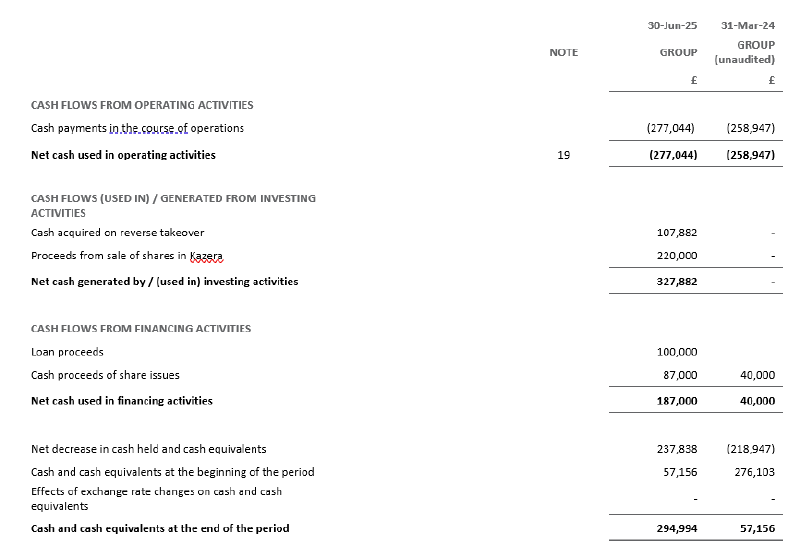
The accompanying notes form part of these financial statements.
COMPANY STATEMENT OF CASH FLOWS
FOR THE YEAR ENDED 30 JUNE 2025
|
|
|
|
|
30-Jun-25 |
30-Jun-24 |
||||||
|
|
|
NOTE |
COMPANY |
COMPANY |
|||||||
|
|
|
|
£ |
£ |
|||||||
|
CASH FLOWS FROM OPERATING ACTIVITIES |
|
|
|
|
|
||||||
|
Cash payments in the course of operations |
|
|
|
(148,068) |
(88,999) |
||||||
|
Net cash used in operating activities |
|
|
19 |
(148,068) |
(88,999) |
||||||
|
|
|
|
|
|
|
||||||
|
CASH FLOWS USED IN INVESTING ACTIVITIES |
|
|
|
|
|
||||||
|
Proceeds from sale of shares in Kazera |
|
|
|
335,898 |
- |
||||||
|
Loan to Signature Gold Pty Ltd |
|
|
|
- |
- |
||||||
|
Net cash generated by / (used in) investing activities |
|
|
|
335,898 |
- |
||||||
|
|
|
|
|
|
|
||||||
|
CASH FLOWS FROM FINANCING ACTIVITIES |
|
|
|
|
|
||||||
|
Repayment of borrowings |
|
|
|
- |
- |
||||||
|
Net cash used in financing activities |
|
|
|
- |
- |
||||||
|
|
|
|
|
|
|
||||||
|
Net decrease in cash held and cash equivalents |
|
|
|
187,830 |
(88,999) |
||||||
|
Cash and cash equivalents at the beginning of the period |
|
|
|
33,126 |
122,125 |
||||||
|
Cash and cash equivalents at the end of the period |
|
|
|
220,956 |
33,126 |
||||||
The accompanying notes form part of these financial statements.
NOTES TO THE FINANCIAL STATEMENTS
FOR THE PERIOD ENDED 30 JUNE 2025
- GENERAL INFORMATION
Tamar Minerals Plc is a company incorporated in England and Wales under the Companies Act 2006. The nature of the Company’s operations and its principal activities are set out in the Strategic Report and the Directors’ Report. On 12 May 2025 the Company changed its name from Tectonic Gold Plc to Tamar Minerals Plc.
On 12 May 2025 the Company acquired the entire issued share capital of Godolphin Exploration Ltd through a reverse takeover (“RTO”). The Group’s current year figures reflect the 15-month period to 30 June 2025 of Godolphin Exploration Ltd and the figures of the Company, Tamar Minerals Plc and its subsidiaries since the date of the RTO. The consolidated comparatives reflect the twelve months to 31 March 2024 of Godolphin Exploration Ltd. The comparatives for the twelve months to 31 March 2024 are unaudited.
Company figures reflect those of the Company, Tamar Minerals Plc, for the years ended 30 June 2024 and 30 June 2025.
- SUMMARY OF SIGNIFICANT ACCOUNTING POLICIES
BASIS OF PREPARATION
The consolidated and parent company financial statements have been prepared in accordance with UK adopted International Accounting Standards applied in accordance with the provisions of the Companies Act 2006.
The consolidated and parent company financial statements have been prepared under the historical cost convention, as modified by the revaluation of certain financial assets and financial liabilities at fair value through profit or loss.
UK adopted International Accounting Standards are subject to amendment and interpretation by the International Accounting Standards Board (“IASB”) and the International Financial Standards Interpretations Committee (“IFRS IC”). The financial statements have been prepared on the basis of the recognition and measurement principles of UK adopted International Accounting Standards that were applicable for the period ended 30 June 2025.
The principal accounting policies adopted and applied in the preparation of the Group’s financial statements are set out below. These have been consistently applied to all the periods presented unless otherwise stated.
The financial statements are presented in GBP, which is the functional currency of the Group, and all values are rounded to the nearest £1, except when otherwise indicated
GOING CONCERN
The Directors have prepared a cash flow assessment for the period to December 2026, being 12 months from the date of signing these financial statements which shows that the Group will require additional funding from May 2026 onwards in order to meet its liabilities as they fall due.. The Group has minimal expenditure requirements in relation to its licences and is committed to maintaining a low overhead at corporate level, commensurate with the Group’s stage of development. As an exploration company, by its nature the Group will need to raise additional funds to develop existing and potential future projects and to meet its ongoing corporate costs Such funding could come from the receipt of the final acquisition payment from White Energy for its acquisition of the Group’s Specimen Hill project, further monetisation of existing assets in Australia, but also in the form of a capital raise in 2026.
Given the ongoing positive results from the Specimen Hill farm out, the current portfolio of projects held by the Group, including those acquired in May 2025 through the acquisition of Godolphin Exploration Ltd, and the continued strength in commodity prices linked to the Group’s projects, the Directors are confident that the Group and Company will be able to raise sufficient funds to meet its obligations and continue as a going concern. However, the Directors note the requirement to raise additional funds in May 2026 does, by its nature, create a material uncertainty as to the Group’s and Company’s ability to continue to operate as envisaged.
Notwithstanding this material uncertainty, the Directors are confident in their ability to raise such funds as required and therefore have prepared these financial statements on a going concern basis.
- SUMMARY OF SIGNIFICANT ACCOUNTING POLICIES (CONTINUED)
CHANGES IN ACCOUNTING POLICIES AND DISCLOSURES
New standards, amendments and interpretations adopted by the Group and Company
The only amendment amended by the UK Endorsement Board or the IASB which is relevant to the Group and is effective for annual periods commencing on or after 1 May 2024:
• Lack of Exchangeability – Amendments to IAS 21 The Effects of Changes in Foreign Exchange Rates
Adoption of the amended standard has had no material impact on the financial statements of the Group or Company.
Accounting Standards or interpretations, not yet early adopted
Standards, interpretations and amendments to published standards not yet effective
At the date of approval of these financial statements, the following standards and interpretations, which havenot been applied in these financial statements, were in issue but not yet effective and have not been adopted in the UK:
• IFRS 18: Presentation and Disclosure in Financial Statements (effective 1 January 2027)
• IFRS 19: Subsidiaries Without Public Accountability: Disclosures (effective 1 January 2027)
• Amendments to IFRS 9 Financial Instruments and IFRS 7 Financial Instruments: Disclosure (effective 1
January 2026)
• Annual Improvements to IFRS Accounting Standards – volume 11 (effective 1 January 2026)
• IFRS S1 General Requirements for Disclosure of Sustainability-related Financial Information (effective 1
January 2024)
• IFRS S2 Climate-related Disclosures (effective 1 January 2024)
The Company is assessing the effect of these new and amended standards and interpretations, which are in issue but not yet mandatorily effective, but their impact is currently not expected to be material.
BASIS OF CONSOLIDATION
Where the Group has control over an investee, it is classified as a subsidiary. The Group controls an investee if all three of the following elements are present: power over the investee, exposure to variable returns from the investee, and the ability of the investor to use its power to affect those variable returns. Control is reassessed whenever facts and circumstances indicate that there may be a change in any of these elements of control.
The consolidated financial statements comprise the financial statements of the Company and its subsidiaries as at the end of the reporting period. The financial statements of the subsidiaries used in the preparation of the consolidated financial statements are prepared for the same reporting date as for the Company. Consistent accounting policies are applied to like transactions and events in similar circumstances. All intra-group balances, balances and unrealised gains and losses resulting from intra-group transactions and dividends are eliminated in full.
Subsidiaries are consolidated from the date of acquisition, being the date on which the Group obtains control, and continue to be consolidated until the date that such control ceases.
During the period the Group acquired the entire share capital of Godolphin Exploration Limited. The transaction resulted in the shareholders of Godolphin Exploration Limited gaining control of the Group, and as such Godolphin Exploration Limited was deemed to be the accounting acquirer, with the Company being the Accounting Acquiree. Management considered whether or not the transaction constituted a business combination, as detailed with the Critical Accounting Judgements section of these financial statements, and considered it not to be a business combination. As a result of this, the consolidated financial statements have been prepared to reflect the consolidated position of the enlarged Group at the period end, and the results of Godolphin Exploration Limited for the entire period, and those of Tamar Minerals Plc and its subsidiaries from the transaction date, being 12 May 2025.
- SUMMARY OF SIGNIFICANT ACCOUNTING POLICIES (CONTINUED)
FINANCIAL ASSETS AT FAIR VALUE THROUGH PROFIT AND LOSS
Investments are initially measured at fair value plus directly attributable incidental acquisition costs. Subsequently, they are measured at fair value in accordance with IFRS 9. This is either the bid price or the last traded price, depending on the convention of the exchange on which the investment is quoted.
Investments are recognised as financial assets at fair value through the profit or loss. Gains and losses on measurement are recognised in other comprehensive income except for impairment losses and foreign exchange gains and losses on monetary items denominated in a foreign currency, until the assets are derecognised, at which time the cumulative gains and losses previously recognised in other comprehensive income are recognised in the income statement.
The Company assesses at each year-end date whether there is any objective evidence that a financial asset or group of financial assets classified as available-for-sale has been impaired. An impairment loss is recognised if there is objective evidence that an event or events since initial recognition of the asset have adversely affected the amount or timing of future cash flows from the asset. A significant or prolonged decline in the fair value of a security below its cost shall be considered in determining whether the asset is impaired.
INVESTMENTS
In the Company’s separate financial statements, investments in subsidiaries are accounted for at cost less impairment losses.
JOINT VENTURE
A joint venture is an arrangement that the Group controls jointly with one or more other investors, and over which the Group has rights to a share of the arrangement’s net assets rather than direct rights to underlying assets and obligations for underlying liabilities. A joint arrangement in which the Group has direct rights to underlying assets and obligations for underlying liabilities is classified as a joint operation.
FOREIGN CURRENCIES
The Group and Company’s financial statements are presented in the currency of the primary economic environment in which it operates (its functional currency). For the purpose of these financial statements, the results and financial position are expressed in Pounds Sterling, which is the presentation currency of the Group and Company.
Each entity in the Group determines its own functional currency and items included in the financial statements of each entity are measured using that functional currency.
Exchange differences arising on the settlement of monetary items, and on the retranslation of monetary items, are included in the income statement. Exchange differences arising on the retranslation of non-monetary items carried at fair value are included in profit or loss for the period, except for differences arising on the retranslation of non-monetary items in respect of which gains and losses are recognised directly in equity. For such non-monetary items, any exchange component of that gain or loss is also recognised directly in equity.
The Group and Company’s financial statements are presented in the currency of the primary economic environment in which it operates (its functional currency). For the purpose of these financial statements, the results and financial position are expressed in Pounds Sterling, which is the presentation currency of the Group and Company.
Each entity in the Group determines its own functional currency and items included in the financial statements of each entity are measured using that functional currency.
Exchange differences arising on the settlement of monetary items, and on the retranslation of monetary items, are included in the income statement. Exchange differences arising on the retranslation of non-monetary items carried at fair value are included in profit or loss for the period, except for differences arising on the retranslation of non-monetary items in respect of which gains and losses are recognised directly in equity. For such non-monetary items, any exchange component of that gain or loss is also recognised directly in equity.
- SUMMARY OF SIGNIFICANT ACCOUNTING POLICIES (CONTINUED)
When a decline in the fair value of a financial asset has been previously recognised in other comprehensive income and there is objective evidence that the asset is impaired, the cumulative loss is removed from other comprehensive income and recognised in the income statement. The loss is measured as the difference between the cost of the financial asset and its current fair value less any previous impairment.
For the purpose of presenting the Group and Company financial statements, the assets and liabilities of any of the Group and Company’s operations that are overseas are translated at exchange rates prevailing on the year-end date. Income and expense items are translated at the average exchange rates for the period.
Any translation differences on consolidation are recognised in Other Comprehensive Income.
TAXATION
The tax expense represents the sum of the tax currently payable and deferred tax.
The tax currently payable is based on taxable profit for the year. Taxable profit differs from net profit as reported in the income statement because it excludes items of income or expense that are taxable or deductible in other years and it further excludes items that are never taxable or deductible. The Group’s liability for current tax is calculated using tax rates that have been enacted or substantively enacted by the year end date.
The research and development tax incentive claim is recognised as income tax revenue in the period in which it is received unless management assess that at the year end the likelihood of receipt is probable.
Deferred tax is the tax expected to be payable or recoverable on temporary differences between the carrying amounts of assets and liabilities in the financial statements and the corresponding tax bases used in the computation of taxable profit and is accounted for using the balance sheet liability method. Deferred tax liabilities are generally recognised for all taxable temporary differences and deferred tax assets are recognised to the extent that it is probable that taxable profits will be available against which deductible temporary differences can be utilised. Such assets and liabilities are not recognised if the temporary difference arises from the initial recognition of goodwill or from the initial recognition (other than in a business combination) of other assets and liabilities in a transaction that affects neither the tax profit nor the accounting profit.
Deferred tax liabilities are recognised for taxable temporary differences arising on investments in subsidiaries and associates, and interests in joint ventures, except where the Group is able to control the reversal of the temporary difference and it is probable that the temporary difference will not reverse in the foreseeable future.
Deferred tax assets and liabilities are offset when there is a legally enforceable right to set off current tax assets against current tax liabilities and where they relate to income taxes levied by the same taxation authority and the Group intends to settle its current tax assets and liabilities on a net basis.
EXPLORATION AND EVALUATION EXPENDITURE
Exploration expenditure incurred is accumulated in respect of each identifiable area of interest, net of any related grant income received. These costs are only carried forward to the extent that they are expected to be recovered through the successful development or sale of the area or where activities in the area have not yet reached a stage which permits reasonable assessment of the existence of economically recoverable reserves.
- SUMMARY OF SIGNIFICANT ACCOUNTING POLICIES (CONTINUED)
Accumulated costs in relation to an abandoned area are written off in full against profit or loss in the year in which the decision to abandon the area is made. When production commences, the accumulated costs for the relevant area of interest are amortised over the life of the area according to the rate of depletion of the economically recoverable reserves. A regular review is undertaken of each area of interest to determine the appropriateness of continuing to carry forward costs in relation to the area of interest.
Exploration and evaluation assets are assessed for impairment annually or when facts and circumstances suggest that the carrying amount of an asset may exceed its recoverable amount in accordance with IFRS 6.
PROPERTY, PLANT AND EQUIPMENT
Items of property, plant and equipment are recorded at cost and depreciated as outlined below:
Depreciation of Property, Plant and Equipment
Depreciation is calculated on a straight-line basis to write off the net cost of each item of property, plant and equipment over its expected useful life for the entity. Estimates of remaining useful lives are made on a regular basis for all assets with annual reassessments for major items. The expected useful lives are as follows: Plant and equipment - 5 years.
IMPAIRMENT OF PROPERTY, PLANT & EQUIPMENT
At each financial year end date, the Group reviews the carrying amounts of its Property, Plant and Equipment to determine whether there is any indication that those assets have suffered an impairment loss. If any such indication exists, the recoverable amount of the asset is estimated in order to determine the extent of the impairment loss, if any. Where the asset does not generate cash flows that are independent from other assets, the Group estimates the recoverable amount of the cash-generating unit to which the asset belongs.
If the recoverable amount of an asset or cash-generating unit is estimated to be less than its carrying amount, the carrying amount of the asset or cash-generating unit is reduced to its recoverable amount and the impairment loss is recognised as an expense immediately.
When an impairment loss subsequently reverses, the carrying amount of the asset or cash-generating unit is increased to the revised estimate of its recoverable amount, but so that the increased carrying amount does not exceed the carrying amount that would have been determined had no impairment loss been recognised for the asset or cash-generating unit in prior years. A reversal of an impairment loss is recognised as income immediately, unless the relevant asset is carried at a revalued amount, in which case the reversal of the impairment loss is treated as a revaluation increase.
REVENUE RECOGNITION
Revenue is measured at the fair value of the consideration received or receivable and represents the amount receivable for goods supplied or services rendered, net of returns, discounts and rebates allowed by the group and value added taxes.
The Group’s primary activities are exploration, research and development and as such it does not have, nor expect to have, regular revenue. The Company and its subsidiaries may make application for certain grants or other funding available to support exploration, research and development in the jurisdiction in which it operates.
It may not be possible to estimate either the likelihood of success in any funding applications submitted or whether a successful application will be supported by full or partial funding. As such the Company does not recognise any grant or other funding until the funds have been received.
The Company may from time to time divest partially or fully a subsidiary and any gains made on the sale of a subsidiary are recognised as revenue when they are received.
The Company may from time to time divest fully or partially an investment in another company and any gains made on the sale of the investment are recognised as other gains or losses when they are received.
- SUMMARY OF SIGNIFICANT ACCOUNTING POLICIES (CONTINUED)
TRADE RECEIVABLES, LOANS AND OTHER RECEIVABLES
Trade receivables, loans and other receivables that have fixed or determinable payments that are not quoted in an active market are classified under ‘loans and receivables. Loans and receivables are measured at amortised cost using the effective interest method, less any impairment. Interest income is recognised by applying the effective interest rate, except for short term receivables when the recognition of interest would be immaterial.
Other receivables, that do not carry any interest, are measured at their nominal value as reduced by any appropriate allowances for irrecoverable amounts.
CASH AND CASH EQUIVALENTS
Cash and cash equivalents comprise cash on hand and other short-term bank deposits of 3 months or less.
FINANCIAL LIABILITIES
Financial liabilities and equity instruments are classified according to the substance of the contractual arrangements entered into. Financial liabilities are classified as either financial liabilities ‘at FVTPL’ or ‘other financial liabilities’.
All financial liabilities are recognised initially at fair value and, in the case of loans and borrowings and payables, net of directly attributable transaction costs. Subsequent measurement is at amortised cost using the effective interest method. The Group’s financial liabilities include trade and other payables.
A financial liability is held for trading if it meets one of the following conditions:
• It is incurred principally for the purpose of repurchasing it in the near term;
• On initial recognition it is part of a portfolio of identified financial instruments that are managed together and for which there is evidence of a recent actual pattern of short-term profit-taking; or
• It is a derivative (except for a derivative that is a financial guarantee contract or a designated and effective hedging instrument).
There were no financial liabilities ‘at FVTPL’ during the current, or preceding, period.
OTHER FINANCIAL LIABILTIES AND SHORT-TERM BORROWINGS
Interest-bearing loans and overdrafts are recorded at the proceeds received, net of direct issue costs. Finance charges are accounted for on an accruals basis in profit or loss using the effective interest rate method and are added to the carrying amount of the instrument to the extent that they are not settled in the period in which they arise. Other short-term borrowings being intercompany loans and unsecured convertible loan notes issued in the year are recognised at amortised cost net of any financing or arrangement fees.
TRADE PAYABLES
Trade payables are initially measured at fair value and subsequently measured at amortised cost using the effective interest method, less provision for impairment.
SHARE-BASED PAYMENTS
The Company has applied the requirements of IFRS 2 Share-based Payment.
The Company operates an equity-settled share-based payment scheme under which share options are issued to certain employees. Equity-settled share-based payments are measured at fair value (excluding the effect of non-market-based vesting conditions) at the date of grant. The fair value determined at the grant date of the equity-settled share-based payments is expensed on a straight-line basis over the vesting period, based on the Company’s estimate of shares that will eventually vest and adjusted for the effect of non-market-based vesting conditions.
- SUMMARY OF SIGNIFICANT ACCOUNTING POLICIES (CONTINUED)
Fair value is measured by use of the Black Scholes model. The expected life used in the model has been adjusted, based on management’s best estimate, for the effects of non-transferability, exercise restrictions, and behavioural considerations.
EQUITY INSTRUMENTS INCLUDING SHARE CAPITAL
Equity instruments issued by the Company are recorded at the proceeds received, net of incremental costs attributable to the issue of new shares.
An equity instrument is any contract that evidences a residual interest in the assets of a company after deducting all of its liabilities. Equity instruments issued by the Company are recorded at the proceeds received net of direct issue costs.
Share capital represents the amount subscribed for shares at nominal value.
The share premium account represents premiums received on the initial issuing of the share capital. Any transaction costs associated with the issuing of shares are deducted from share premium, net of any related income tax benefits. Any bonus issues are also deducted from share premium.
The reverse takeover reserve represents the adjustment to reflect the reverse takeover of Godolphin Exploration Ltd during the period.
The warrant reserve represents the fair value of warrants granted to employees and suppliers for services provided to the Company. The fair value of warrants is expensed over the vesting period or during the period in which the services are received.
The merger reserve arose on the issue of shares to facilitate the reverse acquisition of the Company by Godolphin Exploration Limited on 12 May 2025. Although the Company is the legal acquirer, Godolphin Exploration Limited was identified as the accounting acquirer under IFRS 3 Business Combinations (reverse acquisition). In accordance with the Companies Act 2006 the share premium on the shares issued to facilitate the reverse acquisition has been recognised in the merger reserve in the period ended 30 June 2025.
Accumulated losses include all current and prior period results as disclosed in the Statement of Profit and Loss and Other Comprehensive Income.
CRITICAL ACCOUNTING JUDGEMENTS AND ESTIMATIONS
In the application of the Company’s accounting policies, the Directors are required to make judgements, estimates and assumptions about the carrying amounts of assets and liabilities that are not readily apparent from other sources. The estimates and associated assumptions are based on historical experience and other factors that are considered to be relevant. Actual results may differ from these estimates.
The estimates and underlying assumptions are reviewed on an on-going basis. Revisions to accounting estimates are recognised in the period. Judgements and estimates that may affect future periods are as follows:
TREATMENT OF EXPLORATION AND EVALUATION COSTS
Exploration expenditure incurred is accumulated in respect of each identifiable area of interest, net of any related grant income received. These costs are only carried forward to the extent that they are expected to be recovered through the successful development or sale of the area or where activities in the area have not yet reached a stage which permits reasonable assessment of the existence of economically recoverable reserves. The carrying value carried forward at 30 June 2025 is £2,947,624 (2024: nil).
Accumulated costs in relation to an abandoned area are written off in full against profit in the year in which the decision to abandon the area is made. When production commences, the accumulated costs for the relevant area of interest are amortised over the life of the area according to the rate of depletion of the economically recoverable reserves. A regular review is undertaken of each area of interest to determine the appropriateness of continuing to carry forward costs in relation to the area of interest.
- SUMMARY OF SIGNIFICANT ACCOUNTING POLICIES (CONTINUED)
The value of the Group’s exploration and evaluation expenditure will be dependent upon the success of the Group in discovering economic and recoverable mineral resources. It is also dependent on the Group successfully renewing its licences.
The future revenue flows relating to these assets is uncertain and will also be affected by competition, relative exchange rates and potential new legislation and related environmental requirements.
REVERSE TAKEOVER – ASSESSEMNT OF WHETHER THE TRANSACTION CONSTITUTES A BUSINESS COMBINATION
During the year the Group completed a reverse takeover transaction whereby the Company acquired Godolphin Exploration Limited and the former shareholders of Godolphin Exploration Limited gained control of the enlarged Group. In accordance with IFRS, the transaction has been assessed as a reverse acquisition, with Godolphin Exploration Limited identified as the accounting acquirer.
Management applied significant judgement in determining whether the reverse takeover constitutes a business combination within the scope of IFRS 3 Business Combinations, or whether the transaction falls outside the scope of IFRS 3 and is required to be accounted for as a share-based payment transaction in accordance with IFRS 2 Share-based Payment.
In making this assessment, management evaluated whether the Group met the definition of a business as set out in IFRS 3. In particular, management assessed whether the Group] comprised inputs and substantive processes which together significantly contribute to the ability to create outputs.
At the date of the transaction, the Group did not have an operating workforce, substantive processes, or ongoing revenue-generating activities. Its activities were limited to holding a small number of assets and managing its corporate and listing status. Substantially all of the fair value of the Group was concentrated in identifiable assets rather than in an integrated set of activities and processes. Accordingly, management concluded that the Group did not meet the definition of a business under IFRS 3. This judgement has a significant impact on the accounting treatment of the transaction, including the recognition and measurement of assets, liabilities, equity reserves, and the absence of goodwill.
- SEGMENTAL INFORMATION
The Chief Operating Decision Maker of the Group is the Board of Directors. The Group operates in one industry segment being mineral exploration. Information is therefore shown for geographical segments.
All additions to intangible assets occurred in the Australian reporting segment.
|
2025 |
UNITED KINGDOM |
AUSTRALIA |
UNALLOCATED |
TOTAL |
|
|
£ |
£ |
£ |
£ |
|
Total segment revenue |
- |
- |
- |
- |
|
Segment net profit/loss before tax, depreciation and amortisation |
(188,822) |
(278,090) |
60,307 |
(406,605) |
|
Depreciation and amortisation |
6,658 |
- |
- |
6,658 |
|
Net profit/(loss) before income tax |
(182,164) |
(278,090) |
60,307 |
(399,947) |
|
Income tax benefit |
- |
- |
- |
- |
|
Net profit/(loss) after income tax |
(183,360) |
(278,090) |
60,307 |
(401,143) |
|
Segment non-current assets at 30 June 2025 |
11,636 |
2,947,624 |
- |
2,959,260 |
|
Segment total assets at 30 June 2025 |
57,887 |
2,990,248 |
376,198 |
3,242,333 |
|
Segment total liabilities at 30 June 2025 |
48,346 |
155,280 |
357,285 |
560,911 |
All additions to intangible assets occurred in the Australian reporting segment
4. LOSS BEFORE INCOME TAX
|
|
|
CONSOLIDATED |
||
|
|
|
|
15 months to 30 June 2025 |
12 months to 31 March 2024 |
|
|
|
£ |
£ |
|
|
Loss before income tax is stated after (charging)/crediting: |
|
|
|
|
|
Staff costs as per Note 6 |
|
|
(65,000) |
(66,000) |
|
Depreciation of property plant and equipment |
|
|
(6,658) |
(6,906) |
|
Net foreign exchange loss |
|
|
(62,637) |
(42) |
|
Profit on disposal of Kazera shares |
|
|
241,556 |
- |
|
Loss on Titeline prepayment |
|
|
(258,495) |
- |
During the period, the Company agreed to settle certain professional fees relating to the Reverse Takeover through the transfer of shares held by Titeline in the Company to those creditors, in return for the company writing off the prepaid amounts to paid historically to Titeline. This prepayment was held by the Company’s wholly owned subsidiary, Signature Gold Pty Ltd. The Loss on Titeline Prepayment represents the difference between the carrying value of the prepayment and the value of invoices that were settled under this transaction.
- AUDITORS’ REMUNERATION
|
|
|
|
CONSOLIDATED |
|
|
|
|
|
15 months to 30 June 2025 |
12 months to 31 March 2024 |
|
|
|
£ |
£ |
|
|
The analysis of auditors’ remuneration is as follows: |
|
|
|
|
|
Fees paid to Moore Kingston Smith LLP for: |
|
|
|
|
|
- Audit-related assurance services |
|
|
64,500 |
- |
|
|
|
|
|
|
|
Fees paid to auditor of Signature Gold Pty Ltd, MNSA for: |
|
|
|
|
|
- Audit-related assurance services |
|
|
17,570 |
- |
|
- Taxation compliance services |
|
|
2,011 |
- |
|
|
|
|
19,581 |
- |
|
|
|
|
|
|
The figures for the 15 months to 30 June 2025 represent the fees relating to the audit and tax services for the period. There are no figures in the comparative period which represents the results of Godolphin Exploration Limited only, for which no audit was carried out in that period.
- STAFF COSTS
|
|
|
CONSOLIDATED |
||
|
|
|
|
15 months to 30 June 2025 |
12 months to 31 March 2024 |
|
|
|
£ |
£ |
|
|
The average monthly number of employees (including directors) for continuing operations was: |
|
|
|
|
|
Total staff |
|
|
5 |
3 |
|
Director’s fees for the period ended 30 June 2025 and year ended 31 March 2024 |
|
|
65,000 |
66,000 |
|
|
|
|
65,000 |
66,000 |
|
|
|
|
||
Details of Directors’ remuneration
Details of the nature and amount of each element of the emoluments of each of the key management personnel of the Group for the reporting period ended 30 June 2025 and 31 March 2024 respectively are set out in the tables below.
|
For 15 months to 30 June 2025 |
|
SHORT-TERM BENEFITS |
|
POST-EMPLOYMENT BENEFITS |
|
|
NAME |
|
SALARY AND FEES
|
SOCIAL SECURITY COSTS
|
PENSION
|
TOTAL £ |
|
DIRECTORS |
|
|
|
||
|
B Fulton |
|
15,000 |
- |
- |
15,000 |
|
B Boynton |
|
18,333 |
- |
- |
18,333 |
|
S Quinn |
|
18,333 |
- |
- |
18,333 |
|
D Edmonds |
|
- |
- |
- |
- |
|
J Robbeson |
|
10,000 |
- |
- |
10,000 |
|
M Thompson |
|
3,334 |
374 |
- |
3,708 |
|
Total |
|
65,000 |
374 |
- |
65,374 |
|
For 12 months to 31 March 2024 |
|
SHORT-TERM BENEFITS |
|
POST-EMPLOYMENT BENEFITS |
|
|
NAME |
|
SALARY AND FEES
|
SOCIAL SECURITY COSTS
|
PENSION
|
TOTAL £ |
|
DIRECTORS |
|
|
|
||
|
M Thompson |
|
4,000 |
- |
- |
4,000 |
|
D Colley |
|
2,000 |
- |
- |
2,000 |
|
Total |
|
6,000 |
- |
- |
6,000 |
|
The remuneration detailed above for the 15 months to June 2025 represents the remuneration paid or due to those Directors by Tamar Minerals Plc during that period, and not just those fees due since the RTO. The remuneration details above for the 12 months to 31 March 2024 reflects the remuneration due to Directors of Godolphin Exploration Ltd only, during that period. |
|||||
No Directors were accruing retirement benefits during the period.
- TAXATION
|
|
|
|
15 months to 30 2025 |
12 months to 31 March 2024 |
||
|
|
|
£ |
£ |
|||
|
Consolidated |
|
|
|
|
||
|
Current tax expense/(credit) |
|
|
- |
- |
||
|
Research and Development tax credit |
|
|
- |
- |
||
|
Total tax income |
|
|
- |
- |
||
|
Loss before tax |
|
|
(399,947) |
(215,233) |
||
|
Expected tax on the standard rate of corporation tax in the UK of 25% (2024: 25%) |
|
|
(99,987) |
(53,808) |
||
|
Other non-allowable items |
|
|
- |
- |
||
|
Deferred tax asset on temporary differences |
|
|
172 |
1,727 |
||
|
Tax effect of tax losses not recognised as benefits including tax effect of differences in the standard rate of tax in different jurisdictions |
|
|
99,815 |
52,082 |
||
|
Total tax expense/(income) |
|
|
- |
- |
||
|
No deferred tax asset has been recognised in respect of the losses. At the end of the reporting period the Group had unused tax losses of £42,894,170 (2024: £41,809,739). Where it is anticipated that future taxable profits will be available against which these losses will be utilised, a deferred tax asset is recognised. The total taxation charge in future periods will be affected by any changes to the corporation tax rates in force in the countries in which the Group operates.
|
||||||
|
|
||||||
|
|
||||||
- LOSS PER SHARE
|
The basic loss per share is based on the loss for the period divided by the weighted average number of shares in issue during the reporting period. The weighted average number of ordinary shares for the reporting period assumes that all shares have been included in the computation based on the weighted average number of days since issue. |
||||
|
|
|
|
15 months to 30 June 2025 |
12 months to 31 March 2024 |
|
|
|
£ |
£ |
|
|
Loss for the year attributable to owners of the Company |
|
|
(401,143) |
(256,429) |
|
Weighted average number of ordinary shares in issue for basic earnings |
|
96,166,635 |
87,950,125 |
|
|
Weighted average number of ordinary shares in issue for fully diluted earnings |
|
96,166,635 |
87,950,125 |
|
|
Loss per share (pence per share) |
|
|
|
|
|
Basic |
|
|
(0.42) |
(0.29) |
|
Diluted |
|
|
(0.42) |
(0.29) |
There were 6,962,500 share warrants which are anti-dilutive in the year ended 30 June 2025.
- CASH AND CASH EQUIVALENTS
|
|
CONSOLIDATED |
COMPANY |
||
|
|
30 June 2025 |
31 March 2024 |
30 June 2025 |
30 June 2024 |
|
£ |
£ |
£ |
£ |
|
|
Cash and cash equivalents |
294,994 |
57,156 |
220,956 |
33,126 |
The Directors consider the carrying amount of cash and cash equivalents approximates to their fair value.
- TRADE AND OTHER RECEIVABLES
|
|
CONSOLIDATED |
COMPANY |
||
|
|
30 June 2025 |
31 March 2024 |
30 June 2025 |
30 June 2024 |
|
£ |
£ |
£ |
£ |
|
|
Non-Current |
|
|
|
|
|
Loan to subsidiary undertaking |
- |
- |
2,100,468 |
2,239,446 |
|
|
- |
- |
2,100,468 |
2,239,446 |
|
Current |
|
|
|
|
|
Other receivables |
130,857 |
20,878 |
- |
- |
|
Prepayments |
15,295 |
- |
3,250 |
2,025 |
|
GST and VAT receivable |
23,927 |
10,611 |
21,992 |
830 |
|
|
170,079 |
31,489 |
25,242 |
2,855 |
No receivables were past due or provided for at the period end or at the previous year end. The Directors consider the carrying amount of trade and other receivables approximates to their fair value.
The loan to subsidiary undertaking is unsecured, interest free and repayable on demand.
11. PROPERTY, PLANT AND EQUIPMENT
|
|
|
|
|
CONSOLIDATED |
||
|
|
|
|
|
30 June 2025 |
31 March 2024 |
|
|
|
|
|
|
£ |
£ |
|
|
Cost |
|
|
|
|
|
|
|
At beginning of period |
|
|
|
39,738 |
39,738 |
|
|
Disposals |
|
|
|
(7,932) |
- |
|
|
At end of period |
|
|
|
31,806 |
39,738 |
|
|
|
|
|
|
|
||
|
|
|
|
|
30 June 2025 |
31 March 2024 |
|
|
|
|
|
|
£ |
£ |
|
|
Depreciation |
|
|
|
|
|
|
|
At beginning of period |
|
|
|
18,888 |
11,982 |
|
|
Depreciation charge in period |
|
|
|
6,658 |
6,906 |
|
|
Disposals |
|
|
|
(5,376) |
- |
|
|
At end of period |
|
|
|
20,170 |
18,888 |
|
|
|
|
|
|
|
|
|
|
Net book value |
|
|
|
11,636 |
20,850 |
|
- EXPLORATION AND EVALUATION EXPENDITURE
|
|
|
|
|
CONSOLIDATED |
|
|
|
|
|
|
30 June 2025 |
31 March 2024 |
|
|
|
|
|
£ |
£ |
|
Non-producing properties |
|
|
|
|
|
|
Balance at the beginning of the period |
|
|
|
- |
- |
|
Recognition on reverse acquisition |
|
|
|
2,947,624 |
- |
|
Balance at the end of the period |
|
|
|
2,947,624 |
- |
Exploration and Evaluation Expenditure represents capitalised expenditure less any impairment on the Group’s exploration licences in Australia held by its wholly owned subsidiary, Signature Gold Pty Ltd, being the Specimen Hill and Mount Cassidy projects.
The ultimate recoupment of balances carried forward in relation to areas of interest still in the exploration or valuation phase is dependent on successful development, and commercial exploitation, or alternatively sale of the respective areas. The Directors have taken into consideration a number of factors when assessing the potential for impairment of these assets, including the likelihood of monetising these projects through existing and potential agreements with third-parties, and have concluded that no impairment is necessary at the balance sheet date.
- CONTROLLED ENTITIES
Details of controlled entities are as follows:
|
PARENT ENTITY |
|
COUNTRY OF INCORPORATION |
|
|
|
|
|
Tamar Minerals Plc 167-169 Great Portland Street, Fifth Floor, London United Kingdom, W1W 5PF
|
England and Wales |
|
|
|
|
|
|
CONTROLLED ENTITIES |
PRINCIPAL ACTIVITIES |
COUNTRY OF INCORPORATION |
PERCENTAGE OF ORDINARY SHARES HELD BY THE COMPANY |
INVESTMENT HELD BY THE COMPANY |
INVESTMENT HELD BY THE COMPANY |
|
|
|
|
|
2025 % |
2024 % |
2025 £ |
2024 £ |
|
Signature Gold Pty Ltd 301/66 Hunter Street, Sydney NSW, Australia 2000 |
Mineral exploration |
Australia |
100 |
100 |
3,605,254 |
3,605,254 |
|
Godolphin Exploration Ltd 167-169 Great Portland Street, Fifth Floor, London, England, W1W 5PF |
Mineral exploration |
Australia |
100 |
- |
3,664,255 |
- |
|
|
|
|
|
|
7,269,509 |
3,605,254 |
Signature Gold Pty Ltd had an original cost of £9,000,000, with an impairment of £5,394,746 and net book value of £3,605,254 at 30 June 2025 and 30 June 2024.
The investment in Godolphin Exploration Ltd was acquired through the issue of 1,832,127,500 ordinary shares at a value of 0.20p per share on 12 May 2025.
Godolphin Exploration Limited is exempt from the requirement of the Companies Act 2006 relating to the audit of its individual accounts by virtue of section 479A of the Companies Act 2006.
- TRADE AND OTHER PAYABLES
|
|
CONSOLIDATED |
COMPANY |
||
|
|
30 June 2025 |
31 March 2024 |
30 June 2025 |
30 June 2024 |
|
£ |
£ |
£ |
£ |
|
|
Current |
|
|
|
|
|
Trade payables |
53,643 |
- |
53,643 |
346 |
|
Other payables |
231,121 |
34,791 |
15,450 |
13,338 |
|
Accrued expenses |
112,198 |
- |
111,667 |
287,128 |
|
|
396,962 |
34,791 |
180,760 |
300,812 |
|
Non-Current |
|
|
|
|
|
Other payables |
163,949 |
|
138,192 |
138,192 |
|
|
163,949 |
- |
138,192 |
138,192 |
|
Total Trade and other payable |
560,911 |
34,791 |
318,952 |
439,004 |
Non-current other payables include loans owed to Directors, as detailed in note 21.
Accrued expenses include accrued fees owed to certain Directors, as detailed in note 21.
- ISSUED CAPITAL
|
|
30 June 2025 |
30 June 2024 |
|
|
£ |
£ |
|
Issued Capital |
6,319,792 |
6 , 126,579 |
|
|
|
|
|
|
30 June 2025 |
30 June 2024 |
|
Ordinary Fully paid shares – par value 0.01p |
144,465,805 |
957,188,590 |
|
Deferred Shares – par value 0.01p |
151,149,391 |
151,149,391 |
|
|
|
|
On 12 May 2025 the Company issued 1,832,127,500 ordinary shares at 0.2p to the shareholders of Godolphin Exploration Ltd pursuant to the Reverse Takeover (note 18). Additionally, 100,000,000 ordinary shares were issued to certain Directors of the Company in settlement of certain outstanding fees. No share issue or transaction costs have been deducted from the share premium in relation to these share issues.
Subsequent to these share issues, on 12 May 2025 the Company undertook a 20 for 1 share consolidation exercise. This exercise resulted in the share capital of the Company at the time being replaced with 144,465,805 ordinary shares. There were no changes to the deferred shares in issue.
Each ordinary share carries the right to one vote at shareholders’ meetings and is entitled to participate in any dividends or other distributions of the Company.
Deferred shares have no rights to receive dividends, no voting rights, no rights to participate in assets of the Company and the Company has the power to redeem or repurchase the shares.
- SHARE OPTIONS AND WARRANTS
The following share-based payment arrangements were in existence during the reporting periods ended 30 June 2025 and 30 June 2024:
|
WARRANTS/OPTIONS SERIES |
ORIGINAL NUMBER GRANTED AND VESTED |
NUMBER AT 1 APRIL 2024 |
NUMBER LAPSED IN PERIOD |
NUMBER OUTSTANDING AT 30 JUNE 2025 |
GRANT DATE |
EXPIRY DATE |
VESTING DATE |
EXERCISE PRICE |
|
|
Series (ii) |
65,475,000 |
57,838,637 |
57,838,637 |
- |
8-Sep-20 |
8-Sep-24 |
8-Sep-20 |
2.75p |
|
All options in issue during the period expired on 8 September 2024.
On 12 May 2025, as part of the Reverse Takeover, certain warrants issued by Godolphin Exploration Limited were cancelled, and replaced with warrants in the Company. 5,500,000 warrants were issued with an expiry date of 31 January 2029 and an exercise price of £0.08, and 1,462,500 warrants were issued with an expiry date of 31 May 2029 and an exercise price of £0.10.
- RESERVES
|
|
CONSOLIDATED |
COMPANY |
||
|
|
30 June 2025 |
31 March 2024 |
30 June 2025 |
30 June 2024 |
|
£ |
£ |
£ |
£ |
|
|
Option Reserve |
|
|
|
|
|
Opening balance |
- |
- |
588,553 |
588,553 |
|
Expired options |
- |
- |
(588,553) |
- |
|
Closing balance |
- |
- |
- |
588,553 |
|
|
|
|
|
|
|
Merger Reserve |
|
|
|
|
|
Opening balance |
(66,585,529) |
(66,585,529) |
- |
- |
|
Derecognised on acquisition of Godolphin Exploration Limited |
66,585,529 |
- |
- |
- |
|
Recognised on acquisition of Godolphin Exploration Limited |
3,481,033 |
- |
3,481,032 |
- |
|
Closing balance |
3,481,033 |
(66,585,529) |
3,481,032 |
- |
|
|
|
|
|
|
|
Reverse Takeover Reserve |
|
|
|
|
|
Opening balance |
- |
- |
- |
- |
|
Additions |
(67,211,109) |
- |
- |
- |
|
Closing balance |
(67,211,109) |
- |
- |
- |
The Option Reserve represents the fair value of options granted to employees and suppliers for services provided to the Group. The fair value of options is expensed over the vesting period or during the period in which the services are received.
The Reverse Takeover Reserve results from the Reverse Takeover of Godolphin Exploration Limited by Tamar Minerals Plc, details of which can be found in note 18 below.
The merger reserve arose on the issue of shares to facilitate the reverse acquisition of the Company by Godolphin Exploration Limited on 13 May 2025. Although the Company is the legal acquirer, Godolphin Exploration Limited was identified as the accounting acquirer under IFRS 3 Business Combinations (reverse acquisition). In accordance with the Companies Act 2006 the share premium on the shares issued to facilitate the reverse acquisition has been recognised in the merger reserve in the period ended 30 June 2025.
- REVERSE TAKEOVER
On 12 May 2025,the Company acquired, through the issue of 1,832,127,500 new ordinary shares, the entire issued share capital of Godolphin Exploration Ltd (“Godolphin”). Godolphin Exploration Ltd is a private mining exploration company focused on tin and copper exploration in the Southwest of England.
Although the transaction resulted in Godolphin becoming a wholly owned subsidiary of Tamar, the transaction constitutes a reverse acquisition in substance and has resulted in a fundamental change in the business of the Company. Shareholders of Godolphin own 63.4% of the enlarged Group.
Prior to the transaction, Tamar was not actively operating on its Australian properties, and its primary focus was on their disposal, and M&A activity. As such, the directors do not consider this to meet the definition of a business in accordance with IFRS 3.
Accordingly, this reverse acquisition does not constitute a business combination and is accounted for in accordance with IFRS 2 “Share-based Payments” and associated IFRIC guidance. Although the reverse acquisition is not a business combination, the Company has become the legal parent and is required to apply IFRS 10 and prepare consolidated financial statements.
- REVERSE TAKEOVER (continued)
In accordance with IFRS 2, when accounting for such reverse acquisitions, the reverse acquisition methodology shall take place but rather than recognising goodwill, the difference between the equity value given up by the Company’s shareholders (“Deemed acquisition cost”) and the share of the fair value of net assets gained by the Company shareholders is charged to the statement of comprehensive income as a share-based payment on reverse acquisition. Where the deemed acquisition cost is exceeded by the fair value of net assets acquired, the difference is taken directly to the Reverse Takeover Reserve.
In accordance with reverse acquisition accounting principles, these consolidated financial statements represent a continuation of the financial statements of Godolphin and include the assets and liabilities of both Godolphin and Tamar at 30 June 2025, and the results of Godolphin for the entire period and those of Tamar since 12 May 2025.
On acquisition, the Company issued 1,832,127,500 ordinary shares to acquire the entire share capital of Godolphin, with an issue price of 0.2p, valuing the investment in Godolphin at £3,664,255. The share premium on the shares issued to acquire Godolphin Exploration Limited has been recognised in the merger reserve.
Because the legal subsidiary, Godolphin, was treated on consolidation as the accounting acquirer and the legal Parent Company, Tamar, was treated as the accounting acquiree, the fair value of the shares deemed to have been issued by Godolphin was calculated at £1,914,377 based on an assessment of the purchase consideration for a 100% holding of Tamar of 957,188,591 shares at a weighted average placing price of £0.0020 per share (being the consideration price).
The fair value of the net assets of Tamar at acquisition was as follows:
|
|
|
£ |
|
Cash and cash equivalents |
|
107,882 |
|
Investments |
|
108,444 |
|
Other receivables |
|
317,395 |
|
Exploration and Evaluation Asset |
|
2,943,241 |
|
Trade and other payables |
|
(621,478) |
|
Net assets |
|
2,855,484 |
The difference between the deemed cost of £1,914,377 and the fair value of the net assets assumed above of £2,855,485 was £941,108. As the value of the net assets at acquisition exceeded the deemed cost of acquisition, no transaction cost is recognised or taken to the income statement reserve as required under IFRS 2.
The reverse acquisition reserve which arose from the reverse takeover is made up as follows:
|
|
|
£ |
|
Pre-acquisition retained earnings equity |
|
(6,321,874) |
|
Elimination of existing RTO Reserve in Tamar |
|
(57,976,182) |
|
Elimination of FX reserve in Tamar |
|
(230,198) |
|
Elimination of Godolphin share capital at acquisition |
|
981,400 |
|
Investment |
|
(3,664,255) |
|
|
|
(67,211,109) |
Costs amounting to £55,325 were incurred in relation to the transaction and were expensed to the income statement of the Company when incurred.
- CASH FLOW INFORMATION
For the purpose of presentation in the statement of cash flows, cash and cash equivalents includes cash on hand, deposits held at call with financial institutions, other short-term, highly liquid investments with original maturities of three months or less that are readily convertible to known amounts of cash and which are subject to an insignificant risk of changes in value.
Cash and cash equivalents at the end of the financial year as shown in the statement of cash flows is reconciled to the related items in the statement of financial position as follows:
- CASH FLOW INFORMATION (continued)
|
|
CONSOLIDATED |
COMPANY |
|||
|
|
15 months to 30 2025 |
12 months to 31 March 2024 |
Year ended 30 June 2024 |
Year ended 30 June 2024 |
|
|
£ |
£ |
£ |
£ |
||
|
Loss for the reporting period before taxation |
(399,947) |
(256,429) |
41,298 |
(181,785) |
|
|
Add/(deduct): Non-cash items |
|
|
|
|
|
|
Depreciation and amortisation |
6,658 |
6,906 |
- |
- |
|
|
Gain on disposal of Kazera shares |
(241,556) |
- |
(465,895) |
- |
|
|
Loss on disposal of Titeline prepayment |
246,385 |
- |
- |
- |
|
|
Loss on disposal of tangible fixed assets |
2,556 |
- |
- |
- |
|
|
Foreign exchange |
58,254 |
- |
193,123 |
2,539 |
|
|
Change in assets and liabilities net of the effect of acquisitions and disposals associated with business combinations: |
|
|
|
|
|
|
Decrease in trade and other receivables |
24,415 |
- |
(22,387) |
1,230 |
|
|
(Decrease / Increase) in other assets |
(15,295) |
- |
- |
85,913 |
|
|
Increase in trade payables and accruals |
43,878 |
(9,424) |
105,793 |
3,104 |
|
|
Net cash used in operating activities |
(277,044) |
(258,947) |
(148,068) |
(88,999) |
|
- FINANCIAL INSTRUMENTS
Financial assets by category
The IFRS 9 categories of financial assets included in the Statement of Financial Position and the headings in which they are included are as follows:
|
|
CONSOLIDATED |
COMPANY |
||
|
|
30 June 2025 |
31 March 2024 |
30 June 2025 |
30 June 2024 |
|
£ |
£ |
£ |
£ |
|
|
Financial assets at amortised cost: |
|
|
|
|
|
Cash and cash equivalents |
294,994 |
57,156 |
220,956 |
33,126 |
|
Trade and other receivables |
146,152 |
20,878 |
3,250 |
2,025 |
|
|
441,146 |
78,034 |
224,206 |
35,151 |
Financial liabilities by category
The IFRS 9 categories of financial liability included in the Statement of Financial Position and the headings in which they are included are as follows:
|
|
CONSOLIDATED |
COMPANY |
||
|
|
30 June 2025 |
31 March 2024 |
30 June 2025 |
30 June 2024 |
|
£ |
£ |
£ |
£ |
|
|
Financial liabilities at amortised cost: |
|
|
|
|
|
Trade and other payables |
410,739 |
34,791 |
180,760 |
295,784 |
|
Borrowings |
150,172 |
- |
138,192 |
138,192 |
|
|
560,911 |
34,791 |
318,952 |
433,976 |
- FINANCIAL INSTRUMENTS (continued)
The following are the Group’s contractual maturities of financial liabilities, including estimated interest payments:
|
|
TOTAL CARRYING AMOUNT £ |
LESS THAN ONE YEAR £ |
BETWEEN ONE AND FIVE YEARS £ |
MORE THAN FIVE YEARS £ |
|
30 June 2025 |
|
|
|
|
|
Trade and other payables |
410,739 |
410,739 |
- |
- |
|
Borrowings |
150,172 |
- |
150,172 |
- |
|
31 March 2024 |
|
|
|
|
|
Trade and other payables |
34,791 |
34,791 |
- |
- |
Capital risk management
The Group manages its capital to ensure that it will be able to continue as a going concern while maximising the return to stakeholders through the optimisation of the debt and equity balance. The capital structure of the Group consists of debt, (previously includes the borrowings) cash and cash equivalents and equity attributable to equity holders of the Company, comprising issued capital, reserves and accumulated losses, all as disclosed in the Statement of Financial Position.
Financial risk management objectives
The Group is exposed to a variety of financial risks which result from both its operating and investing activities. The Group’s risk management is coordinated by the board of directors and focuses on actively securing the Group’s short to medium term cash flows by minimising the exposure to financial markets.
The main risks the Group is exposed to through its financial instruments are credit risk, liquidity risk and market price risk.
Foreign currency risk management
The Company undertakes transactions denominated in foreign currencies. Hence, exposures to exchange rate fluctuations arise. Since 25 June 2018. the Company’s major activity has been investment in Australia through its subsidiary Signature Gold Pty Ltd, bringing exposure to the exchange rate fluctuations of GBP/£ Sterling with Australian Dollars.
Exchange rate exposures are managed within approved policy parameters. The Company does not enter into forward exchange contracts to mitigate the exposure to foreign currency.
The Directors consider the balances most susceptible to foreign currency movements to be the net assets of Signature Gold Pty Ltd for the Group.
|
CONSOLIDATED |
|
|
2025 AUD |
2024 AUD |
|
Net Assets of Signature Gold Pty Ltd |
|
|
2,316,245 |
- |
|
|
|
|
|
|
|
COMPANY |
|
|
2025 £ |
2024 £ |
|
Financial assets at fair value through profit and loss |
|
|
3 |
3 |
20. FINANCIAL INSTRUMENTS (continued)
The following table illustrates the sensitivity of the value of the foreign currency denominated assets in regard to the change in AUD exchange rates.
It assumes a +/- 15% change in the AUD/GBP exchange rate for the year ended 30 June 2024 (2023:15%).
Impact of exchange rate fluctuations
|
|
|
|
AUD IMPACT 2025 £ |
AUD IMPACT 2024 £ |
|
Average movement in exchange rate |
|
|
15% |
15% |
|
Change in equity |
|
|
|
|
|
Increase in GBP value |
|
|
166,492 |
- |
|
Decrease in GBP value |
|
|
166,492 |
- |
|
Result for the period |
|
|
|
|
|
Increase in GBP value |
|
|
30,839 |
- |
|
Decrease in GBP value |
|
|
30,839 |
- |
Exposure to foreign exchange rates varies during the year depending on the volume and nature of foreign transactions. Nonetheless, the analysis above is considered to be representative of the Group’s exposure to currency risk.
Interest rate risk management
The Group’s exposure to interest rates on financial assets and financial liabilities is detailed in the liquidity risk management section of this note. There are no long-term loans or short-term loans that carry any interest and thus sensitivity analyses have not been provided on the exposure to interest rates for both derivatives and non-derivative instruments during the year. There would have been no effect on amounts recognised directly in equity.
Credit risk management
The Group's financial instruments, which are subject to credit risk, are considered to be cash and cash equivalents and trade and other receivables, and its exposure to credit risk is not material. The credit risk for cash and cash equivalents is considered negligible since the counterparties are reputable banks.
The Group’s maximum exposure to credit risk is £294,994 (2024: £57,156) comprising other receivables, investments and cash.
Liquidity risk management
Ultimate responsibility for liquidity risk management rests with the Board of Directors, which monitors the Group’s short, medium and long-term funding and liquidity management requirements on an appropriate basis. The Group manages liquidity risk by maintaining adequate reserves, banking facilities and reserve borrowing facilities. The Group’s liquidity risk arises in supporting the trading operations in the subsidiaries, which hopefully will start to generate profits and positive cash-flows in the short term. However, as referred to in Note 3 the Group is currently exposed to significant liquidity risk and needs to obtain external funding to support the Group going forwards.
Market risk management
Market risk arises from the Group’s use of interest bearing and foreign currency financial instruments. It is the risk that future cash flows of a financial instrument will fluctuate because of changes in interest rates (interest rate risk), and foreign exchange rates (currency risk), details of which are included in the relevant sections above.
- RELATED PARTY DISCLOSURES
Group and the Company
At 30 June 2025 the following balances were owed to Directors:
|
|
|
|
£ |
|
Loans |
|
|
|
|
Brett Boynton |
|
|
138,192 |
|
Accrued fees |
|
|
|
|
Brett Boynton |
|
|
15,000 |
|
Sam Quinn |
|
|
70,000 |
|
|
|
|
223,192 |
During the period, in May 2025, £150,000 of accrued fees were settled through the issue of ordinary shares at 0.15p each as follows:
|
|
|
|
£ |
|
Brett Boynton |
|
|
70,000 |
|
Bruce Fulton |
|
|
70,000 |
|
Jonathan Robbeson |
|
|
10,000 |
|
|
|
|
150,000 |
During the period, Silvertree Partners LLP, a Limited Liability Partnership in which Sam Quinn is a member, charged the Company £9,000 (2024: nil) in relation to Company Secretarial and finance function services. All transactions were at arm’s length and at market rates. The balance due to Silvertree Partners LLP at the 30 June 2025 was £5,513 (2024: nil).
During the period, Godolphin Minerals Limited, a Company in which Mark Thompson is a Director, had the following transactions with Godolphin Exploration Limited:
- Cash Loan from Godolphin Minerals Limited to Godolphin Exploration Limited of £100,000. The loan is interest free and has no set repayment date.
- £25,000 owed by Godolphin Exploration Limited to Godolphin Minerals Limited was settled through the issue of 250,000 ordinary shares in Godolphin Exploration Limited.
- At the 30 June 2025, £75,000 was owed by Godolphin Exploration Limited to Godolphin Minerals Limited.
During the period VSA Capital Limited, a Company in which Mark Thompson is a Director, charged the Company £82,000 (2024: £18,000) for corporate services. All transactions were at arm’s length and at market rates. The balance due to VSA Capital Limited at 30 June 2025 was £42,700 (2024: nil).
At 30 June the Group owed 33 rd Degree Limited, a company of which Brett Boynton is a Director, £12,570 (2024: £12,570).
At 30 June 2025 the Group owed Jonathan Robbeson £15,985 (2024: £16,678) in accrued directors fees.
The Company has signed an Exploration Licence and Option for Grant of Mineral Lease agreement with Godolphin Mining (UK) Limited, which is a subsidiary of Godolphin Minerals Limited, a company in which Mark Thompson is a Director and shareholder.
- CAPITAL COMMITMENTS
Exploration Lease Expenditure Commitments
The Group’s Australian licences are subject to an earn in Agreement with White Energy whereby White Energy has taken on all ongoing expenditure commitments, and as such the Group has no ongoing commitments relating to these licences at this time.
The Group holds two licences through Godolphin Exploration Limited. These licences are subject to annual licence fees, with amounts payable to maintain these licences over the next five years as follows:
|
|
2025 |
2024 |
|
£ |
£ |
|
|
Payable: |
|
|
|
- within one year |
125,000 |
100,000 |
|
- later than one year but not later than five years |
675,000 |
600,000 |
|
- later than five years |
300,000 |
500,000 |
|
|
1,100,000 |
1,200,000 |
- CONTINGENT ASSETS AND LIABILITIES
There are no contingent assets or liabilities noted by the Group at 30 June 2025.
- EVENTS AFTER THE REPORTING PERIOD
On 13 November 2025, Andrew Wilson was appointed as a Director of the Company.
There have been no other material non-adjusting events between the balance sheet date and the date of signing these financial statements that require disclosure.
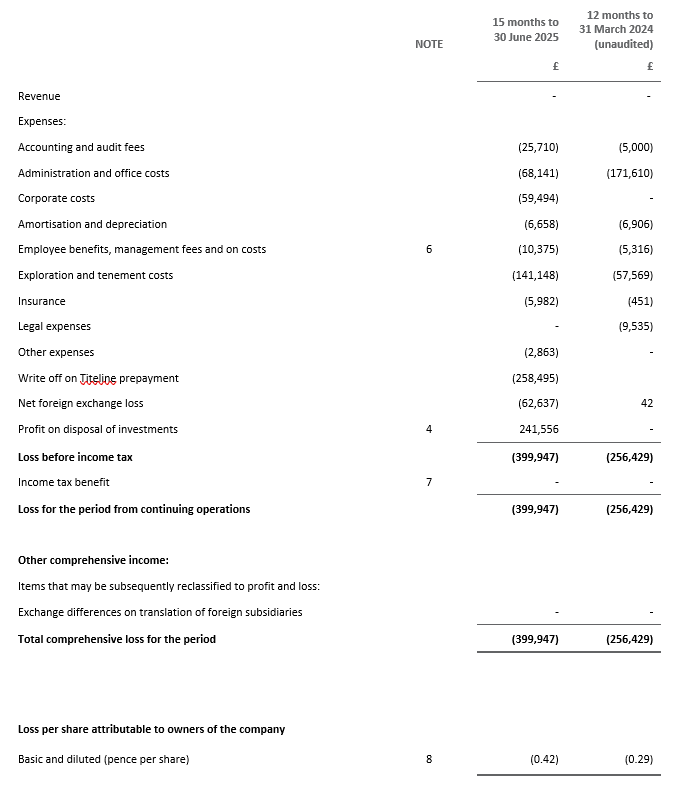
4286721_0.png |
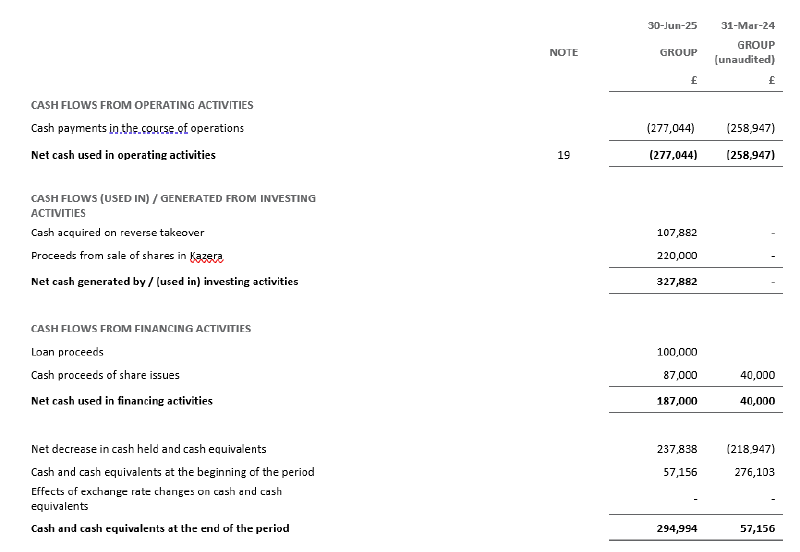
4286721_1.png |

Latest directors dealings
- 1 day ago Legal & General Group
- 1 day ago Trustpilot Group
- 1 day ago Rio Tinto
- 1 day ago Trustpilot Group
- 1 day ago Ruffer Investment Company Ltd Red PTG Pref Shares