
Results from 2 Drill Holes at Clontibret
Summary by AI BETAClose X
18 May 2026
Conroy Gold and Natural Resources plc
("Conroy Gold" or "the Company")
RESULTS FROM TWO DRILL HOLES IDENTIFY SIGNIFICANT
ALTERATION ZONE AT CLONTIBRET
- Extensive alteration zone identified in both drill holes
- Buddingtonite alteration may indicate proximity to concealed hydrothermal gold system at depth
- Headline gold intersections of 3.5 metres at 4.8 g/t Au (including 0.5 metres @ 11.2 g/t Au and 1.0 metre at 16.7 g/t Au)
Conroy Gold and Natural Resources plc (AIM: CGNR) is pleased to announce assay results for a further two drill holes from the current phase of its drill programme (CGC-25-002 and CGC-25-003, totalling 566.7m) at its Clontibret gold deposit in Ireland.
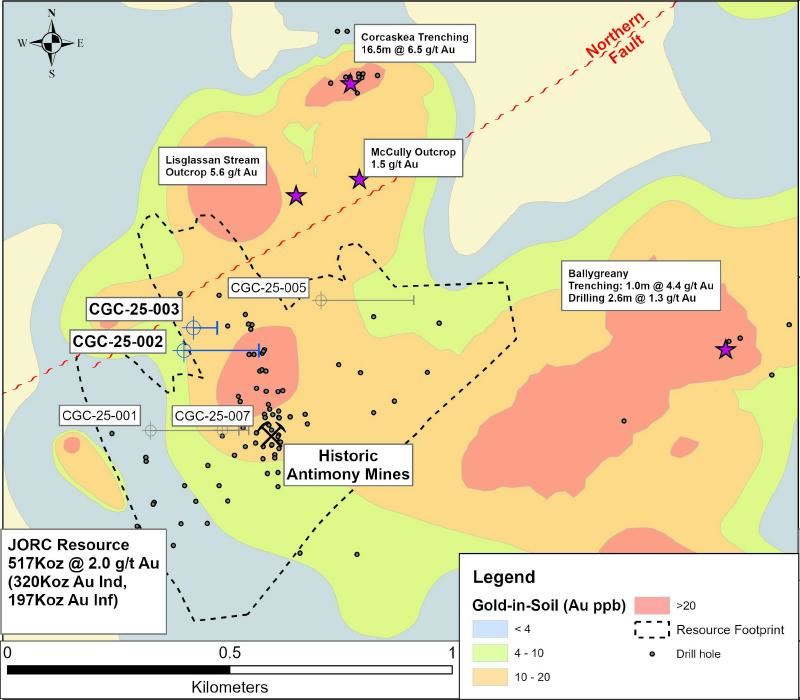
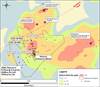
These two drill holes were designed to test the northern strike extension of the central gold lodes associated with the historic Tullybuck antimony mine going northwards towards a postulated northern fault which may exert an important control on mineralisation.
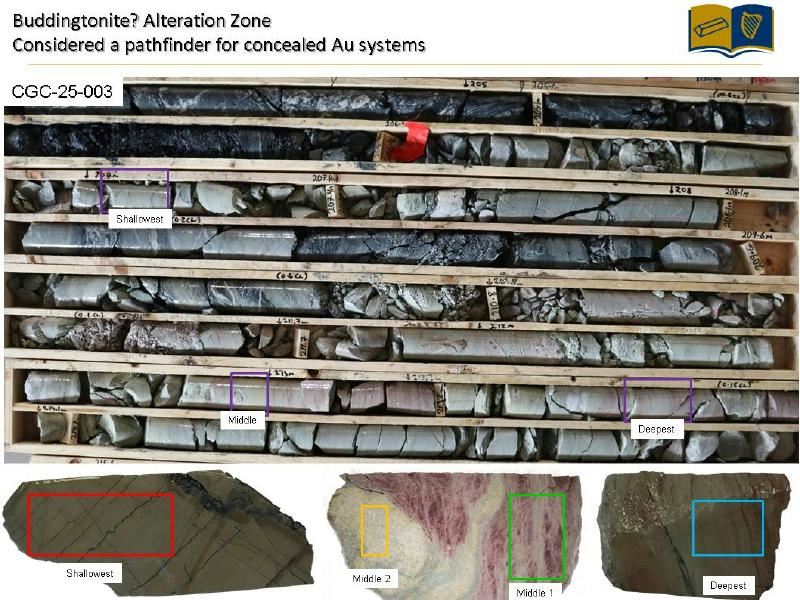
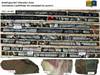
Both drill holes intersected a significant intensely altered zone interpreted to represent Buddingtonite alteration, although further confirmatory analytical work remains ongoing. Buddingtonite is widely recognised as a potential pathfinder mineral associated with concealed hydrothermal gold systems and may act as a vector towards additional gold mineralisation at depth.
The drill holes also intersected highly encouraging gold mineralisation across multiple zones. CGC-25-002 intersected 17 separate gold-bearing zones, highlighted by an interval of 1.0m at 16.7 g/t Au from 37.1m depth, a substantial 3.5m at 4.8 g/t Au from 123.5m (including a high-grade sub-interval of 0.5m at 11.2 g/t Au), and 2.1m at 4.2 g/t Au from 220.1m (including 0.7m at 9.6 g/t Au). CGC-25-003, drilled approximately 50 metres to the north at a steeper inclination, intersected six further gold-bearing zones, confirming the lateral continuity of mineralisation along strike.
John Sherman, Chairman, commented:
"These latest drill results continue to demonstrate the significant gold endowment at Clontibret while also highlighting the growing geological potential of the wider system.
The identification of a substantial alteration zone, interpreted as Buddingtonite-bearing, is particularly encouraging as this type of alteration can be associated with major hydrothermal gold systems worldwide.
We believe these results provide important new geological insights which may assist in targeting further mineralisation as exploration advances."
Current Clontibret Drilling Programme
The ongoing five hole drilling programme is set out below. The results of CGC-25-001 were announced by the Company on 2 nd March 2026 showing the deepest gold mineralisation intersected to date at Clontibret.
Alteration Zone
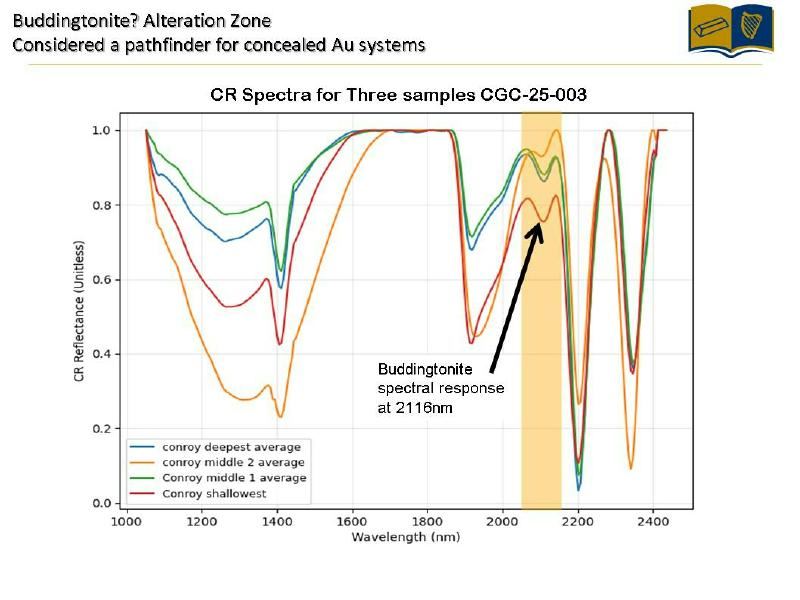
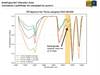
The alteration zone identified in both drill holes (CGC-25-002 and CGC-25-003) has a strike orientation similar to the known gold lodes, at approximately 330 degrees azimuth. Hyperspectral core scanning undertaken on samples from the alteration zone identified a primary Buddingtonite spectral response at 2116nm. Supporting portable XRF and multi-element geochemical analyses indicate a strong potassium alteration signature characterised by elevated potassium and rubidium values together with depleted magnesium and calcium.
Buddingtonite forms when hot, potassium and ammonium-rich fluids react with host rock as they migrate upwards through faults and fractures. In gold systems worldwide, it is commonly developed in the alteration "halo" surrounding and overlying ore-grade mineralisation, marking the pathway the gold-bearing fluids travelled. The combined hyperspectral, portable XRF and geochemical signature observed at Clontibret is characteristic of this fluid-rock interaction and supports the interpretation that the drill holes have intersected part of a larger hydrothermal system. The Company believes the identification of this alteration system may provide an important vectoring tool for future exploration targeting within the Clontibret gold system and particularly at depth and towards the northern fault.
Further announcements will be made as the drilling programme progresses.
Samples identified for hyperspectral scanning
Drill results showing intersections of gold mineralisation
Drill Hole CGC-25-002
Drill hole CGC-25-002 intersected 17 separate gold zones and extensive alteration. The hole was drilled to a total depth of 351.1 metres on an azimuth of 090 degrees at an inclination of -60 degrees.
CGC-25-002 Intersections
- 1.0m @ 16.7 g/t Au from 37.1m
- 1.4m @ 0.3 g/t Au from 50.5m
- 3.7m @ 1.2 g/t Au from 115.0m
- 3.5m @ 4.8 g/t Au from 123.5m (inc. 0.5m @ 11.2 g.t Au)
- 0.7m @ 0.4 g/t Au from 131.5m
- 0.7m @ 1.1 g/t Au from 148.0m
- 1.5m @ 2.9 g/t Au from 175.0m
- 0.8m @ 0.8 g/t Au from 189.2m
- 1.0m @ 0.5 g/t Au from 198.0m
- 0.8m @ 2.2 g/t Au from 207.0m
- 2.1m @ 4.2 g/t Au from 220.1m (inc. 0.7m @ 9.6 g.t Au)
- 1.2m @ 0.8 g/t Au from 226.0m
- 0.9m @ 0.5 g/t Au from 229.m
- 1.1m @ 2.5 g/t Au from 245.6m
- 0.8m @ 0.4 g/t Au from 258.2m
- 1.5m @ 1.1 g/t Au from 259.5m
- 0.5m @ 1.5 g/t Au from 342.0m
(Only intercepts of 0.3 g/t or greater over 1.0m are presented)
All samples were analysed by ALS (OMAC Laboratories), Loughrea, using the Au-ICP21 method - fire assay (30 g) for gold and aqua regia digest with ICP-AES finish (0.5 g) for multi-element analysis.
Drill Hole CGC-25-003
Drill hole CGC-25-003 was drilled approximately 50 metres north of CGC-25-002 at a steeper inclination (-75 degrees) to a total depth of 215.6 metres.
The hole intersected six gold-bearing zones and a continuation of the intense alteration zone identified in CGC-25-002. Drilling terminated within the alteration zone due to technical difficulties.
CGC-25-003 Intersections
· 0.5m @ 2.7 g/t Au from 35.0m
· 0.5m @ 2.1 g/t Au from 45.5m
· 0.5m @ 2.6 g/t Au from 50.0m
· 0.5m @ 1.1 g/t Au from 98.0m
· 3.0m @ 0.8 g/t Au from 118.0m
· 1.0m @ 0.7 g/t Au from 192.0m
(Only intercepts of 0.3 g/t or greater over 1.0m are presented)
All samples were analysed by ALS (OMAC Laboratories), Loughrea, using the Au-ICP21 method - fire assay (30 g) for gold and aqua regia digest with ICP-AES finish (0.5 g) for multi-element analysis.
This release has been approved by Kevin McNulty PGeo, who is a member of the Company's technical staff and holds a BSc/MSc in Geology and Remote Sensing, in accordance with the guidance note for Mining, Oil & Gas Companies issued by the London Stock Exchange in respect of AIM Companies, which outlines standards of disclosure for mineral projects .
About the "Discs of Gold" Project
Conroy Gold's "Discs of Gold" project in Ireland is defined by two parallel district scale gold trends, extending over c.95km, which are 100 per cent. held under license by the Company and anchored by the Clontibret gold deposit. The Clontibret target area contains a currently defined JORC (2012) 517Koz gold resource @ 2.0 g/t Au (320Koz Au Indicated and 197Koz Au Inferred (2017)) which remains open in multiple directions.
The Company has identified a further seven gold targets in its license area with the Clay Lake and Creenkill gold targets being of particular interest. Gold occurs in multiple styles in the Company's license area, including free gold, refractory gold in arsenopyrite and gold associated with pyrite and antimony (stibnite), suggesting multiple hydrothermal events occurred within the licence area.
There are clear geological analogies between the "Discs of Gold" targets and large gold deposits in Southeastern Australia and Atlantic Canada.
Technical Glossary
|
ALS |
Analytical Laboratory Services |
|
Au |
Gold |
|
Fire Assay |
An assay procedure involving heating the sample in a furnace to ensure complete extraction of all the contained precious metal |
|
g/t |
Grams per metric tonne
|
|
ICP |
Inductively coupled plasma |
|
ICP-AES |
Inductively coupled plasma atomic emission spectroscopy |
|
nm |
Nanometres |
|
XRF |
X-ray fluorescence |
For further information please contact :
|
Conroy Gold and Natural Resources plc |
Tel: +353-1-479-6180 |
|
John Sherman, Chairman Maureen Jones, Managing Director |
|
|
Allenby Capital Limited (Nomad) |
Tel: +44-20-3328-5656 |
|
Nick Athanas/Nick Harriss |
|
|
Hybridan LLP (Broker) Claire Louise Noyce
Lothbury Financial Services |
Tel: +44-20-3764-2341
Tel: +44-20-3290-0707 |
|
Michael Padley
|
|
|
Hall Communications |
Tel: +353-1-660-9377 |
|
Don Hall |
|
Visit the website at: www.conroygold.com

4349477_0.jpeg |
4349477_3.jpeg |
4349477_2.jpeg |
4349477_1.jpeg |

Latest directors dealings
- 16 hours ago Legal & General Group
- 17 hours ago Trustpilot Group
- 18 hours ago Rio Tinto
- 18 hours ago Trustpilot Group
- 18 hours ago Ruffer Investment Company Ltd Red PTG Pref Shares