
Final Results IFRS 2024

http://www.rns-pdf.londonstockexchange.com/rns/9268G_1-2025-4-30.pdf
EFG Holding Company
(Previously EFG - Hermes Holding Company)
(Egyptian Joint Stock Company)
Consolidated financial statements.
For the year ended 31 December 2024
-
Table of contents
|
|
Page(s) |
|
Independent auditor's report |
1 - 4 |
|
Consolidated statement of financial position Consolidated statement of profit or loss |
5 6 |
|
Consolidated statement of comprehensive income |
7 |
|
Consolidated statement of changes in equity |
8 - 9 |
|
Consolidated statement of cash flows |
10 - 11 |
|
Notes to the consolidated financial statements |
12 - 121 |
Consolidated statement of financial position
As at 31 December 2024
|
|
|
Notes |
2024 |
|
2023 |
|
|
|
|
|
EGP Thousand |
|
EGP Thousand |
|
|
|
|
|
(Restated) |
|||
|
Assets |
|
|
|
|
|
|
|
Cash and cash equivalents |
|
5 |
42,847,357 |
|
28,222,210 |
|
|
Balance with Central Bank |
|
5.1 |
8,693,380 |
|
4,030,033 |
|
|
Loans and advances to customers |
|
8 |
57,928,603 |
|
40,221,897 |
|
|
Accounts receivable |
|
7 |
15,773,382 |
|
6,770,962 |
|
|
Investments at fair value through profit and loss |
|
6 |
23,488,674 |
|
9,196,191 |
|
|
Investments at fair value through OCI |
|
9 |
12,374,218 |
|
11,647,611 |
|
|
Investments at amortized cost |
|
12 |
12,487,545 |
|
11,233,860 |
|
|
Assets held for sale |
|
11 |
106,304 |
|
- |
|
|
Equity accounted investees |
|
10 |
804,867 |
|
844,793 |
|
|
Investment properties |
|
13 |
90,283 |
|
98,701 |
|
|
Other assets |
|
16 |
6,583,336 |
|
5,021,903 |
|
|
Goodwill and other intangible assets |
|
15 |
2,490,920 |
|
2,318,723 |
|
|
Deferred tax assets |
|
22 |
233,912 |
|
126,411 |
|
|
Property and equipment |
|
14 |
2,975,630 |
|
2,177,789 |
|
|
Total assets |
|
|
186,878,411 |
|
121,911,084 |
|
|
|
|
|
|
|
|
|
|
|
|
|
|
|
|
|
|
Liabilities |
|
|
|
|
|
|
|
Due to banks and financial institutions |
|
17 |
22,762,916 |
|
14,055,729 |
|
|
Customer deposits |
|
18 |
67,208,585 |
|
50,634,207 |
|
|
Loans and borrowings |
|
24 |
11,489,567 |
|
8,130,903 |
|
|
Creditors and other credit balances |
|
21 |
11,130,638 |
|
6,216,904 |
|
|
Accounts payable - customers credit balances FVTPL |
|
19 |
7,901,466 |
|
680,319 |
|
|
Accounts payable - customers credit balances |
|
19.1 |
20,566,943 |
|
11,319,690 |
|
|
Issued bonds |
|
20 |
1,432,665 |
|
749,003 |
|
|
Provisions |
|
23 |
1,913,277 |
|
1,099,271 |
|
|
Current tax liability |
|
30.1 |
1,020,705 |
|
638,583 |
|
|
Deferred tax liabilities |
|
22 |
2,083,684 |
|
987,436 |
|
|
Total liabilities |
|
|
147,510,446 |
|
94,512,045 |
|
|
|
|
|
|
|
|
|
|
Equity |
|
|
|
|
|
|
|
Share capital |
|
25 |
7,298,030 |
|
7,298,030 |
|
|
Legal reserve |
|
|
993,689 |
|
972,344 |
|
|
Share premium |
|
|
1,797,838 |
|
1,668,624 |
|
|
Other reserves |
|
|
11,800,563 |
|
4,843,110 |
|
|
Retained earnings |
|
|
12,568,681 |
|
8,534,456 |
|
|
Treasury shares |
|
25.1 |
(399,975) |
|
- |
|
|
Equity attributable to owners of the Group |
|
|
34,058,826 |
|
23,316,564 |
|
|
Non - controlling interests |
|
26 |
5,309,139 |
|
4,082,475 |
|
|
Total equity |
|
|
39,367,965 |
|
27,399,039 |
|
|
Total liabilities and equity |
|
|
186,878,411 |
|
121,911,084 |
|
|
|
|
|
|
|
|
|
These financial statements were approved and authorised for issue on 30 April 2025 and signed by:
|
Mona Zulficar Chairperson |
Karim Awad Group Chief Executive Officer |
The accompanying notes 1 to 37 form an integral part of these consolidated financial statements.
Consolidated statement of profit or loss
For the year ended 31 December 2024
|
|
Notes |
2024 |
|
2023 |
|
|
|
|
EGP Thousand |
|
EGP Thousand |
|
|
|
|
(Restated) |
|||
|
Interest income |
32 |
22,319,642 |
|
13,484,814 |
|
|
Interest expense |
|
(15,310,258) |
|
(8,867,099) |
|
|
Net interest income |
|
7,009,384 |
|
4,617,715 |
|
|
Fee and commission income |
32 |
11,452,386 |
|
7,161,919 |
|
|
Fee and commission expense |
|
(1,357,101) |
|
(719,609) |
|
|
Net fee and commission income |
|
10,095,285 |
|
6,442,310 |
|
|
Realized securities' (loss)/ gain |
2 |
(57,356) |
|
171,671 |
|
|
Net changes in the fair value of investments at FVTPL |
6 |
2,844,098 |
|
1,411,890 |
|
|
Dividend income |
32 |
85,998 |
|
81,477 |
|
|
Other revenues |
28 |
462,570 |
|
307,796 |
|
|
Net gains on derecognition of financial assets at amortized cost |
32 |
960,692 |
|
432,931 |
|
|
Impairment loss on financial assets - net of recoveries |
29 |
(773,002) |
|
(1,030,333) |
|
|
Foreign currencies exchange differences |
32 |
2,907,706 |
|
1,154,847 |
|
|
Share of gain from equity accounted investees |
32 |
48,853 |
|
45,048 |
|
|
|
|
23,584,228 |
|
13,635,352 |
|
|
General and administrative expenses |
31 |
(14,713,532) |
|
(8,950,858) |
|
|
Financial guarantee provision |
23 |
(40,678) |
|
(38,055) |
|
|
Impairment loss on goodwill and intangible assets |
32 |
- |
|
(12,002) |
|
|
Provisions |
23 |
(738,908) |
|
(224,814) |
|
|
Depreciation and amortisation |
31.2 |
(633,597) |
|
(481,384) |
|
|
Profit before tax |
|
7,457,513 |
|
3,928,239 |
|
|
Income tax expense |
30 |
(2,370,417) |
|
(1,093,997) |
|
|
Profit for the year |
|
5,087,096 |
|
2,834,242 |
|
|
|
|
|
|
|
|
|
Attributable to: |
|
|
|
|
|
|
Shareholders of the Holding Company |
|
4,098,933 |
|
2,212,222 |
|
|
Non-controlling interests |
|
988,163 |
|
622,020 |
|
|
|
|
5,087,096 |
|
2,834,242 |
|
|
|
|
|
|
|
|
|
Earnings per share: |
|
|
|
|
|
|
Basic earnings per share - EGP |
34 |
2.84 |
|
1.52 |
|
|
Diluted earnings per share - EGP |
34 |
2.84 |
|
1.52 |
|
The accompanying notes 1 to 37 form an integral part of these consolidated financial statements.
Consolidated statement of comprehensive income
For the year ended 31 December 2024
|
|
Notes |
2024 |
|
2023 |
|
|
|
EGP Thousand |
|
EGP Thousand |
|
|
|
(Restated) |
||
|
Profit for the year |
|
5,087,096 |
|
2,834,242 |
|
Other comprehensive income items: |
|
|
|
|
|
Items that may be reclassified to the consolidated statement of profit or loss |
|
|
|
|
|
Foreign operations - foreign currency translation differences |
|
7,055,262 |
|
1,919,416 |
|
Foreign currency translation differences - reclassified to profit or loss |
|
(26,944) |
|
(198,160) |
|
Net gain/ (loss) on investments in debt instruments at FVOCI- net change in fair value |
|
186,661 |
|
(33,483) |
|
Investments at fair value through OCI-net change in fair value - reclassified to profit or loss |
|
213,739 |
|
215,549 |
|
Tax relating to such items |
22 |
(102,709) |
|
14,319 |
|
|
|
7,326,009 |
|
1,917,641 |
|
Items that will not be reclassified to the consolidated statement of profit or loss |
|
|
|
|
|
Investment at fair value through OCI - reclassified to retained earnings |
|
555 |
|
(1,064) |
|
Net gain/ (loss) on investments in equity instruments designated at fair value through OCI - net change in fair value |
|
20,241 |
|
(222,270) |
|
Actuarial gain re-measurement of employees' benefits obligations |
21.2 |
2,178 |
|
3,512 |
|
Share of other comprehensive income of equity accounted investees |
|
4,672 |
|
1,310 |
|
Other comprehensive income, net of tax |
|
7,353,655 |
|
1,699,129 |
|
Total comprehensive income for the year |
|
12,440,751 |
|
4,533,371 |
|
Attributable to: |
|
|
|
|
|
||
|
Shareholders of the Holding Company |
|
11,076,685 |
|
3,824,822 |
|||
|
Non-controlling interests |
|
1,364,066 |
|
708,549 |
|||
|
|
|
12,440,751 |
|
4,533,371 |
|||
The accompanying notes 1 to 37 form an integral part of these consolidated financial statements.
Consolidated statement of changes in equity
For the year ended 31 December 2024
|
EGP Thousand |
Share Capital |
Legal reserve |
Share premium |
General reserve |
Translation reserve |
Fair value reserve |
Employee stock ownership plan reserve |
Operational risk reserve |
Retained earnings |
Total |
Non-controlling interests |
Total Equity |
|
|
Balance as at 31 December 2022 |
5,838,424 |
867,455 |
1,668,624 |
158 |
3,979,860 |
(1,224,388) |
289,011 |
80,915 |
7,423,239 |
18,923,298 |
3,445,286 |
22,368,584 |
|
|
Total comprehensive income |
|
|
|
|
|
|
|
|
|
|
|
|
|
|
Profit |
- |
- |
- |
- |
- |
- |
- |
- |
2,212,222 |
2,212,222 |
622,020 |
2,834,242 |
|
|
Other comprehensive income |
- |
- |
- |
- |
1,670,159 |
(61,071) |
- |
- |
3,512 |
1,612,600 |
86,529 |
1,699,129 |
|
|
Total comprehensive income |
- |
- |
- |
- |
1,670,159 |
(61,071) |
- |
- |
2,215,734 |
3,824,822 |
708,549 |
4,533,371 |
|
|
Transactions with owners of the Group |
|
|
|
|
|
|
|
|
|
|
|
|
|
|
Contributions and distributions |
|
|
|
|
|
|
|
|
|
|
|
|
|
|
Dividends |
1,459,606 |
- |
- |
- |
- |
- |
- |
- |
(1,460,450) |
(844) |
(135,421) |
(136,265) |
|
|
Transferred to legal reserve |
- |
104,889 |
- |
- |
- |
- |
- |
- |
(104,889) |
- |
- |
- |
|
|
Employee stock ownership plan (ESOP) |
- |
- |
- |
- |
- |
- |
130,939 |
- |
- |
130,939 |
- |
130,939 |
|
|
Operational risk reserve |
- |
- |
- |
- |
- |
- |
- |
(22,473) |
22,473 |
- |
- |
- |
|
|
Sale of equity securities through OCI |
- |
- |
- |
- |
- |
- |
- |
- |
1,064 |
1,064 |
- |
1,064 |
|
|
Changes in ownership interests |
|
|
|
|
|
|
|
|
|
|
|
|
|
|
Acquisition of subsidiary with NCI |
- |
- |
- |
- |
- |
- |
- |
- |
- |
- |
10,918 |
10,918 |
|
|
Changes in ownership interests without change in control |
- |
- |
- |
- |
- |
- |
- |
- |
437,285 |
437,285 |
53,143 |
490,428 |
|
|
Restated balance as at 31 December 2023 |
7,298,030 |
972,344 |
1,668,624 |
158 |
5,650,019 |
(1,285,459) |
419,950 |
58,442 |
8,534,456 |
23,316,564 |
4,082,475 |
27,399,039 |
|
|
|
|
||||||||||||
The accompanying notes 1 to 37 form an integral part of these consolidated financial statements.
Consolidated statement of changes in equity (continued)
For the year ended 31 December 2024
|
EGP Thousand |
Share Capital |
Legal reserve |
Share premium |
General reserve |
Translation reserve |
Fair value reserve |
Employee stock ownership plan reserve |
Operational risk reserve |
Treasury shares |
Retained earnings |
Total |
Non-controlling interests |
Total Equity |
|
Balance as at 31 December 2023, as previously reported |
7,298,030 |
972,344 |
1,668,624 |
158 |
5,650,019 |
(1,285,459) |
419,950 |
58,442 |
- |
8,538,917 |
23,321,025 |
4,074,904 |
27,395,929 |
|
Impact of purchase price allocation on subsidiary (note 37) |
- |
- |
- |
- |
- |
- |
- |
- |
- |
(4,461) |
(4,461) |
7,571 |
3,110 |
|
Restated balance as at 31 December 2023 |
7,298,030 |
972,344 |
1,668,624 |
158 |
5,650,019 |
(1,285,459) |
419,950 |
58,442 |
- |
8,534,456 |
23,316,564 |
4,082,475 |
27,399,039 |
|
Total comprehensive income |
|
|
|
|
|
|
|
|
|
|
|
|
|
|
Profit |
- |
- |
- |
- |
- |
- |
- |
- |
- |
4,098,933 |
4,098,933 |
988,163 |
5,087,096 |
|
Other comprehensive income |
- |
- |
- |
- |
6,728,166 |
247,408 |
- |
- |
- |
2,178 |
6,977,752 |
375,903 |
7,353,655 |
|
Total comprehensive income |
- |
- |
- |
- |
6,728,166 |
247,408 |
- |
- |
- |
4,101,111 |
11,076,685 |
1,364,066 |
12,440,751 |
|
Transactions with owners of the Group |
|
|
|
|
|
|
|
|
|
|
|
|
|
|
Contributions and distributions |
|
|
|
|
|
|
|
|
|
|
|
|
|
|
Dividends |
- |
- |
- |
- |
- |
- |
- |
- |
- |
(5,809) |
(5,809) |
(139,963) |
(145,772) |
|
Transferred to legal reserve |
- |
21,345 |
- |
- |
- |
- |
- |
- |
- |
(21,345) |
- |
- |
- |
|
Transferred to share premium |
- |
- |
129,214 |
- |
- |
- |
(55,276) |
- |
- |
- |
73,938 |
- |
73,938 |
|
Operational risk reserve |
- |
- |
- |
- |
- |
- |
- |
37,155 |
- |
(37,155) |
- |
- |
- |
|
Purchasing of treasury shares |
- |
- |
- |
- |
- |
- |
- |
- |
(399,975) |
- |
(399,975) |
- |
(399,975) |
|
Sale of equity securities through OCI |
- |
- |
- |
- |
- |
- |
- |
- |
- |
2,975 |
2,975 |
1,296 |
4,271 |
|
Changes in ownership interests |
|
|
|
|
|
|
|
|
|
|
|
|
|
|
Changes in ownership interests without a change in control |
- |
- |
- |
- |
- |
- |
- |
- |
- |
(5,552) |
(5,552) |
1,265 |
(4,287) |
|
Balance as at 31 December 2024 |
7,298,030 |
993,689 |
1,797,838 |
158 |
12,378,185 |
(1,038,051) |
364,674 |
95,597 |
(399,975) |
12,568,681 |
34,058,826 |
5,309,139 |
39,367,965 |
The accompanying notes 1 to 37 form an integral part of these consolidated financial statements.
Consolidated statement of cash flows
For the year ended 31 December 2024
|
|
|
|
|
|
|
|
Notes |
2024 |
|
2023 |
|
|
|
EGP Thousand |
|
EGP Thousand |
|
|
|
(Restated) |
||
|
Cash flows from operating activities |
|
|
|
|
|
Profit for the year before income tax |
|
7,457,513 |
|
3,928,239 |
|
Adjustments for: |
|
|
|
|
|
Depreciation and amortization |
31.2 |
633,597 |
|
481,384 |
|
Provisions movements |
23 |
502,961 |
|
148,077 |
|
Gains on sale of property, plant and equipment |
28 |
(22,882) |
|
(3,251) |
|
Gain from securitization |
|
(960,692) |
|
(432,931) |
|
Gain on sale of investment property |
|
(7,648) |
|
(56,438) |
|
Loss on sale of investment at FVTOCI |
|
203,295 |
|
6,382 |
|
Amortization of premium / issue discount |
|
(2,171,081) |
|
(1,270,786) |
|
Changes in the fair value of investments at fair value through profit and loss |
|
(2,844,098) |
|
(1,411,890) |
|
Share of gain from equity accounted investees |
32 |
(48,853) |
|
(45,048) |
|
Impairment loss on assets |
29,15 |
773,002 |
|
1,042,335 |
|
Share-based payment |
|
73,938 |
|
130,938 |
|
Employees' benefits |
21.2 |
15,477 |
|
10,239 |
|
Foreign currency translation differences |
|
6,395,850 |
|
2,113,321 |
|
Foreign currency exchange differences |
32 |
(2,907,706) |
|
(1,154,847) |
|
Gain on selling of investments in subsidiaries and associates |
|
(2,599) |
|
(116,059) |
|
Operating profit before changes in assets and liabilities |
|
7,090,074 |
|
3,369,665 |
|
Changes in assets and liabilities: |
|
|
|
|
|
Other assets |
|
(154,703) |
|
(2,284,677) |
|
Creditors and other credit balances |
|
(2,800,194) |
|
1,551,020 |
|
Accounts receivables |
|
(3,869,228) |
|
1,854,893 |
|
Accounts payable |
|
(895,777) |
|
(2,654,272) |
|
Accounts payable - customers credit balance at fair value through profit and loss |
|
7,221,146 |
|
301,280 |
|
Loans and facilities to customers |
|
(20,424,633) |
|
(10,303,164) |
|
Due from banks |
|
(4,699,056) |
|
(2,142,353) |
|
Due to banks |
|
(3,196,040) |
|
1,890,134 |
|
Customers deposits |
|
9,102,583 |
|
1,181,427 |
|
Employees' benefits obligations paid |
21.2 |
(37,828) |
|
(1,916) |
|
Investments at fair value through profit and loss |
|
466,184 |
|
(445,075) |
|
Income tax paid |
|
(1,052,558) |
|
(772,664) |
|
Net cash used in operating activities |
|
(13,250,030) |
|
(8,455,702) |
|
Cash flows from investing activities: |
|
|
|
|
|
Payments to purchase property, plant and equipment and other intangible assets |
|
(1,241,297) |
|
(736,314) |
|
Proceeds from sale of property, plant and equipment |
|
36,355 |
|
28,763 |
|
Proceeds from sale of investment property |
|
9,579 |
|
70,176 |
|
Proceeds from sale of investments at FVTOCI |
|
29,663,914 |
|
25,559,674 |
|
Payments to purchase investments at FVTOCI |
|
(26,353,791) |
|
(17,781,236) |
|
Payments to purchase investment in subsidiaries |
|
(5,562) |
|
(69,682) |
|
Proceeds from sale of investment in subsidiaries |
|
- |
|
179,259 |
|
Payments to purchase equity accounted investees |
|
(71,000) |
|
- |
|
Proceeds from sale of equity accounted investees |
|
13,083 |
|
- |
|
Dividends collected |
|
16,185 |
|
23,102 |
|
Net cash generated from investing activities |
|
2,067,466 |
|
7,273,742 |
The accompanying notes 1 to 37 form an integral part of these consolidated financial statements.
Consolidated statement of cash flows (continued)
For the year ended 31 December 2024
|
|
Notes |
2024 |
|
2023 |
|
|
|
EGP Thousand |
|
EGP Thousand |
|
|
|
(Restated) |
||
|
Cash flows from financing activities: |
|
|
|
|
|
Dividends paid |
|
(621,494) |
|
(495,060) |
|
Proceeds from securitization |
|
4,935,750 |
|
5,035,109 |
|
Proceeds from issued bonds |
|
1,432,665 |
|
249,003 |
|
Payment for issued bonds |
|
(749,003) |
|
- |
|
Proceeds from financial institutions |
|
2,142,133 |
|
- |
|
Payment to financial institutions |
|
- |
|
(13,515) |
|
Proceeds from loans and borrowings |
|
4,914,826 |
|
3,571,284 |
|
Payment for loans and borrowings |
|
(1,752,246) |
|
(1,083,222) |
|
Purchase of treasury shares |
|
(399,975) |
|
- |
|
Net cash generated from financing activities |
|
9,902,656 |
|
7,263,599 |
|
|
|
|
|
|
|
Net change in cash and cash equivalents |
|
(1,279,908) |
|
6,081,639 |
|
Cash and cash equivalents at 1 January |
|
20,295,762 |
|
12,750,151 |
|
Effect of exchange rate changes |
|
5,526,122 |
|
1,460,302 |
|
Cash from acquisition of subsidiaries |
|
- |
|
3,670 |
|
Cash and cash equivalents at 31 December |
5 |
24,541,976 |
|
20,295,762 |
The accompanying notes 1 to 37 form an integral part of these consolidated financial statements.
1 Incorporation and principal activities
1.1 Incorporation
- EFG Holding Company (Previously EFG Hermes Holding Company) (Egyptian Joint Stock Company) (the "Group" or "Holding Company") is an Egyptian Joint Stock Company subject to the provisions of the Capital Market Law No.95 of 1992 and its executive regulations. The Group's registered office is located in Smart Village building No. B129, phase 3, KM 28 Cairo / Alexandria Desert Road, 6 October 12577 Egypt.
- The name of the company has been changed to EFG Holding through the approval of the General Assembly dated May 24, 2023 and was reflected in the commercial register on June 14, 2023.
- EFG Holding shares are listed on the Egyptian Ex-change (EGX) and the London Stock Exchange (LSE) in the form of USD-denominated Global Depository Receipts ("GDRs").
1.2 Purpose of the Group
EFG Holding Company (Previously EFG Hermes Holding Company) is a premiere financial services corporation that offers diverse investment banking services including securities brokerage, investment banking, asset management and private equity. In addition, the Group also has non-bank finance products, which include leasing and micro-finance, instalment services, factoring, securitization, collection and tasquek. The purpose of the Group also includes participation in the establishment of companies which issue securities or in increasing their share capital, custody activities, margin trading and commercial bank activities.
2 Basis of preparation
Statement of compliance
The consolidated financial statements of the Group have been prepared in accordance with IFRS accounting standards and interpretations issued by the IFRS Interpretations Committee (IFRIC) applicable to companies reporting under IFRS accounting standards. The financial statements comply with IFRS accounting standards as issued by the International Accounting Standards Board (IASB).
Basis of measurement
These consolidated financial statements have been prepared under the historical cost basis, except for the following:
· Financial assets measured at fair value through profit or loss;
· Financial assets at fair value through other comprehensive income;
· Assets held for sale at fair value at the lower of their carrying amount and fair value less costs to sell; and
· Accounts payable - customers credit balance at fair value through profit and loss.
Functional and presentation currency
The Group's consolidated financial statements are presented in Egyptian Pound ("EGP") because the EGP forms the major currency in which the Group transacts and funds its business. The EGP is also the Group's functional currency because It is the most significant currency relevant to the underlying transactions, events and conditions of the Group and its subsidiaries, as well as representing a significant proportion of its funds generated from financing activities.
The Group has decided to present its statement of financial position in order of liquidity rather than bifurcating its assets and liabilities into a current/ non - current classification, as the banking subsidiary consolidated in these financial statements, which represents majority of the Group assets and liabilities, were presented in a liquidity order format.
2 Basis of preparation (continued)
Use of estimates and judgements
The preparation of consolidated financial statements requires management to make judgements, estimates and assumptions that affect the application of accounting policies and reported amounts of assets and liabilities, income and expenses. Actual results may differ from these estimates.
In applying the Group's accounting policies, IFRS Accounting Standards require management to select suitable accounting policies, apply them consistently and make judgements, estimates and assumptions that are reasonable and prudent and would result in relevant and reliable information. Management, based on guidance in IFRS Accounting Standards and the IASB's framework for the preparation and presentation of financial statements has made these estimates, judgements and assumptions. Listed below are those estimates and judgement which could have the most significant effect on the amounts recognised in the consolidated financial statements.
Estimates and underlying assumptions are reviewed on an ongoing basis and are based on historical experiences and other factors, including expectation of future events that may have a financial impact on the Group and considered to be reasonable under the circumstances. Revisions to accounting estimates are recognised in the period in which the estimate is revised and in any future periods affected.
(a) Going concern
The Group's management has made an assessment of the Group's ability to continue as a going concern and is satisfied that the Group has resources to continue in business for the foreseeable future. In making this assessment, management has considered a wide range of information including projections of profitability, regulatory capital requirements and funding needs. The assessment also includes consideration of reasonably possible downside economic scenarios and their potential impacts on the profitability, capital and liquidity of the Group. In making this assessment, the Group has considered the impact of climate related matters on their going concern assessment.
Furthermore, management is not aware of any material uncertainties that may cast significant doubt upon the Group's ability to continue as a going concern. Therefore, the consolidated financial statements continue to be prepared on going concern basis.
(b) Impairment charge on financial assets
Impairment losses are evaluated as described in Note 3.11
The measurement of impairment losses under IFRS 9 across all categories of financial assets requires assumptions, in particular, in the estimation of the amount and timing of future cash flows and collateral values when determining impairment losses and the assessment of a significant increase in credit risk. These estimates are driven by a number of factors, changes in which can result in different levels of allowances.
The Group's ECL calculations are outputs of multiple models with a number of underlying assumptions regarding the choice of variable inputs and their interdependencies. Elements of the ECL models that are considered accounting judgements and estimates include:
· The Group's internal credit grading model, which assigns PDs to the individual grades.
· The Group's criteria for assessing if there has been a significant increase in credit risk and so allowances for financial assets should be measured on a lifetime ECL basis and the qualitative assessment.
· The segmentation of financial assets when their ECL is assessed on a collective basis.
· Development of ECL models, including the various formulas and the choice of inputs.
· Determination of impacts between economic inputs, such as gross domestic product and collateral values etc. on PDs, EADs and LGDs.
· Selection of forward looking macroeconomic scenarios and their probability weightings, to derive the economic inputs into the ECL models.
It is the Group's policy is to regularly review its models in the context of actual loss experience and adjust when necessary.
2 Basis of preparation (continued)
Use of estimates and judgements (continued)
(c) Impairment charge on property and equipment and investment properties
Impairment losses are evaluated as described in note 3.15.
In determining the net realisable value, the Group uses the selling prices determined by external independent valuer companies, having appropriate recognised professional qualifications and recent experience in the location and category of property being valued. The selling prices are based on market values, being the estimated amount for which a property could be exchanged on the date of the valuation between a willing buyer and a willing seller in an arm's length transaction.
(d) Valuation of financial instruments
The fair value of financial instruments is the price that would be received to sell an asset or paid to transfer a liability in an orderly transaction in the principal (or most advantageous) market at the measurement date under current market conditions (i.e., an exit price) regardless of whether that price is directly observable or estimated using another valuation technique. When the fair values of financial assets and financial liabilities recorded in the statement of financial position cannot be derived from active markets, they are determined using a variety of valuation techniques that include the use of valuation models. The valuation techniques of financial instruments may require certain unobservable inputs to be estimated by management.
(e) Defined benefit plan
The cost of end of service defined benefit and the present value of the related obligation are determined using actuarial valuations. An actuarial valuation involves making various assumptions which may differ from actual developments in the future. These include the determination of the discount rate, future salary increases, withdrawal before normal retirement age and mortality rates. Due to the complexity of the valuation, the underlying assumptions and its long-term nature, a defined benefit obligation is highly sensitive to changes in these assumptions. All assumptions are reviewed at each reporting date.
Additional information on these assumptions is disclosed in note 21.2.
(f) Financial asset and liability classification
The Group's accounting policies provide scope for the classification and assessment of the business model for financial assets and liabilities to be designated on inception into different accounting categories. The classification criteria are mentioned in policy note 3.11.
Classification and measurement of financial assets depends on the results of the SPPI and the business model test. The Group determines the business model at a level that reflects how groups of financial assets are managed together to achieve a particular business objective. This assessment includes judgement reflecting all relevant evidence including how the performance of the assets is evaluated and their performance measured, the risks that affect the performance of the assets and how these are managed and how the managers of the assets are compensated. The Group monitors financial assets measured at amortised cost or fair value through other comprehensive income that are derecognised prior to their maturity to understand the reason for their disposal and whether the reasons are consistent with the objective of the business for which the asset was held. Monitoring is part of the group's continuous assessment of whether the business model for which the remaining financial assets are held continues to be appropriate and if it is not appropriate whether there has been a change in business model and so a prospective change to the classification of those assets. No such changes were required during the periods presented.
(g) Operating segments
In preparation of the segment information disclosure, management has made certain assumptions to arrive at the segment reporting. These assumptions would be reassessed by management on a periodic basis. Operating segments are detailed in note 32.
2 Basis of preparation (continued)
Use of estimates and judgements (continued)
(h) Goodwill impairment testing
The Group estimates that reasonably possible changes in the assumptions used for the impairment would not cause the recoverable amount of either CGU to decline below the carrying amount. An impairment loss is recognised if the carrying amount of an asset or its CGU exceeds its recoverable amount. CGU is the smallest identifiable asset group that generates cash flows that largely are independent from other assets and groups. Impairment losses are recognised in the Group consolidated statement of profit or loss statement. Impairment losses recognised in respect of CGUs are allocated first to reduce the carrying amount of any goodwill allocated to the units and then to reduce the carrying amount of other assets in the unit (group or units) on a pro rata basis.
The recoverable amount of an asset or CGU is the greater of its value in use and its fair value less costs to sell. In assessing value in use, the estimated future cash flows are discounted to their present value using a discount rate that reflects current market assessments of the time value of money and the risks specific to the asset.
(i) Tax
The measurement of deferred tax reflects the tax consequences that would follow the manner in which the Group expects, at the reporting date, to recover or settle the carrying amount of its assets and liabilities. In determining the amount of current and deferred tax, the Group considers the impact of tax exposures, including whether additional taxes and interest maybe due. This assessment relies on estimates and assumptions and may involve a series of judgements about future events. New information may become available that causes the Group to change its judgement regarding the adequacy of existing tax liabilities; such changes to tax liabilities would impact tax expense in the period in which such a determination is made (refer note 22).
3 Summary of material accounting policies
3.1 New or revised Standards or Interpretations
The Standards and amendments that are effective for the first time in 2024 and could be applicable to the Group are:
· Classification of Liabilities as Current or Non-current (Amendments to IAS 1)
· Lease Liability in a Sale and Leaseback (Amendments to IFRS 16)
· Supplier Finance Arrangements (Amendments to IAS 7 and IFRS 7)
· Non-current Liabilities with Covenants (Amendments to IAS 1)
These amendments do not have a significant impact on these financial statements and therefore the disclosures have not been made.
Standards, amendments and Interpretations to existing Standards that are not yet effective and have not been adopted early by the Group.
Other Standards and amendments that are not yet effective and have not been adopted early by the Group include:
· Lack of Exchangeability (Amendments to IAS 21)
· Amendments to the Classification and Measurement of Financial Instruments (Amendments to IFRS 9 and IFRS 7)
· IFRS 18 'Presentation and Disclosure in Financial Statements'
· IFRS 19 'Subsidiaries without Public Accountability: Disclosures'
These amendments are not expected to have a significant impact on the financial statements in the period of initial application and therefore no disclosures have been made.
As at the date of authorization of these financial statements, several new, but not yet effective, Standards and amendments to existing Standards, and Interpretations have been published by the IASB or IFRIC. None of these standards or amendments to existing Standards have been adopted early by the Group and no Interpretations have been issued that are applicable and need to be taken into consideration by the Group at either reporting date.
Management anticipates that all relevant pronouncements will be adopted for the first period beginning on or after the effective date of the pronouncement. New Standards, amendments and Interpretations not adopted in the current year have not been disclosed as they are not expected to have a material impact on the Group's financial statements.
3.2 Basis of consolidation
Business combination
The Group accounts for business combinations using the acquisition method when control is transferred to the Group.
The consideration transferred in the acquisition comprises of:
· fair values of the assets transferred
· liabilities incurred to the former owners of the acquired business
· equity interests issued by the Group
· fair value of any asset or liability resulting from a contingent consideration arrangement, and
· fair value of any pre-existing equity interest in the subsidiary.
3 Summary of material accounting policies (continued)
3.2 Basis of consolidation (conitinued)
Business combination (continued)
Identifiable assets acquired and liabilities and contingent liabilities assumed in a business combination are, with limited exceptions, measured initially at their fair values at the acquisition date. The Group recognises any non-controlling interest in the acquired entity on an acquisition-by-acquisition basis either at fair value or at the non-controlling interest's proportionate share of the acquired entity's net identifiable assets.
Transaction costs are expensed as incurred, except if related to the issue of debt or equity securities in which case those instruments are recognized at fair value, net of transaction costs.
The excess of the consideration transferred, amount of any non-controlling interest in the acquired entity and acquisition-date fair value of any previous equity interest in the acquired entity, over the fair value of the net identifiable assets acquired is recorded as goodwill. If those amounts are less than the fair value of the net identifiable assets of the business acquired, the difference is recognised directly in profit or loss as a bargain purchase.
Where settlement of any part of cash consideration is deferred, the amounts payable in the future are discounted to their present value as at the date of exchange. The discount rate used is the entity's incremental borrowing rate, being the rate at which a similar borrowing could be obtained from an independent financier under comparable terms and conditions. Contingent consideration is classified either as equity or a financial liability. Amounts classified as a financial liability are subsequently remeasured to fair value, with changes in fair value recognised in profit or loss.
If the business combination is achieved in stages, the acquisition date carrying value of the acquirer's previously held equity interest in the acquiree is remeasured to fair value at the acquisition date. Any gains or losses arising from such remeasurement are recognised in profit or loss.
Subsidiaries
Subsidiaries are entities controlled by the Group. The Group controls an entity when it is exposed to, or has rights to, variable returns from its involvement with the entity and has the ability to affect those returns through its power over the entity.
The financial statements of subsidiaries are included in the consolidated financial statements from the date on which control commences until the date on which control ceases.
3 Summary of material accounting policies (continued)
3.2 Basis of consolidation (continued)
Subsidiaries (continued)
The consolidated financial statements comprise the financial statements of the Group and those of its following subsidiaries:
|
Name of subsidiary |
Direct ownership % |
Indirect ownership % |
|
EFG Hermes International Securities Brokerage |
99.87 |
0.09 |
|
EFG Hermes Fund Management |
88.51 |
11.49 |
|
Hermes Portfolio and Fund Management |
78.81 |
21.19 |
|
Hermes Securities Brokerage |
97.58 |
2.42 |
|
Hermes Corporate Finance |
99.42 |
0.48 |
|
EFG - Hermes Advisory Inc. |
100.00 |
- |
|
EFG- Hermes Financial Management (Egypt) Ltd. |
- |
100 |
|
EFG - Hermes Promoting & Underwriting |
99.88 |
- |
|
Bayonne Enterprises Ltd. |
100 |
- |
|
EFG- Hermes Fixed Income |
99.00 |
1 |
|
EFG Hermes for Digital solutions -(Previously) EFG- Hermes Private Equity |
96.30 |
3.70 |
|
EFG- Hermes Private Equity-BVI |
- |
100 |
|
EFG- Hermes UAE LLC. |
100 |
- |
|
Flemming CIIC Holding |
100 |
- |
|
Flemming Mansour Securities |
- |
99.33 |
|
Flemming CIIC Securities |
- |
96 |
|
Flemming CIIC Corporate Finance |
- |
74.92 |
|
EFG- Hermes UAE Ltd. |
100 |
- |
|
EFG- Hermes Holding - Lebanon |
99 |
- |
|
EFG- Hermes KSA |
73.30 |
26.70 |
|
EFG- Hermes Lebanon |
99 |
0.97 |
|
Mena Opportunities Management Limited |
- |
95 |
|
Mena (BVI) Holding Ltd. |
- |
95 |
|
EFG - Hermes Mena Securities Ltd. |
- |
100 |
|
Middle East North Africa Financial Investments W.L.L |
- |
100 |
|
EFG- Hermes Regional Investment Ltd. |
- |
100 |
|
Offset Holding KSC * |
- |
50 |
|
EFG- Hermes IFA Financial Brokerage |
- |
63.08 |
|
IDEAVELOPERS |
- |
81 |
|
EFG- Hermes CB Holding Limited |
- |
100 |
|
EFG- Hermes Global CB Holding Limited |
100 |
- |
|
Mena Long-Term Value Feeder Holdings Ltd. * |
- |
50 |
|
Mena Long-Term Value Master Holdings Ltd. * |
- |
45 |
|
Mena Long-Term Value Management Ltd. * |
- |
45 |
|
EFG - Hermes CL Holding SAL |
- |
100 |
|
EFG-Hermes IB Limited |
100 |
- |
|
EFG Hermes Securitization |
100 |
- |
|
EFG Hermes-Direct Investment Fund |
64 |
- |
|
Tanmeyah Micro Enterprise Services S.A.E |
- |
94.06 |
|
EFG - Hermes Brokerage Holdings Ltd |
100 |
- |
|
EFG - Hermes USA |
100 |
- |
|
EFG Capital Partners III |
- |
100 |
|
Health Management Company |
- |
52.50 |
|
EFG - Hermes Kenya Ltd. |
- |
100 |
|
EFG Finance Holding |
99.82 |
0.18 |
|
EFG - Hermes UK Limited |
- |
100 |
|
OLT Investment International Company (B.S.C) |
99.90 |
- |
|
Frontier Investment Management Partners LTD * |
- |
50 |
|
EFG-Hermes SP limited |
- |
100 |
|
U Consumer Finance- Valu (previously) |
- |
94.96 |
3 Summary of material accounting policies (continued)
3.2 Basis of consolidation (continued)
Subsidiaries (continued)
|
Name of subsidiary |
Direct ownership % |
Indirect ownership % |
|
EFG Corp - Solutions |
- |
100 |
|
Beaufort Asset Managers LTD |
- |
100 |
|
EFG Hermes Bangladesh Limited |
- |
100 |
|
EFG Hermes FI Limited |
- |
100 |
|
EFG Securitization |
- |
100 |
|
EFG International Treasury Management Ltd -EFG Hermes PE Holding LLC |
100 |
- |
|
Etkan for Inquiry and Collection and Business Processes |
- |
100 |
|
RX Healthcare Management |
- |
52.50 |
|
FIM Partners KSA * |
- |
50 |
|
Egypt Education Fund GP Limited |
- |
80 |
|
EFG Hermes Nigeria Limited |
- |
100 |
|
EFG-Hermes Int. Fin Corp |
100 |
-- |
|
FIM Partners UK Ltd |
- |
50 |
|
EFG Hermes Sukuk |
90 |
10 |
|
Beaufort Holding LTD. |
- |
100 |
|
Beaufort Management LTD. |
- |
100 |
|
Vortex IV GP LTD. |
- |
100 |
|
Beaufort SLP Holding |
- |
100 |
|
Beaufort Private Investment Holding LTD. |
- |
100 |
|
Bank NXT- (Previously - Arab Investment Bank) |
51 |
- |
|
EFG VA Holdco Limited |
- |
100 |
|
EFG VA Investco Limited |
- |
100 |
|
Lighthouse Energy GP Limited |
- |
100 |
|
Beaufort SLP II Limited |
- |
100 |
|
Lighthouse Energy GP II |
- |
100 |
|
Beaufort Management Spain |
- |
100 |
|
EFG Singapore PTE LTD |
- |
100 |
|
Fatura Netherlands B.V |
- |
94.06 |
|
Fatura L.L.C |
- |
94.06 |
|
ASASY FOR DIGITAL CONTENT |
- |
94.06 |
|
EFG Payment |
- |
100 |
|
FIM Partners Muscat SPC* |
- |
50 |
|
Noutah for electronic commerce |
- |
94.06 |
|
EFG National Holding Limited-(Previously-VA ESOP Limited) |
- |
100 |
|
EFG RMBV National Investco Limited |
- |
100 |
|
EFG IB Holdco Limited |
- |
100 |
|
EFG IB Investco Limited |
- |
100 |
|
EFG For SME Financing |
- |
100 |
|
Beaufort Managers SLP Limited |
- |
100 |
|
EFG Finance B.V |
- |
100 |
|
Valu for payments and Digital Solutions |
- |
94.96 |
|
Paynas BV |
- |
94.96 |
|
EFG Hermes PE Holdco Ltd |
- |
100 |
|
EFG Hermes IB Holding Ltd. |
100 |
- |
|
|
|
|
* Management has determined that they do control those companies even though the Holding Company may own 50% or less of the issued capital of those entities. This is because the Holding Company is exposed and has the right to the variable returns of those companies and is able to use its power over those companies to affect those returns.
3 Summary of material accounting policies (continued)
3.2 Basis of consolidation (continued)
Non-controlling interests (NCI)
NCI are measured at their proportionate share of the acquiree's identifiable net assets at the date of acquisition. Changes in the Group's interest in a subsidiary that do not result in a loss of control are accounted for as equity transactions.
Loss of control
When the Group loses control over a subsidiary, it derecognises the assets and liabilities of the subsidiary, and any related NCI and other components of equity. Any resulting gain or loss is recognised in profit or loss. Any interest retained in the former subsidiary is measured at fair value when control is lost.
Interests in equity-accounted investees
The Group's interests in equity-accounted investees comprise interests in associates and joint ventures. Associates are those entities in which the Group has significant influence, but not control or joint control, over the financial and operating policies. A joint venture is an arrangement in which the Group has joint control, where by the Group has rights to the net assets of the arrangement. Rather than rights to its assets and obligations for its liabilities. Interests in associates and the joint venture are accounted for using the equity method. They are initially recognized at cost, which includes transaction costs.
Subsequent to initial recognition, the consolidated financial statements include the Group's share of the profit or loss and OCI of equity accounted investees, until the date on which significant influence or joint control ceases.
Transactions eliminated on consolidation
Intra-Group balances and transactions, and any unrealised income and expenses arising from intra-Group transactions, are eliminated. Unrealised gains arising from transactions with equity accounted investees are eliminated against the investment to the extent of the Group's interest in the investee. Unrealised losses are eliminated in the same way as unrealised gains, but only to the extent that there is no evidence of impairment.
3.3 Foreign currency
Foreign currency transactions
Transactions in foreign currencies are translated into the respective functional currencies of Group companies at the exchange rates at the dates of the transactions.
Monetary assets and liabilities denominated in foreign currencies are translated into the functional currency at the exchange rate at the reporting date. Non-monetary assets and liabilities that are measured at fair value in a foreign currency are translated into the functional currency at the exchange rate when the fair value was determined. Non-monetary items that are measured based on historical cost in a foreign currency are translated at the exchange rate at the date of the transaction. Foreign currency differences are recognised in consolidated statement of profit or loss.
However, foreign currency differences arising from the translation of the following items are recognised in OCI:
- A financial liability designated as a hedge of the net investment in a foreign operation to the extent that the hedge is effective; and
- Qualifying cash flow hedges to the extent that the hedges are effective.
3 Summary of material accounting policies (continued)
3.3 Foreign currency (continued)
Foreign currency transactions (continued)
Exchange differences on a monetary item that is part of a net investment in a foreign operation are recognised in other comprehensive income in consolidated accounts. On disposal of a foreign operation, exchange differences previously recognised in other comprehensive income are reclassified to the income statement as a reclassification adjustment.
Foreign operations
The assets and liabilities of foreign operations, including goodwill and fair value adjustments arising on acquisition, are translated at the exchange rates at the reporting date. The income and expenses of foreign operations are translated at the exchange rates at the dates of the transactions.
Foreign currency differences are recognized in OCI and accumulated in the translation reserve, except to the extent that the translation difference is allocated to NCI
When a foreign operation is disposed off in its entirety or partially such that control, significant influence or joint control is lost, the cumulative amount in the translation reserve related to that foreign operation is reclassified to profit or loss as part of the gain or loss on disposal. If the Group disposes of part of its interest in a subsidiary but retains control, then the relevant proportion of the cumulative amount is reattributed to NCI. When the Group disposes of only part of an associate or joint venture while retaining significant influence or joint control, the relevant proportion of the cumulative amount is reclassified to profit or loss.
3.4 Discontinued operation
A discontinued operation is a component of the Group's business, the operations and cash flows of which can be clearly distinguished from the rest of the Group. Classification as a discontinued operation occurs at the earlier of disposal or when the operation meets the criteria to be classified as held-for-sale. When an operation is classified as a discontinued operation, the comparative statement of profit or loss and OCI is re-presented as if the operation had been discontinued from the start of the comparative period.
3.5 Revenue
Gain on sale of investments
Gain (loss) resulting from sale of investments are recognized on transaction date and measured by the difference between cost and selling price less selling commission and expenses.
In case of derecognition of investments in associates, the difference between the carrying amount and the sum of both the consideration received and cumulative gain or loss that had been recognized in shareholders' equity is recognized in the consolidated statement of profit or loss.
Dividend income
Dividend income is recognized when declared and the right to receive payment is established.
Custody fee
Custody fees are recognized when the service is provided. Assets held in a fiduciary capacity are not treated as assets of the Group as they are only held in trust where the Group acts as a custodian on customers' behalf. The Group has no liability or obligations towards the customer on these assets held in trust. Accordingly, these assets are not included in these consolidated financial statements.
3 Summary of material accounting policies (continued)
3.5 Revenue (continued)
Interest income and expenses
Interest income and expense for all interest-bearing financial instruments, except for those classified as FVTPL or designated at fair value through profit or loss, are recognized within 'interest income' and 'interest expense' in the consolidated statement of profit or loss using the effective interest method. Interest income and expense are recognized in the consolidated statement of profit or loss using the effective interest method. The 'effective interest rate' is the rate that exactly discounts estimated future cash payments or receipts through the expected life of the financial instrument to:
· the gross carrying amount of the financial asset; or
· the amortized cost of the financial liability.
When calculating the effective interest rate for financial instruments other than credit-impaired assets, the Groups estimate future cash flows considering all contractual terms of the financial instrument, but not expected credit losses.
The calculation of the effective interest rate includes transaction costs and fees and points paid or received that are an integral part of the effective interest rate. Transaction costs include incremental costs that are directly attributable to the acquisition or issue of a financial asset or financial liability.
Presentation
Interest income and expense presented in the consolidated statement of profit or loss and OCI include:
Interest on financial assets and financial liabilities measured at amortized cost calculated on an effective interest basis; and
Interest on financial investment is measured at FVOCI calculated on an effective interest basis; Interest income and expense on other financial assets and financial liabilities at FVTPL are presented in net income from other financial instruments at FVTPL.
Amortized cost and gross carrying amount
The 'amortized cost' of a financial asset or financial liability is the amount at which the financial asset or financial liability is measured on initial recognition minus the principal repayments, plus or minus the cumulative amortisation using the effective interest method of any difference between that initial amount and the maturity amount and, for financial assets, adjusted for any expected credit loss allowance.
The gross carrying amount of a financial asset is the amortized cost of a financial asset before adjusting for any expected credit loss allowance.
For financial assets that have become credit-impaired subsequent to initial recognition, interest income is calculated by applying the effective interest rate to the amortized cost of the financial asset. If the asset is no longer credit-impaired, then the calculation of interest income reverts to the gross basis.
For financial assets that were credit-impaired on initial recognition, interest income is calculated by applying the credit-adjusted effective interest rate to the amortized cost of the asset. The calculation of interest income does not revert to a gross basis, even if the credit risk of the asset improves.
In calculating interest income and expense, the effective interest rate is applied to the gross carrying amount of the asset (when the asset is not credit-impaired) or to the amortized cost of the liability.
3 Summary of material accounting policies (continued)
3.5 Revenue (continued)
Fee and commission income
Fee and commission income and expense that are integral to the effective interest rate of a financial asset or liability are included in the measurement of the effective interest rate.
Other fee and commission income, including account servicing fees, placement fees and syndication fees, are recognised as the related services are performed.
A contract with a customer that results in a recognised financial instrument in the Group's financial statements may be partially in the scope of IFRS 9 and partially in the scope of IFRS 15. If this is the case, then the Group first applies IFRS 9 to separate and measure the part of the contract that is in the scope of IFRS 9 and then applies IFRS 15 to the residual.
Other fees and commission expenses relates mainly to transaction and service fees, which are expensed in the consolidated statement of profit or loss as the services are received.
Brokerage commission
Brokerage commission resulting from purchase of and sale of securities in favor of clients are recorded upon the execution of the transaction.
Management fee
Management fee is calculated as determined by the management contract of each investment fund and portfolio and recorded on accrual basis.
Incentive fee
Incentive fee is calculated based on certain percentages of the annual return realized by the fund and portfolio, however these incentive fee will not be recognized until revenue realization conditions are satisfied and there is adequate assurance of collection.
Investment property rental income
Rental income from investment property is recognized as revenue on a straight-line basis over the term of the lease. Lease incentives granted are recognized as an integral part of the total rental income, over the term of the lease. Rental income from other property is recognized as other income.
Revenue from micro-finance services
- Revenue from micro-finance services is recognized based on time proportion taking into consideration the rate of return on asset. Revenue yield is recognized in the consolidated statement of profit or loss using the effective interest method for all financial instruments that carry a yield, the effective interest method is the method of measuring the amortized cost of a financial asset and distributing the revenue over the lifetime of the relevant instrument. The effective interest rate is the rate that discounts estimated future cash receipts during the expected life of the financial instrument to reach the book value of the financial asset.
- When classifying loans to customers as irregular, no income is recognized on its return, and it is recognized in marginal records outside the financial statements and are recognized as revenue in accordance with the cash basis when it is collected.
- The commission income is represented in the value of the difference between the yield of the financing granted micro-enterprises and the accruals of the Group's bank by deducting the services provided directly from the amounts collected from the entrepreneurs.
- The benefits and commissions resulting from the performance of the service are recognized, according to the accrual basis as soon as the service is provided to the client unless those revenues cover more of the financial period are recognized on a time proportion basis.
- The administrative commission of the loan granted to customers is collected on contracting in exchange for the issuance of the loan service and administrative commission revenue are proven in the consolidated statement of profit or loss upon the issuance of the loan to the client.
3 Summary of material accounting policies (continued)
3.5 Revenue (continued)
Revenue from micro-finance services (continued)
- A commission delay in payments of premiums is collected at rates agreed upon within the contracts and are recognized as soon as customers delayed payment on the basis of the extended delay.
Gains from securitization
Gains from securitization is measured as the difference between the fair value of the consideration received or is still due to the Group at the end of securitization process and the carrying amount of the securitization portfolios in the Group's books on the date of the transfer agreement.
3.6 Income tax
Income tax expense comprises current and deferred tax. It is recognized in profit or loss except to the extent that it relates to a business combination, or items recognized directly in equity or in OCI.
Current tax
Current tax comprises the expected tax payable or receivable on the taxable income or loss for the year and any adjustment to the tax payable or receivable in respect of previous years. The amount of current tax payable or receivable is the best estimate of the tax amount expected to be paid or received that reflects uncertainty related to income taxes, if any. It is measured using tax rates enacted or substantively enacted at the reporting date. Current tax also includes any tax arising from dividends. Current tax assets and liabilities are offset only if certain criteria are met.
Deferred tax
Deferred tax is recognized in respect of temporary differences between the carrying amounts of assets and liabilities for financial reporting purposes and the amounts used for taxation purposes.
Deferred tax is not recognized for:
- Temporary differences on the initial recognition of assets or liabilities in a transaction that is not a business combination and that affects neither accounting nor taxable profit or loss;
- Temporary differences related to investments in subsidiaries, associates and joint arrangements to the extent that the Group is able to control the timing of the reversal of the temporary differences and it is probable that they will not reverse in the foreseeable future.
- Taxable temporary differences arising on the initial recognition of goodwill.
Deferred tax assets are recognized for unused tax losses, unused tax credits and deductible temporary differences to the extent that it is probable that future taxable profits will be available against which they can be used. Future taxable profits are determined based on business plans for individual subsidiaries in the Group. Deferred tax assets are reviewed at each reporting date and are reduced to the extent that it is no longer probable that the related tax benefit will be realized; such reductions are reversed when the probability of future taxable profits improves.
Unrecognized deferred tax assets are reassessed at each reporting date and recognized to the extent that it has become probable that future taxable profits will be available against which they can be used. Deferred tax is measured at the tax rates that are expected to be applied to temporary differences when they reverse, using tax rates enacted or substantively enacted at the reporting date.
The measurement of deferred tax reflects the tax consequences that would follow from the manner in which the Group expects, at the reporting date, to recover or settle the carrying amount of its assets and liabilities. For this purpose, the carrying amount of investment property measured at fair value is presumed to be recovered through sale, and the Group has not rebutted this presumption.
Deferred tax assets and liabilities are offset only if certain criteria are met.
3 Summary of material accounting policies (continued)
3.7 Property and equipment
Recognition and measurement
Items of property, plant and equipment are measured at cost less accumulated depreciation and any accumulated impairment losses. If significant parts of an item of property, plant and equipment have different useful lives, then they are accounted for as separate items (major components) of property, plant and equipment. Any gain or loss on disposal of an item of property, plant and equipment is recognized in profit or loss.
Subsequent expenditure
Subsequent expenditure is capitalised only if it is probable that the future economic benefits associated with the expenditure will flow to the Group.
Depreciation
Depreciation is calculated to write off the cost of items of property, plant and equipment less their estimated residual values using the straight-line method over their estimated useful lives, and is generally recognized in profit or loss. Leased assets are depreciated over the shorter of the lease term and their useful lives unless it is reasonably certain that the Group will obtain ownership by the end of the lease term. Land is not depreciated. The estimated useful lives of property, plant and equipment for current and comparative periods are as follows:
|
|
Estimated useful life (years) |
|
Buildings |
20 - 50 |
|
Office furniture, equipment & electrical appliances |
2 - 16.67 |
|
Computer equipment |
3.33 - 5 |
|
Transportation means |
3.33 - 5 |
Depreciation methods, useful lives and residual values are reviewed at each reporting date and adjusted if appropriate.
Reclassification to investment property
When the use of a property changes from owner-occupied to investment property, it is reclassified to investment property
3.8 Projects under construction
Projects under construction are recognized initially at cost, the book value is amended by any impairment concerning the value of these projects. Cost includes all expenditures directly attributable to bringing the asset to a working condition for its intended use. Property and equipment under construction are transferred to property and equipment caption when they are completed and are ready for their intended use.
3.9 Intangible assets and goodwill
Goodwill
Goodwill arising on the acquisition of subsidiaries is measured at cost less accumulated impairment losses. Goodwill is initially measured at cost, being the excess of the aggregate of the consideration transferred and the amount recognised for non-controlling interests, and any previous interest held, over the net identifiable assets acquired and liabilities assumed. If the fair value of the net assets acquired is in excess of the aggregate consideration transferred or is in an excess of the fair value of net assets acquired over the aggregate consideration transferred, then the gain is recognised in profit or loss.
3 Summary of material accounting policies (continued)
3.9 Intangible assets and goodwill (continued)
Goodwill (continued)
After initial recognition, goodwill is measured at cost less any accumulated impairment losses. For the purpose of impairment testing, goodwill acquired in a business combination is, from the acquisition date, allocated to each of the Group's cash-generating units ("CGU") that are expected to benefit from the combination, irrespective of whether other assets or liabilities of the acquiree are assigned to those units.
Where goodwill has been allocated to a cash-generating unit and part of the operation within that unit is disposed of, the goodwill associated with the disposed operation is included in the carrying amount of the operation when determining the gain or loss on disposal. Goodwill disposed in these circumstances is measured based on the relative values of the disposed operation and the portion of the cash-generating unit retained.
Research and development
Expenditure on research activities is recognized in profit or loss as incurred.
Development expenditure is capitalised only if the expenditure can be measured reliably, the product or process is technically and commercially feasible, future economic benefits are probable, and the Group intends to and has sufficient resources to complete development and to use or sell the asset.
Otherwise, it is recognized in profit or loss as incurred.
Subsequent to initial recognition, development expenditure is measured at cost less accumulated amortisation and any accumulated impairment losses.
Other intangible assets
Other intangible assets are measured at cost less accumulated amortisation and any accumulated impairment losses.
3.10 Investment property
Investment properties are measured initially at cost, including transaction costs. Transaction costs include transfer taxes, professional fees for legal services and (only in case of investment property held under a lease) initial leasing commissions to bring the properties to the condition necessary for them to be capable of operating.
Subsequent to initial recognition investment property is measured at cost less accumulated depreciation and impairment loss, if any. Investment property is depreciated on a straight-line basis over its useful life. The estimated useful life of investment property is 33 years.
3.11 Assets held for sale
Non-current assets, or disposal Groups comprising assets and liabilities, are classified as held-for-sale if it is highly probable that they will be recovered primarily through sale rather than through continuing use.
Such assets, or disposal Groups, are generally measured at the lower of their carrying amount and fair value less costs to sell. Any impairment loss on a disposal Group is allocated first to goodwill, and then to the remaining assets and liabilities on a pro rata basis, except that no loss is allocated to inventories, financial assets, deferred tax assets, employee benefit assets, investment property or biological assets, which continue to be measured in accordance with the Group's accounting policies. Impairment losses on initial classification as held-for-sale or held-for distribution and subsequent gains and losses on remeasurement are recognised in profit or loss.
3 Summary of material accounting policies (continued)
3.11 Assets held for sale (continued)
Once classified as held-for-sale, intangible assets and property, plant and equipment are no longer amortized or depreciated, and any equity-accounted investee is no longer equity accounted.
3.12 Financial instruments
Recognition and initial measurement
Trade receivables and debt securities issued are initially recognised when they are originated. All other financial assets and financial liabilities are initially recognised when the Group becomes a party to the contractual provisions of the instrument.
A financial asset (unless it is a trade receivable without a significant financing component) or financial liability is initially measured at fair value plus, for an item not at FVTPL, transaction costs that are directly attributable to its acquisition or issue. A trade receivable without a significant financing component is initially measured at the transaction price.
Classification and subsequent measurement
Financial assets
On initial recognition, a financial asset is classified as measured at: amortized cost; FVOCI - debt investment; FVOCI - equity investment; or FVTPL. Financial assets are not reclassified subsequent to their initial recognition unless the Group changes its business model for managing financial assets, in which case all affected financial assets are reclassified on the first day of the first reporting period following the change in the business model.
A financial asset is measured at amortized cost if it meets both of the following conditions and is not designated as at FVTPL:
- it is held within a business model whose objective is to hold assets to collect contractual cash flows; and
- its contractual terms give rise on specified dates to cash flows that are solely payments of principal and interest on the principal amount outstanding.
A debt investment is measured at FVOCI if it meets both of the following conditions and is not designated as at FVTPL:
- it is held within a business model whose objective is achieved by both collecting contractual cash flows and selling financial assets; and
- its contractual terms give rise on specified dates to cash flows that are solely payments of principal and interest on the principal amount outstanding
On initial recognition of an equity investment that is not held for trading, the Group may irrevocably elect to present subsequent changes in the investment's fair value in OCI. This election is made on an instrument‑by‑instrument basis.
All financial assets not classified as measured at amortized cost or FVOCI as described above are measured at FVTPL. This includes all derivative financial assets. On initial recognition, the Group may irrevocably designate a financial asset that otherwise meets the requirements to be measured at amortized cost or at FVOCI as at FVTPL if doing so eliminates or significantly reduces an accounting mismatch that would otherwise arise.
3 Summary of material accounting policies (continued)
3.12 Financial instruments (continued)
Classification and subsequent measurement (continued)
Financial assets (continued)
Financial assets - Business model assessment
The Group makes an assessment of the objective of the business model in which a financial asset is held at a portfolio level because this best reflects the way the business is managed and information is provided to management. The information considered includes:
- The stated policies and objectives for the portfolio and the operation of those policies in practice. These include whether management's strategy focuses on earning contractual interest income, maintaining a particular interest rate profile, matching the duration of the financial assets to the duration of any related liabilities or expected cash outflows or realizing cash flows through the sale of the assets;
- How the performance of the portfolio is evaluated and reported to the Group's management;
- The risks that affect the performance of the business model (and the financial assets held within that business model) and how those risks are managed;
- How managers of the business are compensated - e.g. whether compensation is based on the fair value of the assets managed or the contractual cash flows collected; and
- The frequency, volume and timing of sales of financial assets in prior periods, the reasons for such sales and expectations about future sales activity.
Transfers of financial assets to third parties in transactions that do not qualify for derecognition are not considered sales for this purpose, consistent with the Group's continuing recognition of the assets.
Financial assets that are held for trading or are managed and whose performance is evaluated on a fair value basis are measured at FVTPL.
Financial assets - Assessment whether contractual cash flows are solely payments of principal and interest
For the purposes of this assessment, 'principal' is defined as the fair value of the financial asset on initial recognition. 'Interest' is defined as consideration for the time value of money and for the credit risk associated with the principal amount outstanding during a particular period of time and for other basic lending risks and costs (e.g. liquidity risk and administrative costs), as well as a profit margin.
In assessing whether the contractual cash flows are solely payments of principal and interest, the Group considers the contractual terms of the instrument. This includes assessing whether the financial asset contains a contractual term that could change the timing or amount of contractual cash flows such that it would not meet this condition. In making this assessment, the Group considers:
- Contingent events that would change the amount or timing of cash flows;
- Terms that may adjust the contractual coupon rate, including variable rate‑ features;
- Prepayment and extension features; and
- Terms that limit the Group's claim to cash flows from specified assets (e.g. non‑recourse features)
3 Summary of material accounting policies (continued)
3.12 Financial instruments (continued)
Financial assets - Assessment whether contractual cash flows are solely payments of principal and interest (continued)
A prepayment feature is consistent with the solely payments of principal and interest criterion if the prepayment amount substantially represents unpaid amounts of principal and interest on the principal amount outstanding, which may include reasonable compensation for early termination of the contract. Additionally, for a financial asset acquired at a discount or premium to its contractual par amount, a feature that permits or requires prepayment at an amount that substantially represents the contractual par amount plus accrued (but unpaid) contractual interest (which may also include reasonable compensation for early termination) is treated as consistent with this criterion if the fair value of the prepayment feature is insignificant at initial recognition.
Financial assets - Subsequent measurement and gains and losses
|
Financial assets at FVTPL |
These assets are subsequently measured at fair value. Net gains and losses, including any interest or dividend income, are recognised in profit or loss. |
|
Financial assets at amortized cost |
These assets are subsequently measured at amortized cost using the effective interest method. The amortized cost is reduced by impairment losses. Interest income, foreign exchange gains and losses and impairment are recognised in profit or loss. Any gain or loss on derecognition is recognised in profit or loss. |
|
Debt investments at FVOCI |
These assets are subsequently measured at fair value. Interest income calculated using the effective interest method, foreign exchange gains and losses and impairment are recognised in profit or loss. Other net gains and losses are recognised in OCI. On derecognition, gains and losses accumulated in OCI are reclassified to profit or loss. |
|
Equity investments at FVOCI |
These assets are subsequently measured at fair value. Dividends are recognised as income in profit or loss unless the dividend clearly represents a recovery of part of the cost of the investment. Other net gains and losses are recognised in OCI and are never reclassified to profit or loss. |
Financial liabilities - Classification, subsequent measurement and gains and losses
Financial liabilities are classified as measured at amortized cost or FVTPL. A financial liability is classified as at FVTPL if it is classified as held‑for‑trading, it is a derivative or it is designated as such on initial recognition. Financial liabilities at FVTPL are measured at fair value and net gains and losses, including any interest expense, are recognised in profit or loss. Other financial liabilities are subsequently measured at amortized cost using the effective interest method. Interest expense and foreign exchange gains and losses are recognised in profit or loss. Any gain or loss on derecognition is also recognised in profit or loss.
Derecognition
Financial assets
The Group derecognises a financial asset when the contractual rights to the cash flows from the financial asset expire, or it transfers the rights to receive the contractual cash flows in a transaction in which substantially all of the risks and rewards of ownership of the financial asset are transferred or in which the Group neither transfers nor retains substantially all of the risks and rewards of ownership and it does not retain control of the financial asset.
3 Summary of material accounting policies (continued)
3.12 Financial instruments (continued)
Derecognition (continued)
Financial assets (continued)
The Group derecognises a financial asset when the contractual rights to the cash flows from the financial asset expire, or it transfers the rights to receive the contractual cash flows in a transaction in which substantially all of the risks and rewards of ownership of the financial asset are transferred or in which the Group neither transfers nor retains substantially all of the risks and rewards of ownership and it does not retain control of the financial asset.
The Group enters into transactions whereby it transfers assets recognised in its statement of financial position but retains either all or substantially all of the risks and rewards of the transferred assets. In these cases, the transferred assets are not derecognised.
Financial liabilities
The Group derecognises a financial liability when its contractual obligations are discharged or cancelled, or expire. The Group also derecognises a financial liability when its terms are modified and the cash flows of the modified liability are substantially different, in which case a new financial liability based on the modified terms is recognised at fair value.
On derecognition of a financial liability, the difference between the carrying amount extinguished and the consideration paid (including any non‑cash assets transferred or liabilities assumed) is recognised in profit or loss.
Offsetting
Financial assets and financial liabilities are offset and the net amount presented in the consolidated statement of financial position when, and only when, the Group currently has a legally enforceable right to set off the amounts and it intends either to settle them on a net basis or to realise the asset and settle the liability simultaneously.
3.13 Fair value measurement
The fair value of financial instruments are determined based on the market value of the financial instrument or similar financial instruments at the date of the financial statements without deducting any estimated future selling costs.
3.14 Share capital
Ordinary shares
Incremental costs directly attributable to the issue of ordinary shares are recognized as a deduction from equity. Income tax relating to transaction costs of an equity transaction are accounted for in accordance with IAS 12.
Repurchase and reissue of ordinary shares (treasury shares)
When shares recognized as equity are repurchased, the amount of the consideration paid, which includes directly attributable costs is recognized as a deduction from equity. Repurchased shares are classified as treasury shares and are presented in the treasury share reserve. When treasury shares are sold or reissued subsequently, the amount received is recognized as an increase in equity and the resulting surplus or deficit on the transaction is presented within share premium.
3 Summary of material accounting policies (continued)
3.15 Legal reserve
The Group's statutes provide for deduction of a sum equal to 5% of the annual net profit for formation of the legal reserve. Such deduction will be ceased when the total reserve reaches an amount equal to half of the Group's issued capital and when the reserve falls below this limit, it shall be necessary to resume.
3.16 Impairment
Non-derivative financial assets
Financial instruments and contract assets
The Group recognizes loss allowances for Expected Credit Loss (ECLs) on:
- Financial assets measured at amortized cost;
- Debt investments measured at FVOCI;
- Contract assets.
The Group also recognizes loss allowances for ECLs on loans receivables.
The Group measures loss allowances at an amount equal to lifetime ECLs, except for the following, which are measured at 12‑month ECLs:
- Debt securities that are determined to have low credit risk at the reporting date; and
- Other debt securities and bank balances for which credit risk (i.e. the risk of default occurring over the expected life of the financial instrument) has not increased significantly since initial recognition.
When determining whether the credit risk of a financial asset has increased significantly since initial recognition and when estimating ECLs, the Group considers reasonable and supportable information that is relevant and available without undue cost or effort. This includes both quantitative and qualitative information and analysis, based on the Group's historical experience and informed credit assessment, that includes forward‑looking information.
The Group assumes that the credit risk on a financial asset has increased significantly if it is more than 30 days past due. unless it can be rebutted.
The Group considers a financial asset to be in default when:
- The debtor is unlikely to pay its credit obligations to the Group in full, without recourse by the Group to actions such as realising security (if any is held); or
- The financial asset is more than 90 days past due unless it can be rebutted.
Lifetime ECLs are the ECLs that result from all possible default events over the expected life of a financial instrument. 12‑month ECLs are the portion of ECLs that result from default events that are possible within the 12 months after the reporting date (or a shorter period if the expected life of the instrument is less than 12 months). The maximum period considered when estimating ECLs is the maximum contractual period over which the Group is exposed to credit risk.
Measurement of ECLs
ECLs are an unbiased probability‑weighted estimate of credit losses. Credit losses are measured as the present value of all cash shortfalls (i.e., the difference between the cash flows due to the entity in accordance with the contract and the cash flows that the Group expects to receive).
ECLs are discounted at the effective interest rate of the financial asset.
3 Summary of material accounting policies (continued)
3.16 Impairment (continued)
Credit-impaired financial assets
At each reporting date, the Group assesses whether financial assets carried at amortized cost and debt securities at FVOCI are credit‑impaired. A financial asset is 'credit‑impaired' when one or more events that have a detrimental impact on the estimated future cash flows of the financial asset have occurred.
Evidence that a financial asset is credit‑impaired includes the following observable data:
- Significant financial difficulty of the debtor;
- A breach of contract such as a default or being more than 90 days past due;
- The restructuring of a loan or advance by the Group on terms that the Group would not consider otherwise;
- It is probable that the debtor will enter bankruptcy or other financial reorganisation; or
- The disappearance of an active market for a security because of financial difficulties.
Presentation of allowance for ECL in the statement of financial position
Loss allowances for financial assets measured at amortized cost are deducted from the gross carrying amount of the assets.
For debt securities at FVOCI, the loss allowance is charged to profit or loss and is recognized in OCI.
Write-off
The gross carrying amount of a financial asset is written off when the Group has no reasonable expectations of recovering a financial asset in its entirety or a portion thereof. For individual customers, the Group has a policy of writing off the gross carrying amount when the financial asset is 180 days past due based on historical experience of recoveries of similar assets. For corporate customers, the Group individually makes an assessment with respect to the timing and amount of write‑off based on whether there is a reasonable expectation of recovery. The Group expects no significant recovery from the amount written off. However, financial assets that are written off could still be subject to enforcement activities in order to comply with the Group's procedures for recovery of amounts due.
Non-financial assets
- At each reporting date, the Group reviews the carrying amounts of its non‑financial assets (other than, investment property, contract assets and deferred tax assets) to determine whether there is any indication of impairment. If any such indication exists, then the asset's recoverable amount is estimated. Goodwill is tested annually for impairment.
- For impairment testing, assets are Grouped together into the smallest Group of assets that generates cash inflows from continuing use that are largely independent of the cash inflows of other assets or CGUs. Goodwill arising from a business combination is allocated to CGUs or Groups of CGUs that are expected to benefit from the synergies of the combination.
- The recoverable amount of an asset or CGU is the greater of its value in use and its fair value less costs to sell. Value in use is based on the estimated future cash flows, discounted to their present value using a pre‑tax discount rate that reflects current market assessments of the time value of money and the risks specific to the asset or CGU.
- An impairment loss is recognised if the carrying amount of an asset or CGU exceeds its recoverable amount.
3 Summary of material accounting policies (continued)
3.16 Impairment (continued)
Non-financial assets (continued)
- Impairment losses are recognised in profit or loss. They are allocated first to reduce the carrying amount of any goodwill allocated to the CGU, and then to reduce the carrying amounts of the other assets in the CGU on a pro rata basis.
- An impairment loss in respect of goodwill is not reversed. For other assets, an impairment loss is reversed only to the extent that the asset's carrying amount does not exceed the carrying amount that would have been determined, net of depreciation or amortisation, if no impairment loss had been recognised.
3.17 Investments at fair value through profit or loss
These are securities that the Group acquire principally for the purpose of selling in the near term or holding as a part of portfolio that is managed together for short term profit or position taking. These assets are initially recognised at fair value and subsequently also measure at fair value in the consolidated statement of financial position. All changes in fair values are recognised as part of profit or loss.
3.18 Investments at fair value through other comprehensive income
Financial assets managed within a business model that is achieved by both collecting contractual cash flows and selling and which contain contractual terms that give rise on specified dates to cash flows that are solely payments of principal and interest are measured at FVOCI.
These comprise primarily debt securities. They are recognised on the trade date when the group enters into contractual arrangements to purchase and are generally derecognised when they are either sold or redeemed.
Investments in equity instruments at FVTOCI are initially measured at fair value plus transaction costs. Subsequently, they are measured at fair value with gains and losses arising from changes in fair value recognised in other comprehensive income and accumulated in the investment revaluation reserve. The cumulative gain or loss will not be reclassified to profit or loss on disposal
of the investments.
Investments in debt instruments at FVTOCI are initially measured at fair value plus transaction costs. Subsequently, they are measured at fair value with gains and losses arising from changes in fair value recognised in other comprehensive income and accumulated in the investment revaluation reserve. The cumulative gain or loss will be reclassified to profit or loss on disposal of the investments.
3.19 Financial instruments measured at amortised cost
Financial assets that are held to collect the contractual cash flows and which contain contractual terms that give rise on specified dates to cash flows that are solely payments of principal and interest are measured at amortised cost. Such financial assets include most loans and advances to banks and customers and some debt securities. In addition, most financial liabilities are measured at amortised cost. The group accounts for regular way amortised cost financial instruments using trade date accounting. The carrying value of these financial assets at initial recognition includes any directly attributable transactions costs.
3.20 Provisions
Provisions are recognized when the Group has a legal or constructive current obligation as a result of a past event and it is probable that a flow of economic benefits will be required to settle the obligation. If the effect is material, provisions are determined by discounting the expected future cash flows at a pre-tax rate that reflects current market assessment of the time value of money and, where appropriate, the risks specific to the liability. Provisions are reviewed at the financial position date and amended (when necessary) to represent the best current estimate.
3 Summary of material accounting policies (continued)
3.21 Trade, and notes receivables, debtors and other debit balances
Trade, notes receivables, debtors and other debit balances are stated at nominal value less impairment losses.
The Group's lessees and the leased assets are regularly classified & evaluated, and their obligations are reduced by the rent value paid in each financial period, and with the assurance of the availability of adequate guarantee to collect the client's rent values.
3.22 Cash and cash equivalents
For the purpose of preparing the statement of cash flows, cash and cash equivalents include the balances, whose maturity do not exceed three months from the date of acquisition, cash on hand, cheques under collection and due from banks and financial institutions.
3.23 Profit sharing to employees
The Holding Company pays 10% of its dividends as profit sharing to its employees provided that it will not exceed total employees' annual salaries and directly charged on the consolidated statement of profit or loss as per IFRS accounting standards.
3.24 Employees benefits
Share based payments
Equity settled transactions
For equity-settled share-based payment transactions, the Group measures the services received, and the corresponding increase in equity, indirectly, by reference to the fair value of the equity instruments granted. The fair value of those equity instruments is measured at grant date.
Vesting conditions, other than market conditions, are taken into account by adjusting the number of equity instruments included in the measurement of the transaction amount so that, ultimately, the amount recognized for services received as consideration for the equity instruments granted are based on the number of equity instruments that eventually vest. Hence, on a cumulative basis, no amount is recognized for services received if the equity instruments granted do not vest because of failure to satisfy a vesting condition.
The Group recognizes an amount for the services received during the vesting period based on the best available estimate of the number of equity instruments expected to vest and revise that estimate, if necessary, if subsequent information indicates that the number of equity instruments expected to vest differs from previous estimates. On vesting date, the entity shall revise the estimate to equal the number of equity instruments that ultimately vested
3.25 Micro-enterprises receivables
Credit policy
Funding Consideration
- Funding is granted to clients who have previous experience not less than one year in their current activity which is confirmed by the clients with adequate documentation and field inquiry.
- Funding is granted to the clients and instalments are suitable to their predictable which it's instalment is suitable according to his predictable income activity and this is done through analyzing clients' revenues and expenses and their foreseeable marginal income, and this is done by the specialists of the Group on the prepared form for this purpose (financial study form and credit decision).
- Before grant funding, a client activity field inquiry is done.
- Recording inquiries results about client and guarantor with inquiring forms of the Group which reveal client's activity (visit form & Inquiry form).
3 Summary of material accounting policies (continued)
3.25 Micro-enterprises receivables(continued)
Credit policy (continued)
- The Group prohibit grant funding for new client unless the activity is existing with previous one year experience where the granted funds are within a minimum 1,000 EGP and maximum
30,000 EGP with loan duration of 12 months.
- Inquiries for clients are performed by I-Score Group before granting and in case of approval on granting. The credit limit of the client is considered when calculating the client's revenue and expenses.
Client's Life Insurance
The insurance process on the client is performed with the authorized companies from insurance supervisory authority.
Impairment loss of micro financed loans
The Group at the date of the financial statements estimates the impairment loss of micro financed loans, in the light of the basis and rules of granting credit and forming the provisions according to the Board of Directors decision of the Financial Supervisory Authority No. (173) issued on December 21, 2014, to deal with the impairment loss.
The accounting policies relating to micro-enterprises receivables are detailed under note 3.11.
3.26 Leases
At inception of a contract, the Group assesses whether a contract is, or contains, a lease. A contract is, or contains, a lease if the contract conveys the right to control the use of an identified asset for a period of time in exchange for consideration. To assess whether a contract conveys the right to control the use of an identified asset, the Group uses the definition of a lease in IFRS 16.
As a lessee
At commencement or on modification of a contract that contains a lease component, the Group allocates the consideration in the contract to each lease component on the basis of its relative stand‑alone prices. However, for the leases of property the Group has elected not to separate non‑lease components and account for the lease and non‑lease components as a single lease component.
The Group recognizes a right‑of‑use asset and a lease liability at the lease commencement date. The right‑of‑use asset is initially measured at cost, which comprises the initial amount of the lease liability adjusted for any lease payments made at or before the commencement date, plus any initial direct costs incurred and an estimate of costs to dismantle and remove the underlying asset or to restore the underlying asset or the site on which it is located, less any lease incentives received.
The right of use asset is subsequently depreciated using the straight line method from the commencement date to the end of the lease term, unless the lease transfers ownership of the underlying asset to the Group by the end of the lease term or the cost of the right-of-use asset reflects that the Group will exercise a purchase option. In that case the right-of-use asset will be depreciated over the useful life of the underlying asset, which is determined on the same basis as those of property and equipment. In addition, the right-of-use asset is periodically reduced by impairment losses, if any, and adjusted for certain remeasurements of the lease liability.
The lease liability is initially measured at the present value of the lease payments that are not paid at the commencement date, discounted using the interest rate implicit in the lease or, if that rate cannot be readily determined, the Group's incremental borrowing rate. Generally, the Group uses its incremental borrowing rate as the discount rate.
3 Summary of material accounting policies (continued)
3.26 Leases (continued)
As a lessee (continued)
The Group determines its incremental borrowing rate by obtaining interest rates from various external financing sources and makes certain adjustments to reflect the terms of the lease and type of the asset leased.
Lease payments included in the measurement of the lease liability comprise the fixed payments, including in‑substance fixed payments; variable lease payments that depend on an index or a rate, initially measured using the index or rate as at the commencement date; amounts expected to be payable under a residual value guarantee; and the exercise price under a purchase option that the Group is reasonably certain to exercise, lease payments in an optional renewal period if the Group is reasonably certain to exercise an extension option, and penalties for early termination of a lease unless the Group is reasonably certain not to terminate early.
The lease liability is measured at amortized cost using the effective interest method. It is remeasured when there is a change in future lease payments arising from a change in an index or rate, if there is a change in the Group's estimate of the amount expected to be payable under a residual value guarantee, if the Group changes its assessment of whether it will exercise a purchase, extension, or termination option or if there is a revised in‑substance fixed lease payment.
When the lease liability is remeasured in this way, a corresponding adjustment is made to the carrying amount of the right‑of‑use asset or is recorded in profit or loss if the carrying amount of the right‑of‑use asset has been reduced to zero.
The Group presents right‑of‑use assets that do not meet the definition of investment property in 'property, plant and equipment' and lease liabilities in 'loans and borrowings' in the statement of financial position.
Short-term leases and leases of low-value assets
The Group has elected not to recognize right‑of‑use assets and lease liabilities for leases of low - value assets and short‑term leases, including IT equipment. The Group recognizes the lease payments associated with these leases as an expense on a straight‑line basis over the lease term.
As a lessor
At inception or on modification of a contract that contains a lease component, the Group allocates the consideration in the contract to each lease component on the basis of their relative stand- alone prices.
When the Group acts as a lessor, it determines at lease inception whether each lease is a finance lease or an operating lease.
To classify each lease, the Group makes an overall assessment of whether the lease transfers substantially all the risks and rewards incidental to ownership of the underlying asset. If this is the case, then the lease is a finance lease; if not, then it is an operating lease. As part of this assessment, the Group considers certain indicators such as whether the lease is for a major part of the economic life of the asset.
When the Group is an intermediate lessor, it accounts for its interests in the head lease and the sub-lease separately. It assesses the lease classification of a sub-lease with reference to the right-of-use asset arising from the head lease, not with reference to the underlying asset. If a head lease is a short-term lease to which the Group applies the exemption described above, then it classifies the sub-lease as an operating lease.
3 Summary of material accounting policies (continued)
3.26 Leases (continued)
As a lessor (continued)
If an arrangement contains lease and non-lease components, then the Group applies IFRS 15 to allocate the consideration in the contract.
The Group applies the derecognition and impairment requirements of IFRS 9 to the net investment in the lease. The Group further regularly reviews estimated unguaranteed residual values used in calculating the gross investment in the lease. The Group recognizes lease payments received under operating leases as income on a straight- line basis over the lease term as part of 'other revenue'.
Sale and leaseback transactions are tested under IFRS 15 at the date of the transaction, and if the transaction qualifies as a sale, the underlying asset is derecognised and a right-of-use asset with a corresponding liability is recognised equal to the retained interest in the asset. Any gain or loss is recognised immediately in the consolidated income statement for the interest in the asset transferred to the lessor. If the transaction does not qualify as a sale under IFRS 15, a financial liability equal to the sale value is recognised in the consolidated financial statements
3.27 Operating segment
A segment is a distinguishable component of the Group that is engaged either in providing products or services (business segment) or in providing products or services within a particular economic environment (geographical segment), which is subject to risks and rewards that are different from those of other segments. The Group's primary format for segment reporting is based on business segment.
3.28 Earnings per share
The Group presents basic and diluted earnings per share (EPS) data for its ordinary shares. Basic EPS is calculated by dividing the profit or loss attributable to ordinary shareholders of the Group by the weighted average number of ordinary shares outstanding during the year. Diluted EPS is determined by adjusting the profit or loss attributable to ordinary shareholders and the weighted average number of ordinary shares outstanding for the effects of all dilutive potential ordinary shares.
4 Significant management judgements and estimates
The preparation of the financial statements in conformity with IFRS Accounting Standards requires management to make judgements, estimates and assumptions that affect the application of accounting policies and the reported amounts of assets, liabilities, income and expenses. Actual results may differ from these estimates.
Estimates and underlying assumptions are reviewed on an ongoing basis. Revisions to accounting estimates are recognised in the period in which the estimates are revised and in any future periods affected.
Information about significant areas of estimation and uncertainty and critical judgements in applying accounting policies that have the most significant effect on the amounts recognised in the consolidated financial statements are described below:
Impairment charge on financial assets
Impairment losses are evaluated as described in note 3.16.
The measurement of impairment losses under IFRS 9 across all categories of financial assets requires judgement, in particular, the estimation of the amount and timing of future cash flows and collateral values when determining impairment losses and the assessment of a significant increase in credit risk. These estimates are driven by a number of factors, changes in which can result in different levels of allowances. The Group's ECL calculations are outputs of complex models with a number of underlying assumptions regarding the choice of variable inputs and their interdependencies. Elements of the ECL models that are considered accounting judgements and estimates include:
· The Group's internal credit grading model, which assigns PDs to the individual grades
· The Group's criteria for assessing if there has been a significant increase in credit risk and so allowances for financial assets should be measured on a lifetime ECL basis and the qualitative assessment
· The segmentation of financial assets when their ECL is assessed on a collective basis
· Development of ECL models, including the various formulas and the choice of inputs
· Determination of associations between macroeconomic scenarios and, economic inputs, such as unemployment levels, GDP and inflation rate and the effect on PDs, EADs and LGDs
· Selection of forward-looking macroeconomic scenarios and their probability weightings, to derive the economic inputs into the ECL models It is the Group's policy to regularly review its models in the context of actual loss experience and adjust when necessary.
Fair value measurement
The Group's determination of fair value hierarchy of financial instruments is discussed in note 36.
The value of financial assets is determined by the the price that would be received to sell an asset or paid to transfer a liability in an orderly transaction between market participants at the measurement date.
· In the absence of an active market to determine the fair value of financial instruments, the fair value is estimated using various valuation techniques, taking into consideration the prices of the transactions occurred recently, and guided by the current fair value of other similar tools substantially - discounted cash flow method - or any other evaluation method to get resulting values that can rely on.
4 Significant management judgements and estimates (continued)
Fair value measurement (continued)
· When using the discounted cash flow method to evaluate, the future cash flows are estimated based on the best estimates of management. The discount rate used is determined in the light of the prevailing market price at the date of the consolidated financial statements that are similar in nature and conditions.
The fair values of financial assets and financial liabilities that are traded in active markets are based on quoted market prices or dealer price quotations. For all other financial instruments, the Group determines fair values using other valuation techniques.
For financial instruments that trade infrequently and have little price transparency, fair value is less objective, and requires varying degrees of judgment depending on liquidity, concentration, uncertainty of market factors, pricing assumptions and other risks affecting the specific instrument.
Valuation of financial instruments
The valuation techniques of financial instruments may require certain unobservable inputs to be estimated by the management. These are discussed in detail in note 36.
The Group measures fair values using the fair value hierarchy outlined in note 36, which reflects the significance of the inputs used in making the measurements. The Group has an established control framework with respect to the measurement of fair values.
This includes a valuation team that has overall responsibility for overseeing all significant fair value measurements, including level 3 fair values, and reports directly to the CFO. The valuation team regularly reviews significant unobservable inputs and valuation adjustments.
The Group recognizes transfers between levels of the fair value hierarchy at the end of reporting period during which the change has occurred. Valuation techniques include net present value and discounted cash flow models, comparison with similar instruments for which market observable prices exist.
Assumptions and inputs used in valuation techniques include risk-free and benchmark interest rates, credit spreads and other premia used in estimating discount rates, bond and equity prices, foreign currency exchange rates, equity and equity index prices and expected price volatilities and correlations. The objective of valuation techniques is to arrive at a fair value measurement that reflects the price that would be received to sell the asset or paid to transfer the liability in an orderly transaction between market participants at the measurement date.
The Group uses widely recognized valuation models for determining the fair value of common and more simple financial instruments, like interest rate and currency swaps that use only observable market data and require little management judgment and estimation. Observable prices or model inputs are usually available in the market for listed debt and equity securities, exchange-traded derivatives and simple over the counter derivatives such as interest rate swaps. Availability of observable market prices and model inputs reduces the need for management judgment and estimation and also reduces the uncertainty associated with determining fair values.
Availability of observable market prices and inputs varies depending on the products and markets and is prone to changes based on specific events and general conditions in the financial markets.
The Group does not hold any derivatives at the year-end.
4 Significant management judgements and estimates (continued)
Determination of preliminary values of assets and liabilities acquired in business combinations
While the Group uses its best estimates and assumptions to accurately apply preliminary values to assets acquired and liabilities assumed at the acquisition date as well as contingent consideration, where applicable, these estimates are inherently uncertain and subject to refinement. As a result, during the measurement period, which may be up to one year from the acquisition date, the Group records adjustments to the assets acquired and liabilities assumed with the corresponding offset to goodwill. Upon the conclusion of the measurement period or final determination of the values of the assets acquired or liabilities assumed, whichever comes first, any subsequent adjustments are recorded in the consolidated statements of operations. Accounting for business combinations requires management to make significant estimates and assumptions, especially at the acquisition date, including estimates for intangible assets, contractual obligations assumed, pre-acquisition contingencies, and contingent consideration, where applicable. Although the Company believes the assumptions and estimates it has made have been reasonable and appropriate, they are based in part on historical experience and information obtained from management of the acquired companies and are inherently uncertain. Critical estimates in valuing certain of the intangible assets acquired include; future expected cash flows, estimated market royalty rates, customer attrition rates, cost of developed technology and discount rates. Unanticipated events and circumstances may occur that may affect the accuracy or validity of such assumptions, estimates, or actual results. Acquisition-related expenses are recognized separately from the business combination and are expensed as incurred.
5 Cash and cash equivalents
|
|
31 December 2024 |
|
31 December 2023 |
|
Cash on hand |
254,489 |
|
255,811 |
|
Cheques under collection |
115 |
|
141,951 |
|
Banks - current accounts |
20,795,151 |
|
10,027,157 |
|
Banks - time deposits |
21,808,653 |
|
17,801,324 |
|
Balance |
42,858,408 |
|
28,226,243 |
|
Impairment loss |
(11,051) |
|
(4,033) |
|
Total cash and time deposits (note 5.3) |
42,847,357 |
|
28,222,210 |
5.1 Obligatory reserve balance with CBE amounted to EGP Thousand 8,693,380 as 31 December 2024 (2023: 4,030,033) relates to balances with the Central Bank within the statutory reserve ratio. These deposits are subject to regulatory restrictions and are therefore not available for general use not available for use in the Group's day-to-day operation accordingly it is not included in cash and cash equivalents.
5.2 For the purposes of presenting the statement of cash flows, cash and cash equivalents include balances whose maturity dates do not exceed three months from the date of placement.
5.3 The above figures reconcile to the amount of cash shown in the statement of cash flows at the end of the financial year as follows:
|
|
31 December 2024 |
|
31 December 2023 |
|
Cash and time deposits as above |
42,847,357 |
|
28,222,210 |
|
ECL For cash and cash equivalents |
11,051 |
|
4,033 |
|
Time deposit maturing in more than 90 days |
(54,245) |
|
(18,538) |
|
Bank overdraft |
(19,297,065) |
|
(11,347,885) |
|
Treasury bills maturing in less than 90 days from date of purchase |
1,034,878 |
|
3,435,942 |
|
Cash and cash equivalents |
24,541,976 |
|
20,295,762 |
6 Investments at fair value through profit or loss
|
|
31 December 2024 |
|
31 December 2023 |
|
Mutual fund certificates |
12,031,837 |
|
7,355,442 |
|
Equity securities |
179,333 |
|
108,293 |
|
Debt securities |
3,376,038 |
|
832,915 |
|
Treasury bills |
- |
|
219,222 |
|
Structured notes |
7,901,466 |
|
680,319 |
|
|
23,488,674 |
|
9,196,191 |
|
|
31 December 2024 |
|
31 December 2023 |
|
Listed |
3,512,743 |
|
864,104 |
|
Unlisted |
19,975,931 |
|
8,332,087 |
|
|
23,488,674 |
|
9,196,191 |
Amounts recognized in profit or loss
Net change in the fair value of investments at FVPL as at 31 December 2024 amounted to EGP Thousands 2,844,098 (year ended 31 December 2023: EGP Thousands 1,411,890) being EGP Thousands 2,855,028 (31 December 2023: EGP Thousands 1,516,810) gains and fair value losses of EGP Thousands 10,930 (31 December 2023: EGP Thousands 104,920). Those are recognized under changes in the fair value of the investment at fair value through profit and loss on the consolidated statement of profit or loss.
7 Accounts receivable
|
|
31 December 2024 |
|
31 December 2023 |
||
|
Accounts receivable |
15,260,511 |
|
7,230,156 |
||
|
Other brokerage companies |
1,001,976 |
|
57 |
||
|
Balance |
16,262,487 |
|
7,230,213 |
||
|
Impairment loss (ECL)* |
(489,105) |
|
(459,251) |
||
|
Balance |
15,773,382 |
|
6,770,962 |
||
|
|
31 December 2024 |
|
31 December 2023 |
||
|
Balance at the beginning of the year |
459,251 |
|
315,048 |
||
|
Impairment during the year |
(49,764) |
|
133,080 |
||
|
Write off during the year |
(1,920) |
|
(257) |
||
|
Disposals |
- |
|
(13,465) |
||
|
Effect of foreign currency translation |
81,538 |
|
24,845 |
||
|
Balance at the end of the year |
489,105 |
|
459,251 |
||
Impairment loss *
8 Loans and advances to customers
|
|
31 December 2024 |
|
31 December 2023 |
|
Banking loans and facilities (Bank NXT) (8.1) |
30,093,577 |
|
21,104,242 |
|
Other loans and advances to customers (8.2) |
27,835,026 |
|
19,117,655 |
|
|
57,928,603 |
|
40,221,897 |
8 Loans and advances to customers (continued)
8.1 Banking loans and facilities (Bank NXT)
|
|
31 December 2024 |
|
31 December 2023 |
|
Retail |
|
|
|
|
Overdraft |
62,409 |
|
230,603 |
|
Credit cards |
392,631 |
|
80,550 |
|
Personal loans |
8,061,791 |
|
6,142,400 |
|
Mortgage loans |
1,804,463 |
|
1,063,049 |
|
|
10,321,294 |
|
7,516,602 |
|
Corporate loans including small loans for economic activities |
|
|
|
|
Debit current accounts |
267,268 |
|
474,141 |
|
Direct loans |
16,141,445 |
|
11,470,529 |
|
Syndicated loans |
5,782,660 |
|
3,332,907 |
|
|
22,191,373 |
|
15,277,577 |
|
Gross loans and facilities to customers |
32,512,667 |
|
22,794,179 |
|
Less: |
|
|
|
|
Expected credit losses * |
(2,246,959) |
|
(1,622,463) |
|
Suspended interest |
(643) |
|
(643) |
|
Interest payable |
(171,488) |
|
(66,831) |
|
|
(2,419,090) |
|
(1,689,937) |
|
Banking loans and facilities (Bank NXT) - net |
30,093,577 |
|
21,104,242 |
|
|
|
|
|
|
|
31 December 2024 |
|
31 December 2023 |
|
Expected credit loss* |
|
|
|
|
Balance at the beginning of the year |
1,622,463 |
|
1,412,416 |
|
Impairment during the year |
303,774 |
|
631,388 |
|
Write off during the year |
(196,095) |
|
(623,678) |
|
Recoveries |
169,258 |
|
93,628 |
|
Effect of foreign currency translation |
347,559 |
|
108,709 |
|
Balance at the end of the year |
2,246,959 |
|
1,622,463 |
8.2 Other loans and advances to customers
|
|
31 December 2024 |
|
31 December 2023 |
|
Micro finance |
6,511,264 |
|
5,059,721 |
|
Finance lease |
14,419,802 |
|
9,306,990 |
|
Consumer finance |
11,115,123 |
|
6,293,816 |
|
Factoring |
4,619,596 |
|
2,401,033 |
|
SME lending |
39,462 |
|
0 |
|
Other loans |
2,599,774 |
|
2,350,756 |
|
Unearned interest |
(10,711,693) |
|
(5,787,545) |
|
Balance |
28,593,328 |
|
19,624,771 |
|
Expected credit loss* |
(758,302) |
|
(507,116) |
|
|
27,835,026 |
|
19,117,655 |
|
|
31 December 2024 |
|
31 December 2023 |
|
Expected credit loss* |
|
|
|
|
Balance at the beginning of the year |
507,116 |
|
348,101 |
|
Impairment during the year |
379,249 |
|
219,827 |
|
Write off during the year |
(151,961) |
|
(67,769) |
|
Recoveries |
- |
|
59 |
|
Effect of foreign currency translation |
23,898 |
|
6,898 |
|
Balance at the end of the year |
758,302 |
|
507,116 |
|
|
|
|
|
9 Investments at fair value through OCI
|
|
31 December 2024 |
|
31 December 2023 |
|
Equity securities |
301,995 |
|
187,146 |
|
Mutual fund certificates |
301,572 |
|
138,264 |
|
Debt instruments |
11,770,651 |
|
11,322,201 |
|
|
12,374,218 |
|
11,647,611 |
|
|
31 December 2024 |
|
31 December 2023 |
|
Listed |
4,222,540 |
|
4,299,771 |
|
Unlisted |
8,151,678 |
|
7,347,840 |
|
|
12,374,218 |
|
11,647,611 |
Financial assets at fair value through other comprehensive income (FVOCI) comprise:
- Equity securities and mutual funds certificates not held for trading and which the Group has irrevocably elected at initial recognition to recognise in this category. These are strategic investments, and the Group considers this classification to be more relevant.
- Debt securities where the contractual cash flows are solely principal, and interest and the objective of the Group's business model is achieved both by collecting contractual cash flows and selling financial assets.
10 Equity accounted investees
|
31 December 2024 |
|
||||||||
|
|
Location |
Assets |
Liabilities |
Net gain (losses) |
Gross profit |
Ownership % |
Value |
||
|
Interest in Joint Ventures |
|
||||||||
|
Bedaya Mortgage Finance Co |
Egypt |
2,636,704 |
2,381,476 |
3,550 |
43,861 |
33.34 |
90,478 |
||
|
EFG-EV Fintech |
Egypt |
34,991 |
1,140 |
(712) |
1,213 |
50.00 |
19,511 |
||
|
Interest in Associates |
|
||||||||
|
Kaf Life Insurance takaful |
Egypt |
511,682 |
332,023 |
7,830 |
38,904 |
037.5 |
115,655 |
||
|
Zahraa Elmaadi Company * |
Egypt |
2,668,051 |
798,153 |
343,780 |
451,075 |
20.33 |
380,225 |
||
|
Prime for investment fund management * |
Egypt |
3,042 |
209 |
534 |
354 |
20.00 |
503 |
||
|
Paytech 3100 BV |
Netherlands |
486,877 |
1,404 |
(563) |
- |
40.66 |
197,860 |
||
|
Falcon Partners GP Limited |
UAE |
2,195 |
1,435 |
(1,585) |
- |
25.00 |
635 |
||
|
Total |
|
|
|
|
|
|
804,867 |
||
|
|
|||||||||
10 Equity accounted investees (continued)
|
|
|
|
31 December 2023 |
|
|
|
||
|
|
Location |
Assets |
Liabilities |
Net gain (losses) |
Gross profit |
Ownership % |
Value |
|
|
Interest in Joint Ventures |
||||||||
|
Bedaya Mortgage Finance Co |
Egypt |
1,602,404 |
1,374,318 |
9,854 |
41,946 |
33.34 |
81,069 |
|
|
EFG-EV Finech |
Egypt |
55,433 |
4,773 |
13,086 |
21,347 |
50.00 |
23,418 |
|
|
Paytabs |
Egypt |
22,522 |
22,781 |
(11,255) |
7,788 |
51.00 |
48,852 |
|
|
API Capital Management Limited
|
UAE |
21,376 |
6,021 |
(6,563) |
775 |
50.00 |
9,139 |
|
|
Interest in Associates |
||||||||
|
Kaf Life Insurance takaful |
Egypt |
370,168 |
256,611 |
(28,391) |
27,957 |
37.5 |
49,648 |
|
|
Zahraa Elmaadi Company* |
Egypt |
2,531,888 |
871,390 |
219,016 |
311,089 |
20.33 |
337,646 |
|
|
Middle East Land Reclamation Company* |
Egypt |
47,974 |
192,215 |
(24,763) |
- |
24.47 |
- |
|
|
Prime for investment fund management* |
Egypt |
2,637 |
159 |
297 |
21 |
20.00 |
512 |
|
|
Enmaa Financial Leasing company* |
Egypt |
1,701,904 |
1,394,764 |
56,155 |
108,973 |
31.40 |
96,530 |
|
|
Paytech 3100 BV |
Netherlands |
486,877 |
1,112 |
(1,112) |
- |
40.66 |
197,979 |
|
|
Total |
|
|
|
|
|
|
844,793
|
|
* Equity accounted investees acquired through Bank NXT -(previously)Arab Investment Bank (aiBank).
11 Assets held for sale
The group reclassified the value of its direct contribution to the capital of Enmaa Finance Company with value of 92,596 thousand pounds, EFG Hermes Pakistan with value of 3,542 thousand pounds and Paytabs with value of 10,166 thousand pounds to the item of assets held for sale.
The above values represent the fair value less cost to sell.
12 Investments at amortized cost
|
|
31 December 2024 |
|
31 December 2023 |
|
Debt instruments - Listed |
7,051,166 |
|
7,209,859 |
|
Debt instruments - Un-listed |
5,499,413 |
|
4,064,121 |
|
|
12,550,579 |
|
11,273,980 |
|
Impairment loss |
(63,034) |
|
(40,120) |
|
Total |
12,487,545 |
|
11,233,860 |
13 Investment properties
|
|
2024 |
|
2023 |
|
Cost |
|
|
|
|
As at 1 January |
149,337 |
|
169,540 |
|
Disposal for the year |
(3,900) |
|
(20,203) |
|
As at 31 December |
145,437 |
|
149,337 |
|
Accumulated deprecations |
|
|
|
|
As at 1 January |
50,636 |
|
50,555 |
|
Disposal for the year |
(1,185) |
|
(6,464) |
|
Depreciation charge for the year (note 31.2) |
5,703 |
|
6,545 |
|
As at 31 December |
55,154 |
|
50,636 |
|
Net book amount |
90,283 |
|
98,701 |
Investment property net carrying amounted to EGP Thousands 90,283 as at 31 December 2024, representing the following: -
-EGP Thousands 87,960 the book value of the area owned by EFG Holding Company in Nile City building, and with a fair value of EGP Thousands 616,320.
-EGP Thousands 2,323 the book value of the area owned by Hermes Securities Brokerage, one of the subsidiaries, in Elharam branch and with a fair value of EGP Thousands 24,32.
14 Property and equipment
|
|
Land & buildings |
Leasehold improvements |
Office furniture, equipment & electrical appliances |
Computer equipment |
Vehicles |
Right-of-use assets |
Total |
|
Cost |
|
|
|
|
|
|
|
|
Balance as at 1 January 2023 |
1,220,153 |
282,242 |
521,280 |
690,849 |
53,351 |
440,942 |
3,208,817 |
|
Additions |
173,789 |
159,262 |
164,284 |
153,743 |
32,258 |
193,595 |
876,931 |
|
Disposals |
(46) |
(8,102) |
(61,994) |
(36,654) |
(7,162) |
(27,722) |
(141,680) |
|
Adjustments |
- |
- |
309 |
(309) |
- |
2,306 |
2,306 |
|
Acquisition of subsidiaries |
- |
- |
376 |
844 |
- |
- |
1,220 |
|
Foreign currency translation differences |
3 |
(67) |
53,252 |
36,753 |
3,022 |
50,778 |
143,741 |
|
Total cost as at 31 December 2023 |
1,393,899 |
433,335 |
677,507 |
845,226 |
81,469 |
659,899 |
4,091,335 |
|
Balance as at 1 January 2024 |
1,393,899 |
433,335 |
677,507 |
845,226 |
81,469 |
659,899 |
4,091,335 |
|
Additions |
113,296 |
76,168 |
208,674 |
364,148 |
153,043 |
252,148 |
1,167,477 |
|
Disposals |
(1,137) |
(83) |
(6,497) |
(31,571) |
(19,654) |
(28,799) |
(87,741) |
|
Foreign currency translation differences |
272 |
12,448 |
162,620 |
128,551 |
13,200 |
233,636 |
550,727 |
|
Total cost as at 31 December 2024 |
1,506,330 |
521,868 |
1,042,304 |
1,306,354 |
228,058 |
1,116,884 |
5,721,798 |
14 Property and equipment (continued)
|
|
Land & buildings |
Leasehold improvements |
Office furniture, equipment & electrical appliances |
Computer equipment |
Vehicles |
Right-of-use assets |
Total |
|
Accumulated depreciation |
|
|
|
|
|
|
|
|
Balance as at 1 January 2023 |
204,595 |
229,323 |
374,819 |
492,495 |
36,205 |
235,337 |
1,572,774 |
|
Depreciation for the year (note 31.2) |
45,269 |
33,573 |
53,962 |
99,619 |
9,473 |
96,817 |
338,713 |
|
Disposals' accumulated depreciation |
(46) |
(6,497) |
(46,293) |
(32,297) |
(4,728) |
(16,926) |
(106,787) |
|
Adjustment |
- |
- |
- |
4 |
- |
(12,248) |
(12,244) |
|
Acquisition of subsidiaries |
- |
- |
365 |
733 |
- |
- |
1,098 |
|
Foreign currency translation differences |
1 |
(68) |
50,158 |
32,736 |
1,758 |
35,407 |
119,992 |
|
Balance as at 31 December 2023 |
249,819 |
256,331 |
433,011 |
593,290 |
42,708 |
338,387 |
1,913,546 |
|
Balance as at 1 January 2024 |
249,819 |
256,331 |
433,011 |
593,290 |
42,708 |
338,387 |
1,913,546 |
|
Depreciation for the year (note 31.2) |
51,685 |
45,096 |
66,570 |
126,971 |
25,353 |
132,604 |
448,279 |
|
Disposals' accumulated depreciation |
(893) |
(83) |
(4,362) |
(27,373) |
(12,205) |
(24,783) |
(69,699) |
|
Foreign currency translation differences |
168 |
5,546 |
157,443 |
116,196 |
7,654 |
167,035 |
454,042 |
|
Balance as at 31 December 2024 |
300,779 |
306,890 |
652,662 |
809,084 |
63,510 |
613,243 |
2,746,168 |
|
|
|
|
|
|
|
|
|
|
Carrying amount |
|
|
|
|
|
|
|
|
As at 31 December 2023 |
1,144,080 |
177,004 |
244,496 |
251,936 |
38,761 |
321,512 |
2,177,789 |
|
|
|
|
|
|
|
|
|
|
As at 31 December 2024 |
1,205,551 |
214,978 |
389,642 |
497,270 |
164,548 |
503,641 |
2,975,630 |
15 Goodwill and other intangible assets
|
|
31 December 2024 |
|
31 December 2023 |
|
Goodwill (note 15.1 & 15.2) |
1,556,872 |
|
1,556,872 |
|
Customer relationships (note 15.1) |
320,477 |
|
364,210 |
|
Retailer list (note 15.1) |
33,962 |
|
41,651 |
|
Licenses (note 15.1) |
20,088 |
|
14,029 |
|
Brand name (note 15.1) |
34,704 |
|
34,704 |
|
Software (note 15.1) |
524,817 |
|
307,257 |
|
|
2,490,920 |
|
2,318,723 |
15.1 Movement of goodwill and other intangible assets during the year is as follows:
|
2024 |
Goodwill |
Customer relationships |
Retailer list |
Licenses |
Brand name |
Software |
Total |
|
Balance as at 1 January as previously reported |
1,704,024 |
346,387 |
41,651 |
14,029 |
34,704 |
174,818 |
2,315,613 |
|
Adjustment (note 15.2.1) |
(147,152) |
17,823 |
- |
- |
- |
132,439 |
3,110 |
|
Balance as at 1 January |
1,556,872 |
364,210 |
41,651 |
14,029 |
34,704 |
307,257 |
2,318,723 |
|
Additions |
- |
- |
- |
- |
- |
295,505 |
295,505 |
|
Disposals |
- |
- |
- |
(652) |
- |
(1,595) |
(2,247) |
|
Amortisation during the year |
- |
(81,399) |
(7,689) |
(3,642) |
- |
(86,885) |
(179,615) |
|
Disposals |
- |
- |
- |
652 |
- |
935 |
1,587 |
|
Foreign currency translation differences |
- |
37,666 |
- |
9,701 |
- |
9,600 |
56,967 |
|
Balances as at 31 December |
1,556,872 |
320,477 |
33,962 |
20,088 |
34,704 |
524,817 |
2,49p0,920 |
|
2023 |
|
|
|
|
|
|
|
|
Balance as at 1 January, as previously reported |
1,751,894 |
64,547 |
- |
14,403 |
- |
123,905 |
1,954,749 |
|
Adjustment - Note 15.2.1 |
(495,846) |
336,090 |
49,340 |
- |
34,704 |
68,194 |
(7,518) |
|
Balance as at 1 January |
1,256,048 |
400,637 |
49,340 |
14,403 |
34,704 |
192,099 |
1,947,231 |
|
Additions |
- |
- |
- |
- |
- |
20,665 |
20,665 |
|
Acquisition |
312,826 |
18,483 |
- |
- |
- |
153,766 |
485,075 |
|
Disposals |
- |
- |
- |
- |
- |
(613) |
(613) |
|
Amortisation during the year |
- |
(70,166) |
(7,689) |
(2,461) |
- |
(51,112) |
(131,428) |
|
Impairment during the year |
(12,002) |
- |
- |
- |
- |
- |
(12,002) |
|
Disposals |
- |
- |
- |
- |
- |
296 |
296 |
|
Acquisition |
- |
(660) |
- |
- |
- |
(10,294) |
(10,954) |
|
Foreign currency translation differences |
- |
15,916 |
- |
2,087 |
- |
2,450 |
20,453 |
|
Balance as at 31 December |
1,556,872 |
364,210 |
41,651 |
14,029 |
34,704 |
307,257 |
2,318,723 |
15.2 Goodwill relates to the acquisitions of the below subsidiaries:
|
|
31 December 2024 |
|
31 December 2023 |
|
EFG- Hermes IFA Financial Brokerage Company Kuwait -KSC |
179,148 |
|
179,148 |
|
Tanmeyah Micro Enterprise Services S.A.E |
365,399 |
|
365,399 |
|
Frontier Investment Management Partners LTD |
325,801 |
|
325,801 |
|
Fatura Netherlands B.V |
373,698 |
|
373,698 |
|
Paynas BV (note 15.2.1) |
312,826 |
|
312,826 |
|
|
1,556,872 |
|
1,556,872 |
15 Goodwill and other intangible assets (continued)
15.2.1 PPA effect on the acquisitions during 2023 as follows:
Acquisition of Paynas BV
On 30, September 2023 U Consumer Finance (Previously ValU) (Subsidiary) acquired 94.96% of Paynas BV shares with an acquisition cost amounting to EGP Thousands 397,894.
The Company's share in the acquired net liabilities on the date of acquisition amounted to EGP Thousands (62,084). Accordingly, the goodwill arising on the acquisition was recorded as EGP Thousands 459,978.
Paynas was the first fintech in Egypt to receive an Agent Banking License from the CBE, enabling it to integrate SMBs into the financial system by digitizing their wage payments via Paynas's payroll cards - issued in partnership with Banque Misr and powered by Visa. This is provided in tandem with the Paynas app, which provides employee management tools and financial benefits, improving the financial wellness of SMB employees.
The acquisition builds on U's strategy to expand its product offering and penetrate the B2B space, through leveraging the Paynas offering and network. Furthermore, access to the data on the employee management platform will be used to enrich and enhance credit decisions. This is in addition to the strong technical and business capabilities of the team.
The following represents final Purchase price allocation (PPA)on the acquisition date:
|
|
Paynas B.V |
PPA Effect |
Paynas B.V |
|
|
On the date of acquisition |
After PPA |
|
|
Acquired total assets |
355,727 |
154,960 |
510,687 |
|
Acquired total liabilities |
(420,910) |
-- |
(420,910) |
|
Net assets(liabilities) |
(65,183) |
154,960 |
89,777 |
|
Non-controlling interests |
(3,099) |
7,808 |
4,709 |
|
Group's share in the acquired net assets (liabilities) |
(62,084) |
-- |
85,068 |
|
Consideration transferred |
397,894 |
-- |
397,894 |
|
Resulting goodwill |
459,978 |
-- |
312,826 |
Management of the Group has applied those changes prospectively (note 37).
15.2.2 Goodwill - Test for impairment
The Group assesses goodwill for impairment at least annually. This involves estimating the recoverable amount of the relevant subsidiaries, being the cash-generating units (CGUs). As of the reporting date, the estimated recoverable amounts of the CGUs exceeded their respective carrying values.
The recoverable amounts were determined using the value-in-use approach, applying the Discounted Cash Flow (DCF) method. Cash flow projections were based on a five-year business plan approved by management. The key assumptions used reflect management's expectations of market and industry trends and are supported by historical data sourced from both internal and external sources.
Discount rates were derived from observable market benchmarks, including government bond yields, equity risk premiums, and industry-specific beta factors. Terminal growth rates were aligned with long-term macroeconomic forecasts, including those published by the International Monetary Fund (IMF). A capital structure assumption of 100% equity was applied across all valuations.
In certain cases, the Dividend Discount Model (DDM) was applied where appropriate, using the same valuation principles.
15 Goodwill and other intangible assets (continued)
15.2.2 Goodwill - Test for impairment (continued)
Hence, the Weighted Average Cost of Capital (WACC) was computed using growth rates ranging from 2% to 5%, while the Equity Risk Premium ranged from 4% to 7%, resulting in WACC rates between 8% and 32%, depending on the entity being assessed and subject to market and country conditions.
The Group has performed an analysis by varying these input factors by a reasonably possible margin and assessing whether the change in input factors result in any of the goodwill allocated to appropriate cash generating units being impaired. Based on the above analysis, management has not recognized an impairment for the year ended 31 December 2024 in relation to goodwill.
16 Other assets
|
|
31 December 2024 |
|
31 December 2023 |
|
Deposits with others (note 16.1) |
382,767 |
|
403,361 |
|
Down payments to suppliers (note 16.2) |
1,448,844 |
|
1,176,157 |
|
Prepaid expenses |
486,118 |
|
259,999 |
|
Employees' advances |
218,347 |
|
135,886 |
|
Accrued revenues (note 16.3) |
2,470,694 |
|
1,796,384 |
|
Taxes withheld by others |
74,310 |
|
41,232 |
|
Payments for investments |
5 |
|
9,259 |
|
Settlement guarantee fund |
38,536 |
|
19,869 |
|
Due from Egypt Gulf Bank- Tanmeyah clients |
15,133 |
|
8,487 |
|
Receivables-sale of investments |
1,364 |
|
177,803 |
|
Due from custodian |
63,593 |
|
123,146 |
|
Due from payment channels |
127,492 |
|
90,209 |
|
Securitization surplus |
491,978 |
|
266,865 |
|
Sundry debtors |
398,039 |
|
209,781 |
|
Assets acquired as settlement of debts (note 16.4) |
442,567 |
|
330,652 |
|
Total |
6,659,787 |
|
5,049,090 |
|
Deduct: Impairment loss |
(76,451) |
|
(27,187) |
|
Balance |
6,583,336 |
|
5,021,903 |
16.1 Deposits with others
- Deposits with others include an amount of EGP Thousands 22,163 in the name of the subsidiaries, EFG-Hermes International Securities Brokerage and Hermes Securities Brokerage Company which represent blocked deposits for same day trading operations settlements which take place in the Egyptian Stock Exchange. Both companies are not entitled to use these amounts without prior approval from Misr Clearance Company.
- Deposits with others include an amount of EGP Thousands 265,792 in the name of the subsidiary, EFG- Hermes KSA. This represents margin deposited with the General Clearing Member (GCM) as required by the Clearing House (Muqassa).
16.2 Down payments to suppliers
- Down payments to suppliers mainly related to subsidiaries, Bank NXT, EFG Holding and Tanmeyah Micro Enterprise services S.A.E
16.3 Accrued Revenue
- Accrued revenues includes management fees and interest accrued on Loans and advances to banks, Loans and advances to customers and investment.
16.4 Assets acquired as settlement of debts
- Assets acquired presented in other assets that have been acquired by Bank NXT in exchange for debt account receivables and the assets acquired are mainly land and buildings.
17 Due to banks and financial institutions
|
|
31 December 2024 |
|
31 December 2023 |
|
Financial institutions |
2,923,742 |
|
31,750 |
|
Bank overdraft * |
19,297,065 |
|
11,347,885 |
|
Deposits** |
10,577 |
|
2,378,769 |
|
Due to Central Bank** |
-- |
|
5,225 |
|
Current account** |
531,532 |
|
292,100 |
|
|
22,762,916 |
|
14,055,729 |
* Bank overdraft is facilities granted from the banks which includes a pledged governmental bond contract to secure a credit facility amounted to EGP Thousands 1,065,632.
** Relate to Bank NXT- previously Arab Investment Bank (aiBank).
18 Customer Deposits (Bank NXT)
|
|
31 December 2024 |
|
31 December 2023 |
|
Call deposits |
27,739,336 |
|
20,261,265 |
|
Term deposits |
28,332,022 |
|
20,316,818 |
|
Saving and deposit certificates |
10,074,913 |
|
9,322,930 |
|
Other deposits |
1,062,314 |
|
733,194 |
|
Balance |
67,208,585 |
|
50,634,207 |
|
Corporate deposits |
45,754,381 |
|
35,505,821 |
|
Retail |
21,454,204 |
|
15,128,386 |
|
Balance |
67,208,585 |
|
50,634,207 |
19 Accounts payable - customers credit balance at fair value through profit and loss
This amount represents payable to customers against the structured notes issued by one of the Group companies. These Financial liabilities are linked to assets/structured notes, where assets have been purchased on behalf of customers and accordingly a liability equivalent to the FV of the assets is resided in this entity. These structured notes are linked mainly to treasury bills and quoted equity securities.
19.1 Accounts payable - customers credit balance
Accounts payable balances are mainly represented in the advances made by clients to buy shares in the activity of brokerage. Coupons collected and proceeds from the sale of shares for the benefit of clients are also being added to these accounts.
20 Issued bonds
- During October 2024, EFG Corp-Solutions (a subsidiary - 100%) issued the second issuance (third for the company) of the first program (multi-tranche issuance program of tradable, non-convertible to shares, registered bonds for three years with a value of EGP 3 billion) with a value of EGP 400 million for five years.
- During June 2024 EFG Corp-Solutions (a subsidiary - 100%) issued the second issuance of unsecured short-term bonds with a value of EGP 433 million for one year. The bonds are tradable and non-convertible to shares for a period of 12 months. The bonds proceeds will be used to finance different company activities and meet its financial obligations.
- During April 2024 Hermes Securities Brokerage (a subsidiary - 100%) issued short-term bonds with a value of EGP 600 million (Second issuance of second program) that are tradable and non-convertible to shares for a period of 12 months at a par value of EGP 100 (one hundred Egyptian pounds only) for a bond to be paid at the end of the period with a variable annual rate based on the net average rate of return on treasury bills in Egyptian pounds (364 days) after deducting the tax in addition to a margin (2%), note that the first coupon equal 22.72% will be paid at the end after six months of the issuance and the second coupon will be paid at the end of the issuance the bonds will be fully consumed at the end of the issuance period and the bonds non-expedited payment, the bonds proceeds will be used to finance different company activities and meet its financial obligations.
21 Creditors and other credit balances
|
|
31 December 2024 |
|
31 December 2023 |
|
Accrued expenses |
8,010,373 |
|
3,569,723 |
|
Dividends payable (prior years) |
154,092 |
|
296,818 |
|
Deferred revenues |
145,647 |
|
76,617 |
|
Suppliers |
725,083 |
|
444,780 |
|
Clients' coupons - custody activity |
204,017 |
|
276,902 |
|
Tax authority |
135,312 |
|
89,275 |
|
Social Insurance Association |
16,981 |
|
16,673 |
|
Payables- purchase of investments |
- |
|
157,359 |
|
Medical takaful insurance tax |
51,462 |
|
26,915 |
|
Deposits due to others -finance lease contracts |
10,296 |
|
14,182 |
|
Pre collected instalments |
601,304 |
|
494,994 |
|
Sundry creditors |
425,972 |
|
265,069 |
|
Lease liabilities (21.1) |
560,583 |
|
419,138 |
|
Employees' benefits obligations (21.2) |
89,516 |
|
68,459 |
|
Balance |
11,130,638 |
|
6,216,904 |
21.1 Lease Liabilities
|
|
31 December 2024 |
|
31 December 2023 |
|
Balance at the beginning of the year |
419,140 |
|
412,473 |
|
Additions |
246,312 |
|
29,462 |
|
Disposals |
(9,481) |
|
-- |
|
Accretion of interest |
70,179 |
|
67,494 |
|
Paid during the year |
(245,847) |
|
(191,905) |
|
Effect of foreign currency translation |
80,280 |
|
101,614 |
|
Balance at the end of the year |
560,583 |
|
419,138 |
21.2 Employees' benefits obligations
A- Movements in the net liabilities recognized in the consolidated statement of financial position and their components are as follows:
|
|
31 December 2024 |
|
31 December 2023 |
|
Balance at the beginning of the year |
68,459 |
|
50,812 |
|
Charge for the year |
15,477 |
|
10,239 |
|
Actuarial gain on re-measurement of employees' benefit obligations |
(2,178) |
|
(3,512) |
|
Paid during the year |
(37,828) |
|
(1,916) |
|
Foreign currency translation difference |
45,586 |
|
12,836 |
|
Balance at the end of the year |
89,516 |
|
68,459 |
B- Amounts recognized included in consolidated statement of profit or loss:
|
|
31 December 2024 |
|
31 December 2023 |
|
Current service cost |
10,623 |
|
6,973 |
|
Interests on defined benefit obligation |
4,854 |
|
3,266 |
|
Balance |
15,477 |
|
10,239 |
C- The significant assumptions used in determining end-of-service benefit obligations for the Group's plans are shown below:
|
|
|
As at 31 December 2024 |
|
As at 31 December 2023 |
|
Discount rate |
|
6.25% |
|
5.75% |
|
Future salary increase rate |
|
5.00% |
|
5.00% |
D- A quantitative sensitivity analysis for significant assumptions on the defined benefit obligation are shown below:
|
|
As at 31 December 2024 |
|
As at 31 December 2023 |
||||
|
|
Increase |
|
Decrease |
|
Increase |
|
Decrease |
|
|
(1%) |
|
(1%) |
|
(1%) |
|
(1%) |
|
|
|
|
|
|
|
|
|
|
Discount rate |
82,030 |
|
98,796 |
|
62,538 |
|
75,293 |
|
Future salary increase rate |
98,521 |
|
82,128 |
|
75,276 |
|
62,445 |
The sensitivity analysis above has been determined based on a method that extrapolates the impact on the defined employees' benefits obligation as a result of reasonable changes in key assumptions occurring at the end of reporting period.
22 Deferred tax assets/(liabilities)
|
|
|
|
|
|
|
31 December |
|
|
2024 |
Balance as at 1 January |
Recognized in profit or loss * |
Recognized in equity |
Foreign currency differences |
Net |
Deferred tax assets |
Deferred tax liabilities |
|
Fixed assets depreciation |
(145,513) |
(58,802) |
- |
570 |
(203,745) |
- |
(203,745) |
|
Claims provision |
40,997 |
23,915 |
- |
607 |
65,519 |
65,519 |
- |
|
Impairment loss on assets |
1,417 |
799 |
- |
51 |
2,267 |
2,267 |
- |
|
Prior year losses carried forward |
68,998 |
37,725 |
- |
44,669 |
151,392 |
151,392 |
- |
|
Investment at fair value |
(745,611) |
(655,723) |
(102,709) |
- |
(1,504,043) |
- |
(1,504,043) |
|
Foreign currency translation differences |
(74,260) |
(261,438) |
- |
(1,109) |
(336,807) |
- |
(336,807) |
|
Revaluation of investment property |
1,867 |
-- |
- |
- |
1,867 |
1,867 |
- |
|
Investment in associates |
(11,592) |
849 |
- |
- |
(10,743) |
- |
(10,743) |
|
ESOP deferred |
13,132 |
(265) |
- |
- |
12,867 |
12,867 |
- |
|
Securitization surplus Revaluation |
(10,460) |
(17,886) |
- |
- |
(28,346) |
- |
(28,346) |
|
|
(861,025) |
(930,826) |
(102,709) |
44,788 |
(1,849,772) |
233,912 |
(2,083,684) |
|
|
|
|
|
|
|
|
|
31 December |
|
|
2023 |
Balance as at 1 January |
Acquisition of subsidiaries |
Recognized in profit or loss * (note 30) |
Recognised in equity |
Disposals |
Foreign currency differences |
Net |
Deferred tax assets |
Deferred tax liabilities |
|
Property and equipment depreciation |
(110,329) |
522 |
(35,762) |
- |
- |
56 |
(145,513) |
- |
(145,513) |
|
Claims provision |
185 |
- |
40,804 |
- |
- |
8 |
40,997 |
40,997 |
- |
|
Impairment loss on assets |
1,421 |
- |
- |
- |
- |
(4) |
1,417 |
1,417 |
- |
|
Prior year losses carried forward |
51,804 |
- |
11,149 |
- |
(4,968) |
11,013 |
68,998 |
68,998 |
- |
|
Investment at fair value |
(469,494) |
- |
(290,436) |
14,319 |
- |
- |
(745,611) |
- |
(745,611) |
|
Foreign currency translation differences |
(213,621) |
- |
139,373 |
- |
- |
(12) |
(74,260) |
- |
(74,260) |
|
Revaluation of investment property |
1,867 |
- |
- |
- |
- |
- |
1,867 |
1,867 |
- |
|
Investment in associates |
(7,217) |
- |
(4,375) |
- |
- |
- |
(11,592) |
- |
(11,592) |
|
ESOP deferred |
9,209 |
- |
3,923 |
- |
- |
- |
13,132 |
13,132 |
- |
|
Securitization surplus revaluation |
- |
- |
(10,460) |
- |
- |
- |
(10,460) |
- |
(10,460) |
|
|
(736,175) |
522 |
(145,784) |
14,319 |
(4,968) |
11,061 |
(861,025) |
126,411 |
(987,436) |
*The amounts recognized in profit or loss are related to only those components where taxable temporary differences/deductible temporary differences arise.
23 Provisions
|
|
31 December 2024 |
|
31 December 2023 |
|
|||||
|
Claims provision |
928,441 |
|
532,632 |
|
|||||
|
ECL on unfunded exposure (Bank NXT) |
142,187 |
|
66,278 |
|
|||||
|
End of service benefits |
801,766 |
|
467,663 |
|
|||||
|
Financial guarantee for contingent liabilities |
40,883 |
|
32,698 |
|
|||||
|
|
1,913,277 |
|
1,099,271 |
|
|||||
|
2024 |
Claims provision |
End of service benefits* |
Financial guarantee for contingent liabilities |
ECL on unfunded exposure (Bank NXT) |
Total |
||||
|
Balance as at 1 January |
532,632 |
467,663 |
32,698 |
66,278 |
1,099,271 |
||||
|
Charged during the year |
588,952 |
75,927 |
40,678 |
74,029 |
779,586 |
||||
|
Foreign currency differences |
31,954 |
309,704 |
- |
1,880 |
343,538 |
||||
|
Used during the year |
(184,085) |
(47,310) |
- |
- |
(231,395) |
||||
|
Bad debt |
- |
- |
(32,493) |
- |
(32,493) |
||||
|
Released (note 28) |
(41,012) |
(4,218) |
- |
- |
(45,230) |
||||
|
Balance as at 31 December |
928,441 |
801,766 |
40,883 |
142,187 |
1,913,277 |
||||
|
|
|
|
|
|
|
||||
|
2023 |
Claims provision |
End of service benefits* |
Financial guarantee for contingent liabilities |
ECL on unfunded exposure (Bank NXT) |
Total |
||||
|
Balance as at 1 January |
406,954 |
354,889 |
35,647 |
55,414 |
852,904 |
||||
|
Charged during the year |
163,247 |
52,317 |
38,055 |
9,250 |
262,869 |
||||
|
Foreign currency differences |
8,909 |
87,767 |
- |
1,614 |
98,290 |
||||
|
Used during the year |
(40,536) |
(27,310) |
(41,004) |
- |
(108,850) |
||||
|
Released (note 28) |
(5,942) |
- |
- |
- |
(5,942) |
||||
|
Balance as at 31 December |
532,632 |
467,663 |
32,698 |
66,278 |
1,099,271 |
||||
* Related to Group entities outside Egypt.
24 Loans and borrowings
|
Borrowers
|
Borrowing limits |
Contract dates |
Maturity dates |
31 December 2024 |
31 December 2023 |
|
EFG Corp-Solutions * |
900 million |
27/05/2024 |
27/05/2031 |
618,713 |
115,329 |
|
,, |
5 million |
27/02/2020 |
27/02/2027 |
5,015 |
14,271 |
|
,, |
485 million |
3/12/2024 |
3/12/2031 |
440,681 |
587,119 |
|
,, |
466 million |
30/03/2023 |
31/03/2030 |
456,449 |
585,189 |
|
,, |
2 billion |
21/04/2024 |
21/04/2031 |
347,529 |
541,266 |
|
,, |
548 million |
23/04/2024 |
28/05/2033 |
548,415 |
568,459 |
|
,, |
18.5 million |
29/08/2022 |
28/08/2029 |
18,494 |
13,532 |
|
,, |
152.5 million |
15/01/2023 |
13/07/2027 |
0 |
83,943 |
|
,, |
393 million |
1/7/2024 |
21/08/2025 |
318,665 |
417,964 |
|
,, |
10.5 million |
25/06/2023 |
25/06/2030 |
7,033 |
44,516 |
|
,, |
400 million |
12/12/2023 |
12/12/2028 |
92,259 |
170,582 |
|
,, |
-- |
6/9/2023 |
31/08/2024 |
0 |
27,622 |
|
,, |
175 million |
20/10/2024 |
20/10/2031 |
174,830 |
226,813 |
|
,, |
610 million |
19/10/2017 |
3/3/2027 |
609,960 |
492,800 |
|
,, |
130 million |
21/12/2023 |
12/12/2030 |
124,342 |
147,703 |
|
,, |
3.3 million |
7/2/2018 |
7/2/2025 |
3,349 |
27,591 |
|
,, |
6.1 million |
19/05/2020 |
19/05/2027 |
6,161 |
59,325 |
|
,, |
600 million |
9/6/2024 |
15/08/2028 |
488,264 |
36,747 |
|
,, |
606.6 million |
20/10/2024 |
20/10/2031 |
494,321 |
579,079 |
|
,, |
13 million |
26/11/2020 |
26/11/2027 |
13,006 |
54,757 |
|
,, |
71 million |
25/06/2024 |
11/7/2030 |
70,689 |
76,464 |
|
,, |
200 million |
8/10/2024 |
8/10/2029 |
41,396 |
0 |
|
|
|
|
|
4,879,571 |
4,871,071 |
|
EFG - Hermes Pakistan Limited |
56,5 million |
27/10/2021 |
10/5/2026 |
-- |
41,085 |
|
Tanmeyah Micro Enterprise Services S.A.E |
220 million |
30/10/2024 |
30/10/2025 |
204,768 |
100,000 |
|
,, |
200 million |
20/10/2024 |
18/05/2025 |
166,805 |
188,956 |
|
,, |
200 million |
5/3/2024 |
4/3/2026 |
143,740 |
-- |
|
,, |
250 million |
28/07/2024 |
28/07/2025 |
238,154 |
-- |
|
|
|
|
|
753,467 |
288,956 |
|
U Consumer finance |
600 million |
15/02/2024 |
15/02/2026 |
598,438 |
349,647 |
|
,, |
300 million |
9/5/2022 |
15/02/2026 |
253,876 |
135,817 |
|
,, |
325 million |
7/6/2024 |
30/09/2027 |
324,264 |
221,579 |
|
,, |
300 million |
30/01/2023 |
28/02/2026 |
298,630 |
128,066 |
|
,, |
50 million |
2/2/2023 |
2/11/2026 |
49,394 |
21,661 |
|
,, |
600 million |
2/5/2023 |
2/5/2026 |
600,000 |
261,514 |
|
,, |
400 million |
15/8/2023 |
15/08/2026 |
392,361 |
342,314 |
|
,, |
200 million |
30/09/2024 |
1/4/2027 |
187,323 |
98,388 |
|
,, |
340 million |
13/07/2024 |
13/07/2027 |
338,530 |
340,356 |
|
,, |
950 million |
13/06/2024 |
13/06/2026 |
950,871 |
600,636 |
|
,, |
500 million |
15/07/2024 |
15/07/2026 |
473,800 |
-- |
|
,, |
100 million |
3/10/2024 |
3/9/2026 |
110,000 |
-- |
|
,, |
500 million |
12/1/2024 |
12/1/2026 |
499,967 |
-- |
|
|
|
|
|
5,077,454 |
2,499,978 |
|
EFG Finance Holding |
120 million |
20/10/2024 |
20/10/2028 |
105,887 |
120,000 |
|
,, |
200 million |
12/12/2023 |
12/12/2030 |
166,001 |
183,129 |
|
,, |
400 million |
2/3/2023 |
31/03/2028 |
380,538 |
-- |
|
|
|
|
|
652,426 |
303,129 |
|
EFG For SME |
150 million |
29/07/2024 |
28/07/2025 |
5,475 |
-- |
|
,, |
150 million |
18/11/2024 |
15/09/2025 |
1,501 |
-- |
|
|
|
|
|
6,976 |
0 |
|
Bank NXT |
120 million |
18/08/2014 |
1/2/2039 |
119,673 |
126,684 |
|
Balance |
|
|
|
11,489,567 |
8,130,903 |
|
Distributed as follows: |
|
|
|
|
|
|
Current |
|
|
|
6,160,149 |
3,636,529 |
|
Non-current |
|
|
|
5,329,418 |
4,494,374 |
|
|
|
|
|
11,489,567 |
8,130,903 |
- Most interest rates on loans and credit facilities are based on SOFR, LIBOR, or the borrowing
rate announced by the Central Bank of Egypt (Corridor), plus a margin.
* EFG Hermes Corp - Solutions (wholly owned subsidiary), is committed to settle the credit granted by waiving the rental value of the finance lease contracts to the banks within the credit amount.
25 Share capital
|
|
31 December 2024 |
|
31 December 2023 |
|
|
EGP Thousands |
|
EGP Thousands |
|
|
|
|
|
|
Authorized capital |
30,000,000 |
|
30,000,000 |
|
Issued and Paid in Capital |
7,298,030 |
|
7,298,030 |
|
Number of shares outstanding in Thousands |
1,459,606 |
|
1,459,606 |
|
|
|
|
|
|
|
31 December 2024 |
|
31 December 2023 |
|
|
EGP |
|
EGP |
|
|
|
|
|
|
Par value per share |
5 |
|
5 |
- The Holding Company's General Assembly approved in its session held on May 24, 2023 to increase the Holding Company's authorized capital from EGP 6 billion to EGP 30 billion and increase the Holding Company's issued capital from EGP Thousands 5,838,424 to EGP Thousands 7,298,030 distributed on 1,459,606,008 shares with an increase amounting to EGP Thousands 1,459,606 distributed on 291,921,202 shares with par value EGP 5 through the issuance of one free share for every four shares. This increase is transferred from the company retained earnings that presented in December 31, 2022 financial statements. The required procedures had been taken to register the increase in the Commercial Register.
25.1 Treasury shares
The Holding Company's board of directors approved in its session held on May 22,2024 to purchase a number of 25 million shares of the Holding Company's shares and the Holding Company has purchased a number of 23,713,000 shares from Egyptian stock exchange market at cost of EGP thousand 399,975.
26 Non - controlling interests ("NCIs")
|
|
31 December 2024 |
|
31 December 2023 |
|
Non-controlling interests |
5,309,139 |
|
4,082,475 |
|
Movement in NCIs during the year was as follows |
|
|
|
|
Balance as at 1 January - as previously stated (note 37) |
4,082,475 |
|
3,445,286 |
|
Adjustments during the year (note 37) |
- |
|
7,571 |
|
Balance as at 1 January (note 37) |
4,082,475 |
|
3,452,857 |
|
Comprehensive income for the year |
1,364,066 |
|
708,786 |
|
Dividends during the year |
(139,963) |
|
(135,421) |
|
Acquisition of a subsidiary |
- |
|
3,110 |
|
Sale of equity securities through OCI |
1,296 |
|
- |
|
Changes in ownership interests without change in control |
1,265 |
|
53,143 |
|
Balance as at 31 December |
5,309,139 |
|
4,082,475 |
26 Non - controlling interests ("NCIs") (continued)
The Group considers the Bank NXT as a subsidiary that have a material non-controlling interests to the Group. The principle place of business of Bank NXT is the Arab Republic of Egypt. The proportion of ownership interests and voting rights held by non-controlling interests in Bank NXT represents 48.979% as at 31 December 2024 (31 December 2023: 48.979%). Summarised financial information of Bank NXT is disclosed under note 32 under the Commercial bank (Bank NXT) business segment.
Accumulated non-controlling interests of Bank NXT amounted to EGP Thousand 4,218,199 as 31 December 2024 (2023: 3,355,396).
The profit allocated to non-controlling interests of Bank NXT during the year ended 31 December 2024 amounted to EGP Thousand 860,846 (2023: 555,435)
27 Contingent liabilities
The Holding Company guarantees its subsidiary EFG- Hermes UAE LLC against the Letters of Guarantee issued from banks amounting to:
|
|
31 December 2024 |
|
31 December 2023 |
|
AED |
93,670 |
|
93,670 |
|
Equivalent to EGP |
1,296,243 |
|
785,517 |
|
Assets under management (off-financial position item) |
269,559,987 |
|
159,430,997 |
Securitization and Sukuk transactions
The Group has entered certain securitization and Sukuk transactions, the assets and liabilities related to those transactions do not qualify for the recognition criteria, accordingly the Group has not recognized those assets or liabilities.
The assets and liabilities related to those transactions are represented in:
|
|
31 December 2024 |
|
31 December 2023 |
|
Client portfolios related to securitization transactions |
12,803,298 |
|
15,241,137 |
|
Balances with custodians |
1,177,445 |
|
1,292,213 |
|
Land and Buildings related to Sukuk transactions |
600,000 |
|
600,000 |
|
Total Assets |
14,580,743 |
|
17,133,350 |
|
Bonds |
10,342,453 |
|
12,843,168 |
|
Sukuk |
420,000 |
|
480,000 |
|
Total liabilities |
10,762,453 |
|
13,323,168 |
27 Contingent liabilities (continued)
The contingent liabilities of Bank NXT - aiBank (previously) is as follows:
(i) Capital commitments
Financial investments
The value of commitments related to financial investments for which payments were not requested until the date of the financial position as at 31 December:
|
|
|
|
USD Thousands |
|
|
|
|
|
|
31 December 2024 |
Contribution amount |
Amount paid |
Residual amount |
|
African Export -Import Bank |
5,336 |
2,294 |
3,042 |
|
|
Contribution Amount |
Amount Paid
|
EGP Thousands
Residual Amount |
|
Long term assets |
1,097,003 |
784,425 |
312,578 |
|
31 December 2023 |
Contribution Amount |
Amount paid |
USD Thousands
Residual amount |
|
African Export -Import Bank |
4,890 |
2,116 |
2,774 |
|
|
Contribution Amount |
Amount Paid
|
EGP Thousands
Residual Amount |
|
Long term assets |
1,015,907 |
804,476 |
211,431 |
(ii) Commitments on loans, guarantees and facilities are as follows:
|
|
31 December 2024 |
31 December 2023 |
|
Loan Commitments |
14,182,263 |
933,981 |
|
Letters of guarantees |
2,282,896 |
2,798,308 |
|
Letters of credit (Export and Import) |
938,697 |
13,816 |
|
Acceptances of supplier facilities |
356,038 |
649,754 |
|
|
17,759,894 |
4,395,859 |
28 Other Revenue
Other revenues include rental income and non-recurring income as follows:
|
|
For the year ended |
||
|
|
31 December 2024 |
|
31 December 2023 |
|
Release of provisions (note 23) |
45,230 |
|
5,942 |
|
Rental incomes |
176,656 |
|
67,630 |
|
Gain on sale of property and equipment |
22,882 |
|
3,251 |
|
Gain on sale of Investment property |
7,648 |
|
56,438 |
|
Custodian rebates |
27,604 |
|
16,141 |
|
Advisory fees |
4,651 |
|
92,400 |
|
Other gains |
177,899 |
|
65,994 |
|
|
462,570 |
|
307,796 |
29 Impairment loss on financial assets - net of recoveries
|
|
For the year ended |
||
|
|
December 2024 |
|
December 2023 |
|
Accounts receivable |
(49,764) |
|
133,080 |
|
Funded facilities to customers |
379,250 |
|
219,827 |
|
Banking loans and facilities (Bank NXT) |
303,774 |
|
622,864 |
|
Cash and cash equivalents |
5,977 |
|
265 |
|
Other assets |
58,422 |
|
54,435 |
|
Investments FVOCI - debt instruments |
(14,881) |
|
(7,472) |
|
Investments at amortized cost - debt instruments |
(789) |
|
7,334 |
|
Equity accounted investees * |
91,013 |
|
- |
|
|
773,002 |
|
1,030,333 |
* This pertains to Paytabs (Joint Venture)
30 Income tax expense
|
|
For the year ended |
||
|
|
December 2024 |
|
December 2023 |
|
Current income tax |
1,439,591 |
|
948,213 |
|
Deferred income tax (note 22) |
930,826 |
|
145,784 |
|
|
2,370,417 |
|
1,093,997 |
|
|
|
|
|
|
Effective tax rate |
December 2024 |
|
December 2023 |
|
Net profit (before tax) |
7,457,513 |
|
3,928,239 |
|
Tax rate |
22.50% |
|
22.50% |
|
Income tax calculated based on net income |
1,677,940 |
|
883,854 |
|
Tax adjustments effect |
(238,349) |
|
64,359 |
|
Movement in unrecognised deferred tax |
930,826 |
|
145,784 |
|
Income tax |
2,370,417 |
|
1,093,997 |
|
Effective tax rate |
31.79% |
|
27.85% |
30.1 Current tax Liability
|
|
For the year ended |
||
|
|
December 2024 |
|
December 2023 |
|
Balance at the beginning of year |
638,583 |
|
473,873 |
|
Charge for the year |
1,439,591 |
|
948,213 |
|
Withholding tax receivable |
(8,406) |
|
(12,454) |
|
Income tax paid |
(1,052,558) |
|
(772,664) |
|
Effect of foreign currency translation |
3,495 |
|
1,615 |
|
Balance at the end of year |
1,020,705 |
|
638,583 |
31 General and administrative expenses
|
|
For the year ended |
||
|
|
31 December 2024 |
|
31 December 2023 |
|
Wages, salaries and similar items (note 31.1) |
10,642,711 |
|
6,397,605 |
|
Marketing, technology and network expenses |
1,174,566 |
|
649,957 |
|
Consultancy |
835,706 |
|
549,330 |
|
Travel, accommodation and transportation |
124,829 |
|
83,874 |
|
Leased line and communication expenses |
561,565 |
|
351,313 |
|
Rent and utilities expenses |
166,356 |
|
133,546 |
|
Other expenses |
1,207,799 |
|
785,233 |
|
|
14,713,532 |
|
8,950,858 |
31.1 Share-based payments.
The Holding Company introduced an Employees Share Ownership plan (ESOP) in accordance with the shareholder's approval at the extraordinary general assembly meeting by issuing Free shares representing 5.5% of the issued capital of the Company shall be granted to employees, managers and executive board members of the Company and its subsidiaries.
The duration of this program is five years starting as of 1 January 2021 till 31 December 2025, the vesting period is 3-4 years starting from 1 January 2021 till 31 December 2024. The beneficiary entitled to shares granted to 4 equal instalments.
The equity instruments for share-based payment are recognized at fair value on the grant date and are recorded in the income statement with a corresponding increase in equity. The value of expenses charged to the income statement during the year amounted EGP Thousands 73,938.
Equity instruments during the year represents the following:
|
|
For the year ended |
||
|
|
December 2024 No. of Shares |
|
December 2023 No. of Shares |
|
Total at the beginning of the year |
68,057,297 |
|
56,204,722 |
|
Free shares distributed during the year |
- |
|
13,657,274 |
|
Forfeited shares during the year |
(3,024,810) |
|
(1,804,699) |
|
Exercised during the year |
(17,014,321) |
|
- |
|
Total at the end of the year |
48,018,166 |
|
68,057,297 |
31.2 Depreciation and amortisation expenses
|
|
For the year ended |
||
|
|
31 December 2024 |
|
31 December 2023 |
|
Depreciation expenses - investment properties (note13) |
5,703 |
|
6,545 |
|
Depreciation expenses - properties and equipment (including depreciation of right-of-use assets) (note14) |
448,279 |
|
338,713 |
|
Amortisation expenses - intangible assets (note 15) |
179,615 |
|
136,126 |
|
|
633,597 |
|
481,384 |
32 Operating segments
Basis for operating segment
Segment information is presented in respect of the Group's business segments.
The primary format, business segment, is based on the Group's management and internal reporting structure. Inter-segment pricing is determined on an arm's length basis. Segment results, assets and liabilities include items directly attributable to a segment. The revenue & expense and assets & liabilities analyses in the table below are based on the type of business activities and services that are distinguishable component.
|
For the year ended 31 December 2024 |
Holding & Treasury |
Brokerage |
Asset Management |
Investment Banking |
Private Equity |
Finance Holding |
Leasing |
Micro Financing |
Consumer |
Factoring |
SME Lending |
Commercial banking |
Intersegment eliminations |
Total |
|
Interest income |
1,489,194 |
1,924,393 |
11,993 |
100,000 |
17,605 |
19,654 |
1,955,980 |
2,812,568 |
1,363,055 |
654,254 |
15,671 |
12,369,651 |
(414,376) |
22,319,642 |
|
Interest Expense |
(1,410,188) |
(585,338) |
- |
(64,079) |
- |
(46,079) |
(1,561,820) |
(1,464,730) |
(1,460,603) |
(622,892) |
(118) |
(8,458,569) |
364,158 |
(15,310,258) |
|
Net Interest Income |
79,006 |
1,339,055 |
11,993 |
35,921 |
17,605 |
(26,425) |
394,160 |
1,347,838 |
(97,548) |
31,362 |
15,553 |
3,911,082 |
(50,218) |
7,009,384 |
|
Fee and commission income |
- |
4,360,330 |
1,705,231 |
2,310,953 |
287,777 |
- |
118,597 |
539,150 |
1,095,694 |
96,250 |
522 |
934,176 |
3,706 |
11,452,386 |
|
Fee and commission expense |
(6,044) |
(799,920) |
(210,876) |
14 |
(431) |
(71) |
(41) |
(55,397) |
(30,177) |
(4) |
(38) |
(254,116) |
- |
(1,357,101) |
|
Net Fees and commission Income |
(6,044) |
3,560,410 |
1,494,355 |
2,310,967 |
287,346 |
(71) |
118,556 |
483,753 |
1,065,517 |
96,246 |
484 |
680,060 |
3,706 |
10,095,285 |
|
Realized securities' (losses) |
(207,191) |
18,212 |
1,098 |
- |
23,853 |
(89) |
- |
- |
- |
- |
(117) |
106,878 |
- |
(57,356) |
|
Net changes in the fair value of investments at FVTPL |
2,843,111 |
(3,650) |
5,804 |
- |
(333) |
(1,576) |
- |
- |
742 |
- |
- |
- |
- |
2,844,098 |
|
Dividend Income |
22,392 |
31,831 |
- |
- |
(36) |
- |
- |
- |
- |
- |
- |
31,811 |
- |
85,998 |
|
Other Revenues |
149,005 |
97,959 |
7,423 |
4,652 |
17,501 |
- |
2,226 |
104,332 |
11,750 |
- |
- |
85,559 |
(17,837) |
462,570 |
|
Foreign Currencies Exchange Differences |
2,540,657 |
11,438 |
- |
- |
- |
(13,658) |
145,753 |
1,525 |
96,086 |
37,785 |
(179) |
88,299 |
- |
2,907,706 |
|
Share of Gain from equity accounted investees |
- |
- |
- |
- |
(8,372) |
2,403 |
- |
- |
- |
- |
- |
54,822 |
- |
48,853 |
|
Net gains on derecognition of financial assets measured at amortized cost |
- |
- |
- |
- |
- |
- |
125,980 |
- |
834,712 |
- |
- |
- |
- |
960,692 |
|
Impairment loss on financial assets - net of recoveries |
61,745 |
81,337 |
(2,142) |
(8,644) |
(37,328) |
(90,874) |
(81,226) |
(144,479) |
(171,822) |
(60,281) |
(1,028) |
(316,953) |
(1,307) |
(773,002) |
|
|
5,482,681 |
5,136,592 |
1,518,531 |
2,342,896 |
300,236 |
(130,290) |
705,449 |
1,792,969 |
1,739,437 |
105,112 |
14,713 |
4,641,558 |
(65,656) |
23,584,228 |
|
General administrative expenses |
(2,994,815) |
(4,107,710) |
(1,062,591) |
(1,631,920) |
(412,469) |
(101,027) |
(166,911) |
(1,380,510) |
(1,087,961) |
(50,296) |
(21,991) |
(1,893,592) |
198,261 |
(14,713,532) |
|
Financial Guarantee Provision |
- |
- |
- |
- |
- |
- |
- |
(40,678) |
- |
- |
- |
- |
- |
(40,678) |
|
Provisions |
(347,436) |
(81,591) |
(4,198) |
(86) |
(2,327) |
- |
- |
(149,590) |
(8,000) |
- |
- |
(145,680) |
- |
(738,908) |
|
Depreciation and amortization |
(167,156) |
(45,343) |
(14,950) |
(507) |
(5,709) |
(39) |
(288) |
(77,882) |
(56,429) |
(609) |
(99) |
(131,981) |
(132,605) |
(633,597) |
|
Profit before tax |
1,973,274 |
901,948 |
436,792 |
710,383 |
(120,269) |
(231,356) |
538,250 |
144,309 |
587,047 |
54,207 |
(7,377) |
2,470,305 |
- |
7,457,513 |
|
Income tax expense |
(755,108) |
(397,593) |
20,916 |
(54,937) |
399 |
2,479 |
(118,422) |
(74,809) |
(104,619) |
(15,432) |
(170) |
(873,121) |
- |
(2,370,417) |
|
Profit for the year |
1,218,166 |
504,355 |
457,708 |
655,446 |
(119,870) |
(228,877) |
419,828 |
69,500 |
482,428 |
38,775 |
(7,547) |
1,597,184 |
- |
5,087,096 |
|
|
|
|
|
|
|
|
|
|
|
|
|
|
|
|
|
Total assets |
25,335,823 |
45,846,393 |
2,246,988 |
1,673,334 |
562,549 |
374,288 |
8,738,515 |
6,859,121 |
10,562,145 |
4,589,069 |
90,752 |
79,999,434 |
- |
186,878,411 |
|
Total liabilities |
11,934,391 |
37,861,579 |
829,118 |
1,256,836 |
417,810 |
79,717 |
6,749,751 |
5,297,004 |
8,423,267 |
4,034,120 |
17,761 |
70,609,092 |
- |
147,510,446 |
32 Operating segments (continued)
Basis for operating segment (continued)
|
For the year ended 31 December 2023 |
Holding & Treasury |
Brokerage |
Asset Management |
Investment Banking |
Private Equity |
Finance Holding |
Leasing |
Micro Financing |
Consumer |
Factoring |
Commercial banking |
Intersegment eliminations |
Total |
|
Interest income |
886,840 |
1,004,774 |
5,133 |
42,644 |
26,751 |
6,229 |
1,140,559 |
1,491,099 |
868,308 |
385,040 |
7,669,036 |
(41,599) |
13,484,814 |
|
Interest expense |
(706,588) |
(299,302) |
- |
(27,428) |
- |
- |
(923,705) |
(770,603) |
(727,788) |
(337,560) |
(5,129,506) |
55,381 |
(8,867,099) |
|
Net Interest Income |
180,252 |
705,472 |
5,133 |
15,216 |
26,751 |
6,229 |
216,854 |
720,496 |
140,520 |
47,480 |
2,539,530 |
13,782 |
4,617,715 |
|
Fee and commission income |
(2) |
2,706,287 |
1,260,115 |
718,976 |
226,211 |
1,131 |
47,054 |
573,158 |
547,637 |
65,582 |
1,015,823 |
(53) |
7,161,919 |
|
Fee and commission expense |
(6,554) |
(434,997) |
(141,402) |
- |
(9,567) |
(661) |
(90) |
(15,607) |
(1,980) |
(51) |
(108,700) |
- |
(719,609) |
|
Net fee and commission income |
(6,556) |
2,271,290 |
1,118,713 |
718,976 |
216,644 |
470 |
46,964 |
557,551 |
545,657 |
65,531 |
907,123 |
(53) |
6,442,310 |
|
Realized securities' Gain |
5,707 |
14,528 |
- |
- |
149 |
58 |
- |
- |
2,350 |
- |
148,879 |
- |
171,671 |
|
Net changes in the fair value of investments at FVTPL |
1,462,793 |
2,122 |
(104,769) |
- |
264 |
51,480 |
- |
- |
- |
- |
- |
- |
1,411,890 |
|
Foreign Currencies Exchange Differences |
1,202,906 |
6,551 |
- |
- |
- |
418 |
50,977 |
(4,262) |
(20,891) |
6,622 |
(87,474) |
- |
1,154,847 |
|
Dividend Income |
17,521 |
50,465 |
- |
- |
- |
- |
- |
- |
- |
- |
13,491 |
- |
81,477 |
|
Share of Gain from equity accounted investees |
- |
- |
- |
- |
(4,166) |
(12,694) |
- |
- |
- |
- |
61,908 |
- |
45,048 |
|
Other Revenues |
197,497 |
20,917 |
(80) |
207 |
6,490 |
- |
5,200 |
22,598 |
95,787 |
- |
24,187 |
(65,007) |
307,796 |
|
Net gains on derecognition of financial assets measured at amortized cost |
- |
- |
- |
- |
- |
- |
42,594 |
- |
390,337 |
- |
- |
- |
432,931 |
|
Impairment loss on financial assets - net of recoveries |
(8,788) |
(122,880) |
(24,243) |
- |
(11,518) |
(627) |
(9,592) |
(98,423) |
(84,859) |
(43,383) |
(626,020) |
- |
(1,030,333) |
|
|
3,051,332 |
2,948,465 |
994,754 |
734,399 |
234,614 |
45,334 |
352,997 |
1,197,960 |
1,068,901 |
76,250 |
2,981,624 |
(51,278) |
13,635,352 |
|
General and administrative expenses |
(1,576,902) |
(2,446,343) |
(649,094) |
(807,003) |
(245,662) |
(98,350) |
(142,333) |
(1,051,360) |
(721,888) |
(42,766) |
(1,317,252) |
148,095 |
(8,950,858) |
|
Financial Guarantee Provision |
- |
- |
- |
- |
- |
- |
- |
(38,055) |
- |
- |
- |
- |
(38,055) |
|
Impairment loss on goodwill and intangible assets |
- |
- |
- |
- |
- |
- |
- |
(12,002) |
- |
- |
- |
- |
(12,002) |
|
Provisions |
(32,521) |
(40,777) |
46 |
(3,561) |
(1,185) |
(1,712) |
- |
(24,261) |
(3,438) |
- |
(117,405) |
- |
(224,814) |
|
Depreciation and Amortization |
(138,774) |
(38,445) |
(9,840) |
(342) |
(3,912) |
(7,333) |
(400) |
(69,172) |
(29,373) |
(1,857) |
(85,119) |
(96,817) |
(481,384) |
|
Profit Before Income Tax |
1,303,135 |
422,900 |
335,866 |
(76,507) |
(16,145) |
(62,061) |
210,264 |
3,110 |
314,202 |
31,627 |
1,461,848 |
- |
3,928,239 |
|
Income Tax expense |
(243,807) |
(225,501) |
(8,449) |
(16,048) |
(1,645) |
(1,314) |
(56,037) |
(49,697) |
(73,965) |
(7,263) |
(410,271) |
- |
(1,093,997) |
|
Profit for the Period |
1,059,328 |
197,399 |
327,417 |
(92,555) |
(17,790) |
(63,375) |
154,227 |
(46,587) |
240,237 |
24,364 |
1,051,577 |
- |
2,834,242 |
|
|
|
|
|
|
|
|
|
|
|
|
|
|
|
|
Total assets |
17,458,594 |
19,568,959 |
1,574,356 |
419,557 |
411,063 |
354,651 |
6,241,397 |
5,686,611 |
5,874,362 |
2,366,864 |
61,954,670 |
- |
121,911,084 |
|
Total liabilities |
6,528,678 |
15,223,112 |
511,463 |
378,051 |
295,123 |
44,684 |
5,929,381 |
4,330,108 |
4,784,171 |
1,621,261 |
54,866,013 |
- |
94,512,045 |
32 Operating segments (continued)
Geographical segments
The Group operates in three main geographical areas: Egypt, GCC and other. In presenting the geographic information, segment revenue has been based on the geographical location of operation and the segment assets were based on the geographical location of the assets. The Group's operations are reported under geographical segments, reflecting their respective size of operation.
The revenue analysis in the tables below is based on the location of the operating Group, which is the same as the location of the major customers and the location of the operating companies.
|
December 31, 2024 |
||||
|
|
Egypt |
GCC |
Other |
Total |
|
Total revenues |
18,607,126 |
4,473,266 |
503,836 |
23,584,228 |
|
Segment assets |
132,046,768 |
42,327,605 |
12,504,038 |
186,878,411 |
|
December 31, 2023 |
||||
|
|
Egypt |
GCC |
Other |
Total |
|
Total revenues |
10,853,984 |
2,646,774 |
134,594 |
13,635,352 |
|
Segment assets |
98,587,804 |
15,237,799 |
8,085,481 |
121,911,084 |
|
|
For the year ended |
||
|
Interest income from: |
31 December 2024 |
|
31 December 2023 |
|
Banks and financial institutions |
1,462,542 |
|
777,923 |
|
Accounts receivables |
942,710 |
|
441,275 |
|
Loans and facilities to customer |
15,643,584 |
|
9,152,168 |
|
Investment through fair value |
3,056,475 |
|
1,559,092 |
|
Investment at amortized cost |
1,214,331 |
|
1,554,356 |
|
Balance |
22,319,642 |
|
13,484,814 |
|
|
For the year ended |
||
|
Interest expenses paid to: |
31 December 2024 |
|
31 December 2023 |
|
Banks and financial institutions |
2,794,351 |
|
2,381,322 |
|
Customer deposits |
8,426,422 |
|
5,117,932 |
|
Loans and borrowings |
3,848,268 |
|
1,231,978 |
|
Short term bonds |
236,363 |
|
132,601 |
|
Interest on defined benefit obligation |
4,854 |
|
3,266 |
|
Balance |
15,310,258 |
|
8,867,099 |
33 Tax status (The Holding Company)
- As to Income Tax, the years till 2019 the competent Tax Inspectorate inspected the Holding Company's books and all the disputed points have been settled with the Internal Committee. As to the years 2020/2023, have not been inspected yet.
- As to Salaries Tax, the Holding Company's books had been examined till 2022, and all the disputed points have been settled with the Internal committee and as to years 2023 have not been inspected yet.
- As to Stamp Tax, the Holding Company's books had been examined from year 1998 till 2018 and all the disputed points have been settled with the competent Tax Inspectorate and as to years 2019/2020 have been inspected and appealed on some disputed items and as to years 2021/2024 have not been inspected yet.
- As to Property Tax, for Smart Village building, the Holding Company paid tax till December 31, 2024, and for Nile City's first building, the Holding Company paid tax till December 31, 2024.
34 Earnings per share
Earnings per share is calculated by dividing the net profit for the year after deduction of Tier 1 capital notes payment by the weighted average number of ordinary shares in issue during the year as set out below:
|
|
31-Dec-24 |
|
31-Dec-23 |
|
Net profit for the year |
4,098,933 |
|
2,212,222 |
|
Weighted average number of ordinary shares: |
|
|
|
|
Number of shares issued/deemed to be outstanding from the beginning of the year |
1,459,606 |
|
1,167,685 |
|
Free shares dividend issued during the year 2023 |
- |
|
291,921 |
|
Effect of treasury shares during the year 2024 |
(14,448) |
|
- |
|
Weighted average number of ordinary shares |
1,445,158 |
|
1,459,606 |
|
Basic earnings per share - EGP |
2.84 |
|
1.52 |
|
|
|
|
|
|
Net profit for the year for calculating diluted earnings per share |
4,098,933 |
|
2,212,222 |
|
Weighted average number of ordinary shares in issue for diluted earnings per share |
1,445,158 |
|
1,459,606 |
|
Diluted earnings per share - EGP |
2.84 |
|
1.52 |
Basic and diluted earnings per share are the same due to the fact that the Group has fully issued the shares under share-based payment scheme (note 25) hence, the impact of dilution is nil for the year ended 31 December 2024 and the year ended 31 December 2023.
35 Financial risk management
The Group, as a result of its activities, is exposed to various financial risks, considering the risk acceptance is the basis of the financial activity. Some risks or a group of risks are analyzed, assessed, and managed collectively, and therefore the Group intends to achieve an appropriate balance between risk and interest and to reduce the potential negative effects on the financial performance of the Bank. The most significant types of financial risks are credit risk, market risk and liquidity risk and other operating risks. Market risk includes foreign exchange rate risk, and interest rate risk.
Risk management policies are adopted to determine and analyse risks to limit, control and monitor the risks and commit to limits through the reliable techniques and updated information systems. The Bank periodically reviews and modifies the risk management policies and systems to reflect changes in markets, products, services, and the best recent applications.
Risks are managed by Risk Function in terms of the policies approved by the Board of Directors. Risk Function determines, assesses and covers the financial risks in close cooperation with the various operating units of the Bank. The Board of Directors provides written principles for managing the risks as a whole, in addition to written policies covering specific risk areas such as credit risk, foreign exchange risk, interest rate risk and the use of derivative and non-derivative instruments. In addition, the Risk Function is independently responsible for periodic review of the risk management and control environment.
35 Financial risk management (continued)
The Group's activities expose it to a variety of financial risks: market risk (including currency risk, fair value interest rate risk, cash flow interest rate risk and price risk), credit risk and liquidity risk. The Group's overall risk management program seeks to minimize potential adverse effects on the Group's financial performance.
Management of financial risk in the commercial bank (Bank NXT) is conducted through a separate organization from the investment bank due to regulatory rules and operational necessity. Below is a summary of the risk management framework in both business segments.
35.1 Risk management framework in the investment bank
The investment bank has a central treasury department that works closely with the operating units throughout the Group. The board of directors provides, through its audit and risk committee, guidance to management to issues regarding risk. The board of directors is responsible for:
· Overseeing, ratifying, and reviewing the duties of the risk management department.
· Approving the investment bank's risk appetite framework ("RAF") and ensure it remains consistent with the Firm's short- and long-term strategy, business and capital plans and risk capacity.
· Discuss and determine actions if any of the RAF measures are breached.
Credit risk
I. Investment Banking's Credit risk:
Credit Risk is the risk of loss arising from the inability or failure of a customer, client or counterparty to meet its obligations.
We define the credit exposure to a client or counterparty as the loss potential arising from all product classifications including brokerage's margin lending, overdrafts, DVP, FOP, debt instrument's assets held for-sale & assets held to maturity including T-bills & government bonds and cash placement with commercial banks.
A. Margin Lending
Margin trades involve paying for part of the cost (50%) of a security; a loan for the rest is loaned (50%) by our Brokerage arm to its clients and leaving the securities on deposit under EFG's custody as collateral. Margin trades also involve funding 100% of the trade whenever the client submits collateral that maintains a loan ratio of 50%. The margin lending is bearing interest charges calculated monthly
The Role of Risk Management
· The Credit Risk Officer within the Risk Management Function review and scrutinize the margin trading portfolio on a daily basis.
· The Risk Management Function prepare and develop regular reports on the portfolio associated risks and provide recommendations to facilitate the decision-making process.
· The Risk Management Function is responsible to closely monitor the periodic reports issued by the Margin Trading Desk.
· The Risk Management Function continuously monitor clients' limits to ensure that no single client or group of clients exceeds 5% of HSB's margin portfolio and ensure that the clients' holdings are diversified.
· Concentration limits (stock/client/country) limits set by the Risk Management function.
· On Quarterly basis, the credit risk management runs the ECL model to calculate the expected credit loss for the HSB's margin portfolio and to monitor the change from stage to stage concerning margin exposure and the quality of the collateral the risk management coordinate with the Finance Department on the final ECL figure after running different scenarios to be reflected in the Group's provision.
· On a weekly basis the risk management department runs historical and hypothetical stress tests scenarios to assess the possible losses in the margin book. The reports also include a multitude of risk metrics and reports including time to liquidate exposures, clients' portfolios liquidation risk, single stocks exposures and client's concentration risks.
35 Financial risk management (continued)
35.1 Risk management framework in the investment bank (continued)
Credit risk (continued)
B. Client on-boarding
Margin Trading is applicable only to the approved list of stocks for Margin Trading by the EFG Hermes' risk management.
a) Each client should meet min. requirement to be eligible for margin trading. The risk management assess the client creditworthiness, Risk tolerance & his/her trading experience.
b) the risk management has set the following limits to the margin trading:
· Single client exposure
· Single stock exposure/Collateral, Maximum single stock exposure:
· Marginable Stock/Collateral selection,
· Client with single stock as collateral,
· Margin to Free Float & Margin to market cap,
· Board member transactions,
II. NBFI's Credit Risk:
The NBFI's is exposed to credit risk which is the risk resulting from a party's failure to meet its contractual obligations towards the lending entity. The credit risk is considered to be the most significant risk, therefore requiring a prudent risk management framework. Credit risk is mainly represented in lending activities that give rise to funding facilities. Financial risk management and control are present in each subsidiary reporting to its BOD and the head of each business unit regularly. All risk management activities are further overlooked and managed in a centralized unit within the NBFI which additionally reports to the Group's Board of Directors.
Credit risk measurement
Each subsidiary assesses the Probability of Default of its client using internal credit underwriting criteria tailored to its business line. These techniques have been developed internally and analyses its credit worthiness and risk rating. Below is a summary for the internal Risk Rating for the Corporate lending arms:
Corporate lending risk rating:
|
Corporate Risk Rating Matrix |
Grade |
|
|
1 |
Low Risk |
Performing |
|
2 |
Moderate Risk |
|
|
3 |
Satisfactory Risk |
|
|
4 |
Adequate Risk |
|
|
5 |
Acceptable Risk |
|
|
6 |
Marginally Acceptable |
|
|
7 |
Watch List |
|
|
8 |
Substandard |
Non-Performing |
|
9 |
Doubtful |
|
|
10 |
Loss |
|
Credit risk classification
NBFI assesses the probability of default at the level of each client/ customer using several different techniques based on the nature of the business. This differs from corporate clients to retail whereby the creditworthiness of the client/customers is verified using internally developed models and evaluation techniques for the categories of counterparties, customers and the nature of various facilities. A full study is completed for each client/customer using external data received from the Central bank of Egypt, I-score etc. for Corporate Clients, a full credit study is conducted based on qualitative and quantitative parameters that fully assess the client's creditworthiness. Each client is assigned a risk rating based on the in-depth credit study that accordingly leads to a specific provision coverage.
35 Financial risk management (continued)
35.1 Risk management framework in the investment bank (continued)
Credit risk (continued)
ECL Calculation
For all lending activities under the NBFI; forecasts are being built to assess whether there is a significant increase in credit risk and for the accurate estimation of the expected credit losses (ECL). Management determines the main economic variables that affect credit risk and expected credit losses for each credit portfolio by carrying out an analysis of historical data. The economic variables and the related effect on both Probability of Default (PD) and the Exposure at Default (EAD) and Loss Given Default (LGD) are different depending on the line of business and collateral/financial asset supporting the facility. This is further reviewed and validated by Group's Validation Unit for prudency that undergoes the below:
- Carries out the "regression analysis" to determine the impact of such economic variables on Probability of Default (PD). This allows the management to better understand the historical effects arising from such variables on the default rates and the inputs used in calculating the PD. Further to the key economic scenarios, the validation unit establishes other potential scenarios in addition to assumptions relating to each scenario separately.
- The lifetime probability of default (PD) relating to the key assumption and other assumptions are used, as the outcome of scenario weights are determined for each assumption with the related probabilities of each, in addition to the supporting indicators and qualitative indicators. Based on the results of such study, it is assessed whether this financial asset is located at the first, second or third level, on the basis of which it is determined whether the expected credit losses "ECL" will be computed on 12- month basis "12-month ECL" or over lifetime of the financial instrument "Lifetime ECL".
- The expectations and probabilities of occurrence are subject to a high degree of uncertainty, as it is known to any economic forecasts, therefore the actual results may be significantly different from those anticipated. The Validation unit makes the best estimate of these potential expectations and carries out an analytical study of the irrelevant and non -similar factors for the different credit portfolios to conclude appropriate assumptions for all possible scenarios this is also through the use of "Back-testing Methodology".
Modifications of facilities terms and rescheduling
Each subsidiary under NBFI may modify the terms of the facilities granted to the clients/customers due to commercial renegotiation or financial distress to increase the chances of recovery. The activities of restructuring include arrangements of extension of repayment terms, grace periods, exemption from repayment or some or full interests. Restructuring policies and practices are based on criteria that indicate that repayment is likely to continue. These policies are constantly reviewed.
Reduction and risk avoidance policies
Under NBFI, each subsidiary manages its own risk thresholds including but not limited to Credit limits, Group limits, concentration CAPs related to sectors, tenors, industries, countries, debtors etc. Each subsidiary regulates the levels of acceptable credit risk by setting limits to the amount of risk that will be accepted. These risks are monitored constantly and are reviewed annually or on a recurring basis, when necessary. All thresholds are approved by the risk committee and BOD being the only body of authority allowed to approve alterations to previous CAP's.
Risk Measurement Model
All subsidiaries under NBFI are required to build up provisions in accordance with the instructions of creditworthiness and based on a specific formula set forth by the FRA that is based on the client's customer's repayment behaviour (Days Past Due-DPD). In the event that the required provisions in accordance with the rules of the FRA exceeds the expected credit losses calculated for the purposes of preparing the financial statements, the subsidiary is required to set aside a reserve with the difference between both calculations and this reserve is periodically adjusted by increase or decrease so that it is always equal to the amount of the increase between the two provisions, and this reserve is not distributable.
35 Financial risk management (continued)
35.1 Risk management framework in the investment bank (continued)
Credit risk (continued)
Following is a table showing provision calculation based on FRA for the various subsidiaries:
Leasing:
- Regarding the Performing/Regular Clients, a minimum of 1% provision should be taken.
|
Level |
Delay Period in Days |
Category |
Provisioning Amount |
Comments |
|
1 |
90 < days < 180 |
Follow up |
10% of the uncovered amount of the asset |
N/A |
|
2 |
180 < days < 275 |
Substandard |
25% of the uncovered amount of the asset |
Non-Accrual/Marginalized interest
|
|
3 |
275 < days < 365 |
Doubtful |
50% of the uncovered amount of the asset |
Non-Accrual/Marginalized interest
|
|
4 |
365 < days |
Inferior |
100% of the uncovered amount of the asset |
Non-Accrual/Marginalized interest |
- Regarding the non-performing/irregular clients: they are defined as any client having overdue rentals exceeding 90 days whereby, the concept of "Cross default" will be applied across the portfolio for each client regardless of the repayment behaviour of individual contracts.
|
Asset Shrinkage Margin |
|
|
Asset class |
Asset value consideration after Shrinkage % |
|
RE |
80% from the current market value after the asset re-evaluation
|
|
PV &CV |
70% from the current market value after the asset re-evaluation |
|
All other Assets |
50% from the current market value after the asset re-evaluation |
|
Intangible Assets |
0% not considered as a client balance coverage |
- Consequently, a provision % will be applied depending on the days past due (as found in the table below) on the Remaining and Uncovered O/S Dues[1] after applying shrinkage margins on Evaluated Assets.
- All assets related to Non-Performing Leases must be re-evaluated every 6 months and above shrinkage margins to be applied based on each asset class. Asset Cost after Shrinkage is to be compared to the O/S Dues and the following action to be applied:
o If Asset after Shrinkage > O/S Dues: then the normal provision rate (for performing loans) i.e., 1% is to be applied on the O/S Dues (O/S Principal + Overdue Rents and Corridor).
o If Asset after Shrinkage < O/S Dues: then the provision % (as found in above table) is to be applied on the uncovered portion of O/S dues.
Factoring:
- Regarding the Performing/Regular Clients, a minimum of 1% provision should be taken.
- Regarding the non-performing/irregular clients the provisions calculation below should be implemented after excluding the portfolio that is secured by banks, correspondent factoring companies, credit insurance or any other securities accepted by the FRA. Provisions for irregular clients will be calculated as follows:
|
Overdue tenor |
Provision % |
Notes |
|
From 60 days to 90 days |
10% |
- |
|
< 90 days to 120 days |
25% |
- |
|
< 120 days to 180 days |
50% |
- |
|
< 180 days to 365 days |
70% |
Marginalizing interest |
|
< 365 days |
100% |
Marginalizing interest |

35 Financial risk management (continued)
35.1 Risk management framework in the investment bank (continued)
Credit risk (continued)
SMEs:
- Regarding the Performing/Regular Clients, a minimum of 1% provision should be taken after one year of getting the activity license.
- Regarding the non-performing/ irregular clients: they are defined as any client having overdue instalments and consequently a provision % will be applied depending on the days past due as stipulated in the table below:
|
Level |
Delay Period in Days |
Category |
Provisioning Amount |
Comments |
|
1 |
≥ 30 days and ≤90 days |
Requires Follow-up |
10% |
Non-Accrual/Marginalized interest |
|
2 |
> 90 days and < 120 days |
Requires Follow-up |
20% |
Non-Accrual/Marginalized interest |
|
3 |
>120 days and ≥ 180 days |
Doubtful |
50% |
Non-Accrual/Marginalized interest |
|
4 |
> 180 days |
Inferior |
10% |
Non-Accrual/Marginalized interest |
Micro-Finance:
- The Group is required to take provision percentage based on Days Past Due performance per customer as highlighted in the table below:
|
Delay Period in Days |
Provisioning Amount |
|
Punctual clients that pay on due date or have delays not exceeding 7 days |
2% |
|
Have delays from > 7 days and < 30 days |
10% |
|
Have delays from > 30 days and < 60 days |
25% |
|
Have delays from > 60 days and < 90 days |
50% |
|
Have delays from > 90 days and < 120 days |
70% |
|
More than 120 days |
100% |
|
Clients have deferred instalments (not exceeding 3 instalments) |
10% |
|
Rescheduled customers |
50% |
*The above excludes the case of a deceased customer whereby the full provision should be accounted for after excluding any insurance in favor of the Group (if available)
*The above provisions should be calculated on the full O/S dues related to the full facility of any customer and not only on the due instalment(s).
Consumer Finance:
- Regarding the Performing/Regular Clients: a minimum of 1% provision should be taken for performing portfolio after one year of getting the activity license.
- Regarding the non-performing/ irregular customers (not related to movable assets financing): they are defined as any customer having overdue instalments and consequently a provision % will be applied depending on the days past due as stipulated in the below table:
|
Level |
Delay Period in Days |
Category |
Provisioning Amount |
Comments |
|
1 |
≥ 30 days and ≤90 days |
Requires Follow-up |
10% |
Non-Accrual/Marginalized interest |
|
2 |
> 90 days and < 120 days |
Requires Follow-up |
30% |
Non-Accrual/Marginalized interest |
|
3 |
>120 days and ≥ 180 days |
Doubtful |
50% |
Non-Accrual/Marginalized interest |
|
4 |
> 180 days |
Inferior |
100% |
Non-Accrual/Marginalized interest |
35 Financial risk management (continued)
35.1 Risk management framework in the investment bank (continued)
Credit risk (continued)
- Regarding the non-performing/ irregular customers related to movable asset financing: they are defined as any customer having overdue instalments and consequently a provision % will be applied depending on the days past due as stipulated in the below table and calculation is based on the book value of the asset after discounting 70%.
|
Level |
Delay Period in Days |
Category |
Provisioning Amount |
Comments |
|
1 |
≥ 30 days and ≤90 days |
Requires Follow-up |
10% of the uncovered amount of the asset |
- |
|
2 |
> 90 days and < 120 days |
Requires Follow-up |
30% of the uncovered amount of the asset |
Non-Accrual/Marginalized interest |
|
3 |
>120 days and ≥ 180 days |
Doubtful |
50% of the uncovered amount of the asset |
Non-Accrual/Marginalized interest |
|
4 |
> 180 days |
Inferior |
100% of the uncovered amount of the asset |
Non-Accrual/Marginalized interest |
The following table provides information on the quality of financial assets subject to ECL calculation during the financial year:
|
|
31 December 2024 |
|||||||
|
|
|
|
|
|
|
|
|
|
|
Account |
Stage 1 |
|
Stage 2 |
|
Stage 3 |
|
Total |
|
|
|
|
|
|
|
|
|
|
|
|
Banks and Time deposits |
|
|
|
|
|
|
|
|
|
Banks |
20,694,387 |
|
- |
|
- |
|
20,694,387 |
|
|
Time Deposit |
8,840,978 |
|
1,070,551 |
|
- |
|
9,911,529 |
|
|
ECL |
(2,184) |
|
(4,855) |
|
- |
|
(7,039) |
|
|
Net carrying amount |
29,533,181 |
|
1,065,696 |
|
- |
|
30,598,877 |
|
|
|
|
|
|
|
|
|
|
|
|
Loans and advances to customers |
|
|
|
|
|
|
|
|
|
Loans and facilitates to customers |
27,074,496 |
|
876,635 |
|
642,197 |
|
28,593,328 |
|
|
ECL |
(371,414) |
|
(78,426) |
|
(308,462) |
|
(758,302) |
|
|
Net carrying amount |
26,703,082 |
|
798,209 |
|
333,735 |
|
27,835,026 |
|
|
|
|
|
|
|
|
|
|
|
|
Accounts Receivable |
|
|
|
|
|
|
|
|
|
Accounts Receivable |
15,759,494 |
|
54,966 |
|
448,028 |
|
16,262,488 |
|
|
ECL |
(40,583) |
|
(4,669) |
|
(443,854) |
|
(489,106) |
|
|
Net carrying amount |
15,718,911 |
|
50,297 |
|
4,174 |
|
15,773,382 |
|
|
|
|
|
|
|
|
|
|
|
|
Investments FVTOCI |
|
|
|
|
|
|
|
|
|
Debt Instruments |
1,035,890 |
|
- |
|
- |
|
1,035,890 |
|
|
ECL |
- |
|
- |
|
- |
|
- |
|
|
Net carrying amount |
1,035,890 |
|
- |
|
- |
|
1,035,890 |
|
|
|
|
|
|
|
|
|
|
|
|
Other Assets |
|
|
|
|
|
|
|
|
|
Other assets |
3,748,945 |
|
46,029 |
|
74,166 |
|
3,869,140 |
|
|
ECL |
(2,960) |
|
(1,573) |
|
(58,626) |
|
(63,159) |
|
|
Net carrying amount |
3,745,985 |
|
44,456 |
|
15,540 |
|
3,805,981 |
|
35 Financial risk management (continued)
35.1 Risk management framework in the investment bank (continued)
Credit risk (continued)
|
|
31 December 2023 |
|||||||
|
|
|
|
|
|
|
|
|
|
|
Account |
Stage 1 |
|
Stage 2 |
|
Stage 3 |
|
Total |
|
|
|
|
|
|
|
|
|
|
|
|
Banks and Time deposits |
|
|
|
|
|
|
|
|
|
Banks |
9,949,639 |
|
- |
|
- |
|
9,949,639 |
|
|
Time Deposit |
6,349,755 |
|
- |
|
- |
|
6,349,755 |
|
|
ECL |
(1,317) |
|
- |
|
- |
|
(1,317) |
|
|
Net carrying amount |
16,298,077 |
|
- |
|
- |
|
16,298,077 |
|
|
|
|
|
|
|
|
|
|
|
|
Loans and facilities to customers |
|
|
|
|
|
|
|
|
|
Loans and facilitates to customers |
18,804,223 |
|
479,614 |
|
340,932 |
|
19,624,769 |
|
|
ECL |
(290,445) |
|
(22,411) |
|
(194,258) |
|
(507,114) |
|
|
Net carrying amount |
18,513,778 |
|
457,203 |
|
146,674 |
|
19,117,655 |
|
|
|
|
|
|
|
|
|
|
|
|
Accounts Receivable |
|
|
|
|
|
|
|
|
|
Accounts Receivable |
6,548,486 |
|
67,472 |
|
614,254 |
|
7,230,212 |
|
|
ECL |
(48,013) |
|
(4,254) |
|
(406,983) |
|
(459,250) |
|
|
Net carrying amount |
6,500,473 |
|
63,218 |
|
207,271 |
|
6,770,962 |
|
|
|
|
|
|
|
|
|
|
|
|
Investments FVTOCI |
|
|
|
|
|
|
|
|
|
Debt Instruments |
2,657,276 |
|
- |
|
- |
|
2,657,276 |
|
|
ECL |
- |
|
- |
|
- |
|
- |
|
|
Net carrying amount |
2,657,276 |
|
- |
|
- |
|
2,657,276 |
|
|
|
|
|
|
|
|
|
|
|
|
Other Assets |
|
|
|
|
|
|
|
|
|
Other assets |
2,694,759 |
|
2,548 |
|
30,673 |
|
2,727,980 |
|
|
ECL |
(4,755) |
|
(155) |
|
(17,933) |
|
(22,843) |
|
|
Net carrying amount |
2,690,004 |
|
2,393 |
|
12,740 |
|
2,705,137 |
|
35 Financial risk management (continued)
35.1 Risk management framework in the investment bank (continued)
Credit risk (continued)
Activity segments
The following table represents the analysis of the Investment Bank's main credit exposure at carrying value categorized by the activities practiced by the Investment bank's customers.
|
31 December 2024 |
|
Commercial activity |
|
Industrial |
|
Financial institutions |
|
Real estate companies |
|
Governmental sector |
|
Other |
|
Individuals |
|
Total |
|
Banks and Time deposits |
|
- |
|
- |
|
30,598,877 |
|
- |
|
- |
|
- |
|
- |
|
30,598,877 |
|
Loans and facilities to customers |
|
7,885,923 |
|
982,959 |
|
521,702 |
|
6,677,525 |
|
- |
|
1,644,000 |
|
10,122,917 |
|
27,835,026 |
|
Accounts Receivable |
756,555 |
|
- |
|
7,029,100 |
|
- |
|
- |
|
90,572 |
|
7,897,155 |
|
15,773,382 |
|
|
Investment FVTPL |
|
2,405 |
|
- |
|
23,343,594 |
|
- |
|
- |
|
142,675 |
|
- |
|
23,488,674 |
|
Investment FVTOCI |
|
- |
|
- |
|
1,192,446 |
|
190,004 |
|
- |
|
1,172 |
|
- |
|
1,383,622 |
|
Other assets |
|
6,775 |
|
2,885 |
|
3,062,432 |
|
- |
|
3,422 |
|
376,715 |
|
353,753 |
|
3,805,982 |
|
Total |
|
8,651,658 |
|
985,844 |
|
65,748,151 |
|
6,867,529 |
|
3,422 |
|
2,255,134 |
|
18,373,825 |
|
102,885,563 |
|
|
|
|
|
|
|
|
|
|
|
|
|
|
|
|
|
|
|
31 December 2023 |
|
|
|
|
|
|
|
|
|
|
|
|
|
|
|
|
|
Banks and Time deposits |
|
- |
|
- |
|
16,298,077 |
|
- |
|
- |
|
- |
|
- |
|
16,298,077 |
|
Loans and facilities to customers |
|
6,024,697 |
|
827,685 |
|
2,386,319 |
|
4,339,616 |
|
- |
|
720,755 |
|
4,818,583 |
|
19,117,655 |
|
Accounts Receivable |
|
17,391 |
|
- |
|
3,980,598 |
|
- |
|
- |
|
70,280 |
|
2,702,693 |
|
6,770,962 |
|
Investment FVTPL |
|
24,393 |
|
- |
|
9,093,822 |
|
- |
|
- |
|
77,976 |
|
- |
|
9,196,191 |
|
Investment FVTOCI |
|
- |
|
- |
|
2,755,497 |
|
56,528 |
|
- |
|
713 |
|
- |
|
2,812,738 |
|
Other assets |
|
14,368 |
|
123 |
|
2,510,598 |
|
- |
|
3,757 |
|
171,853 |
|
4,437 |
|
2,705,136 |
|
Total |
|
6,080,849 |
|
827,808 |
|
37,024,911 |
|
4,396,144 |
|
3,757 |
|
1,041,577 |
|
7,525,713 |
|
56,900,759 |
35 Financial risk management (continued)
35.1 Risk management framework in the investment bank (continued)
Market risk
Market risk is defined as the potential loss in both on and off-balance sheet positions resulting from movements in market risk factors such as foreign exchange rates, interest rates, and equity prices.
Market risk is represented in the factors which affect values, earnings and profits of all securities negotiated in stock exchange or affect the value, earning and profit of a particular security.
According to the Group's investment policy, the following procedures are undertaken to reduce the effect of this risk.
- Performing the necessary studies before investment decision to verify the merits of the investment.
- Diversification of investments in different sectors and industries.
- Performing continuous studies required to follow up the Group's investments and their development.
Foreign exchange risk
The investment bank operates internationally and is exposed to foreign exchange risk arising from various currency exposures primarily with respect to the US dollar and other GCC currencies. Foreign exchange risk arises from future commercial transactions, recognized assets and liabilities and net investments in foreign operations.
Management requires investment bank companies to manage their foreign currency risk against their functional currency. Commercial transactions are conducted either in the functional currency of the investment bank country or in transaction currency.
The investment bank actively manages its currency exposure by holding different currency positions in accordance with the RAF and may use derivatives or hedging tools if needed. If the Egyptian pound had weakened/strengthened by 10% against the US dollar with all other variables held constant the Holding Company would have recognized gains or losses for the year as follows:
|
|
Year ended 31 December 2024 |
|
Year ended 31 December 2023 |
|
Weakened 10 % |
1,289,806 |
|
797,165 |
|
Strengthened 10 % |
(1,289,806) |
|
(797,165) |
35 Financial risk management (continued)
35.1 Risk management framework in the investment bank (continued)
Market risk (continued)
Exposure to market risks- trading portfolios
Value at Risk is used to measure market risk exposure within the Group's trading portfolios which comprise of trading investments at fair value through profit or loss is Value at Risk ("VaR"). The VaR of a trading portfolio is the expected loss that will arise on a portfolio over a specified period of time (holding period) from an adverse market movement with a specified probability (confidence level).
The VaR model uses historical simulation based on a 99% confidence level and assumes a 1-day holding period.
|
VaR- Trading Book |
EGP'000 |
|
2024 |
52,093 |
|
2023 |
5,807 |
|
Trading Book Top Contribution VaR by Classification |
2024 Percentage |
2023 Percentage |
|
Fixed Income |
89.8 |
23.96 |
|
Funds |
5.89 |
10.16 |
|
Equity |
4.31 |
65.88 |
Exposure to market risks- investment portfolios
The principal analytical tool also used to measure and control market risk exposure within the Group's investments portfolios which comprise of trading investments at fair value through other comprehensive income is Value at Risk ("VaR"). The VaR model uses historical simulation based on a 99% confidence level and assumes a 1-day holding period.
|
VaR- Investment Book |
EGP'000 |
|
2024 |
16,518 |
|
2023 |
24,166 |
|
Investment Book Top Contribution VaR by Classification |
2024 Percentage |
2023 Percentage |
|
Equity |
84.36 |
-1.81 |
|
Fixed Income |
15.64 |
101.81 |
Interest rate risk
Interest rate risk stems from the sensitivity of earnings to future movements in interest rates applied on assets and liabilities. The Group's management closely monitors interest rate fluctuations on a continuous basis and ensures that assets and liabilities are matched and re-priced in a timely manner.
The Group is exposed to interest rate risk as a result of mismatches or gaps in the amounts of assets and liabilities that mature or are re-priced in a given period. The most important source of interest rate risk derives from the lending, funding and investing activities, where fluctuations in interest rates are reflected in interest margins and earnings.
35 Financial risk management (continued)
35.1 Risk management framework in the investment bank (continued)
Market risk (continued)
Interest rate risk (continued)
The tables below summaries the Investment Bank 's exposure to the interest rate fluctuations risk:
|
31 December 2024 |
Up to 1 month |
More than 1 month to 3 months |
More than 3 months to 1 year |
More than 1 year to 5 years |
More than 5 years |
Without interest |
Total |
|
Financial Assets |
|
|
|
|
|
|
|
|
Cash and cash equivalents |
25,501,575 |
3,260,093 |
- |
60 |
- |
1,851,008 |
30,612,736 |
|
Accounts Receivable |
4,848,339 |
73,396 |
5,344,520 |
- |
- |
5,507,127 |
15,773,382 |
|
Loans and advances to customers |
825,058 |
2,249,797 |
8,113,530 |
15,549,892 |
406,185 |
690,564 |
27,835,026 |
|
Investments at fair value through other comprehensive income |
- |
- |
- |
1,040,605 |
60,638 |
282,379 |
1,383,622 |
|
Investments at Fair value through profit or loss |
114,900 |
679,492 |
8,438,532 |
704,043 |
1,488,975 |
12,062,732 |
23,488,674 |
|
Investments in associates |
- |
- |
- |
- |
- |
424,139 |
424,139 |
|
Other Assets |
221,137 |
- |
- |
182,536 |
- |
3,402,309 |
3,805,982 |
|
Total financial assets at 31 December 2024 |
31,511,009 |
6,262,778 |
21,896,582 |
17,477,136 |
1,955,798 |
24,220,258 |
103,323,561 |
|
|
Up to 1 month |
More than 1 month to 3 months |
More than 3 months to 1 year |
More than 1 year to 5 years |
More than 5 years |
Without interest |
Total |
|
Financial liabilities |
|
|
|
|
|
|
|
|
Due to banks and financial institutions and overdraft |
2,354,369 |
1,652,760 |
17,774,022 |
439,656 |
- |
- |
22,220,807 |
|
Loans and borrowing |
73,739 |
127,911 |
2,088,839 |
9,073,764 |
5,639 |
- |
11,369,892 |
|
Other liabilities |
23,042 |
21,266 |
40,862 |
415,084 |
- |
8,871,124 |
9,371,378 |
|
Accounts payable - customers credit balance at fair value through profit and loss |
- |
- |
7,901,466 |
- |
- |
- |
7,901,466 |
|
Accounts payable - customers credit balance |
- |
- |
- |
- |
- |
20,566,943 |
20,566,943 |
|
Issued bonds |
- |
- |
1,032,665 |
400,000 |
- |
- |
1,432,665 |
|
Total financial liabilities at 31 December 2024 |
2,451,150 |
1,801,937 |
28,837,854 |
10,328,504 |
5,639 |
29,438,067 |
72,863,151 |
|
31 December 2024 |
29,059,859 |
1,342,369 |
(3,822,800) |
7,148,632 |
1,950,159 |
(5,217,809) |
30,460,410 |
35 Financial risk management (continued)
35.1 Risk management framework in the investment bank (continued)
Market risk (continued)
|
31 December 2023 |
Up to 1 month |
More than 1 month to 3 months |
More than 3 months to 1 year |
More than 1 year to 5 years |
More than 5 years |
Without interest |
Total |
|
Financial Assets |
|||||||
|
Cash and cash equivalents |
14,121,425 |
107,800 |
622,333 |
60 |
- |
1,633,737 |
16,485,355 |
|
Accounts Receivable |
2,834,049 |
68,788 |
673,359 |
- |
- |
3,194,766 |
6,770,962 |
|
Loans and advances to customers |
2,779,417 |
1,307,581 |
5,557,851 |
8,888,869 |
15,051 |
568,886 |
19,117,655 |
|
Investments at fair value through other comprehensive income |
- |
313,353 |
1,386,707 |
952,573 |
17,463 |
142,642 |
2,812,738 |
|
Investments at Fair value through profit or loss |
41,952 |
- |
680,319 |
790,292 |
9,127 |
7,674,501 |
9,196,191 |
|
Investments in associates |
- |
- |
- |
- |
- |
410,105 |
410,105 |
|
Other Assets |
319,788 |
6,842 |
43,362 |
18,339 |
- |
2,316,806 |
2,705,137 |
|
Total financial assets at 31 December 2023 |
20,096,631 |
1,804,364 |
8,963,931 |
10,650,133 |
41,641 |
15,941,443 |
57,498,143 |
|
Financial liabilities |
|||||||
|
Due to banks and financial institutions and overdraft |
3,041,063 |
400,223 |
7,931,921 |
6,429 |
- |
- |
11,379,636 |
|
Loans and borrowing |
81,398 |
48,582 |
2,657,769 |
5,590,416 |
10,831 |
- |
8,388,996 |
|
Other liabilities |
- |
- |
- |
- |
- |
4,836,363 |
4,836,363 |
|
Accounts payable - customers credit balance at fair value through profit and loss |
- |
- |
680,319 |
- |
- |
- |
680,319 |
|
Accounts payable - customers credit balance |
- |
- |
- |
- |
- |
11,319,690 |
11,319,690 |
|
Issued bonds |
- |
- |
749,003 |
- |
- |
- |
749,003 |
|
Total financial liabilities at 31 December 2023 |
3,122,461 |
448,805 |
12,019,012 |
5,596,845 |
10,831 |
16,156,053 |
37,354,007 |
|
31 December 2023 |
16,974,170 |
1,355,559 |
(3,055,081) |
5,053,288 |
30,810 |
(214,610) |
20,144,136 |
35 Financial risk management (continued)
35.1 Risk management framework in the investment bank (continued)
Market risk (continued)
Liquidity risk
Liquidity risk is the risk that the Group will be unable to meet its payment obligations when they fall due under normal and stress circumstances. To limit this risk, management has arranged diversified funding sources.
Cash flow forecasting is performed in the operating entities of the bank and aggregated by the central treasury unit. The unit monitors the bank's liquidity requirements to ensure it has sufficient cash to meet operational needs while maintaining sufficient headroom on its committed short-term facilities at all times so that the bank does not breach any capital adequacy rules.
Surplus cash held by the operating entities over and above balance required for working capital management are, with the input of central treasury, are either up streamed to the Holding Company invested in time deposits, money market accounts and investment funds.
|
31 December 2024 |
Up to 1 month |
More than 1 month to 3 months |
More than 3 months to 1 year |
More than 1 year to 5 years |
More than 5 years |
Without maturity |
Total |
|
|
|
|
|
|
|
|
|
|
Due to banks and financial institutions and overdraft |
2,354,369 |
1,652,760 |
17,774,023 |
439,656 |
- |
- |
22,220,808 |
|
Loans and borrowing |
73,738 |
127,911 |
2,088,840 |
9,073,764 |
5,639 |
- |
11,369,893 |
|
Other liabilities |
494,802 |
4,115,836 |
4,011,498 |
588,488 |
- |
160,755 |
9,371,378 |
|
Accounts payable - customers credit balance at fair value through profit and loss |
- |
- |
7,901,466 |
- |
- |
- |
7,901,466 |
|
Accounts payable - customers credit balance |
20,566,943 |
- |
- |
- |
- |
- |
20,566,943 |
|
Issued bonds |
- |
- |
1,032,665 |
400,000 |
- |
- |
1,432,665 |
|
Current Tax Liability |
- |
- |
615,193 |
- |
- |
- |
615,193 |
|
Total financial liabilities according to the contractual maturity date |
23,489,852 |
5,896,507 |
33,423,684 |
10,501,908 |
5,639 |
160,755 |
73,478,345 |
|
Total financial assets according to the contractual maturity date |
40,811,360 |
7,441,765 |
28,310,473 |
19,312,238 |
1,957,941 |
6,260,601 |
104,094,378 |
35 Financial risk management (continued)
35.1 Risk management framework in the investment bank (continued)
Market risk (continued)
Liquidity risk (continued)
|
31 December 2023 |
Up to 1 month |
More than 1 month to 3 months |
More than 3 months to 1 year |
More than 1 year to 5 years |
More than 5 years |
Without maturity |
Total |
|
|
|
|
|
|
|
|
|
|
Due to banks and financial institutions and overdraft |
3,041,063 |
400,223 |
7,931,921 |
6,429 |
- |
- |
11,379,636 |
|
Loans and borrowing |
67,934 |
36,419 |
2,640,834 |
5,259,030 |
- |
- |
8,004,216 |
|
Other liabilities |
629,131 |
1,470,753 |
2,635,770 |
404,886 |
4,281 |
76,322 |
5,221,143 |
|
Accounts payable - customers credit balance at fair value through profit and loss |
- |
- |
680,319 |
- |
- |
- |
680,319 |
|
Accounts payable - customers credit balance |
11,319,690 |
- |
- |
- |
- |
- |
11,319,690 |
|
Issued bonds |
- |
- |
749,003 |
- |
- |
- |
749,003 |
|
Current Tax Liability |
- |
- |
441,790 |
- |
- |
- |
441,790 |
|
Total financial liabilities according to the contractual maturity date |
15,057,817 |
1,907,395 |
15,079,639 |
5,670,344 |
4,281 |
76,322 |
37,795,799 |
|
Total financial assets according to the contractual maturity date |
26,228,715 |
3,083,867 |
10,852,466 |
11,079,694 |
176,451 |
6,076,950 |
57,498,142 |
35 Financial risk management (continued)
35.1 Risk management framework in the investment bank (continued)
Operational risk
Operational risk is the risk of direct or indirect loss due to an event or action causing failure of technology, process infrastructure, personnel, and other risks having an operational risk impact. The Group seeks to minimize actual or potential losses from operational risk failure through a framework of policies and procedures that identify, assess, control, manage, and report those risks.
Controls include effective segregation of duties, access, authorization and reconciliation procedures, staff education and assessment processes.
35.2 Risk management framework in Bank NXT
Credit risk
The Bank is exposed to credit risk which is the risk resulting from a party's failure to meet its contractual obligations towards the Bank. The credit risk is considered to be the most significant risk for the Bank, therefore requiring careful management. Credit risk is mainly represented in lending activities that give rise to loans, facilities and investment activities that result in the Bank's assets including debt instruments.
Credit risk exists also in financial instruments outside the financial position such as loan commitments. The financial risk management and control are centralized in a financial risk management team in the Bank's Risk Management Department which reports to the Board of Directors and head of each business unit regularly.
Loans and facilities to banks and customers (including commitments and financial guarantee contracts)
In measuring credit risk of Funded facilities to customers and to banks, the Bank's rating system is based on three key pillars:
- Current exposures to the counterparty and its likely future development, from which the Bank derive the (exposure at default);
- The risk of default failure (Loss given default); and
- The probability of default by the customer or counterparty on its contractual obligations.
These credit risk measurements, are embedded in the Bank's daily operations which reflect expected loss through the expected loss model required by the Banking Supervision Committee, and the operational measures can contradict with the burden of impairment in accordance with the previous standards that depend on the losses that have realized on the date of the financial statements (realized loss model) and not the expected losses as will come after.
The Bank assesses the probability of default per each customer using internal rating techniques tailored to the various categories of customers. These techniques have been developed internally and the statistical analyses combine credit officers' personal judgment to reach the appropriate viability rating.
35 Financial risk management (continued)
35.2 Risk management framework in Bank NXT (continued)
Credit risk (continued)
Customers of the Bank are segmented into four viability rating classes. The Bank's viability rating scale, which is shown below, reflects the range of default probabilities defined for each rating class. This means that, in principle, credit positions migrate between classes as the assessment of their probability of default changes. The rating techniques are kept under review and are upgraded as necessary. The Bank regularly validates the performance of the viability rating techniques and their ability to predict cases of default.
|
Bank's internal rating classes Bank's rating |
Rating description |
|
1 |
Performing debts |
|
2 |
Standard monitoring |
|
3 |
Special monitoring |
|
4 |
Non- performing debts |
The position exposed to default depends on the amounts expected by the Bank to be outstanding when default occurs. For example, for a loan, this position is the nominal value and for commitments, the Bank recognizes all amounts actually withdrawn in addition to other amounts that are expected to have been withdrawn up to the date of the delay if it occurs.
Loss given default or loss severity represents the Bank's expectation of the extent of loss on a claim should a default occur. It is expressed as percentage of loss to debt and typically varies by type of the debtor, seniority of claim and availability of collateral or other credit coverages.
Estimation of exposure to credit risks to manage the credit risks is a complex matter that requires the use of statistical and electronic models, as the level of exposure to credit risks changes depending on the changes in market conditions and other economic areas in a complex and rapid degree. The exposure to credit risk changes depending on the changes in the level, value and timing of expected cash flows and the passage of time. Accordingly, assessment of the credit risk of the assets portfolio requires further estimations of the probability of default and the related loss rates. The Bank measures credit risk losses by using the probability of default (default in contractual liabilities) based on the carrying amount balance of the financial instrument at the date of Exposure at Default and loss given default.
Classification of credit risks
The Bank assesses the probability of default at the level of each customer / related Group / credit product, by using techniques to classify the customers into different categories, taking into account the minimum rating in accordance with the CBE instructions in terms of determining the creditworthiness of the customers and making the provisions issued during the year 2005. Therefore, the Bank uses a Group of internally developed models and evaluation techniques for the categories of counterparties, customers and the nature of various loans in light of the available information that is collected on the date of adoption of the used model (such as: level of income, level of disposable income and guarantees for individual clients, revenues, type of industry, and other financial and non-financial indicators of the institutions). The Bank completes such indicators with a set of external data, such as the inquiry reports issued by both CBE and credit reporting companies on borrowers and the reports issued by the other local and external credit rating agencies. Moreover, the models used by the Bank allow the systematic exercise of expert assessment by credit risk officials in the final internal credit rating. Therefore, this allows to consider other matters and indicators that may not have been taken as part of other data inputs in the internally or externally developed assessment models and techniques or through external sources.
35 Financial risk management (continued)
35.2 Risk management framework in Bank NXT (continued)
Credit risk (continued)
Classification of credit risks (continued)
Credit grades are assessed so that the risk of default increases incrementally at each higher risk grade, namely the difference in default rates between the rating grade A and A- is less than the difference in default rates between rating grade B and B-. Additional considerations for each type of credit portfolio held by the Bank are set out below:
Individuals, retail banking products and small & micro enterprises
After the date of initial recognition, the borrower's payment behaviour is monitored periodically to calculate a measurement of the payment pattern. Any other information known about the borrower, supposed to be determined by the Bank, may have an impact the creditworthiness, such as unemployment rates and non- payment precedents, as they are included to measure the payment pattern and default rates are, accordingly, determined for each payment pattern measurement.
(Large & Medium) Enterprises and Companies
The rating is determined at the level of the borrower / Groups with similar credit risks. Any updated or new credit information or assessments are included in the credit system constantly and periodically. In addition, information about the creditworthiness of the borrower / Groups with similar credit risks is also updated periodically from other sources such as financial statements and other published financial and non-financial statements.
Debt Instruments, Treasury Bills and Government Bonds
The Bank uses the external ratings issued by the institutions mentioned in the CBE's instructions to manage the credit risk in terms of the debt instruments in the investment portfolio. These published classifications are monitored and updated regularly and periodically. The default rates associated with each rating are determined based on the rates realized over the previous twelve months, as published by the aforementioned rating agencies. The loss rate of the government and CBE debt instruments dominated in local currency is zero.
Future data used in the expected loss model
Future data is used in assessing whether there is a significant increase in the credit risk of financial instruments and estimating the expected credit losses (ECL). The management of Bank determines the main economic variables that affect credit risk and expected credit losses for each credit portfolio by carrying out an analysis of historical data. The economic variables and the related effect on both Probability of Default "PD" and the Exposure at Default "EAD" and Loss Given Default "LGD" are different depending on the financial asset. The Bank will use expert opinions regarding these assumptions and estimates, if necessary.
To determine the impact of such economic variables on both Probability of Default (PD), Exposure at Default (EAD) and Loss Given Default (LGD), the management of the Bank carries out the "regression analysis" to understand the historical effects arising from such variables on the default rates and the inputs used in calculating both Exposure at Default (EAD) and Loss Given Default (LGD). Further to the key economic scenarios, the management of Bank establishes other potential scenarios in addition to assumptions relating to each scenario separately.
35 Financial risk management (continued)
35.2 Risk management framework in Bank NXT (continued)
Credit risk (continued)
Classification of credit risks (continued)
Future data used in the expected loss model (continued)
The lifetime probability of default (PD) relating to the key assumption and other assumptions are used, as the outcome of multiplication is determined for each assumption with the related probabilities of each, in addition to the supporting indicators and qualitative indicators. Based on the results of such study, it is assessed whether this financial asset is located at the first, second or third level, on the basis of which it is determined whether the expected credit losses "ECL" will be computed on 12- month bases "12-month ECL" or over lifetime of the financial instrument "Lifetime ECL".
The expectations and probabilities of occurrence are subject to a high degree of uncertainty, as it is known to any economic forecasts, therefore the actual results may be significantly different from those anticipated. The Bank makes the best estimate of these potential expectations and carries out an analytical study of the irrelevant and non -similar factors for the different credit portfolios to conclude appropriate assumptions for all possible scenarios.
Variable Economic Assumptions
The most significant assumptions that have an impact on the expected credit losses "ECL" are:
(i) Consumption Pricing Indicators (CPI)
(ii) Unemployment Rate
(iii) Gross Domestic Product (GDP)
(iv) Gross national saving/investment
(v) Real available income
Classification of the instruments relating to the losses measured on basis of the similar Groups
For ECL provisions, Groups are classified on the basis of similar credit risk characteristics, as risk exposure within the Bank is homogeneous. When carrying out this classification, it is taken into consideration that there is sufficient information that enables the Bank to classify the Bank with statistical reliability. When sufficient information is not available, the Bank takes into consideration the complementary internal / external reference data.
Corporate loans
- Probability of default model (S& P) is used.
- A conciliation was made between "S&P" and "ORR".
- The model was updated by some economic indicates to keep the probability of default in line with the clients existing in Egypt.
- The model was updated by the ratios of change in the low credit rating of the other clients of the Bank for two years to keep the ratios of model default in line with the clients of the Bank.
Maximum Exposure to Credit Risks - Impaired Financial Instruments
The following table includes the analysis of maximum exposure to the credit risks of financial instruments for which the provision of expected credit risks (ECL) is recognized
The following table represents the total carrying amount of the financial assets and the maximum exposure to credit risk on these financial assets.
35 Financial risk management (continued)
35.2 Risk management framework in Bank NXT (continued)
Credit risk (continued)
Maximum exposure to credit risks - impaired financial instruments (continued)
|
|
EGP Thousands |
||||||
|
Retail |
31 December 2024 |
||||||
|
|
Order of Expected Credit Losses |
||||||
|
|
|
|
|
|
|
|
|
|
|
Stage 1 |
|
Stage 2 |
|
Stage 3 |
|
Total |
|
Credit Rating |
12 Month |
|
Lifetime |
|
Lifetime |
|
|
|
Standard monitoring |
|
|
|
|
|
|
|
|
Overdraft |
61,700 |
|
95 |
|
467 |
|
62,262 |
|
Personal loans |
7,684,007 |
|
229,312 |
|
20,927 |
|
7,934,246 |
|
Credit cards |
387,902 |
|
1,661 |
|
231 |
|
389,794 |
|
Mortgage Loans |
1,784,129 |
|
13,473 |
|
6,298 |
|
1,803,900 |
|
Special monitoring |
|
|
|
|
|
|
|
|
Overdraft |
- |
|
- |
|
147 |
|
147 |
|
Personal loans |
6,945 |
|
285 |
|
120,315 |
|
127,545 |
|
Credit cards |
2,300 |
|
70 |
|
467 |
|
2,837 |
|
Mortgage Loans |
- |
|
- |
|
563 |
|
563 |
|
Total carrying amount |
9,926,983 |
|
244,896 |
|
149,415 |
|
10,321,294 |
|
Expected credit losses |
(40,232) |
|
(9,388) |
|
(148,911) |
|
(198,531) |
|
Net carrying amount |
9,886,751 |
|
235,508 |
|
504 |
|
10,122,763 |
|
Collaterals |
2,911,374 |
|
26,335 |
|
1,706 |
|
2,939,415 |
|
|
EGP Thousands |
||||||
|
Retail |
31 December 2023 |
||||||
|
|
Order of Expected Credit Losses |
||||||
|
|
|
|
|
|
|
|
|
|
|
Stage 1 |
|
Stage 2 |
|
Stage 3 |
|
Total |
|
Credit Rating |
12 Month |
|
Lifetime |
|
Lifetime |
|
|
|
Standard monitoring |
|
|
|
|
|
|
|
|
Overdraft |
227,380 |
|
1,996 |
|
261 |
|
229,637 |
|
Personal loans |
5,534,145 |
|
218,152 |
|
12,711 |
|
5,765,008 |
|
Credit cards |
73,907 |
|
1,653 |
|
15 |
|
75,575 |
|
Mortgage Loans |
1,048,884 |
|
4,410 |
|
6,809 |
|
1,060,103 |
|
Special monitoring |
|
|
|
|
|
|
|
|
Overdraft |
- |
|
99 |
|
- |
|
99 |
|
Personal loans |
27,008 |
|
205,669 |
|
13,819 |
|
246,496 |
|
Credit cards |
2,936 |
|
728 |
|
35 |
|
3,699 |
|
Mortgage Loans |
- |
|
1,758 |
|
771 |
|
2,529 |
|
Default |
|
|
|
|
|
|
|
|
Overdraft |
- |
|
- |
|
867 |
|
867 |
|
Personal loans |
7,836 |
|
- |
|
123,060 |
|
130,896 |
|
Credit cards |
562 |
|
121 |
|
593 |
|
1,276 |
|
Mortgage Loans |
- |
|
- |
|
417 |
|
417 |
|
Total carrying amount |
6,922,658 |
|
434,586 |
|
159,358 |
|
7,516,602 |
|
Expected credit losses |
(20,775) |
|
(14,831) |
|
(153,956) |
|
(189,562) |
|
Net carrying amount |
6,901,883 |
|
419,755 |
|
5,402 |
|
7,327,040 |
|
Collaterals |
2,810,872 |
|
321,585 |
|
107,631 |
|
3,240,088 |
35 Financial risk management (continued)
35.2 Risk management framework in Bank NXT (continued)
Credit risk (continued)
Maximum exposure to credit risks - impaired financial instruments (continued)
|
|
EGP Thousands |
||||||
|
Corporate |
31 December 2024 |
||||||
|
|
Order of Expected Credit Losses |
||||||
|
|
Stage 1 |
|
Stage 2 |
|
Stage 3 |
|
Total |
|
Credit Rating |
12 Month |
|
Lifetime |
|
Lifetime |
|
|
|
Standard monitoring |
|
|
|
|
|
|
|
|
Overdraft |
263,840 |
|
19 |
|
- |
|
263,859 |
|
Direct loans |
14,871,233 |
|
322,318 |
|
- |
|
15,193,551 |
|
Syndicated Loans |
4,816,629 |
|
304,567 |
|
- |
|
5,121,196 |
|
Special monitoring |
|
|
|
|
|
|
|
|
Overdraft |
- |
|
493 |
|
- |
|
493 |
|
Direct loans |
- |
|
34,693 |
|
- |
|
34,693 |
|
Syndicated Loans |
- |
|
459,330 |
|
- |
|
459,330 |
|
Default |
|
|
|
|
|
|
|
|
Overdraft |
- |
|
- |
|
2,916 |
|
2,916 |
|
Direct loans |
- |
|
- |
|
913,201 |
|
913,201 |
|
Syndicated Loans |
- |
|
- |
|
202,134 |
|
202,134 |
|
Total carrying amount |
19,951,702 |
|
1,121,420 |
|
1,118,251 |
|
22,191,373 |
|
Expected credit losses |
(525,427) |
|
(468,763) |
|
(1,054,238) |
|
(2,048,428) |
|
Net carrying amount |
19,426,275 |
|
652,657 |
|
64,013 |
|
20,142,945 |
|
Collaterals |
2,379,740 |
|
302,803 |
|
70,200 |
|
2,752,743 |
|
|
EGP Thousands |
||||||
|
Corporate |
31 December 2023 |
||||||
|
|
Order of Expected Credit Losses |
||||||
|
|
Stage 1 |
|
Stage 2 |
|
Stage 3 |
|
Total |
|
Credit Rating |
12 Month |
|
Lifetime |
|
Lifetime |
|
|
|
Standard monitoring |
|
|
|
|
|
|
|
|
Overdraft |
457,021 |
|
1 |
|
- |
|
457,022 |
|
Direct loans |
10,096,804 |
|
271,204 |
|
2,777 |
|
10,370,785 |
|
Syndicated Loans |
2,591,978 |
|
538,795 |
|
- |
|
3,130,773 |
|
Special monitoring |
|
|
|
|
|
|
|
|
Overdraft |
- |
|
1,354 |
|
- |
|
1,354 |
|
Direct loans |
- |
|
170,176 |
|
- |
|
170,176 |
|
Default |
|
|
|
|
|
|
|
|
Overdraft |
- |
|
- |
|
15,765 |
|
15,765 |
|
Direct loans |
- |
|
- |
|
929,568 |
|
929,568 |
|
Syndicated Loans |
- |
|
- |
|
202,134 |
|
202,134 |
|
Total carrying amount |
13,145,803 |
|
981,530 |
|
1,150,244 |
|
15,277,577 |
|
Expected credit losses |
(347,350) |
|
(167,724) |
|
(917,827) |
|
(1,432,901) |
|
Net carrying amount |
12,798,453 |
|
813,806 |
|
232,417 |
|
13,844,676 |
|
Collaterals |
2,439,021 |
|
101,929 |
|
117,186 |
|
2,658,136 |
35 Financial risk management (continued)
35.2 Risk management framework in Bank NXT (continued)
Credit risk (continued)
Maximum exposure to credit risks - impaired financial instruments (continued)
|
|
EGP Thousands |
||||||
|
Due From Banks |
31 December 2024 |
||||||
|
|
Order of Expected Credit Losses |
||||||
|
|
|
|
|
|
|
|
|
|
|
Stage 1 |
|
Stage 2 |
|
Stage 3 |
|
Total |
|
Credit Rating |
12 Month |
|
Lifetime |
|
Lifetime |
|
|
|
|
|
|
|
|
|
|
|
|
Standard monitoring |
11,997,888 |
|
- |
|
- |
|
11,997,888 |
|
Total carrying amount |
11,997,888 |
|
- |
|
- |
|
11,997,888 |
|
Expected credit losses |
(4,012) |
|
- |
|
- |
|
(4,012) |
|
Net carrying amount |
11,993,876 |
|
- |
|
- |
|
11,993,876 |
|
|
|
|
|
|
|
|
|
|
|
EGP Thousands |
||||||
|
Financial Investments |
31 December 2024 |
||||||
|
|
Order of Expected Credit Losses |
||||||
|
|
|
|
|
|
|
|
|
|
|
Stage 1 |
|
Stage 2 |
|
Stage 3 |
|
Total |
|
Credit Rating |
12 Month |
|
Lifetime |
|
Lifetime |
|
|
|
|
|
|
|
|
|
|
|
|
Standard monitoring |
23,285,422 |
|
- |
|
- |
|
23,285,422 |
|
Total carrying amount |
23,285,422 |
|
- |
|
- |
|
23,285,422 |
|
Expected credit losses |
(96,781) |
|
- |
|
- |
|
(96,781) |
|
Net carrying amount |
23,188,641 |
|
- |
|
- |
|
23,188,641 |
|
|
EGP Thousands |
||||||
|
Other Assets |
31 December 2024 |
||||||
|
|
Order of Expected Credit Losses |
||||||
|
|
|
|
|
|
|
|
|
|
|
Stage 1 |
|
Stage 2 |
|
Stage 3 |
|
Total |
|
Credit Rating |
12 Month |
|
Lifetime |
|
Lifetime |
|
|
|
|
|
|
|
|
|
|
|
|
Standard monitoring |
2,817,087 |
|
- |
|
- |
|
2,817,087 |
|
Total carrying amount |
2,817,087 |
|
- |
|
- |
|
2,817,087 |
|
Expected credit losses |
(13,293) |
|
- |
|
- |
|
(13,293) |
|
Net carrying amount |
2,803,794 |
|
- |
|
- |
|
2,803,794 |
35 Financial risk management (continued)
35.2 Risk management framework in Bank NXT (continued)
Credit risk (continued)
Maximum exposure to credit risks - impaired financial instruments (continued)
|
|
EGP Thousands |
||||||
|
Due From Banks |
31 December 2023 |
||||||
|
|
Order of Expected Credit Losses |
||||||
|
|
|
|
|
|
|
|
|
|
|
Stage 1 |
|
Stage 2 |
|
Stage 3 |
|
Total |
|
Credit Rating |
12 Month |
|
Lifetime |
|
Lifetime |
|
|
|
|
|
|
|
|
|
|
|
|
Standard monitoring |
11,529,087 |
|
- |
|
- |
|
11,529,087 |
|
Total carrying amount |
11,529,087 |
|
- |
|
- |
|
11,529,087 |
|
Expected credit losses |
(2,716) |
|
- |
|
- |
|
(2,716) |
|
Net carrying amount |
11,526,371 |
|
- |
|
- |
|
11,526,371 |
|
|
|
|
|
|
|
|
|
|
|
EGP Thousands |
||||||
|
Financial Investments |
31 December 2023 |
||||||
|
|
Order of Expected Credit Losses |
||||||
|
|
|
|
|
|
|
|
|
|
|
Stage 1 |
|
Stage 2 |
|
Stage 3 |
|
Total |
|
Credit Rating |
12 Month |
|
Lifetime |
|
Lifetime |
|
|
|
|
|
|
|
|
|
|
|
|
Standard monitoring |
21,061,329 |
|
- |
|
- |
|
21,061,329 |
|
Total carrying amount |
21,061,329 |
|
- |
|
- |
|
21,061,329 |
|
Expected credit losses |
(70,434) |
|
- |
|
- |
|
(70,434) |
|
Net carrying amount |
20,990,895 |
|
- |
|
- |
|
20,990,895 |
|
|
|
|
|
|
|
|
|
|
|
EGP Thousands |
||||||
|
Other Assets |
31 December 2023 |
||||||
|
|
Order of Expected Credit Losses |
||||||
|
|
|
|
|
|
|
|
|
|
|
Stage 1 |
|
Stage 2 |
|
Stage 3 |
|
Total |
|
Credit Rating |
12 Month |
|
Lifetime |
|
Lifetime |
|
|
|
|
|
|
|
|
|
|
|
|
Standard monitoring |
2,339,586 |
|
- |
|
- |
|
2,339,586 |
|
Total carrying amount |
2,339,586 |
|
- |
|
- |
|
2,339,586 |
|
Expected credit losses |
- |
|
- |
|
- |
|
- |
|
Net carrying amount |
2,339,586 |
|
- |
|
- |
|
2,339,586 |
35 Financial risk management (continued)
35.2 Risk management framework in Bank NXT (continued)
Credit risk (continued)
The following table displays changes in balances and ECL between the beginning and end of the year:
|
Corporate Loans |
Stage 1 |
Stage 2 |
Stage 3 |
EGP Thousands |
||||
|
|
12 months |
Life time |
Life time |
Total |
||||
|
|
ECL |
Outstanding |
ECL |
Outstanding |
ECL |
Outstanding |
ECL |
Outstanding |
|
Balance as of 1 January 2024 |
347,350 |
13,148,456 |
167,724 |
981,530 |
917,827 |
1,150,244 |
1,432,901 |
15,280,230 |
|
New financial assets purchased or issued |
474,823 |
21,945,150 |
- |
- |
- |
- |
474,823 |
21,945,150 |
|
Financial assets matured or derecognized |
(77,477) |
(9,843,037) |
(2,404) |
(276,329) |
(64,509) |
(232,924) |
(144,390) |
(10,352,290) |
|
Transfer to stage 1 |
5,086 |
706,154 |
(6,077) |
(740,851) |
- |
- |
(991) |
(34,697) |
|
Transfer to stage 2 |
(6,486) |
(1,035,689) |
7,643 |
1,034,611 |
(617) |
(4,857) |
540 |
(5,935) |
|
Transfer to stage 3 |
(493) |
(30,767) |
(6,729) |
(101,244) |
68,585 |
133,334 |
61,363 |
1,323 |
|
Changes in the probability of default and loss in the event of default and the balance exposed to default |
(270,312) |
(6,334,395) |
267,003 |
101,550 |
(125,425) |
(72,325) |
(128,734) |
(6,305,170) |
|
Write- off during the year |
- |
- |
- |
- |
(94,670) |
(94,670) |
(94,670) |
(94,670) |
|
Proceeds from previously written off debts |
- |
- |
- |
- |
100,154 |
- |
100,154 |
- |
|
Foreign exchange differences |
52,936 |
1,395,830 |
41,603 |
122,153 |
252,893 |
239,449 |
347,432 |
1,757,432 |
|
Balance as of 31 December 2024 |
525,427 |
19,951,702 |
468,763 |
1,121,420 |
1,054,238 |
1,118,251 |
2,048,428 |
22,191,373 |
35 Financial risk management (continued)
35.2 Risk management framework in Bank NXT (continued)
Credit risk (continued)
|
Corporate Loans |
Stage 1 |
Stage 2 |
Stage 3 |
EGP Thousands |
||||
|
|
12 months |
Life time |
Life time |
Total |
||||
|
|
ECL |
Outstanding |
ECL |
Outstanding |
ECL |
Outstanding |
ECL |
Outstanding |
|
Balance as of 1 January 2023 |
328,657 |
13,163,840 |
142,610 |
938,285 |
742,871 |
1,420,556 |
1,214,138 |
15,522,681 |
|
New financial assets purchased or issued |
153,495 |
7,181,481 |
- |
- |
- |
- |
153,495 |
7,181,481 |
|
Financial assets matured or derecognised |
(74,163) |
(7,073,606) |
(22,811) |
(346,849) |
(24,564) |
(324,431) |
(121,538) |
(7,744,886) |
|
Transfer to stage 1 |
4,354 |
109,809 |
(16,235) |
(151,573) |
(3,886) |
(4) |
(15,767) |
(41,768) |
|
Transfer to stage 2 |
(147) |
(136,528) |
705 |
125,196 |
- |
- |
558 |
(11,332) |
|
Transfer to stage 3 |
(251) |
(19,179) |
(79,354) |
(256,718) |
252,987 |
293,667 |
173,382 |
17,770 |
|
Changes in the probability of default and loss in the event of default and the balance exposed to default |
(77,040) |
(365,853) |
142,808 |
673,105 |
308,386 |
68,140 |
374,154 |
375,392 |
|
Write- off during the year |
- |
- |
- |
- |
(503,260) |
(503,260) |
(503,260) |
(503,260) |
|
Proceeds from previously written off debts |
- |
- |
- |
- |
49,035 |
- |
49,035 |
- |
|
Foreign exchange differences |
12,445 |
288,492 |
1 |
84 |
96,258 |
195,576 |
108,704 |
484,152 |
|
Balance as of 31 December 2023 |
347,350 |
13,148,456 |
167,724 |
981,530 |
917,827 |
1,150,244 |
1,432,901 |
15,280,230 |
35 Financial risk management (continued)
35.2 Risk management framework in Bank NXT (continued)
Credit risk (continued)
|
Retail Loans |
Stage 1 |
Stage 2 |
Stage 3 |
EGP Thousands |
|
|
||||||
|
|
12 months |
Life time |
Life time |
Total |
||||||||
|
|
ECL |
|
Outstanding |
ECL |
|
Outstanding |
ECL |
|
Outstanding |
ECL |
|
Outstanding |
|
Balance as of 1 January 2024 |
20,775 |
|
6,922,658 |
14,831 |
|
434,586 |
153,956 |
|
159,358 |
189,562 |
|
7,516,602 |
|
New financial assets purchased or issued |
29,605 |
|
6,585,765 |
- |
|
- |
- |
|
- |
29,605 |
|
6,585,765 |
|
Financial assets matured or derecognized |
(11,792) |
|
(1,450,554) |
(678) |
|
(37,511) |
(29,067) |
|
(68,746) |
(41,537) |
|
(1,556,811) |
|
Transfer to stage 1 |
5,124 |
|
1,092,435 |
(10,655) |
|
(1,094,444) |
(22,053) |
|
- |
(27,584) |
|
(2,009) |
|
Transfer to stage 2 |
(5,056) |
|
(1,150,385) |
38,795 |
|
1,155,182 |
(22,122) |
|
(33,827) |
11,617 |
|
(29,030) |
|
Transfer to stage 3 |
(5,459) |
|
(46,006) |
(17,417) |
|
(189,853) |
188,154 |
|
226,038 |
165,278 |
|
(9,821) |
|
Changes in the probability of default and loss in the event of default and the balance exposed to default |
6,925 |
|
(2,135,502) |
(15,488) |
|
(23,327) |
(87,653) |
|
(32,027) |
(96,216) |
|
(2,190,856) |
|
Write- off during the year |
- |
|
- |
- |
|
- |
(101,425) |
|
(101,425) |
(101,425) |
|
(101,425) |
|
Proceeds from previously written off debts |
- |
|
- |
- |
|
- |
69,104 |
|
- |
69,104 |
|
- |
|
Foreign exchange differences |
110 |
|
108,572 |
- |
|
263 |
17 |
|
44 |
127 |
|
108,879 |
|
Balance as of 31 December 2024 |
40,232 |
|
9,926,983 |
9,388 |
|
244,896 |
148,911 |
|
149,415 |
198,531 |
|
10,321,294 |
35 Financial risk management (continued)
35.2 Risk management framework in Bank NXT (continued)
Credit risk (continued)
|
|
|
|
|
|
|
|
|
|
|
EGP Thousands |
|
|
|
Retail Loans |
Stage 1 |
Stage 2 |
Stage 3 |
Total |
||||||||
|
|
12 months |
Life time |
Life time |
|
||||||||
|
|
ECL |
|
Outstanding |
ECL |
|
Outstanding |
ECL |
|
Outstanding |
ECL |
|
Outstanding |
|
Balance as of 1 January 2023 |
38,030 |
|
4,963,887 |
13,799 |
|
196,071 |
146,449 |
|
190,006 |
198,278 |
|
5,349,964 |
|
New financial assets purchased or issued |
10,311 |
|
4,070,685 |
- |
|
- |
- |
|
- |
10,311 |
|
4,070,685 |
|
Financial assets matured or derecognised |
(4,686) |
|
(1,049,410) |
(936) |
|
(57,348) |
(9,108) |
|
(30,759) |
(14,730) |
|
(1,137,517) |
|
Transfer to stage 1 |
37 |
|
56,543 |
(2,219) |
|
(36,192) |
(1,489) |
|
(17,266) |
(3,671) |
|
3,085 |
|
Transfer to stage 2 |
(3,184) |
|
(272,686) |
9,618 |
|
221,621 |
(1,970) |
|
(1,939) |
4,464 |
|
(53,004) |
|
Transfer to stage 3 |
(3,182) |
|
(111,305) |
(4,689) |
|
(26,493) |
92,424 |
|
136,169 |
84,553 |
|
(1,629) |
|
Changes in the probability of default and loss in the event of default and the balance exposed to default |
(16,551) |
|
(749,868) |
(742) |
|
134,662 |
3,470 |
|
3,554 |
(13,823) |
|
(611,652) |
|
Write- off during the year |
- |
|
- |
- |
|
- |
(120,418) |
|
(120,418) |
(120,418) |
|
(120,418) |
|
Proceeds from previously written off debts |
- |
|
- |
- |
|
- |
44,593 |
|
- |
44,593 |
|
- |
|
Foreign exchange differences |
- |
|
14,812 |
- |
|
2,265 |
5 |
|
11 |
5 |
|
17,088 |
|
Balance as of 31 December 2023 |
20,775 |
|
6,922,658 |
14,831 |
|
434,586 |
153,956 |
|
159,358 |
189,562 |
|
7,516,602 |
35 Financial risk management (continued)
35.2 Risk management framework in Bank NXT (continued)
Credit risk (continued)
|
Due From Banks |
Stage 1 |
|
Stage 2 |
|
Stage 3 |
|
EGP Thousands |
|
|
||||||
|
|
12 months |
|
Life time |
|
Life time |
|
Total |
||||||||
|
|
ECL |
|
Outstanding |
|
ECL |
|
Outstanding |
|
ECL |
|
Outstanding |
|
ECL |
|
Outstanding |
|
Balance as of 1 January 2024 |
2,716 |
|
1,300,709 |
|
- |
|
- |
|
- |
|
- |
|
2,716 |
|
1,300,709 |
|
New financial assets purchased or issued |
23,137 |
|
7,063,442 |
|
- |
|
- |
|
- |
|
- |
|
23,137 |
|
7,063,442 |
|
Financial assets matured or derecognized |
(13,995) |
|
(7,137,612) |
|
- |
|
- |
|
- |
|
- |
|
(13,995) |
|
(7,137,612) |
|
Transfer to stage 1 |
- |
|
- |
|
- |
|
- |
|
- |
|
- |
|
- |
|
- |
|
Transfer to stage 2 |
- |
|
- |
|
- |
|
- |
|
- |
|
- |
|
- |
|
- |
|
Transfer to stage 3 |
- |
|
- |
|
- |
|
- |
|
- |
|
- |
|
- |
|
- |
|
Changes in the probability of default and loss in the event of default and the balance exposed to default |
(8,159) |
|
- |
|
- |
|
- |
|
- |
|
- |
|
(8,159) |
|
- |
|
Write- off during the year |
- |
|
- |
|
- |
|
- |
|
- |
|
- |
|
- |
|
- |
|
Proceeds from previously written off debts |
- |
|
- |
|
- |
|
- |
|
- |
|
- |
|
- |
|
- |
|
Foreign exchange differences |
313 |
|
783,322 |
|
- |
|
- |
|
- |
|
- |
|
313 |
|
783,322 |
|
Balance as of 31 December 2024 |
4,012 |
|
2,009,861 |
|
- |
|
- |
|
- |
|
- |
|
4,012 |
|
2,009,861 |
35 Financial risk management (continued)
35.2 Risk management framework in Bank NXT (continued)
Credit risk (continued)
|
|
|
|
|
|
|
|
|
|
|
|
|
|
EGP Thousands |
|
|
|
Due From Banks |
Stage 1 |
|
Stage 2 |
|
Stage 3 |
|
Total |
||||||||
|
|
12 months |
|
Life time |
|
Life time |
|
|
||||||||
|
|
ECL |
|
Outstanding |
|
ECL |
|
Outstanding |
|
ECL |
|
Outstanding |
|
ECL |
|
Outstanding |
|
Balance as of 1 January 2023 |
1,582 |
|
798,173 |
|
- |
|
- |
|
- |
|
- |
|
1,582 |
|
798,173 |
|
New financial assets purchased or issued |
2,716 |
|
1,300,709 |
|
- |
|
- |
|
- |
|
- |
|
2,716 |
|
1,300,709 |
|
Financial assets matured or derecognised |
(2,222) |
|
(975,224) |
|
- |
|
- |
|
- |
|
- |
|
(2,222) |
|
(975,224) |
|
Transfer to stage 1 |
- |
|
- |
|
- |
|
- |
|
- |
|
- |
|
- |
|
- |
|
Transfer to stage 2 |
- |
|
- |
|
- |
|
- |
|
- |
|
- |
|
- |
|
- |
|
Transfer to stage 3 |
- |
|
- |
|
- |
|
- |
|
- |
|
- |
|
- |
|
- |
|
Changes in the probability of default and loss in the event of default and the balance exposed to default |
- |
|
- |
|
- |
|
- |
|
- |
|
- |
|
- |
|
- |
|
Write- off during the year |
- |
|
- |
|
- |
|
- |
|
- |
|
- |
|
- |
|
- |
|
Proceeds from previously written off debts |
- |
|
- |
|
- |
|
- |
|
- |
|
- |
|
- |
|
- |
|
Foreign exchange differences |
640 |
|
177,051 |
|
- |
|
- |
|
- |
|
- |
|
640 |
|
177,051 |
|
Balance as of 31 December 2023 |
2,716 |
|
1,300,709 |
|
- |
|
- |
|
- |
|
- |
|
2,716 |
|
1,300,709 |
35 Financial risk management (continued)
35.2 Risk management framework in Bank NXT (continued)
Credit risk (continued)
|
Financial Investments at fair value through Other Comprehensive income |
Stage 1 |
|
Stage 2 |
|
Stage 3 |
|
EGP Thousands |
|
|
||||||
|
|
12 months |
|
Life time |
|
Life time |
|
Total |
||||||||
|
|
ECL |
|
Outstanding |
|
ECL |
|
Outstanding |
|
ECL |
|
Outstanding |
|
ECL |
|
Outstanding |
|
Balance as of 1 January 2024 |
30,314 |
|
3,880,036 |
|
- |
|
- |
|
- |
|
- |
|
30,314 |
|
3,880,036 |
|
New financial assets purchased or issued |
13,872 |
|
2,167,796 |
|
- |
|
- |
|
- |
|
- |
|
13,872 |
|
2,167,796 |
|
Financial assets matured or derecognized |
(13,770) |
|
(1,999,649) |
|
- |
|
- |
|
- |
|
- |
|
(13,770) |
|
(1,999,649) |
|
Transfer to stage 1 |
- |
|
- |
|
- |
|
- |
|
- |
|
- |
|
- |
|
- |
|
Transfer to stage 2 |
- |
|
- |
|
- |
|
- |
|
- |
|
- |
|
- |
|
- |
|
Transfer to stage 3 |
- |
|
- |
|
- |
|
- |
|
- |
|
- |
|
- |
|
- |
|
Changes in the probability of default and loss in the event of default and the balance exposed to default |
(410) |
|
- |
|
- |
|
- |
|
- |
|
- |
|
(410) |
|
- |
|
Write- off during the year |
- |
|
- |
|
- |
|
- |
|
- |
|
- |
|
- |
|
- |
|
Proceeds from previously written off debts |
- |
|
- |
|
- |
|
- |
|
- |
|
- |
|
- |
|
- |
|
Foreign exchange differences |
3,741 |
|
326,182 |
|
|
|
|
|
|
|
|
|
3,741 |
|
326,182 |
|
Balance as of 31 December 2024 |
33,747 |
|
4,374,365 |
|
- |
|
- |
|
- |
|
- |
|
33,747 |
|
4,374,365 |
35 Financial risk management (continued)
35.2 Risk management framework in Bank NXT (continued)
Credit risk (continued)
|
Financial Investments at fair value through Other Comprehensive income |
Stage 1 |
|
Stage 2 |
|
Stage 3 |
|
EGP Thousands |
||||||||
|
|
12 months |
|
Life time |
|
Life time |
|
Total |
||||||||
|
|
ECL |
|
Outstanding |
|
ECL |
|
Outstanding |
|
ECL |
|
Outstanding |
|
ECL |
|
Outstanding |
|
Balance as of 1 January 2023 |
41,331 |
|
4,376,940 |
|
- |
|
- |
|
- |
|
- |
|
41,331 |
|
4,376,940 |
|
New financial assets purchased or issued |
- |
|
897,945 |
|
- |
|
- |
|
- |
|
- |
|
- |
|
897,945 |
|
Financial assets matured or derecognised |
(13,315) |
|
(1,867,453) |
|
- |
|
- |
|
- |
|
- |
|
(13,315) |
|
(1,867,453) |
|
Transfer to stage 1 |
- |
|
- |
|
- |
|
- |
|
- |
|
- |
|
- |
|
- |
|
Transfer to stage 2 |
- |
|
- |
|
- |
|
- |
|
- |
|
- |
|
- |
|
- |
|
Transfer to stage 3 |
- |
|
- |
|
- |
|
- |
|
- |
|
- |
|
- |
|
- |
|
Changes in the probability of default and loss in the event of default and the balance exposed to default |
435 |
|
- |
|
- |
|
- |
|
- |
|
- |
|
435 |
|
- |
|
Write- off during the year |
- |
|
- |
|
- |
|
- |
|
- |
|
- |
|
- |
|
- |
|
Proceeds from previously written off debts |
- |
|
- |
|
- |
|
- |
|
- |
|
- |
|
- |
|
- |
|
Foreign exchange differences |
1,863 |
|
472,604 |
|
- |
|
- |
|
- |
|
- |
|
1,863 |
|
472,604 |
|
Balance as of 31 December 2023 |
30,314 |
|
3,880,036 |
|
- |
|
- |
|
- |
|
- |
|
30,314 |
|
3,880,036 |
35 Financial risk management (continued)
35.2 Risk management framework in Bank NXT (continued)
Credit risk (continued)
|
Financial Investments at AC |
Stage 1 |
|
Stage 2 |
|
Stage 3 |
|
EGP Thousands |
|
|
||||||
|
|
12 months |
|
Life time |
|
Life time |
|
Total |
||||||||
|
|
ECL |
|
Outstanding |
|
ECL |
|
Outstanding |
|
ECL |
|
Outstanding |
|
ECL |
|
Outstanding |
|
Balance as of 1 January 2024 |
40,120 |
|
6,313,108 |
|
- |
|
- |
|
- |
|
- |
|
40,120 |
|
6,313,108 |
|
New financial assets purchased or issued |
65,296 |
|
3,364,389 |
|
- |
|
- |
|
- |
|
- |
|
65,296 |
|
3,364,389 |
|
Financial assets matured or derecognized |
(3,626) |
|
(4,609,940) |
|
- |
|
- |
|
- |
|
- |
|
(3,626) |
|
(4,609,940) |
|
Transfer to stage 1 |
- |
|
- |
|
- |
|
- |
|
- |
|
- |
|
- |
|
- |
|
Transfer to stage 2 |
- |
|
- |
|
- |
|
- |
|
- |
|
- |
|
- |
|
- |
|
Transfer to stage 3 |
- |
|
- |
|
- |
|
- |
|
- |
|
- |
|
- |
|
- |
|
Changes in the probability of default and loss in the event of default and the balance exposed to default |
(62,459) |
|
- |
|
- |
|
- |
|
- |
|
- |
|
(62,459) |
|
- |
|
Write- off during the year |
- |
|
- |
|
- |
|
- |
|
- |
|
- |
|
- |
|
- |
|
Proceeds from previously written off debts |
- |
|
- |
|
- |
|
- |
|
- |
|
- |
|
- |
|
- |
|
Foreign exchange differences |
23,703 |
|
4,068,707 |
|
|
|
|
|
|
|
|
|
23,703 |
|
4,068,707 |
|
Balance as of 31 December 2024 |
63,034 |
|
9,136,264 |
|
- |
|
- |
|
- |
|
- |
|
63,034 |
|
9,136,264 |
35 Financial risk management (continued)
35.2 Risk management framework in Bank NXT (continued)
Credit risk (continued)
|
Financial Investments at AC |
Stage 1 |
|
Stage 2 |
|
Stage 3 |
|
EGP Thousands |
||||||||
|
|
12 months |
|
Life time |
|
Life time |
|
Total |
||||||||
|
|
ECL |
|
Outstanding |
|
ECL |
|
Outstanding |
|
ECL |
|
Outstanding |
|
ECL |
|
Outstanding |
|
Balance as of 1 January 2023 |
27,406 |
|
3,564,782 |
|
- |
|
- |
|
- |
|
- |
|
27,406 |
|
3,564,782 |
|
New financial assets purchased or issued |
38,353 |
|
6,029,818 |
|
- |
|
- |
|
- |
|
- |
|
38,353 |
|
6,029,818 |
|
Financial assets matured or derecognised |
(31,261) |
|
(4,167,479) |
|
- |
|
- |
|
- |
|
- |
|
(31,261) |
|
(4,167,479) |
|
Transfer to stage 1 |
- |
|
- |
|
- |
|
- |
|
- |
|
- |
|
- |
|
- |
|
Transfer to stage 2 |
- |
|
- |
|
- |
|
- |
|
- |
|
- |
|
- |
|
- |
|
Transfer to stage 3 |
- |
|
- |
|
- |
|
- |
|
- |
|
- |
|
- |
|
- |
|
Changes in the probability of default and loss in the event of default and the balance exposed to default |
242 |
|
- |
|
- |
|
- |
|
- |
|
- |
|
242 |
|
- |
|
Write- off during the year |
- |
|
- |
|
- |
|
- |
|
- |
|
- |
|
- |
|
- |
|
Proceeds from previously written off debts |
- |
|
- |
|
- |
|
- |
|
- |
|
- |
|
- |
|
- |
|
Foreign exchange differences |
5,380 |
|
885,987 |
|
- |
|
- |
|
- |
|
- |
|
5,380 |
|
885,987 |
|
Balance as of 31 December 2023 |
40,120 |
|
6,313,108 |
|
- |
|
- |
|
- |
|
- |
|
40,120 |
|
6,313,108 |
35 Financial risk management (continued)
35.2 Risk management framework in Bank NXT (continued)
Credit risk (continued)
Credit Guarantees
The Bank uses many policies and practices to limit the credit risks. The most widely adopted of these is the acceptability of collateral for debt instruments and loan commitments. The Bank has internal policies regarding classes of collateral that can be accepted to limit or decrease the credit risks.
The Bank accrues out an assessment of the guarantees that have been obtained when establishing these loans. This assessment is regularly assessed. The key types of guarantees are:
· Cash and cash equivalent
· Real estate mortgage
· Derivatives margin agreement that has been signed with the Bank as a part of main offsetting agreements.
· Commercial mortgages
· Financial assets pledge such as debt instruments and equity instruments.
The guarantees held as collateral against the financial assets other than loans and facilities depend on the nature of the instrument, as debt securities, government bonds and other qualified bills are generally not secured, except for the asset-backed securities and similar instruments secured by portfolios of financial instruments. The derivatives are often secured.
The policies adopted by the Bank have not been changed significantly in terms of obtaining guarantees during the financial year, and there has been no change in the quality of those guarantees held by the Bank compared to the previous financial year.
The Bank closely monitors the guarantees held against the low - credit financial assets, as it is likely that the Bank will hold collateral to mitigate potential credit losses.
Written-off Financial Instruments (Loans)
The Bank excludes the financial assets that are still under compulsory collection for unpaid contractual amounts of the bad assets. The Bank seeks to fully recover some amounts legally due that were partially or fully written off due to the lack of a possibility of a full recovery.
Modifications of loans terms and rescheduling
The Bank sometimes modifies terms of the loans granted to the customers due to the commercial renegotiation or non-performing to increase the chances of recovery. The activities of restructuring include arrangements of extension of repayment terms, grace periods, exemption from repayment or some or full interests. Restructuring policies and practices are based on indicators or criteria that indicate - based on the discretion of management- that repayment is likely to continue. These policies are constantly reviewed.
Reduction and Risk Avoidance Policies
The Bank manages, limits, and controls the concentration of credit risks at the debtor level, Groups, industries, and countries. The Bank regulates the levels of acceptable credit risks by setting limits to the amount of risk that will be accepted at the level of each borrower, or Group of borrowers, and at the level of economic activities and geographical sectors.
35 Financial risk management (continued)
35.2 Risk management framework in Bank NXT (continued)
Credit risk (continued)
Reduction and Risk Avoidance Policies (continued)
These risks are monitored constantly and are reviewed annually or on a recurring basis, when necessary. Limits of the credit risks at the level of the borrower / bank, producer, sector, and country are quarterly approved by the Board of Directors.
Credit limits for any borrower, including banks, are divided into sub-limits that include the amounts on- and off- balance sheet, and the daily risk limit relating to trading items such as forward foreign exchange contracts. Actual amounts are compared with the daily limits. Exposure to credit risks is also managed through periodic analysis of the ability of borrowers and potential borrowers to meet the repayment of their liabilities and by amending lending limits, if appropriate.
Means of setting limits of to the risks are shown as following:
Guarantees
The Bank adopts many policies and controls to limit the credit risks. These means include the guarantees obtained against borrowed funds. The Bank sets guiding rules for specific acceptable classes of guarantees. The key types guarantee of loans and facilities are:
· Real estate mortgages.
· Mortgage of activity assets such as machinery and merchandise
· Mortgage of financial instruments such as debt instruments and equity.
The financing is often granted in the longer term and loans to the companies are secured. In order to reduce the credit loss to a minimum, the Bank seeks to get additional guarantees from the concerned parties and when indicators of impairment are shown for a loan or facilities. The guarantees taken as collateral for assets other than loans and facilities are determined based on the nature of the instrument. Generally, the debt instruments and treasury bills are not secured, except for Groups of financial instruments covered by Asset-Backed Securities and similar instruments that are secured by a portfolio of financial instruments.
Master Netting Arrangements
The Bank further restricts its exposure to credit losses by entering into master netting arrangements with counterparties with which it undertakes a significant volume of transactions. Master netting arrangements do not generally result in an offset of assets and liabilities shown in the balance sheet, as transactions are usually settled on a gross basis. However, the credit risk associated with favorable contracts is reduced by a master netting arrangement to the extent that if a default occurs, all amounts with the counterparty are terminated and settled on a net basis. The Bank's overall exposure to credit risk on derivative instruments subject to master netting arrangements can change substantially within a short year, as it is affected by each transaction subject to the arrangement.
Credit Related Commitments
The main purpose of credit-related commitments is to ensure that funds are available to the customer on demand, and financial guarantee contracts carry a credit risk related to loans, and documentary and commercial credits issued by the Bank on behalf of the customer to grant a third party the right to withdraw from the Bank within certain amounts and under specific terms and conditions often secured against the goods being shipped and therefore carries a lower degree of risk than a direct loan.
35 Financial risk management (continued)
35.2 Risk management framework in Bank NXT (continued)
Credit risk (continued)
Credit Related Commitments (continued)
Commitments to extend credit represent unused portions of authorizations to extend credit in the form of loans, guarantees or letters of credit. With respect to credit risk on commitments to extend credit, the Bank is potentially exposed to loss in an amount equal to the total unused commitments. However, the likely amount of loss is less than the total unused commitments, as most commitments to extend credit are contingent upon customers maintaining specific credit standards. The Bank monitors the term to maturity of credit commitments because longer-term commitments generally have a greater degree of credit risk than shorter-term commitments.
Expected Credit Loss Measurement Policy
The Bank's policy requires defining three stages for classifying financial assets that are measured at amortized cost, loan commitments and financial guarantees, as well as debt instruments at fair value through other comprehensive income, according to changes in credit quality since the initial recognition, and then measuring (expected credit losses) in the value related to these instruments as follows:
The unimpaired financial asset is classified upon initial recognition in Stage 1 and credit risk is monitored on an ongoing basis by the Bank's credit risk department.
If there has been a significant increase in credit risk since initial recognition, the financial asset is transferred to Stage 2 and the financial asset is not considered impaired at this stage (lifetime expected credit loss in the absence of credit impairment).
If there are indications of impairment in the value of the financial asset, it is transferred to Stage 3, and the Bank relies on the following indicators to determine whether there are objective evidence indicating.
· A significant increase in the rate of interest on the financial asset because of the increase in credit risk.
· Negative material changes in the activity and financial or economic conditions in which the borrower operates.
· A scheduling request because of difficulties facing the borrower.
· Negative material changes in actual or expected operating results or cash flows.
· Early signs of cash flow/liquidity problems such as delays in servicing creditors/business loans.
· Cancellation of a direct facility by the Bank due to the borrower's high credit risk.
General Bank Risk Measurement Model
The management performs classifications in the form of a more detailed subGroup to comply with the requirements of the Central Bank of Egypt, and the assets exposed to credit risk are classified according to detailed rules and conditions that depend largely on the information related to the customer, his activity, his financial status, and the extent of his regularity of payment.
The Bank calculates the required provisions in accordance with the instructions of creditworthiness, on the basis of specific ratios by the Central Bank of Egypt, and in the event that the required provisions in accordance with the rules of the Central Bank of Egypt exceed the expected credit losses calculated for the purposes of preparing the financial statements, the general bank risk reserve is set aside within.
35 Financial risk management (continued)
35.2 Risk management framework in Bank NXT (continued)
Credit risk (continued)
General Bank Risk Measurement Model (continued)
This reserve is periodically adjusted by increase or decrease so that it is always equal to the amount of the increase between the two provisions, and this reserve is not distributable.
Following is a table on the creditworthiness levels for institutions in accordance with the internal assessment bases compared to the Central Bank of Egypt assessment bases and the provision ratios required for the impairment of the assets exposed to credit risk:
|
CBE Rating |
Rating description |
Provision % |
Internal rating description |
|
1 |
Low Risk |
0% |
Good debts |
|
2 |
Moderate Risk |
1% |
Good debts |
|
3 |
Satisfactory Risk |
1% |
Good debts |
|
4 |
Reasonable Risk |
2% |
Good debts |
|
5 |
Acceptable Risk |
2% |
Good debts |
|
6 |
Marginally Acceptable Risk |
3% |
Standard monitoring |
|
7 |
Watch List |
5% |
Special monitoring |
|
8 |
Substandard |
20% |
Non-performing debts |
|
9 |
Doubtful |
50% |
Non-performing debts |
|
10 |
Bad Debt |
100% |
Non-performing debts |
Maximum limits for credit risk before collateral
|
|
|
31 December 2024 |
|
31 December 2023 |
|
Treasury Bills and other Government Securities |
|
13,042,703 |
|
9,849,828 |
|
Due from banks |
|
11,993,876 |
|
11,526,371 |
|
Loans and facilities to customers |
|
|
|
|
|
Retail Loans |
|
|
|
|
|
Personal loans |
|
7,890,500 |
|
5,969,104 |
|
Credit cards |
|
375,008 |
|
76,961 |
|
Overdraft |
|
62,322 |
|
229,280 |
|
Mortgage loans |
|
1,794,933 |
|
1,051,695 |
|
Corporate Loans |
|
|
|
|
|
Overdraft |
|
263,166 |
|
458,696 |
|
Direct loans |
|
14,945,541 |
|
10,516,787 |
|
Syndicated loans |
|
4,934,238 |
|
2,869,193 |
|
Suspended interest |
|
(643) |
|
(643) |
|
Unearned interest |
|
(171,488) |
|
(66,831) |
|
Financial Investment |
|
|
|
|
|
Debt instruments |
|
10,179,603 |
|
11,171,381 |
|
Other assets - accrued revenue |
|
989,741 |
|
738,563 |
|
|
|
66,299,500 |
|
54,390,385 |
35 Financial risk management (continued)
35.2 Risk management framework in Bank NXT (continued)
Credit risk (continued)
General Bank Risk Measurement Model (continued)
Credit risk exposure item without taking collaterals (off-balance sheet):
|
31-Dec-24 |
|
31-Dec-23 |
|
|
Items exposed to credit risk (off-balance sheet) |
|
|
|
|
|
|
|
|
|
Loan Commitment |
14,182,263 |
|
933,981 |
|
Acceptances on supplier facilities |
3,611,737 |
|
649,754 |
|
Letters of credit |
1,017,394 |
|
135,397 |
|
Letters of guarantee |
357,051 |
|
3,310,132 |
|
|
19,168,445 |
|
5,029,264 |
The above table represents the maximum bank exposure to credit risk 31 December 2024 and 31 December 2023, without taking in consideration any collateral held for in-balance sheet items, the balances included are based on net carrying amounts as reported in the balance sheet and as shown above, 45.04% of the maximum exposure arising from loans and facilities to customers against 38.80% at 31 December 2023; While investments in debt tools represent 35.53%, compared to 38.65% on December 31, 2023.
Management is confident in its ability to continue to control and sustain minimal exposure of credit risk to the Bank resulting from both its loan and facility portfolio and debt Instruments based on the following:
- 96.56% of the loans and facility portfolio is categorized in the top two grades of the internal rating system against 94.38% on 31 December 2023.
-90.52% of the loans and facility portfolio without accruals or impairment indicators against 84.41% on 31 December 2023.
- 89.52% of the investments in debt instruments and treasury bills represent the debt instruments on Egyptian Government against 83% on 31 December 2023
Loans and facilities
Balances of loans and facilities at 31 December 2024 are set out below:
|
|
31 December 2024 |
|
31 December 2023 |
|
|
|
|
|
|
Stage 1 |
29,878,685 |
|
20,071,114 |
|
Stage 2 |
1,366,316 |
|
1,416,116 |
|
Stage 3 |
1,267,666 |
|
1,309,602 |
|
Total |
32,512,667 |
|
22,796,832 |
|
|
|
|
|
|
Less: |
|
|
|
|
Expected credit losses |
(2,246,959) |
|
(1,622,463) |
|
Reserved interests |
(643) |
|
(643) |
|
Interest unearned |
(171,488) |
|
(66,831) |
|
Net |
30,093,577 |
|
21,106,895 |
35 Financial risk management (continued)
35.2 Risk management framework in Bank NXT (continued)
Credit risk (continued)
Loans and facilities according to past due periods
|
31 December 2024 |
Retail |
|
Corporate |
|
|||||
|
EGP Thousand Rating |
Debit current Accounts |
Credit cards |
Personal loans |
Real estate loans |
|
Debit current accounts |
Direct loans |
Syndicated loans |
Total loans and facilities to customers |
|
Performing /No Dues |
62,200 |
341,221 |
7,191,045 |
1,795,038 |
|
267,207 |
14,216,338 |
5,580,526 |
29,453,575 |
|
Past due up to 30 days |
- |
40,297 |
500,736 |
6,736 |
|
- |
962,623 |
- |
1,510,392 |
|
Past due 30-60 days |
62 |
5,989 |
146,353 |
1,864 |
|
9 |
24,480 |
- |
178,757 |
|
Past due more than 60 to 90 days |
- |
2,286 |
96,468 |
262 |
|
- |
11,714 |
- |
110,730 |
|
Impairment |
147 |
2,838 |
127,189 |
563 |
|
52 |
926,290 |
202,134 |
1,259,213 |
|
Total |
62,409 |
392,631 |
8,061,791 |
1,804,463 |
|
267,268 |
16,141,445 |
5,782,660 |
32,512,667 |
|
Expected Credit Losses |
(87) |
(17,623) |
(171,291) |
(9,530) |
|
(4,102) |
(1,195,904) |
(848,422) |
(2,246,959) |
|
Suspended interest |
- |
- |
(5) |
- |
|
- |
(638) |
- |
(643) |
|
Unearned interest |
- |
- |
(149,209) |
- |
|
- |
(22,279) |
- |
(171,488) |
|
Total |
62,322 |
375,008 |
7,741,286 |
1,794,933 |
|
263,166 |
14,922,624 |
4,934,238 |
30,093,577 |
|
31 December 2023 |
Retail |
|
Corporate |
|
|||||
|
EGP Thousand Rating |
Debit current Accounts |
Credit cards |
Personal loans |
Real estate Loans |
|
Debit current accounts |
Direct loans |
Syndicated loans |
Total loans and facilities to customers |
|
Performing /No Dues |
229,637 |
66,187 |
5,324,833 |
1,049,905 |
|
457,150 |
9,169,977 |
2,941,754 |
19,239,443 |
|
Past due up to 30 days |
99 |
9,387 |
440,175 |
10,197 |
|
1,344 |
1,130,307 |
189,019 |
1,780,528 |
|
Past due 30-60 days |
- |
1,812 |
156,432 |
2,279 |
|
- |
73,671 |
- |
234,194 |
|
Past due more than 60 to 90 days |
- |
1,888 |
90,064 |
251 |
|
- |
168,966 |
- |
261,169 |
|
Impairment |
867 |
1,276 |
130,896 |
417 |
|
15,647 |
927,608 |
202,134 |
1,278,845 |
|
Total |
230,603 |
80,550 |
6,142,400 |
1,063,049 |
|
474,141 |
11,470,529 |
3,332,907 |
22,794,179 |
|
Expected Credit Losses |
(1,323) |
(3,589) |
(173,296) |
(11,354) |
|
(15,445) |
(953,742) |
(463,714) |
(1,622,463) |
|
Suspended interest |
- |
- |
(5) |
- |
|
- |
(638) |
- |
(643) |
|
Unearned interest |
- |
- |
(48,793) |
- |
|
- |
(18,038) |
- |
(66,831) |
|
Total |
229,280 |
76,961 |
5,920,306 |
1,051,695 |
|
458,696 |
10,498,111 |
2,869,193 |
21,104,242 |
35 Financial risk management (continued)
35.2 Risk management framework in Bank NXT (continued)
Credit risk (continued)
Restructured loans and facilities
Restructuring activities include extending payment arrangements, implementing forced management programs, modifying, and postponing payments. Policies for implementing restructuring depend on indicators or criteria that indicate that there is a high probability of Continued payments, based on the personal judgment of management. These policies are subject to continuous review. It is usual to apply restructuring to long-term loans, especially customer financing loans, The restructured loans at 31 December 2024 amounted 1,423,197 EGP thousands compared to 1,933,996 EGP thousand at 31 December 2023.
Written-off loans
In accordance with the Board of Directors' decision or its specialized committees, the written-off loans from the non-performing loans are written-off against its related loan loss provisions and that step is made after exhausting all the possible recovery processes.
Debt Instruments and Treasury Bills
The table below presents an analysis of debt instruments, and other treasury bills according to the rating agencies at 31 December 2024
|
|
Treasury bills & other Governmental securities |
Debt Instruments |
Total |
|
31 December 2024 - B |
13,065,489 |
10,219,851 |
23,285,340 |
|
31 December 2023 - B |
9,863,355 |
11,197,974 |
21,061,329 |
35 Financial risk management (continued)
35.2 Risk management framework in Bank NXT (continued)
Credit risk (continued)
Activity segments
The following table represent the analysis of the Bank's main credit exposure at carrying value categorized by the activities practiced by the bank's customers.
|
|
EGP Thousands |
|||||||
|
31 December 2024 |
Commercial activity |
Industrial |
Financial institutions |
Real estate companies |
Governmental sector |
Other |
Individuals |
Total |
|
|
|
|
|
|
|
|
|
|
|
Cash on Hand and CBE Reserve Account |
- |
- |
8,693,380 |
- |
- |
- |
- |
8,693,380 |
|
Due from banks |
- |
- |
11,997,888 |
- |
- |
- |
- |
11,997,888 |
|
Loans and facilities to customers |
|
|
|
|
|
|
|
|
|
Retail loans |
|
|
|
|
|
|
|
|
|
Overdraft |
- |
- |
- |
- |
- |
- |
62,409 |
62,409 |
|
Personal loans |
- |
- |
- |
- |
- |
- |
8,061,791 |
8,061,791 |
|
Credit Cards |
- |
- |
- |
- |
- |
- |
392,631 |
392,631 |
|
Mortgage loans |
- |
- |
- |
- |
- |
- |
1,804,463 |
1,804,463 |
|
Corporate loans |
|
|
|
|
|
|
|
|
|
Overdraft |
188 |
10,042 |
34 |
41 |
771 |
256,192 |
- |
267,268 |
|
Direct loans |
238,323 |
9,033,158 |
2,155,526 |
769,112 |
- |
3,945,326 |
- |
16,141,445 |
|
Syndicated loans |
- |
918,895 |
- |
2,152,667 |
233,819 |
2,477,279 |
- |
5,782,660 |
|
Financial Investments |
|
|
|
|
|
|
|
|
|
Debt instruments |
- |
- |
23,285,340 |
- |
- |
- |
- |
23,285,340 |
|
Other assets |
- |
- |
989,741 |
- |
- |
- |
- |
989,741 |
|
Total on 31 December 2024 |
238,511 |
9,962,095 |
47,121,909 |
2,921,820 |
234,590 |
6,678,797 |
10,321,294 |
77,479,016 |
35 Financial risk management (continued)
35.2 Risk management framework in Bank NXT (continued)
Credit risk (continued)
Activity segments (continued)
|
|
EGP Thousands |
|||||||
|
31 December 2023 |
Commercial activity |
Industrial |
Financial institutions |
Real estate companies |
Governmental sector |
Other |
Individuals |
Total |
|
|
|
|
|
|
|
|
|
|
|
Cash on Hand and CBE Reserve Account |
- |
- |
4,030,033 |
- |
- |
- |
- |
4,030,033 |
|
Due from banks |
- |
- |
11,529,087 |
- |
- |
- |
- |
11,529,087 |
|
Loans and facilities to customers |
|
|
|
|
|
|
|
|
|
Retail loans |
|
|
|
|
|
|
|
|
|
Overdraft |
- |
- |
- |
- |
- |
- |
230,603 |
230,603 |
|
Personal loans |
- |
- |
- |
- |
- |
- |
6,142,400 |
6,142,400 |
|
Credit Cards |
- |
- |
- |
- |
- |
- |
80,550 |
80,550 |
|
Mortgage loans |
- |
- |
- |
- |
- |
- |
1,063,049 |
1,063,049 |
|
Corporate loans |
|
|
|
|
|
|
|
|
|
Overdraft |
19 |
9,851 |
94,996 |
4 |
- |
369,271 |
- |
474,141 |
|
Direct loans |
284,565 |
5,839,569 |
1,419,689 |
971,254 |
- |
2,955,452 |
- |
11,470,529 |
|
Syndicated loans |
- |
656,706 |
- |
1,289,894 |
264,653 |
1,121,654 |
- |
3,332,907 |
|
Financial Investments |
|
|
|
|
|
|
|
|
|
Debt instruments |
- |
- |
19,938,906 |
- |
- |
- |
- |
19,938,906 |
|
Other assets |
- |
- |
767,981 |
- |
- |
- |
- |
767,981 |
|
Total at 31 December 2023 |
284,584 |
6,506,126 |
37,780,692 |
2,261,152 |
264,653 |
4,446,377 |
7,516,602 |
59,060,186 |
35 Financial risk management (continued)
35.2 Risk management framework in Bank NXT (continued)
Market risk
The Bank is exposed to market risk, which is the risk that the fair value or future cash flows of a financial instrument will fluctuate because of changes in market prices. Market risks arise from open positions in interest rate, currency and equity products, all of which are exposed to general and specific market movements and changes in the level of sensitivity of market rates or prices such as interest rates, foreign exchange rates and equity prices. The Bank separates exposures to market risk into either trading or non- trading portfolios.
The management of market risks arising from trading or non-trading activities is concentrated in the market risk management of the Bank and is monitored by two teams separately. Periodic reports on market risks are submitted to the Board of Directors and heads of each business unit.
Trading portfolios include those positions arising from the Bank's dealings directly with customers and market-making transactions, where the Bank acts as a principal with customers or with the market Non- trading portfolios primarily arise from the interest rate management of the entity's retail and commercial banking assets and liabilities, these portfolios include foreign exchange and equity risks arising from investments at amortized cost and at fair value through other comprehensive income.
The Bank uses the method of relating debit interest rate with credit interest rate to avoid the risk of fluctuations in interest rate. The Bank also depends on fluctuated interest rate which does not exceed 3 months except in specific cases interest rates are specified for longer period relating resources portfolio with application portfolio to get return that covers its costs.
In addition, the Bank should not exceed the following:
(i) The surplus amount of any foreign currency positions should not exceed 1 % of the capital base
(ii) The total surplus of foreign currency positions should not exceed 2 % of capital base
(iii) The total shortage amount in the position of any currency should not exceed 10 % of capital base
(iv) The total shortage of (local/foreign) currency positions should not exceed 20 % of capital base
Market Risk Measurement Techniques
The exchange rate risk is measured and hedged by daily follow-up of foreign exchange rates and purchase or sale operations in proportion to market prices with the adoption of limits for foreign currency positions and daily stop-loss limits in proportion to the risks acceptable to the Bank.
The risk of interest rate movements is measured using the standard method for measuring the gap that affects the Bank's profits or the economic value of the Bank.
The risks of securities rate fluctuations are measured. The Market Risk Department follows up on the classification, sale, and purchase of financial investments for the purpose of trading and making a daily assessment of them with close follow-up and working to set the necessary limits for them, in cooperation with the treasury sector, while measuring the value at risk of those instruments if they are kept for the purpose of trading to determine the extent of potential losses.
35 Financial risk management (continued)
35.2 Risk management framework in Bank NXT (continued)
Market risk (continued)
Market Risk Measurement Techniques (continued)
Liquidity risk is measured by managing all assets and liabilities inside and outside the balance sheet in line with the Bank's objectives in its management, through the ALCO committee, which identifies the sources from which liquidity risks arise with the management of market risks and the work of possible scenarios for liquidity pressure and management in case of crises.
The causes of market risks are due to the risk of interest rates and exchange rate risks that arise due to the Bank's daily activities. The Bank manages the risks it is exposed to in the market through a comprehensive framework that reflects the limited acceptance of those risks. All reports are presented to the Risk Committee and the Assets and Liabilities Committee of the Bank. market risks are measured as follows:
Measuring the interest rate risk for positions held not for the purpose of trading, which is the risk that arises from unfavourable movements in the prevailing interest rates in the market during a certain period of time, which may negatively affect the Bank's profitability and the economic value of its equity and consequently the bank's position and the Bank's profitability. The Bank calculates the qualitative and quantitative requirements regarding the rate of interest risks of the positions held for non-trading purposes, while carrying out stress tests on them.
Value at risk of non-trading purpose according to risk type
|
|
|
31 December 2024 |
||||
|
|
|
Average |
|
Higher EGP Thousand |
|
Lower EGP Thousand |
|
Foreign Currency Exchange Risk |
|
1,597 |
|
4,035 |
|
108 |
|
|
|
31 December 2023 |
||||
|
|
|
Average |
|
Higher EGP Thousand |
|
Lower EGP Thousand |
|
Foreign Currency Exchange Risk |
|
4,479 |
|
12,267 |
|
1,136 |
Foreign exchange fluctuation risk
The Bank is exposed to the effects of fluctuations in the foreign currency exchange rates on its financial position and cash flows. The Board of Directors sets limits on the level of exposure by currency and in aggregate for both overnight and intra-day positions, which are monitored daily. The table below summarizes the Bank's exposure to foreign currency exchange rate risk at the end of financial year, and Bank's financial instruments at carrying amounts, categorized by currency.
35 Financial risk management (continued)
35.2 Risk management framework in Bank NXT (continued)
Market risk (continued)
Foreign exchange fluctuation risk (continued)
|
|
|
|
|
|
|
|
|
|
|
|
EGP Thousands |
|
31 December 2024 |
EGP |
|
USD |
|
EUR |
|
GBP |
|
Other |
|
Total |
|
Financial Assets |
|
|
|
|
|
|
|
|
|
|
|
|
Cash and balances with Central Bank |
8,829,407 |
|
82,558 |
|
14,941 |
|
2,534 |
|
4,685 |
|
8,934,125 |
|
Due from banks |
6,319,999 |
|
5,169,410 |
|
372,393 |
|
126,607 |
|
5,467 |
|
11,993,876 |
|
Loans and facilities to customers |
26,758,322 |
|
3,319,414 |
|
15,541 |
|
236 |
|
64 |
|
30,093,577 |
|
Financial Investments |
|
|
|
|
|
|
|
|
|
|
|
|
Financial Investments at fair value through other comprehensive income |
9,152,280 |
|
1,833,122 |
|
5,194 |
|
- |
|
- |
|
10,990,596 |
|
Financial Investments at amortized cost |
3,375,762 |
|
8,994,407 |
|
117,376 |
|
- |
|
- |
|
12,487,545 |
|
Financial Investments in associates |
380,728 |
|
- |
|
- |
|
- |
|
- |
|
380,728 |
|
Asset Held for Sale |
92,596 |
|
- |
|
- |
|
- |
|
- |
|
92,596 |
|
Other Financial Assets |
792,161 |
|
192,580 |
|
4,756 |
|
244 |
|
- |
|
989,741 |
|
Total financial assets at 31 December2024 |
55,701,255 |
|
19,591,491 |
|
530,201 |
|
129,621 |
|
10,216 |
|
75,962,784 |
|
Financial liabilities |
|
|
|
|
|
|
|
|
|
|
|
|
Due to banks |
5,129 |
|
471,762 |
|
43,598 |
|
- |
|
21,620 |
|
542,109 |
|
Customers' deposits |
47,370,305 |
|
19,199,727 |
|
500,062 |
|
129,505 |
|
8,986 |
|
67,208,585 |
|
Other loans |
119,673 |
|
- |
|
- |
|
- |
|
- |
|
119,673 |
|
Other financial liabilities |
1,158,122 |
|
57,811 |
|
48 |
|
9 |
|
- |
|
1,215,990 |
|
Total financial liabilities at 31 December 2024 |
48,653,229 |
|
19,729,300 |
|
543,708 |
|
129,514 |
|
30,606 |
|
69,086,357 |
|
Net financial position at 31 December 2024 |
7,048,026 |
|
(137,809) |
|
(13,507) |
|
107 |
|
(20,390) |
|
6,876,427 |
35 Financial risk management (continued)
35.2 Risk management framework in Bank NXT (continued)
Market risk (continued)
Foreign exchange fluctuation risk (continued)
|
31 December 2023 |
EGP |
USD |
EUR |
GBP |
Other |
Total |
|
|
|
|
|
|
|
|
|
Financial Assets |
|
|
|
|
|
|
|
Cash and balances with Central Bank |
4,145,948 |
77,013 |
13,709 |
757 |
3,090 |
4,240,517 |
|
Due from banks |
6,201,523 |
4,696,110 |
393,379 |
229,657 |
5,702 |
11,526,371 |
|
Loans and facilities to customers |
19,125,717 |
1,958,757 |
19,768 |
- |
- |
21,104,242 |
|
Financial Investments |
|
|
|
|
|
|
|
Financial Investments at fair value through other comprehensive income |
8,338,787 |
493,308 |
2,778 |
- |
- |
8,834,873 |
|
Financial Investments at amortized cost |
4,990,053 |
6,169,819 |
73,989 |
- |
- |
11,233,861 |
|
Financial Investments in Subsidiaries and Associates |
434,687 |
- |
- |
- |
- |
434,687 |
|
Other Financial Assets |
653,137 |
111,504 |
3,083 |
258 |
- |
767,982 |
|
Total financial assets at 31 December 2023 |
43,889,852 |
13,506,511 |
506,706 |
230,672 |
8,792 |
58,142,533 |
|
Financial liabilities |
|
|
|
|
|
|
|
Due to banks |
5,129 |
2,650,375 |
- |
- |
20,589 |
2,676,093 |
|
Customers' deposits |
39,077,243 |
10,812,453 |
508,248 |
230,893 |
5,371 |
50,634,208 |
|
Other loans |
126,684 |
- |
- |
- |
- |
126,684 |
|
Other financial liabilities |
546,828 |
44,062 |
127 |
9 |
- |
591,026 |
|
Total financial liabilities at 31 December 2023 |
39,755,884 |
13,506,890 |
508,375 |
230,902 |
25,960 |
54,028,011 |
|
Net Financial Position at 31 December 2023 |
4,133,968 |
(379) |
(1,669) |
(230) |
(17,168) |
4,114,522 |
Interest rate risk
The Bank is exposed to the effects of fluctuations in the levels of the prevailing interest rate in the market, i.e., the risk of cash flows of the interest rate represented in the fluctuation of future cash flows of a financial instrument due to changes in the interest rate of the instrument and fair value risk of the interest rate, i.e., is the risk of fluctuations in the value of the financial instrument as a result of a change in the interest rates in the market. The interest margin may increase due to these changes; however, the profits may decrease if unexpected movements occur. The Bank's Board of Directors sets limits for the level of variation in interest re-pricing that can be maintained by the Bank, and this is monitored daily by the Bank's fund management.
35 Financial risk management (continued)
35.2 Risk management framework in Bank NXT (continued)
Market risk (continued)
Interest rate risk (continued)
The tables below summaries the Bank 's exposure to the interest rate fluctuations risk that include carrying amount of the financial instruments categorized based on the repricing dates or the maturity date - whichever is earlier.
|
31 December 2024 |
Up to 1 month |
|
More than 1 month to 3 months |
|
More than 3 months to 1 year |
|
More than 1 year to 5 years |
|
More than 5 years |
|
Without interest |
|
Total |
|
Financial Assets |
|
|
|
|
|
|
|
|
|
|
|
|
|
|
Cash and balances with Central Bank |
- |
|
- |
|
- |
|
- |
|
- |
|
8,934,125 |
|
8,934,125 |
|
Due from banks |
9,887,262 |
|
1,955,616 |
|
54,245 |
|
- |
|
- |
|
96,753 |
|
11,993,876 |
|
Loans and facilities to customers |
3,024,777 |
|
14,260,978 |
|
3,112,684 |
|
9,514,310 |
|
2,599,918 |
|
(2,419,090) |
|
30,093,577 |
|
Financial Investments |
|
|
|
|
|
|
|
|
|
|
|
|
|
|
Financial Investments at fair value through other comprehensive income |
298,274 |
|
7,599,419 |
|
2,317,897 |
|
519,171 |
|
- |
|
255,835 |
|
10,990,596 |
|
Financial Investments at amortized cost |
129,403 |
|
5,658,271 |
|
686,513 |
|
6,076,392 |
|
- |
|
(63,034) |
|
12,487,545 |
|
Financial Investments in associates |
- |
|
- |
|
- |
|
- |
|
- |
|
380,728 |
|
380,728 |
|
Assets held for sale |
- |
|
- |
|
- |
|
- |
|
- |
|
92,596 |
|
92,596 |
|
Other Financial Assets |
- |
|
- |
|
- |
|
- |
|
- |
|
989,741 |
|
989,741 |
|
Total financial assets at 31 December 2024 |
13,339,716 |
|
29,474,284 |
|
6,171,339 |
|
16,109,873 |
|
2,599,918 |
|
8,267,654 |
|
75,962,784 |
|
Financial liabilities |
|
|
|
|
|
|
|
|
|
|
|
|
|
|
Due to banks |
10,577 |
|
- |
|
- |
|
- |
|
- |
|
531,532 |
|
542,109 |
|
Customers' deposits |
20,225,042 |
|
12,071,031 |
|
10,872,502 |
|
18,009,556 |
|
7,841 |
|
6,022,614 |
|
67,208,586 |
|
Other Loans |
- |
|
- |
|
- |
|
- |
|
119,673 |
|
- |
|
119,673 |
|
Other financial liabilities |
- |
|
- |
|
- |
|
- |
|
- |
|
1,215,990 |
|
1,215,990 |
|
Total financial liabilities at 31 December 2024 |
20,235,619 |
|
12,071,031 |
|
10,872,502 |
|
18,009,556 |
|
127,514 |
|
7,770,136 |
|
69,086,358 |
|
31 December 2024 |
(6,895,903) |
|
17,403,253 |
|
(4,701,163) |
|
(1,899,683) |
|
2,472,404 |
|
497,518 |
|
6,876,426 |
35 Financial risk management (continued)
35.2 Risk management framework in Bank NXT (continued)
Market risk (continued)
Interest rate risk (continued)
|
31 December 2023 |
Up to 1 month |
More than 1 month to 3 months |
More than 3 months to 1 year |
More than 1 year to 5 years |
More than 5 years |
Without interest |
Total |
|
Financial Assets |
|
|
|
|
|
|
|
|
Cash and balances with Central Bank |
- |
- |
- |
- |
- |
4,240,517 |
4,240,517 |
|
Due from banks |
6,782,038 |
4,728,513 |
18,536 |
- |
- |
(2,716) |
11,526,371 |
|
Loans and facilities to customers |
1,726,427 |
10,359,962 |
1,256,937 |
7,169,237 |
2,281,616 |
(1,689,937) |
21,104,242 |
|
Financial Investments |
|
|
|
|
|
|
|
|
Financial Investments at fair value through other comprehensive income |
2,670,452 |
3,800,142 |
1,618,038 |
521,227 |
55,065 |
169,949 |
8,834,873 |
|
Financial Investments at amortized cost |
285,936 |
3,917,998 |
2,463,559 |
4,323,498 |
282,990 |
(40,120) |
11,233,861 |
|
Financial Investments in Subsidiaries and Associates |
- |
- |
- |
- |
- |
434,687 |
434,687 |
|
Other Financial Assets |
- |
- |
- |
- |
- |
767,982 |
767,982 |
|
Total financial assets at 31 December 2023 |
11,464,853 |
22,806,615 |
5,357,070 |
12,013,962 |
2,619,671 |
3,880,362 |
58,142,533 |
|
Financial liabilities |
|
|
|
|
|
|
|
|
Due to banks |
2,378,769 |
- |
- |
- |
- |
297,324 |
2,676,093 |
|
Customers' deposits |
13,898,659 |
9,562,144 |
12,239,988 |
14,153,191 |
47,032 |
733,194 |
50,634,208 |
|
Other loans |
- |
- |
- |
- |
126,684 |
- |
126,684 |
|
Other financial liabilities |
- |
- |
- |
- |
- |
591,026 |
591,026 |
|
Total financial liabilities at 31 December 2023 |
16,277,428 |
9,562,144 |
12,239,988 |
14,153,191 |
173,716 |
1,621,544 |
54,028,011 |
|
Net Financial Position at 31 December 2023 |
(4,812,575) |
13,244,471 |
(6,882,918) |
(2,139,229) |
2,445,955 |
2,258,818 |
4,114,522 |
35 Financial risk management (continued)
35.2 Risk management framework in Bank NXT (continued)
Market risk (continued)
Interest rate risk (continued)
Sensitivity analysis of interest rate
Changes in interest rates affect equity by the following ways:
(i) Retained Earnings: Increase or decrease in the net interest income and fair value of the financial derivatives included in profits and losses.
(ii) Fair value reserve: Increase or decrease in the fair value of the financial assets at fair value through other comprehensive income recognized directly in the statement of other comprehensive income.
Liquidity risk
Risk management framework in Bank NXT
Liquidity risk is the risk that the Bank is unable to meet its obligations associated with its financial liabilities when they fall due and to replace funds when they are withdrawn. The consequence may be the failure to meet obligation to repay depositors and fulfil commitments to lending.
Liquidity Risk Management
The Bank's liquidity management process, as carried out within the Bank and monitored by Assets & Liabilities Committee, includes:
(i) Day-to-day funding managed by monitoring future cash flows to ensure that requirements can be met. This includes replenishment of funds as they mature or borrowed by customers. The Bank maintains an active presence in global money markets to enable this to happen.
(ii) Maintaining a portfolio of highly marketable assets that can easily be liquidated as protection against any unforeseen interruption to cash flow.
(iii) Monitoring the liquidity ratios against internal and regulatory requirements by the Central Bank of Egypt.
(iv) Managing the concentration and profile of debt maturities.
For monitoring and reporting purpose, the cash flow is measured and projected for the next day, week and month respectively, which are key periods for liquidity management. The starting point for those projections represented in the contractual maturity analysis of the financial liabilities and the expected collection date of the financial assets.
Asset and liability management also monitors unmatched medium-term assets, the level and type of undrawn loan commitments, the usage of debit current account facilities and the impact of contingent liabilities such as letters of guarantees and credits.
The following table represent the analysis of the Bank's liquidity coverage ratio:
|
|
31-Dec-24 |
|
31-Dec-23 |
|
Total value of high-quality liquid assets (1) |
22,539,597 |
|
16,081,143 |
|
Total cash outflow |
18,080,788 |
|
10,601,212 |
|
Total cash inflow within the set limit (the value less than: total cash inflows ،75% from total cash outflows) |
(11,420,652) |
|
(7,950,909) |
|
Net cash outflows (2) |
6,660,136 |
|
2,650,303 |
|
Liquidity coverage ratio (1/2) |
338.43% |
|
606.77% |
35 Financial risk management (continued)
35.2 Risk management framework in Bank NXT (continued)
Cash Flows Risk Hedge
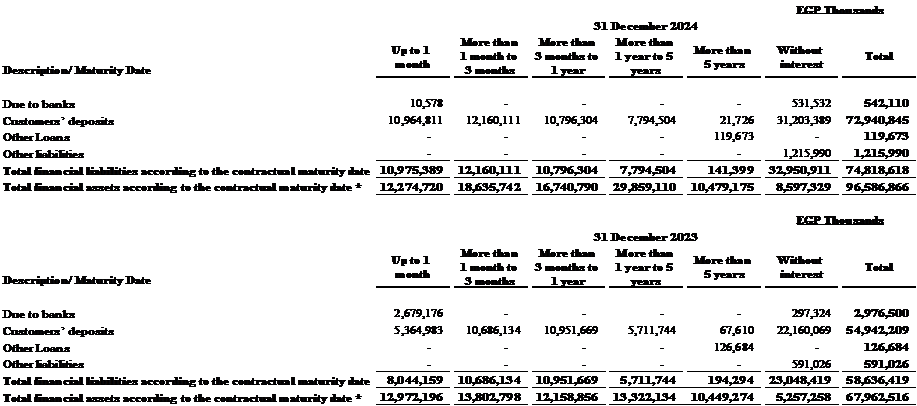
Assets available to satisfy all liabilities and cover loan-associated commitments include cash balances with the Central Bank, Due from banks, treasury bills and other governmental securities, loans and facilities to banks and customers. A percentage of loans to customers that are due to be repaid within a year are extended during the normal activity of Bank NXT in addition to that, there is a mortgage of some debt instruments, treasury bills and other government securities to guarantee obligations and Bank NXT has the ability to satisfy the unexpected net cash flows by selling securities and finding other financing sources.
* Assets shown in the table represent the undiscounted cash flows in accordance with the contractual maturity date.
35 Financial risk management (continued)
35.2 Risk management framework in Bank NXT (continued)
Capital risk
The Bank's objectives on managing capital, which include other elements in addition to the equity shown in the balance sheet, are as follows:
Compliance with the legal requirements of capital in the Arab Republic of Egypt.
Protecting the Bank's ability to continue as a going concern and enabling it to continue generating income for shareholders and other parties dealing with the Bank.
Maintaining a strong capital base that supports the growth of activity.
The capital adequacy and capital uses are daily reviewed according to the requirements of the Central Bank of Egypt by the Bank's management, through forms based on the guidelines of the Basel Committee on Banking Supervision. The required data are submitted and provided to the Central Bank of Egypt on a quarterly basis.
The Central Bank of Egypt requires the Bank to do the following:
- Maintain one billion Egyptian pounds as a minimum for issued and paid-up capital.
- Maintain a ratio equal to or more than 10% between the elements of capital and the elements of assets and contingent liabilities weighted by risk weights.
The numerator of the capital adequacy ratio consists of the following two tiers:
Tier I after disposals includes the following:
Some of the items that will be deducted/ will not be considered and mentioned in the "supervisory instructions on the minimum ratio of capital adequacy", Chapter II on the capital base will be dealt with later as stated in the instructions.
- Continuing core capital after disposals (CET1-Common Equity).
- Additional core capital
There are some items that will be deducted/ not considered and mentioned in the "supervisory instructions on the minimum ratio of capital adequacy", Chapter II on the capital base. These items are deducted from the continuous core capital if the balance is negative, while they are not considered if it is positive.
Tier II after disposals
It includes 45% of the special reserve, loans and subordinated deposits within the limits of the prescribed percentage, as well as the considerable provisions required against the debt instruments, loans, credit facilities and contingent liabilities included in the first stage (Stage 1).
The capital adequacy ratio model includes some important notes and points which are as follows:
1. Reserves: include legal, general, statutory, supportive and capital reserves only.
2. The "general risk reserve" is formed on the beginning date of the application of International Financial Reporting Standard (IFRS 9), in accordance with the supervisory instructions issued to banks on 26 January 2019. It includes the special reserve - credit, the general bank risk reserve - credit and the reserve risk of standard (9), considering that in the subsequent periods of application, the Bank shall abide by what is stated within the instructions on minimum capital adequacy ratio "which is not to consider the bank risk reserve when calculating the ratio."
35 Financial risk management (continued)
35.2 Risk management framework in Bank NXT (continued)
Capital risk (continued)
The numerator of the capital adequacy ratio consists of the following two tiers (continued):
Tier II after disposals (continued)
3. The values of accumulated other comprehensive income items, whether they are positive or negative, are considered.
4. Interim profits/ (losses): It is allowed to record the net interim profits within the capital base after the limited inspection report prepared by the auditor on the Bank's financial statements on a quarterly basis. As for the interim losses, they are presented without any conditions.
5. It does not include the part related to credit, and the explanatory instructions of the rules on the preparation and presentation of the financial statements issued by the Central Bank in April 2009, page 7, item (9) must be perused.
6. It should not exceed 1.25% of total assets and contingent liabilities weighted for credit risk, provided that the required provisions against debt instruments, loans, credit facilities and contingent liabilities included in the Stage 2 and Stage 3 are sufficient to meet the obligations for which the provision is formed.
7. "The value of exceeding the limits set for investments in countries, weighted by risk weights."
8. This value must be included in accordance with Form No. 720 related to investments in countries abroad, taking into account that the value of the capital base listed in the aforementioned statement must be adjusted according to the calculated value.
· The continuing core capital after the regulatory adjustments is Clause 1.1 before excluding contributions to financial companies (shares or investment funds) represented in Clause 1.3.1.1.
· Continuing core capital before regulatory adjustments means paid-up capital, reserves, retained earnings, general risk reserve, and accumulated other comprehensive income items net of goodwill and treasury shares.
· Subordinated loans (deposits): provided that they do not exceed 50% of Tier I after disposals and that 20% of its value is consumed in each of the last five years.
Financial leverage ratio
The Board of Directors of the Central Bank of Egypt, in its session held on 7 July, issued a decision approving the supervisory instructions related to the financial leverage, besides the banks' compliance with the stipulated minimum percentage (3%) on a quarterly basis, as follows:
This is in preparation for the consideration of it within the first pillar of Basel decisions (the minimum capital adequacy ratio) for maintaining the strength and integrity of the banking sector and keeping pace with the best international control practices in this regard.
The financial leverage reflects the relationship between Tier I of capital used in capital adequacy ratio (after disposals) and the Bank's assets (inside and outside the balance sheet) unweighted with risk weights.
36 Fair values and classifications of financial assets and liabilities
Financial instruments measured at fair value
Bank balances
The fair value of one-day variable-rate placements and deposits represent their present value, and the expected fair value of variable-rate deposits is estimated based on the discounted cash flows using the interest rate prevailing in the capital markets for debts that have similar credit risk and maturity date.
Loans and facilities to banks
Loans and facilities to banks represent loans other than bank deposits. The expected fair value of loans and facilities is the discounted value of future cash flows expected to be collected and the cash flows are discounted using the current market interest rate for determining the fair value to determine the fair value to meet all the requirements. This includes replacement of funds on maturity or upon being lent to customers. The Bank is present in global money markets to achieve this objective.
Funded facilities to customers
They are recognized at net value after deduction of provision for impairment loss. The expected fair value for these loans and facilities represents the discounted value of estimated future cash flows expected to be collected. Cash flows are deducted using the current interest rate in the market to specify the fair value.
Investments in securities
Assets through other comprehensive income or profit or loss are carried at fair value. The fair value is determined based on market prices. If such data is not available, fair value is estimated using prices of capital markets for traded securities with similar credit characteristics, dates of maturity and rates.
Due to other banks and customers
The estimated fair value of deposits with undefined maturity date including interest bearing deposits is the amount to be paid upon request. The fair value of fixed interest deposits and non-current other loans are determined in an active market based on discounted cash flows using the interest rate on new debts with similar maturity dates.
Issued debt Instruments
Total fair value is calculated based on prices ruling in the capital markets. For securities with no active markets, discounted cash flow model is used based on the current rate appropriate with the remaining period to date of maturity.
Financial instruments not measured at fair value
Financial investments at amortized cost
They include held-to-maturity financial investments that are listed in the market and are measured at amortized cost in case of bonds, and with respect to investment funds, the evaluation is done at the recoverable amount (fair value).
Management believes that the fair value is not materially different from the carrying amount of these assets.
Due from banks
The fair value of one-day variable-rate placements and deposits represent their present value, and the expected fair value of variable-rate deposits is estimated based on the discounted cash flows using the interest rate prevailing in the capital markets for debts that have similar credit risk and maturity date.
36 Fair values and classifications of financial assets and liabilities (continued)
Loans and facilities to banks
Loans and facilities to banks represent loans other than bank deposits. The expected fair value of loans and facilities is the discounted value of future cash flows expected to be collected and the cash flows are discounted using the current market interest rate for determining the fair value. Loans and facilities are presented net of provision for impairment losses.
Fair value measurement - fair value hierarchy:
The fair values of financial assets and financial liabilities that are traded in active markets are based on quoted market prices or dealer price quotations. For all other financial instruments, the Group determines fair values using other valuation techniques.
For financial instruments that trade infrequently and have little price transparency fair value is less objective, and requires varying degrees of judgment depending on liquidity, concentration, uncertainty of market factors, pricing assumptions another risks affecting the specific instrument.
Fair values of financial instruments
a) Valuation models
The Group measures fair values using the following fair value hierarchy, which reflects the significance of the inputs used in making the measurements. Th Group has an established control framework with respect to the measurement of fair values.
This includes a valuation team that has overall responsibility for overseeing a significant fair value measurements, including level 3 fair values, and report to the management.
The valuation team regularly reviews significant unobservable inputs an valuation adjustments.
If third party information, such as broker quotes or pricing services, is used to measure fair values, then the valuation team assesses the evidence obtained from the third parties to support the conclusion that such valuations meet the requirements of IFRS, including the level in the fair value hierarchy in which such valuations should be classified.
Significant valuation issues are reported to the Group Audit Committee. When measuring the fair value of an asset or liability, the Group uses mark observable data as far as possible. Fair values are categorized into different levels in a fair value hierarchy based on the inputs used in the valuation techniques as follows.
Level 1: inputs that are quoted market prices (unadjusted) in active markets of identical instruments.
Level 2: inputs other than quoted prices included within Level 1 that are observable either directly (i.e. as prices) or indirectly (i.e. derive from prices). This category includes instruments valued using: quoted market prices in active markets for similar instruments; quoted price for identical or similar instruments in markets that are considered less than active; or other valuation techniques in which all significant inputs are directly or indirectly observable from market data.
Level 3: inputs that are unobservable. This category includes all instruments for which the valuation technique includes inputs not based on observable data and the unobservable inputs have a significant effect on the instrument's valuation. This category includes instruments that are valued based on quoted prices for similar instruments for which significant unobservable adjustments or assumptions are required to reflect differences between the instruments.
36 Fair values and classifications of financial assets and liabilities (continued)
Fair values of financial instruments (continued)
b) Financial instruments measured at fair value
The following tables analyses financial instruments measured at fair value at the reporting date, the amounts are based on the values recognized in the statement of financial position:
|
|
Carrying amounts |
Fair value level |
||||||
|
31 December 2024 |
Designated |
Amortized |
Designated |
Total |
Level 1 |
Level 2 |
Level 3 |
Total |
|
Financial assets measured at Fair Value: |
|
|
|
|
|
|
|
|
|
Mutual fund certificates (notes 6 and 9) |
12,031,837 |
- |
301,572 |
12,333,409 |
171,436 |
253,240 |
11,908,733 |
12,333,409 |
|
Equity securities (notes 6 and 9) |
179,333 |
- |
301,995 |
481,328 |
154,670 |
0 |
326,658 |
481,328 |
|
Structured notes (notes 6 and 9) |
7,901,466 |
- |
- |
7,901,466 |
- |
7,901,466 |
- |
7,901,466 |
|
Treasury bills (notes 6 and 9) |
- |
- |
7,566,076 |
7,566,076 |
- |
7,566,076 |
- |
7,566,076 |
|
Debt instruments (notes 6 and 9) |
3,376,038 |
- |
4,204,575 |
7,580,613 |
7,580,613 |
0 |
0 |
7580613 |
|
|
23,488,674 |
0 |
12,374,218 |
35,862,892 |
7,906,719 |
15,720,782 |
12,235,391 |
35,862,892 |
|
Financial assets not measured at fair value: |
|
|
|
- |
- |
- |
- |
|
|
Cash and cash equivalents (note 5) |
- |
51,540,737 |
- |
51,540,737 |
- |
- |
- |
- |
|
Funded facilities to customers (note 8) |
- |
27,835,026 |
- |
27,835,026 |
- |
- |
- |
- |
|
Banking loans and facilities (Bank NXT) (note8.1) |
- |
30,093,577 |
- |
30,093,577 |
- |
- |
- |
- |
|
Accounts receivable (note 7) |
- |
15,773,382 |
- |
15,773,382 |
- |
- |
- |
- |
|
Investments at amortized cost (note 12) |
- |
12,487,545 |
- |
12,487,545 |
- |
- |
- |
- |
|
Other assets (note 16) |
- |
6,583,336 |
- |
6,583,336 |
- |
- |
- |
- |
|
|
- |
144,313,603 |
- |
144,313,603 |
- |
- |
- |
- |
|
Financial liabilities measured at fair value: |
|
|
|
|
|
|
|
|
|
Accounts payable-Customers credit balances at FVTPL (note 19) |
7,901,466 |
- |
- |
7,901,466 |
- |
7,901,466 |
- |
7,901,466 |
|
|
|
|
|
|
|
|
|
|
|
Financial Liabilities not measured at fair value: |
|
|
|
|
|
|
|
|
|
Due to banks and financial institutions |
- |
22,762,916 |
- |
22,762,916 |
- |
- |
- |
- |
|
Customer deposits |
- |
67,208,585 |
- |
67,208,585 |
- |
- |
- |
- |
|
Loans and borrowings |
- |
11,489,567 |
- |
11,489,567 |
- |
- |
- |
- |
|
Creditors and other credit balances |
- |
11,130,638 |
- |
11,130,638 |
- |
- |
- |
- |
|
Account payable-customer credit balances |
- |
20,566,943 |
- |
20,566,943 |
- |
- |
- |
- |
|
Short term bonds |
- |
1,432,665 |
- |
1,432,665 |
- |
- |
- |
- |
|
|
- |
134,591,314 |
- |
134,591,314 |
- |
- |
- |
- |
36 Fair values and classifications of financial assets and liabilities (continued)
Fair values of financial instruments (continued)
b) Financial instruments measured at fair value (continued)
|
|
Carrying amounts |
Fair value level |
||||||
|
31 December 2023 |
Designated |
Amortized |
Designated |
Total |
Level 1 |
Level 2 |
Level 3 |
Total |
|
Financial assets measured at Fair Value: |
|
|
|
|
|
|
|
|
|
Mutual fund certificates (notes 6 and 9) |
7,355,442 |
- |
138,264 |
7,493,706 |
43,528 |
129548 |
7,320,630 |
7,493,706 |
|
Equity securities (notes 6 and 9) |
108,293 |
- |
187,146 |
295,439 |
104,225 |
- |
191,214 |
295,439 |
|
Structured notes (notes 6 and 9) |
680,319 |
- |
- |
680,319 |
- |
680,319 |
- |
680,319 |
|
Treasury bills (notes 6 and 9) |
219,222 |
- |
7,065,958 |
7,285,180 |
- |
7,285,180 |
- |
7,285,180 |
|
Debt instruments (notes 6 and 9) |
832,915 |
- |
4,256,243 |
5,089,158 |
5,089,158 |
- |
- |
5,089,158 |
|
|
9,196,191 |
- |
11,647,611 |
20,843,802 |
5,236,911 |
8,095,047 |
7,511,844 |
20,843,802 |
|
Financial assets not measured at fair value: |
|
|
|
|
|
|
|
|
|
Cash and cash equivalents (note 5) |
- |
32,252,243 |
- |
32,252,243 |
- |
- |
- |
- |
|
Funded facilities to customers (note 8) |
- |
19,117,655 |
- |
19,117,655 |
- |
- |
- |
- |
|
Banking loans and facilities (A) (note 8.1) |
- |
21,104,242 |
- |
21,104,242 |
- |
- |
- |
- |
|
Accounts receivable (note 7) |
- |
6,770,962 |
- |
6,770,962 |
- |
- |
- |
- |
|
Investments at amortized cost (note 12) |
- |
11,233,860 |
- |
11,233,860 |
- |
- |
- |
- |
|
Other assets (note 16) |
- |
5,021,903 |
- |
5021903 |
- |
- |
- |
- |
|
|
- |
95,500,865 |
- |
95,500,865 |
- |
- |
- |
- |
|
Financial liabilities measured at fair value: |
|
|
|
|
|
|
|
|
|
Accounts payable-Customers credit balances at FVTPL (note 19) |
680,319 |
- |
- |
680,319 |
- |
680,319 |
- |
680,319 |
|
|
|
|
|
|
|
|
|
|
|
Financial Liabilities not measured at fair value: |
|
|
|
|
|
|
|
|
|
Due to banks and financial institutions |
- |
14,055,729 |
- |
14,055,729 |
- |
- |
- |
- |
|
Customer deposits |
- |
50,634,207 |
- |
50,634,207 |
- |
- |
- |
- |
|
Loans and borrowings |
- |
8,130,903 |
- |
8,130,903 |
- |
- |
- |
- |
|
Creditors and other credit balances |
- |
6,216,904 |
- |
6,216,904 |
- |
- |
- |
- |
|
Account payable-customer credit balances |
- |
11,319,690 |
- |
11,319,690 |
- |
- |
- |
- |
|
Short term bonds |
- |
749,003 |
- |
749,003 |
- |
- |
- |
- |
|
|
- |
91,106,436 |
- |
91,106,436 |
- |
- |
- |
- |
37 Change in estimate and reclassifications of comparative figures
On 30, September 2023 U Consumer Finance (Previously ValU) (Subsidiary) acquired 94.96% of Paynas BV shares with an acquisition cost amounting to EGP Thousands 397,894.
In 2024 the group has performed the Purchase Price Allocation (PPA) study to determine the fair value of the identifiable asset and liabilities according to the International Financial Reporting Standards.
The Group has reclassified a number of the comparative information to match the current year's presentation.
The table below summarises the restatement and reclassifications of comparative figures:
|
Consolidated statement of financial position |
As of 31 December 2023 as previously stated |
Adjustments
|
Reclassifications |
As of 31 December 2023 |
|
Assets held for sale |
330,652 |
- |
(330,652) |
- |
|
Banking loans and facilities (Bank NXT) |
21,079,316 |
- |
24,926 |
21,104,242 |
|
Goodwill and other intangible assets |
2,315,613 |
3,110 |
- |
2,318,723 |
|
Other assets |
4,716,177 |
- |
305,726 |
5,021,903 |
|
Other liabilities |
6,148,445 |
- |
68,459 |
6,216,904 |
|
Provisions |
1,167,730 |
- |
(68,459) |
1,099,271 |
|
Due to banks and financial institutions |
14,182,413 |
- |
(126,684) |
14,055,729 |
|
Loans and borrowings |
8,004,219 |
- |
126,684 |
8,130,903 |
|
Retained earnings |
8,538,917 |
(4,461) |
- |
8,534,456 |
|
Non - controlling interests |
4,074,904 |
7,571 |
- |
4,082,475 |
|
Consolidated statement of profit or loss |
For the year ended 31 December 2023 as previously stated |
Adjustments |
Reclassifications |
For the year ended 31 December 2023 |
|
Interest expense |
(8,863,833) |
- |
(3,266) |
(8,867,099) |
|
Other revenues |
297,999 |
- |
9,797 |
307,796 |
|
Gains on selling assets held for sale |
9,797 |
- |
(9,797) |
- |
|
General and administrative expenses |
(8,943,885) |
- |
(6,973) |
(8,950,858) |
|
Provisions |
(235,053) |
- |
10,239 |
(224,814) |
|
Depreciation and amortisation |
(476,686) |
(4,698) |
- |
(481,384) |
|
Profit for the year |
2,838,940 |
(4,698) |
- |
2,834,242 |
|
Attributable to: |
|
|
|
|
|
Shareholders of the Holding Company |
2,216,683 |
(4,461) |
- |
2,212,222 |
|
Non-controlling interests |
622,257 |
(237) |
- |
622,020 |
The Group did not present a third statement of financial position as at the beginning of the preceding period as the restatement did not impact the information in the statement of financial position at the beginning of the preceding period.
RNS may use your IP address to confirm compliance with the terms and conditions, to analyse how you engage with the information contained in this communication, and to share such analysis on an anonymised basis with others as part of our commercial services. For further information about how RNS and the London Stock Exchange use the personal data you provide us, please see our Privacy Policy.

Latest directors dealings
- 9 hours ago Tesco
- 9 hours ago Dr. Martens
- 10 hours ago YouGov
- 10 hours ago Vistry Group
- 10 hours ago Cohort