
Annual Financial Report
Summary by AI BETAClose X

BAKER STEEL RESOURCES TRUST LIMITED
(Incorporated in Guernsey with registered number 51576 under the provisions of The Companies (Guernsey) Law, 2008 as amended)
17 April 2026
BAKER STEEL RESOURCES TRUST LIMITED
(the "Company")
LEI: 213800JUXEVF1QLKCC27
Annual Report and Audited Financial Statements
For the year ended 31 December 2025
The Company has today, in accordance with DTR 6.3.5, released its Annual Report and Audited Financial Statements for the year ended 31 December 2025. The Report is available via www.bakersteelcap.com/baker-steel-resources-trust/ and the National Storage Mechanism.
Further details of the Company and its investments are available on the Baker Steel Capital Managers website www.bakersteelcap.com
Enquiries:
Baker Steel Resources Trust Limited +44 20 7389 8237
Francis Johnstone
Trevor Steel
Shore Capital +44 20 7408 4050
Henry Willcocks (Corporate Broking)
Gillian Martin, Daphne Zhang (Corporate)
Adam Gill (Sales)
Aztec Financial Services (Guernsey) Limited
Company Secretary +44 1481 749771
BAKER STEEL RESOURCES TRUST LIMITED
Annual Report and Audited Financial Statements
For the year ended 31 December 2025
|
CONTENTS |
PAGE |
|
|
|
|
Chairman's Statement |
1 |
|
|
|
|
Investment Manager's Report |
3 |
|
|
|
|
Portfolio Statement |
11 |
|
|
|
|
Strategic Report |
13 |
|
|
|
|
Board of Directors |
20 |
|
|
|
|
Directors' Report |
21 |
|
|
|
|
Report of the Audit Committee |
29 |
|
|
|
|
Independent Auditor's Report |
32 |
|
|
|
|
Statement of Financial Position |
38 |
|
|
|
|
Statement of Comprehensive Income |
39 |
|
|
|
|
Statement of Changes in Equity |
41 |
|
|
|
|
Statement of Cash Flows |
42 |
|
|
|
|
Notes to the Financial Statements |
43 |
|
|
|
|
Appendix - Additional Information (Unaudited) |
63 |
|
|
|
|
Management and Administration |
64 |
|
|
|
|
Glossary of Terms |
66 |
Dear Shareholders,
I write to you at a time of seismic shifts in macro-economic trends stemming from energy price spikes since the outbreak of war in the Middle East. In contrast, we can offer a very positive review of your company's performance during 2025 and into early 2026. It reinforces the truism that while major mining companies struggle to avoid being caught up in broader market influences, junior miners and development asset valuations are frequently driven more by news flows on internal project progress and successful access to funding. Additionally, in the current environment, government interest in the critical minerals supply chain can be key.
The year 2025, particularly the second half when the market expectation was for a continuation of a low-interest rate environment, was characterised by rampant precious metal prices and improving performance from a very broad spread of the commodities' universe. This was reflected in gold rising some 65% and silver 148%.
Against the current background of a much more uncertain geopolitical and economic environment, it is reassuring to note that many of the features of your company's strategy and portfolio, which contributed to a very strong performance in 2025 continuing into 2026, should continue to stand it in good stead. A diverse portfolio means that while precious metals have retraced some of their 2025 gains, the healthy exposure to strategic minerals has driven outperformance. In particular, concerns around the need for replenishing Western defence capacity have underpinned the tungsten price (a market dominated by China), and investor interest in Tungsten West (now our largest holding). The previously unloved coal sector has seen better prices and interest as energy importing countries (particularly in Asia) struggle with the oil and gas market fallout of the Middle East war. Similarly, the logistical turmoil in fertiliser constituents resulting from the war is also underpinning the medium-term value of potash assets.
I would like at this point to acknowledge the hard work and industry insights brought to bear by our investment managers in shaping the company's portfolio around strategic commodities with strong demand and price momentum while at the same time starting to harvest investments moving up the development curve and embedding future optionality. Against the backdrop of highly unpredictable macro and sector trends, they are delivering decisively into our strategic goals.
Company Strategy and Performance
It is thus worthwhile restating our strategy which is focussed on offering unique exposure to high alpha opportunities in the mining sector amongst both public and private companies. Our Investment Manager, Baker Steel, is a specialist natural resources asset manager and the experienced team of fund managers running this portfolio benefit from the broader activities, and expert knowledge, in the wider Baker Steel Capital Group.
The Company's NAV rose by a very pleasing 52.8% over the year, from 89.7p to 137.1p. Detailed progress reviews on all the investments are set out in the Investment Manager's Report on pages 3 to 10.
Our strategy has always been to have a globally diverse portfolio of investments. It contains exposure to a number of commodities that have already become the focus of Western governments and industry spending on the energy transition, critical mineral supply chains and defence capabilities, as the bloc attempts to fight back against Chinese dominance of production of the so-called critical minerals. These, such as copper, tin, tungsten, silver and potash, have in the past represented a relatively small percentage of the portfolio with considerable optionality. During 2025, and into the first quarter of 2026, we started to see sharp improvements in the listed share prices of a range of our development projects as funding doors opened and M&A activity picked up. Investments successfully undertaking funding during this period included Tungsten West, Blue Moon Metals, First Tin and Silver X. Your company participated in all of these. The increase interest in these companies has demonstrated the positive effect of optionality to a range of minerals in the right projects.
Consequently, we saw the previously high concentration of our portfolio in our unquoted assets Futura Resources and Cemos Group reduce due to the positive price performance from the remainder of the portfolio. At 31 December 2024, the former represented 64.8% of NAV. At year-end 2025, this shifted to 47.8%. In the 31 March 2026 unaudited NAV statement issued on 8 April 2026, this reduced further to 37.8%. The stand-out performer was Tungsten West, where soaring metal prices and strategic interest enabled that company to raise sufficient funds to target bringing the Hemerdon plant back into production during H2 2026/H1 2027. The share price performance of Tungsten West has continued in the first quarter such that it has become our largest holding at 23%.
The geographic tilt of the portfolio has also shifted, and since year end in particular, our exposure to North America has increased. Blue Moon Metals (into which the Nussir copper project was backed) now has a market cap of C$1 billion. Its recent acquisition of the previously producing Springer tungsten mine in Nevada and the Apex gallium and germanium mine in Utah from diversified miner Teck Resources (which remains an investor) is helping it build a good spread of base and critical minerals.
Company Strategy and Performance (continued)
Equally positive during 2025 was the progress on our two largest unquoted holdings. After a very challenging low-price environment during its mine ramp up phase, Australian coal business Futura Resources undertook a successful refinancing of its debt profile raising US$90 million through a 5-year bond, which has put its balance sheet on a much stronger footing.
In the final quarter of 2025, Moroccan cement business Cemos completed the construction of its compact calcination unit which will enable it to produce its own clinker for its first cement plant in Morocco rather than having to buy clinker at a high price from its local competitors. This should significantly enhance the operating margins with the resulting follow through to enhanced cashflow generation. Additionally, its valuation multiple should move closer to those enjoyed by local integrated producers.
Share Price Performance and Discount Management
During 2025, the BSRT share price rose by 36.0%, vs 56.7% for the MSCI World Metals and Mining Index with a further 52.9% increase by the end of March 2026. The NAV rose by 52.8% in 2025 and a further 26.9% by the end of March 2026.
I would like to assure our shareholders that we are keenly focussed on strategies and actions which we believe should contribute to the share price reflecting the underlying value of our assets more accurately, notwithstanding the illiquid nature of a number of our larger investments. We aim to provide the best NAV growth possible, and share those returns with our investors.
As a start, we were pleased to commence a share buyback programme in the first quarter of 2026. These buybacks were accretive, and along with strong NAV growth, we saw the discount to NAV narrow materially to a 3-year low of around 21.2% towards the end of February 2026. However, the market turbulence and derisking/dislocation of markets caused by the current situation in the Middle East have seen this widen again to 31.9% at the end of March 2026. We believe that in more normal markets, a combination of good asset performance together with an active share buyback policy should continue to drive NAV growth, improve levels of liquidity in the shares, and hopefully tighten the discount.
Capital Allocation Policy
Following previous consultation with a broad swathe of our shareholders, the outcome was that they have differing expectations of the form in which they would like the returns from the portfolio to be delivered (influenced, of course, by where the discount to NAV sits at any point in time). These ranged from investors who want to see a healthy level of reinvestment in high alpha opportunities continuing; those who look for dividends over the medium term; and those who prefer share buybacks or tender offers. Accordingly, we have adopted a revised capital allocation policy including a blend of features, as follows:
· A target of a 5% return of capital each year, delivered through:
Ø a 3% annual dividend (payable semi-annually), based on NAV and expected to become progressive in due course once royalty income streams from relevant assets commence; and
Ø the balance allocated to share buybacks or dividends.
· A commitment that, in the event of significant realisations from asset sales and where the Company's shares have been trading at a discount to NAV in excess of 25% the Company will, where appropriate seek to apply at least 50% of the profits from such realisation proceeds to a return of capital, intended to be by way of tender offer, subject to a sufficient level of cash for this purpose, or otherwise applied towards enhanced share buybacks or dividends.
The above commitments are subject to the full discretion of the Board taking into account circumstances at the relevant time including but not limited to: i) the level of discount at which the Company's shares have been trading; ii) the overall liquidity of the Company's portfolio (acknowledging that the Company may have a large proportion of its investments invested in private assets); and iii) factors such as requirements of the Company's current portfolio investments for potential further funding.
Outlook
Even the most astute forecasters are being tested in the current environment where economic trends are opaque, markets are volatile, and war is severely disrupting trade flows. It is difficult to know how long these conditions will continue, and what their lasting effects on global growth and equity markets could be. Sustained hostilities risk not only higher energy prices but also potentially the timely supply of fuels like diesel used widely in mining operations. Despite this uncertain macro background, I am encouraged to report that your company's portfolio is now more diversified by product and geography than it has been for a number of years as well as being well exposed to strategic minerals which are in high demand.
Investment decisions made some years back are starting to bear fruit. We thus feel the time is right to announce a revised capital allocation policy to reward our broad spread of shareholders, whose support and feedback over recent years has been invaluable. As chairman, I hope to continue to engage with as many of you as possible going forward.
Fiona Perrott-Humphrey
Chairman
16 April 2026
Financial Performance
Highlights - NAV Performance
· 1 Year +52.8%
· 3 Years +66.4%
· 5 Years +43.6%
The audited Net Asset Value per Ordinary Share ("NAV") as at 31 December 2025 was 137.1 pence, an increase of 52.8% in the year compared with the increase in the MSCI World Metals and Mining Index of 56.7% in Sterling terms.
For the purpose of calculating the NAV per share, unquoted investments were carried at fair value as at 31 December 2025 as determined by the Directors as advised by the Investment Manager and quoted investments were carried at their quoted prices as at that date.
Net assets comprised the following:
|
|
31 December 2025 |
|
31 December 2024 |
||
|
|
£m |
% of NAV |
|
£m |
% of NAV |
|
Unquoted Investments |
87.0 |
59.6 |
|
82.2 |
86.1 |
|
Quoted Investments |
54.4 |
37.3 |
|
13.0 |
13.6 |
|
Cash and other net assets |
4.6 |
3.1 |
|
0.3 |
0.3 |
|
|
146.0 |
100.0 |
|
95.5 |
100.0 |
Investment Update
|
|
31 December 2025 |
|
31 December 2024 |
||
|
Largest 10 Holdings - 31 December 2025 |
£m |
% of NAV |
|
£m |
% of NAV |
|
Futura Resources Ltd |
36.4 |
24.9 |
|
31.9 |
33.4 |
|
CEMOS Group Plc |
33.5 |
22.9 |
|
30.0 |
31.4 |
|
Bilboes Gold Royalty |
15.7 |
10.8 |
|
8.4 |
8.8 |
|
Blue Moon Metals Inc* |
13.6 |
9.3 |
|
6.9 |
7.2 |
|
Tungsten West Plc |
12.5 |
8.6 |
|
3.2 |
3.3 |
|
Silver X Mining Corporation |
11.4 |
7.8 |
|
2.1 |
2.3 |
|
Metals Exploration Plc |
6.8 |
4.7 |
|
3.3 |
3.5 |
|
First Tin PLC |
5.1 |
3.5 |
|
2.6 |
2.8 |
|
Caledonia Mining Corporation Plc |
4.6 |
3.2 |
|
3.2 |
3.4 |
|
Kanga Investments Ltd |
1.0 |
0.7 |
|
1.4 |
1.6 |
|
|
140.6 |
96.4 |
|
93.0 |
97.7 |
|
Other Investments |
0.8 |
0.5 |
|
2.2 |
2.0 |
|
Cash and other net assets |
4.6 |
3.1 |
|
0.3 |
0.3 |
|
|
146.0 |
100.0 |
|
95.5 |
100.0 |
*During 2025 Blue Moon Metals Inc completed the acquisition of Nussir ASA
Review
At the year end, the Company was fully invested, holding 15 investments of which the top 10 holdings comprised 96.4% of the portfolio by value. In terms of commodity, the portfolio has indirect exposure to cement, coking coal, copper, gold, iron, lead, potash, silver, tin, tungsten, vanadium, and zinc. Its projects were located in Australia, Canada, Germany, Indonesia, Madagascar, Morocco, Norway, Nicaragua, Peru, the Philippines, Republic of the Congo, the UK, the USA and Zimbabwe.
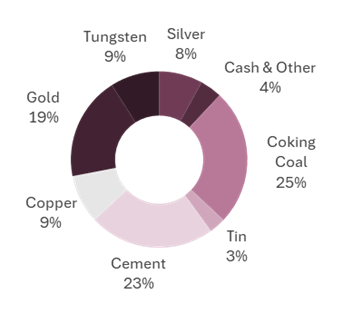
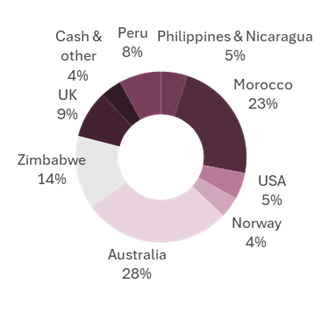
During the second half of 2025, the signs of recovery of investor interest for development stage projects seen in the first six months of the year accelerated with investors prepared to make equity funds available for good quality development and advanced exploration projects held by junior mining companies. The ongoing interest from western governments in securing future supply chains of critical minerals also contributed to improving sentiment and saw a number of partnerships between private equity players and sovereign wealth funds targeting investments in the metals and mining space.
The MSCI World Metals and Mining Index composed of large and mid-cap companies rose 56.7% in Sterling terms in response to stronger commodity prices. The Company's NAV rose 52.8% during the period.
Precious metals were some of the best performing commodities during 2025 with gold rising 64.6% and silver 148.0%. Base metals prices were also strong, with copper up 43.9%, tin up 40.9%, and tungsten up 193.0%. Steel-making mineral prices were volatile with metallurgical coal decreasing by 5.6% at mid-year but recovering to be up 11.9% over the year. Iron ore prices behaved in a similar way, falling mid-year but finishing up 4.8% by 31 December 2025 (all percentages measured in US dollar terms).
The continuing focus on future security of supply of critical minerals (referred to above) has seen key players in commodity markets like the US, China and India focus on calibrating the direction of their future trade flows, both inward and outward bound. Geopolitical tensions will undoubtedly continue to engender high levels of uncertainty around international trade flows, global growth forecasts, currency trends and inflationary pressures. It was therefore pleasing to see that two of our projects: the Nussir Copper Project in Norway (owned by Blue Moon) and Tungsten West's Hemerdon Project in Devon, UK were selected as two of the 13 EU Strategic Projects located outside the EU. Likewise, both Tungsten West and First Tin received expressions of interest for development loans from the EXIM Bank of the USA.
The Company's NAV rose 52.8% in Sterling terms during 2025 with key contributors being the 454% and 206% increases in the listed share price of Silver X and Tungsten West Plc respectively; the revaluation of the Bilboes Royalty and the sale of PAL following the disposal of its Prognoz silver royalty as described below.
The Company's main investments at the year-end are:
Futura Resources Ltd ("Futura")
Futura owns the Wilton and Fairhill steel making coal projects in the Bowen Basin in Queensland, Australia which hold Measured and Indicated resources of 1,281 million tonnes of coal.
Investment: 11,309,005 ordinary shares (25.3%) valued at £12.8 million
1.5% Gross Revenue Royalty valued at £18.8 million
A$4.9 million convertible loan valued at £2.5 million
200,000 Options expiring 22/04/2026 valued at £0.03 million
700,000 Options expiring 29/11/2027 valued at £0.15 million
Bridging loans totalling £2.2 million
Total Value: £36.4 million (31 December 2024 - £31.9 million). The overall value of the investment increased following the start of mining at Fairhill and the refinancing of debt in December 2025. Our additional investments through bridging loans during 2025 were repaid in January 2026.
Futura commenced mining coal from its second project the Fairhill mine in April 2025 adding to its Wilton mine which had commenced in February 2024, immediately to the South of Fairhill.
During the majority of 2025 the metallurgical coal market remained subdued due primarily to on-going economic weakness in China which is the world's largest steel producer. Metallurgical coal prices declined during the first half of 2025 to lows of around US$170/tonne, but started to recover in the second half of the year with the recovery continuing into 2026 to around US$230/tonne at the end of March 2026, a little above the long-term consensus prices of around US$220 per tonne.
The low prices in 2025 put increasing strain on the whole metallurgical coal industry. Futura came under particular pressure during its ramp up stage while it still needed to fund the completion of certain infrastructure capex. The Company supported Futura with three separate bridging loans during the year whilst it looked to refinance its development debt so that it no longer had to make debt repayments during the ramp up phase. At the end of 2025 Futura successfully raised US$90 million through a "Nordic Bond" allowing it to retire its existing debt including the bridging loans and deferring principal repayments to 30 months after the issue date. In addition, the proceeds of the bond issue will be more than sufficient to fund the remaining infrastructure capital required to bring both of Futura's mines into full production.
The Run of Mine ("ROM") production from Fairhill and Wilton combined is planned to be ramped up to a rate of 145,000 tonnes per month or an annualised production rate of around 1.75Mtpa during 2026. In the challenging coal market environment in 2025, mining had been focused on Fairhill due to its premium coal quality which commands higher prices than Wilton coal. In the light of the recovery in the coal price from its 2025 lows, mining at Wilton is planned to restart mid 2026. ROM production is expected to build up further to 4Mtpa by 2030 based on the current mine plan. Saleable product coal in CY 2026 is budgeted at around one million tonnes, increasing further to 1.9Mtpa by 2030. The recent war in the Middle East has not only increased the price but also impacted the availability of diesel in Australia in particular. Although Futura has to date been able to source the diesel it needs, should the situation continue for a prolonged period, this could affect the production rate from Futura's mines and in particular the timing of the restart of Wilton.
CEMOS Group Plc (''CEMOS'')
CEMOS is a private cement producer with production operations at Tarfaya in Morocco.
Investment: 50,129,247 ordinary shares (30.4%) valued at £33.5 million
Value at 31 December 2024: £30.0 million - increased due to completion of the construction of the first compact calcination unit.
The cement market in CEMOS's southern area of Morocco was stable in 2025, with sales for the year totalling 200,000 tonnes, approximately 4% lower than the 209,000 tonnes achieved in 2024. The unaudited EBITDA for the year is estimated at around €9 million, the same as the year before.
CEMOS Group Plc (continued)
During October 2025, Cemos produced its first clinker from its new Compact Calcination Unit at the Tarfaya cement plant site in Morocco. This will in future produce clinker and supplementary cementitious materials, the principal raw materials in cement production representing approximately 70% of cost of the cement. It will not only provide security of supply of clinker but should materially reduce costs as well as providing the potential to lower the carbon footprint associated with cement production through the use of natural supplementary cementitious materials such as pozzolan. The benefit of the Compact Calcination Unit has started to be realised during the first few months of 2026.
During 2024, CEMOS identified a site and commenced the permitting process for its second grinding plant acquired in 2022, essentially identical to the existing plant at Tarfaya. CEMOS has started construction of this second plant which is expected to be completed by the end of 2026 and will allow it to double its production rate from 2027 onwards.
Major Moroccan Government and foreign investment and development initiatives (including but not limited to the football World Cup in 2030) are expected to provide a boost to the Moroccan cement market over the coming years. Cemos expects increased profitability in 2026 following the commencement of production from the clinker plant and thereafter once the second grinding line is installed. It continues to evaluate a listing of the local company on the Casablanca Stock Exchange potentially in 2027/2028.
Bilboes Gold Royalty
The Company holds a 1% Net Smelter Royalty ("NSR") over future production from the Bilboes' gold project in Zimbabwe owned by Caledonia Mining Corporation Plc ("Caledonia"), see below
Investment: 1% NSR valued at £15.7 million
December 2024 valuation: £8.4 million. Valuation increased due to higher gold price and commitment for development.
In November 2025, Caledonia released the results of its Feasibility Study for the Bilboes Gold Project. The mine will be based on Proven and Probable Reserves of 1.75 million ounces of gold at a grade of 2.26 g/t with the construction of a 240,000 tonne per month plant utilising BIOX® technology for processing. The mine has been designed to produce 1.5 million ounces of gold over a 12-year period. The feasibility study confirmed that a single-phase development of the project would provide the best economic return, having considered alternative development options, including multi-phase development and changes to certain other aspects of the project. At a gold price of US$3,648 per ounce used in the feasibility study, the economic model calculated a Net Present Value ("NPV") with an 8% discount rate of US$1,234 million and an Internal Rate of Return ("IRR") of 50.4%.
Caledonia has announced its decision to proceed with the project, which is expected to be funded by a combination of non-recourse senior debt, internal equity and flexible instruments (including royalties, streaming arrangements and mezzanine funding). Caledonia expect that the mine will commence production in the second half of 2028 with the first full year of production being 197,000 ounces of gold in 2029.
At the current gold prices of in excess of US$4,000 per ounce, the Company should receive over US$5 million per annum after withholding tax from its 1% Net Smelter Royalty on the Bilboes mine.
Blue Moon Metals Inc ("Blue Moon")
Blue Moon, listed on the TSX-V and Nasdaq exchanges owns the Nussir copper mine in Norway, the Blue Moon coper/zinc mine in USA, the Springer tungsten mine in USA, and the Apex germanium/gallium mine in USA.
Investment: 5,789,555 ordinary shares (7.2%) valued at £13.6 million (2,786,444 shares subject to phased lock-up to be released in March 2026 and September 2026 - held at a discount.)
At 31 December 2024 the Company held Nussir ASA valued at £6.86 million which were exchanged for Blue Moon Shares in February 2025 and £0.36 million in Blue Moon shares (total £7.2 million).
Following its acquisition of Nussir from the Company and others at the end of February 2025, Blue Moon has moved forward rapidly on all three of its projects and acquired two further advanced projects.
Blue Moon Metals Inc ("Blue Moon") (continued)
At Nussir, in March 2025 Blue Moon completed the acquisition of a local company which held the majority of the required infrastructure for the project to be built including a port area with associated ship loading equipment and infrastructure.
The Nussir Mine is expected to produce around 20,000 tonnes of copper equivalent per annum for an initial mine life of 12 years albeit the deposit remains open to the west and at depth, providing significant upside potential for future resource growth and mine life extension. The first blast for the mine portal took place in June 2025 and the decline shaft is due to reach the orebody around the middle of 2026. Blue Moon is currently finalising an updated feasibility which is expected to be published in the second quarter 2026.
In March 2025, Blue Moon announced the results of a Preliminary Economic Assessment ("PEA") of its volcanogenic massive sulphide deposit, located in Mariposa County California. This envisaged a mine producing an average of 7.2 million lbs copper, 62.3 million lbs zinc, 22,566 ounces of gold and 681,764 ounces of silver per annum in concentrate. Based on an initial capital cost of US$144.5 million, the base case economic model estimates a post-tax NPV (8%) of US$244 million and an IRR of 38%. During October 2025, Blue Moon commenced the construction of the exploration decline at the Blue Moon Mine. The decline will provide underground access for infill and exploration drilling, geotechnical and metallurgical test work, and studies of underground mining conditions. The initial 2,500 feet of the exploration decline is expected to be completed in Q2-2026. Exploration drilling activities will commence from underground concurrently with the advance of the decline, enabling the company to accelerate the collection of geological, geotechnical and metallurgical data in parallel with ongoing development.
In February 2026 Blue Moon completed the acquisition of the Springer tungsten mine, situated in Pershing County, Nevada which is 400 miles by road from the Blue Moon mine and the primary Union Pacific rail spur is 7 miles away from the mill and the site was historically served by a railway siding that could potentially be reinstated. The mill at Springer which has a 1,200 tonnes per day capacity historically processed tungsten and has an Ammonium Paratungstate ("APT") circuit including autoclave and related reagent systems. Apart from the potential to process the existing tungsten resources at Springer, the plant can readily be modified to produce concentrates from critical metals from alternate sources including the Blue Moon mine. Blue Moon intends to develop a hub and spoke business model by acquiring and developing smaller, high grade underground critical metals mines in the western United States ("US") and processing the mineralised material at the Springer Mine.
In March 2026, Blue Moon acquired the previously producing Apex germanium/gallium mine in southern Utah from Teck Resources. As a result, Teck became an 8% shareholder of Blue Moon and agreed the offtake of zinc concentrates produced from the Blue Moon mine for Teck's Trail smelter in British Columbia. Together with Springer the acquisition of Apex uniquely positions Blue Moon as a potential key supplier of US demand for three of the most critical minerals on the US list - tungsten, germanium and gallium.
Tungsten West Plc (''Tungsten West'')
Tungsten West owns the Hemerdon Tungsten Mine in Devon, United Kingdom and is quoted on the AIM market of the London Stock Exchange.
Investment: 107,858,711 ordinary shares (8.5%) valued at £12.4 million
1,657,195 second options valued at £0.1 million
1,657,195 third options valued at £0.0 million
Total £12.5 million (31 December 2024 - £3.2 million). The share price increased following the release of a revised feasibility study and increased tungsten price. The convertible Loan plus accrued interest was converted into equity on 31 December 2025.
In August 2025, Tungsten West announced the results of its updated feasibility study for the restart of mining operations at the Hemerdon Mine prepared by independent technical consultants AMC Consultants (UK) Ltd. The feasibility study sets out a base case with a 11-year life of mine, 4 years of subsequent stockpile reclaim and an additional 12 years of on-going premium aggregate sales. There also exists the potential to extend the operational life of mine, potentially to over 40 years.
Tungsten West Plc (''Tungsten West'') (continued)
The total financing requirement for restarting mining operations at Hemerdon is estimated at US$93 million, benefitting from approximately US$300 million of previously invested capital, including significant open pit pre-stripping. Using a tungsten price of US$400 per Metric Tonne Unit (MTU) (65% ammonium paratungstate or APT), the economics model estimates an NPV (7.5%) of US$190 million with an IRR of 29.3% and an average cashflow over the first 11 years of production of US$31.5 million. In February 2025 China, which accounts for some 80% of the global supply of tungsten, announced restrictions to the export of 5 critical minerals including tungsten. This development has fed through to prices with the price of APT having risen to over US$1,600 per MTU at 31 March 2026. At recent tungsten prices, Tungsten West estimate the project would make an EBITDA of US$294 million per annum once the mine is in full production.
The Hemerdon Mine is fully permitted and once in production would supply approximately 20% of global supply of primary tungsten from outside of China. In February 2026 Tungsten West raised £44.4 million equity and in April 2026 announced it was well advanced with the final stage of due diligence on the remaining project debt package of up to US$85.0 million, including a US$25.0 million first tranche funding tailored to the project schedule. First phase production is targeted for the third quarter 2026 and with the commissioning of the new build crushing, screening and ore sorting facilities in Q1 2027.
Silver X Mining Corporation ("Silver X")
Silver X is a TSX-V listed company whose Recuperada silver/lead/zinc project in Peru comprises 11,261 Ha of mining concessions centred around a 600 tonne per day processing plant.
Investment: 19,502,695 ordinary shares (7.8%) valued at £11.4 million
December 2024 valuation: £2.1 million. The share price increased 454% following higher silver price and release of positive PEA.
During 2025, Silver X produced 812,386 silver equivalent ounces (AgEq oz) from its Nuevo Recuperada silver/lead/zinc mine in Peru.
In August 2025 Silver X released the results of a PEA under Canadian National Instrument 43-101 Standards which would include the construction of a new plant to process the ore from the current mining area, Tangana, and the expansion of the existing plant to process ore from the new Plata area. The PEA outlined a project processing 3,000 tonnes of ore per day producing an average of 5.6 million silver equivalent ounces per annum over a 14 year period. Initial capital costs are estimated at US$81.8 million with an All-In-Sustaining Cost ("AISC") of US$15.8/oz AgEq. The economic model generated a post-tax NPV10% of US$303 million at a silver price of US$33.2 per ounce. In the first quarter of 2026 the Company invested C$9 million as part of a C$69 million debenture raising, largely funded through the sale of a portion of its Silver X equity, in line with its general strategy of targeting convertibles in preference to pure exposure to equity.
Metals Exploration plc ("Metals Ex")
Metals Ex is an AIM listed company which owns the Runruno gold mine in the Philippines.
Investment: 44,810,000 ordinary shares (1.5%) valued at £6.8 million
December 2024 valuation: £3.3 million. The valuation has increased despite the Company's sale of 17.6 million shares, with the share price increasing 184% during the year following the acquisition of Condor Gold plc and the stronger gold price.
During 2025, Metals Ex produced annual gold sales of 66,082 ounces at an AISC of US$1,368 per ounce from its Runruno gold mine in the Philippines generating record annual pre-tax cash flow of US$115.3 million.
In January 2025, Metals Ex completed the acquisition of Condor Gold plc, whose main project is the La India gold project in Nicaragua. Metals Ex's internal studies have suggested that La India could produce an average of 145,000 ounces of gold per annum from open pit and underground over a 12.4 year period. Initial capex of US$122 million has been covered by cashflow from Runruno.
Metals Exploration plc ("Metals Ex") (continued)
The development of La India remains on track for first production at the end of 2026 with development 33% complete at 28 January 2026. Metals Ex acquired a fit for purpose second hand gold ore processing and concentrating plant (including crushers, conveyors, grinding ball mill, gravity circuit, elution, smelting equipment and laboratory) the capacity of which has since been upgraded from 1.4 Mtpa to 1.8 Mtpa.
First Tin PLC ("First Tin")
First Tin is a company listed on the London Stock Exchange which owns the Taronga tin project in Australia and the Tellerhäuser and Gottesburg tin projects in Germany.
Investment: 53,770,871 ordinary shares (9.9%) valued at £5.1 million
December 2024 valuation: £2.6 million. The share price increased 68% following the increased price of tin.
On 2 May 2024, First Tin PLC announced the results of the Definitive Feasibility Study ("DFS") for its 100% owned Taronga open pit tin project located in New South Wales, Australia. The DFS outlines an open pit mine mining 5 million tonnes of ore per annum followed by a crushing and a gravity processing facility. This was forecast to produce an average of 3,600 tonnes of tin per annum at an All-In-Sustaining cost of US$15,843 per tonne of tin sold. Pre-production capex was estimated at US$116 million with the economic model based on US$30,000 per tonne of tin (price at 31 March 2026 cUS$46,000 per tonne) showing a pre-tax NPV8% of US$ 160 million and an IRR of 34%.
A drilling programme undertaken in 2025 totalled 7,459 metres across 97 reverse circulation (RC) drillholes was designed to convert Inferred resources to Measured and Indicated status as well as test several interpreted zones of mineralisation near the proposed pits. Assay results confirm the extension of mineralisation to the northeast and southwest, indicating the potential for wider, deeper pits, which would extend the mine life and improve project economics. Results from the infill drilling have been positive and should allow conversion of Inferred Resources to Indicated category when a revised resource is estimated in the first half of 2026.
First Tin's current focus is on finalisation of the Environmental Impact Statement ("EIS"), which is the next major milestone for the development. Considerable progress has been made with various specialist studies now completed. The proposed site for the mine camp and upgrades to the access road will now form part of the EIS and developmental approval. During the four-week public consultation period, only 4 objections were received. As fewer than 50 objections were lodged, the project will now proceed through the standard departmental approval process rather than referral to the Independent Planning Commission, thereby significantly reducing the likely permitting timeframes and cost to the Company.
Caledonia Mining Corporation Plc ("Caledonia")
Caledonia is a NYSE, AIM and Victoria Falls Exchange listed gold producer whose primary assets are the producing Blanket Mine and the Bilboes gold project (outlined above) both in Zimbabwe.
Investment: 236,000 ordinary shares (1.2%) valued at £4.6 million
December 2024 valuation: £3.2 million. The holding increased in value notwithstanding the Company's sale of 189,000 shares, with the share price increasing 180% during the period due to the increased gold price and a strong operating performance.
Caledonia reported annual gold production at its Blanket gold mine in Zimbabwe of 76,213 oz in 2025, in line with increased guidance. Production guidance for 2026 is similar to 2025 at 72,000 to 76,500 ounces with all-in sustaining cost ("AISC") expected to be in the range of $2,100/oz to $2,300/oz.
The higher gold price in the year resulted in operating profit for the full year of US$137.1 million (2024 US$77.0 million).
Caledonia currently pays a dividend of US$0.14 per quarter. It is expected that at least this level of dividend will continue until the Bilboes project can be brought into production (see above).
Kanga Investments Ltd ("Kanga")
Kanga is a private company which holds the Kanga potash project, in the Republic of the Congo.
Investment: 56,042 ordinary shares (7.8%) valued at £1.0 million
2,177 Kanga Potash ordinary shares valued at £0.04 million
December 2024 valuation: £1.4 million. The valuation decreased due to further funding rounds required while a sale is negotiated.
Kanga completed a positive Feasibility Study in 2020 on its Kanga Potash project in the Republic of the Congo for a mine producing 600,000 tonnes per annum of Muriate of Potash ("MOP"). The DFS economic model gave a NPV at a 10% discount rate of US$511 million with an IRR of 22% based on an MOP price of US$282 per tonne compared to the current price of almost US$400 per tonne. Negotiations are ongoing for the sale of the project although are likely to remain protracted with parties looking to drill additional wells prior to concluding a transaction. Following the year end the Company committed to subscribe for new shares in Kanga Potash as part of a US$1.6 million rights issue to provide working capital for Kanga whilst sale negotiations are progressed.
Outlook
Equity markets have re-opened for companies with attractive development projects. We are seeing an increasing number of interesting new investment opportunities. Given the buoyancy of precious metals this includes a number of pre-IPO precious metal development companies, some offering attractive entry valuations relative to their listed counterparts. In our view a window for IPOs in the precious metals sector will likely remain open through at least 2026, given that we anticipate continued supportive gold and silver pricing. We believe therefore that there is merit in allocating some limited investment capital to a select few of these opportunities, on the basis that they have the potential to generate significant returns upon successful listings. As such, in the first quarter of 2026 the Company has made its new investments in Chancery Royalty and MacKay Gold & Silver which are both expected to list during 2026.
Baker Steel Capital Managers LLP
Investment Manager
16 April 2026
|
Shares |
Investments |
Fair value |
% of Net |
|
/Warrants/ |
|
£ equivalent |
Assets |
|
Nominal |
|
|
|
|
|
Listed equity shares |
|
|
|
|
|
|
|
|
|
Australian Dollars |
|
|
|
4,091,910 |
Akora Resources Limited |
168,298 |
0.12 |
|
|
Australian Dollars Total |
168,298 |
0.12 |
|
|
|
|
|
|
|
Canadian Dollars |
|
|
|
19,502,695 |
Silver X Mining Corporation |
11,396,322 |
7.81 |
|
6,519,395 |
Azarga Metals Corp |
317,465 |
0.22 |
|
5,789,555 |
Blue Moon Metals Inc. |
13,640,583 |
9.35 |
|
|
Canadian Dollars Total |
25,354,370 |
17.38 |
|
|
|
|
|
|
|
Great Britain Pounds |
|
|
|
53,770,871 |
First Tin Plc |
5,108,233 |
3.50 |
|
44,810,000 |
Metals Exploration plc |
6,788,715 |
4.65 |
|
107,858,711 |
Tungsten West Plc |
12,349,822 |
8.46 |
|
|
Great Britain Pounds Total |
24,246,770 |
16.61 |
|
|
|
|
|
|
|
United States Dollars |
|
|
|
236,000 |
Caledonia Mining Corp Plc |
4,584,657 |
3.14 |
|
|
United States Dollars Total |
4,584,657 |
3.14 |
|
|
|
|
|
|
|
|
|
|
|
|
Total investment in listed equity shares |
54,354,095 |
37.25 |
|
|
|
|
|
|
|
Debt instruments |
|
|
|
|
|
|
|
|
|
Australian Dollars |
|
|
|
94 |
Futura Resources Limited Convertible Loan |
2,458,405 |
1.68 |
|
|
Futura Bridging Loan Note 1 |
797,618 |
0.55 |
|
|
Australian Dollars Total |
3,256,023 |
2.23 |
|
|
|
|
|
|
|
United States Dollars |
|
|
|
|
Futura Bridging Loan Note 2 |
811,725 |
0.56 |
|
|
Futura Bridging Loan Note 3 |
557,400 |
0.35 |
|
|
United States Dollars Total |
1,369,125 |
0.91 |
|
|
|
|
|
|
|
|
|
|
|
|
Total investments in debt instruments |
4,625,148 |
3.14 |
|
Shares |
Investments |
Fair value |
% of Net |
|
/Warrants/ |
|
£ equivalent |
Assets |
|
Nominal |
|
|
|
|
|
Unlisted equity shares, warrants and royalties |
|
|
|
|
|
|
|
|
|
Australian Dollars |
|
|
|
10,100,000 |
Futura Gross Revenue Royalty |
18,825,383 |
12.90 |
|
11,309,005 |
Futura Resources Limited |
12,777,144 |
8.76 |
|
200,000 |
Futura Resources Option 22/04/2026 |
34,301 |
0.02 |
|
700,000 |
Futura Resources Option 29/11/2027 |
154,394 |
0.11 |
|
|
Australian Dollars Total |
31,791,222 |
21.79 |
|
|
|
|
|
|
|
Canadian Dollars |
|
|
|
20,578,027 |
PRISM Diversified Limited |
111,340 |
0.08 |
|
40,000 |
PRISM Diversified Limited - Royalty |
21,642 |
0.01 |
|
324,000 |
Unkur Contingent Interest |
43,826 |
0.03 |
|
|
Canadian Dollars Total |
176,808 |
0.12 |
|
|
|
|
|
|
|
Great Britain Pounds |
|
|
|
50,129,247 |
CEMOS Group Plc |
33,486,337 |
22.95 |
|
1,657,195 |
Tungsten West Plc Second Option Share Warrants 18/10/2026 |
130,587 |
0.09 |
|
1,657,195 |
Tungsten West Plc Third Option Share Warrants 18/10/2026 |
- |
- |
|
|
Great Britain Pounds Total |
33,616,924 |
23.04 |
|
|
|
|
|
|
|
|
|
|
|
|
United States Dollars |
|
|
|
100 |
Bilboes Holdings (Private) Limited - Royalty |
15,747,115 |
10.79 |
|
56,042 |
Kanga Investments Limited |
1,023,387 |
0.70 |
|
2,177 |
Kanga Potash |
35,617 |
0.02 |
|
500 |
Polar Acquisition Limited |
371 |
0.00 |
|
|
United States Dollars Total |
16,806,490 |
11.51 |
|
|
|
|
|
|
|
|
|
|
|
|
Total unlisted equity shares, warrants and royalties |
82,391,444 |
56.46 |
|
|
|
|
|
|
|
Financial assets held at fair value through profit or loss |
141,370,687 |
96.85 |
|
|
|
|
|
|
|
Other assets & liabilities |
4,537,809 |
3.15 |
|
|
|
|
|
|
|
Total equity |
145,908,496 |
100.00 |
|
|
|
|
|
Company Structure
The Company is a registered closed-ended investment scheme pursuant to the Protection of Investors (Bailiwick of Guernsey) Law, 2020 ("POI Law") and the Registered Collective Investment Scheme Rules and Guidance, 2021 issued by the Guernsey Financial Services Commission ("GFSC"). The Company is not authorised or regulated as a collective investment scheme by the Financial Conduct Authority. The Company is subject to the Listing Rules and the Disclosure Guidance and Transparency Rules of the UK Listing Authority.
The Articles of the Company contain provisions as to the life of the Company. At the Annual General Meeting ("AGM") falling in 2018 and at each third AGM convened by the Board thereafter, the Board has and will propose a special resolution to discontinue (the Company) which if passed will require the Directors, within 6 months of the passing of the special resolution, to submit proposals to shareholders that will provide shareholders with an opportunity to realise the value of their Ordinary Shares. At the AGM held in 2024, the vote to discontinue the Company was not passed and therefore a vote with regard to continuation will not be proposed by the Board until the AGM in 2027, which is three years after the last vote as is required by the Company's Articles.
Company Purpose and Values
The purpose of the Company is to carry out business as an investment company and to provide returns to shareholders through achieving its investment objective as described on page 14.
The values of the Company are discussed and agreed upon by the Board. The Board seeks to run the Company with a culture of openness, high integrity and accountability. It aims to demonstrate these values through its behaviour both within itself and its dealings with its stakeholders. It seeks to act in the spirit of mutual respect, trust and fairness. The Board is robust in its challenge of the Investment Manager and other service providers but tries always to be constructive and collegiate. The Board expects its members to exhibit an independence of mind and not to be wary of asking difficult questions. Moreover, it expects and encourages its key service providers to exhibit similar values.
Role and Composition of the Board
The Board is the Company's governing body; it sets the Company's strategy and is collectively responsible for its long-term performance. The Board, which is comprised entirely of independent Non-Executive Directors, is responsible for appointing the Manager and subsequently monitoring the activities of the Investment Manager and other service providers to ensure that the investment objectives of the Company continue to be met. The Board also ensures that the Investment Manager adheres to the investment restrictions described in the Company's Prospectus and acts within the parameters set by it in any other respect. It also identifies and monitors the key risks facing the Company.
Investment activities are predominantly monitored through quarterly Board meetings at which the Board receives detailed reports and updates from the Investment Manager, who attends each Board meeting. Services from other key service providers are reviewed as appropriate.
The Board has adopted a new capital allocation policy: The Board intends to target a 5% return of capital each year, delivered through a 3% annual dividend, based on NAV and expected to become progressive in due course once royalty income streams from relevant assets commence; and the balance allocated to share buybacks or dividends. In addition, the Board is committed that, in the event of significant realisations from asset sales and where the Company's shares have been trading at a discount to NAV in excess of 25% the Company will, where appropriate seek to apply at least 50% of the profits from such realisation proceeds to a return of capital, intended to be by way of tender offer, subject to a sufficient level of cash for this purpose, or otherwise applied towards enhanced share buybacks or dividends. The above commitments are subject to the full discretion of the Board taking into account circumstances at the relevant time including but not limited to: i) the level of discount at which the Company's shares have been trading; ii) the overall liquidity of the Company's portfolio (acknowledging that the Company may have a large proportion of its investments invested in private assets); and iii) factors such as requirements of the Company's current portfolio investments for potential further funding.
Under the above new dividend policy, the Company intends to declare an interim dividend per Share commencing in September 2026 and then semi-annually from the 2026 Financial Year in April 2027 following the audit. Dividends will be paid out of capital and/or from any net income after payment of operating expenses. The interim dividends are expected to be declared in September and the final dividends in April.
The Board continues to review the Company's expenditure to ensure that the total costs incurred in the running of the Company remain competitive. An analysis of the Company's costs, including management fees (which are based on the market capitalisation of the Company), Directors' fees and general expenses, is submitted to each Board meeting.
As at 31 December 2025, the Board comprised four Directors (2024: five).
Investment Management
The Manager, Baker Steel Capital Managers (Cayman) Limited, is a company incorporated in the Cayman Islands on 10 April 2002 with registration number 117030 and is an affiliate of the Investment Manager.
The Manager was appointed pursuant to a management agreement with the Company dated 31 March 2010 (the "Management Agreement"). Under the Management Agreement, the Manager acts as manager of the Company, subject to the overall control and supervision of the Directors and was authorised to appoint the Investment Manager to manage and invest the assets of the Company.
Baker Steel Capital Managers LLP acts as Investment Manager of the Company and was constituted in England and Wales on 19 December 2001. It is authorised and regulated by the Financial Conduct Authority in the United Kingdom. The Investment Manager is a limited liability partnership with registration number OC301191 and is an affiliate of the Manager. The Investment
Manager has been appointed by the Company to act as its Alternative Investment Fund Manager ("AIFM") and is responsible for the portfolio management and investment risk management of the Company
The Investment Manager manages the Company in accordance with the Alternative Investment Fund Managers Directives ("AIFMD"). The Investment Manager is a specialist natural resources asset management and advisory firm operating from its head office in London and its branch office in Sydney. It has an experienced team of fund managers covering the precious metals, base metals and minerals sectors worldwide, both in relation to commodity equities and the commodities themselves.
The Directors formally review the performance of the Investment Manager on an annual basis and remain satisfied that the Investment Manager has the appropriate resources and expertise to manage the portfolio of the Company in the best interests of the Company and its shareholders.
Investment Objective
The Company's investment objective is to seek capital growth over the long-term through a focused, global portfolio consisting principally of the equities, loans, royalties or related instruments of natural resources companies. The Company invests predominantly in unlisted companies (i.e. those companies that have not yet made an initial public offering ("IPO") but also in listed securities (including special situations opportunities and less liquid securities) with a view to making attractive investment returns through the uplift in value resulting from the development progression of the investee companies' projects and through exploiting value inherent in market inefficiencies and pricing anomalies.
Investment Policy
The core of the Company's strategy is to invest in natural resources companies, predominantly unlisted, that the Investment Manager considers to be undervalued and that have strong fundamentals and attractive growth prospects. Natural resources companies, for the purposes of the investment policy, are those involved in the exploration for and production of base metals, precious metals, bulk commodities, thermal and metallurgical coals, industrial minerals and energy, and include single-asset as well as diversified natural resources companies.
It is intended that unlisted investments be realised through an IPO, trade sale, management repurchase or other methods.
The Company focuses primarily on making investments in companies with producing and/or tangible assets such as resources and reserves that have been verified under internationally recognised standards for reporting, such as those of the Australasian Joint Ore Reserves Committee ("JORC"). The Company may also invest from time to time in exploration companies whose activities are speculative by nature.
The Company has flexibility to invest in a wide range of investments in addition to unlisted and listed equities and equity-related securities, including but not limited to commodities, convertible bonds, debt securities, royalties, options, warrants and futures. Derivatives may be used for efficient portfolio management, hedging and for the purposes of obtaining investment exposure. The Company may also have exposure from time to time to other companies within the wider resources and materials sector, including services companies, transport and infrastructure companies, utilities and downstream processing companies.
The Company may take legal or management control of a company from time to time. The Company may invest in other investment funds or vehicles, including any managed by the Manager or Investment Manager, where such investment would be complementary to the Company's investment objective and policy.
Borrowing and Leverage
The Company may, at the discretion of the Investment Manager and within limits set by the Board, incur leverage for liquidity purposes by borrowing funds from banks, broker-dealers or other financial institutions or entities. The costs and impact of leverage, positive and negative, will affect the operating results of the Company.
During the current and prior year, no leverage was used by the Company.
Investment Restrictions
There are no fixed limits on the allocation between unlisted and listed equities or equity-related securities and cash although, as a guideline, typically the Investment Manager will aim for the Company to be invested over the long-term as follows:
• between 40 and 100 per cent of the value of its gross assets in unlisted equities or equity-related securities;
• up to 50 per cent of the value of its gross assets in listed equities or equity-related securities;
• up to 10 per cent of the value of its gross assets in cash or cash-like holdings; and
• in 10 to 20 core positions to provide adequate diversification whilst retaining a focused core approach. Core positions will be between 5 per cent and 15 per cent of NAV as at the date of acquisition.
The actual percentage of the Company's gross assets invested in listed and unlisted equities and equity-related securities and cash and cash-like holdings and the number of positions held may fall outside these ranges from time to time. The portfolio may become focused on fewer holdings as certain investments mature and increase in value. Once such investments are realised it is intended that the consideration will be reinvested in several new investments thereby diversifying the portfolio.
Listed securities might exceed the above guideline following a significant number of IPOs or in certain market conditions and likewise cash balances may exceed the above guideline following the realisation of one or more investments or following the issue of new equity in the Company, pending investment or distribution of the proceeds.
The investment policy has the following limits:
• Save in respect of cash and cash-like holdings awaiting investment, and except as set out below, the Company will invest or lend no more than 20 per cent in aggregate of the value of its gross assets in or to any one particular company or group of companies, as at the date of the relevant transaction.
• The Company's investment in Futura Resources Limited ("Futura") may exceed the limit set out above provided that the Company will not invest or lend more than 35 per cent in aggregate of the value of its gross assets in Futura as at the date of the relevant transaction.
• No more than 10 per cent in aggregate of the value of the gross assets of the Company may be invested in other listed closed-ended investment funds, except for those which themselves have stated investment strategies to invest no more than 15 per cent of their gross assets in other listed closed-ended investment funds.
Where derivatives are used for investment exposure, these limits will be applied in respect of the investment exposures so obtained.
The Company will avoid (a) cross-financing between the businesses forming part of its investment portfolio and (b) the operation of common treasury functions between it and the investee companies. When deemed appropriate, the Company may borrow up to 10 per cent of NAV for temporary purposes such as settlement of mis-matches. Borrowings will not however be incurred for the purposes of any Share repurchases. Any material change in the investment objective, investment policy or borrowing policy will only be made with the prior approval of holders of Ordinary Shares by Ordinary Resolution. In the event of any breach of the investment restrictions the Investment Manager would report the breach to the Board and shareholders would be informed of any corrective action required.
No breaches of investment restrictions occurred during the year ended 31 December 2025.
Hedging
The Investment Manager will not normally hedge the exposure of the Company to currency fluctuations.
Performance
The Company monitors NAV against the MSCI World Metals and Mining Index. Whilst this is not a formal benchmark and is dominated by the larger listed mining companies, it is considered the most useful reference for general mining share performance. An outline of performance, market background, investment activity and portfolio strategy during the year under review, as well as outlook, is provided in the Chairman's Statement on pages 1 to 2 and the Investment Manager's Report on pages 3 to 10.
Principal Risk and Uncertainties
The Board is responsible for the Company's system of risk management and internal control and for reviewing its effectiveness.
The Board has adopted a detailed matrix of principal risks affecting the Company's business as an investment company and has established associated policies and processes designed to manage and, where possible, mitigate those risks, which are monitored by the Audit Committee on an ongoing basis. This system assists the Board in determining the nature and extent of the risks it is willing to take in achieving the Company's strategic objectives.
Principal Risk and Uncertainties (continued)
Although the Board believes that it has a robust framework of internal controls in place this can provide only reasonable, and not absolute, assurance against material financial misstatement or loss and is designed to manage, not eliminate, risk. Actions taken by the Board and, where appropriate, its committees, to manage and mitigate the Company's principal risks and uncertainties are discussed in more detail below.
Emerging Risks and Uncertainties
During the year, the Board also discussed and monitored a number of risks that could potentially impact the Company's ability
to meet its strategic objectives. The principal emerging risk is the war in the Middle East which if prolonged could result in an increase the cost and availability of energy which will in turn increase operating costs of mining companies thereby reducing profits and potentially result in the reduction or shutdown of production. In addition, general geopolitical developments could hamper global trade flows and thus potentially distorting market prices of commodities and mining shares.
Environmental social and governance ("ESG")
The Board has implemented an ESG policy which has been developed from the Investment Manager's own ESG policy and is available on the Company's website. The ESG debate around mining has recently become more nuanced. While the potential harm it can do to the environment when badly managed is a negative for the sector (and can impact on the permitting process), there is now an acknowledgement that mining of "future facing metals" is essential to underpin the long term shift to cleaner energy. See also page 18.
Fund Concentration Risk
As at reporting date, the two largest investments comprise some 48% of the Company's net assets are CEMOS (22.9%) and Futura (24.9%). Although these are above the 20% of NAV investment limits, these have increased as a result of relative performance and were compliant at the time of investments (in the case of Futura, subsequent approval was obtained from shareholders to increase its limit to 35%). The Investment Manager reviews all holdings on an ongoing basis and the Board reviews concentration risk at each Board meeting. The Board has reasonable expectation of some significant dividends, and royalty payments and asset disposals in the coming years which should support both distributions to our shareholders as part of the new capital allocation policy as well as enabling the Company to diversify its portfolio when attractive opportunities arise.
Geopolitical Risk
As noted in Emerging Risks the war in the Middle East which if prolonged could result in an increase the cost and availability of energy which will in turn increase operating costs of mining companies thereby reducing profits and potentially result in the reduction or shutdown of production. Market turmoil following recent policy changes by the United States, such as higher tariffs on imported goods, has led to significant stock market volatility, inflation concerns, and fear of potential recession. These tariffs could lead to reciprocal measures by other countries potentially slowing global growth and affecting commodity prices.
Additionally, the invasion of Ukraine and resulting sanctions on Russia, has increased the risk of investing in companies with interests in Russia. It has also increased the uncertainty around previous projections made by those companies, in the face of growing financial and operational constraints. During 2025, Polar Acquisition Limited sold its royalty over the Prognoz silver project in Russia and with the proceeds bought back its shares from the Company and other shareholders. As a result the Company no longer has any direct exposure to Russia or Ukraine.
Inflation Risk
In contrast to the recent more benign inflationary environment, there is now a developing risk that geopolitical tensions may again cause rising energy prices and disrupt supply chains causing further inflationary pressures. This, plus monetary tightening undertaken by central banks to curb inflation, raises the risk of a global recession which would be negative for commodity prices.
There is a growing risk that measures imposed by governments in response to cost-of-living challenges could impact on the Company's investments, specifically increased taxes or royalties imposed by governments may have implications on net sales prices received by investee companies. To mitigate this the Company uses real term models in its valuations using consensus long term commodity prices.
Market and Financial Risks
Market risk arises from volatility in the prices of the Company's underlying investments which, in view of the Company's investment policy, are in turn particularly sensitive to commodity prices. Market risk represents the potential loss the Company might suffer through holding investments in the face of negative market movements. The Board has set investment restrictions and guidelines to help mitigate this risk. These are monitored and reported on by the Investment Manager on a regular basis. Further details are disclosed in Note 4 on pages 53 to 58.
The Company's investment activities also expose it to a variety of financial risks including in particular foreign currency risk. An analysis of sensitivity to foreign exchange is presented on pages 54 to 55. In general, diversification of currency exposures is considered more useful to shareholders than hedging.
Portfolio Management and Performance Risks
The Board is responsible for determining the investment strategy to allow the Company to fulfil its objectives and also for monitoring the performance of the Investment Manager to which has been delegated day to day discretionary management of the Company's portfolio. An inappropriate strategy may lead to poor performance. The investment policy of the Company allows for a highly focused portfolio which can lead to a concentration of risk. To manage this risk, the Investment Manager provides to the Board, on an ongoing basis, an explanation of the significant stock selection recommendations and the rationale for the composition of the investment portfolio. The Board mandates and monitors an adequate diversification of investments, both geographically and by commodity, in order to reduce the risks associated with particular sectors, based on the diversification requirements inherent in the Company's investment policy. It is worth noting that the nature of the investment strategy, focused on a number of unlisted development projects, means that portfolio diversification cannot be rebalanced on a short-term basis.
The Company invests in certain companies whose projects are located in emerging markets. In such countries governments can exercise substantial influence over the private sector and political risk can be a significant factor. In adverse social and political circumstances, governments have been involved in policies of expropriation, confiscatory taxation, nationalisation, intervention in the securities markets and imposition of foreign exchange controls and investment restrictions. The Investment Manager and the Board take into account specific political and other such risks through its approach to valuation when entering into an investment, and seek to mitigate them by diversifying geographically.
The Company's ability to implement its investment policy depends on the Investment Manager's ability to identify, analyse and find an entry point into investments that meet the Company's criteria. Failure by the Investment Manager to find additional opportunities meeting the Company's strategic objectives and to manage investments effectively could have a material adverse effect on the Company's business, financial condition, and results of operations.
The Company has no employees and, subject to oversight by the Board, is reliant on the Investment Manager, which has significant discretion as to the implementation of the Company's operating policies and strategies. The Company is subject to the risk that the Investment Manager or its key investment professionals will cease to be involved in the management of any part of the Company's assets and that no suitable replacement will be found. The Board regularly monitors the performance and capabilities of the Investment Manager and its key man risk plans.
There is the risk that the market capitalisation of the Company (on which the Investment Manager's fee is calculated) falls to such an extent that it will no longer be viable for the Investment Manager to provide the services that it currently provides. The Board monitors this possibility and, should it start to become an issue, would review it with the Investment Manager.
Risk of a vote to wind-up the Company
The Articles contain provisions for a special resolution to be proposed to shareholders at the AGM in 2018 and every three years thereafter on whether to discontinue the Company. The Board tabled such resolutions in previous AGMs held in 2018, 2021, and 2024 and on each occasion, the resolution was not passed. A vote with regard to continuation will next be proposed by the Board at the AGM in 2027 as required by the Company's Articles. Should there be a catastrophic loss of value in the Company's assets, possibly as a result of the risks above, or merely a change in sentiment towards the mining sector generally by a sufficient proportion of investors, there is the risk of shareholders voting to wind-up the Company at that time. As the Company's investments are largely unlisted it could then take a protracted amount of time to realise them or they may need to be sold at a discount to fair value if an accelerated timetable is required.
To be passed, the discontinuation vote requires a majority of 75% of those shareholders voting. To understand the requirements of the Company's major shareholders, the Investment Manager regularly liaises with the Company's broker and meets major shareholders. The Chairman is also available to meet with shareholders as required.
In the event of a winding up of the Company, Shareholders will rank behind any creditors of the Company.
Viability Statement
In accordance with provision 31 of the UK Corporate Governance Code, published by the Financial Reporting Council ("FRC") in January 2024 (the "UK Code"), the Directors, as advised by the Audit Committee, have assessed the prospects of the Company over 3 years. The Board considers that this is an appropriate timeframe to assess the viability of the Company as, in relation to the types of investments the Company makes, three years generally provides sufficient time for major milestones to be reached on mining projects together with some realisations and new investments to be made by the Company. Beyond three years, the Board considers the mining and minerals markets to be too difficult to predict to be sufficiently helpful.
The Company has previously seen pressures from falls in commodity prices and a move by its share price to an increased discount to its NAV. The mining market is inherently cyclical and dependent on world economic output. Notwithstanding this, it is a feature of closed-ended investment companies such as BSRT that the greatest risk to viability is that the investments lose value to an extent where the expense ratio becomes excessive such that the Company becomes an unattractive investment proposition. In such conditions, it may also be a risk that liquidity (i.e. the ability to sell or realise cash from the portfolio, or raise borrowings should that be necessary) is insufficiently available to meet liabilities.
Viability Statement (continued)
In the case of the Company, which has no gearing, the Investment Manager has conducted stress and sensitivity tests of future income and expenditure and the ability to realise assets, and it and the Board have concluded that, even in circumstances representing a deterioration in value of 50% of net assets over the three-year period and a complete inability to sell any of the unlisted assets in the portfolio, the Company should remain viable. The key factor in this assessment is that currently the Company's greatest expense is the management fee which is calculated on the market capitalisation of the Company. Should net assets fall, market capitalisation would be expected to fall in line or at a higher rate, such that the costs of the Company would also fall. It is also assumed that expected income from interest, royalties and dividends is projected to cover budgeted expenses within a three-year period. In addition over the three-year period and under the highly stressed conditions modelled, regular realisations of the Company's listed equities could replace expected income if required. The Directors believe this to be reasonable given that the majority of these equities are traded at sufficient volumes in the context of the positions the Company's holdings represent.
As a result, the Board has a reasonable expectation that the Company will be able to continue in operation and meet its liabilities as they fall due over the period of their assessment.
Environmental, Social and Governance
The Company believes that monitoring ESG is important not only to support sustainable and ethical investment but because ESG considerations are key for creating and maintaining shareholder value. The Company has developed an ESG Investment Policy which draws from international best practice and builds upon the principles and processes outlined in the United Nations Principles for Responsible Investment, of which the Investment Manager is a signatory. A copy of the Company's ESG policy is available on the Company's website.
ESG considerations are considered as an enhanced risk management tool and, as such, are incorporated into the Investment Manager's investment decision process at multiple levels during stock screening and company analysis, as well as being directly addressed with company management during meetings and on-site visits.
The Company is an active investor and will use its voting rights to influence company direction in a sustainable way where deemed appropriate. The Company considers that social and environmental responsibility, along with good governance, are an integral element of running a successful mining company.
For example, CEMOS, with the support of the Company as its largest shareholder, has constructed a calcination unit at its Morocco operations which will allow production of cement with an associated lower carbon footprint and the offer of 'greener' cement products to customers.
Non-Mainstream Pooled Investment
The Directors intend to operate the Company in such a manner that its shares are not categorised as non-mainstream pooled investments.
Stakeholder Engagement
During the year ending 31 December 2025, the Board sought to voluntarily comply with the requirements of Section 172 of the Companies Act 2006 to promote the success of the Company for the benefit of its members as a whole, having regard to the interests of all stakeholders.
Identification of key stakeholders
As an externally managed investment company, the Company has no employees, operations or premises. The Board has identified its key stakeholders as the Company's shareholders, the Investment Manager, other service providers and the Investee Companies.
Engagement with stakeholders
The table below explains how the Board have engaged with all stakeholders.
|
Stakeholder
|
Engagement |
|
Shareholders |
The Board seeks an open and constructive engagement with shareholders who have the opportunity to vote at and to attend the Company's AGM.
Following the announcement of the results of the Company's Annual General Meeting ("AGM") held on Wednesday 24 September 2025 and in line with the AIC Code of Corporate Governance, the Board have investigated the outcome of the two special resolutions that failed to pass with the required majority of 75%. Said special resolutions related to authority to allot and issue up to 20% (in aggregate) of the total number of ordinary shares in issue in the Company for cash and both received votes of 72% in favour. Following engagement with the relevant shareholders, the Board became aware of a late proxy which had been voted in favour, and if received prior to the AGM, would have resulted in both resolutions having been passed by 78% in favour. The Board will continue to engage with shareholders early in the voting process in the lead up to the 2026 AGM. Additional narrative within the 2026 Notice of AGM is also proposed to ensure that the Board's intention in relation to similar resolutions (should they be proposed) is clearly understood by shareholders.
The annual and half year results are available on the Company's website with the results and monthly updates are also announced via the regulatory news service.
The Board receives regular updates on the shareholder register and any trading activity and feedback received from investor meetings and briefings conducted by the Investment Manager, the Broker and research analysts.
|
|
Investment Manager |
Open and collaborative dialogue is maintained between the Board and the Investment Manager.
The Investment Manager is invited to all Board and Audit Committee meetings and provides regular reports on the performance of the investments and any potential issues the Board needs to be aware of.
|
|
Other Service Providers |
The Board receive reports from all service providers at each meeting.
The Administrator attends all Board and Audit Committee meetings.
|
|
Investee Companies |
The Board receives detailed updates on operating performance of material investee companies provided at each meeting. Additionally, the Board receives details of projects being undertaken by the investee companies, including where these may require the Company to consider providing financial support. Through its investments and board positions on investee companies, the Company seeks to promote good ESG practice, with particular attention to Health and Safety of employees at investee companies.
|
Key Decisions
Key decisions are those that are material or of strategic importance to any of the Company's key stakeholders as described above. An example of a key decisions made during the year were the provision of three bridging loans to Futura Resources which provided it working capital to continue operating whilst it sought to refinance its development loans. The Futura refinancing was successfully concluded at the end of 2025 and the bridging loans repaid in January 2026.
Future Developments
The future performance of the Company depends upon the success of the Company's investment strategy and, as to its share price and market rating, partly on investors' view of mining related investments as an asset class. Further comments on the outlook for the Company can be found in the Chairman's Statement on pages 1 and 2 and the Investment Manager's Report on pages 3 to 10.
Signed on behalf of the Board of Directors by:
Fiona Perrott-Humphrey
16 April 2026
BOARD OF DIRECTORS
For the year ended 31 December 2025
The Board of Directors is listed below. In 2018, the Board implemented a succession plan to refresh its membership while maintaining continuity. Since then, the Board has successfully integrated new members, ensuring a balance between continuity of knowledge and experience, and refreshing the Board's composition in terms of skills, diversity, and length of service. In 2019, David Staples joined the Board, bringing extensive experience and contributing to the ongoing renewal process, followed by Fiona Perrott-Humphrey in 2020 and John Falla in 2022. Additionally, Patrick Meier joined the Board in 2024, further enhancing the diversity and expertise of the Board.
Fiona Perrott-Humphrey: Fiona Perrott-Humphrey has over 30 years' experience in the mining finance industry in London. She moved to the UK in 1987 after a period in academia in South Africa, and over the next 15 years, was a rated mining analyst for a number of stockbroking firms including James Capel, Cazenove and Citigroup (the latter as head of European Mining Research). After leaving full time broking, Fiona has had a portfolio of roles drawing on her experience of covering the global mining sector. She is a founder of a mining strategic consulting business, and director of AIM Mining Research and in 2007 published a book entitled Understanding Junior Miners. In 2004, she was appointed Adviser to the Mining team at Rothschild and Co. Fiona was a non-executive director of Dominion Diamonds, located in northern Canada, for two years from 2014. She is invited to present regularly at global mining conferences.
Fiona was appointed in 2020 as a non-executive director and is a member of the Company's Audit Committee. Fiona was appointed as Chair of the Company on 31 December 2024.
Charles Hansard: Charles Hansard has over 40 years' experience in the investment industry as a professional and in a non-executive capacity. He currently serves as a non-executive director on a number of boards which include JJJ Moore part of the Moore Capital group of funds of which he was a director for 25 years. He is a director of NYSE listed Los Gatos Silver Inc and Electrum Ltd., a privately owned US gold exploration company. He formerly served as a director of Apex Silver Mines Ltd., where he chaired the finance committee during its capital raising phase and as chairman of the board of African Platinum Plc, which he led through reorganisation and feasibility prior to its sale to Impala Platinum. He commenced his career in South Africa with Anglo American Corporation and Fleming Martin as a mining analyst. He subsequently worked in New York as an investment banker for Hambros before returning to the UK to co-found IFM Ltd., one of the earliest European hedge fund managers. Charles holds a B.B.S. from Trinity College Dublin.
Notwithstanding that Charles's tenure extends beyond 15 years, the Board is satisfied that he continues to demonstrate independence from the Investment Manager.
John Falla: John qualified as a chartered accountant with Ernst and Young in London, before transferring to its Corporate Finance Department, specialising in the valuation of unquoted shares and securities. On his return to Guernsey in 1996 he worked for an international bank before joining The International Stock Exchange (formerly the Channel Islands Stock Exchange) on its launch in 1998 as a member of the Market Authority. In 2000, Mr Falla joined the Edmond de Rothschild Group, where he provided corporate finance advice to international clients including open and closed-ended funds, and institutions with significant property interests. He was a director of a number of Edmond de Rothschild operating and investment entities, retiring in 2015.
John has been a non-executive director of London listed companies for 15 years and is an experienced audit committee chair.
John was appointed as a non-executive director in 2022 and has been the Chairman of the Audit Committee since 31 December 2022.
Patrick Meier: Patrick has over 30 years of experience in investment banking with specialist knowledge of the mining sector. He headed up the investment banking activities for RBC Capital Markets in Europe and Asia and drove a major expansion of RBC's European presence. Prior to this role, he headed up RBC's activities in the Metals and Mining sector in Europe, Africa and Asia for many years, and continues to enjoy strong relationships within the sector. Mr. Meier also served as a Director on the Board of RBC's main operating subsidiary in Europe. In May 2024, Patrick stepped down as Chairman of Ecora Resources plc, the metals streaming business listed on the London Stock Exchange. Mr. Meier was instrumental in leading Ecora's growth and transformation. He also previously acted as Chairman of AIM-Listed Firestone Diamonds plc.
Patrick Meier was appointed as a non-executive director with effect from 25 June 2024.
The Directors of the Company present their sixteenth annual report and the audited financial statements (the "Annual Report") for the year ended 31 December 2025.
The Directors' Report contains information that covers this period and the period up to the date of publication of this Report. Please note that more up to date information is available on the Company's website www.bakersteelcap.com/baker-steel-resources-trust/.
Status
Baker Steel Resources Trust Limited (the "Company") is a closed-ended investment company with limited liability incorporated on 9 March 2010 in Guernsey under the Companies (Guernsey) Law, 2008 with registration number 51576. The Company is a registered closed-ended investment scheme pursuant to the Protection of Investors (Bailiwick of Guernsey) Law, 2020, ("POI Law") and the Registered Collective Investment Scheme Rules and Guidance, 2021 issued by the Guernsey Financial Services Commission ("GFSC"). On 28 April 2010 the Ordinary Shares and Subscription Shares of the Company were admitted to the Official List of the UK Listing Authority and to trading on the Main Market of the London Stock Exchange.
Investment Objective
Details of the Company's investment objectives and policies are described in the Strategic Report on page 14.
Performance
In the year to 31 December 2025, the Company's NAV per Ordinary Share increased by 52.8% (2024: increased by 16.2%). This compares with an increase in the MSCI World Metals and Mining Index (capital return in Sterling terms) of 56.7% (2024: +13.5%). A more detailed explanation of the performance of the Company is provided within the Investment Manager's Report on pages 3 to 10.
The results for the year are shown in the Statement of Comprehensive Income on page 39 and the Company's financial position at the end of the year is shown in the Statement of Financial Position on page 38.
Critical accounting judgements and key sources of estimation uncertainty
The Directors makes certain estimates and assumptions regarding the future. Estimates and judgements are continually evaluated based on historical experience and other factors, including expectations of future events that are believed to be reasonable under the circumstances. In the future, actual experience may differ from these estimates and assumptions.
Significant estimates and assumptions arise in the valuation of investments. The variety of valuation bases to be adopted and the quality of management information provided by the underlying investee companies means there are inherent difficulties in determining the value of these investments. Amounts realised on the sale of those investments will inevitably differ from the values reflected in the underlying funds holding the investee and the difference may be significant.
Dividends and distribution policy
The Board has adopted a new capital allocation policy. The Board intends to target a 5% return of capital each year, delivered through a 3% annual dividend, based on NAV and expected to become progressive in due course once royalty income streams from relevant assets commence; and the balance allocated to share buybacks or dividends. In addition, the Board is committed that, in the event of significant realisations from asset sales and where the Company's shares have been trading at a discount to NAV in excess of 25% the Company will, where appropriate seek to apply at least 50% of the profits from such realisation proceeds to a return of capital, intended to be by way of tender offer, subject to a sufficient level of cash for this purpose, or otherwise applied towards enhanced share buybacks or dividends. The above commitments are subject to the full discretion of the Board taking into account circumstances at the relevant time including but not limited to: i) the level of discount at which the Company's shares have been trading; ii) the overall liquidity of the Company's portfolio (acknowledging that the Company may have a large proportion of its investments invested in private assets); and iii) factors such as requirements of the Company's current portfolio investments for potential further funding.
Under the above new dividend policy, the Company intends to declare an interim dividend per Share commencing in September 2026 and then semi-annually from the 2026 Financial Year in April 2027 following the audit. Dividends will be paid out of capital and/or from any net income after payment of operating expenses. The interim dividends are expected to be declared in September and the final dividends in April.
Directors and their interests
The Directors of the Company who served during the year and up until the date of signing of the financial statements are:
|
Fiona Perrott-Humphrey (Chairman) |
|
Charles Hansard |
|
John Falla |
|
Patrick Meier |
Biographical details of each of the Directors who were on the Board of the Company at the time of signing the Annual Report are presented on page 20 of the Annual Report.
Directors and their interests (continued)
Each of the Directors is considered to be independent in character and judgement.
Each Director is asked to declare his or her interests at each Board meeting. No Director has any material interest in any other contract which is significant to the Company's business.
As of 31 December 2025, John Falla held 100,000 (2024: 100,000) shares in the Company. Patrick Meier held 82,261 (2024: 82,261) shares in the Company. No other Director has a beneficial interest in the Company or any of its investee companies.
Authorised Share Capital
The share capital of the Company on incorporation was represented by an unlimited number of Ordinary Shares of no par value. The Company may issue an unlimited number of shares of a nominal or par value and/or of no par value or a combination of both.
Shares in issue
At 31 December 2025 the Company had a total of 106,453,335 (2024: 106,453,335) Ordinary Shares outstanding with an additional 700,000 (2024: 700,000) held in treasury. Following the repurchase of 779,400 of its own shares by the Company during 2026 up to the date of this report the Company had a total of 105,683,102 Ordinary Shares outstanding with an additional 700,000 held in treasury. The Company has 9,167 (April 2025: 9,167) Management Ordinary Shares in issue, which are held by the Investment Manager.
The Ordinary Shares are admitted to the Official List of the London Stock Exchange.
Significant Shareholdings
As at 31 December 2025, the Company had received notifications in accordance with the FCA's Disclosure Guidance and Transparency Rule 5.1.2 R of the following interests in 3% or more of the voting rights attaching to the Company's issued share capital.
|
Ordinary Shareholder |
Number of Ordinary Shares |
% of Total Shares in issue |
|
The Sonya Trust* |
12,637,350 |
11.87 |
|
Northcliffe Holdings Pty Limited* |
12,452,177 |
11.71 |
|
Overseas Asset Management |
12,265,915 |
11.52 |
|
First Equity |
10,734,150 |
10.08 |
|
Asset Value Investors |
8,493,000 |
7.98 |
|
RIT Capital Partners |
7,766,803 |
7.30 |
|
Raymond James Investment Services |
6,148,518 |
5.78 |
|
Hargreaves Lansdown Asset Management |
4,834,283 |
4.54 |
|
A J Bell Securities |
3,332,123 |
3.13 |
|
Interactive Investor |
3,267,386 |
3.07 |
The Investment Manager, Baker Steel Capital Managers LLP had an interest in 9,167 Management Ordinary Shares at 31 December 2025 (31 December 2024: 9,167).
*David Baker and Trevor Steel, Directors of the Manager, are interested in the shares held by Northcliffe Holdings Pty Limited and The Sonya Trust respectively.
Statement of Directors' Responsibilities
The Directors are responsible for preparing the annual report and financial statements in accordance with applicable Guernsey law, Listing Rules, Disclosure Guidance and Transparency Rules, UK Corporate Governance Code and generally accepted accounting principles.
Guernsey company law requires the Directors to prepare financial statements for each financial year which give a true and fair view of the state of affairs of the Company and of the profit or loss of the Company for that year. In preparing these financial statements the Directors should:
- select suitable accounting policies and then apply them consistently;
- make judgements and estimates that are reasonable;
- state whether applicable accounting standards have been followed, subject to any material departures disclosed and explained in the financial statements; and
- prepare the financial statements on the going concern basis unless it is inappropriate to presume that the Company will continue in business.
The Directors are responsible for keeping proper accounting records which disclose with reasonable accuracy at any time the financial position of the Company and which enable the Directors to ensure that the financial statements comply with the Companies (Guernsey) Law, 2008 and accounting standards. The Directors are also responsible for the system of internal control, safeguarding the assets of the Company and hence for taking reasonable steps for the prevention and detection of fraud and other irregularities.
The Directors confirm that to the best of their knowledge:
- the financial statements have been prepared in accordance with International Financial Reporting Standards ("IFRS") as adopted by the European Union ("EU") and give a true and fair view of the assets, liabilities and financial position and profit or loss of the Company;
- the Annual Report includes a fair review of the position and performance of the business of the Company together with the description of the principal risks and uncertainties that the Company faces, as required by the Disclosure Guidance and Transparency Rules of the UK Listing Authority;
- the Annual Report and Financial Statements, taken as a whole, is fair, balanced and understandable and provides the information necessary for shareholders to assess the Company's position and performance, business and strategy; and
- they have carried out a robust assessment of the emerging and principal risks facing the Company, including those that would threaten its business model, future performance, solvency or liquidity.
Auditor Information
The Directors at the date of approval of this Report confirm that, so far as each of the Directors is aware, there is no relevant audit information of which the Company's auditor is unaware and each Director has taken all the reasonable steps he or she ought to have taken as a director to make himself or herself aware of any relevant audit information and to establish that the Company's auditor is aware of that information.
Going Concern
The Directors, as advised by the Audit Committee, have made an assessment to satisfy themselves that it is reasonable to assume that the Company is a going concern and considered it appropriate to adopt the going concern basis of accounting. The Directors have considered carefully the liquidity of the Company's investments and the level of cash. As at 31 December 2025, approximately 35% of the Company's assets were represented by cash and unrestricted listed and quoted investments which are readily realisable. The Board are satisfied that the Company has the resources to continue in business for at least 12 months following the signing of these financial statements.
At the AGM in 2024, the vote to discontinue the Company was not passed and therefore a vote with regard to continuation will not be proposed by the Board until the AGM in 2027 as is required by the Company's Articles.
The Directors are not aware of any other material uncertainties that may cast significant doubt upon the Company's ability to continue as a going concern.
Related party transactions
Transactions with related parties are based on terms equivalent to those that prevail in an arm's length transaction and are disclosed in Note 10.
Corporate Governance Compliance
The Company is a member of the Association of Investment Companies.
The Board has therefore considered the Principles and Provisions of the AIC Code of Corporate Governance ("AIC Code"). The AIC Code addresses the Principles and Provisions set out in the UK Corporate Governance Code (the "UK Code"), as well as setting out additional Provisions on issues that are of specific relevance to the Company.
The Board considers that reporting against the Principles and Provisions of the AIC Code, which has been endorsed by the Financial Reporting Council and the Guernsey Financial Services Commission, provides more relevant information to shareholders.
The Company has complied with the Principles and Provisions of the AIC Code and therefore the UK Code except as where explained in the Annual Report on pages 21 to 31 relating to:
· The requirement for a Senior Independent Director
· Nomination and Remuneration Committees
· The requirement for an internal audit function
The AIC Code is available on the AIC website (www.theaic.co.uk). It includes an explanation of how the AIC Code adapts the Principles and Provisions set out in the UK Code to make them relevant for investment companies.
The Code includes provisions relating to:
· The role of the Chief Executive
· Executive Directors' remuneration
The Board considers these provisions are not relevant for the Company as it is an externally managed investment entity. The Company has therefore not reported further in respect of these provisions. The Directors are all independent and non-executive and the Company does not have employees, hence no Chief Executive is required for the Company.
The Board is satisfied that any relevant issues can be properly considered by the Board as explained further on the following pages.
There have been no other instances of non-compliance, other than those noted above.
Operation and composition of the Board
· Composition and Independence
The Board has no executive directors and has contractually delegated responsibility to service providers for the management of the Company's investment portfolio, the arrangement of custodial and cash flow monitoring and oversight services and the provision of accounting and company secretarial services. The Company has no employees.
The Board consists entirely of independent non-executive Directors, of whom Fiona Perrott-Humphrey is the Chairman. Each of the Directors confirms that they have no other significant commitments that adversely impact on their ability to act for the Company and its shareholders, and that they have sufficient time to fulfil their obligations to the Company.
There is no formal policy in respect of the tenure of the Chairman. The Board have adopted a process of refreshing its membership with new appointments made in recent years.
· Senior Independent Director
In view of its non-executive nature and small size, the Board considers that it is not necessary for a Senior Independent Director to be appointed.
· Appointment and re-election
The Company has a transparent procedure for the appointment and re-election of the Directors and independent recruitment consultants may be used where appropriate as was the case in 2024 when OSA assisted in the recruitment of Mr. Meier. There are no service contracts in place for the Directors. The Directors are not required to retire by rotation. Instead each director puts himself or herself forward for re-election on an annual basis at the AGM. The AGM also includes a resolution whereby shareholders are able to approve the maximum cumulative remuneration for the Board.
Corporate Governance Compliance (continued)
Operation and composition of the Board (continued)
· Appointment and re-election (continued)
All the Directors are responsible for reviewing the size, structure and skills of the Board and considering whether any changes are required or new appointments are necessary to meet the requirements of the Company's business and to maintain a balanced Board. The Board will seek the assistance of recruitment specialists to identify suitable candidates for the Board to consider.
Charles Hansard has served as a Director for 16 years. The Board believes that Mr Hansard continues to demonstrate independence from the Manager and to make a valuable contribution to the Company. The Board discusses succession under which its membership will be refreshed over time. Specialists will be engaged as the Board consider necessary to assist with future appointments.
· Information
The Board receives full details of the Company's performance, assets, liabilities and other relevant information in advance of Board meetings, including information on regulatory and accounting developments.
· Performance appraisal
The performance of the Board and the Audit Committee is evaluated each year through a formal and annual rigorous assessment process led by the Chairman and facilitated by the Company Secretary. The performance of the Chairman is evaluated by the other Directors.
· Investment Manager assessment
The Investment Manager was appointed pursuant to an investment management agreement with the Manager dated 31 March 2010 and which was amended and restated, with the Company joining as a party, on 14 November 2014 (the Investment Management Agreement. The Investment Management Agreement pursuant to which the Company and the Manager have appointed the Investment Manager is terminable by any party giving the other parties not less than 12 months' written notice.
Amendments have been made to the Management Agreement and Investment Management Agreements with the Manager and Investment Manager respectively, such that, that proportion of the Management Fee associated with discretionary fund management is now paid directly to the Investment Manager i.e. the Manager now receives no income from its appointment as a discretionary fund manager pursuant to the Management Agreement, and this is paid directly to the Investment Manager. There is no impact whatsoever on the overall Management Fee paid by the Company. The amendments are effective from 1 July 2024.
The Investment Manager prepares regular reports to the Board to allow it to review and assess the Company's activities and performance on an ongoing basis. The Board and the Investment Manager have agreed clearly defined investment criteria, exposure limits and specified levels of authority. The Board completes a formal assessment of the Investment Manager on an annual basis. The assessment covers such matters as the performance of the Company relative to its peers and sector, the management of investor relations and the reasonableness of fee arrangements. Based on its assessment it is the opinion of the Board that the continuation of the appointment of the Investment Manager is in the best interests of shareholders of the Company.
· Board meetings
The Board generally meets at least four times a year, at which time the Directors review the management and performance of the Company's assets and all other significant matters so as to ensure that the Directors maintain overall control and supervision of the Company's affairs. The Board is responsible for the appointment and monitoring of all service providers to the Company. Between these quarterly meetings there is regular contact with the Investment Manager and Company Secretary. The Directors are kept fully informed of investment and financial controls and other matters which are relevant to the business of the Company and which should be brought to the attention of the Directors. The Directors also have direct access to the Company Secretary (through its appointed representatives who are responsible for ensuring that Board procedures are followed and that applicable rules and regulations are complied with) and, where necessary in the furtherance of their duties, to independent professional advice at the expense of the Company.
Corporate Governance Compliance (continued)
Operation and composition of the Board (continued)
· Board Meetings (continued)
Attendance at the quarterly Board and Audit Committee meetings during the year was as follows:
|
|
Board Meetings
|
Audit Committee Meetings |
||
|
|
Held |
Attended |
Held |
Attended |
|
|
|
|
|
|
|
Fiona Perrott-Humphrey |
4 |
4 |
4 |
4 |
|
Charles Hansard |
4 |
4 |
4 |
n/a |
|
John Falla |
4 |
4 |
4 |
4 |
|
Patrick Meier |
4 |
4 |
4 |
4 |
In addition to the quarterly meetings, adhoc Board and committee meetings are convened as required. All Directors contribute to a significant exchange of views with the Investment Manager on specific matters, in particular in relation to developments in the portfolio.
· Relations with Shareholders
The Board believes that the maintenance of good relations with shareholders is vital for the long-term prospects of the Company. The Company's stockbrokers, Shore Capital, the Investment Manager and the Chairman are responsible for managing relationships with shareholders and each provides the Board with feedback on a regular basis that includes a shareholder contact report and any concerns the shareholder has raised. The remainder of the Board are also available to meet with shareholders at the Company's Annual General Meeting or otherwise.
· Engagement with Key Stakeholders
The Board considers its key stakeholders, along with its shareholders, to be the Company's Investment Manager, Administrator, Company Secretary, Stockbroker and Investee Companies. Engagement with each Stakeholder is formalised by quarterly reporting at the Board meetings but outside of the formal meetings, is continuous as required by the operations of the Company. The Board is very aware of the importance to the success of the Company of these key stakeholders and encourages open and frequent dialogue to facilitate improvements to the way that the Company functions. The engagement with stakeholders is covered in more detail in the Strategic Report on pages 18 and 19.
· Principal and Emerging Risks
The Board has delegated responsibility for the assessment of its key risks to the Audit Committee. The Audit Committee has documented the key risks and controls in a detailed risk matrix and meets on a quarterly basis to update it and to assesses the adequacy and completeness of the controls. As the Audit Committee identifies changes that affect the risk profile of the Company it will recommend to the Board any actions required to effectively manage risk. More details on the Principal and Emerging Risks are presented in the Strategic Report on pages 15 to 17.
· Diversity
The Board has no formal policy on diversity but is cognisant of the importance of diversity and the need to maintain a Board with a spectrum of backgrounds and skills appropriate for the specifics of the Company which helps create an environment for successful and effective decision-making. The Board now consists of four directors, and is led by the Chair, Fiona Perrott-Humphrey of British Nationality. The remaining directors are men of British Nationality. Due to the small size of the Board, specific targets on diversity are currently not met and the plans to address these targets for diversity metrics are currently under regular review and will be taken into account when appointing further board members in the future. Recruitment agencies who assist with identifying candidates for Board appointments are also instructed to do so with diversity in mind.
Corporate Governance Compliance (continued)
Committees
The Audit Committee is the sole committee of the Board. Terms of Reference for the Audit Committee are available on the Company's webpage www.bakersteelcap.com/baker-steel-resources-trust/.
· Audit Committee
The Board has established an Audit Committee. The Audit Committee meets at least four times a year and is responsible for ensuring that the financial performance of the Company is properly reported on and monitored and provides a forum through which the Company's external auditor may report to the Board. The Audit Committee operates within established Terms of Reference. The Directors consider there is no need for an internal audit function because the Company operates through regulated service providers and the Directors receive control reports on its key service providers.
John Falla is the Chairman of the Audit Committee with Fiona Perrott-Humphrey and Patrick Meier as the other members. As Chairman of the Board, Fiona Perrott-Humphrey will not Chair the Audit Committee but is considered independent and therefore sits as a committee member.
· Nomination, Remuneration and Management Engagement Committees
Given the size and nature of the Company and the fact that all the Directors are independent and non-executive it is not deemed necessary to form separate Nomination, Remuneration, and Management Engagement Committees. The Board itself considers new Board appointments, remuneration and the engagement of service providers.
Internal Controls
The Board has delegated to service providers the day to day responsibilities for the management of the Company's investment portfolio, the provision of depositary services and administration, registrar and corporate secretarial functions including the independent calculation of the Company's NAV and the production of the Annual Report and Financial Statements which are independently audited.
Formal contractual agreements have been put in place between the Company and providers of these services.
Even though the Board has delegated responsibility for these functions, it retains accountability for them and is responsible for the systems of internal control. However, it has delegated the regular review and oversight of the systems of internal control to the Audit Committee which reports back to the Board following each Audit Committee meeting. At each quarterly Board meeting, compliance reports are provided by the Administrator and Investment Manager.
The Company's risk matrix continues to be the core element of the Company's risk management process in establishing the Company's system of internal financial and reporting control. The risk matrix is prepared and maintained by the Investment Manager and reviewed regularly by the Audit Committee which initially identifies the risks facing the Company and then collectively assesses the likelihood of each risk, the impact of those risks and the strength of the controls mitigating each risk. The system of internal financial and operating control is designed to manage rather than to eliminate the risk of failure to achieve business objectives and by its nature can only provide reasonable and not absolute assurance against misstatement and loss. These controls aim to ensure that assets of the Company are safeguarded, proper accounting records are maintained and the financial information for publication is reliable. The Audit Committee confirms to the Board that there is an ongoing process for identifying, evaluating and managing the significant risks faced by the Company.
This process has been in place for the year under review and up to the date of approval of this Annual Report and Audited Financial Statements and is reviewed by the Board by way of reporting from the Audit Committee.
The Board therefore believes that the Company has adequate and effective systems in place to identify, mitigate and manage the risks to which it is exposed.
Director's Remuneration Policy
All Directors are non-executive and in view of the relatively small size of the Board a Remuneration Committee has not been established. The Board as a whole considers matters relating to the Directors' remuneration. No advice or services were provided by any external person in respect of its consideration of the Directors' remuneration although the Board does have regard to surveys on Directors' remuneration.
Corporate Governance Compliance (continued)
Director's Remuneration Policy (continued)
The Company's policy is that the fees payable to the Directors should reflect the time spent by the Directors on the Company's affairs and the responsibilities borne by the Directors and be sufficient to attract, retain and motivate directors who have the experience and qualities required to run the Company successfully. The Chairs of the Board and the Audit Committee are paid a higher fee in recognition of their additional responsibilities. The fee levels are reviewed annually. Effective 1 July 2025 the Board, resolved to increase their remuneration to £37,500 per annum for each Director. The Chairman receives a supplement of £15,000 per annum and the Chairman of the Audit Committee a supplement of £10,000 per annum.
There are no long-term incentive schemes provided by the Company and no performance fees are paid to Directors. No Director has a service contract with the Company but each of the Directors is appointed by a letter of appointment which sets out the main terms of their appointment. Directors hold office until they retire or cease to be a director in accordance with the Articles of Incorporation or by operation of law.
The Directors recognise the benefits of diversity in terms of gender and ethnicity and will take these into account when considering future appointments to the Board. However, the principal criteria will remain the skills and experience of new directors and the Board will select the candidates whom it believes will add most value.
The Directors are remunerated for their services at such rate as the Directors determine, provided that the aggregate amount of such fees may not exceed £200,000 per annum (or such sum as the Company in general meeting shall from time to time determine).
For the year ended 31 December 2025, the total remuneration of the Directors was £160,000 (2024: £162,229).
Directors are remunerated in the form of fees, payable quarterly in arrears, to the Director personally. The fees paid to each Director in respect of the years ended 31 December 2025 and 31 December 2024 are shown below.
|
|
|
2025 £ |
2024 £ |
|
Fiona Perrott-Humphrey |
|
47,500 |
32,500 |
|
Howard Myles* |
|
- |
42,500 |
|
Charles Hansard |
|
35,000 |
32,500 |
|
John Falla |
42,500 |
37,500 |
|
|
Patrick Meier** |
35,000 |
17,229 |
|
*Howard Myles stepped down from the Board on 31 December 2024.
** Patrick Meier was appointed as an independent non-executive director with effect from 25 June 2024.
Independent Auditors
The independent auditor, BDO Limited, has indicated their willingness to continue in office and a resolution for their re-appointment will be proposed at the Annual General Meeting.
Subsequent Events
Please refer to Note 13 of the financial statements on page 62.
Signed on behalf of the Board of Directors by:
Fiona Perrott-Humphrey
16 April 2026
Report of the Audit CommitteE
For the year ended 31 December 2025
The function of the Audit Committee as described in its Terms of Reference is to ensure that the Company maintains high standards of integrity in its financial reporting and internal controls. John Falla is the Chairman of the Audit Committee. Fiona Perrott-Humphrey and Patrick Meier are the other members of the Audit Committee. The Chair of the Board, will not Chair the Audit Committee but is considered independent and therefore sits as a committee member.
The Audit Committee is appointed by the Board and all members are considered to be independent both of the Investment Manager and the external auditor. The Audit Committee typically meets four times a year, aligned to Board meeting dates, to discuss the Interim and Annual Report and Audited Financial Statements, the audit plan and engagement letter, and the Company's risks and controls, via discussion of its risk matrix. The Board is satisfied that the Audit Committee is properly constituted with members having recent and relevant financial experience, including one member who is a Chartered Accountant.
The Board, advised by the Audit Committee considers the nature and extent of the Company's risk management framework and the risk profile that is acceptable in order to achieve the Company's strategic objectives. As a result, it is considered that the Board has fulfilled its obligations under the AIC Code and the UK Code.
The Audit Committee continues to be responsible for reviewing the adequacy and effectiveness of the Company's on-going risk management systems and processes. The Company's system of internal controls, along with its design and operating effectiveness, is subject to review by the Audit Committee through reports received from all key service providers.
In the event of any deficiencies or breaches being reported, the Board would consider the actions required to remedy and prevent significant failings or weaknesses. During the year ended 31 December 2025, no significant weaknesses or failings were identified.
Fraud, Bribery and Corruption
The Audit Committee continues to monitor the fraud, bribery and corruption policies of the Company. The Board receives a confirmation from all service providers that they are not aware of any instances of fraud or bribery.
The Audit Committee considers the adequacy and security of the arrangements for the employees of its service providers to raise concerns, in confidence, about possible wrongdoing in financial reporting or other matters. The Audit Committee is satisfied it has the ability and resources to investigate any matters that are brought to its attention and to follow up on any conclusion reached by such investigation.
Primary Areas of Judgement
As part of its review of the Company's financial statements, the Audit Committee takes account of the most significant issues and risks, both operational and financial, likely to impact on the financial statements and the mitigating controls to address these risks. The Audit Committee has determined that the key risk of misstatement is the valuation of investments for which there is no readily observable market price. Such investments are recorded at fair value which is the price that would be expected to be received to sell an asset in an orderly transaction between market participants at the measurement date. Significant judgements are required in respect of the valuation of the Company's investments for which there is no observable market price. Further information on the Company's methodologies is provided in Note 3 to the financial statements.
The risk is mitigated through the review by the Audit Committee and Board of detailed reports prepared by the Investment Manager on portfolio valuation including valuation methodology, the underlying assumptions and the valuation process.
The Investment Manager also provides information to the Audit Committee and Board on relevant market indices, recent transactions in similar assets and other relevant information to allow an assessment of appropriate carrying value having regard to the relevant factors.
The ultimate responsibility for ensuring that investments are carried at fair value lies with the Board.
Report of the Audit CommitteE (continued)
For the year ended 31 December 2025
Through its meetings during the year ended 31 December 2025 and its review of the Company's Annual Report and Audited Financial Statements, the Audit Committee considered the principal risks and uncertainties described on pages 15 to 17 which were its primary area of focus as well as the following significant risks.
|
Significant Risks Considered
|
How addressed |
|
The accuracy of the Company's Annual Report and Financial Statements
|
Review of the Annual Report and Audited Financial Statements, discussions with the external auditor and meetings with the auditor to understand the audit approach and findings having regard to the level of materiality agreed with it. |
|
Adequacy of the Company's accounting and internal controls systems
|
Consideration of the Company's risk matrix, taking account of the relevant risks, the potential impact to the Company and the mitigating controls in place. The Committee also reviews control and compliance reports in this respect and receives explanations of any breaches and how any control weaknesses have been addressed. |
|
Valuation of the Company's investments, in particular the valuation of unquoted investments
|
Reports received from and discussed in depth with the Investment Manager providing support for the investment valuations. The Investment Manager reporting is then challenged and reconciled to the independent auditor's review of the investment valuations. |
|
The effectiveness and independence of the external audit process |
The Audit Committee has regular dialogue with the external auditor both before and during the audit process. The auditor presents to the Audit Committee at both the planning and audit review stage, and confirms its independence at each stage. The Audit Committee receives feedback from the Investment Manager on the audit process and any concerns or challenges faced. |
|
Emerging risks |
The Audit Committee discusses the Company's risk matrix each time it meets. The matrix also documents long term implications for the sector from secular trends such as climate change. |
The Audit Committee also provides a forum through which the Company's external auditor reports to the Board. The Board, advised by the Audit Committee, approves all non-audit work carried out by the auditor in advance and the fees paid to the auditor in this respect.
External Audit
The Company's external auditor is BDO Limited ("BDO").
The fees due to the auditor during the year were as follows:
|
|
|
2025 |
2024 |
|
|
|
£ |
£ |
|
Audit fees |
Audit Fees |
83,500 |
79,500 |
|
|
|
|
|
|
Non-audit fees |
Agreed Upon Procedures relating to the review of the Company's half year report |
11,525 |
10,975 |
|
|
|
|
|
|
Total Fees |
|
95,025 |
90,475 |
Report of the Audit CommitteE (continued)
For the year ended 31 December 2025
External Audit (continued)
The external auditor provides an audit planning report in advance of the annual audit. The Audit Committee has the opportunity to question and challenge the auditor in respect of their work. Based on levels of interaction with the auditor, and the assessment of auditor reporting, the audit planning, adherence to audit standards, competence of the audit team and feedback from the Investment Manager, the Audit Committee and the Board are satisfied that the reappointment of the external auditor should be proposed at the Annual General Meeting of the Company.
The Audit Committee has reviewed the effectiveness of the auditor including:
· Independence: The auditor discusses with the Audit Committee, at least annually, the steps it takes to ensure independence and confirms the same to the Audit Committee. The audit fees paid to BDO are presented on page 30 of the Annual Report. The only non-audit fees paid to BDO are in relation to the Agreed Upon Procedures work completed on the Interim Report and Accounts. The audit director rotated during the year in accordance with professional guidelines.
· Quality of Audit Work: The Audit Committee assess the completion of the audit versus the plan and will seek feedback from the Investment Manager and the Administrator on any issues experienced through the Audit. The Chairman of the Audit Committee will separately engage with the audit director to discuss progress and issues with the audit.
Internal Audit
The Audit Committee believes that the Company does not require an internal audit function because it delegates its day-to-day functions to market leading regulated third party service providers, although the Audit Committee oversees these operations and receives regular control reports in this respect.
Risk Management and Internal Controls
The Board is responsible for the Company's system of internal controls and risk management. The Audit Committee has been delegated the responsibility for reviewing the ongoing effectiveness of the Company's internal controls and it discharges its duties in this area by assessing the nature and extent of the significant risks the Company is willing to accept in achieving the Company's objectives, and ensuring that effective systems of risk identification, assessment and mitigation have been implemented. The Strategic Report on pages 13 to 19 outlines the principal risks and uncertainties affecting the Company and the section on Internal Controls in the Directors Report on pages 21 to 28 gives details of the work performed by the Audit Committee in this area.
By their nature, the control mechanisms can only provide reasonable rather than absolute assurance against misstatement or loss. The Audit Committee seeks continual improvement in the Company's internal control mechanisms. The Audit Committee is not aware of any significant failings or weaknesses in the Company's internal controls in the year under review nor up to the date of this report.
Financial Reporting
The primary role of the Audit Committee in relation to financial reporting is to review the Annual Report and Financial Statements and the Half Year Report with the Administrator and the Investment Manager and assess their appropriateness. It focuses in this respect, amongst other matters, on:
· the clarity of the disclosures in the financial reporting and compliance with statutory, regulatory and other financial reporting requirements;
· the quality and acceptability of accounting policies and practices;
· material areas where significant judgements and estimates have been applied or where there has been discussion with the auditor; and
· taken as a whole, whether the financial statements are fair, balanced and understandable and provide shareholders with the necessary information to assess the Company's position and performance, business and strategy, reporting to the Board in this respect.
Going Concern and Viability
The Audit Committee has made an assessment of the Company's ability to continue as a going concern and of its viability, see pages 17 to 18 and 23, and has advised the Board accordingly.
John Falla
Audit Committee Chairman
16 April 2026
Opinion on the financial statements
In our opinion, the financial statements of Baker Steel Resources Trust Limited ("the Company"):
· give a true and fair view of the state of the Company's affairs as at 31 December 2025 and of its profit for the year then ended;
· have been properly prepared in accordance with International Financial Reporting Standards as endorsed by the European Union; and
· have been properly prepared in accordance with the requirements of the Companies (Guernsey) Law, 2008.
We have audited the financial statements of the Company for the year ended 31 December 2025 which comprise the Statement of Financial Position, the Statement of Comprehensive Income, the Statement of Changes in Equity, the Statement of Cash Flows and notes to the financial statements, including a summary of the material accounting policy information.
The financial reporting framework that has been applied in their preparation is applicable law and International Financial Reporting Standards as endorsed by the European Union ("IFRS").
Basis for opinion
We conducted our audit in accordance with International Standards on Auditing (UK) ("ISAs (UK)") and applicable law. Our responsibilities under those standards are further described in the Auditor's responsibilities for the audit of the financial statements section of our report. We believe that the audit evidence we have obtained is sufficient and appropriate to provide a basis for our opinion. Our audit opinion is consistent with the additional report to the audit committee.
Independence
We remain independent of the Company in accordance with the ethical requirements that are relevant to our audit of the financial statements in the UK, including the FRC's Ethical Standard as applied to listed entities, and we have fulfilled our other ethical responsibilities in accordance with these requirements.
Conclusions relating to going concern
In auditing the financial statements, we have concluded that the Directors' use of the going concern basis of accounting in the preparation of the financial statements is appropriate. Our evaluation of the Directors' assessment of the Company's ability to continue to adopt the going concern basis of accounting included:
· Obtaining the paper prepared by those charged with governance and management in respect of going concern and discussing this with both the Directors and management;
· Challenging the Directors' cash flow forecasts for the twelve months from the authorisation of these financial statements by stress testing future income and expenditure, the ability to realise the Company's assets and the impact on the going concern assessment;
· Challenging the key inputs into the cash flow forecasts by comparing these with historic results of the Company and whether they were consistent with our understanding of the Company; and
· Reviewing the minutes of the Board meetings, the RNS announcements and the compliance reports for any indicators of concerns in respect of going concern.
Based on the work we have performed, we have not identified any material uncertainties relating to events or conditions that, individually or collectively, may cast significant doubt on the Company's ability to continue as a going concern for a period of at least twelve months from when the financial statements are authorised for issue.
In relation to the Company's reporting on how it has applied the UK Corporate Governance Code, we have nothing material to add or draw attention to in relation to the Directors' statement in the financial statements about whether the Directors considered it appropriate to adopt the going concern basis of accounting.
Our responsibilities and the responsibilities of the Directors with respect to going concern are described in the relevant sections of this report.
Overview
|
Key audit matters |
|
||||||||||||||||
|
Materiality |
Financial statements as a whole
£2.53m (2024: £1.50m) based on 1.75% (2024: 1.75%) of total assets.
|
||||||||||||||||
An overview of the scope of our audit
Our audit was scoped by obtaining an understanding of the Company and its environment, including the Company's system of internal control, and assessing the risks of material misstatement in the financial statements. We also addressed the risk of management override of internal controls, including assessing whether there was evidence of bias by the Directors that may have represented a risk of material misstatement.
We tailored the scope of our audit taking into account the nature of the Company's investment portfolio, involvement of the Investment Manager and the Company's Administrators, the accounting and reporting environment and the industry in which the Company operates.
This assessment took into account the likelihood, nature and potential magnitude of any misstatement. As part of this risk assessment, we considered the Company's interaction with the Investment Manager and the Company's Administrators. We considered the control environment in place at the Investment Manager and the Company Administrators to the extent that it was relevant to our audit. Following this assessment, we applied professional judgement to determine the extent of testing required over each balance in the financial statements.
Key audit matters
Key audit matters are those matters that, in our professional judgement, were of most significance in our audit of the financial statements of the current period and include the most significant assessed risks of material misstatement (whether or not due to fraud) that we identified, including those which had the greatest effect on: the overall audit strategy, the allocation of resources in the audit, and directing the efforts of the engagement team. These matters were addressed in the context of our audit of the financial statements as a whole, and in forming our opinion thereon, and we do not provide a separate opinion on these matters.
|
Key audit matter |
How the scope of our audit addressed the key audit matter |
|
|
Valuation of unlisted Investments |
Refer to the accounting policy information set out in Note 2 and also Note 3 to the Financial Statements.
The valuations are subjective, with a high level of judgment and estimation linked to the determination of fair value, with limited third-party pricing information available.
As a result of the subjectivity, there is a risk of an inappropriate valuation model being applied, together with the risk of inappropriate inputs to the model being used, which could significantly impact the valuation output.
|
Our procedures included the following:
For all unlisted investments:
· We considered the processes, policies and methodologies used by management for determining the fair value of unlisted investments held by the Company;
· Considered whether the Investment Manager's application of valuation techniques were appropriate to the circumstances of the investment and the accounting policies applied; and
· Agreed the valuation per the models to the financial statements.
In respect of the investments using a valuation model, we:
|
|
Key audit matter |
How the scope of our audit addressed the key audit matter |
|
|
Valuation of unlisted Investments |
The valuation of these investments is a key driver of the Company's net asset value and total return. Accordingly, incorrect valuations of these investments could have a significant impact on the net asset value of the Company and therefore the return generated for shareholders.
We therefore consider this to be a key audit matter.
|
· Obtained and challenged, through discussion and corroboration to external sources, the inputs and assumptions used in management's model based on our understanding of the investment;
· Agreed the inputs, for example volatility, resource prices, and tax rates, into the models to independent 3rd party sources;
· Evaluated whether all key terms of the underlying agreements had been considered within the models;
· Performed an independent sensitivity analysis of certain inputs to identify and challenge, through discussion and corroboration to third party sources, in more detail, those which have the largest impact on the valuation; and
· Tested the mathematical accuracy of the models.
For investments valued on an index valuation, we recalculated, using independently obtained 3rd party information, management's applied basket of indices for each investment.
For those investments which used recent Investment transactions as a basis, we considered if there were any material changes in the market or changes in the performance of the investee company affecting the fair value of the investment at year end.
Key observation: Based on the procedures performed, we are satisfied that judgements applied in valuing the unlisted investments are appropriate.
|
Our application of materiality
We apply the concept of materiality both in planning and performing our audit, and in evaluating the effect of misstatements. We consider materiality to be the magnitude by which misstatements, including omissions, could influence the economic decisions of reasonable users that are taken on the basis of the financial statements.
In order to reduce to an appropriately low level the probability that any misstatements exceed materiality, we use a lower materiality level, performance materiality, to determine the extent of testing needed. Importantly, misstatements below these levels will not necessarily be evaluated as immaterial as we also take account of the nature of identified misstatements, and the particular circumstances of their occurrence, when evaluating their effect on the financial statements as a whole.
Based on our professional judgement, we determined materiality for the financial statements as a whole and performance materiality as follows:
|
|
Company financial statements |
|
|
|
2025 £m |
2024 £m |
|
Materiality
|
2.53m |
1.50m |
|
Basis for determining materiality
|
1.75% of total assets |
1.75% of total assets |
|
Rationale for the benchmark applied
|
Due to the Company being an investment fund with the objective of long-term capital growth, with investment values being a key focus of users of the financial statements.
|
|
|
Performance materiality
|
1.64m |
1.13m |
|
Basis for determining performance materiality
|
65% of materiality
This was determined using our professional judgement and considered the complexity and our knowledge of the engagement, together with history of minimal historical errors and adjustments. There is also a willingness to rectify through adjustments when needed.
|
|
Reporting threshold
We agreed with the Audit Committee that we would report to them all individual audit differences in excess of £75,000 (2024: £45,000). We also agreed to report differences below this threshold that, in our view, warranted reporting on qualitative grounds.
Other information
The directors are responsible for the other information. The other information comprises the information included in the annual report, other than the financial statements and our auditor's report thereon. Our opinion on the financial statements does not cover the other information and, except to the extent otherwise explicitly stated in our report, we do not express any form of assurance conclusion thereon. Our responsibility is to read the other information and, in doing so, consider whether the other information is materially inconsistent with the financial statements or our knowledge obtained in the course of the audit, or otherwise appears to be materially misstated. If we identify such material inconsistencies or apparent material misstatements, we are required to determine whether this gives rise to a material misstatement in the financial statements themselves. If, based on the work we have performed, we conclude that there is a material misstatement of this other information, we are required to report that fact.
We have nothing to report in this regard.
Corporate governance statement
The Listing Rules require us to review the Directors' statement in relation to going concern, longer-term viability and that part of the Corporate Governance Statement relating to the parent company's compliance with the provisions of the UK Corporate Governance Code specified for our review.
Based on the work undertaken as part of our audit, we have concluded that each of the following elements of the Corporate Governance Statement is materially consistent with the financial statements or our knowledge obtained during the audit.
|
Going concern and longer-term viability
|
· The Directors' statement with regards the appropriateness of adopting the going concern basis of accounting and any material uncertainties identified set out on page 23; and · The Directors' explanation as to its assessment of the Company's prospects, the period this assessment covers and why this period is appropriate set out on page 17.
|
|
Other Code provisions
|
· Directors' statement on fair, balanced and understandable set out on page 23; · Board's confirmation that it has carried out a robust assessment of the emerging and principal risks set out on pages 15 to 17 and 23; · The section of the annual report that describes the review of effectiveness of risk management and internal control systems set out on page 27; and The section describing the work of the audit committee set out on pages 27 and 29 to 31.
|
Other Companies (Guernsey) Law, 2008 reporting
We have nothing to report in respect of the following matters where the Companies (Guernsey) Law, 2008 requires us to report to you if, in our opinion:
· proper accounting records have not been kept by the Company; or
· the financial statements are not in agreement with the accounting records; or
· we have failed to obtain all the information and explanations which, to the best of our knowledge and belief, are necessary for the purposes of our audit.
Responsibilities of Directors
As explained more fully in the Statement of Directors' Responsibilities within the Directors' Report, the Directors are responsible for the preparation of the financial statements and for being satisfied that they give a true and fair view, and for such internal control as the Directors determine is necessary to enable the preparation of financial statements that are free from material misstatement, whether due to fraud or error.
In preparing the financial statements, the Directors are responsible for assessing the Company's ability to continue as a going concern, disclosing, as applicable, matters related to going concern and using the going concern basis of accounting unless the Directors either intend to liquidate the Company or to cease operations, or have no realistic alternative but to do so.
Auditor's responsibilities for the audit of the financial statements
Our objectives are to obtain reasonable assurance about whether the financial statements as a whole are free from material misstatement, whether due to fraud or error, and to issue an auditor's report that includes our opinion. Reasonable assurance is a high level of assurance, but is not a guarantee that an audit conducted in accordance with ISAs (UK) will always detect a material misstatement when it exists. Misstatements can arise from fraud or error and are considered material if, individually or in the aggregate, they could reasonably be expected to influence the economic decisions of users taken on the basis of these financial statements.
Extent to which the audit was capable of detecting irregularities, including fraud
Irregularities, including fraud, are instances of non-compliance with laws and regulations. We design procedures in line with our responsibilities, outlined above, to detect material misstatements in respect of irregularities, including fraud. The extent to which our procedures are capable of detecting irregularities, including fraud is detailed below:
Non-compliance with laws and regulations
Based on:
· Our understanding of the Company and the industry in which it operates;
· Discussion with management and those charged with governance; and
· Obtaining an understanding of the Company's policies and procedures regarding compliance with laws and regulations.
We considered the significant laws and regulations to be the International Financial Reporting Standard as adopted by the European Union and the Companies (Guernsey) Law, 2008.
The Company is also subject to laws and regulations where the consequence of non-compliance could have a material effect on the amount or disclosures in the financial statements, for example through the imposition of fines or litigation. We identified such laws and regulations to be The Protection of Investors (Bailiwick of Guernsey) Law, 2020.
Our procedures in respect of the above included:
· Review of minutes of meetings of those charged with governance for any instances of non-compliance with laws and regulations;
· Review of correspondence with the Guernsey Financial Services Commission, internal compliance reports, complaint registers and breach registers to identify and consider any instances of non-compliance with laws and regulations;
· Review of financial statement disclosures and agreeing to supporting documentation; and
· Review of legal expenditure accounts to understand the nature of expenditure incurred.
Auditor's responsibilities for the audit of the financial statements (continued)
Fraud
We assessed the susceptibility of the financial statements to material misstatement, including fraud. Our risk assessment procedures included:
· Enquiry with management and those charged with governance regarding any known or suspected instances of fraud;
· Obtaining an understanding of the Company's policies and procedures relating to:
o Detecting and responding to the risks of fraud; and
o Internal controls established to mitigate risks related to fraud.
· Review of minutes of meetings of those charged with governance for any known or suspected instances of fraud;
· Discussion amongst the engagement team as to how and where fraud might occur in the financial statements; and
· Performing analytical procedures to identify any unusual or unexpected relationships that may indicate risks of material misstatement due to fraud.
Based on our risk assessment, we considered the areas most susceptible to fraud to be management override of controls and valuation of unquoted investments.
Our procedures in respect of the above included those detailed in key audit matter above and also:-
· Considering whether there are any journal entries throughout the year, which may not be covered by testing of material financial statements class of transactions or balances; and
· A review of estimates and judgements applied by Management in the financial statements to assess their appropriateness and the existence of any systematic bias.
We also communicated relevant identified laws and regulations and potential fraud risks to all engagement team members who were all deemed to have appropriate competence and capabilities and remained alert to any indications of fraud or non-compliance with laws and regulations throughout the audit.
Our audit procedures were designed to respond to risks of material misstatement in the financial statements, recognising that the risk of not detecting a material misstatement due to fraud is higher than the risk of not detecting one resulting from error, as fraud may involve deliberate concealment by, for example, forgery, misrepresentations or through collusion. There are inherent limitations in the audit procedures performed and the further removed non-compliance with laws and regulations is from the events and transactions reflected in the financial statements, the less likely we are to become aware of it.
A further description of our responsibilities is available on the Financial Reporting Council's website at: https://www.frc.org.uk/auditorsresponsibilities. This description forms part of our auditor's report.
The engagement director on the audit resulting in this independent auditor's opinion is Simon Hodgson.
Use of our report
This report is made solely to the Company's members, as a body, in accordance with Section 262 of the Companies (Guernsey) Law, 2008. Our audit work has been undertaken so that we might state to the Company's members those matters we are required to state to them in an auditor's report and for no other purpose. To the fullest extent permitted by law, we do not accept or assume responsibility to anyone other than the Company and the Company's members, as a body, for our audit work, for this report, or for the opinions we have formed.
For and on behalf of BDO Limited
Chartered Accountants and Recognised Auditor
Second Floor
Plaza House
Admiral Park
St Peter Port
Guernsey
16 April 2026
|
|
|
2025 |
2024 |
|
|
Notes |
£ |
£ |
|
Assets |
|
|
|
|
Cash and cash equivalents |
|
3,756,740 |
123,608 |
|
Interest and other receivable |
|
965,865 |
338,156 |
|
Financial assets held at fair value through profit or loss |
3 |
141,370,687 |
95,223,891 |
|
Total assets |
|
146,093,292 |
95,685,655 |
|
|
|
|
|
|
Equity and Liabilities |
|
|
|
|
|
|
|
|
|
Liabilities |
|
|
|
|
Directors' fees and expenses payable |
10 |
2,099 |
9,619 |
|
Management fees payable |
7,10 |
115,076 |
89,312 |
|
Administration fees payable |
6 |
- |
51,250 |
|
Audit fees payable |
|
66,800 |
59,100 |
|
Other payables |
|
821 |
- |
|
Total liabilities |
|
184,796 |
209,281 |
|
|
|
|
|
|
Equity |
|
|
|
|
Management Ordinary Shares |
9 |
9,167 |
9,167 |
|
Ordinary Shares |
9 |
75,972,688 |
75,972,688 |
|
Revenue Reserves |
|
7,026,851 |
7,791,310 |
|
Capital Reserves |
|
62,899,790 |
11,703,209 |
|
Total equity |
|
145,908,496 |
95,476,374 |
|
|
|
|
|
|
Total equity and liabilities |
|
146,093,292 |
95,685,655 |
|
|
|
|
|
|
Net Asset Value per Ordinary Share (in Pence)
|
11 |
137.1 |
89.7 |
|
|
|
|
|
|
|
|
|
|
|
The financial statements on pages 38 to 62 were approved and authorised for issue by the Board of Directors on 16 April 2026 and signed on its behalf by: |
|||
|
|
|
||
|
|
|||
Fiona Perrott-Humphrey John Falla
Director Director
|
|
|
Year ended 2025 |
Year ended 2025 |
Year ended 2025 |
|
|
|
Revenue |
Capital |
Total |
|
|
Notes |
£ |
£ |
£ |
|
|
|
|
|
|
|
Income |
|
|
|
|
|
Interest income |
2(e) |
805,127 |
- |
805,127 |
|
Royalty income |
2(f) |
234,150 |
- |
234,150 |
|
Dividend income |
2(g) |
133,515 |
- |
133,515 |
|
Net gain on financial assets at fair value through profit or loss |
3 |
- |
51,210,207 |
51,210,207 |
|
Net foreign exchange loss |
|
- |
(13,626) |
(13,626) |
|
Net income |
|
1,172,792 |
51,196,581 |
52,369,373 |
|
|
|
|
|
|
|
Expenses |
|
|
|
|
|
Management fees |
7,10 |
1,162,030 |
- |
1,162,030 |
|
Directors' fees |
10 |
160,000 |
- |
160,000 |
|
Administration fees |
6 |
212,392 |
- |
212,392 |
|
Audit fees |
|
99,525 |
- |
99,525 |
|
Depositary fees |
|
36,000 |
- |
36,000 |
|
Custody fees |
|
75,954 |
- |
75,954 |
|
Broker fees |
|
70,732 |
- |
70,732 |
|
Legal fees |
|
3,360 |
- |
3,360 |
|
Other expenses |
8 |
117,258 |
- |
117,258 |
|
Total expenses |
|
1,937,251 |
- |
1,937,251 |
|
|
|
|
|
|
|
Net (loss) / gain for the year |
|
(764,459) |
51,196,581 |
50,432,122 |
|
|
|
|
|
|
|
Net (loss) / gain for the year per Ordinary Share: |
|
|
|
|
|
Basic and Diluted (in pence) |
11 |
(0.72) |
48.09 |
47.37 |
|
In the year ended 31 December 2025 there were no other gains or losses other than those recognised above. |
|
|
|
The Directors consider all results to derive from continuing activities. |
|
|
|
The format of the Statement of Comprehensive Income follows the recommendations of the AIC Statement of Recommended Practice and is provided for information purposes. The Company complies with the Statement of Recommended Practice ('SORP') for investment trusts issued by the Association of Investment Companies ('AIC'), except where such guidance conflicts with International Financial Reporting Standards as adopted by the European Union ('EU-adopted IFRS'), in which case EU-adopted IFRS prevails. |
|
|
|
Year ended 2024 |
Year ended 2024 |
Year ended 2024 |
|
|
|
Revenue |
Capital |
Total |
|
|
Notes |
£ |
£ |
£ |
|
|
|
|
|
|
|
Income |
|
|
|
|
|
Interest income |
2(e) |
849,161 |
- |
849,161 |
|
Royalty income |
2(f) |
190,655 |
- |
190,655 |
|
Dividend income |
2(g) |
200,531 |
- |
200,531 |
|
Net gain on financial assets at fair value through profit or loss |
3 |
- |
13,769,797 |
13,769,797 |
|
Net foreign exchange loss |
|
- |
(8,510) |
(8,510) |
|
Net income |
|
1,240,347 |
13,761,287 |
15,001,634 |
|
|
|
|
|
|
|
Expenses |
|
|
|
|
|
Management fees |
7,10 |
937,153 |
- |
937,153 |
|
Directors' fees |
10 |
162,229 |
- |
162,229 |
|
Administration fees |
6 |
205,950 |
- |
205,950 |
|
Audit fees |
|
86,065 |
- |
86,065 |
|
Depositary fees |
|
33,000 |
- |
33,000 |
|
Custody fees |
|
57,954 |
- |
57,954 |
|
Broker fees |
|
40,931 |
- |
40,931 |
|
Legal fees |
|
8,008 |
- |
8,008 |
|
Other expenses |
8 |
153,549 |
- |
153,549 |
|
Total expenses |
|
1,684,839 |
- |
1,684,839 |
|
|
|
|
|
|
|
Net (loss) / gain for the year |
|
(444,492) |
13,761,287 |
13,316,795 |
|
|
|
|
|
|
|
Net (loss) / gain for the year per Ordinary Share: |
|
|
|
|
|
Basic and diluted (in pence) |
11 |
(0.42) |
12.93 |
12.51 |
|
In the year ended 31 December 2024 there were no other gains or losses other than those recognised above. |
|
|
|
The Directors consider all results to derive from continuing activities. |
|
|
|
The format of the Statement of Comprehensive Income follows the recommendations of the AIC Statement of Recommended Practice and is provided for information purposes. The Company complies with the Statement of Recommended Practice ('SORP') for investment trusts issued by the Association of Investment Companies ('AIC'), except where such guidance conflicts with International Financial Reporting Standards as adopted by the European Union ('EU-adopted IFRS'), in which case EU-adopted IFRS prevails. |
|
|
Management Ordinary Shares |
Ordinary Shares |
Treasury Shares |
Revenue reserves |
Capital reserves |
Total equity |
|
|
£ |
£ |
£ |
£ |
£ |
£ |
|
|
|
|
|
|
|
|
|
Balance as at 1 January 2024 |
9,167 |
76,113,180 |
(140,492) |
8,235,802 |
(2,058,078) |
82,159,579 |
|
Net (loss)/gain for the year |
- |
- |
- |
(444,492) |
13,761,287 |
13,316,795 |
|
Balance as at 31 December 2024 |
9,167 |
76,113,180 |
(140,492) |
7,791,310 |
11,703,209 |
95,476,374 |
|
|
|
|
|
|
|
|
|
Net (loss)/gain for the year |
- |
- |
- |
(764,459) |
51,196,581 |
50,432,122 |
|
Balance as at 31 December 2025 |
9,167 |
76,113,180 |
(140,492) |
7,026,851 |
62,899,790 |
145,908,496 |
|
|
|
|
|
|
|
|
|
|
|
Year ended 2025 |
Year ended 2024 |
|
|
Notes |
£ |
£ |
|
Cash flows from operating activities |
|
|
|
|
Net income for the year |
|
50,432,122 |
13,316,795 |
|
Adjustments to reconcile net income for the year to net cash used in operating activities: |
|
|
|
|
Interest income |
|
(805,127) |
(849,161) |
|
Royalty income |
|
(234,150) |
(190,655) |
|
Dividend income |
|
(133,515) |
(200,531) |
|
Net gain on financial assets at fair value through profit or loss |
|
(51,210,207) |
(13,769,797) |
|
Net foreign exchange loss |
|
13,626 |
8,510 |
|
Net decrease in other receivables |
|
5,078 |
4,619 |
|
Net (decrease)/increase in payables |
|
(24,485) |
546 |
|
|
|
(1,956,658) |
(1,679,674) |
|
Interest income received |
|
257,114 |
840,590 |
|
Royalty income received |
|
135,750 |
68,465 |
|
Dividend received |
|
133,515 |
200,531 |
|
|
|
|
|
|
Net cash used in operating activities |
|
(1,430,279) |
(570,088) |
|
|
|
|
|
|
Cash flows from investing activities* |
|
|
|
|
Purchase of financial assets at fair value through profit or loss |
|
(3,409,033) |
(4,845,176) |
|
Sale of financial assets at fair value through profit or loss |
|
8,472,444 |
5,261,178 |
|
Net cash generated from investing activities |
|
5,063,411 |
416,002 |
|
|
|
|
|
|
|
|
|
|
|
Net increase/(decrease) in cash and cash equivalents |
|
3,633,132 |
(154,086) |
|
|
|
|
|
|
Cash and cash equivalents at the beginning of the year |
|
123,608 |
277,694 |
|
|
|
|
|
|
Cash and cash equivalents at the end of the year |
|
3,756,740 |
123,608 |
|
|
|
|
|
* As permitted under IFRS, purchases and sales of financial assets at fair value through profit or loss are classified as investing activities due the nature and intention to generate future income and cash flows from these investments.
1. GENERAL INFORMATION
Baker Steel Resources Trust Limited (the "Company") is a closed-ended investment company with limited liability incorporated and domiciled on 9 March 2010 in Guernsey under the Companies (Guernsey) Law, 2008 with registration number 51576. The Company is a registered closed-ended investment scheme pursuant to the Protection of Investors (Bailiwick of Guernsey) Law, 2020 and the Registered Collective Investment Scheme Rules and Guidance, 2021 issued by the Guernsey Financial Services Commission ("GFSC"). On 28 April 2010, the Ordinary Shares of the Company were admitted to the Official List of the UK Listing Authority and to trading on the Main Market of the London Stock Exchange under Equity shares category.
The Company's portfolio is managed by Baker Steel Capital Managers (Cayman) Limited (the "Manager"). The Manager has appointed Baker Steel Capital Managers LLP (the "Investment Manager") as the Investment Manager to carry out certain duties. The Company's investment objective is to seek capital growth over the long-term through a focused, global portfolio consisting principally of the equities, or related instruments, of natural resources companies. The Company invests predominantly in unlisted companies (i.e. those companies which have not yet made an Initial Public Offering ("IPO")) and also in listed securities (including special situations opportunities and less liquid securities) with a view to exploiting value inherent in market inefficiencies and pricing anomalies.
Baker Steel Capital Managers LLP was authorised to act as an Alternative Investment Fund Manager ("AIFM") of Alternative Investment Funds ("AIFs") on 22 July 2014. On 14 November 2014, the Investment Manager signed an amended Investment Management Agreement with the Company, to take into account AIFM regulations. AIFMD focuses on regulating the AIFM rather than the AIFs themselves, so the impact on the Company is limited.
2. MATERIAL ACCOUNTING POLICY INFORMATION
a) Basis of preparation
The financial statements have been prepared on a historical cost basis, except for Financial Instruments at Fair Value Through Profit or Loss ("FVTPL"), in accordance with International Financial Reporting Standards ("IFRS") as adopted by the European Union. The financial statements have been prepared on a going concern basis.
The Company's functional currency is the Great British pound sterling ("£"), being the currency in which its Ordinary Shares are issued and in which returns are made to shareholders. The presentation currency is the same as the functional currency. The financial statements have been rounded to the nearest £. The Company invests in companies around the world whose shares are denominated in various currencies.
Income encompasses both revenue and capital returns. For a listed investment company, it is best practice to distinguish revenue from capital. Revenue includes items such as dividends, interest, fees and other equivalent items. Capital is the return, positive or negative, from holding investments other than that part of the return that is revenue. The format of the Statement of Comprehensive Income follows the recommendations of the Statement of Recommended Practice for Investment Trust Companies issued by the Association of Investment Companies, except where such presentation is inconsistent with IFRS as adopted by the European Union, in which case EU-adopted IFRS prevail.
Assets and liabilities are presented in order of liquidity. Their maturities are disclosed in Note 4(b).
2. MATERIAL ACCOUNTING POLICY INFORMATION (CONTINUED)
a) Basis of preparation (continued)
New standards, interpretations and amendments adopted from 1 January 2025
The following amendment is effective for the period beginning 1 January 2025:
Lack of Exchangeability (Amendment to IAS 21 The Effects of Changes in Foreign Exchange Rates);
Its adoption did not have a material impact on the financial statements as the Company's foreign currency balances are exchangeable at the measurement date for its specified purpose.
The amendment to the IFRS Accounting Standard is mandatorily effective for reporting periods beginning on or after 1 January 2025. The amendment has been adopted and applied consistently throughout the year.
New standards, amendments and interpretations which are not yet effective for the current year
There are a number of new standards, amendments to standards and interpretations that are effective for the annual period beginning on or after 1 January 2026
The following amendments are effective for the annual reporting period beginning 1 January 2026:
- Amendments to the Classification and Measurement of Financial Instruments (Amendments to IFRS 9 and IFRS 7)
- Annual Improvements to IFRS Accounting Standards (Volume 11)
- Contracts Referencing Nature-dependent Electricity (Amendments to IFRS 9 and IFRS 7)
The above were not adopted early and are not expected to have a material impact on the Company's financial statements except for IFRS 18.
IFRS 18 Presentation and Disclosure in Financial Statements: This Standard replaces IAS 1 Presentation of Financial Statements. It carries forward many requirements from IAS 1 unchanged, effective for periods commencing 1 January 2027. The new accounting standard introduces the following key new requirements:
- Entities are required to classify all income and expenses into five categories in the statement of profit and loss, namely operating, investing, financing, discontinued operations and income tax categories. Entities are also required to present a newly-defined operating profit subtotal. Entities net profit will not change as a result of applying IFRS 18.
- Management-defined performance measures (MPMs) are disclosed in a single note in the financial statements.
- Enhanced guidance is provided on how to group information in the financial statements.
- All entities are required to use the operating profit subtotal as the starting point for the statement of cash flows when presenting operating cash flows under the indirect method.
The Company is still in the process of assessing the impact of the new accounting standard, particularly with respect to the structure of the Group's statement of profit or loss, the statement of cash flows and the additional disclosures required for MPMs.
b) Significant accounting judgements and estimates
The preparation of the Company's financial statements requires the Directors to make judgements, estimates and assumptions that affect the reported amounts recognised in the financial statements and disclosure of contingent liabilities. However, uncertainty about these assumptions and estimates could result in outcomes that could require a material adjustment to the carrying amount of the asset or liability in future periods.
(i) Judgements
In the process of applying the Company's accounting policies, the Directors have made the following judgements, which have had the most significant effect on the amounts recognised in the financial statements:
2. MATERIAL ACCOUNTING POLICY INFORMATION (CONTINUED)
b) Significant accounting judgements and estimates (continued)
(i) Judgements (continued)
Going Concern
The Directors, as advised by the Audit Committee, have made an assessment to satisfy themselves that it is reasonable to assume that the Company is a going concern and considered it appropriate to adopt the going concern basis of accounting. The Directors have considered carefully the liquidity of the Company's investments and the level of cash. As at 31 December 2025, approximately 35% of the Company's assets were represented by cash and unrestricted listed and quoted investments which are readily realisable. The Board are satisfied that the Company has the resources to continue in business for at least 12 months following the signing of these financial statements.
At the AGM in 2024, the vote to discontinue the Company was not passed and therefore a vote with regard to continuation will not be proposed by the Board until the AGM in 2027 as is required by the Company's Articles.
The Directors are not aware of any material uncertainties that may cast significant doubt upon the Company's ability to continue as a going concern.
Eligibility to qualify as an investment entity
The Company has determined that it is an investment entity under the definition of IFRS 10 as it meets the following criteria:
- The Company has obtained funds from investors for the purpose of providing those investors with investment management services;
- The Company's business purpose is to invest funds solely for returns from capital appreciation, investment income or both; and
- The performance of investments made by the Company are substantially measured and evaluated on a fair value basis.
The Company has the typical characteristics of an investment entity:
- It holds more than one investment;
- It has more than one investor;
- It has investors that are not its related parties; and
- It has ownership interests in the form of equity or similar interests.
The Company has applied the exemption from accounting for its associates using the equity method as permitted by IAS 28.
(ii) Estimates and assumptions
The key assumptions concerning the future and other key sources of uncertainty at the reporting date, that have a significant risk of causing a material adjustment to the carrying amounts of assets and liabilities within the next financial year, are discussed below. The Company based its assumptions and estimates on parameters available when the financial statements were prepared. However, existing circumstances and assumptions about future developments may change due to market changes or circumstances arising beyond the control of the Company. Such changes are reflected in the assumptions when they occur. Please refer to Note 3 for further information.
Fair value of financial instruments
When the fair values of financial assets and financial liabilities recorded in the Statement of Financial Position cannot be derived from active markets, their fair value is determined using a variety of valuation techniques that include the use of valuation models. The inputs to these models are taken from observable markets where possible, but where this is not feasible, estimation is required in establishing fair values. The estimates include considerations of liquidity and model inputs related to items such as credit risk, correlation and volatility. Changes in assumptions about these factors could affect the reported fair value of financial instruments in the Statement of Financial Position and the level where the instruments are disclosed in the fair value hierarchy. To assess the significance of a particular input to the entire measurement, the Company performs sensitivity analysis or stress testing techniques. Please refer to Note 3 for further information. Investments in associates are carried at fair value as they are held as part of the investment portfolio which is valued on a fair value basis. Cash flows arising from interest income, dividend income and royalty income on financial assets measured at fair value through profit and loss are classified as cash flows from operating activities, as these represent returns on investments held by the Company.
2. MATERIAL ACCOUNTING POLICY INFORMATION (CONTINUED)
(c) Translation of foreign currencies
Foreign currency transactions during the year are translated into Sterling at the rate of exchange ruling at the date of the transaction. Assets and liabilities denominated in foreign currencies are translated into Sterling at the rate of exchange ruling at the reporting date.
Exchange differences including those arising from adjustment to fair value of financial instruments during the year, are included in the Statement of Comprehensive Income. The foreign exchange movements relating to financial assets form part of the fair value movement in the Statement of Comprehensive Income.
d) Segment information
The chief operating decision maker, who is responsible for allocating resources and assessing performance of the operating segments, has been identified as the Board of Directors as a whole. The key measure of performance used by the Directors to assess the Company's performance and to allocate resources is the Company's NAV, as calculated under IFRS, and therefore no reconciliation is required between the measure of profit or loss used by the Board and that contained in the Annual Report. The Directors are of the opinion that the Company is engaged in a single segment of business: investing in natural resources companies and therefore no aggregation of segments.
e) Interest on investments
These comprise of interest accrued and interest received from convertible loans where interest is payable throughout the life of the instrument which are accounted for on an accruals basis and recognised in the Statement of Comprehensive Income.
f) Royalty income
Royalty income (net of withholding tax) is recognised on an accruals basis in accordance with the substance of the relevant agreements. It is measured at the fair value of the consideration received or receivable and is recognised in the Statement of Comprehensive Income when the right to receive payment is established.
g) Dividend income
Dividend income is accrued on an ex-dividend basis and recognised in the Statement of Comprehensive Income and is presented net of withholding tax. No withholding taxes were suffered during the year (2024: £Nil).
h) Cash and cash equivalents
Cash and cash equivalents includes cash in hand; deposits held at call with banks
i) Bank interest income and expense
Interest income and expense is accounted for on an accruals basis
3. FINANCIAL ASSETS AT FAIR VALUE THROUGH PROFIT OR LOSS
|
Investment Summary: |
Year ended 2025 |
Year ended 2024 |
|
|
£ |
£ |
|
Opening book cost |
80,229,991 |
80,839,379 |
|
Purchases at cost |
3,409,033 |
9,455,694 |
|
Proceeds on sale of investments |
(8,472,444) |
(9,871,696) |
|
Net realised losses |
(2,047,381) |
(193,386) |
|
Closing cost |
73,119,199 |
80,229,991 |
|
Net unrealised gains |
68,251,488 |
14,993,900 |
|
Financial assets held at fair value through profit or loss |
141,370,687 |
95,223,891 |
3. FINANCIAL ASSETS AT FAIR VALUE THROUGH PROFIT OR LOSS (CONTINUED)
The following table analyses net gains on financial assets at fair value through profit or loss for the years ended
31 December 2025 and 31 December 2024.
|
|
Year ended 2025 |
Year ended 2024 |
|
|
£ |
£ |
|
Financial assets at fair value through profit or loss |
|
|
|
Realised (losses)/gains on: |
|
|
|
- Listed equity shares |
1,750,150 |
(193,386) |
|
- Royalties |
(3,797,531) |
- |
|
|
(2,047,381) |
(193,386) |
|
Movement in unrealised gains/(losses) on: |
|
|
|
- Listed equity shares |
40,809,332 |
1,766,917 |
|
- Unlisted equity shares |
(1,249,149) |
15,999,171 |
|
- Royalties |
14,987,764 |
3,627,062 |
|
- Debt instruments |
(2,142,988) |
(7,469,052) |
|
- Warrants |
852,629 |
39,085 |
|
|
53,257,588 |
13,963,183 |
|
Net Income on financial assets at fair value through profit or loss |
51,210,207 |
13,769,797 |
|
|
||
The following table analyses investments by type and by level within the fair valuation hierarchy at 31 December 2025.
|
|
Quoted prices in active markets |
Quoted market based observables |
Unobservable inputs |
|
|
|
Level 1 |
Level 2 |
Level 3 |
Total |
|
|
£ |
£ |
£ |
£ |
|
Financial assets at fair value through profit or loss |
|
|
|
|
|
Listed equity shares |
48,032,920 |
6,321,174* |
- |
54,354,094 |
|
Unlisted equity shares |
- |
- |
47,433,825 |
47,433,825 |
|
Royalties |
- |
- |
34,594,510 |
34,594,510 |
|
Warrants |
- |
- |
363,108 |
363,108 |
|
Debt instruments |
- |
- |
4,625,150 |
4,625,150 |
|
|
48,032,920 |
6,321,174 |
87,016,593 |
141,370,687 |
* This relates to locked‑up Blue Moon shares. Shares that are freely tradable are classified as Level 1.
The following table analyses investments by type and by level within the fair valuation hierarchy at 31 December 2024.
|
|
Quoted prices in active markets |
Quoted market based observables |
Unobservable inputs |
|
|
|
Level 1 |
Level 2 |
Level 3 |
Total |
|
|
£ |
£ |
£ |
£ |
|
Financial assets at fair value through profit or loss |
|
|
|
|
|
Listed equity shares |
12,564,823 |
68,136 |
- |
12,632,959 |
|
Unlisted equity shares |
- |
- |
51,120,696 |
51,120,696 |
|
Royalties |
- |
- |
26,248,129 |
26,248,129 |
|
Warrants |
- |
- |
88,779 |
88,779 |
|
Debt instruments |
- |
- |
5,133,328 |
5,133,328 |
|
|
12,564,823 |
68,136 |
82,590,932 |
95,223,891 |
3. FINANCIAL ASSETS AT FAIR VALUE THROUGH PROFIT OR LOSS (CONTINUED)
The table below shows a reconciliation of beginning to ending fair value balances for Level 3 investments and the amount of total gains or losses for the year included in net gain on financial assets and liabilities at fair value through profit or loss held at 31 December 2025.
|
|
Unlisted |
|
Debt |
|
|
|
31 December 2025 |
Equities |
Royalties |
instruments |
Warrants |
Total |
|
|
£ |
£ |
£ |
£ |
£ |
|
|
|
|
|
|
|
|
Opening balance 1 January 2025 |
51,120,696 |
26,248,129 |
5,133,328 |
88,779 |
82,590,932 |
|
Purchases of investments |
35,578 |
350,496 |
1,975,802 |
47,157 |
2,409,033 |
|
Transfer out of level 3* |
(2,270,071) |
- |
- |
- |
(2,270,071) |
|
Sales of investments |
- |
(7,329,525) |
(340,995) |
- |
(7,670,520) |
|
Conversion |
2,064,720 |
- |
(2,064,720) |
- |
- |
|
Movement in net unrealised (losses)/gains |
(3,517,098) |
15,325,410 |
(78,265) |
227,172 |
11,957,219 |
|
Closing balance 31 December 2025 |
47,433,825 |
34,594,510 |
4,625,150 |
363,108 |
87,016,593 |
|
|
|
|
|
|
|
|
Unrealised gains/(losses) on investments still held at 31 December 2025 |
19,792,611 |
21,495,062 |
(4,344,417) |
315,951 |
37,259,207 |
*The transfer out of Level 3 on the above table is due to the completion of Nussir ASA sale to Blue Moon details of which are discussed below.
The following activities have taken place during the year ended 31 December 2025:
During the year ended 31 December 2025, the Company's unsecured loan notes in Tungsten West PLC were automatically converted in accordance with their terms. As of 31 December 2025, Tungsten West constituted 8.6% of the Company's net asset value.
In December 2024, shareholders representing over 99% of the issued share capital of Nussir ASA agreed to sell their shares to Blue Moon Metals Inc. ("Blue Moon"), a company listed on the TSX Venture Exchange, in exchange for shares in Blue Moon. As at 31 December 2024, the Company held a 21.6% interest in Nussir ASA, valued at £6.9 million and classified as a Level 3 investment.
During the year ended 31 December 2025, Blue Moon completed the acquisition of Nussir ASA. As consideration the Company received shares in Blue Moon which were subject to certain phased lock-up arrangements under the rules of the TSX-V. At 31 December 2025, 1,393,222 Blue Moon shares were subject to a lock-up until 12 March 2026 were held at a 10.5% discount to the listed price and 1,393,222 Blue Moon shares were subject to a lock-up until 12 September 2026 were held at a 20.1% discount to the listed price. The lock-up discount was calculated using an option-pricing approach incorporating volatility, duration of restriction and marketability assumptions. As a result, these Blue Moon shares are classified as Level 2. The remainder of the Company's shares in Blue Moon were free trading and are classified as Level 1.
It is the Company's policy to recognise a change in hierarchy level when there is a change in the status of the investment, for example when a listed company delists or vice versa, or when shares previously subject to a restriction have that restriction released. The transfers between levels are recorded either on the value of the investment immediately after the event or the carrying value of the investment at the beginning of the financial year.
3. FINANCIAL ASSETS AT FAIR VALUE THROUGH PROFIT OR LOSS (CONTINUED)
The table below shows a reconciliation of beginning to ending fair value balances for Level 3 investments and the amount of total gains or losses for the year included in net gain on financial assets and liabilities at fair value through profit or loss held at 31 December 2024.
|
|
Unlisted |
|
Debt |
|
|
|
31 December 2024 |
Equities |
Royalties |
instruments |
Warrants |
Total |
|
|
£ |
£ |
£ |
£ |
£ |
|
Opening balance 1 January 2024 |
29,480,068 |
22,621,067 |
17,359,694 |
49,694 |
69,510,523 |
|
Purchases of investments |
1,030,941 |
- |
117,067 |
- |
1,148,008 |
|
Conversion |
4,610,518 |
- |
(4,610,518) |
- |
- |
|
Sales of investments |
- |
- |
(263,864) |
- |
(263,864) |
|
Movement in net unrealised gains/(losses) |
15,999,169 |
3,627,062 |
(7,469,051) |
39,085 |
12,196,265 |
|
Closing balance 31 December 2024 |
51,120,696 |
26,248,129 |
5,133,328 |
88,779 |
82,590,932 |
|
|
|
|
|
|
|
|
Unrealised gains/(losses) on investments still held at 31 December 2024 |
20,883,117 |
7,580,841 |
(3,401,429) |
88,779 |
25,151,308 |
The following activities have taken place during the year ended 31 December 2024:
During the year ended 31 December 2024, Baker Steel Resources Trust Limited converted its unsecured loan notes in Cemos Group Limited at the end of their term. As of 31 December 2024, Cemos Group constituted 31.4% of the Company's net asset value. The decision to convert was taken as the value of the shares was considered to be significantly above the conversion price.
Valuation methodology of Level 1 and Level 2 investments
In determining an investment's position within the fair value hierarchy, the Directors take into consideration the following factors:
Investments whose values are based on quoted market prices in active markets are classified within Level 1. These include listed equities with observable market prices. The Directors do not adjust the quoted price for such instruments, even in situations where the Company holds a large position, and a sale could reasonably impact the quoted price, other than Azarga Metals Corporation which is listed on the TSX-V exchange, due to the size of the Company's holding and the liquidity of shares and therefore categorised as Level 2. The Company does not currently hold a sufficiently large position in any listed company that it could impact the quoted price via a sale of its investment.
As at 31 December 2025, the Investment Manager prepared the valuations and considered whether there were any changes to performance or the circumstances of the underlying investments which would affect the fair values. Methods, assumptions, and data were consistently applied year on year except for certain private equity investments where a change in assumption is deemed appropriate to reflect the change in the market conditions or investment-specific factors. The Investment Manager then made recommendations to the Board of the fair values as at 31 December 2025.
Investments that trade in markets that are not considered to be active but are valued based on quoted market prices, dealer quotations or alternative pricing sources supported by observable inputs, are classified within Level 2. These include certain less-liquid listed equities. Level 2 investments are valued with reference to the listed price of the shares should they be freely tradable after applying a discount for illiquidity if relevant. As Level 2 investments include positions that are not traded in active markets and/or are subject to transfer restrictions, valuations may be adjusted to reflect illiquidity and/or non-transferability, which are generally based on available market information. The Company held two Level 2 investments at 31 December 2025 (31 December 2024: one).
As previously noted, during the year ended 31 December 2025, Nussir ASA was acquired by Blue Moon Metals Inc., a company listed on the TSX Venture Exchange. A portion of the Blue Moon shares received is subject to lock‑up arrangements expiring on 12 March 2026 and 12 September 2026. As these shares are not freely tradeable during the lock‑up periods, they are classified as Level 2 investments. The remaining Blue Moon shares held by the Company are freely tradeable and are therefore classified as Level 1 investments. The lock‑up discount was calculated using an option‑pricing approach incorporating volatility, duration of restriction, and marketability assumptions.
3. FINANCIAL ASSETS AT FAIR VALUE THROUGH PROFIT OR LOSS (CONTINUED)
Valuation methodology of Level 1 and Level 2 investments (continued)
Investments classified within Level 3 have significant unobservable inputs. They include unlisted debt instruments, royalty rights, unlisted equity shares and warrants. Level 3 investments are valued using valuation techniques explained below. The inputs used by the Directors in estimating the value of Level 3 investments include the original transaction price, recent transactions in the same or similar instruments if representative in volume and nature, completed or pending third-party transactions in the underlying investment of comparable issuers, subsequent rounds of financing, recapitalisations and other transactions across the capital structure, offerings in the equity or debt capital markets, and changes in financial ratios or cash flows. Level 3 investments may also be adjusted with a discount to reflect illiquidity and/or non-transferability in the absence of market information.
Valuation methodology of Level 3 investments
The primary valuation technique is of "Latest Recent Transaction" being either recent external fund raises or transactions. In all cases the valuation considers whether there has been any change since the transaction that would indicate the price is no longer fair value. Where an unquoted investment has been acquired or where there has been a material arm's length transaction during the past six months it will be carried at transaction value, having taken into account any change in market conditions and the performance of the investee company between the transaction date and the valuation date. If it is assessed that a recent transaction is not at an arm's length or there are other indicators that it has not been executed at a price that is representative of fair value then the transaction value will not be used as the carrying value of the investment. Where there has been no relevant Latest Recent Transaction the primary valuation for producing assets is market comparables of Net Present Values and EBITDA Multiples. Where production is yet to start the primary driver is IndexVal. For each core unlisted investment, the Company maintains a weighted average basket of listed companies which are comparable to the investment in terms of commodity, stage of development and location ("IndexVal"). IndexVal is used as an indication of how an investment's share price might have moved had it been listed. Movements in commodity prices are deemed to have been taken into account by the movement of IndexVal.
A secondary tool used by Management to evaluate potential investments as well as to provide underlying valuation references for the Fair Value already established is Development Risk Adjusted Value ("DRAV"). DRAVs are not a primary determinant of Fair Value. The Investment Manager prepares discounted cash flow models for the Company's core investments annually taking into account significant new information, and for decision making purposes when required. From these, DRAVs are derived. The computations are based on consensus forecasts for long term commodity prices and investee company management estimates of operating and capital costs. The Investment Manager takes account of market, country and development risks in its discount factors. Some market analysts incorporate development risk into the discount rate in arriving at a Net Present Value ("NPV") rather than establishing an NPV discounted purely for cost of capital and country risk and then applying a further overall discount to the project economics dependent on where such project sits on the development curve per the DRAV calculations.
The valuation techniques for Level 3 investments can be divided into seven groups:
i. Transactions & Offers
Where there have been transactions within the past 6 months either through a capital raising by the investee company or known secondary market transactions, representative in volume and nature and conducted on an arm's length basis, this is taken as the primary driver for valuing Level 3 investments, having taken into account of any change in market conditions and the performance of the investee company between the transaction date and the valuation date. This includes offers, binding or otherwise from third parties around the year end which may not have completed prior to the year-end but have a high chance of success and are considered to represent the situation at year end.
ii. IndexVal
Where there have been no known transactions for 6 months, at the Company's half year and year end, movements in IndexVal will generally be taken into account in assessing Fair Value where there has been at least a 10% movement in IndexVal over at least a six-month period. The IndexVal results are used as an indication of trend and are viewed in the context of investee company progress and any requirement for finance in the short term for further progression.
iii. Royalty Valuation Model
The rights to receive royalties are valued on projected cashflows taking into account expected time to production and development risk and adjusted for movement in commodity prices.
3. FINANCIAL ASSETS AT FAIR VALUE THROUGH PROFIT OR LOSS (CONTINUED)
Valuation methodology of Level 3 investments (continued)
iv. EBITDA Multiple
In the case of CEMOS Group plc, which moved to full production during 2020 and so could reflect maintainable earnings, its main asset is a cement plant with no defined life like a mining project and therefore has been valued on the basis of a multiple of a blend of historical and forecast earnings before interest, tax, depreciation and amortisation ("EBITDA") when compared to listed comparable cement producers.
v. Market Comparison
In the case of Futura Resources Ltd which commenced production from its Wilton mine in March 2024 and the Fairhill mine in March 2025, it is valued with reference to comparable listed coal producers both in terms of EBITDA multiple and NPV duly discounted for its stage of development.
vi. Warrants
Warrants are valued using a simplified Black Scholes model taking into account time to expiry, exercise price and volatility. Where there is no established market for the underlying shares the average volatility of the companies in that investment's basket of IndexVal comparables is utilised in the Black Scholes model.
vii. Convertible loans
Convertible loans are valued taking into account the value of the conversion option based on a binomial model along with the associated credit risk of the instrument.
Quantitative information of significant unobservable inputs - Level 3
|
Description |
2025 £ |
Valuation technique |
Unobservable input |
Range of unobservable input (weighted average) |
|
|
|
|
|
|
|
Equity Instruments |
|
|
|
|
|
Unlisted Equity |
1,170,344 |
Transactions |
Private transactions |
n/a |
|
|
|
|
|
|
|
Unlisted Equity |
46,263,481 |
EBITDA Multiple |
EBITDA Multiple |
3x - 8x |
|
Royalties |
34,572,497 |
Royalty Valuation model |
Development rate risk |
15%-40% |
|
Royalties |
22,013 |
Other |
n/a |
n/a |
|
|
|
|
|
|
|
Debt Instruments |
|
|
|
|
|
|
|
|
|
|
|
Convertible Loans |
2,458,405
|
Valued at fair value with reference to credit risk |
Rate of Credit Risk |
Nil |
|
Other Loans |
2,166,745 |
Valued at fair value with reference to credit risk |
Risk Discount |
Nil |
|
|
|
|
|
|
|
Warrants |
130,587
|
Discount factors to achieve milestones |
Discount |
25% - 100% |
|
Warrants |
188,695 |
Simplified Black Scholes Model |
Volatility |
57% |
|
Contingent Interest |
43,826
|
Discounted External valuation
|
Discount
|
+/-75%
|
|
|
87,016,593 |
|
|
|
3. FINANCIAL ASSETS AT FAIR VALUE THROUGH PROFIT OR LOSS (CONTINUED)
Quantitative information of significant unobservable inputs - Level 3 (continued)
|
Description |
2024 £ |
Valuation technique |
Unobservable input |
Range of unobservable input (weighted average) |
|
|
|
|
|
|
|
|
|
|
|
|
|
Equity Instruments |
|
|
|
|
|
Unlisted Equity |
8,756,268 |
Transactions |
Private transactions |
n/a |
|
|
|
|
|
|
|
Unlisted Equity |
42,364,428 |
EBITDA Multiple |
EBITDA Multiple |
4x - 14x |
|
Royalties |
26,248,129 |
Royalty Valuation model |
Commodity price and discount rate risk |
15% - 75% |
|
|
|
|
|
|
|
Debt Instruments |
|
|
|
|
|
|
|
|
|
|
|
Other Convertible Debentures/Loans |
5,133,328 |
Valued at fair value with reference to credit risk |
Rate of Credit Risk |
10% - 60% |
|
|
|
|
|
|
|
Warrants |
43,750 |
Discount factors to achieve milestones |
Discount |
20 - 40% |
|
Contingent Interest |
45,030 |
Discounted external valuation |
Discount
|
+/-75%
|
|
|
82,590,932 |
|
|
|
Information on third party transactions in unlisted equities is derived from the Investment Manager's market contacts. The change in IndexVal for each particular unlisted equity is derived from the weighted average movements of the individual baskets for that equity so it is not possible to quantify the range of such inputs.
Sensitivity analysis to significant changes in unobservable inputs within Level 3 investments
The significant unobservable inputs used in the fair value measurement categorised within Level 3 of the fair value hierarchy together with a quantitative sensitivity analysis as at 31 December 2025 are as shown below:
|
Description |
Input |
Sensitivity used |
Effect on Fair Value (£) |
|
Equity Instruments |
|
|
|
|
Unlisted Equity |
Transactions & Expected Transactions |
+/-20% |
+/-234,069 |
|
Unlisted Equity |
EBITDA Multiple |
+/-20% |
+/- 9,252,696 |
|
Royalties |
Commodity Price |
+/-20% |
+/-6,914,499 |
|
Royalties |
Discount Rate |
+/-20% |
-3,674,966/+4,321,897 |
|
Debt Instruments |
|
||
|
Convertibles /Loans |
Risk discount rate |
+/-20% |
-491,681 |
|
Others /Loans |
Risk discount rate |
+/-20% |
-433,348 |
|
Warrants |
Risk of milestones being achieved |
+/-20% |
-34,801/+34,801 |
|
Warrants |
Volatility of Index Basket |
+/-40% |
+289,527/-292,023 |
|
Contingent Interest |
Risk discount rate |
+/-20% |
-35,942/+44,928 |
3. FINANCIAL ASSETS AT FAIR VALUE THROUGH PROFIT OR LOSS (CONTINUED)
Sensitivity analysis to significant changes in unobservable inputs within Level 3 investments (continued)
The significant unobservable inputs used in the fair value measurement categorised within Level 3 of the fair value hierarchy together with a quantitative sensitivity analysis as at 31 December 2024 are as shown below:
|
Description |
Input |
Sensitivity used |
Effect on Fair Value (£) |
|
Equity Instruments |
|
|
|
|
Unlisted Equity |
Transactions & Expected Transactions |
+/-20% |
+/-1,751,254 |
|
Unlisted Equity |
EBITDA Multiple |
+/-20% |
+/-8,472.886 |
|
Royalties |
Commodity Price |
+/-20% |
+/-5,249,626 |
|
Royalties |
Discount Rate |
+/-20% |
-3,047,666/+3,546,959 |
|
Debt Instruments |
|||
|
Others/Loans |
Risk discount rate |
+/-20% |
-998,527/+586,938 |
|
Convertibles /Loans |
Volatility of Index Basket |
+/-40% |
+437,674/-439,332 |
|
Warrants |
Risk of milestones being achieved |
+/-20% |
-18,163/+21,795 |
|
Contingent Interest |
Risk discount rate |
+/-20% |
+/-17,500 |
4. RISK MANAGEMENT POLICIES AND DISCLOSURES
The Company's principal financial instruments comprise financial assets, primarily unlisted equity investments and loans in natural resources companies. The portfolio is concentrated on projects on the large liquid commodity markets and diversified in terms of geography. These investments reflect the core of the Company's investment strategy.
The Company manages its exposure to key financial risks primarily through diversification of geography and commodity, and through technical and legal due diligence. The objective of the policy is to support the delivery of the Company's core investment objective whilst maintaining future financial security. The main risks that could adversely affect the Company's financial assets or future cash flows are market risk (comprising market price risk, currency risk and interest rate risk), commodity price risk, liquidity risk, concentration risk and credit risk.
The Company's financial liabilities principally comprise fees payable to various parties and arise directly from its operations.
Risk exposures and responses
The Company's Board of Directors oversees the management of financial risks, each of which is summarised below.
a) Market risk
Market risk is the risk that the fair value or future cash flows of a financial instrument will fluctuate because of changes in market prices. Market risk comprises three types of risk: market price risk, currency risk and interest rate risk.
i. Market price risk
Market price risk is the risk that the fair value of future cash flows will fluctuate because of changes in the market prices of the Company's investment portfolio.
The sensitivity analysis on the previous pages illustrates the sensitivity of the key inputs into the market valuation and the resulting impact of the fair values. The level of change is considered to be reasonably possible. The sensitivity analysis assumes all other variables are held constant.
4. RISK MANAGEMENT POLICIES AND DISCLOSURES (CONTINUED)
a) Market risk (continued)
ii. Currency risk
At 31 December 2025, the largest non-Sterling portion of the Company's financial assets and liabilities was denominated in Australian Dollars. The functional currency of the Company is Sterling. Currency risk is the risk that the value of non-Sterling denominated financial instruments will fluctuate due to changes in foreign exchange rates. The tables below show the currencies and amounts the Company was exposed to at 31 December 2025 and 31 December 2024.
31 December 2025
|
Currency |
Value |
% of net assets |
||
|
|
local currency |
£ |
|
|
|
AUD |
72,890,875 |
0.4955 |
36,119,996 |
24.76% |
|
CAD |
47,187,235 |
0.5411 |
25,531,179 |
17.50% |
|
GBP |
61,597,786 |
1.0000 |
61,505,159 |
42.15% |
|
USD |
30,650,073 |
0.7423 |
22,752,162 |
15.59% |
|
|
|
|
145,908,496 |
100% |
31 December 2024
|
Currency |
Value |
% of net assets |
||
|
|
local currency |
£ |
|
|
|
AUD |
65,222,046 |
0.4946 |
32,260,585 |
33.79% |
|
CAD |
5,556,265 |
0.5449 |
3,027,714 |
3.17% |
|
EUR |
148,816 |
0.8267 |
123,028 |
0.13% |
|
GBP |
39,153,110 |
1.0000 |
39,153,110 |
41.01% |
|
NOK |
97,756,868 |
0.0702 |
6,862,532 |
7.19% |
|
USD |
17,581,536 |
0.7991 |
14,049,405 |
14.72% |
|
|
|
|
95,476,374 |
100% |
Analysis has been completed to assess what movements in currency rates are reasonably possible. This analysis has considered the variance between the highest and lowest conversion rates in 2025 and 2024 for each of the currencies in the table below. The table shows the potential movements in the Company's net assets as a result of such foreign exchange movements.
|
|
2025 |
2024 |
2025 |
2024 |
|
|
Reasonably |
Reasonably |
|
|
|
Currency |
possible |
possible |
Value |
Value |
|
|
move |
move |
£ |
£ |
|
AUD |
11% |
14% |
3,842,553 |
4,536,944 |
|
CAD |
6% |
8% |
1,445,161 |
230,341 |
|
EUR |
4% |
4% |
- |
6,202 |
|
NOK |
12% |
2% |
- |
168,526 |
|
USD |
11% |
5% |
2,493,388 |
540,943 |
|
|
|
|
7,781,102 |
5,482,956 |
The estimated movement is based on management's determination of a reasonably possible change in foreign exchange rates. In practice, the actual results may differ from the sensitivity analysis above and the difference could be material.
4. RISK MANAGEMENT POLICIES AND DISCLOSURES (CONTINUED)
iii. Interest rate risk
Although the Company's financial assets and liabilities expose it indirectly to risks associated with the effects of fluctuations in the prevailing levels of market interest rates on its financial position and fair value, it is subject to little direct exposure to interest rate fluctuations as the majority of the financial assets are equity investments or similar investments which do not pay interest. For valuation purposes convertible loans all have fixed interest rates and are treated more like quasi equity albeit with higher ranking than equity. As such they are not directly exposed to interest rates from a cash flow perspective. Any excess cash and cash equivalents are invested at short-term market interest rates which expose the Company, to a limited extent, to interest rate risk and corresponding gains/losses from a change in the fair value of these financial instruments.
The table below summarises the Company's exposure to interest rate risk. It includes the Company's assets and liabilities at fair values, categorised by the earlier of contractual re-pricing or maturity dates.
|
At 31 December 2025 |
Less than |
More than |
Non-interest |
|
|
|
|
6 months |
6 months |
bearing |
Total |
|
|
Assets |
£ |
£ |
£ |
£ |
|
|
|
Cash and cash equivalents |
3,756,740 |
- |
- |
3,756,740 |
|
|
Financial assets held at fair value through profit or loss* |
2,201,042 |
350,450 |
138,819,195 |
141,370,687 |
|
|
Interest and other receivable* |
965,865 |
- |
- |
965,865 |
|
|
Total Assets |
6,923,647 |
350,450 |
138,819,195 |
146,093,292 |
|
|
Liabilities |
|
|
|
|
|
|
Other liabilities |
- |
- |
184,796 |
184,796 |
|
|
Total Liabilities |
- |
- |
184,796 |
184,796 |
|
|
Interest rate sensitivity gap |
6,923,647 |
350,450 |
|
|
*The interest rate risks on these items are considered as part of overall price risk in valuing the convertibles.
|
At 31 December 2024 |
Less than |
More than |
Non-interest |
|
|
|
|
6 months |
6 months |
bearing |
Total |
|
|
Assets |
£ |
£ |
£ |
£ |
|
|
|
Cash and cash equivalents |
123,608 |
- |
- |
123,608 |
|
|
Financial assets held at fair value through profit or loss* |
350,851 |
2,175,736 |
92,697,304 |
95,223,891 |
|
|
Interest receivable* |
312,420 |
- |
25,736 |
338,156 |
|
|
Total Assets |
786,879 |
2,175,736 |
92,723,040 |
95,685,655 |
|
|
Liabilities |
|
|
|
|
|
|
Other liabilities |
- |
- |
209,281 |
209,281 |
|
|
Total Liabilities |
- |
- |
209,281 |
209,281 |
|
|
Interest rate sensitivity gap |
786,879 |
2,175,736 |
|
|
*The interest rate risks on these items are considered as part of overall price risk in valuing the convertibles.
Interest rate sensitivity
It is the opinion of the Directors that the Company is not materially exposed to interest rate risk and accordingly no interest rate sensitivity calculation has been provided in these financial statements.
b) Liquidity risk
Liquidity risk is defined as the risk that the Company may not be able to settle or meet its obligations as they fall due. The Company invests in unlisted equities for which there may not be an immediate market. The Company seeks to mitigate this risk by maintaining cash and readily realisable listed equity positions which will cover its ongoing operational expenses.
The Company has the ability to incur borrowings of up to 10% of its NAV but the Company's policy is to restrict any such borrowings to temporary purposes only, such as settlement mis-matches.
4. RISK MANAGEMENT POLICIES AND DISCLOSURES (CONTINUED)
b) Liquidity risk (continued)
The table below analyses the Company's financial assets and liabilities into relevant maturity groupings based on the remaining period at the reporting date to the contractual maturity date. The amounts in the table are the contractual cash flows
|
|
At 31 December 2025 |
Less than |
|
|
More than |
No contractual |
|
|
|
|
1 month |
1-3 months |
3-12 months |
12 months |
maturity |
Total |
|
|
Assets |
£ |
£ |
£ |
£ |
£ |
£ |
|
|
Cash and cash equivalents |
3,756,740 |
- |
- |
- |
- |
3,756,740 |
|
|
Financial assets held at fair value through profit or loss |
- |
2,166,741 |
164,891 |
154,394 |
138,884,661 |
141,370,687 |
|
|
Receivables |
3,000 |
5,926 |
956,939 |
- |
- |
965,865 |
|
|
Total Assets |
3,759,740 |
2,172,667 |
1,121,830 |
154,394 |
138,884,661 |
146,093,292 |
|
|
|
Less than |
|
|
More than |
No contractual |
|
|
|
|
|
1 month |
1-3 months |
3-12 months |
12 months |
maturity |
Total |
|
|
|
Liabilities |
£ |
£ |
£ |
£ |
£ |
£ |
|
|
|
Other payables and accrued expenses |
- |
147,996 |
36,800 |
- |
- |
184,796 |
|
|
|
Total Liabilities |
- |
147,996 |
36,800 |
- |
- |
184,796 |
|
|
|
Net assets attributable to shareholders |
|
|
|
|
145,908,496 |
||
The table below analyses the Company's financial assets and liabilities into relevant maturity groupings based on the remaining period at the Statement of Financial Position date to the contractual maturity date. The amounts in the table are the contractual cash flows.
|
|
At 31 December 2024 |
Less than |
|
|
More than |
No contractual |
|
|
|
|
1 month |
1-3 months |
3-12 months |
12 months |
maturity |
Total |
|
|
Assets |
£ |
£ |
£ |
£ |
£ |
£ |
|
|
Cash and cash equivalents |
123,608 |
- |
- |
- |
- |
123,608 |
|
|
Financial assets held at fair value through profit or loss |
- |
350,851 |
2,064,720 |
111,016 |
92,697,304 |
95,223,891 |
|
|
Receivables |
3,000 |
5,801 |
329,355 |
- |
- |
338,156 |
|
|
Total Assets |
126,608 |
356,652 |
2,394,075 |
111,016 |
92,697,304 |
95,685,655 |
|
|
|
Less than |
|
|
More than |
No contractual |
|
|
|
|
|
1 month |
1-3 months |
3-12 months |
12 months |
maturity |
Total |
|
|
|
Liabilities |
£ |
£ |
£ |
£ |
£ |
£ |
|
|
|
Other payables and accrued expenses |
98,931 |
81,250 |
29,100 |
- |
- |
209,281 |
|
|
|
Total Liabilities |
98,931 |
81,250 |
29,100 |
- |
- |
209,281 |
|
|
|
Net assets attributable to shareholders |
|
|
|
|
95,476,374 |
||
The value of the cash and level 1 listed equity positions held by the Company at the year-end was £51,789,661 (2024: £12,926,120) with the total liabilities at the year-end at £184,796 (2024: £209,281).
4. RISK MANAGEMENT POLICIES AND DISCLOSURES (CONTINUED)
c) Credit risk
Credit risk is the risk that a counterparty will be unable to pay amounts in full as they fall due. The Company has exposure to credit risk in relation to its cash balances, debt instruments, loan and loan notes as stated in the Statement of Financial Position.
The Company seeks to mitigate this risk by lending to companies with projects which have significant value over and above the value of the debt in such company so that there is a significant equity "buffer". The maximum credit risk on debt and royalty instruments for the Company is £39,582,768 (2024: £31,470,236).
The Company's financial assets are exposed to credit risk, which amounted to the following at the reporting date:
|
|
2025 |
2024 |
|
|
£ |
£ |
|
Assets |
|
|
|
Cash and cash equivalents |
3,756,740 |
123,608 |
|
Interest and other receivable |
965,865 |
338,156 |
|
Financial assets held at fair value through profit or loss |
39,582,768 |
31,470,236 |
|
Total assets |
44,305,373 |
31,932,000 |
As at 31 December 2025, the Company's non-equity financial assets exposed to credit risk were held with the following ratings:
|
|
Financial Assets |
Counterparty |
**Credit |
2025 |
|
|
|
|
Rating |
% of net assets |
|
|
-Loan Note |
Futura Resources Limited |
NR* |
1.48 |
|
|
-Convertible Loan Note |
Futura Resources Limited |
NR* |
1.68 |
|
|
Cash and cash equivalents |
HSBC Bank plc |
AA- |
2.57 |
|
|
Total |
5.73 |
||
As at 31 December 2024, the Company's non-equity financial assets exposed to credit risk were held with the following ratings:
|
|
Financial Assets |
Counterparty |
**Credit |
2024 |
|
|
|
|
Rating |
% of net assets |
|
|
-Loan Note |
Tungsten West |
NR* |
2.16 |
|
|
-Convertible Loan Note |
Futura Resources Limited |
NR* |
2.85 |
|
|
-Loan Note |
PRISM Diversified Limited Loan Note 1 |
NR* |
0.09 |
|
|
-Loan Note |
PRISM Diversified Limited Loan Note 2 |
NR* |
0.28 |
|
|
Cash and cash equivalents |
HSBC Bank plc |
A+ |
0.13 |
|
|
Total |
5.51 |
||
* No rating available
**As per S&P
d) Concentration risk
The Company's investment policy is to invest in natural resources companies, both listed and unlisted, that the Investment Manager considers to be undervalued and that have strong fundamentals and attractive growth prospects which means that the Company has significant concentration risk relating to natural resources companies.
Concentration risks include, but are not limited to natural resources asset category (such as gold) and geography. The Company may at certain times hold relatively few investments. The Company could be subject to significant losses if it holds a large position in a particular investment that declines in value or is otherwise adversely affected, including by the default of the issuer. Such risks potentially could have a material adverse effect on the Company's financial position, results of operations, business prospects and returns to investors. The Company's investments are geographically diverse reducing this aspect of concentration risk. In terms of commodity, the portfolio is likewise diversified in the large liquid markets of silver, gold, coal and copper to mitigate this aspect of concentration risk.
4. RISK MANAGEMENT POLICIES AND DISCLOSURES (CONTINUED)
c) Concentration risk (continued)
As at reporting date, the two largest investments now comprise some 48% of the Company's net assets are CEMOS and Futura. The Board has reasonable expectation to receive significant dividends and royalty payments in the coming years which will support both distributions to our shareholders per the new capital allocation policy as well as enabling the Company to diversify its portfolio when attractive opportunities arise.
5. TAXATION
The Company is a Guernsey Exempt Company and is therefore not subject to taxation in Guernsey on its income under the Income Tax (Exempt Bodies) (Guernsey) Ordinance, 1989. An annual exemption fee of £1,600 (2024: £1,600) has been paid. The Company may, however, be exposed to taxes in certain other territories in which it invests such as withholding taxes on interest payments and dividends and on realisations of investments.
6. ADMINISTRATION FEES
The Board appointed Aztec Financial Services (Guernsey) Limited ("Aztec Group") as the Administrator of the Company on 1 December 2023 and Liberum Wealth Limited ("Liberum Wealth") to provide custody and depositary services on 1 November 2023.
Aztec Group is entitled to a fixed fee of £205,000 for the provision of accounting, administration and company secretarial services and Liberum Wealth is entitled to custody fees which are calculated on a daily basis on the last published or available price of assets held in custody and are charged quarterly in arears. A minimum charge of £2,500 per quarter for each account applies. An introductory discounted custody fee of 0.065% applied during the first year of the account. Liberum Wealth is also entitled to depositary fees which are payable quarterly in advance and are subject to a time cap of 35 hours per quarter. Additional time spent is chargeable at their usual hourly rates. An introductory discount of 10% applied to their depository fee during the first year.
The administration fees charged for the year ended 31 December 2025 were £212,392 (2024: £205,950) of which £nil (2024: £51,250) was payable at 31 December 2025.
7. MANAGEMENT AND PERFORMANCE FEES
The Manager was appointed pursuant to a management agreement with the Company dated 31 March 2010 (the "Management Agreement"). The Company pays to the Manager a management fee which is equal to 1/12th of 1.75 per cent of the total average market capitalisation of the Company during each month. The management fee is calculated and accrued
as at the last business day of each month and is paid monthly in arrears. Amendments effective from 1 July 2024 were made to the Management Agreement and Investment Management Agreements with the Manager and Investment Manager respectively, such that, that the proportion of the Management Fee associated with discretionary fund management is now paid directly to the Investment Manager with the remainder paid to the Manager. There is no impact whatsoever on the overall Management Fee paid by the Company.
The management fee for the year ended 31 December 2025 was £1,162,030 (2024: £937,153) of which £115,076 (2024: £89,312) was outstanding at the year end.
The Manager is also entitled to a performance fee. The Performance Period is each 12-month period ending on 31 December (the "Performance Period"). The amount of the performance fee is 15 per cent of the total increase in the NAV, if the Hurdle has been met, at the end of the relevant Performance Period, over the highest previously recorded NAV as at the end of a Performance Period in respect of which a performance fee was last accrued, having made adjustments for numbers of Ordinary Shares issued and/or repurchased ("Highwater Mark"). The Hurdle is the Issue Price multiplied by the shares in issue, increased at a rate of 8% per annum compounded to the end of the relevant Performance Period. In addition, the performance fee will only become payable if there has been sufficient net realised gains. As at 31 December 2025, the Highwater Mark was the equivalent of approximately 94 pence (31 December 2024: 94 pence) per share with the relevant Hurdle being the equivalent of approximately 206 pence (31 December 2024: 191 pence) per share.
There were no earned performance fees payable for the current or prior year.
7. MANAGEMENT AND PERFORMANCE FEES (CONTINUED)
If the Company wishes to terminate the Management Agreement without cause it is required to give the Manager 12 months prior notice or pay to the Manager an amount equal to: (a) the aggregate investment management fee which would otherwise have been payable during the 12 months following the date of such notice (such amount to be calculated for the whole of such period by reference to the Market Capitalisation prevailing on the Valuation Day on or immediately prior to the date of such notice); and (b) any performance fee accrued at the end of any Performance Period which ended on or prior to termination and which remains unpaid at the date of termination which shall be payable as soon as, and to the extent that, sufficient cash or other liquid assets are available to the Company (as determined in good faith by the Directors), provided that such accrued performance fee shall be paid prior to the Company making any new investment or settling any other liabilities; and (c) where termination does not occur at 31 December in any year, any performance fee accrued at the date of termination shall be payable as soon as and to the extent that sufficient cash or other liquid assets are available to the Company (as determined in good faith by the Directors), provided that such accrued performance fee shall be paid prior to the Company making any new investment or settling any other liabilities.
8. OTHER EXPENSES
|
|
2025 |
2024 |
|
|
£ |
£ |
|
Investor services fees |
850 |
24,260 |
|
Public relation fees |
37,253 |
37,438 |
|
Regulatory fees |
32,485 |
29,175 |
|
Research fees |
22,758 |
25,141 |
|
Directors' insurance fees |
17,976 |
16,845 |
|
Directors' expenses |
5,915 |
16,151 |
|
Miscellaneous expenses |
21 |
39 |
|
Compliance fee |
- |
4,500 |
|
|
117,258 |
153,549 |
9. SHARE CAPITAL
The share capital of the Company on incorporation was represented by an unlimited number of Ordinary Shares of no par value. The Company may issue an unlimited number of shares of a nominal or par value and/or of no par value or a combination of both.
At 31 December 2025 the Company had a total of 106,453,335 (2024: 106,453,335) Ordinary Shares outstanding with an additional 700,000 (2024: 700,000) held in treasury. The Company has 9,167 (2024: 9,167) Management Ordinary Shares in issue, which are held by the Investment Manager.
The Ordinary Shares are admitted to the Official List of the London Stock Exchange. Holders of Ordinary Shares have the right to receive notice of and to attend and vote at general meetings of the Company.
Each holder of Ordinary Shares being present in person or by proxy at a meeting will, upon a show of hands, have one vote and upon a poll each such holder of Ordinary Shares present in person or by proxy will have one vote for each Ordinary Share held.
Holders of Management Ordinary Shares have the right to receive notice of and to attend and vote at general meetings of the Company, except that the holders of Management Ordinary Shares are not entitled to vote on any resolution relating to certain specific matters, including a material change to the Company's investment objective, investment policy or borrowing policy. Each holder of Management Ordinary Shares being present in person or by proxy at a meeting will, upon a show of hands, have one vote and upon a poll each such holder of Management Ordinary Shares present in person or by proxy will have one vote for each Management Ordinary Share held. Holders of Ordinary Shares and Management Ordinary Shares are entitled to receive, and participate in, any dividends or other distributions out of the profits of the Company available for dividend and resolved to be distributed in respect of any accounting period or other income or right to participate therein.
9. SHARE CAPITAL (CONTINUED)
The details of issued share capital of the Company are as follows:
|
|
2025 |
2024 |
||
|
|
Amount* |
No. of shares* |
Amount* |
No. of shares* |
|
|
£ |
|
£ |
|
|
Issued and fully paid share capital |
|
|
|
|
|
Ordinary Shares of no par value** |
76,122,347 |
107,162,502 |
76,122,347 |
107,162,502 |
|
(including Management Ordinary Shares) |
|
|
|
|
|
Treasury Shares |
(140,492) |
(700,000) |
(140,492) |
(700,000) |
|
Total Share Capital |
75,981,855 |
106,462,502 |
75,981,855 |
106,462,502 |
* Includes 9,167 (2023: 9,167) Management Ordinary Shares.
** The value reported for the ordinary shares represents the net of subscriptions and redemptions (including any associated expenses)
Treasury shares do not carry voting or dividend rights and are excluded from the calculation of earnings per share and NAV per share
The outstanding Ordinary Shares as at the year ended 31 December 2025 are as follows:
|
|
Ordinary Shares |
Treasury Shares |
||
|
|
Amount* |
No. of shares* |
Amount |
No. of shares |
|
|
£ |
|
£ |
|
|
Balance at 31 December 2025 |
76,122,347 |
106,462,502 |
140,492 |
700,000 |
|
|
|
|
||
Capital Management
As described in the Directors' Report on page 21, the Board has adopted a new capital allocation policy, the Board intends to target a 5% return of capital each year, delivered through a 3% annual dividend, based on NAV and expected to become progressive in due course once royalty income streams from relevant assets commence; and the balance allocated to share buybacks or dividends. In addition the Board is committed that, in the event of significant realisations from asset sales and where the Company's shares have been trading at a discount to NAV in excess of 25% the Company will, where appropriate seek to apply at least 50% of the profits from such realisation proceeds to a return of capital, intended to be by way of tender offer, subject to a sufficient level of cash for this purpose, or otherwise applied towards enhanced share buybacks or dividends.
No distributions were made in 2025 (2024 - nil).
The Company is not subject to any externally imposed capital requirements.
Reserves
As at the year-end the Company had Revenue Reserves of £7,026,851 (2024: £7,791,310) and Capital Reserves of
£62,899,790 (2024: £11,703,209).
Under the Companies (Guernsey) Law 2008, the Company may buy back its own shares, or pay dividends, out of any reserves, subject to passing a solvency test. This test considers whether, immediately after the payment, the Company's assets exceed its liabilities and whether it will be able to pay its debts when they fall due.
10. RELATED PARTY AND INVESTMENT MANAGER TRANSACTIONS
The Investment Manager, Baker Steel Capital Managers LLP, had an interest in 9,167 Management Ordinary Shares at 31 December 2025 (31 December 2024: 9,167).
David Baker and Trevor Steel, Directors of the Manager, are interested in the shares held by Northcliffe Holdings Limited and The Sonya Trust respectively, which are therefore considered to be Related Parties. As at 31 December 2025, Northcliffe Holdings Pty Limited holds 12,452,177 shares (2024: 12,452,177) and The Sonya Trust holds 12,637,350 shares (2024: 12,637,350).
John Falla held 100,000 shares in the Company at 31 December 2025 (2024: 100,000). Patrick Meier held 82,261 shares in the Company at 31 December 2025 (2024: 82,261)
The Company's associates are described in Note 12 to these financial statements.
10. RELATED PARTY AND INVESTMENT MANAGER TRANSACTIONS (CONTINUED)
The Management fees and Directors' fees paid and accrued for the year were:
|
|
2025 £ |
2024 £ |
|
Management fees |
1,162,030 |
937,153 |
|
Directors' fees* |
160,000 |
162,229 |
|
Directors' expenses |
5,915 |
16,151 |
* Mr. Patrick Meier was appointed as an independent non-executive director on 25 June 2024 with an annual remuneration of £32,500 and Howard Myles retired on 31 December 2024.
The Management fees and Directors' fees outstanding at the year-end were:
|
|
2025 £ |
2024 £ |
|
Management fees |
115,076 |
89,312 |
|
Directors' expenses |
2,099 |
9,619 |
11. NET ASSET VALUE PER SHARE AND LOSS PER SHARE
Net asset value per share is based on the net assets of £145,908,496 (31 December 2024: £95,476,374) and 106,462,502 (31 December 2024: 106,462,502) Ordinary Shares, being the number of shares in issue at the year-end excluding 700,000 shares which are held in treasury. The calculation for basic and diluted NAV per share is as below:
|
|
31 December 2025 |
31 December 2024 |
|
|
Ordinary Shares
|
Ordinary Shares
|
|
Net assets at the year-end (£) |
145,908,496 |
95,476,374 |
|
Number of shares |
106,462,502 |
106,462,502 |
|
Net asset value per share (in pence) basic and diluted |
137.1 |
89.7 |
|
Weighted average number of shares |
106,462,502 |
106,462,502 |
The basic and diluted earnings per share for 2025 is based on the net profit for the year of the Company of £50,432,121 and on 106,462,502 Ordinary Shares, being the weighted average number of Ordinary Shares in issue during the year.
The basic and diluted earnings per share for 2024 is based on the net profit for the year of the Company of £13,316,795 and on 106,462,502 Ordinary Shares, being the weighted average number of Ordinary Shares in issue during the year.
There are no outstanding instruments which could result in the issue of new shares or dilute the issued share capital.
NAV Reconciliation
The Company reports its estimated and unaudited NAV to the London Stock Exchange ("LSE") following each month‑end valuation point. At the time the year‑end NAV is released, certain 31 December data and market inputs (both observable and unobservable) relating to the Company's investments may not yet be available. For Level 3 investments, the Investment Manager applies valuation techniques that incorporate inputs from the underlying investments, such as production data, based on the best information available at the reporting date.
Adjustments to the NAV are reflected in these Financial Statements once the relevant information becomes available. The table below provides a reconciliation between the NAV and NAV per share attributable to holders of Ordinary Shares as presented in these Financial Statements and the NAV and NAV per share previously reported to the LSE.
|
|
31 December 2025 |
31 December 2024 |
||
|
|
NAV |
NAV per share |
NAV |
NAV per share |
|
|
£ |
£ |
£ |
£ |
|
NAV published on the LSE at year end |
144,742,695 |
136p |
95,476,374 |
89.7p |
|
Adjustments to valuations |
1,165,801 |
1.1p |
- |
- |
|
Net assets attributable to holders of Ordinary Shares |
145,908,496 |
137.1p |
95,476,374 |
89.7p |
|
|
|
|
|
|
12. INVESTMENT IN ASSOCIATES
The interests in the below companies are for investment purposes and they are deemed associates by virtue of the Company having appointed a non-executive director ("NED") and/or holding in excess of 20% of the voting rights of the relevant company but less than 50%. Where the Company appoints directors to investees, independent valuation process and segregation of duties mitigate potential conflicts of interest. Investments in associates are carried at fair value as they are held as part of the investment portfolio which is valued on a fair value basis.
|
Investment |
Country of Incorporation |
Voting Rights held |
NED Appointed |
|
CEMOS Group Limited |
Jersey |
30.4% |
Yes |
|
Blue Moon Metals Inc |
Canada |
7.2% |
Yes |
|
Futura Resources Limited |
Australia |
25.3% |
Yes |
|
Silver X Mining Corporation |
Canada |
7.8% |
Yes |
|
Polar Acquisition Limited |
Mauritius |
50.0% |
Yes |
Various Baker Steel representatives and their associates received fees and incentives for their role as directors to these companies. These fees are received in addition to the management fees charged.
13. SUBSEQUENT EVENTS
On 10 February 2026, the Company announced the commencement of a share buyback programme to repurchase Ordinary Shares of no par value in accordance with the authority granted by shareholders. Under the general authority approved at the annual general meeting held on 24 September 2025, the maximum number of shares that may be acquired is 15,958,729. As at the date of approval of these financial statements, the Company has repurchased a total of 779,400 ordinary shares.
14. APPROVAL OF ANNUAL REPORT AND AUDITED FINANCIAL STATEMENTS
The Annual Report and Audited Financial Statements for the year ended 31 December 2025 were approved by the Board of Directors on 16 April 2026.
APPENDIX - ADDITIONAL INFORMATION (UNAUDITED)
REMUNERATION DETAILS FOR INVESTMENT MANAGER'S STAFF
As noted earlier, under AIFMD, the Investment Manager received approval to act as a full scope UK AIFM to the Company as of 22 July 2014. Pursuant to Article 22(2)9e) and (f) of AIFMD, an AIFM must, where appropriate for each AIF it manages, make an annual report available to the AIF investors. The annual report must contain, amongst other items, the total amount of remuneration paid by the AIFM to its staff for the financial year, split into fixed and variable remuneration including, where relevant, any carried interest paid by the AIF, along with the aggregate remuneration awarded to senior management and members of staff whose actions have a material impact on the risk profile of the AIF.
For the year ended 31 December 2025 the LLP as Investment Manager paid fixed remuneration to members and those identified as AIF code staff of £450,695. Variable remuneration amounted to £285,248. No carried interest was paid by the Company. These figures represent the aggregate remuneration paid to members and those identified as AIF code staff of the LLP as Investment Manager for the year ended 31 December 2025. The total remuneration of the individuals whose actions have a material impact upon the risk profile of the AIF managed by the AIFM amounted to £735,944.
The total AIFM remuneration attributable to senior management was £735,944. No other staff were identified as material risk takers in the year. The remuneration figures reflect an approximation of the portion of AIFM remuneration reasonably attributable to the AIF.
|
MANAGEMENT AND ADMINISTRATION |
|
|
|
|
|
|
|
DIRECTORS: |
|
Fiona Perrott-Humphrey (Chairman) |
|
|
|
Charles Hansard |
|
|
|
John Falla Patrick Meier |
|
|
|
(all of whom are non-executive and independent) |
|
|
|
|
|
REGISTERED OFFICE: |
|
East Wing, Trafalgar Court |
|
|
|
Les Banques |
|
|
|
St. Peter Port |
|
|
|
Guernsey, GY1 3PP |
|
|
|
Channel Islands |
|
|
|
|
|
MANAGER: |
Baker Steel Capital Managers (Cayman) Limited |
|
|
|
|
PO Box 309 |
|
|
|
George Town |
|
|
|
Grand Cayman, KY1-1104 |
|
|
|
Cayman Islands |
|
|
|
|
|
INVESTMENT MANAGER: |
|
Baker Steel Capital Managers LLP |
|
|
|
34 Dover Street |
|
|
|
London, W1S 4NG |
|
|
|
United Kingdom |
|
|
|
|
|
STOCKBROKERS: |
Shore Capital Stockbrokers Limited |
|
|
|
|
Cassini House, 57 St James's Street |
|
|
|
London, SW1A 1LD |
|
|
|
United Kingdom |
|
|
|
|
|
SOLICITORS TO THE COMPANY: |
Norton Rose Fulbright LLP |
|
|
(as to English law) |
|
3 More London Riverside |
|
|
|
London, SE1 2AQ |
|
|
|
United Kingdom |
|
|
|
|
|
ADVOCATES TO THE COMPANY: |
|
Mourant Ozanne |
|
(as to Guernsey law) |
|
Royal Chambers |
|
|
|
St Julian's Avenue |
|
|
|
St. Peter Port |
|
|
|
Guernsey, GY1 4HP |
|
|
|
Channel Islands |
|
ADMINISTRATOR & COMPANY SECRETARY: |
Aztec Financial Services (Guernsey) Limited |
|
|
|
East Wing, Trafalgar Court |
|
|
|
Les Banques |
|
|
|
St. Peter Port |
|
|
|
Guernsey, GY1 3PP |
|
|
|
Channel Islands |
|
|
|
|
|
|
MANAGEMENT AND ADMINISTRATION (CONTINUED) |
||
|
|
|
|
|
CUSTODIAN TO THE COMPANY: |
Liberum Wealth Limited |
|
|
|
|
1st Floor, Royal Chambers |
|
|
|
St Julian's Avenue |
|
|
|
St. Peter Port |
|
|
|
Guernsey, GY1 2HH |
|
|
|
Channel Islands |
|
|
|
|
|
SAFEKEEPING AND MONITORING AGENT: |
|
Liberum Wealth Limited |
|
|
|
1st Floor, Royal Chambers |
|
|
|
St Julian's Avenue |
|
|
|
St. Peter Port |
|
|
|
Guernsey, GY1 2HH |
|
|
|
Channel Islands |
|
|
|
|
|
INDEPENDENT AUDITOR: |
|
BDO Limited |
|
|
|
P.O. Box 180 |
|
|
|
Plaza House |
|
|
|
2nd Floor, Admiral Park |
|
|
|
St. Peter Port |
|
|
|
Guernsey, GY1 3LL |
|
|
|
Channel Islands |
|
|
|
|
|
REGISTRAR: |
|
Computershare Investor Services (Guernsey) Limited |
|
|
|
2nd Floor, Lefebvre Place Lefebvre Street |
|
|
|
St Peter Port |
|
|
|
Guernsey |
|
|
|
GY1 2JP |
|
|
|
|
|
UK PAYING AGENT AND TRANSFER AGENT: |
|
Computershare Investor Services (Jersey) Limited |
|
|
|
Queensway House Hilgrove Street |
|
|
|
St Helier |
|
|
|
JE11ES |
|
|
|
Jersey
|
|
RECEIVING AGENT: |
|
Computershare Investor Services (Jersey) Limited |
|
|
|
Queensway House Hilgrove Street |
|
|
|
St Helier |
|
|
|
JE11ES |
|
|
|
Jersey
|
|
PRINCIPAL BANKER: |
|
HSBC Bank plc |
|
|
|
Arnold House |
|
|
|
St Julian's Avenue |
|
|
|
St. Peter Port |
|
|
|
Guernsey, GY1 3NF |
|
|
|
Channel Islands |
|
|
|
|
|
|
|
|
|
|
|
|
|
|
|
|
|
|
|
|
GLOSSARY OF TERMS
AIF - Alternative Investment Fund
AIFM - Alternative Investment Fund Manager
AIFMD - Alternative Investment Fund Managers Directive
Aztec Financial Services (Guernsey) Limited - (the "Aztec Group")
BSRT - Baker Steel Resources Trust Limited
Company - Baker Steel Resources Trust Limited
Commission - Guernsey Financial Services Commission
DRAVs - Development Risk Adjusted Values
DFS - A Definitive Feasibility Study is an evaluation of a proposed mining project to determine whether the mineral resource can be mined economically. A DFS is the basis for detailed design and construction of a project and determines definitively whether to proceed with the project. Detailed feasibility studies require a significant amount of formal engineering work, with costings accurate to within 10-15%. The definitive feasibility study will be based on indicated and measured mineral resources.
EU - European Union
EGM - Extraordinary General Meeting
FCA - Financial Conduct Authority
FRC - Financial Reporting Council
FVTPL - Fair value through profit or loss
GFSC - Guernsey Financial Services Commission
GFSC Code - Guernsey Financial Services Commission Code of Corporate Governance
g/t - Grams per tonne
IAS - International Accounting Standards
IFRS - International Financial Reporting Standards as adopted by the European Union
IndexVal - Where there have been no known transactions for 6 months, at the Company's half year and year-end, movements in IndexVal will generally be taken into account in assessing Fair Value where there has been at least a 10% movement in IndexVal over at least a six month period. The IndexVal results are used as an indication of trend and are viewed in the context of investee company progress.
IPO - Initial Public Offering (stock market launch)
Liberum Wealth Limited - Liberum Wealth
JORC - AUSTRALASIAN JOINT ORE RESERVES COMMITTEE
The Code for Reporting of Mineral Resources and Ore Reserves (the JORC Code) of the Australasian Joint Ore Reserves Committee (JORC) is widely accepted as a standard for professional reporting of mineral resources and ore reserves. Mineral resources are classified as 'Inferred', 'Indicated' or 'Measured', while ore reserves are either 'Probable' or 'Proven'.
Mt - million tonnes
NAV - Net Asset Value
GLOSSARY OF TERMS (CONTINUED)
NI 43-101 - CANADIAN NATIONAL INSTRUMENT 43-101
Canadian National Instrument 43-101 is a mineral resource classification instrument which dictates reporting and public disclosure of information in Canada relating to mineral properties.
NAV Discount - NAV to market price discount the Net Asset Value ("NAV") per share is the value of all the investment company's assets, less any liabilities it has, divided by the number of shares. However, because the Company's Ordinary Shares are traded on the London Stock Exchange's Main Market, the share price may be higher or lower than the NAV. The difference is known as a discount or premium.
NPV - Net Present Value
OCI - Other comprehensive income
PEA - Preliminary Economic Assessment
SORP - Statement of Recommended Practice issued by The Association of Investment Companies dated July 2022
UK Code - UK Corporate Governance Code published by the Financial Reporting Council in January 2024
RNS may use your IP address to confirm compliance with the terms and conditions, to analyse how you engage with the information contained in this communication, and to share such analysis on an anonymised basis with others as part of our commercial services. For further information about how RNS and the London Stock Exchange use the personal data you provide us, please see our Privacy Policy.

Latest directors dealings
- 9 hours ago Admiral Group
- 9 hours ago Oryx International Growth Fund Ltd.
- 9 hours ago ASA International Group
- 10 hours ago Standard Life plc
- 10 hours ago Imperial Brands