
High-grade initial drill results at Lithium Ridge
Summary by AI BETAClose X

The information contained within this announcement is deemed by the Company to constitute inside information as stipulated under the Market Abuse Regulations (EU) No. 596/2014 (MAR) as in force in the United Kingdom pursuant to the European Union (Withdrawal) Act 2018. Upon the publication of this announcement via Regulatory Information Service (RIS), this inside information will be in the public domain.
Andrada Mining Limited
("Andrada" or the "Company")
Inaugural high-grade drill results at Lithium Ridge demonstrate continuity, scale and polymetallic upside
Andrada Mining Limited (AIM: ATM, OTCQB: ATMTF) ("Andrada"), a tin producer with a portfolio of critical minerals mining and exploration assets in Namibia, is pleased to announce high-grade intersections from the initial batch of diamond drilling results at Lithium Ridge ("Lithium Ridge" or the "Project") which is being advanced in partnership with Sociedad Química y Minera de Chile SA through its subsidiary SQM Australia (Pty) Ltd ("SQM"). The drilling confirms high-grade lithium mineralisation from surface to drill depth, together with meaningful tin and tantalum mineralisation, reinforcing Lithium Ridge's potential to evolve into a large-scale, long-life polymetallic asset. These results are part of the ongoing Stage 1 exploration programme under the previously announced earn-in agreement, pursuant to which SQM may earn a 30% interest in the Project.
HIGHLIGHTS
§ Consistent mineralisation: Lithium mineralisation was intersected in most of the holes reported, confirming mineralisation from surface down to a depth of 160m (LDR011).
§ Significant lithium intercepts: selected noteworthy and high-grade lithium intercepts include;
− Drill hole LRD003: 9.63m @ 2.12% Li2O from 36.66m to 46.29m
· including 5.74m @ 3.02% Li2O from 38.00m to 43.74m
− Drill hole LRD010: 24.44m @ 1.38% Li2O from 55.44m to 79.88m
· Including 14.57m @ 1.73% Li2O from 64.87m to 79.44m
− Drill hole LRD011: 16.81m @ 1.51% Li2O from 68.30m to 85.11m
· Including 4.81m @ 1.98% Li2O from 80.30m to 85.11m
§ Compelling polymetallic upside: significant associated tin (Sn) and tantalum (Ta) mineralisation with notable intersections including;
− Drill hole LRD001: 2.57m @ 1.98% Sn and 227ppm Ta from 70.88m to 73.45m
− Drill hole LRD011: 0.89m @ 1.33% Sn and 247ppm Ta from 88.46m to 89.35m
§ Stage 1 exploration programme progressing on schedule: regular updates to be published as results are received and milestones achieved.
Anthony Viljoen, Chief Executive Officer, commented:
"We are extremely pleased to announce these exceptional drill results from Lithium Ridge, which validate our confidence in this asset as a potential world-class lithium discovery. These drill results build on the recent high-grade grab sample results and show the continuity of lithium mineralisation at depth. The high-grade intersections, with results reaching up to 3.02% Li₂O, demonstrate the impressive nature of the mineralisation across the project area. These results not only confirm the continuity of lithium mineralisation from surface but also showcase the substantial polymetallic potential with meaningful tin and tantalum credits that will enhance project economics. Lithium Ridge clearly represents an early-entry opportunity for Andrada into Africa's emerging lithium sector, supported by our partnership with global leader SQM.
With drilling progressing on schedule and new spodumene-bearing pegmatites identified through the ongoing geological mapping campaign, we are confident that subsequent results from the Stage 1 drilling campaign will continue to build on this strong foundation."
Overview of results
The Stage 1 drill programme is progressing on schedule and has been designed to comprise approximately 14 000 metres of orientated diamond core drilling across 120 planned drill holes, to determine the depth extent and continuity of the pegmatites within the license area. The drill programme commenced in August 2025 and aims to test mineralisation within both previously known and recently discovered pegmatites. These results are for the first 15 holes representing 1 328 metres of drilling that yielded 496 samples for analysis, including QA/QC.
The results reported as "Whole Intersection" in Table 1 indicate pegmatite intersections from the top to the bottom contact. Where these intersections contain schistose xenoliths, reported results provide the metal content of the actual pegmatite intersections excluding the schistose intervals. Intersections reported as "Including", represent selected higher-grade intervals within the total intersection of the selected pegmatites. All the drill holes were drilled at inclined angles from the horizontal, and the reported pegmatite intersections should, therefore, be considered to represent apparent widths.
Table 1: Results of the intersected mineralised pegmatites with the intersection depths, lengths and grades reported. Intersections described as 'Including' refer to a portion of the whole pegmatite intersection with significant metal values. The reported intersections are indicative of apparent thickness, which is greater than true thickness.
|
Hole ID |
Dip Angle (Degrees) |
Intersection Type |
From - To (metres) |
Length (m) |
Grades |
||
|
Li₂O (%) |
Sn (%) |
Ta (ppm) |
|||||
|
LRD001 |
-60 |
Whole Intersection |
61.79 - 62.04 |
0.25 |
0.01 |
0.06 |
290 |
|
Whole Intersection |
70.88 - 73.45 |
2.57 |
0.50 |
1.98 |
227 |
||
|
Whole Intersection |
78.49 - 79.35 |
0.86 |
0.06 |
0.36 |
41 |
||
|
LRD002 |
-60 |
Whole Intersection |
29.85 - 40.15 |
10.30 |
0.82 |
0.05 |
50 |
|
Including |
36.09 - 37.09 |
1.00 |
3.41 |
0.06 |
11 |
||
|
LRD003 |
-60 |
Whole Intersection |
35.17 - 35.85 |
0.68 |
0.15 |
0.13 |
52 |
|
Whole Intersection |
36.66 - 46.29 |
9.63 |
2.12 |
0.08 |
36 |
||
|
Including |
38.00 - 43.74 |
5.74 |
3.02 |
0.08 |
30 |
||
|
LRD004 |
-60 |
Whole Intersection |
12.20 - 12.45 |
0.25 |
0.05 |
0.01 |
112 |
|
Whole Intersection |
35.00 - 45.25 |
10.25 |
1.02 |
0.08 |
38 |
||
|
Including |
36.98 - 41.49 |
4.51 |
1.68 |
0.03 |
25 |
||
|
LRD005 |
-60 |
Whole Intersection |
28.03 - 41.02 |
12.99 |
0.60 |
0.05 |
113 |
|
Including |
33.54 - 37.19 |
3.65 |
1.75 |
0.04 |
48 |
||
|
Whole Intersection |
43.23 - 43.52 |
0.29 |
0.02 |
0.05 |
121 |
||
|
LRD006 |
-60 |
Whole Intersection |
20.06 - 22.67 |
2.61 |
1.07 |
0.11 |
49 |
|
Including |
20.42 - 21.42 |
1.00 |
2.12 |
0.06 |
40 |
||
|
Whole Intersection |
23.13 - 23.90 |
0.77 |
0.21 |
0.41 |
96 |
||
|
LRD007 |
-60 |
Whole Intersection |
30.95 - 32.43 |
1.48 |
0.10 |
0.29 |
82 |
|
Whole Intersection |
36.55 - 40.27 |
3.72 |
0.18 |
0.23 |
64 |
||
|
Whole Intersection |
41.58 - 42.21 |
0.63 |
0.20 |
0.16 |
76 |
||
|
LRD008 |
-60 |
Whole Intersection |
13.32 - 16.60 |
3.28 |
1.32 |
0.25 |
90 |
|
Whole Intersection |
24.43 - 24.90 |
0.47 |
0.02 |
0.05 |
106 |
||
|
Whole Intersection |
25.15 - 25.71 |
0.56 |
0.18 |
0.06 |
147 |
||
|
Whole Intersection |
34.42 - 34.99 |
0.57 |
0.10 |
0.09 |
100 |
||
|
Whole Intersection |
35.69 - 36.92 |
1.23 |
0.12 |
0.06 |
110 |
||
|
Whole Intersection |
38.62 - 45.11 |
6.49 |
1.03 |
0.29 |
115 |
||
|
Whole Intersection |
48.03 - 49.57 |
1.54 |
1.26 |
0.57 |
80 |
||
|
Whole Intersection |
51.26 - 67.97 |
16.71 |
1.36 |
0.11 |
41 |
||
|
Including |
52.26 - 56.92 |
4.66 |
2.00 |
0.14 |
29 |
||
|
LRD009 |
-60 |
Whole Intersection |
81.84 - 83.67 |
1.83 |
0.09 |
0.18 |
101 |
|
Whole Intersection |
161.37 - 163.69 |
2.32 |
0.09 |
0.13 |
39 |
||
|
LRD010 |
-60 |
Whole Intersection |
22.13 - 22.38 |
0.25 |
1.05 |
0.26 |
135 |
|
Whole Intersection |
22.63 - 24.01 |
1.38 |
0.44 |
0.23 |
127 |
||
|
Whole Intersection |
37.69 - 38.34 |
0.65 |
0.24 |
0.09 |
135 |
||
|
Whole Intersection |
55.44 - 79.88 |
24.44 |
1.38 |
0.23 |
71 |
||
|
Including |
64.87 - 79.44 |
14.57 |
1.73 |
0.32 |
54 |
||
|
Hole ID |
Dip Angle (Degrees) |
Intersection Type |
From - To (metres) |
Length (m) |
Grades |
||
|
Li₂O (%) |
Sn (%) |
Ta (ppm) |
|||||
|
LRD011 |
-60 |
Whole Intersection |
13.52 - 13.84 |
0.32 |
0.02 |
0.12 |
256 |
|
Whole Intersection |
29.90 - 30.33 |
0.43 |
0.06 |
0.05 |
263 |
||
|
Whole Intersection |
57.18 - 59.62 |
2.44 |
0.97 |
0.15 |
88 |
||
|
Whole Intersection |
65.65 - 66.00 |
0.35 |
1.43 |
0.05 |
129 |
||
|
Whole Intersection |
67.80 - 68.05 |
0.25 |
0.22 |
0.17 |
59 |
||
|
Whole Intersection |
68.30 - 85.11 |
16.81 |
1.51 |
0.24 |
88 |
||
|
Including |
80.30 - 85.11 |
4.81 |
1.98 |
0.21 |
70 |
||
|
Whole Intersection |
88.46 - 89.35 |
0.89 |
0.77 |
1.33 |
247 |
||
|
Whole Intersection |
95.54 - 96.79 |
1.25 |
0.23 |
0.08 |
283 |
||
|
Whole Intersection |
103.13 - 103.38 |
0.25 |
0.08 |
0.04 |
150 |
||
|
Whole Intersection |
121.75 - 124.20 |
2.45 |
0.76 |
0.06 |
112 |
||
|
Whole Intersection |
128.78 - 129.03 |
0.25 |
0.04 |
0.15 |
228 |
||
|
Whole Intersection |
130.01 - 137.25 |
7.24 |
1.26 |
0.10 |
58 |
||
|
Including |
131.43 - 136.70 |
5.27 |
1.51 |
0.11 |
59 |
||
|
Whole Intersection |
143.95 - 144.40 |
0.45 |
0.06 |
0.20 |
281 |
||
|
Whole Intersection |
145.75 - 146.00 |
0.25 |
0.09 |
0.16 |
174 |
||
|
Whole Intersection |
150.06 - 150.31 |
0.25 |
0.12 |
0.20 |
67 |
||
|
Whole Intersection |
152.17 - 153.31 |
1.14 |
0.22 |
0.19 |
52 |
||
|
Whole Intersection |
161.71 - 166.12 |
4.41 |
1.33 |
0.11 |
38 |
||
|
Including |
162.86 - 163.98 |
1.12 |
3.32 |
0.04 |
10 |
||
|
Whole Intersection |
174.07 - 174.32 |
0.25 |
0.05 |
0.03 |
201 |
||
|
LRD012 |
-60 |
Whole Intersection |
11.66 - 19.78 |
8.12 |
0.41 |
0.19 |
51 |
|
Whole Intersection |
21.53 - 26.86 |
5.33 |
0.71 |
0.15 |
85 |
||
|
LRD013 |
-60 |
Whole Intersection |
20.25 - 22.95 |
2.70 |
0.08 |
0.17 |
47 |
|
LRD016 |
-50 |
Whole Intersection |
86.73 - 87.55 |
0.82 |
0.02 |
0.05 |
174 |
|
Whole Intersection |
90.19 - 93.08 |
2.89 |
0.17 |
0.14 |
57 |
||
|
LRD018 |
-60 |
Whole Intersection |
13.03 - 18.24 |
5.21 |
0.07 |
0.25 |
31 |
Pegmatite intersections which have not met at least one of the metal contents cut off criteria (>0.25% Li₂O, >0.1% Sn or >99ppm Ta) have not been reported as they are not currently considered to be of economic significance. Spodumene has been visually identified as the primary lithium mineral by the geological teams on site. Tin and tantalum grades have been highlighted as these metals are considered indicative of lithium bearing pegmatites and present economic upside as potential byproducts. Downhole orientation surveys were undertaken for each hole at regular intervals while the hole was advancing and surveyed again in totality after drilling was completed. The surveys were done using a magnetic deviation probe that collected readings at two metre intervals. Collar locations were surveyed using a handheld GPS.
Each drill hole was geologically and structurally logged before being cut and sampled as quarter core. The sampling programme attempted to follow geological contacts while also maintaining consistency in data representativity. The shortest sampled length was 25cm while the longest length was limited to 125cm wherever possible. Once sampled, the material was submitted to SA Labs Ithuba for pulverisation and homogenisation, with the pulps subsequently dispatched to UIS Analytical Services for geochemical analysis. Both contractors are certified, independent laboratories. A sodium peroxide fusion coupled with ICP-OES analysis was used to determine Li and other major element concentrations, while lithium borate fusion with ICP-MS analysis was performed to determine Sn, Ta and other minor or trace element concentrations. No top cut was applied in calculating the weighted average grades for mineralised intersections within the pegmatites.
As previously announced, the Company will continue to provide regular updates as significant results are received and milestones achieved.
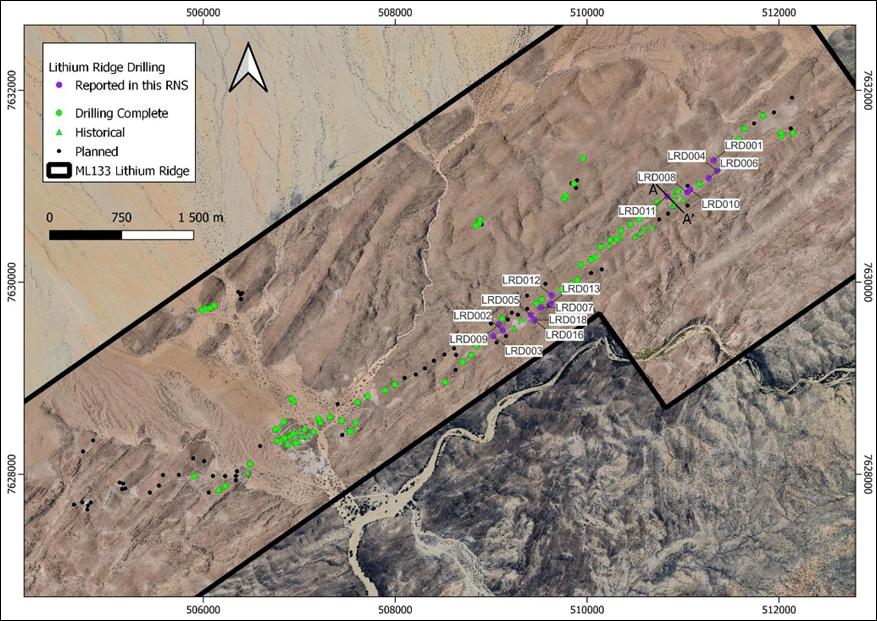
Figure 1: Map showing the locations of the completed and planned diamond drill (DD) holes (circles) from this campaign and the reverse circulation (RC) drill holes (triangles) completed during the 2023 campaign. The line A-A' represents the cross section in Figure 2.
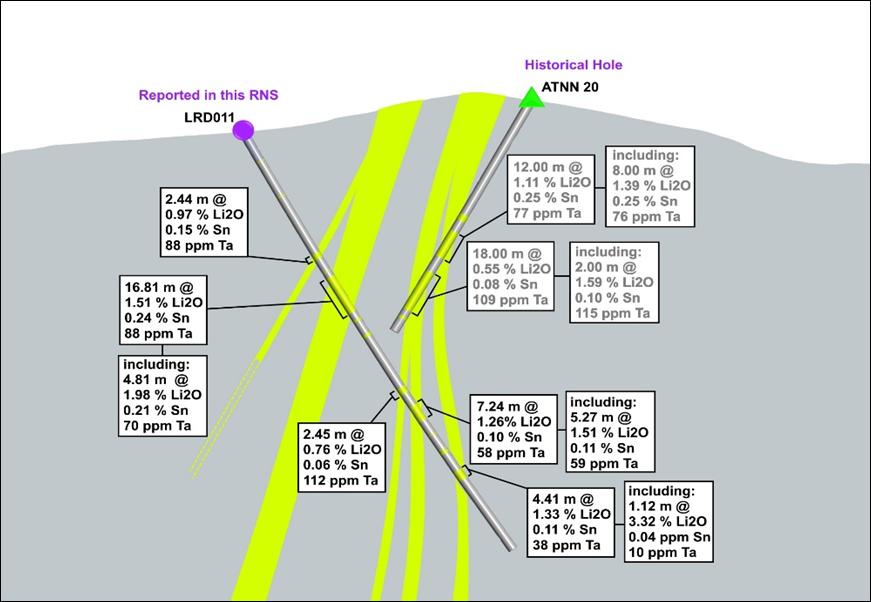
Figure 2: Section line A-A' displaying a projection of the diamond drill hole, LDR011, for which results are reported in this announcement and the RC drill hole, ATNN20, which was drilled during the 2023 campaign. The mineralised intersections from LDR011 are reported in Table 1.
Competent Person statement
The technical data in this announcement has been reviewed by Professor Laurence Robb ("Prof. Robb"), who is a non-executive director of Andrada. Prof. Robb has over 30 years industry related exploration and economic geology experience and is a Competent Person for the reporting of exploration results. He has reviewed both the technical disclosures in this release as well as the quality assurance protocols (QA/QC) and results for this programme.
Glossary of abbreviations
|
% |
Symbol for percentage |
|
DD |
Diamond Drill |
|
ICP-MS |
Inductively Coupled Plasma-Mass Spectrometry |
|
ICP-OES |
Inductively Coupled Plasma-Optical Emission Spectrometry |
|
Li |
Symbol for Lithium |
|
Li → Li₂O |
Metal to metal-oxide conversion factor of 2.153 |
|
Li₂O |
Lithium oxide |
|
PPM |
Parts Per Million |
|
RC |
Reverse Circulation Drill |
|
QA/QC |
Quality Assurance / Quality Control |
|
Sn |
Symbol for Tin |
|
Ta |
Symbol for Tantalum |
Glossary of technical Terms
|
Apparent thickness |
The relationship between apparent width and true thickness is based on the formula by Addie (1968 Economic Geology, vol 63, pp 188-189). |
|||
|
Dip Angle |
The angle of inclination measured downward from horizontal. |
|||
|
Geological Model |
The interpretation of mineralisation and geology that controls the shape of the mineralised unit. This is usually generated in a three-dimensional computer environment. |
|||
|
Pegmatite |
An igneous rock typically of granitic composition, which is distinguished from other igneous rocks by the extremely coarse size of its crystals, or by an abundance of crystals with skeletal, graphic, or other strongly directional growth habits, or by a prominent spatial zonation of mineral assemblages. |
|||
|
Xenolith |
A foreign rock fragment (e.g., schist) within an intrusive body (e.g., pegmatite) that is unrelated to the igneous body. |
|||
CONTACT |
|
|
||
ANDRADA MINING LIMITED |
|
|
||
|
Anthony Viljoen, CEO Sakhile Ndlovu, Head of Investor Relations |
+27 (11) 268 6555 |
|
||
|
|
|
|
||
NOMINATED ADVISOR & BROKER |
|
|
||
Zeus Capital LimitedKaty Mitchell Andrew de Andrade Harry Ansell |
+44 (0) 20 2382 9500 |
|
||
|
|
|
|
||
CORPORATE BROKER & ADVISOR |
|
|
||
H&P Advisory LimitedAndrew Chubb Jay Ashfield Matt Hasson |
+44 (0) 20 7907 8500 |
|
||
|
|
|
|
||
BerenbergJennifer Lee |
+44 (0) 20 3753 3040 |
|
||
FINANCIAL PUBLIC RELATIONS |
|
|
||
Tavistock (United Kingdom)Emily Moss Josephine Clerkin |
+44 (0) 207 920 3150 andrada@tavistock.co.uk |
|
||
About Andrada Mining Limited
Andrada Mining Limited, listed on the London Stock Exchange's AIM market, is a tin producer with a portfolio of critical minerals mining and exploration assets in Namibia, a premier investment destination in Africa. The Company's strategy focuses on unlocking Namibia's abundant mineral resources via best-in-class strategic partnerships across its resource base, enhancing the country's reputation as a leading global hub for African critical mineral investment. Andrada is actively scaling up tin production alongside lithium, tantalum, tungsten and copper, steadily broadening its operational footprint and output. The Company aims to supply critical raw materials from its extensive resource portfolio to support a sustainable future, improve quality of life, and uplift communities near its operations. These critical metals play a crucial role in the green energy transition, serving as essential components for electric vehicles, solar panels, and wind turbines.
RNS may use your IP address to confirm compliance with the terms and conditions, to analyse how you engage with the information contained in this communication, and to share such analysis on an anonymised basis with others as part of our commercial services. For further information about how RNS and the London Stock Exchange use the personal data you provide us, please see our Privacy Policy.

Latest directors dealings
- 10 hours ago Tesco
- 10 hours ago Dr. Martens
- 11 hours ago YouGov
- 12 hours ago Vistry Group
- 12 hours ago Cohort